
Authors: Linus Gundlach
Edited by: –
Last updated: October 8, 2025
Executive summary
CEO activism refers to corporate leaders publicly taking positions on social, political, or environmental issues that may sit outside the firm’s core business. The literature has converged on viewing it as a strategic and values‑driven practice that operates through two primary modes: CEO talk (communication) and CEO action (resource allocation and organizational choices). A multi‑theoretical lens—stakeholder, agency, legitimacy, and upper‑echelons theories—explains why and when CEOs speak up, how audiences interpret those messages, and where benefits and risks arise.
CEO activism is distinct from but related to CSR, corporate political activity, and political CSR. Unlike CSR’s firm‑level programs, CEO activism centers the individual leader and often tackles controversial issues. Unlike traditional political activity, it aims to influence broad stakeholder audiences rather than quietly shaping regulation. Political CSR overlaps when firms assume quasi‑public roles, but CEO activism is anchored in the CEO’s personal stance and visibility.
Research since the mid‑2010s documents rapid growth in the phenomenon. Visibility on digital platforms has heightened expectations, particularly among younger stakeholders, that CEOs will articulate values on salient topics. Evidence shows audience alignment is pivotal: employees, consumers, and investors respond favorably when a CEO’s position matches their beliefs and the firm’s identity. Misalignment can depress sales, invite boycotts, or trigger negative market reactions. Authenticity, message consistency, and issue–firm congruence mitigate downside risk.
For internal stakeholders, authentic activism that fits the company’s culture can strengthen identification, morale, and talent attraction. Externally, effects are heterogeneous: some investor segments reward value‑consistent activism while others penalize perceived distractions from profit. Consumers exhibit partisan purchase responses that can be material yet time‑bound. Policymakers may be more responsive to shifts in public sentiment catalyzed by CEO messaging than to CEOs directly.
Effective implementation follows three phases. In the pre‑stance phase, leaders clarify motivations, select issues with strategic congruence, assess stakeholder reactions, and prepare governance and risk controls. In the stance‑taking phase, they choose timing, channels (e.g., media, social, partnerships), and framing, ensuring the CEO’s voice and company actions align. In the post‑stance phase, they measure reactions, manage backlash, maintain consistency, and embed lessons into culture and processes.
Key drivers include strategic differentiation, brand identity reinforcement, employee engagement, and personal or ethical conviction. Principal barriers include polarization risk, investor concerns over mission drift, reputational fragility, and accusations of hypocrisy if talk outpaces action. A frequently cited best‑practice pattern combines timely, values‑consistent statements with credible follow‑through (e.g., resource commitments).
Important limitations remain. Definitions and typologies vary, causal identification is challenging, and findings are often US‑centric. Future work should refine shared constructs, broaden cross‑national coverage and industries, develop richer measures beyond short‑term market moves, and examine the roles of boards, advisory structures, and communication channels in shaping outcomes. For practitioners, disciplined issue selection, governance alignment, and evidence‑based evaluation are essential to create social impact while protecting organizational performance.
1 Definition and relevance
1.1 Relevance and motivation
The corporate landscape has seen a drastic change in the environment and requirements for the CEO. In recent years, the CEO has gained prominence through being seen as a sociopolitical actor, publicly taking the stance, challenging the boundaries of businesses and society, and creating the expectation that being quiet no longer seems like an option.1Gaines-Ross, L. What CEOs Should Know About Speaking Up on Political Issues. Harvard Business Review(2017). The underlying motivation of this thesis is to follow and understand all aspects and influences of the shift in corporate leadership. The rise of CEO activism in recent times suggests that the phenomenon has seen an evolution from being a rare occurrence to an expectation. To further understand the phenomenon, it is essential to establish a precise definition: CEO activism is defined as a corporate leader taking a public stance on environmental, social, or political issues, which are not necessarily directly related to the firm’s core business.2Hambrick, D. C. & Wowak, A. J. CEO sociopolitical activism: A stakeholder alignment model. Academy of Management Review 46, 33-59 (2021). This definition is critical to understanding the underlying factors of CEO activism and distinguishing the phenomenon from other corporate actions and behaviors.
1.2 Research question and contribution
Numerous studies have focused on examining specific inputs and outcomes of CEO activism, but complete reviews summarizing all results remain uncommon. To counter the trend and create a literature review that merges and summarizes the status quo of researched results, the primary research question is “What makes a CEO active and what impact do active CEOs have on corporate strategies and stakeholder behavior?”. This thesis aims to contribute a literature review exploring the CEOs motivations to strategically execute activism and analyze and collect the previously found results regarding impact and outcomes, especially seeking the impact on stakeholders, while also creating a guideline for the successful integration of activism.
1.3 Structure of the thesis
To adequately address the research question in a structured and comprehensive way, the thesis consists of two main chapters. Chapter 3 provides a deep and critical examination of the theoretical framework, which creates the foundation to further analyze the phenomenon and the empirical foundation, summarizing all relevant results of CEO activism. Further, the chapter will create a systematic overview of the evolution of the research field and further focus on impacts, limitations, and future research. Chapter 4 will provide a practical implementation guideline for a successful implementation for firms, bridging the gap between theory and practice. Analyzing strategic decisions, motivations, and tools, while commenting on the process behind the usage of activism and the complex challenge of creating a sustainable management of stakeholder reactions with a best practice example at the end.
2 Literature review
2.1 Definition & theoretical framework
The following chapter aims to create an overview of the underlying theories of CEO activism, while also giving a short introduction to the evolution of the definition.
2.1.1 Definition
CEO activism has gained prominence, especially over the past years, with increasing research, distinguishing the CEO as an individual person expressing his personal views and the CEO acting as an economic agent, focused primarily on the firm, has become a challenge. To counter the challenge, research has constantly found new definitions trying to limit any overlapping aspects; the development of the definition is shown in table 1 below.
| Time Period | Definition | Author |
| 2019 | “Corporate leaders speaking out on social and environmental policy issues not directly related to their company’s core business”.3Chatterji, A. K. & Toffel, M. W. Assessing the impact of CEO activism. Organization & Environment 32, 159-185 (2019). (p.1) | Chatterji & Toeffel |
| 2021 | “Distinct from the primary purpose of the business that CEOs lead; furthermore, it involves CEOs using their corporate position and resources to advance social and political cause”.4Layla, B., Brammer, S., Pullen, A. & Rhodes, C. The Morality of “new” CEO Activism. Journal of Business Ethics 170, 269-285 (2021). (p.1) | Branicki et al. |
| 2021 | “A business leader´s personal and public expression of a stance on some matter of current social or political debate, with the primary aims of visibly weighing in on the issue and influencing opinions.”2Hambrick, D. C. & Wowak, A. J. CEO sociopolitical activism: A stakeholder alignment model. Academy of Management Review 46, 33-59 (2021). (p.34) | Hambrick & Wowak |
| 2025 | “CEO talk (Leveraging communicative power) and CEO action (leveraging economic power) on sociopolitical issues”.5Fezzey, T. N., Drnevich, P. L. & Borgholthaus, C. J. Damned if you do and damned if you don’t: A theoretical examination and extension of CEO activism. Group & Organization Management 50, 632-681 (2025). (p.4) | Fezzey et al. |
Analyzing the emerging research field on CEO activism, a significant development is noticeable, especially pushed through the continuously enhanced definitions of CEO activism. These definitions focus on the strategies and motives with increasing complexity. Therefore, activism can vary, in CEO Talk and CEO Action, conceptualizing and creating a strategically highly active and volatile phenomenon, furthermore, the comprehensive definition appears less as a precise definition, but more as a complex strategic public performance of an individual CEO taking a stance.5Fezzey, T. N., Drnevich, P. L. & Borgholthaus, C. J. Damned if you do and damned if you don’t: A theoretical examination and extension of CEO activism. Group & Organization Management 50, 632-681 (2025).
2.1.2 Theories
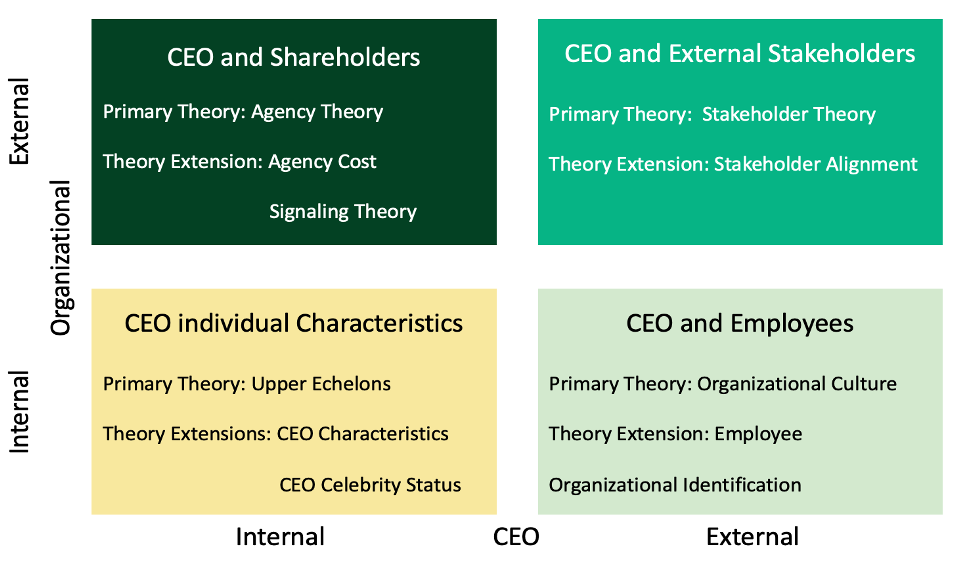
The current state of research has backed the findings with four theoretical frameworks, creating a multi-theoretical framework in the matter of CEO activism. Historically the main argument was conducted towards the stakeholder theory, later extending through the agency theory, the legitimacy theory, and the upper echelons theory.6Freeman, R. E. Strategic management: A stakeholder approach. (Cambridge university press, 2010). That multi-theoretical framework enables the current literature to create a well-balanced view on CEO activism, not as a single act of managers, but a complex phenomenon with psychological dynamics and significant impacts. Illustrated in Figure 1:
Stakeholder theory
The concept of CEO activism has been provided with a direct alignment to the stakeholder theory, indicating a significant influence from the theory on the concept. CEOs tend to engage with decisions driven by personal motivations and values, anticipating the aligned values with the stakeholders, especially with the customers or employees.8Briscoe, F., Chin, M. & Hambrick, D. C. CEO ideology as an element of the corporate opportunity structure for social activists. Academy of Management Journal 57, 1786-1809 (2014). Aligning with the stakeholder theory which states that the success of a firm lies in the satisfaction of all stakeholders (e.g., employees, investors, customers), not only those with direct impact (customers or shareholders).6Freeman, R. E. Strategic management: A stakeholder approach. (Cambridge university press, 2010).
Agency theory
CEO activism and the agency theory share parallels, mostly because the CEO stands at the focus of the public, by making statements on controversial topics, creating an overlapping pattern with the agency theory. Conversely, if the actions taken by the CEO would serve his individual preferences, without considering the corporate situation, of the firm it would not necessarily be solely CEO activism.7Cycyota, C. S. What did they say? A typology of CEO activism. Society and business review 18, 422-438 (2023). Therefore, it must be distinguished if the CEO acts with the aim of enhancing the corporate reputation and building up firm value – CEO activism, or if the CEO diverts completely from the business activities by focusing resources only on the personal agenda without regard to the firm’s possible outcome.9Chatterji, A. K. & Toffel, M. W. Do CEO activists make a difference? Evidence from a field experiment. Harvard Business School working paper series# 16-100 (2016).10Mkrtchyan, A., Sandvik, J. & Zhu, V. Z. CEO activism and firm value. Management Science 70, 6519-6549 (2024). The rise of CEO activism expands the concept, focusing more on shareholder interests, allowing the CEO more freedom to pursue an individual agenda.
Legitimacy theory
Serving as a powerful tool, CEO activism can be used to signal that the firm and the leadership of the firm are aligned with social values and current concerns by shareholders or society, enhancing legitimacy among the target group where the support is needed.11Cook, A., Glass, C. & Ingersoll, A. R. Who speaks? Individual and institutional predictors of CEO activism. Social Science Quarterly 104, 521-534 (2023). Taking a stance on topics which are unpopular or misaligned with the stakeholders can lead to a threat to the firm’s legitimacy. Following the principle of the organizational culture in the company, which acts as the primary force within the company, influencing new stakeholders, especially employees, towards the lived values and ideologies inside the firm.7Cycyota, C. S. What did they say? A typology of CEO activism. Society and business review 18, 422-438 (2023).
Upper echelons theory
Regarding the CEOs personal values and normative orientations constitute an influence on their propensity to engage with sociopolitical issues, not necessarily regarded as the core business of the firm, drawing parallels to the upper echelon’s theory. These values conceptualize the individual responsibility and moral awareness at the personal level of the CEO, but also regard the firm, shaping the ethical values towards the firm.7Cycyota, C. S. What did they say? A typology of CEO activism. Society and business review 18, 422-438 (2023). The CEO might engage in public stances to demonstrate the alignment of the individual CEO, the firm, the employees, and the customers. Taking the stance might not only be motivated by the evolution of institutional norms, but more so, it might be expected from the society for CEOs to take public stances on social topics, creating and helping the firms social standing to be enhanced.
2.1.3 Related concepts
Distinguishing CEO activism from other related concepts and theoretical frameworks enables a trace of history seen in the literature, due to the recent developments and the short history, many aspects of CEO activism build on other frameworks. The literature finds three main concepts that build the foundation of CEO activism; distinguishing them is crucial the three concepts include, Corporate Social Responsibilities (CSR), Corporate Political Activity (CPA), and Political CSR (PCSR). CEO Activism vs Corporate Social Responsibilities (CSR) CSR is one of the main concepts in the literature, and CEO activism has parallels. CEO activism is now distinguished and pushed towards further evolution. Many parallels between the frameworks can be seen by analyzing the literature. CSR focuses more on the broad firm initiatives that contribute to the societal goals and management of environmental impacts.12Sharp, Z. & Zaidman, N. Strategization of CSR. Journal of business ethics 93, 51-71 (2010). These activities are primarily aligned with the firms current and future strategy, focusing on the stands without necessarily involving controversial topics, debates, or focusing on individuals.12Sharp, Z. & Zaidman, N. Strategization of CSR. Journal of business ethics 93, 51-71 (2010). CEO activism, in contrast, is more focused on the individual, showing the CEO as the primary actor in the communication of the firm, frequently involving controversial topics that matter to society, not necessarily for the firms core business.13Rumstadt, F., Kanbach, D. K., Arweck, J., Maran, T. K. & Stubner, S. CEO activism is not equal to CEO activism: a typology of executives’ political statements. Management Decision 62, 370-397 (2024). Chatterji and Toeffel (2019) explicitly differentiated CEO activism from CSR, with the main argument of the individual aspects in CEO activism, concluding that the CEO stands as an individual public figure, with a more institutionalized approach than CSR.3Chatterji, A. K. & Toffel, M. W. Assessing the impact of CEO activism. Organization & Environment 32, 159-185 (2019). However, the view of the individual actor in CEO activism could overlap with strategic CSR of institutions and organizations, mainly due to the CEO speaking in the firms interest, differentiated from the approach of the moral context of the individual person (CEO).3Chatterji, A. K. & Toffel, M. W. Assessing the impact of CEO activism. Organization & Environment 32, 159-185 (2019). CEO Activism vs Corporate Political Activity (CPA) Traditionally, CPA refers to firms that influence governmental institutions or policies and regulatory processes, aiming to achieve specific advantages for their firm. Commonly, the CPA approach includes lobbying, campaign contributions, and participation in political action committees, all these actions are mainly not intended to be public information, or with the goal of supporting society through actions or statements, but mostly aim to increase the firms value and/or profit.14Lawton, T., McGuire, S. & Rajwani, T. Corporate political activity: A literature review and research agenda. International journal of management reviews 15, 86-105 (2013). CEO activism on the other hand, may also use the same channels of communication. However it distinguishes itself from CPA through underlining the individual act of communication through the CEO, mainly aimed at the customers or the public, often with the aim of influencing a broader target group, addressing stakeholders beyond the firm’s immediate core business or circle.2Hambrick, D. C. & Wowak, A. J. CEO sociopolitical activism: A stakeholder alignment model. Academy of Management Review 46, 33-59 (2021). CEO Activism vs Political CSR (PCSR) The defining characteristics of CEO activism are especially the public expression of the individual, underlining the controversial social or political debates, while achieving a value beyond the firms core business.10Mkrtchyan, A., Sandvik, J. & Zhu, V. Z. CEO activism and firm value. Management Science 70, 6519-6549 (2024). Standing in contrast to PCSR, distinct from the systematic governmental role, which is central in the political CSR (PCSR), where the company acts as an individual political player towards stakeholders, especially if governments start losing power.15Feix, A. & Wernicke, G. When is CEO activism conducive to the democratic process? Journal of business ethics 190, 755-774 (2024). Analyzing both concepts, the shift in expectations is clear, with firms and CEOs stepping into a role of activism, naturally conducted by governments or in public debates. In all concepts, there are overlapping patterns and aspects with CEO activism, creating a not always sharply differentiated concept and a complex field of study. The concept of CEO activism has mostly stood out with the individuality of the CEO and their statements, creating a merged concept of all previous named concepts, with one difference to all of them, in CEO activism the CEO is the main actor, creating value for society through statements and attention for different topics. Opposite to most concepts mentioned, the focus of CEO activism is beyond the core business, where the individual firm value is not necessarily the primary target.
2.2 Evolution of the literature
The early 2000s marked the beginning of a switch towards CEO activism and its importance, before an emerging CEO and a firm thinking, acting, and speaking towards social and political issues was seen as CSR.12Sharp, Z. & Zaidman, N. Strategization of CSR. Journal of business ethics 93, 51-71 (2010). Reflecting the importance of active CEOs without mentioning the phenomenon of CEO activism, due to its late gain in prominence.12Sharp, Z. & Zaidman, N. Strategization of CSR. Journal of business ethics 93, 51-71 (2010). The CEO started emerging as a public figure and gaining prominence around the 1980s-1990s, seeing a substantial increase in influence and performance. The global economic world saw a changing environment at the time, especially focused on restructuring and building globalization, increasing the spotlight for the CEO, at that time the society began to gain expectations for CEOs to communicate directly with stakeholders, regarding their input in decisions and making an impact in pushing through the changing climate economically and humanitarian.16Melloni, G., Patacconi, A. & Vikander, N. Cashing in on the culture wars? CEO activism, wokewashing, and firm value. Strategic Management Journal 44, 3098-3121 (2023). Around the early 2000s, the topic of active CEOs began to further evolve, with increasing interest, the first research began to emerge, providing an early theoretical lens and a first analysis of the phenomenon. The rise of the first literature began, enabling individuals with impactful activism and creating the image of a CEO as a powerful, visionary leader who is contributing to society, with strategic moves and influence. The CEO was no longer only the manager of economic wealth, with the sole aim of increasing firm value, but also used the power to create change and influence in important decisions.3Chatterji, A. K. & Toffel, M. W. Assessing the impact of CEO activism. Organization & Environment 32, 159-185 (2019).
The literature behind CEO activism has evolved rapidly, especially around 2016-2025, creating a more in-depth analysis of the topic. Overall, the earlier studies created a fundamental understanding of the topic without entering a detailed view, whereas recently published literature creates a deeper understanding with more expertise, moving away from the stakeholder theory, which gained its prominence at the beginning of the concept of CEO activism.17Rumstadt, F. & Kanbach, D. K. CEO activism. What do we know? What don’t we know? A systematic literature review. Society and business review 17, 307-330 (2022).
CEO activism gained prominence with a first academic definition around the mid-2010s through the research of Chatterji and Toeffel. Fundamentally the milestone was set with the research paper in 2016, establishing the first definition and distinguishing CEO activism from related corporate behaviors e.g. CSR and CPA, which tend to typically behave with discreet actions, as lobbying of direct benefits, separating them from the term of CEO activism.9Chatterji, A. K. & Toffel, M. W. Do CEO activists make a difference? Evidence from a field experiment. Harvard Business School working paper series# 16-100 (2016). The term began to gain increased prominence, literature started to build upon the first definition, creating a refined definition in the year of 2021 by Hambrick and Wowak, describing CEO activism as “a business leader’s personal and public expression of a stance on some matter of current social or political debate, with the primary aims of visibly weighing in on the issue and influencing opinions” (p.34).2Hambrick, D. C. & Wowak, A. J. CEO sociopolitical activism: A stakeholder alignment model. Academy of Management Review 46, 33-59 (2021).
Previous contiguous research by Chatterji and Toeffel in 2019 provided a push for upcoming research, creating a deeper view on the topic by measuring the impact of CEO activism and focusing the research more towards the direct, indirect, and favored topics of CEO activism.3Chatterji, A. K. & Toffel, M. W. Assessing the impact of CEO activism. Organization & Environment 32, 159-185 (2019). While also concluding that two major topics should be researched on, to further create a deeper understanding of the influence.
Firstly, the phenomenon of increased visibility of well-known CEOs, compared to more unnamed CEOs, secondly the societal issues at that time were examined, which could have influenced the results, pushing research further with different aspects in hand.3Chatterji, A. K. & Toffel, M. W. Assessing the impact of CEO activism. Organization & Environment 32, 159-185 (2019). The overall results within those three years by Chatterji and Toeffel marked a milestone in research for CEO activism, creating a deeper understanding of the initial evidence through field experiments, concluding that CEO activism could influence public opinions on issues, closely comparable to political figures, with the sole use of the correct form of activism towards favored topics.3Chatterji, A. K. & Toffel, M. W. Assessing the impact of CEO activism. Organization & Environment 32, 159-185 (2019).
Since then, the literature has experienced a growing influence and a larger role of CEOs, not only do CEOs act politically, for the well-being of their own employees, but they also act as an instrument, enabling the firm to enhance revenue streams or publicity around the company. Recent studies have shown that customers tend to prefer active CEOs, who share the same interests and ideologies.18Larcker F., D. a. T., Brian. CEO Activism Survey. Stanford Graduate School of Business and the Rock Center for Corporate Governance, 1-13 (2018). Analyzing the stock-market, there is a correlation to be seen, with increasing stock prices and enhanced active CEOs, making it clearer to define and understand the underlying Drivers and motives created and used by the CEO.10Mkrtchyan, A., Sandvik, J. & Zhu, V. Z. CEO activism and firm value. Management Science 70, 6519-6549 (2024).
In recent times the importance and increasing power of social media has achieved a general rethinking of activism, creating a generational shift over the past years. Social media has managed to create platforms where stakeholders are constantly confronted with activism, increasingly by firms and their CEOs.19Siedschlag, D. & Lana, J. The effect of corporate social activism: an integrative literature review. Cadernos EBAPE. BR 21, e2022-0305 (2024). Chronological Order The following chapter reflects the historical development of CEO activism and divides the key takeaways into clearly distinguished phases from each other.
Foundational period (Pre-2000s)
The foundational period is dominated by the developments upon the related concepts of which CEO activism builds upon, mainly through CSR and CPA development, where the CEO slowly became the main figure the phenomenon and gaining prominence. During that time the CEO emerged from the broader picture of corporate actions and became the focus of stakeholders.
Emergent period (Early 2000s-Mid 2010s)
Slowly, the literature began to recognize and analyze the CEO as an individual taking the stance and speaking for the company, not as the company. The focus began to shift away from issues directly related to the core business and into sociopolitical issues; the beginning of CEO activism was marked.
Consolidation and expansion period (Mid 2010s-Present)
This period marked the breakthrough of research related to CEO activism; for the first time, research explicitly labels the phenomenon where the CEO emerges, as CEO activism. The research of Chatterji and Toeffel, marked a foundation for future authors, with the first definition in occurring in 2016.9Chatterji, A. K. & Toffel, M. W. Do CEO activists make a difference? Evidence from a field experiment. Harvard Business School working paper series# 16-100 (2016). Since then, the research has further developed focusing on the driver and barriers, impact on stakeholders and more recently the motives and influence of CEOs regarded to the individual prominence.20Kim, Y. CEO activism: a strategic framework for topic selection, considering issue maturity and congruence. Corporate Communications: An International Journal (2024).
Generational shift
Analyzing the 2018 CEO Activism Survey by Stanford University, the given data shows a generational shift regarding the influence of active CEOs, advocating on particular social and political issues. Overall, the younger generation tends to demand that the CEOs influence is used to advocate on certain issues, about 71% of millennials call for issues to be advocated by the CEO, especially on topics that align with their values and interests, while only 63% of Gen X and even less of Baby boomers (46%) share the ideology, backing the change in relevance and demand for active CEOs in recent years.18Larcker F., D. a. T., Brian. CEO Activism Survey. Stanford Graduate School of Business and the Rock Center for Corporate Governance, 1-13 (2018). The difference between the generations is largely driven by social and cultural changes, especially with the rise of social media platforms, the younger generations have gained easier access to political statements.19Siedschlag, D. & Lana, J. The effect of corporate social activism: an integrative literature review. Cadernos EBAPE. BR 21, e2022-0305 (2024). Platforms like Instagram, Twitter or more recently TikTok have enhanced around social and political causes, unlike the older Generations (Gen X and Baby Boomers), Millennials are constantly confronted with real-time social issues and public figures engaging, especially CEOs increase their visibility of firm actions on certain issues.19Siedschlag, D. & Lana, J. The effect of corporate social activism: an integrative literature review. Cadernos EBAPE. BR 21, e2022-0305 (2024). Crucially not all topics that matter to society, e.g., climate change, social justice and diversity, are commented on by CEOs. As a result, younger Stakeholders – mainly Millennials, are demanding a more active CEO who takes public stances on issues that matter to them and shapes the firm in a way that values align with their own. That alignment to stakeholders increases the likability for firms, especially nowadays, younger generations tend to value a firm, mainly their impact to influence and drive societal change, not just on profits.18Larcker F., D. a. T., Brian. CEO Activism Survey. Stanford Graduate School of Business and the Rock Center for Corporate Governance, 1-13 (2018).19Siedschlag, D. & Lana, J. The effect of corporate social activism: an integrative literature review. Cadernos EBAPE. BR 21, e2022-0305 (2024). This shift in generational standpoints is likely closely linked to the digital evolution over the past years, with increasing accessibility to business leaders engaging with socio-political problems. Therefore, the CEO experiences a changed role with different responsibilities and an increasingly critical view of his statements and actions.
Respondence
Further analysis reveals that not every subject or topic is favorable for CEOs to advocate their issues and beliefs on, the majority of topics fall in disfavor for CEOs and their firms.18Larcker F., D. a. T., Brian. CEO Activism Survey. Stanford Graduate School of Business and the Rock Center for Corporate Governance, 1-13 (2018). The responders do not appreciate the CEO taking a stance on the majority of topics; mostly Gender, Political, and Humanitarian issues are not favored to be addressed.18Larcker F., D. a. T., Brian. CEO Activism Survey. Stanford Graduate School of Business and the Rock Center for Corporate Governance, 1-13 (2018). Whereas if the CEO advocates on topics which tend to be framed broader and less controversial, the majority of respondents support the CEO advocating and making a larger impact, receiving the necessary recognition, favored topics mainly are e.g., sustainability, clean air & water, and healthcare.18Larcker F., D. a. T., Brian. CEO Activism Survey. Stanford Graduate School of Business and the Rock Center for Corporate Governance, 1-13 (2018).
Motives
CEOs tend to participate in activism due to various reasons, analyzing the motives, a categorization can be conducted, the motives can be broadly categorized into strategic, personal, and ethical. The primary target of firms is that the strategy aligns with the brand identity and the board of directors, especially if the CEO is active. To create an increased and fundamentally reinforced brand identity, many CEOs decide to engage with topics that matter to society, aiming to attract or retain customers who align with the brand identity and values, by reinforcing the values and managing to differentiate from competitors.3Chatterji, A. K. & Toffel, M. W. Assessing the impact of CEO activism. Organization & Environment 32, 159-185 (2019). With that, there also come a handful of risks to keep a sustainable image of the firm, the CEO must stay aligned with the brand identity and values, which could conflict the personal beliefs of the CEO, creating a conflict of interests and enhancing consumer pressure, leading to a decrease in brand loyalty and accelerating possible stakeholder dissatisfaction.21Acharya, K. Three Essays on CEO Activism, Strategic Choices and Firm Performance. (2020). Creating negative consequences for the brand and the CEO, as stakeholders are constantly demanding an authentic CEO, the pressure arises for firms to potentially replace the CEO, misaligning with the brand values and identity.1Gaines-Ross, L. What CEOs Should Know About Speaking Up on Political Issues. Harvard Business Review(2017).
Although CEO activism is often framed by intuitional norms, mostly in communication, meaning that executives would act under pressure from stakeholders and disregard their own beliefs to push profits and firm likability. However, not all actions are driven by a strategic motive. Literature suggests that many CEOs are pushed and motivated by moral responsibility and use their power, seeing themselves as an individual with the influence to change outcomes in their interests or for the social good.3Chatterji, A. K. & Toffel, M. W. Assessing the impact of CEO activism. Organization & Environment 32, 159-185 (2019). That’s why ethical motives of the CEO may often overlap with the strategic objectives of firms, creating a blurring motive, between conviction and the strategic objective of the firm, therefore, recent literature has been distancing from the classic institutionalization of CEOs and moving towards a more complex and layered framework of CEO activism.17Rumstadt, F. & Kanbach, D. K. CEO activism. What do we know? What don’t we know? A systematic literature review. Society and business review 17, 307-330 (2022).
2.3 Impact on stakeholders
CEO activism spreads wide influence, especially stakeholders are affected, the main arguments serve the purpose of creating a reaction. Most importantly literature suggest that the responses of stakeholders to the CEOs argument are not based on the expressed views of the CEO, but much rather on the alignment between their own beliefs, values, and ideologies. This section aims explores the direct and indirect impact, by analyzing the internal stakeholders (primarily, employees) and the external stakeholders (primarily, consumers and investor) reactions.
2.3.1 Internal stakeholders
The probably most relevant stakeholder for a company is their own employee; employees represent a critical audience for the CEO; their reactions are one of the most important to manage if the firm wants to grow. Studies indicate that the alignment between the views of the CEO, communicated through CEO activism, and the employee’s views and values can significantly improve the morale, engagement, and identification with the firm.10Mkrtchyan, A., Sandvik, J. & Zhu, V. Z. CEO activism and firm value. Management Science 70, 6519-6549 (2024). Authenticity is a fundamental aspect; if employees perceive their CEO as authentic, they tend to create a more profound feeling of belonging to the firm; conversely, research additionally suggests that participants tend to forget and disregard some of the past statements.22Jin, J., Mitson, R., Qin, Y. S., Vielledent, M. & Men, L. R. Can CEO activism be good for the organization? The importance of authenticity, morality, and timeliness. Journalism & Mass Communication Quarterly 101, 590-611 (2024). Furthermore, CEO activism plays a crucial role; literature further suggests that if the employee’s ethical expectations of their CEO correlates with the morality and values of their CEO, it positively benefits employees.23Brown, L. W., Manegold, J. G. & Marquardt, D. J. The effects of CEO activism on employees person‐organization ideological misfit: a conceptual model and research agenda. Business and Society Review 125, 119-141 (2020). Focusing on the alignment between the CEO and the employees can translate into a benefit in performance. When employees have a sustainable feeling that their fundamental values are shared within the firm, they are more likely to increase their effort and align their behaviors with the firms culture.24Burbano, V. in Academy of Management Proceedings. All measures create aligned stakeholders, especially the alignment of employees will lead to an increase in value for the firm, either through an increase in production, increase in investments or stakeholder satisfaction.
2.3.2 External stakeholders
Analyzing the external stakeholder behavior, firstly looking at investor and shareholder reactions to active CEOs. Literature has found that not all stakeholders are positive about CEO activism. Some stakeholders pursue a negative image of the firm if the CEO is too active, which has a negative effect on market shares.25Bhagwat, Y., Warren, N. L., Beck, J. T. & Watson Iv, G. F. Corporate sociopolitical activism and firm value. Journal of marketing 84, 1-21 (2020). The effect is triggered through the image and signal that the CEO sends to the investors by being active, implying that sociopolitical issues stand in a greater focus, rather than profits of the firm, creating a drop in market share price, in the mean of approximately -0,43%.25Bhagwat, Y., Warren, N. L., Beck, J. T. & Watson Iv, G. F. Corporate sociopolitical activism and firm value. Journal of marketing 84, 1-21 (2020). Conversely, other studies suggest that the impact of CEO activism has a positive effect on stock prices if the CEO addresses specific issues that overlap with the ideologies of the largest investor segment, with a consistent message.26Durney, M. T., Johnson, J. A., Sinha, R. K. & Young, D. CEO (in) activism and investor decisions. Contemporary accounting research 42, 525-552 (2025). Through CEO activism not only are investors strongly influenced, but also consumers have a clear understanding of their values and show their satisfaction through purchase intentions, actual sales, and store visits.27Hou, Y. & Poliquin, C. W. The effects of CEO activism: Partisan consumer behavior and its duration. Strategic Management Journal 44, 672-703 (2023). Research indicates that when the CEO speaks towards the consumers and shares the same ideologies, the sales start to increase and consumer satisfaction, conversely if the CEO speaks against the consumers ideologies, the sales and store visits start to decrease.27Hou, Y. & Poliquin, C. W. The effects of CEO activism: Partisan consumer behavior and its duration. Strategic Management Journal 44, 672-703 (2023).
Further, CEO activism is a powerful tool that doesn’t necessarily only influence the direct stakeholders but can influence the broader societal opinion. If CEO activism is used effectively, CEOs can leverage their standpoints and influence public opinions to a certain extent, influencing various policies to support their argument. Literature found that CEO activism is able to influence public opinions, reaching to an extent similar to that of politicians.3Chatterji, A. K. & Toffel, M. W. Assessing the impact of CEO activism. Organization & Environment 32, 159-185 (2019). Continuous research found that active CEOs do not influence policy makers to the extent of changing policy reforms in the interests of firms and CEOs, forcing policy makers to be less willing to engage with CEOs who take controversial stances, suggesting that the influence on polices gets pushed through the public stand points, enhancing the firms interests whilst not directly pushing positively towards politicians.28Poliquin, C. & Hou, Y. Policymaker Responses to CEO Activism. Organization Science (2025).
Overall, research shows that the CEO can influence stakeholders’ reactions and the image of a firm in a positive and a negative way. If CEO activism is performed towards the stakeholders’ ideologies, a positive increase in firm value is created, which leads to motivated employees, satisfied investors, and consumers.10Mkrtchyan, A., Sandvik, J. & Zhu, V. Z. CEO activism and firm value. Management Science 70, 6519-6549 (2024). Whereas if the CEO is unable to confirm that the firm is acting in the stakeholders’ interests regarding socio-political issues, the stakeholder is likely to decrease their likability towards the firm, which creates a backlash for the CEO and the firm’s economic performance.
2.4 Limitations & future research
Examining the existing research work of CEO activism, this section aims to analyze limitations in the research field and outline possible and promising future research. While the research field itself has seen a significant amount of growth throughout recent years, the topic itself remains new. Therefore, further insights and research must be conducted to provide a comprehensive understanding of the topic.
2.4.1 Limitations
Analyzing the growing field of CEO activism, valuable insights into the topic have been researched and analyzed, especially over the past years. As a result, several limitations influence the current findings.
Conceptual and theoretical
The theoretical grounding has been worked out as a significant limitation; a more robust theoretical grounding is needed for research to focus on the same factors and create a research area with common ground. The definition of CEO activism has generally covered the CEO as an individual taking a public stance on sociopolitical issues not directly related to the core business.2Hambrick, D. C. & Wowak, A. J. CEO sociopolitical activism: A stakeholder alignment model. Academy of Management Review 46, 33-59 (2021). Further ongoing research highlights that the current research lacks a shared idea of a concept on which all of literature can build upon, the aim should be to create a framework which fills the gaps of unclear KPIs; such as distinguishing the firm from the CEO and activism regarding direct business opportunities and indirect business related topics, whilst also creating a clear line that separates from other frameworks e.g. CSR and CPA.13Rumstadt, F., Kanbach, D. K., Arweck, J., Maran, T. K. & Stubner, S. CEO activism is not equal to CEO activism: a typology of executives’ political statements. Management Decision 62, 370-397 (2024). The distinction from other frameworks is not always as clear as it should be to enable a clear evolutionary path, most likely due to previous mixing of related concepts, falling into the matter of CEO activism.29Bojanic, V. The positioning of CEOs as advocates and activists for societal change: reflecting media, receptive and strategic cornerstones. Journal of Communication Management 27, 398-413 (2023). While research emphasizes CEO activism as an individual taking the stance, clearly distinguished from the features of CSR and CPA, some literature tends to overlap and focus more on the individual firm instead of the CEO, creating overlapping factors, initiatives, and aspects. Furthermore, the motives of CEO activism have evolved to be clearer in recent literature, but remain debatable, with discussions regarding drivers, values, and reasons.29Bojanic, V. The positioning of CEOs as advocates and activists for societal change: reflecting media, receptive and strategic cornerstones. Journal of Communication Management 27, 398-413 (2023).
Methodological
Early research on CEO activism has been seen critically, due to the recency of the topic, the need for more theoretical and robust analyses has become clear, creating a of lack robust conclusions of processes and outcomes, as literature suggests the existing framework is intended to be only temporarily in its state, especially regarding stakeholder reactions.29Bojanic, V. The positioning of CEOs as advocates and activists for societal change: reflecting media, receptive and strategic cornerstones. Journal of Communication Management 27, 398-413 (2023). Research has seen a significant challenge in the area of CEO activism, creating causality between the CEO taking actions and the direct influence on stakeholders (e.g., changes in firm value or stakeholder behavior), while accounting for a lack of possible other factors.30Bedendo, M. & Siming, L. To advocate or not to advocate: Determinants and financial consequences of CEO activism. British Journal of Management 32, 1062-1081 (2021). Supporting the previous argument of inconsistent results; literature finds positive stock market reactions to CEO activism, conversely, others find negative stock market reactions.25Bhagwat, Y., Warren, N. L., Beck, J. T. & Watson Iv, G. F. Corporate sociopolitical activism and firm value. Journal of marketing 84, 1-21 (2020).26Durney, M. T., Johnson, J. A., Sinha, R. K. & Young, D. CEO (in) activism and investor decisions. Contemporary accounting research 42, 525-552 (2025). Measuring the impact has presented a significant challenge for the literature. Not only the stock market reactions which mostly cover the short-term reactions, probably also due to the recency of the topic, but also survey-based measures may not always fulfill the goal and translate into actual behavior.31Homroy, S. M., Anahit; Sandvik, Jason in Oxford Business Law Blogs (2015).
General
General limitations in the literature are primarily focused on the regional aspect of the research, meaning that significant amount of research, especially the data used is based in the U.S. or applied in the Western context, limiting the analyses to the U.S. and the West.32Adae, E. K. CEOs on a mission: reimagining CEO activism, development, and difference. p. 107-126 (Emerald Publishing Limited, 2023). Supporting the need for literature to expand their research further into different geographical locations, highlighting different motivations and tactics used by the CEO to influence a different cultural target group. Further published studies focus on specific types of activism or specific CEO actions, potentially overlooking broader statements or broader actions taken which, could influence the stakeholders, missing out on the potential effect and measure.32Adae, E. K. CEOs on a mission: reimagining CEO activism, development, and difference. p. 107-126 (Emerald Publishing Limited, 2023). These limitations illustrate the importance of the ongoing evolving research conducted, especially due to the change in the rapidly evolving findings from one period, these findings may not hold true in other periods of time, mainly due to shifts in sentiments and stakeholder behaviors or unequal geographical locations. Disregarding these limitations could cause a backlash against the firm or the CEO if the favored topics of the CEO to comment on change or the cultural importance are disregarded.
2.4.2 Future research
Addressing the previously mentioned limitations of CEO activism, future research must be conducted with a focus on emerging topics and on decreasing gaps and limitations. This chapter aims to offer insights on how future research could fill the gaps with valuable areas of focus.
Conceptual and theoretical
Focusing future research on the development of a more sophisticated theoretical framework would enhance the evolving matter of CEO activism, especially if regarding the missing components addressed in the limitations. Evolving the framework could include creating a refined typology of activism to capture specific outcomes and actions taken, such as roles and the position of the CEO.13Rumstadt, F., Kanbach, D. K., Arweck, J., Maran, T. K. & Stubner, S. CEO activism is not equal to CEO activism: a typology of executives’ political statements. Management Decision 62, 370-397 (2024). Focusing on a dominant and more sophisticated framework would enable research to continue towards a genuine approach where all conclusions and results would be comparable, whilst offering a universal implementation process. Further, research should focus on the motivations for CEO activism, especially regarding the personal values of the CEO, understanding the political movement, ethical considerations, and the strategic objectives of the firm.10Mkrtchyan, A., Sandvik, J. & Zhu, V. Z. CEO activism and firm value. Management Science 70, 6519-6549 (2024). Enhancing the previously mentioned personal values and motives of the CEO would enable researchers to comment and understand the intrinsic drivers of CEO activism, whilst being able to comment on the necessary soft skills required for the CEO to successfully and actively participate in activism.21Acharya, K. Three Essays on CEO Activism, Strategic Choices and Firm Performance. (2020). Research on the relationship and key differences between CEO activism and the related concepts, especially CSR and CPA, warrants a systematic approach to actively understand the joint and independent effects on stakeholders. In future studies, the possible influence of the related concepts and their influence on one and another, with primary focus on aligning the concepts and finding key drivers and barriers in their joint and independent effects.2Hambrick, D. C. & Wowak, A. J. CEO sociopolitical activism: A stakeholder alignment model. Academy of Management Review 46, 33-59 (2021).
Methodological
Focusing on improving the methodological approach, would need for studies to create a more robust design, tracking firms over a longer period to provide the needed evidence of long-term performance and consequences especially in the context of stock market reactions, where the CEO could influence performance through actions, apart from the usual volatility in the market.25Bhagwat, Y., Warren, N. L., Beck, J. T. & Watson Iv, G. F. Corporate sociopolitical activism and firm value. Journal of marketing 84, 1-21 (2020). Focusing research abroad on standardized geographical locations, e.g., the U.S. would generalize the findings cross-culturally and create a dynamic research approach which enables CEOs across the world to implement activism.13Rumstadt, F., Kanbach, D. K., Arweck, J., Maran, T. K. & Stubner, S. CEO activism is not equal to CEO activism: a typology of executives’ political statements. Management Decision 62, 370-397 (2024). Additionally focusing, on the cross-cultural findings enables not only geographical differences but also multi-industries and different firm types, which would yield valuable insights. Improving the development of a more nuanced measure for effectiveness and performance of activism, not solely financial metrics, would enable a better understanding of stakeholder alignment and authenticity of the CEO.13Rumstadt, F., Kanbach, D. K., Arweck, J., Maran, T. K. & Stubner, S. CEO activism is not equal to CEO activism: a typology of executives’ political statements. Management Decision 62, 370-397 (2024). This could be achieved by combining a qualitative and quantitative approach focusing on the broader picture such, as the involvement and influence of Board members, other stakeholders, and the impact of regional CEOs on group CEOs of big firms, to gain a more contextualized understanding.13Rumstadt, F., Kanbach, D. K., Arweck, J., Maran, T. K. & Stubner, S. CEO activism is not equal to CEO activism: a typology of executives’ political statements. Management Decision 62, 370-397 (2024).
General
Furthermore, several areas remain partially unexplored. More research is needed regarding the role of the board of directors, which focuses on overseeing the governing CEO, leaving the board approach and influence in decision making and hiring a fitting CEO for the firm, partially unexplored.30Bedendo, M. & Siming, L. To advocate or not to advocate: Determinants and financial consequences of CEO activism. British Journal of Management 32, 1062-1081 (2021). Building upon the influence of the board of directors, future research could investigate the effect of the advisory board, regarding the potential shaping and influence on the CEO and the actions taken. Especially the research focus on the advisory board may answer questions about the effect of CEOs on stakeholders and their individual decisions on activism beyond the firms core business and the individual values, proving that CEOs do not hold the power alone but are influenced to a particular extent.33Hou, Y. & Poliquin, C. CEO Activism and Political Mobilization. Journal of Business Ethics, 1-17 (2024).
The impact and influence of CEOs, especially through activism, on internal stakeholders, particularly regarding employees is still an area of interest for further studies. While literature suggests that CEO activism can boost employee work ethic, satisfaction, and attract talent, more research has to be conducted on the concrete implementation and active engagement of firms and CEOs as part of their strategic concept, role of leadership, communications, and potential polarization.34Mkrtchyan, A., Sandvik, J. & Xu, D. Employee responses to CEO activism. Journal of Accounting and Economics 78, 101701 (2024). Focusing on the effectiveness of communication channels and strategies, especially the strategy of social media, requires an ongoing examination of the digital evolution of platforms and usage.35Yue, C. A., Thelen, P., Robinson, K. & Men, L. R. How do CEOs communicate on Twitter? A comparative study between Fortune 200 companies and top startup companies. Corporate Communications: An International Journal 24, 532-552 (2019). These effects could cross-reference on the impact of CEO activism and show dynamics and effectiveness of the CEO, especially building on the objectives for future research, in public relations or different perspectives in the industry, or specific industry differences in the strategic approach and channels.36Krishna, A. in Current trends and issues in internal communication: Theory and practice 113-129 (Springer, 2021).
Broader societal movements influence and desire for cultural changes have been seen as an area of potential influence but remain a key area for research to focus on. Especially the long-term effect of CEO activism, in social and political polarization, with regard to generational shifts, change in power and influence as well as the nature of key skillset for a CEO to be successful for current and future generations.34Mkrtchyan, A., Sandvik, J. & Xu, D. Employee responses to CEO activism. Journal of Accounting and Economics 78, 101701 (2024). With research focusing on addressing these limitations in future research, literature will be able to evolve significantly and enhance academic and practical relevance with room for implementation, through a robust foundation for research and understanding of the topic.
3 Practical implementation
3.1 Drivers & barriers
CEO activism is performed with the aim of influencing stakeholders for different reasons; this chapter aims to analyze the different drivers and barriers to performing CEO activism.
3.1.1 Drivers
When analyzing active CEOs and their stakeholders’ reactions to activism, it is essential to distinguish different drivers for the CEOs. When analyzing stakeholder reactions to reasons of CEO activism in the Survey of Weber, Shadwick, and KRC Research, the drivers and barriers are differentiated into three groups. Distinguishing between Strategic/Economic drivers, Personal drivers of the CEO, and Moral/Ethical reasons for activism.37Shandwick, W. CEO activism in 2018: The purposeful CEO. Weber Shandwick & KRC Research (2018).
Strategic and economic
CEO activism is often used as a strategic instrument capable of influencing company performance and stakeholder engagement through actions, this metric enables companies to create economic advantages. Through different statements from CEOs regarding the role of activism, the firm value has increased through a positive market reaction, indicating the importance of successful activism.10Mkrtchyan, A., Sandvik, J. & Zhu, V. Z. CEO activism and firm value. Management Science 70, 6519-6549 (2024). Suggesting that the correct use of CEO activism can lead to a higher brand value, influenced by an increase in sales, and led by customer and investor satisfaction. Analyzing the Survey of Weber, Shadwick and KRC Research, the previous assumptions are backed with data, indicating that the reasons for the CEO taking the stance is mainly pushed to increase sales, with 21% of Americans sharing the same ideology and fulfilling the strategic and economic reasons, 8% believing that CEO activism is done to enhance competitiveness, and 7% believe it is to motivate and attract new employees.37Shandwick, W. CEO activism in 2018: The purposeful CEO. Weber Shandwick & KRC Research (2018). Especially in political polarized markets CEO activism can lead to a huge advantage for firms, if firms share ideologies with the main customer segment, the firm takes these actions through the CEO as an individual enabling the consumer segment to easier be influenced and creating an increase in customer visits and in sales, mainly pushed if the firm speaks into the ideologies, of the main customer segment.38Homroy, S. & Gangopadhyay, S. Strategic CEO activism in polarized markets. Journal of Financial and Quantitative Analysis 60, 617-657 (2025). By applying activism as a firm through the CEO, the firm is able to reach a higher customer satisfaction and higher sales than before, while also distancing itself from competitors.
Personal
The personal motives, values, and ideologies of CEOs can deeply influence the actions taken in the form of activism, primarily the motivations of the individual can result in a more frequent role of activism or engagement. The pre-assumption that CEOs only act out of corporate benefit or for their own self illustration still is widely spread in modern society.37Shandwick, W. CEO activism in 2018: The purposeful CEO. Weber Shandwick & KRC Research (2018). Enhancing the pre-assumption, 36% of all Americans think that CEO activism is solely pushed to get attention, and a further 21% are convinced that the CEOs own reputation is at stake.37Shandwick, W. CEO activism in 2018: The purposeful CEO. Weber Shandwick & KRC Research (2018). Research indicates that the standing and prestige of the CEO shields them from potential backlashes of their statements, consequently the findings imply that the higher the prestige and status of the CEO is and the better the reputation of the firm is, the more likely it is that controversial societal debates and issues are being addressed, mainly because of CEOs prominence the reduced risk of backlashes occurs in more statements with controversial topics and ideologies of the firm and the CEO.39Acharya, K., Abebe, M. A., Kroll, M. & Solano, G. The executive bully pulpit: Drivers of CEO sociopolitical activism in the wake of social movements. Corporate Governance: An International Review 33, 506-528 (2025). Through activism the CEO gains a chance of speaking out, enabling a stage where the CEO can create a personal brand and get attention through statements, leading to a possibility to gain prominence through activism and enhance activism in a sustainable manner.
Moral & ethical
Moral and ethical results show the complexity where the CEO must balance the personal ideologies and convictions with the economic interests of the firm, creating a possible tension if the CEO is personally convinced of a specific opinion, but needs to articulate and spread a different standpoint. Whereas if the CEO speaks out on a certain matter, the firm can be used to underline these statements and create a stronger impact of the statement, leading the CEO to actively engage in activism.10Mkrtchyan, A., Sandvik, J. & Zhu, V. Z. CEO activism and firm value. Management Science 70, 6519-6549 (2024). Conversely, the CEO might feel compelled to address issues due to strong stakeholder engagement or expectations, even if the individual CEO is not convinced, taking the stance from a personal standpoint or priority. Highlighting the agency dilemma where the CEO is seen as an agent, balancing the personal convictions with the economic interests of the firm, representing the diverse and sometimes conflicted stakeholder expectations or preferences towards the firm and the CEO, whereas if the CEO is intrinsically motivated to advocate on certain issues the effect on stakeholders increases.40Melloni, G., Patacconi, A. & Vikander, N. CEO activism as communication to multiple audiences. Available at SSRN 3455330 (2019).
3.1.2 Barriers
The decision or the pressure to engage in activism as a CEO does not always result in a positive outcome, many downsides exist, creating numerous barriers ranging from strategic and economic losses to damages in the firm’s or personal reputation, or moral and ethical barriers.
Strategic and economic
Polarizing with public stances, the CEO can cause issues for the firm by impacting stakeholder behavior if they hold opposing views, potentially triggering backlashes measured through economic consequences, such as consumer boycotts, decline in investor confidence, or negative reactions in the stock market.10Mkrtchyan, A., Sandvik, J. & Zhu, V. Z. CEO activism and firm value. Management Science 70, 6519-6549 (2024). Research found that shareholders react negatively even if the CEO focuses on presidential advisory, due to the interpretation that these actions are potentially forced by weaknesses of the firm or low economic prospects.7Cycyota, C. S. What did they say? A typology of CEO activism. Society and business review 18, 422-438 (2023).41Wowak, A. J., Busenbark, J. R. & Hambrick, D. C. How do employees react when their CEO speaks out? Intra-and extra-firm implications of CEO sociopolitical activism. Administrative Science Quarterly 67, 553-593 (2022). Dividing the form of activism into stronger and weaker activism also enables the division of financial and economic risks, where intense activism takes stance on highly controversial topics or political influence, and weaker activism is a more conservative activism. Implying that a form of risk and reward trade-off is visible, where a strong form of activism can lead to increased impactful and visible enhancements for the firm, with an increased chance of a backlash, and the weaker form is not as impactful but also contains a decreased potential of a backlash.7Cycyota, C. S. What did they say? A typology of CEO activism. Society and business review 18, 422-438 (2023).
Personal
Characteristics of CEO activism underscore the risk and reward trade-off previously mentioned, while the successful use of activism does not only influence the target group, but also aligns with the individual standpoints of the CEO controversial actions may not only influence the firm in a negative way, rather danger the reputation of the CEO long term.7Cycyota, C. S. What did they say? A typology of CEO activism. Society and business review 18, 422-438 (2023). The risk of damaging the individual reputation is always on the line for the CEO especially, by the public, but also on the personal nature of the CEO. The long-term credibility of the individual CEO is directly affected and in jeopardy, meaning that the personal involvement between the CEOs statements and the firm’s actions can be damaging to both parties, if misaligned. Research indicates that problematic aspects of the firms profile can lead to a decrease in trust and provoke backlashes towards the firm, if illustrated potential pitfalls.20Kim, Y. CEO activism: a strategic framework for topic selection, considering issue maturity and congruence. Corporate Communications: An International Journal (2024).
Moral & ethical
Following the moral and ethical conduct of the individual CEO, taking a public stand on social issues can cause ethical dilemma, if the CEO knows that their own firms operations are imperfect and stay in controversy of the statements the act can be seen as an hypocrisy.42Warren, D. E. “Woke” corporations and the stigmatization of corporate social initiatives. Business Ethics Quarterly 32, 169-198 (2022). Therefore, sometimes choosing to be silent as the CEO can be framed as more ethical manner. Further the CEO may choose to remain silent to decrease the resources obtained by the firm, shareholder property, and advance their own personal values apart from the core business, leading to an unjustifiable use of capital which could even backlash for the firm in the future and possibly create a difficult and problematic position for the shareholder, stakeholder, and the firm.43Pirsos, N. (Washington University School of Law, 2024). Further the CEO is faced with the problematic of speaking for the entire firm, a firm with diverse employees, customers, and investors, all with a widespread spectrum of values on personal and political issues. Taking action and using the firm to share the individual views of the CEO on certain issues is challenging and can feel as an ethical overreach losing democracy inside of the firm.15Feix, A. & Wernicke, G. When is CEO activism conducive to the democratic process? Journal of business ethics 190, 755-774 (2024).
3.2 Process & tools
Effective CEO activism requires deliberate strategic planning with a robust process and a clear roadmap for a calculated outcome. This section aims to examine the process and tools that must be aligned for CEO activism, to create an enhanced, economically strong instrument for the firm and the individual CEO.
3.2.1 Process
Academic papers have evolved towards a three-cycled process for the implementation of activism, distinguishing the pre-stance phase, the stance-taking phase, and the post-stance phase from each other.44Olkkonen, L. & Morsing, M. A processual model of CEO activism: Activities, frames, and phases. Business & Society 62, 646-694 (2023). The following cycle underlines the important aspects that need to be regarded for a successful implementation, while underscoring the required planning before, during, and after. Figure 2 illustrates the process of CEO activism:

Pre-stance phase
In the pre-stance phase, the critical preparatory work is the focus. This stage involves managing the motivations of stakeholders, especially the clarification by the CEO and the leadership team for engaging in activism towards a topic of choice. The individual drivers of the CEO, the objectives which are aimed to be achieved, and the stakeholder satisfaction further have to be regarded.44Olkkonen, L. & Morsing, M. A processual model of CEO activism: Activities, frames, and phases. Business & Society 62, 646-694 (2023). Crucially expectations management, stands in the focus, aimed to anticipate key stakeholder reactions, especially of employees, to ensure that the employees stay aligned with the corporate culture.32Adae, E. K. CEOs on a mission: reimagining CEO activism, development, and difference. p. 107-126 (Emerald Publishing Limited, 2023). To fundamentally support the CEO in CEO activism the strategy must be aligned with the firms values and regard a well-informed decision-making processes. The initial step of every planning regarding CEO activism involves the selection of a socio-political topic that the CEO wants to address, followed by the question of being proactive or reactive to a certain issue. Literature proposes a strategic model which emphasizes the dimensions which the CEOs can use to make decisions on which topics they want to advocate on, the issue itself, or the company issue.20Kim, Y. CEO activism: a strategic framework for topic selection, considering issue maturity and congruence. Corporate Communications: An International Journal (2024). This preparatory phase is essential for the strategic alignment, risk management, and result management for the firm, to transform potential impulses into value through corporate actions.
Stance-taking phase
The stance-taking phase is the most visible phase, involving the use of different instruments, selected in the pre-stance phase from the CEOs own toolkit and ability, the core lays in the execution of expressing a position to a sociopolitical issue with the selected instrument, either directly through the CEO, if the CEO is used as a role model or the statement is pushed through the firm, then the CEO acts further in the background and the firm stands in the focus, acting as an own entity, with the CEO as the executional force.44Olkkonen, L. & Morsing, M. A processual model of CEO activism: Activities, frames, and phases. Business & Society 62, 646-694 (2023). The focus should lie on the specific choice of tools used, the exact timing of the announcement, and especially the framing of the statement to ensure a successful fulfillment of the previously determined aim of managing the defined expectations of the stakeholders.44Olkkonen, L. & Morsing, M. A processual model of CEO activism: Activities, frames, and phases. Business & Society 62, 646-694 (2023).
Post-stance phase
The post-stance phase marks the last phase; it involves managing the results and the consequences of the stance. Especially the active management of misaligned stakeholders through a backlash, which is certainly a potential outcome to be expected, secondly, the post-stance phase marks a perfectly fitted timeframe to implement recurring activism through integrated stance taking and commenting on issues within the firms culture.44Olkkonen, L. & Morsing, M. A processual model of CEO activism: Activities, frames, and phases. Business & Society 62, 646-694 (2023). The post-stance includes managing the possible media fallout, reinforcing and adjusting the framing without changing the key message through consistent communication with different media to demonstrate long-term commitment and consistency, while fulfilling the aim and building credibility and trust.32Adae, E. K. CEOs on a mission: reimagining CEO activism, development, and difference. p. 107-126 (Emerald Publishing Limited, 2023). The structured approach marks a multi-stage process, which strongly indicates that the use of effective CEO activism is a calculated strategic action and initiative. Following the detailed preparation through a roadmap, following the pre-stance approach shows the strategic management that builds the foundation for a value-driven implementation.
3.2.2 Tools
The selection of tools for a successful implementation is the primary part for reaching the intended target group and achieving the planned outcome, in harmony with fitting measures of CEO activism, which can significantly influence. This chapter aims to comment on tools that are useful for the CEO when implementing activism, with further focus on the ideal harmony between different tools and measures. CEOs possess a diverse and expanding toolkit, which can be used to implement CEO activism.32Adae, E. K. CEOs on a mission: reimagining CEO activism, development, and difference. p. 107-126 (Emerald Publishing Limited, 2023). To enhance the previous statements, the tools can be divided into different categories, covering three main categories: Communicative, Economic, and Culture.
Communicative instruments are probably the most visible form for CEOs to participate in activism, focusing on awareness for certain topics and influencing target groups through statements and discourses. The communication tools include different forms, focusing on public statements, media engagements, social media, and public speeches. Firstly, public statements and media engagements involve formal press releases or direct engagement with established media companies, where the CEO can adequately comment on different issues.3Chatterji, A. K. & Toffel, M. W. Assessing the impact of CEO activism. Organization & Environment 32, 159-185 (2019). Secondly, social media plays a significant role in activism, especially regarding sociopolitical issues. Social media has evolved into a primary channel for activism, enabling a direct effect on a wider audience with the ability to express the individual message at any given point in time.19Siedschlag, D. & Lana, J. The effect of corporate social activism: an integrative literature review. Cadernos EBAPE. BR 21, e2022-0305 (2024).
Beyond the obvious rhetoric activism, the CEO uses economic instruments as a significant tool, deploying or even threatening to allocate the firms financials and operations elsewhere, can in fact create pressure, ultimately leading to desired changes. These investment actions are overall seen as lot riskier, than only using the communicative instrument, but economic instruments can be interpreted as a more credible signal of commitment, especially through financial support or sustainability actions, taken through investments in infrastructure.3Chatterji, A. K. & Toffel, M. W. Assessing the impact of CEO activism. Organization & Environment 32, 159-185 (2019).32Adae, E. K. CEOs on a mission: reimagining CEO activism, development, and difference. p. 107-126 (Emerald Publishing Limited, 2023). Further different partnerships with social movements or engagements in associations, influence and form strategic alliances with established firms and groups. If these organizations share the same ideologies, a strong partnership could emerge, not only focused on economic growth but with the aim of gaining prominence and credibility while leveraging the sector.4Layla, B., Brammer, S., Pullen, A. & Rhodes, C. The Morality of “new” CEO Activism. Journal of Business Ethics 170, 269-285 (2021).
The firm organization serves the purpose of ensuring the alignment of the internal stakeholders, especially the structure, culture and processes. Shaping the culture of a firm from the inside out fosters the behavior and alignment of stakeholders.40Melloni, G., Patacconi, A. & Vikander, N. CEO activism as communication to multiple audiences. Available at SSRN 3455330 (2019). Through the impact of shaping the culture of a firm, the firm’s culture change management can be pushed through CEO communication directly, if applied directly to employees or other stakeholders (board of directors or advisory boards), mainly the channels reach from town halls, internal memos, announcements to other corporate channels. These powerful actions provide the CEO with a powerful opportunity to articulate and embed the shared values, creating an increase in firm value, through stakeholder alignment and strengthening the corporate identity.10Mkrtchyan, A., Sandvik, J. & Zhu, V. Z. CEO activism and firm value. Management Science 70, 6519-6549 (2024).40Melloni, G., Patacconi, A. & Vikander, N. CEO activism as communication to multiple audiences. Available at SSRN 3455330 (2019).
3.3 Best practice example
Previous academic literature has contained a rich set of case studies which illustrate the effectiveness and possible outcomes of CEO activism, spanning over numerous different topics. This short chapter aims to illustrate a best practice example of a proactive and aligned stance.
Apple & Salesforce
In 2015, Apple CEO Tim Cook responded to Indiana’s Religious Freedom Restoration Act (RFRA). Critics warned that the act would permit discrimination against LGBTQ individuals. The response from several CEOs, especially from the tech industry served as an impactful engagement and response.45News, N. Apple’s Tim Cook and Other Tech CEOs Blast Indiana Religious Freedom Law, 2015). Simultaneously, Marc Benioff, the CEO of Salesforce, announced that Salesforce would cancel programs, leading a corporate boycott, inspiring other CEOs. Three reasons made this act of activism especially successful; mainly the timing and the proactive approach of the activism, supported by a clear and value driven aim, followed by credible actions, created a sustainable achievement. Firstly, the proactive and timely actions made an impact, the new act was being debated and signed at the time of the activism and boycotts, created leverage for the firm, acting proactively, enhancing their credibility. Secondly, the CEOs all had the aim and leverage to impact the decisions taken, creating credibility towards their own values, which they were driven by. Thirdly, all pushed by the previously mentioned actions, the CEOs all created a credible action. While Salesforce CEO Benioff threatened to withdraw investments, Apple CEO Tim Cook brought attention to the topic through social media presence, both actions demonstrated a considerable level of commitment towards the issue.46Miller, J. Apple boss ‘disappointed’ by new Indiana religious law, 2015). The form of activism successfully serves as a best practice example on how CEOs influence opinions with a sustainable outcome.
References
- 1Gaines-Ross, L. What CEOs Should Know About Speaking Up on Political Issues. Harvard Business Review(2017). ↩︎
- 2Hambrick, D. C. & Wowak, A. J. CEO sociopolitical activism: A stakeholder alignment model. Academy of Management Review 46, 33-59 (2021). ↩︎
- 3Chatterji, A. K. & Toffel, M. W. Assessing the impact of CEO activism. Organization & Environment 32, 159-185 (2019). ↩︎
- 4Layla, B., Brammer, S., Pullen, A. & Rhodes, C. The Morality of “new” CEO Activism. Journal of Business Ethics 170, 269-285 (2021). ↩︎
- 2Hambrick, D. C. & Wowak, A. J. CEO sociopolitical activism: A stakeholder alignment model. Academy of Management Review 46, 33-59 (2021). ↩︎
- 5Fezzey, T. N., Drnevich, P. L. & Borgholthaus, C. J. Damned if you do and damned if you don’t: A theoretical examination and extension of CEO activism. Group & Organization Management 50, 632-681 (2025). ↩︎
- 5Fezzey, T. N., Drnevich, P. L. & Borgholthaus, C. J. Damned if you do and damned if you don’t: A theoretical examination and extension of CEO activism. Group & Organization Management 50, 632-681 (2025). ↩︎
- 6Freeman, R. E. Strategic management: A stakeholder approach. (Cambridge university press, 2010). ↩︎
- 7Cycyota, C. S. What did they say? A typology of CEO activism. Society and business review 18, 422-438 (2023). ↩︎
- 8Briscoe, F., Chin, M. & Hambrick, D. C. CEO ideology as an element of the corporate opportunity structure for social activists. Academy of Management Journal 57, 1786-1809 (2014). ↩︎
- 6Freeman, R. E. Strategic management: A stakeholder approach. (Cambridge university press, 2010). ↩︎
- 7Cycyota, C. S. What did they say? A typology of CEO activism. Society and business review 18, 422-438 (2023). ↩︎
- 9Chatterji, A. K. & Toffel, M. W. Do CEO activists make a difference? Evidence from a field experiment. Harvard Business School working paper series# 16-100 (2016). ↩︎
- 10Mkrtchyan, A., Sandvik, J. & Zhu, V. Z. CEO activism and firm value. Management Science 70, 6519-6549 (2024). ↩︎
- 11Cook, A., Glass, C. & Ingersoll, A. R. Who speaks? Individual and institutional predictors of CEO activism. Social Science Quarterly 104, 521-534 (2023). ↩︎
- 7Cycyota, C. S. What did they say? A typology of CEO activism. Society and business review 18, 422-438 (2023). ↩︎
- 7Cycyota, C. S. What did they say? A typology of CEO activism. Society and business review 18, 422-438 (2023). ↩︎
- 12Sharp, Z. & Zaidman, N. Strategization of CSR. Journal of business ethics 93, 51-71 (2010). ↩︎
- 12Sharp, Z. & Zaidman, N. Strategization of CSR. Journal of business ethics 93, 51-71 (2010). ↩︎
- 13Rumstadt, F., Kanbach, D. K., Arweck, J., Maran, T. K. & Stubner, S. CEO activism is not equal to CEO activism: a typology of executives’ political statements. Management Decision 62, 370-397 (2024). ↩︎
- 3Chatterji, A. K. & Toffel, M. W. Assessing the impact of CEO activism. Organization & Environment 32, 159-185 (2019). ↩︎
- 3Chatterji, A. K. & Toffel, M. W. Assessing the impact of CEO activism. Organization & Environment 32, 159-185 (2019). ↩︎
- 14Lawton, T., McGuire, S. & Rajwani, T. Corporate political activity: A literature review and research agenda. International journal of management reviews 15, 86-105 (2013). ↩︎
- 2Hambrick, D. C. & Wowak, A. J. CEO sociopolitical activism: A stakeholder alignment model. Academy of Management Review 46, 33-59 (2021). ↩︎
- 10Mkrtchyan, A., Sandvik, J. & Zhu, V. Z. CEO activism and firm value. Management Science 70, 6519-6549 (2024). ↩︎
- 15Feix, A. & Wernicke, G. When is CEO activism conducive to the democratic process? Journal of business ethics 190, 755-774 (2024). ↩︎
- 12Sharp, Z. & Zaidman, N. Strategization of CSR. Journal of business ethics 93, 51-71 (2010). ↩︎
- 12Sharp, Z. & Zaidman, N. Strategization of CSR. Journal of business ethics 93, 51-71 (2010). ↩︎
- 16Melloni, G., Patacconi, A. & Vikander, N. Cashing in on the culture wars? CEO activism, wokewashing, and firm value. Strategic Management Journal 44, 3098-3121 (2023). ↩︎
- 3Chatterji, A. K. & Toffel, M. W. Assessing the impact of CEO activism. Organization & Environment 32, 159-185 (2019). ↩︎
- 17Rumstadt, F. & Kanbach, D. K. CEO activism. What do we know? What don’t we know? A systematic literature review. Society and business review 17, 307-330 (2022). ↩︎
- 9Chatterji, A. K. & Toffel, M. W. Do CEO activists make a difference? Evidence from a field experiment. Harvard Business School working paper series# 16-100 (2016). ↩︎
- 2Hambrick, D. C. & Wowak, A. J. CEO sociopolitical activism: A stakeholder alignment model. Academy of Management Review 46, 33-59 (2021). ↩︎
- 3Chatterji, A. K. & Toffel, M. W. Assessing the impact of CEO activism. Organization & Environment 32, 159-185 (2019). ↩︎
- 3Chatterji, A. K. & Toffel, M. W. Assessing the impact of CEO activism. Organization & Environment 32, 159-185 (2019). ↩︎
- 3Chatterji, A. K. & Toffel, M. W. Assessing the impact of CEO activism. Organization & Environment 32, 159-185 (2019). ↩︎
- 18Larcker F., D. a. T., Brian. CEO Activism Survey. Stanford Graduate School of Business and the Rock Center for Corporate Governance, 1-13 (2018). ↩︎
- 10Mkrtchyan, A., Sandvik, J. & Zhu, V. Z. CEO activism and firm value. Management Science 70, 6519-6549 (2024). ↩︎
- 19Siedschlag, D. & Lana, J. The effect of corporate social activism: an integrative literature review. Cadernos EBAPE. BR 21, e2022-0305 (2024). ↩︎
- 9Chatterji, A. K. & Toffel, M. W. Do CEO activists make a difference? Evidence from a field experiment. Harvard Business School working paper series# 16-100 (2016). ↩︎
- 20Kim, Y. CEO activism: a strategic framework for topic selection, considering issue maturity and congruence. Corporate Communications: An International Journal (2024). ↩︎
- 18Larcker F., D. a. T., Brian. CEO Activism Survey. Stanford Graduate School of Business and the Rock Center for Corporate Governance, 1-13 (2018). ↩︎
- 19Siedschlag, D. & Lana, J. The effect of corporate social activism: an integrative literature review. Cadernos EBAPE. BR 21, e2022-0305 (2024). ↩︎
- 19Siedschlag, D. & Lana, J. The effect of corporate social activism: an integrative literature review. Cadernos EBAPE. BR 21, e2022-0305 (2024). ↩︎
- 18Larcker F., D. a. T., Brian. CEO Activism Survey. Stanford Graduate School of Business and the Rock Center for Corporate Governance, 1-13 (2018). ↩︎
- 19Siedschlag, D. & Lana, J. The effect of corporate social activism: an integrative literature review. Cadernos EBAPE. BR 21, e2022-0305 (2024). ↩︎
- 18Larcker F., D. a. T., Brian. CEO Activism Survey. Stanford Graduate School of Business and the Rock Center for Corporate Governance, 1-13 (2018). ↩︎
- 18Larcker F., D. a. T., Brian. CEO Activism Survey. Stanford Graduate School of Business and the Rock Center for Corporate Governance, 1-13 (2018). ↩︎
- 18Larcker F., D. a. T., Brian. CEO Activism Survey. Stanford Graduate School of Business and the Rock Center for Corporate Governance, 1-13 (2018). ↩︎
- 3Chatterji, A. K. & Toffel, M. W. Assessing the impact of CEO activism. Organization & Environment 32, 159-185 (2019). ↩︎
- 21Acharya, K. Three Essays on CEO Activism, Strategic Choices and Firm Performance. (2020). ↩︎
- 1Gaines-Ross, L. What CEOs Should Know About Speaking Up on Political Issues. Harvard Business Review(2017). ↩︎
- 3Chatterji, A. K. & Toffel, M. W. Assessing the impact of CEO activism. Organization & Environment 32, 159-185 (2019). ↩︎
- 17Rumstadt, F. & Kanbach, D. K. CEO activism. What do we know? What don’t we know? A systematic literature review. Society and business review 17, 307-330 (2022). ↩︎
- 10Mkrtchyan, A., Sandvik, J. & Zhu, V. Z. CEO activism and firm value. Management Science 70, 6519-6549 (2024). ↩︎
- 22Jin, J., Mitson, R., Qin, Y. S., Vielledent, M. & Men, L. R. Can CEO activism be good for the organization? The importance of authenticity, morality, and timeliness. Journalism & Mass Communication Quarterly 101, 590-611 (2024). ↩︎
- 23Brown, L. W., Manegold, J. G. & Marquardt, D. J. The effects of CEO activism on employees person‐organization ideological misfit: a conceptual model and research agenda. Business and Society Review 125, 119-141 (2020). ↩︎
- 24Burbano, V. in Academy of Management Proceedings. ↩︎
- 25Bhagwat, Y., Warren, N. L., Beck, J. T. & Watson Iv, G. F. Corporate sociopolitical activism and firm value. Journal of marketing 84, 1-21 (2020). ↩︎
- 25Bhagwat, Y., Warren, N. L., Beck, J. T. & Watson Iv, G. F. Corporate sociopolitical activism and firm value. Journal of marketing 84, 1-21 (2020). ↩︎
- 26Durney, M. T., Johnson, J. A., Sinha, R. K. & Young, D. CEO (in) activism and investor decisions. Contemporary accounting research 42, 525-552 (2025). ↩︎
- 27Hou, Y. & Poliquin, C. W. The effects of CEO activism: Partisan consumer behavior and its duration. Strategic Management Journal 44, 672-703 (2023). ↩︎
- 27Hou, Y. & Poliquin, C. W. The effects of CEO activism: Partisan consumer behavior and its duration. Strategic Management Journal 44, 672-703 (2023). ↩︎
- 3Chatterji, A. K. & Toffel, M. W. Assessing the impact of CEO activism. Organization & Environment 32, 159-185 (2019). ↩︎
- 28Poliquin, C. & Hou, Y. Policymaker Responses to CEO Activism. Organization Science (2025). ↩︎
- 10Mkrtchyan, A., Sandvik, J. & Zhu, V. Z. CEO activism and firm value. Management Science 70, 6519-6549 (2024). ↩︎
- 2Hambrick, D. C. & Wowak, A. J. CEO sociopolitical activism: A stakeholder alignment model. Academy of Management Review 46, 33-59 (2021). ↩︎
- 13Rumstadt, F., Kanbach, D. K., Arweck, J., Maran, T. K. & Stubner, S. CEO activism is not equal to CEO activism: a typology of executives’ political statements. Management Decision 62, 370-397 (2024). ↩︎
- 29Bojanic, V. The positioning of CEOs as advocates and activists for societal change: reflecting media, receptive and strategic cornerstones. Journal of Communication Management 27, 398-413 (2023). ↩︎
- 29Bojanic, V. The positioning of CEOs as advocates and activists for societal change: reflecting media, receptive and strategic cornerstones. Journal of Communication Management 27, 398-413 (2023). ↩︎
- 29Bojanic, V. The positioning of CEOs as advocates and activists for societal change: reflecting media, receptive and strategic cornerstones. Journal of Communication Management 27, 398-413 (2023). ↩︎
- 30Bedendo, M. & Siming, L. To advocate or not to advocate: Determinants and financial consequences of CEO activism. British Journal of Management 32, 1062-1081 (2021). ↩︎
- 25Bhagwat, Y., Warren, N. L., Beck, J. T. & Watson Iv, G. F. Corporate sociopolitical activism and firm value. Journal of marketing 84, 1-21 (2020). ↩︎
- 26Durney, M. T., Johnson, J. A., Sinha, R. K. & Young, D. CEO (in) activism and investor decisions. Contemporary accounting research 42, 525-552 (2025). ↩︎
- 31Homroy, S. M., Anahit; Sandvik, Jason in Oxford Business Law Blogs (2015). ↩︎
- 32Adae, E. K. CEOs on a mission: reimagining CEO activism, development, and difference. p. 107-126 (Emerald Publishing Limited, 2023). ↩︎
- 32Adae, E. K. CEOs on a mission: reimagining CEO activism, development, and difference. p. 107-126 (Emerald Publishing Limited, 2023). ↩︎
- 13Rumstadt, F., Kanbach, D. K., Arweck, J., Maran, T. K. & Stubner, S. CEO activism is not equal to CEO activism: a typology of executives’ political statements. Management Decision 62, 370-397 (2024). ↩︎
- 10Mkrtchyan, A., Sandvik, J. & Zhu, V. Z. CEO activism and firm value. Management Science 70, 6519-6549 (2024). ↩︎
- 21Acharya, K. Three Essays on CEO Activism, Strategic Choices and Firm Performance. (2020). ↩︎
- 2Hambrick, D. C. & Wowak, A. J. CEO sociopolitical activism: A stakeholder alignment model. Academy of Management Review 46, 33-59 (2021). ↩︎
- 25Bhagwat, Y., Warren, N. L., Beck, J. T. & Watson Iv, G. F. Corporate sociopolitical activism and firm value. Journal of marketing 84, 1-21 (2020). ↩︎
- 13Rumstadt, F., Kanbach, D. K., Arweck, J., Maran, T. K. & Stubner, S. CEO activism is not equal to CEO activism: a typology of executives’ political statements. Management Decision 62, 370-397 (2024). ↩︎
- 13Rumstadt, F., Kanbach, D. K., Arweck, J., Maran, T. K. & Stubner, S. CEO activism is not equal to CEO activism: a typology of executives’ political statements. Management Decision 62, 370-397 (2024). ↩︎
- 13Rumstadt, F., Kanbach, D. K., Arweck, J., Maran, T. K. & Stubner, S. CEO activism is not equal to CEO activism: a typology of executives’ political statements. Management Decision 62, 370-397 (2024). ↩︎
- 30Bedendo, M. & Siming, L. To advocate or not to advocate: Determinants and financial consequences of CEO activism. British Journal of Management 32, 1062-1081 (2021). ↩︎
- 33Hou, Y. & Poliquin, C. CEO Activism and Political Mobilization. Journal of Business Ethics, 1-17 (2024). ↩︎
- 34Mkrtchyan, A., Sandvik, J. & Xu, D. Employee responses to CEO activism. Journal of Accounting and Economics 78, 101701 (2024). ↩︎
- 35Yue, C. A., Thelen, P., Robinson, K. & Men, L. R. How do CEOs communicate on Twitter? A comparative study between Fortune 200 companies and top startup companies. Corporate Communications: An International Journal 24, 532-552 (2019). ↩︎
- 36Krishna, A. in Current trends and issues in internal communication: Theory and practice 113-129 (Springer, 2021). ↩︎
- 34Mkrtchyan, A., Sandvik, J. & Xu, D. Employee responses to CEO activism. Journal of Accounting and Economics 78, 101701 (2024). ↩︎
- 37Shandwick, W. CEO activism in 2018: The purposeful CEO. Weber Shandwick & KRC Research (2018). ↩︎
- 10Mkrtchyan, A., Sandvik, J. & Zhu, V. Z. CEO activism and firm value. Management Science 70, 6519-6549 (2024). ↩︎
- 37Shandwick, W. CEO activism in 2018: The purposeful CEO. Weber Shandwick & KRC Research (2018). ↩︎
- 38Homroy, S. & Gangopadhyay, S. Strategic CEO activism in polarized markets. Journal of Financial and Quantitative Analysis 60, 617-657 (2025). ↩︎
- 37Shandwick, W. CEO activism in 2018: The purposeful CEO. Weber Shandwick & KRC Research (2018). ↩︎
- 37Shandwick, W. CEO activism in 2018: The purposeful CEO. Weber Shandwick & KRC Research (2018). ↩︎
- 39Acharya, K., Abebe, M. A., Kroll, M. & Solano, G. The executive bully pulpit: Drivers of CEO sociopolitical activism in the wake of social movements. Corporate Governance: An International Review 33, 506-528 (2025). ↩︎
- 10Mkrtchyan, A., Sandvik, J. & Zhu, V. Z. CEO activism and firm value. Management Science 70, 6519-6549 (2024). ↩︎
- 40Melloni, G., Patacconi, A. & Vikander, N. CEO activism as communication to multiple audiences. Available at SSRN 3455330 (2019). ↩︎
- 10Mkrtchyan, A., Sandvik, J. & Zhu, V. Z. CEO activism and firm value. Management Science 70, 6519-6549 (2024). ↩︎
- 7Cycyota, C. S. What did they say? A typology of CEO activism. Society and business review 18, 422-438 (2023). ↩︎
- 41Wowak, A. J., Busenbark, J. R. & Hambrick, D. C. How do employees react when their CEO speaks out? Intra-and extra-firm implications of CEO sociopolitical activism. Administrative Science Quarterly 67, 553-593 (2022). ↩︎
- 7Cycyota, C. S. What did they say? A typology of CEO activism. Society and business review 18, 422-438 (2023). ↩︎
- 7Cycyota, C. S. What did they say? A typology of CEO activism. Society and business review 18, 422-438 (2023). ↩︎
- 20Kim, Y. CEO activism: a strategic framework for topic selection, considering issue maturity and congruence. Corporate Communications: An International Journal (2024). ↩︎
- 42Warren, D. E. “Woke” corporations and the stigmatization of corporate social initiatives. Business Ethics Quarterly 32, 169-198 (2022). ↩︎
- 43Pirsos, N. (Washington University School of Law, 2024). ↩︎
- 15Feix, A. & Wernicke, G. When is CEO activism conducive to the democratic process? Journal of business ethics 190, 755-774 (2024). ↩︎
- 44Olkkonen, L. & Morsing, M. A processual model of CEO activism: Activities, frames, and phases. Business & Society 62, 646-694 (2023). ↩︎
- 44Olkkonen, L. & Morsing, M. A processual model of CEO activism: Activities, frames, and phases. Business & Society 62, 646-694 (2023). ↩︎
- 44Olkkonen, L. & Morsing, M. A processual model of CEO activism: Activities, frames, and phases. Business & Society 62, 646-694 (2023). ↩︎
- 32Adae, E. K. CEOs on a mission: reimagining CEO activism, development, and difference. p. 107-126 (Emerald Publishing Limited, 2023). ↩︎
- 20Kim, Y. CEO activism: a strategic framework for topic selection, considering issue maturity and congruence. Corporate Communications: An International Journal (2024). ↩︎
- 44Olkkonen, L. & Morsing, M. A processual model of CEO activism: Activities, frames, and phases. Business & Society 62, 646-694 (2023). ↩︎
- 44Olkkonen, L. & Morsing, M. A processual model of CEO activism: Activities, frames, and phases. Business & Society 62, 646-694 (2023). ↩︎
- 44Olkkonen, L. & Morsing, M. A processual model of CEO activism: Activities, frames, and phases. Business & Society 62, 646-694 (2023). ↩︎
- 32Adae, E. K. CEOs on a mission: reimagining CEO activism, development, and difference. p. 107-126 (Emerald Publishing Limited, 2023). ↩︎
- 32Adae, E. K. CEOs on a mission: reimagining CEO activism, development, and difference. p. 107-126 (Emerald Publishing Limited, 2023). ↩︎
- 3Chatterji, A. K. & Toffel, M. W. Assessing the impact of CEO activism. Organization & Environment 32, 159-185 (2019). ↩︎
- 19Siedschlag, D. & Lana, J. The effect of corporate social activism: an integrative literature review. Cadernos EBAPE. BR 21, e2022-0305 (2024). ↩︎
- 3Chatterji, A. K. & Toffel, M. W. Assessing the impact of CEO activism. Organization & Environment 32, 159-185 (2019). ↩︎
- 32Adae, E. K. CEOs on a mission: reimagining CEO activism, development, and difference. p. 107-126 (Emerald Publishing Limited, 2023). ↩︎
- 4Layla, B., Brammer, S., Pullen, A. & Rhodes, C. The Morality of “new” CEO Activism. Journal of Business Ethics 170, 269-285 (2021). ↩︎
- 40Melloni, G., Patacconi, A. & Vikander, N. CEO activism as communication to multiple audiences. Available at SSRN 3455330 (2019). ↩︎
- 10Mkrtchyan, A., Sandvik, J. & Zhu, V. Z. CEO activism and firm value. Management Science 70, 6519-6549 (2024). ↩︎
- 40Melloni, G., Patacconi, A. & Vikander, N. CEO activism as communication to multiple audiences. Available at SSRN 3455330 (2019). ↩︎
- 45News, N. Apple’s Tim Cook and Other Tech CEOs Blast Indiana Religious Freedom Law, 2015). ↩︎
- 46Miller, J. Apple boss ‘disappointed’ by new Indiana religious law, 2015). ↩︎
- 1Gaines-Ross, L. What CEOs Should Know About Speaking Up on Political Issues. Harvard Business Review(2017). ↩︎
- 2Hambrick, D. C. & Wowak, A. J. CEO sociopolitical activism: A stakeholder alignment model. Academy of Management Review 46, 33-59 (2021). ↩︎
- 3Chatterji, A. K. & Toffel, M. W. Assessing the impact of CEO activism. Organization & Environment 32, 159-185 (2019). ↩︎
- 4Layla, B., Brammer, S., Pullen, A. & Rhodes, C. The Morality of “new” CEO Activism. Journal of Business Ethics 170, 269-285 (2021). ↩︎
- 2Hambrick, D. C. & Wowak, A. J. CEO sociopolitical activism: A stakeholder alignment model. Academy of Management Review 46, 33-59 (2021). ↩︎
- 5Fezzey, T. N., Drnevich, P. L. & Borgholthaus, C. J. Damned if you do and damned if you don’t: A theoretical examination and extension of CEO activism. Group & Organization Management 50, 632-681 (2025). ↩︎
- 5Fezzey, T. N., Drnevich, P. L. & Borgholthaus, C. J. Damned if you do and damned if you don’t: A theoretical examination and extension of CEO activism. Group & Organization Management 50, 632-681 (2025). ↩︎
- 6Freeman, R. E. Strategic management: A stakeholder approach. (Cambridge university press, 2010). ↩︎
- 7Cycyota, C. S. What did they say? A typology of CEO activism. Society and business review 18, 422-438 (2023). ↩︎
- 8Briscoe, F., Chin, M. & Hambrick, D. C. CEO ideology as an element of the corporate opportunity structure for social activists. Academy of Management Journal 57, 1786-1809 (2014). ↩︎
- 6Freeman, R. E. Strategic management: A stakeholder approach. (Cambridge university press, 2010). ↩︎
- 7Cycyota, C. S. What did they say? A typology of CEO activism. Society and business review 18, 422-438 (2023). ↩︎
- 9Chatterji, A. K. & Toffel, M. W. Do CEO activists make a difference? Evidence from a field experiment. Harvard Business School working paper series# 16-100 (2016). ↩︎
- 10Mkrtchyan, A., Sandvik, J. & Zhu, V. Z. CEO activism and firm value. Management Science 70, 6519-6549 (2024). ↩︎
- 11Cook, A., Glass, C. & Ingersoll, A. R. Who speaks? Individual and institutional predictors of CEO activism. Social Science Quarterly 104, 521-534 (2023). ↩︎
- 7Cycyota, C. S. What did they say? A typology of CEO activism. Society and business review 18, 422-438 (2023). ↩︎
- 7Cycyota, C. S. What did they say? A typology of CEO activism. Society and business review 18, 422-438 (2023). ↩︎
- 12Sharp, Z. & Zaidman, N. Strategization of CSR. Journal of business ethics 93, 51-71 (2010). ↩︎
- 12Sharp, Z. & Zaidman, N. Strategization of CSR. Journal of business ethics 93, 51-71 (2010). ↩︎
- 13Rumstadt, F., Kanbach, D. K., Arweck, J., Maran, T. K. & Stubner, S. CEO activism is not equal to CEO activism: a typology of executives’ political statements. Management Decision 62, 370-397 (2024). ↩︎
- 3Chatterji, A. K. & Toffel, M. W. Assessing the impact of CEO activism. Organization & Environment 32, 159-185 (2019). ↩︎
- 3Chatterji, A. K. & Toffel, M. W. Assessing the impact of CEO activism. Organization & Environment 32, 159-185 (2019). ↩︎
- 14Lawton, T., McGuire, S. & Rajwani, T. Corporate political activity: A literature review and research agenda. International journal of management reviews 15, 86-105 (2013). ↩︎
- 2Hambrick, D. C. & Wowak, A. J. CEO sociopolitical activism: A stakeholder alignment model. Academy of Management Review 46, 33-59 (2021). ↩︎
- 10Mkrtchyan, A., Sandvik, J. & Zhu, V. Z. CEO activism and firm value. Management Science 70, 6519-6549 (2024). ↩︎
- 15Feix, A. & Wernicke, G. When is CEO activism conducive to the democratic process? Journal of business ethics 190, 755-774 (2024). ↩︎
- 12Sharp, Z. & Zaidman, N. Strategization of CSR. Journal of business ethics 93, 51-71 (2010). ↩︎
- 12Sharp, Z. & Zaidman, N. Strategization of CSR. Journal of business ethics 93, 51-71 (2010). ↩︎
- 16Melloni, G., Patacconi, A. & Vikander, N. Cashing in on the culture wars? CEO activism, wokewashing, and firm value. Strategic Management Journal 44, 3098-3121 (2023). ↩︎
- 3Chatterji, A. K. & Toffel, M. W. Assessing the impact of CEO activism. Organization & Environment 32, 159-185 (2019). ↩︎
- 17Rumstadt, F. & Kanbach, D. K. CEO activism. What do we know? What don’t we know? A systematic literature review. Society and business review 17, 307-330 (2022). ↩︎
- 9Chatterji, A. K. & Toffel, M. W. Do CEO activists make a difference? Evidence from a field experiment. Harvard Business School working paper series# 16-100 (2016). ↩︎
- 2Hambrick, D. C. & Wowak, A. J. CEO sociopolitical activism: A stakeholder alignment model. Academy of Management Review 46, 33-59 (2021). ↩︎
- 3Chatterji, A. K. & Toffel, M. W. Assessing the impact of CEO activism. Organization & Environment 32, 159-185 (2019). ↩︎
- 3Chatterji, A. K. & Toffel, M. W. Assessing the impact of CEO activism. Organization & Environment 32, 159-185 (2019). ↩︎
- 3Chatterji, A. K. & Toffel, M. W. Assessing the impact of CEO activism. Organization & Environment 32, 159-185 (2019). ↩︎
- 18Larcker F., D. a. T., Brian. CEO Activism Survey. Stanford Graduate School of Business and the Rock Center for Corporate Governance, 1-13 (2018). ↩︎
- 10Mkrtchyan, A., Sandvik, J. & Zhu, V. Z. CEO activism and firm value. Management Science 70, 6519-6549 (2024). ↩︎
- 19Siedschlag, D. & Lana, J. The effect of corporate social activism: an integrative literature review. Cadernos EBAPE. BR 21, e2022-0305 (2024). ↩︎
- 9Chatterji, A. K. & Toffel, M. W. Do CEO activists make a difference? Evidence from a field experiment. Harvard Business School working paper series# 16-100 (2016). ↩︎
- 20Kim, Y. CEO activism: a strategic framework for topic selection, considering issue maturity and congruence. Corporate Communications: An International Journal (2024). ↩︎
- 18Larcker F., D. a. T., Brian. CEO Activism Survey. Stanford Graduate School of Business and the Rock Center for Corporate Governance, 1-13 (2018). ↩︎
- 19Siedschlag, D. & Lana, J. The effect of corporate social activism: an integrative literature review. Cadernos EBAPE. BR 21, e2022-0305 (2024). ↩︎
- 19Siedschlag, D. & Lana, J. The effect of corporate social activism: an integrative literature review. Cadernos EBAPE. BR 21, e2022-0305 (2024). ↩︎
- 18Larcker F., D. a. T., Brian. CEO Activism Survey. Stanford Graduate School of Business and the Rock Center for Corporate Governance, 1-13 (2018). ↩︎
- 19Siedschlag, D. & Lana, J. The effect of corporate social activism: an integrative literature review. Cadernos EBAPE. BR 21, e2022-0305 (2024). ↩︎
- 18Larcker F., D. a. T., Brian. CEO Activism Survey. Stanford Graduate School of Business and the Rock Center for Corporate Governance, 1-13 (2018). ↩︎
- 18Larcker F., D. a. T., Brian. CEO Activism Survey. Stanford Graduate School of Business and the Rock Center for Corporate Governance, 1-13 (2018). ↩︎
- 18Larcker F., D. a. T., Brian. CEO Activism Survey. Stanford Graduate School of Business and the Rock Center for Corporate Governance, 1-13 (2018). ↩︎
- 3Chatterji, A. K. & Toffel, M. W. Assessing the impact of CEO activism. Organization & Environment 32, 159-185 (2019). ↩︎
- 21Acharya, K. Three Essays on CEO Activism, Strategic Choices and Firm Performance. (2020). ↩︎
- 1Gaines-Ross, L. What CEOs Should Know About Speaking Up on Political Issues. Harvard Business Review(2017). ↩︎
- 3Chatterji, A. K. & Toffel, M. W. Assessing the impact of CEO activism. Organization & Environment 32, 159-185 (2019). ↩︎
- 17Rumstadt, F. & Kanbach, D. K. CEO activism. What do we know? What don’t we know? A systematic literature review. Society and business review 17, 307-330 (2022). ↩︎
- 10Mkrtchyan, A., Sandvik, J. & Zhu, V. Z. CEO activism and firm value. Management Science 70, 6519-6549 (2024). ↩︎
- 22Jin, J., Mitson, R., Qin, Y. S., Vielledent, M. & Men, L. R. Can CEO activism be good for the organization? The importance of authenticity, morality, and timeliness. Journalism & Mass Communication Quarterly 101, 590-611 (2024). ↩︎
- 23Brown, L. W., Manegold, J. G. & Marquardt, D. J. The effects of CEO activism on employees person‐organization ideological misfit: a conceptual model and research agenda. Business and Society Review 125, 119-141 (2020). ↩︎
- 24Burbano, V. in Academy of Management Proceedings. ↩︎
- 25Bhagwat, Y., Warren, N. L., Beck, J. T. & Watson Iv, G. F. Corporate sociopolitical activism and firm value. Journal of marketing 84, 1-21 (2020). ↩︎
- 25Bhagwat, Y., Warren, N. L., Beck, J. T. & Watson Iv, G. F. Corporate sociopolitical activism and firm value. Journal of marketing 84, 1-21 (2020). ↩︎
- 26Durney, M. T., Johnson, J. A., Sinha, R. K. & Young, D. CEO (in) activism and investor decisions. Contemporary accounting research 42, 525-552 (2025). ↩︎
- 27Hou, Y. & Poliquin, C. W. The effects of CEO activism: Partisan consumer behavior and its duration. Strategic Management Journal 44, 672-703 (2023). ↩︎
- 27Hou, Y. & Poliquin, C. W. The effects of CEO activism: Partisan consumer behavior and its duration. Strategic Management Journal 44, 672-703 (2023). ↩︎
- 3Chatterji, A. K. & Toffel, M. W. Assessing the impact of CEO activism. Organization & Environment 32, 159-185 (2019). ↩︎
- 28Poliquin, C. & Hou, Y. Policymaker Responses to CEO Activism. Organization Science (2025). ↩︎
- 10Mkrtchyan, A., Sandvik, J. & Zhu, V. Z. CEO activism and firm value. Management Science 70, 6519-6549 (2024). ↩︎
- 2Hambrick, D. C. & Wowak, A. J. CEO sociopolitical activism: A stakeholder alignment model. Academy of Management Review 46, 33-59 (2021). ↩︎
- 13Rumstadt, F., Kanbach, D. K., Arweck, J., Maran, T. K. & Stubner, S. CEO activism is not equal to CEO activism: a typology of executives’ political statements. Management Decision 62, 370-397 (2024). ↩︎
- 29Bojanic, V. The positioning of CEOs as advocates and activists for societal change: reflecting media, receptive and strategic cornerstones. Journal of Communication Management 27, 398-413 (2023). ↩︎
- 29Bojanic, V. The positioning of CEOs as advocates and activists for societal change: reflecting media, receptive and strategic cornerstones. Journal of Communication Management 27, 398-413 (2023). ↩︎
- 29Bojanic, V. The positioning of CEOs as advocates and activists for societal change: reflecting media, receptive and strategic cornerstones. Journal of Communication Management 27, 398-413 (2023). ↩︎
- 30Bedendo, M. & Siming, L. To advocate or not to advocate: Determinants and financial consequences of CEO activism. British Journal of Management 32, 1062-1081 (2021). ↩︎
- 25Bhagwat, Y., Warren, N. L., Beck, J. T. & Watson Iv, G. F. Corporate sociopolitical activism and firm value. Journal of marketing 84, 1-21 (2020). ↩︎
- 26Durney, M. T., Johnson, J. A., Sinha, R. K. & Young, D. CEO (in) activism and investor decisions. Contemporary accounting research 42, 525-552 (2025). ↩︎
- 31Homroy, S. M., Anahit; Sandvik, Jason in Oxford Business Law Blogs (2015). ↩︎
- 32Adae, E. K. CEOs on a mission: reimagining CEO activism, development, and difference. p. 107-126 (Emerald Publishing Limited, 2023). ↩︎
- 32Adae, E. K. CEOs on a mission: reimagining CEO activism, development, and difference. p. 107-126 (Emerald Publishing Limited, 2023). ↩︎
- 13Rumstadt, F., Kanbach, D. K., Arweck, J., Maran, T. K. & Stubner, S. CEO activism is not equal to CEO activism: a typology of executives’ political statements. Management Decision 62, 370-397 (2024). ↩︎
- 10Mkrtchyan, A., Sandvik, J. & Zhu, V. Z. CEO activism and firm value. Management Science 70, 6519-6549 (2024). ↩︎
- 21Acharya, K. Three Essays on CEO Activism, Strategic Choices and Firm Performance. (2020). ↩︎
- 2Hambrick, D. C. & Wowak, A. J. CEO sociopolitical activism: A stakeholder alignment model. Academy of Management Review 46, 33-59 (2021). ↩︎
- 25Bhagwat, Y., Warren, N. L., Beck, J. T. & Watson Iv, G. F. Corporate sociopolitical activism and firm value. Journal of marketing 84, 1-21 (2020). ↩︎
- 13Rumstadt, F., Kanbach, D. K., Arweck, J., Maran, T. K. & Stubner, S. CEO activism is not equal to CEO activism: a typology of executives’ political statements. Management Decision 62, 370-397 (2024). ↩︎
- 13Rumstadt, F., Kanbach, D. K., Arweck, J., Maran, T. K. & Stubner, S. CEO activism is not equal to CEO activism: a typology of executives’ political statements. Management Decision 62, 370-397 (2024). ↩︎
- 13Rumstadt, F., Kanbach, D. K., Arweck, J., Maran, T. K. & Stubner, S. CEO activism is not equal to CEO activism: a typology of executives’ political statements. Management Decision 62, 370-397 (2024). ↩︎
- 30Bedendo, M. & Siming, L. To advocate or not to advocate: Determinants and financial consequences of CEO activism. British Journal of Management 32, 1062-1081 (2021). ↩︎
- 33Hou, Y. & Poliquin, C. CEO Activism and Political Mobilization. Journal of Business Ethics, 1-17 (2024). ↩︎
- 34Mkrtchyan, A., Sandvik, J. & Xu, D. Employee responses to CEO activism. Journal of Accounting and Economics 78, 101701 (2024). ↩︎
- 35Yue, C. A., Thelen, P., Robinson, K. & Men, L. R. How do CEOs communicate on Twitter? A comparative study between Fortune 200 companies and top startup companies. Corporate Communications: An International Journal 24, 532-552 (2019). ↩︎
- 36Krishna, A. in Current trends and issues in internal communication: Theory and practice 113-129 (Springer, 2021). ↩︎
- 34Mkrtchyan, A., Sandvik, J. & Xu, D. Employee responses to CEO activism. Journal of Accounting and Economics 78, 101701 (2024). ↩︎
- 37Shandwick, W. CEO activism in 2018: The purposeful CEO. Weber Shandwick & KRC Research (2018). ↩︎
- 10Mkrtchyan, A., Sandvik, J. & Zhu, V. Z. CEO activism and firm value. Management Science 70, 6519-6549 (2024). ↩︎
- 37Shandwick, W. CEO activism in 2018: The purposeful CEO. Weber Shandwick & KRC Research (2018). ↩︎
- 38Homroy, S. & Gangopadhyay, S. Strategic CEO activism in polarized markets. Journal of Financial and Quantitative Analysis 60, 617-657 (2025). ↩︎
- 37Shandwick, W. CEO activism in 2018: The purposeful CEO. Weber Shandwick & KRC Research (2018). ↩︎
- 37Shandwick, W. CEO activism in 2018: The purposeful CEO. Weber Shandwick & KRC Research (2018). ↩︎
- 39Acharya, K., Abebe, M. A., Kroll, M. & Solano, G. The executive bully pulpit: Drivers of CEO sociopolitical activism in the wake of social movements. Corporate Governance: An International Review 33, 506-528 (2025). ↩︎
- 10Mkrtchyan, A., Sandvik, J. & Zhu, V. Z. CEO activism and firm value. Management Science 70, 6519-6549 (2024). ↩︎
- 40Melloni, G., Patacconi, A. & Vikander, N. CEO activism as communication to multiple audiences. Available at SSRN 3455330 (2019). ↩︎
- 10Mkrtchyan, A., Sandvik, J. & Zhu, V. Z. CEO activism and firm value. Management Science 70, 6519-6549 (2024). ↩︎
- 7Cycyota, C. S. What did they say? A typology of CEO activism. Society and business review 18, 422-438 (2023). ↩︎
- 41Wowak, A. J., Busenbark, J. R. & Hambrick, D. C. How do employees react when their CEO speaks out? Intra-and extra-firm implications of CEO sociopolitical activism. Administrative Science Quarterly 67, 553-593 (2022). ↩︎
- 7Cycyota, C. S. What did they say? A typology of CEO activism. Society and business review 18, 422-438 (2023). ↩︎
- 7Cycyota, C. S. What did they say? A typology of CEO activism. Society and business review 18, 422-438 (2023). ↩︎
- 20Kim, Y. CEO activism: a strategic framework for topic selection, considering issue maturity and congruence. Corporate Communications: An International Journal (2024). ↩︎
- 42Warren, D. E. “Woke” corporations and the stigmatization of corporate social initiatives. Business Ethics Quarterly 32, 169-198 (2022). ↩︎
- 43Pirsos, N. (Washington University School of Law, 2024). ↩︎
- 15Feix, A. & Wernicke, G. When is CEO activism conducive to the democratic process? Journal of business ethics 190, 755-774 (2024). ↩︎
- 44Olkkonen, L. & Morsing, M. A processual model of CEO activism: Activities, frames, and phases. Business & Society 62, 646-694 (2023). ↩︎
- 44Olkkonen, L. & Morsing, M. A processual model of CEO activism: Activities, frames, and phases. Business & Society 62, 646-694 (2023). ↩︎
- 44Olkkonen, L. & Morsing, M. A processual model of CEO activism: Activities, frames, and phases. Business & Society 62, 646-694 (2023). ↩︎
- 32Adae, E. K. CEOs on a mission: reimagining CEO activism, development, and difference. p. 107-126 (Emerald Publishing Limited, 2023). ↩︎
- 20Kim, Y. CEO activism: a strategic framework for topic selection, considering issue maturity and congruence. Corporate Communications: An International Journal (2024). ↩︎
- 44Olkkonen, L. & Morsing, M. A processual model of CEO activism: Activities, frames, and phases. Business & Society 62, 646-694 (2023). ↩︎
- 44Olkkonen, L. & Morsing, M. A processual model of CEO activism: Activities, frames, and phases. Business & Society 62, 646-694 (2023). ↩︎
- 44Olkkonen, L. & Morsing, M. A processual model of CEO activism: Activities, frames, and phases. Business & Society 62, 646-694 (2023). ↩︎
- 32Adae, E. K. CEOs on a mission: reimagining CEO activism, development, and difference. p. 107-126 (Emerald Publishing Limited, 2023). ↩︎
- 32Adae, E. K. CEOs on a mission: reimagining CEO activism, development, and difference. p. 107-126 (Emerald Publishing Limited, 2023). ↩︎
- 3Chatterji, A. K. & Toffel, M. W. Assessing the impact of CEO activism. Organization & Environment 32, 159-185 (2019). ↩︎
- 19Siedschlag, D. & Lana, J. The effect of corporate social activism: an integrative literature review. Cadernos EBAPE. BR 21, e2022-0305 (2024). ↩︎
- 3Chatterji, A. K. & Toffel, M. W. Assessing the impact of CEO activism. Organization & Environment 32, 159-185 (2019). ↩︎
- 32Adae, E. K. CEOs on a mission: reimagining CEO activism, development, and difference. p. 107-126 (Emerald Publishing Limited, 2023). ↩︎
- 4Layla, B., Brammer, S., Pullen, A. & Rhodes, C. The Morality of “new” CEO Activism. Journal of Business Ethics 170, 269-285 (2021). ↩︎
- 40Melloni, G., Patacconi, A. & Vikander, N. CEO activism as communication to multiple audiences. Available at SSRN 3455330 (2019). ↩︎
- 10Mkrtchyan, A., Sandvik, J. & Zhu, V. Z. CEO activism and firm value. Management Science 70, 6519-6549 (2024). ↩︎
- 40Melloni, G., Patacconi, A. & Vikander, N. CEO activism as communication to multiple audiences. Available at SSRN 3455330 (2019). ↩︎
- 45News, N. Apple’s Tim Cook and Other Tech CEOs Blast Indiana Religious Freedom Law, 2015). ↩︎
- 46Miller, J. Apple boss ‘disappointed’ by new Indiana religious law, 2015). ↩︎