
Authors: Nick Prox
Edited by: –
Last updated: October 8, 2025
Executive summary
Hybrid organizations combine social and economic objectives, operating across multiple sectors and logics. They face institutional complexity, identity challenges, and legitimacy pressures. Research highlights their role in addressing societal issues while managing tensions between competing goals. Key concepts include institutional logics, governance structures, and strategies such as selective coupling and multi-stakeholder boards. Practical solutions involve legal safeguards, performance measurement systems, and collaboration frameworks. Despite opportunities for innovation, hybrids encounter risks like mission drift and resource dependency. Future research should focus on performance implications, governance mechanisms, and resilience strategies to ensure long-term sustainability.
1 Introduction
Over recent decades, institutional complexity has spread to many different areas of society. Organizations today operate in an environment in which they are subject to various institutional logics and are no longer bound by the clearer rules and value systems of the past, a development that can be explained by the fact that the clear sector boundaries of the past can no longer be clearly defined, which influences organizations to become hybrid.1Greenwood, R., Raynard, M., Kodeih, F., Micelotta, E. R. & Lounsbury, M. Institutional Complexity and Organizational Responses. Academy of Management Annals 5, 317-371 (2011). https://doi.org/10.5465/19416520.2011.590299,2Battilana, J. & Lee, M. Advancing Research on Hybrid Organizing – Insights from the Study of Social Enterprises. Academy of Management Annals 8, 397-441 (2014). https://doi.org/10.5465/19416520.2014.893615,3Billis, D. in Hybrid Organizations and the Third Sector: Challenges for Practice, Theory and Policy (ed David Billis) 46-69 (Palgrave Macmillan, 2010). In order to understand and examine this complexity of organizations in the face of change, research into the concept of hybrid organizations has become established.2Battilana, J. & Lee, M. Advancing Research on Hybrid Organizing – Insights from the Study of Social Enterprises. Academy of Management Annals 8, 397-441 (2014). https://doi.org/10.5465/19416520.2014.893615
Hybrid organizations can be defined as organizations that exist and operate in multiple sectors and thus combine multiple logics and identities, which will be discussed in more detail in a later chapter.2Battilana, J. & Lee, M. Advancing Research on Hybrid Organizing – Insights from the Study of Social Enterprises. Academy of Management Annals 8, 397-441 (2014). https://doi.org/10.5465/19416520.2014.893615,4Savarese, C., Huybrechts, B. & Hudon, M. The Influence of Interorganizational Collaboration on Logic Conciliation and Tensions Within Hybrid Organizations: Insights from Social Enterprise–Corporate Collaborations. Journal of Business Ethics 173, 709-721 (2021). https://doi.org/10.1007/s10551-020-04557-7 This topic has become increasingly important in the development of research, and closer examination shows that it is not a minor issue, but rather one that requires further investigation and strategies.5Secinaro, S., Corvo, L., Brescia, V. & Iannaci, D. Hybrid organizations: A Systematic Review of the Current Literature. International business research (Toronto) 12, 1 (2019). https://doi.org/10.5539/ibr.v12n11p1 Hybrid organizations have also become increasingly common in politics, business, and society over time, taking the form of social enterprises (SE), public-private partnerships (PPP), or established institutions such as universities or hospitals.6Doherty, B., Haugh, H. & Lyon, F. Social Enterprises as Hybrid Organizations: A Review and Research Agenda. International Journal of Management Reviews 16, 417-436 (2014). https://doi.org/10.1111/ijmr.12028,5Secinaro, S., Corvo, L., Brescia, V. & Iannaci, D. Hybrid organizations: A Systematic Review of the Current Literature. International business research (Toronto) 12, 1 (2019). https://doi.org/10.5539/ibr.v12n11p1,1Greenwood, R., Raynard, M., Kodeih, F., Micelotta, E. R. & Lounsbury, M. Institutional Complexity and Organizational Responses. Academy of Management Annals 5, 317-371 (2011). https://doi.org/10.5465/19416520.2011.590299 Due to the tensions that arise from the combination of conflicting goals, hybrid organizations are constantly caught between conflicting expectations, which influences their legitimacy and also their internal decision-making processes.1Greenwood, R., Raynard, M., Kodeih, F., Micelotta, E. R. & Lounsbury, M. Institutional Complexity and Organizational Responses. Academy of Management Annals 5, 317-371 (2011). https://doi.org/10.5465/19416520.2011.590299,7Smith, W. K., Gonin, M. & Besharov, M. L. Managing social-business tensions: A review and research agenda for social enterprise. Business Ethics Quarterly 23, 407-442 (2013).
This thesis aims to contribute to the understanding that hybrid organizations are key to overcoming current social challenges, but that they also face fundamental tensions, for which an understanding in theory and practice is equally crucial.8Haigh, N., Walker, J., Bacq, S. & Kickul, J. Hybrid Organizations: Origins, Strategies, Impacts, and Implications. California management review 57, 5-12 (2015). https://doi.org/10.1525/cmr.2015.57.3.5,9Battilana, J., Besharov, M. & Mitzinneck, B. C. in The SAGE Handbook of Organizational Institutionalism (eds Royston Greenwood, Christine Oliver, Thomas B. Lawrence, & Renate E. Meyer) 128-162 (SAGE Publishing, 2017). Accordingly, it also attempts to systematically review the central concepts, definitions, and theoretical perspectives of hybrid organizations, while also collecting and consolidating the diversity of terms and approaches found in the existing literature in order to create a clear structure. The result should be a clear picture of what constitutes hybrid organizations and how they are positioned in the field of research. As mentioned above, the relevance of this project lies in both a scientific and a practical context. In the scientific field, it has already been established that the research situation is highly fragmented and that there is still a lack of binding categories and models that examine and analyze hybrid organizations on a larger scale and in greater depth.9Battilana, J., Besharov, M. & Mitzinneck, B. C. in The SAGE Handbook of Organizational Institutionalism (eds Royston Greenwood, Christine Oliver, Thomas B. Lawrence, & Renate E. Meyer) 128-162 (SAGE Publishing, 2017).,10Skelcher, C. & Smith, S. R. Theorizing hybridity: Institutional logics, complex organizations, and actor identities: The case of nonprofits. Public administration 93, 433-448 (2015). The associated practical field has also shown over time that many areas such as governance, responsibilities, and performance evaluations have become central issues that determine the long-term success of hybrid organizations.11Ebrahim, A., Battilana, J. & Mair, J. The governance of social enterprises: Mission drift and accountability challenges in hybrid organizations. Research in organizational behavior 34, 81-100 (2014). https://doi.org/10.1016/j.riob.2014.09.001,12Mason, C. & Doherty, B. A fair trade-off? Paradoxes in the governance of fair-trade social enterprises. Journal of Business Ethics 136, 451-469 (2015). Therefore, reviewing and critically evaluating existing practical tools and management strategies is necessary, as hybrid organizations cannot always rely on standardized models.11Ebrahim, A., Battilana, J. & Mair, J. The governance of social enterprises: Mission drift and accountability challenges in hybrid organizations. Research in organizational behavior 34, 81-100 (2014). https://doi.org/10.1016/j.riob.2014.09.001,12Mason, C. & Doherty, B. A fair trade-off? Paradoxes in the governance of fair-trade social enterprises. Journal of Business Ethics 136, 451-469 (2015).
Based on this motivation, key research questions can be formulated regarding this problem in order to give the thesis a clear direction in terms of content. On the one hand, the main question can be asked: How can hybrid organizations be classified theoretically, and what areas of tension characterize their management? On the other hand, this question would be supplemented by a practical sub-question: How do hybrid organizations design their governance, accountability, performance, and resilience in practice, and what challenges and solutions can be identified in the process?
The thesis is divided into the following chapters, which gradually address and examine the context in order to establish a comprehensible thread. First, the methodology in the second chapter describes in detail how the literature was searched for and obtained, as well as how it was analyzed and evaluated. The literature review begins in the third chapter by presenting the theoretical core and the current state of research, followed in the fourth chapter by the practical implementation, which builds on the theoretical framework and, among other things, addresses theoretical problems with practical solutions and presents further comparisons and development processes.
2 Literature review
This literature review outlines the state of research and structures the knowledge base, therefore providing a foundation for further analysis and practical implementation, while also identifying research gaps and deriving potential research questions.13Tranfield, D., Denyer, D. & Smart, P. Towards a methodology for developing evidence‐informed management knowledge by means of systematic review. British journal of management 14, 207-222 (2003).,14Besharov, M. L. & Smith, W. K. Multiple institutional logics in organizations: Explaining their varied nature and implications. Academy of management review 39, 364-381 (2014). These chapters aim to examine and clearly present the diversity of concepts, theoretical approaches, and broad areas of tension, thereby creating conceptual clarity and identifying the central lines of research.10Skelcher, C. & Smith, S. R. Theorizing hybridity: Institutional logics, complex organizations, and actor identities: The case of nonprofits. Public administration 93, 433-448 (2015). This review consists of four main chapters, the first of which deals specifically with the conceptual foundations and development of hybrid organizations, followed by theoretical perspectives and typologies. After that, a summary of Strategic Challenges and Organizational Responses will be discussed, before finally addressing Research Gaps, Conceptual Limitations, and Future Research, which classify the state of research. This structure provides a theoretical basis and framework, on which possible analyses and practical approaches can be built later.13Tranfield, D., Denyer, D. & Smart, P. Towards a methodology for developing evidence‐informed management knowledge by means of systematic review. British journal of management 14, 207-222 (2003).
2.1 Conceptual foundations and development of hybrid organizations
In recent decades, organizational research has shown a growing interest in organizations that increasingly combine several sectors and differ from traditional organizations in that they do not follow a single institutional logic.2Battilana, J. & Lee, M. Advancing Research on Hybrid Organizing – Insights from the Study of Social Enterprises. Academy of Management Annals 8, 397-441 (2014). https://doi.org/10.5465/19416520.2014.893615 This combination of multiple logics creates challenges, such as identity and legitimacy issues, which are discussed in later chapters.2Battilana, J. & Lee, M. Advancing Research on Hybrid Organizing – Insights from the Study of Social Enterprises. Academy of Management Annals 8, 397-441 (2014). https://doi.org/10.5465/19416520.2014.893615 This chapter develops a theoretical basis for further work by identifying the characteristics of hybrid organizations and distinguishing them from related concepts.
2.1.1 Definition of hybrid organizations
In the past, organizations have developed in such a way that they can no longer be clearly assigned to specific sectors. Even in the three sectors discussed by Billis (2010) – the public, private, and third sectors – they can no longer be clearly classified. As a result, the boundaries between these sectors become blurred, whereas these circumstances have led to the emergence of so-called hybrid organizations.6Doherty, B., Haugh, H. & Lyon, F. Social Enterprises as Hybrid Organizations: A Review and Research Agenda. International Journal of Management Reviews 16, 417-436 (2014). https://doi.org/10.1111/ijmr.12028,3Billis, D. in Hybrid Organizations and the Third Sector: Challenges for Practice, Theory and Policy (ed David Billis) 46-69 (Palgrave Macmillan, 2010).
Thornton et al. (2012) define institutional logics as “the socially constructed patterns of symbols and material practices, assumptions, values, beliefs, and rules by which individuals and organizations produce and reproduce their material subsistence, organize time and space, and provide meaning to their social reality” (p. 2).15Thornton, P. H., Ocasio, W. & Lounsbury, M. The institutional logics perspective: A new approach to culture, structure, and process. (Oxford University Press, 2012). In relation to hybrid organizations, several institutional logics are combined that typically originate from the market, the state, and civil society. These logics shape the goals, structures, and working methods within the organizations, leading them to pursue multiple, often contradictory, goals simultaneously.16Pache, A.-C. & Santos, F. Inside the hybrid organization: Selective coupling as a response to competing institutional logics. Academy of management journal 56, 972-1001 (2013).
These organizations are difficult to assign to a single category, as many intermediate forms that operate between sectors are neither non-profit or for-profit and therefore resist clear classification.6Doherty, B., Haugh, H. & Lyon, F. Social Enterprises as Hybrid Organizations: A Review and Research Agenda. International Journal of Management Reviews 16, 417-436 (2014). https://doi.org/10.1111/ijmr.12028 On the other hand, traditional organizations usually have a one-dimensional logic, whereas hybrid organizations have a multidimensional orientation and are more complex in terms of organization.17Battilana, J., Sngul, M., Pache, A.-C. & Model, J. HARNESSING PRODUCTIVE TENSIONS IN HYBRID ORGANIZATIONS: THE CASE OF WORK INTEGRATION SOCIAL ENTERPRISES. Academy of Management Journal 58, 1658-1685 (2015). https://doi.org/10.5465/amj.2013.0903,2Battilana, J. & Lee, M. Advancing Research on Hybrid Organizing – Insights from the Study of Social Enterprises. Academy of Management Annals 8, 397-441 (2014). https://doi.org/10.5465/19416520.2014.893615 Hybrid organizations are always associated with tensions and conflicts that arise due to the diversity of logic, which will be discussed in more detail in a later chapter.16Pache, A.-C. & Santos, F. Inside the hybrid organization: Selective coupling as a response to competing institutional logics. Academy of management journal 56, 972-1001 (2013). Apart from the diversity of logic, ambiguities and uncertainty arise when hybrid organizations combine different identities, thereby influencing the identity and self-perception of the organization.7Smith, W. K., Gonin, M. & Besharov, M. L. Managing social-business tensions: A review and research agenda for social enterprise. Business Ethics Quarterly 23, 407-442 (2013).
2.1.2 Related concepts and distinctions
The concept of hybrid organizations can be found in many forms, so it is necessary to distinguish and identify these related concepts from one another.6Doherty, B., Haugh, H. & Lyon, F. Social Enterprises as Hybrid Organizations: A Review and Research Agenda. International Journal of Management Reviews 16, 417-436 (2014). https://doi.org/10.1111/ijmr.12028 There are forms that have hybrid characteristics but do not necessarily fall under the definition of hybrid organizations.18Brandsen, T. & and Karré, P. M. Hybrid Organizations: No Cause for Concern? International Journal of Public Administration 34, 827-836 (2011). https://doi.org/10.1080/01900692.2011.605090 In the following, different types of hybrid organizations are presented, as well as the distinction from related concepts, which are summarized in Table 1 to provide an overview of the main characteristics and differences.
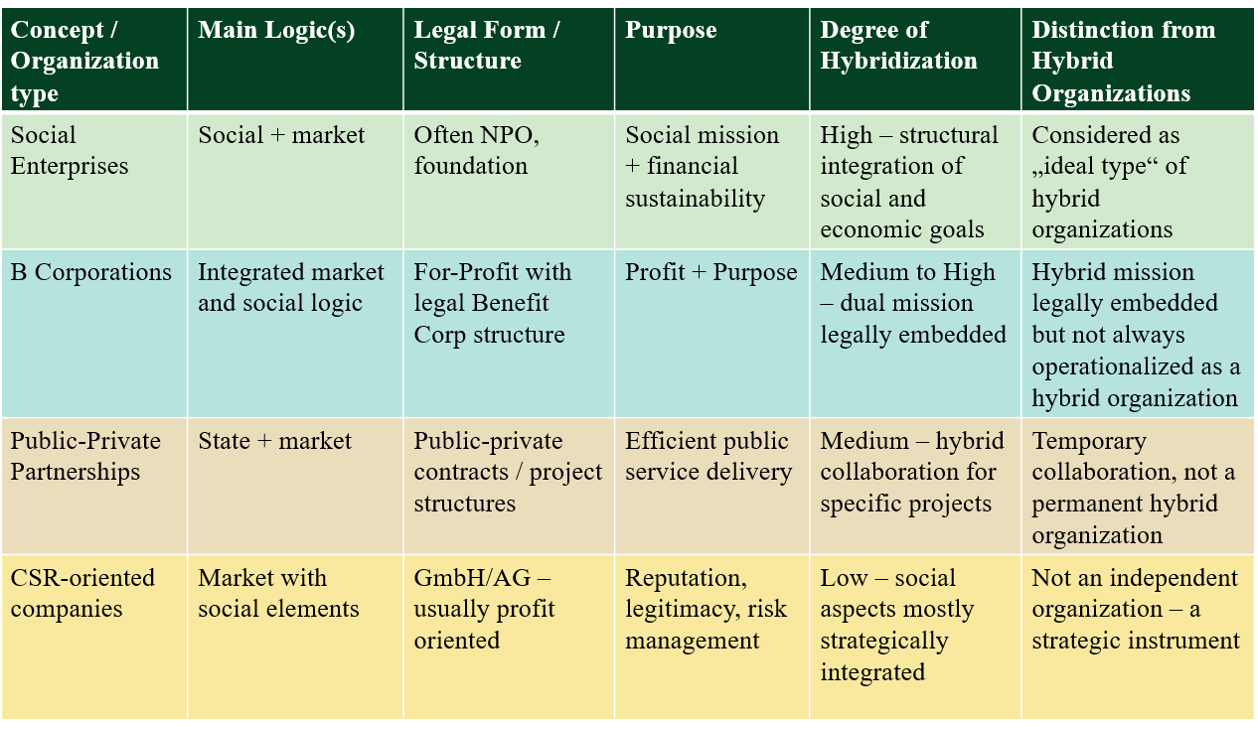
Although definitions of Social enterprises vary, they are often considered as the ideal example of hybrid organizations.19Defourny, J. & Nyssens, M. Fundamentals for an international typology of social enterprise models. VOLUNTAS: International Journal of Voluntary and nonprofit organizations 28, 2469-2497 (2016).,6Doherty, B., Haugh, H. & Lyon, F. Social Enterprises as Hybrid Organizations: A Review and Research Agenda. International Journal of Management Reviews 16, 417-436 (2014). https://doi.org/10.1111/ijmr.12028 SEs are typically characterized by their dual objectives, whereby they attempt to combine social purpose with financial sustainability. More specifically, the social mission lies at the heart of SE and is then implemented and financed using market-oriented techniques.6Doherty, B., Haugh, H. & Lyon, F. Social Enterprises as Hybrid Organizations: A Review and Research Agenda. International Journal of Management Reviews 16, 417-436 (2014). https://doi.org/10.1111/ijmr.12028,20Luke, B. & Chu, V. Social enterprise versus social entrepreneurship: An examination of the ‘why’and ‘how’in pursuing social change. International Small Business Journal 31, 764-784 (2013). Generally speaking, social enterprises have non-profit origins and position themselves between non-profit and for-profit companies and are considered hybrid organizations because they integrate social and economic logics simultaneously.19Defourny, J. & Nyssens, M. Fundamentals for an international typology of social enterprise models. VOLUNTAS: International Journal of Voluntary and nonprofit organizations 28, 2469-2497 (2016).,2Battilana, J. & Lee, M. Advancing Research on Hybrid Organizing – Insights from the Study of Social Enterprises. Academy of Management Annals 8, 397-441 (2014). https://doi.org/10.5465/19416520.2014.893615 Compared to traditional non-profit organizations (NPO), SEs take a direct business approach to social problems and have structurally anchored their financial and social objectives.11Ebrahim, A., Battilana, J. & Mair, J. The governance of social enterprises: Mission drift and accountability challenges in hybrid organizations. Research in organizational behavior 34, 81-100 (2014). https://doi.org/10.1016/j.riob.2014.09.001 Due to the fact that SE combines business and charity at its core, tensions arise that SEs must deal with. In addition, conflicts arise between stakeholder demands and expectations, which often reflect contradictory logics.2Battilana, J. & Lee, M. Advancing Research on Hybrid Organizing – Insights from the Study of Social Enterprises. Academy of Management Annals 8, 397-441 (2014). https://doi.org/10.5465/19416520.2014.893615
Benefit corporations (B Corporation), which originate in the US, are normal for-profit companies that have a similar objective, namely, to combine their profit orientation with social and environmental goals. Compared to traditional companies, B Corporations are accountable not only to shareholders, but to multiple stakeholders.11Ebrahim, A., Battilana, J. & Mair, J. The governance of social enterprises: Mission drift and accountability challenges in hybrid organizations. Research in organizational behavior 34, 81-100 (2014). https://doi.org/10.1016/j.riob.2014.09.001,21Hiller, J. S. The benefit corporation and corporate social responsibility. Journal of business ethics 118, 287-301 (2013). What makes B Corporations special is that they are based on a legal form and thus have their dual mission legally embedded. As a result, Benefit Corporations are considered hybrid organizations because they combine economic and social objectives. To briefly compare them to social enterprises, B Corporations come from a profit-oriented environment, whereas many social enterprises have their roots in the non-profit sector.11Ebrahim, A., Battilana, J. & Mair, J. The governance of social enterprises: Mission drift and accountability challenges in hybrid organizations. Research in organizational behavior 34, 81-100 (2014). https://doi.org/10.1016/j.riob.2014.09.001,21Hiller, J. S. The benefit corporation and corporate social responsibility. Journal of business ethics 118, 287-301 (2013).,19Defourny, J. & Nyssens, M. Fundamentals for an international typology of social enterprise models. VOLUNTAS: International Journal of Voluntary and nonprofit organizations 28, 2469-2497 (2016).
Another concept that involves hybridity are public-private partnerships. PPPs are not considered as a legal organizational form, such as benefit corporations, but are hybrid collaborations between private actors and the government, usually set up for a defined period or project, that seek to achieve social goals.22Skelcher, C. in The Oxford Handbook of Public Management (eds Ewan Ferlie, Laurence E. Lynn, & Christopher Pollitt) 0 (Oxford University Press, 2005). PPPs are considered hybrid arrangements and are referred to as hybrid because they combine government and market-based logics. By combining these logics, several areas are merged, including the general objectives or responsibilities of the government and private sectors.22Skelcher, C. in The Oxford Handbook of Public Management (eds Ewan Ferlie, Laurence E. Lynn, & Christopher Pollitt) 0 (Oxford University Press, 2005). On the other hand, the hybrid nature of public-private partnerships can lead to areas of tension, particularly with regard to government accountability and private sector efficiency. PPPs are a good example of a hybrid arrangement because they highlight the challenges that arise and also show what hybrid structures can look like in practice.22Skelcher, C. in The Oxford Handbook of Public Management (eds Ewan Ferlie, Laurence E. Lynn, & Christopher Pollitt) 0 (Oxford University Press, 2005).
Corporate social responsibility (CSR) originally arose in response to increasing social expectations and global challenges.23Jamali, D. & Mirshak, R. Corporate Social Responsibility (CSR): Theory and Practice in a Developing Country Context. Journal of Business Ethics 72, 243-262 (2007). https://doi.org/10.1007/s10551-006-9168-4 CSR is regarded as a strategic instrument that seeks to achieve positive social impacts. CSR-oriented companies are traditional profit-oriented companies that voluntarily incorporate social and environmental aspects into their corporate strategy in order to meet social expectations and promote legitimacy among stakeholders.23Jamali, D. & Mirshak, R. Corporate Social Responsibility (CSR): Theory and Practice in a Developing Country Context. Journal of Business Ethics 72, 243-262 (2007). https://doi.org/10.1007/s10551-006-9168-4 However, unlike other concepts, social goals are not placed on the same level as the main economic goal, because the goal of CSR is to protect the core economic business. Therefore, CSR is not treated as part of hybrid structures, but rather as a separate research area.2Battilana, J. & Lee, M. Advancing Research on Hybrid Organizing – Insights from the Study of Social Enterprises. Academy of Management Annals 8, 397-441 (2014). https://doi.org/10.5465/19416520.2014.893615,23Jamali, D. & Mirshak, R. Corporate Social Responsibility (CSR): Theory and Practice in a Developing Country Context. Journal of Business Ethics 72, 243-262 (2007). https://doi.org/10.1007/s10551-006-9168-4
From these related concepts of hybrid organizations, the analysis indicates that many concepts share hybrid characteristics but differ in the nature and depth of their objectives.2Battilana, J. & Lee, M. Advancing Research on Hybrid Organizing – Insights from the Study of Social Enterprises. Academy of Management Annals 8, 397-441 (2014). https://doi.org/10.5465/19416520.2014.893615 The biggest difference between the concepts can be seen in CSR, where CSR is often peripheral and strategically motivated, while social enterprises and benefit corporations are structurally aligned with a dual mission. From this, it could be said that hybridity is a spectrum ranging from simple collaborations to fully integrated structures.2Battilana, J. & Lee, M. Advancing Research on Hybrid Organizing – Insights from the Study of Social Enterprises. Academy of Management Annals 8, 397-441 (2014). https://doi.org/10.5465/19416520.2014.893615 This distinction between related concepts can help to better understand and classify similar organizational forms, thereby supporting further analysis in the subsequent chapters.6Doherty, B., Haugh, H. & Lyon, F. Social Enterprises as Hybrid Organizations: A Review and Research Agenda. International Journal of Management Reviews 16, 417-436 (2014). https://doi.org/10.1111/ijmr.12028
2.1.3 Historical origins
The existing literature proves that hybrid forms of organization have long existed in the third sector, with hybrid structures being gradually integrated over time and encountering little resistance in the process.3Billis, D. in Hybrid Organizations and the Third Sector: Challenges for Practice, Theory and Policy (ed David Billis) 46-69 (Palgrave Macmillan, 2010). Complex and unstable environments give rise to hybrid organizations in which various factors influence their working methods and results.18Brandsen, T. & and Karré, P. M. Hybrid Organizations: No Cause for Concern? International Journal of Public Administration 34, 827-836 (2011). https://doi.org/10.1080/01900692.2011.605090 Additionally, historical developments and path dependencies are crucial in determining the governance structure of hybrid organizations and they also provide the institutional context for their origins in the third sector.24Ménard, C. The economics of hybrid organizations. Journal of Institutional and Theoretical Economics (JITE)/Zeitschrift für die gesamte Staatswissenschaft, 345-376 (2004).
Hybrid organizations often originate from civil society structures such as welfare associations or NPOs, whereby social missions were combined with market and state-typical characteristics at an early stage.18Brandsen, T. & and Karré, P. M. Hybrid Organizations: No Cause for Concern? International Journal of Public Administration 34, 827-836 (2011). https://doi.org/10.1080/01900692.2011.605090 The new public management reform then led to the ongoing integration into public structures and competitive markets, with hybrid organizations often operating at the intersection of market, state and civil society. These were mostly former government agencies that became independent institutions and were integrated into the market mechanism, or civil society organizations that entered the public sector, subsequently being further integrated into quasi-market structures.18Brandsen, T. & and Karré, P. M. Hybrid Organizations: No Cause for Concern? International Journal of Public Administration 34, 827-836 (2011). https://doi.org/10.1080/01900692.2011.605090
It was characteristic of the third sector to receive funding from donations, subsidies, and voluntary contributions, which were then directed toward the common good and welfare.18Brandsen, T. & and Karré, P. M. Hybrid Organizations: No Cause for Concern? International Journal of Public Administration 34, 827-836 (2011). https://doi.org/10.1080/01900692.2011.605090 In addition to these financial resources, third sector organizations have also relied on grants, contracts, and sales in the past, with the amount of revenue fluctuating based on political preferences and market forces. These mixed financing models formed the basis for maintaining organizational structures.3Billis, D. in Hybrid Organizations and the Third Sector: Challenges for Practice, Theory and Policy (ed David Billis) 46-69 (Palgrave Macmillan, 2010).
Over time, the third sector has been shaped and influenced by these dynamics, continuously adapting to social, political, and economic changes. These developments form the historical basis for today’s diverse hybrid organizational forms.18Brandsen, T. & and Karré, P. M. Hybrid Organizations: No Cause for Concern? International Journal of Public Administration 34, 827-836 (2011). https://doi.org/10.1080/01900692.2011.605090
2.2 Theoretical perspectives and typologies
This next section gives an overview of theoretical approaches, conceptual models, and other structural types used to explain hybrid organizations. It demonstrates how hybridity is analyzed in the literature and what typologies look like to support the analyses developed later in this thesis.10Skelcher, C. & Smith, S. R. Theorizing hybridity: Institutional logics, complex organizations, and actor identities: The case of nonprofits. Public administration 93, 433-448 (2015). Hybridity is presented in overarching theoretical frameworks in order to better complement the definitions and distinctions discussed so far.10Skelcher, C. & Smith, S. R. Theorizing hybridity: Institutional logics, complex organizations, and actor identities: The case of nonprofits. Public administration 93, 433-448 (2015). There are differing opinions on this in the literature, with some seeing positive opportunities and others seeing problematic tensions, which shows that different perspectives are needed to provide a bigger picture.14Besharov, M. L. & Smith, W. K. Multiple institutional logics in organizations: Explaining their varied nature and implications. Academy of management review 39, 364-381 (2014). The subsequent sections first address theoretical perspectives on hybridity, followed by conceptual models for classification, and finally present structural types and characteristics to round off the chapter.
2.2.1 Theoretical approaches to hybridity
So far, we have understood what hybridity is and where it can occur. Building on this foundation, hybridity is understood in literature as a response to institutional complexity, whereby these logics often contradict each other and can create tensions. Hybrid organizations are particularly affected by this because they often operate in several fields and logics at the same time and therefore have to deal with conflicting expectations.1Greenwood, R., Raynard, M., Kodeih, F., Micelotta, E. R. & Lounsbury, M. Institutional Complexity and Organizational Responses. Academy of Management Annals 5, 317-371 (2011). https://doi.org/10.5465/19416520.2011.590299
Broadly speaking, there is a central theoretical perspective that describes hybridity as a balance between stability and adaptation, whereby this balance is not always static, but can shift over time. Consequently, these contradictory logics of hybridity create space for further development and redesign.10Skelcher, C. & Smith, S. R. Theorizing hybridity: Institutional logics, complex organizations, and actor identities: The case of nonprofits. Public administration 93, 433-448 (2015). Another focus of the literature is on the governance and structural perspective of hybrid organizations. Here, researchers examine how organizations deal with contradicting expectations in complex environments and which structural characteristics shape this balance between logics.14Besharov, M. L. & Smith, W. K. Multiple institutional logics in organizations: Explaining their varied nature and implications. Academy of management review 39, 364-381 (2014). In this context, governance is understood in the literature as a mechanism that attempts to prioritize and balance contradicting demands resulting from conflicting logics.1Greenwood, R., Raynard, M., Kodeih, F., Micelotta, E. R. & Lounsbury, M. Institutional Complexity and Organizational Responses. Academy of Management Annals 5, 317-371 (2011). https://doi.org/10.5465/19416520.2011.590299
On the other hand, hybrid organizations are constantly concerned with their identity and legitimacy. Because hybrid organizations have to integrate multiple identities at the same time, different logics affect the organization, whereby this identity becomes an important mechanism for managing these tensions.10Skelcher, C. & Smith, S. R. Theorizing hybridity: Institutional logics, complex organizations, and actor identities: The case of nonprofits. Public administration 93, 433-448 (2015). Hence, identity is not fixed, but is constantly being reshaped by the interplay of multiple logics. In terms of legitimacy, hybrid organizations must always legitimize themselves to different groups or environments, which results in increasingly competing demands. Since hybrid organizations have integrated multiple logics, the criteria for legitimacy may differ or even contradict each other. This can lead to hybrids being constantly engaged in a negotiation process due to these conflicting criteria.10Skelcher, C. & Smith, S. R. Theorizing hybridity: Institutional logics, complex organizations, and actor identities: The case of nonprofits. Public administration 93, 433-448 (2015).
2.2.2 Theoretical models and conceptual frameworks
In order to gain a better understanding of the mechanisms and functionalities of hybrid organizations, they are further analyzed in the literature using various models and frameworks.6Doherty, B., Haugh, H. & Lyon, F. Social Enterprises as Hybrid Organizations: A Review and Research Agenda. International Journal of Management Reviews 16, 417-436 (2014). https://doi.org/10.1111/ijmr.12028 As already mentioned, institutional logics play a central role because they cause organizations to follow multiple orders and give rise to different tensions and identities.10Skelcher, C. & Smith, S. R. Theorizing hybridity: Institutional logics, complex organizations, and actor identities: The case of nonprofits. Public administration 93, 433-448 (2015). Skelcher and Smith (2015) describe hybridity and hybrid organizations as “slippery concepts with inexact empirical referents” (p.435).10Skelcher, C. & Smith, S. R. Theorizing hybridity: Institutional logics, complex organizations, and actor identities: The case of nonprofits. Public administration 93, 433-448 (2015). Against this background, models and frameworks become essential tools for systematically approaching hybridity in organizational research.10Skelcher, C. & Smith, S. R. Theorizing hybridity: Institutional logics, complex organizations, and actor identities: The case of nonprofits. Public administration 93, 433-448 (2015).
Previous research has focused on how tensions and contradictions between social and economic logics can be managed and dealt with.7Smith, W. K., Gonin, M. & Besharov, M. L. Managing social-business tensions: A review and research agenda for social enterprise. Business Ethics Quarterly 23, 407-442 (2013). However, they also suggest that organizations not only experience paradoxes between logics, but also develop strategies and structures to overcome them.1Greenwood, R., Raynard, M., Kodeih, F., Micelotta, E. R. & Lounsbury, M. Institutional Complexity and Organizational Responses. Academy of Management Annals 5, 317-371 (2011). https://doi.org/10.5465/19416520.2011.590299 Furthermore, several different models have been developed over time that address specific aspects such as strategy, governance, or identity.5Secinaro, S., Corvo, L., Brescia, V. & Iannaci, D. Hybrid organizations: A Systematic Review of the Current Literature. International business research (Toronto) 12, 1 (2019). https://doi.org/10.5539/ibr.v12n11p1 For the following analysis, various models that have received considerable attention in the literature are presented, as they enable a more in-depth understanding of the various aspects of hybrid organizations.10Skelcher, C. & Smith, S. R. Theorizing hybridity: Institutional logics, complex organizations, and actor identities: The case of nonprofits. Public administration 93, 433-448 (2015). Table 2 below provides an overview of the framework developed by Battilana et al. (2017), which summarizes the antecedents, challenges, opportunities, and strategies associated with hybrid organizing.9Battilana, J., Besharov, M. & Mitzinneck, B. C. in The SAGE Handbook of Organizational Institutionalism (eds Royston Greenwood, Christine Oliver, Thomas B. Lawrence, & Renate E. Meyer) 128-162 (SAGE Publishing, 2017).
This conceptual framework for managing hybridity presents an analysis of hybrid organizations in four different dimensions: antecedents, challenges, opportunities, and strategies. It provides an overview of hybrid organizations, how they arise, the tensions they face, the opportunities that emerge for hybrids, and the strategies they develop to overcome challenges.9Battilana, J., Besharov, M. & Mitzinneck, B. C. in The SAGE Handbook of Organizational Institutionalism (eds Royston Greenwood, Christine Oliver, Thomas B. Lawrence, & Renate E. Meyer) 128-162 (SAGE Publishing, 2017).
To begin with, we already know that hybrid organizations do not arise by chance, but rather in phases in which institutional logics shift. In this context, regulatory changes can also have an effect by promoting hybridity or at least opening up new options.9Battilana, J., Besharov, M. & Mitzinneck, B. C. in The SAGE Handbook of Organizational Institutionalism (eds Royston Greenwood, Christine Oliver, Thomas B. Lawrence, & Renate E. Meyer) 128-162 (SAGE Publishing, 2017). In addition, changes in political institutions and cultural developments contribute to which logics are considered legitimate in organizational action. Internal factors also play a central role, with the founders actively shaping the hybrid structures on the one hand, and members bringing different identities and logics into the organization on the other.9Battilana, J., Besharov, M. & Mitzinneck, B. C. in The SAGE Handbook of Organizational Institutionalism (eds Royston Greenwood, Christine Oliver, Thomas B. Lawrence, & Renate E. Meyer) 128-162 (SAGE Publishing, 2017).
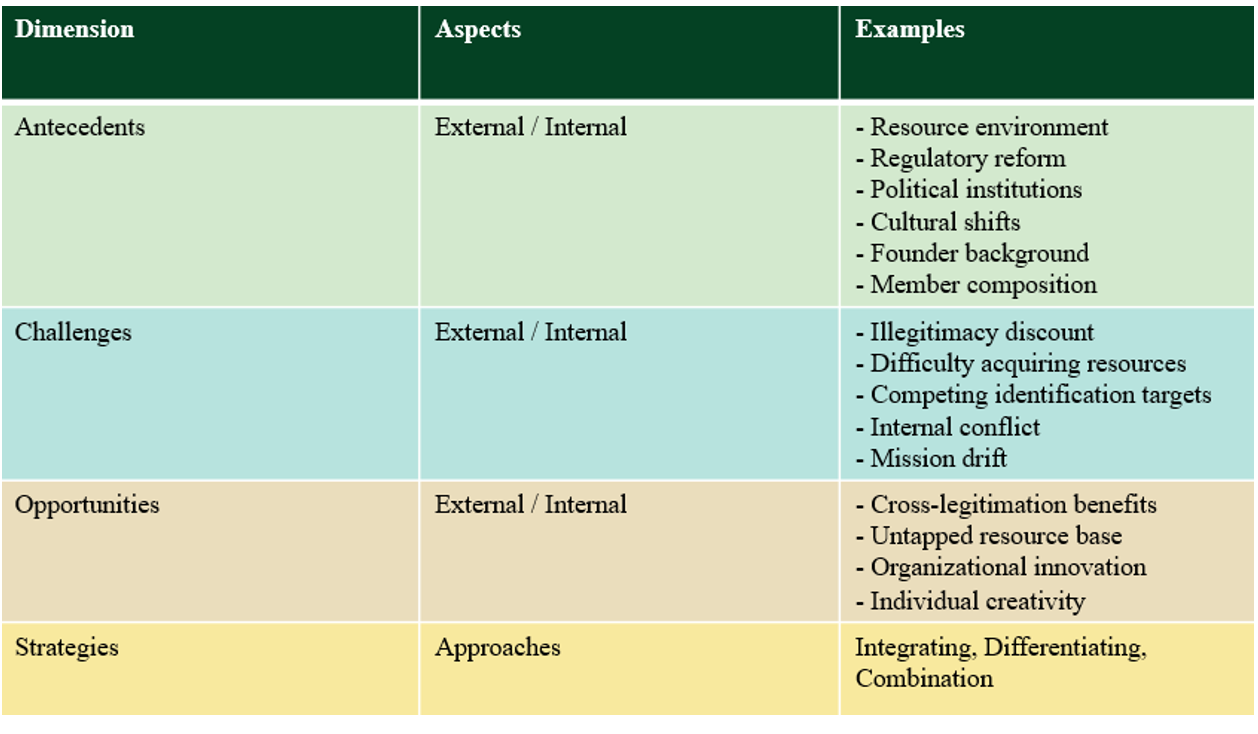
However, the emergence of hybrid organizations inevitably leads to tensions, making it difficult for outsiders to classify hybrid organizations, which can have an impact on their legitimacy.9Battilana, J., Besharov, M. & Mitzinneck, B. C. in The SAGE Handbook of Organizational Institutionalism (eds Royston Greenwood, Christine Oliver, Thomas B. Lawrence, & Renate E. Meyer) 128-162 (SAGE Publishing, 2017). At the same time, internal conflicts can arise, usually stemming from different subgroups and identities, which can result in what is known as mission drift.9Battilana, J., Besharov, M. & Mitzinneck, B. C. in The SAGE Handbook of Organizational Institutionalism (eds Royston Greenwood, Christine Oliver, Thomas B. Lawrence, & Renate E. Meyer) 128-162 (SAGE Publishing, 2017).
Despite the many challenges, hybridity also represents many opportunities, which can also be found in innovation and creativity, with one example being that innovations can not only arise internally, but can also be recognized by external stakeholders.9Battilana, J., Besharov, M. & Mitzinneck, B. C. in The SAGE Handbook of Organizational Institutionalism (eds Royston Greenwood, Christine Oliver, Thomas B. Lawrence, & Renate E. Meyer) 128-162 (SAGE Publishing, 2017). Moreover, learning and innovation processes can be driven forward by the fact that contradictions are often addressed simultaneously. This also allows members to gain and promote creativity due to the diversity of logic within the organization.9Battilana, J., Besharov, M. & Mitzinneck, B. C. in The SAGE Handbook of Organizational Institutionalism (eds Royston Greenwood, Christine Oliver, Thomas B. Lawrence, & Renate E. Meyer) 128-162 (SAGE Publishing, 2017).
Finally, various strategies are being developed to address how tensions are managed. One possibility discussed here is the integration of different elements. This integration can, for example, bring advantages in terms of resource development, but it can also conceal risks, such as placing a burden on members.9Battilana, J., Besharov, M. & Mitzinneck, B. C. in The SAGE Handbook of Organizational Institutionalism (eds Royston Greenwood, Christine Oliver, Thomas B. Lawrence, & Renate E. Meyer) 128-162 (SAGE Publishing, 2017). Another option presented is to clearly separate the different components of a hybrid organization in order to avoid these risks. Regarding this, experience and research have shown that a combination of integration and differentiation is the best way to benefit from hybridity.9Battilana, J., Besharov, M. & Mitzinneck, B. C. in The SAGE Handbook of Organizational Institutionalism (eds Royston Greenwood, Christine Oliver, Thomas B. Lawrence, & Renate E. Meyer) 128-162 (SAGE Publishing, 2017).
This framework helps to structure the literature in these four dimensions and thus to illustrate that hybrids not only experience challenges but can also exploit opportunities, with strategies playing a major role, thereby highlighting the importance of considering and understanding these interactions when assessing hybrids.9Battilana, J., Besharov, M. & Mitzinneck, B. C. in The SAGE Handbook of Organizational Institutionalism (eds Royston Greenwood, Christine Oliver, Thomas B. Lawrence, & Renate E. Meyer) 128-162 (SAGE Publishing, 2017). In addition, this framework can be used as a research agenda and guide for further investigations.9Battilana, J., Besharov, M. & Mitzinneck, B. C. in The SAGE Handbook of Organizational Institutionalism (eds Royston Greenwood, Christine Oliver, Thomas B. Lawrence, & Renate E. Meyer) 128-162 (SAGE Publishing, 2017). Next, a model by Billis (2010) is presented in Figure 1, which focuses on the boundaries between the public, private, and third sectors and addresses the overlaps between them.3Billis, D. in Hybrid Organizations and the Third Sector: Challenges for Practice, Theory and Policy (ed David Billis) 46-69 (Palgrave Macmillan, 2010).
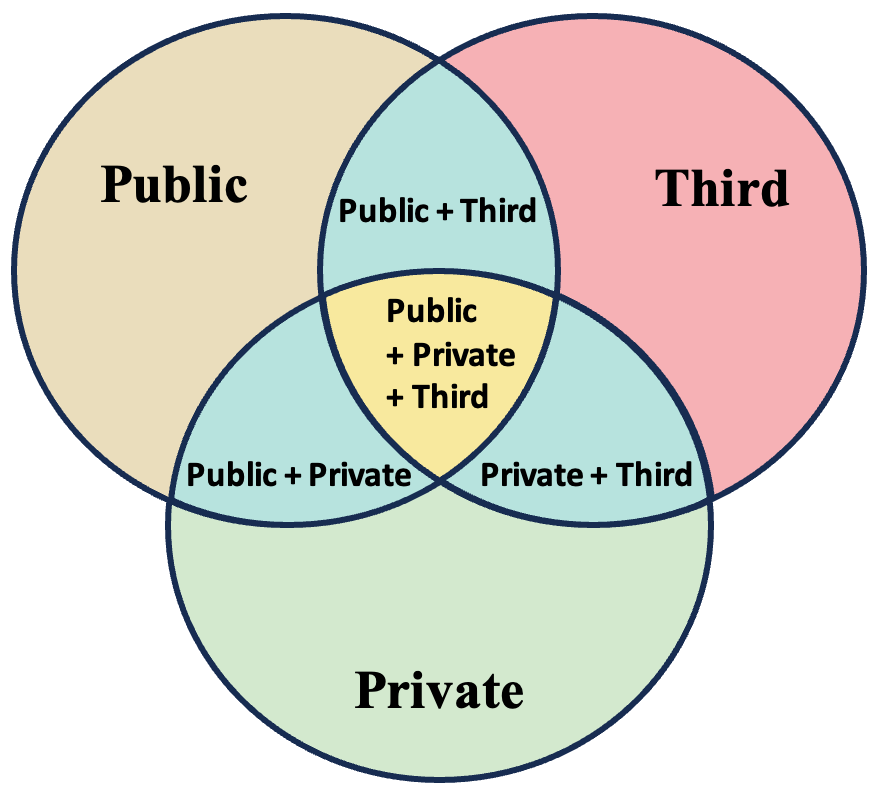
The sectors illustrated in this model (public, private, and third) are presented as independent sectors with different principles, while the circles themselves do not make any statements about the influence and size of these sectors. This model provides a theoretical representation, which nevertheless allows for overlaps between the sectors in various ways.3Billis, D. in Hybrid Organizations and the Third Sector: Challenges for Practice, Theory and Policy (ed David Billis) 46-69 (Palgrave Macmillan, 2010). These overlaps create nine possible zones, from which hybridity can be understood as a result of sectoral intersections.3Billis, D. in Hybrid Organizations and the Third Sector: Challenges for Practice, Theory and Policy (ed David Billis) 46-69 (Palgrave Macmillan, 2010). These nine zones describe a specific combination of these sectors, which can contain either two or three sector logics, and thereby illustrating that organizations may adopt multiple logics simultaneously.3Billis, D. in Hybrid Organizations and the Third Sector: Challenges for Practice, Theory and Policy (ed David Billis) 46-69 (Palgrave Macmillan, 2010). In this way, the models make clear that hybridity is not a static state but one in which organizations can shift into or away from particular zones over time, illustrating that hybrids arise not only at the moment of foundation but also through ongoing processes of development and adaptation.3Billis, D. in Hybrid Organizations and the Third Sector: Challenges for Practice, Theory and Policy (ed David Billis) 46-69 (Palgrave Macmillan, 2010).
To illustrate how different logics are combined in practice, the zones were shown with examples such as Fannie Mae as a public/private example or the National Lottery as a private/public/third example.3Billis, D. in Hybrid Organizations and the Third Sector: Challenges for Practice, Theory and Policy (ed David Billis) 46-69 (Palgrave Macmillan, 2010). The model thus shows that hybridity is not a special case, but a permanent phenomenon that emerges from sectoral logics and provides a kind of map on which organizations can find and orient themselves.3Billis, D. in Hybrid Organizations and the Third Sector: Challenges for Practice, Theory and Policy (ed David Billis) 46-69 (Palgrave Macmillan, 2010). The next step is to present a model by Ebrahim et al. (2014) that deals with integrated and differentiated governance approaches for hybrids. These two approaches are compared in Table 3 below, which highlights their main distinctions.11Ebrahim, A., Battilana, J. & Mair, J. The governance of social enterprises: Mission drift and accountability challenges in hybrid organizations. Research in organizational behavior 34, 81-100 (2014). https://doi.org/10.1016/j.riob.2014.09.001
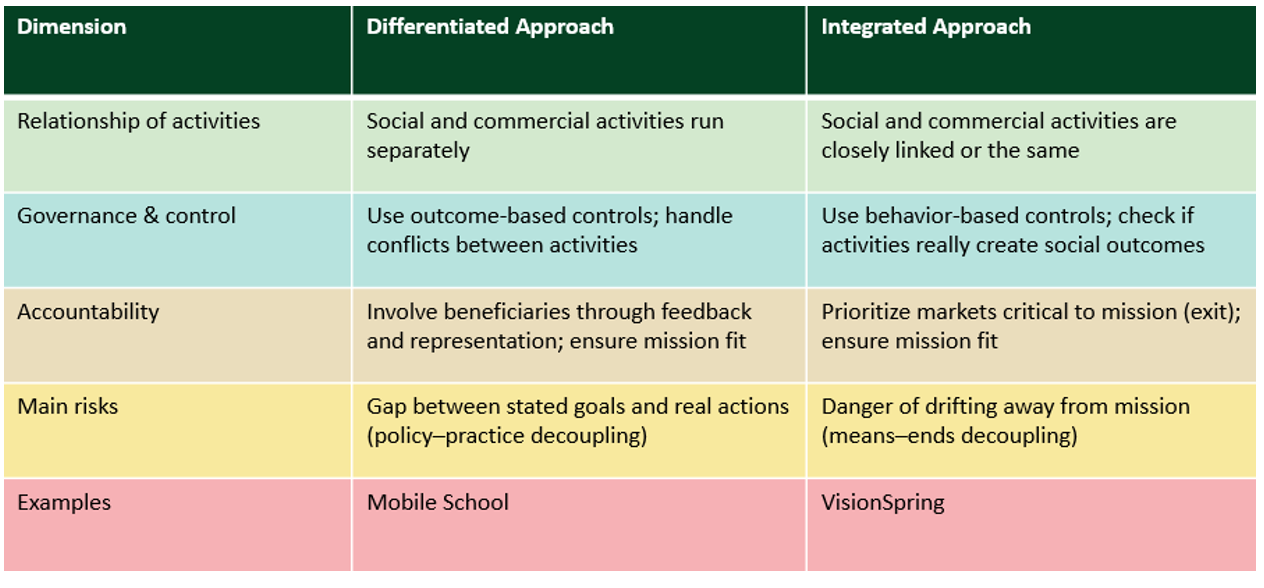
This table distinguishes between two different approaches: the integrated approach and the differentiated approach.11Ebrahim, A., Battilana, J. & Mair, J. The governance of social enterprises: Mission drift and accountability challenges in hybrid organizations. Research in organizational behavior 34, 81-100 (2014). https://doi.org/10.1016/j.riob.2014.09.001 In the literature, these approaches are also presented as two ideal types for hybrids, namely differentiated hybrids (DH) and integrated hybrids (IH). The main difference between these two approaches lies in whether social and commercial activities are separated or intertwined.11Ebrahim, A., Battilana, J. & Mair, J. The governance of social enterprises: Mission drift and accountability challenges in hybrid organizations. Research in organizational behavior 34, 81-100 (2014). https://doi.org/10.1016/j.riob.2014.09.001 In particular, the activities are identical in IH, with the beneficiaries also being the customers, while in DH, social and commercial activities are separate, meaning that the beneficiaries and customers are two different groups of people. In the literature, VisionSpring and Mobile School are constantly cited as examples of integrated hybrids and differentiated hybrids.11Ebrahim, A., Battilana, J. & Mair, J. The governance of social enterprises: Mission drift and accountability challenges in hybrid organizations. Research in organizational behavior 34, 81-100 (2014). https://doi.org/10.1016/j.riob.2014.09.001
Both approaches carry the risk of mission drift, which can be described as a deviation from the original social goals and purpose toward financial goals due to market pressure or resource dependency, which will get more focus in a later section.11Ebrahim, A., Battilana, J. & Mair, J. The governance of social enterprises: Mission drift and accountability challenges in hybrid organizations. Research in organizational behavior 34, 81-100 (2014). https://doi.org/10.1016/j.riob.2014.09.001,25Cornforth, C. Understanding and combating mission drift in social enterprises. Social enterprise journal 10, 3-20 (2014). However, this risk varies between the two types, with DH experiencing what is known as policy-practice decoupling and IH experiencing means-ends decoupling. In the case of DH, there is a danger that it will justify commercial activities with social goals, but in practice will not keep these promises and actions. In the case of IH, it can happen that commercial activities are successful, but do not bring about the expected social effects.11Ebrahim, A., Battilana, J. & Mair, J. The governance of social enterprises: Mission drift and accountability challenges in hybrid organizations. Research in organizational behavior 34, 81-100 (2014). https://doi.org/10.1016/j.riob.2014.09.001 The two types also differ in terms of monitoring and control. With DH, it is important to monitor potential contradictions between separate activities, whereby outcome-based controls tend to be used. With IH, on the other hand, care should be taken to ensure that the integrated activities actually generate social impacts, whereby behavior-based controls are used.11Ebrahim, A., Battilana, J. & Mair, J. The governance of social enterprises: Mission drift and accountability challenges in hybrid organizations. Research in organizational behavior 34, 81-100 (2014). https://doi.org/10.1016/j.riob.2014.09.001 In terms of accountability, both approaches have upward accountability because donors or investors can exert pressure through exit. In terms of downward accountability, the two approaches differ in that IH have an exit option because the beneficiaries are also the customers. DH therefore have no exit option, so governance must strengthen the voice and representation of the beneficiaries.11Ebrahim, A., Battilana, J. & Mair, J. The governance of social enterprises: Mission drift and accountability challenges in hybrid organizations. Research in organizational behavior 34, 81-100 (2014). https://doi.org/10.1016/j.riob.2014.09.001
To round off these two approaches, DH can be presented in such a way that separation creates clarity, requires control over results, and conceals the risk that aspirations and practice may diverge. IH can create synergies through integration, requires behavioral and process control, and conceals the risk that means and ends may become decoupled.11Ebrahim, A., Battilana, J. & Mair, J. The governance of social enterprises: Mission drift and accountability challenges in hybrid organizations. Research in organizational behavior 34, 81-100 (2014). https://doi.org/10.1016/j.riob.2014.09.001 Although these models and frameworks make important contributions, literature also discusses limitations that can often affect practice and handling. The framework developed by Battilana et al. (2017) is considered more theoretical and serves primarily as a research agenda, meaning that it has no real practical orientation.9Battilana, J., Besharov, M. & Mitzinneck, B. C. in The SAGE Handbook of Organizational Institutionalism (eds Royston Greenwood, Christine Oliver, Thomas B. Lawrence, & Renate E. Meyer) 128-162 (SAGE Publishing, 2017). In relation to Billis’ model (2010), it provides a rather static and descriptive representation, which limits its explanatory power regarding whether hybrids have their own management principles.3Billis, D. in Hybrid Organizations and the Third Sector: Challenges for Practice, Theory and Policy (ed David Billis) 46-69 (Palgrave Macmillan, 2010). The two ideal types of Ebrahim et al. (2014) concerning this aspect are limited in significance because reality is usually more complex and many organizations do not fit clearly into these two types.11Ebrahim, A., Battilana, J. & Mair, J. The governance of social enterprises: Mission drift and accountability challenges in hybrid organizations. Research in organizational behavior 34, 81-100 (2014). https://doi.org/10.1016/j.riob.2014.09.001
Taken together, these three models and frameworks make contributions that focus on different areas. The framework developed by Battilana et al. (2017) provides a structure for tensions, opportunities, and strategies for hybrid organizations.9Battilana, J., Besharov, M. & Mitzinneck, B. C. in The SAGE Handbook of Organizational Institutionalism (eds Royston Greenwood, Christine Oliver, Thomas B. Lawrence, & Renate E. Meyer) 128-162 (SAGE Publishing, 2017). Billis (2010) has developed a model that shows the three sectors and derives nine possible hybrid zones from them. This shows that organizations have roots in one sector but can move into hybrid zones.3Billis, D. in Hybrid Organizations and the Third Sector: Challenges for Practice, Theory and Policy (ed David Billis) 46-69 (Palgrave Macmillan, 2010). Finally, Ebrahim et al. (2014) offer a distinction between two ideal types, which also highlights the governance challenges.11Ebrahim, A., Battilana, J. & Mair, J. The governance of social enterprises: Mission drift and accountability challenges in hybrid organizations. Research in organizational behavior 34, 81-100 (2014). https://doi.org/10.1016/j.riob.2014.09.001 Together, the models offer complementary perspectives and form a conceptual foundation for a general understanding of how hybrid organizations deal with social and commercial logics.9Battilana, J., Besharov, M. & Mitzinneck, B. C. in The SAGE Handbook of Organizational Institutionalism (eds Royston Greenwood, Christine Oliver, Thomas B. Lawrence, & Renate E. Meyer) 128-162 (SAGE Publishing, 2017).,3Billis, D. in Hybrid Organizations and the Third Sector: Challenges for Practice, Theory and Policy (ed David Billis) 46-69 (Palgrave Macmillan, 2010).,11Ebrahim, A., Battilana, J. & Mair, J. The governance of social enterprises: Mission drift and accountability challenges in hybrid organizations. Research in organizational behavior 34, 81-100 (2014). https://doi.org/10.1016/j.riob.2014.09.001 Despite the contributions of models and frameworks, academic debates suggest that they only represent partial perspectives and are therefore somewhat limited in their significance. These limitations arise from their theoretical orientation, static representation, and simplified typologies.9Battilana, J., Besharov, M. & Mitzinneck, B. C. in The SAGE Handbook of Organizational Institutionalism (eds Royston Greenwood, Christine Oliver, Thomas B. Lawrence, & Renate E. Meyer) 128-162 (SAGE Publishing, 2017).,3Billis, D. in Hybrid Organizations and the Third Sector: Challenges for Practice, Theory and Policy (ed David Billis) 46-69 (Palgrave Macmillan, 2010).,11Ebrahim, A., Battilana, J. & Mair, J. The governance of social enterprises: Mission drift and accountability challenges in hybrid organizations. Research in organizational behavior 34, 81-100 (2014). https://doi.org/10.1016/j.riob.2014.09.001
2.2.3 Structural types and organizational archetypes
Research into hybrid organizations has evolved over time, with the initial focus being on classifications and definitions, whereas today many different aspects are being investigated.6Doherty, B., Haugh, H. & Lyon, F. Social Enterprises as Hybrid Organizations: A Review and Research Agenda. International Journal of Management Reviews 16, 417-436 (2014). https://doi.org/10.1111/ijmr.12028 To better understand the role of ideal types more specifically, they can be described as organizations that reflect typical structures and practices and thus provide guidance for classifying organizations. In this context, hybrid organizations do not count as classic ideal types due to their combination of characteristics from several sectors.6Doherty, B., Haugh, H. & Lyon, F. Social Enterprises as Hybrid Organizations: A Review and Research Agenda. International Journal of Management Reviews 16, 417-436 (2014). https://doi.org/10.1111/ijmr.12028 The term hybridity is often used in the literature to describe new forms of organization and responses to changes in governance structures. However, it often remains unclear how hybrid organizations actually emerge and what forms they can take.10Skelcher, C. & Smith, S. R. Theorizing hybridity: Institutional logics, complex organizations, and actor identities: The case of nonprofits. Public administration 93, 433-448 (2015). There is therefore a need to systematically capture and analyze the diversity of hybrid organizations without continuing to rely on broad descriptions.6Doherty, B., Haugh, H. & Lyon, F. Social Enterprises as Hybrid Organizations: A Review and Research Agenda. International Journal of Management Reviews 16, 417-436 (2014). https://doi.org/10.1111/ijmr.12028
The main benefit of typologies is that they organize the diversity of hybrid organizations and identify typical patterns, thereby enabling various comparisons. On the other hand, ideal types are also simplified constructs, which carries the risk of inadequately representing complex realities.19Defourny, J. & Nyssens, M. Fundamentals for an international typology of social enterprise models. VOLUNTAS: International Journal of Voluntary and nonprofit organizations 28, 2469-2497 (2016). In this context, hybrid organizations are described as a kind of intermediate form, with the literature providing various typological models of social enterprises that show how different ideal types can be produced by institutional contexts.19Defourny, J. & Nyssens, M. Fundamentals for an international typology of social enterprise models. VOLUNTAS: International Journal of Voluntary and nonprofit organizations 28, 2469-2497 (2016). One example would be social business hybrids, which are considered ideal-type hybrid organizations in research due to their different integration and contradictory logics at their core.26Heydte, L. v. d. Challenges Resulting from Multiple Institutional Logics in Hybrid Organizations : The Case of Social Business Hybrids. 1st 2020. edn, (Wiesbaden: Springer Gabler Fachmedien Wiesbaden, 2019). Such typologies have also been developed in German research, where there are integrated, partially integrated, and differentiated business models depending on the degree to which social and economic activities are linked.27Kreutzer, K. & Niendorf, E. Soziale Geschäftsmodelle–eine Typologie. Verbands-Management 43, 13-21 (2017).
It is common for hybrid organizations to face governance challenges due to their objectives and accountability to different stakeholders. The distinctions made by Ebrahim et al. (2014) between integrated and differentiated hybrids require different governance mechanisms to avoid mission drift.11Ebrahim, A., Battilana, J. & Mair, J. The governance of social enterprises: Mission drift and accountability challenges in hybrid organizations. Research in organizational behavior 34, 81-100 (2014). https://doi.org/10.1016/j.riob.2014.09.001 The structures of hybrid organizations are largely determined by their resource base, which includes the ratio of market revenues, public funds, and philanthropic funds. Hence, different organizational forms can emerge depending on how these funding sources are combined.19Defourny, J. & Nyssens, M. Fundamentals for an international typology of social enterprise models. VOLUNTAS: International Journal of Voluntary and nonprofit organizations 28, 2469-2497 (2016). At the same time, the structures are generally not stable, but dynamic and prone to conflict, because external stakeholders follow different logics. Here, especially in integrated structures, economic goals can overtake social goals.11Ebrahim, A., Battilana, J. & Mair, J. The governance of social enterprises: Mission drift and accountability challenges in hybrid organizations. Research in organizational behavior 34, 81-100 (2014). https://doi.org/10.1016/j.riob.2014.09.001
From this, we can conclude that typologies are helpful tools for capturing and comparing the diversity of hybrid organizations.19Defourny, J. & Nyssens, M. Fundamentals for an international typology of social enterprise models. VOLUNTAS: International Journal of Voluntary and nonprofit organizations 28, 2469-2497 (2016). Nevertheless, typologies remain very simplistic in relation to hybrid organizations, as they are characterized by constant tensions and conflicts.27Kreutzer, K. & Niendorf, E. Soziale Geschäftsmodelle–eine Typologie. Verbands-Management 43, 13-21 (2017). Even ideal-typical examples therefore cannot cover their entire diversity.26Heydte, L. v. d. Challenges Resulting from Multiple Institutional Logics in Hybrid Organizations : The Case of Social Business Hybrids. 1st 2020. edn, (Wiesbaden: Springer Gabler Fachmedien Wiesbaden, 2019).
2.3 Strategic challenges and organizational responses
The next thematic focus is devoted to the strategic and organizational tensions of hybrid organizations, which typically arise from their hybrid structure and can manifest in many different ways, often persisting over time.7Smith, W. K., Gonin, M. & Besharov, M. L. Managing social-business tensions: A review and research agenda for social enterprise. Business Ethics Quarterly 23, 407-442 (2013). Although such tensions often have a negative reputation in this context, they can also be used productively without being seen directly as a problem.17Battilana, J., Sngul, M., Pache, A.-C. & Model, J. HARNESSING PRODUCTIVE TENSIONS IN HYBRID ORGANIZATIONS: THE CASE OF WORK INTEGRATION SOCIAL ENTERPRISES. Academy of Management Journal 58, 1658-1685 (2015). https://doi.org/10.5465/amj.2013.0903 The most central and well-known problem here is mission drift, which is discussed further in the following.25Cornforth, C. Understanding and combating mission drift in social enterprises. Social enterprise journal 10, 3-20 (2014). To date, the literature has already developed various theoretical approaches to analyze and address such conflicts, which this section takes up by first discussing key tensions and mission conflicts, then turning to strategic responses to conflicting logics, and finally examining how hybrid organizations are managed and held accountable.10Skelcher, C. & Smith, S. R. Theorizing hybridity: Institutional logics, complex organizations, and actor identities: The case of nonprofits. Public administration 93, 433-448 (2015).
2.3.1 Key tensions and mission conflicts
Tensions are considered a fundamental characteristic of hybrid organizations, shaping and influencing their entire identity. Smith et al. (2013) distinguish between different types of tensions that have different effects on different areas.7Smith, W. K., Gonin, M. & Besharov, M. L. Managing social-business tensions: A review and research agenda for social enterprise. Business Ethics Quarterly 23, 407-442 (2013). Performing tensions arise from the contradictions mentioned above, which result from different goals and success metrics and are therefore difficult to fulfill simultaneously.7Smith, W. K., Gonin, M. & Besharov, M. L. Managing social-business tensions: A review and research agenda for social enterprise. Business Ethics Quarterly 23, 407-442 (2013). This can mean, for example, that success in one area simultaneously means failure in another, as short-term and quantifiable goals often dominate over long-term and social objective, which in turn can create organizing tensions due to differing requirements for structures, practices, and personnel.7Smith, W. K., Gonin, M. & Besharov, M. L. Managing social-business tensions: A review and research agenda for social enterprise. Business Ethics Quarterly 23, 407-442 (2013). Here, organizations have to make difficult decisions, such as when recruiting or integrating employees. Concerning this aspect, it can happen that the many different backgrounds of employees can lead to deep divisions and lines of conflict.28Battilana, J. & Dorado, S. Building Sustainable Hybrid Organizations: The Case of Commercial Microfinance Organizations. The Academy of Management Journal 53, 1419-1440 (2010). https://doi.org/10.5465/AMJ.2010.57318391 In addition, there are also belonging tensions that reflect identity issues, meaning that organizations constantly struggle with questions of identity between social mission and profit.7Smith, W. K., Gonin, M. & Besharov, M. L. Managing social-business tensions: A review and research agenda for social enterprise. Business Ethics Quarterly 23, 407-442 (2013). A major factor here is the diverging identity expectations of stakeholders, which organizations must deal with. One possible example of conflict could be different external and internal perceptions that arise as a result of an event and can lead to differences of opinion.7Smith, W. K., Gonin, M. & Besharov, M. L. Managing social-business tensions: A review and research agenda for social enterprise. Business Ethics Quarterly 23, 407-442 (2013). Finally, there are learning tensions that can arise due to short-term economic and long-term social goals.7Smith, W. K., Gonin, M. & Besharov, M. L. Managing social-business tensions: A review and research agenda for social enterprise. Business Ethics Quarterly 23, 407-442 (2013). The problem here is that the long-term social mission can be undermined by growth and other economic aspects.29Jay, J. Navigating paradox as a mechanism of change and innovation in hybrid organizations. Academy of management journal 56, 137-159 (2012). The reason for this is that economic metrics can be measured easily in the short term, but social goals have to wait for long-term horizons and data.7Smith, W. K., Gonin, M. & Besharov, M. L. Managing social-business tensions: A review and research agenda for social enterprise. Business Ethics Quarterly 23, 407-442 (2013).
In relation to tensions, mission drift, which has already been mentioned and defined, is a well-known term and phenomenon.11Ebrahim, A., Battilana, J. & Mair, J. The governance of social enterprises: Mission drift and accountability challenges in hybrid organizations. Research in organizational behavior 34, 81-100 (2014). https://doi.org/10.1016/j.riob.2014.09.001 However, mission drift can also move in both directions, meaning that it can either place too much emphasis on market logic or on social goals.25Cornforth, C. Understanding and combating mission drift in social enterprises. Social enterprise journal 10, 3-20 (2014). Thus, it can also happen that too strong a focus on the social mission can create economic weaknesses and cause further paradoxes.17Battilana, J., Sngul, M., Pache, A.-C. & Model, J. HARNESSING PRODUCTIVE TENSIONS IN HYBRID ORGANIZATIONS: THE CASE OF WORK INTEGRATION SOCIAL ENTERPRISES. Academy of Management Journal 58, 1658-1685 (2015). https://doi.org/10.5465/amj.2013.0903 It is not uncommon for dependence on wealthy customer interests to greatly exacerbate this conflict, ultimately neglecting the needs of the actual target groups.11Ebrahim, A., Battilana, J. & Mair, J. The governance of social enterprises: Mission drift and accountability challenges in hybrid organizations. Research in organizational behavior 34, 81-100 (2014). https://doi.org/10.1016/j.riob.2014.09.001 Consequently, mission drift is a permanent burden and risk that hybrid organizations always have to deal with, but governance and institutional mechanisms can help to maintain the balance and stabilize the organization.25Cornforth, C. Understanding and combating mission drift in social enterprises. Social enterprise journal 10, 3-20 (2014).
When dealing with tensions, it becomes clear that they remain and cannot be resolved directly, but they can be navigated through approaches that will be addressed in the following chapter with strategic responses.29Jay, J. Navigating paradox as a mechanism of change and innovation in hybrid organizations. Academy of management journal 56, 137-159 (2012).
2.3.2 Strategic responses to conflicting logics
Building on the previous section, the following examines how organizations deal with and manage these tensions.7Smith, W. K., Gonin, M. & Besharov, M. L. Managing social-business tensions: A review and research agenda for social enterprise. Business Ethics Quarterly 23, 407-442 (2013). Strategies are used to manage tensions productively and thus ensure long-term stability and the ability to act, which means that these strategies can be implemented at several levels, which will be discussed below.7Smith, W. K., Gonin, M. & Besharov, M. L. Managing social-business tensions: A review and research agenda for social enterprise. Business Ethics Quarterly 23, 407-442 (2013).
One level of strategies are governance strategies, where the challenge lies in the fact that hybrids pursue different goals and are accountable to multiple stakeholder groups.11Ebrahim, A., Battilana, J. & Mair, J. The governance of social enterprises: Mission drift and accountability challenges in hybrid organizations. Research in organizational behavior 34, 81-100 (2014). https://doi.org/10.1016/j.riob.2014.09.001 In particular, the governance boards mentioned by Ebrahim et al. (2014) play a key role.11Ebrahim, A., Battilana, J. & Mair, J. The governance of social enterprises: Mission drift and accountability challenges in hybrid organizations. Research in organizational behavior 34, 81-100 (2014). https://doi.org/10.1016/j.riob.2014.09.001 They mediate between the environment and the organization, conveying external requirements while also protecting the core mission. Their main goal is to ensure that the organization maintains its mission and, beyond its supervisory role, reinterprets the mission as the situation requires.11Ebrahim, A., Battilana, J. & Mair, J. The governance of social enterprises: Mission drift and accountability challenges in hybrid organizations. Research in organizational behavior 34, 81-100 (2014). https://doi.org/10.1016/j.riob.2014.09.001 In addition to the role of boards, there are other governance mechanisms that aim to prevent mission drift, such as constitutional, legal, and regulatory mechanisms that safeguard the social mission through new legal forms or legal protection mechanisms.25Cornforth, C. Understanding and combating mission drift in social enterprises. Social enterprise journal 10, 3-20 (2014). There is also external accreditation, which aims to secure legitimacy among stakeholders by signaling their commitment to the mission to the outside world.25Cornforth, C. Understanding and combating mission drift in social enterprises. Social enterprise journal 10, 3-20 (2014).
To return to the point that tensions cannot only be understood as a threat and can be used productively, hybrid organizations can create so-called spaces of negotiation in which different groups negotiate compromises and ensure ongoing coordination.17Battilana, J., Sngul, M., Pache, A.-C. & Model, J. HARNESSING PRODUCTIVE TENSIONS IN HYBRID ORGANIZATIONS: THE CASE OF WORK INTEGRATION SOCIAL ENTERPRISES. Academy of Management Journal 58, 1658-1685 (2015). https://doi.org/10.5465/amj.2013.0903 Additionally, there is another strategic level related to structural differentiation, which is closely linked to spaces of negotiation.17Battilana, J., Sngul, M., Pache, A.-C. & Model, J. HARNESSING PRODUCTIVE TENSIONS IN HYBRID ORGANIZATIONS: THE CASE OF WORK INTEGRATION SOCIAL ENTERPRISES. Academy of Management Journal 58, 1658-1685 (2015). https://doi.org/10.5465/amj.2013.0903 In hybrid organizations, tensions are managed by dividing responsibilities for social and economic activities among different groups. Although they are considered expensive and resource-intensive, they can greatly enhance performance in certain situations.17Battilana, J., Sngul, M., Pache, A.-C. & Model, J. HARNESSING PRODUCTIVE TENSIONS IN HYBRID ORGANIZATIONS: THE CASE OF WORK INTEGRATION SOCIAL ENTERPRISES. Academy of Management Journal 58, 1658-1685 (2015). https://doi.org/10.5465/amj.2013.0903 In comparison, another approach would be to develop a common identity that attempts to balance the logics, whereby hiring and socialization policies play a central role.28Battilana, J. & Dorado, S. Building Sustainable Hybrid Organizations: The Case of Commercial Microfinance Organizations. The Academy of Management Journal 53, 1419-1440 (2010). https://doi.org/10.5465/AMJ.2010.57318391 According to the literature, depending on how the logics are combined or separated in this context, hybrid organizations can take on different structural forms.10Skelcher, C. & Smith, S. R. Theorizing hybridity: Institutional logics, complex organizations, and actor identities: The case of nonprofits. Public administration 93, 433-448 (2015).
Another strategic orientation arises when organizations develop and apply resistance strategies such as compromise, avoidance, defiance, or manipulation in response to conflicting demands.30Pache, A.-C. & Santos, F. When worlds collide: The internal dynamics of organizational responses to conflicting institutional demands. Academy of management review 35, 455-476 (2010). In doing so, organizations can secure their legitimacy externally by combining intact elements of different logics, thereby avoiding costly compromises and deception.16Pache, A.-C. & Santos, F. Inside the hybrid organization: Selective coupling as a response to competing institutional logics. Academy of management journal 56, 972-1001 (2013). This was particularly observed in organizations with a commercial background that use elements from social logic to promote their acceptance and legitimacy. This is known as selective coupling, a term introduced by Pache and Santos (2013) to describe this strategy.16Pache, A.-C. & Santos, F. Inside the hybrid organization: Selective coupling as a response to competing institutional logics. Academy of management journal 56, 972-1001 (2013).
Finally, Jay (2012) proposes a strategy whereby hybrid organizations evaluate the same outcomes differently depending on which logic is applied.29Jay, J. Navigating paradox as a mechanism of change and innovation in hybrid organizations. Academy of management journal 56, 137-159 (2012). This results in paradoxical experiences arising from these tensions, meaning that one logic might consider an outcome a success, while another would consider it a failure. Accordingly, tensions are not resolved, but rather navigated, whereby this process opens up possibilities for new syntheses, including perhaps a new innovative combination of logics.29Jay, J. Navigating paradox as a mechanism of change and innovation in hybrid organizations. Academy of management journal 56, 137-159 (2012).
These results illustrate that many strategic responses can take place at multiple levels. Hybrid organizations have developed strategies at the governance, structural, intra-organizational, and procedural levels over time to deal with the various logics and tensions.11Ebrahim, A., Battilana, J. & Mair, J. The governance of social enterprises: Mission drift and accountability challenges in hybrid organizations. Research in organizational behavior 34, 81-100 (2014). https://doi.org/10.1016/j.riob.2014.09.001,17Battilana, J., Sngul, M., Pache, A.-C. & Model, J. HARNESSING PRODUCTIVE TENSIONS IN HYBRID ORGANIZATIONS: THE CASE OF WORK INTEGRATION SOCIAL ENTERPRISES. Academy of Management Journal 58, 1658-1685 (2015). https://doi.org/10.5465/amj.2013.0903,16Pache, A.-C. & Santos, F. Inside the hybrid organization: Selective coupling as a response to competing institutional logics. Academy of management journal 56, 972-1001 (2013).,29Jay, J. Navigating paradox as a mechanism of change and innovation in hybrid organizations. Academy of management journal 56, 137-159 (2012). Thus, there is no universal solution to these challenges, but rather appropriate approaches that depend on the context and the respective logics.30Pache, A.-C. & Santos, F. When worlds collide: The internal dynamics of organizational responses to conflicting institutional demands. Academy of management review 35, 455-476 (2010). Some approaches therefore also show a productive and opportunity-oriented view of tensions.17Battilana, J., Sngul, M., Pache, A.-C. & Model, J. HARNESSING PRODUCTIVE TENSIONS IN HYBRID ORGANIZATIONS: THE CASE OF WORK INTEGRATION SOCIAL ENTERPRISES. Academy of Management Journal 58, 1658-1685 (2015). https://doi.org/10.5465/amj.2013.0903
2.3.3 How hybrid organizations are managed and held accountable
Since hybrid organizations operate in an environment of institutional plurality, governance is an important mechanism for navigating these contradicting logics.31Mair, J., Mayer, J. & Lutz, E. Navigating institutional plurality: Organizational governance in hybrid organizations. Organization studies36, 713-739 (2015). Different types of hybrids have different approaches, such as conforming hybrids orienting themselves toward a dominant logic or dissenting hybrids using selective coupling or innovation as mechanisms.31Mair, J., Mayer, J. & Lutz, E. Navigating institutional plurality: Organizational governance in hybrid organizations. Organization studies36, 713-739 (2015). While the previous chapter discussed strategies for dealing with tensions, the focus here is on the role of governance structures and boards in ensuring accountability.12Mason, C. & Doherty, B. A fair trade-off? Paradoxes in the governance of fair-trade social enterprises. Journal of Business Ethics 136, 451-469 (2015).
Returning to governance boards, which have already been mentioned and explained as a strategy, they are strongly affected by tensions and embody central paradoxes of hybrid organizations, such as the balance between conflicts of interest, resource scarcity, and social and commercial benefits.12Mason, C. & Doherty, B. A fair trade-off? Paradoxes in the governance of fair-trade social enterprises. Journal of Business Ethics 136, 451-469 (2015). Boards play a significant role in hybrid organizations when it comes to accountability because they act as an interface between the demands of various stakeholders.11Ebrahim, A., Battilana, J. & Mair, J. The governance of social enterprises: Mission drift and accountability challenges in hybrid organizations. Research in organizational behavior 34, 81-100 (2014). https://doi.org/10.1016/j.riob.2014.09.001 The literature describes two challenges: accountability for dual performance goals and accountability to multiple principal stakeholders. Thus, boards are crucial bodies that must prioritize and balance competing expectations in order to preserve hybridity and avoid negative effects such as mission drift.11Ebrahim, A., Battilana, J. & Mair, J. The governance of social enterprises: Mission drift and accountability challenges in hybrid organizations. Research in organizational behavior 34, 81-100 (2014). https://doi.org/10.1016/j.riob.2014.09.001 Another perspective on governance boards would be the difficulties that can arise in implementing social impact measurements.32Banerjee, A., Carlsson-Wall, M. & Nordqvist, M. Hybrid board governance: Exploring the challenges in implementing social impact measurements. The British Accounting Review 56, 101359 (2024). Banerjee (2024) points to three main problems that could arise during implementation. For one, there may be a lack of clear indicators of social impact, whereas, unlike commercial measurements, there are established metrics for cost efficiency that can be measured more easily and quickly.32Banerjee, A., Carlsson-Wall, M. & Nordqvist, M. Hybrid board governance: Exploring the challenges in implementing social impact measurements. The British Accounting Review 56, 101359 (2024). At the same time, there are time and resource-related constraints, as many board members only work on a voluntary basis, for example, and therefore have fewer responsibilities. Finally, a distinction must be made between different types of boards, each of which faces different difficulties in measuring social impact.32Banerjee, A., Carlsson-Wall, M. & Nordqvist, M. Hybrid board governance: Exploring the challenges in implementing social impact measurements. The British Accounting Review 56, 101359 (2024). From this perspective, it is clear that governance boards are not only confronted with divergent goals, but also have to deal with institutional constraints. These factors make accountability particularly challenging to manage in practice.32Banerjee, A., Carlsson-Wall, M. & Nordqvist, M. Hybrid board governance: Exploring the challenges in implementing social impact measurements. The British Accounting Review 56, 101359 (2024).
Remaining within the same subject area, hybrid organizations have multidimensional accountability, meaning they must simultaneously meet financial, social, and institutional requirements.33Bagnoli, L. & Megali, C. Measuring performance in social enterprises. Nonprofit and Voluntary Sector Quarterly 40, 149-165 (2009). According to Bagnoli (2009), three dimensions can be distinguished here, comprising financial performance, social effectiveness, and institutional legitimacy. This involves ensuring economic efficiency and profitability, measuring outputs and impact on beneficiaries and society, and complying with the law and mission.33Bagnoli, L. & Megali, C. Measuring performance in social enterprises. Nonprofit and Voluntary Sector Quarterly 40, 149-165 (2009).
Accountability is also shaped by external collaborations. The nature of the collaboration determines the extent to which tensions are either reduced or used productively.4Savarese, C., Huybrechts, B. & Hudon, M. The Influence of Interorganizational Collaboration on Logic Conciliation and Tensions Within Hybrid Organizations: Insights from Social Enterprise–Corporate Collaborations. Journal of Business Ethics 173, 709-721 (2021). https://doi.org/10.1007/s10551-020-04557-7 In particular, collaborations can have a stabilizing or destabilizing effect, because low interaction often leads to the dominance of one logic, while intensive collaboration creates the opportunity to consciously negotiate tensions and thus maintain hybridity. Accountability is therefore not only an internal management task, but also the result of negotiation processes in external collaborations.4Savarese, C., Huybrechts, B. & Hudon, M. The Influence of Interorganizational Collaboration on Logic Conciliation and Tensions Within Hybrid Organizations: Insights from Social Enterprise–Corporate Collaborations. Journal of Business Ethics 173, 709-721 (2021). https://doi.org/10.1007/s10551-020-04557-7
Whether a hybrid organization performs well has remained one of the biggest challenges in measurement due to the consideration of dual objectives.32Banerjee, A., Carlsson-Wall, M. & Nordqvist, M. Hybrid board governance: Exploring the challenges in implementing social impact measurements. The British Accounting Review 56, 101359 (2024). This also includes the fact that short-term efficiency metrics often conflict with long-term impact goals. In order to meet different expectations, quantitative and qualitative indicators are combined in measurement systems, for example, which then represent much more of a compromise solution.32Banerjee, A., Carlsson-Wall, M. & Nordqvist, M. Hybrid board governance: Exploring the challenges in implementing social impact measurements. The British Accounting Review 56, 101359 (2024). This means that performance measurement in hybrid organizations represents a further complication that is not only a technical task but also a continuous negotiation process between different goals and stakeholders. At the same time, however, unified approaches are difficult to implement because accountability systems are inevitably compromises and fragmented across dimensions.32Banerjee, A., Carlsson-Wall, M. & Nordqvist, M. Hybrid board governance: Exploring the challenges in implementing social impact measurements. The British Accounting Review 56, 101359 (2024).,33Bagnoli, L. & Megali, C. Measuring performance in social enterprises. Nonprofit and Voluntary Sector Quarterly 40, 149-165 (2009).
2.4 Research gaps and conceptual limitations/future research
The final section of the literature review will discuss research gaps, limitations, and future research, which rounds off and summarizes the state of research.
In literature, the term hybridity is widespread but also used and treated in a rough and vague manner. Despite the many different definitions of this topic, there is no clear and unambiguous definition that is uniform and agreed upon by all.10Skelcher, C. & Smith, S. R. Theorizing hybridity: Institutional logics, complex organizations, and actor identities: The case of nonprofits. Public administration 93, 433-448 (2015). In addition to the definitions, there are also a variety of studies that cannot be easily classified and do not offer a uniform structure.5Secinaro, S., Corvo, L., Brescia, V. & Iannaci, D. Hybrid organizations: A Systematic Review of the Current Literature. International business research (Toronto) 12, 1 (2019). https://doi.org/10.5539/ibr.v12n11p1 Many studies work with many different theoretical perspectives on this topic, focusing, for example, on logics, identities, or governance.9Battilana, J., Besharov, M. & Mitzinneck, B. C. in The SAGE Handbook of Organizational Institutionalism (eds Royston Greenwood, Christine Oliver, Thomas B. Lawrence, & Renate E. Meyer) 128-162 (SAGE Publishing, 2017). However, these different perspectives, which are examined very closely in this field of research and may overlap, are largely independent of each other. The research therefore appears to be relatively fragmented.9Battilana, J., Besharov, M. & Mitzinneck, B. C. in The SAGE Handbook of Organizational Institutionalism (eds Royston Greenwood, Christine Oliver, Thomas B. Lawrence, & Renate E. Meyer) 128-162 (SAGE Publishing, 2017). Another finding is that hybrids are often treated descriptively rather than explanatory, which means that further concepts are needed to better understand their emergence and adoption of forms.6Doherty, B., Haugh, H. & Lyon, F. Social Enterprises as Hybrid Organizations: A Review and Research Agenda. International Journal of Management Reviews 16, 417-436 (2014). https://doi.org/10.1111/ijmr.12028 To refer back to the models and frameworks discussed, such as Billis’ Hybrid Zones Model (2010), they provide good orientation and understanding, but often simplify the complex reality of hybrid organizations, quickly reaching their limits.6Doherty, B., Haugh, H. & Lyon, F. Social Enterprises as Hybrid Organizations: A Review and Research Agenda. International Journal of Management Reviews 16, 417-436 (2014). https://doi.org/10.1111/ijmr.12028,3Billis, D. in Hybrid Organizations and the Third Sector: Challenges for Practice, Theory and Policy (ed David Billis) 46-69 (Palgrave Macmillan, 2010). They often fall short empirically because hybridity as a concept has vague referents and thus many cases cannot be neatly squeezed into rigid categories.10Skelcher, C. & Smith, S. R. Theorizing hybridity: Institutional logics, complex organizations, and actor identities: The case of nonprofits. Public administration 93, 433-448 (2015).
As far as early literature on hybrid organizations is concerned, most of it was theoretical or normative in nature, with empirical approaches being treated only rarely and with little supporting evidence.6Doherty, B., Haugh, H. & Lyon, F. Social Enterprises as Hybrid Organizations: A Review and Research Agenda. International Journal of Management Reviews 16, 417-436 (2014). https://doi.org/10.1111/ijmr.12028 Furthermore, research has not yet provided any systematic predictions as to how organizations respond to contradicting demands and remains methodologically limited, due to the lack of empirical studies.1Greenwood, R., Raynard, M., Kodeih, F., Micelotta, E. R. & Lounsbury, M. Institutional Complexity and Organizational Responses. Academy of Management Annals 5, 317-371 (2011). https://doi.org/10.5465/19416520.2011.590299 Another problem is that there are currently only a few literature reviews that truly consolidate and structure the state of research, and many studies only address minor aspects of the topic.5Secinaro, S., Corvo, L., Brescia, V. & Iannaci, D. Hybrid organizations: A Systematic Review of the Current Literature. International business research (Toronto) 12, 1 (2019). https://doi.org/10.5539/ibr.v12n11p1 Regarding core issues in this topic, such as the analysis of tensions between social and economic goals, there is also a lack of systematic and empirically based studies.7Smith, W. K., Gonin, M. & Besharov, M. L. Managing social-business tensions: A review and research agenda for social enterprise. Business Ethics Quarterly 23, 407-442 (2013). This includes how hybrid organizations secure their legitimacy with different stakeholders, which also requires further investigation.34Meyer, M., Buber, R. & Aghamanoukjan, A. In search of legitimacy: Managerialism and legitimation in civil society organizations. VOLUNTAS: International Journal of Voluntary and Nonprofit Organizations 24, 167-193 (2013). A well-known research gap that has been repeatedly highlighted is the existing lack of clarity about how hybrid organizations select, prioritize, and integrate multiple logics.31Mair, J., Mayer, J. & Lutz, E. Navigating institutional plurality: Organizational governance in hybrid organizations. Organization studies36, 713-739 (2015). Concerning this aspect, research has produced very contradictory results about the effects of multiple logics, where there may be a lack of systematic understanding of when diversity of logic leads to conflicts or positive effects.14Besharov, M. L. & Smith, W. K. Multiple institutional logics in organizations: Explaining their varied nature and implications. Academy of management review 39, 364-381 (2014).
In terms of time, it is understood that long-term developments and dynamic changes are only inadequately captured by research because it is often limited to individual case studies or short periods of time.1Greenwood, R., Raynard, M., Kodeih, F., Micelotta, E. R. & Lounsbury, M. Institutional Complexity and Organizational Responses. Academy of Management Annals 5, 317-371 (2011). https://doi.org/10.5465/19416520.2011.590299 We also need evidence of how organizations deal with institutional plurality over longer periods of time and what impact this has on their performance.31Mair, J., Mayer, J. & Lutz, E. Navigating institutional plurality: Organizational governance in hybrid organizations. Organization studies36, 713-739 (2015). With regard to legitimacy, previous studies have also shown that we currently have only limited knowledge of how organizations in different contexts secure their legitimacy in the long term.19Defourny, J. & Nyssens, M. Fundamentals for an international typology of social enterprise models. VOLUNTAS: International Journal of Voluntary and nonprofit organizations 28, 2469-2497 (2016). Furthermore, there is a lack of clear comparison between national and institutional contexts that can illustrate how different framework conditions shape and influence hybrid organizations.19Defourny, J. & Nyssens, M. Fundamentals for an international typology of social enterprise models. VOLUNTAS: International Journal of Voluntary and nonprofit organizations 28, 2469-2497 (2016). These research gaps highlight the need for more longitudinal and comparative studies that capture developments over time and examine different contexts, thereby deepening the understanding of the dynamic processes of hybridity. These are important starting points for the following future research.1Greenwood, R., Raynard, M., Kodeih, F., Micelotta, E. R. & Lounsbury, M. Institutional Complexity and Organizational Responses. Academy of Management Annals 5, 317-371 (2011). https://doi.org/10.5465/19416520.2011.590299
There is a need for future research to systematically examine the different configurations of hybrid organizations. This includes the factors that determine them and the consequences they can have for social and financial performance.2Battilana, J. & Lee, M. Advancing Research on Hybrid Organizing – Insights from the Study of Social Enterprises. Academy of Management Annals 8, 397-441 (2014). https://doi.org/10.5465/19416520.2014.893615 There is also a lack of research that highlights the performance effects of hybrid organizations and integrates the simultaneous measurement of economic and social performance.9Battilana, J., Besharov, M. & Mitzinneck, B. C. in The SAGE Handbook of Organizational Institutionalism (eds Royston Greenwood, Christine Oliver, Thomas B. Lawrence, & Renate E. Meyer) 128-162 (SAGE Publishing, 2017). Research should also focus more strongly on the influence of governance boards on the management of multiple logics and on the implementation of social impact measurement.32Banerjee, A., Carlsson-Wall, M. & Nordqvist, M. Hybrid board governance: Exploring the challenges in implementing social impact measurements. The British Accounting Review 56, 101359 (2024). Recognizing that the empirical context has been lacking in many studies to date, the influence of logics on the innovative capacity and adaptation of organizations should also be empirically researched.31Mair, J., Mayer, J. & Lutz, E. Navigating institutional plurality: Organizational governance in hybrid organizations. Organization studies36, 713-739 (2015). Another future focus should be on how collaborations with organizations with dominant logics shape the balance of logics in hybrids.4Savarese, C., Huybrechts, B. & Hudon, M. The Influence of Interorganizational Collaboration on Logic Conciliation and Tensions Within Hybrid Organizations: Insights from Social Enterprise–Corporate Collaborations. Journal of Business Ethics 173, 709-721 (2021). https://doi.org/10.1007/s10551-020-04557-7 Returning to the time frame, it should be important in the future for research to emphasize systematic reviews and comparable studies that seek to understand the development of hybrid organizations across time and contexts.5Secinaro, S., Corvo, L., Brescia, V. & Iannaci, D. Hybrid organizations: A Systematic Review of the Current Literature. International business research (Toronto) 12, 1 (2019). https://doi.org/10.5539/ibr.v12n11p1 There is also a need for clarification in research on how organizations use paradoxes productively in the long term and what competencies are required to do so.29Jay, J. Navigating paradox as a mechanism of change and innovation in hybrid organizations. Academy of management journal 56, 137-159 (2012).,35Puspadewi, I., Soetjipto, B. W., Wahyuni, S. & Wijayanto, S. H. Managing paradox for the sustainability of social enterprises: an empirical study of forestry community cooperatives in Indonesia. Journal of social entrepreneurship 10, 177-192 (2019). Good approaches for comparative studies would arise in the area of national, sectoral, or organizational contexts that shape hybrid organizing, where there is also still a great need.36Boitier, M., Riviere, A., Wenzlaff, F. & Hattke, F. Hybrid organizational responses to institutional complexity: a cross-case study of three European universities. Management international 22, 121-135 (2018).,37Powell, M., Gillett, A. & Doherty, B. Sustainability in social enterprise: hybrid organizing in public services. Public Management Review21, 159-186 (2019). One area of research that should be further investigated and developed is the development of integrated systems for measuring financial, environmental, and social performance.32Banerjee, A., Carlsson-Wall, M. & Nordqvist, M. Hybrid board governance: Exploring the challenges in implementing social impact measurements. The British Accounting Review 56, 101359 (2024).,33Bagnoli, L. & Megali, C. Measuring performance in social enterprises. Nonprofit and Voluntary Sector Quarterly 40, 149-165 (2009). Finally, further research could analyze which strategies and designs could ensure long-term stability in the face of tensions and mission drift.38Santos, F., Pache, A.-C. & Birkholz, C. Making hybrids work: Aligning business models and organizational design for social enterprises. California management review 57, 36-58 (2015).
In conclusion, the literature section has highlighted the most central building blocks and the representation of hybrid organizations, thus providing a broader understanding and discussion.2Battilana, J. & Lee, M. Advancing Research on Hybrid Organizing – Insights from the Study of Social Enterprises. Academy of Management Annals 8, 397-441 (2014). https://doi.org/10.5465/19416520.2014.893615 However, there are still research gaps, such as performance implications, context-specific dynamics, or long-term resilience, which emphasize the need for future research.9Battilana, J., Besharov, M. & Mitzinneck, B. C. in The SAGE Handbook of Organizational Institutionalism (eds Royston Greenwood, Christine Oliver, Thomas B. Lawrence, & Renate E. Meyer) 128-162 (SAGE Publishing, 2017).,36Boitier, M., Riviere, A., Wenzlaff, F. & Hattke, F. Hybrid organizational responses to institutional complexity: a cross-case study of three European universities. Management international 22, 121-135 (2018).,38Santos, F., Pache, A.-C. & Birkholz, C. Making hybrids work: Aligning business models and organizational design for social enterprises. California management review 57, 36-58 (2015). The upcoming practical implementation then addresses the problems identified in the literature section, where possible practical solutions are examined and developed.
3 Practical implementation
The literature review focused on presenting the state of research and the theoretical foundations of hybrid models, whereas this practical implementation builds on that and concentrates on practical application. This section addresses the problems and tensions identified in the literature review in a practical manner and to develop possible solutions and implementation strategies.16Pache, A.-C. & Santos, F. Inside the hybrid organization: Selective coupling as a response to competing institutional logics. Academy of management journal 56, 972-1001 (2013). In doing so, it answers typical questions and provides guidance, for example, how mission and market can be balanced, how accountability can be properly implemented, or how governance paradoxes can be overcome.12Mason, C. & Doherty, B. A fair trade-off? Paradoxes in the governance of fair-trade social enterprises. Journal of Business Ethics 136, 451-469 (2015).,4Savarese, C., Huybrechts, B. & Hudon, M. The Influence of Interorganizational Collaboration on Logic Conciliation and Tensions Within Hybrid Organizations: Insights from Social Enterprise–Corporate Collaborations. Journal of Business Ethics 173, 709-721 (2021). https://doi.org/10.1007/s10551-020-04557-7 This chapter links theory and practice, showing how hybrid organizations specifically manage tensions and problems. To this end, practical instruments and best practices for implementation are provided, which are also supported by practical case studies.4Savarese, C., Huybrechts, B. & Hudon, M. The Influence of Interorganizational Collaboration on Logic Conciliation and Tensions Within Hybrid Organizations: Insights from Social Enterprise–Corporate Collaborations. Journal of Business Ethics 173, 709-721 (2021). https://doi.org/10.1007/s10551-020-04557-7 The subsequent sections are divided into three main parts, starting with hybrid organizational practices, followed by a comparison with traditional organizations, and finally an examination of performance evaluation and resilience.
3.1 Hybrid organizational practices
Table 4 shows a comparison that links the problems and tensions identified in the literature review with practical solutions, thereby illustrating the transition from theoretical areas of conflict to practical options for action.12Mason, C. & Doherty, B. A fair trade-off? Paradoxes in the governance of fair-trade social enterprises. Journal of Business Ethics 136, 451-469 (2015). Building on this, the following section examines central practices of hybrid organizations, such as governance mechanisms and logic strategies, while also addressing specific processes and implementation practices that demonstrate how tensions are managed in practice.12Mason, C. & Doherty, B. A fair trade-off? Paradoxes in the governance of fair-trade social enterprises. Journal of Business Ethics 136, 451-469 (2015).,28Battilana, J. & Dorado, S. Building Sustainable Hybrid Organizations: The Case of Commercial Microfinance Organizations. The Academy of Management Journal 53, 1419-1440 (2010). https://doi.org/10.5465/AMJ.2010.57318391 Additionally, there are also factors examined that promote or hinder the implementation of hybrid practices.28Battilana, J. & Dorado, S. Building Sustainable Hybrid Organizations: The Case of Commercial Microfinance Organizations. The Academy of Management Journal 53, 1419-1440 (2010). https://doi.org/10.5465/AMJ.2010.57318391 While section 4.1.1 examines core practices and the problem-solving perspective, section 4.1.2 discusses and examines the process logic in the development process of hybrid organizations.
3.1.1 Core hybrid practices
The following provides a practical and realistic understanding of hybrid practice and highlights different approaches to problem solving and dealing with tensions.12Mason, C. & Doherty, B. A fair trade-off? Paradoxes in the governance of fair-trade social enterprises. Journal of Business Ethics 136, 451-469 (2015). The structure of this chapter begins with hybrid organizational practices, where problems and solutions as well as governance control practices and dealing with multiple logics are addressed directly. The analysis is structured in such a way that the problems in Table 4 below are first addressed with practical mechanisms, illustrative examples, and an assessment of opportunities and risks in the context. Subsequently, additional focus is placed on governance and management practices, dealing with accountability, and dealing with multiple logics.
The first recognizable problem from the literature section is the often-mentioned mission drift, where several mechanisms have proven effective in counteracting this phenomenon.25Cornforth, C. Understanding and combating mission drift in social enterprises. Social enterprise journal 10, 3-20 (2014). Specifically, constitutional and legal safeguards, which can be enforced in the form of asset locks, can help to further anchor and protect the original and intended social mission, thereby preventing further deviation.25Cornforth, C. Understanding and combating mission drift in social enterprises. Social enterprise journal 10, 3-20 (2014).,19Defourny, J. & Nyssens, M. Fundamentals for an international typology of social enterprise models. VOLUNTAS: International Journal of Voluntary and nonprofit organizations 28, 2469-2497 (2016).,11Ebrahim, A., Battilana, J. & Mair, J. The governance of social enterprises: Mission drift and accountability challenges in hybrid organizations. Research in organizational behavior 34, 81-100 (2014). https://doi.org/10.1016/j.riob.2014.09.001 An example from Battilana and Dorado (2010) shows that a shared organizational identity and the anchoring of recruitment and socialization policies have helped to reconcile banking and development logics and avoid mission drift.28Battilana, J. & Dorado, S. Building Sustainable Hybrid Organizations: The Case of Commercial Microfinance Organizations. The Academy of Management Journal 53, 1419-1440 (2010). https://doi.org/10.5465/AMJ.2010.57318391.
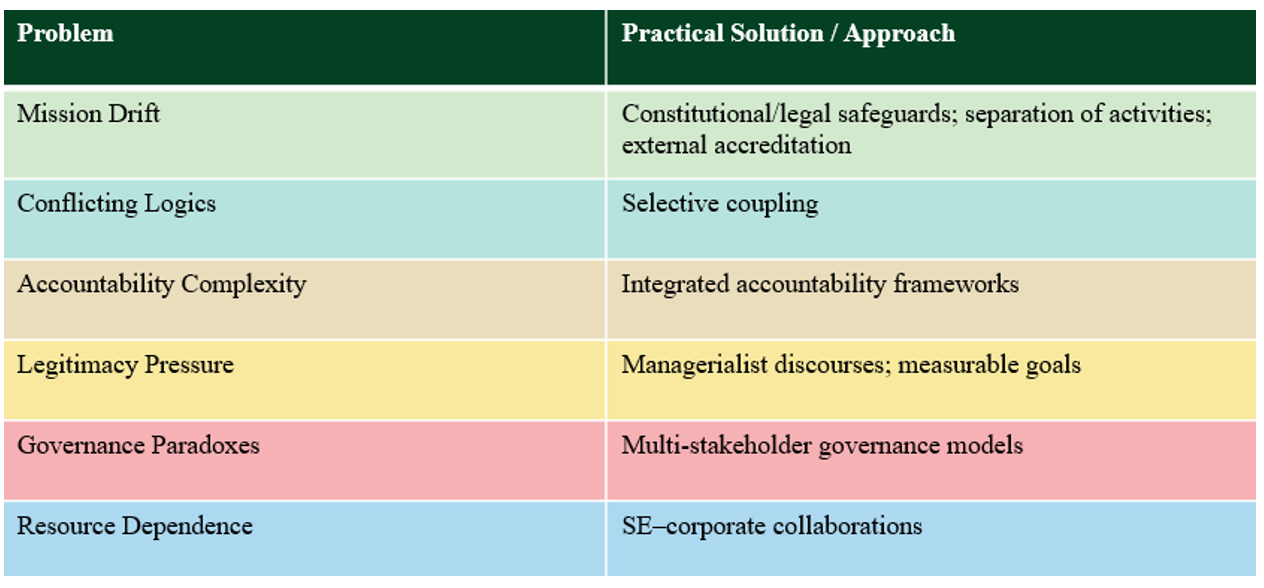
On the other hand, another well-known option is to separate social and commercial activities. These activities are divided into different units, each with their own accountability structures. In addition, an organization can stabilize and secure its special characteristics with external accreditation systems.25Cornforth, C. Understanding and combating mission drift in social enterprises. Social enterprise journal 10, 3-20 (2014). This type is based on voluntary and external certification of standards, where, in this case, for example, a seal of approval sets criteria that social enterprises should meet and also demonstrate how they meet them. This provides a certain degree of assurance that the social mission will not be abandoned.25Cornforth, C. Understanding and combating mission drift in social enterprises. Social enterprise journal 10, 3-20 (2014). One example would be social fair-trade companies involving their producers and consumers in their board of directors and relying on international certification systems to prevent a shift towards commercial goals.12Mason, C. & Doherty, B. A fair trade-off? Paradoxes in the governance of fair-trade social enterprises. Journal of Business Ethics 136, 451-469 (2015).
These measures, such as strong safeguards or external controls, can on the one hand ensure legitimacy and guarantee the alignment of the mission, but on the other hand they risk increasing bureaucracy or reducing flexibility in adapting to changing environments, which makes it important for organizations to constantly review whether the mission is truly protected by these means.25Cornforth, C. Understanding and combating mission drift in social enterprises. Social enterprise journal 10, 3-20 (2014). Cornforth (2014) mentions that mechanisms to protect their independence should be used and that boards should regularly consider external pressure factors.25Cornforth, C. Understanding and combating mission drift in social enterprises. Social enterprise journal 10, 3-20 (2014). Ebrahim et al. (2014) also emphasize the importance of accountability systems that continuously monitor alignment with the mission.11Ebrahim, A., Battilana, J. & Mair, J. The governance of social enterprises: Mission drift and accountability challenges in hybrid organizations. Research in organizational behavior 34, 81-100 (2014). https://doi.org/10.1016/j.riob.2014.09.001
Another key problem area for hybrid organizations is the competing logics they must simultaneously serve at multiple levels, such as social, economic, or even governmental.16Pache, A.-C. & Santos, F. Inside the hybrid organization: Selective coupling as a response to competing institutional logics. Academy of management journal 56, 972-1001 (2013).,1Greenwood, R., Raynard, M., Kodeih, F., Micelotta, E. R. & Lounsbury, M. Institutional Complexity and Organizational Responses. Academy of Management Annals 5, 317-371 (2011). https://doi.org/10.5465/19416520.2011.590299 These logics can exert influence and create contradictions in decision-making, organizational identity, or stakeholder relationships, which can often lead to instability or other consequences.1Greenwood, R., Raynard, M., Kodeih, F., Micelotta, E. R. & Lounsbury, M. Institutional Complexity and Organizational Responses. Academy of Management Annals 5, 317-371 (2011). https://doi.org/10.5465/19416520.2011.590299,16Pache, A.-C. & Santos, F. Inside the hybrid organization: Selective coupling as a response to competing institutional logics. Academy of management journal 56, 972-1001 (2013). One well-known measure that has proven useful regarding this aspect is selective coupling, which aims to adopt individual practices from different logics in a targeted manner rather than allowing one logic to dominate completely.16Pache, A.-C. & Santos, F. Inside the hybrid organization: Selective coupling as a response to competing institutional logics. Academy of management journal 56, 972-1001 (2013). The aim here is not to focus entirely on one thing, but to combine elements in such a way that legitimacy is maintained with regard to multiple stakeholder groups.16Pache, A.-C. & Santos, F. Inside the hybrid organization: Selective coupling as a response to competing institutional logics. Academy of management journal 56, 972-1001 (2013). Pache and Santos (2013) show that social enterprises often respond with selective coupling when they suffer from conflicting demands and expectations, thereby maintaining their credibility with their stakeholders and the market.16Pache, A.-C. & Santos, F. Inside the hybrid organization: Selective coupling as a response to competing institutional logics. Academy of management journal 56, 972-1001 (2013). A key example here would be Work Integration Social Enterprises (WISE), which also have to deal with different logics. WISEs simultaneously uphold market and social logics by often combining standard business practices in sales and production with social support structures for employees to integrate these logics into their day-to-day business.16Pache, A.-C. & Santos, F. Inside the hybrid organization: Selective coupling as a response to competing institutional logics. Academy of management journal 56, 972-1001 (2013). Another example apart from selective coupling would be that in phases of strong opposing goals, it may make sense to separate social and economic responsibilities operationally while at the same time establishing joint review formats in which compromises are openly discussed and documented.11Ebrahim, A., Battilana, J. & Mair, J. The governance of social enterprises: Mission drift and accountability challenges in hybrid organizations. Research in organizational behavior 34, 81-100 (2014). https://doi.org/10.1016/j.riob.2014.09.001,17Battilana, J., Sngul, M., Pache, A.-C. & Model, J. HARNESSING PRODUCTIVE TENSIONS IN HYBRID ORGANIZATIONS: THE CASE OF WORK INTEGRATION SOCIAL ENTERPRISES. Academy of Management Journal 58, 1658-1685 (2015). https://doi.org/10.5465/amj.2013.0903
However, it can also be assumed that this brings both opportunities and risks. Selective coupling brings flexibility and contextual adaptation, allowing organizations to decide for themselves which elements best suit their hybrid mission.16Pache, A.-C. & Santos, F. Inside the hybrid organization: Selective coupling as a response to competing institutional logics. Academy of management journal 56, 972-1001 (2013). At the same time, selective coupling can also lead to inconsistency or mistrust if stakeholders perceive the organization as sending mixed signals or pursuing contradictory strategies.1Greenwood, R., Raynard, M., Kodeih, F., Micelotta, E. R. & Lounsbury, M. Institutional Complexity and Organizational Responses. Academy of Management Annals 5, 317-371 (2011). https://doi.org/10.5465/19416520.2011.590299,16Pache, A.-C. & Santos, F. Inside the hybrid organization: Selective coupling as a response to competing institutional logics. Academy of management journal 56, 972-1001 (2013). Therefore, it is important for organizations to observe and control the balance between their logics using mechanisms.11Ebrahim, A., Battilana, J. & Mair, J. The governance of social enterprises: Mission drift and accountability challenges in hybrid organizations. Research in organizational behavior 34, 81-100 (2014). https://doi.org/10.1016/j.riob.2014.09.001 These mechanisms could include, for example, performance indicators that take financial results and social outcomes into account, or boundary roles, whereby individuals and teams mediate between the logics and competing demands of stakeholders.11Ebrahim, A., Battilana, J. & Mair, J. The governance of social enterprises: Mission drift and accountability challenges in hybrid organizations. Research in organizational behavior 34, 81-100 (2014). https://doi.org/10.1016/j.riob.2014.09.001,12Mason, C. & Doherty, B. A fair trade-off? Paradoxes in the governance of fair-trade social enterprises. Journal of Business Ethics 136, 451-469 (2015). This does not solve the problem of conflicting logics, but it does allow it to be successfully navigated and managed through negotiation and adaptation.1Greenwood, R., Raynard, M., Kodeih, F., Micelotta, E. R. & Lounsbury, M. Institutional Complexity and Organizational Responses. Academy of Management Annals 5, 317-371 (2011). https://doi.org/10.5465/19416520.2011.590299
The challenge of accountability complexity is also a significant problem for hybrid organizations. This challenge can be understood as the requirement that the organization must simultaneously demonstrate its performance to various stakeholders, who are usually funders, regulatory authorities, customers, or communities.11Ebrahim, A., Battilana, J. & Mair, J. The governance of social enterprises: Mission drift and accountability challenges in hybrid organizations. Research in organizational behavior 34, 81-100 (2014). https://doi.org/10.1016/j.riob.2014.09.001 The multidimensional accountability that arises from this can often lead to competing expectations. A typical illustration of this is that funders demand measurable efficiency, while community groups prefer social outcomes. Thus, Ebrahim et al. (2014) explain that social enterprises must integrate financial and social dimensions, as accountability cannot be reduced to a single bottom line.11Ebrahim, A., Battilana, J. & Mair, J. The governance of social enterprises: Mission drift and accountability challenges in hybrid organizations. Research in organizational behavior 34, 81-100 (2014). https://doi.org/10.1016/j.riob.2014.09.001 To address this complexity, there are also mechanisms that help hybrid organizations deal with it more effectively. One option is accountability mapping, which clearly assigns responsibilities to stakeholders by systematically identifying inputs, outputs, and outcomes.11Ebrahim, A., Battilana, J. & Mair, J. The governance of social enterprises: Mission drift and accountability challenges in hybrid organizations. Research in organizational behavior 34, 81-100 (2014). https://doi.org/10.1016/j.riob.2014.09.001 Another strategy is integrated performance measurement systems, also known as Key Performance Indicator (KPI) sets, which bring together economic and social indicators in a single framework. These mechanisms help to ensure that no stakeholder group is favored over another and that compromises are compared.11Ebrahim, A., Battilana, J. & Mair, J. The governance of social enterprises: Mission drift and accountability challenges in hybrid organizations. Research in organizational behavior 34, 81-100 (2014). https://doi.org/10.1016/j.riob.2014.09.001 A fitting example of this is that fair trade social enterprises use their certification systems to enforce compliance with both financial and social standards. Mason and Doherty (2015) use the example of fair trade organizations to show that involving producers and consumers on boards improves accountability to multiple stakeholders and enables tensions to be managed more effectively.12Mason, C. & Doherty, B. A fair trade-off? Paradoxes in the governance of fair-trade social enterprises. Journal of Business Ethics 136, 451-469 (2015).
These approaches improve stakeholder relations, with governance and certification processes strengthening legitimacy and transparency.12Mason, C. & Doherty, B. A fair trade-off? Paradoxes in the governance of fair-trade social enterprises. Journal of Business Ethics 136, 451-469 (2015). However, this can quickly overload the administration or there is a risk of KPI inflation, with too many indicators causing the strategic focus to be lost.11Ebrahim, A., Battilana, J. & Mair, J. The governance of social enterprises: Mission drift and accountability challenges in hybrid organizations. Research in organizational behavior 34, 81-100 (2014). https://doi.org/10.1016/j.riob.2014.09.001 To prevent this from happening, organizations often resort to external audits, such as Fair Trade, or structured reporting cycles, which keep accountability more controlled and maintain credibility with stakeholders.12Mason, C. & Doherty, B. A fair trade-off? Paradoxes in the governance of fair-trade social enterprises. Journal of Business Ethics 136, 451-469 (2015).,11Ebrahim, A., Battilana, J. & Mair, J. The governance of social enterprises: Mission drift and accountability challenges in hybrid organizations. Research in organizational behavior 34, 81-100 (2014). https://doi.org/10.1016/j.riob.2014.09.001
Legitimacy pressure, as a distinct problem area, is closely linked to complex accountability requirements and arises from the expectations of various interest groups, which place demands on hybrids.34Meyer, M., Buber, R. & Aghamanoukjan, A. In search of legitimacy: Managerialism and legitimation in civil society organizations. VOLUNTAS: International Journal of Voluntary and Nonprofit Organizations 24, 167-193 (2013).,37Powell, M., Gillett, A. & Doherty, B. Sustainability in social enterprise: hybrid organizing in public services. Public Management Review21, 159-186 (2019). Because stakeholders expect both effectiveness and professionalism, judgments of legitimacy increasingly depend on operational notions of efficiency and effectiveness. In this context, managerialist discourses have proven helpful, with organizations adopting a certain business language and using management concepts to align themselves with these dominant expectations.34Meyer, M., Buber, R. & Aghamanoukjan, A. In search of legitimacy: Managerialism and legitimation in civil society organizations. VOLUNTAS: International Journal of Voluntary and Nonprofit Organizations 24, 167-193 (2013). Meyer et al. (2013) show that NPOs are increasingly resorting to managerialist patterns of legitimacy, such as efficiency, effectiveness, stakeholder needs, or innovation, and presenting themselves as business-like in this perspective. These discourses serve to legitimize organizations and improve their attractiveness to important external target groups.34Meyer, M., Buber, R. & Aghamanoukjan, A. In search of legitimacy: Managerialism and legitimation in civil society organizations. VOLUNTAS: International Journal of Voluntary and Nonprofit Organizations 24, 167-193 (2013).
Another practical solution is the use of measurable goals. Here, the mission is translated into quantifiable goals in order to present its performance in a comparable and assessable way and thus meet the expectations of investors, funders, and other key audiences.11Ebrahim, A., Battilana, J. & Mair, J. The governance of social enterprises: Mission drift and accountability challenges in hybrid organizations. Research in organizational behavior 34, 81-100 (2014). https://doi.org/10.1016/j.riob.2014.09.001 In practice, organizations do not simply formulate their plans and commitments, but set and define specific key performance indicators for the goals, making it easier for their stakeholders to evaluate these achievements and for hybrids to signal their effectiveness in their competitive environment.11Ebrahim, A., Battilana, J. & Mair, J. The governance of social enterprises: Mission drift and accountability challenges in hybrid organizations. Research in organizational behavior 34, 81-100 (2014). https://doi.org/10.1016/j.riob.2014.09.001 Managerialist discourses and measurable goals are good mechanisms for promoting legitimacy, but they also carry risks.11Ebrahim, A., Battilana, J. & Mair, J. The governance of social enterprises: Mission drift and accountability challenges in hybrid organizations. Research in organizational behavior 34, 81-100 (2014). https://doi.org/10.1016/j.riob.2014.09.001,37Powell, M., Gillett, A. & Doherty, B. Sustainability in social enterprise: hybrid organizing in public services. Public Management Review21, 159-186 (2019). An excessive focus on easily quantifiable factors carries the risk that complex social outcomes will not be properly assessed due to a lack of standardization and comparability in the evaluation of social performance.11Ebrahim, A., Battilana, J. & Mair, J. The governance of social enterprises: Mission drift and accountability challenges in hybrid organizations. Research in organizational behavior 34, 81-100 (2014). https://doi.org/10.1016/j.riob.2014.09.001 In relation to hybrid organizations, they attempt to supplement quantitative indicators in order to strike a balance between external legitimacy requirements and the need to remain true to their social values.37Powell, M., Gillett, A. & Doherty, B. Sustainability in social enterprise: hybrid organizing in public services. Public Management Review21, 159-186 (2019).,34Meyer, M., Buber, R. & Aghamanoukjan, A. In search of legitimacy: Managerialism and legitimation in civil society organizations. VOLUNTAS: International Journal of Voluntary and Nonprofit Organizations 24, 167-193 (2013).
The concept of governance paradoxes is also familiar to hybrid organizations, as they often must deal with this problem area. These paradoxes arise from conflicting requirements, given that boards are expected to uphold the social mission while ensuring financial sustainability.12Mason, C. & Doherty, B. A fair trade-off? Paradoxes in the governance of fair-trade social enterprises. Journal of Business Ethics 136, 451-469 (2015). Board members must therefore navigate trade-offs rather than definitively privileging one logic. There are specific practical responses to these governance paradoxes, one of which is the introduction of multi-stakeholder governance models. These models aim to ensure that different perspectives are considered and incorporated into the organization’s decision-making process.12Mason, C. & Doherty, B. A fair trade-off? Paradoxes in the governance of fair-trade social enterprises. Journal of Business Ethics 136, 451-469 (2015). In light of this, Ebrahim et al. (2014) show that a multi-stakeholder governance approach can be implemented in practice by giving beneficiaries direct representation on the board of directors or by establishing indirect mechanisms such as systematic feedback or complaint-and-response channels, thereby creating downward accountability in decision-making.11Ebrahim, A., Battilana, J. & Mair, J. The governance of social enterprises: Mission drift and accountability challenges in hybrid organizations. Research in organizational behavior 34, 81-100 (2014). https://doi.org/10.1016/j.riob.2014.09.001
These governance arrangements offer the same advantages as the practical solutions of accountability complexity and legitimacy pressure. This includes strengthening accountability and legitimacy by not favoring any interest group.11Ebrahim, A., Battilana, J. & Mair, J. The governance of social enterprises: Mission drift and accountability challenges in hybrid organizations. Research in organizational behavior 34, 81-100 (2014). https://doi.org/10.1016/j.riob.2014.09.001,12Mason, C. & Doherty, B. A fair trade-off? Paradoxes in the governance of fair-trade social enterprises. Journal of Business Ethics 136, 451-469 (2015). It also promotes trust among stakeholders because they are directly involved in organizational oversight. However, this also presents clear challenges, such as the excessive diversity of perspectives slowing down decision-making processes, which can lead to conflicts or blockages.12Mason, C. & Doherty, B. A fair trade-off? Paradoxes in the governance of fair-trade social enterprises. Journal of Business Ethics 136, 451-469 (2015). Mason and Doherty (2015) emphasize that these paradoxes are part of hybrid governance and that the tensions between financial and social goals can never be completely resolved. To avoid these risks, organizations use moderation mechanisms, for example, where role definitions are clearly defined, a preliminary meeting is held for the beneficiaries, or external experts are involved.12Mason, C. & Doherty, B. A fair trade-off? Paradoxes in the governance of fair-trade social enterprises. Journal of Business Ethics 136, 451-469 (2015). In addition, as with the problem of accountability complexity, clear KPIs for social and commercial performance help boards maintain effective governance.12Mason, C. & Doherty, B. A fair trade-off? Paradoxes in the governance of fair-trade social enterprises. Journal of Business Ethics 136, 451-469 (2015). In this context, multi-stakeholder governance models institutionalize the paradoxes rather than eliminating them, providing a framework where competing demands can be managed constructively.12Mason, C. & Doherty, B. A fair trade-off? Paradoxes in the governance of fair-trade social enterprises. Journal of Business Ethics 136, 451-469 (2015).,11Ebrahim, A., Battilana, J. & Mair, J. The governance of social enterprises: Mission drift and accountability challenges in hybrid organizations. Research in organizational behavior 34, 81-100 (2014). https://doi.org/10.1016/j.riob.2014.09.001
The final problem area identified that hybrid organizations must address is the challenge of resource dependency. This dependency arises from the fact that hybrid organizations collaborate with external partners, which shapes both the form and the impact of the collaboration. This can create vulnerabilities, especially when a strong dependency on a partner with a dominant logic limits the organization’s capabilities.4Savarese, C., Huybrechts, B. & Hudon, M. The Influence of Interorganizational Collaboration on Logic Conciliation and Tensions Within Hybrid Organizations: Insights from Social Enterprise–Corporate Collaborations. Journal of Business Ethics 173, 709-721 (2021). https://doi.org/10.1007/s10551-020-04557-7 One response to this problem could be to establish SE-corporate collaborations that better manage mutual dependency and obtain complementary resources. Savarese et al. (2021) distinguish between three types of collaboration: philanthropic, transactional, and integrative, although these can evolve over time.4Savarese, C., Huybrechts, B. & Hudon, M. The Influence of Interorganizational Collaboration on Logic Conciliation and Tensions Within Hybrid Organizations: Insights from Social Enterprise–Corporate Collaborations. Journal of Business Ethics 173, 709-721 (2021). https://doi.org/10.1007/s10551-020-04557-7 These collaborations involve numerous interactions and compatibility with the mission, which contributes to maintaining hybridity, while connections with low commitment tend to focus on one logic and increase the risk of mission drift.4Savarese, C., Huybrechts, B. & Hudon, M. The Influence of Interorganizational Collaboration on Logic Conciliation and Tensions Within Hybrid Organizations: Insights from Social Enterprise–Corporate Collaborations. Journal of Business Ethics 173, 709-721 (2021). https://doi.org/10.1007/s10551-020-04557-7
Concerning this aspect, there are opportunities for closely integrated collaborations to support hybridity or for tensions to remain in such collaborations but be managed in a stable and productive manner.4Savarese, C., Huybrechts, B. & Hudon, M. The Influence of Interorganizational Collaboration on Logic Conciliation and Tensions Within Hybrid Organizations: Insights from Social Enterprise–Corporate Collaborations. Journal of Business Ethics 173, 709-721 (2021). https://doi.org/10.1007/s10551-020-04557-7 Risks arise from the fact that loosely integrated collaborations give priority to one logic, which generates less friction but reduces hybridity and increases the risk of mission drift. In addition, high power asymmetries between partners increase tensions and favor shifts in favor of the dominant logic.4Savarese, C., Huybrechts, B. & Hudon, M. The Influence of Interorganizational Collaboration on Logic Conciliation and Tensions Within Hybrid Organizations: Insights from Social Enterprise–Corporate Collaborations. Journal of Business Ethics 173, 709-721 (2021). https://doi.org/10.1007/s10551-020-04557-7 In practice, hybrids should give priority to integrative features that create close relationships, mutual transfer of resources and capabilities, and stronger mutual commitment. At the same time, the degree of interdependence and power asymmetries in their cooperation portfolio should be monitored. In this context, low-commitment cooperations should not be given too much weight in the portfolio and should rather be replaced by closer and reciprocal partnerships that better protect hybridity.4Savarese, C., Huybrechts, B. & Hudon, M. The Influence of Interorganizational Collaboration on Logic Conciliation and Tensions Within Hybrid Organizations: Insights from Social Enterprise–Corporate Collaborations. Journal of Business Ethics 173, 709-721 (2021). https://doi.org/10.1007/s10551-020-04557-7
With the central problem areas and practical solutions in mind, the focus is now on drivers and barriers to hybrid practice, as well as on design approaches that are intended to demonstrate practical application. One of many driving factors is a balanced resource and skills base.37Powell, M., Gillett, A. & Doherty, B. Sustainability in social enterprise: hybrid organizing in public services. Public Management Review21, 159-186 (2019). In relation to this, hybrid organizations are generally more resilient when they rely on a workforce that combines economic and social skills, have diversified sources of income, and at the same time ensure social quality and service quality.37Powell, M., Gillett, A. & Doherty, B. Sustainability in social enterprise: hybrid organizing in public services. Public Management Review21, 159-186 (2019). Moreover, governance structures also have a beneficial effect when, for example, boards do not view key figures separately and individually, but use them to monitor the relationship between social and commercial activities, thereby identifying potential conflicts of interest at an earlier stage.11Ebrahim, A., Battilana, J. & Mair, J. The governance of social enterprises: Mission drift and accountability challenges in hybrid organizations. Research in organizational behavior 34, 81-100 (2014). https://doi.org/10.1016/j.riob.2014.09.001 Another driver can arise in human resources policy, given that earlier studies show that a shared organizational identity can reduce tensions and ensure simultaneous orientation toward different logics. In areas such as recruitment and socialization practices, for example, such an identity can be built up, shaped by new attitudes and subsequent integration processes.28Battilana, J. & Dorado, S. Building Sustainable Hybrid Organizations: The Case of Commercial Microfinance Organizations. The Academy of Management Journal 53, 1419-1440 (2010). https://doi.org/10.5465/AMJ.2010.57318391
In contrast, there are also factors that inhibit hybrid practice, such as a strong dependence on individual funders or contracts. In this case, collaborations with a low level of commitment tend to favor one logic and thus weaken the hybrid orientation, which is a risk that is further exacerbated by high power asymmetries.4Savarese, C., Huybrechts, B. & Hudon, M. The Influence of Interorganizational Collaboration on Logic Conciliation and Tensions Within Hybrid Organizations: Insights from Social Enterprise–Corporate Collaborations. Journal of Business Ethics 173, 709-721 (2021). https://doi.org/10.1007/s10551-020-04557-7 In addition, the problem of measuring social impacts also means that social performance is given less weight in the control process, as possible questions of causality and comparability can make reliable evaluation difficult.11Ebrahim, A., Battilana, J. & Mair, J. The governance of social enterprises: Mission drift and accountability challenges in hybrid organizations. Research in organizational behavior 34, 81-100 (2014). https://doi.org/10.1016/j.riob.2014.09.001 Cultural factors also have an inhibiting effect when subgroups coexist and no common identity framework is created.28Battilana, J. & Dorado, S. Building Sustainable Hybrid Organizations: The Case of Commercial Microfinance Organizations. The Academy of Management Journal 53, 1419-1440 (2010). https://doi.org/10.5465/AMJ.2010.57318391 Finally, large multi-stakeholder boards carry the risk of slowing down decisions and exacerbating conflicts if roles are not clearly defined, which is why studies call for these to be clearly addressed.12Mason, C. & Doherty, B. A fair trade-off? Paradoxes in the governance of fair-trade social enterprises. Journal of Business Ethics 136, 451-469 (2015).
To summarize the findings and problems identified so far, hybrid organizations could be strengthened through a mix of resources, governance monitoring, and identity work, while dependencies, power asymmetries, measurement problems, subcultures, and complex committees can act as key barriers. However, these tensions and problems can be managed and used productively through targeted management and the mentioned examples.37Powell, M., Gillett, A. & Doherty, B. Sustainability in social enterprise: hybrid organizing in public services. Public Management Review21, 159-186 (2019).,11Ebrahim, A., Battilana, J. & Mair, J. The governance of social enterprises: Mission drift and accountability challenges in hybrid organizations. Research in organizational behavior 34, 81-100 (2014). https://doi.org/10.1016/j.riob.2014.09.001,28Battilana, J. & Dorado, S. Building Sustainable Hybrid Organizations: The Case of Commercial Microfinance Organizations. The Academy of Management Journal 53, 1419-1440 (2010). https://doi.org/10.5465/AMJ.2010.57318391,4Savarese, C., Huybrechts, B. & Hudon, M. The Influence of Interorganizational Collaboration on Logic Conciliation and Tensions Within Hybrid Organizations: Insights from Social Enterprise–Corporate Collaborations. Journal of Business Ethics 173, 709-721 (2021). https://doi.org/10.1007/s10551-020-04557-7,12Mason, C. & Doherty, B. A fair trade-off? Paradoxes in the governance of fair-trade social enterprises. Journal of Business Ethics 136, 451-469 (2015).,17Battilana, J., Sngul, M., Pache, A.-C. & Model, J. HARNESSING PRODUCTIVE TENSIONS IN HYBRID ORGANIZATIONS: THE CASE OF WORK INTEGRATION SOCIAL ENTERPRISES. Academy of Management Journal 58, 1658-1685 (2015). https://doi.org/10.5465/amj.2013.0903
3.1.2 Organizational development process
To continue examining hybrid organizations in practical terms, the following section presents a process logic that depicts hybrid organizations in their practical development. Hybrid organizations do not simply arise abruptly, but rather undergo a lengthy process of formation, development, and eventual stabilization, which can be particularly challenging because, in situations of tension, they cannot directly adopt ready-made management models that are directly suitable and implementable for the organization.28Battilana, J. & Dorado, S. Building Sustainable Hybrid Organizations: The Case of Commercial Microfinance Organizations. The Academy of Management Journal 53, 1419-1440 (2010). https://doi.org/10.5465/AMJ.2010.57318391 The aim of this subchapter is therefore to present and examine hybrid organizations in this process logic to understand and take them into account in specific phases. The process is divided into three different phases, which roughly represent the founding, establishment, and stabilization of the organization.28Battilana, J. & Dorado, S. Building Sustainable Hybrid Organizations: The Case of Commercial Microfinance Organizations. The Academy of Management Journal 53, 1419-1440 (2010). https://doi.org/10.5465/AMJ.2010.57318391,39Tracey, P., Phillips, N. & Jarvis, O. Bridging institutional entrepreneurship and the creation of new organizational forms: A multilevel model. Organization science 22, 60-80 (2011). Finally, the role of leadership in this context is also discussed, as well as drivers and barriers in relation to the development process.
The first phase would represent the founding and early development logic that hybrid organizations go through. As already mentioned, there are no standardized models for hybrid organizations in this phase that they could immediately adopt. This represents a very risky founding phase for hybrid organizations, forcing them to develop their own practical solutions to reconcile their conflicting logics.28Battilana, J. & Dorado, S. Building Sustainable Hybrid Organizations: The Case of Commercial Microfinance Organizations. The Academy of Management Journal 53, 1419-1440 (2010). https://doi.org/10.5465/AMJ.2010.57318391 In practical terms, this means that hybrid organizations often start out experimenting on their own, with a high degree of uncertainty and under the critical observation of stakeholders. If wrong decisions are made in this phase, it can jeopardize their long-term legitimacy.30Pache, A.-C. & Santos, F. When worlds collide: The internal dynamics of organizational responses to conflicting institutional demands. Academy of management review 35, 455-476 (2010).,39Tracey, P., Phillips, N. & Jarvis, O. Bridging institutional entrepreneurship and the creation of new organizational forms: A multilevel model. Organization science 22, 60-80 (2011). From the outset, founders must have asked themselves certain questions regarding identity and legitimacy. Such questions include, for example, whether the founders envision a company with social aspirations or a social organization with a business model.16Pache, A.-C. & Santos, F. Inside the hybrid organization: Selective coupling as a response to competing institutional logics. Academy of management journal 56, 972-1001 (2013). Such identity questions are crucial in practical terms for other areas, such as sources of financing, employee selection, and stakeholder trust.28Battilana, J. & Dorado, S. Building Sustainable Hybrid Organizations: The Case of Commercial Microfinance Organizations. The Academy of Management Journal 53, 1419-1440 (2010). https://doi.org/10.5465/AMJ.2010.57318391 Once a clear identity has been established, trust can be built among investors and partners, while hiring staff and building a culture aligns the organization with hybridity. An example from Battilana and Dorado (2010) is that a microfinance organization deliberately hired young people to form a new hybrid identity.28Battilana, J. & Dorado, S. Building Sustainable Hybrid Organizations: The Case of Commercial Microfinance Organizations. The Academy of Management Journal 53, 1419-1440 (2010). https://doi.org/10.5465/AMJ.2010.57318391 When founding hybrid organizations, the focus is always on the actors, deliberately exploiting gaps in the system and building bridges between established areas. In practical terms, the founders take on the institutional work, which includes reframing social problems, designing organizational structures, and actively seeking legitimacy from society and investors.39Tracey, P., Phillips, N. & Jarvis, O. Bridging institutional entrepreneurship and the creation of new organizational forms: A multilevel model. Organization science 22, 60-80 (2011). Tracey et al. (2011) illustrate how risky and fragile founding processes can be in practice, where two social entrepreneurs in the UK founded the organization Aspire that combined elements of nonprofit logic and market logic. The model was innovative and initially gained legitimacy, but the organization later failed due to tensions between the two logics.39Tracey, P., Phillips, N. & Jarvis, O. Bridging institutional entrepreneurship and the creation of new organizational forms: A multilevel model. Organization science 22, 60-80 (2011).
After the founding phase comes a phase in which hybrid organizations must clearly protect their mission and the problem of mission drift becomes truly apparent, because in practice there is otherwise a risk that market logic will quickly take over and the social orientation will be lost.25Cornforth, C. Understanding and combating mission drift in social enterprises. Social enterprise journal 10, 3-20 (2014). In practical implementation, many organizations develop clear rules and control mechanisms, such as external certifications or legal stipulations, to maintain the balance between their social mission and economic activities.25Cornforth, C. Understanding and combating mission drift in social enterprises. Social enterprise journal 10, 3-20 (2014). Another step would be to ensure financial sustainability and broaden its base. Successful hybrid organizations build up multiple sources of income to remain stable and not develop such a strong dependence on individual donors or funding agreements.37Powell, M., Gillett, A. & Doherty, B. Sustainability in social enterprise: hybrid organizing in public services. Public Management Review21, 159-186 (2019). As Powell et al. (2019) emphasize here, a crucial factor for stability is the development of diverse sources of income that balance the mission and reduce the risk of excessive dependence on funders. In practice, a hybrid workforce also emerges, with people with professional experience working alongside disadvantaged groups who are integrated through the organization.37Powell, M., Gillett, A. & Doherty, B. Sustainability in social enterprise: hybrid organizing in public services. Public Management Review21, 159-186 (2019). Ultimately, depending on their development, different patterns emerge among organizations, which are influenced by governance decisions. Organizations either develop in such a way that they align themselves more closely with one logic and adapt to it, or they consciously use innovations and practices to combine both logics.31Mair, J., Mayer, J. & Lutz, E. Navigating institutional plurality: Organizational governance in hybrid organizations. Organization studies36, 713-739 (2015).
As an organization exists for a longer period, there comes a phase where the focus shifts to lasting legitimacy and stabilization.1Greenwood, R., Raynard, M., Kodeih, F., Micelotta, E. R. & Lounsbury, M. Institutional Complexity and Organizational Responses. Academy of Management Annals 5, 317-371 (2011). https://doi.org/10.5465/19416520.2011.590299 In this phase, organizations prove in everyday life that they are economically viable on the one hand, but also remain socially accepted on the other.1Greenwood, R., Raynard, M., Kodeih, F., Micelotta, E. R. & Lounsbury, M. Institutional Complexity and Organizational Responses. Academy of Management Annals 5, 317-371 (2011). https://doi.org/10.5465/19416520.2011.590299,11Ebrahim, A., Battilana, J. & Mair, J. The governance of social enterprises: Mission drift and accountability challenges in hybrid organizations. Research in organizational behavior 34, 81-100 (2014). https://doi.org/10.1016/j.riob.2014.09.001 In practical terms, this means that once the general balance of the organization has been found, it is not only necessary to establish it once, but also to maintain it in the long term, which requires constant adjustment between social and economic goals.11Ebrahim, A., Battilana, J. & Mair, J. The governance of social enterprises: Mission drift and accountability challenges in hybrid organizations. Research in organizational behavior 34, 81-100 (2014). https://doi.org/10.1016/j.riob.2014.09.001,40Raisiene, A. G. & Urmanavičienė, A. Mission drift in a hybrid organization: how can social business combine its dual goals? Ekonomski vjesnik: Review of Contemporary Entrepreneurship, Business, and Economic Issues 30, 301-310 (2017). This can be achieved, for example, by developing new identities or moving closer to fair trade fields that aim to permanently combine contradictory logics.25Cornforth, C. Understanding and combating mission drift in social enterprises. Social enterprise journal 10, 3-20 (2014). A well-known and frequently mentioned example of governance structures often used by organizations are boards, which contribute to conflict management with stakeholders and keep the organization on a stable course.31Mair, J., Mayer, J. & Lutz, E. Navigating institutional plurality: Organizational governance in hybrid organizations. Organization studies36, 713-739 (2015). In this phase, the types of organizations and the everyday decisions they make become even clearer and more apparent.31Mair, J., Mayer, J. & Lutz, E. Navigating institutional plurality: Organizational governance in hybrid organizations. Organization studies36, 713-739 (2015). An example from Powell et al. (2019) shows that the Shoreditch Development organization ensures its stability by investing its income from real estate projects directly in local social services. This shows that it specifically links its business activities to its social mission.37Powell, M., Gillett, A. & Doherty, B. Sustainability in social enterprise: hybrid organizing in public services. Public Management Review21, 159-186 (2019).
To broaden the focus to include the leadership role, it is important to recognize that, in practice, the direction of a hybrid organization is strongly influenced by leadership positions.11Ebrahim, A., Battilana, J. & Mair, J. The governance of social enterprises: Mission drift and accountability challenges in hybrid organizations. Research in organizational behavior 34, 81-100 (2014). https://doi.org/10.1016/j.riob.2014.09.001,40Raisiene, A. G. & Urmanavičienė, A. Mission drift in a hybrid organization: how can social business combine its dual goals? Ekonomski vjesnik: Review of Contemporary Entrepreneurship, Business, and Economic Issues 30, 301-310 (2017). An example of this would be if managers prioritize dividends or salaries, the organization would shift toward becoming a purely commercial enterprise, which is why leadership has a great responsibility to maintain this balance.40Raisiene, A. G. & Urmanavičienė, A. Mission drift in a hybrid organization: how can social business combine its dual goals? Ekonomski vjesnik: Review of Contemporary Entrepreneurship, Business, and Economic Issues 30, 301-310 (2017). A good and important tool for leadership that hybrid organizations should have is the implementation of an early warning system in everyday life, which could be, for example, the consistent evaluation of monthly indicators. This enables hybrid organizations to recognize at an early stage whether the balance between business and social mission is still right or whether intervention is necessary before something goes wrong.40Raisiene, A. G. & Urmanavičienė, A. Mission drift in a hybrid organization: how can social business combine its dual goals? Ekonomski vjesnik: Review of Contemporary Entrepreneurship, Business, and Economic Issues 30, 301-310 (2017). In addition, managers should not only endure situations of tension, but also use them as opportunities for learning and development. These opportunities can give rise to new innovations by openly addressing paradoxes and reflecting on them as a team, thereby strengthening and stabilizing the hybrid character of the organizations.29Jay, J. Navigating paradox as a mechanism of change and innovation in hybrid organizations. Academy of management journal 56, 137-159 (2012). In practical terms, it would be beneficial for managers to set up negotiation rooms where employees or other members of the organization with different areas of responsibility can regularly discuss contradicting goals or other concerns. These rooms can be used within the organization to specifically coordinate social and economic requirements and thus also to make joint decisions.17Battilana, J., Sngul, M., Pache, A.-C. & Model, J. HARNESSING PRODUCTIVE TENSIONS IN HYBRID ORGANIZATIONS: THE CASE OF WORK INTEGRATION SOCIAL ENTERPRISES. Academy of Management Journal 58, 1658-1685 (2015). https://doi.org/10.5465/amj.2013.0903 Additionally, it is also important for the stability of the balance in the organization that managers provide their employees with targeted training and development. Especially in hybrid organizations, employees should be empowered not only professionally but also socially so that they can understand and implement the dual role of the organization in everyday life.17Battilana, J., Sngul, M., Pache, A.-C. & Model, J. HARNESSING PRODUCTIVE TENSIONS IN HYBRID ORGANIZATIONS: THE CASE OF WORK INTEGRATION SOCIAL ENTERPRISES. Academy of Management Journal 58, 1658-1685 (2015). https://doi.org/10.5465/amj.2013.0903
In connection with this, potential drivers and barriers can be identified during the development process. First, an essential driver is finding the right balance early in the founding and development process, when hybrid organizations establish a functioning balance between social and economic goals in their early stages.7Smith, W. K., Gonin, M. & Besharov, M. L. Managing social-business tensions: A review and research agenda for social enterprise. Business Ethics Quarterly 23, 407-442 (2013). The advantage of achieving this balance from the outset is that later stages of development can be navigated more stably and potential conflicts and paradoxes can be reduced.17Battilana, J., Sngul, M., Pache, A.-C. & Model, J. HARNESSING PRODUCTIVE TENSIONS IN HYBRID ORGANIZATIONS: THE CASE OF WORK INTEGRATION SOCIAL ENTERPRISES. Academy of Management Journal 58, 1658-1685 (2015). https://doi.org/10.5465/amj.2013.0903 In terms of learning processes, organizations can further stabilize their development process if they manage to transform tensions in such a way that they lead to exchange and innovation. Paradoxes are therefore not only short-term challenges, but can also open up long-term opportunities for learning and innovation.29Jay, J. Navigating paradox as a mechanism of change and innovation in hybrid organizations. Academy of management journal 56, 137-159 (2012). Hybrid organizations that are in increasingly mature phases can benefit from greater resilience if they can navigate flexibly between different logics and thus adapt their structure accordingly.41Fossestøl, K., Breit, E., Andreassen, T. A. & Klemsdal, L. Managing institutional complexity in public sector reform: Hybridization in front‐line service organizations. Public administration 93, 290-306 (2015).
One possible inhibiting factor to address is the potential for hybrid organizations to develop in a one-sided manner. This occurs when they follow one logic too closely in their development and thus block or hinder their further progress.7Smith, W. K., Gonin, M. & Besharov, M. L. Managing social-business tensions: A review and research agenda for social enterprise. Business Ethics Quarterly 23, 407-442 (2013). This one-sidedness ultimately leads to an organization losing its hybrid orientation, with business objectives becoming dominant and the social mission being neglected. In addition, too rapid growth could also pose a risk for hybrid organizations, as it is common in the development process but could also quickly supplant the original mission.7Smith, W. K., Gonin, M. & Besharov, M. L. Managing social-business tensions: A review and research agenda for social enterprise. Business Ethics Quarterly 23, 407-442 (2013). This phase tests organizations to see whether they can maintain their hybrid profile or whether they cannot keep up, which would upset the balance.37Powell, M., Gillett, A. & Doherty, B. Sustainability in social enterprise: hybrid organizing in public services. Public Management Review21, 159-186 (2019). In this process, it is often unclear whether a decision is correct because the interpretation of the logics always varies. This can influence and complicate management over longer development phases.29Jay, J. Navigating paradox as a mechanism of change and innovation in hybrid organizations. Academy of management journal 56, 137-159 (2012). Finally, hybrid organizations in the development and maturity phases can often come under pressure to permanently reconcile their conflicting requirements. This existing complexity presents obstacles to the phases and processes that could slow them down or even block them.41Fossestøl, K., Breit, E., Andreassen, T. A. & Klemsdal, L. Managing institutional complexity in public sector reform: Hybridization in front‐line service organizations. Public administration 93, 290-306 (2015).
It becomes clear that hybrid organizations do not simply emerge suddenly but rather go through different phases in which the balance of opposing goals always requires constant debate. In this development, it becomes apparent that hybrids are not static constructs, but rather stabilize themselves through continuous adaptation and readjustment.29Jay, J. Navigating paradox as a mechanism of change and innovation in hybrid organizations. Academy of management journal 56, 137-159 (2012). Another insight is that leadership and learning processes are important and play a central role in all phases to ensure that no blockages or obstacles arise.29Jay, J. Navigating paradox as a mechanism of change and innovation in hybrid organizations. Academy of management journal 56, 137-159 (2012).,17Battilana, J., Sngul, M., Pache, A.-C. & Model, J. HARNESSING PRODUCTIVE TENSIONS IN HYBRID ORGANIZATIONS: THE CASE OF WORK INTEGRATION SOCIAL ENTERPRISES. Academy of Management Journal 58, 1658-1685 (2015). https://doi.org/10.5465/amj.2013.0903 Specifically, the drivers and barriers show that the development of hybrids depends heavily on how they overcome conflicting goals and whether they succeed in balancing their mission and the market.40Raisiene, A. G. & Urmanavičienė, A. Mission drift in a hybrid organization: how can social business combine its dual goals? Ekonomski vjesnik: Review of Contemporary Entrepreneurship, Business, and Economic Issues 30, 301-310 (2017).,7Smith, W. K., Gonin, M. & Besharov, M. L. Managing social-business tensions: A review and research agenda for social enterprise. Business Ethics Quarterly 23, 407-442 (2013). The takeaway is that the long-term success of hybrid organizations depends not primarily on fixed models or frameworks and more on their ability to control their development process and translate contradictions into solutions.41Fossestøl, K., Breit, E., Andreassen, T. A. & Klemsdal, L. Managing institutional complexity in public sector reform: Hybridization in front‐line service organizations. Public administration 93, 290-306 (2015).
3.2 Traditional vs. hybrid organizations
In the following comparison, traditional and hybrid organizations are compared with each other to identify and understand the key differences and similarities in practice. Whereas traditional organizations are usually one-dimensional and easier to manage, hybrid organizations in this comparison demonstrate the many challenges they must overcome.3Billis, D. in Hybrid Organizations and the Third Sector: Challenges for Practice, Theory and Policy (ed David Billis) 46-69 (Palgrave Macmillan, 2010).,28Battilana, J. & Dorado, S. Building Sustainable Hybrid Organizations: The Case of Commercial Microfinance Organizations. The Academy of Management Journal 53, 1419-1440 (2010). https://doi.org/10.5465/AMJ.2010.57318391 From this perspective, many sectors, including finance, fair trade, universities, and social enterprises, operate between these classic and hybrid models.28Battilana, J. & Dorado, S. Building Sustainable Hybrid Organizations: The Case of Commercial Microfinance Organizations. The Academy of Management Journal 53, 1419-1440 (2010). https://doi.org/10.5465/AMJ.2010.57318391,12Mason, C. & Doherty, B. A fair trade-off? Paradoxes in the governance of fair-trade social enterprises. Journal of Business Ethics 136, 451-469 (2015).,36Boitier, M., Riviere, A., Wenzlaff, F. & Hattke, F. Hybrid organizational responses to institutional complexity: a cross-case study of three European universities. Management international 22, 121-135 (2018).,42Liu, G., Eng, T. Y. & Takeda, S. An investigation of marketing capabilities and social enterprise performance in the UK and Japan. Entrepreneurship theory and practice 39, 267-298 (2015). This comparison is presented below in several dimensions, including goals/mission, decision logics, structures & success, stakeholders (such as Non-Governmental Organizations (NGO)), and institutional environments.33Bagnoli, L. & Megali, C. Measuring performance in social enterprises. Nonprofit and Voluntary Sector Quarterly 40, 149-165 (2009).,17Battilana, J., Sngul, M., Pache, A.-C. & Model, J. HARNESSING PRODUCTIVE TENSIONS IN HYBRID ORGANIZATIONS: THE CASE OF WORK INTEGRATION SOCIAL ENTERPRISES. Academy of Management Journal 58, 1658-1685 (2015). https://doi.org/10.5465/amj.2013.0903,19Defourny, J. & Nyssens, M. Fundamentals for an international typology of social enterprise models. VOLUNTAS: International Journal of Voluntary and nonprofit organizations 28, 2469-2497 (2016). The Table 5 and the subsequent analysis are intended to illustrate these differences in a practical way and support them with further examples.
In the first dimension, Goals/Mission, traditional companies usually pursue a one-dimensional goal, which is often defined by maximizing shareholder value.3Billis, D. in Hybrid Organizations and the Third Sector: Challenges for Practice, Theory and Policy (ed David Billis) 46-69 (Palgrave Macmillan, 2010). Hybrid organizations, however, pursue multiple goals simultaneously, which require them to balance both social and economic objectives.28Battilana, J. & Dorado, S. Building Sustainable Hybrid Organizations: The Case of Commercial Microfinance Organizations. The Academy of Management Journal 53, 1419-1440 (2010). https://doi.org/10.5465/AMJ.2010.57318391 One example cited by Battilana and Dorado (2010) are Bolivian microfinance banks such as BancoSol and Los Andes, which not only have to ensure their financial sustainability, but also fulfill their social mission of combating poverty.28Battilana, J. & Dorado, S. Building Sustainable Hybrid Organizations: The Case of Commercial Microfinance Organizations. The Academy of Management Journal 53, 1419-1440 (2010). https://doi.org/10.5465/AMJ.2010.57318391 A practical example from Liu et al. (2015) illustrates this point using empirical research on 534 social enterprises in the United Kingdom and Japan, which shows that capabilities linked to the market side must be positively associated with both economic and social performance in practice.42Liu, G., Eng, T. Y. & Takeda, S. An investigation of marketing capabilities and social enterprise performance in the UK and Japan. Entrepreneurship theory and practice 39, 267-298 (2015). To further illustrate this, WISEs demonstrate their dual focus by employing disadvantaged people on the one hand, but also selling products and services in competitive markets on the other.17Battilana, J., Sngul, M., Pache, A.-C. & Model, J. HARNESSING PRODUCTIVE TENSIONS IN HYBRID ORGANIZATIONS: THE CASE OF WORK INTEGRATION SOCIAL ENTERPRISES. Academy of Management Journal 58, 1658-1685 (2015). https://doi.org/10.5465/amj.2013.0903,19Defourny, J. & Nyssens, M. Fundamentals for an international typology of social enterprise models. VOLUNTAS: International Journal of Voluntary and nonprofit organizations 28, 2469-2497 (2016).
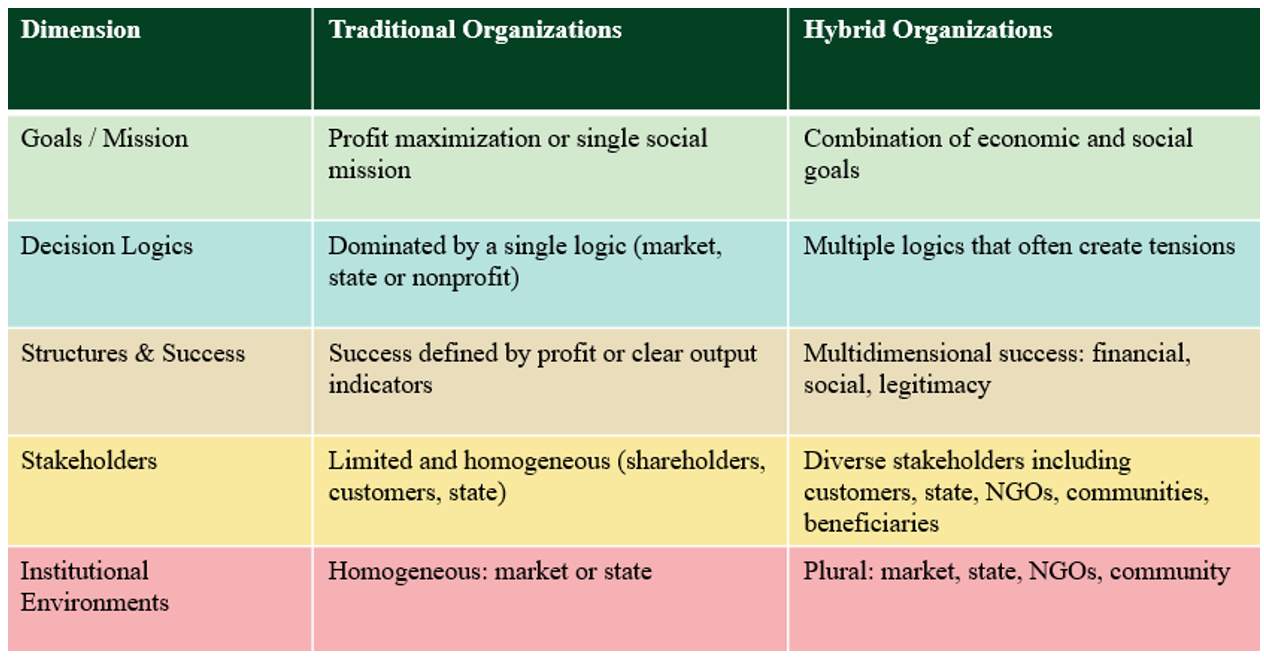
In the next dimension, decision-making logic, the comparison also shows a clear distinction. Traditional organizations typically act according to one dominant logic, which is mainly oriented towards profitability and efficiency.3Billis, D. in Hybrid Organizations and the Third Sector: Challenges for Practice, Theory and Policy (ed David Billis) 46-69 (Palgrave Macmillan, 2010). Hybrid organizations, on the other hand, represent institutional plurality, requiring them to integrate several contradictory logics.17Battilana, J., Sngul, M., Pache, A.-C. & Model, J. HARNESSING PRODUCTIVE TENSIONS IN HYBRID ORGANIZATIONS: THE CASE OF WORK INTEGRATION SOCIAL ENTERPRISES. Academy of Management Journal 58, 1658-1685 (2015). https://doi.org/10.5465/amj.2013.0903 Examples from Mair et al. (2015) show that hybrids either follow a dominant logic or attempt to integrate their competing logics using selective coupling strategies.31Mair, J., Mayer, J. & Lutz, E. Navigating institutional plurality: Organizational governance in hybrid organizations. Organization studies36, 713-739 (2015). Another approach is presented by Ebrahim et al. (2014), who show that the activities of hybrid organizations can either be structured in an integrated manner so that all areas are aligned with the dual objective, or differentiated, whereby social and business activities are divided into separate units.11Ebrahim, A., Battilana, J. & Mair, J. The governance of social enterprises: Mission drift and accountability challenges in hybrid organizations. Research in organizational behavior 34, 81-100 (2014). https://doi.org/10.1016/j.riob.2014.09.001 In practice, this means that economic and social aspects must be considered in decision-making processes in hybrid structures, which can then be implemented in the form of dual approval mechanisms or joint committees representing both perspectives.11Ebrahim, A., Battilana, J. & Mair, J. The governance of social enterprises: Mission drift and accountability challenges in hybrid organizations. Research in organizational behavior 34, 81-100 (2014). https://doi.org/10.1016/j.riob.2014.09.001,31Mair, J., Mayer, J. & Lutz, E. Navigating institutional plurality: Organizational governance in hybrid organizations. Organization studies36, 713-739 (2015).
In terms of structure and success, traditional organizations measure their performance using financial outputs such as profit or shareholder return.3Billis, D. in Hybrid Organizations and the Third Sector: Challenges for Practice, Theory and Policy (ed David Billis) 46-69 (Palgrave Macmillan, 2010).,33Bagnoli, L. & Megali, C. Measuring performance in social enterprises. Nonprofit and Voluntary Sector Quarterly 40, 149-165 (2009). Given the diversity of hybrid organizations, they define their success in multidimensional terms and require a broader understanding of success.11Ebrahim, A., Battilana, J. & Mair, J. The governance of social enterprises: Mission drift and accountability challenges in hybrid organizations. Research in organizational behavior 34, 81-100 (2014). https://doi.org/10.1016/j.riob.2014.09.001,33Bagnoli, L. & Megali, C. Measuring performance in social enterprises. Nonprofit and Voluntary Sector Quarterly 40, 149-165 (2009). Bagnoli and Megali (2009) mention that performance assessment in a social enterprise should combine financial performance, institutional legitimacy, and social effectiveness.33Bagnoli, L. & Megali, C. Measuring performance in social enterprises. Nonprofit and Voluntary Sector Quarterly 40, 149-165 (2009). An important statement by Ebrahim et al. (2014) also emphasizes here that accountability systems in hybrid organizations must reflect these multiple dimensions, because financial metrics alone would undermine their social mission.11Ebrahim, A., Battilana, J. & Mair, J. The governance of social enterprises: Mission drift and accountability challenges in hybrid organizations. Research in organizational behavior 34, 81-100 (2014). https://doi.org/10.1016/j.riob.2014.09.001 A good practical approach here would be to set minimum thresholds for economic results, social impact, and compliance standards, as well as possible escalation mechanisms that report when a dimension falls below a target value.11Ebrahim, A., Battilana, J. & Mair, J. The governance of social enterprises: Mission drift and accountability challenges in hybrid organizations. Research in organizational behavior 34, 81-100 (2014). https://doi.org/10.1016/j.riob.2014.09.001,33Bagnoli, L. & Megali, C. Measuring performance in social enterprises. Nonprofit and Voluntary Sector Quarterly 40, 149-165 (2009).
In the next dimension relating to stakeholders, traditional organizations usually have homogeneous stakeholder groups.3Billis, D. in Hybrid Organizations and the Third Sector: Challenges for Practice, Theory and Policy (ed David Billis) 46-69 (Palgrave Macmillan, 2010). Hybrid organizations, on the other hand, are multi-stakeholder-based, whereas they must consider highly diverse and sometimes divergent demands.3Billis, D. in Hybrid Organizations and the Third Sector: Challenges for Practice, Theory and Policy (ed David Billis) 46-69 (Palgrave Macmillan, 2010). Billis (2010) mentions that hybrids operate at the interface between the market, the state, and the third sector and are therefore subject to many different expectations.3Billis, D. in Hybrid Organizations and the Third Sector: Challenges for Practice, Theory and Policy (ed David Billis) 46-69 (Palgrave Macmillan, 2010). A fitting practical example from Mair et al. (2015) is fair trade organizations, in which consumers expect sustainable practices, producers demand fair prices, and NGOs control and monitor strict compliance with the given standards.31Mair, J., Mayer, J. & Lutz, E. Navigating institutional plurality: Organizational governance in hybrid organizations. Organization studies36, 713-739 (2015). In this context, Mason and Doherty (2015) also discuss how these competing demands lead to paradoxes and as a result must be actively addressed in governance processes.12Mason, C. & Doherty, B. A fair trade-off? Paradoxes in the governance of fair-trade social enterprises. Journal of Business Ethics 136, 451-469 (2015). For practical application, this could involve the introduction of regular consultation meetings, stakeholder councils, or transparent decision-making protocols that can help in the implementation of conflict resolution.12Mason, C. & Doherty, B. A fair trade-off? Paradoxes in the governance of fair-trade social enterprises. Journal of Business Ethics 136, 451-469 (2015).,31Mair, J., Mayer, J. & Lutz, E. Navigating institutional plurality: Organizational governance in hybrid organizations. Organization studies36, 713-739 (2015).
The final dimension is institutional environments, with traditional organizations operating in relatively stable and homogeneous environments.3Billis, D. in Hybrid Organizations and the Third Sector: Challenges for Practice, Theory and Policy (ed David Billis) 46-69 (Palgrave Macmillan, 2010). The same cannot be said for hybrid organizations, which constantly operate in pluralistic and often contradictory environments.17Battilana, J., Sngul, M., Pache, A.-C. & Model, J. HARNESSING PRODUCTIVE TENSIONS IN HYBRID ORGANIZATIONS: THE CASE OF WORK INTEGRATION SOCIAL ENTERPRISES. Academy of Management Journal 58, 1658-1685 (2015). https://doi.org/10.5465/amj.2013.0903 Battilana et al. (2015) explain that hybrid organizations embody multiple institutional logics, which can lead to ongoing tensions that ultimately need to be resolved.17Battilana, J., Sngul, M., Pache, A.-C. & Model, J. HARNESSING PRODUCTIVE TENSIONS IN HYBRID ORGANIZATIONS: THE CASE OF WORK INTEGRATION SOCIAL ENTERPRISES. Academy of Management Journal 58, 1658-1685 (2015). https://doi.org/10.5465/amj.2013.0903 In these environments, Defourny and Nyssens (2016) show that social enterprises typically combine their market revenues, public subsidies, and voluntary resources to secure their mission.19Defourny, J. & Nyssens, M. Fundamentals for an international typology of social enterprise models. VOLUNTAS: International Journal of Voluntary and nonprofit organizations 28, 2469-2497 (2016). A fitting practical example from von der Heydte (2019) is social business hybrids, which encounter financing problems, a lack of legitimacy in the market, and difficulties in accessing qualified personnel when expanding their activities, but manage these problems by applying selective coupling strategies or partnerships, thereby stabilizing their position.26Heydte, L. v. d. Challenges Resulting from Multiple Institutional Logics in Hybrid Organizations : The Case of Social Business Hybrids. 1st 2020. edn, (Wiesbaden: Springer Gabler Fachmedien Wiesbaden, 2019). In order to identify practical approaches that ensure and strengthen resilience, it could be helpful to record institutional requirements, diversify funding sources, or build alliances with external actors.19Defourny, J. & Nyssens, M. Fundamentals for an international typology of social enterprise models. VOLUNTAS: International Journal of Voluntary and nonprofit organizations 28, 2469-2497 (2016).,26Heydte, L. v. d. Challenges Resulting from Multiple Institutional Logics in Hybrid Organizations : The Case of Social Business Hybrids. 1st 2020. edn, (Wiesbaden: Springer Gabler Fachmedien Wiesbaden, 2019).
To finally weigh up this comparative perspective, there are several drivers and barriers that relate to this comparison. One of the promoting factors and thus an advantage for hybrid organizations is when social and economic goals are explicitly anchored in the mission, practices, and especially in the identity. In this case, tensions can be constructively managed rather than suppressed, and the organization is further stabilized.28Battilana, J. & Dorado, S. Building Sustainable Hybrid Organizations: The Case of Commercial Microfinance Organizations. The Academy of Management Journal 53, 1419-1440 (2010). https://doi.org/10.5465/AMJ.2010.57318391,17Battilana, J., Sngul, M., Pache, A.-C. & Model, J. HARNESSING PRODUCTIVE TENSIONS IN HYBRID ORGANIZATIONS: THE CASE OF WORK INTEGRATION SOCIAL ENTERPRISES. Academy of Management Journal 58, 1658-1685 (2015). https://doi.org/10.5465/amj.2013.0903 It is also beneficial to have a clear, appropriate structure, which can take the form of an integrated or differentiated model, thereby increasing the quality of decision-making compared to one-dimensional structures.11Ebrahim, A., Battilana, J. & Mair, J. The governance of social enterprises: Mission drift and accountability challenges in hybrid organizations. Research in organizational behavior 34, 81-100 (2014). https://doi.org/10.1016/j.riob.2014.09.001 Governance processes that systematically take both logics into account are a key driver. They reduce tension and ensure accountability, whereas traditional organizations primarily specialize in shareholder-oriented governance.12Mason, C. & Doherty, B. A fair trade-off? Paradoxes in the governance of fair-trade social enterprises. Journal of Business Ethics 136, 451-469 (2015).,11Ebrahim, A., Battilana, J. & Mair, J. The governance of social enterprises: Mission drift and accountability challenges in hybrid organizations. Research in organizational behavior 34, 81-100 (2014). https://doi.org/10.1016/j.riob.2014.09.001 On the other hand, hybrids can benefit when market-oriented capabilities, such as marketing capabilities or strategic alignment, support both economic and social outcomes, whereas traditional organizations primarily use these capabilities for financial goals.42Liu, G., Eng, T. Y. & Takeda, S. An investigation of marketing capabilities and social enterprise performance in the UK and Japan. Entrepreneurship theory and practice 39, 267-298 (2015).,43Liu, G., Takeda, S. & Ko, W.-W. Strategic orientation and social enterprise performance. Nonprofit and Voluntary Sector Quarterly 43, 480-501 (2014). In terms of resource hybridity, hybrids that combine market, government, and voluntary resources are more resilient to crises than traditionally single-source-funded organizations.19Defourny, J. & Nyssens, M. Fundamentals for an international typology of social enterprise models. VOLUNTAS: International Journal of Voluntary and nonprofit organizations 28, 2469-2497 (2016). A final significant driver is the involvement and participation of many different stakeholders in organizational activities, which on the one hand increases legitimacy and improves the quality of information, and on the other hand provides an advantage over more homogeneous stakeholder sets.3Billis, D. in Hybrid Organizations and the Third Sector: Challenges for Practice, Theory and Policy (ed David Billis) 46-69 (Palgrave Macmillan, 2010).,12Mason, C. & Doherty, B. A fair trade-off? Paradoxes in the governance of fair-trade social enterprises. Journal of Business Ethics 136, 451-469 (2015).
However, there are also many inhibiting factors, such as conflicts of logic. These generate constant tensions and internal friction, which traditional organizations that are managed in a one-dimensional manner rarely have to deal with.17Battilana, J., Sngul, M., Pache, A.-C. & Model, J. HARNESSING PRODUCTIVE TENSIONS IN HYBRID ORGANIZATIONS: THE CASE OF WORK INTEGRATION SOCIAL ENTERPRISES. Academy of Management Journal 58, 1658-1685 (2015). https://doi.org/10.5465/amj.2013.0903,31Mair, J., Mayer, J. & Lutz, E. Navigating institutional plurality: Organizational governance in hybrid organizations. Organization studies36, 713-739 (2015). In addition, multidimensional target systems make management and accountability significantly more complex in practice than pure financial indicators.33Bagnoli, L. & Megali, C. Measuring performance in social enterprises. Nonprofit and Voluntary Sector Quarterly 40, 149-165 (2009).,11Ebrahim, A., Battilana, J. & Mair, J. The governance of social enterprises: Mission drift and accountability challenges in hybrid organizations. Research in organizational behavior 34, 81-100 (2014). https://doi.org/10.1016/j.riob.2014.09.001 The classic hybrid risk of mission drift represents a clear barrier, but is not really known to traditional profit-oriented organizations.12Mason, C. & Doherty, B. A fair trade-off? Paradoxes in the governance of fair-trade social enterprises. Journal of Business Ethics 136, 451-469 (2015).,28Battilana, J. & Dorado, S. Building Sustainable Hybrid Organizations: The Case of Commercial Microfinance Organizations. The Academy of Management Journal 53, 1419-1440 (2010). https://doi.org/10.5465/AMJ.2010.57318391 In new and inconsistent fields, it is often common for there to be a lack of full institutionalization, resulting in gaps in legitimacy and regulation, which makes access to capital, markets, and talent more difficult.26Heydte, L. v. d. Challenges Resulting from Multiple Institutional Logics in Hybrid Organizations : The Case of Social Business Hybrids. 1st 2020. edn, (Wiesbaden: Springer Gabler Fachmedien Wiesbaden, 2019). At the same time, simultaneous financing of different goals leads to trade-offs, which can represent cost pressure versus support intensity, and increases dependencies, with traditional companies primarily addressing financial criteria.19Defourny, J. & Nyssens, M. Fundamentals for an international typology of social enterprise models. VOLUNTAS: International Journal of Voluntary and nonprofit organizations 28, 2469-2497 (2016).,17Battilana, J., Sngul, M., Pache, A.-C. & Model, J. HARNESSING PRODUCTIVE TENSIONS IN HYBRID ORGANIZATIONS: THE CASE OF WORK INTEGRATION SOCIAL ENTERPRISES. Academy of Management Journal 58, 1658-1685 (2015). https://doi.org/10.5465/amj.2013.0903 Finally, governance overload and unclear responsibilities can be another barrier, as broader accountability boards and management can be overwhelmed if roles are not clearly assigned or impact measurement is poorly institutionalized.11Ebrahim, A., Battilana, J. & Mair, J. The governance of social enterprises: Mission drift and accountability challenges in hybrid organizations. Research in organizational behavior 34, 81-100 (2014). https://doi.org/10.1016/j.riob.2014.09.001,12Mason, C. & Doherty, B. A fair trade-off? Paradoxes in the governance of fair-trade social enterprises. Journal of Business Ethics 136, 451-469 (2015).
In conclusion, hybrid organizations generally differ from traditional ones in that their drivers and barriers arise directly from the tension between multiple logics, meaning they are more complex.17Battilana, J., Sngul, M., Pache, A.-C. & Model, J. HARNESSING PRODUCTIVE TENSIONS IN HYBRID ORGANIZATIONS: THE CASE OF WORK INTEGRATION SOCIAL ENTERPRISES. Academy of Management Journal 58, 1658-1685 (2015). https://doi.org/10.5465/amj.2013.0903 Multiple drivers such as dual mission, governance, resource hybridity, and stakeholder involvement give hybrids advantages, but on the other hand, they are accompanied by barriers such as measurement complexity, mission drift, legitimacy problems, and governance overload.28Battilana, J. & Dorado, S. Building Sustainable Hybrid Organizations: The Case of Commercial Microfinance Organizations. The Academy of Management Journal 53, 1419-1440 (2010). https://doi.org/10.5465/AMJ.2010.57318391,11Ebrahim, A., Battilana, J. & Mair, J. The governance of social enterprises: Mission drift and accountability challenges in hybrid organizations. Research in organizational behavior 34, 81-100 (2014). https://doi.org/10.1016/j.riob.2014.09.001,19Defourny, J. & Nyssens, M. Fundamentals for an international typology of social enterprise models. VOLUNTAS: International Journal of Voluntary and nonprofit organizations 28, 2469-2497 (2016).,3Billis, D. in Hybrid Organizations and the Third Sector: Challenges for Practice, Theory and Policy (ed David Billis) 46-69 (Palgrave Macmillan, 2010).,33Bagnoli, L. & Megali, C. Measuring performance in social enterprises. Nonprofit and Voluntary Sector Quarterly 40, 149-165 (2009).,12Mason, C. & Doherty, B. A fair trade-off? Paradoxes in the governance of fair-trade social enterprises. Journal of Business Ethics 136, 451-469 (2015).,26Heydte, L. v. d. Challenges Resulting from Multiple Institutional Logics in Hybrid Organizations : The Case of Social Business Hybrids. 1st 2020. edn, (Wiesbaden: Springer Gabler Fachmedien Wiesbaden, 2019). For hybrid organizations to ultimately function in the long term, their accountability structures and stakeholder routines must be designed to take social and economic logics into account simultaneously.11Ebrahim, A., Battilana, J. & Mair, J. The governance of social enterprises: Mission drift and accountability challenges in hybrid organizations. Research in organizational behavior 34, 81-100 (2014). https://doi.org/10.1016/j.riob.2014.09.001 Approaches are therefore particularly effective when opportunities and risks are not separated but managed as part of a common management system.26Heydte, L. v. d. Challenges Resulting from Multiple Institutional Logics in Hybrid Organizations : The Case of Social Business Hybrids. 1st 2020. edn, (Wiesbaden: Springer Gabler Fachmedien Wiesbaden, 2019).
3.3 Performance evaluation and strategic resilience
The following section concludes the examination of practical aspects by addressing the challenges of performance measurement and resilience in hybrid organizations.28Battilana, J. & Dorado, S. Building Sustainable Hybrid Organizations: The Case of Commercial Microfinance Organizations. The Academy of Management Journal 53, 1419-1440 (2010). https://doi.org/10.5465/AMJ.2010.57318391 Performance measurement is considered indispensable, serving not only as a management tool but also as an important means of accountability to stakeholders, with practical examples, such as different time logics and measurability, showing how these aspects can lead to tensions.33Bagnoli, L. & Megali, C. Measuring performance in social enterprises. Nonprofit and Voluntary Sector Quarterly 40, 149-165 (2009).,11Ebrahim, A., Battilana, J. & Mair, J. The governance of social enterprises: Mission drift and accountability challenges in hybrid organizations. Research in organizational behavior 34, 81-100 (2014). https://doi.org/10.1016/j.riob.2014.09.001 In this context, the importance of strategic resilience is emphasized, showing that organizations must be able not only to respond to external demands, but also to assert themselves and remain stable in times of crisis and uncertainty, raising the key question of how hybrid organizations can practically evaluate their performance and develop strategic resilience in order to secure their mission in the long term.26Heydte, L. v. d. Challenges Resulting from Multiple Institutional Logics in Hybrid Organizations : The Case of Social Business Hybrids. 1st 2020. edn, (Wiesbaden: Springer Gabler Fachmedien Wiesbaden, 2019).,17Battilana, J., Sngul, M., Pache, A.-C. & Model, J. HARNESSING PRODUCTIVE TENSIONS IN HYBRID ORGANIZATIONS: THE CASE OF WORK INTEGRATION SOCIAL ENTERPRISES. Academy of Management Journal 58, 1658-1685 (2015). https://doi.org/10.5465/amj.2013.0903
Regarding performance measurement for hybrid organizations, which has been a practical challenge for organizations to date, it is important that all areas of an organization are measured and evaluated simultaneously, resulting in the three central fields of finance, social impact, and legitimacy.33Bagnoli, L. & Megali, C. Measuring performance in social enterprises. Nonprofit and Voluntary Sector Quarterly 40, 149-165 (2009).,11Ebrahim, A., Battilana, J. & Mair, J. The governance of social enterprises: Mission drift and accountability challenges in hybrid organizations. Research in organizational behavior 34, 81-100 (2014). https://doi.org/10.1016/j.riob.2014.09.001 These areas show performance in terms of profits, value creation, or efficiency; the extent and quality of achievement among target groups and society; and the demonstration of legitimacy, which shows the consistency of actions, mission, and legal framework.33Bagnoli, L. & Megali, C. Measuring performance in social enterprises. Nonprofit and Voluntary Sector Quarterly 40, 149-165 (2009). With regard to this, performance measurement is a tool that is intended to guide behavior and always keep the goals in sight, thereby also monitoring whether employees and the organization as a whole are deviating from their mission and whether the achievement of goals remains transparent and verifiable.11Ebrahim, A., Battilana, J. & Mair, J. The governance of social enterprises: Mission drift and accountability challenges in hybrid organizations. Research in organizational behavior 34, 81-100 (2014). https://doi.org/10.1016/j.riob.2014.09.001 The problem that has already been recognized and is present here is that there is no uniform currency or method for social performance to be considered on the same level as financial indicators.11Ebrahim, A., Battilana, J. & Mair, J. The governance of social enterprises: Mission drift and accountability challenges in hybrid organizations. Research in organizational behavior 34, 81-100 (2014). https://doi.org/10.1016/j.riob.2014.09.001,32Banerjee, A., Carlsson-Wall, M. & Nordqvist, M. Hybrid board governance: Exploring the challenges in implementing social impact measurements. The British Accounting Review 56, 101359 (2024). Therefore, social performance is significantly more complex than financial indicators and often only becomes visible in terms of its social impact after several years, whereas financial indicators are standardized and regularly audited.11Ebrahim, A., Battilana, J. & Mair, J. The governance of social enterprises: Mission drift and accountability challenges in hybrid organizations. Research in organizational behavior 34, 81-100 (2014). https://doi.org/10.1016/j.riob.2014.09.001 As an overall concept, performance measurement, in addition to its internal control function, is also a key means of external legitimization, building trust with stakeholders and justifying its existence in the competitive environment.33Bagnoli, L. & Megali, C. Measuring performance in social enterprises. Nonprofit and Voluntary Sector Quarterly 40, 149-165 (2009).,11Ebrahim, A., Battilana, J. & Mair, J. The governance of social enterprises: Mission drift and accountability challenges in hybrid organizations. Research in organizational behavior 34, 81-100 (2014). https://doi.org/10.1016/j.riob.2014.09.001 Boards and supervisory bodies play a decisive role in this process because they are responsible for moderating diverging institutional logics and, at the same time, providing the resources necessary for reasonable impact measurement.32Banerjee, A., Carlsson-Wall, M. & Nordqvist, M. Hybrid board governance: Exploring the challenges in implementing social impact measurements. The British Accounting Review 56, 101359 (2024).,11Ebrahim, A., Battilana, J. & Mair, J. The governance of social enterprises: Mission drift and accountability challenges in hybrid organizations. Research in organizational behavior 34, 81-100 (2014). https://doi.org/10.1016/j.riob.2014.09.001
There are several practical approaches to performance measurement that can be used to deal with these complications and challenges. One possible approach could be the introduction of a multidimensional controlling system. This system takes an approach that goes beyond the classic double bottom line and thus considers normative and legal requirements in addition to financial and social results, ultimately making control more realistic and comprehensive.33Bagnoli, L. & Megali, C. Measuring performance in social enterprises. Nonprofit and Voluntary Sector Quarterly 40, 149-165 (2009). Another practical instrument that can be used here is the value-added statement, which illustrates the economic contribution to stakeholders who are not directly involved in the profit by using financial data to show how much value an organization creates for its stakeholders in the process of transforming external goods and services.33Bagnoli, L. & Megali, C. Measuring performance in social enterprises. Nonprofit and Voluntary Sector Quarterly 40, 149-165 (2009). Considering that hybrid organizations sometimes have limited ability to plan for the future due to their dependence on government funds, investors, or weak capital structures, short-term cost and performance tracking could be helpful and beneficial because it creates transparency about income and expenses and enables quick adjustments.33Bagnoli, L. & Megali, C. Measuring performance in social enterprises. Nonprofit and Voluntary Sector Quarterly 40, 149-165 (2009). In practice, managers and executives often find it difficult to define and implement social KPIs that are as verifiable and comparable as financial indicators. Developing such indicators is therefore one of the biggest practical challenges.11Ebrahim, A., Battilana, J. & Mair, J. The governance of social enterprises: Mission drift and accountability challenges in hybrid organizations. Research in organizational behavior 34, 81-100 (2014). https://doi.org/10.1016/j.riob.2014.09.001,32Banerjee, A., Carlsson-Wall, M. & Nordqvist, M. Hybrid board governance: Exploring the challenges in implementing social impact measurements. The British Accounting Review 56, 101359 (2024).
Regarding performance improvement, studies show that not all marketing skills automatically improve performance.42Liu, G., Eng, T. Y. & Takeda, S. An investigation of marketing capabilities and social enterprise performance in the UK and Japan. Entrepreneurship theory and practice 39, 267-298 (2015). It is crucial that organizations selectively develop their marketing competencies, depending on the specific performance goals they are pursuing, in order to prevent losses in addressing and to ensure that scarce resources are used effectively.42Liu, G., Eng, T. Y. & Takeda, S. An investigation of marketing capabilities and social enterprise performance in the UK and Japan. Entrepreneurship theory and practice 39, 267-298 (2015). Furthermore, a strategic orientation that systematically aligns processes, decision-making styles, and principles with ensuring survivability can greatly help hybrid organizations guarantee their security, while at the same time significantly increasing their overall performance by improving their market effectiveness and customer satisfaction.43Liu, G., Takeda, S. & Ko, W.-W. Strategic orientation and social enterprise performance. Nonprofit and Voluntary Sector Quarterly 43, 480-501 (2014).
In terms of strategic resilience, it is important for the long-term survival of hybrid organizations that they develop a common identity that enables a balance between different logics and reduces internal tensions, which can be achieved through targeted recruitment and socialization processes.28Battilana, J. & Dorado, S. Building Sustainable Hybrid Organizations: The Case of Commercial Microfinance Organizations. The Academy of Management Journal 53, 1419-1440 (2010). https://doi.org/10.5465/AMJ.2010.57318391 Resilience in this context also means that organizations use external support and networks to bridge institutional gaps and thus gain access to resources and recognition that are difficult to obtain in the market environment.26Heydte, L. v. d. Challenges Resulting from Multiple Institutional Logics in Hybrid Organizations : The Case of Social Business Hybrids. 1st 2020. edn, (Wiesbaden: Springer Gabler Fachmedien Wiesbaden, 2019). A strategic choice could be to consciously select suitable legal forms and also use selective coupling mechanisms to comply with individual logics externally without adapting the entire organization to them.26Heydte, L. v. d. Challenges Resulting from Multiple Institutional Logics in Hybrid Organizations : The Case of Social Business Hybrids. 1st 2020. edn, (Wiesbaden: Springer Gabler Fachmedien Wiesbaden, 2019). In relation to crises and times of uncertainty, resilience becomes essential for hybrid organizations. This strategic resilience serves to remain stable and successfully assert themselves in such phases, because when hybrid organizations leave their familiar ecosystem and must compete in the free market, they face the greatest challenges because they are competing for the same resources as traditional companies.26Heydte, L. v. d. Challenges Resulting from Multiple Institutional Logics in Hybrid Organizations : The Case of Social Business Hybrids. 1st 2020. edn, (Wiesbaden: Springer Gabler Fachmedien Wiesbaden, 2019). In the long term, the resilience of hybrid organizations is demonstrated by their ability to deal constructively with conflicting requirements and gain flexibility in their actions, which strengthens their sustainability.17Battilana, J., Sngul, M., Pache, A.-C. & Model, J. HARNESSING PRODUCTIVE TENSIONS IN HYBRID ORGANIZATIONS: THE CASE OF WORK INTEGRATION SOCIAL ENTERPRISES. Academy of Management Journal 58, 1658-1685 (2015). https://doi.org/10.5465/amj.2013.0903,26Heydte, L. v. d. Challenges Resulting from Multiple Institutional Logics in Hybrid Organizations : The Case of Social Business Hybrids. 1st 2020. edn, (Wiesbaden: Springer Gabler Fachmedien Wiesbaden, 2019).
Overall, performance measurement is essential for hybrid organizations, as it controls internal processes on the one hand, but also ensures external legitimacy on the other.33Bagnoli, L. & Megali, C. Measuring performance in social enterprises. Nonprofit and Voluntary Sector Quarterly 40, 149-165 (2009).,11Ebrahim, A., Battilana, J. & Mair, J. The governance of social enterprises: Mission drift and accountability challenges in hybrid organizations. Research in organizational behavior 34, 81-100 (2014). https://doi.org/10.1016/j.riob.2014.09.001 Moreover, strategic resilience is crucial and decisive for the long-term viability and survival of hybrid organizations, due to the stability it enables in uncertain times and environments.26Heydte, L. v. d. Challenges Resulting from Multiple Institutional Logics in Hybrid Organizations : The Case of Social Business Hybrids. 1st 2020. edn, (Wiesbaden: Springer Gabler Fachmedien Wiesbaden, 2019).,17Battilana, J., Sngul, M., Pache, A.-C. & Model, J. HARNESSING PRODUCTIVE TENSIONS IN HYBRID ORGANIZATIONS: THE CASE OF WORK INTEGRATION SOCIAL ENTERPRISES. Academy of Management Journal 58, 1658-1685 (2015). https://doi.org/10.5465/amj.2013.0903 The approaches presented in this chapter thus tie in with the previous analyses, which identified problem areas and practical solutions and examined and analyzed the process logic from the founding to the stabilization of hybrid organizations. Furthermore, the comparison of traditional and hybrid organizations shows to what extent hybrid organizations face particular challenges.3Billis, D. in Hybrid Organizations and the Third Sector: Challenges for Practice, Theory and Policy (ed David Billis) 46-69 (Palgrave Macmillan, 2010).,12Mason, C. & Doherty, B. A fair trade-off? Paradoxes in the governance of fair-trade social enterprises. Journal of Business Ethics 136, 451-469 (2015).,26Heydte, L. v. d. Challenges Resulting from Multiple Institutional Logics in Hybrid Organizations : The Case of Social Business Hybrids. 1st 2020. edn, (Wiesbaden: Springer Gabler Fachmedien Wiesbaden, 2019). Throughout this thesis, several different steps and perspectives have shown that hybrid organizations are not merely theoretical concepts, but rather viable forms of organization in practice that combine social impact and economic viability.19Defourny, J. & Nyssens, M. Fundamentals for an international typology of social enterprise models. VOLUNTAS: International Journal of Voluntary and nonprofit organizations 28, 2469-2497 (2016).,33Bagnoli, L. & Megali, C. Measuring performance in social enterprises. Nonprofit and Voluntary Sector Quarterly 40, 149-165 (2009). The results of this thesis show that there are many theoretical perspectives and models in the literature and research that can be implemented with practical mechanisms, comparisons, and strategies, resulting in a comprehensive picture of how hybrid organizations can navigate between theory and practice and secure their mission in the long term.11Ebrahim, A., Battilana, J. & Mair, J. The governance of social enterprises: Mission drift and accountability challenges in hybrid organizations. Research in organizational behavior 34, 81-100 (2014). https://doi.org/10.1016/j.riob.2014.09.001,28Battilana, J. & Dorado, S. Building Sustainable Hybrid Organizations: The Case of Commercial Microfinance Organizations. The Academy of Management Journal 53, 1419-1440 (2010). https://doi.org/10.5465/AMJ.2010.57318391,12Mason, C. & Doherty, B. A fair trade-off? Paradoxes in the governance of fair-trade social enterprises. Journal of Business Ethics 136, 451-469 (2015).
References
- 1Greenwood, R., Raynard, M., Kodeih, F., Micelotta, E. R. & Lounsbury, M. Institutional Complexity and Organizational Responses. Academy of Management Annals 5, 317-371 (2011). https://doi.org/10.5465/19416520.2011.590299 ↩︎
- 2Battilana, J. & Lee, M. Advancing Research on Hybrid Organizing – Insights from the Study of Social Enterprises. Academy of Management Annals 8, 397-441 (2014). https://doi.org/10.5465/19416520.2014.893615 ↩︎
- 3Billis, D. in Hybrid Organizations and the Third Sector: Challenges for Practice, Theory and Policy (ed David Billis) 46-69 (Palgrave Macmillan, 2010). ↩︎
- 2Battilana, J. & Lee, M. Advancing Research on Hybrid Organizing – Insights from the Study of Social Enterprises. Academy of Management Annals 8, 397-441 (2014). https://doi.org/10.5465/19416520.2014.893615 ↩︎
- 2Battilana, J. & Lee, M. Advancing Research on Hybrid Organizing – Insights from the Study of Social Enterprises. Academy of Management Annals 8, 397-441 (2014). https://doi.org/10.5465/19416520.2014.893615 ↩︎
- 4Savarese, C., Huybrechts, B. & Hudon, M. The Influence of Interorganizational Collaboration on Logic Conciliation and Tensions Within Hybrid Organizations: Insights from Social Enterprise–Corporate Collaborations. Journal of Business Ethics 173, 709-721 (2021). https://doi.org/10.1007/s10551-020-04557-7 ↩︎
- 5Secinaro, S., Corvo, L., Brescia, V. & Iannaci, D. Hybrid organizations: A Systematic Review of the Current Literature. International business research (Toronto) 12, 1 (2019). https://doi.org/10.5539/ibr.v12n11p1 ↩︎
- 6Doherty, B., Haugh, H. & Lyon, F. Social Enterprises as Hybrid Organizations: A Review and Research Agenda. International Journal of Management Reviews 16, 417-436 (2014). https://doi.org/10.1111/ijmr.12028 ↩︎
- 5Secinaro, S., Corvo, L., Brescia, V. & Iannaci, D. Hybrid organizations: A Systematic Review of the Current Literature. International business research (Toronto) 12, 1 (2019). https://doi.org/10.5539/ibr.v12n11p1 ↩︎
- 1Greenwood, R., Raynard, M., Kodeih, F., Micelotta, E. R. & Lounsbury, M. Institutional Complexity and Organizational Responses. Academy of Management Annals 5, 317-371 (2011). https://doi.org/10.5465/19416520.2011.590299 ↩︎
- 1Greenwood, R., Raynard, M., Kodeih, F., Micelotta, E. R. & Lounsbury, M. Institutional Complexity and Organizational Responses. Academy of Management Annals 5, 317-371 (2011). https://doi.org/10.5465/19416520.2011.590299 ↩︎
- 7Smith, W. K., Gonin, M. & Besharov, M. L. Managing social-business tensions: A review and research agenda for social enterprise. Business Ethics Quarterly 23, 407-442 (2013). ↩︎
- 8Haigh, N., Walker, J., Bacq, S. & Kickul, J. Hybrid Organizations: Origins, Strategies, Impacts, and Implications. California management review 57, 5-12 (2015). https://doi.org/10.1525/cmr.2015.57.3.5 ↩︎
- 9Battilana, J., Besharov, M. & Mitzinneck, B. C. in The SAGE Handbook of Organizational Institutionalism (eds Royston Greenwood, Christine Oliver, Thomas B. Lawrence, & Renate E. Meyer) 128-162 (SAGE Publishing, 2017). ↩︎
- 9Battilana, J., Besharov, M. & Mitzinneck, B. C. in The SAGE Handbook of Organizational Institutionalism (eds Royston Greenwood, Christine Oliver, Thomas B. Lawrence, & Renate E. Meyer) 128-162 (SAGE Publishing, 2017). ↩︎
- 10Skelcher, C. & Smith, S. R. Theorizing hybridity: Institutional logics, complex organizations, and actor identities: The case of nonprofits. Public administration 93, 433-448 (2015). ↩︎
- 11Ebrahim, A., Battilana, J. & Mair, J. The governance of social enterprises: Mission drift and accountability challenges in hybrid organizations. Research in organizational behavior 34, 81-100 (2014). https://doi.org/10.1016/j.riob.2014.09.001 ↩︎
- 12Mason, C. & Doherty, B. A fair trade-off? Paradoxes in the governance of fair-trade social enterprises. Journal of Business Ethics 136, 451-469 (2015). ↩︎
- 11Ebrahim, A., Battilana, J. & Mair, J. The governance of social enterprises: Mission drift and accountability challenges in hybrid organizations. Research in organizational behavior 34, 81-100 (2014). https://doi.org/10.1016/j.riob.2014.09.001 ↩︎
- 12Mason, C. & Doherty, B. A fair trade-off? Paradoxes in the governance of fair-trade social enterprises. Journal of Business Ethics 136, 451-469 (2015). ↩︎
- 13Tranfield, D., Denyer, D. & Smart, P. Towards a methodology for developing evidence‐informed management knowledge by means of systematic review. British journal of management 14, 207-222 (2003). ↩︎
- 14Besharov, M. L. & Smith, W. K. Multiple institutional logics in organizations: Explaining their varied nature and implications. Academy of management review 39, 364-381 (2014). ↩︎
- 10Skelcher, C. & Smith, S. R. Theorizing hybridity: Institutional logics, complex organizations, and actor identities: The case of nonprofits. Public administration 93, 433-448 (2015). ↩︎
- 13Tranfield, D., Denyer, D. & Smart, P. Towards a methodology for developing evidence‐informed management knowledge by means of systematic review. British journal of management 14, 207-222 (2003). ↩︎
- 2Battilana, J. & Lee, M. Advancing Research on Hybrid Organizing – Insights from the Study of Social Enterprises. Academy of Management Annals 8, 397-441 (2014). https://doi.org/10.5465/19416520.2014.893615 ↩︎
- 2Battilana, J. & Lee, M. Advancing Research on Hybrid Organizing – Insights from the Study of Social Enterprises. Academy of Management Annals 8, 397-441 (2014). https://doi.org/10.5465/19416520.2014.893615 ↩︎
- 6Doherty, B., Haugh, H. & Lyon, F. Social Enterprises as Hybrid Organizations: A Review and Research Agenda. International Journal of Management Reviews 16, 417-436 (2014). https://doi.org/10.1111/ijmr.12028 ↩︎
- 3Billis, D. in Hybrid Organizations and the Third Sector: Challenges for Practice, Theory and Policy (ed David Billis) 46-69 (Palgrave Macmillan, 2010). ↩︎
- 15Thornton, P. H., Ocasio, W. & Lounsbury, M. The institutional logics perspective: A new approach to culture, structure, and process. (Oxford University Press, 2012). ↩︎
- 16Pache, A.-C. & Santos, F. Inside the hybrid organization: Selective coupling as a response to competing institutional logics. Academy of management journal 56, 972-1001 (2013). ↩︎
- 6Doherty, B., Haugh, H. & Lyon, F. Social Enterprises as Hybrid Organizations: A Review and Research Agenda. International Journal of Management Reviews 16, 417-436 (2014). https://doi.org/10.1111/ijmr.12028 ↩︎
- 17Battilana, J., Sngul, M., Pache, A.-C. & Model, J. HARNESSING PRODUCTIVE TENSIONS IN HYBRID ORGANIZATIONS: THE CASE OF WORK INTEGRATION SOCIAL ENTERPRISES. Academy of Management Journal 58, 1658-1685 (2015). https://doi.org/10.5465/amj.2013.0903 ↩︎
- 2Battilana, J. & Lee, M. Advancing Research on Hybrid Organizing – Insights from the Study of Social Enterprises. Academy of Management Annals 8, 397-441 (2014). https://doi.org/10.5465/19416520.2014.893615 ↩︎
- 16Pache, A.-C. & Santos, F. Inside the hybrid organization: Selective coupling as a response to competing institutional logics. Academy of management journal 56, 972-1001 (2013). ↩︎
- 7Smith, W. K., Gonin, M. & Besharov, M. L. Managing social-business tensions: A review and research agenda for social enterprise. Business Ethics Quarterly 23, 407-442 (2013). ↩︎
- 6Doherty, B., Haugh, H. & Lyon, F. Social Enterprises as Hybrid Organizations: A Review and Research Agenda. International Journal of Management Reviews 16, 417-436 (2014). https://doi.org/10.1111/ijmr.12028 ↩︎
- 18Brandsen, T. & and Karré, P. M. Hybrid Organizations: No Cause for Concern? International Journal of Public Administration 34, 827-836 (2011). https://doi.org/10.1080/01900692.2011.605090 ↩︎
- 19Defourny, J. & Nyssens, M. Fundamentals for an international typology of social enterprise models. VOLUNTAS: International Journal of Voluntary and nonprofit organizations 28, 2469-2497 (2016). ↩︎
- 6Doherty, B., Haugh, H. & Lyon, F. Social Enterprises as Hybrid Organizations: A Review and Research Agenda. International Journal of Management Reviews 16, 417-436 (2014). https://doi.org/10.1111/ijmr.12028 ↩︎
- 6Doherty, B., Haugh, H. & Lyon, F. Social Enterprises as Hybrid Organizations: A Review and Research Agenda. International Journal of Management Reviews 16, 417-436 (2014). https://doi.org/10.1111/ijmr.12028 ↩︎
- 20Luke, B. & Chu, V. Social enterprise versus social entrepreneurship: An examination of the ‘why’and ‘how’in pursuing social change. International Small Business Journal 31, 764-784 (2013). ↩︎
- 19Defourny, J. & Nyssens, M. Fundamentals for an international typology of social enterprise models. VOLUNTAS: International Journal of Voluntary and nonprofit organizations 28, 2469-2497 (2016). ↩︎
- 2Battilana, J. & Lee, M. Advancing Research on Hybrid Organizing – Insights from the Study of Social Enterprises. Academy of Management Annals 8, 397-441 (2014). https://doi.org/10.5465/19416520.2014.893615 ↩︎
- 11Ebrahim, A., Battilana, J. & Mair, J. The governance of social enterprises: Mission drift and accountability challenges in hybrid organizations. Research in organizational behavior 34, 81-100 (2014). https://doi.org/10.1016/j.riob.2014.09.001 ↩︎
- 2Battilana, J. & Lee, M. Advancing Research on Hybrid Organizing – Insights from the Study of Social Enterprises. Academy of Management Annals 8, 397-441 (2014). https://doi.org/10.5465/19416520.2014.893615 ↩︎
- 11Ebrahim, A., Battilana, J. & Mair, J. The governance of social enterprises: Mission drift and accountability challenges in hybrid organizations. Research in organizational behavior 34, 81-100 (2014). https://doi.org/10.1016/j.riob.2014.09.001 ↩︎
- 21Hiller, J. S. The benefit corporation and corporate social responsibility. Journal of business ethics 118, 287-301 (2013). ↩︎
- 11Ebrahim, A., Battilana, J. & Mair, J. The governance of social enterprises: Mission drift and accountability challenges in hybrid organizations. Research in organizational behavior 34, 81-100 (2014). https://doi.org/10.1016/j.riob.2014.09.001 ↩︎
- 21Hiller, J. S. The benefit corporation and corporate social responsibility. Journal of business ethics 118, 287-301 (2013). ↩︎
- 19Defourny, J. & Nyssens, M. Fundamentals for an international typology of social enterprise models. VOLUNTAS: International Journal of Voluntary and nonprofit organizations 28, 2469-2497 (2016). ↩︎
- 22Skelcher, C. in The Oxford Handbook of Public Management (eds Ewan Ferlie, Laurence E. Lynn, & Christopher Pollitt) 0 (Oxford University Press, 2005). ↩︎
- 22Skelcher, C. in The Oxford Handbook of Public Management (eds Ewan Ferlie, Laurence E. Lynn, & Christopher Pollitt) 0 (Oxford University Press, 2005). ↩︎
- 22Skelcher, C. in The Oxford Handbook of Public Management (eds Ewan Ferlie, Laurence E. Lynn, & Christopher Pollitt) 0 (Oxford University Press, 2005). ↩︎
- 23Jamali, D. & Mirshak, R. Corporate Social Responsibility (CSR): Theory and Practice in a Developing Country Context. Journal of Business Ethics 72, 243-262 (2007). https://doi.org/10.1007/s10551-006-9168-4 ↩︎
- 23Jamali, D. & Mirshak, R. Corporate Social Responsibility (CSR): Theory and Practice in a Developing Country Context. Journal of Business Ethics 72, 243-262 (2007). https://doi.org/10.1007/s10551-006-9168-4 ↩︎
- 2Battilana, J. & Lee, M. Advancing Research on Hybrid Organizing – Insights from the Study of Social Enterprises. Academy of Management Annals 8, 397-441 (2014). https://doi.org/10.5465/19416520.2014.893615 ↩︎
- 23Jamali, D. & Mirshak, R. Corporate Social Responsibility (CSR): Theory and Practice in a Developing Country Context. Journal of Business Ethics 72, 243-262 (2007). https://doi.org/10.1007/s10551-006-9168-4 ↩︎
- 2Battilana, J. & Lee, M. Advancing Research on Hybrid Organizing – Insights from the Study of Social Enterprises. Academy of Management Annals 8, 397-441 (2014). https://doi.org/10.5465/19416520.2014.893615 ↩︎
- 2Battilana, J. & Lee, M. Advancing Research on Hybrid Organizing – Insights from the Study of Social Enterprises. Academy of Management Annals 8, 397-441 (2014). https://doi.org/10.5465/19416520.2014.893615 ↩︎
- 6Doherty, B., Haugh, H. & Lyon, F. Social Enterprises as Hybrid Organizations: A Review and Research Agenda. International Journal of Management Reviews 16, 417-436 (2014). https://doi.org/10.1111/ijmr.12028 ↩︎
- 3Billis, D. in Hybrid Organizations and the Third Sector: Challenges for Practice, Theory and Policy (ed David Billis) 46-69 (Palgrave Macmillan, 2010). ↩︎
- 18Brandsen, T. & and Karré, P. M. Hybrid Organizations: No Cause for Concern? International Journal of Public Administration 34, 827-836 (2011). https://doi.org/10.1080/01900692.2011.605090 ↩︎
- 24Ménard, C. The economics of hybrid organizations. Journal of Institutional and Theoretical Economics (JITE)/Zeitschrift für die gesamte Staatswissenschaft, 345-376 (2004). ↩︎
- 18Brandsen, T. & and Karré, P. M. Hybrid Organizations: No Cause for Concern? International Journal of Public Administration 34, 827-836 (2011). https://doi.org/10.1080/01900692.2011.605090 ↩︎
- 18Brandsen, T. & and Karré, P. M. Hybrid Organizations: No Cause for Concern? International Journal of Public Administration 34, 827-836 (2011). https://doi.org/10.1080/01900692.2011.605090 ↩︎
- 18Brandsen, T. & and Karré, P. M. Hybrid Organizations: No Cause for Concern? International Journal of Public Administration 34, 827-836 (2011). https://doi.org/10.1080/01900692.2011.605090 ↩︎
- 3Billis, D. in Hybrid Organizations and the Third Sector: Challenges for Practice, Theory and Policy (ed David Billis) 46-69 (Palgrave Macmillan, 2010). ↩︎
- 18Brandsen, T. & and Karré, P. M. Hybrid Organizations: No Cause for Concern? International Journal of Public Administration 34, 827-836 (2011). https://doi.org/10.1080/01900692.2011.605090 ↩︎
- 10Skelcher, C. & Smith, S. R. Theorizing hybridity: Institutional logics, complex organizations, and actor identities: The case of nonprofits. Public administration 93, 433-448 (2015). ↩︎
- 10Skelcher, C. & Smith, S. R. Theorizing hybridity: Institutional logics, complex organizations, and actor identities: The case of nonprofits. Public administration 93, 433-448 (2015). ↩︎
- 14Besharov, M. L. & Smith, W. K. Multiple institutional logics in organizations: Explaining their varied nature and implications. Academy of management review 39, 364-381 (2014). ↩︎
- 1Greenwood, R., Raynard, M., Kodeih, F., Micelotta, E. R. & Lounsbury, M. Institutional Complexity and Organizational Responses. Academy of Management Annals 5, 317-371 (2011). https://doi.org/10.5465/19416520.2011.590299 ↩︎
- 10Skelcher, C. & Smith, S. R. Theorizing hybridity: Institutional logics, complex organizations, and actor identities: The case of nonprofits. Public administration 93, 433-448 (2015). ↩︎
- 14Besharov, M. L. & Smith, W. K. Multiple institutional logics in organizations: Explaining their varied nature and implications. Academy of management review 39, 364-381 (2014). ↩︎
- 1Greenwood, R., Raynard, M., Kodeih, F., Micelotta, E. R. & Lounsbury, M. Institutional Complexity and Organizational Responses. Academy of Management Annals 5, 317-371 (2011). https://doi.org/10.5465/19416520.2011.590299 ↩︎
- 10Skelcher, C. & Smith, S. R. Theorizing hybridity: Institutional logics, complex organizations, and actor identities: The case of nonprofits. Public administration 93, 433-448 (2015). ↩︎
- 10Skelcher, C. & Smith, S. R. Theorizing hybridity: Institutional logics, complex organizations, and actor identities: The case of nonprofits. Public administration 93, 433-448 (2015). ↩︎
- 6Doherty, B., Haugh, H. & Lyon, F. Social Enterprises as Hybrid Organizations: A Review and Research Agenda. International Journal of Management Reviews 16, 417-436 (2014). https://doi.org/10.1111/ijmr.12028 ↩︎
- 10Skelcher, C. & Smith, S. R. Theorizing hybridity: Institutional logics, complex organizations, and actor identities: The case of nonprofits. Public administration 93, 433-448 (2015). ↩︎
- 10Skelcher, C. & Smith, S. R. Theorizing hybridity: Institutional logics, complex organizations, and actor identities: The case of nonprofits. Public administration 93, 433-448 (2015). ↩︎
- 10Skelcher, C. & Smith, S. R. Theorizing hybridity: Institutional logics, complex organizations, and actor identities: The case of nonprofits. Public administration 93, 433-448 (2015). ↩︎
- 7Smith, W. K., Gonin, M. & Besharov, M. L. Managing social-business tensions: A review and research agenda for social enterprise. Business Ethics Quarterly 23, 407-442 (2013). ↩︎
- 1Greenwood, R., Raynard, M., Kodeih, F., Micelotta, E. R. & Lounsbury, M. Institutional Complexity and Organizational Responses. Academy of Management Annals 5, 317-371 (2011). https://doi.org/10.5465/19416520.2011.590299 ↩︎
- 5Secinaro, S., Corvo, L., Brescia, V. & Iannaci, D. Hybrid organizations: A Systematic Review of the Current Literature. International business research (Toronto) 12, 1 (2019). https://doi.org/10.5539/ibr.v12n11p1 ↩︎
- 10Skelcher, C. & Smith, S. R. Theorizing hybridity: Institutional logics, complex organizations, and actor identities: The case of nonprofits. Public administration 93, 433-448 (2015). ↩︎
- 9Battilana, J., Besharov, M. & Mitzinneck, B. C. in The SAGE Handbook of Organizational Institutionalism (eds Royston Greenwood, Christine Oliver, Thomas B. Lawrence, & Renate E. Meyer) 128-162 (SAGE Publishing, 2017). ↩︎
- 9Battilana, J., Besharov, M. & Mitzinneck, B. C. in The SAGE Handbook of Organizational Institutionalism (eds Royston Greenwood, Christine Oliver, Thomas B. Lawrence, & Renate E. Meyer) 128-162 (SAGE Publishing, 2017). ↩︎
- 9Battilana, J., Besharov, M. & Mitzinneck, B. C. in The SAGE Handbook of Organizational Institutionalism (eds Royston Greenwood, Christine Oliver, Thomas B. Lawrence, & Renate E. Meyer) 128-162 (SAGE Publishing, 2017). ↩︎
- 9Battilana, J., Besharov, M. & Mitzinneck, B. C. in The SAGE Handbook of Organizational Institutionalism (eds Royston Greenwood, Christine Oliver, Thomas B. Lawrence, & Renate E. Meyer) 128-162 (SAGE Publishing, 2017). ↩︎
- 9Battilana, J., Besharov, M. & Mitzinneck, B. C. in The SAGE Handbook of Organizational Institutionalism (eds Royston Greenwood, Christine Oliver, Thomas B. Lawrence, & Renate E. Meyer) 128-162 (SAGE Publishing, 2017). ↩︎
- 9Battilana, J., Besharov, M. & Mitzinneck, B. C. in The SAGE Handbook of Organizational Institutionalism (eds Royston Greenwood, Christine Oliver, Thomas B. Lawrence, & Renate E. Meyer) 128-162 (SAGE Publishing, 2017). ↩︎
- 9Battilana, J., Besharov, M. & Mitzinneck, B. C. in The SAGE Handbook of Organizational Institutionalism (eds Royston Greenwood, Christine Oliver, Thomas B. Lawrence, & Renate E. Meyer) 128-162 (SAGE Publishing, 2017). ↩︎
- 9Battilana, J., Besharov, M. & Mitzinneck, B. C. in The SAGE Handbook of Organizational Institutionalism (eds Royston Greenwood, Christine Oliver, Thomas B. Lawrence, & Renate E. Meyer) 128-162 (SAGE Publishing, 2017). ↩︎
- 9Battilana, J., Besharov, M. & Mitzinneck, B. C. in The SAGE Handbook of Organizational Institutionalism (eds Royston Greenwood, Christine Oliver, Thomas B. Lawrence, & Renate E. Meyer) 128-162 (SAGE Publishing, 2017). ↩︎
- 9Battilana, J., Besharov, M. & Mitzinneck, B. C. in The SAGE Handbook of Organizational Institutionalism (eds Royston Greenwood, Christine Oliver, Thomas B. Lawrence, & Renate E. Meyer) 128-162 (SAGE Publishing, 2017). ↩︎
- 9Battilana, J., Besharov, M. & Mitzinneck, B. C. in The SAGE Handbook of Organizational Institutionalism (eds Royston Greenwood, Christine Oliver, Thomas B. Lawrence, & Renate E. Meyer) 128-162 (SAGE Publishing, 2017). ↩︎
- 9Battilana, J., Besharov, M. & Mitzinneck, B. C. in The SAGE Handbook of Organizational Institutionalism (eds Royston Greenwood, Christine Oliver, Thomas B. Lawrence, & Renate E. Meyer) 128-162 (SAGE Publishing, 2017). ↩︎
- 9Battilana, J., Besharov, M. & Mitzinneck, B. C. in The SAGE Handbook of Organizational Institutionalism (eds Royston Greenwood, Christine Oliver, Thomas B. Lawrence, & Renate E. Meyer) 128-162 (SAGE Publishing, 2017). ↩︎
- 3Billis, D. in Hybrid Organizations and the Third Sector: Challenges for Practice, Theory and Policy (ed David Billis) 46-69 (Palgrave Macmillan, 2010). ↩︎
- 3Billis, D. in Hybrid Organizations and the Third Sector: Challenges for Practice, Theory and Policy (ed David Billis) 46-69 (Palgrave Macmillan, 2010). ↩︎
- 3Billis, D. in Hybrid Organizations and the Third Sector: Challenges for Practice, Theory and Policy (ed David Billis) 46-69 (Palgrave Macmillan, 2010). ↩︎
- 3Billis, D. in Hybrid Organizations and the Third Sector: Challenges for Practice, Theory and Policy (ed David Billis) 46-69 (Palgrave Macmillan, 2010). ↩︎
- 3Billis, D. in Hybrid Organizations and the Third Sector: Challenges for Practice, Theory and Policy (ed David Billis) 46-69 (Palgrave Macmillan, 2010). ↩︎
- 3Billis, D. in Hybrid Organizations and the Third Sector: Challenges for Practice, Theory and Policy (ed David Billis) 46-69 (Palgrave Macmillan, 2010). ↩︎
- 3Billis, D. in Hybrid Organizations and the Third Sector: Challenges for Practice, Theory and Policy (ed David Billis) 46-69 (Palgrave Macmillan, 2010). ↩︎
- 3Billis, D. in Hybrid Organizations and the Third Sector: Challenges for Practice, Theory and Policy (ed David Billis) 46-69 (Palgrave Macmillan, 2010). ↩︎
- 11Ebrahim, A., Battilana, J. & Mair, J. The governance of social enterprises: Mission drift and accountability challenges in hybrid organizations. Research in organizational behavior 34, 81-100 (2014). https://doi.org/10.1016/j.riob.2014.09.001 ↩︎
- 11Ebrahim, A., Battilana, J. & Mair, J. The governance of social enterprises: Mission drift and accountability challenges in hybrid organizations. Research in organizational behavior 34, 81-100 (2014). https://doi.org/10.1016/j.riob.2014.09.001 ↩︎
- 11Ebrahim, A., Battilana, J. & Mair, J. The governance of social enterprises: Mission drift and accountability challenges in hybrid organizations. Research in organizational behavior 34, 81-100 (2014). https://doi.org/10.1016/j.riob.2014.09.001 ↩︎
- 11Ebrahim, A., Battilana, J. & Mair, J. The governance of social enterprises: Mission drift and accountability challenges in hybrid organizations. Research in organizational behavior 34, 81-100 (2014). https://doi.org/10.1016/j.riob.2014.09.001 ↩︎
- 11Ebrahim, A., Battilana, J. & Mair, J. The governance of social enterprises: Mission drift and accountability challenges in hybrid organizations. Research in organizational behavior 34, 81-100 (2014). https://doi.org/10.1016/j.riob.2014.09.001 ↩︎
- 11Ebrahim, A., Battilana, J. & Mair, J. The governance of social enterprises: Mission drift and accountability challenges in hybrid organizations. Research in organizational behavior 34, 81-100 (2014). https://doi.org/10.1016/j.riob.2014.09.001 ↩︎
- 25Cornforth, C. Understanding and combating mission drift in social enterprises. Social enterprise journal 10, 3-20 (2014). ↩︎
- 11Ebrahim, A., Battilana, J. & Mair, J. The governance of social enterprises: Mission drift and accountability challenges in hybrid organizations. Research in organizational behavior 34, 81-100 (2014). https://doi.org/10.1016/j.riob.2014.09.001 ↩︎
- 11Ebrahim, A., Battilana, J. & Mair, J. The governance of social enterprises: Mission drift and accountability challenges in hybrid organizations. Research in organizational behavior 34, 81-100 (2014). https://doi.org/10.1016/j.riob.2014.09.001 ↩︎
- 11Ebrahim, A., Battilana, J. & Mair, J. The governance of social enterprises: Mission drift and accountability challenges in hybrid organizations. Research in organizational behavior 34, 81-100 (2014). https://doi.org/10.1016/j.riob.2014.09.001 ↩︎
- 11Ebrahim, A., Battilana, J. & Mair, J. The governance of social enterprises: Mission drift and accountability challenges in hybrid organizations. Research in organizational behavior 34, 81-100 (2014). https://doi.org/10.1016/j.riob.2014.09.001 ↩︎
- 9Battilana, J., Besharov, M. & Mitzinneck, B. C. in The SAGE Handbook of Organizational Institutionalism (eds Royston Greenwood, Christine Oliver, Thomas B. Lawrence, & Renate E. Meyer) 128-162 (SAGE Publishing, 2017). ↩︎
- 3Billis, D. in Hybrid Organizations and the Third Sector: Challenges for Practice, Theory and Policy (ed David Billis) 46-69 (Palgrave Macmillan, 2010). ↩︎
- 11Ebrahim, A., Battilana, J. & Mair, J. The governance of social enterprises: Mission drift and accountability challenges in hybrid organizations. Research in organizational behavior 34, 81-100 (2014). https://doi.org/10.1016/j.riob.2014.09.001 ↩︎
- 9Battilana, J., Besharov, M. & Mitzinneck, B. C. in The SAGE Handbook of Organizational Institutionalism (eds Royston Greenwood, Christine Oliver, Thomas B. Lawrence, & Renate E. Meyer) 128-162 (SAGE Publishing, 2017). ↩︎
- 3Billis, D. in Hybrid Organizations and the Third Sector: Challenges for Practice, Theory and Policy (ed David Billis) 46-69 (Palgrave Macmillan, 2010). ↩︎
- 11Ebrahim, A., Battilana, J. & Mair, J. The governance of social enterprises: Mission drift and accountability challenges in hybrid organizations. Research in organizational behavior 34, 81-100 (2014). https://doi.org/10.1016/j.riob.2014.09.001 ↩︎
- 9Battilana, J., Besharov, M. & Mitzinneck, B. C. in The SAGE Handbook of Organizational Institutionalism (eds Royston Greenwood, Christine Oliver, Thomas B. Lawrence, & Renate E. Meyer) 128-162 (SAGE Publishing, 2017). ↩︎
- 3Billis, D. in Hybrid Organizations and the Third Sector: Challenges for Practice, Theory and Policy (ed David Billis) 46-69 (Palgrave Macmillan, 2010). ↩︎
- 11Ebrahim, A., Battilana, J. & Mair, J. The governance of social enterprises: Mission drift and accountability challenges in hybrid organizations. Research in organizational behavior 34, 81-100 (2014). https://doi.org/10.1016/j.riob.2014.09.001 ↩︎
- 9Battilana, J., Besharov, M. & Mitzinneck, B. C. in The SAGE Handbook of Organizational Institutionalism (eds Royston Greenwood, Christine Oliver, Thomas B. Lawrence, & Renate E. Meyer) 128-162 (SAGE Publishing, 2017). ↩︎
- 3Billis, D. in Hybrid Organizations and the Third Sector: Challenges for Practice, Theory and Policy (ed David Billis) 46-69 (Palgrave Macmillan, 2010). ↩︎
- 11Ebrahim, A., Battilana, J. & Mair, J. The governance of social enterprises: Mission drift and accountability challenges in hybrid organizations. Research in organizational behavior 34, 81-100 (2014). https://doi.org/10.1016/j.riob.2014.09.001 ↩︎
- 6Doherty, B., Haugh, H. & Lyon, F. Social Enterprises as Hybrid Organizations: A Review and Research Agenda. International Journal of Management Reviews 16, 417-436 (2014). https://doi.org/10.1111/ijmr.12028 ↩︎
- 6Doherty, B., Haugh, H. & Lyon, F. Social Enterprises as Hybrid Organizations: A Review and Research Agenda. International Journal of Management Reviews 16, 417-436 (2014). https://doi.org/10.1111/ijmr.12028 ↩︎
- 10Skelcher, C. & Smith, S. R. Theorizing hybridity: Institutional logics, complex organizations, and actor identities: The case of nonprofits. Public administration 93, 433-448 (2015). ↩︎
- 6Doherty, B., Haugh, H. & Lyon, F. Social Enterprises as Hybrid Organizations: A Review and Research Agenda. International Journal of Management Reviews 16, 417-436 (2014). https://doi.org/10.1111/ijmr.12028 ↩︎
- 19Defourny, J. & Nyssens, M. Fundamentals for an international typology of social enterprise models. VOLUNTAS: International Journal of Voluntary and nonprofit organizations 28, 2469-2497 (2016). ↩︎
- 19Defourny, J. & Nyssens, M. Fundamentals for an international typology of social enterprise models. VOLUNTAS: International Journal of Voluntary and nonprofit organizations 28, 2469-2497 (2016). ↩︎
- 26Heydte, L. v. d. Challenges Resulting from Multiple Institutional Logics in Hybrid Organizations : The Case of Social Business Hybrids. 1st 2020. edn, (Wiesbaden: Springer Gabler Fachmedien Wiesbaden, 2019). ↩︎
- 27Kreutzer, K. & Niendorf, E. Soziale Geschäftsmodelle–eine Typologie. Verbands-Management 43, 13-21 (2017). ↩︎
- 11Ebrahim, A., Battilana, J. & Mair, J. The governance of social enterprises: Mission drift and accountability challenges in hybrid organizations. Research in organizational behavior 34, 81-100 (2014). https://doi.org/10.1016/j.riob.2014.09.001 ↩︎
- 19Defourny, J. & Nyssens, M. Fundamentals for an international typology of social enterprise models. VOLUNTAS: International Journal of Voluntary and nonprofit organizations 28, 2469-2497 (2016). ↩︎
- 11Ebrahim, A., Battilana, J. & Mair, J. The governance of social enterprises: Mission drift and accountability challenges in hybrid organizations. Research in organizational behavior 34, 81-100 (2014). https://doi.org/10.1016/j.riob.2014.09.001 ↩︎
- 19Defourny, J. & Nyssens, M. Fundamentals for an international typology of social enterprise models. VOLUNTAS: International Journal of Voluntary and nonprofit organizations 28, 2469-2497 (2016). ↩︎
- 27Kreutzer, K. & Niendorf, E. Soziale Geschäftsmodelle–eine Typologie. Verbands-Management 43, 13-21 (2017). ↩︎
- 26Heydte, L. v. d. Challenges Resulting from Multiple Institutional Logics in Hybrid Organizations : The Case of Social Business Hybrids. 1st 2020. edn, (Wiesbaden: Springer Gabler Fachmedien Wiesbaden, 2019). ↩︎
- 7Smith, W. K., Gonin, M. & Besharov, M. L. Managing social-business tensions: A review and research agenda for social enterprise. Business Ethics Quarterly 23, 407-442 (2013). ↩︎
- 17Battilana, J., Sngul, M., Pache, A.-C. & Model, J. HARNESSING PRODUCTIVE TENSIONS IN HYBRID ORGANIZATIONS: THE CASE OF WORK INTEGRATION SOCIAL ENTERPRISES. Academy of Management Journal 58, 1658-1685 (2015). https://doi.org/10.5465/amj.2013.0903 ↩︎
- 25Cornforth, C. Understanding and combating mission drift in social enterprises. Social enterprise journal 10, 3-20 (2014). ↩︎
- 10Skelcher, C. & Smith, S. R. Theorizing hybridity: Institutional logics, complex organizations, and actor identities: The case of nonprofits. Public administration 93, 433-448 (2015). ↩︎
- 7Smith, W. K., Gonin, M. & Besharov, M. L. Managing social-business tensions: A review and research agenda for social enterprise. Business Ethics Quarterly 23, 407-442 (2013). ↩︎
- 7Smith, W. K., Gonin, M. & Besharov, M. L. Managing social-business tensions: A review and research agenda for social enterprise. Business Ethics Quarterly 23, 407-442 (2013). ↩︎
- 7Smith, W. K., Gonin, M. & Besharov, M. L. Managing social-business tensions: A review and research agenda for social enterprise. Business Ethics Quarterly 23, 407-442 (2013). ↩︎
- 28Battilana, J. & Dorado, S. Building Sustainable Hybrid Organizations: The Case of Commercial Microfinance Organizations. The Academy of Management Journal 53, 1419-1440 (2010). https://doi.org/10.5465/AMJ.2010.57318391 ↩︎
- 7Smith, W. K., Gonin, M. & Besharov, M. L. Managing social-business tensions: A review and research agenda for social enterprise. Business Ethics Quarterly 23, 407-442 (2013). ↩︎
- 7Smith, W. K., Gonin, M. & Besharov, M. L. Managing social-business tensions: A review and research agenda for social enterprise. Business Ethics Quarterly 23, 407-442 (2013). ↩︎
- 7Smith, W. K., Gonin, M. & Besharov, M. L. Managing social-business tensions: A review and research agenda for social enterprise. Business Ethics Quarterly 23, 407-442 (2013). ↩︎
- 29Jay, J. Navigating paradox as a mechanism of change and innovation in hybrid organizations. Academy of management journal 56, 137-159 (2012). ↩︎
- 7Smith, W. K., Gonin, M. & Besharov, M. L. Managing social-business tensions: A review and research agenda for social enterprise. Business Ethics Quarterly 23, 407-442 (2013). ↩︎
- 11Ebrahim, A., Battilana, J. & Mair, J. The governance of social enterprises: Mission drift and accountability challenges in hybrid organizations. Research in organizational behavior 34, 81-100 (2014). https://doi.org/10.1016/j.riob.2014.09.001 ↩︎
- 25Cornforth, C. Understanding and combating mission drift in social enterprises. Social enterprise journal 10, 3-20 (2014). ↩︎
- 17Battilana, J., Sngul, M., Pache, A.-C. & Model, J. HARNESSING PRODUCTIVE TENSIONS IN HYBRID ORGANIZATIONS: THE CASE OF WORK INTEGRATION SOCIAL ENTERPRISES. Academy of Management Journal 58, 1658-1685 (2015). https://doi.org/10.5465/amj.2013.0903 ↩︎
- 11Ebrahim, A., Battilana, J. & Mair, J. The governance of social enterprises: Mission drift and accountability challenges in hybrid organizations. Research in organizational behavior 34, 81-100 (2014). https://doi.org/10.1016/j.riob.2014.09.001 ↩︎
- 25Cornforth, C. Understanding and combating mission drift in social enterprises. Social enterprise journal 10, 3-20 (2014). ↩︎
- 29Jay, J. Navigating paradox as a mechanism of change and innovation in hybrid organizations. Academy of management journal 56, 137-159 (2012). ↩︎
- 7Smith, W. K., Gonin, M. & Besharov, M. L. Managing social-business tensions: A review and research agenda for social enterprise. Business Ethics Quarterly 23, 407-442 (2013). ↩︎
- 7Smith, W. K., Gonin, M. & Besharov, M. L. Managing social-business tensions: A review and research agenda for social enterprise. Business Ethics Quarterly 23, 407-442 (2013). ↩︎
- 11Ebrahim, A., Battilana, J. & Mair, J. The governance of social enterprises: Mission drift and accountability challenges in hybrid organizations. Research in organizational behavior 34, 81-100 (2014). https://doi.org/10.1016/j.riob.2014.09.001 ↩︎
- 11Ebrahim, A., Battilana, J. & Mair, J. The governance of social enterprises: Mission drift and accountability challenges in hybrid organizations. Research in organizational behavior 34, 81-100 (2014). https://doi.org/10.1016/j.riob.2014.09.001 ↩︎
- 11Ebrahim, A., Battilana, J. & Mair, J. The governance of social enterprises: Mission drift and accountability challenges in hybrid organizations. Research in organizational behavior 34, 81-100 (2014). https://doi.org/10.1016/j.riob.2014.09.001 ↩︎
- 25Cornforth, C. Understanding and combating mission drift in social enterprises. Social enterprise journal 10, 3-20 (2014). ↩︎
- 25Cornforth, C. Understanding and combating mission drift in social enterprises. Social enterprise journal 10, 3-20 (2014). ↩︎
- 17Battilana, J., Sngul, M., Pache, A.-C. & Model, J. HARNESSING PRODUCTIVE TENSIONS IN HYBRID ORGANIZATIONS: THE CASE OF WORK INTEGRATION SOCIAL ENTERPRISES. Academy of Management Journal 58, 1658-1685 (2015). https://doi.org/10.5465/amj.2013.0903 ↩︎
- 17Battilana, J., Sngul, M., Pache, A.-C. & Model, J. HARNESSING PRODUCTIVE TENSIONS IN HYBRID ORGANIZATIONS: THE CASE OF WORK INTEGRATION SOCIAL ENTERPRISES. Academy of Management Journal 58, 1658-1685 (2015). https://doi.org/10.5465/amj.2013.0903 ↩︎
- 17Battilana, J., Sngul, M., Pache, A.-C. & Model, J. HARNESSING PRODUCTIVE TENSIONS IN HYBRID ORGANIZATIONS: THE CASE OF WORK INTEGRATION SOCIAL ENTERPRISES. Academy of Management Journal 58, 1658-1685 (2015). https://doi.org/10.5465/amj.2013.0903 ↩︎
- 28Battilana, J. & Dorado, S. Building Sustainable Hybrid Organizations: The Case of Commercial Microfinance Organizations. The Academy of Management Journal 53, 1419-1440 (2010). https://doi.org/10.5465/AMJ.2010.57318391 ↩︎
- 10Skelcher, C. & Smith, S. R. Theorizing hybridity: Institutional logics, complex organizations, and actor identities: The case of nonprofits. Public administration 93, 433-448 (2015). ↩︎
- 30Pache, A.-C. & Santos, F. When worlds collide: The internal dynamics of organizational responses to conflicting institutional demands. Academy of management review 35, 455-476 (2010). ↩︎
- 16Pache, A.-C. & Santos, F. Inside the hybrid organization: Selective coupling as a response to competing institutional logics. Academy of management journal 56, 972-1001 (2013). ↩︎
- 16Pache, A.-C. & Santos, F. Inside the hybrid organization: Selective coupling as a response to competing institutional logics. Academy of management journal 56, 972-1001 (2013). ↩︎
- 29Jay, J. Navigating paradox as a mechanism of change and innovation in hybrid organizations. Academy of management journal 56, 137-159 (2012). ↩︎
- 29Jay, J. Navigating paradox as a mechanism of change and innovation in hybrid organizations. Academy of management journal 56, 137-159 (2012). ↩︎
- 11Ebrahim, A., Battilana, J. & Mair, J. The governance of social enterprises: Mission drift and accountability challenges in hybrid organizations. Research in organizational behavior 34, 81-100 (2014). https://doi.org/10.1016/j.riob.2014.09.001 ↩︎
- 17Battilana, J., Sngul, M., Pache, A.-C. & Model, J. HARNESSING PRODUCTIVE TENSIONS IN HYBRID ORGANIZATIONS: THE CASE OF WORK INTEGRATION SOCIAL ENTERPRISES. Academy of Management Journal 58, 1658-1685 (2015). https://doi.org/10.5465/amj.2013.0903 ↩︎
- 16Pache, A.-C. & Santos, F. Inside the hybrid organization: Selective coupling as a response to competing institutional logics. Academy of management journal 56, 972-1001 (2013). ↩︎
- 29Jay, J. Navigating paradox as a mechanism of change and innovation in hybrid organizations. Academy of management journal 56, 137-159 (2012). ↩︎
- 30Pache, A.-C. & Santos, F. When worlds collide: The internal dynamics of organizational responses to conflicting institutional demands. Academy of management review 35, 455-476 (2010). ↩︎
- 17Battilana, J., Sngul, M., Pache, A.-C. & Model, J. HARNESSING PRODUCTIVE TENSIONS IN HYBRID ORGANIZATIONS: THE CASE OF WORK INTEGRATION SOCIAL ENTERPRISES. Academy of Management Journal 58, 1658-1685 (2015). https://doi.org/10.5465/amj.2013.0903 ↩︎
- 31Mair, J., Mayer, J. & Lutz, E. Navigating institutional plurality: Organizational governance in hybrid organizations. Organization studies36, 713-739 (2015). ↩︎
- 31Mair, J., Mayer, J. & Lutz, E. Navigating institutional plurality: Organizational governance in hybrid organizations. Organization studies36, 713-739 (2015). ↩︎
- 12Mason, C. & Doherty, B. A fair trade-off? Paradoxes in the governance of fair-trade social enterprises. Journal of Business Ethics 136, 451-469 (2015). ↩︎
- 12Mason, C. & Doherty, B. A fair trade-off? Paradoxes in the governance of fair-trade social enterprises. Journal of Business Ethics 136, 451-469 (2015). ↩︎
- 11Ebrahim, A., Battilana, J. & Mair, J. The governance of social enterprises: Mission drift and accountability challenges in hybrid organizations. Research in organizational behavior 34, 81-100 (2014). https://doi.org/10.1016/j.riob.2014.09.001 ↩︎
- 11Ebrahim, A., Battilana, J. & Mair, J. The governance of social enterprises: Mission drift and accountability challenges in hybrid organizations. Research in organizational behavior 34, 81-100 (2014). https://doi.org/10.1016/j.riob.2014.09.001 ↩︎
- 32Banerjee, A., Carlsson-Wall, M. & Nordqvist, M. Hybrid board governance: Exploring the challenges in implementing social impact measurements. The British Accounting Review 56, 101359 (2024). ↩︎
- 32Banerjee, A., Carlsson-Wall, M. & Nordqvist, M. Hybrid board governance: Exploring the challenges in implementing social impact measurements. The British Accounting Review 56, 101359 (2024). ↩︎
- 32Banerjee, A., Carlsson-Wall, M. & Nordqvist, M. Hybrid board governance: Exploring the challenges in implementing social impact measurements. The British Accounting Review 56, 101359 (2024). ↩︎
- 32Banerjee, A., Carlsson-Wall, M. & Nordqvist, M. Hybrid board governance: Exploring the challenges in implementing social impact measurements. The British Accounting Review 56, 101359 (2024). ↩︎
- 33Bagnoli, L. & Megali, C. Measuring performance in social enterprises. Nonprofit and Voluntary Sector Quarterly 40, 149-165 (2009). ↩︎
- 33Bagnoli, L. & Megali, C. Measuring performance in social enterprises. Nonprofit and Voluntary Sector Quarterly 40, 149-165 (2009). ↩︎
- 4Savarese, C., Huybrechts, B. & Hudon, M. The Influence of Interorganizational Collaboration on Logic Conciliation and Tensions Within Hybrid Organizations: Insights from Social Enterprise–Corporate Collaborations. Journal of Business Ethics 173, 709-721 (2021). https://doi.org/10.1007/s10551-020-04557-7 ↩︎
- 4Savarese, C., Huybrechts, B. & Hudon, M. The Influence of Interorganizational Collaboration on Logic Conciliation and Tensions Within Hybrid Organizations: Insights from Social Enterprise–Corporate Collaborations. Journal of Business Ethics 173, 709-721 (2021). https://doi.org/10.1007/s10551-020-04557-7 ↩︎
- 32Banerjee, A., Carlsson-Wall, M. & Nordqvist, M. Hybrid board governance: Exploring the challenges in implementing social impact measurements. The British Accounting Review 56, 101359 (2024). ↩︎
- 32Banerjee, A., Carlsson-Wall, M. & Nordqvist, M. Hybrid board governance: Exploring the challenges in implementing social impact measurements. The British Accounting Review 56, 101359 (2024). ↩︎
- 32Banerjee, A., Carlsson-Wall, M. & Nordqvist, M. Hybrid board governance: Exploring the challenges in implementing social impact measurements. The British Accounting Review 56, 101359 (2024). ↩︎
- 33Bagnoli, L. & Megali, C. Measuring performance in social enterprises. Nonprofit and Voluntary Sector Quarterly 40, 149-165 (2009). ↩︎
- 10Skelcher, C. & Smith, S. R. Theorizing hybridity: Institutional logics, complex organizations, and actor identities: The case of nonprofits. Public administration 93, 433-448 (2015). ↩︎
- 5Secinaro, S., Corvo, L., Brescia, V. & Iannaci, D. Hybrid organizations: A Systematic Review of the Current Literature. International business research (Toronto) 12, 1 (2019). https://doi.org/10.5539/ibr.v12n11p1 ↩︎
- 9Battilana, J., Besharov, M. & Mitzinneck, B. C. in The SAGE Handbook of Organizational Institutionalism (eds Royston Greenwood, Christine Oliver, Thomas B. Lawrence, & Renate E. Meyer) 128-162 (SAGE Publishing, 2017). ↩︎
- 9Battilana, J., Besharov, M. & Mitzinneck, B. C. in The SAGE Handbook of Organizational Institutionalism (eds Royston Greenwood, Christine Oliver, Thomas B. Lawrence, & Renate E. Meyer) 128-162 (SAGE Publishing, 2017). ↩︎
- 6Doherty, B., Haugh, H. & Lyon, F. Social Enterprises as Hybrid Organizations: A Review and Research Agenda. International Journal of Management Reviews 16, 417-436 (2014). https://doi.org/10.1111/ijmr.12028 ↩︎
- 6Doherty, B., Haugh, H. & Lyon, F. Social Enterprises as Hybrid Organizations: A Review and Research Agenda. International Journal of Management Reviews 16, 417-436 (2014). https://doi.org/10.1111/ijmr.12028 ↩︎
- 3Billis, D. in Hybrid Organizations and the Third Sector: Challenges for Practice, Theory and Policy (ed David Billis) 46-69 (Palgrave Macmillan, 2010). ↩︎
- 10Skelcher, C. & Smith, S. R. Theorizing hybridity: Institutional logics, complex organizations, and actor identities: The case of nonprofits. Public administration 93, 433-448 (2015). ↩︎
- 6Doherty, B., Haugh, H. & Lyon, F. Social Enterprises as Hybrid Organizations: A Review and Research Agenda. International Journal of Management Reviews 16, 417-436 (2014). https://doi.org/10.1111/ijmr.12028 ↩︎
- 1Greenwood, R., Raynard, M., Kodeih, F., Micelotta, E. R. & Lounsbury, M. Institutional Complexity and Organizational Responses. Academy of Management Annals 5, 317-371 (2011). https://doi.org/10.5465/19416520.2011.590299 ↩︎
- 5Secinaro, S., Corvo, L., Brescia, V. & Iannaci, D. Hybrid organizations: A Systematic Review of the Current Literature. International business research (Toronto) 12, 1 (2019). https://doi.org/10.5539/ibr.v12n11p1 ↩︎
- 7Smith, W. K., Gonin, M. & Besharov, M. L. Managing social-business tensions: A review and research agenda for social enterprise. Business Ethics Quarterly 23, 407-442 (2013). ↩︎
- 34Meyer, M., Buber, R. & Aghamanoukjan, A. In search of legitimacy: Managerialism and legitimation in civil society organizations. VOLUNTAS: International Journal of Voluntary and Nonprofit Organizations 24, 167-193 (2013). ↩︎
- 31Mair, J., Mayer, J. & Lutz, E. Navigating institutional plurality: Organizational governance in hybrid organizations. Organization studies36, 713-739 (2015). ↩︎
- 14Besharov, M. L. & Smith, W. K. Multiple institutional logics in organizations: Explaining their varied nature and implications. Academy of management review 39, 364-381 (2014). ↩︎
- 1Greenwood, R., Raynard, M., Kodeih, F., Micelotta, E. R. & Lounsbury, M. Institutional Complexity and Organizational Responses. Academy of Management Annals 5, 317-371 (2011). https://doi.org/10.5465/19416520.2011.590299 ↩︎
- 31Mair, J., Mayer, J. & Lutz, E. Navigating institutional plurality: Organizational governance in hybrid organizations. Organization studies36, 713-739 (2015). ↩︎
- 19Defourny, J. & Nyssens, M. Fundamentals for an international typology of social enterprise models. VOLUNTAS: International Journal of Voluntary and nonprofit organizations 28, 2469-2497 (2016). ↩︎
- 19Defourny, J. & Nyssens, M. Fundamentals for an international typology of social enterprise models. VOLUNTAS: International Journal of Voluntary and nonprofit organizations 28, 2469-2497 (2016). ↩︎
- 1Greenwood, R., Raynard, M., Kodeih, F., Micelotta, E. R. & Lounsbury, M. Institutional Complexity and Organizational Responses. Academy of Management Annals 5, 317-371 (2011). https://doi.org/10.5465/19416520.2011.590299 ↩︎
- 2Battilana, J. & Lee, M. Advancing Research on Hybrid Organizing – Insights from the Study of Social Enterprises. Academy of Management Annals 8, 397-441 (2014). https://doi.org/10.5465/19416520.2014.893615 ↩︎
- 9Battilana, J., Besharov, M. & Mitzinneck, B. C. in The SAGE Handbook of Organizational Institutionalism (eds Royston Greenwood, Christine Oliver, Thomas B. Lawrence, & Renate E. Meyer) 128-162 (SAGE Publishing, 2017). ↩︎
- 32Banerjee, A., Carlsson-Wall, M. & Nordqvist, M. Hybrid board governance: Exploring the challenges in implementing social impact measurements. The British Accounting Review 56, 101359 (2024). ↩︎
- 31Mair, J., Mayer, J. & Lutz, E. Navigating institutional plurality: Organizational governance in hybrid organizations. Organization studies36, 713-739 (2015). ↩︎
- 4Savarese, C., Huybrechts, B. & Hudon, M. The Influence of Interorganizational Collaboration on Logic Conciliation and Tensions Within Hybrid Organizations: Insights from Social Enterprise–Corporate Collaborations. Journal of Business Ethics 173, 709-721 (2021). https://doi.org/10.1007/s10551-020-04557-7 ↩︎
- 5Secinaro, S., Corvo, L., Brescia, V. & Iannaci, D. Hybrid organizations: A Systematic Review of the Current Literature. International business research (Toronto) 12, 1 (2019). https://doi.org/10.5539/ibr.v12n11p1 ↩︎
- 29Jay, J. Navigating paradox as a mechanism of change and innovation in hybrid organizations. Academy of management journal 56, 137-159 (2012). ↩︎
- 35Puspadewi, I., Soetjipto, B. W., Wahyuni, S. & Wijayanto, S. H. Managing paradox for the sustainability of social enterprises: an empirical study of forestry community cooperatives in Indonesia. Journal of social entrepreneurship 10, 177-192 (2019). ↩︎
- 36Boitier, M., Riviere, A., Wenzlaff, F. & Hattke, F. Hybrid organizational responses to institutional complexity: a cross-case study of three European universities. Management international 22, 121-135 (2018). ↩︎
- 37Powell, M., Gillett, A. & Doherty, B. Sustainability in social enterprise: hybrid organizing in public services. Public Management Review21, 159-186 (2019). ↩︎
- 32Banerjee, A., Carlsson-Wall, M. & Nordqvist, M. Hybrid board governance: Exploring the challenges in implementing social impact measurements. The British Accounting Review 56, 101359 (2024). ↩︎
- 33Bagnoli, L. & Megali, C. Measuring performance in social enterprises. Nonprofit and Voluntary Sector Quarterly 40, 149-165 (2009). ↩︎
- 38Santos, F., Pache, A.-C. & Birkholz, C. Making hybrids work: Aligning business models and organizational design for social enterprises. California management review 57, 36-58 (2015). ↩︎
- 2Battilana, J. & Lee, M. Advancing Research on Hybrid Organizing – Insights from the Study of Social Enterprises. Academy of Management Annals 8, 397-441 (2014). https://doi.org/10.5465/19416520.2014.893615 ↩︎
- 9Battilana, J., Besharov, M. & Mitzinneck, B. C. in The SAGE Handbook of Organizational Institutionalism (eds Royston Greenwood, Christine Oliver, Thomas B. Lawrence, & Renate E. Meyer) 128-162 (SAGE Publishing, 2017). ↩︎
- 36Boitier, M., Riviere, A., Wenzlaff, F. & Hattke, F. Hybrid organizational responses to institutional complexity: a cross-case study of three European universities. Management international 22, 121-135 (2018). ↩︎
- 38Santos, F., Pache, A.-C. & Birkholz, C. Making hybrids work: Aligning business models and organizational design for social enterprises. California management review 57, 36-58 (2015). ↩︎
- 16Pache, A.-C. & Santos, F. Inside the hybrid organization: Selective coupling as a response to competing institutional logics. Academy of management journal 56, 972-1001 (2013). ↩︎
- 12Mason, C. & Doherty, B. A fair trade-off? Paradoxes in the governance of fair-trade social enterprises. Journal of Business Ethics 136, 451-469 (2015). ↩︎
- 4Savarese, C., Huybrechts, B. & Hudon, M. The Influence of Interorganizational Collaboration on Logic Conciliation and Tensions Within Hybrid Organizations: Insights from Social Enterprise–Corporate Collaborations. Journal of Business Ethics 173, 709-721 (2021). https://doi.org/10.1007/s10551-020-04557-7 ↩︎
- 4Savarese, C., Huybrechts, B. & Hudon, M. The Influence of Interorganizational Collaboration on Logic Conciliation and Tensions Within Hybrid Organizations: Insights from Social Enterprise–Corporate Collaborations. Journal of Business Ethics 173, 709-721 (2021). https://doi.org/10.1007/s10551-020-04557-7 ↩︎
- 12Mason, C. & Doherty, B. A fair trade-off? Paradoxes in the governance of fair-trade social enterprises. Journal of Business Ethics 136, 451-469 (2015). ↩︎
- 12Mason, C. & Doherty, B. A fair trade-off? Paradoxes in the governance of fair-trade social enterprises. Journal of Business Ethics 136, 451-469 (2015). ↩︎
- 28Battilana, J. & Dorado, S. Building Sustainable Hybrid Organizations: The Case of Commercial Microfinance Organizations. The Academy of Management Journal 53, 1419-1440 (2010). https://doi.org/10.5465/AMJ.2010.57318391 ↩︎
- 28Battilana, J. & Dorado, S. Building Sustainable Hybrid Organizations: The Case of Commercial Microfinance Organizations. The Academy of Management Journal 53, 1419-1440 (2010). https://doi.org/10.5465/AMJ.2010.57318391 ↩︎
- 12Mason, C. & Doherty, B. A fair trade-off? Paradoxes in the governance of fair-trade social enterprises. Journal of Business Ethics 136, 451-469 (2015). ↩︎
- 25Cornforth, C. Understanding and combating mission drift in social enterprises. Social enterprise journal 10, 3-20 (2014). ↩︎
- 25Cornforth, C. Understanding and combating mission drift in social enterprises. Social enterprise journal 10, 3-20 (2014). ↩︎
- 19Defourny, J. & Nyssens, M. Fundamentals for an international typology of social enterprise models. VOLUNTAS: International Journal of Voluntary and nonprofit organizations 28, 2469-2497 (2016). ↩︎
- 11Ebrahim, A., Battilana, J. & Mair, J. The governance of social enterprises: Mission drift and accountability challenges in hybrid organizations. Research in organizational behavior 34, 81-100 (2014). https://doi.org/10.1016/j.riob.2014.09.001 ↩︎
- 28Battilana, J. & Dorado, S. Building Sustainable Hybrid Organizations: The Case of Commercial Microfinance Organizations. The Academy of Management Journal 53, 1419-1440 (2010). https://doi.org/10.5465/AMJ.2010.57318391 ↩︎
- 25Cornforth, C. Understanding and combating mission drift in social enterprises. Social enterprise journal 10, 3-20 (2014). ↩︎
- 25Cornforth, C. Understanding and combating mission drift in social enterprises. Social enterprise journal 10, 3-20 (2014). ↩︎
- 12Mason, C. & Doherty, B. A fair trade-off? Paradoxes in the governance of fair-trade social enterprises. Journal of Business Ethics 136, 451-469 (2015). ↩︎
- 25Cornforth, C. Understanding and combating mission drift in social enterprises. Social enterprise journal 10, 3-20 (2014). ↩︎
- 25Cornforth, C. Understanding and combating mission drift in social enterprises. Social enterprise journal 10, 3-20 (2014). ↩︎
- 11Ebrahim, A., Battilana, J. & Mair, J. The governance of social enterprises: Mission drift and accountability challenges in hybrid organizations. Research in organizational behavior 34, 81-100 (2014). https://doi.org/10.1016/j.riob.2014.09.001 ↩︎
- 16Pache, A.-C. & Santos, F. Inside the hybrid organization: Selective coupling as a response to competing institutional logics. Academy of management journal 56, 972-1001 (2013). ↩︎
- 1Greenwood, R., Raynard, M., Kodeih, F., Micelotta, E. R. & Lounsbury, M. Institutional Complexity and Organizational Responses. Academy of Management Annals 5, 317-371 (2011). https://doi.org/10.5465/19416520.2011.590299 ↩︎
- 1Greenwood, R., Raynard, M., Kodeih, F., Micelotta, E. R. & Lounsbury, M. Institutional Complexity and Organizational Responses. Academy of Management Annals 5, 317-371 (2011). https://doi.org/10.5465/19416520.2011.590299 ↩︎
- 16Pache, A.-C. & Santos, F. Inside the hybrid organization: Selective coupling as a response to competing institutional logics. Academy of management journal 56, 972-1001 (2013). ↩︎
- 16Pache, A.-C. & Santos, F. Inside the hybrid organization: Selective coupling as a response to competing institutional logics. Academy of management journal 56, 972-1001 (2013). ↩︎
- 16Pache, A.-C. & Santos, F. Inside the hybrid organization: Selective coupling as a response to competing institutional logics. Academy of management journal 56, 972-1001 (2013). ↩︎
- 16Pache, A.-C. & Santos, F. Inside the hybrid organization: Selective coupling as a response to competing institutional logics. Academy of management journal 56, 972-1001 (2013). ↩︎
- 16Pache, A.-C. & Santos, F. Inside the hybrid organization: Selective coupling as a response to competing institutional logics. Academy of management journal 56, 972-1001 (2013). ↩︎
- 11Ebrahim, A., Battilana, J. & Mair, J. The governance of social enterprises: Mission drift and accountability challenges in hybrid organizations. Research in organizational behavior 34, 81-100 (2014). https://doi.org/10.1016/j.riob.2014.09.001 ↩︎
- 17Battilana, J., Sngul, M., Pache, A.-C. & Model, J. HARNESSING PRODUCTIVE TENSIONS IN HYBRID ORGANIZATIONS: THE CASE OF WORK INTEGRATION SOCIAL ENTERPRISES. Academy of Management Journal 58, 1658-1685 (2015). https://doi.org/10.5465/amj.2013.0903 ↩︎
- 16Pache, A.-C. & Santos, F. Inside the hybrid organization: Selective coupling as a response to competing institutional logics. Academy of management journal 56, 972-1001 (2013). ↩︎
- 1Greenwood, R., Raynard, M., Kodeih, F., Micelotta, E. R. & Lounsbury, M. Institutional Complexity and Organizational Responses. Academy of Management Annals 5, 317-371 (2011). https://doi.org/10.5465/19416520.2011.590299 ↩︎
- 16Pache, A.-C. & Santos, F. Inside the hybrid organization: Selective coupling as a response to competing institutional logics. Academy of management journal 56, 972-1001 (2013). ↩︎
- 11Ebrahim, A., Battilana, J. & Mair, J. The governance of social enterprises: Mission drift and accountability challenges in hybrid organizations. Research in organizational behavior 34, 81-100 (2014). https://doi.org/10.1016/j.riob.2014.09.001 ↩︎
- 11Ebrahim, A., Battilana, J. & Mair, J. The governance of social enterprises: Mission drift and accountability challenges in hybrid organizations. Research in organizational behavior 34, 81-100 (2014). https://doi.org/10.1016/j.riob.2014.09.001 ↩︎
- 12Mason, C. & Doherty, B. A fair trade-off? Paradoxes in the governance of fair-trade social enterprises. Journal of Business Ethics 136, 451-469 (2015). ↩︎
- 1Greenwood, R., Raynard, M., Kodeih, F., Micelotta, E. R. & Lounsbury, M. Institutional Complexity and Organizational Responses. Academy of Management Annals 5, 317-371 (2011). https://doi.org/10.5465/19416520.2011.590299 ↩︎
- 11Ebrahim, A., Battilana, J. & Mair, J. The governance of social enterprises: Mission drift and accountability challenges in hybrid organizations. Research in organizational behavior 34, 81-100 (2014). https://doi.org/10.1016/j.riob.2014.09.001 ↩︎
- 11Ebrahim, A., Battilana, J. & Mair, J. The governance of social enterprises: Mission drift and accountability challenges in hybrid organizations. Research in organizational behavior 34, 81-100 (2014). https://doi.org/10.1016/j.riob.2014.09.001 ↩︎
- 11Ebrahim, A., Battilana, J. & Mair, J. The governance of social enterprises: Mission drift and accountability challenges in hybrid organizations. Research in organizational behavior 34, 81-100 (2014). https://doi.org/10.1016/j.riob.2014.09.001 ↩︎
- 11Ebrahim, A., Battilana, J. & Mair, J. The governance of social enterprises: Mission drift and accountability challenges in hybrid organizations. Research in organizational behavior 34, 81-100 (2014). https://doi.org/10.1016/j.riob.2014.09.001 ↩︎
- 12Mason, C. & Doherty, B. A fair trade-off? Paradoxes in the governance of fair-trade social enterprises. Journal of Business Ethics 136, 451-469 (2015). ↩︎
- 12Mason, C. & Doherty, B. A fair trade-off? Paradoxes in the governance of fair-trade social enterprises. Journal of Business Ethics 136, 451-469 (2015). ↩︎
- 11Ebrahim, A., Battilana, J. & Mair, J. The governance of social enterprises: Mission drift and accountability challenges in hybrid organizations. Research in organizational behavior 34, 81-100 (2014). https://doi.org/10.1016/j.riob.2014.09.001 ↩︎
- 12Mason, C. & Doherty, B. A fair trade-off? Paradoxes in the governance of fair-trade social enterprises. Journal of Business Ethics 136, 451-469 (2015). ↩︎
- 11Ebrahim, A., Battilana, J. & Mair, J. The governance of social enterprises: Mission drift and accountability challenges in hybrid organizations. Research in organizational behavior 34, 81-100 (2014). https://doi.org/10.1016/j.riob.2014.09.001 ↩︎
- 34Meyer, M., Buber, R. & Aghamanoukjan, A. In search of legitimacy: Managerialism and legitimation in civil society organizations. VOLUNTAS: International Journal of Voluntary and Nonprofit Organizations 24, 167-193 (2013). ↩︎
- 37Powell, M., Gillett, A. & Doherty, B. Sustainability in social enterprise: hybrid organizing in public services. Public Management Review21, 159-186 (2019). ↩︎
- 34Meyer, M., Buber, R. & Aghamanoukjan, A. In search of legitimacy: Managerialism and legitimation in civil society organizations. VOLUNTAS: International Journal of Voluntary and Nonprofit Organizations 24, 167-193 (2013). ↩︎
- 34Meyer, M., Buber, R. & Aghamanoukjan, A. In search of legitimacy: Managerialism and legitimation in civil society organizations. VOLUNTAS: International Journal of Voluntary and Nonprofit Organizations 24, 167-193 (2013). ↩︎
- 11Ebrahim, A., Battilana, J. & Mair, J. The governance of social enterprises: Mission drift and accountability challenges in hybrid organizations. Research in organizational behavior 34, 81-100 (2014). https://doi.org/10.1016/j.riob.2014.09.001 ↩︎
- 11Ebrahim, A., Battilana, J. & Mair, J. The governance of social enterprises: Mission drift and accountability challenges in hybrid organizations. Research in organizational behavior 34, 81-100 (2014). https://doi.org/10.1016/j.riob.2014.09.001 ↩︎
- 11Ebrahim, A., Battilana, J. & Mair, J. The governance of social enterprises: Mission drift and accountability challenges in hybrid organizations. Research in organizational behavior 34, 81-100 (2014). https://doi.org/10.1016/j.riob.2014.09.001 ↩︎
- 37Powell, M., Gillett, A. & Doherty, B. Sustainability in social enterprise: hybrid organizing in public services. Public Management Review21, 159-186 (2019). ↩︎
- 11Ebrahim, A., Battilana, J. & Mair, J. The governance of social enterprises: Mission drift and accountability challenges in hybrid organizations. Research in organizational behavior 34, 81-100 (2014). https://doi.org/10.1016/j.riob.2014.09.001 ↩︎
- 37Powell, M., Gillett, A. & Doherty, B. Sustainability in social enterprise: hybrid organizing in public services. Public Management Review21, 159-186 (2019). ↩︎
- 34Meyer, M., Buber, R. & Aghamanoukjan, A. In search of legitimacy: Managerialism and legitimation in civil society organizations. VOLUNTAS: International Journal of Voluntary and Nonprofit Organizations 24, 167-193 (2013). ↩︎
- 12Mason, C. & Doherty, B. A fair trade-off? Paradoxes in the governance of fair-trade social enterprises. Journal of Business Ethics 136, 451-469 (2015). ↩︎
- 12Mason, C. & Doherty, B. A fair trade-off? Paradoxes in the governance of fair-trade social enterprises. Journal of Business Ethics 136, 451-469 (2015). ↩︎
- 11Ebrahim, A., Battilana, J. & Mair, J. The governance of social enterprises: Mission drift and accountability challenges in hybrid organizations. Research in organizational behavior 34, 81-100 (2014). https://doi.org/10.1016/j.riob.2014.09.001 ↩︎
- 11Ebrahim, A., Battilana, J. & Mair, J. The governance of social enterprises: Mission drift and accountability challenges in hybrid organizations. Research in organizational behavior 34, 81-100 (2014). https://doi.org/10.1016/j.riob.2014.09.001 ↩︎
- 12Mason, C. & Doherty, B. A fair trade-off? Paradoxes in the governance of fair-trade social enterprises. Journal of Business Ethics 136, 451-469 (2015). ↩︎
- 12Mason, C. & Doherty, B. A fair trade-off? Paradoxes in the governance of fair-trade social enterprises. Journal of Business Ethics 136, 451-469 (2015). ↩︎
- 12Mason, C. & Doherty, B. A fair trade-off? Paradoxes in the governance of fair-trade social enterprises. Journal of Business Ethics 136, 451-469 (2015). ↩︎
- 12Mason, C. & Doherty, B. A fair trade-off? Paradoxes in the governance of fair-trade social enterprises. Journal of Business Ethics 136, 451-469 (2015). ↩︎
- 12Mason, C. & Doherty, B. A fair trade-off? Paradoxes in the governance of fair-trade social enterprises. Journal of Business Ethics 136, 451-469 (2015). ↩︎
- 11Ebrahim, A., Battilana, J. & Mair, J. The governance of social enterprises: Mission drift and accountability challenges in hybrid organizations. Research in organizational behavior 34, 81-100 (2014). https://doi.org/10.1016/j.riob.2014.09.001 ↩︎
- 4Savarese, C., Huybrechts, B. & Hudon, M. The Influence of Interorganizational Collaboration on Logic Conciliation and Tensions Within Hybrid Organizations: Insights from Social Enterprise–Corporate Collaborations. Journal of Business Ethics 173, 709-721 (2021). https://doi.org/10.1007/s10551-020-04557-7 ↩︎
- 4Savarese, C., Huybrechts, B. & Hudon, M. The Influence of Interorganizational Collaboration on Logic Conciliation and Tensions Within Hybrid Organizations: Insights from Social Enterprise–Corporate Collaborations. Journal of Business Ethics 173, 709-721 (2021). https://doi.org/10.1007/s10551-020-04557-7 ↩︎
- 4Savarese, C., Huybrechts, B. & Hudon, M. The Influence of Interorganizational Collaboration on Logic Conciliation and Tensions Within Hybrid Organizations: Insights from Social Enterprise–Corporate Collaborations. Journal of Business Ethics 173, 709-721 (2021). https://doi.org/10.1007/s10551-020-04557-7 ↩︎
- 4Savarese, C., Huybrechts, B. & Hudon, M. The Influence of Interorganizational Collaboration on Logic Conciliation and Tensions Within Hybrid Organizations: Insights from Social Enterprise–Corporate Collaborations. Journal of Business Ethics 173, 709-721 (2021). https://doi.org/10.1007/s10551-020-04557-7 ↩︎
- 4Savarese, C., Huybrechts, B. & Hudon, M. The Influence of Interorganizational Collaboration on Logic Conciliation and Tensions Within Hybrid Organizations: Insights from Social Enterprise–Corporate Collaborations. Journal of Business Ethics 173, 709-721 (2021). https://doi.org/10.1007/s10551-020-04557-7 ↩︎
- 4Savarese, C., Huybrechts, B. & Hudon, M. The Influence of Interorganizational Collaboration on Logic Conciliation and Tensions Within Hybrid Organizations: Insights from Social Enterprise–Corporate Collaborations. Journal of Business Ethics 173, 709-721 (2021). https://doi.org/10.1007/s10551-020-04557-7 ↩︎
- 37Powell, M., Gillett, A. & Doherty, B. Sustainability in social enterprise: hybrid organizing in public services. Public Management Review21, 159-186 (2019). ↩︎
- 37Powell, M., Gillett, A. & Doherty, B. Sustainability in social enterprise: hybrid organizing in public services. Public Management Review21, 159-186 (2019). ↩︎
- 11Ebrahim, A., Battilana, J. & Mair, J. The governance of social enterprises: Mission drift and accountability challenges in hybrid organizations. Research in organizational behavior 34, 81-100 (2014). https://doi.org/10.1016/j.riob.2014.09.001 ↩︎
- 28Battilana, J. & Dorado, S. Building Sustainable Hybrid Organizations: The Case of Commercial Microfinance Organizations. The Academy of Management Journal 53, 1419-1440 (2010). https://doi.org/10.5465/AMJ.2010.57318391 ↩︎
- 4Savarese, C., Huybrechts, B. & Hudon, M. The Influence of Interorganizational Collaboration on Logic Conciliation and Tensions Within Hybrid Organizations: Insights from Social Enterprise–Corporate Collaborations. Journal of Business Ethics 173, 709-721 (2021). https://doi.org/10.1007/s10551-020-04557-7 ↩︎
- 11Ebrahim, A., Battilana, J. & Mair, J. The governance of social enterprises: Mission drift and accountability challenges in hybrid organizations. Research in organizational behavior 34, 81-100 (2014). https://doi.org/10.1016/j.riob.2014.09.001 ↩︎
- 28Battilana, J. & Dorado, S. Building Sustainable Hybrid Organizations: The Case of Commercial Microfinance Organizations. The Academy of Management Journal 53, 1419-1440 (2010). https://doi.org/10.5465/AMJ.2010.57318391 ↩︎
- 12Mason, C. & Doherty, B. A fair trade-off? Paradoxes in the governance of fair-trade social enterprises. Journal of Business Ethics 136, 451-469 (2015). ↩︎
- 37Powell, M., Gillett, A. & Doherty, B. Sustainability in social enterprise: hybrid organizing in public services. Public Management Review21, 159-186 (2019). ↩︎
- 11Ebrahim, A., Battilana, J. & Mair, J. The governance of social enterprises: Mission drift and accountability challenges in hybrid organizations. Research in organizational behavior 34, 81-100 (2014). https://doi.org/10.1016/j.riob.2014.09.001 ↩︎
- 28Battilana, J. & Dorado, S. Building Sustainable Hybrid Organizations: The Case of Commercial Microfinance Organizations. The Academy of Management Journal 53, 1419-1440 (2010). https://doi.org/10.5465/AMJ.2010.57318391 ↩︎
- 4Savarese, C., Huybrechts, B. & Hudon, M. The Influence of Interorganizational Collaboration on Logic Conciliation and Tensions Within Hybrid Organizations: Insights from Social Enterprise–Corporate Collaborations. Journal of Business Ethics 173, 709-721 (2021). https://doi.org/10.1007/s10551-020-04557-7 ↩︎
- 12Mason, C. & Doherty, B. A fair trade-off? Paradoxes in the governance of fair-trade social enterprises. Journal of Business Ethics 136, 451-469 (2015). ↩︎
- 17Battilana, J., Sngul, M., Pache, A.-C. & Model, J. HARNESSING PRODUCTIVE TENSIONS IN HYBRID ORGANIZATIONS: THE CASE OF WORK INTEGRATION SOCIAL ENTERPRISES. Academy of Management Journal 58, 1658-1685 (2015). https://doi.org/10.5465/amj.2013.0903 ↩︎
- 28Battilana, J. & Dorado, S. Building Sustainable Hybrid Organizations: The Case of Commercial Microfinance Organizations. The Academy of Management Journal 53, 1419-1440 (2010). https://doi.org/10.5465/AMJ.2010.57318391 ↩︎
- 28Battilana, J. & Dorado, S. Building Sustainable Hybrid Organizations: The Case of Commercial Microfinance Organizations. The Academy of Management Journal 53, 1419-1440 (2010). https://doi.org/10.5465/AMJ.2010.57318391 ↩︎
- 39Tracey, P., Phillips, N. & Jarvis, O. Bridging institutional entrepreneurship and the creation of new organizational forms: A multilevel model. Organization science 22, 60-80 (2011). ↩︎
- 28Battilana, J. & Dorado, S. Building Sustainable Hybrid Organizations: The Case of Commercial Microfinance Organizations. The Academy of Management Journal 53, 1419-1440 (2010). https://doi.org/10.5465/AMJ.2010.57318391 ↩︎
- 30Pache, A.-C. & Santos, F. When worlds collide: The internal dynamics of organizational responses to conflicting institutional demands. Academy of management review 35, 455-476 (2010). ↩︎
- 39Tracey, P., Phillips, N. & Jarvis, O. Bridging institutional entrepreneurship and the creation of new organizational forms: A multilevel model. Organization science 22, 60-80 (2011). ↩︎
- 16Pache, A.-C. & Santos, F. Inside the hybrid organization: Selective coupling as a response to competing institutional logics. Academy of management journal 56, 972-1001 (2013). ↩︎
- 28Battilana, J. & Dorado, S. Building Sustainable Hybrid Organizations: The Case of Commercial Microfinance Organizations. The Academy of Management Journal 53, 1419-1440 (2010). https://doi.org/10.5465/AMJ.2010.57318391 ↩︎
- 28Battilana, J. & Dorado, S. Building Sustainable Hybrid Organizations: The Case of Commercial Microfinance Organizations. The Academy of Management Journal 53, 1419-1440 (2010). https://doi.org/10.5465/AMJ.2010.57318391 ↩︎
- 39Tracey, P., Phillips, N. & Jarvis, O. Bridging institutional entrepreneurship and the creation of new organizational forms: A multilevel model. Organization science 22, 60-80 (2011). ↩︎
- 39Tracey, P., Phillips, N. & Jarvis, O. Bridging institutional entrepreneurship and the creation of new organizational forms: A multilevel model. Organization science 22, 60-80 (2011). ↩︎
- 25Cornforth, C. Understanding and combating mission drift in social enterprises. Social enterprise journal 10, 3-20 (2014). ↩︎
- 25Cornforth, C. Understanding and combating mission drift in social enterprises. Social enterprise journal 10, 3-20 (2014). ↩︎
- 37Powell, M., Gillett, A. & Doherty, B. Sustainability in social enterprise: hybrid organizing in public services. Public Management Review21, 159-186 (2019). ↩︎
- 37Powell, M., Gillett, A. & Doherty, B. Sustainability in social enterprise: hybrid organizing in public services. Public Management Review21, 159-186 (2019). ↩︎
- 31Mair, J., Mayer, J. & Lutz, E. Navigating institutional plurality: Organizational governance in hybrid organizations. Organization studies36, 713-739 (2015). ↩︎
- 1Greenwood, R., Raynard, M., Kodeih, F., Micelotta, E. R. & Lounsbury, M. Institutional Complexity and Organizational Responses. Academy of Management Annals 5, 317-371 (2011). https://doi.org/10.5465/19416520.2011.590299 ↩︎
- 1Greenwood, R., Raynard, M., Kodeih, F., Micelotta, E. R. & Lounsbury, M. Institutional Complexity and Organizational Responses. Academy of Management Annals 5, 317-371 (2011). https://doi.org/10.5465/19416520.2011.590299 ↩︎
- 11Ebrahim, A., Battilana, J. & Mair, J. The governance of social enterprises: Mission drift and accountability challenges in hybrid organizations. Research in organizational behavior 34, 81-100 (2014). https://doi.org/10.1016/j.riob.2014.09.001 ↩︎
- 11Ebrahim, A., Battilana, J. & Mair, J. The governance of social enterprises: Mission drift and accountability challenges in hybrid organizations. Research in organizational behavior 34, 81-100 (2014). https://doi.org/10.1016/j.riob.2014.09.001 ↩︎
- 40Raisiene, A. G. & Urmanavičienė, A. Mission drift in a hybrid organization: how can social business combine its dual goals? Ekonomski vjesnik: Review of Contemporary Entrepreneurship, Business, and Economic Issues 30, 301-310 (2017). ↩︎
- 25Cornforth, C. Understanding and combating mission drift in social enterprises. Social enterprise journal 10, 3-20 (2014). ↩︎
- 31Mair, J., Mayer, J. & Lutz, E. Navigating institutional plurality: Organizational governance in hybrid organizations. Organization studies36, 713-739 (2015). ↩︎
- 31Mair, J., Mayer, J. & Lutz, E. Navigating institutional plurality: Organizational governance in hybrid organizations. Organization studies36, 713-739 (2015). ↩︎
- 37Powell, M., Gillett, A. & Doherty, B. Sustainability in social enterprise: hybrid organizing in public services. Public Management Review21, 159-186 (2019). ↩︎
- 11Ebrahim, A., Battilana, J. & Mair, J. The governance of social enterprises: Mission drift and accountability challenges in hybrid organizations. Research in organizational behavior 34, 81-100 (2014). https://doi.org/10.1016/j.riob.2014.09.001 ↩︎
- 40Raisiene, A. G. & Urmanavičienė, A. Mission drift in a hybrid organization: how can social business combine its dual goals? Ekonomski vjesnik: Review of Contemporary Entrepreneurship, Business, and Economic Issues 30, 301-310 (2017). ↩︎
- 40Raisiene, A. G. & Urmanavičienė, A. Mission drift in a hybrid organization: how can social business combine its dual goals? Ekonomski vjesnik: Review of Contemporary Entrepreneurship, Business, and Economic Issues 30, 301-310 (2017). ↩︎
- 40Raisiene, A. G. & Urmanavičienė, A. Mission drift in a hybrid organization: how can social business combine its dual goals? Ekonomski vjesnik: Review of Contemporary Entrepreneurship, Business, and Economic Issues 30, 301-310 (2017). ↩︎
- 29Jay, J. Navigating paradox as a mechanism of change and innovation in hybrid organizations. Academy of management journal 56, 137-159 (2012). ↩︎
- 17Battilana, J., Sngul, M., Pache, A.-C. & Model, J. HARNESSING PRODUCTIVE TENSIONS IN HYBRID ORGANIZATIONS: THE CASE OF WORK INTEGRATION SOCIAL ENTERPRISES. Academy of Management Journal 58, 1658-1685 (2015). https://doi.org/10.5465/amj.2013.0903 ↩︎
- 17Battilana, J., Sngul, M., Pache, A.-C. & Model, J. HARNESSING PRODUCTIVE TENSIONS IN HYBRID ORGANIZATIONS: THE CASE OF WORK INTEGRATION SOCIAL ENTERPRISES. Academy of Management Journal 58, 1658-1685 (2015). https://doi.org/10.5465/amj.2013.0903 ↩︎
- 7Smith, W. K., Gonin, M. & Besharov, M. L. Managing social-business tensions: A review and research agenda for social enterprise. Business Ethics Quarterly 23, 407-442 (2013). ↩︎
- 17Battilana, J., Sngul, M., Pache, A.-C. & Model, J. HARNESSING PRODUCTIVE TENSIONS IN HYBRID ORGANIZATIONS: THE CASE OF WORK INTEGRATION SOCIAL ENTERPRISES. Academy of Management Journal 58, 1658-1685 (2015). https://doi.org/10.5465/amj.2013.0903 ↩︎
- 29Jay, J. Navigating paradox as a mechanism of change and innovation in hybrid organizations. Academy of management journal 56, 137-159 (2012). ↩︎
- 41Fossestøl, K., Breit, E., Andreassen, T. A. & Klemsdal, L. Managing institutional complexity in public sector reform: Hybridization in front‐line service organizations. Public administration 93, 290-306 (2015). ↩︎
- 7Smith, W. K., Gonin, M. & Besharov, M. L. Managing social-business tensions: A review and research agenda for social enterprise. Business Ethics Quarterly 23, 407-442 (2013). ↩︎
- 7Smith, W. K., Gonin, M. & Besharov, M. L. Managing social-business tensions: A review and research agenda for social enterprise. Business Ethics Quarterly 23, 407-442 (2013). ↩︎
- 37Powell, M., Gillett, A. & Doherty, B. Sustainability in social enterprise: hybrid organizing in public services. Public Management Review21, 159-186 (2019). ↩︎
- 29Jay, J. Navigating paradox as a mechanism of change and innovation in hybrid organizations. Academy of management journal 56, 137-159 (2012). ↩︎
- 41Fossestøl, K., Breit, E., Andreassen, T. A. & Klemsdal, L. Managing institutional complexity in public sector reform: Hybridization in front‐line service organizations. Public administration 93, 290-306 (2015). ↩︎
- 29Jay, J. Navigating paradox as a mechanism of change and innovation in hybrid organizations. Academy of management journal 56, 137-159 (2012). ↩︎
- 29Jay, J. Navigating paradox as a mechanism of change and innovation in hybrid organizations. Academy of management journal 56, 137-159 (2012). ↩︎
- 17Battilana, J., Sngul, M., Pache, A.-C. & Model, J. HARNESSING PRODUCTIVE TENSIONS IN HYBRID ORGANIZATIONS: THE CASE OF WORK INTEGRATION SOCIAL ENTERPRISES. Academy of Management Journal 58, 1658-1685 (2015). https://doi.org/10.5465/amj.2013.0903 ↩︎
- 40Raisiene, A. G. & Urmanavičienė, A. Mission drift in a hybrid organization: how can social business combine its dual goals? Ekonomski vjesnik: Review of Contemporary Entrepreneurship, Business, and Economic Issues 30, 301-310 (2017). ↩︎
- 7Smith, W. K., Gonin, M. & Besharov, M. L. Managing social-business tensions: A review and research agenda for social enterprise. Business Ethics Quarterly 23, 407-442 (2013). ↩︎
- 41Fossestøl, K., Breit, E., Andreassen, T. A. & Klemsdal, L. Managing institutional complexity in public sector reform: Hybridization in front‐line service organizations. Public administration 93, 290-306 (2015). ↩︎
- 3Billis, D. in Hybrid Organizations and the Third Sector: Challenges for Practice, Theory and Policy (ed David Billis) 46-69 (Palgrave Macmillan, 2010). ↩︎
- 28Battilana, J. & Dorado, S. Building Sustainable Hybrid Organizations: The Case of Commercial Microfinance Organizations. The Academy of Management Journal 53, 1419-1440 (2010). https://doi.org/10.5465/AMJ.2010.57318391 ↩︎
- 28Battilana, J. & Dorado, S. Building Sustainable Hybrid Organizations: The Case of Commercial Microfinance Organizations. The Academy of Management Journal 53, 1419-1440 (2010). https://doi.org/10.5465/AMJ.2010.57318391 ↩︎
- 12Mason, C. & Doherty, B. A fair trade-off? Paradoxes in the governance of fair-trade social enterprises. Journal of Business Ethics 136, 451-469 (2015). ↩︎
- 36Boitier, M., Riviere, A., Wenzlaff, F. & Hattke, F. Hybrid organizational responses to institutional complexity: a cross-case study of three European universities. Management international 22, 121-135 (2018). ↩︎
- 42Liu, G., Eng, T. Y. & Takeda, S. An investigation of marketing capabilities and social enterprise performance in the UK and Japan. Entrepreneurship theory and practice 39, 267-298 (2015). ↩︎
- 33Bagnoli, L. & Megali, C. Measuring performance in social enterprises. Nonprofit and Voluntary Sector Quarterly 40, 149-165 (2009). ↩︎
- 17Battilana, J., Sngul, M., Pache, A.-C. & Model, J. HARNESSING PRODUCTIVE TENSIONS IN HYBRID ORGANIZATIONS: THE CASE OF WORK INTEGRATION SOCIAL ENTERPRISES. Academy of Management Journal 58, 1658-1685 (2015). https://doi.org/10.5465/amj.2013.0903 ↩︎
- 19Defourny, J. & Nyssens, M. Fundamentals for an international typology of social enterprise models. VOLUNTAS: International Journal of Voluntary and nonprofit organizations 28, 2469-2497 (2016). ↩︎
- 3Billis, D. in Hybrid Organizations and the Third Sector: Challenges for Practice, Theory and Policy (ed David Billis) 46-69 (Palgrave Macmillan, 2010). ↩︎
- 28Battilana, J. & Dorado, S. Building Sustainable Hybrid Organizations: The Case of Commercial Microfinance Organizations. The Academy of Management Journal 53, 1419-1440 (2010). https://doi.org/10.5465/AMJ.2010.57318391 ↩︎
- 28Battilana, J. & Dorado, S. Building Sustainable Hybrid Organizations: The Case of Commercial Microfinance Organizations. The Academy of Management Journal 53, 1419-1440 (2010). https://doi.org/10.5465/AMJ.2010.57318391 ↩︎
- 42Liu, G., Eng, T. Y. & Takeda, S. An investigation of marketing capabilities and social enterprise performance in the UK and Japan. Entrepreneurship theory and practice 39, 267-298 (2015). ↩︎
- 17Battilana, J., Sngul, M., Pache, A.-C. & Model, J. HARNESSING PRODUCTIVE TENSIONS IN HYBRID ORGANIZATIONS: THE CASE OF WORK INTEGRATION SOCIAL ENTERPRISES. Academy of Management Journal 58, 1658-1685 (2015). https://doi.org/10.5465/amj.2013.0903 ↩︎
- 19Defourny, J. & Nyssens, M. Fundamentals for an international typology of social enterprise models. VOLUNTAS: International Journal of Voluntary and nonprofit organizations 28, 2469-2497 (2016). ↩︎
- 3Billis, D. in Hybrid Organizations and the Third Sector: Challenges for Practice, Theory and Policy (ed David Billis) 46-69 (Palgrave Macmillan, 2010). ↩︎
- 17Battilana, J., Sngul, M., Pache, A.-C. & Model, J. HARNESSING PRODUCTIVE TENSIONS IN HYBRID ORGANIZATIONS: THE CASE OF WORK INTEGRATION SOCIAL ENTERPRISES. Academy of Management Journal 58, 1658-1685 (2015). https://doi.org/10.5465/amj.2013.0903 ↩︎
- 31Mair, J., Mayer, J. & Lutz, E. Navigating institutional plurality: Organizational governance in hybrid organizations. Organization studies36, 713-739 (2015). ↩︎
- 11Ebrahim, A., Battilana, J. & Mair, J. The governance of social enterprises: Mission drift and accountability challenges in hybrid organizations. Research in organizational behavior 34, 81-100 (2014). https://doi.org/10.1016/j.riob.2014.09.001 ↩︎
- 11Ebrahim, A., Battilana, J. & Mair, J. The governance of social enterprises: Mission drift and accountability challenges in hybrid organizations. Research in organizational behavior 34, 81-100 (2014). https://doi.org/10.1016/j.riob.2014.09.001 ↩︎
- 31Mair, J., Mayer, J. & Lutz, E. Navigating institutional plurality: Organizational governance in hybrid organizations. Organization studies36, 713-739 (2015). ↩︎
- 3Billis, D. in Hybrid Organizations and the Third Sector: Challenges for Practice, Theory and Policy (ed David Billis) 46-69 (Palgrave Macmillan, 2010). ↩︎
- 33Bagnoli, L. & Megali, C. Measuring performance in social enterprises. Nonprofit and Voluntary Sector Quarterly 40, 149-165 (2009). ↩︎
- 11Ebrahim, A., Battilana, J. & Mair, J. The governance of social enterprises: Mission drift and accountability challenges in hybrid organizations. Research in organizational behavior 34, 81-100 (2014). https://doi.org/10.1016/j.riob.2014.09.001 ↩︎
- 33Bagnoli, L. & Megali, C. Measuring performance in social enterprises. Nonprofit and Voluntary Sector Quarterly 40, 149-165 (2009). ↩︎
- 33Bagnoli, L. & Megali, C. Measuring performance in social enterprises. Nonprofit and Voluntary Sector Quarterly 40, 149-165 (2009). ↩︎
- 11Ebrahim, A., Battilana, J. & Mair, J. The governance of social enterprises: Mission drift and accountability challenges in hybrid organizations. Research in organizational behavior 34, 81-100 (2014). https://doi.org/10.1016/j.riob.2014.09.001 ↩︎
- 11Ebrahim, A., Battilana, J. & Mair, J. The governance of social enterprises: Mission drift and accountability challenges in hybrid organizations. Research in organizational behavior 34, 81-100 (2014). https://doi.org/10.1016/j.riob.2014.09.001 ↩︎
- 33Bagnoli, L. & Megali, C. Measuring performance in social enterprises. Nonprofit and Voluntary Sector Quarterly 40, 149-165 (2009). ↩︎
- 3Billis, D. in Hybrid Organizations and the Third Sector: Challenges for Practice, Theory and Policy (ed David Billis) 46-69 (Palgrave Macmillan, 2010). ↩︎
- 3Billis, D. in Hybrid Organizations and the Third Sector: Challenges for Practice, Theory and Policy (ed David Billis) 46-69 (Palgrave Macmillan, 2010). ↩︎
- 3Billis, D. in Hybrid Organizations and the Third Sector: Challenges for Practice, Theory and Policy (ed David Billis) 46-69 (Palgrave Macmillan, 2010). ↩︎
- 31Mair, J., Mayer, J. & Lutz, E. Navigating institutional plurality: Organizational governance in hybrid organizations. Organization studies36, 713-739 (2015). ↩︎
- 12Mason, C. & Doherty, B. A fair trade-off? Paradoxes in the governance of fair-trade social enterprises. Journal of Business Ethics 136, 451-469 (2015). ↩︎
- 12Mason, C. & Doherty, B. A fair trade-off? Paradoxes in the governance of fair-trade social enterprises. Journal of Business Ethics 136, 451-469 (2015). ↩︎
- 31Mair, J., Mayer, J. & Lutz, E. Navigating institutional plurality: Organizational governance in hybrid organizations. Organization studies36, 713-739 (2015). ↩︎
- 3Billis, D. in Hybrid Organizations and the Third Sector: Challenges for Practice, Theory and Policy (ed David Billis) 46-69 (Palgrave Macmillan, 2010). ↩︎
- 17Battilana, J., Sngul, M., Pache, A.-C. & Model, J. HARNESSING PRODUCTIVE TENSIONS IN HYBRID ORGANIZATIONS: THE CASE OF WORK INTEGRATION SOCIAL ENTERPRISES. Academy of Management Journal 58, 1658-1685 (2015). https://doi.org/10.5465/amj.2013.0903 ↩︎
- 17Battilana, J., Sngul, M., Pache, A.-C. & Model, J. HARNESSING PRODUCTIVE TENSIONS IN HYBRID ORGANIZATIONS: THE CASE OF WORK INTEGRATION SOCIAL ENTERPRISES. Academy of Management Journal 58, 1658-1685 (2015). https://doi.org/10.5465/amj.2013.0903 ↩︎
- 19Defourny, J. & Nyssens, M. Fundamentals for an international typology of social enterprise models. VOLUNTAS: International Journal of Voluntary and nonprofit organizations 28, 2469-2497 (2016). ↩︎
- 26Heydte, L. v. d. Challenges Resulting from Multiple Institutional Logics in Hybrid Organizations : The Case of Social Business Hybrids. 1st 2020. edn, (Wiesbaden: Springer Gabler Fachmedien Wiesbaden, 2019). ↩︎
- 19Defourny, J. & Nyssens, M. Fundamentals for an international typology of social enterprise models. VOLUNTAS: International Journal of Voluntary and nonprofit organizations 28, 2469-2497 (2016). ↩︎
- 26Heydte, L. v. d. Challenges Resulting from Multiple Institutional Logics in Hybrid Organizations : The Case of Social Business Hybrids. 1st 2020. edn, (Wiesbaden: Springer Gabler Fachmedien Wiesbaden, 2019). ↩︎
- 28Battilana, J. & Dorado, S. Building Sustainable Hybrid Organizations: The Case of Commercial Microfinance Organizations. The Academy of Management Journal 53, 1419-1440 (2010). https://doi.org/10.5465/AMJ.2010.57318391 ↩︎
- 17Battilana, J., Sngul, M., Pache, A.-C. & Model, J. HARNESSING PRODUCTIVE TENSIONS IN HYBRID ORGANIZATIONS: THE CASE OF WORK INTEGRATION SOCIAL ENTERPRISES. Academy of Management Journal 58, 1658-1685 (2015). https://doi.org/10.5465/amj.2013.0903 ↩︎
- 11Ebrahim, A., Battilana, J. & Mair, J. The governance of social enterprises: Mission drift and accountability challenges in hybrid organizations. Research in organizational behavior 34, 81-100 (2014). https://doi.org/10.1016/j.riob.2014.09.001 ↩︎
- 12Mason, C. & Doherty, B. A fair trade-off? Paradoxes in the governance of fair-trade social enterprises. Journal of Business Ethics 136, 451-469 (2015). ↩︎
- 11Ebrahim, A., Battilana, J. & Mair, J. The governance of social enterprises: Mission drift and accountability challenges in hybrid organizations. Research in organizational behavior 34, 81-100 (2014). https://doi.org/10.1016/j.riob.2014.09.001 ↩︎
- 42Liu, G., Eng, T. Y. & Takeda, S. An investigation of marketing capabilities and social enterprise performance in the UK and Japan. Entrepreneurship theory and practice 39, 267-298 (2015). ↩︎
- 43Liu, G., Takeda, S. & Ko, W.-W. Strategic orientation and social enterprise performance. Nonprofit and Voluntary Sector Quarterly 43, 480-501 (2014). ↩︎
- 19Defourny, J. & Nyssens, M. Fundamentals for an international typology of social enterprise models. VOLUNTAS: International Journal of Voluntary and nonprofit organizations 28, 2469-2497 (2016). ↩︎
- 3Billis, D. in Hybrid Organizations and the Third Sector: Challenges for Practice, Theory and Policy (ed David Billis) 46-69 (Palgrave Macmillan, 2010). ↩︎
- 12Mason, C. & Doherty, B. A fair trade-off? Paradoxes in the governance of fair-trade social enterprises. Journal of Business Ethics 136, 451-469 (2015). ↩︎
- 17Battilana, J., Sngul, M., Pache, A.-C. & Model, J. HARNESSING PRODUCTIVE TENSIONS IN HYBRID ORGANIZATIONS: THE CASE OF WORK INTEGRATION SOCIAL ENTERPRISES. Academy of Management Journal 58, 1658-1685 (2015). https://doi.org/10.5465/amj.2013.0903 ↩︎
- 31Mair, J., Mayer, J. & Lutz, E. Navigating institutional plurality: Organizational governance in hybrid organizations. Organization studies36, 713-739 (2015). ↩︎
- 33Bagnoli, L. & Megali, C. Measuring performance in social enterprises. Nonprofit and Voluntary Sector Quarterly 40, 149-165 (2009). ↩︎
- 11Ebrahim, A., Battilana, J. & Mair, J. The governance of social enterprises: Mission drift and accountability challenges in hybrid organizations. Research in organizational behavior 34, 81-100 (2014). https://doi.org/10.1016/j.riob.2014.09.001 ↩︎
- 12Mason, C. & Doherty, B. A fair trade-off? Paradoxes in the governance of fair-trade social enterprises. Journal of Business Ethics 136, 451-469 (2015). ↩︎
- 28Battilana, J. & Dorado, S. Building Sustainable Hybrid Organizations: The Case of Commercial Microfinance Organizations. The Academy of Management Journal 53, 1419-1440 (2010). https://doi.org/10.5465/AMJ.2010.57318391 ↩︎
- 26Heydte, L. v. d. Challenges Resulting from Multiple Institutional Logics in Hybrid Organizations : The Case of Social Business Hybrids. 1st 2020. edn, (Wiesbaden: Springer Gabler Fachmedien Wiesbaden, 2019). ↩︎
- 19Defourny, J. & Nyssens, M. Fundamentals for an international typology of social enterprise models. VOLUNTAS: International Journal of Voluntary and nonprofit organizations 28, 2469-2497 (2016). ↩︎
- 17Battilana, J., Sngul, M., Pache, A.-C. & Model, J. HARNESSING PRODUCTIVE TENSIONS IN HYBRID ORGANIZATIONS: THE CASE OF WORK INTEGRATION SOCIAL ENTERPRISES. Academy of Management Journal 58, 1658-1685 (2015). https://doi.org/10.5465/amj.2013.0903 ↩︎
- 11Ebrahim, A., Battilana, J. & Mair, J. The governance of social enterprises: Mission drift and accountability challenges in hybrid organizations. Research in organizational behavior 34, 81-100 (2014). https://doi.org/10.1016/j.riob.2014.09.001 ↩︎
- 12Mason, C. & Doherty, B. A fair trade-off? Paradoxes in the governance of fair-trade social enterprises. Journal of Business Ethics 136, 451-469 (2015). ↩︎
- 17Battilana, J., Sngul, M., Pache, A.-C. & Model, J. HARNESSING PRODUCTIVE TENSIONS IN HYBRID ORGANIZATIONS: THE CASE OF WORK INTEGRATION SOCIAL ENTERPRISES. Academy of Management Journal 58, 1658-1685 (2015). https://doi.org/10.5465/amj.2013.0903 ↩︎
- 28Battilana, J. & Dorado, S. Building Sustainable Hybrid Organizations: The Case of Commercial Microfinance Organizations. The Academy of Management Journal 53, 1419-1440 (2010). https://doi.org/10.5465/AMJ.2010.57318391 ↩︎
- 11Ebrahim, A., Battilana, J. & Mair, J. The governance of social enterprises: Mission drift and accountability challenges in hybrid organizations. Research in organizational behavior 34, 81-100 (2014). https://doi.org/10.1016/j.riob.2014.09.001 ↩︎
- 19Defourny, J. & Nyssens, M. Fundamentals for an international typology of social enterprise models. VOLUNTAS: International Journal of Voluntary and nonprofit organizations 28, 2469-2497 (2016). ↩︎
- 3Billis, D. in Hybrid Organizations and the Third Sector: Challenges for Practice, Theory and Policy (ed David Billis) 46-69 (Palgrave Macmillan, 2010). ↩︎
- 33Bagnoli, L. & Megali, C. Measuring performance in social enterprises. Nonprofit and Voluntary Sector Quarterly 40, 149-165 (2009). ↩︎
- 12Mason, C. & Doherty, B. A fair trade-off? Paradoxes in the governance of fair-trade social enterprises. Journal of Business Ethics 136, 451-469 (2015). ↩︎
- 26Heydte, L. v. d. Challenges Resulting from Multiple Institutional Logics in Hybrid Organizations : The Case of Social Business Hybrids. 1st 2020. edn, (Wiesbaden: Springer Gabler Fachmedien Wiesbaden, 2019). ↩︎
- 11Ebrahim, A., Battilana, J. & Mair, J. The governance of social enterprises: Mission drift and accountability challenges in hybrid organizations. Research in organizational behavior 34, 81-100 (2014). https://doi.org/10.1016/j.riob.2014.09.001 ↩︎
- 26Heydte, L. v. d. Challenges Resulting from Multiple Institutional Logics in Hybrid Organizations : The Case of Social Business Hybrids. 1st 2020. edn, (Wiesbaden: Springer Gabler Fachmedien Wiesbaden, 2019). ↩︎
- 28Battilana, J. & Dorado, S. Building Sustainable Hybrid Organizations: The Case of Commercial Microfinance Organizations. The Academy of Management Journal 53, 1419-1440 (2010). https://doi.org/10.5465/AMJ.2010.57318391 ↩︎
- 33Bagnoli, L. & Megali, C. Measuring performance in social enterprises. Nonprofit and Voluntary Sector Quarterly 40, 149-165 (2009). ↩︎
- 11Ebrahim, A., Battilana, J. & Mair, J. The governance of social enterprises: Mission drift and accountability challenges in hybrid organizations. Research in organizational behavior 34, 81-100 (2014). https://doi.org/10.1016/j.riob.2014.09.001 ↩︎
- 26Heydte, L. v. d. Challenges Resulting from Multiple Institutional Logics in Hybrid Organizations : The Case of Social Business Hybrids. 1st 2020. edn, (Wiesbaden: Springer Gabler Fachmedien Wiesbaden, 2019). ↩︎
- 17Battilana, J., Sngul, M., Pache, A.-C. & Model, J. HARNESSING PRODUCTIVE TENSIONS IN HYBRID ORGANIZATIONS: THE CASE OF WORK INTEGRATION SOCIAL ENTERPRISES. Academy of Management Journal 58, 1658-1685 (2015). https://doi.org/10.5465/amj.2013.0903 ↩︎
- 33Bagnoli, L. & Megali, C. Measuring performance in social enterprises. Nonprofit and Voluntary Sector Quarterly 40, 149-165 (2009). ↩︎
- 11Ebrahim, A., Battilana, J. & Mair, J. The governance of social enterprises: Mission drift and accountability challenges in hybrid organizations. Research in organizational behavior 34, 81-100 (2014). https://doi.org/10.1016/j.riob.2014.09.001 ↩︎
- 33Bagnoli, L. & Megali, C. Measuring performance in social enterprises. Nonprofit and Voluntary Sector Quarterly 40, 149-165 (2009). ↩︎
- 11Ebrahim, A., Battilana, J. & Mair, J. The governance of social enterprises: Mission drift and accountability challenges in hybrid organizations. Research in organizational behavior 34, 81-100 (2014). https://doi.org/10.1016/j.riob.2014.09.001 ↩︎
- 11Ebrahim, A., Battilana, J. & Mair, J. The governance of social enterprises: Mission drift and accountability challenges in hybrid organizations. Research in organizational behavior 34, 81-100 (2014). https://doi.org/10.1016/j.riob.2014.09.001 ↩︎
- 32Banerjee, A., Carlsson-Wall, M. & Nordqvist, M. Hybrid board governance: Exploring the challenges in implementing social impact measurements. The British Accounting Review 56, 101359 (2024). ↩︎
- 11Ebrahim, A., Battilana, J. & Mair, J. The governance of social enterprises: Mission drift and accountability challenges in hybrid organizations. Research in organizational behavior 34, 81-100 (2014). https://doi.org/10.1016/j.riob.2014.09.001 ↩︎
- 33Bagnoli, L. & Megali, C. Measuring performance in social enterprises. Nonprofit and Voluntary Sector Quarterly 40, 149-165 (2009). ↩︎
- 11Ebrahim, A., Battilana, J. & Mair, J. The governance of social enterprises: Mission drift and accountability challenges in hybrid organizations. Research in organizational behavior 34, 81-100 (2014). https://doi.org/10.1016/j.riob.2014.09.001 ↩︎
- 32Banerjee, A., Carlsson-Wall, M. & Nordqvist, M. Hybrid board governance: Exploring the challenges in implementing social impact measurements. The British Accounting Review 56, 101359 (2024). ↩︎
- 11Ebrahim, A., Battilana, J. & Mair, J. The governance of social enterprises: Mission drift and accountability challenges in hybrid organizations. Research in organizational behavior 34, 81-100 (2014). https://doi.org/10.1016/j.riob.2014.09.001 ↩︎
- 33Bagnoli, L. & Megali, C. Measuring performance in social enterprises. Nonprofit and Voluntary Sector Quarterly 40, 149-165 (2009). ↩︎
- 33Bagnoli, L. & Megali, C. Measuring performance in social enterprises. Nonprofit and Voluntary Sector Quarterly 40, 149-165 (2009). ↩︎
- 33Bagnoli, L. & Megali, C. Measuring performance in social enterprises. Nonprofit and Voluntary Sector Quarterly 40, 149-165 (2009). ↩︎
- 11Ebrahim, A., Battilana, J. & Mair, J. The governance of social enterprises: Mission drift and accountability challenges in hybrid organizations. Research in organizational behavior 34, 81-100 (2014). https://doi.org/10.1016/j.riob.2014.09.001 ↩︎
- 32Banerjee, A., Carlsson-Wall, M. & Nordqvist, M. Hybrid board governance: Exploring the challenges in implementing social impact measurements. The British Accounting Review 56, 101359 (2024). ↩︎
- 42Liu, G., Eng, T. Y. & Takeda, S. An investigation of marketing capabilities and social enterprise performance in the UK and Japan. Entrepreneurship theory and practice 39, 267-298 (2015). ↩︎
- 42Liu, G., Eng, T. Y. & Takeda, S. An investigation of marketing capabilities and social enterprise performance in the UK and Japan. Entrepreneurship theory and practice 39, 267-298 (2015). ↩︎
- 43Liu, G., Takeda, S. & Ko, W.-W. Strategic orientation and social enterprise performance. Nonprofit and Voluntary Sector Quarterly 43, 480-501 (2014). ↩︎
- 28Battilana, J. & Dorado, S. Building Sustainable Hybrid Organizations: The Case of Commercial Microfinance Organizations. The Academy of Management Journal 53, 1419-1440 (2010). https://doi.org/10.5465/AMJ.2010.57318391 ↩︎
- 26Heydte, L. v. d. Challenges Resulting from Multiple Institutional Logics in Hybrid Organizations : The Case of Social Business Hybrids. 1st 2020. edn, (Wiesbaden: Springer Gabler Fachmedien Wiesbaden, 2019). ↩︎
- 26Heydte, L. v. d. Challenges Resulting from Multiple Institutional Logics in Hybrid Organizations : The Case of Social Business Hybrids. 1st 2020. edn, (Wiesbaden: Springer Gabler Fachmedien Wiesbaden, 2019). ↩︎
- 26Heydte, L. v. d. Challenges Resulting from Multiple Institutional Logics in Hybrid Organizations : The Case of Social Business Hybrids. 1st 2020. edn, (Wiesbaden: Springer Gabler Fachmedien Wiesbaden, 2019). ↩︎
- 17Battilana, J., Sngul, M., Pache, A.-C. & Model, J. HARNESSING PRODUCTIVE TENSIONS IN HYBRID ORGANIZATIONS: THE CASE OF WORK INTEGRATION SOCIAL ENTERPRISES. Academy of Management Journal 58, 1658-1685 (2015). https://doi.org/10.5465/amj.2013.0903 ↩︎
- 26Heydte, L. v. d. Challenges Resulting from Multiple Institutional Logics in Hybrid Organizations : The Case of Social Business Hybrids. 1st 2020. edn, (Wiesbaden: Springer Gabler Fachmedien Wiesbaden, 2019). ↩︎
- 33Bagnoli, L. & Megali, C. Measuring performance in social enterprises. Nonprofit and Voluntary Sector Quarterly 40, 149-165 (2009). ↩︎
- 11Ebrahim, A., Battilana, J. & Mair, J. The governance of social enterprises: Mission drift and accountability challenges in hybrid organizations. Research in organizational behavior 34, 81-100 (2014). https://doi.org/10.1016/j.riob.2014.09.001 ↩︎
- 26Heydte, L. v. d. Challenges Resulting from Multiple Institutional Logics in Hybrid Organizations : The Case of Social Business Hybrids. 1st 2020. edn, (Wiesbaden: Springer Gabler Fachmedien Wiesbaden, 2019). ↩︎
- 17Battilana, J., Sngul, M., Pache, A.-C. & Model, J. HARNESSING PRODUCTIVE TENSIONS IN HYBRID ORGANIZATIONS: THE CASE OF WORK INTEGRATION SOCIAL ENTERPRISES. Academy of Management Journal 58, 1658-1685 (2015). https://doi.org/10.5465/amj.2013.0903 ↩︎
- 3Billis, D. in Hybrid Organizations and the Third Sector: Challenges for Practice, Theory and Policy (ed David Billis) 46-69 (Palgrave Macmillan, 2010). ↩︎
- 12Mason, C. & Doherty, B. A fair trade-off? Paradoxes in the governance of fair-trade social enterprises. Journal of Business Ethics 136, 451-469 (2015). ↩︎
- 26Heydte, L. v. d. Challenges Resulting from Multiple Institutional Logics in Hybrid Organizations : The Case of Social Business Hybrids. 1st 2020. edn, (Wiesbaden: Springer Gabler Fachmedien Wiesbaden, 2019). ↩︎
- 19Defourny, J. & Nyssens, M. Fundamentals for an international typology of social enterprise models. VOLUNTAS: International Journal of Voluntary and nonprofit organizations 28, 2469-2497 (2016). ↩︎
- 33Bagnoli, L. & Megali, C. Measuring performance in social enterprises. Nonprofit and Voluntary Sector Quarterly 40, 149-165 (2009). ↩︎
- 11Ebrahim, A., Battilana, J. & Mair, J. The governance of social enterprises: Mission drift and accountability challenges in hybrid organizations. Research in organizational behavior 34, 81-100 (2014). https://doi.org/10.1016/j.riob.2014.09.001 ↩︎
- 28Battilana, J. & Dorado, S. Building Sustainable Hybrid Organizations: The Case of Commercial Microfinance Organizations. The Academy of Management Journal 53, 1419-1440 (2010). https://doi.org/10.5465/AMJ.2010.57318391 ↩︎
- 12Mason, C. & Doherty, B. A fair trade-off? Paradoxes in the governance of fair-trade social enterprises. Journal of Business Ethics 136, 451-469 (2015). ↩︎
- 1Greenwood, R., Raynard, M., Kodeih, F., Micelotta, E. R. & Lounsbury, M. Institutional Complexity and Organizational Responses. Academy of Management Annals 5, 317-371 (2011). https://doi.org/10.5465/19416520.2011.590299 ↩︎
- 2Battilana, J. & Lee, M. Advancing Research on Hybrid Organizing – Insights from the Study of Social Enterprises. Academy of Management Annals 8, 397-441 (2014). https://doi.org/10.5465/19416520.2014.893615 ↩︎
- 3Billis, D. in Hybrid Organizations and the Third Sector: Challenges for Practice, Theory and Policy (ed David Billis) 46-69 (Palgrave Macmillan, 2010). ↩︎
- 2Battilana, J. & Lee, M. Advancing Research on Hybrid Organizing – Insights from the Study of Social Enterprises. Academy of Management Annals 8, 397-441 (2014). https://doi.org/10.5465/19416520.2014.893615 ↩︎
- 2Battilana, J. & Lee, M. Advancing Research on Hybrid Organizing – Insights from the Study of Social Enterprises. Academy of Management Annals 8, 397-441 (2014). https://doi.org/10.5465/19416520.2014.893615 ↩︎
- 4Savarese, C., Huybrechts, B. & Hudon, M. The Influence of Interorganizational Collaboration on Logic Conciliation and Tensions Within Hybrid Organizations: Insights from Social Enterprise–Corporate Collaborations. Journal of Business Ethics 173, 709-721 (2021). https://doi.org/10.1007/s10551-020-04557-7 ↩︎
- 5Secinaro, S., Corvo, L., Brescia, V. & Iannaci, D. Hybrid organizations: A Systematic Review of the Current Literature. International business research (Toronto) 12, 1 (2019). https://doi.org/10.5539/ibr.v12n11p1 ↩︎
- 6Doherty, B., Haugh, H. & Lyon, F. Social Enterprises as Hybrid Organizations: A Review and Research Agenda. International Journal of Management Reviews 16, 417-436 (2014). https://doi.org/10.1111/ijmr.12028 ↩︎
- 5Secinaro, S., Corvo, L., Brescia, V. & Iannaci, D. Hybrid organizations: A Systematic Review of the Current Literature. International business research (Toronto) 12, 1 (2019). https://doi.org/10.5539/ibr.v12n11p1 ↩︎
- 1Greenwood, R., Raynard, M., Kodeih, F., Micelotta, E. R. & Lounsbury, M. Institutional Complexity and Organizational Responses. Academy of Management Annals 5, 317-371 (2011). https://doi.org/10.5465/19416520.2011.590299 ↩︎
- 1Greenwood, R., Raynard, M., Kodeih, F., Micelotta, E. R. & Lounsbury, M. Institutional Complexity and Organizational Responses. Academy of Management Annals 5, 317-371 (2011). https://doi.org/10.5465/19416520.2011.590299 ↩︎
- 7Smith, W. K., Gonin, M. & Besharov, M. L. Managing social-business tensions: A review and research agenda for social enterprise. Business Ethics Quarterly 23, 407-442 (2013). ↩︎
- 8Haigh, N., Walker, J., Bacq, S. & Kickul, J. Hybrid Organizations: Origins, Strategies, Impacts, and Implications. California management review 57, 5-12 (2015). https://doi.org/10.1525/cmr.2015.57.3.5 ↩︎
- 9Battilana, J., Besharov, M. & Mitzinneck, B. C. in The SAGE Handbook of Organizational Institutionalism (eds Royston Greenwood, Christine Oliver, Thomas B. Lawrence, & Renate E. Meyer) 128-162 (SAGE Publishing, 2017). ↩︎
- 9Battilana, J., Besharov, M. & Mitzinneck, B. C. in The SAGE Handbook of Organizational Institutionalism (eds Royston Greenwood, Christine Oliver, Thomas B. Lawrence, & Renate E. Meyer) 128-162 (SAGE Publishing, 2017). ↩︎
- 10Skelcher, C. & Smith, S. R. Theorizing hybridity: Institutional logics, complex organizations, and actor identities: The case of nonprofits. Public administration 93, 433-448 (2015). ↩︎
- 11Ebrahim, A., Battilana, J. & Mair, J. The governance of social enterprises: Mission drift and accountability challenges in hybrid organizations. Research in organizational behavior 34, 81-100 (2014). https://doi.org/10.1016/j.riob.2014.09.001 ↩︎
- 12Mason, C. & Doherty, B. A fair trade-off? Paradoxes in the governance of fair-trade social enterprises. Journal of Business Ethics 136, 451-469 (2015). ↩︎
- 11Ebrahim, A., Battilana, J. & Mair, J. The governance of social enterprises: Mission drift and accountability challenges in hybrid organizations. Research in organizational behavior 34, 81-100 (2014). https://doi.org/10.1016/j.riob.2014.09.001 ↩︎
- 12Mason, C. & Doherty, B. A fair trade-off? Paradoxes in the governance of fair-trade social enterprises. Journal of Business Ethics 136, 451-469 (2015). ↩︎
- 13Tranfield, D., Denyer, D. & Smart, P. Towards a methodology for developing evidence‐informed management knowledge by means of systematic review. British journal of management 14, 207-222 (2003). ↩︎
- 14Besharov, M. L. & Smith, W. K. Multiple institutional logics in organizations: Explaining their varied nature and implications. Academy of management review 39, 364-381 (2014). ↩︎
- 10Skelcher, C. & Smith, S. R. Theorizing hybridity: Institutional logics, complex organizations, and actor identities: The case of nonprofits. Public administration 93, 433-448 (2015). ↩︎
- 13Tranfield, D., Denyer, D. & Smart, P. Towards a methodology for developing evidence‐informed management knowledge by means of systematic review. British journal of management 14, 207-222 (2003). ↩︎
- 2Battilana, J. & Lee, M. Advancing Research on Hybrid Organizing – Insights from the Study of Social Enterprises. Academy of Management Annals 8, 397-441 (2014). https://doi.org/10.5465/19416520.2014.893615 ↩︎
- 2Battilana, J. & Lee, M. Advancing Research on Hybrid Organizing – Insights from the Study of Social Enterprises. Academy of Management Annals 8, 397-441 (2014). https://doi.org/10.5465/19416520.2014.893615 ↩︎
- 6Doherty, B., Haugh, H. & Lyon, F. Social Enterprises as Hybrid Organizations: A Review and Research Agenda. International Journal of Management Reviews 16, 417-436 (2014). https://doi.org/10.1111/ijmr.12028 ↩︎
- 3Billis, D. in Hybrid Organizations and the Third Sector: Challenges for Practice, Theory and Policy (ed David Billis) 46-69 (Palgrave Macmillan, 2010). ↩︎
- 15Thornton, P. H., Ocasio, W. & Lounsbury, M. The institutional logics perspective: A new approach to culture, structure, and process. (Oxford University Press, 2012). ↩︎
- 16Pache, A.-C. & Santos, F. Inside the hybrid organization: Selective coupling as a response to competing institutional logics. Academy of management journal 56, 972-1001 (2013). ↩︎
- 6Doherty, B., Haugh, H. & Lyon, F. Social Enterprises as Hybrid Organizations: A Review and Research Agenda. International Journal of Management Reviews 16, 417-436 (2014). https://doi.org/10.1111/ijmr.12028 ↩︎
- 17Battilana, J., Sngul, M., Pache, A.-C. & Model, J. HARNESSING PRODUCTIVE TENSIONS IN HYBRID ORGANIZATIONS: THE CASE OF WORK INTEGRATION SOCIAL ENTERPRISES. Academy of Management Journal 58, 1658-1685 (2015). https://doi.org/10.5465/amj.2013.0903 ↩︎
- 2Battilana, J. & Lee, M. Advancing Research on Hybrid Organizing – Insights from the Study of Social Enterprises. Academy of Management Annals 8, 397-441 (2014). https://doi.org/10.5465/19416520.2014.893615 ↩︎
- 16Pache, A.-C. & Santos, F. Inside the hybrid organization: Selective coupling as a response to competing institutional logics. Academy of management journal 56, 972-1001 (2013). ↩︎
- 7Smith, W. K., Gonin, M. & Besharov, M. L. Managing social-business tensions: A review and research agenda for social enterprise. Business Ethics Quarterly 23, 407-442 (2013). ↩︎
- 6Doherty, B., Haugh, H. & Lyon, F. Social Enterprises as Hybrid Organizations: A Review and Research Agenda. International Journal of Management Reviews 16, 417-436 (2014). https://doi.org/10.1111/ijmr.12028 ↩︎
- 18Brandsen, T. & and Karré, P. M. Hybrid Organizations: No Cause for Concern? International Journal of Public Administration 34, 827-836 (2011). https://doi.org/10.1080/01900692.2011.605090 ↩︎
- 19Defourny, J. & Nyssens, M. Fundamentals for an international typology of social enterprise models. VOLUNTAS: International Journal of Voluntary and nonprofit organizations 28, 2469-2497 (2016). ↩︎
- 6Doherty, B., Haugh, H. & Lyon, F. Social Enterprises as Hybrid Organizations: A Review and Research Agenda. International Journal of Management Reviews 16, 417-436 (2014). https://doi.org/10.1111/ijmr.12028 ↩︎
- 6Doherty, B., Haugh, H. & Lyon, F. Social Enterprises as Hybrid Organizations: A Review and Research Agenda. International Journal of Management Reviews 16, 417-436 (2014). https://doi.org/10.1111/ijmr.12028 ↩︎
- 20Luke, B. & Chu, V. Social enterprise versus social entrepreneurship: An examination of the ‘why’and ‘how’in pursuing social change. International Small Business Journal 31, 764-784 (2013). ↩︎
- 19Defourny, J. & Nyssens, M. Fundamentals for an international typology of social enterprise models. VOLUNTAS: International Journal of Voluntary and nonprofit organizations 28, 2469-2497 (2016). ↩︎
- 2Battilana, J. & Lee, M. Advancing Research on Hybrid Organizing – Insights from the Study of Social Enterprises. Academy of Management Annals 8, 397-441 (2014). https://doi.org/10.5465/19416520.2014.893615 ↩︎
- 11Ebrahim, A., Battilana, J. & Mair, J. The governance of social enterprises: Mission drift and accountability challenges in hybrid organizations. Research in organizational behavior 34, 81-100 (2014). https://doi.org/10.1016/j.riob.2014.09.001 ↩︎
- 2Battilana, J. & Lee, M. Advancing Research on Hybrid Organizing – Insights from the Study of Social Enterprises. Academy of Management Annals 8, 397-441 (2014). https://doi.org/10.5465/19416520.2014.893615 ↩︎
- 11Ebrahim, A., Battilana, J. & Mair, J. The governance of social enterprises: Mission drift and accountability challenges in hybrid organizations. Research in organizational behavior 34, 81-100 (2014). https://doi.org/10.1016/j.riob.2014.09.001 ↩︎
- 21Hiller, J. S. The benefit corporation and corporate social responsibility. Journal of business ethics 118, 287-301 (2013). ↩︎
- 11Ebrahim, A., Battilana, J. & Mair, J. The governance of social enterprises: Mission drift and accountability challenges in hybrid organizations. Research in organizational behavior 34, 81-100 (2014). https://doi.org/10.1016/j.riob.2014.09.001 ↩︎
- 21Hiller, J. S. The benefit corporation and corporate social responsibility. Journal of business ethics 118, 287-301 (2013). ↩︎
- 19Defourny, J. & Nyssens, M. Fundamentals for an international typology of social enterprise models. VOLUNTAS: International Journal of Voluntary and nonprofit organizations 28, 2469-2497 (2016). ↩︎
- 22Skelcher, C. in The Oxford Handbook of Public Management (eds Ewan Ferlie, Laurence E. Lynn, & Christopher Pollitt) 0 (Oxford University Press, 2005). ↩︎
- 22Skelcher, C. in The Oxford Handbook of Public Management (eds Ewan Ferlie, Laurence E. Lynn, & Christopher Pollitt) 0 (Oxford University Press, 2005). ↩︎
- 22Skelcher, C. in The Oxford Handbook of Public Management (eds Ewan Ferlie, Laurence E. Lynn, & Christopher Pollitt) 0 (Oxford University Press, 2005). ↩︎
- 23Jamali, D. & Mirshak, R. Corporate Social Responsibility (CSR): Theory and Practice in a Developing Country Context. Journal of Business Ethics 72, 243-262 (2007). https://doi.org/10.1007/s10551-006-9168-4 ↩︎
- 23Jamali, D. & Mirshak, R. Corporate Social Responsibility (CSR): Theory and Practice in a Developing Country Context. Journal of Business Ethics 72, 243-262 (2007). https://doi.org/10.1007/s10551-006-9168-4 ↩︎
- 2Battilana, J. & Lee, M. Advancing Research on Hybrid Organizing – Insights from the Study of Social Enterprises. Academy of Management Annals 8, 397-441 (2014). https://doi.org/10.5465/19416520.2014.893615 ↩︎
- 23Jamali, D. & Mirshak, R. Corporate Social Responsibility (CSR): Theory and Practice in a Developing Country Context. Journal of Business Ethics 72, 243-262 (2007). https://doi.org/10.1007/s10551-006-9168-4 ↩︎
- 2Battilana, J. & Lee, M. Advancing Research on Hybrid Organizing – Insights from the Study of Social Enterprises. Academy of Management Annals 8, 397-441 (2014). https://doi.org/10.5465/19416520.2014.893615 ↩︎
- 2Battilana, J. & Lee, M. Advancing Research on Hybrid Organizing – Insights from the Study of Social Enterprises. Academy of Management Annals 8, 397-441 (2014). https://doi.org/10.5465/19416520.2014.893615 ↩︎
- 6Doherty, B., Haugh, H. & Lyon, F. Social Enterprises as Hybrid Organizations: A Review and Research Agenda. International Journal of Management Reviews 16, 417-436 (2014). https://doi.org/10.1111/ijmr.12028 ↩︎
- 3Billis, D. in Hybrid Organizations and the Third Sector: Challenges for Practice, Theory and Policy (ed David Billis) 46-69 (Palgrave Macmillan, 2010). ↩︎
- 18Brandsen, T. & and Karré, P. M. Hybrid Organizations: No Cause for Concern? International Journal of Public Administration 34, 827-836 (2011). https://doi.org/10.1080/01900692.2011.605090 ↩︎
- 24Ménard, C. The economics of hybrid organizations. Journal of Institutional and Theoretical Economics (JITE)/Zeitschrift für die gesamte Staatswissenschaft, 345-376 (2004). ↩︎
- 18Brandsen, T. & and Karré, P. M. Hybrid Organizations: No Cause for Concern? International Journal of Public Administration 34, 827-836 (2011). https://doi.org/10.1080/01900692.2011.605090 ↩︎
- 18Brandsen, T. & and Karré, P. M. Hybrid Organizations: No Cause for Concern? International Journal of Public Administration 34, 827-836 (2011). https://doi.org/10.1080/01900692.2011.605090 ↩︎
- 18Brandsen, T. & and Karré, P. M. Hybrid Organizations: No Cause for Concern? International Journal of Public Administration 34, 827-836 (2011). https://doi.org/10.1080/01900692.2011.605090 ↩︎
- 3Billis, D. in Hybrid Organizations and the Third Sector: Challenges for Practice, Theory and Policy (ed David Billis) 46-69 (Palgrave Macmillan, 2010). ↩︎
- 18Brandsen, T. & and Karré, P. M. Hybrid Organizations: No Cause for Concern? International Journal of Public Administration 34, 827-836 (2011). https://doi.org/10.1080/01900692.2011.605090 ↩︎
- 10Skelcher, C. & Smith, S. R. Theorizing hybridity: Institutional logics, complex organizations, and actor identities: The case of nonprofits. Public administration 93, 433-448 (2015). ↩︎
- 10Skelcher, C. & Smith, S. R. Theorizing hybridity: Institutional logics, complex organizations, and actor identities: The case of nonprofits. Public administration 93, 433-448 (2015). ↩︎
- 14Besharov, M. L. & Smith, W. K. Multiple institutional logics in organizations: Explaining their varied nature and implications. Academy of management review 39, 364-381 (2014). ↩︎
- 1Greenwood, R., Raynard, M., Kodeih, F., Micelotta, E. R. & Lounsbury, M. Institutional Complexity and Organizational Responses. Academy of Management Annals 5, 317-371 (2011). https://doi.org/10.5465/19416520.2011.590299 ↩︎
- 10Skelcher, C. & Smith, S. R. Theorizing hybridity: Institutional logics, complex organizations, and actor identities: The case of nonprofits. Public administration 93, 433-448 (2015). ↩︎
- 14Besharov, M. L. & Smith, W. K. Multiple institutional logics in organizations: Explaining their varied nature and implications. Academy of management review 39, 364-381 (2014). ↩︎
- 1Greenwood, R., Raynard, M., Kodeih, F., Micelotta, E. R. & Lounsbury, M. Institutional Complexity and Organizational Responses. Academy of Management Annals 5, 317-371 (2011). https://doi.org/10.5465/19416520.2011.590299 ↩︎
- 10Skelcher, C. & Smith, S. R. Theorizing hybridity: Institutional logics, complex organizations, and actor identities: The case of nonprofits. Public administration 93, 433-448 (2015). ↩︎
- 10Skelcher, C. & Smith, S. R. Theorizing hybridity: Institutional logics, complex organizations, and actor identities: The case of nonprofits. Public administration 93, 433-448 (2015). ↩︎
- 6Doherty, B., Haugh, H. & Lyon, F. Social Enterprises as Hybrid Organizations: A Review and Research Agenda. International Journal of Management Reviews 16, 417-436 (2014). https://doi.org/10.1111/ijmr.12028 ↩︎
- 10Skelcher, C. & Smith, S. R. Theorizing hybridity: Institutional logics, complex organizations, and actor identities: The case of nonprofits. Public administration 93, 433-448 (2015). ↩︎
- 10Skelcher, C. & Smith, S. R. Theorizing hybridity: Institutional logics, complex organizations, and actor identities: The case of nonprofits. Public administration 93, 433-448 (2015). ↩︎
- 10Skelcher, C. & Smith, S. R. Theorizing hybridity: Institutional logics, complex organizations, and actor identities: The case of nonprofits. Public administration 93, 433-448 (2015). ↩︎
- 7Smith, W. K., Gonin, M. & Besharov, M. L. Managing social-business tensions: A review and research agenda for social enterprise. Business Ethics Quarterly 23, 407-442 (2013). ↩︎
- 1Greenwood, R., Raynard, M., Kodeih, F., Micelotta, E. R. & Lounsbury, M. Institutional Complexity and Organizational Responses. Academy of Management Annals 5, 317-371 (2011). https://doi.org/10.5465/19416520.2011.590299 ↩︎
- 5Secinaro, S., Corvo, L., Brescia, V. & Iannaci, D. Hybrid organizations: A Systematic Review of the Current Literature. International business research (Toronto) 12, 1 (2019). https://doi.org/10.5539/ibr.v12n11p1 ↩︎
- 10Skelcher, C. & Smith, S. R. Theorizing hybridity: Institutional logics, complex organizations, and actor identities: The case of nonprofits. Public administration 93, 433-448 (2015). ↩︎
- 9Battilana, J., Besharov, M. & Mitzinneck, B. C. in The SAGE Handbook of Organizational Institutionalism (eds Royston Greenwood, Christine Oliver, Thomas B. Lawrence, & Renate E. Meyer) 128-162 (SAGE Publishing, 2017). ↩︎
- 9Battilana, J., Besharov, M. & Mitzinneck, B. C. in The SAGE Handbook of Organizational Institutionalism (eds Royston Greenwood, Christine Oliver, Thomas B. Lawrence, & Renate E. Meyer) 128-162 (SAGE Publishing, 2017). ↩︎
- 9Battilana, J., Besharov, M. & Mitzinneck, B. C. in The SAGE Handbook of Organizational Institutionalism (eds Royston Greenwood, Christine Oliver, Thomas B. Lawrence, & Renate E. Meyer) 128-162 (SAGE Publishing, 2017). ↩︎
- 9Battilana, J., Besharov, M. & Mitzinneck, B. C. in The SAGE Handbook of Organizational Institutionalism (eds Royston Greenwood, Christine Oliver, Thomas B. Lawrence, & Renate E. Meyer) 128-162 (SAGE Publishing, 2017). ↩︎
- 9Battilana, J., Besharov, M. & Mitzinneck, B. C. in The SAGE Handbook of Organizational Institutionalism (eds Royston Greenwood, Christine Oliver, Thomas B. Lawrence, & Renate E. Meyer) 128-162 (SAGE Publishing, 2017). ↩︎
- 9Battilana, J., Besharov, M. & Mitzinneck, B. C. in The SAGE Handbook of Organizational Institutionalism (eds Royston Greenwood, Christine Oliver, Thomas B. Lawrence, & Renate E. Meyer) 128-162 (SAGE Publishing, 2017). ↩︎
- 9Battilana, J., Besharov, M. & Mitzinneck, B. C. in The SAGE Handbook of Organizational Institutionalism (eds Royston Greenwood, Christine Oliver, Thomas B. Lawrence, & Renate E. Meyer) 128-162 (SAGE Publishing, 2017). ↩︎
- 9Battilana, J., Besharov, M. & Mitzinneck, B. C. in The SAGE Handbook of Organizational Institutionalism (eds Royston Greenwood, Christine Oliver, Thomas B. Lawrence, & Renate E. Meyer) 128-162 (SAGE Publishing, 2017). ↩︎
- 9Battilana, J., Besharov, M. & Mitzinneck, B. C. in The SAGE Handbook of Organizational Institutionalism (eds Royston Greenwood, Christine Oliver, Thomas B. Lawrence, & Renate E. Meyer) 128-162 (SAGE Publishing, 2017). ↩︎
- 9Battilana, J., Besharov, M. & Mitzinneck, B. C. in The SAGE Handbook of Organizational Institutionalism (eds Royston Greenwood, Christine Oliver, Thomas B. Lawrence, & Renate E. Meyer) 128-162 (SAGE Publishing, 2017). ↩︎
- 9Battilana, J., Besharov, M. & Mitzinneck, B. C. in The SAGE Handbook of Organizational Institutionalism (eds Royston Greenwood, Christine Oliver, Thomas B. Lawrence, & Renate E. Meyer) 128-162 (SAGE Publishing, 2017). ↩︎
- 9Battilana, J., Besharov, M. & Mitzinneck, B. C. in The SAGE Handbook of Organizational Institutionalism (eds Royston Greenwood, Christine Oliver, Thomas B. Lawrence, & Renate E. Meyer) 128-162 (SAGE Publishing, 2017). ↩︎
- 9Battilana, J., Besharov, M. & Mitzinneck, B. C. in The SAGE Handbook of Organizational Institutionalism (eds Royston Greenwood, Christine Oliver, Thomas B. Lawrence, & Renate E. Meyer) 128-162 (SAGE Publishing, 2017). ↩︎
- 3Billis, D. in Hybrid Organizations and the Third Sector: Challenges for Practice, Theory and Policy (ed David Billis) 46-69 (Palgrave Macmillan, 2010). ↩︎
- 3Billis, D. in Hybrid Organizations and the Third Sector: Challenges for Practice, Theory and Policy (ed David Billis) 46-69 (Palgrave Macmillan, 2010). ↩︎
- 3Billis, D. in Hybrid Organizations and the Third Sector: Challenges for Practice, Theory and Policy (ed David Billis) 46-69 (Palgrave Macmillan, 2010). ↩︎
- 3Billis, D. in Hybrid Organizations and the Third Sector: Challenges for Practice, Theory and Policy (ed David Billis) 46-69 (Palgrave Macmillan, 2010). ↩︎
- 3Billis, D. in Hybrid Organizations and the Third Sector: Challenges for Practice, Theory and Policy (ed David Billis) 46-69 (Palgrave Macmillan, 2010). ↩︎
- 3Billis, D. in Hybrid Organizations and the Third Sector: Challenges for Practice, Theory and Policy (ed David Billis) 46-69 (Palgrave Macmillan, 2010). ↩︎
- 3Billis, D. in Hybrid Organizations and the Third Sector: Challenges for Practice, Theory and Policy (ed David Billis) 46-69 (Palgrave Macmillan, 2010). ↩︎
- 3Billis, D. in Hybrid Organizations and the Third Sector: Challenges for Practice, Theory and Policy (ed David Billis) 46-69 (Palgrave Macmillan, 2010). ↩︎
- 11Ebrahim, A., Battilana, J. & Mair, J. The governance of social enterprises: Mission drift and accountability challenges in hybrid organizations. Research in organizational behavior 34, 81-100 (2014). https://doi.org/10.1016/j.riob.2014.09.001 ↩︎
- 11Ebrahim, A., Battilana, J. & Mair, J. The governance of social enterprises: Mission drift and accountability challenges in hybrid organizations. Research in organizational behavior 34, 81-100 (2014). https://doi.org/10.1016/j.riob.2014.09.001 ↩︎
- 11Ebrahim, A., Battilana, J. & Mair, J. The governance of social enterprises: Mission drift and accountability challenges in hybrid organizations. Research in organizational behavior 34, 81-100 (2014). https://doi.org/10.1016/j.riob.2014.09.001 ↩︎
- 11Ebrahim, A., Battilana, J. & Mair, J. The governance of social enterprises: Mission drift and accountability challenges in hybrid organizations. Research in organizational behavior 34, 81-100 (2014). https://doi.org/10.1016/j.riob.2014.09.001 ↩︎
- 11Ebrahim, A., Battilana, J. & Mair, J. The governance of social enterprises: Mission drift and accountability challenges in hybrid organizations. Research in organizational behavior 34, 81-100 (2014). https://doi.org/10.1016/j.riob.2014.09.001 ↩︎
- 11Ebrahim, A., Battilana, J. & Mair, J. The governance of social enterprises: Mission drift and accountability challenges in hybrid organizations. Research in organizational behavior 34, 81-100 (2014). https://doi.org/10.1016/j.riob.2014.09.001 ↩︎
- 25Cornforth, C. Understanding and combating mission drift in social enterprises. Social enterprise journal 10, 3-20 (2014). ↩︎
- 11Ebrahim, A., Battilana, J. & Mair, J. The governance of social enterprises: Mission drift and accountability challenges in hybrid organizations. Research in organizational behavior 34, 81-100 (2014). https://doi.org/10.1016/j.riob.2014.09.001 ↩︎
- 11Ebrahim, A., Battilana, J. & Mair, J. The governance of social enterprises: Mission drift and accountability challenges in hybrid organizations. Research in organizational behavior 34, 81-100 (2014). https://doi.org/10.1016/j.riob.2014.09.001 ↩︎
- 11Ebrahim, A., Battilana, J. & Mair, J. The governance of social enterprises: Mission drift and accountability challenges in hybrid organizations. Research in organizational behavior 34, 81-100 (2014). https://doi.org/10.1016/j.riob.2014.09.001 ↩︎
- 11Ebrahim, A., Battilana, J. & Mair, J. The governance of social enterprises: Mission drift and accountability challenges in hybrid organizations. Research in organizational behavior 34, 81-100 (2014). https://doi.org/10.1016/j.riob.2014.09.001 ↩︎
- 9Battilana, J., Besharov, M. & Mitzinneck, B. C. in The SAGE Handbook of Organizational Institutionalism (eds Royston Greenwood, Christine Oliver, Thomas B. Lawrence, & Renate E. Meyer) 128-162 (SAGE Publishing, 2017). ↩︎
- 3Billis, D. in Hybrid Organizations and the Third Sector: Challenges for Practice, Theory and Policy (ed David Billis) 46-69 (Palgrave Macmillan, 2010). ↩︎
- 11Ebrahim, A., Battilana, J. & Mair, J. The governance of social enterprises: Mission drift and accountability challenges in hybrid organizations. Research in organizational behavior 34, 81-100 (2014). https://doi.org/10.1016/j.riob.2014.09.001 ↩︎
- 9Battilana, J., Besharov, M. & Mitzinneck, B. C. in The SAGE Handbook of Organizational Institutionalism (eds Royston Greenwood, Christine Oliver, Thomas B. Lawrence, & Renate E. Meyer) 128-162 (SAGE Publishing, 2017). ↩︎
- 3Billis, D. in Hybrid Organizations and the Third Sector: Challenges for Practice, Theory and Policy (ed David Billis) 46-69 (Palgrave Macmillan, 2010). ↩︎
- 11Ebrahim, A., Battilana, J. & Mair, J. The governance of social enterprises: Mission drift and accountability challenges in hybrid organizations. Research in organizational behavior 34, 81-100 (2014). https://doi.org/10.1016/j.riob.2014.09.001 ↩︎
- 9Battilana, J., Besharov, M. & Mitzinneck, B. C. in The SAGE Handbook of Organizational Institutionalism (eds Royston Greenwood, Christine Oliver, Thomas B. Lawrence, & Renate E. Meyer) 128-162 (SAGE Publishing, 2017). ↩︎
- 3Billis, D. in Hybrid Organizations and the Third Sector: Challenges for Practice, Theory and Policy (ed David Billis) 46-69 (Palgrave Macmillan, 2010). ↩︎
- 11Ebrahim, A., Battilana, J. & Mair, J. The governance of social enterprises: Mission drift and accountability challenges in hybrid organizations. Research in organizational behavior 34, 81-100 (2014). https://doi.org/10.1016/j.riob.2014.09.001 ↩︎
- 9Battilana, J., Besharov, M. & Mitzinneck, B. C. in The SAGE Handbook of Organizational Institutionalism (eds Royston Greenwood, Christine Oliver, Thomas B. Lawrence, & Renate E. Meyer) 128-162 (SAGE Publishing, 2017). ↩︎
- 3Billis, D. in Hybrid Organizations and the Third Sector: Challenges for Practice, Theory and Policy (ed David Billis) 46-69 (Palgrave Macmillan, 2010). ↩︎
- 11Ebrahim, A., Battilana, J. & Mair, J. The governance of social enterprises: Mission drift and accountability challenges in hybrid organizations. Research in organizational behavior 34, 81-100 (2014). https://doi.org/10.1016/j.riob.2014.09.001 ↩︎
- 6Doherty, B., Haugh, H. & Lyon, F. Social Enterprises as Hybrid Organizations: A Review and Research Agenda. International Journal of Management Reviews 16, 417-436 (2014). https://doi.org/10.1111/ijmr.12028 ↩︎
- 6Doherty, B., Haugh, H. & Lyon, F. Social Enterprises as Hybrid Organizations: A Review and Research Agenda. International Journal of Management Reviews 16, 417-436 (2014). https://doi.org/10.1111/ijmr.12028 ↩︎
- 10Skelcher, C. & Smith, S. R. Theorizing hybridity: Institutional logics, complex organizations, and actor identities: The case of nonprofits. Public administration 93, 433-448 (2015). ↩︎
- 6Doherty, B., Haugh, H. & Lyon, F. Social Enterprises as Hybrid Organizations: A Review and Research Agenda. International Journal of Management Reviews 16, 417-436 (2014). https://doi.org/10.1111/ijmr.12028 ↩︎
- 19Defourny, J. & Nyssens, M. Fundamentals for an international typology of social enterprise models. VOLUNTAS: International Journal of Voluntary and nonprofit organizations 28, 2469-2497 (2016). ↩︎
- 19Defourny, J. & Nyssens, M. Fundamentals for an international typology of social enterprise models. VOLUNTAS: International Journal of Voluntary and nonprofit organizations 28, 2469-2497 (2016). ↩︎
- 26Heydte, L. v. d. Challenges Resulting from Multiple Institutional Logics in Hybrid Organizations : The Case of Social Business Hybrids. 1st 2020. edn, (Wiesbaden: Springer Gabler Fachmedien Wiesbaden, 2019). ↩︎
- 27Kreutzer, K. & Niendorf, E. Soziale Geschäftsmodelle–eine Typologie. Verbands-Management 43, 13-21 (2017). ↩︎
- 11Ebrahim, A., Battilana, J. & Mair, J. The governance of social enterprises: Mission drift and accountability challenges in hybrid organizations. Research in organizational behavior 34, 81-100 (2014). https://doi.org/10.1016/j.riob.2014.09.001 ↩︎
- 19Defourny, J. & Nyssens, M. Fundamentals for an international typology of social enterprise models. VOLUNTAS: International Journal of Voluntary and nonprofit organizations 28, 2469-2497 (2016). ↩︎
- 11Ebrahim, A., Battilana, J. & Mair, J. The governance of social enterprises: Mission drift and accountability challenges in hybrid organizations. Research in organizational behavior 34, 81-100 (2014). https://doi.org/10.1016/j.riob.2014.09.001 ↩︎
- 19Defourny, J. & Nyssens, M. Fundamentals for an international typology of social enterprise models. VOLUNTAS: International Journal of Voluntary and nonprofit organizations 28, 2469-2497 (2016). ↩︎
- 27Kreutzer, K. & Niendorf, E. Soziale Geschäftsmodelle–eine Typologie. Verbands-Management 43, 13-21 (2017). ↩︎
- 26Heydte, L. v. d. Challenges Resulting from Multiple Institutional Logics in Hybrid Organizations : The Case of Social Business Hybrids. 1st 2020. edn, (Wiesbaden: Springer Gabler Fachmedien Wiesbaden, 2019). ↩︎
- 7Smith, W. K., Gonin, M. & Besharov, M. L. Managing social-business tensions: A review and research agenda for social enterprise. Business Ethics Quarterly 23, 407-442 (2013). ↩︎
- 17Battilana, J., Sngul, M., Pache, A.-C. & Model, J. HARNESSING PRODUCTIVE TENSIONS IN HYBRID ORGANIZATIONS: THE CASE OF WORK INTEGRATION SOCIAL ENTERPRISES. Academy of Management Journal 58, 1658-1685 (2015). https://doi.org/10.5465/amj.2013.0903 ↩︎
- 25Cornforth, C. Understanding and combating mission drift in social enterprises. Social enterprise journal 10, 3-20 (2014). ↩︎
- 10Skelcher, C. & Smith, S. R. Theorizing hybridity: Institutional logics, complex organizations, and actor identities: The case of nonprofits. Public administration 93, 433-448 (2015). ↩︎
- 7Smith, W. K., Gonin, M. & Besharov, M. L. Managing social-business tensions: A review and research agenda for social enterprise. Business Ethics Quarterly 23, 407-442 (2013). ↩︎
- 7Smith, W. K., Gonin, M. & Besharov, M. L. Managing social-business tensions: A review and research agenda for social enterprise. Business Ethics Quarterly 23, 407-442 (2013). ↩︎
- 7Smith, W. K., Gonin, M. & Besharov, M. L. Managing social-business tensions: A review and research agenda for social enterprise. Business Ethics Quarterly 23, 407-442 (2013). ↩︎
- 28Battilana, J. & Dorado, S. Building Sustainable Hybrid Organizations: The Case of Commercial Microfinance Organizations. The Academy of Management Journal 53, 1419-1440 (2010). https://doi.org/10.5465/AMJ.2010.57318391 ↩︎
- 7Smith, W. K., Gonin, M. & Besharov, M. L. Managing social-business tensions: A review and research agenda for social enterprise. Business Ethics Quarterly 23, 407-442 (2013). ↩︎
- 7Smith, W. K., Gonin, M. & Besharov, M. L. Managing social-business tensions: A review and research agenda for social enterprise. Business Ethics Quarterly 23, 407-442 (2013). ↩︎
- 7Smith, W. K., Gonin, M. & Besharov, M. L. Managing social-business tensions: A review and research agenda for social enterprise. Business Ethics Quarterly 23, 407-442 (2013). ↩︎
- 29Jay, J. Navigating paradox as a mechanism of change and innovation in hybrid organizations. Academy of management journal 56, 137-159 (2012). ↩︎
- 7Smith, W. K., Gonin, M. & Besharov, M. L. Managing social-business tensions: A review and research agenda for social enterprise. Business Ethics Quarterly 23, 407-442 (2013). ↩︎
- 11Ebrahim, A., Battilana, J. & Mair, J. The governance of social enterprises: Mission drift and accountability challenges in hybrid organizations. Research in organizational behavior 34, 81-100 (2014). https://doi.org/10.1016/j.riob.2014.09.001 ↩︎
- 25Cornforth, C. Understanding and combating mission drift in social enterprises. Social enterprise journal 10, 3-20 (2014). ↩︎
- 17Battilana, J., Sngul, M., Pache, A.-C. & Model, J. HARNESSING PRODUCTIVE TENSIONS IN HYBRID ORGANIZATIONS: THE CASE OF WORK INTEGRATION SOCIAL ENTERPRISES. Academy of Management Journal 58, 1658-1685 (2015). https://doi.org/10.5465/amj.2013.0903 ↩︎
- 11Ebrahim, A., Battilana, J. & Mair, J. The governance of social enterprises: Mission drift and accountability challenges in hybrid organizations. Research in organizational behavior 34, 81-100 (2014). https://doi.org/10.1016/j.riob.2014.09.001 ↩︎
- 25Cornforth, C. Understanding and combating mission drift in social enterprises. Social enterprise journal 10, 3-20 (2014). ↩︎
- 29Jay, J. Navigating paradox as a mechanism of change and innovation in hybrid organizations. Academy of management journal 56, 137-159 (2012). ↩︎
- 7Smith, W. K., Gonin, M. & Besharov, M. L. Managing social-business tensions: A review and research agenda for social enterprise. Business Ethics Quarterly 23, 407-442 (2013). ↩︎
- 7Smith, W. K., Gonin, M. & Besharov, M. L. Managing social-business tensions: A review and research agenda for social enterprise. Business Ethics Quarterly 23, 407-442 (2013). ↩︎
- 11Ebrahim, A., Battilana, J. & Mair, J. The governance of social enterprises: Mission drift and accountability challenges in hybrid organizations. Research in organizational behavior 34, 81-100 (2014). https://doi.org/10.1016/j.riob.2014.09.001 ↩︎
- 11Ebrahim, A., Battilana, J. & Mair, J. The governance of social enterprises: Mission drift and accountability challenges in hybrid organizations. Research in organizational behavior 34, 81-100 (2014). https://doi.org/10.1016/j.riob.2014.09.001 ↩︎
- 11Ebrahim, A., Battilana, J. & Mair, J. The governance of social enterprises: Mission drift and accountability challenges in hybrid organizations. Research in organizational behavior 34, 81-100 (2014). https://doi.org/10.1016/j.riob.2014.09.001 ↩︎
- 25Cornforth, C. Understanding and combating mission drift in social enterprises. Social enterprise journal 10, 3-20 (2014). ↩︎
- 25Cornforth, C. Understanding and combating mission drift in social enterprises. Social enterprise journal 10, 3-20 (2014). ↩︎
- 17Battilana, J., Sngul, M., Pache, A.-C. & Model, J. HARNESSING PRODUCTIVE TENSIONS IN HYBRID ORGANIZATIONS: THE CASE OF WORK INTEGRATION SOCIAL ENTERPRISES. Academy of Management Journal 58, 1658-1685 (2015). https://doi.org/10.5465/amj.2013.0903 ↩︎
- 17Battilana, J., Sngul, M., Pache, A.-C. & Model, J. HARNESSING PRODUCTIVE TENSIONS IN HYBRID ORGANIZATIONS: THE CASE OF WORK INTEGRATION SOCIAL ENTERPRISES. Academy of Management Journal 58, 1658-1685 (2015). https://doi.org/10.5465/amj.2013.0903 ↩︎
- 17Battilana, J., Sngul, M., Pache, A.-C. & Model, J. HARNESSING PRODUCTIVE TENSIONS IN HYBRID ORGANIZATIONS: THE CASE OF WORK INTEGRATION SOCIAL ENTERPRISES. Academy of Management Journal 58, 1658-1685 (2015). https://doi.org/10.5465/amj.2013.0903 ↩︎
- 28Battilana, J. & Dorado, S. Building Sustainable Hybrid Organizations: The Case of Commercial Microfinance Organizations. The Academy of Management Journal 53, 1419-1440 (2010). https://doi.org/10.5465/AMJ.2010.57318391 ↩︎
- 10Skelcher, C. & Smith, S. R. Theorizing hybridity: Institutional logics, complex organizations, and actor identities: The case of nonprofits. Public administration 93, 433-448 (2015). ↩︎
- 30Pache, A.-C. & Santos, F. When worlds collide: The internal dynamics of organizational responses to conflicting institutional demands. Academy of management review 35, 455-476 (2010). ↩︎
- 16Pache, A.-C. & Santos, F. Inside the hybrid organization: Selective coupling as a response to competing institutional logics. Academy of management journal 56, 972-1001 (2013). ↩︎
- 16Pache, A.-C. & Santos, F. Inside the hybrid organization: Selective coupling as a response to competing institutional logics. Academy of management journal 56, 972-1001 (2013). ↩︎
- 29Jay, J. Navigating paradox as a mechanism of change and innovation in hybrid organizations. Academy of management journal 56, 137-159 (2012). ↩︎
- 29Jay, J. Navigating paradox as a mechanism of change and innovation in hybrid organizations. Academy of management journal 56, 137-159 (2012). ↩︎
- 11Ebrahim, A., Battilana, J. & Mair, J. The governance of social enterprises: Mission drift and accountability challenges in hybrid organizations. Research in organizational behavior 34, 81-100 (2014). https://doi.org/10.1016/j.riob.2014.09.001 ↩︎
- 17Battilana, J., Sngul, M., Pache, A.-C. & Model, J. HARNESSING PRODUCTIVE TENSIONS IN HYBRID ORGANIZATIONS: THE CASE OF WORK INTEGRATION SOCIAL ENTERPRISES. Academy of Management Journal 58, 1658-1685 (2015). https://doi.org/10.5465/amj.2013.0903 ↩︎
- 16Pache, A.-C. & Santos, F. Inside the hybrid organization: Selective coupling as a response to competing institutional logics. Academy of management journal 56, 972-1001 (2013). ↩︎
- 29Jay, J. Navigating paradox as a mechanism of change and innovation in hybrid organizations. Academy of management journal 56, 137-159 (2012). ↩︎
- 30Pache, A.-C. & Santos, F. When worlds collide: The internal dynamics of organizational responses to conflicting institutional demands. Academy of management review 35, 455-476 (2010). ↩︎
- 17Battilana, J., Sngul, M., Pache, A.-C. & Model, J. HARNESSING PRODUCTIVE TENSIONS IN HYBRID ORGANIZATIONS: THE CASE OF WORK INTEGRATION SOCIAL ENTERPRISES. Academy of Management Journal 58, 1658-1685 (2015). https://doi.org/10.5465/amj.2013.0903 ↩︎
- 31Mair, J., Mayer, J. & Lutz, E. Navigating institutional plurality: Organizational governance in hybrid organizations. Organization studies36, 713-739 (2015). ↩︎
- 31Mair, J., Mayer, J. & Lutz, E. Navigating institutional plurality: Organizational governance in hybrid organizations. Organization studies36, 713-739 (2015). ↩︎
- 12Mason, C. & Doherty, B. A fair trade-off? Paradoxes in the governance of fair-trade social enterprises. Journal of Business Ethics 136, 451-469 (2015). ↩︎
- 12Mason, C. & Doherty, B. A fair trade-off? Paradoxes in the governance of fair-trade social enterprises. Journal of Business Ethics 136, 451-469 (2015). ↩︎
- 11Ebrahim, A., Battilana, J. & Mair, J. The governance of social enterprises: Mission drift and accountability challenges in hybrid organizations. Research in organizational behavior 34, 81-100 (2014). https://doi.org/10.1016/j.riob.2014.09.001 ↩︎
- 11Ebrahim, A., Battilana, J. & Mair, J. The governance of social enterprises: Mission drift and accountability challenges in hybrid organizations. Research in organizational behavior 34, 81-100 (2014). https://doi.org/10.1016/j.riob.2014.09.001 ↩︎
- 32Banerjee, A., Carlsson-Wall, M. & Nordqvist, M. Hybrid board governance: Exploring the challenges in implementing social impact measurements. The British Accounting Review 56, 101359 (2024). ↩︎
- 32Banerjee, A., Carlsson-Wall, M. & Nordqvist, M. Hybrid board governance: Exploring the challenges in implementing social impact measurements. The British Accounting Review 56, 101359 (2024). ↩︎
- 32Banerjee, A., Carlsson-Wall, M. & Nordqvist, M. Hybrid board governance: Exploring the challenges in implementing social impact measurements. The British Accounting Review 56, 101359 (2024). ↩︎
- 32Banerjee, A., Carlsson-Wall, M. & Nordqvist, M. Hybrid board governance: Exploring the challenges in implementing social impact measurements. The British Accounting Review 56, 101359 (2024). ↩︎
- 33Bagnoli, L. & Megali, C. Measuring performance in social enterprises. Nonprofit and Voluntary Sector Quarterly 40, 149-165 (2009). ↩︎
- 33Bagnoli, L. & Megali, C. Measuring performance in social enterprises. Nonprofit and Voluntary Sector Quarterly 40, 149-165 (2009). ↩︎
- 4Savarese, C., Huybrechts, B. & Hudon, M. The Influence of Interorganizational Collaboration on Logic Conciliation and Tensions Within Hybrid Organizations: Insights from Social Enterprise–Corporate Collaborations. Journal of Business Ethics 173, 709-721 (2021). https://doi.org/10.1007/s10551-020-04557-7 ↩︎
- 4Savarese, C., Huybrechts, B. & Hudon, M. The Influence of Interorganizational Collaboration on Logic Conciliation and Tensions Within Hybrid Organizations: Insights from Social Enterprise–Corporate Collaborations. Journal of Business Ethics 173, 709-721 (2021). https://doi.org/10.1007/s10551-020-04557-7 ↩︎
- 32Banerjee, A., Carlsson-Wall, M. & Nordqvist, M. Hybrid board governance: Exploring the challenges in implementing social impact measurements. The British Accounting Review 56, 101359 (2024). ↩︎
- 32Banerjee, A., Carlsson-Wall, M. & Nordqvist, M. Hybrid board governance: Exploring the challenges in implementing social impact measurements. The British Accounting Review 56, 101359 (2024). ↩︎
- 32Banerjee, A., Carlsson-Wall, M. & Nordqvist, M. Hybrid board governance: Exploring the challenges in implementing social impact measurements. The British Accounting Review 56, 101359 (2024). ↩︎
- 33Bagnoli, L. & Megali, C. Measuring performance in social enterprises. Nonprofit and Voluntary Sector Quarterly 40, 149-165 (2009). ↩︎
- 10Skelcher, C. & Smith, S. R. Theorizing hybridity: Institutional logics, complex organizations, and actor identities: The case of nonprofits. Public administration 93, 433-448 (2015). ↩︎
- 5Secinaro, S., Corvo, L., Brescia, V. & Iannaci, D. Hybrid organizations: A Systematic Review of the Current Literature. International business research (Toronto) 12, 1 (2019). https://doi.org/10.5539/ibr.v12n11p1 ↩︎
- 9Battilana, J., Besharov, M. & Mitzinneck, B. C. in The SAGE Handbook of Organizational Institutionalism (eds Royston Greenwood, Christine Oliver, Thomas B. Lawrence, & Renate E. Meyer) 128-162 (SAGE Publishing, 2017). ↩︎
- 9Battilana, J., Besharov, M. & Mitzinneck, B. C. in The SAGE Handbook of Organizational Institutionalism (eds Royston Greenwood, Christine Oliver, Thomas B. Lawrence, & Renate E. Meyer) 128-162 (SAGE Publishing, 2017). ↩︎
- 6Doherty, B., Haugh, H. & Lyon, F. Social Enterprises as Hybrid Organizations: A Review and Research Agenda. International Journal of Management Reviews 16, 417-436 (2014). https://doi.org/10.1111/ijmr.12028 ↩︎
- 6Doherty, B., Haugh, H. & Lyon, F. Social Enterprises as Hybrid Organizations: A Review and Research Agenda. International Journal of Management Reviews 16, 417-436 (2014). https://doi.org/10.1111/ijmr.12028 ↩︎
- 3Billis, D. in Hybrid Organizations and the Third Sector: Challenges for Practice, Theory and Policy (ed David Billis) 46-69 (Palgrave Macmillan, 2010). ↩︎
- 10Skelcher, C. & Smith, S. R. Theorizing hybridity: Institutional logics, complex organizations, and actor identities: The case of nonprofits. Public administration 93, 433-448 (2015). ↩︎
- 6Doherty, B., Haugh, H. & Lyon, F. Social Enterprises as Hybrid Organizations: A Review and Research Agenda. International Journal of Management Reviews 16, 417-436 (2014). https://doi.org/10.1111/ijmr.12028 ↩︎
- 1Greenwood, R., Raynard, M., Kodeih, F., Micelotta, E. R. & Lounsbury, M. Institutional Complexity and Organizational Responses. Academy of Management Annals 5, 317-371 (2011). https://doi.org/10.5465/19416520.2011.590299 ↩︎
- 5Secinaro, S., Corvo, L., Brescia, V. & Iannaci, D. Hybrid organizations: A Systematic Review of the Current Literature. International business research (Toronto) 12, 1 (2019). https://doi.org/10.5539/ibr.v12n11p1 ↩︎
- 7Smith, W. K., Gonin, M. & Besharov, M. L. Managing social-business tensions: A review and research agenda for social enterprise. Business Ethics Quarterly 23, 407-442 (2013). ↩︎
- 34Meyer, M., Buber, R. & Aghamanoukjan, A. In search of legitimacy: Managerialism and legitimation in civil society organizations. VOLUNTAS: International Journal of Voluntary and Nonprofit Organizations 24, 167-193 (2013). ↩︎
- 31Mair, J., Mayer, J. & Lutz, E. Navigating institutional plurality: Organizational governance in hybrid organizations. Organization studies36, 713-739 (2015). ↩︎
- 14Besharov, M. L. & Smith, W. K. Multiple institutional logics in organizations: Explaining their varied nature and implications. Academy of management review 39, 364-381 (2014). ↩︎
- 1Greenwood, R., Raynard, M., Kodeih, F., Micelotta, E. R. & Lounsbury, M. Institutional Complexity and Organizational Responses. Academy of Management Annals 5, 317-371 (2011). https://doi.org/10.5465/19416520.2011.590299 ↩︎
- 31Mair, J., Mayer, J. & Lutz, E. Navigating institutional plurality: Organizational governance in hybrid organizations. Organization studies36, 713-739 (2015). ↩︎
- 19Defourny, J. & Nyssens, M. Fundamentals for an international typology of social enterprise models. VOLUNTAS: International Journal of Voluntary and nonprofit organizations 28, 2469-2497 (2016). ↩︎
- 19Defourny, J. & Nyssens, M. Fundamentals for an international typology of social enterprise models. VOLUNTAS: International Journal of Voluntary and nonprofit organizations 28, 2469-2497 (2016). ↩︎
- 1Greenwood, R., Raynard, M., Kodeih, F., Micelotta, E. R. & Lounsbury, M. Institutional Complexity and Organizational Responses. Academy of Management Annals 5, 317-371 (2011). https://doi.org/10.5465/19416520.2011.590299 ↩︎
- 2Battilana, J. & Lee, M. Advancing Research on Hybrid Organizing – Insights from the Study of Social Enterprises. Academy of Management Annals 8, 397-441 (2014). https://doi.org/10.5465/19416520.2014.893615 ↩︎
- 9Battilana, J., Besharov, M. & Mitzinneck, B. C. in The SAGE Handbook of Organizational Institutionalism (eds Royston Greenwood, Christine Oliver, Thomas B. Lawrence, & Renate E. Meyer) 128-162 (SAGE Publishing, 2017). ↩︎
- 32Banerjee, A., Carlsson-Wall, M. & Nordqvist, M. Hybrid board governance: Exploring the challenges in implementing social impact measurements. The British Accounting Review 56, 101359 (2024). ↩︎
- 31Mair, J., Mayer, J. & Lutz, E. Navigating institutional plurality: Organizational governance in hybrid organizations. Organization studies36, 713-739 (2015). ↩︎
- 4Savarese, C., Huybrechts, B. & Hudon, M. The Influence of Interorganizational Collaboration on Logic Conciliation and Tensions Within Hybrid Organizations: Insights from Social Enterprise–Corporate Collaborations. Journal of Business Ethics 173, 709-721 (2021). https://doi.org/10.1007/s10551-020-04557-7 ↩︎
- 5Secinaro, S., Corvo, L., Brescia, V. & Iannaci, D. Hybrid organizations: A Systematic Review of the Current Literature. International business research (Toronto) 12, 1 (2019). https://doi.org/10.5539/ibr.v12n11p1 ↩︎
- 29Jay, J. Navigating paradox as a mechanism of change and innovation in hybrid organizations. Academy of management journal 56, 137-159 (2012). ↩︎
- 35Puspadewi, I., Soetjipto, B. W., Wahyuni, S. & Wijayanto, S. H. Managing paradox for the sustainability of social enterprises: an empirical study of forestry community cooperatives in Indonesia. Journal of social entrepreneurship 10, 177-192 (2019). ↩︎
- 36Boitier, M., Riviere, A., Wenzlaff, F. & Hattke, F. Hybrid organizational responses to institutional complexity: a cross-case study of three European universities. Management international 22, 121-135 (2018). ↩︎
- 37Powell, M., Gillett, A. & Doherty, B. Sustainability in social enterprise: hybrid organizing in public services. Public Management Review21, 159-186 (2019). ↩︎
- 32Banerjee, A., Carlsson-Wall, M. & Nordqvist, M. Hybrid board governance: Exploring the challenges in implementing social impact measurements. The British Accounting Review 56, 101359 (2024). ↩︎
- 33Bagnoli, L. & Megali, C. Measuring performance in social enterprises. Nonprofit and Voluntary Sector Quarterly 40, 149-165 (2009). ↩︎
- 38Santos, F., Pache, A.-C. & Birkholz, C. Making hybrids work: Aligning business models and organizational design for social enterprises. California management review 57, 36-58 (2015). ↩︎
- 2Battilana, J. & Lee, M. Advancing Research on Hybrid Organizing – Insights from the Study of Social Enterprises. Academy of Management Annals 8, 397-441 (2014). https://doi.org/10.5465/19416520.2014.893615 ↩︎
- 9Battilana, J., Besharov, M. & Mitzinneck, B. C. in The SAGE Handbook of Organizational Institutionalism (eds Royston Greenwood, Christine Oliver, Thomas B. Lawrence, & Renate E. Meyer) 128-162 (SAGE Publishing, 2017). ↩︎
- 36Boitier, M., Riviere, A., Wenzlaff, F. & Hattke, F. Hybrid organizational responses to institutional complexity: a cross-case study of three European universities. Management international 22, 121-135 (2018). ↩︎
- 38Santos, F., Pache, A.-C. & Birkholz, C. Making hybrids work: Aligning business models and organizational design for social enterprises. California management review 57, 36-58 (2015). ↩︎
- 16Pache, A.-C. & Santos, F. Inside the hybrid organization: Selective coupling as a response to competing institutional logics. Academy of management journal 56, 972-1001 (2013). ↩︎
- 12Mason, C. & Doherty, B. A fair trade-off? Paradoxes in the governance of fair-trade social enterprises. Journal of Business Ethics 136, 451-469 (2015). ↩︎
- 4Savarese, C., Huybrechts, B. & Hudon, M. The Influence of Interorganizational Collaboration on Logic Conciliation and Tensions Within Hybrid Organizations: Insights from Social Enterprise–Corporate Collaborations. Journal of Business Ethics 173, 709-721 (2021). https://doi.org/10.1007/s10551-020-04557-7 ↩︎
- 4Savarese, C., Huybrechts, B. & Hudon, M. The Influence of Interorganizational Collaboration on Logic Conciliation and Tensions Within Hybrid Organizations: Insights from Social Enterprise–Corporate Collaborations. Journal of Business Ethics 173, 709-721 (2021). https://doi.org/10.1007/s10551-020-04557-7 ↩︎
- 12Mason, C. & Doherty, B. A fair trade-off? Paradoxes in the governance of fair-trade social enterprises. Journal of Business Ethics 136, 451-469 (2015). ↩︎
- 12Mason, C. & Doherty, B. A fair trade-off? Paradoxes in the governance of fair-trade social enterprises. Journal of Business Ethics 136, 451-469 (2015). ↩︎
- 28Battilana, J. & Dorado, S. Building Sustainable Hybrid Organizations: The Case of Commercial Microfinance Organizations. The Academy of Management Journal 53, 1419-1440 (2010). https://doi.org/10.5465/AMJ.2010.57318391 ↩︎
- 28Battilana, J. & Dorado, S. Building Sustainable Hybrid Organizations: The Case of Commercial Microfinance Organizations. The Academy of Management Journal 53, 1419-1440 (2010). https://doi.org/10.5465/AMJ.2010.57318391 ↩︎
- 12Mason, C. & Doherty, B. A fair trade-off? Paradoxes in the governance of fair-trade social enterprises. Journal of Business Ethics 136, 451-469 (2015). ↩︎
- 25Cornforth, C. Understanding and combating mission drift in social enterprises. Social enterprise journal 10, 3-20 (2014). ↩︎
- 25Cornforth, C. Understanding and combating mission drift in social enterprises. Social enterprise journal 10, 3-20 (2014). ↩︎
- 19Defourny, J. & Nyssens, M. Fundamentals for an international typology of social enterprise models. VOLUNTAS: International Journal of Voluntary and nonprofit organizations 28, 2469-2497 (2016). ↩︎
- 11Ebrahim, A., Battilana, J. & Mair, J. The governance of social enterprises: Mission drift and accountability challenges in hybrid organizations. Research in organizational behavior 34, 81-100 (2014). https://doi.org/10.1016/j.riob.2014.09.001 ↩︎
- 28Battilana, J. & Dorado, S. Building Sustainable Hybrid Organizations: The Case of Commercial Microfinance Organizations. The Academy of Management Journal 53, 1419-1440 (2010). https://doi.org/10.5465/AMJ.2010.57318391 ↩︎
- 25Cornforth, C. Understanding and combating mission drift in social enterprises. Social enterprise journal 10, 3-20 (2014). ↩︎
- 25Cornforth, C. Understanding and combating mission drift in social enterprises. Social enterprise journal 10, 3-20 (2014). ↩︎
- 12Mason, C. & Doherty, B. A fair trade-off? Paradoxes in the governance of fair-trade social enterprises. Journal of Business Ethics 136, 451-469 (2015). ↩︎
- 25Cornforth, C. Understanding and combating mission drift in social enterprises. Social enterprise journal 10, 3-20 (2014). ↩︎
- 25Cornforth, C. Understanding and combating mission drift in social enterprises. Social enterprise journal 10, 3-20 (2014). ↩︎
- 11Ebrahim, A., Battilana, J. & Mair, J. The governance of social enterprises: Mission drift and accountability challenges in hybrid organizations. Research in organizational behavior 34, 81-100 (2014). https://doi.org/10.1016/j.riob.2014.09.001 ↩︎
- 16Pache, A.-C. & Santos, F. Inside the hybrid organization: Selective coupling as a response to competing institutional logics. Academy of management journal 56, 972-1001 (2013). ↩︎
- 1Greenwood, R., Raynard, M., Kodeih, F., Micelotta, E. R. & Lounsbury, M. Institutional Complexity and Organizational Responses. Academy of Management Annals 5, 317-371 (2011). https://doi.org/10.5465/19416520.2011.590299 ↩︎
- 1Greenwood, R., Raynard, M., Kodeih, F., Micelotta, E. R. & Lounsbury, M. Institutional Complexity and Organizational Responses. Academy of Management Annals 5, 317-371 (2011). https://doi.org/10.5465/19416520.2011.590299 ↩︎
- 16Pache, A.-C. & Santos, F. Inside the hybrid organization: Selective coupling as a response to competing institutional logics. Academy of management journal 56, 972-1001 (2013). ↩︎
- 16Pache, A.-C. & Santos, F. Inside the hybrid organization: Selective coupling as a response to competing institutional logics. Academy of management journal 56, 972-1001 (2013). ↩︎
- 16Pache, A.-C. & Santos, F. Inside the hybrid organization: Selective coupling as a response to competing institutional logics. Academy of management journal 56, 972-1001 (2013). ↩︎
- 16Pache, A.-C. & Santos, F. Inside the hybrid organization: Selective coupling as a response to competing institutional logics. Academy of management journal 56, 972-1001 (2013). ↩︎
- 16Pache, A.-C. & Santos, F. Inside the hybrid organization: Selective coupling as a response to competing institutional logics. Academy of management journal 56, 972-1001 (2013). ↩︎
- 11Ebrahim, A., Battilana, J. & Mair, J. The governance of social enterprises: Mission drift and accountability challenges in hybrid organizations. Research in organizational behavior 34, 81-100 (2014). https://doi.org/10.1016/j.riob.2014.09.001 ↩︎
- 17Battilana, J., Sngul, M., Pache, A.-C. & Model, J. HARNESSING PRODUCTIVE TENSIONS IN HYBRID ORGANIZATIONS: THE CASE OF WORK INTEGRATION SOCIAL ENTERPRISES. Academy of Management Journal 58, 1658-1685 (2015). https://doi.org/10.5465/amj.2013.0903 ↩︎
- 16Pache, A.-C. & Santos, F. Inside the hybrid organization: Selective coupling as a response to competing institutional logics. Academy of management journal 56, 972-1001 (2013). ↩︎
- 1Greenwood, R., Raynard, M., Kodeih, F., Micelotta, E. R. & Lounsbury, M. Institutional Complexity and Organizational Responses. Academy of Management Annals 5, 317-371 (2011). https://doi.org/10.5465/19416520.2011.590299 ↩︎
- 16Pache, A.-C. & Santos, F. Inside the hybrid organization: Selective coupling as a response to competing institutional logics. Academy of management journal 56, 972-1001 (2013). ↩︎
- 11Ebrahim, A., Battilana, J. & Mair, J. The governance of social enterprises: Mission drift and accountability challenges in hybrid organizations. Research in organizational behavior 34, 81-100 (2014). https://doi.org/10.1016/j.riob.2014.09.001 ↩︎
- 11Ebrahim, A., Battilana, J. & Mair, J. The governance of social enterprises: Mission drift and accountability challenges in hybrid organizations. Research in organizational behavior 34, 81-100 (2014). https://doi.org/10.1016/j.riob.2014.09.001 ↩︎
- 12Mason, C. & Doherty, B. A fair trade-off? Paradoxes in the governance of fair-trade social enterprises. Journal of Business Ethics 136, 451-469 (2015). ↩︎
- 1Greenwood, R., Raynard, M., Kodeih, F., Micelotta, E. R. & Lounsbury, M. Institutional Complexity and Organizational Responses. Academy of Management Annals 5, 317-371 (2011). https://doi.org/10.5465/19416520.2011.590299 ↩︎
- 11Ebrahim, A., Battilana, J. & Mair, J. The governance of social enterprises: Mission drift and accountability challenges in hybrid organizations. Research in organizational behavior 34, 81-100 (2014). https://doi.org/10.1016/j.riob.2014.09.001 ↩︎
- 11Ebrahim, A., Battilana, J. & Mair, J. The governance of social enterprises: Mission drift and accountability challenges in hybrid organizations. Research in organizational behavior 34, 81-100 (2014). https://doi.org/10.1016/j.riob.2014.09.001 ↩︎
- 11Ebrahim, A., Battilana, J. & Mair, J. The governance of social enterprises: Mission drift and accountability challenges in hybrid organizations. Research in organizational behavior 34, 81-100 (2014). https://doi.org/10.1016/j.riob.2014.09.001 ↩︎
- 11Ebrahim, A., Battilana, J. & Mair, J. The governance of social enterprises: Mission drift and accountability challenges in hybrid organizations. Research in organizational behavior 34, 81-100 (2014). https://doi.org/10.1016/j.riob.2014.09.001 ↩︎
- 12Mason, C. & Doherty, B. A fair trade-off? Paradoxes in the governance of fair-trade social enterprises. Journal of Business Ethics 136, 451-469 (2015). ↩︎
- 12Mason, C. & Doherty, B. A fair trade-off? Paradoxes in the governance of fair-trade social enterprises. Journal of Business Ethics 136, 451-469 (2015). ↩︎
- 11Ebrahim, A., Battilana, J. & Mair, J. The governance of social enterprises: Mission drift and accountability challenges in hybrid organizations. Research in organizational behavior 34, 81-100 (2014). https://doi.org/10.1016/j.riob.2014.09.001 ↩︎
- 12Mason, C. & Doherty, B. A fair trade-off? Paradoxes in the governance of fair-trade social enterprises. Journal of Business Ethics 136, 451-469 (2015). ↩︎
- 11Ebrahim, A., Battilana, J. & Mair, J. The governance of social enterprises: Mission drift and accountability challenges in hybrid organizations. Research in organizational behavior 34, 81-100 (2014). https://doi.org/10.1016/j.riob.2014.09.001 ↩︎
- 34Meyer, M., Buber, R. & Aghamanoukjan, A. In search of legitimacy: Managerialism and legitimation in civil society organizations. VOLUNTAS: International Journal of Voluntary and Nonprofit Organizations 24, 167-193 (2013). ↩︎
- 37Powell, M., Gillett, A. & Doherty, B. Sustainability in social enterprise: hybrid organizing in public services. Public Management Review21, 159-186 (2019). ↩︎
- 34Meyer, M., Buber, R. & Aghamanoukjan, A. In search of legitimacy: Managerialism and legitimation in civil society organizations. VOLUNTAS: International Journal of Voluntary and Nonprofit Organizations 24, 167-193 (2013). ↩︎
- 34Meyer, M., Buber, R. & Aghamanoukjan, A. In search of legitimacy: Managerialism and legitimation in civil society organizations. VOLUNTAS: International Journal of Voluntary and Nonprofit Organizations 24, 167-193 (2013). ↩︎
- 11Ebrahim, A., Battilana, J. & Mair, J. The governance of social enterprises: Mission drift and accountability challenges in hybrid organizations. Research in organizational behavior 34, 81-100 (2014). https://doi.org/10.1016/j.riob.2014.09.001 ↩︎
- 11Ebrahim, A., Battilana, J. & Mair, J. The governance of social enterprises: Mission drift and accountability challenges in hybrid organizations. Research in organizational behavior 34, 81-100 (2014). https://doi.org/10.1016/j.riob.2014.09.001 ↩︎
- 11Ebrahim, A., Battilana, J. & Mair, J. The governance of social enterprises: Mission drift and accountability challenges in hybrid organizations. Research in organizational behavior 34, 81-100 (2014). https://doi.org/10.1016/j.riob.2014.09.001 ↩︎
- 37Powell, M., Gillett, A. & Doherty, B. Sustainability in social enterprise: hybrid organizing in public services. Public Management Review21, 159-186 (2019). ↩︎
- 11Ebrahim, A., Battilana, J. & Mair, J. The governance of social enterprises: Mission drift and accountability challenges in hybrid organizations. Research in organizational behavior 34, 81-100 (2014). https://doi.org/10.1016/j.riob.2014.09.001 ↩︎
- 37Powell, M., Gillett, A. & Doherty, B. Sustainability in social enterprise: hybrid organizing in public services. Public Management Review21, 159-186 (2019). ↩︎
- 34Meyer, M., Buber, R. & Aghamanoukjan, A. In search of legitimacy: Managerialism and legitimation in civil society organizations. VOLUNTAS: International Journal of Voluntary and Nonprofit Organizations 24, 167-193 (2013). ↩︎
- 12Mason, C. & Doherty, B. A fair trade-off? Paradoxes in the governance of fair-trade social enterprises. Journal of Business Ethics 136, 451-469 (2015). ↩︎
- 12Mason, C. & Doherty, B. A fair trade-off? Paradoxes in the governance of fair-trade social enterprises. Journal of Business Ethics 136, 451-469 (2015). ↩︎
- 11Ebrahim, A., Battilana, J. & Mair, J. The governance of social enterprises: Mission drift and accountability challenges in hybrid organizations. Research in organizational behavior 34, 81-100 (2014). https://doi.org/10.1016/j.riob.2014.09.001 ↩︎
- 11Ebrahim, A., Battilana, J. & Mair, J. The governance of social enterprises: Mission drift and accountability challenges in hybrid organizations. Research in organizational behavior 34, 81-100 (2014). https://doi.org/10.1016/j.riob.2014.09.001 ↩︎
- 12Mason, C. & Doherty, B. A fair trade-off? Paradoxes in the governance of fair-trade social enterprises. Journal of Business Ethics 136, 451-469 (2015). ↩︎
- 12Mason, C. & Doherty, B. A fair trade-off? Paradoxes in the governance of fair-trade social enterprises. Journal of Business Ethics 136, 451-469 (2015). ↩︎
- 12Mason, C. & Doherty, B. A fair trade-off? Paradoxes in the governance of fair-trade social enterprises. Journal of Business Ethics 136, 451-469 (2015). ↩︎
- 12Mason, C. & Doherty, B. A fair trade-off? Paradoxes in the governance of fair-trade social enterprises. Journal of Business Ethics 136, 451-469 (2015). ↩︎
- 12Mason, C. & Doherty, B. A fair trade-off? Paradoxes in the governance of fair-trade social enterprises. Journal of Business Ethics 136, 451-469 (2015). ↩︎
- 11Ebrahim, A., Battilana, J. & Mair, J. The governance of social enterprises: Mission drift and accountability challenges in hybrid organizations. Research in organizational behavior 34, 81-100 (2014). https://doi.org/10.1016/j.riob.2014.09.001 ↩︎
- 4Savarese, C., Huybrechts, B. & Hudon, M. The Influence of Interorganizational Collaboration on Logic Conciliation and Tensions Within Hybrid Organizations: Insights from Social Enterprise–Corporate Collaborations. Journal of Business Ethics 173, 709-721 (2021). https://doi.org/10.1007/s10551-020-04557-7 ↩︎
- 4Savarese, C., Huybrechts, B. & Hudon, M. The Influence of Interorganizational Collaboration on Logic Conciliation and Tensions Within Hybrid Organizations: Insights from Social Enterprise–Corporate Collaborations. Journal of Business Ethics 173, 709-721 (2021). https://doi.org/10.1007/s10551-020-04557-7 ↩︎
- 4Savarese, C., Huybrechts, B. & Hudon, M. The Influence of Interorganizational Collaboration on Logic Conciliation and Tensions Within Hybrid Organizations: Insights from Social Enterprise–Corporate Collaborations. Journal of Business Ethics 173, 709-721 (2021). https://doi.org/10.1007/s10551-020-04557-7 ↩︎
- 4Savarese, C., Huybrechts, B. & Hudon, M. The Influence of Interorganizational Collaboration on Logic Conciliation and Tensions Within Hybrid Organizations: Insights from Social Enterprise–Corporate Collaborations. Journal of Business Ethics 173, 709-721 (2021). https://doi.org/10.1007/s10551-020-04557-7 ↩︎
- 4Savarese, C., Huybrechts, B. & Hudon, M. The Influence of Interorganizational Collaboration on Logic Conciliation and Tensions Within Hybrid Organizations: Insights from Social Enterprise–Corporate Collaborations. Journal of Business Ethics 173, 709-721 (2021). https://doi.org/10.1007/s10551-020-04557-7 ↩︎
- 4Savarese, C., Huybrechts, B. & Hudon, M. The Influence of Interorganizational Collaboration on Logic Conciliation and Tensions Within Hybrid Organizations: Insights from Social Enterprise–Corporate Collaborations. Journal of Business Ethics 173, 709-721 (2021). https://doi.org/10.1007/s10551-020-04557-7 ↩︎
- 37Powell, M., Gillett, A. & Doherty, B. Sustainability in social enterprise: hybrid organizing in public services. Public Management Review21, 159-186 (2019). ↩︎
- 37Powell, M., Gillett, A. & Doherty, B. Sustainability in social enterprise: hybrid organizing in public services. Public Management Review21, 159-186 (2019). ↩︎
- 11Ebrahim, A., Battilana, J. & Mair, J. The governance of social enterprises: Mission drift and accountability challenges in hybrid organizations. Research in organizational behavior 34, 81-100 (2014). https://doi.org/10.1016/j.riob.2014.09.001 ↩︎
- 28Battilana, J. & Dorado, S. Building Sustainable Hybrid Organizations: The Case of Commercial Microfinance Organizations. The Academy of Management Journal 53, 1419-1440 (2010). https://doi.org/10.5465/AMJ.2010.57318391 ↩︎
- 4Savarese, C., Huybrechts, B. & Hudon, M. The Influence of Interorganizational Collaboration on Logic Conciliation and Tensions Within Hybrid Organizations: Insights from Social Enterprise–Corporate Collaborations. Journal of Business Ethics 173, 709-721 (2021). https://doi.org/10.1007/s10551-020-04557-7 ↩︎
- 11Ebrahim, A., Battilana, J. & Mair, J. The governance of social enterprises: Mission drift and accountability challenges in hybrid organizations. Research in organizational behavior 34, 81-100 (2014). https://doi.org/10.1016/j.riob.2014.09.001 ↩︎
- 28Battilana, J. & Dorado, S. Building Sustainable Hybrid Organizations: The Case of Commercial Microfinance Organizations. The Academy of Management Journal 53, 1419-1440 (2010). https://doi.org/10.5465/AMJ.2010.57318391 ↩︎
- 12Mason, C. & Doherty, B. A fair trade-off? Paradoxes in the governance of fair-trade social enterprises. Journal of Business Ethics 136, 451-469 (2015). ↩︎
- 37Powell, M., Gillett, A. & Doherty, B. Sustainability in social enterprise: hybrid organizing in public services. Public Management Review21, 159-186 (2019). ↩︎
- 11Ebrahim, A., Battilana, J. & Mair, J. The governance of social enterprises: Mission drift and accountability challenges in hybrid organizations. Research in organizational behavior 34, 81-100 (2014). https://doi.org/10.1016/j.riob.2014.09.001 ↩︎
- 28Battilana, J. & Dorado, S. Building Sustainable Hybrid Organizations: The Case of Commercial Microfinance Organizations. The Academy of Management Journal 53, 1419-1440 (2010). https://doi.org/10.5465/AMJ.2010.57318391 ↩︎
- 4Savarese, C., Huybrechts, B. & Hudon, M. The Influence of Interorganizational Collaboration on Logic Conciliation and Tensions Within Hybrid Organizations: Insights from Social Enterprise–Corporate Collaborations. Journal of Business Ethics 173, 709-721 (2021). https://doi.org/10.1007/s10551-020-04557-7 ↩︎
- 12Mason, C. & Doherty, B. A fair trade-off? Paradoxes in the governance of fair-trade social enterprises. Journal of Business Ethics 136, 451-469 (2015). ↩︎
- 17Battilana, J., Sngul, M., Pache, A.-C. & Model, J. HARNESSING PRODUCTIVE TENSIONS IN HYBRID ORGANIZATIONS: THE CASE OF WORK INTEGRATION SOCIAL ENTERPRISES. Academy of Management Journal 58, 1658-1685 (2015). https://doi.org/10.5465/amj.2013.0903 ↩︎
- 28Battilana, J. & Dorado, S. Building Sustainable Hybrid Organizations: The Case of Commercial Microfinance Organizations. The Academy of Management Journal 53, 1419-1440 (2010). https://doi.org/10.5465/AMJ.2010.57318391 ↩︎
- 28Battilana, J. & Dorado, S. Building Sustainable Hybrid Organizations: The Case of Commercial Microfinance Organizations. The Academy of Management Journal 53, 1419-1440 (2010). https://doi.org/10.5465/AMJ.2010.57318391 ↩︎
- 39Tracey, P., Phillips, N. & Jarvis, O. Bridging institutional entrepreneurship and the creation of new organizational forms: A multilevel model. Organization science 22, 60-80 (2011). ↩︎
- 28Battilana, J. & Dorado, S. Building Sustainable Hybrid Organizations: The Case of Commercial Microfinance Organizations. The Academy of Management Journal 53, 1419-1440 (2010). https://doi.org/10.5465/AMJ.2010.57318391 ↩︎
- 30Pache, A.-C. & Santos, F. When worlds collide: The internal dynamics of organizational responses to conflicting institutional demands. Academy of management review 35, 455-476 (2010). ↩︎
- 39Tracey, P., Phillips, N. & Jarvis, O. Bridging institutional entrepreneurship and the creation of new organizational forms: A multilevel model. Organization science 22, 60-80 (2011). ↩︎
- 16Pache, A.-C. & Santos, F. Inside the hybrid organization: Selective coupling as a response to competing institutional logics. Academy of management journal 56, 972-1001 (2013). ↩︎
- 28Battilana, J. & Dorado, S. Building Sustainable Hybrid Organizations: The Case of Commercial Microfinance Organizations. The Academy of Management Journal 53, 1419-1440 (2010). https://doi.org/10.5465/AMJ.2010.57318391 ↩︎
- 28Battilana, J. & Dorado, S. Building Sustainable Hybrid Organizations: The Case of Commercial Microfinance Organizations. The Academy of Management Journal 53, 1419-1440 (2010). https://doi.org/10.5465/AMJ.2010.57318391 ↩︎
- 39Tracey, P., Phillips, N. & Jarvis, O. Bridging institutional entrepreneurship and the creation of new organizational forms: A multilevel model. Organization science 22, 60-80 (2011). ↩︎
- 39Tracey, P., Phillips, N. & Jarvis, O. Bridging institutional entrepreneurship and the creation of new organizational forms: A multilevel model. Organization science 22, 60-80 (2011). ↩︎
- 25Cornforth, C. Understanding and combating mission drift in social enterprises. Social enterprise journal 10, 3-20 (2014). ↩︎
- 25Cornforth, C. Understanding and combating mission drift in social enterprises. Social enterprise journal 10, 3-20 (2014). ↩︎
- 37Powell, M., Gillett, A. & Doherty, B. Sustainability in social enterprise: hybrid organizing in public services. Public Management Review21, 159-186 (2019). ↩︎
- 37Powell, M., Gillett, A. & Doherty, B. Sustainability in social enterprise: hybrid organizing in public services. Public Management Review21, 159-186 (2019). ↩︎
- 31Mair, J., Mayer, J. & Lutz, E. Navigating institutional plurality: Organizational governance in hybrid organizations. Organization studies36, 713-739 (2015). ↩︎
- 1Greenwood, R., Raynard, M., Kodeih, F., Micelotta, E. R. & Lounsbury, M. Institutional Complexity and Organizational Responses. Academy of Management Annals 5, 317-371 (2011). https://doi.org/10.5465/19416520.2011.590299 ↩︎
- 1Greenwood, R., Raynard, M., Kodeih, F., Micelotta, E. R. & Lounsbury, M. Institutional Complexity and Organizational Responses. Academy of Management Annals 5, 317-371 (2011). https://doi.org/10.5465/19416520.2011.590299 ↩︎
- 11Ebrahim, A., Battilana, J. & Mair, J. The governance of social enterprises: Mission drift and accountability challenges in hybrid organizations. Research in organizational behavior 34, 81-100 (2014). https://doi.org/10.1016/j.riob.2014.09.001 ↩︎
- 11Ebrahim, A., Battilana, J. & Mair, J. The governance of social enterprises: Mission drift and accountability challenges in hybrid organizations. Research in organizational behavior 34, 81-100 (2014). https://doi.org/10.1016/j.riob.2014.09.001 ↩︎
- 40Raisiene, A. G. & Urmanavičienė, A. Mission drift in a hybrid organization: how can social business combine its dual goals? Ekonomski vjesnik: Review of Contemporary Entrepreneurship, Business, and Economic Issues 30, 301-310 (2017). ↩︎
- 25Cornforth, C. Understanding and combating mission drift in social enterprises. Social enterprise journal 10, 3-20 (2014). ↩︎
- 31Mair, J., Mayer, J. & Lutz, E. Navigating institutional plurality: Organizational governance in hybrid organizations. Organization studies36, 713-739 (2015). ↩︎
- 31Mair, J., Mayer, J. & Lutz, E. Navigating institutional plurality: Organizational governance in hybrid organizations. Organization studies36, 713-739 (2015). ↩︎
- 37Powell, M., Gillett, A. & Doherty, B. Sustainability in social enterprise: hybrid organizing in public services. Public Management Review21, 159-186 (2019). ↩︎
- 11Ebrahim, A., Battilana, J. & Mair, J. The governance of social enterprises: Mission drift and accountability challenges in hybrid organizations. Research in organizational behavior 34, 81-100 (2014). https://doi.org/10.1016/j.riob.2014.09.001 ↩︎
- 40Raisiene, A. G. & Urmanavičienė, A. Mission drift in a hybrid organization: how can social business combine its dual goals? Ekonomski vjesnik: Review of Contemporary Entrepreneurship, Business, and Economic Issues 30, 301-310 (2017). ↩︎
- 40Raisiene, A. G. & Urmanavičienė, A. Mission drift in a hybrid organization: how can social business combine its dual goals? Ekonomski vjesnik: Review of Contemporary Entrepreneurship, Business, and Economic Issues 30, 301-310 (2017). ↩︎
- 40Raisiene, A. G. & Urmanavičienė, A. Mission drift in a hybrid organization: how can social business combine its dual goals? Ekonomski vjesnik: Review of Contemporary Entrepreneurship, Business, and Economic Issues 30, 301-310 (2017). ↩︎
- 29Jay, J. Navigating paradox as a mechanism of change and innovation in hybrid organizations. Academy of management journal 56, 137-159 (2012). ↩︎
- 17Battilana, J., Sngul, M., Pache, A.-C. & Model, J. HARNESSING PRODUCTIVE TENSIONS IN HYBRID ORGANIZATIONS: THE CASE OF WORK INTEGRATION SOCIAL ENTERPRISES. Academy of Management Journal 58, 1658-1685 (2015). https://doi.org/10.5465/amj.2013.0903 ↩︎
- 17Battilana, J., Sngul, M., Pache, A.-C. & Model, J. HARNESSING PRODUCTIVE TENSIONS IN HYBRID ORGANIZATIONS: THE CASE OF WORK INTEGRATION SOCIAL ENTERPRISES. Academy of Management Journal 58, 1658-1685 (2015). https://doi.org/10.5465/amj.2013.0903 ↩︎
- 7Smith, W. K., Gonin, M. & Besharov, M. L. Managing social-business tensions: A review and research agenda for social enterprise. Business Ethics Quarterly 23, 407-442 (2013). ↩︎
- 17Battilana, J., Sngul, M., Pache, A.-C. & Model, J. HARNESSING PRODUCTIVE TENSIONS IN HYBRID ORGANIZATIONS: THE CASE OF WORK INTEGRATION SOCIAL ENTERPRISES. Academy of Management Journal 58, 1658-1685 (2015). https://doi.org/10.5465/amj.2013.0903 ↩︎
- 29Jay, J. Navigating paradox as a mechanism of change and innovation in hybrid organizations. Academy of management journal 56, 137-159 (2012). ↩︎
- 41Fossestøl, K., Breit, E., Andreassen, T. A. & Klemsdal, L. Managing institutional complexity in public sector reform: Hybridization in front‐line service organizations. Public administration 93, 290-306 (2015). ↩︎
- 7Smith, W. K., Gonin, M. & Besharov, M. L. Managing social-business tensions: A review and research agenda for social enterprise. Business Ethics Quarterly 23, 407-442 (2013). ↩︎
- 7Smith, W. K., Gonin, M. & Besharov, M. L. Managing social-business tensions: A review and research agenda for social enterprise. Business Ethics Quarterly 23, 407-442 (2013). ↩︎
- 37Powell, M., Gillett, A. & Doherty, B. Sustainability in social enterprise: hybrid organizing in public services. Public Management Review21, 159-186 (2019). ↩︎
- 29Jay, J. Navigating paradox as a mechanism of change and innovation in hybrid organizations. Academy of management journal 56, 137-159 (2012). ↩︎
- 41Fossestøl, K., Breit, E., Andreassen, T. A. & Klemsdal, L. Managing institutional complexity in public sector reform: Hybridization in front‐line service organizations. Public administration 93, 290-306 (2015). ↩︎
- 29Jay, J. Navigating paradox as a mechanism of change and innovation in hybrid organizations. Academy of management journal 56, 137-159 (2012). ↩︎
- 29Jay, J. Navigating paradox as a mechanism of change and innovation in hybrid organizations. Academy of management journal 56, 137-159 (2012). ↩︎
- 17Battilana, J., Sngul, M., Pache, A.-C. & Model, J. HARNESSING PRODUCTIVE TENSIONS IN HYBRID ORGANIZATIONS: THE CASE OF WORK INTEGRATION SOCIAL ENTERPRISES. Academy of Management Journal 58, 1658-1685 (2015). https://doi.org/10.5465/amj.2013.0903 ↩︎
- 40Raisiene, A. G. & Urmanavičienė, A. Mission drift in a hybrid organization: how can social business combine its dual goals? Ekonomski vjesnik: Review of Contemporary Entrepreneurship, Business, and Economic Issues 30, 301-310 (2017). ↩︎
- 7Smith, W. K., Gonin, M. & Besharov, M. L. Managing social-business tensions: A review and research agenda for social enterprise. Business Ethics Quarterly 23, 407-442 (2013). ↩︎
- 41Fossestøl, K., Breit, E., Andreassen, T. A. & Klemsdal, L. Managing institutional complexity in public sector reform: Hybridization in front‐line service organizations. Public administration 93, 290-306 (2015). ↩︎
- 3Billis, D. in Hybrid Organizations and the Third Sector: Challenges for Practice, Theory and Policy (ed David Billis) 46-69 (Palgrave Macmillan, 2010). ↩︎
- 28Battilana, J. & Dorado, S. Building Sustainable Hybrid Organizations: The Case of Commercial Microfinance Organizations. The Academy of Management Journal 53, 1419-1440 (2010). https://doi.org/10.5465/AMJ.2010.57318391 ↩︎
- 28Battilana, J. & Dorado, S. Building Sustainable Hybrid Organizations: The Case of Commercial Microfinance Organizations. The Academy of Management Journal 53, 1419-1440 (2010). https://doi.org/10.5465/AMJ.2010.57318391 ↩︎
- 12Mason, C. & Doherty, B. A fair trade-off? Paradoxes in the governance of fair-trade social enterprises. Journal of Business Ethics 136, 451-469 (2015). ↩︎
- 36Boitier, M., Riviere, A., Wenzlaff, F. & Hattke, F. Hybrid organizational responses to institutional complexity: a cross-case study of three European universities. Management international 22, 121-135 (2018). ↩︎
- 42Liu, G., Eng, T. Y. & Takeda, S. An investigation of marketing capabilities and social enterprise performance in the UK and Japan. Entrepreneurship theory and practice 39, 267-298 (2015). ↩︎
- 33Bagnoli, L. & Megali, C. Measuring performance in social enterprises. Nonprofit and Voluntary Sector Quarterly 40, 149-165 (2009). ↩︎
- 17Battilana, J., Sngul, M., Pache, A.-C. & Model, J. HARNESSING PRODUCTIVE TENSIONS IN HYBRID ORGANIZATIONS: THE CASE OF WORK INTEGRATION SOCIAL ENTERPRISES. Academy of Management Journal 58, 1658-1685 (2015). https://doi.org/10.5465/amj.2013.0903 ↩︎
- 19Defourny, J. & Nyssens, M. Fundamentals for an international typology of social enterprise models. VOLUNTAS: International Journal of Voluntary and nonprofit organizations 28, 2469-2497 (2016). ↩︎
- 3Billis, D. in Hybrid Organizations and the Third Sector: Challenges for Practice, Theory and Policy (ed David Billis) 46-69 (Palgrave Macmillan, 2010). ↩︎
- 28Battilana, J. & Dorado, S. Building Sustainable Hybrid Organizations: The Case of Commercial Microfinance Organizations. The Academy of Management Journal 53, 1419-1440 (2010). https://doi.org/10.5465/AMJ.2010.57318391 ↩︎
- 28Battilana, J. & Dorado, S. Building Sustainable Hybrid Organizations: The Case of Commercial Microfinance Organizations. The Academy of Management Journal 53, 1419-1440 (2010). https://doi.org/10.5465/AMJ.2010.57318391 ↩︎
- 42Liu, G., Eng, T. Y. & Takeda, S. An investigation of marketing capabilities and social enterprise performance in the UK and Japan. Entrepreneurship theory and practice 39, 267-298 (2015). ↩︎
- 17Battilana, J., Sngul, M., Pache, A.-C. & Model, J. HARNESSING PRODUCTIVE TENSIONS IN HYBRID ORGANIZATIONS: THE CASE OF WORK INTEGRATION SOCIAL ENTERPRISES. Academy of Management Journal 58, 1658-1685 (2015). https://doi.org/10.5465/amj.2013.0903 ↩︎
- 19Defourny, J. & Nyssens, M. Fundamentals for an international typology of social enterprise models. VOLUNTAS: International Journal of Voluntary and nonprofit organizations 28, 2469-2497 (2016). ↩︎
- 3Billis, D. in Hybrid Organizations and the Third Sector: Challenges for Practice, Theory and Policy (ed David Billis) 46-69 (Palgrave Macmillan, 2010). ↩︎
- 17Battilana, J., Sngul, M., Pache, A.-C. & Model, J. HARNESSING PRODUCTIVE TENSIONS IN HYBRID ORGANIZATIONS: THE CASE OF WORK INTEGRATION SOCIAL ENTERPRISES. Academy of Management Journal 58, 1658-1685 (2015). https://doi.org/10.5465/amj.2013.0903 ↩︎
- 31Mair, J., Mayer, J. & Lutz, E. Navigating institutional plurality: Organizational governance in hybrid organizations. Organization studies36, 713-739 (2015). ↩︎
- 11Ebrahim, A., Battilana, J. & Mair, J. The governance of social enterprises: Mission drift and accountability challenges in hybrid organizations. Research in organizational behavior 34, 81-100 (2014). https://doi.org/10.1016/j.riob.2014.09.001 ↩︎
- 11Ebrahim, A., Battilana, J. & Mair, J. The governance of social enterprises: Mission drift and accountability challenges in hybrid organizations. Research in organizational behavior 34, 81-100 (2014). https://doi.org/10.1016/j.riob.2014.09.001 ↩︎
- 31Mair, J., Mayer, J. & Lutz, E. Navigating institutional plurality: Organizational governance in hybrid organizations. Organization studies36, 713-739 (2015). ↩︎
- 3Billis, D. in Hybrid Organizations and the Third Sector: Challenges for Practice, Theory and Policy (ed David Billis) 46-69 (Palgrave Macmillan, 2010). ↩︎
- 33Bagnoli, L. & Megali, C. Measuring performance in social enterprises. Nonprofit and Voluntary Sector Quarterly 40, 149-165 (2009). ↩︎
- 11Ebrahim, A., Battilana, J. & Mair, J. The governance of social enterprises: Mission drift and accountability challenges in hybrid organizations. Research in organizational behavior 34, 81-100 (2014). https://doi.org/10.1016/j.riob.2014.09.001 ↩︎
- 33Bagnoli, L. & Megali, C. Measuring performance in social enterprises. Nonprofit and Voluntary Sector Quarterly 40, 149-165 (2009). ↩︎
- 33Bagnoli, L. & Megali, C. Measuring performance in social enterprises. Nonprofit and Voluntary Sector Quarterly 40, 149-165 (2009). ↩︎
- 11Ebrahim, A., Battilana, J. & Mair, J. The governance of social enterprises: Mission drift and accountability challenges in hybrid organizations. Research in organizational behavior 34, 81-100 (2014). https://doi.org/10.1016/j.riob.2014.09.001 ↩︎
- 11Ebrahim, A., Battilana, J. & Mair, J. The governance of social enterprises: Mission drift and accountability challenges in hybrid organizations. Research in organizational behavior 34, 81-100 (2014). https://doi.org/10.1016/j.riob.2014.09.001 ↩︎
- 33Bagnoli, L. & Megali, C. Measuring performance in social enterprises. Nonprofit and Voluntary Sector Quarterly 40, 149-165 (2009). ↩︎
- 3Billis, D. in Hybrid Organizations and the Third Sector: Challenges for Practice, Theory and Policy (ed David Billis) 46-69 (Palgrave Macmillan, 2010). ↩︎
- 3Billis, D. in Hybrid Organizations and the Third Sector: Challenges for Practice, Theory and Policy (ed David Billis) 46-69 (Palgrave Macmillan, 2010). ↩︎
- 3Billis, D. in Hybrid Organizations and the Third Sector: Challenges for Practice, Theory and Policy (ed David Billis) 46-69 (Palgrave Macmillan, 2010). ↩︎
- 31Mair, J., Mayer, J. & Lutz, E. Navigating institutional plurality: Organizational governance in hybrid organizations. Organization studies36, 713-739 (2015). ↩︎
- 12Mason, C. & Doherty, B. A fair trade-off? Paradoxes in the governance of fair-trade social enterprises. Journal of Business Ethics 136, 451-469 (2015). ↩︎
- 12Mason, C. & Doherty, B. A fair trade-off? Paradoxes in the governance of fair-trade social enterprises. Journal of Business Ethics 136, 451-469 (2015). ↩︎
- 31Mair, J., Mayer, J. & Lutz, E. Navigating institutional plurality: Organizational governance in hybrid organizations. Organization studies36, 713-739 (2015). ↩︎
- 3Billis, D. in Hybrid Organizations and the Third Sector: Challenges for Practice, Theory and Policy (ed David Billis) 46-69 (Palgrave Macmillan, 2010). ↩︎
- 17Battilana, J., Sngul, M., Pache, A.-C. & Model, J. HARNESSING PRODUCTIVE TENSIONS IN HYBRID ORGANIZATIONS: THE CASE OF WORK INTEGRATION SOCIAL ENTERPRISES. Academy of Management Journal 58, 1658-1685 (2015). https://doi.org/10.5465/amj.2013.0903 ↩︎
- 17Battilana, J., Sngul, M., Pache, A.-C. & Model, J. HARNESSING PRODUCTIVE TENSIONS IN HYBRID ORGANIZATIONS: THE CASE OF WORK INTEGRATION SOCIAL ENTERPRISES. Academy of Management Journal 58, 1658-1685 (2015). https://doi.org/10.5465/amj.2013.0903 ↩︎
- 19Defourny, J. & Nyssens, M. Fundamentals for an international typology of social enterprise models. VOLUNTAS: International Journal of Voluntary and nonprofit organizations 28, 2469-2497 (2016). ↩︎
- 26Heydte, L. v. d. Challenges Resulting from Multiple Institutional Logics in Hybrid Organizations : The Case of Social Business Hybrids. 1st 2020. edn, (Wiesbaden: Springer Gabler Fachmedien Wiesbaden, 2019). ↩︎
- 19Defourny, J. & Nyssens, M. Fundamentals for an international typology of social enterprise models. VOLUNTAS: International Journal of Voluntary and nonprofit organizations 28, 2469-2497 (2016). ↩︎
- 26Heydte, L. v. d. Challenges Resulting from Multiple Institutional Logics in Hybrid Organizations : The Case of Social Business Hybrids. 1st 2020. edn, (Wiesbaden: Springer Gabler Fachmedien Wiesbaden, 2019). ↩︎
- 28Battilana, J. & Dorado, S. Building Sustainable Hybrid Organizations: The Case of Commercial Microfinance Organizations. The Academy of Management Journal 53, 1419-1440 (2010). https://doi.org/10.5465/AMJ.2010.57318391 ↩︎
- 17Battilana, J., Sngul, M., Pache, A.-C. & Model, J. HARNESSING PRODUCTIVE TENSIONS IN HYBRID ORGANIZATIONS: THE CASE OF WORK INTEGRATION SOCIAL ENTERPRISES. Academy of Management Journal 58, 1658-1685 (2015). https://doi.org/10.5465/amj.2013.0903 ↩︎
- 11Ebrahim, A., Battilana, J. & Mair, J. The governance of social enterprises: Mission drift and accountability challenges in hybrid organizations. Research in organizational behavior 34, 81-100 (2014). https://doi.org/10.1016/j.riob.2014.09.001 ↩︎
- 12Mason, C. & Doherty, B. A fair trade-off? Paradoxes in the governance of fair-trade social enterprises. Journal of Business Ethics 136, 451-469 (2015). ↩︎
- 11Ebrahim, A., Battilana, J. & Mair, J. The governance of social enterprises: Mission drift and accountability challenges in hybrid organizations. Research in organizational behavior 34, 81-100 (2014). https://doi.org/10.1016/j.riob.2014.09.001 ↩︎
- 42Liu, G., Eng, T. Y. & Takeda, S. An investigation of marketing capabilities and social enterprise performance in the UK and Japan. Entrepreneurship theory and practice 39, 267-298 (2015). ↩︎
- 43Liu, G., Takeda, S. & Ko, W.-W. Strategic orientation and social enterprise performance. Nonprofit and Voluntary Sector Quarterly 43, 480-501 (2014). ↩︎
- 19Defourny, J. & Nyssens, M. Fundamentals for an international typology of social enterprise models. VOLUNTAS: International Journal of Voluntary and nonprofit organizations 28, 2469-2497 (2016). ↩︎
- 3Billis, D. in Hybrid Organizations and the Third Sector: Challenges for Practice, Theory and Policy (ed David Billis) 46-69 (Palgrave Macmillan, 2010). ↩︎
- 12Mason, C. & Doherty, B. A fair trade-off? Paradoxes in the governance of fair-trade social enterprises. Journal of Business Ethics 136, 451-469 (2015). ↩︎
- 17Battilana, J., Sngul, M., Pache, A.-C. & Model, J. HARNESSING PRODUCTIVE TENSIONS IN HYBRID ORGANIZATIONS: THE CASE OF WORK INTEGRATION SOCIAL ENTERPRISES. Academy of Management Journal 58, 1658-1685 (2015). https://doi.org/10.5465/amj.2013.0903 ↩︎
- 31Mair, J., Mayer, J. & Lutz, E. Navigating institutional plurality: Organizational governance in hybrid organizations. Organization studies36, 713-739 (2015). ↩︎
- 33Bagnoli, L. & Megali, C. Measuring performance in social enterprises. Nonprofit and Voluntary Sector Quarterly 40, 149-165 (2009). ↩︎
- 11Ebrahim, A., Battilana, J. & Mair, J. The governance of social enterprises: Mission drift and accountability challenges in hybrid organizations. Research in organizational behavior 34, 81-100 (2014). https://doi.org/10.1016/j.riob.2014.09.001 ↩︎
- 12Mason, C. & Doherty, B. A fair trade-off? Paradoxes in the governance of fair-trade social enterprises. Journal of Business Ethics 136, 451-469 (2015). ↩︎
- 28Battilana, J. & Dorado, S. Building Sustainable Hybrid Organizations: The Case of Commercial Microfinance Organizations. The Academy of Management Journal 53, 1419-1440 (2010). https://doi.org/10.5465/AMJ.2010.57318391 ↩︎
- 26Heydte, L. v. d. Challenges Resulting from Multiple Institutional Logics in Hybrid Organizations : The Case of Social Business Hybrids. 1st 2020. edn, (Wiesbaden: Springer Gabler Fachmedien Wiesbaden, 2019). ↩︎
- 19Defourny, J. & Nyssens, M. Fundamentals for an international typology of social enterprise models. VOLUNTAS: International Journal of Voluntary and nonprofit organizations 28, 2469-2497 (2016). ↩︎
- 17Battilana, J., Sngul, M., Pache, A.-C. & Model, J. HARNESSING PRODUCTIVE TENSIONS IN HYBRID ORGANIZATIONS: THE CASE OF WORK INTEGRATION SOCIAL ENTERPRISES. Academy of Management Journal 58, 1658-1685 (2015). https://doi.org/10.5465/amj.2013.0903 ↩︎
- 11Ebrahim, A., Battilana, J. & Mair, J. The governance of social enterprises: Mission drift and accountability challenges in hybrid organizations. Research in organizational behavior 34, 81-100 (2014). https://doi.org/10.1016/j.riob.2014.09.001 ↩︎
- 12Mason, C. & Doherty, B. A fair trade-off? Paradoxes in the governance of fair-trade social enterprises. Journal of Business Ethics 136, 451-469 (2015). ↩︎
- 17Battilana, J., Sngul, M., Pache, A.-C. & Model, J. HARNESSING PRODUCTIVE TENSIONS IN HYBRID ORGANIZATIONS: THE CASE OF WORK INTEGRATION SOCIAL ENTERPRISES. Academy of Management Journal 58, 1658-1685 (2015). https://doi.org/10.5465/amj.2013.0903 ↩︎
- 28Battilana, J. & Dorado, S. Building Sustainable Hybrid Organizations: The Case of Commercial Microfinance Organizations. The Academy of Management Journal 53, 1419-1440 (2010). https://doi.org/10.5465/AMJ.2010.57318391 ↩︎
- 11Ebrahim, A., Battilana, J. & Mair, J. The governance of social enterprises: Mission drift and accountability challenges in hybrid organizations. Research in organizational behavior 34, 81-100 (2014). https://doi.org/10.1016/j.riob.2014.09.001 ↩︎
- 19Defourny, J. & Nyssens, M. Fundamentals for an international typology of social enterprise models. VOLUNTAS: International Journal of Voluntary and nonprofit organizations 28, 2469-2497 (2016). ↩︎
- 3Billis, D. in Hybrid Organizations and the Third Sector: Challenges for Practice, Theory and Policy (ed David Billis) 46-69 (Palgrave Macmillan, 2010). ↩︎
- 33Bagnoli, L. & Megali, C. Measuring performance in social enterprises. Nonprofit and Voluntary Sector Quarterly 40, 149-165 (2009). ↩︎
- 12Mason, C. & Doherty, B. A fair trade-off? Paradoxes in the governance of fair-trade social enterprises. Journal of Business Ethics 136, 451-469 (2015). ↩︎
- 26Heydte, L. v. d. Challenges Resulting from Multiple Institutional Logics in Hybrid Organizations : The Case of Social Business Hybrids. 1st 2020. edn, (Wiesbaden: Springer Gabler Fachmedien Wiesbaden, 2019). ↩︎
- 11Ebrahim, A., Battilana, J. & Mair, J. The governance of social enterprises: Mission drift and accountability challenges in hybrid organizations. Research in organizational behavior 34, 81-100 (2014). https://doi.org/10.1016/j.riob.2014.09.001 ↩︎
- 26Heydte, L. v. d. Challenges Resulting from Multiple Institutional Logics in Hybrid Organizations : The Case of Social Business Hybrids. 1st 2020. edn, (Wiesbaden: Springer Gabler Fachmedien Wiesbaden, 2019). ↩︎
- 28Battilana, J. & Dorado, S. Building Sustainable Hybrid Organizations: The Case of Commercial Microfinance Organizations. The Academy of Management Journal 53, 1419-1440 (2010). https://doi.org/10.5465/AMJ.2010.57318391 ↩︎
- 33Bagnoli, L. & Megali, C. Measuring performance in social enterprises. Nonprofit and Voluntary Sector Quarterly 40, 149-165 (2009). ↩︎
- 11Ebrahim, A., Battilana, J. & Mair, J. The governance of social enterprises: Mission drift and accountability challenges in hybrid organizations. Research in organizational behavior 34, 81-100 (2014). https://doi.org/10.1016/j.riob.2014.09.001 ↩︎
- 26Heydte, L. v. d. Challenges Resulting from Multiple Institutional Logics in Hybrid Organizations : The Case of Social Business Hybrids. 1st 2020. edn, (Wiesbaden: Springer Gabler Fachmedien Wiesbaden, 2019). ↩︎
- 17Battilana, J., Sngul, M., Pache, A.-C. & Model, J. HARNESSING PRODUCTIVE TENSIONS IN HYBRID ORGANIZATIONS: THE CASE OF WORK INTEGRATION SOCIAL ENTERPRISES. Academy of Management Journal 58, 1658-1685 (2015). https://doi.org/10.5465/amj.2013.0903 ↩︎
- 33Bagnoli, L. & Megali, C. Measuring performance in social enterprises. Nonprofit and Voluntary Sector Quarterly 40, 149-165 (2009). ↩︎
- 11Ebrahim, A., Battilana, J. & Mair, J. The governance of social enterprises: Mission drift and accountability challenges in hybrid organizations. Research in organizational behavior 34, 81-100 (2014). https://doi.org/10.1016/j.riob.2014.09.001 ↩︎
- 33Bagnoli, L. & Megali, C. Measuring performance in social enterprises. Nonprofit and Voluntary Sector Quarterly 40, 149-165 (2009). ↩︎
- 11Ebrahim, A., Battilana, J. & Mair, J. The governance of social enterprises: Mission drift and accountability challenges in hybrid organizations. Research in organizational behavior 34, 81-100 (2014). https://doi.org/10.1016/j.riob.2014.09.001 ↩︎
- 11Ebrahim, A., Battilana, J. & Mair, J. The governance of social enterprises: Mission drift and accountability challenges in hybrid organizations. Research in organizational behavior 34, 81-100 (2014). https://doi.org/10.1016/j.riob.2014.09.001 ↩︎
- 32Banerjee, A., Carlsson-Wall, M. & Nordqvist, M. Hybrid board governance: Exploring the challenges in implementing social impact measurements. The British Accounting Review 56, 101359 (2024). ↩︎
- 11Ebrahim, A., Battilana, J. & Mair, J. The governance of social enterprises: Mission drift and accountability challenges in hybrid organizations. Research in organizational behavior 34, 81-100 (2014). https://doi.org/10.1016/j.riob.2014.09.001 ↩︎
- 33Bagnoli, L. & Megali, C. Measuring performance in social enterprises. Nonprofit and Voluntary Sector Quarterly 40, 149-165 (2009). ↩︎
- 11Ebrahim, A., Battilana, J. & Mair, J. The governance of social enterprises: Mission drift and accountability challenges in hybrid organizations. Research in organizational behavior 34, 81-100 (2014). https://doi.org/10.1016/j.riob.2014.09.001 ↩︎
- 32Banerjee, A., Carlsson-Wall, M. & Nordqvist, M. Hybrid board governance: Exploring the challenges in implementing social impact measurements. The British Accounting Review 56, 101359 (2024). ↩︎
- 11Ebrahim, A., Battilana, J. & Mair, J. The governance of social enterprises: Mission drift and accountability challenges in hybrid organizations. Research in organizational behavior 34, 81-100 (2014). https://doi.org/10.1016/j.riob.2014.09.001 ↩︎
- 33Bagnoli, L. & Megali, C. Measuring performance in social enterprises. Nonprofit and Voluntary Sector Quarterly 40, 149-165 (2009). ↩︎
- 33Bagnoli, L. & Megali, C. Measuring performance in social enterprises. Nonprofit and Voluntary Sector Quarterly 40, 149-165 (2009). ↩︎
- 33Bagnoli, L. & Megali, C. Measuring performance in social enterprises. Nonprofit and Voluntary Sector Quarterly 40, 149-165 (2009). ↩︎
- 11Ebrahim, A., Battilana, J. & Mair, J. The governance of social enterprises: Mission drift and accountability challenges in hybrid organizations. Research in organizational behavior 34, 81-100 (2014). https://doi.org/10.1016/j.riob.2014.09.001 ↩︎
- 32Banerjee, A., Carlsson-Wall, M. & Nordqvist, M. Hybrid board governance: Exploring the challenges in implementing social impact measurements. The British Accounting Review 56, 101359 (2024). ↩︎
- 42Liu, G., Eng, T. Y. & Takeda, S. An investigation of marketing capabilities and social enterprise performance in the UK and Japan. Entrepreneurship theory and practice 39, 267-298 (2015). ↩︎
- 42Liu, G., Eng, T. Y. & Takeda, S. An investigation of marketing capabilities and social enterprise performance in the UK and Japan. Entrepreneurship theory and practice 39, 267-298 (2015). ↩︎
- 43Liu, G., Takeda, S. & Ko, W.-W. Strategic orientation and social enterprise performance. Nonprofit and Voluntary Sector Quarterly 43, 480-501 (2014). ↩︎
- 28Battilana, J. & Dorado, S. Building Sustainable Hybrid Organizations: The Case of Commercial Microfinance Organizations. The Academy of Management Journal 53, 1419-1440 (2010). https://doi.org/10.5465/AMJ.2010.57318391 ↩︎
- 26Heydte, L. v. d. Challenges Resulting from Multiple Institutional Logics in Hybrid Organizations : The Case of Social Business Hybrids. 1st 2020. edn, (Wiesbaden: Springer Gabler Fachmedien Wiesbaden, 2019). ↩︎
- 26Heydte, L. v. d. Challenges Resulting from Multiple Institutional Logics in Hybrid Organizations : The Case of Social Business Hybrids. 1st 2020. edn, (Wiesbaden: Springer Gabler Fachmedien Wiesbaden, 2019). ↩︎
- 26Heydte, L. v. d. Challenges Resulting from Multiple Institutional Logics in Hybrid Organizations : The Case of Social Business Hybrids. 1st 2020. edn, (Wiesbaden: Springer Gabler Fachmedien Wiesbaden, 2019). ↩︎
- 17Battilana, J., Sngul, M., Pache, A.-C. & Model, J. HARNESSING PRODUCTIVE TENSIONS IN HYBRID ORGANIZATIONS: THE CASE OF WORK INTEGRATION SOCIAL ENTERPRISES. Academy of Management Journal 58, 1658-1685 (2015). https://doi.org/10.5465/amj.2013.0903 ↩︎
- 26Heydte, L. v. d. Challenges Resulting from Multiple Institutional Logics in Hybrid Organizations : The Case of Social Business Hybrids. 1st 2020. edn, (Wiesbaden: Springer Gabler Fachmedien Wiesbaden, 2019). ↩︎
- 33Bagnoli, L. & Megali, C. Measuring performance in social enterprises. Nonprofit and Voluntary Sector Quarterly 40, 149-165 (2009). ↩︎
- 11Ebrahim, A., Battilana, J. & Mair, J. The governance of social enterprises: Mission drift and accountability challenges in hybrid organizations. Research in organizational behavior 34, 81-100 (2014). https://doi.org/10.1016/j.riob.2014.09.001 ↩︎
- 26Heydte, L. v. d. Challenges Resulting from Multiple Institutional Logics in Hybrid Organizations : The Case of Social Business Hybrids. 1st 2020. edn, (Wiesbaden: Springer Gabler Fachmedien Wiesbaden, 2019). ↩︎
- 17Battilana, J., Sngul, M., Pache, A.-C. & Model, J. HARNESSING PRODUCTIVE TENSIONS IN HYBRID ORGANIZATIONS: THE CASE OF WORK INTEGRATION SOCIAL ENTERPRISES. Academy of Management Journal 58, 1658-1685 (2015). https://doi.org/10.5465/amj.2013.0903 ↩︎
- 3Billis, D. in Hybrid Organizations and the Third Sector: Challenges for Practice, Theory and Policy (ed David Billis) 46-69 (Palgrave Macmillan, 2010). ↩︎
- 12Mason, C. & Doherty, B. A fair trade-off? Paradoxes in the governance of fair-trade social enterprises. Journal of Business Ethics 136, 451-469 (2015). ↩︎
- 26Heydte, L. v. d. Challenges Resulting from Multiple Institutional Logics in Hybrid Organizations : The Case of Social Business Hybrids. 1st 2020. edn, (Wiesbaden: Springer Gabler Fachmedien Wiesbaden, 2019). ↩︎
- 19Defourny, J. & Nyssens, M. Fundamentals for an international typology of social enterprise models. VOLUNTAS: International Journal of Voluntary and nonprofit organizations 28, 2469-2497 (2016). ↩︎
- 33Bagnoli, L. & Megali, C. Measuring performance in social enterprises. Nonprofit and Voluntary Sector Quarterly 40, 149-165 (2009). ↩︎
- 11Ebrahim, A., Battilana, J. & Mair, J. The governance of social enterprises: Mission drift and accountability challenges in hybrid organizations. Research in organizational behavior 34, 81-100 (2014). https://doi.org/10.1016/j.riob.2014.09.001 ↩︎
- 28Battilana, J. & Dorado, S. Building Sustainable Hybrid Organizations: The Case of Commercial Microfinance Organizations. The Academy of Management Journal 53, 1419-1440 (2010). https://doi.org/10.5465/AMJ.2010.57318391 ↩︎
- 12Mason, C. & Doherty, B. A fair trade-off? Paradoxes in the governance of fair-trade social enterprises. Journal of Business Ethics 136, 451-469 (2015). ↩︎