
Authors: Martin Rutter
Edited by: –
Last updated: October 06, 2025
Executive summary
Public-Private Partnerships (PPPs) are collaborative arrangements between governments and private entities to deliver infrastructure and services. They address funding gaps, leverage private expertise, and aim to improve efficiency and sustainability. PPPs differ from traditional procurement and privatization by combining design, build, finance, and operation under long-term contracts with shared risk.
Key elements of PPPs include governance and stakeholder alignment, long-term contracting, risk-sharing, financing mechanisms, and sustainability integration. Effective governance ensures transparency, accountability, and public interest protection. Strong stakeholder engagement and trust are critical for success. Contracts typically span decades and require flexibility for renegotiation. Risk allocation should match the partner best able to manage specific risks, while financing strategies must balance equity and debt to ensure viability.
Sustainability has become central to PPPs, aligning projects with economic, social, and environmental goals and the UN Sustainable Development Goals (SDGs). Best practices include incorporating sustainability criteria in bidding, monitoring performance indicators, and fostering social value creation. Despite their potential, PPPs face challenges such as unclear definitions, complex contracts, political risks, and difficulties in measuring success and sustainability outcomes.
Future research should focus on standardizing definitions, improving measurability of success and sustainability, and exploring private sector perspectives. Practical implications highlight the need for robust PPP frameworks, transparent procurement processes, and capacity building for both public and private partners.
1 Introduction
Infrastructure plays a crucial role in economic and social development, as it supports societal needs on a basic human level such as clean water, electricity, heating and general quality of life, and provides critical transport infrastructure for market needs such as roads, railways and ports.1Global Infrastructure Hub. Global Infrastructure Outlook – Infrastructure investment needs 50 countries, 7 sectors to 2040. (2017). Governments traditionally provided the delivery of public infrastructure and services directly, but limited public capital and a shortage of management expertise have led to the adoption of alternative procurement methods.2OECD. Public-Private Partnerships: In Pursuit of Risk Sharing and Value for Money. (2008).,3Torchia, M., Calabrò, A. & Morner, M. Public–Private Partnerships in the Health Care Sector: A Systematic Review of the Literature. Public Management Review 17, 236-261 (2015).,4Shen, L., Tam, V. W. Y., Gan, L., Ye, K. & Zhao, Z. Improving Sustainability Performance for Public-Private-Partnership (PPP) Projects. Sustainability 8, 289 (2016). In addition, with projections indicating an increase of 67 percent by 2040 compared to 2015 values for infrastructure investments, a need for even greater investments may be needed to accommodate economic growth.1Global Infrastructure Hub. Global Infrastructure Outlook – Infrastructure investment needs 50 countries, 7 sectors to 2040. (2017). In response to that, governments around the world have begun to tap into the private sectors capital and expertise to minimize public deficits, reflecting a general trend toward the involvement of the private sector in the provision of infrastructure and services.5Osei-Kyei, R. & Chan, A. Review of studies on the Critical Success Factors for Public–Private Partnership (PPP) projects from 1990 to 2013. International Journal of Project Management 33, 1335-1346 (2015).,6Iossa, E. & Martimort, D. The Simple Microeconomics of Public-Private Partnerships. Journal of Public Economic Theory 17, 4-48 (2015). Public-Private Partnerships (PPPs) have emerged as one of the major alternative procurement methods for public procurement, combining ‘the best of both worlds’ to create a favorable environment for delivering high-quality public infrastructures or services.3Torchia, M., Calabrò, A. & Morner, M. Public–Private Partnerships in the Health Care Sector: A Systematic Review of the Literature. Public Management Review 17, 236-261 (2015).,7Kwak, Y. H., Chih, Y. & Ibbs, C. W. Towards a Comprehensive Understanding of Public Private Partnerships for Infrastructure Development. California Management Review 51, 51-78 (2009).,8Casady, C., Eriksson, K., Levitt, R. & Scott, W. R. (Re)defining public-private partnerships (PPPs) in the new public governance (NPG) paradigm: an institutional maturity perspective. Public Management Review 22, 1-23 (2019).,9Hodge, G. A. & Greve, C. Public–Private Partnerships: An International Performance Review. Public Administration Review 67, 545-558 (2007).,10Roehrich, J. K., Lewis, M. A. & George, G. Are public–private partnerships a healthy option? A systematic literature review. Social Science & Medicine 113, 110-119 (2014). On the one hand, these usually large-scale projects between public and private actors have become an important element in meeting the increasing demands of society and represent a crucial mechanism for organizing essential societal sectors, service provision, sustainable development, as well as innovative responses to major societal challenges.11Van Ham, H. & Koppenjan, J. Building public-private partnerships: Assessing and managing risks in port development. Public Management Review 3, 593-616 (2001).,12Roehrich, J. K. & Kivleniece, I. Creating and distributing sustainable value through public-private collaborative projects. in Handbook on the Business of Sustainability: The Organization, Implementation, and Practice of Sustainable Growth (eds. George, G. et al.) Ch. 26, 474-500 (Edward Elgar Publishing, 2022). On the other hand, infrastructure projects often represent some of the largest financial commitments made by governments, which are fraught with economic uncertainties, risks, public versus private distributional issues, and environmental considerations.8Casady, C., Eriksson, K., Levitt, R. & Scott, W. R. (Re)defining public-private partnerships (PPPs) in the new public governance (NPG) paradigm: an institutional maturity perspective. Public Management Review 22, 1-23 (2019). With the integration of sustainability considerations into public procurement and the introduction of the Sustainable Development Goals (SDGs), the existing challenges between the commercial interests of the private sector and the long-term sustainability goals of governments have also increased.13Koppenjan, J. & Enserink, B. Public–Private Partnerships in Urban Infrastructures: Reconciling Private Sector Participation and Sustainability. Public Administration Review 69, 284-296 (2009).,14Pinz, A., Roudyani, N. & Thaler, J. Public-private partnerships as instruments to achieve sustainability-related objectives: The state of the art and a research agenda. Public Management Review 20, 1-22 (2017). In recent years, PPPs even have been emphasized as a tool for sustainable development.15UNECE. ECE/CECI/WP/PPP/2022/6 – Introduction to Public-Private Partnerships in support of the United Nations Sustainable Development Goals. (2022b). Under certain circumstances the various features of PPPs can contribute to generating efficient, affordable and sustainable infrastructure projects.16World Bank. PPP Reference Guide 3.0. (World Bank, 2017). Despite many mixed results in benefits and challenges, PPPs continue to be used for a wide variety of public infrastructure projects delivered around the world.10Roehrich, J. K., Lewis, M. A. & George, G. Are public–private partnerships a healthy option? A systematic literature review. Social Science & Medicine 113, 110-119 (2014).,17Bovaird, T. Public–Private Partnerships: From Contested Concepts to Prevalent Practice. International Review of Administrative Sciences 70, 199-215 (2004). PPPs have become increasingly popular, as there has been a steady growth in many developed countries such as the UK, Australia, Portugal, Spain, and are also widely used in developing countries as a means to build and operate their infrastructures.18Wang, H., Xiong, W., Guangdong, W. & Zhu, D. Public Private Partnership in Public Administration Discipline: A Literature Review. Public Management Review 20, 293-316 (2018).
In the discipline of public administration, PPPs have been widely discussed with different debates and viewpoints.18Wang, H., Xiong, W., Guangdong, W. & Zhu, D. Public Private Partnership in Public Administration Discipline: A Literature Review. Public Management Review 20, 293-316 (2018). There seems to be no consensus on how to define PPPs and what constitutes them in different disciplines, sectors, and even countries. Scholars highlight different research agendas and practitioners use PPPs as an alternative procurement method in different settings resulting in a wide diversity of approaches worldwide.9Hodge, G. A. & Greve, C. Public–Private Partnerships: An International Performance Review. Public Administration Review 67, 545-558 (2007).,18Wang, H., Xiong, W., Guangdong, W. & Zhu, D. Public Private Partnership in Public Administration Discipline: A Literature Review. Public Management Review 20, 293-316 (2018). Therefore, a better understanding of the concept of PPPs is needed, given that there are different interpretations and implementations. This study seeks to provide a comprehensive analysis of the existing PPP research from different disciplines, by integrating many insights from both academic and institutional sources. It aims to explore different elements that constitute PPPs, as well as critical debates, challenges and best practices, and potentially contribute to a better understanding of PPPs. It also aims to provide guidance to scholars for future research, and to practitioners looking to structure a PPP effectively and with sustainability considerations.
The study begins with an explanation of PPPs, their diverse definitions and differences from other procurement methods. It then provides a conceptual overview of various key elements and their possible best practices, as well as how to measure the success of a PPP. Practical implications for partners are then presented through a framework based on the theoretical conceptualization, combined with guidelines, tools and frameworks from (inter-)governmental organizations. Lastly, drivers and barriers to the implementation of PPPs are discussed. A particular emphasis lies in answering the key question “How are public-private partnerships conceptualized and implemented across various contexts and to what extent are sustainability considerations taken into account?”. By answering this question, this study contributes to a better understanding of PPPs, and shows recent advancements for sustainable development in PPPs.
2 Literature review
2.1 Definition
The concept of PPP is interpreted in various ways lacking a clear standard definition; however, it is broadly described by many scholars as a long-term, collaborative relationship between the government and private actors.5Osei-Kyei, R. & Chan, A. Review of studies on the Critical Success Factors for Public–Private Partnership (PPP) projects from 1990 to 2013. International Journal of Project Management 33, 1335-1346 (2015).,7Kwak, Y. H., Chih, Y. & Ibbs, C. W. Towards a Comprehensive Understanding of Public Private Partnerships for Infrastructure Development. California Management Review 51, 51-78 (2009).,9Hodge, G. A. & Greve, C. Public–Private Partnerships: An International Performance Review. Public Administration Review 67, 545-558 (2007).,18Wang, H., Xiong, W., Guangdong, W. & Zhu, D. Public Private Partnership in Public Administration Discipline: A Literature Review. Public Management Review 20, 293-316 (2018).,19Song, J., Zhang, H. & Dong, W. A review of emerging trends in global PPP research: analysis and visualization. Scientometrics 107, 1111-1147 (2016).,20Hodge, G. A., Greve, C. & Biygautane, M. Do PPP’s work? What and how have we been learning so far?. Public Management Review 20, 1105-1121 (2018). Many scholars or institutions added elements into a more detailed definition or changed it according to their central research focus. The OECD (2008) added more elements to their definition and defined PPPs as
“an agreement between the government and one or more private partners (which may include the operators and the financers) according to which the private partners deliver the service in such a manner that the service delivery objectives of the government are aligned with the profit objectives of the private partners and where the effectiveness of the alignment depends on a sufficient transfer of risk to the private partners” (p. 17).2OECD. Public-Private Partnerships: In Pursuit of Risk Sharing and Value for Money. (2008).
As for researchers, Grimsey and Lewis (2004) defined PPPs as “arrangements whereby private parties participate in, or provide support for, the provision of infrastructure, and a PPP project results in a contract for a private entity to deliver public infrastructure-based services” (p. 2).21Grimsey, D. & Lewis, M. K. Public Private Partnerships: The Worldwide Revolution in Infrastructure Provision and Project Finance. (Edward Elgar Publishing, 2004). Iossa and Martimort (2014) wrote that under PPP, a “local authority or a central-government agency enters a long-term contract with a private supplier for the delivery of some service” (p. 5), in which the supplier takes on responsibilities for building, financing, managing and maintaining the infrastructure.6Iossa, E. & Martimort, D. The Simple Microeconomics of Public-Private Partnerships. Journal of Public Economic Theory 17, 4-48 (2015). George et al. (2024) recently defined PPP as “organizational arrangements where relevant services or investments result from the joint action of public and private actors with varied degrees and types of engagement and responsibility” (p. 12).22George, G., Fewer, T. J., Lazzarini, S., McGahan, A. M. & Puranam, P. Partnering for Grand Challenges: A Review of Organizational Design Considerations in Public–Private Collaborations. Journal of Management 50, 10-40 (2024).
There seems to be no clarity around the definition, as the interpretations have similarities, but vary slightly in scope and depth.2OECD. Public-Private Partnerships: In Pursuit of Risk Sharing and Value for Money. (2008).,5Osei-Kyei, R. & Chan, A. Review of studies on the Critical Success Factors for Public–Private Partnership (PPP) projects from 1990 to 2013. International Journal of Project Management 33, 1335-1346 (2015). PPPs are often seen as complex and eclectic, that reflect flexibility and adaptability.9Hodge, G. A. & Greve, C. Public–Private Partnerships: An International Performance Review. Public Administration Review 67, 545-558 (2007).,18Wang, H., Xiong, W., Guangdong, W. & Zhu, D. Public Private Partnership in Public Administration Discipline: A Literature Review. Public Management Review 20, 293-316 (2018).,23Narbaev, T., Alberto, D. M. & and Orazalin, N. A multi-disciplinary meta-review of the public–private partnerships research. Construction Management and Economics 38, 109-125 (2020). While all researchers highlight the broad definition of a long-term, collaborative relationship between public and private actors to provide a service or infrastructure, the emphasis, detailing and weighting varies according to the key elements. Key elements of PPPs can be classified as governance and stakeholder involvement, long-term contracting, risk-sharing, financing and critical success factors.3Torchia, M., Calabrò, A. & Morner, M. Public–Private Partnerships in the Health Care Sector: A Systematic Review of the Literature. Public Management Review 17, 236-261 (2015).,7Kwak, Y. H., Chih, Y. & Ibbs, C. W. Towards a Comprehensive Understanding of Public Private Partnerships for Infrastructure Development. California Management Review 51, 51-78 (2009).,9Hodge, G. A. & Greve, C. Public–Private Partnerships: An International Performance Review. Public Administration Review 67, 545-558 (2007).,24Engel, E., Fischer, R. D. & Galetovic, A. The Economics of Public-Private Partnerships: A Basic Guide. (Cambridge University Press, 2014).,25Cui, C., Liu, Y., Hope, A. & Wang, J. Review of studies on the public–private partnerships (PPP) for infrastructure projects. International Journal of Project Management 36, 773-794 (2018). Further potential research topics can be classified under these elements. In recent years, sustainability has gained more and more significance in project delivery, as it is of great interest in modern society.14Pinz, A., Roudyani, N. & Thaler, J. Public-private partnerships as instruments to achieve sustainability-related objectives: The state of the art and a research agenda. Public Management Review 20, 1-22 (2017).,26Kivilä, J., Martinsuo, M. & Vuorinen, L. Sustainable project management through project control in infrastructure projects. International Journal of Project Management 35, 1167-1183 (2017). As a result, an increasing number of studies are focusing on sustainability in PPPs.25Cui, C., Liu, Y., Hope, A. & Wang, J. Review of studies on the public–private partnerships (PPP) for infrastructure projects. International Journal of Project Management 36, 773-794 (2018). Sustainability considerations have become a major part in PPPs; therefore, sustainability may be seen as a newly added element to the research on PPPs.
To understand the context in which PPPs are used and what is meant by providing a service or infrastructure, some researchers quoted Grimsey and Lewis (2004). They defined infrastructure as asset-based and refers to both economic infrastructure (key intermediate services for businesses and industries to enhance productivity/innovation such as roads, motorways, telecommunications, bridges, power, …) and social infrastructure (basic services for households to improve quality of life and welfare such as hospitals, housing, schools, water, sewage, …).21Grimsey, D. & Lewis, M. K. Public Private Partnerships: The Worldwide Revolution in Infrastructure Provision and Project Finance. (Edward Elgar Publishing, 2004). Several reasons for the unclear definition can be identified.
2.1.1 Understanding the diversity of PPPs
As mentioned before, PPP can be applied to a vast array of activities in delivering a service or infrastructure.20Hodge, G. A., Greve, C. & Biygautane, M. Do PPP’s work? What and how have we been learning so far?. Public Management Review 20, 1105-1121 (2018).,21Grimsey, D. & Lewis, M. K. Public Private Partnerships: The Worldwide Revolution in Infrastructure Provision and Project Finance. (Edward Elgar Publishing, 2004). While traditionally PPP has been widely used in the fields of infrastructure and public services, such as transportation, health, energy, water and sewage, their scope has been extended across various sectors like IT services, accommodations, leisure facilities, prisons, military training, waste management, schools and hospitals and many more.6Iossa, E. & Martimort, D. The Simple Microeconomics of Public-Private Partnerships. Journal of Public Economic Theory 17, 4-48 (2015).,7Kwak, Y. H., Chih, Y. & Ibbs, C. W. Towards a Comprehensive Understanding of Public Private Partnerships for Infrastructure Development. California Management Review 51, 51-78 (2009).,18Wang, H., Xiong, W., Guangdong, W. & Zhu, D. Public Private Partnership in Public Administration Discipline: A Literature Review. Public Management Review 20, 293-316 (2018). Infrastructure involves many types and services, which also means that PPPs vary significantly in scope, complexity and structure.22George, G., Fewer, T. J., Lazzarini, S., McGahan, A. M. & Puranam, P. Partnering for Grand Challenges: A Review of Organizational Design Considerations in Public–Private Collaborations. Journal of Management 50, 10-40 (2024).,24Engel, E., Fischer, R. D. & Galetovic, A. The Economics of Public-Private Partnerships: A Basic Guide. (Cambridge University Press, 2014). As Hodge and Greve (2007) mentioned, this wide diversity has resulted in a variety of broad and narrow definitions.9Hodge, G. A. & Greve, C. Public–Private Partnerships: An International Performance Review. Public Administration Review 67, 545-558 (2007).
Furthermore, PPP is an ever-changing field that has a different history in each country, changed over time and evolved throughout the world.9Hodge, G. A. & Greve, C. Public–Private Partnerships: An International Performance Review. Public Administration Review 67, 545-558 (2007). The concept has adapted to constantly changing economic conditions and frequent policy changes.25Cui, C., Liu, Y., Hope, A. & Wang, J. Review of studies on the public–private partnerships (PPP) for infrastructure projects. International Journal of Project Management 36, 773-794 (2018). Global differences in economic (organizations and industries), political (regimes and voting systems), and cultural (diversity of societal problems) backgrounds contribute to the different approaches regarding PPPs forms and functions.22George, G., Fewer, T. J., Lazzarini, S., McGahan, A. M. & Puranam, P. Partnering for Grand Challenges: A Review of Organizational Design Considerations in Public–Private Collaborations. Journal of Management 50, 10-40 (2024).,27Wang, H., Liu, Y., Xiong, W. & Song, J. The moderating role of governance environment on the relationship between risk allocation and private investment in PPP markets: Evidence from developing countries. International Journal of Project Management 37, 117-130 (2019). As it seems, there is “no one single global ‘PPP model’” (p. 1108).20Hodge, G. A., Greve, C. & Biygautane, M. Do PPP’s work? What and how have we been learning so far?. Public Management Review 20, 1105-1121 (2018). For example, Cui et al. (2018)discovered in their literature review that there are evident differences in PPP project types and its implementation between developed and developing countries due to different abilities, environments and demands.25Cui, C., Liu, Y., Hope, A. & Wang, J. Review of studies on the public–private partnerships (PPP) for infrastructure projects. International Journal of Project Management 36, 773-794 (2018). Governments worldwide cover different risk-sharing, financing structures, transparency regulations and assumptions, on how to best deal with poor risk management or governance outcomes.28Hodge, G. A., Greve, C. & Boardman, A. E. Public-Private Partnerships: The Way They Were and What They Can Become. Australian Journal of Public Administration 76, 273-282 (2017b).
Additionally, as stated before in the definition, PPP is viewed differentially by many and few agree on what PPP is.9Hodge, G. A. & Greve, C. Public–Private Partnerships: An International Performance Review. Public Administration Review 67, 545-558 (2007). Hodge and Greve (2017a) mentioned PPPs cover many meanings, such as being a single project or activity, a specific form of a project delivery arrangement, a symbol of the private sectors role in the economy, a governance tool to make use of the private sector or a phenomenon representing a change in project delivery.29Hodge, G. A. & Greve, C. On Public–Private Partnership Performance: A Contemporary Review. Public Works Management & Policy 22, 55-78 (2017a). Thus, PPPs can be defined in various ways, come in several types and are used in different ways and situations.18Wang, H., Xiong, W., Guangdong, W. & Zhu, D. Public Private Partnership in Public Administration Discipline: A Literature Review. Public Management Review 20, 293-316 (2018). This results in a diversity in scholarly investigations covering multiple PPP research interests and differing across various disciplines.23Narbaev, T., Alberto, D. M. & and Orazalin, N. A multi-disciplinary meta-review of the public–private partnerships research. Construction Management and Economics 38, 109-125 (2020). Hodge and Greve (2007) also described PPP as a ‘language game’, where governments might use the term strategically to avoid opposition with words like ‘privatization’ and ‘contracting out’ that could result in different governmental views on PPPs.9Hodge, G. A. & Greve, C. Public–Private Partnerships: An International Performance Review. Public Administration Review 67, 545-558 (2007).
Lastly, the lack of a clear definition of PPPs can also be partly attributed to their overlap with other forms of public procurement. These forms share many close similarities, particularly in risk-sharing, service delivery and private sector involvement, adding more complexity to the distinction and definition. The next part covers this aspect and differentiates PPPs from other procurement methods.
2.1.2 Differentiation from other procurement methods
Most studies from the early 2000s aimed to clarify the difference between PPPs and traditional procurement methods.25Cui, C., Liu, Y., Hope, A. & Wang, J. Review of studies on the public–private partnerships (PPP) for infrastructure projects. International Journal of Project Management 36, 773-794 (2018). According to Savas (2000), privatization is an act to reduce the role of the government or involve the private sector to meet the needs of people in a society; more specifically, relying more on the private sector and less on the government to improve public management.30Savas, E. S. Privatization and Public–Private Partnership. (Cq Press, 2000). Traditional public procurement involves the public sector securing the full financing and paying the contractor as the work on the asset progresses.21Grimsey, D. & Lewis, M. K. Public Private Partnerships: The Worldwide Revolution in Infrastructure Provision and Project Finance. (Edward Elgar Publishing, 2004). The public sector is fully responsible for delivering the public service.7Kwak, Y. H., Chih, Y. & Ibbs, C. W. Towards a Comprehensive Understanding of Public Private Partnerships for Infrastructure Development. California Management Review 51, 51-78 (2009). In that aspect, the opposite is full privatization, which refers to the complete transfer or sale of an asset, infrastructure, or service to a private entity.21Grimsey, D. & Lewis, M. K. Public Private Partnerships: The Worldwide Revolution in Infrastructure Provision and Project Finance. (Edward Elgar Publishing, 2004). PPPs occupy a middle ground between traditional public procurement and full privatization.2OECD. Public-Private Partnerships: In Pursuit of Risk Sharing and Value for Money. (2008). This middle ground is a broad space to fill and further types of procurement are in it, which may seem similar to PPPs.2OECD. Public-Private Partnerships: In Pursuit of Risk Sharing and Value for Money. (2008).,21Grimsey, D. & Lewis, M. K. Public Private Partnerships: The Worldwide Revolution in Infrastructure Provision and Project Finance. (Edward Elgar Publishing, 2004). It is therefore important to clearly distinguish all forms of procurement.
In PPPs, a publicly owned organization, such as the government, and a privately owned organization or business, tend to pursue different operating and strategic goals, but get together for a mutual goal, which drives them to build a partnership together in a dynamic and complex environment.3Torchia, M., Calabrò, A. & Morner, M. Public–Private Partnerships in the Health Care Sector: A Systematic Review of the Literature. Public Management Review 17, 236-261 (2015).,18Wang, H., Xiong, W., Guangdong, W. & Zhu, D. Public Private Partnership in Public Administration Discipline: A Literature Review. Public Management Review 20, 293-316 (2018). Most times, the ownership of the infrastructure or asset goes to the private partner, but may later revert back to the public sector if it is an essential service or there is no obvious alternative use; for generic facilities with alternative use, the asset may remain in private ownership.6Iossa, E. & Martimort, D. The Simple Microeconomics of Public-Private Partnerships. Journal of Public Economic Theory 17, 4-48 (2015). Whether or not an activity or project is deemed a PPP in the first place depends on who bears the risk.2OECD. Public-Private Partnerships: In Pursuit of Risk Sharing and Value for Money. (2008). A unique feature of PPPs is the allocation of risk and a generally greater risk premium.5Osei-Kyei, R. & Chan, A. Review of studies on the Critical Success Factors for Public–Private Partnership (PPP) projects from 1990 to 2013. International Journal of Project Management 33, 1335-1346 (2015).,6Iossa, E. & Martimort, D. The Simple Microeconomics of Public-Private Partnerships. Journal of Public Economic Theory 17, 4-48 (2015). Another difference is that the cooperations through PPPs usually remain for a very long period of time, typically in a closer cooperation based on trust, commitment and sharing at the heart of the partnership.3Torchia, M., Calabrò, A. & Morner, M. Public–Private Partnerships in the Health Care Sector: A Systematic Review of the Literature. Public Management Review 17, 236-261 (2015).,18Wang, H., Xiong, W., Guangdong, W. & Zhu, D. Public Private Partnership in Public Administration Discipline: A Literature Review. Public Management Review 20, 293-316 (2018).,17Bovaird, T. Public–Private Partnerships: From Contested Concepts to Prevalent Practice. International Review of Administrative Sciences 70, 199-215 (2004). Short-term projects are not PPPs.9Hodge, G. A. & Greve, C. Public–Private Partnerships: An International Performance Review. Public Administration Review 67, 545-558 (2007).,18Wang, H., Xiong, W., Guangdong, W. & Zhu, D. Public Private Partnership in Public Administration Discipline: A Literature Review. Public Management Review 20, 293-316 (2018). PPPs are characterized by longer procurement processes, and tendering processes of average around three years before the partnership starts.6Iossa, E. & Martimort, D. The Simple Microeconomics of Public-Private Partnerships. Journal of Public Economic Theory 17, 4-48 (2015).,7Kwak, Y. H., Chih, Y. & Ibbs, C. W. Towards a Comprehensive Understanding of Public Private Partnerships for Infrastructure Development. California Management Review 51, 51-78 (2009). In that aspect, for public procurement there are mostly separate contracts for construction, maintenance and facility management, whereas under PPP those are typically bundled in one long-term contract.9Hodge, G. A. & Greve, C. Public–Private Partnerships: An International Performance Review. Public Administration Review 67, 545-558 (2007).,18Wang, H., Xiong, W., Guangdong, W. & Zhu, D. Public Private Partnership in Public Administration Discipline: A Literature Review. Public Management Review 20, 293-316 (2018).,21Grimsey, D. & Lewis, M. K. Public Private Partnerships: The Worldwide Revolution in Infrastructure Provision and Project Finance. (Edward Elgar Publishing, 2004). Traditional procurement typically involves the delivery of goods and services that are either completely public or private, whereas PPPs provide public or quasi-public goods and services to a third party (usually the society as a whole) that is usually not a direct client of either sector.3Torchia, M., Calabrò, A. & Morner, M. Public–Private Partnerships in the Health Care Sector: A Systematic Review of the Literature. Public Management Review 17, 236-261 (2015).
As of Grimsey and Lewis (2004), PPPs may seem to have the same underlying principles as a joint venture in an open commercial environment.21Grimsey, D. & Lewis, M. K. Public Private Partnerships: The Worldwide Revolution in Infrastructure Provision and Project Finance. (Edward Elgar Publishing, 2004). However, the main difference lies in the fact, that in joint ventures, the public and private partners jointly take a stake in equity for an infrastructure, while in PPPs the private partner takes full responsibility for tasks like development, operation and ownership.21Grimsey, D. & Lewis, M. K. Public Private Partnerships: The Worldwide Revolution in Infrastructure Provision and Project Finance. (Edward Elgar Publishing, 2004). The focus in joint ventures lies in the co-production with external partners.17Bovaird, T. Public–Private Partnerships: From Contested Concepts to Prevalent Practice. International Review of Administrative Sciences 70, 199-215 (2004). Contracting out or rather outsourcing also involves the transfer of functions to an external private partner, but the focus lays on commissioning and more of a make-or-buy policy, rather than building long-term partnerships.18Wang, H., Xiong, W., Guangdong, W. & Zhu, D. Public Private Partnership in Public Administration Discipline: A Literature Review. Public Management Review 20, 293-316 (2018).,31Forrer, J., Kee, J. E., Newcomer, K. E. & Boyer, E. Public–Private Partnerships and the Public Accountability Question. Public Administration Review 70, 475-484 (2010).,32Reynaers, A.-M. Public Values in Public-Private Partnerships. Public Administration Review 74, 41-50 (2014). As Grimsey and Lewis (2004) also stated, in concession agreements the government grants the private sector the right to design, construct, finance, renovate, operate and maintain facilities; the ownership may remain with the government or be transferred back to the government after the concession period.21Grimsey, D. & Lewis, M. K. Public Private Partnerships: The Worldwide Revolution in Infrastructure Provision and Project Finance. (Edward Elgar Publishing, 2004). Concessions are rather a right or franchise to provide public services for a specified period of time.21Grimsey, D. & Lewis, M. K. Public Private Partnerships: The Worldwide Revolution in Infrastructure Provision and Project Finance. (Edward Elgar Publishing, 2004). Leasing is similar in that aspect, but the government builds the asset or facility and leaves the operation and maintenance of it to the private firm.21Grimsey, D. & Lewis, M. K. Public Private Partnerships: The Worldwide Revolution in Infrastructure Provision and Project Finance. (Edward Elgar Publishing, 2004). All these types differ from PPPs in the nature and degree of the risk transfer, and are less of a direct partnership in the aspect of PPPs.18Wang, H., Xiong, W., Guangdong, W. & Zhu, D. Public Private Partnership in Public Administration Discipline: A Literature Review. Public Management Review 20, 293-316 (2018). It is important to note, that most PPPs are usually some type of concession or lease, but not restricted to it.21Grimsey, D. & Lewis, M. K. Public Private Partnerships: The Worldwide Revolution in Infrastructure Provision and Project Finance. (Edward Elgar Publishing, 2004).
PPPs widen the procurement process but there are many grey areas.21Grimsey, D. & Lewis, M. K. Public Private Partnerships: The Worldwide Revolution in Infrastructure Provision and Project Finance. (Edward Elgar Publishing, 2004). As the different methods are intertwined, some joint ventures, outsourcing contracts, concessions and lease contracts can also be considered PPPs and vice versa, if the specific circumstances match. For example, an outsourcing arrangement where a private firm takes on a greater role in risk-sharing and long-term delivery of the service could also resemble a PPP. There are further types of PPPs that vary in the degree of private involvement, particularly in the extent of tasks transferred to the private partner, the separation of ownership and responsibility, and the sharing of risks between the public and private sector actors.3Torchia, M., Calabrò, A. & Morner, M. Public–Private Partnerships in the Health Care Sector: A Systematic Review of the Literature. Public Management Review 17, 236-261 (2015).,7Kwak, Y. H., Chih, Y. & Ibbs, C. W. Towards a Comprehensive Understanding of Public Private Partnerships for Infrastructure Development. California Management Review 51, 51-78 (2009).,10Roehrich, J. K., Lewis, M. A. & George, G. Are public–private partnerships a healthy option? A systematic literature review. Social Science & Medicine 113, 110-119 (2014).,13Koppenjan, J. & Enserink, B. Public–Private Partnerships in Urban Infrastructures: Reconciling Private Sector Participation and Sustainability. Public Administration Review 69, 284-296 (2009).
2.1.3 Key types
As mentioned before, PPPs can take on many different forms, however, there is a more specific continuum of common types that differentiate in the activities design, build, rehabilitate, own, operate, lease, finance, transfer and maintain.2OECD. Public-Private Partnerships: In Pursuit of Risk Sharing and Value for Money. (2008).,4Shen, L., Tam, V. W. Y., Gan, L., Ye, K. & Zhao, Z. Improving Sustainability Performance for Public-Private-Partnership (PPP) Projects. Sustainability 8, 289 (2016).,7Kwak, Y. H., Chih, Y. & Ibbs, C. W. Towards a Comprehensive Understanding of Public Private Partnerships for Infrastructure Development. California Management Review 51, 51-78 (2009).,10Roehrich, J. K., Lewis, M. A. & George, G. Are public–private partnerships a healthy option? A systematic literature review. Social Science & Medicine 113, 110-119 (2014).,21Grimsey, D. & Lewis, M. K. Public Private Partnerships: The Worldwide Revolution in Infrastructure Provision and Project Finance. (Edward Elgar Publishing, 2004). All forms and types may be classified under the ‘umbrella-term’ PPP.32Reynaers, A.-M. Public Values in Public-Private Partnerships. Public Administration Review 74, 41-50 (2014). Figure 1 illustrates the possible public procurement methods and many of the following types of PPPs, based on the private sector involvement in a PPP.
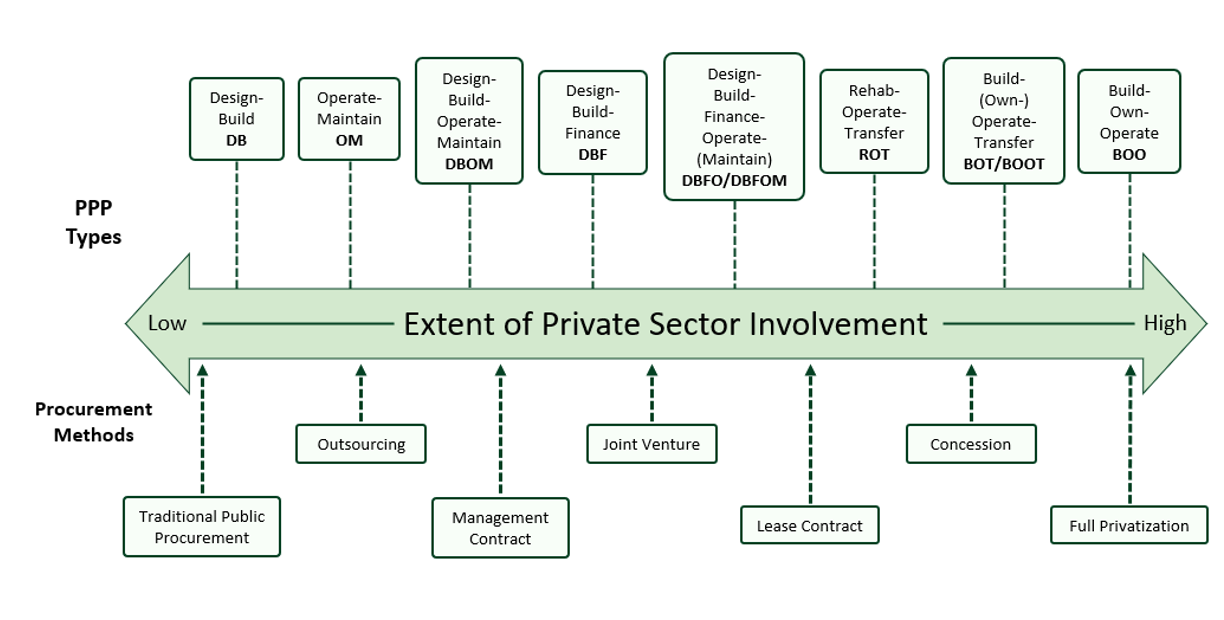
Figure 1: Extent of Private Sector Involvement, own illustration, based on Roehrich et al. (2014); The World Bank (2017); Wojewnik-Filikowska and Wegrzyn (2019)10,16,33
There are various types for PPPs, which for example include more widespread types like BOT (Build-Operate-Transfer), BTO (Build-Transfer-Operate), BOO (Build-Own-Operate), BOOT (Build-Own-Operate-Transfer), DB (Design-Build), DBFO (Design-Build-Finance-Operate) and DBOM (Design-Build-Operate-Maintain), DBFOM (Design-Build-Finance-Operate-Maintain), OM (Operate-Maintain) and ROT (Rehabilitate-Operate-Transfer) and several more lesser used variations.2OECD. Public-Private Partnerships: In Pursuit of Risk Sharing and Value for Money. (2008).,7Kwak, Y. H., Chih, Y. & Ibbs, C. W. Towards a Comprehensive Understanding of Public Private Partnerships for Infrastructure Development. California Management Review 51, 51-78 (2009).,10Roehrich, J. K., Lewis, M. A. & George, G. Are public–private partnerships a healthy option? A systematic literature review. Social Science & Medicine 113, 110-119 (2014).,16World Bank. PPP Reference Guide 3.0. (World Bank, 2017).,34Abdel Aziz, A. M. Successful Delivery of Public-Private Partnerships for Infrastructure Development. Journal of Construction Engineering and Management 133, 918-931 (2007). Adoption varies among countries worldwide and very often depends on the country’s objectives, with DBFO being the most prominent in Europe, DBOM in North America and BOT/DBFO/DBOM relatively balanced in Asia.5Osei-Kyei, R. & Chan, A. Review of studies on the Critical Success Factors for Public–Private Partnership (PPP) projects from 1990 to 2013. International Journal of Project Management 33, 1335-1346 (2015).,34Abdel Aziz, A. M. Successful Delivery of Public-Private Partnerships for Infrastructure Development. Journal of Construction Engineering and Management 133, 918-931 (2007).
Key findings are that (1) most types of PPP account for bundling of Building (B) or Operation (O) of the infrastructure, but differ in the other aspects6Iossa, E. & Martimort, D. The Simple Microeconomics of Public-Private Partnerships. Journal of Public Economic Theory 17, 4-48 (2015)., (2) the Design (D) types involve the whole development of the concept and specifications by the private partner, in which they bear more responsibilities and risks early on7Kwak, Y. H., Chih, Y. & Ibbs, C. W. Towards a Comprehensive Understanding of Public Private Partnerships for Infrastructure Development. California Management Review 51, 51-78 (2009).,16World Bank. PPP Reference Guide 3.0. (World Bank, 2017)., (3) all prominent Own (O) and Transfer (T) types involve higher private partner risks, as well as private ownership, concession agreements, and the consideration of transferring assets back to the government after the concession period7Kwak, Y. H., Chih, Y. & Ibbs, C. W. Towards a Comprehensive Understanding of Public Private Partnerships for Infrastructure Development. California Management Review 51, 51-78 (2009).,10Roehrich, J. K., Lewis, M. A. & George, G. Are public–private partnerships a healthy option? A systematic literature review. Social Science & Medicine 113, 110-119 (2014).,16World Bank. PPP Reference Guide 3.0. (World Bank, 2017)., (4) Operate (O) types typically involve user charge payment mechanisms, i.e. directly from the users of the facility through fees, tariffs or tolls16World Bank. PPP Reference Guide 3.0. (World Bank, 2017).,25Cui, C., Liu, Y., Hope, A. & Wang, J. Review of studies on the public–private partnerships (PPP) for infrastructure projects. International Journal of Project Management 36, 773-794 (2018)., (5) Finance (F) types require the private partner to finance all or part of the necessary capital expenditure without risks being limited to the equity of a Special Purpose Vehicle (SPV) company16World Bank. PPP Reference Guide 3.0. (World Bank, 2017)., (6) types with Rehabilitation (R) and the type OM typically cover renewal and/or management of existing infrastructure.7Kwak, Y. H., Chih, Y. & Ibbs, C. W. Towards a Comprehensive Understanding of Public Private Partnerships for Infrastructure Development. California Management Review 51, 51-78 (2009).,16World Bank. PPP Reference Guide 3.0. (World Bank, 2017).
2.1.4 Theoretical perspectives on PPPs
PPPs can be seen through a number of economic theories that help to explain several aspects, choices and challenges of PPP. As Cui et al. (2018) noted, researchers take on different theoretical perspectives to explore PPPs.25Cui, C., Liu, Y., Hope, A. & Wang, J. Review of studies on the public–private partnerships (PPP) for infrastructure projects. International Journal of Project Management 36, 773-794 (2018). The two foundational theories affecting PPPs are the principal-agent theory and the transaction cost theory.17Bovaird, T. Public–Private Partnerships: From Contested Concepts to Prevalent Practice. International Review of Administrative Sciences 70, 199-215 (2004). The principal-agent focuses on the principal (public sector) and the agent (private sector), and concerns incentive problems caused by information asymmetries.18Wang, H., Xiong, W., Guangdong, W. & Zhu, D. Public Private Partnership in Public Administration Discipline: A Literature Review. Public Management Review 20, 293-316 (2018). The transaction cost theory concerns optimal governance structure of transactions to minimize costs.18Wang, H., Xiong, W., Guangdong, W. & Zhu, D. Public Private Partnership in Public Administration Discipline: A Literature Review. Public Management Review 20, 293-316 (2018). In these theories opportunistic behavior plays an important role, which leads actors to use situations to their advantage, hence well-written contracts are important.35Warsen, R., Klijn, E. H. & Koppenjan, J. Mix and Match: How Contractual and Relational Conditions Are Combined in Successful Public–Private Partnerships. Journal of Public Administration Research and Theory29, 375-393 (2019). Property rights theory deals with the incompleteness of PPP contracts.18Wang, H., Xiong, W., Guangdong, W. & Zhu, D. Public Private Partnership in Public Administration Discipline: A Literature Review. Public Management Review 20, 293-316 (2018). Other theories are the public choice theory and New Public Management concerning competition mechanisms, the stakeholder theory concerning the balance of stakeholders’ benefits, the network theory and governance theory examining the cooperation between public and private sectors and institutional theory exploring an institutional view on PPPs.18Wang, H., Xiong, W., Guangdong, W. & Zhu, D. Public Private Partnership in Public Administration Discipline: A Literature Review. Public Management Review 20, 293-316 (2018).
2.2 Historical background
The ‘linguistics of PPP’ began relatively recently, first being used by specialists in the 1970s with urban development and downtown renewal in the US.20Hodge, G. A., Greve, C. & Biygautane, M. Do PPP’s work? What and how have we been learning so far?. Public Management Review 20, 1105-1121 (2018).,36Bovaird, T. A Brief Intellectual History of the Public–Private Partnership Movement. in International Handbook on Public–Private Partnerships (eds. Hodge, G. A., Greve, C. & Boardman, A. E.) Ch. 3, 43-67 (Edward Elgar Publishing, 2010). Looking even further back the possibility of financing infrastructure projects such as toll roads with private capital goes as far back as to Roman times; and even in the earlier 1800s countries used variations of co-financing and private financing as an important option for public infrastructure to provide roads, canals and railways.20Hodge, G. A., Greve, C. & Biygautane, M. Do PPP’s work? What and how have we been learning so far?. Public Management Review 20, 1105-1121 (2018).
Due to budget deficits and increasing public debt burdens in the 1990s, the promise of private finance for large infrastructure was alluring for most governments.2OECD. Public-Private Partnerships: In Pursuit of Risk Sharing and Value for Money. (2008). While their application in some parts of the world began in the early 1990s, the UK was one of the first countries to formalize the idea of PPP into a policy preference, which was proposed as a Private Finance Initiative (PFI), to fund new infrastructure projects from the private sector due to the public fundings exceeding the national budget.19Song, J., Zhang, H. & Dong, W. A review of emerging trends in global PPP research: analysis and visualization. Scientometrics 107, 1111-1147 (2016).,20Hodge, G. A., Greve, C. & Biygautane, M. Do PPP’s work? What and how have we been learning so far?. Public Management Review 20, 1105-1121 (2018). PFI was the forerunner and later re-branded as PPP.18Wang, H., Xiong, W., Guangdong, W. & Zhu, D. Public Private Partnership in Public Administration Discipline: A Literature Review. Public Management Review 20, 293-316 (2018). After the financial crisis in 2007, some governments had to fill funding gaps and stimulate the economic recovery, in which they formally encouraged the private sector to invest in infrastructure construction.37Wang, N. & Ma, M. Public–private partnership as a tool for sustainable development – What literatures say? Sustainable Development 29, 243-258 (2021). In the coming years, the PPP policy idea took off internationally and evolved into a global, much broader meaning covering many different aspects, witnessing the development of several types of PPPs.19Song, J., Zhang, H. & Dong, W. A review of emerging trends in global PPP research: analysis and visualization. Scientometrics 107, 1111-1147 (2016).,20Hodge, G. A., Greve, C. & Biygautane, M. Do PPP’s work? What and how have we been learning so far?. Public Management Review 20, 1105-1121 (2018).
In 2015 the United Nations (UN) introduced the 17 SDGs as part of the Agenda 2030, promoting a plan of action for the people, planet and prosperity, in which many goals align with the scope of PPP projects in areas like infrastructure, sustainable cities and communities.38Berrone, P. et al. EASIER: An Evaluation Model for Public–Private Partnerships Contributing to the Sustainable Development Goals. Sustainability 11, 2339 (2019).,39Du, J., Wu, H. & Zhao, X. Critical Factors on the Capital Structure of Public–Private Partnership Projects: A Sustainability Perspective. Sustainability 10, 2066 (2018). With their adoption, PPPs have become even more prominent, encouraging sustainability as one of the key goals in partnering for infrastructure projects.26Kivilä, J., Martinsuo, M. & Vuorinen, L. Sustainable project management through project control in infrastructure projects. International Journal of Project Management 35, 1167-1183 (2017).,40Marx, A. Public-Private Partnerships for Sustainable Development: Exploring Their Design and Its Impact on Effectiveness. Sustainability 11, 1087 (2019). In 2019 the UN presented PPP standards encouraging them as a tool for sustainable development, providing a focus on the people and reducing weaknesses in the implementation of the traditional PPPs.37Wang, N. & Ma, M. Public–private partnership as a tool for sustainable development – What literatures say? Sustainable Development 29, 243-258 (2021).,41UNECE. ECE/CECI/2019/5 – Guiding Principles on People-first Public-Private Partnerships in support of the United Nations Sustainable Development Goals. (2019).
2.3 PPP conceptualization
For a better understanding of what constitutes PPPs, it is essential to examine the previously mentioned key elements. The key elements – governance and stakeholder alignment, long-term contracting, risk-sharing, financing and sustainability – are the foundation of designing, implementing and evaluating PPP projects. A conceptual classification framework is shown in Figure 2 that summarizes the key elements and their most important components, which together are critical to the success of a PPP. The following section presents these key elements, their challenges and possible best practice solutions. Particularly, the best practices are a mix of critical success factors, theoretical models and PPP case examples found in the literature.
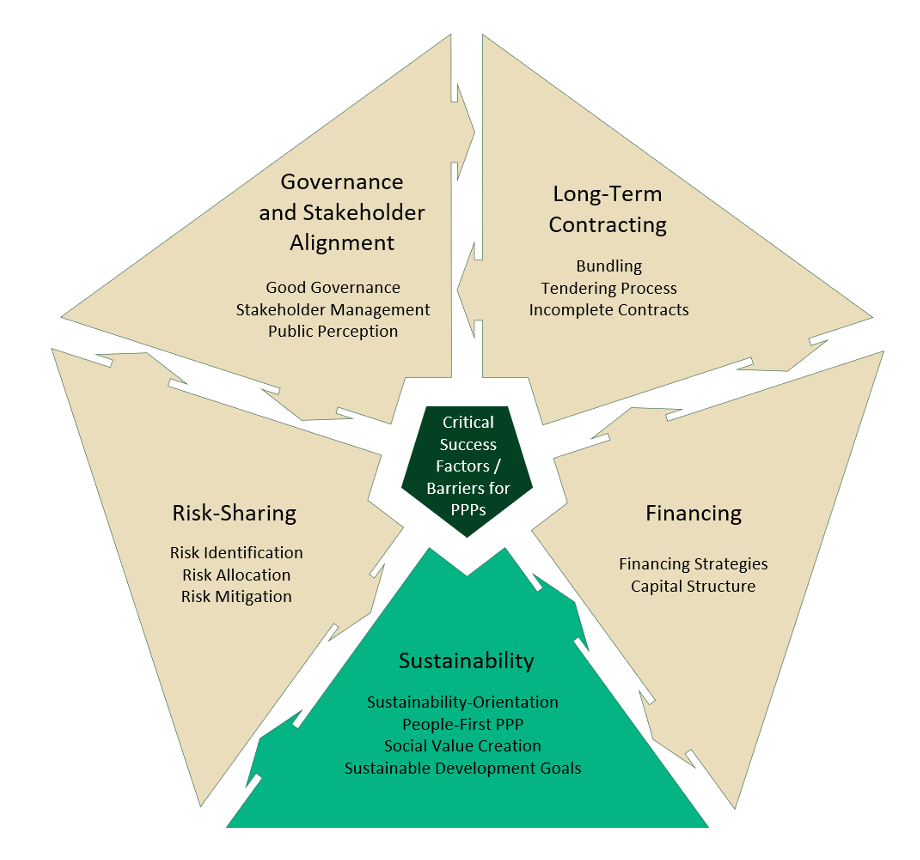
Figure 2: Conceptual Classification Framework, own illustration, inspired from Kwak et al. (2009))7
2.3.1 Public governance and stakeholder alignment
When delivering infrastructure through PPPs, the stakeholders influence the outcomes, which gives rise to several issues on how the partnership is governed, who takes the lead and the nature of stakeholder involvement.40Marx, A. Public-Private Partnerships for Sustainable Development: Exploring Their Design and Its Impact on Effectiveness. Sustainability 11, 1087 (2019). Both partners are working together in a long-term relationship to achieve a common purpose.29Hodge, G. A. & Greve, C. On Public–Private Partnership Performance: A Contemporary Review. Public Works Management & Policy 22, 55-78 (2017a). Strong relationships between the public and private sectors in PPP projects are therefore crucial to reduce misunderstandings or conflicts.42Tang, L., Shen, Q. & Cheng, E. W. L. A review of studies on Public–Private Partnership projects in the construction industry. International Journal of Project Management 28, 683-694 (2010). Trust also plays a major role in the relationship between partners, as other control mechanisms, such as stricter contracts or tighter governance, are needed if trust is lacking.35Warsen, R., Klijn, E. H. & Koppenjan, J. Mix and Match: How Contractual and Relational Conditions Are Combined in Successful Public–Private Partnerships. Journal of Public Administration Research and Theory29, 375-393 (2019). This is especially important because many stakeholders internally and externally influence a PPP.
First of all, stakeholders involve any individuals or organizations affected by or affecting the PPP project.43El-Gohary, N. M., Osman, H. & El-Diraby, T. E. Stakeholder management for public private partnerships. International Journal of Project Management 24, 595-604 (2006). Typical internal stakeholders involve the public sector, such as the central state, local government of a region, or various ministries, as well as any organization outside the public sector (private sector), such as private businesses, advisors, investors, banks and voluntary organizations.6Iossa, E. & Martimort, D. The Simple Microeconomics of Public-Private Partnerships. Journal of Public Economic Theory 17, 4-48 (2015).,12Roehrich, J. K. & Kivleniece, I. Creating and distributing sustainable value through public-private collaborative projects. in Handbook on the Business of Sustainability: The Organization, Implementation, and Practice of Sustainable Growth (eds. George, G. et al.) Ch. 26, 474-500 (Edward Elgar Publishing, 2022).,17Bovaird, T. Public–Private Partnerships: From Contested Concepts to Prevalent Practice. International Review of Administrative Sciences 70, 199-215 (2004). External stakeholders involve those with a legitimate interest in the project and/or are affected by it, i.e. the citizens, community organizations and non-governmental organizations (NGOs).17Bovaird, T. Public–Private Partnerships: From Contested Concepts to Prevalent Practice. International Review of Administrative Sciences 70, 199-215 (2004).,43El-Gohary, N. M., Osman, H. & El-Diraby, T. E. Stakeholder management for public private partnerships. International Journal of Project Management 24, 595-604 (2006). It is important to note, that poor stakeholder management is one of the common reasons for PPPs to fail.9Hodge, G. A. & Greve, C. Public–Private Partnerships: An International Performance Review. Public Administration Review 67, 545-558 (2007). Due to the mutual involvement of all these stakeholders, good governance is needed. Good Governance generally involves good regulatory quality, bureaucratic efficiency and independence, while governments support the development with clear policies, strong commitment, as well as appropriate legal and regulative frameworks.25Cui, C., Liu, Y., Hope, A. & Wang, J. Review of studies on the public–private partnerships (PPP) for infrastructure projects. International Journal of Project Management 36, 773-794 (2018). Further governance principles include transparency, accountability, fair and honest processes, leadership, competitiveness and sustainability, which are quite demanding.17Bovaird, T. Public–Private Partnerships: From Contested Concepts to Prevalent Practice. International Review of Administrative Sciences 70, 199-215 (2004).
As Bovaird (2004) argued, good governance in PPPs means in particular, that partnerships have to take responsibility for achieving improvements for the problems, which gave rise to the partnership; meaning, that the first objective of PPPs is mostly to improve the quality of life in areas of major significance to citizens and service users.17Bovaird, T. Public–Private Partnerships: From Contested Concepts to Prevalent Practice. International Review of Administrative Sciences 70, 199-215 (2004). Therefore, governance is also important to protect the public interest despite the delegation of authority to the private partner.9Hodge, G. A. & Greve, C. Public–Private Partnerships: An International Performance Review. Public Administration Review 67, 545-558 (2007). The current design of PPPs does not give enough emphasis on the extent and nature of external stakeholders, resulting in inefficiencies.3Torchia, M., Calabrò, A. & Morner, M. Public–Private Partnerships in the Health Care Sector: A Systematic Review of the Literature. Public Management Review 17, 236-261 (2015). To ensure the progress and success of PPPs, public support by the civil society, trade unions and NGOs is crucial, as PPPs provide key public services for the citizens.2OECD. Public-Private Partnerships: In Pursuit of Risk Sharing and Value for Money. (2008).,5Osei-Kyei, R. & Chan, A. Review of studies on the Critical Success Factors for Public–Private Partnership (PPP) projects from 1990 to 2013. International Journal of Project Management 33, 1335-1346 (2015). Specifically, public opposition has been reported as one of the main reasons for failure of PPP projects.43El-Gohary, N. M., Osman, H. & El-Diraby, T. E. Stakeholder management for public private partnerships. International Journal of Project Management 24, 595-604 (2006). One the one hand, if the citizens are skeptical, distrusting or do not support a policy, condition, method or even a particular PPP project, criticism could arise; on the other hand, if a project is seen as being well delivered, public support improves.29Hodge, G. A. & Greve, C. On Public–Private Partnership Performance: A Contemporary Review. Public Works Management & Policy 22, 55-78 (2017a). This is backed by a US study from Boyer and Slyke (2019) that examined factors that influence public attitudes and found out that familiarity with PPPs, trust in government and feelings toward the business sector influences attitudes toward them.44Boyer, E. J. & Van Slyke, D. M. Citizen Attitudes Towards Public–Private Partnerships. The American Review of Public Administration 49, 259-274 (2018). Political support may also waver from the opposition.2OECD. Public-Private Partnerships: In Pursuit of Risk Sharing and Value for Money. (2008). The following best practices address these difficulties and challenges.
First of all, it is important to note that the government has the leading role in the legitimacy of a PPP project, where accountability and public interest are crucial.3Torchia, M., Calabrò, A. & Morner, M. Public–Private Partnerships in the Health Care Sector: A Systematic Review of the Literature. Public Management Review 17, 236-261 (2015).,8Casady, C., Eriksson, K., Levitt, R. & Scott, W. R. (Re)defining public-private partnerships (PPPs) in the new public governance (NPG) paradigm: an institutional maturity perspective. Public Management Review 22, 1-23 (2019). Specifically, effective leadership to ensure goals and accountability, as well as strong political backing to sustain the project once legislations change, are crucial for the success of PPPs.31Forrer, J., Kee, J. E., Newcomer, K. E. & Boyer, E. Public–Private Partnerships and the Public Accountability Question. Public Administration Review 70, 475-484 (2010). In this regard it is important that governments keeps their governance responsibilities separated from commercial concerns.9Hodge, G. A. & Greve, C. Public–Private Partnerships: An International Performance Review. Public Administration Review 67, 545-558 (2007). In addition, improving the procurement skills of the department staff involved in PPPs is an underlying practice to strengthen their expertise to improve the projects delivery and streamline the PPP implementation.34Abdel Aziz, A. M. Successful Delivery of Public-Private Partnerships for Infrastructure Development. Journal of Construction Engineering and Management 133, 918-931 (2007). For example, in Lima, Peru the building of an Expressway through a PPP resulted in failure due to a weak legal and institutional context, linked with a lack of transparency and accountability, which resulted in accusations of corruption.45Eurodad. History RePPPeated II – Why Public-Private Partnerships are not the solution. (2022).
Hodge and Greve (2007) pointed out, that special organizational units may be a good way to ensure effective PPP governance. For example, some countries, such as Britain and the Netherlands, established centralized PPP units for a top-down approach that drives the adoption of PPPs across all the government’s levels; while other countries, such as Germany, Denmark and Sweden, organized themselves in a decentralized way for a rather bottom-up approach with more room for local decisions.9Hodge, G. A. & Greve, C. Public–Private Partnerships: An International Performance Review. Public Administration Review 67, 545-558 (2007). A PPP unit could have the authority to evaluate and assess issues outside of the government’s typical competencies such as cost allocation, clauses, length of concessions and risk allocation.34Abdel Aziz, A. M. Successful Delivery of Public-Private Partnerships for Infrastructure Development. Journal of Construction Engineering and Management 133, 918-931 (2007). Furthermore, tight governance may be needed to protect the public interest, but weaker governance is also needed to enable risk-taking and innovation.46Skelcher, C. Governing Partnerships. in International Handbook on Public–Private Partnerships (eds. Hodge, G. A., Greve, C. & Boardman, A. E.) Ch. 13, 292-304 (Edward Elgar Publishing, 2010). Governments should therefore avoid overregulation of private operators.25Cui, C., Liu, Y., Hope, A. & Wang, J. Review of studies on the public–private partnerships (PPP) for infrastructure projects. International Journal of Project Management 36, 773-794 (2018). Finding a balance in centralized coordination and governance is important to achieve flexibility and efficiency gains in PPP projects.12Roehrich, J. K. & Kivleniece, I. Creating and distributing sustainable value through public-private collaborative projects. in Handbook on the Business of Sustainability: The Organization, Implementation, and Practice of Sustainable Growth (eds. George, G. et al.) Ch. 26, 474-500 (Edward Elgar Publishing, 2022). Another important practice is to select the right private partner because both partners will work together for a very long time.3Torchia, M., Calabrò, A. & Morner, M. Public–Private Partnerships in the Health Care Sector: A Systematic Review of the Literature. Public Management Review 17, 236-261 (2015). Furthermore, PPP projects are difficult for a single construction company to execute, which means that a reliable, well-structured, financially strong and technically competent private partner is crucial.5Osei-Kyei, R. & Chan, A. Review of studies on the Critical Success Factors for Public–Private Partnership (PPP) projects from 1990 to 2013. International Journal of Project Management 33, 1335-1346 (2015).,7Kwak, Y. H., Chih, Y. & Ibbs, C. W. Towards a Comprehensive Understanding of Public Private Partnerships for Infrastructure Development. California Management Review 51, 51-78 (2009). Abdel Aziz (2007) suggested a multi-stage process for contractor selection, including stages for interest, qualification, proposals, offers and the final negotiation.34Abdel Aziz, A. M. Successful Delivery of Public-Private Partnerships for Infrastructure Development. Journal of Construction Engineering and Management 133, 918-931 (2007). The whole selection process for partners must be fair and transparent to mitigate avoidable legal disputes that could impede the project’s progress.3Torchia, M., Calabrò, A. & Morner, M. Public–Private Partnerships in the Health Care Sector: A Systematic Review of the Literature. Public Management Review 17, 236-261 (2015). Governments may also assist in strengthening companies both financially and technically to build their capacity to be able to compete with international project companies.5Osei-Kyei, R. & Chan, A. Review of studies on the Critical Success Factors for Public–Private Partnership (PPP) projects from 1990 to 2013. International Journal of Project Management 33, 1335-1346 (2015).
As an example of good governance, Biygautane et al. (2019) describe how Saudi Arabia developed an airport in Medina in 2010, despite many constraints.47Biygautane, M., Neesham, C. & Al-Yahya, K. O. Institutional entrepreneurship and infrastructure public-private partnership (PPP): Unpacking the role of social actors in implementing PPP projects. International Journal of Project Management 37, 192-219 (2019). The public sector faced many deficits, such as a lack of understanding of the PPP concept, missing administrative mechanisms, weak ministerial communication, transparency issues, lack of skills and expertise, and the absence of a PPP law.47Biygautane, M., Neesham, C. & Al-Yahya, K. O. Institutional entrepreneurship and infrastructure public-private partnership (PPP): Unpacking the role of social actors in implementing PPP projects. International Journal of Project Management 37, 192-219 (2019). The government contracted a consortium of international private firms through a BTO agreement for 23 years to build and operate the PPP project after a feasibility analysis and a recommended PPP model.47Biygautane, M., Neesham, C. & Al-Yahya, K. O. Institutional entrepreneurship and infrastructure public-private partnership (PPP): Unpacking the role of social actors in implementing PPP projects. International Journal of Project Management 37, 192-219 (2019). In addition, the government took steps to overcome the institutional constraints by streamlining administrative procedures, ensuring transparency throughout the whole process, hiring experienced staff for a new PPP department, drafting a legal team for the agreement, and seeking international professional advisors.47Biygautane, M., Neesham, C. & Al-Yahya, K. O. Institutional entrepreneurship and infrastructure public-private partnership (PPP): Unpacking the role of social actors in implementing PPP projects. International Journal of Project Management 37, 192-219 (2019). The whole process was complemented by the involvement of different ministries and even a royal order for political support.47Biygautane, M., Neesham, C. & Al-Yahya, K. O. Institutional entrepreneurship and infrastructure public-private partnership (PPP): Unpacking the role of social actors in implementing PPP projects. International Journal of Project Management 37, 192-219 (2019).
To build strong relationships, trust and ultimately an effective PPP, the involvement and alignment among all stakeholders are essential.10Roehrich, J. K., Lewis, M. A. & George, G. Are public–private partnerships a healthy option? A systematic literature review. Social Science & Medicine 113, 110-119 (2014).,25Cui, C., Liu, Y., Hope, A. & Wang, J. Review of studies on the public–private partnerships (PPP) for infrastructure projects. International Journal of Project Management 36, 773-794 (2018). Specifically for stakeholder involvement, El-Gohary et al. (2006) developed a semantic model, which thoroughly captures the actors, concerns, processes, resources and strategies behind a PPP project.43El-Gohary, N. M., Osman, H. & El-Diraby, T. E. Stakeholder management for public private partnerships. International Journal of Project Management 24, 595-604 (2006). The model incorporates many essential steps and strategies toward creating a strong involvement program that will help in effective communication and stakeholder management.43El-Gohary, N. M., Osman, H. & El-Diraby, T. E. Stakeholder management for public private partnerships. International Journal of Project Management 24, 595-604 (2006). To foster relationships, governments can set up formal relationship standards and procedures to foster trust.8Casady, C., Eriksson, K., Levitt, R. & Scott, W. R. (Re)defining public-private partnerships (PPPs) in the new public governance (NPG) paradigm: an institutional maturity perspective. Public Management Review 22, 1-23 (2019). They may even give assurances to the private partner about future revenue guarantees, as well as assurances to the public about quality and reasonable end user fees in this regard.2OECD. Public-Private Partnerships: In Pursuit of Risk Sharing and Value for Money. (2008).,5Osei-Kyei, R. & Chan, A. Review of studies on the Critical Success Factors for Public–Private Partnership (PPP) projects from 1990 to 2013. International Journal of Project Management 33, 1335-1346 (2015).
For the relationship between the public and private sector, both parties should consult each other for any clarification on the projects’ delivery throughout the whole procurement process.5Osei-Kyei, R. & Chan, A. Review of studies on the Critical Success Factors for Public–Private Partnership (PPP) projects from 1990 to 2013. International Journal of Project Management 33, 1335-1346 (2015). These regular consultations especially help to clarify uncertainties. Furthermore, they create a foundation for true partnering between the two sectors.21Grimsey, D. & Lewis, M. K. Public Private Partnerships: The Worldwide Revolution in Infrastructure Provision and Project Finance. (Edward Elgar Publishing, 2004). As for the public, mechanisms for a deeper level of acceptance and participation are needed.48Boyer, E. J. How does public participation affect perceptions of public-private partnerships? A citizens’ view on push, pull, and network approaches in PPPs. Public Management Review 21, 1464-1485 (2019). First of all, it is important to clear any doubts or rumors from the public concerning the delivery of PPP projects.5Osei-Kyei, R. & Chan, A. Review of studies on the Critical Success Factors for Public–Private Partnership (PPP) projects from 1990 to 2013. International Journal of Project Management 33, 1335-1346 (2015). Consistent and clear communication with all (internal and external) stakeholders is vital for success as it boosts trust, transparency, engagement and support for the cause.31Forrer, J., Kee, J. E., Newcomer, K. E. & Boyer, E. Public–Private Partnerships and the Public Accountability Question. Public Administration Review 70, 475-484 (2010). In addition, publicly made information and reports can improve transparency for all internal and external stakeholders.5Osei-Kyei, R. & Chan, A. Review of studies on the Critical Success Factors for Public–Private Partnership (PPP) projects from 1990 to 2013. International Journal of Project Management 33, 1335-1346 (2015). It is also crucial, that PPPs should consider the interests of the citizens and other stakeholders, as well as include all the stakeholders in the decision-making.3Torchia, M., Calabrò, A. & Morner, M. Public–Private Partnerships in the Health Care Sector: A Systematic Review of the Literature. Public Management Review 17, 236-261 (2015).,17Bovaird, T. Public–Private Partnerships: From Contested Concepts to Prevalent Practice. International Review of Administrative Sciences 70, 199-215 (2004). This interactive engagement reflects citizens’ interest, includes them in the development and also improves public support.48Boyer, E. J. How does public participation affect perceptions of public-private partnerships? A citizens’ view on push, pull, and network approaches in PPPs. Public Management Review 21, 1464-1485 (2019). According to George et al. (2024), a good case example for involving all stakeholders is the Hyderabad Water Supply and Sewage Board project in India.22George, G., Fewer, T. J., Lazzarini, S., McGahan, A. M. & Puranam, P. Partnering for Grand Challenges: A Review of Organizational Design Considerations in Public–Private Collaborations. Journal of Management 50, 10-40 (2024). The public leaders created forums involving interactions among the public sector members as well as consultation mechanisms with citizens to foster awareness and get useful input.22George, G., Fewer, T. J., Lazzarini, S., McGahan, A. M. & Puranam, P. Partnering for Grand Challenges: A Review of Organizational Design Considerations in Public–Private Collaborations. Journal of Management 50, 10-40 (2024).
2.3.2 Long-term contracting
A PPP involves a cooperation between the public and private partner for a whole lifecycle of an infrastructure asset, lasting at least 10 to 20 years, mostly bundled in a single ‘one-covering contract’.49Van Den Hurk, M. & Verhoest, K. The challenge of using standard contracts in public–private partnerships. Public Management Review 18, 278-299 (2016). The typical contract lasts for 20 to 35 years, but can stretch up to 99 years due to contractual payments.6Iossa, E. & Martimort, D. The Simple Microeconomics of Public-Private Partnerships. Journal of Public Economic Theory 17, 4-48 (2015).,30Savas, E. S. Privatization and Public–Private Partnership. (Cq Press, 2000). PPPs typically involve longer bidding and contracting periods than traditional procurement methods and due to uncertainties from long concession periods and the inherent incompleteness in every detail of the project, PPP contracts often need adjustments along the way.25Cui, C., Liu, Y., Hope, A. & Wang, J. Review of studies on the public–private partnerships (PPP) for infrastructure projects. International Journal of Project Management 36, 773-794 (2018). A striking fact is that PPP concessions are routinely renegotiated because the contracts last for several decades and thus incomplete contracts are to be expected.24Engel, E., Fischer, R. D. & Galetovic, A. The Economics of Public-Private Partnerships: A Basic Guide. (Cambridge University Press, 2014). Failed renegotiations during the life cycle and adverse institutional conditions, such as contract enforcement or unrealistic demand expectations from the government, are some of the reasons for lower success of a PPP.6Iossa, E. & Martimort, D. The Simple Microeconomics of Public-Private Partnerships. Journal of Public Economic Theory 17, 4-48 (2015). To summarize, “PPP contracts are long-lasting and constantly changing” (p. 17)25Cui, C., Liu, Y., Hope, A. & Wang, J. Review of studies on the public–private partnerships (PPP) for infrastructure projects. International Journal of Project Management 36, 773-794 (2018)., adding additional complexity to the already complicated activity of contracting, which aims to align opposing interests of different actors into an agreement packed with mutual commitment.49Van Den Hurk, M. & Verhoest, K. The challenge of using standard contracts in public–private partnerships. Public Management Review 18, 278-299 (2016).
As Martimort and Pouyet (2008) suggest, to better understand the optimal delegation of public services, it is important to consider the complex array of tasks involved in procuring a public service.50Martimort, D. & Pouyet, J. To build or not to build: Normative and positive theories of public–private partnerships. International Journal of Industrial Organization 26, 393-411 (2008). Those tasks necessitate, first, the building of infrastructure and, second, the efficient operation of these assets. With PPPs the governments adopt a more minimalistic stance, selecting a private consortium responsible for designing the infrastructure’s quality attributes, constructing the assets and managing them as efficiently as possible.50Martimort, D. & Pouyet, J. To build or not to build: Normative and positive theories of public–private partnerships. International Journal of Industrial Organization 26, 393-411 (2008). Typically, it involves the bundling of the tasks of design, building, finance, operation and maintaining, assigned to a consortium; however, governments may also bundle several smaller or similar projects together, either to be jointly procured and tendered or to be managed by a single private sector partner.6Iossa, E. & Martimort, D. The Simple Microeconomics of Public-Private Partnerships. Journal of Public Economic Theory 17, 4-48 (2015).,49Van Den Hurk, M. & Verhoest, K. The challenge of using standard contracts in public–private partnerships. Public Management Review 18, 278-299 (2016). The consortium typically involves all the partners from the private sector organized into a special purpose vehicle (SPV) responsible for the tasks.2OECD. Public-Private Partnerships: In Pursuit of Risk Sharing and Value for Money. (2008). This act of bundling should save operating costs, contribute to the dispersion of transaction costs and create economies of scale, but increases the projects complexity further and limits the participation of smaller private companies.6Iossa, E. & Martimort, D. The Simple Microeconomics of Public-Private Partnerships. Journal of Public Economic Theory 17, 4-48 (2015).,10Roehrich, J. K., Lewis, M. A. & George, G. Are public–private partnerships a healthy option? A systematic literature review. Social Science & Medicine 113, 110-119 (2014).,49Van Den Hurk, M. & Verhoest, K. The challenge of using standard contracts in public–private partnerships. Public Management Review 18, 278-299 (2016). The following best practices address contracting and bundling in PPPs.
Formal contracts are an important governance mechanism to provide guidance, clarify stakeholders’ responsibilities, effective risk allocation and give a legal framework for future PPPs.10Roehrich, J. K., Lewis, M. A. & George, G. Are public–private partnerships a healthy option? A systematic literature review. Social Science & Medicine 113, 110-119 (2014). A good practice is to fit those contracts to specific technological, strategic and institutional settings.13Koppenjan, J. & Enserink, B. Public–Private Partnerships in Urban Infrastructures: Reconciling Private Sector Participation and Sustainability. Public Administration Review 69, 284-296 (2009). As Van Den Hurk & Verhoerst (2014) argued, standardization of contracts might be another solution to settle negotiations more quickly, lower transaction costs, foster competition by enlarging the field of potential bidders and render learning for future contracts.49Van Den Hurk, M. & Verhoest, K. The challenge of using standard contracts in public–private partnerships. Public Management Review 18, 278-299 (2016). They discussed, that it can play an important role in PPP practice and generally be seen as a PPP-simplifying governance tool, but the benefits depend a lot on whether the public actor considers it as a guiding instrument or a control tool.49Van Den Hurk, M. & Verhoest, K. The challenge of using standard contracts in public–private partnerships. Public Management Review 18, 278-299 (2016). However, standard contracts with rigid specifications may constrain private partner’s commitment, could cause further harm in negotiations and flexibility due to the restrictive nature and have a negative impact on the local level of the infrastructure asset to be built.10Roehrich, J. K., Lewis, M. A. & George, G. Are public–private partnerships a healthy option? A systematic literature review. Social Science & Medicine 113, 110-119 (2014).,49Van Den Hurk, M. & Verhoest, K. The challenge of using standard contracts in public–private partnerships. Public Management Review 18, 278-299 (2016). It is precisely due to the many uncertainties that a certain necessity for flexible agreements and contract renegotiations is important.25Cui, C., Liu, Y., Hope, A. & Wang, J. Review of studies on the public–private partnerships (PPP) for infrastructure projects. International Journal of Project Management 36, 773-794 (2018). Governments may then build on past experiences and fix many aspects in future contracts more easily.51Spraul, K. & Thaler, J. Partnering for good? An analysis of how to achieve sustainability-related outcomes in public–private partnerships. Business Research 13, 485-511 (2020). Thus, the challenge lies in balancing the opposite forces and using a formal or standardized contract in a complementary way or as a guideline.49Van Den Hurk, M. & Verhoest, K. The challenge of using standard contracts in public–private partnerships. Public Management Review 18, 278-299 (2016).
Another option is to design tendering procedures and contracts in such a way that ensures competition, transparency and accountability.13Koppenjan, J. & Enserink, B. Public–Private Partnerships in Urban Infrastructures: Reconciling Private Sector Participation and Sustainability. Public Administration Review 69, 284-296 (2009). In that aspect, Cui et al. (2018) suggest proactive measures to reduce (re-)negotiation costs, such as incorporating key contract clauses while keeping an incomplete contract.25Cui, C., Liu, Y., Hope, A. & Wang, J. Review of studies on the public–private partnerships (PPP) for infrastructure projects. International Journal of Project Management 36, 773-794 (2018). They emphasize flexible contract terms, dynamic contract supervision and an analysis of renegotiation triggers during the lifecycle of a PPP project before potential conflicts even appear.25Cui, C., Liu, Y., Hope, A. & Wang, J. Review of studies on the public–private partnerships (PPP) for infrastructure projects. International Journal of Project Management 36, 773-794 (2018). Including renegotiation clauses could be another solution, for when the environment changes, new information arises or errors are discovered.24Engel, E., Fischer, R. D. & Galetovic, A. The Economics of Public-Private Partnerships: A Basic Guide. (Cambridge University Press, 2014). Early involvement of private partners in the process is also encouraged through competitive bidding and negotiation procedures.13Koppenjan, J. & Enserink, B. Public–Private Partnerships in Urban Infrastructures: Reconciling Private Sector Participation and Sustainability. Public Administration Review 69, 284-296 (2009). Jointly clarifying goals and metrics, such as values, rewards and outcomes, as well as establishing relational linkages early on may be a potential for better valuation and trust between partners.22George, G., Fewer, T. J., Lazzarini, S., McGahan, A. M. & Puranam, P. Partnering for Grand Challenges: A Review of Organizational Design Considerations in Public–Private Collaborations. Journal of Management 50, 10-40 (2024). To make sure the other party abides by the contract, the possibility of applying sanctions provides steering options during the later implementation of the project.35Warsen, R., Klijn, E. H. & Koppenjan, J. Mix and Match: How Contractual and Relational Conditions Are Combined in Successful Public–Private Partnerships. Journal of Public Administration Research and Theory29, 375-393 (2019).
Another factor to consider is the bundling of tasks. By bundling, externalities can be better addressed and managed.50Martimort, D. & Pouyet, J. To build or not to build: Normative and positive theories of public–private partnerships. International Journal of Industrial Organization 26, 393-411 (2008). A positive (or negative) externality refers to the case, where a building innovation reduces (or increases) costs at the management stage.6Iossa, E. & Martimort, D. The Simple Microeconomics of Public-Private Partnerships. Journal of Public Economic Theory 17, 4-48 (2015). With positive externalities, bundling is preferred and increases welfare; when the externalities are negative, unbundling reduces agency costs and is socially preferable.50Martimort, D. & Pouyet, J. To build or not to build: Normative and positive theories of public–private partnerships. International Journal of Industrial Organization 26, 393-411 (2008). The question lies further, which tasks in PPPs should be bundled into a consortium or instead unbundled and undertaken by separate firms, when the externalities are uncertain and other factors are present.6Iossa, E. & Martimort, D. The Simple Microeconomics of Public-Private Partnerships. Journal of Public Economic Theory 17, 4-48 (2015). Building on the previous research, Dolla and Laishram (2020) developed a theoretical framework specifically examining factors for bundling tasks on PPPs.52Dolla, T. & Laishram, B. Bundling in public–private partnership projects – a conceptual framework. International Journal of Productivity and Performance Management 69, 1177-1203 (2020). They gave propositions on various phases in the PPP project, presented factors that influence bundling decisions and gave recommendations for (un-)bundling tasks.52Dolla, T. & Laishram, B. Bundling in public–private partnership projects – a conceptual framework. International Journal of Productivity and Performance Management 69, 1177-1203 (2020).
2.3.3 The role of risk-sharing
Risk is a crucial element of PPPs, as it involves long contracting/concession periods and involves many participants in the partnership.7Kwak, Y. H., Chih, Y. & Ibbs, C. W. Towards a Comprehensive Understanding of Public Private Partnerships for Infrastructure Development. California Management Review 51, 51-78 (2009). PPP generally have more risks and a higher degree of risks than other procurement methods.18Wang, H., Xiong, W., Guangdong, W. & Zhu, D. Public Private Partnership in Public Administration Discipline: A Literature Review. Public Management Review 20, 293-316 (2018). As one of the main benefits of PPP, the allocation of risks has attracted significant interest from researchers.25Cui, C., Liu, Y., Hope, A. & Wang, J. Review of studies on the public–private partnerships (PPP) for infrastructure projects. International Journal of Project Management 36, 773-794 (2018). “A risk is seen as an uncertain possibility” (p. 303); or more precisely, a “probability that the actual outcome will deviate from the expected outcome” (p. 48).2OECD. Public-Private Partnerships: In Pursuit of Risk Sharing and Value for Money. (2008).,18Wang, H., Xiong, W., Guangdong, W. & Zhu, D. Public Private Partnership in Public Administration Discipline: A Literature Review. Public Management Review 20, 293-316 (2018). Risk-sharing allows both partners to transfer some of their risks, ensuring that neither side bears too many risks, which encourages them to work closely together.18Wang, H., Xiong, W., Guangdong, W. & Zhu, D. Public Private Partnership in Public Administration Discipline: A Literature Review. Public Management Review 20, 293-316 (2018). Researchers seem to agree that risk-sharing between both sectors is a major consideration for successfully integrating their strengths.9Hodge, G. A. & Greve, C. Public–Private Partnerships: An International Performance Review. Public Administration Review 67, 545-558 (2007).
First of all, it is important to identify the risks involved in a specific PPP project.25Cui, C., Liu, Y., Hope, A. & Wang, J. Review of studies on the public–private partnerships (PPP) for infrastructure projects. International Journal of Project Management 36, 773-794 (2018). There can be many kinds of risks to consider in PPPs.9Hodge, G. A. & Greve, C. Public–Private Partnerships: An International Performance Review. Public Administration Review 67, 545-558 (2007).,18Wang, H., Xiong, W., Guangdong, W. & Zhu, D. Public Private Partnership in Public Administration Discipline: A Literature Review. Public Management Review 20, 293-316 (2018). Wang (2018) classified risks generally into project-related, market-related, social and country risks.18Wang, H., Xiong, W., Guangdong, W. & Zhu, D. Public Private Partnership in Public Administration Discipline: A Literature Review. Public Management Review 20, 293-316 (2018). Project-related risks are the risks that occur due to the project’s uncertainty and complexity, covering areas like design, development, construction, finance and operation.18Wang, H., Xiong, W., Guangdong, W. & Zhu, D. Public Private Partnership in Public Administration Discipline: A Literature Review. Public Management Review 20, 293-316 (2018). Examples are design deficiencies, construction delays, poor quality, higher maintenance cost, lack of commitment, and inadequate distribution of responsibilities and authority.53Chou, J.-S. & Pramudawardhani, D. Cross-country comparisons of key drivers, critical success factors and risk allocation for public-private partnership projects. International Journal of Project Management 33, 1136-1150 (2015). Major risks involve the creation of unbalanced partnerships due to the constant conflict of interest between the partners and high operation and maintenance risks due to depreciation over a long contracting period.3Torchia, M., Calabrò, A. & Morner, M. Public–Private Partnerships in the Health Care Sector: A Systematic Review of the Literature. Public Management Review 17, 236-261 (2015).,6Iossa, E. & Martimort, D. The Simple Microeconomics of Public-Private Partnerships. Journal of Public Economic Theory 17, 4-48 (2015). Market-related risks are generated by the market, seen from a macroeconomic view, including inflation over the contract period, interest rate fluctuations, competition and market demand fluctuations.18Wang, H., Xiong, W., Guangdong, W. & Zhu, D. Public Private Partnership in Public Administration Discipline: A Literature Review. Public Management Review 20, 293-316 (2018).,53Chou, J.-S. & Pramudawardhani, D. Cross-country comparisons of key drivers, critical success factors and risk allocation for public-private partnership projects. International Journal of Project Management 33, 1136-1150 (2015). Social risks involve the public dimension and are in some way linked to market-related risks due to user demand.18Wang, H., Xiong, W., Guangdong, W. & Zhu, D. Public Private Partnership in Public Administration Discipline: A Literature Review. Public Management Review 20, 293-316 (2018). Examples are public opposition, demand fluctuations and illicit acts of third parties.53Chou, J.-S. & Pramudawardhani, D. Cross-country comparisons of key drivers, critical success factors and risk allocation for public-private partnership projects. International Journal of Project Management 33, 1136-1150 (2015). Especially the public opposition is a major risk because PPPs often have greater visibility.18Wang, H., Xiong, W., Guangdong, W. & Zhu, D. Public Private Partnership in Public Administration Discipline: A Literature Review. Public Management Review 20, 293-316 (2018). Country risks are related to the country’s specific uncertainties, typically on the political and legal level.18Wang, H., Xiong, W., Guangdong, W. & Zhu, D. Public Private Partnership in Public Administration Discipline: A Literature Review. Public Management Review 20, 293-316 (2018). There are many examples such as an unstable government, corruption, law and regulatory changes, poor decision-making and poor governance.53Chou, J.-S. & Pramudawardhani, D. Cross-country comparisons of key drivers, critical success factors and risk allocation for public-private partnership projects. International Journal of Project Management 33, 1136-1150 (2015). Political risks play a crucial role in PPPs as weak political support could influence public opinion, might dissuade private sector participants and further increase many other risks.2OECD. Public-Private Partnerships: In Pursuit of Risk Sharing and Value for Money. (2008). Governance risks also appear to have increased with PPPs, like the desire of governments to proceed with hasty project construction for political purposes and the inadequate transparency of the projects.9Hodge, G. A. & Greve, C. Public–Private Partnerships: An International Performance Review. Public Administration Review 67, 545-558 (2007).
It is important to note that there is no universal list of all risks that apply to all PPPs, as their presence and degree depend on a variety of factors such as project type, sector, size, location and PPP type.7Kwak, Y. H., Chih, Y. & Ibbs, C. W. Towards a Comprehensive Understanding of Public Private Partnerships for Infrastructure Development. California Management Review 51, 51-78 (2009). Therefore, rigorous risk analysis and optimal risk allocation are fundamentally important for all stakeholders involved in a PPP.3Torchia, M., Calabrò, A. & Morner, M. Public–Private Partnerships in the Health Care Sector: A Systematic Review of the Literature. Public Management Review 17, 236-261 (2015). Risk allocation refers to which party assumes the risk in the end.27Wang, H., Liu, Y., Xiong, W. & Song, J. The moderating role of governance environment on the relationship between risk allocation and private investment in PPP markets: Evidence from developing countries. International Journal of Project Management 37, 117-130 (2019). It is precisely because there is a mix of risks from both sectors, that there are differences in which partner is better able to handle which type of risk.7Kwak, Y. H., Chih, Y. & Ibbs, C. W. Towards a Comprehensive Understanding of Public Private Partnerships for Infrastructure Development. California Management Review 51, 51-78 (2009).,34Abdel Aziz, A. M. Successful Delivery of Public-Private Partnerships for Infrastructure Development. Journal of Construction Engineering and Management 133, 918-931 (2007). Furthermore, once the risks and their potential impacts are identified, strategies for risk mitigation are useful.2OECD. Public-Private Partnerships: In Pursuit of Risk Sharing and Value for Money. (2008). Each risk should be assessed in terms of its effects on the project and the end users, and allocated to the partner, who is best able to manage the occurrences and for whom they are most affordable.2OECD. Public-Private Partnerships: In Pursuit of Risk Sharing and Value for Money. (2008).,27Wang, H., Liu, Y., Xiong, W. & Song, J. The moderating role of governance environment on the relationship between risk allocation and private investment in PPP markets: Evidence from developing countries. International Journal of Project Management 37, 117-130 (2019).,34Abdel Aziz, A. M. Successful Delivery of Public-Private Partnerships for Infrastructure Development. Journal of Construction Engineering and Management 133, 918-931 (2007). The following best practices address the allocation of risk.
First of all, Governments should refrain from the idea of transferring all the risks to the private partner.5Osei-Kyei, R. & Chan, A. Review of studies on the Critical Success Factors for Public–Private Partnership (PPP) projects from 1990 to 2013. International Journal of Project Management 33, 1335-1346 (2015). Doing so may result in the private firm either avoiding any relational interactions and large upfront investments or alternatively charging very high risk-premiums.24Engel, E., Fischer, R. D. & Galetovic, A. The Economics of Public-Private Partnerships: A Basic Guide. (Cambridge University Press, 2014).,31Forrer, J., Kee, J. E., Newcomer, K. E. & Boyer, E. Public–Private Partnerships and the Public Accountability Question. Public Administration Review 70, 475-484 (2010). Risk allocation is influenced by a country’s governance environment.27Wang, H., Liu, Y., Xiong, W. & Song, J. The moderating role of governance environment on the relationship between risk allocation and private investment in PPP markets: Evidence from developing countries. International Journal of Project Management 37, 117-130 (2019). For weaker governments or weak environments, less risk should be transferred to the private partner due to higher political risks.6Iossa, E. & Martimort, D. The Simple Microeconomics of Public-Private Partnerships. Journal of Public Economic Theory 17, 4-48 (2015). In countries with good governance, the environment has matured and private investors have full confidence in the cooperation.27Wang, H., Liu, Y., Xiong, W. & Song, J. The moderating role of governance environment on the relationship between risk allocation and private investment in PPP markets: Evidence from developing countries. International Journal of Project Management 37, 117-130 (2019). Different regions thus need different risk allocation models.25Cui, C., Liu, Y., Hope, A. & Wang, J. Review of studies on the public–private partnerships (PPP) for infrastructure projects. International Journal of Project Management 36, 773-794 (2018). Besides the governance environment, the type of project affects the allocation of risks.18Wang, H., Xiong, W., Guangdong, W. & Zhu, D. Public Private Partnership in Public Administration Discipline: A Literature Review. Public Management Review 20, 293-316 (2018). For example, in prisons, users do not pay and the demand is imposed, thus the demand risk remains with the government and no revenue risks are involved; in leisure centers, user fees are needed, thus the demand risk is mostly shared and revenue risks lie entirely with the contractor.6Iossa, E. & Martimort, D. The Simple Microeconomics of Public-Private Partnerships. Journal of Public Economic Theory 17, 4-48 (2015). Typically, most political and legal risks should be assumed by the government, while most project-related and market-related risks are retained by the private sector, as well as other risks subjected to several considerations are shared between both.7Kwak, Y. H., Chih, Y. & Ibbs, C. W. Towards a Comprehensive Understanding of Public Private Partnerships for Infrastructure Development. California Management Review 51, 51-78 (2009).,34Abdel Aziz, A. M. Successful Delivery of Public-Private Partnerships for Infrastructure Development. Journal of Construction Engineering and Management 133, 918-931 (2007).
The effects of the risk allocation should also be assessed on the project and the ultimate users of the infrastructure.34Abdel Aziz, A. M. Successful Delivery of Public-Private Partnerships for Infrastructure Development. Journal of Construction Engineering and Management 133, 918-931 (2007). To determine and alleviate current risks, project owners should regularly communicate with all stakeholders involved, especially the funders, involved teams and local citizens, through regular consultations or project information disclosures to the public.27Wang, H., Liu, Y., Xiong, W. & Song, J. The moderating role of governance environment on the relationship between risk allocation and private investment in PPP markets: Evidence from developing countries. International Journal of Project Management 37, 117-130 (2019). Governments could design an effective risk allocation plan by engaging all stakeholders, consulting experts, as well as recording and learning from other PPP projects, which could mitigate future risks.27Wang, H., Liu, Y., Xiong, W. & Song, J. The moderating role of governance environment on the relationship between risk allocation and private investment in PPP markets: Evidence from developing countries. International Journal of Project Management 37, 117-130 (2019). Following a suggestion by Roehrich et al. (2014) there is a need for standardization of risk assessment tools, appropriate risk pricing and improvement in transparency of risk types.10Roehrich, J. K., Lewis, M. A. & George, G. Are public–private partnerships a healthy option? A systematic literature review. Social Science & Medicine 113, 110-119 (2014). Cui et al. (2018) also suggest improving risk assessment and allocation by systematically quantifying the risks based on factors such as the project type, implementation stage, location and other aspects.25Cui, C., Liu, Y., Hope, A. & Wang, J. Review of studies on the public–private partnerships (PPP) for infrastructure projects. International Journal of Project Management 36, 773-794 (2018). Proper risk transfer provides incentives, lowers costs and efficient provision of services.6Iossa, E. & Martimort, D. The Simple Microeconomics of Public-Private Partnerships. Journal of Public Economic Theory 17, 4-48 (2015).
2.3.4 Financing mechanisms
Financing is another key element in the provision of public infrastructure, as the challenge lies in finding the necessary resources for the PPP project.24Engel, E., Fischer, R. D. & Galetovic, A. The Economics of Public-Private Partnerships: A Basic Guide. (Cambridge University Press, 2014). In particular, as the construction of public projects often ends up costing more than previous cost estimates, requires larger financial flows, and suffers from unreasonable capital structures, a firm financing structure is essential to mitigate risks and the failure of a PPP project.6Iossa, E. & Martimort, D. The Simple Microeconomics of Public-Private Partnerships. Journal of Public Economic Theory 17, 4-48 (2015).,7Kwak, Y. H., Chih, Y. & Ibbs, C. W. Towards a Comprehensive Understanding of Public Private Partnerships for Infrastructure Development. California Management Review 51, 51-78 (2009).,9Hodge, G. A. & Greve, C. Public–Private Partnerships: An International Performance Review. Public Administration Review 67, 545-558 (2007).,39Du, J., Wu, H. & Zhao, X. Critical Factors on the Capital Structure of Public–Private Partnership Projects: A Sustainability Perspective. Sustainability 10, 2066 (2018). The main project sponsors are domestic private equity investors and foreign investors, such as construction companies, operating companies and banks.27Wang, H., Liu, Y., Xiong, W. & Song, J. The moderating role of governance environment on the relationship between risk allocation and private investment in PPP markets: Evidence from developing countries. International Journal of Project Management 37, 117-130 (2019). The distribution of investment between the public and private sector to finance a PPP is a key factor as it determines the interest of both sectors, influences the contract design and arrangements, the process of contract (re-)negotiations and the organizational structure of the projects.4Shen, L., Tam, V. W. Y., Gan, L., Ye, K. & Zhao, Z. Improving Sustainability Performance for Public-Private-Partnership (PPP) Projects. Sustainability 8, 289 (2016). During the project’s life-cycle, the sources of finance change depending on the phase.24Engel, E., Fischer, R. D. & Galetovic, A. The Economics of Public-Private Partnerships: A Basic Guide. (Cambridge University Press, 2014). Especially the use of private finance is of importance due to the large infrastructure investments needed for a long time and the important role that infrastructure funds play.6Iossa, E. & Martimort, D. The Simple Microeconomics of Public-Private Partnerships. Journal of Public Economic Theory 17, 4-48 (2015). Private financing is usually associated with high upfront investments and lower costs in the operation and maintenance phase, in which the revenues over the life cycle pay off the debt, often at a higher cost to the government than with public debt.21Grimsey, D. & Lewis, M. K. Public Private Partnerships: The Worldwide Revolution in Infrastructure Provision and Project Finance. (Edward Elgar Publishing, 2004).,24Engel, E., Fischer, R. D. & Galetovic, A. The Economics of Public-Private Partnerships: A Basic Guide. (Cambridge University Press, 2014). However, both public and private actors finance the project in some way, while the public partner pays periodically recurring fees later in the operational stage for the private sector’s early financing.49Van Den Hurk, M. & Verhoest, K. The challenge of using standard contracts in public–private partnerships. Public Management Review 18, 278-299 (2016). Governments may use taxes from the users (or through the general public) to pay the contractor performance-based or agreed payments for the service provided.34Abdel Aziz, A. M. Successful Delivery of Public-Private Partnerships for Infrastructure Development. Journal of Construction Engineering and Management 133, 918-931 (2007). The payments to the private sector partner can also be directly made by the users of the facility through tolls and user fees.6Iossa, E. & Martimort, D. The Simple Microeconomics of Public-Private Partnerships. Journal of Public Economic Theory 17, 4-48 (2015).,24Engel, E., Fischer, R. D. & Galetovic, A. The Economics of Public-Private Partnerships: A Basic Guide. (Cambridge University Press, 2014). The following best practices describe methods to calculate financial resources needed and address financial strategies.
The public sector commonly uses the ‘public sector comparator’ in evaluating and selecting a PPP project, a tool to compare how much building an asset through public funding would cost with how much it would cost to build as a PPP.3Torchia, M., Calabrò, A. & Morner, M. Public–Private Partnerships in the Health Care Sector: A Systematic Review of the Literature. Public Management Review 17, 236-261 (2015). Often it is combined with the Value for money (VfM) analysis, which is the combination of costs, risks, time, budget, quality and more.18Wang, H., Xiong, W., Guangdong, W. & Zhu, D. Public Private Partnership in Public Administration Discipline: A Literature Review. Public Management Review 20, 293-316 (2018).,21Grimsey, D. & Lewis, M. K. Public Private Partnerships: The Worldwide Revolution in Infrastructure Provision and Project Finance. (Edward Elgar Publishing, 2004).,34Abdel Aziz, A. M. Successful Delivery of Public-Private Partnerships for Infrastructure Development. Journal of Construction Engineering and Management 133, 918-931 (2007). However, VfM is not as important for public procurement, as the main goal of PPPs is not economic feasibility, but rather to procure a needed infrastructure, service or a social outcome.21Grimsey, D. & Lewis, M. K. Public Private Partnerships: The Worldwide Revolution in Infrastructure Provision and Project Finance. (Edward Elgar Publishing, 2004). Further methods besides the VfM-analysis might be considered, such as quantification of risks, life cycle cost analysis, revenue modeling, financial analysis and determining various quantitative and strategic factors.34Abdel Aziz, A. M. Successful Delivery of Public-Private Partnerships for Infrastructure Development. Journal of Construction Engineering and Management 133, 918-931 (2007).
Additional factors that play an important role in PPP financing need to be considered, including market needs, tariff structure, concession period, credibility of the project, financing sources and external events.7Kwak, Y. H., Chih, Y. & Ibbs, C. W. Towards a Comprehensive Understanding of Public Private Partnerships for Infrastructure Development. California Management Review 51, 51-78 (2009). For an appropriate capital structure, critical factors of the specific PPP projects need to be considered. Du et al. (2018) analyzed 15 cases for several critical factors that influence the capital structure of PPP projects, including benefit, cost, ability, risk, project condition, government support and external situation.39Du, J., Wu, H. & Zhao, X. Critical Factors on the Capital Structure of Public–Private Partnership Projects: A Sustainability Perspective. Sustainability 10, 2066 (2018). Based on different combinations of these factors and depending on weaker or stronger variables, they developed strategic variations on capital structuring, in which the private sectors’ equity-to-debt ratio varies.39Du, J., Wu, H. & Zhao, X. Critical Factors on the Capital Structure of Public–Private Partnership Projects: A Sustainability Perspective. Sustainability 10, 2066 (2018).
Government measures can be taken to ensure an appropriate capital structure, such as setting a cap on revenues, enforcing specific mechanisms for setting toll rates, requiring a specific equity-debt ratio, limiting the rate of return, and limiting the concession period to the time in which all debts are repaid.34Abdel Aziz, A. M. Successful Delivery of Public-Private Partnerships for Infrastructure Development. Journal of Construction Engineering and Management 133, 918-931 (2007). To encourage the private sector to finance the project, governments may support the private partner in the form of a guaranteed minimum revenue for the services.7Kwak, Y. H., Chih, Y. & Ibbs, C. W. Towards a Comprehensive Understanding of Public Private Partnerships for Infrastructure Development. California Management Review 51, 51-78 (2009). In particular, to prevent unreasonably high profits from private partners on behalf of the taxpayers and users, benefit-sharing arrangements are a good practice to return profits over a specific threshold back to the public.13Koppenjan, J. & Enserink, B. Public–Private Partnerships in Urban Infrastructures: Reconciling Private Sector Participation and Sustainability. Public Administration Review 69, 284-296 (2009). For example, a parking lot built for a hospital in Scotland covered by an existing PFI contract resulted in the private firm profiteering from the hospital workers and the people in need of the service, as the private firm was fully in charge of the car parks.45Eurodad. History RePPPeated II – Why Public-Private Partnerships are not the solution. (2022). Clarity and consistency in the definition of financial indicators for sponsors and lenders can help to avoid misunderstandings and improve trust between the parties involved, especially among foreign participants in PPPs.42Tang, L., Shen, Q. & Cheng, E. W. L. A review of studies on Public–Private Partnership projects in the construction industry. International Journal of Project Management 28, 683-694 (2010). With adequate financing, PPPs are not inherently more costly through private financing than public debt, as sophisticated financial engineering through adequate measures can reduce the higher cost of capital.24Engel, E., Fischer, R. D. & Galetovic, A. The Economics of Public-Private Partnerships: A Basic Guide. (Cambridge University Press, 2014).
2.3.5 Sustainability-oriented PPP
Sustainability is gaining more and more significance in project delivery, as stakeholders require ethicality, environmental sustainability and economic efficiency throughout the whole project’s life cycle.26Kivilä, J., Martinsuo, M. & Vuorinen, L. Sustainable project management through project control in infrastructure projects. International Journal of Project Management 35, 1167-1183 (2017). Modern views of sustainability generally cite three interrelated dimensions – economic, ecological and social sustainability, with the social dimension being the most commonly researched in PPPs.14Pinz, A., Roudyani, N. & Thaler, J. Public-private partnerships as instruments to achieve sustainability-related objectives: The state of the art and a research agenda. Public Management Review 20, 1-22 (2017).,26Kivilä, J., Martinsuo, M. & Vuorinen, L. Sustainable project management through project control in infrastructure projects. International Journal of Project Management 35, 1167-1183 (2017).,37Wang, N. & Ma, M. Public–private partnership as a tool for sustainable development – What literatures say? Sustainable Development 29, 243-258 (2021). To measure the dimensions of sustainability in PPPs, there are many indicators, such as economic prosperity, cost efficiency, internal rate of return and life-cycle costs (economic), energy efficiency, pollution, environmental protection and impact on geographic conditions (ecological), contribution to quality of life, provision of quality services, job creation and promotion of health & sanitation (social).4Shen, L., Tam, V. W. Y., Gan, L., Ye, K. & Zhao, Z. Improving Sustainability Performance for Public-Private-Partnership (PPP) Projects. Sustainability 8, 289 (2016). Recent research has explored the creation and maintenance of sustainability-oriented PPPs, in which the topics of sustainability, governance and stakeholders have become more important.23Narbaev, T., Alberto, D. M. & and Orazalin, N. A multi-disciplinary meta-review of the public–private partnerships research. Construction Management and Economics 38, 109-125 (2020).,37Wang, N. & Ma, M. Public–private partnership as a tool for sustainable development – What literatures say? Sustainable Development 29, 243-258 (2021). In terms of stakeholders, the creation of social value appears to be of high importance in the literature and practice.54Caldwell, N. D., Roehrich, J. K. & George, G. Social Value Creation and Relational Coordination in Public-Private Collaborations. Journal of Management Studies 54, 906-928 (2017).
Most PPP arrangements are two-way affairs between the government and a private business without explicitly reflecting citizens’ perspectives sufficiently.9Hodge, G. A. & Greve, C. Public–Private Partnerships: An International Performance Review. Public Administration Review 67, 545-558 (2007).,51Spraul, K. & Thaler, J. Partnering for good? An analysis of how to achieve sustainability-related outcomes in public–private partnerships. Business Research 13, 485-511 (2020). The recent approach by the United Nations Economic Commission for Europe (UNECE) involves ‘people-first PPP’ and is designed to overcome some of the weaknesses of the traditional PPP model, as it focuses on delivering value for the people.41UNECE. ECE/CECI/2019/5 – Guiding Principles on People-first Public-Private Partnerships in support of the United Nations Sustainable Development Goals. (2019). In this context, ‘social value creation’ has emerged as a crucial and increasingly dominant sustainability objective for PPP projects.12Roehrich, J. K. & Kivleniece, I. Creating and distributing sustainable value through public-private collaborative projects. in Handbook on the Business of Sustainability: The Organization, Implementation, and Practice of Sustainable Growth (eds. George, G. et al.) Ch. 26, 474-500 (Edward Elgar Publishing, 2022). Social Value refers to the benefit that a society gains as a whole from a PPP infrastructure project and is considered a key sustainability category, which includes indicators like equality, human rights and public meeting.25Cui, C., Liu, Y., Hope, A. & Wang, J. Review of studies on the public–private partnerships (PPP) for infrastructure projects. International Journal of Project Management 36, 773-794 (2018).,55Hueskes, M., Verhoest, K. & Block, T. Governing public–private partnerships for sustainability: An analysis of procurement and governance practices of PPP infrastructure projects. International Journal of Project Management 35, 1184-1195 (2017). It can be created when the partnership generates some kind of positive societal outcome, beyond what one organization could create.54Caldwell, N. D., Roehrich, J. K. & George, G. Social Value Creation and Relational Coordination in Public-Private Collaborations. Journal of Management Studies 54, 906-928 (2017). Involving the public in some ways can help to ensure that the PPP project better reflects societal needs.
However, PPPs’ impact on the public interest may be a concern, due to the private partner’s prioritization of profits rather than on the public interest.3Torchia, M., Calabrò, A. & Morner, M. Public–Private Partnerships in the Health Care Sector: A Systematic Review of the Literature. Public Management Review 17, 236-261 (2015).,4Shen, L., Tam, V. W. Y., Gan, L., Ye, K. & Zhao, Z. Improving Sustainability Performance for Public-Private-Partnership (PPP) Projects. Sustainability 8, 289 (2016). If for example, the public sector contribution is minimal, environmental and social considerations of an infrastructure may not be considered in favor of private profit priorities in the economic feasibility of a project.4Shen, L., Tam, V. W. Y., Gan, L., Ye, K. & Zhao, Z. Improving Sustainability Performance for Public-Private-Partnership (PPP) Projects. Sustainability 8, 289 (2016). Therefore, citizens may be excluded from sustainability considerations if governance measures from the public partner are weak.14Pinz, A., Roudyani, N. & Thaler, J. Public-private partnerships as instruments to achieve sustainability-related objectives: The state of the art and a research agenda. Public Management Review 20, 1-22 (2017). As of Reynaers (2014), there is still not enough empirical evidence on whether social values can be threatened, safeguarded, or even strengthened through PPPs, as it mostly depends on the project phase and specific values in question.32Reynaers, A.-M. Public Values in Public-Private Partnerships. Public Administration Review 74, 41-50 (2014).
As one of the main objectives of the SDGs, building reliable, sustainable and resilient infrastructure is crucial for achieving sustainable development in many countries.25Cui, C., Liu, Y., Hope, A. & Wang, J. Review of studies on the public–private partnerships (PPP) for infrastructure projects. International Journal of Project Management 36, 773-794 (2018). Over the past decades, PPPs have already been used for sustainable development across some areas of public infrastructure and services.27Wang, H., Liu, Y., Xiong, W. & Song, J. The moderating role of governance environment on the relationship between risk allocation and private investment in PPP markets: Evidence from developing countries. International Journal of Project Management 37, 117-130 (2019). An example is the London Olympics 2012, where the buildings and equipment were designed and intended to be reused, repurposed or dismantled.56Davies, A. & Mackenzie, I. Project complexity and systems integration: Constructing the London 2012 Olympics and Paralympics Games. International Journal of Project Management 32, 773-790 (2014). More recently, they have been recognized by the UN as a potential tool to achieve the 17 SDGs.25Cui, C., Liu, Y., Hope, A. & Wang, J. Review of studies on the public–private partnerships (PPP) for infrastructure projects. International Journal of Project Management 36, 773-794 (2018).,37Wang, N. & Ma, M. Public–private partnership as a tool for sustainable development – What literatures say? Sustainable Development 29, 243-258 (2021). Through an analysis of empirical studies about sustainable development in PPPs, Pinz et al. (2017) indicated that PPPs have been used in various fields that appear critical for sustainable development and thus are linked to the SDGs presented in Agenda 2030.14Pinz, A., Roudyani, N. & Thaler, J. Public-private partnerships as instruments to achieve sustainability-related objectives: The state of the art and a research agenda. Public Management Review 20, 1-22 (2017). These areas in which PPPs are implemented – such as infrastructure and transportation (SDG-9), school buildings (SDG-4), health care (SDG-3), fire/police departments and prisons (SDG-16), water (SDG-6), energy supply (SDG-7) and urban development (SDG-11) – have clear impacts on the social and ecological environment and may have the potential to support sustainable development.14Pinz, A., Roudyani, N. & Thaler, J. Public-private partnerships as instruments to achieve sustainability-related objectives: The state of the art and a research agenda. Public Management Review 20, 1-22 (2017). Acknowledging the importance of collaboration, ‘partnerships for the goals’ (SDG-17) encourages global multi-stakeholder partnerships (target 17.16) and effective public-private partnerships (target 17.17) to tackle complex societal problems with coordinated efforts, goal alignment and resource mobilization.22George, G., Fewer, T. J., Lazzarini, S., McGahan, A. M. & Puranam, P. Partnering for Grand Challenges: A Review of Organizational Design Considerations in Public–Private Collaborations. Journal of Management 50, 10-40 (2024).,38Berrone, P. et al. EASIER: An Evaluation Model for Public–Private Partnerships Contributing to the Sustainable Development Goals. Sustainability 11, 2339 (2019).,57Bundesministerium für wirtschaftliche Zusammenarbeit und Entwicklung. Agenda 2030 | 17 Ziele für nachhaltige Entwicklung. Accessed on 28.03.2025: https://www.bmz.de/de/agenda-2030/ (n. d.). The scope of the SDGs makes it difficult for a single entity to achieve them, so partnerships are needed to share knowledge, expertise, technology and financial resources.38Berrone, P. et al. EASIER: An Evaluation Model for Public–Private Partnerships Contributing to the Sustainable Development Goals. Sustainability 11, 2339 (2019).
Despite PPPs’ potential for sustainable development, there are several underlying issues. Pinz et al. (2017) analysis also revealed that PPP currently “simply fails to contribute to the accomplishment of sustainability-related objectives” (p. 10) and “little empirical evidence confirms whether PPPs are appropriate instruments for accomplishing sustainability-related objectives” (p. 16).14Pinz, A., Roudyani, N. & Thaler, J. Public-private partnerships as instruments to achieve sustainability-related objectives: The state of the art and a research agenda. Public Management Review 20, 1-22 (2017). Sergi et al. (2019) performed a research on 14 developed and 14 developing countries to measure PPPs as a mechanism for financing sustainable development.58Sergi, B. S., Popkova, E. G., Borzenko, K. V. & Przhedetskaya, N. V. Public–Private Partnerships as a Mechanism of Financing Sustainable Development. in Financing Sustainable Development: Key Challenges and Prospects (eds. Ziolo, M. & Sergi, B. S.) Ch. 13, 313-339 (Springer International Publishing, 2019). They found that there currently remains low effectiveness of financing sustainable development and PPPs are insufficiently used for it, partly because most PPPs focus on infrastructure.58Sergi, B. S., Popkova, E. G., Borzenko, K. V. & Przhedetskaya, N. V. Public–Private Partnerships as a Mechanism of Financing Sustainable Development. in Financing Sustainable Development: Key Challenges and Prospects (eds. Ziolo, M. & Sergi, B. S.) Ch. 13, 313-339 (Springer International Publishing, 2019). Furthermore, a problematic emphasis on the measurability within PPP projects leads to a weak conceptualization of sustainability and a limited amount of evidence.38Berrone, P. et al. EASIER: An Evaluation Model for Public–Private Partnerships Contributing to the Sustainable Development Goals. Sustainability 11, 2339 (2019).,55Hueskes, M., Verhoest, K. & Block, T. Governing public–private partnerships for sustainability: An analysis of procurement and governance practices of PPP infrastructure projects. International Journal of Project Management 35, 1184-1195 (2017). Specifically on ecological sustainability, Shahbaz et al. (2020) analyzed carbon emissions in PPP projects in China and found that PPPs have a positive effect on carbon emissions (i.e. affect environmental quality by increasing CO2 emissions), which is contrary to the typical improvements on environmental quality by technological innovations.59Shahbaz, M., Raghutla, C., Song, M., Zameer, H. & Jiao, Z. Public-private partnerships investment in energy as new determinant of CO2 emissions: The role of technological innovations in China. Energy Economics 86, 104664 (2020). Theoretically, the successful implementation of PPPs should improve sustainable development in various fields of infrastructure.
Several previously identified best practices on the key elements appear to be coherent with sustainability considerations. As Pinz et al. (2017) analysis also showed, that risk allocation, responsibilities throughout the whole partnership process, good governance and an adequate capital structure are important for successful PPP management and crucial for the accomplishment of sustainability-related objectives.14Pinz, A., Roudyani, N. & Thaler, J. Public-private partnerships as instruments to achieve sustainability-related objectives: The state of the art and a research agenda. Public Management Review 20, 1-22 (2017). Further examples of coherent objectives that have been described in sustainability-focused literature include strong political commitment, involvement of further stakeholders, a more flexible governance structure, contract regulations, building trust, shared understanding, goal alignment and clear communication.12Roehrich, J. K. & Kivleniece, I. Creating and distributing sustainable value through public-private collaborative projects. in Handbook on the Business of Sustainability: The Organization, Implementation, and Practice of Sustainable Growth (eds. George, G. et al.) Ch. 26, 474-500 (Edward Elgar Publishing, 2022).,13Koppenjan, J. & Enserink, B. Public–Private Partnerships in Urban Infrastructures: Reconciling Private Sector Participation and Sustainability. Public Administration Review 69, 284-296 (2009).,51Spraul, K. & Thaler, J. Partnering for good? An analysis of how to achieve sustainability-related outcomes in public–private partnerships. Business Research 13, 485-511 (2020).,55Hueskes, M., Verhoest, K. & Block, T. Governing public–private partnerships for sustainability: An analysis of procurement and governance practices of PPP infrastructure projects. International Journal of Project Management 35, 1184-1195 (2017). All of them influence the successful implementation of PPPs in some way and thus also promote sustainable opportunities. Further best practices focus on sustainability considerations applied throughout the whole life-cycle of PPP projects.
To turn sustainability considerations into action, appropriate measuring of sustainability is important, in which sustainability indicators play a crucial role in setting proper targets, monitoring progress, and determining appropriate performance.2OECD. Public-Private Partnerships: In Pursuit of Risk Sharing and Value for Money. (2008).,55Hueskes, M., Verhoest, K. & Block, T. Governing public–private partnerships for sustainability: An analysis of procurement and governance practices of PPP infrastructure projects. International Journal of Project Management 35, 1184-1195 (2017). In this regard, Hueskes et al. (2017) developed a sustainability framework with 54 key indicators to assess sustainability from a broader perspective than the traditional focus on social, ecological and economic aspects.55Hueskes, M., Verhoest, K. & Block, T. Governing public–private partnerships for sustainability: An analysis of procurement and governance practices of PPP infrastructure projects. International Journal of Project Management 35, 1184-1195 (2017). They defined main categories such as ‘environment’, ‘liveability’, ‘health and comfort’, ‘social equity’ and ‘community and participation’ at the first level, broke these down in more detail at a second level and then further into more specific examples of indicators at the third level, providing a basis for a proper assessment of possible sustainability objectives.55Hueskes, M., Verhoest, K. & Block, T. Governing public–private partnerships for sustainability: An analysis of procurement and governance practices of PPP infrastructure projects. International Journal of Project Management 35, 1184-1195 (2017). Both partners need to continuously assess possible sustainability objectives and seek improved ways of increasing the sustainability of policies and activities.17Bovaird, T. Public–Private Partnerships: From Contested Concepts to Prevalent Practice. International Review of Administrative Sciences 70, 199-215 (2004).
Sustainability needs to be integrated into ordinary project routines and could be added to existing tools and methods.26Kivilä, J., Martinsuo, M. & Vuorinen, L. Sustainable project management through project control in infrastructure projects. International Journal of Project Management 35, 1167-1183 (2017). As an example for a method, Berrone et al. (2019) introduced the ‘EASIER evaluation model’, which considers not only the economic impact of a PPP (i.e. the typical VfM analysis and feasibility of a PPP project), but also its impact on society and the environment.38Berrone, P. et al. EASIER: An Evaluation Model for Public–Private Partnerships Contributing to the Sustainable Development Goals. Sustainability 11, 2339 (2019). The evaluation model consists of 53 questions covering six dimensions – Engagement of Stakeholders, Access to all population, Scalability and replicability for a broader area, Inclusiveness of minorities, Economic Impact and Resilience of infrastructure to preserve the environment – which allows for a comprehensive assessment of the project’s sustainability and the alignment with the SDGs from an early stage.38Berrone, P. et al. EASIER: An Evaluation Model for Public–Private Partnerships Contributing to the Sustainable Development Goals. Sustainability 11, 2339 (2019). Furthermore, the SDGs could be generally used as a framework to set important targets to trigger changes in projects’ early selection and design.16World Bank. PPP Reference Guide 3.0. (World Bank, 2017). For example, SDG-4, which promotes quality education, can be targeted by conducting the training of local staff and other related stakeholders, as well as ensuring know-how transmission, or SDG-16, which calls for strong institutions and inclusive societies, can be targeted by making the project’s information freely available online.38Berrone, P. et al. EASIER: An Evaluation Model for Public–Private Partnerships Contributing to the Sustainable Development Goals. Sustainability 11, 2339 (2019).,57Bundesministerium für wirtschaftliche Zusammenarbeit und Entwicklung. Agenda 2030 | 17 Ziele für nachhaltige Entwicklung. Accessed on 28.03.2025: https://www.bmz.de/de/agenda-2030/ (n. d.). According to Cheng et al. (2021), a recent case of a PPP project that actively implements the SDGs is a commuter-rail system in Taizhou, China, which considers the participation of all stakeholders and all people in the implementation.60Cheng, Z., Wang, H., Xiong, W., Zhu, D. & Cheng, L. Public–private partnership as a driver of sustainable development: toward a conceptual framework of sustainability-oriented PPP. Environment, Development and Sustainability 23, 1043-1063 (2021). The goals are implemented as much as possible according to the Agenda 2030; with some goals that are difficult to implement, while other closely related goals may be implemented according to the project’s characteristics.60Cheng, Z., Wang, H., Xiong, W., Zhu, D. & Cheng, L. Public–private partnership as a driver of sustainable development: toward a conceptual framework of sustainability-oriented PPP. Environment, Development and Sustainability 23, 1043-1063 (2021).
Furthermore, the selected PPP contract types provide different incentive structures that are likely to have an impact on sustainability goals and outcomes, in which some provide incentives for a full life-cycle or integrate project phases.55Hueskes, M., Verhoest, K. & Block, T. Governing public–private partnerships for sustainability: An analysis of procurement and governance practices of PPP infrastructure projects. International Journal of Project Management 35, 1184-1195 (2017). A good step in reducing the failure rate of PPP projects might be to choose a suitable PPP type. The selection should be based on the key internal factors of the specific project (i.e. potential risks, planned contract design, capital structure and transfer of responsibility), and the internal and external conditions of the country.42Tang, L., Shen, Q. & Cheng, E. W. L. A review of studies on Public–Private Partnership projects in the construction industry. International Journal of Project Management 28, 683-694 (2010). Each PPP type offers different structures and incentives, so aligning all factors with the appropriate type will ensure a better fit and long-term sustainability.
Governments may use governance instruments and incentives to stimulate sustainability.55Hueskes, M., Verhoest, K. & Block, T. Governing public–private partnerships for sustainability: An analysis of procurement and governance practices of PPP infrastructure projects. International Journal of Project Management 35, 1184-1195 (2017). Projects that are unprofitable but may have an important impact on sustainability could be combined with more profitable activities, such as land and real estate development, where the added value co-finances the unprofitable parts and reduces ‘cherry picking’ profitable activities.13Koppenjan, J. & Enserink, B. Public–Private Partnerships in Urban Infrastructures: Reconciling Private Sector Participation and Sustainability. Public Administration Review 69, 284-296 (2009). Furthermore, governments may create an incentive system that rewards specifically government employees for sustainability performance, which ensures a stronger commitment to sustainability goals in the public sector.13Koppenjan, J. & Enserink, B. Public–Private Partnerships in Urban Infrastructures: Reconciling Private Sector Participation and Sustainability. Public Administration Review 69, 284-296 (2009). The private sector must be aligned with the other stakeholders by rewarding them for pre-agreed performance indicators, as well as incentivized in some way to find cost-effective solutions to sustainable development challenges.16World Bank. PPP Reference Guide 3.0. (World Bank, 2017). As Hueskes et al. (2017) argued, just mentioning sustainability aspects in the bidding process does not imply that the private partner will act upon those demands, making the formulation and weighting in the award criteria important to give them higher incentive value.55Hueskes, M., Verhoest, K. & Block, T. Governing public–private partnerships for sustainability: An analysis of procurement and governance practices of PPP infrastructure projects. International Journal of Project Management 35, 1184-1195 (2017). Two options would be to (1) set a minimum score threshold for sustainability criteria to ensure the integration of sustainability considerations in the biddings, and (2) set a maximum or fixed price in the bidding process to ensure that competition focuses on better quality rather than the lowest price.55Hueskes, M., Verhoest, K. & Block, T. Governing public–private partnerships for sustainability: An analysis of procurement and governance practices of PPP infrastructure projects. International Journal of Project Management 35, 1184-1195 (2017).
To create social values, relational coordination, mutual knowledge and goal alignment are vital.54Caldwell, N. D., Roehrich, J. K. & George, G. Social Value Creation and Relational Coordination in Public-Private Collaborations. Journal of Management Studies 54, 906-928 (2017). This requires genuine partnerships between both partners, as well as involving all stakeholders. Stakeholder involvement is a dimension of sustainability by itself that can address the citizens and users into PPP development.55Hueskes, M., Verhoest, K. & Block, T. Governing public–private partnerships for sustainability: An analysis of procurement and governance practices of PPP infrastructure projects. International Journal of Project Management 35, 1184-1195 (2017). It is important to note, that it requires to involve all individuals to ensure access to services and infrastructure of social interest for all citizens without any discrimination, particularly for the most vulnerable, the poorest and minorities.38Berrone, P. et al. EASIER: An Evaluation Model for Public–Private Partnerships Contributing to the Sustainable Development Goals. Sustainability 11, 2339 (2019). The public sector should therefore set and monitor standards for safety, effectiveness and quality, and ultimately ensure that citizens have adequate access to the infrastructure.3Torchia, M., Calabrò, A. & Morner, M. Public–Private Partnerships in the Health Care Sector: A Systematic Review of the Literature. Public Management Review 17, 236-261 (2015). Furthermore, the involvement should be balanced throughout the whole life cycle of the project.38Berrone, P. et al. EASIER: An Evaluation Model for Public–Private Partnerships Contributing to the Sustainable Development Goals. Sustainability 11, 2339 (2019).
A best practice example for sustainability integration can be presented by Spraul and Thaler (2020) through a swimming pool PPP project in Germany, which addresses a focus on economic, social and ecological sustainability.51Spraul, K. & Thaler, J. Partnering for good? An analysis of how to achieve sustainability-related outcomes in public–private partnerships. Business Research 13, 485-511 (2020). In 2006 the public sector, a municipality, planned to build a new public swimming pool, invited companies throughout Europe that could meet the needs and lastly awarded a German-based, but global operating firm the contract after negotiations.51Spraul, K. & Thaler, J. Partnering for good? An analysis of how to achieve sustainability-related outcomes in public–private partnerships. Business Research 13, 485-511 (2020). Building on experiences from other municipalities, the public partner implemented as many aspects in the contract as possible and taking into account sustainability considerations such as noise level, water temperature and quality.51Spraul, K. & Thaler, J. Partnering for good? An analysis of how to achieve sustainability-related outcomes in public–private partnerships. Business Research 13, 485-511 (2020). For economic sustainability, the PPP reduces public expenses, offers a new tourist attraction, creates new jobs and ultimately increases the regional value creation.51Spraul, K. & Thaler, J. Partnering for good? An analysis of how to achieve sustainability-related outcomes in public–private partnerships. Business Research 13, 485-511 (2020). Ecological sustainability was achieved by a life-cycle approach including energy and water consumption, heating through solar energy, a fit into the landscape and managing traffic through shuttle services and location.51Spraul, K. & Thaler, J. Partnering for good? An analysis of how to achieve sustainability-related outcomes in public–private partnerships. Business Research 13, 485-511 (2020). As for social sustainability, the PPP engaged several stakeholders through round table discussions, including citizens, users, employees, schools, sports clubs and local businesses, as well as regards for social acceptability, affordable fees, job security and benefits sharing.51Spraul, K. & Thaler, J. Partnering for good? An analysis of how to achieve sustainability-related outcomes in public–private partnerships. Business Research 13, 485-511 (2020). This example shows how sustainability can be integrated into the whole life-cycle, as it includes several sustainability considerations for a specific PPP project and learns from prior experiences of similar projects.
2.4 Measuring success
Vastly different success measures exist across the discipline, the jurisdictions, researchers and those professionals employed in the PPP industry, as for example, success may involve to ‘get things done’, to ‘properly account for things’, to do it ‘on-time and on-budget’, to do things at ‘maximum efficiency’, to ‘govern well’ and more.20Hodge, G. A., Greve, C. & Biygautane, M. Do PPP’s work? What and how have we been learning so far?. Public Management Review 20, 1105-1121 (2018). The differing goals of the public and private partners highlight the necessity of assessing at a microeconomic level whether PPPs are a success or failure, but it is no easy task to evaluate if they are successful or not, because many factors are coherent and interdependent.3Torchia, M., Calabrò, A. & Morner, M. Public–Private Partnerships in the Health Care Sector: A Systematic Review of the Literature. Public Management Review 17, 236-261 (2015).
“The question of ‘success’ (or of ‘high performance’) cannot be resolved without asking ‘success for whom?’” (p. 67).29Hodge, G. A. & Greve, C. On Public–Private Partnership Performance: A Contemporary Review. Public Works Management & Policy 22, 55-78 (2017a). Many actors are involved in PPPs and success may therefore be seen quite differently by each actor and the groups involved in the public infrastructure.18Wang, H., Xiong, W., Guangdong, W. & Zhu, D. Public Private Partnership in Public Administration Discipline: A Literature Review. Public Management Review 20, 293-316 (2018).,29Hodge, G. A. & Greve, C. On Public–Private Partnership Performance: A Contemporary Review. Public Works Management & Policy 22, 55-78 (2017a). The narrow view of success looks only at the political and business dimension, focusing on the particular outcomes and targets set in the agreement, such as the return on investment or economic feasibility.18Wang, H., Xiong, W., Guangdong, W. & Zhu, D. Public Private Partnership in Public Administration Discipline: A Literature Review. Public Management Review 20, 293-316 (2018).,29Hodge, G. A. & Greve, C. On Public–Private Partnership Performance: A Contemporary Review. Public Works Management & Policy 22, 55-78 (2017a). It is important to note, that political success in their concept is independent of business success; meaning that PPP projects may succeed (or fail) in political terms regardless of whether they fail (or succeed) in business terms, for example when the public demand is strong, but the project ends in a financial loss.29Hodge, G. A. & Greve, C. On Public–Private Partnership Performance: A Contemporary Review. Public Works Management & Policy 22, 55-78 (2017a).
The broader view takes into account wider benefits for the stakeholders and features the VfM analysis.18Wang, H., Xiong, W., Guangdong, W. & Zhu, D. Public Private Partnership in Public Administration Discipline: A Literature Review. Public Management Review 20, 293-316 (2018). A novel feature of VfM is, that it also includes some of the risks associated with the project.3Torchia, M., Calabrò, A. & Morner, M. Public–Private Partnerships in the Health Care Sector: A Systematic Review of the Literature. Public Management Review 17, 236-261 (2015). As mentioned by Cui et al. (2018), economic feasibility and VfM are mainly the key methods in scoping out and selecting a PPP project.25Cui, C., Liu, Y., Hope, A. & Wang, J. Review of studies on the public–private partnerships (PPP) for infrastructure projects. International Journal of Project Management 36, 773-794 (2018). However, they argued, that the VfM-analysis alone is not enough to reflect success and the accurate assessment of economic and social values of PPPs, as it does not consider public attitudes and other stakeholders’ expectations.25Cui, C., Liu, Y., Hope, A. & Wang, J. Review of studies on the public–private partnerships (PPP) for infrastructure projects. International Journal of Project Management 36, 773-794 (2018). When evaluating a PPP, social and environmental impacts, as well as intergenerational effects for future generations, should be considered, due to the long lifecycle of such projects, the long-term financial impacts on the local population and sustainability considerations.25Cui, C., Liu, Y., Hope, A. & Wang, J. Review of studies on the public–private partnerships (PPP) for infrastructure projects. International Journal of Project Management 36, 773-794 (2018). For example, Mladenovic et al. (2013) identify for the primary stakeholder groups three key performance indicators for stakeholder satisfaction, in which the public sector focuses on effectiveness and VfM, the private sector prioritizes profitability and the users seek a high level of service.61Mladenovic, G., Vajdic, N., Wündsch, B. & Temeljotov-Salaj, A. Use of key performance indicators for PPP transport projects to meet stakeholders’ performance objectives. Built Environment Project and Asset Management 3, 228-249 (2013). They concluded that an evaluation of the different objectives from the standpoint of each stakeholder and a weighted combination of them might be able to describe whether a PPP is successful or a failure.61Mladenovic, G., Vajdic, N., Wündsch, B. & Temeljotov-Salaj, A. Use of key performance indicators for PPP transport projects to meet stakeholders’ performance objectives. Built Environment Project and Asset Management 3, 228-249 (2013). An evaluation of whether PPP can improve at least one of the social, environmental and economic dimensions of sustainability could also be considered to incorporate sustainability considerations.14Pinz, A., Roudyani, N. & Thaler, J. Public-private partnerships as instruments to achieve sustainability-related objectives: The state of the art and a research agenda. Public Management Review 20, 1-22 (2017).
The success of a PPP is never guaranteed, as achieving any of these goals is not always certain and they might even fundamentally conflict; ultimately coming down to ‘who gets what done and for whom’.20Hodge, G. A., Greve, C. & Biygautane, M. Do PPP’s work? What and how have we been learning so far?. Public Management Review 20, 1105-1121 (2018). To conclude, a PPP should not only be evaluated from a technical point of view but rather from an overall process perspective.18Wang, H., Xiong, W., Guangdong, W. & Zhu, D. Public Private Partnership in Public Administration Discipline: A Literature Review. Public Management Review 20, 293-316 (2018).
2.5 Summary and key takeaways
2.5.1 Summary
This study provides a comprehensive review of the academic discourse on PPPs, in particular on the different insights, views and aspects. By analyzing the existing literature from various disciplines, this study covers many different elements that together constitute PPPs and addresses the current debates, challenges and best practices associated with them. It also explores recent advancements in structuring and managing a successful and sustainable PPP, as well as giving insights into the complexity and adaptability of PPPs. As many literatures have a central research focus on specific thematic elements, they collectively contribute to a better understanding of the structure of PPPs.
The focus lies on the detailed definition of PPP, the differentiation from other public procurement methods, an in-depth conceptualization of the key elements that constitute a PPP, the integration of sustainability considerations, and how to measure a successful PPP. While there is no clear standard definition for PPPs, they are broadly described as ‘long-term collaborative relationships between the government and private actors’, sometimes with additional elements that vary across disciplines and institutions. Many types and forms are classified under the ‘umbrella-term’ PPP that are shaped by different sectors, settings and views. The review identified five key elements for PPPs – governance and stakeholder alignment, long-term contracting, risk-sharing, financing and sustainability – each examined for its role, associated challenges and best practices underscored by some case examples. Governance is the central aspect of a PPP, as the public sector manages the long-term contract, the relationship between both partners and the stakeholders. Many types of risks are to be considered and allocated to the partner who is better able to handle them. In regards to financing, solid strategies and a firm capital structure are needed. Sustainability is of great interest to theory and practice, and a key section of the study, particularly to the three dimensions of sustainability, social value creation and the SDGs. The key elements and most best practices are interconnected in some way, as they all contribute to the success and also the sustainability of a PPP.
2.5.2 Limitations and criticism
A major limitation of the research on PPPs is the large amount of diverse literature that can vary widely in terms of scope, type, definition, region, sector, factors, subtopics and much more. This is reinforced by the vast array of activities in which PPPs are used, the ever-changing economic conditions and the frequent policy changes around the world. This diversity poses a major challenge in providing a consistent and summarizing overview of the topic as a whole. This also gives rise to some parts being rather short-coming, which is also a limitation in itself. Due to these reasons, picking out specific studies and literature may additionally be subconsciously influenced by potential biases, such as cognitive, observer and researcher bias, which cannot be entirely reduced.
Moreover, most studies take on a public sector perspective, in which the private sector perspective is addressed to a limited extent, which constrains a comprehensive analysis equally on both partners and their mutual relationship. The availability of data for case studies is a further challenge as, on the one hand, there is some bias towards extreme examples and, on the other hand, details of PPP contracts are very confidential and need to be looked at over a very long period of time (20 – 30 years). Research tends to look at politically extreme cases (negative high-profile PPPs or very successful PPPs), which may not reflect the general global trend. Conclusions taken from these case studies might be inspiring, but their generalizability remains limited.27Wang, H., Liu, Y., Xiong, W. & Song, J. The moderating role of governance environment on the relationship between risk allocation and private investment in PPP markets: Evidence from developing countries. International Journal of Project Management 37, 117-130 (2019).,51Spraul, K. & Thaler, J. Partnering for good? An analysis of how to achieve sustainability-related outcomes in public–private partnerships. Business Research 13, 485-511 (2020).,55Hueskes, M., Verhoest, K. & Block, T. Governing public–private partnerships for sustainability: An analysis of procurement and governance practices of PPP infrastructure projects. International Journal of Project Management 35, 1184-1195 (2017). Furthermore, empirical and statistical research is currently limited, due to the number of incomplete PPP projects.10Roehrich, J. K., Lewis, M. A. & George, G. Are public–private partnerships a healthy option? A systematic literature review. Social Science & Medicine 113, 110-119 (2014).,37Wang, N. & Ma, M. Public–private partnership as a tool for sustainable development – What literatures say? Sustainable Development 29, 243-258 (2021). Most PPP projects are still ongoing, with many being in the operational phase.35Warsen, R., Klijn, E. H. & Koppenjan, J. Mix and Match: How Contractual and Relational Conditions Are Combined in Successful Public–Private Partnerships. Journal of Public Administration Research and Theory29, 375-393 (2019). The measurability of PPPs also remains problematic and as sustainability is a topic that is not at the core of PPP research, the conceptualization of sustainability-related objectives remains difficult.14Pinz, A., Roudyani, N. & Thaler, J. Public-private partnerships as instruments to achieve sustainability-related objectives: The state of the art and a research agenda. Public Management Review 20, 1-22 (2017).,55Hueskes, M., Verhoest, K. & Block, T. Governing public–private partnerships for sustainability: An analysis of procurement and governance practices of PPP infrastructure projects. International Journal of Project Management 35, 1184-1195 (2017). All this may affect the reliability of the current data.
2.5.3 Future research agenda
To address the limitations and criticism on the topic, future research could focus on synthesizing the many differences, especially in the political, economic, cultural and sectoral environments, and possibly drawing conclusions on how to deal with PPPs in specific situations. In particular, possible causes for the failure of PPPs in different sectors and countries could be examined in more detail, preferably not through extreme case examples.10Roehrich, J. K., Lewis, M. A. & George, G. Are public–private partnerships a healthy option? A systematic literature review. Social Science & Medicine 113, 110-119 (2014). Examining the role of the private sector in delivering public goods and services and looking at PPPs from the private sectors’ perspective could be additional opportunities for a better understanding.12Roehrich, J. K. & Kivleniece, I. Creating and distributing sustainable value through public-private collaborative projects. in Handbook on the Business of Sustainability: The Organization, Implementation, and Practice of Sustainable Growth (eds. George, G. et al.) Ch. 26, 474-500 (Edward Elgar Publishing, 2022). Similarities, differences, and particularities may also be extracted from these cases for a better understanding.32Reynaers, A.-M. Public Values in Public-Private Partnerships. Public Administration Review 74, 41-50 (2014). In addition, as mentioned before, success is currently measured differently, future research may develop a framework taking into account all aspects of a project, which could be used for a better understanding of PPPs and also as a baseline for PPP measurability.
Furthermore, sustainability is playing an increasingly important role in the project delivery26, which is why research should ensure the measurability of PPPs and thus also sustainability, taking place over the entire life cycle of the project.26Kivilä, J., Martinsuo, M. & Vuorinen, L. Sustainable project management through project control in infrastructure projects. International Journal of Project Management 35, 1167-1183 (2017). Many studies focus on the social dimension of sustainability and seem to take in some parts of sustainability considerations in specific project stages.37Wang, N. & Ma, M. Public–private partnership as a tool for sustainable development – What literatures say? Sustainable Development 29, 243-258 (2021). As PPPs are recognized as a tool for sustainable development, future studies may take into account all dimensions of sustainability over the whole life-cycle of PPP projects.62UNECE. ECE/CECI/WP/PPP/2022/5 – Standard on Public-Private Partnerships/Concession Model law. (2022a).
3 Practical implications
Establishing a successful PPP requires many considerations and multiple steps from both partners, in which a PPP process framework might provide guidance on how to manage a them over the whole life-cycle. The process framework outlines essential steps that both, the public and private sectors, should consider when planning and implementing a PPP project. It builds on the prior theoretical insights, especially the key elements and the practical best practices, and combines them with recent tools, guidelines and principles from (inter-)governmental organizations useable for practice. The drivers and barriers that follow illustrate the factors that encourage and discourage governments and private companies from establishing PPPs.
3.1 PPP process framework
The process of developing a proper PPP is complex, as each government may set different processes for establishing and implementing PPP projects. Standardization of the process helps to ensure that PPPs are properly developed, coordinated and aligned with the government’s objectives.16World Bank. PPP Reference Guide 3.0. (World Bank, 2017). The ‘PPP process framework’ shown in figure 3 involves four main steps incorporating a mix of different PPP processes made through different (inter-)governmental organizations, such as Asian Development Bank (2008), World Bank (2017) and UNECE (2022a), combined with some insights from the prior conceptualization, especially with frameworks proposed by the theory. The framework covers the public sector perspective, as the government is fully responsible for the entire process until the contract has been finalized.16World Bank. PPP Reference Guide 3.0. (World Bank, 2017). This is accompanied by involving all stakeholders affected by or affecting the PPP project throughout the whole life-cycle of the PPP project to develop an enabling environment.63Asian Development Bank. Public-Private Partnership (PPP) Handbook. (Asian Development Bank, 2008).
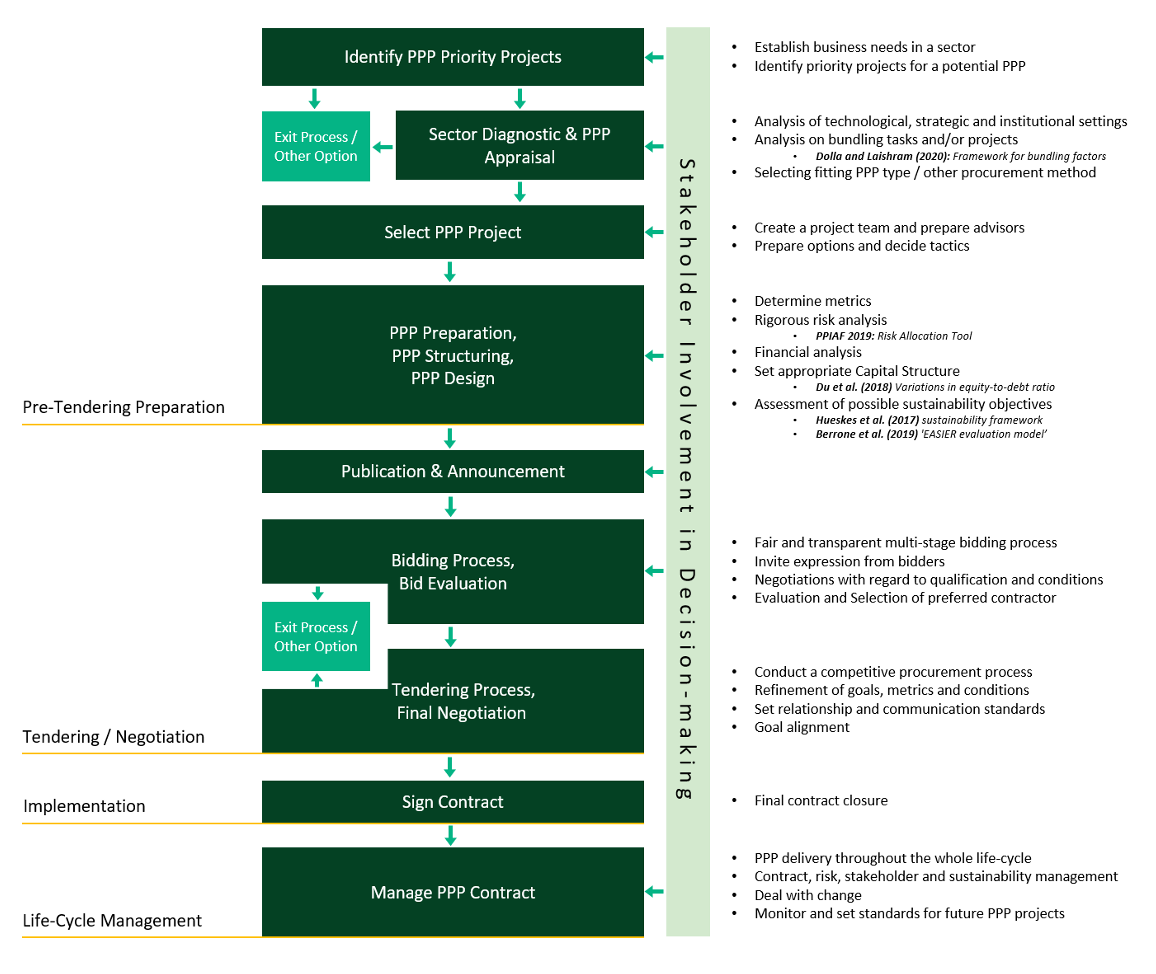
Figure 3: PPP Process Framework, own illustration, based on Asian Development Bank (2008); Kwak et al. (2009); The World Bank (2017)7,16,62
The first step of the process typically starts with identifying the business and service needs, especially which sectors are in need for critical public services and infrastructures. Potential projects are analyzed to set priorities for establishing a suitable PPP project. Once the outline is made, the sector and project are appraised to determine feasibility, which can be tested across several dimensions such as technical, legal, environmental and social feasibility.16World Bank. PPP Reference Guide 3.0. (World Bank, 2017). This includes analyzing factors such as technical issues and complexity, laws and regulations, institutional structures, governments’ capacity, sectoral constraints, market situation, economic situation, financial situation, bundling of tasks/projects, and much more.16World Bank. PPP Reference Guide 3.0. (World Bank, 2017).,21Grimsey, D. & Lewis, M. K. Public Private Partnerships: The Worldwide Revolution in Infrastructure Provision and Project Finance. (Edward Elgar Publishing, 2004).,63Asian Development Bank. Public-Private Partnership (PPP) Handbook. (Asian Development Bank, 2008). This appraisal also involves the examination of a fitting PPP type and alternatives, such as refurbishment of existing infrastructure or other public procurement methods. As each PPP option varies in responsibility and risk, the characteristics are compared against the objective and potential strengths and weaknesses are worked through.63Asian Development Bank. Public-Private Partnership (PPP) Handbook. (Asian Development Bank, 2008). A decision is made on whether to approve the PPP project or seek other strategies.16World Bank. PPP Reference Guide 3.0. (World Bank, 2017). If the PPP project is selected, a project team, sometimes also a PPP Unit, shall be established to develop options and tactics.62UNECE. ECE/CECI/WP/PPP/2022/5 – Standard on Public-Private Partnerships/Concession Model law. (2022a). Their task is to build a solid PPP structure and design for the tendering process to prevent avoidable conflicts and disputes.62UNECE. ECE/CECI/WP/PPP/2022/5 – Standard on Public-Private Partnerships/Concession Model law. (2022a). This preparation may include defining criteria and metrics such as responsibilities, incentives, sanctions, financing, risks, performance requirements and sustainable requirements (Sustainability dimensions, Social Value, SDGs).62UNECE. ECE/CECI/WP/PPP/2022/5 – Standard on Public-Private Partnerships/Concession Model law. (2022a). In particular, a rigorous risk and financial analysis are required for the successful implementation of PPPs. In this context, the Global Infrastructure Hub (GI Hub) has developed a guidance tool in 2019 for risk analysis to properly allocate risks between public and private partners in different project types and sectors.64Global Infrastructure Hub. PPP Risk Allocation Tool (2019 Edition). Accessed on 01.04.2025: https://ppp-risk.gihub.org/ (2019). It presents risk allocation matrices across 18 different project types in sectors such as energy, social transport and water, with detailed project risks, discussions of risk allocation and possible mitigation measures.64Global Infrastructure Hub. PPP Risk Allocation Tool (2019 Edition). Accessed on 01.04.2025: https://ppp-risk.gihub.org/ (2019). The financial analysis involves the determination of cost factors, using different analysis methods such as ‘public sector comparator’ VfM-analysis and life-cycle cost analysis, and setting a proper capital structure based on equity-to-debt ratio.
Once the preparations are completed, the second step is started which involves bidding, tendering and negotiation processes. PPP projects are announced to the public to invite expressions from potential bidders and citizens for transparency. The bidding involves a fair and transparent multi-stage bidding process to select preferred bidders, which incorporates detailing for qualification, technical and financial proposals, and an evaluation based on prior defined criteria.16World Bank. PPP Reference Guide 3.0. (World Bank, 2017). Potential bidders are evaluated and invited to discuss more detailed considerations. This process is especially important as the partners will work together for a long time and considers aspects such as early involvement, joint clarification and goal alignment. The early negotiations may involve strengthening potential companies financially and technically to build their capacity, setting relationship and communication standards, providing assurances and asses possible sustainability objectives. Ideally, most issues should be addressed during the bidding process.16World Bank. PPP Reference Guide 3.0. (World Bank, 2017). The selection of a proper private partner should include many principles, such as open access to public procurement, equal treatment of candidates and bidders, transparency and confidentiality, a free competition, VfM, alignment with the SDGs, fair risk allocation, as well as satisfaction to users of the service and rewards over the whole life cycle.62UNECE. ECE/CECI/WP/PPP/2022/5 – Standard on Public-Private Partnerships/Concession Model law. (2022a). A final negotiation with the final preferred bidder presents the last opportunity to work out contractual issues on both sides.63Asian Development Bank. Public-Private Partnership (PPP) Handbook. (Asian Development Bank, 2008). It gives both parties a final chance to set key contractual clauses. Examples could be setting minimum revenue guarantees and benefit-sharing arrangements (economic), rewards for cost-efficient solutions for sustainable development and minimum score threshold for sustainability criteria (ecologic), standards for safety, effectiveness and quality, and job securing (social). This step is the final possibility to approve the PPP or seek other strategies.
The third step involves the final closure of the contract with the winning bidder, which includes the key contractual clauses, further sub-contracts (with third-party contractors) and possibly flexible terms as renegotiation triggers and potentials to upgrade.16World Bank. PPP Reference Guide 3.0. (World Bank, 2017).,21Grimsey, D. & Lewis, M. K. Public Private Partnerships: The Worldwide Revolution in Infrastructure Provision and Project Finance. (Edward Elgar Publishing, 2004).,63Asian Development Bank. Public-Private Partnership (PPP) Handbook. (Asian Development Bank, 2008). Key contractual clauses shall contain terms relevant for the PPP, such as key premises, parties and sub-contractors involved, specific rights and obligations, applicable penalties, rights to charge third parties and their conditions, financing and payments, laws, licenses and permits, ownership and transfer, and many more.62UNECE. ECE/CECI/WP/PPP/2022/5 – Standard on Public-Private Partnerships/Concession Model law. (2022a). With the contractual closure, the PPP is implemented. As the final step, the government must manage the PPP delivery over its whole life-cycle.16World Bank. PPP Reference Guide 3.0. (World Bank, 2017). This typically involves managing and monitoring results, but also enforcing PPP contract requirements.62UNECE. ECE/CECI/WP/PPP/2022/5 – Standard on Public-Private Partnerships/Concession Model law. (2022a). Examples include risk management, contract management and compliance, stakeholder management, dealing with the external environment and fiscal changes, ensuring social value and sustainable development, and ultimately the (on-time and on-budget) service delivery. In addition, the whole process shall be regularly reported and results preferably get recorded in an open database, to set standards for future PPP projects.16World Bank. PPP Reference Guide 3.0. (World Bank, 2017).,62UNECE. ECE/CECI/WP/PPP/2022/5 – Standard on Public-Private Partnerships/Concession Model law. (2022a).
3.2 Key considerations for the private sector
While the public sector is responsible for the entire process of the PPP, the private sector also plays a crucial role in the successful implementation of a PPP project. In most cases, the private firms join the PPP process at the bidding phase once the project is announced by the public sector. The bidding stage is therefore the private sector stage, in which potential bidders assess the project and propose contracts with the public partner.65ADB, EBRD, IDB, IsDB, and WBG. The APMG Public-Private Partnership (PPP) Certification Guide. (Washington, DC: World Bank Group, 2016). From this point, the private sector becomes a central factor and takes many considerations in joining a PPP project.
Often multiple private firms are involved in a PPP, each with their specific reasons for the involvement.65ADB, EBRD, IDB, IsDB, and WBG. The APMG Public-Private Partnership (PPP) Certification Guide. (Washington, DC: World Bank Group, 2016). These private firms evaluate their decision to join a partnership with the public sector based on a variety of legal, financial and strategic considerations. The government issues ‘Request for Proposal’ documents to the interested bidders, which include the project structure, requirements and details of the bidding process.16World Bank. PPP Reference Guide 3.0. (World Bank, 2017). Private firms may go through a structured process identifying the market- and sector-specific opportunities, and further review the PPP projects’ general commercial, technical and financial requirements, as well as an analysis of the project risks.65ADB, EBRD, IDB, IsDB, and WBG. The APMG Public-Private Partnership (PPP) Certification Guide. (Washington, DC: World Bank Group, 2016). The decision for involvement in a PPP project therefore depends on analyzing several factors and whether business and investment opportunities are present, i.e. a project feasibility from the private partners perspective.65ADB, EBRD, IDB, IsDB, and WBG. The APMG Public-Private Partnership (PPP) Certification Guide. (Washington, DC: World Bank Group, 2016). If the project screening is positive, the bidder may initiate the formation of a consortium, with partners for construction, operation and financing, as well as advisors for legal, technical and financial advice.65ADB, EBRD, IDB, IsDB, and WBG. The APMG Public-Private Partnership (PPP) Certification Guide. (Washington, DC: World Bank Group, 2016). In addition, further shareholders, such as investors or sponsors, may also be invited to strengthen the proposal and financial capacity of the consortium.65ADB, EBRD, IDB, IsDB, and WBG. The APMG Public-Private Partnership (PPP) Certification Guide. (Washington, DC: World Bank Group, 2016). At this stage, each consortium member typically conducts an in-depth assessment of whether they proceed with the PPP project and an appraisal of any threats to the forecasted project revenues.65ADB, EBRD, IDB, IsDB, and WBG. The APMG Public-Private Partnership (PPP) Certification Guide. (Washington, DC: World Bank Group, 2016).
Once the analysis is completed, the possible members inform the other private partners of their decision to participate, and all partners will form a consortium through a ‘consortium agreement’.65ADB, EBRD, IDB, IsDB, and WBG. The APMG Public-Private Partnership (PPP) Certification Guide. (Washington, DC: World Bank Group, 2016). The consortium agreement will set out how they will operate and the members decide on an appropriate consortium structure, equity stakes, cost-sharing mechanisms, payment obligations, and a steering committee.65ADB, EBRD, IDB, IsDB, and WBG. The APMG Public-Private Partnership (PPP) Certification Guide. (Washington, DC: World Bank Group, 2016). Once the consortium is set, a bid manager is appointed who leads, coordinates, prepares and deals with the tendering process as the consortium’s representative and submits the bidding to the public partner.65ADB, EBRD, IDB, IsDB, and WBG. The APMG Public-Private Partnership (PPP) Certification Guide. (Washington, DC: World Bank Group, 2016). The steering committee supports the bid manager by overseeing the preparation, submission, deadlines, reports and decisions on arising project issues.65ADB, EBRD, IDB, IsDB, and WBG. The APMG Public-Private Partnership (PPP) Certification Guide. (Washington, DC: World Bank Group, 2016). If the consortium becomes the preferred bidder in the tendering process, negotiations are still needed to refine goals, metrics and specifications. Two particular milestones, the commercial and financial closure, are required to reach the final contractual closure. Commercial closure is reached as all commercial terms are agreed upon by both partners, even if the project’s funding is not yet finalized or the SPV not yet fully formed.65ADB, EBRD, IDB, IsDB, and WBG. The APMG Public-Private Partnership (PPP) Certification Guide. (Washington, DC: World Bank Group, 2016). Financial closure is reached, once all project documentations have been signed, financing pre-conditions are met and the funding for the PPP project becomes available.65ADB, EBRD, IDB, IsDB, and WBG. The APMG Public-Private Partnership (PPP) Certification Guide. (Washington, DC: World Bank Group, 2016). Both milestones require intense negotiations and adjustments, which shape the final contractual agreement. As the contract is signed, each consortium member is responsible for completing their contractual terms and deadlines, while the public partner manages the PPP contract throughout the whole life cycle.
In summary, the bidding process involves a long and rigorous assessment of the investment decisions, risk analysis, and often the formation of a consortium to finance the PPP project. Many considerations are needed to set a consortium agreement and further finalize the PPP contract with the public partner.
3.3 Drivers and barriers
3.3.1 Drivers
The government’s general purpose is to secure efficiency and efficacy in infrastructure for public services and utilize PPP for a wide range of strategic purposes, such as policy design, planning, coordination, monitoring, evaluation and/or implementation, resource optimization, as well as ultimately service delivery.17Bovaird, T. Public–Private Partnerships: From Contested Concepts to Prevalent Practice. International Review of Administrative Sciences 70, 199-215 (2004). Several drivers relate to the underlying motivation for explicitly choosing PPPs over other procurement methods. These drivers can be categorized in political, economic, and environmental and sustainability drivers, as shown in table 1.
Table 1: Drivers for the Implementation of PPPs
| Category | Drivers |
| Political | Address complex public policy problems by private sector involvement |
| Overcome governments capacity constraints | |
| Access to private sector technical expertise | |
| Enable public works even with budget deficits | |
| Reduction of pressure on public budget | |
| Focus on core competencies instead of directly providing services | |
| Economic | Combine strengths from both sectors |
| Achieve Economies of Scale and Scope | |
| Opportunity for mutual learning | |
| Risk-sharing to leverage capabilities and lower individual risks | |
| Private capital access to finance needed infrastructure | |
| Develop local economies (economic and societal growth) | |
| Enable efficiency gains and cost savings | |
| Job creation | |
| Strengthen businesses in difficult markets | |
| Facilitate innovations in infrastructure development | |
| Reputation benefits and access to new markets for the private sector | |
| Environmental/ | Incentives for sustainable development |
| Sustainability | Support and improve health demands (access, education, availability) |
| Compliance to national environmental standards | |
| Enable alignment with the SDGs | |
| Favorable environment for high-quality infrastructure and services | |
| Sharing of expertise, technology and resources to meet sustainability targets | |
| Resource savings |
The main political driver is to involve the private sector in addressing complex public policy problems.31Forrer, J., Kee, J. E., Newcomer, K. E. & Boyer, E. Public–Private Partnerships and the Public Accountability Question. Public Administration Review 70, 475-484 (2010). The public sector sometimes establishes a PPP that focuses on a single or a narrow range of issues, to overcome problems that public institutions struggle with.17Bovaird, T. Public–Private Partnerships: From Contested Concepts to Prevalent Practice. International Review of Administrative Sciences 70, 199-215 (2004). The government lacks in-house knowledge to deliver the goods and services in a cost-efficient way and therefore seeks to gain access to technical expertise from the private sector.31Forrer, J., Kee, J. E., Newcomer, K. E. & Boyer, E. Public–Private Partnerships and the Public Accountability Question. Public Administration Review 70, 475-484 (2010). Governments are mostly driven by the desire for public works, even when budgets are constrained.24Engel, E., Fischer, R. D. & Galetovic, A. The Economics of Public-Private Partnerships: A Basic Guide. (Cambridge University Press, 2014). PPPs bring the ability to put infrastructure project priorities onto the public agenda as they enable to reduce pressure on the public budget and thus also the provision of infrastructure without appearing to increase public sector borrowing.29Hodge, G. A. & Greve, C. On Public–Private Partnership Performance: A Contemporary Review. Public Works Management & Policy 22, 55-78 (2017a). Governments additionally can concentrate on their core competencies and do not need to use their own resources for unfamiliar projects.42Tang, L., Shen, Q. & Cheng, E. W. L. A review of studies on Public–Private Partnership projects in the construction industry. International Journal of Project Management 28, 683-694 (2010).,66Cumming, D. J. Government Policy towards Entrepreneurial Finance: Innovation Investment Funds. Journal of Business Venturing 22, 193-235 (2007). Political stability and its capacity help reduce various risks such as inflation, financing and payment risks, so countries with a more stable political environment are likely to be more attractive to private sector investment.27Wang, H., Liu, Y., Xiong, W. & Song, J. The moderating role of governance environment on the relationship between risk allocation and private investment in PPP markets: Evidence from developing countries. International Journal of Project Management 37, 117-130 (2019). In that aspect, good regulatory quality and high compliance with laws and rules increase private investors’ confidence and attracts more private participation.27Wang, H., Liu, Y., Xiong, W. & Song, J. The moderating role of governance environment on the relationship between risk allocation and private investment in PPP markets: Evidence from developing countries. International Journal of Project Management 37, 117-130 (2019).
As the main economic driver, PPPs promise delivery from ‘the best of both worlds’ by combining the strengths of private actors, such as technical expertise, management skills and entrepreneurial spirit, and the role of public actors, including social responsibility, justice and local knowledge.10Roehrich, J. K., Lewis, M. A. & George, G. Are public–private partnerships a healthy option? A systematic literature review. Social Science & Medicine 113, 110-119 (2014).,29Hodge, G. A. & Greve, C. On Public–Private Partnership Performance: A Contemporary Review. Public Works Management & Policy 22, 55-78 (2017a). Bovaird (2004) found out, that partnerships can contribute to three competitive advantages, providing (1) economies of scale, (2) economies of scope and (3) opportunities for mutual learning.17Bovaird, T. Public–Private Partnerships: From Contested Concepts to Prevalent Practice. International Review of Administrative Sciences 70, 199-215 (2004). Economies of scale, from buying in bulk, or economies of scope, through sharing of expertise, are realized when authorities work with one or more private partner.17Bovaird, T. Public–Private Partnerships: From Contested Concepts to Prevalent Practice. International Review of Administrative Sciences 70, 199-215 (2004). The opportunity to learn from each other is realized through working jointly together to achieve a common purpose.29Hodge, G. A. & Greve, C. On Public–Private Partnership Performance: A Contemporary Review. Public Works Management & Policy 22, 55-78 (2017a).
Risk is another driver of PPP adoption. Even though PPPs involve greater risks, the transfer of risks lowers certain risks for each partner, making it a favorable environment to invest for both.6Iossa, E. & Martimort, D. The Simple Microeconomics of Public-Private Partnerships. Journal of Public Economic Theory 17, 4-48 (2015).,18Wang, H., Xiong, W., Guangdong, W. & Zhu, D. Public Private Partnership in Public Administration Discipline: A Literature Review. Public Management Review 20, 293-316 (2018). Sharing risks can also leverage the private sectors capabilities and be an opportunity for ‘cost dumping’, ‘benefits raiding’ and ‘stealing each other’s expertise’.17Bovaird, T. Public–Private Partnerships: From Contested Concepts to Prevalent Practice. International Review of Administrative Sciences 70, 199-215 (2004).,22George, G., Fewer, T. J., Lazzarini, S., McGahan, A. M. & Puranam, P. Partnering for Grand Challenges: A Review of Organizational Design Considerations in Public–Private Collaborations. Journal of Management 50, 10-40 (2024). Private financing can be used to satisfy infrastructure needs, especially for badly needed infrastructure, developing local economies, deliver public services, and renew urban areas.18Wang, H., Xiong, W., Guangdong, W. & Zhu, D. Public Private Partnership in Public Administration Discipline: A Literature Review. Public Management Review 20, 293-316 (2018).,34Abdel Aziz, A. M. Successful Delivery of Public-Private Partnerships for Infrastructure Development. Journal of Construction Engineering and Management 133, 918-931 (2007). A common promise is, that PPPs through private finance and bundling several tasks lead to efficiency gains.24Engel, E., Fischer, R. D. & Galetovic, A. The Economics of Public-Private Partnerships: A Basic Guide. (Cambridge University Press, 2014). Cost savings compared to traditional methods is another economic driver for initiating a PPP project.3Torchia, M., Calabrò, A. & Morner, M. Public–Private Partnerships in the Health Care Sector: A Systematic Review of the Literature. Public Management Review 17, 236-261 (2015). The alleged financial advantages are one of the main reasons for PPPs’ popularity.24Engel, E., Fischer, R. D. & Galetovic, A. The Economics of Public-Private Partnerships: A Basic Guide. (Cambridge University Press, 2014).
Furthermore, PPPs promote economic growth and employment opportunities.7Kwak, Y. H., Chih, Y. & Ibbs, C. W. Towards a Comprehensive Understanding of Public Private Partnerships for Infrastructure Development. California Management Review 51, 51-78 (2009). Through these partnerships several benefits such as the creation of jobs, educational development, as well as incentives for innovation and competition are realized.10Roehrich, J. K., Lewis, M. A. & George, G. Are public–private partnerships a healthy option? A systematic literature review. Social Science & Medicine 113, 110-119 (2014). Governments can directly support businesses in difficult global market conditions and strengthen societal economic development.29Hodge, G. A. & Greve, C. On Public–Private Partnership Performance: A Contemporary Review. Public Works Management & Policy 22, 55-78 (2017a). Furthermore, due to the flexibility to adapt to the future environment, PPPs may be seen as a way to facilitate innovations in infrastructure development.7Kwak, Y. H., Chih, Y. & Ibbs, C. W. Towards a Comprehensive Understanding of Public Private Partnerships for Infrastructure Development. California Management Review 51, 51-78 (2009).,29Hodge, G. A. & Greve, C. On Public–Private Partnership Performance: A Contemporary Review. Public Works Management & Policy 22, 55-78 (2017a). They may be seen as an alternative method to make the most out of existing resources and competencies; or may explore the potential for innovative approaches, bringing in new resources and competencies.17Bovaird, T. Public–Private Partnerships: From Contested Concepts to Prevalent Practice. International Review of Administrative Sciences 70, 199-215 (2004). In terms of economic growth, PPPs also enable full-life-cycle costs of infrastructures to be provided by the private sector, giving rise to better on-time and on-budget delivery of infrastructure.7Kwak, Y. H., Chih, Y. & Ibbs, C. W. Towards a Comprehensive Understanding of Public Private Partnerships for Infrastructure Development. California Management Review 51, 51-78 (2009).,29Hodge, G. A. & Greve, C. On Public–Private Partnership Performance: A Contemporary Review. Public Works Management & Policy 22, 55-78 (2017a). Evidence on a comparison of PPPs and public procurement in Australia suggests that PPPs consistently performed better on construction time and less cost overruns.16World Bank. PPP Reference Guide 3.0. (World Bank, 2017). Another driver would be the aspect of ‘corporate social responsibility’ 17 to enhance the reputation of private partners and perhaps even enter a new market. The higher the possibility of the return on investment for the private partner, the better the private participation in PPPs.18Wang, H., Xiong, W., Guangdong, W. & Zhu, D. Public Private Partnership in Public Administration Discipline: A Literature Review. Public Management Review 20, 293-316 (2018).
Prior political and economic drivers for PPPs also give many incentives for sustainable development on the economic and social dimensions of sustainability, such as economic growth, employment opportunities and sustainable innovations in infrastructure. Widdus (2001) found several drivers specifically behind pharmaceutical and other health-related companies entering collaborations with the public sector to improve access to health products.67Widdus, R. Public-private partnerships for health: their main targets, their diversity, and their future directions. Bulletin of the World Health Organization 79, 713-720 (2001). He mentioned drivers such as controlling specific diseases, improving coordination, distributing better health services, educating the public and improving product quality, particularly for poorer citizens.67Widdus, R. Public-private partnerships for health: their main targets, their diversity, and their future directions. Bulletin of the World Health Organization 79, 713-720 (2001). In poorer countries, due to limited availability and accessibility in health demands, PPPs offer added values by mobilizing new resources, build better delivery systems and strengthening health demands.67Widdus, R. Public-private partnerships for health: their main targets, their diversity, and their future directions. Bulletin of the World Health Organization 79, 713-720 (2001).
Furthermore, PPPs may finance projects that have to comply with national environmental and planning standards, which couldn’t be financed prior due to budget deficits.16World Bank. PPP Reference Guide 3.0. (World Bank, 2017). The combination of both partners creates a favorable environment for delivering high-quality public infrastructures or services.10Roehrich, J. K., Lewis, M. A. & George, G. Are public–private partnerships a healthy option? A systematic literature review. Social Science & Medicine 113, 110-119 (2014). The quality of the infrastructure is also more likely to remain high due to good routine maintenance during the operating phase by the private partner, which reduces the need to rebuild or refit the infrastructure and saves valuable resources.24Engel, E., Fischer, R. D. & Galetovic, A. The Economics of Public-Private Partnerships: A Basic Guide. (Cambridge University Press, 2014). In addition, the scope of the SDGs makes it difficult for a single entity to achieve them, so partnerships are needed to share knowledge, expertise, technology and financial resources.38Berrone, P. et al. EASIER: An Evaluation Model for Public–Private Partnerships Contributing to the Sustainable Development Goals. Sustainability 11, 2339 (2019).
3.3.2 Barriers
Despite the numerous drivers for setting up a PPP, many barriers are limiting its implementation. The general barriers include many risks, uncertainties, inefficiencies, problems related to the relationship and the lack of maturity of the PPP concept.7Kwak, Y. H., Chih, Y. & Ibbs, C. W. Towards a Comprehensive Understanding of Public Private Partnerships for Infrastructure Development. California Management Review 51, 51-78 (2009).,34Abdel Aziz, A. M. Successful Delivery of Public-Private Partnerships for Infrastructure Development. Journal of Construction Engineering and Management 133, 918-931 (2007). Generally, trust between the contractual partners is lacking.49Van Den Hurk, M. & Verhoest, K. The challenge of using standard contracts in public–private partnerships. Public Management Review 18, 278-299 (2016). More specific barriers can be categorized as political, economic, and environmental and sustainability barriers, summarized as shown in table 2.
Table 2: Barriers for the Implementation of PPPs
| Category | Barriers |
| Political | Lack of standardized definition for PPPs |
| Complex and formal contracts over a long time period | |
| Long bidding, tendering and procurement processes | |
| Governments preference for familiar procurement methods | |
| Rigid laws and regulations | |
| Lack of PPP legislations and processes | |
| Insufficient knowledge and skills for PPPs | |
| Frequent legislative changes | |
| Changes in public sector attitude toward PPPs | |
| Inter-governmental goal misalignment | |
| High political risks in unstable or weak governments | |
| Difficulties in joint decision-making | |
| Fear of losing political control | |
| Resistance from politicians, public service staff and trade unions | |
| Economic | Conflicting objectives between both sectors |
| Concerns, criticism and protest from service users and citizens | |
| Lack of prior shared experiences and coordination | |
| Lack of trust between all stakeholders | |
| Lack of public sectors strategic planning | |
| Corruption, scandals and misuse | |
| Undermining competition and higher risk for monopolies | |
| Dilution of accountability and public interest | |
| High tendering costs and financial burdens | |
| Larger operating costs in the long run | |
| External Factors (unfavorable initial conditions and External Shocks) | |
| Difficulties in measuring performance and success | |
| Environmental/ | Difficulties in measuring sustainability criteria |
| Sustainability | Conflict in Short-term profits and long-term sustainability goals |
| Hesitation in adopting sustainability objectives | |
| Difficulties to monetize sustainability benefits | |
| High sustainability criteria undermine competition | |
| Conflicting priorities across governmental levels |
First of all, the lack of a standardized definition for PPP acts as a barrier to PPP management during the development of effective legal frameworks.25Cui, C., Liu, Y., Hope, A. & Wang, J. Review of studies on the public–private partnerships (PPP) for infrastructure projects. International Journal of Project Management 36, 773-794 (2018). Since PPPs and their negotiations are relatively new, partners rely on long formal contractual elements, which involve highly complex arrangements.7Kwak, Y. H., Chih, Y. & Ibbs, C. W. Towards a Comprehensive Understanding of Public Private Partnerships for Infrastructure Development. California Management Review 51, 51-78 (2009).,49Van Den Hurk, M. & Verhoest, K. The challenge of using standard contracts in public–private partnerships. Public Management Review 18, 278-299 (2016). In this process, PPPs need long bidding, tendering and procurement processes, which can make them unattractive for the private sector to engage in partnerships, and may even result in leading governments to make these activities in-house despite inefficiencies.6Iossa, E. & Martimort, D. The Simple Microeconomics of Public-Private Partnerships. Journal of Public Economic Theory 17, 4-48 (2015).,17Bovaird, T. Public–Private Partnerships: From Contested Concepts to Prevalent Practice. International Review of Administrative Sciences 70, 199-215 (2004). Governments also have a certain tendency to rely on familiar and traditional public procurement methods.34Abdel Aziz, A. M. Successful Delivery of Public-Private Partnerships for Infrastructure Development. Journal of Construction Engineering and Management 133, 918-931 (2007). This is accompanied by rigid laws and regulations favoring traditional procurement methods, limiting the adoption of PPPs.8Casady, C., Eriksson, K., Levitt, R. & Scott, W. R. (Re)defining public-private partnerships (PPPs) in the new public governance (NPG) paradigm: an institutional maturity perspective. Public Management Review 22, 1-23 (2019). In many cases, governments lack specific PPP legislations, familiar mechanisms and procurement processes for developing a PPP project and maturity within the institutional environment.8Casady, C., Eriksson, K., Levitt, R. & Scott, W. R. (Re)defining public-private partnerships (PPPs) in the new public governance (NPG) paradigm: an institutional maturity perspective. Public Management Review 22, 1-23 (2019).,34Abdel Aziz, A. M. Successful Delivery of Public-Private Partnerships for Infrastructure Development. Journal of Construction Engineering and Management 133, 918-931 (2007). Similarly, appropriate knowledge and skills to implement these projects are still lacking.7Kwak, Y. H., Chih, Y. & Ibbs, C. W. Towards a Comprehensive Understanding of Public Private Partnerships for Infrastructure Development. California Management Review 51, 51-78 (2009). As a result, governments often discover that they are unprepared and ill-equipped to handle unanticipated opportunities and difficulties during the establishment of a PPP project.13Koppenjan, J. & Enserink, B. Public–Private Partnerships in Urban Infrastructures: Reconciling Private Sector Participation and Sustainability. Public Administration Review 69, 284-296 (2009).
Furthermore, constant changes in the economy and policy reformations keep altering procedures in making effective frameworks.25Cui, C., Liu, Y., Hope, A. & Wang, J. Review of studies on the public–private partnerships (PPP) for infrastructure projects. International Journal of Project Management 36, 773-794 (2018). Particularly due to the discontinuity of public-sector leadership or regular changes in legislation periods, these long procedures may be relatively unattractive.34Abdel Aziz, A. M. Successful Delivery of Public-Private Partnerships for Infrastructure Development. Journal of Construction Engineering and Management 133, 918-931 (2007). In this regard, changes in legislation can lead to not honoring the terms of contracts and possibly even nullifying contractual clauses.6Iossa, E. & Martimort, D. The Simple Microeconomics of Public-Private Partnerships. Journal of Public Economic Theory 17, 4-48 (2015). Goals may also vary between different public agencies or among different governmental departments.7Kwak, Y. H., Chih, Y. & Ibbs, C. W. Towards a Comprehensive Understanding of Public Private Partnerships for Infrastructure Development. California Management Review 51, 51-78 (2009). Such political risks are especially frequent in weak governments or ones with limited political commitment.2OECD. Public-Private Partnerships: In Pursuit of Risk Sharing and Value for Money. (2008). In countries of Latin America and the Caribbean, for example, it is not uncommon for a new administration to decide not to honor tariff increases stated in the concession contract, and in Central and Eastern Europe, too, different attitudes have led to changes.6Iossa, E. & Martimort, D. The Simple Microeconomics of Public-Private Partnerships. Journal of Public Economic Theory 17, 4-48 (2015). A considerable political barrier is, that PPPs are suspected of interfering with political control over infrastructure development decisions.17Bovaird, T. Public–Private Partnerships: From Contested Concepts to Prevalent Practice. International Review of Administrative Sciences 70, 199-215 (2004). A study in the Netherlands showed, that partners tend to have difficulties with joint decision-making and are pre-occupied with their own procedures.18Wang, H., Xiong, W., Guangdong, W. & Zhu, D. Public Private Partnership in Public Administration Discipline: A Literature Review. Public Management Review 20, 293-316 (2018).,68Klijn, E.-H. & Teisman, G. R. Institutional and Strategic Barriers to Public—Private Partnership: An Analysis of Dutch Cases. Public Money & Management 23, 137-146 (2003). This is particularly noticeable in the resistance to sharing power or control with partners because politicians fear losing control over policy-making, which hinders the opportunity to ‘grow the business’ of delivering infrastructure.17Bovaird, T. Public–Private Partnerships: From Contested Concepts to Prevalent Practice. International Review of Administrative Sciences 70, 199-215 (2004). At the practical level, public service staff and trade unions often resist PPPs due to fear of job dismantling or worse conditions of employment.17Bovaird, T. Public–Private Partnerships: From Contested Concepts to Prevalent Practice. International Review of Administrative Sciences 70, 199-215 (2004).
A major economic barrier is the constant conflict of interest between both partners, in which the private sector aims for profit margins and performance, while the public sector aims to optimize social, political and budgetary objectives.3Torchia, M., Calabrò, A. & Morner, M. Public–Private Partnerships in the Health Care Sector: A Systematic Review of the Literature. Public Management Review 17, 236-261 (2015). Service users and citizens also express concerns and criticism, about providers driven by profit motives, which may result in a lack of trust or disagreement with the whole concept.10Roehrich, J. K., Lewis, M. A. & George, G. Are public–private partnerships a healthy option? A systematic literature review. Social Science & Medicine 113, 110-119 (2014).,17Bovaird, T. Public–Private Partnerships: From Contested Concepts to Prevalent Practice. International Review of Administrative Sciences 70, 199-215 (2004). In addition, the lack of prior experience working together and the coordination needed to reach a common understanding between all stakeholders and their interests makes it a difficult procurement method.12Roehrich, J. K. & Kivleniece, I. Creating and distributing sustainable value through public-private collaborative projects. in Handbook on the Business of Sustainability: The Organization, Implementation, and Practice of Sustainable Growth (eds. George, G. et al.) Ch. 26, 474-500 (Edward Elgar Publishing, 2022).,22George, G., Fewer, T. J., Lazzarini, S., McGahan, A. M. & Puranam, P. Partnering for Grand Challenges: A Review of Organizational Design Considerations in Public–Private Collaborations. Journal of Management 50, 10-40 (2024). Due to the public sector’s limited abilities to engage in such strategic planning, they may be hesitant to engage in partnerships with private actors.10Roehrich, J. K., Lewis, M. A. & George, G. Are public–private partnerships a healthy option? A systematic literature review. Social Science & Medicine 113, 110-119 (2014). Countries with high levels of corruption have increased market risks affecting private investors’ decisions, which may hinder them from doing business with such governments and damage private sectors investment in PPP projects.27Wang, H., Liu, Y., Xiong, W. & Song, J. The moderating role of governance environment on the relationship between risk allocation and private investment in PPP markets: Evidence from developing countries. International Journal of Project Management 37, 117-130 (2019). Due to the nature of the partnerships, there may also be concerns about diluting accountability and eroding public interest.21Grimsey, D. & Lewis, M. K. Public Private Partnerships: The Worldwide Revolution in Infrastructure Provision and Project Finance. (Edward Elgar Publishing, 2004). Some studies show several cases of corruption and scandals due to misuse of private funds, in which accountability is lacking, negatively affecting other PPP projects.9Hodge, G. A. & Greve, C. Public–Private Partnerships: An International Performance Review. Public Administration Review 67, 545-558 (2007). Due to the long-term nature of PPPs with high tendering costs and huge financial burdens, they are suspected of undermining competition between potential providers.7Kwak, Y. H., Chih, Y. & Ibbs, C. W. Towards a Comprehensive Understanding of Public Private Partnerships for Infrastructure Development. California Management Review 51, 51-78 (2009).,17Bovaird, T. Public–Private Partnerships: From Contested Concepts to Prevalent Practice. International Review of Administrative Sciences 70, 199-215 (2004). It may also result in situations, in which the private firm assumes a monopoly position.7Kwak, Y. H., Chih, Y. & Ibbs, C. W. Towards a Comprehensive Understanding of Public Private Partnerships for Infrastructure Development. California Management Review 51, 51-78 (2009).,17Bovaird, T. Public–Private Partnerships: From Contested Concepts to Prevalent Practice. International Review of Administrative Sciences 70, 199-215 (2004). It is also important to note, that while PPPs lower public budget deficits early, they often require larger operating expenditure over time and may cost more for the government over the whole life-cycle of the PPP project.21Grimsey, D. & Lewis, M. K. Public Private Partnerships: The Worldwide Revolution in Infrastructure Provision and Project Finance. (Edward Elgar Publishing, 2004). In addition, as argues before, success and the performance may be difficult to measure due to many stakeholders having different objectives. External economic barriers may also influence PPPs, such as unfavorable economic and commercial conditions.34Abdel Aziz, A. M. Successful Delivery of Public-Private Partnerships for Infrastructure Development. Journal of Construction Engineering and Management 133, 918-931 (2007). External factors differentiate in initial conditions, such as sectoral, regional and global differences, and external shocks, such as the global financial crisis or Covid-19.14Pinz, A., Roudyani, N. & Thaler, J. Public-private partnerships as instruments to achieve sustainability-related objectives: The state of the art and a research agenda. Public Management Review 20, 1-22 (2017).,37Wang, N. & Ma, M. Public–private partnership as a tool for sustainable development – What literatures say? Sustainable Development 29, 243-258 (2021).
As for environmental and sustainability barriers, political and economic barriers can be intertwined with sustainability considerations in some ways, such as negotiating sustainability clauses in the contract, conflicting interests between both sectors and political attitudes toward sustainable development. A significant barrier to the development of sustainability-oriented PPPs is the difficulty in assessing sustainability and formulating measurable sustainability criteria for PPPs.55Hueskes, M., Verhoest, K. & Block, T. Governing public–private partnerships for sustainability: An analysis of procurement and governance practices of PPP infrastructure projects. International Journal of Project Management 35, 1184-1195 (2017). Furthermore, private sector investment decisions are determined by a certain degree of short-term profit expectations, but their extent is at odds with achieving sustainability goals and public interests realized from a long-term perspective.4Shen, L., Tam, V. W. Y., Gan, L., Ye, K. & Zhao, Z. Improving Sustainability Performance for Public-Private-Partnership (PPP) Projects. Sustainability 8, 289 (2016).,13Koppenjan, J. & Enserink, B. Public–Private Partnerships in Urban Infrastructures: Reconciling Private Sector Participation and Sustainability. Public Administration Review 69, 284-296 (2009). This could result in difficulties finding appropriate partners, as the private partners could hesitate the adoption of sustainable objectives or have difficulties monetizing sustainability benefits. There are also concerns, that too high selection criteria for sustainability could threaten small- and medium-sized enterprises, thus hindering competition and innovative sustainability solutions.55Hueskes, M., Verhoest, K. & Block, T. Governing public–private partnerships for sustainability: An analysis of procurement and governance practices of PPP infrastructure projects. International Journal of Project Management 35, 1184-1195 (2017). In addition, various levels of government have different views on the value of PPPs; for example, the central government may be interested to achieve sustainable development through PPPs, while local administration may rather relieve financial burdens and boost economic growth.18Wang, H., Xiong, W., Guangdong, W. & Zhu, D. Public Private Partnership in Public Administration Discipline: A Literature Review. Public Management Review 20, 293-316 (2018).
References
- 1Global Infrastructure Hub. Global Infrastructure Outlook – Infrastructure investment needs 50 countries, 7 sectors to 2040. (2017). ↩︎
- 2OECD. Public-Private Partnerships: In Pursuit of Risk Sharing and Value for Money. (2008). ↩︎
- 3Torchia, M., Calabrò, A. & Morner, M. Public–Private Partnerships in the Health Care Sector: A Systematic Review of the Literature. Public Management Review 17, 236-261 (2015). ↩︎
- 4Shen, L., Tam, V. W. Y., Gan, L., Ye, K. & Zhao, Z. Improving Sustainability Performance for Public-Private-Partnership (PPP) Projects. Sustainability 8, 289 (2016). ↩︎
- 1Global Infrastructure Hub. Global Infrastructure Outlook – Infrastructure investment needs 50 countries, 7 sectors to 2040. (2017). ↩︎
- 5Osei-Kyei, R. & Chan, A. Review of studies on the Critical Success Factors for Public–Private Partnership (PPP) projects from 1990 to 2013. International Journal of Project Management 33, 1335-1346 (2015). ↩︎
- 6Iossa, E. & Martimort, D. The Simple Microeconomics of Public-Private Partnerships. Journal of Public Economic Theory 17, 4-48 (2015). ↩︎
- 3Torchia, M., Calabrò, A. & Morner, M. Public–Private Partnerships in the Health Care Sector: A Systematic Review of the Literature. Public Management Review 17, 236-261 (2015). ↩︎
- 7Kwak, Y. H., Chih, Y. & Ibbs, C. W. Towards a Comprehensive Understanding of Public Private Partnerships for Infrastructure Development. California Management Review 51, 51-78 (2009). ↩︎
- 8Casady, C., Eriksson, K., Levitt, R. & Scott, W. R. (Re)defining public-private partnerships (PPPs) in the new public governance (NPG) paradigm: an institutional maturity perspective. Public Management Review 22, 1-23 (2019). ↩︎
- 9Hodge, G. A. & Greve, C. Public–Private Partnerships: An International Performance Review. Public Administration Review 67, 545-558 (2007). ↩︎
- 10Roehrich, J. K., Lewis, M. A. & George, G. Are public–private partnerships a healthy option? A systematic literature review. Social Science & Medicine 113, 110-119 (2014). ↩︎
- 11Van Ham, H. & Koppenjan, J. Building public-private partnerships: Assessing and managing risks in port development. Public Management Review 3, 593-616 (2001). ↩︎
- 12Roehrich, J. K. & Kivleniece, I. Creating and distributing sustainable value through public-private collaborative projects. in Handbook on the Business of Sustainability: The Organization, Implementation, and Practice of Sustainable Growth (eds. George, G. et al.) Ch. 26, 474-500 (Edward Elgar Publishing, 2022). ↩︎
- 8Casady, C., Eriksson, K., Levitt, R. & Scott, W. R. (Re)defining public-private partnerships (PPPs) in the new public governance (NPG) paradigm: an institutional maturity perspective. Public Management Review 22, 1-23 (2019). ↩︎
- 13Koppenjan, J. & Enserink, B. Public–Private Partnerships in Urban Infrastructures: Reconciling Private Sector Participation and Sustainability. Public Administration Review 69, 284-296 (2009). ↩︎
- 14Pinz, A., Roudyani, N. & Thaler, J. Public-private partnerships as instruments to achieve sustainability-related objectives: The state of the art and a research agenda. Public Management Review 20, 1-22 (2017). ↩︎
- 15UNECE. ECE/CECI/WP/PPP/2022/6 – Introduction to Public-Private Partnerships in support of the United Nations Sustainable Development Goals. (2022b). ↩︎
- 16World Bank. PPP Reference Guide 3.0. (World Bank, 2017). ↩︎
- 10Roehrich, J. K., Lewis, M. A. & George, G. Are public–private partnerships a healthy option? A systematic literature review. Social Science & Medicine 113, 110-119 (2014). ↩︎
- 17Bovaird, T. Public–Private Partnerships: From Contested Concepts to Prevalent Practice. International Review of Administrative Sciences 70, 199-215 (2004). ↩︎
- 18Wang, H., Xiong, W., Guangdong, W. & Zhu, D. Public Private Partnership in Public Administration Discipline: A Literature Review. Public Management Review 20, 293-316 (2018). ↩︎
- 18Wang, H., Xiong, W., Guangdong, W. & Zhu, D. Public Private Partnership in Public Administration Discipline: A Literature Review. Public Management Review 20, 293-316 (2018). ↩︎
- 9Hodge, G. A. & Greve, C. Public–Private Partnerships: An International Performance Review. Public Administration Review 67, 545-558 (2007). ↩︎
- 18Wang, H., Xiong, W., Guangdong, W. & Zhu, D. Public Private Partnership in Public Administration Discipline: A Literature Review. Public Management Review 20, 293-316 (2018). ↩︎
- 5Osei-Kyei, R. & Chan, A. Review of studies on the Critical Success Factors for Public–Private Partnership (PPP) projects from 1990 to 2013. International Journal of Project Management 33, 1335-1346 (2015). ↩︎
- 7Kwak, Y. H., Chih, Y. & Ibbs, C. W. Towards a Comprehensive Understanding of Public Private Partnerships for Infrastructure Development. California Management Review 51, 51-78 (2009). ↩︎
- 9Hodge, G. A. & Greve, C. Public–Private Partnerships: An International Performance Review. Public Administration Review 67, 545-558 (2007). ↩︎
- 18Wang, H., Xiong, W., Guangdong, W. & Zhu, D. Public Private Partnership in Public Administration Discipline: A Literature Review. Public Management Review 20, 293-316 (2018). ↩︎
- 19Song, J., Zhang, H. & Dong, W. A review of emerging trends in global PPP research: analysis and visualization. Scientometrics 107, 1111-1147 (2016). ↩︎
- 20Hodge, G. A., Greve, C. & Biygautane, M. Do PPP’s work? What and how have we been learning so far?. Public Management Review 20, 1105-1121 (2018). ↩︎
- 2OECD. Public-Private Partnerships: In Pursuit of Risk Sharing and Value for Money. (2008). ↩︎
- 21Grimsey, D. & Lewis, M. K. Public Private Partnerships: The Worldwide Revolution in Infrastructure Provision and Project Finance. (Edward Elgar Publishing, 2004). ↩︎
- 6Iossa, E. & Martimort, D. The Simple Microeconomics of Public-Private Partnerships. Journal of Public Economic Theory 17, 4-48 (2015). ↩︎
- 22George, G., Fewer, T. J., Lazzarini, S., McGahan, A. M. & Puranam, P. Partnering for Grand Challenges: A Review of Organizational Design Considerations in Public–Private Collaborations. Journal of Management 50, 10-40 (2024). ↩︎
- 2OECD. Public-Private Partnerships: In Pursuit of Risk Sharing and Value for Money. (2008). ↩︎
- 5Osei-Kyei, R. & Chan, A. Review of studies on the Critical Success Factors for Public–Private Partnership (PPP) projects from 1990 to 2013. International Journal of Project Management 33, 1335-1346 (2015). ↩︎
- 9Hodge, G. A. & Greve, C. Public–Private Partnerships: An International Performance Review. Public Administration Review 67, 545-558 (2007). ↩︎
- 18Wang, H., Xiong, W., Guangdong, W. & Zhu, D. Public Private Partnership in Public Administration Discipline: A Literature Review. Public Management Review 20, 293-316 (2018). ↩︎
- 23Narbaev, T., Alberto, D. M. & and Orazalin, N. A multi-disciplinary meta-review of the public–private partnerships research. Construction Management and Economics 38, 109-125 (2020). ↩︎
- 3Torchia, M., Calabrò, A. & Morner, M. Public–Private Partnerships in the Health Care Sector: A Systematic Review of the Literature. Public Management Review 17, 236-261 (2015). ↩︎
- 7Kwak, Y. H., Chih, Y. & Ibbs, C. W. Towards a Comprehensive Understanding of Public Private Partnerships for Infrastructure Development. California Management Review 51, 51-78 (2009). ↩︎
- 9Hodge, G. A. & Greve, C. Public–Private Partnerships: An International Performance Review. Public Administration Review 67, 545-558 (2007). ↩︎
- 24Engel, E., Fischer, R. D. & Galetovic, A. The Economics of Public-Private Partnerships: A Basic Guide. (Cambridge University Press, 2014). ↩︎
- 25Cui, C., Liu, Y., Hope, A. & Wang, J. Review of studies on the public–private partnerships (PPP) for infrastructure projects. International Journal of Project Management 36, 773-794 (2018). ↩︎
- 14Pinz, A., Roudyani, N. & Thaler, J. Public-private partnerships as instruments to achieve sustainability-related objectives: The state of the art and a research agenda. Public Management Review 20, 1-22 (2017). ↩︎
- 26Kivilä, J., Martinsuo, M. & Vuorinen, L. Sustainable project management through project control in infrastructure projects. International Journal of Project Management 35, 1167-1183 (2017). ↩︎
- 25Cui, C., Liu, Y., Hope, A. & Wang, J. Review of studies on the public–private partnerships (PPP) for infrastructure projects. International Journal of Project Management 36, 773-794 (2018). ↩︎
- 21Grimsey, D. & Lewis, M. K. Public Private Partnerships: The Worldwide Revolution in Infrastructure Provision and Project Finance. (Edward Elgar Publishing, 2004). ↩︎
- 20Hodge, G. A., Greve, C. & Biygautane, M. Do PPP’s work? What and how have we been learning so far?. Public Management Review 20, 1105-1121 (2018). ↩︎
- 21Grimsey, D. & Lewis, M. K. Public Private Partnerships: The Worldwide Revolution in Infrastructure Provision and Project Finance. (Edward Elgar Publishing, 2004). ↩︎
- 6Iossa, E. & Martimort, D. The Simple Microeconomics of Public-Private Partnerships. Journal of Public Economic Theory 17, 4-48 (2015). ↩︎
- 7Kwak, Y. H., Chih, Y. & Ibbs, C. W. Towards a Comprehensive Understanding of Public Private Partnerships for Infrastructure Development. California Management Review 51, 51-78 (2009). ↩︎
- 18Wang, H., Xiong, W., Guangdong, W. & Zhu, D. Public Private Partnership in Public Administration Discipline: A Literature Review. Public Management Review 20, 293-316 (2018). ↩︎
- 22George, G., Fewer, T. J., Lazzarini, S., McGahan, A. M. & Puranam, P. Partnering for Grand Challenges: A Review of Organizational Design Considerations in Public–Private Collaborations. Journal of Management 50, 10-40 (2024). ↩︎
- 24Engel, E., Fischer, R. D. & Galetovic, A. The Economics of Public-Private Partnerships: A Basic Guide. (Cambridge University Press, 2014). ↩︎
- 9Hodge, G. A. & Greve, C. Public–Private Partnerships: An International Performance Review. Public Administration Review 67, 545-558 (2007). ↩︎
- 9Hodge, G. A. & Greve, C. Public–Private Partnerships: An International Performance Review. Public Administration Review 67, 545-558 (2007). ↩︎
- 25Cui, C., Liu, Y., Hope, A. & Wang, J. Review of studies on the public–private partnerships (PPP) for infrastructure projects. International Journal of Project Management 36, 773-794 (2018). ↩︎
- 22George, G., Fewer, T. J., Lazzarini, S., McGahan, A. M. & Puranam, P. Partnering for Grand Challenges: A Review of Organizational Design Considerations in Public–Private Collaborations. Journal of Management 50, 10-40 (2024). ↩︎
- 27Wang, H., Liu, Y., Xiong, W. & Song, J. The moderating role of governance environment on the relationship between risk allocation and private investment in PPP markets: Evidence from developing countries. International Journal of Project Management 37, 117-130 (2019). ↩︎
- 20Hodge, G. A., Greve, C. & Biygautane, M. Do PPP’s work? What and how have we been learning so far?. Public Management Review 20, 1105-1121 (2018). ↩︎
- 25Cui, C., Liu, Y., Hope, A. & Wang, J. Review of studies on the public–private partnerships (PPP) for infrastructure projects. International Journal of Project Management 36, 773-794 (2018). ↩︎
- 28Hodge, G. A., Greve, C. & Boardman, A. E. Public-Private Partnerships: The Way They Were and What They Can Become. Australian Journal of Public Administration 76, 273-282 (2017b). ↩︎
- 9Hodge, G. A. & Greve, C. Public–Private Partnerships: An International Performance Review. Public Administration Review 67, 545-558 (2007). ↩︎
- 29Hodge, G. A. & Greve, C. On Public–Private Partnership Performance: A Contemporary Review. Public Works Management & Policy 22, 55-78 (2017a). ↩︎
- 18Wang, H., Xiong, W., Guangdong, W. & Zhu, D. Public Private Partnership in Public Administration Discipline: A Literature Review. Public Management Review 20, 293-316 (2018). ↩︎
- 23Narbaev, T., Alberto, D. M. & and Orazalin, N. A multi-disciplinary meta-review of the public–private partnerships research. Construction Management and Economics 38, 109-125 (2020). ↩︎
- 9Hodge, G. A. & Greve, C. Public–Private Partnerships: An International Performance Review. Public Administration Review 67, 545-558 (2007). ↩︎
- 25Cui, C., Liu, Y., Hope, A. & Wang, J. Review of studies on the public–private partnerships (PPP) for infrastructure projects. International Journal of Project Management 36, 773-794 (2018). ↩︎
- 30Savas, E. S. Privatization and Public–Private Partnership. (Cq Press, 2000). ↩︎
- 21Grimsey, D. & Lewis, M. K. Public Private Partnerships: The Worldwide Revolution in Infrastructure Provision and Project Finance. (Edward Elgar Publishing, 2004). ↩︎
- 7Kwak, Y. H., Chih, Y. & Ibbs, C. W. Towards a Comprehensive Understanding of Public Private Partnerships for Infrastructure Development. California Management Review 51, 51-78 (2009). ↩︎
- 21Grimsey, D. & Lewis, M. K. Public Private Partnerships: The Worldwide Revolution in Infrastructure Provision and Project Finance. (Edward Elgar Publishing, 2004). ↩︎
- 2OECD. Public-Private Partnerships: In Pursuit of Risk Sharing and Value for Money. (2008). ↩︎
- 2OECD. Public-Private Partnerships: In Pursuit of Risk Sharing and Value for Money. (2008). ↩︎
- 21Grimsey, D. & Lewis, M. K. Public Private Partnerships: The Worldwide Revolution in Infrastructure Provision and Project Finance. (Edward Elgar Publishing, 2004). ↩︎
- 3Torchia, M., Calabrò, A. & Morner, M. Public–Private Partnerships in the Health Care Sector: A Systematic Review of the Literature. Public Management Review 17, 236-261 (2015). ↩︎
- 18Wang, H., Xiong, W., Guangdong, W. & Zhu, D. Public Private Partnership in Public Administration Discipline: A Literature Review. Public Management Review 20, 293-316 (2018). ↩︎
- 6Iossa, E. & Martimort, D. The Simple Microeconomics of Public-Private Partnerships. Journal of Public Economic Theory 17, 4-48 (2015). ↩︎
- 2OECD. Public-Private Partnerships: In Pursuit of Risk Sharing and Value for Money. (2008). ↩︎
- 5Osei-Kyei, R. & Chan, A. Review of studies on the Critical Success Factors for Public–Private Partnership (PPP) projects from 1990 to 2013. International Journal of Project Management 33, 1335-1346 (2015). ↩︎
- 6Iossa, E. & Martimort, D. The Simple Microeconomics of Public-Private Partnerships. Journal of Public Economic Theory 17, 4-48 (2015). ↩︎
- 3Torchia, M., Calabrò, A. & Morner, M. Public–Private Partnerships in the Health Care Sector: A Systematic Review of the Literature. Public Management Review 17, 236-261 (2015). ↩︎
- 18Wang, H., Xiong, W., Guangdong, W. & Zhu, D. Public Private Partnership in Public Administration Discipline: A Literature Review. Public Management Review 20, 293-316 (2018). ↩︎
- 17Bovaird, T. Public–Private Partnerships: From Contested Concepts to Prevalent Practice. International Review of Administrative Sciences 70, 199-215 (2004). ↩︎
- 9Hodge, G. A. & Greve, C. Public–Private Partnerships: An International Performance Review. Public Administration Review 67, 545-558 (2007). ↩︎
- 18Wang, H., Xiong, W., Guangdong, W. & Zhu, D. Public Private Partnership in Public Administration Discipline: A Literature Review. Public Management Review 20, 293-316 (2018). ↩︎
- 6Iossa, E. & Martimort, D. The Simple Microeconomics of Public-Private Partnerships. Journal of Public Economic Theory 17, 4-48 (2015). ↩︎
- 7Kwak, Y. H., Chih, Y. & Ibbs, C. W. Towards a Comprehensive Understanding of Public Private Partnerships for Infrastructure Development. California Management Review 51, 51-78 (2009). ↩︎
- 9Hodge, G. A. & Greve, C. Public–Private Partnerships: An International Performance Review. Public Administration Review 67, 545-558 (2007). ↩︎
- 18Wang, H., Xiong, W., Guangdong, W. & Zhu, D. Public Private Partnership in Public Administration Discipline: A Literature Review. Public Management Review 20, 293-316 (2018). ↩︎
- 21Grimsey, D. & Lewis, M. K. Public Private Partnerships: The Worldwide Revolution in Infrastructure Provision and Project Finance. (Edward Elgar Publishing, 2004). ↩︎
- 3Torchia, M., Calabrò, A. & Morner, M. Public–Private Partnerships in the Health Care Sector: A Systematic Review of the Literature. Public Management Review 17, 236-261 (2015). ↩︎
- 21Grimsey, D. & Lewis, M. K. Public Private Partnerships: The Worldwide Revolution in Infrastructure Provision and Project Finance. (Edward Elgar Publishing, 2004). ↩︎
- 21Grimsey, D. & Lewis, M. K. Public Private Partnerships: The Worldwide Revolution in Infrastructure Provision and Project Finance. (Edward Elgar Publishing, 2004). ↩︎
- 17Bovaird, T. Public–Private Partnerships: From Contested Concepts to Prevalent Practice. International Review of Administrative Sciences 70, 199-215 (2004). ↩︎
- 18Wang, H., Xiong, W., Guangdong, W. & Zhu, D. Public Private Partnership in Public Administration Discipline: A Literature Review. Public Management Review 20, 293-316 (2018). ↩︎
- 31Forrer, J., Kee, J. E., Newcomer, K. E. & Boyer, E. Public–Private Partnerships and the Public Accountability Question. Public Administration Review 70, 475-484 (2010). ↩︎
- 32Reynaers, A.-M. Public Values in Public-Private Partnerships. Public Administration Review 74, 41-50 (2014). ↩︎
- 21Grimsey, D. & Lewis, M. K. Public Private Partnerships: The Worldwide Revolution in Infrastructure Provision and Project Finance. (Edward Elgar Publishing, 2004). ↩︎
- 21Grimsey, D. & Lewis, M. K. Public Private Partnerships: The Worldwide Revolution in Infrastructure Provision and Project Finance. (Edward Elgar Publishing, 2004). ↩︎
- 21Grimsey, D. & Lewis, M. K. Public Private Partnerships: The Worldwide Revolution in Infrastructure Provision and Project Finance. (Edward Elgar Publishing, 2004). ↩︎
- 18Wang, H., Xiong, W., Guangdong, W. & Zhu, D. Public Private Partnership in Public Administration Discipline: A Literature Review. Public Management Review 20, 293-316 (2018). ↩︎
- 21Grimsey, D. & Lewis, M. K. Public Private Partnerships: The Worldwide Revolution in Infrastructure Provision and Project Finance. (Edward Elgar Publishing, 2004). ↩︎
- 21Grimsey, D. & Lewis, M. K. Public Private Partnerships: The Worldwide Revolution in Infrastructure Provision and Project Finance. (Edward Elgar Publishing, 2004). ↩︎
- 3Torchia, M., Calabrò, A. & Morner, M. Public–Private Partnerships in the Health Care Sector: A Systematic Review of the Literature. Public Management Review 17, 236-261 (2015). ↩︎
- 7Kwak, Y. H., Chih, Y. & Ibbs, C. W. Towards a Comprehensive Understanding of Public Private Partnerships for Infrastructure Development. California Management Review 51, 51-78 (2009). ↩︎
- 10Roehrich, J. K., Lewis, M. A. & George, G. Are public–private partnerships a healthy option? A systematic literature review. Social Science & Medicine 113, 110-119 (2014). ↩︎
- 13Koppenjan, J. & Enserink, B. Public–Private Partnerships in Urban Infrastructures: Reconciling Private Sector Participation and Sustainability. Public Administration Review 69, 284-296 (2009). ↩︎
- 2OECD. Public-Private Partnerships: In Pursuit of Risk Sharing and Value for Money. (2008). ↩︎
- 4Shen, L., Tam, V. W. Y., Gan, L., Ye, K. & Zhao, Z. Improving Sustainability Performance for Public-Private-Partnership (PPP) Projects. Sustainability 8, 289 (2016). ↩︎
- 7Kwak, Y. H., Chih, Y. & Ibbs, C. W. Towards a Comprehensive Understanding of Public Private Partnerships for Infrastructure Development. California Management Review 51, 51-78 (2009). ↩︎
- 10Roehrich, J. K., Lewis, M. A. & George, G. Are public–private partnerships a healthy option? A systematic literature review. Social Science & Medicine 113, 110-119 (2014). ↩︎
- 21Grimsey, D. & Lewis, M. K. Public Private Partnerships: The Worldwide Revolution in Infrastructure Provision and Project Finance. (Edward Elgar Publishing, 2004). ↩︎
- 32Reynaers, A.-M. Public Values in Public-Private Partnerships. Public Administration Review 74, 41-50 (2014). ↩︎
- 2OECD. Public-Private Partnerships: In Pursuit of Risk Sharing and Value for Money. (2008). ↩︎
- 7Kwak, Y. H., Chih, Y. & Ibbs, C. W. Towards a Comprehensive Understanding of Public Private Partnerships for Infrastructure Development. California Management Review 51, 51-78 (2009). ↩︎
- 10Roehrich, J. K., Lewis, M. A. & George, G. Are public–private partnerships a healthy option? A systematic literature review. Social Science & Medicine 113, 110-119 (2014). ↩︎
- 16World Bank. PPP Reference Guide 3.0. (World Bank, 2017). ↩︎
- 34Abdel Aziz, A. M. Successful Delivery of Public-Private Partnerships for Infrastructure Development. Journal of Construction Engineering and Management 133, 918-931 (2007). ↩︎
- 5Osei-Kyei, R. & Chan, A. Review of studies on the Critical Success Factors for Public–Private Partnership (PPP) projects from 1990 to 2013. International Journal of Project Management 33, 1335-1346 (2015). ↩︎
- 34Abdel Aziz, A. M. Successful Delivery of Public-Private Partnerships for Infrastructure Development. Journal of Construction Engineering and Management 133, 918-931 (2007). ↩︎
- 6Iossa, E. & Martimort, D. The Simple Microeconomics of Public-Private Partnerships. Journal of Public Economic Theory 17, 4-48 (2015). ↩︎
- 7Kwak, Y. H., Chih, Y. & Ibbs, C. W. Towards a Comprehensive Understanding of Public Private Partnerships for Infrastructure Development. California Management Review 51, 51-78 (2009). ↩︎
- 16World Bank. PPP Reference Guide 3.0. (World Bank, 2017). ↩︎
- 7Kwak, Y. H., Chih, Y. & Ibbs, C. W. Towards a Comprehensive Understanding of Public Private Partnerships for Infrastructure Development. California Management Review 51, 51-78 (2009). ↩︎
- 10Roehrich, J. K., Lewis, M. A. & George, G. Are public–private partnerships a healthy option? A systematic literature review. Social Science & Medicine 113, 110-119 (2014). ↩︎
- 16World Bank. PPP Reference Guide 3.0. (World Bank, 2017). ↩︎
- 16World Bank. PPP Reference Guide 3.0. (World Bank, 2017). ↩︎
- 25Cui, C., Liu, Y., Hope, A. & Wang, J. Review of studies on the public–private partnerships (PPP) for infrastructure projects. International Journal of Project Management 36, 773-794 (2018). ↩︎
- 16World Bank. PPP Reference Guide 3.0. (World Bank, 2017). ↩︎
- 7Kwak, Y. H., Chih, Y. & Ibbs, C. W. Towards a Comprehensive Understanding of Public Private Partnerships for Infrastructure Development. California Management Review 51, 51-78 (2009). ↩︎
- 16World Bank. PPP Reference Guide 3.0. (World Bank, 2017). ↩︎
- 25Cui, C., Liu, Y., Hope, A. & Wang, J. Review of studies on the public–private partnerships (PPP) for infrastructure projects. International Journal of Project Management 36, 773-794 (2018). ↩︎
- 17Bovaird, T. Public–Private Partnerships: From Contested Concepts to Prevalent Practice. International Review of Administrative Sciences 70, 199-215 (2004). ↩︎
- 18Wang, H., Xiong, W., Guangdong, W. & Zhu, D. Public Private Partnership in Public Administration Discipline: A Literature Review. Public Management Review 20, 293-316 (2018). ↩︎
- 18Wang, H., Xiong, W., Guangdong, W. & Zhu, D. Public Private Partnership in Public Administration Discipline: A Literature Review. Public Management Review 20, 293-316 (2018). ↩︎
- 35Warsen, R., Klijn, E. H. & Koppenjan, J. Mix and Match: How Contractual and Relational Conditions Are Combined in Successful Public–Private Partnerships. Journal of Public Administration Research and Theory29, 375-393 (2019). ↩︎
- 18Wang, H., Xiong, W., Guangdong, W. & Zhu, D. Public Private Partnership in Public Administration Discipline: A Literature Review. Public Management Review 20, 293-316 (2018). ↩︎
- 18Wang, H., Xiong, W., Guangdong, W. & Zhu, D. Public Private Partnership in Public Administration Discipline: A Literature Review. Public Management Review 20, 293-316 (2018). ↩︎
- 20Hodge, G. A., Greve, C. & Biygautane, M. Do PPP’s work? What and how have we been learning so far?. Public Management Review 20, 1105-1121 (2018). ↩︎
- 36Bovaird, T. A Brief Intellectual History of the Public–Private Partnership Movement. in International Handbook on Public–Private Partnerships (eds. Hodge, G. A., Greve, C. & Boardman, A. E.) Ch. 3, 43-67 (Edward Elgar Publishing, 2010). ↩︎
- 20Hodge, G. A., Greve, C. & Biygautane, M. Do PPP’s work? What and how have we been learning so far?. Public Management Review 20, 1105-1121 (2018). ↩︎
- 2OECD. Public-Private Partnerships: In Pursuit of Risk Sharing and Value for Money. (2008). ↩︎
- 19Song, J., Zhang, H. & Dong, W. A review of emerging trends in global PPP research: analysis and visualization. Scientometrics 107, 1111-1147 (2016). ↩︎
- 20Hodge, G. A., Greve, C. & Biygautane, M. Do PPP’s work? What and how have we been learning so far?. Public Management Review 20, 1105-1121 (2018). ↩︎
- 18Wang, H., Xiong, W., Guangdong, W. & Zhu, D. Public Private Partnership in Public Administration Discipline: A Literature Review. Public Management Review 20, 293-316 (2018). ↩︎
- 37Wang, N. & Ma, M. Public–private partnership as a tool for sustainable development – What literatures say? Sustainable Development 29, 243-258 (2021). ↩︎
- 19Song, J., Zhang, H. & Dong, W. A review of emerging trends in global PPP research: analysis and visualization. Scientometrics 107, 1111-1147 (2016). ↩︎
- 20Hodge, G. A., Greve, C. & Biygautane, M. Do PPP’s work? What and how have we been learning so far?. Public Management Review 20, 1105-1121 (2018). ↩︎
- 38Berrone, P. et al. EASIER: An Evaluation Model for Public–Private Partnerships Contributing to the Sustainable Development Goals. Sustainability 11, 2339 (2019). ↩︎
- 39Du, J., Wu, H. & Zhao, X. Critical Factors on the Capital Structure of Public–Private Partnership Projects: A Sustainability Perspective. Sustainability 10, 2066 (2018). ↩︎
- 26Kivilä, J., Martinsuo, M. & Vuorinen, L. Sustainable project management through project control in infrastructure projects. International Journal of Project Management 35, 1167-1183 (2017). ↩︎
- 40Marx, A. Public-Private Partnerships for Sustainable Development: Exploring Their Design and Its Impact on Effectiveness. Sustainability 11, 1087 (2019). ↩︎
- 37Wang, N. & Ma, M. Public–private partnership as a tool for sustainable development – What literatures say? Sustainable Development 29, 243-258 (2021). ↩︎
- 41UNECE. ECE/CECI/2019/5 – Guiding Principles on People-first Public-Private Partnerships in support of the United Nations Sustainable Development Goals. (2019). ↩︎
- 40Marx, A. Public-Private Partnerships for Sustainable Development: Exploring Their Design and Its Impact on Effectiveness. Sustainability 11, 1087 (2019). ↩︎
- 29Hodge, G. A. & Greve, C. On Public–Private Partnership Performance: A Contemporary Review. Public Works Management & Policy 22, 55-78 (2017a). ↩︎
- 42Tang, L., Shen, Q. & Cheng, E. W. L. A review of studies on Public–Private Partnership projects in the construction industry. International Journal of Project Management 28, 683-694 (2010). ↩︎
- 35Warsen, R., Klijn, E. H. & Koppenjan, J. Mix and Match: How Contractual and Relational Conditions Are Combined in Successful Public–Private Partnerships. Journal of Public Administration Research and Theory29, 375-393 (2019). ↩︎
- 43El-Gohary, N. M., Osman, H. & El-Diraby, T. E. Stakeholder management for public private partnerships. International Journal of Project Management 24, 595-604 (2006). ↩︎
- 6Iossa, E. & Martimort, D. The Simple Microeconomics of Public-Private Partnerships. Journal of Public Economic Theory 17, 4-48 (2015). ↩︎
- 12Roehrich, J. K. & Kivleniece, I. Creating and distributing sustainable value through public-private collaborative projects. in Handbook on the Business of Sustainability: The Organization, Implementation, and Practice of Sustainable Growth (eds. George, G. et al.) Ch. 26, 474-500 (Edward Elgar Publishing, 2022). ↩︎
- 17Bovaird, T. Public–Private Partnerships: From Contested Concepts to Prevalent Practice. International Review of Administrative Sciences 70, 199-215 (2004). ↩︎
- 17Bovaird, T. Public–Private Partnerships: From Contested Concepts to Prevalent Practice. International Review of Administrative Sciences 70, 199-215 (2004). ↩︎
- 43El-Gohary, N. M., Osman, H. & El-Diraby, T. E. Stakeholder management for public private partnerships. International Journal of Project Management 24, 595-604 (2006). ↩︎
- 9Hodge, G. A. & Greve, C. Public–Private Partnerships: An International Performance Review. Public Administration Review 67, 545-558 (2007). ↩︎
- 25Cui, C., Liu, Y., Hope, A. & Wang, J. Review of studies on the public–private partnerships (PPP) for infrastructure projects. International Journal of Project Management 36, 773-794 (2018). ↩︎
- 17Bovaird, T. Public–Private Partnerships: From Contested Concepts to Prevalent Practice. International Review of Administrative Sciences 70, 199-215 (2004). ↩︎
- 17Bovaird, T. Public–Private Partnerships: From Contested Concepts to Prevalent Practice. International Review of Administrative Sciences 70, 199-215 (2004). ↩︎
- 9Hodge, G. A. & Greve, C. Public–Private Partnerships: An International Performance Review. Public Administration Review 67, 545-558 (2007). ↩︎
- 3Torchia, M., Calabrò, A. & Morner, M. Public–Private Partnerships in the Health Care Sector: A Systematic Review of the Literature. Public Management Review 17, 236-261 (2015). ↩︎
- 2OECD. Public-Private Partnerships: In Pursuit of Risk Sharing and Value for Money. (2008). ↩︎
- 5Osei-Kyei, R. & Chan, A. Review of studies on the Critical Success Factors for Public–Private Partnership (PPP) projects from 1990 to 2013. International Journal of Project Management 33, 1335-1346 (2015). ↩︎
- 43El-Gohary, N. M., Osman, H. & El-Diraby, T. E. Stakeholder management for public private partnerships. International Journal of Project Management 24, 595-604 (2006). ↩︎
- 29Hodge, G. A. & Greve, C. On Public–Private Partnership Performance: A Contemporary Review. Public Works Management & Policy 22, 55-78 (2017a). ↩︎
- 44Boyer, E. J. & Van Slyke, D. M. Citizen Attitudes Towards Public–Private Partnerships. The American Review of Public Administration 49, 259-274 (2018). ↩︎
- 2OECD. Public-Private Partnerships: In Pursuit of Risk Sharing and Value for Money. (2008). ↩︎
- 3Torchia, M., Calabrò, A. & Morner, M. Public–Private Partnerships in the Health Care Sector: A Systematic Review of the Literature. Public Management Review 17, 236-261 (2015). ↩︎
- 8Casady, C., Eriksson, K., Levitt, R. & Scott, W. R. (Re)defining public-private partnerships (PPPs) in the new public governance (NPG) paradigm: an institutional maturity perspective. Public Management Review 22, 1-23 (2019). ↩︎
- 31Forrer, J., Kee, J. E., Newcomer, K. E. & Boyer, E. Public–Private Partnerships and the Public Accountability Question. Public Administration Review 70, 475-484 (2010). ↩︎
- 9Hodge, G. A. & Greve, C. Public–Private Partnerships: An International Performance Review. Public Administration Review 67, 545-558 (2007). ↩︎
- 34Abdel Aziz, A. M. Successful Delivery of Public-Private Partnerships for Infrastructure Development. Journal of Construction Engineering and Management 133, 918-931 (2007). ↩︎
- 45Eurodad. History RePPPeated II – Why Public-Private Partnerships are not the solution. (2022). ↩︎
- 9Hodge, G. A. & Greve, C. Public–Private Partnerships: An International Performance Review. Public Administration Review 67, 545-558 (2007). ↩︎
- 34Abdel Aziz, A. M. Successful Delivery of Public-Private Partnerships for Infrastructure Development. Journal of Construction Engineering and Management 133, 918-931 (2007). ↩︎
- 46Skelcher, C. Governing Partnerships. in International Handbook on Public–Private Partnerships (eds. Hodge, G. A., Greve, C. & Boardman, A. E.) Ch. 13, 292-304 (Edward Elgar Publishing, 2010). ↩︎
- 25Cui, C., Liu, Y., Hope, A. & Wang, J. Review of studies on the public–private partnerships (PPP) for infrastructure projects. International Journal of Project Management 36, 773-794 (2018). ↩︎
- 12Roehrich, J. K. & Kivleniece, I. Creating and distributing sustainable value through public-private collaborative projects. in Handbook on the Business of Sustainability: The Organization, Implementation, and Practice of Sustainable Growth (eds. George, G. et al.) Ch. 26, 474-500 (Edward Elgar Publishing, 2022). ↩︎
- 3Torchia, M., Calabrò, A. & Morner, M. Public–Private Partnerships in the Health Care Sector: A Systematic Review of the Literature. Public Management Review 17, 236-261 (2015). ↩︎
- 5Osei-Kyei, R. & Chan, A. Review of studies on the Critical Success Factors for Public–Private Partnership (PPP) projects from 1990 to 2013. International Journal of Project Management 33, 1335-1346 (2015). ↩︎
- 7Kwak, Y. H., Chih, Y. & Ibbs, C. W. Towards a Comprehensive Understanding of Public Private Partnerships for Infrastructure Development. California Management Review 51, 51-78 (2009). ↩︎
- 34Abdel Aziz, A. M. Successful Delivery of Public-Private Partnerships for Infrastructure Development. Journal of Construction Engineering and Management 133, 918-931 (2007). ↩︎
- 3Torchia, M., Calabrò, A. & Morner, M. Public–Private Partnerships in the Health Care Sector: A Systematic Review of the Literature. Public Management Review 17, 236-261 (2015). ↩︎
- 5Osei-Kyei, R. & Chan, A. Review of studies on the Critical Success Factors for Public–Private Partnership (PPP) projects from 1990 to 2013. International Journal of Project Management 33, 1335-1346 (2015). ↩︎
- 47Biygautane, M., Neesham, C. & Al-Yahya, K. O. Institutional entrepreneurship and infrastructure public-private partnership (PPP): Unpacking the role of social actors in implementing PPP projects. International Journal of Project Management 37, 192-219 (2019). ↩︎
- 47Biygautane, M., Neesham, C. & Al-Yahya, K. O. Institutional entrepreneurship and infrastructure public-private partnership (PPP): Unpacking the role of social actors in implementing PPP projects. International Journal of Project Management 37, 192-219 (2019). ↩︎
- 47Biygautane, M., Neesham, C. & Al-Yahya, K. O. Institutional entrepreneurship and infrastructure public-private partnership (PPP): Unpacking the role of social actors in implementing PPP projects. International Journal of Project Management 37, 192-219 (2019). ↩︎
- 47Biygautane, M., Neesham, C. & Al-Yahya, K. O. Institutional entrepreneurship and infrastructure public-private partnership (PPP): Unpacking the role of social actors in implementing PPP projects. International Journal of Project Management 37, 192-219 (2019). ↩︎
- 47Biygautane, M., Neesham, C. & Al-Yahya, K. O. Institutional entrepreneurship and infrastructure public-private partnership (PPP): Unpacking the role of social actors in implementing PPP projects. International Journal of Project Management 37, 192-219 (2019). ↩︎
- 10Roehrich, J. K., Lewis, M. A. & George, G. Are public–private partnerships a healthy option? A systematic literature review. Social Science & Medicine 113, 110-119 (2014). ↩︎
- 25Cui, C., Liu, Y., Hope, A. & Wang, J. Review of studies on the public–private partnerships (PPP) for infrastructure projects. International Journal of Project Management 36, 773-794 (2018). ↩︎
- 43El-Gohary, N. M., Osman, H. & El-Diraby, T. E. Stakeholder management for public private partnerships. International Journal of Project Management 24, 595-604 (2006). ↩︎
- 43El-Gohary, N. M., Osman, H. & El-Diraby, T. E. Stakeholder management for public private partnerships. International Journal of Project Management 24, 595-604 (2006). ↩︎
- 8Casady, C., Eriksson, K., Levitt, R. & Scott, W. R. (Re)defining public-private partnerships (PPPs) in the new public governance (NPG) paradigm: an institutional maturity perspective. Public Management Review 22, 1-23 (2019). ↩︎
- 2OECD. Public-Private Partnerships: In Pursuit of Risk Sharing and Value for Money. (2008). ↩︎
- 5Osei-Kyei, R. & Chan, A. Review of studies on the Critical Success Factors for Public–Private Partnership (PPP) projects from 1990 to 2013. International Journal of Project Management 33, 1335-1346 (2015). ↩︎
- 5Osei-Kyei, R. & Chan, A. Review of studies on the Critical Success Factors for Public–Private Partnership (PPP) projects from 1990 to 2013. International Journal of Project Management 33, 1335-1346 (2015). ↩︎
- 21Grimsey, D. & Lewis, M. K. Public Private Partnerships: The Worldwide Revolution in Infrastructure Provision and Project Finance. (Edward Elgar Publishing, 2004). ↩︎
- 48Boyer, E. J. How does public participation affect perceptions of public-private partnerships? A citizens’ view on push, pull, and network approaches in PPPs. Public Management Review 21, 1464-1485 (2019). ↩︎
- 5Osei-Kyei, R. & Chan, A. Review of studies on the Critical Success Factors for Public–Private Partnership (PPP) projects from 1990 to 2013. International Journal of Project Management 33, 1335-1346 (2015). ↩︎
- 31Forrer, J., Kee, J. E., Newcomer, K. E. & Boyer, E. Public–Private Partnerships and the Public Accountability Question. Public Administration Review 70, 475-484 (2010). ↩︎
- 5Osei-Kyei, R. & Chan, A. Review of studies on the Critical Success Factors for Public–Private Partnership (PPP) projects from 1990 to 2013. International Journal of Project Management 33, 1335-1346 (2015). ↩︎
- 3Torchia, M., Calabrò, A. & Morner, M. Public–Private Partnerships in the Health Care Sector: A Systematic Review of the Literature. Public Management Review 17, 236-261 (2015). ↩︎
- 17Bovaird, T. Public–Private Partnerships: From Contested Concepts to Prevalent Practice. International Review of Administrative Sciences 70, 199-215 (2004). ↩︎
- 48Boyer, E. J. How does public participation affect perceptions of public-private partnerships? A citizens’ view on push, pull, and network approaches in PPPs. Public Management Review 21, 1464-1485 (2019). ↩︎
- 22George, G., Fewer, T. J., Lazzarini, S., McGahan, A. M. & Puranam, P. Partnering for Grand Challenges: A Review of Organizational Design Considerations in Public–Private Collaborations. Journal of Management 50, 10-40 (2024). ↩︎
- 22George, G., Fewer, T. J., Lazzarini, S., McGahan, A. M. & Puranam, P. Partnering for Grand Challenges: A Review of Organizational Design Considerations in Public–Private Collaborations. Journal of Management 50, 10-40 (2024). ↩︎
- 49Van Den Hurk, M. & Verhoest, K. The challenge of using standard contracts in public–private partnerships. Public Management Review 18, 278-299 (2016). ↩︎
- 6Iossa, E. & Martimort, D. The Simple Microeconomics of Public-Private Partnerships. Journal of Public Economic Theory 17, 4-48 (2015). ↩︎
- 30Savas, E. S. Privatization and Public–Private Partnership. (Cq Press, 2000). ↩︎
- 25Cui, C., Liu, Y., Hope, A. & Wang, J. Review of studies on the public–private partnerships (PPP) for infrastructure projects. International Journal of Project Management 36, 773-794 (2018). ↩︎
- 24Engel, E., Fischer, R. D. & Galetovic, A. The Economics of Public-Private Partnerships: A Basic Guide. (Cambridge University Press, 2014). ↩︎
- 6Iossa, E. & Martimort, D. The Simple Microeconomics of Public-Private Partnerships. Journal of Public Economic Theory 17, 4-48 (2015). ↩︎
- 25Cui, C., Liu, Y., Hope, A. & Wang, J. Review of studies on the public–private partnerships (PPP) for infrastructure projects. International Journal of Project Management 36, 773-794 (2018). ↩︎
- 49Van Den Hurk, M. & Verhoest, K. The challenge of using standard contracts in public–private partnerships. Public Management Review 18, 278-299 (2016). ↩︎
- 50Martimort, D. & Pouyet, J. To build or not to build: Normative and positive theories of public–private partnerships. International Journal of Industrial Organization 26, 393-411 (2008). ↩︎
- 50Martimort, D. & Pouyet, J. To build or not to build: Normative and positive theories of public–private partnerships. International Journal of Industrial Organization 26, 393-411 (2008). ↩︎
- 6Iossa, E. & Martimort, D. The Simple Microeconomics of Public-Private Partnerships. Journal of Public Economic Theory 17, 4-48 (2015). ↩︎
- 49Van Den Hurk, M. & Verhoest, K. The challenge of using standard contracts in public–private partnerships. Public Management Review 18, 278-299 (2016). ↩︎
- 2OECD. Public-Private Partnerships: In Pursuit of Risk Sharing and Value for Money. (2008). ↩︎
- 6Iossa, E. & Martimort, D. The Simple Microeconomics of Public-Private Partnerships. Journal of Public Economic Theory 17, 4-48 (2015). ↩︎
- 10Roehrich, J. K., Lewis, M. A. & George, G. Are public–private partnerships a healthy option? A systematic literature review. Social Science & Medicine 113, 110-119 (2014). ↩︎
- 49Van Den Hurk, M. & Verhoest, K. The challenge of using standard contracts in public–private partnerships. Public Management Review 18, 278-299 (2016). ↩︎
- 10Roehrich, J. K., Lewis, M. A. & George, G. Are public–private partnerships a healthy option? A systematic literature review. Social Science & Medicine 113, 110-119 (2014). ↩︎
- 13Koppenjan, J. & Enserink, B. Public–Private Partnerships in Urban Infrastructures: Reconciling Private Sector Participation and Sustainability. Public Administration Review 69, 284-296 (2009). ↩︎
- 49Van Den Hurk, M. & Verhoest, K. The challenge of using standard contracts in public–private partnerships. Public Management Review 18, 278-299 (2016). ↩︎
- 49Van Den Hurk, M. & Verhoest, K. The challenge of using standard contracts in public–private partnerships. Public Management Review 18, 278-299 (2016). ↩︎
- 10Roehrich, J. K., Lewis, M. A. & George, G. Are public–private partnerships a healthy option? A systematic literature review. Social Science & Medicine 113, 110-119 (2014). ↩︎
- 49Van Den Hurk, M. & Verhoest, K. The challenge of using standard contracts in public–private partnerships. Public Management Review 18, 278-299 (2016). ↩︎
- 25Cui, C., Liu, Y., Hope, A. & Wang, J. Review of studies on the public–private partnerships (PPP) for infrastructure projects. International Journal of Project Management 36, 773-794 (2018). ↩︎
- 51Spraul, K. & Thaler, J. Partnering for good? An analysis of how to achieve sustainability-related outcomes in public–private partnerships. Business Research 13, 485-511 (2020). ↩︎
- 49Van Den Hurk, M. & Verhoest, K. The challenge of using standard contracts in public–private partnerships. Public Management Review 18, 278-299 (2016). ↩︎
- 13Koppenjan, J. & Enserink, B. Public–Private Partnerships in Urban Infrastructures: Reconciling Private Sector Participation and Sustainability. Public Administration Review 69, 284-296 (2009). ↩︎
- 25Cui, C., Liu, Y., Hope, A. & Wang, J. Review of studies on the public–private partnerships (PPP) for infrastructure projects. International Journal of Project Management 36, 773-794 (2018). ↩︎
- 25Cui, C., Liu, Y., Hope, A. & Wang, J. Review of studies on the public–private partnerships (PPP) for infrastructure projects. International Journal of Project Management 36, 773-794 (2018). ↩︎
- 24Engel, E., Fischer, R. D. & Galetovic, A. The Economics of Public-Private Partnerships: A Basic Guide. (Cambridge University Press, 2014). ↩︎
- 13Koppenjan, J. & Enserink, B. Public–Private Partnerships in Urban Infrastructures: Reconciling Private Sector Participation and Sustainability. Public Administration Review 69, 284-296 (2009). ↩︎
- 22George, G., Fewer, T. J., Lazzarini, S., McGahan, A. M. & Puranam, P. Partnering for Grand Challenges: A Review of Organizational Design Considerations in Public–Private Collaborations. Journal of Management 50, 10-40 (2024). ↩︎
- 35Warsen, R., Klijn, E. H. & Koppenjan, J. Mix and Match: How Contractual and Relational Conditions Are Combined in Successful Public–Private Partnerships. Journal of Public Administration Research and Theory29, 375-393 (2019). ↩︎
- 50Martimort, D. & Pouyet, J. To build or not to build: Normative and positive theories of public–private partnerships. International Journal of Industrial Organization 26, 393-411 (2008). ↩︎
- 6Iossa, E. & Martimort, D. The Simple Microeconomics of Public-Private Partnerships. Journal of Public Economic Theory 17, 4-48 (2015). ↩︎
- 50Martimort, D. & Pouyet, J. To build or not to build: Normative and positive theories of public–private partnerships. International Journal of Industrial Organization 26, 393-411 (2008). ↩︎
- 6Iossa, E. & Martimort, D. The Simple Microeconomics of Public-Private Partnerships. Journal of Public Economic Theory 17, 4-48 (2015). ↩︎
- 52Dolla, T. & Laishram, B. Bundling in public–private partnership projects – a conceptual framework. International Journal of Productivity and Performance Management 69, 1177-1203 (2020). ↩︎
- 52Dolla, T. & Laishram, B. Bundling in public–private partnership projects – a conceptual framework. International Journal of Productivity and Performance Management 69, 1177-1203 (2020). ↩︎
- 7Kwak, Y. H., Chih, Y. & Ibbs, C. W. Towards a Comprehensive Understanding of Public Private Partnerships for Infrastructure Development. California Management Review 51, 51-78 (2009). ↩︎
- 18Wang, H., Xiong, W., Guangdong, W. & Zhu, D. Public Private Partnership in Public Administration Discipline: A Literature Review. Public Management Review 20, 293-316 (2018). ↩︎
- 25Cui, C., Liu, Y., Hope, A. & Wang, J. Review of studies on the public–private partnerships (PPP) for infrastructure projects. International Journal of Project Management 36, 773-794 (2018). ↩︎
- 2OECD. Public-Private Partnerships: In Pursuit of Risk Sharing and Value for Money. (2008). ↩︎
- 18Wang, H., Xiong, W., Guangdong, W. & Zhu, D. Public Private Partnership in Public Administration Discipline: A Literature Review. Public Management Review 20, 293-316 (2018). ↩︎
- 18Wang, H., Xiong, W., Guangdong, W. & Zhu, D. Public Private Partnership in Public Administration Discipline: A Literature Review. Public Management Review 20, 293-316 (2018). ↩︎
- 9Hodge, G. A. & Greve, C. Public–Private Partnerships: An International Performance Review. Public Administration Review 67, 545-558 (2007). ↩︎
- 25Cui, C., Liu, Y., Hope, A. & Wang, J. Review of studies on the public–private partnerships (PPP) for infrastructure projects. International Journal of Project Management 36, 773-794 (2018). ↩︎
- 9Hodge, G. A. & Greve, C. Public–Private Partnerships: An International Performance Review. Public Administration Review 67, 545-558 (2007). ↩︎
- 18Wang, H., Xiong, W., Guangdong, W. & Zhu, D. Public Private Partnership in Public Administration Discipline: A Literature Review. Public Management Review 20, 293-316 (2018). ↩︎
- 18Wang, H., Xiong, W., Guangdong, W. & Zhu, D. Public Private Partnership in Public Administration Discipline: A Literature Review. Public Management Review 20, 293-316 (2018). ↩︎
- 18Wang, H., Xiong, W., Guangdong, W. & Zhu, D. Public Private Partnership in Public Administration Discipline: A Literature Review. Public Management Review 20, 293-316 (2018). ↩︎
- 53Chou, J.-S. & Pramudawardhani, D. Cross-country comparisons of key drivers, critical success factors and risk allocation for public-private partnership projects. International Journal of Project Management 33, 1136-1150 (2015). ↩︎
- 3Torchia, M., Calabrò, A. & Morner, M. Public–Private Partnerships in the Health Care Sector: A Systematic Review of the Literature. Public Management Review 17, 236-261 (2015). ↩︎
- 6Iossa, E. & Martimort, D. The Simple Microeconomics of Public-Private Partnerships. Journal of Public Economic Theory 17, 4-48 (2015). ↩︎
- 18Wang, H., Xiong, W., Guangdong, W. & Zhu, D. Public Private Partnership in Public Administration Discipline: A Literature Review. Public Management Review 20, 293-316 (2018). ↩︎
- 53Chou, J.-S. & Pramudawardhani, D. Cross-country comparisons of key drivers, critical success factors and risk allocation for public-private partnership projects. International Journal of Project Management 33, 1136-1150 (2015). ↩︎
- 18Wang, H., Xiong, W., Guangdong, W. & Zhu, D. Public Private Partnership in Public Administration Discipline: A Literature Review. Public Management Review 20, 293-316 (2018). ↩︎
- 53Chou, J.-S. & Pramudawardhani, D. Cross-country comparisons of key drivers, critical success factors and risk allocation for public-private partnership projects. International Journal of Project Management 33, 1136-1150 (2015). ↩︎
- 18Wang, H., Xiong, W., Guangdong, W. & Zhu, D. Public Private Partnership in Public Administration Discipline: A Literature Review. Public Management Review 20, 293-316 (2018). ↩︎
- 18Wang, H., Xiong, W., Guangdong, W. & Zhu, D. Public Private Partnership in Public Administration Discipline: A Literature Review. Public Management Review 20, 293-316 (2018). ↩︎
- 53Chou, J.-S. & Pramudawardhani, D. Cross-country comparisons of key drivers, critical success factors and risk allocation for public-private partnership projects. International Journal of Project Management 33, 1136-1150 (2015). ↩︎
- 2OECD. Public-Private Partnerships: In Pursuit of Risk Sharing and Value for Money. (2008). ↩︎
- 9Hodge, G. A. & Greve, C. Public–Private Partnerships: An International Performance Review. Public Administration Review 67, 545-558 (2007). ↩︎
- 7Kwak, Y. H., Chih, Y. & Ibbs, C. W. Towards a Comprehensive Understanding of Public Private Partnerships for Infrastructure Development. California Management Review 51, 51-78 (2009). ↩︎
- 3Torchia, M., Calabrò, A. & Morner, M. Public–Private Partnerships in the Health Care Sector: A Systematic Review of the Literature. Public Management Review 17, 236-261 (2015). ↩︎
- 27Wang, H., Liu, Y., Xiong, W. & Song, J. The moderating role of governance environment on the relationship between risk allocation and private investment in PPP markets: Evidence from developing countries. International Journal of Project Management 37, 117-130 (2019). ↩︎
- 7Kwak, Y. H., Chih, Y. & Ibbs, C. W. Towards a Comprehensive Understanding of Public Private Partnerships for Infrastructure Development. California Management Review 51, 51-78 (2009). ↩︎
- 34Abdel Aziz, A. M. Successful Delivery of Public-Private Partnerships for Infrastructure Development. Journal of Construction Engineering and Management 133, 918-931 (2007). ↩︎
- 2OECD. Public-Private Partnerships: In Pursuit of Risk Sharing and Value for Money. (2008). ↩︎
- 2OECD. Public-Private Partnerships: In Pursuit of Risk Sharing and Value for Money. (2008). ↩︎
- 27Wang, H., Liu, Y., Xiong, W. & Song, J. The moderating role of governance environment on the relationship between risk allocation and private investment in PPP markets: Evidence from developing countries. International Journal of Project Management 37, 117-130 (2019). ↩︎
- 34Abdel Aziz, A. M. Successful Delivery of Public-Private Partnerships for Infrastructure Development. Journal of Construction Engineering and Management 133, 918-931 (2007). ↩︎
- 5Osei-Kyei, R. & Chan, A. Review of studies on the Critical Success Factors for Public–Private Partnership (PPP) projects from 1990 to 2013. International Journal of Project Management 33, 1335-1346 (2015). ↩︎
- 24Engel, E., Fischer, R. D. & Galetovic, A. The Economics of Public-Private Partnerships: A Basic Guide. (Cambridge University Press, 2014). ↩︎
- 31Forrer, J., Kee, J. E., Newcomer, K. E. & Boyer, E. Public–Private Partnerships and the Public Accountability Question. Public Administration Review 70, 475-484 (2010). ↩︎
- 27Wang, H., Liu, Y., Xiong, W. & Song, J. The moderating role of governance environment on the relationship between risk allocation and private investment in PPP markets: Evidence from developing countries. International Journal of Project Management 37, 117-130 (2019). ↩︎
- 6Iossa, E. & Martimort, D. The Simple Microeconomics of Public-Private Partnerships. Journal of Public Economic Theory 17, 4-48 (2015). ↩︎
- 27Wang, H., Liu, Y., Xiong, W. & Song, J. The moderating role of governance environment on the relationship between risk allocation and private investment in PPP markets: Evidence from developing countries. International Journal of Project Management 37, 117-130 (2019). ↩︎
- 25Cui, C., Liu, Y., Hope, A. & Wang, J. Review of studies on the public–private partnerships (PPP) for infrastructure projects. International Journal of Project Management 36, 773-794 (2018). ↩︎
- 18Wang, H., Xiong, W., Guangdong, W. & Zhu, D. Public Private Partnership in Public Administration Discipline: A Literature Review. Public Management Review 20, 293-316 (2018). ↩︎
- 6Iossa, E. & Martimort, D. The Simple Microeconomics of Public-Private Partnerships. Journal of Public Economic Theory 17, 4-48 (2015). ↩︎
- 7Kwak, Y. H., Chih, Y. & Ibbs, C. W. Towards a Comprehensive Understanding of Public Private Partnerships for Infrastructure Development. California Management Review 51, 51-78 (2009). ↩︎
- 34Abdel Aziz, A. M. Successful Delivery of Public-Private Partnerships for Infrastructure Development. Journal of Construction Engineering and Management 133, 918-931 (2007). ↩︎
- 34Abdel Aziz, A. M. Successful Delivery of Public-Private Partnerships for Infrastructure Development. Journal of Construction Engineering and Management 133, 918-931 (2007). ↩︎
- 27Wang, H., Liu, Y., Xiong, W. & Song, J. The moderating role of governance environment on the relationship between risk allocation and private investment in PPP markets: Evidence from developing countries. International Journal of Project Management 37, 117-130 (2019). ↩︎
- 27Wang, H., Liu, Y., Xiong, W. & Song, J. The moderating role of governance environment on the relationship between risk allocation and private investment in PPP markets: Evidence from developing countries. International Journal of Project Management 37, 117-130 (2019). ↩︎
- 10Roehrich, J. K., Lewis, M. A. & George, G. Are public–private partnerships a healthy option? A systematic literature review. Social Science & Medicine 113, 110-119 (2014). ↩︎
- 25Cui, C., Liu, Y., Hope, A. & Wang, J. Review of studies on the public–private partnerships (PPP) for infrastructure projects. International Journal of Project Management 36, 773-794 (2018). ↩︎
- 6Iossa, E. & Martimort, D. The Simple Microeconomics of Public-Private Partnerships. Journal of Public Economic Theory 17, 4-48 (2015). ↩︎
- 24Engel, E., Fischer, R. D. & Galetovic, A. The Economics of Public-Private Partnerships: A Basic Guide. (Cambridge University Press, 2014). ↩︎
- 6Iossa, E. & Martimort, D. The Simple Microeconomics of Public-Private Partnerships. Journal of Public Economic Theory 17, 4-48 (2015). ↩︎
- 7Kwak, Y. H., Chih, Y. & Ibbs, C. W. Towards a Comprehensive Understanding of Public Private Partnerships for Infrastructure Development. California Management Review 51, 51-78 (2009). ↩︎
- 9Hodge, G. A. & Greve, C. Public–Private Partnerships: An International Performance Review. Public Administration Review 67, 545-558 (2007). ↩︎
- 39Du, J., Wu, H. & Zhao, X. Critical Factors on the Capital Structure of Public–Private Partnership Projects: A Sustainability Perspective. Sustainability 10, 2066 (2018). ↩︎
- 27Wang, H., Liu, Y., Xiong, W. & Song, J. The moderating role of governance environment on the relationship between risk allocation and private investment in PPP markets: Evidence from developing countries. International Journal of Project Management 37, 117-130 (2019). ↩︎
- 4Shen, L., Tam, V. W. Y., Gan, L., Ye, K. & Zhao, Z. Improving Sustainability Performance for Public-Private-Partnership (PPP) Projects. Sustainability 8, 289 (2016). ↩︎
- 24Engel, E., Fischer, R. D. & Galetovic, A. The Economics of Public-Private Partnerships: A Basic Guide. (Cambridge University Press, 2014). ↩︎
- 6Iossa, E. & Martimort, D. The Simple Microeconomics of Public-Private Partnerships. Journal of Public Economic Theory 17, 4-48 (2015). ↩︎
- 21Grimsey, D. & Lewis, M. K. Public Private Partnerships: The Worldwide Revolution in Infrastructure Provision and Project Finance. (Edward Elgar Publishing, 2004). ↩︎
- 24Engel, E., Fischer, R. D. & Galetovic, A. The Economics of Public-Private Partnerships: A Basic Guide. (Cambridge University Press, 2014). ↩︎
- 49Van Den Hurk, M. & Verhoest, K. The challenge of using standard contracts in public–private partnerships. Public Management Review 18, 278-299 (2016). ↩︎
- 34Abdel Aziz, A. M. Successful Delivery of Public-Private Partnerships for Infrastructure Development. Journal of Construction Engineering and Management 133, 918-931 (2007). ↩︎
- 6Iossa, E. & Martimort, D. The Simple Microeconomics of Public-Private Partnerships. Journal of Public Economic Theory 17, 4-48 (2015). ↩︎
- 24Engel, E., Fischer, R. D. & Galetovic, A. The Economics of Public-Private Partnerships: A Basic Guide. (Cambridge University Press, 2014). ↩︎
- 3Torchia, M., Calabrò, A. & Morner, M. Public–Private Partnerships in the Health Care Sector: A Systematic Review of the Literature. Public Management Review 17, 236-261 (2015). ↩︎
- 18Wang, H., Xiong, W., Guangdong, W. & Zhu, D. Public Private Partnership in Public Administration Discipline: A Literature Review. Public Management Review 20, 293-316 (2018). ↩︎
- 21Grimsey, D. & Lewis, M. K. Public Private Partnerships: The Worldwide Revolution in Infrastructure Provision and Project Finance. (Edward Elgar Publishing, 2004). ↩︎
- 34Abdel Aziz, A. M. Successful Delivery of Public-Private Partnerships for Infrastructure Development. Journal of Construction Engineering and Management 133, 918-931 (2007). ↩︎
- 21Grimsey, D. & Lewis, M. K. Public Private Partnerships: The Worldwide Revolution in Infrastructure Provision and Project Finance. (Edward Elgar Publishing, 2004). ↩︎
- 34Abdel Aziz, A. M. Successful Delivery of Public-Private Partnerships for Infrastructure Development. Journal of Construction Engineering and Management 133, 918-931 (2007). ↩︎
- 7Kwak, Y. H., Chih, Y. & Ibbs, C. W. Towards a Comprehensive Understanding of Public Private Partnerships for Infrastructure Development. California Management Review 51, 51-78 (2009). ↩︎
- 39Du, J., Wu, H. & Zhao, X. Critical Factors on the Capital Structure of Public–Private Partnership Projects: A Sustainability Perspective. Sustainability 10, 2066 (2018). ↩︎
- 39Du, J., Wu, H. & Zhao, X. Critical Factors on the Capital Structure of Public–Private Partnership Projects: A Sustainability Perspective. Sustainability 10, 2066 (2018). ↩︎
- 34Abdel Aziz, A. M. Successful Delivery of Public-Private Partnerships for Infrastructure Development. Journal of Construction Engineering and Management 133, 918-931 (2007). ↩︎
- 7Kwak, Y. H., Chih, Y. & Ibbs, C. W. Towards a Comprehensive Understanding of Public Private Partnerships for Infrastructure Development. California Management Review 51, 51-78 (2009). ↩︎
- 13Koppenjan, J. & Enserink, B. Public–Private Partnerships in Urban Infrastructures: Reconciling Private Sector Participation and Sustainability. Public Administration Review 69, 284-296 (2009). ↩︎
- 45Eurodad. History RePPPeated II – Why Public-Private Partnerships are not the solution. (2022). ↩︎
- 42Tang, L., Shen, Q. & Cheng, E. W. L. A review of studies on Public–Private Partnership projects in the construction industry. International Journal of Project Management 28, 683-694 (2010). ↩︎
- 24Engel, E., Fischer, R. D. & Galetovic, A. The Economics of Public-Private Partnerships: A Basic Guide. (Cambridge University Press, 2014). ↩︎
- 26Kivilä, J., Martinsuo, M. & Vuorinen, L. Sustainable project management through project control in infrastructure projects. International Journal of Project Management 35, 1167-1183 (2017). ↩︎
- 14Pinz, A., Roudyani, N. & Thaler, J. Public-private partnerships as instruments to achieve sustainability-related objectives: The state of the art and a research agenda. Public Management Review 20, 1-22 (2017). ↩︎
- 26Kivilä, J., Martinsuo, M. & Vuorinen, L. Sustainable project management through project control in infrastructure projects. International Journal of Project Management 35, 1167-1183 (2017). ↩︎
- 37Wang, N. & Ma, M. Public–private partnership as a tool for sustainable development – What literatures say? Sustainable Development 29, 243-258 (2021). ↩︎
- 4Shen, L., Tam, V. W. Y., Gan, L., Ye, K. & Zhao, Z. Improving Sustainability Performance for Public-Private-Partnership (PPP) Projects. Sustainability 8, 289 (2016). ↩︎
- 23Narbaev, T., Alberto, D. M. & and Orazalin, N. A multi-disciplinary meta-review of the public–private partnerships research. Construction Management and Economics 38, 109-125 (2020). ↩︎
- 37Wang, N. & Ma, M. Public–private partnership as a tool for sustainable development – What literatures say? Sustainable Development 29, 243-258 (2021). ↩︎
- 54Caldwell, N. D., Roehrich, J. K. & George, G. Social Value Creation and Relational Coordination in Public-Private Collaborations. Journal of Management Studies 54, 906-928 (2017). ↩︎
- 9Hodge, G. A. & Greve, C. Public–Private Partnerships: An International Performance Review. Public Administration Review 67, 545-558 (2007). ↩︎
- 51Spraul, K. & Thaler, J. Partnering for good? An analysis of how to achieve sustainability-related outcomes in public–private partnerships. Business Research 13, 485-511 (2020). ↩︎
- 41UNECE. ECE/CECI/2019/5 – Guiding Principles on People-first Public-Private Partnerships in support of the United Nations Sustainable Development Goals. (2019). ↩︎
- 12Roehrich, J. K. & Kivleniece, I. Creating and distributing sustainable value through public-private collaborative projects. in Handbook on the Business of Sustainability: The Organization, Implementation, and Practice of Sustainable Growth (eds. George, G. et al.) Ch. 26, 474-500 (Edward Elgar Publishing, 2022). ↩︎
- 25Cui, C., Liu, Y., Hope, A. & Wang, J. Review of studies on the public–private partnerships (PPP) for infrastructure projects. International Journal of Project Management 36, 773-794 (2018). ↩︎
- 55Hueskes, M., Verhoest, K. & Block, T. Governing public–private partnerships for sustainability: An analysis of procurement and governance practices of PPP infrastructure projects. International Journal of Project Management 35, 1184-1195 (2017). ↩︎
- 54Caldwell, N. D., Roehrich, J. K. & George, G. Social Value Creation and Relational Coordination in Public-Private Collaborations. Journal of Management Studies 54, 906-928 (2017). ↩︎
- 3Torchia, M., Calabrò, A. & Morner, M. Public–Private Partnerships in the Health Care Sector: A Systematic Review of the Literature. Public Management Review 17, 236-261 (2015). ↩︎
- 4Shen, L., Tam, V. W. Y., Gan, L., Ye, K. & Zhao, Z. Improving Sustainability Performance for Public-Private-Partnership (PPP) Projects. Sustainability 8, 289 (2016). ↩︎
- 4Shen, L., Tam, V. W. Y., Gan, L., Ye, K. & Zhao, Z. Improving Sustainability Performance for Public-Private-Partnership (PPP) Projects. Sustainability 8, 289 (2016). ↩︎
- 14Pinz, A., Roudyani, N. & Thaler, J. Public-private partnerships as instruments to achieve sustainability-related objectives: The state of the art and a research agenda. Public Management Review 20, 1-22 (2017). ↩︎
- 32Reynaers, A.-M. Public Values in Public-Private Partnerships. Public Administration Review 74, 41-50 (2014). ↩︎
- 25Cui, C., Liu, Y., Hope, A. & Wang, J. Review of studies on the public–private partnerships (PPP) for infrastructure projects. International Journal of Project Management 36, 773-794 (2018). ↩︎
- 27Wang, H., Liu, Y., Xiong, W. & Song, J. The moderating role of governance environment on the relationship between risk allocation and private investment in PPP markets: Evidence from developing countries. International Journal of Project Management 37, 117-130 (2019). ↩︎
- 56Davies, A. & Mackenzie, I. Project complexity and systems integration: Constructing the London 2012 Olympics and Paralympics Games. International Journal of Project Management 32, 773-790 (2014). ↩︎
- 25Cui, C., Liu, Y., Hope, A. & Wang, J. Review of studies on the public–private partnerships (PPP) for infrastructure projects. International Journal of Project Management 36, 773-794 (2018). ↩︎
- 37Wang, N. & Ma, M. Public–private partnership as a tool for sustainable development – What literatures say? Sustainable Development 29, 243-258 (2021). ↩︎
- 14Pinz, A., Roudyani, N. & Thaler, J. Public-private partnerships as instruments to achieve sustainability-related objectives: The state of the art and a research agenda. Public Management Review 20, 1-22 (2017). ↩︎
- 14Pinz, A., Roudyani, N. & Thaler, J. Public-private partnerships as instruments to achieve sustainability-related objectives: The state of the art and a research agenda. Public Management Review 20, 1-22 (2017). ↩︎
- 22George, G., Fewer, T. J., Lazzarini, S., McGahan, A. M. & Puranam, P. Partnering for Grand Challenges: A Review of Organizational Design Considerations in Public–Private Collaborations. Journal of Management 50, 10-40 (2024). ↩︎
- 38Berrone, P. et al. EASIER: An Evaluation Model for Public–Private Partnerships Contributing to the Sustainable Development Goals. Sustainability 11, 2339 (2019). ↩︎
- 57Bundesministerium für wirtschaftliche Zusammenarbeit und Entwicklung. Agenda 2030 | 17 Ziele für nachhaltige Entwicklung. Accessed on 28.03.2025: https://www.bmz.de/de/agenda-2030/ (n. d.). ↩︎
- 38Berrone, P. et al. EASIER: An Evaluation Model for Public–Private Partnerships Contributing to the Sustainable Development Goals. Sustainability 11, 2339 (2019). ↩︎
- 14Pinz, A., Roudyani, N. & Thaler, J. Public-private partnerships as instruments to achieve sustainability-related objectives: The state of the art and a research agenda. Public Management Review 20, 1-22 (2017). ↩︎
- 58Sergi, B. S., Popkova, E. G., Borzenko, K. V. & Przhedetskaya, N. V. Public–Private Partnerships as a Mechanism of Financing Sustainable Development. in Financing Sustainable Development: Key Challenges and Prospects (eds. Ziolo, M. & Sergi, B. S.) Ch. 13, 313-339 (Springer International Publishing, 2019). ↩︎
- 58Sergi, B. S., Popkova, E. G., Borzenko, K. V. & Przhedetskaya, N. V. Public–Private Partnerships as a Mechanism of Financing Sustainable Development. in Financing Sustainable Development: Key Challenges and Prospects (eds. Ziolo, M. & Sergi, B. S.) Ch. 13, 313-339 (Springer International Publishing, 2019). ↩︎
- 38Berrone, P. et al. EASIER: An Evaluation Model for Public–Private Partnerships Contributing to the Sustainable Development Goals. Sustainability 11, 2339 (2019). ↩︎
- 55Hueskes, M., Verhoest, K. & Block, T. Governing public–private partnerships for sustainability: An analysis of procurement and governance practices of PPP infrastructure projects. International Journal of Project Management 35, 1184-1195 (2017). ↩︎
- 59Shahbaz, M., Raghutla, C., Song, M., Zameer, H. & Jiao, Z. Public-private partnerships investment in energy as new determinant of CO2 emissions: The role of technological innovations in China. Energy Economics 86, 104664 (2020). ↩︎
- 14Pinz, A., Roudyani, N. & Thaler, J. Public-private partnerships as instruments to achieve sustainability-related objectives: The state of the art and a research agenda. Public Management Review 20, 1-22 (2017). ↩︎
- 12Roehrich, J. K. & Kivleniece, I. Creating and distributing sustainable value through public-private collaborative projects. in Handbook on the Business of Sustainability: The Organization, Implementation, and Practice of Sustainable Growth (eds. George, G. et al.) Ch. 26, 474-500 (Edward Elgar Publishing, 2022). ↩︎
- 13Koppenjan, J. & Enserink, B. Public–Private Partnerships in Urban Infrastructures: Reconciling Private Sector Participation and Sustainability. Public Administration Review 69, 284-296 (2009). ↩︎
- 51Spraul, K. & Thaler, J. Partnering for good? An analysis of how to achieve sustainability-related outcomes in public–private partnerships. Business Research 13, 485-511 (2020). ↩︎
- 55Hueskes, M., Verhoest, K. & Block, T. Governing public–private partnerships for sustainability: An analysis of procurement and governance practices of PPP infrastructure projects. International Journal of Project Management 35, 1184-1195 (2017). ↩︎
- 2OECD. Public-Private Partnerships: In Pursuit of Risk Sharing and Value for Money. (2008). ↩︎
- 55Hueskes, M., Verhoest, K. & Block, T. Governing public–private partnerships for sustainability: An analysis of procurement and governance practices of PPP infrastructure projects. International Journal of Project Management 35, 1184-1195 (2017). ↩︎
- 55Hueskes, M., Verhoest, K. & Block, T. Governing public–private partnerships for sustainability: An analysis of procurement and governance practices of PPP infrastructure projects. International Journal of Project Management 35, 1184-1195 (2017). ↩︎
- 55Hueskes, M., Verhoest, K. & Block, T. Governing public–private partnerships for sustainability: An analysis of procurement and governance practices of PPP infrastructure projects. International Journal of Project Management 35, 1184-1195 (2017). ↩︎
- 17Bovaird, T. Public–Private Partnerships: From Contested Concepts to Prevalent Practice. International Review of Administrative Sciences 70, 199-215 (2004). ↩︎
- 26Kivilä, J., Martinsuo, M. & Vuorinen, L. Sustainable project management through project control in infrastructure projects. International Journal of Project Management 35, 1167-1183 (2017). ↩︎
- 38Berrone, P. et al. EASIER: An Evaluation Model for Public–Private Partnerships Contributing to the Sustainable Development Goals. Sustainability 11, 2339 (2019). ↩︎
- 38Berrone, P. et al. EASIER: An Evaluation Model for Public–Private Partnerships Contributing to the Sustainable Development Goals. Sustainability 11, 2339 (2019). ↩︎
- 16World Bank. PPP Reference Guide 3.0. (World Bank, 2017). ↩︎
- 38Berrone, P. et al. EASIER: An Evaluation Model for Public–Private Partnerships Contributing to the Sustainable Development Goals. Sustainability 11, 2339 (2019). ↩︎
- 57Bundesministerium für wirtschaftliche Zusammenarbeit und Entwicklung. Agenda 2030 | 17 Ziele für nachhaltige Entwicklung. Accessed on 28.03.2025: https://www.bmz.de/de/agenda-2030/ (n. d.). ↩︎
- 60Cheng, Z., Wang, H., Xiong, W., Zhu, D. & Cheng, L. Public–private partnership as a driver of sustainable development: toward a conceptual framework of sustainability-oriented PPP. Environment, Development and Sustainability 23, 1043-1063 (2021). ↩︎
- 60Cheng, Z., Wang, H., Xiong, W., Zhu, D. & Cheng, L. Public–private partnership as a driver of sustainable development: toward a conceptual framework of sustainability-oriented PPP. Environment, Development and Sustainability 23, 1043-1063 (2021). ↩︎
- 55Hueskes, M., Verhoest, K. & Block, T. Governing public–private partnerships for sustainability: An analysis of procurement and governance practices of PPP infrastructure projects. International Journal of Project Management 35, 1184-1195 (2017). ↩︎
- 42Tang, L., Shen, Q. & Cheng, E. W. L. A review of studies on Public–Private Partnership projects in the construction industry. International Journal of Project Management 28, 683-694 (2010). ↩︎
- 55Hueskes, M., Verhoest, K. & Block, T. Governing public–private partnerships for sustainability: An analysis of procurement and governance practices of PPP infrastructure projects. International Journal of Project Management 35, 1184-1195 (2017). ↩︎
- 13Koppenjan, J. & Enserink, B. Public–Private Partnerships in Urban Infrastructures: Reconciling Private Sector Participation and Sustainability. Public Administration Review 69, 284-296 (2009). ↩︎
- 13Koppenjan, J. & Enserink, B. Public–Private Partnerships in Urban Infrastructures: Reconciling Private Sector Participation and Sustainability. Public Administration Review 69, 284-296 (2009). ↩︎
- 16World Bank. PPP Reference Guide 3.0. (World Bank, 2017). ↩︎
- 55Hueskes, M., Verhoest, K. & Block, T. Governing public–private partnerships for sustainability: An analysis of procurement and governance practices of PPP infrastructure projects. International Journal of Project Management 35, 1184-1195 (2017). ↩︎
- 55Hueskes, M., Verhoest, K. & Block, T. Governing public–private partnerships for sustainability: An analysis of procurement and governance practices of PPP infrastructure projects. International Journal of Project Management 35, 1184-1195 (2017). ↩︎
- 54Caldwell, N. D., Roehrich, J. K. & George, G. Social Value Creation and Relational Coordination in Public-Private Collaborations. Journal of Management Studies 54, 906-928 (2017). ↩︎
- 55Hueskes, M., Verhoest, K. & Block, T. Governing public–private partnerships for sustainability: An analysis of procurement and governance practices of PPP infrastructure projects. International Journal of Project Management 35, 1184-1195 (2017). ↩︎
- 38Berrone, P. et al. EASIER: An Evaluation Model for Public–Private Partnerships Contributing to the Sustainable Development Goals. Sustainability 11, 2339 (2019). ↩︎
- 3Torchia, M., Calabrò, A. & Morner, M. Public–Private Partnerships in the Health Care Sector: A Systematic Review of the Literature. Public Management Review 17, 236-261 (2015). ↩︎
- 38Berrone, P. et al. EASIER: An Evaluation Model for Public–Private Partnerships Contributing to the Sustainable Development Goals. Sustainability 11, 2339 (2019). ↩︎
- 51Spraul, K. & Thaler, J. Partnering for good? An analysis of how to achieve sustainability-related outcomes in public–private partnerships. Business Research 13, 485-511 (2020). ↩︎
- 51Spraul, K. & Thaler, J. Partnering for good? An analysis of how to achieve sustainability-related outcomes in public–private partnerships. Business Research 13, 485-511 (2020). ↩︎
- 51Spraul, K. & Thaler, J. Partnering for good? An analysis of how to achieve sustainability-related outcomes in public–private partnerships. Business Research 13, 485-511 (2020). ↩︎
- 51Spraul, K. & Thaler, J. Partnering for good? An analysis of how to achieve sustainability-related outcomes in public–private partnerships. Business Research 13, 485-511 (2020). ↩︎
- 51Spraul, K. & Thaler, J. Partnering for good? An analysis of how to achieve sustainability-related outcomes in public–private partnerships. Business Research 13, 485-511 (2020). ↩︎
- 51Spraul, K. & Thaler, J. Partnering for good? An analysis of how to achieve sustainability-related outcomes in public–private partnerships. Business Research 13, 485-511 (2020). ↩︎
- 20Hodge, G. A., Greve, C. & Biygautane, M. Do PPP’s work? What and how have we been learning so far?. Public Management Review 20, 1105-1121 (2018). ↩︎
- 3Torchia, M., Calabrò, A. & Morner, M. Public–Private Partnerships in the Health Care Sector: A Systematic Review of the Literature. Public Management Review 17, 236-261 (2015). ↩︎
- 29Hodge, G. A. & Greve, C. On Public–Private Partnership Performance: A Contemporary Review. Public Works Management & Policy 22, 55-78 (2017a). ↩︎
- 18Wang, H., Xiong, W., Guangdong, W. & Zhu, D. Public Private Partnership in Public Administration Discipline: A Literature Review. Public Management Review 20, 293-316 (2018). ↩︎
- 29Hodge, G. A. & Greve, C. On Public–Private Partnership Performance: A Contemporary Review. Public Works Management & Policy 22, 55-78 (2017a). ↩︎
- 18Wang, H., Xiong, W., Guangdong, W. & Zhu, D. Public Private Partnership in Public Administration Discipline: A Literature Review. Public Management Review 20, 293-316 (2018). ↩︎
- 29Hodge, G. A. & Greve, C. On Public–Private Partnership Performance: A Contemporary Review. Public Works Management & Policy 22, 55-78 (2017a). ↩︎
- 29Hodge, G. A. & Greve, C. On Public–Private Partnership Performance: A Contemporary Review. Public Works Management & Policy 22, 55-78 (2017a). ↩︎
- 18Wang, H., Xiong, W., Guangdong, W. & Zhu, D. Public Private Partnership in Public Administration Discipline: A Literature Review. Public Management Review 20, 293-316 (2018). ↩︎
- 3Torchia, M., Calabrò, A. & Morner, M. Public–Private Partnerships in the Health Care Sector: A Systematic Review of the Literature. Public Management Review 17, 236-261 (2015). ↩︎
- 25Cui, C., Liu, Y., Hope, A. & Wang, J. Review of studies on the public–private partnerships (PPP) for infrastructure projects. International Journal of Project Management 36, 773-794 (2018). ↩︎
- 25Cui, C., Liu, Y., Hope, A. & Wang, J. Review of studies on the public–private partnerships (PPP) for infrastructure projects. International Journal of Project Management 36, 773-794 (2018). ↩︎
- 25Cui, C., Liu, Y., Hope, A. & Wang, J. Review of studies on the public–private partnerships (PPP) for infrastructure projects. International Journal of Project Management 36, 773-794 (2018). ↩︎
- 61Mladenovic, G., Vajdic, N., Wündsch, B. & Temeljotov-Salaj, A. Use of key performance indicators for PPP transport projects to meet stakeholders’ performance objectives. Built Environment Project and Asset Management 3, 228-249 (2013). ↩︎
- 61Mladenovic, G., Vajdic, N., Wündsch, B. & Temeljotov-Salaj, A. Use of key performance indicators for PPP transport projects to meet stakeholders’ performance objectives. Built Environment Project and Asset Management 3, 228-249 (2013). ↩︎
- 14Pinz, A., Roudyani, N. & Thaler, J. Public-private partnerships as instruments to achieve sustainability-related objectives: The state of the art and a research agenda. Public Management Review 20, 1-22 (2017). ↩︎
- 20Hodge, G. A., Greve, C. & Biygautane, M. Do PPP’s work? What and how have we been learning so far?. Public Management Review 20, 1105-1121 (2018). ↩︎
- 18Wang, H., Xiong, W., Guangdong, W. & Zhu, D. Public Private Partnership in Public Administration Discipline: A Literature Review. Public Management Review 20, 293-316 (2018). ↩︎
- 27Wang, H., Liu, Y., Xiong, W. & Song, J. The moderating role of governance environment on the relationship between risk allocation and private investment in PPP markets: Evidence from developing countries. International Journal of Project Management 37, 117-130 (2019). ↩︎
- 51Spraul, K. & Thaler, J. Partnering for good? An analysis of how to achieve sustainability-related outcomes in public–private partnerships. Business Research 13, 485-511 (2020). ↩︎
- 55Hueskes, M., Verhoest, K. & Block, T. Governing public–private partnerships for sustainability: An analysis of procurement and governance practices of PPP infrastructure projects. International Journal of Project Management 35, 1184-1195 (2017). ↩︎
- 10Roehrich, J. K., Lewis, M. A. & George, G. Are public–private partnerships a healthy option? A systematic literature review. Social Science & Medicine 113, 110-119 (2014). ↩︎
- 37Wang, N. & Ma, M. Public–private partnership as a tool for sustainable development – What literatures say? Sustainable Development 29, 243-258 (2021). ↩︎
- 35Warsen, R., Klijn, E. H. & Koppenjan, J. Mix and Match: How Contractual and Relational Conditions Are Combined in Successful Public–Private Partnerships. Journal of Public Administration Research and Theory29, 375-393 (2019). ↩︎
- 14Pinz, A., Roudyani, N. & Thaler, J. Public-private partnerships as instruments to achieve sustainability-related objectives: The state of the art and a research agenda. Public Management Review 20, 1-22 (2017). ↩︎
- 55Hueskes, M., Verhoest, K. & Block, T. Governing public–private partnerships for sustainability: An analysis of procurement and governance practices of PPP infrastructure projects. International Journal of Project Management 35, 1184-1195 (2017). ↩︎
- 10Roehrich, J. K., Lewis, M. A. & George, G. Are public–private partnerships a healthy option? A systematic literature review. Social Science & Medicine 113, 110-119 (2014). ↩︎
- 12Roehrich, J. K. & Kivleniece, I. Creating and distributing sustainable value through public-private collaborative projects. in Handbook on the Business of Sustainability: The Organization, Implementation, and Practice of Sustainable Growth (eds. George, G. et al.) Ch. 26, 474-500 (Edward Elgar Publishing, 2022). ↩︎
- 32Reynaers, A.-M. Public Values in Public-Private Partnerships. Public Administration Review 74, 41-50 (2014). ↩︎
- 26Kivilä, J., Martinsuo, M. & Vuorinen, L. Sustainable project management through project control in infrastructure projects. International Journal of Project Management 35, 1167-1183 (2017). ↩︎
- 37Wang, N. & Ma, M. Public–private partnership as a tool for sustainable development – What literatures say? Sustainable Development 29, 243-258 (2021). ↩︎
- 62UNECE. ECE/CECI/WP/PPP/2022/5 – Standard on Public-Private Partnerships/Concession Model law. (2022a). ↩︎
- 16World Bank. PPP Reference Guide 3.0. (World Bank, 2017). ↩︎
- 16World Bank. PPP Reference Guide 3.0. (World Bank, 2017). ↩︎
- 63Asian Development Bank. Public-Private Partnership (PPP) Handbook. (Asian Development Bank, 2008). ↩︎
- 16World Bank. PPP Reference Guide 3.0. (World Bank, 2017). ↩︎
- 16World Bank. PPP Reference Guide 3.0. (World Bank, 2017). ↩︎
- 21Grimsey, D. & Lewis, M. K. Public Private Partnerships: The Worldwide Revolution in Infrastructure Provision and Project Finance. (Edward Elgar Publishing, 2004). ↩︎
- 63Asian Development Bank. Public-Private Partnership (PPP) Handbook. (Asian Development Bank, 2008). ↩︎
- 63Asian Development Bank. Public-Private Partnership (PPP) Handbook. (Asian Development Bank, 2008). ↩︎
- 16World Bank. PPP Reference Guide 3.0. (World Bank, 2017). ↩︎
- 62UNECE. ECE/CECI/WP/PPP/2022/5 – Standard on Public-Private Partnerships/Concession Model law. (2022a). ↩︎
- 62UNECE. ECE/CECI/WP/PPP/2022/5 – Standard on Public-Private Partnerships/Concession Model law. (2022a). ↩︎
- 62UNECE. ECE/CECI/WP/PPP/2022/5 – Standard on Public-Private Partnerships/Concession Model law. (2022a). ↩︎
- 64Global Infrastructure Hub. PPP Risk Allocation Tool (2019 Edition). Accessed on 01.04.2025: https://ppp-risk.gihub.org/ (2019). ↩︎
- 64Global Infrastructure Hub. PPP Risk Allocation Tool (2019 Edition). Accessed on 01.04.2025: https://ppp-risk.gihub.org/ (2019). ↩︎
- 16World Bank. PPP Reference Guide 3.0. (World Bank, 2017). ↩︎
- 16World Bank. PPP Reference Guide 3.0. (World Bank, 2017). ↩︎
- 62UNECE. ECE/CECI/WP/PPP/2022/5 – Standard on Public-Private Partnerships/Concession Model law. (2022a). ↩︎
- 63Asian Development Bank. Public-Private Partnership (PPP) Handbook. (Asian Development Bank, 2008). ↩︎
- 16World Bank. PPP Reference Guide 3.0. (World Bank, 2017). ↩︎
- 21Grimsey, D. & Lewis, M. K. Public Private Partnerships: The Worldwide Revolution in Infrastructure Provision and Project Finance. (Edward Elgar Publishing, 2004). ↩︎
- 63Asian Development Bank. Public-Private Partnership (PPP) Handbook. (Asian Development Bank, 2008). ↩︎
- 62UNECE. ECE/CECI/WP/PPP/2022/5 – Standard on Public-Private Partnerships/Concession Model law. (2022a). ↩︎
- 16World Bank. PPP Reference Guide 3.0. (World Bank, 2017). ↩︎
- 62UNECE. ECE/CECI/WP/PPP/2022/5 – Standard on Public-Private Partnerships/Concession Model law. (2022a). ↩︎
- 16World Bank. PPP Reference Guide 3.0. (World Bank, 2017). ↩︎
- 62UNECE. ECE/CECI/WP/PPP/2022/5 – Standard on Public-Private Partnerships/Concession Model law. (2022a). ↩︎
- 65ADB, EBRD, IDB, IsDB, and WBG. The APMG Public-Private Partnership (PPP) Certification Guide. (Washington, DC: World Bank Group, 2016). ↩︎
- 65ADB, EBRD, IDB, IsDB, and WBG. The APMG Public-Private Partnership (PPP) Certification Guide. (Washington, DC: World Bank Group, 2016). ↩︎
- 16World Bank. PPP Reference Guide 3.0. (World Bank, 2017). ↩︎
- 65ADB, EBRD, IDB, IsDB, and WBG. The APMG Public-Private Partnership (PPP) Certification Guide. (Washington, DC: World Bank Group, 2016). ↩︎
- 65ADB, EBRD, IDB, IsDB, and WBG. The APMG Public-Private Partnership (PPP) Certification Guide. (Washington, DC: World Bank Group, 2016). ↩︎
- 65ADB, EBRD, IDB, IsDB, and WBG. The APMG Public-Private Partnership (PPP) Certification Guide. (Washington, DC: World Bank Group, 2016). ↩︎
- 65ADB, EBRD, IDB, IsDB, and WBG. The APMG Public-Private Partnership (PPP) Certification Guide. (Washington, DC: World Bank Group, 2016). ↩︎
- 65ADB, EBRD, IDB, IsDB, and WBG. The APMG Public-Private Partnership (PPP) Certification Guide. (Washington, DC: World Bank Group, 2016). ↩︎
- 65ADB, EBRD, IDB, IsDB, and WBG. The APMG Public-Private Partnership (PPP) Certification Guide. (Washington, DC: World Bank Group, 2016). ↩︎
- 65ADB, EBRD, IDB, IsDB, and WBG. The APMG Public-Private Partnership (PPP) Certification Guide. (Washington, DC: World Bank Group, 2016). ↩︎
- 65ADB, EBRD, IDB, IsDB, and WBG. The APMG Public-Private Partnership (PPP) Certification Guide. (Washington, DC: World Bank Group, 2016). ↩︎
- 65ADB, EBRD, IDB, IsDB, and WBG. The APMG Public-Private Partnership (PPP) Certification Guide. (Washington, DC: World Bank Group, 2016). ↩︎
- 65ADB, EBRD, IDB, IsDB, and WBG. The APMG Public-Private Partnership (PPP) Certification Guide. (Washington, DC: World Bank Group, 2016). ↩︎
- 65ADB, EBRD, IDB, IsDB, and WBG. The APMG Public-Private Partnership (PPP) Certification Guide. (Washington, DC: World Bank Group, 2016). ↩︎
- 17Bovaird, T. Public–Private Partnerships: From Contested Concepts to Prevalent Practice. International Review of Administrative Sciences 70, 199-215 (2004). ↩︎
- 31Forrer, J., Kee, J. E., Newcomer, K. E. & Boyer, E. Public–Private Partnerships and the Public Accountability Question. Public Administration Review 70, 475-484 (2010). ↩︎
- 17Bovaird, T. Public–Private Partnerships: From Contested Concepts to Prevalent Practice. International Review of Administrative Sciences 70, 199-215 (2004). ↩︎
- 31Forrer, J., Kee, J. E., Newcomer, K. E. & Boyer, E. Public–Private Partnerships and the Public Accountability Question. Public Administration Review 70, 475-484 (2010). ↩︎
- 24Engel, E., Fischer, R. D. & Galetovic, A. The Economics of Public-Private Partnerships: A Basic Guide. (Cambridge University Press, 2014). ↩︎
- 29Hodge, G. A. & Greve, C. On Public–Private Partnership Performance: A Contemporary Review. Public Works Management & Policy 22, 55-78 (2017a). ↩︎
- 42Tang, L., Shen, Q. & Cheng, E. W. L. A review of studies on Public–Private Partnership projects in the construction industry. International Journal of Project Management 28, 683-694 (2010). ↩︎
- 66Cumming, D. J. Government Policy towards Entrepreneurial Finance: Innovation Investment Funds. Journal of Business Venturing 22, 193-235 (2007). ↩︎
- 27Wang, H., Liu, Y., Xiong, W. & Song, J. The moderating role of governance environment on the relationship between risk allocation and private investment in PPP markets: Evidence from developing countries. International Journal of Project Management 37, 117-130 (2019). ↩︎
- 27Wang, H., Liu, Y., Xiong, W. & Song, J. The moderating role of governance environment on the relationship between risk allocation and private investment in PPP markets: Evidence from developing countries. International Journal of Project Management 37, 117-130 (2019). ↩︎
- 10Roehrich, J. K., Lewis, M. A. & George, G. Are public–private partnerships a healthy option? A systematic literature review. Social Science & Medicine 113, 110-119 (2014). ↩︎
- 29Hodge, G. A. & Greve, C. On Public–Private Partnership Performance: A Contemporary Review. Public Works Management & Policy 22, 55-78 (2017a). ↩︎
- 17Bovaird, T. Public–Private Partnerships: From Contested Concepts to Prevalent Practice. International Review of Administrative Sciences 70, 199-215 (2004). ↩︎
- 17Bovaird, T. Public–Private Partnerships: From Contested Concepts to Prevalent Practice. International Review of Administrative Sciences 70, 199-215 (2004). ↩︎
- 29Hodge, G. A. & Greve, C. On Public–Private Partnership Performance: A Contemporary Review. Public Works Management & Policy 22, 55-78 (2017a). ↩︎
- 6Iossa, E. & Martimort, D. The Simple Microeconomics of Public-Private Partnerships. Journal of Public Economic Theory 17, 4-48 (2015). ↩︎
- 18Wang, H., Xiong, W., Guangdong, W. & Zhu, D. Public Private Partnership in Public Administration Discipline: A Literature Review. Public Management Review 20, 293-316 (2018). ↩︎
- 17Bovaird, T. Public–Private Partnerships: From Contested Concepts to Prevalent Practice. International Review of Administrative Sciences 70, 199-215 (2004). ↩︎
- 22George, G., Fewer, T. J., Lazzarini, S., McGahan, A. M. & Puranam, P. Partnering for Grand Challenges: A Review of Organizational Design Considerations in Public–Private Collaborations. Journal of Management 50, 10-40 (2024). ↩︎
- 18Wang, H., Xiong, W., Guangdong, W. & Zhu, D. Public Private Partnership in Public Administration Discipline: A Literature Review. Public Management Review 20, 293-316 (2018). ↩︎
- 34Abdel Aziz, A. M. Successful Delivery of Public-Private Partnerships for Infrastructure Development. Journal of Construction Engineering and Management 133, 918-931 (2007). ↩︎
- 24Engel, E., Fischer, R. D. & Galetovic, A. The Economics of Public-Private Partnerships: A Basic Guide. (Cambridge University Press, 2014). ↩︎
- 3Torchia, M., Calabrò, A. & Morner, M. Public–Private Partnerships in the Health Care Sector: A Systematic Review of the Literature. Public Management Review 17, 236-261 (2015). ↩︎
- 24Engel, E., Fischer, R. D. & Galetovic, A. The Economics of Public-Private Partnerships: A Basic Guide. (Cambridge University Press, 2014). ↩︎
- 7Kwak, Y. H., Chih, Y. & Ibbs, C. W. Towards a Comprehensive Understanding of Public Private Partnerships for Infrastructure Development. California Management Review 51, 51-78 (2009). ↩︎
- 10Roehrich, J. K., Lewis, M. A. & George, G. Are public–private partnerships a healthy option? A systematic literature review. Social Science & Medicine 113, 110-119 (2014). ↩︎
- 29Hodge, G. A. & Greve, C. On Public–Private Partnership Performance: A Contemporary Review. Public Works Management & Policy 22, 55-78 (2017a). ↩︎
- 7Kwak, Y. H., Chih, Y. & Ibbs, C. W. Towards a Comprehensive Understanding of Public Private Partnerships for Infrastructure Development. California Management Review 51, 51-78 (2009). ↩︎
- 29Hodge, G. A. & Greve, C. On Public–Private Partnership Performance: A Contemporary Review. Public Works Management & Policy 22, 55-78 (2017a). ↩︎
- 17Bovaird, T. Public–Private Partnerships: From Contested Concepts to Prevalent Practice. International Review of Administrative Sciences 70, 199-215 (2004). ↩︎
- 7Kwak, Y. H., Chih, Y. & Ibbs, C. W. Towards a Comprehensive Understanding of Public Private Partnerships for Infrastructure Development. California Management Review 51, 51-78 (2009). ↩︎
- 29Hodge, G. A. & Greve, C. On Public–Private Partnership Performance: A Contemporary Review. Public Works Management & Policy 22, 55-78 (2017a). ↩︎
- 16World Bank. PPP Reference Guide 3.0. (World Bank, 2017). ↩︎
- 18Wang, H., Xiong, W., Guangdong, W. & Zhu, D. Public Private Partnership in Public Administration Discipline: A Literature Review. Public Management Review 20, 293-316 (2018). ↩︎
- 67Widdus, R. Public-private partnerships for health: their main targets, their diversity, and their future directions. Bulletin of the World Health Organization 79, 713-720 (2001). ↩︎
- 67Widdus, R. Public-private partnerships for health: their main targets, their diversity, and their future directions. Bulletin of the World Health Organization 79, 713-720 (2001). ↩︎
- 67Widdus, R. Public-private partnerships for health: their main targets, their diversity, and their future directions. Bulletin of the World Health Organization 79, 713-720 (2001). ↩︎
- 16World Bank. PPP Reference Guide 3.0. (World Bank, 2017). ↩︎
- 10Roehrich, J. K., Lewis, M. A. & George, G. Are public–private partnerships a healthy option? A systematic literature review. Social Science & Medicine 113, 110-119 (2014). ↩︎
- 24Engel, E., Fischer, R. D. & Galetovic, A. The Economics of Public-Private Partnerships: A Basic Guide. (Cambridge University Press, 2014). ↩︎
- 38Berrone, P. et al. EASIER: An Evaluation Model for Public–Private Partnerships Contributing to the Sustainable Development Goals. Sustainability 11, 2339 (2019). ↩︎
- 7Kwak, Y. H., Chih, Y. & Ibbs, C. W. Towards a Comprehensive Understanding of Public Private Partnerships for Infrastructure Development. California Management Review 51, 51-78 (2009). ↩︎
- 34Abdel Aziz, A. M. Successful Delivery of Public-Private Partnerships for Infrastructure Development. Journal of Construction Engineering and Management 133, 918-931 (2007). ↩︎
- 49Van Den Hurk, M. & Verhoest, K. The challenge of using standard contracts in public–private partnerships. Public Management Review 18, 278-299 (2016). ↩︎
- 25Cui, C., Liu, Y., Hope, A. & Wang, J. Review of studies on the public–private partnerships (PPP) for infrastructure projects. International Journal of Project Management 36, 773-794 (2018). ↩︎
- 7Kwak, Y. H., Chih, Y. & Ibbs, C. W. Towards a Comprehensive Understanding of Public Private Partnerships for Infrastructure Development. California Management Review 51, 51-78 (2009). ↩︎
- 49Van Den Hurk, M. & Verhoest, K. The challenge of using standard contracts in public–private partnerships. Public Management Review 18, 278-299 (2016). ↩︎
- 6Iossa, E. & Martimort, D. The Simple Microeconomics of Public-Private Partnerships. Journal of Public Economic Theory 17, 4-48 (2015). ↩︎
- 17Bovaird, T. Public–Private Partnerships: From Contested Concepts to Prevalent Practice. International Review of Administrative Sciences 70, 199-215 (2004). ↩︎
- 34Abdel Aziz, A. M. Successful Delivery of Public-Private Partnerships for Infrastructure Development. Journal of Construction Engineering and Management 133, 918-931 (2007). ↩︎
- 8Casady, C., Eriksson, K., Levitt, R. & Scott, W. R. (Re)defining public-private partnerships (PPPs) in the new public governance (NPG) paradigm: an institutional maturity perspective. Public Management Review 22, 1-23 (2019). ↩︎
- 8Casady, C., Eriksson, K., Levitt, R. & Scott, W. R. (Re)defining public-private partnerships (PPPs) in the new public governance (NPG) paradigm: an institutional maturity perspective. Public Management Review 22, 1-23 (2019). ↩︎
- 34Abdel Aziz, A. M. Successful Delivery of Public-Private Partnerships for Infrastructure Development. Journal of Construction Engineering and Management 133, 918-931 (2007). ↩︎
- 7Kwak, Y. H., Chih, Y. & Ibbs, C. W. Towards a Comprehensive Understanding of Public Private Partnerships for Infrastructure Development. California Management Review 51, 51-78 (2009). ↩︎
- 13Koppenjan, J. & Enserink, B. Public–Private Partnerships in Urban Infrastructures: Reconciling Private Sector Participation and Sustainability. Public Administration Review 69, 284-296 (2009). ↩︎
- 25Cui, C., Liu, Y., Hope, A. & Wang, J. Review of studies on the public–private partnerships (PPP) for infrastructure projects. International Journal of Project Management 36, 773-794 (2018). ↩︎
- 34Abdel Aziz, A. M. Successful Delivery of Public-Private Partnerships for Infrastructure Development. Journal of Construction Engineering and Management 133, 918-931 (2007). ↩︎
- 6Iossa, E. & Martimort, D. The Simple Microeconomics of Public-Private Partnerships. Journal of Public Economic Theory 17, 4-48 (2015). ↩︎
- 7Kwak, Y. H., Chih, Y. & Ibbs, C. W. Towards a Comprehensive Understanding of Public Private Partnerships for Infrastructure Development. California Management Review 51, 51-78 (2009). ↩︎
- 2OECD. Public-Private Partnerships: In Pursuit of Risk Sharing and Value for Money. (2008). ↩︎
- 6Iossa, E. & Martimort, D. The Simple Microeconomics of Public-Private Partnerships. Journal of Public Economic Theory 17, 4-48 (2015). ↩︎
- 17Bovaird, T. Public–Private Partnerships: From Contested Concepts to Prevalent Practice. International Review of Administrative Sciences 70, 199-215 (2004). ↩︎
- 18Wang, H., Xiong, W., Guangdong, W. & Zhu, D. Public Private Partnership in Public Administration Discipline: A Literature Review. Public Management Review 20, 293-316 (2018). ↩︎
- 68Klijn, E.-H. & Teisman, G. R. Institutional and Strategic Barriers to Public—Private Partnership: An Analysis of Dutch Cases. Public Money & Management 23, 137-146 (2003). ↩︎
- 17Bovaird, T. Public–Private Partnerships: From Contested Concepts to Prevalent Practice. International Review of Administrative Sciences 70, 199-215 (2004). ↩︎
- 17Bovaird, T. Public–Private Partnerships: From Contested Concepts to Prevalent Practice. International Review of Administrative Sciences 70, 199-215 (2004). ↩︎
- 3Torchia, M., Calabrò, A. & Morner, M. Public–Private Partnerships in the Health Care Sector: A Systematic Review of the Literature. Public Management Review 17, 236-261 (2015). ↩︎
- 10Roehrich, J. K., Lewis, M. A. & George, G. Are public–private partnerships a healthy option? A systematic literature review. Social Science & Medicine 113, 110-119 (2014). ↩︎
- 17Bovaird, T. Public–Private Partnerships: From Contested Concepts to Prevalent Practice. International Review of Administrative Sciences 70, 199-215 (2004). ↩︎
- 12Roehrich, J. K. & Kivleniece, I. Creating and distributing sustainable value through public-private collaborative projects. in Handbook on the Business of Sustainability: The Organization, Implementation, and Practice of Sustainable Growth (eds. George, G. et al.) Ch. 26, 474-500 (Edward Elgar Publishing, 2022). ↩︎
- 22George, G., Fewer, T. J., Lazzarini, S., McGahan, A. M. & Puranam, P. Partnering for Grand Challenges: A Review of Organizational Design Considerations in Public–Private Collaborations. Journal of Management 50, 10-40 (2024). ↩︎
- 10Roehrich, J. K., Lewis, M. A. & George, G. Are public–private partnerships a healthy option? A systematic literature review. Social Science & Medicine 113, 110-119 (2014). ↩︎
- 27Wang, H., Liu, Y., Xiong, W. & Song, J. The moderating role of governance environment on the relationship between risk allocation and private investment in PPP markets: Evidence from developing countries. International Journal of Project Management 37, 117-130 (2019). ↩︎
- 21Grimsey, D. & Lewis, M. K. Public Private Partnerships: The Worldwide Revolution in Infrastructure Provision and Project Finance. (Edward Elgar Publishing, 2004). ↩︎
- 9Hodge, G. A. & Greve, C. Public–Private Partnerships: An International Performance Review. Public Administration Review 67, 545-558 (2007). ↩︎
- 7Kwak, Y. H., Chih, Y. & Ibbs, C. W. Towards a Comprehensive Understanding of Public Private Partnerships for Infrastructure Development. California Management Review 51, 51-78 (2009). ↩︎
- 17Bovaird, T. Public–Private Partnerships: From Contested Concepts to Prevalent Practice. International Review of Administrative Sciences 70, 199-215 (2004). ↩︎
- 7Kwak, Y. H., Chih, Y. & Ibbs, C. W. Towards a Comprehensive Understanding of Public Private Partnerships for Infrastructure Development. California Management Review 51, 51-78 (2009). ↩︎
- 17Bovaird, T. Public–Private Partnerships: From Contested Concepts to Prevalent Practice. International Review of Administrative Sciences 70, 199-215 (2004). ↩︎
- 21Grimsey, D. & Lewis, M. K. Public Private Partnerships: The Worldwide Revolution in Infrastructure Provision and Project Finance. (Edward Elgar Publishing, 2004). ↩︎
- 34Abdel Aziz, A. M. Successful Delivery of Public-Private Partnerships for Infrastructure Development. Journal of Construction Engineering and Management 133, 918-931 (2007). ↩︎
- 14Pinz, A., Roudyani, N. & Thaler, J. Public-private partnerships as instruments to achieve sustainability-related objectives: The state of the art and a research agenda. Public Management Review 20, 1-22 (2017). ↩︎
- 37Wang, N. & Ma, M. Public–private partnership as a tool for sustainable development – What literatures say? Sustainable Development 29, 243-258 (2021). ↩︎
- 55Hueskes, M., Verhoest, K. & Block, T. Governing public–private partnerships for sustainability: An analysis of procurement and governance practices of PPP infrastructure projects. International Journal of Project Management 35, 1184-1195 (2017). ↩︎
- 4Shen, L., Tam, V. W. Y., Gan, L., Ye, K. & Zhao, Z. Improving Sustainability Performance for Public-Private-Partnership (PPP) Projects. Sustainability 8, 289 (2016). ↩︎
- 13Koppenjan, J. & Enserink, B. Public–Private Partnerships in Urban Infrastructures: Reconciling Private Sector Participation and Sustainability. Public Administration Review 69, 284-296 (2009). ↩︎
- 55Hueskes, M., Verhoest, K. & Block, T. Governing public–private partnerships for sustainability: An analysis of procurement and governance practices of PPP infrastructure projects. International Journal of Project Management 35, 1184-1195 (2017). ↩︎
- 18Wang, H., Xiong, W., Guangdong, W. & Zhu, D. Public Private Partnership in Public Administration Discipline: A Literature Review. Public Management Review 20, 293-316 (2018). ↩︎
1 Global Infrastructure Hub. Global Infrastructure Outlook – Infrastructure investment needs 50 countries, 7 sectors to 2040. (2017).
2 OECD. Public-Private Partnerships: In Pursuit of Risk Sharing and Value for Money. (2008).
3 Torchia, M., Calabrò, A. & Morner, M. Public–Private Partnerships in the Health Care Sector: A Systematic Review of the Literature. Public Management Review 17, 236-261 (2015).
4 Shen, L., Tam, V. W. Y., Gan, L., Ye, K. & Zhao, Z. Improving Sustainability Performance for Public-Private-Partnership (PPP) Projects. Sustainability 8, 289 (2016).
5 Osei-Kyei, R. & Chan, A. Review of studies on the Critical Success Factors for Public–Private Partnership (PPP) projects from 1990 to 2013. International Journal of Project Management 33, 1335-1346 (2015).
6 Iossa, E. & Martimort, D. The Simple Microeconomics of Public-Private Partnerships. Journal of Public Economic Theory 17, 4-48 (2015).
7 Kwak, Y. H., Chih, Y. & Ibbs, C. W. Towards a Comprehensive Understanding of Public Private Partnerships for Infrastructure Development. California Management Review 51, 51-78 (2009).
8 Casady, C., Eriksson, K., Levitt, R. & Scott, W. R. (Re)defining public-private partnerships (PPPs) in the new public governance (NPG) paradigm: an institutional maturity perspective. Public Management Review 22, 1-23 (2019).
9 Hodge, G. A. & Greve, C. Public–Private Partnerships: An International Performance Review. Public Administration Review 67, 545-558 (2007).
10 Roehrich, J. K., Lewis, M. A. & George, G. Are public–private partnerships a healthy option? A systematic literature review. Social Science & Medicine 113, 110-119 (2014).
11 Van Ham, H. & Koppenjan, J. Building public-private partnerships: Assessing and managing risks in port development. Public Management Review 3, 593-616 (2001).
12 Roehrich, J. K. & Kivleniece, I. Creating and distributing sustainable value through public-private collaborative projects. in Handbook on the Business of Sustainability: The Organization, Implementation, and Practice of Sustainable Growth (eds. George, G. et al.) Ch. 26, 474-500 (Edward Elgar Publishing, 2022).
13 Koppenjan, J. & Enserink, B. Public–Private Partnerships in Urban Infrastructures: Reconciling Private Sector Participation and Sustainability. Public Administration Review 69, 284-296 (2009).
14 Pinz, A., Roudyani, N. & Thaler, J. Public-private partnerships as instruments to achieve sustainability-related objectives: The state of the art and a research agenda. Public Management Review 20, 1-22 (2017).
15 UNECE. ECE/CECI/WP/PPP/2022/6 – Introduction to Public-Private Partnerships in support of the United Nations Sustainable Development Goals. (2022b).
16 World Bank. PPP Reference Guide 3.0. (World Bank, 2017).
17 Bovaird, T. Public–Private Partnerships: From Contested Concepts to Prevalent Practice. International Review of Administrative Sciences 70, 199-215 (2004).
18 Wang, H., Xiong, W., Guangdong, W. & Zhu, D. Public Private Partnership in Public Administration Discipline: A Literature Review. Public Management Review 20, 293-316 (2018).
19 Song, J., Zhang, H. & Dong, W. A review of emerging trends in global PPP research: analysis and visualization. Scientometrics 107, 1111-1147 (2016).
20 Hodge, G. A., Greve, C. & Biygautane, M. Do PPP’s work? What and how have we been learning so far?. Public Management Review 20, 1105-1121 (2018).
21 Grimsey, D. & Lewis, M. K. Public Private Partnerships: The Worldwide Revolution in Infrastructure Provision and Project Finance. (Edward Elgar Publishing, 2004).
22 George, G., Fewer, T. J., Lazzarini, S., McGahan, A. M. & Puranam, P. Partnering for Grand Challenges: A Review of Organizational Design Considerations in Public–Private Collaborations. Journal of Management 50, 10-40 (2024).
23 Narbaev, T., Alberto, D. M. & and Orazalin, N. A multi-disciplinary meta-review of the public–private partnerships research. Construction Management and Economics 38, 109-125 (2020).
24 Engel, E., Fischer, R. D. & Galetovic, A. The Economics of Public-Private Partnerships: A Basic Guide. (Cambridge University Press, 2014).
25 Cui, C., Liu, Y., Hope, A. & Wang, J. Review of studies on the public–private partnerships (PPP) for infrastructure projects. International Journal of Project Management 36, 773-794 (2018).
26 Kivilä, J., Martinsuo, M. & Vuorinen, L. Sustainable project management through project control in infrastructure projects. International Journal of Project Management 35, 1167-1183 (2017).
27 Wang, H., Liu, Y., Xiong, W. & Song, J. The moderating role of governance environment on the relationship between risk allocation and private investment in PPP markets: Evidence from developing countries. International Journal of Project Management 37, 117-130 (2019).
28 Hodge, G. A., Greve, C. & Boardman, A. E. Public-Private Partnerships: The Way They Were and What They Can Become. Australian Journal of Public Administration 76, 273-282 (2017b).
29 Hodge, G. A. & Greve, C. On Public–Private Partnership Performance: A Contemporary Review. Public Works Management & Policy 22, 55-78 (2017a).
30 Savas, E. S. Privatization and Public–Private Partnership. (Cq Press, 2000).
31 Forrer, J., Kee, J. E., Newcomer, K. E. & Boyer, E. Public–Private Partnerships and the Public Accountability Question. Public Administration Review 70, 475-484 (2010).
32 Reynaers, A.-M. Public Values in Public-Private Partnerships. Public Administration Review 74, 41-50 (2014).
33 Wojewnik-Filipkowska, A. & Węgrzyn, J. Understanding of Public–Private Partnership Stakeholders as a Condition of Sustainable Development. Sustainability 11, 1194 (2019).
34 Abdel Aziz, A. M. Successful Delivery of Public-Private Partnerships for Infrastructure Development. Journal of Construction Engineering and Management 133, 918-931 (2007).
35 Warsen, R., Klijn, E. H. & Koppenjan, J. Mix and Match: How Contractual and Relational Conditions Are Combined in Successful Public–Private Partnerships. Journal of Public Administration Research and Theory29, 375-393 (2019).
36 Bovaird, T. A Brief Intellectual History of the Public–Private Partnership Movement. in International Handbook on Public–Private Partnerships (eds. Hodge, G. A., Greve, C. & Boardman, A. E.) Ch. 3, 43-67 (Edward Elgar Publishing, 2010).
37 Wang, N. & Ma, M. Public–private partnership as a tool for sustainable development – What literatures say? Sustainable Development 29, 243-258 (2021).
38 Berrone, P. et al. EASIER: An Evaluation Model for Public–Private Partnerships Contributing to the Sustainable Development Goals. Sustainability 11, 2339 (2019).
39 Du, J., Wu, H. & Zhao, X. Critical Factors on the Capital Structure of Public–Private Partnership Projects: A Sustainability Perspective. Sustainability 10, 2066 (2018).
40 Marx, A. Public-Private Partnerships for Sustainable Development: Exploring Their Design and Its Impact on Effectiveness. Sustainability 11, 1087 (2019).
41 UNECE. ECE/CECI/2019/5 – Guiding Principles on People-first Public-Private Partnerships in support of the United Nations Sustainable Development Goals. (2019).
42 Tang, L., Shen, Q. & Cheng, E. W. L. A review of studies on Public–Private Partnership projects in the construction industry. International Journal of Project Management 28, 683-694 (2010).
43 El-Gohary, N. M., Osman, H. & El-Diraby, T. E. Stakeholder management for public private partnerships. International Journal of Project Management 24, 595-604 (2006).
44 Boyer, E. J. & Van Slyke, D. M. Citizen Attitudes Towards Public–Private Partnerships. The American Review of Public Administration 49, 259-274 (2018).
45 Eurodad. History RePPPeated II – Why Public-Private Partnerships are not the solution. (2022).
46 Skelcher, C. Governing Partnerships. in International Handbook on Public–Private Partnerships (eds. Hodge, G. A., Greve, C. & Boardman, A. E.) Ch. 13, 292-304 (Edward Elgar Publishing, 2010).
47 Biygautane, M., Neesham, C. & Al-Yahya, K. O. Institutional entrepreneurship and infrastructure public-private partnership (PPP): Unpacking the role of social actors in implementing PPP projects. International Journal of Project Management 37, 192-219 (2019).
48 Boyer, E. J. How does public participation affect perceptions of public-private partnerships? A citizens’ view on push, pull, and network approaches in PPPs. Public Management Review 21, 1464-1485 (2019).
49 Van Den Hurk, M. & Verhoest, K. The challenge of using standard contracts in public–private partnerships. Public Management Review 18, 278-299 (2016).
50 Martimort, D. & Pouyet, J. To build or not to build: Normative and positive theories of public–private partnerships. International Journal of Industrial Organization 26, 393-411 (2008).
51 Spraul, K. & Thaler, J. Partnering for good? An analysis of how to achieve sustainability-related outcomes in public–private partnerships. Business Research 13, 485-511 (2020).
52 Dolla, T. & Laishram, B. Bundling in public–private partnership projects – a conceptual framework. International Journal of Productivity and Performance Management 69, 1177-1203 (2020).
53 Chou, J.-S. & Pramudawardhani, D. Cross-country comparisons of key drivers, critical success factors and risk allocation for public-private partnership projects. International Journal of Project Management 33, 1136-1150 (2015).
54 Caldwell, N. D., Roehrich, J. K. & George, G. Social Value Creation and Relational Coordination in Public-Private Collaborations. Journal of Management Studies 54, 906-928 (2017).
55 Hueskes, M., Verhoest, K. & Block, T. Governing public–private partnerships for sustainability: An analysis of procurement and governance practices of PPP infrastructure projects. International Journal of Project Management 35, 1184-1195 (2017).
56 Davies, A. & Mackenzie, I. Project complexity and systems integration: Constructing the London 2012 Olympics and Paralympics Games. International Journal of Project Management 32, 773-790 (2014).
57 Bundesministerium für wirtschaftliche Zusammenarbeit und Entwicklung. Agenda 2030 | 17 Ziele für nachhaltige Entwicklung. Accessed on 28.03.2025: https://www.bmz.de/de/agenda-2030/ (n. d.).
58 Sergi, B. S., Popkova, E. G., Borzenko, K. V. & Przhedetskaya, N. V. Public–Private Partnerships as a Mechanism of Financing Sustainable Development. in Financing Sustainable Development: Key Challenges and Prospects (eds. Ziolo, M. & Sergi, B. S.) Ch. 13, 313-339 (Springer International Publishing, 2019).
59 Shahbaz, M., Raghutla, C., Song, M., Zameer, H. & Jiao, Z. Public-private partnerships investment in energy as new determinant of CO2 emissions: The role of technological innovations in China. Energy Economics 86, 104664 (2020).
60 Cheng, Z., Wang, H., Xiong, W., Zhu, D. & Cheng, L. Public–private partnership as a driver of sustainable development: toward a conceptual framework of sustainability-oriented PPP. Environment, Development and Sustainability 23, 1043-1063 (2021).
61 Mladenovic, G., Vajdic, N., Wündsch, B. & Temeljotov-Salaj, A. Use of key performance indicators for PPP transport projects to meet stakeholders’ performance objectives. Built Environment Project and Asset Management 3, 228-249 (2013).
62 Asian Development Bank. Public-Private Partnership (PPP) Handbook. (Asian Development Bank, 2008).
63 UNECE. ECE/CECI/WP/PPP/2022/5 – Standard on Public-Private Partnerships/Concession Model law. (2022a).
64 Global Infrastructure Hub. PPP Risk Allocation Tool (2019 Edition). Accessed on 01.04.2025: https://ppp-risk.gihub.org/ (2019).
65 ADB, EBRD, IDB, IsDB, and WBG. The APMG Public-Private Partnership (PPP) Certification Guide. (Washington, DC: World Bank Group, 2016).
66 Cumming, D. J. Government Policy towards Entrepreneurial Finance: Innovation Investment Funds. Journal of Business Venturing 22, 193-235 (2007).
67 Widdus, R. Public-private partnerships for health: their main targets, their diversity, and their future directions. Bulletin of the World Health Organization 79, 713-720 (2001).
68 Klijn, E.-H. & Teisman, G. R. Institutional and Strategic Barriers to Public—Private Partnership: An Analysis of Dutch Cases. Public Money & Management 23, 137-146 (2003).
- 1Global Infrastructure Hub. Global Infrastructure Outlook – Infrastructure investment needs 50 countries, 7 sectors to 2040. (2017). ↩︎
- 2OECD. Public-Private Partnerships: In Pursuit of Risk Sharing and Value for Money. (2008). ↩︎
- 3Torchia, M., Calabrò, A. & Morner, M. Public–Private Partnerships in the Health Care Sector: A Systematic Review of the Literature. Public Management Review 17, 236-261 (2015). ↩︎
- 4Shen, L., Tam, V. W. Y., Gan, L., Ye, K. & Zhao, Z. Improving Sustainability Performance for Public-Private-Partnership (PPP) Projects. Sustainability 8, 289 (2016). ↩︎
- 1Global Infrastructure Hub. Global Infrastructure Outlook – Infrastructure investment needs 50 countries, 7 sectors to 2040. (2017). ↩︎
- 5Osei-Kyei, R. & Chan, A. Review of studies on the Critical Success Factors for Public–Private Partnership (PPP) projects from 1990 to 2013. International Journal of Project Management 33, 1335-1346 (2015). ↩︎
- 6Iossa, E. & Martimort, D. The Simple Microeconomics of Public-Private Partnerships. Journal of Public Economic Theory 17, 4-48 (2015). ↩︎
- 3Torchia, M., Calabrò, A. & Morner, M. Public–Private Partnerships in the Health Care Sector: A Systematic Review of the Literature. Public Management Review 17, 236-261 (2015). ↩︎
- 7Kwak, Y. H., Chih, Y. & Ibbs, C. W. Towards a Comprehensive Understanding of Public Private Partnerships for Infrastructure Development. California Management Review 51, 51-78 (2009). ↩︎
- 8Casady, C., Eriksson, K., Levitt, R. & Scott, W. R. (Re)defining public-private partnerships (PPPs) in the new public governance (NPG) paradigm: an institutional maturity perspective. Public Management Review 22, 1-23 (2019). ↩︎
- 9Hodge, G. A. & Greve, C. Public–Private Partnerships: An International Performance Review. Public Administration Review 67, 545-558 (2007). ↩︎
- 10Roehrich, J. K., Lewis, M. A. & George, G. Are public–private partnerships a healthy option? A systematic literature review. Social Science & Medicine 113, 110-119 (2014). ↩︎
- 11Van Ham, H. & Koppenjan, J. Building public-private partnerships: Assessing and managing risks in port development. Public Management Review 3, 593-616 (2001). ↩︎
- 12Roehrich, J. K. & Kivleniece, I. Creating and distributing sustainable value through public-private collaborative projects. in Handbook on the Business of Sustainability: The Organization, Implementation, and Practice of Sustainable Growth (eds. George, G. et al.) Ch. 26, 474-500 (Edward Elgar Publishing, 2022). ↩︎
- 8Casady, C., Eriksson, K., Levitt, R. & Scott, W. R. (Re)defining public-private partnerships (PPPs) in the new public governance (NPG) paradigm: an institutional maturity perspective. Public Management Review 22, 1-23 (2019). ↩︎
- 13Koppenjan, J. & Enserink, B. Public–Private Partnerships in Urban Infrastructures: Reconciling Private Sector Participation and Sustainability. Public Administration Review 69, 284-296 (2009). ↩︎
- 14Pinz, A., Roudyani, N. & Thaler, J. Public-private partnerships as instruments to achieve sustainability-related objectives: The state of the art and a research agenda. Public Management Review 20, 1-22 (2017). ↩︎
- 15UNECE. ECE/CECI/WP/PPP/2022/6 – Introduction to Public-Private Partnerships in support of the United Nations Sustainable Development Goals. (2022b). ↩︎
- 16World Bank. PPP Reference Guide 3.0. (World Bank, 2017). ↩︎
- 10Roehrich, J. K., Lewis, M. A. & George, G. Are public–private partnerships a healthy option? A systematic literature review. Social Science & Medicine 113, 110-119 (2014). ↩︎
- 17Bovaird, T. Public–Private Partnerships: From Contested Concepts to Prevalent Practice. International Review of Administrative Sciences 70, 199-215 (2004). ↩︎
- 18Wang, H., Xiong, W., Guangdong, W. & Zhu, D. Public Private Partnership in Public Administration Discipline: A Literature Review. Public Management Review 20, 293-316 (2018). ↩︎
- 18Wang, H., Xiong, W., Guangdong, W. & Zhu, D. Public Private Partnership in Public Administration Discipline: A Literature Review. Public Management Review 20, 293-316 (2018). ↩︎
- 9Hodge, G. A. & Greve, C. Public–Private Partnerships: An International Performance Review. Public Administration Review 67, 545-558 (2007). ↩︎
- 18Wang, H., Xiong, W., Guangdong, W. & Zhu, D. Public Private Partnership in Public Administration Discipline: A Literature Review. Public Management Review 20, 293-316 (2018). ↩︎
- 5Osei-Kyei, R. & Chan, A. Review of studies on the Critical Success Factors for Public–Private Partnership (PPP) projects from 1990 to 2013. International Journal of Project Management 33, 1335-1346 (2015). ↩︎
- 7Kwak, Y. H., Chih, Y. & Ibbs, C. W. Towards a Comprehensive Understanding of Public Private Partnerships for Infrastructure Development. California Management Review 51, 51-78 (2009). ↩︎
- 9Hodge, G. A. & Greve, C. Public–Private Partnerships: An International Performance Review. Public Administration Review 67, 545-558 (2007). ↩︎
- 18Wang, H., Xiong, W., Guangdong, W. & Zhu, D. Public Private Partnership in Public Administration Discipline: A Literature Review. Public Management Review 20, 293-316 (2018). ↩︎
- 19Song, J., Zhang, H. & Dong, W. A review of emerging trends in global PPP research: analysis and visualization. Scientometrics 107, 1111-1147 (2016). ↩︎
- 20Hodge, G. A., Greve, C. & Biygautane, M. Do PPP’s work? What and how have we been learning so far?. Public Management Review 20, 1105-1121 (2018). ↩︎
- 2OECD. Public-Private Partnerships: In Pursuit of Risk Sharing and Value for Money. (2008). ↩︎
- 21Grimsey, D. & Lewis, M. K. Public Private Partnerships: The Worldwide Revolution in Infrastructure Provision and Project Finance. (Edward Elgar Publishing, 2004). ↩︎
- 6Iossa, E. & Martimort, D. The Simple Microeconomics of Public-Private Partnerships. Journal of Public Economic Theory 17, 4-48 (2015). ↩︎
- 22George, G., Fewer, T. J., Lazzarini, S., McGahan, A. M. & Puranam, P. Partnering for Grand Challenges: A Review of Organizational Design Considerations in Public–Private Collaborations. Journal of Management 50, 10-40 (2024). ↩︎
- 2OECD. Public-Private Partnerships: In Pursuit of Risk Sharing and Value for Money. (2008). ↩︎
- 5Osei-Kyei, R. & Chan, A. Review of studies on the Critical Success Factors for Public–Private Partnership (PPP) projects from 1990 to 2013. International Journal of Project Management 33, 1335-1346 (2015). ↩︎
- 9Hodge, G. A. & Greve, C. Public–Private Partnerships: An International Performance Review. Public Administration Review 67, 545-558 (2007). ↩︎
- 18Wang, H., Xiong, W., Guangdong, W. & Zhu, D. Public Private Partnership in Public Administration Discipline: A Literature Review. Public Management Review 20, 293-316 (2018). ↩︎
- 23Narbaev, T., Alberto, D. M. & and Orazalin, N. A multi-disciplinary meta-review of the public–private partnerships research. Construction Management and Economics 38, 109-125 (2020). ↩︎
- 3Torchia, M., Calabrò, A. & Morner, M. Public–Private Partnerships in the Health Care Sector: A Systematic Review of the Literature. Public Management Review 17, 236-261 (2015). ↩︎
- 7Kwak, Y. H., Chih, Y. & Ibbs, C. W. Towards a Comprehensive Understanding of Public Private Partnerships for Infrastructure Development. California Management Review 51, 51-78 (2009). ↩︎
- 9Hodge, G. A. & Greve, C. Public–Private Partnerships: An International Performance Review. Public Administration Review 67, 545-558 (2007). ↩︎
- 24Engel, E., Fischer, R. D. & Galetovic, A. The Economics of Public-Private Partnerships: A Basic Guide. (Cambridge University Press, 2014). ↩︎
- 25Cui, C., Liu, Y., Hope, A. & Wang, J. Review of studies on the public–private partnerships (PPP) for infrastructure projects. International Journal of Project Management 36, 773-794 (2018). ↩︎
- 14Pinz, A., Roudyani, N. & Thaler, J. Public-private partnerships as instruments to achieve sustainability-related objectives: The state of the art and a research agenda. Public Management Review 20, 1-22 (2017). ↩︎
- 26Kivilä, J., Martinsuo, M. & Vuorinen, L. Sustainable project management through project control in infrastructure projects. International Journal of Project Management 35, 1167-1183 (2017). ↩︎
- 25Cui, C., Liu, Y., Hope, A. & Wang, J. Review of studies on the public–private partnerships (PPP) for infrastructure projects. International Journal of Project Management 36, 773-794 (2018). ↩︎
- 21Grimsey, D. & Lewis, M. K. Public Private Partnerships: The Worldwide Revolution in Infrastructure Provision and Project Finance. (Edward Elgar Publishing, 2004). ↩︎
- 20Hodge, G. A., Greve, C. & Biygautane, M. Do PPP’s work? What and how have we been learning so far?. Public Management Review 20, 1105-1121 (2018). ↩︎
- 21Grimsey, D. & Lewis, M. K. Public Private Partnerships: The Worldwide Revolution in Infrastructure Provision and Project Finance. (Edward Elgar Publishing, 2004). ↩︎
- 6Iossa, E. & Martimort, D. The Simple Microeconomics of Public-Private Partnerships. Journal of Public Economic Theory 17, 4-48 (2015). ↩︎
- 7Kwak, Y. H., Chih, Y. & Ibbs, C. W. Towards a Comprehensive Understanding of Public Private Partnerships for Infrastructure Development. California Management Review 51, 51-78 (2009). ↩︎
- 18Wang, H., Xiong, W., Guangdong, W. & Zhu, D. Public Private Partnership in Public Administration Discipline: A Literature Review. Public Management Review 20, 293-316 (2018). ↩︎
- 22George, G., Fewer, T. J., Lazzarini, S., McGahan, A. M. & Puranam, P. Partnering for Grand Challenges: A Review of Organizational Design Considerations in Public–Private Collaborations. Journal of Management 50, 10-40 (2024). ↩︎
- 24Engel, E., Fischer, R. D. & Galetovic, A. The Economics of Public-Private Partnerships: A Basic Guide. (Cambridge University Press, 2014). ↩︎
- 9Hodge, G. A. & Greve, C. Public–Private Partnerships: An International Performance Review. Public Administration Review 67, 545-558 (2007). ↩︎
- 9Hodge, G. A. & Greve, C. Public–Private Partnerships: An International Performance Review. Public Administration Review 67, 545-558 (2007). ↩︎
- 25Cui, C., Liu, Y., Hope, A. & Wang, J. Review of studies on the public–private partnerships (PPP) for infrastructure projects. International Journal of Project Management 36, 773-794 (2018). ↩︎
- 22George, G., Fewer, T. J., Lazzarini, S., McGahan, A. M. & Puranam, P. Partnering for Grand Challenges: A Review of Organizational Design Considerations in Public–Private Collaborations. Journal of Management 50, 10-40 (2024). ↩︎
- 27Wang, H., Liu, Y., Xiong, W. & Song, J. The moderating role of governance environment on the relationship between risk allocation and private investment in PPP markets: Evidence from developing countries. International Journal of Project Management 37, 117-130 (2019). ↩︎
- 20Hodge, G. A., Greve, C. & Biygautane, M. Do PPP’s work? What and how have we been learning so far?. Public Management Review 20, 1105-1121 (2018). ↩︎
- 25Cui, C., Liu, Y., Hope, A. & Wang, J. Review of studies on the public–private partnerships (PPP) for infrastructure projects. International Journal of Project Management 36, 773-794 (2018). ↩︎
- 28Hodge, G. A., Greve, C. & Boardman, A. E. Public-Private Partnerships: The Way They Were and What They Can Become. Australian Journal of Public Administration 76, 273-282 (2017b). ↩︎
- 9Hodge, G. A. & Greve, C. Public–Private Partnerships: An International Performance Review. Public Administration Review 67, 545-558 (2007). ↩︎
- 29Hodge, G. A. & Greve, C. On Public–Private Partnership Performance: A Contemporary Review. Public Works Management & Policy 22, 55-78 (2017a). ↩︎
- 18Wang, H., Xiong, W., Guangdong, W. & Zhu, D. Public Private Partnership in Public Administration Discipline: A Literature Review. Public Management Review 20, 293-316 (2018). ↩︎
- 23Narbaev, T., Alberto, D. M. & and Orazalin, N. A multi-disciplinary meta-review of the public–private partnerships research. Construction Management and Economics 38, 109-125 (2020). ↩︎
- 9Hodge, G. A. & Greve, C. Public–Private Partnerships: An International Performance Review. Public Administration Review 67, 545-558 (2007). ↩︎
- 25Cui, C., Liu, Y., Hope, A. & Wang, J. Review of studies on the public–private partnerships (PPP) for infrastructure projects. International Journal of Project Management 36, 773-794 (2018). ↩︎
- 30Savas, E. S. Privatization and Public–Private Partnership. (Cq Press, 2000). ↩︎
- 21Grimsey, D. & Lewis, M. K. Public Private Partnerships: The Worldwide Revolution in Infrastructure Provision and Project Finance. (Edward Elgar Publishing, 2004). ↩︎
- 7Kwak, Y. H., Chih, Y. & Ibbs, C. W. Towards a Comprehensive Understanding of Public Private Partnerships for Infrastructure Development. California Management Review 51, 51-78 (2009). ↩︎
- 21Grimsey, D. & Lewis, M. K. Public Private Partnerships: The Worldwide Revolution in Infrastructure Provision and Project Finance. (Edward Elgar Publishing, 2004). ↩︎
- 2OECD. Public-Private Partnerships: In Pursuit of Risk Sharing and Value for Money. (2008). ↩︎
- 2OECD. Public-Private Partnerships: In Pursuit of Risk Sharing and Value for Money. (2008). ↩︎
- 21Grimsey, D. & Lewis, M. K. Public Private Partnerships: The Worldwide Revolution in Infrastructure Provision and Project Finance. (Edward Elgar Publishing, 2004). ↩︎
- 3Torchia, M., Calabrò, A. & Morner, M. Public–Private Partnerships in the Health Care Sector: A Systematic Review of the Literature. Public Management Review 17, 236-261 (2015). ↩︎
- 18Wang, H., Xiong, W., Guangdong, W. & Zhu, D. Public Private Partnership in Public Administration Discipline: A Literature Review. Public Management Review 20, 293-316 (2018). ↩︎
- 6Iossa, E. & Martimort, D. The Simple Microeconomics of Public-Private Partnerships. Journal of Public Economic Theory 17, 4-48 (2015). ↩︎
- 2OECD. Public-Private Partnerships: In Pursuit of Risk Sharing and Value for Money. (2008). ↩︎
- 5Osei-Kyei, R. & Chan, A. Review of studies on the Critical Success Factors for Public–Private Partnership (PPP) projects from 1990 to 2013. International Journal of Project Management 33, 1335-1346 (2015). ↩︎
- 6Iossa, E. & Martimort, D. The Simple Microeconomics of Public-Private Partnerships. Journal of Public Economic Theory 17, 4-48 (2015). ↩︎
- 3Torchia, M., Calabrò, A. & Morner, M. Public–Private Partnerships in the Health Care Sector: A Systematic Review of the Literature. Public Management Review 17, 236-261 (2015). ↩︎
- 18Wang, H., Xiong, W., Guangdong, W. & Zhu, D. Public Private Partnership in Public Administration Discipline: A Literature Review. Public Management Review 20, 293-316 (2018). ↩︎
- 17Bovaird, T. Public–Private Partnerships: From Contested Concepts to Prevalent Practice. International Review of Administrative Sciences 70, 199-215 (2004). ↩︎
- 9Hodge, G. A. & Greve, C. Public–Private Partnerships: An International Performance Review. Public Administration Review 67, 545-558 (2007). ↩︎
- 18Wang, H., Xiong, W., Guangdong, W. & Zhu, D. Public Private Partnership in Public Administration Discipline: A Literature Review. Public Management Review 20, 293-316 (2018). ↩︎
- 6Iossa, E. & Martimort, D. The Simple Microeconomics of Public-Private Partnerships. Journal of Public Economic Theory 17, 4-48 (2015). ↩︎
- 7Kwak, Y. H., Chih, Y. & Ibbs, C. W. Towards a Comprehensive Understanding of Public Private Partnerships for Infrastructure Development. California Management Review 51, 51-78 (2009). ↩︎
- 9Hodge, G. A. & Greve, C. Public–Private Partnerships: An International Performance Review. Public Administration Review 67, 545-558 (2007). ↩︎
- 18Wang, H., Xiong, W., Guangdong, W. & Zhu, D. Public Private Partnership in Public Administration Discipline: A Literature Review. Public Management Review 20, 293-316 (2018). ↩︎
- 21Grimsey, D. & Lewis, M. K. Public Private Partnerships: The Worldwide Revolution in Infrastructure Provision and Project Finance. (Edward Elgar Publishing, 2004). ↩︎
- 3Torchia, M., Calabrò, A. & Morner, M. Public–Private Partnerships in the Health Care Sector: A Systematic Review of the Literature. Public Management Review 17, 236-261 (2015). ↩︎
- 21Grimsey, D. & Lewis, M. K. Public Private Partnerships: The Worldwide Revolution in Infrastructure Provision and Project Finance. (Edward Elgar Publishing, 2004). ↩︎
- 21Grimsey, D. & Lewis, M. K. Public Private Partnerships: The Worldwide Revolution in Infrastructure Provision and Project Finance. (Edward Elgar Publishing, 2004). ↩︎
- 17Bovaird, T. Public–Private Partnerships: From Contested Concepts to Prevalent Practice. International Review of Administrative Sciences 70, 199-215 (2004). ↩︎
- 18Wang, H., Xiong, W., Guangdong, W. & Zhu, D. Public Private Partnership in Public Administration Discipline: A Literature Review. Public Management Review 20, 293-316 (2018). ↩︎
- 31Forrer, J., Kee, J. E., Newcomer, K. E. & Boyer, E. Public–Private Partnerships and the Public Accountability Question. Public Administration Review 70, 475-484 (2010). ↩︎
- 32Reynaers, A.-M. Public Values in Public-Private Partnerships. Public Administration Review 74, 41-50 (2014). ↩︎
- 21Grimsey, D. & Lewis, M. K. Public Private Partnerships: The Worldwide Revolution in Infrastructure Provision and Project Finance. (Edward Elgar Publishing, 2004). ↩︎
- 21Grimsey, D. & Lewis, M. K. Public Private Partnerships: The Worldwide Revolution in Infrastructure Provision and Project Finance. (Edward Elgar Publishing, 2004). ↩︎
- 21Grimsey, D. & Lewis, M. K. Public Private Partnerships: The Worldwide Revolution in Infrastructure Provision and Project Finance. (Edward Elgar Publishing, 2004). ↩︎
- 18Wang, H., Xiong, W., Guangdong, W. & Zhu, D. Public Private Partnership in Public Administration Discipline: A Literature Review. Public Management Review 20, 293-316 (2018). ↩︎
- 21Grimsey, D. & Lewis, M. K. Public Private Partnerships: The Worldwide Revolution in Infrastructure Provision and Project Finance. (Edward Elgar Publishing, 2004). ↩︎
- 21Grimsey, D. & Lewis, M. K. Public Private Partnerships: The Worldwide Revolution in Infrastructure Provision and Project Finance. (Edward Elgar Publishing, 2004). ↩︎
- 3Torchia, M., Calabrò, A. & Morner, M. Public–Private Partnerships in the Health Care Sector: A Systematic Review of the Literature. Public Management Review 17, 236-261 (2015). ↩︎
- 7Kwak, Y. H., Chih, Y. & Ibbs, C. W. Towards a Comprehensive Understanding of Public Private Partnerships for Infrastructure Development. California Management Review 51, 51-78 (2009). ↩︎
- 10Roehrich, J. K., Lewis, M. A. & George, G. Are public–private partnerships a healthy option? A systematic literature review. Social Science & Medicine 113, 110-119 (2014). ↩︎
- 13Koppenjan, J. & Enserink, B. Public–Private Partnerships in Urban Infrastructures: Reconciling Private Sector Participation and Sustainability. Public Administration Review 69, 284-296 (2009). ↩︎
- 2OECD. Public-Private Partnerships: In Pursuit of Risk Sharing and Value for Money. (2008). ↩︎
- 4Shen, L., Tam, V. W. Y., Gan, L., Ye, K. & Zhao, Z. Improving Sustainability Performance for Public-Private-Partnership (PPP) Projects. Sustainability 8, 289 (2016). ↩︎
- 7Kwak, Y. H., Chih, Y. & Ibbs, C. W. Towards a Comprehensive Understanding of Public Private Partnerships for Infrastructure Development. California Management Review 51, 51-78 (2009). ↩︎
- 10Roehrich, J. K., Lewis, M. A. & George, G. Are public–private partnerships a healthy option? A systematic literature review. Social Science & Medicine 113, 110-119 (2014). ↩︎
- 21Grimsey, D. & Lewis, M. K. Public Private Partnerships: The Worldwide Revolution in Infrastructure Provision and Project Finance. (Edward Elgar Publishing, 2004). ↩︎
- 32Reynaers, A.-M. Public Values in Public-Private Partnerships. Public Administration Review 74, 41-50 (2014). ↩︎
- 2OECD. Public-Private Partnerships: In Pursuit of Risk Sharing and Value for Money. (2008). ↩︎
- 7Kwak, Y. H., Chih, Y. & Ibbs, C. W. Towards a Comprehensive Understanding of Public Private Partnerships for Infrastructure Development. California Management Review 51, 51-78 (2009). ↩︎
- 10Roehrich, J. K., Lewis, M. A. & George, G. Are public–private partnerships a healthy option? A systematic literature review. Social Science & Medicine 113, 110-119 (2014). ↩︎
- 16World Bank. PPP Reference Guide 3.0. (World Bank, 2017). ↩︎
- 34Abdel Aziz, A. M. Successful Delivery of Public-Private Partnerships for Infrastructure Development. Journal of Construction Engineering and Management 133, 918-931 (2007). ↩︎
- 5Osei-Kyei, R. & Chan, A. Review of studies on the Critical Success Factors for Public–Private Partnership (PPP) projects from 1990 to 2013. International Journal of Project Management 33, 1335-1346 (2015). ↩︎
- 34Abdel Aziz, A. M. Successful Delivery of Public-Private Partnerships for Infrastructure Development. Journal of Construction Engineering and Management 133, 918-931 (2007). ↩︎
- 6Iossa, E. & Martimort, D. The Simple Microeconomics of Public-Private Partnerships. Journal of Public Economic Theory 17, 4-48 (2015). ↩︎
- 7Kwak, Y. H., Chih, Y. & Ibbs, C. W. Towards a Comprehensive Understanding of Public Private Partnerships for Infrastructure Development. California Management Review 51, 51-78 (2009). ↩︎
- 16World Bank. PPP Reference Guide 3.0. (World Bank, 2017). ↩︎
- 7Kwak, Y. H., Chih, Y. & Ibbs, C. W. Towards a Comprehensive Understanding of Public Private Partnerships for Infrastructure Development. California Management Review 51, 51-78 (2009). ↩︎
- 10Roehrich, J. K., Lewis, M. A. & George, G. Are public–private partnerships a healthy option? A systematic literature review. Social Science & Medicine 113, 110-119 (2014). ↩︎
- 16World Bank. PPP Reference Guide 3.0. (World Bank, 2017). ↩︎
- 16World Bank. PPP Reference Guide 3.0. (World Bank, 2017). ↩︎
- 25Cui, C., Liu, Y., Hope, A. & Wang, J. Review of studies on the public–private partnerships (PPP) for infrastructure projects. International Journal of Project Management 36, 773-794 (2018). ↩︎
- 16World Bank. PPP Reference Guide 3.0. (World Bank, 2017). ↩︎
- 7Kwak, Y. H., Chih, Y. & Ibbs, C. W. Towards a Comprehensive Understanding of Public Private Partnerships for Infrastructure Development. California Management Review 51, 51-78 (2009). ↩︎
- 16World Bank. PPP Reference Guide 3.0. (World Bank, 2017). ↩︎
- 25Cui, C., Liu, Y., Hope, A. & Wang, J. Review of studies on the public–private partnerships (PPP) for infrastructure projects. International Journal of Project Management 36, 773-794 (2018). ↩︎
- 17Bovaird, T. Public–Private Partnerships: From Contested Concepts to Prevalent Practice. International Review of Administrative Sciences 70, 199-215 (2004). ↩︎
- 18Wang, H., Xiong, W., Guangdong, W. & Zhu, D. Public Private Partnership in Public Administration Discipline: A Literature Review. Public Management Review 20, 293-316 (2018). ↩︎
- 18Wang, H., Xiong, W., Guangdong, W. & Zhu, D. Public Private Partnership in Public Administration Discipline: A Literature Review. Public Management Review 20, 293-316 (2018). ↩︎
- 35Warsen, R., Klijn, E. H. & Koppenjan, J. Mix and Match: How Contractual and Relational Conditions Are Combined in Successful Public–Private Partnerships. Journal of Public Administration Research and Theory29, 375-393 (2019). ↩︎
- 18Wang, H., Xiong, W., Guangdong, W. & Zhu, D. Public Private Partnership in Public Administration Discipline: A Literature Review. Public Management Review 20, 293-316 (2018). ↩︎
- 18Wang, H., Xiong, W., Guangdong, W. & Zhu, D. Public Private Partnership in Public Administration Discipline: A Literature Review. Public Management Review 20, 293-316 (2018). ↩︎
- 20Hodge, G. A., Greve, C. & Biygautane, M. Do PPP’s work? What and how have we been learning so far?. Public Management Review 20, 1105-1121 (2018). ↩︎
- 36Bovaird, T. A Brief Intellectual History of the Public–Private Partnership Movement. in International Handbook on Public–Private Partnerships (eds. Hodge, G. A., Greve, C. & Boardman, A. E.) Ch. 3, 43-67 (Edward Elgar Publishing, 2010). ↩︎
- 20Hodge, G. A., Greve, C. & Biygautane, M. Do PPP’s work? What and how have we been learning so far?. Public Management Review 20, 1105-1121 (2018). ↩︎
- 2OECD. Public-Private Partnerships: In Pursuit of Risk Sharing and Value for Money. (2008). ↩︎
- 19Song, J., Zhang, H. & Dong, W. A review of emerging trends in global PPP research: analysis and visualization. Scientometrics 107, 1111-1147 (2016). ↩︎
- 20Hodge, G. A., Greve, C. & Biygautane, M. Do PPP’s work? What and how have we been learning so far?. Public Management Review 20, 1105-1121 (2018). ↩︎
- 18Wang, H., Xiong, W., Guangdong, W. & Zhu, D. Public Private Partnership in Public Administration Discipline: A Literature Review. Public Management Review 20, 293-316 (2018). ↩︎
- 37Wang, N. & Ma, M. Public–private partnership as a tool for sustainable development – What literatures say? Sustainable Development 29, 243-258 (2021). ↩︎
- 19Song, J., Zhang, H. & Dong, W. A review of emerging trends in global PPP research: analysis and visualization. Scientometrics 107, 1111-1147 (2016). ↩︎
- 20Hodge, G. A., Greve, C. & Biygautane, M. Do PPP’s work? What and how have we been learning so far?. Public Management Review 20, 1105-1121 (2018). ↩︎
- 38Berrone, P. et al. EASIER: An Evaluation Model for Public–Private Partnerships Contributing to the Sustainable Development Goals. Sustainability 11, 2339 (2019). ↩︎
- 39Du, J., Wu, H. & Zhao, X. Critical Factors on the Capital Structure of Public–Private Partnership Projects: A Sustainability Perspective. Sustainability 10, 2066 (2018). ↩︎
- 26Kivilä, J., Martinsuo, M. & Vuorinen, L. Sustainable project management through project control in infrastructure projects. International Journal of Project Management 35, 1167-1183 (2017). ↩︎
- 40Marx, A. Public-Private Partnerships for Sustainable Development: Exploring Their Design and Its Impact on Effectiveness. Sustainability 11, 1087 (2019). ↩︎
- 37Wang, N. & Ma, M. Public–private partnership as a tool for sustainable development – What literatures say? Sustainable Development 29, 243-258 (2021). ↩︎
- 41UNECE. ECE/CECI/2019/5 – Guiding Principles on People-first Public-Private Partnerships in support of the United Nations Sustainable Development Goals. (2019). ↩︎
- 40Marx, A. Public-Private Partnerships for Sustainable Development: Exploring Their Design and Its Impact on Effectiveness. Sustainability 11, 1087 (2019). ↩︎
- 29Hodge, G. A. & Greve, C. On Public–Private Partnership Performance: A Contemporary Review. Public Works Management & Policy 22, 55-78 (2017a). ↩︎
- 42Tang, L., Shen, Q. & Cheng, E. W. L. A review of studies on Public–Private Partnership projects in the construction industry. International Journal of Project Management 28, 683-694 (2010). ↩︎
- 35Warsen, R., Klijn, E. H. & Koppenjan, J. Mix and Match: How Contractual and Relational Conditions Are Combined in Successful Public–Private Partnerships. Journal of Public Administration Research and Theory29, 375-393 (2019). ↩︎
- 43El-Gohary, N. M., Osman, H. & El-Diraby, T. E. Stakeholder management for public private partnerships. International Journal of Project Management 24, 595-604 (2006). ↩︎
- 6Iossa, E. & Martimort, D. The Simple Microeconomics of Public-Private Partnerships. Journal of Public Economic Theory 17, 4-48 (2015). ↩︎
- 12Roehrich, J. K. & Kivleniece, I. Creating and distributing sustainable value through public-private collaborative projects. in Handbook on the Business of Sustainability: The Organization, Implementation, and Practice of Sustainable Growth (eds. George, G. et al.) Ch. 26, 474-500 (Edward Elgar Publishing, 2022). ↩︎
- 17Bovaird, T. Public–Private Partnerships: From Contested Concepts to Prevalent Practice. International Review of Administrative Sciences 70, 199-215 (2004). ↩︎
- 17Bovaird, T. Public–Private Partnerships: From Contested Concepts to Prevalent Practice. International Review of Administrative Sciences 70, 199-215 (2004). ↩︎
- 43El-Gohary, N. M., Osman, H. & El-Diraby, T. E. Stakeholder management for public private partnerships. International Journal of Project Management 24, 595-604 (2006). ↩︎
- 9Hodge, G. A. & Greve, C. Public–Private Partnerships: An International Performance Review. Public Administration Review 67, 545-558 (2007). ↩︎
- 25Cui, C., Liu, Y., Hope, A. & Wang, J. Review of studies on the public–private partnerships (PPP) for infrastructure projects. International Journal of Project Management 36, 773-794 (2018). ↩︎
- 17Bovaird, T. Public–Private Partnerships: From Contested Concepts to Prevalent Practice. International Review of Administrative Sciences 70, 199-215 (2004). ↩︎
- 17Bovaird, T. Public–Private Partnerships: From Contested Concepts to Prevalent Practice. International Review of Administrative Sciences 70, 199-215 (2004). ↩︎
- 9Hodge, G. A. & Greve, C. Public–Private Partnerships: An International Performance Review. Public Administration Review 67, 545-558 (2007). ↩︎
- 3Torchia, M., Calabrò, A. & Morner, M. Public–Private Partnerships in the Health Care Sector: A Systematic Review of the Literature. Public Management Review 17, 236-261 (2015). ↩︎
- 2OECD. Public-Private Partnerships: In Pursuit of Risk Sharing and Value for Money. (2008). ↩︎
- 5Osei-Kyei, R. & Chan, A. Review of studies on the Critical Success Factors for Public–Private Partnership (PPP) projects from 1990 to 2013. International Journal of Project Management 33, 1335-1346 (2015). ↩︎
- 43El-Gohary, N. M., Osman, H. & El-Diraby, T. E. Stakeholder management for public private partnerships. International Journal of Project Management 24, 595-604 (2006). ↩︎
- 29Hodge, G. A. & Greve, C. On Public–Private Partnership Performance: A Contemporary Review. Public Works Management & Policy 22, 55-78 (2017a). ↩︎
- 44Boyer, E. J. & Van Slyke, D. M. Citizen Attitudes Towards Public–Private Partnerships. The American Review of Public Administration 49, 259-274 (2018). ↩︎
- 2OECD. Public-Private Partnerships: In Pursuit of Risk Sharing and Value for Money. (2008). ↩︎
- 3Torchia, M., Calabrò, A. & Morner, M. Public–Private Partnerships in the Health Care Sector: A Systematic Review of the Literature. Public Management Review 17, 236-261 (2015). ↩︎
- 8Casady, C., Eriksson, K., Levitt, R. & Scott, W. R. (Re)defining public-private partnerships (PPPs) in the new public governance (NPG) paradigm: an institutional maturity perspective. Public Management Review 22, 1-23 (2019). ↩︎
- 31Forrer, J., Kee, J. E., Newcomer, K. E. & Boyer, E. Public–Private Partnerships and the Public Accountability Question. Public Administration Review 70, 475-484 (2010). ↩︎
- 9Hodge, G. A. & Greve, C. Public–Private Partnerships: An International Performance Review. Public Administration Review 67, 545-558 (2007). ↩︎
- 34Abdel Aziz, A. M. Successful Delivery of Public-Private Partnerships for Infrastructure Development. Journal of Construction Engineering and Management 133, 918-931 (2007). ↩︎
- 45Eurodad. History RePPPeated II – Why Public-Private Partnerships are not the solution. (2022). ↩︎
- 9Hodge, G. A. & Greve, C. Public–Private Partnerships: An International Performance Review. Public Administration Review 67, 545-558 (2007). ↩︎
- 34Abdel Aziz, A. M. Successful Delivery of Public-Private Partnerships for Infrastructure Development. Journal of Construction Engineering and Management 133, 918-931 (2007). ↩︎
- 46Skelcher, C. Governing Partnerships. in International Handbook on Public–Private Partnerships (eds. Hodge, G. A., Greve, C. & Boardman, A. E.) Ch. 13, 292-304 (Edward Elgar Publishing, 2010). ↩︎
- 25Cui, C., Liu, Y., Hope, A. & Wang, J. Review of studies on the public–private partnerships (PPP) for infrastructure projects. International Journal of Project Management 36, 773-794 (2018). ↩︎
- 12Roehrich, J. K. & Kivleniece, I. Creating and distributing sustainable value through public-private collaborative projects. in Handbook on the Business of Sustainability: The Organization, Implementation, and Practice of Sustainable Growth (eds. George, G. et al.) Ch. 26, 474-500 (Edward Elgar Publishing, 2022). ↩︎
- 3Torchia, M., Calabrò, A. & Morner, M. Public–Private Partnerships in the Health Care Sector: A Systematic Review of the Literature. Public Management Review 17, 236-261 (2015). ↩︎
- 5Osei-Kyei, R. & Chan, A. Review of studies on the Critical Success Factors for Public–Private Partnership (PPP) projects from 1990 to 2013. International Journal of Project Management 33, 1335-1346 (2015). ↩︎
- 7Kwak, Y. H., Chih, Y. & Ibbs, C. W. Towards a Comprehensive Understanding of Public Private Partnerships for Infrastructure Development. California Management Review 51, 51-78 (2009). ↩︎
- 34Abdel Aziz, A. M. Successful Delivery of Public-Private Partnerships for Infrastructure Development. Journal of Construction Engineering and Management 133, 918-931 (2007). ↩︎
- 3Torchia, M., Calabrò, A. & Morner, M. Public–Private Partnerships in the Health Care Sector: A Systematic Review of the Literature. Public Management Review 17, 236-261 (2015). ↩︎
- 5Osei-Kyei, R. & Chan, A. Review of studies on the Critical Success Factors for Public–Private Partnership (PPP) projects from 1990 to 2013. International Journal of Project Management 33, 1335-1346 (2015). ↩︎
- 47Biygautane, M., Neesham, C. & Al-Yahya, K. O. Institutional entrepreneurship and infrastructure public-private partnership (PPP): Unpacking the role of social actors in implementing PPP projects. International Journal of Project Management 37, 192-219 (2019). ↩︎
- 47Biygautane, M., Neesham, C. & Al-Yahya, K. O. Institutional entrepreneurship and infrastructure public-private partnership (PPP): Unpacking the role of social actors in implementing PPP projects. International Journal of Project Management 37, 192-219 (2019). ↩︎
- 47Biygautane, M., Neesham, C. & Al-Yahya, K. O. Institutional entrepreneurship and infrastructure public-private partnership (PPP): Unpacking the role of social actors in implementing PPP projects. International Journal of Project Management 37, 192-219 (2019). ↩︎
- 47Biygautane, M., Neesham, C. & Al-Yahya, K. O. Institutional entrepreneurship and infrastructure public-private partnership (PPP): Unpacking the role of social actors in implementing PPP projects. International Journal of Project Management 37, 192-219 (2019). ↩︎
- 47Biygautane, M., Neesham, C. & Al-Yahya, K. O. Institutional entrepreneurship and infrastructure public-private partnership (PPP): Unpacking the role of social actors in implementing PPP projects. International Journal of Project Management 37, 192-219 (2019). ↩︎
- 10Roehrich, J. K., Lewis, M. A. & George, G. Are public–private partnerships a healthy option? A systematic literature review. Social Science & Medicine 113, 110-119 (2014). ↩︎
- 25Cui, C., Liu, Y., Hope, A. & Wang, J. Review of studies on the public–private partnerships (PPP) for infrastructure projects. International Journal of Project Management 36, 773-794 (2018). ↩︎
- 43El-Gohary, N. M., Osman, H. & El-Diraby, T. E. Stakeholder management for public private partnerships. International Journal of Project Management 24, 595-604 (2006). ↩︎
- 43El-Gohary, N. M., Osman, H. & El-Diraby, T. E. Stakeholder management for public private partnerships. International Journal of Project Management 24, 595-604 (2006). ↩︎
- 8Casady, C., Eriksson, K., Levitt, R. & Scott, W. R. (Re)defining public-private partnerships (PPPs) in the new public governance (NPG) paradigm: an institutional maturity perspective. Public Management Review 22, 1-23 (2019). ↩︎
- 2OECD. Public-Private Partnerships: In Pursuit of Risk Sharing and Value for Money. (2008). ↩︎
- 5Osei-Kyei, R. & Chan, A. Review of studies on the Critical Success Factors for Public–Private Partnership (PPP) projects from 1990 to 2013. International Journal of Project Management 33, 1335-1346 (2015). ↩︎
- 5Osei-Kyei, R. & Chan, A. Review of studies on the Critical Success Factors for Public–Private Partnership (PPP) projects from 1990 to 2013. International Journal of Project Management 33, 1335-1346 (2015). ↩︎
- 21Grimsey, D. & Lewis, M. K. Public Private Partnerships: The Worldwide Revolution in Infrastructure Provision and Project Finance. (Edward Elgar Publishing, 2004). ↩︎
- 48Boyer, E. J. How does public participation affect perceptions of public-private partnerships? A citizens’ view on push, pull, and network approaches in PPPs. Public Management Review 21, 1464-1485 (2019). ↩︎
- 5Osei-Kyei, R. & Chan, A. Review of studies on the Critical Success Factors for Public–Private Partnership (PPP) projects from 1990 to 2013. International Journal of Project Management 33, 1335-1346 (2015). ↩︎
- 31Forrer, J., Kee, J. E., Newcomer, K. E. & Boyer, E. Public–Private Partnerships and the Public Accountability Question. Public Administration Review 70, 475-484 (2010). ↩︎
- 5Osei-Kyei, R. & Chan, A. Review of studies on the Critical Success Factors for Public–Private Partnership (PPP) projects from 1990 to 2013. International Journal of Project Management 33, 1335-1346 (2015). ↩︎
- 3Torchia, M., Calabrò, A. & Morner, M. Public–Private Partnerships in the Health Care Sector: A Systematic Review of the Literature. Public Management Review 17, 236-261 (2015). ↩︎
- 17Bovaird, T. Public–Private Partnerships: From Contested Concepts to Prevalent Practice. International Review of Administrative Sciences 70, 199-215 (2004). ↩︎
- 48Boyer, E. J. How does public participation affect perceptions of public-private partnerships? A citizens’ view on push, pull, and network approaches in PPPs. Public Management Review 21, 1464-1485 (2019). ↩︎
- 22George, G., Fewer, T. J., Lazzarini, S., McGahan, A. M. & Puranam, P. Partnering for Grand Challenges: A Review of Organizational Design Considerations in Public–Private Collaborations. Journal of Management 50, 10-40 (2024). ↩︎
- 22George, G., Fewer, T. J., Lazzarini, S., McGahan, A. M. & Puranam, P. Partnering for Grand Challenges: A Review of Organizational Design Considerations in Public–Private Collaborations. Journal of Management 50, 10-40 (2024). ↩︎
- 49Van Den Hurk, M. & Verhoest, K. The challenge of using standard contracts in public–private partnerships. Public Management Review 18, 278-299 (2016). ↩︎
- 6Iossa, E. & Martimort, D. The Simple Microeconomics of Public-Private Partnerships. Journal of Public Economic Theory 17, 4-48 (2015). ↩︎
- 30Savas, E. S. Privatization and Public–Private Partnership. (Cq Press, 2000). ↩︎
- 25Cui, C., Liu, Y., Hope, A. & Wang, J. Review of studies on the public–private partnerships (PPP) for infrastructure projects. International Journal of Project Management 36, 773-794 (2018). ↩︎
- 24Engel, E., Fischer, R. D. & Galetovic, A. The Economics of Public-Private Partnerships: A Basic Guide. (Cambridge University Press, 2014). ↩︎
- 6Iossa, E. & Martimort, D. The Simple Microeconomics of Public-Private Partnerships. Journal of Public Economic Theory 17, 4-48 (2015). ↩︎
- 25Cui, C., Liu, Y., Hope, A. & Wang, J. Review of studies on the public–private partnerships (PPP) for infrastructure projects. International Journal of Project Management 36, 773-794 (2018). ↩︎
- 49Van Den Hurk, M. & Verhoest, K. The challenge of using standard contracts in public–private partnerships. Public Management Review 18, 278-299 (2016). ↩︎
- 50Martimort, D. & Pouyet, J. To build or not to build: Normative and positive theories of public–private partnerships. International Journal of Industrial Organization 26, 393-411 (2008). ↩︎
- 50Martimort, D. & Pouyet, J. To build or not to build: Normative and positive theories of public–private partnerships. International Journal of Industrial Organization 26, 393-411 (2008). ↩︎
- 6Iossa, E. & Martimort, D. The Simple Microeconomics of Public-Private Partnerships. Journal of Public Economic Theory 17, 4-48 (2015). ↩︎
- 49Van Den Hurk, M. & Verhoest, K. The challenge of using standard contracts in public–private partnerships. Public Management Review 18, 278-299 (2016). ↩︎
- 2OECD. Public-Private Partnerships: In Pursuit of Risk Sharing and Value for Money. (2008). ↩︎
- 6Iossa, E. & Martimort, D. The Simple Microeconomics of Public-Private Partnerships. Journal of Public Economic Theory 17, 4-48 (2015). ↩︎
- 10Roehrich, J. K., Lewis, M. A. & George, G. Are public–private partnerships a healthy option? A systematic literature review. Social Science & Medicine 113, 110-119 (2014). ↩︎
- 49Van Den Hurk, M. & Verhoest, K. The challenge of using standard contracts in public–private partnerships. Public Management Review 18, 278-299 (2016). ↩︎
- 10Roehrich, J. K., Lewis, M. A. & George, G. Are public–private partnerships a healthy option? A systematic literature review. Social Science & Medicine 113, 110-119 (2014). ↩︎
- 13Koppenjan, J. & Enserink, B. Public–Private Partnerships in Urban Infrastructures: Reconciling Private Sector Participation and Sustainability. Public Administration Review 69, 284-296 (2009). ↩︎
- 49Van Den Hurk, M. & Verhoest, K. The challenge of using standard contracts in public–private partnerships. Public Management Review 18, 278-299 (2016). ↩︎
- 49Van Den Hurk, M. & Verhoest, K. The challenge of using standard contracts in public–private partnerships. Public Management Review 18, 278-299 (2016). ↩︎
- 10Roehrich, J. K., Lewis, M. A. & George, G. Are public–private partnerships a healthy option? A systematic literature review. Social Science & Medicine 113, 110-119 (2014). ↩︎
- 49Van Den Hurk, M. & Verhoest, K. The challenge of using standard contracts in public–private partnerships. Public Management Review 18, 278-299 (2016). ↩︎
- 25Cui, C., Liu, Y., Hope, A. & Wang, J. Review of studies on the public–private partnerships (PPP) for infrastructure projects. International Journal of Project Management 36, 773-794 (2018). ↩︎
- 51Spraul, K. & Thaler, J. Partnering for good? An analysis of how to achieve sustainability-related outcomes in public–private partnerships. Business Research 13, 485-511 (2020). ↩︎
- 49Van Den Hurk, M. & Verhoest, K. The challenge of using standard contracts in public–private partnerships. Public Management Review 18, 278-299 (2016). ↩︎
- 13Koppenjan, J. & Enserink, B. Public–Private Partnerships in Urban Infrastructures: Reconciling Private Sector Participation and Sustainability. Public Administration Review 69, 284-296 (2009). ↩︎
- 25Cui, C., Liu, Y., Hope, A. & Wang, J. Review of studies on the public–private partnerships (PPP) for infrastructure projects. International Journal of Project Management 36, 773-794 (2018). ↩︎
- 25Cui, C., Liu, Y., Hope, A. & Wang, J. Review of studies on the public–private partnerships (PPP) for infrastructure projects. International Journal of Project Management 36, 773-794 (2018). ↩︎
- 24Engel, E., Fischer, R. D. & Galetovic, A. The Economics of Public-Private Partnerships: A Basic Guide. (Cambridge University Press, 2014). ↩︎
- 13Koppenjan, J. & Enserink, B. Public–Private Partnerships in Urban Infrastructures: Reconciling Private Sector Participation and Sustainability. Public Administration Review 69, 284-296 (2009). ↩︎
- 22George, G., Fewer, T. J., Lazzarini, S., McGahan, A. M. & Puranam, P. Partnering for Grand Challenges: A Review of Organizational Design Considerations in Public–Private Collaborations. Journal of Management 50, 10-40 (2024). ↩︎
- 35Warsen, R., Klijn, E. H. & Koppenjan, J. Mix and Match: How Contractual and Relational Conditions Are Combined in Successful Public–Private Partnerships. Journal of Public Administration Research and Theory29, 375-393 (2019). ↩︎
- 50Martimort, D. & Pouyet, J. To build or not to build: Normative and positive theories of public–private partnerships. International Journal of Industrial Organization 26, 393-411 (2008). ↩︎
- 6Iossa, E. & Martimort, D. The Simple Microeconomics of Public-Private Partnerships. Journal of Public Economic Theory 17, 4-48 (2015). ↩︎
- 50Martimort, D. & Pouyet, J. To build or not to build: Normative and positive theories of public–private partnerships. International Journal of Industrial Organization 26, 393-411 (2008). ↩︎
- 6Iossa, E. & Martimort, D. The Simple Microeconomics of Public-Private Partnerships. Journal of Public Economic Theory 17, 4-48 (2015). ↩︎
- 52Dolla, T. & Laishram, B. Bundling in public–private partnership projects – a conceptual framework. International Journal of Productivity and Performance Management 69, 1177-1203 (2020). ↩︎
- 52Dolla, T. & Laishram, B. Bundling in public–private partnership projects – a conceptual framework. International Journal of Productivity and Performance Management 69, 1177-1203 (2020). ↩︎
- 7Kwak, Y. H., Chih, Y. & Ibbs, C. W. Towards a Comprehensive Understanding of Public Private Partnerships for Infrastructure Development. California Management Review 51, 51-78 (2009). ↩︎
- 18Wang, H., Xiong, W., Guangdong, W. & Zhu, D. Public Private Partnership in Public Administration Discipline: A Literature Review. Public Management Review 20, 293-316 (2018). ↩︎
- 25Cui, C., Liu, Y., Hope, A. & Wang, J. Review of studies on the public–private partnerships (PPP) for infrastructure projects. International Journal of Project Management 36, 773-794 (2018). ↩︎
- 2OECD. Public-Private Partnerships: In Pursuit of Risk Sharing and Value for Money. (2008). ↩︎
- 18Wang, H., Xiong, W., Guangdong, W. & Zhu, D. Public Private Partnership in Public Administration Discipline: A Literature Review. Public Management Review 20, 293-316 (2018). ↩︎
- 18Wang, H., Xiong, W., Guangdong, W. & Zhu, D. Public Private Partnership in Public Administration Discipline: A Literature Review. Public Management Review 20, 293-316 (2018). ↩︎
- 9Hodge, G. A. & Greve, C. Public–Private Partnerships: An International Performance Review. Public Administration Review 67, 545-558 (2007). ↩︎
- 25Cui, C., Liu, Y., Hope, A. & Wang, J. Review of studies on the public–private partnerships (PPP) for infrastructure projects. International Journal of Project Management 36, 773-794 (2018). ↩︎
- 9Hodge, G. A. & Greve, C. Public–Private Partnerships: An International Performance Review. Public Administration Review 67, 545-558 (2007). ↩︎
- 18Wang, H., Xiong, W., Guangdong, W. & Zhu, D. Public Private Partnership in Public Administration Discipline: A Literature Review. Public Management Review 20, 293-316 (2018). ↩︎
- 18Wang, H., Xiong, W., Guangdong, W. & Zhu, D. Public Private Partnership in Public Administration Discipline: A Literature Review. Public Management Review 20, 293-316 (2018). ↩︎
- 18Wang, H., Xiong, W., Guangdong, W. & Zhu, D. Public Private Partnership in Public Administration Discipline: A Literature Review. Public Management Review 20, 293-316 (2018). ↩︎
- 53Chou, J.-S. & Pramudawardhani, D. Cross-country comparisons of key drivers, critical success factors and risk allocation for public-private partnership projects. International Journal of Project Management 33, 1136-1150 (2015). ↩︎
- 3Torchia, M., Calabrò, A. & Morner, M. Public–Private Partnerships in the Health Care Sector: A Systematic Review of the Literature. Public Management Review 17, 236-261 (2015). ↩︎
- 6Iossa, E. & Martimort, D. The Simple Microeconomics of Public-Private Partnerships. Journal of Public Economic Theory 17, 4-48 (2015). ↩︎
- 18Wang, H., Xiong, W., Guangdong, W. & Zhu, D. Public Private Partnership in Public Administration Discipline: A Literature Review. Public Management Review 20, 293-316 (2018). ↩︎
- 53Chou, J.-S. & Pramudawardhani, D. Cross-country comparisons of key drivers, critical success factors and risk allocation for public-private partnership projects. International Journal of Project Management 33, 1136-1150 (2015). ↩︎
- 18Wang, H., Xiong, W., Guangdong, W. & Zhu, D. Public Private Partnership in Public Administration Discipline: A Literature Review. Public Management Review 20, 293-316 (2018). ↩︎
- 53Chou, J.-S. & Pramudawardhani, D. Cross-country comparisons of key drivers, critical success factors and risk allocation for public-private partnership projects. International Journal of Project Management 33, 1136-1150 (2015). ↩︎
- 18Wang, H., Xiong, W., Guangdong, W. & Zhu, D. Public Private Partnership in Public Administration Discipline: A Literature Review. Public Management Review 20, 293-316 (2018). ↩︎
- 18Wang, H., Xiong, W., Guangdong, W. & Zhu, D. Public Private Partnership in Public Administration Discipline: A Literature Review. Public Management Review 20, 293-316 (2018). ↩︎
- 53Chou, J.-S. & Pramudawardhani, D. Cross-country comparisons of key drivers, critical success factors and risk allocation for public-private partnership projects. International Journal of Project Management 33, 1136-1150 (2015). ↩︎
- 2OECD. Public-Private Partnerships: In Pursuit of Risk Sharing and Value for Money. (2008). ↩︎
- 9Hodge, G. A. & Greve, C. Public–Private Partnerships: An International Performance Review. Public Administration Review 67, 545-558 (2007). ↩︎
- 7Kwak, Y. H., Chih, Y. & Ibbs, C. W. Towards a Comprehensive Understanding of Public Private Partnerships for Infrastructure Development. California Management Review 51, 51-78 (2009). ↩︎
- 3Torchia, M., Calabrò, A. & Morner, M. Public–Private Partnerships in the Health Care Sector: A Systematic Review of the Literature. Public Management Review 17, 236-261 (2015). ↩︎
- 27Wang, H., Liu, Y., Xiong, W. & Song, J. The moderating role of governance environment on the relationship between risk allocation and private investment in PPP markets: Evidence from developing countries. International Journal of Project Management 37, 117-130 (2019). ↩︎
- 7Kwak, Y. H., Chih, Y. & Ibbs, C. W. Towards a Comprehensive Understanding of Public Private Partnerships for Infrastructure Development. California Management Review 51, 51-78 (2009). ↩︎
- 34Abdel Aziz, A. M. Successful Delivery of Public-Private Partnerships for Infrastructure Development. Journal of Construction Engineering and Management 133, 918-931 (2007). ↩︎
- 2OECD. Public-Private Partnerships: In Pursuit of Risk Sharing and Value for Money. (2008). ↩︎
- 2OECD. Public-Private Partnerships: In Pursuit of Risk Sharing and Value for Money. (2008). ↩︎
- 27Wang, H., Liu, Y., Xiong, W. & Song, J. The moderating role of governance environment on the relationship between risk allocation and private investment in PPP markets: Evidence from developing countries. International Journal of Project Management 37, 117-130 (2019). ↩︎
- 34Abdel Aziz, A. M. Successful Delivery of Public-Private Partnerships for Infrastructure Development. Journal of Construction Engineering and Management 133, 918-931 (2007). ↩︎
- 5Osei-Kyei, R. & Chan, A. Review of studies on the Critical Success Factors for Public–Private Partnership (PPP) projects from 1990 to 2013. International Journal of Project Management 33, 1335-1346 (2015). ↩︎
- 24Engel, E., Fischer, R. D. & Galetovic, A. The Economics of Public-Private Partnerships: A Basic Guide. (Cambridge University Press, 2014). ↩︎
- 31Forrer, J., Kee, J. E., Newcomer, K. E. & Boyer, E. Public–Private Partnerships and the Public Accountability Question. Public Administration Review 70, 475-484 (2010). ↩︎
- 27Wang, H., Liu, Y., Xiong, W. & Song, J. The moderating role of governance environment on the relationship between risk allocation and private investment in PPP markets: Evidence from developing countries. International Journal of Project Management 37, 117-130 (2019). ↩︎
- 6Iossa, E. & Martimort, D. The Simple Microeconomics of Public-Private Partnerships. Journal of Public Economic Theory 17, 4-48 (2015). ↩︎
- 27Wang, H., Liu, Y., Xiong, W. & Song, J. The moderating role of governance environment on the relationship between risk allocation and private investment in PPP markets: Evidence from developing countries. International Journal of Project Management 37, 117-130 (2019). ↩︎
- 25Cui, C., Liu, Y., Hope, A. & Wang, J. Review of studies on the public–private partnerships (PPP) for infrastructure projects. International Journal of Project Management 36, 773-794 (2018). ↩︎
- 18Wang, H., Xiong, W., Guangdong, W. & Zhu, D. Public Private Partnership in Public Administration Discipline: A Literature Review. Public Management Review 20, 293-316 (2018). ↩︎
- 6Iossa, E. & Martimort, D. The Simple Microeconomics of Public-Private Partnerships. Journal of Public Economic Theory 17, 4-48 (2015). ↩︎
- 7Kwak, Y. H., Chih, Y. & Ibbs, C. W. Towards a Comprehensive Understanding of Public Private Partnerships for Infrastructure Development. California Management Review 51, 51-78 (2009). ↩︎
- 34Abdel Aziz, A. M. Successful Delivery of Public-Private Partnerships for Infrastructure Development. Journal of Construction Engineering and Management 133, 918-931 (2007). ↩︎
- 34Abdel Aziz, A. M. Successful Delivery of Public-Private Partnerships for Infrastructure Development. Journal of Construction Engineering and Management 133, 918-931 (2007). ↩︎
- 27Wang, H., Liu, Y., Xiong, W. & Song, J. The moderating role of governance environment on the relationship between risk allocation and private investment in PPP markets: Evidence from developing countries. International Journal of Project Management 37, 117-130 (2019). ↩︎
- 27Wang, H., Liu, Y., Xiong, W. & Song, J. The moderating role of governance environment on the relationship between risk allocation and private investment in PPP markets: Evidence from developing countries. International Journal of Project Management 37, 117-130 (2019). ↩︎
- 10Roehrich, J. K., Lewis, M. A. & George, G. Are public–private partnerships a healthy option? A systematic literature review. Social Science & Medicine 113, 110-119 (2014). ↩︎
- 25Cui, C., Liu, Y., Hope, A. & Wang, J. Review of studies on the public–private partnerships (PPP) for infrastructure projects. International Journal of Project Management 36, 773-794 (2018). ↩︎
- 6Iossa, E. & Martimort, D. The Simple Microeconomics of Public-Private Partnerships. Journal of Public Economic Theory 17, 4-48 (2015). ↩︎
- 24Engel, E., Fischer, R. D. & Galetovic, A. The Economics of Public-Private Partnerships: A Basic Guide. (Cambridge University Press, 2014). ↩︎
- 6Iossa, E. & Martimort, D. The Simple Microeconomics of Public-Private Partnerships. Journal of Public Economic Theory 17, 4-48 (2015). ↩︎
- 7Kwak, Y. H., Chih, Y. & Ibbs, C. W. Towards a Comprehensive Understanding of Public Private Partnerships for Infrastructure Development. California Management Review 51, 51-78 (2009). ↩︎
- 9Hodge, G. A. & Greve, C. Public–Private Partnerships: An International Performance Review. Public Administration Review 67, 545-558 (2007). ↩︎
- 39Du, J., Wu, H. & Zhao, X. Critical Factors on the Capital Structure of Public–Private Partnership Projects: A Sustainability Perspective. Sustainability 10, 2066 (2018). ↩︎
- 27Wang, H., Liu, Y., Xiong, W. & Song, J. The moderating role of governance environment on the relationship between risk allocation and private investment in PPP markets: Evidence from developing countries. International Journal of Project Management 37, 117-130 (2019). ↩︎
- 4Shen, L., Tam, V. W. Y., Gan, L., Ye, K. & Zhao, Z. Improving Sustainability Performance for Public-Private-Partnership (PPP) Projects. Sustainability 8, 289 (2016). ↩︎
- 24Engel, E., Fischer, R. D. & Galetovic, A. The Economics of Public-Private Partnerships: A Basic Guide. (Cambridge University Press, 2014). ↩︎
- 6Iossa, E. & Martimort, D. The Simple Microeconomics of Public-Private Partnerships. Journal of Public Economic Theory 17, 4-48 (2015). ↩︎
- 21Grimsey, D. & Lewis, M. K. Public Private Partnerships: The Worldwide Revolution in Infrastructure Provision and Project Finance. (Edward Elgar Publishing, 2004). ↩︎
- 24Engel, E., Fischer, R. D. & Galetovic, A. The Economics of Public-Private Partnerships: A Basic Guide. (Cambridge University Press, 2014). ↩︎
- 49Van Den Hurk, M. & Verhoest, K. The challenge of using standard contracts in public–private partnerships. Public Management Review 18, 278-299 (2016). ↩︎
- 34Abdel Aziz, A. M. Successful Delivery of Public-Private Partnerships for Infrastructure Development. Journal of Construction Engineering and Management 133, 918-931 (2007). ↩︎
- 6Iossa, E. & Martimort, D. The Simple Microeconomics of Public-Private Partnerships. Journal of Public Economic Theory 17, 4-48 (2015). ↩︎
- 24Engel, E., Fischer, R. D. & Galetovic, A. The Economics of Public-Private Partnerships: A Basic Guide. (Cambridge University Press, 2014). ↩︎
- 3Torchia, M., Calabrò, A. & Morner, M. Public–Private Partnerships in the Health Care Sector: A Systematic Review of the Literature. Public Management Review 17, 236-261 (2015). ↩︎
- 18Wang, H., Xiong, W., Guangdong, W. & Zhu, D. Public Private Partnership in Public Administration Discipline: A Literature Review. Public Management Review 20, 293-316 (2018). ↩︎
- 21Grimsey, D. & Lewis, M. K. Public Private Partnerships: The Worldwide Revolution in Infrastructure Provision and Project Finance. (Edward Elgar Publishing, 2004). ↩︎
- 34Abdel Aziz, A. M. Successful Delivery of Public-Private Partnerships for Infrastructure Development. Journal of Construction Engineering and Management 133, 918-931 (2007). ↩︎
- 21Grimsey, D. & Lewis, M. K. Public Private Partnerships: The Worldwide Revolution in Infrastructure Provision and Project Finance. (Edward Elgar Publishing, 2004). ↩︎
- 34Abdel Aziz, A. M. Successful Delivery of Public-Private Partnerships for Infrastructure Development. Journal of Construction Engineering and Management 133, 918-931 (2007). ↩︎
- 7Kwak, Y. H., Chih, Y. & Ibbs, C. W. Towards a Comprehensive Understanding of Public Private Partnerships for Infrastructure Development. California Management Review 51, 51-78 (2009). ↩︎
- 39Du, J., Wu, H. & Zhao, X. Critical Factors on the Capital Structure of Public–Private Partnership Projects: A Sustainability Perspective. Sustainability 10, 2066 (2018). ↩︎
- 39Du, J., Wu, H. & Zhao, X. Critical Factors on the Capital Structure of Public–Private Partnership Projects: A Sustainability Perspective. Sustainability 10, 2066 (2018). ↩︎
- 34Abdel Aziz, A. M. Successful Delivery of Public-Private Partnerships for Infrastructure Development. Journal of Construction Engineering and Management 133, 918-931 (2007). ↩︎
- 7Kwak, Y. H., Chih, Y. & Ibbs, C. W. Towards a Comprehensive Understanding of Public Private Partnerships for Infrastructure Development. California Management Review 51, 51-78 (2009). ↩︎
- 13Koppenjan, J. & Enserink, B. Public–Private Partnerships in Urban Infrastructures: Reconciling Private Sector Participation and Sustainability. Public Administration Review 69, 284-296 (2009). ↩︎
- 45Eurodad. History RePPPeated II – Why Public-Private Partnerships are not the solution. (2022). ↩︎
- 42Tang, L., Shen, Q. & Cheng, E. W. L. A review of studies on Public–Private Partnership projects in the construction industry. International Journal of Project Management 28, 683-694 (2010). ↩︎
- 24Engel, E., Fischer, R. D. & Galetovic, A. The Economics of Public-Private Partnerships: A Basic Guide. (Cambridge University Press, 2014). ↩︎
- 26Kivilä, J., Martinsuo, M. & Vuorinen, L. Sustainable project management through project control in infrastructure projects. International Journal of Project Management 35, 1167-1183 (2017). ↩︎
- 14Pinz, A., Roudyani, N. & Thaler, J. Public-private partnerships as instruments to achieve sustainability-related objectives: The state of the art and a research agenda. Public Management Review 20, 1-22 (2017). ↩︎
- 26Kivilä, J., Martinsuo, M. & Vuorinen, L. Sustainable project management through project control in infrastructure projects. International Journal of Project Management 35, 1167-1183 (2017). ↩︎
- 37Wang, N. & Ma, M. Public–private partnership as a tool for sustainable development – What literatures say? Sustainable Development 29, 243-258 (2021). ↩︎
- 4Shen, L., Tam, V. W. Y., Gan, L., Ye, K. & Zhao, Z. Improving Sustainability Performance for Public-Private-Partnership (PPP) Projects. Sustainability 8, 289 (2016). ↩︎
- 23Narbaev, T., Alberto, D. M. & and Orazalin, N. A multi-disciplinary meta-review of the public–private partnerships research. Construction Management and Economics 38, 109-125 (2020). ↩︎
- 37Wang, N. & Ma, M. Public–private partnership as a tool for sustainable development – What literatures say? Sustainable Development 29, 243-258 (2021). ↩︎
- 54Caldwell, N. D., Roehrich, J. K. & George, G. Social Value Creation and Relational Coordination in Public-Private Collaborations. Journal of Management Studies 54, 906-928 (2017). ↩︎
- 9Hodge, G. A. & Greve, C. Public–Private Partnerships: An International Performance Review. Public Administration Review 67, 545-558 (2007). ↩︎
- 51Spraul, K. & Thaler, J. Partnering for good? An analysis of how to achieve sustainability-related outcomes in public–private partnerships. Business Research 13, 485-511 (2020). ↩︎
- 41UNECE. ECE/CECI/2019/5 – Guiding Principles on People-first Public-Private Partnerships in support of the United Nations Sustainable Development Goals. (2019). ↩︎
- 12Roehrich, J. K. & Kivleniece, I. Creating and distributing sustainable value through public-private collaborative projects. in Handbook on the Business of Sustainability: The Organization, Implementation, and Practice of Sustainable Growth (eds. George, G. et al.) Ch. 26, 474-500 (Edward Elgar Publishing, 2022). ↩︎
- 25Cui, C., Liu, Y., Hope, A. & Wang, J. Review of studies on the public–private partnerships (PPP) for infrastructure projects. International Journal of Project Management 36, 773-794 (2018). ↩︎
- 55Hueskes, M., Verhoest, K. & Block, T. Governing public–private partnerships for sustainability: An analysis of procurement and governance practices of PPP infrastructure projects. International Journal of Project Management 35, 1184-1195 (2017). ↩︎
- 54Caldwell, N. D., Roehrich, J. K. & George, G. Social Value Creation and Relational Coordination in Public-Private Collaborations. Journal of Management Studies 54, 906-928 (2017). ↩︎
- 3Torchia, M., Calabrò, A. & Morner, M. Public–Private Partnerships in the Health Care Sector: A Systematic Review of the Literature. Public Management Review 17, 236-261 (2015). ↩︎
- 4Shen, L., Tam, V. W. Y., Gan, L., Ye, K. & Zhao, Z. Improving Sustainability Performance for Public-Private-Partnership (PPP) Projects. Sustainability 8, 289 (2016). ↩︎
- 4Shen, L., Tam, V. W. Y., Gan, L., Ye, K. & Zhao, Z. Improving Sustainability Performance for Public-Private-Partnership (PPP) Projects. Sustainability 8, 289 (2016). ↩︎
- 14Pinz, A., Roudyani, N. & Thaler, J. Public-private partnerships as instruments to achieve sustainability-related objectives: The state of the art and a research agenda. Public Management Review 20, 1-22 (2017). ↩︎
- 32Reynaers, A.-M. Public Values in Public-Private Partnerships. Public Administration Review 74, 41-50 (2014). ↩︎
- 25Cui, C., Liu, Y., Hope, A. & Wang, J. Review of studies on the public–private partnerships (PPP) for infrastructure projects. International Journal of Project Management 36, 773-794 (2018). ↩︎
- 27Wang, H., Liu, Y., Xiong, W. & Song, J. The moderating role of governance environment on the relationship between risk allocation and private investment in PPP markets: Evidence from developing countries. International Journal of Project Management 37, 117-130 (2019). ↩︎
- 56Davies, A. & Mackenzie, I. Project complexity and systems integration: Constructing the London 2012 Olympics and Paralympics Games. International Journal of Project Management 32, 773-790 (2014). ↩︎
- 25Cui, C., Liu, Y., Hope, A. & Wang, J. Review of studies on the public–private partnerships (PPP) for infrastructure projects. International Journal of Project Management 36, 773-794 (2018). ↩︎
- 37Wang, N. & Ma, M. Public–private partnership as a tool for sustainable development – What literatures say? Sustainable Development 29, 243-258 (2021). ↩︎
- 14Pinz, A., Roudyani, N. & Thaler, J. Public-private partnerships as instruments to achieve sustainability-related objectives: The state of the art and a research agenda. Public Management Review 20, 1-22 (2017). ↩︎
- 14Pinz, A., Roudyani, N. & Thaler, J. Public-private partnerships as instruments to achieve sustainability-related objectives: The state of the art and a research agenda. Public Management Review 20, 1-22 (2017). ↩︎
- 22George, G., Fewer, T. J., Lazzarini, S., McGahan, A. M. & Puranam, P. Partnering for Grand Challenges: A Review of Organizational Design Considerations in Public–Private Collaborations. Journal of Management 50, 10-40 (2024). ↩︎
- 38Berrone, P. et al. EASIER: An Evaluation Model for Public–Private Partnerships Contributing to the Sustainable Development Goals. Sustainability 11, 2339 (2019). ↩︎
- 57Bundesministerium für wirtschaftliche Zusammenarbeit und Entwicklung. Agenda 2030 | 17 Ziele für nachhaltige Entwicklung. Accessed on 28.03.2025: https://www.bmz.de/de/agenda-2030/ (n. d.). ↩︎
- 38Berrone, P. et al. EASIER: An Evaluation Model for Public–Private Partnerships Contributing to the Sustainable Development Goals. Sustainability 11, 2339 (2019). ↩︎
- 14Pinz, A., Roudyani, N. & Thaler, J. Public-private partnerships as instruments to achieve sustainability-related objectives: The state of the art and a research agenda. Public Management Review 20, 1-22 (2017). ↩︎
- 58Sergi, B. S., Popkova, E. G., Borzenko, K. V. & Przhedetskaya, N. V. Public–Private Partnerships as a Mechanism of Financing Sustainable Development. in Financing Sustainable Development: Key Challenges and Prospects (eds. Ziolo, M. & Sergi, B. S.) Ch. 13, 313-339 (Springer International Publishing, 2019). ↩︎
- 58Sergi, B. S., Popkova, E. G., Borzenko, K. V. & Przhedetskaya, N. V. Public–Private Partnerships as a Mechanism of Financing Sustainable Development. in Financing Sustainable Development: Key Challenges and Prospects (eds. Ziolo, M. & Sergi, B. S.) Ch. 13, 313-339 (Springer International Publishing, 2019). ↩︎
- 38Berrone, P. et al. EASIER: An Evaluation Model for Public–Private Partnerships Contributing to the Sustainable Development Goals. Sustainability 11, 2339 (2019). ↩︎
- 55Hueskes, M., Verhoest, K. & Block, T. Governing public–private partnerships for sustainability: An analysis of procurement and governance practices of PPP infrastructure projects. International Journal of Project Management 35, 1184-1195 (2017). ↩︎
- 59Shahbaz, M., Raghutla, C., Song, M., Zameer, H. & Jiao, Z. Public-private partnerships investment in energy as new determinant of CO2 emissions: The role of technological innovations in China. Energy Economics 86, 104664 (2020). ↩︎
- 14Pinz, A., Roudyani, N. & Thaler, J. Public-private partnerships as instruments to achieve sustainability-related objectives: The state of the art and a research agenda. Public Management Review 20, 1-22 (2017). ↩︎
- 12Roehrich, J. K. & Kivleniece, I. Creating and distributing sustainable value through public-private collaborative projects. in Handbook on the Business of Sustainability: The Organization, Implementation, and Practice of Sustainable Growth (eds. George, G. et al.) Ch. 26, 474-500 (Edward Elgar Publishing, 2022). ↩︎
- 13Koppenjan, J. & Enserink, B. Public–Private Partnerships in Urban Infrastructures: Reconciling Private Sector Participation and Sustainability. Public Administration Review 69, 284-296 (2009). ↩︎
- 51Spraul, K. & Thaler, J. Partnering for good? An analysis of how to achieve sustainability-related outcomes in public–private partnerships. Business Research 13, 485-511 (2020). ↩︎
- 55Hueskes, M., Verhoest, K. & Block, T. Governing public–private partnerships for sustainability: An analysis of procurement and governance practices of PPP infrastructure projects. International Journal of Project Management 35, 1184-1195 (2017). ↩︎
- 2OECD. Public-Private Partnerships: In Pursuit of Risk Sharing and Value for Money. (2008). ↩︎
- 55Hueskes, M., Verhoest, K. & Block, T. Governing public–private partnerships for sustainability: An analysis of procurement and governance practices of PPP infrastructure projects. International Journal of Project Management 35, 1184-1195 (2017). ↩︎
- 55Hueskes, M., Verhoest, K. & Block, T. Governing public–private partnerships for sustainability: An analysis of procurement and governance practices of PPP infrastructure projects. International Journal of Project Management 35, 1184-1195 (2017). ↩︎
- 55Hueskes, M., Verhoest, K. & Block, T. Governing public–private partnerships for sustainability: An analysis of procurement and governance practices of PPP infrastructure projects. International Journal of Project Management 35, 1184-1195 (2017). ↩︎
- 17Bovaird, T. Public–Private Partnerships: From Contested Concepts to Prevalent Practice. International Review of Administrative Sciences 70, 199-215 (2004). ↩︎
- 26Kivilä, J., Martinsuo, M. & Vuorinen, L. Sustainable project management through project control in infrastructure projects. International Journal of Project Management 35, 1167-1183 (2017). ↩︎
- 38Berrone, P. et al. EASIER: An Evaluation Model for Public–Private Partnerships Contributing to the Sustainable Development Goals. Sustainability 11, 2339 (2019). ↩︎
- 38Berrone, P. et al. EASIER: An Evaluation Model for Public–Private Partnerships Contributing to the Sustainable Development Goals. Sustainability 11, 2339 (2019). ↩︎
- 16World Bank. PPP Reference Guide 3.0. (World Bank, 2017). ↩︎
- 38Berrone, P. et al. EASIER: An Evaluation Model for Public–Private Partnerships Contributing to the Sustainable Development Goals. Sustainability 11, 2339 (2019). ↩︎
- 57Bundesministerium für wirtschaftliche Zusammenarbeit und Entwicklung. Agenda 2030 | 17 Ziele für nachhaltige Entwicklung. Accessed on 28.03.2025: https://www.bmz.de/de/agenda-2030/ (n. d.). ↩︎
- 60Cheng, Z., Wang, H., Xiong, W., Zhu, D. & Cheng, L. Public–private partnership as a driver of sustainable development: toward a conceptual framework of sustainability-oriented PPP. Environment, Development and Sustainability 23, 1043-1063 (2021). ↩︎
- 60Cheng, Z., Wang, H., Xiong, W., Zhu, D. & Cheng, L. Public–private partnership as a driver of sustainable development: toward a conceptual framework of sustainability-oriented PPP. Environment, Development and Sustainability 23, 1043-1063 (2021). ↩︎
- 55Hueskes, M., Verhoest, K. & Block, T. Governing public–private partnerships for sustainability: An analysis of procurement and governance practices of PPP infrastructure projects. International Journal of Project Management 35, 1184-1195 (2017). ↩︎
- 42Tang, L., Shen, Q. & Cheng, E. W. L. A review of studies on Public–Private Partnership projects in the construction industry. International Journal of Project Management 28, 683-694 (2010). ↩︎
- 55Hueskes, M., Verhoest, K. & Block, T. Governing public–private partnerships for sustainability: An analysis of procurement and governance practices of PPP infrastructure projects. International Journal of Project Management 35, 1184-1195 (2017). ↩︎
- 13Koppenjan, J. & Enserink, B. Public–Private Partnerships in Urban Infrastructures: Reconciling Private Sector Participation and Sustainability. Public Administration Review 69, 284-296 (2009). ↩︎
- 13Koppenjan, J. & Enserink, B. Public–Private Partnerships in Urban Infrastructures: Reconciling Private Sector Participation and Sustainability. Public Administration Review 69, 284-296 (2009). ↩︎
- 16World Bank. PPP Reference Guide 3.0. (World Bank, 2017). ↩︎
- 55Hueskes, M., Verhoest, K. & Block, T. Governing public–private partnerships for sustainability: An analysis of procurement and governance practices of PPP infrastructure projects. International Journal of Project Management 35, 1184-1195 (2017). ↩︎
- 55Hueskes, M., Verhoest, K. & Block, T. Governing public–private partnerships for sustainability: An analysis of procurement and governance practices of PPP infrastructure projects. International Journal of Project Management 35, 1184-1195 (2017). ↩︎
- 54Caldwell, N. D., Roehrich, J. K. & George, G. Social Value Creation and Relational Coordination in Public-Private Collaborations. Journal of Management Studies 54, 906-928 (2017). ↩︎
- 55Hueskes, M., Verhoest, K. & Block, T. Governing public–private partnerships for sustainability: An analysis of procurement and governance practices of PPP infrastructure projects. International Journal of Project Management 35, 1184-1195 (2017). ↩︎
- 38Berrone, P. et al. EASIER: An Evaluation Model for Public–Private Partnerships Contributing to the Sustainable Development Goals. Sustainability 11, 2339 (2019). ↩︎
- 3Torchia, M., Calabrò, A. & Morner, M. Public–Private Partnerships in the Health Care Sector: A Systematic Review of the Literature. Public Management Review 17, 236-261 (2015). ↩︎
- 38Berrone, P. et al. EASIER: An Evaluation Model for Public–Private Partnerships Contributing to the Sustainable Development Goals. Sustainability 11, 2339 (2019). ↩︎
- 51Spraul, K. & Thaler, J. Partnering for good? An analysis of how to achieve sustainability-related outcomes in public–private partnerships. Business Research 13, 485-511 (2020). ↩︎
- 51Spraul, K. & Thaler, J. Partnering for good? An analysis of how to achieve sustainability-related outcomes in public–private partnerships. Business Research 13, 485-511 (2020). ↩︎
- 51Spraul, K. & Thaler, J. Partnering for good? An analysis of how to achieve sustainability-related outcomes in public–private partnerships. Business Research 13, 485-511 (2020). ↩︎
- 51Spraul, K. & Thaler, J. Partnering for good? An analysis of how to achieve sustainability-related outcomes in public–private partnerships. Business Research 13, 485-511 (2020). ↩︎
- 51Spraul, K. & Thaler, J. Partnering for good? An analysis of how to achieve sustainability-related outcomes in public–private partnerships. Business Research 13, 485-511 (2020). ↩︎
- 51Spraul, K. & Thaler, J. Partnering for good? An analysis of how to achieve sustainability-related outcomes in public–private partnerships. Business Research 13, 485-511 (2020). ↩︎
- 20Hodge, G. A., Greve, C. & Biygautane, M. Do PPP’s work? What and how have we been learning so far?. Public Management Review 20, 1105-1121 (2018). ↩︎
- 3Torchia, M., Calabrò, A. & Morner, M. Public–Private Partnerships in the Health Care Sector: A Systematic Review of the Literature. Public Management Review 17, 236-261 (2015). ↩︎
- 29Hodge, G. A. & Greve, C. On Public–Private Partnership Performance: A Contemporary Review. Public Works Management & Policy 22, 55-78 (2017a). ↩︎
- 18Wang, H., Xiong, W., Guangdong, W. & Zhu, D. Public Private Partnership in Public Administration Discipline: A Literature Review. Public Management Review 20, 293-316 (2018). ↩︎
- 29Hodge, G. A. & Greve, C. On Public–Private Partnership Performance: A Contemporary Review. Public Works Management & Policy 22, 55-78 (2017a). ↩︎
- 18Wang, H., Xiong, W., Guangdong, W. & Zhu, D. Public Private Partnership in Public Administration Discipline: A Literature Review. Public Management Review 20, 293-316 (2018). ↩︎
- 29Hodge, G. A. & Greve, C. On Public–Private Partnership Performance: A Contemporary Review. Public Works Management & Policy 22, 55-78 (2017a). ↩︎
- 29Hodge, G. A. & Greve, C. On Public–Private Partnership Performance: A Contemporary Review. Public Works Management & Policy 22, 55-78 (2017a). ↩︎
- 18Wang, H., Xiong, W., Guangdong, W. & Zhu, D. Public Private Partnership in Public Administration Discipline: A Literature Review. Public Management Review 20, 293-316 (2018). ↩︎
- 3Torchia, M., Calabrò, A. & Morner, M. Public–Private Partnerships in the Health Care Sector: A Systematic Review of the Literature. Public Management Review 17, 236-261 (2015). ↩︎
- 25Cui, C., Liu, Y., Hope, A. & Wang, J. Review of studies on the public–private partnerships (PPP) for infrastructure projects. International Journal of Project Management 36, 773-794 (2018). ↩︎
- 25Cui, C., Liu, Y., Hope, A. & Wang, J. Review of studies on the public–private partnerships (PPP) for infrastructure projects. International Journal of Project Management 36, 773-794 (2018). ↩︎
- 25Cui, C., Liu, Y., Hope, A. & Wang, J. Review of studies on the public–private partnerships (PPP) for infrastructure projects. International Journal of Project Management 36, 773-794 (2018). ↩︎
- 61Mladenovic, G., Vajdic, N., Wündsch, B. & Temeljotov-Salaj, A. Use of key performance indicators for PPP transport projects to meet stakeholders’ performance objectives. Built Environment Project and Asset Management 3, 228-249 (2013). ↩︎
- 61Mladenovic, G., Vajdic, N., Wündsch, B. & Temeljotov-Salaj, A. Use of key performance indicators for PPP transport projects to meet stakeholders’ performance objectives. Built Environment Project and Asset Management 3, 228-249 (2013). ↩︎
- 14Pinz, A., Roudyani, N. & Thaler, J. Public-private partnerships as instruments to achieve sustainability-related objectives: The state of the art and a research agenda. Public Management Review 20, 1-22 (2017). ↩︎
- 20Hodge, G. A., Greve, C. & Biygautane, M. Do PPP’s work? What and how have we been learning so far?. Public Management Review 20, 1105-1121 (2018). ↩︎
- 18Wang, H., Xiong, W., Guangdong, W. & Zhu, D. Public Private Partnership in Public Administration Discipline: A Literature Review. Public Management Review 20, 293-316 (2018). ↩︎
- 27Wang, H., Liu, Y., Xiong, W. & Song, J. The moderating role of governance environment on the relationship between risk allocation and private investment in PPP markets: Evidence from developing countries. International Journal of Project Management 37, 117-130 (2019). ↩︎
- 51Spraul, K. & Thaler, J. Partnering for good? An analysis of how to achieve sustainability-related outcomes in public–private partnerships. Business Research 13, 485-511 (2020). ↩︎
- 55Hueskes, M., Verhoest, K. & Block, T. Governing public–private partnerships for sustainability: An analysis of procurement and governance practices of PPP infrastructure projects. International Journal of Project Management 35, 1184-1195 (2017). ↩︎
- 10Roehrich, J. K., Lewis, M. A. & George, G. Are public–private partnerships a healthy option? A systematic literature review. Social Science & Medicine 113, 110-119 (2014). ↩︎
- 37Wang, N. & Ma, M. Public–private partnership as a tool for sustainable development – What literatures say? Sustainable Development 29, 243-258 (2021). ↩︎
- 35Warsen, R., Klijn, E. H. & Koppenjan, J. Mix and Match: How Contractual and Relational Conditions Are Combined in Successful Public–Private Partnerships. Journal of Public Administration Research and Theory29, 375-393 (2019). ↩︎
- 14Pinz, A., Roudyani, N. & Thaler, J. Public-private partnerships as instruments to achieve sustainability-related objectives: The state of the art and a research agenda. Public Management Review 20, 1-22 (2017). ↩︎
- 55Hueskes, M., Verhoest, K. & Block, T. Governing public–private partnerships for sustainability: An analysis of procurement and governance practices of PPP infrastructure projects. International Journal of Project Management 35, 1184-1195 (2017). ↩︎
- 10Roehrich, J. K., Lewis, M. A. & George, G. Are public–private partnerships a healthy option? A systematic literature review. Social Science & Medicine 113, 110-119 (2014). ↩︎
- 12Roehrich, J. K. & Kivleniece, I. Creating and distributing sustainable value through public-private collaborative projects. in Handbook on the Business of Sustainability: The Organization, Implementation, and Practice of Sustainable Growth (eds. George, G. et al.) Ch. 26, 474-500 (Edward Elgar Publishing, 2022). ↩︎
- 32Reynaers, A.-M. Public Values in Public-Private Partnerships. Public Administration Review 74, 41-50 (2014). ↩︎
- 26Kivilä, J., Martinsuo, M. & Vuorinen, L. Sustainable project management through project control in infrastructure projects. International Journal of Project Management 35, 1167-1183 (2017). ↩︎
- 37Wang, N. & Ma, M. Public–private partnership as a tool for sustainable development – What literatures say? Sustainable Development 29, 243-258 (2021). ↩︎
- 62UNECE. ECE/CECI/WP/PPP/2022/5 – Standard on Public-Private Partnerships/Concession Model law. (2022a). ↩︎
- 16World Bank. PPP Reference Guide 3.0. (World Bank, 2017). ↩︎
- 16World Bank. PPP Reference Guide 3.0. (World Bank, 2017). ↩︎
- 63Asian Development Bank. Public-Private Partnership (PPP) Handbook. (Asian Development Bank, 2008). ↩︎
- 16World Bank. PPP Reference Guide 3.0. (World Bank, 2017). ↩︎
- 16World Bank. PPP Reference Guide 3.0. (World Bank, 2017). ↩︎
- 21Grimsey, D. & Lewis, M. K. Public Private Partnerships: The Worldwide Revolution in Infrastructure Provision and Project Finance. (Edward Elgar Publishing, 2004). ↩︎
- 63Asian Development Bank. Public-Private Partnership (PPP) Handbook. (Asian Development Bank, 2008). ↩︎
- 63Asian Development Bank. Public-Private Partnership (PPP) Handbook. (Asian Development Bank, 2008). ↩︎
- 16World Bank. PPP Reference Guide 3.0. (World Bank, 2017). ↩︎
- 62UNECE. ECE/CECI/WP/PPP/2022/5 – Standard on Public-Private Partnerships/Concession Model law. (2022a). ↩︎
- 62UNECE. ECE/CECI/WP/PPP/2022/5 – Standard on Public-Private Partnerships/Concession Model law. (2022a). ↩︎
- 62UNECE. ECE/CECI/WP/PPP/2022/5 – Standard on Public-Private Partnerships/Concession Model law. (2022a). ↩︎
- 64Global Infrastructure Hub. PPP Risk Allocation Tool (2019 Edition). Accessed on 01.04.2025: https://ppp-risk.gihub.org/ (2019). ↩︎
- 64Global Infrastructure Hub. PPP Risk Allocation Tool (2019 Edition). Accessed on 01.04.2025: https://ppp-risk.gihub.org/ (2019). ↩︎
- 16World Bank. PPP Reference Guide 3.0. (World Bank, 2017). ↩︎
- 16World Bank. PPP Reference Guide 3.0. (World Bank, 2017). ↩︎
- 62UNECE. ECE/CECI/WP/PPP/2022/5 – Standard on Public-Private Partnerships/Concession Model law. (2022a). ↩︎
- 63Asian Development Bank. Public-Private Partnership (PPP) Handbook. (Asian Development Bank, 2008). ↩︎
- 16World Bank. PPP Reference Guide 3.0. (World Bank, 2017). ↩︎
- 21Grimsey, D. & Lewis, M. K. Public Private Partnerships: The Worldwide Revolution in Infrastructure Provision and Project Finance. (Edward Elgar Publishing, 2004). ↩︎
- 63Asian Development Bank. Public-Private Partnership (PPP) Handbook. (Asian Development Bank, 2008). ↩︎
- 62UNECE. ECE/CECI/WP/PPP/2022/5 – Standard on Public-Private Partnerships/Concession Model law. (2022a). ↩︎
- 16World Bank. PPP Reference Guide 3.0. (World Bank, 2017). ↩︎
- 62UNECE. ECE/CECI/WP/PPP/2022/5 – Standard on Public-Private Partnerships/Concession Model law. (2022a). ↩︎
- 16World Bank. PPP Reference Guide 3.0. (World Bank, 2017). ↩︎
- 62UNECE. ECE/CECI/WP/PPP/2022/5 – Standard on Public-Private Partnerships/Concession Model law. (2022a). ↩︎
- 65ADB, EBRD, IDB, IsDB, and WBG. The APMG Public-Private Partnership (PPP) Certification Guide. (Washington, DC: World Bank Group, 2016). ↩︎
- 65ADB, EBRD, IDB, IsDB, and WBG. The APMG Public-Private Partnership (PPP) Certification Guide. (Washington, DC: World Bank Group, 2016). ↩︎
- 16World Bank. PPP Reference Guide 3.0. (World Bank, 2017). ↩︎
- 65ADB, EBRD, IDB, IsDB, and WBG. The APMG Public-Private Partnership (PPP) Certification Guide. (Washington, DC: World Bank Group, 2016). ↩︎
- 65ADB, EBRD, IDB, IsDB, and WBG. The APMG Public-Private Partnership (PPP) Certification Guide. (Washington, DC: World Bank Group, 2016). ↩︎
- 65ADB, EBRD, IDB, IsDB, and WBG. The APMG Public-Private Partnership (PPP) Certification Guide. (Washington, DC: World Bank Group, 2016). ↩︎
- 65ADB, EBRD, IDB, IsDB, and WBG. The APMG Public-Private Partnership (PPP) Certification Guide. (Washington, DC: World Bank Group, 2016). ↩︎
- 65ADB, EBRD, IDB, IsDB, and WBG. The APMG Public-Private Partnership (PPP) Certification Guide. (Washington, DC: World Bank Group, 2016). ↩︎
- 65ADB, EBRD, IDB, IsDB, and WBG. The APMG Public-Private Partnership (PPP) Certification Guide. (Washington, DC: World Bank Group, 2016). ↩︎
- 65ADB, EBRD, IDB, IsDB, and WBG. The APMG Public-Private Partnership (PPP) Certification Guide. (Washington, DC: World Bank Group, 2016). ↩︎
- 65ADB, EBRD, IDB, IsDB, and WBG. The APMG Public-Private Partnership (PPP) Certification Guide. (Washington, DC: World Bank Group, 2016). ↩︎
- 65ADB, EBRD, IDB, IsDB, and WBG. The APMG Public-Private Partnership (PPP) Certification Guide. (Washington, DC: World Bank Group, 2016). ↩︎
- 65ADB, EBRD, IDB, IsDB, and WBG. The APMG Public-Private Partnership (PPP) Certification Guide. (Washington, DC: World Bank Group, 2016). ↩︎
- 65ADB, EBRD, IDB, IsDB, and WBG. The APMG Public-Private Partnership (PPP) Certification Guide. (Washington, DC: World Bank Group, 2016). ↩︎
- 17Bovaird, T. Public–Private Partnerships: From Contested Concepts to Prevalent Practice. International Review of Administrative Sciences 70, 199-215 (2004). ↩︎
- 31Forrer, J., Kee, J. E., Newcomer, K. E. & Boyer, E. Public–Private Partnerships and the Public Accountability Question. Public Administration Review 70, 475-484 (2010). ↩︎
- 17Bovaird, T. Public–Private Partnerships: From Contested Concepts to Prevalent Practice. International Review of Administrative Sciences 70, 199-215 (2004). ↩︎
- 31Forrer, J., Kee, J. E., Newcomer, K. E. & Boyer, E. Public–Private Partnerships and the Public Accountability Question. Public Administration Review 70, 475-484 (2010). ↩︎
- 24Engel, E., Fischer, R. D. & Galetovic, A. The Economics of Public-Private Partnerships: A Basic Guide. (Cambridge University Press, 2014). ↩︎
- 29Hodge, G. A. & Greve, C. On Public–Private Partnership Performance: A Contemporary Review. Public Works Management & Policy 22, 55-78 (2017a). ↩︎
- 42Tang, L., Shen, Q. & Cheng, E. W. L. A review of studies on Public–Private Partnership projects in the construction industry. International Journal of Project Management 28, 683-694 (2010). ↩︎
- 66Cumming, D. J. Government Policy towards Entrepreneurial Finance: Innovation Investment Funds. Journal of Business Venturing 22, 193-235 (2007). ↩︎
- 27Wang, H., Liu, Y., Xiong, W. & Song, J. The moderating role of governance environment on the relationship between risk allocation and private investment in PPP markets: Evidence from developing countries. International Journal of Project Management 37, 117-130 (2019). ↩︎
- 27Wang, H., Liu, Y., Xiong, W. & Song, J. The moderating role of governance environment on the relationship between risk allocation and private investment in PPP markets: Evidence from developing countries. International Journal of Project Management 37, 117-130 (2019). ↩︎
- 10Roehrich, J. K., Lewis, M. A. & George, G. Are public–private partnerships a healthy option? A systematic literature review. Social Science & Medicine 113, 110-119 (2014). ↩︎
- 29Hodge, G. A. & Greve, C. On Public–Private Partnership Performance: A Contemporary Review. Public Works Management & Policy 22, 55-78 (2017a). ↩︎
- 17Bovaird, T. Public–Private Partnerships: From Contested Concepts to Prevalent Practice. International Review of Administrative Sciences 70, 199-215 (2004). ↩︎
- 17Bovaird, T. Public–Private Partnerships: From Contested Concepts to Prevalent Practice. International Review of Administrative Sciences 70, 199-215 (2004). ↩︎
- 29Hodge, G. A. & Greve, C. On Public–Private Partnership Performance: A Contemporary Review. Public Works Management & Policy 22, 55-78 (2017a). ↩︎
- 6Iossa, E. & Martimort, D. The Simple Microeconomics of Public-Private Partnerships. Journal of Public Economic Theory 17, 4-48 (2015). ↩︎
- 18Wang, H., Xiong, W., Guangdong, W. & Zhu, D. Public Private Partnership in Public Administration Discipline: A Literature Review. Public Management Review 20, 293-316 (2018). ↩︎
- 17Bovaird, T. Public–Private Partnerships: From Contested Concepts to Prevalent Practice. International Review of Administrative Sciences 70, 199-215 (2004). ↩︎
- 22George, G., Fewer, T. J., Lazzarini, S., McGahan, A. M. & Puranam, P. Partnering for Grand Challenges: A Review of Organizational Design Considerations in Public–Private Collaborations. Journal of Management 50, 10-40 (2024). ↩︎
- 18Wang, H., Xiong, W., Guangdong, W. & Zhu, D. Public Private Partnership in Public Administration Discipline: A Literature Review. Public Management Review 20, 293-316 (2018). ↩︎
- 34Abdel Aziz, A. M. Successful Delivery of Public-Private Partnerships for Infrastructure Development. Journal of Construction Engineering and Management 133, 918-931 (2007). ↩︎
- 24Engel, E., Fischer, R. D. & Galetovic, A. The Economics of Public-Private Partnerships: A Basic Guide. (Cambridge University Press, 2014). ↩︎
- 3Torchia, M., Calabrò, A. & Morner, M. Public–Private Partnerships in the Health Care Sector: A Systematic Review of the Literature. Public Management Review 17, 236-261 (2015). ↩︎
- 24Engel, E., Fischer, R. D. & Galetovic, A. The Economics of Public-Private Partnerships: A Basic Guide. (Cambridge University Press, 2014). ↩︎
- 7Kwak, Y. H., Chih, Y. & Ibbs, C. W. Towards a Comprehensive Understanding of Public Private Partnerships for Infrastructure Development. California Management Review 51, 51-78 (2009). ↩︎
- 10Roehrich, J. K., Lewis, M. A. & George, G. Are public–private partnerships a healthy option? A systematic literature review. Social Science & Medicine 113, 110-119 (2014). ↩︎
- 29Hodge, G. A. & Greve, C. On Public–Private Partnership Performance: A Contemporary Review. Public Works Management & Policy 22, 55-78 (2017a). ↩︎
- 7Kwak, Y. H., Chih, Y. & Ibbs, C. W. Towards a Comprehensive Understanding of Public Private Partnerships for Infrastructure Development. California Management Review 51, 51-78 (2009). ↩︎
- 29Hodge, G. A. & Greve, C. On Public–Private Partnership Performance: A Contemporary Review. Public Works Management & Policy 22, 55-78 (2017a). ↩︎
- 17Bovaird, T. Public–Private Partnerships: From Contested Concepts to Prevalent Practice. International Review of Administrative Sciences 70, 199-215 (2004). ↩︎
- 7Kwak, Y. H., Chih, Y. & Ibbs, C. W. Towards a Comprehensive Understanding of Public Private Partnerships for Infrastructure Development. California Management Review 51, 51-78 (2009). ↩︎
- 29Hodge, G. A. & Greve, C. On Public–Private Partnership Performance: A Contemporary Review. Public Works Management & Policy 22, 55-78 (2017a). ↩︎
- 16World Bank. PPP Reference Guide 3.0. (World Bank, 2017). ↩︎
- 18Wang, H., Xiong, W., Guangdong, W. & Zhu, D. Public Private Partnership in Public Administration Discipline: A Literature Review. Public Management Review 20, 293-316 (2018). ↩︎
- 67Widdus, R. Public-private partnerships for health: their main targets, their diversity, and their future directions. Bulletin of the World Health Organization 79, 713-720 (2001). ↩︎
- 67Widdus, R. Public-private partnerships for health: their main targets, their diversity, and their future directions. Bulletin of the World Health Organization 79, 713-720 (2001). ↩︎
- 67Widdus, R. Public-private partnerships for health: their main targets, their diversity, and their future directions. Bulletin of the World Health Organization 79, 713-720 (2001). ↩︎
- 16World Bank. PPP Reference Guide 3.0. (World Bank, 2017). ↩︎
- 10Roehrich, J. K., Lewis, M. A. & George, G. Are public–private partnerships a healthy option? A systematic literature review. Social Science & Medicine 113, 110-119 (2014). ↩︎
- 24Engel, E., Fischer, R. D. & Galetovic, A. The Economics of Public-Private Partnerships: A Basic Guide. (Cambridge University Press, 2014). ↩︎
- 38Berrone, P. et al. EASIER: An Evaluation Model for Public–Private Partnerships Contributing to the Sustainable Development Goals. Sustainability 11, 2339 (2019). ↩︎
- 7Kwak, Y. H., Chih, Y. & Ibbs, C. W. Towards a Comprehensive Understanding of Public Private Partnerships for Infrastructure Development. California Management Review 51, 51-78 (2009). ↩︎
- 34Abdel Aziz, A. M. Successful Delivery of Public-Private Partnerships for Infrastructure Development. Journal of Construction Engineering and Management 133, 918-931 (2007). ↩︎
- 49Van Den Hurk, M. & Verhoest, K. The challenge of using standard contracts in public–private partnerships. Public Management Review 18, 278-299 (2016). ↩︎
- 25Cui, C., Liu, Y., Hope, A. & Wang, J. Review of studies on the public–private partnerships (PPP) for infrastructure projects. International Journal of Project Management 36, 773-794 (2018). ↩︎
- 7Kwak, Y. H., Chih, Y. & Ibbs, C. W. Towards a Comprehensive Understanding of Public Private Partnerships for Infrastructure Development. California Management Review 51, 51-78 (2009). ↩︎
- 49Van Den Hurk, M. & Verhoest, K. The challenge of using standard contracts in public–private partnerships. Public Management Review 18, 278-299 (2016). ↩︎
- 6Iossa, E. & Martimort, D. The Simple Microeconomics of Public-Private Partnerships. Journal of Public Economic Theory 17, 4-48 (2015). ↩︎
- 17Bovaird, T. Public–Private Partnerships: From Contested Concepts to Prevalent Practice. International Review of Administrative Sciences 70, 199-215 (2004). ↩︎
- 34Abdel Aziz, A. M. Successful Delivery of Public-Private Partnerships for Infrastructure Development. Journal of Construction Engineering and Management 133, 918-931 (2007). ↩︎
- 8Casady, C., Eriksson, K., Levitt, R. & Scott, W. R. (Re)defining public-private partnerships (PPPs) in the new public governance (NPG) paradigm: an institutional maturity perspective. Public Management Review 22, 1-23 (2019). ↩︎
- 8Casady, C., Eriksson, K., Levitt, R. & Scott, W. R. (Re)defining public-private partnerships (PPPs) in the new public governance (NPG) paradigm: an institutional maturity perspective. Public Management Review 22, 1-23 (2019). ↩︎
- 34Abdel Aziz, A. M. Successful Delivery of Public-Private Partnerships for Infrastructure Development. Journal of Construction Engineering and Management 133, 918-931 (2007). ↩︎
- 7Kwak, Y. H., Chih, Y. & Ibbs, C. W. Towards a Comprehensive Understanding of Public Private Partnerships for Infrastructure Development. California Management Review 51, 51-78 (2009). ↩︎
- 13Koppenjan, J. & Enserink, B. Public–Private Partnerships in Urban Infrastructures: Reconciling Private Sector Participation and Sustainability. Public Administration Review 69, 284-296 (2009). ↩︎
- 25Cui, C., Liu, Y., Hope, A. & Wang, J. Review of studies on the public–private partnerships (PPP) for infrastructure projects. International Journal of Project Management 36, 773-794 (2018). ↩︎
- 34Abdel Aziz, A. M. Successful Delivery of Public-Private Partnerships for Infrastructure Development. Journal of Construction Engineering and Management 133, 918-931 (2007). ↩︎
- 6Iossa, E. & Martimort, D. The Simple Microeconomics of Public-Private Partnerships. Journal of Public Economic Theory 17, 4-48 (2015). ↩︎
- 7Kwak, Y. H., Chih, Y. & Ibbs, C. W. Towards a Comprehensive Understanding of Public Private Partnerships for Infrastructure Development. California Management Review 51, 51-78 (2009). ↩︎
- 2OECD. Public-Private Partnerships: In Pursuit of Risk Sharing and Value for Money. (2008). ↩︎
- 6Iossa, E. & Martimort, D. The Simple Microeconomics of Public-Private Partnerships. Journal of Public Economic Theory 17, 4-48 (2015). ↩︎
- 17Bovaird, T. Public–Private Partnerships: From Contested Concepts to Prevalent Practice. International Review of Administrative Sciences 70, 199-215 (2004). ↩︎
- 18Wang, H., Xiong, W., Guangdong, W. & Zhu, D. Public Private Partnership in Public Administration Discipline: A Literature Review. Public Management Review 20, 293-316 (2018). ↩︎
- 68Klijn, E.-H. & Teisman, G. R. Institutional and Strategic Barriers to Public—Private Partnership: An Analysis of Dutch Cases. Public Money & Management 23, 137-146 (2003). ↩︎
- 17Bovaird, T. Public–Private Partnerships: From Contested Concepts to Prevalent Practice. International Review of Administrative Sciences 70, 199-215 (2004). ↩︎
- 17Bovaird, T. Public–Private Partnerships: From Contested Concepts to Prevalent Practice. International Review of Administrative Sciences 70, 199-215 (2004). ↩︎
- 3Torchia, M., Calabrò, A. & Morner, M. Public–Private Partnerships in the Health Care Sector: A Systematic Review of the Literature. Public Management Review 17, 236-261 (2015). ↩︎
- 10Roehrich, J. K., Lewis, M. A. & George, G. Are public–private partnerships a healthy option? A systematic literature review. Social Science & Medicine 113, 110-119 (2014). ↩︎
- 17Bovaird, T. Public–Private Partnerships: From Contested Concepts to Prevalent Practice. International Review of Administrative Sciences 70, 199-215 (2004). ↩︎
- 12Roehrich, J. K. & Kivleniece, I. Creating and distributing sustainable value through public-private collaborative projects. in Handbook on the Business of Sustainability: The Organization, Implementation, and Practice of Sustainable Growth (eds. George, G. et al.) Ch. 26, 474-500 (Edward Elgar Publishing, 2022). ↩︎
- 22George, G., Fewer, T. J., Lazzarini, S., McGahan, A. M. & Puranam, P. Partnering for Grand Challenges: A Review of Organizational Design Considerations in Public–Private Collaborations. Journal of Management 50, 10-40 (2024). ↩︎
- 10Roehrich, J. K., Lewis, M. A. & George, G. Are public–private partnerships a healthy option? A systematic literature review. Social Science & Medicine 113, 110-119 (2014). ↩︎
- 27Wang, H., Liu, Y., Xiong, W. & Song, J. The moderating role of governance environment on the relationship between risk allocation and private investment in PPP markets: Evidence from developing countries. International Journal of Project Management 37, 117-130 (2019). ↩︎
- 21Grimsey, D. & Lewis, M. K. Public Private Partnerships: The Worldwide Revolution in Infrastructure Provision and Project Finance. (Edward Elgar Publishing, 2004). ↩︎
- 9Hodge, G. A. & Greve, C. Public–Private Partnerships: An International Performance Review. Public Administration Review 67, 545-558 (2007). ↩︎
- 7Kwak, Y. H., Chih, Y. & Ibbs, C. W. Towards a Comprehensive Understanding of Public Private Partnerships for Infrastructure Development. California Management Review 51, 51-78 (2009). ↩︎
- 17Bovaird, T. Public–Private Partnerships: From Contested Concepts to Prevalent Practice. International Review of Administrative Sciences 70, 199-215 (2004). ↩︎
- 7Kwak, Y. H., Chih, Y. & Ibbs, C. W. Towards a Comprehensive Understanding of Public Private Partnerships for Infrastructure Development. California Management Review 51, 51-78 (2009). ↩︎
- 17Bovaird, T. Public–Private Partnerships: From Contested Concepts to Prevalent Practice. International Review of Administrative Sciences 70, 199-215 (2004). ↩︎
- 21Grimsey, D. & Lewis, M. K. Public Private Partnerships: The Worldwide Revolution in Infrastructure Provision and Project Finance. (Edward Elgar Publishing, 2004). ↩︎
- 34Abdel Aziz, A. M. Successful Delivery of Public-Private Partnerships for Infrastructure Development. Journal of Construction Engineering and Management 133, 918-931 (2007). ↩︎
- 14Pinz, A., Roudyani, N. & Thaler, J. Public-private partnerships as instruments to achieve sustainability-related objectives: The state of the art and a research agenda. Public Management Review 20, 1-22 (2017). ↩︎
- 37Wang, N. & Ma, M. Public–private partnership as a tool for sustainable development – What literatures say? Sustainable Development 29, 243-258 (2021). ↩︎
- 55Hueskes, M., Verhoest, K. & Block, T. Governing public–private partnerships for sustainability: An analysis of procurement and governance practices of PPP infrastructure projects. International Journal of Project Management 35, 1184-1195 (2017). ↩︎
- 4Shen, L., Tam, V. W. Y., Gan, L., Ye, K. & Zhao, Z. Improving Sustainability Performance for Public-Private-Partnership (PPP) Projects. Sustainability 8, 289 (2016). ↩︎
- 13Koppenjan, J. & Enserink, B. Public–Private Partnerships in Urban Infrastructures: Reconciling Private Sector Participation and Sustainability. Public Administration Review 69, 284-296 (2009). ↩︎
- 55Hueskes, M., Verhoest, K. & Block, T. Governing public–private partnerships for sustainability: An analysis of procurement and governance practices of PPP infrastructure projects. International Journal of Project Management 35, 1184-1195 (2017). ↩︎
- 18Wang, H., Xiong, W., Guangdong, W. & Zhu, D. Public Private Partnership in Public Administration Discipline: A Literature Review. Public Management Review 20, 293-316 (2018). ↩︎