
Authors: Maren Wyngra
Edited by: –
Last updated: October 8, 2025
Executive summary
SDG 15-Life on Land-aims to conserve, restore, and sustainably use terrestrial ecosystems while halting biodiversity loss, land degradation, deforestation, and desertification. Biodiversity underpins human wellbeing and the economy through ecosystem services such as carbon sequestration, water regulation, soil formation, and pollination. Businesses both depend on and impact these services via land-use change, pollution, invasive species, overexploitation, and climate change. The Kunming-Montreal Global Biodiversity Framework (GBF) complements the SDGs by setting long-term goals and targets, elevating disclosure and accountability for companies and financial institutions.
For organizations, the business case is clear: unmanaged biodiversity risks drive costs, disrupt operations, and erode social license to operate; conversely, proactive stewardship unlocks innovation, market differentiation, resilience, and investor confidence. Effective corporate governance integrates biodiversity into strategy, risk management, procurement, reporting, and incentives. A practical typology of corporate biodiversity strategies follows the mitigation hierarchy: avoid (conservation), minimize, restore (on-site), and, only as a last resort, compensate or repair off-site-recognizing scientific and implementation limits.
Implementation proceeds through six stages: (1) top-level commitment and a clear vision; (2) assessment of impacts, dependencies, and value-chain hotspots; (3) definition of targets (e.g., no net loss or net positive impact), pilots, and partnerships; (4) implementation focused on high-biodiversity sites and stakeholder engagement; (5) measurement using credible, fit-for-purpose approaches and mixed metrics (intactness, species, habitat condition, ecosystem services, and financial indicators); and (6) reporting and collaboration aligned with recognized frameworks (e.g., ISO 14001, GRI, TNFD/CSRD), including fair benefit-sharing and respect for indigenous peoples’ rights.
Selecting measurement approaches requires context-specific choices. Tools such as IBAT (incl. STAR), ENCORE, LIFE, BPT/BMS, site-level calculators, LCA-based methods (e.g., ReCiPe, GLOBIO), and geospatial platforms can jointly support decisions, provided limitations are acknowledged and multiple metrics are combined. Organizations should connect biodiversity targets to enterprise strategy, disclose progress transparently, and manage SDG interactions systemically. A nexus approach helps firms optimize co-benefits across goals (e.g., climate, water, food) and minimize trade-offs, thereby strengthening the resilience of the socio-ecological systems in which they operate.
1 Introduction
1.1 Current Status of biodiversity and ecosystems
Scientific research has demonstrated that human well-being and survival, a healthy planet, and economic prosperity for all people are dependent on biodiversity, the Earth’s ecosystems, and the products and services it provides.1Intergovernmental Platform on Biodiversity and Ecosystem Services. Summary for policymakers of the global assessment report on biodiversity and ecosystem services of the Intergovernmental Science-Policy Platform on Biodiversity and Ecosystem Services. IPBES Secretariat: Bonn, Germany, 22-47 (2019).,2Reid, W. et al. Millennium Ecosystem Assessment. Ecosystems and human well-being: synthesis. (2005).,3Convention on Biological Diversity. Decision Adopted by the Conference of the Parties to the Convention on Biological Diversity: Kunming-Montreal Global Biodiversity Framework (CBD/COP/DEC/15/4). (2022). Concurrently, with this knowledge, the rate of degradation of the ecosystem continues to accelerate exponentially and biodiversity is fast declining, which reduces the planet’s ability to support complex living forms.4Bradshaw, C. J. A. et al. Underestimating the Challenges of Avoiding a Ghastly Future. Frontiers in Conservation Science 1 (2021).,5Macellari, M., Gusmerotti, N. M., Frey, M. & Testa, F. Embedding biodiversity and ecosystem services in corporate sustainability: A strategy to enable Sustainable Development Goals. Business Strategy & Development 1, 244-255 (2018).
Humankind has entered the sixth mass extinction.6Küfeoğlu, S. in Emerging Technologies: Value Creation for Sustainable Development 469-486 (Springer, 2022).,7Klein, M. SDG 15: life on land. Jean Monnet Sustainable Development Goals Network Policy Brief Series, 1, 1-6 (2020). Human influence has accelerated extinction rates 100 times faster than in the past. Today, around 150 plant and animal species are becoming extinct every day, and approximately half a million species over the next few decades.8Ceballos, G. et al. Accelerated modern human-induced species losses: Entering the sixth mass extinction. Science advances 1, e1400253 (2015).,9Bundesministerium für wirtschaftliche Zusammenarbeit und Entwicklung. SDG 15: Leben an Land <https://www.bmz.de/de/agenda-2030/sdg-15> (2023). Species extinction is an irreversible effect.10United Nations. Life on Land: Why it matters, <https://www.un.org/sustainabledevelopment/wp-content/uploads/2019/07/15_Why-It-Matters-2020.pdf> (2020). A significant reduction in biodiversity will intensify climate change, jeopardise food security, affect human health, and threaten the lives of many people in rural areas and indigenous communities.11Panwar, R., Ober, H. & Pinkse, J. The uncomfortable relationship between business and biodiversity: Advancing research on business strategies for biodiversity protection. Business Strategy and the Environment 32, 2554-2566 (2023). The loss of biodiversity has furthermore been associated with an increased likelihood of zoonotic diseases in the context of the COVID-19 pandemic, which in turn could favor the occurrence of pandemic outbreaks.12Wagner, M. Business, biodiversity and ecosystem services: Evidence from large-scale survey data. Business Strategy and the Environment 32, 2583-2599 (2023). The economy also suffers, as biodiversity is an essential basis for various industries and secures millions of jobs.13Gibassier, D., Maas, K. & Schaltegger, S. Special issue of business, strategy, and the environment call for papers business, society, biodiversity, and natural capital deadline June 30, 2020 (see details of conference/workshop at the end of the call for paper). Business strategy and the environment 28, 921-924 (2019).
The main causes of biodiversity loss are agricultural expansion, urbanization, infrastructure development, industrialization, and population growth. These factors affect the resilience of ecosystems by reducing the quality and overall size of habitats and impacting landscapes, leading to ecosystem degradation.6Küfeoğlu, S. in Emerging Technologies: Value Creation for Sustainable Development 469-486 (Springer, 2022).,7Klein, M. SDG 15: life on land. Jean Monnet Sustainable Development Goals Network Policy Brief Series, 1, 1-6 (2020). If a habitat is too fragmented, its biodiversity will suffer, leading to ecological dysfunction and the risk of species becoming extinct.14United Nations Environment Programme. Frontiers 2018/19 Report: Emerging Issues of Environmental Concern. (Nairobi, 2019). The Red List Index declined by 12 percent between 1993 and 2024, indicating that 28 percent of the nearly 160,000 assessed species are now threatened. Illegal wildlife trade further exacerbates this decline, affecting around 4,000 plant and animal species in 162 countries between 2015 and 2021.15United Nations. The sustainable development goals report 2024. (United Nations New York, NY, 2024).
Forests, home to more than 80 percent of the terrestrial species of animals and plants, provide humans with ecosystem services such as fresh air, water, and food.10United Nations. Life on Land: Why it matters, <https://www.un.org/sustainabledevelopment/wp-content/uploads/2019/07/15_Why-It-Matters-2020.pdf> (2020).,16Tallis, H. & Kareiva, P. Ecosystem services. Current Biology 15, 746-748 (2005). However, according to the United Nations (2024), the proportion of forest coverage decreased from 31.9 percent in 2000 to 31.2 percent in 2020, resulting in a net forest loss of nearly 100 million hectares. The predominant factor driving global deforestation is the expansion of agriculture, which was responsible for almost 90 percent of the loss. Specifically, cropland accounted for 49.6 percent of the deforestation, while livestock grazing accounted for 38.5 percent.15United Nations. The sustainable development goals report 2024. (United Nations New York, NY, 2024). Forest loss causes interconnected consequences such as the intensification of climate change, land degradation, diminished biodiversity, and thus, the disappearance of rural communities’ livelihoods.10United Nations. Life on Land: Why it matters, <https://www.un.org/sustainabledevelopment/wp-content/uploads/2019/07/15_Why-It-Matters-2020.pdf> (2020). Although the net annual forest loss has declined, the majority of it occurs in ecologically valuable regions, and many key biodiversity areas remain insufficiently protected.17Convention on Biological Diversity. Biodiversity and the 2030 Agenda for Sustainable Development: Technical Note. (2016).
Mountain ecosystems are also under significant threat. For instance, approximately 1.6 percent of the world’s mountainous areas have been degraded since the early 2000s. Climate change, unplanned agriculture, and urbanization threaten downstream water provision and reduce glacial coverage. This, in turn, increases risks such as soil erosion and flooding. Only about a third of mountain key biodiversity areas are safeguarded by protected areas or effective conservation measures.15United Nations. The sustainable development goals report 2024. (United Nations New York, NY, 2024).
There is a great need to raise awareness of this development, as most people are not aware of it, even though the existence of human civilisation is under threat.1Intergovernmental Platform on Biodiversity and Ecosystem Services. Summary for policymakers of the global assessment report on biodiversity and ecosystem services of the Intergovernmental Science-Policy Platform on Biodiversity and Ecosystem Services. IPBES Secretariat: Bonn, Germany, 22-47 (2019).,18Convention on Biological Diversity. Global Biodiversity Outlook 5. Montreal. (2020). The ecological deterioration and socio-economic consequences are delayed in time, thereby increasing the difficulty of recognizing the extent of the challenges and implementing timely countermeasures.19Intergovernmental Panel on Climate Change. Climate Change 2023: Synthesis Report, Summary for Policymakers. Contribution of Working Groups I, II and III to the Sixth Assessment Report of the Intergovernmental Panel on Climate Change [Core Writing Team, H. Lee and J. Romero (eds.)]. IPCC, Geneva, Switzerland. (2023). A holistic view of complex adaptive systems, which can provide valuable insights into problems and their potential solutions, is made more difficult by excessive disciplinary specialisation.4Bradshaw, C. J. A. et al. Underestimating the Challenges of Avoiding a Ghastly Future. Frontiers in Conservation Science 1 (2021). Effective measures are delayed by the small-scale nature of socio-political processes that are responsible for planning and implementing solutions.20Shanley, P. & López, C. Out of the loop: why research rarely reaches policy makers and the public and what can be done. Biotropica 41, 535-544 (2009).
The Sustainable Development Goals (SDGs) represent a comprehensive framework that addresses complex global challenges and supports local economic development and social transformation across sectors.21Sachs, J. D. The age of sustainable development. (Columbia University Press, 2015). SDG 15, life on land, specifically addresses the situation outlined above, as it aims to conserve, restore, and sustainably use terrestrial ecosystems, including forest management and combating desertification, land degradation, and biodiversity loss.9Bundesministerium für wirtschaftliche Zusammenarbeit und Entwicklung. SDG 15: Leben an Land <https://www.bmz.de/de/agenda-2030/sdg-15> (2023).
1.2 Why SDG 15 matters for businesses
Companies have substantial impacts on biodiversity loss and ecosystem degradation, primarily as an outcome of the magnitude and extent of their operations. At the same time, they are vulnerable to the consequences of these actions. Ecosystem destruction often leads to increased business expenditures.22World Economic Forum. The Global Risks Report 2019 (Geneva, Switzerland, 2019). For instance, pharmaceutical companies rely on genetic resources to identify new active compounds, and the destruction of ecosystems may reduce access to these invaluable resources. Similarly, the agricultural sector is highly dependent on ecosystem services, such as natural pollination and pest control, which are vital for maintaining crop yields. A decline in biodiversity can diminish these services, directly affecting agricultural productivity and raising operational costs. Furthermore, tourism and related sectors rely heavily on natural environments, and biodiversity loss can lead to reduced revenues as destinations lose their appeal.23TEEB. The Economics of Ecosystems and Biodiversity in Business and Enterprise. (London and New York, 2012).
The impact of biodiversity loss varies across different sectors, but all companies are affected to some extent.24Addison, P. F., Bull, J. W. & Milner-Gulland, E. Using conservation science to advance corporate biodiversity accountability. Conservation Biology 33, 307-318 (2019). Some companies are allocating financial and other resources to address their interdependencies with biodiversity. Nevertheless, a lack of awareness or indifference persists among numerous companies, limiting their contribution to biodiversity conservation.25Smith, T. et al. Biodiversity means business: Reframing global biodiversity goals for the private sector. Conservation Letters 13, e12690 (2020).
Despite global targets, such as those set by the Convention on Biological Diversity (CBD; see Chapter 3.2.2), companies often fail to engage with these goals strategically. This can be attributed to the absence of specific, actionable targets tailored to the corporate context. Many companies perceive these goals as overly complex or view them as intended primarily for governments rather than for private enterprises.26Convention on Biological Diversity Engaging Business in the Development of a Post-2020 Global Biodiversity Framework. (Convention on Biological Diversity, Montreal, Canada, 2018).
In contrast, the SDGs, particularly SDG 15, have gained broader recognition within the private sector. Yet, a significant gap in understanding how businesses can align their operations with SDG 15 remains. Companies often struggle to integrate their principles into corporate strategies and practices.25Smith, T. et al. Biodiversity means business: Reframing global biodiversity goals for the private sector. Conservation Letters 13, e12690 (2020).
There is an opportunity for producers and companies to compete on non-price factors, including social, economic, and environmental sustainability.27Boiral, O. & Heras-Saizarbitoria, I. Corporate commitment to biodiversity in mining and forestry: Identifying drivers from GRI reports. Journal of Cleaner Production 162, 153-161 (2017). By doing so, they can create new potential and help promote sustainable practices. Companies can play a central role in protecting biodiversity through long-term and systemic economic incentives.28Global Commons Alliance. Science-based targets for nature: initial guidance for business. (2020).
Given this context, the objective of this thesis is to conduct a comprehensive review of SDG 15 and explore its implementation within businesses. The research will examine how companies perceive and integrate SDG 15 into their strategies. Ultimately, the goal is to address the challenges of aligning corporate activities with global biodiversity goals and contribute to bridging the gap between international frameworks and business practices.
2 Theoretical perspective
The chapter on the theoretical perspective begins with an explanation of key terminology that is important for understanding SDG.15United Nations. The sustainable development goals report 2024. (United Nations New York, NY, 2024). The development of SDG 15 and other important international agreements is then categorised historically. This is followed by a presentation of the most important concepts and fundamentals in the field of biodiversity and ecosystem service management in companies. The chapter concludes with a summary of the key theoretical findings, which serve as the basis for the practical implementation section.
2.1 Key terminology
The following explains the key terms for SDG 15, such as biodiversity, ecosystems and ecosystem services, deforestation, land degradation, conservation, restoration, and sustainable use.
2.1.1 Biodiversity, terrestrial ecosystems and ecosystem services
SDG 15 directly refers to biodiversity within terrestrial environments. This acknowledgement is instrumental in ensuring that biodiversity is integrated into relevant sectors, thereby incentivising its conservation and sustainable utilisation.18Convention on Biological Diversity. Global Biodiversity Outlook 5. Montreal. (2020).
The Convention of Biological Diversity (2011) defines biological diversity as “the variability among living organisms from all sources including, inter alia, terrestrial, marine and other aquatic ecosystems and the ecological complexes of which they are part; this includes diversity within species, between species and of ecosystems” (p. 4).29Convention on Biological Diversity. Convention on Biological Diversity : text and annexes. (Montreal, Quebec, Canada, 2011).
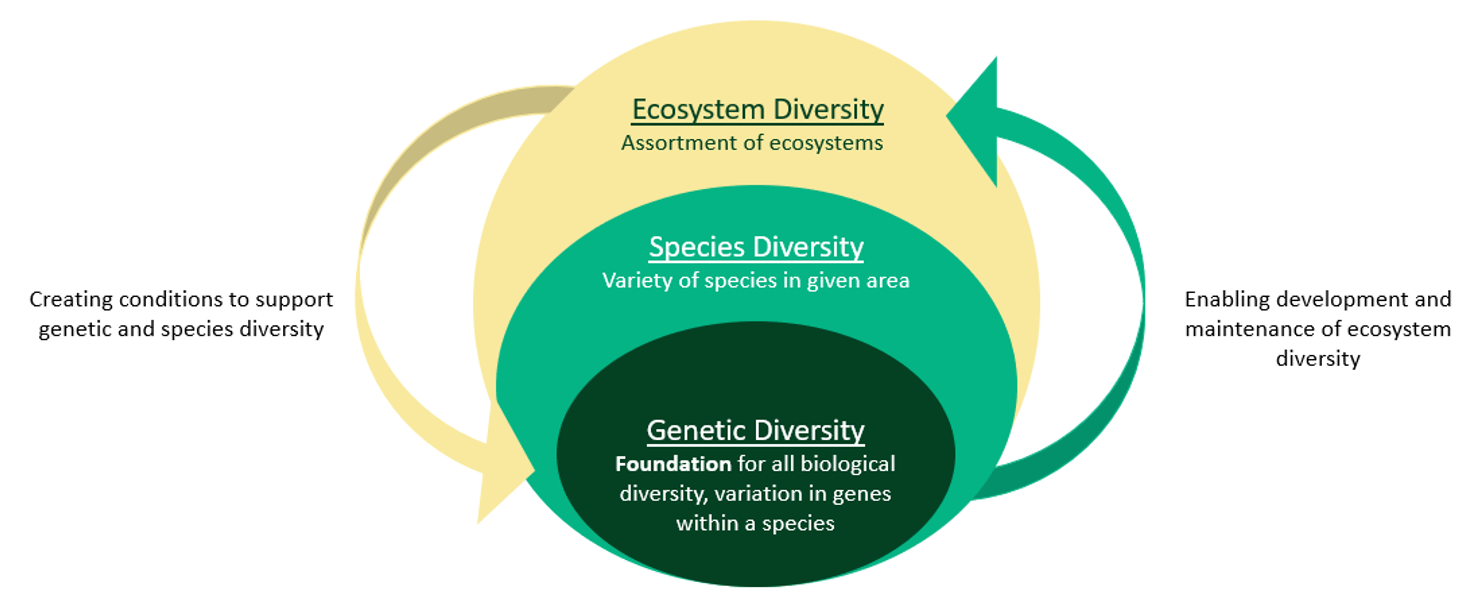
Figure 1: Three tiers of biological diversity, own Illustration according to Panwar et al. (2023)11Panwar, R., Ober, H. & Pinkse, J. The uncomfortable relationship between business and biodiversity: Advancing research on business strategies for biodiversity protection. Business Strategy and the Environment 32, 2554-2566 (2023).
It builds the life support system of planet Earth. Biological diversity in the form of genetic material, species, and ecosystems (Figure 1) forms the basis of human life.30UN Global Compact. A Framework for Corporate Action on Biodiversity and Ecosystem Services. (2012).
Genetic diversity is the foundation of biological diversity, referring to the genetic variation present within a species.31Laikre, L. et al. Neglect of Genetic Diversity in Implementation of the Convention on Biological Diversity. Conservation Biology 24, 86-88 (2010). A decline in genetic diversity, once surpassing a certain threshold, can lead to the inability of species and ecosystem diversity to be sustained.32Sills, J. et al. Post-2020 goals overlook genetic diversity. Science 367, 1083-1085 (2020). Panwar et al. (2023) state that a decline in genetic diversity can also result in a loss of species adaptability, thereby increasing their vulnerability to extinction due to shifts in abiotic conditions, such as drought, or biotic conditions, including the introduction of invasive species.
The next level, known as species diversity, refers to the diversity of species within a given area. Increased biodiversity leads to functional redundancy. This defines the adoption of analogous ecological functions, such as nitrogen fixation or soil formation, by several species. This phenomenon provides greater security, as another species can take over the function of an extinct species.
The final level encompasses the diversity of ecosystems, which consist of dynamic communities of plants, animals, microorganisms, and their environment. It is widely acknowledged that high levels of ecosystem diversity are conducive to the promotion of biodiversity at the species and genetic level. The three levels are symbiotically linked, with genetic diversity forming the basis, species diversity enabling the development and maintenance of ecosystem diversity, and ecosystem diversity creating the conditions to support genetic and species diversity.11Panwar, R., Ober, H. & Pinkse, J. The uncomfortable relationship between business and biodiversity: Advancing research on business strategies for biodiversity protection. Business Strategy and the Environment 32, 2554-2566 (2023).
To illustrate the impact of companies on all three levels of biodiversity, the following example of palm oil plantations is used. If primary forests (an ecosystem) are cut down to make room for palm oil plantations, they only provide a suitable habitat for half of the original vertebrate species.33Fitzherbert, E. B. et al. How will oil palm expansion affect biodiversity? Trends in Ecology & Evolution 23, 538-545 (2008). This process can be seen as an intervention in the species diversity tier. As a result of habitat loss, individuals of native wild animals in the remaining primary forests may become genetically isolated. This leads to a reduction in genetic mixing and consequently to a loss of genetic diversity.34Brunke, J., Radespiel, U., Russo, I.-R., Bruford, M. W. & Goossens, B. Messing about on the river: the role of geographic barriers in shaping the genetic structure of Bornean small mammals in a fragmented landscape. Conservation Genetics 20, 691-704 (2019). The establishment of palm oil plantations can result in a severe reduction or isolation of primary forest fragments. Subsequently, the disappearance of several species responsible for similar ecological functions (e.g. pollination and seed dispersal) can lead to the collapse of the remaining primary forest fragments. This results in a loss of ecosystem diversity.35Foster, W. A. et al. Establishing the evidence base for maintaining biodiversity and ecosystem function in the oil palm landscapes of South East Asia. Philosophical Transactions of the Royal Society B: Biological Sciences366, 3277-3291 (2011).
The Convention of Biological Diversity (2011) describes an ecosystem as “[…] a dynamic complex of plant, animal and micro-organism communities and their non-living environment interacting as a functional unit” (p. 4).29Convention on Biological Diversity. Convention on Biological Diversity : text and annexes. (Montreal, Quebec, Canada, 2011).
Terrestrial ecosystems are land-based communities of organisms and the interactions between biotic and abiotic components in a given area. Temperature range, average rainfall, soil type, and amount of light determine the type of terrestrial ecosystem in a location.36National Geographic. Terrestrial Ecosystem, <https://education.nationalgeographic.org/resource/terrestrial-ecosystem/> (n.d.). A wide variety of ecosystems can be found around the world.37Schowalter, T. D. in Insect Ecology (ed Timothy D. Schowalter) Ch. 11, 367-404 (Academic Press, 2016). Examples of terrestrial ecosystems are the tundra, taiga, temperate deciduous forests, tropical rainforests, grasslands, and deserts.36National Geographic. Terrestrial Ecosystem, <https://education.nationalgeographic.org/resource/terrestrial-ecosystem/> (n.d.). Over time, even purely aquatic environments such as lakes can evolve into mixed spectra in which aquatic and terrestrial areas develop and interact.6Küfeoğlu, S. in Emerging Technologies: Value Creation for Sustainable Development 469-486 (Springer, 2022). It is estimated that 55 percent of global gross domestic product (GDP) is derived from healthy ecosystems.38International Union for Conservation of Nature. Kunming-Montreal Global Biodiversity Framework. (IUCN, Gland, Switzerland, 2024). In addition, terrestrial ecosystems play a vital role in providing goods and services, such as carbon sequestration, soil quality maintenance, biodiversity protection, and disaster risk reduction through water regulation and erosion control. These ecosystem functions are essential not only for agricultural systems but also for climate change mitigation and adaptation efforts.6Küfeoğlu, S. in Emerging Technologies: Value Creation for Sustainable Development 469-486 (Springer, 2022).,39Ishtiaque, A., Masrur, A., Rabby, Y. W., Jerin, T. & Dewan, A. Remote sensing-based research for monitoring progress towards SDG 15 in Bangladesh: A review. Remote sensing 12, 691 (2020). Securing these benefits for future generations, such as livelihood security, is a core objective of SDG 15.40UN Environment Programme. GOAL 15: Life on land, <https://unep.org/topics/sustainable-development-goals/why-do-sustainable-development-goals-matter/goal-15-life-2> (n.d.).
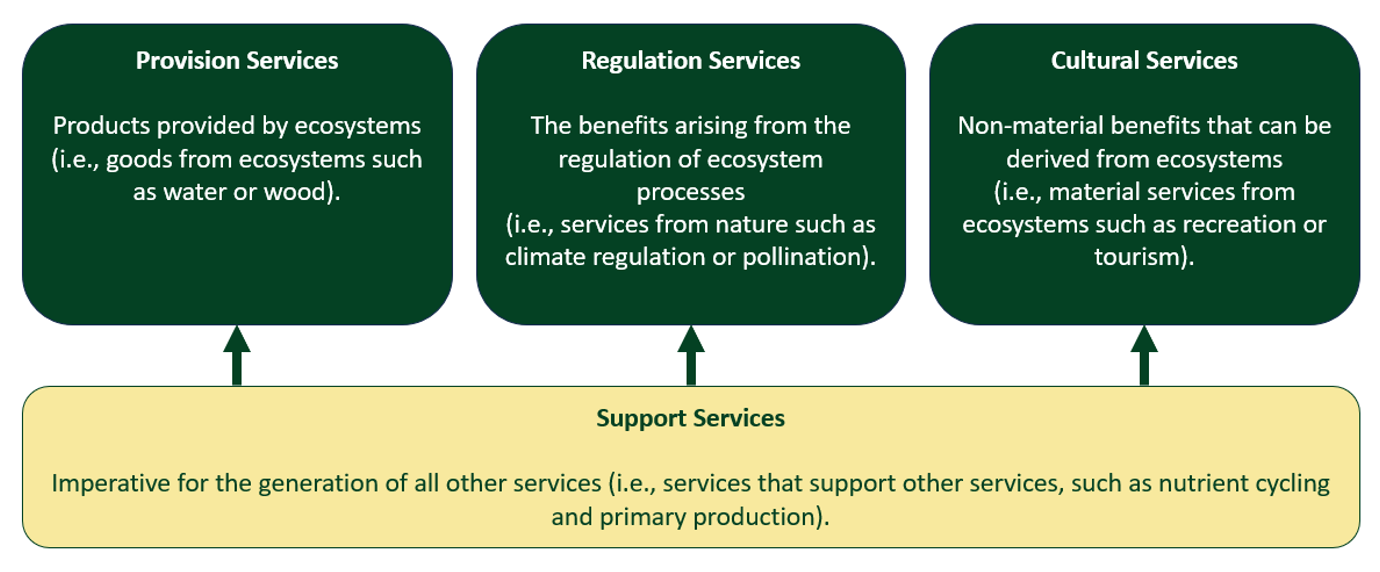
Figure 2: Ecosystem services, own illustration according to UN Global Compact (2012)30UN Global Compact. A Framework for Corporate Action on Biodiversity and Ecosystem Services. (2012).
The human species is considered to be a part of ecosystems, and at the same time, ecosystems provide benefits to humankind. These benefits are generally referred to as ecosystem services.5Macellari, M., Gusmerotti, N. M., Frey, M. & Testa, F. Embedding biodiversity and ecosystem services in corporate sustainability: A strategy to enable Sustainable Development Goals. Business Strategy & Development 1, 244-255 (2018).,7Klein, M. SDG 15: life on land. Jean Monnet Sustainable Development Goals Network Policy Brief Series, 1, 1-6 (2020). Many of these benefits can be attributed to biodiversity.12Wagner, M. Business, biodiversity and ecosystem services: Evidence from large-scale survey data. Business Strategy and the Environment 32, 2583-2599 (2023). This is because the functioning of ecosystems and their performance is strongly dependent on the functional and structural variability of species and the distribution and quantity of all three components of biodiversity: genes, species, ecosystems.30UN Global Compact. A Framework for Corporate Action on Biodiversity and Ecosystem Services. (2012). The provision of ecosystem services can benefit human society in a direct manner or as an input for the production of other goods and services. To illustrate, the pollination of crops is a direct contribution to food production and is thus regarded as an ecosystem service.7Klein, M. SDG 15: life on land. Jean Monnet Sustainable Development Goals Network Policy Brief Series, 1, 1-6 (2020). Ecosystem services can be generally distinguished into four services illustrated in Figure 2, namely provisioning services, regulating services, cultural services, and supporting services.12Wagner, M. Business, biodiversity and ecosystem services: Evidence from large-scale survey data. Business Strategy and the Environment 32, 2583-2599 (2023).
Ecosystem services are provided at various levels, including local, e.g., pollination, regional, e.g., protection from floods and landslides, and global, e.g., climate regulation. The intensification of competition for natural resources and ecosystem services is driven by factors such as population growth and rising consumption. The loss of biodiversity has far-reaching and systemic effects, which are linked to the most pressing challenges facing humanity, including food security and water scarcity. These problems are particularly affecting the most vulnerable groups, thereby exacerbating poverty. The most significant factors contributing to biodiversity loss are land use change (habitat loss), pollution, climate change, the introduction of invasive species, and the depletion of natural resources (see Chapter 3). The driving forces behind this pressure are the expansion of fishing and forestry, urbanization, increased demand for energy and water, and industrial development in general (see Figure 3).30UN Global Compact. A Framework for Corporate Action on Biodiversity and Ecosystem Services. (2012).
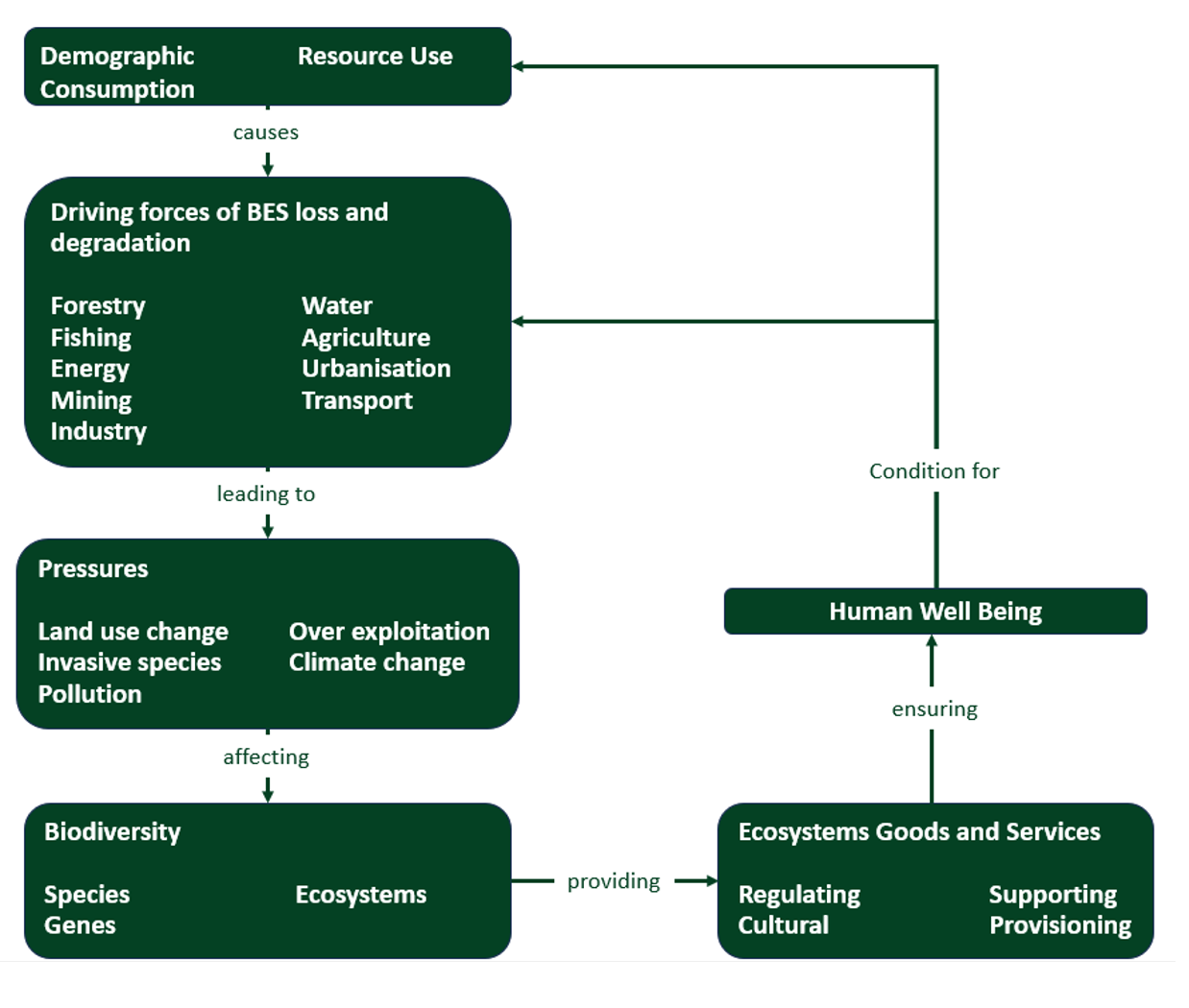
Figure 3: Human impact on BES, own illustration according to UN Global Compact (2012)30UN Global Compact. A Framework for Corporate Action on Biodiversity and Ecosystem Services. (2012).
2.1.2 Deforestation
There is no consensual definition of deforestation. Nevertheless, many definitions characterise deforestation as the loss or conversion of forest areas. While some definitions are based on changes in land use, others are based on changes in tree cover.41Fernández-Montes de Oca, A. I. et al. An integrated framework for harmonizing definitions of deforestation. Environmental Science & Policy 115, 71-78 (2021). Throughout history and continuing into the present day, forests have been felled to create space for agriculture and pasture, and to obtain wood for use in the production of fuel and construction.42National Geographic. Deforestation <https://education.nationalgeographic.org/resource/deforestation/> (2025). Rural populations will substantially be impacted from the loss of forest areas, as this leads to land degradation, increased carbon emissions and loss of biodiversity, as forests remove CO2 from the atmosphere, support the balance of oxygen, carbon dioxide and moisture in the atmosphere and maintain watersheds that provide 75 percent of the world’s fresh water. Natural disasters such as floods, droughts, landslides, and other severe events are also reduced through forests.6Küfeoğlu, S. in Emerging Technologies: Value Creation for Sustainable Development 469-486 (Springer, 2022).
2.1.3 Land degradation
Land degradation is a critical environmental issue that leads to the decline of land productivity and biodiversity. The most common factors contributing to land degradation are water and wind erosion. This process is defined as the gradual deterioration and removal of soil, stone, and other similar materials caused by the action of waves, rain, or wind. Moreover, the loss of soil organic carbon is a significant issue, as is salinization, which refers to the accumulation of salt in the soil. Soil acidification, a process by which the pH value of the soil declines over time, soil compaction, nutrient imbalances, soil contamination by pesticides and heavy metals, and vegetation degradation and overexploitation of water resources, also play a role.43Prăvălie, R. et al. A unifying modelling of multiple land degradation pathways in Europe. Nature Communications 15, 3862 (2024).
The accelerated degradation of land has been driven by a combination of pressures from agriculture and livestock farming, urbanization, deforestation, and other intensive land uses.44Santini, N. S., Chamizo, S., Lucas-Borja, M. E. & Muñoz-Rojas, M. Editorial: Restoration of Degraded Terrestrial Ecosystems. Frontiers in Ecology and Evolution 10 (2022). The loss of essential ecosystem services due to land degradation has far-reaching consequences for food security, economic growth, and environmental sustainability. Globally, the economic cost of land degradation, measured by the loss of ecosystem services, is estimated to be US$6.3-10.6 trillion per year.43Prăvălie, R. et al. A unifying modelling of multiple land degradation pathways in Europe. Nature Communications 15, 3862 (2024).
Desertification is a form of land degradation.45Gui, D. et al. Desertification baseline: A bottleneck for addressing desertification. Earth-Science Reviews 257, 104892 (2024). It is one of the most significant challenges currently facing sustainable development, alongside biodiversity and climate change.46United Nations. World Day to Combat Desertification and Drought, 17 June, <https://www.un.org/en/observances/desertification-day/background> (n.d.). Desertification defined by the United Nations Convention to Combat Desertification (1999) “[…] means land degradation in arid, semiarid and dry sub-humid areas, resulting from various factors, including climatic variations and human activities” (p.4).47United Nations Convention to Combat Desertification. United Nations Convention to Combat Desertification in Those Countries Experiencing Serious Drought And/or Desertification, Particulary in Africa. (Secretariat of the United Nations Convention to Combat Desertification, 1999).
Despite the critical impact, measuring desertification is challenging due to the lack of a standardised definition and benchmark for land degradation. Different methods lead to widely varying estimates, with 4 to 74 percent of drylandsaffected, while 10 to 60 million square kilometers of degraded land is globally affected. The World Atlas of Desertification (WAD) lacks comprehensive maps due to inconsistent measurement standards. While some studies quantify affected land, the Intergovernmental Science-Policy Platform on Biodiversity and Ecosystem Services (IPBES) focuses on population impact, projecting an increase from 2.7 billion (2010) to 4 billion (2050). Overall, desertification assessment remains complex due to incomplete and fragmented data.45Gui, D. et al. Desertification baseline: A bottleneck for addressing desertification. Earth-Science Reviews 257, 104892 (2024).
2.1.4 Conservation, restoration, and sustainable use
The term “conservation” is defined as the study of the loss of biodiversity on Earth, as well as the potential measures that can be implemented to prevent this loss. The overarching objective of conservation is to safeguard the diversity of life across all levels of biological organization.48Pimm, S. L. conservation <https://www.britannica.com/science/conservation-ecology/Calculating-relative-rates-of-extinction> (2024).
The United Nations has declared the years 2021 to 2030 the “Decade for Ecosystem Restoration”. This initiative has been adopted in recognition of the fundamental role that healthy land plays in human prosperity. The overarching objective of this decade is to halt further degradation of ecosystems and to restore the quantity and quality of land resources. These objectives are imperative for the preservation of biodiversity, ecosystem functions, and services. Achieving this objective will require the development and implementation of innovative and sustainable solutions that address the ecological, social, and economic imperatives.49Willemen, L. et al. How to halt the global decline of lands. Nature Sustainability 3, 164-166 (2020). In chapter 0 conservation and restoration are explained in more detail in the context of the typology of biodiversity strategies.
The Convention on Biological Diversity (2011) defines sustainable use as “the use of components of biodiversity in a way and at a rate that does not lead to the long-term decline of biodiversity and thereby maintains its potential to meet the needs and aspirations of present and future generations” (p.5).29Convention on Biological Diversity. Convention on Biological Diversity : text and annexes. (Montreal, Quebec, Canada, 2011). Sustainable use is a result of socio-ecological systems that are designed to maintain biodiversity and ecosystem functions in the long term while contributing to human well-being. Sustainable use is a dynamic process, whereby alterations in time and space are observed in wild species, the ecosystems that support them, and the social systems in which utilisation takes place. The social, economic, and ecological dimensions of sustainability, as set out in the 2030 Agenda for Sustainable Development and its SDGs, are taken into account.50Intergovernmental Platform on Biodiversity and Ecosystem Services. sustainable use, <https://www.ipbes.net/glossary-tag/sustainable-use> (n.d.).
2.2 Historical background
Following the establishment of definitional clarity regarding key terms such as biodiversity and ecosystem services, the historical development of SDG 15 is outlined in this chapter. Examining the origins and policy frameworks provides a comprehensive understanding of why biodiversity conservation is currently regarded as a significant challenge for businesses. The origins of sustainable development are initially discussed in the context of the report “Our Common Future”. This is followed by an assessment of the Convention on Biological Diversity (CBD), the most pertinent agreement on biodiversity to date. The Strategic Plan for Biodiversity and its Aichi Targets are then subjected to detailed review, as is the Agenda 2030 with the associated SDGs. The final section of the chapter presents the Kunming Global Biodiversity Framework (GBF) and its role in achieving SDG.15United Nations. The sustainable development goals report 2024. (United Nations New York, NY, 2024). Figure 4 visualises the historical background of SDG.15United Nations. The sustainable development goals report 2024. (United Nations New York, NY, 2024).
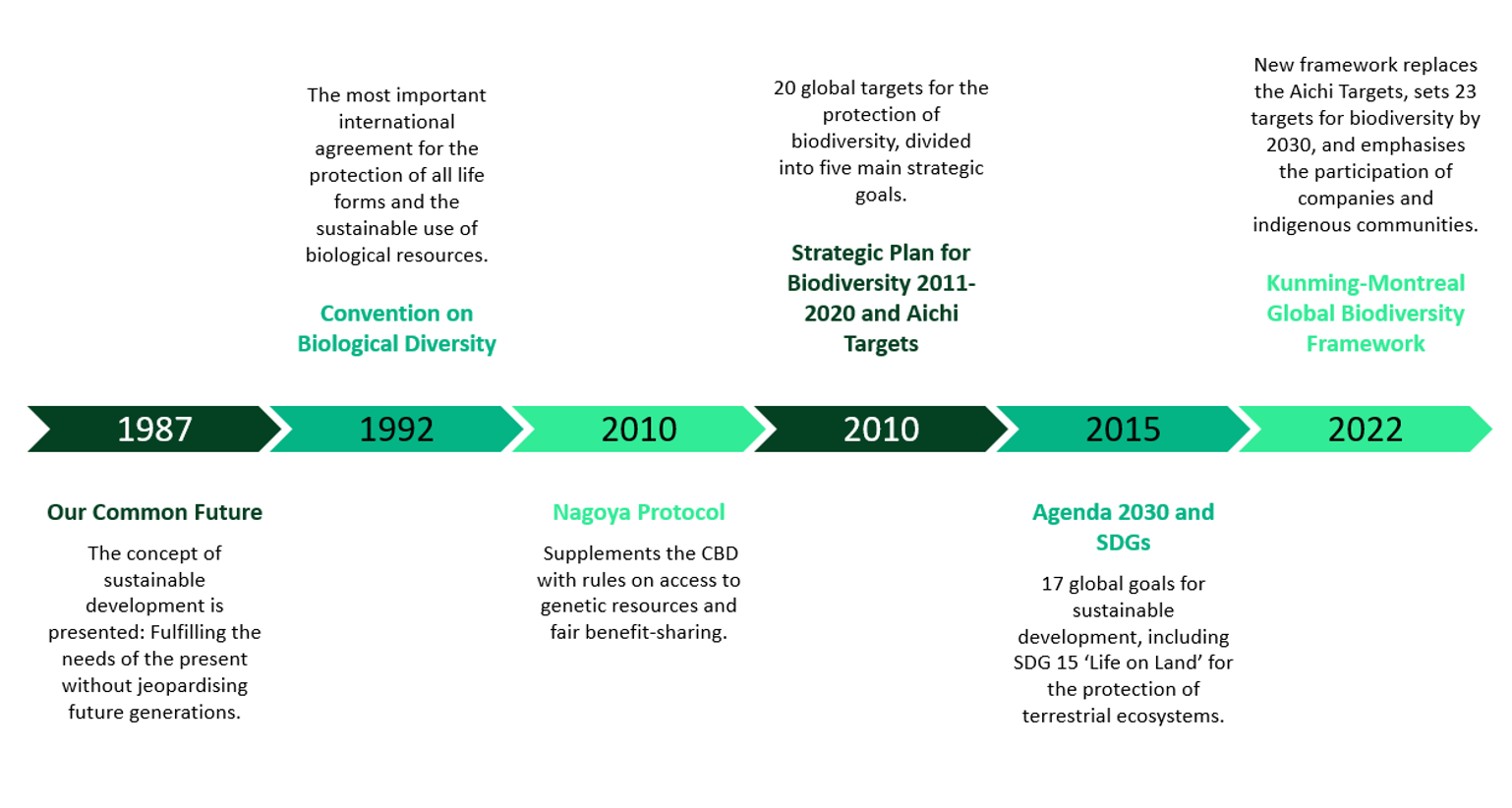
2.2.1 Sustainable development – Our Common Future
In 1987, the World Commission on Environment and Development presented the concept of sustainable development in the report “Our Common Future”. The World Commission on Environment and Development (1987) defined sustainable development as the ability of “humanity […] to make development sustainable to ensure that it meets the needs of the present without compromising the ability of future generations to meet their own needs” (p. 6).51World Commission on Environment and Development. Our common future. (Oxford University Press Oxford 1987).
According to Holden et al. (2024), two fundamental elements of this report have remained constant:
- Definition of sustainable development: The above-mentioned definition of sustainable development continues to be widely used. This has probably continued to prevail as it represents an idea that many people find intuitively important and meaningful.
- Interdependence of environment and development: The choice between environment and development is illusory, as the two are inextricably linked. On the one hand, the ability to develop depends on a well-functioning environment. On the other hand, development always has an impact on the environment, regardless of the direction in which it takes place.52Holden, E., Linnerud, K. & Bøe, V. Sustainable development: Notions, numbers, and narratives. Sustainable Development 33, 2812-2825 (2024).
2.2.2 Convention on Biological Diversity and Nagoya Protocol
In 1992, the UN member states adopted the CBD at the UN World Conference in Rio de Janeiro, which entered into force on 29 December 1993.53WWF. COP16, GBF und CBD? Wir erklären das Wichtigste zur Weltnaturkonferenz, <https://www.wwf.at/artikel/weltnaturkonferenz/> (n.d.). 34 To this day, it is the most important agreement for biodiversity and the first international set of rules that protects all living things in our environment and links this to the sustainable use of biological resources. This includes animals, plants, and ecosystems. The CBD takes biodiversity into account in all areas of human life, economy, and utilisation.54WWF. COP16, GBF und CBD? Wir erklären das Wichtigste zur Weltnaturkonferenz, <https://www.wwf.at/artikel/weltnaturkonferenz/> (n.d.). It pursues three main objectives: Firstly, the conservation of biological diversity, secondly, the sustainable use of components, and thirdly, the sharing of the arising benefits from the utilisation of genetic resources.30UN Global Compact. A Framework for Corporate Action on Biodiversity and Ecosystem Services. (2012).,54WWF. COP16, GBF und CBD? Wir erklären das Wichtigste zur Weltnaturkonferenz, <https://www.wwf.at/artikel/weltnaturkonferenz/> (n.d.).,55Zhu, Y., Prescott, G. W., Chu, P. & Carrasco, L. R. Glaring gaps in tools to estimate businesses’ biodiversity impacts hinder alignment with the Kunming-Montreal global biodiversity framework. Journal of Cleaner Production 451, 142079 (2024). Although legally binding, enforcement mechanisms for the CBD are limited, leaving implementation largely dependent on national commitment and resources.54WWF. COP16, GBF und CBD? Wir erklären das Wichtigste zur Weltnaturkonferenz, <https://www.wwf.at/artikel/weltnaturkonferenz/> (n.d.).
The Nagoya Protocol on Access and Benefit-Sharing (ABS) contains detailed provisions for the third goal of the CBD.56Bundesamt für Naturschutz. Nagoya-Protokoll Grundlagen, <https://www.bfn.de/grundlagen> (n.d.). It is a supplementary agreement to the CBD, adopted on 29 October 2010 in Nagoya, Japan, and in force since 12 October. It ensures the fair and equitable sharing of benefits arising from the utilisation of genetic resources, promoting biodiversity conservation and sustainable use. The protocol establishes legal certainty and transparency for providers and users of genetic resources by setting predictable conditions for access and benefit-sharing.57Convention on Biological Diversity. About the Nagoya Protocol, <https://www.cbd.int/abs/about/default.shtml> (2015).
Countries must implement domestic-level measures to regulate access, requiring prior informed consent, issuing permits, and promoting research that supports biodiversity. They must also ensure fair benefit-sharing, which includes monetary (e.g., royalties) and non-monetary (e.g., research collaboration) benefits under mutually agreed terms. Compliance measures require countries to verify legal access, enforce benefit-sharing agreements, and monitor genetic resource use throughout the value chain.57Convention on Biological Diversity. About the Nagoya Protocol, <https://www.cbd.int/abs/about/default.shtml> (2015).
The protocol also covers traditional knowledge associated with genetic resources, where indigenous and local communities (IPLCs) have the right to grant access. IPCLs are subject to prior informed consent and fair benefit-sharing by their laws, practices, and traditional uses. By strengthening legal frameworks, the Nagoya Protocol supports sustainable development and biodiversity conservation while enhancing human well-being.57Convention on Biological Diversity. About the Nagoya Protocol, <https://www.cbd.int/abs/about/default.shtml> (2015).
To provide support for this framework, countries must appoint national focal points and establish competent authorities. The role of these authorities is to guide users through the legal and procedural aspects of accessing genetic resources. These authorities are responsible for ensuring compliance with domestic rules and for issuing proof that access was legally obtained. The Access and Benefit-Sharing Clearing-House is an international online platform that facilitates transparency by collecting and sharing key information, such as permits and regulatory frameworks.29Convention on Biological Diversity. Convention on Biological Diversity : text and annexes. (Montreal, Quebec, Canada, 2011).
Monitoring the utilisation of genetic resources, each nation must establish checkpoints at pivotal phases such as research, innovation, and commercialisation. The purpose of these checkpoints is to verify whether the use of resources aligns with the conditions originally agreed upon. In the event of non-compliance with the established rules regarding access and benefit-sharing, the onus falls upon the relevant countries to initiate appropriate and effective measures. These measures may encompass legal proceedings or collaborative endeavours with other states that have a vested interest in the matter.29Convention on Biological Diversity. Convention on Biological Diversity : text and annexes. (Montreal, Quebec, Canada, 2011).
2.2.3 Strategic plan for biodiversity and Aichi Targets
In 2010, the CBD adopted the Strategic Plan for Biodiversity 2011-2020 and its Aichi Targets.17Convention on Biological Diversity. Biodiversity and the 2030 Agenda for Sustainable Development: Technical Note. (2016).,30UN Global Compact. A Framework for Corporate Action on Biodiversity and Ecosystem Services. (2012). This plan serves as a comprehensive framework for prioritising actions to conserve biodiversity and helps align business strategies, the CBDs objectives, as well as regulatory frameworks and new or improved public policies.17Convention on Biological Diversity. Biodiversity and the 2030 Agenda for Sustainable Development: Technical Note. (2016).,30UN Global Compact. A Framework for Corporate Action on Biodiversity and Ecosystem Services. (2012). It consists of 20 targets (see Figure 5) organized under five strategic goals. In accordance with the global targets established, the relevant parties are advised to formulate their own national or regional targets, aligning with their respective priorities and contributing to the overall achievement of the global targets. These targets and progress should be integrated into the national biodiversity strategy and action plan and reported.58Convention on Biological Diversity. Key Elements of the Strategic Plan 2011-2020, including Aichi Biodiversity Targets, <https://www.cbd.int/sp/elements#IV> (2018).
The five strategic goals are:
- Strategic goal A: Address the underlying causes of biodiversity loss by mainstreaming biodiversity across government and society
- Strategic goal B: Reduce the direct pressures on biodiversity and promote sustainable use
- Strategic goal C: Improve the status of biodiversity by safeguarding ecosystems, species, and genetic diversity
- Strategic goal D: Enhance the benefits to all from biodiversity and ecosystem Services
- Strategic goal E: Enhance implementation through participatory planning, knowledge management, and capacity building.59United Nations Environment Programme. United Nations Decade on Biodiversity 2011-2020: Living in Harmony with Nature. (Montreal, Canada, 2011).
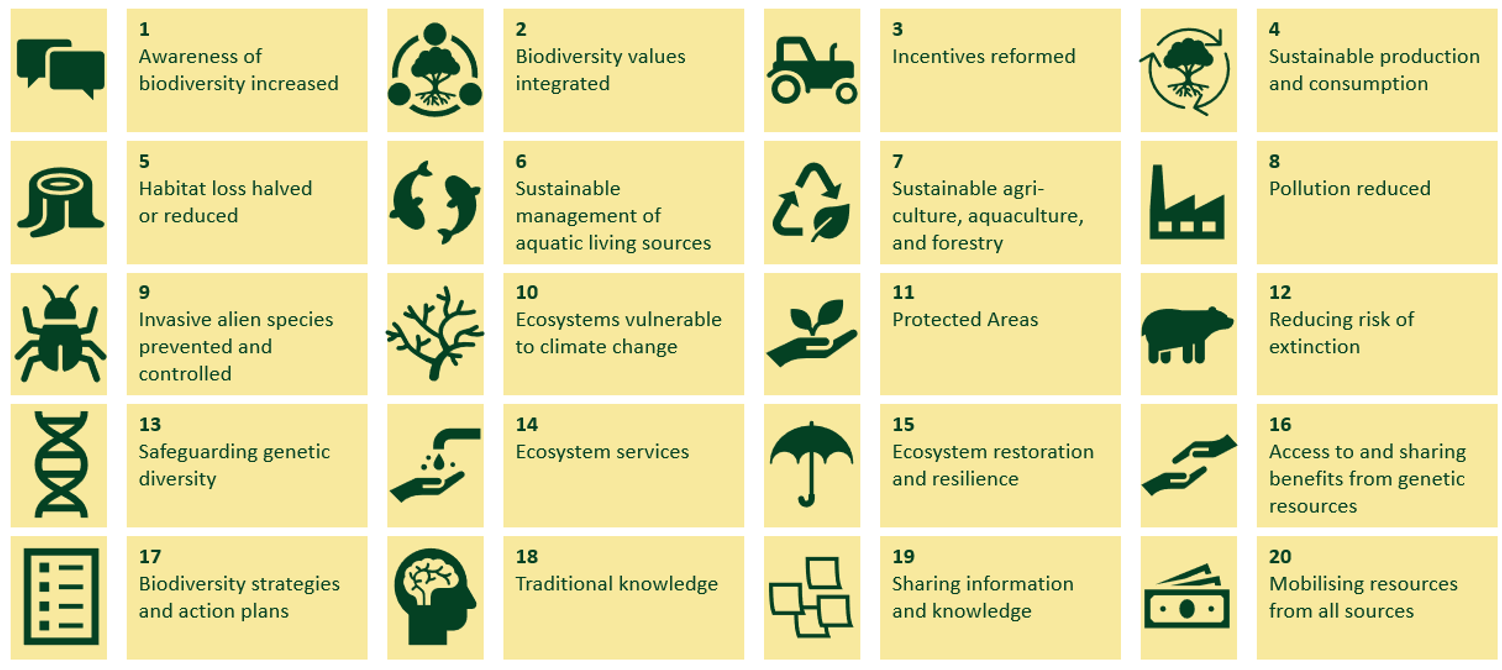
Figure 5: Aichi biodiversity targets, own illustration according to Convention on Biological Diversity (2016)17Convention on Biological Diversity. Biodiversity and the 2030 Agenda for Sustainable Development: Technical Note. (2016).
2.2.4 Agenda 2030 and the Sustainable Development Goals
In 2015, the Agenda 2030 and its SDGs represented a significant milestone in the evolution of sustainable development, marking the first instance of the establishment of explicit goals and subgoals in this domain.52Holden, E., Linnerud, K. & Bøe, V. Sustainable development: Notions, numbers, and narratives. Sustainable Development 33, 2812-2825 (2024). Consisting of 17 goals and 169 specific targets to be achieved by 2030, the SDGs were unanimously adopted by all UN member states.60Ferrero-Ferrero, I., Muñoz-Torres, M. J., Rivera-Lirio, J. M., Escrig-Olmedo, E. & Fernández-Izquierdo, M. í. SDG reporting: an analysis of corporate sustainability leaders. Marketing Intelligence & Planning 41, 457-472 (2023).,61van Zanten, J. A. & van Tulder, R. Improving companies’ impacts on sustainable development: A nexus approach to the SDGS. Business Strategy and the Environment 30, 3703-3720 (2021). Anchored in the five pillars of planet, people, prosperity, peace, and partnership (the 5 P’s), they aim to promote economic growth, social justice, and environmental sustainability.60Ferrero-Ferrero, I., Muñoz-Torres, M. J., Rivera-Lirio, J. M., Escrig-Olmedo, E. & Fernández-Izquierdo, M. í. SDG reporting: an analysis of corporate sustainability leaders. Marketing Intelligence & Planning 41, 457-472 (2023). By integrating these dimensions, the SDGs offer a comprehensive framework for addressing complex global challenges and catalysing local economic development and social transformation across sectors.21Sachs, J. D. The age of sustainable development. (Columbia University Press, 2015).
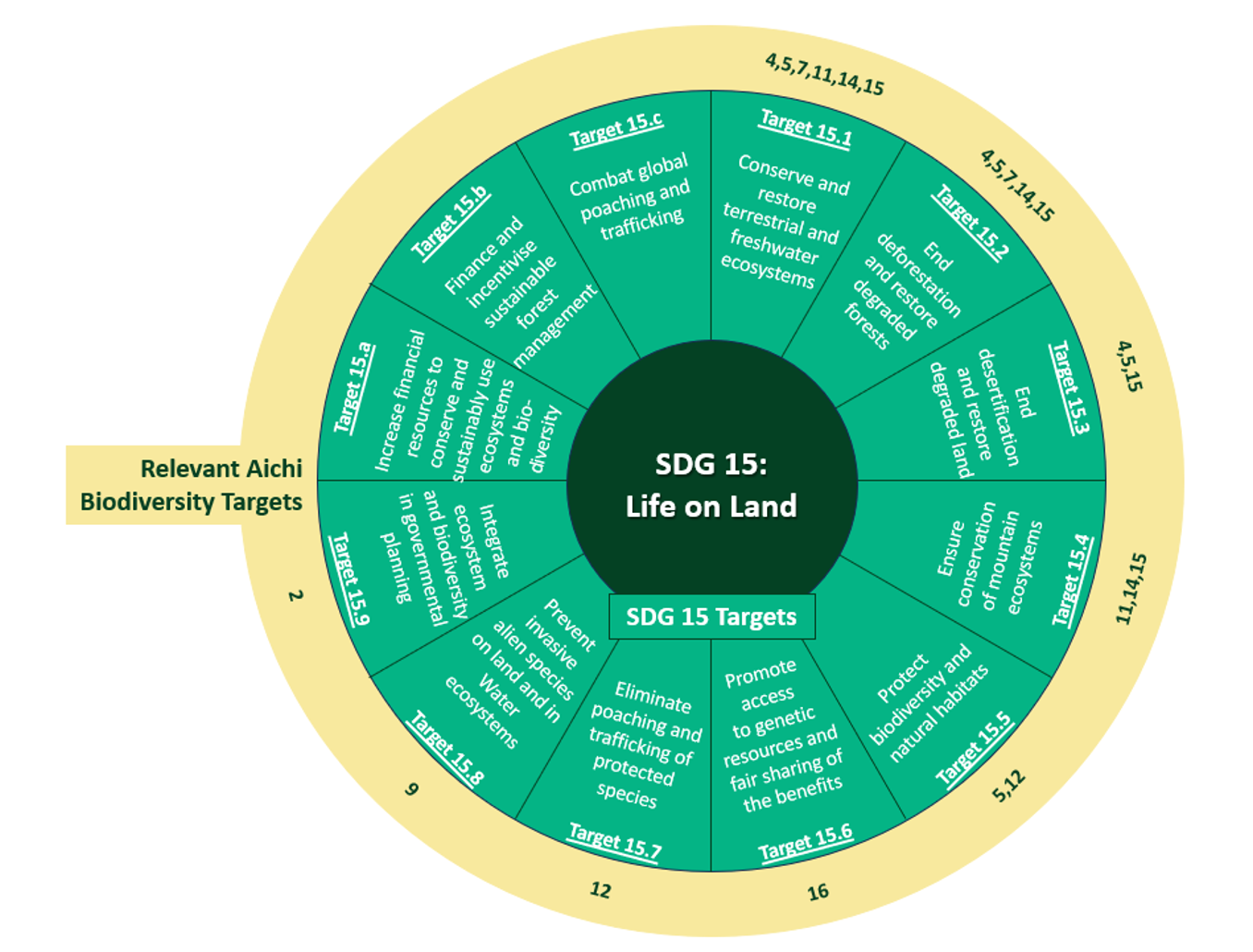
Figure 6: SDG 15 targets and relation to Aichi biodiversity targets, own illustration according to United Nations (n.d.)46United Nations. World Day to Combat Desertification and Drought, 17 June,
SDG 15, ’Life on Land’, addresses the conservation, restoration, and sustainable use of terrestrial ecosystems, including forest management and combating desertification, land degradation, and biodiversity loss.9Bundesministerium für wirtschaftliche Zusammenarbeit und Entwicklung. SDG 15: Leben an Land <https://www.bmz.de/de/agenda-2030/sdg-15> (2023). A distinguishing feature of SDG 15 is its basis on prior commitments from international agreements and soft law instruments like the Strategic Plan for Biodiversity and its Aichi Targets. Consequently, five of the SDG 15 targets (Target 15.1, 15.2, 15.5, 15.8, and 15.9) have been established as targets for 2020, although they are part of the 2030 Agenda.62Lehmann, I. Inspiration from the Kunming-Montreal Global Biodiversity Framework for SDG 15. International Environmental Agreements: Politics, Law and Economics 23, 207-214 (2023).
SDG 15 comprises 12 specific targets, measured by 14 indicators, which provide a structured approach to addressing these challenges.6Küfeoğlu, S. in Emerging Technologies: Value Creation for Sustainable Development 469-486 (Springer, 2022). The CBD (2016) offers a summary of the linkages of SDG 15 and the Aichi Targets shown in Figure 6. The initial nine targets pertain to outcome targets, encompassing a range of subjects, from the preservation of terrestrial ecosystems and designated biodiversity areas (15.1) to the promotion of sustainable forest management (15.2), the cessation of land degradation (15.3), and the establishment of sustainable ecosystems (15.4). The scope of these targets is further expanded to encompass the following: the targets of combating species extinction (15.5), access and benefit-sharing (15.6), illegal wildlife persecution (15.7), invasive alien species (15.8), and the integration of biodiversity values into planning (15.9). The implementation targets, conversely, pertain to the augmentation of funding for biodiversity (15.a), sustainable forest management (15.b), and capacity building to combat illegal wildlife trade (15.c).63Krauss, J. E. Unpacking SDG 15, its targets and indicators: tracing ideas of conservation. Globalizations 19, 1179-1194 (2022).
Initially, it may appear that SDG 15 is exclusively concerned with environmental issues.64Chazdon, R. & Brancalion, P. Restoring forests as a means to many ends. Science 365, 24-25 (2019). However, SDG 15 is of fundamental importance to the wider SDGs. Achieving the objectives of SDG 15 is contingent upon a fundamental transformation in the human relationship with the natural environment.9Bundesministerium für wirtschaftliche Zusammenarbeit und Entwicklung. SDG 15: Leben an Land <https://www.bmz.de/de/agenda-2030/sdg-15> (2023). The interconnectedness among natural biomes underscores the synergistic relationship between the achievement of Goal 15 and the advancement of other goals. For instance, the conservation of forests under Goal 15 not only strengthens climate protection (Goal 13) and the preservation of marine life (Goal 14) but also fosters responsible consumption and sustainable production (Goal 12). Initiatives under Goal 15 can also alleviate poverty and reduce inequalities (Goals 1 and 10) because rural communities depend heavily on healthy ecosystems for their daily survival. When these natural services fail, the most vulnerable lose their livelihoods. Conversely, well-managed ecosystems pave the way out of poverty by safeguarding livelihoods. Moreover, the conservation of natural habitats has been demonstrated to enhance the Earth’s intrinsic disease-control mechanisms and safeguard genetic resources that are imperative to the identification of novel pharmaceuticals, thereby fostering health and well-being (Goal 3).65UN Global Compact. 15. Life on Land <https://blueprint.unglobalcompact.org/sdgs/sdg15/> (2017).
Achieving all SDGs and preventing significant harm to ecosystems, societies, and economies necessitates a focus on natural resources and their sustainable management. This interdependence underscores the importance of SDG 15 in achieving sustainable development goals across all sectors.64Chazdon, R. & Brancalion, P. Restoring forests as a means to many ends. Science 365, 24-25 (2019).
While Agenda 2030 integrates multiple dimensions of sustainability, it neglects two important elements of “Our Common Future”. Firstly, the fact that there are environmental limits to the way we organize our economy. Secondly, the point is that any notion of sustainable development is based on social justice, understood as concrete proposals for the redistribution of income, wealth, and resources within and between generations. Where the 2030 Agenda talks about justice, it is about equal access to basic human rights and participation in decisions that affect one’s own life.52Holden, E., Linnerud, K. & Bøe, V. Sustainable development: Notions, numbers, and narratives. Sustainable Development 33, 2812-2825 (2024).
Furthermore, the 2030 Agenda has several issues, including the failure to establish explicit priorities, which can result in the selection of only specific goals, a practice often referred to as “cherry picking”.66Forestier, O. & Kim, R. E. Cherry-picking the Sustainable Development Goals: Goal prioritization by national governments and implications for global governance. Sustainable Development 28, 1269-1278 (2020). Additionally, certain goals, notably environmental goals, are not quantifiable.67Stokstad, E. Sustainable goals from UN under fire. Science 347, 702-703 (2015).,68van Vuuren, D. P. et al. Defining a sustainable development target space for 2030 and 2050. One Earth 5, 142-156 (2022). The importance of social and economic issues in the SDGs outweighs other sustainability aspects, such as the environment, which were at the forefront of previous global initiatives.69Diaz-Sarachaga, J. M., Jato-Espino, D. & Castro-Fresno, D. Is the Sustainable Development Goals (SDG) index an adequate framework to measure the progress of the 2030 Agenda? Sustainable Development 26, 663-671 (2018). In addition, several of the SDGs are not recognized as goals, but rather as proposals for achieving the goals. Finally, it should be added that the objectives rely on a dialogue-based consensus between the countries and are less anchored in theoretically sound research contributions.52Holden, E., Linnerud, K. & Bøe, V. Sustainable development: Notions, numbers, and narratives. Sustainable Development 33, 2812-2825 (2024).
Despite these challenges, the Agenda 2030 is consistent with other existing international commitments, including the Strategic Plan for Biodiversity, reinforcing their mutual goals. Therefore, the implementation of one contributes to the achievement of the other.17Convention on Biological Diversity. Biodiversity and the 2030 Agenda for Sustainable Development: Technical Note. (2016).
2.2.5 Kunming-Montreal Global Biodiversity Framework
In 2022, the GBF was adopted at the 15th Conference of the Parties (COP) as a prospective new guideline for SDG.15United Nations. The sustainable development goals report 2024. (United Nations New York, NY, 2024). Furthermore, the GBF is intended to serve as a novel strategic plan that will replace the Aichi Targets. The GBF is comprised of four long-term goals and 23 targets, with the overarching vision for 2050 being that biodiversity is valued, conserved, restored and wisely used, ecosystem services are sustained, a healthy planet is maintained and benefits are provided for all people.38International Union for Conservation of Nature. Kunming-Montreal Global Biodiversity Framework. (IUCN, Gland, Switzerland, 2024).,55Zhu, Y., Prescott, G. W., Chu, P. & Carrasco, L. R. Glaring gaps in tools to estimate businesses’ biodiversity impacts hinder alignment with the Kunming-Montreal global biodiversity framework. Journal of Cleaner Production 451, 142079 (2024).,62Lehmann, I. Inspiration from the Kunming-Montreal Global Biodiversity Framework for SDG 15. International Environmental Agreements: Politics, Law and Economics 23, 207-214 (2023). The National Biodiversity Strategies and Action Plans (NBSAPs) serve as main instruments for implementing the GBF.70International Institute for Sustainable Development. Inside the UN Biodiversity Converence (CBD COP 16), <https://www.iisd.org/inside-cop-16> (2024). The establishment of this new guideline was a response to the intensification of drivers of biodiversity loss and the ongoing decline. However, in order to support the SDGs and achieve the vision of living in harmony with nature by 2050, the GBF must be implemented in an ambitious manner.38International Union for Conservation of Nature. Kunming-Montreal Global Biodiversity Framework. (IUCN, Gland, Switzerland, 2024).
The GBF’s objectives not only include the conservation of nature they also seek the equitable distribution of benefits. In this context, IPLCs are recognized as playing a crucial role in biodiversity conservation. Their full and effective participation in implementation and monitoring is recognized.38International Union for Conservation of Nature. Kunming-Montreal Global Biodiversity Framework. (IUCN, Gland, Switzerland, 2024). This is attributable to the fact that biodiversity in areas under the management of IPLCs is demonstrably superior to that in other areas, including protected areas.71Internationale Klimaschutz Initiative. CBD COP 16, <https://www.international-climate-initiative.com/ueber-die-iki/themen/cbd-cop-16/> (n.d.).
Moreover, the GBF sets out particular objectives that lead to favorable results in the domain of biodiversity. In comparison to its predecessor, the Aichi Biodiversity Targets, it introduces novel elements of nature conservation, such as the emphasis on ecological connectivity, nature-based solutions and spatial planning to address changes in land and sea use. It also underscores the significance of safeguarding indigenous and traditional areas, as well as urban green spaces and water bodies. A notable aspect of the GBF is its explicit call, a first in the field, for transnational companies and financial institutions to participate in the regular monitoring, assessment and transparent disclosure of the risks, dependencies and impacts on biodiversity in their operations, supply chains and portfolios.55Zhu, Y., Prescott, G. W., Chu, P. & Carrasco, L. R. Glaring gaps in tools to estimate businesses’ biodiversity impacts hinder alignment with the Kunming-Montreal global biodiversity framework. Journal of Cleaner Production 451, 142079 (2024).
The GBF has calculated the global funding gap for measures to protect biodiversity to be 700 billion US dollars per year. This indicates that public funding alone is insufficient to bridge this funding gap, emphasising the need for increased involvement from the private sector.71Internationale Klimaschutz Initiative. CBD COP 16, <https://www.international-climate-initiative.com/ueber-die-iki/themen/cbd-cop-16/> (n.d.).
2.3 Fundamentals of biodiversity and ecosystem service management in companies
In order to facilitate a more profound comprehension of SDG 15 in a business context, this section establishes the theoretical foundations for the subsequent practical implementation chapter. Initially, the relationship between business and the BES is demonstrated in the context of the predominant factors contributing to biodiversity loss. Thereafter, the significance of environmental stewardship and the consideration of risks and opportunities, in addition to corporate governance, are elaborated. The typology of biodiversity strategies is then discussed, and a systemic framework for sustainable development with the socio-ecological system is presented.
2.3.1 Business and BES
Companies rely on BES goods and services for their products, and yet business processes are also responsible for ecosystem transformation. They must therefore implement effective BES management, ensuring their activities do not have a negative environmental impact. They also need to ensure that their impacts do not adversely affect their operations or investments. Companies from all sectors have started integrating BES practices into their business strategies. However, there is a lack of awareness regarding their impact on biodiversity loss. Most biodiversity and business literature is focused on land use change as the main driver of biodiversity loss. Consequently, industries such as agriculture, mining, and forestry are predominantly held responsible. Nevertheless, other causes, including pollution, introduction of invasive species, overexploitation of natural resources, and climate change, need to be considered. A comprehensive understanding of these causes is essential for developing effective BES strategies, which aim to mitigate the main causes of biodiversity loss by the company. The following chapter is therefore dedicated to these key influencing factors and their impact on biodiversity.11Panwar, R., Ober, H. & Pinkse, J. The uncomfortable relationship between business and biodiversity: Advancing research on business strategies for biodiversity protection. Business Strategy and the Environment 32, 2554-2566 (2023).
2.3.1.1 Land use change
Land use change is driven by various economic sectors, including agriculture, forestry, and real estate. This change includes the conversion of natural areas into farmland, plantations, or urban settlements, which often leads to the destruction or fragmentation of habitats.11Panwar, R., Ober, H. & Pinkse, J. The uncomfortable relationship between business and biodiversity: Advancing research on business strategies for biodiversity protection. Business Strategy and the Environment 32, 2554-2566 (2023). A prominent example of this phenomenon is the expansion of palm oil plantations in Southeast Asia (as already illustrated in Chapter 3.1.1), which has led to the near extinction of species such as the Orangutan and the Sumatran tiger.72Poor, E. E., Shao, Y. & Kelly, M. J. Mapping and predicting forest loss in a Sumatran tiger landscape from 2002 to 2050. Journal of Environmental Management 231, 397-404 (2019). However, it should be noted that almost all economic sectors contribute to changes in land use. For instance, the construction of a shopping center and its associated parking lot is the responsibility of the retail sector, while the development of an office complex by a software developer constitutes a contribution to the land use changes of the developed building.11Panwar, R., Ober, H. & Pinkse, J. The uncomfortable relationship between business and biodiversity: Advancing research on business strategies for biodiversity protection. Business Strategy and the Environment 32, 2554-2566 (2023).
2.3.1.2 Pollution
Pollution has been identified as a significant yet frequently disregarded factor contributing to biodiversity loss, impacting species through the contamination of air, water, and soil. The emissions from power plants, such as sulphur dioxide and nitrogen oxides, when released into the environment in the form of acid rain, have deleterious effects on species and ecosystems.73Grantz, D. A., Garner, J. H. B. & Johnson, D. W. Ecological effects of particulate matter. Environment International 29, 213-239 (2003). The extensive utilisation of pesticides and fertilisers can modify soil conditions, rendering them unfavourable for numerous organisms and resulting in a reduction in below-ground biodiversity.74Power, A. G. Ecosystem services and agriculture: tradeoffs and synergies. Philosophical Transactions of the Royal Society B: Biological Sciences 365, 2959-2971 (2010). The mining industry is a major contributor to pollution.11Panwar, R., Ober, H. & Pinkse, J. The uncomfortable relationship between business and biodiversity: Advancing research on business strategies for biodiversity protection. Business Strategy and the Environment 32, 2554-2566 (2023). Mining has particularly detrimental effects when it is conducted within or in proximity to biodiversity hotspots, a prime example of this being the opencast mining of ironstone which has had a profoundly negative effect on the entire Canga ecosystem in Brazil.75Salles, D. M., Carmo, F. F. d. & Jacobi, C. M. Habitat Loss Challenges the Conservation of Endemic Plants in Mining-Targeted Brazilian Mountains. Environmental Conservation 46, 140-146 (2019). While acknowledging the contribution of all industries to pollution, it is particularly the energy, agriculture, and mining sectors that are responsible for biodiversity loss through this pathway.11Panwar, R., Ober, H. & Pinkse, J. The uncomfortable relationship between business and biodiversity: Advancing research on business strategies for biodiversity protection. Business Strategy and the Environment 32, 2554-2566 (2023).
2.3.1.3 Introduction of invasive species
The introduction of invasive species has been identified as a significant contributing factor to biodiversity loss.11Panwar, R., Ober, H. & Pinkse, J. The uncomfortable relationship between business and biodiversity: Advancing research on business strategies for biodiversity protection. Business Strategy and the Environment 32, 2554-2566 (2023). The presence of non-native species in an ecosystem can result in the displacement of native species due to competition for resources and disruption to ecosystem function.76Jeschke, J. M. & Strayer, D. L. Invasion success of vertebrates in Europe and North America. Proceedings of the National Academy of Sciences 102, 7198-7202 (2005).
Industries such as agroforestry, biofuel production, and horticulture frequently introduce invasive plants with high adaptability and rapid growth, such as the Australian acacia, which now threatens native species worldwide. Furthermore, international trade has been identified as a significant factor in the spread of invasive species, as evidenced by the transportation of rats in cargo, which has led to the endangerment of island seabird populations. While various industries contribute to this issue, agriculture, horticulture, forestry, and aquaculture play a particularly significant role.11Panwar, R., Ober, H. & Pinkse, J. The uncomfortable relationship between business and biodiversity: Advancing research on business strategies for biodiversity protection. Business Strategy and the Environment 32, 2554-2566 (2023).
2.3.1.4 Overexploitation of natural resources
Overexploitation of natural resources occurs when hunting, fishing, or harvesting exceeds sustainable rates, preventing populations from recovering. Some countries regulate trade to ensure sustainability, here illegal poaching and logging continue to fuel a thriving black market for rare wildlife and plant species and lead to overexploitation in these areas. Excessive logging by the forestry industry depletes native tree populations, leading to habitat destruction. While many sectors contribute to overexploitation, the fishing industry and pet trade are among the most significant.11Panwar, R., Ober, H. & Pinkse, J. The uncomfortable relationship between business and biodiversity: Advancing research on business strategies for biodiversity protection. Business Strategy and the Environment 32, 2554-2566 (2023).
2.3.1.5 Climate change
Despite its prominence in corporate sustainability discussions, climate change is rarely integrated into corporate biodiversity strategies.11Panwar, R., Ober, H. & Pinkse, J. The uncomfortable relationship between business and biodiversity: Advancing research on business strategies for biodiversity protection. Business Strategy and the Environment 32, 2554-2566 (2023). Human activities are driving changes in the Earth’s atmosphere, hydrosphere, lithosphere, and biosphere, which are likely to worsen biodiversity loss, exacerbated by other existing threats.77Ellis, E. C. Anthropogenic transformation of the terrestrial biosphere. Philosophical Transactions of the Royal Society A: Mathematical, Physical and Engineering Sciences 369, 1010-1035 (2011). Climate change decreases genetic diversity by favouring only gene variants that are suited to the new environmental conditions, while others gradually disappear.78Bellard, C., Bertelsmeier, C., Leadley, P., Thuiller, W. & Courchamp, F. Impacts of climate change on the future of biodiversity. Ecology Letters 15, 365-377 (2012). Species encounter difficulties in locating the resources they require at the necessary times, for example, when plants are in bloom or fruit is available. This can result in risks such as pollinators being unable to access nectar or migratory species being unable to find food.11Panwar, R., Ober, H. & Pinkse, J. The uncomfortable relationship between business and biodiversity: Advancing research on business strategies for biodiversity protection. Business Strategy and the Environment 32, 2554-2566 (2023). Climate shifts have the potential to transform ecosystems, transitioning rainforests to savannahs or boreal forests to tundra, significantly impacting biodiversity.78Bellard, C., Bertelsmeier, C., Leadley, P., Thuiller, W. & Courchamp, F. Impacts of climate change on the future of biodiversity. Ecology Letters 15, 365-377 (2012). While all industries contribute to climate change, the energy, agriculture, forestry, and transportation sectors are the primary drivers of biodiversity loss through their actions.11Panwar, R., Ober, H. & Pinkse, J. The uncomfortable relationship between business and biodiversity: Advancing research on business strategies for biodiversity protection. Business Strategy and the Environment 32, 2554-2566 (2023).
2.3.2 Environmental stewardship
The increasing integration of sustainability into business agendas can be observed worldwide. Companies are looking for opportunities and innovations to ensure corporate and investor success while creating social value and developing innovative and transformative solutions. Part of this sustainability agenda is effective environmental stewardship. The UN Global Compact’s definition of this is a comprehensive understanding and effective management of critical environmental risks and opportunities with corporate governance as a starting point of responsible BES management.30UN Global Compact. A Framework for Corporate Action on Biodiversity and Ecosystem Services. (2012).
Therefore, in the next sub-chapter, the risks and opportunities for BES management will be introduced, and a closer look at corporate governance will be undertaken.
2.3.2.1 Risks and opportunities
The awareness of the potential risks associated with biodiversity loss remains limited.79TEEB. The economics of ecosystems and biodiversity TEEB for businesses (2010). However, an increasing pressure from various stakeholders, including investors, customers, and governments, is driving companies to manage and report on their environmental and social impacts, particularly in relation to BES. The risks and opportunities arising from this pressure influence business activities, necessitating targeted measures to enhance sustainability.30UN Global Compact. A Framework for Corporate Action on Biodiversity and Ecosystem Services. (2012).
Inadequate management of BES by companies can give rise to a variety of risks, including, but not limited to, diminished productivity, unanticipated business interruptions, and constrained access to critical resources. These risks, in turn, can result in elevated operating costs, thereby threatening a company’s competitiveness and profitability in the long term. BES-related risks may be evident in various domains, including operations, regulation and law, reputation, or market and finance.30UN Global Compact. A Framework for Corporate Action on Biodiversity and Ecosystem Services. (2012).
In the context of regulatory frameworks, the procurement of legal or social operating licenses can pose substantial risks. To illustrate this point, consider the case of several companies that sought licenses to extract gold from a region of Colombia that is particularly environmentally sensitive. This area supplies a significant proportion of the freshwater to the city of Bucaramanga. The extraction efforts encountered significant opposition from local communities and non-governmental organizations (NGOs), who alleged that they had not been consulted regarding the projects. Consequently, the Colombian government suspended the licenses, underscoring the necessity of securing both social and environmental approvals.30UN Global Compact. A Framework for Corporate Action on Biodiversity and Ecosystem Services. (2012).
Furthermore, inadequate environmental practices can harm a company’s reputation and diminish its brand value, which may result in legal and financial consequences, such as remediation costs for environmental damage and compensation related to disasters or misconduct. Such incidents can profoundly affect a company’s performance and public image, underscoring the importance of robust environmental management practices to mitigate ecological damage and potential financial and reputational impacts.30UN Global Compact. A Framework for Corporate Action on Biodiversity and Ecosystem Services. (2012).
The integration of BES receipt into corporate sustainability strategies has been demonstrated to yield significant opportunities for companies. A stronger focus on consumer preferences has been shown to result in the alignment of new products and services with consumer preferences and capture revenue from emerging green markets.30UN Global Compact. A Framework for Corporate Action on Biodiversity and Ecosystem Services. (2012). One example is Philips, which in 2011 generated 39 percent of its revenue from sustainable products, with over 4000 new environmentally friendly offerings. The company invested ¬479 million in green innovation and eco-design to improve material and energy efficiency. In addition, Philips has committed to restoring BES, reducing its operational environmental impact, and developing sustainable technologies in partnership with the International Union for Conservation of Nature (IUCN).80Philips. Philips Full Annual Report 2011. (2011).
This, in turn, has the potential to anticipate legal requirements, better cushion compliance costs, and position a company more advantageously in relation to competitors.30UN Global Compact. A Framework for Corporate Action on Biodiversity and Ecosystem Services. (2012). The following case study is provided to demonstrate how companies can increase their profits. Kingfisher is highlighted by the UN Global Compact (2012) as a company that has committed to sourcing responsible timber through its commercial buying policies. This strategy has had a positive impact on its profits. Sales of Forest Stewardship Council (FSC)-certified timber have been steadily increasing since 2007, contributing not only to financial gains but also to sustainability efforts.81Kingfisher. Better Homes. Better Lives. For Everyone. Kingfisher Responsible Business Report 2023/24. (2023). In addition, Kingfisher, in conjunction with other retailers, established the Timber Retail Coalition (TRC) to uphold ethical standards for timber and wood products sold within the European Union (EU).82Kingfisher. Kingfisher welcomes outcome of European Commission review of the EU Timber Regulation, <https://www.kingfisher.com/media/news/2016/kingfisher-welcomes-outcome-of-european-commission-review-of-th> (2016).
As the risks and opportunities inherent in BES management become more clearly defined, companies that integrate biodiversity and ecosystem protection into their strategies stand to gain a competitive advantage. By managing resources more efficiently, minimising risk, and providing higher-quality products and services, they can enhance their sustainability performance and underscore their leading role in the market.30UN Global Compact. A Framework for Corporate Action on Biodiversity and Ecosystem Services. (2012).
2.3.2.2 Corporate governance and BES action
Governance is the starting point for responsible BES management. Here, BES considerations can be incorporated into all aspects of management. The board plays a critical role as it can be instrumental in developing and guiding the company’s sustainability agenda. It can integrate key BES issues into a holistic strategy for sustainable operating policies, principles, and practices to address both social and environmental impacts. Companies need to initiate the formulation of explicit goals and objectives for BES. These objectives must be incorporated into risk and opportunity assessment, core business, procurement management, financial accounting, auditing, and reporting. A structured approach assists companies in identifying the relevance of BES for their business and products, and in prioritising those aspects of their impact and dependencies that necessitate targeted action. Figure 7 shows a framework that illustrates how BES can be embedded in an organization’s overall strategies and activities. It facilitates the identification of relevant issue and organisational areas within a company.30UN Global Compact. A Framework for Corporate Action on Biodiversity and Ecosystem Services. (2012).
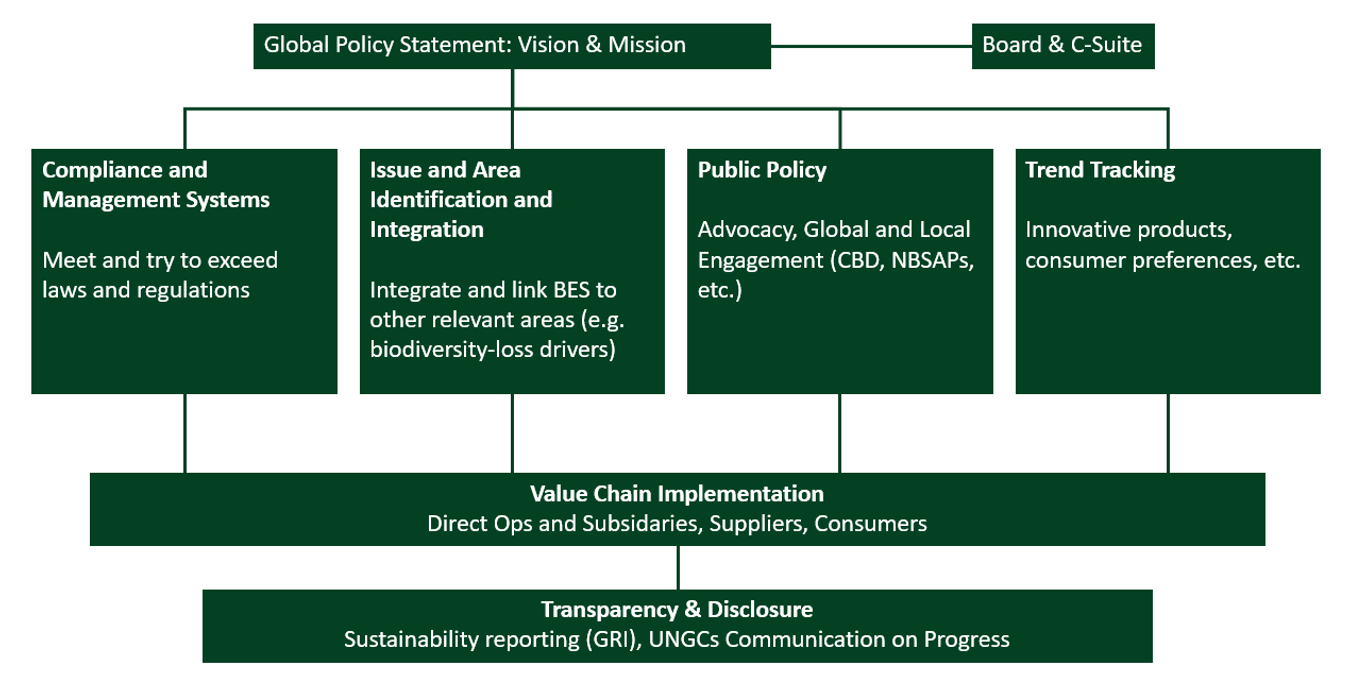
Figure 7: Organisational and issue area framework, own illustration according to UN Global Compact (2012)30UN Global Compact. A Framework for Corporate Action on Biodiversity and Ecosystem Services. (2012).
2.3.3 Typology of corporate biodiversity strategies

Figure 8: Typology of corporate biodiversity strategies, own illustration according to Panwar (2023)11Panwar, R., Ober, H. & Pinkse, J. The uncomfortable relationship between business and biodiversity: Advancing research on business strategies for biodiversity protection. Business Strategy and the Environment 32, 2554-2566 (2023).
The typology of corporate biodiversity strategies (see Figure 8) provides the conceptual foundation for the mitigation hierarchy, a sequence of approaches as identified in the relevant conservation and development literature.11Panwar, R., Ober, H. & Pinkse, J. The uncomfortable relationship between business and biodiversity: Advancing research on business strategies for biodiversity protection. Business Strategy and the Environment 32, 2554-2566 (2023).,83Business and Biodiversity Offsets Programme. Standard on Biodiversity Offsets. (2012). The hierarchy suggests that companies should first attempt to avoid biodiversity loss, secondly minimise the harm caused by unavoidable loss, and finally remediate and offset any damage caused. Corporate biodiversity protection strategies can be organized based on temporal and spatial dimensions. The temporal dimension includes proactively preventing biodiversity loss and implementing reactive initiatives after the biodiversity loss has occurred. The spatial dimension includes implementing on-site and off-site interventions. Combining the temporal and spatial interventions yields four basic corporate biodiversity protection strategies: conservation, restoration, compensation, and reparation.11Panwar, R., Ober, H. & Pinkse, J. The uncomfortable relationship between business and biodiversity: Advancing research on business strategies for biodiversity protection. Business Strategy and the Environment 32, 2554-2566 (2023).
2.3.3.1 Conservation
Conservation is a before-loss, on-site strategy that assumes biodiversity loss is avoidable. Companies implement a conservation strategy when facing regulatory pressures.11Panwar, R., Ober, H. & Pinkse, J. The uncomfortable relationship between business and biodiversity: Advancing research on business strategies for biodiversity protection. Business Strategy and the Environment 32, 2554-2566 (2023). This can be seen in the U.S. forestry industry, where strict regulations at national, state, and regional levels require companies to implement conservation measures to prevent biodiversity loss. These rules prohibit activities that could harm ecosystems, compelling businesses to adopt sustainable forest management practices.84Butler, B. J. in Future forests of the northern United States Gen. Tech. Rep. NRS-151 (ed Stephen R.; Moser Shifley, W. Keith, ) Ch. 9, 243-269 (US Department of Agriculture, Forest Service, Northern Research Station, 2016).
Also, market pressures enhance the action of preventative measures. Many companies adopt sustainability certifications to mitigate biodiversity loss. For example, seek forestry firms the FSC certification, while agriculture and food sector businesses may follow the Marine Stewardship Council (MSC) for fisheries and the Roundtable on Sustainable Palm Oil (RSPO) for palm oil. Regenerative agriculture practices are also gaining traction, reducing environmental impacts.11Panwar, R., Ober, H. & Pinkse, J. The uncomfortable relationship between business and biodiversity: Advancing research on business strategies for biodiversity protection. Business Strategy and the Environment 32, 2554-2566 (2023).
Companies across industries are further adopting biodiversity-friendly practices, such as apparel brands using innovative sustainable fibres for reduced soil toxicity, and companies like DyeCoo, which invented a waterless dyeing technology with the property to reduce water use and contamination. The Corporate Fiber and Materials Benchmark (CFMB) program, introduced by Textile Exchange, supports biodiversity efforts in fashion. In construction, the BiodiverCity® label promotes standardised biodiversity benchmarks.11Panwar, R., Ober, H. & Pinkse, J. The uncomfortable relationship between business and biodiversity: Advancing research on business strategies for biodiversity protection. Business Strategy and the Environment 32, 2554-2566 (2023). However, some studies indicate that market-driven certification programs are ineffective.85Rametsteiner, E. & Simula, M. Forest certification-an instrument to promote sustainable forest management? Journal of Environmental Management 67, 87-98 (2003).,86van der Ven, H., Rothacker, C. & Cashore, B. Do eco-labels prevent deforestation? Lessons from non-state market driven governance in the soy, palm oil, and cocoa sectors. Global Environmental Change 52, 141-151 (2018). More in-depth research is needed to objectively analyze the impact of initiatives to prevent biodiversity loss at the company level on a macro scale. While conservation is ideal, it is often impractical, especially for extractive industries where preventing biodiversity loss entirely would severely limit operations.11Panwar, R., Ober, H. & Pinkse, J. The uncomfortable relationship between business and biodiversity: Advancing research on business strategies for biodiversity protection. Business Strategy and the Environment 32, 2554-2566 (2023).
2.3.3.2 Restoration
Restoration, the returning of an ecosystem to its pre-disturbed condition, is an after-loss, on-site strategy that acknowledges that biodiversity losses are inevitable in most commercial activities. Companies can restore previously lost biodiversity on the same site where it was lost after a commercial activity is completed.11Panwar, R., Ober, H. & Pinkse, J. The uncomfortable relationship between business and biodiversity: Advancing research on business strategies for biodiversity protection. Business Strategy and the Environment 32, 2554-2566 (2023).,87National Research Council. Restoration of Aquatic Ecosystems: Science, Technology, and Public Policy. (National Academy Press, 1992). In many cases, fully restoring an ecosystem is unrealistic due to incomplete knowledge of its original state and the difficulty of replicating those conditions, even if they were well understood.88Moerke, A. H. & Lamberti, G. A. Restoring Stream Ecosystems: Lessons from a Midwestern State. Restoration Ecology 12, 327-334 (2004). Regulations usually prescribe restoration initiatives. Certain companies voluntarily engage in restoration efforts that extend beyond regulatory requirements, particularly within the food and agriculture sector, which is subject to close scrutiny due to its impact on biodiversity and agrobiodiversity, the diversity in food plants.89Zimmerer, K. S. & de Haan, S. Agrobiodiversity and a sustainable food future. Nature Plants 3, 17047 (2017). Regenerative farming is gaining traction as a way to restore degraded soils. It encompasses various practices that enhance soil health by leveraging photosynthesis to improve nutrient density, crop resilience, and carbon cycling.90The Carbon Underground and Regenerative Agriculture Initiative. What is Regenerative Agriculture?, <https://regenerationinternational.org/2017/02/24/what-is-regenerative-agriculture/> (2017). Large corporations, including Danone, Nestlí©, and Unilever, are adopting regenerative agriculture through initiatives like One Planet Business for Biodiversity (OP2B), a project by the WBCSD, to restore biodiversity at the value-chain level through regenerative practices. Cargill aims to support farmers adopting regenerative practices and systems across 10 million acres in North America. High-tech startups, such as Biome Makers, are also advancing soil health solutions. Their soil-tech platform BeCrop and neural biocomputing applications help farmers measure the organic soil quality and take restorative actions. However, full ecosystem restoration is often unrealistic due to knowledge gaps and irreversible biodiversity loss. Even when companies recognize the need for restoration, effective implementation remains challenging, and some degraded sites may never be recoverable.11Panwar, R., Ober, H. & Pinkse, J. The uncomfortable relationship between business and biodiversity: Advancing research on business strategies for biodiversity protection. Business Strategy and the Environment 32, 2554-2566 (2023).
2.3.3.3 Compensation
Compensation is an off-site before-loss strategy that accepts the loss of biodiversity at the place of business activity. Compensation, as a spatial separation strategy, enables companies and development planners to reconcile the conservation of biodiversity with economic growth.91Büscher, B. & Dressler, W. Linking neoprotectionism and environmental governance: On the rapidly increasing tensions between actors in the environment-development nexus. Conservation and society 5, 586-611 (2007).,92McShane, T. a. W., Michael. Getting Biodiversity Projects to Work: Towards More Effective Conservation and Development. (Columbia University Press, 2004). Compensation aims to offset biodiversity loss, targeting no-net-loss (NNL) or preferably a net-positive impact (NPI).93Rainey, H. J. et al. A review of corporate goals of No Net Loss and Net Positive Impact on biodiversity. Oryx49, 232-238 (2015). There are two ways in which compensation can be achieved. Either through in-kind (same region/species) or out-of-kind (different region/species) offsets.94Van Dover, C. L. et al. Biodiversity loss from deep-sea mining. Nature Geoscience 10, 464-465 (2017). Companies adopt compensation strategies for both regulatory compliance and voluntary commitments. NNL regulations emerged in response to wetland and landscape losses in the U.S. and Germany.95Wende, W., Tucker, G., Quí©tier, F., Rayment, M. & Darbi, M. Introduction: biodiversity offsets-the European perspective on no net loss of biodiversity and ecosystem services. (Springer, 2018).,96Hough, P. & Robertson, M. Mitigation under Section 404 of the Clean Water Act: where it comes from, what it means. WETLANDS ECOLOGY AND MANAGEMENT 17, 15-33 (2009). Since then, it has expanded globally; examples of these regulations include U.S. Wetland Mitigation Banks, the EU’s Natura 2000, Australian Offset Policies, and Brazil’s Industrial and Offset Policies.97McKenney, B. A. & Kiesecker, J. M. Policy Development for Biodiversity Offsets: A Review of Offset Frameworks. Environmental Management 45, 165-176 (2010). Major financial institutions require NNL planning, and between 2001 and 2016, companies committed to NNL/NPI, though only 18 maintained active commitments.63Krauss, J. E. Unpacking SDG 15, its targets and indicators: tracing ideas of conservation. Globalizations 19, 1179-1194 (2022).,98de Silva, G. C., Regan, E. C., Pollard, E. H. B. & Addison, P. F. E. The evolution of corporate no net loss and net positive impact biodiversity commitments: Understanding appetite and addressing challenges. Business Strategy and the Environment 28, 1481-1495 (2019). While compensation is meant as a last resort within the mitigation hierarchy, businesses often prioritise it to continue operations, raising concerns about effectiveness and accountability.99Spash, C. L. Bulldozing biodiversity: The economics of offsets and trading-in Nature. Biological Conservation192, 541-551 (2015).,100Dauguet, B. Biodiversity offsetting as a commodification process: A French case study as a concrete example. Biological Conservation 192, 533-540 (2015).
2.3.3.4 Reparation
The term reparation is employed to denote an off-site after-loss strategy, one that is driven by both regulatory requirements and voluntary commitments.11Panwar, R., Ober, H. & Pinkse, J. The uncomfortable relationship between business and biodiversity: Advancing research on business strategies for biodiversity protection. Business Strategy and the Environment 32, 2554-2566 (2023). Within regulatory contexts, it is frequently associated with in-lieu fee (ILF) mitigation, as evidenced under the U.S. Clean Water Act, whereby a permittee pays a fee to a third-party sponsor instead of conducting mitigation activities themselves (such as restoring, creating, or enhancing wetlands). The funds collected are then used by the ILF program sponsor to implement projects that aim to restore or enhance aquatic resources at a later date. This mechanism is used when on-site mitigation is impracticable or when it is more efficient to conduct off-site mitigation through a coordinated program.101Wilkinson, J. In-lieu fee mitigation: coming into compliance with the new Compensatory Mitigation Rule. Wetlands Ecology and Management 17, 53-70 (2009). The impact of repairs on biodiversity loss is limited due to the separation of damage and restoration. This challenges the prevailing notion that biodiversity is specific to a given location. Additionally, concerns have been raised regarding the prevalence of corruption in repair initiatives, such as carbon offset projects in developing countries, particularly regarding double-counting.102Blum, M. The legitimation of contested carbon markets after Paris – empirical insights from market stakeholders. Journal of Environmental Policy & Planning 22, 226-238 (2020). Equivalency is a major challenge, as it is very complex to determine what counts as an offset and what effects it has. Furthermore, reparation projects can harm biodiversity by promoting monoculture. This creates a misleading perception of protection while reducing ecological diversity.11Panwar, R., Ober, H. & Pinkse, J. The uncomfortable relationship between business and biodiversity: Advancing research on business strategies for biodiversity protection. Business Strategy and the Environment 32, 2554-2566 (2023).
The four biodiversity protection strategies should not be considered rigid choices. Companies have considerable opportunities to innovate and differentiate within each strategy. This flexibility is advantageous because there is no scientific consensus about the most effective ways to implement a strategy.11Panwar, R., Ober, H. & Pinkse, J. The uncomfortable relationship between business and biodiversity: Advancing research on business strategies for biodiversity protection. Business Strategy and the Environment 32, 2554-2566 (2023).
2.3.4 Systemic view on sustainable development – Socio-ecological systems and resilience
It is important to consider the significance of SDG 15 in relation to other SDGs, as it is a fundamental component for achieving the broader objectives of the SDGs.9Bundesministerium für wirtschaftliche Zusammenarbeit und Entwicklung. SDG 15: Leben an Land <https://www.bmz.de/de/agenda-2030/sdg-15> (2023).,65UN Global Compact. 15. Life on Land <https://blueprint.unglobalcompact.org/sdgs/sdg15/> (2017). Many companies treat the SDGs as separate individual goals instead of considering their interactions holistically. While business- and industry-oriented SDGs are often prioritised, environment-related SDGs, such as SDG 15, receive less attention.103PwC. From promise to reality: Does business really care about the SDGs?, <www.pwc.com/sdgreportingchallenge> (2018).,104World Business Council for Sustainable Development & Det Norske Veritas and Germanischer Lloyd. Business and the SDGs: A survey of WBCSD members and Global Network partners. (2018). This leads to unintended trade-offs: Economic growth and industrialization can have negative consequences for biodiversity and the environment. To better manage such interactions and shape sustainable development systemically, the Socio-Ecological Systems (SES) approach offers an integrative perspective on the complex interrelationships between ecological, economic, and social factors.61van Zanten, J. A. & van Tulder, R. Improving companies’ impacts on sustainable development: A nexus approach to the SDGS. Business Strategy and the Environment 30, 3703-3720 (2021).
2.3.4.1 Socio-ecological systems
Folke et al. (2010) define an SES as an “integrated system of ecosystems and human society with reciprocal feedback and interdependence. The concept emphasises the humans-in-nature perspective” (p.3Convention on Biological Diversity. Decision Adopted by the Conference of the Parties to the Convention on Biological Diversity: Kunming-Montreal Global Biodiversity Framework (CBD/COP/DEC/15/4). (2022).,[PDF]).105Folke, C. et al. Resilience thinking: integrating resilience, adaptability and transformability. Ecology and society15 (2010). All resources utilised by humans are embedded in complex SES. These consist of several subsystems and internal variables within these subsystems on multiple levels. This is comparable to organisms, which consist of organs, organs of tissues, tissues from cells, cells from proteins, etc. In a complex SES, subsystems such as a resource system (e.g., a managed forest), resource units (trees or wood), users (foresters), and governance systems (forestry regulations, property rights, or local forest user associations) are relatively separable. However, they work together to create results at the SES level. These results then affect the subsystems and their parts and other SES, both big and small.106Ostrom, E. A General Framework for Analyzing Sustainability of Social-Ecological Systems. Science 325, 419-422 (2009). It should be noted that the SES perspective recognises that not only are people, communities, economies, societies, and cultures embedded in, dependent on, and shaped by the resources and services provided by ecosystems, but also that social activities shape ecosystems. The improvements or deteriorations in the results of sustainable development can be analyzed through these interrelations, which offer a systemic view that contributes to the understanding of the processes.61van Zanten, J. A. & van Tulder, R. Improving companies’ impacts on sustainable development: A nexus approach to the SDGS. Business Strategy and the Environment 30, 3703-3720 (2021).
The adaptation cycles in which the SES develop consist of four phases: Growth, Conservation, Release, and Renewal. The growth phase initially leads to the exploitation of resources, followed by a stable conservation phase in which capital accumulation takes place. The system may then become more rigid, followed by collapse and the release of system energies. This is followed by reorganisation, in which the components rearrange themselves. This could lead back to the initial phase or the formation of a new regime. Both can be desirable or undesirable for sustainable development. However, the adaptation cycle alone is not responsible for the outcome. Feedback over space and time must also be taken into account.61van Zanten, J. A. & van Tulder, R. Improving companies’ impacts on sustainable development: A nexus approach to the SDGS. Business Strategy and the Environment 30, 3703-3720 (2021).
In SES, larger systems (e.g., climate, economy) change slowly, while smaller systems (e.g., forests, factories) change faster. SES are linked across different spatial and temporal scales.107Chapin III, F. S., Kofinas, G. P., Folke, C. & Chapin, M. C. Principles of ecosystem stewardship: resilience-based natural resource management in a changing world. (Springer Science & Business Media, 2009). The adaptation cycles of different SES and their interactions can be top-down (larger systems influence smaller ones) or bottom-up (smaller systems influence larger ones).108Allen, C. R., Angeler, D. G., Garmestani, A. S., Gunderson, L. H. & Holling, C. S. Panarchy: Theory and Application. Ecosystems 17, 578-589 (2014). As a result, the ability of an SES to achieve the SDGs does not depend on that one SES alone. This, again, is influenced by interactions and feedback between the adaptation cycles of the different subsystems of the SES at different spatial and temporal scales.107Chapin III, F. S., Kofinas, G. P., Folke, C. & Chapin, M. C. Principles of ecosystem stewardship: resilience-based natural resource management in a changing world. (Springer Science & Business Media, 2009).
The SES’s ability to meet sustainable development objectives comes with an uncertainty because of the way the SES interact with other systems at different times, and the way they change over time.61van Zanten, J. A. & van Tulder, R. Improving companies’ impacts on sustainable development: A nexus approach to the SDGS. Business Strategy and the Environment 30, 3703-3720 (2021). It cannot always be assumed that systems go through the four phases of the adaptation cycle in the correct order, which leads to increased unpredictability and complexity. Larger emerging patterns affect the components of a system as it reacts to them, changing the properties of the whole complex adaptive system.109Levin, S. et al. Social-ecological systems as complex adaptive systems: modeling and policy implications. Environment and Development Economics 18, 111-132 (2013). The system adapts the interactions of its components in response to changes. These changes in the overall SES can be sudden, far-reaching, and undesirable, for example, when thresholds and tipping points are exceeded. This characteristic of the SES adds complexity to the planning of improvements in sustainable development outcomes. The next section explains how resilience can help to overcome this challenge.61van Zanten, J. A. & van Tulder, R. Improving companies’ impacts on sustainable development: A nexus approach to the SDGS. Business Strategy and the Environment 30, 3703-3720 (2021).
2.3.4.2 SES resilience
The concept of Resilience thinking helps to manage sustainable development in an uncertain and non-linear world.110Folke, C. Resilience (Republished). Ecology and Society 21 (2016). A resilient SES can adapt or transform while maintaining a desirable development path108 that ensures human well-being and environmental sustainability despite change.105Folke, C. et al. Resilience thinking: integrating resilience, adaptability and transformability. Ecology and society15 (2010).,111R. Biggs, M. S. a. M. L. S. e. Principles for Building Resilience: Sustaining Ecosystem Services in Social-Ecological Systems. (Cambridge University Press, 2015).
The three central elements of the Resilience concept are resilience, adaptability, and transformability. They interact across scales.105Folke, C. et al. Resilience thinking: integrating resilience, adaptability and transformability. Ecology and society15 (2010). These elements enable systems to absorb, adapt, or build an entirely new system by transforming in response to change.105Folke, C. et al. Resilience thinking: integrating resilience, adaptability and transformability. Ecology and society15 (2010).,107Chapin III, F. S., Kofinas, G. P., Folke, C. & Chapin, M. C. Principles of ecosystem stewardship: resilience-based natural resource management in a changing world. (Springer Science & Business Media, 2009). Resilience thinking is dynamic, proactive, and forward-looking, focusing on evolution and transformation rather than maintaining the status quo.110Folke, C. Resilience (Republished). Ecology and Society 21 (2016).,112Reyers, B., Folke, C., Moore, M.-L., Biggs, R. & Galaz, V. Social-Ecological Systems Insights for Navigating the Dynamics of the Anthropocene. Annual Review of Environment and Resources 43, 267-289 (2018).
Actors within an SES can enhance their resilience through adaptive capacity, which refers to their ability to learn, gather knowledge, and respond to change.105Folke, C. et al. Resilience thinking: integrating resilience, adaptability and transformability. Ecology and society15 (2010). Actors can use the adaptive capacity to support adaptation and transformation. Adaptation includes the agent’s actions to sustain, innovate, and improve current development, while transformation shifts development toward new or emergent pathways.113Folke, C., Biggs, R., Norström, A. V., Reyers, B. & Rockström, J. Social-ecological resilience and biosphere-based sustainability science. Ecology and Society 21 (2016).
The management of interactions within and between SES enables resilience (the adaptation and transformation in the face of change) and thereby promotes sustainable development.106Ostrom, E. A General Framework for Analyzing Sustainability of Social-Ecological Systems. Science 325, 419-422 (2009).,107Chapin III, F. S., Kofinas, G. P., Folke, C. & Chapin, M. C. Principles of ecosystem stewardship: resilience-based natural resource management in a changing world. (Springer Science & Business Media, 2009).,112Reyers, B., Folke, C., Moore, M.-L., Biggs, R. & Galaz, V. Social-Ecological Systems Insights for Navigating the Dynamics of the Anthropocene. Annual Review of Environment and Resources 43, 267-289 (2018).,113Folke, C., Biggs, R., Norström, A. V., Reyers, B. & Rockström, J. Social-ecological resilience and biosphere-based sustainability science. Ecology and Society 21 (2016). Resilience and desirable development pathways can be enhanced and driven by actors reshaping socio-ecological dynamics.112Reyers, B., Folke, C., Moore, M.-L., Biggs, R. & Galaz, V. Social-Ecological Systems Insights for Navigating the Dynamics of the Anthropocene. Annual Review of Environment and Resources 43, 267-289 (2018). Thus, Resilience provides a framework for acceptable development within the governance of complex SES dynamics. This shapes human well-being in a dynamic biosphere.110Folke, C. Resilience (Republished). Ecology and Society 21 (2016).
Determining whether the resilience of an SES supports sustainable development is inherently subjective, especially regarding the strategies of individual actors. The SDGs help to reduce this subjectivity by providing globally agreed thresholds to guide sustainability efforts with 17 goals and 169 targets.114Leach, M. et al. Equity and sustainability in the Anthropocene: A social-ecological systems perspective on their intertwined futures. Global Sustainability 1, e13 (2018). By promoting environmental sustainability, social inclusion, and economic development, the SDGs increase resilience and strengthen the ability of SES actors to cope with, adapt to, or transform sustainable development.110Folke, C. Resilience (Republished). Ecology and Society 21 (2016).
2.3.4.3 Systemic corporate sustainability
After analyzing the macro level based on SES and Resilience to the achievability of sustainable development, the focus is now shifted to analyzing the micro level to determine the influence of corporate sustainability strategies.
Companies are agents within SES, embedded in multiple systems at different scales. Through interactions with socio-ecological components, such as the SDGs, they influence system resilience and sustainability. Individual firms cannot transform entire systems alone.61van Zanten, J. A. & van Tulder, R. Improving companies’ impacts on sustainable development: A nexus approach to the SDGS. Business Strategy and the Environment 30, 3703-3720 (2021). However, they possess adaptive capacity to shape adaptive cycles and with that their resilience.115Williams, A., Whiteman, G. & Kennedy, S. Cross-Scale Systemic Resilience: Implications for Organization Studies. Business & Society 60, 95-124 (2021). Corporate actions are crucial for SES resilience, as a few firms dominate biodiversity, agriculture, and global emissions.116Grafton, R. Q. et al. Realizing resilience for decision-making. Nature Sustainability 2, 907-913 (2019).,117Blasiak, R., Jouffray, J.-B., Wabnitz, C. C., Sundström, E. & Österblom, H. Corporate control and global governance of marine genetic resources. Science advances 4, eaar5237 (2018).,118Carbon Disclosure Project. The carbon majors database. (2017). Thus, big companies have a large influence on resilience, and therefore, the corporate management of these companies plays a key role in sustainable development.119Keys, P. W. et al. Anthropocene risk. Nature Sustainability 2, 667-673 (2019).
Since the mid-1990s, scholars have argued that positive, sustainable development requires systemic thinking in the formulation of corporate sustainability strategies.120Gladwin, T. N., Kennelly, J. J. & Krause, T.-S. Shifting paradigms for sustainable development: Implications for management theory and research. Academy of management Review 20, 874-907 (1995).,121King, A. Avoiding Ecological Surprise: Lessons from Long-Standing Communities. The Academy of Management Review 20, 961-985 (1995). However, only a few studies have addressed how to achieve this and how companies influence SES resilience.122Williams, A., Kennedy, S., Philipp, F. & Whiteman, G. Systems thinking: A review of sustainability management research. Journal of Cleaner Production 148, 866-881 (2017). Even though some business leaders have theoretically recognized the importance of systems thinking for corporate sustainability, the practical implementation of systemic sustainability strategies remains difficult to envision.122Williams, A., Kennedy, S., Philipp, F. & Whiteman, G. Systems thinking: A review of sustainability management research. Journal of Cleaner Production 148, 866-881 (2017).,123Bansal, P., Kim, A. & Wood, M. O. Hidden in Plain Sight: The Importance of Scale in Organizations’ Attention to Issues. Academy of Management Review 43, 217-241 (2018).
2.3.4.4 Interaction of SDGs and companies
Businesses can contribute to sustainable development by advancing the SDGs as they promote the resilience of the SES in which they operate. The SDGs are closely interlinked, which means that their implementation must not be viewed in isolation, but as a complex system of interactions and feedback loops.61van Zanten, J. A. & van Tulder, R. Improving companies’ impacts on sustainable development: A nexus approach to the SDGS. Business Strategy and the Environment 30, 3703-3720 (2021). This interconnectedness means that the SDGs should not be understood as 17 separate goals, but as systemic challenges.107Chapin III, F. S., Kofinas, G. P., Folke, C. & Chapin, M. C. Principles of ecosystem stewardship: resilience-based natural resource management in a changing world. (Springer Science & Business Media, 2009).,112Reyers, B., Folke, C., Moore, M.-L., Biggs, R. & Galaz, V. Social-Ecological Systems Insights for Navigating the Dynamics of the Anthropocene. Annual Review of Environment and Resources 43, 267-289 (2018).,113Folke, C., Biggs, R., Norström, A. V., Reyers, B. & Rockström, J. Social-ecological resilience and biosphere-based sustainability science. Ecology and Society 21 (2016).
The United Nations (2015) emphasises that the SDGs are “integrated and indivisible and balance the three dimensions of sustainable development”(p. 3), which means that short-term gains in human prosperity must not be realised at the expense of the long-term social and environmental capital base.124Stafford-Smith, M. et al. Integration: the key to implementing the Sustainable Development Goals. Sustainability Science 12, 911-919 (2017).,125United Nations. Transforming our world: the 2030 Agenda for Sustainable Development. (New York, 2015).
Despite this recognition, the interdependent relationships of the SDGs have so far been insufficiently operationalised.126Nilsson, M. et al. Mapping interactions between the sustainable development goals: lessons learned and ways forward. Sustainability Science 13, 1489-1503 (2018). The references to these interactions within the agenda are weak and often unclear, which means that the SDGs remain primarily sectoral in their formulation.127Boas, I., Biermann, F. & Kanie, N. Cross-sectoral strategies in global sustainability governance: towards a nexus approach. International Environmental Agreements: Politics, Law and Economics 16, 449-464 (2016). As a result, companies and other agents receive incomplete guidance on how to address the complex interlinkages of the SDGs.128Costanza, R. et al. Modelling and measuring sustainable wellbeing in connection with the UN Sustainable Development Goals. Ecological Economics 130, 350-355 (2016). It is necessary to better understand the natural and social interactions between the objectives to guide the targeted endeavours.129Lu, Y., Nakicenovic, N., Visbeck, M. & Stevance, A.-S. Policy: Five priorities for the UN Sustainable Development Goals. Nature 520, 432-433 (2015).
There are two groups of emerging efforts to evaluate the interaction of the SDGs. The quantitative method examines the correlations between the goals regarding public statistics and shows synergies and possible conflicting goals.130Weitz, N., Carlsen, H., Nilsson, M. & Skí¥nberg, K. Towards systemic and contextual priority setting for implementing the 2030 Agenda. Sustainability Science 13, 531-548 (2018). The qualitative method maps positive (co-benefits) and negative (trade-offs) interactions. For example, SDG 2 (Zero Hunger) supports SDG 3 (Good Health and Well-being), but food production can constrain SDG 6 (Clean Water and Sanitation) as it affects water sustainability and impedes SDG 13 (Climate Action).131Nilsson, M., Griggs, D. & Visbeck, M. Policy: Map the interactions between Sustainable Development Goals. Nature 534, 320-322 (2016). These methods help formulate science-based hypotheses and clarify the impact on decision makers.61van Zanten, J. A. & van Tulder, R. Improving companies’ impacts on sustainable development: A nexus approach to the SDGS. Business Strategy and the Environment 30, 3703-3720 (2021).
These science-informed analyses of SDG interactions support founded decisions and progress monitoring.132Griggs, D., Nilsson, M., Stevance, A. & McCollum, D. A guide to SDG interactions: from science to implementation. (International Council for Science, Paris, 2017). They show that SDGs can be implemented through a systemic approach, which manages conflicting goals and at the same time maximises co-benefits. The transformative potential of the Agenda 2030 can only be reached through such an integrative approach.133Independent Group of Scientists appointed by the Secretary-General. Global Sustainable Development Report 2019: The Future is Now – Science for Achieving Sustainable Development. (United Nations, New York, 2019).
Understanding the interactions between the SDGs is essential to advancing sustainable development in its totality. Equally important is recognizing how companies engage with these goals, as this insight enables the development of systemic corporate sustainability strategies and helps businesses optimise their overall contribution to sustainable development.61van Zanten, J. A. & van Tulder, R. Improving companies’ impacts on sustainable development: A nexus approach to the SDGS. Business Strategy and the Environment 30, 3703-3720 (2021).
Companies interact with the SDGs through their processes and the goods and services they produce, creating direct and indirect effects on sustainable development.131Nilsson, M., Griggs, D. & Visbeck, M. Policy: Map the interactions between Sustainable Development Goals. Nature 534, 320-322 (2016). Direct interactions are derived from business activities and products, while indirect interactions emerge from SDG interconnections. These interdependencies create feedback loops that can either reinforce progress or hinder other sustainability goals.122Williams, A., Kennedy, S., Philipp, F. & Whiteman, G. Systems thinking: A review of sustainability management research. Journal of Cleaner Production 148, 866-881 (2017).
The impact of companies on the SDGs can be categorised into positive, negative, or neutral interactions. Positive interactions enhance the resilience of SES and contribute to sustainable development, whereas negative interactions weaken this resilience and may undermine sustainability pathways.114Leach, M. et al. Equity and sustainability in the Anthropocene: A social-ecological systems perspective on their intertwined futures. Global Sustainability 1, e13 (2018). Neutral interactions, on the other hand, do not significantly influence SES stability.61van Zanten, J. A. & van Tulder, R. Improving companies’ impacts on sustainable development: A nexus approach to the SDGS. Business Strategy and the Environment 30, 3703-3720 (2021).
Concrete examples illustrate the complexity of these interactions and show the dilemmas. A tobacco company, for instance, may promote gender equality (SDG 5) through its workforce policies while simultaneously harming public health (SDG 3) with its products. Similarly, Unilever contributes to fighting hunger (SDG 2) by providing food products, yet acknowledges that around 44 percent of its portfolio consists of products with relatively low nutritional value, potentially undermining the same goal.61van Zanten, J. A. & van Tulder, R. Improving companies’ impacts on sustainable development: A nexus approach to the SDGS. Business Strategy and the Environment 30, 3703-3720 (2021).
Furthermore, since SES are interconnected across space and time, companies, especially multinational enterprises, can influence SDGs beyond their immediate environment, affecting other SES in different locations and creating long-term impacts. The forestry sector serves as an example: companies that engage in large-scale deforestation to produce timber may reduce biodiversity (SDG 15.5), thereby disrupting pollination services provided by insects, which in turn can negatively impact agricultural production and food security (SDGs 2.3, 2.4).61van Zanten, J. A. & van Tulder, R. Improving companies’ impacts on sustainable development: A nexus approach to the SDGS. Business Strategy and the Environment 30, 3703-3720 (2021).
This specific form of representing companies’ interactions with the SDGs can serve as a basis for developing systemic sustainability strategies for companies.121King, A. Avoiding Ecological Surprise: Lessons from Long-Standing Communities. The Academy of Management Review 20, 961-985 (1995). While assessing these interactions can be complex, it helps reveal existing but often overlooked effects, enabling businesses to better align their operations with sustainable development goals.134Weitz, N., Nilsson, M. & Davis, M. A nexus approach to the post-2015 agenda: Formulating integrated water, energy, and food SDGs. SAIS Review of International Affairs 34, 37-50 (2014).
2.3.4.5 Linking corporate SDG interaction with system resilience
Figure 9 introduces a framework that shows the influence of SDG interactions at the company level on SES resilience. Companies’ direct and indirect interaction with the SDGs impacts the resilience positively and negatively within the SES in which they operate. These SESs are also interconnected across time and space. A company’s direct interaction with the SDGs triggers indirect effects due to the interconnections between the goals. Positive interactions enhance SES resilience and contribute to sustainable development, whereas negative interactions weaken SES resilience and may hinder progress.61van Zanten, J. A. & van Tulder, R. Improving companies’ impacts on sustainable development: A nexus approach to the SDGS. Business Strategy and the Environment 30, 3703-3720 (2021).
Using Royal Dutch Shell as an example in the next section, the framework illustrates how corporate activities interact with the SDGs and influence the resilience of SESs.61van Zanten, J. A. & van Tulder, R. Improving companies’ impacts on sustainable development: A nexus approach to the SDGS. Business Strategy and the Environment 30, 3703-3720 (2021). The energy company is responsible for the supply of 1.5 percent of the world’s oil and 3 percent of its natural gas.135Shell. Sustainability Report 2018-Delivering energy in a responsible way. (2019).
Direct SDG interactions

Figure 9: Framework: The influence of companies’ SDG interactions on SES resilience, own illustration according to van Zanten & van Tulden (2021)136Van Zanten, J. A. & van Tulder, R. Analyzing companies’ interactions with the Sustainable Development Goals through network analysis: Four corporate sustainability imperatives. Business Strategy and the Environment 30, 2396-2420 (2021).
The company can have positive direct (arrow 1) and negative direct (arrow 2) interactions with the SDGs and their targets.61van Zanten, J. A. & van Tulder, R. Improving companies’ impacts on sustainable development: A nexus approach to the SDGS. Business Strategy and the Environment 30, 3703-3720 (2021). Shell’s energy production is in alignment with SDG 7.1, as outlined by the United Nations (2023), which stipulates the necessity of “ensure[ing] universal access to affordable, reliable, and modern energy services” (p. 3).137United Nations Department of Economic and Social Affairs. The Sustainable Development Goals: Extended Report 2023 – 7 Affordable and Clean Energy (United Nations, New York, 2023). Moreover, the energy production of Shell promotes job creation (SDGs 8.3, 8.5), but also negatively impacts the sustainable use of natural resources (SDGs 12.2) and the environmentally sustainable management of chemicals and waste (SDG 12.4) while the extraction takes place.138van Zanten, J. A. & van Tulder, R. Towards nexus-based governance: defining interactions between economic activities and Sustainable Development Goals (SDGs). International Journal of Sustainable Development & World Ecology 28, 210-226 (2020). Furthermore, Shell’s ongoing and planned fossil fuel extraction does not align with the objectives of the Paris Agreement on climate change.139Carbon Tracker. Balancing the budget: Why deflating the carbon bubble requires oil & gas companies to shrink. (2019). Its goal is to cap global warming at 1.5 degrees above pre-industrial levels, effectively nullifying SDG target 13.2. Additionally, the extraction and processing of oil and gas require land use and cause pollution, which undermines the preservation of aquatic and terrestrial ecosystems (SDGs 14 and 15 – various targets).61van Zanten, J. A. & van Tulder, R. Improving companies’ impacts on sustainable development: A nexus approach to the SDGS. Business Strategy and the Environment 30, 3703-3720 (2021).
Indirect SDG interactions
The phenomenon of indirect SDG interactions stems from the interconnected nature of the Goals, whereby a company’s positive direct effects on a specific SDG may result in indirect positive interactions with other SDGs (arrow 3). Conversely, direct negative effects may also lead to indirect negative interactions with SDGs (arrow 4). It is also possible that indirect negative SDG interactions may be a cause of direct and/or indirect positive SDG interactions (arrow 5). Furthermore, direct and/or indirect negative SDG interactions may also be a cause of indirect positive SDG interactions (arrow 6).61van Zanten, J. A. & van Tulder, R. Improving companies’ impacts on sustainable development: A nexus approach to the SDGS. Business Strategy and the Environment 30, 3703-3720 (2021).
For example, Shell’s energy supply enables industrialization (SDG 9.2) and mobility (SDG 11.2), which enables the creation of jobs and income (SDG 8-various targets). However, fossil fuel combustion exacerbates climate change and thus also cancels out climate action (SDG 13.2). Further climate change is harming marine- and land-based ecosystems (SDGs 14 and 15 – various targets) and community resilience (SDGs 11.5), particularly those of the poor (SDG 1.5).61van Zanten, J. A. & van Tulder, R. Improving companies’ impacts on sustainable development: A nexus approach to the SDGS. Business Strategy and the Environment 30, 3703-3720 (2021).,140Intergovernmental Panel on Climate Change. Global warming of 1.5°C. An IPCC Special Report on the impacts of global warming of 1.5°C above pre-industrial levels and related global greenhouse gas emission pathways, in the context of strengthening the global response to the threat of climate change, sustainable development, and efforts to eradicate poverty. (IPCC, Geneva, 2018).
Resilience
The company’s direct and indirect interactions with the SDGs impact the resilience of the SES it is part of (arrows 7 and 8). While positive interactions enhance SES resilience, negative interactions harm the resilience. A company can affect the resilience of multiple SES, which are interconnected across different scales. However, the framework evaluates the company’s influence rather than the final socio-ecological outcomes, as these outcomes result from the collective and interlinked actions of various actors within the system rather than a single company alone. Shell’s interactions with the SDGs impact the resilience of SES across various geospatial scales. While the company contributes to socio-economic development by creating jobs, generating income, and supporting industrialization and mobility, it also has significant negative effects. Its environmental impact, particularly the misalignment of its energy production with the Paris Agreement, weakens SES resilience. This applies not only to the local SES where energy is extracted but also to the broader global climate system, as well as intermediary-scale SES affected by climate change. As a result, Shell’s activities significantly hinder multiple SDGs, ultimately weakening SES resilience and impeding sustainable development.61van Zanten, J. A. & van Tulder, R. Improving companies’ impacts on sustainable development: A nexus approach to the SDGS. Business Strategy and the Environment 30, 3703-3720 (2021).
Feedback between SES
A company’s interaction with the SDGs not only influences the resilience of a single SES but can also influence several other SES in both directions (arrow 9). SES adaptation cycles are linked across different spatial scales. Small-scale SES can affect the adaptation cycles of large-scale SES (bottom-up), while conversely, large-scale SES can influence the cycles of small-scale SES (top-down). For example, Shell’s influence on the global climate leads to the consequences of climate change, which are then felt in smaller SES (top-down effects). Similarly, bottom-up effects can be observed when small industries gain access to energy, which can indirectly promote industrialization, boost employment, and increase incomes, which in turn affect larger SES. This scenario points to the existence of complex cross-scale feedback loops that influence the adjustment cycles of different SES. While these feedback loops are difficult to measure and control, they undeniably have an impact on the resilience of SES and, consequently, on their pathways to sustainable development.61van Zanten, J. A. & van Tulder, R. Improving companies’ impacts on sustainable development: A nexus approach to the SDGS. Business Strategy and the Environment 30, 3703-3720 (2021).
How companies can implement this systemic approach will be discussed in further detail in the practical implementation part, chapter 4.5.
2.4 Summary
The overarching goal of SDG 15 – Life on Land – is to conserve, restore, and sustainably use terrestrial ecosystems, sustainably manage forests, combat desertification, halt and reverse land degradation, and halt biodiversity loss.
SDG 15 is of particular relevance because the interaction between genetic, species, ecosystem diversity, and the provision of ecosystem services forms the basis for the survival and well-being of human societies. The importance of achieving SDG 15 is further emphasised by the fact that SDG 15 has a significant influence on the achievement of the other SDGs due to the existing interdependencies.
The historical development of the protection of BES and sustainable development begins with the “Our Common Future” report, in which sustainable development was defined for the first time. Early concepts of sustainable development follow, starting with the CBD, the Strategic Plan for Biodiversity and its Aichi Targets, the Agenda 2030, and extending to the recently introduced GBF. The GBF, which serves as a strategic guide for SDG 15, is intended to replace the previous Aichi Targets and defines long-term goals and specific sub-targets. One new feature is the focus on the protection of natural habitats and the fair distribution of the benefits of biodiversity. In addition, transnational companies and financial institutions are included in monitoring and disclosure processes.
With regard to achieving the goals of SDG 15, companies are ascribed a special role because they have a major impact on BES. To minimise or improve their influence on BES, it is relevant for companies to understand the drivers of biodiversity loss and to recognize the contribution they make to it. In addition to land use change, these include pollution, the introduction of invasive species, climate change, and the overuse of resources.
Analysing risks and opportunities in combination with corporate governance is a starting point for effective BES management. Risks may encompass inadequate environmental practices and the subsequent reputational damage that can ensue. Conversely, opportunities may arise from innovative solutions.
As outlined in the Typology of Biodiversity Strategy a company may adopt a variety of biodiversity strategies, which encompass various approaches, including conservation, restoration, compensation, and reparation. A systematic approach to the implementation of these strategies is recommended, with the hierarchy of mitigation being considered. This suggests that companies should prioritise the prevention of biodiversity loss, followed by the minimisation of damage caused by inevitable losses, and finally, the rectification and compensation for any damage caused. Prioritising conservation measures, particularly those to be implemented at the site of company operations before the initiation of any other measures, is strongly recommended, although their implementation may not always be feasible. However, companies do not need to implement a specific biodiversity strategy; a range of measures can be adopted.
Furthermore, the SES approach emphasises the complex interactions between ecological, economic, and social dimensions. SES are described as integrated systems in which natural resources, their use, and the associated governance structures are interlinked. Resilience enables these systems to adapt or transform, which is crucial for the sustainable management of BES. The systemic perspective on which the SES is based links the theoretical foundations directly with the practical implementation of biodiversity strategies in companies. This strengthens the resilience of the overall system and can thus contribute to the successful implementation of SDG.15United Nations. The sustainable development goals report 2024. (United Nations New York, NY, 2024).
3 Practical implementation
First of all, it is relevant that the current challenges in the area of sustainability are complex and dynamic problems that do not have a ready-made solution, but instead require individual solutions to be developed.5Macellari, M., Gusmerotti, N. M., Frey, M. & Testa, F. Embedding biodiversity and ecosystem services in corporate sustainability: A strategy to enable Sustainable Development Goals. Business Strategy & Development 1, 244-255 (2018). For this reason, this chapter focuses on the practical implementation of SDG 15 in companies. It provides an overview of processes and tools that give companies a starting point for finding the right way to implement SDG and BES strategies for their organization and to manage them effectively.
Initially, the barriers that prevent companies from implementing SDG 15 or BES management in their companies are examined. Subsequently, the drivers that promote implementation are described. The BES management strategy roadmap chapter describes the common elements that should be considered by every company when adopting BES strategies. These elements are embedded in the six steps of the BES management model. The subsequent chapter is dedicated to the critical aspect of measuring BES, presenting an array of measurement approaches and methods. This is complemented by the presentation of a framework that facilitates the selection of the most appropriate measurement approach. The final chapter offers a systemic approach that addresses the management of the interactions between the SDGs.
3.1 Barriers to BES management in companies
This chapter examines the key obstacles that hinder effective BES management in corporate settings. The barriers span from knowledge deficits and methodological challenges to economic externalities and inconsistent regulations.5Macellari, M., Gusmerotti, N. M., Frey, M. & Testa, F. Embedding biodiversity and ecosystem services in corporate sustainability: A strategy to enable Sustainable Development Goals. Business Strategy & Development 1, 244-255 (2018).,55Zhu, Y., Prescott, G. W., Chu, P. & Carrasco, L. R. Glaring gaps in tools to estimate businesses’ biodiversity impacts hinder alignment with the Kunming-Montreal global biodiversity framework. Journal of Cleaner Production 451, 142079 (2024).,79TEEB. The economics of ecosystems and biodiversity TEEB for businesses (2010).
Companies often do not have sufficient theoretical or practical knowledge of BES, complicating decision-making and the dissemination of targeted information. There is a need for targeted training and appropriate tools to empower decision-makers to integrate biodiversity considerations into their business processes.5Macellari, M., Gusmerotti, N. M., Frey, M. & Testa, F. Embedding biodiversity and ecosystem services in corporate sustainability: A strategy to enable Sustainable Development Goals. Business Strategy & Development 1, 244-255 (2018).
A lack of reliable scientific and economic data makes it difficult for companies to assess the risks and opportunities associated with BES. Many ecosystem services lie beyond the direct control of companies, making quantification and the assignment of responsibilities challenging. This uncertainty hinders the implementation of effective conservation measures. Uncertain regulations further complicate the implementation of effective measures.79TEEB. The economics of ecosystems and biodiversity TEEB for businesses (2010). Concerning the regulations, not only does uncertainty create a barrier, but also inconsistency. While Europe has numerous extensive regulations, there is a lack of comparable standards in other regions. This regulatory imbalance can place companies in strict regulatory environments at a competitive disadvantage compared to those operating in less regulated markets.5Macellari, M., Gusmerotti, N. M., Frey, M. & Testa, F. Embedding biodiversity and ecosystem services in corporate sustainability: A strategy to enable Sustainable Development Goals. Business Strategy & Development 1, 244-255 (2018).
Reporting on BES is often superficial, partly due to a lack of incentives and insufficient priority given by corporate management.79TEEB. The economics of ecosystems and biodiversity TEEB for businesses (2010). One of the biggest methodological hurdles is the limited guidance for BES reporting. Companies lack clear guidance on how to convert physical metrics into monetary values. As a result, BES reports are inconsistent and difficult to compare.79TEEB. The economics of ecosystems and biodiversity TEEB for businesses (2010). Furthermore, current measurement tools do not fully align with the GBF, creating a gap between corporate practices and global targets.141Katic, P. G., Cerretelli, S., Haggar, J., Santika, T. & Walsh, C. Mainstreaming biodiversity in business decisions: Taking stock of tools and gaps. Biological Conservation 277, 109831 (2023). The absence of a uniform standard for metrics and a common unit of measurement exacerbates comparability and standardisation challenges.5Macellari, M., Gusmerotti, N. M., Frey, M. & Testa, F. Embedding biodiversity and ecosystem services in corporate sustainability: A strategy to enable Sustainable Development Goals. Business Strategy & Development 1, 244-255 (2018).,79TEEB. The economics of ecosystems and biodiversity TEEB for businesses (2010).
The aggregation of BES indicators poses a further challenge. While individual ecological performance can be measured well locally, there is no method to translate it into comprehensive indicators that reflect the overall performance of a company. In addition, it is often difficult to attribute changes in biodiversity directly to corporate measures.79TEEB. The economics of ecosystems and biodiversity TEEB for businesses (2010). Companies tend to adopt fragmented or ad hoc approaches due to the absence of standardised, integrated management strategies, leading to inconsistent reporting and monitoring.55Zhu, Y., Prescott, G. W., Chu, P. & Carrasco, L. R. Glaring gaps in tools to estimate businesses’ biodiversity impacts hinder alignment with the Kunming-Montreal global biodiversity framework. Journal of Cleaner Production 451, 142079 (2024).
Biodiversity loss costs are frequently considered externalities, meaning they are not directly reflected in financial reports and therefore receive little economic weight. In addition, companies are not allowed to recognize intangible assets, which means that many ecological benefits are not taken into account in the company valuation.79TEEB. The economics of ecosystems and biodiversity TEEB for businesses (2010).
3.2 Drivers of BES management in companies
The drivers of corporate biodiversity measures are highlighted below. Companies take measures for biodiversity for a variety of reasons, including legal requirements, operational benefits, financial incentives, and stakeholder expectations.27Boiral, O. & Heras-Saizarbitoria, I. Corporate commitment to biodiversity in mining and forestry: Identifying drivers from GRI reports. Journal of Cleaner Production 162, 153-161 (2017).,30UN Global Compact. A Framework for Corporate Action on Biodiversity and Ecosystem Services. (2012).
Environmental regulations are one of the most common drivers of biodiversity measures.142Dempsey, J. Biodiversity loss as material risk: Tracking the changing meanings and materialities of biodiversity conservation. Geoforum 45, 41-51 (2013). Regulations enforce biodiversity measures, but can also lead to additional benefits.25Smith, T. et al. Biodiversity means business: Reframing global biodiversity goals for the private sector. Conservation Letters 13, e12690 (2020). One example of this is Chevron, a global energy solutions provider.143Chevron. the chevron way <https://www.chevron.com/who-we-are/culture/the-chevron-way> (n.d.). This company implemented the Quarantine Management System (QMS) on Barrow Island to control invasive species. In addition to regulatory compliance, this led to increased environmental awareness and an improved corporate reputation.25Smith, T. et al. Biodiversity means business: Reframing global biodiversity goals for the private sector. Conservation Letters 13, e12690 (2020).
Furthermore, companies are responding to increasing pressure from investors, customers, and local communities to address biodiversity. Increasing environmental awareness in society leads to higher demands on companies.5Macellari, M., Gusmerotti, N. M., Frey, M. & Testa, F. Embedding biodiversity and ecosystem services in corporate sustainability: A strategy to enable Sustainable Development Goals. Business Strategy & Development 1, 244-255 (2018). In this context, consumers, retailers, and regulators can drive action through their interest in the carbon, water, and biodiversity footprint of products. It leads to action by companies along their supply chains, ensuring the control and measurement of BES impacts throughout their production processes.65UN Global Compact. 15. Life on Land <https://blueprint.unglobalcompact.org/sdgs/sdg15/> (2017). Materiality analyses help to take stakeholder expectations into account at an early stage.5Macellari, M., Gusmerotti, N. M., Frey, M. & Testa, F. Embedding biodiversity and ecosystem services in corporate sustainability: A strategy to enable Sustainable Development Goals. Business Strategy & Development 1, 244-255 (2018).
Another driver for biodiversity measures is that they make operational processes more efficient and, at the same time, bring ecological benefits.5Macellari, M., Gusmerotti, N. M., Frey, M. & Testa, F. Embedding biodiversity and ecosystem services in corporate sustainability: A strategy to enable Sustainable Development Goals. Business Strategy & Development 1, 244-255 (2018).,25Smith, T. et al. Biodiversity means business: Reframing global biodiversity goals for the private sector. Conservation Letters 13, e12690 (2020). Companies minimise ecological risks, which reduces costs in the long term and secures operating licences.5Macellari, M., Gusmerotti, N. M., Frey, M. & Testa, F. Embedding biodiversity and ecosystem services in corporate sustainability: A strategy to enable Sustainable Development Goals. Business Strategy & Development 1, 244-255 (2018). One example of this is Yorkshire Water’s Peatland Restoration.25Smith, T. et al. Biodiversity means business: Reframing global biodiversity goals for the private sector. Conservation Letters 13, e12690 (2020). The company utilises natural infrastructure to enhance water quality while protecting wildlife habitats. This effort contributes to carbon sequestration, supports water filtration for drinking purposes, and reduces treatment needs. Additionally, it helps restore bog vegetation, benefiting the ecosystem.144Yorkshire Water. Re-peat restoration, <https://www.yorkshirewater.com/news-media/news-articles/2020/re-peat-restoration-humberstone/> (2020).
Businesses are increasingly recognizing BES management as a vital tool for mitigating risks and reducing costs. Many see it as essential for de-risking supply chains, improving awareness, and maintaining long-term profitability.5Macellari, M., Gusmerotti, N. M., Frey, M. & Testa, F. Embedding biodiversity and ecosystem services in corporate sustainability: A strategy to enable Sustainable Development Goals. Business Strategy & Development 1, 244-255 (2018).,25Smith, T. et al. Biodiversity means business: Reframing global biodiversity goals for the private sector. Conservation Letters 13, e12690 (2020). For example, Kering and Oyu Tolgoi’s partnership in restoring degraded land in the Gobi Desert not only ensures a sustainable cashmere supply but also helps mitigate the environmental impacts of mining, contributing to Oyu Tolgoi’s goal of achieving a Net Positive Impact on biodiversity. This aligns with their broader sustainability strategies.25Smith, T. et al. Biodiversity means business: Reframing global biodiversity goals for the private sector. Conservation Letters 13, e12690 (2020).
3.3 BES management strategy roadmap
Companies must acknowledge the interconnectivity between intact ecosystems, their supply chains, consumer demand, and long-term business value. A comprehensive understanding of the risks and opportunities associated with BES is crucial, as these vary depending on the industry and the environmental and socio-economic context at the local level. The implementation of diverse strategies is essential for companies to enhance their performance in the realm of BES management. This is due to the necessity for strategies to be customised to their specific impacts and relative dependence on BES. Despite these differences, some commonalities should be present in any BES strategy. These common elements are integrated in the six steps of the BES management model (Figure 10) in this chapter, and, regardless of the level of impact or dependency, they can help organizations make significant progress in the effective management of BES issues.30UN Global Compact. A Framework for Corporate Action on Biodiversity and Ecosystem Services. (2012).
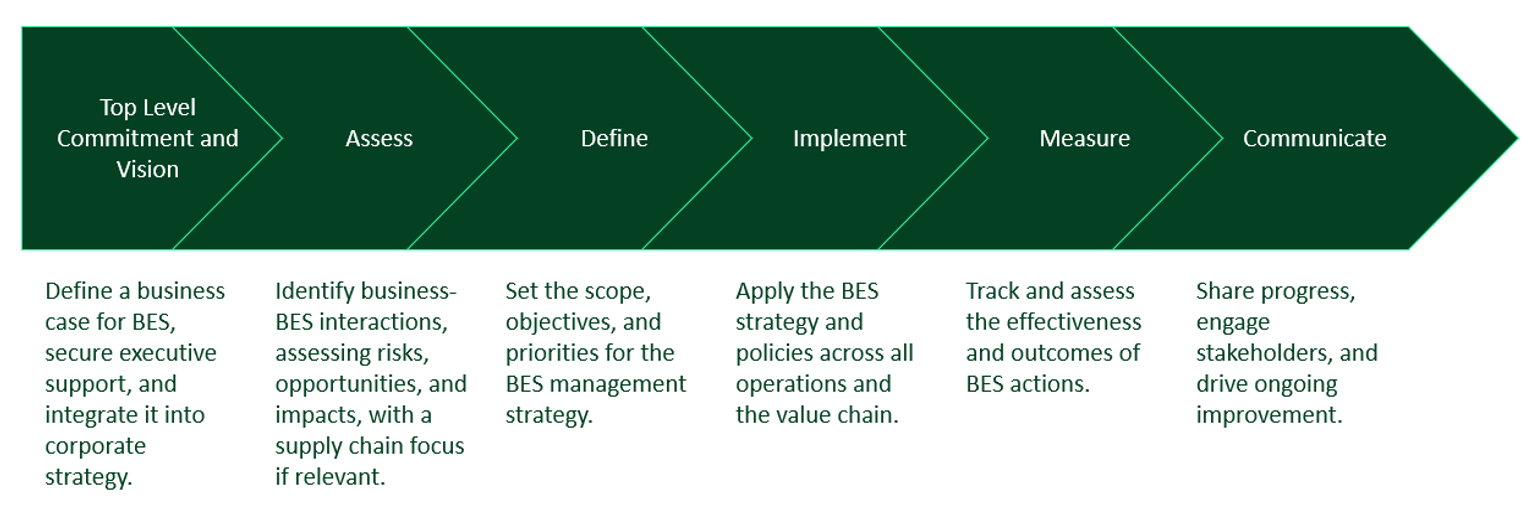
Figure 10: BES management model, own illustration according to UN Global Compact (2012)30UN Global Compact. A Framework for Corporate Action on Biodiversity and Ecosystem Services. (2012).
The following section outlines recommendations for the integration of BES strategies within corporate operations. These recommendations are categorised into six management stages, to align corporate sustainability strategies with four distinct domains: the environment, human rights, labor, and anti-corruption. It is recommended that companies implement key steps as part of existing environmental management systems or as a component of a biodiversity action plan.30UN Global Compact. A Framework for Corporate Action on Biodiversity and Ecosystem Services. (2012).
3.3.1 Top level commitment and vision
The development and dissemination of business cases play special roles in implementing BES management. A theoretical perspective alone is insufficient; rather, the detailed communication of a new business approach is necessary to develop decisions and strategies that are favorable to the company and biodiversity.5Macellari, M., Gusmerotti, N. M., Frey, M. & Testa, F. Embedding biodiversity and ecosystem services in corporate sustainability: A strategy to enable Sustainable Development Goals. Business Strategy & Development 1, 244-255 (2018). Therefore, companies should develop an initial business case for BES management tailored to the company’s needs and strategy. Companies should identify the potential benefits, such as market leadership, cost savings, increased employee engagement, enhanced market share, and the ability to shape industry standards ahead of emerging regulations.30UN Global Compact. A Framework for Corporate Action on Biodiversity and Ecosystem Services. (2012). Understanding ecosystem services as a key input in the business model is vital. Once this awareness is established, businesses must inevitably evaluate the sustainability of their resource use and determine the necessary steps for improvement.5Macellari, M., Gusmerotti, N. M., Frey, M. & Testa, F. Embedding biodiversity and ecosystem services in corporate sustainability: A strategy to enable Sustainable Development Goals. Business Strategy & Development 1, 244-255 (2018).
It is recommended that companies analyze the experiences of other companies regarding the integration of BES within their operations, to identify key learnings in terms of successes and challenges. These insights can then be applied to the specific situation in the own company.30UN Global Compact. A Framework for Corporate Action on Biodiversity and Ecosystem Services. (2012).
To ensure the effective implementation of BES management, it is essential to obtain the support of key operational departments, senior executives, and board members. In this regard, raising awareness plays a crucial role. Support and recognition at the management board level are essential for fostering awareness within the organization.5Macellari, M., Gusmerotti, N. M., Frey, M. & Testa, F. Embedding biodiversity and ecosystem services in corporate sustainability: A strategy to enable Sustainable Development Goals. Business Strategy & Development 1, 244-255 (2018). As discussed in Chapter 3.3.2.2 and illustrated in Figure 7, the Organisational and Issue Area Framework facilitates comprehension of the implementation and integration of BES within the broader strategies and actions of companies.30UN Global Compact. A Framework for Corporate Action on Biodiversity and Ecosystem Services. (2012). Environmental-oriented values of top management significantly influence the adoption of a strategic BES management approach.145Testa, F., Gusmerottia, N. M., Corsini, F., Passetti, E. & Iraldo, F. Factors Affecting Environmental Management by Small and Micro Firms: The Importance of Entrepreneurs’ Attitudes and Environmental Investment. Corporate Social Responsibility and Environmental Management 23, 373-385 (2016). The following guiding questions provided by the UN Global Compact (2017) on intentionality, ambition, consistency, collaboration, and accountability help companies to assess if their actions satisfy the leadership qualities that are needed to advance SDG 15.65UN Global Compact. 15. Life on Land <https://blueprint.unglobalcompact.org/sdgs/sdg15/> (2017).
3.3.1.1 Intentionality
Intentionality and commitment to the corporate strategy at the highest management level are crucial aspects in protecting life on land. This can increase employee motivation, enabling the communication of strategic goals to suppliers. As a result, respect and support for biodiversity are ensured throughout the supply chain. Companies should systematically evaluate their intentionality of supporting SDG 15 by addressing key guiding questions:
- Is our organization truly dedicated to achieving SDG 15, and have we developed a holistic strategy that reflects this commitment across all operations and the broader community?
- Do we have processes in place to learn from our actions and continuously improve our approach to biodiversity, and are we committed to learn from our actions in the first place?
- To what extent does top-level management, including the board, support our biodiversity strategy?65UN Global Compact. 15. Life on Land <https://blueprint.unglobalcompact.org/sdgs/sdg15/> (2017).
3.3.1.2 Ambition
Achieving SDG 15 requires ambitious action. In concrete terms, this necessitates the minimisation and ultimate elimination of a company’s impact on natural ecosystems. Innovations in all business areas and the value chain are essential to decouple economic activity from the destruction of natural capital. Companies should critically assess their ambition by reflecting on key guiding questions:
- Do our actions generate long-term outcomes that go beyond standard industry practices?
- How well do our initiatives align with the requirements for achieving SDG 15?65UN Global Compact. 15. Life on Land <https://blueprint.unglobalcompact.org/sdgs/sdg15/> (2017).
3.3.1.3 Consistency
Consistency must be ensured in companies through incentive structures that promote the protection of natural capital in all business functions. One way to encourage consistent behavior is a protocol for natural capital accounting that values ecosystem degradation and reflects it in financial reports. Companies should reflect on their consistency by analyzing the following guiding questions:
- Have we integrated support for SDG 15 across all organisational functions?
- Are employee and board incentives aligned with the goals of SDG 15?65UN Global Compact. 15. Life on Land <https://blueprint.unglobalcompact.org/sdgs/sdg15/> (2017).
3.3.1.4 Collaboration
Collaboration with multiple stakeholders is essential to protect natural ecosystems. Working with members of the supply chain is relevant to build capacity and ensure that they can also take measures to protect life on land. Similarly, government agencies and scientific institutions help to understand the most important priorities for nature conservation. Companies should consider the following guiding question regarding collaboration:
- Do we actively seek partnerships with governments, UN agencies, suppliers, civil society organizations, industry peers, and other stakeholders to exchange how to strengthen the achievement of SDG 15?65UN Global Compact. 15. Life on Land <https://blueprint.unglobalcompact.org/sdgs/sdg15/> (2017).
3.3.1.5 Accountability
Accountability is critical for the conservation of terrestrial and freshwater-based inland ecosystems. Corporate measures to preserve these ecosystems must be quantifiable and subject to verification. The impact of economic activities on ecosystems must be subject to continuous monitoring. To mitigate any negative consequences, it is essential to establish close and constructive cooperation with the affected communities. Companies should assess their accountability by using these guiding questions:
- Do we actively communicate our commitment to advancing SDG 15?
- Have we established processes to identify, monitor, and report on both positive and adverse impacts?
- Are we effectively mitigating the risks associated with our actions?
- Do we take responsibility for remediating any negative impacts resulting from our activities?
- How do we ensure meaningful engagement with stakeholders?65UN Global Compact. 15. Life on Land <https://blueprint.unglobalcompact.org/sdgs/sdg15/> (2017).
3.3.2 Assess
In this stage, companies should develop a comprehensive understanding of BES in the context of corporate business strategy, operational procedures, and associated risks.30UN Global Compact. A Framework for Corporate Action on Biodiversity and Ecosystem Services. (2012).
Without knowledge of the organization’s impact on biodiversity, it is impossible to develop effective strategies and set meaningful targets.5Macellari, M., Gusmerotti, N. M., Frey, M. & Testa, F. Embedding biodiversity and ecosystem services in corporate sustainability: A strategy to enable Sustainable Development Goals. Business Strategy & Development 1, 244-255 (2018). In Chapter 3.3.1, an overview of corporate impacts on biodiversity was provided to support a deeper understanding of these interconnections and lay the groundwork for strategic action.11Panwar, R., Ober, H. & Pinkse, J. The uncomfortable relationship between business and biodiversity: Advancing research on business strategies for biodiversity protection. Business Strategy and the Environment 32, 2554-2566 (2023). A comprehensive evaluation of the company’s dependencies on BES is imperative. This evaluation should be conducted in conjunction with a value chain analysis, encompassing the company’s operations, the procurement of raw materials from suppliers and sub-suppliers, and the utilisation of company products by consumers. It is essential to comprehend and quantify the benefits of specific, company-dependent BES components, and to assess their status.30UN Global Compact. A Framework for Corporate Action on Biodiversity and Ecosystem Services. (2012).
The increased business awareness gained through BES management highlights the risks and rising costs associated with inaction, which is mentioned in further detail in Chapter 3.3.2.1.146Dyllick, T. & Hockerts, K. Beyond the business case for corporate sustainability. Business Strategy and the Environment 11, 130-141 (2002). Considering the findings obtained from the preceding steps about the key operational activities, products, or services that are likely to have a significant impact on the BES, it is recommended that a baseline study be conducted. To either mitigate risks or protect critical ecosystem services, the appropriateness of existing company practices must be documented.30UN Global Compact. A Framework for Corporate Action on Biodiversity and Ecosystem Services. (2012).
As a subsequent measure, which can be implemented if it is relevant to a specific company, there could be the incorporation of a focus on the supply chain and a progressive implementation of the procurement requirements that encourage and eventually require suppliers to adopt best practices.30UN Global Compact. A Framework for Corporate Action on Biodiversity and Ecosystem Services. (2012).
To implement this awareness and responsibility strategically and operationally, there is a strong demand for integration and interaction at the level of actors and instruments inside and outside organizations. This includes integrated reporting and materiality to make the right decisions and to adapt and change internal business processes to make them more efficient and profitable. The development of management methods, procedures, guidelines, and objectives is relevant to the implementation of business processes.5Macellari, M., Gusmerotti, N. M., Frey, M. & Testa, F. Embedding biodiversity and ecosystem services in corporate sustainability: A strategy to enable Sustainable Development Goals. Business Strategy & Development 1, 244-255 (2018).
3.3.3 Define
In this step, companies are required to establish a concrete corporate goal. Furthermore, objectives associated with these goals must be incorporated, as well as a defined timeline for company-wide implementation for BES management. Companies should establish BES targets that prioritise the achievement of a net positive impact, or, at the very least, no net loss of biodiversity.30UN Global Compact. A Framework for Corporate Action on Biodiversity and Ecosystem Services. (2012).
To avoid, minimise, or negate the impacts of the BES components most affected by the company’s activities, it is necessary to establish work benchmarks. Such benchmarks should be found that, on the one hand, measure that no harm is done and, on the other hand, that good is done.30UN Global Compact. A Framework for Corporate Action on Biodiversity and Ecosystem Services. (2012). A BES management pilot strategy should include the following aspects:
- The focus should be on actions that a company can take within its operations, those for which it can assume responsibility, or those it can influence.
- The assessment should be limited to a few geographic areas to gain in-depth rather than broad insights.
- Measures should be based on measurable targets, or a solid framework should be established that enables the setting of credible goals that can be reliably measured.
- The design of BES management protocols and methods must align with the monitoring requirements of existing operational procedures.
- In certain instances, it may be advantageous to devise strategies that address BES components indirectly influenced by the company or other stakeholders on which the company depends.
- Partnerships should be identified that possess the requisite expertise to ensure the development of a credible methodology and monitoring framework.
- An independent evaluation or audit by a third party after the pilot phase should be planned from the outset.30UN Global Compact. A Framework for Corporate Action on Biodiversity and Ecosystem Services. (2012).
Companies should establish annual corporate targets and managerial incentives to facilitate the implementation of their BES management strategy. Clear assignment of responsibility for internal awareness and strategy execution is essential to ensure accountability. Simultaneously, investments in innovation and technological advancements can contribute to improving the environmental performance of operational units.30UN Global Compact. A Framework for Corporate Action on Biodiversity and Ecosystem Services. (2012).
3.3.4 Implement
In order to facilitate the effective management of BES, it is imperative to implement the mitigation hierarchy delineated in Chapter 3.3.3.30UN Global Compact. A Framework for Corporate Action on Biodiversity and Ecosystem Services. (2012). The hierarchy stipulates that companies should prioritise the following strategy: firstly, the prevention of biodiversity loss; secondly, the minimisation of harm caused by unavoidable loss; and finally, the remediation and offsetting of any damage caused.11Panwar, R., Ober, H. & Pinkse, J. The uncomfortable relationship between business and biodiversity: Advancing research on business strategies for biodiversity protection. Business Strategy and the Environment 32, 2554-2566 (2023). It is recommended that this approach be encouraged for adoption throughout the supply chain. As a preliminary step in implementing this hierarchy, priority should be given to implementation at sites with high biodiversity value.30UN Global Compact. A Framework for Corporate Action on Biodiversity and Ecosystem Services. (2012).
In the process of developing and implementing a BES strategy, it is essential to ensure the involvement of relevant stakeholders. This includes local communities residing in proximity to the operating site, communities whose livelihoods are contingent on the utilisation of such resources and are adversely affected by operations, and local authorities. The involvement of these stakeholders fosters the advancement of common goals and ensures that environmental and social needs are met.30UN Global Compact. A Framework for Corporate Action on Biodiversity and Ecosystem Services. (2012).
The methodological framework used by the company (for example, the one introduced in this chapter) should be implemented, monitored, and refined. This is done to avoid, control, mitigate, and compensate for risks and negative impacts, or enhance positive impacts at pilot sites.30UN Global Compact. A Framework for Corporate Action on Biodiversity and Ecosystem Services. (2012).
The successful implementation of BES management is dependent upon the independent evaluation of the robustness, validity, and repeatability of the measures implemented at the pilot sites. Concurrently, it is essential to determine how the results of the pilot phase can be incorporated into company guidelines that express a commitment to BES and align the organization with these goals.30UN Global Compact. A Framework for Corporate Action on Biodiversity and Ecosystem Services. (2012).
3.3.5 Measure
Companies need to monitor, assess, and report on biodiversity impacts using BES impact indicators.30UN Global Compact. A Framework for Corporate Action on Biodiversity and Ecosystem Services. (2012). Measurement enables control of decision-making and management processes in advance, as well as facilitating retrospective evaluation of strategies and programs.147Schaltegger, S. & Burritt, R. Measuring and managing sustainability performance of supply chains. Supply Chain Management: An International Journal 19, 232-241 (2014). At the same time, however, this is a main barrier, as already explained in Chapter 4.1. Measurement is further discussed in Chapter 4.4, which shows how companies can find the fitting measurement approach and metrics.148De Ryck, J., Driesen, K., Verhelst, J., Lammerant, J., et al. Assessment of Biodiversity Measurement Approaches for Businesses and Financial Institutions Update report 5. (2024).
Monetisation can facilitate measurement and guide the identification of effective solutions, playing a pivotal role in both internal decision-making and external communication strategies. By assigning economic value to ecosystem services, businesses can address a range of challenges, notably encouraging investment in ecosystem protection. However, while monetisation can indeed encourage investment in ecosystem protection, it is not universally necessary or viable.5Macellari, M., Gusmerotti, N. M., Frey, M. & Testa, F. Embedding biodiversity and ecosystem services in corporate sustainability: A strategy to enable Sustainable Development Goals. Business Strategy & Development 1, 244-255 (2018).
An important example is the Economics of Ecosystems and Biodiversity (TEEB) initiative, which offers monetary assessments of ecosystem service degradation, thereby amplifying concerns and raising awareness about the ongoing loss of ecosystems and their associated socio-economic consequences.5Macellari, M., Gusmerotti, N. M., Frey, M. & Testa, F. Embedding biodiversity and ecosystem services in corporate sustainability: A strategy to enable Sustainable Development Goals. Business Strategy & Development 1, 244-255 (2018). This is necessary because nature is often invisible in economic decision-making, leading to the steady depletion of natural capital. Without recognizing the true cost of replacing nature’s free services or understanding that man-made alternatives can be prohibitively expensive, ecosystems continue to be undervalued.149TEEB. Approach, <https://teebweb.org/about/approach/> (n.d.).
Due to the scope of this work, this section only provides an overview of the contents of the TEEB report but does not go into further depth. The TEEB for Businesses Report provides businesses with insights into how BES impacts their operations and financial stability. It highlights the economic risks of biodiversity loss, the benefits of integrating BES into decision-making, and practical tools for measuring and managing biodiversity impacts. Companies will find guidance on regulatory compliance, risk mitigation strategies, and emerging market opportunities linked to sustainable resource management. By incorporating BES considerations, businesses can enhance long-term resilience, meet stakeholder expectations, and align with global sustainability trends.23TEEB. The Economics of Ecosystems and Biodiversity in Business and Enterprise. (London and New York, 2012).
In general, it is recommended that a measurement and verification protocol is established, encompassing provisions for audit and review over time. The protocol should be formalised and disseminated to facilitate the monitoring of the effectiveness and efficiency of BES management measures. It should also enable the correction of any violations and performance deficiencies, if necessary. Once the scope and systematic implementation of the company’s BES monitoring and verification protocol has been determined, verification of this defined BES footprint should continue. The evaluation of the results should be conducted in two stages. Firstly, the results should be evaluated internally, if appropriate. Secondly, the results should be evaluated within the framework of an independent certification system or generally recognized international performance standards. The results form the basis for refining and improving the procedures.30UN Global Compact. A Framework for Corporate Action on Biodiversity and Ecosystem Services. (2012).
3.3.6 Reporting and collaboration
Corporate sustainability reporting is an effective way for companies to communicate their performance and demonstrate progress on BES obligations.30UN Global Compact. A Framework for Corporate Action on Biodiversity and Ecosystem Services. (2012). The standardised language for corporate reporting enables concrete implementation.150Liu, J. et al. Systems integration for global sustainability. Science 347, 1258832 (2015). Reporting not only legitimises corporate efforts but also builds credibility with key stakeholders.30UN Global Compact. A Framework for Corporate Action on Biodiversity and Ecosystem Services. (2012).
The reporting of BES-related activities can be done in various ways.30UN Global Compact. A Framework for Corporate Action on Biodiversity and Ecosystem Services. (2012). Companies can be certified with ISO 14001, the most popular international standard for implementing an Environmental Management System (EMS).151Heras-Saizarbitoria, I., Dogui, K. & Boiral, O. Shedding light on ISO 14001 certification audits. Journal of Cleaner Production 51, 88-98 (2013). Further, the Global Reporting Initiative (GRI) Standards help organizations of all sizes report their economic, environmental, and social impacts credibly and comparably, increasing transparency for investors, policymakers, and civil society.152GRI. Continuous improvement, <https://www.globalreporting.org/standards/> (n.d.). The Communication on Progress (CoP) is an annual publication in which companies outline the measures they have taken to implement the ten principles of the UN Global Compact. All participating companies are obliged to publish this report annually.153UN Global Compact. Policy on Communication on Progress. (2024). This guideline can be used to disclose progress concerning the four main topics of communication (human rights, labor, the environment, and anti-corruption). Companies can communicate progress in the three environmental principles (principles 7, 8, and 9), which are closely related to the objectives of the CBD. As recognized by the CBD, reporting serves three principal purposes:
- As an objective communication tool, it reflects a company’s BES performance to stakeholders.
- As an internal management tool, it fulfils two functions. Firstly, it facilitates the alignment of corporate strategies, policies, and responsibilities on BES with the various constituent parts of the organization. Secondly, it carries out a risk and opportunity analysis and integrates the results into management processes.
- As a market information source, it allows a systematic incorporation of BES considerations into decision-making.30UN Global Compact. A Framework for Corporate Action on Biodiversity and Ecosystem Services. (2012).
Heightened awareness of corporate responsibility has led to an increased focus on the establishment of dialogue and cooperation with relevant stakeholders. Stakeholders can be defined as any individuals or entities that are impacted by corporate activities. This includes local communities, governments, financial institutions, shareholders, employees, and consumers.30UN Global Compact. A Framework for Corporate Action on Biodiversity and Ecosystem Services. (2012). Dialogues with various stakeholders are critical to creating a social license to operate.5Macellari, M., Gusmerotti, N. M., Frey, M. & Testa, F. Embedding biodiversity and ecosystem services in corporate sustainability: A strategy to enable Sustainable Development Goals. Business Strategy & Development 1, 244-255 (2018). In addition, industry associations and sectoral bodies are to be engaged to promote the dissemination of best management practice within the field of BES. Table 1 illustrates the scale or scope of stakeholder engagement. It also indicates the type of stakeholders represented in a particular area, how they can be interacted with, and the benefits of doing so. The specific stakeholders affected by a company’s activities and the phase of its business cycle depend on various factors. It is therefore important to identify and assess these stakeholders to determine the most effective forms of collaboration and thus maximise impact.30UN Global Compact. A Framework for Corporate Action on Biodiversity and Ecosystem Services. (2012).
Table 1: Scale of stakeholder engagement, own illustration according to UN Global Compact (2012)30UN Global Compact. A Framework for Corporate Action on Biodiversity and Ecosystem Services. (2012).
| Scale or scope | Stakeholders | Engagement opportunities/benefits |
| International operations | EmployeesShareholders | Assess risks and identify opportunitiesEncourage shared decision-making and stakeholder involvementImprove transparency and corporate credibilityStrengthen corporate values and enhance staff capabilities |
| Local community/ authorities | Local communitiesCommunity-based organisations | Strengthen reputation and obtain a license to operate by enhancing social and environmental performanceStrengthen the ability to collaborate with communitiesLower operational risksCreate inclusive business models that consider both BES and community interests |
| National | National agenciesNational government bodiesNational NGOs | Recognise and respond to regulatory changes affecting the companyProvide input to help shape policy and regulatory frameworks |
| International | Global initiatives and working groups | Achieve global recognition for efforts and a responsible brand imageShare insights and best practices with international initiatives and working groups |
Engaging with relevant stakeholders also fosters inclusivity and partnerships, which positively impact those affected by the sustainable and fair use of natural resources. The advantages of such collaboration are manifold, including the procurement of legal and social operating licenses, the augmentation of productivity, the attraction of ethical consumers and investors, and the assurance of future access to natural resources. These points underscore the importance of considering the most strategic forms of engagement and identifying the most appropriate partners. The pursuit of engagement and action can occur at various levels, including internal, local, regional, national, and international levels.65UN Global Compact. 15. Life on Land <https://blueprint.unglobalcompact.org/sdgs/sdg15/> (2017).
A fair and just distribution of benefits arising from the use of biological resources is central to BES measures. Companies operating in affected regions or using natural resources should consider the social impacts of their activities, engage with local communities, and recognize property rights to minimise reputational and operational risks. Both the CBD and the Nagoya Protocol (Chapter 3.2.2) emphasise the importance of fair benefit sharing, taking into account the free, prior, and informed consent of affected communities.30UN Global Compact. A Framework for Corporate Action on Biodiversity and Ecosystem Services. (2012).
3.4 Measurement
This chapter provides an overview of biodiversity measurement approaches suitable for addressing SDG 15 and the GBF. After that, the metrics that build the bases for these approaches will be introduced. It then introduces the Biodiversity Measurement Navigation Wheel, which helps businesses choose the fitting approach for their needs. There is a particular focus on the section of biodiversity targets.
3.4.1 Key biodiversity measurement approaches
The demand for credible measurement tools to assess the impact of businesses on biodiversity is increasing.154Lammerant, J. et al. Assessment of biodiversity measurement approaches for businesses and financial institutions. Update report 3 (2019). In a rapidly evolving landscape of methods, criteria, and standards, it is difficult to determine the most suitable tool. The measurement methods differ widely in terms of their function, scope, and alignment with global biodiversity targets, which complicates the selection process.141Katic, P. G., Cerretelli, S., Haggar, J., Santika, T. & Walsh, C. Mainstreaming biodiversity in business decisions: Taking stock of tools and gaps. Biological Conservation 277, 109831 (2023).
Approaches provide the overall framework for assessment. Metrics (Chapter 4.4.2) provide quantifiable data, and models provide the underlying structure for analyzing and interpreting the data to inform decision-making and drive action towards biodiversity conservation.55Zhu, Y., Prescott, G. W., Chu, P. & Carrasco, L. R. Glaring gaps in tools to estimate businesses’ biodiversity impacts hinder alignment with the Kunming-Montreal global biodiversity framework. Journal of Cleaner Production 451, 142079 (2024).
Models used within specific biodiversity measurement approaches are, for example, GLOBIO and ReCiPe. GLOBIO is a model assessing the impact of various pressures on biodiversity intactness. It is based on pressure-impact relationships. ReCiPe is a scientific life cycle assessment (LCA) methodology. It quantifies the Potentially Disappeared Fraction (PDF) of GHG emissions, air pollution, water consumption, water and land pollution, waste generation, and land use on terrestrial, freshwater, and marine ecosystems. Both GLOBIO and ReCiPe can be used for pressure-impact modeling.148De Ryck, J., Driesen, K., Verhelst, J., Lammerant, J., et al. Assessment of Biodiversity Measurement Approaches for Businesses and Financial Institutions Update report 5. (2024).
Table 2 presents biodiversity and ecosystem services approaches relevant to businesses and financial institutions. It specifies the resource type of each approach and provides a brief description of its purpose and application. De Ryck et al (2024) mentions three different resource types:
- A tool is a ready-to-use solution that produces a numerical result for a given indicator. It can be implemented as an online platform, software application, or an Excel-based calculation sheet.
- A calculation method or methodology consists of a structured sequence of steps, or a defined process used to derive an output for an indicator.
- A database is a systematically organized collection of data that is stored electronically and can be retrieved as needed.148De Ryck, J., Driesen, K., Verhelst, J., Lammerant, J., et al. Assessment of Biodiversity Measurement Approaches for Businesses and Financial Institutions Update report 5. (2024).
Table 2: Shortened overview of biodiversity and ecosystem services measurement approaches, own illustration according to De Ryck et al. (2024)148De Ryck, J., Driesen, K., Verhelst, J., Lammerant, J., et al. Assessment of Biodiversity Measurement Approaches for Businesses and Financial Institutions Update report 5. (2024).
| Biodiversity Approaches Table | ||
| Name of biodiversity measurement approach | Resource type | Description |
| Biodiversity Monitoring System (BMS) | Calculation method, tool | The BMS tool, developed as part of the EU LIFE project, enables food standards, companies, and cooperatives to systematically monitor biodiversity indicators at their certified operations. Based on 41 key indicators that capture both positive potential (e.g., ecological structures, biotope corridors, buffer zones) and negative influences (e.g., use of chemical pesticides, erosion, water consumption), aggregated results are provided for groups (e.g., all Global-G.A.P.-certified tomato producers in Spain). This makes it possible to track the development of individual indicators over time. |
| Biodiversity Net Gain Calculator (BNGC) | Calculation method, tool (Excel) | The Arcadis BNGC was developed to make the biodiversity-related value of land use transparent at the site level. Using a metric system that considers extent, condition, and importance, each unit of area is assigned a biodiversity value between 0 and 1 based on field research by experienced ecologists. This enables companies to practically demonstrate no net loss and a net gain. |
| Biodiversity Performance Tool (BPT) | Calculation method, tool | The BPT was developed as part of the EU LIFE project ‘Biodiversity in Standards and Labels for the Food Sector’ and is used at the company level to support farmers and consultants in creating and implementing Biodiversity Action Plans (BAP). The tool collects around 100 data and information points, which are summarised into 79 key figures and indicators to describe the biodiversity baseline of a business, for example, about habitats, ecological structures, potentially harmful agricultural practices, training, and cooperation. In the EU LIFE project ‘Insect Responsible Sourcing Regions’, specific indicators for insect protection were also integrated. A traffic light system is used to visualise the strengths and weaknesses of the operation and provide links to descriptions of measures. Regular updates also allow the monitoring of the implementation of the BAP and the impacts achieved. |
| Ecosystem Intelligence Platform (EI) | Tool | The EI platform helps non-ecologists to carry out site assessments of ecosystem services under different landscape management conditions. It uses a systems-based approach and a suite of models to assess the impacts and benefits of land use decisions in terms of climate, air quality, water, biodiversity, soil, and social factors. |
| Exploring Natural Capital Opportunities, Risks and Exposure (ENCORE) | Database, tool (web application) | The Nature Capital module of ENCORE illustrates how the economy depends on and affects nature, and how environmental change creates business risk. At the same time, the biodiversity module enables the assessment of whether financial activities in selected sectors (currently mining and agriculture) are consistent with a nature-positive future. |
| Integrated Biodiversity Assessment Tool (IBAT) | Tool, database, metric (i.e., STAR) | IBAT is a web-based mapping tool that provides commercial access to relevant global biodiversity datasets (such as WDPA, WDKBA, and the IUCN Red List). It generates reports, GIS downloads, Excel files, and API interfaces to provide location-specific insights into biodiversity risks, opportunities, and dependencies, including for reporting purposes (TNFD, GRI, CSRD, etc.). IBAT also integrates the STAR metric, which measures how investments can reduce the risk of species extinction and thus supports the targeted alignment of financial activities with global goals such as the SDGs. |
| LIFE Methodology (LIFE) | Calculation method, tool (web application) | The LIFE methodology provides robust, measurable, quantitative, and qualitative information on the integration of biodiversity in companies, regardless of size or industry. Its quantitative metrics show the biodiversity balance (pressure vs. positive performance) and provide strategic guidance for effective conservation action. This is complemented by qualitative indicators (LIFE Standard) that analyse impacts, dependencies, risks, and opportunities related to natural capital, ecosystem services, and supply chain risks. Implementation is user-friendly thanks to the LIFE Key software. |
| Nala.Earth | Tool | Nala Earth is a nature and biodiversity management platform that helps companies identify their nature-related risks and report in line with new frameworks and regulations (TNFD, SBTN, EU CSRD). It processes scientific data, including satellite imagery and primary measurements, to make it usable for business decision-making. |
| Xylo Systems Biodiversity Assessment (Xylo) | Calculation method, tool | Xylo Systems is a biodiversity intelligence tool that helps companies assess their biodiversity footprint at the site and portfolio level. It aggregates global biodiversity data across species and ecosystems to quantify the state of biodiversity, identify risks to business operations, and highlight opportunities to minimise damage and restore nature. The tool’s insights include, for example, the number of endangered species on site, the integrity of ecosystems and biodiversity, a local biodiversity index, site-specific keystone species, a ranking of biodiversity threats, the risk of species extinction, land cover types, and proximity to key biodiversity areas and protected areas. Xylo Systems can also generate reports for Greenstar and TNFD. |
Nevertheless, there are some gaps in the measurement approaches. In particular, the lack of alignment of many approaches with the GBF makes it difficult for companies to measure and transparently communicate their biodiversity performance in line with global targets. Important aspects such as ecosystem integration, the sustainable use of biological resources by indigenous communities, or the impact of climate protection measures on biodiversity are insufficiently taken into account in existing approaches.55Zhu, Y., Prescott, G. W., Chu, P. & Carrasco, L. R. Glaring gaps in tools to estimate businesses’ biodiversity impacts hinder alignment with the Kunming-Montreal global biodiversity framework. Journal of Cleaner Production 451, 142079 (2024).
The current implementation of these tools is not fully aligned with the GBF.141Katic, P. G., Cerretelli, S., Haggar, J., Santika, T. & Walsh, C. Mainstreaming biodiversity in business decisions: Taking stock of tools and gaps. Biological Conservation 277, 109831 (2023). Consequently, they also fail to fully align with SDG 15, as the GBF is expected to serve as the new guideline for achieving SDG 15.62Lehmann, I. Inspiration from the Kunming-Montreal Global Biodiversity Framework for SDG 15. International Environmental Agreements: Politics, Law and Economics 23, 207-214 (2023). The absence of harmonised frameworks remains a key challenge, resulting in fragmented and ad-hoc approaches rather than integrated and comprehensive management strategies. To support corporate contributions to biodiversity goals, coordinated efforts are essential to develop standardised methods for measurement, monitoring, and reporting.55Zhu, Y., Prescott, G. W., Chu, P. & Carrasco, L. R. Glaring gaps in tools to estimate businesses’ biodiversity impacts hinder alignment with the Kunming-Montreal global biodiversity framework. Journal of Cleaner Production 451, 142079 (2024).
Alongside other new emerging initiatives (see Chapter 4.4.3), the International Standard for Sustainable Land Management, developed by the LIFE Institute, represents a new initiative aimed at harmonising measurement methods and improving the application of biodiversity assessment tools. Shifting the focus from individual corporate applications to collective approaches. These emerging initiatives seek to mainstream biodiversity considerations at both sectoral and territorial levels, fostering conservation efforts and promoting sustainable land management.55Zhu, Y., Prescott, G. W., Chu, P. & Carrasco, L. R. Glaring gaps in tools to estimate businesses’ biodiversity impacts hinder alignment with the Kunming-Montreal global biodiversity framework. Journal of Cleaner Production 451, 142079 (2024).
Despite their limitations, these approaches have several positive functions. They help to identify relationships and potential impacts on biodiversity, while also evaluating the success of conservation initiatives. They help companies identify opportunities and risks across value chains and operations. They also support business strategy and product development by integrating biodiversity considerations into decision-making. They enable long-term monitoring of biodiversity performance and provide a basis for reporting frameworks such as TNFD, CSRD and others.141Katic, P. G., Cerretelli, S., Haggar, J., Santika, T. & Walsh, C. Mainstreaming biodiversity in business decisions: Taking stock of tools and gaps. Biological Conservation 277, 109831 (2023).
3.4.2 Key biodiversity metrics
Measuring biodiversity is complex, as no single metric can fully capture its various dimensions across different business applications and organisational focus areas. Table 3 provides insights into commonly used biodiversity metrics, particularly state indicators.148De Ryck, J., Driesen, K., Verhelst, J., Lammerant, J., et al. Assessment of Biodiversity Measurement Approaches for Businesses and Financial Institutions Update report 5. (2024).
Table 3: Key biodiversity metrics, own illustration according to De Ryck et al. (2024)148De Ryck, J., Driesen, K., Verhelst, J., Lammerant, J., et al. Assessment of Biodiversity Measurement Approaches for Businesses and Financial Institutions Update report 5. (2024).
| Type of metric | Commonly used metrics | Unit of biodiversity | Approaches[1]relying on these metrics |
| Species metrics | Number of individuals | Number of individuals of any one species | Xylo |
| STAR (Species Threat Abatement and Restoration metric) | Globally threatened species | ENCORE;IBAT;Xylo | |
| Species richness | Number of species | Xylo | |
| Extent Condition metrics | Habitat hectares; quality hectares | Ecosystems | BPT;BMS;EI;Xylo |
| MSA[area] Mean species abundance | All species | BNGC;ENCORE | |
| Extent (or Area) * Condition (or Quality) *Significance metrics | Biodiversity Intactness Index (BII) | All species | Xylo |
| Ecosystem Intactness Index (EII) | Ecosystems | Xylo | |
| BNGC score | Biodiversity value per m² | BNGC | |
| Biodiversity scoring system | Biodiversity units (BU) | EI | |
| Protected Area | Protected habitat | IBAT | |
| Key Biodiversity Areas | Biodiversity areas | IBAT | |
| Financial metrics | Total monetary value (e.g. €/year) | Ecosystem services | EI |
| Combined state, pressure, and response metrics (dashboard) | No single quantitative metric, with scorecards used to identify risk areas. Appreciation of progress | Habitat/species population/biodiversity management unit (BMU) | LIFE |
Key metrics include intactness-based models such as Mean Species Abundance (MSA), which allow aggregation but lack local biodiversity specificity. In contrast, species-focused metrics, like the STAR metric used in the IBAT approach, emphasise threatened species but may overlook biodiversity values not covered by the IUCN Red List. Additionally, monetised ecosystem service metrics assess biodiversity from an economic perspective, while thematic metrics, such as deforestation-free or palm oil-free, focus on specific environmental concerns.148De Ryck, J., Driesen, K., Verhelst, J., Lammerant, J., et al. Assessment of Biodiversity Measurement Approaches for Businesses and Financial Institutions Update report 5. (2024).
Despite the frequent inclusion of land use in biodiversity approaches, several important metrics remain completely disregarded. Notably, recognition of traditional territories of IPLCs and green and blue spaces in urban areas is absent from all indices. Similarly, human connection to nature, biosafety measures and biotechnology, and incentives impacting biodiversity conservation remain unmeasured. These omissions underscore the limitations of existing biodiversity indices and the need for a broader, more integrated approach, as stated in the subchapter above.55Zhu, Y., Prescott, G. W., Chu, P. & Carrasco, L. R. Glaring gaps in tools to estimate businesses’ biodiversity impacts hinder alignment with the Kunming-Montreal global biodiversity framework. Journal of Cleaner Production 451, 142079 (2024).
Given the multidimensional nature of biodiversity, a combination of different metrics is necessary. Decision-making based on a single metric can lead to unintended consequences, for example, when intactness metrics and species-based metrics yield different conservation priorities. To effectively support SDG 15 and the GBF, biodiversity measurement approaches must integrate multiple metrics, ranging from pressure indicators to state and financial indicators. This ensures a comprehensive understanding of biodiversity impacts and dependencies, enabling more effective conservation strategies.148De Ryck, J., Driesen, K., Verhelst, J., Lammerant, J., et al. Assessment of Biodiversity Measurement Approaches for Businesses and Financial Institutions Update report 5. (2024).
3.4.3 The Biodiversity Measurement Navigation Wheel 3.0
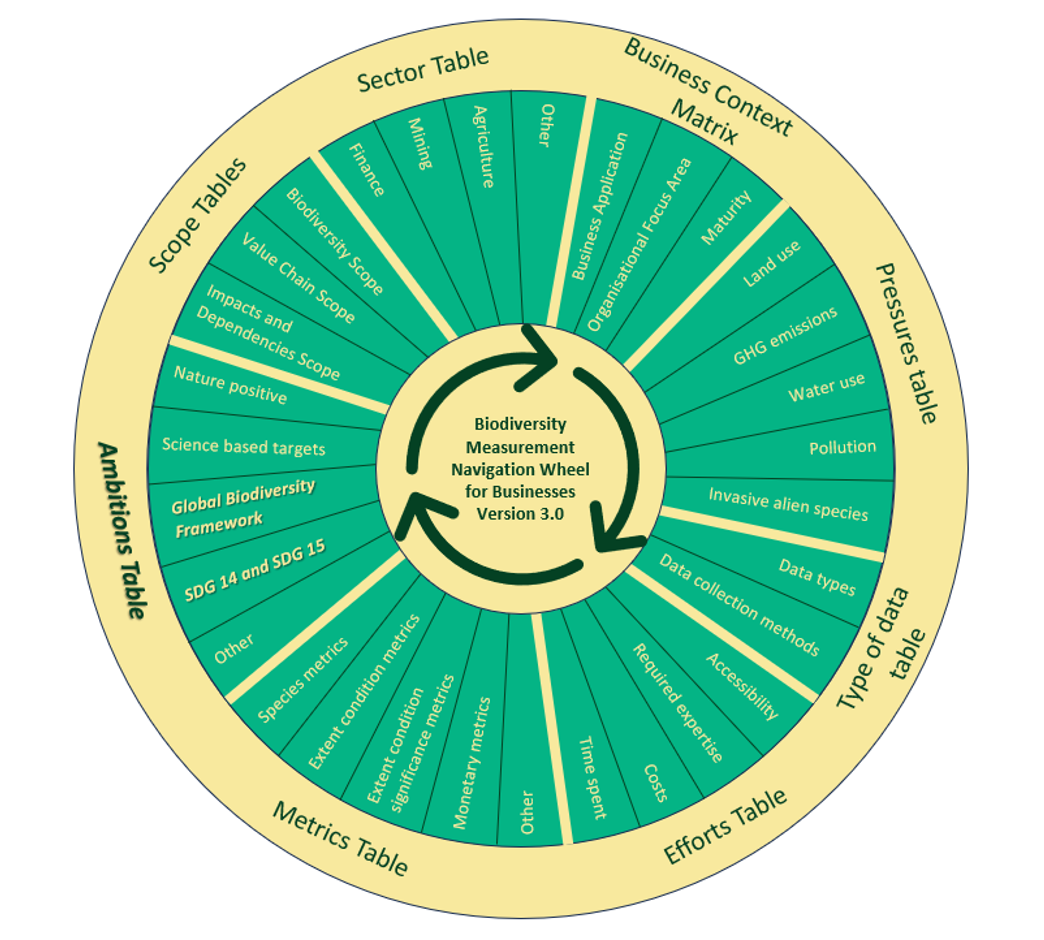
Figure 11: Biodiversity Measurement Navigation Wheel for Businesses Version 3.0, own illustration according to De Ryck et al. (2024)148De Ryck, J., Driesen, K., Verhelst, J., Lammerant, J., et al. Assessment of Biodiversity Measurement Approaches for Businesses and Financial Institutions Update report 5. (2024).
The Biodiversity Measurement Navigation Wheel 3.0 (Figure 11) is a decision-making framework designed to help businesses and financial institutions identify the most suitable biodiversity measurement approaches. By considering multiple criteria, such as business context, biodiversity pressures, data type, effort level, metrics, scope, sector, and biodiversity ambitions, the tool enables users to make informed choices based on their specific needs.148De Ryck, J., Driesen, K., Verhelst, J., Lammerant, J., et al. Assessment of Biodiversity Measurement Approaches for Businesses and Financial Institutions Update report 5. (2024).
A key feature of the Navigation Wheel is its Fast Track Approach, which allows users to evaluate multiple criteria simultaneously rather than following a rigid step-by-step process. It also provides overview tables for better comparison of different metrics and recognises the unique requirements of the financial sector. Covering 37 measurement approaches, the tool is regularly updated to reflect advancements in biodiversity assessment.148De Ryck, J., Driesen, K., Verhelst, J., Lammerant, J., et al. Assessment of Biodiversity Measurement Approaches for Businesses and Financial Institutions Update report 5. (2024).
Users have the flexibility to prioritise criteria and systematically eliminate approaches that do not align with their needs. While there is no strict hierarchy, starting with the Business Context criterion is recommended for an efficient selection process.148De Ryck, J., Driesen, K., Verhelst, J., Lammerant, J., et al. Assessment of Biodiversity Measurement Approaches for Businesses and Financial Institutions Update report 5. (2024).
Among the eight selection criteria of the Biodiversity Measurement Wheel 3.0, Biodiversity Ambition is particularly relevant in this thesis, as it examines alignment with global biodiversity frameworks such as SDG 15 and the GBF. Tracking progress toward these targets is essential for businesses committing to sustainability goals, such as compliance with disclosure frameworks (TNFD, GRI, CSRD) or achieving biodiversity targets like NNL, “nature positive”, or science-based targets. Some measurement approaches are more effective than others in assessing progress, making target alignment a key selection criterion.148De Ryck, J., Driesen, K., Verhelst, J., Lammerant, J., et al. Assessment of Biodiversity Measurement Approaches for Businesses and Financial Institutions Update report 5. (2024).
The Biodiversity Ambitions Table links key global biodiversity targets with their implications for tool selection and suitable measurement approaches. Table 4 represents a shortened version of the Biodiversity Ambitions Table limited to the GBF and SDG 15.148De Ryck, J., Driesen, K., Verhelst, J., Lammerant, J., et al. Assessment of Biodiversity Measurement Approaches for Businesses and Financial Institutions Update report 5. (2024).
Table 4: Biodiversity ambitions, own illustration according to De Ryck (2024)148De Ryck, J., Driesen, K., Verhelst, J., Lammerant, J., et al. Assessment of Biodiversity Measurement Approaches for Businesses and Financial Institutions Update report 5. (2024).
| Biodiversity Ambitions Table | ||
| Biodiversity Target | Consequences for tool selection | Suitable tools |
| GBF | Many of the GBF’s objectives apply primarily at the international and national levels. However, these types of goals also have an impact on the economy. For this reason, the following aspects have a separate role to play in choosing the appropriate approach: A greater emphasis on measuring biodiversity performance (for example, mandatory reporting is already in place at EU level and now applies globally); this has a positive impact on all approaches; There is more demand for evidence that global nature targets are being met. As a result, companies are applying more biodiversity accounting approaches. These approaches are based on measurement concepts that can measure and compare positive and negative impacts on biodiversity; An increased demand for approaches that can measure impact reduction at the company level; Advocacy of LCA approaches in the calculation of production and consumption footprints;Metrics related to the identification and interpretation of risks are gaining importance. | A combination of measurement approaches is relevant to cover the following points: Both impacts and dependencies (e.g., using LIFE) Both habitats/species and ecosystem services All significant pressures on biodiversity The entire value chain, including the consumption phase (LCA approaches also for capturing the consumption phase) Terrestrial, freshwater, and marine biodiversity, where relevant for the company Risks and opportunities in addition to impacts and dependenciesAccounting approaches (e.g., Biological Diversity Protocol) are based on measurement approaches. These measurement approaches should be suitable for measuring and comparing positive and negative impactsIf these objectives are applied at the site level, more specific measurement approaches can be developed there, which in turn can be combined.Targets can be addressed (partly) with measurement approaches like: Xylo Systems, IBAT (with the STAR metric used for GBF Goal 1 and Goal 4), Nala.Earth and ENCORE. |
| SDG 15 | In SDG 15, one specific topic relates to forests. Endangered species is another KPI under SDG 15, and some measurement approaches are explicitly based on such metrics. | For SDG 15, suitable tools are those using approaches that utilise MSA and PDF and rely on models such as Globio and ReCiPe. These give a rough idea of the impact on biodiversity about land use intensity categories. Similar to marine ecosystems, STAR can also be useful in terrestrial and freshwater ecosystems. A very useful tool for measuring deforestation and afforestation in the supply chains of certain commodities is data sources focusing on the condition and extent of forests (satellite imagery). The BPT and the BMS assess biodiversity impacts at the farm level, with the BMS aggregating data to provide food companies with insights into the collective impact of farmers within a supply chain.Invasive alien species are primarily captured by site-level approaches, such as the BNGC and the BMS in the food sector.To evaluate the effects of development activities on terrestrial and freshwater ecosystems in relation to sustainability goals, quantitative alternative analyses can be applied. The EI platform facilitates comparisons against sustainability benchmarks and high-performing reference conditions.Additionally, Xylo Systems and Nala.Earth offer further potential for biodiversity assessment. |
For the GBF, the increasing importance of biodiversity measurement, mandatory reporting, and corporate accountability has led to a growing demand for tools that assess both biodiversity impacts and dependencies. Measurement approaches must integrate multiple aspects, including habitat and species conservation, ecosystem services, material pressures, and value chain impacts. Specific tools like Xylo Systems, IBAT (STAR metric), Nala.Earth, and ENCORE contribute to addressing GBF targets.148De Ryck, J., Driesen, K., Verhelst, J., Lammerant, J., et al. Assessment of Biodiversity Measurement Approaches for Businesses and Financial Institutions Update report 5. (2024).
For SDG 15, key focus areas include deforestation, sustainable forest management, and threatened species. Tools using intactness-based models like MSA and PDF (e.g., Globio, ReCiPe) provide insights into land use impacts, while satellite imagery and biodiversity monitoring systems help track deforestation and afforestation. Sector-specific tools, such as the BPT and BMS, assist in measuring farm-level biodiversity impacts. Additionally, tools like the BNGC and EI platform support site-level assessments and quantitative alternatives analysis.148De Ryck, J., Driesen, K., Verhelst, J., Lammerant, J., et al. Assessment of Biodiversity Measurement Approaches for Businesses and Financial Institutions Update report 5. (2024).
However, there is a need to constantly check these approaches as new initiatives are emerging. For example:
- The Nature Positive Initiative’s Working Group on Metrics is developing a standardised set of “State of Nature” (SON) metrics to track progress at all levels, with a draft set available for consultation by November.
- The WBCSD’s Nature Metrics Portal (launching in 2025), which will align sector-specific metrics with disclosure requirements, helping companies link biodiversity actions to targets.
- The Align Project, which emphasises state-based biodiversity metrics over pressure metrics when assessing corporate contributions to nature-positive goals.148De Ryck, J., Driesen, K., Verhelst, J., Lammerant, J., et al. Assessment of Biodiversity Measurement Approaches for Businesses and Financial Institutions Update report 5. (2024).
These developments will enhance measurement approaches, ensuring businesses effectively track their biodiversity performance and contribute to SDG 15 and the GBF.148De Ryck, J., Driesen, K., Verhelst, J., Lammerant, J., et al. Assessment of Biodiversity Measurement Approaches for Businesses and Financial Institutions Update report 5. (2024).
3.5 Systemic management of SDG interactions
This chapter provides a systemic approach to how companies can manage the interactions of the SDGs to improve their influence on the resilience of SES. Chapter 3.3.4 introduces the theory and the framework that explains how companies, through their positive and negative, direct and indirect SDG interactions, influence the resilience of the SES they are embedded in.61van Zanten, J. A. & van Tulder, R. Improving companies’ impacts on sustainable development: A nexus approach to the SDGS. Business Strategy and the Environment 30, 3703-3720 (2021).
Traditional governance approaches to sustainable development often overlook the interconnectedness of the economic, environmental, and social dimensions. Although divisional approaches may seem attractive due to their simplicity in implementation, monitoring, and communication to different Stakeholders, they often lead to policy incoherence and hinder the achievement of the SDGs.127Boas, I., Biermann, F. & Kanie, N. Cross-sectoral strategies in global sustainability governance: towards a nexus approach. International Environmental Agreements: Politics, Law and Economics 16, 449-464 (2016).,134Weitz, N., Nilsson, M. & Davis, M. A nexus approach to the post-2015 agenda: Formulating integrated water, energy, and food SDGs. SAIS Review of International Affairs 34, 37-50 (2014).,155Obersteiner, M. et al. Assessing the land resource-food price nexus of the Sustainable Development Goals. Science Advances 2, e1501499 (2016). These fragmented approaches can produce negative SDG impacts, ultimately reducing SES resilience.61van Zanten, J. A. & van Tulder, R. Improving companies’ impacts on sustainable development: A nexus approach to the SDGS. Business Strategy and the Environment 30, 3703-3720 (2021). In contrast, the adoption of the SDGs has promoted a recognition of sustainable development as an interconnected, systemic concept.127Boas, I., Biermann, F. & Kanie, N. Cross-sectoral strategies in global sustainability governance: towards a nexus approach. International Environmental Agreements: Politics, Law and Economics 16, 449-464 (2016).
The nexus approach addresses these interconnections by integrating various sustainability domains and acknowledges the interrelations among the SDGs and their targets.127Boas, I., Biermann, F. & Kanie, N. Cross-sectoral strategies in global sustainability governance: towards a nexus approach. International Environmental Agreements: Politics, Law and Economics 16, 449-464 (2016). It fosters synergies, reduces risks of conflicting policies, and supports a holistic, cross-sectoral perspective.134Weitz, N., Nilsson, M. & Davis, M. A nexus approach to the post-2015 agenda: Formulating integrated water, energy, and food SDGs. SAIS Review of International Affairs 34, 37-50 (2014).,155Obersteiner, M. et al. Assessing the land resource-food price nexus of the Sustainable Development Goals. Science Advances 2, e1501499 (2016).,156Waage, J. et al. Governing the UN Sustainable Development Goals: interactions, infrastructures, and institutions. The Lancet Global Health 3, e251-e252 (2015). Instead of improving isolated components, the nexus approach enhances the efficiency of entire SES.157Hoff, H. Understanding the nexus. (Stockholm Environment Institute, 2011). Since SES resilience depends on how actors manage their interactions with system components, this approach helps actors leverage their adaptive capacity to manage these interactions in an integrated, systemic way, supporting sustainable development pathways.61van Zanten, J. A. & van Tulder, R. Improving companies’ impacts on sustainable development: A nexus approach to the SDGS. Business Strategy and the Environment 30, 3703-3720 (2021).,107Chapin III, F. S., Kofinas, G. P., Folke, C. & Chapin, M. C. Principles of ecosystem stewardship: resilience-based natural resource management in a changing world. (Springer Science & Business Media, 2009).,112Reyers, B., Folke, C., Moore, M.-L., Biggs, R. & Galaz, V. Social-Ecological Systems Insights for Navigating the Dynamics of the Anthropocene. Annual Review of Environment and Resources 43, 267-289 (2018).
Aligned global data collection efforts across statistical offices enable more comparable indicators, which allows for studies that consider both micro-level (corporate) initiatives and macro-level (SES) impacts.61van Zanten, J. A. & van Tulder, R. Improving companies’ impacts on sustainable development: A nexus approach to the SDGS. Business Strategy and the Environment 30, 3703-3720 (2021). The nexus approach enables companies to use their adaptive capacity to align their operations and products with the SDGs in a way that supports SES resilience. By holistically managing SDG interactions, companies can create systemic sustainability strategies. The following cycle encourages companies to continuously assess and adjust their interactions with SDGs to enhance their contributions to resilient systems. It guides managers in implementing this approach through two main stages: strategising and executing.61van Zanten, J. A. & van Tulder, R. Improving companies’ impacts on sustainable development: A nexus approach to the SDGS. Business Strategy and the Environment 30, 3703-3720 (2021).
Strategising: The company selects an SDG portfolio by identifying:
- Direct SDGs: SDGs are directly positively and negatively impacted by the company’s operations and products, and services it provides.
- Indirect SDGs: SDGs are indirectly positively and negatively influenced because of the companies’ direct SDG interactions through the interconnection of SDGs.
- Transformational SDGs: SDGs that drive the company toward sustainability by amplifying positive impacts and mitigating negative ones.61van Zanten, J. A. & van Tulder, R. Improving companies’ impacts on sustainable development: A nexus approach to the SDGS. Business Strategy and the Environment 30, 3703-3720 (2021).
The SDG-nexus portfolio developed in the first step not only includes SDGs directly and indirectly affected by the company but also incorporates transformational SDGs that drive positive impacts on the resilience of SESs. For each selected goal, the company sets specific targets to achieve. The aim of this portfolio, aligned with the nexus approach, is to ensure that the SDGs support each other, minimising trade-offs. This strategising step defines the framework for a comprehensive and systemic corporate sustainability strategy.61van Zanten, J. A. & van Tulder, R. Improving companies’ impacts on sustainable development: A nexus approach to the SDGS. Business Strategy and the Environment 30, 3703-3720 (2021).
Executing: The company then works to operationalise and realise the SDG ambitions by taking three key actions:61van Zanten, J. A. & van Tulder, R. Improving companies’ impacts on sustainable development: A nexus approach to the SDGS. Business Strategy and the Environment 30, 3703-3720 (2021).
- Operationalising: Adjusting operations and governance structures to meet SDG goals. This may involve adjustments to the company’s institutional framework and governance (SDG 16), its business model (SDG 12), as well as promoting gender equality (SDG 5), decent work (SDG 8), and equal opportunities (SDG 10). These goals can be supported by transforming the company’s processes and corporate governance.158Martínez-Ferrero, J. & García-Meca, E. Internal corporate governance strength as a mechanism for achieving sustainable development goals. Sustainable Development 28, 1189-1198 (2020).
- Innovating: Innovating new and existing products, goods, and services to enhance SDG impacts included in the portfolio. For example, through innovations that reduce the environmental footprint of these products, or through the production of goods and services that improve people’s well-being.159Nylund, P. A., Brem, A. & Agarwal, N. Innovation ecosystems for meeting sustainable development goals: The evolving roles of multinational enterprises. Journal of Cleaner Production 281, 125329 (2021).,136Van Zanten, J. A. & van Tulder, R. Analyzing companies’ interactions with the Sustainable Development Goals through network analysis: Four corporate sustainability imperatives. Business Strategy and the Environment 30, 2396-2420 (2021).
- Partnering: Collaborating with value chain partners to enhance SDG impacts in both the production (upstream) and consumption (downstream) of goods and services, and working with civil society and government organizations to ensure SDG interactions achieve positive sustainable development outcomes.160van Zanten, J. A. & van Tulder, R. Multinational enterprises and the Sustainable Development Goals: An institutional approach to corporate engagement. Journal of International Business Policy 1, 208-233 (2018).,161Negri, M., Cagno, E., Colicchia, C. & Sarkis, J. Integrating sustainability and resilience in the supply chain: A systematic literature review and a research agenda. Business Strategy and the Environment 30, 2858-2886 (2021).
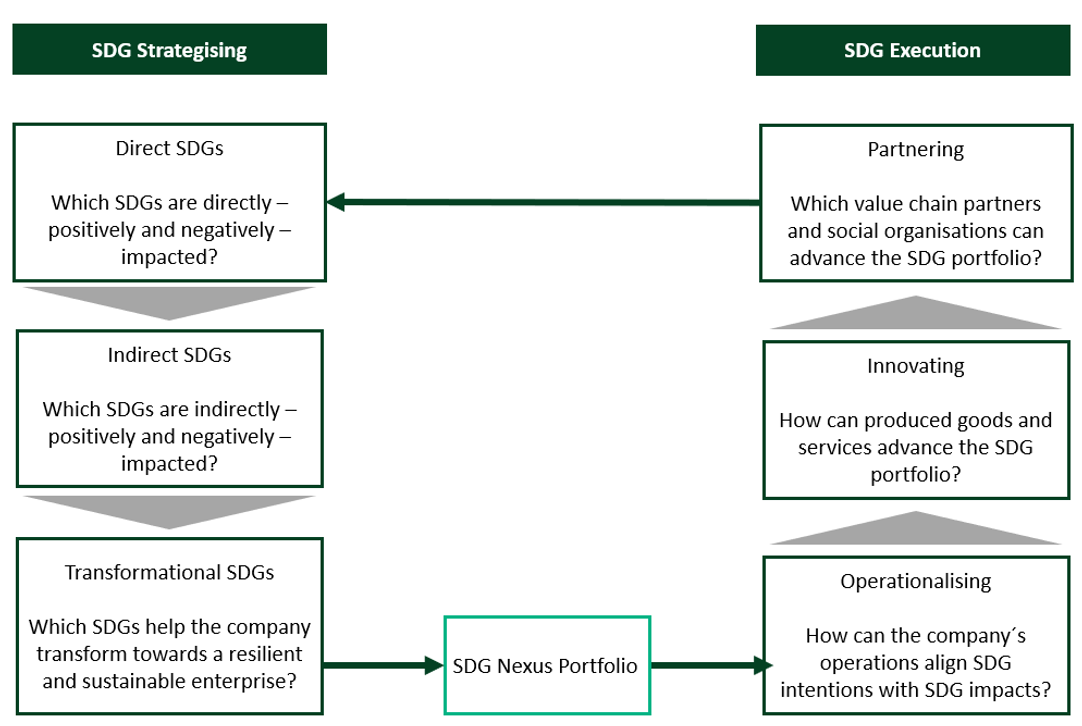
Figure 12: Implementing a nexus approach in corporate sustainability with six guiding questions, own illustration according to van Zanten & van Tulden (2021)136Van Zanten, J. A. & van Tulder, R. Analyzing companies’ interactions with the Sustainable Development Goals through network analysis: Four corporate sustainability imperatives. Business Strategy and the Environment 30, 2396-2420 (2021).
Figure 11 shows that these stages create a continuous cycle, prompting companies to regularly evaluate how their activities align with the SDGs. This ongoing assessment helps shape both their current and ideal “SDG-nexus portfolio”, strengthening their impact on building more resilient systems.61van Zanten, J. A. & van Tulder, R. Improving companies’ impacts on sustainable development: A nexus approach to the SDGS. Business Strategy and the Environment 30, 3703-3720 (2021).
To illustrate the application of a nexus approach to corporate sustainability, consider a hypothetical oil company. This company would first develop an “SDG-nexus portfolio” by identifying key SDG interactions. Direct impacts include positively contributing to SDG 7.1 (access to energy) through its core business while negatively affecting SDG 13.2 (climate change mitigation) due to greenhouse gas emissions. Indirectly, SDGs such as 9 (industry, innovation, and infrastructure) and 11 (sustainable cities and communities) may be positively affected from the energy supplied, while SDGs 13 (climate action), SDG 14 (life below water), and SDG 15 (life on land) could be adversely indirectly and negatively influenced by emissions emitted by burning non-renewable energy sources. Transformational SDGs, such as 7.2 (renewable energy) and 7.3 (energy efficiency), would help shift the company’s focus toward sustainable energy production, thereby maintaining access to energy (SDG 7.1) while significantly reducing environmental harm. To offset emissions during this transition, afforestation efforts (SDG 15) could be explored as a carbon sink.61van Zanten, J. A. & van Tulder, R. Improving companies’ impacts on sustainable development: A nexus approach to the SDGS. Business Strategy and the Environment 30, 3703-3720 (2021).
The execution phase involves operational changes, innovation, and partnerships. The company could align its emissions with the Paris Agreement by incorporating SDG targets into executive incentives and prioritising markets with the greatest need for its positive contributions. Innovation would focus on transitioning to renewable energy and enhancing product efficiency. Collaboration across the value chain would support these efforts-working with suppliers to improve efficiency, partnering with customers to ensure renewable energy meets demand, and engaging with environmental organizations to scale up reforestation projects.61van Zanten, J. A. & van Tulder, R. Improving companies’ impacts on sustainable development: A nexus approach to the SDGS. Business Strategy and the Environment 30, 3703-3720 (2021).
This cycle of assessing and adjusting SDG interactions continues over time. For instance, afforestation efforts to offset emissions could compete with agricultural land use, limiting SDG 2 (zero hunger). Alternatively, reforestation in areas with water scarcity and land degradation could simultaneously advance SDG 6 (clean water and sanitation) and broader SDG 15 goals. Through this continuous evaluation, the company can refine its sustainability strategy, strengthening SES resilience and improving its overall impact on sustainable development.61van Zanten, J. A. & van Tulder, R. Improving companies’ impacts on sustainable development: A nexus approach to the SDGS. Business Strategy and the Environment 30, 3703-3720 (2021).
References
- 1Intergovernmental Platform on Biodiversity and Ecosystem Services. Summary for policymakers of the global assessment report on biodiversity and ecosystem services of the Intergovernmental Science-Policy Platform on Biodiversity and Ecosystem Services. IPBES Secretariat: Bonn, Germany, 22-47 (2019). ↩︎
- 2Reid, W. et al. Millennium Ecosystem Assessment. Ecosystems and human well-being: synthesis. (2005). ↩︎
- 3Convention on Biological Diversity. Decision Adopted by the Conference of the Parties to the Convention on Biological Diversity: Kunming-Montreal Global Biodiversity Framework (CBD/COP/DEC/15/4). (2022). ↩︎
- 4Bradshaw, C. J. A. et al. Underestimating the Challenges of Avoiding a Ghastly Future. Frontiers in Conservation Science 1 (2021). ↩︎
- 5Macellari, M., Gusmerotti, N. M., Frey, M. & Testa, F. Embedding biodiversity and ecosystem services in corporate sustainability: A strategy to enable Sustainable Development Goals. Business Strategy & Development 1, 244-255 (2018). ↩︎
- 6Küfeoğlu, S. in Emerging Technologies: Value Creation for Sustainable Development 469-486 (Springer, 2022). ↩︎
- 7Klein, M. SDG 15: life on land. Jean Monnet Sustainable Development Goals Network Policy Brief Series, 1, 1-6 (2020). ↩︎
- 8Ceballos, G. et al. Accelerated modern human-induced species losses: Entering the sixth mass extinction. Science advances 1, e1400253 (2015). ↩︎
- 9Bundesministerium für wirtschaftliche Zusammenarbeit und Entwicklung. SDG 15: Leben an Land <https://www.bmz.de/de/agenda-2030/sdg-15> (2023). ↩︎
- 10United Nations. Life on Land: Why it matters, <https://www.un.org/sustainabledevelopment/wp-content/uploads/2019/07/15_Why-It-Matters-2020.pdf> (2020). ↩︎
- 11Panwar, R., Ober, H. & Pinkse, J. The uncomfortable relationship between business and biodiversity: Advancing research on business strategies for biodiversity protection. Business Strategy and the Environment 32, 2554-2566 (2023). ↩︎
- 12Wagner, M. Business, biodiversity and ecosystem services: Evidence from large-scale survey data. Business Strategy and the Environment 32, 2583-2599 (2023). ↩︎
- 13Gibassier, D., Maas, K. & Schaltegger, S. Special issue of business, strategy, and the environment call for papers business, society, biodiversity, and natural capital deadline June 30, 2020 (see details of conference/workshop at the end of the call for paper). Business strategy and the environment 28, 921-924 (2019). ↩︎
- 6Küfeoğlu, S. in Emerging Technologies: Value Creation for Sustainable Development 469-486 (Springer, 2022). ↩︎
- 7Klein, M. SDG 15: life on land. Jean Monnet Sustainable Development Goals Network Policy Brief Series, 1, 1-6 (2020). ↩︎
- 14United Nations Environment Programme. Frontiers 2018/19 Report: Emerging Issues of Environmental Concern. (Nairobi, 2019). ↩︎
- 15United Nations. The sustainable development goals report 2024. (United Nations New York, NY, 2024). ↩︎
- 10United Nations. Life on Land: Why it matters, <https://www.un.org/sustainabledevelopment/wp-content/uploads/2019/07/15_Why-It-Matters-2020.pdf> (2020). ↩︎
- 16Tallis, H. & Kareiva, P. Ecosystem services. Current Biology 15, 746-748 (2005). ↩︎
- 15United Nations. The sustainable development goals report 2024. (United Nations New York, NY, 2024). ↩︎
- 10United Nations. Life on Land: Why it matters, <https://www.un.org/sustainabledevelopment/wp-content/uploads/2019/07/15_Why-It-Matters-2020.pdf> (2020). ↩︎
- 17Convention on Biological Diversity. Biodiversity and the 2030 Agenda for Sustainable Development: Technical Note. (2016). ↩︎
- 15United Nations. The sustainable development goals report 2024. (United Nations New York, NY, 2024). ↩︎
- 1Intergovernmental Platform on Biodiversity and Ecosystem Services. Summary for policymakers of the global assessment report on biodiversity and ecosystem services of the Intergovernmental Science-Policy Platform on Biodiversity and Ecosystem Services. IPBES Secretariat: Bonn, Germany, 22-47 (2019). ↩︎
- 18Convention on Biological Diversity. Global Biodiversity Outlook 5. Montreal. (2020). ↩︎
- 19Intergovernmental Panel on Climate Change. Climate Change 2023: Synthesis Report, Summary for Policymakers. Contribution of Working Groups I, II and III to the Sixth Assessment Report of the Intergovernmental Panel on Climate Change [Core Writing Team, H. Lee and J. Romero (eds.)]. IPCC, Geneva, Switzerland. (2023). ↩︎
- 4Bradshaw, C. J. A. et al. Underestimating the Challenges of Avoiding a Ghastly Future. Frontiers in Conservation Science 1 (2021). ↩︎
- 20Shanley, P. & López, C. Out of the loop: why research rarely reaches policy makers and the public and what can be done. Biotropica 41, 535-544 (2009). ↩︎
- 21Sachs, J. D. The age of sustainable development. (Columbia University Press, 2015). ↩︎
- 9Bundesministerium für wirtschaftliche Zusammenarbeit und Entwicklung. SDG 15: Leben an Land <https://www.bmz.de/de/agenda-2030/sdg-15> (2023). ↩︎
- 22World Economic Forum. The Global Risks Report 2019 (Geneva, Switzerland, 2019). ↩︎
- 23TEEB. The Economics of Ecosystems and Biodiversity in Business and Enterprise. (London and New York, 2012). ↩︎
- 24Addison, P. F., Bull, J. W. & Milner-Gulland, E. Using conservation science to advance corporate biodiversity accountability. Conservation Biology 33, 307-318 (2019). ↩︎
- 25Smith, T. et al. Biodiversity means business: Reframing global biodiversity goals for the private sector. Conservation Letters 13, e12690 (2020). ↩︎
- 26Convention on Biological Diversity Engaging Business in the Development of a Post-2020 Global Biodiversity Framework. (Convention on Biological Diversity, Montreal, Canada, 2018). ↩︎
- 25Smith, T. et al. Biodiversity means business: Reframing global biodiversity goals for the private sector. Conservation Letters 13, e12690 (2020). ↩︎
- 27Boiral, O. & Heras-Saizarbitoria, I. Corporate commitment to biodiversity in mining and forestry: Identifying drivers from GRI reports. Journal of Cleaner Production 162, 153-161 (2017). ↩︎
- 28Global Commons Alliance. Science-based targets for nature: initial guidance for business. (2020). ↩︎
- 15United Nations. The sustainable development goals report 2024. (United Nations New York, NY, 2024). ↩︎
- 18Convention on Biological Diversity. Global Biodiversity Outlook 5. Montreal. (2020). ↩︎
- 29Convention on Biological Diversity. Convention on Biological Diversity : text and annexes. (Montreal, Quebec, Canada, 2011). ↩︎
- 11Panwar, R., Ober, H. & Pinkse, J. The uncomfortable relationship between business and biodiversity: Advancing research on business strategies for biodiversity protection. Business Strategy and the Environment 32, 2554-2566 (2023). ↩︎
- 30UN Global Compact. A Framework for Corporate Action on Biodiversity and Ecosystem Services. (2012). ↩︎
- 31Laikre, L. et al. Neglect of Genetic Diversity in Implementation of the Convention on Biological Diversity. Conservation Biology 24, 86-88 (2010). ↩︎
- 32Sills, J. et al. Post-2020 goals overlook genetic diversity. Science 367, 1083-1085 (2020). ↩︎
- 11Panwar, R., Ober, H. & Pinkse, J. The uncomfortable relationship between business and biodiversity: Advancing research on business strategies for biodiversity protection. Business Strategy and the Environment 32, 2554-2566 (2023). ↩︎
- 33Fitzherbert, E. B. et al. How will oil palm expansion affect biodiversity? Trends in Ecology & Evolution 23, 538-545 (2008). ↩︎
- 34Brunke, J., Radespiel, U., Russo, I.-R., Bruford, M. W. & Goossens, B. Messing about on the river: the role of geographic barriers in shaping the genetic structure of Bornean small mammals in a fragmented landscape. Conservation Genetics 20, 691-704 (2019). ↩︎
- 35Foster, W. A. et al. Establishing the evidence base for maintaining biodiversity and ecosystem function in the oil palm landscapes of South East Asia. Philosophical Transactions of the Royal Society B: Biological Sciences366, 3277-3291 (2011). ↩︎
- 29Convention on Biological Diversity. Convention on Biological Diversity : text and annexes. (Montreal, Quebec, Canada, 2011). ↩︎
- 36National Geographic. Terrestrial Ecosystem, <https://education.nationalgeographic.org/resource/terrestrial-ecosystem/> (n.d.). ↩︎
- 37Schowalter, T. D. in Insect Ecology (ed Timothy D. Schowalter) Ch. 11, 367-404 (Academic Press, 2016). ↩︎
- 36National Geographic. Terrestrial Ecosystem, <https://education.nationalgeographic.org/resource/terrestrial-ecosystem/> (n.d.). ↩︎
- 6Küfeoğlu, S. in Emerging Technologies: Value Creation for Sustainable Development 469-486 (Springer, 2022). ↩︎
- 38International Union for Conservation of Nature. Kunming-Montreal Global Biodiversity Framework. (IUCN, Gland, Switzerland, 2024). ↩︎
- 6Küfeoğlu, S. in Emerging Technologies: Value Creation for Sustainable Development 469-486 (Springer, 2022). ↩︎
- 39Ishtiaque, A., Masrur, A., Rabby, Y. W., Jerin, T. & Dewan, A. Remote sensing-based research for monitoring progress towards SDG 15 in Bangladesh: A review. Remote sensing 12, 691 (2020). ↩︎
- 40UN Environment Programme. GOAL 15: Life on land, <https://unep.org/topics/sustainable-development-goals/why-do-sustainable-development-goals-matter/goal-15-life-2> (n.d.). ↩︎
- 30UN Global Compact. A Framework for Corporate Action on Biodiversity and Ecosystem Services. (2012). ↩︎
- 5Macellari, M., Gusmerotti, N. M., Frey, M. & Testa, F. Embedding biodiversity and ecosystem services in corporate sustainability: A strategy to enable Sustainable Development Goals. Business Strategy & Development 1, 244-255 (2018). ↩︎
- 7Klein, M. SDG 15: life on land. Jean Monnet Sustainable Development Goals Network Policy Brief Series, 1, 1-6 (2020). ↩︎
- 12Wagner, M. Business, biodiversity and ecosystem services: Evidence from large-scale survey data. Business Strategy and the Environment 32, 2583-2599 (2023). ↩︎
- 30UN Global Compact. A Framework for Corporate Action on Biodiversity and Ecosystem Services. (2012). ↩︎
- 7Klein, M. SDG 15: life on land. Jean Monnet Sustainable Development Goals Network Policy Brief Series, 1, 1-6 (2020). ↩︎
- 12Wagner, M. Business, biodiversity and ecosystem services: Evidence from large-scale survey data. Business Strategy and the Environment 32, 2583-2599 (2023). ↩︎
- 30UN Global Compact. A Framework for Corporate Action on Biodiversity and Ecosystem Services. (2012). ↩︎
- 30UN Global Compact. A Framework for Corporate Action on Biodiversity and Ecosystem Services. (2012). ↩︎
- 41Fernández-Montes de Oca, A. I. et al. An integrated framework for harmonizing definitions of deforestation. Environmental Science & Policy 115, 71-78 (2021). ↩︎
- 42National Geographic. Deforestation <https://education.nationalgeographic.org/resource/deforestation/> (2025). ↩︎
- 6Küfeoğlu, S. in Emerging Technologies: Value Creation for Sustainable Development 469-486 (Springer, 2022). ↩︎
- 43Prăvălie, R. et al. A unifying modelling of multiple land degradation pathways in Europe. Nature Communications 15, 3862 (2024). ↩︎
- 44Santini, N. S., Chamizo, S., Lucas-Borja, M. E. & Muñoz-Rojas, M. Editorial: Restoration of Degraded Terrestrial Ecosystems. Frontiers in Ecology and Evolution 10 (2022). ↩︎
- 43Prăvălie, R. et al. A unifying modelling of multiple land degradation pathways in Europe. Nature Communications 15, 3862 (2024). ↩︎
- 45Gui, D. et al. Desertification baseline: A bottleneck for addressing desertification. Earth-Science Reviews 257, 104892 (2024). ↩︎
- 46United Nations. World Day to Combat Desertification and Drought, 17 June, <https://www.un.org/en/observances/desertification-day/background> (n.d.). ↩︎
- 47United Nations Convention to Combat Desertification. United Nations Convention to Combat Desertification in Those Countries Experiencing Serious Drought And/or Desertification, Particulary in Africa. (Secretariat of the United Nations Convention to Combat Desertification, 1999). ↩︎
- 45Gui, D. et al. Desertification baseline: A bottleneck for addressing desertification. Earth-Science Reviews 257, 104892 (2024). ↩︎
- 48Pimm, S. L. conservation <https://www.britannica.com/science/conservation-ecology/Calculating-relative-rates-of-extinction> (2024). ↩︎
- 49Willemen, L. et al. How to halt the global decline of lands. Nature Sustainability 3, 164-166 (2020). ↩︎
- 29Convention on Biological Diversity. Convention on Biological Diversity : text and annexes. (Montreal, Quebec, Canada, 2011). ↩︎
- 50Intergovernmental Platform on Biodiversity and Ecosystem Services. sustainable use, <https://www.ipbes.net/glossary-tag/sustainable-use> (n.d.). ↩︎
- 15United Nations. The sustainable development goals report 2024. (United Nations New York, NY, 2024). ↩︎
- 15United Nations. The sustainable development goals report 2024. (United Nations New York, NY, 2024). ↩︎
- 51World Commission on Environment and Development. Our common future. (Oxford University Press Oxford 1987). ↩︎
- 52Holden, E., Linnerud, K. & Bøe, V. Sustainable development: Notions, numbers, and narratives. Sustainable Development 33, 2812-2825 (2024). ↩︎
- 53WWF. COP16, GBF und CBD? Wir erklären das Wichtigste zur Weltnaturkonferenz, <https://www.wwf.at/artikel/weltnaturkonferenz/> (n.d.). ↩︎
- 54WWF. COP16, GBF und CBD? Wir erklären das Wichtigste zur Weltnaturkonferenz, <https://www.wwf.at/artikel/weltnaturkonferenz/> (n.d.). ↩︎
- 30UN Global Compact. A Framework for Corporate Action on Biodiversity and Ecosystem Services. (2012). ↩︎
- 54WWF. COP16, GBF und CBD? Wir erklären das Wichtigste zur Weltnaturkonferenz, <https://www.wwf.at/artikel/weltnaturkonferenz/> (n.d.). ↩︎
- 55Zhu, Y., Prescott, G. W., Chu, P. & Carrasco, L. R. Glaring gaps in tools to estimate businesses’ biodiversity impacts hinder alignment with the Kunming-Montreal global biodiversity framework. Journal of Cleaner Production 451, 142079 (2024). ↩︎
- 54WWF. COP16, GBF und CBD? Wir erklären das Wichtigste zur Weltnaturkonferenz, <https://www.wwf.at/artikel/weltnaturkonferenz/> (n.d.). ↩︎
- 56Bundesamt für Naturschutz. Nagoya-Protokoll Grundlagen, <https://www.bfn.de/grundlagen> (n.d.). ↩︎
- 57Convention on Biological Diversity. About the Nagoya Protocol, <https://www.cbd.int/abs/about/default.shtml> (2015). ↩︎
- 57Convention on Biological Diversity. About the Nagoya Protocol, <https://www.cbd.int/abs/about/default.shtml> (2015). ↩︎
- 57Convention on Biological Diversity. About the Nagoya Protocol, <https://www.cbd.int/abs/about/default.shtml> (2015). ↩︎
- 29Convention on Biological Diversity. Convention on Biological Diversity : text and annexes. (Montreal, Quebec, Canada, 2011). ↩︎
- 29Convention on Biological Diversity. Convention on Biological Diversity : text and annexes. (Montreal, Quebec, Canada, 2011). ↩︎
- 17Convention on Biological Diversity. Biodiversity and the 2030 Agenda for Sustainable Development: Technical Note. (2016). ↩︎
- 30UN Global Compact. A Framework for Corporate Action on Biodiversity and Ecosystem Services. (2012). ↩︎
- 17Convention on Biological Diversity. Biodiversity and the 2030 Agenda for Sustainable Development: Technical Note. (2016). ↩︎
- 30UN Global Compact. A Framework for Corporate Action on Biodiversity and Ecosystem Services. (2012). ↩︎
- 58Convention on Biological Diversity. Key Elements of the Strategic Plan 2011-2020, including Aichi Biodiversity Targets, <https://www.cbd.int/sp/elements#IV> (2018). ↩︎
- 59United Nations Environment Programme. United Nations Decade on Biodiversity 2011-2020: Living in Harmony with Nature. (Montreal, Canada, 2011). ↩︎
- 17Convention on Biological Diversity. Biodiversity and the 2030 Agenda for Sustainable Development: Technical Note. (2016). ↩︎
- 52Holden, E., Linnerud, K. & Bøe, V. Sustainable development: Notions, numbers, and narratives. Sustainable Development 33, 2812-2825 (2024). ↩︎
- 60Ferrero-Ferrero, I., Muñoz-Torres, M. J., Rivera-Lirio, J. M., Escrig-Olmedo, E. & Fernández-Izquierdo, M. í. SDG reporting: an analysis of corporate sustainability leaders. Marketing Intelligence & Planning 41, 457-472 (2023). ↩︎
- 61van Zanten, J. A. & van Tulder, R. Improving companies’ impacts on sustainable development: A nexus approach to the SDGS. Business Strategy and the Environment 30, 3703-3720 (2021). ↩︎
- 60Ferrero-Ferrero, I., Muñoz-Torres, M. J., Rivera-Lirio, J. M., Escrig-Olmedo, E. & Fernández-Izquierdo, M. í. SDG reporting: an analysis of corporate sustainability leaders. Marketing Intelligence & Planning 41, 457-472 (2023). ↩︎
- 21Sachs, J. D. The age of sustainable development. (Columbia University Press, 2015). ↩︎
- 46United Nations. World Day to Combat Desertification and Drought, 17 June,
- 17Convention on Biological Diversity. Biodiversity and the 2030 Agenda for Sustainable Development: Technical Note. (2016). ↩︎
- 9Bundesministerium für wirtschaftliche Zusammenarbeit und Entwicklung. SDG 15: Leben an Land <https://www.bmz.de/de/agenda-2030/sdg-15> (2023). ↩︎
- 62Lehmann, I. Inspiration from the Kunming-Montreal Global Biodiversity Framework for SDG 15. International Environmental Agreements: Politics, Law and Economics 23, 207-214 (2023). ↩︎
- 6Küfeoğlu, S. in Emerging Technologies: Value Creation for Sustainable Development 469-486 (Springer, 2022). ↩︎
- 63Krauss, J. E. Unpacking SDG 15, its targets and indicators: tracing ideas of conservation. Globalizations 19, 1179-1194 (2022). ↩︎
- 64Chazdon, R. & Brancalion, P. Restoring forests as a means to many ends. Science 365, 24-25 (2019). ↩︎
- 9Bundesministerium für wirtschaftliche Zusammenarbeit und Entwicklung. SDG 15: Leben an Land <https://www.bmz.de/de/agenda-2030/sdg-15> (2023). ↩︎
- 65UN Global Compact. 15. Life on Land <https://blueprint.unglobalcompact.org/sdgs/sdg15/> (2017). ↩︎
- 64Chazdon, R. & Brancalion, P. Restoring forests as a means to many ends. Science 365, 24-25 (2019). ↩︎
- 52Holden, E., Linnerud, K. & Bøe, V. Sustainable development: Notions, numbers, and narratives. Sustainable Development 33, 2812-2825 (2024). ↩︎
- 66Forestier, O. & Kim, R. E. Cherry-picking the Sustainable Development Goals: Goal prioritization by national governments and implications for global governance. Sustainable Development 28, 1269-1278 (2020). ↩︎
- 67Stokstad, E. Sustainable goals from UN under fire. Science 347, 702-703 (2015). ↩︎
- 68van Vuuren, D. P. et al. Defining a sustainable development target space for 2030 and 2050. One Earth 5, 142-156 (2022). ↩︎
- 69Diaz-Sarachaga, J. M., Jato-Espino, D. & Castro-Fresno, D. Is the Sustainable Development Goals (SDG) index an adequate framework to measure the progress of the 2030 Agenda? Sustainable Development 26, 663-671 (2018). ↩︎
- 52Holden, E., Linnerud, K. & Bøe, V. Sustainable development: Notions, numbers, and narratives. Sustainable Development 33, 2812-2825 (2024). ↩︎
- 17Convention on Biological Diversity. Biodiversity and the 2030 Agenda for Sustainable Development: Technical Note. (2016). ↩︎
- 15United Nations. The sustainable development goals report 2024. (United Nations New York, NY, 2024). ↩︎
- 38International Union for Conservation of Nature. Kunming-Montreal Global Biodiversity Framework. (IUCN, Gland, Switzerland, 2024). ↩︎
- 55Zhu, Y., Prescott, G. W., Chu, P. & Carrasco, L. R. Glaring gaps in tools to estimate businesses’ biodiversity impacts hinder alignment with the Kunming-Montreal global biodiversity framework. Journal of Cleaner Production 451, 142079 (2024). ↩︎
- 62Lehmann, I. Inspiration from the Kunming-Montreal Global Biodiversity Framework for SDG 15. International Environmental Agreements: Politics, Law and Economics 23, 207-214 (2023). ↩︎
- 70International Institute for Sustainable Development. Inside the UN Biodiversity Converence (CBD COP 16), <https://www.iisd.org/inside-cop-16> (2024). ↩︎
- 38International Union for Conservation of Nature. Kunming-Montreal Global Biodiversity Framework. (IUCN, Gland, Switzerland, 2024). ↩︎
- 38International Union for Conservation of Nature. Kunming-Montreal Global Biodiversity Framework. (IUCN, Gland, Switzerland, 2024). ↩︎
- 71Internationale Klimaschutz Initiative. CBD COP 16, <https://www.international-climate-initiative.com/ueber-die-iki/themen/cbd-cop-16/> (n.d.). ↩︎
- 55Zhu, Y., Prescott, G. W., Chu, P. & Carrasco, L. R. Glaring gaps in tools to estimate businesses’ biodiversity impacts hinder alignment with the Kunming-Montreal global biodiversity framework. Journal of Cleaner Production 451, 142079 (2024). ↩︎
- 71Internationale Klimaschutz Initiative. CBD COP 16, <https://www.international-climate-initiative.com/ueber-die-iki/themen/cbd-cop-16/> (n.d.). ↩︎
- 11Panwar, R., Ober, H. & Pinkse, J. The uncomfortable relationship between business and biodiversity: Advancing research on business strategies for biodiversity protection. Business Strategy and the Environment 32, 2554-2566 (2023). ↩︎
- 11Panwar, R., Ober, H. & Pinkse, J. The uncomfortable relationship between business and biodiversity: Advancing research on business strategies for biodiversity protection. Business Strategy and the Environment 32, 2554-2566 (2023). ↩︎
- 72Poor, E. E., Shao, Y. & Kelly, M. J. Mapping and predicting forest loss in a Sumatran tiger landscape from 2002 to 2050. Journal of Environmental Management 231, 397-404 (2019). ↩︎
- 11Panwar, R., Ober, H. & Pinkse, J. The uncomfortable relationship between business and biodiversity: Advancing research on business strategies for biodiversity protection. Business Strategy and the Environment 32, 2554-2566 (2023). ↩︎
- 73Grantz, D. A., Garner, J. H. B. & Johnson, D. W. Ecological effects of particulate matter. Environment International 29, 213-239 (2003). ↩︎
- 74Power, A. G. Ecosystem services and agriculture: tradeoffs and synergies. Philosophical Transactions of the Royal Society B: Biological Sciences 365, 2959-2971 (2010). ↩︎
- 11Panwar, R., Ober, H. & Pinkse, J. The uncomfortable relationship between business and biodiversity: Advancing research on business strategies for biodiversity protection. Business Strategy and the Environment 32, 2554-2566 (2023). ↩︎
- 75Salles, D. M., Carmo, F. F. d. & Jacobi, C. M. Habitat Loss Challenges the Conservation of Endemic Plants in Mining-Targeted Brazilian Mountains. Environmental Conservation 46, 140-146 (2019). ↩︎
- 11Panwar, R., Ober, H. & Pinkse, J. The uncomfortable relationship between business and biodiversity: Advancing research on business strategies for biodiversity protection. Business Strategy and the Environment 32, 2554-2566 (2023). ↩︎
- 11Panwar, R., Ober, H. & Pinkse, J. The uncomfortable relationship between business and biodiversity: Advancing research on business strategies for biodiversity protection. Business Strategy and the Environment 32, 2554-2566 (2023). ↩︎
- 76Jeschke, J. M. & Strayer, D. L. Invasion success of vertebrates in Europe and North America. Proceedings of the National Academy of Sciences 102, 7198-7202 (2005). ↩︎
- 11Panwar, R., Ober, H. & Pinkse, J. The uncomfortable relationship between business and biodiversity: Advancing research on business strategies for biodiversity protection. Business Strategy and the Environment 32, 2554-2566 (2023). ↩︎
- 11Panwar, R., Ober, H. & Pinkse, J. The uncomfortable relationship between business and biodiversity: Advancing research on business strategies for biodiversity protection. Business Strategy and the Environment 32, 2554-2566 (2023). ↩︎
- 11Panwar, R., Ober, H. & Pinkse, J. The uncomfortable relationship between business and biodiversity: Advancing research on business strategies for biodiversity protection. Business Strategy and the Environment 32, 2554-2566 (2023). ↩︎
- 77Ellis, E. C. Anthropogenic transformation of the terrestrial biosphere. Philosophical Transactions of the Royal Society A: Mathematical, Physical and Engineering Sciences 369, 1010-1035 (2011). ↩︎
- 78Bellard, C., Bertelsmeier, C., Leadley, P., Thuiller, W. & Courchamp, F. Impacts of climate change on the future of biodiversity. Ecology Letters 15, 365-377 (2012). ↩︎
- 11Panwar, R., Ober, H. & Pinkse, J. The uncomfortable relationship between business and biodiversity: Advancing research on business strategies for biodiversity protection. Business Strategy and the Environment 32, 2554-2566 (2023). ↩︎
- 78Bellard, C., Bertelsmeier, C., Leadley, P., Thuiller, W. & Courchamp, F. Impacts of climate change on the future of biodiversity. Ecology Letters 15, 365-377 (2012). ↩︎
- 11Panwar, R., Ober, H. & Pinkse, J. The uncomfortable relationship between business and biodiversity: Advancing research on business strategies for biodiversity protection. Business Strategy and the Environment 32, 2554-2566 (2023). ↩︎
- 30UN Global Compact. A Framework for Corporate Action on Biodiversity and Ecosystem Services. (2012). ↩︎
- 79TEEB. The economics of ecosystems and biodiversity TEEB for businesses (2010). ↩︎
- 30UN Global Compact. A Framework for Corporate Action on Biodiversity and Ecosystem Services. (2012). ↩︎
- 30UN Global Compact. A Framework for Corporate Action on Biodiversity and Ecosystem Services. (2012). ↩︎
- 30UN Global Compact. A Framework for Corporate Action on Biodiversity and Ecosystem Services. (2012). ↩︎
- 30UN Global Compact. A Framework for Corporate Action on Biodiversity and Ecosystem Services. (2012). ↩︎
- 30UN Global Compact. A Framework for Corporate Action on Biodiversity and Ecosystem Services. (2012). ↩︎
- 80Philips. Philips Full Annual Report 2011. (2011). ↩︎
- 30UN Global Compact. A Framework for Corporate Action on Biodiversity and Ecosystem Services. (2012). ↩︎
- 81Kingfisher. Better Homes. Better Lives. For Everyone. Kingfisher Responsible Business Report 2023/24. (2023). ↩︎
- 82Kingfisher. Kingfisher welcomes outcome of European Commission review of the EU Timber Regulation, <https://www.kingfisher.com/media/news/2016/kingfisher-welcomes-outcome-of-european-commission-review-of-th> (2016). ↩︎
- 30UN Global Compact. A Framework for Corporate Action on Biodiversity and Ecosystem Services. (2012). ↩︎
- 30UN Global Compact. A Framework for Corporate Action on Biodiversity and Ecosystem Services. (2012). ↩︎
- 30UN Global Compact. A Framework for Corporate Action on Biodiversity and Ecosystem Services. (2012). ↩︎
- 11Panwar, R., Ober, H. & Pinkse, J. The uncomfortable relationship between business and biodiversity: Advancing research on business strategies for biodiversity protection. Business Strategy and the Environment 32, 2554-2566 (2023). ↩︎
- 11Panwar, R., Ober, H. & Pinkse, J. The uncomfortable relationship between business and biodiversity: Advancing research on business strategies for biodiversity protection. Business Strategy and the Environment 32, 2554-2566 (2023). ↩︎
- 83Business and Biodiversity Offsets Programme. Standard on Biodiversity Offsets. (2012). ↩︎
- 11Panwar, R., Ober, H. & Pinkse, J. The uncomfortable relationship between business and biodiversity: Advancing research on business strategies for biodiversity protection. Business Strategy and the Environment 32, 2554-2566 (2023). ↩︎
- 11Panwar, R., Ober, H. & Pinkse, J. The uncomfortable relationship between business and biodiversity: Advancing research on business strategies for biodiversity protection. Business Strategy and the Environment 32, 2554-2566 (2023). ↩︎
- 84Butler, B. J. in Future forests of the northern United States Gen. Tech. Rep. NRS-151 (ed Stephen R.; Moser Shifley, W. Keith, ) Ch. 9, 243-269 (US Department of Agriculture, Forest Service, Northern Research Station, 2016). ↩︎
- 11Panwar, R., Ober, H. & Pinkse, J. The uncomfortable relationship between business and biodiversity: Advancing research on business strategies for biodiversity protection. Business Strategy and the Environment 32, 2554-2566 (2023). ↩︎
- 11Panwar, R., Ober, H. & Pinkse, J. The uncomfortable relationship between business and biodiversity: Advancing research on business strategies for biodiversity protection. Business Strategy and the Environment 32, 2554-2566 (2023). ↩︎
- 85Rametsteiner, E. & Simula, M. Forest certification-an instrument to promote sustainable forest management? Journal of Environmental Management 67, 87-98 (2003). ↩︎
- 86van der Ven, H., Rothacker, C. & Cashore, B. Do eco-labels prevent deforestation? Lessons from non-state market driven governance in the soy, palm oil, and cocoa sectors. Global Environmental Change 52, 141-151 (2018). ↩︎
- 11Panwar, R., Ober, H. & Pinkse, J. The uncomfortable relationship between business and biodiversity: Advancing research on business strategies for biodiversity protection. Business Strategy and the Environment 32, 2554-2566 (2023). ↩︎
- 11Panwar, R., Ober, H. & Pinkse, J. The uncomfortable relationship between business and biodiversity: Advancing research on business strategies for biodiversity protection. Business Strategy and the Environment 32, 2554-2566 (2023). ↩︎
- 87National Research Council. Restoration of Aquatic Ecosystems: Science, Technology, and Public Policy. (National Academy Press, 1992). ↩︎
- 88Moerke, A. H. & Lamberti, G. A. Restoring Stream Ecosystems: Lessons from a Midwestern State. Restoration Ecology 12, 327-334 (2004). ↩︎
- 89Zimmerer, K. S. & de Haan, S. Agrobiodiversity and a sustainable food future. Nature Plants 3, 17047 (2017). ↩︎
- 90The Carbon Underground and Regenerative Agriculture Initiative. What is Regenerative Agriculture?, <https://regenerationinternational.org/2017/02/24/what-is-regenerative-agriculture/> (2017). ↩︎
- 11Panwar, R., Ober, H. & Pinkse, J. The uncomfortable relationship between business and biodiversity: Advancing research on business strategies for biodiversity protection. Business Strategy and the Environment 32, 2554-2566 (2023). ↩︎
- 91Büscher, B. & Dressler, W. Linking neoprotectionism and environmental governance: On the rapidly increasing tensions between actors in the environment-development nexus. Conservation and society 5, 586-611 (2007). ↩︎
- 92McShane, T. a. W., Michael. Getting Biodiversity Projects to Work: Towards More Effective Conservation and Development. (Columbia University Press, 2004). ↩︎
- 93Rainey, H. J. et al. A review of corporate goals of No Net Loss and Net Positive Impact on biodiversity. Oryx49, 232-238 (2015). ↩︎
- 94Van Dover, C. L. et al. Biodiversity loss from deep-sea mining. Nature Geoscience 10, 464-465 (2017). ↩︎
- 95Wende, W., Tucker, G., Quí©tier, F., Rayment, M. & Darbi, M. Introduction: biodiversity offsets-the European perspective on no net loss of biodiversity and ecosystem services. (Springer, 2018). ↩︎
- 96Hough, P. & Robertson, M. Mitigation under Section 404 of the Clean Water Act: where it comes from, what it means. WETLANDS ECOLOGY AND MANAGEMENT 17, 15-33 (2009). ↩︎
- 97McKenney, B. A. & Kiesecker, J. M. Policy Development for Biodiversity Offsets: A Review of Offset Frameworks. Environmental Management 45, 165-176 (2010). ↩︎
- 63Krauss, J. E. Unpacking SDG 15, its targets and indicators: tracing ideas of conservation. Globalizations 19, 1179-1194 (2022). ↩︎
- 98de Silva, G. C., Regan, E. C., Pollard, E. H. B. & Addison, P. F. E. The evolution of corporate no net loss and net positive impact biodiversity commitments: Understanding appetite and addressing challenges. Business Strategy and the Environment 28, 1481-1495 (2019). ↩︎
- 99Spash, C. L. Bulldozing biodiversity: The economics of offsets and trading-in Nature. Biological Conservation192, 541-551 (2015). ↩︎
- 100Dauguet, B. Biodiversity offsetting as a commodification process: A French case study as a concrete example. Biological Conservation 192, 533-540 (2015). ↩︎
- 11Panwar, R., Ober, H. & Pinkse, J. The uncomfortable relationship between business and biodiversity: Advancing research on business strategies for biodiversity protection. Business Strategy and the Environment 32, 2554-2566 (2023). ↩︎
- 101Wilkinson, J. In-lieu fee mitigation: coming into compliance with the new Compensatory Mitigation Rule. Wetlands Ecology and Management 17, 53-70 (2009). ↩︎
- 102Blum, M. The legitimation of contested carbon markets after Paris – empirical insights from market stakeholders. Journal of Environmental Policy & Planning 22, 226-238 (2020). ↩︎
- 11Panwar, R., Ober, H. & Pinkse, J. The uncomfortable relationship between business and biodiversity: Advancing research on business strategies for biodiversity protection. Business Strategy and the Environment 32, 2554-2566 (2023). ↩︎
- 11Panwar, R., Ober, H. & Pinkse, J. The uncomfortable relationship between business and biodiversity: Advancing research on business strategies for biodiversity protection. Business Strategy and the Environment 32, 2554-2566 (2023). ↩︎
- 9Bundesministerium für wirtschaftliche Zusammenarbeit und Entwicklung. SDG 15: Leben an Land <https://www.bmz.de/de/agenda-2030/sdg-15> (2023). ↩︎
- 65UN Global Compact. 15. Life on Land <https://blueprint.unglobalcompact.org/sdgs/sdg15/> (2017). ↩︎
- 103PwC. From promise to reality: Does business really care about the SDGs?, <www.pwc.com/sdgreportingchallenge> (2018). ↩︎
- 104World Business Council for Sustainable Development & Det Norske Veritas and Germanischer Lloyd. Business and the SDGs: A survey of WBCSD members and Global Network partners. (2018). ↩︎
- 61van Zanten, J. A. & van Tulder, R. Improving companies’ impacts on sustainable development: A nexus approach to the SDGS. Business Strategy and the Environment 30, 3703-3720 (2021). ↩︎
- 3Convention on Biological Diversity. Decision Adopted by the Conference of the Parties to the Convention on Biological Diversity: Kunming-Montreal Global Biodiversity Framework (CBD/COP/DEC/15/4). (2022). ↩︎
- 105Folke, C. et al. Resilience thinking: integrating resilience, adaptability and transformability. Ecology and society15 (2010). ↩︎
- 106Ostrom, E. A General Framework for Analyzing Sustainability of Social-Ecological Systems. Science 325, 419-422 (2009). ↩︎
- 61van Zanten, J. A. & van Tulder, R. Improving companies’ impacts on sustainable development: A nexus approach to the SDGS. Business Strategy and the Environment 30, 3703-3720 (2021). ↩︎
- 61van Zanten, J. A. & van Tulder, R. Improving companies’ impacts on sustainable development: A nexus approach to the SDGS. Business Strategy and the Environment 30, 3703-3720 (2021). ↩︎
- 107Chapin III, F. S., Kofinas, G. P., Folke, C. & Chapin, M. C. Principles of ecosystem stewardship: resilience-based natural resource management in a changing world. (Springer Science & Business Media, 2009). ↩︎
- 108Allen, C. R., Angeler, D. G., Garmestani, A. S., Gunderson, L. H. & Holling, C. S. Panarchy: Theory and Application. Ecosystems 17, 578-589 (2014). ↩︎
- 107Chapin III, F. S., Kofinas, G. P., Folke, C. & Chapin, M. C. Principles of ecosystem stewardship: resilience-based natural resource management in a changing world. (Springer Science & Business Media, 2009). ↩︎
- 61van Zanten, J. A. & van Tulder, R. Improving companies’ impacts on sustainable development: A nexus approach to the SDGS. Business Strategy and the Environment 30, 3703-3720 (2021). ↩︎
- 109Levin, S. et al. Social-ecological systems as complex adaptive systems: modeling and policy implications. Environment and Development Economics 18, 111-132 (2013). ↩︎
- 61van Zanten, J. A. & van Tulder, R. Improving companies’ impacts on sustainable development: A nexus approach to the SDGS. Business Strategy and the Environment 30, 3703-3720 (2021). ↩︎
- 110Folke, C. Resilience (Republished). Ecology and Society 21 (2016). ↩︎
- 105Folke, C. et al. Resilience thinking: integrating resilience, adaptability and transformability. Ecology and society15 (2010). ↩︎
- 111R. Biggs, M. S. a. M. L. S. e. Principles for Building Resilience: Sustaining Ecosystem Services in Social-Ecological Systems. (Cambridge University Press, 2015). ↩︎
- 105Folke, C. et al. Resilience thinking: integrating resilience, adaptability and transformability. Ecology and society15 (2010). ↩︎
- 105Folke, C. et al. Resilience thinking: integrating resilience, adaptability and transformability. Ecology and society15 (2010). ↩︎
- 107Chapin III, F. S., Kofinas, G. P., Folke, C. & Chapin, M. C. Principles of ecosystem stewardship: resilience-based natural resource management in a changing world. (Springer Science & Business Media, 2009). ↩︎
- 110Folke, C. Resilience (Republished). Ecology and Society 21 (2016). ↩︎
- 112Reyers, B., Folke, C., Moore, M.-L., Biggs, R. & Galaz, V. Social-Ecological Systems Insights for Navigating the Dynamics of the Anthropocene. Annual Review of Environment and Resources 43, 267-289 (2018). ↩︎
- 105Folke, C. et al. Resilience thinking: integrating resilience, adaptability and transformability. Ecology and society15 (2010). ↩︎
- 113Folke, C., Biggs, R., Norström, A. V., Reyers, B. & Rockström, J. Social-ecological resilience and biosphere-based sustainability science. Ecology and Society 21 (2016). ↩︎
- 106Ostrom, E. A General Framework for Analyzing Sustainability of Social-Ecological Systems. Science 325, 419-422 (2009). ↩︎
- 107Chapin III, F. S., Kofinas, G. P., Folke, C. & Chapin, M. C. Principles of ecosystem stewardship: resilience-based natural resource management in a changing world. (Springer Science & Business Media, 2009). ↩︎
- 112Reyers, B., Folke, C., Moore, M.-L., Biggs, R. & Galaz, V. Social-Ecological Systems Insights for Navigating the Dynamics of the Anthropocene. Annual Review of Environment and Resources 43, 267-289 (2018). ↩︎
- 113Folke, C., Biggs, R., Norström, A. V., Reyers, B. & Rockström, J. Social-ecological resilience and biosphere-based sustainability science. Ecology and Society 21 (2016). ↩︎
- 112Reyers, B., Folke, C., Moore, M.-L., Biggs, R. & Galaz, V. Social-Ecological Systems Insights for Navigating the Dynamics of the Anthropocene. Annual Review of Environment and Resources 43, 267-289 (2018). ↩︎
- 110Folke, C. Resilience (Republished). Ecology and Society 21 (2016). ↩︎
- 114Leach, M. et al. Equity and sustainability in the Anthropocene: A social-ecological systems perspective on their intertwined futures. Global Sustainability 1, e13 (2018). ↩︎
- 110Folke, C. Resilience (Republished). Ecology and Society 21 (2016). ↩︎
- 61van Zanten, J. A. & van Tulder, R. Improving companies’ impacts on sustainable development: A nexus approach to the SDGS. Business Strategy and the Environment 30, 3703-3720 (2021). ↩︎
- 115Williams, A., Whiteman, G. & Kennedy, S. Cross-Scale Systemic Resilience: Implications for Organization Studies. Business & Society 60, 95-124 (2021). ↩︎
- 116Grafton, R. Q. et al. Realizing resilience for decision-making. Nature Sustainability 2, 907-913 (2019). ↩︎
- 117Blasiak, R., Jouffray, J.-B., Wabnitz, C. C., Sundström, E. & Österblom, H. Corporate control and global governance of marine genetic resources. Science advances 4, eaar5237 (2018). ↩︎
- 118Carbon Disclosure Project. The carbon majors database. (2017). ↩︎
- 119Keys, P. W. et al. Anthropocene risk. Nature Sustainability 2, 667-673 (2019). ↩︎
- 120Gladwin, T. N., Kennelly, J. J. & Krause, T.-S. Shifting paradigms for sustainable development: Implications for management theory and research. Academy of management Review 20, 874-907 (1995). ↩︎
- 121King, A. Avoiding Ecological Surprise: Lessons from Long-Standing Communities. The Academy of Management Review 20, 961-985 (1995). ↩︎
- 122Williams, A., Kennedy, S., Philipp, F. & Whiteman, G. Systems thinking: A review of sustainability management research. Journal of Cleaner Production 148, 866-881 (2017). ↩︎
- 122Williams, A., Kennedy, S., Philipp, F. & Whiteman, G. Systems thinking: A review of sustainability management research. Journal of Cleaner Production 148, 866-881 (2017). ↩︎
- 123Bansal, P., Kim, A. & Wood, M. O. Hidden in Plain Sight: The Importance of Scale in Organizations’ Attention to Issues. Academy of Management Review 43, 217-241 (2018). ↩︎
- 61van Zanten, J. A. & van Tulder, R. Improving companies’ impacts on sustainable development: A nexus approach to the SDGS. Business Strategy and the Environment 30, 3703-3720 (2021). ↩︎
- 107Chapin III, F. S., Kofinas, G. P., Folke, C. & Chapin, M. C. Principles of ecosystem stewardship: resilience-based natural resource management in a changing world. (Springer Science & Business Media, 2009). ↩︎
- 112Reyers, B., Folke, C., Moore, M.-L., Biggs, R. & Galaz, V. Social-Ecological Systems Insights for Navigating the Dynamics of the Anthropocene. Annual Review of Environment and Resources 43, 267-289 (2018). ↩︎
- 113Folke, C., Biggs, R., Norström, A. V., Reyers, B. & Rockström, J. Social-ecological resilience and biosphere-based sustainability science. Ecology and Society 21 (2016). ↩︎
- 124Stafford-Smith, M. et al. Integration: the key to implementing the Sustainable Development Goals. Sustainability Science 12, 911-919 (2017). ↩︎
- 125United Nations. Transforming our world: the 2030 Agenda for Sustainable Development. (New York, 2015). ↩︎
- 126Nilsson, M. et al. Mapping interactions between the sustainable development goals: lessons learned and ways forward. Sustainability Science 13, 1489-1503 (2018). ↩︎
- 127Boas, I., Biermann, F. & Kanie, N. Cross-sectoral strategies in global sustainability governance: towards a nexus approach. International Environmental Agreements: Politics, Law and Economics 16, 449-464 (2016). ↩︎
- 128Costanza, R. et al. Modelling and measuring sustainable wellbeing in connection with the UN Sustainable Development Goals. Ecological Economics 130, 350-355 (2016). ↩︎
- 129Lu, Y., Nakicenovic, N., Visbeck, M. & Stevance, A.-S. Policy: Five priorities for the UN Sustainable Development Goals. Nature 520, 432-433 (2015). ↩︎
- 130Weitz, N., Carlsen, H., Nilsson, M. & Skí¥nberg, K. Towards systemic and contextual priority setting for implementing the 2030 Agenda. Sustainability Science 13, 531-548 (2018). ↩︎
- 131Nilsson, M., Griggs, D. & Visbeck, M. Policy: Map the interactions between Sustainable Development Goals. Nature 534, 320-322 (2016). ↩︎
- 61van Zanten, J. A. & van Tulder, R. Improving companies’ impacts on sustainable development: A nexus approach to the SDGS. Business Strategy and the Environment 30, 3703-3720 (2021). ↩︎
- 132Griggs, D., Nilsson, M., Stevance, A. & McCollum, D. A guide to SDG interactions: from science to implementation. (International Council for Science, Paris, 2017). ↩︎
- 133Independent Group of Scientists appointed by the Secretary-General. Global Sustainable Development Report 2019: The Future is Now – Science for Achieving Sustainable Development. (United Nations, New York, 2019). ↩︎
- 61van Zanten, J. A. & van Tulder, R. Improving companies’ impacts on sustainable development: A nexus approach to the SDGS. Business Strategy and the Environment 30, 3703-3720 (2021). ↩︎
- 131Nilsson, M., Griggs, D. & Visbeck, M. Policy: Map the interactions between Sustainable Development Goals. Nature 534, 320-322 (2016). ↩︎
- 122Williams, A., Kennedy, S., Philipp, F. & Whiteman, G. Systems thinking: A review of sustainability management research. Journal of Cleaner Production 148, 866-881 (2017). ↩︎
- 114Leach, M. et al. Equity and sustainability in the Anthropocene: A social-ecological systems perspective on their intertwined futures. Global Sustainability 1, e13 (2018). ↩︎
- 61van Zanten, J. A. & van Tulder, R. Improving companies’ impacts on sustainable development: A nexus approach to the SDGS. Business Strategy and the Environment 30, 3703-3720 (2021). ↩︎
- 61van Zanten, J. A. & van Tulder, R. Improving companies’ impacts on sustainable development: A nexus approach to the SDGS. Business Strategy and the Environment 30, 3703-3720 (2021). ↩︎
- 61van Zanten, J. A. & van Tulder, R. Improving companies’ impacts on sustainable development: A nexus approach to the SDGS. Business Strategy and the Environment 30, 3703-3720 (2021). ↩︎
- 121King, A. Avoiding Ecological Surprise: Lessons from Long-Standing Communities. The Academy of Management Review 20, 961-985 (1995). ↩︎
- 134Weitz, N., Nilsson, M. & Davis, M. A nexus approach to the post-2015 agenda: Formulating integrated water, energy, and food SDGs. SAIS Review of International Affairs 34, 37-50 (2014). ↩︎
- 61van Zanten, J. A. & van Tulder, R. Improving companies’ impacts on sustainable development: A nexus approach to the SDGS. Business Strategy and the Environment 30, 3703-3720 (2021). ↩︎
- 61van Zanten, J. A. & van Tulder, R. Improving companies’ impacts on sustainable development: A nexus approach to the SDGS. Business Strategy and the Environment 30, 3703-3720 (2021). ↩︎
- 135Shell. Sustainability Report 2018-Delivering energy in a responsible way. (2019). ↩︎
- 136Van Zanten, J. A. & van Tulder, R. Analyzing companies’ interactions with the Sustainable Development Goals through network analysis: Four corporate sustainability imperatives. Business Strategy and the Environment 30, 2396-2420 (2021). ↩︎
- 61van Zanten, J. A. & van Tulder, R. Improving companies’ impacts on sustainable development: A nexus approach to the SDGS. Business Strategy and the Environment 30, 3703-3720 (2021). ↩︎
- 137United Nations Department of Economic and Social Affairs. The Sustainable Development Goals: Extended Report 2023 – 7 Affordable and Clean Energy (United Nations, New York, 2023). ↩︎
- 138van Zanten, J. A. & van Tulder, R. Towards nexus-based governance: defining interactions between economic activities and Sustainable Development Goals (SDGs). International Journal of Sustainable Development & World Ecology 28, 210-226 (2020). ↩︎
- 139Carbon Tracker. Balancing the budget: Why deflating the carbon bubble requires oil & gas companies to shrink. (2019). ↩︎
- 61van Zanten, J. A. & van Tulder, R. Improving companies’ impacts on sustainable development: A nexus approach to the SDGS. Business Strategy and the Environment 30, 3703-3720 (2021). ↩︎
- 61van Zanten, J. A. & van Tulder, R. Improving companies’ impacts on sustainable development: A nexus approach to the SDGS. Business Strategy and the Environment 30, 3703-3720 (2021). ↩︎
- 61van Zanten, J. A. & van Tulder, R. Improving companies’ impacts on sustainable development: A nexus approach to the SDGS. Business Strategy and the Environment 30, 3703-3720 (2021). ↩︎
- 140Intergovernmental Panel on Climate Change. Global warming of 1.5°C. An IPCC Special Report on the impacts of global warming of 1.5°C above pre-industrial levels and related global greenhouse gas emission pathways, in the context of strengthening the global response to the threat of climate change, sustainable development, and efforts to eradicate poverty. (IPCC, Geneva, 2018). ↩︎
- 61van Zanten, J. A. & van Tulder, R. Improving companies’ impacts on sustainable development: A nexus approach to the SDGS. Business Strategy and the Environment 30, 3703-3720 (2021). ↩︎
- 61van Zanten, J. A. & van Tulder, R. Improving companies’ impacts on sustainable development: A nexus approach to the SDGS. Business Strategy and the Environment 30, 3703-3720 (2021). ↩︎
- 15United Nations. The sustainable development goals report 2024. (United Nations New York, NY, 2024). ↩︎
- 5Macellari, M., Gusmerotti, N. M., Frey, M. & Testa, F. Embedding biodiversity and ecosystem services in corporate sustainability: A strategy to enable Sustainable Development Goals. Business Strategy & Development 1, 244-255 (2018). ↩︎
- 5Macellari, M., Gusmerotti, N. M., Frey, M. & Testa, F. Embedding biodiversity and ecosystem services in corporate sustainability: A strategy to enable Sustainable Development Goals. Business Strategy & Development 1, 244-255 (2018). ↩︎
- 55Zhu, Y., Prescott, G. W., Chu, P. & Carrasco, L. R. Glaring gaps in tools to estimate businesses’ biodiversity impacts hinder alignment with the Kunming-Montreal global biodiversity framework. Journal of Cleaner Production 451, 142079 (2024). ↩︎
- 79TEEB. The economics of ecosystems and biodiversity TEEB for businesses (2010). ↩︎
- 5Macellari, M., Gusmerotti, N. M., Frey, M. & Testa, F. Embedding biodiversity and ecosystem services in corporate sustainability: A strategy to enable Sustainable Development Goals. Business Strategy & Development 1, 244-255 (2018). ↩︎
- 79TEEB. The economics of ecosystems and biodiversity TEEB for businesses (2010). ↩︎
- 5Macellari, M., Gusmerotti, N. M., Frey, M. & Testa, F. Embedding biodiversity and ecosystem services in corporate sustainability: A strategy to enable Sustainable Development Goals. Business Strategy & Development 1, 244-255 (2018). ↩︎
- 79TEEB. The economics of ecosystems and biodiversity TEEB for businesses (2010). ↩︎
- 79TEEB. The economics of ecosystems and biodiversity TEEB for businesses (2010). ↩︎
- 141Katic, P. G., Cerretelli, S., Haggar, J., Santika, T. & Walsh, C. Mainstreaming biodiversity in business decisions: Taking stock of tools and gaps. Biological Conservation 277, 109831 (2023). ↩︎
- 5Macellari, M., Gusmerotti, N. M., Frey, M. & Testa, F. Embedding biodiversity and ecosystem services in corporate sustainability: A strategy to enable Sustainable Development Goals. Business Strategy & Development 1, 244-255 (2018). ↩︎
- 79TEEB. The economics of ecosystems and biodiversity TEEB for businesses (2010). ↩︎
- 79TEEB. The economics of ecosystems and biodiversity TEEB for businesses (2010). ↩︎
- 55Zhu, Y., Prescott, G. W., Chu, P. & Carrasco, L. R. Glaring gaps in tools to estimate businesses’ biodiversity impacts hinder alignment with the Kunming-Montreal global biodiversity framework. Journal of Cleaner Production 451, 142079 (2024). ↩︎
- 79TEEB. The economics of ecosystems and biodiversity TEEB for businesses (2010). ↩︎
- 27Boiral, O. & Heras-Saizarbitoria, I. Corporate commitment to biodiversity in mining and forestry: Identifying drivers from GRI reports. Journal of Cleaner Production 162, 153-161 (2017). ↩︎
- 30UN Global Compact. A Framework for Corporate Action on Biodiversity and Ecosystem Services. (2012). ↩︎
- 142Dempsey, J. Biodiversity loss as material risk: Tracking the changing meanings and materialities of biodiversity conservation. Geoforum 45, 41-51 (2013). ↩︎
- 25Smith, T. et al. Biodiversity means business: Reframing global biodiversity goals for the private sector. Conservation Letters 13, e12690 (2020). ↩︎
- 143Chevron. the chevron way <https://www.chevron.com/who-we-are/culture/the-chevron-way> (n.d.). ↩︎
- 25Smith, T. et al. Biodiversity means business: Reframing global biodiversity goals for the private sector. Conservation Letters 13, e12690 (2020). ↩︎
- 5Macellari, M., Gusmerotti, N. M., Frey, M. & Testa, F. Embedding biodiversity and ecosystem services in corporate sustainability: A strategy to enable Sustainable Development Goals. Business Strategy & Development 1, 244-255 (2018). ↩︎
- 65UN Global Compact. 15. Life on Land <https://blueprint.unglobalcompact.org/sdgs/sdg15/> (2017). ↩︎
- 5Macellari, M., Gusmerotti, N. M., Frey, M. & Testa, F. Embedding biodiversity and ecosystem services in corporate sustainability: A strategy to enable Sustainable Development Goals. Business Strategy & Development 1, 244-255 (2018). ↩︎
- 5Macellari, M., Gusmerotti, N. M., Frey, M. & Testa, F. Embedding biodiversity and ecosystem services in corporate sustainability: A strategy to enable Sustainable Development Goals. Business Strategy & Development 1, 244-255 (2018). ↩︎
- 25Smith, T. et al. Biodiversity means business: Reframing global biodiversity goals for the private sector. Conservation Letters 13, e12690 (2020). ↩︎
- 5Macellari, M., Gusmerotti, N. M., Frey, M. & Testa, F. Embedding biodiversity and ecosystem services in corporate sustainability: A strategy to enable Sustainable Development Goals. Business Strategy & Development 1, 244-255 (2018). ↩︎
- 25Smith, T. et al. Biodiversity means business: Reframing global biodiversity goals for the private sector. Conservation Letters 13, e12690 (2020). ↩︎
- 144Yorkshire Water. Re-peat restoration, <https://www.yorkshirewater.com/news-media/news-articles/2020/re-peat-restoration-humberstone/> (2020). ↩︎
- 5Macellari, M., Gusmerotti, N. M., Frey, M. & Testa, F. Embedding biodiversity and ecosystem services in corporate sustainability: A strategy to enable Sustainable Development Goals. Business Strategy & Development 1, 244-255 (2018). ↩︎
- 25Smith, T. et al. Biodiversity means business: Reframing global biodiversity goals for the private sector. Conservation Letters 13, e12690 (2020). ↩︎
- 25Smith, T. et al. Biodiversity means business: Reframing global biodiversity goals for the private sector. Conservation Letters 13, e12690 (2020). ↩︎
- 30UN Global Compact. A Framework for Corporate Action on Biodiversity and Ecosystem Services. (2012). ↩︎
- 30UN Global Compact. A Framework for Corporate Action on Biodiversity and Ecosystem Services. (2012). ↩︎
- 30UN Global Compact. A Framework for Corporate Action on Biodiversity and Ecosystem Services. (2012). ↩︎
- 5Macellari, M., Gusmerotti, N. M., Frey, M. & Testa, F. Embedding biodiversity and ecosystem services in corporate sustainability: A strategy to enable Sustainable Development Goals. Business Strategy & Development 1, 244-255 (2018). ↩︎
- 30UN Global Compact. A Framework for Corporate Action on Biodiversity and Ecosystem Services. (2012). ↩︎
- 5Macellari, M., Gusmerotti, N. M., Frey, M. & Testa, F. Embedding biodiversity and ecosystem services in corporate sustainability: A strategy to enable Sustainable Development Goals. Business Strategy & Development 1, 244-255 (2018). ↩︎
- 30UN Global Compact. A Framework for Corporate Action on Biodiversity and Ecosystem Services. (2012). ↩︎
- 5Macellari, M., Gusmerotti, N. M., Frey, M. & Testa, F. Embedding biodiversity and ecosystem services in corporate sustainability: A strategy to enable Sustainable Development Goals. Business Strategy & Development 1, 244-255 (2018). ↩︎
- 30UN Global Compact. A Framework for Corporate Action on Biodiversity and Ecosystem Services. (2012). ↩︎
- 145Testa, F., Gusmerottia, N. M., Corsini, F., Passetti, E. & Iraldo, F. Factors Affecting Environmental Management by Small and Micro Firms: The Importance of Entrepreneurs’ Attitudes and Environmental Investment. Corporate Social Responsibility and Environmental Management 23, 373-385 (2016). ↩︎
- 65UN Global Compact. 15. Life on Land <https://blueprint.unglobalcompact.org/sdgs/sdg15/> (2017). ↩︎
- 65UN Global Compact. 15. Life on Land <https://blueprint.unglobalcompact.org/sdgs/sdg15/> (2017). ↩︎
- 65UN Global Compact. 15. Life on Land <https://blueprint.unglobalcompact.org/sdgs/sdg15/> (2017). ↩︎
- 65UN Global Compact. 15. Life on Land <https://blueprint.unglobalcompact.org/sdgs/sdg15/> (2017). ↩︎
- 65UN Global Compact. 15. Life on Land <https://blueprint.unglobalcompact.org/sdgs/sdg15/> (2017). ↩︎
- 65UN Global Compact. 15. Life on Land <https://blueprint.unglobalcompact.org/sdgs/sdg15/> (2017). ↩︎
- 30UN Global Compact. A Framework for Corporate Action on Biodiversity and Ecosystem Services. (2012). ↩︎
- 5Macellari, M., Gusmerotti, N. M., Frey, M. & Testa, F. Embedding biodiversity and ecosystem services in corporate sustainability: A strategy to enable Sustainable Development Goals. Business Strategy & Development 1, 244-255 (2018). ↩︎
- 11Panwar, R., Ober, H. & Pinkse, J. The uncomfortable relationship between business and biodiversity: Advancing research on business strategies for biodiversity protection. Business Strategy and the Environment 32, 2554-2566 (2023). ↩︎
- 30UN Global Compact. A Framework for Corporate Action on Biodiversity and Ecosystem Services. (2012). ↩︎
- 146Dyllick, T. & Hockerts, K. Beyond the business case for corporate sustainability. Business Strategy and the Environment 11, 130-141 (2002). ↩︎
- 30UN Global Compact. A Framework for Corporate Action on Biodiversity and Ecosystem Services. (2012). ↩︎
- 30UN Global Compact. A Framework for Corporate Action on Biodiversity and Ecosystem Services. (2012). ↩︎
- 5Macellari, M., Gusmerotti, N. M., Frey, M. & Testa, F. Embedding biodiversity and ecosystem services in corporate sustainability: A strategy to enable Sustainable Development Goals. Business Strategy & Development 1, 244-255 (2018). ↩︎
- 30UN Global Compact. A Framework for Corporate Action on Biodiversity and Ecosystem Services. (2012). ↩︎
- 30UN Global Compact. A Framework for Corporate Action on Biodiversity and Ecosystem Services. (2012). ↩︎
- 30UN Global Compact. A Framework for Corporate Action on Biodiversity and Ecosystem Services. (2012). ↩︎
- 30UN Global Compact. A Framework for Corporate Action on Biodiversity and Ecosystem Services. (2012). ↩︎
- 30UN Global Compact. A Framework for Corporate Action on Biodiversity and Ecosystem Services. (2012). ↩︎
- 11Panwar, R., Ober, H. & Pinkse, J. The uncomfortable relationship between business and biodiversity: Advancing research on business strategies for biodiversity protection. Business Strategy and the Environment 32, 2554-2566 (2023). ↩︎
- 30UN Global Compact. A Framework for Corporate Action on Biodiversity and Ecosystem Services. (2012). ↩︎
- 30UN Global Compact. A Framework for Corporate Action on Biodiversity and Ecosystem Services. (2012). ↩︎
- 30UN Global Compact. A Framework for Corporate Action on Biodiversity and Ecosystem Services. (2012). ↩︎
- 30UN Global Compact. A Framework for Corporate Action on Biodiversity and Ecosystem Services. (2012). ↩︎
- 30UN Global Compact. A Framework for Corporate Action on Biodiversity and Ecosystem Services. (2012). ↩︎
- 147Schaltegger, S. & Burritt, R. Measuring and managing sustainability performance of supply chains. Supply Chain Management: An International Journal 19, 232-241 (2014). ↩︎
- 148De Ryck, J., Driesen, K., Verhelst, J., Lammerant, J., et al. Assessment of Biodiversity Measurement Approaches for Businesses and Financial Institutions Update report 5. (2024). ↩︎
- 5Macellari, M., Gusmerotti, N. M., Frey, M. & Testa, F. Embedding biodiversity and ecosystem services in corporate sustainability: A strategy to enable Sustainable Development Goals. Business Strategy & Development 1, 244-255 (2018). ↩︎
- 5Macellari, M., Gusmerotti, N. M., Frey, M. & Testa, F. Embedding biodiversity and ecosystem services in corporate sustainability: A strategy to enable Sustainable Development Goals. Business Strategy & Development 1, 244-255 (2018). ↩︎
- 149TEEB. Approach, <https://teebweb.org/about/approach/> (n.d.). ↩︎
- 23TEEB. The Economics of Ecosystems and Biodiversity in Business and Enterprise. (London and New York, 2012). ↩︎
- 30UN Global Compact. A Framework for Corporate Action on Biodiversity and Ecosystem Services. (2012). ↩︎
- 30UN Global Compact. A Framework for Corporate Action on Biodiversity and Ecosystem Services. (2012). ↩︎
- 150Liu, J. et al. Systems integration for global sustainability. Science 347, 1258832 (2015). ↩︎
- 30UN Global Compact. A Framework for Corporate Action on Biodiversity and Ecosystem Services. (2012). ↩︎
- 30UN Global Compact. A Framework for Corporate Action on Biodiversity and Ecosystem Services. (2012). ↩︎
- 151Heras-Saizarbitoria, I., Dogui, K. & Boiral, O. Shedding light on ISO 14001 certification audits. Journal of Cleaner Production 51, 88-98 (2013). ↩︎
- 152GRI. Continuous improvement, <https://www.globalreporting.org/standards/> (n.d.). ↩︎
- 153UN Global Compact. Policy on Communication on Progress. (2024). ↩︎
- 30UN Global Compact. A Framework for Corporate Action on Biodiversity and Ecosystem Services. (2012). ↩︎
- 30UN Global Compact. A Framework for Corporate Action on Biodiversity and Ecosystem Services. (2012). ↩︎
- 5Macellari, M., Gusmerotti, N. M., Frey, M. & Testa, F. Embedding biodiversity and ecosystem services in corporate sustainability: A strategy to enable Sustainable Development Goals. Business Strategy & Development 1, 244-255 (2018). ↩︎
- 30UN Global Compact. A Framework for Corporate Action on Biodiversity and Ecosystem Services. (2012). ↩︎
- 30UN Global Compact. A Framework for Corporate Action on Biodiversity and Ecosystem Services. (2012). ↩︎
- 65UN Global Compact. 15. Life on Land <https://blueprint.unglobalcompact.org/sdgs/sdg15/> (2017). ↩︎
- 30UN Global Compact. A Framework for Corporate Action on Biodiversity and Ecosystem Services. (2012). ↩︎
- 154Lammerant, J. et al. Assessment of biodiversity measurement approaches for businesses and financial institutions. Update report 3 (2019). ↩︎
- 141Katic, P. G., Cerretelli, S., Haggar, J., Santika, T. & Walsh, C. Mainstreaming biodiversity in business decisions: Taking stock of tools and gaps. Biological Conservation 277, 109831 (2023). ↩︎
- 55Zhu, Y., Prescott, G. W., Chu, P. & Carrasco, L. R. Glaring gaps in tools to estimate businesses’ biodiversity impacts hinder alignment with the Kunming-Montreal global biodiversity framework. Journal of Cleaner Production 451, 142079 (2024). ↩︎
- 148De Ryck, J., Driesen, K., Verhelst, J., Lammerant, J., et al. Assessment of Biodiversity Measurement Approaches for Businesses and Financial Institutions Update report 5. (2024). ↩︎
- 148De Ryck, J., Driesen, K., Verhelst, J., Lammerant, J., et al. Assessment of Biodiversity Measurement Approaches for Businesses and Financial Institutions Update report 5. (2024). ↩︎
- 148De Ryck, J., Driesen, K., Verhelst, J., Lammerant, J., et al. Assessment of Biodiversity Measurement Approaches for Businesses and Financial Institutions Update report 5. (2024). ↩︎
- 55Zhu, Y., Prescott, G. W., Chu, P. & Carrasco, L. R. Glaring gaps in tools to estimate businesses’ biodiversity impacts hinder alignment with the Kunming-Montreal global biodiversity framework. Journal of Cleaner Production 451, 142079 (2024). ↩︎
- 141Katic, P. G., Cerretelli, S., Haggar, J., Santika, T. & Walsh, C. Mainstreaming biodiversity in business decisions: Taking stock of tools and gaps. Biological Conservation 277, 109831 (2023). ↩︎
- 62Lehmann, I. Inspiration from the Kunming-Montreal Global Biodiversity Framework for SDG 15. International Environmental Agreements: Politics, Law and Economics 23, 207-214 (2023). ↩︎
- 55Zhu, Y., Prescott, G. W., Chu, P. & Carrasco, L. R. Glaring gaps in tools to estimate businesses’ biodiversity impacts hinder alignment with the Kunming-Montreal global biodiversity framework. Journal of Cleaner Production 451, 142079 (2024). ↩︎
- 55Zhu, Y., Prescott, G. W., Chu, P. & Carrasco, L. R. Glaring gaps in tools to estimate businesses’ biodiversity impacts hinder alignment with the Kunming-Montreal global biodiversity framework. Journal of Cleaner Production 451, 142079 (2024). ↩︎
- 141Katic, P. G., Cerretelli, S., Haggar, J., Santika, T. & Walsh, C. Mainstreaming biodiversity in business decisions: Taking stock of tools and gaps. Biological Conservation 277, 109831 (2023). ↩︎
- 148De Ryck, J., Driesen, K., Verhelst, J., Lammerant, J., et al. Assessment of Biodiversity Measurement Approaches for Businesses and Financial Institutions Update report 5. (2024). ↩︎
- 148De Ryck, J., Driesen, K., Verhelst, J., Lammerant, J., et al. Assessment of Biodiversity Measurement Approaches for Businesses and Financial Institutions Update report 5. (2024). ↩︎
- 148De Ryck, J., Driesen, K., Verhelst, J., Lammerant, J., et al. Assessment of Biodiversity Measurement Approaches for Businesses and Financial Institutions Update report 5. (2024). ↩︎
- 55Zhu, Y., Prescott, G. W., Chu, P. & Carrasco, L. R. Glaring gaps in tools to estimate businesses’ biodiversity impacts hinder alignment with the Kunming-Montreal global biodiversity framework. Journal of Cleaner Production 451, 142079 (2024). ↩︎
- 148De Ryck, J., Driesen, K., Verhelst, J., Lammerant, J., et al. Assessment of Biodiversity Measurement Approaches for Businesses and Financial Institutions Update report 5. (2024). ↩︎
- 148De Ryck, J., Driesen, K., Verhelst, J., Lammerant, J., et al. Assessment of Biodiversity Measurement Approaches for Businesses and Financial Institutions Update report 5. (2024). ↩︎
- 148De Ryck, J., Driesen, K., Verhelst, J., Lammerant, J., et al. Assessment of Biodiversity Measurement Approaches for Businesses and Financial Institutions Update report 5. (2024). ↩︎
- 148De Ryck, J., Driesen, K., Verhelst, J., Lammerant, J., et al. Assessment of Biodiversity Measurement Approaches for Businesses and Financial Institutions Update report 5. (2024). ↩︎
- 148De Ryck, J., Driesen, K., Verhelst, J., Lammerant, J., et al. Assessment of Biodiversity Measurement Approaches for Businesses and Financial Institutions Update report 5. (2024). ↩︎
- 148De Ryck, J., Driesen, K., Verhelst, J., Lammerant, J., et al. Assessment of Biodiversity Measurement Approaches for Businesses and Financial Institutions Update report 5. (2024). ↩︎
- 148De Ryck, J., Driesen, K., Verhelst, J., Lammerant, J., et al. Assessment of Biodiversity Measurement Approaches for Businesses and Financial Institutions Update report 5. (2024). ↩︎
- 148De Ryck, J., Driesen, K., Verhelst, J., Lammerant, J., et al. Assessment of Biodiversity Measurement Approaches for Businesses and Financial Institutions Update report 5. (2024). ↩︎
- 148De Ryck, J., Driesen, K., Verhelst, J., Lammerant, J., et al. Assessment of Biodiversity Measurement Approaches for Businesses and Financial Institutions Update report 5. (2024). ↩︎
- 148De Ryck, J., Driesen, K., Verhelst, J., Lammerant, J., et al. Assessment of Biodiversity Measurement Approaches for Businesses and Financial Institutions Update report 5. (2024). ↩︎
- 148De Ryck, J., Driesen, K., Verhelst, J., Lammerant, J., et al. Assessment of Biodiversity Measurement Approaches for Businesses and Financial Institutions Update report 5. (2024). ↩︎
- 148De Ryck, J., Driesen, K., Verhelst, J., Lammerant, J., et al. Assessment of Biodiversity Measurement Approaches for Businesses and Financial Institutions Update report 5. (2024). ↩︎
- 61van Zanten, J. A. & van Tulder, R. Improving companies’ impacts on sustainable development: A nexus approach to the SDGS. Business Strategy and the Environment 30, 3703-3720 (2021). ↩︎
- 127Boas, I., Biermann, F. & Kanie, N. Cross-sectoral strategies in global sustainability governance: towards a nexus approach. International Environmental Agreements: Politics, Law and Economics 16, 449-464 (2016). ↩︎
- 134Weitz, N., Nilsson, M. & Davis, M. A nexus approach to the post-2015 agenda: Formulating integrated water, energy, and food SDGs. SAIS Review of International Affairs 34, 37-50 (2014). ↩︎
- 155Obersteiner, M. et al. Assessing the land resource-food price nexus of the Sustainable Development Goals. Science Advances 2, e1501499 (2016). ↩︎
- 61van Zanten, J. A. & van Tulder, R. Improving companies’ impacts on sustainable development: A nexus approach to the SDGS. Business Strategy and the Environment 30, 3703-3720 (2021). ↩︎
- 127Boas, I., Biermann, F. & Kanie, N. Cross-sectoral strategies in global sustainability governance: towards a nexus approach. International Environmental Agreements: Politics, Law and Economics 16, 449-464 (2016). ↩︎
- 127Boas, I., Biermann, F. & Kanie, N. Cross-sectoral strategies in global sustainability governance: towards a nexus approach. International Environmental Agreements: Politics, Law and Economics 16, 449-464 (2016). ↩︎
- 134Weitz, N., Nilsson, M. & Davis, M. A nexus approach to the post-2015 agenda: Formulating integrated water, energy, and food SDGs. SAIS Review of International Affairs 34, 37-50 (2014). ↩︎
- 155Obersteiner, M. et al. Assessing the land resource-food price nexus of the Sustainable Development Goals. Science Advances 2, e1501499 (2016). ↩︎
- 156Waage, J. et al. Governing the UN Sustainable Development Goals: interactions, infrastructures, and institutions. The Lancet Global Health 3, e251-e252 (2015). ↩︎
- 157Hoff, H. Understanding the nexus. (Stockholm Environment Institute, 2011). ↩︎
- 61van Zanten, J. A. & van Tulder, R. Improving companies’ impacts on sustainable development: A nexus approach to the SDGS. Business Strategy and the Environment 30, 3703-3720 (2021). ↩︎
- 107Chapin III, F. S., Kofinas, G. P., Folke, C. & Chapin, M. C. Principles of ecosystem stewardship: resilience-based natural resource management in a changing world. (Springer Science & Business Media, 2009). ↩︎
- 112Reyers, B., Folke, C., Moore, M.-L., Biggs, R. & Galaz, V. Social-Ecological Systems Insights for Navigating the Dynamics of the Anthropocene. Annual Review of Environment and Resources 43, 267-289 (2018). ↩︎
- 61van Zanten, J. A. & van Tulder, R. Improving companies’ impacts on sustainable development: A nexus approach to the SDGS. Business Strategy and the Environment 30, 3703-3720 (2021). ↩︎
- 61van Zanten, J. A. & van Tulder, R. Improving companies’ impacts on sustainable development: A nexus approach to the SDGS. Business Strategy and the Environment 30, 3703-3720 (2021). ↩︎
- 61van Zanten, J. A. & van Tulder, R. Improving companies’ impacts on sustainable development: A nexus approach to the SDGS. Business Strategy and the Environment 30, 3703-3720 (2021). ↩︎
- 61van Zanten, J. A. & van Tulder, R. Improving companies’ impacts on sustainable development: A nexus approach to the SDGS. Business Strategy and the Environment 30, 3703-3720 (2021). ↩︎
- 61van Zanten, J. A. & van Tulder, R. Improving companies’ impacts on sustainable development: A nexus approach to the SDGS. Business Strategy and the Environment 30, 3703-3720 (2021). ↩︎
- 158Martínez-Ferrero, J. & García-Meca, E. Internal corporate governance strength as a mechanism for achieving sustainable development goals. Sustainable Development 28, 1189-1198 (2020). ↩︎
- 159Nylund, P. A., Brem, A. & Agarwal, N. Innovation ecosystems for meeting sustainable development goals: The evolving roles of multinational enterprises. Journal of Cleaner Production 281, 125329 (2021). ↩︎
- 136Van Zanten, J. A. & van Tulder, R. Analyzing companies’ interactions with the Sustainable Development Goals through network analysis: Four corporate sustainability imperatives. Business Strategy and the Environment 30, 2396-2420 (2021). ↩︎
- 160van Zanten, J. A. & van Tulder, R. Multinational enterprises and the Sustainable Development Goals: An institutional approach to corporate engagement. Journal of International Business Policy 1, 208-233 (2018). ↩︎
- 161Negri, M., Cagno, E., Colicchia, C. & Sarkis, J. Integrating sustainability and resilience in the supply chain: A systematic literature review and a research agenda. Business Strategy and the Environment 30, 2858-2886 (2021). ↩︎
- 136Van Zanten, J. A. & van Tulder, R. Analyzing companies’ interactions with the Sustainable Development Goals through network analysis: Four corporate sustainability imperatives. Business Strategy and the Environment 30, 2396-2420 (2021). ↩︎
- 61van Zanten, J. A. & van Tulder, R. Improving companies’ impacts on sustainable development: A nexus approach to the SDGS. Business Strategy and the Environment 30, 3703-3720 (2021). ↩︎
- 61van Zanten, J. A. & van Tulder, R. Improving companies’ impacts on sustainable development: A nexus approach to the SDGS. Business Strategy and the Environment 30, 3703-3720 (2021). ↩︎
- 61van Zanten, J. A. & van Tulder, R. Improving companies’ impacts on sustainable development: A nexus approach to the SDGS. Business Strategy and the Environment 30, 3703-3720 (2021). ↩︎
- 61van Zanten, J. A. & van Tulder, R. Improving companies’ impacts on sustainable development: A nexus approach to the SDGS. Business Strategy and the Environment 30, 3703-3720 (2021). ↩︎
- 1Intergovernmental Platform on Biodiversity and Ecosystem Services. Summary for policymakers of the global assessment report on biodiversity and ecosystem services of the Intergovernmental Science-Policy Platform on Biodiversity and Ecosystem Services. IPBES Secretariat: Bonn, Germany, 22-47 (2019). ↩︎
- 2Reid, W. et al. Millennium Ecosystem Assessment. Ecosystems and human well-being: synthesis. (2005). ↩︎
- 3Convention on Biological Diversity. Decision Adopted by the Conference of the Parties to the Convention on Biological Diversity: Kunming-Montreal Global Biodiversity Framework (CBD/COP/DEC/15/4). (2022). ↩︎
- 4Bradshaw, C. J. A. et al. Underestimating the Challenges of Avoiding a Ghastly Future. Frontiers in Conservation Science 1 (2021). ↩︎
- 5Macellari, M., Gusmerotti, N. M., Frey, M. & Testa, F. Embedding biodiversity and ecosystem services in corporate sustainability: A strategy to enable Sustainable Development Goals. Business Strategy & Development 1, 244-255 (2018). ↩︎
- 6Küfeoğlu, S. in Emerging Technologies: Value Creation for Sustainable Development 469-486 (Springer, 2022). ↩︎
- 7Klein, M. SDG 15: life on land. Jean Monnet Sustainable Development Goals Network Policy Brief Series, 1, 1-6 (2020). ↩︎
- 8Ceballos, G. et al. Accelerated modern human-induced species losses: Entering the sixth mass extinction. Science advances 1, e1400253 (2015). ↩︎
- 9Bundesministerium für wirtschaftliche Zusammenarbeit und Entwicklung. SDG 15: Leben an Land <https://www.bmz.de/de/agenda-2030/sdg-15> (2023). ↩︎
- 10United Nations. Life on Land: Why it matters, <https://www.un.org/sustainabledevelopment/wp-content/uploads/2019/07/15_Why-It-Matters-2020.pdf> (2020). ↩︎
- 11Panwar, R., Ober, H. & Pinkse, J. The uncomfortable relationship between business and biodiversity: Advancing research on business strategies for biodiversity protection. Business Strategy and the Environment 32, 2554-2566 (2023). ↩︎
- 12Wagner, M. Business, biodiversity and ecosystem services: Evidence from large-scale survey data. Business Strategy and the Environment 32, 2583-2599 (2023). ↩︎
- 13Gibassier, D., Maas, K. & Schaltegger, S. Special issue of business, strategy, and the environment call for papers business, society, biodiversity, and natural capital deadline June 30, 2020 (see details of conference/workshop at the end of the call for paper). Business strategy and the environment 28, 921-924 (2019). ↩︎
- 6Küfeoğlu, S. in Emerging Technologies: Value Creation for Sustainable Development 469-486 (Springer, 2022). ↩︎
- 7Klein, M. SDG 15: life on land. Jean Monnet Sustainable Development Goals Network Policy Brief Series, 1, 1-6 (2020). ↩︎
- 14United Nations Environment Programme. Frontiers 2018/19 Report: Emerging Issues of Environmental Concern. (Nairobi, 2019). ↩︎
- 15United Nations. The sustainable development goals report 2024. (United Nations New York, NY, 2024). ↩︎
- 10United Nations. Life on Land: Why it matters, <https://www.un.org/sustainabledevelopment/wp-content/uploads/2019/07/15_Why-It-Matters-2020.pdf> (2020). ↩︎
- 16Tallis, H. & Kareiva, P. Ecosystem services. Current Biology 15, 746-748 (2005). ↩︎
- 15United Nations. The sustainable development goals report 2024. (United Nations New York, NY, 2024). ↩︎
- 10United Nations. Life on Land: Why it matters, <https://www.un.org/sustainabledevelopment/wp-content/uploads/2019/07/15_Why-It-Matters-2020.pdf> (2020). ↩︎
- 17Convention on Biological Diversity. Biodiversity and the 2030 Agenda for Sustainable Development: Technical Note. (2016). ↩︎
- 15United Nations. The sustainable development goals report 2024. (United Nations New York, NY, 2024). ↩︎
- 1Intergovernmental Platform on Biodiversity and Ecosystem Services. Summary for policymakers of the global assessment report on biodiversity and ecosystem services of the Intergovernmental Science-Policy Platform on Biodiversity and Ecosystem Services. IPBES Secretariat: Bonn, Germany, 22-47 (2019). ↩︎
- 18Convention on Biological Diversity. Global Biodiversity Outlook 5. Montreal. (2020). ↩︎
- 19Intergovernmental Panel on Climate Change. Climate Change 2023: Synthesis Report, Summary for Policymakers. Contribution of Working Groups I, II and III to the Sixth Assessment Report of the Intergovernmental Panel on Climate Change [Core Writing Team, H. Lee and J. Romero (eds.)]. IPCC, Geneva, Switzerland. (2023). ↩︎
- 4Bradshaw, C. J. A. et al. Underestimating the Challenges of Avoiding a Ghastly Future. Frontiers in Conservation Science 1 (2021). ↩︎
- 20Shanley, P. & López, C. Out of the loop: why research rarely reaches policy makers and the public and what can be done. Biotropica 41, 535-544 (2009). ↩︎
- 21Sachs, J. D. The age of sustainable development. (Columbia University Press, 2015). ↩︎
- 9Bundesministerium für wirtschaftliche Zusammenarbeit und Entwicklung. SDG 15: Leben an Land <https://www.bmz.de/de/agenda-2030/sdg-15> (2023). ↩︎
- 22World Economic Forum. The Global Risks Report 2019 (Geneva, Switzerland, 2019). ↩︎
- 23TEEB. The Economics of Ecosystems and Biodiversity in Business and Enterprise. (London and New York, 2012). ↩︎
- 24Addison, P. F., Bull, J. W. & Milner-Gulland, E. Using conservation science to advance corporate biodiversity accountability. Conservation Biology 33, 307-318 (2019). ↩︎
- 25Smith, T. et al. Biodiversity means business: Reframing global biodiversity goals for the private sector. Conservation Letters 13, e12690 (2020). ↩︎
- 26Convention on Biological Diversity Engaging Business in the Development of a Post-2020 Global Biodiversity Framework. (Convention on Biological Diversity, Montreal, Canada, 2018). ↩︎
- 25Smith, T. et al. Biodiversity means business: Reframing global biodiversity goals for the private sector. Conservation Letters 13, e12690 (2020). ↩︎
- 27Boiral, O. & Heras-Saizarbitoria, I. Corporate commitment to biodiversity in mining and forestry: Identifying drivers from GRI reports. Journal of Cleaner Production 162, 153-161 (2017). ↩︎
- 28Global Commons Alliance. Science-based targets for nature: initial guidance for business. (2020). ↩︎
- 15United Nations. The sustainable development goals report 2024. (United Nations New York, NY, 2024). ↩︎
- 18Convention on Biological Diversity. Global Biodiversity Outlook 5. Montreal. (2020). ↩︎
- 29Convention on Biological Diversity. Convention on Biological Diversity : text and annexes. (Montreal, Quebec, Canada, 2011). ↩︎
- 11Panwar, R., Ober, H. & Pinkse, J. The uncomfortable relationship between business and biodiversity: Advancing research on business strategies for biodiversity protection. Business Strategy and the Environment 32, 2554-2566 (2023). ↩︎
- 30UN Global Compact. A Framework for Corporate Action on Biodiversity and Ecosystem Services. (2012). ↩︎
- 31Laikre, L. et al. Neglect of Genetic Diversity in Implementation of the Convention on Biological Diversity. Conservation Biology 24, 86-88 (2010). ↩︎
- 32Sills, J. et al. Post-2020 goals overlook genetic diversity. Science 367, 1083-1085 (2020). ↩︎
- 11Panwar, R., Ober, H. & Pinkse, J. The uncomfortable relationship between business and biodiversity: Advancing research on business strategies for biodiversity protection. Business Strategy and the Environment 32, 2554-2566 (2023). ↩︎
- 33Fitzherbert, E. B. et al. How will oil palm expansion affect biodiversity? Trends in Ecology & Evolution 23, 538-545 (2008). ↩︎
- 34Brunke, J., Radespiel, U., Russo, I.-R., Bruford, M. W. & Goossens, B. Messing about on the river: the role of geographic barriers in shaping the genetic structure of Bornean small mammals in a fragmented landscape. Conservation Genetics 20, 691-704 (2019). ↩︎
- 35Foster, W. A. et al. Establishing the evidence base for maintaining biodiversity and ecosystem function in the oil palm landscapes of South East Asia. Philosophical Transactions of the Royal Society B: Biological Sciences366, 3277-3291 (2011). ↩︎
- 29Convention on Biological Diversity. Convention on Biological Diversity : text and annexes. (Montreal, Quebec, Canada, 2011). ↩︎
- 36National Geographic. Terrestrial Ecosystem, <https://education.nationalgeographic.org/resource/terrestrial-ecosystem/> (n.d.). ↩︎
- 37Schowalter, T. D. in Insect Ecology (ed Timothy D. Schowalter) Ch. 11, 367-404 (Academic Press, 2016). ↩︎
- 36National Geographic. Terrestrial Ecosystem, <https://education.nationalgeographic.org/resource/terrestrial-ecosystem/> (n.d.). ↩︎
- 6Küfeoğlu, S. in Emerging Technologies: Value Creation for Sustainable Development 469-486 (Springer, 2022). ↩︎
- 38International Union for Conservation of Nature. Kunming-Montreal Global Biodiversity Framework. (IUCN, Gland, Switzerland, 2024). ↩︎
- 6Küfeoğlu, S. in Emerging Technologies: Value Creation for Sustainable Development 469-486 (Springer, 2022). ↩︎
- 39Ishtiaque, A., Masrur, A., Rabby, Y. W., Jerin, T. & Dewan, A. Remote sensing-based research for monitoring progress towards SDG 15 in Bangladesh: A review. Remote sensing 12, 691 (2020). ↩︎
- 40UN Environment Programme. GOAL 15: Life on land, <https://unep.org/topics/sustainable-development-goals/why-do-sustainable-development-goals-matter/goal-15-life-2> (n.d.). ↩︎
- 30UN Global Compact. A Framework for Corporate Action on Biodiversity and Ecosystem Services. (2012). ↩︎
- 5Macellari, M., Gusmerotti, N. M., Frey, M. & Testa, F. Embedding biodiversity and ecosystem services in corporate sustainability: A strategy to enable Sustainable Development Goals. Business Strategy & Development 1, 244-255 (2018). ↩︎
- 7Klein, M. SDG 15: life on land. Jean Monnet Sustainable Development Goals Network Policy Brief Series, 1, 1-6 (2020). ↩︎
- 12Wagner, M. Business, biodiversity and ecosystem services: Evidence from large-scale survey data. Business Strategy and the Environment 32, 2583-2599 (2023). ↩︎
- 30UN Global Compact. A Framework for Corporate Action on Biodiversity and Ecosystem Services. (2012). ↩︎
- 7Klein, M. SDG 15: life on land. Jean Monnet Sustainable Development Goals Network Policy Brief Series, 1, 1-6 (2020). ↩︎
- 12Wagner, M. Business, biodiversity and ecosystem services: Evidence from large-scale survey data. Business Strategy and the Environment 32, 2583-2599 (2023). ↩︎
- 30UN Global Compact. A Framework for Corporate Action on Biodiversity and Ecosystem Services. (2012). ↩︎
- 30UN Global Compact. A Framework for Corporate Action on Biodiversity and Ecosystem Services. (2012). ↩︎
- 41Fernández-Montes de Oca, A. I. et al. An integrated framework for harmonizing definitions of deforestation. Environmental Science & Policy 115, 71-78 (2021). ↩︎
- 42National Geographic. Deforestation <https://education.nationalgeographic.org/resource/deforestation/> (2025). ↩︎
- 6Küfeoğlu, S. in Emerging Technologies: Value Creation for Sustainable Development 469-486 (Springer, 2022). ↩︎
- 43Prăvălie, R. et al. A unifying modelling of multiple land degradation pathways in Europe. Nature Communications 15, 3862 (2024). ↩︎
- 44Santini, N. S., Chamizo, S., Lucas-Borja, M. E. & Muñoz-Rojas, M. Editorial: Restoration of Degraded Terrestrial Ecosystems. Frontiers in Ecology and Evolution 10 (2022). ↩︎
- 43Prăvălie, R. et al. A unifying modelling of multiple land degradation pathways in Europe. Nature Communications 15, 3862 (2024). ↩︎
- 45Gui, D. et al. Desertification baseline: A bottleneck for addressing desertification. Earth-Science Reviews 257, 104892 (2024). ↩︎
- 46United Nations. World Day to Combat Desertification and Drought, 17 June, <https://www.un.org/en/observances/desertification-day/background> (n.d.). ↩︎
- 47United Nations Convention to Combat Desertification. United Nations Convention to Combat Desertification in Those Countries Experiencing Serious Drought And/or Desertification, Particulary in Africa. (Secretariat of the United Nations Convention to Combat Desertification, 1999). ↩︎
- 45Gui, D. et al. Desertification baseline: A bottleneck for addressing desertification. Earth-Science Reviews 257, 104892 (2024). ↩︎
- 48Pimm, S. L. conservation <https://www.britannica.com/science/conservation-ecology/Calculating-relative-rates-of-extinction> (2024). ↩︎
- 49Willemen, L. et al. How to halt the global decline of lands. Nature Sustainability 3, 164-166 (2020). ↩︎
- 29Convention on Biological Diversity. Convention on Biological Diversity : text and annexes. (Montreal, Quebec, Canada, 2011). ↩︎
- 50Intergovernmental Platform on Biodiversity and Ecosystem Services. sustainable use, <https://www.ipbes.net/glossary-tag/sustainable-use> (n.d.). ↩︎
- 15United Nations. The sustainable development goals report 2024. (United Nations New York, NY, 2024). ↩︎
- 15United Nations. The sustainable development goals report 2024. (United Nations New York, NY, 2024). ↩︎
- 51World Commission on Environment and Development. Our common future. (Oxford University Press Oxford 1987). ↩︎
- 52Holden, E., Linnerud, K. & Bøe, V. Sustainable development: Notions, numbers, and narratives. Sustainable Development 33, 2812-2825 (2024). ↩︎
- 53WWF. COP16, GBF und CBD? Wir erklären das Wichtigste zur Weltnaturkonferenz, <https://www.wwf.at/artikel/weltnaturkonferenz/> (n.d.). ↩︎
- 54WWF. COP16, GBF und CBD? Wir erklären das Wichtigste zur Weltnaturkonferenz, <https://www.wwf.at/artikel/weltnaturkonferenz/> (n.d.). ↩︎
- 30UN Global Compact. A Framework for Corporate Action on Biodiversity and Ecosystem Services. (2012). ↩︎
- 54WWF. COP16, GBF und CBD? Wir erklären das Wichtigste zur Weltnaturkonferenz, <https://www.wwf.at/artikel/weltnaturkonferenz/> (n.d.). ↩︎
- 55Zhu, Y., Prescott, G. W., Chu, P. & Carrasco, L. R. Glaring gaps in tools to estimate businesses’ biodiversity impacts hinder alignment with the Kunming-Montreal global biodiversity framework. Journal of Cleaner Production 451, 142079 (2024). ↩︎
- 54WWF. COP16, GBF und CBD? Wir erklären das Wichtigste zur Weltnaturkonferenz, <https://www.wwf.at/artikel/weltnaturkonferenz/> (n.d.). ↩︎
- 56Bundesamt für Naturschutz. Nagoya-Protokoll Grundlagen, <https://www.bfn.de/grundlagen> (n.d.). ↩︎
- 57Convention on Biological Diversity. About the Nagoya Protocol, <https://www.cbd.int/abs/about/default.shtml> (2015). ↩︎
- 57Convention on Biological Diversity. About the Nagoya Protocol, <https://www.cbd.int/abs/about/default.shtml> (2015). ↩︎
- 57Convention on Biological Diversity. About the Nagoya Protocol, <https://www.cbd.int/abs/about/default.shtml> (2015). ↩︎
- 29Convention on Biological Diversity. Convention on Biological Diversity : text and annexes. (Montreal, Quebec, Canada, 2011). ↩︎
- 29Convention on Biological Diversity. Convention on Biological Diversity : text and annexes. (Montreal, Quebec, Canada, 2011). ↩︎
- 17Convention on Biological Diversity. Biodiversity and the 2030 Agenda for Sustainable Development: Technical Note. (2016). ↩︎
- 30UN Global Compact. A Framework for Corporate Action on Biodiversity and Ecosystem Services. (2012). ↩︎
- 17Convention on Biological Diversity. Biodiversity and the 2030 Agenda for Sustainable Development: Technical Note. (2016). ↩︎
- 30UN Global Compact. A Framework for Corporate Action on Biodiversity and Ecosystem Services. (2012). ↩︎
- 58Convention on Biological Diversity. Key Elements of the Strategic Plan 2011-2020, including Aichi Biodiversity Targets, <https://www.cbd.int/sp/elements#IV> (2018). ↩︎
- 59United Nations Environment Programme. United Nations Decade on Biodiversity 2011-2020: Living in Harmony with Nature. (Montreal, Canada, 2011). ↩︎
- 17Convention on Biological Diversity. Biodiversity and the 2030 Agenda for Sustainable Development: Technical Note. (2016). ↩︎
- 52Holden, E., Linnerud, K. & Bøe, V. Sustainable development: Notions, numbers, and narratives. Sustainable Development 33, 2812-2825 (2024). ↩︎
- 60Ferrero-Ferrero, I., Muñoz-Torres, M. J., Rivera-Lirio, J. M., Escrig-Olmedo, E. & Fernández-Izquierdo, M. í. SDG reporting: an analysis of corporate sustainability leaders. Marketing Intelligence & Planning 41, 457-472 (2023). ↩︎
- 61van Zanten, J. A. & van Tulder, R. Improving companies’ impacts on sustainable development: A nexus approach to the SDGS. Business Strategy and the Environment 30, 3703-3720 (2021). ↩︎
- 60Ferrero-Ferrero, I., Muñoz-Torres, M. J., Rivera-Lirio, J. M., Escrig-Olmedo, E. & Fernández-Izquierdo, M. í. SDG reporting: an analysis of corporate sustainability leaders. Marketing Intelligence & Planning 41, 457-472 (2023). ↩︎
- 21Sachs, J. D. The age of sustainable development. (Columbia University Press, 2015). ↩︎
- 46United Nations. World Day to Combat Desertification and Drought, 17 June,
- 17Convention on Biological Diversity. Biodiversity and the 2030 Agenda for Sustainable Development: Technical Note. (2016). ↩︎
- 9Bundesministerium für wirtschaftliche Zusammenarbeit und Entwicklung. SDG 15: Leben an Land <https://www.bmz.de/de/agenda-2030/sdg-15> (2023). ↩︎
- 62Lehmann, I. Inspiration from the Kunming-Montreal Global Biodiversity Framework for SDG 15. International Environmental Agreements: Politics, Law and Economics 23, 207-214 (2023). ↩︎
- 6Küfeoğlu, S. in Emerging Technologies: Value Creation for Sustainable Development 469-486 (Springer, 2022). ↩︎
- 63Krauss, J. E. Unpacking SDG 15, its targets and indicators: tracing ideas of conservation. Globalizations 19, 1179-1194 (2022). ↩︎
- 64Chazdon, R. & Brancalion, P. Restoring forests as a means to many ends. Science 365, 24-25 (2019). ↩︎
- 9Bundesministerium für wirtschaftliche Zusammenarbeit und Entwicklung. SDG 15: Leben an Land <https://www.bmz.de/de/agenda-2030/sdg-15> (2023). ↩︎
- 65UN Global Compact. 15. Life on Land <https://blueprint.unglobalcompact.org/sdgs/sdg15/> (2017). ↩︎
- 64Chazdon, R. & Brancalion, P. Restoring forests as a means to many ends. Science 365, 24-25 (2019). ↩︎
- 52Holden, E., Linnerud, K. & Bøe, V. Sustainable development: Notions, numbers, and narratives. Sustainable Development 33, 2812-2825 (2024). ↩︎
- 66Forestier, O. & Kim, R. E. Cherry-picking the Sustainable Development Goals: Goal prioritization by national governments and implications for global governance. Sustainable Development 28, 1269-1278 (2020). ↩︎
- 67Stokstad, E. Sustainable goals from UN under fire. Science 347, 702-703 (2015). ↩︎
- 68van Vuuren, D. P. et al. Defining a sustainable development target space for 2030 and 2050. One Earth 5, 142-156 (2022). ↩︎
- 69Diaz-Sarachaga, J. M., Jato-Espino, D. & Castro-Fresno, D. Is the Sustainable Development Goals (SDG) index an adequate framework to measure the progress of the 2030 Agenda? Sustainable Development 26, 663-671 (2018). ↩︎
- 52Holden, E., Linnerud, K. & Bøe, V. Sustainable development: Notions, numbers, and narratives. Sustainable Development 33, 2812-2825 (2024). ↩︎
- 17Convention on Biological Diversity. Biodiversity and the 2030 Agenda for Sustainable Development: Technical Note. (2016). ↩︎
- 15United Nations. The sustainable development goals report 2024. (United Nations New York, NY, 2024). ↩︎
- 38International Union for Conservation of Nature. Kunming-Montreal Global Biodiversity Framework. (IUCN, Gland, Switzerland, 2024). ↩︎
- 55Zhu, Y., Prescott, G. W., Chu, P. & Carrasco, L. R. Glaring gaps in tools to estimate businesses’ biodiversity impacts hinder alignment with the Kunming-Montreal global biodiversity framework. Journal of Cleaner Production 451, 142079 (2024). ↩︎
- 62Lehmann, I. Inspiration from the Kunming-Montreal Global Biodiversity Framework for SDG 15. International Environmental Agreements: Politics, Law and Economics 23, 207-214 (2023). ↩︎
- 70International Institute for Sustainable Development. Inside the UN Biodiversity Converence (CBD COP 16), <https://www.iisd.org/inside-cop-16> (2024). ↩︎
- 38International Union for Conservation of Nature. Kunming-Montreal Global Biodiversity Framework. (IUCN, Gland, Switzerland, 2024). ↩︎
- 38International Union for Conservation of Nature. Kunming-Montreal Global Biodiversity Framework. (IUCN, Gland, Switzerland, 2024). ↩︎
- 71Internationale Klimaschutz Initiative. CBD COP 16, <https://www.international-climate-initiative.com/ueber-die-iki/themen/cbd-cop-16/> (n.d.). ↩︎
- 55Zhu, Y., Prescott, G. W., Chu, P. & Carrasco, L. R. Glaring gaps in tools to estimate businesses’ biodiversity impacts hinder alignment with the Kunming-Montreal global biodiversity framework. Journal of Cleaner Production 451, 142079 (2024). ↩︎
- 71Internationale Klimaschutz Initiative. CBD COP 16, <https://www.international-climate-initiative.com/ueber-die-iki/themen/cbd-cop-16/> (n.d.). ↩︎
- 11Panwar, R., Ober, H. & Pinkse, J. The uncomfortable relationship between business and biodiversity: Advancing research on business strategies for biodiversity protection. Business Strategy and the Environment 32, 2554-2566 (2023). ↩︎
- 11Panwar, R., Ober, H. & Pinkse, J. The uncomfortable relationship between business and biodiversity: Advancing research on business strategies for biodiversity protection. Business Strategy and the Environment 32, 2554-2566 (2023). ↩︎
- 72Poor, E. E., Shao, Y. & Kelly, M. J. Mapping and predicting forest loss in a Sumatran tiger landscape from 2002 to 2050. Journal of Environmental Management 231, 397-404 (2019). ↩︎
- 11Panwar, R., Ober, H. & Pinkse, J. The uncomfortable relationship between business and biodiversity: Advancing research on business strategies for biodiversity protection. Business Strategy and the Environment 32, 2554-2566 (2023). ↩︎
- 73Grantz, D. A., Garner, J. H. B. & Johnson, D. W. Ecological effects of particulate matter. Environment International 29, 213-239 (2003). ↩︎
- 74Power, A. G. Ecosystem services and agriculture: tradeoffs and synergies. Philosophical Transactions of the Royal Society B: Biological Sciences 365, 2959-2971 (2010). ↩︎
- 11Panwar, R., Ober, H. & Pinkse, J. The uncomfortable relationship between business and biodiversity: Advancing research on business strategies for biodiversity protection. Business Strategy and the Environment 32, 2554-2566 (2023). ↩︎
- 75Salles, D. M., Carmo, F. F. d. & Jacobi, C. M. Habitat Loss Challenges the Conservation of Endemic Plants in Mining-Targeted Brazilian Mountains. Environmental Conservation 46, 140-146 (2019). ↩︎
- 11Panwar, R., Ober, H. & Pinkse, J. The uncomfortable relationship between business and biodiversity: Advancing research on business strategies for biodiversity protection. Business Strategy and the Environment 32, 2554-2566 (2023). ↩︎
- 11Panwar, R., Ober, H. & Pinkse, J. The uncomfortable relationship between business and biodiversity: Advancing research on business strategies for biodiversity protection. Business Strategy and the Environment 32, 2554-2566 (2023). ↩︎
- 76Jeschke, J. M. & Strayer, D. L. Invasion success of vertebrates in Europe and North America. Proceedings of the National Academy of Sciences 102, 7198-7202 (2005). ↩︎
- 11Panwar, R., Ober, H. & Pinkse, J. The uncomfortable relationship between business and biodiversity: Advancing research on business strategies for biodiversity protection. Business Strategy and the Environment 32, 2554-2566 (2023). ↩︎
- 11Panwar, R., Ober, H. & Pinkse, J. The uncomfortable relationship between business and biodiversity: Advancing research on business strategies for biodiversity protection. Business Strategy and the Environment 32, 2554-2566 (2023). ↩︎
- 11Panwar, R., Ober, H. & Pinkse, J. The uncomfortable relationship between business and biodiversity: Advancing research on business strategies for biodiversity protection. Business Strategy and the Environment 32, 2554-2566 (2023). ↩︎
- 77Ellis, E. C. Anthropogenic transformation of the terrestrial biosphere. Philosophical Transactions of the Royal Society A: Mathematical, Physical and Engineering Sciences 369, 1010-1035 (2011). ↩︎
- 78Bellard, C., Bertelsmeier, C., Leadley, P., Thuiller, W. & Courchamp, F. Impacts of climate change on the future of biodiversity. Ecology Letters 15, 365-377 (2012). ↩︎
- 11Panwar, R., Ober, H. & Pinkse, J. The uncomfortable relationship between business and biodiversity: Advancing research on business strategies for biodiversity protection. Business Strategy and the Environment 32, 2554-2566 (2023). ↩︎
- 78Bellard, C., Bertelsmeier, C., Leadley, P., Thuiller, W. & Courchamp, F. Impacts of climate change on the future of biodiversity. Ecology Letters 15, 365-377 (2012). ↩︎
- 11Panwar, R., Ober, H. & Pinkse, J. The uncomfortable relationship between business and biodiversity: Advancing research on business strategies for biodiversity protection. Business Strategy and the Environment 32, 2554-2566 (2023). ↩︎
- 30UN Global Compact. A Framework for Corporate Action on Biodiversity and Ecosystem Services. (2012). ↩︎
- 79TEEB. The economics of ecosystems and biodiversity TEEB for businesses (2010). ↩︎
- 30UN Global Compact. A Framework for Corporate Action on Biodiversity and Ecosystem Services. (2012). ↩︎
- 30UN Global Compact. A Framework for Corporate Action on Biodiversity and Ecosystem Services. (2012). ↩︎
- 30UN Global Compact. A Framework for Corporate Action on Biodiversity and Ecosystem Services. (2012). ↩︎
- 30UN Global Compact. A Framework for Corporate Action on Biodiversity and Ecosystem Services. (2012). ↩︎
- 30UN Global Compact. A Framework for Corporate Action on Biodiversity and Ecosystem Services. (2012). ↩︎
- 80Philips. Philips Full Annual Report 2011. (2011). ↩︎
- 30UN Global Compact. A Framework for Corporate Action on Biodiversity and Ecosystem Services. (2012). ↩︎
- 81Kingfisher. Better Homes. Better Lives. For Everyone. Kingfisher Responsible Business Report 2023/24. (2023). ↩︎
- 82Kingfisher. Kingfisher welcomes outcome of European Commission review of the EU Timber Regulation, <https://www.kingfisher.com/media/news/2016/kingfisher-welcomes-outcome-of-european-commission-review-of-th> (2016). ↩︎
- 30UN Global Compact. A Framework for Corporate Action on Biodiversity and Ecosystem Services. (2012). ↩︎
- 30UN Global Compact. A Framework for Corporate Action on Biodiversity and Ecosystem Services. (2012). ↩︎
- 30UN Global Compact. A Framework for Corporate Action on Biodiversity and Ecosystem Services. (2012). ↩︎
- 11Panwar, R., Ober, H. & Pinkse, J. The uncomfortable relationship between business and biodiversity: Advancing research on business strategies for biodiversity protection. Business Strategy and the Environment 32, 2554-2566 (2023). ↩︎
- 11Panwar, R., Ober, H. & Pinkse, J. The uncomfortable relationship between business and biodiversity: Advancing research on business strategies for biodiversity protection. Business Strategy and the Environment 32, 2554-2566 (2023). ↩︎
- 83Business and Biodiversity Offsets Programme. Standard on Biodiversity Offsets. (2012). ↩︎
- 11Panwar, R., Ober, H. & Pinkse, J. The uncomfortable relationship between business and biodiversity: Advancing research on business strategies for biodiversity protection. Business Strategy and the Environment 32, 2554-2566 (2023). ↩︎
- 11Panwar, R., Ober, H. & Pinkse, J. The uncomfortable relationship between business and biodiversity: Advancing research on business strategies for biodiversity protection. Business Strategy and the Environment 32, 2554-2566 (2023). ↩︎
- 84Butler, B. J. in Future forests of the northern United States Gen. Tech. Rep. NRS-151 (ed Stephen R.; Moser Shifley, W. Keith, ) Ch. 9, 243-269 (US Department of Agriculture, Forest Service, Northern Research Station, 2016). ↩︎
- 11Panwar, R., Ober, H. & Pinkse, J. The uncomfortable relationship between business and biodiversity: Advancing research on business strategies for biodiversity protection. Business Strategy and the Environment 32, 2554-2566 (2023). ↩︎
- 11Panwar, R., Ober, H. & Pinkse, J. The uncomfortable relationship between business and biodiversity: Advancing research on business strategies for biodiversity protection. Business Strategy and the Environment 32, 2554-2566 (2023). ↩︎
- 85Rametsteiner, E. & Simula, M. Forest certification-an instrument to promote sustainable forest management? Journal of Environmental Management 67, 87-98 (2003). ↩︎
- 86van der Ven, H., Rothacker, C. & Cashore, B. Do eco-labels prevent deforestation? Lessons from non-state market driven governance in the soy, palm oil, and cocoa sectors. Global Environmental Change 52, 141-151 (2018). ↩︎
- 11Panwar, R., Ober, H. & Pinkse, J. The uncomfortable relationship between business and biodiversity: Advancing research on business strategies for biodiversity protection. Business Strategy and the Environment 32, 2554-2566 (2023). ↩︎
- 11Panwar, R., Ober, H. & Pinkse, J. The uncomfortable relationship between business and biodiversity: Advancing research on business strategies for biodiversity protection. Business Strategy and the Environment 32, 2554-2566 (2023). ↩︎
- 87National Research Council. Restoration of Aquatic Ecosystems: Science, Technology, and Public Policy. (National Academy Press, 1992). ↩︎
- 88Moerke, A. H. & Lamberti, G. A. Restoring Stream Ecosystems: Lessons from a Midwestern State. Restoration Ecology 12, 327-334 (2004). ↩︎
- 89Zimmerer, K. S. & de Haan, S. Agrobiodiversity and a sustainable food future. Nature Plants 3, 17047 (2017). ↩︎
- 90The Carbon Underground and Regenerative Agriculture Initiative. What is Regenerative Agriculture?, <https://regenerationinternational.org/2017/02/24/what-is-regenerative-agriculture/> (2017). ↩︎
- 11Panwar, R., Ober, H. & Pinkse, J. The uncomfortable relationship between business and biodiversity: Advancing research on business strategies for biodiversity protection. Business Strategy and the Environment 32, 2554-2566 (2023). ↩︎
- 91Büscher, B. & Dressler, W. Linking neoprotectionism and environmental governance: On the rapidly increasing tensions between actors in the environment-development nexus. Conservation and society 5, 586-611 (2007). ↩︎
- 92McShane, T. a. W., Michael. Getting Biodiversity Projects to Work: Towards More Effective Conservation and Development. (Columbia University Press, 2004). ↩︎
- 93Rainey, H. J. et al. A review of corporate goals of No Net Loss and Net Positive Impact on biodiversity. Oryx49, 232-238 (2015). ↩︎
- 94Van Dover, C. L. et al. Biodiversity loss from deep-sea mining. Nature Geoscience 10, 464-465 (2017). ↩︎
- 95Wende, W., Tucker, G., Quí©tier, F., Rayment, M. & Darbi, M. Introduction: biodiversity offsets-the European perspective on no net loss of biodiversity and ecosystem services. (Springer, 2018). ↩︎
- 96Hough, P. & Robertson, M. Mitigation under Section 404 of the Clean Water Act: where it comes from, what it means. WETLANDS ECOLOGY AND MANAGEMENT 17, 15-33 (2009). ↩︎
- 97McKenney, B. A. & Kiesecker, J. M. Policy Development for Biodiversity Offsets: A Review of Offset Frameworks. Environmental Management 45, 165-176 (2010). ↩︎
- 63Krauss, J. E. Unpacking SDG 15, its targets and indicators: tracing ideas of conservation. Globalizations 19, 1179-1194 (2022). ↩︎
- 98de Silva, G. C., Regan, E. C., Pollard, E. H. B. & Addison, P. F. E. The evolution of corporate no net loss and net positive impact biodiversity commitments: Understanding appetite and addressing challenges. Business Strategy and the Environment 28, 1481-1495 (2019). ↩︎
- 99Spash, C. L. Bulldozing biodiversity: The economics of offsets and trading-in Nature. Biological Conservation192, 541-551 (2015). ↩︎
- 100Dauguet, B. Biodiversity offsetting as a commodification process: A French case study as a concrete example. Biological Conservation 192, 533-540 (2015). ↩︎
- 11Panwar, R., Ober, H. & Pinkse, J. The uncomfortable relationship between business and biodiversity: Advancing research on business strategies for biodiversity protection. Business Strategy and the Environment 32, 2554-2566 (2023). ↩︎
- 101Wilkinson, J. In-lieu fee mitigation: coming into compliance with the new Compensatory Mitigation Rule. Wetlands Ecology and Management 17, 53-70 (2009). ↩︎
- 102Blum, M. The legitimation of contested carbon markets after Paris – empirical insights from market stakeholders. Journal of Environmental Policy & Planning 22, 226-238 (2020). ↩︎
- 11Panwar, R., Ober, H. & Pinkse, J. The uncomfortable relationship between business and biodiversity: Advancing research on business strategies for biodiversity protection. Business Strategy and the Environment 32, 2554-2566 (2023). ↩︎
- 11Panwar, R., Ober, H. & Pinkse, J. The uncomfortable relationship between business and biodiversity: Advancing research on business strategies for biodiversity protection. Business Strategy and the Environment 32, 2554-2566 (2023). ↩︎
- 9Bundesministerium für wirtschaftliche Zusammenarbeit und Entwicklung. SDG 15: Leben an Land <https://www.bmz.de/de/agenda-2030/sdg-15> (2023). ↩︎
- 65UN Global Compact. 15. Life on Land <https://blueprint.unglobalcompact.org/sdgs/sdg15/> (2017). ↩︎
- 103PwC. From promise to reality: Does business really care about the SDGs?, <www.pwc.com/sdgreportingchallenge> (2018). ↩︎
- 104World Business Council for Sustainable Development & Det Norske Veritas and Germanischer Lloyd. Business and the SDGs: A survey of WBCSD members and Global Network partners. (2018). ↩︎
- 61van Zanten, J. A. & van Tulder, R. Improving companies’ impacts on sustainable development: A nexus approach to the SDGS. Business Strategy and the Environment 30, 3703-3720 (2021). ↩︎
- 3Convention on Biological Diversity. Decision Adopted by the Conference of the Parties to the Convention on Biological Diversity: Kunming-Montreal Global Biodiversity Framework (CBD/COP/DEC/15/4). (2022). ↩︎
- 105Folke, C. et al. Resilience thinking: integrating resilience, adaptability and transformability. Ecology and society15 (2010). ↩︎
- 106Ostrom, E. A General Framework for Analyzing Sustainability of Social-Ecological Systems. Science 325, 419-422 (2009). ↩︎
- 61van Zanten, J. A. & van Tulder, R. Improving companies’ impacts on sustainable development: A nexus approach to the SDGS. Business Strategy and the Environment 30, 3703-3720 (2021). ↩︎
- 61van Zanten, J. A. & van Tulder, R. Improving companies’ impacts on sustainable development: A nexus approach to the SDGS. Business Strategy and the Environment 30, 3703-3720 (2021). ↩︎
- 107Chapin III, F. S., Kofinas, G. P., Folke, C. & Chapin, M. C. Principles of ecosystem stewardship: resilience-based natural resource management in a changing world. (Springer Science & Business Media, 2009). ↩︎
- 108Allen, C. R., Angeler, D. G., Garmestani, A. S., Gunderson, L. H. & Holling, C. S. Panarchy: Theory and Application. Ecosystems 17, 578-589 (2014). ↩︎
- 107Chapin III, F. S., Kofinas, G. P., Folke, C. & Chapin, M. C. Principles of ecosystem stewardship: resilience-based natural resource management in a changing world. (Springer Science & Business Media, 2009). ↩︎
- 61van Zanten, J. A. & van Tulder, R. Improving companies’ impacts on sustainable development: A nexus approach to the SDGS. Business Strategy and the Environment 30, 3703-3720 (2021). ↩︎
- 109Levin, S. et al. Social-ecological systems as complex adaptive systems: modeling and policy implications. Environment and Development Economics 18, 111-132 (2013). ↩︎
- 61van Zanten, J. A. & van Tulder, R. Improving companies’ impacts on sustainable development: A nexus approach to the SDGS. Business Strategy and the Environment 30, 3703-3720 (2021). ↩︎
- 110Folke, C. Resilience (Republished). Ecology and Society 21 (2016). ↩︎
- 105Folke, C. et al. Resilience thinking: integrating resilience, adaptability and transformability. Ecology and society15 (2010). ↩︎
- 111R. Biggs, M. S. a. M. L. S. e. Principles for Building Resilience: Sustaining Ecosystem Services in Social-Ecological Systems. (Cambridge University Press, 2015). ↩︎
- 105Folke, C. et al. Resilience thinking: integrating resilience, adaptability and transformability. Ecology and society15 (2010). ↩︎
- 105Folke, C. et al. Resilience thinking: integrating resilience, adaptability and transformability. Ecology and society15 (2010). ↩︎
- 107Chapin III, F. S., Kofinas, G. P., Folke, C. & Chapin, M. C. Principles of ecosystem stewardship: resilience-based natural resource management in a changing world. (Springer Science & Business Media, 2009). ↩︎
- 110Folke, C. Resilience (Republished). Ecology and Society 21 (2016). ↩︎
- 112Reyers, B., Folke, C., Moore, M.-L., Biggs, R. & Galaz, V. Social-Ecological Systems Insights for Navigating the Dynamics of the Anthropocene. Annual Review of Environment and Resources 43, 267-289 (2018). ↩︎
- 105Folke, C. et al. Resilience thinking: integrating resilience, adaptability and transformability. Ecology and society15 (2010). ↩︎
- 113Folke, C., Biggs, R., Norström, A. V., Reyers, B. & Rockström, J. Social-ecological resilience and biosphere-based sustainability science. Ecology and Society 21 (2016). ↩︎
- 106Ostrom, E. A General Framework for Analyzing Sustainability of Social-Ecological Systems. Science 325, 419-422 (2009). ↩︎
- 107Chapin III, F. S., Kofinas, G. P., Folke, C. & Chapin, M. C. Principles of ecosystem stewardship: resilience-based natural resource management in a changing world. (Springer Science & Business Media, 2009). ↩︎
- 112Reyers, B., Folke, C., Moore, M.-L., Biggs, R. & Galaz, V. Social-Ecological Systems Insights for Navigating the Dynamics of the Anthropocene. Annual Review of Environment and Resources 43, 267-289 (2018). ↩︎
- 113Folke, C., Biggs, R., Norström, A. V., Reyers, B. & Rockström, J. Social-ecological resilience and biosphere-based sustainability science. Ecology and Society 21 (2016). ↩︎
- 112Reyers, B., Folke, C., Moore, M.-L., Biggs, R. & Galaz, V. Social-Ecological Systems Insights for Navigating the Dynamics of the Anthropocene. Annual Review of Environment and Resources 43, 267-289 (2018). ↩︎
- 110Folke, C. Resilience (Republished). Ecology and Society 21 (2016). ↩︎
- 114Leach, M. et al. Equity and sustainability in the Anthropocene: A social-ecological systems perspective on their intertwined futures. Global Sustainability 1, e13 (2018). ↩︎
- 110Folke, C. Resilience (Republished). Ecology and Society 21 (2016). ↩︎
- 61van Zanten, J. A. & van Tulder, R. Improving companies’ impacts on sustainable development: A nexus approach to the SDGS. Business Strategy and the Environment 30, 3703-3720 (2021). ↩︎
- 115Williams, A., Whiteman, G. & Kennedy, S. Cross-Scale Systemic Resilience: Implications for Organization Studies. Business & Society 60, 95-124 (2021). ↩︎
- 116Grafton, R. Q. et al. Realizing resilience for decision-making. Nature Sustainability 2, 907-913 (2019). ↩︎
- 117Blasiak, R., Jouffray, J.-B., Wabnitz, C. C., Sundström, E. & Österblom, H. Corporate control and global governance of marine genetic resources. Science advances 4, eaar5237 (2018). ↩︎
- 118Carbon Disclosure Project. The carbon majors database. (2017). ↩︎
- 119Keys, P. W. et al. Anthropocene risk. Nature Sustainability 2, 667-673 (2019). ↩︎
- 120Gladwin, T. N., Kennelly, J. J. & Krause, T.-S. Shifting paradigms for sustainable development: Implications for management theory and research. Academy of management Review 20, 874-907 (1995). ↩︎
- 121King, A. Avoiding Ecological Surprise: Lessons from Long-Standing Communities. The Academy of Management Review 20, 961-985 (1995). ↩︎
- 122Williams, A., Kennedy, S., Philipp, F. & Whiteman, G. Systems thinking: A review of sustainability management research. Journal of Cleaner Production 148, 866-881 (2017). ↩︎
- 122Williams, A., Kennedy, S., Philipp, F. & Whiteman, G. Systems thinking: A review of sustainability management research. Journal of Cleaner Production 148, 866-881 (2017). ↩︎
- 123Bansal, P., Kim, A. & Wood, M. O. Hidden in Plain Sight: The Importance of Scale in Organizations’ Attention to Issues. Academy of Management Review 43, 217-241 (2018). ↩︎
- 61van Zanten, J. A. & van Tulder, R. Improving companies’ impacts on sustainable development: A nexus approach to the SDGS. Business Strategy and the Environment 30, 3703-3720 (2021). ↩︎
- 107Chapin III, F. S., Kofinas, G. P., Folke, C. & Chapin, M. C. Principles of ecosystem stewardship: resilience-based natural resource management in a changing world. (Springer Science & Business Media, 2009). ↩︎
- 112Reyers, B., Folke, C., Moore, M.-L., Biggs, R. & Galaz, V. Social-Ecological Systems Insights for Navigating the Dynamics of the Anthropocene. Annual Review of Environment and Resources 43, 267-289 (2018). ↩︎
- 113Folke, C., Biggs, R., Norström, A. V., Reyers, B. & Rockström, J. Social-ecological resilience and biosphere-based sustainability science. Ecology and Society 21 (2016). ↩︎
- 124Stafford-Smith, M. et al. Integration: the key to implementing the Sustainable Development Goals. Sustainability Science 12, 911-919 (2017). ↩︎
- 125United Nations. Transforming our world: the 2030 Agenda for Sustainable Development. (New York, 2015). ↩︎
- 126Nilsson, M. et al. Mapping interactions between the sustainable development goals: lessons learned and ways forward. Sustainability Science 13, 1489-1503 (2018). ↩︎
- 127Boas, I., Biermann, F. & Kanie, N. Cross-sectoral strategies in global sustainability governance: towards a nexus approach. International Environmental Agreements: Politics, Law and Economics 16, 449-464 (2016). ↩︎
- 128Costanza, R. et al. Modelling and measuring sustainable wellbeing in connection with the UN Sustainable Development Goals. Ecological Economics 130, 350-355 (2016). ↩︎
- 129Lu, Y., Nakicenovic, N., Visbeck, M. & Stevance, A.-S. Policy: Five priorities for the UN Sustainable Development Goals. Nature 520, 432-433 (2015). ↩︎
- 130Weitz, N., Carlsen, H., Nilsson, M. & Skí¥nberg, K. Towards systemic and contextual priority setting for implementing the 2030 Agenda. Sustainability Science 13, 531-548 (2018). ↩︎
- 131Nilsson, M., Griggs, D. & Visbeck, M. Policy: Map the interactions between Sustainable Development Goals. Nature 534, 320-322 (2016). ↩︎
- 61van Zanten, J. A. & van Tulder, R. Improving companies’ impacts on sustainable development: A nexus approach to the SDGS. Business Strategy and the Environment 30, 3703-3720 (2021). ↩︎
- 132Griggs, D., Nilsson, M., Stevance, A. & McCollum, D. A guide to SDG interactions: from science to implementation. (International Council for Science, Paris, 2017). ↩︎
- 133Independent Group of Scientists appointed by the Secretary-General. Global Sustainable Development Report 2019: The Future is Now – Science for Achieving Sustainable Development. (United Nations, New York, 2019). ↩︎
- 61van Zanten, J. A. & van Tulder, R. Improving companies’ impacts on sustainable development: A nexus approach to the SDGS. Business Strategy and the Environment 30, 3703-3720 (2021). ↩︎
- 131Nilsson, M., Griggs, D. & Visbeck, M. Policy: Map the interactions between Sustainable Development Goals. Nature 534, 320-322 (2016). ↩︎
- 122Williams, A., Kennedy, S., Philipp, F. & Whiteman, G. Systems thinking: A review of sustainability management research. Journal of Cleaner Production 148, 866-881 (2017). ↩︎
- 114Leach, M. et al. Equity and sustainability in the Anthropocene: A social-ecological systems perspective on their intertwined futures. Global Sustainability 1, e13 (2018). ↩︎
- 61van Zanten, J. A. & van Tulder, R. Improving companies’ impacts on sustainable development: A nexus approach to the SDGS. Business Strategy and the Environment 30, 3703-3720 (2021). ↩︎
- 61van Zanten, J. A. & van Tulder, R. Improving companies’ impacts on sustainable development: A nexus approach to the SDGS. Business Strategy and the Environment 30, 3703-3720 (2021). ↩︎
- 61van Zanten, J. A. & van Tulder, R. Improving companies’ impacts on sustainable development: A nexus approach to the SDGS. Business Strategy and the Environment 30, 3703-3720 (2021). ↩︎
- 121King, A. Avoiding Ecological Surprise: Lessons from Long-Standing Communities. The Academy of Management Review 20, 961-985 (1995). ↩︎
- 134Weitz, N., Nilsson, M. & Davis, M. A nexus approach to the post-2015 agenda: Formulating integrated water, energy, and food SDGs. SAIS Review of International Affairs 34, 37-50 (2014). ↩︎
- 61van Zanten, J. A. & van Tulder, R. Improving companies’ impacts on sustainable development: A nexus approach to the SDGS. Business Strategy and the Environment 30, 3703-3720 (2021). ↩︎
- 61van Zanten, J. A. & van Tulder, R. Improving companies’ impacts on sustainable development: A nexus approach to the SDGS. Business Strategy and the Environment 30, 3703-3720 (2021). ↩︎
- 135Shell. Sustainability Report 2018-Delivering energy in a responsible way. (2019). ↩︎
- 136Van Zanten, J. A. & van Tulder, R. Analyzing companies’ interactions with the Sustainable Development Goals through network analysis: Four corporate sustainability imperatives. Business Strategy and the Environment 30, 2396-2420 (2021). ↩︎
- 61van Zanten, J. A. & van Tulder, R. Improving companies’ impacts on sustainable development: A nexus approach to the SDGS. Business Strategy and the Environment 30, 3703-3720 (2021). ↩︎
- 137United Nations Department of Economic and Social Affairs. The Sustainable Development Goals: Extended Report 2023 – 7 Affordable and Clean Energy (United Nations, New York, 2023). ↩︎
- 138van Zanten, J. A. & van Tulder, R. Towards nexus-based governance: defining interactions between economic activities and Sustainable Development Goals (SDGs). International Journal of Sustainable Development & World Ecology 28, 210-226 (2020). ↩︎
- 139Carbon Tracker. Balancing the budget: Why deflating the carbon bubble requires oil & gas companies to shrink. (2019). ↩︎
- 61van Zanten, J. A. & van Tulder, R. Improving companies’ impacts on sustainable development: A nexus approach to the SDGS. Business Strategy and the Environment 30, 3703-3720 (2021). ↩︎
- 61van Zanten, J. A. & van Tulder, R. Improving companies’ impacts on sustainable development: A nexus approach to the SDGS. Business Strategy and the Environment 30, 3703-3720 (2021). ↩︎
- 61van Zanten, J. A. & van Tulder, R. Improving companies’ impacts on sustainable development: A nexus approach to the SDGS. Business Strategy and the Environment 30, 3703-3720 (2021). ↩︎
- 140Intergovernmental Panel on Climate Change. Global warming of 1.5°C. An IPCC Special Report on the impacts of global warming of 1.5°C above pre-industrial levels and related global greenhouse gas emission pathways, in the context of strengthening the global response to the threat of climate change, sustainable development, and efforts to eradicate poverty. (IPCC, Geneva, 2018). ↩︎
- 61van Zanten, J. A. & van Tulder, R. Improving companies’ impacts on sustainable development: A nexus approach to the SDGS. Business Strategy and the Environment 30, 3703-3720 (2021). ↩︎
- 61van Zanten, J. A. & van Tulder, R. Improving companies’ impacts on sustainable development: A nexus approach to the SDGS. Business Strategy and the Environment 30, 3703-3720 (2021). ↩︎
- 15United Nations. The sustainable development goals report 2024. (United Nations New York, NY, 2024). ↩︎
- 5Macellari, M., Gusmerotti, N. M., Frey, M. & Testa, F. Embedding biodiversity and ecosystem services in corporate sustainability: A strategy to enable Sustainable Development Goals. Business Strategy & Development 1, 244-255 (2018). ↩︎
- 5Macellari, M., Gusmerotti, N. M., Frey, M. & Testa, F. Embedding biodiversity and ecosystem services in corporate sustainability: A strategy to enable Sustainable Development Goals. Business Strategy & Development 1, 244-255 (2018). ↩︎
- 55Zhu, Y., Prescott, G. W., Chu, P. & Carrasco, L. R. Glaring gaps in tools to estimate businesses’ biodiversity impacts hinder alignment with the Kunming-Montreal global biodiversity framework. Journal of Cleaner Production 451, 142079 (2024). ↩︎
- 79TEEB. The economics of ecosystems and biodiversity TEEB for businesses (2010). ↩︎
- 5Macellari, M., Gusmerotti, N. M., Frey, M. & Testa, F. Embedding biodiversity and ecosystem services in corporate sustainability: A strategy to enable Sustainable Development Goals. Business Strategy & Development 1, 244-255 (2018). ↩︎
- 79TEEB. The economics of ecosystems and biodiversity TEEB for businesses (2010). ↩︎
- 5Macellari, M., Gusmerotti, N. M., Frey, M. & Testa, F. Embedding biodiversity and ecosystem services in corporate sustainability: A strategy to enable Sustainable Development Goals. Business Strategy & Development 1, 244-255 (2018). ↩︎
- 79TEEB. The economics of ecosystems and biodiversity TEEB for businesses (2010). ↩︎
- 79TEEB. The economics of ecosystems and biodiversity TEEB for businesses (2010). ↩︎
- 141Katic, P. G., Cerretelli, S., Haggar, J., Santika, T. & Walsh, C. Mainstreaming biodiversity in business decisions: Taking stock of tools and gaps. Biological Conservation 277, 109831 (2023). ↩︎
- 5Macellari, M., Gusmerotti, N. M., Frey, M. & Testa, F. Embedding biodiversity and ecosystem services in corporate sustainability: A strategy to enable Sustainable Development Goals. Business Strategy & Development 1, 244-255 (2018). ↩︎
- 79TEEB. The economics of ecosystems and biodiversity TEEB for businesses (2010). ↩︎
- 79TEEB. The economics of ecosystems and biodiversity TEEB for businesses (2010). ↩︎
- 55Zhu, Y., Prescott, G. W., Chu, P. & Carrasco, L. R. Glaring gaps in tools to estimate businesses’ biodiversity impacts hinder alignment with the Kunming-Montreal global biodiversity framework. Journal of Cleaner Production 451, 142079 (2024). ↩︎
- 79TEEB. The economics of ecosystems and biodiversity TEEB for businesses (2010). ↩︎
- 27Boiral, O. & Heras-Saizarbitoria, I. Corporate commitment to biodiversity in mining and forestry: Identifying drivers from GRI reports. Journal of Cleaner Production 162, 153-161 (2017). ↩︎
- 30UN Global Compact. A Framework for Corporate Action on Biodiversity and Ecosystem Services. (2012). ↩︎
- 142Dempsey, J. Biodiversity loss as material risk: Tracking the changing meanings and materialities of biodiversity conservation. Geoforum 45, 41-51 (2013). ↩︎
- 25Smith, T. et al. Biodiversity means business: Reframing global biodiversity goals for the private sector. Conservation Letters 13, e12690 (2020). ↩︎
- 143Chevron. the chevron way <https://www.chevron.com/who-we-are/culture/the-chevron-way> (n.d.). ↩︎
- 25Smith, T. et al. Biodiversity means business: Reframing global biodiversity goals for the private sector. Conservation Letters 13, e12690 (2020). ↩︎
- 5Macellari, M., Gusmerotti, N. M., Frey, M. & Testa, F. Embedding biodiversity and ecosystem services in corporate sustainability: A strategy to enable Sustainable Development Goals. Business Strategy & Development 1, 244-255 (2018). ↩︎
- 65UN Global Compact. 15. Life on Land <https://blueprint.unglobalcompact.org/sdgs/sdg15/> (2017). ↩︎
- 5Macellari, M., Gusmerotti, N. M., Frey, M. & Testa, F. Embedding biodiversity and ecosystem services in corporate sustainability: A strategy to enable Sustainable Development Goals. Business Strategy & Development 1, 244-255 (2018). ↩︎
- 5Macellari, M., Gusmerotti, N. M., Frey, M. & Testa, F. Embedding biodiversity and ecosystem services in corporate sustainability: A strategy to enable Sustainable Development Goals. Business Strategy & Development 1, 244-255 (2018). ↩︎
- 25Smith, T. et al. Biodiversity means business: Reframing global biodiversity goals for the private sector. Conservation Letters 13, e12690 (2020). ↩︎
- 5Macellari, M., Gusmerotti, N. M., Frey, M. & Testa, F. Embedding biodiversity and ecosystem services in corporate sustainability: A strategy to enable Sustainable Development Goals. Business Strategy & Development 1, 244-255 (2018). ↩︎
- 25Smith, T. et al. Biodiversity means business: Reframing global biodiversity goals for the private sector. Conservation Letters 13, e12690 (2020). ↩︎
- 144Yorkshire Water. Re-peat restoration, <https://www.yorkshirewater.com/news-media/news-articles/2020/re-peat-restoration-humberstone/> (2020). ↩︎
- 5Macellari, M., Gusmerotti, N. M., Frey, M. & Testa, F. Embedding biodiversity and ecosystem services in corporate sustainability: A strategy to enable Sustainable Development Goals. Business Strategy & Development 1, 244-255 (2018). ↩︎
- 25Smith, T. et al. Biodiversity means business: Reframing global biodiversity goals for the private sector. Conservation Letters 13, e12690 (2020). ↩︎
- 25Smith, T. et al. Biodiversity means business: Reframing global biodiversity goals for the private sector. Conservation Letters 13, e12690 (2020). ↩︎
- 30UN Global Compact. A Framework for Corporate Action on Biodiversity and Ecosystem Services. (2012). ↩︎
- 30UN Global Compact. A Framework for Corporate Action on Biodiversity and Ecosystem Services. (2012). ↩︎
- 30UN Global Compact. A Framework for Corporate Action on Biodiversity and Ecosystem Services. (2012). ↩︎
- 5Macellari, M., Gusmerotti, N. M., Frey, M. & Testa, F. Embedding biodiversity and ecosystem services in corporate sustainability: A strategy to enable Sustainable Development Goals. Business Strategy & Development 1, 244-255 (2018). ↩︎
- 30UN Global Compact. A Framework for Corporate Action on Biodiversity and Ecosystem Services. (2012). ↩︎
- 5Macellari, M., Gusmerotti, N. M., Frey, M. & Testa, F. Embedding biodiversity and ecosystem services in corporate sustainability: A strategy to enable Sustainable Development Goals. Business Strategy & Development 1, 244-255 (2018). ↩︎
- 30UN Global Compact. A Framework for Corporate Action on Biodiversity and Ecosystem Services. (2012). ↩︎
- 5Macellari, M., Gusmerotti, N. M., Frey, M. & Testa, F. Embedding biodiversity and ecosystem services in corporate sustainability: A strategy to enable Sustainable Development Goals. Business Strategy & Development 1, 244-255 (2018). ↩︎
- 30UN Global Compact. A Framework for Corporate Action on Biodiversity and Ecosystem Services. (2012). ↩︎
- 145Testa, F., Gusmerottia, N. M., Corsini, F., Passetti, E. & Iraldo, F. Factors Affecting Environmental Management by Small and Micro Firms: The Importance of Entrepreneurs’ Attitudes and Environmental Investment. Corporate Social Responsibility and Environmental Management 23, 373-385 (2016). ↩︎
- 65UN Global Compact. 15. Life on Land <https://blueprint.unglobalcompact.org/sdgs/sdg15/> (2017). ↩︎
- 65UN Global Compact. 15. Life on Land <https://blueprint.unglobalcompact.org/sdgs/sdg15/> (2017). ↩︎
- 65UN Global Compact. 15. Life on Land <https://blueprint.unglobalcompact.org/sdgs/sdg15/> (2017). ↩︎
- 65UN Global Compact. 15. Life on Land <https://blueprint.unglobalcompact.org/sdgs/sdg15/> (2017). ↩︎
- 65UN Global Compact. 15. Life on Land <https://blueprint.unglobalcompact.org/sdgs/sdg15/> (2017). ↩︎
- 65UN Global Compact. 15. Life on Land <https://blueprint.unglobalcompact.org/sdgs/sdg15/> (2017). ↩︎
- 30UN Global Compact. A Framework for Corporate Action on Biodiversity and Ecosystem Services. (2012). ↩︎
- 5Macellari, M., Gusmerotti, N. M., Frey, M. & Testa, F. Embedding biodiversity and ecosystem services in corporate sustainability: A strategy to enable Sustainable Development Goals. Business Strategy & Development 1, 244-255 (2018). ↩︎
- 11Panwar, R., Ober, H. & Pinkse, J. The uncomfortable relationship between business and biodiversity: Advancing research on business strategies for biodiversity protection. Business Strategy and the Environment 32, 2554-2566 (2023). ↩︎
- 30UN Global Compact. A Framework for Corporate Action on Biodiversity and Ecosystem Services. (2012). ↩︎
- 146Dyllick, T. & Hockerts, K. Beyond the business case for corporate sustainability. Business Strategy and the Environment 11, 130-141 (2002). ↩︎
- 30UN Global Compact. A Framework for Corporate Action on Biodiversity and Ecosystem Services. (2012). ↩︎
- 30UN Global Compact. A Framework for Corporate Action on Biodiversity and Ecosystem Services. (2012). ↩︎
- 5Macellari, M., Gusmerotti, N. M., Frey, M. & Testa, F. Embedding biodiversity and ecosystem services in corporate sustainability: A strategy to enable Sustainable Development Goals. Business Strategy & Development 1, 244-255 (2018). ↩︎
- 30UN Global Compact. A Framework for Corporate Action on Biodiversity and Ecosystem Services. (2012). ↩︎
- 30UN Global Compact. A Framework for Corporate Action on Biodiversity and Ecosystem Services. (2012). ↩︎
- 30UN Global Compact. A Framework for Corporate Action on Biodiversity and Ecosystem Services. (2012). ↩︎
- 30UN Global Compact. A Framework for Corporate Action on Biodiversity and Ecosystem Services. (2012). ↩︎
- 30UN Global Compact. A Framework for Corporate Action on Biodiversity and Ecosystem Services. (2012). ↩︎
- 11Panwar, R., Ober, H. & Pinkse, J. The uncomfortable relationship between business and biodiversity: Advancing research on business strategies for biodiversity protection. Business Strategy and the Environment 32, 2554-2566 (2023). ↩︎
- 30UN Global Compact. A Framework for Corporate Action on Biodiversity and Ecosystem Services. (2012). ↩︎
- 30UN Global Compact. A Framework for Corporate Action on Biodiversity and Ecosystem Services. (2012). ↩︎
- 30UN Global Compact. A Framework for Corporate Action on Biodiversity and Ecosystem Services. (2012). ↩︎
- 30UN Global Compact. A Framework for Corporate Action on Biodiversity and Ecosystem Services. (2012). ↩︎
- 30UN Global Compact. A Framework for Corporate Action on Biodiversity and Ecosystem Services. (2012). ↩︎
- 147Schaltegger, S. & Burritt, R. Measuring and managing sustainability performance of supply chains. Supply Chain Management: An International Journal 19, 232-241 (2014). ↩︎
- 148De Ryck, J., Driesen, K., Verhelst, J., Lammerant, J., et al. Assessment of Biodiversity Measurement Approaches for Businesses and Financial Institutions Update report 5. (2024). ↩︎
- 5Macellari, M., Gusmerotti, N. M., Frey, M. & Testa, F. Embedding biodiversity and ecosystem services in corporate sustainability: A strategy to enable Sustainable Development Goals. Business Strategy & Development 1, 244-255 (2018). ↩︎
- 5Macellari, M., Gusmerotti, N. M., Frey, M. & Testa, F. Embedding biodiversity and ecosystem services in corporate sustainability: A strategy to enable Sustainable Development Goals. Business Strategy & Development 1, 244-255 (2018). ↩︎
- 149TEEB. Approach, <https://teebweb.org/about/approach/> (n.d.). ↩︎
- 23TEEB. The Economics of Ecosystems and Biodiversity in Business and Enterprise. (London and New York, 2012). ↩︎
- 30UN Global Compact. A Framework for Corporate Action on Biodiversity and Ecosystem Services. (2012). ↩︎
- 30UN Global Compact. A Framework for Corporate Action on Biodiversity and Ecosystem Services. (2012). ↩︎
- 150Liu, J. et al. Systems integration for global sustainability. Science 347, 1258832 (2015). ↩︎
- 30UN Global Compact. A Framework for Corporate Action on Biodiversity and Ecosystem Services. (2012). ↩︎
- 30UN Global Compact. A Framework for Corporate Action on Biodiversity and Ecosystem Services. (2012). ↩︎
- 151Heras-Saizarbitoria, I., Dogui, K. & Boiral, O. Shedding light on ISO 14001 certification audits. Journal of Cleaner Production 51, 88-98 (2013). ↩︎
- 152GRI. Continuous improvement, <https://www.globalreporting.org/standards/> (n.d.). ↩︎
- 153UN Global Compact. Policy on Communication on Progress. (2024). ↩︎
- 30UN Global Compact. A Framework for Corporate Action on Biodiversity and Ecosystem Services. (2012). ↩︎
- 30UN Global Compact. A Framework for Corporate Action on Biodiversity and Ecosystem Services. (2012). ↩︎
- 5Macellari, M., Gusmerotti, N. M., Frey, M. & Testa, F. Embedding biodiversity and ecosystem services in corporate sustainability: A strategy to enable Sustainable Development Goals. Business Strategy & Development 1, 244-255 (2018). ↩︎
- 30UN Global Compact. A Framework for Corporate Action on Biodiversity and Ecosystem Services. (2012). ↩︎
- 30UN Global Compact. A Framework for Corporate Action on Biodiversity and Ecosystem Services. (2012). ↩︎
- 65UN Global Compact. 15. Life on Land <https://blueprint.unglobalcompact.org/sdgs/sdg15/> (2017). ↩︎
- 30UN Global Compact. A Framework for Corporate Action on Biodiversity and Ecosystem Services. (2012). ↩︎
- 154Lammerant, J. et al. Assessment of biodiversity measurement approaches for businesses and financial institutions. Update report 3 (2019). ↩︎
- 141Katic, P. G., Cerretelli, S., Haggar, J., Santika, T. & Walsh, C. Mainstreaming biodiversity in business decisions: Taking stock of tools and gaps. Biological Conservation 277, 109831 (2023). ↩︎
- 55Zhu, Y., Prescott, G. W., Chu, P. & Carrasco, L. R. Glaring gaps in tools to estimate businesses’ biodiversity impacts hinder alignment with the Kunming-Montreal global biodiversity framework. Journal of Cleaner Production 451, 142079 (2024). ↩︎
- 148De Ryck, J., Driesen, K., Verhelst, J., Lammerant, J., et al. Assessment of Biodiversity Measurement Approaches for Businesses and Financial Institutions Update report 5. (2024). ↩︎
- 148De Ryck, J., Driesen, K., Verhelst, J., Lammerant, J., et al. Assessment of Biodiversity Measurement Approaches for Businesses and Financial Institutions Update report 5. (2024). ↩︎
- 148De Ryck, J., Driesen, K., Verhelst, J., Lammerant, J., et al. Assessment of Biodiversity Measurement Approaches for Businesses and Financial Institutions Update report 5. (2024). ↩︎
- 55Zhu, Y., Prescott, G. W., Chu, P. & Carrasco, L. R. Glaring gaps in tools to estimate businesses’ biodiversity impacts hinder alignment with the Kunming-Montreal global biodiversity framework. Journal of Cleaner Production 451, 142079 (2024). ↩︎
- 141Katic, P. G., Cerretelli, S., Haggar, J., Santika, T. & Walsh, C. Mainstreaming biodiversity in business decisions: Taking stock of tools and gaps. Biological Conservation 277, 109831 (2023). ↩︎
- 62Lehmann, I. Inspiration from the Kunming-Montreal Global Biodiversity Framework for SDG 15. International Environmental Agreements: Politics, Law and Economics 23, 207-214 (2023). ↩︎
- 55Zhu, Y., Prescott, G. W., Chu, P. & Carrasco, L. R. Glaring gaps in tools to estimate businesses’ biodiversity impacts hinder alignment with the Kunming-Montreal global biodiversity framework. Journal of Cleaner Production 451, 142079 (2024). ↩︎
- 55Zhu, Y., Prescott, G. W., Chu, P. & Carrasco, L. R. Glaring gaps in tools to estimate businesses’ biodiversity impacts hinder alignment with the Kunming-Montreal global biodiversity framework. Journal of Cleaner Production 451, 142079 (2024). ↩︎
- 141Katic, P. G., Cerretelli, S., Haggar, J., Santika, T. & Walsh, C. Mainstreaming biodiversity in business decisions: Taking stock of tools and gaps. Biological Conservation 277, 109831 (2023). ↩︎
- 148De Ryck, J., Driesen, K., Verhelst, J., Lammerant, J., et al. Assessment of Biodiversity Measurement Approaches for Businesses and Financial Institutions Update report 5. (2024). ↩︎
- 148De Ryck, J., Driesen, K., Verhelst, J., Lammerant, J., et al. Assessment of Biodiversity Measurement Approaches for Businesses and Financial Institutions Update report 5. (2024). ↩︎
- 148De Ryck, J., Driesen, K., Verhelst, J., Lammerant, J., et al. Assessment of Biodiversity Measurement Approaches for Businesses and Financial Institutions Update report 5. (2024). ↩︎
- 55Zhu, Y., Prescott, G. W., Chu, P. & Carrasco, L. R. Glaring gaps in tools to estimate businesses’ biodiversity impacts hinder alignment with the Kunming-Montreal global biodiversity framework. Journal of Cleaner Production 451, 142079 (2024). ↩︎
- 148De Ryck, J., Driesen, K., Verhelst, J., Lammerant, J., et al. Assessment of Biodiversity Measurement Approaches for Businesses and Financial Institutions Update report 5. (2024). ↩︎
- 148De Ryck, J., Driesen, K., Verhelst, J., Lammerant, J., et al. Assessment of Biodiversity Measurement Approaches for Businesses and Financial Institutions Update report 5. (2024). ↩︎
- 148De Ryck, J., Driesen, K., Verhelst, J., Lammerant, J., et al. Assessment of Biodiversity Measurement Approaches for Businesses and Financial Institutions Update report 5. (2024). ↩︎
- 148De Ryck, J., Driesen, K., Verhelst, J., Lammerant, J., et al. Assessment of Biodiversity Measurement Approaches for Businesses and Financial Institutions Update report 5. (2024). ↩︎
- 148De Ryck, J., Driesen, K., Verhelst, J., Lammerant, J., et al. Assessment of Biodiversity Measurement Approaches for Businesses and Financial Institutions Update report 5. (2024). ↩︎
- 148De Ryck, J., Driesen, K., Verhelst, J., Lammerant, J., et al. Assessment of Biodiversity Measurement Approaches for Businesses and Financial Institutions Update report 5. (2024). ↩︎
- 148De Ryck, J., Driesen, K., Verhelst, J., Lammerant, J., et al. Assessment of Biodiversity Measurement Approaches for Businesses and Financial Institutions Update report 5. (2024). ↩︎
- 148De Ryck, J., Driesen, K., Verhelst, J., Lammerant, J., et al. Assessment of Biodiversity Measurement Approaches for Businesses and Financial Institutions Update report 5. (2024). ↩︎
- 148De Ryck, J., Driesen, K., Verhelst, J., Lammerant, J., et al. Assessment of Biodiversity Measurement Approaches for Businesses and Financial Institutions Update report 5. (2024). ↩︎
- 148De Ryck, J., Driesen, K., Verhelst, J., Lammerant, J., et al. Assessment of Biodiversity Measurement Approaches for Businesses and Financial Institutions Update report 5. (2024). ↩︎
- 148De Ryck, J., Driesen, K., Verhelst, J., Lammerant, J., et al. Assessment of Biodiversity Measurement Approaches for Businesses and Financial Institutions Update report 5. (2024). ↩︎
- 148De Ryck, J., Driesen, K., Verhelst, J., Lammerant, J., et al. Assessment of Biodiversity Measurement Approaches for Businesses and Financial Institutions Update report 5. (2024). ↩︎
- 61van Zanten, J. A. & van Tulder, R. Improving companies’ impacts on sustainable development: A nexus approach to the SDGS. Business Strategy and the Environment 30, 3703-3720 (2021). ↩︎
- 127Boas, I., Biermann, F. & Kanie, N. Cross-sectoral strategies in global sustainability governance: towards a nexus approach. International Environmental Agreements: Politics, Law and Economics 16, 449-464 (2016). ↩︎
- 134Weitz, N., Nilsson, M. & Davis, M. A nexus approach to the post-2015 agenda: Formulating integrated water, energy, and food SDGs. SAIS Review of International Affairs 34, 37-50 (2014). ↩︎
- 155Obersteiner, M. et al. Assessing the land resource-food price nexus of the Sustainable Development Goals. Science Advances 2, e1501499 (2016). ↩︎
- 61van Zanten, J. A. & van Tulder, R. Improving companies’ impacts on sustainable development: A nexus approach to the SDGS. Business Strategy and the Environment 30, 3703-3720 (2021). ↩︎
- 127Boas, I., Biermann, F. & Kanie, N. Cross-sectoral strategies in global sustainability governance: towards a nexus approach. International Environmental Agreements: Politics, Law and Economics 16, 449-464 (2016). ↩︎
- 127Boas, I., Biermann, F. & Kanie, N. Cross-sectoral strategies in global sustainability governance: towards a nexus approach. International Environmental Agreements: Politics, Law and Economics 16, 449-464 (2016). ↩︎
- 134Weitz, N., Nilsson, M. & Davis, M. A nexus approach to the post-2015 agenda: Formulating integrated water, energy, and food SDGs. SAIS Review of International Affairs 34, 37-50 (2014). ↩︎
- 155Obersteiner, M. et al. Assessing the land resource-food price nexus of the Sustainable Development Goals. Science Advances 2, e1501499 (2016). ↩︎
- 156Waage, J. et al. Governing the UN Sustainable Development Goals: interactions, infrastructures, and institutions. The Lancet Global Health 3, e251-e252 (2015). ↩︎
- 157Hoff, H. Understanding the nexus. (Stockholm Environment Institute, 2011). ↩︎
- 61van Zanten, J. A. & van Tulder, R. Improving companies’ impacts on sustainable development: A nexus approach to the SDGS. Business Strategy and the Environment 30, 3703-3720 (2021). ↩︎
- 107Chapin III, F. S., Kofinas, G. P., Folke, C. & Chapin, M. C. Principles of ecosystem stewardship: resilience-based natural resource management in a changing world. (Springer Science & Business Media, 2009). ↩︎
- 112Reyers, B., Folke, C., Moore, M.-L., Biggs, R. & Galaz, V. Social-Ecological Systems Insights for Navigating the Dynamics of the Anthropocene. Annual Review of Environment and Resources 43, 267-289 (2018). ↩︎
- 61van Zanten, J. A. & van Tulder, R. Improving companies’ impacts on sustainable development: A nexus approach to the SDGS. Business Strategy and the Environment 30, 3703-3720 (2021). ↩︎
- 61van Zanten, J. A. & van Tulder, R. Improving companies’ impacts on sustainable development: A nexus approach to the SDGS. Business Strategy and the Environment 30, 3703-3720 (2021). ↩︎
- 61van Zanten, J. A. & van Tulder, R. Improving companies’ impacts on sustainable development: A nexus approach to the SDGS. Business Strategy and the Environment 30, 3703-3720 (2021). ↩︎
- 61van Zanten, J. A. & van Tulder, R. Improving companies’ impacts on sustainable development: A nexus approach to the SDGS. Business Strategy and the Environment 30, 3703-3720 (2021). ↩︎
- 61van Zanten, J. A. & van Tulder, R. Improving companies’ impacts on sustainable development: A nexus approach to the SDGS. Business Strategy and the Environment 30, 3703-3720 (2021). ↩︎
- 158Martínez-Ferrero, J. & García-Meca, E. Internal corporate governance strength as a mechanism for achieving sustainable development goals. Sustainable Development 28, 1189-1198 (2020). ↩︎
- 159Nylund, P. A., Brem, A. & Agarwal, N. Innovation ecosystems for meeting sustainable development goals: The evolving roles of multinational enterprises. Journal of Cleaner Production 281, 125329 (2021). ↩︎
- 136Van Zanten, J. A. & van Tulder, R. Analyzing companies’ interactions with the Sustainable Development Goals through network analysis: Four corporate sustainability imperatives. Business Strategy and the Environment 30, 2396-2420 (2021). ↩︎
- 160van Zanten, J. A. & van Tulder, R. Multinational enterprises and the Sustainable Development Goals: An institutional approach to corporate engagement. Journal of International Business Policy 1, 208-233 (2018). ↩︎
- 161Negri, M., Cagno, E., Colicchia, C. & Sarkis, J. Integrating sustainability and resilience in the supply chain: A systematic literature review and a research agenda. Business Strategy and the Environment 30, 2858-2886 (2021). ↩︎
- 136Van Zanten, J. A. & van Tulder, R. Analyzing companies’ interactions with the Sustainable Development Goals through network analysis: Four corporate sustainability imperatives. Business Strategy and the Environment 30, 2396-2420 (2021). ↩︎
- 61van Zanten, J. A. & van Tulder, R. Improving companies’ impacts on sustainable development: A nexus approach to the SDGS. Business Strategy and the Environment 30, 3703-3720 (2021). ↩︎
- 61van Zanten, J. A. & van Tulder, R. Improving companies’ impacts on sustainable development: A nexus approach to the SDGS. Business Strategy and the Environment 30, 3703-3720 (2021). ↩︎
- 61van Zanten, J. A. & van Tulder, R. Improving companies’ impacts on sustainable development: A nexus approach to the SDGS. Business Strategy and the Environment 30, 3703-3720 (2021). ↩︎
- 61van Zanten, J. A. & van Tulder, R. Improving companies’ impacts on sustainable development: A nexus approach to the SDGS. Business Strategy and the Environment 30, 3703-3720 (2021). ↩︎