
Authors: Innocent Okoro Kalu, Emenere-Ubong Friday Ekpety
Edited by: Buddhinie Jayawardana, Thirasara Gunaruwan
Last updated: May 17, 2026
Executive summary
Fuel cells convert chemical energy, typically from hydrogen, into electricity with high efficiency and near-zero tailpipe emissions, making them a key technology for decarbonization. Their environmental performance depends heavily on hydrogen production pathways, with green hydrogen offering the lowest lifecycle emissions.
Fuel cell technologies vary by electrolyte type and operating temperature, influencing applications across transportation, stationary power, and energy storage. Despite advantages such as modularity and combined heat and power integration, challenges remain, including high costs, durability issues, and limited hydrogen infrastructure.
The hydrogen supply chain—covering production, storage, transport, and refueling infrastructure—plays a critical role in overall system performance and sustainability. Trade-offs exist between cost, energy density, and safety across different storage and logistics options.
Economically, fuel cells are becoming more competitive due to technological progress and scaling, although total cost of ownership remains influenced by fuel costs and infrastructure. Market growth is strongest in heavy-duty transport, stationary systems, and regions with strong policy support.
Environmentally, fuel cells provide significant benefits in reducing greenhouse gas emissions and air pollutants when paired with low-carbon hydrogen, though concerns persist around material sourcing and end-of-life management. Social impacts are generally positive, including job creation and improved air quality, but depend on public acceptance and infrastructure development.
Policy frameworks, incentives, and international strategies are critical enablers of fuel cell adoption, while supply chain risks for critical materials require strategic management. Overall, fuel cells represent a promising but complex pathway toward sustainable energy systems.
1 Introduction: Fuel cells – A clean energy revolution
As the world moves toward sustainable energy solutions, fuel cells are emerging as a transformative technology for power generation and transportation.1Trencher, G. & Edianto, A. Drivers and barriers to the adoption of fuel cell passenger vehicles and buses in Germany. Energies 14, 833 (2021). These electrochemical devices convert chemical energy directly into electrical energy through a reaction between hydrogen and oxygen, with water and heat as the only byproducts.2Breeze, P. A. Fuel cells. (London San Diego Cambridge Oxford: AP Academic Press, an imprint of Elsevier, 2017).,3Behling, N. H. Fuel cells : current technology challenges and future research needs$nElektronische Ressource. 1. edn, (Amsterdam Heidelberg u.a.: Elsevier, 2013).,4Stolten, D., Samsun, R. C. & Garland, N. Fuel cells : data, facts and figures. (Weinheim: Wiley-VCH, 2016).,5Bagockij, V. S. Fuel cells : problems and solutions. 2nd edn, (Hoboken, N.J: Wiley, 2012).,6Giorgi, L. & Leccese, F. Fuel cells: Technologies and applications. The Open Fuel Cells Journal 6 (2013).,7Jiang, S. P. & Li, Q. Introduction to Fuel Cells: Electrochemistry and Materials. (Springer, 2022).,8Lucia, U. Overview on fuel cells. Renewable and Sustainable Energy Reviews 30, 164-169 (2014). https://doi.org/https://doi.org/10.1016/j.rser.2013.09.025 In contrast to traditional combustion engines, fuel cells provide higher efficiency and zero tailpipe emissions, making them crucial in the global decarbonization effort.3Behling, N. H. Fuel cells : current technology challenges and future research needs$nElektronische Ressource. 1. edn, (Amsterdam Heidelberg u.a.: Elsevier, 2013).,4Stolten, D., Samsun, R. C. & Garland, N. Fuel cells : data, facts and figures. (Weinheim: Wiley-VCH, 2016). The true environmental impact depends on the hydrogen production method. Green hydrogen significantly reduces lifecycle carbon footprints, whereas hydrogen derived from unabated fossil fuels, such as through steam methane reforming, results in high lifecycle emissions due to the carbon-intensive nature of its production.9Muron, M. P., G.; Fraile, D. Clean Hydrogen Production Pathways Report 2024. 1-99 (Hydrogen Europe, 2024).,10Wong, E. Y., Ho, D. C., So, S., Tsang, C.-W. & Chan, E. M. Life cycle assessment of electric vehicles and hydrogen fuel cell vehicles using the greet model—a comparative study. Sustainability 13, 4872 (2021).
The fuel cell concept dates back to 1839, when Sir William Grove first demonstrated the use of hydrogen and oxygen to generate electricity.1Trencher, G. & Edianto, A. Drivers and barriers to the adoption of fuel cell passenger vehicles and buses in Germany. Energies 14, 833 (2021).,11Warshay, M. & Prokopius, P. R. in Grove Anniversary (1839-1989) Fuel Cell Symposium.,12Andújar, J. M. & Segura, F. Fuel cells: History and updating. A walk along two centuries. Renewable and Sustainable Energy Reviews 13, 2309-2322 (2009). https://doi.org/https://doi.org/10.1016/j.rser.2009.03.015 Nevertheless, notable advancements did not occur until the mid-20th century, especially during the U.S. space program, when fuel cells were used to power NASA’s Apollo missions.2Breeze, P. A. Fuel cells. (London San Diego Cambridge Oxford: AP Academic Press, an imprint of Elsevier, 2017).,5Bagockij, V. S. Fuel cells : problems and solutions. 2nd edn, (Hoboken, N.J: Wiley, 2012).,11Warshay, M. & Prokopius, P. R. in Grove Anniversary (1839-1989) Fuel Cell Symposium.,12Andújar, J. M. & Segura, F. Fuel cells: History and updating. A walk along two centuries. Renewable and Sustainable Energy Reviews 13, 2309-2322 (2009). https://doi.org/https://doi.org/10.1016/j.rser.2009.03.015,13Oecd & International Energy Agency. Hydrogen and Fuel Cells : Review of National R&D Programs. Report No. 9789264108844, (Paris : OECD Publishing and International Energy Agency, 2004).,14Mustakim, W. (Taylor & Francis, 2025). Since then, ongoing technological advancements and growing environmental concerns have fueled efforts to commercialize fuel cells for vehicles, stationary power production, and portable devices.1Trencher, G. & Edianto, A. Drivers and barriers to the adoption of fuel cell passenger vehicles and buses in Germany. Energies 14, 833 (2021).,15Singh, P., Agarwal, A. K., Thakur, A. & Sinha, R. K. Challenges and Opportunities in Green Hydrogen Production. 1st 2024. edn, (Singapore: Springer Nature Singapore Singapore: Imprint: Springer, 2024).,16Bos, P. B. Commercializing fuel cells: managing risks. Journal of Power Sources 61, 21-31 (1996). https://doi.org/https://doi.org/10.1016/S0378-7753(96)02334-8,17Borthwick, W. K. The European Union approach to fuel cell development. Journal of Power Sources 86, 52-56 (2000).
Despite their promise, fuel cells encounter various economic, social, and political obstacles that hinder widespread adoption. High production costs, limited hydrogen infrastructure, and challenges in public acceptance have slowed progress.1Trencher, G. & Edianto, A. Drivers and barriers to the adoption of fuel cell passenger vehicles and buses in Germany. Energies 14, 833 (2021).,18Kampker, A. et al. Challenges towards large-scale fuel cell production: Results of an expert assessment study. international journal of hydrogen energy 45, 29288-29296 (2020).,19European Commission Joint Research Centre et al. Clean Energy Technology Observatory, Fuel cell technology in the European Union – Status report on technology development, trends, value chains and markets. (Publications Office of the European Union, Luxembourg, 2024).,20Huya-Kouadio, J. & James, B. D. 20 (Strategic Analysis Inc., 2023). However, supportive government policies, research innovations, and global sustainability objectives propel development.21International Energy Agency. Annual Report. 1-117 (Advanced Fuel Cells Technology Collaboration Programme, 2023).,22International Energy Agency. Global Hydrogen Review. 1-295 (2024).,23U.S. Department of Energy (DOE). Multi-Year Program Plan. 75 – 91 (Hydrogen and Fuel Cell Technologies Office, 2024).
This paper examines fuel cells’ characteristics and historical development, economic and ecological performance, social impacts, and the policy and regulatory framework influencing their future. Through this analysis, we aim to deliver a thorough overview of fuel cells as a viable alternative to traditional energy sources and their significance in the shift toward a cleaner, greener future.
2 Description and history of fuel cells
2.1 Technology description
A fuel cell consists of an electrically conductive anode and cathode, separated by an ion- conducting electrolyte or membrane.19European Commission Joint Research Centre et al. Clean Energy Technology Observatory, Fuel cell technology in the European Union – Status report on technology development, trends, value chains and markets. (Publications Office of the European Union, Luxembourg, 2024). Typically, hydrogen or another fuel is supplied to the anode, while oxygen or air is delivered to the cathode. The electrolyte enables ion exchange, facilitating the electrochemical reaction that produces electricity, heat, and water. Fuel cells are modular and
3scalable, as multiple cells can be arranged in a stack to increase power output. They are categorized based on the electrolyte used, influencing the electrochemical processes, required catalysts, operating temperature range, fuel compatibility, and overall suitability for specific applications.19European Commission Joint Research Centre et al. Clean Energy Technology Observatory, Fuel cell technology in the European Union – Status report on technology development, trends, value chains and markets. (Publications Office of the European Union, Luxembourg, 2024).,23U.S. Department of Energy (DOE). Multi-Year Program Plan. 75 – 91 (Hydrogen and Fuel Cell Technologies Office, 2024).
Fuel cells effectively transform the chemical energy in fuels like hydrogen into electricity, making them a crucial component of a diverse set of solutions to achieve a sustainable and equitable clean energy future. These systems can generate electricity, heat, and water from various fuels and feedstocks, allowing for versatile applications across multiple industries.2Breeze, P. A. Fuel cells. (London San Diego Cambridge Oxford: AP Academic Press, an imprint of Elsevier, 2017).,5Bagockij, V. S. Fuel cells : problems and solutions. 2nd edn, (Hoboken, N.J: Wiley, 2012).,19European Commission Joint Research Centre et al. Clean Energy Technology Observatory, Fuel cell technology in the European Union – Status report on technology development, trends, value chains and markets. (Publications Office of the European Union, Luxembourg, 2024). Their uses span transportation, including road and off-road vehicles, rail, marine, and aviation, and stationary power generation for industries, data centers, and residential or commercial buildings.5Bagockij, V. S. Fuel cells : problems and solutions. 2nd edn, (Hoboken, N.J: Wiley, 2012).,6Giorgi, L. & Leccese, F. Fuel cells: Technologies and applications. The Open Fuel Cells Journal 6 (2013).,24Olabi, A. G., Wilberforce, T. & Abdelkareem, M. A. Fuel cell application in the automotive industry and future perspective. Energy 214, 118955 (2021). https://doi.org/https://doi.org/10.1016/j.energy.2020.118955,25European Commission Joint Research Centre, Ortiz Cebolla, R., Davies, J. & Weidner, E. Global deployment of large capacity stationary fuel cells – Drivers of, and barriers to, stationary fuel cell deployment. (Publications Office, 2019).,26Sharaf, O. Z. & Orhan, M. F. An overview of fuel cell technology: Fundamentals and applications. Renewable and Sustainable Energy Reviews 32, 810-853 (2014). https://doi.org/https://doi.org/10.1016/j.rser.2014.01.012
Additionally, fuel cells play a vital role in long-term energy storage for the electrical grid. They can also be integrated into combined heat and power (CHP) systems or employed in innovative hybrid solutions, such as tri-generation systems that simultaneously produce electricity, heat, and hydrogen.23U.S. Department of Energy (DOE). Multi-Year Program Plan. 75 – 91 (Hydrogen and Fuel Cell Technologies Office, 2024).
2.1.1 Working principle of fuel cells
The operation of a fuel cell follows a process that is essentially the reverse of water electrolysis. It relies on two fundamental electrochemical reactions:
• Oxidation of hydrogen gas at the anode (negative electrode).
• Reduction of oxygen gas at the cathode (positive electrode).
In the presence of an electrolyte membrane, hydrogen molecules at the anode undergo oxidation, forming hydrogen ions (H⁺) and free electrons (e-⁻). While the electrons move through an external circuit, generating electrical power, the hydrogen ions migrate through the electrolyte membrane toward the cathode.
𝐻2 → 2𝐻+ + 2𝑒− (1)
At the cathode, oxygen gas (O₂) reacts with the hydrogen ions and incoming electrons, forming water (H₂O) and releasing heat. This reaction completes the electrical circuit, allowing for the continuous production of usable electricity.
1/2𝑂2 + 2𝐻+ + 2𝑒− → 𝐻2𝑂 (2)
The overall chemical reaction that produces electricity is given as:
𝐻2 + 1/2𝑂2 → 𝐻2𝑂 (3)
2.1.2 Basic configuration of a fuel cell
A fuel cell consists of several essential components that work together to facilitate the conversion of fuel (e.g., hydrogen) and oxygen into electricity. These key elements include:
1. Anode (negative electrode):
• The anode is where hydrogen gas undergoes oxidation, breaking into hydrogen ions (H⁺) and electrons (e-⁻).
• The electrons travel through an external circuit, generating electrical power, while the hydrogen ions move through the electrolyte membrane toward the cathode.
2. Cathode (positive electrode):
The cathode receives oxygen (O₂) from the air, where it combines with the hydrogen ions and incoming electrons to undergo a reduction reaction, forming water (H₂O) as the only byproduct.
3. Electrolyte membrane:
• This ion-conductive layer separates the anode and cathode, allowing only hydrogen ions (H⁺) to pass through while preventing electrons from doing so.
• This selective permeability forces the electrons to travel through the external circuit, ensuring the generation of usable electrical power.
4. External circuit:
This component connects the anode and cathode, allowing electrons to flow, which powers various applications such as electric motors, vehicles, and electronic devices.
5. Current collectors:
These conductive materials (such as carbon paper or metal) are positioned between the anode and cathode to facilitate electron flow into the external circuit, enhancing efficiency.
6. Cooling system:
Fuel cells generate significant heat during operation, necessitating a cooling mechanism (either water or air-based) to regulate temperature and prevent overheating.
7. Fuel and oxygen supply:
Fuel cells require a continuous supply of hydrogen and oxygen to sustain electrochemical reactions.5Bagockij, V. S. Fuel cells : problems and solutions. 2nd edn, (Hoboken, N.J: Wiley, 2012).
Hydrogen is often supplied as high-purity gas, while oxygen is typically drawn from the atmosphere.
Although the core components remain consistent across different fuel cell types, some variations exist. For example, Solid Oxide Fuel Cells (SOFCs) use solid ceramic electrolytes instead of liquid or polymer membranes, and Proton Exchange Membrane Fuel Cells (PEMFCs) utilize a proton exchange membrane (PEM) electrolyte, ensuring fast ion transport and high efficiency.
2.2 Classification and types of fuel cells
Fuel cells are categorized based on their electrolyte composition, influencing their operating temperature, fuel compatibility, efficiency, and application.7Jiang, S. P. & Li, Q. Introduction to Fuel Cells: Electrochemistry and Materials. (Springer, 2022). Each type has distinct advantages and challenges, making them suitable for industrial, commercial, and transportation uses.5Bagockij, V. S. Fuel cells : problems and solutions. 2nd edn, (Hoboken, N.J: Wiley, 2012).
Reactant type: Fuel cells can use a variety of fuels (reducing agents), such as hydrogen, methanol, methane, carbon monoxide (CO), and inorganic reducing agents like hydrogen sulfide (H₂S) and hydrazine (N₂H₄). The oxidizing agents include pure oxygen, air oxygen, hydrogen peroxide (H₂O₂), and chlorine. Other exotic reactants have also been proposed.
Electrolyte type: Fuel cells commonly use liquid electrolytes (aqueous solutions of acids, alkalies, salts) and molten salts. However, solid electrolytes (ionically conducting organic polymers and inorganic oxide compounds) are often preferred as they reduce the risk of leakage, prevent corrosive interactions with construction materials, and serve as separators to keep reactants from reaching the wrong electrode space.
Working temperature: Fuel cells are categorized into low-temperature (up to 120-150°C), intermediate-temperature (150-250°C), and high-temperature (over 650°C) fuel cells. Low- temperature fuel cells include membrane-type and most alkaline fuel cells. Intermediate- temperature fuel cells include those with phosphoric acid electrolytes and Bacon-type alkaline cells. High-temperature fuel cells comprise molten carbonate and solid-oxide fuel cells. Recently, interim-temperature fuel cells operating in the 200-650°C range have been introduced.6Giorgi, L. & Leccese, F. Fuel cells: Technologies and applications. The Open Fuel Cells Journal 6 (2013).
2.2.1 Types of fuel cells
1. Alkaline fuel cells (AFCs):
• Concentrated KOH is used as an electrolyte, and depending on the concentration, it can operate at high temperatures (~200°C) or low temperatures (50-100°C).
• CO₂ from air or fuel oxidation forms K₂CO₃ precipitates, affecting performance. High purity hydrogen and CO₂ scrubbers are required.
2. Polymer electrolyte membrane fuel cells (PEMFCs):
• Use polymeric materials like Nafion as electrolytes, operating at ~80°C. They are common in fuel cell vehicles.
• Utilize platinum (Pt) as a catalyst, which is facing issues of high cost and resource scarcity. Efforts are made to reduce Pt usage and develop non-precious metal catalysts.
3. Phosphoric acid fuel cells (PAFCs):
• Use 100% H₃PO₄ as electrolyte, operating at 150-220°C. Common in stationary power generation.
• Less sensitive to CO poisoning but requires robust electrocatalysts and components due to the corrosive nature of the electrolyte.
4. Molten carbonate fuel cells (MCFCs):
• Use a mixture of alkali metal carbonates as an electrolyte, operating at 600-700°C. Suitable for large-scale power plants.
• Utilize non-precious metal catalysts and can directly use CO as fuel. The molten carbonate electrolyte is highly corrosive.
5. Solid oxide fuel cells (SOFCs):
• Use solid ceramic electrolytes, operating at 600-1000°C. Do not require precious metal catalysts.
• It can reform various fuels internally, offering high efficiency and suitability for stationery and distributed power supply applications.7Jiang, S. P. & Li, Q. Introduction to Fuel Cells: Electrochemistry and Materials. (Springer, 2022).
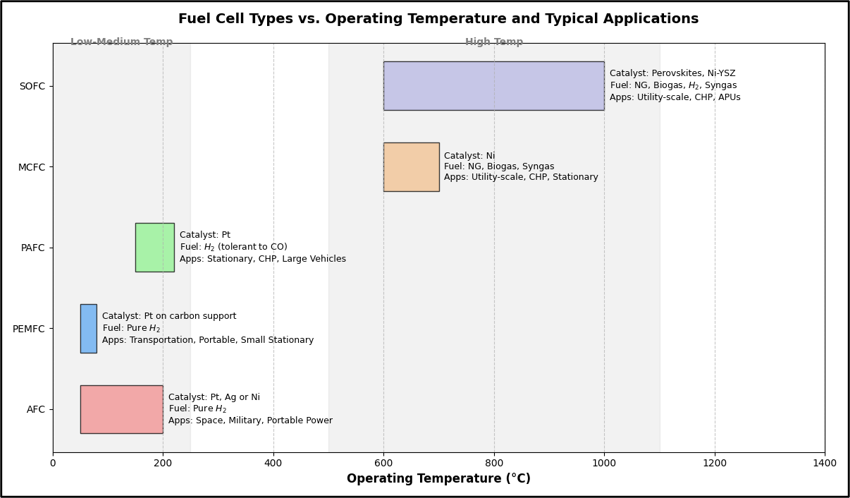
Figure 1: Operating temperatures and typical applications of fuel cells27Gholamreza Mirshekari, R. M. Solid Oxide Fuel Cells: From Fundamental Principles to Complete Systems. (2020).28Veza, I. Fuel-cell thermal management strategies for enhanced performance: Review of fuel-cell thermal management in Proton-exchange membrane fuel cells (pemfcs) and solid-oxide fuel cells (sofcs). Hydrogen 6, 65 (2025).
2.3 Performance metrices and benchmarking
There are several metrices that can be used to measure the performance of a fuel cell that include followings.
a. Electrical efficiency
This is the ratio of net electrical output to the Lower Heating Value (LHV) serves as the foundational benchmark for assessing a fuel cell’s performance. The operating temperature and electrochemical mechanism are the main factors influencing the significant variations in efficiency ranges among technology types.29U.S., D. o. E. Hydrogen and Fuel Cell Technologies Office: Multi-Year Program Plan. 170 (U.S. Department of Energy, 2024). Due to high working temperatures, speed up electrochemical kinetics and allow internal hydrocarbon reforming, high-temperature systems (SOFC, MCFC) obtain greater efficiencies without the need for external fuel processors.
b. Power density
Power density determines how small a fuel cell stack may be for a given power output. It is measured in W/cm2 or kW/L. Higher power density is often traded off against efficiency and durability, since operating at elevated current densities increases ohmic and concentration losses and accelerates performance degradation. Toyota, Hyundai, and other automakers adopt PEMFC systems because they can achieve volumetric power densities of up to 3.0 kW/L in sophisticated automobile stacks.30Yun Wanga, H. Y., Andrew Martinez b, Patrick Honga, Hui Xuc, Fred R. Bockmiller. Polymer electrolyte membrane fuel cell and hydrogen station networks for automobiles: Status, technology, and perspectives. Advances in Applied Energy 2 (2021). https://doi.org/https://doi.org/10.1016/j.adapen.2021.100011
c. Transient response
The ability of a fuel cell system to swiftly adjust output power in response to variations in load is known as transient response, and it is essential for grid support, vehicle propulsion, backup power, and microgrid applications. Transient response has been identified as a key engineering barrier for SOFC as they require time to warm up.31Qasem, N. A. A., Abdulrahman, G. A. Q. & Osinkin, D. A Recent Comprehensive Review of Fuel Cells: History, Types, and Applications. International Journal of Energy Research 2024 (2024). https://doi.org/10.1155/2024/7271748
d. Cold-start capability
The ability of a system to achieve operational output from ambient temperature is referred to as cold-start capability. PEMFC systems can cold-start within seconds to a few minutes. But high temperature fuel cells (MCFC, SOFC) have inherently long start up times because they must be heated to several hundred degrees Celsius before electrochemical operation is possible.
2.4 Enhancing system efficiency through combined heat and power (CHP)
Combined heat and power (CHP) which is also referred as cogeneration, is the most significant efficiency lever for stationary fuel cells, because it captures the thermal energy that would otherwise be wasted. Fuel cell CHP is one of the most thermodynamically efficient generating methods available since it provides performance comparable to large combined-cycle gas plants at a fraction of the scale.31Qasem, N. A. A., Abdulrahman, G. A. Q. & Osinkin, D. A Recent Comprehensive Review of Fuel Cells: History, Types, and Applications. International Journal of Energy Research 2024 (2024). https://doi.org/10.1155/2024/7271748 The table below shows how the a higher efficiency is obtained using CHP by different fuel cells.
Table 1: Types of Fuel Cells.32U.S., D. o. E. Types of Fuel Cells, (
| Fuel cell | Application | Electrical efficiency | CHP Total Efficiency |
| PAFC | used in hotels and hospitals. ~120°C steam; space/water heating | 36–42% | 85% |
| MCFCs | 300°C steam; industrial process heat | 50–60% | 80% |
| SOFC | 500°C exhaust; steam, bottoming cycles | 50–65% | 85–90%+ |
2.5 Durability and degradation mechanisms
To achieve long term commercial feasibility of fuel cells, it is necessary to address the complicated degradation processes that control the service life of stacks.
2.5.1 Fuel stack durability drivers
Platinum (Pt)-based catalysts, specifically the Pt/C, are the catalysts that have been popularly used in PEMFCs owing to their high capacity to catalyze the electrochemical reactions at both cathode and anode. One of the major degradation processes is sintering whereby nanoparticle coalescence and growth decrease the active surface area and lower the catalytic activity and can be induced by thermal effects or reactions with reactants during catalytic reactions.33Okonkwo, P. C. Proton exchange membrane fuel cell catalyst layer degradation mechanisms: A succinct review. Catalysts 15, 97 (2025). Membrane pinholes is another process that causes degradation in fuel cells. Pinholes in proton exchange membrane (PEM) systems can form during manufacturing, handling, or long-term operation due to factors such as contaminant particles, non-uniform stress distribution, and membrane degradation. These pinholes compromise membrane integrity by enabling bulk gas crossover and risking electrical shorting.34Liu, C., Wrubel, J., Padgett, E. & Bender, G. The impacts of membrane pinholes on PEM water electrolysis. Journal of Power Sources 581, 233507 (2023). Carbon corrosion in PEMFCs mainly takes place during start-up or shutdown where a temporary lack of hydrogen in the anode makes air fill the fuel cell apertures. This state will cause electrochemical reaction involving carbon and water at the cathode, resulting in oxidation and consequent corrosion of carbon materials both in the membrane electrode assembly (MEA) and the gas diffusion layer (GDL).35Sim, J., Kang, M., Min, K., Lee, E. & Jyoung, J. Y. Effects of carbon corrosion on Proton exchange membrane fuel cell performance using two durability evaluation methods. Renewable Energy 190, 959–970 (2022).
Carbon Monoxide (CO) poisoning is also a common contaminant in hydrogen fuel cells only happens on the anode, which may be caused by impurities added during hydrogen production or storage. The basic process of CO poisoning is that the CO molecules will be adsorbed on sites of Pt catalysts and physically inhibited hydrogen access to the Pt particles and thus suppressed electrochemical reaction.36Schmittinger, W. V., A. . A review of the main parameters influencing long-term performance and durability of PEM fuel cells. Journal of Power Sources 180, 1-14 (2008). Sulfer is also a commonly found poison in Pt catalysts. It can be found in low levels in hydrogen or as very low quantities in fuel sources.33Okonkwo, P. C. Proton exchange membrane fuel cell catalyst layer degradation mechanisms: A succinct review. Catalysts 15, 97 (2025). It is reported the amount of H2S poisoning reduced with increasing temperature and rose with rising electrode potential. The thermal cycling of PEM fuel cells during thermal changes between sub-zero and operating temperatures causes large thermal and mechanical stresses, leading to damage in long term durability. Constant ice forming and melting on the surface of the membrane may result in the delamination of the catalyst layer on the membrane and the GDL. In addition, thermal cycling of wet membranes facilitates the development and expansion of cracks that enhance the crossover of reactant gases, formation of hot spots and ultimately pinhole development.36Schmittinger, W. V., A. . A review of the main parameters influencing long-term performance and durability of PEM fuel cells. Journal of Power Sources 180, 1-14 (2008).
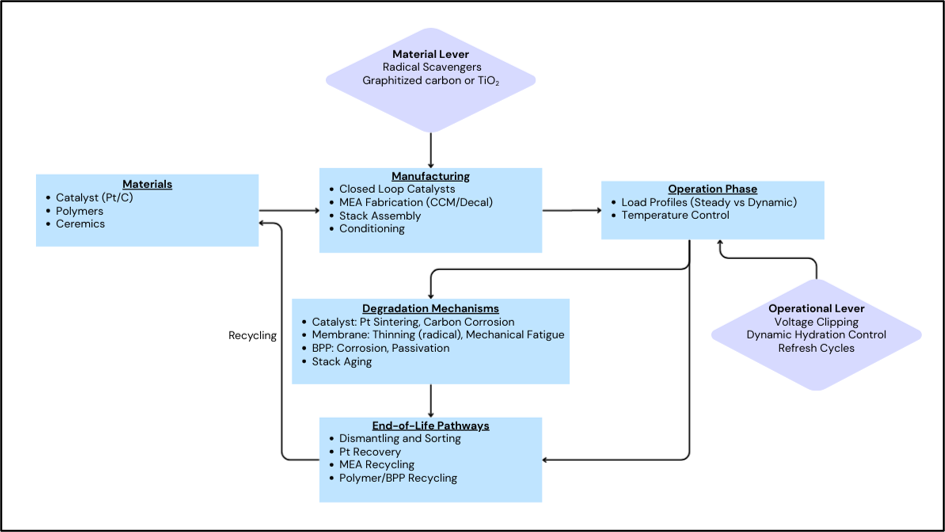
Figure 2: Lifecycle of a PEM fuel-cell stack37Stanchev, P. H., N. Life cycle of fuel cells: From raw materials to end-of-life management. Clean Technologies 7, 94 (2025).
2.5.2 Typical lifetime ranges in different applications
According to the U.S. Department of Energy (DOE), the automotive industry, has already established a goal of more than 8,000 hours of performance with less than 10% of performance degradation of transportation fuel-cell systems, and more than 25,000 hours of performance with heavy-duty cars by 2030. The 15-year and 200,000-km targets have been seen in the modified accelerated durability tests on prototype stacks by Toyota. But Monte Carlo simulations at standard operating temperatures of 600C of 3,884 to 3,895 hours, or in other words 155,360 to 155,800 km in the case of a 25-ton heavy-duty truck, indicates that there is still a significant difference between performance under normal operating conditions and long-term industry goals.38Choi, Y., Kim, M., Park, J. & Goo, Y. Proton exchange membrane fuel cell stack durability prediction using Arrhenius-based accelerated degradation model. Applied Sciences 15, 1300 (2025). The lifespan of fuel cell stationary ranges greatly according to the technology and size of the installation. Micro-CHP systems with power up to 5 kW last about 12 years, and it is estimated that this will increase to 15 years by 2030, whilst mid-size CHP systems of 5 to 20 kW have an existing limit of 6 years and are predicted to continue to 20 years by 2030. PEMFC and SOFC systems have lifetimes of 40,000-80,000 and 20,000-90,000 hours respectively whilst PAFC systems dominate at the most at 30,000-130,000 hours. MCFC systems have a 15,000-30,000 hour rating compared to AFC systems with the lowest estimated life of only 5,000 to 8,000 hours.39Cigolotti, V., Genovese, M. & Fragiacomo, P. Comprehensive Review on fuel cell technology for stationary applications as sustainable and efficient poly-generation Energy Systems. Energies 14, 4963 (2021).
2.5.3 Mitigation strategies
2.5.3.1 Operating envelopes
High humidity, temperature, and electric potential are the factors that cause corrosion of the carbon catalyst carrier and, thus, should be optimized as an important approach to mitigation. Cathode inlet gas humidity can be reduced, especially since start-stop cycle degradation is about 40 times higher at 80 0C and 100% RH than at 5 0C and 25% RH. Reduction of operating temperature during start-stop cycles also minimizes performance loss because, at high temperatures, not only do carrier corrosion and dissolution and agglomeration of platinum catalysts increase faster but also the rate of performance loss is increased. Also, a higher rate of gasing will decrease the time taken by the hydrogen-air interface in the flow through thereby decreasing the total rate of corrosion of the carbon carrier.40Liu, Z., Chen, H. & Zhang, T. Review on system mitigation strategies for start-stop degradation of automotive proton exchange membrane fuel cell. Applied Energy 327 (2022).
2.5.3.2 Start–stop management
Management of start-stop in PEMFCs aims at ensuring that the hydrogen-air interface in the anode is minimized to limit carbon carrier corrosion. This boundary cannot form completely during start-up or shutdown, which has been prevented by nitrogen purging and one study has indicated that voltage decay increases 10-fold without nitrogen purging after 200 cycles. Alternatively, the rate of degradation can be reduced by almost 30% by supplying the anode with hydrogen prior to air in the start process, and the exhaust should be closed during shutdown to prevent the supply of air continuously, and is also more effective in increasing the life.40Liu, Z., Chen, H. & Zhang, T. Review on system mitigation strategies for start-stop degradation of automotive proton exchange membrane fuel cell. Applied Energy 327 (2022).
2.6 History of fuel cells
2.6.1 Early developments
The idea of fuel cells began with Sir William Robert Grove in 1839 when he created the gas voltaic battery, an initial fuel cell model. Grove realized that by reversing the water electrolysis process, electricity could be produced by combining hydrogen and oxygen in an electrochemical reaction, establishing a foundation for subsequent fuel cell studies. His research was published in the Philosophical Magazine. Despite its successful demonstration, Grove did not view fuel cells as a practical energy source at the time, leading to stagnation in research.5Bagockij, V. S. Fuel cells : problems and solutions. 2nd edn, (Hoboken, N.J: Wiley, 2012).,7Jiang, S. P. & Li, Q. Introduction to Fuel Cells: Electrochemistry and Materials. (Springer, 2022). Wilhelm Ostwald’s significant theoretical contributions in 1894, proposing electricity generation through fuel oxidation via electrochemical means, further advanced the field, though practical applications remained elusive for several decades.5Bagockij, V. S. Fuel cells : problems and solutions. 2nd edn, (Hoboken, N.J: Wiley, 2012).,14Mustakim, W. (Taylor & Francis, 2025).
2.6.2 Experimental fuel cell advancements (1894–1960)
Early experiments in fuel cells faced challenges due to a lack of advanced materials and an understanding of electrochemistry. However, Francis Thomas Bacon developed the first practical alkaline fuel cell (AFC) in 1932. Bacon’s research led to replacing corrosive acidic electrolytes with alkaline electrolytes, significantly improving fuel cell durability and efficiency.5Bagockij, V. S. Fuel cells : problems and solutions. 2nd edn, (Hoboken, N.J: Wiley, 2012).,7Jiang, S. P. & Li, Q. Introduction to Fuel Cells: Electrochemistry and Materials. (Springer, 2022).,14Mustakim, W. (Taylor & Francis, 2025).
By 1959, Bacon successfully demonstrated a 5-kW alkaline fuel cell stack.5Bagockij, V. S. Fuel cells : problems and solutions. 2nd edn, (Hoboken, N.J: Wiley, 2012).,7Jiang, S. P. & Li, Q. Introduction to Fuel Cells: Electrochemistry and Materials. (Springer, 2022).,41Mench, M. M. Fuel cell engines. (Hoboken, N.J: John Wiley & Sons, 2008). During this period, researchers such as Emil Baur also made significant advances in high-temperature fuel cells, specifically solid oxide fuel cells (SOFCs) and molten carbonate fuel cells (MCFCs). However, these technologies were not yet mature for practical applications.5Bagockij, V. S. Fuel cells : problems and solutions. 2nd edn, (Hoboken, N.J: Wiley, 2012).,7Jiang, S. P. & Li, Q. Introduction to Fuel Cells: Electrochemistry and Materials. (Springer, 2022).,14Mustakim, W. (Taylor & Francis, 2025).
2.6.3 NASA and the first fuel cell boom (1960s–1990s)
Fuel cells gained widespread attention in the 1960s when NASA adopted them for the Gemini and Apollo space programs. They provided a reliable power source with no moving parts and produced water as a byproduct for astronauts. During this time, several new types of fuel cells were developed, including Polymer Electrolyte Membrane Fuel Cells (PEMFCs) used in the Gemini spacecraft, Phosphoric Acid Fuel Cells (PAFCs) for stationary power applications, and Molten Carbonate Fuel Cells (MCFCs) for large-scale power generation. Despite these advancements, high costs and the lack of hydrogen infrastructure limited commercial viability adoption.2Breeze, P. A. Fuel cells. (London San Diego Cambridge Oxford: AP Academic Press, an imprint of Elsevier, 2017).,8Lucia, U. Overview on fuel cells. Renewable and Sustainable Energy Reviews 30, 164-169 (2014). https://doi.org/https://doi.org/10.1016/j.rser.2013.09.025,12Andújar, J. M. & Segura, F. Fuel cells: History and updating. A walk along two centuries. Renewable and Sustainable Energy Reviews 13, 2309-2322 (2009). https://doi.org/https://doi.org/10.1016/j.rser.2009.03.015
2.6.4 The resurgence of fuel cells (1990s–present)
In the 1990s, fuel cells experienced a resurgence driven by concerns over energy security, climate change, and the pursuit of renewable alternatives. Significant investments were made in hydrogen fuel cell vehicles (FCVs), with automakers like Toyota, Honda, and Hyundai leading the development of Fuel Cell Electric Vehicles (FCEVs).3Behling, N. H. Fuel cells : current technology challenges and future research needs$nElektronische Ressource. 1. edn, (Amsterdam Heidelberg u.a.: Elsevier, 2013).,4Stolten, D., Samsun, R. C. & Garland, N. Fuel cells : data, facts and figures. (Weinheim: Wiley-VCH, 2016). Key factors contributing to this resurgence included government policies such as the Kyoto Protocol (1997)8Lucia, U. Overview on fuel cells. Renewable and Sustainable Energy Reviews 30, 164-169 (2014). https://doi.org/https://doi.org/10.1016/j.rser.2013.09.025, technological advances in fuel cell catalysts, membrane durability, and the expansion of hydrogen infrastructure in countries like South Korea, Japan, Germany, and the United States.1Trencher, G. & Edianto, A. Drivers and barriers to the adoption of fuel cell passenger vehicles and buses in Germany. Energies 14, 833 (2021).,42Kim, K., Moon, S. & Kim, J. How far is it from your home? Strategic policy and management to overcome barriers of introducing fuel-cell power generation facilities. Energy policy 182, 113746 (2023). https://doi.org/10.1016/j.enpol.2023.113746,43Miller, E. L. et al. US Department of Energy hydrogen and fuel cell technologies perspectives. Mrs Bulletin 45, 57-64 (2020).
Today, fuel cells are being integrated into renewable energy systems, stationary power generation, and zero-emission transportation. The push towards a hydrogen economy continues, with major corporations and governments advocating for hydrogen-powered infrastructure.17Borthwick, W. K. The European Union approach to fuel cell development. Journal of Power Sources 86, 52-56 (2000).,43Miller, E. L. et al. US Department of Energy hydrogen and fuel cell technologies perspectives. Mrs Bulletin 45, 57-64 (2020).
3 Hydrogen supply chain
3.1 Hydrogen production pathways and carbon intensity
The production of hydrogen is not monolithic. The value of its environment solely relies on the source of energy and the intensity of carbon within the production route. To make sure that fuel cells offer a net reduction of emissions, lifecycle assessments (LCA) need to consider all the phases of the well-to-gate.44Gonzales-Calienes, G. e. a. Life cycle assessment of hydrogen production pathways to support hydrogen decarbonization policies in a Canadian context. Frontiers in Energy Vol 19, 1093–1108 (2025). Carbon footprint of hydrogen differs based on technology employed: Electrolysis is a method of splitting water into Oxygen and Hydrogen (green H2), using electricity generated by wind, solar or other non-carbon emission sources. Life‑cycle Greenhouse Gas (GHG) intensities are the lowest, typically ≈20 g CO₂e MJ-1 (≈5-6 kg CO₂e kg-1 H2) when the electricity grid is more than 85 % clean.45Busch, P., Kendall, A. & Lipman, T. A systematic review of life cycle greenhouse gas intensity values for hydrogen production pathways. Renewable and Sustainable Energy Reviews 184, 113588 (2023). Steam Methane Reforming (SMR) and Autothermal Reforming (ATR) are the two leading technologies that are being used for Hydrogen production.46Zhang, L., Dillon, D., Bhown, A. & Mancuso, L. Model development and techno economics assessment of steam methane reforming (SMR) and auto thermal reforming (ATR) with high CO₂ Capture Rate. SSRN Electronic Journal, 5012414 (2024). https://doi.org/10.2139/ssrn.5012414 SMR is the most prominent technology used in the industry, responsible for 80% of global H2 production in 2020.47Wang, R. et al. Performance and techno-economic analysis of an SMR-CCS process for blue hydrogen production: Ai predictions. Energy & Fuels 29, 22260–22281 (2025). Carbon Capture and Storage (CCS) methods are used with SMR and ATR to mitigate CO₂ emissions.46Zhang, L., Dillon, D., Bhown, A. & Mancuso, L. Model development and techno economics assessment of steam methane reforming (SMR) and auto thermal reforming (ATR) with high CO₂ Capture Rate. SSRN Electronic Journal, 5012414 (2024). https://doi.org/10.2139/ssrn.5012414 The SMR-CCS method results in the generation of blue H2.47Wang, R. et al. Performance and techno-economic analysis of an SMR-CCS process for blue hydrogen production: Ai predictions. Energy & Fuels 29, 22260–22281 (2025). Intensities are reported as high as about 10 kg CO₂e kg-1 H2 (equivalent to ≈10 kg CO₂e kg -1 H2 in a decarbonizing power sector) down to ≈3-4 kg CO₂e kg-1 H2 in cases where CCS is very effective.48Lamers, P., Ghosh, T., Upasani, S., Sacchi, R. & Daioglou, V. Linking life cycle and integrated assessment modeling to evaluate technologies in an evolving system context: A power-to-hydrogen case study for the United States. Environmental Science & Technology 57, 2464–2473 (2023). Emerging bio/thermal routes such as biomass gasification, biogas reforming and renewable-natural-gas reforming are also used in H2 production. These routes can achieve extremely low intensities (≈0.4 kg CO₂e kg-1 H2 or similar values depending on biomass pathway), although values are highly scattered with feedstock and CCS system. Including CCS methods allows biomass pathways to have even negative carbon intensities.49Lipman, T. et al. Moving Beyond the Colors: The Full Life-Cycle Emissions of Hydrogen Production Pathways for California. 1-67 (University of California Institute of Transportation Studies, 2023).
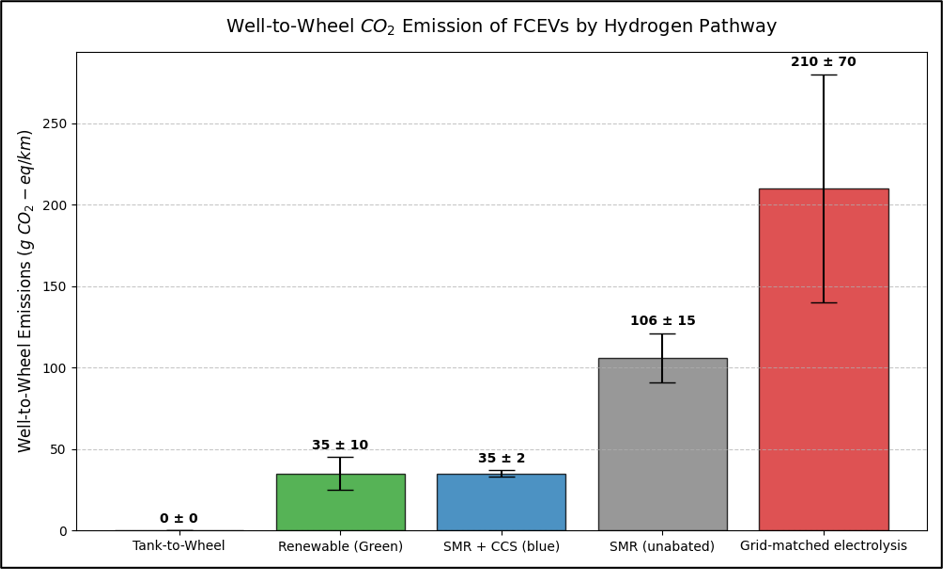
Figure 3: Well-to-wheel CO₂e of FCEVs by hydrogen pathway50Maniscalco, M. P., Longo, S., Cellura, M., Miccichè, G. & Ferraro, M. Critical review of life cycle assessment of hydrogen production pathways. Environments 11, 108 (2024).
Section §45V provides a tiered Production Tax Credit (PTC) of clean hydrogen in which the credit value varies based on the lifecycle GHG emissions emitted during hydrogen production. As an example, the criteria to be eligible to the highest credit tier state that the lifecycle GHG emissions of the hydrogen production process must be less than 0.45 kg CO₂ekg-1 H2.51Energy, U. S. D. o. Assessing Lifecycle Greenhouse Gas Emissions Associated with Electricity Use for the Section 45V Clean Hydrogen Production Tax Credit. 1-15 (2023). However, a fuel cell can only be said to be clean when the hydrogen it is fed on was emitted into the atmosphere with low emissions. When a fuel cell operates using unmediated grey hydrogen, the cumulative emissions may even be higher than those of a high-efficiency diesel engine or natural gas turbine, which is counterproductive to environmentally goal-oriented technology.9Muron, M. P., G.; Fraile, D. Clean Hydrogen Production Pathways Report 2024. 1-99 (Hydrogen Europe, 2024). A methodology was proposed to determine whether the produced hydrogen was “clean”, utilizing an application of an extensive/multifaceted lifecycle GHG emissions framework (45VH2-GREET 1) and being eligible to qualify at the highest tiers such as, electrolysis should frequently satisfy requirements on incrementality (new clean power), temporal matching (hourly verification), and geographic correlation (same grid region) in order to avoid the unintended effect of introducing more fossil fuels combustion to the grid which is known as the three pillars.9Muron, M. P., G.; Fraile, D. Clean Hydrogen Production Pathways Report 2024. 1-99 (Hydrogen Europe, 2024).
3.2 Storage and logistics
3.2.1 Hydrogen storage
There are a variety of hydrogen storage and logistics technologies optimized to balance of energy density, cost, and compatibility with infrastructure, and choice of storage approach is largely dependent on the desired energy density and desired end-use. The most common mobility application currently is compressed gas storage at 350 or 700 bar with the industry standard of 700 bar (H70) is used in personal vehicles, and the 350 bar standard currently used in the heavy-duty transit market. Type III/IV carbon‑fibre high pressure tanks are used for this purpose.52U.S., D. o. E. Onboard Type IV Compressed Hydrogen Storage System – Cost and Performance Status. (2025). LH2 offers the highest volumetric density (≈80 % greater than 70 MPa gas and 50 % greater than methyl‑cyclohexane) but needs cryogenic tanks at 20 K; the liquefaction process is energy‑intensive (~13.8 kWh kg-1) and incurs boil‑off losses of 1–5 % per day. LH2 is favoured for long‑distance bulk transport because shipping and pipeline delivery become economical beyond ≈3000 km.53Zhang, T. et al. Hydrogen liquefaction and storage: Recent progress and Perspectives. Renewable and Sustainable Energy Reviews 176 (2023).,54Al Ghafri, S. Z. e. Hydrogen liquefaction: A review of the fundamental physics, engineering practice and future opportunities. Energy & Environmental Science 15, 2690–2731 (2022).,55Schiaroli, A. e. a. A comprehensive review on Liquid Hydrogen Transfer Operations and safety considerations for mobile applications. International Journal of Hydrogen Energy 107, 164-182 (2025). LOHCs are mixed with dibenzyltoluene, methanol, N-ethylcarbazole and toluene56Niermann, M., Timmerberg, S., Drünert, S. & Kaltschmitt, M. Liquid organic hydrogen carriers and alternatives for international transport of Renewable Hydrogen. Renewable and Sustainable Energy Reviews 135, 110171 (2021)., which chemically bond Hydrogen to facilitate storing it at ambient temperature and pressure and thus easing its processing and transportation. LOHCs are beneficial because of their stability and high content of hydrogen, and their performance is determined by the individual organic liquid mentioned above and catalytic actions.57Xie, Z., Jin, Q., Su, G. & Lu, W. . A review of hydrogen storage and transportation: Progresses and challenges. Energies 17, 4070 (2024). Nowadays, the most popular solid hydrogen storage materials are the categories which can be represented by magnesium hydride, sodium borohydride, and ammonia borane. Magnesium-based materials are specifically interesting since they have low molecular weight and can easily be found. Nonetheless, one of the major shortcomings of magnesium-based materials is a high hydrogen release temperature.57Xie, Z., Jin, Q., Su, G. & Lu, W. . A review of hydrogen storage and transportation: Progresses and challenges. Energies 17, 4070 (2024). These storage technologies that keep hydrogen locked up in a compound structure.58Usman, M. R. Hydrogen Storage Methods: Review and current status. Renewable and Sustainable Energy Reviews 167, 112743 (2022).
3.2.2 Logistics
The process of transporting hydrogen between production points and the final consumers is characterized by one onsite and two offsites with trailer trucks and pipelines, which can be applied to various scale sizes and conditions of the infrastructure. Smaller-scale or new demand in non-available pipeline infrastructure is usually served with trailers, such as gaseous tube trailers and cryogenic liquid tankers. The pipeline cost reduction trends on higher demands and higher lifespan than trailer trucks, place gaseous pipeline supply chain in a favourable position during a longer period and past 2050 in situations where onsite electricity prices are elevated.59Alexandrou, S. Comparative analysis of on-site vs off-site green-hydrogen value chain scenarios to cover projected aviation demand: A case for Toulouse Blagnac Airport in France., (DIVA, 2023). Onsite generation, hydrogen is produced at the place of the consumption with a direct transmission of electricity over a high voltage direct current grid.56Niermann, M., Timmerberg, S., Drünert, S. & Kaltschmitt, M. Liquid organic hydrogen carriers and alternatives for international transport of Renewable Hydrogen. Renewable and Sustainable Energy Reviews 135, 110171 (2021).
3.2.3 Key trade-offs
3.2.3.1 Energy density
The high mass-energy density of pure hydrogen of 120 MJ/kg is compensated with an extremely small volumetric energy density, which motivates the further development of the better storage solutions. Both cryogenic liquefaction and LOHCs have a great enhancement of volumetric density, LH2 being higher than CGH2 in terms of storage density, whilst LOHCs have high capacity by means of hydrogenation at the expense of low gravimetric energy density.56Niermann, M., Timmerberg, S., Drünert, S. & Kaltschmitt, M. Liquid organic hydrogen carriers and alternatives for international transport of Renewable Hydrogen. Renewable and Sustainable Energy Reviews 135, 110171 (2021).,57Xie, Z., Jin, Q., Su, G. & Lu, W. . A review of hydrogen storage and transportation: Progresses and challenges. Energies 17, 4070 (2024).
3.2.3.2 Bail-off and storage losses
The biggest disadvantage of LH2 is that it has a boil-off effect such that heat input results in the loss of hydrogen to vapor loss of 1-5% energy and unstable pressure, which necessitates expensive insulation or active thermal protection. Conversely, there are very small transport losses in LOHCs and CGH2 systems and the added benefit of long-term storage in the form of LOHCs is that no leakage and boil-off can take place theoretically.56Niermann, M., Timmerberg, S., Drünert, S. & Kaltschmitt, M. Liquid organic hydrogen carriers and alternatives for international transport of Renewable Hydrogen. Renewable and Sustainable Energy Reviews 135, 110171 (2021).,57Xie, Z., Jin, Q., Su, G. & Lu, W. . A review of hydrogen storage and transportation: Progresses and challenges. Energies 17, 4070 (2024).
3.2.3.3 Permeation and safety
The small molecular weight of hydrogen creates a lot of problems in terms of permeation and leakage encountered in compressed gas storage and pipeline transportation. In Type IV tanks, polymer lining permeation must be scrutinized by selecting the correct material like HDPE or special nylon, whereas in pipelines it increases chances of leakages and material embrittlement. With LOHCs, these problems are mostly evaded, since they are liquid at ambient temperature and would appear very similar to conventional crude oil-based liquids, so they can use the existing fuel infrastructure with little or no adaptation.56Niermann, M., Timmerberg, S., Drünert, S. & Kaltschmitt, M. Liquid organic hydrogen carriers and alternatives for international transport of Renewable Hydrogen. Renewable and Sustainable Energy Reviews 135, 110171 (2021).,57Xie, Z., Jin, Q., Su, G. & Lu, W. . A review of hydrogen storage and transportation: Progresses and challenges. Energies 17, 4070 (2024).
3.2.3.4 Cost
The cost of transportation of hydrogen varies significantly based on the mode of transportation, distance, and carrier technology. CGH2 trucks are the most popular type over short ranges (less than 200 km) and become cost-effective in combination with pipelines and cavern storage but become very expensive as distance increases. Instead, in the case of long-distance or transoceanic transportation, seaborne LH2 is the most economical option, even though LH2 is expensive in general because of the energy-intensive liquefaction process and losses during boil-off. A promising substitute is LOHCs which are based on the existing liquid fuel infrastructure such as mineral oil tanks and gas pipeline systems, which avoids additional capital expenditure, and methanol is the most competitive LOHCs due to the large capacity of transportation as well as low costs of raw materials.56Niermann, M., Timmerberg, S., Drünert, S. & Kaltschmitt, M. Liquid organic hydrogen carriers and alternatives for international transport of Renewable Hydrogen. Renewable and Sustainable Energy Reviews 135, 110171 (2021).,57Xie, Z., Jin, Q., Su, G. & Lu, W. . A review of hydrogen storage and transportation: Progresses and challenges. Energies 17, 4070 (2024).
3.3 Infrastructure and refuelling networks
The globe has been experiencing strategic hydrogen refuelling infrastructure expansion where pilot demonstrations have been replaced by high-business potential networks supported by zero-emission policies and technological advancements.60Zope, R. Hydrogen Refueling Stations Market Size, Share, Trends, Growth, Forecasts 2025 – 2032. Persistence Market Research, (2025). There are two main pressure standards of hydrogen refuelling stations, and each applies to a particular type of vehicle. Passenger cars are based on the 700 bar (H70) standard, which allows the long range drive by allowing high density storage of energy. Commercial trucks and buses, however, come with the lower 350 bar standard (H35/H35HF) which is more appropriate to the increased capacity and other storage needs of the larger machines.61Dietz, D. H2 mobility: Commercial vehicles on the rise – 350-bar hydrogen refuellings surpass 700-bar for the first time amid growing demand. H2 MOBILITY, (2025). Hydrogen refuelling infrastructure varies considerably on scale depending on demand and location. Small stations with a capacity of less than one tonne per day dominated the market in early 2026, capturing over 90% of the market share largely due to their lower capital costs and suitability for regions with modest demand. Medium and large stations, capable of dispensing between one and four or more tonnes per day respectively, are increasingly being deployed across logistics hubs and high traffic corridors.62Business, F. Hydrogen fueling station market size, share: Forecast [2034], (2026). Modern high-capacity stations are capable of dispensing between 14 and 160 kg/h of hydrogen on the performance end with future goals of filling a 100 kg capacity truck in ten minutes.63HRS. French-made 14 to 80kg/h: Hrs. Hydrogen stations, (2025).
The market of hydrogen refuelling is growing at an alarming rate in the world with the estimated growth rate of 21.2% per annum in 2026.64Markets, R. Hydrogen Fueling Station Market Report 2026, (2026). Asia-Pacific is the most dominant area in this rise which is led by China, Japan and South Korea where large investments in fuel cell technology and green energy projects are taking the market growth to a higher stage. In the meantime, Europe and North America are also experiencing a huge growth with the opening of “Hydrogen Hubs” and logistics corridors.65U.S., D. o. E. Regional clean hydrogen hubs., ( It is worth noting that the U.S. market is becoming one of the fastest expanding due to the extensive zero-emission requirements that are fuelling the mass use of hydrogen refuelling stations.66in Council Regulation (EU) No 559/2014 (2014).
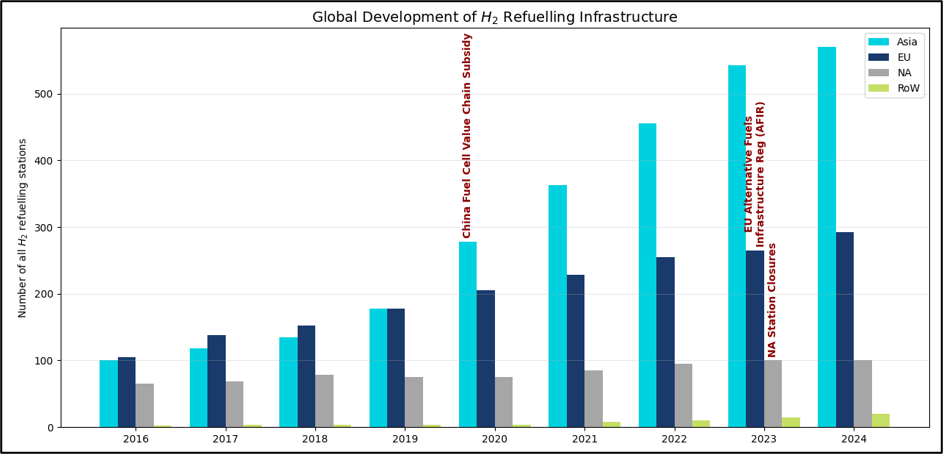
Figure 4: Global hydrogen refuelling station growth by regions67H2Stations.org. Statistics, <https://www.h2stations.org/statistics> (2025).
There is a sudden rise in number of refuelling stations in Asia from 2020, which could be because of China subsidy shift happened in 2020. In 2023, Europe implemented EU Alternative Fuels Infrastructure Regulation (AFIR) and North America has closed some of their light duty refuelling stations.68Yuki. China’s new fuel cell and FCV subsidy policy design, (2020).,69Observatory, E. H. Alternative fuels infrastructure regulation., (2025).,70Hogen, M. Shell is immediately closing all of its California Hydrogen stations, (2024).
Public-Private Partnerships (PPPs) are important in the hydrogen industry in problem-solving the high initial capital and infrastructure risks that may discourage development. These consortia are a combination of private investment and government resources that will speed up deployment in emerging markets where market forces might not be adequate. One such example of this type of collaboration is the Fuel Cells and Hydrogen Joint Undertaking (FCH 2 JU) in Europe which is a collaboration between the European Commission, industry stakeholders, and research communities with the aim of standardization and scaling of hydrogen technologies across the region.66in Council Regulation (EU) No 559/2014 (2014).
In spite of the overall growth of the sector, there are still a number of operational challenges that are considered as major hurdles. There is always the issue of reliability and massive breakdowns in high pressure compressors because of wear and tear on the piston and gasket and the chiller systems because of failure to control leaks of refrigerant, the latter often leads to significant downtime. To make this problem even deeper, long maintenance times are often explained by the lack of spare parts and technological incompetency of a lot of specialized parts.71Groth, K. M., Reising, L. M., Grabovetska, V. & Ruiz, A. Hydrogen Systems Risk and reliability challenges, priorities, and workshop insights. Hydrogen Safety 2, 88-98 (2025). In the future, one strategy that will be deployed to overcome infrastructure deficiencies is a strategic emphasis on on-site hydrogen generation via electrolysis and establishment of mobile refuelling stations that would offer an elastic coverage in regions where permanent infrastructure is yet to be established.64Markets, R. Hydrogen Fueling Station Market Report 2026, (2026).
3.4 Safety, codes, and standards
A strict set of safety codes and fuel-quality standards must be followed by organizations that work in the hydrogen industry to reduce the risks that are posed by the special chemical characteristics of hydrogen, including its extended flammability characteristic and limited molecular size. One of the main standards is NFPA 2 (Hydrogen Technologies Code) that establishes extensive fire and life safety regulations concerning the generation, installation, storage, piping, and utilization of hydrogen in both gaseous and liquid state.72Tools, H. Hydrogen and Fuel Cells Codes and Standards Database, ( To ensure operational safety and design of refuelling stations, the ISO 19880 series set global standards of risk management, such as hazard identification, safety distances (setbacks), and design of such critical elements as dispensers and compression systems.73Saw, J. L. et al. Deliverables D3.7 and D3.8 Developing Good Practice Guidelines in Project MultHyFuel. (MultHyFuel, 2025). The integrity of the fuel cells and their functionality necessitate the conformance to fuel-quality criteria; ISO 14687 and SAE J2719 represent the allowable amounts of impurities namely carbon monoxide and sulfur, that would otherwise poison the catalysts and lead to failure. Effective safety management systems should also focus on expert training and emergency behaviour, which involves practice drills on how to respond instinctively to alarms.74ISO. ISO 14687:2019(en) Hydrogen fuel quality, (2019).,75U.S., D. o. E. Hydrogen Fuel Quality Specifications for Polymer Electrolyte Fuel Cells in Road Vehicles. 1-86 (2016). Additionally, leak-sensing mechanisms and preventive measures of leakage, coupled with the estimated distance of setback to guard other properties, are fundamental keystones to safe and extensive deployment of hydrogen infrastructure.
4 Economic performance of fuel cells
The economic performance of fuel cells is a critical factor in determining their viability and competitiveness in the energy market. While government subsidies have played a crucial role in accelerating adoption18Kampker, A. et al. Challenges towards large-scale fuel cell production: Results of an expert assessment study. international journal of hydrogen energy 45, 29288-29296 (2020). , sustainable market requires stable business models where fuel cells can thrive without subsidies. The Total Cost of Ownership (TCO), which includes production, usage, and disposal, must reach levels comparable to internal combustion engines (ICEs) and battery- electric vehicles (BEVs) for fuel cells to achieve mass market penetration.18Kampker, A. et al. Challenges towards large-scale fuel cell production: Results of an expert assessment study. international journal of hydrogen energy 45, 29288-29296 (2020).
This section will explore the cost dynamics of fuel cells, including their initial costs, current cost trends, and comparisons with alternative energy sources. Additionally, it will examine the growth of the fuel cell industry, highlighting market trends, key companies, revenue generation, and forecasts for industry expansion.
4.1 Costs of fuel cells
The initial cost of fuel cells has historically been high due to the expensive materials and complex manufacturing processes involved.76James, B., Huya-Kouadio, J., Houchins, C. & DeSanti, D. Fuel cell vehicle and bus cost analysis. (Technical report, US DoE, 2016, www. hydrogen. energy. gov/pdfs/progress16 …, 2016). For instance, early fuel cell systems for light-duty vehicles (LDVs) were priced at approximately $60 per kW in 2016.20Huya-Kouadio, J. & James, B. D. 20 (Strategic Analysis Inc., 2023).,77James, B. D. (Strategic Analysis Inc., 2022). However, advancements in technology and economies of scale have led to a substantial reduction in costs. By 2022, the cost of LDV fuel cell systems had decreased to around $45 per kW.20Huya-Kouadio, J. & James, B. D. 20 (Strategic Analysis Inc., 2023).,77James, B. D. (Strategic Analysis Inc., 2022). This trend is expected to continue as further improvements in materials and manufacturing processes are realized.11Warshay, M. & Prokopius, P. R. in Grove Anniversary (1839-1989) Fuel Cell Symposium.
The current cost trends for fuel cells indicate a continued decline in prices. As of 2023, the cost of LDV fuel cell systems is projected to reach $40 per kW by 2025 and ~$30 to ~$50 per kW by 2030.20Huya-Kouadio, J. & James, B. D. 20 (Strategic Analysis Inc., 2023).,77James, B. D. (Strategic Analysis Inc., 2022).,78Research and Markets. Fuel Cell Market. 1-138 (2025).,79IEA. Light commercial vehicle – H2 fuel cell, (2025)..
Similarly, the cost of medium-duty vehicle (MDV) and heavy-duty vehicle (HDV) fuel cell systems is also expected to decrease. For example, HDV systems are projected to cost $80 per kW by 2030.78Research and Markets. Fuel Cell Market. 1-138 (2025). These cost reductions are driven by advancements in manufacturing techniques, increased production volumes, and improvements in fuel cell stack efficiency.
Currently, the cost of fuel cell systems remains high, particularly in the automotive sector. A top- down analysis of the Toyota Mirai fuel cell system estimates a price of $200 per kW at the system level.18Kampker, A. et al. Challenges towards large-scale fuel cell production: Results of an expert assessment study. international journal of hydrogen energy 45, 29288-29296 (2020). However, industry experts suggest that actual costs are higher, as fuel cell vehicle (FCEV) manufacturers do not yet recover full production costs from sales.18Kampker, A. et al. Challenges towards large-scale fuel cell production: Results of an expert assessment study. international journal of hydrogen energy 45, 29288-29296 (2020).,76James, B., Huya-Kouadio, J., Houchins, C. & DeSanti, D. Fuel cell vehicle and bus cost analysis. (Technical report, US DoE, 2016, www. hydrogen. energy. gov/pdfs/progress16 …, 2016). Expert assessments indicate the following cost trends in fuel cell stack production:18Kampker, A. et al. Challenges towards large-scale fuel cell production: Results of an expert assessment study. international journal of hydrogen energy 45, 29288-29296 (2020).
1. Most commonly cited cost range: €400–490 per kW.
2. Industry benchmark (high-volume production plants): €245 per kW.
3. Upper cost estimates: Up to €1,000 per kW, though such high costs are decreasing over time.
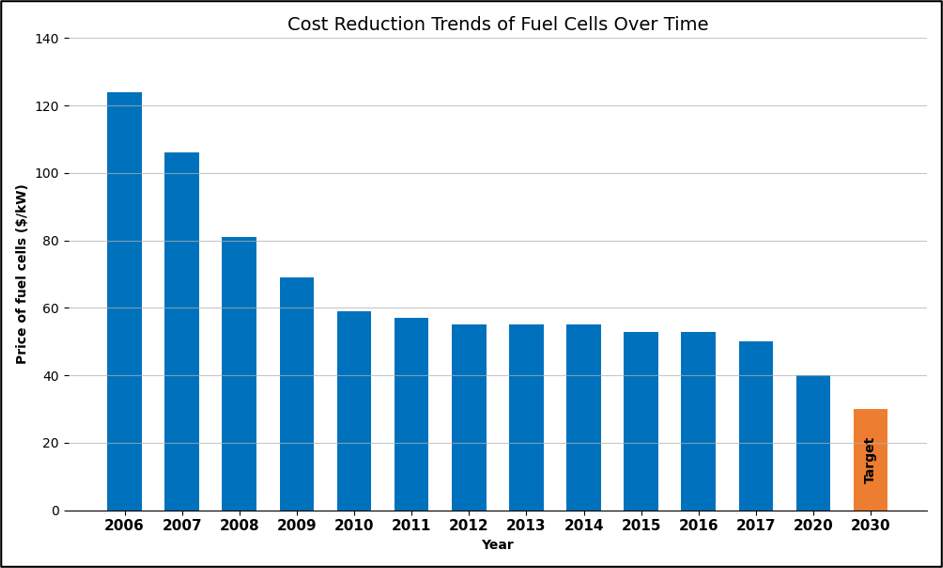
Figure 5: Cost reduction trends of fuel cells over time80Gallas, D., Stobnicki, P. & Bolzhelarskyi, Y. Types and applications of hydrogen fuel cells in transport. Rail Vehicles, 31-36 (2022). https://doi.org/10.53502/RAIL-157018
4.2 Economics beyond CAPEX
Total Cost of Ownership (TCO) of a fuel cell system extends well beyond the initial purchase price or capital expenditure. One of the key ongoing costs is stack replacement. At current manufacturing scales, PEMFC stacks in heavy-duty transport applications have replacement intervals of 20,000–30,000 hours, and stack expenses account for 30–50% of system CAPEX.81Energy, O. o. E. E. R. Fuel Cells Fact Sheet. 2 (Washington, D.C., 2015). Through high-volume production and material innovation, the DOE’s 2023 Hydrogen Program Plan aims to reduce PEMFC stack costs from roughly $250/kW in 2022 to less than $80/kW by 2030.82U.S., D. o. E. Hydrogen Program Plan. 66 (U.S. Department of Energy (DOE), Washington, D.C., 2024).
The highest continuous operating costs are the hydrogen fuel cost and delivery logistics. Green hydrogen transported to end-users presently ranges from $6–$14/kg depending on geography, production process, and transportation mode (gaseous tube trailer, liquid tanker, or pipeline). It is forecasted that green hydrogen production costs will be reduced to $2.5–$4/kg by 2030–2035 with favourable electricity pricing for renewables , but supplied costs at the dispenser will remain higher due to compression, storage, and distribution costs.83Council, H. Hydrogen Insights 2023 December Update, (
Further, secondary expenses like high-pressure storage permits and the possibility of downtime from membrane degradation, balance-of-plant failures, or hydrogen supply interruptions could be possible additions to the total cost of ownership (TCO). The cost of permitting could vary from one jurisdiction to another.
4.3 Industry growth
According to the European Clean Energy Technology Observatory19European Commission Joint Research Centre et al. Clean Energy Technology Observatory, Fuel cell technology in the European Union – Status report on technology development, trends, value chains and markets. (Publications Office of the European Union, Luxembourg, 2024)., the global installed capacity of fuel cells has experienced steady growth, with Asia leading the charge. By 2021, the worldwide installed capacity was estimated between 6.9 and 7.3 GW, with Europe contributing around 8.1 to 8.3% of this total. Recent data suggests a stagnation in growth rates despite an overall increase in capacity.5Bagockij, V. S. Fuel cells : problems and solutions. 2nd edn, (Hoboken, N.J: Wiley, 2012).,6Giorgi, L. & Leccese, F. Fuel cells: Technologies and applications. The Open Fuel Cells Journal 6 (2013).,19European Commission Joint Research Centre et al. Clean Energy Technology Observatory, Fuel cell technology in the European Union – Status report on technology development, trends, value chains and markets. (Publications Office of the European Union, Luxembourg, 2024).,21International Energy Agency. Annual Report. 1-117 (Advanced Fuel Cells Technology Collaboration Programme, 2023).,24Olabi, A. G., Wilberforce, T. & Abdelkareem, M. A. Fuel cell application in the automotive industry and future perspective. Energy 214, 118955 (2021). https://doi.org/https://doi.org/10.1016/j.energy.2020.118955,25European Commission Joint Research Centre, Ortiz Cebolla, R., Davies, J. & Weidner, E. Global deployment of large capacity stationary fuel cells – Drivers of, and barriers to, stationary fuel cell deployment. (Publications Office, 2019).,26Sharaf, O. Z. & Orhan, M. F. An overview of fuel cell technology: Fundamentals and applications. Renewable and Sustainable Energy Reviews 32, 810-853 (2014). https://doi.org/https://doi.org/10.1016/j.rser.2014.01.012,78Research and Markets. Fuel Cell Market. 1-138 (2025).,84Martin Lambert et al. 2024 State of the European Hydrogen Market Report. 1-34 (2024).,85Hydrogen Council. Hydrogen Insights 2024. (2024).,86Fuel Cells and Hydrogen Joint Undertaking. Programme Review Report 2020-2021. 188 (Publications Office of the European Union, Luxembourg, 2021). The transport sector dominates fuel cell applications, accounting for the majority share, driven by the demand for zero-emission vehicles. Stationary applications hold the second-largest market share, while portable fuel cells represent a minor portion of the market.19European Commission Joint Research Centre et al. Clean Energy Technology Observatory, Fuel cell technology in the European Union – Status report on technology development, trends, value chains and markets. (Publications Office of the European Union, Luxembourg, 2024).,78Research and Markets. Fuel Cell Market. 1-138 (2025).,84Martin Lambert et al. 2024 State of the European Hydrogen Market Report. 1-34 (2024).
Road applications lead with the highest share in the transport sector, followed by material handling and aviation. Passenger cars dominate the global fuel cell vehicle fleet, with Asia, particularly South Korea and China, leading deployments. China also leads in manufacturing capacities,12Andújar, J. M. & Segura, F. Fuel cells: History and updating. A walk along two centuries. Renewable and Sustainable Energy Reviews 13, 2309-2322 (2009). https://doi.org/https://doi.org/10.1016/j.rser.2009.03.015 contributing significantly to the global production of PEMFCs. Asia is leading in stationary applications with the highest installed capacity, followed by North America and Europe.19European Commission Joint Research Centre et al. Clean Energy Technology Observatory, Fuel cell technology in the European Union – Status report on technology development, trends, value chains and markets. (Publications Office of the European Union, Luxembourg, 2024).,22International Energy Agency. Global Hydrogen Review. 1-295 (2024).,85Hydrogen Council. Hydrogen Insights 2024. (2024). Despite growth in fuel cell deployment over the last decade, the current deployment rate for passenger cars is slowing. Higher operational costs, advances in battery electric vehicle technology, and the 2022 energy crisis have impacted the financial viability of hydrogen-powered transport.22International Energy Agency. Global Hydrogen Review. 1-295 (2024).,78Research and Markets. Fuel Cell Market. 1-138 (2025).,84Martin Lambert et al. 2024 State of the European Hydrogen Market Report. 1-34 (2024).,85Hydrogen Council. Hydrogen Insights 2024. (2024).,86Fuel Cells and Hydrogen Joint Undertaking. Programme Review Report 2020-2021. 188 (Publications Office of the European Union, Luxembourg, 2021). However, global interest in sustainable transportation technologies is expected to drive further expansion and diversification of fuel cell applications, particularly in heavy-duty transport.78Research and Markets. Fuel Cell Market. 1-138 (2025).,85Hydrogen Council. Hydrogen Insights 2024. (2024).
The fuel cell market globally is enjoying a strong growth with the market size estimated to be ~ USD 5 to 15 billion by the year 2025 as the market segments and different geographical areas are differentiated in different market studies. It is estimated that valuations will reach between ~ USD 7 to 17 billion by 2026 and the fact that there will be faster adoption between automotive, stationary and portable applications. Going ahead, the market is projected to be in the range of ~USD 18 to 27 billion by 2030 with the help of a compound annual growth rate (CAGR) of ~ 26% – 28%, a promising landmark of the sector that would be experiencing strong long-term growth curve due to rising demand of clean energy solutions.87Perčić, M., Vladimir, N., Jovanović, I. & Koričan, M. Application of fuel cells with zero-carbon fuels in short-sea shipping. Applied Energy 309, 118463 (2022).,88Acar, C., Beskese, A. & Temur, G. T. Comparative fuel cell sustainability assessment with a novel approach. International journal of hydrogen energy 47, 575-594 (2022). https://doi.org/10.1016/j.ijhydene.2021.10.034,89Stephens, I. E. L., Rossmeisl, J. & Chorkendorff, I. Toward sustainable fuel cells. Science 354, 1378-1379 (2016).,90Pollet, B. G., Kocha, S. S. & Staffell, I. Current status of automotive fuel cells for sustainable transport. Current opinion in Electrochemistry 16, 90-95 (2019).,91Tampe, A., Höse, K. & Götze, U. Sustainability-Oriented Assessment of Fuel Cells—A Literature Review. Sustainability 15, 14368 (2023). with the Asia-Pacific region leading the industry with a 61.62% market share in 2025. By 2025, Europe is expected to be the fastest growing region with 27.62% CAGR.87Perčić, M., Vladimir, N., Jovanović, I. & Koričan, M. Application of fuel cells with zero-carbon fuels in short-sea shipping. Applied Energy 309, 118463 (2022).
The U.S. fuel cell market expected to witness substantial growth, potentially reaching USD 9.77 billion by 2032, driven by government-led economic and stimulus initiatives promoting green energy development.
Projections for EU fuel cell deployment and installed capacity show an acceleration in fuel cell vehicle uptake from 2035, with passenger cars leading the growth by 2050. Heavy goods and light commercial vehicles will also grow significantly, while buses and stationary applications will have a smaller share. Overall, the fuel cell industry is experiencing expansion, reflecting the increasing global interest in clean and sustainable energy solutions.19European Commission Joint Research Centre et al. Clean Energy Technology Observatory, Fuel cell technology in the European Union – Status report on technology development, trends, value chains and markets. (Publications Office of the European Union, Luxembourg, 2024).
4.4 Fuel cells vs. batteries and combustion
Currently, fuel cells have become cost-competitive in certain applications. Because their 3-minute refueling time eliminates the 8-hour charge windows and “battery room” footprints needed by lead-acid or lithium-ion fleets, fuel cell forklifts dominate material handling in high-volume warehouses.92Engle-Cox, J. A. et al. (Frontiers in Energy Research, 2022). Similar to this, fuel cells offer long-duration autonomy for fixed backup power in data centers that would be prohibitively expensive with batteries alone. Fuel cells dominate heavy-duty long-haul transportation on routes longer than 500 km, when the weight of a battery pack would reduce the potential cargo payload by several tonnes, directly affecting revenue per mile
On the other hand, battery-electric vehicles (BEVs) continue to dominate light-duty passenger cars and last-mile urban delivery, where overnight charging is possible and energy efficiency is almost twice that of a fuel cell pathway. Internal combustion (ICE), especially hydrogen-combustion engines (H2-ICE), continues to be a competitive “bridge” for distant mining and off-road construction where the environment is too harsh for delicate fuel cell membranes and the initial capital expenditure must be kept low.93Association, H. E. New report highlights Hydrogen Internal Combustion Engines as a key solution for greener off-road machinery, (2024).
4.5 Comparative use-case guidance: BEV vs. FCEV vs. ICE
BEVs usually offer the highest well‑to‑wheel efficiency and lowest running cost, provided electricity is low‑carbon for light‑duty passenger use with moderate daily mileage and access to overnight charging. They work well for commuting in urban and suburban areas, stop-and-go in dense areas, and fleets with predictable routes, where vehicles can dwell for charging and regenerative braking maximizes efficiency.94Peiretti Paradisi, B., Pulvirenti, L., Prussi, M., Rolando, L. & Vinogradov, A. Life Cycle Assessment of Different Powertrain Alternatives for a Clean Urban Bus Across Diverse Weather Conditions. Energies 18 (2025). https://doi.org/10.3390/en18174522 By contrast, ICE vehicles retain an advantage mainly where fuel is cheap, climate policy is weak, and infrastructure for either charging or hydrogen is lacking, although their long‑term alignment with decarbonization targets is poor because of tailpipe CO₂ and pollutant emissions.
FCEVs and hybrid fuel-cell platforms may become increasingly appealing for long-range, high-duty applications like large trucks, intercity buses, and trains because they combine zero local emissions with quick refueling and relatively light onboard energy storage. Hydrogen systems can maintain vehicle weight and utilisation closer to traditional diesel standards, particularly when high-power or megawatt-scale charging is unavailable, according to studies comparing BEVs and FCEVs.95Magnino, A. et al. in Journal of Energy Storage Vol. 99 (2024). However, battery mass and charge downtime increase fast with range and duty cycle. Both BEVs and FCEVs have efficiency losses in cold regions as a result of heating loads; however, fuel-cell waste heat may provide cabin heating with little effect on range, whereas BEV range can drastically decrease in the absence of effective heat pumps and pre-conditioning.
Use-case recommendations for stationary power vary depending on whether prime power, backup, or CHP are required. Batteries and diesel gensets are currently the most expensive options for backup power with occasional operation, such as telecom towers or data centers with brief outages. However, fuel cells are becoming more popular in areas where minimal noise, low local emissions, and prolonged runtime are needed. Stationary fuel cells (PAFC, MCFC, SOFC) can provide high electrical efficiency and near-continuous operation for prime power, exceeding ICE gensets in terms of emissions and occasionally lifecycle efficiency, particularly in situations when gas is available and there is a constant thermal load. High-temperature fuel cells are appropriate for campuses, hospitals, and industrial users with coincident heat and electrical demand, because they may achieve total energy utilisation in CHP applications that is higher than what is feasible for small gas turbines or engines.
5 Ecological performance of fuel cells
Fuel cells are a clean energy solution with significant environmental benefits over fossil fuels. They use hydrogen to generate electricity, producing mainly water and heat with low emissions.
However, their environmental impact depends on hydrogen production methods, resource11extraction, and waste management. Concerns also exist regarding rare metal mining for components and disposal after use. This section examines the carbon footprint, resource use, and waste associated with fuel cell technologies to comprehensively evaluate their ecological effects.
5.1 Environmental impacts of fuel cells
5.1.1 Carbon footprint of fuel cells compared to other energy sources
According to Dunlap96Dunlap, R. A simple and objective carbon footprint analysis for alternative transportation technologies. Energy and Environment Research 3, 33 (2013)., fuel cell vehicles have the potential to be environmentally advantageous, but their actual carbon footprint is heavily reliant on the cleanliness of the electricity used to produce hydrogen and that fuel cell vehicles (FCVs) have a carbon footprint similar to gasoline ICE vehicles (0.24 kg CO₂/km vs. 0.22 kg CO₂/km), making them a “neutral” alternative unless hydrogen is produced from renewable sources. Wong et al.97Wong, E. Y. C., Ho, D. C. K., So, S., Tsang, C.-W. & Chan, E. M. H. in 2020 international conference on decision aid sciences and application (DASA). 932-937 (IEEE). carried out a comparative analysis of fuel cells and concluded that for one full hydrogen tank, the CO₂ emissions of a fuel cell are 70.7 kg for natural gas-based hydrogen but only 11.9 kg for green hydrogen, a reduction factor of 8.2. However, in terms of tank-to-wheel, hydrogen fuel cell vehicles have zero direct CO₂ emissions during driving, similar to EVs. Several other studies, such as those of Xu et al.98Xu, A. et al. Life cycle assessment and carbon footprint evaluation of a PEMFC system integrated with different hydrogen production routes. Energy Conversion and Management 312, 118586 (2024)., Ma et al.99Ma, X., Wang, Q., Xiong, S. & Yuan, Y. Application of fuel cell and alternative fuel for the decarbonization of China’s road freight sector towards carbon neutral. International Journal of Hydrogen Energy 49, 263-275 (2024)., Perčić et al.87Perčić, M., Vladimir, N., Jovanović, I. & Koričan, M. Application of fuel cells with zero-carbon fuels in short-sea shipping. Applied Energy 309, 118463 (2022)., etc., also agree with this conclusion.
5.1.2 Waste generation and disposal concerns of fuel cells
According to a sustainability assessment study of fuel cells conducted by Canan et al.88Acar, C., Beskese, A. & Temur, G. T. Comparative fuel cell sustainability assessment with a novel approach. International journal of hydrogen energy 47, 575-594 (2022). https://doi.org/10.1016/j.ijhydene.2021.10.034, fuel cells produce minimal solid waste during operation, especially when using pure hydrogen. However, manufacturing waste and end-of-life disposal are concerns because catalysts (often containing platinum) and membrane materials used in fuel cells require proper recycling and disposal. The study also mentioned that high-temperature fuel cells (e.g., Molten Carbonate Fuel Cells, Solid Oxide Fuel Cells) generate thermal waste, which can contribute to inefficiencies if not properly utilized. Canan et al. further stated that in terms of air quality, fuel cells do not produce nitrogen oxides (NOx), sulfur oxides (SOx), or particulate matter, but some fuel cell types produce excess water as a byproduct which if untreated, temperature and contaminants could affect water sustainability.
5.2 Sustainability improvements of fuel cells
Fuel cells, especially proton exchange membrane fuel cells (PEMFCs), depend on catalysts made from platinum (Pt). The limited availability and high cost of platinum restrict scalability.
Recently,14Mustakim, W. (Taylor & Francis, 2025). however, there has been a surge in research aimed at enhancing the process. This includes innovative catalyst designs like Pt-Pb nanoplatelets and Pt nanowires, which boost catalytic efficiency while decreasing the overall platinum usage. Additionally, there’s ongoing exploration of non-precious metal catalysts, such as those based on iron, cobalt, and nickel, which could partially or completely substitute platinum in fuel cells. Furthermore, advancements in electrolyzer technology are being pursued to utilize green hydrogen and minimize emissions overall.89Stephens, I. E. L., Rossmeisl, J. & Chorkendorff, I. Toward sustainable fuel cells. Science 354, 1378-1379 (2016).,90Pollet, B. G., Kocha, S. S. & Staffell, I. Current status of automotive fuel cells for sustainable transport. Current opinion in Electrochemistry 16, 90-95 (2019).,91Tampe, A., Höse, K. & Götze, U. Sustainability-Oriented Assessment of Fuel Cells—A Literature Review. Sustainability 15, 14368 (2023).,100Priya, A. et al. Advancements on sustainable microbial fuel cells and their future prospects: A review. Environmental research 210, 112930 (2022).,101Akyüz, E. S., Telli, E. & Farsak, M. Hydrogen generation electrolyzers: paving the way for sustainable energy. International Journal of Hydrogen Energy 81, 1338-1362 (2024).,102Hassan, N. et al. Recent review and evaluation of green hydrogen production via water electrolysis for a sustainable and clean energy society. International Journal of Hydrogen Energy 52, 420-441 (2024).
5.3 Environmental justice and sustainability
When fuel cells replace combustion sources, they can significantly increase air quality by reducing local air pollutants. As fuel cells produce only water vapour at the exhaust, pollutants like NOx, particulate matter (PM), and volatile organic compounds that frequently damage low-income neighborhoods in high-traffic regions will not be emitted. Further, Fuel-cell vehicles can lower the risk of asthma flare-ups, cardiovascular stress, and other chronic diseases that are more common in youngsters and communities of colour by reducing traffic-related pollution.103U.S., E. P. A. FY 2022-2026 EPA Strategic Plan. 88 (U.S. Environmental Protection Agency (EPA), Washington, D.C., 2022).
With regards to the sustainability impacts, fuel-cell vehicles can reach nearly zero lifecycle greenhouse gas emissions when hydrogen is produced from low-carbon sources (such as renewable electrolysis). As fuel-cell systems consist of lesser number of moving parts compared to internal combustion engines, they reduce material wear and increase vehicle life, supporting a circular economy approach to waste reduction.
However, the location of infrastructure for hydrogen generation, storage, and refueling, could affect the neighborhood, as electrolysers and compressors produce noise and high-pressure hydrogen storage necessitates meticulous fire safety design and community involvement.
Recycling and upcycling were shown to be responsible for 50% of membrane/ionomer material recovery and above 95% of platinum group metals (PGMs) recovery from fuel cell membrane electrode assemblies (MEA).104U.S., D. o. E. DOE National Clean Hydrogen Strategy Roadmap. (2022).
5.4 Integration with renewable energy systems
Fuel cell integration with renewable energy sources can speed up decarbonisation and improve grid stability. In “power-to-gas-to-power” systems, green hydrogen is produced via electrolysis consuming renewables such as solar or wind. It can then be stored and fed to fuel cells or turbines to provide electricity during times of low renewable output.105Agency, I. E. Renewables 2023: Analysis and Forecast to 2028. 172 (International Energy Agency (IEA), 2024).
Fuel cells are capable of effectively providing long-duration storage at system scale. During times of VRE surplus, green hydrogen generated by PEM electrolysis can be stored in pressurised tanks, underground caves, or as liquid hydrogen for a few days, weeks, or even a season. During times of shortfall, it can be turned back into electricity using fuel cells. According to NREL modelling of high-VRE grids (>80% renewable penetration), in some regional designs, hydrogen-based long-duration storage might reduce the requirement for peaking gas capacity by 30–60%.106Hunter, C. A. Techno-economic analysis of long-duration energy storage and flexible power generation technologies to support high-variable renewable energy grids. Joule 5, 2077–2101 (2021).
Further, fuel cell-renewable microgrids provide excellent resilience for remote towns, military installations, island grids, and vital infrastructure. An electrolyser, hydrogen storage, and a fuel cell (usually PEMFC or SOFC) are frequently paired with solar PV and/or wind power. The fuel cell offers baseload and multi-hour backup capacity, while battery storage provides sub-second frequency response. United States supports and promotes this model by funding co-located production, storage, and end-use infrastructure.107Figueroa, J., Sreenath, R., Celebi, M., Tang, S. & Gonzalez, J. DOE Regional Clean Hydrogen Hubs Program (H2Hubs). (2023).
6 Social impacts of fuel cells
Fuel cell technology significantly impacts job creation, public health, and energy accessibility. As a clean energy solution, it reduces air pollution by replacing fossil fuels, especially in urban areas. The expansion of the hydrogen economy also creates jobs across sectors like research and manufacturing. However, public acceptance hinges on cost, infrastructure, and awareness. This section examines the social impacts of fuel cell technology.
6.1 Public acceptance of fuel cells
In several countries, there is a growing acceptance of fuel cell technologies. However, studies show that the level of acceptance often depends on factors such as awareness, positive impacts, and potential cost. For example, a study conducted by Paula et al.108Bögel, P. et al. The role of attitudes in technology acceptance management: Reflections on the case of hydrogen fuel cells in Europe. Journal of Cleaner Production 188, 125-135 (2018). to assess public awareness, attitudes, and acceptance of fuel cell technologies across multiple countries, showed that overall, public perception was positive, with 56.3% viewing hydrogen fuel cells as a good or very good solution
for energy and environmental challenges and acceptance varied by country, with higher awareness of hydrogen fuel cell vehicles than stationary fuel cells for home use. The study concluded that despite regional variations in the acceptance of fuel cell technologies, increasing public knowledge and addressing information gaps are critical for improving social acceptance and encouraging wider adoption of fuel cell technologies. In another independent study to assess the level of acceptance of fuel cells in Europe109Oltra, C., Dütschke, E., Sala, R., Schneider, U. & Upham, P. The public acceptance of hydrogen fuel cell applications in Europe. Revista Internacional de Sociologia 75 (2017). revealed a 60% acceptance rate, with the majority favoring public funding to subsidize residential fuel cell systems ahead of fuel cell electric vehicles. There has been good public acceptance in Malaysia110Norazahar, N. et al. Hydrogen application and its safety: An overview of public perceptions and acceptance in Malaysia. Process Safety and Environmental Protection 180, 686-698 (2023). https://doi.org/https://doi.org/10.1016/j.psep.2023.10.019, in Japan111Itaoka, K., Saito, A. & Sasaki, K. Public perception on hydrogen infrastructure in Japan: Influence of rollout of commercial fuel cell vehicles. International Journal of Hydrogen Energy 42, 7290-7296 (2017). https://doi.org/https://doi.org/10.1016/j.ijhydene.2016.10.123,112Khan, U., Yamamoto, T. & Sato, H. Consumer preferences for hydrogen fuel cell vehicles in Japan. Transportation Research Part D: Transport and Environment 87, 102542 (2020)., China113Yan, J. & Zhao, J. Willingness to pay for heavy-duty hydrogen fuel cell trucks and factors affecting the purchase choices in China. International Journal of Hydrogen Energy 47, 24619-24634 (2022).,114Zhang, Y., Yu, Y. & Zou, B. Analyzing public awareness and acceptance of alternative fuel vehicles in China: The case of EV. Energy Policy 39, 7015-7024 (2011)., etc. particularly for mobility applications.15Singh, P., Agarwal, A. K., Thakur, A. & Sinha, R. K. Challenges and Opportunities in Green Hydrogen Production. 1st 2024. edn, (Singapore: Springer Nature Singapore Singapore: Imprint: Springer, 2024).
6.2 Positive social impacts of fuel cells
6.2.1 Job creation in the fuel cell sector
A 2020 study by Bezdek115Bezdek, R. H. The hydrogen economy and jobs of the future. ECS Transactions 96, 107 (2020). identified 42 emerging occupations related to fuel cells, spanning engineering, manufacturing, maintenance, and policy analysis. The study estimates that the hydrogen and fuel cell economy could generate nearly 1 million new jobs in the U.S. by 2030, with wages generally exceeding the national average. According to the U.S Department of shift toward a hydrogen and fuel cell economy will require new training programs for a diverse workforce, ranging from technicians and engineers to policy analysts and business consultants, and employment opportunities will open up in businesses that develop, manufacture, operate, and maintain the fuel cell systems. The DOE 2016 reports on hydrogen and fuel projects that the widespread adoption of fuel cell technology could potentially create 180,000 jobs in the United States by 2020 and 675,000 jobs by 2035.116U.S Department of Energy. Careers in Fuel Cell Technologies Fact Sheets. 1-2 (FUEL CELL TECHNOLOGIES OFFICE, 2016). According to the European Clean Energy Technology Observatory, the automotive companies Hyundai and Toyota are the leading fuel cell manufacturers in terms of the number of systems and deployed capacity, with Hyundai (South Korea & Germany) employing 19100 in fuel cell-related research and development, while Toyota (Japan & Europe) employs 1350 in their Fuel Cell unit launched in 2023. The report mentions that US fuel cell companies employ about 8510 employees, while European-based fuel cell companies employ about 2500.19European Commission Joint Research Centre et al. Clean Energy Technology Observatory, Fuel cell technology in the European Union – Status report on technology development, trends, value chains and markets. (Publications Office of the European Union, Luxembourg, 2024). Overall, employment in the fuel cell sector is growing, with major automakers and energy firms investing in new manufacturing and research facilities. The expansion of fuel cell vehicle production, infrastructure, and green hydrogen projects will drive further job creation worldwide.
6.3 Negative social impact of fuel cells
A study by Knut et al.117Seip, K. L., Thorstensen, B. & Wang, H. Environmental impacts of energy facilities: fuel cell technology compared with coal and conventional gas technology. Journal of Power Sources 35, 37-58 (1991). https://doi.org/https://doi.org/10.1016/0378-7753(91)80003-G compares the negative impacts of solid oxide fuel cells (SOFCs) with coal energy. It finds that while SOFCs offer significant environmental benefits, they have drawbacks.
SOFC plants generate 10-100 times less air and water pollution than coal and 50-98% less than gas plants. Although they emit lower CO₂ levels, they still produce some greenhouse gases, meaning they are not zero-emission. Fuel cells require rare metals like platinum and nickel, raising concerns about sustainability. They reduce visual and noise pollution by about 30% compared to gas plants, but these issues persist. SOFCs lower health hazards related to coal-fired plants and 14have about 70% of the health risks of gas plants, although risks may still arise from hydrogen storage, transportation, and fuel processing.
7 Political and legal aspects
Government policies, incentives, and regulatory frameworks significantly influence the adoption and commercialization of both fuel cell technology and other new technologies and inventions.118Jafari, H., Safarzadeh, S. & Azad-Farsani, E. Effects of governmental policies on energy-efficiency improvement of hydrogen fuel cell cars: A game-theoretic approach. Energy 254, 124394 (2022).,119Hall, J. & Kerr, R. Innovation dynamics and environmental technologies: the emergence of fuel cell technology. Journal of Cleaner Production 11, 459-471 (2003). https://doi.org/https://doi.org/10.1016/S0959-6526(02)00067-7 Various countries have implemented pro-fuel cell policies to support the transition toward clean energy and hydrogen infrastructure development. This section explores key government policies, incentives, and safety regulations.
7.1 Key government policies and regulations affecting fuel cell technology around the globe
Japan: Japan leads in hydrogen and fuel cell policies, launching the world’s first national hydrogen strategy, the ‘Basic Hydrogen Strategy,’ in 2017, which inspired 26 other nations to create their hydrogen strategies by 2022.120Issues, T. M. C. o. R. E. H. a. R. 1-56 (The Ministerial Council on Renewable Energy, Hydrogen and Related Issues, 2023).,121Asif, U. & Schmidt, K. Fuel cell electric vehicles (FCEV): Policy advances to enhance commercial success. Sustainability 13, 5149 (2021). Japan also hosted the Hydrogen Energy Ministerial Meeting (HEM) to support policy initiatives and continues to be crucial in the global hydrogen sector. The updated Basic Hydrogen Strategy aims to invest ¥15 trillion ($100 billion USD) in hydrogen projects over the next 15 years, targeting a sixfold increase in hydrogen usage by 2040 through improved production and distribution networks.120Issues, T. M. C. o. R. E. H. a. R. 1-56 (The Ministerial Council on Renewable Energy, Hydrogen and Related Issues, 2023).,121Asif, U. & Schmidt, K. Fuel cell electric vehicles (FCEV): Policy advances to enhance commercial success. Sustainability 13, 5149 (2021). This has enabled Japan to achieve key milestones, including commercializing the first fuel cell vehicles (FCVs), increased household adoption of fuel cells, and numerous patents in fuel cell technologies.22International Energy Agency. Global Hydrogen Review. 1-295 (2024).,25European Commission Joint Research Centre, Ortiz Cebolla, R., Davies, J. & Weidner, E. Global deployment of large capacity stationary fuel cells – Drivers of, and barriers to, stationary fuel cell deployment. (Publications Office, 2019).,85Hydrogen Council. Hydrogen Insights 2024. (2024).,122ERM. Fuel Cell Industry Review. (The ERM International Group Limited, 2022).
South Korea: South Korea remains one of the largest stationary fuel cell markets globally, characterized by multiple utility-scale projects. This growth stems from the Renewable Portfolio Standard (RPS) by the government, mandating fuel cells in energy generation and promoting on-site generation for large buildings. South Korea’s installed stationary fuel cell capacity exceeded 1 GW as of 2024.123IEA. Advanced Fuel Cells Technology Collaboration Programme – Annual Report 2024. (IEA, 2024). In June 2022, the Hydrogen Economy Law was enacted to enhance the hydrogen economy, targeting hydrogen to meet 2.1% of energy needs by 2030 and 7.1% by 2035. The RPS will transition into a Clean Hydrogen Portfolio Standard, with details expected in 2023. The Hydrogen Road Map sets a goal of 8 GW domestic stationary fuel cell capacity, 7 GW for export, and 2.1 GW for Combined Heat and Power (CHP) systems by 2040, positioning South Korea as a leading fuel cell exporter17Borthwick, W. K. The European Union approach to fuel cell development. Journal of Power Sources 86, 52-56 (2000).,22International Energy Agency. Global Hydrogen Review. 1-295 (2024).,25European Commission Joint Research Centre, Ortiz Cebolla, R., Davies, J. & Weidner, E. Global deployment of large capacity stationary fuel cells – Drivers of, and barriers to, stationary fuel cell deployment. (Publications Office, 2019).,78Research and Markets. Fuel Cell Market. 1-138 (2025).,85Hydrogen Council. Hydrogen Insights 2024. (2024).,122ERM. Fuel Cell Industry Review. (The ERM International Group Limited, 2022).
China: In March 2022, China launched its 14th Five-Year Plan for energy, prioritizing fuel cell electric vehicles (FCEVs) and hydrogen as key industries.124Asian Development Bank. 1-16 (2021). The National Development and Reform Commission and the National Energy Administration outlined a roadmap for hydrogen expansion from 2021 to 2035, aligning with carbon neutrality goals. The policy emphasizes heavy- duty FCEVs and industrial uses, especially in mining, ports, and industrial parks, while promoting hydrogen infrastructure like storage, refueling stations, and supply chains. Goals include producing 100,000–200,000 tons of green hydrogen annually and deploying 50,000 FCEVs by 2025, reducing 1–2 million tons of CO₂ emissions annually.22International Energy Agency. Global Hydrogen Review. 1-295 (2024).,85Hydrogen Council. Hydrogen Insights 2024. (2024).,121Asif, U. & Schmidt, K. Fuel cell electric vehicles (FCEV): Policy advances to enhance commercial success. Sustainability 13, 5149 (2021).,125International Energy Agency. Global Hydrogen Review. 1-176 (2023). By the end of 2022, China saw a surge in fuel cell commercial vehicles, with 3,789 units deployed, up from 1,787 in 2021. Light-duty FCEVs also rose from 20 in 2021 to nearly 100 in 2022. Over 5,000 commercial FCEVs were registered, showing increasing regional hydrogen investment. The Beijing Winter Olympics contributed to this growth, with over 1,000 hydrogen-powered vehicles used during the event.121Asif, U. & Schmidt, K. Fuel cell electric vehicles (FCEV): Policy advances to enhance commercial success. Sustainability 13, 5149 (2021).,122ERM. Fuel Cell Industry Review. (The ERM International Group Limited, 2022).
The European Union: In 2022, the European Union (EU) advanced fuel cell and hydrogen projects, notably approving the Important Projects of Common European Interest (IPCEI). This initiative unites multiple EU countries to enhance hydrogen’s production, storage, and distribution for transportation and industry. A total of 41 projects in 15 EU countries secured up to €5.4 billion in public funding, unlocking an additional €8.8 billion in private investments.19European Commission Joint Research Centre et al. Clean Energy Technology Observatory, Fuel cell technology in the European Union – Status report on technology development, trends, value chains and markets. (Publications Office of the European Union, Luxembourg, 2024).,84Martin Lambert et al. 2024 State of the European Hydrogen Market Report. 1-34 (2024).,121Asif, U. & Schmidt, K. Fuel cell electric vehicles (FCEV): Policy advances to enhance commercial success. Sustainability 13, 5149 (2021).,122ERM. Fuel Cell Industry Review. (The ERM International Group Limited, 2022).
The United States: The Inflation Reduction Act (IRA) passed in August 2022 marked a policy shift in the U.S. clean energy sector, offering $370 billion in tax incentives for low-carbon technologies like fuel cells and hydrogen. For qualified purchasers of Fuel Cell Electric Vehicles (FCEVs), the New Clean Vehicle Credit under IRC Section 30D offers up to $7,500. Strict qualifying requirements, such as Manufacturer’s Suggested Retail Price (MSRP) limitations of $80,000 for vans, sport utility vehicles, and pickup trucks and $55,000 for other vehicles, apply to this credit. Additionally, it imposes income restrictions, such as a $300,000 modified adjusted gross income threshold for married couples filing jointly. Buyers should regularly confirm current restrictions using official IRS or DOE guidelines because these regulations and eligibility requirements are subject to change.126IRS. (ed Internal Revenue Services) (2024).
Additionally, a 10-year, tiered incentive based on the lifetime greenhouse gas (GHG) emissions intensity of the hydrogen manufacturing process is offered under the Section §45V Clean Hydrogen manufacturing Tax Credit which is further discussed in above section 3.1.23U.S. Department of Energy (DOE). Multi-Year Program Plan. 75 – 91 (Hydrogen and Fuel Cell Technologies Office, 2024).,43Miller, E. L. et al. US Department of Energy hydrogen and fuel cell technologies perspectives. Mrs Bulletin 45, 57-64 (2020).,121Asif, U. & Schmidt, K. Fuel cell electric vehicles (FCEV): Policy advances to enhance commercial success. Sustainability 13, 5149 (2021).
7.2 Global policy and incentives map
To advance the hydrogen economy, countries across the globe are using a comprehensive, overlapping policy map, as opposed to a single legislative framework. However, the policy mix differs from country to country, but the major global policy instruments for fuel cell and hydrogen technology development broadly fall under the following four policy categories:
Production tax credits (PTCs): Supply-side subsidies, where the government rewards the producer based on the amount of clean hydrogen produced per kilogram, hence enhancing the relative competitive advantage of fuel cells over fossil fuels.
Vehicle purchase credits: Demand-side financial policy instruments targeting the end-user, aiming to bridge the capital costs of Fuel Cell Electric Vehicles (FCEVs) and heavy-duty transportation modes.127Gatto, A. et al. An exemplary subsidization path for the green hydrogen economy uptake: Rollout policies in the United States and the European Union. Journal of Cleaner Production (2024). https://doi.org/10.1016/j.jclepro.2024.140757
Grants for regional H2 hubs: Large-scale infrastructure investment strategies targeting the development of infrastructure that can integrate hydrogen production, storage, and consumption, such as the U.S. Regional Clean Hydrogen Hubs initiative, hence resolving the chicken-and-egg problem associated with infrastructure development.128Brusilo P., H. R., Victor D.G. Evaluating the impact of policy on California’s FCEV market: Evidence from expert elicitation and lessons for emerging markets. International Journal of Hydrogen Energy 145, 1152-1170 (2025). https://doi.org/https://doi.org/10.1016/j.ijhydene.2025.05.430
Carbon intensity (CI) thresholds: A major policy shift, where the government’s financial incentives are based on the level of greenhouse gas emissions produced per kilogram of hydrogen produced, as opposed to the production method.129Moura J., S. I. Financing low-carbon hydrogen: The role of public policies and strategies in the EU, UK and USA. AIMS Green Finance 5(2), 265-297 (2023). https://doi.org/10.3934/GF.2023011
The details of these policy tools change over time and must always be validated through official government sources before making investment or deployment decisions.
7.3 Geopolitics of critical raw materials and supply chain security
The large-scale adoption of fuel cell technology fundamentally alters the traditional energy landscape from a fuel-intensive to a material-intensive system, where Critical Raw Materials (CRMs) like Platinum Group Metals (PGMs) play a vital role. The global supply chains for these vital catalysts are geographically extremely concentrated, where 70% of global platinum production comes from South Africa, and Russia contributes to another significant share of the global supply.130Repository, J. P. Platinum: Impact assessment for supply security. The extremely high concentration of global supply chains for these vital catalysts poses a severe geopolitical risk, where global conflicts, trade sanctions, and socio-economic instability in these vital regions can cause an instant disruption to global supply. Furthermore, the rapid roll-out of green hydrogen infrastructure can cause a structural supply deficit for Platinum Group Metals in the coming decades. To address these geopolitical risks associated with supply chain security for these vital catalysts, governments are increasingly adopting strategic approaches like the European Union’s Critical Raw Materials Act, where it has mandated domestic processing quotas and aggressively promotes the circular economy by recycling end-of-life components of the fuel cell.131in Regulation (EU) 2024/1252 (ed European Union) (2024). 7
References
132- 1Trencher, G. & Edianto, A. Drivers and barriers to the adoption of fuel cell passenger vehicles and buses in Germany. Energies 14, 833 (2021). ↩︎
- 2Breeze, P. A. Fuel cells. (London San Diego Cambridge Oxford: AP Academic Press, an imprint of Elsevier, 2017). ↩︎
- 3Behling, N. H. Fuel cells : current technology challenges and future research needs$nElektronische Ressource. 1. edn, (Amsterdam Heidelberg u.a.: Elsevier, 2013). ↩︎
- 4Stolten, D., Samsun, R. C. & Garland, N. Fuel cells : data, facts and figures. (Weinheim: Wiley-VCH, 2016). ↩︎
- 5Bagockij, V. S. Fuel cells : problems and solutions. 2nd edn, (Hoboken, N.J: Wiley, 2012). ↩︎
- 6Giorgi, L. & Leccese, F. Fuel cells: Technologies and applications. The Open Fuel Cells Journal 6 (2013). ↩︎
- 7Jiang, S. P. & Li, Q. Introduction to Fuel Cells: Electrochemistry and Materials. (Springer, 2022). ↩︎
- 8Lucia, U. Overview on fuel cells. Renewable and Sustainable Energy Reviews 30, 164-169 (2014). https://doi.org/https://doi.org/10.1016/j.rser.2013.09.025 ↩︎
- 3Behling, N. H. Fuel cells : current technology challenges and future research needs$nElektronische Ressource. 1. edn, (Amsterdam Heidelberg u.a.: Elsevier, 2013). ↩︎
- 4Stolten, D., Samsun, R. C. & Garland, N. Fuel cells : data, facts and figures. (Weinheim: Wiley-VCH, 2016). ↩︎
- 9Muron, M. P., G.; Fraile, D. Clean Hydrogen Production Pathways Report 2024. 1-99 (Hydrogen Europe, 2024). ↩︎
- 10Wong, E. Y., Ho, D. C., So, S., Tsang, C.-W. & Chan, E. M. Life cycle assessment of electric vehicles and hydrogen fuel cell vehicles using the greet model—a comparative study. Sustainability 13, 4872 (2021). ↩︎
- 1Trencher, G. & Edianto, A. Drivers and barriers to the adoption of fuel cell passenger vehicles and buses in Germany. Energies 14, 833 (2021). ↩︎
- 11Warshay, M. & Prokopius, P. R. in Grove Anniversary (1839-1989) Fuel Cell Symposium. ↩︎
- 12Andújar, J. M. & Segura, F. Fuel cells: History and updating. A walk along two centuries. Renewable and Sustainable Energy Reviews 13, 2309-2322 (2009). https://doi.org/https://doi.org/10.1016/j.rser.2009.03.015 ↩︎
- 2Breeze, P. A. Fuel cells. (London San Diego Cambridge Oxford: AP Academic Press, an imprint of Elsevier, 2017). ↩︎
- 5Bagockij, V. S. Fuel cells : problems and solutions. 2nd edn, (Hoboken, N.J: Wiley, 2012). ↩︎
- 11Warshay, M. & Prokopius, P. R. in Grove Anniversary (1839-1989) Fuel Cell Symposium. ↩︎
- 12Andújar, J. M. & Segura, F. Fuel cells: History and updating. A walk along two centuries. Renewable and Sustainable Energy Reviews 13, 2309-2322 (2009). https://doi.org/https://doi.org/10.1016/j.rser.2009.03.015 ↩︎
- 13Oecd & International Energy Agency. Hydrogen and Fuel Cells : Review of National R&D Programs. Report No. 9789264108844, (Paris : OECD Publishing and International Energy Agency, 2004). ↩︎
- 14Mustakim, W. (Taylor & Francis, 2025). ↩︎
- 1Trencher, G. & Edianto, A. Drivers and barriers to the adoption of fuel cell passenger vehicles and buses in Germany. Energies 14, 833 (2021). ↩︎
- 15Singh, P., Agarwal, A. K., Thakur, A. & Sinha, R. K. Challenges and Opportunities in Green Hydrogen Production. 1st 2024. edn, (Singapore: Springer Nature Singapore Singapore: Imprint: Springer, 2024). ↩︎
- 16Bos, P. B. Commercializing fuel cells: managing risks. Journal of Power Sources 61, 21-31 (1996). https://doi.org/https://doi.org/10.1016/S0378-7753(96)02334-8 ↩︎
- 17Borthwick, W. K. The European Union approach to fuel cell development. Journal of Power Sources 86, 52-56 (2000). ↩︎
- 1Trencher, G. & Edianto, A. Drivers and barriers to the adoption of fuel cell passenger vehicles and buses in Germany. Energies 14, 833 (2021). ↩︎
- 18Kampker, A. et al. Challenges towards large-scale fuel cell production: Results of an expert assessment study. international journal of hydrogen energy 45, 29288-29296 (2020). ↩︎
- 19European Commission Joint Research Centre et al. Clean Energy Technology Observatory, Fuel cell technology in the European Union – Status report on technology development, trends, value chains and markets. (Publications Office of the European Union, Luxembourg, 2024). ↩︎
- 20Huya-Kouadio, J. & James, B. D. 20 (Strategic Analysis Inc., 2023). ↩︎
- 21International Energy Agency. Annual Report. 1-117 (Advanced Fuel Cells Technology Collaboration Programme, 2023). ↩︎
- 22International Energy Agency. Global Hydrogen Review. 1-295 (2024). ↩︎
- 23U.S. Department of Energy (DOE). Multi-Year Program Plan. 75 – 91 (Hydrogen and Fuel Cell Technologies Office, 2024). ↩︎
- 19European Commission Joint Research Centre et al. Clean Energy Technology Observatory, Fuel cell technology in the European Union – Status report on technology development, trends, value chains and markets. (Publications Office of the European Union, Luxembourg, 2024). ↩︎
- 19European Commission Joint Research Centre et al. Clean Energy Technology Observatory, Fuel cell technology in the European Union – Status report on technology development, trends, value chains and markets. (Publications Office of the European Union, Luxembourg, 2024). ↩︎
- 23U.S. Department of Energy (DOE). Multi-Year Program Plan. 75 – 91 (Hydrogen and Fuel Cell Technologies Office, 2024). ↩︎
- 2Breeze, P. A. Fuel cells. (London San Diego Cambridge Oxford: AP Academic Press, an imprint of Elsevier, 2017). ↩︎
- 5Bagockij, V. S. Fuel cells : problems and solutions. 2nd edn, (Hoboken, N.J: Wiley, 2012). ↩︎
- 19European Commission Joint Research Centre et al. Clean Energy Technology Observatory, Fuel cell technology in the European Union – Status report on technology development, trends, value chains and markets. (Publications Office of the European Union, Luxembourg, 2024). ↩︎
- 5Bagockij, V. S. Fuel cells : problems and solutions. 2nd edn, (Hoboken, N.J: Wiley, 2012). ↩︎
- 6Giorgi, L. & Leccese, F. Fuel cells: Technologies and applications. The Open Fuel Cells Journal 6 (2013). ↩︎
- 24Olabi, A. G., Wilberforce, T. & Abdelkareem, M. A. Fuel cell application in the automotive industry and future perspective. Energy 214, 118955 (2021). https://doi.org/https://doi.org/10.1016/j.energy.2020.118955 ↩︎
- 25European Commission Joint Research Centre, Ortiz Cebolla, R., Davies, J. & Weidner, E. Global deployment of large capacity stationary fuel cells – Drivers of, and barriers to, stationary fuel cell deployment. (Publications Office, 2019). ↩︎
- 26Sharaf, O. Z. & Orhan, M. F. An overview of fuel cell technology: Fundamentals and applications. Renewable and Sustainable Energy Reviews 32, 810-853 (2014). https://doi.org/https://doi.org/10.1016/j.rser.2014.01.012 ↩︎
- 23U.S. Department of Energy (DOE). Multi-Year Program Plan. 75 – 91 (Hydrogen and Fuel Cell Technologies Office, 2024). ↩︎
- 5Bagockij, V. S. Fuel cells : problems and solutions. 2nd edn, (Hoboken, N.J: Wiley, 2012). ↩︎
- 7Jiang, S. P. & Li, Q. Introduction to Fuel Cells: Electrochemistry and Materials. (Springer, 2022). ↩︎
- 5Bagockij, V. S. Fuel cells : problems and solutions. 2nd edn, (Hoboken, N.J: Wiley, 2012). ↩︎
- 6Giorgi, L. & Leccese, F. Fuel cells: Technologies and applications. The Open Fuel Cells Journal 6 (2013). ↩︎
- 7Jiang, S. P. & Li, Q. Introduction to Fuel Cells: Electrochemistry and Materials. (Springer, 2022). ↩︎
- 27Gholamreza Mirshekari, R. M. Solid Oxide Fuel Cells: From Fundamental Principles to Complete Systems. (2020). ↩︎
- 28Veza, I. Fuel-cell thermal management strategies for enhanced performance: Review of fuel-cell thermal management in Proton-exchange membrane fuel cells (pemfcs) and solid-oxide fuel cells (sofcs). Hydrogen 6, 65 (2025). ↩︎
- 29U.S., D. o. E. Hydrogen and Fuel Cell Technologies Office: Multi-Year Program Plan. 170 (U.S. Department of Energy, 2024). ↩︎
- 30Yun Wanga, H. Y., Andrew Martinez b, Patrick Honga, Hui Xuc, Fred R. Bockmiller. Polymer electrolyte membrane fuel cell and hydrogen station networks for automobiles: Status, technology, and perspectives. Advances in Applied Energy 2 (2021). https://doi.org/https://doi.org/10.1016/j.adapen.2021.100011 ↩︎
- 31Qasem, N. A. A., Abdulrahman, G. A. Q. & Osinkin, D. A Recent Comprehensive Review of Fuel Cells: History, Types, and Applications. International Journal of Energy Research 2024 (2024). https://doi.org/10.1155/2024/7271748 ↩︎
- 31Qasem, N. A. A., Abdulrahman, G. A. Q. & Osinkin, D. A Recent Comprehensive Review of Fuel Cells: History, Types, and Applications. International Journal of Energy Research 2024 (2024). https://doi.org/10.1155/2024/7271748 ↩︎
- 32U.S., D. o. E. Types of Fuel Cells, ( ↩︎
- 33Okonkwo, P. C. Proton exchange membrane fuel cell catalyst layer degradation mechanisms: A succinct review. Catalysts 15, 97 (2025). ↩︎
- 34Liu, C., Wrubel, J., Padgett, E. & Bender, G. The impacts of membrane pinholes on PEM water electrolysis. Journal of Power Sources 581, 233507 (2023). ↩︎
- 35Sim, J., Kang, M., Min, K., Lee, E. & Jyoung, J. Y. Effects of carbon corrosion on Proton exchange membrane fuel cell performance using two durability evaluation methods. Renewable Energy 190, 959–970 (2022). ↩︎
- 36Schmittinger, W. V., A. . A review of the main parameters influencing long-term performance and durability of PEM fuel cells. Journal of Power Sources 180, 1-14 (2008). ↩︎
- 33Okonkwo, P. C. Proton exchange membrane fuel cell catalyst layer degradation mechanisms: A succinct review. Catalysts 15, 97 (2025). ↩︎
- 36Schmittinger, W. V., A. . A review of the main parameters influencing long-term performance and durability of PEM fuel cells. Journal of Power Sources 180, 1-14 (2008). ↩︎
- 37Stanchev, P. H., N. Life cycle of fuel cells: From raw materials to end-of-life management. Clean Technologies 7, 94 (2025). ↩︎
- 38Choi, Y., Kim, M., Park, J. & Goo, Y. Proton exchange membrane fuel cell stack durability prediction using Arrhenius-based accelerated degradation model. Applied Sciences 15, 1300 (2025). ↩︎
- 39Cigolotti, V., Genovese, M. & Fragiacomo, P. Comprehensive Review on fuel cell technology for stationary applications as sustainable and efficient poly-generation Energy Systems. Energies 14, 4963 (2021). ↩︎
- 40Liu, Z., Chen, H. & Zhang, T. Review on system mitigation strategies for start-stop degradation of automotive proton exchange membrane fuel cell. Applied Energy 327 (2022). ↩︎
- 40Liu, Z., Chen, H. & Zhang, T. Review on system mitigation strategies for start-stop degradation of automotive proton exchange membrane fuel cell. Applied Energy 327 (2022). ↩︎
- 5Bagockij, V. S. Fuel cells : problems and solutions. 2nd edn, (Hoboken, N.J: Wiley, 2012). ↩︎
- 7Jiang, S. P. & Li, Q. Introduction to Fuel Cells: Electrochemistry and Materials. (Springer, 2022). ↩︎
- 5Bagockij, V. S. Fuel cells : problems and solutions. 2nd edn, (Hoboken, N.J: Wiley, 2012). ↩︎
- 14Mustakim, W. (Taylor & Francis, 2025). ↩︎
- 5Bagockij, V. S. Fuel cells : problems and solutions. 2nd edn, (Hoboken, N.J: Wiley, 2012). ↩︎
- 7Jiang, S. P. & Li, Q. Introduction to Fuel Cells: Electrochemistry and Materials. (Springer, 2022). ↩︎
- 14Mustakim, W. (Taylor & Francis, 2025). ↩︎
- 5Bagockij, V. S. Fuel cells : problems and solutions. 2nd edn, (Hoboken, N.J: Wiley, 2012). ↩︎
- 7Jiang, S. P. & Li, Q. Introduction to Fuel Cells: Electrochemistry and Materials. (Springer, 2022). ↩︎
- 41Mench, M. M. Fuel cell engines. (Hoboken, N.J: John Wiley & Sons, 2008). ↩︎
- 5Bagockij, V. S. Fuel cells : problems and solutions. 2nd edn, (Hoboken, N.J: Wiley, 2012). ↩︎
- 7Jiang, S. P. & Li, Q. Introduction to Fuel Cells: Electrochemistry and Materials. (Springer, 2022). ↩︎
- 14Mustakim, W. (Taylor & Francis, 2025). ↩︎
- 2Breeze, P. A. Fuel cells. (London San Diego Cambridge Oxford: AP Academic Press, an imprint of Elsevier, 2017). ↩︎
- 8Lucia, U. Overview on fuel cells. Renewable and Sustainable Energy Reviews 30, 164-169 (2014). https://doi.org/https://doi.org/10.1016/j.rser.2013.09.025 ↩︎
- 12Andújar, J. M. & Segura, F. Fuel cells: History and updating. A walk along two centuries. Renewable and Sustainable Energy Reviews 13, 2309-2322 (2009). https://doi.org/https://doi.org/10.1016/j.rser.2009.03.015 ↩︎
- 3Behling, N. H. Fuel cells : current technology challenges and future research needs$nElektronische Ressource. 1. edn, (Amsterdam Heidelberg u.a.: Elsevier, 2013). ↩︎
- 4Stolten, D., Samsun, R. C. & Garland, N. Fuel cells : data, facts and figures. (Weinheim: Wiley-VCH, 2016). ↩︎
- 8Lucia, U. Overview on fuel cells. Renewable and Sustainable Energy Reviews 30, 164-169 (2014). https://doi.org/https://doi.org/10.1016/j.rser.2013.09.025 ↩︎
- 1Trencher, G. & Edianto, A. Drivers and barriers to the adoption of fuel cell passenger vehicles and buses in Germany. Energies 14, 833 (2021). ↩︎
- 42Kim, K., Moon, S. & Kim, J. How far is it from your home? Strategic policy and management to overcome barriers of introducing fuel-cell power generation facilities. Energy policy 182, 113746 (2023). https://doi.org/10.1016/j.enpol.2023.113746 ↩︎
- 43Miller, E. L. et al. US Department of Energy hydrogen and fuel cell technologies perspectives. Mrs Bulletin 45, 57-64 (2020). ↩︎
- 17Borthwick, W. K. The European Union approach to fuel cell development. Journal of Power Sources 86, 52-56 (2000). ↩︎
- 43Miller, E. L. et al. US Department of Energy hydrogen and fuel cell technologies perspectives. Mrs Bulletin 45, 57-64 (2020). ↩︎
- 44Gonzales-Calienes, G. e. a. Life cycle assessment of hydrogen production pathways to support hydrogen decarbonization policies in a Canadian context. Frontiers in Energy Vol 19, 1093–1108 (2025). ↩︎
- 45Busch, P., Kendall, A. & Lipman, T. A systematic review of life cycle greenhouse gas intensity values for hydrogen production pathways. Renewable and Sustainable Energy Reviews 184, 113588 (2023). ↩︎
- 46Zhang, L., Dillon, D., Bhown, A. & Mancuso, L. Model development and techno economics assessment of steam methane reforming (SMR) and auto thermal reforming (ATR) with high CO₂ Capture Rate. SSRN Electronic Journal, 5012414 (2024). https://doi.org/10.2139/ssrn.5012414 ↩︎
- 47Wang, R. et al. Performance and techno-economic analysis of an SMR-CCS process for blue hydrogen production: Ai predictions. Energy & Fuels 29, 22260–22281 (2025). ↩︎
- 46Zhang, L., Dillon, D., Bhown, A. & Mancuso, L. Model development and techno economics assessment of steam methane reforming (SMR) and auto thermal reforming (ATR) with high CO₂ Capture Rate. SSRN Electronic Journal, 5012414 (2024). https://doi.org/10.2139/ssrn.5012414 ↩︎
- 47Wang, R. et al. Performance and techno-economic analysis of an SMR-CCS process for blue hydrogen production: Ai predictions. Energy & Fuels 29, 22260–22281 (2025). ↩︎
- 48Lamers, P., Ghosh, T., Upasani, S., Sacchi, R. & Daioglou, V. Linking life cycle and integrated assessment modeling to evaluate technologies in an evolving system context: A power-to-hydrogen case study for the United States. Environmental Science & Technology 57, 2464–2473 (2023). ↩︎
- 49Lipman, T. et al. Moving Beyond the Colors: The Full Life-Cycle Emissions of Hydrogen Production Pathways for California. 1-67 (University of California Institute of Transportation Studies, 2023). ↩︎
- 50Maniscalco, M. P., Longo, S., Cellura, M., Miccichè, G. & Ferraro, M. Critical review of life cycle assessment of hydrogen production pathways. Environments 11, 108 (2024). ↩︎
- 51Energy, U. S. D. o. Assessing Lifecycle Greenhouse Gas Emissions Associated with Electricity Use for the Section 45V Clean Hydrogen Production Tax Credit. 1-15 (2023). ↩︎
- 9Muron, M. P., G.; Fraile, D. Clean Hydrogen Production Pathways Report 2024. 1-99 (Hydrogen Europe, 2024). ↩︎
- 9Muron, M. P., G.; Fraile, D. Clean Hydrogen Production Pathways Report 2024. 1-99 (Hydrogen Europe, 2024). ↩︎
- 52U.S., D. o. E. Onboard Type IV Compressed Hydrogen Storage System – Cost and Performance Status. (2025). ↩︎
- 53Zhang, T. et al. Hydrogen liquefaction and storage: Recent progress and Perspectives. Renewable and Sustainable Energy Reviews 176 (2023). ↩︎
- 54Al Ghafri, S. Z. e. Hydrogen liquefaction: A review of the fundamental physics, engineering practice and future opportunities. Energy & Environmental Science 15, 2690–2731 (2022). ↩︎
- 55Schiaroli, A. e. a. A comprehensive review on Liquid Hydrogen Transfer Operations and safety considerations for mobile applications. International Journal of Hydrogen Energy 107, 164-182 (2025). ↩︎
- 56Niermann, M., Timmerberg, S., Drünert, S. & Kaltschmitt, M. Liquid organic hydrogen carriers and alternatives for international transport of Renewable Hydrogen. Renewable and Sustainable Energy Reviews 135, 110171 (2021). ↩︎
- 57Xie, Z., Jin, Q., Su, G. & Lu, W. . A review of hydrogen storage and transportation: Progresses and challenges. Energies 17, 4070 (2024). ↩︎
- 57Xie, Z., Jin, Q., Su, G. & Lu, W. . A review of hydrogen storage and transportation: Progresses and challenges. Energies 17, 4070 (2024). ↩︎
- 58Usman, M. R. Hydrogen Storage Methods: Review and current status. Renewable and Sustainable Energy Reviews 167, 112743 (2022). ↩︎
- 59Alexandrou, S. Comparative analysis of on-site vs off-site green-hydrogen value chain scenarios to cover projected aviation demand: A case for Toulouse Blagnac Airport in France., (DIVA, 2023). ↩︎
- 56Niermann, M., Timmerberg, S., Drünert, S. & Kaltschmitt, M. Liquid organic hydrogen carriers and alternatives for international transport of Renewable Hydrogen. Renewable and Sustainable Energy Reviews 135, 110171 (2021). ↩︎
- 56Niermann, M., Timmerberg, S., Drünert, S. & Kaltschmitt, M. Liquid organic hydrogen carriers and alternatives for international transport of Renewable Hydrogen. Renewable and Sustainable Energy Reviews 135, 110171 (2021). ↩︎
- 57Xie, Z., Jin, Q., Su, G. & Lu, W. . A review of hydrogen storage and transportation: Progresses and challenges. Energies 17, 4070 (2024). ↩︎
- 56Niermann, M., Timmerberg, S., Drünert, S. & Kaltschmitt, M. Liquid organic hydrogen carriers and alternatives for international transport of Renewable Hydrogen. Renewable and Sustainable Energy Reviews 135, 110171 (2021). ↩︎
- 57Xie, Z., Jin, Q., Su, G. & Lu, W. . A review of hydrogen storage and transportation: Progresses and challenges. Energies 17, 4070 (2024). ↩︎
- 56Niermann, M., Timmerberg, S., Drünert, S. & Kaltschmitt, M. Liquid organic hydrogen carriers and alternatives for international transport of Renewable Hydrogen. Renewable and Sustainable Energy Reviews 135, 110171 (2021). ↩︎
- 57Xie, Z., Jin, Q., Su, G. & Lu, W. . A review of hydrogen storage and transportation: Progresses and challenges. Energies 17, 4070 (2024). ↩︎
- 56Niermann, M., Timmerberg, S., Drünert, S. & Kaltschmitt, M. Liquid organic hydrogen carriers and alternatives for international transport of Renewable Hydrogen. Renewable and Sustainable Energy Reviews 135, 110171 (2021). ↩︎
- 57Xie, Z., Jin, Q., Su, G. & Lu, W. . A review of hydrogen storage and transportation: Progresses and challenges. Energies 17, 4070 (2024). ↩︎
- 60Zope, R. Hydrogen Refueling Stations Market Size, Share, Trends, Growth, Forecasts 2025 – 2032. Persistence Market Research, (2025). ↩︎
- 61Dietz, D. H2 mobility: Commercial vehicles on the rise – 350-bar hydrogen refuellings surpass 700-bar for the first time amid growing demand. H2 MOBILITY, (2025). ↩︎
- 62Business, F. Hydrogen fueling station market size, share: Forecast [2034], (2026). ↩︎
- 63HRS. French-made 14 to 80kg/h: Hrs. Hydrogen stations, (2025). ↩︎
- 64Markets, R. Hydrogen Fueling Station Market Report 2026, (2026). ↩︎
- 65U.S., D. o. E. Regional clean hydrogen hubs., ( ↩︎
- 66in Council Regulation (EU) No 559/2014 (2014). ↩︎
- 67H2Stations.org. Statistics, <https://www.h2stations.org/statistics> (2025). ↩︎
- 68Yuki. China’s new fuel cell and FCV subsidy policy design, (2020). ↩︎
- 69Observatory, E. H. Alternative fuels infrastructure regulation., (2025). ↩︎
- 70Hogen, M. Shell is immediately closing all of its California Hydrogen stations, (2024). ↩︎
- 66in Council Regulation (EU) No 559/2014 (2014). ↩︎
- 71Groth, K. M., Reising, L. M., Grabovetska, V. & Ruiz, A. Hydrogen Systems Risk and reliability challenges, priorities, and workshop insights. Hydrogen Safety 2, 88-98 (2025). ↩︎
- 64Markets, R. Hydrogen Fueling Station Market Report 2026, (2026). ↩︎
- 72Tools, H. Hydrogen and Fuel Cells Codes and Standards Database, ( ↩︎
- 73Saw, J. L. et al. Deliverables D3.7 and D3.8 Developing Good Practice Guidelines in Project MultHyFuel. (MultHyFuel, 2025). ↩︎
- 74ISO. ISO 14687:2019(en) Hydrogen fuel quality, (2019). ↩︎
- 75U.S., D. o. E. Hydrogen Fuel Quality Specifications for Polymer Electrolyte Fuel Cells in Road Vehicles. 1-86 (2016). ↩︎
- 18Kampker, A. et al. Challenges towards large-scale fuel cell production: Results of an expert assessment study. international journal of hydrogen energy 45, 29288-29296 (2020). ↩︎
- 18Kampker, A. et al. Challenges towards large-scale fuel cell production: Results of an expert assessment study. international journal of hydrogen energy 45, 29288-29296 (2020). ↩︎
- 76James, B., Huya-Kouadio, J., Houchins, C. & DeSanti, D. Fuel cell vehicle and bus cost analysis. (Technical report, US DoE, 2016, www. hydrogen. energy. gov/pdfs/progress16 …, 2016). ↩︎
- 20Huya-Kouadio, J. & James, B. D. 20 (Strategic Analysis Inc., 2023). ↩︎
- 77James, B. D. (Strategic Analysis Inc., 2022). ↩︎
- 20Huya-Kouadio, J. & James, B. D. 20 (Strategic Analysis Inc., 2023). ↩︎
- 77James, B. D. (Strategic Analysis Inc., 2022). ↩︎
- 11Warshay, M. & Prokopius, P. R. in Grove Anniversary (1839-1989) Fuel Cell Symposium. ↩︎
- 20Huya-Kouadio, J. & James, B. D. 20 (Strategic Analysis Inc., 2023). ↩︎
- 77James, B. D. (Strategic Analysis Inc., 2022). ↩︎
- 78Research and Markets. Fuel Cell Market. 1-138 (2025). ↩︎
- 79IEA. Light commercial vehicle – H2 fuel cell, (2025). ↩︎
- 78Research and Markets. Fuel Cell Market. 1-138 (2025). ↩︎
- 18Kampker, A. et al. Challenges towards large-scale fuel cell production: Results of an expert assessment study. international journal of hydrogen energy 45, 29288-29296 (2020). ↩︎
- 18Kampker, A. et al. Challenges towards large-scale fuel cell production: Results of an expert assessment study. international journal of hydrogen energy 45, 29288-29296 (2020). ↩︎
- 76James, B., Huya-Kouadio, J., Houchins, C. & DeSanti, D. Fuel cell vehicle and bus cost analysis. (Technical report, US DoE, 2016, www. hydrogen. energy. gov/pdfs/progress16 …, 2016). ↩︎
- 18Kampker, A. et al. Challenges towards large-scale fuel cell production: Results of an expert assessment study. international journal of hydrogen energy 45, 29288-29296 (2020). ↩︎
- 80Gallas, D., Stobnicki, P. & Bolzhelarskyi, Y. Types and applications of hydrogen fuel cells in transport. Rail Vehicles, 31-36 (2022). https://doi.org/10.53502/RAIL-157018 ↩︎
- 81Energy, O. o. E. E. R. Fuel Cells Fact Sheet. 2 (Washington, D.C., 2015). ↩︎
- 82U.S., D. o. E. Hydrogen Program Plan. 66 (U.S. Department of Energy (DOE), Washington, D.C., 2024). ↩︎
- 83Council, H. Hydrogen Insights 2023 December Update, ( ↩︎
- 19European Commission Joint Research Centre et al. Clean Energy Technology Observatory, Fuel cell technology in the European Union – Status report on technology development, trends, value chains and markets. (Publications Office of the European Union, Luxembourg, 2024). ↩︎
- 5Bagockij, V. S. Fuel cells : problems and solutions. 2nd edn, (Hoboken, N.J: Wiley, 2012). ↩︎
- 6Giorgi, L. & Leccese, F. Fuel cells: Technologies and applications. The Open Fuel Cells Journal 6 (2013). ↩︎
- 19European Commission Joint Research Centre et al. Clean Energy Technology Observatory, Fuel cell technology in the European Union – Status report on technology development, trends, value chains and markets. (Publications Office of the European Union, Luxembourg, 2024). ↩︎
- 21International Energy Agency. Annual Report. 1-117 (Advanced Fuel Cells Technology Collaboration Programme, 2023). ↩︎
- 24Olabi, A. G., Wilberforce, T. & Abdelkareem, M. A. Fuel cell application in the automotive industry and future perspective. Energy 214, 118955 (2021). https://doi.org/https://doi.org/10.1016/j.energy.2020.118955 ↩︎
- 25European Commission Joint Research Centre, Ortiz Cebolla, R., Davies, J. & Weidner, E. Global deployment of large capacity stationary fuel cells – Drivers of, and barriers to, stationary fuel cell deployment. (Publications Office, 2019). ↩︎
- 26Sharaf, O. Z. & Orhan, M. F. An overview of fuel cell technology: Fundamentals and applications. Renewable and Sustainable Energy Reviews 32, 810-853 (2014). https://doi.org/https://doi.org/10.1016/j.rser.2014.01.012 ↩︎
- 78Research and Markets. Fuel Cell Market. 1-138 (2025). ↩︎
- 84Martin Lambert et al. 2024 State of the European Hydrogen Market Report. 1-34 (2024). ↩︎
- 85Hydrogen Council. Hydrogen Insights 2024. (2024). ↩︎
- 86Fuel Cells and Hydrogen Joint Undertaking. Programme Review Report 2020-2021. 188 (Publications Office of the European Union, Luxembourg, 2021). ↩︎
- 19European Commission Joint Research Centre et al. Clean Energy Technology Observatory, Fuel cell technology in the European Union – Status report on technology development, trends, value chains and markets. (Publications Office of the European Union, Luxembourg, 2024). ↩︎
- 78Research and Markets. Fuel Cell Market. 1-138 (2025). ↩︎
- 84Martin Lambert et al. 2024 State of the European Hydrogen Market Report. 1-34 (2024). ↩︎
- 12Andújar, J. M. & Segura, F. Fuel cells: History and updating. A walk along two centuries. Renewable and Sustainable Energy Reviews 13, 2309-2322 (2009). https://doi.org/https://doi.org/10.1016/j.rser.2009.03.015 ↩︎
- 19European Commission Joint Research Centre et al. Clean Energy Technology Observatory, Fuel cell technology in the European Union – Status report on technology development, trends, value chains and markets. (Publications Office of the European Union, Luxembourg, 2024). ↩︎
- 22International Energy Agency. Global Hydrogen Review. 1-295 (2024). ↩︎
- 85Hydrogen Council. Hydrogen Insights 2024. (2024). ↩︎
- 22International Energy Agency. Global Hydrogen Review. 1-295 (2024). ↩︎
- 78Research and Markets. Fuel Cell Market. 1-138 (2025). ↩︎
- 84Martin Lambert et al. 2024 State of the European Hydrogen Market Report. 1-34 (2024). ↩︎
- 85Hydrogen Council. Hydrogen Insights 2024. (2024). ↩︎
- 86Fuel Cells and Hydrogen Joint Undertaking. Programme Review Report 2020-2021. 188 (Publications Office of the European Union, Luxembourg, 2021). ↩︎
- 78Research and Markets. Fuel Cell Market. 1-138 (2025). ↩︎
- 85Hydrogen Council. Hydrogen Insights 2024. (2024). ↩︎
- 87Perčić, M., Vladimir, N., Jovanović, I. & Koričan, M. Application of fuel cells with zero-carbon fuels in short-sea shipping. Applied Energy 309, 118463 (2022). ↩︎
- 88Acar, C., Beskese, A. & Temur, G. T. Comparative fuel cell sustainability assessment with a novel approach. International journal of hydrogen energy 47, 575-594 (2022). https://doi.org/10.1016/j.ijhydene.2021.10.034 ↩︎
- 89Stephens, I. E. L., Rossmeisl, J. & Chorkendorff, I. Toward sustainable fuel cells. Science 354, 1378-1379 (2016). ↩︎
- 90Pollet, B. G., Kocha, S. S. & Staffell, I. Current status of automotive fuel cells for sustainable transport. Current opinion in Electrochemistry 16, 90-95 (2019). ↩︎
- 91Tampe, A., Höse, K. & Götze, U. Sustainability-Oriented Assessment of Fuel Cells—A Literature Review. Sustainability 15, 14368 (2023). ↩︎
- 87Perčić, M., Vladimir, N., Jovanović, I. & Koričan, M. Application of fuel cells with zero-carbon fuels in short-sea shipping. Applied Energy 309, 118463 (2022). ↩︎
- 19European Commission Joint Research Centre et al. Clean Energy Technology Observatory, Fuel cell technology in the European Union – Status report on technology development, trends, value chains and markets. (Publications Office of the European Union, Luxembourg, 2024). ↩︎
- 92Engle-Cox, J. A. et al. (Frontiers in Energy Research, 2022). ↩︎
- 93Association, H. E. New report highlights Hydrogen Internal Combustion Engines as a key solution for greener off-road machinery, (2024). ↩︎
- 94Peiretti Paradisi, B., Pulvirenti, L., Prussi, M., Rolando, L. & Vinogradov, A. Life Cycle Assessment of Different Powertrain Alternatives for a Clean Urban Bus Across Diverse Weather Conditions. Energies 18 (2025). https://doi.org/10.3390/en18174522 ↩︎
- 95Magnino, A. et al. in Journal of Energy Storage Vol. 99 (2024). ↩︎
- 96Dunlap, R. A simple and objective carbon footprint analysis for alternative transportation technologies. Energy and Environment Research 3, 33 (2013). ↩︎
- 97Wong, E. Y. C., Ho, D. C. K., So, S., Tsang, C.-W. & Chan, E. M. H. in 2020 international conference on decision aid sciences and application (DASA). 932-937 (IEEE). ↩︎
- 98Xu, A. et al. Life cycle assessment and carbon footprint evaluation of a PEMFC system integrated with different hydrogen production routes. Energy Conversion and Management 312, 118586 (2024). ↩︎
- 99Ma, X., Wang, Q., Xiong, S. & Yuan, Y. Application of fuel cell and alternative fuel for the decarbonization of China’s road freight sector towards carbon neutral. International Journal of Hydrogen Energy 49, 263-275 (2024). ↩︎
- 87Perčić, M., Vladimir, N., Jovanović, I. & Koričan, M. Application of fuel cells with zero-carbon fuels in short-sea shipping. Applied Energy 309, 118463 (2022). ↩︎
- 88Acar, C., Beskese, A. & Temur, G. T. Comparative fuel cell sustainability assessment with a novel approach. International journal of hydrogen energy 47, 575-594 (2022). https://doi.org/10.1016/j.ijhydene.2021.10.034 ↩︎
- 14Mustakim, W. (Taylor & Francis, 2025). ↩︎
- 89Stephens, I. E. L., Rossmeisl, J. & Chorkendorff, I. Toward sustainable fuel cells. Science 354, 1378-1379 (2016). ↩︎
- 90Pollet, B. G., Kocha, S. S. & Staffell, I. Current status of automotive fuel cells for sustainable transport. Current opinion in Electrochemistry 16, 90-95 (2019). ↩︎
- 91Tampe, A., Höse, K. & Götze, U. Sustainability-Oriented Assessment of Fuel Cells—A Literature Review. Sustainability 15, 14368 (2023). ↩︎
- 100Priya, A. et al. Advancements on sustainable microbial fuel cells and their future prospects: A review. Environmental research 210, 112930 (2022). ↩︎
- 101Akyüz, E. S., Telli, E. & Farsak, M. Hydrogen generation electrolyzers: paving the way for sustainable energy. International Journal of Hydrogen Energy 81, 1338-1362 (2024). ↩︎
- 102Hassan, N. et al. Recent review and evaluation of green hydrogen production via water electrolysis for a sustainable and clean energy society. International Journal of Hydrogen Energy 52, 420-441 (2024). ↩︎
- 103U.S., E. P. A. FY 2022-2026 EPA Strategic Plan. 88 (U.S. Environmental Protection Agency (EPA), Washington, D.C., 2022). ↩︎
- 104U.S., D. o. E. DOE National Clean Hydrogen Strategy Roadmap. (2022). ↩︎
- 105Agency, I. E. Renewables 2023: Analysis and Forecast to 2028. 172 (International Energy Agency (IEA), 2024). ↩︎
- 106Hunter, C. A. Techno-economic analysis of long-duration energy storage and flexible power generation technologies to support high-variable renewable energy grids. Joule 5, 2077–2101 (2021). ↩︎
- 107Figueroa, J., Sreenath, R., Celebi, M., Tang, S. & Gonzalez, J. DOE Regional Clean Hydrogen Hubs Program (H2Hubs). (2023). ↩︎
- 108Bögel, P. et al. The role of attitudes in technology acceptance management: Reflections on the case of hydrogen fuel cells in Europe. Journal of Cleaner Production 188, 125-135 (2018). ↩︎
- 109Oltra, C., Dütschke, E., Sala, R., Schneider, U. & Upham, P. The public acceptance of hydrogen fuel cell applications in Europe. Revista Internacional de Sociologia 75 (2017). ↩︎
- 110Norazahar, N. et al. Hydrogen application and its safety: An overview of public perceptions and acceptance in Malaysia. Process Safety and Environmental Protection 180, 686-698 (2023). https://doi.org/https://doi.org/10.1016/j.psep.2023.10.019 ↩︎
- 111Itaoka, K., Saito, A. & Sasaki, K. Public perception on hydrogen infrastructure in Japan: Influence of rollout of commercial fuel cell vehicles. International Journal of Hydrogen Energy 42, 7290-7296 (2017). https://doi.org/https://doi.org/10.1016/j.ijhydene.2016.10.123 ↩︎
- 112Khan, U., Yamamoto, T. & Sato, H. Consumer preferences for hydrogen fuel cell vehicles in Japan. Transportation Research Part D: Transport and Environment 87, 102542 (2020). ↩︎
- 113Yan, J. & Zhao, J. Willingness to pay for heavy-duty hydrogen fuel cell trucks and factors affecting the purchase choices in China. International Journal of Hydrogen Energy 47, 24619-24634 (2022). ↩︎
- 114Zhang, Y., Yu, Y. & Zou, B. Analyzing public awareness and acceptance of alternative fuel vehicles in China: The case of EV. Energy Policy 39, 7015-7024 (2011). ↩︎
- 15Singh, P., Agarwal, A. K., Thakur, A. & Sinha, R. K. Challenges and Opportunities in Green Hydrogen Production. 1st 2024. edn, (Singapore: Springer Nature Singapore Singapore: Imprint: Springer, 2024). ↩︎
- 115Bezdek, R. H. The hydrogen economy and jobs of the future. ECS Transactions 96, 107 (2020). ↩︎
- 116U.S Department of Energy. Careers in Fuel Cell Technologies Fact Sheets. 1-2 (FUEL CELL TECHNOLOGIES OFFICE, 2016). ↩︎
- 19European Commission Joint Research Centre et al. Clean Energy Technology Observatory, Fuel cell technology in the European Union – Status report on technology development, trends, value chains and markets. (Publications Office of the European Union, Luxembourg, 2024). ↩︎
- 117Seip, K. L., Thorstensen, B. & Wang, H. Environmental impacts of energy facilities: fuel cell technology compared with coal and conventional gas technology. Journal of Power Sources 35, 37-58 (1991). https://doi.org/https://doi.org/10.1016/0378-7753(91)80003-G ↩︎
- 118Jafari, H., Safarzadeh, S. & Azad-Farsani, E. Effects of governmental policies on energy-efficiency improvement of hydrogen fuel cell cars: A game-theoretic approach. Energy 254, 124394 (2022). ↩︎
- 119Hall, J. & Kerr, R. Innovation dynamics and environmental technologies: the emergence of fuel cell technology. Journal of Cleaner Production 11, 459-471 (2003). https://doi.org/https://doi.org/10.1016/S0959-6526(02)00067-7 ↩︎
- 120Issues, T. M. C. o. R. E. H. a. R. 1-56 (The Ministerial Council on Renewable Energy, Hydrogen and Related Issues, 2023). ↩︎
- 121Asif, U. & Schmidt, K. Fuel cell electric vehicles (FCEV): Policy advances to enhance commercial success. Sustainability 13, 5149 (2021). ↩︎
- 120Issues, T. M. C. o. R. E. H. a. R. 1-56 (The Ministerial Council on Renewable Energy, Hydrogen and Related Issues, 2023). ↩︎
- 121Asif, U. & Schmidt, K. Fuel cell electric vehicles (FCEV): Policy advances to enhance commercial success. Sustainability 13, 5149 (2021). ↩︎
- 22International Energy Agency. Global Hydrogen Review. 1-295 (2024). ↩︎
- 25European Commission Joint Research Centre, Ortiz Cebolla, R., Davies, J. & Weidner, E. Global deployment of large capacity stationary fuel cells – Drivers of, and barriers to, stationary fuel cell deployment. (Publications Office, 2019). ↩︎
- 85Hydrogen Council. Hydrogen Insights 2024. (2024). ↩︎
- 122ERM. Fuel Cell Industry Review. (The ERM International Group Limited, 2022). ↩︎
- 123IEA. Advanced Fuel Cells Technology Collaboration Programme – Annual Report 2024. (IEA, 2024). ↩︎
- 17Borthwick, W. K. The European Union approach to fuel cell development. Journal of Power Sources 86, 52-56 (2000). ↩︎
- 22International Energy Agency. Global Hydrogen Review. 1-295 (2024). ↩︎
- 25European Commission Joint Research Centre, Ortiz Cebolla, R., Davies, J. & Weidner, E. Global deployment of large capacity stationary fuel cells – Drivers of, and barriers to, stationary fuel cell deployment. (Publications Office, 2019). ↩︎
- 78Research and Markets. Fuel Cell Market. 1-138 (2025). ↩︎
- 85Hydrogen Council. Hydrogen Insights 2024. (2024). ↩︎
- 122ERM. Fuel Cell Industry Review. (The ERM International Group Limited, 2022). ↩︎
- 124Asian Development Bank. 1-16 (2021). ↩︎
- 22International Energy Agency. Global Hydrogen Review. 1-295 (2024). ↩︎
- 85Hydrogen Council. Hydrogen Insights 2024. (2024). ↩︎
- 121Asif, U. & Schmidt, K. Fuel cell electric vehicles (FCEV): Policy advances to enhance commercial success. Sustainability 13, 5149 (2021). ↩︎
- 125International Energy Agency. Global Hydrogen Review. 1-176 (2023). ↩︎
- 121Asif, U. & Schmidt, K. Fuel cell electric vehicles (FCEV): Policy advances to enhance commercial success. Sustainability 13, 5149 (2021). ↩︎
- 122ERM. Fuel Cell Industry Review. (The ERM International Group Limited, 2022). ↩︎
- 19European Commission Joint Research Centre et al. Clean Energy Technology Observatory, Fuel cell technology in the European Union – Status report on technology development, trends, value chains and markets. (Publications Office of the European Union, Luxembourg, 2024). ↩︎
- 84Martin Lambert et al. 2024 State of the European Hydrogen Market Report. 1-34 (2024). ↩︎
- 121Asif, U. & Schmidt, K. Fuel cell electric vehicles (FCEV): Policy advances to enhance commercial success. Sustainability 13, 5149 (2021). ↩︎
- 122ERM. Fuel Cell Industry Review. (The ERM International Group Limited, 2022). ↩︎
- 126IRS. (ed Internal Revenue Services) (2024). ↩︎
- 23U.S. Department of Energy (DOE). Multi-Year Program Plan. 75 – 91 (Hydrogen and Fuel Cell Technologies Office, 2024). ↩︎
- 43Miller, E. L. et al. US Department of Energy hydrogen and fuel cell technologies perspectives. Mrs Bulletin 45, 57-64 (2020). ↩︎
- 121Asif, U. & Schmidt, K. Fuel cell electric vehicles (FCEV): Policy advances to enhance commercial success. Sustainability 13, 5149 (2021). ↩︎
- 127Gatto, A. et al. An exemplary subsidization path for the green hydrogen economy uptake: Rollout policies in the United States and the European Union. Journal of Cleaner Production (2024). https://doi.org/10.1016/j.jclepro.2024.140757 ↩︎
- 128Brusilo P., H. R., Victor D.G. Evaluating the impact of policy on California’s FCEV market: Evidence from expert elicitation and lessons for emerging markets. International Journal of Hydrogen Energy 145, 1152-1170 (2025). https://doi.org/https://doi.org/10.1016/j.ijhydene.2025.05.430 ↩︎
- 129Moura J., S. I. Financing low-carbon hydrogen: The role of public policies and strategies in the EU, UK and USA. AIMS Green Finance 5(2), 265-297 (2023). https://doi.org/10.3934/GF.2023011 ↩︎
- 130Repository, J. P. Platinum: Impact assessment for supply security. ↩︎
- 131in Regulation (EU) 2024/1252 (ed European Union) (2024). 7 ↩︎
- 132