Authors: Patrick Lars Wesch
Edited by: –
Last updated: October 8, 2025
Executive summary
This article examines corruption as a systemic, cross-sector challenge that undermines sustainable development, market integrity, and trust in institutions. It outlines widely used definitions (e.g., abuse of entrusted power for private gain), highlights measurement approaches (perception indexes like the CPI and experience-based surveys), and traces the evolution of corruption research.
For organizations, the analysis connects corruption to environmental, social, and governance outcomes: it weakens environmental enforcement and resource allocation, exacerbates social inequities, and exposes governance failures. Real-world corporate cases (e.g., Siemens, Odebrecht) illustrate supply-side bribery, distorted competition, and severe legal, financial, and reputational impacts.
The paper reviews practical anti-corruption tools—compliance management systems, ISO 37001 alignment, and whistleblowing—emphasizing that effectiveness depends on culture, leadership (‘tone from the top’), risk-based controls, and credible protection for reporters. It also synthesizes drivers and barriers across legal, societal, economic, and organizational domains, underscoring that programs succeed when incentives, transparency, and enforcement are aligned.
Action-oriented guidance includes embedding anti-corruption in sustainability strategies, strengthening procurement transparency and third-party due diligence, leveraging technology (e-procurement, analytics) with appropriate safeguards, and using multiple indicators to monitor progress. Ultimately, a comprehensive, integrity-centered approach improves resilience, supports ESG objectives, and sustains long-term value creation.
1 Introduction
Corruption is known as a phenomenon that is both old and complex.1Bildung, B. für politische. Korruption. bpb.de https://www.bpb.de/kurzknapp/lexika/lexikon-der-wirtschaft/19885/korruption/. described as a global problem and a continuous challenge that affects all parts of a society and can be found in every country, political system, and social class. This paper aims to study this complex problem.2Pucher, M. Korruption im Gesundheitswesen Problemwahrnehmung und korruptionsverhindernde Maßnahmen im Gesundheitswesen von Südafrika. (2023).
1.1 Motivation and relevance
The Corruption Perceptions Index (CPI), published every year by Transparency International, gives a global picture of perceived corruption in the public sector. In the CPI 2024, Denmark is at the top with 90 out of 100 possible points, followed by Finland (88 points), while countries like Somalia (9 points), South Sudan (8 points), and Venezuela (10 points) are at the bottom of the list. Germany was ranked 15th with 75 points, which is a small drop from the previous year. This shows that fighting corruption here might be stalling. The global average score of 43 points and the fact that more than two-thirds of the countries surveyed score below 50 points show how big the problem is worldwide.3Corruption Perceptions Index 2024. Transparency.org https://www.transparency.org/en/cpi/2024 (2025). It is important to understand that even the perception of corruption, as measured by the CPI, has big consequences. It affects investment decisions, a country’s international reputation, and how much citizens trust government institutions. So, no matter how much corruption there actually is (which is hard to measure), the belief that it is widespread shapes economic and political behavior, which makes transparency and public image very important.4Transparency International Releases the 2023 Corruption Perceptions Index. Transparency Internationalhttps://us.transparency.org/news/transparency-international-releasesthe-2023-corruption-perceptions-index/.
The economic costs of corruption are huge, even if they are hard to count exactly. Scandals like the Siemens affair (about 1.3 billion Euros in bribes, total costs for fines etc. around 2.5 billion Euros) show the massive financial losses.5Berghoff, H. “Organised irresponsibility”? The Siemens corruption scandal of the 1990s and 2000s. Business History 60, 423–445 (2018). For Germany alone, between 2015 and 2019, detected corruption cases caused an average financial damage of about 161 million Euros per year. However, in only about 20 percent of these cases could a specific monetary value be given. Estimates suggest that the real extent of corruption is much higher because a large part remains undiscovered. A company survey from 2018 shows that the so-called “dark figure” (undiscovered cases) is much larger – even with some progress in fighting corruption in recent years.6Enste, D. H. Folgen von Korruption für Wirtschaft, Staat und Gesellschaft. bpb.dehttps://www.bpb.de/shop/zeitschriften/apuz/332695/folgen-vonkorruption-fuer-wirtschaft-staat-und-gesellschaft/ (2021).
Also, corruption is closely connected to other urgent global challenges. It weakens democratic processes and institutions, makes fighting climate change harder by misusing funds and blocking policies, increases poverty and social inequality, and is a threat to human rights and the rule of law. So, fighting corruption is not just about fighting crime, but it is a key requirement for sustainable development, social justice, and working democracies.6Enste, D. H. Folgen von Korruption für Wirtschaft, Staat und Gesellschaft. bpb.dehttps://www.bpb.de/shop/zeitschriften/apuz/332695/folgen-vonkorruption-fuer-wirtschaft-staat-und-gesellschaft/ (2021).
1.2 Corruption: Definitions and demarcation problems
One of the main challenges when studying corruption scientifically is defining it. Because corruption appears in many different forms and situations, there is no one definition that everyone agrees on.7Fuchs, S. Geltungsbereiche des sozialen Kapitals in Deutschland: Eine Prüfung der Messinvarianz, der Verteilung und der Auswirkung von sozialem Vertrauen, Reziprozität und formalen Netzwerken. (Springer Fachmedien, Wiesbaden, 2020). doi:10.1007/978-3-658-28877-8. The term “corruption” comes from Latin and is based on the word corrumpere, which can mean “to spoil,” “to bribe,” “to destroy,” or “to falsify” (cf. von Arnim 2003: 283).8Wolf, S. Korruption, Antikorruptionspolitik und öffentliche Verwaltung: Einführung und europapolitische Bezüge. (Springer Fachmedien, Wiesbaden, 2014). doi:10.1007/978-3-658-04108-3. The main international agreement, the UN Convention against Corruption (UNCAC), does not use one single definition. Instead, it lists specific actions that should be considered criminal offenses, such as bribery, embezzlement, or abuse of office.9Ivanhoe, H. & Aziz, Z. Combating Corruption to Counter Conflict: Proposals for In-country Reform and International Community Intervention. Berkeley Journal of International Law 38, 355–399 (2020). This practical approach shows how hard it is to cover the complexity of the phenomenon with just one definition.
Despite these difficulties, certain understandings have become common in practice and research. The most widely used definition, mainly shaped by the nongovernmental organization Transparency International, describes corruption as the “abuse of entrusted power for private gain.”.10What is corruption? Transparency.org https://www.transparency.org/en/what-is-corruption. katharina.kiener-manu. Anti-Corruption Module 1 Key Issues: Similar definitions are used by the World Bank, which sees corruption as the “abuse of public power or a public office for private purposes” including small and large corruption as well as “state capture” by elites11 and the Organization for Economic Co-operation and Development (OECD), which talks about the abuse of a public or private office. These definitions usually highlight three main parts: (1) having entrusted power (in the public, private, or civil society sector), (2) abusing this power (by doing or not doing something, not necessarily illegally), and (3) getting a private benefit. Examples include officials asking for bribes, politicians giving contracts to friends, or companies bribing public officials.11Corruption – Baseline Definition. //www.unodc.org.
1.3 Historical development of corruption
Corruption is a universal and timeless phenomenon that has existed in all forms of society and government structures, as shown by historical examples from ancient India, Rome, Greece, and China. Academic interest in this topic has grown a lot in the second half of the 20th century. An initial phase in the 1950s and 1960s was connected to decolonization and the modernization theories of that time.12Farrales, M. J. What is Corruption?: A History of Corruption Studies and the Great Definitions Debate. SSRN Scholarly Paper at https://doi.org/10.2139/ssrn.1739962 (2005). A second wave, which continues today, started in the early 1990s. This was mainly driven by growing pessimism in developing countries, the collapse of the Soviet Union – which created new opportunities for corrupt practices – and increasing concern from international development organizations, especially the World Bank. At the same time, more corruption scandals also happened in established democracies. The development of corruption indices in the 1990s, especially Transparency International’s Corruption Perception Index (CPI), has greatly advanced the statistical analysis of corruption across countries.12Farrales, M. J. What is Corruption?: A History of Corruption Studies and the Great Definitions Debate. SSRN Scholarly Paper at https://doi.org/10.2139/ssrn.1739962 (2005).
2 Corruption and sustainability
As we already saw in chapter 1, corruption is an old and complex problem that affects all parts of society. Beyond its significant economic costs and its damaging effect on democratic processes, corruption is strongly linked to other urgent global challenges, especially the whole topic of sustainable development. This strong connection shows that fighting corruption is more than just stopping crime. It’s actually a basic requirement for having a healthy environment, promoting fairness in society, and enabling good democratic governance. This chapter aims to thoroughly explore the many-sided relationship between corruption and different aspects of sustainability. By bringing together findings from various studies done in different places and economies, this analysis will show the direct and indirect ways corruption impacts the environment. It will also look at its complex interactions with innovation, and highlight how these relationships appear differently depending on the specific sustainability goals and regional characteristics.13Enste, D. H. Folgen von Korruption für Wirtschaft, Staat und Gesellschaft. in Handbuch Korruptionsforschung 1–14 (Springer VS, Wiesbaden, 2025). doi:10.1007/978-3-658-42592-0_5-1.
2.1 Environmental sustainability
Experts in academics and politics agree that corruption harms environmental sustainability. Corruption naturally changes how resources are used and makes rules less effective, directly stopping efforts to protect the environment. When corruption happens, money meant for public good can go to private individuals, which then reduces the good effects of environmental projects.14Morse, S. Is Corruption Bad for Environmental Sustainability? A Cross-National Analysis. Ecology and Society 11, (2006).
There are many ways corruption makes the environment worse. It can directly block environmental checks and enforcement. This lets companies that don’t follow rules avoid being held responsible for environmental damage. For example, a lot of corruption in government and agencies makes the environment easily harmed because laws are weak and there isn’t enough good control.15Ganda, F. The influence of corruption on environmental sustainability in the developing economies of Southern Africa. Heliyon 6, e04387 (2020).
Also, corruption can have big indirect effects. It often means a country is less wealthy. Lower income can then lead to more pollution or less ability to invest in making the environment better. This creates a cycle where corruption keeps a country from developing economically, which then makes it harder for that country to pay for and reach environmental sustainability goals.14Morse, S. Is Corruption Bad for Environmental Sustainability? A Cross-National Analysis. Ecology and Society 11, (2006).
2.2 Corruption, innovation, and sustainability goals
The connection between corruption, innovation, and sustainability is very complicated and not always clear. While people often see them as separate things, their interaction can greatly influence how well an organization can reach its sustainability goals. Both corruption and innovation—which are usually seen as having opposite effects on sustainability—can have different impacts depending on the exact sustainability goals.16Troisi, R., Nese, A., Blanco-Gregory, R. & Giovanniello, M. A. The Effects of Corruption and Innovation on Sustainability: A Firm-Level Analysis. Sustainability 15, 1848 (2023).
2.2.1 “Sand” or “grease” for sustainability?
The usual idea is that corruption is like “sand in the wheels.” It slows down economic and social progress, and by extension, it hurts sustainability. This view stresses that corruption can weaken and make democratic systems, national security, and both economic and social stability poorer. It acts as a barrier to economic progress, especially sustainable economic growth, by stopping individual actions that are very important for achieving complex, long-term goals like sustainability.16Troisi, R., Nese, A., Blanco-Gregory, R. & Giovanniello, M. A. The Effects of Corruption and Innovation on Sustainability: A Firm-Level Analysis. Sustainability 15, 1848 (2023).
The “greasing the wheels” idea suggests that in certain situations, corruption might seem to make economic activity easier, even if it’s through illegal ways. This happens especially when government rules are very difficult and administrative processes take a long time and are complicated. In these cases, paying a bribe might make it quicker to get permits, contracts, or enter a market. This helps companies work more efficiently, and sometimes, they might even make investments that are good for environmental sustainability. This outcome, which seems to contradict itself, is often seen in countries with weak institutions. Here, corruption can bypass strict rules and give investors a “helping hand” (Troisi et al., 2023, pp. 5-6). While this could lead to quick money for some companies or even attract foreign investment by avoiding strict laws, it basically damages the rule of law and fair competition.16Troisi, R., Nese, A., Blanco-Gregory, R. & Giovanniello, M. A. The Effects of Corruption and Innovation on Sustainability: A Firm-Level Analysis. Sustainability 15, 1848 (2023).
2.2.2 Innovation’s: Driver and detractor of sustainability
Innovation is widely known as a key factor for promoting sustainability. It drives planned changes in how organizations think, what they offer, their methods, and their practices to create social and environmental value along with money. It acts as a powerful force, allowing organizations to be competitive and sustainable at the same time by making systems better and introducing technologies that produce less pollution.16Troisi, R., Nese, A., Blanco-Gregory, R. & Giovanniello, M. A. The Effects of Corruption and Innovation on Sustainability: A Firm-Level Analysis. Sustainability 15, 1848 (2023).
However, innovation is not always good for sustainability, and its results can be mixed. Innovation that only aims for making more money, without a strong commitment to public well-being, might just improve traditional products and processes that are not sustainable. This type of innovation puts a company’s advantage over the good of society. It focuses on making existing technologies better instead of making the big changes needed for real sustainability.16Troisi, R., Nese, A., Blanco-Gregory, R. & Giovanniello, M. A. The Effects of Corruption and Innovation on Sustainability: A Firm-Level Analysis. Sustainability 15, 1848 (2023).
2.3 Regional and economic differences
The way innovation and corruption interact is complex and works in both directions. While corruption is usually seen as something that stops innovation and its ability to help with sustainability goals, there is evidence that the interactions are more complicated.
2.3.1 Southern African perspective
Focusing on the developing economies of Southern Africa, Ganda (2020) provides insights into the interplay between corruption and environmental sustainability across 16 countries from 2010 to 2017.15Ganda, F. The influence of corruption on environmental sustainability in the developing economies of Southern Africa. Heliyon 6, e04387 (2020).
An important discovery from this regional study is that corruption and environmental sustainability have a bidirectional Granger causality. This means that corruption not only affects the environment, but also the existing environmental conditions can influence how much corruption there is in these countries. In the short term, the Corruption Perception Index (CPI) consistently shows that corruption makes environmental sustainability worse in Southern African economies. This direct, negative connection highlights the immediate harm caused by corrupt practices in the region.15Ganda, F. The influence of corruption on environmental sustainability in the developing economies of Southern Africa. Heliyon 6, e04387 (2020).
The long-term effects are more complex. While the two corruption indicators show different results over a longer period, Ganda (2020) clearly shows that the harmful effect of corruption, as measured by the CPI, increases by almost three times. Furthermore, the study finds that economic growth in Southern Africa is, surprisingly, linked to a decrease in environmental sustainability in the long run. This shows how urgently a change to truly eco-friendly economic models is needed.15Ganda, F. The influence of corruption on environmental sustainability in the developing economies of Southern Africa. Heliyon 6, e04387 (2020).
2.3.2 Insights from BRICS and Next-11 countries
Extending the analysis to other major emerging economies, Sinha et al. (2019) investigate the impact of public sector corruption on carbon emissions in the BRICS (Brazil, Russia, India, China, and South Africa) and Next-11 countries from 1990 to 2017.17Impact of corruption in public sector on environmental quality: Implications for sustainability in BRICS and next 11 countries – ScienceDirect. https://www-sciencedirect-com.proxy02a.bis.unioldenburg.de/science/article/pii/S0959652619320190.
The research shows that instances of public sector corruption increase environmental damage in these developing economies. This harmful effect works through important ways: corruption actively reduces the positive effect of using renewable energy on environmental quality and increases the negative effect of using fossil fuels.17Impact of corruption in public sector on environmental quality: Implications for sustainability in BRICS and next 11 countries – ScienceDirect. https://www-sciencedirect-com.proxy02a.bis.unioldenburg.de/science/article/pii/S0959652619320190.
Sinha et al. (2019) also point out an interesting finding: corrupt practices are often more common in countries that are more developed and have strong institutions. This suggests that as economies grow and formal institutions become stronger, new ways for corruption might appear, or existing ones might become more sophisticated. This can lead to what they call “policy-level rigidities” that come from deeply established corrupt practices.17Impact of corruption in public sector on environmental quality: Implications for sustainability in BRICS and next 11 countries – ScienceDirect. https://www-sciencedirect-com.proxy02a.bis.unioldenburg.de/science/article/pii/S0959652619320190.
2.4 Synthesis and policy implications
The many research findings from studies across different countries and companies clearly show that corruption is a big problem for achieving environmental sustainability. The insights highlight that corruption works in several ways:
- Weakening government: Directly harming how environmental policies are made, put into action, and controlled.
- Wrongly using resources: Taking money and assets away from real efforts to protect the environment.
- Slowing green change: Actively reducing the good effects of renewable energy and making the bad effects of fossil fuels worse.
- Creating inefficiencies: Making situations where illegal gains are more important than working effectively and making true innovations.14Morse, S. Is Corruption Bad for Environmental Sustainability? A Cross-National Analysis. Ecology and Society 11, (2006).16Troisi, R., Nese, A., Blanco-Gregory, R. & Giovanniello, M. A. The Effects of Corruption and Innovation on Sustainability: A Firm-Level Analysis. Sustainability 15, 1848 (2023).17Impact of corruption in public sector on environmental quality: Implications for sustainability in BRICS and next 11 countries – ScienceDirect. https://www-sciencedirect-com.proxy02a.bis.unioldenburg.de/science/article/pii/S0959652619320190.
The complicated interaction with innovation, where new technologies can both make things more transparent and create new chances for illegal activities, makes the situation even harder. Also, the regional studies emphasize that the exact ways and seriousness of corruption’s impact can change based on how developed an economy is, how strong its institutions are, and the usual social rules.16Troisi, R., Nese, A., Blanco-Gregory, R. & Giovanniello, M. A. The Effects of Corruption and Innovation on Sustainability: A Firm-Level Analysis. Sustainability 15, 1848 (2023).17Impact of corruption in public sector on environmental quality: Implications for sustainability in BRICS and next 11 countries – ScienceDirect. https://www-sciencedirect-com.proxy02a.bis.unioldenburg.de/science/article/pii/S0959652619320190. For both government leaders and company managers, these insights mean that fighting corruption needs many different, specially made approaches. Simple, general solutions will probably not work well. Instead, strategies must:
- Target specific kinds of corruption: Understanding that different types of corruption might need different ways to deal with them.
- Make institutions stronger: Going beyond just formal rules to make sure rules are truly followed and people are held responsible, especially in areas with many resources or fast industrial growth.
- Promote clear government systems: Especially in areas like environmental permits, energy policy, and public buying, to reduce “places where corruption can happen.”
- Include anti-corruption measures in sustainability projects: Making sure that environmental and green economy projects are planned from the start with strong measures against corruption.
- Build a culture of honesty: Both within government bodies and private companies, as basic parts for effective systems to follow rules and report wrongdoing.
- Use innovation for clearness: Using new technologies to make things less hidden and reduce chances for corruption, while also being careful about new risks.15Ganda, F. The influence of corruption on environmental sustainability in the developing economies of Southern Africa. Heliyon 6, e04387 (2020).16Troisi, R., Nese, A., Blanco-Gregory, R. & Giovanniello, M. A. The Effects of Corruption and Innovation on Sustainability: A Firm-Level Analysis. Sustainability 15, 1848 (2023).
Achieving real sustainable development finally depends on a strong and flexible fight against corruption. This fight must understand its many forms, how different situations affect it, and its deep ability to harm environmental quality and the wellbeing of society.
3 Measuring corruption
To understand the causes and effects of corruption scientifically, and for politicians to develop and check effective strategies, it’s very important to measure corruption empirically.18Banerjee, A., Mullainathan, S. & Hanna, R. Corruption. Working Paper at https://doi.org/10.3386/w17968 (2012). But because corruption is so complex and often hidden, measuring it creates big methodological and conceptual problems for research.19Korruption als Ordnung zweiter Art. (VS Verlag für Sozialwissenschaften, Wiesbaden, 2011). doi:10.1007/978-3-53193011-4. This chapter will discuss these problems (Section 4.1) and then present the most common indicators and methods for measuring corruption. We will also talk about their methods, what they aim to measure, their strengths and weaknesses(Section 4.2).
3.1 Challenges in measuring corruption
Measuring corruption faces several basic difficulties. These come from the nature of corruption itself and from limits in methods.
3.1.1 The hidden nature of corruption
Corruption is usually a secret act, often illegal or at least illegitimate. Unlike many other types of crime where there are clear victims who want the crime to be found out, in a typical act of corruption (e.g., bribery), both the giver and the receiver benefit directly from the deal. So, they both have a strong common interest in keeping it secret.8Wolf, S. Korruption, Antikorruptionspolitik und öffentliche Verwaltung: Einführung und europapolitische Bezüge. (Springer Fachmedien, Wiesbaden, 2014). doi:10.1007/978-3-658-04108-3. This means it’s almost impossible for researchers to directly observe corrupt actions. This secrecy is not just a practical problem for collecting data; it also shapes what corruption is and how we try to fight it.18Banerjee, A., Mullainathan, S. & Hanna, R. Corruption. Working Paper at https://doi.org/10.3386/w17968 (2012).
3.1.2 The difference between perception and experience in measurement
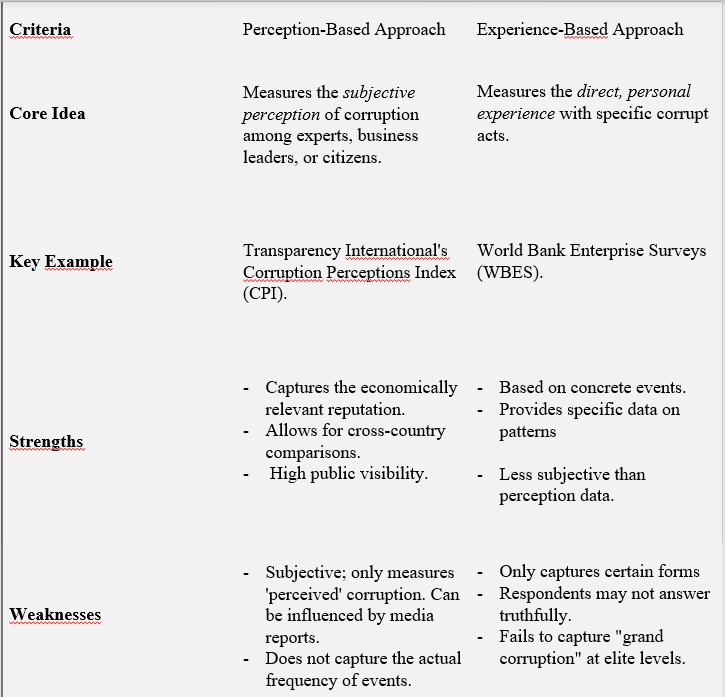
A key methodological challenge in measuring corruption is the difference between measuring the perception of corruption and measuring actual corruption experiences.18Banerjee, A., Mullainathan, S. & Hanna, R. Corruption. Working Paper at https://doi.org/10.3386/w17968 (2012). Perception-based indexes, like the CPI, are based on subjective opinions from experts, business people, or citizens about how common corruption is believed to be in a country or sector.4Transparency International Releases the 2023 Corruption Perceptions Index. Transparency Internationalhttps://us.transparency.org/news/transparency-international-releasesthe-2023-corruption-perceptions-index/. Experience-based surveys, like the Global Corruption Barometer (GCB), on the other hand, try to measure how directly individuals or companies are affected by specific corrupt acts, mostly bribe payments.20Global Corruption Barometer (GCB). Transparency International – Austrian Chapter https://ti-austria.at/indizes-cpi/global-corruptionbarometer/.
3.2 Indicators and methods for measuring corruption
Even with the challenges mentioned, research has developed several indicators and methods to measure corruption empirically. The most important approaches can be generally divided into perception-based indexes and experience-based surveys. In the following, these approaches will be introduced and critically analyzed.
3.2.1 Perception-based indexes
Perception-based indexes try to measure how much corruption there is by using the subjective opinions of selected groups – usually country experts, business people, or even citizens. The basic idea is that these perceptions are important because people often make their decisions (e.g., investment decisions) based on these perceptions. The most famous example is the Corruption Perceptions Index (CPI) by Transparency International.8Wolf, S. Korruption, Antikorruptionspolitik und öffentliche Verwaltung: Einführung und europapolitische Bezüge. (Springer Fachmedien, Wiesbaden, 2014). doi:10.1007/978-3-658-04108-3.
The Corruption Perceptions Index (CPI), published every year by Transparency International, is the most well-known corruption indicator worldwide. It aims to measure and compare the perceived corruption in the public sector of different countries. It includes different forms like bribery, misuse of public funds, abuse of office for private gain, nepotism in administration, and state capture.4Transparency International Releases the 2023 Corruption Perceptions Index. Transparency Internationalhttps://us.transparency.org/news/transparency-international-releasesthe-2023-corruption-perceptions-index/.
The CPI is a composite index that currently uses 13 different external data sources. These sources are surveys and ratings from country experts and business leaders, carried out by independent organizations like the Bertelsmann Foundation, the World Economic Forum, the Economist Intelligence Unit, or the World Bank. To calculate the index, the raw data from each source is standardized to a common scale from 0 (high level of perceived corruption) to 100 (no perceived corruption). A country’s CPI score is then the simple average of the standardized values from all available sources. A country needs at least three sources. standard deviations and confidence intervals are given to show how spread out the underlying ratings are, which indicates measurement uncertainty. Since 2012, a consistent method has been used to allow comparisons over time.21Korruption. (VS Verlag für Sozialwissenschaften, Wiesbaden, 2005). doi:10.1007/978-3-322-80714-4.
3.2.2 Experience-based measurement approaches
As an alternative or addition to perception-based indexes, experience-based approaches aim to measure the direct, personal experience of citizens or businesses with corrupt practices. Instead of asking about general opinions, these surveys ask if respondents themselves had to pay bribes within a certain period (e.g., the last 12 months) to get a public service or finish a business transaction.20Global Corruption Barometer (GCB). Transparency International – Austrian Chapter https://ti-austria.at/indizes-cpi/global-corruptionbarometer/.
The basic idea of this method is to count actual corruption events by asking the people directly involved. A well-known example of such surveys is the World Bank Enterprise Surveys (WBES): These surveys are for business owners and managers in developing and transition countries. They collect a lot of data on the business environment, including specific questions about how often and how much (“percentage of revenue”) informal payments or bribes were expected or paid when dealing with authorities (e.g., for permits, tax audits, customs clearance, utility connections). The focus is clearly on the actual experiences of companies.22Enterprise Surveys Indicators Data – World Bank Group. https://www.enterprisesurveys.org/en/enterprisesurveys.
Experience-based surveys thus provide valuable, but specific, insights, mainly into the extent and patterns of everyday or administrative corruption from the point of view of citizens and businesses. Their strength lies in directly asking about experiences and the potential to break down data. Their weaknesses come from biased answers and their limited ability to capture more complex forms of corruption. They are a necessary addition to perception indexes but cannot replace them. The often-seen difference between high perception and lower experience shows that both approaches highlight different, but equally important, aspects of the corruption problem.23Neubauer, J. Das Phänomen Korruption – Facetten, Messung und Monita. in Korruptionsanfälligkeit von Unternehmen 11–52 (Springer Gabler, Wiesbaden, 2018). doi:10.1007/978-3-658-19869-5_2.
3.2.3 Classification of measurement approaches
The previous discussion of different ways to measure corruption – perception-based indexes and experience-based surveys – has shown that each approach has specific strengths and weaknesses. A main finding is that no single method can fully and perfectly capture the complex and many-sided phenomenon of corruption. Each method looks at different aspects and faces specific methodological challenges.8Wolf, S. Korruption, Antikorruptionspolitik und öffentliche Verwaltung: Einführung und europapolitische Bezüge. (Springer Fachmedien, Wiesbaden, 2014). doi:10.1007/978-3-658-04108-3.
In conclusion, measuring corruption is an ongoing research area with big debates about methods. There is no “best” method. For a scientifically sound discussion, one needs to know the specific methodological bases and limitations, as well as a critical, context-related interpretation and combination of the available indicators. Future developments, especially in using Big Data and digital administrative data, could open new ways to improve corruption measurement, but they will also bring up new methodological questions.21Korruption. (VS Verlag für Sozialwissenschaften, Wiesbaden, 2005). doi:10.1007/978-3-322-80714-4.
4 The role of companies in corruption
Business corruption, often defined as the misuse of entrusted power for private or organizational benefit, is a global issue that has big impacts on the economy, society, and the environment. It often happens where the private and public sectors meet, when companies try to get advantages through unfair means. The role of companies here is mixed: they are often active in starting and benefiting from corrupt practices (supply side), but they can also suffer a lot from the consequences.24Korruption in und zwischen Unternehmen. Kriminalistik 747–752 (2010).
Decisions about corrupt actions are often made by people inside the company, seemingly for the company’s benefit, like to secure orders. However, negative consequences like fines, damage to reputation, and market losses affect the whole company. So, companies are often both the cause and the victim.25Langfristige Perspektiven und Nachhaltigkeit in der Rechnungslegung. (Springer Fachmedien, Wiesbaden, 2017). doi:10.1007/978-3-65814877-5.
This chapter looks at why corporate corruption happens and how it works. It also examines the direct effects on companies (legal, financial, reputation, competition) and how it impacts sustainable development (environmental, social, governance) and innovation processes. The cases of Siemens and Odebrecht will be used to show these points.
4.1 Causes and mechanisms of business corruption
Business corruption happens because of a complex mix of factors at the company, institutional, and individual levels.
4.1.1 The supply side of corruption: Company strategies and practices
Companies often actively start corruption to get a competitive edge, open up new markets, or avoid regulations. Bribes, improper gifts, or other benefits are used on purpose. In some cases, corruption becomes a regular part of the business strategy, especially in industries and markets prone to corruption.26Neubauer, J. Korruptionsanfälligkeit von Unternehmen. (Springer Fachmedien, Wiesbaden, 2018). doi:10.1007/978-3-658-19869-5.
The Siemens scandal (starting in 2006) is an example of systematic, supply-side corruption. For years, the company used a global network of “black accounts” and bribes (over 1.3 billion Euros) to get contracts, mainly in foreign markets and sectors like telecommunications and energy.5Berghoff, H. “Organised irresponsibility”? The Siemens corruption scandal of the 1990s and 2000s. Business History 60, 423–445 (2018). This was not just a single event, but a system that grew over years and was seen as necessary by some parts of the management. The use of hidden funds and consulting contracts to hide these payments shows how organized it was.27Bergmann, J. Gescheiterte Informalität am Beispiel des Korruptionsfalls Siemens. in Scheitern – Organisations- und wirtschaftssoziologische Analysen 231–250 (Springer VS, Wiesbaden, 2014). doi:10.1007/978-3-658-01652-4_10.
An even more extreme example was the Odebrecht case. The Brazilian construction company set up its own department (“Division of Structured Operations”) that was systematically responsible for planning and handling billions in bribe payments, including through the “Caixa Dois” system (parallel accounting). With this, Odebrecht secured large infrastructure projects in Latin America and Africa. Here, bribery was a central part of their business model. The special department shows a clear, strategic decision to use corruption.28Campos, N., Engel, E., Fischer, R. D. & Galetovic, A. The Ways of Corruption in Infrastructure: Lessons from the Odebrecht Case. Journal of Economic Perspectives 35, 171–190 (2021).
The Siemens and Odebrecht cases show that supply-side corruption often goes beyond individual wrongdoing and is the result of systematic, strategically implemented practices to gain competitive advantages.
4.1.2 Incentive structures and opportunities
Internal and external incentives, as well as opportunities, are key drivers. High pressure to perform and unrealistic goals can lead employees to unethical behavior to meet targets and avoid negative outcomes. Pay systems that focus mainly on short-term financial results, without considering ethical aspects, can encourage corruption.24Korruption in und zwischen Unternehmen. Kriminalistik 747–752 (2010).
Opportunities appear when there are not enough internal controls, lack of transparency, and complex organizational structures. Too much freedom in important roles (purchasing, sales) without proper oversight and clear rules is risky. If corrupt behavior is allowed or even leads to success, it lowers the barrier for people to do wrong themselves.26Neubauer, J. Korruptionsanfälligkeit von Unternehmen. (Springer Fachmedien, Wiesbaden, 2018). doi:10.1007/978-3-658-19869-5.
4.1.3 Institutional and cultural factors
The external environment is very important. Operating in countries with weak rule of law, high perceived corruption, and poor law enforcement lowers the risk of being caught and the moral threshold. Industry-specific “normalization” of corruption creates social pressure or justifications. Cultural differences in what is a gift and legitimate business negotiation can create gray areas.29Causes of Corruption: History, Geography, and Government. (BOFIT, Helsinki, 2008).
Siemens and Odebrecht were very active in regions and sectors known for corruption. The internal argument that bribery was necessary there played a key role. The conditions in those places (non-transparent bidding, low official salaries) created opportunity and incentive. External weaknesses and problematic industry cultures act as a “breeding ground” and provide justification strategies.30Gebhardt, C. & Müller-Seitz, G. Phoenix Arising from the Ashes: An Event-Oriented Analysis of the Siemens’ Corruption Scandal as Nexus between Organization and Society (Phönix aus der Asche: Eine ereignisorientierte Betrachtung des Siemens-Korruptionsskandals als Nexus zwischen Organisation und Umwelt) (German). SSRN Scholarly Paper at https://papers.ssrn.com/abstract=1735063 (2011).
4.1.4 Internal organizational factors
Internal factors like company culture, compliance systems, and ethical leadership are often critical. A culture that puts profit above ethics or tolerates unethical behavior promotes corruption. A missing or unbelievable commitment to integrity from leaders (“tone from the top”) sends very bad signals. At Siemens (before the scandal), there was a culture of tolerance to achieve business goals; the management at least partly looked away.27Bergmann, J. Gescheiterte Informalität am Beispiel des Korruptionsfalls Siemens. in Scheitern – Organisations- und wirtschaftssoziologische Analysen 231–250 (Springer VS, Wiesbaden, 2014). doi:10.1007/978-3-658-01652-4_10. At Odebrecht, corruption was so deeply rooted that a special department existed for it, which suggests a “tone from the top” that saw corruption as a strategic tool.28Campos, N., Engel, E., Fischer, R. D. & Galetovic, A. The Ways of Corruption in Infrastructure: Lessons from the Odebrecht Case. Journal of Economic Perspectives 35, 171–190 (2021).
Weak or merely formal compliance systems without consistent enforcement are ineffective. Lack of training and awareness also makes companies vulnerable. At Siemens, formal rules existed but were systematically bypassed; the compliance function was weak.31Rose-Ackerman, S. ‘“Grand”’ corruption and the ethics of global business. (2002). At an individual level, personality traits (low integrity, desire for power) and motivations (personal gain, fear of losing one’s job, desire for recognition, feeling of unfair treatment) can play a role. A weak company culture, marked by a poor “tone from the top,” is often the main internal trigger. Even good compliance systems are useless without active support from leadership.32Anand, V., Ashforth, B. E. & Joshi, M. Business as usual: The acceptance and perpetuation of corruption in organizations. Academy of Management Executive 18, 39–53 (2004).
4.2 Effects of corruption on companies
The consequences of corrupt actions are many and serious, from legal and financial penalties to damage to reputation and competitive disadvantages.
4.2.1 Legal consequences
Companies face high fines, penalties, and confiscation of profits. Also, managers are often prosecuted, sometimes with prison sentences. At Siemens, managers were fired and faced criminal charges.27Bergmann, J. Gescheiterte Informalität am Beispiel des Korruptionsfalls Siemens. in Scheitern – Organisations- und wirtschaftssoziologische Analysen 231–250 (Springer VS, Wiesbaden, 2014). doi:10.1007/978-3-658-01652-4_10. Regulatory bodies can impose requirements like implementing compliance systems and external monitors. Siemens had to build a comprehensive compliance system under the supervision of Theo Waigel.5Berghoff, H. “Organised irresponsibility”? The Siemens corruption scandal of the 1990s and 2000s. Business History 60, 423–445 (2018).
4.2.2 Financial impacts
Direct costs include fines, legal fees, investigation costs, consulting fees, and costs for implementing compliance. For Siemens, the total costs were about 2.5 billion Euros.27Bergmann, J. Gescheiterte Informalität am Beispiel des Korruptionsfalls Siemens. in Scheitern – Organisations- und wirtschaftssoziologische Analysen 231–250 (Springer VS, Wiesbaden, 2014). doi:10.1007/978-3-658-01652-4_10. There are also indirect costs: loss of contracts, being banned from bids (debarment), and loss of business relationships. Share prices and market value suffer a lot due to a loss of investor trust. Creditworthiness can drop, which increases capital costs. In the long run, market shares can be lost to honest competitors.33Redwitz, C. Korruption als wirtschaftliche Handlung: Ziele und Auswirkungen von Korruption in der Zusammenarbeit von Unternehmen und Behörden. (Springer Fachmedien, Wiesbaden, 2014). doi:10.1007/978-3-658-04569-2.
4.2.3 Reputation damage and loss of trust
One of the most serious harms is the massive loss of trust from customers, partners, employees, investors, and the public. Corruption violates ethical norms and laws. Being found out leads to negative perception and media coverage.33Redwitz, C. Korruption als wirtschaftliche Handlung: Ziele und Auswirkungen von Korruption in der Zusammenarbeit von Unternehmen und Behörden. (Springer Fachmedien, Wiesbaden, 2014). doi:10.1007/978-3-658-04569-2. Siemens suffered significant image damage and had to take extensive measures to regain trust and build a culture of integrity.34Klinkhammer, J. On the dark side of the code: organizational challenges to an effective anti-corruption strategy. Crime Law Soc Change 60, 191–208 (2013). Long-term negative effects on brand and image are hard to fix. A damaged reputation also makes it harder to hire skilled employees. Rebuilding reputation requires believable, long-term efforts and fundamental change.33Redwitz, C. Korruption als wirtschaftliche Handlung: Ziele und Auswirkungen von Korruption in der Zusammenarbeit von Unternehmen und Behörden. (Springer Fachmedien, Wiesbaden, 2014). doi:10.1007/978-3-658-04569-2.
4.2.4 Distortion of competition
Business corruption greatly distorts fair competition. Contracts don’t go to the best-performing bidders, but to those who pay bribes. This creates barriers for honest, innovative companies to enter the market. Resources are misused because decisions are not based on efficiency. This leads to bad projects, overpriced or low-quality goods/services, and economic losses. In the long run, corruption harms market mechanisms, weakens trust in fair rules, and reduces incentives for innovation.21Korruption. (VS Verlag für Sozialwissenschaften, Wiesbaden, 2005). doi:10.1007/978-3-322-80714-4. Siemens and Odebrecht systematically used bribery to secure contracts, which distorted markets and put competitors at a disadvantage. Corruption thus harms market principles and the overall economy.
4.3 Impacts on sustainability and innovation
Corruption has deep impacts on sustainable development (environmental, social, governance) and innovation. Sustainability, as defined by ESG criteria, is fundamentally undermined by corruption.8Wolf, S. Korruption, Antikorruptionspolitik und öffentliche Verwaltung: Einführung und europapolitische Bezüge. (Springer Fachmedien, Wiesbaden, 2014). doi:10.1007/978-3-658-04108-3.
Environmental sustainability: as mentioned in Chapter 3 Corruption allows companies to bypass environmental standards through bribery, leading to more pollution, illegal resource exploitation, and approval of environmentally harmful projects. In the Odebrecht case, corruption in infrastructure projects (e.g., dams in the Amazon) could lead to ignoring environmental reviews and destroying ecosystems.28Campos, N., Engel, E., Fischer, R. D. & Galetovic, A. The Ways of Corruption in Infrastructure: Lessons from the Odebrecht Case. Journal of Economic Perspectives 35, 171–190 (2021). Siemens also faced criticism for its involvement in controversial dam projects (e.g., Belo Monte), which raises questions about its consistency with sustainability goals.35_greenpeace_tapajos-report.pdf.
Social sustainability: Corruption can encourage the exploitation of workers and ignoring labor standards/human rights in supply chains. In the Odebrecht case, bribes went to elites while the population suffered from overpriced/low-quality projects or a lack of social investments.[1]
Governance aspects (ESG): Corruption undermines good corporate governance and ethical practices, which are core parts of ESG. Corrupt companies show huge governance problems. This negatively affects ESG ratings and can lead to divestments.36Poiriazi, E., Zournatzidou, G., Konteos, G. & Sariannidis, N. Analyzing the Interconnection Between Environmental, Social, and Governance (ESG) Criteria and Corporate Corruption: Revealing the Significant Impact of Greenwashing. Administrative Sciences 15, 100 (2025).
In summary, corruption works against all three pillars of sustainability. It allows environmentally harmful behavior, makes social inequalities worse, and represents a failure of governance that undermines achieving the UN Sustainable Development Goals (SDGs).37Tacconi, L. & Williams, D. A. Corruption and Anti-Corruption in Environmental and Resource Management. Annu. Rev. Environ. Resour. 45, 305–329 (2020).
4.4 Concluding remarks
Companies have a mixed role in corruption; they are often active in creating and benefiting from it (supply side), but also suffer from the consequences. The causes are complex: strategic decisions, bad incentives, lack of controls, problematic cultures, and external pressure. The Siemens and Odebrecht cases show systematic bribery to get contracts.
The effects are devastating: huge legal and financial penalties, big damage to reputation, and unfair competition. Also, corruption undermines sustainable development (environmental, social, governance) and usually hinders real innovation, while it can promote fake innovations.37Tacconi, L. & Williams, D. A. Corruption and Anti-Corruption in Environmental and Resource Management. Annu. Rev. Environ. Resour. 45, 305–329 (2020). Scandals can also start learning processes, as the Siemens example shows. After the crisis, Siemens invested a lot in compliance and a culture of integrity. The growing importance of ESG criteria and pressure from stakeholders could encourage positive changes. But what remains key is the willingness of management to see integrity as a basic value and live by it.36Poiriazi, E., Zournatzidou, G., Konteos, G. & Sariannidis, N. Analyzing the Interconnection Between Environmental, Social, and Governance (ESG) Criteria and Corporate Corruption: Revealing the Significant Impact of Greenwashing. Administrative Sciences 15, 100 (2025).
5 Anti-corruption measures
Fighting corruption is a complex and ongoing task. Given the serious negative effects of corrupt practices on the economy, society, and reputation, companies need to put in place effective prevention and reaction systems.38Irina, F. et al. Corruption as an obstacle to sustainable development: A regional example. Entrepreneurship and Sustainability Issues 7, 674–689 (2019). International standards like ISO 37001 are becoming more important.39ISO 37001:2025. ISO https://www.iso.org/standard/37001. This chapter analyzes key tools for fighting corruption within companies, evaluates how effective they are, and discusses challenges in evaluating them.
5.1 Compliance Management Systems (CMS)
Compliance Management Systems (CMS) are structured ways to make sure that laws and internal rules are followed, especially for preventing, finding, and reacting to corruption.40Heißner, S. Erfolgsfaktor Integrität: Wirtschaftskriminalität und Korruption erkennen, aufklären, verhindern. (Springer Fachmedien, Wiesbaden, 2014). doi:10.1007/978-3-658-05608-7.
5.1.1 Core elements of a CMS
An effective CMS includes several elements that depend on each other:
- Compliance goals: Clear, measurable goals for the CMS, based on risk analysis and company values.
- Compliance organization: Clear responsibilities (e.g., an independent Compliance Officer) and enough resources.
- Risk analysis: Systematically identifying and evaluating company-specific corruption risks (internal, external, industry-specific, and country-specific).
Regular new assessments are very important.40Heißner, S. Erfolgsfaktor Integrität: Wirtschaftskriminalität und Korruption erkennen, aufklären, verhindern. (Springer Fachmedien, Wiesbaden, 2014). doi:10.1007/978-3-658-05608-7.
5.1.2 The role of ISO 37001
ISO 37001 offers a globally recognized, certifiable framework for anti-corruption management systems. It specifies measures for preventing, detecting, and reacting to bribery. Its core elements (e.g., risk assessment, due diligence, controls, training) are largely the same as general CMS requirements. Getting certified can increase credibility, but it doesn’t guarantee freedom from corruption, because how effective it is depends on how deeply it’s put in place and how the company culture really works.39ISO 37001:2025. ISO https://www.iso.org/standard/37001.
5.1.3 Academic evaluation of the effectiveness of CMS
Academic views on CMS effectiveness are critical. A main point of criticism is the difference between simply following rules (extrinsic motivation) and a deep ethical commitment (intrinsic motivation). Often, compliance is seen as a legal necessity without real ethical thinking. Behavioral economic studies show that factors like performance pressure or variable payment systems can encourage corrupt behavior, even when formal CMS are in place.40Heißner, S. Erfolgsfaktor Integrität: Wirtschaftskriminalität und Korruption erkennen, aufklären, verhindern. (Springer Fachmedien, Wiesbaden, 2014). doi:10.1007/978-3-658-05608-7.
5.2 Whistleblowing systems
Whistleblowing systems are established ways for people to report wrongdoing and are an important tool for finding corruption.41Lehnart, T. Whistleblowing im Arbeitsrecht: Schutz von Beschäftigten durch die Hinweisgeberrichtlinie der Europäischen Union. (Springer Fachmedien, Wiesbaden, 2024). doi:10.1007/978-3-658-45611-5.
5.2.1 Elements of effective whistleblowing systems
Effective systems include:
- Reporting channels: Many different, easy-to-access, and secure internal (supervisors, compliance, ombudspersons) and external channels (external ombudspersons, service providers).
- Anonymity and confidentiality: The option for anonymity and strict confidentiality are crucial.
- Protection from retaliation: Full protection from negative treatment is essential.
- Case handling processes: Clear, transparent processes for receiving, checking, investigating, and following up on reports, including feedback to the whistleblower.40Heißner, S. Erfolgsfaktor Integrität: Wirtschaftskriminalität und Korruption erkennen, aufklären, verhindern. (Springer Fachmedien, Wiesbaden, 2014). doi:10.1007/978-3-658-05608-7.
5.2.2 Legal framework
The European Union (EU) Whistleblower Directive (Directive (EU) 2019/1937) sets EU-wide minimum standards to protect people who report violations of Union law and requires companies to set up internal reporting channels. In Germany, this was put into law by the Hinweisgeberschutzgesetz (HinSchG), which has been in force since July 2, 2023. The HinSchG requires companies with 50 or more employees to set up internal reporting offices, regulates reporting channels (internal/external), confidentiality, protection from retaliation (with reversal of burden of proof), and penalties for violations.41Lehnart, T. Whistleblowing im Arbeitsrecht: Schutz von Beschäftigten durch die Hinweisgeberrichtlinie der Europäischen Union. (Springer Fachmedien, Wiesbaden, 2024). doi:10.1007/978-3-658-45611-5.
5.2.3 Effectiveness of whistleblowing systems
Research confirms the potential effectiveness of whistleblowing systems. Factors for success include a culture of trust, clear communication, guaranteed anonymity/confidentiality, protection from retaliation, transparent case handling, and support from top management..42Johnson, R. A. Whistleblowing: When It Works—And Why. (Lynne Rienner Publishers, 2022). doi:10.1515/9781685857264. Challenges include the stigma of whistleblowers, the risk of misuse, difficulties in investigating anonymous tips, and negative effects on the work atmosphere if not implemented well. So, effectiveness depends a lot on the organizational culture and the trust that is actually lived.43Onyango, G. Whistleblower protection in developing countries: a review of challenges and prospects. SN Bus Econ 1, 1–30 (2021).
5.3 Evaluating the effectiveness of measures
Evaluating how effective anti-corruption measures are is a big challenge because corrupt behavior is hidden. It is hard to get objective measurements of corruption.8Wolf, S. Korruption, Antikorruptionspolitik und öffentliche Verwaltung: Einführung und europapolitische Bezüge. (Springer Fachmedien, Wiesbaden, 2014). doi:10.1007/978-3-658-04108-3. While perception indexes like the Corruption Perceptions Index (CPI) exist, they are criticized for their methods.3Corruption Perceptions Index 2024. Transparency.org https://www.transparency.org/en/cpi/2024 (2025). Corruption is a problem with many causes, and the effects of prevention measures often only appear after some time. Also, how effective anti-corruption efforts are is greatly influenced by contextual factors, including the prevailing culture, the legal environment, the specific industry, and the company’s internal structure.8Wolf, S. Korruption, Antikorruptionspolitik und öffentliche Verwaltung: Einführung und europapolitische Bezüge. (Springer Fachmedien, Wiesbaden, 2014). doi:10.1007/978-3-658-04108-3. Often, evaluations focus more on short-term outputs, such as implementing certain measures or conducting training, rather than on measuring long-term outcomes or the actual impact on the level of corruption.33Redwitz, C. Korruption als wirtschaftliche Handlung: Ziele und Auswirkungen von Korruption in der Zusammenarbeit von Unternehmen und Behörden. (Springer Fachmedien, Wiesbaden, 2014). doi:10.1007/978-3-658-04569-2.
5.4 Conclusion
Fighting corruption needs a set of measures. CMS and whistleblowing systems are valuable parts of this. However, their effectiveness greatly depends on a strong culture of integrity and a believable “tone from the top.” Without this cultural foundation, formal systems risk becoming just “window dressing.” Evaluating effectiveness remains a challenge due to the problems in measuring corruption and assigning causality. An integrated, risk-based, and culturally rooted approach that is continuously evaluated and adjusted is essential for anti-corruption efforts.31Rose-Ackerman, S. ‘“Grand”’ corruption and the ethics of global business. (2002).
6 Drivers and barriers of corporate anti-corruption
Implementing and deeply rooting anti-corruption program is a complex task. Its success depends greatly on a mix of factors that help (drivers) and hinder (barriers). This chapter looks at the many legal, social, economic, technological, and internal/organizational influences on corporate anti-corruption efforts.
6.1 Legal factors
The legal framework is a basic foundation for corporate anti-corruption. It sets clear standards, creates incentives, and provides penalties for violations..44Bahoo, S., Alon, I. & Paltrinieri, A. Corruption in international business: A review and research agenda. International Business Review 29, 101660 (2020).
Drivers
- International conventions as impulses: International agreements like the UN Convention against Corruption (UNCAC) and the OECD Anti-Bribery Convention set global minimum standards and encourage international cooperation. The UNCAC calls for preventive measures in both public and private sectors, as well as transparency and accountability. The OECD Convention focuses on the supply side of bribing foreign public officials and has led to legal reforms and stronger enforcement in member states. These conventions signal a global shift towards less tolerance for corruption, forcing internationally active companies to change their practices to avoid legal consequences and damage to their reputation.45Cheng Wenhao. Implementing international laws to fight business bribery: Case of the Organization for Economic Co-operation and Development (OECD) anti-bribery convention. Afr. J. Bus. Manage. 5, (2011).
- National laws and extraterritorial effect: National laws with effects outside their own country, like the US Foreign Corrupt Practices Act (FCPA), force global companies to follow strict anti-corruption standards, no matter where their main office is. The threat of severe penalties and the possibility of prosecuting individuals are strong deterrents. The increased use of the FCPA outside the US since the mid-2000s had a significant deterrent effect on foreign direct investment in high-risk countries. Multinational corporations often put in place global compliance programs that follow the strictest applicable standards.46Cuervo-Cazurra, A. The effectiveness of laws against bribery abroad. J Int Bus Stud 39, 634–651 (2008).
- Legal gaps and unclear regulations: Gaps in laws and unclear definitions of corruption, especially where lobbying meets criminal corruption, as well as missing rules in specific areas, create grey zones and legal uncertainties. These can encourage corrupt behavior or make it harder to prosecute. Such unclear points lower the perceived risks of corrupt actions and can be used by companies under competitive pressure. The difficulty of having a clear and universal definition of corruption adds to this uncertainty.46Cuervo-Cazurra, A. The effectiveness of laws against bribery abroad. J Int Bus Stud 39, 634–651 (2008).
- Challenges in law enforcement: Even clear laws need consistent enforcement. A lack of resources for law enforcement agencies, political influence on investigations, and the complexity of cross-border cases make this difficult. Weak law enforcement reduces the deterrent effect of laws and lowers the incentive to invest in comprehensive compliance measures.47Darrough, M. N. The FCPA and the OECD Convention: Some Lessons from the U.S. Experience. J Bus Ethics 93, 255–276 (2010).
6.2 Societal factors
Social norms, values, and public opinion have a big impact on the level of corruption and companies’ willingness to fight it.
Drivers
- Public pressure and media attention: Big corruption scandals, uncovered by investigative media, create significant pressure on companies and politicians. The media acts as a watchdog, forcing companies to change their behavior beyond legal obligations. The fear of public exposure and negative business consequences motivates companies to implement stricter anticorruption programs.48_3790_vjh_73_2_212_01747383953.pdf. https://elibrary-dunckerhumblot-com.proxy02a.bis.unioldenburg.de/pdfjs/web/viewer.html?file=../../pdf/article/6490/10_3790_ vjh_73_2_212_01747383953.pdf.
- Activism by NGOs and civil society: Non-governmental organizations (NGOs) like Transparency International raise awareness about corruption and demand accountability. The Corruption Perceptions Index (CPI) allows for comparisons and increases awareness of the problem. NGOs influence the agenda for anti-corruption reforms and increase pressure on companies to act more ethically.4Transparency International Releases the 2023 Corruption Perceptions Index. Transparency Internationalhttps://us.transparency.org/news/transparency-international-releasesthe-2023-corruption-perceptions-index/.
- Cultural acceptance and normalization of corruption: In some societies or industries, certain forms of corruption are deeply rooted and seen as “normal.” Such social norms undermine formal rules and create a “culture of corruption.” Informal norms can be more important than formal rules, as employees seek social acceptance or believe that corrupt behavior is common. The difference between a gift and a bribe is often cultural.8Wolf, S. Korruption, Antikorruptionspolitik und öffentliche Verwaltung: Einführung und europapolitische Bezüge. (Springer Fachmedien, Wiesbaden, 2014). doi:10.1007/978-3-658-04108-3.
- Lack of transparency and information asymmetries: A lack of transparency in government and company processes, as well as uneven access to information, make it harder for outside groups to discover and fight corruption. A lack of transparency is a breeding ground for corruption because it limits the ability of civil society to monitor.44Bahoo, S., Alon, I. & Paltrinieri, A. Corruption in international business: A review and research agenda. International Business Review 29, 101660 (2020).
6.3 Economic factors
Economic considerations and incentive structures influence business decisions regarding corruption and investments in anti-corruption programs.
Drivers
- Costs of corruption vs. costs of compliance: Companies are increasingly realizing that the long-term costs of corruption (fines, legal fees, productivity losses, reputation damage) can be higher than the costs of compliance. The “Business Case for Integrity” is becoming more important, as economic rationality shifts towards compliance when the risks of corruption outweigh the costs of prevention.49Posthuma, R. A. High-compliance work systems: Innovative solutions for firm success and control of foreign corruption. Business Horizons 65, 205–214 (2022).
- Market integrity and fair competition: Companies that rely on fair competition have an interest in fighting corruption because it distorts competition. The demand for a “level playing field” can be a strong driver for anti-corruption efforts. In transparent markets, honest companies have better chances, which increases the incentive for ethical behavior.46Cuervo-Cazurra, A. The effectiveness of laws against bribery abroad. J Int Bus Stud 39, 634–651 (2008).
- Rent-Seeking Behavior: The possibility of making excessive profits (“rents”) through corruption creates strong incentives for corrupt behavior, especially where the private and public sectors meet. Companies try to secure advantages by manipulating the regulatory environment instead of competing through innovation and efficiency.33Redwitz, C. Korruption als wirtschaftliche Handlung: Ziele und Auswirkungen von Korruption in der Zusammenarbeit von Unternehmen und Behörden. (Springer Fachmedien, Wiesbaden, 2014). doi:10.1007/978-3-658-04569-2.
6.4 Internal / Organizational factors
Internal structures, processes, and company culture are crucial for how effective anti-corruption programs is.
Drivers
- “Tone from the top” and “Tone from the middle”: A clear and consistently communicated stance against corruption from top management is fundamental for a company culture of integrity. Exemplary behavior from leaders shapes what is expected. Middle management is just as important in implementing and overseeing ethical guidelines.8Wolf, S. Korruption, Antikorruptionspolitik und öffentliche Verwaltung: Einführung und europapolitische Bezüge. (Springer Fachmedien, Wiesbaden, 2014). doi:10.1007/978-3-658-04108-3.
- Establishing a strong compliance culture and ethical values: A company culture based on values like integrity and transparency encourages rule-abiding behavior and reduces vulnerability to corruption. This includes an internalized understanding of right and wrong and promotes a “Speak-Up Culture”.8Wolf, S. Korruption, Antikorruptionspolitik und öffentliche Verwaltung: Einführung und europapolitische Bezüge. (Springer Fachmedien, Wiesbaden, 2014). doi:10.1007/978-3-658-04108-3.
Barriers
- Resistance to compliance and cultural inertia: Introducing CMS can face resistance if they are seen as bureaucratic or showing distrust. Deeply rooted cultures that tolerate corruption are hard to change. Compliance initiatives often fail because of this “human firewall”.50Kölbel, R., Theile, H. & Herold, N. Die institutionelle Form von Korruption und deren Implikationen. in Institutionelle Korruption und Arzneimittelvertrieb 341–355 (Springer, Berlin, Heidelberg, 2019). doi:10.1007/978-3-662-57416-4_15.
- Misaligned incentives and conflicting goals: Aggressive targets and bonus systems based solely on short-term financial results can encourage unethical behavior and work against the goals of anti-corruption programs.8Wolf, S. Korruption, Antikorruptionspolitik und öffentliche Verwaltung: Einführung und europapolitische Bezüge. (Springer Fachmedien, Wiesbaden, 2014). doi:10.1007/978-3-658-04108-3.
- Lack of resources and competencies for compliance: Effectively implementing and overseeing CMS requires enough financial and human resources, as well as expertise. This is especially challenging for small and medium-sized enterprises (SMEs) and can affect the effectiveness of compliance programs.25Langfristige Perspektiven und Nachhaltigkeit in der Rechnungslegung. (Springer Fachmedien, Wiesbaden, 2017). doi:10.1007/978-3-65814877-5.
6.5 Conclusion
The analysis of the drivers and barriers of corruption shows a complex interaction of legal, social, economic, technological, and internal organizational factors. It becomes clear that corruption is not an isolated phenomenon but can be deeply rooted in the structures and processes of societies and organizations.
In summary, fighting corruption requires a multi-dimensional approach that considers how these different factors depend on each other. Single measures are often not enough. Instead, a combined effort is needed that aims to strengthen legal frameworks, promote a culture of integrity in society and organizations, create transparent and fair economic incentive systems, and responsibly use new technologies. Only through such a comprehensive understanding and approach can the many drivers of corruption be effectively addressed and the barriers to fighting it be overcome.
7 Outlook
This thesis took a close look at corruption, a problem that is both old and very complex, and one that continues to challenge societies and economies all over the world. In an era of globalized markets and interconnected supply chains, understanding corruption is more important than ever. The main goal of this work was to understand the many sides of corruption. This involved looking at the basic problems of defining and measuring it, analyzing its deep-rooted causes and serious consequences, and examining the different methods and strategies designed to fight it. The research has clearly shown that corruption is not a simple issue with a simple solution. Instead, it is a dynamic problem caused by a mix of individual choices, company-level cultures, and wider system-wide factors. The synthesis of all the research presented in this thesis leads to several key findings. These findings not only show how serious the problem is but also highlight that fighting it is a difficult, ongoing process that requires commitment.
A first major finding is the basic challenge that corruption itself presents to researchers and policymakers. As shown in the early chapters, the lack of a single, universally accepted definition of corruption and its naturally secret nature create significant challenges. This makes it incredibly difficult to get a truly accurate picture of the problem. This thesis explored the two main approaches to measurement: perception-based indexes, like the well-known Corruption Perceptions Index (CPI), and experience-based surveys, such as the World Bank Enterprise Surveys. The analysis shows that these methods create a critical duality, revealing two different sides of corruption. Perception-based indexes are powerful because they influence investor confidence and a country’s global reputation. A low score can scare away foreign investment, even if day-to-day bribery is not common. On the other hand, experience-based surveys provide concrete data on the frequency and cost of actual bribe payments, which is useful for targeted antibribery policies. These surveys often fail to capture “grand corruption”—high-level deals made behind closed doors—or the subtle forms of influence that can be just as damaging.
A crucial part of this thesis was also to examine the profound relationship between corruption and the broad agenda of sustainable development. Chapter 3 demonstrated that corruption is not just an economic or governance issue; it directly and profoundly undermines efforts towards environmental integrity, social justice, and robust democratic governance. We saw how corruption distorts resource allocation, weakens regulatory frameworks, and actively hinders the transition to green economies, for example, by reducing the positive impact of renewable energy. The discussion highlighted that the effects of corruption are not uniform but vary depending on regional and economic contexts, as shown by insights from Southern Africa, BRICS, and Next-11 countries. Furthermore, the complex interplay between corruption and innovation was explored, revealing that while innovation can be a tool against corruption, it can also create new opportunities for illicit practices. Ultimately, this thesis concludes that achieving genuine sustainability across its environmental, social, and governance (ESG) dimensions critically depends on a determined and adaptive fight against corruption that acknowledges its diverse forms and contextual influences.
This thesis concludes that neither measurement method is sufficient by itself. Instead, they are like two different but essential tools that, when used together, provide a more complete, three-dimensional view of the problem. The common gap between a high perception of corruption and a lower level of reported personal experience with it is particularly revealing. It suggests that people’s general perception is shaped by more than just paying bribes; it is also influenced by a wider climate of impunity, a lack of trust in public institutions, and the feeling that powerful elites are not held accountable. As a result, any serious academic discussion or effective policy strategy must acknowledge the limitations of each method and use a “dashboard” of multiple indicators to get a clearer understanding.
Relying on a single number can be misleading and lead to flawed conclusions.
A central part of this thesis was a focused examination of the role of companies, particularly as the active “supply side” of corruption. The detailed analysis of the Siemens and Odebrecht scandals provided clear, real-world examples of how corrupt practices can become deeply embedded within a company’s core strategy. These cases powerfully demonstrate that corporate corruption is often not just the result of a few “bad apple” employees. Instead, it can evolve into a highly organized, institutionalized system for entering new markets and gaining an unfair competitive advantage. The Odebrecht case, with its dedicated “Division of Structured Operations” for managing bribe payments, is a stark illustration of corruption as a deliberate business function. The key internal drivers identified—such as aggressive sales targets and bonus systems tied only to financial results, poor internal controls, and a weak ethical message from top leaders (a poor “tone from the top”) combine with external pressures to create an environment where illegal acts are justified as a necessary, or even normal, way to do business. This means that companies are not simply passive victims of corrupt environments. They are often active, strategic perpetrators, a dual role that makes the problem much more complex to prevent and to fix.
The consequences of such corporate wrongdoing are wide-ranging, severe, and ripple outwards to affect the entire economy and society. This thesis has detailed these negative effects, which go far beyond the immediate fines and legal fees. The damage includes crippling legal actions against both the company and individuals, profound and long-lasting harm to a company’s reputation, and a fundamental distortion of market competition. When contracts are awarded based on who pays the biggest bribe rather than on merit, quality, or price, it chokes off innovation, leads to poor-quality goods and public services, and creates unfair barriers for honest and efficient companies. This damages the very foundation of a fair market economy. Furthermore, the analysis has drawn a direct and undeniable link between corruption and the broader global goals of sustainable development. Corruption systematically undermines all three pillars of ESG: it harms the Environment by allowing companies to bribe their way around environmental laws, leading to illegal pollution or resource destruction; it deepens Social inequality by diverting public funds meant for schools, healthcare, and infrastructure into the pockets of corrupt elites; and it represents a catastrophic failure of corporate Governance. The conclusion is clear and unavoidable: corporate corruption is a primary roadblock to achieving a just, environmentally sound, and equitably governed global economy.
In response to this significant threat, the business world and regulators have developed a toolkit of anti-corruption measures, with Compliance Management Systems (CMS) and formal whistleblowing channels being the most prominent. This thesis critically evaluated these instruments and concluded that their effectiveness is entirely dependent on how they are implemented and, more importantly, on the organizational culture they exist within. Frameworks like ISO 37001 and legal requirements such as the EU Whistleblower Directive provide an essential structure and clear expectations. They are at constant risk of becoming mere “window dressing”, a superficial layer of rules created only to satisfy regulators, if they are not supported by a deeply ingrained, company-wide culture of integrity. Academic research consistently highlights this crucial difference between formal, box-ticking compliance and a genuine ethical commitment. Without a credible “tone from the top” that is actively demonstrated by leaders and filters down through all levels of management, even the most technically perfect CMS will fail. Similarly, the success of whistleblowing systems depends entirely on the level of trust and psychological safety within the company. An employee will only report wrongdoing if they believe their report will be taken seriously and that they are fully protected from any form of retaliation. The challenge of empirically measuring the true effectiveness of these internal measures remains a significant barrier.
Ultimately, the implementation and real-world success of corporate anti-corruption efforts are governed by a complex web of competing forces that either help (drivers) or hinder (barriers). The analysis revealed that strong external drivers include international legal frameworks with cross-border power, like the U.S. FCPA, as well as increasing pressure from civil society groups, NGOs like Transparency International, and investigative media. At the same time, the “Business Case for Integrity” is becoming a powerful internal driver, as more companies recognize that the massive long-term costs of corruption, including brand destruction and loss of customers, far outweigh the short-term gains. These positive forces are often counteracted by formidable barriers. These include gaps in national laws, weak and under-resourced law enforcement in high-risk countries, the cultural normalization of practices like “gift-giving,” and intense market pressure that can push ethical considerations to the background. Internally, deep-rooted cultural resistance to change, misaligned incentive systems that reward reckless behavior, and a simple lack of resources, especially in small and medium-sized enterprises (SMEs)—can stop even well-intentioned compliance programs from succeeding.
In final conclusion, effectively combating corruption requires a multi-dimensional, and culturally focused approach. This thesis has demonstrated throughout its analysis that isolated, legalistic, or purely formal measures are insufficient to address a problem so deeply embedded in organizational habits. The most effective path forward demands an integrated strategy. This strategy must strengthen legal and regulatory frameworks, foster a genuine corporate culture of integrity that is championed by the highest levels of leadership, align all business incentives with ethical behavior, and leverage public and stakeholder pressure to achieve greater transparency and accountability. The journey from a culture that tolerates corruption to one that is built on integrity, as exemplified by the difficult transformation at Siemens after its major scandal, is long and challenging, but it is possible. It requires a fundamental shift in perspective, where integrity is no longer viewed as a burdensome cost or a compliance exercise, but as a core strategic value and an absolutely essential requirement for building long-term resilience, earning stakeholder trust, and achieving sustainable success in the modern global marketplace.
References
- 1Bildung, B. für politische. Korruption. bpb.de https://www.bpb.de/kurzknapp/lexika/lexikon-der-wirtschaft/19885/korruption/. ↩︎
- 2Pucher, M. Korruption im Gesundheitswesen Problemwahrnehmung und korruptionsverhindernde Maßnahmen im Gesundheitswesen von Südafrika. (2023). ↩︎
- 3Corruption Perceptions Index 2024. Transparency.org https://www.transparency.org/en/cpi/2024 (2025). ↩︎
- 4Transparency International Releases the 2023 Corruption Perceptions Index. Transparency Internationalhttps://us.transparency.org/news/transparency-international-releasesthe-2023-corruption-perceptions-index/. ↩︎
- 5Berghoff, H. “Organised irresponsibility”? The Siemens corruption scandal of the 1990s and 2000s. Business History 60, 423–445 (2018). ↩︎
- 6Enste, D. H. Folgen von Korruption für Wirtschaft, Staat und Gesellschaft. bpb.dehttps://www.bpb.de/shop/zeitschriften/apuz/332695/folgen-vonkorruption-fuer-wirtschaft-staat-und-gesellschaft/ (2021). ↩︎
- 6Enste, D. H. Folgen von Korruption für Wirtschaft, Staat und Gesellschaft. bpb.dehttps://www.bpb.de/shop/zeitschriften/apuz/332695/folgen-vonkorruption-fuer-wirtschaft-staat-und-gesellschaft/ (2021). ↩︎
- 7Fuchs, S. Geltungsbereiche des sozialen Kapitals in Deutschland: Eine Prüfung der Messinvarianz, der Verteilung und der Auswirkung von sozialem Vertrauen, Reziprozität und formalen Netzwerken. (Springer Fachmedien, Wiesbaden, 2020). doi:10.1007/978-3-658-28877-8. ↩︎
- 8Wolf, S. Korruption, Antikorruptionspolitik und öffentliche Verwaltung: Einführung und europapolitische Bezüge. (Springer Fachmedien, Wiesbaden, 2014). doi:10.1007/978-3-658-04108-3. ↩︎
- 9Ivanhoe, H. & Aziz, Z. Combating Corruption to Counter Conflict: Proposals for In-country Reform and International Community Intervention. Berkeley Journal of International Law 38, 355–399 (2020). ↩︎
- 10What is corruption? Transparency.org https://www.transparency.org/en/what-is-corruption. katharina.kiener-manu. Anti-Corruption Module 1 Key Issues: ↩︎
- 11Corruption – Baseline Definition. //www.unodc.org. ↩︎
- 12Farrales, M. J. What is Corruption?: A History of Corruption Studies and the Great Definitions Debate. SSRN Scholarly Paper at https://doi.org/10.2139/ssrn.1739962 (2005). ↩︎
- 12Farrales, M. J. What is Corruption?: A History of Corruption Studies and the Great Definitions Debate. SSRN Scholarly Paper at https://doi.org/10.2139/ssrn.1739962 (2005). ↩︎
- 13Enste, D. H. Folgen von Korruption für Wirtschaft, Staat und Gesellschaft. in Handbuch Korruptionsforschung 1–14 (Springer VS, Wiesbaden, 2025). doi:10.1007/978-3-658-42592-0_5-1. ↩︎
- 14Morse, S. Is Corruption Bad for Environmental Sustainability? A Cross-National Analysis. Ecology and Society 11, (2006). ↩︎
- 15Ganda, F. The influence of corruption on environmental sustainability in the developing economies of Southern Africa. Heliyon 6, e04387 (2020). ↩︎
- 14Morse, S. Is Corruption Bad for Environmental Sustainability? A Cross-National Analysis. Ecology and Society 11, (2006). ↩︎
- 16Troisi, R., Nese, A., Blanco-Gregory, R. & Giovanniello, M. A. The Effects of Corruption and Innovation on Sustainability: A Firm-Level Analysis. Sustainability 15, 1848 (2023). ↩︎
- 16Troisi, R., Nese, A., Blanco-Gregory, R. & Giovanniello, M. A. The Effects of Corruption and Innovation on Sustainability: A Firm-Level Analysis. Sustainability 15, 1848 (2023). ↩︎
- 16Troisi, R., Nese, A., Blanco-Gregory, R. & Giovanniello, M. A. The Effects of Corruption and Innovation on Sustainability: A Firm-Level Analysis. Sustainability 15, 1848 (2023). ↩︎
- 16Troisi, R., Nese, A., Blanco-Gregory, R. & Giovanniello, M. A. The Effects of Corruption and Innovation on Sustainability: A Firm-Level Analysis. Sustainability 15, 1848 (2023). ↩︎
- 16Troisi, R., Nese, A., Blanco-Gregory, R. & Giovanniello, M. A. The Effects of Corruption and Innovation on Sustainability: A Firm-Level Analysis. Sustainability 15, 1848 (2023). ↩︎
- 15Ganda, F. The influence of corruption on environmental sustainability in the developing economies of Southern Africa. Heliyon 6, e04387 (2020). ↩︎
- 15Ganda, F. The influence of corruption on environmental sustainability in the developing economies of Southern Africa. Heliyon 6, e04387 (2020). ↩︎
- 15Ganda, F. The influence of corruption on environmental sustainability in the developing economies of Southern Africa. Heliyon 6, e04387 (2020). ↩︎
- 17Impact of corruption in public sector on environmental quality: Implications for sustainability in BRICS and next 11 countries – ScienceDirect. https://www-sciencedirect-com.proxy02a.bis.unioldenburg.de/science/article/pii/S0959652619320190. ↩︎
- 17Impact of corruption in public sector on environmental quality: Implications for sustainability in BRICS and next 11 countries – ScienceDirect. https://www-sciencedirect-com.proxy02a.bis.unioldenburg.de/science/article/pii/S0959652619320190. ↩︎
- 17Impact of corruption in public sector on environmental quality: Implications for sustainability in BRICS and next 11 countries – ScienceDirect. https://www-sciencedirect-com.proxy02a.bis.unioldenburg.de/science/article/pii/S0959652619320190. ↩︎
- 14Morse, S. Is Corruption Bad for Environmental Sustainability? A Cross-National Analysis. Ecology and Society 11, (2006). ↩︎
- 16Troisi, R., Nese, A., Blanco-Gregory, R. & Giovanniello, M. A. The Effects of Corruption and Innovation on Sustainability: A Firm-Level Analysis. Sustainability 15, 1848 (2023). ↩︎
- 17Impact of corruption in public sector on environmental quality: Implications for sustainability in BRICS and next 11 countries – ScienceDirect. https://www-sciencedirect-com.proxy02a.bis.unioldenburg.de/science/article/pii/S0959652619320190. ↩︎
- 16Troisi, R., Nese, A., Blanco-Gregory, R. & Giovanniello, M. A. The Effects of Corruption and Innovation on Sustainability: A Firm-Level Analysis. Sustainability 15, 1848 (2023). ↩︎
- 17Impact of corruption in public sector on environmental quality: Implications for sustainability in BRICS and next 11 countries – ScienceDirect. https://www-sciencedirect-com.proxy02a.bis.unioldenburg.de/science/article/pii/S0959652619320190. ↩︎
- 15Ganda, F. The influence of corruption on environmental sustainability in the developing economies of Southern Africa. Heliyon 6, e04387 (2020). ↩︎
- 16Troisi, R., Nese, A., Blanco-Gregory, R. & Giovanniello, M. A. The Effects of Corruption and Innovation on Sustainability: A Firm-Level Analysis. Sustainability 15, 1848 (2023). ↩︎
- 18Banerjee, A., Mullainathan, S. & Hanna, R. Corruption. Working Paper at https://doi.org/10.3386/w17968 (2012). ↩︎
- 19Korruption als Ordnung zweiter Art. (VS Verlag für Sozialwissenschaften, Wiesbaden, 2011). doi:10.1007/978-3-53193011-4. ↩︎
- 8Wolf, S. Korruption, Antikorruptionspolitik und öffentliche Verwaltung: Einführung und europapolitische Bezüge. (Springer Fachmedien, Wiesbaden, 2014). doi:10.1007/978-3-658-04108-3. ↩︎
- 18Banerjee, A., Mullainathan, S. & Hanna, R. Corruption. Working Paper at https://doi.org/10.3386/w17968 (2012). ↩︎
- 18Banerjee, A., Mullainathan, S. & Hanna, R. Corruption. Working Paper at https://doi.org/10.3386/w17968 (2012). ↩︎
- 4Transparency International Releases the 2023 Corruption Perceptions Index. Transparency Internationalhttps://us.transparency.org/news/transparency-international-releasesthe-2023-corruption-perceptions-index/. ↩︎
- 20Global Corruption Barometer (GCB). Transparency International – Austrian Chapter https://ti-austria.at/indizes-cpi/global-corruptionbarometer/. ↩︎
- 8Wolf, S. Korruption, Antikorruptionspolitik und öffentliche Verwaltung: Einführung und europapolitische Bezüge. (Springer Fachmedien, Wiesbaden, 2014). doi:10.1007/978-3-658-04108-3. ↩︎
- 4Transparency International Releases the 2023 Corruption Perceptions Index. Transparency Internationalhttps://us.transparency.org/news/transparency-international-releasesthe-2023-corruption-perceptions-index/. ↩︎
- 21Korruption. (VS Verlag für Sozialwissenschaften, Wiesbaden, 2005). doi:10.1007/978-3-322-80714-4. ↩︎
- 20Global Corruption Barometer (GCB). Transparency International – Austrian Chapter https://ti-austria.at/indizes-cpi/global-corruptionbarometer/. ↩︎
- 22Enterprise Surveys Indicators Data – World Bank Group. https://www.enterprisesurveys.org/en/enterprisesurveys. ↩︎
- 23Neubauer, J. Das Phänomen Korruption – Facetten, Messung und Monita. in Korruptionsanfälligkeit von Unternehmen 11–52 (Springer Gabler, Wiesbaden, 2018). doi:10.1007/978-3-658-19869-5_2. ↩︎
- 8Wolf, S. Korruption, Antikorruptionspolitik und öffentliche Verwaltung: Einführung und europapolitische Bezüge. (Springer Fachmedien, Wiesbaden, 2014). doi:10.1007/978-3-658-04108-3. ↩︎
- 21Korruption. (VS Verlag für Sozialwissenschaften, Wiesbaden, 2005). doi:10.1007/978-3-322-80714-4. ↩︎
- 24Korruption in und zwischen Unternehmen. Kriminalistik 747–752 (2010). ↩︎
- 25Langfristige Perspektiven und Nachhaltigkeit in der Rechnungslegung. (Springer Fachmedien, Wiesbaden, 2017). doi:10.1007/978-3-65814877-5. ↩︎
- 26Neubauer, J. Korruptionsanfälligkeit von Unternehmen. (Springer Fachmedien, Wiesbaden, 2018). doi:10.1007/978-3-658-19869-5. ↩︎
- 5Berghoff, H. “Organised irresponsibility”? The Siemens corruption scandal of the 1990s and 2000s. Business History 60, 423–445 (2018). ↩︎
- 27Bergmann, J. Gescheiterte Informalität am Beispiel des Korruptionsfalls Siemens. in Scheitern – Organisations- und wirtschaftssoziologische Analysen 231–250 (Springer VS, Wiesbaden, 2014). doi:10.1007/978-3-658-01652-4_10. ↩︎
- 28Campos, N., Engel, E., Fischer, R. D. & Galetovic, A. The Ways of Corruption in Infrastructure: Lessons from the Odebrecht Case. Journal of Economic Perspectives 35, 171–190 (2021). ↩︎
- 24Korruption in und zwischen Unternehmen. Kriminalistik 747–752 (2010). ↩︎
- 26Neubauer, J. Korruptionsanfälligkeit von Unternehmen. (Springer Fachmedien, Wiesbaden, 2018). doi:10.1007/978-3-658-19869-5. ↩︎
- 29Causes of Corruption: History, Geography, and Government. (BOFIT, Helsinki, 2008). ↩︎
- 30Gebhardt, C. & Müller-Seitz, G. Phoenix Arising from the Ashes: An Event-Oriented Analysis of the Siemens’ Corruption Scandal as Nexus between Organization and Society (Phönix aus der Asche: Eine ereignisorientierte Betrachtung des Siemens-Korruptionsskandals als Nexus zwischen Organisation und Umwelt) (German). SSRN Scholarly Paper at https://papers.ssrn.com/abstract=1735063 (2011). ↩︎
- 27Bergmann, J. Gescheiterte Informalität am Beispiel des Korruptionsfalls Siemens. in Scheitern – Organisations- und wirtschaftssoziologische Analysen 231–250 (Springer VS, Wiesbaden, 2014). doi:10.1007/978-3-658-01652-4_10. ↩︎
- 28Campos, N., Engel, E., Fischer, R. D. & Galetovic, A. The Ways of Corruption in Infrastructure: Lessons from the Odebrecht Case. Journal of Economic Perspectives 35, 171–190 (2021). ↩︎
- 31Rose-Ackerman, S. ‘“Grand”’ corruption and the ethics of global business. (2002). ↩︎
- 32Anand, V., Ashforth, B. E. & Joshi, M. Business as usual: The acceptance and perpetuation of corruption in organizations. Academy of Management Executive 18, 39–53 (2004). ↩︎
- 27Bergmann, J. Gescheiterte Informalität am Beispiel des Korruptionsfalls Siemens. in Scheitern – Organisations- und wirtschaftssoziologische Analysen 231–250 (Springer VS, Wiesbaden, 2014). doi:10.1007/978-3-658-01652-4_10. ↩︎
- 5Berghoff, H. “Organised irresponsibility”? The Siemens corruption scandal of the 1990s and 2000s. Business History 60, 423–445 (2018). ↩︎
- 27Bergmann, J. Gescheiterte Informalität am Beispiel des Korruptionsfalls Siemens. in Scheitern – Organisations- und wirtschaftssoziologische Analysen 231–250 (Springer VS, Wiesbaden, 2014). doi:10.1007/978-3-658-01652-4_10. ↩︎
- 33Redwitz, C. Korruption als wirtschaftliche Handlung: Ziele und Auswirkungen von Korruption in der Zusammenarbeit von Unternehmen und Behörden. (Springer Fachmedien, Wiesbaden, 2014). doi:10.1007/978-3-658-04569-2. ↩︎
- 33Redwitz, C. Korruption als wirtschaftliche Handlung: Ziele und Auswirkungen von Korruption in der Zusammenarbeit von Unternehmen und Behörden. (Springer Fachmedien, Wiesbaden, 2014). doi:10.1007/978-3-658-04569-2. ↩︎
- 34Klinkhammer, J. On the dark side of the code: organizational challenges to an effective anti-corruption strategy. Crime Law Soc Change 60, 191–208 (2013). ↩︎
- 33Redwitz, C. Korruption als wirtschaftliche Handlung: Ziele und Auswirkungen von Korruption in der Zusammenarbeit von Unternehmen und Behörden. (Springer Fachmedien, Wiesbaden, 2014). doi:10.1007/978-3-658-04569-2. ↩︎
- 21Korruption. (VS Verlag für Sozialwissenschaften, Wiesbaden, 2005). doi:10.1007/978-3-322-80714-4. ↩︎
- 8Wolf, S. Korruption, Antikorruptionspolitik und öffentliche Verwaltung: Einführung und europapolitische Bezüge. (Springer Fachmedien, Wiesbaden, 2014). doi:10.1007/978-3-658-04108-3. ↩︎
- 28Campos, N., Engel, E., Fischer, R. D. & Galetovic, A. The Ways of Corruption in Infrastructure: Lessons from the Odebrecht Case. Journal of Economic Perspectives 35, 171–190 (2021). ↩︎
- 35_greenpeace_tapajos-report.pdf. ↩︎
- 36Poiriazi, E., Zournatzidou, G., Konteos, G. & Sariannidis, N. Analyzing the Interconnection Between Environmental, Social, and Governance (ESG) Criteria and Corporate Corruption: Revealing the Significant Impact of Greenwashing. Administrative Sciences 15, 100 (2025). ↩︎
- 37Tacconi, L. & Williams, D. A. Corruption and Anti-Corruption in Environmental and Resource Management. Annu. Rev. Environ. Resour. 45, 305–329 (2020). ↩︎
- 37Tacconi, L. & Williams, D. A. Corruption and Anti-Corruption in Environmental and Resource Management. Annu. Rev. Environ. Resour. 45, 305–329 (2020). ↩︎
- 36Poiriazi, E., Zournatzidou, G., Konteos, G. & Sariannidis, N. Analyzing the Interconnection Between Environmental, Social, and Governance (ESG) Criteria and Corporate Corruption: Revealing the Significant Impact of Greenwashing. Administrative Sciences 15, 100 (2025). ↩︎
- 38Irina, F. et al. Corruption as an obstacle to sustainable development: A regional example. Entrepreneurship and Sustainability Issues 7, 674–689 (2019). ↩︎
- 39ISO 37001:2025. ISO https://www.iso.org/standard/37001. ↩︎
- 40Heißner, S. Erfolgsfaktor Integrität: Wirtschaftskriminalität und Korruption erkennen, aufklären, verhindern. (Springer Fachmedien, Wiesbaden, 2014). doi:10.1007/978-3-658-05608-7. ↩︎
- 40Heißner, S. Erfolgsfaktor Integrität: Wirtschaftskriminalität und Korruption erkennen, aufklären, verhindern. (Springer Fachmedien, Wiesbaden, 2014). doi:10.1007/978-3-658-05608-7. ↩︎
- 39ISO 37001:2025. ISO https://www.iso.org/standard/37001. ↩︎
- 40Heißner, S. Erfolgsfaktor Integrität: Wirtschaftskriminalität und Korruption erkennen, aufklären, verhindern. (Springer Fachmedien, Wiesbaden, 2014). doi:10.1007/978-3-658-05608-7. ↩︎
- 41Lehnart, T. Whistleblowing im Arbeitsrecht: Schutz von Beschäftigten durch die Hinweisgeberrichtlinie der Europäischen Union. (Springer Fachmedien, Wiesbaden, 2024). doi:10.1007/978-3-658-45611-5. ↩︎
- 40Heißner, S. Erfolgsfaktor Integrität: Wirtschaftskriminalität und Korruption erkennen, aufklären, verhindern. (Springer Fachmedien, Wiesbaden, 2014). doi:10.1007/978-3-658-05608-7. ↩︎
- 41Lehnart, T. Whistleblowing im Arbeitsrecht: Schutz von Beschäftigten durch die Hinweisgeberrichtlinie der Europäischen Union. (Springer Fachmedien, Wiesbaden, 2024). doi:10.1007/978-3-658-45611-5. ↩︎
- 42Johnson, R. A. Whistleblowing: When It Works—And Why. (Lynne Rienner Publishers, 2022). doi:10.1515/9781685857264. ↩︎
- 43Onyango, G. Whistleblower protection in developing countries: a review of challenges and prospects. SN Bus Econ 1, 1–30 (2021). ↩︎
- 8Wolf, S. Korruption, Antikorruptionspolitik und öffentliche Verwaltung: Einführung und europapolitische Bezüge. (Springer Fachmedien, Wiesbaden, 2014). doi:10.1007/978-3-658-04108-3. ↩︎
- 3Corruption Perceptions Index 2024. Transparency.org https://www.transparency.org/en/cpi/2024 (2025). ↩︎
- 8Wolf, S. Korruption, Antikorruptionspolitik und öffentliche Verwaltung: Einführung und europapolitische Bezüge. (Springer Fachmedien, Wiesbaden, 2014). doi:10.1007/978-3-658-04108-3. ↩︎
- 33Redwitz, C. Korruption als wirtschaftliche Handlung: Ziele und Auswirkungen von Korruption in der Zusammenarbeit von Unternehmen und Behörden. (Springer Fachmedien, Wiesbaden, 2014). doi:10.1007/978-3-658-04569-2. ↩︎
- 31Rose-Ackerman, S. ‘“Grand”’ corruption and the ethics of global business. (2002). ↩︎
- 44Bahoo, S., Alon, I. & Paltrinieri, A. Corruption in international business: A review and research agenda. International Business Review 29, 101660 (2020). ↩︎
- 45Cheng Wenhao. Implementing international laws to fight business bribery: Case of the Organization for Economic Co-operation and Development (OECD) anti-bribery convention. Afr. J. Bus. Manage. 5, (2011). ↩︎
- 46Cuervo-Cazurra, A. The effectiveness of laws against bribery abroad. J Int Bus Stud 39, 634–651 (2008). ↩︎
- 46Cuervo-Cazurra, A. The effectiveness of laws against bribery abroad. J Int Bus Stud 39, 634–651 (2008). ↩︎
- 47Darrough, M. N. The FCPA and the OECD Convention: Some Lessons from the U.S. Experience. J Bus Ethics 93, 255–276 (2010). ↩︎
- 48_3790_vjh_73_2_212_01747383953.pdf. https://elibrary-dunckerhumblot-com.proxy02a.bis.unioldenburg.de/pdfjs/web/viewer.html?file=../../pdf/article/6490/10_3790_ vjh_73_2_212_01747383953.pdf. ↩︎
- 4Transparency International Releases the 2023 Corruption Perceptions Index. Transparency Internationalhttps://us.transparency.org/news/transparency-international-releasesthe-2023-corruption-perceptions-index/. ↩︎
- 8Wolf, S. Korruption, Antikorruptionspolitik und öffentliche Verwaltung: Einführung und europapolitische Bezüge. (Springer Fachmedien, Wiesbaden, 2014). doi:10.1007/978-3-658-04108-3. ↩︎
- 44Bahoo, S., Alon, I. & Paltrinieri, A. Corruption in international business: A review and research agenda. International Business Review 29, 101660 (2020). ↩︎
- 49Posthuma, R. A. High-compliance work systems: Innovative solutions for firm success and control of foreign corruption. Business Horizons 65, 205–214 (2022). ↩︎
- 46Cuervo-Cazurra, A. The effectiveness of laws against bribery abroad. J Int Bus Stud 39, 634–651 (2008). ↩︎
- 33Redwitz, C. Korruption als wirtschaftliche Handlung: Ziele und Auswirkungen von Korruption in der Zusammenarbeit von Unternehmen und Behörden. (Springer Fachmedien, Wiesbaden, 2014). doi:10.1007/978-3-658-04569-2. ↩︎
- 8Wolf, S. Korruption, Antikorruptionspolitik und öffentliche Verwaltung: Einführung und europapolitische Bezüge. (Springer Fachmedien, Wiesbaden, 2014). doi:10.1007/978-3-658-04108-3. ↩︎
- 8Wolf, S. Korruption, Antikorruptionspolitik und öffentliche Verwaltung: Einführung und europapolitische Bezüge. (Springer Fachmedien, Wiesbaden, 2014). doi:10.1007/978-3-658-04108-3. ↩︎
- 50Kölbel, R., Theile, H. & Herold, N. Die institutionelle Form von Korruption und deren Implikationen. in Institutionelle Korruption und Arzneimittelvertrieb 341–355 (Springer, Berlin, Heidelberg, 2019). doi:10.1007/978-3-662-57416-4_15. ↩︎
- 8Wolf, S. Korruption, Antikorruptionspolitik und öffentliche Verwaltung: Einführung und europapolitische Bezüge. (Springer Fachmedien, Wiesbaden, 2014). doi:10.1007/978-3-658-04108-3. ↩︎
- 25Langfristige Perspektiven und Nachhaltigkeit in der Rechnungslegung. (Springer Fachmedien, Wiesbaden, 2017). doi:10.1007/978-3-65814877-5. ↩︎
- 1Bildung, B. für politische. Korruption. bpb.de https://www.bpb.de/kurzknapp/lexika/lexikon-der-wirtschaft/19885/korruption/. ↩︎
- 2Pucher, M. Korruption im Gesundheitswesen Problemwahrnehmung und korruptionsverhindernde Maßnahmen im Gesundheitswesen von Südafrika. (2023). ↩︎
- 3Corruption Perceptions Index 2024. Transparency.org https://www.transparency.org/en/cpi/2024 (2025). ↩︎
- 4Transparency International Releases the 2023 Corruption Perceptions Index. Transparency Internationalhttps://us.transparency.org/news/transparency-international-releasesthe-2023-corruption-perceptions-index/. ↩︎
- 5Berghoff, H. “Organised irresponsibility”? The Siemens corruption scandal of the 1990s and 2000s. Business History 60, 423–445 (2018). ↩︎
- 6Enste, D. H. Folgen von Korruption für Wirtschaft, Staat und Gesellschaft. bpb.dehttps://www.bpb.de/shop/zeitschriften/apuz/332695/folgen-vonkorruption-fuer-wirtschaft-staat-und-gesellschaft/ (2021). ↩︎
- 6Enste, D. H. Folgen von Korruption für Wirtschaft, Staat und Gesellschaft. bpb.dehttps://www.bpb.de/shop/zeitschriften/apuz/332695/folgen-vonkorruption-fuer-wirtschaft-staat-und-gesellschaft/ (2021). ↩︎
- 7Fuchs, S. Geltungsbereiche des sozialen Kapitals in Deutschland: Eine Prüfung der Messinvarianz, der Verteilung und der Auswirkung von sozialem Vertrauen, Reziprozität und formalen Netzwerken. (Springer Fachmedien, Wiesbaden, 2020). doi:10.1007/978-3-658-28877-8. ↩︎
- 8Wolf, S. Korruption, Antikorruptionspolitik und öffentliche Verwaltung: Einführung und europapolitische Bezüge. (Springer Fachmedien, Wiesbaden, 2014). doi:10.1007/978-3-658-04108-3. ↩︎
- 9Ivanhoe, H. & Aziz, Z. Combating Corruption to Counter Conflict: Proposals for In-country Reform and International Community Intervention. Berkeley Journal of International Law 38, 355–399 (2020). ↩︎
- 10What is corruption? Transparency.org https://www.transparency.org/en/what-is-corruption. katharina.kiener-manu. Anti-Corruption Module 1 Key Issues: ↩︎
- 11Corruption – Baseline Definition. //www.unodc.org. ↩︎
- 12Farrales, M. J. What is Corruption?: A History of Corruption Studies and the Great Definitions Debate. SSRN Scholarly Paper at https://doi.org/10.2139/ssrn.1739962 (2005). ↩︎
- 12Farrales, M. J. What is Corruption?: A History of Corruption Studies and the Great Definitions Debate. SSRN Scholarly Paper at https://doi.org/10.2139/ssrn.1739962 (2005). ↩︎
- 13Enste, D. H. Folgen von Korruption für Wirtschaft, Staat und Gesellschaft. in Handbuch Korruptionsforschung 1–14 (Springer VS, Wiesbaden, 2025). doi:10.1007/978-3-658-42592-0_5-1. ↩︎
- 14Morse, S. Is Corruption Bad for Environmental Sustainability? A Cross-National Analysis. Ecology and Society 11, (2006). ↩︎
- 15Ganda, F. The influence of corruption on environmental sustainability in the developing economies of Southern Africa. Heliyon 6, e04387 (2020). ↩︎
- 14Morse, S. Is Corruption Bad for Environmental Sustainability? A Cross-National Analysis. Ecology and Society 11, (2006). ↩︎
- 16Troisi, R., Nese, A., Blanco-Gregory, R. & Giovanniello, M. A. The Effects of Corruption and Innovation on Sustainability: A Firm-Level Analysis. Sustainability 15, 1848 (2023). ↩︎
- 16Troisi, R., Nese, A., Blanco-Gregory, R. & Giovanniello, M. A. The Effects of Corruption and Innovation on Sustainability: A Firm-Level Analysis. Sustainability 15, 1848 (2023). ↩︎
- 16Troisi, R., Nese, A., Blanco-Gregory, R. & Giovanniello, M. A. The Effects of Corruption and Innovation on Sustainability: A Firm-Level Analysis. Sustainability 15, 1848 (2023). ↩︎
- 16Troisi, R., Nese, A., Blanco-Gregory, R. & Giovanniello, M. A. The Effects of Corruption and Innovation on Sustainability: A Firm-Level Analysis. Sustainability 15, 1848 (2023). ↩︎
- 16Troisi, R., Nese, A., Blanco-Gregory, R. & Giovanniello, M. A. The Effects of Corruption and Innovation on Sustainability: A Firm-Level Analysis. Sustainability 15, 1848 (2023). ↩︎
- 15Ganda, F. The influence of corruption on environmental sustainability in the developing economies of Southern Africa. Heliyon 6, e04387 (2020). ↩︎
- 15Ganda, F. The influence of corruption on environmental sustainability in the developing economies of Southern Africa. Heliyon 6, e04387 (2020). ↩︎
- 15Ganda, F. The influence of corruption on environmental sustainability in the developing economies of Southern Africa. Heliyon 6, e04387 (2020). ↩︎
- 17Impact of corruption in public sector on environmental quality: Implications for sustainability in BRICS and next 11 countries – ScienceDirect. https://www-sciencedirect-com.proxy02a.bis.unioldenburg.de/science/article/pii/S0959652619320190. ↩︎
- 17Impact of corruption in public sector on environmental quality: Implications for sustainability in BRICS and next 11 countries – ScienceDirect. https://www-sciencedirect-com.proxy02a.bis.unioldenburg.de/science/article/pii/S0959652619320190. ↩︎
- 17Impact of corruption in public sector on environmental quality: Implications for sustainability in BRICS and next 11 countries – ScienceDirect. https://www-sciencedirect-com.proxy02a.bis.unioldenburg.de/science/article/pii/S0959652619320190. ↩︎
- 14Morse, S. Is Corruption Bad for Environmental Sustainability? A Cross-National Analysis. Ecology and Society 11, (2006). ↩︎
- 16Troisi, R., Nese, A., Blanco-Gregory, R. & Giovanniello, M. A. The Effects of Corruption and Innovation on Sustainability: A Firm-Level Analysis. Sustainability 15, 1848 (2023). ↩︎
- 17Impact of corruption in public sector on environmental quality: Implications for sustainability in BRICS and next 11 countries – ScienceDirect. https://www-sciencedirect-com.proxy02a.bis.unioldenburg.de/science/article/pii/S0959652619320190. ↩︎
- 16Troisi, R., Nese, A., Blanco-Gregory, R. & Giovanniello, M. A. The Effects of Corruption and Innovation on Sustainability: A Firm-Level Analysis. Sustainability 15, 1848 (2023). ↩︎
- 17Impact of corruption in public sector on environmental quality: Implications for sustainability in BRICS and next 11 countries – ScienceDirect. https://www-sciencedirect-com.proxy02a.bis.unioldenburg.de/science/article/pii/S0959652619320190. ↩︎
- 15Ganda, F. The influence of corruption on environmental sustainability in the developing economies of Southern Africa. Heliyon 6, e04387 (2020). ↩︎
- 16Troisi, R., Nese, A., Blanco-Gregory, R. & Giovanniello, M. A. The Effects of Corruption and Innovation on Sustainability: A Firm-Level Analysis. Sustainability 15, 1848 (2023). ↩︎
- 18Banerjee, A., Mullainathan, S. & Hanna, R. Corruption. Working Paper at https://doi.org/10.3386/w17968 (2012). ↩︎
- 19Korruption als Ordnung zweiter Art. (VS Verlag für Sozialwissenschaften, Wiesbaden, 2011). doi:10.1007/978-3-53193011-4. ↩︎
- 8Wolf, S. Korruption, Antikorruptionspolitik und öffentliche Verwaltung: Einführung und europapolitische Bezüge. (Springer Fachmedien, Wiesbaden, 2014). doi:10.1007/978-3-658-04108-3. ↩︎
- 18Banerjee, A., Mullainathan, S. & Hanna, R. Corruption. Working Paper at https://doi.org/10.3386/w17968 (2012). ↩︎
- 18Banerjee, A., Mullainathan, S. & Hanna, R. Corruption. Working Paper at https://doi.org/10.3386/w17968 (2012). ↩︎
- 4Transparency International Releases the 2023 Corruption Perceptions Index. Transparency Internationalhttps://us.transparency.org/news/transparency-international-releasesthe-2023-corruption-perceptions-index/. ↩︎
- 20Global Corruption Barometer (GCB). Transparency International – Austrian Chapter https://ti-austria.at/indizes-cpi/global-corruptionbarometer/. ↩︎
- 8Wolf, S. Korruption, Antikorruptionspolitik und öffentliche Verwaltung: Einführung und europapolitische Bezüge. (Springer Fachmedien, Wiesbaden, 2014). doi:10.1007/978-3-658-04108-3. ↩︎
- 4Transparency International Releases the 2023 Corruption Perceptions Index. Transparency Internationalhttps://us.transparency.org/news/transparency-international-releasesthe-2023-corruption-perceptions-index/. ↩︎
- 21Korruption. (VS Verlag für Sozialwissenschaften, Wiesbaden, 2005). doi:10.1007/978-3-322-80714-4. ↩︎
- 20Global Corruption Barometer (GCB). Transparency International – Austrian Chapter https://ti-austria.at/indizes-cpi/global-corruptionbarometer/. ↩︎
- 22Enterprise Surveys Indicators Data – World Bank Group. https://www.enterprisesurveys.org/en/enterprisesurveys. ↩︎
- 23Neubauer, J. Das Phänomen Korruption – Facetten, Messung und Monita. in Korruptionsanfälligkeit von Unternehmen 11–52 (Springer Gabler, Wiesbaden, 2018). doi:10.1007/978-3-658-19869-5_2. ↩︎
- 8Wolf, S. Korruption, Antikorruptionspolitik und öffentliche Verwaltung: Einführung und europapolitische Bezüge. (Springer Fachmedien, Wiesbaden, 2014). doi:10.1007/978-3-658-04108-3. ↩︎
- 21Korruption. (VS Verlag für Sozialwissenschaften, Wiesbaden, 2005). doi:10.1007/978-3-322-80714-4. ↩︎
- 24Korruption in und zwischen Unternehmen. Kriminalistik 747–752 (2010). ↩︎
- 25Langfristige Perspektiven und Nachhaltigkeit in der Rechnungslegung. (Springer Fachmedien, Wiesbaden, 2017). doi:10.1007/978-3-65814877-5. ↩︎
- 26Neubauer, J. Korruptionsanfälligkeit von Unternehmen. (Springer Fachmedien, Wiesbaden, 2018). doi:10.1007/978-3-658-19869-5. ↩︎
- 5Berghoff, H. “Organised irresponsibility”? The Siemens corruption scandal of the 1990s and 2000s. Business History 60, 423–445 (2018). ↩︎
- 27Bergmann, J. Gescheiterte Informalität am Beispiel des Korruptionsfalls Siemens. in Scheitern – Organisations- und wirtschaftssoziologische Analysen 231–250 (Springer VS, Wiesbaden, 2014). doi:10.1007/978-3-658-01652-4_10. ↩︎
- 28Campos, N., Engel, E., Fischer, R. D. & Galetovic, A. The Ways of Corruption in Infrastructure: Lessons from the Odebrecht Case. Journal of Economic Perspectives 35, 171–190 (2021). ↩︎
- 24Korruption in und zwischen Unternehmen. Kriminalistik 747–752 (2010). ↩︎
- 26Neubauer, J. Korruptionsanfälligkeit von Unternehmen. (Springer Fachmedien, Wiesbaden, 2018). doi:10.1007/978-3-658-19869-5. ↩︎
- 29Causes of Corruption: History, Geography, and Government. (BOFIT, Helsinki, 2008). ↩︎
- 30Gebhardt, C. & Müller-Seitz, G. Phoenix Arising from the Ashes: An Event-Oriented Analysis of the Siemens’ Corruption Scandal as Nexus between Organization and Society (Phönix aus der Asche: Eine ereignisorientierte Betrachtung des Siemens-Korruptionsskandals als Nexus zwischen Organisation und Umwelt) (German). SSRN Scholarly Paper at https://papers.ssrn.com/abstract=1735063 (2011). ↩︎
- 27Bergmann, J. Gescheiterte Informalität am Beispiel des Korruptionsfalls Siemens. in Scheitern – Organisations- und wirtschaftssoziologische Analysen 231–250 (Springer VS, Wiesbaden, 2014). doi:10.1007/978-3-658-01652-4_10. ↩︎
- 28Campos, N., Engel, E., Fischer, R. D. & Galetovic, A. The Ways of Corruption in Infrastructure: Lessons from the Odebrecht Case. Journal of Economic Perspectives 35, 171–190 (2021). ↩︎
- 31Rose-Ackerman, S. ‘“Grand”’ corruption and the ethics of global business. (2002). ↩︎
- 32Anand, V., Ashforth, B. E. & Joshi, M. Business as usual: The acceptance and perpetuation of corruption in organizations. Academy of Management Executive 18, 39–53 (2004). ↩︎
- 27Bergmann, J. Gescheiterte Informalität am Beispiel des Korruptionsfalls Siemens. in Scheitern – Organisations- und wirtschaftssoziologische Analysen 231–250 (Springer VS, Wiesbaden, 2014). doi:10.1007/978-3-658-01652-4_10. ↩︎
- 5Berghoff, H. “Organised irresponsibility”? The Siemens corruption scandal of the 1990s and 2000s. Business History 60, 423–445 (2018). ↩︎
- 27Bergmann, J. Gescheiterte Informalität am Beispiel des Korruptionsfalls Siemens. in Scheitern – Organisations- und wirtschaftssoziologische Analysen 231–250 (Springer VS, Wiesbaden, 2014). doi:10.1007/978-3-658-01652-4_10. ↩︎
- 33Redwitz, C. Korruption als wirtschaftliche Handlung: Ziele und Auswirkungen von Korruption in der Zusammenarbeit von Unternehmen und Behörden. (Springer Fachmedien, Wiesbaden, 2014). doi:10.1007/978-3-658-04569-2. ↩︎
- 33Redwitz, C. Korruption als wirtschaftliche Handlung: Ziele und Auswirkungen von Korruption in der Zusammenarbeit von Unternehmen und Behörden. (Springer Fachmedien, Wiesbaden, 2014). doi:10.1007/978-3-658-04569-2. ↩︎
- 34Klinkhammer, J. On the dark side of the code: organizational challenges to an effective anti-corruption strategy. Crime Law Soc Change 60, 191–208 (2013). ↩︎
- 33Redwitz, C. Korruption als wirtschaftliche Handlung: Ziele und Auswirkungen von Korruption in der Zusammenarbeit von Unternehmen und Behörden. (Springer Fachmedien, Wiesbaden, 2014). doi:10.1007/978-3-658-04569-2. ↩︎
- 21Korruption. (VS Verlag für Sozialwissenschaften, Wiesbaden, 2005). doi:10.1007/978-3-322-80714-4. ↩︎
- 8Wolf, S. Korruption, Antikorruptionspolitik und öffentliche Verwaltung: Einführung und europapolitische Bezüge. (Springer Fachmedien, Wiesbaden, 2014). doi:10.1007/978-3-658-04108-3. ↩︎
- 28Campos, N., Engel, E., Fischer, R. D. & Galetovic, A. The Ways of Corruption in Infrastructure: Lessons from the Odebrecht Case. Journal of Economic Perspectives 35, 171–190 (2021). ↩︎
- 35_greenpeace_tapajos-report.pdf. ↩︎
- 36Poiriazi, E., Zournatzidou, G., Konteos, G. & Sariannidis, N. Analyzing the Interconnection Between Environmental, Social, and Governance (ESG) Criteria and Corporate Corruption: Revealing the Significant Impact of Greenwashing. Administrative Sciences 15, 100 (2025). ↩︎
- 37Tacconi, L. & Williams, D. A. Corruption and Anti-Corruption in Environmental and Resource Management. Annu. Rev. Environ. Resour. 45, 305–329 (2020). ↩︎
- 37Tacconi, L. & Williams, D. A. Corruption and Anti-Corruption in Environmental and Resource Management. Annu. Rev. Environ. Resour. 45, 305–329 (2020). ↩︎
- 36Poiriazi, E., Zournatzidou, G., Konteos, G. & Sariannidis, N. Analyzing the Interconnection Between Environmental, Social, and Governance (ESG) Criteria and Corporate Corruption: Revealing the Significant Impact of Greenwashing. Administrative Sciences 15, 100 (2025). ↩︎
- 38Irina, F. et al. Corruption as an obstacle to sustainable development: A regional example. Entrepreneurship and Sustainability Issues 7, 674–689 (2019). ↩︎
- 39ISO 37001:2025. ISO https://www.iso.org/standard/37001. ↩︎
- 40Heißner, S. Erfolgsfaktor Integrität: Wirtschaftskriminalität und Korruption erkennen, aufklären, verhindern. (Springer Fachmedien, Wiesbaden, 2014). doi:10.1007/978-3-658-05608-7. ↩︎
- 40Heißner, S. Erfolgsfaktor Integrität: Wirtschaftskriminalität und Korruption erkennen, aufklären, verhindern. (Springer Fachmedien, Wiesbaden, 2014). doi:10.1007/978-3-658-05608-7. ↩︎
- 39ISO 37001:2025. ISO https://www.iso.org/standard/37001. ↩︎
- 40Heißner, S. Erfolgsfaktor Integrität: Wirtschaftskriminalität und Korruption erkennen, aufklären, verhindern. (Springer Fachmedien, Wiesbaden, 2014). doi:10.1007/978-3-658-05608-7. ↩︎
- 41Lehnart, T. Whistleblowing im Arbeitsrecht: Schutz von Beschäftigten durch die Hinweisgeberrichtlinie der Europäischen Union. (Springer Fachmedien, Wiesbaden, 2024). doi:10.1007/978-3-658-45611-5. ↩︎
- 40Heißner, S. Erfolgsfaktor Integrität: Wirtschaftskriminalität und Korruption erkennen, aufklären, verhindern. (Springer Fachmedien, Wiesbaden, 2014). doi:10.1007/978-3-658-05608-7. ↩︎
- 41Lehnart, T. Whistleblowing im Arbeitsrecht: Schutz von Beschäftigten durch die Hinweisgeberrichtlinie der Europäischen Union. (Springer Fachmedien, Wiesbaden, 2024). doi:10.1007/978-3-658-45611-5. ↩︎
- 42Johnson, R. A. Whistleblowing: When It Works—And Why. (Lynne Rienner Publishers, 2022). doi:10.1515/9781685857264. ↩︎
- 43Onyango, G. Whistleblower protection in developing countries: a review of challenges and prospects. SN Bus Econ 1, 1–30 (2021). ↩︎
- 8Wolf, S. Korruption, Antikorruptionspolitik und öffentliche Verwaltung: Einführung und europapolitische Bezüge. (Springer Fachmedien, Wiesbaden, 2014). doi:10.1007/978-3-658-04108-3. ↩︎
- 3Corruption Perceptions Index 2024. Transparency.org https://www.transparency.org/en/cpi/2024 (2025). ↩︎
- 8Wolf, S. Korruption, Antikorruptionspolitik und öffentliche Verwaltung: Einführung und europapolitische Bezüge. (Springer Fachmedien, Wiesbaden, 2014). doi:10.1007/978-3-658-04108-3. ↩︎
- 33Redwitz, C. Korruption als wirtschaftliche Handlung: Ziele und Auswirkungen von Korruption in der Zusammenarbeit von Unternehmen und Behörden. (Springer Fachmedien, Wiesbaden, 2014). doi:10.1007/978-3-658-04569-2. ↩︎
- 31Rose-Ackerman, S. ‘“Grand”’ corruption and the ethics of global business. (2002). ↩︎
- 44Bahoo, S., Alon, I. & Paltrinieri, A. Corruption in international business: A review and research agenda. International Business Review 29, 101660 (2020). ↩︎
- 45Cheng Wenhao. Implementing international laws to fight business bribery: Case of the Organization for Economic Co-operation and Development (OECD) anti-bribery convention. Afr. J. Bus. Manage. 5, (2011). ↩︎
- 46Cuervo-Cazurra, A. The effectiveness of laws against bribery abroad. J Int Bus Stud 39, 634–651 (2008). ↩︎
- 46Cuervo-Cazurra, A. The effectiveness of laws against bribery abroad. J Int Bus Stud 39, 634–651 (2008). ↩︎
- 47Darrough, M. N. The FCPA and the OECD Convention: Some Lessons from the U.S. Experience. J Bus Ethics 93, 255–276 (2010). ↩︎
- 48_3790_vjh_73_2_212_01747383953.pdf. https://elibrary-dunckerhumblot-com.proxy02a.bis.unioldenburg.de/pdfjs/web/viewer.html?file=../../pdf/article/6490/10_3790_ vjh_73_2_212_01747383953.pdf. ↩︎
- 4Transparency International Releases the 2023 Corruption Perceptions Index. Transparency Internationalhttps://us.transparency.org/news/transparency-international-releasesthe-2023-corruption-perceptions-index/. ↩︎
- 8Wolf, S. Korruption, Antikorruptionspolitik und öffentliche Verwaltung: Einführung und europapolitische Bezüge. (Springer Fachmedien, Wiesbaden, 2014). doi:10.1007/978-3-658-04108-3. ↩︎
- 44Bahoo, S., Alon, I. & Paltrinieri, A. Corruption in international business: A review and research agenda. International Business Review 29, 101660 (2020). ↩︎
- 49Posthuma, R. A. High-compliance work systems: Innovative solutions for firm success and control of foreign corruption. Business Horizons 65, 205–214 (2022). ↩︎
- 46Cuervo-Cazurra, A. The effectiveness of laws against bribery abroad. J Int Bus Stud 39, 634–651 (2008). ↩︎
- 33Redwitz, C. Korruption als wirtschaftliche Handlung: Ziele und Auswirkungen von Korruption in der Zusammenarbeit von Unternehmen und Behörden. (Springer Fachmedien, Wiesbaden, 2014). doi:10.1007/978-3-658-04569-2. ↩︎
- 8Wolf, S. Korruption, Antikorruptionspolitik und öffentliche Verwaltung: Einführung und europapolitische Bezüge. (Springer Fachmedien, Wiesbaden, 2014). doi:10.1007/978-3-658-04108-3. ↩︎
- 8Wolf, S. Korruption, Antikorruptionspolitik und öffentliche Verwaltung: Einführung und europapolitische Bezüge. (Springer Fachmedien, Wiesbaden, 2014). doi:10.1007/978-3-658-04108-3. ↩︎
- 50Kölbel, R., Theile, H. & Herold, N. Die institutionelle Form von Korruption und deren Implikationen. in Institutionelle Korruption und Arzneimittelvertrieb 341–355 (Springer, Berlin, Heidelberg, 2019). doi:10.1007/978-3-662-57416-4_15. ↩︎
- 8Wolf, S. Korruption, Antikorruptionspolitik und öffentliche Verwaltung: Einführung und europapolitische Bezüge. (Springer Fachmedien, Wiesbaden, 2014). doi:10.1007/978-3-658-04108-3. ↩︎
- 25Langfristige Perspektiven und Nachhaltigkeit in der Rechnungslegung. (Springer Fachmedien, Wiesbaden, 2017). doi:10.1007/978-3-65814877-5. ↩︎