
Authors: Wiebke Lachnitt
Edited by: –
Last updated: October 8, 2025
Executive summary
Labor and worker rights are fundamental human rights that safeguard fair treatment, workplace safety, and equitable remuneration. This document explores their historical evolution, modern challenges, and corporate responsibilities in a globalized economy.
Historically, labor rights emerged during industrialization to address exploitative conditions, leading to milestones such as the Factory Acts and the founding of the International Labour Organization (ILO) in 1919. The ILO established conventions that remain central to global labor governance, including prohibitions on forced labor, child labor, and discrimination, as well as rights to collective bargaining and freedom of association.
Modern challenges include precarious and informal work, exploitation of migrant workers, and the impact of digitalization and artificial intelligence on employment. Migrant workers, particularly in sectors like construction and domestic work, face systemic vulnerabilities under frameworks such as the Kafala system, which restricts mobility and fosters abuse. Despite reforms, enforcement gaps persist, leaving workers exposed to debt bondage, unsafe conditions, and limited access to justice.
Corporate actors play a dual role: they can perpetuate exploitative practices through cost-driven strategies or champion improvements via voluntary codes of conduct, multi-stakeholder initiatives (MSIs), and sustainability reporting. Instruments such as SA 8000, ISO standards, and frameworks like the UN Guiding Principles on Business and Human Rights provide guidance for integrating labor rights into corporate governance. However, voluntary measures often suffer from weak enforcement and limited impact on process rights, such as freedom of association.
The document outlines a practical implementation guideline based on the Plan-Do-Check-Act (PDCA) cycle, enabling companies to assess current practices, identify risks, implement corrective measures, and monitor progress. Complementary approaches include capability-building programs for suppliers and participation in MSIs to enhance transparency and accountability.
Drivers for improving labor rights include regulatory frameworks like the EU Corporate Sustainability Reporting Directive (CSRD) and the Corporate Sustainability Due Diligence Directive (CSDDD), stakeholder pressure from investors and consumers, and reputational incentives. Conversely, barriers such as weak enforcement, resource constraints, governance gaps, and competing stakeholder interests hinder progress.
Case studies of Fairphone and Patagonia illustrate best practices, combining innovative measures like living wage programs with established standards and collaborative initiatives. These examples demonstrate that strategic integration of labor rights into corporate operations not only fulfills ethical obligations but also strengthens competitiveness and resilience.
In conclusion, advancing labor and worker rights requires a holistic approach that blends regulatory compliance, voluntary initiatives, and continuous improvement. Companies that embed these principles into their strategies can achieve both social impact and long-term business value.
1 Introduction
In 2021, international media reported on the deaths of approximately 6,500 migrant workers in Qatar since the country won the bid to host the Fédération Internationale de Football Association’s (FIFA) 2022 World Cup in 2010.1Cholewinski, R. & Guttman, U. Understanding the Kafala Migrant Labor System in Qatar and the Middle East at Large, with ILO Senior Migration Specialist Ryszard Cholewinski. Georget. J. Int. Aff. 24, 72–77 (2023). This figure refers to the deaths of migrant workers from South Asian countries, particularly India, Pakistan, Nepal, Bangladesh and Sri Lanka. Yet, it does not distinguish between work-related and non-work-related causes of death.1Cholewinski, R. & Guttman, U. Understanding the Kafala Migrant Labor System in Qatar and the Middle East at Large, with ILO Senior Migration Specialist Ryszard Cholewinski. Georget. J. Int. Aff. 24, 72–77 (2023).2Roan, D. Fifa legacy fund after Qatar World Cup ‘shameful’ for lack of migrant worker aid, says Amnesty. BBC Sport https://www. bbc. com/sport/football/articles/ce9gllgn0d7o (2024). Moreover, a direct connection between the deaths and the World Cup-related construction projects remains disputed, as Qatar has failed to document different work-related causes of death.3Qadri, M. Qatar labor Reforms Ahead of the FIFA 2022 World Cup. Bus. Hum. Rights J. 7, 319–325 (2022). Nevertheless, these reports fueled widespread international criticism regarding human rights issues in Qatar, including not only labor. And worker rights but also the rights of women and the LGBTQI+ community, restrictions on freedom of speech, as well as allegations of bribery and corruption within FIFA itself.1Cholewinski, R. & Guttman, U. Understanding the Kafala Migrant Labor System in Qatar and the Middle East at Large, with ILO Senior Migration Specialist Ryszard Cholewinski. Georget. J. Int. Aff. 24, 72–77 (2023).4Heerdt, D. “Games–Time Human Rights Due Diligence”: A Case Study of FIFA’s Human Rights Volunteers Program at the FIFA World Cup Qatar 2022. Ger. Law J. 24, 1740–1751 (2023).
The central criticism concerning labor and worker rights violations in Qatar relates to the treatment of migrant workers under the Kafala system. The state sponsors companies and thus legally binds foreign workers to their employers, thereby creating structural power asymmetries that facilitate exploitation and abuse.1Cholewinski, R. & Guttman, U. Understanding the Kafala Migrant Labor System in Qatar and the Middle East at Large, with ILO Senior Migration Specialist Ryszard Cholewinski. Georget. J. Int. Aff. 24, 72–77 (2023).5Bonsu, N. I. Framing Migrant Workers: A Content Analysis of Qatar Media Coverage of Migrant Workers During the 2022 FIFA World Cup. Soc. Sci. Q. 106, e70051 (2025). While the Kafala system is widespread across Gulf Arab states, as well as in countries such as Lebanon and Jordan, Qatar has introduced comparatively progressive reforms.1Cholewinski, R. & Guttman, U. Understanding the Kafala Migrant Labor System in Qatar and the Middle East at Large, with ILO Senior Migration Specialist Ryszard Cholewinski. Georget. J. Int. Aff. 24, 72–77 (2023).6Cholewinski, R. The ILO and the Global Compact for Safe, Orderly and Regular Migration: labor migration, decent work and implementation of the Compact with specific reference to the Arab states region. Int. J. Law Context 16, 304–320 (2020). These include granting workers in all sectors the right to change employers with reasonable notice and abolishing the mandatory exit permit.1Cholewinski, R. & Guttman, U. Understanding the Kafala Migrant Labor System in Qatar and the Middle East at Large, with ILO Senior Migration Specialist Ryszard Cholewinski. Georget. J. Int. Aff. 24, 72–77 (2023).6Cholewinski, R. The ILO and the Global Compact for Safe, Orderly and Regular Migration: labor migration, decent work and implementation of the Compact with specific reference to the Arab states region. Int. J. Law Context 16, 304–320 (2020). However, practical implementation of these reforms remained problematic, as employers often sought to prevent workers from exercising these rights by threatening retaliation.1Cholewinski, R. & Guttman, U. Understanding the Kafala Migrant Labor System in Qatar and the Middle East at Large, with ILO Senior Migration Specialist Ryszard Cholewinski. Georget. J. Int. Aff. 24, 72–77 (2023).6Cholewinski, R. The ILO and the Global Compact for Safe, Orderly and Regular Migration: labor migration, decent work and implementation of the Compact with specific reference to the Arab states region. Int. J. Law Context 16, 304–320 (2020). Furthermore, the system reinforced the notion of labor migration as temporary and reduced state responsibility for protecting migrant workers by shifting financial and legal obligations onto individual sponsors.7Lowe, C. et al. Extending social protection to migrant workers in the region of the Cooperation Council for the Arab States of the Gulf (GCC): An analysis of enablers and barriers. Int. Soc. Secur. Rev. 76, 89–110 (2023). Thereby, migrant workers in Qatar were confronted with multiple labor and worker rights violations.1Cholewinski, R. & Guttman, U. Understanding the Kafala Migrant Labor System in Qatar and the Middle East at Large, with ILO Senior Migration Specialist Ryszard Cholewinski. Georget. J. Int. Aff. 24, 72–77 (2023).5Bonsu, N. I. Framing Migrant Workers: A Content Analysis of Qatar Media Coverage of Migrant Workers During the 2022 FIFA World Cup. Soc. Sci. Q. 106, e70051 (2025).6Cholewinski, R. The ILO and the Global Compact for Safe, Orderly and Regular Migration: labor migration, decent work and implementation of the Compact with specific reference to the Arab states region. Int. J. Law Context 16, 304–320 (2020). For instance, many workers incurred substantial debts due to unlawful and unethical recruitment practices, in some cases paying recruitment agencies up to ten months’ wages, which effectively placed them in situations of debt bondage and forced labor.1Cholewinski, R. & Guttman, U. Understanding the Kafala Migrant Labor System in Qatar and the Middle East at Large, with ILO Senior Migration Specialist Ryszard Cholewinski. Georget. J. Int. Aff. 24, 72–77 (2023).5Bonsu, N. I. Framing Migrant Workers: A Content Analysis of Qatar Media Coverage of Migrant Workers During the 2022 FIFA World Cup. Soc. Sci. Q. 106, e70051 (2025).6Cholewinski, R. The ILO and the Global Compact for Safe, Orderly and Regular Migration: labor migration, decent work and implementation of the Compact with specific reference to the Arab states region. Int. J. Law Context 16, 304–320 (2020). Moreover, access to justice for labor and worker rights violations was severely constrained.1Cholewinski, R. & Guttman, U. Understanding the Kafala Migrant Labor System in Qatar and the Middle East at Large, with ILO Senior Migration Specialist Ryszard Cholewinski. Georget. J. Int. Aff. 24, 72–77 (2023).5Bonsu, N. I. Framing Migrant Workers: A Content Analysis of Qatar Media Coverage of Migrant Workers During the 2022 FIFA World Cup. Soc. Sci. Q. 106, e70051 (2025). Structural barriers included bureaucratic complexity, language barriers, travel costs, the absence of free legal advice and the difficulty of pursuing claims once workers had left the country.7Lowe, C. et al. Extending social protection to migrant workers in the region of the Cooperation Council for the Arab States of the Gulf (GCC): An analysis of enablers and barriers. Int. Soc. Secur. Rev. 76, 89–110 (2023). Even when complaints were filed, labor dispute committees often required three to eight months to reach a decision and compensation was not guaranteed.3Qadri, M. Qatar labor Reforms Ahead of the FIFA 2022 World Cup. Bus. Hum. Rights J. 7, 319–325 (2022). The persistent failure to enforce labor laws and punish abusive employers also contributed to the situation.5Bonsu, N. I. Framing Migrant Workers: A Content Analysis of Qatar Media Coverage of Migrant Workers During the 2022 FIFA World Cup. Soc. Sci. Q. 106, e70051 (2025).7Lowe, C. et al. Extending social protection to migrant workers in the region of the Cooperation Council for the Arab States of the Gulf (GCC): An analysis of enablers and barriers. Int. Soc. Secur. Rev. 76, 89–110 (2023). Although regulatory reforms were introduced, including the establishment of a minimum wage and the formal possibility for workers to change employers, significant gaps in accountability remained.5Bonsu, N. I. Framing Migrant Workers: A Content Analysis of Qatar Media Coverage of Migrant Workers During the 2022 FIFA World Cup. Soc. Sci. Q. 106, e70051 (2025).7Lowe, C. et al. Extending social protection to migrant workers in the region of the Cooperation Council for the Arab States of the Gulf (GCC): An analysis of enablers and barriers. Int. Soc. Secur. Rev. 76, 89–110 (2023). Social protection mechanisms for migrant workers were largely absent, particularly regarding long-term provisions such as pensions or unemployment insurance.6Cholewinski, R. The ILO and the Global Compact for Safe, Orderly and Regular Migration: labor migration, decent work and implementation of the Compact with specific reference to the Arab states region. Int. J. Law Context 16, 304–320 (2020). This represents a significant gap in the protection system, which does not meet international standards.7Lowe, C. et al. Extending social protection to migrant workers in the region of the Cooperation Council for the Arab States of the Gulf (GCC): An analysis of enablers and barriers. Int. Soc. Secur. Rev. 76, 89–110 (2023). These shortcomings prompted extensive criticism from civil society organizations. And human rights groups like Amnesty International, which have characterized the Kafala system as a form of forced labor, which the International labor Organization (ILO, 1930) defines as “all work or service which is extracted from any person under the threat of a penalty and for which the person has not offered himself or herself voluntarily. ”(Art.2Roan, D. Fifa legacy fund after Qatar World Cup ‘shameful’ for lack of migrant worker aid, says Amnesty. BBC Sport https://www. bbc. com/sport/football/articles/ce9gllgn0d7o (2024). (1)).5Bonsu, N. I. Framing Migrant Workers: A Content Analysis of Qatar Media Coverage of Migrant Workers During the 2022 FIFA World Cup. Soc. Sci. Q. 106, e70051 (2025).8International labor Organization (ILO). Convention C029 – Forced labor Convention, 1930 (No. 29). https://normlex. ilo. org/dyn/nrmlx_en/f? p=NORMLEXPUB:12100:::NO:12100:P12100_ILO_CODE:C029:NO. In contrast, during the World Cup, local media coverage in Qatar predominantly emphasized governmental efforts to address these criticisms, often framed through conflicts and accountability frameworks, while moral and human-centered perspectives remained marginalized.5Bonsu, N. I. Framing Migrant Workers: A Content Analysis of Qatar Media Coverage of Migrant Workers During the 2022 FIFA World Cup. Soc. Sci. Q. 106, e70051 (2025).
The case of Qatar illustrates not only the structural vulnerabilities of migrant workers under the Kafala system, but also the role of powerful organizations such as FIFA in shaping labor and worker rights.1Cholewinski, R. & Guttman, U. Understanding the Kafala Migrant Labor System in Qatar and the Middle East at Large, with ILO Senior Migration Specialist Ryszard Cholewinski. Georget. J. Int. Aff. 24, 72–77 (2023).9Brudney, J. Hiding in Plain Sight: An ILO Convention on Labor Standards in Global Supply Chains. Chic. J. Int. Law 23, (2023). The controversies surrounding the 2022 World Cup demonstrate that corporate and organizational actors are not passive observers but active participants whose decisions can either reinforce exploitative practices or help to dismantle them.1Cholewinski, R. & Guttman, U. Understanding the Kafala Migrant Labor System in Qatar and the Middle East at Large, with ILO Senior Migration Specialist Ryszard Cholewinski. Georget. J. Int. Aff. 24, 72–77 (2023).9Brudney, J. Hiding in Plain Sight: An ILO Convention on Labor Standards in Global Supply Chains. Chic. J. Int. Law 23, (2023). This raises the central question of how companies can both prevent violations and improve labor and worker rights. On the one hand, companies follow economic interest, business models based on cost reduction and flexible labor markets may foster exploitative practices and promote power asymmetries.10Arnold, D. & Bongiovi, J. R. Precarious, Informalizing, and Flexible Work: Transforming Concepts and Understandings. Am. Behav. Sci. 57, 289–308 (2013). On the other hand, companies possess considerable potential to promote fair operations and supply chains.11Compa, L. A. & Hinchliffe-Darricarrere, T. Enforcing International Labor Rights through Corporate Codes of Conduct. Columbia J. Transnatl. Law 33, 663–689 (1995). The practical implementation of labor and worker rights is crucial, as without active corporate commitment, rights often remain confined to paper declarations with little effect on the daily realities of workers.12Vandenbroucke, S. , Pluut, H. , Erkens, Y. & Kantorowicz, J. Do companies walk the talk? Commitments and actions in global supply chain labor standards. Int. J. Corp. Soc. Responsib. 9, 17 (2024).
The motivation for this thesis arises from both personal. And societal interests, especially the desire to understand how corporate actors influence the implementation of labor and worker rights, a topic of growing importance given recent public debates and regulatory developments.13European Comission. Kommission vereinfacht Vorschriften für Nachhaltigkeitsberichterstattung und EU-Investitionen. European Commission – European Commissionhttps://ec. europa. eu/commission/presscorner/detail/de/ip_25_614. Furthermore, the importance of labor and worker rights has gained renewed attention in recent years, not only in academic discourses but also in political and societal debates.10Arnold, D. & Bongiovi, J. R. Precarious, Informalizing, and Flexible Work: Transforming Concepts and Understandings. Am. Behav. Sci. 57, 289–308 (2013). The growing awareness of exploitative practices in global supply chains, combined with increasing regulatory initiatives, underlines that labor standards are no longer a marginal concern but a central issue in evaluating corporate conduct.10Arnold, D. & Bongiovi, J. R. Precarious, Informalizing, and Flexible Work: Transforming Concepts and Understandings. Am. Behav. Sci. 57, 289–308 (2013). Recent legislative developments, such as the German Supply Chain Due Diligence Act (orig. : Lieferkettensorgfaltspflichtengesetz, LkSG), as well as the European Union’s Corporate Social Responsibility Directive (CSRD). And the Corporate Sustainability Due Diligence Directive (CSDDD), illustrate that the protection of labor and worker rights is progressively shifting from a voluntary commitment to a binding requirement.9Brudney, J. Hiding in Plain Sight: An ILO Convention on Labor Standards in Global Supply Chains. Chic. J. Int. Law 23, (2023).14Bundesministerium für Arbeit und Soziales. CSR – Corporate Sustainability Reporting Directive (CSRD). https://www. csr-in-deutschland. de/DE/CSR-Allgemein/CSR-Politik/CSR-in-der-EU/Corporate-Sustainability-Reporting-Directive/corporate-sustainability-reporting-directive-art. html (n. D. ). At the same time, companies are under pressure from investors, consumers and civil society to integrate labor standards into broader Corporate Social Responsibility (CSR) strategies, demonstrating that these rights are inseparable from a contemporary understanding of corporate accountability.15Alizadeh, A. The Drivers and Barriers of Corporate Social Responsibility: A Comparison of the MENA Region and Western Countries. Sustainability 14, 909 (2022).
From a historical perspective, labor and worker rights have always been closely connected to broader social and economic transformations.10Arnold, D. & Bongiovi, J. R. Precarious, Informalizing, and Flexible Work: Transforming Concepts and Understandings. Am. Behav. Sci. 57, 289–308 (2013). The rise of industrialization in the 19th century exposed workers to unprecedented risks, long working hours and inadequate protections, prompting the emergence of labor movements and trade unions.16Rodgers, G. , Lee, E. , Swepston, L. & Van Daele, J. The International labor Organization and the Quest for Social Justice, 1919-2009. (International labor Office, Geneva, 2009).17Maul, D. The International labor Organization: 100 Years of Global Social Policy. (De Gruyter, 2019). doi:10. 1515/9783110650723. The establishment of the ILO in 1919 marked a turning point in codifying labor standards at the international level, reflecting the recognition that social justice and economic development are interdependent.16Rodgers, G. , Lee, E. , Swepston, L. & Van Daele, J. The International labor Organization and the Quest for Social Justice, 1919-2009. (International labor Office, Geneva, 2009).17Maul, D. The International labor Organization: 100 Years of Global Social Policy. (De Gruyter, 2019). doi:10. 1515/9783110650723. While these rights were initially conceptualized within national frameworks, globalization and the expansion of transnational supply chains have shifted the focus toward the global enforcement of labor standards.16Rodgers, G. , Lee, E. , Swepston, L. & Van Daele, J. The International labor Organization and the Quest for Social Justice, 1919-2009. (International labor Office, Geneva, 2009).17Maul, D. The International labor Organization: 100 Years of Global Social Policy. (De Gruyter, 2019). doi:10. 1515/9783110650723. Today, violations of workers’ rights in one country can have reputational, financial and legal consequences for corporations operating worldwide, underscoring the global relevance of the issue.18Drebes, M. J. Impediments to the implementation of voluntary codes of conduct in production factories of the Global South: so much to do, so little done. Third World Q. 35, 1256–1272 (2014).
Despite these developments, existing research often addresses labor and worker rights in fragmented ways. Much of the literature either emphasizes the role of states and international organizations in setting standards, or it examines Corporate Social Responsibility in isolation from broader labor rights frameworks.19Fatima, T. & Elbanna, S. Corporate Social Responsibility (CSR) Implementation: A Review and a Research Agenda Towards an Integrative Framework. J. Bus. Ethics 183, 105–121 (2023).20Silva, V. , Thomas, H. & Berten, J. Global labor Governance by Numbers: A Comparison of the ILO and OECD. Glob. Policy 16, 266–274 (2025). Less attention has been paid to the dynamic. And reciprocal relationship between corporate actors and labor rights and how companies are both shaped by regulatory requirements and societal expectations, while simultaneously shaping the implementation and effectiveness of these rights through their decisions and practices.21Buhmann, K. Public Regulators and CSR: The ‘Social Licence to Operate’ in Recent United Nations Instruments on Business and Human Rights and the Juridification of CSR. J. Bus. Ethics 136, 699–714 (2016). Addressing this gap is essential for understanding the realities of labor standards in a globalized economy, where formal commitments on paper may diverge significantly from practical outcomes.22Vandenbroucke, S. The portrayal of effectiveness of supplier codes of conduct in improving labor conditions in global supply chains: A systematic review of the literature. Regul. Gov. 18, 307–327 (2024).23Egels-Zandén, N. & Lindholm, H. Do codes of conduct improve worker rights in supply chains? A study of Fair Wear Foundation. J. Clean. Prod. 107, 31–40 (2015). By focusing on this interplay, this thesis aims to contribute to a more nuanced understanding of labor and worker rights as both a regulatory framework and a lived practice. It highlights how corporate conduct can reinforce existing inequalities or, alternatively, become a driver of social progress. This dual perspective not only enriches the academic discussions but also offers insights for policymakers, businesses and civil society actors seeking to ensure that labor and worker rights are not merely aspirational but effectively implemented in everyday practice.
In this thesis, the terms work, employment and labor are used frequently. Although they are often treated as synonyms, their definitions differ.24International labor Organization (ILO). Resolution II: Resolution to amend the 19th ICLS resolution concerning statistics of work, employment and labor underutilization. in (Geneva, 2023). Work is defined as any activity performed by a person, regardless of age or gender, that produces goods or provides services for others or themselves.24International labor Organization (ILO). Resolution II: Resolution to amend the 19th ICLS resolution concerning statistics of work, employment and labor underutilization. in (Geneva, 2023). Traditionally, labor was used to refer to work that is physical or strenuous, but today it is used interchangeably with work.25Fayard, A. -L. Notes on the Meaning of Work: Labor, Work, and Action in the 21st Century. J. Manag. Inq. 30, 207–220 (2021). In addition, employment is defined as a person who worked at least one hour for pay or a person absent from work due to reasons such as sickness, maternity leave, or annual leave, in a reference period.26International labor Organization (ILO). Employment. https://www. ilo. org/resource/employment-1 (2016). Moreover, labor and worker rights are understood as fundamental human rights encompassing both collective and individual dimensions, including freedom of association, collective bargaining, workplace safety and fair remuneration.27International labor Organization (ILO). International labor standards and human rights | International labor Organization. https://www. ilo. org/resource/international-labor-standards-and-human-rights (2025).28International labor Organization (ILO). ILO 1998 Declaration on Fundamental Principles and Rights at Work and its Follow-up. https://www. ilo. org/resource/conference-paper/ilo-1998-declaration-fundamental-principles-and-rights-work-and-its-follow (2022). These rights are codified in international labor standards that seek to protect workers in all sectors from exploitation and promote dignity at work.27International labor Organization (ILO). International labor standards and human rights | International labor Organization. https://www. ilo. org/resource/international-labor-standards-and-human-rights (2025).28International labor Organization (ILO). ILO 1998 Declaration on Fundamental Principles and Rights at Work and its Follow-up. https://www. ilo. org/resource/conference-paper/ilo-1998-declaration-fundamental-principles-and-rights-work-and-its-follow (2022). Furthermore, terms such as labor standards or labor rights are understood and occasionally used synonymously for labor and worker rights, as they refer to the same underlying principles in the reviewed literature.
Closely linked to this discussion is the concept of Corporate Social Responsibility. CSR describes the voluntary commitment of companies to assume social responsibility beyond mere compliance with legal regulations.29Compa, L. A. Corporate social responsibility and workers’ rights. Comp. Labor Law Policy J. 30, 1–10 (2008). Labor and worker rights constitute a core area in this context, as corporate decisions regarding production conditions, supply chain management, or human resource policies have direct impacts on the realization of these rights.29Compa, L. A. Corporate social responsibility and workers’ rights. Comp. Labor Law Policy J. 30, 1–10 (2008). At the same time, companies are increasingly required to systematically integrate labor rights into their strategies and structures due to societal expectations, regulatory developments and reputational risks.15Alizadeh, A. The Drivers and Barriers of Corporate Social Responsibility: A Comparison of the MENA Region and Western Countries. Sustainability 14, 909 (2022). The engagement with CSR thus clearly demonstrates that labor and worker rights are not solely matters for the state but are significantly shaped by corporate action.
Another important distinction has to be made between labor rights and human rights. While fundamental labor rights, such as the prohibition of forced labor or child labor, are considered part of universal human rights, differences exist in scope and focus.30United Nations. Universal Declaration of Human Rights. United Nations https://www. un. org/en/about-us/universal-declaration-of-human-rights (1948). Human rights relate to the dignity and freedom of individuals in all areas of life, whereas labor and worker rights are specifically oriented toward the relationship between employers and employees.27International labor Organization (ILO). International labor standards and human rights | International labor Organization. https://www. ilo. org/resource/international-labor-standards-and-human-rights (2025).28International labor Organization (ILO). ILO 1998 Declaration on Fundamental Principles and Rights at Work and its Follow-up. https://www. ilo. org/resource/conference-paper/ilo-1998-declaration-fundamental-principles-and-rights-work-and-its-follow (2022). Labor rights can therefore be understood as a subset of human rights, characterized by their specific framing within the work context.31Baccini, L. & Koenig-Archibugi, M. Why do States Commit to International Labor Standards? Interdependent Ratification of Core ILO Conventions, 1948–2009. World Polit. 66, 446–490 (2014). For companies, this means human rights must not be implemented abstractly, but in the form of concrete labor standards.32Baumann-Pauly, D. , Nolan, J. , Van Heerden, A. & Samway, M. Industry-Specific Multi-Stakeholder Initiatives That Govern Corporate Human Rights Standards: Legitimacy assessments of the Fair Labor Association and the Global Network Initiative. J. Bus. Ethics 143, 771–787 (2017). Especially in global supply chains, the practical implementation determines whether rights exist merely on paper or have tangible effects.33Blanton, R. & Blanton, S. L. Globalization and Collective Labor Rights. Sociol. Forum 31, 181–202 (2016).
In summary, this thesis addresses labor and worker rights as a complex issue shaped by both corporate practices and broader societal and legal frameworks. It aims to provide an understanding of the interplay between companies’ strategies, regulatory requirements and the effective implementation of labor standards, which is essential for assessing how rights are upheld in practice.
To provide a systematic analysis, the thesis is structured in several parts. The following chapter first introduces the methodology applied in this thesis. This section explains in detail how the literature review was conducted, which databases and search terms were used and according to which criteria relevant literature was selected or excluded. Chapter 3 is the sustainability analysis, which consists of two major parts and provides the theoretical background for the following practical implementation and drivers & barriers. In the first half, the historical emergence of labor and worker rights is addressed. It discusses early developments and the rise of workers’ organizations, with particular attention to the UK’s 1933 Factory Act. As it is considered a milestone.16Rodgers, G. , Lee, E. , Swepston, L. & Van Daele, J. The International labor Organization and the Quest for Social Justice, 1919-2009. (International labor Office, Geneva, 2009).34Nardinelli, C. Child labor and the Factory Acts. J. Econ. Hist. 40, 739–755 (1980). The internationalization of trade unions will then be reviewed, followed by the founding of the ILO. The ILO will be discussed in greater detail as the ILO has shaped and inspired most of today’s labor and worker rights measures.35Anner, M. & Caraway, T. International Institutions and Workers’ Rights: Between Labor Standards and Market Flexibility. Stud. Comp. Int. Dev. 45, 151–169 (2010).36Kerrissey, J. & Schuhrke, J. Life Chances: Labor Rights, International Institutions, and Worker Fatalities in the Global South. Soc. Forces 95, 191–216 (2016). Finally, this section considers the globalization of labor standards.
In the second half of the sustainability analysis, the focus is shifted to modern issues by presenting current labor. And worker rights issues, namely, informal and precarious work, the exploitation of migrant workers and the influence of artificial intelligence (AI) on labor. Afterwards, the relationship between companies and labor and worker rights will be analyzed. Here, two perspectives will be discussed. First, the influence of labor and worker rights on companies and secondly, the influence of companies on labor and worker rights. The relationship between labor and worker rights and corporate actors is reciprocal.37Dahan, Y. , Lerner, H. & Milman-Sivan, F. Shared Responsibility and Labor Rights in Global Supply Chains. J. Bus. Ethics 182, 1025–1040 (2023). On the one hand, existing labor standards, regulations and international norms influence companies by establishing obligations and boundaries that shape corporate practices.37Dahan, Y. , Lerner, H. & Milman-Sivan, F. Shared Responsibility and Labor Rights in Global Supply Chains. J. Bus. Ethics 182, 1025–1040 (2023). On the other hand, companies themselves have a decisive impact on the implementation of these rights, as their operational decisions, supply chain management and corporate policies can either support or undermine the effective implementation of labor and worker rights.15Alizadeh, A. The Drivers and Barriers of Corporate Social Responsibility: A Comparison of the MENA Region and Western Countries. Sustainability 14, 909 (2022). Distinguishing between these two directions of influence is essential for understanding both the constraints under which companies operate and their potential role in promoting fair working conditions.37Dahan, Y. , Lerner, H. & Milman-Sivan, F. Shared Responsibility and Labor Rights in Global Supply Chains. J. Bus. Ethics 182, 1025–1040 (2023).
The aim of this chapter is also to identify and explain in which way companies can positively contribute to the improvement of labor and worker rights. Furthermore, it will be examined how corporate performance in this field can be assessed, with a focus on the instruments of single-stakeholder codes of conduct and multi-stakeholder initiatives.32Baumann-Pauly, D. , Nolan, J. , Van Heerden, A. & Samway, M. Industry-Specific Multi-Stakeholder Initiatives That Govern Corporate Human Rights Standards: Legitimacy assessments of the Fair Labor Association and the Global Network Initiative. J. Bus. Ethics 143, 771–787 (2017).38Berman, C. Is the ILO’s governance system fit for the 21st century? Glob. Soc. Policy 22, 379–384 (2022). Moreover, sustainability reporting standards and Key Performance Indicators (KPIs), including wages, working hours and occupational health and safety, will be discussed, as well as how those can be obtained to provide a comprehensive framework for measuring corporate performance. In addition, best practice examples will illustrate how they have implemented these instruments to improve their labor and worker rights performance and enhance accountability across supply chains.
The fourth chapter is the practical implementation of labor and worker rights. The overarching goal of this chapter is to provide a guideline for companies on how to systematically integrate labor and worker rights into business operations. Building on findings from the sustainability analysis, the chapter follows a Plan-Do-Check-Act (PDCA) cycle as a base structure of the guideline. It begins with an assessment of the current state of a company’s labor and worker rights performance, including its supply chain. Based on this diagnosis, potential measures and initiatives are presented, some general measures and some that are industry-specific. The following two phases of the PDCA-cycle address how these measures are monitored for effectiveness, how shortcomings are identified and which corrective actions can be taken. Moreover, two alternative approaches will be addressed based on practical examples.
Chapter 5 discusses the drivers and barriers that affect the implementation of labor and worker rights in companies. This chapter first explores potential drivers that can strengthen labor and worker rights, such as regulatory frameworks, international organizations and corporate values. It then turns to potential barriers that hinder effective implementation, ranging from structural challenges to stakeholder resistance, but also how companies can overcome these barriers. Particular attention will be paid to actors like the ILO, which can function as both a driver and a barrier depending on the context. By discussing enabling and constraining factors, this chapter sheds light on the complex dynamics that can shape the outcome of implementing labor and worker rights.
Lastly, the most important findings of this thesis will be summarized in the conclusion. Furthermore, limitations and possible directions for further research will be discussed.
2 Sustainability analysis
2.1 Historical emergence of labor and worker rights
2.1.1 Early developments and the ormation of workers’ organizations
Some of the earliest labor law developments took place in Europe in the 14th century, where labor laws such as maximum wage were first adopted.39Engerman, S. L. The History and Political Economy of International Labor Standards. in International Labor Standards: History, Theory, and Policy Options (eds Basu, K. , Horn, H. , Román, L. & Shapiro, J. ) (Wiley, 2003). doi:10. 1002/9780470754818. In the 16th and 17th centuries, laws improving the treatment of slaves in European colonies, including minimum hours of work and acceptable punishments, were implemented.39Engerman, S. L. The History and Political Economy of International Labor Standards. in International Labor Standards: History, Theory, and Policy Options (eds Basu, K. , Horn, H. , Román, L. & Shapiro, J. ) (Wiley, 2003). doi:10. 1002/9780470754818. However, the protection of workers and their benefits was merely a by-product back then.39Engerman, S. L. The History and Political Economy of International Labor Standards. in International Labor Standards: History, Theory, and Policy Options (eds Basu, K. , Horn, H. , Román, L. & Shapiro, J. ) (Wiley, 2003). doi:10. 1002/9780470754818. These laws were enforced by the elites who had their own interests in mind, without much consideration for their employees.39Engerman, S. L. The History and Political Economy of International Labor Standards. in International Labor Standards: History, Theory, and Policy Options (eds Basu, K. , Horn, H. , Román, L. & Shapiro, J. ) (Wiley, 2003). doi:10. 1002/9780470754818. A shift of that mindset first took place during the Industrial Revolution in the 18th and 19th centuries, when the benefits of such laws were directed towards the workers themselves.39Engerman, S. L. The History and Political Economy of International Labor Standards. in International Labor Standards: History, Theory, and Policy Options (eds Basu, K. , Horn, H. , Román, L. & Shapiro, J. ) (Wiley, 2003). doi:10. 1002/9780470754818. The Industrialization led to major differences in working conditions, especially negatively affecting those performing menial tasks.16Rodgers, G. , Lee, E. , Swepston, L. & Van Daele, J. The International labor Organization and the Quest for Social Justice, 1919-2009. (International labor Office, Geneva, 2009).17Maul, D. The International labor Organization: 100 Years of Global Social Policy. (De Gruyter, 2019). doi:10. 1515/9783110650723. Workers suffered from long working hours, hazardous working conditions, very low wages and child labor.16Rodgers, G. , Lee, E. , Swepston, L. & Van Daele, J. The International labor Organization and the Quest for Social Justice, 1919-2009. (International labor Office, Geneva, 2009).17Maul, D. The International labor Organization: 100 Years of Global Social Policy. (De Gruyter, 2019). doi:10. 1515/9783110650723. From the mid-18th century onward, workers, especially in Europe, started to stand up for their rights and to associate in order to address the so-called Social Question of inequality and injustice (see Figure 1).16Rodgers, G. , Lee, E. , Swepston, L. & Van Daele, J. The International labor Organization and the Quest for Social Justice, 1919-2009. (International labor Office, Geneva, 2009).17Maul, D. The International labor Organization: 100 Years of Global Social Policy. (De Gruyter, 2019). doi:10. 1515/9783110650723.39Engerman, S. L. The History and Political Economy of International Labor Standards. in International Labor Standards: History, Theory, and Policy Options (eds Basu, K. , Horn, H. , Román, L. & Shapiro, J. ) (Wiley, 2003). doi:10. 1002/9780470754818. Due to alliances of workers becoming more powerful, employers and governments began to restrict such activities with consequential new laws and regulations.16Rodgers, G. , Lee, E. , Swepston, L. & Van Daele, J. The International labor Organization and the Quest for Social Justice, 1919-2009. (International labor Office, Geneva, 2009).39Engerman, S. L. The History and Political Economy of International Labor Standards. in International Labor Standards: History, Theory, and Policy Options (eds Basu, K. , Horn, H. , Román, L. & Shapiro, J. ) (Wiley, 2003). doi:10. 1002/9780470754818. It was not until the mid-19th century that the right to combine gained ground and workers’ organizations developed all over Western Europe.16Rodgers, G. , Lee, E. , Swepston, L. & Van Daele, J. The International labor Organization and the Quest for Social Justice, 1919-2009. (International labor Office, Geneva, 2009). The history of national trade unions is analogous.16Rodgers, G. , Lee, E. , Swepston, L. & Van Daele, J. The International labor Organization and the Quest for Social Justice, 1919-2009. (International labor Office, Geneva, 2009).
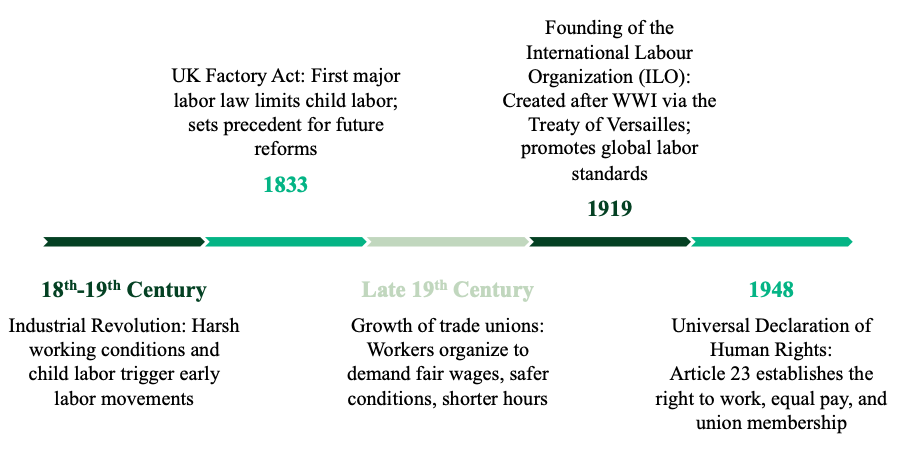
Labor standard concerns were directed towards children and women back then and not men.39Engerman, S. L. The History and Political Economy of International Labor Standards. in International Labor Standards: History, Theory, and Policy Options (eds Basu, K. , Horn, H. , Román, L. & Shapiro, J. ) (Wiley, 2003). doi:10. 1002/9780470754818. This was because women and children were not considered to be able to make decisions for themselves.39Engerman, S. L. The History and Political Economy of International Labor Standards. in International Labor Standards: History, Theory, and Policy Options (eds Basu, K. , Horn, H. , Román, L. & Shapiro, J. ) (Wiley, 2003). doi:10. 1002/9780470754818. Additionally, they had limited political power, control over money, and were usually not in a position to bargain, however, male workers implicitly benefited from these labor standard developments as well.39Engerman, S. L. The History and Political Economy of International Labor Standards. in International Labor Standards: History, Theory, and Policy Options (eds Basu, K. , Horn, H. , Román, L. & Shapiro, J. ) (Wiley, 2003). doi:10. 1002/9780470754818. Nonetheless, as illustrated in Figure 1, one breakthrough and milestone of the earliest labor movements was the protection of child workers in the textile industry in the United Kingdom.34Nardinelli, C. Child labor and the Factory Acts. J. Econ. Hist. 40, 739–755 (1980). The Factory Act of 1833 “prohibited the employment of children under the age of nine in all textile mills (except silk) powered by steam or water” (Nardinelli 1980, p. 741) and limited the amount of time children between the ages of nine and twelve were allowed to work, which was nine hours per day or 48 hours per week.34Nardinelli, C. Child labor and the Factory Acts. J. Econ. Hist. 40, 739–755 (1980). In addition, the Factory Act required working children to attend school.34Nardinelli, C. Child labor and the Factory Acts. J. Econ. Hist. 40, 739–755 (1980). The silk mills were exempt from these rules because they were deemed less harmful than other textile factories and child labor was considered an integral part of the industry’s survival.34Nardinelli, C. Child labor and the Factory Acts. J. Econ. Hist. 40, 739–755 (1980). Therefore, less rigorous rules were imposed on silk mills.34Nardinelli, C. Child labor and the Factory Acts. J. Econ. Hist. 40, 739–755 (1980).
An implicit tax on child labor ensured the success of the 1833 Factory Act.34Nardinelli, C. Child labor and the Factory Acts. J. Econ. Hist. 40, 739–755 (1980). Factory owners were required to collect age certificates and some needed to hire staff to handle the extra paperwork.34Nardinelli, C. Child labor and the Factory Acts. J. Econ. Hist. 40, 739–755 (1980). Due to the compulsory schooling, some factories had to establish a shift system, if there wasn’t one already, and provide schools if no school existed nearby.34Nardinelli, C. Child labor and the Factory Acts. J. Econ. Hist. 40, 739–755 (1980). All these measures have raised costs for the factory owners, leading to an implicit tax on child labor.34Nardinelli, C. Child labor and the Factory Acts. J. Econ. Hist. 40, 739–755 (1980). An example of the tax’s positive effect is the drop in the number of employed children from 56,000 to 33,000 in textile factories after the enforcement of the law between 1835 and 1838.34Nardinelli, C. Child labor and the Factory Acts. J. Econ. Hist. 40, 739–755 (1980). And even though there might have been some cheating, suggesting the numbers were not as high as reported, the law was substantially obeyed and therefore a success.34Nardinelli, C. Child labor and the Factory Acts. J. Econ. Hist. 40, 739–755 (1980). However, it is important to note that the number of child workers in textile factories was decreasing before the 1833 Factory Act, due to Industrialization and technological improvements.34Nardinelli, C. Child labor and the Factory Acts. J. Econ. Hist. 40, 739–755 (1980). Secondary jobs, usually performed by children, such as picking up waste or piecing together broken threads, became mostly obsolete since the improved machines did not break as many threads and produced less waste.34Nardinelli, C. Child labor and the Factory Acts. J. Econ. Hist. 40, 739–755 (1980).
One point of criticism could be that the 1833 Factory Act only targeted the textile industry and legislative restrictions on other industries were not enforced until the 1860s and 1870s.34Nardinelli, C. Child labor and the Factory Acts. J. Econ. Hist. 40, 739–755 (1980). Nevertheless, the 1833 Factory Act was one of many in a series of Factory Acts, which acted as a blueprint for similar legislation in most European. And North American countries that was adopted towards the end of the 19th century.16Rodgers, G. , Lee, E. , Swepston, L. & Van Daele, J. The International labor Organization and the Quest for Social Justice, 1919-2009. (International labor Office, Geneva, 2009).34Nardinelli, C. Child labor and the Factory Acts. J. Econ. Hist. 40, 739–755 (1980).
2.1.2 Internationalization of trade unions
The first worker rights subject dealt with at an international level was forced and compulsory labor, discussed at the Congress of Vienna in 1815.16Rodgers, G. , Lee, E. , Swepston, L. & Van Daele, J. The International labor Organization and the Quest for Social Justice, 1919-2009. (International labor Office, Geneva, 2009). The goal was to end cruel treatment towards workers and propagate more humanity.16Rodgers, G. , Lee, E. , Swepston, L. & Van Daele, J. The International labor Organization and the Quest for Social Justice, 1919-2009. (International labor Office, Geneva, 2009). After the Congress of Vienna, many countries adopted national laws that prohibited the slave trade and imposed sanctions for non-compliance with these laws.16Rodgers, G. , Lee, E. , Swepston, L. & Van Daele, J. The International labor Organization and the Quest for Social Justice, 1919-2009. (International labor Office, Geneva, 2009). Nevertheless, the formation of international trade unions did not occur until the second half of the 19th century, but it was a major development towards the labor and worker rights of today (see Figure 1).16Rodgers, G. , Lee, E. , Swepston, L. & Van Daele, J. The International labor Organization and the Quest for Social Justice, 1919-2009. (International labor Office, Geneva, 2009).17Maul, D. The International labor Organization: 100 Years of Global Social Policy. (De Gruyter, 2019). doi:10. 1515/9783110650723. During that time, the International Trade Secretariats were founded, followed by the International Federation of Trade Unions, formed in 1913.16Rodgers, G. , Lee, E. , Swepston, L. & Van Daele, J. The International labor Organization and the Quest for Social Justice, 1919-2009. (International labor Office, Geneva, 2009). Throughout World War I, between 1914 and 1918, members of the international trade union movement kept in touch and managed to make plans for a post-war period.16Rodgers, G. , Lee, E. , Swepston, L. & Van Daele, J. The International labor Organization and the Quest for Social Justice, 1919-2009. (International labor Office, Geneva, 2009). At a trade union conference in Leeds in 1916, a list of demands of workers’ rights was drafted, which included “freedom of association, limited working hours, a minimum working age of 14 years, the abolition of night work for women, comprehensive social security. And factory inspectorates, […]” (Rodgers et al. 2009, p. 46).16Rodgers, G. , Lee, E. , Swepston, L. & Van Daele, J. The International labor Organization and the Quest for Social Justice, 1919-2009. (International labor Office, Geneva, 2009). After the war ended and the ILO was founded, they took on every one of these demands.16Rodgers, G. , Lee, E. , Swepston, L. & Van Daele, J. The International labor Organization and the Quest for Social Justice, 1919-2009. (International labor Office, Geneva, 2009).
A pivotal forerunner of the ILO was the International Association for labor Legislation (IALL), founded in 1900.17Maul, D. The International labor Organization: 100 Years of Global Social Policy. (De Gruyter, 2019). doi:10. 1515/9783110650723. The association reflected the internationalist spirit of the late 19th century by juxtaposing “the ideals of peace, progress and cooperation among states” (Maul 2019, p. 18) with the reality of a world of competing nations.17Maul, D. The International labor Organization: 100 Years of Global Social Policy. (De Gruyter, 2019). doi:10. 1515/9783110650723. Even though IALL members were mostly academics, the work of the IALL was defined by the involvement of private initiatives and governments, similar to the International Red Cross movement at that time.17Maul, D. The International labor Organization: 100 Years of Global Social Policy. (De Gruyter, 2019). doi:10. 1515/9783110650723. Experts and representatives of different countries that financed the IALL joined the association with the formation of the IALL’s permanent secretariat in Basel in 1901.17Maul, D. The International labor Organization: 100 Years of Global Social Policy. (De Gruyter, 2019). doi:10. 1515/9783110650723. Especially members of major industrial countries like France, Germany, or the United States of America made the IALL an opportunity to compare and judge their different social reform models.17Maul, D. The International labor Organization: 100 Years of Global Social Policy. (De Gruyter, 2019). doi:10. 1515/9783110650723.
The association’s primary goal was to spread and implement labor law internationally.17Maul, D. The International labor Organization: 100 Years of Global Social Policy. (De Gruyter, 2019). doi:10. 1515/9783110650723. The Basel Office pursued its objectives by coordinating national sections, facilitating transnational reformist exchange and promoting labor law harmonization through its networks.17Maul, D. The International labor Organization: 100 Years of Global Social Policy. (De Gruyter, 2019). doi:10. 1515/9783110650723. The IALL’s work intersected with that of several other international bodies, such as the Permanent Committee for Social Insurance or the International Association for the Prevention of Unemployment.17Maul, D. The International labor Organization: 100 Years of Global Social Policy. (De Gruyter, 2019). doi:10. 1515/9783110650723. They all shared a commitment to social reform and international cooperation, which influenced the IALL’s work significantly.17Maul, D. The International labor Organization: 100 Years of Global Social Policy. (De Gruyter, 2019). doi:10. 1515/9783110650723.
The promotion of international labor conventions was the main target of the IALL and the association achieved notable success in two cases in 1906.17Maul, D. The International labor Organization: 100 Years of Global Social Policy. (De Gruyter, 2019). doi:10. 1515/9783110650723. The first convention banned the usage of white phosphorus in match production, marking a milestone in the fight against hazardous workplace conditions.17Maul, D. The International labor Organization: 100 Years of Global Social Policy. (De Gruyter, 2019). doi:10. 1515/9783110650723. The second convention was on the prohibition of night work for women, which found broad support across political lines.17Maul, D. The International labor Organization: 100 Years of Global Social Policy. (De Gruyter, 2019). doi:10. 1515/9783110650723. Further conventions were planned, such as the prohibition of night work for children under the age of 14. And the reduction of working hours to ten hours a day for adolescents and women, which also addressed the demands of the trade union movement.17Maul, D. The International labor Organization: 100 Years of Global Social Policy. (De Gruyter, 2019). doi:10. 1515/9783110650723. However, these conventions never came to fruition due to the outbreak of World War I in 1914.17Maul, D. The International labor Organization: 100 Years of Global Social Policy. (De Gruyter, 2019). doi:10. 1515/9783110650723.
Just like the demands of the Leeds trade union conference, the ILO took on and executed the IALL conventions that could not be realized.16Rodgers, G. , Lee, E. , Swepston, L. & Van Daele, J. The International labor Organization and the Quest for Social Justice, 1919-2009. (International labor Office, Geneva, 2009).17Maul, D. The International labor Organization: 100 Years of Global Social Policy. (De Gruyter, 2019). doi:10. 1515/9783110650723. In retrospect, the IALL is considered a major testing ground for what would later become the ILO.17Maul, D. The International labor Organization: 100 Years of Global Social Policy. (De Gruyter, 2019). doi:10. 1515/9783110650723.
2.1.3 Founding of the ILO
The ILO was established alongside the League of Nations at the Paris Peace Conference in 1919 and was anchored in the Treaty of Versailles, which formally marked the end of World War I.16Rodgers, G. , Lee, E. , Swepston, L. & Van Daele, J. The International labor Organization and the Quest for Social Justice, 1919-2009. (International labor Office, Geneva, 2009).17Maul, D. The International labor Organization: 100 Years of Global Social Policy. (De Gruyter, 2019). doi:10. 1515/9783110650723. Both institutions were conceived as a response to the profound political and social upheavals triggered by the war. A central conviction guiding the Conference and the Treaty was that lasting peace required not only political settlements, but also social justice.16Rodgers, G. , Lee, E. , Swepston, L. & Van Daele, J. The International labor Organization and the Quest for Social Justice, 1919-2009. (International labor Office, Geneva, 2009).17Maul, D. The International labor Organization: 100 Years of Global Social Policy. (De Gruyter, 2019). doi:10. 1515/9783110650723. The creation of the ILO reflected this belief and represented a social justice as an essential cornerstone for peace and not just as a commodity.16Rodgers, G. , Lee, E. , Swepston, L. & Van Daele, J. The International labor Organization and the Quest for Social Justice, 1919-2009. (International labor Office, Geneva, 2009).17Maul, D. The International labor Organization: 100 Years of Global Social Policy. (De Gruyter, 2019). doi:10. 1515/9783110650723.
Furthermore, the ILO was supposed to be an answer to the Social Question of inequality. And injustice of workers, which first came up during the Industrial Revolution and continue the pre-war work of other organizations such as the IALL and the trade union movement.16Rodgers, G. , Lee, E. , Swepston, L. & Van Daele, J. The International labor Organization and the Quest for Social Justice, 1919-2009. (International labor Office, Geneva, 2009).17Maul, D. The International labor Organization: 100 Years of Global Social Policy. (De Gruyter, 2019). doi:10. 1515/9783110650723. Different from previous organizations and associations, the ILO has a unique tripartite structure with national representatives from not only governments and employers, but also workers, all with equal voting power.16Rodgers, G. , Lee, E. , Swepston, L. & Van Daele, J. The International labor Organization and the Quest for Social Justice, 1919-2009. (International labor Office, Geneva, 2009).17Maul, D. The International labor Organization: 100 Years of Global Social Policy. (De Gruyter, 2019). doi:10. 1515/9783110650723.40Thomas, H. & Anner, M. Dissensus and Deadlock in the Evolution of labor Governance: Global Supply Chains and the International labor Organization (ILO). J. Bus. Ethics 184, 33–49 (2023). The formulation and adoption of international labor standards were considered the ILO’s primary mandate, aiming to regulate nearly all dimensions of labor law and industrial relations.16Rodgers, G. , Lee, E. , Swepston, L. & Van Daele, J. The International labor Organization and the Quest for Social Justice, 1919-2009. (International labor Office, Geneva, 2009).17Maul, D. The International labor Organization: 100 Years of Global Social Policy. (De Gruyter, 2019). doi:10. 1515/9783110650723.41Standing, G. The ILO: An Agency for Globalization? Dev. Change 39, 355–384 (2008).
The ILO hit several milestones in its first couple of years, such as the Minimum Wage-Fixing Machinery Convention (No. 26) in 1928, which set a minimum wage, or the Forced labor Convention (No. 29) in 1930, which prohibited forced labor.8International labor Organization (ILO). Convention C029 – Forced labor Convention, 1930 (No. 29). https://normlex. ilo. org/dyn/nrmlx_en/f? p=NORMLEXPUB:12100:::NO:12100:P12100_ILO_CODE:C029:NO.42International labor Organization (ILO). Convention C026 – Minimum Wage-Fixing Machinery Convention, 1928 (No. 26). https://normlex. ilo. org/dyn/nrmlx_en/f? p=NORMLEXPUB:12100:0::NO:12100:P12100_INSTRUMENT_ID:312171:NO. Moreover, the organization outsourced its supervisory expertise for the ratification of standards in 1926.16Rodgers, G. , Lee, E. , Swepston, L. & Van Daele, J. The International labor Organization and the Quest for Social Justice, 1919-2009. (International labor Office, Geneva, 2009).17Maul, D. The International labor Organization: 100 Years of Global Social Policy. (De Gruyter, 2019). doi:10. 1515/9783110650723. From 1927 onward, that was going to be the job of the newly developed Committee of Experts on the Application of Conventions and Recommendations (CEACR).16Rodgers, G. , Lee, E. , Swepston, L. & Van Daele, J. The International labor Organization and the Quest for Social Justice, 1919-2009. (International labor Office, Geneva, 2009).17Maul, D. The International labor Organization: 100 Years of Global Social Policy. (De Gruyter, 2019). doi:10. 1515/9783110650723. The CEACR consisted mostly of internationally renowned jurists and labor law experts and their job was to review the annual reports of nations that ratified standards.17Maul, D. The International labor Organization: 100 Years of Global Social Policy. (De Gruyter, 2019). doi:10. 1515/9783110650723. The experts became crucial in the establishment of the international labor law of the member states.17Maul, D. The International labor Organization: 100 Years of Global Social Policy. (De Gruyter, 2019). doi:10. 1515/9783110650723. Due to the precarious situation in Europe during World War II (1939-1945), the ILO moved its headquarters from Geneva to Montreal to secure its freedom of action.16Rodgers, G. , Lee, E. , Swepston, L. & Van Daele, J. The International labor Organization and the Quest for Social Justice, 1919-2009. (International labor Office, Geneva, 2009).17Maul, D. The International labor Organization: 100 Years of Global Social Policy. (De Gruyter, 2019). doi:10. 1515/9783110650723. This move led to the Philadelphia Conference in 1944, which is considered the second founding of the ILO.16Rodgers, G. , Lee, E. , Swepston, L. & Van Daele, J. The International labor Organization and the Quest for Social Justice, 1919-2009. (International labor Office, Geneva, 2009).17Maul, D. The International labor Organization: 100 Years of Global Social Policy. (De Gruyter, 2019). doi:10. 1515/9783110650723. The outcome of that Conference was the Philadelphia Declaration, which outlined the universal will of renewing liberal democracies, after the experiences of the rise of Fascism and Nazism during the war.16Rodgers, G. , Lee, E. , Swepston, L. & Van Daele, J. The International labor Organization and the Quest for Social Justice, 1919-2009. (International labor Office, Geneva, 2009).17Maul, D. The International labor Organization: 100 Years of Global Social Policy. (De Gruyter, 2019). doi:10. 1515/9783110650723. The fundamental principles of the Declaration reaffirmed the existing ILO principles and put special emphasis on some of them, such as the principle that labor is not a commodity.16Rodgers, G. , Lee, E. , Swepston, L. & Van Daele, J. The International labor Organization and the Quest for Social Justice, 1919-2009. (International labor Office, Geneva, 2009).17Maul, D. The International labor Organization: 100 Years of Global Social Policy. (De Gruyter, 2019). doi:10. 1515/9783110650723.43Thomas, H. & Turnbull, P. From horizontal to vertical labor governance: The International labor Organization (ILO) and decent work in global supply chains. Hum. Relat. 71, 536–559 (2018). Among others, the Declaration made a big impact on the international human rights movement. Universal human rights were defined as such: “all human beings, irrespective of race, creed or sex, have the right to pursue both material well-being. And their spiritual development in conditions of freedom and dignity, of economic security and equal opportunity” (ILO 1944, p. 1), which became a main source of inspiration for the Charter of the United Nations (UN) and the UN’s Universal Declaration of Human Rights (UDHR) from 1948.16Rodgers, G. , Lee, E. , Swepston, L. & Van Daele, J. The International labor Organization and the Quest for Social Justice, 1919-2009. (International labor Office, Geneva, 2009).17Maul, D. The International labor Organization: 100 Years of Global Social Policy. (De Gruyter, 2019). doi:10. 1515/9783110650723.44International Labour Organization (ILO). ILO Declaration of Philadelphia. (1944).
When the ILO was founded, the organization had 44 member states, which rapidly grew to 121 member states after World War II and the dissolution of European colonies.17Maul, D. The International labor Organization: 100 Years of Global Social Policy. (De Gruyter, 2019). doi:10. 1515/9783110650723.39Engerman, S. L. The History and Political Economy of International Labor Standards. in International Labor Standards: History, Theory, and Policy Options (eds Basu, K. , Horn, H. , Román, L. & Shapiro, J. ) (Wiley, 2003). doi:10. 1002/9780470754818.40Thomas, H. & Anner, M. Dissensus and Deadlock in the Evolution of labor Governance: Global Supply Chains and the International labor Organization (ILO). J. Bus. Ethics 184, 33–49 (2023). Today, the organization has 187 member states.17Maul, D. The International labor Organization: 100 Years of Global Social Policy. (De Gruyter, 2019). doi:10. 1515/9783110650723.39Engerman, S. L. The History and Political Economy of International Labor Standards. in International Labor Standards: History, Theory, and Policy Options (eds Basu, K. , Horn, H. , Román, L. & Shapiro, J. ) (Wiley, 2003). doi:10. 1002/9780470754818.40Thomas, H. & Anner, M. Dissensus and Deadlock in the Evolution of labor Governance: Global Supply Chains and the International labor Organization (ILO). J. Bus. Ethics 184, 33–49 (2023). Moreover, as of 2025, the ILO has adopted 192 Conventions and formulated 209 Recommendations.45NORMLEX – Information System on International labor Standards. International labor Organization (ILO)https://normlex. ilo. org/dyn/nrmlx_en/f? p=NORMLEXPUB:1:0::NO::: In the Declaration of 1998, the eight most important conventions were grouped as the Fundamental Conventions, which are considered to be the fundamental human rights in the workplace.46Hassel, A. The Evolution of a Global Labor Governance Regime. Governance 21, 231–251 (2008).41Standing, G. The ILO: An Agency for Globalization? Dev. Change 39, 355–384 (2008). The Conventions are also known as the Core Labor Standards and are central to the ILO’s mission of achieving social justice worldwide.16Rodgers, G. , Lee, E. , Swepston, L. & Van Daele, J. The International labor Organization and the Quest for Social Justice, 1919-2009. (International labor Office, Geneva, 2009).46Hassel, A. The Evolution of a Global Labor Governance Regime. Governance 21, 231–251 (2008). They cover labor and worker rights, such as the abolishment of forced labor, minimum age, discrimination, the freedom to associate, the right to collective bargaining and equal remuneration (see Table 1).16Rodgers, G. , Lee, E. , Swepston, L. & Van Daele, J. The International labor Organization and the Quest for Social Justice, 1919-2009. (International labor Office, Geneva, 2009). What is special about these conventions is that they apply to all 187 member states and the members have to adhere to them, regardless of whether they have ratified them or not.16Rodgers, G. , Lee, E. , Swepston, L. & Van Daele, J. The International labor Organization and the Quest for Social Justice, 1919-2009. (International labor Office, Geneva, 2009).17Maul, D. The International labor Organization: 100 Years of Global Social Policy. (De Gruyter, 2019). doi:10. 1515/9783110650723.41Standing, G. The ILO: An Agency for Globalization? Dev. Change 39, 355–384 (2008). However, most member states have also ratified the Fundamental Conventions, as illustrated in Table 1.16Rodgers, G. , Lee, E. , Swepston, L. & Van Daele, J. The International labor Organization and the Quest for Social Justice, 1919-2009. (International labor Office, Geneva, 2009).17Maul, D. The International labor Organization: 100 Years of Global Social Policy. (De Gruyter, 2019). doi:10. 1515/9783110650723. Nevertheless, the only convention ratified by all member states is the C182 – Worst Forms of Child labor Convention.47Ratifications of C182 – Worst Forms of Child labor Convention, 1999 (No. 182). International labor Organization (ILO) https://normlex. ilo. org/dyn/nrmlx_en/f? p=1000:11300:0::NO:11300:P11300_INSTRUMENT_ID:312327.
Convention
Purpose & Ratifications
C029 – Forced labor Convention, 1930 (No. 29)
Aims to abolish all forms of forced and compulsory labor. While widely ratified (181 ratifications), its principles continue to be violated in practice, with modern challenges including prison labor, trafficking and exploitation of domestic workers. C087 – Freedom of Association and Protection of the Right to Organise Convention, 1948 (No. 87)
Guarantees the rights of workers and employers to freely organize in defense of their interests and is recognized as a foundational human right. Despite its significance, major economies like China, India and the USA remain outside of it due to structural and political barriers. Nevertheless, most member states have ratified it (158 ratifications). C098 – Right to Organise and Collective Bargaining Convention, 1949 (No. 98)
Complements earlier protections by strengthening the rights to organize and engage in collective bargaining, reinforcing the formation of independent organizations for both workers and employers. However, its political nature has limited global ratification, similar to its predecessor (168 ratifications). C100 – Equal Remuneration Convention, 1951 (No. 100)
Seeks to eliminate pay discrimination by requiring equal remuneration for work of equal value. It refines previous principles refining and strengthening the commitment to gender pay equality. This convention has been ratified by the majority of ILO members (174 ratifications). C105 – Abolition of Forced labor Convention, 1957 (No. 105)
Bans forced labor used as punishment for political views, strikes, discrimination or breaches of labor discipline, targeting abuses seen during World War II and Soviet Gulags. Like its predecessor, it ranks among the most widely ratified ILO conventions (178 ratifications). C111 – Discrimination (Employment and Occupation) Convention, 1958 (No. 111)
Requires states to promote equality of opportunity and treatment in employment and occupation, aiming to eliminate discrimination, which has been adopted into many national constitutions worldwide. It has been widely ratified (175 ratifications). C138 – Minimum Age Convention, 1973 (No. 138)
Establishes a general minimum age for employment, replacing earlier sector-specific rules on child labor. It requires that this age be no lower than the end of compulsory schooling and generally not under 15, with some flexibility for developing countries. It has been ratified by most ILO members (177 ratifications). C182 – Worst Forms of Child labor Convention, 1999 (No. 182)
Calls for immediate elimination of the worst forms of child labor, including slavery, prostitution, illicit activities and hazardous work. It became the fastest-ratified ILO convention in history and has attracted broad support and funding (187 ratifications).
| Convention | Purpose & Ratifications |
| C029 – Forced Labour Convention, 1930 (No. 29) | Aims to abolish all forms of forced and compulsory labor. While widely ratified (181 ratifications), its principles continue to be violated in practice, with modern challenges including prison labor, trafficking and exploitation of domestic workers. |
| C087 – Freedom of Association and Protection of the Right to Organise Convention, 1948 (No. 87) | Guarantees the rights of workers and employers to freely organize in defense of their interests and is recognized as a foundational human right. Despite its significance, it has been ratified by less than half of all states, with major economies like China, India and the USA remaining outside due to structural and political barriers. Nevertheless, most member states have ratified it (158 ratifications). |
| C098 – Right to Organise and Collective Bargaining Convention, 1949 (No. 98) | Complements earlier protections by strengthening the rights to organize and engage in collective bargaining, reinforcing the formation of independent organizations for both workers and employers. However, its political nature has limited global ratification, similar to its predecessor (168 ratifications). |
| C100 – Equal Remuneration Convention, 1951 (No. 100) | Seeks to eliminate pay discrimination by requiring equal remuneration for work of equal value. It refines previous principles refining and strengthening the commitment to gender pay equality. This convention has been ratified by the majority of ILO members (174 ratifications). |
| C105 – Abolition of Forced Labour Convention, 1957 (No. 105) | Bans forced labor used as punishment for political views, strikes, discrimination or breaches of labor discipline, targeting abuses seen during World War II and Soviet Gulags. Like its predecessor, it ranks among the most widely ratified ILO conventions (178 ratifications). |
| C111 – Discrimination (Employment and Occupation) Convention, 1958 (No. 111) | Requires states to promote equality of opportunity and treatment in employment and occupation, aiming to eliminate discrimination, which has been adopted into many national constitutions worldwide. It has been widely ratified (175 ratifications). |
| C138 – Minimum Age Convention, 1973 (No. 138) | Establishes a general minimum age for employment, replacing earlier sector-specific rules on child labor. It requires that this age be no lower than the end of compulsory schooling and generally not under 15, with some flexibility for developing countries. It has been ratified by most ILO members (177 ratifications). |
| C182 – Worst Forms of Child Labour Convention, 1999 (No. 182) | Calls for immediate elimination of the worst forms of child labor, including slavery, prostitution, illicit activities and hazardous work. It became the fastest-ratified ILO convention in history and has attracted broad support and funding (187 ratifications). |
Some Conventions are additions to previous Conventions, like the C105 – Abolition of Forced labor Convention, 1957 (No. 105), which is an addition to the C029 – Forced labor Convention, 1930 (No. 29) (see Table 1). However, the ILO regularly passes new Conventions that go beyond the Fundamental Conventions and address ‘modern’ labor and worker rights issues.17Maul, D. The International labor Organization: 100 Years of Global Social Policy. (De Gruyter, 2019). doi:10. 1515/9783110650723.40Thomas, H. & Anner, M. Dissensus and Deadlock in the Evolution of labor Governance: Global Supply Chains and the International labor Organization (ILO). J. Bus. Ethics 184, 33–49 (2023).55Coe, C. & Glaser, A. L. Introduction to the special issue: Organizing domestic work: The limits of regulations in the wake of the Domestic Workers Convention. Anthropol. Work Rev. 45, 59–68 (2024). One example of that is the C189 – Domestic Workers Convention, 2011 (No. 189), which was the first occupational safety standard for domestic workers.17Maul, D. The International labor Organization: 100 Years of Global Social Policy. (De Gruyter, 2019). doi:10. 1515/9783110650723.40Thomas, H. & Anner, M. Dissensus and Deadlock in the Evolution of labor Governance: Global Supply Chains and the International labor Organization (ILO). J. Bus. Ethics 184, 33–49 (2023).55Coe, C. & Glaser, A. L. Introduction to the special issue: Organizing domestic work: The limits of regulations in the wake of the Domestic Workers Convention. Anthropol. Work Rev. 45, 59–68 (2024). The ILO, ILO conventions, and especially the Core Labor Standards, are still of great importance today, as they provide the framework for many other labor standards, regulations and national legislations that followed.35Anner, M. & Caraway, T. International Institutions and Workers’ Rights: Between Labor Standards and Market Flexibility. Stud. Comp. Int. Dev. 45, 151–169 (2010).36Kerrissey, J. & Schuhrke, J. Life Chances: Labor Rights, International Institutions, and Worker Fatalities in the Global South. Soc. Forces 95, 191–216 (2016).
2.1.4 Globalization of labor standards & status quo
The process of internationalizing labor and worker rights had already begun before the establishment of the ILO.35Anner, M. & Caraway, T. International Institutions and Workers’ Rights: Between Labor Standards and Market Flexibility. Stud. Comp. Int. Dev. 45, 151–169 (2010).39Engerman, S. L. The History and Political Economy of International Labor Standards. in International Labor Standards: History, Theory, and Policy Options (eds Basu, K. , Horn, H. , Román, L. & Shapiro, J. ) (Wiley, 2003). doi:10. 1002/9780470754818.41Standing, G. The ILO: An Agency for Globalization? Dev. Change 39, 355–384 (2008). Nonetheless, the globalization of labor and worker rights has accelerated since its founding.35Anner, M. & Caraway, T. International Institutions and Workers’ Rights: Between Labor Standards and Market Flexibility. Stud. Comp. Int. Dev. 45, 151–169 (2010).39Engerman, S. L. The History and Political Economy of International Labor Standards. in International Labor Standards: History, Theory, and Policy Options (eds Basu, K. , Horn, H. , Román, L. & Shapiro, J. ) (Wiley, 2003). doi:10. 1002/9780470754818.41Standing, G. The ILO: An Agency for Globalization? Dev. Change 39, 355–384 (2008). A turning point for the globalization of labor standards was the Declaration of Philadelphia, due to the strong emphasis on universal human rights, followed by the departure from a Eurocentric orientation. And the shift to a global one in the mid-20thcentury.16Rodgers, G. , Lee, E. , Swepston, L. & Van Daele, J. The International labor Organization and the Quest for Social Justice, 1919-2009. (International labor Office, Geneva, 2009).17Maul, D. The International labor Organization: 100 Years of Global Social Policy. (De Gruyter, 2019). doi:10. 1515/9783110650723.41Standing, G. The ILO: An Agency for Globalization? Dev. Change 39, 355–384 (2008). Moreover, the decolonization of European colonies led to a growth of member states from the global south, which also encouraged a globalized orientation.16Rodgers, G. , Lee, E. , Swepston, L. & Van Daele, J. The International labor Organization and the Quest for Social Justice, 1919-2009. (International labor Office, Geneva, 2009).17Maul, D. The International labor Organization: 100 Years of Global Social Policy. (De Gruyter, 2019). doi:10. 1515/9783110650723.
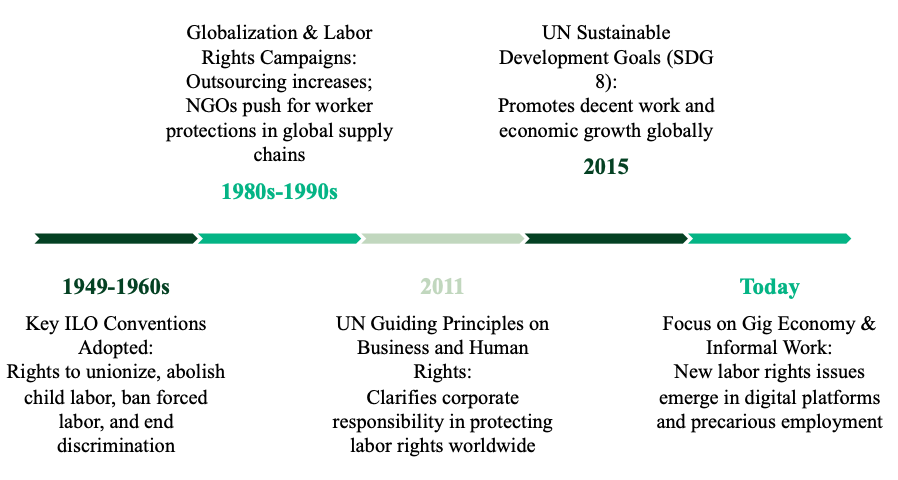
However, the ILO was not the only organization contributing to this movement.16Rodgers, G. , Lee, E. , Swepston, L. & Van Daele, J. The International labor Organization and the Quest for Social Justice, 1919-2009. (International labor Office, Geneva, 2009).17Maul, D. The International labor Organization: 100 Years of Global Social Policy. (De Gruyter, 2019). doi:10. 1515/9783110650723.46Hassel, A. The Evolution of a Global Labor Governance Regime. Governance 21, 231–251 (2008). Many other organizations and initiatives formed from the mid-20th century onward, like the UDHR, the organization for Economic Co-operation and Development (OECD) and the UN Global Compact (see Figure 2).16Rodgers, G. , Lee, E. , Swepston, L. & Van Daele, J. The International labor Organization and the Quest for Social Justice, 1919-2009. (International labor Office, Geneva, 2009).17Maul, D. The International labor Organization: 100 Years of Global Social Policy. (De Gruyter, 2019). doi:10. 1515/9783110650723.46Hassel, A. The Evolution of a Global Labor Governance Regime. Governance 21, 231–251 (2008). All these have a different impact on labor and worker rights, but what they all have in common is that they follow a soft law approach, meaning they are voluntary.6Cholewinski, R. The ILO and the Global Compact for Safe, Orderly and Regular Migration: labor migration, decent work and implementation of the Compact with specific reference to the Arab states region. Int. J. Law Context 16, 304–320 (2020).57United Nations. Guiding Principles on Business and Human Rights: Implementing the United Nations ‘Protect, Respect and Remedy’ Framework. (2011).59Wolfsteller, R. & Li, Y. Business and Human Rights Regulation After the UN Guiding Principles: Accountability, Governance, Effectiveness. Hum. Rights Rev. 23, 1–17 (2022).60The Secretariat. CORPORATE RESPONSIBILITIES AND THE OECD GUIDELINES FOR MULTINATIONAL ENTERPRISES. in Foreign Direct Investment, Development and Corporate Responsibility (ed. organization for Economic Co-operation and Development (OECD)) (OECD Publishing, Paris, 1999).61OECD. OECD Guidelines for Multinational Enterprises on Responsible Business Conduct. (OECD, 2023). doi:10.1787/81f92357-en. The UDHR defines universal. And fundamental human rights, which are internationally recognized, and Article 23 establishes basic labor and worker rights for everyone, such as the right to work, equal pay, no discrimination and the right to join trade unions.21Buhmann, K. Public Regulators and CSR: The ‘Social Licence to Operate’ in Recent United Nations Instruments on Business and Human Rights and the Juridification of CSR. J. Bus. Ethics 136, 699–714 (2016).47Ratifications of C182 – Worst Forms of Child labor Convention, 1999 (No. 182). International labor Organization (ILO) https://normlex. ilo. org/dyn/nrmlx_en/f? p=1000:11300:0::NO:11300:P11300_INSTRUMENT_ID:312327. It posed as a framework for subsequent international human rights treaties.21Buhmann, K. Public Regulators and CSR: The ‘Social Licence to Operate’ in Recent United Nations Instruments on Business and Human Rights and the Juridification of CSR. J. Bus. Ethics 136, 699–714 (2016).47Ratifications of C182 – Worst Forms of Child labor Convention, 1999 (No. 182). International labor Organization (ILO) https://normlex. ilo. org/dyn/nrmlx_en/f? p=1000:11300:0::NO:11300:P11300_INSTRUMENT_ID:312327. The OECD’s influence on labor and worker rights is mostly indirect since its activities focus on other issues, such as offering economic expertise and the coordination of policy measures.20Silva, V. , Thomas, H. & Berten, J. Global labor Governance by Numbers: A Comparison of the ILO and OECD. Glob. Policy 16, 266–274 (2025). However, in 1976, the organization published the OECD Guidelines for Multinational Enterprises on Responsible Business Conduct, which established behavioral norms for enterprises, covering the following issues: “employment. And industrial relations, environmental protection, information disclosure, competition, financing, taxation, and science and technology” (OECD 1999, p. 19).60The Secretariat. CORPORATE RESPONSIBILITIES AND THE OECD GUIDELINES FOR MULTINATIONAL ENTERPRISES. in Foreign Direct Investment, Development and Corporate Responsibility (ed. organization for Economic Co-operation and Development (OECD)) (OECD Publishing, Paris, 1999). The Guidelines are not legally binding, but the OECD member governments are required to promote their adherence.60The Secretariat. CORPORATE RESPONSIBILITIES AND THE OECD GUIDELINES FOR MULTINATIONAL ENTERPRISES. in Foreign Direct Investment, Development and Corporate Responsibility (ed. organization for Economic Co-operation and Development (OECD)) (OECD Publishing, Paris, 1999). Since its establishment, the Guidelines have been revised multiple times, most recently in 2023.46Hassel, A. The Evolution of a Global Labor Governance Regime. Governance 21, 231–251 (2008).61OECD. OECD Guidelines for Multinational Enterprises on Responsible Business Conduct. (OECD, 2023). doi:10.1787/81f92357-en. The UN Global Compact goes in a similar direction. It is also a voluntary measure and companies that join the Global Compact commit to adhere to the ten principles, which are partly based on the ILO’s Core Labor Standards.46Hassel, A. The Evolution of a Global Labor Governance Regime. Governance 21, 231–251 (2008). The Initiative was a reaction to legally binding codes of conduct for Multinational Enterprises (MNEs). And their supply chains, which had failed in the past, hence, this soft law approach, under which companies were only required to provide evidence of compliance, proved successful.46Hassel, A. The Evolution of a Global Labor Governance Regime. Governance 21, 231–251 (2008).
Furthermore, as seen in Figure 2, in 2011, the UN published the UN Guiding Principles on Business and Human Rights (UNGPs).59Wolfsteller, R. & Li, Y. Business and Human Rights Regulation After the UN Guiding Principles: Accountability, Governance, Effectiveness. Hum. Rights Rev. 23, 1–17 (2022).62Compa, L. When in Rome: the exercise of power by foreign multinational companies in the United States. Transf. Eur. Rev. labor Res. 20, 271–293 (2014). The UNGPs promote the implementation of corporate Due Diligence mechanisms.59Wolfsteller, R. & Li, Y. Business and Human Rights Regulation After the UN Guiding Principles: Accountability, Governance, Effectiveness. Hum. Rights Rev. 23, 1–17 (2022).62Compa, L. When in Rome: the exercise of power by foreign multinational companies in the United States. Transf. Eur. Rev. labor Res. 20, 271–293 (2014). This means that companies must identify, prevent, mitigate and account for human rights abuses.59Wolfsteller, R. & Li, Y. Business and Human Rights Regulation After the UN Guiding Principles: Accountability, Governance, Effectiveness. Hum. Rights Rev. 23, 1–17 (2022).62Compa, L. When in Rome: the exercise of power by foreign multinational companies in the United States. Transf. Eur. Rev. labor Res. 20, 271–293 (2014). This also includes the behavior of MNEs with regard to freedom of association, one of the core labor standards.59Wolfsteller, R. & Li, Y. Business and Human Rights Regulation After the UN Guiding Principles: Accountability, Governance, Effectiveness. Hum. Rights Rev. 23, 1–17 (2022).62Compa, L. When in Rome: the exercise of power by foreign multinational companies in the United States. Transf. Eur. Rev. labor Res. 20, 271–293 (2014).
A most recent development is the Sustainable Development Goals (SDGs), adopted by the UN in 2015.63United Nations. THE 17 GOALS | Sustainable Development. https://sdgs. un. org/goals (n. D. ). The 17 goals aim for a sustainable development on a social, ecological and economic level.63United Nations. THE 17 GOALS | Sustainable Development. https://sdgs. un. org/goals (n. D. ). SDG 8 promotes decent work and economic growth.58United Nations. Goal 8 | Department of Economic and Social Affairs. https://sdgs. un. org/goals/goal8 (n. D. ). It contains sub-targets about the protection of labor and worker rights and a secure working environment for all types of workers, especially women migrant workers.58United Nations. Goal 8 | Department of Economic and Social Affairs. https://sdgs. un. org/goals/goal8 (n. D. ). Moreover, SDG 8 targets to end forced labor, modern slavery and human trafficking.6Cholewinski, R. The ILO and the Global Compact for Safe, Orderly and Regular Migration: labor migration, decent work and implementation of the Compact with specific reference to the Arab states region. Int. J. Law Context 16, 304–320 (2020).58United Nations. Goal 8 | Department of Economic and Social Affairs. https://sdgs. un. org/goals/goal8 (n. D. ).
In a nutshell, the development of labor and worker rights has led from labor laws that managed maximum wages or minimal working hours to labor standards of today that demand minimum wages and regulate maximum working hours.39Engerman, S. L. The History and Political Economy of International Labor Standards. in International Labor Standards: History, Theory, and Policy Options (eds Basu, K. , Horn, H. , Román, L. & Shapiro, J. ) (Wiley, 2003). doi:10. 1002/9780470754818. Engerman (2003) has divided modern labor and worker rights into three categories.39Engerman, S. L. The History and Political Economy of International Labor Standards. in International Labor Standards: History, Theory, and Policy Options (eds Basu, K. , Horn, H. , Román, L. & Shapiro, J. ) (Wiley, 2003). doi:10. 1002/9780470754818. Firstly, the most basic labor and worker rights: minimum wage and maximum hours of work.39Engerman, S. L. The History and Political Economy of International Labor Standards. in International Labor Standards: History, Theory, and Policy Options (eds Basu, K. , Horn, H. , Román, L. & Shapiro, J. ) (Wiley, 2003). doi:10. 1002/9780470754818. Secondly, laws that stipulate acceptable working conditions in factories: occupational health and safety conditions, as well as the elimination of work hazards.39Engerman, S. L. The History and Political Economy of International Labor Standards. in International Labor Standards: History, Theory, and Policy Options (eds Basu, K. , Horn, H. , Román, L. & Shapiro, J. ) (Wiley, 2003). doi:10. 1002/9780470754818. And thirdly, laws that dictate the range of permissible agreements between employer and employee, such as rights of association, formation of unions and bargaining rights.39Engerman, S. L. The History and Political Economy of International Labor Standards. in International Labor Standards: History, Theory, and Policy Options (eds Basu, K. , Horn, H. , Román, L. & Shapiro, J. ) (Wiley, 2003). doi:10. 1002/9780470754818.
While Engerman’s categories reflect the core of modern labor and worker rights, recent developments reveal new forms of vulnerability, as well as new challenges, which will be addressed in the following chapter.
2.2 Modern labor and worker rights issues
The most talked about labor and worker rights issues of today are precarious and informal work, the exploitation of migrant workers, as well as the digital transformation and the rise of Artificial Intelligence.5Bonsu, N. I. Framing Migrant Workers: A Content Analysis of Qatar Media Coverage of Migrant Workers During the 2022 FIFA World Cup. Soc. Sci. Q. 106, e70051 (2025).10Arnold, D. & Bongiovi, J. R. Precarious, Informalizing, and Flexible Work: Transforming Concepts and Understandings. Am. Behav. Sci. 57, 289–308 (2013).17Maul, D. The International labor Organization: 100 Years of Global Social Policy. (De Gruyter, 2019). doi:10. 1515/9783110650723.64Oelz, M. The ILO’s Domestic Workers Convention and Recommendation: A window of opportunity for social justice. Int. labor Rev. 153, 143–172 (2014).65Cherubini, D. , Garofalo Geymonat, G. & Marchetti, S. Global Rights and Local Struggles. The case of the ILO Convention n. 189 on domestic work. University of Salento https://doi. org/10. 1285/I20356609V11I3P717 (2018).66Valente, J. C. L. Data Workers in AI development: challenges to labor sovereignty in digital labor platforms and global production networks. Liinc Em Rev. 20, (2024).
Precarious and informal work are terms for employment with very limited or without any kind of legal worker protection, which are often used interchangeably.10Arnold, D. & Bongiovi, J. R. Precarious, Informalizing, and Flexible Work: Transforming Concepts and Understandings. Am. Behav. Sci. 57, 289–308 (2013). Even though they often overlap, they do not mean the same.10Arnold, D. & Bongiovi, J. R. Precarious, Informalizing, and Flexible Work: Transforming Concepts and Understandings. Am. Behav. Sci. 57, 289–308 (2013). Precarious work, on the one hand, is associated with uncertainty and instability (lack of job security), low income, very limited social benefits and a lack of workplace safety.10Arnold, D. & Bongiovi, J. R. Precarious, Informalizing, and Flexible Work: Transforming Concepts and Understandings. Am. Behav. Sci. 57, 289–308 (2013). One example are platform workers, like food delivery drivers working for platforms like Uber Eats.67Buendia Esteban, R. M. Examining recent initiatives to ensure labor rights for platform workers in the European Union to tackle the problem of domination. Transf. Eur. Rev. labor Res. 28, 475–487 (2022). Platform workers are frequently excluded from labor protections due to the conditions deliberately shaped by the platforms themselves, which classify them in ways that deny them legal recognition as employees, thereby depriving them of fundamental labor rights.67Buendia Esteban, R. M. Examining recent initiatives to ensure labor rights for platform workers in the European Union to tackle the problem of domination. Transf. Eur. Rev. labor Res. 28, 475–487 (2022).
Informal work, on the other hand, is any type of employment that is not recognized, regulated, or protected by existing legal or regulatory frameworks.10Arnold, D. & Bongiovi, J. R. Precarious, Informalizing, and Flexible Work: Transforming Concepts and Understandings. Am. Behav. Sci. 57, 289–308 (2013). Other than precarious workers, informal workers often do not have employment contracts or enjoy any kind of social benefits.10Arnold, D. & Bongiovi, J. R. Precarious, Informalizing, and Flexible Work: Transforming Concepts and Understandings. Am. Behav. Sci. 57, 289–308 (2013). Domestic workers often fall under this category, as they are frequently fully or partially excluded from labor laws due to their work in private households, which are often not recognized as a formal workplace.68Tomei, M. & Belser, P. New ILO standards on decent work for domestic workers: A summary of the issues and discussions. Int. labor Rev. 150, 431–438 (2011). One labor and worker rights development to tackle the domestic work issue was the ILO’s C189 – Domestic Workers Convention, 2011 (No. 189). However, it has only been ratified by 40 countries and in the majority of the world, domestic work is still not recognized as real work.65Cherubini, D. , Garofalo Geymonat, G. & Marchetti, S. Global Rights and Local Struggles. The case of the ILO Convention n. 189 on domestic work. University of Salento https://doi. org/10. 1285/I20356609V11I3P717 (2018).69International labor Organization (ILO). Ratifications of C189 – Domestic Workers Convention, 2011 (No. 189). https://normlex. ilo. org/dyn/nrmlx_en/f? p=NORMLEXPUB:11300:0::NO::p11300_instrument_id:2551460.
Other recent developments are the technological change and the rise of AI, as well as the possible effects these may have on jobs.70Torre, F. , Teigland, R. & Larsson, A. AI leadership and the future of corporate governance: Changing demands for board competence. in The digital transformation of labor: automation, the gig economy and welfare (Routledge, Abingdon, Oxon New York, NY, 2020).71Adhikary, S. & Banerjee, K. Digitalisation and AI what does the Future Hold for labor Union. Glocalism (2022) doi:10. 12893/gjcpi. 2022. 1. 5. Due to the technological transformation, some human-made work, work that low-skilled workers used to perform, is increasingly taken over by intelligent systems.72Castronova, E. Players for hire: Games and the future of low-skill work. in The digital transformation of labor: automation, the gig economy and welfare (eds Larsson, A. & Teigland, R. ) 200–212 (Routledge, Abingdon, Oxon New York, NY, 2020). Unlike previous technological advancements, the recent advancements in AI and robotics offer autonomous capabilities and are thus driving structural technological unemployment, as human labor becomes increasingly redundant.70Torre, F. , Teigland, R. & Larsson, A. AI leadership and the future of corporate governance: Changing demands for board competence. in The digital transformation of labor: automation, the gig economy and welfare (Routledge, Abingdon, Oxon New York, NY, 2020).71Adhikary, S. & Banerjee, K. Digitalisation and AI what does the Future Hold for labor Union. Glocalism (2022) doi:10. 12893/gjcpi. 2022. 1. 5. Moreover, the labor market fails to generate sufficient employment opportunities to offset the resulting displacement.70Torre, F. , Teigland, R. & Larsson, A. AI leadership and the future of corporate governance: Changing demands for board competence. in The digital transformation of labor: automation, the gig economy and welfare (Routledge, Abingdon, Oxon New York, NY, 2020).71Adhikary, S. & Banerjee, K. Digitalisation and AI what does the Future Hold for labor Union. Glocalism (2022) doi:10. 12893/gjcpi. 2022. 1. 5.
One outcome of all these developments is the so-called Gig Economy (see Figure 2). The rapid digitalization of work and advancements in automation and communication technologies are not only expanding the work process to include digital data and machines, but also embedding it in far-reaching production networks.56Graham, M. & Anwar, A. The global gig economy: Toward a planetary labor market. in The digital transformation of labor: automation, the gig economy and welfare (eds Larsson, A. & Teigland, R. ) 213–234 (Routledge, Abingdon, Oxon New York, NY, 2020). The Gig Economy refers to a new way of working in which workers support themselves by performing a series of ‘gigs’ on a freelance basis. These gig workers usually work for several different clients, rather than having a permanent position.73Bernhardtz, V. E. Black boxes of cognitive computers and the impact on labor markets. in The digital transformation of labor: automation, the gig economy and welfare (eds Larsson, A. & Teigland, R. ) 100–115 (Routledge, Abingdon, Oxon New York, NY, 2020). Due to the low wages and very limited social benefits these gigs provide, gig work can also be counted as a form of informal work.73Bernhardtz, V. E. Black boxes of cognitive computers and the impact on labor markets. in The digital transformation of labor: automation, the gig economy and welfare (eds Larsson, A. & Teigland, R. ) 100–115 (Routledge, Abingdon, Oxon New York, NY, 2020).74Larsson, A. & Sabolová, D. ‘Gig patients’: Health and dental care in the gig economy. in The digital transformation of labor: automation, the gig economy and welfare (ed. Teigland, R. ) 174–184 (Routledge, Abingdon, Oxon New York, NY, 2020).
There are currently only a few regulatory frameworks addressing AI, most of which focus on ethical and governance issues.70Torre, F. , Teigland, R. & Larsson, A. AI leadership and the future of corporate governance: Changing demands for board competence. in The digital transformation of labor: automation, the gig economy and welfare (Routledge, Abingdon, Oxon New York, NY, 2020). For instance, in 2024, the European Union adopted the EU-AI Act.75Europäische Kommission. KI-Verordnung tritt in Kraft. Europäische Kommissionhttps://commission. europa. eu/news-and-media/news/ai-act-enters-force-2024-08-01_de (2024). That framework has the goal to promote the responsible development and use of AI in the EU, addressing potential risks to health, safety and fundamental rights.75Europäische Kommission. KI-Verordnung tritt in Kraft. Europäische Kommissionhttps://commission. europa. eu/news-and-media/news/ai-act-enters-force-2024-08-01_de (2024). After copyright infringements of music, videos, illustrations and articles, the EU recently extended the Act, which mandates that providers of large, powerful AI models to disclose which websites they use to access copyright-protected work.76Schmid, K. Strengere KI-Regeln für ChatGPT und Co. treten in Kraft. tagesschau. dehttps://www. tagesschau. de/ausland/europa/eu-regeln-ki-100. html (2025). It remains to be seen whether future regulatory frameworks will be developed that address the influence of AI on labor and worker rights.
Moreover, during the globalization of economies, international workers have become a staple.77Jensen, J. & Piper, N. Migrant workers, the ILO and the potential for labor justice. Glob. Soc. Policy 22, 239–243 (2022). Migrant workers are crucial to many sectors and economies in addressing labor shortages in destination countries, particularly in sectors such as construction, agriculture, as well a care and domestic work and are often referred to as the backbone of global supply chains.77Jensen, J. & Piper, N. Migrant workers, the ILO and the potential for labor justice. Glob. Soc. Policy 22, 239–243 (2022). According to recent calculations, there were an estimated 167.7 million migrant workers worldwide in 2022.77Jensen, J. & Piper, N. Migrant workers, the ILO and the potential for labor justice. Glob. Soc. Policy 22, 239–243 (2022).78International Labour Organization (ILO). ILO Global Estimates on International Migrant Workers: International migrants in the labour force. (2024). They are particularly common in North America, Southern and Western Europe and the Arab states.6Cholewinski, R. The ILO and the Global Compact for Safe, Orderly and Regular Migration: labor migration, decent work and implementation of the Compact with specific reference to the Arab states region. Int. J. Law Context 16, 304–320 (2020). In the Gulf Cooperation Council member countries (Bahrain, Saudi Arabia, Kuwait, Oman, Qatar, United Arab Emirates), they represent the largest share of the working population, accounting for over 75 per cent of the workforce.7Lowe, C. et al. Extending social protection to migrant workers in the region of the Cooperation Council for the Arab States of the Gulf (GCC): An analysis of enablers and barriers. Int. Soc. Secur. Rev. 76, 89–110 (2023).79General Secretariat of the Gulf Cooperation Council. Gulf Cooperation Council. General Secretariat of the Gulf Cooperation Council https://www. gcc-sg. org/en/Pages/default. aspx (n. D. ). In Qatar, they even make up an estimated 88.4 per cent of the population.3Qadri, M. Qatar labor Reforms Ahead of the FIFA 2022 World Cup. Bus. Hum. Rights J. 7, 319–325 (2022). Many high-income countries are facing an aging population, which is leading to an increasing demand for labor that is often met by migrants.80International labor Organization (ILO). ILO Global Estimates on International Migrant Workers: International migrants in the labor force. (2024). A key driver is the desire of companies and economies to secure national competitiveness and growth through access to low-wage workers and significant income differences between countries of origin and destination are strong incentives for migration.1Cholewinski, R. & Guttman, U. Understanding the Kafala Migrant Labor System in Qatar and the Middle East at Large, with ILO Senior Migration Specialist Ryszard Cholewinski. Georget. J. Int. Aff. 24, 72–77 (2023).7Lowe, C. et al. Extending social protection to migrant workers in the region of the Cooperation Council for the Arab States of the Gulf (GCC): An analysis of enablers and barriers. Int. Soc. Secur. Rev. 76, 89–110 (2023). Even with low wages of, for instance, 250 to 300 dollars per month in a Gulf state, migration is worthwhile for many workers, as these jobs pay better than in their home countries.1Cholewinski, R. & Guttman, U. Understanding the Kafala Migrant Labor System in Qatar and the Middle East at Large, with ILO Senior Migration Specialist Ryszard Cholewinski. Georget. J. Int. Aff. 24, 72–77 (2023). Furthermore, in many countries, there is a lack of decent work and underemployment is prevalent, whereby labor migration is often encouraged by the government and thus often seen as a necessity rather than free choice.1Cholewinski, R. & Guttman, U. Understanding the Kafala Migrant Labor System in Qatar and the Middle East at Large, with ILO Senior Migration Specialist Ryszard Cholewinski. Georget. J. Int. Aff. 24, 72–77 (2023).80International labor Organization (ILO). ILO Global Estimates on International Migrant Workers: International migrants in the labor force. (2024).
As the example of the FIFA World Cup in Qatar has illustrated, labor migration often comes with exploitation and violations of labor and worker rights.5Bonsu, N. I. Framing Migrant Workers: A Content Analysis of Qatar Media Coverage of Migrant Workers During the 2022 FIFA World Cup. Soc. Sci. Q. 106, e70051 (2025).7Lowe, C. et al. Extending social protection to migrant workers in the region of the Cooperation Council for the Arab States of the Gulf (GCC): An analysis of enablers and barriers. Int. Soc. Secur. Rev. 76, 89–110 (2023). This exploitation is directly encouraged by the government and its Kafala system, which ties migrant workers to a single employer in terms of their legal status and their right of residence.5Bonsu, N. I. Framing Migrant Workers: A Content Analysis of Qatar Media Coverage of Migrant Workers During the 2022 FIFA World Cup. Soc. Sci. Q. 106, e70051 (2025).7Lowe, C. et al. Extending social protection to migrant workers in the region of the Cooperation Council for the Arab States of the Gulf (GCC): An analysis of enablers and barriers. Int. Soc. Secur. Rev. 76, 89–110 (2023). This system creates an enormous power imbalance that encourages abuse and exploitation.1Cholewinski, R. & Guttman, U. Understanding the Kafala Migrant Labor System in Qatar and the Middle East at Large, with ILO Senior Migration Specialist Ryszard Cholewinski. Georget. J. Int. Aff. 24, 72–77 (2023). Migrant workers are frequently denied fundamental rights such as freedom of association and the right to collective bargaining and countries like Qatar do not have trade unions, which could potentially help workers to stand up for their rights.1Cholewinski, R. & Guttman, U. Understanding the Kafala Migrant Labor System in Qatar and the Middle East at Large, with ILO Senior Migration Specialist Ryszard Cholewinski. Georget. J. Int. Aff. 24, 72–77 (2023). Since migration is seen as temporary, social security systems are often neglected, which leads to migrants having limited access to health care, pensions, or unemployment insurance.7Lowe, C. et al. Extending social protection to migrant workers in the region of the Cooperation Council for the Arab States of the Gulf (GCC): An analysis of enablers and barriers. Int. Soc. Secur. Rev. 76, 89–110 (2023).77Jensen, J. & Piper, N. Migrant workers, the ILO and the potential for labor justice. Glob. Soc. Policy 22, 239–243 (2022). Moreover, the enforcement of laws, such as minimum wages, is often weak and companies are rarely penalized for violations.3Qadri, M. Qatar labor Reforms Ahead of the FIFA 2022 World Cup. Bus. Hum. Rights J. 7, 319–325 (2022). In summary, the employment of migrant workers is driven by several global. And local factors, but is deeply problematic due to systemic exploitation and legal shortcomings and recent examples like the 2022 World Cup underscore the urgency of this labor and worker rights issue.
2.3 Relationship between companies and labor and worker rights
2.3.1 Influence of labor and worker rights on companies
Companies are required to follow national labor and worker laws and regulations that set minimum standards for labor and worker rights, such as wages, working hours, occupational health and safety, as well as protection against child labor and forced labor.81Basu, K. , Horn, H. , Román, L. & Shapiro, J. Introduction. in International Labor Standards: History, Theory, and Policy Options 3–6 (Wiley, 2003). doi:10. 1002/9780470754818. These minimum standards are often based on the ILO Core Labor Standards (see Table 1).81Basu, K. , Horn, H. , Román, L. & Shapiro, J. Introduction. in International Labor Standards: History, Theory, and Policy Options 3–6 (Wiley, 2003). doi:10. 1002/9780470754818. International standards like these apply in addition to national labor and worker rights legislation.17Maul, D. The International labor Organization: 100 Years of Global Social Policy. (De Gruyter, 2019). doi:10. 1515/9783110650723. Even if states have not ratified ILO conventions, their ILO membership obliges them to respect the Core Labor Standards, such as C087 – Freedom of Association and Protection of the Right to Organise Convention, 1948 (No. 87) and the C098 – Right to Organise and Collective Bargaining Convention, 1949 (No. 98) (see Table 1).16Rodgers, G. , Lee, E. , Swepston, L. & Van Daele, J. The International labor Organization and the Quest for Social Justice, 1919-2009. (International labor Office, Geneva, 2009).17Maul, D. The International labor Organization: 100 Years of Global Social Policy. (De Gruyter, 2019). doi:10. 1515/9783110650723. Consequently, these governmental duties exert normative pressure on companies.82Compa, L. Unfair Advantage: Workers’ Freedom of Association in the United States under International Human Rights Standards. (Cornell University Press, 2019). doi:10. 7591/9781501722639.
The introduction of labor standards may initially be perceived as a cost factor that impairs economic competitiveness.35Anner, M. & Caraway, T. International Institutions and Workers’ Rights: Between Labor Standards and Market Flexibility. Stud. Comp. Int. Dev. 45, 151–169 (2010). Research has shown, however, that the implementation of labor standards can increase economic efficiency and improve export competitiveness rather than harm it.35Anner, M. & Caraway, T. International Institutions and Workers’ Rights: Between Labor Standards and Market Flexibility. Stud. Comp. Int. Dev. 45, 151–169 (2010). Nevertheless, the degree of commitment that companies maintain and monitor labor standards largely depends on factors like “sectors, size, the value chain, and leadership” (Hassel 2008, p. 247).46Hassel, A. The Evolution of a Global Labor Governance Regime. Governance 21, 231–251 (2008). Weak enforcement can incentivize companies, particularly from weakly regulated countries, to undercut and exploit labor standards for a competitive advantage.46Hassel, A. The Evolution of a Global Labor Governance Regime. Governance 21, 231–251 (2008). This can lead to a widening gap between high and low labor standards in specific sectors, rather than raising them overall.46Hassel, A. The Evolution of a Global Labor Governance Regime. Governance 21, 231–251 (2008).
As outlined earlier the expansion and tightening of labor and worker rights is not a new development, yet it continues to present ongoing challenges for companies, particularly MNEs.83Lévesque, C. , Hennebert, M. -A. , Murray, G. & Bourque, R. Corporate Social Responsibility and Worker Rights: Institutionalizing Social Dialogue Through International Framework Agreements. J. Bus. Ethics 153, 215–230 (2018). These challenges are further intensified by growing pressure from stakeholders such as consumers, Non-Governmental Organizations (NGOs), or the media to ensure compliance with labor and worker rights, as well as their environmental performance across global operations and supply chains.11Compa, L. A. & Hinchliffe-Darricarrere, T. Enforcing International Labor Rights through Corporate Codes of Conduct. Columbia J. Transnatl. Law 33, 663–689 (1995).84O’Rourke, D. Outsourcing Regulation: Analyzing Nongovernmental Systems of Labor Standards and Monitoring. Policy Stud. J. 31, 1–29 (2003). A good reputation regarding high labor standards can act as a powerful selling point for companies, because if a company has one bad supplier, it can damage the whole company’s reputation.29Compa, L. A. Corporate social responsibility and workers’ rights. Comp. Labor Law Policy J. 30, 1–10 (2008).84O’Rourke, D. Outsourcing Regulation: Analyzing Nongovernmental Systems of Labor Standards and Monitoring. Policy Stud. J. 31, 1–29 (2003). Consequently, the fear of reputational damage can motivate companies to take voluntary measures, such as the introduction of their own codes of conduct, monitoring systems, or the development of Corporate Social Responsibility programs.11Compa, L. A. & Hinchliffe-Darricarrere, T. Enforcing International Labor Rights through Corporate Codes of Conduct. Columbia J. Transnatl. Law 33, 663–689 (1995).46Hassel, A. The Evolution of a Global Labor Governance Regime. Governance 21, 231–251 (2008).84O’Rourke, D. Outsourcing Regulation: Analyzing Nongovernmental Systems of Labor Standards and Monitoring. Policy Stud. J. 31, 1–29 (2003). These measures describe the impacts companies can have on labor and worker rights and will therefore be discussed in further detail in the following chapter.
2.3.2 Influence of companies on labor and worker rights
Companies play a pivotal role in shaping labor and worker rights, within and beyond their own operations, both positive and negative.11Compa, L. A. & Hinchliffe-Darricarrere, T. Enforcing International Labor Rights through Corporate Codes of Conduct. Columbia J. Transnatl. Law 33, 663–689 (1995).29Compa, L. A. Corporate social responsibility and workers’ rights. Comp. Labor Law Policy J. 30, 1–10 (2008).59Wolfsteller, R. & Li, Y. Business and Human Rights Regulation After the UN Guiding Principles: Accountability, Governance, Effectiveness. Hum. Rights Rev. 23, 1–17 (2022).62Compa, L. When in Rome: the exercise of power by foreign multinational companies in the United States. Transf. Eur. Rev. labor Res. 20, 271–293 (2014). Before discussing the positive impact companies can have on labor and worker rights, the negative impacts will be addressed.
One negative impact is that there can be major power imbalances between employers and employees, especially in global supply chains.40Thomas, H. & Anner, M. Dissensus and Deadlock in the Evolution of labor Governance: Global Supply Chains and the International labor Organization (ILO). J. Bus. Ethics 184, 33–49 (2023). Supply chains are becoming increasingly international, which allows companies to shift their production between different countries and thus take advantage of flexible employment relationships.10Arnold, D. & Bongiovi, J. R. Precarious, Informalizing, and Flexible Work: Transforming Concepts and Understandings. Am. Behav. Sci. 57, 289–308 (2013). For instance, MNEs can lower the prices they pay their suppliers and demand faster delivery times.10Arnold, D. & Bongiovi, J. R. Precarious, Informalizing, and Flexible Work: Transforming Concepts and Understandings. Am. Behav. Sci. 57, 289–308 (2013).40Thomas, H. & Anner, M. Dissensus and Deadlock in the Evolution of labor Governance: Global Supply Chains and the International labor Organization (ILO). J. Bus. Ethics 184, 33–49 (2023). This puts pressure on suppliers to lower wages, impose excessive and forced overtime, promote precarious working conditions and prevent unionization to control costs.10Arnold, D. & Bongiovi, J. R. Precarious, Informalizing, and Flexible Work: Transforming Concepts and Understandings. Am. Behav. Sci. 57, 289–308 (2013).40Thomas, H. & Anner, M. Dissensus and Deadlock in the Evolution of labor Governance: Global Supply Chains and the International labor Organization (ILO). J. Bus. Ethics 184, 33–49 (2023).
Furthermore, some MNEs exploit deregulated labor markets in countries such as the United States, leveraging the nation’s economic and legal system to their advantage.62Compa, L. When in Rome: the exercise of power by foreign multinational companies in the United States. Transf. Eur. Rev. labor Res. 20, 271–293 (2014). On the one hand, they are drawn by access to capital and efficient transportation networks and on the other hand by a labor law framework that favors employers over trade unions and thus employees.62Compa, L. When in Rome: the exercise of power by foreign multinational companies in the United States. Transf. Eur. Rev. labor Res. 20, 271–293 (2014). Despite benefitting from these anti-union regulations, many companies still openly endorse global labor standards such as the UDHR, UNGPs, or ILO conventions, which include safeguarding the right to associate.62Compa, L. When in Rome: the exercise of power by foreign multinational companies in the United States. Transf. Eur. Rev. labor Res. 20, 271–293 (2014). It is not uncommon for companies to resist union efforts, some even launch aggressive campaigns to intimidate their employees and therefore prevent unionization.29Compa, L. A. Corporate social responsibility and workers’ rights. Comp. Labor Law Policy J. 30, 1–10 (2008). Some companies, therefore, prefer to utilize voluntary codes of conduct because they would rather address enforcing those than governmental regulations.29Compa, L. A. Corporate social responsibility and workers’ rights. Comp. Labor Law Policy J. 30, 1–10 (2008).
Moreover, complex supply chains can be used to obscure responsibility for the conduct of suppliers and subcontractors, as accountability becomes increasingly opaque.46Hassel, A. The Evolution of a Global Labor Governance Regime. Governance 21, 231–251 (2008). This structural separation also enables MNEs to evade liability for human rights violations committed by subsidiaries or suppliers, since these entities are regarded as legally distinct, thereby significantly hindering victims’ access to legal remedies.59Wolfsteller, R. & Li, Y. Business and Human Rights Regulation After the UN Guiding Principles: Accountability, Governance, Effectiveness. Hum. Rights Rev. 23, 1–17 (2022). Even initiatives such as the French Duty of Vigilance Law (orig. : Loi de Vigilance) of 2017, which obliges companies to assume liability for any negative human rights or environmental impact caused by their subsidiaries, encounter significant challenges.59Wolfsteller, R. & Li, Y. Business and Human Rights Regulation After the UN Guiding Principles: Accountability, Governance, Effectiveness. Hum. Rights Rev. 23, 1–17 (2022). The burden of proof frequently rests with the plaintiffs, while the structural power asymmetries between MNEs and affected communities substantially hinder access to effective legal remedies.59Wolfsteller, R. & Li, Y. Business and Human Rights Regulation After the UN Guiding Principles: Accountability, Governance, Effectiveness. Hum. Rights Rev. 23, 1–17 (2022).
Despite that, not every impact a company has on labor and worker rights is negative.29Compa, L. A. Corporate social responsibility and workers’ rights. Comp. Labor Law Policy J. 30, 1–10 (2008). In the last few decades, MNEs have increasingly established voluntary codes of conduct in order to improve their labor and worker rights performance along their supply chains.18Drebes, M. J. Impediments to the implementation of voluntary codes of conduct in production factories of the Global South: so much to do, so little done. Third World Q. 35, 1256–1272 (2014).29Compa, L. A. Corporate social responsibility and workers’ rights. Comp. Labor Law Policy J. 30, 1–10 (2008). Companies such as Levi Strauss & Co. and Reebok Corp. were forerunners in developing such internal codes of conduct, which were based on the UN’s UDHR and ILO conventions.11Compa, L. A. & Hinchliffe-Darricarrere, T. Enforcing International Labor Rights through Corporate Codes of Conduct. Columbia J. Transnatl. Law 33, 663–689 (1995).29Compa, L. A. Corporate social responsibility and workers’ rights. Comp. Labor Law Policy J. 30, 1–10 (2008). These measures usually set out basic expectations for working conditions, often based on the ILO’s Fundamental Conventions, that suppliers must comply with.18Drebes, M. J. Impediments to the implementation of voluntary codes of conduct in production factories of the Global South: so much to do, so little done. Third World Q. 35, 1256–1272 (2014).29Compa, L. A. Corporate social responsibility and workers’ rights. Comp. Labor Law Policy J. 30, 1–10 (2008). Some firms favor voluntary codes of conduct or monitoring systems over governmental regulations, as these voluntary measures are often considered more compatible with business strategies by MNEs, due to being specifically designed to align with their operational structures.84O’Rourke, D. Outsourcing Regulation: Analyzing Nongovernmental Systems of Labor Standards and Monitoring. Policy Stud. J. 31, 1–29 (2003). A positive side effect of codes of conduct can be the strengthening of supplier relationships, as the associated improvements in quality and delivery times foster greater mutual trust.46Hassel, A. The Evolution of a Global Labor Governance Regime. Governance 21, 231–251 (2008).
In recent years, many multi-stakeholder initiatives (MSIs) have been established in collaboration with multiple actors like companies, trade unions, NGOs, universities and governments to address challenges such as labor and worker rights across various industries.32Baumann-Pauly, D. , Nolan, J. , Van Heerden, A. & Samway, M. Industry-Specific Multi-Stakeholder Initiatives That Govern Corporate Human Rights Standards: Legitimacy assessments of the Fair Labor Association and the Global Network Initiative. J. Bus. Ethics 143, 771–787 (2017). Furthermore, MSIs’ stakeholders all have equal decision-making powers.18Drebes, M. J. Impediments to the implementation of voluntary codes of conduct in production factories of the Global South: so much to do, so little done. Third World Q. 35, 1256–1272 (2014).32Baumann-Pauly, D. , Nolan, J. , Van Heerden, A. & Samway, M. Industry-Specific Multi-Stakeholder Initiatives That Govern Corporate Human Rights Standards: Legitimacy assessments of the Fair Labor Association and the Global Network Initiative. J. Bus. Ethics 143, 771–787 (2017). Examples of this are the Fair Labor Association (FLA) and the Global Network Initiative (GNI).32Baumann-Pauly, D. , Nolan, J. , Van Heerden, A. & Samway, M. Industry-Specific Multi-Stakeholder Initiatives That Govern Corporate Human Rights Standards: Legitimacy assessments of the Fair Labor Association and the Global Network Initiative. J. Bus. Ethics 143, 771–787 (2017). MSIs can help clarify and refine the application of labor and worker rights standards to specific business processes and companies are increasingly using MSIs to improve their labor and worker rights performance along the supply chain.29Compa, L. A. Corporate social responsibility and workers’ rights. Comp. Labor Law Policy J. 30, 1–10 (2008).32Baumann-Pauly, D. , Nolan, J. , Van Heerden, A. & Samway, M. Industry-Specific Multi-Stakeholder Initiatives That Govern Corporate Human Rights Standards: Legitimacy assessments of the Fair Labor Association and the Global Network Initiative. J. Bus. Ethics 143, 771–787 (2017). The participation obliges companies to comply with the according standards and to remedy violations.32Baumann-Pauly, D. , Nolan, J. , Van Heerden, A. & Samway, M. Industry-Specific Multi-Stakeholder Initiatives That Govern Corporate Human Rights Standards: Legitimacy assessments of the Fair Labor Association and the Global Network Initiative. J. Bus. Ethics 143, 771–787 (2017). Next to reputational advantages of participating in MSIs, other incentives can be risk minimization of violating labor. And worker rights, as well as the opportunity to use peer pressure to implement higher labor standards across the industry and therefore not having to bear the burden alone.32Baumann-Pauly, D. , Nolan, J. , Van Heerden, A. & Samway, M. Industry-Specific Multi-Stakeholder Initiatives That Govern Corporate Human Rights Standards: Legitimacy assessments of the Fair Labor Association and the Global Network Initiative. J. Bus. Ethics 143, 771–787 (2017).46Hassel, A. The Evolution of a Global Labor Governance Regime. Governance 21, 231–251 (2008).
2.4 Measuring the sustainability performance of companies regarding labor and worker rights
2.4.1 Codes of conduct
The previous chapter examined the impacts of companies on labor and worker rights and vice versa. The following section addresses how companies can measure their performance regarding labor and worker rights. Companies can implement several measures to determine their labor and worker rights performance and some have been mentioned already, such as codes of conduct and multi-stakeholder initiatives.18Drebes, M. J. Impediments to the implementation of voluntary codes of conduct in production factories of the Global South: so much to do, so little done. Third World Q. 35, 1256–1272 (2014).
Codes of conduct define standards and regulations used to evaluate a factory’s performance.18Drebes, M. J. Impediments to the implementation of voluntary codes of conduct in production factories of the Global South: so much to do, so little done. Third World Q. 35, 1256–1272 (2014).84O’Rourke, D. Outsourcing Regulation: Analyzing Nongovernmental Systems of Labor Standards and Monitoring. Policy Stud. J. 31, 1–29 (2003). A comprehensive code usually covers various specific working conditions, for instance, the prohibition of forced labor, child labor and discrimination.23Egels-Zandén, N. & Lindholm, H. Do codes of conduct improve worker rights in supply chains? A study of Fair Wear Foundation. J. Clean. Prod. 107, 31–40 (2015). An effective implementation requires assigning responsibility to named, on-site managers, as well as continuous monitoring and reporting on labor and worker rights conditions.11Compa, L. A. & Hinchliffe-Darricarrere, T. Enforcing International Labor Rights through Corporate Codes of Conduct. Columbia J. Transnatl. Law 33, 663–689 (1995). To evaluate the actual performance, companies utilize internal monitoring and enforcement mechanisms, which include distributing detailed questionnaires to their suppliers and conducting unannounced site visits and inspections by their own staff.11Compa, L. A. & Hinchliffe-Darricarrere, T. Enforcing International Labor Rights through Corporate Codes of Conduct. Columbia J. Transnatl. Law 33, 663–689 (1995). Companies like Levi Strauss & Co. have introduced a three-tiered approach for the events of violations, with the worst cases ending in the termination of supplier contracts.11Compa, L. A. & Hinchliffe-Darricarrere, T. Enforcing International Labor Rights through Corporate Codes of Conduct. Columbia J. Transnatl. Law 33, 663–689 (1995). In response to skepticism from critics regarding the credibility of internal audits of suppliers’ compliance with codes of conduct and the transparency of related disclosures, companies are increasingly relying on third-party monitoring, which is carried out by specialized agencies.18Drebes, M. J. Impediments to the implementation of voluntary codes of conduct in production factories of the Global South: so much to do, so little done. Third World Q. 35, 1256–1272 (2014).29Compa, L. A. Corporate social responsibility and workers’ rights. Comp. Labor Law Policy J. 30, 1–10 (2008). These third-party agencies, like MSIs, perform audits designed to assess suppliers’ compliance with codes of conduct.18Drebes, M. J. Impediments to the implementation of voluntary codes of conduct in production factories of the Global South: so much to do, so little done. Third World Q. 35, 1256–1272 (2014).29Compa, L. A. Corporate social responsibility and workers’ rights. Comp. Labor Law Policy J. 30, 1–10 (2008). Organizations such as the Social Accountability International, with its SA 8000 standard and the Fair Wear Foundation (FWF) are examples of such initiatives.23Egels-Zandén, N. & Lindholm, H. Do codes of conduct improve worker rights in supply chains? A study of Fair Wear Foundation. J. Clean. Prod. 107, 31–40 (2015).85O’Rourke, D. Multi-stakeholder regulation: privatizing or socializing global labor standards? World Dev. 34, 899–918 (2006). However, external audits can also be controversial, as companies can specifically select monitoring organizations with lower standards or less aggressive inspections, which undermines the credibility.18Drebes, M. J. Impediments to the implementation of voluntary codes of conduct in production factories of the Global South: so much to do, so little done. Third World Q. 35, 1256–1272 (2014).
Levi Strauss was a forerunner and some would describe it as a best practice example, as the company was one of the first to implement an internal code of conduct.11Compa, L. A. & Hinchliffe-Darricarrere, T. Enforcing International Labor Rights through Corporate Codes of Conduct. Columbia J. Transnatl. Law 33, 663–689 (1995). A code of international business principles was already in place in 1975.11Compa, L. A. & Hinchliffe-Darricarrere, T. Enforcing International Labor Rights through Corporate Codes of Conduct. Columbia J. Transnatl. Law 33, 663–689 (1995). This step, and in particular the publication of the Business Partner Terms of Engagement and Guidelines for Country Selection in 1992, positioned Levi’s as a pioneer in corporate responsibility.11Compa, L. A. & Hinchliffe-Darricarrere, T. Enforcing International Labor Rights through Corporate Codes of Conduct. Columbia J. Transnatl. Law 33, 663–689 (1995). Levi Strauss developed a sophisticated internal monitoring and enforcement system that included detailed questionnaires, audits, unannounced factory visits.11Compa, L. A. & Hinchliffe-Darricarrere, T. Enforcing International Labor Rights through Corporate Codes of Conduct. Columbia J. Transnatl. Law 33, 663–689 (1995). In 2000, a separate department was established just for the enforcement and adjustment of their code of conduct.86Doorey, D. J. The Transparent Supply Chain: from Resistance to Implementation at Nike and Levi-Strauss. J. Bus. Ethics 103, 587–603 (2011). As mentioned, Levi Strauss strictly enforced their code by terminating contracts of non-abiding suppliers.11Compa, L. A. & Hinchliffe-Darricarrere, T. Enforcing International Labor Rights through Corporate Codes of Conduct. Columbia J. Transnatl. Law 33, 663–689 (1995).86Doorey, D. J. The Transparent Supply Chain: from Resistance to Implementation at Nike and Levi-Strauss. J. Bus. Ethics 103, 587–603 (2011). Moreover, after initial reservations regarding external monitoring, the company transformed in 1999 by joining the FLA and the Ethical Trading Initiative (ETI).86Doorey, D. J. The Transparent Supply Chain: from Resistance to Implementation at Nike and Levi-Strauss. J. Bus. Ethics 103, 587–603 (2011). In 2005, Levi Strauss published its global factory list on its website, which was seen as the culmination of a series of steps towards more transparency and positioned the company as a pioneer in this area, too.86Doorey, D. J. The Transparent Supply Chain: from Resistance to Implementation at Nike and Levi-Strauss. J. Bus. Ethics 103, 587–603 (2011). What speaks against Levi Strauss as a best practice example is that they originally excluded two fundamental labor and worker rights: the right to form and join trade unions and the right to bargain collectively.11Compa, L. A. & Hinchliffe-Darricarrere, T. Enforcing International Labor Rights through Corporate Codes of Conduct. Columbia J. Transnatl. Law 33, 663–689 (1995). This is noteworthy because these standards are included in every international human rights instrument that addresses labor issues.11Compa, L. A. & Hinchliffe-Darricarrere, T. Enforcing International Labor Rights through Corporate Codes of Conduct. Columbia J. Transnatl. Law 33, 663–689 (1995). However, nowadays, Levi Straus has included these core labor rights in their Levi Strauss’s Global Employee Code of Conduct.87Levi Strauss & Co. Global Employee Code of Conduct. (n. D. ).
Reebok may pose as a better best practice example as they had a very similar approach to Levi Strauss in developing their code of conduct, but with one significant difference.11Compa, L. A. & Hinchliffe-Darricarrere, T. Enforcing International Labor Rights through Corporate Codes of Conduct. Columbia J. Transnatl. Law 33, 663–689 (1995). Reebok has included the two fundamental rights that Levi Strauss omitted from the beginning.11Compa, L. A. & Hinchliffe-Darricarrere, T. Enforcing International Labor Rights through Corporate Codes of Conduct. Columbia J. Transnatl. Law 33, 663–689 (1995). Furthermore, rather than terminating contracts if code violations occur, like Levi Strauss, Reebok pursued an engagement strategy.11Compa, L. A. & Hinchliffe-Darricarrere, T. Enforcing International Labor Rights through Corporate Codes of Conduct. Columbia J. Transnatl. Law 33, 663–689 (1995). They advocate for long-term supplier relationships and the advancement of labor and worker rights, while acknowledging the importance of protecting workers rather than depriving them of employment.11Compa, L. A. & Hinchliffe-Darricarrere, T. Enforcing International Labor Rights through Corporate Codes of Conduct. Columbia J. Transnatl. Law 33, 663–689 (1995).
Despite their widespread adoption, codes of conduct present limitations when it comes to accurately measuring corporate performance on labor and worker rights.18Drebes, M. J. Impediments to the implementation of voluntary codes of conduct in production factories of the Global South: so much to do, so little done. Third World Q. 35, 1256–1272 (2014). As voluntary instruments, codes of conduct are not legally binding and are frequently utilized by companies as a public relations strategy to enhance their corporate image, without a genuine commitment to preventing labor and worker rights abuses.18Drebes, M. J. Impediments to the implementation of voluntary codes of conduct in production factories of the Global South: so much to do, so little done. Third World Q. 35, 1256–1272 (2014). Codes of conduct tend to be more effective regarding the improvement of outcome standards instead of process rights.18Drebes, M. J. Impediments to the implementation of voluntary codes of conduct in production factories of the Global South: so much to do, so little done. Third World Q. 35, 1256–1272 (2014).22Vandenbroucke, S. The portrayal of effectiveness of supplier codes of conduct in improving labor conditions in global supply chains: A systematic review of the literature. Regul. Gov. 18, 307–327 (2024).23Egels-Zandén, N. & Lindholm, H. Do codes of conduct improve worker rights in supply chains? A study of Fair Wear Foundation. J. Clean. Prod. 107, 31–40 (2015). This is likely due to improvements in outcome standards, meaning specific working conditions such as wages, working hours and health and safety, being easier to measure and calculate.18Drebes, M. J. Impediments to the implementation of voluntary codes of conduct in production factories of the Global South: so much to do, so little done. Third World Q. 35, 1256–1272 (2014).22Vandenbroucke, S. The portrayal of effectiveness of supplier codes of conduct in improving labor conditions in global supply chains: A systematic review of the literature. Regul. Gov. 18, 307–327 (2024).23Egels-Zandén, N. & Lindholm, H. Do codes of conduct improve worker rights in supply chains? A study of Fair Wear Foundation. J. Clean. Prod. 107, 31–40 (2015). Whereas, companies largely fail to improve process rights, such as freedom of association, the right to collective bargaining and protection against discrimination.18Drebes, M. J. Impediments to the implementation of voluntary codes of conduct in production factories of the Global South: so much to do, so little done. Third World Q. 35, 1256–1272 (2014).22Vandenbroucke, S. The portrayal of effectiveness of supplier codes of conduct in improving labor conditions in global supply chains: A systematic review of the literature. Regul. Gov. 18, 307–327 (2024).23Egels-Zandén, N. & Lindholm, H. Do codes of conduct improve worker rights in supply chains? A study of Fair Wear Foundation. J. Clean. Prod. 107, 31–40 (2015). These rights are more difficult to monitor and their impact on business success is less predictable.18Drebes, M. J. Impediments to the implementation of voluntary codes of conduct in production factories of the Global South: so much to do, so little done. Third World Q. 35, 1256–1272 (2014).22Vandenbroucke, S. The portrayal of effectiveness of supplier codes of conduct in improving labor conditions in global supply chains: A systematic review of the literature. Regul. Gov. 18, 307–327 (2024).23Egels-Zandén, N. & Lindholm, H. Do codes of conduct improve worker rights in supply chains? A study of Fair Wear Foundation. J. Clean. Prod. 107, 31–40 (2015). Furthermore, the actual improvements in working conditions achieved through company codes are generally difficult to determine.9Brudney, J. Hiding in Plain Sight: An ILO Convention on Labor Standards in Global Supply Chains. Chic. J. Int. Law 23, (2023).23Egels-Zandén, N. & Lindholm, H. Do codes of conduct improve worker rights in supply chains? A study of Fair Wear Foundation. J. Clean. Prod. 107, 31–40 (2015).88Hasan, R. , Moore, M. & Handfield, R. Establishing Operational Norms for Labor Rights Standards Implementation in Low-Cost Apparel Production. Sustainability 13, 12120 (2021). The research on this is limited and some studies only find limited or no significant improvements over time.9Brudney, J. Hiding in Plain Sight: An ILO Convention on Labor Standards in Global Supply Chains. Chic. J. Int. Law 23, (2023).23Egels-Zandén, N. & Lindholm, H. Do codes of conduct improve worker rights in supply chains? A study of Fair Wear Foundation. J. Clean. Prod. 107, 31–40 (2015).88Hasan, R. , Moore, M. & Handfield, R. Establishing Operational Norms for Labor Rights Standards Implementation in Low-Cost Apparel Production. Sustainability 13, 12120 (2021). Furthermore, audits are only snapshots and can be manipulated by falsified records or employees being instructed beforehand to make false statements during interviews.23Egels-Zandén, N. & Lindholm, H. Do codes of conduct improve worker rights in supply chains? A study of Fair Wear Foundation. J. Clean. Prod. 107, 31–40 (2015). Many codes of conduct are also drawn up by companies without negotiation or consultation with employees.49Ratifications of C087 – Freedom of Association and Protection of the Right to Organise Convention, 1948 (No. 87). International labor Organization (ILO) https://normlex. ilo. org/dyn/nrmlx_en/f? p=1000:11300:0::NO:11300:P11300_INSTRUMENT_ID:312232. Employees are often only marginally involved in the process and may not even be aware that such a code exists or that it could be a tool for their protection.49Ratifications of C087 – Freedom of Association and Protection of the Right to Organise Convention, 1948 (No. 87). International labor Organization (ILO) https://normlex. ilo. org/dyn/nrmlx_en/f? p=1000:11300:0::NO:11300:P11300_INSTRUMENT_ID:312232.
2.4.2 Multi-stakeholder initiatives
Multi-stakeholder initiatives play a central role in measuring and improving corporate performance concerning labor and worker rights, especially where governmental regulations and enforcement are weak.32Baumann-Pauly, D. , Nolan, J. , Van Heerden, A. & Samway, M. Industry-Specific Multi-Stakeholder Initiatives That Govern Corporate Human Rights Standards: Legitimacy assessments of the Fair Labor Association and the Global Network Initiative. J. Bus. Ethics 143, 771–787 (2017). They act as a form of private governance or network governance that transcends the traditional dichotomy of voluntary and mandatory approaches.32Baumann-Pauly, D. , Nolan, J. , Van Heerden, A. & Samway, M. Industry-Specific Multi-Stakeholder Initiatives That Govern Corporate Human Rights Standards: Legitimacy assessments of the Fair Labor Association and the Global Network Initiative. J. Bus. Ethics 143, 771–787 (2017). MSIs place corporate behavior under the surveillance of a wide range of stakeholders, including not only governments, but also NGOs, trade unions, industry associations and other international organizations.32Baumann-Pauly, D. , Nolan, J. , Van Heerden, A. & Samway, M. Industry-Specific Multi-Stakeholder Initiatives That Govern Corporate Human Rights Standards: Legitimacy assessments of the Fair Labor Association and the Global Network Initiative. J. Bus. Ethics 143, 771–787 (2017). Similar to single-stakeholder codes of conduct, codes of conduct drafted by companies themselves, MSIs also develop codes of conduct and guidelines, based on international labor standards like the ILO Core Labor Standards.38Berman, C. Is the ILO’s governance system fit for the 21st century? Glob. Soc. Policy 22, 379–384 (2022). One of MSIs’ responsibilities is conducting audits for companies at the companies’ suppliers to verify the compliance with codes of conduct.32Baumann-Pauly, D. , Nolan, J. , Van Heerden, A. & Samway, M. Industry-Specific Multi-Stakeholder Initiatives That Govern Corporate Human Rights Standards: Legitimacy assessments of the Fair Labor Association and the Global Network Initiative. J. Bus. Ethics 143, 771–787 (2017). Audits often include unannounced visits to suppliers’ production facilities and interviews with employees, which may be conducted on-site or off-site to ensure freedom of expression.11Compa, L. A. & Hinchliffe-Darricarrere, T. Enforcing International Labor Rights through Corporate Codes of Conduct. Columbia J. Transnatl. Law 33, 663–689 (1995).23Egels-Zandén, N. & Lindholm, H. Do codes of conduct improve worker rights in supply chains? A study of Fair Wear Foundation. J. Clean. Prod. 107, 31–40 (2015). MSIs often follow similar goals of transparency, legitimacy and effectiveness, but their foci differ.32Baumann-Pauly, D. , Nolan, J. , Van Heerden, A. & Samway, M. Industry-Specific Multi-Stakeholder Initiatives That Govern Corporate Human Rights Standards: Legitimacy assessments of the Fair Labor Association and the Global Network Initiative. J. Bus. Ethics 143, 771–787 (2017).84O’Rourke, D. Outsourcing Regulation: Analyzing Nongovernmental Systems of Labor Standards and Monitoring. Policy Stud. J. 31, 1–29 (2003). For instance, the FLA’s main focus is on manufacturing industries, such as apparel, shoes and agriculture and the GNI concentrates on the information and communication technology industry.32Baumann-Pauly, D. , Nolan, J. , Van Heerden, A. & Samway, M. Industry-Specific Multi-Stakeholder Initiatives That Govern Corporate Human Rights Standards: Legitimacy assessments of the Fair Labor Association and the Global Network Initiative. J. Bus. Ethics 143, 771–787 (2017).84O’Rourke, D. Outsourcing Regulation: Analyzing Nongovernmental Systems of Labor Standards and Monitoring. Policy Stud. J. 31, 1–29 (2003). Not all are industry-specific, though, the ETI explicitly sees itself as an experimental learning initiative that aims to identify and disseminate best practices in the implementation of codes of conduct.84O’Rourke, D. Outsourcing Regulation: Analyzing Nongovernmental Systems of Labor Standards and Monitoring. Policy Stud. J. 31, 1–29 (2003).85O’Rourke, D. Multi-stakeholder regulation: privatizing or socializing global labor standards? World Dev. 34, 899–918 (2006).
The effectiveness of MSI is as controversial as that of single-stakeholder codes of conduct, because they bear the same limitations and the difficulty of measuring improvements or impairments of labor and worker rights remains.18Drebes, M. J. Impediments to the implementation of voluntary codes of conduct in production factories of the Global South: so much to do, so little done. Third World Q. 35, 1256–1272 (2014).23Egels-Zandén, N. & Lindholm, H. Do codes of conduct improve worker rights in supply chains? A study of Fair Wear Foundation. J. Clean. Prod. 107, 31–40 (2015).85O’Rourke, D. Multi-stakeholder regulation: privatizing or socializing global labor standards? World Dev. 34, 899–918 (2006). Some initiatives, such as the FWF, deliver marginal improvements in workers’ rights at the global level, but few significant results for specific labor and worker rights.23Egels-Zandén, N. & Lindholm, H. Do codes of conduct improve worker rights in supply chains? A study of Fair Wear Foundation. J. Clean. Prod. 107, 31–40 (2015). An advantage of MSIs in contrast to single-stakeholder codes of conduct is, however, that in the case of code violations, peer pressure within an MSI or the threat of exclusion from the initiative can motivate companies to improve their performance, as reputational risks. And consumer campaigns play a crucial role.32Baumann-Pauly, D. , Nolan, J. , Van Heerden, A. & Samway, M. Industry-Specific Multi-Stakeholder Initiatives That Govern Corporate Human Rights Standards: Legitimacy assessments of the Fair Labor Association and the Global Network Initiative. J. Bus. Ethics 143, 771–787 (2017). A case like this happened at the FLA when a participating company was placed under special monitoring due to code violations at a supplier factory.32Baumann-Pauly, D. , Nolan, J. , Van Heerden, A. & Samway, M. Industry-Specific Multi-Stakeholder Initiatives That Govern Corporate Human Rights Standards: Legitimacy assessments of the Fair Labor Association and the Global Network Initiative. J. Bus. Ethics 143, 771–787 (2017). Other participating companies saw this incident as a threat to the FLA’s credibility and called for a root-cause analysis, as well as thorough remediation measures.32Baumann-Pauly, D. , Nolan, J. , Van Heerden, A. & Samway, M. Industry-Specific Multi-Stakeholder Initiatives That Govern Corporate Human Rights Standards: Legitimacy assessments of the Fair Labor Association and the Global Network Initiative. J. Bus. Ethics 143, 771–787 (2017).
The equal and substantial participation of workers and local NGOs is often a challenge, as many MSIs lack genuine involvement of the directly affected population in decision-making bodies.85O’Rourke, D. Multi-stakeholder regulation: privatizing or socializing global labor standards? World Dev. 34, 899–918 (2006). One point of criticism is that companies might try to control these processes by co-opting NGOs, turning them from independent inspectors into partners and simultaneously undermining strict local laws and unions.85O’Rourke, D. Multi-stakeholder regulation: privatizing or socializing global labor standards? World Dev. 34, 899–918 (2006). Hence, despite the multi-stakeholder approach, power imbalances often exist, with companies exerting considerable influence over the definition and enforcement of standards.85O’Rourke, D. Multi-stakeholder regulation: privatizing or socializing global labor standards? World Dev. 34, 899–918 (2006).
2.4.3 Reporting standards
Reporting standards such as those of the Global Reporting Initiative (GRI). And the European Sustainability Reporting Standards (ESRS) create a systematic framework that guides companies in disclosing their performance in environmental, governance and social aspects in a way that is comparable and based on reliable data.89Filtikaki, E. , Vastardi, M. & Adam, K. Sustainability Reporting in the Raw Materials Industry. in RawMat 2023 46 (MDPI, 2023). doi:10. 3390/materproc2023015046.90Yosifova, D. & Petrova-Kirova, M. The new EU Corporate Sustainability Reporting Framework in the Context of GRI Standards. in Economic and Social Development (eds Curcic, N. , Caric, M. & Roljevic Nicolic, S. ) 85–95 (Novi Sad, 2022). GRI standards and ESRS share similar objectives, however the implementation of GRI is voluntary and ESRS, which came with the EU’s new CSRD, will be mandatory for most companies in the EU in the near future.89Filtikaki, E. , Vastardi, M. & Adam, K. Sustainability Reporting in the Raw Materials Industry. in RawMat 2023 46 (MDPI, 2023). doi:10. 3390/materproc2023015046.90Yosifova, D. & Petrova-Kirova, M. The new EU Corporate Sustainability Reporting Framework in the Context of GRI Standards. in Economic and Social Development (eds Curcic, N. , Caric, M. & Roljevic Nicolic, S. ) 85–95 (Novi Sad, 2022). By defining what and how to report, they enable stakeholders, such as investors, consumers and NGOs, to compare and evaluate the performance of different companies.89Filtikaki, E. , Vastardi, M. & Adam, K. Sustainability Reporting in the Raw Materials Industry. in RawMat 2023 46 (MDPI, 2023). doi:10. 3390/materproc2023015046.90Yosifova, D. & Petrova-Kirova, M. The new EU Corporate Sustainability Reporting Framework in the Context of GRI Standards. in Economic and Social Development (eds Curcic, N. , Caric, M. & Roljevic Nicolic, S. ) 85–95 (Novi Sad, 2022). Both address more issues than just labor and worker rights, nevertheless both attempt to divide them into measurable items.89Filtikaki, E. , Vastardi, M. & Adam, K. Sustainability Reporting in the Raw Materials Industry. in RawMat 2023 46 (MDPI, 2023). doi:10. 3390/materproc2023015046. The primary objective of GRI is to establish standards for sustainability reporting by providing globally applicable guidelines covering the economic, social and environmental (ESG) performance of companies.91Kuruvilla, S. & Verma, A. International Labor Standards, Soft Regulation, and National Government Roles. J. Ind. Relat. 48, 41–58 (2006). GRI’s overarching aim is to elevate sustainability reporting to a level comparable to that of financial reporting.91Kuruvilla, S. & Verma, A. International Labor Standards, Soft Regulation, and National Government Roles. J. Ind. Relat. 48, 41–58 (2006). The GRI standards include specific indicators on labor practices, including employment, occupational health and safety, training and education, non-discrimination, freedom of association and collective bargaining.89Filtikaki, E. , Vastardi, M. & Adam, K. Sustainability Reporting in the Raw Materials Industry. in RawMat 2023 46 (MDPI, 2023). doi:10. 3390/materproc2023015046. Next to the general requirements. And disclosures, ESRS standards are also divided into the three ESG dimensions and the ESRS social disclosures require information on a company’s own workforce (ESRS S1), workers in the value chain (ESRS S2), affected communities (ESRS S3) and consumers and end-users (ESRS S4).92ANNEX I to Commission Delegated Regulation (EU) 2023/2772 supplementing Directive 2013/34/EU of the European Parliament. And of the Council as regards sustainability reporting standards, published in the Official Journal of the European Union on 22 December 2023 and including the corrigendum published on 18 April 2024. EFRAGhttps://xbrl. efrag. org/e-esrs/esrs-set1-2023. html#d1e34825-3-1 (2024). A key concept of the new ESRS is the dual materiality.89Filtikaki, E. , Vastardi, M. & Adam, K. Sustainability Reporting in the Raw Materials Industry. in RawMat 2023 46 (MDPI, 2023). doi:10. 3390/materproc2023015046. GRI initially only focused on one directional materiality, but has now incorporated the double materiality approach as well.93Matuszak, Ł. , Różańska, E. & Szczepankiewicz, E. I. Assessment of the Compliance of Environmental Disclosures by Energy Companies Using GRI Standards with European Sustainability Reporting Standards: A Case Study. Sustainability 17, 3380 (2025). This means, companies must not only report on how sustainability issues affect their financial performance (financial materiality) but also how their own activities impact people and environment (impact materiality).89Filtikaki, E. , Vastardi, M. & Adam, K. Sustainability Reporting in the Raw Materials Industry. in RawMat 2023 46 (MDPI, 2023). doi:10. 3390/materproc2023015046. This approach forces companies to systematically document their impact, for example on labor and worker rights, and translate them into KPIs.59Wolfsteller, R. & Li, Y. Business and Human Rights Regulation After the UN Guiding Principles: Accountability, Governance, Effectiveness. Hum. Rights Rev. 23, 1–17 (2022). Possible KPIs can be the number of workplace accidents, gender pay gap and employee fluctuation rate.89Filtikaki, E. , Vastardi, M. & Adam, K. Sustainability Reporting in the Raw Materials Industry. in RawMat 2023 46 (MDPI, 2023). doi:10. 3390/materproc2023015046.94Klettner, A. , Clarke, T. & Boersma, M. The Governance of Corporate Sustainability: Empirical Insights into the Development, Leadership and Implementation of Responsible Business Strategy. J. Bus. Ethics 122, 145–165 (2014). The transparency created by these KPIs allows stakeholders to make comparisons to other companies, which can then put pressure on companies to improve their performance and lead to reputational damages.94Klettner, A. , Clarke, T. & Boersma, M. The Governance of Corporate Sustainability: Empirical Insights into the Development, Leadership and Implementation of Responsible Business Strategy. J. Bus. Ethics 122, 145–165 (2014). Companies can also utilize other instruments like codes of conduct or MSIs and perform audits to gain information about the adherence to labor and worker rights of their suppliers.23Egels-Zandén, N. & Lindholm, H. Do codes of conduct improve worker rights in supply chains? A study of Fair Wear Foundation. J. Clean. Prod. 107, 31–40 (2015).
A limitation of reporting standards is the discrepancy between what companies report and what they actually implement.95Baumann-Pauly, D. , Wickert, C. , Spence, L. J. & Scherer, A. G. Organizing Corporate Social Responsibility in Small and Large Firms: Size Matters. J. Bus. Ethics 115, 693–705 (2013). Large companies are often good at communication. And reporting, but perform weakly in the actual internal implementation. Voluntary standards, such as GRI, can lead to cherry-picking, which is the deliberate selection of positive aspects and thereby painting a falsely positive picture of their sustainability performance.95Baumann-Pauly, D. , Wickert, C. , Spence, L. J. & Scherer, A. G. Organizing Corporate Social Responsibility in Small and Large Firms: Size Matters. J. Bus. Ethics 115, 693–705 (2013).90Yosifova, D. & Petrova-Kirova, M. The new EU Corporate Sustainability Reporting Framework in the Context of GRI Standards. in Economic and Social Development (eds Curcic, N. , Caric, M. & Roljevic Nicolic, S. ) 85–95 (Novi Sad, 2022). However, with the new and mandatory ESRS, the EU tried to solve this problem.89Filtikaki, E. , Vastardi, M. & Adam, K. Sustainability Reporting in the Raw Materials Industry. in RawMat 2023 46 (MDPI, 2023). doi:10. 3390/materproc2023015046. Furthermore, like codes of conduct and MSIs, reporting standards also often poorly report on process rights.96Anner, M. Corporate Social Responsibility and Freedom of Association Rights: The Precarious Quest for Legitimacy and Control in Global Supply Chains. Polit. Soc. 40, 609–644 (2012). Even though process rights like the right to collective bargaining. And freedom of association have to be reported, companies often fail to identify violations, whereby KPIs in these areas that are based solely on audits are often incomplete and misleading.23Egels-Zandén, N. & Lindholm, H. Do codes of conduct improve worker rights in supply chains? A study of Fair Wear Foundation. J. Clean. Prod. 107, 31–40 (2015).96Anner, M. Corporate Social Responsibility and Freedom of Association Rights: The Precarious Quest for Legitimacy and Control in Global Supply Chains. Polit. Soc. 40, 609–644 (2012). In conclusion, reporting standards define relevant topics, create transparency and provide some useful KPIs regarding a company’s social performance, however, their informative value can be limited.
2.4.4 KPIs
To assess their performance, companies frequently use key performance indicators and apply them across diverse domains, ranging from financial outcomes to sustainability performance.97Hristov, I. & Chirico, A. The Role of Sustainability Key Performance Indicators (KPIs) in Implementing Sustainable Strategies. Sustainability 11, 5742 (2019).98Uddin, S. , Popesko, B. , Papadaki, Š. & Wagner, J. Performance measurement in a transitional economy: unfolding a case of KPIs. Account. Audit. Account. J. 34, 370–396 (2020). This chapter will address KPIs that measure the labor and worker rights performance of companies.
As discussed earlier, single- and multi-stakeholder codes of conduct and reporting standards can offer KPIs for evaluating a company’s labor and worker rights performance, however, they only present one approach of measurement. Outcome standards and process rights likewise serve to evaluate the effectiveness of such codes, while also being wider evaluative frameworks.18Drebes, M. J. Impediments to the implementation of voluntary codes of conduct in production factories of the Global South: so much to do, so little done. Third World Q. 35, 1256–1272 (2014). Outcome standards refer to specific, measurable details of the working relationship and the actual conditions that employees encounter.18Drebes, M. J. Impediments to the implementation of voluntary codes of conduct in production factories of the Global South: so much to do, so little done. Third World Q. 35, 1256–1272 (2014).22Vandenbroucke, S. The portrayal of effectiveness of supplier codes of conduct in improving labor conditions in global supply chains: A systematic review of the literature. Regul. Gov. 18, 307–327 (2024). They are often the result of negotiations between employers and employees and focus on tangible benefits and conditions.18Drebes, M. J. Impediments to the implementation of voluntary codes of conduct in production factories of the Global South: so much to do, so little done. Third World Q. 35, 1256–1272 (2014).22Vandenbroucke, S. The portrayal of effectiveness of supplier codes of conduct in improving labor conditions in global supply chains: A systematic review of the literature. Regul. Gov. 18, 307–327 (2024). These KPIs encompass areas such as the regulation of working hours and overtime, wages and benefits, including remuneration for overtime and health insurance, as well as occupational health and safety standards.18Drebes, M. J. Impediments to the implementation of voluntary codes of conduct in production factories of the Global South: so much to do, so little done. Third World Q. 35, 1256–1272 (2014).22Vandenbroucke, S. The portrayal of effectiveness of supplier codes of conduct in improving labor conditions in global supply chains: A systematic review of the literature. Regul. Gov. 18, 307–327 (2024).23Egels-Zandén, N. & Lindholm, H. Do codes of conduct improve worker rights in supply chains? A study of Fair Wear Foundation. J. Clean. Prod. 107, 31–40 (2015). Companies tend to prioritize improving outcome standards, as these deliver relatively quick and tangible results and ensure compliance with legal obligations. Furthermore, audits and monitoring systems are usually more effective in identifying and improving tangible labor and worker rights standards.18Drebes, M. J. Impediments to the implementation of voluntary codes of conduct in production factories of the Global South: so much to do, so little done. Third World Q. 35, 1256–1272 (2014).22Vandenbroucke, S. The portrayal of effectiveness of supplier codes of conduct in improving labor conditions in global supply chains: A systematic review of the literature. Regul. Gov. 18, 307–327 (2024).
Process rights refer to more diffuse labor rights that give workers the ability to assert their rights themselves or negotiate further outcome standards.18Drebes, M. J. Impediments to the implementation of voluntary codes of conduct in production factories of the Global South: so much to do, so little done. Third World Q. 35, 1256–1272 (2014).22Vandenbroucke, S. The portrayal of effectiveness of supplier codes of conduct in improving labor conditions in global supply chains: A systematic review of the literature. Regul. Gov. 18, 307–327 (2024). These rights aim to reduce power imbalances and strengthen worker autonomy.18Drebes, M. J. Impediments to the implementation of voluntary codes of conduct in production factories of the Global South: so much to do, so little done. Third World Q. 35, 1256–1272 (2014).22Vandenbroucke, S. The portrayal of effectiveness of supplier codes of conduct in improving labor conditions in global supply chains: A systematic review of the literature. Regul. Gov. 18, 307–327 (2024). Examples for process rights are freedom of association, the right to collective bargaining and the right to freedom of expression of grievances.18Drebes, M. J. Impediments to the implementation of voluntary codes of conduct in production factories of the Global South: so much to do, so little done. Third World Q. 35, 1256–1272 (2014).22Vandenbroucke, S. The portrayal of effectiveness of supplier codes of conduct in improving labor conditions in global supply chains: A systematic review of the literature. Regul. Gov. 18, 307–327 (2024).23Egels-Zandén, N. & Lindholm, H. Do codes of conduct improve worker rights in supply chains? A study of Fair Wear Foundation. J. Clean. Prod. 107, 31–40 (2015).99Singh, N. The Impact of International Labor Standards: A Survey of Economic Theory. in International Labor Standards: History, Theory, and Policy Options (eds Basu, K. , Horn, H. , Román, L. & Shapiro, J. ) 107–181 (Wiley, 2003). doi:10. 1002/9780470754818. Civil society actors and employee organizations place particular emphasis on process rights when it comes to improving working conditions, leading to tensions between companies’ focus on outcome standards and civil society’s focus on process rights.18Drebes, M. J. Impediments to the implementation of voluntary codes of conduct in production factories of the Global South: so much to do, so little done. Third World Q. 35, 1256–1272 (2014). Civil society actors argue that strengthening these rights enables employees to fight for and improve their own working conditions independently.18Drebes, M. J. Impediments to the implementation of voluntary codes of conduct in production factories of the Global South: so much to do, so little done. Third World Q. 35, 1256–1272 (2014). While outcome standards are often positively influenced by codes of conduct, process rights tend to demonstrate little or no improvement.18Drebes, M. J. Impediments to the implementation of voluntary codes of conduct in production factories of the Global South: so much to do, so little done. Third World Q. 35, 1256–1272 (2014).22Vandenbroucke, S. The portrayal of effectiveness of supplier codes of conduct in improving labor conditions in global supply chains: A systematic review of the literature. Regul. Gov. 18, 307–327 (2024).23Egels-Zandén, N. & Lindholm, H. Do codes of conduct improve worker rights in supply chains? A study of Fair Wear Foundation. J. Clean. Prod. 107, 31–40 (2015). Implementing and monitoring process rights in factories is more difficult and the economic consequences of improving them are less predictable than with outcome standards.18Drebes, M. J. Impediments to the implementation of voluntary codes of conduct in production factories of the Global South: so much to do, so little done. Third World Q. 35, 1256–1272 (2014). MSIs attempt to address these differing priorities, but often encounter obstacles due to conflicting interests.18Drebes, M. J. Impediments to the implementation of voluntary codes of conduct in production factories of the Global South: so much to do, so little done. Third World Q. 35, 1256–1272 (2014). Nevertheless, MSIs can provide valuable platforms for the practical application and monitoring of international standards and specific business environments.18Drebes, M. J. Impediments to the implementation of voluntary codes of conduct in production factories of the Global South: so much to do, so little done. Third World Q. 35, 1256–1272 (2014).
Companies can also implement management systems such as SA 8000, which is an internationally recognized standard for corporate social responsibility that focuses on protecting workers’ rights and ensuring decent working conditions in all industrial sectors.100Kryvoi, Y. Enforcing Labor Rights against Multinational Corporate Groups in Europe. Ind. Relat. J. Econ. Soc. 46, 366–386 (2007).101Merli, R. , Preziosi, M. & Massa, I. Social Values and Sustainability: A Survey on Drivers, Barriers and Benefits of SA8000 Certification in Italian Firms. Sustainability 7, 4120–4130 (2015). The standard measures the performance of certified companies in nine specific areas that can serve as KPIs.102Sethi, S. P. & Rovenpor, J. L. The Role of NGOs in Ameliorating Sweatshop‐like Conditions in the Global Supply Chain: The Case of Fair Labor Association (FLA), and Social Accountability International (SAI). Bus. Soc. Rev. 121, 5–36 (2016). These include the prohibition of child. And forced labor, as well as discrimination and physical punishments as a disciplinary measure, ensuring a safe and healthy working environment, freedom of association and the right to collective bargaining, working hours, remuneration and the existence of a management system for the continuous compliance with the standard.84O’Rourke, D. Outsourcing Regulation: Analyzing Nongovernmental Systems of Labor Standards and Monitoring. Policy Stud. J. 31, 1–29 (2003).101Merli, R. , Preziosi, M. & Massa, I. Social Values and Sustainability: A Survey on Drivers, Barriers and Benefits of SA8000 Certification in Italian Firms. Sustainability 7, 4120–4130 (2015).102Sethi, S. P. & Rovenpor, J. L. The Role of NGOs in Ameliorating Sweatshop‐like Conditions in the Global Supply Chain: The Case of Fair Labor Association (FLA), and Social Accountability International (SAI). Bus. Soc. Rev. 121, 5–36 (2016). SA 8000 has its limitations as well, as it can be criticized for its lack of depth.84O’Rourke, D. Outsourcing Regulation: Analyzing Nongovernmental Systems of Labor Standards and Monitoring. Policy Stud. J. 31, 1–29 (2003).85O’Rourke, D. Multi-stakeholder regulation: privatizing or socializing global labor standards? World Dev. 34, 899–918 (2006). Critics argue that an annual audit taking only one day is not sufficient to ensure compliance with the standard.84O’Rourke, D. Outsourcing Regulation: Analyzing Nongovernmental Systems of Labor Standards and Monitoring. Policy Stud. J. 31, 1–29 (2003).85O’Rourke, D. Multi-stakeholder regulation: privatizing or socializing global labor standards? World Dev. 34, 899–918 (2006). Moreover, audits are conducted by professional service firms that are paid directly by the factories being audited.84O’Rourke, D. Outsourcing Regulation: Analyzing Nongovernmental Systems of Labor Standards and Monitoring. Policy Stud. J. 31, 1–29 (2003).85O’Rourke, D. Multi-stakeholder regulation: privatizing or socializing global labor standards? World Dev. 34, 899–918 (2006). This raises concerns about the objectivity and quality of the audits and may create incentives for companies to choose less rigorous auditors.84O’Rourke, D. Outsourcing Regulation: Analyzing Nongovernmental Systems of Labor Standards and Monitoring. Policy Stud. J. 31, 1–29 (2003).85O’Rourke, D. Multi-stakeholder regulation: privatizing or socializing global labor standards? World Dev. 34, 899–918 (2006).102Sethi, S. P. & Rovenpor, J. L. The Role of NGOs in Ameliorating Sweatshop‐like Conditions in the Global Supply Chain: The Case of Fair Labor Association (FLA), and Social Accountability International (SAI). Bus. Soc. Rev. 121, 5–36 (2016). There is also no clear evidence of whether and how SA 8000 actually influences working practices or business results.84O’Rourke, D. Outsourcing Regulation: Analyzing Nongovernmental Systems of Labor Standards and Monitoring. Policy Stud. J. 31, 1–29 (2003).85O’Rourke, D. Multi-stakeholder regulation: privatizing or socializing global labor standards? World Dev. 34, 899–918 (2006).102Sethi, S. P. & Rovenpor, J. L. The Role of NGOs in Ameliorating Sweatshop‐like Conditions in the Global Supply Chain: The Case of Fair Labor Association (FLA), and Social Accountability International (SAI). Bus. Soc. Rev. 121, 5–36 (2016).
Companies can also obtain KPIs through further management systems, such as corporate grievance mechanisms or human rights due diligence.103Harrison, J. , Parejo, M. & Wielga, M. The value of complaints mechanisms in the private labor regulation of GVCs: A case study of the Fair Labor Association. Int. labor Rev. 163, 73–94 (2024). Human rights due diligence is a central pillar of corporate responsibility, enshrined in the UNGPs.59Wolfsteller, R. & Li, Y. Business and Human Rights Regulation After the UN Guiding Principles: Accountability, Governance, Effectiveness. Hum. Rights Rev. 23, 1–17 (2022). Effective human rights due diligence entails the identification, prevention, mitigation and remediation of negative human rights impacts.38Berman, C. Is the ILO’s governance system fit for the 21st century? Glob. Soc. Policy 22, 379–384 (2022).62Compa, L. When in Rome: the exercise of power by foreign multinational companies in the United States. Transf. Eur. Rev. labor Res. 20, 271–293 (2014).103Harrison, J. , Parejo, M. & Wielga, M. The value of complaints mechanisms in the private labor regulation of GVCs: A case study of the Fair Labor Association. Int. labor Rev. 163, 73–94 (2024). This process involves evaluating how effectively risks are identified and addressed, with the resulting data serving as KPIs for a company’s labor and worker rights performance.38Berman, C. Is the ILO’s governance system fit for the 21st century? Glob. Soc. Policy 22, 379–384 (2022).62Compa, L. When in Rome: the exercise of power by foreign multinational companies in the United States. Transf. Eur. Rev. labor Res. 20, 271–293 (2014).103Harrison, J. , Parejo, M. & Wielga, M. The value of complaints mechanisms in the private labor regulation of GVCs: A case study of the Fair Labor Association. Int. labor Rev. 163, 73–94 (2024). Moreover, corporate grievance mechanisms are mechanisms that enable affected parties to complain about corporate misconduct and, if the complaints are justified, to obtain remediation.103Harrison, J. , Parejo, M. & Wielga, M. The value of complaints mechanisms in the private labor regulation of GVCs: A case study of the Fair Labor Association. Int. labor Rev. 163, 73–94 (2024). Companies can measure the effectiveness of their corporate grievance mechanisms by collecting data on the number of complaints submitted, broken down by type, location, complainant and the type of allegations.103Harrison, J. , Parejo, M. & Wielga, M. The value of complaints mechanisms in the private labor regulation of GVCs: A case study of the Fair Labor Association. Int. labor Rev. 163, 73–94 (2024). Other metrics include the accessibility of corporate grievance mechanisms, the processing time of complaints and the type of remedies provided.103Harrison, J. , Parejo, M. & Wielga, M. The value of complaints mechanisms in the private labor regulation of GVCs: A case study of the Fair Labor Association. Int. labor Rev. 163, 73–94 (2024).
Furthermore, compliance with relevant national labor laws and regulations can serve as a basic metric.18Drebes, M. J. Impediments to the implementation of voluntary codes of conduct in production factories of the Global South: so much to do, so little done. Third World Q. 35, 1256–1272 (2014).33Blanton, R. & Blanton, S. L. Globalization and Collective Labor Rights. Sociol. Forum 31, 181–202 (2016). The avoidance or resolution of lawsuits alleging unfair labor practices and other legal disputes, including the outcomes of court proceedings, is an additional indicator of a company’s labor and worker rights performance.62Compa, L. When in Rome: the exercise of power by foreign multinational companies in the United States. Transf. Eur. Rev. labor Res. 20, 271–293 (2014).104Duhaime, B. & Décoste, É. From Geneva to San José: The ILO standards and the Inter‐American System for the protection of human rights. Int. labor Rev. 159, 525–544 (2020).
In summary, Chapter 3 first outlines the historical development of labor and worker rights, beginning with early workers’ organizations from the 14th century and landmark regulations such as the Factory Act of 1833 in the United Kingdom. It further traced the growing internationalization of labor movements in the late 19th century, considering organizations like the IALL, a direct predecessor of the ILO. The founding of the ILO in 1919 marked a turning point by establishing conventions that continue to serve as a basis for many subsequent standards and frameworks. It also laid the groundwork for the globalization of labor and worker rights throughout the 20th century, when a range of international organizations and initiatives were established that now addressed labor and worker rights issues on a global level. Next followed modern issues, in which recent developments and challenges are addressed, including the rise of precarious and informal work as well as AI and the exploitation of migrant workers.
The second half of this chapter examined the complex relationship between companies and labor and worker rights. It began by considering how labor and worker rights influence corporate behavior, for instance, through national laws. Attention then turned to the effects of companies on labor and worker rights, highlighting both negative impacts, such as worker exploitation and positive contributions, including voluntary initiatives aimed at improving conditions across supply chains. The analysis then moved to how corporate performance in this area can be assessed through instruments such as codes of conduct, MSIs and other mechanisms providing KPIs. Together, these analyses provide a conceptual and practical foundation for the following chapter, which focuses on the implementation of labor and worker rights measures in corporate practice.
3 Practical implementation
3.1 Operational guideline
3.1.1 Application of the PDCA-cycle
Labor and worker rights have played a big role for companies for centuries now and yet there are still many companies that can improve their performance.39Engerman, S. L. The History and Political Economy of International Labor Standards. in International Labor Standards: History, Theory, and Policy Options (eds Basu, K. , Horn, H. , Román, L. & Shapiro, J. ) (Wiley, 2003). doi:10. 1002/9780470754818. This chapter aims to demonstrate how companies can enhance their labor and worker rights performance by implementing corresponding processes, measures and tools. It is further intended to serve as a practical guideline for companies seeking to assess and improve their performance in this area. The guideline outlined in the following chapters is inspired by the Plan-Do-Check-Act-cycle, also known as the Deming wheel, a widely applied framework for process improvements used as a foundation for management systems, such as the International Organization for Standardization’s (ISO) standards ISO 14001 – Environmental Management System. And ISO 45001 – Occupational Health and Safety Management System.105Kohl, H. Standards for Management Systems: A Comprehensive Guide to Content, Implementation Tools, and Certification Schemes. (Springer International Publishing, Cham, 2020). doi:10. 1007/978-3-030-35832-7.106Moen, R. & Norman, C. Evolution of the PDCA Cycle. (2006).107Jelenc, L. , Lerner, S. & Knapić, V. Strategy deployment using PDC cycle. in Conference Proceedings – 5th International Scientific Conference vol. 1 11–17 (Culmena, Zagreb, 2020). As illustrated in Figure 3, the PDCA-cycle is an iterative, four-step management model that serves to continuously improve processes, products, or services.105Kohl, H. Standards for Management Systems: A Comprehensive Guide to Content, Implementation Tools, and Certification Schemes. (Springer International Publishing, Cham, 2020). doi:10. 1007/978-3-030-35832-7.107Jelenc, L. , Lerner, S. & Knapić, V. Strategy deployment using PDC cycle. in Conference Proceedings – 5th International Scientific Conference vol. 1 11–17 (Culmena, Zagreb, 2020).
Although the PDCA-cycle offers a general framework, its effectiveness is largely dependent on the extent and rigor of its implementation within an organization.108Brauweiler, J. , Zenker-Hoffmann, A. & Will, M. Arbeitsschutzmanagementsysteme Nach ISO 45001:2018: Grundwissen Für Praktiker. (Springer Fachmedien Wiesbaden, Wiesbaden, 2019). doi:10. 1007/978-3-658-24409-5.109Malega, P. , Daneshjo, N. , Rudy, V. & Drábik, P. PDCA Cycle – Tool for Improvement of the Business Processes – Case Study. TEM J. 10, 1336–1347 (2021). For instance, ISO standards, like ISO 45001, based on the PDCA principles, define minimum structural requirements for the design of a management system.108Brauweiler, J. , Zenker-Hoffmann, A. & Will, M. Arbeitsschutzmanagementsysteme Nach ISO 45001:2018: Grundwissen Für Praktiker. (Springer Fachmedien Wiesbaden, Wiesbaden, 2019). doi:10. 1007/978-3-658-24409-5. They do not, however, prescribe specific objectives, organizational structures, process flows, performance benchmarks, or the tools and methods to be applied.108Brauweiler, J. , Zenker-Hoffmann, A. & Will, M. Arbeitsschutzmanagementsysteme Nach ISO 45001:2018: Grundwissen Für Praktiker. (Springer Fachmedien Wiesbaden, Wiesbaden, 2019). doi:10. 1007/978-3-658-24409-5. Consequently, the practical effectiveness of the system depends on how these requirements are operationalized by the organization.108Brauweiler, J. , Zenker-Hoffmann, A. & Will, M. Arbeitsschutzmanagementsysteme Nach ISO 45001:2018: Grundwissen Für Praktiker. (Springer Fachmedien Wiesbaden, Wiesbaden, 2019). doi:10. 1007/978-3-658-24409-5.109Malega, P. , Daneshjo, N. , Rudy, V. & Drábik, P. PDCA Cycle – Tool for Improvement of the Business Processes – Case Study. TEM J. 10, 1336–1347 (2021). In addition, an inadequate analysis of relevant factors during the plan- and do-phases may significantly constrain the system’s problem-solving capacity.109Malega, P. , Daneshjo, N. , Rudy, V. & Drábik, P. PDCA Cycle – Tool for Improvement of the Business Processes – Case Study. TEM J. 10, 1336–1347 (2021). With the right commitment, however, this should not pose a problem, as organizational dedication and continuous monitoring can ensure that the PDCA-cycle is applied effectively and adapted to the specific context of the company.105Kohl, H. Standards for Management Systems: A Comprehensive Guide to Content, Implementation Tools, and Certification Schemes. (Springer International Publishing, Cham, 2020). doi:10. 1007/978-3-030-35832-7.107Jelenc, L. , Lerner, S. & Knapić, V. Strategy deployment using PDC cycle. in Conference Proceedings – 5th International Scientific Conference vol. 1 11–17 (Culmena, Zagreb, 2020).
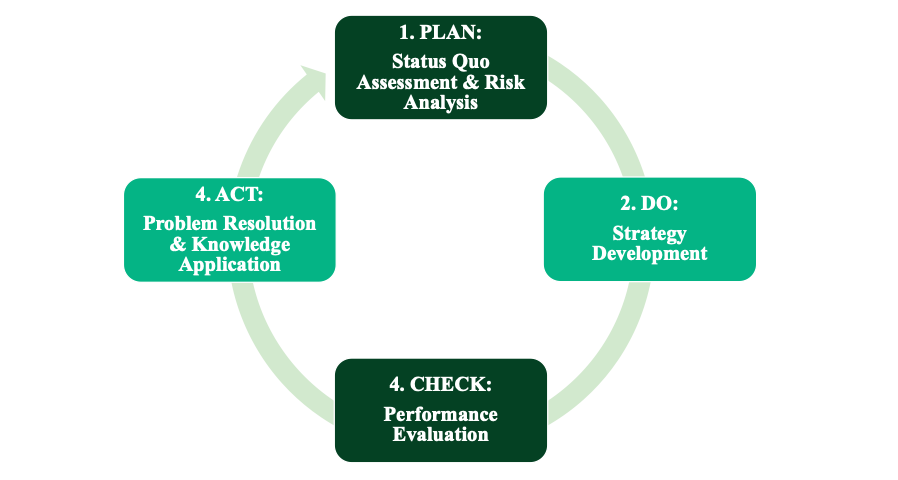
Alternative frameworks, such as the DIMAC approach, which stands for Define-Measure-Analyze-Improve-Control, could have been applied for this purpose as well, as their steps frequently resemble those of the PDCA-cycle.105Kohl, H. Standards for Management Systems: A Comprehensive Guide to Content, Implementation Tools, and Certification Schemes. (Springer International Publishing, Cham, 2020). doi:10. 1007/978-3-030-35832-7. Nevertheless, the PDCA-cycle is particularly well established in both theory and practice and has demonstrated its effectiveness across diverse organizational contexts.107Jelenc, L. , Lerner, S. & Knapić, V. Strategy deployment using PDC cycle. in Conference Proceedings – 5th International Scientific Conference vol. 1 11–17 (Culmena, Zagreb, 2020). Moreover, many of the outlined steps are consistent with the literature on integrating CSR into corporate strategy.19Fatima, T. & Elbanna, S. Corporate Social Responsibility (CSR) Implementation: A Review and a Research Agenda Towards an Integrative Framework. J. Bus. Ethics 183, 105–121 (2023).94Klettner, A. , Clarke, T. & Boersma, M. The Governance of Corporate Sustainability: Empirical Insights into the Development, Leadership and Implementation of Responsible Business Strategy. J. Bus. Ethics 122, 145–165 (2014).95Baumann-Pauly, D. , Wickert, C. , Spence, L. J. & Scherer, A. G. Organizing Corporate Social Responsibility in Small and Large Firms: Size Matters. J. Bus. Ethics 115, 693–705 (2013).111Kleine, A. & Von Hauff, M. Sustainability-Driven Implementation of Corporate Social Responsibility: Application of the Integrative Sustainability Triangle. J. Bus. Ethics 85, 517–533 (2009). The German EMAS Advisory Board published a policy paper on synergy effects in the implementation processes of CSRD and the European Eco-Management and Audit Scheme (EMAS).112Umweltgutachterausschuss. Synergies between CSRD and EMAS. in Policy Paper vol. 2 1–19 (2024). The paper proposes that companies that have not implemented sustainability reporting yet, but have implemented EMAS, which is a well-established management system for improving corporate environmental performance, can use information gathered for the EMAS audit. And reuse it as foundational information for CSRD/ ESRS.112Umweltgutachterausschuss. Synergies between CSRD and EMAS. in Policy Paper vol. 2 1–19 (2024). Due to its widespread use, many companies have already implemented PDCA-cycles that address labor. And worker rights issues in their operations, like ISO 45001 for occupational health and safety.107Jelenc, L. , Lerner, S. & Knapić, V. Strategy deployment using PDC cycle. in Conference Proceedings – 5th International Scientific Conference vol. 1 11–17 (Culmena, Zagreb, 2020).108Brauweiler, J. , Zenker-Hoffmann, A. & Will, M. Arbeitsschutzmanagementsysteme Nach ISO 45001:2018: Grundwissen Für Praktiker. (Springer Fachmedien Wiesbaden, Wiesbaden, 2019). doi:10. 1007/978-3-658-24409-5. Which suggests that companies can also utilize existing structures and information to create synergies for the implementation of a PDCA-cycle for improving labor and worker rights, rather than implementing them in isolation.
Before initiating the PDCA-cycle, a company should publicly declare its commitment to CSR strategies, as labor and worker rights form an integral part of that.19Fatima, T. & Elbanna, S. Corporate Social Responsibility (CSR) Implementation: A Review and a Research Agenda Towards an Integrative Framework. J. Bus. Ethics 183, 105–121 (2023).95Baumann-Pauly, D. , Wickert, C. , Spence, L. J. & Scherer, A. G. Organizing Corporate Social Responsibility in Small and Large Firms: Size Matters. J. Bus. Ethics 115, 693–705 (2013). Embedding CSR values and practices into daily business processes and routines is essential, as this goes beyond mere regulatory compliance and aims at strategic integration, moving the company from reactive adherence to proactive shaping of the CSR agenda.19Fatima, T. & Elbanna, S. Corporate Social Responsibility (CSR) Implementation: A Review and a Research Agenda Towards an Integrative Framework. J. Bus. Ethics 183, 105–121 (2023).95Baumann-Pauly, D. , Wickert, C. , Spence, L. J. & Scherer, A. G. Organizing Corporate Social Responsibility in Small and Large Firms: Size Matters. J. Bus. Ethics 115, 693–705 (2013). This requires commitment from senior management, clearly defined responsibilities and governance structures such as dedicated committees to guide and monitor implementation.94Klettner, A. , Clarke, T. & Boersma, M. The Governance of Corporate Sustainability: Empirical Insights into the Development, Leadership and Implementation of Responsible Business Strategy. J. Bus. Ethics 122, 145–165 (2014).111Kleine, A. & Von Hauff, M. Sustainability-Driven Implementation of Corporate Social Responsibility: Application of the Integrative Sustainability Triangle. J. Bus. Ethics 85, 517–533 (2009). Moreover, CSR should be anchored in policy documents, mission statements and vision.19Fatima, T. & Elbanna, S. Corporate Social Responsibility (CSR) Implementation: A Review and a Research Agenda Towards an Integrative Framework. J. Bus. Ethics 183, 105–121 (2023).95Baumann-Pauly, D. , Wickert, C. , Spence, L. J. & Scherer, A. G. Organizing Corporate Social Responsibility in Small and Large Firms: Size Matters. J. Bus. Ethics 115, 693–705 (2013).
3.1.2 Plan: Status quo assessment & risk analysis
Building on this strategic integration of CSR into business operations, the PDCA-cycle begins with the plan-phase, in which goals are defined and the necessary steps to achieve these goals are planned.107Jelenc, L. , Lerner, S. & Knapić, V. Strategy deployment using PDC cycle. in Conference Proceedings – 5th International Scientific Conference vol. 1 11–17 (Culmena, Zagreb, 2020). This involves reviewing the mission, vision, values and guidelines, as well as developing strategic directions.107Jelenc, L. , Lerner, S. & Knapić, V. Strategy deployment using PDC cycle. in Conference Proceedings – 5th International Scientific Conference vol. 1 11–17 (Culmena, Zagreb, 2020). In addition, measurable criteria must be established in order to verify the achievement of objectives.19Fatima, T. & Elbanna, S. Corporate Social Responsibility (CSR) Implementation: A Review and a Research Agenda Towards an Integrative Framework. J. Bus. Ethics 183, 105–121 (2023).105Kohl, H. Standards for Management Systems: A Comprehensive Guide to Content, Implementation Tools, and Certification Schemes. (Springer International Publishing, Cham, 2020). doi:10. 1007/978-3-030-35832-7. Furthermore, companies should conduct a comprehensive analysis of existing practices, beginning with legal requirements and extending to voluntary measures, in order to determine the extent to which mechanisms protecting labor and worker rights are already in place.107Jelenc, L. , Lerner, S. & Knapić, V. Strategy deployment using PDC cycle. in Conference Proceedings – 5th International Scientific Conference vol. 1 11–17 (Culmena, Zagreb, 2020).113Revathy, B. Corporate responsibility – an implemenatation guide for business. Far East J. Psychol. Bus. 6, 15–31 (2012). This means, in particular, that companies need to evaluate the following measures.
Codes of conduct are a widely used instrument in CSR, serving both to establish responsible business practices and to communicate ethical corporate culture.18Drebes, M. J. Impediments to the implementation of voluntary codes of conduct in production factories of the Global South: so much to do, so little done. Third World Q. 35, 1256–1272 (2014).114Erwin, P. M. Corporate Codes of Conduct: The Effects of Code Content and Quality on Ethical Performance. J. Bus. Ethics 99, 535–548 (2011). Companies can therefore assess compliance with these codes both internally and across their supply chain through audits, providing an initial indication of their impact on labor and worker rights.84O’Rourke, D. Outsourcing Regulation: Analyzing Nongovernmental Systems of Labor Standards and Monitoring. Policy Stud. J. 31, 1–29 (2003). As previously stated, the effectiveness of codes of conduct remains disputed, nevertheless, they can provide valuable insights into a company’s performance, particularly concerning outcome standards, which include KPIs such as wages, working hours and health insurance.18Drebes, M. J. Impediments to the implementation of voluntary codes of conduct in production factories of the Global South: so much to do, so little done. Third World Q. 35, 1256–1272 (2014).22Vandenbroucke, S. The portrayal of effectiveness of supplier codes of conduct in improving labor conditions in global supply chains: A systematic review of the literature. Regul. Gov. 18, 307–327 (2024).23Egels-Zandén, N. & Lindholm, H. Do codes of conduct improve worker rights in supply chains? A study of Fair Wear Foundation. J. Clean. Prod. 107, 31–40 (2015). Furthermore, companies must review their already implemented management and reporting systems to determine whether these include the protection of labor and worker rights and if so, to what extent.115Hąbek, P. & Wolniak, R. Assessing the quality of corporate social responsibility reports: the case of reporting practices in selected European Union member states. Qual. Quant. 50, 399–420 (2016). Relevant management systems could be the SA 8000 standard, which covers working conditions across sectors, or ISO 45001, a standard for occupational health and safety.101Merli, R. , Preziosi, M. & Massa, I. Social Values and Sustainability: A Survey on Drivers, Barriers and Benefits of SA8000 Certification in Italian Firms. Sustainability 7, 4120–4130 (2015).105Kohl, H. Standards for Management Systems: A Comprehensive Guide to Content, Implementation Tools, and Certification Schemes. (Springer International Publishing, Cham, 2020). doi:10. 1007/978-3-030-35832-7. On the one hand, SA 8000 offers an overview of compliance with labor standards across the supply chain and, alongside codes of conduct, provides data on core labor standards such as the prohibition of child. And forced labor, adherence to minimum wages and limits on working hours.100Kryvoi, Y. Enforcing Labor Rights against Multinational Corporate Groups in Europe. Ind. Relat. J. Econ. Soc. 46, 366–386 (2007). On the other hand, management systems like ISO 45001, that go more into detail about one specific labor right, can also be helpful.105Kohl, H. Standards for Management Systems: A Comprehensive Guide to Content, Implementation Tools, and Certification Schemes. (Springer International Publishing, Cham, 2020). doi:10. 1007/978-3-030-35832-7. Although ISO 45001 does not mandate a prescriptive list of KPIs, it requires companies to formulate measurable goals, systematically monitor and evaluate the performance of their occupational health and safety measures.105Kohl, H. Standards for Management Systems: A Comprehensive Guide to Content, Implementation Tools, and Certification Schemes. (Springer International Publishing, Cham, 2020). doi:10. 1007/978-3-030-35832-7. Hence, this standard could also be a valuable indicator of the status quo of a company’s labor and worker rights performance.
Nonetheless, a status quo assessment on its own is insufficient. Companies should also conduct a risk analysis to identify the occurrence, location and nature of labor and worker rights violations within their supply chains.105Kohl, H. Standards for Management Systems: A Comprehensive Guide to Content, Implementation Tools, and Certification Schemes. (Springer International Publishing, Cham, 2020). doi:10. 1007/978-3-030-35832-7.107Jelenc, L. , Lerner, S. & Knapić, V. Strategy deployment using PDC cycle. in Conference Proceedings – 5th International Scientific Conference vol. 1 11–17 (Culmena, Zagreb, 2020). This type of thinking can also be found in the processes of management systems like ISO 45001.108Brauweiler, J. , Zenker-Hoffmann, A. & Will, M. Arbeitsschutzmanagementsysteme Nach ISO 45001:2018: Grundwissen Für Praktiker. (Springer Fachmedien Wiesbaden, Wiesbaden, 2019). doi:10. 1007/978-3-658-24409-5. Moreover, risks can be understood as the effects of uncertainty, which can be both positive (opportunities) and negative (threats).105Kohl, H. Standards for Management Systems: A Comprehensive Guide to Content, Implementation Tools, and Certification Schemes. (Springer International Publishing, Cham, 2020). doi:10. 1007/978-3-030-35832-7.108Brauweiler, J. , Zenker-Hoffmann, A. & Will, M. Arbeitsschutzmanagementsysteme Nach ISO 45001:2018: Grundwissen Für Praktiker. (Springer Fachmedien Wiesbaden, Wiesbaden, 2019). doi:10. 1007/978-3-658-24409-5. By identifying potential negative risks during the plan-phase, preventative measures can be developed and implemented in the following phases.105Kohl, H. Standards for Management Systems: A Comprehensive Guide to Content, Implementation Tools, and Certification Schemes. (Springer International Publishing, Cham, 2020). doi:10. 1007/978-3-030-35832-7. At the same time, opportunities can be integrated in order to improve the overall performance.105Kohl, H. Standards for Management Systems: A Comprehensive Guide to Content, Implementation Tools, and Certification Schemes. (Springer International Publishing, Cham, 2020). doi:10. 1007/978-3-030-35832-7. However, there are currently only a few well-established methods for identifying opportunities.108Brauweiler, J. , Zenker-Hoffmann, A. & Will, M. Arbeitsschutzmanagementsysteme Nach ISO 45001:2018: Grundwissen Für Praktiker. (Springer Fachmedien Wiesbaden, Wiesbaden, 2019). doi:10. 1007/978-3-658-24409-5. Organizations usually identify opportunities by reframing risk mitigation measures in a positive light.108Brauweiler, J. , Zenker-Hoffmann, A. & Will, M. Arbeitsschutzmanagementsysteme Nach ISO 45001:2018: Grundwissen Für Praktiker. (Springer Fachmedien Wiesbaden, Wiesbaden, 2019). doi:10. 1007/978-3-658-24409-5. For example, measures taken to reduce strain when handling heavy loads (e. g. , use of lifting cranes, ergonomics training) create an opportunity to improve employee health.108Brauweiler, J. , Zenker-Hoffmann, A. & Will, M. Arbeitsschutzmanagementsysteme Nach ISO 45001:2018: Grundwissen Für Praktiker. (Springer Fachmedien Wiesbaden, Wiesbaden, 2019). doi:10. 1007/978-3-658-24409-5.
Nevertheless, risk analyses can help to identify and prioritize critical problem areas, which enables companies to deploy their resources where they will be most effective in reducing risks or exploiting opportunities.105Kohl, H. Standards for Management Systems: A Comprehensive Guide to Content, Implementation Tools, and Certification Schemes. (Springer International Publishing, Cham, 2020). doi:10. 1007/978-3-030-35832-7.113Revathy, B. Corporate responsibility – an implemenatation guide for business. Far East J. Psychol. Bus. 6, 15–31 (2012). In order to prioritize risks, companies can conduct a risk priority matrix as seen in Figure 4. In a matrix like this, risks are classified based on two dimensions: the likelihood of occurrence and the severity of the potential damage. This classification is often done on levels such as high, medium and low, which provides a quick overview of the most critical risks.105Kohl, H. Standards for Management Systems: A Comprehensive Guide to Content, Implementation Tools, and Certification Schemes. (Springer International Publishing, Cham, 2020). doi:10. 1007/978-3-030-35832-7.108Brauweiler, J. , Zenker-Hoffmann, A. & Will, M. Arbeitsschutzmanagementsysteme Nach ISO 45001:2018: Grundwissen Für Praktiker. (Springer Fachmedien Wiesbaden, Wiesbaden, 2019). doi:10. 1007/978-3-658-24409-5.
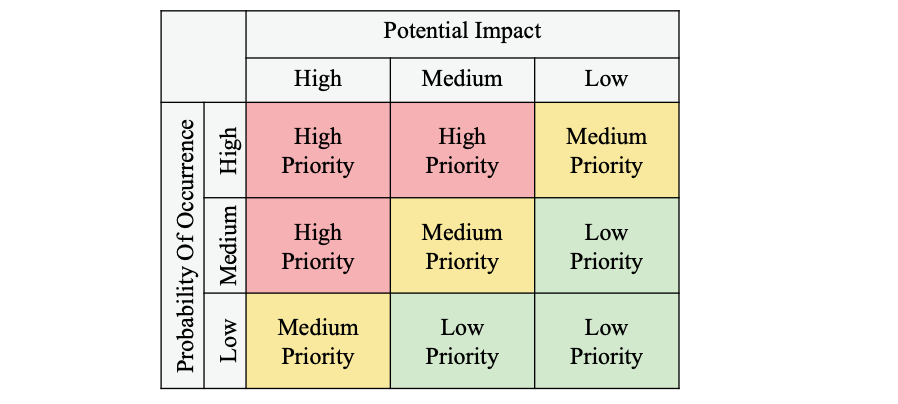
If a company has implemented risk management processes through human rights due diligence mechanisms, these can be used to further identify risks, as detecting labor and worker rights violations is most effective when directly engaging with those affected.9Brudney, J. Hiding in Plain Sight: An ILO Convention on Labor Standards in Global Supply Chains. Chic. J. Int. Law 23, (2023). In some countries, particularly some European countries, laws mandating human rights due diligence have been enacted in the last few years, hence, they are already mandatory for some companies.9Brudney, J. Hiding in Plain Sight: An ILO Convention on Labor Standards in Global Supply Chains. Chic. J. Int. Law 23, (2023). Examples are the Dutch Child Labor Due Diligence Act (orig. : Wet Zorgplicht Kinderarbeid), the French Corporate Duty of Vigilance Law and the German Supply Chain Due Diligence Act.9Brudney, J. Hiding in Plain Sight: An ILO Convention on Labor Standards in Global Supply Chains. Chic. J. Int. Law 23, (2023). These laws go beyond voluntary CSR by establishing mandatory due diligence obligations, thereby requiring companies to implement corresponding mechanisms.9Brudney, J. Hiding in Plain Sight: An ILO Convention on Labor Standards in Global Supply Chains. Chic. J. Int. Law 23, (2023). However, these laws also have limitations, as they often only establish procedural liability, i. e. , companies are held liable for non-compliance with the due diligence process, not necessarily for the actual human rights violation itself.9Brudney, J. Hiding in Plain Sight: An ILO Convention on Labor Standards in Global Supply Chains. Chic. J. Int. Law 23, (2023). Other limitations are that these laws often only apply to large companies or are limited to certain human rights risks, like the Dutch law on child labor.9Brudney, J. Hiding in Plain Sight: An ILO Convention on Labor Standards in Global Supply Chains. Chic. J. Int. Law 23, (2023). Nevertheless, employees are the primary and most effective sources of information about labor and worker rights violations, as they experience workplace conditions firsthand and should therefore play a crucial role in the identification of labor and worker rights risks.9Brudney, J. Hiding in Plain Sight: An ILO Convention on Labor Standards in Global Supply Chains. Chic. J. Int. Law 23, (2023).36Kerrissey, J. & Schuhrke, J. Life Chances: Labor Rights, International Institutions, and Worker Fatalities in the Global South. Soc. Forces 95, 191–216 (2016).116Wheeler, J. Expanding worker voice and labor rights in global supply chains: Standard setting, verification, and traceability. Glob. Soc. Policy 22, 385–391 (2022). The final step of the plan-phase is to define strategic plans and goals for the improvement of labor and worker rights.107Jelenc, L. , Lerner, S. & Knapić, V. Strategy deployment using PDC cycle. in Conference Proceedings – 5th International Scientific Conference vol. 1 11–17 (Culmena, Zagreb, 2020).
To summarize the plan-phase, companies should first do a status quo assessment of the labor and worker rights measures they have already taken, such as the implementation of codes of conduct and suitable management systems. The next step should be a risk analysis of labor and worker rights violations caused by the company’s operations and across the supply chain. Since risk analyses are often already included in management systems, companies can build on this information, complemented by insights obtained through human rights due diligence mechanisms. Lastly, a company needs to define its labor and worker rights goals.
3.1.3 Do: Strategy development
Based on the information gained in the plan-phase, companies can develop strategies during the do-phase. In this second step (see Figure 3), the previously defined strategic plans and goals are now converted into detailed operational plans and projects, which will then be implemented.107Jelenc, L. , Lerner, S. & Knapić, V. Strategy deployment using PDC cycle. in Conference Proceedings – 5th International Scientific Conference vol. 1 11–17 (Culmena, Zagreb, 2020).
As discussed in Chapter 3, corporate actions can positively influence labor and worker rights by applying a range of instruments. Implementing such instruments, if not already in place, is therefore a reasonable approach to strengthening their labor and worker rights performance.117Locke, R. M. The Promise and Limits of Private Power: Promoting Labor Standards in a Global Economy. (Cambridge University Press, 2013). doi:10. 1017/CBO9781139381840. In addition, the voluntary adoption of international frameworks demonstrates commitment and provides a structure for implementation and reporting.94Klettner, A. , Clarke, T. & Boersma, M. The Governance of Corporate Sustainability: Empirical Insights into the Development, Leadership and Implementation of Responsible Business Strategy. J. Bus. Ethics 122, 145–165 (2014).95Baumann-Pauly, D. , Wickert, C. , Spence, L. J. & Scherer, A. G. Organizing Corporate Social Responsibility in Small and Large Firms: Size Matters. J. Bus. Ethics 115, 693–705 (2013). First of all, companies should implement concrete measures to remedy identified labor and worker rights violations and prevent future abuses. For instance, this may involve adapting workflows and processes to eliminate occupational health and safety risks, or revising remuneration systems or other contractual terms to ensure fair wages and benefits, as well as to prevent discrimination (e. g. , by including temporary workers in bonus systems).117Locke, R. M. The Promise and Limits of Private Power: Promoting Labor Standards in a Global Economy. (Cambridge University Press, 2013). doi:10. 1017/CBO9781139381840.
Next, it is advisable to implement a company-wide monitoring mechanism like a code of conduct. The effectiveness is disputed, yet they are often highly requested by stakeholders like consumers, NGOs, or governments, as they cover basic labor standards and should therefore definitely be implemented.18Drebes, M. J. Impediments to the implementation of voluntary codes of conduct in production factories of the Global South: so much to do, so little done. Third World Q. 35, 1256–1272 (2014). Moreover, codes of conduct require regular audits, which, on the one hand, represent the status quo and provide KPIs and on the other hand demonstrate where room for improvement lies.18Drebes, M. J. Impediments to the implementation of voluntary codes of conduct in production factories of the Global South: so much to do, so little done. Third World Q. 35, 1256–1272 (2014).22Vandenbroucke, S. The portrayal of effectiveness of supplier codes of conduct in improving labor conditions in global supply chains: A systematic review of the literature. Regul. Gov. 18, 307–327 (2024). For more transparency, companies should also consider joining multi-stakeholder initiatives or at least hire an external organization for monitoring the adherence to their code of conduct.29Compa, L. A. Corporate social responsibility and workers’ rights. Comp. Labor Law Policy J. 30, 1–10 (2008).86Doorey, D. J. The Transparent Supply Chain: from Resistance to Implementation at Nike and Levi-Strauss. J. Bus. Ethics 103, 587–603 (2011). MSIs are generally considered more credible and legitimate than programs that are entirely controlled by companies.18Drebes, M. J. Impediments to the implementation of voluntary codes of conduct in production factories of the Global South: so much to do, so little done. Third World Q. 35, 1256–1272 (2014).96Anner, M. Corporate Social Responsibility and Freedom of Association Rights: The Precarious Quest for Legitimacy and Control in Global Supply Chains. Polit. Soc. 40, 609–644 (2012). This is due to the involvement of a wide range of actors apart from the companies themselves, such as trade unions, NGOs and other organizations.18Drebes, M. J. Impediments to the implementation of voluntary codes of conduct in production factories of the Global South: so much to do, so little done. Third World Q. 35, 1256–1272 (2014).29Compa, L. A. Corporate social responsibility and workers’ rights. Comp. Labor Law Policy J. 30, 1–10 (2008). When joining multi-stakeholder initiatives, it makes sense to choose industry-specific ones, as these are directly tailored to the specific challenges and circumstances of the industry.105Kohl, H. Standards for Management Systems: A Comprehensive Guide to Content, Implementation Tools, and Certification Schemes. (Springer International Publishing, Cham, 2020). doi:10. 1007/978-3-030-35832-7. The adoption of an industry-specific standard can lead to its widespread acceptance, which in turn can strengthen the competitiveness of participating companies as they demonstrate a common, recognized level of responsibility.117Locke, R. M. The Promise and Limits of Private Power: Promoting Labor Standards in a Global Economy. (Cambridge University Press, 2013). doi:10. 1017/CBO9781139381840. For example, a well-established MSI for the textile industry is the Fair Wear Foundation.23Egels-Zandén, N. & Lindholm, H. Do codes of conduct improve worker rights in supply chains? A study of Fair Wear Foundation. J. Clean. Prod. 107, 31–40 (2015). What distinguishes it from other MSIs is that it limits the influence of individual companies by obtaining their funding from various stakeholder groups instead of from companies only and therefore increases the credibility of the independent audits.23Egels-Zandén, N. & Lindholm, H. Do codes of conduct improve worker rights in supply chains? A study of Fair Wear Foundation. J. Clean. Prod. 107, 31–40 (2015).
As mentioned in the plan-phase, companies can also implement management systems, in the case of labor and worker rights, those should aim to improve those. Much like SA 8000 aims to improve labor and worker rights generally, or ISO 45001’s aim to improve occupational health and safety standards.101Merli, R. , Preziosi, M. & Massa, I. Social Values and Sustainability: A Survey on Drivers, Barriers and Benefits of SA8000 Certification in Italian Firms. Sustainability 7, 4120–4130 (2015).105Kohl, H. Standards for Management Systems: A Comprehensive Guide to Content, Implementation Tools, and Certification Schemes. (Springer International Publishing, Cham, 2020). doi:10. 1007/978-3-030-35832-7. However, there are many more management systems that firms can implement for improved labor and worker rights across their supply chain. Another option is ISO 37301 – Compliance Management Systems, which offers guidance for the introduction, implementation, maintenance and improvement of compliance mechanisms for companies.118Malega, P. & Majerník, M. Standardisation of Compliance Management and Process Quality in the Organization Based on the Integrated Management System. Qual. Innov. Prosper. 28, 82–99 (2024). By implementing this standard, companies are required to develop measurement methods to evaluate compliance management performance, eventually leading to an improvement in performance and therefore ensuring its effectiveness.118Malega, P. & Majerník, M. Standardisation of Compliance Management and Process Quality in the Organization Based on the Integrated Management System. Qual. Innov. Prosper. 28, 82–99 (2024). Moreover, ISO 37301 mandates organizations to train their employees on understanding the compliance requirements, in order for them to correctly identify compliance breaches.118Malega, P. & Majerník, M. Standardisation of Compliance Management and Process Quality in the Organization Based on the Integrated Management System. Qual. Innov. Prosper. 28, 82–99 (2024). Since compliance is a very important factor for the improvement of labor and worker rights, effective compliance management is essential.22Vandenbroucke, S. The portrayal of effectiveness of supplier codes of conduct in improving labor conditions in global supply chains: A systematic review of the literature. Regul. Gov. 18, 307–327 (2024).
Another important standard for companies’ compliance with and improvements of labor and worker rights is the ISO 37001 – Anti-bribery Management Systems, primarily by promoting ethical corporate governance and protecting employees who report misconduct.105Kohl, H. Standards for Management Systems: A Comprehensive Guide to Content, Implementation Tools, and Certification Schemes. (Springer International Publishing, Cham, 2020). doi:10. 1007/978-3-030-35832-7.118Malega, P. & Majerník, M. Standardisation of Compliance Management and Process Quality in the Organization Based on the Integrated Management System. Qual. Innov. Prosper. 28, 82–99 (2024). Besides its different focus to ISO 37301, the implementation procedure is very similar.118Malega, P. & Majerník, M. Standardisation of Compliance Management and Process Quality in the Organization Based on the Integrated Management System. Qual. Innov. Prosper. 28, 82–99 (2024). A direct contribution to the protection of labor. And worker rights is ISO 37001’s requirement that employees must not be subjected to discrimination or other negative consequences when they raise concerns about actual or suspected bribery or other violations of the anti-bribery policy.105Kohl, H. Standards for Management Systems: A Comprehensive Guide to Content, Implementation Tools, and Certification Schemes. (Springer International Publishing, Cham, 2020). doi:10. 1007/978-3-030-35832-7.118Malega, P. & Majerník, M. Standardisation of Compliance Management and Process Quality in the Organization Based on the Integrated Management System. Qual. Innov. Prosper. 28, 82–99 (2024). This strengthens the right of employees to report grievances without fear of repercussions, which is an important component of workers’ rights.105Kohl, H. Standards for Management Systems: A Comprehensive Guide to Content, Implementation Tools, and Certification Schemes. (Springer International Publishing, Cham, 2020). doi:10. 1007/978-3-030-35832-7.118Malega, P. & Majerník, M. Standardisation of Compliance Management and Process Quality in the Organization Based on the Integrated Management System. Qual. Innov. Prosper. 28, 82–99 (2024).
All these management systems, however, entail certain limitations. For example, ISO 45001 defines only minimum requirements for the structure and design of an occupational health and safety management system, without prescribing concrete goals, organizational structures, process flows, or performance outcomes.105Kohl, H. Standards for Management Systems: A Comprehensive Guide to Content, Implementation Tools, and Certification Schemes. (Springer International Publishing, Cham, 2020). doi:10. 1007/978-3-030-35832-7.108Brauweiler, J. , Zenker-Hoffmann, A. & Will, M. Arbeitsschutzmanagementsysteme Nach ISO 45001:2018: Grundwissen Für Praktiker. (Springer Fachmedien Wiesbaden, Wiesbaden, 2019). doi:10. 1007/978-3-658-24409-5. Consequently, the system’s effectiveness largely depends on how it is implemented within the organization, as is the case for most management systems.108Brauweiler, J. , Zenker-Hoffmann, A. & Will, M. Arbeitsschutzmanagementsysteme Nach ISO 45001:2018: Grundwissen Für Praktiker. (Springer Fachmedien Wiesbaden, Wiesbaden, 2019). doi:10. 1007/978-3-658-24409-5.116Wheeler, J. Expanding worker voice and labor rights in global supply chains: Standard setting, verification, and traceability. Glob. Soc. Policy 22, 385–391 (2022). Moreover, the ISO approach has been criticized for prioritizing procedural compliance over employees’ needs, while neglecting social dialogue and fundamental labor and worker rights.116Wheeler, J. Expanding worker voice and labor rights in global supply chains: Standard setting, verification, and traceability. Glob. Soc. Policy 22, 385–391 (2022).
Another alternative is the implementation of human rights due diligence, if it has not been implemented yet. Due diligence seeks to bridge the gap between principles and practice and tries to promote social dialogue, which is often missing in instruments like management systems.9Brudney, J. Hiding in Plain Sight: An ILO Convention on Labor Standards in Global Supply Chains. Chic. J. Int. Law 23, (2023).22Vandenbroucke, S. The portrayal of effectiveness of supplier codes of conduct in improving labor conditions in global supply chains: A systematic review of the literature. Regul. Gov. 18, 307–327 (2024). Voluntary CSR programs and codes of conduct often face a decoupling problem, in which formal guidelines fail to translate into actual practice.9Brudney, J. Hiding in Plain Sight: An ILO Convention on Labor Standards in Global Supply Chains. Chic. J. Int. Law 23, (2023).22Vandenbroucke, S. The portrayal of effectiveness of supplier codes of conduct in improving labor conditions in global supply chains: A systematic review of the literature. Regul. Gov. 18, 307–327 (2024). However, due diligence, especially if legally binding (e. g. , the French Corporate Duty of Vigilance Law), can promote recoupling by establishing clear obligations, sanctions and access to legal remedies for victims.9Brudney, J. Hiding in Plain Sight: An ILO Convention on Labor Standards in Global Supply Chains. Chic. J. Int. Law 23, (2023).37Dahan, Y. , Lerner, H. & Milman-Sivan, F. Shared Responsibility and Labor Rights in Global Supply Chains. J. Bus. Ethics 182, 1025–1040 (2023). In addition to existing national laws, the EU has recently adopted the Corporate Sustainability Due Diligence Directive (CSDDD), which entered into force on 25 July 2024. EU Member States are currently required to transpose the directive into national law by 26 July 2028, following a postponement of the original timeline as part of recent EU simplification measures.119Deutscher Nachhaltigkeitskodex. Corporate Sustainability Due Diligence Directive (CSDDD). https://www.deutscher-nachhaltigkeitskodex.de/de/berichtspflichten/corporate-sustainability-due-diligence-directive-csddd/ (n. D.).120Industrie- und Handelskammer Nord Westfalen (IHK). EU-Lieferkettenrichtlinie (CSDDD). (2025) [Accessed 27.03.2026]. And, although many due diligence laws are not yet legally binding, the implementation of due diligence mechanisms is still advisable, as the CSDDD will require MNEs to comply in the near future.121European Comission. Corporate sustainability due diligence. https://commission. europa. eu/business-economy-euro/doing-business-eu/sustainability-due-diligence-responsible-business/corporate-sustainability-due-diligence_en (n. D. ). Around 6,000 companies are expected to be affected by this just in the EU.121European Comission. Corporate sustainability due diligence. https://commission. europa. eu/business-economy-euro/doing-business-eu/sustainability-due-diligence-responsible-business/corporate-sustainability-due-diligence_en (n. D. ). Moreover, smaller companies are likely to be indirectly affected through business partners within their value chains.121European Comission. Corporate sustainability due diligence. https://commission. europa. eu/business-economy-euro/doing-business-eu/sustainability-due-diligence-responsible-business/corporate-sustainability-due-diligence_en (n. D. ).
In addition, companies can consider the implementation of instruments that address the overall sustainability of a company rather than focusing solely on labor and worker rights, such as the GRI standards.91Kuruvilla, S. & Verma, A. International Labor Standards, Soft Regulation, and National Government Roles. J. Ind. Relat. 48, 41–58 (2006). Given the growing importance of sustainability reporting over the past decades and the imminent introduction of mandatory reporting standards, the inclusion of labor and worker rights has become a standard practice.90Yosifova, D. & Petrova-Kirova, M. The new EU Corporate Sustainability Reporting Framework in the Context of GRI Standards. in Economic and Social Development (eds Curcic, N. , Caric, M. & Roljevic Nicolic, S. ) 85–95 (Novi Sad, 2022).91Kuruvilla, S. & Verma, A. International Labor Standards, Soft Regulation, and National Government Roles. J. Ind. Relat. 48, 41–58 (2006). Thus, sustainability reporting also serves as a possible instrument for addressing labor and worker rights.90Yosifova, D. & Petrova-Kirova, M. The new EU Corporate Sustainability Reporting Framework in the Context of GRI Standards. in Economic and Social Development (eds Curcic, N. , Caric, M. & Roljevic Nicolic, S. ) 85–95 (Novi Sad, 2022).91Kuruvilla, S. & Verma, A. International Labor Standards, Soft Regulation, and National Government Roles. J. Ind. Relat. 48, 41–58 (2006).
While GRI can also be considered an MSI, its standards differ in that they apply across all sectors and go beyond prescribing codes of conduct or behavioral norms.91Kuruvilla, S. & Verma, A. International Labor Standards, Soft Regulation, and National Government Roles. J. Ind. Relat. 48, 41–58 (2006). In recent years, the GRI standards have been some of the most used sustainability reporting standards globally. And regarding labor and worker rights, GRI standards address topics such as the Core Labor Standards, as well as grievance mechanisms and due diligence.90Yosifova, D. & Petrova-Kirova, M. The new EU Corporate Sustainability Reporting Framework in the Context of GRI Standards. in Economic and Social Development (eds Curcic, N. , Caric, M. & Roljevic Nicolic, S. ) 85–95 (Novi Sad, 2022).122Mares, R. The Limits of Supply Chain Responsibility: A Critical Analysis of Corporate Responsibility Instruments. Nord. J. Int. Law 79, 193–244 (2010). Nonetheless, GRI remains a voluntary measure and will arguably be superseded, at least within the EU, by the European Sustainability Reporting Standards, which are mandated under the EU’s Corporate Sustainability Reporting Directive.14Bundesministerium für Arbeit und Soziales. CSR – Corporate Sustainability Reporting Directive (CSRD). https://www. csr-in-deutschland. de/DE/CSR-Allgemein/CSR-Politik/CSR-in-der-EU/Corporate-Sustainability-Reporting-Directive/corporate-sustainability-reporting-directive-art. html (n. D. ).90Yosifova, D. & Petrova-Kirova, M. The new EU Corporate Sustainability Reporting Framework in the Context of GRI Standards. in Economic and Social Development (eds Curcic, N. , Caric, M. & Roljevic Nicolic, S. ) 85–95 (Novi Sad, 2022).123European Commission. Corporate sustainability reporting. European Commissionhttps://finance. ec. europa. eu/capital-markets-union-and-financial-markets/company-reporting-and-auditing/company-reporting/corporate-sustainability-reporting_en (n. D. ). CSRD is mandatory for MNEs and voluntary for Small and Medium-sized Enterprises (SME).14Bundesministerium für Arbeit und Soziales. CSR – Corporate Sustainability Reporting Directive (CSRD). https://www. csr-in-deutschland. de/DE/CSR-Allgemein/CSR-Politik/CSR-in-der-EU/Corporate-Sustainability-Reporting-Directive/corporate-sustainability-reporting-directive-art. html (n. D. ).90Yosifova, D. & Petrova-Kirova, M. The new EU Corporate Sustainability Reporting Framework in the Context of GRI Standards. in Economic and Social Development (eds Curcic, N. , Caric, M. & Roljevic Nicolic, S. ) 85–95 (Novi Sad, 2022).123European Commission. Corporate sustainability reporting. European Commissionhttps://finance. ec. europa. eu/capital-markets-union-and-financial-markets/company-reporting-and-auditing/company-reporting/corporate-sustainability-reporting_en (n. D. ). The requirements for disclosure of information focus on how the company affects people and the environment.14Bundesministerium für Arbeit und Soziales. CSR – Corporate Sustainability Reporting Directive (CSRD). https://www. csr-in-deutschland. de/DE/CSR-Allgemein/CSR-Politik/CSR-in-der-EU/Corporate-Sustainability-Reporting-Directive/corporate-sustainability-reporting-directive-art. html (n. D. ).90Yosifova, D. & Petrova-Kirova, M. The new EU Corporate Sustainability Reporting Framework in the Context of GRI Standards. in Economic and Social Development (eds Curcic, N. , Caric, M. & Roljevic Nicolic, S. ) 85–95 (Novi Sad, 2022).123European Commission. Corporate sustainability reporting. European Commissionhttps://finance. ec. europa. eu/capital-markets-union-and-financial-markets/company-reporting-and-auditing/company-reporting/corporate-sustainability-reporting_en (n. D. ). Due to the utilization of other sustainability reporting tools and standards for greenwashing and marketing purposes, CSRD aims to significantly improve the availability, comparability and reliability of sustainability data by providing a uniform European standard.90Yosifova, D. & Petrova-Kirova, M. The new EU Corporate Sustainability Reporting Framework in the Context of GRI Standards. in Economic and Social Development (eds Curcic, N. , Caric, M. & Roljevic Nicolic, S. ) 85–95 (Novi Sad, 2022).124Baumüller, J. EU omnibus package on sustainability -something we don’t want to ride (yet)? ‘Omnibus I’, CSRD (new) and the revised future of sustainability reporting in the EU: Evidence from Austria. Preprint at https://doi. org/10. 2139/ssrn. 5195189 (2025). As previously outlined, ESRS requires social information on its own workforce, workforce in the value chain, affected communities and consumers and end users.89Filtikaki, E. , Vastardi, M. & Adam, K. Sustainability Reporting in the Raw Materials Industry. in RawMat 2023 46 (MDPI, 2023). doi:10. 3390/materproc2023015046.92ANNEX I to Commission Delegated Regulation (EU) 2023/2772 supplementing Directive 2013/34/EU of the European Parliament. And of the Council as regards sustainability reporting standards, published in the Official Journal of the European Union on 22 December 2023 and including the corrigendum published on 18 April 2024. EFRAGhttps://xbrl. efrag. org/e-esrs/esrs-set1-2023. html#d1e34825-3-1 (2024). As sustainability reporting obligations primarily apply to MNEs while SMEs are indirectly affected, the EU recently issued a recommendation on voluntary sustainability reporting for SMEs.125European Comission. Commission presents voluntary sustainability reporting standard to ease burden on SMEs – European Commission. https://finance. ec. europa. eu/publications/commission-presents-voluntary-sustainability-reporting-standard-ease-burden-smes_en (2025). The aim is to reduce the administrative burden on SMEs that are asked by large companies and financial institutions, which are subjected to CSRD requirements, to provide sustainability-related information.125European Comission. Commission presents voluntary sustainability reporting standard to ease burden on SMEs – European Commission. https://finance. ec. europa. eu/publications/commission-presents-voluntary-sustainability-reporting-standard-ease-burden-smes_en (2025).
Apart from traditional monitoring approaches, companies can implement capability-building programs for their suppliers.117Locke, R. M. The Promise and Limits of Private Power: Promoting Labor Standards in a Global Economy. (Cambridge University Press, 2013). doi:10. 1017/CBO9781139381840. Capability-building programs are an alternative approach to combating poor labor standards in global supply chains.117Locke, R. M. The Promise and Limits of Private Power: Promoting Labor Standards in a Global Economy. (Cambridge University Press, 2013). doi:10. 1017/CBO9781139381840. They are based on observations that factories in developing countries often lack the resources, technical expertise and management systems to resolve compliance issues on their own.117Locke, R. M. The Promise and Limits of Private Power: Promoting Labor Standards in a Global Economy. (Cambridge University Press, 2013). doi:10. 1017/CBO9781139381840. The main goal is to prevent labor standard violations by providing factories with the skills, technologies and organizational capacities to enforce labor and worker rights independently.117Locke, R. M. The Promise and Limits of Private Power: Promoting Labor Standards in a Global Economy. (Cambridge University Press, 2013). doi:10. 1017/CBO9781139381840. It also aims to strengthen the financial capacity of companies, enabling investments in higher wages and improved working conditions.117Locke, R. M. The Promise and Limits of Private Power: Promoting Labor Standards in a Global Economy. (Cambridge University Press, 2013). doi:10. 1017/CBO9781139381840. At the same time, it seeks to restructure work processes, enhance employee skills and empower workers to, for instance, correct production errors independently.117Locke, R. M. The Promise and Limits of Private Power: Promoting Labor Standards in a Global Economy. (Cambridge University Press, 2013). doi:10. 1017/CBO9781139381840. This creates a self-reinforcing cycle in which more efficient companies invest in their workforce, who in turn drive continuous improvement, thereby further enhancing efficiency of companies and supporting compliance with codes of conduct.117Locke, R. M. The Promise and Limits of Private Power: Promoting Labor Standards in a Global Economy. (Cambridge University Press, 2013). doi:10. 1017/CBO9781139381840. One example of such an initiative is the Better Work Program, jointly developed by the ILO and the International Finance Corporation.9Brudney, J. Hiding in Plain Sight: An ILO Convention on Labor Standards in Global Supply Chains. Chic. J. Int. Law 23, (2023). The program provides factory-level consulting and training services grounded in social dialogue, for instance, through Performance Improvement Consultative Committees, where management and employee representatives decide on measures to be implemented with shared decision-making power.9Brudney, J. Hiding in Plain Sight: An ILO Convention on Labor Standards in Global Supply Chains. Chic. J. Int. Law 23, (2023). Empirical evaluations demonstrate that the Better Work program contributes to higher wages, improved working conditions and has a positive impact on both productivity and profitability.9Brudney, J. Hiding in Plain Sight: An ILO Convention on Labor Standards in Global Supply Chains. Chic. J. Int. Law 23, (2023).
Once measures have been selected to address the previously identified risks, for example, implementing ISO 45001 in response to occupational health and safety risks, their implementation represents the concluding step of the do-phase.107Jelenc, L. , Lerner, S. & Knapić, V. Strategy deployment using PDC cycle. in Conference Proceedings – 5th International Scientific Conference vol. 1 11–17 (Culmena, Zagreb, 2020).108Brauweiler, J. , Zenker-Hoffmann, A. & Will, M. Arbeitsschutzmanagementsysteme Nach ISO 45001:2018: Grundwissen Für Praktiker. (Springer Fachmedien Wiesbaden, Wiesbaden, 2019). doi:10. 1007/978-3-658-24409-5.
In a nutshell, the do-phase should begin with remedying identified labor and worker rights violations and prevent future abuses. Next, in accordance with the collected data from the plan-phase, companies need to decide on concrete measures to work on the improvement of labor and worker rights across their supply chain. For example, by implementing a code of conduct, due diligence mechanisms, or management systems that directly address labor and worker rights issues like occupational health and safety. Sustainability reporting should also be considered, as it encompasses not only social but also environmental and governance issues and has already achieved broad adoption driven by both upcoming mandatory requirements and stakeholder pressure. Lastly, companies need to implement their chosen instruments.
3.1.4 Check: Performance evaluation
The third phase is the check-phase (see Figure 3) and its goal is to evaluate the results and performance of the measures implemented and compare them with the planned goals and requirements.105Kohl, H. Standards for Management Systems: A Comprehensive Guide to Content, Implementation Tools, and Certification Schemes. (Springer International Publishing, Cham, 2020). doi:10. 1007/978-3-030-35832-7.107Jelenc, L. , Lerner, S. & Knapić, V. Strategy deployment using PDC cycle. in Conference Proceedings – 5th International Scientific Conference vol. 1 11–17 (Culmena, Zagreb, 2020). It is a crucial phase for learning from successes and failures.105Kohl, H. Standards for Management Systems: A Comprehensive Guide to Content, Implementation Tools, and Certification Schemes. (Springer International Publishing, Cham, 2020). doi:10. 1007/978-3-030-35832-7.107Jelenc, L. , Lerner, S. & Knapić, V. Strategy deployment using PDC cycle. in Conference Proceedings – 5th International Scientific Conference vol. 1 11–17 (Culmena, Zagreb, 2020).
Firstly, companies must monitor and evaluate their implemented labor and worker rights measures by tracking implementation activities and strategic plans regularly, for example monthly, quarterly or annually.105Kohl, H. Standards for Management Systems: A Comprehensive Guide to Content, Implementation Tools, and Certification Schemes. (Springer International Publishing, Cham, 2020). doi:10. 1007/978-3-030-35832-7. Moreover, performance should be measured based on previously defined criteria, targets and KPIs.105Kohl, H. Standards for Management Systems: A Comprehensive Guide to Content, Implementation Tools, and Certification Schemes. (Springer International Publishing, Cham, 2020). doi:10. 1007/978-3-030-35832-7.
Secondly, performance data needs to be analyzed and assessed to determine whether processes function as intended and objectives have been achieved.105Kohl, H. Standards for Management Systems: A Comprehensive Guide to Content, Implementation Tools, and Certification Schemes. (Springer International Publishing, Cham, 2020). doi:10. 1007/978-3-030-35832-7.107Jelenc, L. , Lerner, S. & Knapić, V. Strategy deployment using PDC cycle. in Conference Proceedings – 5th International Scientific Conference vol. 1 11–17 (Culmena, Zagreb, 2020). The effectiveness of management standards requires systematic evaluation as well.105Kohl, H. Standards for Management Systems: A Comprehensive Guide to Content, Implementation Tools, and Certification Schemes. (Springer International Publishing, Cham, 2020). doi:10. 1007/978-3-030-35832-7. In addition, directly implemented remedial measures addressing labor and worker rights violations should be monitored to verify whether they achieve the desired outcome.109Malega, P. , Daneshjo, N. , Rudy, V. & Drábik, P. PDCA Cycle – Tool for Improvement of the Business Processes – Case Study. TEM J. 10, 1336–1347 (2021).118Malega, P. & Majerník, M. Standardisation of Compliance Management and Process Quality in the Organization Based on the Integrated Management System. Qual. Innov. Prosper. 28, 82–99 (2024).
Furthermore, any non-conformity needs to be documented.108Brauweiler, J. , Zenker-Hoffmann, A. & Will, M. Arbeitsschutzmanagementsysteme Nach ISO 45001:2018: Grundwissen Für Praktiker. (Springer Fachmedien Wiesbaden, Wiesbaden, 2019). doi:10. 1007/978-3-658-24409-5. A non-conformity refers to the failure to meet the requirements of a commitment, standard, or management system and its disclosure is essential for improving future performances, as only through identifying the root cause can effective corrective measures be defined.108Brauweiler, J. , Zenker-Hoffmann, A. & Will, M. Arbeitsschutzmanagementsysteme Nach ISO 45001:2018: Grundwissen Für Praktiker. (Springer Fachmedien Wiesbaden, Wiesbaden, 2019). doi:10. 1007/978-3-658-24409-5. As a general principle, all findings, results, non-conformities and decisions should be documented and regular audits are a central instrument for self-assessment.105Kohl, H. Standards for Management Systems: A Comprehensive Guide to Content, Implementation Tools, and Certification Schemes. (Springer International Publishing, Cham, 2020). doi:10. 1007/978-3-030-35832-7.108Brauweiler, J. , Zenker-Hoffmann, A. & Will, M. Arbeitsschutzmanagementsysteme Nach ISO 45001:2018: Grundwissen Für Praktiker. (Springer Fachmedien Wiesbaden, Wiesbaden, 2019). doi:10. 1007/978-3-658-24409-5.
On top of that, complaint mechanisms are particularly valuable because they enable a bottom-up process and give marginalized actors such as workers a chance to express when their rights are violated.103Harrison, J. , Parejo, M. & Wielga, M. The value of complaints mechanisms in the private labor regulation of GVCs: A case study of the Fair Labor Association. Int. labor Rev. 163, 73–94 (2024). These mechanisms allow for continuous monitoring because complaints can be filed at any time when a standard has been violated.103Harrison, J. , Parejo, M. & Wielga, M. The value of complaints mechanisms in the private labor regulation of GVCs: A case study of the Fair Labor Association. Int. labor Rev. 163, 73–94 (2024). One crucial component of this is employee training, which enhances employees’ ability to recognize and report hazards, risks or other incidents.108Brauweiler, J. , Zenker-Hoffmann, A. & Will, M. Arbeitsschutzmanagementsysteme Nach ISO 45001:2018: Grundwissen Für Praktiker. (Springer Fachmedien Wiesbaden, Wiesbaden, 2019). doi:10. 1007/978-3-658-24409-5. It is a key element of the check-phase as it ensures the accuracy, reliability and effectiveness of all monitoring measurements, analysis and evaluation processes related to improvements of labor and worker rights.108Brauweiler, J. , Zenker-Hoffmann, A. & Will, M. Arbeitsschutzmanagementsysteme Nach ISO 45001:2018: Grundwissen Für Praktiker. (Springer Fachmedien Wiesbaden, Wiesbaden, 2019). doi:10. 1007/978-3-658-24409-5.
Companies may also encounter challenges in this phase, as the complexity and breadth of applicable requirements make their systematic documentation and continuous updating difficult.105Kohl, H. Standards for Management Systems: A Comprehensive Guide to Content, Implementation Tools, and Certification Schemes. (Springer International Publishing, Cham, 2020). doi:10. 1007/978-3-030-35832-7.108Brauweiler, J. , Zenker-Hoffmann, A. & Will, M. Arbeitsschutzmanagementsysteme Nach ISO 45001:2018: Grundwissen Für Praktiker. (Springer Fachmedien Wiesbaden, Wiesbaden, 2019). doi:10. 1007/978-3-658-24409-5. This is particularly difficult for smaller companies with limited human and financial resources, but it can likewise affect larger companies due to their diverse processes and product portfolios.108Brauweiler, J. , Zenker-Hoffmann, A. & Will, M. Arbeitsschutzmanagementsysteme Nach ISO 45001:2018: Grundwissen Für Praktiker. (Springer Fachmedien Wiesbaden, Wiesbaden, 2019). doi:10. 1007/978-3-658-24409-5.
Overall, the check-phase aims to provide a clear understanding of which measures are effective and why, as well as which are not and the reasons for their shortcomings. This insight enables informed adjustments and corrective actions in the following act-phase, fostering continuous improvement.
3.1.5 Act: Problem resolution & knowledge application
The last phase of the PDCA-cycle is the act-phase (see Figure 3), which is deeply intertwined with the previous check-phase.107Jelenc, L. , Lerner, S. & Knapić, V. Strategy deployment using PDC cycle. in Conference Proceedings – 5th International Scientific Conference vol. 1 11–17 (Culmena, Zagreb, 2020). The check-phase provides information on the effectiveness of implementation, while the act-phase primarily serves as a stage for problem-solving and learning.107Jelenc, L. , Lerner, S. & Knapić, V. Strategy deployment using PDC cycle. in Conference Proceedings – 5th International Scientific Conference vol. 1 11–17 (Culmena, Zagreb, 2020). Furthermore, this phase can take two directions. If the results of the check-phase are satisfactory and the objectives have been met, the newly implemented methods, internal rules, or instruments can be considered successful and should therefore be standardized.107Jelenc, L. , Lerner, S. & Knapić, V. Strategy deployment using PDC cycle. in Conference Proceedings – 5th International Scientific Conference vol. 1 11–17 (Culmena, Zagreb, 2020). This enables the consolidation of best practices and supports sustainable improvement.107Jelenc, L. , Lerner, S. & Knapić, V. Strategy deployment using PDC cycle. in Conference Proceedings – 5th International Scientific Conference vol. 1 11–17 (Culmena, Zagreb, 2020). If, however, activities and outcomes are unsatisfactory, the organization is required to take corrective action, with the primary purpose of this phase being to determine the appropriate course of action and the timeframe for its resolution.107Jelenc, L. , Lerner, S. & Knapić, V. Strategy deployment using PDC cycle. in Conference Proceedings – 5th International Scientific Conference vol. 1 11–17 (Culmena, Zagreb, 2020).
The company must respond to incidents or non-conformities promptly and take appropriate monitoring and corrective measures to address the consequences.108Brauweiler, J. , Zenker-Hoffmann, A. & Will, M. Arbeitsschutzmanagementsysteme Nach ISO 45001:2018: Grundwissen Für Praktiker. (Springer Fachmedien Wiesbaden, Wiesbaden, 2019). doi:10. 1007/978-3-658-24409-5. Conducting a root-cause analysis is essential and often involves employees and other relevant stakeholders.107Jelenc, L. , Lerner, S. & Knapić, V. Strategy deployment using PDC cycle. in Conference Proceedings – 5th International Scientific Conference vol. 1 11–17 (Culmena, Zagreb, 2020).108Brauweiler, J. , Zenker-Hoffmann, A. & Will, M. Arbeitsschutzmanagementsysteme Nach ISO 45001:2018: Grundwissen Für Praktiker. (Springer Fachmedien Wiesbaden, Wiesbaden, 2019). doi:10. 1007/978-3-658-24409-5. Problem analysis methods and tools, such as the 5-Why method, can be used for this purpose.107Jelenc, L. , Lerner, S. & Knapić, V. Strategy deployment using PDC cycle. in Conference Proceedings – 5th International Scientific Conference vol. 1 11–17 (Culmena, Zagreb, 2020).108Brauweiler, J. , Zenker-Hoffmann, A. & Will, M. Arbeitsschutzmanagementsysteme Nach ISO 45001:2018: Grundwissen Für Praktiker. (Springer Fachmedien Wiesbaden, Wiesbaden, 2019). doi:10. 1007/978-3-658-24409-5. The 5-Why method is a systematic problem-solving technique that identifies the root cause of an issue by repeatedly asking ‘Why? ’ to go beyond obvious indicators and prevent recurrence.105Kohl, H. Standards for Management Systems: A Comprehensive Guide to Content, Implementation Tools, and Certification Schemes. (Springer International Publishing, Cham, 2020). doi:10. 1007/978-3-030-35832-7.107Jelenc, L. , Lerner, S. & Knapić, V. Strategy deployment using PDC cycle. in Conference Proceedings – 5th International Scientific Conference vol. 1 11–17 (Culmena, Zagreb, 2020).109Malega, P. , Daneshjo, N. , Rudy, V. & Drábik, P. PDCA Cycle – Tool for Improvement of the Business Processes – Case Study. TEM J. 10, 1336–1347 (2021). Although the name suggests five iterations, the number is flexible.105Kohl, H. Standards for Management Systems: A Comprehensive Guide to Content, Implementation Tools, and Certification Schemes. (Springer International Publishing, Cham, 2020). doi:10. 1007/978-3-030-35832-7. The method is widely used in management systems, like the PDCA-cycle, to enhance causal analysis and support organizational learning.105Kohl, H. Standards for Management Systems: A Comprehensive Guide to Content, Implementation Tools, and Certification Schemes. (Springer International Publishing, Cham, 2020). doi:10. 1007/978-3-030-35832-7.107Jelenc, L. , Lerner, S. & Knapić, V. Strategy deployment using PDC cycle. in Conference Proceedings – 5th International Scientific Conference vol. 1 11–17 (Culmena, Zagreb, 2020).109Malega, P. , Daneshjo, N. , Rudy, V. & Drábik, P. PDCA Cycle – Tool for Improvement of the Business Processes – Case Study. TEM J. 10, 1336–1347 (2021).
Furthermore, the effectiveness of the corrective measures must be assessed to ensure that the problem does not recur.108Brauweiler, J. , Zenker-Hoffmann, A. & Will, M. Arbeitsschutzmanagementsysteme Nach ISO 45001:2018: Grundwissen Für Praktiker. (Springer Fachmedien Wiesbaden, Wiesbaden, 2019). doi:10. 1007/978-3-658-24409-5.109Malega, P. , Daneshjo, N. , Rudy, V. & Drábik, P. PDCA Cycle – Tool for Improvement of the Business Processes – Case Study. TEM J. 10, 1336–1347 (2021). In addition, all actions taken to address incidents and non-conformities must be documented.108Brauweiler, J. , Zenker-Hoffmann, A. & Will, M. Arbeitsschutzmanagementsysteme Nach ISO 45001:2018: Grundwissen Für Praktiker. (Springer Fachmedien Wiesbaden, Wiesbaden, 2019). doi:10. 1007/978-3-658-24409-5.109Malega, P. , Daneshjo, N. , Rudy, V. & Drábik, P. PDCA Cycle – Tool for Improvement of the Business Processes – Case Study. TEM J. 10, 1336–1347 (2021).
In conclusion, in the act-phase, companies must resolve the previously identified problems, while also standardizing and consolidating practices that have proven successful. Finally, upon completing the act-phase, the PDCA-cycle has been fully executed, however, as an iterative process, it is never truly complete.105Kohl, H. Standards for Management Systems: A Comprehensive Guide to Content, Implementation Tools, and Certification Schemes. (Springer International Publishing, Cham, 2020). doi:10. 1007/978-3-030-35832-7.107Jelenc, L. , Lerner, S. & Knapić, V. Strategy deployment using PDC cycle. in Conference Proceedings – 5th International Scientific Conference vol. 1 11–17 (Culmena, Zagreb, 2020).109Malega, P. , Daneshjo, N. , Rudy, V. & Drábik, P. PDCA Cycle – Tool for Improvement of the Business Processes – Case Study. TEM J. 10, 1336–1347 (2021). Subsequently, a new PDCA-cycle begins, incorporating adjusted goals or revised plans to address identified issues and achieve the desired improvements.105Kohl, H. Standards for Management Systems: A Comprehensive Guide to Content, Implementation Tools, and Certification Schemes. (Springer International Publishing, Cham, 2020). doi:10. 1007/978-3-030-35832-7.107Jelenc, L. , Lerner, S. & Knapić, V. Strategy deployment using PDC cycle. in Conference Proceedings – 5th International Scientific Conference vol. 1 11–17 (Culmena, Zagreb, 2020).109Malega, P. , Daneshjo, N. , Rudy, V. & Drábik, P. PDCA Cycle – Tool for Improvement of the Business Processes – Case Study. TEM J. 10, 1336–1347 (2021).
3.2 Alternative approaches of practical examples
3.2.1 Fairphone
Although the PDCA logic provides a structured pathway to advancing labor and worker rights, this chapter examines alternative approaches implemented by Fairphone and Patagonia. Fairphone is a Dutch smartphone manufacturer that differentiates itself through its commitment to ethical and sustainable production practices as well as its circular business model.126Romagnoli, S. et al. Ethical Phone for a Fair, Circular, and Sustainable Future: Fairphone Business Case and Possible Application in a Smart City Context. in Cases on Circular Economy in Practice: (ed. De Giovanni, P. ) 70–94 (IGI Global, 2022). doi:10. 4018/978-1-6684-5001-7. In 2010, Bas van Abel launched a campaign highlighting the use of conflict minerals in the mobile phone industry and the sector’s excessive electronic waste.126Romagnoli, S. et al. Ethical Phone for a Fair, Circular, and Sustainable Future: Fairphone Business Case and Possible Application in a Smart City Context. in Cases on Circular Economy in Practice: (ed. De Giovanni, P. ) 70–94 (IGI Global, 2022). doi:10. 4018/978-1-6684-5001-7. Aimed at raising awareness of the social consequences of mineral extraction in African countries, the campaign gained significant traction.126Romagnoli, S. et al. Ethical Phone for a Fair, Circular, and Sustainable Future: Fairphone Business Case and Possible Application in a Smart City Context. in Cases on Circular Economy in Practice: (ed. De Giovanni, P. ) 70–94 (IGI Global, 2022). doi:10. 4018/978-1-6684-5001-7. In collaboration with the charity Waap, van Abel developed the first fair phone, which ultimately led to the founding of the company Fairphone in 2013.126Romagnoli, S. et al. Ethical Phone for a Fair, Circular, and Sustainable Future: Fairphone Business Case and Possible Application in a Smart City Context. in Cases on Circular Economy in Practice: (ed. De Giovanni, P. ) 70–94 (IGI Global, 2022). doi:10. 4018/978-1-6684-5001-7.127Bodenheimer, M. Transition towards socially sustainable behavior? A comparison of cases from the smartphone and garment industries. (2019) doi:10.24406/PUBLICA-FHG-299422. Fairphone pursues a dual objective of mitigating environmental and social issues, while still being commercially successful.126Romagnoli, S. et al. Ethical Phone for a Fair, Circular, and Sustainable Future: Fairphone Business Case and Possible Application in a Smart City Context. in Cases on Circular Economy in Practice: (ed. De Giovanni, P. ) 70–94 (IGI Global, 2022). doi:10. 4018/978-1-6684-5001-7. Central to their strategy is the extension of product life cycles through modular design and the use of recycled materials.126Romagnoli, S. et al. Ethical Phone for a Fair, Circular, and Sustainable Future: Fairphone Business Case and Possible Application in a Smart City Context. in Cases on Circular Economy in Practice: (ed. De Giovanni, P. ) 70–94 (IGI Global, 2022). doi:10. 4018/978-1-6684-5001-7. The company’s ambition is to generate positive effects across the value chain, beginning with responsible mineral sourcing and extending to design, production and product use, thereby positioning itself as an ethical alternative in the smartphone market.112Umweltgutachterausschuss. Synergies between CSRD and EMAS. in Policy Paper vol. 2 1–19 (2024). Fairphone targets an average usage period of three years and the modular, upgradable and durable design enables users to repair their phones or replace parts themselves, thereby facilitating an extended lifecycle.126Romagnoli, S. et al. Ethical Phone for a Fair, Circular, and Sustainable Future: Fairphone Business Case and Possible Application in a Smart City Context. in Cases on Circular Economy in Practice: (ed. De Giovanni, P. ) 70–94 (IGI Global, 2022). doi:10. 4018/978-1-6684-5001-7. Furthermore, Fairphone works on closing resource loops by increasing the share of recycled material across all components.126Romagnoli, S. et al. Ethical Phone for a Fair, Circular, and Sustainable Future: Fairphone Business Case and Possible Application in a Smart City Context. in Cases on Circular Economy in Practice: (ed. De Giovanni, P. ) 70–94 (IGI Global, 2022). doi:10. 4018/978-1-6684-5001-7. To achieve this, the company collaborated with partners specialized in collecting and disassembling discarded phones.126Romagnoli, S. et al. Ethical Phone for a Fair, Circular, and Sustainable Future: Fairphone Business Case and Possible Application in a Smart City Context. in Cases on Circular Economy in Practice: (ed. De Giovanni, P. ) 70–94 (IGI Global, 2022). doi:10. 4018/978-1-6684-5001-7.
Alongside environmental considerations, Fairphone focuses on fair labor conditions.126Romagnoli, S. et al. Ethical Phone for a Fair, Circular, and Sustainable Future: Fairphone Business Case and Possible Application in a Smart City Context. in Cases on Circular Economy in Practice: (ed. De Giovanni, P. ) 70–94 (IGI Global, 2022). doi:10. 4018/978-1-6684-5001-7. They were the first electronics company to source gold from Fairtrade-certified artisanal mines and actively promote fair working conditions in the sourcing of other critical materials, such as cobalt.126Romagnoli, S. et al. Ethical Phone for a Fair, Circular, and Sustainable Future: Fairphone Business Case and Possible Application in a Smart City Context. in Cases on Circular Economy in Practice: (ed. De Giovanni, P. ) 70–94 (IGI Global, 2022). doi:10. 4018/978-1-6684-5001-7. Through comprehensive supply chain management, the company ensures that all partners adhere to high social standards and comply with TCO guidelines, a standard for adequate working conditions.126Romagnoli, S. et al. Ethical Phone for a Fair, Circular, and Sustainable Future: Fairphone Business Case and Possible Application in a Smart City Context. in Cases on Circular Economy in Practice: (ed. De Giovanni, P. ) 70–94 (IGI Global, 2022). doi:10. 4018/978-1-6684-5001-7.
Among Fairphone’s social responsibility initiatives, its living wages program is particularly significant.128Fairphone. Paying Living Wage in the Electronics Supply Chain. (2020).129Fairphone. Fairphone’s Guide to paying living wages in the supply chain. (2022). The company regards the payment of living wages as a core responsibility and has implemented a system to close wage gaps among its suppliers.128Fairphone. Paying Living Wage in the Electronics Supply Chain. (2020).129Fairphone. Fairphone’s Guide to paying living wages in the supply chain. (2022). Fairphone uses methodologies such as the Global Living Wage Coalition’s Anchor Method and the Asia Floor Wage to determine fair compensation.128Fairphone. Paying Living Wage in the Electronics Supply Chain. (2020).129Fairphone. Fairphone’s Guide to paying living wages in the supply chain. (2022). The Global Living Wage Coalition, for instance, defines a living wage as the remuneration for a standard working week that is sufficient to provide workers and their families with a decent standard of living.128Fairphone. Paying Living Wage in the Electronics Supply Chain. (2020).129Fairphone. Fairphone’s Guide to paying living wages in the supply chain. (2022). This encompasses basic necessities such as food, water, housing, education, healthcare, transportation and clothing, as well as provisions for unforeseen expenses.128Fairphone. Paying Living Wage in the Electronics Supply Chain. (2020).129Fairphone. Fairphone’s Guide to paying living wages in the supply chain. (2022). Fairphone has calculated that ensuring living wages for the workforce of its direct suppliers adds less than 1.50 Euros per smartphone, which is less than 0.3% of the retail price and an amount easily abided by the company or the customer.128Fairphone. Paying Living Wage in the Electronics Supply Chain. (2020).129Fairphone. Fairphone’s Guide to paying living wages in the supply chain. (2022). The so-called Fairphone Bonus is distributed not only to production line employees but to all workers of a factory earning below the target living wage, thereby promoting fairness and fostering employee loyalty.128Fairphone. Paying Living Wage in the Electronics Supply Chain. (2020).129Fairphone. Fairphone’s Guide to paying living wages in the supply chain. (2022). The Fairphone Bonus, originally paid quarterly, is now distributed monthly, which significantly reduces the wage gap for the lowest-paid workers, with some of the lowest earners receiving the equivalent of up to three additional months’ salaries.128Fairphone. Paying Living Wage in the Electronics Supply Chain. (2020).129Fairphone. Fairphone’s Guide to paying living wages in the supply chain. (2022).
Fairphone’s approach may be seen as innovative. And more far-reaching compared to other companies’ efforts to address labor and worker rights issues, nevertheless, it also relies on established standards and frameworks to achieve its objectives, which have also been presented in previous chapters of this thesis.126Romagnoli, S. et al. Ethical Phone for a Fair, Circular, and Sustainable Future: Fairphone Business Case and Possible Application in a Smart City Context. in Cases on Circular Economy in Practice: (ed. De Giovanni, P. ) 70–94 (IGI Global, 2022). doi:10. 4018/978-1-6684-5001-7. For its 2024 sustainability report, Fairphone applied the CSRD/ ESRS requirements for the first time.130Fairphone. Fairphone’s Impact Report 2024: The one that lasts. (2025). Moreover, to strengthen workplace safety, the company has implemented several management systems, namely ISO 14001, ISO 45001 and ISO 50001 (Energy Management).130Fairphone. Fairphone’s Impact Report 2024: The one that lasts. (2025). According to Fairphone, tier-two suppliers often hold ISO certifications but are rarely audited against broader compliance standards.130Fairphone. Fairphone’s Impact Report 2024: The one that lasts. (2025). Therefore, Fairphone has supported several sub-suppliers in preparing for compliance audits, stating that “[t]his goes a long way in creating workplaces that are safer and more sustainable in every way. ” (Fairphone 2025, p. 28).130Fairphone. Fairphone’s Impact Report 2024: The one that lasts. (2025). Moreover, Fairphone has adopted due diligence measures aligned with international guidelines. And standards, such as the UNGPs, the OECD Guidelines for Multinational Enterprises on Responsible Business Conduct and the OECD’s Due Diligence Guidance for Responsible Supply Chains of Minerals from Conflict-Affected and High-Risk Areas.130Fairphone. Fairphone’s Impact Report 2024: The one that lasts. (2025). By adhering to these frameworks, the company addresses both general and industry-specific due diligence requirements.130Fairphone. Fairphone’s Impact Report 2024: The one that lasts. (2025). In addition, Fairphone has introduced a code of conduct, which builds on international standards like the ILO Fundamental Principles. And Rights at Work, the UNGPs, the OECD Guidelines for Multinational Enterprises on Responsible Business Conduct, complemented by their own experience.130Fairphone. Fairphone’s Impact Report 2024: The one that lasts. (2025). The code covers human rights, health and safety, the environment, responsible sourcing and business ethics.130Fairphone. Fairphone’s Impact Report 2024: The one that lasts. (2025).131Fairphone. Ways of Working Together. (2021).
These measures demonstrate that, although Fairphone’s Living Wage program may initially appear radical, its approach to social sustainability can be effectively implemented through widely recognized international standards, illustrating a model that other companies could potentially adopt. Notably, Fairphone’s adoption of these frameworks appears to be driven primarily by a genuine commitment to improving their performance, rather than by external image considerations, as is often observed in other companies regarding sustainability initiatives.18Drebes, M. J. Impediments to the implementation of voluntary codes of conduct in production factories of the Global South: so much to do, so little done. Third World Q. 35, 1256–1272 (2014).126Romagnoli, S. et al. Ethical Phone for a Fair, Circular, and Sustainable Future: Fairphone Business Case and Possible Application in a Smart City Context. in Cases on Circular Economy in Practice: (ed. De Giovanni, P. ) 70–94 (IGI Global, 2022). doi:10. 4018/978-1-6684-5001-7.
3.2.2 Patagonia
Patagonia is an outdoor apparel company founded in the 1970s by Yvon Chouinard.132Patagonia. Unternehmensgeschichte. https://eu. patagonia. com/de/de/company-history/ (n. D. ). Its origins, however, go back to the 1950s, when Chouinard, an avid rock climber, began selling high-quality climbing pitons that outperformed those available on the market.132Patagonia. Unternehmensgeschichte. https://eu. patagonia. com/de/de/company-history/ (n. D. ).133O’Rourke, D. & Strand, R. Patagonia: Driving Sustainable Innovation by Embracing Tensions. Calif. Manage. Rev. 60, 102–125 (2017).134Rattalino, F. Circular advantage anyone? Sustainability‐driven innovation and circularity at Patagonia, Inc. Thunderbird Int. Bus. Rev. 60, 747–755 (2018). In 1957, he formally founded Chouinard Equipment for Alpinists Inc., which by 1970 had become the largest supplier of climbing hardware in the U. S.132Patagonia. Unternehmensgeschichte. https://eu. patagonia. com/de/de/company-history/ (n. D. ).133O’Rourke, D. & Strand, R. Patagonia: Driving Sustainable Innovation by Embracing Tensions. Calif. Manage. Rev. 60, 102–125 (2017).134Rattalino, F. Circular advantage anyone? Sustainability‐driven innovation and circularity at Patagonia, Inc. Thunderbird Int. Bus. Rev. 60, 747–755 (2018). Recognizing the environmental damage caused by pitons, Chouinard discontinued the highly profitable product line in 1972 to develop more sustainable alternatives such as climbing irons and ice axes.132Patagonia. Unternehmensgeschichte. https://eu. patagonia. com/de/de/company-history/ (n. D. ).134Rattalino, F. Circular advantage anyone? Sustainability‐driven innovation and circularity at Patagonia, Inc. Thunderbird Int. Bus. Rev. 60, 747–755 (2018). In the same year, Chouinard Equipment introduced a new line of durable, technical clothing under the name Patagonia, which was incorporated as a separate company in 1979. Following rapid expansion in the late 1980s and early 1990s, Patagonia overextended itself and nearly went bankrupt, leading to the dismissal of one-fifth of its workforce.134Rattalino, F. Circular advantage anyone? Sustainability‐driven innovation and circularity at Patagonia, Inc. Thunderbird Int. Bus. Rev. 60, 747–755 (2018). This crisis prompted a reassessment of corporate values and a stronger commitment to reducing environmental impacts.134Rattalino, F. Circular advantage anyone? Sustainability‐driven innovation and circularity at Patagonia, Inc. Thunderbird Int. Bus. Rev. 60, 747–755 (2018). Although sustainability had been part of Chouinard Equipment’s and Patagonia’s philosophy from the beginning, this turning point marked the real starting point of Patagonia’s comprehensive sustainability strategy.134Rattalino, F. Circular advantage anyone? Sustainability‐driven innovation and circularity at Patagonia, Inc. Thunderbird Int. Bus. Rev. 60, 747–755 (2018). The company has built its business model on the principles of sustainable development and is known as a best practice example for its responsible behavior and transparency in the environmental sector.135Achabou, M. A. The effect of perceived CSR effort on consumer brand preference in the clothing and footwear sector. Eur. Bus. Rev. 32, 317–347 (2020). The company has continuously worked to improve the sustainability performance of its products and has sometimes taken approaches that might be considered radical.133O’Rourke, D. & Strand, R. Patagonia: Driving Sustainable Innovation by Embracing Tensions. Calif. Manage. Rev. 60, 102–125 (2017).135Achabou, M. A. The effect of perceived CSR effort on consumer brand preference in the clothing and footwear sector. Eur. Bus. Rev. 32, 317–347 (2020). For example, Patagonia has relied exclusively on organic cotton since 1996, a decision that initially led to supply shortages and almost double the costs compared to non-organic cotton.134Rattalino, F. Circular advantage anyone? Sustainability‐driven innovation and circularity at Patagonia, Inc. Thunderbird Int. Bus. Rev. 60, 747–755 (2018).135Achabou, M. A. The effect of perceived CSR effort on consumer brand preference in the clothing and footwear sector. Eur. Bus. Rev. 32, 317–347 (2020). Moreover, they have started campaigns such as Don’t Buy This Jacket and Buy Less, urging consumers to reduce their consumption and shop more consciously, paradoxically resulting in increased sales.134Rattalino, F. Circular advantage anyone? Sustainability‐driven innovation and circularity at Patagonia, Inc. Thunderbird Int. Bus. Rev. 60, 747–755 (2018).
Like for Fairphone, social sustainability is also a central priority for Patagonia.136Patagonia. Annual Benefit Corporation Report: Fiscal Years 2023 and 2024. (2024). One of their measures is that the company is a founding member of the Fair Labor Association and undergoes its annual assessment each year.136Patagonia. Annual Benefit Corporation Report: Fiscal Years 2023 and 2024. (2024).137Patagonia. Fair Labor Association®. https://www. patagonia. com/our-footprint/fair-labor-association. html (n. D. ). Furthermore, the FLA accreditation serves as a guide for Patagonia’s responsible purchasing practices.137Patagonia. Fair Labor Association®. https://www. patagonia. com/our-footprint/fair-labor-association. html (n. D. ). These practices reflect the company’s commitment to establishing and implementing guidelines that consider the needs of both the company and its suppliers, to create fair and mutually beneficial partnerships.138Patagonia. Responsible Purchasing Practices. https://www. patagonia. com/our-footprint/responsible-purchasing-practices. html (n. D. ). They include, for instance, clearly defining and adhering to agreed order quantities, payments and terms, providing sufficient lead times and technical details and sharing responsibility for social and environmental aspects.138Patagonia. Responsible Purchasing Practices. https://www. patagonia. com/our-footprint/responsible-purchasing-practices. html (n. D. ). Poor or unenforced purchasing practices, by contrast, can place suppliers in compromising situations, potentially resulting in underpayment of workers, excessive working hours, unsafe working conditions, layoffs, or the use of unauthorized subcontractors just to meet buyer demands.138Patagonia. Responsible Purchasing Practices. https://www. patagonia. com/our-footprint/responsible-purchasing-practices. html (n. D. ). Patagonia stresses that ethical purchasing lies at the core of social responsibility and forms the basis for addressing worker well-being and environmental impact.138Patagonia. Responsible Purchasing Practices. https://www. patagonia. com/our-footprint/responsible-purchasing-practices. html (n. D. ).
Patagonia seeks to build long-term, mutually beneficial relationships with its business partners and has therefore implemented a 4-fold process for selecting suppliers.139Patagonia. Working With Factories. https://www. patagonia. com/our-footprint/working-with-factories. html (n. D. ).140Shourkaei, M. M. , Taylor, K. M. & Dyck, B. Examining sustainable supply chain management via a social‐symbolic work lens: Lessons from Patagonia. Bus. Strategy Environ. 33, 1477–1496 (2024). Since Patagonia does not own factories, the company addresses this by carefully choosing suitable partners.140Shourkaei, M. M. , Taylor, K. M. & Dyck, B. Examining sustainable supply chain management via a social‐symbolic work lens: Lessons from Patagonia. Bus. Strategy Environ. 33, 1477–1496 (2024).141Patagonia. Corporate Social Responsibility. https://www. patagonia. com/social-responsibility/ (n. D. ). In this 4-fold process, employees from sourcing and quality, and the environmental and social responsibility teams must jointly decide whether a supplier is approved.139Patagonia. Working With Factories. https://www. patagonia. com/our-footprint/working-with-factories. html (n. D. ).140Shourkaei, M. M. , Taylor, K. M. & Dyck, B. Examining sustainable supply chain management via a social‐symbolic work lens: Lessons from Patagonia. Bus. Strategy Environ. 33, 1477–1496 (2024). By involving these groups, supplier selection becomes a value-driven, rather than a financially motivated decision.139Patagonia. Working With Factories. https://www. patagonia. com/our-footprint/working-with-factories. html (n. D. ).140Shourkaei, M. M. , Taylor, K. M. & Dyck, B. Examining sustainable supply chain management via a social‐symbolic work lens: Lessons from Patagonia. Bus. Strategy Environ. 33, 1477–1496 (2024).
Furthermore, to sustain long-term relationships, Patagonia provides resources such as financing the audits and offering technological support to help their suppliers improve their sustainability practices.140Shourkaei, M. M. , Taylor, K. M. & Dyck, B. Examining sustainable supply chain management via a social‐symbolic work lens: Lessons from Patagonia. Bus. Strategy Environ. 33, 1477–1496 (2024). However, if a supplier fails to meet Patagonia’s social and economic standards or is unable to implement necessary improvements, the contract will be terminated.139Patagonia. Working With Factories. https://www. patagonia. com/our-footprint/working-with-factories. html (n. D. ).140Shourkaei, M. M. , Taylor, K. M. & Dyck, B. Examining sustainable supply chain management via a social‐symbolic work lens: Lessons from Patagonia. Bus. Strategy Environ. 33, 1477–1496 (2024). For such cases, Patagonia has implemented its FLA-approved responsible exit strategy, where suppliers are informed nine to twelve months in advance to ensure a fair and transparent transition.139Patagonia. Working With Factories. https://www. patagonia. com/our-footprint/working-with-factories. html (n. D. ).140Shourkaei, M. M. , Taylor, K. M. & Dyck, B. Examining sustainable supply chain management via a social‐symbolic work lens: Lessons from Patagonia. Bus. Strategy Environ. 33, 1477–1496 (2024).
A central component of Patagonia’s responsible purchasing practices is the integration of the FLA’s living wage standard into its code of conduct.142Patagonia. Living Wage. https://www. patagonia. com/our-footprint/living-wage. html (n. D. ). Like Fairphone’s Living Wage Program, Patagonia’s standard states that workers must receive remuneration in a regular working week that is sufficient to cover their basic needs, as well as those of their families. And to allow them a certain amount of disposable income.142Patagonia. Living Wage. https://www. patagonia. com/our-footprint/living-wage. html (n. D. ).143Barford, A. , Gilbert, R. , Beales, A. , Zorila, M. & Nelson, J. The Case for Living Wages: How Paying Living Wages Improves Business Performance and Tackles Poverty. https://www. repository. cam. ac. uk/handle/1810/336987 (2022) doi:10. 17863/CAM. 80370. As of 2023, Patagonia’s supply chain employs more than 65,000 workers.142Patagonia. Living Wage. https://www. patagonia. com/our-footprint/living-wage. html (n. D. ). An analysis revealed that all suppliers pay wages above the legal minimum, with many offering two to three times that amount.142Patagonia. Living Wage. https://www. patagonia. com/our-footprint/living-wage. html (n. D. ). Approximately one-third of suppliers were found to pay a living wage, another third provide at least 80% of a living wage, while the remaining suppliers pay at least 50%.142Patagonia. Living Wage. https://www. patagonia. com/our-footprint/living-wage. html (n. D. ). Additionally, Patagonia’s Fair Trade program has reached more than 85,000 workers worldwide because for every item produced in a Fair Trade Certified factory, the company pays a premium that flows directly into a worker-controlled Community Development Fund.136Patagonia. Annual Benefit Corporation Report: Fiscal Years 2023 and 2024. (2024).144Patagonia. Fair Trade Certified. https://www. patagonia. com/our-footprint/fair-trade. html (n. D. ). In fiscal year 2024, 88% of Patagonia’s products were manufactured in Fair Trade Certified factories.136Patagonia. Annual Benefit Corporation Report: Fiscal Years 2023 and 2024. (2024).144Patagonia. Fair Trade Certified. https://www. patagonia. com/our-footprint/fair-trade. html (n. D. ). Beyond these measures, Patagonia has also established a program to support migrant workers, who are often particularly vulnerable to exploitation when employed by third-party agencies rather than by suppliers directly, as such agencies often pay lower wages than national workers receive.145Patagonia. Migrant Workers. https://www. patagonia. com/our-footprint/migrant-workers. html (n. D. ). In addition, Patagonia promotes employee welfare by providing health care premiums for its U. S. workforce, offering training and career development opportunities and running an environmental internship program that allows employees to take paid leave to work for an environmental organization for several months.134Rattalino, F. Circular advantage anyone? Sustainability‐driven innovation and circularity at Patagonia, Inc. Thunderbird Int. Bus. Rev. 60, 747–755 (2018).136Patagonia. Annual Benefit Corporation Report: Fiscal Years 2023 and 2024. (2024).
In a nutshell, Patagonia can be considered purpose-driven and the company has implemented numerous social and environmental practices over the past decades.135Achabou, M. A. The effect of perceived CSR effort on consumer brand preference in the clothing and footwear sector. Eur. Bus. Rev. 32, 317–347 (2020). At the same time, the company also relies on widely used standards and frameworks, which, although differing slightly from those previously discussed, provide an important perspective on corporate social responsibility measures from a U. S. context. Patagonia has, for instance, adopted a code of conduct based on FLA and ILO standards.146Patagonia. Supplier Workplace Code of Conduct. (n. D. ). Patagonia does not report according to a sustainability standard, however, they publish information about their activities transparently on their website and in documents like their Annual Benefit Corporation Report: Fiscal Years 2023 and 2024.136Patagonia. Annual Benefit Corporation Report: Fiscal Years 2023 and 2024. (2024).141Patagonia. Corporate Social Responsibility. https://www. patagonia. com/social-responsibility/ (n. D. ). Moreover, the company holds both Fair Trade and B Corp certifications, with the latter serving as a benchmark for assessing the social and environmental performance of companies.133O’Rourke, D. & Strand, R. Patagonia: Driving Sustainable Innovation by Embracing Tensions. Calif. Manage. Rev. 60, 102–125 (2017).134Rattalino, F. Circular advantage anyone? Sustainability‐driven innovation and circularity at Patagonia, Inc. Thunderbird Int. Bus. Rev. 60, 747–755 (2018).136Patagonia. Annual Benefit Corporation Report: Fiscal Years 2023 and 2024. (2024).140Shourkaei, M. M. , Taylor, K. M. & Dyck, B. Examining sustainable supply chain management via a social‐symbolic work lens: Lessons from Patagonia. Bus. Strategy Environ. 33, 1477–1496 (2024).147De Giovanni, P. Circular Economy in the Textile Industry. in Cases on Circular Economy in Practice: 180–207 (IGI Global, 2022). doi:10. 4018/978-1-6684-5001-7. Similar to Fairphone, Patagonia supports living wages and maintains partnerships with MSIs such as the FLA and the Sustainable Apparel Coalition, which comprises of major brands like Nike, Levi’s and the Gap.134Rattalino, F. Circular advantage anyone? Sustainability‐driven innovation and circularity at Patagonia, Inc. Thunderbird Int. Bus. Rev. 60, 747–755 (2018).138Patagonia. Responsible Purchasing Practices. https://www. patagonia. com/our-footprint/responsible-purchasing-practices. html (n. D. ).142Patagonia. Living Wage. https://www. patagonia. com/our-footprint/living-wage. html (n. D. ).
To summarize, this chapter began with a description of the PDCA-cycle as one possible pathway to successfully implementing labor and worker rights strategies aimed at long-term monitoring and improvement. The PDCA-cycle begins with the plan-phase, in which the status quo is assessed, existing measures are identified and suitable KPIs are determined. A risk assessment can further help to identify labor and worker rights violations across the supply chain. After risks are prioritized, this information can be used to set goals and develop prevention strategies. In the subsequent do-phase, companies need to select and implement the chosen measures based on the analysis from the plan-phase. The check-phase then involves evaluating whether the measures were implemented correctly and assessing their effectiveness. Finally, in the act-phase, identified problems are addressed and the process is standardized so the cycle can begin again.
Following this, two practical examples were analyzed to illustrate alternative approaches to improving their labor and worker rights performance, namely Fairphone and Patagonia. While both companies pursue measures that might be considered entrepreneurial and progressive, such as living wage programs, they also rely on widely established instruments. Both companies have adopted codes of conduct that are aligned with international standards, such as the ILO conventions and participate in MSIs and management systems, including the FLA and ISO standards. This indicates that, in addition to pursuing their own more progressive measures, Fairphone and Patagonia also make use of instruments that are broadly recognized within the industry and could, in principle, be applied by other companies within their respective industries.
4 Drivers and barriers
4.1 Drivers
Companies can be faced with drivers and barriers when it comes to implementing mechanisms that protect and improve labor and worker rights along their supply chain.15Alizadeh, A. The Drivers and Barriers of Corporate Social Responsibility: A Comparison of the MENA Region and Western Countries. Sustainability 14, 909 (2022). Those drivers and barriers can be internal and external factors influencing decision-making processes.15Alizadeh, A. The Drivers and Barriers of Corporate Social Responsibility: A Comparison of the MENA Region and Western Countries. Sustainability 14, 909 (2022). Drivers and barriers may arise from various stakeholder groups, including internal actors such as employees and management, as well as external stakeholders such as governments, investors, consumers, NGOs and international organizations.15Alizadeh, A. The Drivers and Barriers of Corporate Social Responsibility: A Comparison of the MENA Region and Western Countries. Sustainability 14, 909 (2022). In addition, structural factors like competition and reputation can play a significant role.15Alizadeh, A. The Drivers and Barriers of Corporate Social Responsibility: A Comparison of the MENA Region and Western Countries. Sustainability 14, 909 (2022).148Amalric, F. & Hauser, J. Economic Drivers of Corporate Responsibility Activities. J. Corp. Citizsh. 2005, 27–38 (2005). The following section will first address the drivers before turning to potential barriers. Internal drivers influence a company’s decisions from within, which is why the values a company represents play a key role, as well as the values and personal convictions of a company’s management and thus drive the implementation of CSR activities.15Alizadeh, A. The Drivers and Barriers of Corporate Social Responsibility: A Comparison of the MENA Region and Western Countries. Sustainability 14, 909 (2022). Research has shown that companies led by managers who act ethically tend to be more socially responsible.15Alizadeh, A. The Drivers and Barriers of Corporate Social Responsibility: A Comparison of the MENA Region and Western Countries. Sustainability 14, 909 (2022). Moreover, an ethical leadership style can instill a sense of ethical behavior in employees by having managers act as role models.19Fatima, T. & Elbanna, S. Corporate Social Responsibility (CSR) Implementation: A Review and a Research Agenda Towards an Integrative Framework. J. Bus. Ethics 183, 105–121 (2023). These values can be directly embedded in the organization through corporate mission statements, guidelines such as codes of conduct and other formal procedures.19Fatima, T. & Elbanna, S. Corporate Social Responsibility (CSR) Implementation: A Review and a Research Agenda Towards an Integrative Framework. J. Bus. Ethics 183, 105–121 (2023). Companies such as Fairphone and Patagonia have systematically embedded their core values within organizational structures, reflecting the ethical priorities of their management.126Romagnoli, S. et al. Ethical Phone for a Fair, Circular, and Sustainable Future: Fairphone Business Case and Possible Application in a Smart City Context. in Cases on Circular Economy in Practice: (ed. De Giovanni, P. ) 70–94 (IGI Global, 2022). doi:10. 4018/978-1-6684-5001-7.130Fairphone. Fairphone’s Impact Report 2024: The one that lasts. (2025).133O’Rourke, D. & Strand, R. Patagonia: Driving Sustainable Innovation by Embracing Tensions. Calif. Manage. Rev. 60, 102–125 (2017).134Rattalino, F. Circular advantage anyone? Sustainability‐driven innovation and circularity at Patagonia, Inc. Thunderbird Int. Bus. Rev. 60, 747–755 (2018). Consequently, these values act as a driver for the implementation and continuous improvement of labor and worker rights across their supply chains.126Romagnoli, S. et al. Ethical Phone for a Fair, Circular, and Sustainable Future: Fairphone Business Case and Possible Application in a Smart City Context. in Cases on Circular Economy in Practice: (ed. De Giovanni, P. ) 70–94 (IGI Global, 2022). doi:10. 4018/978-1-6684-5001-7.130Fairphone. Fairphone’s Impact Report 2024: The one that lasts. (2025).133O’Rourke, D. & Strand, R. Patagonia: Driving Sustainable Innovation by Embracing Tensions. Calif. Manage. Rev. 60, 102–125 (2017).134Rattalino, F. Circular advantage anyone? Sustainability‐driven innovation and circularity at Patagonia, Inc. Thunderbird Int. Bus. Rev. 60, 747–755 (2018).
Employees are another internal driver, as they are the primary recipients of labor and worker rights measures and are also the primary and most effective source of information regarding violations.36Kerrissey, J. & Schuhrke, J. Life Chances: Labor Rights, International Institutions, and Worker Fatalities in the Global South. Soc. Forces 95, 191–216 (2016).116Wheeler, J. Expanding worker voice and labor rights in global supply chains: Standard setting, verification, and traceability. Glob. Soc. Policy 22, 385–391 (2022). Moreover, they are often represented by labor unions, which have historically played a key role in negotiating labor standards since the 18th century, ultimately leading to one of the Core Labor Standard of collective bargaining (see Table 1).16Rodgers, G. , Lee, E. , Swepston, L. & Van Daele, J. The International labor Organization and the Quest for Social Justice, 1919-2009. (International labor Office, Geneva, 2009).17Maul, D. The International labor Organization: 100 Years of Global Social Policy. (De Gruyter, 2019). doi:10. 1515/9783110650723.88Hasan, R. , Moore, M. & Handfield, R. Establishing Operational Norms for Labor Rights Standards Implementation in Low-Cost Apparel Production. Sustainability 13, 12120 (2021). Accessible and user-friendly grievance mechanisms can further strengthen workers’ access to remedies, especially in the absence of fear of repercussions.88Hasan, R. , Moore, M. & Handfield, R. Establishing Operational Norms for Labor Rights Standards Implementation in Low-Cost Apparel Production. Sustainability 13, 12120 (2021).118Malega, P. & Majerník, M. Standardisation of Compliance Management and Process Quality in the Organization Based on the Integrated Management System. Qual. Innov. Prosper. 28, 82–99 (2024). Employee training on understanding the compliance requirements further aids workers in correctly identifying violations.118Malega, P. & Majerník, M. Standardisation of Compliance Management and Process Quality in the Organization Based on the Integrated Management System. Qual. Innov. Prosper. 28, 82–99 (2024). In principle, workers can not only insist on their own rights but also advocate for improved working conditions across the supply chain.7Lowe, C. et al. Extending social protection to migrant workers in the region of the Cooperation Council for the Arab States of the Gulf (GCC): An analysis of enablers and barriers. Int. Soc. Secur. Rev. 76, 89–110 (2023). In practice, however, this is often constrained by employer pressure, power imbalances or even the threat of repercussions.7Lowe, C. et al. Extending social protection to migrant workers in the region of the Cooperation Council for the Arab States of the Gulf (GCC): An analysis of enablers and barriers. Int. Soc. Secur. Rev. 76, 89–110 (2023). Furthermore, the successful implementation of labor and worker rights can enhance a company’s attractiveness as an employer and contribute to higher employee motivation, as workers are more likely to identify with and support the organization’s values.148Amalric, F. & Hauser, J. Economic Drivers of Corporate Responsibility Activities. J. Corp. Citizsh. 2005, 27–38 (2005).149Lindgreen, A. , Swaen, V. & Maon, F. Introduction: Corporate Social Responsibility Implementation. J. Bus. Ethics85, 251–256 (2009).
External drivers come from outside the company, exerting pressure on the company, or create incentives to engage in CSR and comply with certain standards.15Alizadeh, A. The Drivers and Barriers of Corporate Social Responsibility: A Comparison of the MENA Region and Western Countries. Sustainability 14, 909 (2022). Governments. And international organizations play a central role in shaping the legal and institutional framework for labor and worker rights, thus one main external driver is national legislation on supply chain due diligence, such as the German Supply Chain Due Diligence Act.148Amalric, F. & Hauser, J. Economic Drivers of Corporate Responsibility Activities. J. Corp. Citizsh. 2005, 27–38 (2005).150Drubel, J. Das ILO-Zwangsarbeitsverbot in der globalisierten Wirtschaft: Zu den Grenzen der Wirksamkeit einer Norm. (Springer Fachmedien Wiesbaden, Wiesbaden, 2022). doi:10. 1007/978-3-658-38981-9. Frameworks like these oblige companies to take responsibility and thereby strengthen the implementation of due diligence mechanisms as well as labor and worker rights.148Amalric, F. & Hauser, J. Economic Drivers of Corporate Responsibility Activities. J. Corp. Citizsh. 2005, 27–38 (2005).150Drubel, J. Das ILO-Zwangsarbeitsverbot in der globalisierten Wirtschaft: Zu den Grenzen der Wirksamkeit einer Norm. (Springer Fachmedien Wiesbaden, Wiesbaden, 2022). doi:10. 1007/978-3-658-38981-9. At the European level, the EU’s CSDDD will become mandatory for MNEs across the EU and non-EU companies with business in the EU in the near future and has to be incorporated into national law by 2026.119Deutscher Nachhaltigkeitskodex. Corporate Sustainability Due Diligence Directive (CSDDD). https://www.deutscher-nachhaltigkeitskodex.de/de/berichtspflichten/corporate-sustainability-due-diligence-directive-csddd/ (n. D.). The Corporate Sustainability Reporting Directive is another significant expansion of European legislation on corporate accountability.90Yosifova, D. & Petrova-Kirova, M. The new EU Corporate Sustainability Reporting Framework in the Context of GRI Standards. in Economic and Social Development (eds Curcic, N. , Caric, M. & Roljevic Nicolic, S. ) 85–95 (Novi Sad, 2022). Unlike its predecessor, the Non-Financial Reporting Directive, which applied to roughly 11,000 companies, the CSRD will cover nearly 49,000 firms across the EU.124Baumüller, J. EU omnibus package on sustainability -something we don’t want to ride (yet)? ‘Omnibus I’, CSRD (new) and the revised future of sustainability reporting in the EU: Evidence from Austria. Preprint at https://doi. org/10. 2139/ssrn. 5195189 (2025). By introducing the ESRS standards, the EU established uniform requirements for sustainability reporting, also including labor and worker rights.90Yosifova, D. & Petrova-Kirova, M. The new EU Corporate Sustainability Reporting Framework in the Context of GRI Standards. in Economic and Social Development (eds Curcic, N. , Caric, M. & Roljevic Nicolic, S. ) 85–95 (Novi Sad, 2022). This standardization aims to enhance the reliability and comparability of disclosed information, similar to financial reporting standards.14Bundesministerium für Arbeit und Soziales. CSR – Corporate Sustainability Reporting Directive (CSRD). https://www. csr-in-deutschland. de/DE/CSR-Allgemein/CSR-Politik/CSR-in-der-EU/Corporate-Sustainability-Reporting-Directive/corporate-sustainability-reporting-directive-art. html (n. D. ).90Yosifova, D. & Petrova-Kirova, M. The new EU Corporate Sustainability Reporting Framework in the Context of GRI Standards. in Economic and Social Development (eds Curcic, N. , Caric, M. & Roljevic Nicolic, S. ) 85–95 (Novi Sad, 2022). In practice, CSRD acts as a strong driver for companies to improve their social performance, as vague statements and selective disclosures will be easily detectable due to the standardized reporting framework.14Bundesministerium für Arbeit und Soziales. CSR – Corporate Sustainability Reporting Directive (CSRD). https://www. csr-in-deutschland. de/DE/CSR-Allgemein/CSR-Politik/CSR-in-der-EU/Corporate-Sustainability-Reporting-Directive/corporate-sustainability-reporting-directive-art. html (n. D. ).90Yosifova, D. & Petrova-Kirova, M. The new EU Corporate Sustainability Reporting Framework in the Context of GRI Standards. in Economic and Social Development (eds Curcic, N. , Caric, M. & Roljevic Nicolic, S. ) 85–95 (Novi Sad, 2022). At the same time, stakeholders such as investors, employees and NGOs gain improved access to consistent data, which increases their ability to evaluate and compare companies, thereby further incentivizing firms to strengthen their labor and worker rights practices.124Baumüller, J. EU omnibus package on sustainability -something we don’t want to ride (yet)? ‘Omnibus I’, CSRD (new) and the revised future of sustainability reporting in the EU: Evidence from Austria. Preprint at https://doi. org/10. 2139/ssrn. 5195189 (2025).
Among international organizations, the ILO stands out as a key actor by providing international labor standards and conventions, most notably the Fundamental Conventions, which are binding for all ILO member states.16Rodgers, G. , Lee, E. , Swepston, L. & Van Daele, J. The International labor Organization and the Quest for Social Justice, 1919-2009. (International labor Office, Geneva, 2009).150Drubel, J. Das ILO-Zwangsarbeitsverbot in der globalisierten Wirtschaft: Zu den Grenzen der Wirksamkeit einer Norm. (Springer Fachmedien Wiesbaden, Wiesbaden, 2022). doi:10. 1007/978-3-658-38981-9. The ILO does not possess sanctioning powers, however, its monitoring system allows the organization to uncover violations and publicly expose those responsible.35Anner, M. & Caraway, T. International Institutions and Workers’ Rights: Between Labor Standards and Market Flexibility. Stud. Comp. Int. Dev. 45, 151–169 (2010). Such complaint procedures generate political and public pressure on states to enforce labor standards, which in turn indirectly drives companies operating within these jurisdictions to improve their practices.35Anner, M. & Caraway, T. International Institutions and Workers’ Rights: Between Labor Standards and Market Flexibility. Stud. Comp. Int. Dev. 45, 151–169 (2010). Research indicates that ILO reporting has a positive and lasting impact on states’ respect for labor rights, particularly in cases of severe violations.151Koliev, F. , Sommerer, T. & Tallberg, J. Compliance without coercion: Effects of reporting on international labor rights. J. Peace Res. 58, 494–509 (2021). The monitoring process creates transparency and provides information that domestic actors, such as trade unions and NGOs, can use to pressure their governments.151Koliev, F. , Sommerer, T. & Tallberg, J. Compliance without coercion: Effects of reporting on international labor rights. J. Peace Res. 58, 494–509 (2021). Even in cases where conventions are not ratified, the process of drafting and adopting them can still influence national regulations by initiating dialogue, fostering learning and stimulating domestic mobilization.152Koliev, F. Promoting international labor standards: The ILO and national labor regulations. Br. J. Polit. Int. Relat. 24, 361–380 (2022). Furthermore, the ILO. And its conventions play a pivotal role in shaping international labor standards, as they have served as the foundation for most subsequent labor and worker rights standards, laws and instruments, such as codes of conduct, SA 8000, the FLA, etc. , for over a century now.35Anner, M. & Caraway, T. International Institutions and Workers’ Rights: Between Labor Standards and Market Flexibility. Stud. Comp. Int. Dev. 45, 151–169 (2010).88Hasan, R. , Moore, M. & Handfield, R. Establishing Operational Norms for Labor Rights Standards Implementation in Low-Cost Apparel Production. Sustainability 13, 12120 (2021).122Mares, R. The Limits of Supply Chain Responsibility: A Critical Analysis of Corporate Responsibility Instruments. Nord. J. Int. Law 79, 193–244 (2010).150Drubel, J. Das ILO-Zwangsarbeitsverbot in der globalisierten Wirtschaft: Zu den Grenzen der Wirksamkeit einer Norm. (Springer Fachmedien Wiesbaden, Wiesbaden, 2022). doi:10. 1007/978-3-658-38981-9.
Moreover, companies, especially global corporations, are vulnerable to campaigns by activist groups and NGOs, which can thereby act as drivers.15Alizadeh, A. The Drivers and Barriers of Corporate Social Responsibility: A Comparison of the MENA Region and Western Countries. Sustainability 14, 909 (2022).117Locke, R. M. The Promise and Limits of Private Power: Promoting Labor Standards in a Global Economy. (Cambridge University Press, 2013). doi:10. 1017/CBO9781139381840. These groups can utilize consumer boycotts and name-and-shame campaigns, which are also used by the ILO, to address violations. And force companies to introduce labor and worker rights protection measures, such as codes of conduct and monitoring systems for their suppliers.35Anner, M. & Caraway, T. International Institutions and Workers’ Rights: Between Labor Standards and Market Flexibility. Stud. Comp. Int. Dev. 45, 151–169 (2010).117Locke, R. M. The Promise and Limits of Private Power: Promoting Labor Standards in a Global Economy. (Cambridge University Press, 2013). doi:10. 1017/CBO9781139381840. Creating credible information about product quality through industry standards can strengthen stakeholder confidence and increase the profitability of the industry.15Alizadeh, A. The Drivers and Barriers of Corporate Social Responsibility: A Comparison of the MENA Region and Western Countries. Sustainability 14, 909 (2022). Therefore, stakeholder pressure can not only lead to an increased corporate social responsibility but also help avoid reputational risks and damages to brand value.117Locke, R. M. The Promise and Limits of Private Power: Promoting Labor Standards in a Global Economy. (Cambridge University Press, 2013). doi:10. 1017/CBO9781139381840.
The media plays a crucial role in this, as they are educating the public about emerging issues such as environmental problems or human rights violations.153Richter, U. H. Drivers of Change: A Multiple-Case Study on the Process of Institutionalization of Corporate Responsibility Among Three Multinational Companies. J. Bus. Ethics 102, 261–279 (2011). They are often the primary source of publicity for campaigns by NGOs, which exert pressure on companies in this way.153Richter, U. H. Drivers of Change: A Multiple-Case Study on the Process of Institutionalization of Corporate Responsibility Among Three Multinational Companies. J. Bus. Ethics 102, 261–279 (2011). This media visibility can also drive the implementation of sustainability reports, as the public pressure forces companies to address society’s expectations to maintain their legitimacy.154Benvenuto, M. , Aufiero, C. & Viola, C. A systematic literature review on the determinants of sustainability reporting systems. Heliyon 9, e14893 (2023). An example that demonstrates the importance of media coverage is the Rana Plaza disaster, when a factory collapsed in Bangladesh in 2013, that killed over 1,100 and injured between 2,000 and 3,000 people.155Human Rights in Business. (Routledge, 2017). doi:10. 4324/9781315269467.156Aizawa, M. & Tripathi, S. Beyond Rana Plaza: Next Steps for the Global Garment Industry and Bangladeshi Manufacturers. Bus. Hum. Rights J. 1, 145–151 (2016). The disaster is considered the worst industrial tragedy in the 200-year history of mass clothing production and immediately after the accident, numerous reports appeared about the catastrophic working conditions in the factory.88Hasan, R. , Moore, M. & Handfield, R. Establishing Operational Norms for Labor Rights Standards Implementation in Low-Cost Apparel Production. Sustainability 13, 12120 (2021).155Human Rights in Business. (Routledge, 2017). doi:10. 4324/9781315269467. However, criticism and media attention were not only directed at local factory owners, but also at the entire Bangladeshi garment industry and its customers, including many brands based in the EU, such as Zara, Primark and Benetton.155Human Rights in Business. (Routledge, 2017). doi:10. 4324/9781315269467. Media coverage was therefore crucial in tracing responsibility along the supply chain to the global brands and retailers that benefited from the cheap production.144Patagonia. Fair Trade Certified. https://www. patagonia. com/our-footprint/fair-trade. html (n. D. ). The Rana Plaza disaster and the following global media coverage sparked a broad debate about corporate responsibility in supply chains.156Aizawa, M. & Tripathi, S. Beyond Rana Plaza: Next Steps for the Global Garment Industry and Bangladeshi Manufacturers. Bus. Hum. Rights J. 1, 145–151 (2016). It was a catalyst for the creation of initiatives such as the Accord on Fire and Building Safety in Bangladesh, a binding agreement between international brands and trade unions to improve safety standards in factories.156Aizawa, M. & Tripathi, S. Beyond Rana Plaza: Next Steps for the Global Garment Industry and Bangladeshi Manufacturers. Bus. Hum. Rights J. 1, 145–151 (2016).
Another driver can be investors, as the financial sector influences companies through investment decisions and demands for transparency.154Benvenuto, M. , Aufiero, C. & Viola, C. A systematic literature review on the determinants of sustainability reporting systems. Heliyon 9, e14893 (2023). Investors are increasingly taking long-term sustainability ratings containing ESG factors into account for their decision-making, especially now with the mandatory CSRD reporting, which represents a powerful incentive to act and promotes greater transparency.90Yosifova, D. & Petrova-Kirova, M. The new EU Corporate Sustainability Reporting Framework in the Context of GRI Standards. in Economic and Social Development (eds Curcic, N. , Caric, M. & Roljevic Nicolic, S. ) 85–95 (Novi Sad, 2022).94Klettner, A. , Clarke, T. & Boersma, M. The Governance of Corporate Sustainability: Empirical Insights into the Development, Leadership and Implementation of Responsible Business Strategy. J. Bus. Ethics 122, 145–165 (2014).153Richter, U. H. Drivers of Change: A Multiple-Case Study on the Process of Institutionalization of Corporate Responsibility Among Three Multinational Companies. J. Bus. Ethics 102, 261–279 (2011). There is increasing recognition among larger companies that advancing corporate sustainability is not only expected but also creates value for the business.94Klettner, A. , Clarke, T. & Boersma, M. The Governance of Corporate Sustainability: Empirical Insights into the Development, Leadership and Implementation of Responsible Business Strategy. J. Bus. Ethics 122, 145–165 (2014). This reflects a managerial shift towards enlightened shareholder value, moving beyond a purely shareholder-oriented perspective.94Klettner, A. , Clarke, T. & Boersma, M. The Governance of Corporate Sustainability: Empirical Insights into the Development, Leadership and Implementation of Responsible Business Strategy. J. Bus. Ethics 122, 145–165 (2014). Embedding CSR into business strategy acknowledges that the interests of employees, supportive communities and loyal customers are essential to a company’s long-term success.94Klettner, A. , Clarke, T. & Boersma, M. The Governance of Corporate Sustainability: Empirical Insights into the Development, Leadership and Implementation of Responsible Business Strategy. J. Bus. Ethics 122, 145–165 (2014). Driven by the potential to create value through CSR activities, investors increasingly advocate projects that enhance a company’s competitiveness and profitability.148Amalric, F. & Hauser, J. Economic Drivers of Corporate Responsibility Activities. J. Corp. Citizsh. 2005, 27–38 (2005). In this context, differentiation through corporate responsibility initiatives that are difficult to replicate can provide a strategic advantage.148Amalric, F. & Hauser, J. Economic Drivers of Corporate Responsibility Activities. J. Corp. Citizsh. 2005, 27–38 (2005). Name-and-shame campaigns can also influence investors, as negative publicity regarding inadequate labor conditions may increase perceived risks and threaten long-term profitability.117Locke, R. M. The Promise and Limits of Private Power: Promoting Labor Standards in a Global Economy. (Cambridge University Press, 2013). doi:10. 1017/CBO9781139381840.150Drubel, J. Das ILO-Zwangsarbeitsverbot in der globalisierten Wirtschaft: Zu den Grenzen der Wirksamkeit einer Norm. (Springer Fachmedien Wiesbaden, Wiesbaden, 2022). doi:10. 1007/978-3-658-38981-9. In response, investors may exert pressure on the company to strengthen their labor standards, both to safeguard financial performance and maintain legitimacy in the eyes of stakeholders.15Alizadeh, A. The Drivers and Barriers of Corporate Social Responsibility: A Comparison of the MENA Region and Western Countries. Sustainability 14, 909 (2022).117Locke, R. M. The Promise and Limits of Private Power: Promoting Labor Standards in a Global Economy. (Cambridge University Press, 2013). doi:10. 1017/CBO9781139381840.150Drubel, J. Das ILO-Zwangsarbeitsverbot in der globalisierten Wirtschaft: Zu den Grenzen der Wirksamkeit einer Norm. (Springer Fachmedien Wiesbaden, Wiesbaden, 2022). doi:10. 1007/978-3-658-38981-9. This dynamic illustrates how reputational concerns and investors’ expectations can jointly act as powerful drivers for improving labor and worker rights.117Locke, R. M. The Promise and Limits of Private Power: Promoting Labor Standards in a Global Economy. (Cambridge University Press, 2013). doi:10. 1017/CBO9781139381840.150Drubel, J. Das ILO-Zwangsarbeitsverbot in der globalisierten Wirtschaft: Zu den Grenzen der Wirksamkeit einer Norm. (Springer Fachmedien Wiesbaden, Wiesbaden, 2022). doi:10. 1007/978-3-658-38981-9.
Consumers also serve as important drivers, as they can influence companies through their purchasing decisions.148Amalric, F. & Hauser, J. Economic Drivers of Corporate Responsibility Activities. J. Corp. Citizsh. 2005, 27–38 (2005). Many consumers consider not only financial factors, but also a company’s social performance and thus avoid interactions with firms whose practices they view as ethically problematic.148Amalric, F. & Hauser, J. Economic Drivers of Corporate Responsibility Activities. J. Corp. Citizsh. 2005, 27–38 (2005). Consumers are often willing to pay more for a product that has been manufactured under higher environmental and social standards.148Amalric, F. & Hauser, J. Economic Drivers of Corporate Responsibility Activities. J. Corp. Citizsh. 2005, 27–38 (2005). Research indicates that, particularly among Western consumers with a greater purchasing power, willingness to pay is higher for goods produced socially or environmentally sustainable, especially when accompanied by recognized certifications.101Merli, R. , Preziosi, M. & Massa, I. Social Values and Sustainability: A Survey on Drivers, Barriers and Benefits of SA8000 Certification in Italian Firms. Sustainability 7, 4120–4130 (2015). These certifications enhance the perceived value of products, enabling companies to charge premium prices.101Merli, R. , Preziosi, M. & Massa, I. Social Values and Sustainability: A Survey on Drivers, Barriers and Benefits of SA8000 Certification in Italian Firms. Sustainability 7, 4120–4130 (2015). In addition, consumers can be influenced by NGOs or activist groups to boycott certain products.117Locke, R. M. The Promise and Limits of Private Power: Promoting Labor Standards in a Global Economy. (Cambridge University Press, 2013). doi:10. 1017/CBO9781139381840.148Amalric, F. & Hauser, J. Economic Drivers of Corporate Responsibility Activities. J. Corp. Citizsh. 2005, 27–38 (2005). By not expressing dissatisfaction with a company’s social performance, they can enforce significant pressure, which may ultimately result in reputational damage.117Locke, R. M. The Promise and Limits of Private Power: Promoting Labor Standards in a Global Economy. (Cambridge University Press, 2013). doi:10. 1017/CBO9781139381840.148Amalric, F. & Hauser, J. Economic Drivers of Corporate Responsibility Activities. J. Corp. Citizsh. 2005, 27–38 (2005).
Beyond reputational risks driving improvements in labor and worker rights, reputational advantages can also be strategically leveraged.29Compa, L. A. Corporate social responsibility and workers’ rights. Comp. Labor Law Policy J. 30, 1–10 (2008). A good reputation for ethical business practices creates a valuable intangible asset.11Compa, L. A. & Hinchliffe-Darricarrere, T. Enforcing International Labor Rights through Corporate Codes of Conduct. Columbia J. Transnatl. Law 33, 663–689 (1995). Companies such as Levi Strauss recognized that collaborating with responsible partners both safeguards and enhances their brand image.11Compa, L. A. & Hinchliffe-Darricarrere, T. Enforcing International Labor Rights through Corporate Codes of Conduct. Columbia J. Transnatl. Law 33, 663–689 (1995). Moreover, codes of conduct, in particular, function as a reputational asset that can attract consumers and investors and potentially provide a competitive advantage.9Brudney, J. Hiding in Plain Sight: An ILO Convention on Labor Standards in Global Supply Chains. Chic. J. Int. Law 23, (2023). Companies that already invest in higher labor standards have a vested interest in ensuring that their competitors adhere to comparable requirements.46Hassel, A. The Evolution of a Global Labor Governance Regime. Governance 21, 231–251 (2008). While having an interest in the sector-wide compliance, without such alignment, companies can also risk facing a competitive disadvantage compared to companies that reduce costs by exploiting workers.46Hassel, A. The Evolution of a Global Labor Governance Regime. Governance 21, 231–251 (2008). Only a few companies, like Patagonia or Fairphone, willingly accept the potential competitive disadvantage and associated higher costs.126Romagnoli, S. et al. Ethical Phone for a Fair, Circular, and Sustainable Future: Fairphone Business Case and Possible Application in a Smart City Context. in Cases on Circular Economy in Practice: (ed. De Giovanni, P. ) 70–94 (IGI Global, 2022). doi:10. 4018/978-1-6684-5001-7.130Fairphone. Fairphone’s Impact Report 2024: The one that lasts. (2025).133O’Rourke, D. & Strand, R. Patagonia: Driving Sustainable Innovation by Embracing Tensions. Calif. Manage. Rev. 60, 102–125 (2017).134Rattalino, F. Circular advantage anyone? Sustainability‐driven innovation and circularity at Patagonia, Inc. Thunderbird Int. Bus. Rev. 60, 747–755 (2018).135Achabou, M. A. The effect of perceived CSR effort on consumer brand preference in the clothing and footwear sector. Eur. Bus. Rev. 32, 317–347 (2020). Consequently, leading companies have formed alliances and, in some cases, advocated for binding government regulations.46Hassel, A. The Evolution of a Global Labor Governance Regime. Governance 21, 231–251 (2008). They also support private regulatory initiatives aimed at creating industry-wide standards and thereby equalizing costs across the market.46Hassel, A. The Evolution of a Global Labor Governance Regime. Governance 21, 231–251 (2008). This mechanism effectively transforms voluntary commitments into a de facto industry standard, which competitors cannot avoid, while simultaneously serving as a driver for the advancement of labor and worker rights.32Baumann-Pauly, D. , Nolan, J. , Van Heerden, A. & Samway, M. Industry-Specific Multi-Stakeholder Initiatives That Govern Corporate Human Rights Standards: Legitimacy assessments of the Fair Labor Association and the Global Network Initiative. J. Bus. Ethics 143, 771–787 (2017).46Hassel, A. The Evolution of a Global Labor Governance Regime. Governance 21, 231–251 (2008).
Although the implementation of labor and worker rights measures may entail competitive disadvantages in the short term, such measures can also enhance long-term profitability by mitigating market risks and generating new market opportunities, thereby contributing to sustainable competitive advantages.15Alizadeh, A. The Drivers and Barriers of Corporate Social Responsibility: A Comparison of the MENA Region and Western Countries. Sustainability 14, 909 (2022). Moreover, CSR allows companies to differentiate their products in the market.148Amalric, F. & Hauser, J. Economic Drivers of Corporate Responsibility Activities. J. Corp. Citizsh. 2005, 27–38 (2005). When consumers are willing to pay a premium for products produced in line with social standards, firms can offset additional costs associated with such practices.148Amalric, F. & Hauser, J. Economic Drivers of Corporate Responsibility Activities. J. Corp. Citizsh. 2005, 27–38 (2005). A strong CSR commitment may thus not only attract new customer segments but also foster customer loyalty.15Alizadeh, A. The Drivers and Barriers of Corporate Social Responsibility: A Comparison of the MENA Region and Western Countries. Sustainability 14, 909 (2022). In particular, some SMEs view transparency across the entire value chain as a competitive advantage, as it enables them to offer a product that remains difficult to replicate for many competitors.95Baumann-Pauly, D. , Wickert, C. , Spence, L. J. & Scherer, A. G. Organizing Corporate Social Responsibility in Small and Large Firms: Size Matters. J. Bus. Ethics 115, 693–705 (2013).
Technologies can significantly advance and drive the implementation and monitoring of CSR and labor and worker rights by improving traditional management approaches and creating new opportunities.157Chen, C. , Feng, Y. & Shen, B. Managing Labor Sustainability in Digitalized Supply Chains: A Systematic Literature Review. Sustainability 14, 3895 (2022). Digitalization enables a more efficient and transparent dissemination of information, which makes it easier for traditional management approaches to improve their supply chain performance.157Chen, C. , Feng, Y. & Shen, B. Managing Labor Sustainability in Digitalized Supply Chains: A Systematic Literature Review. Sustainability 14, 3895 (2022). To achieve this, technological developments like Blockchain. And Big Data Analytics can be used to track working conditions, working hours, living wages, social benefits and equality, while also promoting health and safety in the workplace and reduce fraudulent and unethical recruitment practices among migrant workers.157Chen, C. , Feng, Y. & Shen, B. Managing Labor Sustainability in Digitalized Supply Chains: A Systematic Literature Review. Sustainability 14, 3895 (2022). However, these modern technologies are cost-intensive. And at first, there will be a shortage of employees who have both knowledge of supply chain management and the required expertise to operate these new technologies, especially in the context of improving labor and worker rights.157Chen, C. , Feng, Y. & Shen, B. Managing Labor Sustainability in Digitalized Supply Chains: A Systematic Literature Review. Sustainability 14, 3895 (2022).
To summarize, both internal and external drivers can shape companies’ implementation of labor and worker rights and CSR more broadly. Internal drivers include stakeholders like employees and management, as well as corporate values.15Alizadeh, A. The Drivers and Barriers of Corporate Social Responsibility: A Comparison of the MENA Region and Western Countries. Sustainability 14, 909 (2022).19Fatima, T. & Elbanna, S. Corporate Social Responsibility (CSR) Implementation: A Review and a Research Agenda Towards an Integrative Framework. J. Bus. Ethics 183, 105–121 (2023).88Hasan, R. , Moore, M. & Handfield, R. Establishing Operational Norms for Labor Rights Standards Implementation in Low-Cost Apparel Production. Sustainability 13, 12120 (2021). External drivers encompass governments, binding frameworks, such as the EU’s CSRD, international organizations like the ILO, as well as pressure from investors, NGOs and consumers.94Klettner, A. , Clarke, T. & Boersma, M. The Governance of Corporate Sustainability: Empirical Insights into the Development, Leadership and Implementation of Responsible Business Strategy. J. Bus. Ethics 122, 145–165 (2014).148Amalric, F. & Hauser, J. Economic Drivers of Corporate Responsibility Activities. J. Corp. Citizsh. 2005, 27–38 (2005).150Drubel, J. Das ILO-Zwangsarbeitsverbot in der globalisierten Wirtschaft: Zu den Grenzen der Wirksamkeit einer Norm. (Springer Fachmedien Wiesbaden, Wiesbaden, 2022). doi:10. 1007/978-3-658-38981-9.151Koliev, F. , Sommerer, T. & Tallberg, J. Compliance without coercion: Effects of reporting on international labor rights. J. Peace Res. 58, 494–509 (2021). Competitive and reputational advantages further drive implementation.29Compa, L. A. Corporate social responsibility and workers’ rights. Comp. Labor Law Policy J. 30, 1–10 (2008). In conclusion, when implemented strategically, transparently. And consistently, CSR activities like the improvement of labor and worker rights not only lead to an improved social sustainability, but can also generate long-term economic benefits, including strengthened competitiveness and improved corporate reputation.94Klettner, A. , Clarke, T. & Boersma, M. The Governance of Corporate Sustainability: Empirical Insights into the Development, Leadership and Implementation of Responsible Business Strategy. J. Bus. Ethics 122, 145–165 (2014).111Kleine, A. & Von Hauff, M. Sustainability-Driven Implementation of Corporate Social Responsibility: Application of the Integrative Sustainability Triangle. J. Bus. Ethics 85, 517–533 (2009).
4.2 Barriers
During the implementation of labor and worker rights measures, as well as in preparatory phases, companies may be confronted with not only drivers, but barriers as well, which can also be divided into internal and external dimensions.15Alizadeh, A. The Drivers and Barriers of Corporate Social Responsibility: A Comparison of the MENA Region and Western Countries. Sustainability 14, 909 (2022).
Contrary to its role as an internal driver, management can also function as an internal barrier.15Alizadeh, A. The Drivers and Barriers of Corporate Social Responsibility: A Comparison of the MENA Region and Western Countries. Sustainability 14, 909 (2022). A lack of commitment regarding CSR and labor standards may hinder implementation, as the necessary willingness to embed such practices into core business functions is absent.15Alizadeh, A. The Drivers and Barriers of Corporate Social Responsibility: A Comparison of the MENA Region and Western Countries. Sustainability 14, 909 (2022). Without the representation of ethical values, managers are inclined to prioritize symbolic actions over substantive improvements.94Klettner, A. , Clarke, T. & Boersma, M. The Governance of Corporate Sustainability: Empirical Insights into the Development, Leadership and Implementation of Responsible Business Strategy. J. Bus. Ethics 122, 145–165 (2014). This often results in signaling compliance externally, while underlying problems persist internally.94Klettner, A. , Clarke, T. & Boersma, M. The Governance of Corporate Sustainability: Empirical Insights into the Development, Leadership and Implementation of Responsible Business Strategy. J. Bus. Ethics 122, 145–165 (2014). Consequently, CSR activities risk being perceived primarily as instruments of public relations rather than as genuine commitments to organizational change.18Drebes, M. J. Impediments to the implementation of voluntary codes of conduct in production factories of the Global South: so much to do, so little done. Third World Q. 35, 1256–1272 (2014).94Klettner, A. , Clarke, T. & Boersma, M. The Governance of Corporate Sustainability: Empirical Insights into the Development, Leadership and Implementation of Responsible Business Strategy. J. Bus. Ethics 122, 145–165 (2014).
A recurring barrier to the effective implementation of labor and worker rights measures is the lack of knowledge and expertise within companies.15Alizadeh, A. The Drivers and Barriers of Corporate Social Responsibility: A Comparison of the MENA Region and Western Countries. Sustainability 14, 909 (2022). Compliance and audit processes require specialized competencies in areas such as occupational health and safety, human rights and operations management.15Alizadeh, A. The Drivers and Barriers of Corporate Social Responsibility: A Comparison of the MENA Region and Western Countries. Sustainability 14, 909 (2022).117Locke, R. M. The Promise and Limits of Private Power: Promoting Labor Standards in a Global Economy. (Cambridge University Press, 2013). doi:10. 1017/CBO9781139381840. Many companies face challenges due to the absence of clear guidelines, coherent strategies and well-defined project requirements.15Alizadeh, A. The Drivers and Barriers of Corporate Social Responsibility: A Comparison of the MENA Region and Western Countries. Sustainability 14, 909 (2022). A frequent weakness is the insufficient integration of CSR into core business processes.15Alizadeh, A. The Drivers and Barriers of Corporate Social Responsibility: A Comparison of the MENA Region and Western Countries. Sustainability 14, 909 (2022). In particular, SMEs often lack structured frameworks for implementing, measuring and monitoring a comprehensive CSR approach.149Lindgreen, A. , Swaen, V. & Maon, F. Introduction: Corporate Social Responsibility Implementation. J. Bus. Ethics85, 251–256 (2009). Furthermore, when trained auditors or relevant expertise are lacking, the result is often incomplete or inaccurate information, which in turn undermines the reliability and effectiveness of monitoring systems.117Locke, R. M. The Promise and Limits of Private Power: Promoting Labor Standards in a Global Economy. (Cambridge University Press, 2013). doi:10. 1017/CBO9781139381840. In addition, many initiatives fail to adequately consider divergent. And sometimes competing interests of various stakeholders in global supply chains, such as the company itself, suppliers and workers, which can lead to resistance to improvements when the associated benefits are not perceived as being evenly distributed.117Locke, R. M. The Promise and Limits of Private Power: Promoting Labor Standards in a Global Economy. (Cambridge University Press, 2013). doi:10. 1017/CBO9781139381840. An increasing number of suppliers and internal departments in larger companies can further create conflicting individual interests, which may stand in opposition to overarching CSR objectives and thereby hinder effective implementation.15Alizadeh, A. The Drivers and Barriers of Corporate Social Responsibility: A Comparison of the MENA Region and Western Countries. Sustainability 14, 909 (2022).
Insufficient financial resources are another significant barrier, particularly for SMEs.15Alizadeh, A. The Drivers and Barriers of Corporate Social Responsibility: A Comparison of the MENA Region and Western Countries. Sustainability 14, 909 (2022). Limited budgets often restrict their ability to allocate funds for CSR initiatives, as effective implementation requires capacity, time, knowledge and infrastructure, which are areas where no immediate returns can be expected.15Alizadeh, A. The Drivers and Barriers of Corporate Social Responsibility: A Comparison of the MENA Region and Western Countries. Sustainability 14, 909 (2022). The implementation costs of labor standards, such as higher wages, facility improvements and audit administrations, place an additional burden on companies and their suppliers.88Hasan, R. , Moore, M. & Handfield, R. Establishing Operational Norms for Labor Rights Standards Implementation in Low-Cost Apparel Production. Sustainability 13, 12120 (2021).101Merli, R. , Preziosi, M. & Massa, I. Social Values and Sustainability: A Survey on Drivers, Barriers and Benefits of SA8000 Certification in Italian Firms. Sustainability 7, 4120–4130 (2015).
Financial resources are not the only resources posing as a barrier. Suppliers in developing countries often lack the resources, technical expertise and management systems to address the root causes of compliance deficiencies.117Locke, R. M. The Promise and Limits of Private Power: Promoting Labor Standards in a Global Economy. (Cambridge University Press, 2013). doi:10. 1017/CBO9781139381840. As a result, companies often resort to penalizing or policing these factories, instead of providing constructive support.117Locke, R. M. The Promise and Limits of Private Power: Promoting Labor Standards in a Global Economy. (Cambridge University Press, 2013). doi:10. 1017/CBO9781139381840. Moreover, CSR initiatives such as the UN Global Compact or the GRI standards are primarily designed for large companies that have the human. And financial resources to implement the necessary procedures, whereby SMEs are systematically disadvantaged by the complex reporting requirements and their informal management approaches.95Baumann-Pauly, D. , Wickert, C. , Spence, L. J. & Scherer, A. G. Organizing Corporate Social Responsibility in Small and Large Firms: Size Matters. J. Bus. Ethics 115, 693–705 (2013).
A lack of information and transparency embodies another barrier, particularly concerning MNEs’ control over subsidiaries or business partners.155Human Rights in Business. (Routledge, 2017). doi:10. 4324/9781315269467. Audit results are frequently inaccurate, biased, or incomplete, as they often rely on documentation that can easily be manipulated.117Locke, R. M. The Promise and Limits of Private Power: Promoting Labor Standards in a Global Economy. (Cambridge University Press, 2013). doi:10. 1017/CBO9781139381840. Furthermore, the boundaries of corporate responsibility within global supply chains are often ambiguous, which complicates the identification of concrete measures required from companies.117Locke, R. M. The Promise and Limits of Private Power: Promoting Labor Standards in a Global Economy. (Cambridge University Press, 2013). doi:10. 1017/CBO9781139381840. Establishing liability of parent companies for labor and worker rights violations committed by subsidiaries or contractors in third countries poses additional challenges, as victims frequently lack sufficient evidence to demonstrate effective corporate control.155Human Rights in Business. (Routledge, 2017). doi:10. 4324/9781315269467. The legal attribution of responsibility is further constrained by the requirement to establish a causal link between specific corporate actions and the resulting harm, a criterion that is not always clearly defined in practice.150Drubel, J. Das ILO-Zwangsarbeitsverbot in der globalisierten Wirtschaft: Zu den Grenzen der Wirksamkeit einer Norm. (Springer Fachmedien Wiesbaden, Wiesbaden, 2022). doi:10. 1007/978-3-658-38981-9.
Another external barrier can be investors, whose primary focus lies on profit maximization, which can pose as an external barrier.95Baumann-Pauly, D. , Wickert, C. , Spence, L. J. & Scherer, A. G. Organizing Corporate Social Responsibility in Small and Large Firms: Size Matters. J. Bus. Ethics 115, 693–705 (2013). Such investors tend to pressure companies to prioritize short-term financial returns and shareholder value, rather than allocating resources to CSR measures and compliance with labor standards.95Baumann-Pauly, D. , Wickert, C. , Spence, L. J. & Scherer, A. G. Organizing Corporate Social Responsibility in Small and Large Firms: Size Matters. J. Bus. Ethics 115, 693–705 (2013). This barrier predominantly affects MNEs, as SMEs are often owner-managed and therefore subject to less external investor pressure, which grants them comparatively greater flexibility in investment decisions.95Baumann-Pauly, D. , Wickert, C. , Spence, L. J. & Scherer, A. G. Organizing Corporate Social Responsibility in Small and Large Firms: Size Matters. J. Bus. Ethics 115, 693–705 (2013). At the same time, however, SMEs often lack the financial resources to implement CSR practices effectively.15Alizadeh, A. The Drivers and Barriers of Corporate Social Responsibility: A Comparison of the MENA Region and Western Countries. Sustainability 14, 909 (2022). The resulting inadequate cost/ benefit ratio limits their ability to leverage CSR measures as a source of competitive advantage, even though such measures are otherwise considered important drivers of corporate responsibility.15Alizadeh, A. The Drivers and Barriers of Corporate Social Responsibility: A Comparison of the MENA Region and Western Countries. Sustainability 14, 909 (2022).
Another stakeholder group that may act as a barrier are consumers, whose purchasing decisions often reflect limited interest in socially responsible products.149Lindgreen, A. , Swaen, V. & Maon, F. Introduction: Corporate Social Responsibility Implementation. J. Bus. Ethics85, 251–256 (2009). Traditional consumers prioritize factors such as price or brand recognition, while social and environmental considerations remain secondary.111Kleine, A. & Von Hauff, M. Sustainability-Driven Implementation of Corporate Social Responsibility: Application of the Integrative Sustainability Triangle. J. Bus. Ethics 85, 517–533 (2009). Research further indicates that consumer awareness of socially sustainable brands and the meaning of corporate responsibility is often limited.149Lindgreen, A. , Swaen, V. & Maon, F. Introduction: Corporate Social Responsibility Implementation. J. Bus. Ethics85, 251–256 (2009). Globalization and competitive pressure in the retail sector reinforce this trend, as demand for low-priced goods, particularly in the food and fashion industries, compromises companies’ willingness to invest in more sustainable practices.15Alizadeh, A. The Drivers and Barriers of Corporate Social Responsibility: A Comparison of the MENA Region and Western Countries. Sustainability 14, 909 (2022). Moreover, the comparatively higher costs of sustainable products are another barrier, as price-sensitive customers may shift to cheaper alternatives, thereby reducing the attractiveness of improving labor and environmental standards.15Alizadeh, A. The Drivers and Barriers of Corporate Social Responsibility: A Comparison of the MENA Region and Western Countries. Sustainability 14, 909 (2022).117Locke, R. M. The Promise and Limits of Private Power: Promoting Labor Standards in a Global Economy. (Cambridge University Press, 2013). doi:10. 1017/CBO9781139381840.
National regulations can act as a barrier as they often cannot keep pace with the transnational activities of companies, leading to so-called governance gaps.150Drubel, J. Das ILO-Zwangsarbeitsverbot in der globalisierten Wirtschaft: Zu den Grenzen der Wirksamkeit einer Norm. (Springer Fachmedien Wiesbaden, Wiesbaden, 2022). doi:10. 1007/978-3-658-38981-9. Companies comply with national laws, but these often do not cover their complex foreign activities in global supply chains.150Drubel, J. Das ILO-Zwangsarbeitsverbot in der globalisierten Wirtschaft: Zu den Grenzen der Wirksamkeit einer Norm. (Springer Fachmedien Wiesbaden, Wiesbaden, 2022). doi:10. 1007/978-3-658-38981-9. Ineffective regulatory and governance systems, combined with weak enforcement of existing laws, constitute a major barrier, particularly in developing countries.15Alizadeh, A. The Drivers and Barriers of Corporate Social Responsibility: A Comparison of the MENA Region and Western Countries. Sustainability 14, 909 (2022). States often lack either the institutional capacity or the political will to ensure compliance with labor regulations, for instance, in addressing forced labor.117Locke, R. M. The Promise and Limits of Private Power: Promoting Labor Standards in a Global Economy. (Cambridge University Press, 2013). doi:10. 1017/CBO9781139381840.150Drubel, J. Das ILO-Zwangsarbeitsverbot in der globalisierten Wirtschaft: Zu den Grenzen der Wirksamkeit einer Norm. (Springer Fachmedien Wiesbaden, Wiesbaden, 2022). doi:10. 1007/978-3-658-38981-9. When laws exist to protect workers or the environment but are not enforced, companies have little incentive to go beyond the minimum legal requirements.7Lowe, C. et al. Extending social protection to migrant workers in the region of the Cooperation Council for the Arab States of the Gulf (GCC): An analysis of enablers and barriers. Int. Soc. Secur. Rev. 76, 89–110 (2023).154Benvenuto, M. , Aufiero, C. & Viola, C. A systematic literature review on the determinants of sustainability reporting systems. Heliyon 9, e14893 (2023). This is also evident in the context of global supply chains, where some governments deliberately refrain from enforcing their own national laws out of fear of losing investment.117Locke, R. M. The Promise and Limits of Private Power: Promoting Labor Standards in a Global Economy. (Cambridge University Press, 2013). doi:10. 1017/CBO9781139381840. This way the inadequate implementation of legal standards becomes embedded in the political economy itself, creating structural incentives for foreign companies to exploit these weaknesses.150Drubel, J. Das ILO-Zwangsarbeitsverbot in der globalisierten Wirtschaft: Zu den Grenzen der Wirksamkeit einer Norm. (Springer Fachmedien Wiesbaden, Wiesbaden, 2022). doi:10. 1007/978-3-658-38981-9.
A major challenge and barrier is the lack of a universally accepted concept for measuring CSR using quantifiable indicators.111Kleine, A. & Von Hauff, M. Sustainability-Driven Implementation of Corporate Social Responsibility: Application of the Integrative Sustainability Triangle. J. Bus. Ethics 85, 517–533 (2009). Without a robust data infrastructure and KPIs, companies cannot systematically collect, manage, or transparently report on their sustainability performance.111Kleine, A. & Von Hauff, M. Sustainability-Driven Implementation of Corporate Social Responsibility: Application of the Integrative Sustainability Triangle. J. Bus. Ethics 85, 517–533 (2009). This shortcoming makes it difficult to translate CSR into measurable goals beyond vague declarations of intent.111Kleine, A. & Von Hauff, M. Sustainability-Driven Implementation of Corporate Social Responsibility: Application of the Integrative Sustainability Triangle. J. Bus. Ethics 85, 517–533 (2009).
Political structures can also influence the implementation of CSR.15Alizadeh, A. The Drivers and Barriers of Corporate Social Responsibility: A Comparison of the MENA Region and Western Countries. Sustainability 14, 909 (2022). For example, in Middle Eastern and North African regions corruption is one main barrier to implementing CSR.15Alizadeh, A. The Drivers and Barriers of Corporate Social Responsibility: A Comparison of the MENA Region and Western Countries. Sustainability 14, 909 (2022). High levels of corruption create additional burdens and costs for companies, undermine trust and discourage formal business engagement, which hinders CSR initiatives.15Alizadeh, A. The Drivers and Barriers of Corporate Social Responsibility: A Comparison of the MENA Region and Western Countries. Sustainability 14, 909 (2022).
Even though the ILO has been and still is a main driver of the development of labor standards, it also has its disadvantages, which can act as barriers to the implementation of labor and worker rights in companies.41Standing, G. The ILO: An Agency for Globalization? Dev. Change 39, 355–384 (2008). The ILO is lacking enforcement powers, as it cannot compel states to comply with international labor standards and has no legal or financial sanctions at its disposal.11Compa, L. A. & Hinchliffe-Darricarrere, T. Enforcing International Labor Rights through Corporate Codes of Conduct. Columbia J. Transnatl. Law 33, 663–689 (1995).151Koliev, F. , Sommerer, T. & Tallberg, J. Compliance without coercion: Effects of reporting on international labor rights. J. Peace Res. 58, 494–509 (2021). Furthermore, as the traditional approach of the ILO is state-centered. And focuses on national legislation and horizontal labor regulation, it makes it less effective in addressing the complex, transnational and multi-tiered nature of global supply chains, where CSR efforts are often located.40Thomas, H. & Anner, M. Dissensus and Deadlock in the Evolution of labor Governance: Global Supply Chains and the International labor Organization (ILO). J. Bus. Ethics 184, 33–49 (2023). Its monitoring system primarily relies on naming-and-shaming through the public disclosure of violations, a mechanism that often proves insufficient to induce substantive change.11Compa, L. A. & Hinchliffe-Darricarrere, T. Enforcing International Labor Rights through Corporate Codes of Conduct. Columbia J. Transnatl. Law 33, 663–689 (1995).158Thomas Payne. Retooling the ILO: How a New Enforcement Wing Can Help the ILO Reach its Goal Through Regional Free Trade Agreements. Indiana J. Glob. Leg. Stud. 24, 597 (2017). To avoid such scrutiny, many countries deliberately refrain from ratifying ILO conventions, thereby weakening the normative foundation for labor. And worker rights initiatives based on compliance with these standards to avoid the strict monitoring and risk of public naming-and-shaming that this entails.11Compa, L. A. & Hinchliffe-Darricarrere, T. Enforcing International Labor Rights through Corporate Codes of Conduct. Columbia J. Transnatl. Law 33, 663–689 (1995).152Koliev, F. Promoting international labor standards: The ILO and national labor regulations. Br. J. Polit. Int. Relat. 24, 361–380 (2022). Moreover, even when MNEs refer to ILO conventions in their codes of conduct, these commitments are typically non-binding and rarely require companies to comply with the conventions ratified in the respective host countries.41Standing, G. The ILO: An Agency for Globalization? Dev. Change 39, 355–384 (2008).
One central issue of the ILO is the so-called norm-law gap.150Drubel, J. Das ILO-Zwangsarbeitsverbot in der globalisierten Wirtschaft: Zu den Grenzen der Wirksamkeit einer Norm. (Springer Fachmedien Wiesbaden, Wiesbaden, 2022). doi:10. 1007/978-3-658-38981-9. The norm-law gap describes the discrepancy between the normative content of a regulation and its legal codification in a law or contract.150Drubel, J. Das ILO-Zwangsarbeitsverbot in der globalisierten Wirtschaft: Zu den Grenzen der Wirksamkeit einer Norm. (Springer Fachmedien Wiesbaden, Wiesbaden, 2022). doi:10. 1007/978-3-658-38981-9. In other words, the normative ideal is not always fully reflected in written law.150Drubel, J. Das ILO-Zwangsarbeitsverbot in der globalisierten Wirtschaft: Zu den Grenzen der Wirksamkeit einer Norm. (Springer Fachmedien Wiesbaden, Wiesbaden, 2022). doi:10. 1007/978-3-658-38981-9. For example, the prohibition of forced labor is often narrowly defined as an interpersonal relationship based on direct coercion.150Drubel, J. Das ILO-Zwangsarbeitsverbot in der globalisierten Wirtschaft: Zu den Grenzen der Wirksamkeit einer Norm. (Springer Fachmedien Wiesbaden, Wiesbaden, 2022). doi:10. 1007/978-3-658-38981-9. This neglects deeper economic and structural conditions, such as poverty, pressure from global supply chains, or informal work, that can also lead to forced labor.150Drubel, J. Das ILO-Zwangsarbeitsverbot in der globalisierten Wirtschaft: Zu den Grenzen der Wirksamkeit einer Norm. (Springer Fachmedien Wiesbaden, Wiesbaden, 2022). doi:10. 1007/978-3-658-38981-9. Consequently, responsibility is often individualized and forced labor is conceptualized as a form of criminal deviance rather than as a structural problem.150Drubel, J. Das ILO-Zwangsarbeitsverbot in der globalisierten Wirtschaft: Zu den Grenzen der Wirksamkeit einer Norm. (Springer Fachmedien Wiesbaden, Wiesbaden, 2022). doi:10. 1007/978-3-658-38981-9.
As of 2025, the ILO has adopted 192 conventions, yet some exhibit a very low ratification rate.45NORMLEX – Information System on International labor Standards. International labor Organization (ILO)https://normlex. ilo. org/dyn/nrmlx_en/f? p=NORMLEXPUB:1:0::NO:::150Drubel, J. Das ILO-Zwangsarbeitsverbot in der globalisierten Wirtschaft: Zu den Grenzen der Wirksamkeit einer Norm. (Springer Fachmedien Wiesbaden, Wiesbaden, 2022). doi:10. 1007/978-3-658-38981-9. Companies that voluntarily adopt higher labor standards risk a loss of competitiveness, particularly when binding international frameworks are lacking.31Baccini, L. & Koenig-Archibugi, M. Why do States Commit to International Labor Standards? Interdependent Ratification of Core ILO Conventions, 1948–2009. World Polit. 66, 446–490 (2014). The ILO itself has highlighted that the absence of decent working conditions in some countries creates disincentives for others to raise their own standards.31Baccini, L. & Koenig-Archibugi, M. Why do States Commit to International Labor Standards? Interdependent Ratification of Core ILO Conventions, 1948–2009. World Polit. 66, 446–490 (2014). Companies that incur additional costs for compliance may thus be disadvantaged relative to competitors operating under weaker or poorly enforced regulations.16Rodgers, G. , Lee, E. , Swepston, L. & Van Daele, J. The International labor Organization and the Quest for Social Justice, 1919-2009. (International labor Office, Geneva, 2009).32Baumann-Pauly, D. , Nolan, J. , Van Heerden, A. & Samway, M. Industry-Specific Multi-Stakeholder Initiatives That Govern Corporate Human Rights Standards: Legitimacy assessments of the Fair Labor Association and the Global Network Initiative. J. Bus. Ethics 143, 771–787 (2017). Moreover, some governments continue to view labor regulations as a constraint on economic efficiency and growth.16Rodgers, G. , Lee, E. , Swepston, L. & Van Daele, J. The International labor Organization and the Quest for Social Justice, 1919-2009. (International labor Office, Geneva, 2009). Low ratification rates and the predominantly voluntary nature of CSR further enable states to formally endorse international agreements without demonstrating the capacity or willingness to implement them.33Blanton, R. & Blanton, S. L. Globalization and Collective Labor Rights. Sociol. Forum 31, 181–202 (2016).36Kerrissey, J. & Schuhrke, J. Life Chances: Labor Rights, International Institutions, and Worker Fatalities in the Global South. Soc. Forces 95, 191–216 (2016). Such strategic ratification establishes a form of decoupling, whereby formal commitments are disconnected from actual practices.33Blanton, R. & Blanton, S. L. Globalization and Collective Labor Rights. Sociol. Forum 31, 181–202 (2016). This phenomenon is particularly problematic in the field of labor and worker rights.33Blanton, R. & Blanton, S. L. Globalization and Collective Labor Rights. Sociol. Forum 31, 181–202 (2016). Even when more comprehensive labor legislation is adopted, weak enforcement mechanisms allow violations to persist in practice.33Blanton, R. & Blanton, S. L. Globalization and Collective Labor Rights. Sociol. Forum 31, 181–202 (2016). In summary, the ILO can act as a barrier to the implementation of labor. And worker rights in companies due to its lack of power, voluntary nature of conventions, a norm-law gap, which is an insufficient application into written law and low ratification rates.
Instruments implemented by companies to improve labor and worker rights can, under certain conditions, themselves become barriers.117Locke, R. M. The Promise and Limits of Private Power: Promoting Labor Standards in a Global Economy. (Cambridge University Press, 2013). doi:10. 1017/CBO9781139381840. A key limitation lies in their voluntary nature and despite their widespread adoption, such initiatives often lack enforcement mechanisms and therefore function primarily as guidelines.117Locke, R. M. The Promise and Limits of Private Power: Promoting Labor Standards in a Global Economy. (Cambridge University Press, 2013). doi:10. 1017/CBO9781139381840. Their implementation is further associated with significant costs, including corporate-wide regulatory adjustments, employee training, remuneration of internal and external auditors and corrective measures identified in audits, wage increases or workplace improvements.85O’Rourke, D. Multi-stakeholder regulation: privatizing or socializing global labor standards? World Dev. 34, 899–918 (2006). Instruments like codes of conduct have been frequently criticized as symbolic public relations tools or as strategies to avoid stricter governmental regulations, which undermines their credibility.18Drebes, M. J. Impediments to the implementation of voluntary codes of conduct in production factories of the Global South: so much to do, so little done. Third World Q. 35, 1256–1272 (2014).158Thomas Payne. Retooling the ILO: How a New Enforcement Wing Can Help the ILO Reach its Goal Through Regional Free Trade Agreements. Indiana J. Glob. Leg. Stud. 24, 597 (2017). Additionally, their actual impact on working conditions is often limited or insufficient.18Drebes, M. J. Impediments to the implementation of voluntary codes of conduct in production factories of the Global South: so much to do, so little done. Third World Q. 35, 1256–1272 (2014).23Egels-Zandén, N. & Lindholm, H. Do codes of conduct improve worker rights in supply chains? A study of Fair Wear Foundation. J. Clean. Prod. 107, 31–40 (2015). Research indicates that even with substantial investments, only a minority of factories achieve notable improvements in compliance, while many stagnate or even regress.23Egels-Zandén, N. & Lindholm, H. Do codes of conduct improve worker rights in supply chains? A study of Fair Wear Foundation. J. Clean. Prod. 107, 31–40 (2015). While codes of conduct can facilitate the measurement of outcome standards like wages. And overtime, their influence on process rights, such as freedom of association or the right to collective bargaining, remains marginal, given the challenges of monitoring and quantifying such rights.18Drebes, M. J. Impediments to the implementation of voluntary codes of conduct in production factories of the Global South: so much to do, so little done. Third World Q. 35, 1256–1272 (2014). Furthermore, the increase in codes and monitoring systems across global supply chains creates redundancies and inconsistencies.117Locke, R. M. The Promise and Limits of Private Power: Promoting Labor Standards in a Global Economy. (Cambridge University Press, 2013). doi:10. 1017/CBO9781139381840. Suppliers are often required to comply to multiple, sometimes contradictory, standards, resulting in a so-called monitoring fatigue, as factories undergo several audits per year for different clients.117Locke, R. M. The Promise and Limits of Private Power: Promoting Labor Standards in a Global Economy. (Cambridge University Press, 2013). doi:10. 1017/CBO9781139381840. This situation can also be described as a compliance limbo, as suppliers struggle to meet divergent requirements without necessarily achieving substantive improvements in working conditions.117Locke, R. M. The Promise and Limits of Private Power: Promoting Labor Standards in a Global Economy. (Cambridge University Press, 2013). doi:10. 1017/CBO9781139381840.
In a nutshell, internal barriers include a lack of interest in change among employees and management, as well as insufficient knowledge, expertise and financial resources, all of which obstruct the effective implementation of labor and worker rights.15Alizadeh, A. The Drivers and Barriers of Corporate Social Responsibility: A Comparison of the MENA Region and Western Countries. Sustainability 14, 909 (2022).94Klettner, A. , Clarke, T. & Boersma, M. The Governance of Corporate Sustainability: Empirical Insights into the Development, Leadership and Implementation of Responsible Business Strategy. J. Bus. Ethics 122, 145–165 (2014).95Baumann-Pauly, D. , Wickert, C. , Spence, L. J. & Scherer, A. G. Organizing Corporate Social Responsibility in Small and Large Firms: Size Matters. J. Bus. Ethics 115, 693–705 (2013). External barriers can arise from investor pressure, restrictive national governments, or the voluntary nature of international frameworks such as those provided by the ILO.15Alizadeh, A. The Drivers and Barriers of Corporate Social Responsibility: A Comparison of the MENA Region and Western Countries. Sustainability 14, 909 (2022).150Drubel, J. Das ILO-Zwangsarbeitsverbot in der globalisierten Wirtschaft: Zu den Grenzen der Wirksamkeit einer Norm. (Springer Fachmedien Wiesbaden, Wiesbaden, 2022). doi:10. 1007/978-3-658-38981-9.151Koliev, F. , Sommerer, T. & Tallberg, J. Compliance without coercion: Effects of reporting on international labor rights. J. Peace Res. 58, 494–509 (2021).
4.3 Overcoming barriers
The first step to overcome these barriers is to begin internally by re-evaluating corporate values and integrating the improvement of labor and worker rights into core strategies.105Kohl, H. Standards for Management Systems: A Comprehensive Guide to Content, Implementation Tools, and Certification Schemes. (Springer International Publishing, Cham, 2020). doi:10. 1007/978-3-030-35832-7. For instance, Levi Strauss was one of the first U. S. companies to systematically address social issues and embed them into its corporate identity.11Compa, L. A. & Hinchliffe-Darricarrere, T. Enforcing International Labor Rights through Corporate Codes of Conduct. Columbia J. Transnatl. Law 33, 663–689 (1995).159De Lucia, R. , Iavazzi, A. , Combatti, I. & Quarcoo, B. Circular Economy at the Core of Levi & Co. ’s Success: The Circuar Business of Denim. in Cases on Circular Economy in Practice: (ed. De Giovanni, P. ) 95–115 (IGI Global, 2022). doi:10. 4018/978-1-6684-5001-7. Although the implementation of sustainability initiatives is often associated with higher costs, in the case of Levi Strauss, it led to improved cost effectiveness in their supply chains.134Rattalino, F. Circular advantage anyone? Sustainability‐driven innovation and circularity at Patagonia, Inc. Thunderbird Int. Bus. Rev. 60, 747–755 (2018). Before introducing further measures, it is essential to address existing labor and worker rights violations.117Locke, R. M. The Promise and Limits of Private Power: Promoting Labor Standards in a Global Economy. (Cambridge University Press, 2013). doi:10. 1017/CBO9781139381840. Compliance programs, such as Nike’s, are specifically designed to identify the root causes of such violations and to foster capacity building.117Locke, R. M. The Promise and Limits of Private Power: Promoting Labor Standards in a Global Economy. (Cambridge University Press, 2013). doi:10. 1017/CBO9781139381840. It has to be noted, though, that private compliance programs are shaped by local political contexts, as well as the effectiveness of national legislations and they have shown to have the greatest impact in countries with stronger institutional frameworks.117Locke, R. M. The Promise and Limits of Private Power: Promoting Labor Standards in a Global Economy. (Cambridge University Press, 2013). doi:10. 1017/CBO9781139381840. Beyond subsidiaries, such strategies must also extend to suppliers.18Drebes, M. J. Impediments to the implementation of voluntary codes of conduct in production factories of the Global South: so much to do, so little done. Third World Q. 35, 1256–1272 (2014). Most companies rely on codes of conduct, yet given their limited effectiveness, it is advisable to complement them with additional instruments, such as Fairphone’s and Patagonia’s living wage programs.18Drebes, M. J. Impediments to the implementation of voluntary codes of conduct in production factories of the Global South: so much to do, so little done. Third World Q. 35, 1256–1272 (2014).130Fairphone. Fairphone’s Impact Report 2024: The one that lasts. (2025).142Patagonia. Living Wage. https://www. patagonia. com/our-footprint/living-wage. html (n. D. ).158Thomas Payne. Retooling the ILO: How a New Enforcement Wing Can Help the ILO Reach its Goal Through Regional Free Trade Agreements. Indiana J. Glob. Leg. Stud. 24, 597 (2017). Effective integration into core strategies requires strong employee involvement and capacity building.95Baumann-Pauly, D. , Wickert, C. , Spence, L. J. & Scherer, A. G. Organizing Corporate Social Responsibility in Small and Large Firms: Size Matters. J. Bus. Ethics 115, 693–705 (2013). Rather than relying solely on penalties for violations, many companies increasingly support suppliers through capacity-building initiatives, like Nike.117Locke, R. M. The Promise and Limits of Private Power: Promoting Labor Standards in a Global Economy. (Cambridge University Press, 2013). doi:10. 1017/CBO9781139381840. This preventative approach equips factories with the necessary skills, technologies and organizational structures to independently uphold labor standards.117Locke, R. M. The Promise and Limits of Private Power: Promoting Labor Standards in a Global Economy. (Cambridge University Press, 2013). doi:10. 1017/CBO9781139381840. For instance, Nike linked technical upgrading at a Mexican supplier factory with greater employee participation and empowerment, which ultimately resulted in better working conditions.117Locke, R. M. The Promise and Limits of Private Power: Promoting Labor Standards in a Global Economy. (Cambridge University Press, 2013). doi:10. 1017/CBO9781139381840.
Once internal barriers have been addressed, external challenges need to be considered. To convince stakeholders such as NGOs and consumers that CSR activities are genuine rather than symbolic, whereby continuity and long-term commitment are key.135Achabou, M. A. The effect of perceived CSR effort on consumer brand preference in the clothing and footwear sector. Eur. Bus. Rev. 32, 317–347 (2020). Companies with an established history of CSR engagement are generally perceived as more credible and face less criticism.135Achabou, M. A. The effect of perceived CSR effort on consumer brand preference in the clothing and footwear sector. Eur. Bus. Rev. 32, 317–347 (2020). In addition, participation in multi-stakeholder initiatives, such as the FLA joined by Nike, Levi Strauss and Patagonia, or accreditations like Patagonia’s B Corp certification can enhance legitimacy and transparency.86Doorey, D. J. The Transparent Supply Chain: from Resistance to Implementation at Nike and Levi-Strauss. J. Bus. Ethics 103, 587–603 (2011).135Achabou, M. A. The effect of perceived CSR effort on consumer brand preference in the clothing and footwear sector. Eur. Bus. Rev. 32, 317–347 (2020).136Patagonia. Annual Benefit Corporation Report: Fiscal Years 2023 and 2024. (2024).143Barford, A. , Gilbert, R. , Beales, A. , Zorila, M. & Nelson, J. The Case for Living Wages: How Paying Living Wages Improves Business Performance and Tackles Poverty. https://www. repository. cam. ac. uk/handle/1810/336987 (2022) doi:10. 17863/CAM. 80370. Since suppliers are central to a company’s CSR performance, Patagonia introduced responsible purchasing practices designed to balance the needs of both brand and supplier, thereby fostering fair, long-term and mutually beneficial partnerships.138Patagonia. Responsible Purchasing Practices. https://www. patagonia. com/our-footprint/responsible-purchasing-practices. html (n. D. ). These include adherence to clearly defined order quantities, payment and delivery terms, as well as sufficient lead times, particularly in the case of terminated partnerships.138Patagonia. Responsible Purchasing Practices. https://www. patagonia. com/our-footprint/responsible-purchasing-practices. html (n. D. ).
In summary, overcoming these barriers requires companies to re-evaluate their values and commit to long-term strategies for improving labor and worker rights in order to build credibility.134Rattalino, F. Circular advantage anyone? Sustainability‐driven innovation and circularity at Patagonia, Inc. Thunderbird Int. Bus. Rev. 60, 747–755 (2018).135Achabou, M. A. The effect of perceived CSR effort on consumer brand preference in the clothing and footwear sector. Eur. Bus. Rev. 32, 317–347 (2020). In the long term, such efforts can contribute not only to enhanced social performance but also to economic benefits, including greater cost efficiency and strengthened competitiveness.29Compa, L. A. Corporate social responsibility and workers’ rights. Comp. Labor Law Policy J. 30, 1–10 (2008).95Baumann-Pauly, D. , Wickert, C. , Spence, L. J. & Scherer, A. G. Organizing Corporate Social Responsibility in Small and Large Firms: Size Matters. J. Bus. Ethics 115, 693–705 (2013).
5 Conclusion
This master’s thesis set out to analyze the role of labor and worker rights in the corporate context. The main objective was to illustrate the theoretical background, how companies can practically implement labor and worker rights into their business operations and which possible drivers and barriers they face along the way.
The sustainability analysis begins with the historical emergence of labor and worker rights, with the earliest developments going back to 14th-century Europe. However, substantial progress only occurred during the Industrial Revolution in the 18th and 19th centuries, when poor working conditions led to workers standing up for their rights and forming workers’ organizations. A heavily discussed topic was child labor, resulting in strict legislations such as the UK Factory Act of 1833, which severely limited the employment of children in textile mills. This Factory Act later served as a blueprint for labor legislation across European and North American countries.
Workers’ organizations gradually evolved into trade unions, with international unions emerging in the late 19th century. Forerunners of the ILO, such as the IALL, achieved early success by fulfilling trade unions’ demands, such as banning night work for women and improving hazardous working conditions. After World War I, the ILO was established at the Paris Peace Conference, continuing the work the IALL was not able to finish due to the outbreak of the war. Since its founding in 1919, the ILO has adopted 192 conventions and 209 recommendations, of which the Fundamental Conventions remain the most important ones. These conventions are the only mandatory ones and cover issues such as forced labor, child labor, minimum ages and the right to organize and collective bargaining. Moreover, these conventions have shaped and become the basic principles behind many widely applied labor standards and legislations worldwide.
Following the ILO’s departure from a Eurocentric focus after the Declaration of Philadelphia, further international organizations and frameworks emerged throughout the 20th century. The UDHR (Article 23), the OECD Guidelines for Multinational Enterprises, the UN Global Compact and the UN Guiding Principles on Business and Human Rights have all contributed to establishing behavioral norms and due diligence standards for corporations.
Recent labor and worker rights issues include precarious and informal work, migrant workers and the rise of AI. Precarious jobs, such as platform-based food delivery, are characterized by uncertainty, low income and a lack of social protection. Informal work, such as domestic employment, is often excluded from legal frameworks and social benefits, despite the ILO’s efforts with the Domestic Workers Convention. Digitalization and AI present further risks, as low-skilled jobs may be replaced by automation. These developments have accelerated the Gig Economy, characterized by multiple non-permanent and poorly paid jobs without social protection. Furthermore, the exploitation of migrant workers is still a pressing issue due to poor working conditions reminiscent of forced labor, as the introductory example of the 2022 FIFA World Cup in Qatar illustrated.
The sustainability analysis then turned to the relationship between companies and labor and worker rights. Companies must comply with national legislation and, where applicable, ratified international conventions. Therefore, implementing labor rights can directly affect business performance. A strong implementation fosters efficiency and legitimacy, while weak implementation risks reputational damage under stakeholder pressure from NGOs, consumers and the media.
Furthermore, companies can exert both negative and positive influences regarding labor and worker rights. On the negative side, global supply chains often involve power imbalances and exploitation of deregulated markets, with responsibilities obscured by complexity. On the positive side, many companies have voluntarily adopted codes of conduct and joined MSIs, enabling external audits of compliance and safeguarding basic labor and worker rights.
Lastly, the sustainability analysis turned to the question of how companies can measure their labor and worker rights performance, which can be achieved through various instruments. One option are codes of conduct, including definitions of labor standards. The adherence is controlled through supplier questionnaires and unannounced audits, providing insight into compliance. Levi Strauss and Reebok were pioneers in this area. To enforce compliance, both implemented codes of conduct with sophisticated internal monitoring and enforcement systems. The difference was, however, that Levi Strauss terminated contracts in the event of non-compliance, while Reebok pursued an engagement strategy and focused on long-term supplier contracts. Nevertheless, codes of conduct are criticized for being symbolic rather than substantive, often producing outcome-based KPIs (e. g. , wages, working hours) while neglecting process rights (e. g. , freedom of association, right to collective bargaining), which are arguably more important.
To increase transparency, many companies join MSIs, where peer accountability and external audits strengthen legitimacy. However, MSIs face similar criticism regarding their effectiveness and additionally, some have been accused of co-opting NGOs to gain more control over the audits.
Reporting standards such as GRI and ESRS also provide labor-related disclosures, like occupational health and safety, employee fluctuation rates, non-discrimination and freedom of association. While these standards enhance comparability, process rights remain underreported, but this might change soon with ESRS becoming mandatory in the EU. Another way to assess the labor and worker rights performance is to use KPIs. Most instruments provide KPIs of outcome standards, which are often prioritized by companies over process rights, as they are easier to quantify and provide tangible, predictable results. Civil society actors and employee organizations advocate for greater emphasis on process rights, which can empower workers to negotiate improvements independently. MSIs attempt to address this gap but encounter challenges due to conflicting interests of stakeholders. Furthermore, companies can implement management systems like the standard SA 8000, corporate grievance or due diligence mechanisms, which can help to assess the effectiveness of measures and enable continuous improvement.
From a theoretical perspective, this thesis contributes to a deeper understanding of how labor and worker rights have developed into a multidimensional field influenced by law, politics, economics and international institutions. By tracing the trajectory from early European regulations to contemporary global frameworks, the analysis underscores the dynamic and interdependent character of labor and worker rights. Moreover, the analysis demonstrates that sustainable progress cannot be captured through quantitative indicators alone and the inclusion of process rights is essential for a comprehensive picture.
Chapter 4 introduces the PDCA-cycle, a widely used framework for process improvements, as a practical guideline. Leadership commitment is essential to initiate the cycle, which starts with the plan-phase. This phase should be used to assess the status quo, which means, in particular, all already implemented instruments that address labor and worker rights should be reviewed, such as codes of conduct, MSIs, due diligence mechanisms and management systems. Furthermore, companies can carry out a risk assessment analysis to identify where violations occur and prioritize them according to probability and potential impact. Then, companies can start to plan strategic goals of improving labor and worker rights. The purpose of the do-phase is to decide on concrete measures to remediate possible labor and worker rights violations, but also consider measures that improve the overall labor and worker rights performance of a company. To achieve that, companies can evaluate multiple measures like codes of conduct, MSIs, reporting standards, or management systems, followed by the implementation thereof. The check-phase aims to analyze the implemented measures for their effectiveness and if they have been implemented correctly. The act-phase then serves to perform corrective measures, standardize the successfully implemented measures and processes. After completing all four steps, the iterative PDCA-cycle can begin again to further improve labor and worker rights along the supply chain.
Next, two alternative approaches of implementing labor and worker rights have been discussed, illustrated by best practice examples. Fairphone secures fair working conditions through responsible mineral sourcing and a living wage program for suppliers’ employees. Patagonia has adopted similar measures, like only sourcing organic cotton, as well as a living wage program. Both companies have also implemented codes of conduct, participate in MSIs and transparently report on their activities, which are all instruments reflected in the previously presented guideline.
Lastly, drivers and barriers were discussed. Internal drivers include ethical leadership and, therefore, ethical company values, as well as involved employees. External drivers include national and international legislations and regulations like CSRD and ILO conventions, as well as stakeholder pressure and technological innovation. Internal barriers can be a lack of ethical values, commitment, resources and expertise. External barriers are insufficient national regulations, political structures and limited enforcement by international organizations. The norm-law gap illustrates the difficulty of translating ILO norms into comprehensive national laws.
To overcome these barriers, companies must align values with sustainability goals, implement long-term measures and embed labor rights into core business strategies. The best practice examples showed that genuine commitment and integration into core business strategies can ensure effective protection of labor and worker rights, while still being competitive.
From a practical perspective, this thesis illustrates that companies face both drivers and barriers when addressing labor rights. Compliance with national legislation and ratified international conventions is a non-negotiable, but beyond compliance, companies can strengthen legitimacy and stakeholder trust by voluntarily adopting codes of conduct, joining multi-stakeholder initiatives and adhering to reporting frameworks such as GRI or ESRS. The PDCA-cycle has shown to provide an effective management tool for integrating labor rights into corporate processes, ensuring systematic assessment, implementation, evaluation and continuous improvement. Best practice cases such as Fairphone and Patagonia demonstrate that proactive strategies, ranging from responsible sourcing to living wage programs, can be successfully integrated into business operations and even serve as a competitive advantage.
While these findings offer valuable insights, the limitations of this thesis must be acknowledged. This thesis is primarily conceptual and relies on secondary literature, which limits the extent to which empirical generalizations can be made. Although the historical and institutional analysis provides a solid foundation, more case studies or quantitative data could have strengthened it. Moreover, given the vast number of international conventions, initiatives and corporate instruments, only a limited amount could be examined in detail. Other relevant aspects, such as regional and sectoral variations in labor standards, were not addressed in detail, which could have provided a more comprehensive outcome.
During the course of this thesis, several implications for future research emerged. A key limitation of the current literature is that many case studies on the implementation of labor and worker rights or CSR are over a decade old. Reassessing these cases against today’s standards and regulatory frameworks would generate valuable insights, particularly in the context of the EU’s recently introduced CSRD/ ESRS standards. Future research could examine not only how companies adapt to these requirements but also how effective CSRD proves to be in practice. In addition, a comparative analysis of the (social) sustainability performance of a company with mandatory reporting obligations, for example, a European company, versus a company from a country without reporting obligations, such as the USA, which only has a few regulations at state level, could provide interesting insights on how regulatory environments shape corporate behavior.160Imolauer, K. Zwischen zwei Welten: ESG-Backlash in den USA. Haufe. de News und Fachwissenhttps://www. haufe. de/sustainability/debatte/zwischen-zwei-welten-esg-backlash-in-den-usa_575768_646030. html (2025). Furthermore, building on the practical guideline outlined in this thesis, it would be worthwhile to study how a company implements labor and worker rights through a PDCA-cycle-based approach.
References
1. Cholewinski, R. & Guttman, U. Understanding the Kafala Migrant Labor System in Qatar and the Middle East at Large, with ILO Senior Migration Specialist Ryszard Cholewinski. Georget. J. Int. Aff. 24, 72–77 (2023).
2. Roan, D. Fifa legacy fund after Qatar World Cup ‘shameful’ for lack of migrant worker aid, says Amnesty. BBC Sport https://www.bbc.com/sport/football/articles/ce9gllgn0d7o (2024).
3. Qadri, M. Qatar Labour Reforms Ahead of the FIFA 2022 World Cup. Bus. Hum. Rights J. 7, 319–325 (2022).
4. Heerdt, D. “Games–Time Human Rights Due Diligence”: A Case Study of FIFA’s Human Rights Volunteers Program at the FIFA World Cup Qatar 2022. Ger. Law J. 24, 1740–1751 (2023).
5. Bonsu, N. I. Framing Migrant Workers: A Content Analysis of Qatar Media Coverage of Migrant Workers During the 2022 FIFA World Cup. Soc. Sci. Q. 106, e70051 (2025).
6. Cholewinski, R. The ILO and the Global Compact for Safe, Orderly and Regular Migration: labour migration, decent work and implementation of the Compact with specific reference to the Arab states region. Int. J. Law Context 16, 304–320 (2020).
7. Lowe, C. et al. Extending social protection to migrant workers in the region of the Cooperation Council for the Arab States of the Gulf (GCC): An analysis of enablers and barriers. Int. Soc. Secur. Rev. 76, 89–110 (2023).
8. International Labour Organization (ILO). Convention C029 – Forced Labour Convention, 1930 (No. 29). https://normlex.ilo.org/dyn/nrmlx_en/f?p=NORMLEXPUB:12100:::NO:12100:P12100_ILO_CODE:C029:NO.
9. Brudney, J. Hiding in Plain Sight: An ILO Convention on Labor Standards in Global Supply Chains. Chic. J. Int. Law 23, (2023).
10. Arnold, D. & Bongiovi, J. R. Precarious, Informalizing, and Flexible Work: Transforming Concepts and Understandings. Am. Behav. Sci. 57, 289–308 (2013).
11. Compa, L. A. & Hinchliffe-Darricarrere, T. Enforcing International Labor Rights through Corporate Codes of Conduct. Columbia J. Transnatl. Law 33, 663–689 (1995).
12. Vandenbroucke, S., Pluut, H., Erkens, Y. & Kantorowicz, J. Do companies walk the talk? Commitments and actions in global supply chain labor standards. Int. J. Corp. Soc. Responsib. 9, 17 (2024).
13. European Comission. Kommission vereinfacht Vorschriften für Nachhaltigkeitsberichterstattung und EU-Investitionen. European Commission – European Commissionhttps://ec.europa.eu/commission/presscorner/detail/de/ip_25_614.
14. Bundesministerium für Arbeit und Soziales. CSR – Corporate Sustainability Reporting Directive (CSRD). https://www.csr-in-deutschland.de/DE/CSR-Allgemein/CSR-Politik/CSR-in-der-EU/Corporate-Sustainability-Reporting-Directive/corporate-sustainability-reporting-directive-art.html (n. D.).
15. Alizadeh, A. The Drivers and Barriers of Corporate Social Responsibility: A Comparison of the MENA Region and Western Countries. Sustainability 14, 909 (2022).
16. Rodgers, G., Lee, E., Swepston, L. & Van Daele, J. The International Labour Organization and the Quest for Social Justice, 1919-2009. (International Labour Office, Geneva, 2009).
17. Maul, D. The International Labour Organization: 100 Years of Global Social Policy. (De Gruyter, 2019). doi:10.1515/9783110650723.
18. Drebes, M. J. Impediments to the implementation of voluntary codes of conduct in production factories of the Global South: so much to do, so little done. Third World Q. 35, 1256–1272 (2014).
19. Fatima, T. & Elbanna, S. Corporate Social Responsibility (CSR) Implementation: A Review and a Research Agenda Towards an Integrative Framework. J. Bus. Ethics 183, 105–121 (2023).
20. Silva, V., Thomas, H. & Berten, J. Global Labour Governance by Numbers: A Comparison of the ILO and OECD. Glob. Policy 16, 266–274 (2025).
21. Buhmann, K. Public Regulators and CSR: The ‘Social Licence to Operate’ in Recent United Nations Instruments on Business and Human Rights and the Juridification of CSR. J. Bus. Ethics 136, 699–714 (2016).
22. Vandenbroucke, S. The portrayal of effectiveness of supplier codes of conduct in improving labor conditions in global supply chains: A systematic review of the literature. Regul. Gov. 18, 307–327 (2024).
23. Egels-Zandén, N. & Lindholm, H. Do codes of conduct improve worker rights in supply chains? A study of Fair Wear Foundation. J. Clean. Prod. 107, 31–40 (2015).
24. International Labour Organization (ILO). Resolution II: Resolution to amend the 19th ICLS resolution concerning statistics of work, employment and labour underutilization. in (Geneva, 2023).
25. Fayard, A.-L. Notes on the Meaning of Work: Labor, Work, and Action in the 21st Century. J. Manag. Inq. 30, 207–220 (2021).
26. International Labour Organization (ILO). Employment. https://www.ilo.org/resource/employment-1 (2016).
27. International Labour Organization (ILO). International labour standards and human rights | International Labour Organization. https://www.ilo.org/resource/international-labour-standards-and-human-rights (2025).
28. International Labour Organization (ILO). ILO 1998 Declaration on Fundamental Principles and Rights at Work and its Follow-up. https://www.ilo.org/resource/conference-paper/ilo-1998-declaration-fundamental-principles-and-rights-work-and-its-follow (2022).
29. Compa, L. A. Corporate social responsibility and workers’ rights. Comp. Labor Law Policy J. 30, 1–10 (2008).
30. United Nations. Universal Declaration of Human Rights. United Nations https://www.un.org/en/about-us/universal-declaration-of-human-rights (1948).
31. Baccini, L. & Koenig-Archibugi, M. Why do States Commit to International Labor Standards? Interdependent Ratification of Core ILO Conventions, 1948–2009. World Polit. 66, 446–490 (2014).
32. Baumann-Pauly, D., Nolan, J., Van Heerden, A. & Samway, M. Industry-Specific Multi-Stakeholder Initiatives That Govern Corporate Human Rights Standards: Legitimacy assessments of the Fair Labor Association and the Global Network Initiative. J. Bus. Ethics 143, 771–787 (2017).
33. Blanton, R. & Blanton, S. L. Globalization and Collective Labor Rights. Sociol. Forum 31, 181–202 (2016).
34. Nardinelli, C. Child labor and the Factory Acts. J. Econ. Hist. 40, 739–755 (1980).
35. Anner, M. & Caraway, T. International Institutions and Workers’ Rights: Between Labor Standards and Market Flexibility. Stud. Comp. Int. Dev. 45, 151–169 (2010).
36. Kerrissey, J. & Schuhrke, J. Life Chances: Labor Rights, International Institutions, and Worker Fatalities in the Global South. Soc. Forces 95, 191–216 (2016).
37. Dahan, Y., Lerner, H. & Milman-Sivan, F. Shared Responsibility and Labor Rights in Global Supply Chains. J. Bus. Ethics 182, 1025–1040 (2023).
38. Berman, C. Is the ILO’s governance system fit for the 21st century? Glob. Soc. Policy 22, 379–384 (2022).
39. Cook, D. A. Systematic and Nonsystematic Reviews: Choosing an Approach. in Healthcare Simulation Research(eds Nestel, D., Hui, J., Kunkler, K., Scerbo, M. W. & Calhoun, A. W.) 55–60 (Springer International Publishing, Cham, 2019). doi:10.1007/978-3-030-26837-4_8.
40. Hassel, A. The Evolution of a Global Labor Governance Regime. Governance 21, 231–251 (2008).
41. Wohlin, C. Guidelines for snowballing in systematic literature studies and a replication in software engineering. in Proceedings of the 18th International Conference on Evaluation and Assessment in Software Engineering 1–10 (ACM, London England United Kingdom, 2014). doi:10.1145/2601248.2601268.
42. Engerman, S. L. The History and Political Economy of International Labor Standards. in International Labor Standards: History, Theory, and Policy Options (eds Basu, K., Horn, H., Román, L. & Shapiro, J.) (Wiley, 2003). doi:10.1002/9780470754818.
43. Thomas, H. & Anner, M. Dissensus and Deadlock in the Evolution of Labour Governance: Global Supply Chains and the International Labour Organization (ILO). J. Bus. Ethics 184, 33–49 (2023).
44. Standing, G. The ILO: An Agency for Globalization? Dev. Change 39, 355–384 (2008).
45. International Labour Organization (ILO). Convention C026 – Minimum Wage-Fixing Machinery Convention, 1928 (No. 26). https://normlex.ilo.org/dyn/nrmlx_en/f?p=NORMLEXPUB:12100:0::NO:12100:P12100_INSTRUMENT_ID:312171:NO.
46. Thomas, H. & Turnbull, P. From horizontal to vertical labour governance: The International Labour Organization (ILO) and decent work in global supply chains. Hum. Relat. 71, 536–559 (2018).
47. International Labour Organization (ILO). ILO Declaration of Philadelphia. (1944).
48. NORMLEX – Information System on International Labour Standards. International Labour Organization (ILO)https://normlex.ilo.org/dyn/nrmlx_en/f?p=NORMLEXPUB:1:0::NO:::
49. Ratifications of C182 – Worst Forms of Child Labour Convention, 1999 (No. 182). International Labour Organization (ILO) https://normlex.ilo.org/dyn/nrmlx_en/f?p=1000:11300:0::NO:11300:P11300_INSTRUMENT_ID:312327.
50. International Labour Organization (ILO). Ratifications of C029 – Forced Labour Convention, 1930 (No. 29). International Labour Organization (ILO) https://normlex.ilo.org/dyn/nrmlx_en/f?p=1000:11300:0::NO:11300:P11300_INSTRUMENT_ID:312174.
51. Ratifications of C087 – Freedom of Association and Protection of the Right to Organise Convention, 1948 (No. 87). International Labour Organization (ILO) https://normlex.ilo.org/dyn/nrmlx_en/f?p=1000:11300:0::NO:11300:P11300_INSTRUMENT_ID:312232.
52. Ratifications of C098 – Right to Organise and Collective Bargaining Convention, 1949 (No. 98). International Labour Organization (ILO) https://normlex.ilo.org/dyn/nrmlx_en/f?p=1000:11300:0::NO:11300:P11300_INSTRUMENT_ID:312243.
53. Ratifications of C100 – Equal Remuneration Convention, 1951 (No. 100). International Labour Organization (ILO) https://normlex.ilo.org/dyn/nrmlx_en/f?p=1000:11300:0::no:11300:p11300_instrument_id:312245.
54. Ratifications of C105 – Abolition of Forced Labour Convention, 1957 (No. 105). International Labour Organization (ILO) https://normlex.ilo.org/dyn/nrmlx_en/f?p=1000:11300:0::no:11300:p11300_instrument_id:312250.
55. Ratifications of C111 – Discrimination (Employment and Occupation) Convention, 1958 (No. 111). International Labour Organization (ILO) https://normlex.ilo.org/dyn/nrmlx_en/f?p=1000:11300:0::no:11300:p11300_instrument_id:312256.
56. Ratifications of C138 – Minimum Age Convention, 1973 (No. 138). International Labour Organization (ILO)https://normlex.ilo.org/dyn/nrmlx_en/f?p=1000:11300:0::NO:11300:P11300_INSTRUMENT_ID:312283.
57. Coe, C. & Glaser, A. L. Introduction to the special issue: Organizing domestic work: The limits of regulations in the wake of the Domestic Workers Convention. Anthropol. Work Rev. 45, 59–68 (2024).
58. Graham, M. & Anwar, A. The global gig economy: Toward a planetary labor market. in The digital transformation of labor: automation, the gig economy and welfare (eds Larsson, A. & Teigland, R.) 213–234 (Routledge, Abingdon, Oxon New York, NY, 2020).
59. United Nations. Guiding Principles on Business and Human Rights: Implementing the United Nations ‘Protect, Respect and Remedy’ Framework. (2011).
60. United Nations. Goal 8 | Department of Economic and Social Affairs. https://sdgs.un.org/goals/goal8 (n. D.).
61. Wolfsteller, R. & Li, Y. Business and Human Rights Regulation After the UN Guiding Principles: Accountability, Governance, Effectiveness. Hum. Rights Rev. 23, 1–17 (2022).
62. The Secretariat. CORPORATE RESPONSIBILITIES AND THE OECD GUIDELINES FOR MULTINATIONAL ENTERPRISES. in Foreign Direct Investment, Development and Corporate Responsibility (ed. Organisation for Economic Co-operation and Development (OECD)) (OECD Publishing, Paris, 1999).
63. OECD. OECD Guidelines for Multinational Enterprises on Responsible Business Conduct. (OECD, 2023). doi:10.1787/81f92357-en.
64. Oelz, M. The ILO’s Domestic Workers Convention and Recommendation: A window of opportunity for social justice. Int. Labour Rev. 153, 143–172 (2014).
65. Compa, L. When in Rome: the exercise of power by foreign multinational companies in the United States. Transf. Eur. Rev. Labour Res. 20, 271–293 (2014).
66. United Nations. THE 17 GOALS | Sustainable Development. https://sdgs.un.org/goals (n. D.).
67. Cherubini, D., Garofalo Geymonat, G. & Marchetti, S. Global Rights and Local Struggles. The case of the ILO Convention n.189 on domestic work. University of Salento https://doi.org/10.1285/I20356609V11I3P717 (2018).
68. Valente, J. C. L. Data Workers in AI development: challenges to labour sovereignty in digital labour platforms and global production networks. Liinc Em Rev. 20, (2024).
69. Buendia Esteban, R. M. Examining recent initiatives to ensure labour rights for platform workers in the European Union to tackle the problem of domination. Transf. Eur. Rev. Labour Res. 28, 475–487 (2022).
70. Tomei, M. & Belser, P. New ILO standards on decent work for domestic workers: A summary of the issues and discussions. Int. Labour Rev. 150, 431–438 (2011).
71. International Labour Organization (ILO). Ratifications of C189 – Domestic Workers Convention, 2011 (No. 189). https://normlex.ilo.org/dyn/nrmlx_en/f?p=NORMLEXPUB:11300:0::NO::p11300_instrument_id:2551460.
72. Torre, F., Teigland, R. & Larsson, A. AI leadership and the future of corporate governance: Changing demands for board competence. in The digital transformation of labor: automation, the gig economy and welfare (Routledge, Abingdon, Oxon New York, NY, 2020).
73. Adhikary, S. & Banerjee, K. Digitalisation and AI what does the Future Hold for Labour Union. Glocalism (2022) doi:10.12893/gjcpi.2022.1.5.
74. Castronova, E. Players for hire: Games and the future of low-skill work. in The digital transformation of labor: automation, the gig economy and welfare (eds Larsson, A. & Teigland, R.) 200–212 (Routledge, Abingdon, Oxon New York, NY, 2020).
75. Bernhardtz, V. E. Black boxes of cognitive computers and the impact on labor markets. in The digital transformation of labor: automation, the gig economy and welfare (eds Larsson, A. & Teigland, R.) 100–115 (Routledge, Abingdon, Oxon New York, NY, 2020).
76. Larsson, A. & Sabolová, D. ‘Gig patients’: Health and dental care in the gig economy. in The digital transformation of labor: automation, the gig economy and welfare (ed. Teigland, R.) 174–184 (Routledge, Abingdon, Oxon New York, NY, 2020).
77. Europäische Kommission. KI-Verordnung tritt in Kraft. Europäische Kommissionhttps://commission.europa.eu/news-and-media/news/ai-act-enters-force-2024-08-01_de (2024).
78. Schmid, K. Strengere KI-Regeln für ChatGPT und Co. treten in Kraft. tagesschau.dehttps://www.tagesschau.de/ausland/europa/eu-regeln-ki-100.html (2025).
79. Jensen, J. & Piper, N. Migrant workers, the ILO and the potential for labour justice. Glob. Soc. Policy 22, 239–243 (2022).
80. International Labour Organization (ILO). ILO Global Estimates on International Migrant Workers: International migrants in the labour force. (2024).
81. General Secretariat of the Gulf Cooperation Council. Gulf Cooperation Council. General Secretariat of the Gulf Cooperation Council https://www.gcc-sg.org/en/Pages/default.aspx (n. D.).
82. Basu, K., Horn, H., Román, L. & Shapiro, J. Introduction. in International Labor Standards: History, Theory, and Policy Options 3–6 (Wiley, 2003). doi:10.1002/9780470754818.
83. Compa, L. Unfair Advantage: Workers’ Freedom of Association in the United States under International Human Rights Standards. (Cornell University Press, 2019). doi:10.7591/9781501722639.
84. Lévesque, C., Hennebert, M.-A., Murray, G. & Bourque, R. Corporate Social Responsibility and Worker Rights: Institutionalizing Social Dialogue Through International Framework Agreements. J. Bus. Ethics 153, 215–230 (2018).
85. O’Rourke, D. Outsourcing Regulation: Analyzing Nongovernmental Systems of Labor Standards and Monitoring. Policy Stud. J. 31, 1–29 (2003).
86. O’Rourke, D. Multi-stakeholder regulation: privatizing or socializing global labor standards? World Dev. 34, 899–918 (2006).
87. Doorey, D. J. The Transparent Supply Chain: from Resistance to Implementation at Nike and Levi-Strauss. J. Bus. Ethics 103, 587–603 (2011).
88. Levi Strauss & Co. Global Employee Code of Conduct. (n. D.).
89. Hasan, R., Moore, M. & Handfield, R. Establishing Operational Norms for Labor Rights Standards Implementation in Low-Cost Apparel Production. Sustainability 13, 12120 (2021).
90. Filtikaki, E., Vastardi, M. & Adam, K. Sustainability Reporting in the Raw Materials Industry. in RawMat 2023 46 (MDPI, 2023). doi:10.3390/materproc2023015046.
91. Yosifova, D. & Petrova-Kirova, M. The new EU Corporate Sustainability Reporting Framework in the Context of GRI Standards. in Economic and Social Development (eds Curcic, N., Caric, M. & Roljevic Nicolic, S.) 85–95 (Novi Sad, 2022).
92. Kuruvilla, S. & Verma, A. International Labor Standards, Soft Regulation, and National Government Roles. J. Ind. Relat. 48, 41–58 (2006).
93. ANNEX I to Commission Delegated Regulation (EU) 2023/2772 supplementing Directive 2013/34/EU of the European Parliament and of the Council as regards sustainability reporting standards, published in the Official Journal of the European Union on 22 December 2023 and including the corrigendum published on 18 April 2024. EFRAGhttps://xbrl.efrag.org/e-esrs/esrs-set1-2023.html#d1e34825-3-1 (2024).
94. Matuszak, Ł., Różańska, E. & Szczepankiewicz, E. I. Assessment of the Compliance of Environmental Disclosures by Energy Companies Using GRI Standards with European Sustainability Reporting Standards: A Case Study. Sustainability 17, 3380 (2025).
95. Klettner, A., Clarke, T. & Boersma, M. The Governance of Corporate Sustainability: Empirical Insights into the Development, Leadership and Implementation of Responsible Business Strategy. J. Bus. Ethics 122, 145–165 (2014).
96. Baumann-Pauly, D., Wickert, C., Spence, L. J. & Scherer, A. G. Organizing Corporate Social Responsibility in Small and Large Firms: Size Matters. J. Bus. Ethics 115, 693–705 (2013).
97. Anner, M. Corporate Social Responsibility and Freedom of Association Rights: The Precarious Quest for Legitimacy and Control in Global Supply Chains. Polit. Soc. 40, 609–644 (2012).
98. Hristov, I. & Chirico, A. The Role of Sustainability Key Performance Indicators (KPIs) in Implementing Sustainable Strategies. Sustainability 11, 5742 (2019).
99. Uddin, S., Popesko, B., Papadaki, Š. & Wagner, J. Performance measurement in a transitional economy: unfolding a case of KPIs. Account. Audit. Account. J. 34, 370–396 (2020).
100. Singh, N. The Impact of International Labor Standards: A Survey of Economic Theory. in International Labor Standards: History, Theory, and Policy Options (eds Basu, K., Horn, H., Román, L. & Shapiro, J.) 107–181 (Wiley, 2003). doi:10.1002/9780470754818.
101. Kryvoi, Y. Enforcing Labor Rights against Multinational Corporate Groups in Europe. Ind. Relat. J. Econ. Soc. 46, 366–386 (2007).
102. Merli, R., Preziosi, M. & Massa, I. Social Values and Sustainability: A Survey on Drivers, Barriers and Benefits of SA8000 Certification in Italian Firms. Sustainability 7, 4120–4130 (2015).
103. Sethi, S. P. & Rovenpor, J. L. The Role of NGOs in Ameliorating Sweatshop‐like Conditions in the Global Supply Chain: The Case of Fair Labor Association (FLA), and Social Accountability International (SAI). Bus. Soc. Rev. 121, 5–36 (2016).
104. Harrison, J., Parejo, M. & Wielga, M. The value of complaints mechanisms in the private labour regulation of GVCs: A case study of the Fair Labor Association. Int. Labour Rev. 163, 73–94 (2024).
105. Duhaime, B. & Décoste, É. From Geneva to San José: The ILO standards and the Inter‐American System for the protection of human rights. Int. Labour Rev. 159, 525–544 (2020).
106. Kohl, H. Standards for Management Systems: A Comprehensive Guide to Content, Implementation Tools, and Certification Schemes. (Springer International Publishing, Cham, 2020). doi:10.1007/978-3-030-35832-7.
107. Moen, R. & Norman, C. Evolution of the PDCA Cycle. (2006).
108. Jelenc, L., Lerner, S. & Knapić, V. Strategy deployment using PDC cycle. in Conference Proceedings – 5th International Scientific Conference vol. 1 11–17 (Culmena, Zagreb, 2020).
109. Brauweiler, J., Zenker-Hoffmann, A. & Will, M. Arbeitsschutzmanagementsysteme Nach ISO 45001:2018: Grundwissen Für Praktiker. (Springer Fachmedien Wiesbaden, Wiesbaden, 2019). doi:10.1007/978-3-658-24409-5.
110. Malega, P., Daneshjo, N., Rudy, V. & Drábik, P. PDCA Cycle – Tool for Improvement of the Business Processes – Case Study. TEM J. 10, 1336–1347 (2021).
111. Lerneinheit 2.1: Der Sicherheitsprozess. Bundesamt für Sicherheit in der Informationstechnik (BSI)https://www.bsi.bund.de/dok/10990518 (n. D.).
112. Kleine, A. & Von Hauff, M. Sustainability-Driven Implementation of Corporate Social Responsibility: Application of the Integrative Sustainability Triangle. J. Bus. Ethics 85, 517–533 (2009).
113. Umweltgutachterausschuss. Synergies between CSRD and EMAS. in Policy Paper vol. 2 1–19 (2024).
114. Revathy, B. Corporate responsibility – an implemenatation guide for business. Far East J. Psychol. Bus. 6, 15–31 (2012).
115. Erwin, P. M. Corporate Codes of Conduct: The Effects of Code Content and Quality on Ethical Performance. J. Bus. Ethics 99, 535–548 (2011).
116. Hąbek, P. & Wolniak, R. Assessing the quality of corporate social responsibility reports: the case of reporting practices in selected European Union member states. Qual. Quant. 50, 399–420 (2016).
117. Wheeler, J. Expanding worker voice and labor rights in global supply chains: Standard setting, verification, and traceability. Glob. Soc. Policy 22, 385–391 (2022).
118. Locke, R. M. The Promise and Limits of Private Power: Promoting Labor Standards in a Global Economy. (Cambridge University Press, 2013). doi:10.1017/CBO9781139381840.
119. Malega, P. & Majerník, M. Standardisation of Compliance Management and Process Quality in the Organization Based on the Integrated Management System. Qual. Innov. Prosper. 28, 82–99 (2024).
120. Deutscher Nachhaltigkeitskodex. Corporate Sustainability Due Diligence Directive (CSDDD). https://www.deutscher-nachhaltigkeitskodex.de/de/berichtspflichten/corporate-sustainability-due-diligence-directive-csddd/ (n. D.).
121. European Comission. Corporate sustainability due diligence. https://commission.europa.eu/business-economy-euro/doing-business-eu/sustainability-due-diligence-responsible-business/corporate-sustainability-due-diligence_en (n. D.).
122. Mares, R. The Limits of Supply Chain Responsibility: A Critical Analysis of Corporate Responsibility Instruments. Nord. J. Int. Law 79, 193–244 (2010).
123. European Commission. Corporate sustainability reporting. European Commissionhttps://finance.ec.europa.eu/capital-markets-union-and-financial-markets/company-reporting-and-auditing/company-reporting/corporate-sustainability-reporting_en (n. D.).
124. Baumüller, J. EU omnibus package on sustainability -something we don’t want to ride (yet)? ‘Omnibus I’, CSRD (new) and the revised future of sustainability reporting in the EU: Evidence from Austria. Preprint at https://doi.org/10.2139/ssrn.5195189 (2025).
125. European Comission. Commission presents voluntary sustainability reporting standard to ease burden on SMEs – European Commission. https://finance.ec.europa.eu/publications/commission-presents-voluntary-sustainability-reporting-standard-ease-burden-smes_en (2025).
126. Romagnoli, S. et al. Ethical Phone for a Fair, Circular, and Sustainable Future: Fairphone Business Case and Possible Application in a Smart City Context. in Cases on Circular Economy in Practice: (ed. De Giovanni, P.) 70–94 (IGI Global, 2022). doi:10.4018/978-1-6684-5001-7.
127. Bodenheimer, M. Transition towards socially sustainable behavior? A comparison of cases from the smartphone and garment industries. (2019) doi:10.24406/PUBLICA-FHG-299422.
128. Fairphone. Paying Living Wage in the Electronics Supply Chain. (2020).
129. Fairphone. Fairphone’s Guide to paying living wages in the supply chain. (2022).
130. Fairphone. Fairphone’s Impact Report 2024: The one that lasts. (2025).
131. Fairphone. Ways of Working Together. (2021).
132. Patagonia. Unternehmensgeschichte. https://eu.patagonia.com/de/de/company-history/ (n. D.).
133. O’Rourke, D. & Strand, R. Patagonia: Driving Sustainable Innovation by Embracing Tensions. Calif. Manage. Rev. 60, 102–125 (2017).
134. Rattalino, F. Circular advantage anyone? Sustainability‐driven innovation and circularity at Patagonia, Inc. Thunderbird Int. Bus. Rev. 60, 747–755 (2018).
135. Achabou, M. A. The effect of perceived CSR effort on consumer brand preference in the clothing and footwear sector. Eur. Bus. Rev. 32, 317–347 (2020).
136. Patagonia. Annual Benefit Corporation Report: Fiscal Years 2023 and 2024. (2024).
137. Patagonia. Fair Labor Association®. https://www.patagonia.com/our-footprint/fair-labor-association.html (n. D.).
138. Patagonia. Responsible Purchasing Practices. https://www.patagonia.com/our-footprint/responsible-purchasing-practices.html (n. D.).
139. Patagonia. Working With Factories. https://www.patagonia.com/our-footprint/working-with-factories.html (n. D.).
140. Shourkaei, M. M., Taylor, K. M. & Dyck, B. Examining sustainable supply chain management via a social‐symbolic work lens: Lessons from Patagonia. Bus. Strategy Environ. 33, 1477–1496 (2024).
141. Patagonia. Corporate Social Responsibility. https://www.patagonia.com/social-responsibility/ (n. D.).
142. Patagonia. Living Wage. https://www.patagonia.com/our-footprint/living-wage.html (n. D.).
143. Barford, A., Gilbert, R., Beales, A., Zorila, M. & Nelson, J. The Case for Living Wages: How Paying Living Wages Improves Business Performance and Tackles Poverty. https://www.repository.cam.ac.uk/handle/1810/336987 (2022) doi:10.17863/CAM.80370.
144. Patagonia. Fair Trade Certified. https://www.patagonia.com/our-footprint/fair-trade.html (n. D.).
145. Patagonia. Migrant Workers. https://www.patagonia.com/our-footprint/migrant-workers.html (n. D.).
146. Patagonia. Supplier Workplace Code of Conduct. (n. D.).
147. De Giovanni, P. Circular Economy in the Textile Industry. in Cases on Circular Economy in Practice: 180–207 (IGI Global, 2022). doi:10.4018/978-1-6684-5001-7.
148. Amalric, F. & Hauser, J. Economic Drivers of Corporate Responsibility Activities. J. Corp. Citizsh. 2005, 27–38 (2005).
149. Lindgreen, A., Swaen, V. & Maon, F. Introduction: Corporate Social Responsibility Implementation. J. Bus. Ethics85, 251–256 (2009).
150. Drubel, J. Das ILO-Zwangsarbeitsverbot in der globalisierten Wirtschaft: Zu den Grenzen der Wirksamkeit einer Norm. (Springer Fachmedien Wiesbaden, Wiesbaden, 2022). doi:10.1007/978-3-658-38981-9.
151. Koliev, F., Sommerer, T. & Tallberg, J. Compliance without coercion: Effects of reporting on international labor rights. J. Peace Res. 58, 494–509 (2021).
152. Koliev, F. Promoting international labour standards: The ILO and national labour regulations. Br. J. Polit. Int. Relat. 24, 361–380 (2022).
153. Richter, U. H. Drivers of Change: A Multiple-Case Study on the Process of Institutionalization of Corporate Responsibility Among Three Multinational Companies. J. Bus. Ethics 102, 261–279 (2011).
154. Benvenuto, M., Aufiero, C. & Viola, C. A systematic literature review on the determinants of sustainability reporting systems. Heliyon 9, e14893 (2023).
155. Human Rights in Business. (Routledge, 2017). doi:10.4324/9781315269467.
156. Aizawa, M. & Tripathi, S. Beyond Rana Plaza: Next Steps for the Global Garment Industry and Bangladeshi Manufacturers. Bus. Hum. Rights J. 1, 145–151 (2016).
157. Chen, C., Feng, Y. & Shen, B. Managing Labor Sustainability in Digitalized Supply Chains: A Systematic Literature Review. Sustainability 14, 3895 (2022).
158. Thomas Payne. Retooling the ILO: How a New Enforcement Wing Can Help the ILO Reach its Goal Through Regional Free Trade Agreements. Indiana J. Glob. Leg. Stud. 24, 597 (2017).
159. De Lucia, R., Iavazzi, A., Combatti, I. & Quarcoo, B. Circular Economy at the Core of Levi & Co.’s Success: The Circuar Business of Denim. in Cases on Circular Economy in Practice: (ed. De Giovanni, P.) 95–115 (IGI Global, 2022). doi:10.4018/978-1-6684-5001-7.
160. Imolauer, K. Zwischen zwei Welten: ESG-Backlash in den USA. Haufe.de News und Fachwissenhttps://www.haufe.de/sustainability/debatte/zwischen-zwei-welten-esg-backlash-in-den-usa_575768_646030.html (2025).
- 1Cholewinski, R. & Guttman, U. Understanding the Kafala Migrant Labor System in Qatar and the Middle East at Large, with ILO Senior Migration Specialist Ryszard Cholewinski. Georget. J. Int. Aff. 24, 72–77 (2023). ↩︎
- 1Cholewinski, R. & Guttman, U. Understanding the Kafala Migrant Labor System in Qatar and the Middle East at Large, with ILO Senior Migration Specialist Ryszard Cholewinski. Georget. J. Int. Aff. 24, 72–77 (2023). ↩︎
- 2Roan, D. Fifa legacy fund after Qatar World Cup ‘shameful’ for lack of migrant worker aid, says Amnesty. BBC Sport https://www. bbc. com/sport/football/articles/ce9gllgn0d7o (2024). ↩︎
- 3Qadri, M. Qatar labor Reforms Ahead of the FIFA 2022 World Cup. Bus. Hum. Rights J. 7, 319–325 (2022). ↩︎
- 1Cholewinski, R. & Guttman, U. Understanding the Kafala Migrant Labor System in Qatar and the Middle East at Large, with ILO Senior Migration Specialist Ryszard Cholewinski. Georget. J. Int. Aff. 24, 72–77 (2023). ↩︎
- 4Heerdt, D. “Games–Time Human Rights Due Diligence”: A Case Study of FIFA’s Human Rights Volunteers Program at the FIFA World Cup Qatar 2022. Ger. Law J. 24, 1740–1751 (2023). ↩︎
- 1Cholewinski, R. & Guttman, U. Understanding the Kafala Migrant Labor System in Qatar and the Middle East at Large, with ILO Senior Migration Specialist Ryszard Cholewinski. Georget. J. Int. Aff. 24, 72–77 (2023). ↩︎
- 5Bonsu, N. I. Framing Migrant Workers: A Content Analysis of Qatar Media Coverage of Migrant Workers During the 2022 FIFA World Cup. Soc. Sci. Q. 106, e70051 (2025). ↩︎
- 1Cholewinski, R. & Guttman, U. Understanding the Kafala Migrant Labor System in Qatar and the Middle East at Large, with ILO Senior Migration Specialist Ryszard Cholewinski. Georget. J. Int. Aff. 24, 72–77 (2023). ↩︎
- 6Cholewinski, R. The ILO and the Global Compact for Safe, Orderly and Regular Migration: labor migration, decent work and implementation of the Compact with specific reference to the Arab states region. Int. J. Law Context 16, 304–320 (2020). ↩︎
- 1Cholewinski, R. & Guttman, U. Understanding the Kafala Migrant Labor System in Qatar and the Middle East at Large, with ILO Senior Migration Specialist Ryszard Cholewinski. Georget. J. Int. Aff. 24, 72–77 (2023). ↩︎
- 6Cholewinski, R. The ILO and the Global Compact for Safe, Orderly and Regular Migration: labor migration, decent work and implementation of the Compact with specific reference to the Arab states region. Int. J. Law Context 16, 304–320 (2020). ↩︎
- 1Cholewinski, R. & Guttman, U. Understanding the Kafala Migrant Labor System in Qatar and the Middle East at Large, with ILO Senior Migration Specialist Ryszard Cholewinski. Georget. J. Int. Aff. 24, 72–77 (2023). ↩︎
- 6Cholewinski, R. The ILO and the Global Compact for Safe, Orderly and Regular Migration: labor migration, decent work and implementation of the Compact with specific reference to the Arab states region. Int. J. Law Context 16, 304–320 (2020). ↩︎
- 7Lowe, C. et al. Extending social protection to migrant workers in the region of the Cooperation Council for the Arab States of the Gulf (GCC): An analysis of enablers and barriers. Int. Soc. Secur. Rev. 76, 89–110 (2023). ↩︎
- 1Cholewinski, R. & Guttman, U. Understanding the Kafala Migrant Labor System in Qatar and the Middle East at Large, with ILO Senior Migration Specialist Ryszard Cholewinski. Georget. J. Int. Aff. 24, 72–77 (2023). ↩︎
- 5Bonsu, N. I. Framing Migrant Workers: A Content Analysis of Qatar Media Coverage of Migrant Workers During the 2022 FIFA World Cup. Soc. Sci. Q. 106, e70051 (2025). ↩︎
- 6Cholewinski, R. The ILO and the Global Compact for Safe, Orderly and Regular Migration: labor migration, decent work and implementation of the Compact with specific reference to the Arab states region. Int. J. Law Context 16, 304–320 (2020). ↩︎
- 1Cholewinski, R. & Guttman, U. Understanding the Kafala Migrant Labor System in Qatar and the Middle East at Large, with ILO Senior Migration Specialist Ryszard Cholewinski. Georget. J. Int. Aff. 24, 72–77 (2023). ↩︎
- 5Bonsu, N. I. Framing Migrant Workers: A Content Analysis of Qatar Media Coverage of Migrant Workers During the 2022 FIFA World Cup. Soc. Sci. Q. 106, e70051 (2025). ↩︎
- 6Cholewinski, R. The ILO and the Global Compact for Safe, Orderly and Regular Migration: labor migration, decent work and implementation of the Compact with specific reference to the Arab states region. Int. J. Law Context 16, 304–320 (2020). ↩︎
- 1Cholewinski, R. & Guttman, U. Understanding the Kafala Migrant Labor System in Qatar and the Middle East at Large, with ILO Senior Migration Specialist Ryszard Cholewinski. Georget. J. Int. Aff. 24, 72–77 (2023). ↩︎
- 5Bonsu, N. I. Framing Migrant Workers: A Content Analysis of Qatar Media Coverage of Migrant Workers During the 2022 FIFA World Cup. Soc. Sci. Q. 106, e70051 (2025). ↩︎
- 7Lowe, C. et al. Extending social protection to migrant workers in the region of the Cooperation Council for the Arab States of the Gulf (GCC): An analysis of enablers and barriers. Int. Soc. Secur. Rev. 76, 89–110 (2023). ↩︎
- 3Qadri, M. Qatar labor Reforms Ahead of the FIFA 2022 World Cup. Bus. Hum. Rights J. 7, 319–325 (2022). ↩︎
- 5Bonsu, N. I. Framing Migrant Workers: A Content Analysis of Qatar Media Coverage of Migrant Workers During the 2022 FIFA World Cup. Soc. Sci. Q. 106, e70051 (2025). ↩︎
- 7Lowe, C. et al. Extending social protection to migrant workers in the region of the Cooperation Council for the Arab States of the Gulf (GCC): An analysis of enablers and barriers. Int. Soc. Secur. Rev. 76, 89–110 (2023). ↩︎
- 5Bonsu, N. I. Framing Migrant Workers: A Content Analysis of Qatar Media Coverage of Migrant Workers During the 2022 FIFA World Cup. Soc. Sci. Q. 106, e70051 (2025). ↩︎
- 7Lowe, C. et al. Extending social protection to migrant workers in the region of the Cooperation Council for the Arab States of the Gulf (GCC): An analysis of enablers and barriers. Int. Soc. Secur. Rev. 76, 89–110 (2023). ↩︎
- 6Cholewinski, R. The ILO and the Global Compact for Safe, Orderly and Regular Migration: labor migration, decent work and implementation of the Compact with specific reference to the Arab states region. Int. J. Law Context 16, 304–320 (2020). ↩︎
- 7Lowe, C. et al. Extending social protection to migrant workers in the region of the Cooperation Council for the Arab States of the Gulf (GCC): An analysis of enablers and barriers. Int. Soc. Secur. Rev. 76, 89–110 (2023). ↩︎
- 2Roan, D. Fifa legacy fund after Qatar World Cup ‘shameful’ for lack of migrant worker aid, says Amnesty. BBC Sport https://www. bbc. com/sport/football/articles/ce9gllgn0d7o (2024). ↩︎
- 5Bonsu, N. I. Framing Migrant Workers: A Content Analysis of Qatar Media Coverage of Migrant Workers During the 2022 FIFA World Cup. Soc. Sci. Q. 106, e70051 (2025). ↩︎
- 8International labor Organization (ILO). Convention C029 – Forced labor Convention, 1930 (No. 29). https://normlex. ilo. org/dyn/nrmlx_en/f? p=NORMLEXPUB:12100:::NO:12100:P12100_ILO_CODE:C029:NO. ↩︎
- 5Bonsu, N. I. Framing Migrant Workers: A Content Analysis of Qatar Media Coverage of Migrant Workers During the 2022 FIFA World Cup. Soc. Sci. Q. 106, e70051 (2025). ↩︎
- 1Cholewinski, R. & Guttman, U. Understanding the Kafala Migrant Labor System in Qatar and the Middle East at Large, with ILO Senior Migration Specialist Ryszard Cholewinski. Georget. J. Int. Aff. 24, 72–77 (2023). ↩︎
- 9Brudney, J. Hiding in Plain Sight: An ILO Convention on Labor Standards in Global Supply Chains. Chic. J. Int. Law 23, (2023). ↩︎
- 1Cholewinski, R. & Guttman, U. Understanding the Kafala Migrant Labor System in Qatar and the Middle East at Large, with ILO Senior Migration Specialist Ryszard Cholewinski. Georget. J. Int. Aff. 24, 72–77 (2023). ↩︎
- 9Brudney, J. Hiding in Plain Sight: An ILO Convention on Labor Standards in Global Supply Chains. Chic. J. Int. Law 23, (2023). ↩︎
- 10Arnold, D. & Bongiovi, J. R. Precarious, Informalizing, and Flexible Work: Transforming Concepts and Understandings. Am. Behav. Sci. 57, 289–308 (2013). ↩︎
- 11Compa, L. A. & Hinchliffe-Darricarrere, T. Enforcing International Labor Rights through Corporate Codes of Conduct. Columbia J. Transnatl. Law 33, 663–689 (1995). ↩︎
- 12Vandenbroucke, S. , Pluut, H. , Erkens, Y. & Kantorowicz, J. Do companies walk the talk? Commitments and actions in global supply chain labor standards. Int. J. Corp. Soc. Responsib. 9, 17 (2024). ↩︎
- 13European Comission. Kommission vereinfacht Vorschriften für Nachhaltigkeitsberichterstattung und EU-Investitionen. European Commission – European Commissionhttps://ec. europa. eu/commission/presscorner/detail/de/ip_25_614. ↩︎
- 10Arnold, D. & Bongiovi, J. R. Precarious, Informalizing, and Flexible Work: Transforming Concepts and Understandings. Am. Behav. Sci. 57, 289–308 (2013). ↩︎
- 10Arnold, D. & Bongiovi, J. R. Precarious, Informalizing, and Flexible Work: Transforming Concepts and Understandings. Am. Behav. Sci. 57, 289–308 (2013). ↩︎
- 9Brudney, J. Hiding in Plain Sight: An ILO Convention on Labor Standards in Global Supply Chains. Chic. J. Int. Law 23, (2023). ↩︎
- 14Bundesministerium für Arbeit und Soziales. CSR – Corporate Sustainability Reporting Directive (CSRD). https://www. csr-in-deutschland. de/DE/CSR-Allgemein/CSR-Politik/CSR-in-der-EU/Corporate-Sustainability-Reporting-Directive/corporate-sustainability-reporting-directive-art. html (n. D. ). ↩︎
- 15Alizadeh, A. The Drivers and Barriers of Corporate Social Responsibility: A Comparison of the MENA Region and Western Countries. Sustainability 14, 909 (2022). ↩︎
- 10Arnold, D. & Bongiovi, J. R. Precarious, Informalizing, and Flexible Work: Transforming Concepts and Understandings. Am. Behav. Sci. 57, 289–308 (2013). ↩︎
- 16Rodgers, G. , Lee, E. , Swepston, L. & Van Daele, J. The International labor Organization and the Quest for Social Justice, 1919-2009. (International labor Office, Geneva, 2009). ↩︎
- 17Maul, D. The International labor Organization: 100 Years of Global Social Policy. (De Gruyter, 2019). doi:10. 1515/9783110650723. ↩︎
- 16Rodgers, G. , Lee, E. , Swepston, L. & Van Daele, J. The International labor Organization and the Quest for Social Justice, 1919-2009. (International labor Office, Geneva, 2009). ↩︎
- 17Maul, D. The International labor Organization: 100 Years of Global Social Policy. (De Gruyter, 2019). doi:10. 1515/9783110650723. ↩︎
- 16Rodgers, G. , Lee, E. , Swepston, L. & Van Daele, J. The International labor Organization and the Quest for Social Justice, 1919-2009. (International labor Office, Geneva, 2009). ↩︎
- 17Maul, D. The International labor Organization: 100 Years of Global Social Policy. (De Gruyter, 2019). doi:10. 1515/9783110650723. ↩︎
- 18Drebes, M. J. Impediments to the implementation of voluntary codes of conduct in production factories of the Global South: so much to do, so little done. Third World Q. 35, 1256–1272 (2014). ↩︎
- 19Fatima, T. & Elbanna, S. Corporate Social Responsibility (CSR) Implementation: A Review and a Research Agenda Towards an Integrative Framework. J. Bus. Ethics 183, 105–121 (2023). ↩︎
- 20Silva, V. , Thomas, H. & Berten, J. Global labor Governance by Numbers: A Comparison of the ILO and OECD. Glob. Policy 16, 266–274 (2025). ↩︎
- 21Buhmann, K. Public Regulators and CSR: The ‘Social Licence to Operate’ in Recent United Nations Instruments on Business and Human Rights and the Juridification of CSR. J. Bus. Ethics 136, 699–714 (2016). ↩︎
- 22Vandenbroucke, S. The portrayal of effectiveness of supplier codes of conduct in improving labor conditions in global supply chains: A systematic review of the literature. Regul. Gov. 18, 307–327 (2024). ↩︎
- 23Egels-Zandén, N. & Lindholm, H. Do codes of conduct improve worker rights in supply chains? A study of Fair Wear Foundation. J. Clean. Prod. 107, 31–40 (2015). ↩︎
- 24International labor Organization (ILO). Resolution II: Resolution to amend the 19th ICLS resolution concerning statistics of work, employment and labor underutilization. in (Geneva, 2023). ↩︎
- 24International labor Organization (ILO). Resolution II: Resolution to amend the 19th ICLS resolution concerning statistics of work, employment and labor underutilization. in (Geneva, 2023). ↩︎
- 25Fayard, A. -L. Notes on the Meaning of Work: Labor, Work, and Action in the 21st Century. J. Manag. Inq. 30, 207–220 (2021). ↩︎
- 26International labor Organization (ILO). Employment. https://www. ilo. org/resource/employment-1 (2016). ↩︎
- 27International labor Organization (ILO). International labor standards and human rights | International labor Organization. https://www. ilo. org/resource/international-labor-standards-and-human-rights (2025). ↩︎
- 28International labor Organization (ILO). ILO 1998 Declaration on Fundamental Principles and Rights at Work and its Follow-up. https://www. ilo. org/resource/conference-paper/ilo-1998-declaration-fundamental-principles-and-rights-work-and-its-follow (2022). ↩︎
- 27International labor Organization (ILO). International labor standards and human rights | International labor Organization. https://www. ilo. org/resource/international-labor-standards-and-human-rights (2025). ↩︎
- 28International labor Organization (ILO). ILO 1998 Declaration on Fundamental Principles and Rights at Work and its Follow-up. https://www. ilo. org/resource/conference-paper/ilo-1998-declaration-fundamental-principles-and-rights-work-and-its-follow (2022). ↩︎
- 29Compa, L. A. Corporate social responsibility and workers’ rights. Comp. Labor Law Policy J. 30, 1–10 (2008). ↩︎
- 29Compa, L. A. Corporate social responsibility and workers’ rights. Comp. Labor Law Policy J. 30, 1–10 (2008). ↩︎
- 15Alizadeh, A. The Drivers and Barriers of Corporate Social Responsibility: A Comparison of the MENA Region and Western Countries. Sustainability 14, 909 (2022). ↩︎
- 30United Nations. Universal Declaration of Human Rights. United Nations https://www. un. org/en/about-us/universal-declaration-of-human-rights (1948). ↩︎
- 27International labor Organization (ILO). International labor standards and human rights | International labor Organization. https://www. ilo. org/resource/international-labor-standards-and-human-rights (2025). ↩︎
- 28International labor Organization (ILO). ILO 1998 Declaration on Fundamental Principles and Rights at Work and its Follow-up. https://www. ilo. org/resource/conference-paper/ilo-1998-declaration-fundamental-principles-and-rights-work-and-its-follow (2022). ↩︎
- 31Baccini, L. & Koenig-Archibugi, M. Why do States Commit to International Labor Standards? Interdependent Ratification of Core ILO Conventions, 1948–2009. World Polit. 66, 446–490 (2014). ↩︎
- 32Baumann-Pauly, D. , Nolan, J. , Van Heerden, A. & Samway, M. Industry-Specific Multi-Stakeholder Initiatives That Govern Corporate Human Rights Standards: Legitimacy assessments of the Fair Labor Association and the Global Network Initiative. J. Bus. Ethics 143, 771–787 (2017). ↩︎
- 33Blanton, R. & Blanton, S. L. Globalization and Collective Labor Rights. Sociol. Forum 31, 181–202 (2016). ↩︎
- 16Rodgers, G. , Lee, E. , Swepston, L. & Van Daele, J. The International labor Organization and the Quest for Social Justice, 1919-2009. (International labor Office, Geneva, 2009). ↩︎
- 34Nardinelli, C. Child labor and the Factory Acts. J. Econ. Hist. 40, 739–755 (1980). ↩︎
- 35Anner, M. & Caraway, T. International Institutions and Workers’ Rights: Between Labor Standards and Market Flexibility. Stud. Comp. Int. Dev. 45, 151–169 (2010). ↩︎
- 36Kerrissey, J. & Schuhrke, J. Life Chances: Labor Rights, International Institutions, and Worker Fatalities in the Global South. Soc. Forces 95, 191–216 (2016). ↩︎
- 37Dahan, Y. , Lerner, H. & Milman-Sivan, F. Shared Responsibility and Labor Rights in Global Supply Chains. J. Bus. Ethics 182, 1025–1040 (2023). ↩︎
- 37Dahan, Y. , Lerner, H. & Milman-Sivan, F. Shared Responsibility and Labor Rights in Global Supply Chains. J. Bus. Ethics 182, 1025–1040 (2023). ↩︎
- 15Alizadeh, A. The Drivers and Barriers of Corporate Social Responsibility: A Comparison of the MENA Region and Western Countries. Sustainability 14, 909 (2022). ↩︎
- 37Dahan, Y. , Lerner, H. & Milman-Sivan, F. Shared Responsibility and Labor Rights in Global Supply Chains. J. Bus. Ethics 182, 1025–1040 (2023). ↩︎
- 32Baumann-Pauly, D. , Nolan, J. , Van Heerden, A. & Samway, M. Industry-Specific Multi-Stakeholder Initiatives That Govern Corporate Human Rights Standards: Legitimacy assessments of the Fair Labor Association and the Global Network Initiative. J. Bus. Ethics 143, 771–787 (2017). ↩︎
- 38Berman, C. Is the ILO’s governance system fit for the 21st century? Glob. Soc. Policy 22, 379–384 (2022). ↩︎
- 39Engerman, S. L. The History and Political Economy of International Labor Standards. in International Labor Standards: History, Theory, and Policy Options (eds Basu, K. , Horn, H. , Román, L. & Shapiro, J. ) (Wiley, 2003). doi:10. 1002/9780470754818. ↩︎
- 39Engerman, S. L. The History and Political Economy of International Labor Standards. in International Labor Standards: History, Theory, and Policy Options (eds Basu, K. , Horn, H. , Román, L. & Shapiro, J. ) (Wiley, 2003). doi:10. 1002/9780470754818. ↩︎
- 39Engerman, S. L. The History and Political Economy of International Labor Standards. in International Labor Standards: History, Theory, and Policy Options (eds Basu, K. , Horn, H. , Román, L. & Shapiro, J. ) (Wiley, 2003). doi:10. 1002/9780470754818. ↩︎
- 39Engerman, S. L. The History and Political Economy of International Labor Standards. in International Labor Standards: History, Theory, and Policy Options (eds Basu, K. , Horn, H. , Román, L. & Shapiro, J. ) (Wiley, 2003). doi:10. 1002/9780470754818. ↩︎
- 39Engerman, S. L. The History and Political Economy of International Labor Standards. in International Labor Standards: History, Theory, and Policy Options (eds Basu, K. , Horn, H. , Román, L. & Shapiro, J. ) (Wiley, 2003). doi:10. 1002/9780470754818. ↩︎
- 16Rodgers, G. , Lee, E. , Swepston, L. & Van Daele, J. The International labor Organization and the Quest for Social Justice, 1919-2009. (International labor Office, Geneva, 2009). ↩︎
- 17Maul, D. The International labor Organization: 100 Years of Global Social Policy. (De Gruyter, 2019). doi:10. 1515/9783110650723. ↩︎
- 16Rodgers, G. , Lee, E. , Swepston, L. & Van Daele, J. The International labor Organization and the Quest for Social Justice, 1919-2009. (International labor Office, Geneva, 2009). ↩︎
- 17Maul, D. The International labor Organization: 100 Years of Global Social Policy. (De Gruyter, 2019). doi:10. 1515/9783110650723. ↩︎
- 16Rodgers, G. , Lee, E. , Swepston, L. & Van Daele, J. The International labor Organization and the Quest for Social Justice, 1919-2009. (International labor Office, Geneva, 2009). ↩︎
- 17Maul, D. The International labor Organization: 100 Years of Global Social Policy. (De Gruyter, 2019). doi:10. 1515/9783110650723. ↩︎
- 39Engerman, S. L. The History and Political Economy of International Labor Standards. in International Labor Standards: History, Theory, and Policy Options (eds Basu, K. , Horn, H. , Román, L. & Shapiro, J. ) (Wiley, 2003). doi:10. 1002/9780470754818. ↩︎
- 16Rodgers, G. , Lee, E. , Swepston, L. & Van Daele, J. The International labor Organization and the Quest for Social Justice, 1919-2009. (International labor Office, Geneva, 2009). ↩︎
- 39Engerman, S. L. The History and Political Economy of International Labor Standards. in International Labor Standards: History, Theory, and Policy Options (eds Basu, K. , Horn, H. , Román, L. & Shapiro, J. ) (Wiley, 2003). doi:10. 1002/9780470754818. ↩︎
- 16Rodgers, G. , Lee, E. , Swepston, L. & Van Daele, J. The International labor Organization and the Quest for Social Justice, 1919-2009. (International labor Office, Geneva, 2009). ↩︎
- 16Rodgers, G. , Lee, E. , Swepston, L. & Van Daele, J. The International labor Organization and the Quest for Social Justice, 1919-2009. (International labor Office, Geneva, 2009). ↩︎
- 39Engerman, S. L. The History and Political Economy of International Labor Standards. in International Labor Standards: History, Theory, and Policy Options (eds Basu, K. , Horn, H. , Román, L. & Shapiro, J. ) (Wiley, 2003). doi:10. 1002/9780470754818. ↩︎
- 39Engerman, S. L. The History and Political Economy of International Labor Standards. in International Labor Standards: History, Theory, and Policy Options (eds Basu, K. , Horn, H. , Román, L. & Shapiro, J. ) (Wiley, 2003). doi:10. 1002/9780470754818. ↩︎
- 39Engerman, S. L. The History and Political Economy of International Labor Standards. in International Labor Standards: History, Theory, and Policy Options (eds Basu, K. , Horn, H. , Román, L. & Shapiro, J. ) (Wiley, 2003). doi:10. 1002/9780470754818. ↩︎
- 34Nardinelli, C. Child labor and the Factory Acts. J. Econ. Hist. 40, 739–755 (1980). ↩︎
- 34Nardinelli, C. Child labor and the Factory Acts. J. Econ. Hist. 40, 739–755 (1980). ↩︎
- 34Nardinelli, C. Child labor and the Factory Acts. J. Econ. Hist. 40, 739–755 (1980). ↩︎
- 34Nardinelli, C. Child labor and the Factory Acts. J. Econ. Hist. 40, 739–755 (1980). ↩︎
- 34Nardinelli, C. Child labor and the Factory Acts. J. Econ. Hist. 40, 739–755 (1980). ↩︎
- 34Nardinelli, C. Child labor and the Factory Acts. J. Econ. Hist. 40, 739–755 (1980). ↩︎
- 34Nardinelli, C. Child labor and the Factory Acts. J. Econ. Hist. 40, 739–755 (1980). ↩︎
- 34Nardinelli, C. Child labor and the Factory Acts. J. Econ. Hist. 40, 739–755 (1980). ↩︎
- 34Nardinelli, C. Child labor and the Factory Acts. J. Econ. Hist. 40, 739–755 (1980). ↩︎
- 34Nardinelli, C. Child labor and the Factory Acts. J. Econ. Hist. 40, 739–755 (1980). ↩︎
- 34Nardinelli, C. Child labor and the Factory Acts. J. Econ. Hist. 40, 739–755 (1980). ↩︎
- 34Nardinelli, C. Child labor and the Factory Acts. J. Econ. Hist. 40, 739–755 (1980). ↩︎
- 34Nardinelli, C. Child labor and the Factory Acts. J. Econ. Hist. 40, 739–755 (1980). ↩︎
- 34Nardinelli, C. Child labor and the Factory Acts. J. Econ. Hist. 40, 739–755 (1980). ↩︎
- 16Rodgers, G. , Lee, E. , Swepston, L. & Van Daele, J. The International labor Organization and the Quest for Social Justice, 1919-2009. (International labor Office, Geneva, 2009). ↩︎
- 34Nardinelli, C. Child labor and the Factory Acts. J. Econ. Hist. 40, 739–755 (1980). ↩︎
- 16Rodgers, G. , Lee, E. , Swepston, L. & Van Daele, J. The International labor Organization and the Quest for Social Justice, 1919-2009. (International labor Office, Geneva, 2009). ↩︎
- 16Rodgers, G. , Lee, E. , Swepston, L. & Van Daele, J. The International labor Organization and the Quest for Social Justice, 1919-2009. (International labor Office, Geneva, 2009). ↩︎
- 16Rodgers, G. , Lee, E. , Swepston, L. & Van Daele, J. The International labor Organization and the Quest for Social Justice, 1919-2009. (International labor Office, Geneva, 2009). ↩︎
- 16Rodgers, G. , Lee, E. , Swepston, L. & Van Daele, J. The International labor Organization and the Quest for Social Justice, 1919-2009. (International labor Office, Geneva, 2009). ↩︎
- 17Maul, D. The International labor Organization: 100 Years of Global Social Policy. (De Gruyter, 2019). doi:10. 1515/9783110650723. ↩︎
- 16Rodgers, G. , Lee, E. , Swepston, L. & Van Daele, J. The International labor Organization and the Quest for Social Justice, 1919-2009. (International labor Office, Geneva, 2009). ↩︎
- 16Rodgers, G. , Lee, E. , Swepston, L. & Van Daele, J. The International labor Organization and the Quest for Social Justice, 1919-2009. (International labor Office, Geneva, 2009). ↩︎
- 16Rodgers, G. , Lee, E. , Swepston, L. & Van Daele, J. The International labor Organization and the Quest for Social Justice, 1919-2009. (International labor Office, Geneva, 2009). ↩︎
- 16Rodgers, G. , Lee, E. , Swepston, L. & Van Daele, J. The International labor Organization and the Quest for Social Justice, 1919-2009. (International labor Office, Geneva, 2009). ↩︎
- 17Maul, D. The International labor Organization: 100 Years of Global Social Policy. (De Gruyter, 2019). doi:10. 1515/9783110650723. ↩︎
- 17Maul, D. The International labor Organization: 100 Years of Global Social Policy. (De Gruyter, 2019). doi:10. 1515/9783110650723. ↩︎
- 17Maul, D. The International labor Organization: 100 Years of Global Social Policy. (De Gruyter, 2019). doi:10. 1515/9783110650723. ↩︎
- 17Maul, D. The International labor Organization: 100 Years of Global Social Policy. (De Gruyter, 2019). doi:10. 1515/9783110650723. ↩︎
- 17Maul, D. The International labor Organization: 100 Years of Global Social Policy. (De Gruyter, 2019). doi:10. 1515/9783110650723. ↩︎
- 17Maul, D. The International labor Organization: 100 Years of Global Social Policy. (De Gruyter, 2019). doi:10. 1515/9783110650723. ↩︎
- 17Maul, D. The International labor Organization: 100 Years of Global Social Policy. (De Gruyter, 2019). doi:10. 1515/9783110650723. ↩︎
- 17Maul, D. The International labor Organization: 100 Years of Global Social Policy. (De Gruyter, 2019). doi:10. 1515/9783110650723. ↩︎
- 17Maul, D. The International labor Organization: 100 Years of Global Social Policy. (De Gruyter, 2019). doi:10. 1515/9783110650723. ↩︎
- 17Maul, D. The International labor Organization: 100 Years of Global Social Policy. (De Gruyter, 2019). doi:10. 1515/9783110650723. ↩︎
- 17Maul, D. The International labor Organization: 100 Years of Global Social Policy. (De Gruyter, 2019). doi:10. 1515/9783110650723. ↩︎
- 17Maul, D. The International labor Organization: 100 Years of Global Social Policy. (De Gruyter, 2019). doi:10. 1515/9783110650723. ↩︎
- 17Maul, D. The International labor Organization: 100 Years of Global Social Policy. (De Gruyter, 2019). doi:10. 1515/9783110650723. ↩︎
- 17Maul, D. The International labor Organization: 100 Years of Global Social Policy. (De Gruyter, 2019). doi:10. 1515/9783110650723. ↩︎
- 16Rodgers, G. , Lee, E. , Swepston, L. & Van Daele, J. The International labor Organization and the Quest for Social Justice, 1919-2009. (International labor Office, Geneva, 2009). ↩︎
- 17Maul, D. The International labor Organization: 100 Years of Global Social Policy. (De Gruyter, 2019). doi:10. 1515/9783110650723. ↩︎
- 17Maul, D. The International labor Organization: 100 Years of Global Social Policy. (De Gruyter, 2019). doi:10. 1515/9783110650723. ↩︎
- 16Rodgers, G. , Lee, E. , Swepston, L. & Van Daele, J. The International labor Organization and the Quest for Social Justice, 1919-2009. (International labor Office, Geneva, 2009). ↩︎
- 17Maul, D. The International labor Organization: 100 Years of Global Social Policy. (De Gruyter, 2019). doi:10. 1515/9783110650723. ↩︎
- 16Rodgers, G. , Lee, E. , Swepston, L. & Van Daele, J. The International labor Organization and the Quest for Social Justice, 1919-2009. (International labor Office, Geneva, 2009). ↩︎
- 17Maul, D. The International labor Organization: 100 Years of Global Social Policy. (De Gruyter, 2019). doi:10. 1515/9783110650723. ↩︎
- 16Rodgers, G. , Lee, E. , Swepston, L. & Van Daele, J. The International labor Organization and the Quest for Social Justice, 1919-2009. (International labor Office, Geneva, 2009). ↩︎
- 17Maul, D. The International labor Organization: 100 Years of Global Social Policy. (De Gruyter, 2019). doi:10. 1515/9783110650723. ↩︎
- 16Rodgers, G. , Lee, E. , Swepston, L. & Van Daele, J. The International labor Organization and the Quest for Social Justice, 1919-2009. (International labor Office, Geneva, 2009). ↩︎
- 17Maul, D. The International labor Organization: 100 Years of Global Social Policy. (De Gruyter, 2019). doi:10. 1515/9783110650723. ↩︎
- 16Rodgers, G. , Lee, E. , Swepston, L. & Van Daele, J. The International labor Organization and the Quest for Social Justice, 1919-2009. (International labor Office, Geneva, 2009). ↩︎
- 17Maul, D. The International labor Organization: 100 Years of Global Social Policy. (De Gruyter, 2019). doi:10. 1515/9783110650723. ↩︎
- 40Thomas, H. & Anner, M. Dissensus and Deadlock in the Evolution of labor Governance: Global Supply Chains and the International labor Organization (ILO). J. Bus. Ethics 184, 33–49 (2023). ↩︎
- 16Rodgers, G. , Lee, E. , Swepston, L. & Van Daele, J. The International labor Organization and the Quest for Social Justice, 1919-2009. (International labor Office, Geneva, 2009). ↩︎
- 17Maul, D. The International labor Organization: 100 Years of Global Social Policy. (De Gruyter, 2019). doi:10. 1515/9783110650723. ↩︎
- 41Standing, G. The ILO: An Agency for Globalization? Dev. Change 39, 355–384 (2008). ↩︎
- 8International labor Organization (ILO). Convention C029 – Forced labor Convention, 1930 (No. 29). https://normlex. ilo. org/dyn/nrmlx_en/f? p=NORMLEXPUB:12100:::NO:12100:P12100_ILO_CODE:C029:NO. ↩︎
- 42International labor Organization (ILO). Convention C026 – Minimum Wage-Fixing Machinery Convention, 1928 (No. 26). https://normlex. ilo. org/dyn/nrmlx_en/f? p=NORMLEXPUB:12100:0::NO:12100:P12100_INSTRUMENT_ID:312171:NO. ↩︎
- 16Rodgers, G. , Lee, E. , Swepston, L. & Van Daele, J. The International labor Organization and the Quest for Social Justice, 1919-2009. (International labor Office, Geneva, 2009). ↩︎
- 17Maul, D. The International labor Organization: 100 Years of Global Social Policy. (De Gruyter, 2019). doi:10. 1515/9783110650723. ↩︎
- 16Rodgers, G. , Lee, E. , Swepston, L. & Van Daele, J. The International labor Organization and the Quest for Social Justice, 1919-2009. (International labor Office, Geneva, 2009). ↩︎
- 17Maul, D. The International labor Organization: 100 Years of Global Social Policy. (De Gruyter, 2019). doi:10. 1515/9783110650723. ↩︎
- 17Maul, D. The International labor Organization: 100 Years of Global Social Policy. (De Gruyter, 2019). doi:10. 1515/9783110650723. ↩︎
- 17Maul, D. The International labor Organization: 100 Years of Global Social Policy. (De Gruyter, 2019). doi:10. 1515/9783110650723. ↩︎
- 16Rodgers, G. , Lee, E. , Swepston, L. & Van Daele, J. The International labor Organization and the Quest for Social Justice, 1919-2009. (International labor Office, Geneva, 2009). ↩︎
- 17Maul, D. The International labor Organization: 100 Years of Global Social Policy. (De Gruyter, 2019). doi:10. 1515/9783110650723. ↩︎
- 16Rodgers, G. , Lee, E. , Swepston, L. & Van Daele, J. The International labor Organization and the Quest for Social Justice, 1919-2009. (International labor Office, Geneva, 2009). ↩︎
- 17Maul, D. The International labor Organization: 100 Years of Global Social Policy. (De Gruyter, 2019). doi:10. 1515/9783110650723. ↩︎
- 16Rodgers, G. , Lee, E. , Swepston, L. & Van Daele, J. The International labor Organization and the Quest for Social Justice, 1919-2009. (International labor Office, Geneva, 2009). ↩︎
- 17Maul, D. The International labor Organization: 100 Years of Global Social Policy. (De Gruyter, 2019). doi:10. 1515/9783110650723. ↩︎
- 16Rodgers, G. , Lee, E. , Swepston, L. & Van Daele, J. The International labor Organization and the Quest for Social Justice, 1919-2009. (International labor Office, Geneva, 2009). ↩︎
- 17Maul, D. The International labor Organization: 100 Years of Global Social Policy. (De Gruyter, 2019). doi:10. 1515/9783110650723. ↩︎
- 43Thomas, H. & Turnbull, P. From horizontal to vertical labor governance: The International labor Organization (ILO) and decent work in global supply chains. Hum. Relat. 71, 536–559 (2018). ↩︎
- 16Rodgers, G. , Lee, E. , Swepston, L. & Van Daele, J. The International labor Organization and the Quest for Social Justice, 1919-2009. (International labor Office, Geneva, 2009). ↩︎
- 17Maul, D. The International labor Organization: 100 Years of Global Social Policy. (De Gruyter, 2019). doi:10. 1515/9783110650723. ↩︎
- 44International Labour Organization (ILO). ILO Declaration of Philadelphia. (1944). ↩︎
- 17Maul, D. The International labor Organization: 100 Years of Global Social Policy. (De Gruyter, 2019). doi:10. 1515/9783110650723. ↩︎
- 39Engerman, S. L. The History and Political Economy of International Labor Standards. in International Labor Standards: History, Theory, and Policy Options (eds Basu, K. , Horn, H. , Román, L. & Shapiro, J. ) (Wiley, 2003). doi:10. 1002/9780470754818. ↩︎
- 40Thomas, H. & Anner, M. Dissensus and Deadlock in the Evolution of labor Governance: Global Supply Chains and the International labor Organization (ILO). J. Bus. Ethics 184, 33–49 (2023). ↩︎
- 17Maul, D. The International labor Organization: 100 Years of Global Social Policy. (De Gruyter, 2019). doi:10. 1515/9783110650723. ↩︎
- 39Engerman, S. L. The History and Political Economy of International Labor Standards. in International Labor Standards: History, Theory, and Policy Options (eds Basu, K. , Horn, H. , Román, L. & Shapiro, J. ) (Wiley, 2003). doi:10. 1002/9780470754818. ↩︎
- 40Thomas, H. & Anner, M. Dissensus and Deadlock in the Evolution of labor Governance: Global Supply Chains and the International labor Organization (ILO). J. Bus. Ethics 184, 33–49 (2023). ↩︎
- 45NORMLEX – Information System on International labor Standards. International labor Organization (ILO)https://normlex. ilo. org/dyn/nrmlx_en/f? p=NORMLEXPUB:1:0::NO::: ↩︎
- 46Hassel, A. The Evolution of a Global Labor Governance Regime. Governance 21, 231–251 (2008). ↩︎
- 41Standing, G. The ILO: An Agency for Globalization? Dev. Change 39, 355–384 (2008). ↩︎
- 16Rodgers, G. , Lee, E. , Swepston, L. & Van Daele, J. The International labor Organization and the Quest for Social Justice, 1919-2009. (International labor Office, Geneva, 2009). ↩︎
- 46Hassel, A. The Evolution of a Global Labor Governance Regime. Governance 21, 231–251 (2008). ↩︎
- 16Rodgers, G. , Lee, E. , Swepston, L. & Van Daele, J. The International labor Organization and the Quest for Social Justice, 1919-2009. (International labor Office, Geneva, 2009). ↩︎
- 16Rodgers, G. , Lee, E. , Swepston, L. & Van Daele, J. The International labor Organization and the Quest for Social Justice, 1919-2009. (International labor Office, Geneva, 2009). ↩︎
- 17Maul, D. The International labor Organization: 100 Years of Global Social Policy. (De Gruyter, 2019). doi:10. 1515/9783110650723. ↩︎
- 41Standing, G. The ILO: An Agency for Globalization? Dev. Change 39, 355–384 (2008). ↩︎
- 16Rodgers, G. , Lee, E. , Swepston, L. & Van Daele, J. The International labor Organization and the Quest for Social Justice, 1919-2009. (International labor Office, Geneva, 2009). ↩︎
- 17Maul, D. The International labor Organization: 100 Years of Global Social Policy. (De Gruyter, 2019). doi:10. 1515/9783110650723. ↩︎
- 47Ratifications of C182 – Worst Forms of Child labor Convention, 1999 (No. 182). International labor Organization (ILO) https://normlex. ilo. org/dyn/nrmlx_en/f? p=1000:11300:0::NO:11300:P11300_INSTRUMENT_ID:312327. ↩︎
- 17Maul, D. The International labor Organization: 100 Years of Global Social Policy. (De Gruyter, 2019). doi:10. 1515/9783110650723. ↩︎
- 40Thomas, H. & Anner, M. Dissensus and Deadlock in the Evolution of labor Governance: Global Supply Chains and the International labor Organization (ILO). J. Bus. Ethics 184, 33–49 (2023). ↩︎
- 55Coe, C. & Glaser, A. L. Introduction to the special issue: Organizing domestic work: The limits of regulations in the wake of the Domestic Workers Convention. Anthropol. Work Rev. 45, 59–68 (2024). ↩︎
- 17Maul, D. The International labor Organization: 100 Years of Global Social Policy. (De Gruyter, 2019). doi:10. 1515/9783110650723. ↩︎
- 40Thomas, H. & Anner, M. Dissensus and Deadlock in the Evolution of labor Governance: Global Supply Chains and the International labor Organization (ILO). J. Bus. Ethics 184, 33–49 (2023). ↩︎
- 55Coe, C. & Glaser, A. L. Introduction to the special issue: Organizing domestic work: The limits of regulations in the wake of the Domestic Workers Convention. Anthropol. Work Rev. 45, 59–68 (2024). ↩︎
- 35Anner, M. & Caraway, T. International Institutions and Workers’ Rights: Between Labor Standards and Market Flexibility. Stud. Comp. Int. Dev. 45, 151–169 (2010). ↩︎
- 36Kerrissey, J. & Schuhrke, J. Life Chances: Labor Rights, International Institutions, and Worker Fatalities in the Global South. Soc. Forces 95, 191–216 (2016). ↩︎
- 35Anner, M. & Caraway, T. International Institutions and Workers’ Rights: Between Labor Standards and Market Flexibility. Stud. Comp. Int. Dev. 45, 151–169 (2010). ↩︎
- 39Engerman, S. L. The History and Political Economy of International Labor Standards. in International Labor Standards: History, Theory, and Policy Options (eds Basu, K. , Horn, H. , Román, L. & Shapiro, J. ) (Wiley, 2003). doi:10. 1002/9780470754818. ↩︎
- 41Standing, G. The ILO: An Agency for Globalization? Dev. Change 39, 355–384 (2008). ↩︎
- 35Anner, M. & Caraway, T. International Institutions and Workers’ Rights: Between Labor Standards and Market Flexibility. Stud. Comp. Int. Dev. 45, 151–169 (2010). ↩︎
- 39Engerman, S. L. The History and Political Economy of International Labor Standards. in International Labor Standards: History, Theory, and Policy Options (eds Basu, K. , Horn, H. , Román, L. & Shapiro, J. ) (Wiley, 2003). doi:10. 1002/9780470754818. ↩︎
- 41Standing, G. The ILO: An Agency for Globalization? Dev. Change 39, 355–384 (2008). ↩︎
- 16Rodgers, G. , Lee, E. , Swepston, L. & Van Daele, J. The International labor Organization and the Quest for Social Justice, 1919-2009. (International labor Office, Geneva, 2009). ↩︎
- 17Maul, D. The International labor Organization: 100 Years of Global Social Policy. (De Gruyter, 2019). doi:10. 1515/9783110650723. ↩︎
- 41Standing, G. The ILO: An Agency for Globalization? Dev. Change 39, 355–384 (2008). ↩︎
- 16Rodgers, G. , Lee, E. , Swepston, L. & Van Daele, J. The International labor Organization and the Quest for Social Justice, 1919-2009. (International labor Office, Geneva, 2009). ↩︎
- 17Maul, D. The International labor Organization: 100 Years of Global Social Policy. (De Gruyter, 2019). doi:10. 1515/9783110650723. ↩︎
- 16Rodgers, G. , Lee, E. , Swepston, L. & Van Daele, J. The International labor Organization and the Quest for Social Justice, 1919-2009. (International labor Office, Geneva, 2009). ↩︎
- 17Maul, D. The International labor Organization: 100 Years of Global Social Policy. (De Gruyter, 2019). doi:10. 1515/9783110650723. ↩︎
- 46Hassel, A. The Evolution of a Global Labor Governance Regime. Governance 21, 231–251 (2008). ↩︎
- 16Rodgers, G. , Lee, E. , Swepston, L. & Van Daele, J. The International labor Organization and the Quest for Social Justice, 1919-2009. (International labor Office, Geneva, 2009). ↩︎
- 17Maul, D. The International labor Organization: 100 Years of Global Social Policy. (De Gruyter, 2019). doi:10. 1515/9783110650723. ↩︎
- 46Hassel, A. The Evolution of a Global Labor Governance Regime. Governance 21, 231–251 (2008). ↩︎
- 6Cholewinski, R. The ILO and the Global Compact for Safe, Orderly and Regular Migration: labor migration, decent work and implementation of the Compact with specific reference to the Arab states region. Int. J. Law Context 16, 304–320 (2020). ↩︎
- 57United Nations. Guiding Principles on Business and Human Rights: Implementing the United Nations ‘Protect, Respect and Remedy’ Framework. (2011). ↩︎
- 59Wolfsteller, R. & Li, Y. Business and Human Rights Regulation After the UN Guiding Principles: Accountability, Governance, Effectiveness. Hum. Rights Rev. 23, 1–17 (2022). ↩︎
- 60The Secretariat. CORPORATE RESPONSIBILITIES AND THE OECD GUIDELINES FOR MULTINATIONAL ENTERPRISES. in Foreign Direct Investment, Development and Corporate Responsibility (ed. organization for Economic Co-operation and Development (OECD)) (OECD Publishing, Paris, 1999). ↩︎
- 61OECD. OECD Guidelines for Multinational Enterprises on Responsible Business Conduct. (OECD, 2023). doi:10.1787/81f92357-en. ↩︎
- 21Buhmann, K. Public Regulators and CSR: The ‘Social Licence to Operate’ in Recent United Nations Instruments on Business and Human Rights and the Juridification of CSR. J. Bus. Ethics 136, 699–714 (2016). ↩︎
- 47Ratifications of C182 – Worst Forms of Child labor Convention, 1999 (No. 182). International labor Organization (ILO) https://normlex. ilo. org/dyn/nrmlx_en/f? p=1000:11300:0::NO:11300:P11300_INSTRUMENT_ID:312327. ↩︎
- 21Buhmann, K. Public Regulators and CSR: The ‘Social Licence to Operate’ in Recent United Nations Instruments on Business and Human Rights and the Juridification of CSR. J. Bus. Ethics 136, 699–714 (2016). ↩︎
- 47Ratifications of C182 – Worst Forms of Child labor Convention, 1999 (No. 182). International labor Organization (ILO) https://normlex. ilo. org/dyn/nrmlx_en/f? p=1000:11300:0::NO:11300:P11300_INSTRUMENT_ID:312327. ↩︎
- 20Silva, V. , Thomas, H. & Berten, J. Global labor Governance by Numbers: A Comparison of the ILO and OECD. Glob. Policy 16, 266–274 (2025). ↩︎
- 60The Secretariat. CORPORATE RESPONSIBILITIES AND THE OECD GUIDELINES FOR MULTINATIONAL ENTERPRISES. in Foreign Direct Investment, Development and Corporate Responsibility (ed. organization for Economic Co-operation and Development (OECD)) (OECD Publishing, Paris, 1999). ↩︎
- 60The Secretariat. CORPORATE RESPONSIBILITIES AND THE OECD GUIDELINES FOR MULTINATIONAL ENTERPRISES. in Foreign Direct Investment, Development and Corporate Responsibility (ed. organization for Economic Co-operation and Development (OECD)) (OECD Publishing, Paris, 1999). ↩︎
- 46Hassel, A. The Evolution of a Global Labor Governance Regime. Governance 21, 231–251 (2008). ↩︎
- 61OECD. OECD Guidelines for Multinational Enterprises on Responsible Business Conduct. (OECD, 2023). doi:10.1787/81f92357-en. ↩︎
- 46Hassel, A. The Evolution of a Global Labor Governance Regime. Governance 21, 231–251 (2008). ↩︎
- 46Hassel, A. The Evolution of a Global Labor Governance Regime. Governance 21, 231–251 (2008). ↩︎
- 59Wolfsteller, R. & Li, Y. Business and Human Rights Regulation After the UN Guiding Principles: Accountability, Governance, Effectiveness. Hum. Rights Rev. 23, 1–17 (2022). ↩︎
- 62Compa, L. When in Rome: the exercise of power by foreign multinational companies in the United States. Transf. Eur. Rev. labor Res. 20, 271–293 (2014). ↩︎
- 59Wolfsteller, R. & Li, Y. Business and Human Rights Regulation After the UN Guiding Principles: Accountability, Governance, Effectiveness. Hum. Rights Rev. 23, 1–17 (2022). ↩︎
- 62Compa, L. When in Rome: the exercise of power by foreign multinational companies in the United States. Transf. Eur. Rev. labor Res. 20, 271–293 (2014). ↩︎
- 59Wolfsteller, R. & Li, Y. Business and Human Rights Regulation After the UN Guiding Principles: Accountability, Governance, Effectiveness. Hum. Rights Rev. 23, 1–17 (2022). ↩︎
- 62Compa, L. When in Rome: the exercise of power by foreign multinational companies in the United States. Transf. Eur. Rev. labor Res. 20, 271–293 (2014). ↩︎
- 59Wolfsteller, R. & Li, Y. Business and Human Rights Regulation After the UN Guiding Principles: Accountability, Governance, Effectiveness. Hum. Rights Rev. 23, 1–17 (2022). ↩︎
- 62Compa, L. When in Rome: the exercise of power by foreign multinational companies in the United States. Transf. Eur. Rev. labor Res. 20, 271–293 (2014). ↩︎
- 63United Nations. THE 17 GOALS | Sustainable Development. https://sdgs. un. org/goals (n. D. ). ↩︎
- 63United Nations. THE 17 GOALS | Sustainable Development. https://sdgs. un. org/goals (n. D. ). ↩︎
- 58United Nations. Goal 8 | Department of Economic and Social Affairs. https://sdgs. un. org/goals/goal8 (n. D. ). ↩︎
- 58United Nations. Goal 8 | Department of Economic and Social Affairs. https://sdgs. un. org/goals/goal8 (n. D. ). ↩︎
- 6Cholewinski, R. The ILO and the Global Compact for Safe, Orderly and Regular Migration: labor migration, decent work and implementation of the Compact with specific reference to the Arab states region. Int. J. Law Context 16, 304–320 (2020). ↩︎
- 58United Nations. Goal 8 | Department of Economic and Social Affairs. https://sdgs. un. org/goals/goal8 (n. D. ). ↩︎
- 39Engerman, S. L. The History and Political Economy of International Labor Standards. in International Labor Standards: History, Theory, and Policy Options (eds Basu, K. , Horn, H. , Román, L. & Shapiro, J. ) (Wiley, 2003). doi:10. 1002/9780470754818. ↩︎
- 39Engerman, S. L. The History and Political Economy of International Labor Standards. in International Labor Standards: History, Theory, and Policy Options (eds Basu, K. , Horn, H. , Román, L. & Shapiro, J. ) (Wiley, 2003). doi:10. 1002/9780470754818. ↩︎
- 39Engerman, S. L. The History and Political Economy of International Labor Standards. in International Labor Standards: History, Theory, and Policy Options (eds Basu, K. , Horn, H. , Román, L. & Shapiro, J. ) (Wiley, 2003). doi:10. 1002/9780470754818. ↩︎
- 39Engerman, S. L. The History and Political Economy of International Labor Standards. in International Labor Standards: History, Theory, and Policy Options (eds Basu, K. , Horn, H. , Román, L. & Shapiro, J. ) (Wiley, 2003). doi:10. 1002/9780470754818. ↩︎
- 39Engerman, S. L. The History and Political Economy of International Labor Standards. in International Labor Standards: History, Theory, and Policy Options (eds Basu, K. , Horn, H. , Román, L. & Shapiro, J. ) (Wiley, 2003). doi:10. 1002/9780470754818. ↩︎
- 5Bonsu, N. I. Framing Migrant Workers: A Content Analysis of Qatar Media Coverage of Migrant Workers During the 2022 FIFA World Cup. Soc. Sci. Q. 106, e70051 (2025). ↩︎
- 10Arnold, D. & Bongiovi, J. R. Precarious, Informalizing, and Flexible Work: Transforming Concepts and Understandings. Am. Behav. Sci. 57, 289–308 (2013). ↩︎
- 17Maul, D. The International labor Organization: 100 Years of Global Social Policy. (De Gruyter, 2019). doi:10. 1515/9783110650723. ↩︎
- 64Oelz, M. The ILO’s Domestic Workers Convention and Recommendation: A window of opportunity for social justice. Int. labor Rev. 153, 143–172 (2014). ↩︎
- 65Cherubini, D. , Garofalo Geymonat, G. & Marchetti, S. Global Rights and Local Struggles. The case of the ILO Convention n. 189 on domestic work. University of Salento https://doi. org/10. 1285/I20356609V11I3P717 (2018). ↩︎
- 66Valente, J. C. L. Data Workers in AI development: challenges to labor sovereignty in digital labor platforms and global production networks. Liinc Em Rev. 20, (2024). ↩︎
- 10Arnold, D. & Bongiovi, J. R. Precarious, Informalizing, and Flexible Work: Transforming Concepts and Understandings. Am. Behav. Sci. 57, 289–308 (2013). ↩︎
- 10Arnold, D. & Bongiovi, J. R. Precarious, Informalizing, and Flexible Work: Transforming Concepts and Understandings. Am. Behav. Sci. 57, 289–308 (2013). ↩︎
- 10Arnold, D. & Bongiovi, J. R. Precarious, Informalizing, and Flexible Work: Transforming Concepts and Understandings. Am. Behav. Sci. 57, 289–308 (2013). ↩︎
- 67Buendia Esteban, R. M. Examining recent initiatives to ensure labor rights for platform workers in the European Union to tackle the problem of domination. Transf. Eur. Rev. labor Res. 28, 475–487 (2022). ↩︎
- 67Buendia Esteban, R. M. Examining recent initiatives to ensure labor rights for platform workers in the European Union to tackle the problem of domination. Transf. Eur. Rev. labor Res. 28, 475–487 (2022). ↩︎
- 10Arnold, D. & Bongiovi, J. R. Precarious, Informalizing, and Flexible Work: Transforming Concepts and Understandings. Am. Behav. Sci. 57, 289–308 (2013). ↩︎
- 10Arnold, D. & Bongiovi, J. R. Precarious, Informalizing, and Flexible Work: Transforming Concepts and Understandings. Am. Behav. Sci. 57, 289–308 (2013). ↩︎
- 68Tomei, M. & Belser, P. New ILO standards on decent work for domestic workers: A summary of the issues and discussions. Int. labor Rev. 150, 431–438 (2011). ↩︎
- 65Cherubini, D. , Garofalo Geymonat, G. & Marchetti, S. Global Rights and Local Struggles. The case of the ILO Convention n. 189 on domestic work. University of Salento https://doi. org/10. 1285/I20356609V11I3P717 (2018). ↩︎
- 69International labor Organization (ILO). Ratifications of C189 – Domestic Workers Convention, 2011 (No. 189). https://normlex. ilo. org/dyn/nrmlx_en/f? p=NORMLEXPUB:11300:0::NO::p11300_instrument_id:2551460. ↩︎
- 70Torre, F. , Teigland, R. & Larsson, A. AI leadership and the future of corporate governance: Changing demands for board competence. in The digital transformation of labor: automation, the gig economy and welfare (Routledge, Abingdon, Oxon New York, NY, 2020). ↩︎
- 71Adhikary, S. & Banerjee, K. Digitalisation and AI what does the Future Hold for labor Union. Glocalism (2022) doi:10. 12893/gjcpi. 2022. 1. 5. ↩︎
- 72Castronova, E. Players for hire: Games and the future of low-skill work. in The digital transformation of labor: automation, the gig economy and welfare (eds Larsson, A. & Teigland, R. ) 200–212 (Routledge, Abingdon, Oxon New York, NY, 2020). ↩︎
- 70Torre, F. , Teigland, R. & Larsson, A. AI leadership and the future of corporate governance: Changing demands for board competence. in The digital transformation of labor: automation, the gig economy and welfare (Routledge, Abingdon, Oxon New York, NY, 2020). ↩︎
- 71Adhikary, S. & Banerjee, K. Digitalisation and AI what does the Future Hold for labor Union. Glocalism (2022) doi:10. 12893/gjcpi. 2022. 1. 5. ↩︎
- 70Torre, F. , Teigland, R. & Larsson, A. AI leadership and the future of corporate governance: Changing demands for board competence. in The digital transformation of labor: automation, the gig economy and welfare (Routledge, Abingdon, Oxon New York, NY, 2020). ↩︎
- 71Adhikary, S. & Banerjee, K. Digitalisation and AI what does the Future Hold for labor Union. Glocalism (2022) doi:10. 12893/gjcpi. 2022. 1. 5. ↩︎
- 56Graham, M. & Anwar, A. The global gig economy: Toward a planetary labor market. in The digital transformation of labor: automation, the gig economy and welfare (eds Larsson, A. & Teigland, R. ) 213–234 (Routledge, Abingdon, Oxon New York, NY, 2020). ↩︎
- 73Bernhardtz, V. E. Black boxes of cognitive computers and the impact on labor markets. in The digital transformation of labor: automation, the gig economy and welfare (eds Larsson, A. & Teigland, R. ) 100–115 (Routledge, Abingdon, Oxon New York, NY, 2020). ↩︎
- 73Bernhardtz, V. E. Black boxes of cognitive computers and the impact on labor markets. in The digital transformation of labor: automation, the gig economy and welfare (eds Larsson, A. & Teigland, R. ) 100–115 (Routledge, Abingdon, Oxon New York, NY, 2020). ↩︎
- 74Larsson, A. & Sabolová, D. ‘Gig patients’: Health and dental care in the gig economy. in The digital transformation of labor: automation, the gig economy and welfare (ed. Teigland, R. ) 174–184 (Routledge, Abingdon, Oxon New York, NY, 2020). ↩︎
- 70Torre, F. , Teigland, R. & Larsson, A. AI leadership and the future of corporate governance: Changing demands for board competence. in The digital transformation of labor: automation, the gig economy and welfare (Routledge, Abingdon, Oxon New York, NY, 2020). ↩︎
- 75Europäische Kommission. KI-Verordnung tritt in Kraft. Europäische Kommissionhttps://commission. europa. eu/news-and-media/news/ai-act-enters-force-2024-08-01_de (2024). ↩︎
- 75Europäische Kommission. KI-Verordnung tritt in Kraft. Europäische Kommissionhttps://commission. europa. eu/news-and-media/news/ai-act-enters-force-2024-08-01_de (2024). ↩︎
- 76Schmid, K. Strengere KI-Regeln für ChatGPT und Co. treten in Kraft. tagesschau. dehttps://www. tagesschau. de/ausland/europa/eu-regeln-ki-100. html (2025). ↩︎
- 77Jensen, J. & Piper, N. Migrant workers, the ILO and the potential for labor justice. Glob. Soc. Policy 22, 239–243 (2022). ↩︎
- 77Jensen, J. & Piper, N. Migrant workers, the ILO and the potential for labor justice. Glob. Soc. Policy 22, 239–243 (2022). ↩︎
- 77Jensen, J. & Piper, N. Migrant workers, the ILO and the potential for labor justice. Glob. Soc. Policy 22, 239–243 (2022). ↩︎
- 78International Labour Organization (ILO). ILO Global Estimates on International Migrant Workers: International migrants in the labour force. (2024). ↩︎
- 6Cholewinski, R. The ILO and the Global Compact for Safe, Orderly and Regular Migration: labor migration, decent work and implementation of the Compact with specific reference to the Arab states region. Int. J. Law Context 16, 304–320 (2020). ↩︎
- 7Lowe, C. et al. Extending social protection to migrant workers in the region of the Cooperation Council for the Arab States of the Gulf (GCC): An analysis of enablers and barriers. Int. Soc. Secur. Rev. 76, 89–110 (2023). ↩︎
- 79General Secretariat of the Gulf Cooperation Council. Gulf Cooperation Council. General Secretariat of the Gulf Cooperation Council https://www. gcc-sg. org/en/Pages/default. aspx (n. D. ). ↩︎
- 3Qadri, M. Qatar labor Reforms Ahead of the FIFA 2022 World Cup. Bus. Hum. Rights J. 7, 319–325 (2022). ↩︎
- 80International labor Organization (ILO). ILO Global Estimates on International Migrant Workers: International migrants in the labor force. (2024). ↩︎
- 1Cholewinski, R. & Guttman, U. Understanding the Kafala Migrant Labor System in Qatar and the Middle East at Large, with ILO Senior Migration Specialist Ryszard Cholewinski. Georget. J. Int. Aff. 24, 72–77 (2023). ↩︎
- 7Lowe, C. et al. Extending social protection to migrant workers in the region of the Cooperation Council for the Arab States of the Gulf (GCC): An analysis of enablers and barriers. Int. Soc. Secur. Rev. 76, 89–110 (2023). ↩︎
- 1Cholewinski, R. & Guttman, U. Understanding the Kafala Migrant Labor System in Qatar and the Middle East at Large, with ILO Senior Migration Specialist Ryszard Cholewinski. Georget. J. Int. Aff. 24, 72–77 (2023). ↩︎
- 1Cholewinski, R. & Guttman, U. Understanding the Kafala Migrant Labor System in Qatar and the Middle East at Large, with ILO Senior Migration Specialist Ryszard Cholewinski. Georget. J. Int. Aff. 24, 72–77 (2023). ↩︎
- 80International labor Organization (ILO). ILO Global Estimates on International Migrant Workers: International migrants in the labor force. (2024). ↩︎
- 5Bonsu, N. I. Framing Migrant Workers: A Content Analysis of Qatar Media Coverage of Migrant Workers During the 2022 FIFA World Cup. Soc. Sci. Q. 106, e70051 (2025). ↩︎
- 7Lowe, C. et al. Extending social protection to migrant workers in the region of the Cooperation Council for the Arab States of the Gulf (GCC): An analysis of enablers and barriers. Int. Soc. Secur. Rev. 76, 89–110 (2023). ↩︎
- 5Bonsu, N. I. Framing Migrant Workers: A Content Analysis of Qatar Media Coverage of Migrant Workers During the 2022 FIFA World Cup. Soc. Sci. Q. 106, e70051 (2025). ↩︎
- 7Lowe, C. et al. Extending social protection to migrant workers in the region of the Cooperation Council for the Arab States of the Gulf (GCC): An analysis of enablers and barriers. Int. Soc. Secur. Rev. 76, 89–110 (2023). ↩︎
- 1Cholewinski, R. & Guttman, U. Understanding the Kafala Migrant Labor System in Qatar and the Middle East at Large, with ILO Senior Migration Specialist Ryszard Cholewinski. Georget. J. Int. Aff. 24, 72–77 (2023). ↩︎
- 1Cholewinski, R. & Guttman, U. Understanding the Kafala Migrant Labor System in Qatar and the Middle East at Large, with ILO Senior Migration Specialist Ryszard Cholewinski. Georget. J. Int. Aff. 24, 72–77 (2023). ↩︎
- 7Lowe, C. et al. Extending social protection to migrant workers in the region of the Cooperation Council for the Arab States of the Gulf (GCC): An analysis of enablers and barriers. Int. Soc. Secur. Rev. 76, 89–110 (2023). ↩︎
- 77Jensen, J. & Piper, N. Migrant workers, the ILO and the potential for labor justice. Glob. Soc. Policy 22, 239–243 (2022). ↩︎
- 3Qadri, M. Qatar labor Reforms Ahead of the FIFA 2022 World Cup. Bus. Hum. Rights J. 7, 319–325 (2022). ↩︎
- 81Basu, K. , Horn, H. , Román, L. & Shapiro, J. Introduction. in International Labor Standards: History, Theory, and Policy Options 3–6 (Wiley, 2003). doi:10. 1002/9780470754818. ↩︎
- 81Basu, K. , Horn, H. , Román, L. & Shapiro, J. Introduction. in International Labor Standards: History, Theory, and Policy Options 3–6 (Wiley, 2003). doi:10. 1002/9780470754818. ↩︎
- 17Maul, D. The International labor Organization: 100 Years of Global Social Policy. (De Gruyter, 2019). doi:10. 1515/9783110650723. ↩︎
- 16Rodgers, G. , Lee, E. , Swepston, L. & Van Daele, J. The International labor Organization and the Quest for Social Justice, 1919-2009. (International labor Office, Geneva, 2009). ↩︎
- 17Maul, D. The International labor Organization: 100 Years of Global Social Policy. (De Gruyter, 2019). doi:10. 1515/9783110650723. ↩︎
- 82Compa, L. Unfair Advantage: Workers’ Freedom of Association in the United States under International Human Rights Standards. (Cornell University Press, 2019). doi:10. 7591/9781501722639. ↩︎
- 35Anner, M. & Caraway, T. International Institutions and Workers’ Rights: Between Labor Standards and Market Flexibility. Stud. Comp. Int. Dev. 45, 151–169 (2010). ↩︎
- 35Anner, M. & Caraway, T. International Institutions and Workers’ Rights: Between Labor Standards and Market Flexibility. Stud. Comp. Int. Dev. 45, 151–169 (2010). ↩︎
- 46Hassel, A. The Evolution of a Global Labor Governance Regime. Governance 21, 231–251 (2008). ↩︎
- 46Hassel, A. The Evolution of a Global Labor Governance Regime. Governance 21, 231–251 (2008). ↩︎
- 46Hassel, A. The Evolution of a Global Labor Governance Regime. Governance 21, 231–251 (2008). ↩︎
- 83Lévesque, C. , Hennebert, M. -A. , Murray, G. & Bourque, R. Corporate Social Responsibility and Worker Rights: Institutionalizing Social Dialogue Through International Framework Agreements. J. Bus. Ethics 153, 215–230 (2018). ↩︎
- 11Compa, L. A. & Hinchliffe-Darricarrere, T. Enforcing International Labor Rights through Corporate Codes of Conduct. Columbia J. Transnatl. Law 33, 663–689 (1995). ↩︎
- 84O’Rourke, D. Outsourcing Regulation: Analyzing Nongovernmental Systems of Labor Standards and Monitoring. Policy Stud. J. 31, 1–29 (2003). ↩︎
- 29Compa, L. A. Corporate social responsibility and workers’ rights. Comp. Labor Law Policy J. 30, 1–10 (2008). ↩︎
- 84O’Rourke, D. Outsourcing Regulation: Analyzing Nongovernmental Systems of Labor Standards and Monitoring. Policy Stud. J. 31, 1–29 (2003). ↩︎
- 11Compa, L. A. & Hinchliffe-Darricarrere, T. Enforcing International Labor Rights through Corporate Codes of Conduct. Columbia J. Transnatl. Law 33, 663–689 (1995). ↩︎
- 46Hassel, A. The Evolution of a Global Labor Governance Regime. Governance 21, 231–251 (2008). ↩︎
- 84O’Rourke, D. Outsourcing Regulation: Analyzing Nongovernmental Systems of Labor Standards and Monitoring. Policy Stud. J. 31, 1–29 (2003). ↩︎
- 11Compa, L. A. & Hinchliffe-Darricarrere, T. Enforcing International Labor Rights through Corporate Codes of Conduct. Columbia J. Transnatl. Law 33, 663–689 (1995). ↩︎
- 29Compa, L. A. Corporate social responsibility and workers’ rights. Comp. Labor Law Policy J. 30, 1–10 (2008). ↩︎
- 59Wolfsteller, R. & Li, Y. Business and Human Rights Regulation After the UN Guiding Principles: Accountability, Governance, Effectiveness. Hum. Rights Rev. 23, 1–17 (2022). ↩︎
- 62Compa, L. When in Rome: the exercise of power by foreign multinational companies in the United States. Transf. Eur. Rev. labor Res. 20, 271–293 (2014). ↩︎
- 40Thomas, H. & Anner, M. Dissensus and Deadlock in the Evolution of labor Governance: Global Supply Chains and the International labor Organization (ILO). J. Bus. Ethics 184, 33–49 (2023). ↩︎
- 10Arnold, D. & Bongiovi, J. R. Precarious, Informalizing, and Flexible Work: Transforming Concepts and Understandings. Am. Behav. Sci. 57, 289–308 (2013). ↩︎
- 10Arnold, D. & Bongiovi, J. R. Precarious, Informalizing, and Flexible Work: Transforming Concepts and Understandings. Am. Behav. Sci. 57, 289–308 (2013). ↩︎
- 40Thomas, H. & Anner, M. Dissensus and Deadlock in the Evolution of labor Governance: Global Supply Chains and the International labor Organization (ILO). J. Bus. Ethics 184, 33–49 (2023). ↩︎
- 10Arnold, D. & Bongiovi, J. R. Precarious, Informalizing, and Flexible Work: Transforming Concepts and Understandings. Am. Behav. Sci. 57, 289–308 (2013). ↩︎
- 40Thomas, H. & Anner, M. Dissensus and Deadlock in the Evolution of labor Governance: Global Supply Chains and the International labor Organization (ILO). J. Bus. Ethics 184, 33–49 (2023). ↩︎
- 62Compa, L. When in Rome: the exercise of power by foreign multinational companies in the United States. Transf. Eur. Rev. labor Res. 20, 271–293 (2014). ↩︎
- 62Compa, L. When in Rome: the exercise of power by foreign multinational companies in the United States. Transf. Eur. Rev. labor Res. 20, 271–293 (2014). ↩︎
- 62Compa, L. When in Rome: the exercise of power by foreign multinational companies in the United States. Transf. Eur. Rev. labor Res. 20, 271–293 (2014). ↩︎
- 29Compa, L. A. Corporate social responsibility and workers’ rights. Comp. Labor Law Policy J. 30, 1–10 (2008). ↩︎
- 29Compa, L. A. Corporate social responsibility and workers’ rights. Comp. Labor Law Policy J. 30, 1–10 (2008). ↩︎
- 46Hassel, A. The Evolution of a Global Labor Governance Regime. Governance 21, 231–251 (2008). ↩︎
- 59Wolfsteller, R. & Li, Y. Business and Human Rights Regulation After the UN Guiding Principles: Accountability, Governance, Effectiveness. Hum. Rights Rev. 23, 1–17 (2022). ↩︎
- 59Wolfsteller, R. & Li, Y. Business and Human Rights Regulation After the UN Guiding Principles: Accountability, Governance, Effectiveness. Hum. Rights Rev. 23, 1–17 (2022). ↩︎
- 59Wolfsteller, R. & Li, Y. Business and Human Rights Regulation After the UN Guiding Principles: Accountability, Governance, Effectiveness. Hum. Rights Rev. 23, 1–17 (2022). ↩︎
- 29Compa, L. A. Corporate social responsibility and workers’ rights. Comp. Labor Law Policy J. 30, 1–10 (2008). ↩︎
- 18Drebes, M. J. Impediments to the implementation of voluntary codes of conduct in production factories of the Global South: so much to do, so little done. Third World Q. 35, 1256–1272 (2014). ↩︎
- 29Compa, L. A. Corporate social responsibility and workers’ rights. Comp. Labor Law Policy J. 30, 1–10 (2008). ↩︎
- 11Compa, L. A. & Hinchliffe-Darricarrere, T. Enforcing International Labor Rights through Corporate Codes of Conduct. Columbia J. Transnatl. Law 33, 663–689 (1995). ↩︎
- 29Compa, L. A. Corporate social responsibility and workers’ rights. Comp. Labor Law Policy J. 30, 1–10 (2008). ↩︎
- 18Drebes, M. J. Impediments to the implementation of voluntary codes of conduct in production factories of the Global South: so much to do, so little done. Third World Q. 35, 1256–1272 (2014). ↩︎
- 29Compa, L. A. Corporate social responsibility and workers’ rights. Comp. Labor Law Policy J. 30, 1–10 (2008). ↩︎
- 84O’Rourke, D. Outsourcing Regulation: Analyzing Nongovernmental Systems of Labor Standards and Monitoring. Policy Stud. J. 31, 1–29 (2003). ↩︎
- 46Hassel, A. The Evolution of a Global Labor Governance Regime. Governance 21, 231–251 (2008). ↩︎
- 32Baumann-Pauly, D. , Nolan, J. , Van Heerden, A. & Samway, M. Industry-Specific Multi-Stakeholder Initiatives That Govern Corporate Human Rights Standards: Legitimacy assessments of the Fair Labor Association and the Global Network Initiative. J. Bus. Ethics 143, 771–787 (2017). ↩︎
- 18Drebes, M. J. Impediments to the implementation of voluntary codes of conduct in production factories of the Global South: so much to do, so little done. Third World Q. 35, 1256–1272 (2014). ↩︎
- 32Baumann-Pauly, D. , Nolan, J. , Van Heerden, A. & Samway, M. Industry-Specific Multi-Stakeholder Initiatives That Govern Corporate Human Rights Standards: Legitimacy assessments of the Fair Labor Association and the Global Network Initiative. J. Bus. Ethics 143, 771–787 (2017). ↩︎
- 32Baumann-Pauly, D. , Nolan, J. , Van Heerden, A. & Samway, M. Industry-Specific Multi-Stakeholder Initiatives That Govern Corporate Human Rights Standards: Legitimacy assessments of the Fair Labor Association and the Global Network Initiative. J. Bus. Ethics 143, 771–787 (2017). ↩︎
- 29Compa, L. A. Corporate social responsibility and workers’ rights. Comp. Labor Law Policy J. 30, 1–10 (2008). ↩︎
- 32Baumann-Pauly, D. , Nolan, J. , Van Heerden, A. & Samway, M. Industry-Specific Multi-Stakeholder Initiatives That Govern Corporate Human Rights Standards: Legitimacy assessments of the Fair Labor Association and the Global Network Initiative. J. Bus. Ethics 143, 771–787 (2017). ↩︎
- 32Baumann-Pauly, D. , Nolan, J. , Van Heerden, A. & Samway, M. Industry-Specific Multi-Stakeholder Initiatives That Govern Corporate Human Rights Standards: Legitimacy assessments of the Fair Labor Association and the Global Network Initiative. J. Bus. Ethics 143, 771–787 (2017). ↩︎
- 32Baumann-Pauly, D. , Nolan, J. , Van Heerden, A. & Samway, M. Industry-Specific Multi-Stakeholder Initiatives That Govern Corporate Human Rights Standards: Legitimacy assessments of the Fair Labor Association and the Global Network Initiative. J. Bus. Ethics 143, 771–787 (2017). ↩︎
- 46Hassel, A. The Evolution of a Global Labor Governance Regime. Governance 21, 231–251 (2008). ↩︎
- 18Drebes, M. J. Impediments to the implementation of voluntary codes of conduct in production factories of the Global South: so much to do, so little done. Third World Q. 35, 1256–1272 (2014). ↩︎
- 18Drebes, M. J. Impediments to the implementation of voluntary codes of conduct in production factories of the Global South: so much to do, so little done. Third World Q. 35, 1256–1272 (2014). ↩︎
- 84O’Rourke, D. Outsourcing Regulation: Analyzing Nongovernmental Systems of Labor Standards and Monitoring. Policy Stud. J. 31, 1–29 (2003). ↩︎
- 23Egels-Zandén, N. & Lindholm, H. Do codes of conduct improve worker rights in supply chains? A study of Fair Wear Foundation. J. Clean. Prod. 107, 31–40 (2015). ↩︎
- 11Compa, L. A. & Hinchliffe-Darricarrere, T. Enforcing International Labor Rights through Corporate Codes of Conduct. Columbia J. Transnatl. Law 33, 663–689 (1995). ↩︎
- 11Compa, L. A. & Hinchliffe-Darricarrere, T. Enforcing International Labor Rights through Corporate Codes of Conduct. Columbia J. Transnatl. Law 33, 663–689 (1995). ↩︎
- 11Compa, L. A. & Hinchliffe-Darricarrere, T. Enforcing International Labor Rights through Corporate Codes of Conduct. Columbia J. Transnatl. Law 33, 663–689 (1995). ↩︎
- 18Drebes, M. J. Impediments to the implementation of voluntary codes of conduct in production factories of the Global South: so much to do, so little done. Third World Q. 35, 1256–1272 (2014). ↩︎
- 29Compa, L. A. Corporate social responsibility and workers’ rights. Comp. Labor Law Policy J. 30, 1–10 (2008). ↩︎
- 18Drebes, M. J. Impediments to the implementation of voluntary codes of conduct in production factories of the Global South: so much to do, so little done. Third World Q. 35, 1256–1272 (2014). ↩︎
- 29Compa, L. A. Corporate social responsibility and workers’ rights. Comp. Labor Law Policy J. 30, 1–10 (2008). ↩︎
- 23Egels-Zandén, N. & Lindholm, H. Do codes of conduct improve worker rights in supply chains? A study of Fair Wear Foundation. J. Clean. Prod. 107, 31–40 (2015). ↩︎
- 85O’Rourke, D. Multi-stakeholder regulation: privatizing or socializing global labor standards? World Dev. 34, 899–918 (2006). ↩︎
- 18Drebes, M. J. Impediments to the implementation of voluntary codes of conduct in production factories of the Global South: so much to do, so little done. Third World Q. 35, 1256–1272 (2014). ↩︎
- 11Compa, L. A. & Hinchliffe-Darricarrere, T. Enforcing International Labor Rights through Corporate Codes of Conduct. Columbia J. Transnatl. Law 33, 663–689 (1995). ↩︎
- 11Compa, L. A. & Hinchliffe-Darricarrere, T. Enforcing International Labor Rights through Corporate Codes of Conduct. Columbia J. Transnatl. Law 33, 663–689 (1995). ↩︎
- 11Compa, L. A. & Hinchliffe-Darricarrere, T. Enforcing International Labor Rights through Corporate Codes of Conduct. Columbia J. Transnatl. Law 33, 663–689 (1995). ↩︎
- 11Compa, L. A. & Hinchliffe-Darricarrere, T. Enforcing International Labor Rights through Corporate Codes of Conduct. Columbia J. Transnatl. Law 33, 663–689 (1995). ↩︎
- 86Doorey, D. J. The Transparent Supply Chain: from Resistance to Implementation at Nike and Levi-Strauss. J. Bus. Ethics 103, 587–603 (2011). ↩︎
- 11Compa, L. A. & Hinchliffe-Darricarrere, T. Enforcing International Labor Rights through Corporate Codes of Conduct. Columbia J. Transnatl. Law 33, 663–689 (1995). ↩︎
- 86Doorey, D. J. The Transparent Supply Chain: from Resistance to Implementation at Nike and Levi-Strauss. J. Bus. Ethics 103, 587–603 (2011). ↩︎
- 86Doorey, D. J. The Transparent Supply Chain: from Resistance to Implementation at Nike and Levi-Strauss. J. Bus. Ethics 103, 587–603 (2011). ↩︎
- 86Doorey, D. J. The Transparent Supply Chain: from Resistance to Implementation at Nike and Levi-Strauss. J. Bus. Ethics 103, 587–603 (2011). ↩︎
- 11Compa, L. A. & Hinchliffe-Darricarrere, T. Enforcing International Labor Rights through Corporate Codes of Conduct. Columbia J. Transnatl. Law 33, 663–689 (1995). ↩︎
- 11Compa, L. A. & Hinchliffe-Darricarrere, T. Enforcing International Labor Rights through Corporate Codes of Conduct. Columbia J. Transnatl. Law 33, 663–689 (1995). ↩︎
- 87Levi Strauss & Co. Global Employee Code of Conduct. (n. D. ). ↩︎
- 11Compa, L. A. & Hinchliffe-Darricarrere, T. Enforcing International Labor Rights through Corporate Codes of Conduct. Columbia J. Transnatl. Law 33, 663–689 (1995). ↩︎
- 11Compa, L. A. & Hinchliffe-Darricarrere, T. Enforcing International Labor Rights through Corporate Codes of Conduct. Columbia J. Transnatl. Law 33, 663–689 (1995). ↩︎
- 11Compa, L. A. & Hinchliffe-Darricarrere, T. Enforcing International Labor Rights through Corporate Codes of Conduct. Columbia J. Transnatl. Law 33, 663–689 (1995). ↩︎
- 11Compa, L. A. & Hinchliffe-Darricarrere, T. Enforcing International Labor Rights through Corporate Codes of Conduct. Columbia J. Transnatl. Law 33, 663–689 (1995). ↩︎
- 18Drebes, M. J. Impediments to the implementation of voluntary codes of conduct in production factories of the Global South: so much to do, so little done. Third World Q. 35, 1256–1272 (2014). ↩︎
- 18Drebes, M. J. Impediments to the implementation of voluntary codes of conduct in production factories of the Global South: so much to do, so little done. Third World Q. 35, 1256–1272 (2014). ↩︎
- 18Drebes, M. J. Impediments to the implementation of voluntary codes of conduct in production factories of the Global South: so much to do, so little done. Third World Q. 35, 1256–1272 (2014). ↩︎
- 22Vandenbroucke, S. The portrayal of effectiveness of supplier codes of conduct in improving labor conditions in global supply chains: A systematic review of the literature. Regul. Gov. 18, 307–327 (2024). ↩︎
- 23Egels-Zandén, N. & Lindholm, H. Do codes of conduct improve worker rights in supply chains? A study of Fair Wear Foundation. J. Clean. Prod. 107, 31–40 (2015). ↩︎
- 18Drebes, M. J. Impediments to the implementation of voluntary codes of conduct in production factories of the Global South: so much to do, so little done. Third World Q. 35, 1256–1272 (2014). ↩︎
- 22Vandenbroucke, S. The portrayal of effectiveness of supplier codes of conduct in improving labor conditions in global supply chains: A systematic review of the literature. Regul. Gov. 18, 307–327 (2024). ↩︎
- 23Egels-Zandén, N. & Lindholm, H. Do codes of conduct improve worker rights in supply chains? A study of Fair Wear Foundation. J. Clean. Prod. 107, 31–40 (2015). ↩︎
- 18Drebes, M. J. Impediments to the implementation of voluntary codes of conduct in production factories of the Global South: so much to do, so little done. Third World Q. 35, 1256–1272 (2014). ↩︎
- 22Vandenbroucke, S. The portrayal of effectiveness of supplier codes of conduct in improving labor conditions in global supply chains: A systematic review of the literature. Regul. Gov. 18, 307–327 (2024). ↩︎
- 23Egels-Zandén, N. & Lindholm, H. Do codes of conduct improve worker rights in supply chains? A study of Fair Wear Foundation. J. Clean. Prod. 107, 31–40 (2015). ↩︎
- 18Drebes, M. J. Impediments to the implementation of voluntary codes of conduct in production factories of the Global South: so much to do, so little done. Third World Q. 35, 1256–1272 (2014). ↩︎
- 22Vandenbroucke, S. The portrayal of effectiveness of supplier codes of conduct in improving labor conditions in global supply chains: A systematic review of the literature. Regul. Gov. 18, 307–327 (2024). ↩︎
- 23Egels-Zandén, N. & Lindholm, H. Do codes of conduct improve worker rights in supply chains? A study of Fair Wear Foundation. J. Clean. Prod. 107, 31–40 (2015). ↩︎
- 9Brudney, J. Hiding in Plain Sight: An ILO Convention on Labor Standards in Global Supply Chains. Chic. J. Int. Law 23, (2023). ↩︎
- 23Egels-Zandén, N. & Lindholm, H. Do codes of conduct improve worker rights in supply chains? A study of Fair Wear Foundation. J. Clean. Prod. 107, 31–40 (2015). ↩︎
- 88Hasan, R. , Moore, M. & Handfield, R. Establishing Operational Norms for Labor Rights Standards Implementation in Low-Cost Apparel Production. Sustainability 13, 12120 (2021). ↩︎
- 9Brudney, J. Hiding in Plain Sight: An ILO Convention on Labor Standards in Global Supply Chains. Chic. J. Int. Law 23, (2023). ↩︎
- 23Egels-Zandén, N. & Lindholm, H. Do codes of conduct improve worker rights in supply chains? A study of Fair Wear Foundation. J. Clean. Prod. 107, 31–40 (2015). ↩︎
- 88Hasan, R. , Moore, M. & Handfield, R. Establishing Operational Norms for Labor Rights Standards Implementation in Low-Cost Apparel Production. Sustainability 13, 12120 (2021). ↩︎
- 23Egels-Zandén, N. & Lindholm, H. Do codes of conduct improve worker rights in supply chains? A study of Fair Wear Foundation. J. Clean. Prod. 107, 31–40 (2015). ↩︎
- 49Ratifications of C087 – Freedom of Association and Protection of the Right to Organise Convention, 1948 (No. 87). International labor Organization (ILO) https://normlex. ilo. org/dyn/nrmlx_en/f? p=1000:11300:0::NO:11300:P11300_INSTRUMENT_ID:312232. ↩︎
- 49Ratifications of C087 – Freedom of Association and Protection of the Right to Organise Convention, 1948 (No. 87). International labor Organization (ILO) https://normlex. ilo. org/dyn/nrmlx_en/f? p=1000:11300:0::NO:11300:P11300_INSTRUMENT_ID:312232. ↩︎
- 32Baumann-Pauly, D. , Nolan, J. , Van Heerden, A. & Samway, M. Industry-Specific Multi-Stakeholder Initiatives That Govern Corporate Human Rights Standards: Legitimacy assessments of the Fair Labor Association and the Global Network Initiative. J. Bus. Ethics 143, 771–787 (2017). ↩︎
- 32Baumann-Pauly, D. , Nolan, J. , Van Heerden, A. & Samway, M. Industry-Specific Multi-Stakeholder Initiatives That Govern Corporate Human Rights Standards: Legitimacy assessments of the Fair Labor Association and the Global Network Initiative. J. Bus. Ethics 143, 771–787 (2017). ↩︎
- 32Baumann-Pauly, D. , Nolan, J. , Van Heerden, A. & Samway, M. Industry-Specific Multi-Stakeholder Initiatives That Govern Corporate Human Rights Standards: Legitimacy assessments of the Fair Labor Association and the Global Network Initiative. J. Bus. Ethics 143, 771–787 (2017). ↩︎
- 38Berman, C. Is the ILO’s governance system fit for the 21st century? Glob. Soc. Policy 22, 379–384 (2022). ↩︎
- 32Baumann-Pauly, D. , Nolan, J. , Van Heerden, A. & Samway, M. Industry-Specific Multi-Stakeholder Initiatives That Govern Corporate Human Rights Standards: Legitimacy assessments of the Fair Labor Association and the Global Network Initiative. J. Bus. Ethics 143, 771–787 (2017). ↩︎
- 11Compa, L. A. & Hinchliffe-Darricarrere, T. Enforcing International Labor Rights through Corporate Codes of Conduct. Columbia J. Transnatl. Law 33, 663–689 (1995). ↩︎
- 23Egels-Zandén, N. & Lindholm, H. Do codes of conduct improve worker rights in supply chains? A study of Fair Wear Foundation. J. Clean. Prod. 107, 31–40 (2015). ↩︎
- 32Baumann-Pauly, D. , Nolan, J. , Van Heerden, A. & Samway, M. Industry-Specific Multi-Stakeholder Initiatives That Govern Corporate Human Rights Standards: Legitimacy assessments of the Fair Labor Association and the Global Network Initiative. J. Bus. Ethics 143, 771–787 (2017). ↩︎
- 84O’Rourke, D. Outsourcing Regulation: Analyzing Nongovernmental Systems of Labor Standards and Monitoring. Policy Stud. J. 31, 1–29 (2003). ↩︎
- 32Baumann-Pauly, D. , Nolan, J. , Van Heerden, A. & Samway, M. Industry-Specific Multi-Stakeholder Initiatives That Govern Corporate Human Rights Standards: Legitimacy assessments of the Fair Labor Association and the Global Network Initiative. J. Bus. Ethics 143, 771–787 (2017). ↩︎
- 84O’Rourke, D. Outsourcing Regulation: Analyzing Nongovernmental Systems of Labor Standards and Monitoring. Policy Stud. J. 31, 1–29 (2003). ↩︎
- 84O’Rourke, D. Outsourcing Regulation: Analyzing Nongovernmental Systems of Labor Standards and Monitoring. Policy Stud. J. 31, 1–29 (2003). ↩︎
- 85O’Rourke, D. Multi-stakeholder regulation: privatizing or socializing global labor standards? World Dev. 34, 899–918 (2006). ↩︎
- 18Drebes, M. J. Impediments to the implementation of voluntary codes of conduct in production factories of the Global South: so much to do, so little done. Third World Q. 35, 1256–1272 (2014). ↩︎
- 23Egels-Zandén, N. & Lindholm, H. Do codes of conduct improve worker rights in supply chains? A study of Fair Wear Foundation. J. Clean. Prod. 107, 31–40 (2015). ↩︎
- 85O’Rourke, D. Multi-stakeholder regulation: privatizing or socializing global labor standards? World Dev. 34, 899–918 (2006). ↩︎
- 23Egels-Zandén, N. & Lindholm, H. Do codes of conduct improve worker rights in supply chains? A study of Fair Wear Foundation. J. Clean. Prod. 107, 31–40 (2015). ↩︎
- 32Baumann-Pauly, D. , Nolan, J. , Van Heerden, A. & Samway, M. Industry-Specific Multi-Stakeholder Initiatives That Govern Corporate Human Rights Standards: Legitimacy assessments of the Fair Labor Association and the Global Network Initiative. J. Bus. Ethics 143, 771–787 (2017). ↩︎
- 32Baumann-Pauly, D. , Nolan, J. , Van Heerden, A. & Samway, M. Industry-Specific Multi-Stakeholder Initiatives That Govern Corporate Human Rights Standards: Legitimacy assessments of the Fair Labor Association and the Global Network Initiative. J. Bus. Ethics 143, 771–787 (2017). ↩︎
- 32Baumann-Pauly, D. , Nolan, J. , Van Heerden, A. & Samway, M. Industry-Specific Multi-Stakeholder Initiatives That Govern Corporate Human Rights Standards: Legitimacy assessments of the Fair Labor Association and the Global Network Initiative. J. Bus. Ethics 143, 771–787 (2017). ↩︎
- 85O’Rourke, D. Multi-stakeholder regulation: privatizing or socializing global labor standards? World Dev. 34, 899–918 (2006). ↩︎
- 85O’Rourke, D. Multi-stakeholder regulation: privatizing or socializing global labor standards? World Dev. 34, 899–918 (2006). ↩︎
- 85O’Rourke, D. Multi-stakeholder regulation: privatizing or socializing global labor standards? World Dev. 34, 899–918 (2006). ↩︎
- 89Filtikaki, E. , Vastardi, M. & Adam, K. Sustainability Reporting in the Raw Materials Industry. in RawMat 2023 46 (MDPI, 2023). doi:10. 3390/materproc2023015046. ↩︎
- 90Yosifova, D. & Petrova-Kirova, M. The new EU Corporate Sustainability Reporting Framework in the Context of GRI Standards. in Economic and Social Development (eds Curcic, N. , Caric, M. & Roljevic Nicolic, S. ) 85–95 (Novi Sad, 2022). ↩︎
- 89Filtikaki, E. , Vastardi, M. & Adam, K. Sustainability Reporting in the Raw Materials Industry. in RawMat 2023 46 (MDPI, 2023). doi:10. 3390/materproc2023015046. ↩︎
- 90Yosifova, D. & Petrova-Kirova, M. The new EU Corporate Sustainability Reporting Framework in the Context of GRI Standards. in Economic and Social Development (eds Curcic, N. , Caric, M. & Roljevic Nicolic, S. ) 85–95 (Novi Sad, 2022). ↩︎
- 89Filtikaki, E. , Vastardi, M. & Adam, K. Sustainability Reporting in the Raw Materials Industry. in RawMat 2023 46 (MDPI, 2023). doi:10. 3390/materproc2023015046. ↩︎
- 90Yosifova, D. & Petrova-Kirova, M. The new EU Corporate Sustainability Reporting Framework in the Context of GRI Standards. in Economic and Social Development (eds Curcic, N. , Caric, M. & Roljevic Nicolic, S. ) 85–95 (Novi Sad, 2022). ↩︎
- 89Filtikaki, E. , Vastardi, M. & Adam, K. Sustainability Reporting in the Raw Materials Industry. in RawMat 2023 46 (MDPI, 2023). doi:10. 3390/materproc2023015046. ↩︎
- 91Kuruvilla, S. & Verma, A. International Labor Standards, Soft Regulation, and National Government Roles. J. Ind. Relat. 48, 41–58 (2006). ↩︎
- 91Kuruvilla, S. & Verma, A. International Labor Standards, Soft Regulation, and National Government Roles. J. Ind. Relat. 48, 41–58 (2006). ↩︎
- 89Filtikaki, E. , Vastardi, M. & Adam, K. Sustainability Reporting in the Raw Materials Industry. in RawMat 2023 46 (MDPI, 2023). doi:10. 3390/materproc2023015046. ↩︎
- 92ANNEX I to Commission Delegated Regulation (EU) 2023/2772 supplementing Directive 2013/34/EU of the European Parliament. And of the Council as regards sustainability reporting standards, published in the Official Journal of the European Union on 22 December 2023 and including the corrigendum published on 18 April 2024. EFRAGhttps://xbrl. efrag. org/e-esrs/esrs-set1-2023. html#d1e34825-3-1 (2024). ↩︎
- 89Filtikaki, E. , Vastardi, M. & Adam, K. Sustainability Reporting in the Raw Materials Industry. in RawMat 2023 46 (MDPI, 2023). doi:10. 3390/materproc2023015046. ↩︎
- 93Matuszak, Ł. , Różańska, E. & Szczepankiewicz, E. I. Assessment of the Compliance of Environmental Disclosures by Energy Companies Using GRI Standards with European Sustainability Reporting Standards: A Case Study. Sustainability 17, 3380 (2025). ↩︎
- 89Filtikaki, E. , Vastardi, M. & Adam, K. Sustainability Reporting in the Raw Materials Industry. in RawMat 2023 46 (MDPI, 2023). doi:10. 3390/materproc2023015046. ↩︎
- 59Wolfsteller, R. & Li, Y. Business and Human Rights Regulation After the UN Guiding Principles: Accountability, Governance, Effectiveness. Hum. Rights Rev. 23, 1–17 (2022). ↩︎
- 89Filtikaki, E. , Vastardi, M. & Adam, K. Sustainability Reporting in the Raw Materials Industry. in RawMat 2023 46 (MDPI, 2023). doi:10. 3390/materproc2023015046. ↩︎
- 94Klettner, A. , Clarke, T. & Boersma, M. The Governance of Corporate Sustainability: Empirical Insights into the Development, Leadership and Implementation of Responsible Business Strategy. J. Bus. Ethics 122, 145–165 (2014). ↩︎
- 94Klettner, A. , Clarke, T. & Boersma, M. The Governance of Corporate Sustainability: Empirical Insights into the Development, Leadership and Implementation of Responsible Business Strategy. J. Bus. Ethics 122, 145–165 (2014). ↩︎
- 23Egels-Zandén, N. & Lindholm, H. Do codes of conduct improve worker rights in supply chains? A study of Fair Wear Foundation. J. Clean. Prod. 107, 31–40 (2015). ↩︎
- 95Baumann-Pauly, D. , Wickert, C. , Spence, L. J. & Scherer, A. G. Organizing Corporate Social Responsibility in Small and Large Firms: Size Matters. J. Bus. Ethics 115, 693–705 (2013). ↩︎
- 95Baumann-Pauly, D. , Wickert, C. , Spence, L. J. & Scherer, A. G. Organizing Corporate Social Responsibility in Small and Large Firms: Size Matters. J. Bus. Ethics 115, 693–705 (2013). ↩︎
- 90Yosifova, D. & Petrova-Kirova, M. The new EU Corporate Sustainability Reporting Framework in the Context of GRI Standards. in Economic and Social Development (eds Curcic, N. , Caric, M. & Roljevic Nicolic, S. ) 85–95 (Novi Sad, 2022). ↩︎
- 89Filtikaki, E. , Vastardi, M. & Adam, K. Sustainability Reporting in the Raw Materials Industry. in RawMat 2023 46 (MDPI, 2023). doi:10. 3390/materproc2023015046. ↩︎
- 96Anner, M. Corporate Social Responsibility and Freedom of Association Rights: The Precarious Quest for Legitimacy and Control in Global Supply Chains. Polit. Soc. 40, 609–644 (2012). ↩︎
- 23Egels-Zandén, N. & Lindholm, H. Do codes of conduct improve worker rights in supply chains? A study of Fair Wear Foundation. J. Clean. Prod. 107, 31–40 (2015). ↩︎
- 96Anner, M. Corporate Social Responsibility and Freedom of Association Rights: The Precarious Quest for Legitimacy and Control in Global Supply Chains. Polit. Soc. 40, 609–644 (2012). ↩︎
- 97Hristov, I. & Chirico, A. The Role of Sustainability Key Performance Indicators (KPIs) in Implementing Sustainable Strategies. Sustainability 11, 5742 (2019). ↩︎
- 98Uddin, S. , Popesko, B. , Papadaki, Š. & Wagner, J. Performance measurement in a transitional economy: unfolding a case of KPIs. Account. Audit. Account. J. 34, 370–396 (2020). ↩︎
- 18Drebes, M. J. Impediments to the implementation of voluntary codes of conduct in production factories of the Global South: so much to do, so little done. Third World Q. 35, 1256–1272 (2014). ↩︎
- 18Drebes, M. J. Impediments to the implementation of voluntary codes of conduct in production factories of the Global South: so much to do, so little done. Third World Q. 35, 1256–1272 (2014). ↩︎
- 22Vandenbroucke, S. The portrayal of effectiveness of supplier codes of conduct in improving labor conditions in global supply chains: A systematic review of the literature. Regul. Gov. 18, 307–327 (2024). ↩︎
- 18Drebes, M. J. Impediments to the implementation of voluntary codes of conduct in production factories of the Global South: so much to do, so little done. Third World Q. 35, 1256–1272 (2014). ↩︎
- 22Vandenbroucke, S. The portrayal of effectiveness of supplier codes of conduct in improving labor conditions in global supply chains: A systematic review of the literature. Regul. Gov. 18, 307–327 (2024). ↩︎
- 18Drebes, M. J. Impediments to the implementation of voluntary codes of conduct in production factories of the Global South: so much to do, so little done. Third World Q. 35, 1256–1272 (2014). ↩︎
- 22Vandenbroucke, S. The portrayal of effectiveness of supplier codes of conduct in improving labor conditions in global supply chains: A systematic review of the literature. Regul. Gov. 18, 307–327 (2024). ↩︎
- 23Egels-Zandén, N. & Lindholm, H. Do codes of conduct improve worker rights in supply chains? A study of Fair Wear Foundation. J. Clean. Prod. 107, 31–40 (2015). ↩︎
- 18Drebes, M. J. Impediments to the implementation of voluntary codes of conduct in production factories of the Global South: so much to do, so little done. Third World Q. 35, 1256–1272 (2014). ↩︎
- 22Vandenbroucke, S. The portrayal of effectiveness of supplier codes of conduct in improving labor conditions in global supply chains: A systematic review of the literature. Regul. Gov. 18, 307–327 (2024). ↩︎
- 18Drebes, M. J. Impediments to the implementation of voluntary codes of conduct in production factories of the Global South: so much to do, so little done. Third World Q. 35, 1256–1272 (2014). ↩︎
- 22Vandenbroucke, S. The portrayal of effectiveness of supplier codes of conduct in improving labor conditions in global supply chains: A systematic review of the literature. Regul. Gov. 18, 307–327 (2024). ↩︎
- 18Drebes, M. J. Impediments to the implementation of voluntary codes of conduct in production factories of the Global South: so much to do, so little done. Third World Q. 35, 1256–1272 (2014). ↩︎
- 22Vandenbroucke, S. The portrayal of effectiveness of supplier codes of conduct in improving labor conditions in global supply chains: A systematic review of the literature. Regul. Gov. 18, 307–327 (2024). ↩︎
- 18Drebes, M. J. Impediments to the implementation of voluntary codes of conduct in production factories of the Global South: so much to do, so little done. Third World Q. 35, 1256–1272 (2014). ↩︎
- 22Vandenbroucke, S. The portrayal of effectiveness of supplier codes of conduct in improving labor conditions in global supply chains: A systematic review of the literature. Regul. Gov. 18, 307–327 (2024). ↩︎
- 23Egels-Zandén, N. & Lindholm, H. Do codes of conduct improve worker rights in supply chains? A study of Fair Wear Foundation. J. Clean. Prod. 107, 31–40 (2015). ↩︎
- 99Singh, N. The Impact of International Labor Standards: A Survey of Economic Theory. in International Labor Standards: History, Theory, and Policy Options (eds Basu, K. , Horn, H. , Román, L. & Shapiro, J. ) 107–181 (Wiley, 2003). doi:10. 1002/9780470754818. ↩︎
- 18Drebes, M. J. Impediments to the implementation of voluntary codes of conduct in production factories of the Global South: so much to do, so little done. Third World Q. 35, 1256–1272 (2014). ↩︎
- 18Drebes, M. J. Impediments to the implementation of voluntary codes of conduct in production factories of the Global South: so much to do, so little done. Third World Q. 35, 1256–1272 (2014). ↩︎
- 18Drebes, M. J. Impediments to the implementation of voluntary codes of conduct in production factories of the Global South: so much to do, so little done. Third World Q. 35, 1256–1272 (2014). ↩︎
- 22Vandenbroucke, S. The portrayal of effectiveness of supplier codes of conduct in improving labor conditions in global supply chains: A systematic review of the literature. Regul. Gov. 18, 307–327 (2024). ↩︎
- 23Egels-Zandén, N. & Lindholm, H. Do codes of conduct improve worker rights in supply chains? A study of Fair Wear Foundation. J. Clean. Prod. 107, 31–40 (2015). ↩︎
- 18Drebes, M. J. Impediments to the implementation of voluntary codes of conduct in production factories of the Global South: so much to do, so little done. Third World Q. 35, 1256–1272 (2014). ↩︎
- 18Drebes, M. J. Impediments to the implementation of voluntary codes of conduct in production factories of the Global South: so much to do, so little done. Third World Q. 35, 1256–1272 (2014). ↩︎
- 18Drebes, M. J. Impediments to the implementation of voluntary codes of conduct in production factories of the Global South: so much to do, so little done. Third World Q. 35, 1256–1272 (2014). ↩︎
- 100Kryvoi, Y. Enforcing Labor Rights against Multinational Corporate Groups in Europe. Ind. Relat. J. Econ. Soc. 46, 366–386 (2007). ↩︎
- 101Merli, R. , Preziosi, M. & Massa, I. Social Values and Sustainability: A Survey on Drivers, Barriers and Benefits of SA8000 Certification in Italian Firms. Sustainability 7, 4120–4130 (2015). ↩︎
- 102Sethi, S. P. & Rovenpor, J. L. The Role of NGOs in Ameliorating Sweatshop‐like Conditions in the Global Supply Chain: The Case of Fair Labor Association (FLA), and Social Accountability International (SAI). Bus. Soc. Rev. 121, 5–36 (2016). ↩︎
- 84O’Rourke, D. Outsourcing Regulation: Analyzing Nongovernmental Systems of Labor Standards and Monitoring. Policy Stud. J. 31, 1–29 (2003). ↩︎
- 101Merli, R. , Preziosi, M. & Massa, I. Social Values and Sustainability: A Survey on Drivers, Barriers and Benefits of SA8000 Certification in Italian Firms. Sustainability 7, 4120–4130 (2015). ↩︎
- 102Sethi, S. P. & Rovenpor, J. L. The Role of NGOs in Ameliorating Sweatshop‐like Conditions in the Global Supply Chain: The Case of Fair Labor Association (FLA), and Social Accountability International (SAI). Bus. Soc. Rev. 121, 5–36 (2016). ↩︎
- 84O’Rourke, D. Outsourcing Regulation: Analyzing Nongovernmental Systems of Labor Standards and Monitoring. Policy Stud. J. 31, 1–29 (2003). ↩︎
- 85O’Rourke, D. Multi-stakeholder regulation: privatizing or socializing global labor standards? World Dev. 34, 899–918 (2006). ↩︎
- 84O’Rourke, D. Outsourcing Regulation: Analyzing Nongovernmental Systems of Labor Standards and Monitoring. Policy Stud. J. 31, 1–29 (2003). ↩︎
- 85O’Rourke, D. Multi-stakeholder regulation: privatizing or socializing global labor standards? World Dev. 34, 899–918 (2006). ↩︎
- 84O’Rourke, D. Outsourcing Regulation: Analyzing Nongovernmental Systems of Labor Standards and Monitoring. Policy Stud. J. 31, 1–29 (2003). ↩︎
- 85O’Rourke, D. Multi-stakeholder regulation: privatizing or socializing global labor standards? World Dev. 34, 899–918 (2006). ↩︎
- 84O’Rourke, D. Outsourcing Regulation: Analyzing Nongovernmental Systems of Labor Standards and Monitoring. Policy Stud. J. 31, 1–29 (2003). ↩︎
- 85O’Rourke, D. Multi-stakeholder regulation: privatizing or socializing global labor standards? World Dev. 34, 899–918 (2006). ↩︎
- 102Sethi, S. P. & Rovenpor, J. L. The Role of NGOs in Ameliorating Sweatshop‐like Conditions in the Global Supply Chain: The Case of Fair Labor Association (FLA), and Social Accountability International (SAI). Bus. Soc. Rev. 121, 5–36 (2016). ↩︎
- 84O’Rourke, D. Outsourcing Regulation: Analyzing Nongovernmental Systems of Labor Standards and Monitoring. Policy Stud. J. 31, 1–29 (2003). ↩︎
- 85O’Rourke, D. Multi-stakeholder regulation: privatizing or socializing global labor standards? World Dev. 34, 899–918 (2006). ↩︎
- 102Sethi, S. P. & Rovenpor, J. L. The Role of NGOs in Ameliorating Sweatshop‐like Conditions in the Global Supply Chain: The Case of Fair Labor Association (FLA), and Social Accountability International (SAI). Bus. Soc. Rev. 121, 5–36 (2016). ↩︎
- 103Harrison, J. , Parejo, M. & Wielga, M. The value of complaints mechanisms in the private labor regulation of GVCs: A case study of the Fair Labor Association. Int. labor Rev. 163, 73–94 (2024). ↩︎
- 59Wolfsteller, R. & Li, Y. Business and Human Rights Regulation After the UN Guiding Principles: Accountability, Governance, Effectiveness. Hum. Rights Rev. 23, 1–17 (2022). ↩︎
- 38Berman, C. Is the ILO’s governance system fit for the 21st century? Glob. Soc. Policy 22, 379–384 (2022). ↩︎
- 62Compa, L. When in Rome: the exercise of power by foreign multinational companies in the United States. Transf. Eur. Rev. labor Res. 20, 271–293 (2014). ↩︎
- 103Harrison, J. , Parejo, M. & Wielga, M. The value of complaints mechanisms in the private labor regulation of GVCs: A case study of the Fair Labor Association. Int. labor Rev. 163, 73–94 (2024). ↩︎
- 38Berman, C. Is the ILO’s governance system fit for the 21st century? Glob. Soc. Policy 22, 379–384 (2022). ↩︎
- 62Compa, L. When in Rome: the exercise of power by foreign multinational companies in the United States. Transf. Eur. Rev. labor Res. 20, 271–293 (2014). ↩︎
- 103Harrison, J. , Parejo, M. & Wielga, M. The value of complaints mechanisms in the private labor regulation of GVCs: A case study of the Fair Labor Association. Int. labor Rev. 163, 73–94 (2024). ↩︎
- 103Harrison, J. , Parejo, M. & Wielga, M. The value of complaints mechanisms in the private labor regulation of GVCs: A case study of the Fair Labor Association. Int. labor Rev. 163, 73–94 (2024). ↩︎
- 103Harrison, J. , Parejo, M. & Wielga, M. The value of complaints mechanisms in the private labor regulation of GVCs: A case study of the Fair Labor Association. Int. labor Rev. 163, 73–94 (2024). ↩︎
- 103Harrison, J. , Parejo, M. & Wielga, M. The value of complaints mechanisms in the private labor regulation of GVCs: A case study of the Fair Labor Association. Int. labor Rev. 163, 73–94 (2024). ↩︎
- 18Drebes, M. J. Impediments to the implementation of voluntary codes of conduct in production factories of the Global South: so much to do, so little done. Third World Q. 35, 1256–1272 (2014). ↩︎
- 33Blanton, R. & Blanton, S. L. Globalization and Collective Labor Rights. Sociol. Forum 31, 181–202 (2016). ↩︎
- 62Compa, L. When in Rome: the exercise of power by foreign multinational companies in the United States. Transf. Eur. Rev. labor Res. 20, 271–293 (2014). ↩︎
- 104Duhaime, B. & Décoste, É. From Geneva to San José: The ILO standards and the Inter‐American System for the protection of human rights. Int. labor Rev. 159, 525–544 (2020). ↩︎
- 39Engerman, S. L. The History and Political Economy of International Labor Standards. in International Labor Standards: History, Theory, and Policy Options (eds Basu, K. , Horn, H. , Román, L. & Shapiro, J. ) (Wiley, 2003). doi:10. 1002/9780470754818. ↩︎
- 105Kohl, H. Standards for Management Systems: A Comprehensive Guide to Content, Implementation Tools, and Certification Schemes. (Springer International Publishing, Cham, 2020). doi:10. 1007/978-3-030-35832-7. ↩︎
- 106Moen, R. & Norman, C. Evolution of the PDCA Cycle. (2006). ↩︎
- 107Jelenc, L. , Lerner, S. & Knapić, V. Strategy deployment using PDC cycle. in Conference Proceedings – 5th International Scientific Conference vol. 1 11–17 (Culmena, Zagreb, 2020). ↩︎
- 105Kohl, H. Standards for Management Systems: A Comprehensive Guide to Content, Implementation Tools, and Certification Schemes. (Springer International Publishing, Cham, 2020). doi:10. 1007/978-3-030-35832-7. ↩︎
- 107Jelenc, L. , Lerner, S. & Knapić, V. Strategy deployment using PDC cycle. in Conference Proceedings – 5th International Scientific Conference vol. 1 11–17 (Culmena, Zagreb, 2020). ↩︎
- 108Brauweiler, J. , Zenker-Hoffmann, A. & Will, M. Arbeitsschutzmanagementsysteme Nach ISO 45001:2018: Grundwissen Für Praktiker. (Springer Fachmedien Wiesbaden, Wiesbaden, 2019). doi:10. 1007/978-3-658-24409-5. ↩︎
- 109Malega, P. , Daneshjo, N. , Rudy, V. & Drábik, P. PDCA Cycle – Tool for Improvement of the Business Processes – Case Study. TEM J. 10, 1336–1347 (2021). ↩︎
- 108Brauweiler, J. , Zenker-Hoffmann, A. & Will, M. Arbeitsschutzmanagementsysteme Nach ISO 45001:2018: Grundwissen Für Praktiker. (Springer Fachmedien Wiesbaden, Wiesbaden, 2019). doi:10. 1007/978-3-658-24409-5. ↩︎
- 108Brauweiler, J. , Zenker-Hoffmann, A. & Will, M. Arbeitsschutzmanagementsysteme Nach ISO 45001:2018: Grundwissen Für Praktiker. (Springer Fachmedien Wiesbaden, Wiesbaden, 2019). doi:10. 1007/978-3-658-24409-5. ↩︎
- 108Brauweiler, J. , Zenker-Hoffmann, A. & Will, M. Arbeitsschutzmanagementsysteme Nach ISO 45001:2018: Grundwissen Für Praktiker. (Springer Fachmedien Wiesbaden, Wiesbaden, 2019). doi:10. 1007/978-3-658-24409-5. ↩︎
- 109Malega, P. , Daneshjo, N. , Rudy, V. & Drábik, P. PDCA Cycle – Tool for Improvement of the Business Processes – Case Study. TEM J. 10, 1336–1347 (2021). ↩︎
- 109Malega, P. , Daneshjo, N. , Rudy, V. & Drábik, P. PDCA Cycle – Tool for Improvement of the Business Processes – Case Study. TEM J. 10, 1336–1347 (2021). ↩︎
- 105Kohl, H. Standards for Management Systems: A Comprehensive Guide to Content, Implementation Tools, and Certification Schemes. (Springer International Publishing, Cham, 2020). doi:10. 1007/978-3-030-35832-7. ↩︎
- 107Jelenc, L. , Lerner, S. & Knapić, V. Strategy deployment using PDC cycle. in Conference Proceedings – 5th International Scientific Conference vol. 1 11–17 (Culmena, Zagreb, 2020). ↩︎
- 105Kohl, H. Standards for Management Systems: A Comprehensive Guide to Content, Implementation Tools, and Certification Schemes. (Springer International Publishing, Cham, 2020). doi:10. 1007/978-3-030-35832-7. ↩︎
- 107Jelenc, L. , Lerner, S. & Knapić, V. Strategy deployment using PDC cycle. in Conference Proceedings – 5th International Scientific Conference vol. 1 11–17 (Culmena, Zagreb, 2020). ↩︎
- 19Fatima, T. & Elbanna, S. Corporate Social Responsibility (CSR) Implementation: A Review and a Research Agenda Towards an Integrative Framework. J. Bus. Ethics 183, 105–121 (2023). ↩︎
- 94Klettner, A. , Clarke, T. & Boersma, M. The Governance of Corporate Sustainability: Empirical Insights into the Development, Leadership and Implementation of Responsible Business Strategy. J. Bus. Ethics 122, 145–165 (2014). ↩︎
- 95Baumann-Pauly, D. , Wickert, C. , Spence, L. J. & Scherer, A. G. Organizing Corporate Social Responsibility in Small and Large Firms: Size Matters. J. Bus. Ethics 115, 693–705 (2013). ↩︎
- 111Kleine, A. & Von Hauff, M. Sustainability-Driven Implementation of Corporate Social Responsibility: Application of the Integrative Sustainability Triangle. J. Bus. Ethics 85, 517–533 (2009). ↩︎
- 112Umweltgutachterausschuss. Synergies between CSRD and EMAS. in Policy Paper vol. 2 1–19 (2024). ↩︎
- 112Umweltgutachterausschuss. Synergies between CSRD and EMAS. in Policy Paper vol. 2 1–19 (2024). ↩︎
- 107Jelenc, L. , Lerner, S. & Knapić, V. Strategy deployment using PDC cycle. in Conference Proceedings – 5th International Scientific Conference vol. 1 11–17 (Culmena, Zagreb, 2020). ↩︎
- 108Brauweiler, J. , Zenker-Hoffmann, A. & Will, M. Arbeitsschutzmanagementsysteme Nach ISO 45001:2018: Grundwissen Für Praktiker. (Springer Fachmedien Wiesbaden, Wiesbaden, 2019). doi:10. 1007/978-3-658-24409-5. ↩︎
- 19Fatima, T. & Elbanna, S. Corporate Social Responsibility (CSR) Implementation: A Review and a Research Agenda Towards an Integrative Framework. J. Bus. Ethics 183, 105–121 (2023). ↩︎
- 95Baumann-Pauly, D. , Wickert, C. , Spence, L. J. & Scherer, A. G. Organizing Corporate Social Responsibility in Small and Large Firms: Size Matters. J. Bus. Ethics 115, 693–705 (2013). ↩︎
- 19Fatima, T. & Elbanna, S. Corporate Social Responsibility (CSR) Implementation: A Review and a Research Agenda Towards an Integrative Framework. J. Bus. Ethics 183, 105–121 (2023). ↩︎
- 95Baumann-Pauly, D. , Wickert, C. , Spence, L. J. & Scherer, A. G. Organizing Corporate Social Responsibility in Small and Large Firms: Size Matters. J. Bus. Ethics 115, 693–705 (2013). ↩︎
- 94Klettner, A. , Clarke, T. & Boersma, M. The Governance of Corporate Sustainability: Empirical Insights into the Development, Leadership and Implementation of Responsible Business Strategy. J. Bus. Ethics 122, 145–165 (2014). ↩︎
- 111Kleine, A. & Von Hauff, M. Sustainability-Driven Implementation of Corporate Social Responsibility: Application of the Integrative Sustainability Triangle. J. Bus. Ethics 85, 517–533 (2009). ↩︎
- 19Fatima, T. & Elbanna, S. Corporate Social Responsibility (CSR) Implementation: A Review and a Research Agenda Towards an Integrative Framework. J. Bus. Ethics 183, 105–121 (2023). ↩︎
- 95Baumann-Pauly, D. , Wickert, C. , Spence, L. J. & Scherer, A. G. Organizing Corporate Social Responsibility in Small and Large Firms: Size Matters. J. Bus. Ethics 115, 693–705 (2013). ↩︎
- 107Jelenc, L. , Lerner, S. & Knapić, V. Strategy deployment using PDC cycle. in Conference Proceedings – 5th International Scientific Conference vol. 1 11–17 (Culmena, Zagreb, 2020). ↩︎
- 107Jelenc, L. , Lerner, S. & Knapić, V. Strategy deployment using PDC cycle. in Conference Proceedings – 5th International Scientific Conference vol. 1 11–17 (Culmena, Zagreb, 2020). ↩︎
- 19Fatima, T. & Elbanna, S. Corporate Social Responsibility (CSR) Implementation: A Review and a Research Agenda Towards an Integrative Framework. J. Bus. Ethics 183, 105–121 (2023). ↩︎
- 105Kohl, H. Standards for Management Systems: A Comprehensive Guide to Content, Implementation Tools, and Certification Schemes. (Springer International Publishing, Cham, 2020). doi:10. 1007/978-3-030-35832-7. ↩︎
- 107Jelenc, L. , Lerner, S. & Knapić, V. Strategy deployment using PDC cycle. in Conference Proceedings – 5th International Scientific Conference vol. 1 11–17 (Culmena, Zagreb, 2020). ↩︎
- 113Revathy, B. Corporate responsibility – an implemenatation guide for business. Far East J. Psychol. Bus. 6, 15–31 (2012). ↩︎
- 18Drebes, M. J. Impediments to the implementation of voluntary codes of conduct in production factories of the Global South: so much to do, so little done. Third World Q. 35, 1256–1272 (2014). ↩︎
- 114Erwin, P. M. Corporate Codes of Conduct: The Effects of Code Content and Quality on Ethical Performance. J. Bus. Ethics 99, 535–548 (2011). ↩︎
- 84O’Rourke, D. Outsourcing Regulation: Analyzing Nongovernmental Systems of Labor Standards and Monitoring. Policy Stud. J. 31, 1–29 (2003). ↩︎
- 18Drebes, M. J. Impediments to the implementation of voluntary codes of conduct in production factories of the Global South: so much to do, so little done. Third World Q. 35, 1256–1272 (2014). ↩︎
- 22Vandenbroucke, S. The portrayal of effectiveness of supplier codes of conduct in improving labor conditions in global supply chains: A systematic review of the literature. Regul. Gov. 18, 307–327 (2024). ↩︎
- 23Egels-Zandén, N. & Lindholm, H. Do codes of conduct improve worker rights in supply chains? A study of Fair Wear Foundation. J. Clean. Prod. 107, 31–40 (2015). ↩︎
- 115Hąbek, P. & Wolniak, R. Assessing the quality of corporate social responsibility reports: the case of reporting practices in selected European Union member states. Qual. Quant. 50, 399–420 (2016). ↩︎
- 101Merli, R. , Preziosi, M. & Massa, I. Social Values and Sustainability: A Survey on Drivers, Barriers and Benefits of SA8000 Certification in Italian Firms. Sustainability 7, 4120–4130 (2015). ↩︎
- 105Kohl, H. Standards for Management Systems: A Comprehensive Guide to Content, Implementation Tools, and Certification Schemes. (Springer International Publishing, Cham, 2020). doi:10. 1007/978-3-030-35832-7. ↩︎
- 100Kryvoi, Y. Enforcing Labor Rights against Multinational Corporate Groups in Europe. Ind. Relat. J. Econ. Soc. 46, 366–386 (2007). ↩︎
- 105Kohl, H. Standards for Management Systems: A Comprehensive Guide to Content, Implementation Tools, and Certification Schemes. (Springer International Publishing, Cham, 2020). doi:10. 1007/978-3-030-35832-7. ↩︎
- 105Kohl, H. Standards for Management Systems: A Comprehensive Guide to Content, Implementation Tools, and Certification Schemes. (Springer International Publishing, Cham, 2020). doi:10. 1007/978-3-030-35832-7. ↩︎
- 105Kohl, H. Standards for Management Systems: A Comprehensive Guide to Content, Implementation Tools, and Certification Schemes. (Springer International Publishing, Cham, 2020). doi:10. 1007/978-3-030-35832-7. ↩︎
- 107Jelenc, L. , Lerner, S. & Knapić, V. Strategy deployment using PDC cycle. in Conference Proceedings – 5th International Scientific Conference vol. 1 11–17 (Culmena, Zagreb, 2020). ↩︎
- 108Brauweiler, J. , Zenker-Hoffmann, A. & Will, M. Arbeitsschutzmanagementsysteme Nach ISO 45001:2018: Grundwissen Für Praktiker. (Springer Fachmedien Wiesbaden, Wiesbaden, 2019). doi:10. 1007/978-3-658-24409-5. ↩︎
- 105Kohl, H. Standards for Management Systems: A Comprehensive Guide to Content, Implementation Tools, and Certification Schemes. (Springer International Publishing, Cham, 2020). doi:10. 1007/978-3-030-35832-7. ↩︎
- 108Brauweiler, J. , Zenker-Hoffmann, A. & Will, M. Arbeitsschutzmanagementsysteme Nach ISO 45001:2018: Grundwissen Für Praktiker. (Springer Fachmedien Wiesbaden, Wiesbaden, 2019). doi:10. 1007/978-3-658-24409-5. ↩︎
- 105Kohl, H. Standards for Management Systems: A Comprehensive Guide to Content, Implementation Tools, and Certification Schemes. (Springer International Publishing, Cham, 2020). doi:10. 1007/978-3-030-35832-7. ↩︎
- 105Kohl, H. Standards for Management Systems: A Comprehensive Guide to Content, Implementation Tools, and Certification Schemes. (Springer International Publishing, Cham, 2020). doi:10. 1007/978-3-030-35832-7. ↩︎
- 108Brauweiler, J. , Zenker-Hoffmann, A. & Will, M. Arbeitsschutzmanagementsysteme Nach ISO 45001:2018: Grundwissen Für Praktiker. (Springer Fachmedien Wiesbaden, Wiesbaden, 2019). doi:10. 1007/978-3-658-24409-5. ↩︎
- 108Brauweiler, J. , Zenker-Hoffmann, A. & Will, M. Arbeitsschutzmanagementsysteme Nach ISO 45001:2018: Grundwissen Für Praktiker. (Springer Fachmedien Wiesbaden, Wiesbaden, 2019). doi:10. 1007/978-3-658-24409-5. ↩︎
- 108Brauweiler, J. , Zenker-Hoffmann, A. & Will, M. Arbeitsschutzmanagementsysteme Nach ISO 45001:2018: Grundwissen Für Praktiker. (Springer Fachmedien Wiesbaden, Wiesbaden, 2019). doi:10. 1007/978-3-658-24409-5. ↩︎
- 105Kohl, H. Standards for Management Systems: A Comprehensive Guide to Content, Implementation Tools, and Certification Schemes. (Springer International Publishing, Cham, 2020). doi:10. 1007/978-3-030-35832-7. ↩︎
- 113Revathy, B. Corporate responsibility – an implemenatation guide for business. Far East J. Psychol. Bus. 6, 15–31 (2012). ↩︎
- 105Kohl, H. Standards for Management Systems: A Comprehensive Guide to Content, Implementation Tools, and Certification Schemes. (Springer International Publishing, Cham, 2020). doi:10. 1007/978-3-030-35832-7. ↩︎
- 108Brauweiler, J. , Zenker-Hoffmann, A. & Will, M. Arbeitsschutzmanagementsysteme Nach ISO 45001:2018: Grundwissen Für Praktiker. (Springer Fachmedien Wiesbaden, Wiesbaden, 2019). doi:10. 1007/978-3-658-24409-5. ↩︎
- 9Brudney, J. Hiding in Plain Sight: An ILO Convention on Labor Standards in Global Supply Chains. Chic. J. Int. Law 23, (2023). ↩︎
- 9Brudney, J. Hiding in Plain Sight: An ILO Convention on Labor Standards in Global Supply Chains. Chic. J. Int. Law 23, (2023). ↩︎
- 9Brudney, J. Hiding in Plain Sight: An ILO Convention on Labor Standards in Global Supply Chains. Chic. J. Int. Law 23, (2023). ↩︎
- 9Brudney, J. Hiding in Plain Sight: An ILO Convention on Labor Standards in Global Supply Chains. Chic. J. Int. Law 23, (2023). ↩︎
- 9Brudney, J. Hiding in Plain Sight: An ILO Convention on Labor Standards in Global Supply Chains. Chic. J. Int. Law 23, (2023). ↩︎
- 9Brudney, J. Hiding in Plain Sight: An ILO Convention on Labor Standards in Global Supply Chains. Chic. J. Int. Law 23, (2023). ↩︎
- 9Brudney, J. Hiding in Plain Sight: An ILO Convention on Labor Standards in Global Supply Chains. Chic. J. Int. Law 23, (2023). ↩︎
- 36Kerrissey, J. & Schuhrke, J. Life Chances: Labor Rights, International Institutions, and Worker Fatalities in the Global South. Soc. Forces 95, 191–216 (2016). ↩︎
- 116Wheeler, J. Expanding worker voice and labor rights in global supply chains: Standard setting, verification, and traceability. Glob. Soc. Policy 22, 385–391 (2022). ↩︎
- 107Jelenc, L. , Lerner, S. & Knapić, V. Strategy deployment using PDC cycle. in Conference Proceedings – 5th International Scientific Conference vol. 1 11–17 (Culmena, Zagreb, 2020). ↩︎
- 107Jelenc, L. , Lerner, S. & Knapić, V. Strategy deployment using PDC cycle. in Conference Proceedings – 5th International Scientific Conference vol. 1 11–17 (Culmena, Zagreb, 2020). ↩︎
- 117Locke, R. M. The Promise and Limits of Private Power: Promoting Labor Standards in a Global Economy. (Cambridge University Press, 2013). doi:10. 1017/CBO9781139381840. ↩︎
- 94Klettner, A. , Clarke, T. & Boersma, M. The Governance of Corporate Sustainability: Empirical Insights into the Development, Leadership and Implementation of Responsible Business Strategy. J. Bus. Ethics 122, 145–165 (2014). ↩︎
- 95Baumann-Pauly, D. , Wickert, C. , Spence, L. J. & Scherer, A. G. Organizing Corporate Social Responsibility in Small and Large Firms: Size Matters. J. Bus. Ethics 115, 693–705 (2013). ↩︎
- 117Locke, R. M. The Promise and Limits of Private Power: Promoting Labor Standards in a Global Economy. (Cambridge University Press, 2013). doi:10. 1017/CBO9781139381840. ↩︎
- 18Drebes, M. J. Impediments to the implementation of voluntary codes of conduct in production factories of the Global South: so much to do, so little done. Third World Q. 35, 1256–1272 (2014). ↩︎
- 18Drebes, M. J. Impediments to the implementation of voluntary codes of conduct in production factories of the Global South: so much to do, so little done. Third World Q. 35, 1256–1272 (2014). ↩︎
- 22Vandenbroucke, S. The portrayal of effectiveness of supplier codes of conduct in improving labor conditions in global supply chains: A systematic review of the literature. Regul. Gov. 18, 307–327 (2024). ↩︎
- 29Compa, L. A. Corporate social responsibility and workers’ rights. Comp. Labor Law Policy J. 30, 1–10 (2008). ↩︎
- 86Doorey, D. J. The Transparent Supply Chain: from Resistance to Implementation at Nike and Levi-Strauss. J. Bus. Ethics 103, 587–603 (2011). ↩︎
- 18Drebes, M. J. Impediments to the implementation of voluntary codes of conduct in production factories of the Global South: so much to do, so little done. Third World Q. 35, 1256–1272 (2014). ↩︎
- 96Anner, M. Corporate Social Responsibility and Freedom of Association Rights: The Precarious Quest for Legitimacy and Control in Global Supply Chains. Polit. Soc. 40, 609–644 (2012). ↩︎
- 18Drebes, M. J. Impediments to the implementation of voluntary codes of conduct in production factories of the Global South: so much to do, so little done. Third World Q. 35, 1256–1272 (2014). ↩︎
- 29Compa, L. A. Corporate social responsibility and workers’ rights. Comp. Labor Law Policy J. 30, 1–10 (2008). ↩︎
- 105Kohl, H. Standards for Management Systems: A Comprehensive Guide to Content, Implementation Tools, and Certification Schemes. (Springer International Publishing, Cham, 2020). doi:10. 1007/978-3-030-35832-7. ↩︎
- 117Locke, R. M. The Promise and Limits of Private Power: Promoting Labor Standards in a Global Economy. (Cambridge University Press, 2013). doi:10. 1017/CBO9781139381840. ↩︎
- 23Egels-Zandén, N. & Lindholm, H. Do codes of conduct improve worker rights in supply chains? A study of Fair Wear Foundation. J. Clean. Prod. 107, 31–40 (2015). ↩︎
- 23Egels-Zandén, N. & Lindholm, H. Do codes of conduct improve worker rights in supply chains? A study of Fair Wear Foundation. J. Clean. Prod. 107, 31–40 (2015). ↩︎
- 101Merli, R. , Preziosi, M. & Massa, I. Social Values and Sustainability: A Survey on Drivers, Barriers and Benefits of SA8000 Certification in Italian Firms. Sustainability 7, 4120–4130 (2015). ↩︎
- 105Kohl, H. Standards for Management Systems: A Comprehensive Guide to Content, Implementation Tools, and Certification Schemes. (Springer International Publishing, Cham, 2020). doi:10. 1007/978-3-030-35832-7. ↩︎
- 118Malega, P. & Majerník, M. Standardisation of Compliance Management and Process Quality in the Organization Based on the Integrated Management System. Qual. Innov. Prosper. 28, 82–99 (2024). ↩︎
- 118Malega, P. & Majerník, M. Standardisation of Compliance Management and Process Quality in the Organization Based on the Integrated Management System. Qual. Innov. Prosper. 28, 82–99 (2024). ↩︎
- 118Malega, P. & Majerník, M. Standardisation of Compliance Management and Process Quality in the Organization Based on the Integrated Management System. Qual. Innov. Prosper. 28, 82–99 (2024). ↩︎
- 22Vandenbroucke, S. The portrayal of effectiveness of supplier codes of conduct in improving labor conditions in global supply chains: A systematic review of the literature. Regul. Gov. 18, 307–327 (2024). ↩︎
- 105Kohl, H. Standards for Management Systems: A Comprehensive Guide to Content, Implementation Tools, and Certification Schemes. (Springer International Publishing, Cham, 2020). doi:10. 1007/978-3-030-35832-7. ↩︎
- 118Malega, P. & Majerník, M. Standardisation of Compliance Management and Process Quality in the Organization Based on the Integrated Management System. Qual. Innov. Prosper. 28, 82–99 (2024). ↩︎
- 118Malega, P. & Majerník, M. Standardisation of Compliance Management and Process Quality in the Organization Based on the Integrated Management System. Qual. Innov. Prosper. 28, 82–99 (2024). ↩︎
- 105Kohl, H. Standards for Management Systems: A Comprehensive Guide to Content, Implementation Tools, and Certification Schemes. (Springer International Publishing, Cham, 2020). doi:10. 1007/978-3-030-35832-7. ↩︎
- 118Malega, P. & Majerník, M. Standardisation of Compliance Management and Process Quality in the Organization Based on the Integrated Management System. Qual. Innov. Prosper. 28, 82–99 (2024). ↩︎
- 105Kohl, H. Standards for Management Systems: A Comprehensive Guide to Content, Implementation Tools, and Certification Schemes. (Springer International Publishing, Cham, 2020). doi:10. 1007/978-3-030-35832-7. ↩︎
- 118Malega, P. & Majerník, M. Standardisation of Compliance Management and Process Quality in the Organization Based on the Integrated Management System. Qual. Innov. Prosper. 28, 82–99 (2024). ↩︎
- 105Kohl, H. Standards for Management Systems: A Comprehensive Guide to Content, Implementation Tools, and Certification Schemes. (Springer International Publishing, Cham, 2020). doi:10. 1007/978-3-030-35832-7. ↩︎
- 108Brauweiler, J. , Zenker-Hoffmann, A. & Will, M. Arbeitsschutzmanagementsysteme Nach ISO 45001:2018: Grundwissen Für Praktiker. (Springer Fachmedien Wiesbaden, Wiesbaden, 2019). doi:10. 1007/978-3-658-24409-5. ↩︎
- 108Brauweiler, J. , Zenker-Hoffmann, A. & Will, M. Arbeitsschutzmanagementsysteme Nach ISO 45001:2018: Grundwissen Für Praktiker. (Springer Fachmedien Wiesbaden, Wiesbaden, 2019). doi:10. 1007/978-3-658-24409-5. ↩︎
- 116Wheeler, J. Expanding worker voice and labor rights in global supply chains: Standard setting, verification, and traceability. Glob. Soc. Policy 22, 385–391 (2022). ↩︎
- 116Wheeler, J. Expanding worker voice and labor rights in global supply chains: Standard setting, verification, and traceability. Glob. Soc. Policy 22, 385–391 (2022). ↩︎
- 9Brudney, J. Hiding in Plain Sight: An ILO Convention on Labor Standards in Global Supply Chains. Chic. J. Int. Law 23, (2023). ↩︎
- 22Vandenbroucke, S. The portrayal of effectiveness of supplier codes of conduct in improving labor conditions in global supply chains: A systematic review of the literature. Regul. Gov. 18, 307–327 (2024). ↩︎
- 9Brudney, J. Hiding in Plain Sight: An ILO Convention on Labor Standards in Global Supply Chains. Chic. J. Int. Law 23, (2023). ↩︎
- 22Vandenbroucke, S. The portrayal of effectiveness of supplier codes of conduct in improving labor conditions in global supply chains: A systematic review of the literature. Regul. Gov. 18, 307–327 (2024). ↩︎
- 9Brudney, J. Hiding in Plain Sight: An ILO Convention on Labor Standards in Global Supply Chains. Chic. J. Int. Law 23, (2023). ↩︎
- 37Dahan, Y. , Lerner, H. & Milman-Sivan, F. Shared Responsibility and Labor Rights in Global Supply Chains. J. Bus. Ethics 182, 1025–1040 (2023). ↩︎
- 119Deutscher Nachhaltigkeitskodex. Corporate Sustainability Due Diligence Directive (CSDDD). https://www.deutscher-nachhaltigkeitskodex.de/de/berichtspflichten/corporate-sustainability-due-diligence-directive-csddd/ (n. D.). ↩︎
- 120Industrie- und Handelskammer Nord Westfalen (IHK). EU-Lieferkettenrichtlinie (CSDDD). (2025) [Accessed 27.03.2026]. ↩︎
- 121European Comission. Corporate sustainability due diligence. https://commission. europa. eu/business-economy-euro/doing-business-eu/sustainability-due-diligence-responsible-business/corporate-sustainability-due-diligence_en (n. D. ). ↩︎
- 121European Comission. Corporate sustainability due diligence. https://commission. europa. eu/business-economy-euro/doing-business-eu/sustainability-due-diligence-responsible-business/corporate-sustainability-due-diligence_en (n. D. ). ↩︎
- 121European Comission. Corporate sustainability due diligence. https://commission. europa. eu/business-economy-euro/doing-business-eu/sustainability-due-diligence-responsible-business/corporate-sustainability-due-diligence_en (n. D. ). ↩︎
- 91Kuruvilla, S. & Verma, A. International Labor Standards, Soft Regulation, and National Government Roles. J. Ind. Relat. 48, 41–58 (2006). ↩︎
- 90Yosifova, D. & Petrova-Kirova, M. The new EU Corporate Sustainability Reporting Framework in the Context of GRI Standards. in Economic and Social Development (eds Curcic, N. , Caric, M. & Roljevic Nicolic, S. ) 85–95 (Novi Sad, 2022). ↩︎
- 91Kuruvilla, S. & Verma, A. International Labor Standards, Soft Regulation, and National Government Roles. J. Ind. Relat. 48, 41–58 (2006). ↩︎
- 90Yosifova, D. & Petrova-Kirova, M. The new EU Corporate Sustainability Reporting Framework in the Context of GRI Standards. in Economic and Social Development (eds Curcic, N. , Caric, M. & Roljevic Nicolic, S. ) 85–95 (Novi Sad, 2022). ↩︎
- 91Kuruvilla, S. & Verma, A. International Labor Standards, Soft Regulation, and National Government Roles. J. Ind. Relat. 48, 41–58 (2006). ↩︎
- 91Kuruvilla, S. & Verma, A. International Labor Standards, Soft Regulation, and National Government Roles. J. Ind. Relat. 48, 41–58 (2006). ↩︎
- 90Yosifova, D. & Petrova-Kirova, M. The new EU Corporate Sustainability Reporting Framework in the Context of GRI Standards. in Economic and Social Development (eds Curcic, N. , Caric, M. & Roljevic Nicolic, S. ) 85–95 (Novi Sad, 2022). ↩︎
- 122Mares, R. The Limits of Supply Chain Responsibility: A Critical Analysis of Corporate Responsibility Instruments. Nord. J. Int. Law 79, 193–244 (2010). ↩︎
- 14Bundesministerium für Arbeit und Soziales. CSR – Corporate Sustainability Reporting Directive (CSRD). https://www. csr-in-deutschland. de/DE/CSR-Allgemein/CSR-Politik/CSR-in-der-EU/Corporate-Sustainability-Reporting-Directive/corporate-sustainability-reporting-directive-art. html (n. D. ). ↩︎
- 90Yosifova, D. & Petrova-Kirova, M. The new EU Corporate Sustainability Reporting Framework in the Context of GRI Standards. in Economic and Social Development (eds Curcic, N. , Caric, M. & Roljevic Nicolic, S. ) 85–95 (Novi Sad, 2022). ↩︎
- 123European Commission. Corporate sustainability reporting. European Commissionhttps://finance. ec. europa. eu/capital-markets-union-and-financial-markets/company-reporting-and-auditing/company-reporting/corporate-sustainability-reporting_en (n. D. ). ↩︎
- 14Bundesministerium für Arbeit und Soziales. CSR – Corporate Sustainability Reporting Directive (CSRD). https://www. csr-in-deutschland. de/DE/CSR-Allgemein/CSR-Politik/CSR-in-der-EU/Corporate-Sustainability-Reporting-Directive/corporate-sustainability-reporting-directive-art. html (n. D. ). ↩︎
- 90Yosifova, D. & Petrova-Kirova, M. The new EU Corporate Sustainability Reporting Framework in the Context of GRI Standards. in Economic and Social Development (eds Curcic, N. , Caric, M. & Roljevic Nicolic, S. ) 85–95 (Novi Sad, 2022). ↩︎
- 123European Commission. Corporate sustainability reporting. European Commissionhttps://finance. ec. europa. eu/capital-markets-union-and-financial-markets/company-reporting-and-auditing/company-reporting/corporate-sustainability-reporting_en (n. D. ). ↩︎
- 14Bundesministerium für Arbeit und Soziales. CSR – Corporate Sustainability Reporting Directive (CSRD). https://www. csr-in-deutschland. de/DE/CSR-Allgemein/CSR-Politik/CSR-in-der-EU/Corporate-Sustainability-Reporting-Directive/corporate-sustainability-reporting-directive-art. html (n. D. ). ↩︎
- 90Yosifova, D. & Petrova-Kirova, M. The new EU Corporate Sustainability Reporting Framework in the Context of GRI Standards. in Economic and Social Development (eds Curcic, N. , Caric, M. & Roljevic Nicolic, S. ) 85–95 (Novi Sad, 2022). ↩︎
- 123European Commission. Corporate sustainability reporting. European Commissionhttps://finance. ec. europa. eu/capital-markets-union-and-financial-markets/company-reporting-and-auditing/company-reporting/corporate-sustainability-reporting_en (n. D. ). ↩︎
- 90Yosifova, D. & Petrova-Kirova, M. The new EU Corporate Sustainability Reporting Framework in the Context of GRI Standards. in Economic and Social Development (eds Curcic, N. , Caric, M. & Roljevic Nicolic, S. ) 85–95 (Novi Sad, 2022). ↩︎
- 124Baumüller, J. EU omnibus package on sustainability -something we don’t want to ride (yet)? ‘Omnibus I’, CSRD (new) and the revised future of sustainability reporting in the EU: Evidence from Austria. Preprint at https://doi. org/10. 2139/ssrn. 5195189 (2025). ↩︎
- 89Filtikaki, E. , Vastardi, M. & Adam, K. Sustainability Reporting in the Raw Materials Industry. in RawMat 2023 46 (MDPI, 2023). doi:10. 3390/materproc2023015046. ↩︎
- 92ANNEX I to Commission Delegated Regulation (EU) 2023/2772 supplementing Directive 2013/34/EU of the European Parliament. And of the Council as regards sustainability reporting standards, published in the Official Journal of the European Union on 22 December 2023 and including the corrigendum published on 18 April 2024. EFRAGhttps://xbrl. efrag. org/e-esrs/esrs-set1-2023. html#d1e34825-3-1 (2024). ↩︎
- 125European Comission. Commission presents voluntary sustainability reporting standard to ease burden on SMEs – European Commission. https://finance. ec. europa. eu/publications/commission-presents-voluntary-sustainability-reporting-standard-ease-burden-smes_en (2025). ↩︎
- 125European Comission. Commission presents voluntary sustainability reporting standard to ease burden on SMEs – European Commission. https://finance. ec. europa. eu/publications/commission-presents-voluntary-sustainability-reporting-standard-ease-burden-smes_en (2025). ↩︎
- 117Locke, R. M. The Promise and Limits of Private Power: Promoting Labor Standards in a Global Economy. (Cambridge University Press, 2013). doi:10. 1017/CBO9781139381840. ↩︎
- 117Locke, R. M. The Promise and Limits of Private Power: Promoting Labor Standards in a Global Economy. (Cambridge University Press, 2013). doi:10. 1017/CBO9781139381840. ↩︎
- 117Locke, R. M. The Promise and Limits of Private Power: Promoting Labor Standards in a Global Economy. (Cambridge University Press, 2013). doi:10. 1017/CBO9781139381840. ↩︎
- 117Locke, R. M. The Promise and Limits of Private Power: Promoting Labor Standards in a Global Economy. (Cambridge University Press, 2013). doi:10. 1017/CBO9781139381840. ↩︎
- 117Locke, R. M. The Promise and Limits of Private Power: Promoting Labor Standards in a Global Economy. (Cambridge University Press, 2013). doi:10. 1017/CBO9781139381840. ↩︎
- 117Locke, R. M. The Promise and Limits of Private Power: Promoting Labor Standards in a Global Economy. (Cambridge University Press, 2013). doi:10. 1017/CBO9781139381840. ↩︎
- 117Locke, R. M. The Promise and Limits of Private Power: Promoting Labor Standards in a Global Economy. (Cambridge University Press, 2013). doi:10. 1017/CBO9781139381840. ↩︎
- 9Brudney, J. Hiding in Plain Sight: An ILO Convention on Labor Standards in Global Supply Chains. Chic. J. Int. Law 23, (2023). ↩︎
- 9Brudney, J. Hiding in Plain Sight: An ILO Convention on Labor Standards in Global Supply Chains. Chic. J. Int. Law 23, (2023). ↩︎
- 9Brudney, J. Hiding in Plain Sight: An ILO Convention on Labor Standards in Global Supply Chains. Chic. J. Int. Law 23, (2023). ↩︎
- 107Jelenc, L. , Lerner, S. & Knapić, V. Strategy deployment using PDC cycle. in Conference Proceedings – 5th International Scientific Conference vol. 1 11–17 (Culmena, Zagreb, 2020). ↩︎
- 108Brauweiler, J. , Zenker-Hoffmann, A. & Will, M. Arbeitsschutzmanagementsysteme Nach ISO 45001:2018: Grundwissen Für Praktiker. (Springer Fachmedien Wiesbaden, Wiesbaden, 2019). doi:10. 1007/978-3-658-24409-5. ↩︎
- 105Kohl, H. Standards for Management Systems: A Comprehensive Guide to Content, Implementation Tools, and Certification Schemes. (Springer International Publishing, Cham, 2020). doi:10. 1007/978-3-030-35832-7. ↩︎
- 107Jelenc, L. , Lerner, S. & Knapić, V. Strategy deployment using PDC cycle. in Conference Proceedings – 5th International Scientific Conference vol. 1 11–17 (Culmena, Zagreb, 2020). ↩︎
- 105Kohl, H. Standards for Management Systems: A Comprehensive Guide to Content, Implementation Tools, and Certification Schemes. (Springer International Publishing, Cham, 2020). doi:10. 1007/978-3-030-35832-7. ↩︎
- 107Jelenc, L. , Lerner, S. & Knapić, V. Strategy deployment using PDC cycle. in Conference Proceedings – 5th International Scientific Conference vol. 1 11–17 (Culmena, Zagreb, 2020). ↩︎
- 105Kohl, H. Standards for Management Systems: A Comprehensive Guide to Content, Implementation Tools, and Certification Schemes. (Springer International Publishing, Cham, 2020). doi:10. 1007/978-3-030-35832-7. ↩︎
- 105Kohl, H. Standards for Management Systems: A Comprehensive Guide to Content, Implementation Tools, and Certification Schemes. (Springer International Publishing, Cham, 2020). doi:10. 1007/978-3-030-35832-7. ↩︎
- 105Kohl, H. Standards for Management Systems: A Comprehensive Guide to Content, Implementation Tools, and Certification Schemes. (Springer International Publishing, Cham, 2020). doi:10. 1007/978-3-030-35832-7. ↩︎
- 107Jelenc, L. , Lerner, S. & Knapić, V. Strategy deployment using PDC cycle. in Conference Proceedings – 5th International Scientific Conference vol. 1 11–17 (Culmena, Zagreb, 2020). ↩︎
- 105Kohl, H. Standards for Management Systems: A Comprehensive Guide to Content, Implementation Tools, and Certification Schemes. (Springer International Publishing, Cham, 2020). doi:10. 1007/978-3-030-35832-7. ↩︎
- 109Malega, P. , Daneshjo, N. , Rudy, V. & Drábik, P. PDCA Cycle – Tool for Improvement of the Business Processes – Case Study. TEM J. 10, 1336–1347 (2021). ↩︎
- 118Malega, P. & Majerník, M. Standardisation of Compliance Management and Process Quality in the Organization Based on the Integrated Management System. Qual. Innov. Prosper. 28, 82–99 (2024). ↩︎
- 108Brauweiler, J. , Zenker-Hoffmann, A. & Will, M. Arbeitsschutzmanagementsysteme Nach ISO 45001:2018: Grundwissen Für Praktiker. (Springer Fachmedien Wiesbaden, Wiesbaden, 2019). doi:10. 1007/978-3-658-24409-5. ↩︎
- 108Brauweiler, J. , Zenker-Hoffmann, A. & Will, M. Arbeitsschutzmanagementsysteme Nach ISO 45001:2018: Grundwissen Für Praktiker. (Springer Fachmedien Wiesbaden, Wiesbaden, 2019). doi:10. 1007/978-3-658-24409-5. ↩︎
- 105Kohl, H. Standards for Management Systems: A Comprehensive Guide to Content, Implementation Tools, and Certification Schemes. (Springer International Publishing, Cham, 2020). doi:10. 1007/978-3-030-35832-7. ↩︎
- 108Brauweiler, J. , Zenker-Hoffmann, A. & Will, M. Arbeitsschutzmanagementsysteme Nach ISO 45001:2018: Grundwissen Für Praktiker. (Springer Fachmedien Wiesbaden, Wiesbaden, 2019). doi:10. 1007/978-3-658-24409-5. ↩︎
- 103Harrison, J. , Parejo, M. & Wielga, M. The value of complaints mechanisms in the private labor regulation of GVCs: A case study of the Fair Labor Association. Int. labor Rev. 163, 73–94 (2024). ↩︎
- 103Harrison, J. , Parejo, M. & Wielga, M. The value of complaints mechanisms in the private labor regulation of GVCs: A case study of the Fair Labor Association. Int. labor Rev. 163, 73–94 (2024). ↩︎
- 108Brauweiler, J. , Zenker-Hoffmann, A. & Will, M. Arbeitsschutzmanagementsysteme Nach ISO 45001:2018: Grundwissen Für Praktiker. (Springer Fachmedien Wiesbaden, Wiesbaden, 2019). doi:10. 1007/978-3-658-24409-5. ↩︎
- 108Brauweiler, J. , Zenker-Hoffmann, A. & Will, M. Arbeitsschutzmanagementsysteme Nach ISO 45001:2018: Grundwissen Für Praktiker. (Springer Fachmedien Wiesbaden, Wiesbaden, 2019). doi:10. 1007/978-3-658-24409-5. ↩︎
- 105Kohl, H. Standards for Management Systems: A Comprehensive Guide to Content, Implementation Tools, and Certification Schemes. (Springer International Publishing, Cham, 2020). doi:10. 1007/978-3-030-35832-7. ↩︎
- 108Brauweiler, J. , Zenker-Hoffmann, A. & Will, M. Arbeitsschutzmanagementsysteme Nach ISO 45001:2018: Grundwissen Für Praktiker. (Springer Fachmedien Wiesbaden, Wiesbaden, 2019). doi:10. 1007/978-3-658-24409-5. ↩︎
- 108Brauweiler, J. , Zenker-Hoffmann, A. & Will, M. Arbeitsschutzmanagementsysteme Nach ISO 45001:2018: Grundwissen Für Praktiker. (Springer Fachmedien Wiesbaden, Wiesbaden, 2019). doi:10. 1007/978-3-658-24409-5. ↩︎
- 107Jelenc, L. , Lerner, S. & Knapić, V. Strategy deployment using PDC cycle. in Conference Proceedings – 5th International Scientific Conference vol. 1 11–17 (Culmena, Zagreb, 2020). ↩︎
- 107Jelenc, L. , Lerner, S. & Knapić, V. Strategy deployment using PDC cycle. in Conference Proceedings – 5th International Scientific Conference vol. 1 11–17 (Culmena, Zagreb, 2020). ↩︎
- 107Jelenc, L. , Lerner, S. & Knapić, V. Strategy deployment using PDC cycle. in Conference Proceedings – 5th International Scientific Conference vol. 1 11–17 (Culmena, Zagreb, 2020). ↩︎
- 107Jelenc, L. , Lerner, S. & Knapić, V. Strategy deployment using PDC cycle. in Conference Proceedings – 5th International Scientific Conference vol. 1 11–17 (Culmena, Zagreb, 2020). ↩︎
- 107Jelenc, L. , Lerner, S. & Knapić, V. Strategy deployment using PDC cycle. in Conference Proceedings – 5th International Scientific Conference vol. 1 11–17 (Culmena, Zagreb, 2020). ↩︎
- 108Brauweiler, J. , Zenker-Hoffmann, A. & Will, M. Arbeitsschutzmanagementsysteme Nach ISO 45001:2018: Grundwissen Für Praktiker. (Springer Fachmedien Wiesbaden, Wiesbaden, 2019). doi:10. 1007/978-3-658-24409-5. ↩︎
- 107Jelenc, L. , Lerner, S. & Knapić, V. Strategy deployment using PDC cycle. in Conference Proceedings – 5th International Scientific Conference vol. 1 11–17 (Culmena, Zagreb, 2020). ↩︎
- 108Brauweiler, J. , Zenker-Hoffmann, A. & Will, M. Arbeitsschutzmanagementsysteme Nach ISO 45001:2018: Grundwissen Für Praktiker. (Springer Fachmedien Wiesbaden, Wiesbaden, 2019). doi:10. 1007/978-3-658-24409-5. ↩︎
- 107Jelenc, L. , Lerner, S. & Knapić, V. Strategy deployment using PDC cycle. in Conference Proceedings – 5th International Scientific Conference vol. 1 11–17 (Culmena, Zagreb, 2020). ↩︎
- 108Brauweiler, J. , Zenker-Hoffmann, A. & Will, M. Arbeitsschutzmanagementsysteme Nach ISO 45001:2018: Grundwissen Für Praktiker. (Springer Fachmedien Wiesbaden, Wiesbaden, 2019). doi:10. 1007/978-3-658-24409-5. ↩︎
- 105Kohl, H. Standards for Management Systems: A Comprehensive Guide to Content, Implementation Tools, and Certification Schemes. (Springer International Publishing, Cham, 2020). doi:10. 1007/978-3-030-35832-7. ↩︎
- 107Jelenc, L. , Lerner, S. & Knapić, V. Strategy deployment using PDC cycle. in Conference Proceedings – 5th International Scientific Conference vol. 1 11–17 (Culmena, Zagreb, 2020). ↩︎
- 109Malega, P. , Daneshjo, N. , Rudy, V. & Drábik, P. PDCA Cycle – Tool for Improvement of the Business Processes – Case Study. TEM J. 10, 1336–1347 (2021). ↩︎
- 105Kohl, H. Standards for Management Systems: A Comprehensive Guide to Content, Implementation Tools, and Certification Schemes. (Springer International Publishing, Cham, 2020). doi:10. 1007/978-3-030-35832-7. ↩︎
- 105Kohl, H. Standards for Management Systems: A Comprehensive Guide to Content, Implementation Tools, and Certification Schemes. (Springer International Publishing, Cham, 2020). doi:10. 1007/978-3-030-35832-7. ↩︎
- 107Jelenc, L. , Lerner, S. & Knapić, V. Strategy deployment using PDC cycle. in Conference Proceedings – 5th International Scientific Conference vol. 1 11–17 (Culmena, Zagreb, 2020). ↩︎
- 109Malega, P. , Daneshjo, N. , Rudy, V. & Drábik, P. PDCA Cycle – Tool for Improvement of the Business Processes – Case Study. TEM J. 10, 1336–1347 (2021). ↩︎
- 108Brauweiler, J. , Zenker-Hoffmann, A. & Will, M. Arbeitsschutzmanagementsysteme Nach ISO 45001:2018: Grundwissen Für Praktiker. (Springer Fachmedien Wiesbaden, Wiesbaden, 2019). doi:10. 1007/978-3-658-24409-5. ↩︎
- 109Malega, P. , Daneshjo, N. , Rudy, V. & Drábik, P. PDCA Cycle – Tool for Improvement of the Business Processes – Case Study. TEM J. 10, 1336–1347 (2021). ↩︎
- 108Brauweiler, J. , Zenker-Hoffmann, A. & Will, M. Arbeitsschutzmanagementsysteme Nach ISO 45001:2018: Grundwissen Für Praktiker. (Springer Fachmedien Wiesbaden, Wiesbaden, 2019). doi:10. 1007/978-3-658-24409-5. ↩︎
- 109Malega, P. , Daneshjo, N. , Rudy, V. & Drábik, P. PDCA Cycle – Tool for Improvement of the Business Processes – Case Study. TEM J. 10, 1336–1347 (2021). ↩︎
- 105Kohl, H. Standards for Management Systems: A Comprehensive Guide to Content, Implementation Tools, and Certification Schemes. (Springer International Publishing, Cham, 2020). doi:10. 1007/978-3-030-35832-7. ↩︎
- 107Jelenc, L. , Lerner, S. & Knapić, V. Strategy deployment using PDC cycle. in Conference Proceedings – 5th International Scientific Conference vol. 1 11–17 (Culmena, Zagreb, 2020). ↩︎
- 109Malega, P. , Daneshjo, N. , Rudy, V. & Drábik, P. PDCA Cycle – Tool for Improvement of the Business Processes – Case Study. TEM J. 10, 1336–1347 (2021). ↩︎
- 105Kohl, H. Standards for Management Systems: A Comprehensive Guide to Content, Implementation Tools, and Certification Schemes. (Springer International Publishing, Cham, 2020). doi:10. 1007/978-3-030-35832-7. ↩︎
- 107Jelenc, L. , Lerner, S. & Knapić, V. Strategy deployment using PDC cycle. in Conference Proceedings – 5th International Scientific Conference vol. 1 11–17 (Culmena, Zagreb, 2020). ↩︎
- 109Malega, P. , Daneshjo, N. , Rudy, V. & Drábik, P. PDCA Cycle – Tool for Improvement of the Business Processes – Case Study. TEM J. 10, 1336–1347 (2021). ↩︎
- 126Romagnoli, S. et al. Ethical Phone for a Fair, Circular, and Sustainable Future: Fairphone Business Case and Possible Application in a Smart City Context. in Cases on Circular Economy in Practice: (ed. De Giovanni, P. ) 70–94 (IGI Global, 2022). doi:10. 4018/978-1-6684-5001-7. ↩︎
- 126Romagnoli, S. et al. Ethical Phone for a Fair, Circular, and Sustainable Future: Fairphone Business Case and Possible Application in a Smart City Context. in Cases on Circular Economy in Practice: (ed. De Giovanni, P. ) 70–94 (IGI Global, 2022). doi:10. 4018/978-1-6684-5001-7. ↩︎
- 126Romagnoli, S. et al. Ethical Phone for a Fair, Circular, and Sustainable Future: Fairphone Business Case and Possible Application in a Smart City Context. in Cases on Circular Economy in Practice: (ed. De Giovanni, P. ) 70–94 (IGI Global, 2022). doi:10. 4018/978-1-6684-5001-7. ↩︎
- 126Romagnoli, S. et al. Ethical Phone for a Fair, Circular, and Sustainable Future: Fairphone Business Case and Possible Application in a Smart City Context. in Cases on Circular Economy in Practice: (ed. De Giovanni, P. ) 70–94 (IGI Global, 2022). doi:10. 4018/978-1-6684-5001-7. ↩︎
- 127Bodenheimer, M. Transition towards socially sustainable behavior? A comparison of cases from the smartphone and garment industries. (2019) doi:10.24406/PUBLICA-FHG-299422. ↩︎
- 126Romagnoli, S. et al. Ethical Phone for a Fair, Circular, and Sustainable Future: Fairphone Business Case and Possible Application in a Smart City Context. in Cases on Circular Economy in Practice: (ed. De Giovanni, P. ) 70–94 (IGI Global, 2022). doi:10. 4018/978-1-6684-5001-7. ↩︎
- 126Romagnoli, S. et al. Ethical Phone for a Fair, Circular, and Sustainable Future: Fairphone Business Case and Possible Application in a Smart City Context. in Cases on Circular Economy in Practice: (ed. De Giovanni, P. ) 70–94 (IGI Global, 2022). doi:10. 4018/978-1-6684-5001-7. ↩︎
- 112Umweltgutachterausschuss. Synergies between CSRD and EMAS. in Policy Paper vol. 2 1–19 (2024). ↩︎
- 126Romagnoli, S. et al. Ethical Phone for a Fair, Circular, and Sustainable Future: Fairphone Business Case and Possible Application in a Smart City Context. in Cases on Circular Economy in Practice: (ed. De Giovanni, P. ) 70–94 (IGI Global, 2022). doi:10. 4018/978-1-6684-5001-7. ↩︎
- 126Romagnoli, S. et al. Ethical Phone for a Fair, Circular, and Sustainable Future: Fairphone Business Case and Possible Application in a Smart City Context. in Cases on Circular Economy in Practice: (ed. De Giovanni, P. ) 70–94 (IGI Global, 2022). doi:10. 4018/978-1-6684-5001-7. ↩︎
- 126Romagnoli, S. et al. Ethical Phone for a Fair, Circular, and Sustainable Future: Fairphone Business Case and Possible Application in a Smart City Context. in Cases on Circular Economy in Practice: (ed. De Giovanni, P. ) 70–94 (IGI Global, 2022). doi:10. 4018/978-1-6684-5001-7. ↩︎
- 126Romagnoli, S. et al. Ethical Phone for a Fair, Circular, and Sustainable Future: Fairphone Business Case and Possible Application in a Smart City Context. in Cases on Circular Economy in Practice: (ed. De Giovanni, P. ) 70–94 (IGI Global, 2022). doi:10. 4018/978-1-6684-5001-7. ↩︎
- 126Romagnoli, S. et al. Ethical Phone for a Fair, Circular, and Sustainable Future: Fairphone Business Case and Possible Application in a Smart City Context. in Cases on Circular Economy in Practice: (ed. De Giovanni, P. ) 70–94 (IGI Global, 2022). doi:10. 4018/978-1-6684-5001-7. ↩︎
- 126Romagnoli, S. et al. Ethical Phone for a Fair, Circular, and Sustainable Future: Fairphone Business Case and Possible Application in a Smart City Context. in Cases on Circular Economy in Practice: (ed. De Giovanni, P. ) 70–94 (IGI Global, 2022). doi:10. 4018/978-1-6684-5001-7. ↩︎
- 128Fairphone. Paying Living Wage in the Electronics Supply Chain. (2020). ↩︎
- 129Fairphone. Fairphone’s Guide to paying living wages in the supply chain. (2022). ↩︎
- 128Fairphone. Paying Living Wage in the Electronics Supply Chain. (2020). ↩︎
- 129Fairphone. Fairphone’s Guide to paying living wages in the supply chain. (2022). ↩︎
- 128Fairphone. Paying Living Wage in the Electronics Supply Chain. (2020). ↩︎
- 129Fairphone. Fairphone’s Guide to paying living wages in the supply chain. (2022). ↩︎
- 128Fairphone. Paying Living Wage in the Electronics Supply Chain. (2020). ↩︎
- 129Fairphone. Fairphone’s Guide to paying living wages in the supply chain. (2022). ↩︎
- 128Fairphone. Paying Living Wage in the Electronics Supply Chain. (2020). ↩︎
- 129Fairphone. Fairphone’s Guide to paying living wages in the supply chain. (2022). ↩︎
- 128Fairphone. Paying Living Wage in the Electronics Supply Chain. (2020). ↩︎
- 129Fairphone. Fairphone’s Guide to paying living wages in the supply chain. (2022). ↩︎
- 128Fairphone. Paying Living Wage in the Electronics Supply Chain. (2020). ↩︎
- 129Fairphone. Fairphone’s Guide to paying living wages in the supply chain. (2022). ↩︎
- 128Fairphone. Paying Living Wage in the Electronics Supply Chain. (2020). ↩︎
- 129Fairphone. Fairphone’s Guide to paying living wages in the supply chain. (2022). ↩︎
- 126Romagnoli, S. et al. Ethical Phone for a Fair, Circular, and Sustainable Future: Fairphone Business Case and Possible Application in a Smart City Context. in Cases on Circular Economy in Practice: (ed. De Giovanni, P. ) 70–94 (IGI Global, 2022). doi:10. 4018/978-1-6684-5001-7. ↩︎
- 130Fairphone. Fairphone’s Impact Report 2024: The one that lasts. (2025). ↩︎
- 130Fairphone. Fairphone’s Impact Report 2024: The one that lasts. (2025). ↩︎
- 130Fairphone. Fairphone’s Impact Report 2024: The one that lasts. (2025). ↩︎
- 130Fairphone. Fairphone’s Impact Report 2024: The one that lasts. (2025). ↩︎
- 130Fairphone. Fairphone’s Impact Report 2024: The one that lasts. (2025). ↩︎
- 130Fairphone. Fairphone’s Impact Report 2024: The one that lasts. (2025). ↩︎
- 130Fairphone. Fairphone’s Impact Report 2024: The one that lasts. (2025). ↩︎
- 130Fairphone. Fairphone’s Impact Report 2024: The one that lasts. (2025). ↩︎
- 131Fairphone. Ways of Working Together. (2021). ↩︎
- 18Drebes, M. J. Impediments to the implementation of voluntary codes of conduct in production factories of the Global South: so much to do, so little done. Third World Q. 35, 1256–1272 (2014). ↩︎
- 126Romagnoli, S. et al. Ethical Phone for a Fair, Circular, and Sustainable Future: Fairphone Business Case and Possible Application in a Smart City Context. in Cases on Circular Economy in Practice: (ed. De Giovanni, P. ) 70–94 (IGI Global, 2022). doi:10. 4018/978-1-6684-5001-7. ↩︎
- 132Patagonia. Unternehmensgeschichte. https://eu. patagonia. com/de/de/company-history/ (n. D. ). ↩︎
- 132Patagonia. Unternehmensgeschichte. https://eu. patagonia. com/de/de/company-history/ (n. D. ). ↩︎
- 133O’Rourke, D. & Strand, R. Patagonia: Driving Sustainable Innovation by Embracing Tensions. Calif. Manage. Rev. 60, 102–125 (2017). ↩︎
- 134Rattalino, F. Circular advantage anyone? Sustainability‐driven innovation and circularity at Patagonia, Inc. Thunderbird Int. Bus. Rev. 60, 747–755 (2018). ↩︎
- 132Patagonia. Unternehmensgeschichte. https://eu. patagonia. com/de/de/company-history/ (n. D. ). ↩︎
- 133O’Rourke, D. & Strand, R. Patagonia: Driving Sustainable Innovation by Embracing Tensions. Calif. Manage. Rev. 60, 102–125 (2017). ↩︎
- 134Rattalino, F. Circular advantage anyone? Sustainability‐driven innovation and circularity at Patagonia, Inc. Thunderbird Int. Bus. Rev. 60, 747–755 (2018). ↩︎
- 132Patagonia. Unternehmensgeschichte. https://eu. patagonia. com/de/de/company-history/ (n. D. ). ↩︎
- 134Rattalino, F. Circular advantage anyone? Sustainability‐driven innovation and circularity at Patagonia, Inc. Thunderbird Int. Bus. Rev. 60, 747–755 (2018). ↩︎
- 134Rattalino, F. Circular advantage anyone? Sustainability‐driven innovation and circularity at Patagonia, Inc. Thunderbird Int. Bus. Rev. 60, 747–755 (2018). ↩︎
- 134Rattalino, F. Circular advantage anyone? Sustainability‐driven innovation and circularity at Patagonia, Inc. Thunderbird Int. Bus. Rev. 60, 747–755 (2018). ↩︎
- 134Rattalino, F. Circular advantage anyone? Sustainability‐driven innovation and circularity at Patagonia, Inc. Thunderbird Int. Bus. Rev. 60, 747–755 (2018). ↩︎
- 135Achabou, M. A. The effect of perceived CSR effort on consumer brand preference in the clothing and footwear sector. Eur. Bus. Rev. 32, 317–347 (2020). ↩︎
- 133O’Rourke, D. & Strand, R. Patagonia: Driving Sustainable Innovation by Embracing Tensions. Calif. Manage. Rev. 60, 102–125 (2017). ↩︎
- 135Achabou, M. A. The effect of perceived CSR effort on consumer brand preference in the clothing and footwear sector. Eur. Bus. Rev. 32, 317–347 (2020). ↩︎
- 134Rattalino, F. Circular advantage anyone? Sustainability‐driven innovation and circularity at Patagonia, Inc. Thunderbird Int. Bus. Rev. 60, 747–755 (2018). ↩︎
- 135Achabou, M. A. The effect of perceived CSR effort on consumer brand preference in the clothing and footwear sector. Eur. Bus. Rev. 32, 317–347 (2020). ↩︎
- 134Rattalino, F. Circular advantage anyone? Sustainability‐driven innovation and circularity at Patagonia, Inc. Thunderbird Int. Bus. Rev. 60, 747–755 (2018). ↩︎
- 136Patagonia. Annual Benefit Corporation Report: Fiscal Years 2023 and 2024. (2024). ↩︎
- 136Patagonia. Annual Benefit Corporation Report: Fiscal Years 2023 and 2024. (2024). ↩︎
- 137Patagonia. Fair Labor Association®. https://www. patagonia. com/our-footprint/fair-labor-association. html (n. D. ). ↩︎
- 137Patagonia. Fair Labor Association®. https://www. patagonia. com/our-footprint/fair-labor-association. html (n. D. ). ↩︎
- 138Patagonia. Responsible Purchasing Practices. https://www. patagonia. com/our-footprint/responsible-purchasing-practices. html (n. D. ). ↩︎
- 138Patagonia. Responsible Purchasing Practices. https://www. patagonia. com/our-footprint/responsible-purchasing-practices. html (n. D. ). ↩︎
- 138Patagonia. Responsible Purchasing Practices. https://www. patagonia. com/our-footprint/responsible-purchasing-practices. html (n. D. ). ↩︎
- 138Patagonia. Responsible Purchasing Practices. https://www. patagonia. com/our-footprint/responsible-purchasing-practices. html (n. D. ). ↩︎
- 139Patagonia. Working With Factories. https://www. patagonia. com/our-footprint/working-with-factories. html (n. D. ). ↩︎
- 140Shourkaei, M. M. , Taylor, K. M. & Dyck, B. Examining sustainable supply chain management via a social‐symbolic work lens: Lessons from Patagonia. Bus. Strategy Environ. 33, 1477–1496 (2024). ↩︎
- 140Shourkaei, M. M. , Taylor, K. M. & Dyck, B. Examining sustainable supply chain management via a social‐symbolic work lens: Lessons from Patagonia. Bus. Strategy Environ. 33, 1477–1496 (2024). ↩︎
- 141Patagonia. Corporate Social Responsibility. https://www. patagonia. com/social-responsibility/ (n. D. ). ↩︎
- 139Patagonia. Working With Factories. https://www. patagonia. com/our-footprint/working-with-factories. html (n. D. ). ↩︎
- 140Shourkaei, M. M. , Taylor, K. M. & Dyck, B. Examining sustainable supply chain management via a social‐symbolic work lens: Lessons from Patagonia. Bus. Strategy Environ. 33, 1477–1496 (2024). ↩︎
- 139Patagonia. Working With Factories. https://www. patagonia. com/our-footprint/working-with-factories. html (n. D. ). ↩︎
- 140Shourkaei, M. M. , Taylor, K. M. & Dyck, B. Examining sustainable supply chain management via a social‐symbolic work lens: Lessons from Patagonia. Bus. Strategy Environ. 33, 1477–1496 (2024). ↩︎
- 140Shourkaei, M. M. , Taylor, K. M. & Dyck, B. Examining sustainable supply chain management via a social‐symbolic work lens: Lessons from Patagonia. Bus. Strategy Environ. 33, 1477–1496 (2024). ↩︎
- 139Patagonia. Working With Factories. https://www. patagonia. com/our-footprint/working-with-factories. html (n. D. ). ↩︎
- 140Shourkaei, M. M. , Taylor, K. M. & Dyck, B. Examining sustainable supply chain management via a social‐symbolic work lens: Lessons from Patagonia. Bus. Strategy Environ. 33, 1477–1496 (2024). ↩︎
- 139Patagonia. Working With Factories. https://www. patagonia. com/our-footprint/working-with-factories. html (n. D. ). ↩︎
- 140Shourkaei, M. M. , Taylor, K. M. & Dyck, B. Examining sustainable supply chain management via a social‐symbolic work lens: Lessons from Patagonia. Bus. Strategy Environ. 33, 1477–1496 (2024). ↩︎
- 142Patagonia. Living Wage. https://www. patagonia. com/our-footprint/living-wage. html (n. D. ). ↩︎
- 142Patagonia. Living Wage. https://www. patagonia. com/our-footprint/living-wage. html (n. D. ). ↩︎
- 143Barford, A. , Gilbert, R. , Beales, A. , Zorila, M. & Nelson, J. The Case for Living Wages: How Paying Living Wages Improves Business Performance and Tackles Poverty. https://www. repository. cam. ac. uk/handle/1810/336987 (2022) doi:10. 17863/CAM. 80370. ↩︎
- 142Patagonia. Living Wage. https://www. patagonia. com/our-footprint/living-wage. html (n. D. ). ↩︎
- 142Patagonia. Living Wage. https://www. patagonia. com/our-footprint/living-wage. html (n. D. ). ↩︎
- 142Patagonia. Living Wage. https://www. patagonia. com/our-footprint/living-wage. html (n. D. ). ↩︎
- 136Patagonia. Annual Benefit Corporation Report: Fiscal Years 2023 and 2024. (2024). ↩︎
- 144Patagonia. Fair Trade Certified. https://www. patagonia. com/our-footprint/fair-trade. html (n. D. ). ↩︎
- 136Patagonia. Annual Benefit Corporation Report: Fiscal Years 2023 and 2024. (2024). ↩︎
- 144Patagonia. Fair Trade Certified. https://www. patagonia. com/our-footprint/fair-trade. html (n. D. ). ↩︎
- 145Patagonia. Migrant Workers. https://www. patagonia. com/our-footprint/migrant-workers. html (n. D. ). ↩︎
- 134Rattalino, F. Circular advantage anyone? Sustainability‐driven innovation and circularity at Patagonia, Inc. Thunderbird Int. Bus. Rev. 60, 747–755 (2018). ↩︎
- 136Patagonia. Annual Benefit Corporation Report: Fiscal Years 2023 and 2024. (2024). ↩︎
- 135Achabou, M. A. The effect of perceived CSR effort on consumer brand preference in the clothing and footwear sector. Eur. Bus. Rev. 32, 317–347 (2020). ↩︎
- 146Patagonia. Supplier Workplace Code of Conduct. (n. D. ). ↩︎
- 136Patagonia. Annual Benefit Corporation Report: Fiscal Years 2023 and 2024. (2024). ↩︎
- 141Patagonia. Corporate Social Responsibility. https://www. patagonia. com/social-responsibility/ (n. D. ). ↩︎
- 133O’Rourke, D. & Strand, R. Patagonia: Driving Sustainable Innovation by Embracing Tensions. Calif. Manage. Rev. 60, 102–125 (2017). ↩︎
- 134Rattalino, F. Circular advantage anyone? Sustainability‐driven innovation and circularity at Patagonia, Inc. Thunderbird Int. Bus. Rev. 60, 747–755 (2018). ↩︎
- 136Patagonia. Annual Benefit Corporation Report: Fiscal Years 2023 and 2024. (2024). ↩︎
- 140Shourkaei, M. M. , Taylor, K. M. & Dyck, B. Examining sustainable supply chain management via a social‐symbolic work lens: Lessons from Patagonia. Bus. Strategy Environ. 33, 1477–1496 (2024). ↩︎
- 147De Giovanni, P. Circular Economy in the Textile Industry. in Cases on Circular Economy in Practice: 180–207 (IGI Global, 2022). doi:10. 4018/978-1-6684-5001-7. ↩︎
- 134Rattalino, F. Circular advantage anyone? Sustainability‐driven innovation and circularity at Patagonia, Inc. Thunderbird Int. Bus. Rev. 60, 747–755 (2018). ↩︎
- 138Patagonia. Responsible Purchasing Practices. https://www. patagonia. com/our-footprint/responsible-purchasing-practices. html (n. D. ). ↩︎
- 142Patagonia. Living Wage. https://www. patagonia. com/our-footprint/living-wage. html (n. D. ). ↩︎
- 15Alizadeh, A. The Drivers and Barriers of Corporate Social Responsibility: A Comparison of the MENA Region and Western Countries. Sustainability 14, 909 (2022). ↩︎
- 15Alizadeh, A. The Drivers and Barriers of Corporate Social Responsibility: A Comparison of the MENA Region and Western Countries. Sustainability 14, 909 (2022). ↩︎
- 15Alizadeh, A. The Drivers and Barriers of Corporate Social Responsibility: A Comparison of the MENA Region and Western Countries. Sustainability 14, 909 (2022). ↩︎
- 15Alizadeh, A. The Drivers and Barriers of Corporate Social Responsibility: A Comparison of the MENA Region and Western Countries. Sustainability 14, 909 (2022). ↩︎
- 148Amalric, F. & Hauser, J. Economic Drivers of Corporate Responsibility Activities. J. Corp. Citizsh. 2005, 27–38 (2005). ↩︎
- 15Alizadeh, A. The Drivers and Barriers of Corporate Social Responsibility: A Comparison of the MENA Region and Western Countries. Sustainability 14, 909 (2022). ↩︎
- 15Alizadeh, A. The Drivers and Barriers of Corporate Social Responsibility: A Comparison of the MENA Region and Western Countries. Sustainability 14, 909 (2022). ↩︎
- 19Fatima, T. & Elbanna, S. Corporate Social Responsibility (CSR) Implementation: A Review and a Research Agenda Towards an Integrative Framework. J. Bus. Ethics 183, 105–121 (2023). ↩︎
- 19Fatima, T. & Elbanna, S. Corporate Social Responsibility (CSR) Implementation: A Review and a Research Agenda Towards an Integrative Framework. J. Bus. Ethics 183, 105–121 (2023). ↩︎
- 126Romagnoli, S. et al. Ethical Phone for a Fair, Circular, and Sustainable Future: Fairphone Business Case and Possible Application in a Smart City Context. in Cases on Circular Economy in Practice: (ed. De Giovanni, P. ) 70–94 (IGI Global, 2022). doi:10. 4018/978-1-6684-5001-7. ↩︎
- 130Fairphone. Fairphone’s Impact Report 2024: The one that lasts. (2025). ↩︎
- 133O’Rourke, D. & Strand, R. Patagonia: Driving Sustainable Innovation by Embracing Tensions. Calif. Manage. Rev. 60, 102–125 (2017). ↩︎
- 134Rattalino, F. Circular advantage anyone? Sustainability‐driven innovation and circularity at Patagonia, Inc. Thunderbird Int. Bus. Rev. 60, 747–755 (2018). ↩︎
- 126Romagnoli, S. et al. Ethical Phone for a Fair, Circular, and Sustainable Future: Fairphone Business Case and Possible Application in a Smart City Context. in Cases on Circular Economy in Practice: (ed. De Giovanni, P. ) 70–94 (IGI Global, 2022). doi:10. 4018/978-1-6684-5001-7. ↩︎
- 130Fairphone. Fairphone’s Impact Report 2024: The one that lasts. (2025). ↩︎
- 133O’Rourke, D. & Strand, R. Patagonia: Driving Sustainable Innovation by Embracing Tensions. Calif. Manage. Rev. 60, 102–125 (2017). ↩︎
- 134Rattalino, F. Circular advantage anyone? Sustainability‐driven innovation and circularity at Patagonia, Inc. Thunderbird Int. Bus. Rev. 60, 747–755 (2018). ↩︎
- 36Kerrissey, J. & Schuhrke, J. Life Chances: Labor Rights, International Institutions, and Worker Fatalities in the Global South. Soc. Forces 95, 191–216 (2016). ↩︎
- 116Wheeler, J. Expanding worker voice and labor rights in global supply chains: Standard setting, verification, and traceability. Glob. Soc. Policy 22, 385–391 (2022). ↩︎
- 16Rodgers, G. , Lee, E. , Swepston, L. & Van Daele, J. The International labor Organization and the Quest for Social Justice, 1919-2009. (International labor Office, Geneva, 2009). ↩︎
- 17Maul, D. The International labor Organization: 100 Years of Global Social Policy. (De Gruyter, 2019). doi:10. 1515/9783110650723. ↩︎
- 88Hasan, R. , Moore, M. & Handfield, R. Establishing Operational Norms for Labor Rights Standards Implementation in Low-Cost Apparel Production. Sustainability 13, 12120 (2021). ↩︎
- 88Hasan, R. , Moore, M. & Handfield, R. Establishing Operational Norms for Labor Rights Standards Implementation in Low-Cost Apparel Production. Sustainability 13, 12120 (2021). ↩︎
- 118Malega, P. & Majerník, M. Standardisation of Compliance Management and Process Quality in the Organization Based on the Integrated Management System. Qual. Innov. Prosper. 28, 82–99 (2024). ↩︎
- 118Malega, P. & Majerník, M. Standardisation of Compliance Management and Process Quality in the Organization Based on the Integrated Management System. Qual. Innov. Prosper. 28, 82–99 (2024). ↩︎
- 7Lowe, C. et al. Extending social protection to migrant workers in the region of the Cooperation Council for the Arab States of the Gulf (GCC): An analysis of enablers and barriers. Int. Soc. Secur. Rev. 76, 89–110 (2023). ↩︎
- 7Lowe, C. et al. Extending social protection to migrant workers in the region of the Cooperation Council for the Arab States of the Gulf (GCC): An analysis of enablers and barriers. Int. Soc. Secur. Rev. 76, 89–110 (2023). ↩︎
- 148Amalric, F. & Hauser, J. Economic Drivers of Corporate Responsibility Activities. J. Corp. Citizsh. 2005, 27–38 (2005). ↩︎
- 149Lindgreen, A. , Swaen, V. & Maon, F. Introduction: Corporate Social Responsibility Implementation. J. Bus. Ethics85, 251–256 (2009). ↩︎
- 15Alizadeh, A. The Drivers and Barriers of Corporate Social Responsibility: A Comparison of the MENA Region and Western Countries. Sustainability 14, 909 (2022). ↩︎
- 148Amalric, F. & Hauser, J. Economic Drivers of Corporate Responsibility Activities. J. Corp. Citizsh. 2005, 27–38 (2005). ↩︎
- 150Drubel, J. Das ILO-Zwangsarbeitsverbot in der globalisierten Wirtschaft: Zu den Grenzen der Wirksamkeit einer Norm. (Springer Fachmedien Wiesbaden, Wiesbaden, 2022). doi:10. 1007/978-3-658-38981-9. ↩︎
- 148Amalric, F. & Hauser, J. Economic Drivers of Corporate Responsibility Activities. J. Corp. Citizsh. 2005, 27–38 (2005). ↩︎
- 150Drubel, J. Das ILO-Zwangsarbeitsverbot in der globalisierten Wirtschaft: Zu den Grenzen der Wirksamkeit einer Norm. (Springer Fachmedien Wiesbaden, Wiesbaden, 2022). doi:10. 1007/978-3-658-38981-9. ↩︎
- 119Deutscher Nachhaltigkeitskodex. Corporate Sustainability Due Diligence Directive (CSDDD). https://www.deutscher-nachhaltigkeitskodex.de/de/berichtspflichten/corporate-sustainability-due-diligence-directive-csddd/ (n. D.). ↩︎
- 90Yosifova, D. & Petrova-Kirova, M. The new EU Corporate Sustainability Reporting Framework in the Context of GRI Standards. in Economic and Social Development (eds Curcic, N. , Caric, M. & Roljevic Nicolic, S. ) 85–95 (Novi Sad, 2022). ↩︎
- 124Baumüller, J. EU omnibus package on sustainability -something we don’t want to ride (yet)? ‘Omnibus I’, CSRD (new) and the revised future of sustainability reporting in the EU: Evidence from Austria. Preprint at https://doi. org/10. 2139/ssrn. 5195189 (2025). ↩︎
- 90Yosifova, D. & Petrova-Kirova, M. The new EU Corporate Sustainability Reporting Framework in the Context of GRI Standards. in Economic and Social Development (eds Curcic, N. , Caric, M. & Roljevic Nicolic, S. ) 85–95 (Novi Sad, 2022). ↩︎
- 14Bundesministerium für Arbeit und Soziales. CSR – Corporate Sustainability Reporting Directive (CSRD). https://www. csr-in-deutschland. de/DE/CSR-Allgemein/CSR-Politik/CSR-in-der-EU/Corporate-Sustainability-Reporting-Directive/corporate-sustainability-reporting-directive-art. html (n. D. ). ↩︎
- 90Yosifova, D. & Petrova-Kirova, M. The new EU Corporate Sustainability Reporting Framework in the Context of GRI Standards. in Economic and Social Development (eds Curcic, N. , Caric, M. & Roljevic Nicolic, S. ) 85–95 (Novi Sad, 2022). ↩︎
- 14Bundesministerium für Arbeit und Soziales. CSR – Corporate Sustainability Reporting Directive (CSRD). https://www. csr-in-deutschland. de/DE/CSR-Allgemein/CSR-Politik/CSR-in-der-EU/Corporate-Sustainability-Reporting-Directive/corporate-sustainability-reporting-directive-art. html (n. D. ). ↩︎
- 90Yosifova, D. & Petrova-Kirova, M. The new EU Corporate Sustainability Reporting Framework in the Context of GRI Standards. in Economic and Social Development (eds Curcic, N. , Caric, M. & Roljevic Nicolic, S. ) 85–95 (Novi Sad, 2022). ↩︎
- 124Baumüller, J. EU omnibus package on sustainability -something we don’t want to ride (yet)? ‘Omnibus I’, CSRD (new) and the revised future of sustainability reporting in the EU: Evidence from Austria. Preprint at https://doi. org/10. 2139/ssrn. 5195189 (2025). ↩︎
- 16Rodgers, G. , Lee, E. , Swepston, L. & Van Daele, J. The International labor Organization and the Quest for Social Justice, 1919-2009. (International labor Office, Geneva, 2009). ↩︎
- 150Drubel, J. Das ILO-Zwangsarbeitsverbot in der globalisierten Wirtschaft: Zu den Grenzen der Wirksamkeit einer Norm. (Springer Fachmedien Wiesbaden, Wiesbaden, 2022). doi:10. 1007/978-3-658-38981-9. ↩︎
- 35Anner, M. & Caraway, T. International Institutions and Workers’ Rights: Between Labor Standards and Market Flexibility. Stud. Comp. Int. Dev. 45, 151–169 (2010). ↩︎
- 35Anner, M. & Caraway, T. International Institutions and Workers’ Rights: Between Labor Standards and Market Flexibility. Stud. Comp. Int. Dev. 45, 151–169 (2010). ↩︎
- 151Koliev, F. , Sommerer, T. & Tallberg, J. Compliance without coercion: Effects of reporting on international labor rights. J. Peace Res. 58, 494–509 (2021). ↩︎
- 151Koliev, F. , Sommerer, T. & Tallberg, J. Compliance without coercion: Effects of reporting on international labor rights. J. Peace Res. 58, 494–509 (2021). ↩︎
- 152Koliev, F. Promoting international labor standards: The ILO and national labor regulations. Br. J. Polit. Int. Relat. 24, 361–380 (2022). ↩︎
- 35Anner, M. & Caraway, T. International Institutions and Workers’ Rights: Between Labor Standards and Market Flexibility. Stud. Comp. Int. Dev. 45, 151–169 (2010). ↩︎
- 88Hasan, R. , Moore, M. & Handfield, R. Establishing Operational Norms for Labor Rights Standards Implementation in Low-Cost Apparel Production. Sustainability 13, 12120 (2021). ↩︎
- 122Mares, R. The Limits of Supply Chain Responsibility: A Critical Analysis of Corporate Responsibility Instruments. Nord. J. Int. Law 79, 193–244 (2010). ↩︎
- 150Drubel, J. Das ILO-Zwangsarbeitsverbot in der globalisierten Wirtschaft: Zu den Grenzen der Wirksamkeit einer Norm. (Springer Fachmedien Wiesbaden, Wiesbaden, 2022). doi:10. 1007/978-3-658-38981-9. ↩︎
- 15Alizadeh, A. The Drivers and Barriers of Corporate Social Responsibility: A Comparison of the MENA Region and Western Countries. Sustainability 14, 909 (2022). ↩︎
- 117Locke, R. M. The Promise and Limits of Private Power: Promoting Labor Standards in a Global Economy. (Cambridge University Press, 2013). doi:10. 1017/CBO9781139381840. ↩︎
- 35Anner, M. & Caraway, T. International Institutions and Workers’ Rights: Between Labor Standards and Market Flexibility. Stud. Comp. Int. Dev. 45, 151–169 (2010). ↩︎
- 117Locke, R. M. The Promise and Limits of Private Power: Promoting Labor Standards in a Global Economy. (Cambridge University Press, 2013). doi:10. 1017/CBO9781139381840. ↩︎
- 15Alizadeh, A. The Drivers and Barriers of Corporate Social Responsibility: A Comparison of the MENA Region and Western Countries. Sustainability 14, 909 (2022). ↩︎
- 117Locke, R. M. The Promise and Limits of Private Power: Promoting Labor Standards in a Global Economy. (Cambridge University Press, 2013). doi:10. 1017/CBO9781139381840. ↩︎
- 153Richter, U. H. Drivers of Change: A Multiple-Case Study on the Process of Institutionalization of Corporate Responsibility Among Three Multinational Companies. J. Bus. Ethics 102, 261–279 (2011). ↩︎
- 153Richter, U. H. Drivers of Change: A Multiple-Case Study on the Process of Institutionalization of Corporate Responsibility Among Three Multinational Companies. J. Bus. Ethics 102, 261–279 (2011). ↩︎
- 154Benvenuto, M. , Aufiero, C. & Viola, C. A systematic literature review on the determinants of sustainability reporting systems. Heliyon 9, e14893 (2023). ↩︎
- 155Human Rights in Business. (Routledge, 2017). doi:10. 4324/9781315269467. ↩︎
- 156Aizawa, M. & Tripathi, S. Beyond Rana Plaza: Next Steps for the Global Garment Industry and Bangladeshi Manufacturers. Bus. Hum. Rights J. 1, 145–151 (2016). ↩︎
- 88Hasan, R. , Moore, M. & Handfield, R. Establishing Operational Norms for Labor Rights Standards Implementation in Low-Cost Apparel Production. Sustainability 13, 12120 (2021). ↩︎
- 155Human Rights in Business. (Routledge, 2017). doi:10. 4324/9781315269467. ↩︎
- 155Human Rights in Business. (Routledge, 2017). doi:10. 4324/9781315269467. ↩︎
- 144Patagonia. Fair Trade Certified. https://www. patagonia. com/our-footprint/fair-trade. html (n. D. ). ↩︎
- 156Aizawa, M. & Tripathi, S. Beyond Rana Plaza: Next Steps for the Global Garment Industry and Bangladeshi Manufacturers. Bus. Hum. Rights J. 1, 145–151 (2016). ↩︎
- 156Aizawa, M. & Tripathi, S. Beyond Rana Plaza: Next Steps for the Global Garment Industry and Bangladeshi Manufacturers. Bus. Hum. Rights J. 1, 145–151 (2016). ↩︎
- 154Benvenuto, M. , Aufiero, C. & Viola, C. A systematic literature review on the determinants of sustainability reporting systems. Heliyon 9, e14893 (2023). ↩︎
- 90Yosifova, D. & Petrova-Kirova, M. The new EU Corporate Sustainability Reporting Framework in the Context of GRI Standards. in Economic and Social Development (eds Curcic, N. , Caric, M. & Roljevic Nicolic, S. ) 85–95 (Novi Sad, 2022). ↩︎
- 94Klettner, A. , Clarke, T. & Boersma, M. The Governance of Corporate Sustainability: Empirical Insights into the Development, Leadership and Implementation of Responsible Business Strategy. J. Bus. Ethics 122, 145–165 (2014). ↩︎
- 153Richter, U. H. Drivers of Change: A Multiple-Case Study on the Process of Institutionalization of Corporate Responsibility Among Three Multinational Companies. J. Bus. Ethics 102, 261–279 (2011). ↩︎
- 94Klettner, A. , Clarke, T. & Boersma, M. The Governance of Corporate Sustainability: Empirical Insights into the Development, Leadership and Implementation of Responsible Business Strategy. J. Bus. Ethics 122, 145–165 (2014). ↩︎
- 94Klettner, A. , Clarke, T. & Boersma, M. The Governance of Corporate Sustainability: Empirical Insights into the Development, Leadership and Implementation of Responsible Business Strategy. J. Bus. Ethics 122, 145–165 (2014). ↩︎
- 94Klettner, A. , Clarke, T. & Boersma, M. The Governance of Corporate Sustainability: Empirical Insights into the Development, Leadership and Implementation of Responsible Business Strategy. J. Bus. Ethics 122, 145–165 (2014). ↩︎
- 148Amalric, F. & Hauser, J. Economic Drivers of Corporate Responsibility Activities. J. Corp. Citizsh. 2005, 27–38 (2005). ↩︎
- 148Amalric, F. & Hauser, J. Economic Drivers of Corporate Responsibility Activities. J. Corp. Citizsh. 2005, 27–38 (2005). ↩︎
- 117Locke, R. M. The Promise and Limits of Private Power: Promoting Labor Standards in a Global Economy. (Cambridge University Press, 2013). doi:10. 1017/CBO9781139381840. ↩︎
- 150Drubel, J. Das ILO-Zwangsarbeitsverbot in der globalisierten Wirtschaft: Zu den Grenzen der Wirksamkeit einer Norm. (Springer Fachmedien Wiesbaden, Wiesbaden, 2022). doi:10. 1007/978-3-658-38981-9. ↩︎
- 15Alizadeh, A. The Drivers and Barriers of Corporate Social Responsibility: A Comparison of the MENA Region and Western Countries. Sustainability 14, 909 (2022). ↩︎
- 117Locke, R. M. The Promise and Limits of Private Power: Promoting Labor Standards in a Global Economy. (Cambridge University Press, 2013). doi:10. 1017/CBO9781139381840. ↩︎
- 150Drubel, J. Das ILO-Zwangsarbeitsverbot in der globalisierten Wirtschaft: Zu den Grenzen der Wirksamkeit einer Norm. (Springer Fachmedien Wiesbaden, Wiesbaden, 2022). doi:10. 1007/978-3-658-38981-9. ↩︎
- 117Locke, R. M. The Promise and Limits of Private Power: Promoting Labor Standards in a Global Economy. (Cambridge University Press, 2013). doi:10. 1017/CBO9781139381840. ↩︎
- 150Drubel, J. Das ILO-Zwangsarbeitsverbot in der globalisierten Wirtschaft: Zu den Grenzen der Wirksamkeit einer Norm. (Springer Fachmedien Wiesbaden, Wiesbaden, 2022). doi:10. 1007/978-3-658-38981-9. ↩︎
- 148Amalric, F. & Hauser, J. Economic Drivers of Corporate Responsibility Activities. J. Corp. Citizsh. 2005, 27–38 (2005). ↩︎
- 148Amalric, F. & Hauser, J. Economic Drivers of Corporate Responsibility Activities. J. Corp. Citizsh. 2005, 27–38 (2005). ↩︎
- 148Amalric, F. & Hauser, J. Economic Drivers of Corporate Responsibility Activities. J. Corp. Citizsh. 2005, 27–38 (2005). ↩︎
- 101Merli, R. , Preziosi, M. & Massa, I. Social Values and Sustainability: A Survey on Drivers, Barriers and Benefits of SA8000 Certification in Italian Firms. Sustainability 7, 4120–4130 (2015). ↩︎
- 101Merli, R. , Preziosi, M. & Massa, I. Social Values and Sustainability: A Survey on Drivers, Barriers and Benefits of SA8000 Certification in Italian Firms. Sustainability 7, 4120–4130 (2015). ↩︎
- 117Locke, R. M. The Promise and Limits of Private Power: Promoting Labor Standards in a Global Economy. (Cambridge University Press, 2013). doi:10. 1017/CBO9781139381840. ↩︎
- 148Amalric, F. & Hauser, J. Economic Drivers of Corporate Responsibility Activities. J. Corp. Citizsh. 2005, 27–38 (2005). ↩︎
- 117Locke, R. M. The Promise and Limits of Private Power: Promoting Labor Standards in a Global Economy. (Cambridge University Press, 2013). doi:10. 1017/CBO9781139381840. ↩︎
- 148Amalric, F. & Hauser, J. Economic Drivers of Corporate Responsibility Activities. J. Corp. Citizsh. 2005, 27–38 (2005). ↩︎
- 29Compa, L. A. Corporate social responsibility and workers’ rights. Comp. Labor Law Policy J. 30, 1–10 (2008). ↩︎
- 11Compa, L. A. & Hinchliffe-Darricarrere, T. Enforcing International Labor Rights through Corporate Codes of Conduct. Columbia J. Transnatl. Law 33, 663–689 (1995). ↩︎
- 11Compa, L. A. & Hinchliffe-Darricarrere, T. Enforcing International Labor Rights through Corporate Codes of Conduct. Columbia J. Transnatl. Law 33, 663–689 (1995). ↩︎
- 9Brudney, J. Hiding in Plain Sight: An ILO Convention on Labor Standards in Global Supply Chains. Chic. J. Int. Law 23, (2023). ↩︎
- 46Hassel, A. The Evolution of a Global Labor Governance Regime. Governance 21, 231–251 (2008). ↩︎
- 46Hassel, A. The Evolution of a Global Labor Governance Regime. Governance 21, 231–251 (2008). ↩︎
- 126Romagnoli, S. et al. Ethical Phone for a Fair, Circular, and Sustainable Future: Fairphone Business Case and Possible Application in a Smart City Context. in Cases on Circular Economy in Practice: (ed. De Giovanni, P. ) 70–94 (IGI Global, 2022). doi:10. 4018/978-1-6684-5001-7. ↩︎
- 130Fairphone. Fairphone’s Impact Report 2024: The one that lasts. (2025). ↩︎
- 133O’Rourke, D. & Strand, R. Patagonia: Driving Sustainable Innovation by Embracing Tensions. Calif. Manage. Rev. 60, 102–125 (2017). ↩︎
- 134Rattalino, F. Circular advantage anyone? Sustainability‐driven innovation and circularity at Patagonia, Inc. Thunderbird Int. Bus. Rev. 60, 747–755 (2018). ↩︎
- 135Achabou, M. A. The effect of perceived CSR effort on consumer brand preference in the clothing and footwear sector. Eur. Bus. Rev. 32, 317–347 (2020). ↩︎
- 46Hassel, A. The Evolution of a Global Labor Governance Regime. Governance 21, 231–251 (2008). ↩︎
- 46Hassel, A. The Evolution of a Global Labor Governance Regime. Governance 21, 231–251 (2008). ↩︎
- 32Baumann-Pauly, D. , Nolan, J. , Van Heerden, A. & Samway, M. Industry-Specific Multi-Stakeholder Initiatives That Govern Corporate Human Rights Standards: Legitimacy assessments of the Fair Labor Association and the Global Network Initiative. J. Bus. Ethics 143, 771–787 (2017). ↩︎
- 46Hassel, A. The Evolution of a Global Labor Governance Regime. Governance 21, 231–251 (2008). ↩︎
- 15Alizadeh, A. The Drivers and Barriers of Corporate Social Responsibility: A Comparison of the MENA Region and Western Countries. Sustainability 14, 909 (2022). ↩︎
- 148Amalric, F. & Hauser, J. Economic Drivers of Corporate Responsibility Activities. J. Corp. Citizsh. 2005, 27–38 (2005). ↩︎
- 148Amalric, F. & Hauser, J. Economic Drivers of Corporate Responsibility Activities. J. Corp. Citizsh. 2005, 27–38 (2005). ↩︎
- 15Alizadeh, A. The Drivers and Barriers of Corporate Social Responsibility: A Comparison of the MENA Region and Western Countries. Sustainability 14, 909 (2022). ↩︎
- 95Baumann-Pauly, D. , Wickert, C. , Spence, L. J. & Scherer, A. G. Organizing Corporate Social Responsibility in Small and Large Firms: Size Matters. J. Bus. Ethics 115, 693–705 (2013). ↩︎
- 157Chen, C. , Feng, Y. & Shen, B. Managing Labor Sustainability in Digitalized Supply Chains: A Systematic Literature Review. Sustainability 14, 3895 (2022). ↩︎
- 157Chen, C. , Feng, Y. & Shen, B. Managing Labor Sustainability in Digitalized Supply Chains: A Systematic Literature Review. Sustainability 14, 3895 (2022). ↩︎
- 157Chen, C. , Feng, Y. & Shen, B. Managing Labor Sustainability in Digitalized Supply Chains: A Systematic Literature Review. Sustainability 14, 3895 (2022). ↩︎
- 157Chen, C. , Feng, Y. & Shen, B. Managing Labor Sustainability in Digitalized Supply Chains: A Systematic Literature Review. Sustainability 14, 3895 (2022). ↩︎
- 15Alizadeh, A. The Drivers and Barriers of Corporate Social Responsibility: A Comparison of the MENA Region and Western Countries. Sustainability 14, 909 (2022). ↩︎
- 19Fatima, T. & Elbanna, S. Corporate Social Responsibility (CSR) Implementation: A Review and a Research Agenda Towards an Integrative Framework. J. Bus. Ethics 183, 105–121 (2023). ↩︎
- 88Hasan, R. , Moore, M. & Handfield, R. Establishing Operational Norms for Labor Rights Standards Implementation in Low-Cost Apparel Production. Sustainability 13, 12120 (2021). ↩︎
- 94Klettner, A. , Clarke, T. & Boersma, M. The Governance of Corporate Sustainability: Empirical Insights into the Development, Leadership and Implementation of Responsible Business Strategy. J. Bus. Ethics 122, 145–165 (2014). ↩︎
- 148Amalric, F. & Hauser, J. Economic Drivers of Corporate Responsibility Activities. J. Corp. Citizsh. 2005, 27–38 (2005). ↩︎
- 150Drubel, J. Das ILO-Zwangsarbeitsverbot in der globalisierten Wirtschaft: Zu den Grenzen der Wirksamkeit einer Norm. (Springer Fachmedien Wiesbaden, Wiesbaden, 2022). doi:10. 1007/978-3-658-38981-9. ↩︎
- 151Koliev, F. , Sommerer, T. & Tallberg, J. Compliance without coercion: Effects of reporting on international labor rights. J. Peace Res. 58, 494–509 (2021). ↩︎
- 29Compa, L. A. Corporate social responsibility and workers’ rights. Comp. Labor Law Policy J. 30, 1–10 (2008). ↩︎
- 94Klettner, A. , Clarke, T. & Boersma, M. The Governance of Corporate Sustainability: Empirical Insights into the Development, Leadership and Implementation of Responsible Business Strategy. J. Bus. Ethics 122, 145–165 (2014). ↩︎
- 111Kleine, A. & Von Hauff, M. Sustainability-Driven Implementation of Corporate Social Responsibility: Application of the Integrative Sustainability Triangle. J. Bus. Ethics 85, 517–533 (2009). ↩︎
- 15Alizadeh, A. The Drivers and Barriers of Corporate Social Responsibility: A Comparison of the MENA Region and Western Countries. Sustainability 14, 909 (2022). ↩︎
- 15Alizadeh, A. The Drivers and Barriers of Corporate Social Responsibility: A Comparison of the MENA Region and Western Countries. Sustainability 14, 909 (2022). ↩︎
- 15Alizadeh, A. The Drivers and Barriers of Corporate Social Responsibility: A Comparison of the MENA Region and Western Countries. Sustainability 14, 909 (2022). ↩︎
- 94Klettner, A. , Clarke, T. & Boersma, M. The Governance of Corporate Sustainability: Empirical Insights into the Development, Leadership and Implementation of Responsible Business Strategy. J. Bus. Ethics 122, 145–165 (2014). ↩︎
- 94Klettner, A. , Clarke, T. & Boersma, M. The Governance of Corporate Sustainability: Empirical Insights into the Development, Leadership and Implementation of Responsible Business Strategy. J. Bus. Ethics 122, 145–165 (2014). ↩︎
- 18Drebes, M. J. Impediments to the implementation of voluntary codes of conduct in production factories of the Global South: so much to do, so little done. Third World Q. 35, 1256–1272 (2014). ↩︎
- 94Klettner, A. , Clarke, T. & Boersma, M. The Governance of Corporate Sustainability: Empirical Insights into the Development, Leadership and Implementation of Responsible Business Strategy. J. Bus. Ethics 122, 145–165 (2014). ↩︎
- 15Alizadeh, A. The Drivers and Barriers of Corporate Social Responsibility: A Comparison of the MENA Region and Western Countries. Sustainability 14, 909 (2022). ↩︎
- 15Alizadeh, A. The Drivers and Barriers of Corporate Social Responsibility: A Comparison of the MENA Region and Western Countries. Sustainability 14, 909 (2022). ↩︎
- 117Locke, R. M. The Promise and Limits of Private Power: Promoting Labor Standards in a Global Economy. (Cambridge University Press, 2013). doi:10. 1017/CBO9781139381840. ↩︎
- 15Alizadeh, A. The Drivers and Barriers of Corporate Social Responsibility: A Comparison of the MENA Region and Western Countries. Sustainability 14, 909 (2022). ↩︎
- 15Alizadeh, A. The Drivers and Barriers of Corporate Social Responsibility: A Comparison of the MENA Region and Western Countries. Sustainability 14, 909 (2022). ↩︎
- 149Lindgreen, A. , Swaen, V. & Maon, F. Introduction: Corporate Social Responsibility Implementation. J. Bus. Ethics85, 251–256 (2009). ↩︎
- 117Locke, R. M. The Promise and Limits of Private Power: Promoting Labor Standards in a Global Economy. (Cambridge University Press, 2013). doi:10. 1017/CBO9781139381840. ↩︎
- 117Locke, R. M. The Promise and Limits of Private Power: Promoting Labor Standards in a Global Economy. (Cambridge University Press, 2013). doi:10. 1017/CBO9781139381840. ↩︎
- 15Alizadeh, A. The Drivers and Barriers of Corporate Social Responsibility: A Comparison of the MENA Region and Western Countries. Sustainability 14, 909 (2022). ↩︎
- 15Alizadeh, A. The Drivers and Barriers of Corporate Social Responsibility: A Comparison of the MENA Region and Western Countries. Sustainability 14, 909 (2022). ↩︎
- 15Alizadeh, A. The Drivers and Barriers of Corporate Social Responsibility: A Comparison of the MENA Region and Western Countries. Sustainability 14, 909 (2022). ↩︎
- 88Hasan, R. , Moore, M. & Handfield, R. Establishing Operational Norms for Labor Rights Standards Implementation in Low-Cost Apparel Production. Sustainability 13, 12120 (2021). ↩︎
- 101Merli, R. , Preziosi, M. & Massa, I. Social Values and Sustainability: A Survey on Drivers, Barriers and Benefits of SA8000 Certification in Italian Firms. Sustainability 7, 4120–4130 (2015). ↩︎
- 117Locke, R. M. The Promise and Limits of Private Power: Promoting Labor Standards in a Global Economy. (Cambridge University Press, 2013). doi:10. 1017/CBO9781139381840. ↩︎
- 117Locke, R. M. The Promise and Limits of Private Power: Promoting Labor Standards in a Global Economy. (Cambridge University Press, 2013). doi:10. 1017/CBO9781139381840. ↩︎
- 95Baumann-Pauly, D. , Wickert, C. , Spence, L. J. & Scherer, A. G. Organizing Corporate Social Responsibility in Small and Large Firms: Size Matters. J. Bus. Ethics 115, 693–705 (2013). ↩︎
- 155Human Rights in Business. (Routledge, 2017). doi:10. 4324/9781315269467. ↩︎
- 117Locke, R. M. The Promise and Limits of Private Power: Promoting Labor Standards in a Global Economy. (Cambridge University Press, 2013). doi:10. 1017/CBO9781139381840. ↩︎
- 117Locke, R. M. The Promise and Limits of Private Power: Promoting Labor Standards in a Global Economy. (Cambridge University Press, 2013). doi:10. 1017/CBO9781139381840. ↩︎
- 155Human Rights in Business. (Routledge, 2017). doi:10. 4324/9781315269467. ↩︎
- 150Drubel, J. Das ILO-Zwangsarbeitsverbot in der globalisierten Wirtschaft: Zu den Grenzen der Wirksamkeit einer Norm. (Springer Fachmedien Wiesbaden, Wiesbaden, 2022). doi:10. 1007/978-3-658-38981-9. ↩︎
- 95Baumann-Pauly, D. , Wickert, C. , Spence, L. J. & Scherer, A. G. Organizing Corporate Social Responsibility in Small and Large Firms: Size Matters. J. Bus. Ethics 115, 693–705 (2013). ↩︎
- 95Baumann-Pauly, D. , Wickert, C. , Spence, L. J. & Scherer, A. G. Organizing Corporate Social Responsibility in Small and Large Firms: Size Matters. J. Bus. Ethics 115, 693–705 (2013). ↩︎
- 95Baumann-Pauly, D. , Wickert, C. , Spence, L. J. & Scherer, A. G. Organizing Corporate Social Responsibility in Small and Large Firms: Size Matters. J. Bus. Ethics 115, 693–705 (2013). ↩︎
- 15Alizadeh, A. The Drivers and Barriers of Corporate Social Responsibility: A Comparison of the MENA Region and Western Countries. Sustainability 14, 909 (2022). ↩︎
- 15Alizadeh, A. The Drivers and Barriers of Corporate Social Responsibility: A Comparison of the MENA Region and Western Countries. Sustainability 14, 909 (2022). ↩︎
- 149Lindgreen, A. , Swaen, V. & Maon, F. Introduction: Corporate Social Responsibility Implementation. J. Bus. Ethics85, 251–256 (2009). ↩︎
- 111Kleine, A. & Von Hauff, M. Sustainability-Driven Implementation of Corporate Social Responsibility: Application of the Integrative Sustainability Triangle. J. Bus. Ethics 85, 517–533 (2009). ↩︎
- 149Lindgreen, A. , Swaen, V. & Maon, F. Introduction: Corporate Social Responsibility Implementation. J. Bus. Ethics85, 251–256 (2009). ↩︎
- 15Alizadeh, A. The Drivers and Barriers of Corporate Social Responsibility: A Comparison of the MENA Region and Western Countries. Sustainability 14, 909 (2022). ↩︎
- 15Alizadeh, A. The Drivers and Barriers of Corporate Social Responsibility: A Comparison of the MENA Region and Western Countries. Sustainability 14, 909 (2022). ↩︎
- 117Locke, R. M. The Promise and Limits of Private Power: Promoting Labor Standards in a Global Economy. (Cambridge University Press, 2013). doi:10. 1017/CBO9781139381840. ↩︎
- 150Drubel, J. Das ILO-Zwangsarbeitsverbot in der globalisierten Wirtschaft: Zu den Grenzen der Wirksamkeit einer Norm. (Springer Fachmedien Wiesbaden, Wiesbaden, 2022). doi:10. 1007/978-3-658-38981-9. ↩︎
- 150Drubel, J. Das ILO-Zwangsarbeitsverbot in der globalisierten Wirtschaft: Zu den Grenzen der Wirksamkeit einer Norm. (Springer Fachmedien Wiesbaden, Wiesbaden, 2022). doi:10. 1007/978-3-658-38981-9. ↩︎
- 15Alizadeh, A. The Drivers and Barriers of Corporate Social Responsibility: A Comparison of the MENA Region and Western Countries. Sustainability 14, 909 (2022). ↩︎
- 117Locke, R. M. The Promise and Limits of Private Power: Promoting Labor Standards in a Global Economy. (Cambridge University Press, 2013). doi:10. 1017/CBO9781139381840. ↩︎
- 150Drubel, J. Das ILO-Zwangsarbeitsverbot in der globalisierten Wirtschaft: Zu den Grenzen der Wirksamkeit einer Norm. (Springer Fachmedien Wiesbaden, Wiesbaden, 2022). doi:10. 1007/978-3-658-38981-9. ↩︎
- 7Lowe, C. et al. Extending social protection to migrant workers in the region of the Cooperation Council for the Arab States of the Gulf (GCC): An analysis of enablers and barriers. Int. Soc. Secur. Rev. 76, 89–110 (2023). ↩︎
- 154Benvenuto, M. , Aufiero, C. & Viola, C. A systematic literature review on the determinants of sustainability reporting systems. Heliyon 9, e14893 (2023). ↩︎
- 117Locke, R. M. The Promise and Limits of Private Power: Promoting Labor Standards in a Global Economy. (Cambridge University Press, 2013). doi:10. 1017/CBO9781139381840. ↩︎
- 150Drubel, J. Das ILO-Zwangsarbeitsverbot in der globalisierten Wirtschaft: Zu den Grenzen der Wirksamkeit einer Norm. (Springer Fachmedien Wiesbaden, Wiesbaden, 2022). doi:10. 1007/978-3-658-38981-9. ↩︎
- 111Kleine, A. & Von Hauff, M. Sustainability-Driven Implementation of Corporate Social Responsibility: Application of the Integrative Sustainability Triangle. J. Bus. Ethics 85, 517–533 (2009). ↩︎
- 111Kleine, A. & Von Hauff, M. Sustainability-Driven Implementation of Corporate Social Responsibility: Application of the Integrative Sustainability Triangle. J. Bus. Ethics 85, 517–533 (2009). ↩︎
- 111Kleine, A. & Von Hauff, M. Sustainability-Driven Implementation of Corporate Social Responsibility: Application of the Integrative Sustainability Triangle. J. Bus. Ethics 85, 517–533 (2009). ↩︎
- 15Alizadeh, A. The Drivers and Barriers of Corporate Social Responsibility: A Comparison of the MENA Region and Western Countries. Sustainability 14, 909 (2022). ↩︎
- 15Alizadeh, A. The Drivers and Barriers of Corporate Social Responsibility: A Comparison of the MENA Region and Western Countries. Sustainability 14, 909 (2022). ↩︎
- 15Alizadeh, A. The Drivers and Barriers of Corporate Social Responsibility: A Comparison of the MENA Region and Western Countries. Sustainability 14, 909 (2022). ↩︎
- 41Standing, G. The ILO: An Agency for Globalization? Dev. Change 39, 355–384 (2008). ↩︎
- 11Compa, L. A. & Hinchliffe-Darricarrere, T. Enforcing International Labor Rights through Corporate Codes of Conduct. Columbia J. Transnatl. Law 33, 663–689 (1995). ↩︎
- 151Koliev, F. , Sommerer, T. & Tallberg, J. Compliance without coercion: Effects of reporting on international labor rights. J. Peace Res. 58, 494–509 (2021). ↩︎
- 40Thomas, H. & Anner, M. Dissensus and Deadlock in the Evolution of labor Governance: Global Supply Chains and the International labor Organization (ILO). J. Bus. Ethics 184, 33–49 (2023). ↩︎
- 11Compa, L. A. & Hinchliffe-Darricarrere, T. Enforcing International Labor Rights through Corporate Codes of Conduct. Columbia J. Transnatl. Law 33, 663–689 (1995). ↩︎
- 158Thomas Payne. Retooling the ILO: How a New Enforcement Wing Can Help the ILO Reach its Goal Through Regional Free Trade Agreements. Indiana J. Glob. Leg. Stud. 24, 597 (2017). ↩︎
- 11Compa, L. A. & Hinchliffe-Darricarrere, T. Enforcing International Labor Rights through Corporate Codes of Conduct. Columbia J. Transnatl. Law 33, 663–689 (1995). ↩︎
- 152Koliev, F. Promoting international labor standards: The ILO and national labor regulations. Br. J. Polit. Int. Relat. 24, 361–380 (2022). ↩︎
- 41Standing, G. The ILO: An Agency for Globalization? Dev. Change 39, 355–384 (2008). ↩︎
- 150Drubel, J. Das ILO-Zwangsarbeitsverbot in der globalisierten Wirtschaft: Zu den Grenzen der Wirksamkeit einer Norm. (Springer Fachmedien Wiesbaden, Wiesbaden, 2022). doi:10. 1007/978-3-658-38981-9. ↩︎
- 150Drubel, J. Das ILO-Zwangsarbeitsverbot in der globalisierten Wirtschaft: Zu den Grenzen der Wirksamkeit einer Norm. (Springer Fachmedien Wiesbaden, Wiesbaden, 2022). doi:10. 1007/978-3-658-38981-9. ↩︎
- 150Drubel, J. Das ILO-Zwangsarbeitsverbot in der globalisierten Wirtschaft: Zu den Grenzen der Wirksamkeit einer Norm. (Springer Fachmedien Wiesbaden, Wiesbaden, 2022). doi:10. 1007/978-3-658-38981-9. ↩︎
- 150Drubel, J. Das ILO-Zwangsarbeitsverbot in der globalisierten Wirtschaft: Zu den Grenzen der Wirksamkeit einer Norm. (Springer Fachmedien Wiesbaden, Wiesbaden, 2022). doi:10. 1007/978-3-658-38981-9. ↩︎
- 150Drubel, J. Das ILO-Zwangsarbeitsverbot in der globalisierten Wirtschaft: Zu den Grenzen der Wirksamkeit einer Norm. (Springer Fachmedien Wiesbaden, Wiesbaden, 2022). doi:10. 1007/978-3-658-38981-9. ↩︎
- 150Drubel, J. Das ILO-Zwangsarbeitsverbot in der globalisierten Wirtschaft: Zu den Grenzen der Wirksamkeit einer Norm. (Springer Fachmedien Wiesbaden, Wiesbaden, 2022). doi:10. 1007/978-3-658-38981-9. ↩︎
- 45NORMLEX – Information System on International labor Standards. International labor Organization (ILO)https://normlex. ilo. org/dyn/nrmlx_en/f? p=NORMLEXPUB:1:0::NO::: ↩︎
- 150Drubel, J. Das ILO-Zwangsarbeitsverbot in der globalisierten Wirtschaft: Zu den Grenzen der Wirksamkeit einer Norm. (Springer Fachmedien Wiesbaden, Wiesbaden, 2022). doi:10. 1007/978-3-658-38981-9. ↩︎
- 31Baccini, L. & Koenig-Archibugi, M. Why do States Commit to International Labor Standards? Interdependent Ratification of Core ILO Conventions, 1948–2009. World Polit. 66, 446–490 (2014). ↩︎
- 31Baccini, L. & Koenig-Archibugi, M. Why do States Commit to International Labor Standards? Interdependent Ratification of Core ILO Conventions, 1948–2009. World Polit. 66, 446–490 (2014). ↩︎
- 16Rodgers, G. , Lee, E. , Swepston, L. & Van Daele, J. The International labor Organization and the Quest for Social Justice, 1919-2009. (International labor Office, Geneva, 2009). ↩︎
- 32Baumann-Pauly, D. , Nolan, J. , Van Heerden, A. & Samway, M. Industry-Specific Multi-Stakeholder Initiatives That Govern Corporate Human Rights Standards: Legitimacy assessments of the Fair Labor Association and the Global Network Initiative. J. Bus. Ethics 143, 771–787 (2017). ↩︎
- 16Rodgers, G. , Lee, E. , Swepston, L. & Van Daele, J. The International labor Organization and the Quest for Social Justice, 1919-2009. (International labor Office, Geneva, 2009). ↩︎
- 33Blanton, R. & Blanton, S. L. Globalization and Collective Labor Rights. Sociol. Forum 31, 181–202 (2016). ↩︎
- 36Kerrissey, J. & Schuhrke, J. Life Chances: Labor Rights, International Institutions, and Worker Fatalities in the Global South. Soc. Forces 95, 191–216 (2016). ↩︎
- 33Blanton, R. & Blanton, S. L. Globalization and Collective Labor Rights. Sociol. Forum 31, 181–202 (2016). ↩︎
- 33Blanton, R. & Blanton, S. L. Globalization and Collective Labor Rights. Sociol. Forum 31, 181–202 (2016). ↩︎
- 33Blanton, R. & Blanton, S. L. Globalization and Collective Labor Rights. Sociol. Forum 31, 181–202 (2016). ↩︎
- 117Locke, R. M. The Promise and Limits of Private Power: Promoting Labor Standards in a Global Economy. (Cambridge University Press, 2013). doi:10. 1017/CBO9781139381840. ↩︎
- 117Locke, R. M. The Promise and Limits of Private Power: Promoting Labor Standards in a Global Economy. (Cambridge University Press, 2013). doi:10. 1017/CBO9781139381840. ↩︎
- 85O’Rourke, D. Multi-stakeholder regulation: privatizing or socializing global labor standards? World Dev. 34, 899–918 (2006). ↩︎
- 18Drebes, M. J. Impediments to the implementation of voluntary codes of conduct in production factories of the Global South: so much to do, so little done. Third World Q. 35, 1256–1272 (2014). ↩︎
- 158Thomas Payne. Retooling the ILO: How a New Enforcement Wing Can Help the ILO Reach its Goal Through Regional Free Trade Agreements. Indiana J. Glob. Leg. Stud. 24, 597 (2017). ↩︎
- 18Drebes, M. J. Impediments to the implementation of voluntary codes of conduct in production factories of the Global South: so much to do, so little done. Third World Q. 35, 1256–1272 (2014). ↩︎
- 23Egels-Zandén, N. & Lindholm, H. Do codes of conduct improve worker rights in supply chains? A study of Fair Wear Foundation. J. Clean. Prod. 107, 31–40 (2015). ↩︎
- 23Egels-Zandén, N. & Lindholm, H. Do codes of conduct improve worker rights in supply chains? A study of Fair Wear Foundation. J. Clean. Prod. 107, 31–40 (2015). ↩︎
- 18Drebes, M. J. Impediments to the implementation of voluntary codes of conduct in production factories of the Global South: so much to do, so little done. Third World Q. 35, 1256–1272 (2014). ↩︎
- 117Locke, R. M. The Promise and Limits of Private Power: Promoting Labor Standards in a Global Economy. (Cambridge University Press, 2013). doi:10. 1017/CBO9781139381840. ↩︎
- 117Locke, R. M. The Promise and Limits of Private Power: Promoting Labor Standards in a Global Economy. (Cambridge University Press, 2013). doi:10. 1017/CBO9781139381840. ↩︎
- 117Locke, R. M. The Promise and Limits of Private Power: Promoting Labor Standards in a Global Economy. (Cambridge University Press, 2013). doi:10. 1017/CBO9781139381840. ↩︎
- 15Alizadeh, A. The Drivers and Barriers of Corporate Social Responsibility: A Comparison of the MENA Region and Western Countries. Sustainability 14, 909 (2022). ↩︎
- 94Klettner, A. , Clarke, T. & Boersma, M. The Governance of Corporate Sustainability: Empirical Insights into the Development, Leadership and Implementation of Responsible Business Strategy. J. Bus. Ethics 122, 145–165 (2014). ↩︎
- 95Baumann-Pauly, D. , Wickert, C. , Spence, L. J. & Scherer, A. G. Organizing Corporate Social Responsibility in Small and Large Firms: Size Matters. J. Bus. Ethics 115, 693–705 (2013). ↩︎
- 15Alizadeh, A. The Drivers and Barriers of Corporate Social Responsibility: A Comparison of the MENA Region and Western Countries. Sustainability 14, 909 (2022). ↩︎
- 150Drubel, J. Das ILO-Zwangsarbeitsverbot in der globalisierten Wirtschaft: Zu den Grenzen der Wirksamkeit einer Norm. (Springer Fachmedien Wiesbaden, Wiesbaden, 2022). doi:10. 1007/978-3-658-38981-9. ↩︎
- 151Koliev, F. , Sommerer, T. & Tallberg, J. Compliance without coercion: Effects of reporting on international labor rights. J. Peace Res. 58, 494–509 (2021). ↩︎
- 105Kohl, H. Standards for Management Systems: A Comprehensive Guide to Content, Implementation Tools, and Certification Schemes. (Springer International Publishing, Cham, 2020). doi:10. 1007/978-3-030-35832-7. ↩︎
- 11Compa, L. A. & Hinchliffe-Darricarrere, T. Enforcing International Labor Rights through Corporate Codes of Conduct. Columbia J. Transnatl. Law 33, 663–689 (1995). ↩︎
- 159De Lucia, R. , Iavazzi, A. , Combatti, I. & Quarcoo, B. Circular Economy at the Core of Levi & Co. ’s Success: The Circuar Business of Denim. in Cases on Circular Economy in Practice: (ed. De Giovanni, P. ) 95–115 (IGI Global, 2022). doi:10. 4018/978-1-6684-5001-7. ↩︎
- 134Rattalino, F. Circular advantage anyone? Sustainability‐driven innovation and circularity at Patagonia, Inc. Thunderbird Int. Bus. Rev. 60, 747–755 (2018). ↩︎
- 117Locke, R. M. The Promise and Limits of Private Power: Promoting Labor Standards in a Global Economy. (Cambridge University Press, 2013). doi:10. 1017/CBO9781139381840. ↩︎
- 117Locke, R. M. The Promise and Limits of Private Power: Promoting Labor Standards in a Global Economy. (Cambridge University Press, 2013). doi:10. 1017/CBO9781139381840. ↩︎
- 117Locke, R. M. The Promise and Limits of Private Power: Promoting Labor Standards in a Global Economy. (Cambridge University Press, 2013). doi:10. 1017/CBO9781139381840. ↩︎
- 18Drebes, M. J. Impediments to the implementation of voluntary codes of conduct in production factories of the Global South: so much to do, so little done. Third World Q. 35, 1256–1272 (2014). ↩︎
- 18Drebes, M. J. Impediments to the implementation of voluntary codes of conduct in production factories of the Global South: so much to do, so little done. Third World Q. 35, 1256–1272 (2014). ↩︎
- 130Fairphone. Fairphone’s Impact Report 2024: The one that lasts. (2025). ↩︎
- 142Patagonia. Living Wage. https://www. patagonia. com/our-footprint/living-wage. html (n. D. ). ↩︎
- 158Thomas Payne. Retooling the ILO: How a New Enforcement Wing Can Help the ILO Reach its Goal Through Regional Free Trade Agreements. Indiana J. Glob. Leg. Stud. 24, 597 (2017). ↩︎
- 95Baumann-Pauly, D. , Wickert, C. , Spence, L. J. & Scherer, A. G. Organizing Corporate Social Responsibility in Small and Large Firms: Size Matters. J. Bus. Ethics 115, 693–705 (2013). ↩︎
- 117Locke, R. M. The Promise and Limits of Private Power: Promoting Labor Standards in a Global Economy. (Cambridge University Press, 2013). doi:10. 1017/CBO9781139381840. ↩︎
- 117Locke, R. M. The Promise and Limits of Private Power: Promoting Labor Standards in a Global Economy. (Cambridge University Press, 2013). doi:10. 1017/CBO9781139381840. ↩︎
- 117Locke, R. M. The Promise and Limits of Private Power: Promoting Labor Standards in a Global Economy. (Cambridge University Press, 2013). doi:10. 1017/CBO9781139381840. ↩︎
- 135Achabou, M. A. The effect of perceived CSR effort on consumer brand preference in the clothing and footwear sector. Eur. Bus. Rev. 32, 317–347 (2020). ↩︎
- 135Achabou, M. A. The effect of perceived CSR effort on consumer brand preference in the clothing and footwear sector. Eur. Bus. Rev. 32, 317–347 (2020). ↩︎
- 86Doorey, D. J. The Transparent Supply Chain: from Resistance to Implementation at Nike and Levi-Strauss. J. Bus. Ethics 103, 587–603 (2011). ↩︎
- 135Achabou, M. A. The effect of perceived CSR effort on consumer brand preference in the clothing and footwear sector. Eur. Bus. Rev. 32, 317–347 (2020). ↩︎
- 136Patagonia. Annual Benefit Corporation Report: Fiscal Years 2023 and 2024. (2024). ↩︎
- 143Barford, A. , Gilbert, R. , Beales, A. , Zorila, M. & Nelson, J. The Case for Living Wages: How Paying Living Wages Improves Business Performance and Tackles Poverty. https://www. repository. cam. ac. uk/handle/1810/336987 (2022) doi:10. 17863/CAM. 80370. ↩︎
- 138Patagonia. Responsible Purchasing Practices. https://www. patagonia. com/our-footprint/responsible-purchasing-practices. html (n. D. ). ↩︎
- 138Patagonia. Responsible Purchasing Practices. https://www. patagonia. com/our-footprint/responsible-purchasing-practices. html (n. D. ). ↩︎
- 134Rattalino, F. Circular advantage anyone? Sustainability‐driven innovation and circularity at Patagonia, Inc. Thunderbird Int. Bus. Rev. 60, 747–755 (2018). ↩︎
- 135Achabou, M. A. The effect of perceived CSR effort on consumer brand preference in the clothing and footwear sector. Eur. Bus. Rev. 32, 317–347 (2020). ↩︎
- 29Compa, L. A. Corporate social responsibility and workers’ rights. Comp. Labor Law Policy J. 30, 1–10 (2008). ↩︎
- 95Baumann-Pauly, D. , Wickert, C. , Spence, L. J. & Scherer, A. G. Organizing Corporate Social Responsibility in Small and Large Firms: Size Matters. J. Bus. Ethics 115, 693–705 (2013). ↩︎
- 160Imolauer, K. Zwischen zwei Welten: ESG-Backlash in den USA. Haufe. de News und Fachwissenhttps://www. haufe. de/sustainability/debatte/zwischen-zwei-welten-esg-backlash-in-den-usa_575768_646030. html (2025). ↩︎