
Authors: Jean-Luca Johannsen
Edited by: –
Last updated: October 8, 2025
Executive summary
This article reviews the rise, meaning, and implications of the shareholder value paradigm for corporate governance and strategy. Since the 1980s, many firms—especially in the US—have oriented decisions toward maximizing returns to equity owners, operationalized through discounted cash flow logic, market valuation, and investor expectations. While this approach offers a consistent, market-based objective that can align managerial incentives with capital allocation, it remains conceptually and normatively contested. Critics highlight legal misinterpretations of shareholder primacy, heterogeneous investor preferences, short-termism, and distributional impacts on employees and communities.
The historical account traces a shift from mid-twentieth-century managerial capitalism to a finance-led model catalyzed by takeovers, deregulation, and institutional investor activism. Foundational contributions by Friedman, Jensen and Meckling, and Rappaport established the normative and analytical bases for treating shareholders as residual claimants and for valuing firms via future cash flows. In parallel, stakeholder theory and emerging CSR/ESG frameworks proposed broader corporate purposes and highlighted the importance of non-financial risks, reputation, and long-term resilience.
Conceptually, the article defines shareholder value as maximizing economic returns to equity holders, then maps three core implications: (1) shareholder wealth as the primary decision rule; (2) strategic alignment to long-run cash flows rather than short-term earnings; and (3) recognition that shareholders are heterogeneous, with divergent horizons and values. Empirical research links shareholder value practices to downsizing, wage restraint, and financialization, though effects vary by context and governance design. Event studies and ESG literature suggest that markets penalize poor environmental conduct more than they reward good conduct, and that selected ESG improvements can reduce risk and support valuation—especially when monitored by long-term investors.
Practically, implementation emphasizes value-based planning, incentive design, portfolio restructuring, capital discipline, and investor communication. Drivers include global capital market pressures, expected cash flow sensitivities in pricing, executive compensation structures, and ownership concentration. Barriers arise from stakeholder-oriented legal regimes (e.g., co-determination), societal expectations and reputational constraints, and divergent shareholder objectives.
Future research opportunities include unpacking causal pathways between ownership types and stakeholder outcomes; clarifying when CSR/ESG enhances shareholder value; and examining new governance forms that integrate purpose with competitiveness. For leaders seeking sustainability, the article argues for integrating long-term cash flow logic with credible stakeholder engagement, transparent metrics, and guardrails against short-termism—so that value creation aligns financial performance with social and ecological outcomes.
1 Introduction and relevance
The concept of shareholder value has developed into a dominant paradigm for modern corporate governance and financial decision-making. Since the 1980s, the primary purpose of numerous corporations, particularly in the United States, has been to maximize shareholder wealth, primarily through stock price appreciation and the distribution of returns via dividends or capital gains. 1Shin, T. The shareholder value principle: the governance and control of corporations in the United States. Sociology Compass 7, 829–840 (2013). The ascendance of shareholder value as the primary corporate purpose in the United States was driven by economic crises in the 1970s and 1980s, which undermined managerial control and facilitated the emergence of a market-oriented framework that focused on shareholder returns. 2Heilbron, J., Verheul, J. & Quak, S. The origins and early diffusion of “shareholder value” in the United States. Theory and Society 43, 1–22 (2014). This transition was driven by takeovers, deregulation, and evolving norms among institutional investors, ultimately institutionalising shareholder value as the dominant corporate logic by the late 1980s. 2Heilbron, J., Verheul, J. & Quak, S. The origins and early diffusion of “shareholder value” in the United States. Theory and Society 43, 1–22 (2014). Corporate governance mechanisms began to prioritise financial returns for owners, often at the expense of broader stakeholder considerations. 3Stout, L. A. New thinking on “shareholder primacy.” Accounting Economics and Law 2, 1-22 (2012). This governance principle aligns with Friedman (1970) who asserts that a company’s exclusive social responsibility consists in generating profits, as long as it adheres to legal regulations and complies with ethical norms. 4Friedman, M. A Friedman doctrine – The social responsibility of business is to increase its profits. The New York Times, SM17 (1970). Rappaport (1997) systematised the idea that the central duty of management is to enhance shareholder value, presenting this concept as the developing global standard for assessing corporate performance. 5Rappaport, A. Creating Shareholder Value: A Guide for Managers and Investors. (Free Press, 1997)., p.1 Despite its widespread adoption in corporate strategy, the shareholder value principle has sparked significant academic debate. The academic community continues to be polarised in its interpretation of shareholder value. The debate centers on whether the term should be interpreted narrowly as a financial metric, more broadly as a managerial philosophy, or even as a normative standard that defines the firm’s societal role. 6DesJardine, M. R., Zhang, M. & Shi, W. How shareholders impact stakeholder interests: A review and map for future research. Journal of Management 49, 400–429 (2023).
Several critiques have been advanced concerning the limitations and side effects of a shareholder value orientation. Stout (2012) has provided a challenge to the legal and theoretical foundations of shareholder primacy, contending that this concept is inadequately supported by corporate law and frequently fails to align with sustainable economic outcomes. 3Stout, L. A. New thinking on “shareholder primacy.” Accounting Economics and Law 2, 1-22 (2012). Moreover, Cassidy (2003) argues that a strong emphasis on maximizing shareholder value can lead to the neglect of other stakeholder interests, potentially causing unintended negative consequences for employees, customers and communities when managerial decisions are predominantly guided by shareholder demands. 7Cassidy, D. Maximizing shareholder value: The risks to employees, customers and the community. Corporate Governance: The international journal of business in society 3, 32–37 (2003).
The growing criticism of shareholder primacy has given rise to a discourse surrounding the question of whether corporate value creation should consider broader responsibilities that extend beyond financial returns. In this context, frameworks such as Corporate Social Responsibility (CSR) and Environmental, Social, and Governance (ESG) have gained relevance as potential complements to shareholder-oriented governance. 8Kräussl, R., Oladiran, T. & Stefanova, D. A review on ESG investing: Investors’ expectations, beliefs and perceptions. Journal of Economic Surveys 38, 476–502 (2023).,9Coelho, R., Jayantilal, S. & Ferreira, J. J. The impact of social responsibility on corporate financial performance: A systematic literature review. Corporate Social Responsibility and Environmental Management 30, 1535–1560 (2023).
The subsequent section will examine how these approaches aim to integrate sustainability considerations into corporate strategy and investment decisions. As Barnea and Rubin (2010) point out, a potential issue with corporate social responsibility initiatives is that they may increase internal tensions between shareholders, due to diverging investor preferences and the risk of managerial opportunism. 10Barnea, A. & Rubin, A. Corporate social responsibility as a conflict between shareholders. Journal of Business Ethics97, 71–86 (2010). In this context, ESG denotes a collection of Environmental, Social, and Governance criteria used as central indicators for assessing the sustainability and ethical implications of corporate conduct. These aspects are being increasingly incorporated into financial evaluations and investment strategies, as they offer information on long-term risks and opportunities that traditional financial indicators do not reflect. The concept has developed into a framework through which stakeholders can evaluate the extent to which a company acts responsibly and transparently in relation to issues such as environmental impact, working conditions, and governance structures. 11Kweh, Q. L., et al. Environmental, social and governance and the efficiency of government-linked companies in Malaysia. Institutions and Economies 9, 55–74 (2017). Kräussl’s (2023) review demonstrates that ESG investing has evolved from a niche practice to a widespread phenomenon, primarily driven by a significant increase in institutional participation and the growing prominence of responsible investment principles. A considerable number of investors regard ESG as a beneficial method of managing long-term risks, particularly regarding climate-related issues. However, the extant literature on financial outperformance is inconclusive, and there is no consensus on whether ESG leads to higher returns. The author also notes that some investors are motivated by ethical values or a desire to create a positive impact on society, even if this results in lower financial returns. 8Kräussl, R., Oladiran, T. & Stefanova, D. A review on ESG investing: Investors’ expectations, beliefs and perceptions. Journal of Economic Surveys 38, 476–502 (2023). A recent literature review by Coelho, Jayantilal and Ferreira (2023) found that the majority of examined studies identified a positive relationship between corporate social responsibility and corporate financial performance. However, the review also identified a number of neutral or even negative findings. This finding is consistent with the ongoing academic discourse on the subject and lends further support to the proposition that the interests of shareholders and stakeholders can, under certain conditions, be aligned. 9Coelho, R., Jayantilal, S. & Ferreira, J. J. The impact of social responsibility on corporate financial performance: A systematic literature review. Corporate Social Responsibility and Environmental Management 30, 1535–1560 (2023). One example of the regulatory changes is the Corporate Sustainability Reporting Directive (CSRD) introduced by the European Union, which obliges large companies to provide standardised sustainability information. The directive aims to enhance transparency and improve the quality of information available to investors and stakeholders. This development represents a significant shift in policy from voluntary to mandatory sustainability reporting, thereby emphasising the importance of non-financial indicators in financial analysis and valuation. 12Hummel, K. & Jobst, D. An overview of corporate sustainability reporting legislation in the European Union. Accounting in Europe 21, 320–355 (2024).
In light of these developments, the shareholder value concept is being re-examined in both academic and practical domains. Rather than considering shareholder and stakeholder interests to be fundamentally opposed, recent literature explores the possibility that long-term shareholder value might, under certain conditions, be supported by integrating sustainability considerations into business models, governance frameworks, and performance metrics. This thesis seeks to contribute to the ongoing academic discourse by undertaking a structured literature review that examines the origins, debates, implications, and future directions of shareholder value, particularly in the context of responsible and sustainable business practices.
2 Definition
In order to engage critically with the shareholder value debate, it is essential to first clarify how the concept is defined and explained within the literature, as this forms the basis for both its theoretical foundation and practical application in corporate governance.
According to Sundaram and Inkpen (2004), shareholder value refers to the maximization of value for equity owners as the preferred objective of corporate management. The authors argue that this goal should not be pursued because it is legally required, ethically superior, or based on ease of measurement, but because it is the most effective guiding principle among available alternatives. The concept is grounded in the idea that shareholders, as residual claimants, have the strongest incentive to ensure the overall value creation of the firm. In this sense, shareholder value serves as a clear and coherent corporate objective, which provides strategic direction for managers acting as agents of the firm’s owners. The approach does not exclude the relevance of stakeholders but maintains that pursuing shareholder value contributes to the broader performance of the firm as a whole. 13Sundaram, A. K. & Inkpen, A. C. The corporate objective revisited. Organization Science 15, 350–363 (2004). In line with this understanding, shareholder value is also characterised by Letza, Sun and Kirkbride (2004) as the core normative foundation of shareholder-oriented corporate governance models. According to this model, the corporation’s main objective is to maximize shareholder returns, based on the view that shareholders are the owners of the firm. This perspective states that shareholders take the highest financial risk and are therefore entitled to exert control and benefit from corporate operations. It forms the basis of a governance structure in which managerial accountability is aligned with the goal of increasing shareholder wealth, measured primarily through stock market performance and shareholder returns. 14Letza, S., Sun, X. & Kirkbride, J. Shareholding versus stakeholding: A critical review of corporate governance. Corporate Governance: an International Review 12, 242–262 (2004).
While some authors present shareholder value as a coherent and strategically effective objective that guides corporate management, others have raised fundamental concerns regarding the concept’s legal foundations, normative assumptions, and conceptual clarity. Among these critical voices is the perspective of Stout (2012), who defines shareholder value as a normative and controversial concept rooted in shareholder primacy theory, which states that corporations exist to maximize the share price for their shareholders. This ideology assumes that shareholders own the corporation, that they are its residual claimants, and that directors and executives should act as their agents. She states that these assumptions are legally incorrect and empirically unsupported. Shareholder value, understood as a single performance metric, is not required by law and often fails to benefit even shareholders themselves long-term. Rather than reflecting a coherent corporate objective, shareholder value represents a managerial choice shaped by flawed economic theories and specific interest groups. 3Stout, L. A. New thinking on “shareholder primacy.” Accounting Economics and Law 2, 1-22 (2012). Furthermore, Loderer et al. (2010) posit that shareholder value remains an inherently ill-defined and ambiguous corporate goal. While frequently cited as the fundamental objective of corporate finance, it is unclear whether it provides a meaningful or measurable standard for evaluating managerial performance. The authors observe that the concept lacks consensus in both theoretical and practical contexts. Implementing it as a decision-making principle becomes challenging when assumptions about ideal capital market functioning are not met. Nevertheless, the concept remains widely used as a normative reference point in corporate governance and financial discourse. 15Loderer, C., Roth, L., Waelchli, U. & Joerg, P. Shareholder value: Principles, declarations, and actions. Financial Management 39, 5–32 (2010).
In conclusion, the reviewed literature illustrates that shareholder value is a frequently used yet variously interpreted concept. Across the sources, a common baseline can be identified in that shareholder value generally refers to the maximization of economic returns to equity holders, often framed as the primary objective of corporate governance. Taken together, these perspectives suggest that while shareholder value serves as a central reference point in corporate governance, its meaning, scope, and implications remain contested. This definitional ambiguity provides the basis for the subsequent examination of the concept’s theoretical tensions, and normative critique. Given this plurality of views and the definitional variety observed in the literature, a pragmatic and general working definition is adopted for the purpose of analytical clarity. The term shareholder value refers to any economic value, profit, or wealth that is created by a corporation through its business activities and is distributed to the owners of corporate equity, namely the shareholders. By keeping the definition open, this thesis offers a neutral basis to explore the functional role and contested implications of shareholder value in contemporary corporate governance.
3 Scope and delimitation of the literature review
As demonstrated in the previous section, the concept of shareholder value is broad and contested. Consequently, it is necessary to establish clear analytical focal points for the literature review that go beyond narrowly financial interpretations. This review therefore considers shareholder value as a multidimensional construct, not merely a financial metric. This review deliberately excludes accounting indicators, quantitative performance measures, or sector-specific applications. According to Rappaport (1997), the shareholder value approach determines the value of a business by discounting future expected cash flows using the company’s cost of capital, thereby reflecting the financial return to shareholders through dividends and share price appreciation. Shareholder value is derived from the overall corporate value, defined as the sum of the market value of debt and equity, with shareholder value calculated by subtracting the market value of debt and other non-equity claims from the total corporate value. The corporate value consists of three elements: the present value of projected operating cash flows over the defined planning period, a terminal value representing the firm’s worth beyond the forecast horizon, and the current value of marketable securities and non-operating assets. The weighted average cost of capital (WACC) is applied as the discount rate, representing the required return for both debt and equity holders. Value creation occurs when returns on invested capital exceed the cost of capital, while investments yielding returns below this threshold reduce shareholder value. 5Rappaport, A. Creating Shareholder Value: A Guide for Managers and Investors. (Free Press, 1997).
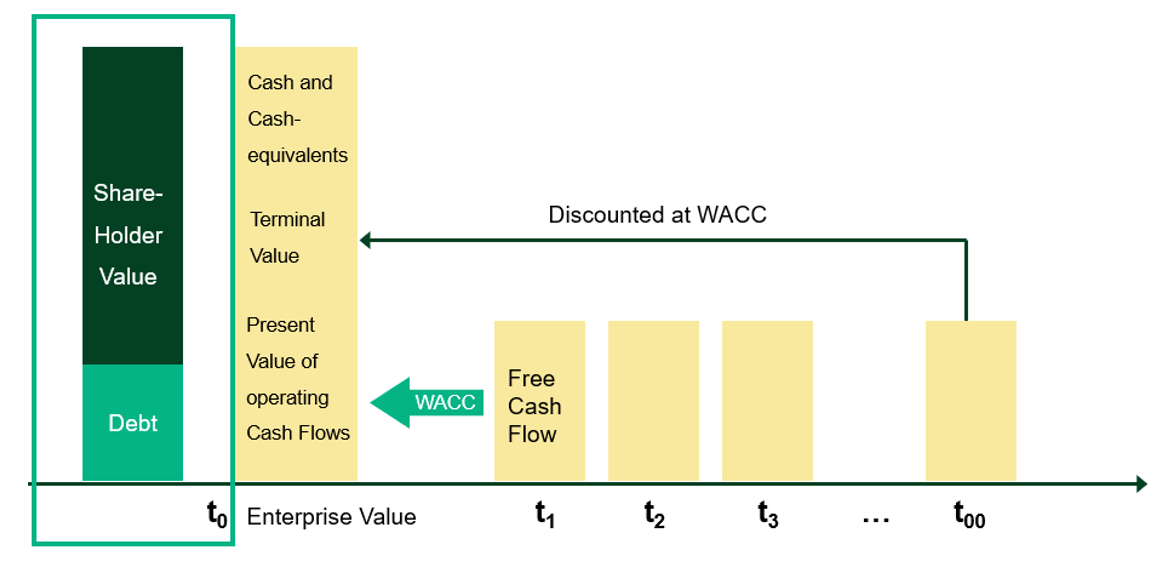
Largani, Kaviani, and Abdollahpour (2012) analyze Shareholder Value Added (SVA) as a systematic approach grounded in capital cost modelling and discounted cash flow forecasts, predominantly employed in financial decision-making scenarios. 16Largani, M. S., Kaviani, M., & Abdollahpour, A. A review of the application of the concept of Shareholder Value Added (SVA) in financial decisions. Procedia – Social and Behavioral Sciences 40, 490-497 (2012).
While such models are relevant within the fields of financial control and performance evaluation, they fall outside the conceptual and normative focus of this thesis. Instead of adopting a company-specific or financially technical perspective, this thesis examines shareholder value through normative, theoretical and governance-related viewpoints. Particular emphasis is placed on its broader implications for corporate purpose and organizational legitimacy. The literature review situates the concept of shareholder value within the broader discourse on corporate responsibility, sustainable development, and stakeholder involvement, highlighting its contested and evolving nature. To reflect this complexity, the review draws on interdisciplinary sources from corporate governance theory, business ethics, strategic management and sustainability research. By focusing on conceptual foundations, governance structures, and normative critiques, the review aims to provide an integrated understanding of how shareholder value thinking shapes corporate decision-making, social responsibility strategies, and the conditions for sustainability transformations, while deliberately excluding sector-specific analyses and quantitative performance models.
4 Origin and historical development of shareholder value
In order to understand how the concept of shareholder value evolved into a widely adopted corporate objective, it is essential to examine its origins and historical development, in both theory and practice.
Before the rise of shareholder value, the dominant corporate governance model in the United States was characterised by managerial capitalism. Both Chandler (1984) and Cheffins (2015) describe how, throughout the mid-twentieth century, corporate control rested primarily with professional managers rather than shareholders. 17Chandler, A. D. The emergence of managerial capitalism. Business History Review 58, 473-503 (1984).,18Cheffins, B. R. Corporate governance since the managerial capitalism era. Business History Review 89, 717-744 (2015).
By the mid-twentieth century, managerial capitalism had become firmly established in the United States. It was characterised by a system of professionalised management and internal strategic oversight. As industrial enterprises grew in size and complexity from the late nineteenth century onwards, ownership became more widely dispersed among shareholders, while operational authority shifted to paid executives. Managerial discretion prevailed over shareholder influence, with decision-making concentrated within hierarchical administrative structures. These changes were a structural response to the organizational demands of large-scale production and mass distribution. 17Chandler, A. D. The emergence of managerial capitalism. Business History Review 58, 473-503 (1984).
Cheffins (2015) reinforces this characterisation, describing public companies during this period as marked by weak shareholder control, organizational loyalty and a general absence of market-based discipline. He further notes that this model proved resilient due to institutional constraints such as labor representation and regulatory frameworks. 18Cheffins, B. R. Corporate governance since the managerial capitalism era. Business History Review 89, 717-744 (2015).
The idea that corporations exist primarily to maximize shareholder profits was neither a legal norm nor a widely accepted corporate principle before the 1980s. 19Rhee, R. J. The neoliberal corporate purpose of Dodge v. Ford and shareholder primacy: A historical context 1919-2019. Stanford Journal of Law, Business & Finance 28, 202–254 (2023).
Instead, corporate governance in the United States was marked by a system, in which top executives held broad decision-making authority and were expected to consider not only shareholder interests but also the concerns of employees, local communities, and the public. This form of capitalism relied on passive investors and a political-economic context that supported a stakeholder-oriented view of corporate purpose. Only with the shift in political and economic conditions during the 1980s did the idea of shareholder primacy become institutionalised and more accepted as the central objective of corporate governance. 19Rhee, R. J. The neoliberal corporate purpose of Dodge v. Ford and shareholder primacy: A historical context 1919-2019. Stanford Journal of Law, Business & Finance 28, 202–254 (2023).
The academic discourse intensified in the 1970s and 1980s due to several significant contributions that established the normative, theoretical, and practical underpinnings of shareholder value, particularly the work of Friedman (1970), Jensen and Meckling (1976) and Rappaport (1986). Writing in the context of liberal market economics, Friedman (1970) argued that the purpose of a firm is not to pursue broader societal goals, but to achieve economic returns for its owners by acting within the legal and competitive framework of the market. From his perspective, ethical responsibilities lie with individuals, not with corporations as entities. Managers, in this view, are employed to represent the financial interests of shareholders and should not use company resources to address political or social concerns. Doing so, he warned, risks undermining democratic norms by allowing private decision-makers to influence collective outcomes that should be determined through public institutions and political processes. 4Friedman, M. A Friedman doctrine – The social responsibility of business is to increase its profits. The New York Times, SM17 (1970).
Jensen and Meckling (1976) developed a theoretical framework that conceptualises the firm as a network of contractual relationships among various parties. Central to their analysis is the divergence of interests between shareholders and managers, which arises from the separation of ownership and control. This misalignment gives rise to agency costs, which include not only expenditures for monitoring managerial behavior but also efficiency losses due to suboptimal decision making. The authors analytically examine how such costs emerge and how contractual arrangements, such as equity participation or formal control mechanisms, may influence managerial incentives and affect the overall structure of these relationships. 20Jensen, M. C. & Meckling, W. H. Theory of the Firm. Managerial behavior, agency costs and ownership structure. Journal of Financial Economics 3, 305-360 (1976).
Rappaport (1986) made a substantial contribution to the practical institutionalisation of shareholder value in corporate management, in addition to the theoretical developments of the 1970s. In 1986, his work formalised the valuation logic by defining shareholder value as the present value of anticipated future cash flows, discounted by the cost of capital. This method established a structured framework for connecting financial strategy to shareholder interests. Rappaport’s operational model reinforced its role in corporate governance and performance evaluation by transforming the normative commitment to shareholder value into a decision-making instrument that was applicable in practice. 21Rappaport, A. Creating shareholder value: The new standard for business performance. (Free Press, 1986)., p.50
While the theoretical foundations of shareholder value were firmly established in the 1970s and 1980s, its widespread implementation in corporate practice was primarily driven by financial market actors rather than academic theorists. 2Heilbron, J., Verheul, J. & Quak, S. The origins and early diffusion of “shareholder value” in the United States. Theory and Society 43, 1–22 (2014).
Heilbron, Verheul, and Quak (2014) assert that the initial spread of shareholder value logic was driven by corporate raiders, activist institutional investors and public pension funds. These actors openly contested the legitimacy of management autonomy by advocating for enhanced accountability to shareholders. Direct pressure on business boards and executives was exerted through takeovers, proxy battles, and public campaigns to prioritise short-term financial performance, especially stock price appreciation and dividend payouts. This dynamic substantially transformed managerial incentives. In an effort to evade takeovers and appease investors, management commenced the adoption of financial indicators and governance methods linked with the maximization of shareholder value. The trend was enabled by deregulatory reforms in the 1980s, which broadened the market for corporate control and validated the use of shareholder value as a criterion for assessing corporate performance. The corporate purpose was redefined to focus on providing financial returns to owners rather than balancing the interests of different stakeholders. The success of these financial actors in enforcing their expectations across a wide range of firms normalised the shareholder value orientation and accelerated its adoption as the dominant governance logic. 2Heilbron, J., Verheul, J. & Quak, S. The origins and early diffusion of “shareholder value” in the United States. Theory and Society 43, 1–22 (2014).
By the end of the 1990s, the shareholder value model had achieved widespread acceptance across jurisdictions. 22Hansmann, H. & Kraakman, R. The end of history for corporate law. Georgetown Law Journal 89, 439-468 (2001). This phenomenon was interpreted as part of a broader convergence in corporate governance, in which alternative models, such as stakeholder-oriented frameworks, lost ground to the perceived efficiency and market discipline of shareholder primacy. This shift has been described as a turning point, with the global diffusion of shareholder-oriented reforms being identified as marking the effective standardisation of corporate law principles. 22Hansmann, H. & Kraakman, R. The end of history for corporate law. Georgetown Law Journal 89, 439-468 (2001).
The rise of shareholder value in the 1980s and 1990s was not met with universal acceptance. 14Letza, S., Sun, X. & Kirkbride, J. Shareholding versus stakeholding: A critical review of corporate governance. Corporate Governance: an International Review 12, 242–262 (2004). On the contrary, alternative concepts emerged within the same historical context, one of the most prominent being Stakeholder Theory. Stakeholder theory, as formulated by Freeman (1984), offers a redefinition of the corporation’s role and purpose. His conception of the firm as a system of interdependent relationships puts a strong emphasis on key stakeholder groups such as employees, customers, suppliers, investors and communities. The theory posits that long-term business success is contingent not on the prioritisation of a single group, but rather on the concurrent creation and sustenance of value for all stakeholders. The multidimensional model challenges the unidimensional logic of shareholder primacy by introducing a more integrative framework of corporate purpose. Freeman emphasises that the role of management is to harmonise these interests strategically, thereby ensuring that no stakeholder group is neglected by design. In this view, corporate strategy is defined as a process of aligning values, expectations and contributions across all affected constituencies with a view to enabling sustainable value creation. 23Freeman, R. E. Strategic management: A stakeholder approach. (Cambridge University Press, 1984)., p.5
Letza, Sun and Kirkbride (2004) placed these theoretical shifts in a broader historical context. They state that the spread of shareholder-oriented logic during the late twentieth century prompted a wave of academic resistance. Stakeholder theory was interpreted as a reaction to the reductionist tendencies of agency theory, which framed corporate behavior in strictly financial and individualistic terms. The authors criticised both shareholder and stakeholder models for relying on binary oppositions and called for a more dynamic and contextualised understanding of governance frameworks. 14Letza, S., Sun, X. & Kirkbride, J. Shareholding versus stakeholding: A critical review of corporate governance. Corporate Governance: an International Review 12, 242–262 (2004).
Taken together, these developments illustrate that the rise of shareholder value was not an uncontested progression but a historically situated shift that redefined corporate purpose in both theory and practice. The early emergence of stakeholder theory underscores that corporate governance is a contested field, shaped by competing visions of accountability, legitimacy and value creation. Understanding this historical trajectory is essential for evaluating whether shareholder value remains an adequate framework in light of today’s calls for more inclusive and sustainable business practices.
5 Implications for shareholders and stakeholders
As presented in Chapter 1 and Chapter 3, the concept of shareholder value remains contested within academic discourse, as its foundational assumptions and the underlying conceptions related to shareholders, stakeholders and society are not universally accepted and continue to be the subject of critical examination. The model is highly debated due to the various implications that derive from its core assumptions and normative orientation. The following section examines three core implications commonly associated with the shareholder perspective, each of which has been the subject of frequent academic debate due to its far-reaching implications for corporate decision-making and governance.
One fundamental implication of the shareholder value approach, as advanced by Sundaram and Inkpen (2004), is that the maximization of shareholder wealth should be regarded as the primary objective of corporate decision-making. The authors argue that managers, in their role as agents of shareholders, should utilise shareholder value as the guiding objective function for strategic and operational decisions, as it offers the most coherent and effective basis for aligning managerial actions with overall firm value. This logic is deeply embedded in the fields of financial economics and corporate governance, particularly in Anglo-American contexts, where it is widely accepted as a normative standard. Deviations from this focus are described as agency problems and are typically addressed through mechanisms such as shareholder voice, shareholder exit, or market-based control of corporate assets. It is acknowledged that there are potential boundary constraints and criticisms to consider, such as short-termism, excessive risk-taking and fairness concerns. However, the authors argue that shareholder value maximization remains the most appropriate and inclusive objective for corporate governance when interpreted and implemented in a long-term, incentive-aligned manner. 13Sundaram, A. K. & Inkpen, A. C. The corporate objective revisited. Organization Science 15, 350–363 (2004).
Concurrently, Hansmann and Kraakman (2001) have noted a broad ideological consensus that managerial authority should be exercised exclusively on behalf of shareholders, with other constituencies safeguarded through contractual agreements or regulatory frameworks. From this standpoint, shareholder primacy is regarded not only as the most efficient governance structure, but also as a functional standard for global corporate practice. 22Hansmann, H. & Kraakman, R. The end of history for corporate law. Georgetown Law Journal 89, 439-468 (2001).
A second implication of the shareholder value approach is the strategic alignment of corporate decisions with long term value creation for shareholders. The model requires that all major decisions, ranging from capital budgeting and investment allocation to corporate portfolio restructuring, be assessed according to their expected contribution to shareholder value. 24Blyth, M. L., Friskey, E. A., & Rappaport, A. Implementing the shareholder value approach. Journal of Business Strategy 6, 48-58 (1986).
Within this framework, strategic management is treated as a process of identifying and selecting those options that generate the highest financial returns for shareholders. This includes the targeted use of synergies between business units as a source of competitive advantage. The shareholder value approach therefore serves as a central planning logic that informs decision making across all major levels of corporate strategy. 24Blyth, M. L., Friskey, E. A., & Rappaport, A. Implementing the shareholder value approach. Journal of Business Strategy 6, 48-58 (1986).
This principle is further developed by Rappaport (2006), who emphasises that companies should prioritise strategies that maximize expected future cash flows, even when this may come at the expense of short-term earnings. In his framework, shareholder value serves as the overriding criterion for strategic and financial planning, guiding firms to consider long-term market expectations when allocating resources. By doing so, Rappaport aims to shield corporate decision-making from short-term performance pressures and ensure alignment with sustainable market valuation over time. 25Rappaport, A. Ten ways to create shareholder value. Harvard business review 84, 66-77 (2006). Similarly, Denis (2019) argues in favour of shareholder value maximization as the only decision rule that ensures strategic coherence in competitive markets. The author proposes that firms operating within public capital markets must adhere to this principle in order to attract investment and maintain legitimacy. In the author’s opinion, the maximization of long-term shareholder value inherently demands that strategic decisions be grounded in market-based logic, thereby aligning firms with competitive advantage through efficient resource use. 26Denis, D. The case for maximizing long‐run shareholder value. Journal of Applied Corporate Finance 31, 81-89 (2019).
A third implication of the shareholder value approach is the underlying assumption that shareholders constitute a homogeneous group with identical motivations, goals and time horizons, as Stout (2012) argues this assumption is false. The model presumes that all shareholders are rational actors exclusively interested in maximizing financial returns, thereby promoting a simplified and economically reductive view of human behavior. However, this assumption neglects the empirical reality that shareholders vary considerably in their preferences and values. Some prioritise short term gains, others favour long term sustainable growth or incorporate ethical or prosocial considerations into their investment decisions. Shareholders include a diverse range of actors such as hedge funds, pension funds, institutional investors and individuals, each of whom operates under different constraints and expectations. As Stout further argues, there is no single unified shareholder value, rather, shareholder interests are fragmented and often conflicting, making the premise of a common goal both conceptually and practically untenable. 3Stout, L. A. New thinking on “shareholder primacy.” Accounting Economics and Law 2, 1-22 (2012).
DesJardine, Zhang and Shi (2023) further emphasize that shareholders constitute a highly heterogeneous group, differing in their investment horizons and orientation toward financial or non-financial objectives. The authors also observe the rise of ESG-focused shareholder activism and an increasing presence of sustainability-oriented investor behavior in certain segments of the market. 6DesJardine, M. R., Zhang, M. & Shi, W. How shareholders impact stakeholder interests: A review and map for future research. Journal of Management 49, 400–429 (2023).
While the foundational implications of the shareholder value concept are primarily directed at shareholders, their influence extends beyond this group. 6DesJardine, M. R., Zhang, M. & Shi, W. How shareholders impact stakeholder interests: A review and map for future research. Journal of Management 49, 400–429 (2023). The following sections examine key implications embedded in the shareholder value logic that relate to stakeholders and to society at large.
One significant implication for stakeholders under the shareholder value model is that their interests are considered secondary to those of shareholders, particularly within legal and financial frameworks that prioritise shareholder returns. 27Lipton, A. M. What we talk about when we talk about shareholder primacy. Case Western Reserve Law Review 69, 863-894 (2019). The doctrine of shareholder primacy is widely interpreted as establishing a fiduciary duty for corporate directors to act primarily in the financial interest of shareholders. This often means that managerial decisions are assessed in terms of their contribution to shareholder wealth rather than their effects on other constituencies. In accordance with this logic, stakeholder interests, such as those of employees, customers or communities, are typically acknowledged only when they can be demonstrated to support financial performance. 27Lipton, A. M. What we talk about when we talk about shareholder primacy. Case Western Reserve Law Review 69, 863-894 (2019). This approach is characterised by a conditional engagement with stakeholders, whereby non shareholder claims are considered relevant to corporate governance solely insofar as they contribute to shareholder value. However, it should be noted that this interpretation is not uniformly applied across different legal jurisdictions. Recent legal developments reflect a growing recognition of shareholder heterogeneity and non-financial preferences. This has the effect of complicating the traditional view of unconditional shareholder primacy. 27Lipton, A. M. What we talk about when we talk about shareholder primacy. Case Western Reserve Law Review 69, 863-894 (2019). Clarke and Friedman (2016) support this perspective by contending that shareholder value ideology diminishes all non-shareholder interests to metrics that must be measured and validated based on their financial impact to the firm. This approach diminishes the function of corporate management and undermines the broader social duties traditionally linked to the corporation. 28Clarke, C., & Friedman, H. H. ‘Maximizing Shareholder Value’: A Theory Run Amok. i-manager’s Journal on Management 10, 45-60 (2016).
In summary, the shareholder value model establishes a hierarchy of interests in which stakeholder concerns are considered only to the extent that they align with shareholder interests. This conditional relevance reduces stakeholder interests to instrumental variables and limits the scope within which broader social considerations can be incorporated into managerial decision-making.
A further implication of the shareholder value approach is the dominance of a narrow financial logic in corporate decision-making, in which managerial actions are primarily evaluated based on their effect on short-term stock performance. As shown by the tendency to cut research and development, maintenance, hiring and strategic growth to meet short term financial goals, this orientation discourages long term investment and innovation. Corporate resources are diverted to accounting methods and share buybacks to boost earnings per share and meet market expectations. This rationale leads to executive compensation tied to share price changes, incentivising short term conduct. Societal and environmental concerns are regarded as being of lesser importance, since they are external to managerial agendas based on financial achievement. 28Clarke, C., & Friedman, H. H. ‘Maximizing Shareholder Value’: A Theory Run Amok. i-manager’s Journal on Management 10, 45-60 (2016).
Nevertheless, the pursuit of continuous financial growth is constrained by fundamental ecological factors. McBain et al. (2017) highlight that since the mid-1970s, global human demand has surpassed the Earth’s regeneration capacity, leading to a continuous condition of ecological overshoot. The dynamic model suggests that continuous expansion in economic output and the corresponding demand for resources will intensify this overshoot, hence elevating the likelihood of exceeding planetary boundaries. 29McBain, B., Lenzen, M., Wackernagel, M., & Albrecht, G. How long can global ecological overshoot last? Global and Planetary Change 155, 13-19 (2017). This concern is further supported by Merz et al. (2023), who argue that overshoot results from maladaptive behavioral patterns, including the institutionalisation of economic growth as an unquestioned societal goal. The emphasis placed on the promotion of increased consumption and waste by current economic systems, as outlined in the text, is a key point of discussion. The assertion that these systems cannot be sustained within the planet’s finite ecological limits is also of particular significance. Consequently, they caution that even efficiency-oriented interventions are unlikely to reverse the trend without addressing the root behavioral and institutional drivers. 30Merz, J. J., et al. World scientists’ warning: The behavioural crisis driving ecological overshoot. Science Progress 106, 1-22 (2023).
Together, these findings illustrate a structural contradiction between the continuous growth expectations embedded in shareholder value logics and the physical limitations of planetary ecosystems.
As previously discussed, the shareholder value model, in its strict form, implies that shareholder claims have to be prioritised over all other interests, even if this is legally questionable. 27Lipton, A. M. What we talk about when we talk about shareholder primacy. Case Western Reserve Law Review 69, 863-894 (2019). This logic of primacy may, however, produce unintended side-effects for other stakeholder groups, particularly employees. 31Fligstein, N. & Goldstein, A. The legacy of shareholder value capitalism. Annual Review of Sociology 48, 193–211 (2022).
One prominent example, as outlined by Fligstein and Goldstein (2022), concerns the distributional effects associated with the shareholder value doctrine over recent decades. According to their analysis, the prevailing emphasis on shareholder returns has given rise to practices such as dividend payouts, share buybacks and cost-cutting strategies, which primarily benefit a limited segment of society. It has been posited that such mechanisms function as a means of reallocation of corporate resources from wages and employment security to financial markets. This reallocation has been argued to result in a weakening of labor protections and to contribute to an increase in economic inequality. It is stated that firms have increasingly sought to reduce labor costs and limit investment in workforce development in order to maximize shareholder returns, thereby reinforcing a model that disproportionately advantages capital holders. 31Fligstein, N. & Goldstein, A. The legacy of shareholder value capitalism. Annual Review of Sociology 48, 193–211 (2022).
These findings are broadly consistent with earlier work by Fligstein and Shin (2007), who examined how shareholder value-oriented restructuring strategies shaped corporate behavior across U.S. industries between 1984 and 2000. The findings indicate that mergers and workforce reductions became increasingly prevalent in response to mounting profitability pressures and shareholder expectations, particularly within low-performing industries. Nevertheless, these practices did not result in sustained improvements in industry-level profitability. The authors observe that, in contrast to the restoration of financial performance, such strategies contributed to a reorganisation of employment relations, characterised by increased layoffs, declining unionisation, and reduced managerial attention to non-shareholder constituencies. Although the study does not directly assess distributive outcomes or inequality, it engages with the broader interpretation that shareholder value governance may have shifted power and resources away from labor and toward capital. 32Fligstein, N. & Shin, T. Shareholder Value and the transformation of the U.S. economy, 1984–2000. Sociological Forum 22, 399–424 (2007).
As previously explained, the distributive effects associated with shareholder value orientation constitute one central aspect of its broader societal implications. In addition to concerns about inequality and resource distribution, the academic discussion has also turned to operational dimensions, particularly regarding how shareholder primacy influences corporate employment practices. 33Jung, J. Shareholder value and workforce downsizing, 1981–2006. Social Forces 93, 1335-1368 (2015).,34Jung, J., & Lee, Y. Financialization and corporate downsizing as a shareholder value strategy. Socio-Economic Review20, 1795-1823 (2022).
A further area of debate in this context is the increasing prevalence of workforce reductions in large corporations, which empirical studies have linked to shareholder value strategies. Jung (2015), for instance, analyses data from publicly traded US firms over the period 1981 to 2006 and observes that layoffs are not only used as a response to economic distress but may also be employed proactively to signal financial discipline. He identifies two factors that may be contributing to this trend. Firstly, there is pressure from institutional investors to maximize returns. Secondly, there are internal governance mechanisms, such as independent boards and equity-based compensation for CEOs, which could create incentives to cut costs and raise the share price. These mechanisms serve to align managerial conduct with shareholder expectations. In such a governance context, workforce reductions may be regarded as a rational response to investor demands, even in companies that are otherwise economically stable. 33Jung, J. Shareholder value and workforce downsizing, 1981–2006. Social Forces 93, 1335-1368 (2015).
In a related study, Jung and Lee (2022) examine how workforce downsizing interacts with broader patterns of financialisation in corporate governance. The paper’s argument is supported by data concerning the actions of US firms over the period from 1984 to 2006. The data show that shareholder value strategies may result in a reallocation of resources from labor to financial markets. The analysis indicates that enterprises operating within environments characterised by high financialisation demonstrate an increased propensity to implement workforce reductions, utilising this strategy as a form of communication with investors, particularly in instances where earnings forecasts are not met. The authors posit that this form of reactive downsizing may be incongruent with longer-term workforce planning and capacity building. However, they also acknowledge that the causal mechanisms behind these developments are complex and difficult to isolate with certainty. 34Jung, J., & Lee, Y. Financialization and corporate downsizing as a shareholder value strategy. Socio-Economic Review20, 1795-1823 (2022).
The overarching argument is that the dominance of the shareholder value approach, alongside the financialisation of the US economy since the 1980s, has led to a fundamental redistribution of economic gains within firms and across the broader economy, which has also been associated with rising income inequality. 35Palladino, L. Financialization at work: Shareholder primacy and stagnant wages in the United States. Competition & Change 25, 382–400 (2021).,36Goldstein, A. Revenge of the managers: Labor cost-cutting and the paradoxical resurgence of managerialism in the shareholder value era, 1984 to 2001. American Sociological Review 77, 268–294 (2012).,37Levy, F. & Kochan, T. Addressing the problem of stagnant wages. Comparative Economic Studies 54, 739–764 (2012).
In this context, Palladino (2021) examines the link between shareholder primacy and stagnating wages for non-executive employees in the United States. Using macroeconomic and firm-level data, Palladino argues that the increase in shareholder payouts, particularly through dividends and stock buybacks, has coincided with declining wage growth in recent decades. While acknowledging that multiple factors contribute to wage stagnation, Palladino emphasises the growing influence of financial markets in shaping corporate priorities. According to the analysis, shareholder returns have increasingly taken precedence in internal budgeting decisions, with wages often remaining stagnant despite rising productivity. The study concludes that this pattern of resource allocation may reflect a shift in corporate governance norms, whereby the focus on maximizing shareholder value limits firms’ capacity to reinvest in their workforce. 35Palladino, L. Financialization at work: Shareholder primacy and stagnant wages in the United States. Competition & Change 25, 382–400 (2021). Moreover, Goldstein (2012) provides an historical analysis of labor cost-cutting within the framework of shareholder value ideologies. He argues that the resurgence of managerial authority was driven by the same shareholder-oriented reforms that had initially been introduced to discipline management. Goldstein suggests that managers actively embraced labor cost reductions as a means of demonstrating financial discipline and meeting shareholder expectations. This strategic focus on cost containment, particularly in payroll expenditure, may have contributed to wage stagnation for large parts of the workforce. However, Goldstein also notes that such strategies were not uniformly effective, and that their outcomes often depended on sectoral and institutional contexts. 36Goldstein, A. Revenge of the managers: Labor cost-cutting and the paradoxical resurgence of managerialism in the shareholder value era, 1984 to 2001. American Sociological Review 77, 268–294 (2012).
Finally, Levy and Kochan (2012) analyze wage stagnation as a long-term structural challenge facing the US economy, identifying a variety of contributing factors. They identify the prioritisation of shareholder returns as a key factor that has influenced corporate behavior since the 1980s. They argue that the increased focus on shareholder value has coincided with reduced wage growth and a smaller proportion of income being allocated to labor. However, they also emphasize the multifactorial nature of the problem, citing weakened labor institutions, technological change and macroeconomic policy as further explanatory variables. Levy and Kochan advocate a more balanced approach to value creation, incorporating stronger institutional support for wage growth alongside economic competitiveness. 37Levy, F. & Kochan, T. Addressing the problem of stagnant wages. Comparative Economic Studies 54, 739–764 (2012).
In conclusion, the reviewed studies suggest that strict adherence to the shareholder value model can have a variety of secondary effects, particularly with regard to the allocation of corporate resources and labor relations. Although the emphasis on shareholder primacy is often justified in terms of efficiency, competitiveness or accountability, empirical literature raises concerns that this orientation may encourage practices such as workforce downsizing and wage restraint, which pose risks to non-shareholder constituencies. It is important to note that these effects are not portrayed as inevitable or universally observed, rather they depend on broader governance structures, financial market pressures, and institutional contexts. The findings thus invite a more nuanced understanding of the implementation of the shareholder value model, emphasising the need to consider not only the intended efficiency gains, but also the possible distributional and organizational side effects that may accompany such strategies.
6 Academic debate on shareholder value
A key area of academic debate concerns the long-term effectiveness of shareholder value as a guiding principle for corporate strategy. Proponents of shareholder value like Rappaport (2006) contend that aligning managerial decisions with the financial interests of shareholders is the most effective way to achieve long-term corporate value. 25Rappaport, A. Ten ways to create shareholder value. Harvard business review 84, 66-77 (2006).
Hansmann and Kraakman (2001) regard the shareholder-oriented model as the dominant framework within the field of corporate governance. They argue that this model has demonstrated superior efficiency in aligning managerial accountability with firm performance. They suggest that the global diffusion of this model is driven by both theoretical consistency and its practical success in ensuring access to equity capital, promoting efficient investment decisions and incentivising value-maximizing behavior among managers. According to their analysis, prioritising shareholder interests fosters corporate responsiveness and competitiveness, particularly in dynamic, innovation-driven markets. 22Hansmann, H. & Kraakman, R. The end of history for corporate law. Georgetown Law Journal 89, 439-468 (2001). Furthermore, Blyth, Friskey and Rappaport (1986) support this perspective, emphasising that shareholder value provides clear, consistent guidance for strategic decision-making. They claim that traditional accounting measures do not provide sufficient guidance for long-term planning, whereas focusing on shareholder value ensures that managers act in accordance with investor expectations. Following this line of reasoning, aligning corporate strategy with shareholder interests promotes financial discipline, enhances transparency and contributes to sustainable firm performance over time. 24Blyth, M. L., Friskey, E. A., & Rappaport, A. Implementing the shareholder value approach. Journal of Business Strategy 6, 48-58 (1986).
However, from a stakeholder-oriented perspective, the question of long-term value takes a different form. Rather than assuming that shareholder alignment guarantees sustainable performance, several authors have raised concerns that this narrow focus may redirect managerial priorities and weaken the broader foundations of corporate success. 1Shin, T. The shareholder value principle: the governance and control of corporations in the United States. Sociology Compass 7, 829–840 (2013).,3Stout, L. A. New thinking on “shareholder primacy.” Accounting Economics and Law 2, 1-22 (2012).,34Jung, J., & Lee, Y. Financialization and corporate downsizing as a shareholder value strategy. Socio-Economic Review20, 1795-1823 (2022).
Stout (2012) contests the assumptions on which the concept of shareholder primacy is founded, highlighting inaccuracies in legal, economic, and corporate governance contexts. She contends that the exclusive alignment of corporate objectives with share price maximization leads to short-termism and erodes trust among stakeholders. 3Stout, L. A. New thinking on “shareholder primacy.” Accounting Economics and Law 2, 1-22 (2012). Recent research challenges the assumption that a focus on shareholder value necessarily promotes long-term company performance. 34Jung, J., & Lee, Y. Financialization and corporate downsizing as a shareholder value strategy. Socio-Economic Review20, 1795-1823 (2022). Jung and Lee (2022) argue that the institutionalisation of shareholder primacy has led to a set of managerial behaviors that favour short-term market signalling over sustainable investment strategies. Their study shows that, under pressure from financial market actors, firms increasingly adopt downsizing measures after disappointing financial results. Rather than investing in the business or employee development, firms respond to disappointing financial results by cutting costs to demonstrate their commitment to shareholder interests. According to the authors, this behavior undermines long-term competitiveness and contributes to employment instability. 34Jung, J., & Lee, Y. Financialization and corporate downsizing as a shareholder value strategy. Socio-Economic Review20, 1795-1823 (2022). Shin (2013) adds to this critique by examining how shareholder value became a widely adopted, yet controversial, governance model in the US. He claims that this principle is based on political and ideological changes rather than universally accepted economic logic. In practice, its implementation is often merely symbolic and inconsistent. Shin illustrates how many corporations adopt shareholder-value rhetoric without fully aligning their strategies, creating a disconnect between words and actions. He concludes that the rise of shareholder value has contributed to increased layoffs, financialisation and the erosion of long-term productive capabilities, suggesting that the promised efficiency gains may come at the expense of sustainable firm development. 1Shin, T. The shareholder value principle: the governance and control of corporations in the United States. Sociology Compass 7, 829–840 (2013).
Another central controversy in the academic discourse concerns the normative foundations of corporate governance. At issue is the notion that the primary purpose of the firm is to maximize profits for its shareholders, a claim that continues to provoke debate regarding the broader responsibilities and objectives of corporate activity. 31Fligstein, N. & Goldstein, A. The legacy of shareholder value capitalism. Annual Review of Sociology 48, 193–211 (2022).
Rappaport (1983) argues that a firm’s fundamental purpose should be to maximize shareholder value, as this is the only objective that provides a consistent, market-based standard for evaluating corporate performance. He criticises conventional accounting metrics, such as earnings per share and return on investment, for being backward-looking and susceptible to distortion through accounting conventions. According to Rappaport, shareholder value should guide corporate strategy because it directly aligns planning, investment decisions and managerial incentives with the financial expectations of investors. 38Rappaport, A. Corporate performance standards and shareholder value. Journal of Business Strategy 3, 28-38 (1983). Denis (2019) reinforces this position by emphasising that shareholders occupy a unique position within the corporate structure. Unlike other stakeholders, who receive fixed payments such as wages or interest, shareholders are only entitled to what remains after all other obligations have been met. This gives them the strongest incentive to monitor management and demand efficient capital allocation. From this perspective, maximizing shareholder value ensures that firms operate efficiently, respond to market signals and remain accountable to their owners. 26Denis, D. The case for maximizing long‐run shareholder value. Journal of Applied Corporate Finance 31, 81-89 (2019).
Hansmann and Kraakman (2001) argue that the global shift toward shareholder orientation in corporate governance is not a coincidence but is instead rooted in its superior functional performance. They state that this model effectively aligns managers’ interests with those of investors and improves access to capital markets. In their view, prioritising shareholders is not only a normative stance, but also a pragmatic solution to the problem of managerial discretion in publicly traded firms. 22Hansmann, H. & Kraakman, R. The end of history for corporate law. Georgetown Law Journal 89, 439-468 (2001).
The shareholder-oriented interpretation of corporate purpose, however, is not without contestation. Critical perspectives have emerged, highlighting legal, normative, and practical concerns associated with an exclusive focus on shareholder interests. 39George, G., Haas, M. R., McGahan, A. M., Schillebeeckx, S. J. D., & Tracey, P. Purpose in the for-profit firm: A review and framework for management research. Journal of Management 49, 1841-1869 (2023),40Henisz, W. J. The value of organizational purpose. Strategy Science 8, 159–169 (2023).
George et al. (2023) argue that corporate purpose should extend beyond financial optimisation to consider broader responsibilities toward stakeholders and society. They argue that a clearly defined purpose can strengthen strategic clarity by aligning internal decision-making processes and reducing conflict. They also claim that purpose is linked to increased employee engagement as it fosters satisfaction, motivation and retention. While they further suggest that a strong sense of purpose may improve organizational resilience in times of disruption, they treat this as an open question rather than an established outcome. 39George, G., Haas, M. R., McGahan, A. M., Schillebeeckx, S. J. D., & Tracey, P. Purpose in the for-profit firm: A review and framework for management research. Journal of Management 49, 1841-1869 (2023) A similar line of reasoning is pursued by Henisz (2023), who likewise endorses a broader corporate purpose and links it to potential benefits. He argues that a firm’s commitment to a broader organizational purpose, if credible and authentic, facilitates the formation of relational contracts with all of its external stakeholders. These contracts, which are based on perceived sincerity and shared goals, can encourage reciprocity and trust, thereby strengthening relationships with stakeholders and creating intangible value. 40Henisz, W. J. The value of organizational purpose. Strategy Science 8, 159–169 (2023).
7 Future research
One important avenue for future research concerns the interaction between shareholder interests and stakeholder outcomes. As examined in Chapter 6, debates surrounding social inequality, labor conditions, and ownership structures have intensified over time. In this context, there is growing interest in developing a more nuanced understanding of how shareholder priorities shape stakeholder interests. 6DesJardine, M. R., Zhang, M. & Shi, W. How shareholders impact stakeholder interests: A review and map for future research. Journal of Management 49, 400–429 (2023).
DesJardine, Zhang and Shi (2023) conducted a literature review analysing the relationship between various forms of shareholder ownership and their effects on stakeholder interests. They emphasize that transactional shareholders, who pursue short-term financial goals, are linked to practices such as workforce reductions, salary reductions, reduced employee benefits and lower job security. The authors emphasize that the academic literature is fragmented across disciplines and theoretical frameworks, which limits the understanding of how different types of shareholders influence stakeholder outcomes. They also identify research gaps concerning ownership forms that have not been widely studied, such as ESG-oriented activist hedge funds and foundation ownership. The authors additionally propose that future research should investigate the interactive dynamics between shareholders and stakeholders, with particular attention to how the collective power and the ability of stakeholders to mobilise may moderate the influence exerted by shareholders. Moreover, the review highlights stakeholder wellbeing as a central focus for further research. 6DesJardine, M. R., Zhang, M. & Shi, W. How shareholders impact stakeholder interests: A review and map for future research. Journal of Management 49, 400–429 (2023).
The relevance of this issue is further highlighted by Goranova and Ryan (2022), who analyze the influence of the dominant shareholder-centric corporate objective on governance practices and managerial decision-making. They argue that the theoretical foundations of shareholder primacy, especially the assumption that shareholders are the sole residual claimants, have contributed to governance blind spots that may neglect negative consequences for stakeholders, including employees. The authors point out that actions aimed at maximizing shareholder value can involve value transfers at the expense of labor, such as reduced long term investment, increased risk shifting, and the potential for wage inequality. Consequently, the authors recommend future research into alternative governance approaches, such as Strategic Corporate Governance, that consider long term firm competitiveness and broader stakeholder interests. 41Goranova, M. & Ryan, L. V. The corporate objective revisited: the shareholder perspective. Journal of Management Studies 59, 526–554 (2022).
Finally, Fligstein and Goldstein (2022) examine how shareholder value capitalism has restructured corporate priorities in a way that disadvantages labor. They document how cost-cutting strategies, including outsourcing, layoffs, pension reductions, and benefit cuts, were central to enhancing shareholder returns, yet led to deteriorating employment conditions and growing income inequality. The authors emphasize that these changes have disproportionately favoured top executives and financial actors, while weakening unions, reducing job security, and lowering the labor share of income. While the literature provides empirical evidence of these distributional outcomes, the authors identify several open research questions. In particular, they advocate further studies on whether recent ideological and political challenges, such as ESG-oriented investing or the rise of private equity, are fundamentally altering the logic of shareholder value. They also emphasize the need to expand the analysis beyond public firms and examine the impact of financial extraction strategies on a wider range of social actors. 31Fligstein, N. & Goldstein, A. The legacy of shareholder value capitalism. Annual Review of Sociology 48, 193–211 (2022).
Another important research area explores the relationship between corporate social responsibility (CSR) and shareholder value. While some studies suggest that CSR may enhance firm value, particularly under certain ownership conditions, the overall evidence remains inconclusive. 10Barnea, A. & Rubin, A. Corporate social responsibility as a conflict between shareholders. Journal of Business Ethics97, 71–86 (2010).,9Coelho, R., Jayantilal, S. & Ferreira, J. J. The impact of social responsibility on corporate financial performance: A systematic literature review. Corporate Social Responsibility and Environmental Management 30, 1535–1560 (2023).,42Nguyen, P. A., Kecskés, A., & Mansi, S. Does corporate social responsibility create shareholder value? The importance of long-term investors. Journal of Banking & Finance 112, 1-21 (2020).
A detailed analysis by Coelho, Jayantilal and Ferreira (2023) shows that the link between corporate social responsibility and organizational performance is inconclusive across a broad range of studies. The findings diverge considerably, with some research pointing to long-term financial advantages, while others report no significant impact or even detrimental effects. The review underscores that the financial implications of CSR efforts are heavily shaped by contextual factors such as the specific industry setting, the prevailing regulatory framework and the expectations of relevant stakeholder groups. 9Coelho, R., Jayantilal, S. & Ferreira, J. J. The impact of social responsibility on corporate financial performance: A systematic literature review. Corporate Social Responsibility and Environmental Management 30, 1535–1560 (2023). The complex relationship between CSR and firm value is also examined by Barnea and Rubin (2010), who analyze the potential consequences of CSR engagement and argue that such activities can lead to agency conflicts when managers pursue CSR initiatives primarily to enhance their personal reputation rather than to increase firm value. In their model, CSR may generate costs without corresponding benefits if it reflects managerial self-interest rather than strategies aligned with stakeholder interests. 10Barnea, A. & Rubin, A. Corporate social responsibility as a conflict between shareholders. Journal of Business Ethics97, 71–86 (2010). Furthermore, Nguyen Kecskés and Mansi (2020) analyze whether corporate social responsibility contributes to shareholder value, finding that the presence of long-term institutional investors significantly strengthens this relationship. They demonstrate that firms with greater long-term ownership and higher CSR engagement exhibit higher valuations. However, these firms do not experience higher realised or expected profitability. Instead, the positive valuation effects are driven by reduced risk, reflected in lower volatility of both profitability and stock returns. The study suggests that long-term investors monitor managers to ensure that CSR is pursued in ways that enhance shareholder value. 42Nguyen, P. A., Kecskés, A., & Mansi, S. Does corporate social responsibility create shareholder value? The importance of long-term investors. Journal of Banking & Finance 112, 1-21 (2020).
The impact of environmental, social, and governance (ESG) performance on shareholder value has become a subject of increasing academic interest. While some studies suggest that selected ESG factors may enhance firm valuation by improving risk profiles or reputational standing, the overall evidence remains differentiated. 43Zumente, I. & Bistrova, J. ESG importance for long-term shareholder value creation: Literature vs. practice. Journal of Open Innovation: Technology Market and Complexity 7, 1-13 (2021).,44Mercereau, B., Melin, L. & Lugo, M. M. Creating shareholder value through ESG engagement. Journal of Asset Management 23, 550–566 (2022).,45Capelle-Blancard, G., Desroziers, A. & Scholtens, B. Shareholders and the environment: A review of four decades of academic research. Environmental Research Letters 16, 1-41 (2021).
Zumenta and Bistrova (2021) performed an analysis of academic studies and corporate mission statements from Central and Eastern European firms, examining how ESG performance contributes to long-term shareholder value. They found that high ESG performance is associated with improved financial results, reduced risk, better management quality, and increased capital efficiency. Furthermore, they emphasize that non-financial factors, such as reputation, employee engagement, and stakeholder trust, also significantly contribute to value creation. However, the authors point out that existing research is fragmented across disciplines and often fails to clarify causal pathways. Specifically, they note that it remains unclear whether the observed financial effects stem directly from ESG performance or are mediated by underlying variables, such as stakeholder relationships or risk perception. Consequently, they advocate for future research that incorporates ESG effects into broader value creation models and examines cross-sectional differences by region. Additionally, the study suggests that the mechanisms through which ESG translates into shareholder value are not yet fully understood. 43Zumente, I. & Bistrova, J. ESG importance for long-term shareholder value creation: Literature vs. practice. Journal of Open Innovation: Technology Market and Complexity 7, 1-13 (2021).
A more granular perspective on the financial effects of ESG is offered by Mercereau, Melin and Lugo (2022), who focus on the valuation impact of specific ESG variables. They found that enhancing selected ESG factors, such as carbon emissions, board structure and gender diversity, can generate significant shareholder value when firms adopt best practice standards in key ESG areas. However, the authors also note that the impact of ESG is highly specific to individual firms and sectors, and that only a few ESG metrics typically drive most of the valuation effect. While their model helps to identify such firm-specific priorities, the authors highlight several areas for future research. These include expanding the analysis to other financial dimensions like the cost of debt, deepening sector specific studies, and disentangling the effects of individual ESG components beyond current model limitations. They also emphasize the need to address data availability constraints, particularly in social metrics, to enhance the robustness and applicability of ESG engagement strategies. 44Mercereau, B., Melin, L. & Lugo, M. M. Creating shareholder value through ESG engagement. Journal of Asset Management 23, 550–566 (2022).
In contrast to firm centred analyses, Capelle-Blancard, Desroziers and Scholtens (2021) provide a comprehensive review of event studies that examine how financial markets respond to corporate environmental news. They find that negative environmental events, such as pollution or regulatory violations, typically lead to a statistically significant decline in stock prices, while positive environmental events often fail to generate a comparable positive reaction. Based on this asymmetry, the authors conclude that financial markets tend to penalise bad environmental behavior more than they reward good conduct. The study highlights the limitations of relying solely on market discipline to enforce environmental responsibility and calls for more robust non-market mechanisms to complement financial incentives. 45Capelle-Blancard, G., Desroziers, A. & Scholtens, B. Shareholders and the environment: A review of four decades of academic research. Environmental Research Letters 16, 1-41 (2021).
8 Practical implementation
This chapter explores how the shareholder value concept is translated into concrete managerial practices. While the concept itself rests on financial principles, its practical implementation varies considerably. 46Vitols, S. Negotiated shareholder value: the German variant of an Anglo-American practice. Competition & Change 8,357-374 (2004).
According to Blyth, Friskey and Rappaport (1986), the effective implementation of the shareholder value concept requires systematic integration into corporate planning processes. They emphasize the use of valuation tools to inform strategic decisions at business unit and corporate levels. Rather than relying on traditional indicators such as earnings per share or return on investment, this approach is based on forward-looking cash flow projections and discounting techniques. Managers should be trained in value-based thinking and provided with tools that link financial data with valuation models. Strategic alternatives, such as investments, acquisitions, divestitures, and pricing decisions, are evaluated based on their contribution to the present value of expected cash flows. This takes into account the cost of capital and residual value. This approach also incorporates value-oriented incentive systems and the use of a shared analytical language to optimise capital allocation. Scenario analysis, sensitivity assessments and strategy comparisons help to identify key value drivers and funding needs. This enables companies to evaluate and implement the strategies that will most effectively increase shareholder value at all organizational levels. 24Blyth, M. L., Friskey, E. A., & Rappaport, A. Implementing the shareholder value approach. Journal of Business Strategy 6, 48-58 (1986).
Rappaport (2006) argues that, to effectively implement the concept of shareholder value, companies must abandon short-term earnings targets and instead focus on generating long-term cash flows. He outlines guiding principles that discourage earnings management and favour investments based on their incremental value. Instead of metrics such as earnings per share accretion, strategic decisions should be evaluated using discounted cash flow methods. The same applies to mergers and acquisitions, where realising synergies should take precedence over short-term earnings dilution. In terms of operations, value creation is pursued by divesting underperforming units and reallocating resources to high-value activities, including the outsourcing of non-core processes. If no attractive investment opportunities exist, excess cash should be returned to shareholders via dividends or share buybacks. At operational level, targets should reflect value indicators, such as shareholder value added, rather than short-term accounting metrics. Investor communication should focus on value- and cash flow-related information. Taken together, these measures form a coherent framework aimed at achieving long-term, capital-efficient growth. 25Rappaport, A. Ten ways to create shareholder value. Harvard business review 84, 66-77 (2006).
Similarly, Seed (1985) argues that the implementation of shareholder value hinges on strategic positioning, decisions regarding capital structure, and targeted investor communication. The focus is on maximizing the perceived present value of future cash flows rather than reported earnings. To this end, companies must ensure that investment projects generate returns above the cost of capital, adjusting their portfolios accordingly. Underperforming or misaligned business units should be divested, while strategic resources need to be allocated to areas with high value-creation potential. Adjusting the capital structure by increasing the use of debt or share repurchases can lower capital costs and shift the internal focus from earnings to cash flow management. Implementing this approach also involves establishing consistent planning routines and transparent financial communication. Managers must clearly articulate long-term value drivers and align financial strategy, business development and investor relations accordingly. Only through such integration can sustainable shareholder value be realised. 47Seed, A. H. Winning strategies for shareholder value creation. Journal of Business Strategy 6, 44–51 (1985).
Corporate decisions in competitive markets should, in the view of Denis (2019), be guided by shareholder value maximization. This requires resources to be allocated among stakeholders based on their value contribution, while ensuring that contractual claims are met before any residual cash flows can be allocated to shareholder value. To attract and retain partners, value-maximizing firms must offer competitive compensation and benefits to employees, suppliers and creditors. At the same time, strategic decisions should follow the principle of allocating capital where marginal benefits exceed marginal costs. Denis also emphasises the long-term character of equity value, noting that even if shareholders exit quickly, stock prices reflect expectations over the full cash flow horizon. Companies that fail to respect market-based compensation logic risk developing unsustainable cost structures. Furthermore, if the right legal and regulatory protections are in place, shareholder-oriented governance may be in line with the interests of stakeholders. The market-based framework is supplemented by external limitations such as the government, the media, and criticism from the public, to avoid externalities. 26Denis, D. The case for maximizing long‐run shareholder value. Journal of Applied Corporate Finance 31, 81-89 (2019).
As discussed in detail in Chapter 6, which addresses the implications of the concept, the conventional and restrictive understanding of shareholder value has not gone unchallenged, as demonstrated by the prevailing academic discourse. In the context of modern practical implementation, it is essential to take into account the broader and at times contested implications of the concept, including potential unintended consequences for shareholders, stakeholders, and society at large.
9 Drivers of implementation
The following section explores key mechanisms that contribute to the practical adoption of shareholder value principles in corporate practice. The increasing integration of global capital markets has influenced how corporations respond to investor expectations and evaluate financial performance. Therefore, the role of future cash flows and shareholder-oriented governance practices has become a subject of growing analytical interest. 48Chen, L., Da, Z., & Zhao, X What drives stock price movements? The Review of Financial Studies 26, 841-876 (2013).
As part of the broader debate, Chen, Da, and Zhao (2013) investigate whether changes in stock prices are mainly driven by revisions in expected cash flows or by changes in discount rates. Their analysis challenges the dominant view in asset pricing research, which attributes most of the variation in stock returns to discount rate news. The authors of the study conclude that expected cash flows account for a significant portion of stock price movements, particularly over longer investment horizons. Their findings also indicate that during the 2008 financial crisis, there was a significant decrease in stock prices that coincided with substantial downward revisions in analysts’ five-year earnings forecasts. These findings suggest that the prospect of deteriorating future cash flows played a major role in the observed market downturn. While the study focuses on stock return decomposition and does not explicitly discuss shareholder value, it highlights the central role of expected cash flows in asset pricing. 48Chen, L., Da, Z., & Zhao, X What drives stock price movements? The Review of Financial Studies 26, 841-876 (2013).
Whereas Chen, Da and Zhao (2013) emphasize the informational relevance of expected cash flows in explaining stock market reactions, Almond, Edwards and Clark (2003) highlight how such expectations have shaped managerial decisions in response to shareholder value pressures in globalised capital markets. 48Chen, L., Da, Z., & Zhao, X What drives stock price movements? The Review of Financial Studies 26, 841-876 (2013).,49Almond, P., Edwards, T. & Clark, I. Multinationals and changing national business systems in Europe: towards the ‘shareholder value’ model? Industrial Relations Journal 34, 430–445 (2003). They argue that multinational corporations, particularly those with international shareholder bases and multiple stock market listings, are increasingly exposed to the norms of the Anglo-American shareholder value model. This exposure arises from the globalisation of capital markets and the associated expectations of institutional investors. The authors highlight the case of French companies that undertook large-scale redundancies despite reporting solid profits, in order to meet shareholder demands and remain competitive in global financial markets. As part of this trend, companies have shifted away from retaining earnings for reinvestment, instead increasing the proportion of profits distributed to shareholders. Concurrently, executive compensation has become more closely linked to share price performance, indicating a broader alignment with shareholder-value-oriented governance. 49Almond, P., Edwards, T. & Clark, I. Multinationals and changing national business systems in Europe: towards the ‘shareholder value’ model? Industrial Relations Journal 34, 430–445 (2003).
Taken together, these findings suggest that the combined effect of capital market pressures and the centrality of increasing expected cash flows in valuation may reinforce corporate alignment with shareholder value logic. Both studies indicate that meeting investor expectations, particularly regarding sustainable earnings, can significantly influence corporate behavior.
The structure of executive compensation, particularly its linkage to stock market performance, is frequently discussed in relation to corporate decision-making and the alignment of managerial and shareholder interests. 50Bizjak, J. M., Brickley, J. A., & Coles, J. L Stock-based incentive compensation and investment behavior. Journal of Accounting and Economics 16, 349-372. (1993).,51Sanders, G. Behavioral responses of CEOs to stock ownership and stock option pay. Academy of Management Journal44, 477–492 (2001).
Bizjak, Brickley and Coles (1993) evaluate the impact of equity-based incentive contracts, such as stock options, on managerial investment behavior in scenarios involving asymmetric information. They argue that tying executive compensation to share price performance can, in principle, motivate managers to act in the interests of shareholders. However, they also highlight in their analysis that such contracts may distort investment decisions if too much emphasis is placed on short-term stock price movements. The authors demonstrate that all potential distortions in their model originate from the incentive contract itself rather than from other agency conflicts. This suggests that poorly designed compensation structures can lead to either overinvestment or underinvestment. They propose that balanced compensation designs that reflect both current and future share price performance can help mitigate these distortions. While multiyear components, such as stock options, are discussed as potentially less distortionary, the study does not claim that these contracts inherently reduce agency costs or consistently enhance shareholder value. Rather, the effectiveness of such mechanisms depends on their specific design and time orientation. 50Bizjak, J. M., Brickley, J. A., & Coles, J. L Stock-based incentive compensation and investment behavior. Journal of Accounting and Economics 16, 349-372. (1993).
Extending the discussion to behavioral responses at executive level, Sanders (2001) explores how various types of equity-based compensation impact CEO decision-making, particularly regarding corporate acquisition and divestiture activities. The study reveals that stock ownership and stock options have contrasting behavioral effects. CEOs who hold company shares tend to act more conservatively because the value of their personal wealth is directly tied to gains and losses in share price. This is reflected in a negative correlation between stock ownership and acquisition and divestiture activities. In contrast, option-based compensation encourages risk-taking, as options reward positive share price movements without exposing executives to equivalent downside risk. CEOs with high levels of stock options are more likely to pursue acquisitions and divestitures, viewing them as opportunities to generate gains without facing immediate financial penalties in the event of failure. However, these relationships are not uniform. The study finds that CEO tenure and firm performance significantly moderate the effect of stock options on risk-taking behavior. In high-performing firms or among long-tenured CEOs, the propensity to take risks in response to option-based incentives is reduced. By contrast, the effect of stock ownership remains stable across these conditions. 51Sanders, G. Behavioral responses of CEOs to stock ownership and stock option pay. Academy of Management Journal44, 477–492 (2001).
In summary, linking executive compensation to stock price performance is likely to create incentives for managers to pursue strategies aimed at increasing stock prices, and thereby shareholder value. However, the effectiveness and long-term implications of such incentives depend on the specific design of the compensation scheme and the behavioral responses it induces, particularly with regard to risk-taking, time horizons, and potential trade-offs between short-term gains and long-term value creation.
Lastly, the ownership structure of a firm is considered an important factor in shaping shareholder value orientation. Concentrated ownership and the increasing role of institutional investors can influence how strongly corporate governance frameworks align with shareholder interests. 52Jiang, F., Kim, K. A., Nofsinger, J. R., & Zhu, B. A pecking order of shareholder structure. Journal of Corporate Finance 44, 1-14. (2017). Jiang et al. (2017) show that firms with concentrated ownership, particularly where a private dominant shareholder holds a majority stake, tend to exhibit lower agency costs and better corporate performance. This alignment of interests between dominant shareholders and the company may reduce internal conflicts and facilitate strategic decisions geared toward shareholder value. However, the findings are context-specific and do not apply uniformly, especially not in cases where the shareholder is a government entity, whose objectives may diverge from value maximization. 52Jiang, F., Kim, K. A., Nofsinger, J. R., & Zhu, B. A pecking order of shareholder structure. Journal of Corporate Finance 44, 1-14. (2017). Overall, the ownership structure of a company plays a significant role in shaping its orientation toward shareholder value. Concentrated ownership and the presence of institutional investors can support a closer alignment between corporate governance and shareholder interests.
10 Barriers to implementation
As discussed in the previous chapter, institutional, financial, and managerial drivers support the diffusion of shareholder value practices. However, their consistent implementation remains limited due to structural and contextual barriers, which are outlined in the following section.
Bottenberg, Tuschke and Flickinger (2017) illustrate how the stakeholder-oriented German system imposes significant legal constraints on implementing shareholder value strategies. Germany’s labor and corporate laws institutionalise employee participation through mechanisms like co-determination, making rapid organizational changes such as mass layoffs or plant closures difficult. This structure demands extensive negotiation and procedural justification, which can significantly slow or obstruct purely shareholder focused decisions. 53Bottenberg, K., Tuschke, A. & Flickinger, M. Corporate governance between shareholder and stakeholder orientation: Lessons from Germany. Journal of Management Inquiry 26, 165–180 (2017). Reflecting a similar understanding of German corporate governance, Vitols (2004) argues that shareholder-oriented strategies must be negotiated within the established stakeholder coalition, particularly with strong works councils and trade unions. This negotiation-based approach characterises a distinct German variant of shareholder value, which the author calls negotiated shareholder value. It recognises employee representatives as powerful stakeholders whose interests and agreement are crucial when implementing shareholder-oriented changes, thereby restricting managerial flexibility to favour shareholder returns at the expense of other stakeholders. 46Vitols, S. Negotiated shareholder value: the German variant of an Anglo-American practice. Competition & Change 8,357-374 (2004).
In conclusion, legal and institutional arrangements, especially those governing labor participation, represent a fundamental constraint on the full implementation of shareholder value principles. Rather than allowing unilateral managerial action, these frameworks require negotiated outcomes that balance shareholder priorities with legally embedded stakeholder rights, thereby shaping a distinct governance model in stakeholder-oriented environments.
Societal developments and changing stakeholder demands can influence how companies define their strategic priorities. In this context, the relationship between profit-driven governance models and broader responsibilities toward society has become an area of growing attention. 54Tudway, R., & Pascal, A. M. Corporate governance, shareholder value and societal expectations. Corporate Governance: The International Journal of Business in Society 6, 305-316. (2006).,55Martin, J., Petty, W. & Wallace, J. Shareholder value maximization – Is there a role for corporate social responsibility? Journal of Applied Corporate Finance 21, 110–118 (2009).
It has been expressed by Tudway and Pascal (2006) that rising expectations from society have emerged in response to the perception that key social and economic responsibilities have been increasingly neglected by companies. They describe corporate social responsibility as a necessary response to this development, framing it as a modern license to operate granted by stakeholders such as non-governmental organizations and the wider public. According to their analysis, CSR does not constrain shareholder value, rather it is a potential contributor to it. They argue that directors who ignore such expectations may, under certain conditions, be failing in their duty to promote shareholder value. For this reason, they propose integrating CSR into long-term shareholder value strategies, enabling companies to address broader social expectations while strengthening their market position. 54Tudway, R., & Pascal, A. M. Corporate governance, shareholder value and societal expectations. Corporate Governance: The International Journal of Business in Society 6, 305-316. (2006).
Martin, Petty and Wallace (2009) suggest that a company’s reputation, particularly its perceived reliability in dealing with stakeholders, may serve as a valuable resource for supporting shareholder value. They caution that reputational harm linked to socially irresponsible conduct can undermine financial outcomes, for instance through declining customer trust, weakened investor support and reduced market valuation. Although the connection between reputation and performance is not always clearly measurable, the authors argue that aligning corporate social responsibility with strategic objectives can help to strengthen long term stakeholder relationships. 55Martin, J., Petty, W. & Wallace, J. Shareholder value maximization – Is there a role for corporate social responsibility? Journal of Applied Corporate Finance 21, 110–118 (2009).
Consequently, public expectations and social legitimacy can act as external barriers to the unrestricted implementation of shareholder value strategies. As reputational capital becomes increasingly relevant, integrating corporate social responsibility into governance approaches may offer a way to align shareholder interests with broader societal expectations, thereby supporting more sustainable value creation.
The composition of a firm’s shareholder base may influence the implementation of shareholder value principles. A diverse shareholder structure, particularly characterised by differing interests and objectives among shareholders, can limit the implementation of a pure shareholder value concept. 6DesJardine, M. R., Zhang, M. & Shi, W. How shareholders impact stakeholder interests: A review and map for future research. Journal of Management 49, 400–429 (2023).
DesJardine, Zhang and Shi (2023) highlight that shareholders are heterogeneous, displaying considerable variance in their objectives, investment horizons, and orientation toward financial or social outcomes. This diversity can lead to internal tensions and conflicts, especially when certain shareholders prioritise long-term sustainability and social responsibility over short-term profit maximization. They observe that differing priorities among shareholder groups, such as short term oriented transactional investors and those favouring broader stakeholder considerations, can influence the strategic direction of a firm. Rather than preventing the pursuit of a unified profit driven strategy, such tensions tend to shape whether a company focuses primarily on short term financial returns or adopts a more stakeholder inclusive approach. 6DesJardine, M. R., Zhang, M. & Shi, W. How shareholders impact stakeholder interests: A review and map for future research. Journal of Management 49, 400–429 (2023).
Consequently, internal conflicts arising from a heterogeneous shareholder structure can limit the consistent implementation of the shareholder value concept, as divergent interests often require compromises that can dilute managerial focus and make it difficult to pursue a consistent, financially driven governance strategy.
References
- 1Shin, T. The shareholder value principle: the governance and control of corporations in the United States. Sociology Compass 7, 829–840 (2013). ↩︎
- 2Heilbron, J., Verheul, J. & Quak, S. The origins and early diffusion of “shareholder value” in the United States. Theory and Society 43, 1–22 (2014). ↩︎
- 2Heilbron, J., Verheul, J. & Quak, S. The origins and early diffusion of “shareholder value” in the United States. Theory and Society 43, 1–22 (2014). ↩︎
- 3Stout, L. A. New thinking on “shareholder primacy.” Accounting Economics and Law 2, 1-22 (2012). ↩︎
- 4Friedman, M. A Friedman doctrine – The social responsibility of business is to increase its profits. The New York Times, SM17 (1970). ↩︎
- 5Rappaport, A. Creating Shareholder Value: A Guide for Managers and Investors. (Free Press, 1997). ↩︎
- 6DesJardine, M. R., Zhang, M. & Shi, W. How shareholders impact stakeholder interests: A review and map for future research. Journal of Management 49, 400–429 (2023). ↩︎
- 3Stout, L. A. New thinking on “shareholder primacy.” Accounting Economics and Law 2, 1-22 (2012). ↩︎
- 7Cassidy, D. Maximizing shareholder value: The risks to employees, customers and the community. Corporate Governance: The international journal of business in society 3, 32–37 (2003). ↩︎
- 8Kräussl, R., Oladiran, T. & Stefanova, D. A review on ESG investing: Investors’ expectations, beliefs and perceptions. Journal of Economic Surveys 38, 476–502 (2023). ↩︎
- 9Coelho, R., Jayantilal, S. & Ferreira, J. J. The impact of social responsibility on corporate financial performance: A systematic literature review. Corporate Social Responsibility and Environmental Management 30, 1535–1560 (2023). ↩︎
- 10Barnea, A. & Rubin, A. Corporate social responsibility as a conflict between shareholders. Journal of Business Ethics97, 71–86 (2010). ↩︎
- 11Kweh, Q. L., et al. Environmental, social and governance and the efficiency of government-linked companies in Malaysia. Institutions and Economies 9, 55–74 (2017). ↩︎
- 8Kräussl, R., Oladiran, T. & Stefanova, D. A review on ESG investing: Investors’ expectations, beliefs and perceptions. Journal of Economic Surveys 38, 476–502 (2023). ↩︎
- 9Coelho, R., Jayantilal, S. & Ferreira, J. J. The impact of social responsibility on corporate financial performance: A systematic literature review. Corporate Social Responsibility and Environmental Management 30, 1535–1560 (2023). ↩︎
- 12Hummel, K. & Jobst, D. An overview of corporate sustainability reporting legislation in the European Union. Accounting in Europe 21, 320–355 (2024). ↩︎
- 13Sundaram, A. K. & Inkpen, A. C. The corporate objective revisited. Organization Science 15, 350–363 (2004). ↩︎
- 14Letza, S., Sun, X. & Kirkbride, J. Shareholding versus stakeholding: A critical review of corporate governance. Corporate Governance: an International Review 12, 242–262 (2004). ↩︎
- 3Stout, L. A. New thinking on “shareholder primacy.” Accounting Economics and Law 2, 1-22 (2012). ↩︎
- 15Loderer, C., Roth, L., Waelchli, U. & Joerg, P. Shareholder value: Principles, declarations, and actions. Financial Management 39, 5–32 (2010). ↩︎
- 5Rappaport, A. Creating Shareholder Value: A Guide for Managers and Investors. (Free Press, 1997). ↩︎
- 16Largani, M. S., Kaviani, M., & Abdollahpour, A. A review of the application of the concept of Shareholder Value Added (SVA) in financial decisions. Procedia – Social and Behavioral Sciences 40, 490-497 (2012). ↩︎
- 17Chandler, A. D. The emergence of managerial capitalism. Business History Review 58, 473-503 (1984). ↩︎
- 18Cheffins, B. R. Corporate governance since the managerial capitalism era. Business History Review 89, 717-744 (2015). ↩︎
- 17Chandler, A. D. The emergence of managerial capitalism. Business History Review 58, 473-503 (1984). ↩︎
- 18Cheffins, B. R. Corporate governance since the managerial capitalism era. Business History Review 89, 717-744 (2015). ↩︎
- 19Rhee, R. J. The neoliberal corporate purpose of Dodge v. Ford and shareholder primacy: A historical context 1919-2019. Stanford Journal of Law, Business & Finance 28, 202–254 (2023). ↩︎
- 19Rhee, R. J. The neoliberal corporate purpose of Dodge v. Ford and shareholder primacy: A historical context 1919-2019. Stanford Journal of Law, Business & Finance 28, 202–254 (2023). ↩︎
- 4Friedman, M. A Friedman doctrine – The social responsibility of business is to increase its profits. The New York Times, SM17 (1970). ↩︎
- 20Jensen, M. C. & Meckling, W. H. Theory of the Firm. Managerial behavior, agency costs and ownership structure. Journal of Financial Economics 3, 305-360 (1976). ↩︎
- 21Rappaport, A. Creating shareholder value: The new standard for business performance. (Free Press, 1986). ↩︎
- 2Heilbron, J., Verheul, J. & Quak, S. The origins and early diffusion of “shareholder value” in the United States. Theory and Society 43, 1–22 (2014). ↩︎
- 2Heilbron, J., Verheul, J. & Quak, S. The origins and early diffusion of “shareholder value” in the United States. Theory and Society 43, 1–22 (2014). ↩︎
- 22Hansmann, H. & Kraakman, R. The end of history for corporate law. Georgetown Law Journal 89, 439-468 (2001). ↩︎
- 22Hansmann, H. & Kraakman, R. The end of history for corporate law. Georgetown Law Journal 89, 439-468 (2001). ↩︎
- 14Letza, S., Sun, X. & Kirkbride, J. Shareholding versus stakeholding: A critical review of corporate governance. Corporate Governance: an International Review 12, 242–262 (2004). ↩︎
- 23Freeman, R. E. Strategic management: A stakeholder approach. (Cambridge University Press, 1984). ↩︎
- 14Letza, S., Sun, X. & Kirkbride, J. Shareholding versus stakeholding: A critical review of corporate governance. Corporate Governance: an International Review 12, 242–262 (2004). ↩︎
- 13Sundaram, A. K. & Inkpen, A. C. The corporate objective revisited. Organization Science 15, 350–363 (2004). ↩︎
- 22Hansmann, H. & Kraakman, R. The end of history for corporate law. Georgetown Law Journal 89, 439-468 (2001). ↩︎
- 24Blyth, M. L., Friskey, E. A., & Rappaport, A. Implementing the shareholder value approach. Journal of Business Strategy 6, 48-58 (1986). ↩︎
- 24Blyth, M. L., Friskey, E. A., & Rappaport, A. Implementing the shareholder value approach. Journal of Business Strategy 6, 48-58 (1986). ↩︎
- 25Rappaport, A. Ten ways to create shareholder value. Harvard business review 84, 66-77 (2006). ↩︎
- 26Denis, D. The case for maximizing long‐run shareholder value. Journal of Applied Corporate Finance 31, 81-89 (2019). ↩︎
- 3Stout, L. A. New thinking on “shareholder primacy.” Accounting Economics and Law 2, 1-22 (2012). ↩︎
- 6DesJardine, M. R., Zhang, M. & Shi, W. How shareholders impact stakeholder interests: A review and map for future research. Journal of Management 49, 400–429 (2023). ↩︎
- 6DesJardine, M. R., Zhang, M. & Shi, W. How shareholders impact stakeholder interests: A review and map for future research. Journal of Management 49, 400–429 (2023). ↩︎
- 27Lipton, A. M. What we talk about when we talk about shareholder primacy. Case Western Reserve Law Review 69, 863-894 (2019). ↩︎
- 27Lipton, A. M. What we talk about when we talk about shareholder primacy. Case Western Reserve Law Review 69, 863-894 (2019). ↩︎
- 27Lipton, A. M. What we talk about when we talk about shareholder primacy. Case Western Reserve Law Review 69, 863-894 (2019). ↩︎
- 28Clarke, C., & Friedman, H. H. ‘Maximizing Shareholder Value’: A Theory Run Amok. i-manager’s Journal on Management 10, 45-60 (2016). ↩︎
- 28Clarke, C., & Friedman, H. H. ‘Maximizing Shareholder Value’: A Theory Run Amok. i-manager’s Journal on Management 10, 45-60 (2016). ↩︎
- 29McBain, B., Lenzen, M., Wackernagel, M., & Albrecht, G. How long can global ecological overshoot last? Global and Planetary Change 155, 13-19 (2017). ↩︎
- 30Merz, J. J., et al. World scientists’ warning: The behavioural crisis driving ecological overshoot. Science Progress 106, 1-22 (2023). ↩︎
- 27Lipton, A. M. What we talk about when we talk about shareholder primacy. Case Western Reserve Law Review 69, 863-894 (2019). ↩︎
- 31Fligstein, N. & Goldstein, A. The legacy of shareholder value capitalism. Annual Review of Sociology 48, 193–211 (2022). ↩︎
- 31Fligstein, N. & Goldstein, A. The legacy of shareholder value capitalism. Annual Review of Sociology 48, 193–211 (2022). ↩︎
- 32Fligstein, N. & Shin, T. Shareholder Value and the transformation of the U.S. economy, 1984–2000. Sociological Forum 22, 399–424 (2007). ↩︎
- 33Jung, J. Shareholder value and workforce downsizing, 1981–2006. Social Forces 93, 1335-1368 (2015). ↩︎
- 34Jung, J., & Lee, Y. Financialization and corporate downsizing as a shareholder value strategy. Socio-Economic Review20, 1795-1823 (2022). ↩︎
- 33Jung, J. Shareholder value and workforce downsizing, 1981–2006. Social Forces 93, 1335-1368 (2015). ↩︎
- 34Jung, J., & Lee, Y. Financialization and corporate downsizing as a shareholder value strategy. Socio-Economic Review20, 1795-1823 (2022). ↩︎
- 35Palladino, L. Financialization at work: Shareholder primacy and stagnant wages in the United States. Competition & Change 25, 382–400 (2021). ↩︎
- 36Goldstein, A. Revenge of the managers: Labor cost-cutting and the paradoxical resurgence of managerialism in the shareholder value era, 1984 to 2001. American Sociological Review 77, 268–294 (2012). ↩︎
- 37Levy, F. & Kochan, T. Addressing the problem of stagnant wages. Comparative Economic Studies 54, 739–764 (2012). ↩︎
- 35Palladino, L. Financialization at work: Shareholder primacy and stagnant wages in the United States. Competition & Change 25, 382–400 (2021). ↩︎
- 36Goldstein, A. Revenge of the managers: Labor cost-cutting and the paradoxical resurgence of managerialism in the shareholder value era, 1984 to 2001. American Sociological Review 77, 268–294 (2012). ↩︎
- 37Levy, F. & Kochan, T. Addressing the problem of stagnant wages. Comparative Economic Studies 54, 739–764 (2012). ↩︎
- 25Rappaport, A. Ten ways to create shareholder value. Harvard business review 84, 66-77 (2006). ↩︎
- 22Hansmann, H. & Kraakman, R. The end of history for corporate law. Georgetown Law Journal 89, 439-468 (2001). ↩︎
- 24Blyth, M. L., Friskey, E. A., & Rappaport, A. Implementing the shareholder value approach. Journal of Business Strategy 6, 48-58 (1986). ↩︎
- 1Shin, T. The shareholder value principle: the governance and control of corporations in the United States. Sociology Compass 7, 829–840 (2013). ↩︎
- 3Stout, L. A. New thinking on “shareholder primacy.” Accounting Economics and Law 2, 1-22 (2012). ↩︎
- 34Jung, J., & Lee, Y. Financialization and corporate downsizing as a shareholder value strategy. Socio-Economic Review20, 1795-1823 (2022). ↩︎
- 3Stout, L. A. New thinking on “shareholder primacy.” Accounting Economics and Law 2, 1-22 (2012). ↩︎
- 34Jung, J., & Lee, Y. Financialization and corporate downsizing as a shareholder value strategy. Socio-Economic Review20, 1795-1823 (2022). ↩︎
- 34Jung, J., & Lee, Y. Financialization and corporate downsizing as a shareholder value strategy. Socio-Economic Review20, 1795-1823 (2022). ↩︎
- 1Shin, T. The shareholder value principle: the governance and control of corporations in the United States. Sociology Compass 7, 829–840 (2013). ↩︎
- 31Fligstein, N. & Goldstein, A. The legacy of shareholder value capitalism. Annual Review of Sociology 48, 193–211 (2022). ↩︎
- 38Rappaport, A. Corporate performance standards and shareholder value. Journal of Business Strategy 3, 28-38 (1983). ↩︎
- 26Denis, D. The case for maximizing long‐run shareholder value. Journal of Applied Corporate Finance 31, 81-89 (2019). ↩︎
- 22Hansmann, H. & Kraakman, R. The end of history for corporate law. Georgetown Law Journal 89, 439-468 (2001). ↩︎
- 39George, G., Haas, M. R., McGahan, A. M., Schillebeeckx, S. J. D., & Tracey, P. Purpose in the for-profit firm: A review and framework for management research. Journal of Management 49, 1841-1869 (2023) ↩︎
- 40Henisz, W. J. The value of organizational purpose. Strategy Science 8, 159–169 (2023). ↩︎
- 39George, G., Haas, M. R., McGahan, A. M., Schillebeeckx, S. J. D., & Tracey, P. Purpose in the for-profit firm: A review and framework for management research. Journal of Management 49, 1841-1869 (2023) ↩︎
- 40Henisz, W. J. The value of organizational purpose. Strategy Science 8, 159–169 (2023). ↩︎
- 6DesJardine, M. R., Zhang, M. & Shi, W. How shareholders impact stakeholder interests: A review and map for future research. Journal of Management 49, 400–429 (2023). ↩︎
- 6DesJardine, M. R., Zhang, M. & Shi, W. How shareholders impact stakeholder interests: A review and map for future research. Journal of Management 49, 400–429 (2023). ↩︎
- 41Goranova, M. & Ryan, L. V. The corporate objective revisited: the shareholder perspective. Journal of Management Studies 59, 526–554 (2022). ↩︎
- 31Fligstein, N. & Goldstein, A. The legacy of shareholder value capitalism. Annual Review of Sociology 48, 193–211 (2022). ↩︎
- 10Barnea, A. & Rubin, A. Corporate social responsibility as a conflict between shareholders. Journal of Business Ethics97, 71–86 (2010). ↩︎
- 9Coelho, R., Jayantilal, S. & Ferreira, J. J. The impact of social responsibility on corporate financial performance: A systematic literature review. Corporate Social Responsibility and Environmental Management 30, 1535–1560 (2023). ↩︎
- 42Nguyen, P. A., Kecskés, A., & Mansi, S. Does corporate social responsibility create shareholder value? The importance of long-term investors. Journal of Banking & Finance 112, 1-21 (2020). ↩︎
- 9Coelho, R., Jayantilal, S. & Ferreira, J. J. The impact of social responsibility on corporate financial performance: A systematic literature review. Corporate Social Responsibility and Environmental Management 30, 1535–1560 (2023). ↩︎
- 10Barnea, A. & Rubin, A. Corporate social responsibility as a conflict between shareholders. Journal of Business Ethics97, 71–86 (2010). ↩︎
- 42Nguyen, P. A., Kecskés, A., & Mansi, S. Does corporate social responsibility create shareholder value? The importance of long-term investors. Journal of Banking & Finance 112, 1-21 (2020). ↩︎
- 43Zumente, I. & Bistrova, J. ESG importance for long-term shareholder value creation: Literature vs. practice. Journal of Open Innovation: Technology Market and Complexity 7, 1-13 (2021). ↩︎
- 44Mercereau, B., Melin, L. & Lugo, M. M. Creating shareholder value through ESG engagement. Journal of Asset Management 23, 550–566 (2022). ↩︎
- 45Capelle-Blancard, G., Desroziers, A. & Scholtens, B. Shareholders and the environment: A review of four decades of academic research. Environmental Research Letters 16, 1-41 (2021). ↩︎
- 43Zumente, I. & Bistrova, J. ESG importance for long-term shareholder value creation: Literature vs. practice. Journal of Open Innovation: Technology Market and Complexity 7, 1-13 (2021). ↩︎
- 44Mercereau, B., Melin, L. & Lugo, M. M. Creating shareholder value through ESG engagement. Journal of Asset Management 23, 550–566 (2022). ↩︎
- 45Capelle-Blancard, G., Desroziers, A. & Scholtens, B. Shareholders and the environment: A review of four decades of academic research. Environmental Research Letters 16, 1-41 (2021). ↩︎
- 46Vitols, S. Negotiated shareholder value: the German variant of an Anglo-American practice. Competition & Change 8,357-374 (2004). ↩︎
- 24Blyth, M. L., Friskey, E. A., & Rappaport, A. Implementing the shareholder value approach. Journal of Business Strategy 6, 48-58 (1986). ↩︎
- 25Rappaport, A. Ten ways to create shareholder value. Harvard business review 84, 66-77 (2006). ↩︎
- 47Seed, A. H. Winning strategies for shareholder value creation. Journal of Business Strategy 6, 44–51 (1985). ↩︎
- 26Denis, D. The case for maximizing long‐run shareholder value. Journal of Applied Corporate Finance 31, 81-89 (2019). ↩︎
- 48Chen, L., Da, Z., & Zhao, X What drives stock price movements? The Review of Financial Studies 26, 841-876 (2013). ↩︎
- 48Chen, L., Da, Z., & Zhao, X What drives stock price movements? The Review of Financial Studies 26, 841-876 (2013). ↩︎
- 48Chen, L., Da, Z., & Zhao, X What drives stock price movements? The Review of Financial Studies 26, 841-876 (2013). ↩︎
- 49Almond, P., Edwards, T. & Clark, I. Multinationals and changing national business systems in Europe: towards the ‘shareholder value’ model? Industrial Relations Journal 34, 430–445 (2003). ↩︎
- 49Almond, P., Edwards, T. & Clark, I. Multinationals and changing national business systems in Europe: towards the ‘shareholder value’ model? Industrial Relations Journal 34, 430–445 (2003). ↩︎
- 50Bizjak, J. M., Brickley, J. A., & Coles, J. L Stock-based incentive compensation and investment behavior. Journal of Accounting and Economics 16, 349-372. (1993). ↩︎
- 51Sanders, G. Behavioral responses of CEOs to stock ownership and stock option pay. Academy of Management Journal44, 477–492 (2001). ↩︎
- 50Bizjak, J. M., Brickley, J. A., & Coles, J. L Stock-based incentive compensation and investment behavior. Journal of Accounting and Economics 16, 349-372. (1993). ↩︎
- 51Sanders, G. Behavioral responses of CEOs to stock ownership and stock option pay. Academy of Management Journal44, 477–492 (2001). ↩︎
- 52Jiang, F., Kim, K. A., Nofsinger, J. R., & Zhu, B. A pecking order of shareholder structure. Journal of Corporate Finance 44, 1-14. (2017). ↩︎
- 52Jiang, F., Kim, K. A., Nofsinger, J. R., & Zhu, B. A pecking order of shareholder structure. Journal of Corporate Finance 44, 1-14. (2017). ↩︎
- 53Bottenberg, K., Tuschke, A. & Flickinger, M. Corporate governance between shareholder and stakeholder orientation: Lessons from Germany. Journal of Management Inquiry 26, 165–180 (2017). ↩︎
- 46Vitols, S. Negotiated shareholder value: the German variant of an Anglo-American practice. Competition & Change 8,357-374 (2004). ↩︎
- 54Tudway, R., & Pascal, A. M. Corporate governance, shareholder value and societal expectations. Corporate Governance: The International Journal of Business in Society 6, 305-316. (2006). ↩︎
- 55Martin, J., Petty, W. & Wallace, J. Shareholder value maximization – Is there a role for corporate social responsibility? Journal of Applied Corporate Finance 21, 110–118 (2009). ↩︎
- 54Tudway, R., & Pascal, A. M. Corporate governance, shareholder value and societal expectations. Corporate Governance: The International Journal of Business in Society 6, 305-316. (2006). ↩︎
- 55Martin, J., Petty, W. & Wallace, J. Shareholder value maximization – Is there a role for corporate social responsibility? Journal of Applied Corporate Finance 21, 110–118 (2009). ↩︎
- 6DesJardine, M. R., Zhang, M. & Shi, W. How shareholders impact stakeholder interests: A review and map for future research. Journal of Management 49, 400–429 (2023). ↩︎
- 6DesJardine, M. R., Zhang, M. & Shi, W. How shareholders impact stakeholder interests: A review and map for future research. Journal of Management 49, 400–429 (2023). ↩︎
- 1Shin, T. The shareholder value principle: the governance and control of corporations in the United States. Sociology Compass 7, 829–840 (2013). ↩︎
- 2Heilbron, J., Verheul, J. & Quak, S. The origins and early diffusion of “shareholder value” in the United States. Theory and Society 43, 1–22 (2014). ↩︎
- 2Heilbron, J., Verheul, J. & Quak, S. The origins and early diffusion of “shareholder value” in the United States. Theory and Society 43, 1–22 (2014). ↩︎
- 3Stout, L. A. New thinking on “shareholder primacy.” Accounting Economics and Law 2, 1-22 (2012). ↩︎
- 4Friedman, M. A Friedman doctrine – The social responsibility of business is to increase its profits. The New York Times, SM17 (1970). ↩︎
- 5Rappaport, A. Creating Shareholder Value: A Guide for Managers and Investors. (Free Press, 1997). ↩︎
- 6DesJardine, M. R., Zhang, M. & Shi, W. How shareholders impact stakeholder interests: A review and map for future research. Journal of Management 49, 400–429 (2023). ↩︎
- 3Stout, L. A. New thinking on “shareholder primacy.” Accounting Economics and Law 2, 1-22 (2012). ↩︎
- 7Cassidy, D. Maximizing shareholder value: The risks to employees, customers and the community. Corporate Governance: The international journal of business in society 3, 32–37 (2003). ↩︎
- 8Kräussl, R., Oladiran, T. & Stefanova, D. A review on ESG investing: Investors’ expectations, beliefs and perceptions. Journal of Economic Surveys 38, 476–502 (2023). ↩︎
- 9Coelho, R., Jayantilal, S. & Ferreira, J. J. The impact of social responsibility on corporate financial performance: A systematic literature review. Corporate Social Responsibility and Environmental Management 30, 1535–1560 (2023). ↩︎
- 10Barnea, A. & Rubin, A. Corporate social responsibility as a conflict between shareholders. Journal of Business Ethics97, 71–86 (2010). ↩︎
- 11Kweh, Q. L., et al. Environmental, social and governance and the efficiency of government-linked companies in Malaysia. Institutions and Economies 9, 55–74 (2017). ↩︎
- 8Kräussl, R., Oladiran, T. & Stefanova, D. A review on ESG investing: Investors’ expectations, beliefs and perceptions. Journal of Economic Surveys 38, 476–502 (2023). ↩︎
- 9Coelho, R., Jayantilal, S. & Ferreira, J. J. The impact of social responsibility on corporate financial performance: A systematic literature review. Corporate Social Responsibility and Environmental Management 30, 1535–1560 (2023). ↩︎
- 12Hummel, K. & Jobst, D. An overview of corporate sustainability reporting legislation in the European Union. Accounting in Europe 21, 320–355 (2024). ↩︎
- 13Sundaram, A. K. & Inkpen, A. C. The corporate objective revisited. Organization Science 15, 350–363 (2004). ↩︎
- 14Letza, S., Sun, X. & Kirkbride, J. Shareholding versus stakeholding: A critical review of corporate governance. Corporate Governance: an International Review 12, 242–262 (2004). ↩︎
- 3Stout, L. A. New thinking on “shareholder primacy.” Accounting Economics and Law 2, 1-22 (2012). ↩︎
- 15Loderer, C., Roth, L., Waelchli, U. & Joerg, P. Shareholder value: Principles, declarations, and actions. Financial Management 39, 5–32 (2010). ↩︎
- 5Rappaport, A. Creating Shareholder Value: A Guide for Managers and Investors. (Free Press, 1997). ↩︎
- 16Largani, M. S., Kaviani, M., & Abdollahpour, A. A review of the application of the concept of Shareholder Value Added (SVA) in financial decisions. Procedia – Social and Behavioral Sciences 40, 490-497 (2012). ↩︎
- 17Chandler, A. D. The emergence of managerial capitalism. Business History Review 58, 473-503 (1984). ↩︎
- 18Cheffins, B. R. Corporate governance since the managerial capitalism era. Business History Review 89, 717-744 (2015). ↩︎
- 17Chandler, A. D. The emergence of managerial capitalism. Business History Review 58, 473-503 (1984). ↩︎
- 18Cheffins, B. R. Corporate governance since the managerial capitalism era. Business History Review 89, 717-744 (2015). ↩︎
- 19Rhee, R. J. The neoliberal corporate purpose of Dodge v. Ford and shareholder primacy: A historical context 1919-2019. Stanford Journal of Law, Business & Finance 28, 202–254 (2023). ↩︎
- 19Rhee, R. J. The neoliberal corporate purpose of Dodge v. Ford and shareholder primacy: A historical context 1919-2019. Stanford Journal of Law, Business & Finance 28, 202–254 (2023). ↩︎
- 4Friedman, M. A Friedman doctrine – The social responsibility of business is to increase its profits. The New York Times, SM17 (1970). ↩︎
- 20Jensen, M. C. & Meckling, W. H. Theory of the Firm. Managerial behavior, agency costs and ownership structure. Journal of Financial Economics 3, 305-360 (1976). ↩︎
- 21Rappaport, A. Creating shareholder value: The new standard for business performance. (Free Press, 1986). ↩︎
- 2Heilbron, J., Verheul, J. & Quak, S. The origins and early diffusion of “shareholder value” in the United States. Theory and Society 43, 1–22 (2014). ↩︎
- 2Heilbron, J., Verheul, J. & Quak, S. The origins and early diffusion of “shareholder value” in the United States. Theory and Society 43, 1–22 (2014). ↩︎
- 22Hansmann, H. & Kraakman, R. The end of history for corporate law. Georgetown Law Journal 89, 439-468 (2001). ↩︎
- 22Hansmann, H. & Kraakman, R. The end of history for corporate law. Georgetown Law Journal 89, 439-468 (2001). ↩︎
- 14Letza, S., Sun, X. & Kirkbride, J. Shareholding versus stakeholding: A critical review of corporate governance. Corporate Governance: an International Review 12, 242–262 (2004). ↩︎
- 23Freeman, R. E. Strategic management: A stakeholder approach. (Cambridge University Press, 1984). ↩︎
- 14Letza, S., Sun, X. & Kirkbride, J. Shareholding versus stakeholding: A critical review of corporate governance. Corporate Governance: an International Review 12, 242–262 (2004). ↩︎
- 13Sundaram, A. K. & Inkpen, A. C. The corporate objective revisited. Organization Science 15, 350–363 (2004). ↩︎
- 22Hansmann, H. & Kraakman, R. The end of history for corporate law. Georgetown Law Journal 89, 439-468 (2001). ↩︎
- 24Blyth, M. L., Friskey, E. A., & Rappaport, A. Implementing the shareholder value approach. Journal of Business Strategy 6, 48-58 (1986). ↩︎
- 24Blyth, M. L., Friskey, E. A., & Rappaport, A. Implementing the shareholder value approach. Journal of Business Strategy 6, 48-58 (1986). ↩︎
- 25Rappaport, A. Ten ways to create shareholder value. Harvard business review 84, 66-77 (2006). ↩︎
- 26Denis, D. The case for maximizing long‐run shareholder value. Journal of Applied Corporate Finance 31, 81-89 (2019). ↩︎
- 3Stout, L. A. New thinking on “shareholder primacy.” Accounting Economics and Law 2, 1-22 (2012). ↩︎
- 6DesJardine, M. R., Zhang, M. & Shi, W. How shareholders impact stakeholder interests: A review and map for future research. Journal of Management 49, 400–429 (2023). ↩︎
- 6DesJardine, M. R., Zhang, M. & Shi, W. How shareholders impact stakeholder interests: A review and map for future research. Journal of Management 49, 400–429 (2023). ↩︎
- 27Lipton, A. M. What we talk about when we talk about shareholder primacy. Case Western Reserve Law Review 69, 863-894 (2019). ↩︎
- 27Lipton, A. M. What we talk about when we talk about shareholder primacy. Case Western Reserve Law Review 69, 863-894 (2019). ↩︎
- 27Lipton, A. M. What we talk about when we talk about shareholder primacy. Case Western Reserve Law Review 69, 863-894 (2019). ↩︎
- 28Clarke, C., & Friedman, H. H. ‘Maximizing Shareholder Value’: A Theory Run Amok. i-manager’s Journal on Management 10, 45-60 (2016). ↩︎
- 28Clarke, C., & Friedman, H. H. ‘Maximizing Shareholder Value’: A Theory Run Amok. i-manager’s Journal on Management 10, 45-60 (2016). ↩︎
- 29McBain, B., Lenzen, M., Wackernagel, M., & Albrecht, G. How long can global ecological overshoot last? Global and Planetary Change 155, 13-19 (2017). ↩︎
- 30Merz, J. J., et al. World scientists’ warning: The behavioural crisis driving ecological overshoot. Science Progress 106, 1-22 (2023). ↩︎
- 27Lipton, A. M. What we talk about when we talk about shareholder primacy. Case Western Reserve Law Review 69, 863-894 (2019). ↩︎
- 31Fligstein, N. & Goldstein, A. The legacy of shareholder value capitalism. Annual Review of Sociology 48, 193–211 (2022). ↩︎
- 31Fligstein, N. & Goldstein, A. The legacy of shareholder value capitalism. Annual Review of Sociology 48, 193–211 (2022). ↩︎
- 32Fligstein, N. & Shin, T. Shareholder Value and the transformation of the U.S. economy, 1984–2000. Sociological Forum 22, 399–424 (2007). ↩︎
- 33Jung, J. Shareholder value and workforce downsizing, 1981–2006. Social Forces 93, 1335-1368 (2015). ↩︎
- 34Jung, J., & Lee, Y. Financialization and corporate downsizing as a shareholder value strategy. Socio-Economic Review20, 1795-1823 (2022). ↩︎
- 33Jung, J. Shareholder value and workforce downsizing, 1981–2006. Social Forces 93, 1335-1368 (2015). ↩︎
- 34Jung, J., & Lee, Y. Financialization and corporate downsizing as a shareholder value strategy. Socio-Economic Review20, 1795-1823 (2022). ↩︎
- 35Palladino, L. Financialization at work: Shareholder primacy and stagnant wages in the United States. Competition & Change 25, 382–400 (2021). ↩︎
- 36Goldstein, A. Revenge of the managers: Labor cost-cutting and the paradoxical resurgence of managerialism in the shareholder value era, 1984 to 2001. American Sociological Review 77, 268–294 (2012). ↩︎
- 37Levy, F. & Kochan, T. Addressing the problem of stagnant wages. Comparative Economic Studies 54, 739–764 (2012). ↩︎
- 35Palladino, L. Financialization at work: Shareholder primacy and stagnant wages in the United States. Competition & Change 25, 382–400 (2021). ↩︎
- 36Goldstein, A. Revenge of the managers: Labor cost-cutting and the paradoxical resurgence of managerialism in the shareholder value era, 1984 to 2001. American Sociological Review 77, 268–294 (2012). ↩︎
- 37Levy, F. & Kochan, T. Addressing the problem of stagnant wages. Comparative Economic Studies 54, 739–764 (2012). ↩︎
- 25Rappaport, A. Ten ways to create shareholder value. Harvard business review 84, 66-77 (2006). ↩︎
- 22Hansmann, H. & Kraakman, R. The end of history for corporate law. Georgetown Law Journal 89, 439-468 (2001). ↩︎
- 24Blyth, M. L., Friskey, E. A., & Rappaport, A. Implementing the shareholder value approach. Journal of Business Strategy 6, 48-58 (1986). ↩︎
- 1Shin, T. The shareholder value principle: the governance and control of corporations in the United States. Sociology Compass 7, 829–840 (2013). ↩︎
- 3Stout, L. A. New thinking on “shareholder primacy.” Accounting Economics and Law 2, 1-22 (2012). ↩︎
- 34Jung, J., & Lee, Y. Financialization and corporate downsizing as a shareholder value strategy. Socio-Economic Review20, 1795-1823 (2022). ↩︎
- 3Stout, L. A. New thinking on “shareholder primacy.” Accounting Economics and Law 2, 1-22 (2012). ↩︎
- 34Jung, J., & Lee, Y. Financialization and corporate downsizing as a shareholder value strategy. Socio-Economic Review20, 1795-1823 (2022). ↩︎
- 34Jung, J., & Lee, Y. Financialization and corporate downsizing as a shareholder value strategy. Socio-Economic Review20, 1795-1823 (2022). ↩︎
- 1Shin, T. The shareholder value principle: the governance and control of corporations in the United States. Sociology Compass 7, 829–840 (2013). ↩︎
- 31Fligstein, N. & Goldstein, A. The legacy of shareholder value capitalism. Annual Review of Sociology 48, 193–211 (2022). ↩︎
- 38Rappaport, A. Corporate performance standards and shareholder value. Journal of Business Strategy 3, 28-38 (1983). ↩︎
- 26Denis, D. The case for maximizing long‐run shareholder value. Journal of Applied Corporate Finance 31, 81-89 (2019). ↩︎
- 22Hansmann, H. & Kraakman, R. The end of history for corporate law. Georgetown Law Journal 89, 439-468 (2001). ↩︎
- 39George, G., Haas, M. R., McGahan, A. M., Schillebeeckx, S. J. D., & Tracey, P. Purpose in the for-profit firm: A review and framework for management research. Journal of Management 49, 1841-1869 (2023) ↩︎
- 40Henisz, W. J. The value of organizational purpose. Strategy Science 8, 159–169 (2023). ↩︎
- 39George, G., Haas, M. R., McGahan, A. M., Schillebeeckx, S. J. D., & Tracey, P. Purpose in the for-profit firm: A review and framework for management research. Journal of Management 49, 1841-1869 (2023) ↩︎
- 40Henisz, W. J. The value of organizational purpose. Strategy Science 8, 159–169 (2023). ↩︎
- 6DesJardine, M. R., Zhang, M. & Shi, W. How shareholders impact stakeholder interests: A review and map for future research. Journal of Management 49, 400–429 (2023). ↩︎
- 6DesJardine, M. R., Zhang, M. & Shi, W. How shareholders impact stakeholder interests: A review and map for future research. Journal of Management 49, 400–429 (2023). ↩︎
- 41Goranova, M. & Ryan, L. V. The corporate objective revisited: the shareholder perspective. Journal of Management Studies 59, 526–554 (2022). ↩︎
- 31Fligstein, N. & Goldstein, A. The legacy of shareholder value capitalism. Annual Review of Sociology 48, 193–211 (2022). ↩︎
- 10Barnea, A. & Rubin, A. Corporate social responsibility as a conflict between shareholders. Journal of Business Ethics97, 71–86 (2010). ↩︎
- 9Coelho, R., Jayantilal, S. & Ferreira, J. J. The impact of social responsibility on corporate financial performance: A systematic literature review. Corporate Social Responsibility and Environmental Management 30, 1535–1560 (2023). ↩︎
- 42Nguyen, P. A., Kecskés, A., & Mansi, S. Does corporate social responsibility create shareholder value? The importance of long-term investors. Journal of Banking & Finance 112, 1-21 (2020). ↩︎
- 9Coelho, R., Jayantilal, S. & Ferreira, J. J. The impact of social responsibility on corporate financial performance: A systematic literature review. Corporate Social Responsibility and Environmental Management 30, 1535–1560 (2023). ↩︎
- 10Barnea, A. & Rubin, A. Corporate social responsibility as a conflict between shareholders. Journal of Business Ethics97, 71–86 (2010). ↩︎
- 42Nguyen, P. A., Kecskés, A., & Mansi, S. Does corporate social responsibility create shareholder value? The importance of long-term investors. Journal of Banking & Finance 112, 1-21 (2020). ↩︎
- 43Zumente, I. & Bistrova, J. ESG importance for long-term shareholder value creation: Literature vs. practice. Journal of Open Innovation: Technology Market and Complexity 7, 1-13 (2021). ↩︎
- 44Mercereau, B., Melin, L. & Lugo, M. M. Creating shareholder value through ESG engagement. Journal of Asset Management 23, 550–566 (2022). ↩︎
- 45Capelle-Blancard, G., Desroziers, A. & Scholtens, B. Shareholders and the environment: A review of four decades of academic research. Environmental Research Letters 16, 1-41 (2021). ↩︎
- 43Zumente, I. & Bistrova, J. ESG importance for long-term shareholder value creation: Literature vs. practice. Journal of Open Innovation: Technology Market and Complexity 7, 1-13 (2021). ↩︎
- 44Mercereau, B., Melin, L. & Lugo, M. M. Creating shareholder value through ESG engagement. Journal of Asset Management 23, 550–566 (2022). ↩︎
- 45Capelle-Blancard, G., Desroziers, A. & Scholtens, B. Shareholders and the environment: A review of four decades of academic research. Environmental Research Letters 16, 1-41 (2021). ↩︎
- 46Vitols, S. Negotiated shareholder value: the German variant of an Anglo-American practice. Competition & Change 8,357-374 (2004). ↩︎
- 24Blyth, M. L., Friskey, E. A., & Rappaport, A. Implementing the shareholder value approach. Journal of Business Strategy 6, 48-58 (1986). ↩︎
- 25Rappaport, A. Ten ways to create shareholder value. Harvard business review 84, 66-77 (2006). ↩︎
- 47Seed, A. H. Winning strategies for shareholder value creation. Journal of Business Strategy 6, 44–51 (1985). ↩︎
- 26Denis, D. The case for maximizing long‐run shareholder value. Journal of Applied Corporate Finance 31, 81-89 (2019). ↩︎
- 48Chen, L., Da, Z., & Zhao, X What drives stock price movements? The Review of Financial Studies 26, 841-876 (2013). ↩︎
- 48Chen, L., Da, Z., & Zhao, X What drives stock price movements? The Review of Financial Studies 26, 841-876 (2013). ↩︎
- 48Chen, L., Da, Z., & Zhao, X What drives stock price movements? The Review of Financial Studies 26, 841-876 (2013). ↩︎
- 49Almond, P., Edwards, T. & Clark, I. Multinationals and changing national business systems in Europe: towards the ‘shareholder value’ model? Industrial Relations Journal 34, 430–445 (2003). ↩︎
- 49Almond, P., Edwards, T. & Clark, I. Multinationals and changing national business systems in Europe: towards the ‘shareholder value’ model? Industrial Relations Journal 34, 430–445 (2003). ↩︎
- 50Bizjak, J. M., Brickley, J. A., & Coles, J. L Stock-based incentive compensation and investment behavior. Journal of Accounting and Economics 16, 349-372. (1993). ↩︎
- 51Sanders, G. Behavioral responses of CEOs to stock ownership and stock option pay. Academy of Management Journal44, 477–492 (2001). ↩︎
- 50Bizjak, J. M., Brickley, J. A., & Coles, J. L Stock-based incentive compensation and investment behavior. Journal of Accounting and Economics 16, 349-372. (1993). ↩︎
- 51Sanders, G. Behavioral responses of CEOs to stock ownership and stock option pay. Academy of Management Journal44, 477–492 (2001). ↩︎
- 52Jiang, F., Kim, K. A., Nofsinger, J. R., & Zhu, B. A pecking order of shareholder structure. Journal of Corporate Finance 44, 1-14. (2017). ↩︎
- 52Jiang, F., Kim, K. A., Nofsinger, J. R., & Zhu, B. A pecking order of shareholder structure. Journal of Corporate Finance 44, 1-14. (2017). ↩︎
- 53Bottenberg, K., Tuschke, A. & Flickinger, M. Corporate governance between shareholder and stakeholder orientation: Lessons from Germany. Journal of Management Inquiry 26, 165–180 (2017). ↩︎
- 46Vitols, S. Negotiated shareholder value: the German variant of an Anglo-American practice. Competition & Change 8,357-374 (2004). ↩︎
- 54Tudway, R., & Pascal, A. M. Corporate governance, shareholder value and societal expectations. Corporate Governance: The International Journal of Business in Society 6, 305-316. (2006). ↩︎
- 55Martin, J., Petty, W. & Wallace, J. Shareholder value maximization – Is there a role for corporate social responsibility? Journal of Applied Corporate Finance 21, 110–118 (2009). ↩︎
- 54Tudway, R., & Pascal, A. M. Corporate governance, shareholder value and societal expectations. Corporate Governance: The International Journal of Business in Society 6, 305-316. (2006). ↩︎
- 55Martin, J., Petty, W. & Wallace, J. Shareholder value maximization – Is there a role for corporate social responsibility? Journal of Applied Corporate Finance 21, 110–118 (2009). ↩︎
- 6DesJardine, M. R., Zhang, M. & Shi, W. How shareholders impact stakeholder interests: A review and map for future research. Journal of Management 49, 400–429 (2023). ↩︎
- 6DesJardine, M. R., Zhang, M. & Shi, W. How shareholders impact stakeholder interests: A review and map for future research. Journal of Management 49, 400–429 (2023). ↩︎