
Authors: Joost Horstmann
Edited by: –
Last updated: October 8, 2025
Executive summary
Organizational incentives for sustainability align individual behavior and corporate systems with environmental objectives. They include financial rewards, performance recognition, training, employee participation, negative incentives, and green nudges. Research links these incentives to higher pro‑environmental behavior (PEB) and improved environmental performance (EP), especially when goals and metrics are clear and supported by credible leadership and culture. A balanced approach that combines extrinsic motivators (e.g., bonuses) with intrinsic drivers (autonomy, competence, relatedness) produces more durable change than money alone.
External pressures—policy, regulation, investor demands, customer expectations, and civil society—push firms to operationalize sustainability. Internally, green organizational culture, sustainable leadership, EP monitoring, and knowledge sharing enable incentives to work. ISO 14001 and Sustainability Balanced Scorecards (SBSC) help set targets, define KPIs, and translate environmental priorities into day‑to‑day decisions and compensation. Case examples from Interface (EcoSense Bonus Plan) and BMW show how clear targets, site‑level accountability, and training programs embed sustainability in performance systems.
Effective design addresses common barriers: attitude and resistance to change, crowding‑out of intrinsic motivation by poorly framed monetary rewards, lack of knowledge, and limited resources. Practical recommendations include: co‑creating a sustainability identity and culture, establishing transparent targets and evaluation systems, investing in training and knowledge‑sharing, and calibrating incentives to external requirements and internal capacity. The AMO framework (Ability–Motivation–Opportunity) and Green HRM provide actionable structures to integrate incentives across the workforce and connect PEB to EP and competitive advantage.
Future work should expand incentive measurement, deepen psychological mechanisms (e.g., attitude–behavior gaps), and strengthen social sustainability links. For practitioners, start with a status‑quo assessment, set measurable goals, implement a portfolio of incentives across roles, and evaluate and adjust through a PDCA cycle. Done well, green incentives become a strategic lever that improves environmental outcomes, engages employees, and builds resilient, competitive organizations.
1 Introduction
The responsibility of companies as major contributors to negative environmental impacts underscores the necessity of considering organizations as relevant actors in sustainable development.1Shahzad, M. A., Du Jianguo & Junaid, M. Impact of green HRM practices on sustainable performance: mediating role of green innovation, green culture, and green employees’ behavior. Environ Sci Pollut Res 30, 88524–88547; 10.1007/s11356-023-28498-6 (2023). In Europe, industry was responsible for approximately 20 percent of CO2 emissions in 2022, with the energy sector and agriculture not included in this figure.2Europäisches Parlament. Treibhausgasemissionen nach Ländern und Sektoren (Infografik) | Themen | Europäisches Parlament. Available at https://www.europarl.europa.eu/topics/de/article/20180301STO98928/treibhausgasemissionen-nach-landern-und-sektoren-infografik (2022). Concurrently, the various industries contribute to resource consumption, biodiversity loss, and climate change through energy-intensive processes, raw material extraction.3Hirschnitz-Garbers, M., Tan, A. R., Gradmann, A. & Srebotnjak, T. Key drivers for unsustainable resource use – categories, effects and policy pointers. Journal of Cleaner Production 132, 13–31; 10.1016/j.jclepro.2015.02.038 (2016).4Panwar, R., Ober, H. & Pinkse, J. The uncomfortable relationship between business and biodiversity: Advancing research on business strategies for biodiversity protection. Bus Strat Env 32, 2554–2566; 10.1002/bse.3139 (2023). The concept of corporate social responsibility (CSR) therefore broadens the discourse on organizational accountability by establishing social and environmental considerations as valid criteria alongside financial objectives.5Lindgreen, A. & Swaen, V. Corporate Social Responsibility. International Journal of Management Reviews 12, 1–7; 10.1111/j.1468-2370.2009.00277.x (2010). As a consequence of these issues, companies are subject to substantial external pressures to live up to their responsibility: Governments are implementing ambitious climate targets, investors are demanding transparency regarding environmental-, social- and governance-metrics, consumers are increasingly demanding sustainable products, and Non-Governmental Organizations are publicly exposing violations.6Zhao, Y. & Yang, Y. Sustainability target setting and incentive design: A literature review. BMTP 2, 3134; 10.54517/bmtp3134 (2025).7González‐Benito, J. & González‐Benito, Ó. A study of determinant factors of stakeholder environmental pressure perceived by industrial companies. Bus Strat Env 19, 164–181; 10.1002/bse.631 (2010).8Deegan, C. & Islam, M. A. An exploration of NGO and media efforts to influence workplace practices and associated accountability within global supply chains. The British Accounting Review 46, 397–415; 10.1016/j.bar.2014.10.002 (2014).
The external expectations together with this recent development led to the implementation of numerous incentives that motivate organizations sustainable transformations. Regulatory requirements, such as the obligation for large corporations to report on sustainability, CO2 pricing as well as government support programs, tax-benefits and subsidies, create a framework that rewards environmentally and socially responsible behavior, and penalizes irresponsible behavior.9Saka, N., Olanipekun, A. O. & Omotayo, T. Reward and compensation incentives for enhancing green building construction. Environmental and Sustainability Indicators 11, 100138; 10.1016/j.indic.2021.100138 (2021).10Khattak, M. S., Wu, Q., Ahmad, M. & Ullah, R. Exploring the knowledge structure between government incentives and corporate social responsibility. CR; 10.1108/CR-03-2024-0062 (2025).11Jiang, K., Leng, M., Jiang, Y. & Xu, L. From penalties to profits: how government regulation and cost-revenue trade-offs shape green production and marketing. Environ Dev Sustain, 1–37; 10.1007/s10668-025-06250-z (2025).12Anton, W. R. Q., Deltas, G. & Khanna, M. Incentives for environmental self-regulation and implications for environmental performance. Journal of Environmental Economics and Management 48, 632–654; 10.1016/j.jeem.2003.06.003 (2004). The mounting pressure from stakeholders and government incentives has led to a shift in perspective among companies, which now regard sustainability not only as a moral obligation, but also as a strategic consideration.13Sarkis, J., Gonzalez‐Torre, P. & Adenso‐Diaz, B. Stakeholder pressure and the adoption of environmental practices: The mediating effect of training. Journal of Operations Management 28, 163–176; 10.1016/j.jom.2009.10.001 (2010). A study from 2022 revealed, that at least 300 of the Fortune Global Top 500 companies are communicating their commitment to the Sustainable Development Goals (SDGs).14Song, L. et al. How much is global business sectors contributing to sustainable development goals? Sustainable Horizons 1, 100012; 10.1016/j.horiz.2022.100012 (2022). These goals, which were adopted in 2015 within the United Nations Agenda for Sustainable Development, encompass the social, environmental, and economic dimensions of sustainability.15United Nations. The Sustainable Development Goals. Available at https://www.un.org/sustainabledevelopment/development-goals/ (2025). However, the study also indicates that a significant number of companies are utilising sustainability in a rather superficial manner. Less than 23 percent of the sample used the SDGs to develop specific actions, and less than one percent developed tools to measure their progress.14Song, L. et al. How much is global business sectors contributing to sustainable development goals? Sustainable Horizons 1, 100012; 10.1016/j.horiz.2022.100012 (2022). Therefore, the efficacy of these external mechanisms and incentives is limited in terms of achieving comprehensive integration of sustainability into the decision-making processes, measures and cultural ethos of corporations.14Song, L. et al. How much is global business sectors contributing to sustainable development goals? Sustainable Horizons 1, 100012; 10.1016/j.horiz.2022.100012 (2022).16Graafland, J. & Bovenberg, L. Government regulation, business leaders’ motivations and environmental performance of SMEs. Journal of Environmental Planning and Management 63, 1335–1355 (2020).17He, Q. The influence of organizational policies on firm environmental performance through sustainable technologies and innovation and stakeholder concerns. Sci Rep 15, 10019; 10.1038/s41598-025-94499-9 (2025).
Consequently, internal organizational incentives for sustainability (hereinafter also referred to as “green incentives”) have been gaining increasing attention in recent decades as an effective tool, impelling organizational members at all hierarchical levels to proactively pursue the company’s environmental sustainability objectives.18Loedphacharakamon, N. & Worakittikul, W. TQM and sustainable hospitality: unpacking the link between green culture, employee behavior, and hotel performance. Cogent Business & Management 12, 2499948; 10.1080/23311975.2025.2499948 (2025).19Derchi, G.-B., Davila, A. & Oyon, D. Green incentives for environmental goals. Management Accounting Research 59, 100830; 10.1016/j.mar.2022.100830 (2023).20Johnstone, L. & Beusch, P. Motivating sustainable behaviour in the workplace through control. J Manag Control, 1–36; 10.1007/s00187-025-00390-z (2025).21Govindarajulu, N. & Daily, B. F. Motivating employees for environmental improvement. Industrial Management & Data Systems 104, 364–372; 10.1108/02635570410530775 (2004). It is important to acknowledge that, within the scope of this thesis, the concept of sustainability will be examined through the lenses of ecological and economic perspectives.1Shahzad, M. A., Du Jianguo & Junaid, M. Impact of green HRM practices on sustainable performance: mediating role of green innovation, green culture, and green employees’ behavior. Environ Sci Pollut Res 30, 88524–88547; 10.1007/s11356-023-28498-6 (2023).22Nikolaou, I. E., Tsagarakis, K. P. & Tasopoulou, K. An examination of ecopreneurs’ incentives through a combination between institutional and resource-based approach. MEQ 29, 195–215; 10.1108/MEQ-01-2017-0004 (2018). The social dimension is also highly relevant, however, with reference to green incentives, its integration is still in its beginnings, particularly in terms of measurability.19Derchi, G.-B., Davila, A. & Oyon, D. Green incentives for environmental goals. Management Accounting Research 59, 100830; 10.1016/j.mar.2022.100830 (2023).23Süßbauer, E. & Schäfer, M. Corporate strategies for greening the workplace: Findings from sustainability-oriented companies in Germany. Journal of Cleaner Production 226, 564–577; 10.1016/j.jclepro.2019.04.009 (2019).24Amrutha, V. N. & Geetha, S. N. A systematic review on green human resource management: Implications for social sustainability. Journal of Cleaner Production 247, 119131; 10.1016/j.jclepro.2019.119131 (2020). Organisational incentives for sustainability are therefore defined as the totality of financial and non-financial reward, control, and motivation mechanisms implemented by companies to align the behavior of organizational members with sustainability objectives and improve their competencies.20Johnstone, L. & Beusch, P. Motivating sustainable behaviour in the workplace through control. J Manag Control, 1–36; 10.1007/s00187-025-00390-z (2025).25Beck-Krala, E. & Klimkiewicz, K. Reward Programs Supporting Environmental Organizational Policy. Zarządzanie Zasobami Ludzkimi, 41–54 (2017).26Dahlmann, F., Branicki, L. & Brammer, S. ‘Carrots for Corporate Sustainability’: Impacts of Incentive Inclusiveness and Variety on Environmental Performance. Bus Strat Env 26, 1110–1131; 10.1002/bse.1971 (2017). According to the findings of the Carbon Disclosure Project, a survey conducted in 2013 revealed that. 77.5 percent of the sampled companies had already implemented compensation structures at various hierarchical levels as a form of green incentive systems.19Derchi, G.-B., Davila, A. & Oyon, D. Green incentives for environmental goals. Management Accounting Research 59, 100830; 10.1016/j.mar.2022.100830 (2023). In addition to such green rewards, which are among the most well-established incentive types, these also include negative incentives, performance recognition, environmental training, employee empowerment for participation and nudging.
As portrayed by the number of different incentive systems, the motivation to act in a sustainable manner is a multifaceted phenomenon. Empirical studies demonstrate that green incentive systems have the capacity to influence the pro-environmental behavior (PEB) and enhance environmental performance (EP).27Aftab, J., Abid, N., Cucari, N. & Savastano, M. Green human resource management and environmental performance: The role of green innovation and environmental strategy in a developing country. Bus Strat Env 32, 1782–1798; 10.1002/bse.3219 (2023).28Ojo, A. O., Tan, C. N.-L. & Alias, M. Linking green HRM practices to environmental performance through pro-environment behaviour in the information technology sector. Social Responsibility Journal 18, 1–18; 10.1108/SRJ-12-2019-0403 (2022). However, long-term effects can only be enabled when individual values and the workforce’s sense of purpose align with organizational structures. In the context of incentives intrinsic motives, such as environmental awareness and personal responsibility, interact with extrinsic organizational factors, including green incentive systems.20Johnstone, L. & Beusch, P. Motivating sustainable behaviour in the workplace through control. J Manag Control, 1–36; 10.1007/s00187-025-00390-z (2025).26Dahlmann, F., Branicki, L. & Brammer, S. ‘Carrots for Corporate Sustainability’: Impacts of Incentive Inclusiveness and Variety on Environmental Performance. Bus Strat Env 26, 1110–1131; 10.1002/bse.1971 (2017).29Rahman, M., Abd Wahab, S. & Abdul Latiff, A. S. The Underlying Theories of Organizational Sustainability: The Motivation Perspective. JBMS 5, 181–193; 10.32996/jbms.2023.5.1.18 (2023). Therefore, an effective incentive must take both levels into account to achieve sustainability not only as a duty but as an integral part of organizational identity.30Liu, J. & Liu, J. The greater the incentives, the better the effect? Interactive moderating effects on the relationship between green motivation and green creativity. IJCHM 35, 919–932; 10.1108/IJCHM-03-2022-0340 (2023). In such circumstances, the implementation of organizational incentive systems for sustainability can serve as an effective strategy to encourage PEB among all members.20Johnstone, L. & Beusch, P. Motivating sustainable behaviour in the workplace through control. J Manag Control, 1–36; 10.1007/s00187-025-00390-z (2025).31Maki, A., Burns, R. J., Ha, L. & Rothman, A. J. Paying people to protect the environment: A meta-analysis of financial incentive interventions to promote proenvironmental behaviors. Journal of Environmental Psychology 47, 242–255; 10.1016/j.jenvp.2016.07.006 (2016). This, in turn, facilitates the EP and the overall sustainability of the organization.27Aftab, J., Abid, N., Cucari, N. & Savastano, M. Green human resource management and environmental performance: The role of green innovation and environmental strategy in a developing country. Bus Strat Env 32, 1782–1798; 10.1002/bse.3219 (2023).28Ojo, A. O., Tan, C. N.-L. & Alias, M. Linking green HRM practices to environmental performance through pro-environment behaviour in the information technology sector. Social Responsibility Journal 18, 1–18; 10.1108/SRJ-12-2019-0403 (2022).
The objective of this thesis is to provide a comprehensive scientific and holistic overview of organizational incentives for sustainability, including their interdisciplinary perspectives and the practical application of such incentive systems. To that end, it addresses the following two questions:
- What are organizational incentives for sustainability and what is the current state of research?
- How can organizational incentives for sustainability be successfully implemented in practice?
To answer these research questions, the structure of this thesis is as follows: After presenting the underlying methodology in Chapter 2, Chapter 3 provides a comprehensive literature review on the topic of organizational incentives for sustainability. Starting with a more detailed definition of organizational incentives for sustainability, their different forms, and the division of the concept of sustainability in Chapter 3.1, Chapter 3.2 examines historical developments. Chapter 3.3 explores relevant theories and literature to clarify how incentives function. To achieve this, the thesis first adopts an economic sustainability perspective and then divides ecological sustainability into individual and organizational perspectives. The literature review concludes with a discussion of future research opportunities. To address the second research question, Chapter 4 outlines the practical implementation of organizational incentives for sustainability using a four-step cycle process.
2 Literature review
In addition to providing relevant definitions and a historical overview, the literature review primarily focuses on the theoretical concepts that explain how organizational green incentive systems work. First, a few of these concepts are assigned to the economic perspective in form of organizational performance, and then the relevant theories and literature streams for ecological sustainability are presented. In the incentive context, sustainability performance can be viewed from individual and organizational perspectives, which is why the relevant theories are separated into these two categories.
2.1 Definition
This thesis proposes a comprehensive definition of “green incentives” by synthesising the three definitional approaches from Johnstone and Beusch (2025), Beck-Krala and Klimkiewicz (2017) and Dahlmann et al (2017).20Johnstone, L. & Beusch, P. Motivating sustainable behaviour in the workplace through control. J Manag Control, 1–36; 10.1007/s00187-025-00390-z (2025).25Beck-Krala, E. & Klimkiewicz, K. Reward Programs Supporting Environmental Organizational Policy. Zarządzanie Zasobami Ludzkimi, 41–54 (2017).26Dahlmann, F., Branicki, L. & Brammer, S. ‘Carrots for Corporate Sustainability’: Impacts of Incentive Inclusiveness and Variety on Environmental Performance. Bus Strat Env 26, 1110–1131; 10.1002/bse.1971 (2017). Therefore, organizational incentives for sustainability are defined as the totality of financial and non-financial reward, control, and motivation mechanisms implemented by companies to align the behavior of organizational members with sustainability objectives and improve their competencies.
The majority of literature pertaining to the green incentive therefore focuses on the activation of PEB among organizational members and the improvement of EP at the organizational level.27Aftab, J., Abid, N., Cucari, N. & Savastano, M. Green human resource management and environmental performance: The role of green innovation and environmental strategy in a developing country. Bus Strat Env 32, 1782–1798; 10.1002/bse.3219 (2023).28Ojo, A. O., Tan, C. N.-L. & Alias, M. Linking green HRM practices to environmental performance through pro-environment behaviour in the information technology sector. Social Responsibility Journal 18, 1–18; 10.1108/SRJ-12-2019-0403 (2022).32Ren, S., Tang, G. & E. Jackson, S. Green human resource management research in emergence: A review and future directions. Asia Pac J Manag 35, 769–803; 10.1007/s10490-017-9532-1 (2018). These two central target units for the ecological sustainability of green incentives will be further elaborated upon in Chapter 3.1.2.
Nonetheless, organizational performance also plays a role in implementing such green incentive systems. The focus of green incentive systems on human resources enables the generation of intangible competitive advantages, alongside the enhancement of employee performance and sustainable knowledge capital.1Shahzad, M. A., Du Jianguo & Junaid, M. Impact of green HRM practices on sustainable performance: mediating role of green innovation, green culture, and green employees’ behavior. Environ Sci Pollut Res 30, 88524–88547; 10.1007/s11356-023-28498-6 (2023).33Amjad, F. et al. Effect of green human resource management practices on organizational sustainability: the mediating role of environmental and employee performance. Environ Sci Pollut Res 28, 28191–28206; 10.1007/s11356-020-11307-9 (2021). Therefore, sustainability incentive systems should be designed to improve knowledge transfer, information absorption, and competence development with respect to ecological objectives.26Dahlmann, F., Branicki, L. & Brammer, S. ‘Carrots for Corporate Sustainability’: Impacts of Incentive Inclusiveness and Variety on Environmental Performance. Bus Strat Env 26, 1110–1131; 10.1002/bse.1971 (2017).
Johnstone and Beusch (2025) address the different incentive type systems and their target groups in their own definition of incentives for sustainable development in organizations:
“The regulatory processes put in place by organizations and/or individuals therein to ensure the behavio[u]ral alignment between individual employees and the organization and/or other (groups of) employees throughout the hierarchy. These can include both tangible incentives such as monetary bonuses and benefits and/or intangible incentives such as feelings of belonging, autonomy and competence, among others, for employees throughout the hierarchy.” (p. 28).20Johnstone, L. & Beusch, P. Motivating sustainable behaviour in the workplace through control. J Manag Control, 1–36; 10.1007/s00187-025-00390-z (2025).
This definition emphasizes that the target group for incentives is not exclusively employees but that incentive systems for sustainability can be implemented throughout the entire organizational hierarchy, extending to all individuals. The key factors are the systematic design and targeted distribution of incentives across different levels and functional areas to achieve collective ecological effects.19Derchi, G.-B., Davila, A. & Oyon, D. Green incentives for environmental goals. Management Accounting Research 59, 100830; 10.1016/j.mar.2022.100830 (2023).20Johnstone, L. & Beusch, P. Motivating sustainable behaviour in the workplace through control. J Manag Control, 1–36; 10.1007/s00187-025-00390-z (2025). For this reason, in the following this thesis refers to organizational members rather than just employees or managers.
Moreover, this definition underscores the significance of a broader array of mechanisms in sustainability incentive systems. Evidently formalised and structured control mechanisms, such as reward and punishment systems and measurable targets, are not the only factors that play a role.25Beck-Krala, E. & Klimkiewicz, K. Reward Programs Supporting Environmental Organizational Policy. Zarządzanie Zasobami Ludzkimi, 41–54 (2017). Less visible forms of motivation, such as social norms, collective values, role models, and peer pressure, are also central. Motivation for sustainable action comes from both external incentives and the fulfillment of basic psychological needs, such as autonomy, competence, and belonging.20Johnstone, L. & Beusch, P. Motivating sustainable behaviour in the workplace through control. J Manag Control, 1–36; 10.1007/s00187-025-00390-z (2025).26Dahlmann, F., Branicki, L. & Brammer, S. ‘Carrots for Corporate Sustainability’: Impacts of Incentive Inclusiveness and Variety on Environmental Performance. Bus Strat Env 26, 1110–1131; 10.1002/bse.1971 (2017). Accordingly, the effectiveness of such incentive systems depends on how well they align with the individual needs, motives, and goals of organizational members, as well as credible organizational commitment from company management.34Kang, Y.-C., Hsiao, H.-S. & Ni, J.-Y. The Role of Sustainable Training and Reward in Influencing Employee Accountability Perception and Behavior for Corporate Sustainability. Sustainability 14, 11589; 10.3390/su141811589 (2022).
2.1.1 Incentive types
A more thorough examination of the second part of the definition proposed by Johnstone and Beusch (2025) is necessary to further refine the understanding of organizational incentives for sustainability.20Johnstone, L. & Beusch, P. Motivating sustainable behaviour in the workplace through control. J Manag Control, 1–36; 10.1007/s00187-025-00390-z (2025). In this regard, it is imperative to acknowledge that incentives can be categorised into various types. In the definition, the distinction between tangible and intangible is employed; however, in GHRM- and green incentive-theory, the classic distinction separates green incentives into financial and non-financial categories.21Govindarajulu, N. & Daily, B. F. Motivating employees for environmental improvement. Industrial Management & Data Systems 104, 364–372; 10.1108/02635570410530775 (2004).26Dahlmann, F., Branicki, L. & Brammer, S. ‘Carrots for Corporate Sustainability’: Impacts of Incentive Inclusiveness and Variety on Environmental Performance. Bus Strat Env 26, 1110–1131; 10.1002/bse.1971 (2017).35Leidner, S., Baden, D. & Ashleigh, M. J. Green (environmental) HRM: aligning ideals with appropriate practices. PR 48, 1169–1185; 10.1108/PR-12-2017-0382 (2019). Monetary incentives can be summarised under the term “Compensation”, while non-monetary incentives exhibit a greater degree of diversity in their different motivational types.20Johnstone, L. & Beusch, P. Motivating sustainable behaviour in the workplace through control. J Manag Control, 1–36; 10.1007/s00187-025-00390-z (2025).36Renwick, D. W., Redman, T. & Maguire, S. Green Human Resource Management: A Review and Research Agenda*. Int J Management Reviews 15, 1–14; 10.1111/j.1468-2370.2011.00328.x (2013).37Arulrajah, A. A., Opatha, H. & Nawaratne, N. Green Human Resource Management Practices: A Review. SLJHRM 5 (2015). For this reason, non-monetary incentive types are considered individually and are not grouped under a single term. The following Table 1 provides an initial overview of the incentive types, accompanied by their respective definitions. The six incentive types were selected based on the previously formulated definition and through the synthesis of the relevant literature from GHRM as well as the literature specifically focused on green incentives. This overview will be expanded upon in greater detail in the practical section of this thesis in Chapter 4.3, where a more comprehensive table and additional information will be provided.
Incentive Type
Definition
Financial
Rewards
Monetary benefits that are designed to encourage PEB or sustainable decisions and achieve green organizational goals38Das, S. & Dash, M. Green Compensation And Reward System: A Novel Approach Towards The Growth And Sustainability Of Organisation. Journal of Advanced Zoology 45, 1213–1219 (2024).39Yin, Y., Wang, Y. & Lu, Y. How to Design Green Compensation to Promote Managers’ Pro-Environmental Behavior? A Goal-Framing Perspective. J Bus Ethics 197, 341–353; 10.1007/s10551-024-05762-4 (2025).
Non-financial
Negative incentives
Measures such as warnings, suspensions or disciplinary penalties that sanction undesirable behaviour37Arulrajah, A. A., Opatha, H. & Nawaratne, N. Green Human Resource Management Practices: A Review. SLJHRM 5 (2015).40Mandip, G. Green HRM: People Management Commitment to Environmental Sustainability. Research Journal of Recent Sciences 1, 244–252 (2012).
Performance recognition
Methodical feedback and appreciation of PEB and EP for organizational members35Leidner, S., Baden, D. & Ashleigh, M. J. Green (environmental) HRM: aligning ideals with appropriate practices. PR 48, 1169–1185; 10.1108/PR-12-2017-0382 (2019).41Saeed, B. B. et al. Promoting employee’s proenvironmental behavior through green human resource management practices. Corp Soc Responsibility Env 26, 424–438; 10.1002/csr.1694 (2019).42Milne, P. Motivation, incentives and organisational culture. Journal of Knowledge Management 11, 28–38; 10.1108/13673270710832145 (2007).
Environmental training
Provision of systematic educational measures aimed at expanding the knowledge, skills and awareness of organizational members about ecological issues34Kang, Y.-C., Hsiao, H.-S. & Ni, J.-Y. The Role of Sustainable Training and Reward in Influencing Employee Accountability Perception and Behavior for Corporate Sustainability. Sustainability 14, 11589; 10.3390/su141811589 (2022).43Pham, N. T., Vo-Thanh, T., Shahbaz, M., Duc Huynh, T. L. & Usman, M. Managing environmental challenges: Training as a solution to improve employee green performance. Journal of Environmental Management 269, 110781; 10.1016/j.jenvman.2020.110781 (2020).44Teixeira, A. A., Jabbour, C. J. C., Sousa Jabbour, A. B. L. de, Latan, H. & Oliveira, J. H. C. de. Green training and green supply chain management: evidence from Brazilian firms. Journal of Cleaner Production 116, 170–176; 10.1016/j.jclepro.2015.12.061 (2016).
Employee empowerment for participation
Integration of employees within decision-making processes, problem-solving methodologies, and the development of green initiatives45Tariq, S., Jan, F. A. & Ahmad, M. S. Green employee empowerment: a systematic literature review on state-of-art in green human resource management. Qual Quant 50, 237–269; 10.1007/s11135-014-0146-0 (2016).46Markey, R., McIvor, J., O’Brien, M. & Wright, C. F. Reducing carbon emissions through employee participation: evidence from Australia. Industrial Relations Journal 50, 57–83; 10.1111/irj.12238 (2019).47Ye, P., Liu, L. & Tan, J. Influence of leadership empowering behavior on employee innovation behavior: The moderating effect of personal development support. Front. Psychol. 13, 1022377; 10.3389/fpsyg.2022.1022377 (2022).
Green nudging
Implementation of targeted modifications (subtle influencing of decision-making), aiming to increase the probability of sustainable behavior, while ensuring the preservation of individual autonomy48Decrinis, L., Freibichler, W., Kaiser, M., Sunstein, C. R. & Reisch, L. A. Sustainable behaviour at work: How message framing encourages employees to choose electric vehicles. Bus Strat Env 32, 5650–5668; 10.1002/bse.3441 (2023).49Paolis, G. de, Tiberio, L. & Caffaro, F. More sustainable choices in the workplace: a systematic review of nudge theory applications. Front. Psychol. 16, 1556796; 10.3389/fpsyg.2025.1556796 (2025).
| Incentive Type | Definition | |
| Financial | Rewards | Monetary benefits that are designed to encourage PEB or sustainable decisions and achieve green organisational goals40,41 |
| Non-financial | Negative incentives | Measures such as warnings, suspensions or disciplinary penalties that sanction undesirable behaviour39,42 |
| Performance recognition | Methodical feedback and appreciation of PEB and EP for organisational members37,43,44 | |
| Environmental training | Provision of systematic educational measures aimed at expanding the knowledge, skills and awareness of organisational members about ecological issues36,45,46 | |
| Employee empowerment for participation | Integration of employees within decision-making processes, problem-solving methodologies, and the development of green initiatives47–49 | |
| Green nudging | Implementation of targeted modifications (subtle influencing of decision-making), aiming to increase the probability of sustainable behaviour, while ensuring the preservation of individual autonomy50,51 |
2.1.2 Definition of sustainability in a green incentive context
The concept of sustainability has grown steadily over the past few decades, making it difficult to arrive at a definition that capture its multifaceted nature. Contemporary research fundamentally considers sustainability from three interdependent dimensions, as set out in the Brundtland Report, the Triple Bottom Line and the United Nations Agenda:15United Nations. The Sustainable Development Goals. Available at https://www.un.org/sustainabledevelopment/development-goals/ (2025).50Brundtland, G. H. Our Common Future: Report of the World Commission on Environment and Development, 1987.51Goldsmith, P. D. & Basak, R. Incentive Contracts and Environmental Performance Indicators. Environmental and Resource Economics 20, 259–279; 10.1023/A:1013065801547 (2001).52Elkington, J. Accounting for the triple bottom line. Measuring Business Excellence 2, 18–22; 10.1108/eb025539 (1998).
- Ecological sustainability: Addresses the careful use of resources, the limitation of emissions and waste, and the protection of biodiversity and ecosystems,
- Economic sustainability: Encompasses securing prosperity and economic performance. Sustainable management considers the resilience of companies and markets across generations, rather than focusing solely on short-term profit maximisation.
- Social sustainability: Involves promoting social justice, participation, and fair working and living conditions to create social stability.53Elkington, J. Towards the Sustainable Corporation: Win-Win-Win Business Strategies for Sustainable Development.California Management Review 36, 90–100; 10.2307/41165746 (1994).54Purvis, B., Mao, Y. & Robinson, D. Three pillars of sustainability: in search of conceptual origins. Sustain Sci 14, 681–695; 10.1007/s11625-018-0627-5 (2019).
A significant number of scientific research has criticised these three dimensions for failing to grasp the complexity and interdisciplinary nature of sustainability.55Kuhlman, T. & Farrington, J. What is Sustainability? Sustainability 2, 3436–3448; 10.3390/su2113436 (2010).56Giovannoni, E. & Fabietti, G. What Is Sustainability? A Review of the Concept and Its Applications. In Integrated reporting. Concepts and cases that redefine corporate accountability, edited by C. Busco (Springer, Cham, Heidelberg, 2013), pp. 21–40. This development will also be seen in the following chapters, which demonstrate how different theoretical approaches on the economic and ecological sustainability shape the impacts of green incentives. However, as outlined in the introduction, social sustainability is not a consideration within the framework of green incentive systems. One reason for this is that the social perspective is generally given little attention in the literature on green incentives.24Amrutha, V. N. & Geetha, S. N. A systematic review on green human resource management: Implications for social sustainability. Journal of Cleaner Production 247, 119131; 10.1016/j.jclepro.2019.119131 (2020). Conversely, social performance indicators have been found to be lacking in terms of standardization and objectivity in measurement, a factor that is of considerable significance with regard to the practical implementation and monitoring of green incentives.19Derchi, G.-B., Davila, A. & Oyon, D. Green incentives for environmental goals. Management Accounting Research 59, 100830; 10.1016/j.mar.2022.100830 (2023).23Süßbauer, E. & Schäfer, M. Corporate strategies for greening the workplace: Findings from sustainability-oriented companies in Germany. Journal of Cleaner Production 226, 564–577; 10.1016/j.jclepro.2019.04.009 (2019).24Amrutha, V. N. & Geetha, S. N. A systematic review on green human resource management: Implications for social sustainability. Journal of Cleaner Production 247, 119131; 10.1016/j.jclepro.2019.119131 (2020).57Maas, K. & Rosendaal, S. Sustainability Targets in Executive Remuneration: Targets, Time Frame, Country and Sector Specification. Bus Strat Env 25, 390–401; 10.1002/bse.1880 (2016). The issue of economic sustainability will be addressed in Chapter 3.3.1, which will examine perspectives on intangible competitive advantages and organizational performance in the context of green incentives.1Shahzad, M. A., Du Jianguo & Junaid, M. Impact of green HRM practices on sustainable performance: mediating role of green innovation, green culture, and green employees’ behavior. Environ Sci Pollut Res 30, 88524–88547; 10.1007/s11356-023-28498-6 (2023).22Nikolaou, I. E., Tsagarakis, K. P. & Tasopoulou, K. An examination of ecopreneurs’ incentives through a combination between institutional and resource-based approach. MEQ 29, 195–215; 10.1108/MEQ-01-2017-0004 (2018).
Nonetheless, the existing literature on organizational incentives for sustainability primarily focuses on the dimension of ecological sustainability. This is why the two most used theoretical target variables in form of PEB and EP are defined below – first at the individual level and then derived from this at the organizational level. This enables a better understanding of ecological sustainability in the context of green incentive systems, as the division into individual and organizational perspectives will be a reoccurring theme. As shown in Chapter 3.3.2 where this thesis dives deeper into green incentives and ecological sustainability, the consideration of these two perspectives plays a central role in the relevant literature for green incentives.27Aftab, J., Abid, N., Cucari, N. & Savastano, M. Green human resource management and environmental performance: The role of green innovation and environmental strategy in a developing country. Bus Strat Env 32, 1782–1798; 10.1002/bse.3219 (2023).58Elshaer, I. A., Sobaih, A. E. E., Aliedan, M. & Azazz, A. M. S. The Effect of Green Human Resource Management on Environmental Performance in Small Tourism Enterprises: Mediating Role of Pro-Environmental Behaviors.Sustainability 13, 1956; 10.3390/su13041956 (2021).59Marrucci, L., Daddi, T. & Iraldo, F. Creating environmental performance indicators to assess corporate sustainability and reward employees. Ecological Indicators 158, 111489; 10.1016/j.ecolind.2023.111489 (2024).
2.1.2.1 Pro-environmental behaviour
Before examining the desired effect of incentives for sustainability from an organizational perspective, it is important to first consider the effect on an individual level. Various terms are used in the literature to describe the internalization of sustainable awareness among organizational members, including employee green behavior, green attitude, environmental consciousness, sustainable behavior and numerous further terminology.60Hameed Aldulaimi, S., Mohammed Yousif Abo Keir & Abdeldayem, M. M. Implementing Green Human Resources Management to Promote Sustainability Development: Application from Telecommunication Companies in Kingdom of Bahrain. Journal of Statistics Applications & Probability 11, 321–330; 10.18576/jsap/110125 (2022).61Hnin, S. W., Javed, A., Karnjana, J., Jeenanunta, C. & Kohda, Y. Workplace sustainability: energy-saving behaviors in office environments of Thailand. Front. Psychol. 16, 1400410; 10.3389/fpsyg.2025.1400410 (2025).62Zacher, H., Rudolph, C. W. & Katz, I. M. Employee Green Behavior as the Core of Environmentally Sustainable Organizations. Annu. Rev. Organ. Psychol. Organ. Behav. 10, 465–494; 10.1146/annurev-orgpsych-120920-050421 (2023).63Liaquat, M. et al. Impact of motivational factors and green behaviors on employee environmental performance. Research in Globalization 8, 100180; 10.1016/j.resglo.2023.100180 (2024).
However, one term is most widely referred to in the literature: “Pro-Environmental Behaviour”.41Saeed, B. B. et al. Promoting employee’s proenvironmental behavior through green human resource management practices. Corp Soc Responsibility Env 26, 424–438; 10.1002/csr.1694 (2019).64Odhiambo, G. M., Waiganjo, E. & Simiyu, A. N. Incentivizing Employee Pro-Environmental Behaviour: Harnessing the Potential of Green Rewards. AJER 4, 601–611; 10.51867/ajernet.4.2.60 (2023).65Ahuja, J., Yadav, M. & Sergio, R. P. Green leadership and pro-environmental behaviour: a moderated mediation model with rewards, self-efficacy and training. International Journal of Ethics and Systems 39, 481–501; 10.1108/IJOES-02-2022-0041 (2023).66Grace Mwamburi Odhiambo, Esther Wangithi Waiganjo & Alice Nanjala Simiyu. Incentivizing Employee Pro-Environmental Behaviour: Harnessing the Potential of Green Rewards. AJER 4, 601–611-601–611 (2023). PEB incorporates the aforementioned alternatives and holistically summarizes the goal of sustainable incentive systems at the individual level. Woo (2021) describes PEB as the actions and routines individuals take to minimize negative environmental impacts and promote sustainable practices.67Woo, E. J. The Necessity of Environmental Education for Employee Green Behavior. East Asian Journal of Business Economics (EAJBE) 9, 29–41; 10.20498/eajbe.2021.9.4.29 (2021). Ture and Ganesh (2014), on the other hand, limit PEB to indirect activities in the workplace and to the natural environment.68Ture, R. S. & Ganesh, M. P. Understanding Pro-environmental Behaviours at Workplace: Proposal of a Model. Asia-Pacific Journal of Management Research and Innovation 10, 137–145; 10.1177/2319510X14536219 (2014). Johnstone and Beusch (2025) take a more integrative approach, considering PEB a target variable alongside traditional organizational economic performance and incorporating both into their definition: “[…] any activity that contributes to an environmentally friendly […] workplace, lifestyle, or society, in addition to the traditional financial security of the organization” (p. 2).20Johnstone, L. & Beusch, P. Motivating sustainable behaviour in the workplace through control. J Manag Control, 1–36; 10.1007/s00187-025-00390-z (2025).
To better understand individual sustainable behaviors in a corporate context, the “Green Five Taxonomy” by Ones et al. (2018) provides a detailed analysis of PEB’s structure. It consists of five meta-categories directly related to incentive systems:
- Transforming behaviours: Adapting and changing products and processes for sustainability,
- Conserving behaviours: Conserving resources through the “3 Rs” (reduce, reuse, recycle),
- Avoiding harm behaviours: Preventing negative environmental impacts,
- Green leadership behaviours: Motivating others to act sustainably,
- Green program behaviours: Initiatives and programs with sustainable goals.64Odhiambo, G. M., Waiganjo, E. & Simiyu, A. N. Incentivizing Employee Pro-Environmental Behaviour: Harnessing the Potential of Green Rewards. AJER 4, 601–611; 10.51867/ajernet.4.2.60 (2023).69Ones, D. S., Wiernik, B. M., Dilchert, S. & Klein, R. M. Multiple domains and categories of employee green behaviours: more than conservation. Chapters, 13–38 (2018).
Thus, PEB encompasses a broad spectrum of actions, ranging from small resource conservation measures to strategic process innovations. By comprehending the factors that influence and promote pro-environmental actions in the workplace, organizations can formulate effective green incentive strategies to encourage PEB.70Aan Hardiyana, Manik, E. & Komara, A. T. Exploring the Impact of Eco-Friendly Leadership and Motivation on Sustainable Workplace Culture and Environmental Effectiveness to Support the Sustainable Development Goals (SDG’s). jlsdgr 5, e02447; 10.47172/2965-730X.SDGsReview.v5.n01.pe02447 (2024). Improved PEB functions as a direct driver for EP which is further elaborated in the following chapter.28Ojo, A. O., Tan, C. N.-L. & Alias, M. Linking green HRM practices to environmental performance through pro-environment behaviour in the information technology sector. Social Responsibility Journal 18, 1–18; 10.1108/SRJ-12-2019-0403 (2022).58Elshaer, I. A., Sobaih, A. E. E., Aliedan, M. & Azazz, A. M. S. The Effect of Green Human Resource Management on Environmental Performance in Small Tourism Enterprises: Mediating Role of Pro-Environmental Behaviors.Sustainability 13, 1956; 10.3390/su13041956 (2021).
2.1.2.2 Environmental performance
In the extant literature, the EP of a company is regarded as a pivotal, overarching objective in the context of organizational incentives for sustainability.26Dahlmann, F., Branicki, L. & Brammer, S. ‘Carrots for Corporate Sustainability’: Impacts of Incentive Inclusiveness and Variety on Environmental Performance. Bus Strat Env 26, 1110–1131; 10.1002/bse.1971 (2017).59Marrucci, L., Daddi, T. & Iraldo, F. Creating environmental performance indicators to assess corporate sustainability and reward employees. Ecological Indicators 158, 111489; 10.1016/j.ecolind.2023.111489 (2024).71Paillé, P., Chen, Y., Boiral, O. & Jin, J. The Impact of Human Resource Management on Environmental Performance: An Employee-Level Study. Journal of Business Ethics 121, 451–466; 10.1007/s10551-013-1732-0 (2014). As research on EP has increased significantly in recent decades, it represents a relevant benchmark for performance evaluation in the measurement of incentive systems.26Dahlmann, F., Branicki, L. & Brammer, S. ‘Carrots for Corporate Sustainability’: Impacts of Incentive Inclusiveness and Variety on Environmental Performance. Bus Strat Env 26, 1110–1131; 10.1002/bse.1971 (2017).59Marrucci, L., Daddi, T. & Iraldo, F. Creating environmental performance indicators to assess corporate sustainability and reward employees. Ecological Indicators 158, 111489; 10.1016/j.ecolind.2023.111489 (2024).72Ali, S., Jiang, J., Rehman, R. u. & Khan, M. K. Tournament incentives and environmental performance: the role of green innovation. Environ Sci Pollut Res 30, 17670–17680; 10.1007/s11356-022-23406-w (2023). This shift in focus means that the evaluation of ecological sustainability moves from the individual to the organizational level.26Dahlmann, F., Branicki, L. & Brammer, S. ‘Carrots for Corporate Sustainability’: Impacts of Incentive Inclusiveness and Variety on Environmental Performance. Bus Strat Env 26, 1110–1131; 10.1002/bse.1971 (2017).27Aftab, J., Abid, N., Cucari, N. & Savastano, M. Green human resource management and environmental performance: The role of green innovation and environmental strategy in a developing country. Bus Strat Env 32, 1782–1798; 10.1002/bse.3219 (2023). Through the use of EP
As posited by Paillé et al. (2014,), the term is defined as “[…] an output demonstrating the degree to which firms are committed to protecting the natural environment” (p. 451), with a particular focus on the efficient use of resources and the reduction of greenhouse gas emissions.71Paillé, P., Chen, Y., Boiral, O. & Jin, J. The Impact of Human Resource Management on Environmental Performance: An Employee-Level Study. Journal of Business Ethics 121, 451–466; 10.1007/s10551-013-1732-0 (2014). In the context of green incentives, these are, for example, standards such as recycling rates, CO2 reduction or energy efficiency.19Derchi, G.-B., Davila, A. & Oyon, D. Green incentives for environmental goals. Management Accounting Research 59, 100830; 10.1016/j.mar.2022.100830 (2023).59Marrucci, L., Daddi, T. & Iraldo, F. Creating environmental performance indicators to assess corporate sustainability and reward employees. Ecological Indicators 158, 111489; 10.1016/j.ecolind.2023.111489 (2024).71Paillé, P., Chen, Y., Boiral, O. & Jin, J. The Impact of Human Resource Management on Environmental Performance: An Employee-Level Study. Journal of Business Ethics 121, 451–466; 10.1007/s10551-013-1732-0 (2014). Nevertheless, a more diverse array of objectives, including new processes or product designs, risk mitigation strategies, and alterations in individual behavior, such as PEB itself, can also be regarded as components of the EP.19Derchi, G.-B., Davila, A. & Oyon, D. Green incentives for environmental goals. Management Accounting Research 59, 100830; 10.1016/j.mar.2022.100830 (2023). As shown in the literature, PEB has a positive influence on EP. It acts as a mediator between the use of green incentives and the enhancement of EP, highlighting the importance of the interplay between EP and PEB.27Aftab, J., Abid, N., Cucari, N. & Savastano, M. Green human resource management and environmental performance: The role of green innovation and environmental strategy in a developing country. Bus Strat Env 32, 1782–1798; 10.1002/bse.3219 (2023).28Ojo, A. O., Tan, C. N.-L. & Alias, M. Linking green HRM practices to environmental performance through pro-environment behaviour in the information technology sector. Social Responsibility Journal 18, 1–18; 10.1108/SRJ-12-2019-0403 (2022).58Elshaer, I. A., Sobaih, A. E. E., Aliedan, M. & Azazz, A. M. S. The Effect of Green Human Resource Management on Environmental Performance in Small Tourism Enterprises: Mediating Role of Pro-Environmental Behaviors.Sustainability 13, 1956; 10.3390/su13041956 (2021). Furthermore, an overarching EP system to measure sustainable progress results in a strengthening of the legitimacy of corresponding decisions, thereby improving the efficiency of incentives and, consequently, the PEB.26Dahlmann, F., Branicki, L. & Brammer, S. ‘Carrots for Corporate Sustainability’: Impacts of Incentive Inclusiveness and Variety on Environmental Performance. Bus Strat Env 26, 1110–1131; 10.1002/bse.1971 (2017).59Marrucci, L., Daddi, T. & Iraldo, F. Creating environmental performance indicators to assess corporate sustainability and reward employees. Ecological Indicators 158, 111489; 10.1016/j.ecolind.2023.111489 (2024).
In contrast to social sustainability dimensions, EP is regarded as comparatively objective, standardised and easily measurable.19Derchi, G.-B., Davila, A. & Oyon, D. Green incentives for environmental goals. Management Accounting Research 59, 100830; 10.1016/j.mar.2022.100830 (2023). It is supported by internationally recognised frameworks such as the Greenhouse Gas Protocol or International Organisation for Standardisation (ISO) 14001 certification, as well as strategic management tools such as the Sustainability Balanced Scorecard (SBSC).73Mio, C., Costantini, A. & Panfilo, S. Performance measurement tools for sustainable business: A systematic literature review on the sustainability balanced scorecard use. Corporate Social Responsibility and Environmental Management 29, 367–384; 10.1002/csr.2206 (2022).74Campos, L. M., Melo Heizen, D. A. de, Verdinelli, M. A. & Cauchick Miguel, P. A. Environmental performance indicators: a study on ISO 14001 certified companies. Journal of Cleaner Production 99, 286–296; 10.1016/j.jclepro.2015.03.019 (2015).75Ali, I., Sami, S., Senan, N. A. M., Baig, A. & Khan, I. A. A study on corporate sustainability performance evaluation and management: The sustainability balanced scorecard. CGOBR 6, 150–162; 10.22495/cgobrv6i2p15 (2022). This enables a company to define quantitative environmental goals and monitor them systematically.19Derchi, G.-B., Davila, A. & Oyon, D. Green incentives for environmental goals. Management Accounting Research 59, 100830; 10.1016/j.mar.2022.100830 (2023).57Maas, K. & Rosendaal, S. Sustainability Targets in Executive Remuneration: Targets, Time Frame, Country and Sector Specification. Bus Strat Env 25, 390–401; 10.1002/bse.1880 (2016).59Marrucci, L., Daddi, T. & Iraldo, F. Creating environmental performance indicators to assess corporate sustainability and reward employees. Ecological Indicators 158, 111489; 10.1016/j.ecolind.2023.111489 (2024).
Evidently EP plays a pivotal role in the operationalisation of environmental sustainability among organizational members. As a control variable in green incentive systems, such as compensation, or as a basis for praise and recognition, it enables the implementation of targeted incentives.19Derchi, G.-B., Davila, A. & Oyon, D. Green incentives for environmental goals. Management Accounting Research 59, 100830; 10.1016/j.mar.2022.100830 (2023).59Marrucci, L., Daddi, T. & Iraldo, F. Creating environmental performance indicators to assess corporate sustainability and reward employees. Ecological Indicators 158, 111489; 10.1016/j.ecolind.2023.111489 (2024).76Paillé, P., Valéau, P. & Carballo-Penela, A. Green rewards for optimizing employee environmental performance: examining the role of perceived organizational support for the environment and internal environmental orientation.Journal of Environmental Planning and Management 66, 2810–2831; 10.1080/09640568.2022.2092723 (2023).
2.2 Historical background
This historical review provides a comprehensive overview of the development of green incentive systems. The review commences with an examination of the origin of classic organizational incentive systems and their subsequent evolution through the lenses of psychology and economics. It then proceeds to demonstrate the gradual integration of sustainability with incentive concepts over the course of several decades, leading up to the present day.
Incentive systems originated from the work of Taylor (1911), who exclusively discussed monetary incentives offered to workers in exchange for increased performance and productivity. The theory assumes that workers are fundamentally unwilling to work and can only be motivated by financial incentives.77Taylor, F. W. The principles of scientific management (Harper & Brothers, New York, 1911).
1950s–1970s
From the mid-20th century onward, this one-dimensional view of incentive systems underwent a fundamental change. Scholars began exploring new theoretical approaches, viewing workers as having needs more complex than just money. Self-fulfillment and the desire for professional and personal growth became important factors in literature on incentives. For example, Herzberg’s (1959) two-factor theory distinguishes between extrinsic motivators, such as pay and working conditions, and intrinsic motivators, such as recognition from organizational members and the assumption of responsibility.78Herzberg, F. The Motivation to Work (John Wiley & Sons, New York, 1959). In his expectancy theory, Vroom (1964) emphasizes that rewards are evaluated subjectively from the perspective of the recipient.79Vroom, V. H. Work and motivation (Wiley, New York, 1964). Exclusive financial incentive systems are increasingly being criticized. New perspectives emerged that focused on the psychological basis of motivation, distinguished between individual and group incentives, and addressed the timing of rewards.80Caudill, H. L. & Porter, C. D. An Historical Perspective of Reward Systems: Lessons Learned from the Scientific Management Era. International Journal of Human Resource Studies 4, 127; 10.5296/ijhrs.v4i4.6605 (2014). Jensen and Meckling (1976) show the role of incentives in their agency theory, where they align the interests of the principals (corporate management) and agents (lower management) by motivating agents to act according to the economic goals of the company.81Jensen, M. C. & Meckling, W. H. Theory of the firm: Managerial behavior, agency costs and ownership structure.Journal of Financial Economics 3, 305–360; 10.1016/0304-405X(76)90026-X (1976).
The publication of The Limits to Growth in 1972, combined with the growing debate on CSR, increased pressure on companies for the first time to take responsibility for their environmental and social impacts.82Meadows, D. H., Meadows, D. L. & Randers, J. The limits to growth: A report for the Club of Rome’s project on the predicament of mankind (Universe Books, New York, 1972). Simultaneously, the US and Europe began setting the first external policy incentives in the form of regulations with mandatory standards, and integrating non-financial aspects into incentive policy became more prevalent.83Gerard, D. & Lave, L. B. Implementing technology-forcing policies: The 1970 Clean Air Act Amendments and the introduction of advanced automotive emissions controls in the United States. Technological Forecasting and Social Change 72, 761–778; 10.1016/j.techfore.2004.08.003 (2005).84Turnock, S. T. et al. The impact of European legislative and technology measures to reduce air pollutants on air quality, human health and climate. Environ. Res. Lett. 11, 24010; 10.1088/1748-9326/11/2/024010 (2016).
1980s – 1990s
In the early 1980s, there was a shift in focus toward companies, which led to the integration of environmental management systems (EMS) for the first time. The aim of this integration was to operationalize environmental goals and integrate them into corporate processes. The successful implementation of an EMS necessitates the motivation and behavioural changes of employees, actively directing attention to internal processes and thus also to an organization’s workforce.51Goldsmith, P. D. & Basak, R. Incentive Contracts and Environmental Performance Indicators. Environmental and Resource Economics 20, 259–279; 10.1023/A:1013065801547 (2001).85Florida, R. & Davison, D. Gaining from Green Management: Environmental Management Systems inside and outside the Factory. California Management Review 43, 64–84; 10.2307/41166089 (2001). Concurrent with the publication of the Brundtland Report by the UN in 1987, there was a marked increase in the integration of EMS.50Brundtland, G. H. Our Common Future: Report of the World Commission on Environment and Development, 1987.51Goldsmith, P. D. & Basak, R. Incentive Contracts and Environmental Performance Indicators. Environmental and Resource Economics 20, 259–279; 10.1023/A:1013065801547 (2001). In the early 1990s, the EU’s Eco-Management and Audit Scheme (EMAS) Regulation, one of the first voluntary, legally regulated EMS, was published.86Franke, J. Political evolution of EMAS: Perspectives from the EU, national governments and industrial groups. Eur. Env. 5, 155–159; 10.1002/eet.3320050602 (1995). Wehrmeyer (1996) emphasizes that the success or failure of companies that wish to integrate environmentally friendly approaches into their business activities is contingent upon the actions of employees.87Wehrmeyer, W. Greening People. Human Resources and Environmental Management (Taylor and Francis, London, 1996). This trend is reinforced on the practical side by the publication of ISO 14001-Norm in 1996 as another internationally applicable EMS, as well as the triple bottom line, which further promotes the development of sustainability-related performance indicators and thus also incentives.52Elkington, J. Accounting for the triple bottom line. Measuring Business Excellence 2, 18–22; 10.1108/eb025539 (1998).88Rondinelli, D. & Vastag, G. Panacea, common sense, or just a label? European Management Journal 18, 499–510; 10.1016/S0263-2373(00)00039-6 (2000). Moreover, during the 1990s, the incorporation of sustainability into business models was increasingly recognized as a strategic asset, enabling companies to enhance their competitiveness and generate additional profits.89Gallarotti, G. M. It pays to be green: The managerial incentive structure and environmentally sound strategies. The Columbia Journal of World Business 30, 38–57; 10.1016/0022-5428(95)90004-7 (1995).
Following this development, leading companies initiated the systematic incorporation of traditional sustainability incentives within their internal compensation structures.90Eccles, R. G., Ioannou, I. & Serafeim, G. The Impact of Corporate Sustainability on Organizational Processes and Performance. Management Science 60, 2835–2857 (2014). One notable example is that of Interface Inc., which incorporated its corporate waste reduction objective into the remuneration of its managers and employees through the implementation of a financial bonus system.91DuBose, J. R. Sustainability and Performance at Interface, Inc. Interfaces 30, 190–201; 10.1287/inte.30.3.190.11665 (2000). Organisation members were incentivized to engage in environmentally friendly activities or activities that support the process of achieving the waste reduction quota. These activities included training and collecting necessary waste data. Furthermore, since 1993, Patagonia has encouraged its employees to engage in environmental initiatives and pursue further education in the domain of sustainability, offering paid time off and bonuses as incentives.92Rattalino, F. Circular advantage anyone? Sustainability‐driven innovation and circularity at Patagonia, Inc.Thunderbird Intl Bus Rev 60, 747–755; 10.1002/tie.21917 (2018).93Ims, K. J. Caring Entrepreneurship and Ecological Conscience—The Case of Patagonia Inc. Caring Management in the New Economy, 197–220; 10.1007/978-3-030-14199-8_11 (2019).
2000s
By the early 2000s, these developments had resulted in more than 14,000 companies worldwide obtaining ISO 14001 certification, indicating a growing commitment to integrating sustainability internally among their workforces.51Goldsmith, P. D. & Basak, R. Incentive Contracts and Environmental Performance Indicators. Environmental and Resource Economics 20, 259–279; 10.1023/A:1013065801547 (2001). Additionally, sustainability goals are increasingly being incorporated into organizational target agreements, Key Performance Indicators (KPI), and compensation systems.94McElhaney, K. A., Toffel, M. W. & Hill, N. Designing a Sustainability Management System at BMW Group: The Designworks/USA Case Study. Greener Management International, 102–116 (2004).95Berrone, P. & Gomez-Mejia, L. R. Environmental Performance and Executive Compensation: An Integrated Agency-Institutional Perspective. AMJ 52, 103–126; 10.5465/amj.2009.36461950 (2009). This emerging trend is also reflected in the development of the first sustainability standard for compensation in the voluntary reporting standard of the Global Reporting Initiative (GRI). In 2002, the initiative published the first standard requiring disclosures on the “[…] linkage between executive compensation and the achievement of the organization’s financial and non-financial goals (e.g., environmental performance, labor practices)” (p. 42).96Global Reporting Initiative. GRI Sustainability Reporting Guidelines 2002, 2002. In the mid-2000s, initial scientific work on the term GHRM made an appearance, drawing attention to human resources as a central force in implementing sustainable strategies.97Jabbour, C. J. C. & Santos, F. C. A. The central role of human resource management in the search for sustainable organizations. The International Journal of Human Resource Management 19, 2133–2154; 10.1080/09585190802479389 (2008).98Renwick, D., Redman, T. & Maguire, S. Green HRM: A review, process model, and research agenda. University of Sheffield Management School Discussion Paper 1, 1–46 (2008). This makes motivating organizational members even more important for sustainability since GHRM largely consists of incentive mechanisms, such as green rewards, recognition, empowerment and training.36Renwick, D. W., Redman, T. & Maguire, S. Green Human Resource Management: A Review and Research Agenda*. Int J Management Reviews 15, 1–14; 10.1111/j.1468-2370.2011.00328.x (2013).97Jabbour, C. J. C. & Santos, F. C. A. The central role of human resource management in the search for sustainable organizations. The International Journal of Human Resource Management 19, 2133–2154; 10.1080/09585190802479389 (2008).98Renwick, D., Redman, T. & Maguire, S. Green HRM: A review, process model, and research agenda. University of Sheffield Management School Discussion Paper 1, 1–46 (2008). The BMW Group is an example of this, as it has had an EMS in accordance with ISO 14001 in all its production facilities worldwide since 1999.94McElhaney, K. A., Toffel, M. W. & Hill, N. Designing a Sustainability Management System at BMW Group: The Designworks/USA Case Study. Greener Management International, 102–116 (2004). The EMS was further expanded into a sustainability management system based on the triple bottom line, which was intended to integrate social and economic aspects in addition to environmental ones. This resulted in incentives for increased performance, as well as non-monetary incentives such as employee empowerment and opportunities for participation. In these programs, employees could contribute their own sustainability ideas to product development or supplier requirements.94McElhaney, K. A., Toffel, M. W. & Hill, N. Designing a Sustainability Management System at BMW Group: The Designworks/USA Case Study. Greener Management International, 102–116 (2004). Concurrently, the performance appraisal system was revised, incorporating sustainability aspects into employee recognition programs.94McElhaney, K. A., Toffel, M. W. & Hill, N. Designing a Sustainability Management System at BMW Group: The Designworks/USA Case Study. Greener Management International, 102–116 (2004). Overall, there has been a shift from purely short-term monetary incentives to non-monetary, participatory incentives, which usually accompanies longer-term changes in the workforce and general corporate culture regarding sustainability.94McElhaney, K. A., Toffel, M. W. & Hill, N. Designing a Sustainability Management System at BMW Group: The Designworks/USA Case Study. Greener Management International, 102–116 (2004).99Fernández, E., Junquera, B. & Ordiz, M. Organizational culture and human resources in the environmental issue: a review of the literature. The International Journal of Human Resource Management 14, 634–656; 10.1080/0958519032000057628 (2003).100Hanna, M. D., Rocky Newman, W. & Johnson, P. Linking operational and environmental improvement through employee involvement. International Journal of Operations & Production Management 20, 148–165; 10.1108/01443570010304233 (2000).
2010s – today
Since the 2010s until the present day, many other large companies have integrated organizational incentive systems into their sustainability strategies.
Patagonia is once again a leading example. In 2011, for instance, the company offered monetary incentives to encourage employees to use bicycles or public transportation instead of private cars. Patagonia also promotes non-monetary incentives, giving its workforce eight weeks off each year to work with environmental groups and gain direct experience with sustainability issues.93Ims, K. J. Caring Entrepreneurship and Ecological Conscience—The Case of Patagonia Inc. Caring Management in the New Economy, 197–220; 10.1007/978-3-030-14199-8_11 (2019). Since 2012, Henkel, a consumer goods and adhesives company, has used the “Sustainability Ambassador Program” as its largest global training program, through which over 50,000 employees have received sustainability training and can contribute their ideas to the planning process.101Henkel. Sustainability ambassador program. Available at https://www.henkel.in/sustainability/initiatives-and-partnerships/sustainability-ambassador-program (2025).
In the domain of sustainability reporting, there is an emerging trend towards regulations that mandate companies to disclose information regarding the integration of sustainability into their compensation systems. In addition to the GRI standards, the European Union, as part of the Corporate Sustainability Reporting Directive, has also published standards for mandatory reporting by leading companies. The European Sustainability Reporting Standards (ESRS) mandate the disclosure of the correlation between the remuneration of administrative, managerial, and supervisory bodies and sustainability targets. Furthermore, they require the disclosure of any relevant training programs in which these bodies have participated.102EFRAG. ESRS 2 General Disclosures. Available at https://www.efrag.org/sites/default/files/media/document/2024-08/ESRS%202%20Delegated-act-2023-5303-annex-1_en.pdf (2025). Additionally, voices in the scientific community increasingly emphasize the effectiveness of incentive systems in anchoring sustainability in companies in the long term.30Liu, J. & Liu, J. The greater the incentives, the better the effect? Interactive moderating effects on the relationship between green motivation and green creativity. IJCHM 35, 919–932; 10.1108/IJCHM-03-2022-0340 (2023).103Ferretti, P., Gonnella, C. & Martino, P. Integrating sustainability in management control systems: an exploratory study on Italian banks. MEDAR 32, 1–34; 10.1108/MEDAR-03-2023-1954 (2024).
However, despite these developments, green incentives offered by companies to organizational members have not yet become a standard tool in corporate sustainability strategies. Studies show that reward and incentive systems are among the least used sustainability management practices.103Ferretti, P., Gonnella, C. & Martino, P. Integrating sustainability in management control systems: an exploratory study on Italian banks. MEDAR 32, 1–34; 10.1108/MEDAR-03-2023-1954 (2024).104Crutzen, N., Zvezdov, D. & Schaltegger, S. Sustainability and management control. Exploring and theorizing control patterns in large European firms. Journal of Cleaner Production 143, 1291–1301; 10.1016/j.jclepro.2016.11.135 (2017). This is particularly evident in the area of sustainability reporting, as one of the most advanced practical areas of organizational sustainability.105Benvenuto, M., Aufiero, C. & Viola, C. A systematic literature review on the determinants of sustainability reporting systems. Heliyon 9, e14893; 10.1016/j.heliyon.2023.e14893 (2023). Information on incentive systems for the workforce accounts for only a small proportion of sustainability reports, which usually only superficially address the remuneration systems of top management, thus hardly covering the extensive topic of incentives. This leaves a lot of room for improvement, considering the diversity of green incentives.106Obereder, L., Müller-Camen, M. & Renwick, D. W. S. GHRM in Sustainability Reporting: An Exploratory Analysis Across Six Countries Using the AMO Framework. Green Human Resource Management Research, 141–166; 10.1007/978-3-031-06558-3_7 (2022).
Overall, the development of organizational incentives for sustainability is still in its infancy and requires much more attention from companies, politicians, and academia in the future in order to be recognized as a classic component of a successful sustainability strategy.6Zhao, Y. & Yang, Y. Sustainability target setting and incentive design: A literature review. BMTP 2, 3134; 10.54517/bmtp3134 (2025).19Derchi, G.-B., Davila, A. & Oyon, D. Green incentives for environmental goals. Management Accounting Research 59, 100830; 10.1016/j.mar.2022.100830 (2023).107Zhu, C., Liu, X., Chen, D. & Yue, Y. Executive compensation and corporate sustainability: Evidence from ESG ratings. Heliyon 10, e32943; 10.1016/j.heliyon.2024.e32943 (2024).
2.3 Theoretical frameworks and literature streams for understanding green incentives
Chapter 3.1.2 shows that relevant theoretical perspectives on green incentive systems, as identified through a comprehensive literature review, can be categorized into two distinct dimensions of sustainability. The discussion commences with an examination of ecological sustainability, which initially encompasses the economic benefits of green incentive systems. Subsequent to this, fundamental theoretical concepts are presented, illustrating the anchoring of economic goals in green incentive systems.
The second relevant strand is ecological sustainability, within which the relevant theories can be divided into the two levels specified in Chapter 3.1.2: behavioural and motivational psychology theories at the individual level, and theories at the organizational level. The thesis aims to provide a comprehensive overview of the functioning and effects of green incentive systems within these two levels.
2.3.1 Green incentives and economic sustainability
In the recent literature, organizational incentives for sustainability are frequently associated with economic sustainability. This association is typically expressed in terms of improved organizational performance and the creation of competitive advantages.1Shahzad, M. A., Du Jianguo & Junaid, M. Impact of green HRM practices on sustainable performance: mediating role of green innovation, green culture, and green employees’ behavior. Environ Sci Pollut Res 30, 88524–88547; 10.1007/s11356-023-28498-6 (2023).45Tariq, S., Jan, F. A. & Ahmad, M. S. Green employee empowerment: a systematic literature review on state-of-art in green human resource management. Qual Quant 50, 237–269; 10.1007/s11135-014-0146-0 (2016).108AlKetbi, A. & Rice, J. The Impact of Green Human Resource Management Practices on Employees, Clients, and Organizational Performance: A Literature Review. Administrative Sciences 14, 78; 10.3390/admsci14040078 (2024). This process is subsequently addressed by the Natural Resource-Based View (NRBV) and employee retention, demonstrating why the use of green incentives can be economically lucrative for companies. In the following section, the various methodologies employed by green incentive systems will be delineated, with particular reference to the economic tenets of agency and stewardship theory. The final section of this study illustrates the possibility of jointly considering ecological and economic goals with the help of multi-task agency theory.
2.3.1.1 Economic sustainability: A natural resource-based view
Prior to an examination of fundamental theories, the economic sustainability perspective is presented in the context of organizational green incentive systems and their promotion of PEB and EP. In this regard, the NRBV perspective, as outlined by Hart (1995), is discussed.109Hart, S. L. A Natural-Resource-Based View of the Firm. AMR 20, 986; 10.2307/258963 (1995). This perspective links the economic implications of green incentives to the process of ecological transformation.109Hart, S. L. A Natural-Resource-Based View of the Firm. AMR 20, 986; 10.2307/258963 (1995).
The NRBV is predicated on the Resource Based View as conceptualised by Barney (1991).110Barney, J. Firm Resources and Sustained Competitive Advantage. Journal of Management 17, 99–120; 10.1177/014920639101700108 (1991). The theory posits that sustainable competitive advantages that assist organizations can be obtained through the utilisation of their unique internal resources. As Barney (1991) asserts, these resources must be valuable, difficult to imitate and embedded in the organization. In the context of incentive systems, the focus is primarily on strategically important human resources, more specifically on intangible, knowledge-based resources such as skills, experience and employee motivation, and the resulting positive effects on organizational performance.110Barney, J. Firm Resources and Sustained Competitive Advantage. Journal of Management 17, 99–120; 10.1177/014920639101700108 (1991).
This perspective is adopted by the NRBV, which builds upon the Resource Based View theory by contending that enterprises that incorporate environmental concerns into their fundamental strategy demonstrate enhanced resilience and competitiveness over the long term.89Gallarotti, G. M. It pays to be green: The managerial incentive structure and environmentally sound strategies. The Columbia Journal of World Business 30, 38–57; 10.1016/0022-5428(95)90004-7 (1995).109Hart, S. L. A Natural-Resource-Based View of the Firm. AMR 20, 986; 10.2307/258963 (1995). The key strategic implications of the NRBV are as follows:
- Pollution prevention: increasing efficiency by reducing waste and emissions,
- Product stewardship: responsibility throughout the entire life cycle of products,
- Sustainable development: building new skills and resources that secure the long-term relationship between companies and the environment.109Hart, S. L. A Natural-Resource-Based View of the Firm. AMR 20, 986; 10.2307/258963 (1995).
Green incentive systems promote all three of these perspectives in different ways, starting with pollution prevention. As outlined in Chapter 3.1.2.2, resource conservation and the reduction of energy usage are identified as pivotal objectives within green incentive systems.19Derchi, G.-B., Davila, A. & Oyon, D. Green incentives for environmental goals. Management Accounting Research 59, 100830; 10.1016/j.mar.2022.100830 (2023).59Marrucci, L., Daddi, T. & Iraldo, F. Creating environmental performance indicators to assess corporate sustainability and reward employees. Ecological Indicators 158, 111489; 10.1016/j.ecolind.2023.111489 (2024).71Paillé, P., Chen, Y., Boiral, O. & Jin, J. The Impact of Human Resource Management on Environmental Performance: An Employee-Level Study. Journal of Business Ethics 121, 451–466; 10.1007/s10551-013-1732-0 (2014). The PEB also places emphasis on the conservation of resources at the individual level.64Odhiambo, G. M., Waiganjo, E. & Simiyu, A. N. Incentivizing Employee Pro-Environmental Behaviour: Harnessing the Potential of Green Rewards. AJER 4, 601–611; 10.51867/ajernet.4.2.60 (2023).69Ones, D. S., Wiernik, B. M., Dilchert, S. & Klein, R. M. Multiple domains and categories of employee green behaviours: more than conservation. Chapters, 13–38 (2018). The potential financial benefits of energy savings have been well documented, and the same is true of the economic advantages of reducing waste, which can also lead to a reduction in material costs.25Beck-Krala, E. & Klimkiewicz, K. Reward Programs Supporting Environmental Organizational Policy. Zarządzanie Zasobami Ludzkimi, 41–54 (2017).65Ahuja, J., Yadav, M. & Sergio, R. P. Green leadership and pro-environmental behaviour: a moderated mediation model with rewards, self-efficacy and training. International Journal of Ethics and Systems 39, 481–501; 10.1108/IJOES-02-2022-0041 (2023).111Austrup, D. & Blomberg, C. von. Anreiz- und Vergütungssysteme: Verlockung zur Nachhaltigkeit. CSR und Finance, 83–94; 10.1007/978-3-642-54882-6_5 (2014).
Product stewardship is also considered in the context of organizational incentives for sustainability. The pivotal concept in this context pertains to green innovations, which can be effectively promoted through the utilisation of green incentives, as evidenced by numerous studies.72Ali, S., Jiang, J., Rehman, R. u. & Khan, M. K. Tournament incentives and environmental performance: the role of green innovation. Environ Sci Pollut Res 30, 17670–17680; 10.1007/s11356-022-23406-w (2023).112Liu, M., Zhao, J. & Liu, H. Digital transformation, employee and executive compensation, and sustained green innovation. International Review of Financial Analysis 97, 103873; 10.1016/j.irfa.2024.103873 (2025).113Ramus, C. A. Encouraging innovative environmental actions: what companies and managers must do. Journal of World Business 37, 151–164; 10.1016/S1090-9516(02)00074-3 (2002). The topic encompasses technology development, product and process differentiation, and, in general, the development of new ideas for improving EP.114Ren, S., Tang, G. & Jackson, S. E. Effects of Green HRM and CEO ethical leadership on organizations’ environmental performance. IJM 42, 961–983; 10.1108/IJM-09-2019-0414 (2021).115Li, B., Yin, S. & Zhang, B. Incentive mechanism of multiple green innovation behaviors of equipment manufacturing enterprises: A managers, green coordination groups and employees perspective. PloS one 19, e0300533; 10.1371/journal.pone.0300533 (2024). Green innovation is pivotal to the sustainable transformation of companies and concurrently functions as a growth engine that is imperative for long-term competitiveness.115Li, B., Yin, S. & Zhang, B. Incentive mechanism of multiple green innovation behaviors of equipment manufacturing enterprises: A managers, green coordination groups and employees perspective. PloS one 19, e0300533; 10.1371/journal.pone.0300533 (2024).116Shen, C. H. & Zhang, H. Tournament Incentives and Firm Innovation. Review of Finance 22, 1515–1548; 10.1093/rof/rfw064 (2018). The promotion of new concepts through the empowerment and engagement of employees has been demonstrated to be an effective method of encouraging innovation processes.72Ali, S., Jiang, J., Rehman, R. u. & Khan, M. K. Tournament incentives and environmental performance: the role of green innovation. Environ Sci Pollut Res 30, 17670–17680; 10.1007/s11356-022-23406-w (2023).112Liu, M., Zhao, J. & Liu, H. Digital transformation, employee and executive compensation, and sustained green innovation. International Review of Financial Analysis 97, 103873; 10.1016/j.irfa.2024.103873 (2025). Employee empowerment for participation has shown to have a direct positive effect on organizational performance.45Tariq, S., Jan, F. A. & Ahmad, M. S. Green employee empowerment: a systematic literature review on state-of-art in green human resource management. Qual Quant 50, 237–269; 10.1007/s11135-014-0146-0 (2016).
Within the paradigm of sustainable development, the concepts and insights emanating from green innovation among organizational members constitute a pivotal resource, challenging imitation due to its unique nature. Further non-monetary benefits of an ethical nature, including ecological responsibility, environmental knowledge and personal green values, are also relevant resources.117Parrish, B. D. Sustainability-driven entrepreneurship: Principles of organization design. Journal of Business Venturing 25, 510–523; 10.1016/j.jbusvent.2009.05.005 (2010).118Xuecheng, W., Ahmad, N. H., Iqbal, Q. & Saina, B. Responsible Leadership and Sustainable Development in East Asia Economic Group: Application of Social Exchange Theory. Sustainability 14, 6020; 10.3390/su14106020 (2022). The promotion of these can be achieved through the utilisation of green incentives, such as training or empowerment, thereby creating further competitive advantages.34Kang, Y.-C., Hsiao, H.-S. & Ni, J.-Y. The Role of Sustainable Training and Reward in Influencing Employee Accountability Perception and Behavior for Corporate Sustainability. Sustainability 14, 11589; 10.3390/su141811589 (2022).65Ahuja, J., Yadav, M. & Sergio, R. P. Green leadership and pro-environmental behaviour: a moderated mediation model with rewards, self-efficacy and training. International Journal of Ethics and Systems 39, 481–501; 10.1108/IJOES-02-2022-0041 (2023).119Bilderback, S. Integrating training for organizational sustainability: the application of Sustainable Development Goals globally. EJTD 48, 730–748; 10.1108/EJTD-01-2023-0005 (2024).
From the NRBV’s perspective, green incentives can therefore be regarded as a strategic tool for strengthening both the economic and ecological performance of the organization through human capital. The implementation of these sustainable development measures has been demonstrated to facilitate the activation of employees, the cultivation of ecological skills, and the attainment of advantages that are challenging to replicate. The potential for organizations to achieve such advantages through sustainable development is a key motivator for promoting PEB among their members, utilising green incentive systems.22Nikolaou, I. E., Tsagarakis, K. P. & Tasopoulou, K. An examination of ecopreneurs’ incentives through a combination between institutional and resource-based approach. MEQ 29, 195–215; 10.1108/MEQ-01-2017-0004 (2018).
2.3.1.2 Employee retention through green incentives
In addition to the NRBV perspective on economic sustainability, the positive effect of incentive systems on employee retention can be highlighted. The concept of employee retention pertains to the long-term retention of qualified employees and the prevention of their departure. This is not merely an issue of reducing turnover; it is also about strengthening organizational loyalty and commitment.120Hassanein, F. et al. Green Human Resource Management and Employee Retention in the Hotel Industry of UAE: The Mediating Effect of Green Innovation. Sustainability 16, 4668; 10.3390/su16114668 (2024).
In general, the length of time employees remain with the company is positively influenced by organizational green incentives across all levels of the hierarchy.120Hassanein, F. et al. Green Human Resource Management and Employee Retention in the Hotel Industry of UAE: The Mediating Effect of Green Innovation. Sustainability 16, 4668; 10.3390/su16114668 (2024).121Lambert, E. G. et al. To be committed or not: a systematic review of the empirical literature on organizational commitment among correctional staff. Criminal Justice Studies 34, 88–114; 10.1080/1478601X.2020.1762082 (2021). Current scientific studies demonstrate that green incentives, such as rewards or recognition for PEB, have been shown to directly increase employee satisfaction and, consequently, indirectly increase employee loyalty to the company.60Hameed Aldulaimi, S., Mohammed Yousif Abo Keir & Abdeldayem, M. M. Implementing Green Human Resources Management to Promote Sustainability Development: Application from Telecommunication Companies in Kingdom of Bahrain. Journal of Statistics Applications & Probability 11, 321–330; 10.18576/jsap/110125 (2022).122Rayner, J. & Morgan, D. An empirical study of ‘green’ workplace behaviours: ability, motivation and opportunity.Asia Pacific Journal of Human Resources 56, 56–78; 10.1111/1744-7941.12151 (2018). In the context of green incentives, sustainable initiatives have been shown to promote job satisfaction and employee engagement, thereby strengthening emotional attachment to the company. This, in turn, has been demonstrated to increase productivity and long-term employee retention.123Diri, T. V. & Elisha, O. D. Green human resource management: A catalyst for environmental sustainability in Nigeria. Journal of Global Ecology and Environment 11, 9–27 (2021).124Lawson, V. Reshaping Economic Geography? Producing Spaces of Inclusive Development. Economic Geography 86, 351–360; 10.1111/j.1944-8287.2010.001092.x (2010).
Additionally, the integration of employees into company processes, thereby affording them greater latitude in the domain of corporate sustainability, has been demonstrated to exert a favourable influence on employee retention. The allocation of greater responsibility to employees engenders a sense of comfort and value within the organizational structure, thereby exerting a direct and positive influence on the duration of their employment.120Hassanein, F. et al. Green Human Resource Management and Employee Retention in the Hotel Industry of UAE: The Mediating Effect of Green Innovation. Sustainability 16, 4668; 10.3390/su16114668 (2024).125Mirvis, P. Employee Engagement and CSR: Transactional, Relational, and Developmental Approaches. California Management Review 54, 93–117; 10.1525/cmr.2012.54.4.93 (2012).
Moreover, the implementation of incentives is ordinarily accompanied by the application of EMS.126Wagner, M. ‘Green’ Human Resource Benefits: Do they Matter as Determinants of Environmental Management System Implementation? J Bus Ethics 114, 443–456; 10.1007/s10551-012-1356-9 (2013). The extant research literature indicates that the implementation of such systems is also associated with increased employee satisfaction and enhanced staff retention opportunities.126Wagner, M. ‘Green’ Human Resource Benefits: Do they Matter as Determinants of Environmental Management System Implementation? J Bus Ethics 114, 443–456; 10.1007/s10551-012-1356-9 (2013). This phenomenon is also related to the PEB of employees, which is specifically improved through green incentives. Cao et al. (2024) argue that increased PEB not only increases environmental behavior but also has a positive influence on emotional attachment in the form of commitment and job satisfaction – both of which are key drivers of employee retention.127Cao, S., Xu, P., Qalati, S. A. & Wu, K. Impact of Employee Environmental Concerns on Sustainable Practices: Investigating Organizational Commitment and Job Satisfaction. Sustainability 16, 5823; 10.3390/su16135823 (2024).
The introduction of incentive systems for sustainability has been demonstrated to exert both a direct and an indirect impact on employee retention. The indirect component is demonstrated by the increase in general employee satisfaction, increased emotional attachment, and environmental awareness. Consequently, the positive effects on employee retention represent a further incentive for companies to implement green incentive systems in their organizations.120Hassanein, F. et al. Green Human Resource Management and Employee Retention in the Hotel Industry of UAE: The Mediating Effect of Green Innovation. Sustainability 16, 4668; 10.3390/su16114668 (2024).126Wagner, M. ‘Green’ Human Resource Benefits: Do they Matter as Determinants of Environmental Management System Implementation? J Bus Ethics 114, 443–456; 10.1007/s10551-012-1356-9 (2013).
2.3.1.3 Agency- and stewardship-theory
The Agency theory introduced by Jensen and Meckling (1976) (also known as principal-agent theory) is a cornerstone of classical incentive theory. The theory analyses organizations as relationships between principals (shareholders and senior management) and agents (middle managers and employees).81Jensen, M. C. & Meckling, W. H. Theory of the firm: Managerial behavior, agency costs and ownership structure.Journal of Financial Economics 3, 305–360; 10.1016/0304-405X(76)90026-X (1976). It assumes, that businesses were founded to generate money and their agents should increase organizational performance.1Shahzad, M. A., Du Jianguo & Junaid, M. Impact of green HRM practices on sustainable performance: mediating role of green innovation, green culture, and green employees’ behavior. Environ Sci Pollut Res 30, 88524–88547; 10.1007/s11356-023-28498-6 (2023). However, in the context of the relationship, a conflict of objectives emerges between the two parties, known as the principal-agent problem. The theory posits that while principals act primarily in the interests of the organization, agents act in their own interests to maximize benefit. It is therefore conceivable that they could place their own interests above those of the principals and, by extension, the organization as a whole.81Jensen, M. C. & Meckling, W. H. Theory of the firm: Managerial behavior, agency costs and ownership structure.Journal of Financial Economics 3, 305–360; 10.1016/0304-405X(76)90026-X (1976).
In order to address this issue, incentive systems have been identified as a pivotal solution for resolving the divergent interests of the parties involved. Research demonstrates that these systems directly influence goal commitment, namely the prioritisation of tasks among agents, and promote responsibility and productivity through the provision of rewards for the achievement of predefined goals.128A. Banu Goktan. Impact of green management on CEO compensation: interplay of the agency theory and institutional theory perspectives. Journal of Business Economics and Management 15, 96–110 (2014).129Merriman, K. K., Sen, S., Felo, A. J. & Litzky, B. E. Employees and sustainability: the role of incentives. Journal of Managerial Psychology 31, 820–836; 10.1108/JMP-09-2014-0285 (2016). In this agency-context, the concept of extrinsic motivation is also referenced, with a more detailed discussion of this topic available in the beginning of Chapter 3.3.2.130Greiner, M. & Sun, J. How corporate social responsibility can incentivize top managers: A commitment to sustainability as an agency intervention. Corporate Social Responsibility and Environmental Management 28, 1360–1375; 10.1002/csr.2148 (2021). The enhancement of individual effort and the establishment of organizational goals have been demonstrated to exert a direct and positive influence on organizational performance.26Dahlmann, F., Branicki, L. & Brammer, S. ‘Carrots for Corporate Sustainability’: Impacts of Incentive Inclusiveness and Variety on Environmental Performance. Bus Strat Env 26, 1110–1131; 10.1002/bse.1971 (2017).41Saeed, B. B. et al. Promoting employee’s proenvironmental behavior through green human resource management practices. Corp Soc Responsibility Env 26, 424–438; 10.1002/csr.1694 (2019).
However, there is a body of research that challenges the assumption of agency theory that individuals always act in accordance with their self-interested goals.131Aguilera, R. V., Aragón-Correa, J. A., Marano, V. & Tashman, P. A. The Corporate Governance of Environmental Sustainability: A Review and Proposal for More Integrated Research. Journal of Management 47, 1468–1497; 10.1177/0149206321991212 (2021).132Francoeur, C., Melis, A., Gaia, S. & Aresu, S. Green or Greed? An Alternative Look at CEO Compensation and Corporate Environmental Commitment. Journal of Business Ethics 140, 439–453 (2017). This approach is adopted by the stewardship theory, as posited by Donaldson and Davis (1991), which, in contrast to agency theory, assumes that agents do not act out of self-interest, but as loyal stewards in the interests of the principals.133Donaldson, L. & Davis, J. H. Stewardship Theory or Agency Theory: CEO Governance and Shareholder Returns.Australian Journal of Management 16, 49–64; 10.1177/031289629101600103 (1991). The rational underpinning this phenomenon is that agents derive personal fulfillment from achieving organizational performance goals and are therefore intrinsically motivated.134Seun, K. J., Esther, I. O. & Wasiu, A. A. Unveiling Stewardship Theory: Emerging Trends and Future Direction.Journal of Business and African Economy 11, 95–112 (2024). Agents possess a profound sense of responsibility and perceive themselves as “stewards” of corporate resources.135Hernandez, M. Toward an Understanding of the Psychology of Stewardship. AMR 37, 172–193; 10.5465/amr.2010.0363 (2012). In the context of green incentives, it has been demonstrated that when principals prioritise EP, those in managerial roles are typically driven by their sense of moral obligation or altruism towards environmental protection.39Yin, Y., Wang, Y. & Lu, Y. How to Design Green Compensation to Promote Managers’ Pro-Environmental Behavior? A Goal-Framing Perspective. J Bus Ethics 197, 341–353; 10.1007/s10551-024-05762-4 (2025).
Evidently both theories are concerned with the enhancement of organizational performance through the pursuit of economic objectives. However, in the extant literature, they are directly linked to incentive systems for sustainability and corresponding ecological goals.39Yin, Y., Wang, Y. & Lu, Y. How to Design Green Compensation to Promote Managers’ Pro-Environmental Behavior? A Goal-Framing Perspective. J Bus Ethics 197, 341–353; 10.1007/s10551-024-05762-4 (2025).136Zens, P. & Heiler, C. Nachhaltig führen, nachhaltig belohnen. Wie ESG-Kriterien die Vergütung in DAX-Unternehmen prägen (Springer Fachmedien Wiesbaden; Imprint Springer Gabler, Wiesbaden, 2025).137Saeed, U. F. & Abdul-Karim, M. The evolving role of executive compensation, sustainability performance, and corporate dynamics in the era of corporate sustainability: insights from quantile regression in emerging markets.Cogent Business & Management 12, 2512833; 10.1080/23311975.2025.2512833 (2025). A fundamental challenge emerges from this perspective, as agents or stewards are compelled to select between ecological and economic objectives.39Yin, Y., Wang, Y. & Lu, Y. How to Design Green Compensation to Promote Managers’ Pro-Environmental Behavior? A Goal-Framing Perspective. J Bus Ethics 197, 341–353; 10.1007/s10551-024-05762-4 (2025).129Merriman, K. K., Sen, S., Felo, A. J. & Litzky, B. E. Employees and sustainability: the role of incentives. Journal of Managerial Psychology 31, 820–836; 10.1108/JMP-09-2014-0285 (2016).
2.3.1.4 Multitask-agency theory
In order to resolve this conflict of objectives, the existing literature proposes various extensions to agency theory, including the Multitask-Agency Theory proposed by Holmstrom and Milgrom (1991).138Holmstrom, B. & Milgrom, P. Multitask Principal–Agent Analyses: Incentive Contracts, Asset Ownership, and Job Design. J Law Econ Organ 7, 24–52; 10.1093/jleo/7.special_issue.24 (1991). This theory is based on the assumption that agents frequently have to pursue multiple goals concurrently.138Holmstrom, B. & Milgrom, P. Multitask Principal–Agent Analyses: Incentive Contracts, Asset Ownership, and Job Design. J Law Econ Organ 7, 24–52; 10.1093/jleo/7.special_issue.24 (1991). Within the scope of this thesis, economic efficiency and environmental sustainability are regarded as intertwined objectives.139Merriman, K. K. & Sen, S. Incenting managers toward the triple bottom line: An agency and social norm perspective. Human Resource Management 51, 851–871; 10.1002/hrm.21491 (2012).140Ratti, S., Arena, M., Azzone, G. & Dell’Agostino, L. Environmental claims and executive compensation plans: Is there a link? An empirical investigation of Italian listed companies. Journal of Cleaner Production 422, 138434; 10.1016/j.jclepro.2023.138434 (2023). The approach aligns with the aforementioned NRBV model, demonstrating the interconnectedness between ecological and economic sustainability.109Hart, S. L. A Natural-Resource-Based View of the Firm. AMR 20, 986; 10.2307/258963 (1995). The utilisation of green incentive systems in addressing the agency problem invariably fosters economic sustainability through enhanced employee performance, the establishment of competitive advantages, and improvements in employee retention.22Nikolaou, I. E., Tsagarakis, K. P. & Tasopoulou, K. An examination of ecopreneurs’ incentives through a combination between institutional and resource-based approach. MEQ 29, 195–215; 10.1108/MEQ-01-2017-0004 (2018).126Wagner, M. ‘Green’ Human Resource Benefits: Do they Matter as Determinants of Environmental Management System Implementation? J Bus Ethics 114, 443–456; 10.1007/s10551-012-1356-9 (2013).
When formulated properly, goals for green incentive systems based on multitask agency theory have the potential to result in a favourable outcome. Research demonstrates that green incentive systems are utilised in a manner that enhances the performance of organizational members while simultaneously increasing the company’s EP.33Amjad, F. et al. Effect of green human resource management practices on organizational sustainability: the mediating role of environmental and employee performance. Environ Sci Pollut Res 28, 28191–28206; 10.1007/s11356-020-11307-9 (2021).129Merriman, K. K., Sen, S., Felo, A. J. & Litzky, B. E. Employees and sustainability: the role of incentives. Journal of Managerial Psychology 31, 820–836; 10.1108/JMP-09-2014-0285 (2016). Evidently effective incentives for sustainability must also incorporate financial objectives, either by integrating them directly or by means of incentivising energy savings in the workplace, also leading to cost reductions.137Saeed, U. F. & Abdul-Karim, M. The evolving role of executive compensation, sustainability performance, and corporate dynamics in the era of corporate sustainability: insights from quantile regression in emerging markets.Cogent Business & Management 12, 2512833; 10.1080/23311975.2025.2512833 (2025).
However, when both sustainability perspectives are considered, this results in attention biases, meaning that agents prioritise tasks for which they are more strongly incentivised. It is imperative that multiple performance dimensions are given full consideration.129Merriman, K. K., Sen, S., Felo, A. J. & Litzky, B. E. Employees and sustainability: the role of incentives. Journal of Managerial Psychology 31, 820–836; 10.1108/JMP-09-2014-0285 (2016). Furthermore, the intensification of incentives in relation to the different goals must be specifically adjusted in order to enable a balanced allocation of resources. Therefore, the implementation of this strategy necessitates a more individualised consideration of the objectives of the organization’s members.139Merriman, K. K. & Sen, S. Incenting managers toward the triple bottom line: An agency and social norm perspective. Human Resource Management 51, 851–871; 10.1002/hrm.21491 (2012).
The theories of this chapter underscore the crucial function of precise and transparent ecological and economic objectives in green incentive system.6Zhao, Y. & Yang, Y. Sustainability target setting and incentive design: A literature review. BMTP 2, 3134; 10.54517/bmtp3134 (2025). At the same time, a better understanding requires a more individualised perspective on the psychological backgrounds of the agents, which will be further examined in the following part of the thesis.
2.3.2 Green incentives and ecological sustainability – Two central perspectives
The subsequent section provides a comprehensive overview of the current literature and theoretical frameworks that are predominantly associated with ecological sustainability in research. The text goes on to explain the different modes of operation and effects of incentives for sustainability, which can be viewed from two perspectives based on the prior division of PEB and EP: the individual perspective and, building on this, the organizational perspective. The synthesis of these two perspectives enables the summarisation of the multifaceted individual theories and trends from the current literature into a coherent overall picture.
2.3.2.1 Individual-level theories
In order to gain a comprehensive understanding of organizational incentives for sustainability, it is essential to examine the individual level and the motivational and behavioural psychological background to the activation of PEB. As was stated in the previous chapter the theoretical and practical conceptualisation of incentive systems for sustainability is becoming increasingly complex. This paradigm shift is evidenced by the mounting significance of the individual perspective, which emphasizes the utilisation of motivational and behavioural psychological principles to comprehend green incentives. The present study focuses on the extent to which personal values, beliefs and needs influence the PEB of organizational members.141Bandhu, D. et al. Theories of motivation: A comprehensive analysis of human behavior drivers. Acta Psychologica 244, 104177; 10.1016/j.actpsy.2024.104177 (2024). In the following section, the most relevant theories from the literature relating to organizational incentives for sustainability and PEB activation are presented in a logical sequence. The following theories are based on the self-determination theory, which is a theoretical framework that classifies motivation into extrinsic and intrinsic categories. This is then built upon through an in-depth examination of intrinsic motivation using social identity theory and of extrinsic motivation using social exchange theory. Finally, the Norm Activation Model highlights the unique features of environmental sustainability as an area influenced by norms and values.
Extrinsic and intrinsic motivation: The Self-Determination Theory
Deci and Ryan’s Self-Determination Theory (SDT) from 1985 is a comprehensive psychological motivation theory that deals with the quality and origins of human motivation.142Deci, E. L. & Ryan, R. M. Intrinsic motivation and self-determination in human behavior (Plenum Press, New York, N.Y., 1985). As initially demonstrated by a wide variety of fields, for instance sports and education, the present study has revealed the utility of the present model in an organizational context.141Bandhu, D. et al. Theories of motivation: A comprehensive analysis of human behavior drivers. Acta Psychologica 244, 104177; 10.1016/j.actpsy.2024.104177 (2024). The concept is gaining increasing traction in academic literature, particularly in the context of understanding and promoting sustainable behavior within organizational settings. Consequently, it serves as a foundational element for the development and implementation of green incentive systems.20Johnstone, L. & Beusch, P. Motivating sustainable behaviour in the workplace through control. J Manag Control, 1–36; 10.1007/s00187-025-00390-z (2025).29Rahman, M., Abd Wahab, S. & Abdul Latiff, A. S. The Underlying Theories of Organizational Sustainability: The Motivation Perspective. JBMS 5, 181–193; 10.32996/jbms.2023.5.1.18 (2023).30Liu, J. & Liu, J. The greater the incentives, the better the effect? Interactive moderating effects on the relationship between green motivation and green creativity. IJCHM 35, 919–932; 10.1108/IJCHM-03-2022-0340 (2023).143Graves, L. M., Sarkis, J. & Zhu, Q. How transformational leadership and employee motivation combine to predict employee proenvironmental behaviors in China. Journal of Environmental Psychology 35, 81–91; 10.1016/j.jenvp.2013.05.002 (2013).
The fundamental premise of SDT is the notion that individuals exhibit heightened levels of commitment, productivity and satisfaction when they perceive their actions as self-determined.142Deci, E. L. & Ryan, R. M. Intrinsic motivation and self-determination in human behavior (Plenum Press, New York, N.Y., 1985). As demonstrated in Figure 1, the theory differentiates between three categories of motivation and also draws on approaches from agency and stewardship theory:141Bandhu, D. et al. Theories of motivation: A comprehensive analysis of human behavior drivers. Acta Psychologica 244, 104177; 10.1016/j.actpsy.2024.104177 (2024).
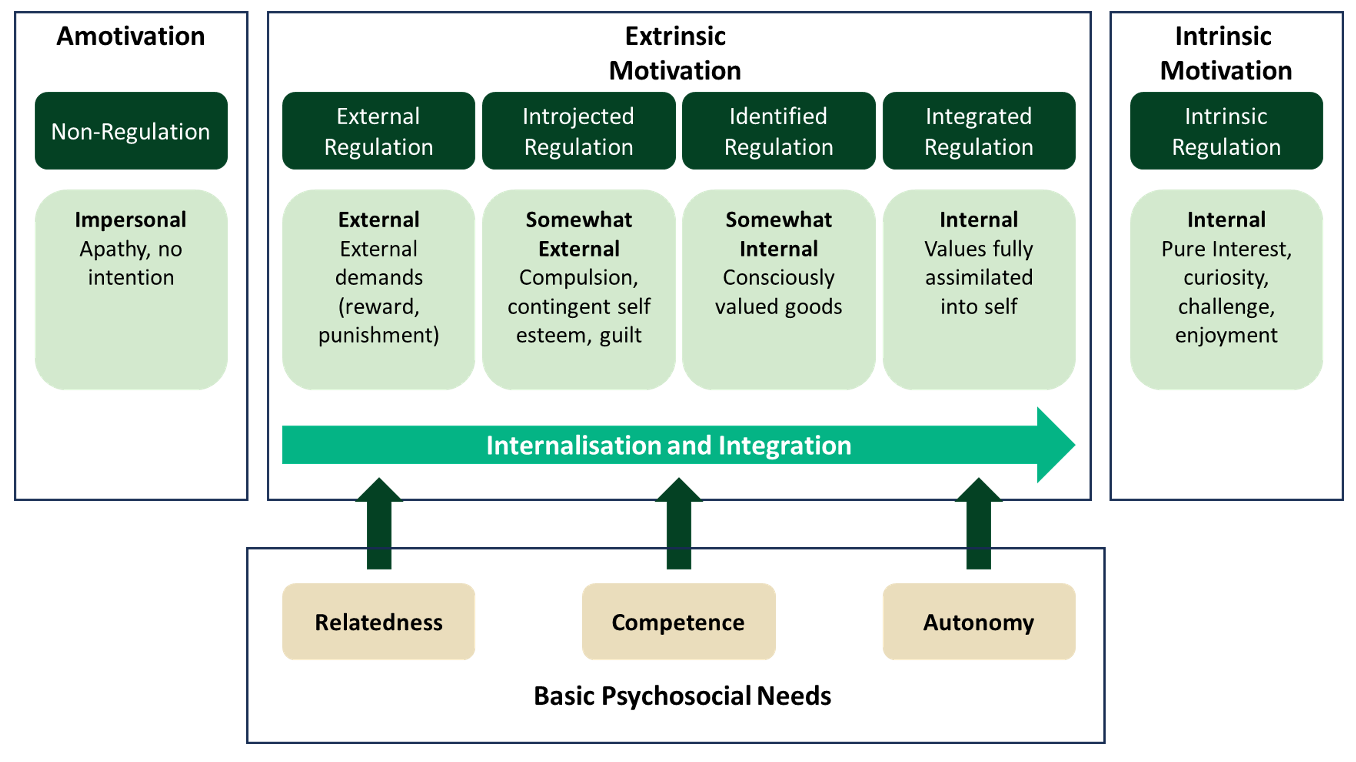
Amotivation occurs primarily when people see no connection between their actions and a desired outcome.20Johnstone, L. & Beusch, P. Motivating sustainable behaviour in the workplace through control. J Manag Control, 1–36; 10.1007/s00187-025-00390-z (2025).141Bandhu, D. et al. Theories of motivation: A comprehensive analysis of human behavior drivers. Acta Psychologica 244, 104177; 10.1016/j.actpsy.2024.104177 (2024).
Extrinsic motivation, otherwise termed controlled motivation, is based on external pressure such as rewards or sanctions, and is often controlled by systems that are results oriented. This form of motivation has been demonstrated to assist in the enforcement of organizational goals; however, it does not take into account the higher needs of individuals.141Bandhu, D. et al. Theories of motivation: A comprehensive analysis of human behavior drivers. Acta Psychologica 244, 104177; 10.1016/j.actpsy.2024.104177 (2024).143Graves, L. M., Sarkis, J. & Zhu, Q. How transformational leadership and employee motivation combine to predict employee proenvironmental behaviors in China. Journal of Environmental Psychology 35, 81–91; 10.1016/j.jenvp.2013.05.002 (2013). This notion has been previously explored in the context of agency theory, wherein extrinsic incentives are employed to address conflicts of interest between principals and agents.130Greiner, M. & Sun, J. How corporate social responsibility can incentivize top managers: A commitment to sustainability as an agency intervention. Corporate Social Responsibility and Environmental Management 28, 1360–1375; 10.1002/csr.2148 (2021). Nevertheless, as illustrated in Figure 1, the presence of extrinsic motivation has been shown to enhance intrinsic motivation, particularly when focusing on the appropriate form of the four extrinsic regulation types. The closer the motivation systems align with personal emotions, goals, and values, the greater an individual’s ability to internalise and integrate them.45Tariq, S., Jan, F. A. & Ahmad, M. S. Green employee empowerment: a systematic literature review on state-of-art in green human resource management. Qual Quant 50, 237–269; 10.1007/s11135-014-0146-0 (2016).141Bandhu, D. et al. Theories of motivation: A comprehensive analysis of human behavior drivers. Acta Psychologica 244, 104177; 10.1016/j.actpsy.2024.104177 (2024).
Intrinsic motivation, also referred to as autonomous motivation, is defined as the congruence between behavior and the personal values, goals and needs of the individual. This phenomenon stems from feelings such as interest, enjoyment, and a sense of purpose inherent in the activity itself.141Bandhu, D. et al. Theories of motivation: A comprehensive analysis of human behavior drivers. Acta Psychologica 244, 104177; 10.1016/j.actpsy.2024.104177 (2024). Employee-oriented control instruments, including participation in decision-making processes, the provision of creative freedom in action, and the implementation of cultural and personnel control mechanisms, such as recognition, have been identified as effective promotional strategies. Intrinsic motivation is particularly desirable in relation to sustainability, as it aims at a long-term impact horizon.20Johnstone, L. & Beusch, P. Motivating sustainable behaviour in the workplace through control. J Manag Control, 1–36; 10.1007/s00187-025-00390-z (2025).30Liu, J. & Liu, J. The greater the incentives, the better the effect? Interactive moderating effects on the relationship between green motivation and green creativity. IJCHM 35, 919–932; 10.1108/IJCHM-03-2022-0340 (2023).141Bandhu, D. et al. Theories of motivation: A comprehensive analysis of human behavior drivers. Acta Psychologica 244, 104177; 10.1016/j.actpsy.2024.104177 (2024). The intrinsic motivation approach is also reflected in stewardship theory, which considers the reason for sustainable action to be internalised within individuals.134Seun, K. J., Esther, I. O. & Wasiu, A. A. Unveiling Stewardship Theory: Emerging Trends and Future Direction.Journal of Business and African Economy 11, 95–112 (2024).
As posited by SDT and shown in Figure 1, three universal basic psychological needs are identified as core elements:
- Autonomy: The feeling of acting of one’s own free will,
- Competence: The feeling of effectiveness and self-efficacy in dealing with challenges,
- Relatedness: The feeling of being connected to others and recognised.142Deci, E. L. & Ryan, R. M. Intrinsic motivation and self-determination in human behavior (Plenum Press, New York, N.Y., 1985).
According to SDT, the occurrence of stable, sustainable, and intrinsically motivated action is contingent upon the satisfaction of these three fundamental needs.141Bandhu, D. et al. Theories of motivation: A comprehensive analysis of human behavior drivers. Acta Psychologica 244, 104177; 10.1016/j.actpsy.2024.104177 (2024). This standpoint posits that the self-motivation of organizational members constitutes the most salient aspect of corporate sustainability.29Rahman, M., Abd Wahab, S. & Abdul Latiff, A. S. The Underlying Theories of Organizational Sustainability: The Motivation Perspective. JBMS 5, 181–193; 10.32996/jbms.2023.5.1.18 (2023). The configuration of incentive systems is therefore pivotal in determining the extent to which the workforce is motivated to align with organizational objectives for a sustainability strategy and to act accordingly.20Johnstone, L. & Beusch, P. Motivating sustainable behaviour in the workplace through control. J Manag Control, 1–36; 10.1007/s00187-025-00390-z (2025).
However, when selecting green incentive types, it is important to bear in mind that external rewards have the potential to supplant intrinsic motivation, thereby demotivating rather than strengthening organizational members who are positively disposed towards green change.39Yin, Y., Wang, Y. & Lu, Y. How to Design Green Compensation to Promote Managers’ Pro-Environmental Behavior? A Goal-Framing Perspective. J Bus Ethics 197, 341–353; 10.1007/s10551-024-05762-4 (2025).132Francoeur, C., Melis, A., Gaia, S. & Aresu, S. Green or Greed? An Alternative Look at CEO Compensation and Corporate Environmental Commitment. Journal of Business Ethics 140, 439–453 (2017). In the event of employees’ performance of environmental tasks being solely motivated by external rewards, there is a possibility of a decline in intrinsic motivation, as this may be interpreted as a signal that the desired behavior is arduous or unattractive.132Francoeur, C., Melis, A., Gaia, S. & Aresu, S. Green or Greed? An Alternative Look at CEO Compensation and Corporate Environmental Commitment. Journal of Business Ethics 140, 439–453 (2017). It is hypothesised that, according to the principles of SDT, monetary incentives have the capacity to replace intrinsic motivation driven by environmental concerns, particularly when they are perceived as a means of control rather than support.30Liu, J. & Liu, J. The greater the incentives, the better the effect? Interactive moderating effects on the relationship between green motivation and green creativity. IJCHM 35, 919–932; 10.1108/IJCHM-03-2022-0340 (2023).144Hewett, R. & Conway, N. The undermining effect revisited: The salience of everyday verbal rewards and self‐determined motivation. Journal of Organizational Behavior 37, 436–455; 10.1002/job.2051 (2016).145Zhang, Y., Luo, Y., Zhang, X. & Zhao, J. How Green Human Resource Management Can Promote Green Employee Behavior in China: A Technology Acceptance Model Perspective. Sustainability 11, 5408; 10.3390/su11195408 (2019). It is therefore always essential to consider the interactive effects between extrinsic and intrinsic motivation in practice.30Liu, J. & Liu, J. The greater the incentives, the better the effect? Interactive moderating effects on the relationship between green motivation and green creativity. IJCHM 35, 919–932; 10.1108/IJCHM-03-2022-0340 (2023).
A further issue with controlled motivation is its instability. The removal of incentives has been demonstrated to result in the immediate discontinuation of the behavior, with no evidence of enduring internalisation.146Ryan, R. M. & Deci, E. L. Self-determination theory. Basic psychological needs in motivation, development, and wellness (The Guilford Press, New York, London, 2018). SDT emphasizes the importance of autonomy-promoting incentive systems that have a short-term controlling effect and can also promote intrinsic or internalised motivation in the long term.147Gagné, M. & Deci, E. L. Self‐determination theory and work motivation. Journal of Organizational Behavior 26, 331–362; 10.1002/job.322 (2005). The long-term internalisation of motivation is of particular relevance to environmental strategies, given that ecological sustainability is always an ongoing process.20Johnstone, L. & Beusch, P. Motivating sustainable behaviour in the workplace through control. J Manag Control, 1–36; 10.1007/s00187-025-00390-z (2025).
Social Identity Theory
In order to facilitate long-term internalisation of motivation, it is necessary to consider a further social-psychological perspective on the effect of organizational incentives on the PEB of organizational members. Social Identity Theory (SIT), as pioneered by Tajfel and Turner (1979), is a psychological behavior theory that proposes that individuals seek to align with positive social groups, as this process reinforces their self-image and consequently enhances their intrinsic motivation.148Tajfel, H. & Turner, J. C. An integrative theory of intergroup conflict. (Brooks/Cole, Monterey, CA, 1979). This, in turn, underscores the significance of relatedness as a fundamental need within the framework of SDT. SIT extends the understanding by incorporating this social connectedness within organizational contexts.149Ribeiro, N., Gomes, D. R., Ortega, E., Gomes, G. P. & Semedo, A. S. The Impact of Green HRM on Employees’ Eco-Friendly Behavior: The Mediator Role of Organizational Identification. Sustainability 14, 2897; 10.3390/su14052897 (2022).150Khan, R. U., Abbasi, M. A., Farhan, A. F. A., Al-sakkaf, M. A. & Singh, K. S. D. Green HRM, organizational identification and sustainable development in the emerging economy: applications from social identity theory.Journal of Economic and Administrative Sciences; 10.1108/JEAS-07-2022-0177 (2023).
In concrete terms, this means that employees perceive their affiliation with an organization as constituting part of their identity, a phenomenon also referred to as organizational identification.150Khan, R. U., Abbasi, M. A., Farhan, A. F. A., Al-sakkaf, M. A. & Singh, K. S. D. Green HRM, organizational identification and sustainable development in the emerging economy: applications from social identity theory.Journal of Economic and Administrative Sciences; 10.1108/JEAS-07-2022-0177 (2023).151Carmeli, A., Brammer, S., Gomes, E. & Tarba, S. Y. An organizational ethic of care and employee involvement in sustainability‐related behaviors: A social identity perspective. Journal of Organizational Behavior 38, 1380–1395; 10.1002/job.2185 (2017). This phenomenon is further reinforced when the organization is perceived as fundamentally positive, as evidenced by a strong sustainability profile and a sense of belonging.29Rahman, M., Abd Wahab, S. & Abdul Latiff, A. S. The Underlying Theories of Organizational Sustainability: The Motivation Perspective. JBMS 5, 181–193; 10.32996/jbms.2023.5.1.18 (2023).149Ribeiro, N., Gomes, D. R., Ortega, E., Gomes, G. P. & Semedo, A. S. The Impact of Green HRM on Employees’ Eco-Friendly Behavior: The Mediator Role of Organizational Identification. Sustainability 14, 2897; 10.3390/su14052897 (2022). The sense of affiliation with an organization perceived as green can be strengthened by incentive systems that encourage or reward sustainable behavior, thereby eliciting an affective response to organizational sustainability.151Carmeli, A., Brammer, S., Gomes, E. & Tarba, S. Y. An organizational ethic of care and employee involvement in sustainability‐related behaviors: A social identity perspective. Journal of Organizational Behavior 38, 1380–1395; 10.1002/job.2185 (2017). SIT provides a theoretical basis for the positive relationship between selected green incentives, organizational identification and the PEB of organizational members. In this theoretical basis, organizational identification acts as a mediator between incentive systems and the PEB of employees.152Gond, J.-P., El Akremi, A., Swaen, V. & Babu, N. The psychological microfoundations of corporate social responsibility: A person‐centric systematic review. Journal of Organizational Behavior 38, 225–246; 10.1002/job.2170 (2017).153Chaudhary, R. Green Human Resource Management and Employee Green Behavior: An Empirical Analysis.Corporate Social Responsibility and Environmental Management 27, 630–641; 10.1002/csr.1827 (2020). Conversely, green incentives are particularly effective when they lead to strong identification with the company.149Ribeiro, N., Gomes, D. R., Ortega, E., Gomes, G. P. & Semedo, A. S. The Impact of Green HRM on Employees’ Eco-Friendly Behavior: The Mediator Role of Organizational Identification. Sustainability 14, 2897; 10.3390/su14052897 (2022).
However, within the context of organizational social identity, it is important to note that individuals possess multiple identities (occupation, department, gender, etc.) which have the potential to conflict. These other identities have the capacity to compete with organizational identification and thus suppress sustainable behavior.154Ashforth, B. E. & Mael, F. Social Identity Theory and the Organization. AMR 14, 20; 10.2307/258189 (1989). Consequently, there is a necessity to initiate a shift towards a more environmentally conscious culture at an early stage in order to avoid such identity conflicts.155Roscoe, S., Subramanian, N., Jabbour, C. J. & Chong, T. Green human resource management and the enablers of green organisational culture: Enhancing a firm’s environmental performance for sustainable development. Bus Strat Env 28, 737–749; 10.1002/bse.2277 (2019).
Social-Exchange Theory
While the SIT places primary focus on intrinsic motivation, arising from the personal relationship of organizational members with their organization, Social Exchange Theory provides an alternate theoretical perspective, deepening the phenomenon of extrinsic motivation. This psychological behavior theory based on the work from Homans (1958) provides a comprehensive explanation of the basic functioning of incentives for sustainability from the perspective of the target groups.65Ahuja, J., Yadav, M. & Sergio, R. P. Green leadership and pro-environmental behaviour: a moderated mediation model with rewards, self-efficacy and training. International Journal of Ethics and Systems 39, 481–501; 10.1108/IJOES-02-2022-0041 (2023).156Paillé, P., Sanchez-Famoso, V., Valéau, P., Ren, S. & Mejia-Morelos, J. H. Green HRM through social exchange revisited: when negotiated exchanges shape cooperation. The International Journal of Human Resource Management 34, 3277–3307; 10.1080/09585192.2022.2117992 (2023).157Homans, G. C. Social Behavior as Exchange. American Journal of Sociology 63, 597–606 (1958). The theory elaborates on the element of the contract between the two parties in the context of the principal-agent model by alluding to mutual obligations and thereby enhancing the social interactions between principals and agents.158Memon, K. R., Ghani, B. & Khalid, S. The relationship between corporate social responsibility and employee engagement: A social exchange perspective. International Journal of Business Science & Applied Management (IJBSAM) 15, 1–16 (2020).
The investment by companies or company managers in their workforce through incentive measures to promote PEB is known to result in appreciation on the part of the workforce. Evidently members of the organization experience support through monetary rewards, as well as trust, further development and appreciation. These rewards are manifested in investments in their own well-being.159Piwowar-Sulej, K., Iqbal, Q., Dagar, V. & Singh, S. Employees’ eco-friendly innovative behaviors: Examining the role of individual and situational factors. European Management Journal; 10.1016/j.emj.2024.04.005 (2024). This dynamic, in turn, fosters the concept of reciprocity, whereby the target group is motivated to reciprocate the gesture and repays the favor through the desired PEB.112Liu, M., Zhao, J. & Liu, H. Digital transformation, employee and executive compensation, and sustained green innovation. International Review of Financial Analysis 97, 103873; 10.1016/j.irfa.2024.103873 (2025).159Piwowar-Sulej, K., Iqbal, Q., Dagar, V. & Singh, S. Employees’ eco-friendly innovative behaviors: Examining the role of individual and situational factors. European Management Journal; 10.1016/j.emj.2024.04.005 (2024).160Chiarini, A. & Bag, S. Using green human resource management practices to achieve green performance: Evidence from Italian manufacturing context. Bus Strat Env 33, 4694–4707; 10.1002/bse.3724 (2024). The establishment of a reciprocal relationship between the two parties has been demonstrated to engender heightened environmental awareness, commitment and satisfaction.160Chiarini, A. & Bag, S. Using green human resource management practices to achieve green performance: Evidence from Italian manufacturing context. Bus Strat Env 33, 4694–4707; 10.1002/bse.3724 (2024). Psychological conditions such as trust and fairness are emphasized as being pivotal to the success of incentive measures and as a basis for reciprocity. In addition to the extrinsic motivation provided by the measures, these conditions have been shown to trigger an intrinsic interest in implementing sustainability within the company among employees.159Piwowar-Sulej, K., Iqbal, Q., Dagar, V. & Singh, S. Employees’ eco-friendly innovative behaviors: Examining the role of individual and situational factors. European Management Journal; 10.1016/j.emj.2024.04.005 (2024). For instance, if employees feel supported by their superiors, this can further strengthen their intrinsic motivation, and, based on the principle of reciprocity, some employees may voluntarily engage in environmentally related actions.71Paillé, P., Chen, Y., Boiral, O. & Jin, J. The Impact of Human Resource Management on Environmental Performance: An Employee-Level Study. Journal of Business Ethics 121, 451–466; 10.1007/s10551-013-1732-0 (2014).159Piwowar-Sulej, K., Iqbal, Q., Dagar, V. & Singh, S. Employees’ eco-friendly innovative behaviors: Examining the role of individual and situational factors. European Management Journal; 10.1016/j.emj.2024.04.005 (2024). This phenomenon of these actions beyond what the company expects in return for the incentives describes a behavior that is addressed by the following theory.
Norm Activation Model
Finally, the Norm Activation Model (NAM) will be employed to demonstrate the distinctive function that sustainability performs as an ethically charged topic within the context of motivation. The model provides a complementary perspective on PEB by emphasising personal norms and moral responsibility as key drivers of PEB.61Hnin, S. W., Javed, A., Karnjana, J., Jeenanunta, C. & Kohda, Y. Workplace sustainability: energy-saving behaviors in office environments of Thailand. Front. Psychol. 16, 1400410; 10.3389/fpsyg.2025.1400410 (2025).161Ostertag, F. Integrating OCBE Literature and Norm Activation Theory: A Moderated Mediation on Proenvironmental Behavior of Employees. Sustainability 15, 7605; 10.3390/su15097605 (2023). This psychological behavior theory from Schwartz (1977) is founded on three core constructs, each of which is elaborated briefly in the context of PEB:
- Awareness of consequences: Awareness of the negative consequences of environmentally harmful behavior,
- Ascription of responsibility: The individual sense of responsibility for these consequences,
- Personal norms: The moral commitment to environmentally friendly behavior, which acts as a motivational force.162Zhang, Y., Wang, Z. & Zhou, G. Antecedents of employee electricity saving behavior in organizations: An empirical study based on norm activation model. Energy Policy 62, 1120–1127; 10.1016/j.enpol.2013.07.036 (2013).
This sequence of effects, from awareness to assumption of responsibility to moral norms, can be regarded as the internal activation mechanism for PEB.162Zhang, Y., Wang, Z. & Zhou, G. Antecedents of employee electricity saving behavior in organizations: An empirical study based on norm activation model. Energy Policy 62, 1120–1127; 10.1016/j.enpol.2013.07.036 (2013). This approach is also evident in the professional environment, where a sense of moral responsibility, in conjunction with social norms, has been shown to significantly influence employees’ willingness to engage in resource-saving behavior.161Ostertag, F. Integrating OCBE Literature and Norm Activation Theory: A Moderated Mediation on Proenvironmental Behavior of Employees. Sustainability 15, 7605; 10.3390/su15097605 (2023).163Tverskoi, D. et al. Energy saving at work: Understanding the roles of normative values and perceived benefits and costs in single-person and shared offices in the United States. Energy Research & Social Science 79, 102173; 10.1016/j.erss.2021.102173 (2021).164Kotsopoulos, D., Bardaki, C. & Pramatari, K. How to motivate employees towards organizational energy conservation: Insights based on employees perceptions and an IoT-enabled gamified IS intervention. Heliyon 9, e16314; 10.1016/j.heliyon.2023.e16314 (2023). This commitment, which extends beyond the expectations of the company, is also referred to in the literature as Organisational Citizenship Behaviour for the Environment.71Paillé, P., Chen, Y., Boiral, O. & Jin, J. The Impact of Human Resource Management on Environmental Performance: An Employee-Level Study. Journal of Business Ethics 121, 451–466; 10.1007/s10551-013-1732-0 (2014).165Temminck, E., Mearns, K. & Fruhen, L. Motivating Employees towards Sustainable Behaviour. Bus Strat Env 24, 402–412; 10.1002/bse.1827 (2015). It is apparent that this behavior promotes novel environmental innovations and increases the effectiveness of incentive systems.165Temminck, E., Mearns, K. & Fruhen, L. Motivating Employees towards Sustainable Behaviour. Bus Strat Env 24, 402–412; 10.1002/bse.1827 (2015).166Malik, S. Y. et al. Corporate Social Responsibility, Green Human Resources Management, and Sustainable Performance: Is Organizational Citizenship Behavior towards Environment the Missing Link? Sustainability 13, 1044; 10.3390/su13031044 (2021). Furthermore, it facilitates the implementation of EMS, such as the ISO 14001 standard.167Roy, M.-J., Boiral, O. & Paillé, P. Pursuing quality and environmental performance. Business Process Mgmt Journal 19, 30–53; 10.1108/14637151311294859 (2013). Although organizational citizenship behavior is not directly triggered by monetary incentives, it can be promoted through strategic human resource management measures such as environmental training and cultural integration.71Paillé, P., Chen, Y., Boiral, O. & Jin, J. The Impact of Human Resource Management on Environmental Performance: An Employee-Level Study. Journal of Business Ethics 121, 451–466; 10.1007/s10551-013-1732-0 (2014). As with SIT, management role models and consistency of ethical beliefs have been shown to be effective drivers.168Ramus, C. A. Organizational Support for Employees: Encouraging Creative Ideas for Environmental Sustainability.California Management Review 43, 85–105; 10.2307/41166090 (2001).
However, it is important to note that this theory only refers to external organizational factors to a limited extent. Even though NAM, when employed in conjunction with OCBE, has been demonstrated to address intrinsic motivation and expand it to encompass the aspect of moral responsibility, it is important to acknowledge its limitations with regard to external organizational factors.169Zhang, Y., Fu, B., Maani, S. & Le Wen. Employee energy-saving behaviors: Review of theories, influencing factors, and interventions. Renewable and Sustainable Energy Reviews 203, 114766; 10.1016/j.rser.2024.114766 (2024). Accordingly, NAM has limited applicability to the design of incentive systems for sustainability in more complex workplace contexts.61Hnin, S. W., Javed, A., Karnjana, J., Jeenanunta, C. & Kohda, Y. Workplace sustainability: energy-saving behaviors in office environments of Thailand. Front. Psychol. 16, 1400410; 10.3389/fpsyg.2025.1400410 (2025). It should always be used in conjunction with other theoretical models. However, it is imperative to consider the impact of the interaction between intrinsic motivation and the emotional and normative components of sustainability when implementing green incentive systems.108AlKetbi, A. & Rice, J. The Impact of Green Human Resource Management Practices on Employees, Clients, and Organizational Performance: A Literature Review. Administrative Sciences 14, 78; 10.3390/admsci14040078 (2024).
2.3.2.2 Organisational-level theories
The behavioural and motivational psychological perspectives presented in this study offer a framework for examining the impact of green incentive systems on PEB, thereby highlighting the multifaceted nature of human motivation. Together with the different dimensions of ecological and economical sustainability it emphasizes the necessity for a holistic understanding. This also includes the consideration of incentive systems for sustainability from an organizational perspective, the primary aim of which is to improve EP.71Paillé, P., Chen, Y., Boiral, O. & Jin, J. The Impact of Human Resource Management on Environmental Performance: An Employee-Level Study. Journal of Business Ethics 121, 451–466; 10.1007/s10551-013-1732-0 (2014).155Roscoe, S., Subramanian, N., Jabbour, C. J. & Chong, T. Green human resource management and the enablers of green organisational culture: Enhancing a firm’s environmental performance for sustainable development. Bus Strat Env 28, 737–749; 10.1002/bse.2277 (2019).
Evidently there are different studies in the extant literature on sustainable incentives that consider the different concepts together and attempt to combine the economic and ecological perspectives using integrative approaches such as GHRM and the Ability-Motivation-Opportunity (AMO) model.
Green Human Resource Management
A thorough review of the extant literature reveals that GRHM can be regarded as the most substantial and advanced body of literature at the organizational level in terms of incentive systems for sustainability. As this is a broad topic whose complete presentation would exceed the theoretical focus of this thesis, a comprehensive presentation of the topic will not be provided. Consequently, the following section primarily focuses on incentive-oriented GHRM practices and their interactions with the relevant sustainability dimensions.
GHRM is essentially defined by Renwick et al. (2013) as the “[…] HRM aspects of environmental management […]” (p. 1).36Renwick, D. W., Redman, T. & Maguire, S. Green Human Resource Management: A Review and Research Agenda*. Int J Management Reviews 15, 1–14; 10.1111/j.1468-2370.2011.00328.x (2013). GHRM is linked to an organization’s environmental goals via classic human resource practices, with the purpose of promoting PEB and EP.37Arulrajah, A. A., Opatha, H. & Nawaratne, N. Green Human Resource Management Practices: A Review. SLJHRM 5 (2015).
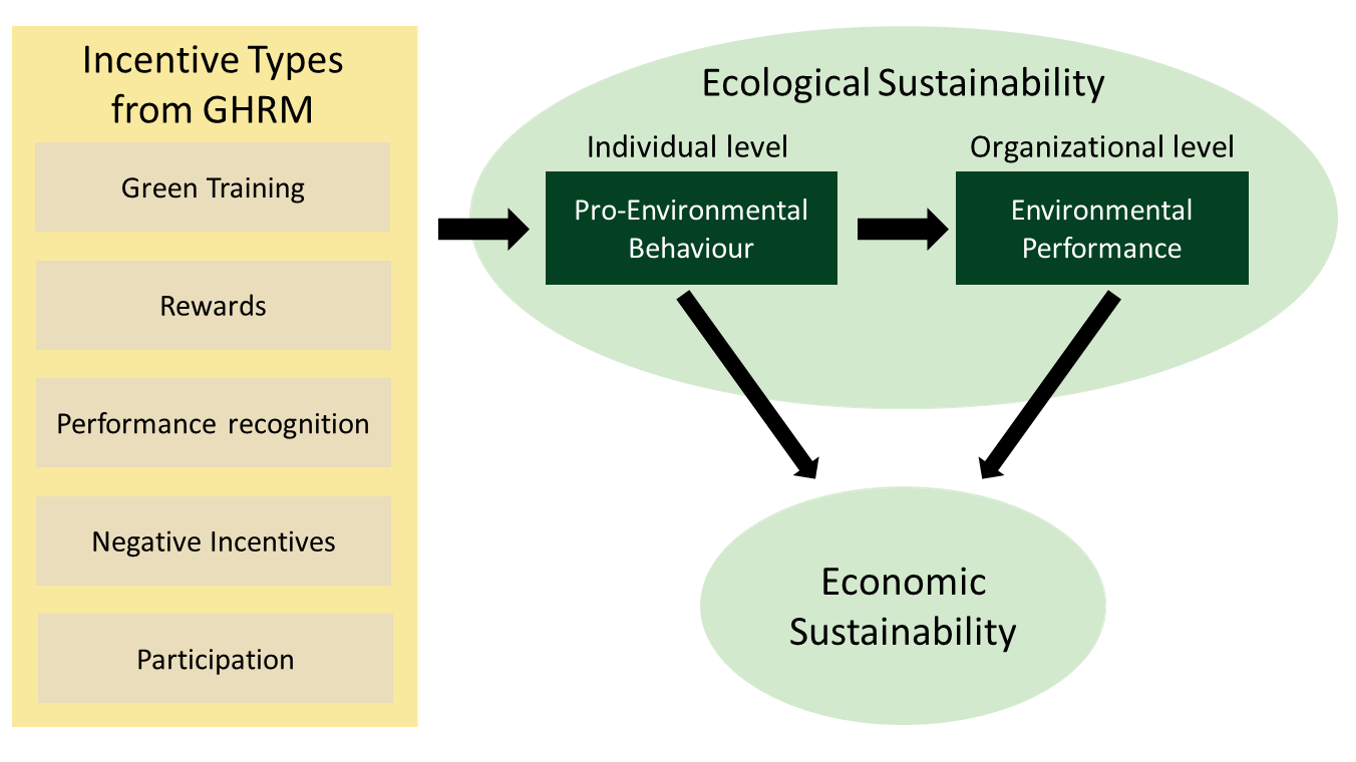
As demonstrated in this paper, the majority of these practices are represented by the green incentive systems that are the subject of discussion in this thesis.24Amrutha, V. N. & Geetha, S. N. A systematic review on green human resource management: Implications for social sustainability. Journal of Cleaner Production 247, 119131; 10.1016/j.jclepro.2019.119131 (2020).37Arulrajah, A. A., Opatha, H. & Nawaratne, N. Green Human Resource Management Practices: A Review. SLJHRM 5 (2015).170Birbirsa, Z. & Worku, M. Green Human Resource Management: A Systematic Literature Review and Future Research Directions. IJOL 11, 357–383; 10.33844/ijol.2022.60334 (2022). As illustrated by Figure 2, members of an organization are systematically empowered to engage in PEB through incentive systems such as rewards, green training, performance recognition, negative incentives and participatory processes.24Amrutha, V. N. & Geetha, S. N. A systematic review on green human resource management: Implications for social sustainability. Journal of Cleaner Production 247, 119131; 10.1016/j.jclepro.2019.119131 (2020).36Renwick, D. W., Redman, T. & Maguire, S. Green Human Resource Management: A Review and Research Agenda*. Int J Management Reviews 15, 1–14; 10.1111/j.1468-2370.2011.00328.x (2013). For instance, members of organizations demonstrate increased levels of engagement in environmental initiatives, adopt practices that conserve energy and paper, and transition to more sustainable modes of transportation.98Renwick, D., Redman, T. & Maguire, S. Green HRM: A review, process model, and research agenda. University of Sheffield Management School Discussion Paper 1, 1–46 (2008).
As discussed in Chapter 3.1.2, the concept of organizational sustainability in the form of EP is influenced by PEB.27Aftab, J., Abid, N., Cucari, N. & Savastano, M. Green human resource management and environmental performance: The role of green innovation and environmental strategy in a developing country. Bus Strat Env 32, 1782–1798; 10.1002/bse.3219 (2023).28Ojo, A. O., Tan, C. N.-L. & Alias, M. Linking green HRM practices to environmental performance through pro-environment behaviour in the information technology sector. Social Responsibility Journal 18, 1–18; 10.1108/SRJ-12-2019-0403 (2022). The proactive behavior of employees leads to long-term sustainable stability and a reduction in the ecological footprint of organizations.71Paillé, P., Chen, Y., Boiral, O. & Jin, J. The Impact of Human Resource Management on Environmental Performance: An Employee-Level Study. Journal of Business Ethics 121, 451–466; 10.1007/s10551-013-1732-0 (2014). The utilisation of GHRM practices has been demonstrated to contribute to a decreased emission of CO₂, reduced waste, and the conception of new sustainable products and green innovations.27Aftab, J., Abid, N., Cucari, N. & Savastano, M. Green human resource management and environmental performance: The role of green innovation and environmental strategy in a developing country. Bus Strat Env 32, 1782–1798; 10.1002/bse.3219 (2023).171Sampene, A. K., Li, C. & Esther Agyeiwaa, O. Green human resource to stimulate low carbon behaviour through the mediation role of innovation practices and organizational commitment. International Journal of Innovation Studies 8, 364–380; 10.1016/j.ijis.2024.09.001 (2024).
Moreover, economic sustainability is also encompassed within the framework of GHRM. This perspective aligns with the principles outlined by NRBV, which asserts that the EP of individuals and organizations, as promoted by GHRM incentives, contributes to enhanced financial performance and competitiveness.172Agyabeng-Mensah, Y. & Tang, L. The relationship among green human capital, green logistics practices, green competitiveness, social performance and financial performance. Journal of Manufacturing Technology Management 32, 1377–1398; 10.1108/JMTM-11-2020-0441 (2021). Evidently GHRM practices have the capacity to indirectly enhance economic sustainability through the channels of PEB and EP. This encompasses green innovations such as efficiency gains and lower production costs at the organizational level.173Ramus, C. A. & Steger, U. The Roles of Supervisory Support Behaviors and Environmental Policy in Employee “Ecoinitiatives” at Leading-Edge European Companies. AMJ 43, 605–626; 10.5465/1556357 (2000). At the individual level, the possession of intangible ecological knowledge resources by employees can act as a competitive advantage for the company.145Zhang, Y., Luo, Y., Zhang, X. & Zhao, J. How Green Human Resource Management Can Promote Green Employee Behavior in China: A Technology Acceptance Model Perspective. Sustainability 11, 5408; 10.3390/su11195408 (2019). Furthermore, there is a general improvement in employee performance that can act as a driver for economic sustainability.174Saputro, A. & Nawangsari, L. C. The Effect of Green Human Resource Management on Organization Citizenship Behaviour for Environment (OCBE) and Its Implications on Employee Performance at Pt Andalan Bakti Niaga.EJBMR 6, 174–181; 10.24018/ejbmr.2021.6.1.716 (2021).
In addition to the direct interactions of incentives shown in Figure 2, the present literature also discusses the influence of GHRM on corporate culture. As previously emphasized in the SIT in Chapter 3.3.2, the identification of the organization’s members with their company plays a pivotal role in the success of green incentives. The implementation of GHRM as a foundational human resource management system has been demonstrated to exert a profound influence on the cultural landscape of corporate entities.155Roscoe, S., Subramanian, N., Jabbour, C. J. & Chong, T. Green human resource management and the enablers of green organisational culture: Enhancing a firm’s environmental performance for sustainable development. Bus Strat Env 28, 737–749; 10.1002/bse.2277 (2019). As Arulrajah et al. (2015) demonstrate, values such as environmental responsibility, as well as a general awareness and commitment, are actively promoted.37Arulrajah, A. A., Opatha, H. & Nawaratne, N. Green Human Resource Management Practices: A Review. SLJHRM 5 (2015). The literature repeatedly emphasizes that GHRM, as a structured and strategic framework, strengthens both employees’ identification with the organization and their PEB.114Ren, S., Tang, G. & Jackson, S. E. Effects of Green HRM and CEO ethical leadership on organizations’ environmental performance. IJM 42, 961–983; 10.1108/IJM-09-2019-0414 (2021).149Ribeiro, N., Gomes, D. R., Ortega, E., Gomes, G. P. & Semedo, A. S. The Impact of Green HRM on Employees’ Eco-Friendly Behavior: The Mediator Role of Organizational Identification. Sustainability 14, 2897; 10.3390/su14052897 (2022).175Kim, Y. J., Kim, W. G., Choi, H.-M. & Phetvaroon, K. The effect of green human resource management on hotel employees’ eco-friendly behavior and environmental performance. International Journal of Hospitality Management 76, 83–93; 10.1016/j.ijhm.2018.04.007 (2019). The integration of environmental sustainability into the organizational identity through GHRM has been demonstrated to exert a positive influence on job satisfaction and, consequently, on employee retention.60Hameed Aldulaimi, S., Mohammed Yousif Abo Keir & Abdeldayem, M. M. Implementing Green Human Resources Management to Promote Sustainability Development: Application from Telecommunication Companies in Kingdom of Bahrain. Journal of Statistics Applications & Probability 11, 321–330; 10.18576/jsap/110125 (2022).120Hassanein, F. et al. Green Human Resource Management and Employee Retention in the Hotel Industry of UAE: The Mediating Effect of Green Innovation. Sustainability 16, 4668; 10.3390/su16114668 (2024). This fosters a sense of fulfillment among employees, as they perceive their contributions to environmental protection to be both functional and responsible.170Birbirsa, Z. & Worku, M. Green Human Resource Management: A Systematic Literature Review and Future Research Directions. IJOL 11, 357–383; 10.33844/ijol.2022.60334 (2022).
In conclusion, it is evident that GHRM integrates the sustainability dimensions of incentive systems, thereby facilitating a comprehensive understanding of the theoretical underpinnings of green incentives and their influences at the organizational and individual levels. It encompasses personnel policy measures in the form of green incentives with the aim of promoting PEB in order to achieve the overarching goal of improving EP in the long term. Simultaneously, GHRM employs these measures to generate knowledge capital and unparalleled competitive advantages based on NRBV, which culminate in long-term economic sustainability. The only element absent from this model is the integration of specific psychological perspectives. Consequently, the AMO theory is presented below as a complementary organizational framework to GHRM.
Ability-Motivation-Opportunity Theory
The AMO Theory according to Appelbaum (2000) provides a more profound insight into the organizational domains of action and the functionality of the various incentive types for sustainability.176Miah, M., Szabó-Szentgróti, G. & Walter, V. A systematic literature review on green human resource management (GHRM): an organizational sustainability perspective. Cogent Business & Management 11, 2371983; 10.1080/23311975.2024.2371983 (2024).177Appelbaum, E. Manufacturing advantage. Why high performance work systems pay off. 1st ed. (Cornell University Press, Ithaca, NY, 2000). Derived from classical human resource management theory, the model posits that the performance of employees and organizations is determined by the interaction of ability, motivation and opportunity.177Appelbaum, E. Manufacturing advantage. Why high performance work systems pay off. 1st ed. (Cornell University Press, Ithaca, NY, 2000). It is only when all three of these behavioural concepts are provided and coordinated by the organization that optimal performance can be achieved.108AlKetbi, A. & Rice, J. The Impact of Green Human Resource Management Practices on Employees, Clients, and Organizational Performance: A Literature Review. Administrative Sciences 14, 78; 10.3390/admsci14040078 (2024).122Rayner, J. & Morgan, D. An empirical study of ‘green’ workplace behaviours: ability, motivation and opportunity.Asia Pacific Journal of Human Resources 56, 56–78; 10.1111/1744-7941.12151 (2018).
The successful implementation of the AMO framework and its constituent elements is dependent on the structural adaptation of the company and its organizational culture. The company is responsible for establishing the appropriate framework conditions that enable and support sustainable behavior.178Ercantan, O. & Eyupoglu, S. How Do Green Human Resource Management Practices Encourage Employees to Engage in Green Behavior? Perceptions of University Students as Prospective Employees. Sustainability 14, 1718; 10.3390/su14031718 (2022). Consequently, AMO theory can be applied with particular success in the GHRM context.106Obereder, L., Müller-Camen, M. & Renwick, D. W. S. GHRM in Sustainability Reporting: An Exploratory Analysis Across Six Countries Using the AMO Framework. Green Human Resource Management Research, 141–166; 10.1007/978-3-031-06558-3_7 (2022). This is further demonstrated in Figure 3, which integrates the AMO framework into the overview of how green incentives from GHRM function.
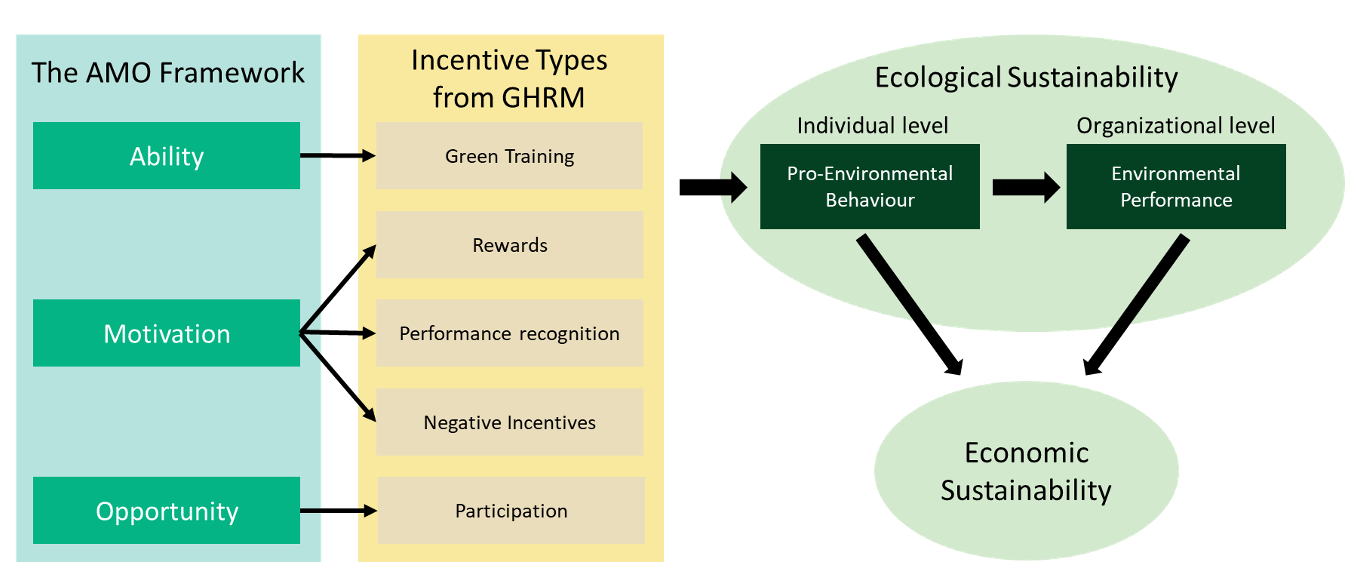
The initial component, entitled Ability, signifies the competencies, proficiencies and qualifications of organizational members. In the context of GHRM, this is primarily supported by the incentive of green training for the targeted development of environmental competence. Environmental training programs have been developed to equip organizational members with the necessary skills to recognize and manage environmental problems, and to facilitate a comprehensive understanding of the correlation between environmental issues and their own work activities.106Obereder, L., Müller-Camen, M. & Renwick, D. W. S. GHRM in Sustainability Reporting: An Exploratory Analysis Across Six Countries Using the AMO Framework. Green Human Resource Management Research, 141–166; 10.1007/978-3-031-06558-3_7 (2022).179Singh, S. K., Del Giudice, M., Chierici, R. & Graziano, D. Green innovation and environmental performance: The role of green transformational leadership and green human resource management. Technological Forecasting and Social Change 150, 119762; 10.1016/j.techfore.2019.119762 (2020).180Mwamburi, G. O., Wangithi, E. W. & Simiyu, A. N. Incentivizing Employee Pro-Environmental Behaviour: Harnessing the Potential of Green Rewards. AJER 4, 601–611-601–611 (2023).
The component motivation is defined as the measures that encourage organizational members to engage in proactive green behavior and implement the organization’s environmental goals. As demonstrated in the relevant literature, this component directly intersects with classic green incentive systems, such as rewards, negative incentives and EP recognition.29Rahman, M., Abd Wahab, S. & Abdul Latiff, A. S. The Underlying Theories of Organizational Sustainability: The Motivation Perspective. JBMS 5, 181–193; 10.32996/jbms.2023.5.1.18 (2023).106Obereder, L., Müller-Camen, M. & Renwick, D. W. S. GHRM in Sustainability Reporting: An Exploratory Analysis Across Six Countries Using the AMO Framework. Green Human Resource Management Research, 141–166; 10.1007/978-3-031-06558-3_7 (2022).178Ercantan, O. & Eyupoglu, S. How Do Green Human Resource Management Practices Encourage Employees to Engage in Green Behavior? Perceptions of University Students as Prospective Employees. Sustainability 14, 1718; 10.3390/su14031718 (2022).
Opportunity represents the final component of the AMO framework. This refers to the provision of opportunities for organizational members to engage in the active participation of sustainability strategies and decision-making processes. Evidently significant incentive mechanisms within the framework of GHRM encompass employee empowerment, notably in the context of environmental initiatives.29Rahman, M., Abd Wahab, S. & Abdul Latiff, A. S. The Underlying Theories of Organizational Sustainability: The Motivation Perspective. JBMS 5, 181–193; 10.32996/jbms.2023.5.1.18 (2023).106Obereder, L., Müller-Camen, M. & Renwick, D. W. S. GHRM in Sustainability Reporting: An Exploratory Analysis Across Six Countries Using the AMO Framework. Green Human Resource Management Research, 141–166; 10.1007/978-3-031-06558-3_7 (2022).
When designing green incentive systems, it is imperative that they are not conceived in a one-dimensional manner, particularly at the organizational level. A focus on extrinsic rewards as the sole motivator has the potential to be counterproductive if there is an absence of concomitant skill development and opportunities for participation.132Francoeur, C., Melis, A., Gaia, S. & Aresu, S. Green or Greed? An Alternative Look at CEO Compensation and Corporate Environmental Commitment. Journal of Business Ethics 140, 439–453 (2017). The AMO theory is a comprehensive integration of the findings from theories of individual sustainability motivation, which are then applied to organizational implementation processes. The present theory is already being utilised in research to develop integrative models and to expand the three components within the framework of GHRM with further behavioural and motivational psychological approaches, such as the NAM.61Hnin, S. W., Javed, A., Karnjana, J., Jeenanunta, C. & Kohda, Y. Workplace sustainability: energy-saving behaviors in office environments of Thailand. Front. Psychol. 16, 1400410; 10.3389/fpsyg.2025.1400410 (2025).
In summary, it is evident that an integrative GHRM approach, incorporating green incentive systems based on the AMO framework, is designed to establish a nexus between learning and development opportunities, performance-based rewards and employee empowerment through organizational participation. This creates a coherent system that influences individual behavior and promotes the cultural anchoring of sustainability within the company.
2.3.3 Outlook for future research
The multidisciplinary nature of sustainable incentive systems has already prompted contributions from a wide range of scientific fields within the existing literature. This phenomenon is also reflected in the present literature review, which places sustainability through organizational incentive systems in the context of integrated economical sustainability perspectives. Simultaneously, the review considers the topic at the organizational level and in the form of socio-psychological motivation and behavior theories at the individual level.
Despite the numerous scientific perspectives, which necessitate a holistic view of the topic, there is a serious lack of detailed summaries or reviews in the current literature. A review of the available literature (as of 1 August 2025) reveals a lack of scientific papers that provide a comprehensive overview of the interdisciplinary core topics of organizational incentives for sustainability. Approaches based on a more holistic view can only be found sporadically in scientific papers, in which a few types of incentives are explained in more detail and organizational theories are placed in the context of individual behavior pattern.61Hnin, S. W., Javed, A., Karnjana, J., Jeenanunta, C. & Kohda, Y. Workplace sustainability: energy-saving behaviors in office environments of Thailand. Front. Psychol. 16, 1400410; 10.3389/fpsyg.2025.1400410 (2025). However, it should be noted that organizational incentives for sustainability represent only a fraction of the broader picture outlined in these scientific papers, as they do not concentrate specifically on incentive systems. The employment and advancement of a more interdisciplinary approach, exemplified by the AMO framework, which integrates psychology, organizational theory and economic theory, has the potential to facilitate a more comprehensive elucidation of behavioural effects and the operation of incentive systems.20Johnstone, L. & Beusch, P. Motivating sustainable behaviour in the workplace through control. J Manag Control, 1–36; 10.1007/s00187-025-00390-z (2025).26Dahlmann, F., Branicki, L. & Brammer, S. ‘Carrots for Corporate Sustainability’: Impacts of Incentive Inclusiveness and Variety on Environmental Performance. Bus Strat Env 26, 1110–1131; 10.1002/bse.1971 (2017).
This leads to the following observation: that, in general, a greater consideration of the motivational and psychological mechanisms that underpin the impact of sustainability incentives is required in research.19Derchi, G.-B., Davila, A. & Oyon, D. Green incentives for environmental goals. Management Accounting Research 59, 100830; 10.1016/j.mar.2022.100830 (2023). One such example is the “Attitude-Behaviour Gap”, a concept rarely applied in the general organizational context and even less in the research area of green incentives. Yet it is a theory which can offer an interesting perspective, particularly in relation to incentive systems for sustainability, and the difficulties in implementing these systems.181Zhang, Y., Du, J. & Boamah, K. B. Green climate and pro‐environmental behavior: Addressing attitude‐behavior gaps towards promoting sustainable development. Sustainable Development 31, 2428–2445; 10.1002/sd.2520 (2023).
Moreover, future research should broaden the scope of sustainability in relation to incentives. The prevailing focus at present is on ecological and economic metrics, including CO2 emissions, waste reduction, energy efficiency and environmental innovations. Conversely, the social level is underrepresented, even though this perspective has now been firmly integrated into the prevailing understanding of sustainability. Consequently, the topic is regarded from a single perspective, and spillover effects between social and ecological objectives for incentive systems are not considered.19Derchi, G.-B., Davila, A. & Oyon, D. Green incentives for environmental goals. Management Accounting Research 59, 100830; 10.1016/j.mar.2022.100830 (2023).24Amrutha, V. N. & Geetha, S. N. A systematic review on green human resource management: Implications for social sustainability. Journal of Cleaner Production 247, 119131; 10.1016/j.jclepro.2019.119131 (2020).
Ultimately, there is a need for more contextual variables to be included in the research. It is essential to consider the variations in the functionality, types and efficacy of incentives, contingent on industry, geographical location and organizational structure, in order to enhance comprehension in practical contexts. The aforementioned points apply equally to the direct comparison of sustainable incentives for different hierarchical levels and the combinations of monetary and non-monetary incentives, or intrinsic and extrinsic motivation, which are most effective in different organizational contexts.19Derchi, G.-B., Davila, A. & Oyon, D. Green incentives for environmental goals. Management Accounting Research 59, 100830; 10.1016/j.mar.2022.100830 (2023).20Johnstone, L. & Beusch, P. Motivating sustainable behaviour in the workplace through control. J Manag Control, 1–36; 10.1007/s00187-025-00390-z (2025).26Dahlmann, F., Branicki, L. & Brammer, S. ‘Carrots for Corporate Sustainability’: Impacts of Incentive Inclusiveness and Variety on Environmental Performance. Bus Strat Env 26, 1110–1131; 10.1002/bse.1971 (2017).
In summary of this literature review, organizational incentives for sustainability are an effective tool for anchoring and developing sustainability in organizational structures. However, they are still in their infancy, both from a theoretical and scientific perspective and in terms of practical application. The present state of research is characterised by an absence of integrative considerations of the various relevant variables, both in terms of the different theoretical perspectives and in the practice-oriented literature. A key recommendation for future research is to compare different framework conditions for implementation and to develop a more comprehensive understanding of sustainability.
3 Practical implementation – A four-step process
The current state of research into organizational incentives for sustainability does not provide a comprehensive overview of how they are implemented in practice. As previously stated, the subject is novel and, while it is gradually acquiring relevance at the theoretical level, there is a paucity of structured overviews, conventional tools, or clear recommendations for action for the entire process, particularly in practice.
In view of the aforementioned considerations, the subsequent section presents a wholly novel draft of a four-step implementation process for the practical implementation of organizational incentives for sustainability. The theoretical basis for this is the Plan-Do-Check-Act (PDCA) cycle, which is already widely used as a tool for the implementation of new sustainability management processes.182Nguyen, V., Nguyen, N., Schumacher, B. & Tran, T. Practical Application of Plan–Do–Check–Act Cycle for Quality Improvement of Sustainable Packaging: A Case Study. Applied Sciences 10, 6332; 10.3390/app10186332 (2020).183Jovanović, B., Filipović, J. & Bakić, V. Energy management system implementation in Serbian manufacturing – Plan-Do-Check-Act cycle approach. Journal of Cleaner Production 162, 1144–1156; 10.1016/j.jclepro.2017.06.140 (2017).184Prashar, A. Adopting PDCA (Plan-Do-Check-Act) cycle for energy optimization in energy-intensive SMEs. Journal of Cleaner Production 145, 277–293; 10.1016/j.jclepro.2017.01.068 (2017). As posited by Brouwer and van Koppen (2008), the PDCA cycle constitutes the foundational framework for the comprehensive implementation process of the ISO 14001 standard, a EMS that is pivotal in the context of green incentive systems (see Chapter 4.2.1).113Ramus, C. A. Encouraging innovative environmental actions: what companies and managers must do. Journal of World Business 37, 151–164; 10.1016/S1090-9516(02)00074-3 (2002).185Brouwer, M. A. & van Koppen, C. The soul of the machine: continual improvement in ISO 14001. Journal of Cleaner Production 16, 450–457; 10.1016/j.jclepro.2006.08.022 (2008).186Teixeira, A. A., Jabbour, C. J. C. & Jabbour, Ana Beatriz Lopes de Sousa. Relationship between green management and environmental training in companies located in Brazil: A theoretical framework and case studies. International Journal of Production Economics 140, 318–329; 10.1016/j.ijpe.2012.01.009 (2012). The PDCA process was adapted based on the literature reviewed in this thesis, since the individual steps are given different levels of attention in the context of green incentive research. In Figure 4, the alterations made to the PDCA cycle based on the ISO 14001 process are demonstrated and further elaborated on in the following.
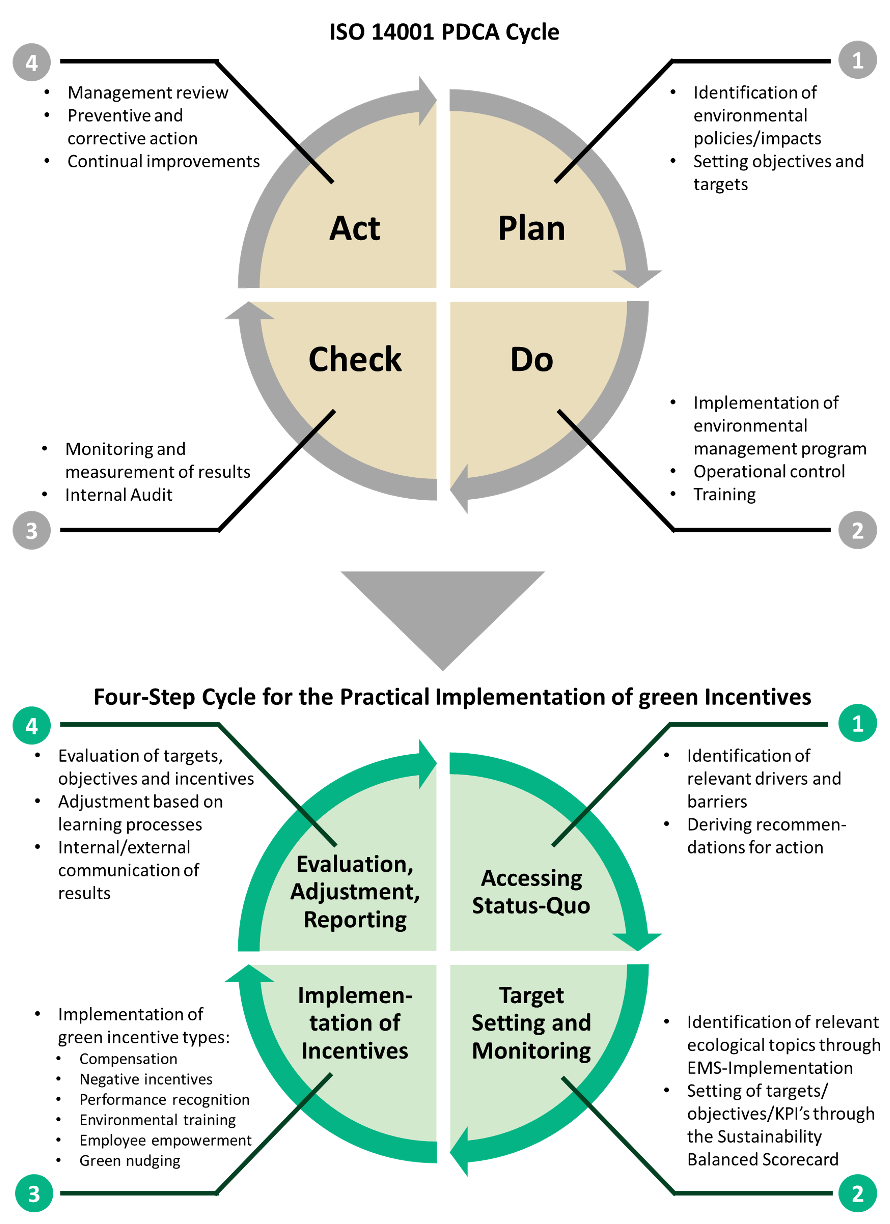
The four-step process begins with an assessment of the status quo, whereby various drivers and barriers are analysed in order to facilitate or enable the subsequent implementation of the following steps. The formulation and internal communication of clear objectives using the ISO 14001 standard and the SBSC, in conjunction with the monitoring, constitute the second step. It is typically the case that both of these steps are encompassed within the Plan-phase of the PDCA cycle.182Nguyen, V., Nguyen, N., Schumacher, B. & Tran, T. Practical Application of Plan–Do–Check–Act Cycle for Quality Improvement of Sustainable Packaging: A Case Study. Applied Sciences 10, 6332; 10.3390/app10186332 (2020). However, in the extant literature on organizational incentive systems for sustainability, these first steps are discussed in such detail that they are considered as two individual steps.
As illustrated in Figure 4, in the third step of the process, the various forms of incentives are examined in depth and categorised according to target demographics and the nature of motivation. Furthermore, the examination is supported by practical examples and case studies, which demonstrate implementation strategies. The selection and implementation of these green incentives can be transferred directly to the Do-phase of the PDCA cycle.182Nguyen, V., Nguyen, N., Schumacher, B. & Tran, T. Practical Application of Plan–Do–Check–Act Cycle for Quality Improvement of Sustainable Packaging: A Case Study. Applied Sciences 10, 6332; 10.3390/app10186332 (2020).
The fourth and final step in this process is the evaluation of the set goals, once again with reference to ISO 14001 and the SBSC. The results of these evaluations are then used to make any necessary adjustments to the implemented incentive systems. In the PDCA cycle this step is typically divided into the Check- (evaluation) and Act- (adjustment) phases.182Nguyen, V., Nguyen, N., Schumacher, B. & Tran, T. Practical Application of Plan–Do–Check–Act Cycle for Quality Improvement of Sustainable Packaging: A Case Study. Applied Sciences 10, 6332; 10.3390/app10186332 (2020). Finally, reporting is elaborated as a concluding element of the fourth step to demonstrate the possibilities for transparent communication of the progress throughout the four-step process. However, as all three aspects are dealt with only very briefly and relatively superficially in current sources on the implementation of organizational incentives for sustainability, they are combined into one step in the context of this thesis.
In addition to recommendations for action derived from extant literature on GHRM, the entire four-step process is also oriented on the example of Interface Inc. The company is a globally renowned manufacturer of modular flooring, with a reputation for its commitment to sustainability, as evidenced by its ambitious environmental objectives and the introduction of innovative sustainability strategies.91DuBose, J. R. Sustainability and Performance at Interface, Inc. Interfaces 30, 190–201; 10.1287/inte.30.3.190.11665 (2000).188Luqmani, A., Leach, M. & Jesson, D. Factors behind sustainable business innovation: The case of a global carpet manufacturing company. Environmental Innovation and Societal Transitions 24, 94–105; 10.1016/j.eist.2016.10.007 (2017).189Stubbs, W. & Cocklin, C. An ecological modernist interpretation of sustainability: the case of Interface Inc. Bus Strat Env 17, 512–523; 10.1002/bse.544 (2008). As early as the mid-1990s, Interface demonstrated a dedication to incorporating green incentives through the implementation of the successful “QUEST” (Quality Utilising Employee Suggestions and Teamwork) incentive program. The implementation of this multifaceted program across all locations was undertaken with the objective of eliminating all types of waste within the company. DuBose (2000) provided a detailed description of the entire process, documenting it thoroughly.91DuBose, J. R. Sustainability and Performance at Interface, Inc. Interfaces 30, 190–201; 10.1287/inte.30.3.190.11665 (2000). Consequently, subsequent sections of the thesis consistently refer to this incentive plan as a best practice example, alongside other practical examples.
3.1 Step One: Assessing Status Quo by determining relevant Barriers and Drivers
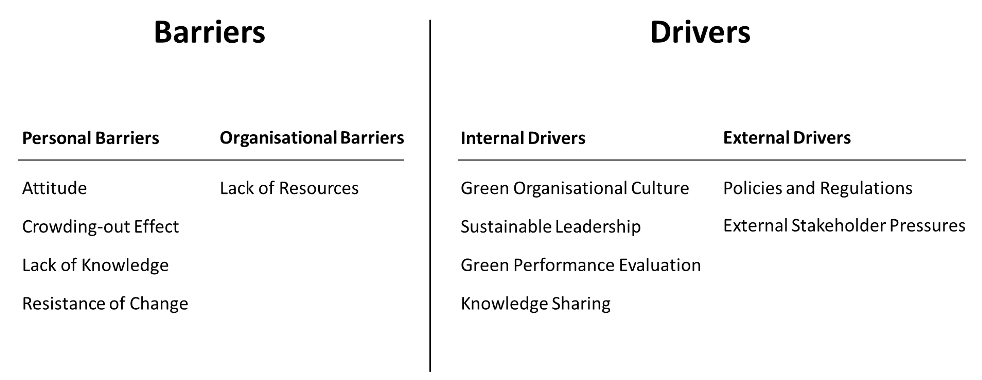
To ensure the successful implementation of sustainability incentives within an organization, it is essential to conduct a status quo analysis of the drivers and barriers. While drivers reveal which internal strengths and opportunities can be leveraged to promote sustainability goals, barriers highlight potential obstacles to success.24Amrutha, V. N. & Geetha, S. N. A systematic review on green human resource management: Implications for social sustainability. Journal of Cleaner Production 247, 119131; 10.1016/j.jclepro.2019.119131 (2020).32Ren, S., Tang, G. & E. Jackson, S. Green human resource management research in emergence: A review and future directions. Asia Pac J Manag 35, 769–803; 10.1007/s10490-017-9532-1 (2018). A comprehensive overview of barriers and drivers is presented in Figure 5. It is important to note that recommendations for action are deliberately excluded at this stage. However, at the conclusion of the first step, four recommendations for action are derived from the previously mentioned drivers and barriers. These should always be considered prior to the use of green incentives. Furthermore, the insights gained can be used to design incentive systems that leverage existing strengths and reduce resistance, therefore enhancing their acceptance.32Ren, S., Tang, G. & E. Jackson, S. Green human resource management research in emergence: A review and future directions. Asia Pac J Manag 35, 769–803; 10.1007/s10490-017-9532-1 (2018).190Matejun, M., Matusiak, B. E. & Różańska-Bińczyk, I. Employee Readiness for GHRM and Its Individual Antecedents: Instrumental and Change-Based Approach. Sustainability 16, 4776; 10.3390/su16114776 (2024).
3.1.1 Barriers
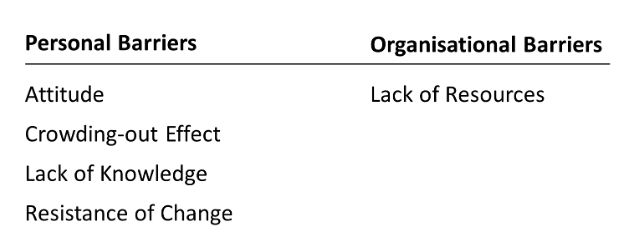
As the literature review has already shown, an increasing number of authors emphasize that, in addition to organizational barriers, a deeper understanding of individual barriers and the behavioural motivation of organizational members is necessary.32Ren, S., Tang, G. & E. Jackson, S. Green human resource management research in emergence: A review and future directions. Asia Pac J Manag 35, 769–803; 10.1007/s10490-017-9532-1 (2018).191Yuriev, A., Boiral, O., Francoeur, V. & Paillé, P. Overcoming the barriers to pro-environmental behaviors in the workplace: A systematic review. Journal of Cleaner Production 182, 379–394; 10.1016/j.jclepro.2018.02.041 (2018). This article therefore adopts the structure of the literature review on organizational sustainability, in which the content of the literature was considered at individual and organizational levels. The categorisation of barriers as either personal or organizational is based on the work of Yuriev et al. (2018), which specifically addresses barriers to PEB.191Yuriev, A., Boiral, O., Francoeur, V. & Paillé, P. Overcoming the barriers to pro-environmental behaviors in the workplace: A systematic review. Journal of Cleaner Production 182, 379–394; 10.1016/j.jclepro.2018.02.041 (2018). The most relevant barriers for green incentives mentioned in this article are presented below and can also be identified within the literature context of green incentives, with further barriers added if necessary. An overview of the barriers can be found in Figure 6.
3.1.1.1 Personal barriers
In the following the identified personal barriers are presented individually. These primarily incorporate behavioural and motivational theories related to the personal behaviors of organizational members.
Attitude
The prevailing personal barrier that has been the subject of research based on the findings of Yuriev et al. (2018) that hinders PEB is Attitude.191Yuriev, A., Boiral, O., Francoeur, V. & Paillé, P. Overcoming the barriers to pro-environmental behaviors in the workplace: A systematic review. Journal of Cleaner Production 182, 379–394; 10.1016/j.jclepro.2018.02.041 (2018). This encompasses an individual’s personal relationship to moral obligations, personal values, and specific ecological attitudes, such as a connection to nature.192Ruepert, A. et al. Environmental considerations in the organizational context: A pathway to pro-environmental behaviour at work. Energy Research & Social Science 17, 59–70; 10.1016/j.erss.2016.04.004 (2016). Intrinsic motivation from SDT has been identified as a key factor in this regard.20Johnstone, L. & Beusch, P. Motivating sustainable behaviour in the workplace through control. J Manag Control, 1–36; 10.1007/s00187-025-00390-z (2025).30Liu, J. & Liu, J. The greater the incentives, the better the effect? Interactive moderating effects on the relationship between green motivation and green creativity. IJCHM 35, 919–932; 10.1108/IJCHM-03-2022-0340 (2023).143Graves, L. M., Sarkis, J. & Zhu, Q. How transformational leadership and employee motivation combine to predict employee proenvironmental behaviors in China. Journal of Environmental Psychology 35, 81–91; 10.1016/j.jenvp.2013.05.002 (2013). This attitude is consistent both in the domestic environment and in the workspace. A negative attitude towards environmental sustainability has been shown to have a significant impact on the willingness to engage in PEB.191Yuriev, A., Boiral, O., Francoeur, V. & Paillé, P. Overcoming the barriers to pro-environmental behaviors in the workplace: A systematic review. Journal of Cleaner Production 182, 379–394; 10.1016/j.jclepro.2018.02.041 (2018). This is particularly evident in the context of motivation through incentives, where conflicting personal attitudes towards an organization’s sustainability goals can result in the emergence of blockages.24Amrutha, V. N. & Geetha, S. N. A systematic review on green human resource management: Implications for social sustainability. Journal of Cleaner Production 247, 119131; 10.1016/j.jclepro.2019.119131 (2020).143Graves, L. M., Sarkis, J. & Zhu, Q. How transformational leadership and employee motivation combine to predict employee proenvironmental behaviors in China. Journal of Environmental Psychology 35, 81–91; 10.1016/j.jenvp.2013.05.002 (2013).
Crowding-out effect
The second barrier is closely related to the aforementioned issue but not mentioned by Yuriev et al. (2018).191Yuriev, A., Boiral, O., Francoeur, V. & Paillé, P. Overcoming the barriers to pro-environmental behaviors in the workplace: A systematic review. Journal of Cleaner Production 182, 379–394; 10.1016/j.jclepro.2018.02.041 (2018). In literature it is named as the Crowding-out Effect. This effect has been frequently discussed in both theory and practice, and the problem has already been briefly described in this thesis in the beginning Chapter 3.3.2 in context of the SDT.30Liu, J. & Liu, J. The greater the incentives, the better the effect? Interactive moderating effects on the relationship between green motivation and green creativity. IJCHM 35, 919–932; 10.1108/IJCHM-03-2022-0340 (2023).39Yin, Y., Wang, Y. & Lu, Y. How to Design Green Compensation to Promote Managers’ Pro-Environmental Behavior? A Goal-Framing Perspective. J Bus Ethics 197, 341–353; 10.1007/s10551-024-05762-4 (2025).132Francoeur, C., Melis, A., Gaia, S. & Aresu, S. Green or Greed? An Alternative Look at CEO Compensation and Corporate Environmental Commitment. Journal of Business Ethics 140, 439–453 (2017). According to the crowding-out effect, individuals may perceive external incentives as controlling, thereby diminishing their sense of autonomy and self-determination.132Francoeur, C., Melis, A., Gaia, S. & Aresu, S. Green or Greed? An Alternative Look at CEO Compensation and Corporate Environmental Commitment. Journal of Business Ethics 140, 439–453 (2017).193Gneezy, U., Meier, S. & Rey-Biel, P. When and Why Incentives (Don’t) Work to Modify Behavior. Journal of Economic Perspectives 25, 191–210; 10.1257/jep.25.4.191 (2011). The actions undertaken by the individuals are not perceived as originating from the individual’s own volition. Rather, they are received as responses to external stimuli such as reward or control.145Zhang, Y., Luo, Y., Zhang, X. & Zhao, J. How Green Human Resource Management Can Promote Green Employee Behavior in China: A Technology Acceptance Model Perspective. Sustainability 11, 5408; 10.3390/su11195408 (2019). This external motivator subsequently supersedes any intrinsic motivation that the individual might have initially possessed.39Yin, Y., Wang, Y. & Lu, Y. How to Design Green Compensation to Promote Managers’ Pro-Environmental Behavior? A Goal-Framing Perspective. J Bus Ethics 197, 341–353; 10.1007/s10551-024-05762-4 (2025). Once the incentive is withdrawn, the probability of PEBs being sustained also declines.39Yin, Y., Wang, Y. & Lu, Y. How to Design Green Compensation to Promote Managers’ Pro-Environmental Behavior? A Goal-Framing Perspective. J Bus Ethics 197, 341–353; 10.1007/s10551-024-05762-4 (2025).143Graves, L. M., Sarkis, J. & Zhu, Q. How transformational leadership and employee motivation combine to predict employee proenvironmental behaviors in China. Journal of Environmental Psychology 35, 81–91; 10.1016/j.jenvp.2013.05.002 (2013). This phenomenon has been demonstrated on multiple occasions in studies examining the impact of monetary rewards.194Lee, M. P. When money fails to talk: unintended consequences of using monetary incentives to elicit sustainable behaviours. In Handbook on the business of sustainability. The organization, implementation, and practice of sustainable growth, edited by G. George, M. R. Haas, H. Joshi, A. M. McGahan & P. Tracey (Edward Elgar Publishing, Cheltenham, Northampton, 2022). Additionally, there is a risk that intrinsic motivation will decrease if external incentives are interpreted as a signal that the targeted behavior is burdensome or unattractive.132Francoeur, C., Melis, A., Gaia, S. & Aresu, S. Green or Greed? An Alternative Look at CEO Compensation and Corporate Environmental Commitment. Journal of Business Ethics 140, 439–453 (2017).
Lack of knowledge
Yuriev et al. (2018) asserts that Lack of Knowledge possesses the second highest nominal value in scientific articles.191Yuriev, A., Boiral, O., Francoeur, V. & Paillé, P. Overcoming the barriers to pro-environmental behaviors in the workplace: A systematic review. Journal of Cleaner Production 182, 379–394; 10.1016/j.jclepro.2018.02.041 (2018). This refers to the lack of awareness among organizational members of how green behaviors can be implemented in practice, an aspect that also plays a central role as a barrier in the context of incentive systems.24Amrutha, V. N. & Geetha, S. N. A systematic review on green human resource management: Implications for social sustainability. Journal of Cleaner Production 247, 119131; 10.1016/j.jclepro.2019.119131 (2020).164Kotsopoulos, D., Bardaki, C. & Pramatari, K. How to motivate employees towards organizational energy conservation: Insights based on employees perceptions and an IoT-enabled gamified IS intervention. Heliyon 9, e16314; 10.1016/j.heliyon.2023.e16314 (2023). Individuals generally tend to avoid situations in which they have too little knowledge to control their behavior and in which uncertainty prevails. This can prevent, for example, the implementation of EMS and associated environmental programs.195Chan, E. S. W. Implementing Environmental Management Systems in Small- and Medium-Sized Hotels: Obstacles.Journal of Hospitality & Tourism Research 35, 3–23; 10.1177/1096348010370857 (2011). Conversely, an individual’s awareness of recycling and associated processes has been identified as a significant predictor of environmentally sustainable behaviors, such as waste segregation.196Chan, E. S., Hon, A. H., Chan, W. & Okumus, F. What drives employees’ intentions to implement green practices in hotels? The role of knowledge, awareness, concern and ecological behaviour. International Journal of Hospitality Management 40, 20–28; 10.1016/j.ijhm.2014.03.001 (2014).
Resistance to change
A final significant barrier is Resistance to Change.197Nejati, M., Rabiei, S. & Chiappetta Jabbour, C. J. Envisioning the invisible: Understanding the synergy between green human resource management and green supply chain management in manufacturing firms in Iran in light of the moderating effect of employees’ resistance to change. Journal of Cleaner Production 168, 163–172; 10.1016/j.jclepro.2017.08.213 (2017).198van Dijk, R. & van Dick, R. Navigating Organizational Change: Change Leaders, Employee Resistance and Work-based Identities. Journal of Change Management 9, 143–163; 10.1080/14697010902879087 (2009). As previously outlined in SIT, individuals align their personal values with those of their organization. If incentives force a change in this organizational identity, it can lead to resistance within an organization’s workforce.197Nejati, M., Rabiei, S. & Chiappetta Jabbour, C. J. Envisioning the invisible: Understanding the synergy between green human resource management and green supply chain management in manufacturing firms in Iran in light of the moderating effect of employees’ resistance to change. Journal of Cleaner Production 168, 163–172; 10.1016/j.jclepro.2017.08.213 (2017).199Shamaila Gull & Hafsa Rehman. Impact of Green Training on Ecological Sustainability in the Presence of Employee Resistance as a Moderator: Evidence from Textile Sector of Pakistan. PJEAS 30 (2022). Organisational change, especially of a structural or cultural nature, as it is the case with sustainability transformation using incentives, can directly threaten identification with the company and thus acceptance due to the loss of status or belonging.200Lozano, R. Resistance to Sustainability Change in Organisations and Strategies to Overcome It. Organisational Change Management for Sustainability, 129–156; 10.1007/978-3-031-59622-3_8 (2024). This can potentially have negative consequences, including the disparagement of groups that advocate for sustainable change and accept the new green incentives, as well as active resistance and resignation.199Shamaila Gull & Hafsa Rehman. Impact of Green Training on Ecological Sustainability in the Presence of Employee Resistance as a Moderator: Evidence from Textile Sector of Pakistan. PJEAS 30 (2022).200Lozano, R. Resistance to Sustainability Change in Organisations and Strategies to Overcome It. Organisational Change Management for Sustainability, 129–156; 10.1007/978-3-031-59622-3_8 (2024). This phenomenon has been explored in the study by Yuriev et al. (2018), who framed it in the contexts of social norms and unwillingness to change habits.191Yuriev, A., Boiral, O., Francoeur, V. & Paillé, P. Overcoming the barriers to pro-environmental behaviors in the workplace: A systematic review. Journal of Cleaner Production 182, 379–394; 10.1016/j.jclepro.2018.02.041 (2018). The term social norms is employed to denote the shared perception of employees regarding the standard behavior that is considered to be “normal” in the context of environmental issues.191Yuriev, A., Boiral, O., Francoeur, V. & Paillé, P. Overcoming the barriers to pro-environmental behaviors in the workplace: A systematic review. Journal of Cleaner Production 182, 379–394; 10.1016/j.jclepro.2018.02.041 (2018). In the absence of a standardised environmental consciousness within a team or organization, members may be reluctant to adopt and demonstrate appropriate behaviors.201Pinzone, M., Guerci, M., Lettieri, E. & Redman, T. Progressing in the change journey towards sustainability in healthcare: the role of ‘Green’ HRM. Journal of Cleaner Production 122, 201–211; 10.1016/j.jclepro.2016.02.031 (2016). The context of unwillingness to change habits refers to the notion that established routines can impede behavioural modification.191Yuriev, A., Boiral, O., Francoeur, V. & Paillé, P. Overcoming the barriers to pro-environmental behaviors in the workplace: A systematic review. Journal of Cleaner Production 182, 379–394; 10.1016/j.jclepro.2018.02.041 (2018). This suggests that individuals who have previously driven to work will always prefer to drive, even in the presence of an alternative mode of transport such as cycling.202Adams, E. J., Esliger, D. W., Taylor, I. M. & Sherar, L. B. Individual, employment and psychosocial factors influencing walking to work: Implications for intervention design. PLOS ONE 12, e0171374; 10.1371/journal.pone.0171374 (2017). In this context, the concept of a “status quo bias” is also discussed, which refers to the systematic tendency to evaluate the current situation more positively than possible alternatives.129Merriman, K. K., Sen, S., Felo, A. J. & Litzky, B. E. Employees and sustainability: the role of incentives. Journal of Managerial Psychology 31, 820–836; 10.1108/JMP-09-2014-0285 (2016). It is once again evident that established norms and conventions are hindering the progress of PEB through green incentives.
3.1.1.2 Organisational barrier: Lack of resources
The organizational barriers can be reduced to one, as the majority of the relevant content is already covered in the drivers. For instance, Yuriev et al. (2018) identify the absence of an “internal green culture” as a hindrance.191Yuriev, A., Boiral, O., Francoeur, V. & Paillé, P. Overcoming the barriers to pro-environmental behaviors in the workplace: A systematic review. Journal of Cleaner Production 182, 379–394; 10.1016/j.jclepro.2018.02.041 (2018). However this is addressed by means of the concept of “green organisational culture” in the following drivers. The incorporation of a green corporate culture as a driver is more probable, as the extant literature refers with greater frequency to the positive effects of such a culture on incentives for sustainability.18Loedphacharakamon, N. & Worakittikul, W. TQM and sustainable hospitality: unpacking the link between green culture, employee behavior, and hotel performance. Cogent Business & Management 12, 2499948; 10.1080/23311975.2025.2499948 (2025).203Kim, A., Kim, Y., Han, K., Jackson, S. E. & Ployhart, R. E. Multilevel Influences on Voluntary Workplace Green Behavior: Individual Differences, Leader Behavior, and Coworker Advocacy. Journal of Management 43, 1335–1358; 10.1177/0149206314547386 (2017).204Khan, N. U. et al. Antecedents of Employee Green Behavior in the Hospitality Industry. Front. Psychol. 13, 836109; 10.3389/fpsyg.2022.836109 (2022).
A fundamental barrier that is often cited at the organizational level pertains to the Lack of Resources.191Yuriev, A., Boiral, O., Francoeur, V. & Paillé, P. Overcoming the barriers to pro-environmental behaviors in the workplace: A systematic review. Journal of Cleaner Production 182, 379–394; 10.1016/j.jclepro.2018.02.041 (2018).205Ye, P., Liu, Z., Wang, X. & Zhang, Y. Barriers to green human resources management (GHRM) implementation in developing countries: evidence from China. Environ Sci Pollut Res 30, 99570–99583; 10.1007/s11356-023-28697-1 (2023). Research demonstrates that a lack of financial resources, personnel, infrastructure, time, or the aforementioned insufficient expertise can impede the implementation of green incentives.205Ye, P., Liu, Z., Wang, X. & Zhang, Y. Barriers to green human resources management (GHRM) implementation in developing countries: evidence from China. Environ Sci Pollut Res 30, 99570–99583; 10.1007/s11356-023-28697-1 (2023).206Khawaja, A. & Janjua, K. N. The impact of green human resource management practices on organisational sustainability through green knowledge sharing. SA j. hum. resour. manag. 23; 10.4102/sajhrm.v23i0.2702 (2024).207Kiesnere, A. L. & Baumgartner, R. J. Sustainability Management in Practice: Organizational Change for Sustainability in Smaller Large-Sized Companies in Austria. Sustainability 11, 572; 10.3390/su11030572 (2019). In the USA, for instance, there is a fundamental lack of qualified sustainability personnel, while companies are also often reluctant to invest in the necessary technical infrastructure because it is considered costly, complex and difficult to implement, combined with a general lack of technical support in this area.205Ye, P., Liu, Z., Wang, X. & Zhang, Y. Barriers to green human resources management (GHRM) implementation in developing countries: evidence from China. Environ Sci Pollut Res 30, 99570–99583; 10.1007/s11356-023-28697-1 (2023).
Furthermore, the economic resources can be divided into lack of financial resources, as well as cost of implementation. Monetary concerns such as higher capital and investment and budgetary challenges can prevent organizations from implementing green initiatives like incentives.208Yusliza, M.-Y. et al. Top management commitment, corporate social responsibility and green human resource management. Benchmarking: An International Journal 26, 2051–2078; 10.1108/BIJ-09-2018-0283 (2019). Moreover, green incentive systems that target long-term, intrinsic effects necessitate extensive planning and frequently demand the investment of organizational members’ time.209Allen, S. Employees’ Perspectives on the Costs and Benefits of Organizations’ Environmental Initiatives. Business & Society 62, 787–823; 10.1177/00076503221113250 (2023).210Usman, M., Rofcanin, Y., Ali, M., Ogbonnaya, C. & Babalola, M. T. Toward a more sustainable environment: Understanding why and when green training promotes employees’ eco‐friendly behaviors outside of work. Human Resource Management 62, 355–371; 10.1002/hrm.22148 (2023). chapter 4.3 will discuss some of these resource issues in the context of specific green incentives. Nevertheless, in numerous instances, this is less a matter of an actual absence of resources and more a matter of “locked-up resources” that are not redistributed due to organizational inertia.207Kiesnere, A. L. & Baumgartner, R. J. Sustainability Management in Practice: Organizational Change for Sustainability in Smaller Large-Sized Companies in Austria. Sustainability 11, 572; 10.3390/su11030572 (2019).211Chen, M., Yang, Z., Dou, W. & Wang, F. Flying or dying? Organizational change, customer participation, and innovation ambidexterity in emerging economies. Asia Pac J Manag 35, 97–119; 10.1007/s10490-017-9520-5 (2018).
3.1.2 Drivers
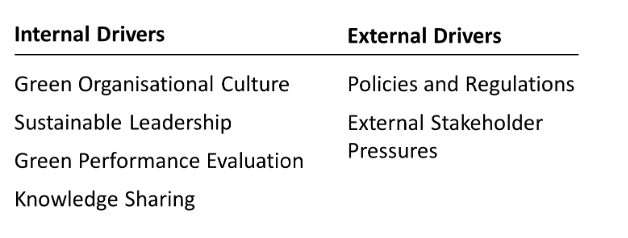
The drivers are traditionally divided into internal and external drivers, as this division is useful for including drivers that go beyond the organizational level. An overview of the relevant drivers can be found in Figure 7.
3.1.2.1 Internal drivers
The internal drivers primarily relate to the importance of the participatory integration of sustainability into the organizational identity in the form of a green organizational culture and in connection with green leadership. In addition, the general relevance of precise monitoring of EP is emphasized, and knowledge sharing is addressed as an efficient driver for compensating for knowledge deficits and increasing the effectiveness of green incentives.
Green organisational culture
In the literature on organizational incentives for sustainability, one of the most frequently discussed antecedents is the introduction and implementation of a Green Organisational Culture.1Shahzad, M. A., Du Jianguo & Junaid, M. Impact of green HRM practices on sustainable performance: mediating role of green innovation, green culture, and green employees’ behavior. Environ Sci Pollut Res 30, 88524–88547; 10.1007/s11356-023-28498-6 (2023).18Loedphacharakamon, N. & Worakittikul, W. TQM and sustainable hospitality: unpacking the link between green culture, employee behavior, and hotel performance. Cogent Business & Management 12, 2499948; 10.1080/23311975.2025.2499948 (2025).155Roscoe, S., Subramanian, N., Jabbour, C. J. & Chong, T. Green human resource management and the enablers of green organisational culture: Enhancing a firm’s environmental performance for sustainable development. Bus Strat Env 28, 737–749; 10.1002/bse.2277 (2019).212Tsymbaliuk, S., Vasylik, A. & Stoliaruk, K. Staff Motivation for Green Behaviour and Environmental Initiatives.EPESS 24, 78–83; 10.55549/epess.1179692 (2022). This culture is characterised by the collective values, norms and practices of an organization that integrate environmental sustainability into decision-making processes and daily operations. Culture shapes the attitudes, ideologies and behaviors of an organization’s members, significantly influencing daily activities.150Khan, R. U., Abbasi, M. A., Farhan, A. F. A., Al-sakkaf, M. A. & Singh, K. S. D. Green HRM, organizational identification and sustainable development in the emerging economy: applications from social identity theory.Journal of Economic and Administrative Sciences; 10.1108/JEAS-07-2022-0177 (2023).213Schein, E. H. Organizational Culture and Leadership, Edgar H. Schein. 1992. Jossey-Bass Publishers, San Francisco, CA. 418 pages. ISBN: 1-55542-487-2. $25.95. Bulletin of Science, Technology & Society 14, 121–122; 10.1177/027046769401400247 (1994).
As demonstrated in the section on personal barriers, values and assumptions can either promote or hinder motivation. If culture is neglected, initiatives to promote ecological change, such as the integration of incentives, often fail despite the existence of formal programs.21Govindarajulu, N. & Daily, B. F. Motivating employees for environmental improvement. Industrial Management & Data Systems 104, 364–372; 10.1108/02635570410530775 (2004).191Yuriev, A., Boiral, O., Francoeur, V. & Paillé, P. Overcoming the barriers to pro-environmental behaviors in the workplace: A systematic review. Journal of Cleaner Production 182, 379–394; 10.1016/j.jclepro.2018.02.041 (2018).
Incentive systems convey key messages about a company’s strategy, culture and values both implicitly and explicitly. This is why aligning the workforce with sustainability goals requires the creation of an appropriate corporate culture.111Austrup, D. & Blomberg, C. von. Anreiz- und Vergütungssysteme: Verlockung zur Nachhaltigkeit. CSR und Finance, 83–94; 10.1007/978-3-642-54882-6_5 (2014). At the same time, incentives such as training, recognition and financial support for green initiatives themselves enable a green culture, creating a self-reinforcing cycle.155Roscoe, S., Subramanian, N., Jabbour, C. J. & Chong, T. Green human resource management and the enablers of green organisational culture: Enhancing a firm’s environmental performance for sustainable development. Bus Strat Env 28, 737–749; 10.1002/bse.2277 (2019).
Sustainable leadership
Sustainable Leadership is an approach in which individuals or organizations use influence and role modeling to integrate ecological goals into decision-making processes, structures and cultures. This leadership style is closely connected to transformational leadership and involves communicating a clear and consistent environmental vision for one’s area of responsibility.65Ahuja, J., Yadav, M. & Sergio, R. P. Green leadership and pro-environmental behaviour: a moderated mediation model with rewards, self-efficacy and training. International Journal of Ethics and Systems 39, 481–501; 10.1108/IJOES-02-2022-0041 (2023). Leaders motivate employees by outlining a vision of sustainable practices for the future, explaining concrete action plans and foster trust in their team members’ capabilities.65Ahuja, J., Yadav, M. & Sergio, R. P. Green leadership and pro-environmental behaviour: a moderated mediation model with rewards, self-efficacy and training. International Journal of Ethics and Systems 39, 481–501; 10.1108/IJOES-02-2022-0041 (2023).143Graves, L. M., Sarkis, J. & Zhu, Q. How transformational leadership and employee motivation combine to predict employee proenvironmental behaviors in China. Journal of Environmental Psychology 35, 81–91; 10.1016/j.jenvp.2013.05.002 (2013). Furthermore, they encourage employees to critically examine existing assumptions about environmental issues and develop creative, diverse solutions. Another key aspect is fostering employees’ individual development potential by assessing their learning needs and providing appropriate training and learning opportunities.143Graves, L. M., Sarkis, J. & Zhu, Q. How transformational leadership and employee motivation combine to predict employee proenvironmental behaviors in China. Journal of Environmental Psychology 35, 81–91; 10.1016/j.jenvp.2013.05.002 (2013). Furthermore, it is evident that demonstrating sustainable behavior through personal actions and interpersonal relationships has a significant impact on the PEB of subordinate managers and human resource managers.214Tao, Z. Green leadership, green action: How environmentally specific transformational leadership drives employee green behavior. Business and Society Review; 10.1111/basr.70017 (2025). This phenomenon is also described as the role model function that managers assume, not only through their hierarchical position, but also through referent power as role models.114Ren, S., Tang, G. & Jackson, S. E. Effects of Green HRM and CEO ethical leadership on organizations’ environmental performance. IJM 42, 961–983; 10.1108/IJM-09-2019-0414 (2021).143Graves, L. M., Sarkis, J. & Zhu, Q. How transformational leadership and employee motivation combine to predict employee proenvironmental behaviors in China. Journal of Environmental Psychology 35, 81–91; 10.1016/j.jenvp.2013.05.002 (2013). Organisational members adopt behaviors that are considered to be in accordance with social norms by observing and replicating the behaviors of senior management.214Tao, Z. Green leadership, green action: How environmentally specific transformational leadership drives employee green behavior. Business and Society Review; 10.1111/basr.70017 (2025).215Mukhtar, A., Mahmood, S., Naeem, M. & Khan, K. I. I feel green with my leader: when and how green transformational leadership influences employees’ green behavior. International Journal of Ethics and Systems 41, 590–607; 10.1108/IJOES-08-2024-0250 (2025).
The notion that organizational members perceive their environmental commitment to be valued and supported by their employers is of central importance.60Hameed Aldulaimi, S., Mohammed Yousif Abo Keir & Abdeldayem, M. M. Implementing Green Human Resources Management to Promote Sustainability Development: Application from Telecommunication Companies in Kingdom of Bahrain. Journal of Statistics Applications & Probability 11, 321–330; 10.18576/jsap/110125 (2022).165Temminck, E., Mearns, K. & Fruhen, L. Motivating Employees towards Sustainable Behaviour. Bus Strat Env 24, 402–412; 10.1002/bse.1827 (2015). The literature suggests that employees who feel their company shares their environmental beliefs are more likely to experience a sense of unity and shared purpose in the workplace.216Xie, J., Bhutta, Z. M., Di Li & Andleeb, N. Green HRM practices for encouraging pro-environmental behavior among employees: the mediating influence of job satisfaction. Environ Sci Pollut Res 30, 103620–103639; 10.1007/s11356-023-29362-3 (2023). In addition to the enhancement of job satisfaction, this phenomenon has been demonstrated to engender an elevation in general well-being, loyalty, and commitment. This commitment is further solidified by an authentic interest in supporting sustainable corporate goals.208Yusliza, M.-Y. et al. Top management commitment, corporate social responsibility and green human resource management. Benchmarking: An International Journal 26, 2051–2078; 10.1108/BIJ-09-2018-0283 (2019).
While green leadership itself is a central driver for incentives, on the organizational level it also functions as an enabler for a green culture, while a green culture simultaneously drives sustainable leadership.29Rahman, M., Abd Wahab, S. & Abdul Latiff, A. S. The Underlying Theories of Organizational Sustainability: The Motivation Perspective. JBMS 5, 181–193; 10.32996/jbms.2023.5.1.18 (2023).65Ahuja, J., Yadav, M. & Sergio, R. P. Green leadership and pro-environmental behaviour: a moderated mediation model with rewards, self-efficacy and training. International Journal of Ethics and Systems 39, 481–501; 10.1108/IJOES-02-2022-0041 (2023).212Tsymbaliuk, S., Vasylik, A. & Stoliaruk, K. Staff Motivation for Green Behaviour and Environmental Initiatives.EPESS 24, 78–83; 10.55549/epess.1179692 (2022). Company executives play a pivotal role in the process of integrating sustainability into the ethos of the corporation and the associated human resource management systems. This integration involves the alignment of organizational objectives with environmentally sustainable initiatives, such as incentive systems, thereby contributing to the reinforcement of an eco-friendly organizational culture.32Ren, S., Tang, G. & E. Jackson, S. Green human resource management research in emergence: A review and future directions. Asia Pac J Manag 35, 769–803; 10.1007/s10490-017-9532-1 (2018).217Sharari, H., Qawasmeh, R., Helalat, A. & Jahmani, A. Enhancing employee sustainability through employee quality of life: the role of top management support. The TQM Journal 37, 1320–1341; 10.1108/TQM-11-2023-0379 (2024).
In conclusion, this indicates that, owing to a sustainable culture in conjunction with suitable leadership, members of the organization no longer solely act on a sense of duty, but also on an intrinsic drive and sense of purpose to adopt sustainable measures in the workplace and beyond.216Xie, J., Bhutta, Z. M., Di Li & Andleeb, N. Green HRM practices for encouraging pro-environmental behavior among employees: the mediating influence of job satisfaction. Environ Sci Pollut Res 30, 103620–103639; 10.1007/s11356-023-29362-3 (2023).
Monitoring environmental performance
The present study hypothesises that targeted monitoring of EP and PEB is positively associated with the utilisation and rapid introduction of green incentives.6Zhao, Y. & Yang, Y. Sustainability target setting and incentive design: A literature review. BMTP 2, 3134; 10.54517/bmtp3134 (2025). Monitoring Environmental Performance is therefore a crucial precursor to green incentives, as it initially engenders transparency regarding to environmental impacts and thus establishes a foundation upon which incentive systems can be effectively implemented.37Arulrajah, A. A., Opatha, H. & Nawaratne, N. Green Human Resource Management Practices: A Review. SLJHRM 5 (2015).59Marrucci, L., Daddi, T. & Iraldo, F. Creating environmental performance indicators to assess corporate sustainability and reward employees. Ecological Indicators 158, 111489; 10.1016/j.ecolind.2023.111489 (2024). When a company defines green targets for the first time, it is often lacking in knowledge about environmental aspects, benchmarks and ecological KPIs relating to its own business.19Derchi, G.-B., Davila, A. & Oyon, D. Green incentives for environmental goals. Management Accounting Research 59, 100830; 10.1016/j.mar.2022.100830 (2023). It is imperative for companies to initially establish a foundation of expertise in environmental monitoring and management, a prerequisite for the subsequent development of precise targets and metrics. These metrics can then be translated into incentive systems.59Marrucci, L., Daddi, T. & Iraldo, F. Creating environmental performance indicators to assess corporate sustainability and reward employees. Ecological Indicators 158, 111489; 10.1016/j.ecolind.2023.111489 (2024).218Lisi, I. E. Translating environmental motivations into performance: The role of environmental performance measurement systems. Management Accounting Research 29, 27–44; 10.1016/j.mar.2015.06.001 (2015). Managers must set green targets, goals and responsibilities for their sections or divisions, assessing the number of green incidents and communicate the environmental policy of the organization.37Arulrajah, A. A., Opatha, H. & Nawaratne, N. Green Human Resource Management Practices: A Review. SLJHRM 5 (2015). The actions are instrumental in the introduction and utilisation of sustainable incentive systems. Empirical evidence demonstrates that companies with greater experience in monitoring EP are more likely to utilise green incentives and are also able to integrate them more efficiently.19Derchi, G.-B., Davila, A. & Oyon, D. Green incentives for environmental goals. Management Accounting Research 59, 100830; 10.1016/j.mar.2022.100830 (2023). Lastly the provision of regular feedback to the members of an organization across all hierarchical levels and establishing a firm-wide dialogue on green matters are also needed.37Arulrajah, A. A., Opatha, H. & Nawaratne, N. Green Human Resource Management Practices: A Review. SLJHRM 5 (2015).
Knowledge sharing
A final relevant internal driver is Knowledge Sharing. This approach describes the communication behavior between knowledge holders and knowledge seekers concerning the transfer and absorption of knowledge.219Hansen, M. T. The Search-Transfer Problem: The Role of Weak Ties in Sharing Knowledge across Organization Subunits. Administrative Science Quarterly 44, 82–111; 10.2307/2667032 (1999). In organizational contexts, knowledge sharing encompasses the transfer of both work-related information and personal experiences.206Khawaja, A. & Janjua, K. N. The impact of green human resource management practices on organisational sustainability through green knowledge sharing. SA j. hum. resour. manag. 23; 10.4102/sajhrm.v23i0.2702 (2024). The term refers to the exchange between employees themselves, as well as the exchange between top management and the entire workforce.118Xuecheng, W., Ahmad, N. H., Iqbal, Q. & Saina, B. Responsible Leadership and Sustainable Development in East Asia Economic Group: Application of Social Exchange Theory. Sustainability 14, 6020; 10.3390/su14106020 (2022).219Hansen, M. T. The Search-Transfer Problem: The Role of Weak Ties in Sharing Knowledge across Organization Subunits. Administrative Science Quarterly 44, 82–111; 10.2307/2667032 (1999).
In the context of green incentive systems, knowledge sharing is a moderating factor between the sustainable goals of the company and the PEB of the organization’s members, thereby forming an effective driver.220Yang, M. & Li, Z. The influence of green human resource management on employees’ green innovation behavior: The role of green organizational commitment and knowledge sharing. Heliyon 9, e22161; 10.1016/j.heliyon.2023.e22161 (2023).221Fawehinmi, O., Yusliza, M. Y., Mohamad, Z., Noor Faezah, J. & Muhammad, Z. Assessing the green behaviour of academics. IJM 41, 879–900; 10.1108/IJM-07-2019-0347 (2020). At the level of the individual employee, it has been demonstrated that those who acquire environmental knowledge, apply and share it with others as part of incentive systems can serve as role models for others. This behavior has been shown to inspire colleagues to adopt sustainable practices and to pass on green knowledge in the work environment.118Xuecheng, W., Ahmad, N. H., Iqbal, Q. & Saina, B. Responsible Leadership and Sustainable Development in East Asia Economic Group: Application of Social Exchange Theory. Sustainability 14, 6020; 10.3390/su14106020 (2022). This, in turn, has been demonstrated to positively influence PEB.222Khan, K., Shams, M. S., Khan, Q., Akbar, S. & Niazi, M. M. Relationship Among Green Human Resource Management, Green Knowledge Sharing, Green Commitment, and Green Behavior: A Moderated Mediation Model.Front. Psychol. 13, 924492; 10.3389/fpsyg.2022.924492 (2022). Conversely, companies can leverage knowledge sharing by implementing incentives on platforms, exchange formats and knowledge databases that empower organizational members to behave sustainably.155Roscoe, S., Subramanian, N., Jabbour, C. J. & Chong, T. Green human resource management and the enablers of green organisational culture: Enhancing a firm’s environmental performance for sustainable development. Bus Strat Env 28, 737–749; 10.1002/bse.2277 (2019).
3.1.2.2 External drivers
The external drivers are limited to the two most relevant ones, namely policies and regulations as well as external stakeholder pressures.
Policies and regulations
Policies and Regulations as regulatory requirements represent a significant external factor influencing organizational incentive systems for sustainability. Legislators at both the national and supranational levels are increasingly imposing demands on companies to pursue sustainability objectives in a systematic manner and to quantify their progress.6Zhao, Y. & Yang, Y. Sustainability target setting and incentive design: A literature review. BMTP 2, 3134; 10.54517/bmtp3134 (2025). Examples of such requirements include the CO2 pricing policy based on the European Emissions Trading System or tax-benefits and subsidies like China’s green tax system which promotes organizations green innovations.223Wang, X., Wang, S., Wu, K., Zhai, C. & Li, Y. Environmental protection tax and enterprises’ green technology innovation: Evidence from China. International Review of Economics & Finance 96, 103617; 10.1016/j.iref.2024.103617 (2024).224Schleich, J., Rogge, K. & Betz, R. Incentives for energy efficiency in the EU Emissions Trading Scheme. Energy Efficiency 2, 37–67; 10.1007/s12053-008-9029-3 (2009). Such requirements function as formal external drivers that prompt organizations not only to anchor sustainability goals at the strategic level, but also to operationalise them internally through performance management, new target agreements and the adjustment of remuneration systems.9Saka, N., Olanipekun, A. O. & Omotayo, T. Reward and compensation incentives for enhancing green building construction. Environmental and Sustainability Indicators 11, 100138; 10.1016/j.indic.2021.100138 (2021).10Khattak, M. S., Wu, Q., Ahmad, M. & Ullah, R. Exploring the knowledge structure between government incentives and corporate social responsibility. CR; 10.1108/CR-03-2024-0062 (2025).
Regulatory drivers have been demonstrated to exert a direct influence on the configuration of organizational incentive systems, thereby effecting the transformation of sustainability objectives into binding control variables.78Herzberg, F. The Motivation to Work (John Wiley & Sons, New York, 1959). This assertion is further substantiated by extant research. Studies indicate that industries such as mining and minerals, utilities, and oil and petroleum products, which are subject to stringent regulations due to their high levels of air pollution, resource consumption, or other adverse environmental impacts, provide nearly 100 percent CSR-contingent compensation. In industries with less stringent regulatory oversight, such as textile, apparel, and footwear, the integration of CSR-related components into the compensation framework of organizational members is less prevalent. Only 15 percent are actively using such methods, underscoring the significance of external regulatory frameworks and legislation.214Tao, Z. Green leadership, green action: How environmentally specific transformational leadership drives employee green behavior. Business and Society Review; 10.1111/basr.70017 (2025).215Mukhtar, A., Mahmood, S., Naeem, M. & Khan, K. I. I feel green with my leader: when and how green transformational leadership influences employees’ green behavior. International Journal of Ethics and Systems 41, 590–607; 10.1108/IJOES-08-2024-0250 (2025).
External stakeholder pressures
In addition to legal requirements imposed by politicians, the External Stakeholder Pressures of other stakeholder groups are also a key driver for the implementation of sustainability-oriented incentive systems.59Marrucci, L., Daddi, T. & Iraldo, F. Creating environmental performance indicators to assess corporate sustainability and reward employees. Ecological Indicators 158, 111489; 10.1016/j.ecolind.2023.111489 (2024). Investors and capital markets are becoming increasingly demanding of transparency regarding ESG performance and are linking their investment decisions to credible sustainability strategies.225Alda, M. Corporate sustainability and institutional shareholders: The pressure of social responsible pension funds on environmental firm practices. Bus Strat Env 28, 1060–1071; 10.1002/bse.2301 (2019). In the contemporary business environment, customers are increasingly demanding products and services that demonstrate environmental responsibility.226Tseng, S.-C. & Hung, S.-W. A framework identifying the gaps between customers’ expectations and their perceptions in green products. Journal of Cleaner Production 59, 174–184; 10.1016/j.jclepro.2013.06.050 (2013). Concurrently, employees across various sectors are placing greater value on their employer’s commitment to sustainability, perceiving it as a crucial aspect of their employer’s appeal.127Cao, S., Xu, P., Qalati, S. A. & Wu, K. Impact of Employee Environmental Concerns on Sustainable Practices: Investigating Organizational Commitment and Job Satisfaction. Sustainability 16, 5823; 10.3390/su16135823 (2024). Furthermore, Non-Governmental Organizations, the media and the broad public also exert pressure by highlighting abuses and measuring companies against social expectations.8Deegan, C. & Islam, M. A. An exploration of NGO and media efforts to influence workplace practices and associated accountability within global supply chains. The British Accounting Review 46, 397–415; 10.1016/j.bar.2014.10.002 (2014). Evidently the presence of multiple stakeholders exerts pressure on the reputation, legitimacy and accountability of organizations.7González‐Benito, J. & González‐Benito, Ó. A study of determinant factors of stakeholder environmental pressure perceived by industrial companies. Bus Strat Env 19, 164–181; 10.1002/bse.631 (2010).227Lei Yang, Danae Manika & Frances Bowen. Organisational and employee symbolic environmental behaviours: an integrated multi-level framework. In Research handbook on employee pro-environmental behaviour, edited by V. K. Wells, D. Gregory-Smith & D. Manika (Edward Elgar Publishing, Cheltenham, Northampton, 2018), pp. 229–264. This pressure prompts organizations to integrate sustainability goals into their governance and human resources systems, as well as to establish concrete practices with the guidance of incentive systems.6Zhao, Y. & Yang, Y. Sustainability target setting and incentive design: A literature review. BMTP 2, 3134; 10.54517/bmtp3134 (2025).59Marrucci, L., Daddi, T. & Iraldo, F. Creating environmental performance indicators to assess corporate sustainability and reward employees. Ecological Indicators 158, 111489; 10.1016/j.ecolind.2023.111489 (2024).
3.1.3 Recommendations for action based on barriers and drivers
Based on the barriers, drivers and following a comprehensive review of the extant literature four recommendations for action were formulated. The purpose of these recommendations is to provide an example of an initial overview for companies, as illustrated in figure 8. Consequently, potential measures or frameworks for action can be deduced that pre-emptively facilitate the implementation of green incentive systems.
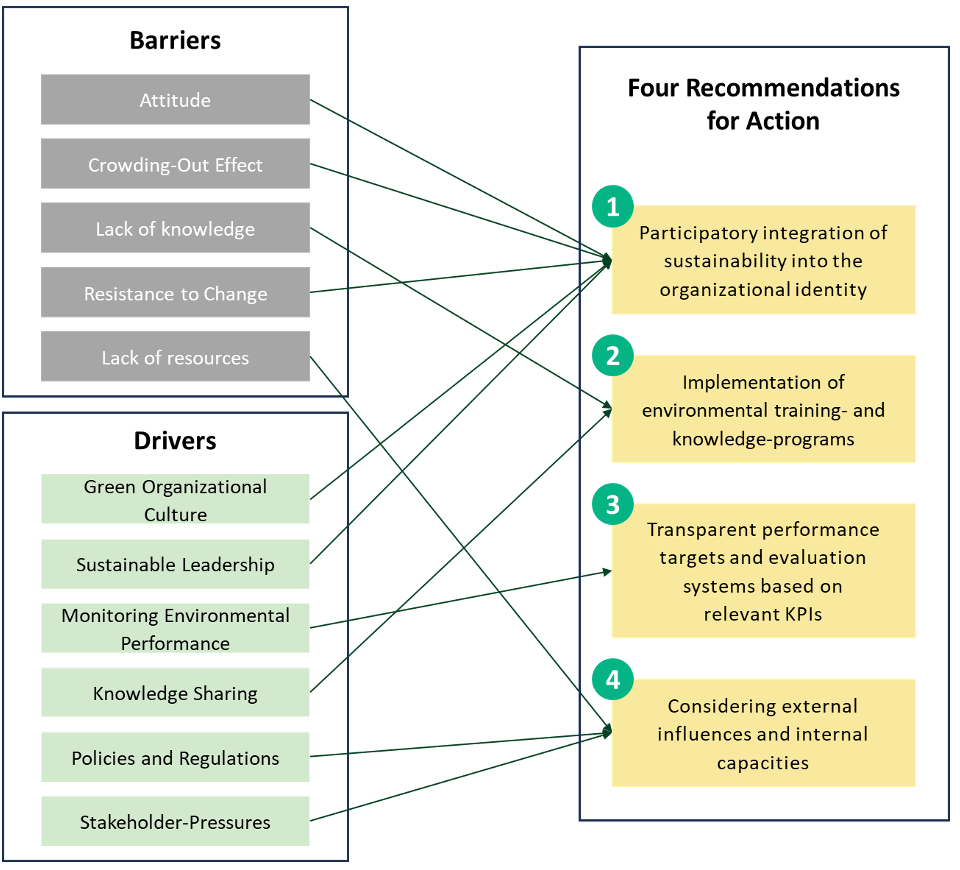
The primary and most significant recommendation for action is the participatory integration of sustainability into the organizational identity.45Tariq, S., Jan, F. A. & Ahmad, M. S. Green employee empowerment: a systematic literature review on state-of-art in green human resource management. Qual Quant 50, 237–269; 10.1007/s11135-014-0146-0 (2016).190Matejun, M., Matusiak, B. E. & Różańska-Bińczyk, I. Employee Readiness for GHRM and Its Individual Antecedents: Instrumental and Change-Based Approach. Sustainability 16, 4776; 10.3390/su16114776 (2024).228Assoratgoon, W. & Kantabutra, S. Toward a sustainability organizational culture model. Journal of Cleaner Production 400, 136666; 10.1016/j.jclepro.2023.136666 (2023). The basis for this measure is formed by drivers in form of Green Organisational Cultureand Sustainable Leadership. Green organizational culture is regarded as the essential framework, which is augmented by sustainable leadership through the establishment of role models who embody the values and assimilate them into decision-making processes.18Loedphacharakamon, N. & Worakittikul, W. TQM and sustainable hospitality: unpacking the link between green culture, employee behavior, and hotel performance. Cogent Business & Management 12, 2499948; 10.1080/23311975.2025.2499948 (2025).212Tsymbaliuk, S., Vasylik, A. & Stoliaruk, K. Staff Motivation for Green Behaviour and Environmental Initiatives.EPESS 24, 78–83; 10.55549/epess.1179692 (2022). Furthermore, the concept encompasses the individual barriers of Attitude, Resistance to Change and the Crowding-out Effect. The active involvement of employees in the development of a sustainable organizational identity and the implementation of green incentive systems has been demonstrated to be an effective strategy for reducing resistance to change and enhancing general acceptance.197Nejati, M., Rabiei, S. & Chiappetta Jabbour, C. J. Envisioning the invisible: Understanding the synergy between green human resource management and green supply chain management in manufacturing firms in Iran in light of the moderating effect of employees’ resistance to change. Journal of Cleaner Production 168, 163–172; 10.1016/j.jclepro.2017.08.213 (2017).229Perron, G. M., Côté, R. P. & Duffy, J. F. Improving environmental awareness training in business. Journal of Cleaner Production 14, 551–562; 10.1016/j.jclepro.2005.07.006 (2006). The workforce is increasingly able to identify with sustainability practices, which in turn has a direct influence on their values and their intrinsic motivation.20Johnstone, L. & Beusch, P. Motivating sustainable behaviour in the workplace through control. J Manag Control, 1–36; 10.1007/s00187-025-00390-z (2025).47Ye, P., Liu, L. & Tan, J. Influence of leadership empowering behavior on employee innovation behavior: The moderating effect of personal development support. Front. Psychol. 13, 1022377; 10.3389/fpsyg.2022.1022377 (2022). Concurrently, this mitigates the prevailing perception of external control among organizational constituents, thereby diminishing the crowding-out effect.193Gneezy, U., Meier, S. & Rey-Biel, P. When and Why Incentives (Don’t) Work to Modify Behavior. Journal of Economic Perspectives 25, 191–210; 10.1257/jep.25.4.191 (2011).
The second recommendation for action, transparent target agreements and evaluation systems based on clear, meaningful KPIs, is directly linked to the driver of Monitoring Environmental Performance. The precise and comprehensible measurement of EP is a basic prerequisite for designing credible and effective incentive systems.6Zhao, Y. & Yang, Y. Sustainability target setting and incentive design: A literature review. BMTP 2, 3134; 10.54517/bmtp3134 (2025).19Derchi, G.-B., Davila, A. & Oyon, D. Green incentives for environmental goals. Management Accounting Research 59, 100830; 10.1016/j.mar.2022.100830 (2023).59Marrucci, L., Daddi, T. & Iraldo, F. Creating environmental performance indicators to assess corporate sustainability and reward employees. Ecological Indicators 158, 111489; 10.1016/j.ecolind.2023.111489 (2024). The employment of appropriate indicators facilitates the translation of complex environmental objectives into concrete, verifiable metrics. This provides employees with unambiguous guidance regarding their organizations’ expectations.6Zhao, Y. & Yang, Y. Sustainability target setting and incentive design: A literature review. BMTP 2, 3134; 10.54517/bmtp3134 (2025).37Arulrajah, A. A., Opatha, H. & Nawaratne, N. Green Human Resource Management Practices: A Review. SLJHRM 5 (2015).59Marrucci, L., Daddi, T. & Iraldo, F. Creating environmental performance indicators to assess corporate sustainability and reward employees. Ecological Indicators 158, 111489; 10.1016/j.ecolind.2023.111489 (2024).
The implementation of training and education programs constitutes the third recommendation for action. This standpoint is predicated on the personal barrier of Lack of Knowledge. Such measures have been demonstrated to assist in the reduction of knowledge deficits by imparting to organizational members the skills required for the implementation of sustainable behavior and improving EP.65Ahuja, J., Yadav, M. & Sergio, R. P. Green leadership and pro-environmental behaviour: a moderated mediation model with rewards, self-efficacy and training. International Journal of Ethics and Systems 39, 481–501; 10.1108/IJOES-02-2022-0041 (2023).119Bilderback, S. Integrating training for organizational sustainability: the application of Sustainable Development Goals globally. EJTD 48, 730–748; 10.1108/EJTD-01-2023-0005 (2024).230Yafi, E., Tehseen, S. & Haider, S. A. Impact of Green Training on Environmental Performance through Mediating Role of Competencies and Motivation. Sustainability 13, 5624; 10.3390/su13105624 (2021). The driver Knowledge Sharing also benefits from this recommendation, as improved basic knowledge encourages knowledge sharing and new experiential knowledge or joint training courses encourage knowledge exchange.222Khan, K., Shams, M. S., Khan, Q., Akbar, S. & Niazi, M. M. Relationship Among Green Human Resource Management, Green Knowledge Sharing, Green Commitment, and Green Behavior: A Moderated Mediation Model.Front. Psychol. 13, 924492; 10.3389/fpsyg.2022.924492 (2022).231Nazir, M. W., Zunhuwan, S., Zulfiqat, A., Khan, H. & Bangash, S. A. Green HRM and Leadership Style as Drivers of Sustainable Innovation Examining the Mediating Role of Knowledge Sharing. JSSR 5, 314–325; 10.62843/jssr.v5i1.493 (2025).
The final recommendation for action is intended to draw attention to both external and internal conditions by taking external influences and internal capacities into account. In this particular instance, the external factors exerting influence can be categorised as follows: the driving Policies and Regulations, in addition to External Stakeholder Pressures.6Zhao, Y. & Yang, Y. Sustainability target setting and incentive design: A literature review. BMTP 2, 3134; 10.54517/bmtp3134 (2025).9Saka, N., Olanipekun, A. O. & Omotayo, T. Reward and compensation incentives for enhancing green building construction. Environmental and Sustainability Indicators 11, 100138; 10.1016/j.indic.2021.100138 (2021). It is imperative that both of these factors are given due consideration on an ongoing basis, given the dynamic demands they place on organizations.11Jiang, K., Leng, M., Jiang, Y. & Xu, L. From penalties to profits: how government regulation and cost-revenue trade-offs shape green production and marketing. Environ Dev Sustain, 1–37; 10.1007/s10668-025-06250-z (2025).232Seroka‐Stolka, O. & Fijorek, K. Linking stakeholder pressure and corporate environmental competitiveness: The moderating effect of ISO 14001 adoption. Corporate Social Responsibility and Environmental Management 29, 1663–1675; 10.1002/csr.2311 (2022). Internally, the consideration of capacities for the implementation of incentive systems serves to address the challenge posed by the Lack of Resources. The pre-emptive redistribution of resources has been demonstrated to reduce the planning effort and optimise sustainable processes in such a way that monetary costs remain manageable.233Moizer, J. & Tracey, P. Strategy making in social enterprise: The role of resource allocation and its effects on organizational sustainability. Syst. Res. 27, 252–266; 10.1002/sres.1006 (2010). As posited by Beck-Krala and Klimkiewicz (2017), the provision of compensation for the achievement of green targets has the potential to result in a reduction in the amount of rewards received by managers for the fulfillment of financial objectives. It is essential to acknowledge the necessity of evaluating the distribution of resources for economic and ecological objectives when implementing monetary incentives.25Beck-Krala, E. & Klimkiewicz, K. Reward Programs Supporting Environmental Organizational Policy. Zarządzanie Zasobami Ludzkimi, 41–54 (2017).
Overall, a comprehensive analysis of the barriers and drivers is therefore essential to pre-emptively facilitate the implementation of green incentive systems. Additionally, it is important to note that there are many more interactions between the barriers and drivers and the action recommendations. Figure 8 only gives a first impression of the most relevant mediations.
3.2 Step two: Target setting and monitoring
As established in the analysis of barriers, drivers and the resulting recommendations for action, incentive systems must be measurable and monitorable through KPIs and communicated in cooperation with clear goals.6Zhao, Y. & Yang, Y. Sustainability target setting and incentive design: A literature review. BMTP 2, 3134; 10.54517/bmtp3134 (2025).234Bento, R. F., Mertins, L. & White, L. F. Do Sustainability Measures Matter in Managerial Appraisal and Rewards? InBeyond Perceptions, Crafting Meaning, edited by R. F. Bento, L. Mertins & L. F. White (Emerald Publishing Limited2019), Vol. 21, pp. 1–24. Incentives such as monetary bonuses or appraisals are based almost exclusively on performance evaluations, for which a transparent, measurable basis to all members of the organization is indispensable.59Marrucci, L., Daddi, T. & Iraldo, F. Creating environmental performance indicators to assess corporate sustainability and reward employees. Ecological Indicators 158, 111489; 10.1016/j.ecolind.2023.111489 (2024).234Bento, R. F., Mertins, L. & White, L. F. Do Sustainability Measures Matter in Managerial Appraisal and Rewards? InBeyond Perceptions, Crafting Meaning, edited by R. F. Bento, L. Mertins & L. F. White (Emerald Publishing Limited2019), Vol. 21, pp. 1–24. For that reason a variety of tools is described below. These include the classic EMS, the SBSC and a more detailed presentation of the target formulations of Interface.
3.2.1 Environmental management systems: The ISO 14001-norm
The integration of an EMS within an organizational framework serves as a valuable instrument for the formulation, measurement and monitoring of incentive systems for sustainability.113Ramus, C. A. Encouraging innovative environmental actions: what companies and managers must do. Journal of World Business 37, 151–164; 10.1016/S1090-9516(02)00074-3 (2002). The present thesis focuses on ISO 14001 as a globally recognised standard for EMS. The rationale behind this phenomenon is the significance of the standard for the effective implementation of green incentive systems, as evidenced by the recurrent association between GHRM and ISO 14001 in extant literature.126Wagner, M. ‘Green’ Human Resource Benefits: Do they Matter as Determinants of Environmental Management System Implementation? J Bus Ethics 114, 443–456; 10.1007/s10551-012-1356-9 (2013).186Teixeira, A. A., Jabbour, C. J. C. & Jabbour, Ana Beatriz Lopes de Sousa. Relationship between green management and environmental training in companies located in Brazil: A theoretical framework and case studies. International Journal of Production Economics 140, 318–329; 10.1016/j.ijpe.2012.01.009 (2012).235Hossari, H. & Elfahli, K. Green Human Resource Management: An Exploratory Study from Moroccan ISO 14001 Certified Companies. In Corporate Social Responsibility in the 21st Century, edited by M. Sarfraz (IntechOpen, Erscheinungsort nicht ermittelbar, 2023), Vol. 4. This suggests that it is the focus of significantly more attention than the EMAS, which is only infrequently mentioned.160Chiarini, A. & Bag, S. Using green human resource management practices to achieve green performance: Evidence from Italian manufacturing context. Bus Strat Env 33, 4694–4707; 10.1002/bse.3724 (2024). In practice, ISO 14001 is more common than EMAS, as it is an international standard that already had 300,410 certified sites in 2023.236ISO. The ISO Survey. Available at https://www.iso.org/the-iso-survey.html (2023). In comparison, EMAS, which has only been applicable outside Europe since 2010, currently has 15,815 registered sites.237European Comission. EMAS – Facts and Figures. Available at https://green-forum.ec.europa.eu/green-business/emas/about-emas/emas-statistics-and-graphs_en (2025).238Testa, F. et al. EMAS and ISO 14001: the differences in effectively improving environmental performance. Journal of Cleaner Production 68, 165–173; 10.1016/j.jclepro.2013.12.061 (2014).
ISO 14001 is a voluntary standard for the implementation of EMS, the purpose of which is to certify that a company has defined an environmental policy and is continuously working to improve its EP. The provision of structured processes for the implementation of environmental goals, policies and responsibilities is supported by regular auditing.239Ferenhof, H. A., Vignochi, L., Selig, P. M., Lezana, Á. G. R. & Campos, L. M. Environmental management systems in small and medium-sized enterprises: an analysis and systematic review. Journal of Cleaner Production 74, 44–53; 10.1016/j.jclepro.2014.03.027 (2014). In order to achieve this objective, it is necessary to undertake a thorough analysis of the organization’s activities that have a substantial environmental impact, in terms of both risks and opportunities. This approach enables the identification and targeting of the most material environmental topics for an organization, based on the results obtained.239Ferenhof, H. A., Vignochi, L., Selig, P. M., Lezana, Á. G. R. & Campos, L. M. Environmental management systems in small and medium-sized enterprises: an analysis and systematic review. Journal of Cleaner Production 74, 44–53; 10.1016/j.jclepro.2014.03.027 (2014). Moreover, the systematic documentation of environmental measures and targets is essential for quantifying and auditing environmental objectives, thereby facilitating their integration into existing performance and incentive systems.19Derchi, G.-B., Davila, A. & Oyon, D. Green incentives for environmental goals. Management Accounting Research 59, 100830; 10.1016/j.mar.2022.100830 (2023).59Marrucci, L., Daddi, T. & Iraldo, F. Creating environmental performance indicators to assess corporate sustainability and reward employees. Ecological Indicators 158, 111489; 10.1016/j.ecolind.2023.111489 (2024). In their study, Derchi et al. (2023) highlight that the majority of the companies surveyed (61.4%) had implemented an EMS in accordance with ISO 14001 before introducing green incentive programs.19Derchi, G.-B., Davila, A. & Oyon, D. Green incentives for environmental goals. Management Accounting Research 59, 100830; 10.1016/j.mar.2022.100830 (2023). The formal and structured program establishes a framework that can be utilised by the entire organization as a guide, thereby laying the foundation for the monitoring of environmental objectives.19Derchi, G.-B., Davila, A. & Oyon, D. Green incentives for environmental goals. Management Accounting Research 59, 100830; 10.1016/j.mar.2022.100830 (2023). The implementation of an EMS through the ISO-Norm, signifies a pronounced dedication on the part of management to the fostering of environmental improvements, both within the organization and in its external relations.71Paillé, P., Chen, Y., Boiral, O. & Jin, J. The Impact of Human Resource Management on Environmental Performance: An Employee-Level Study. Journal of Business Ethics 121, 451–466; 10.1007/s10551-013-1732-0 (2014).240Iatridis, K. & Kesidou, E. What Drives Substantive Versus Symbolic Implementation of ISO 14001 in a Time of Economic Crisis? Insights from Greek Manufacturing Companies. J Bus Ethics 148, 859–877; 10.1007/s10551-016-3019-8 (2018). This initiative has been found to raise employee awareness of environmental issues and their importance to the organization, fostering a green organizational culture.21Govindarajulu, N. & Daily, B. F. Motivating employees for environmental improvement. Industrial Management & Data Systems 104, 364–372; 10.1108/02635570410530775 (2004). In the absence of such goal orientation, members of organizations frequently exhibit a lack of motivation to engage in additional tasks within the environmental context.21Govindarajulu, N. & Daily, B. F. Motivating employees for environmental improvement. Industrial Management & Data Systems 104, 364–372; 10.1108/02635570410530775 (2004).168Ramus, C. A. Organizational Support for Employees: Encouraging Creative Ideas for Environmental Sustainability.California Management Review 43, 85–105; 10.2307/41166090 (2001).
A final relevant aspect of ISO 14001 is the obligation for companies to provide environmental training for their workforce. The training of organizational members constitutes a distinct incentive, as previously delineated in the recommendations for action from the first step. This incentive is of particular importance and is directly addressed by the standard. It is imperative for companies to ensure that their workforce possesses a fundamental level of competence and awareness, and to systematically document this process.44Teixeira, A. A., Jabbour, C. J. C., Sousa Jabbour, A. B. L. de, Latan, H. & Oliveira, J. H. C. de. Green training and green supply chain management: evidence from Brazilian firms. Journal of Cleaner Production 116, 170–176; 10.1016/j.jclepro.2015.12.061 (2016).186Teixeira, A. A., Jabbour, C. J. C. & Jabbour, Ana Beatriz Lopes de Sousa. Relationship between green management and environmental training in companies located in Brazil: A theoretical framework and case studies. International Journal of Production Economics 140, 318–329; 10.1016/j.ijpe.2012.01.009 (2012).
In summary, it is evident that ISO 14001 constitutes a significant foundation for the implementation of incentive systems and the development and evaluation of associated ecological sustainability objectives. Nevertheless, its primary function is as a medium through which an organization’s commitment to sustainability is communicated to its workforce, thereby establishing the basis for incentive systems that are built on this foundation.19Derchi, G.-B., Davila, A. & Oyon, D. Green incentives for environmental goals. Management Accounting Research 59, 100830; 10.1016/j.mar.2022.100830 (2023). For instance, it employs training as an incentive and establishes a significant framework for evaluating a company’s primary environmental concerns and formulating associated targets. Nevertheless, this demonstrates the need for more specific tools that implement the EMS framework into concrete KPIs and individual sustainability goals. For this reason, these specifications are addressed in the following chapter from the perspective of the SBSC.
3.2.2 The sustainability balanced scorecard
The SBSC has been developed as a tool to provide a framework for the measurable representation of goals for green incentive systems. The Balanced Scorecard was originally developed by Kaplan and Norton (1992) as a performance measurement tool.241Kaplan, R. S. & Norton, D. P. The balanced scorecard – Measures that drive performance. Harvard Business Review 70, 71–79 (1992). This was done in order to overcome the one-sided focus on financial indicators and to include non-financial success factors. The aim was to enable organizations to secure their long-term value creation. In the process of establishing SBSC objectives, it is imperative to refrain from employing a single measure as the exclusive performance indicator. Instead, the definition of multiple objectives and metrics across diverse domains is to be encouraged. There are four well-established perspectives that are commonly used when formulating objectives. These perspectives are the financial perspective, the customer perspective, the internal processes perspective, and the learning and growth perspective.73Mio, C., Costantini, A. & Panfilo, S. Performance measurement tools for sustainable business: A systematic literature review on the sustainability balanced scorecard use. Corporate Social Responsibility and Environmental Management 29, 367–384; 10.1002/csr.2206 (2022).241Kaplan, R. S. & Norton, D. P. The balanced scorecard – Measures that drive performance. Harvard Business Review 70, 71–79 (1992).
Evidently the evolution of the tool has been a multifaceted process, with its progression from a rudimentary measurement instrument to a sophisticated strategic performance management tool, and ultimately, to a pivotal strategy implementation tool. The tool’s recent integration with the SBSC has further expanded its functionality, enabling its utilisation in the field of implementing sustainability strategies and evaluating EP.73Mio, C., Costantini, A. & Panfilo, S. Performance measurement tools for sustainable business: A systematic literature review on the sustainability balanced scorecard use. Corporate Social Responsibility and Environmental Management 29, 367–384; 10.1002/csr.2206 (2022).75Ali, I., Sami, S., Senan, N. A. M., Baig, A. & Khan, I. A. A study on corporate sustainability performance evaluation and management: The sustainability balanced scorecard. CGOBR 6, 150–162; 10.22495/cgobrv6i2p15 (2022). There are three possible approaches to be considered: firstly, the integration of sustainability aspects into the four existing perspectives; secondly, the supplementation of the four perspectives with a separate sustainability perspective; and thirdly, the development of a specific environmental scorecard.73Mio, C., Costantini, A. & Panfilo, S. Performance measurement tools for sustainable business: A systematic literature review on the sustainability balanced scorecard use. Corporate Social Responsibility and Environmental Management 29, 367–384; 10.1002/csr.2206 (2022). In the context of green incentive systems, the integration of ecological sustainability objectives within the four traditional Balanced Scorecard perspectives is a commendable approach.75Ali, I., Sami, S., Senan, N. A. M., Baig, A. & Khan, I. A. A study on corporate sustainability performance evaluation and management: The sustainability balanced scorecard. CGOBR 6, 150–162; 10.22495/cgobrv6i2p15 (2022).242Oliveira, J. Balanced Scorecard and Sustainability. In Encyclopedia of Sustainable Management, edited by S. O. Idowu, et al. (Springer, Cham, 2019), pp. 1–6.243Sahu, S. & Satpathy, B. Green human resource management practices for sustainable business environment: a model based on balanced scorecard approach. International Research Journal of Management Sociology & Humanity 13,219–227 (2022).
As outlined in the extant literature, a holistic approach to incentive systems for sustainability also encompasses economic sustainability. Evidently this encompasses the relevant aspects from the NRBV, manifesting in the form of enhanced employee performance and retention and the subsequent competitive advantages through efficient resource usage.22Nikolaou, I. E., Tsagarakis, K. P. & Tasopoulou, K. An examination of ecopreneurs’ incentives through a combination between institutional and resource-based approach. MEQ 29, 195–215; 10.1108/MEQ-01-2017-0004 (2018).244Mittal, E. & Kaur, N. GHRM practices and employee retention in the IT sector: Parallel mediation approach.Prajnan 52, 155–178 (2023). This aspect is addressed by the financial perspective of the SBSC, which also includes metrics with a clear focus on organizational performance, such as the “growth rate of operating income” or the “employee retention rate”.75Ali, I., Sami, S., Senan, N. A. M., Baig, A. & Khan, I. A. A study on corporate sustainability performance evaluation and management: The sustainability balanced scorecard. CGOBR 6, 150–162; 10.22495/cgobrv6i2p15 (2022). Within the domain of green incentives, the financial perspective can be articulated through KPI such as cost savings derived from the reduction of waste or energy consumption.25Beck-Krala, E. & Klimkiewicz, K. Reward Programs Supporting Environmental Organizational Policy. Zarządzanie Zasobami Ludzkimi, 41–54 (2017).65Ahuja, J., Yadav, M. & Sergio, R. P. Green leadership and pro-environmental behaviour: a moderated mediation model with rewards, self-efficacy and training. International Journal of Ethics and Systems 39, 481–501; 10.1108/IJOES-02-2022-0041 (2023).
In the context of sustainability, the second perspective is considered not purely from the customer’s perspective, but also as the “external stakeholder perspective”.75Ali, I., Sami, S., Senan, N. A. M., Baig, A. & Khan, I. A. A study on corporate sustainability performance evaluation and management: The sustainability balanced scorecard. CGOBR 6, 150–162; 10.22495/cgobrv6i2p15 (2022).245Hansen, E. G. & Schaltegger, S. Sustainability Balanced Scorecards and their Architectures: Irrelevant or Misunderstood? J Bus Ethics 150, 937–952; 10.1007/s10551-017-3531-5 (2018). In this manner, the SBSC incorporates the element identified in the initial phase, wherein the assessment of external factors based on two drivers was determined to be a pivotal recommendation for action.9Saka, N., Olanipekun, A. O. & Omotayo, T. Reward and compensation incentives for enhancing green building construction. Environmental and Sustainability Indicators 11, 100138; 10.1016/j.indic.2021.100138 (2021).245Hansen, E. G. & Schaltegger, S. Sustainability Balanced Scorecards and their Architectures: Irrelevant or Misunderstood? J Bus Ethics 150, 937–952; 10.1007/s10551-017-3531-5 (2018). The “SIGMA Sustainability Scorecard” proposes a potential structure, incorporating the satisfaction levels of the most relevant stakeholder groups, including customers, suppliers, the government and associated regulators, with the environment itself identified as a stakeholder of particular significance.75Ali, I., Sami, S., Senan, N. A. M., Baig, A. & Khan, I. A. A study on corporate sustainability performance evaluation and management: The sustainability balanced scorecard. CGOBR 6, 150–162; 10.22495/cgobrv6i2p15 (2022).246The Sigma Project. The SIGMA Guidleines – Toolkit: Sustainability Scorecard. Available at https://library.uniteddiversity.coop/Measuring_Progress_and_Eco_Footprinting/SIGMASustainabilityScorecard.pdf.
The third perspective, the internal processes perspective, is of particular relevance in relation to sustainable incentive systems. In this context, organizations are able to establish objectives for internal processes, including product development, energy conservation, and CO2 reduction within their own workplaces.247Epstein, M. J. & Wisner, P. S. Using a Balanced Scorecard to Implement Sustainability. Environmental Quality Management 11, 1–10; 10.1002/tqem.1300 (2001). These objectives function as a clear guide for the individual workforce on the desired sustainable behaviors and will be further examined in context of the Interface example in the following Chapter 4.2.3.
The fourth perspective, entitled “learning and growth”, also addresses organizational performance, as the growth and learning perspective relates directly to NRBV approaches. The competencies obtained through learning and personal growth constitute the precise core resource that NRBV emphasizes as a competitive advantage.34Kang, Y.-C., Hsiao, H.-S. & Ni, J.-Y. The Role of Sustainable Training and Reward in Influencing Employee Accountability Perception and Behavior for Corporate Sustainability. Sustainability 14, 11589; 10.3390/su141811589 (2022). For this purpose, the utilisation of KPIs, such as the percentage of employees who have already completed training in environmental education, can be employed.91DuBose, J. R. Sustainability and Performance at Interface, Inc. Interfaces 30, 190–201; 10.1287/inte.30.3.190.11665 (2000).247Epstein, M. J. & Wisner, P. S. Using a Balanced Scorecard to Implement Sustainability. Environmental Quality Management 11, 1–10; 10.1002/tqem.1300 (2001).
The Balanced Scorecard’s capacity for adaptability as a framework signifies its potential to serve as a valuable instrument in the definition of suitable objectives and evaluation metrics. Additionally, it helps in the monitoring of pertinent processes, particularly in the context of sustainability incentives.75Ali, I., Sami, S., Senan, N. A. M., Baig, A. & Khan, I. A. A study on corporate sustainability performance evaluation and management: The sustainability balanced scorecard. CGOBR 6, 150–162; 10.22495/cgobrv6i2p15 (2022).242Oliveira, J. Balanced Scorecard and Sustainability. In Encyclopedia of Sustainable Management, edited by S. O. Idowu, et al. (Springer, Cham, 2019), pp. 1–6.
This assertion is further substantiated through practical evidence, as demonstrated by the BMW Group.111Austrup, D. & Blomberg, C. von. Anreiz- und Vergütungssysteme: Verlockung zur Nachhaltigkeit. CSR und Finance, 83–94; 10.1007/978-3-642-54882-6_5 (2014). Since 2007, the BMW Group has utilised an SBSC as a target system to oversee its entire corporate structure. Moreover, the company bases a proportion of its executives’ remuneration upon the attainment of specific objectives. The company elected to incorporate environmental objectives into the four perspectives, developing an indexed KPI for its production departments based on the subjects of energy consumption, water consumption, wastewater production, waste for landfill and emissions of volatile organic compounds. Managers in the field of research and development are subject to specific performance targets. These targets relate to core topics, including but not limited to CO2 emissions and the weight of vehicle models. The achievement of these targets is then reflected in the managers’ remuneration. In the context of purchasing, sustainability criteria are assuming an increasingly significant role in the selection and evaluation of suppliers.111Austrup, D. & Blomberg, C. von. Anreiz- und Vergütungssysteme: Verlockung zur Nachhaltigkeit. CSR und Finance, 83–94; 10.1007/978-3-642-54882-6_5 (2014). The Generali Group, a prominent insurance company headquartered in Italy, is another notable example that employs an SBSC.75Ali, I., Sami, S., Senan, N. A. M., Baig, A. & Khan, I. A. A study on corporate sustainability performance evaluation and management: The sustainability balanced scorecard. CGOBR 6, 150–162; 10.22495/cgobrv6i2p15 (2022).
Evidently the SBSC is a tool that, in contrast to the ISO 14001 standard, is characterised by its enhanced flexibility in design.73Mio, C., Costantini, A. & Panfilo, S. Performance measurement tools for sustainable business: A systematic literature review on the sustainability balanced scorecard use. Corporate Social Responsibility and Environmental Management 29, 367–384; 10.1002/csr.2206 (2022). Moreover, it encompasses not only the purely ecological perspective but also economical sustainability and the expectations of stakeholder groups.75Ali, I., Sami, S., Senan, N. A. M., Baig, A. & Khan, I. A. A study on corporate sustainability performance evaluation and management: The sustainability balanced scorecard. CGOBR 6, 150–162; 10.22495/cgobrv6i2p15 (2022). Additionally, by incorporating internal processes within the framework of the learning and growth perspective, the focus is directed towards the individual requirements of organizational members within a company. Evidence from BMW and the Generali Group demonstrates the practical implementation of this methodology by various companies as a centralised performance evaluation framework and, consequently, as a foundation for incentive systems.75Ali, I., Sami, S., Senan, N. A. M., Baig, A. & Khan, I. A. A study on corporate sustainability performance evaluation and management: The sustainability balanced scorecard. CGOBR 6, 150–162; 10.22495/cgobrv6i2p15 (2022).111Austrup, D. & Blomberg, C. von. Anreiz- und Vergütungssysteme: Verlockung zur Nachhaltigkeit. CSR und Finance, 83–94; 10.1007/978-3-642-54882-6_5 (2014).
It is also noteworthy that the SBSC flexibility allows it to become a tool that also monitors the incentive systems themselves using incentive-specific KPIs. For instance, from an internal process perspective, minimum targets can be established for the amount of financial expenditure on green monetary rewards, or a minimum number of environmental training courses to be completed.32Ren, S., Tang, G. & E. Jackson, S. Green human resource management research in emergence: A review and future directions. Asia Pac J Manag 35, 769–803; 10.1007/s10490-017-9532-1 (2018). However, the extant literature only offers a few superficial approaches to how sustainable incentive systems can be made measurable in practice and how such measurement units could be integrated into an SBSC.32Ren, S., Tang, G. & E. Jackson, S. Green human resource management research in emergence: A review and future directions. Asia Pac J Manag 35, 769–803; 10.1007/s10490-017-9532-1 (2018).248Beck-Krala, E. & Klimkiewicz, K. Sustainable Rewards. In Encyclopedia of Sustainable Management, edited by S. O. Idowu, et al. (Springer, Cham, 2019), pp. 1–8. Therefore, it should be noted that the fourth step in chapter 4.4 is concerned with the presentation of a theoretical approach to evaluating the success of sustainable incentive systems but has not yet been applied in practice. Nevertheless, a more individualised practical approach is exemplified by Interface which will be further elaborated upon in the following.
3.2.3 The EcoSense Bonus Plan from Interface Inc.
To conclude with a concrete example from practice for specific objectives in the incentive context, this chapter focuses on the “EcoSense Bonus Plan” from Interface, which the company uses as a central control element for its incentive system.91DuBose, J. R. Sustainability and Performance at Interface, Inc. Interfaces 30, 190–201; 10.1287/inte.30.3.190.11665 (2000).
In 1994, Interface set itself the ultimate goal of eliminating waste in all its forms. In order to achieve this objective, it was necessary to reduce waste by 50 percent over the next three years in comparison with the 1994 baseline. This reduction was to be achieved as follows: ten percent in year one, 15 percent in year two, and 25 percent in year three. The “QUEST Incentive Plan” was devised to realise this objective. This plan constitutes a bonus package that accounts for 15 percent of an employee’s remuneration. The allocation of financial resources was contingent upon the geographical location of the respective member of the organization, with the allocation being granted to locations that had successfully attained the annual waste reduction target. In contrast to BMW, Interface incorporated its entire workforce, encompassing all hierarchical levels, into the incentive system. Employees and site managers initiated the process of achieving the annual waste reduction targets by proposing novel concepts pertaining to recycling, alternative packaging materials, and new product designs. However, in the third year, the bonus system underwent a further revision, as the overall target of 50 percent proved challenging to achieve despite significant progress. Consequently, Interface developed a new target system.
In the new system, Interface has integrated additional environmental issues alongside waste, in response to the significant environmental impacts identified. This has been achieved by means of the “EcoSense Bonus Plan”, provided in Table 2. The company’s individual locations were able to accrue points by fulfilling various ecological targets set out in the plan. In accordance with the number of points accumulated, the QUEST percentage was adjusted to provide an additional opportunity to achieve the ambitious reduction target and thereby earning the bonus.
This new bonus plan largely reflects the four SBSC perspectives, as explained in Chapter 4.2.2. The financial perspective is taken up by the Quality Management System category and further deepened by the reduction targets in the Eco Efficiency categories termed “What We Make” and “What We Take”. The stakeholder perspective is only integrated through the underlying consideration of the environment as a stakeholder; other stakeholder demands are not taken into account. The third perspective of internal processes is essentially illustrated by all categories except the “What We Take” category. Of particular note here are target categories such as the “Environmental Management System”, which specifically relates to the implementation of ISO 14001 certification, and the “Ecometrics” category, which is intended to motivate locations to monitor their own environmental KPIs. Both categories can be connected to the relevance of clear target and objective frameworks. Finally, the learning and growth perspective is incorporated through the “Natural Step Training” category as the last SBSC perspective.
| Category | Points Awarded |
| Environmental Management System | |
| Baseline review | 2 |
| Initial audit | 2 |
| Certification | 2 |
| Quality Management System | |
| Planning and training | 2 |
| Initial audit | 2 |
| Certification | 2 |
| The Natural Step Training | |
| Level 1-25 per cent of employees | 2 |
| Level 2-50 per cent of employees | 2 |
| Level 3-75 per cent of employees | 2 |
| Ecometrics | |
| Material and energy flows | 2 |
| Recycling progress reports | 2 |
| Emissions inventory | 1 |
| Employee awareness survey | 2 |
| Purchasing | |
| “Buy recycled” program | 1 |
| Material Eco-Efficiency: What We Take | |
| Material | 1 per percent reduction |
| Non-renewable material reduction projects | 1/2 per project |
| Energy | 1 per percent reduction |
| Energy reduction projects | 1/2 per project |
| Eco-Efficiency: What We Make | |
| Solid waste reduction | 1 per 5-per cent reduction |
| Water emissions reduction | 1 per 5-per cent reduction |
| Air emissions reduction | 1 per 5-per cent reduction |
| Emissions point source elimination | 1 per point source eliminated |
Evidently Interface was able to ensure uniform performance evaluation for its various locations with the assistance of clearly defined target categories. Concurrently, the targets functioned as a framework for guiding the actions of members within the organization, ensuring that their respective progress objectives were made transparent and comprehensible. Furthermore, the business units of Interface were supported by the provision of tools and templates for data collection and external sustainability experts, for example, to facilitate the process.91DuBose, J. R. Sustainability and Performance at Interface, Inc. Interfaces 30, 190–201; 10.1287/inte.30.3.190.11665 (2000).
The EcoSense Bonus Plan of Interface underscores the significance of systematic monitoring of incentive systems, utilising clearly defined targets. The plan demonstrates the process of decomposing an overarching sustainability target into numerous subordinate targets within the context of incentive systems. This approach provides organizational members with a systematic framework for achieving organizational incentives.91DuBose, J. R. Sustainability and Performance at Interface, Inc. Interfaces 30, 190–201; 10.1287/inte.30.3.190.11665 (2000). However, the precise manner in which this can be designed varies considerably between companies, with considerations such as the nature of the implemented incentive systems being paramount. This leads to step three of the practical implementation.
3.3 Step three: Implementation of different green incentive systems
The third step provides a comprehensive overview of the various sustainable incentives an organization can implement, emphasising the respective strengths and weaknesses that companies should take into consideration when integrating them. At the beginning, incentives based on extrinsic motivation are presented, followed by incentives that increasingly incorporate intrinsic motivational factors. The descriptions of the individual sustainability incentives follow a consistent structure. First, the respective incentive types are defined. Then, the preferred target group is presented. Additionally, the incentives are classified in terms of intrinsic and extrinsic motivation. Finally, the various practical forms of implementation are discussed, and possible implementations from practice are illustrated using shorter or, where available, more detailed case studies and examples.
3.3.1 Compensation
In this thesis, compensation is defined as the monetary benefits that are designed to encourage PEB or decisions and achieve the green organizational goals.38Das, S. & Dash, M. Green Compensation And Reward System: A Novel Approach Towards The Growth And Sustainability Of Organisation. Journal of Advanced Zoology 45, 1213–1219 (2024).39Yin, Y., Wang, Y. & Lu, Y. How to Design Green Compensation to Promote Managers’ Pro-Environmental Behavior? A Goal-Framing Perspective. J Bus Ethics 197, 341–353; 10.1007/s10551-024-05762-4 (2025). This particular incentive has historically been incorporated predominantly within the remuneration structures of executives, thereby concentrating primarily on the higher hierarchical levels.57Maas, K. & Rosendaal, S. Sustainability Targets in Executive Remuneration: Targets, Time Frame, Country and Sector Specification. Bus Strat Env 25, 390–401; 10.1002/bse.1880 (2016).95Berrone, P. & Gomez-Mejia, L. R. Environmental Performance and Executive Compensation: An Integrated Agency-Institutional Perspective. AMJ 52, 103–126; 10.5465/amj.2009.36461950 (2009). Nevertheless, since the early 2000s, the system has also been increasingly extended to employees of companies, particularly due to the growing popularity of GHRM in research and practice.59Marrucci, L., Daddi, T. & Iraldo, F. Creating environmental performance indicators to assess corporate sustainability and reward employees. Ecological Indicators 158, 111489; 10.1016/j.ecolind.2023.111489 (2024).
Compensation is a paradigmatic example of extrinsic motivation, as it offers exclusively external rewards for behavioural changes.194Lee, M. P. When money fails to talk: unintended consequences of using monetary incentives to elicit sustainable behaviours. In Handbook on the business of sustainability. The organization, implementation, and practice of sustainable growth, edited by G. George, M. R. Haas, H. Joshi, A. M. McGahan & P. Tracey (Edward Elgar Publishing, Cheltenham, Northampton, 2022). A variety of approaches for implementation have been developed over the course of the past decades, and are presented in here. However, it is important to note, that the integration of compensation within other incentive systems can be a successful strategy for activating intrinsic motivation, with possible combinations being discussed in subsequent chapters.111Austrup, D. & Blomberg, C. von. Anreiz- und Vergütungssysteme: Verlockung zur Nachhaltigkeit. CSR und Finance, 83–94; 10.1007/978-3-642-54882-6_5 (2014).249Farooq, K., Yusliza, M. Y. & Alkaf, A. R. Understanding Employee Ecological Behavior in Malaysian Higher Educational Institutes Through Green HRM Practices. In Green Human Resource Management. A View from Global South Countries, edited by M.-Y. Yusliza & D. W. S. Renwick (Springer Nature Singapore; Imprint Springer, Singapore, 2024), pp. 163–177.
The most conventional measure employed is to give financial bonuses or premiums.6Zhao, Y. & Yang, Y. Sustainability target setting and incentive design: A literature review. BMTP 2, 3134; 10.54517/bmtp3134 (2025). There are different ways to implement these, with the most common one being the link of remuneration to the eco-performance in relation to a company’s sustainability goals.39Yin, Y., Wang, Y. & Lu, Y. How to Design Green Compensation to Promote Managers’ Pro-Environmental Behavior? A Goal-Framing Perspective. J Bus Ethics 197, 341–353; 10.1007/s10551-024-05762-4 (2025).95Berrone, P. & Gomez-Mejia, L. R. Environmental Performance and Executive Compensation: An Integrated Agency-Institutional Perspective. AMJ 52, 103–126; 10.5465/amj.2009.36461950 (2009).137Saeed, U. F. & Abdul-Karim, M. The evolving role of executive compensation, sustainability performance, and corporate dynamics in the era of corporate sustainability: insights from quantile regression in emerging markets.Cogent Business & Management 12, 2512833; 10.1080/23311975.2025.2512833 (2025). These can either be in the form of cash bonuses or through shares like stock grants or options.250Aresu, S., Rombi, L. & Khalfaoui, M. The Evolution of CSR Contracting in Italian Non-financial Listed Companies.Environmental, Social, Governance (ESG), 131–153; 10.1007/978-3-031-76618-3_7 (2025).
Furthermore, if the environmental goal is connected to monetary benefits for the organization, such as waste reduction or energy savings, the organization’s monetary incentives can be adapted. Employees can be rewarded based on the total cost savings achieved, with the incentive proportionately increasing as the percentage of material or energy saved increases.251Young, W. et al. Changing Behaviour: Successful Environmental Programmes in the Workplace. Bus Strat Env 24, 689–703; 10.1002/bse.1836 (2015).
Another typical monetary incentive is subsidies and cost coverage for sustainable behavior, such as subsidies for the use of public transport, shuttlebus services and infrastructure benefits such as electric vehicle charging stations.106Obereder, L., Müller-Camen, M. & Renwick, D. W. S. GHRM in Sustainability Reporting: An Exploratory Analysis Across Six Countries Using the AMO Framework. Green Human Resource Management Research, 141–166; 10.1007/978-3-031-06558-3_7 (2022).137Saeed, U. F. & Abdul-Karim, M. The evolving role of executive compensation, sustainability performance, and corporate dynamics in the era of corporate sustainability: insights from quantile regression in emerging markets.Cogent Business & Management 12, 2512833; 10.1080/23311975.2025.2512833 (2025).
A more detailed example of compensation is provided by the Generali Group, a leading international insurance company in Europe. The organization has developed a reward system for managers that comprises four components: fund pool, individual performance, calibration, and payout. The fund pool is defined as the annual volume of short-term incentives, which are determined based on adjusted net income and operating performance indicators. The assessment of individual performance is derived from an SBSC, which is adapted to specific national and corporate contexts. This framework establishes targets and KPIs for each manager. It is essential to acknowledge that sustainable, non-financial performance constitutes 25% of the comprehensive evaluation, in conjunction with other dimensions such as the financial perspective of the SBSC. The Generali Group specifically integrates ESG factors into the SBSC of its top managers, directly linking sustainability KPIs to remuneration and salary increases. As part of the calibration process, individual performance is also reviewed based on market conditions, compliance and the code of conduct. The final payment is then made as a short-term bonus based on the overall performance evaluation. Lastly, this evaluation takes into account the achievement of sustainability targets.75Ali, I., Sami, S., Senan, N. A. M., Baig, A. & Khan, I. A. A study on corporate sustainability performance evaluation and management: The sustainability balanced scorecard. CGOBR 6, 150–162; 10.22495/cgobrv6i2p15 (2022).
The Generali Group system exemplifies the effective integration of financial incentives and salary developments with sustainability goals, while ensuring the objective and fair evaluation of individual performance. This underscores the significance of formulating and monitoring explicit objectives, without which such an evaluation would be lacking a necessary foundation.59Marrucci, L., Daddi, T. & Iraldo, F. Creating environmental performance indicators to assess corporate sustainability and reward employees. Ecological Indicators 158, 111489; 10.1016/j.ecolind.2023.111489 (2024). Nevertheless, there is a debate surrounding the applicability of this model to middle and lower management levels, as well as other industries.75Ali, I., Sami, S., Senan, N. A. M., Baig, A. & Khan, I. A. A study on corporate sustainability performance evaluation and management: The sustainability balanced scorecard. CGOBR 6, 150–162; 10.22495/cgobrv6i2p15 (2022).
In this context, the concept of Interface can be cited as an example once again. The company has extended bonus payments based on EP to its entire workforce. This has been achieved by setting the target to be achieved for the bonus for an entire site rather than for individual persons. DuBose (2000) found this approach to foster a collaborative environment, encouraging all members of the organization at the site to work collectively towards the shared objective.91DuBose, J. R. Sustainability and Performance at Interface, Inc. Interfaces 30, 190–201; 10.1287/inte.30.3.190.11665 (2000).
While compensation posits a diverse portfolio of applications, it is important to consider certain factors when implementing reward incentives. In addition to the previously mentioned crowding-out effect and the suppression of intrinsic motivation by external rewards, such incentives carry other risks.194Lee, M. P. When money fails to talk: unintended consequences of using monetary incentives to elicit sustainable behaviours. In Handbook on the business of sustainability. The organization, implementation, and practice of sustainable growth, edited by G. George, M. R. Haas, H. Joshi, A. M. McGahan & P. Tracey (Edward Elgar Publishing, Cheltenham, Northampton, 2022). Monetary incentives have frequently been demonstrated to have a short-term effect, whereas sustainability requires long-term changes in behavior.25Beck-Krala, E. & Klimkiewicz, K. Reward Programs Supporting Environmental Organizational Policy. Zarządzanie Zasobami Ludzkimi, 41–54 (2017).203Kim, A., Kim, Y., Han, K., Jackson, S. E. & Ployhart, R. E. Multilevel Influences on Voluntary Workplace Green Behavior: Individual Differences, Leader Behavior, and Coworker Advocacy. Journal of Management 43, 1335–1358; 10.1177/0149206314547386 (2017). Moreover, in the event that the rewards are inadequate, there is a possibility of a decline in motivation, given that the compensation will be incapable of making up for the costs associated with engaging in PEB. This, in turn, will compromise the efficacy of the reward systems.39Yin, Y., Wang, Y. & Lu, Y. How to Design Green Compensation to Promote Managers’ Pro-Environmental Behavior? A Goal-Framing Perspective. J Bus Ethics 197, 341–353; 10.1007/s10551-024-05762-4 (2025). Lastly literature suggests that the emphasis should not be placed on purely profit-driven motivations, and that the environmental benefits of the incentive should be clearly communicated. Regarding monetary rewards, it is imperative that the incentive level is always maintained within reasonable limits and is linked to appropriate performance metrics and outcome indicators.39Yin, Y., Wang, Y. & Lu, Y. How to Design Green Compensation to Promote Managers’ Pro-Environmental Behavior? A Goal-Framing Perspective. J Bus Ethics 197, 341–353; 10.1007/s10551-024-05762-4 (2025).252Lindenberg, S. & Foss, N. J. Managing Joint Production Motivation: The Role of Goal Framing and Governance Mechanisms. AMR 36, 500–525; 10.5465/AMR.2011.61031808 (2011).
Summing up, rewards constitute a central and traditionally widely utilised form of green incentives. The adaptability of these systems is underlined by their capacity to be configured to align with diverse hierarchical levels and objectives. Concurrently, the utilisation of rewards as incentives is predominantly grounded in extrinsic motivation. In the absence of clear goal definitions and systematic monitoring, this approach results in only marginal alterations in the PEB of the organization’s members, potentially overriding intrinsic motivation. Therefore, it is imperative that rewards are integrated into other incentive systems wherever possible in order to link extrinsic and intrinsic motivation and anchor sustainability in the company and its culture in the long term.253Delmas, M. A. & Pekovic, S. Corporate Sustainable Innovation and Employee Behavior. Journal of Business Ethics 150, 1071–1088 (2018).
3.3.2 Negative incentives
Negative incentives, in literature otherwise referred to as “discipline management”, are defined as measures such as warnings, suspensions or disciplinary penalties that sanction undesirable behavior rather than rewarding desirable behavior.37Arulrajah, A. A., Opatha, H. & Nawaratne, N. Green Human Resource Management Practices: A Review. SLJHRM 5 (2015).40Mandip, G. Green HRM: People Management Commitment to Environmental Sustainability. Research Journal of Recent Sciences 1, 244–252 (2012). Such regulations are embedded within organizations through explicit guidelines and associated responsibilities, along with the ensuing obligations in the realm of environmental protection. These principles should be integrated into the daily lives and behavior of the organization’s members to the greatest extent possible.64Odhiambo, G. M., Waiganjo, E. & Simiyu, A. N. Incentivizing Employee Pro-Environmental Behaviour: Harnessing the Potential of Green Rewards. AJER 4, 601–611; 10.51867/ajernet.4.2.60 (2023).254Khan, A. et al. The mediating role of proactive environmental behavior between environmental knowledge and green discipline management. International Journal of Innovation, Creativity and Change 15, 470–491 (2021). Studies on negative incentives demonstrate, that such penalties have a stronger effect than equivalent gains, because they are often perceived as losses.31Maki, A., Burns, R. J., Ha, L. & Rothman, A. J. Paying people to protect the environment: A meta-analysis of financial incentive interventions to promote proenvironmental behaviors. Journal of Environmental Psychology 47, 242–255; 10.1016/j.jenvp.2016.07.006 (2016).255Homonoff, T. A. Can Small Incentives Have Large Effects? The Impact of Taxes versus Bonuses on Disposable Bag Use. American Economic Journal: Economic Policy 10, 177–210; 10.1257/pol.20150261 (2018).
The application of classic disciplinary measures is typically directed towards employees occupying lower hierarchical levels.37Arulrajah, A. A., Opatha, H. & Nawaratne, N. Green Human Resource Management Practices: A Review. SLJHRM 5 (2015).64Odhiambo, G. M., Waiganjo, E. & Simiyu, A. N. Incentivizing Employee Pro-Environmental Behaviour: Harnessing the Potential of Green Rewards. AJER 4, 601–611; 10.51867/ajernet.4.2.60 (2023). The rationale behind this is that managers occupying higher hierarchical levels typically serve as the primary custodians of green discipline within the organizational structure. This is evident from their tendency to impose sanctions or financial penalties, on employees who fail to adhere to established environmental policies.256Nisar, Q. A. et al. Green human resource management practices and environmental performance in Malaysian green hotels: The role of green intellectual capital and pro-environmental behavior. Journal of Cleaner Production 311, 127504; 10.1016/j.jclepro.2021.127504 (2021).
As posited by Renwick et al. (2008), the following implementation methods are explicitly portrayed: 1) the imposition of monetary sanctions in cases of non-compliance with environmental targets, 2) the application of penalties or dismissals, and 3) the utilisation of negative reinforcement, including criticism, reminders or temporary suspension.98Renwick, D., Redman, T. & Maguire, S. Green HRM: A review, process model, and research agenda. University of Sheffield Management School Discussion Paper 1, 1–46 (2008).
A case study by Johnstone and Beusch (2025) examines an internationally active Swedish company that uses negative incentives to successfully promote sustainable behavior among its employees. In order to achieve this objective, a culture was established which operated according to the motto “comply or get punished”. The purpose of this was to ensure that employees directly associated misconduct with corresponding consequences. This strategy was underpinned by a combination of formal regulations, notably a code of conduct, and an emphasis on social norms, complemented by training courses and workshops.20Johnstone, L. & Beusch, P. Motivating sustainable behaviour in the workplace through control. J Manag Control, 1–36; 10.1007/s00187-025-00390-z (2025).
As negative incentives are also extrinsically motivating, they too carry the risk of a crowding-out effect. Consequently, if the sanctions do not align with the target group’s comprehension of social norms, their efficacy is diminished.194Lee, M. P. When money fails to talk: unintended consequences of using monetary incentives to elicit sustainable behaviours. In Handbook on the business of sustainability. The organization, implementation, and practice of sustainable growth, edited by G. George, M. R. Haas, H. Joshi, A. M. McGahan & P. Tracey (Edward Elgar Publishing, Cheltenham, Northampton, 2022). Moreover, these measures have the potential to engender an adverse emotional atmosphere, which, in turn, leads to a decline in pro-ecological conduct and the deterioration of the perceived green corporate culture.66Grace Mwamburi Odhiambo, Esther Wangithi Waiganjo & Alice Nanjala Simiyu. Incentivizing Employee Pro-Environmental Behaviour: Harnessing the Potential of Green Rewards. AJER 4, 601–611-601–611 (2023). If the consequences for failing to meet environmental targets are considered too severe, managers may become disengaged from environmental management activities.257Jackson, S. E., Renwick, D. W. S., Jabbour, C. J. C. & Muller-Camen, M. State-of-the-Art and Future Directions for Green Human Resource Management: Introduction to the Special Issue. German Journal of Human Resource Management: Zeitschrift für Personalforschung 25, 99–116; 10.1177/239700221102500203 (2011).
It is generally recommended that negative incentives be employed in the sense of progressive discipline, with the severity of the violation determining the measure applied.37Arulrajah, A. A., Opatha, H. & Nawaratne, N. Green Human Resource Management Practices: A Review. SLJHRM 5 (2015).
In essence, negative incentives can be regarded as a form of motivation that, while potentially efficacious, frequently proves to be counterproductive within the paradigm of a green corporate culture. As demonstrated by the case study, the successful implementation of such a system requires a fundamental cultural shift in which discipline management is recognised as an integral component of motivation.20Johnstone, L. & Beusch, P. Motivating sustainable behaviour in the workplace through control. J Manag Control, 1–36; 10.1007/s00187-025-00390-z (2025). Concurrently, negative incentives possess numerous disadvantages due to their extrinsic nature, and extant research suggests that reinforcing incentives are more effective motivators in this context.258Lawler, E. Motivation in Work Organizations (Brooks/Cole Publishing, Monetary, CA, 1973).
3.3.3 Performance recognition
The first non-monetary green incentive type that is not based purely on extrinsic motivation is performance recognition for organizational members. Within the context of incentives for sustainability, this term refers to the methodical feedback and appreciation of PEB and EP for organizational members.35Leidner, S., Baden, D. & Ashleigh, M. J. Green (environmental) HRM: aligning ideals with appropriate practices. PR 48, 1169–1185; 10.1108/PR-12-2017-0382 (2019).41Saeed, B. B. et al. Promoting employee’s proenvironmental behavior through green human resource management practices. Corp Soc Responsibility Env 26, 424–438; 10.1002/csr.1694 (2019).42Milne, P. Motivation, incentives and organisational culture. Journal of Knowledge Management 11, 28–38; 10.1108/13673270710832145 (2007). The objective is to increase the attention for the individual and collective contributions to environmental objectives and to promote motivation for sustainable behavior through the implementation of appropriate recognition systems.37Arulrajah, A. A., Opatha, H. & Nawaratne, N. Green Human Resource Management Practices: A Review. SLJHRM 5 (2015). This is achieved through the specific recognition and acknowledgement of sustainability achievements, frequently manifested in a visible or symbolic manner.38Das, S. & Dash, M. Green Compensation And Reward System: A Novel Approach Towards The Growth And Sustainability Of Organisation. Journal of Advanced Zoology 45, 1213–1219 (2024). In contrast to compensation, recognition based rewards are used across all hierarchies of an organization, often divided into team- and individual praise.38Das, S. & Dash, M. Green Compensation And Reward System: A Novel Approach Towards The Growth And Sustainability Of Organisation. Journal of Advanced Zoology 45, 1213–1219 (2024).259Ullah, M. Integrating Environmental Sustainability into Human Resource Management : A Comprehensive Review on Green Human Resource Management. Maghreb Review of Economics and Management 4, 6–22; 10.12816/0037717 (2017).
Performance recognition is typically regarded as an extrinsic incentive, with rewards and appreciation typically originating from external sources.42Milne, P. Motivation, incentives and organisational culture. Journal of Knowledge Management 11, 28–38; 10.1108/13673270710832145 (2007).260Aldabbas, H., Pinnington, A., Lahrech, A. & Blaique, L. Extrinsic rewards for employee creativity? The role of perceived organisational support, work engagement and intrinsic motivation. International Journal of Innovation Science 17, 237–260; 10.1108/IJIS-08-2022-0165 (2025). Concurrently, it has the potential to encourage intrinsic motivation if employees encounter recognition as a manifestation of authentic appreciation, through “[…] acknowledging effort, commitment and learning, even if the outcomes were not as planned […]” (p. 30).42Milne, P. Motivation, incentives and organisational culture. Journal of Knowledge Management 11, 28–38; 10.1108/13673270710832145 (2007). The public visibility and social recognition that this effect engenders have been demonstrated to create a sense of meaning.261Kuvaas, B. Performance appraisal satisfaction and employee outcomes: mediating and moderating roles of work motivation. The International Journal of Human Resource Management 17, 504–522; 10.1080/09585190500521581 (2006).
The implementation of recognition in the context of sustainability can also take various forms. Firstly, the effective role of symbolic recognition, such as handing out awards, certificates, or titles, must be acknowledged.124Lawson, V. Reshaping Economic Geography? Producing Spaces of Inclusive Development. Economic Geography 86, 351–360; 10.1111/j.1944-8287.2010.001092.x (2010). This encompasses both overt acknowledgement in the presence of other organizational members and external recognition, which may be publicised during meetings, company events, or via internal communication channels.238Testa, F. et al. EMAS and ISO 14001: the differences in effectively improving environmental performance. Journal of Cleaner Production 68, 165–173; 10.1016/j.jclepro.2013.12.061 (2014).
Another option is the implementation of company-wide programs, such as the establishment of recurring prizes or awards that serve to make the fulfillment of sustainability goals visible and promote long-term progress.37Arulrajah, A. A., Opatha, H. & Nawaratne, N. Green Human Resource Management Practices: A Review. SLJHRM 5 (2015).66Grace Mwamburi Odhiambo, Esther Wangithi Waiganjo & Alice Nanjala Simiyu. Incentivizing Employee Pro-Environmental Behaviour: Harnessing the Potential of Green Rewards. AJER 4, 601–611-601–611 (2023). In such cases, the utilisation of monetary rewards like paid vacations or gift certificates as a complementary incentive for participation can serve as an effective strategy to enhance the efficacy of these programs.257Jackson, S. E., Renwick, D. W. S., Jabbour, C. J. C. & Muller-Camen, M. State-of-the-Art and Future Directions for Green Human Resource Management: Introduction to the Special Issue. German Journal of Human Resource Management: Zeitschrift für Personalforschung 25, 99–116; 10.1177/239700221102500203 (2011). This has the potential to increase overall participation in such programs and enhance the efficiency of performance recognition.257Jackson, S. E., Renwick, D. W. S., Jabbour, C. J. C. & Muller-Camen, M. State-of-the-Art and Future Directions for Green Human Resource Management: Introduction to the Special Issue. German Journal of Human Resource Management: Zeitschrift für Personalforschung 25, 99–116; 10.1177/239700221102500203 (2011).
A practical example would be the American multinational diversified technology company 3M, that implemented specific recognition programs such as “Pollution Prevention Pays” and the “EHS Achievement Awards”, which recognize individuals or teams who have made a special contribution in areas such as safety or pollution prevention. They get rewarded by nonmonetary recognition awards such as trips and diplomas. In addition to promoting concrete environmental measures, these awards also signal the company management’s appreciation for sustainable contributions. This has enabled 3M to establish a culture in which environmental commitment offers concrete, visible and publicly recognised added value for employees.257Jackson, S. E., Renwick, D. W. S., Jabbour, C. J. C. & Muller-Camen, M. State-of-the-Art and Future Directions for Green Human Resource Management: Introduction to the Special Issue. German Journal of Human Resource Management: Zeitschrift für Personalforschung 25, 99–116; 10.1177/239700221102500203 (2011).262Rizvi, Y. S. & Garg, R. Environmental sustainability performance: a study of the role of green human resource management and other green internal intellectual capital components. IJBSR 16, 65; 10.1504/IJBSR.2022.119598 (2022).
Despite the growing focus on internal motivation, the implementation of performance recognition systems also carries with it certain risks. The transparent and fair evaluation of sustainable goal achievement plays a central role in the successful implementation of appraisal-based incentives.37Arulrajah, A. A., Opatha, H. & Nawaratne, N. Green Human Resource Management Practices: A Review. SLJHRM 5 (2015). In the absence of such alignment, recognition may be perceived as arbitrary or unjust.234Bento, R. F., Mertins, L. & White, L. F. Do Sustainability Measures Matter in Managerial Appraisal and Rewards? InBeyond Perceptions, Crafting Meaning, edited by R. F. Bento, L. Mertins & L. F. White (Emerald Publishing Limited2019), Vol. 21, pp. 1–24.
Overall, performance recognition, with its various applications, is a flexible incentive type which, in contrast to the types mentioned above, also takes intrinsic motivation into account and can thus lead to longer-term changes in the behavior of the target group.
3.3.4 Environmental training
Environmental training may be defined as the provision of systematic educational measures aimed at expanding the knowledge, skills and awareness of organizational members with regard to ecological issues.34Kang, Y.-C., Hsiao, H.-S. & Ni, J.-Y. The Role of Sustainable Training and Reward in Influencing Employee Accountability Perception and Behavior for Corporate Sustainability. Sustainability 14, 11589; 10.3390/su141811589 (2022).43Pham, N. T., Vo-Thanh, T., Shahbaz, M., Duc Huynh, T. L. & Usman, M. Managing environmental challenges: Training as a solution to improve employee green performance. Journal of Environmental Management 269, 110781; 10.1016/j.jenvman.2020.110781 (2020).44Teixeira, A. A., Jabbour, C. J. C., Sousa Jabbour, A. B. L. de, Latan, H. & Oliveira, J. H. C. de. Green training and green supply chain management: evidence from Brazilian firms. Journal of Cleaner Production 116, 170–176; 10.1016/j.jclepro.2015.12.061 (2016). The objective is to incentivise the adoption of sustainable targets within the organization by encouraging the staff to become stewards of the environment.21Govindarajulu, N. & Daily, B. F. Motivating employees for environmental improvement. Industrial Management & Data Systems 104, 364–372; 10.1108/02635570410530775 (2004).34Kang, Y.-C., Hsiao, H.-S. & Ni, J.-Y. The Role of Sustainable Training and Reward in Influencing Employee Accountability Perception and Behavior for Corporate Sustainability. Sustainability 14, 11589; 10.3390/su141811589 (2022). Essentially, it was found that environmental education programs are a vital means of overcoming obstacles to environmental protection and encouraging acceptance of environmental initiatives in the workplace. This has positive outcomes for both companies and employees.230Yafi, E., Tehseen, S. & Haider, S. A. Impact of Green Training on Environmental Performance through Mediating Role of Competencies and Motivation. Sustainability 13, 5624; 10.3390/su13105624 (2021). Like performance-based recognition, sustainability trainings can be targeted at all levels of hierarchy, with different thematic focusses.21Govindarajulu, N. & Daily, B. F. Motivating employees for environmental improvement. Industrial Management & Data Systems 104, 364–372; 10.1108/02635570410530775 (2004).44Teixeira, A. A., Jabbour, C. J. C., Sousa Jabbour, A. B. L. de, Latan, H. & Oliveira, J. H. C. de. Green training and green supply chain management: evidence from Brazilian firms. Journal of Cleaner Production 116, 170–176; 10.1016/j.jclepro.2015.12.061 (2016). Training for managers concentrates on their function as role models, strategic sustainability decision-making, and implementation of corresponding guidelines.263Sholotan, C. Training Executives and Policymakers on the Need to Integrate Sustainability into Decision Making.Management and Leadership for a Sustainable Africa, Volume 3, 157–177; 10.1007/978-3-031-05284-2_8 (2022). Meanwhile, training courses at employee level primarily serve to initiate concrete enhancement of PEB in their everyday working life.
The motivational effect of environmental training and education is primarily attributable to intrinsic mechanisms.210Usman, M., Rofcanin, Y., Ali, M., Ogbonnaya, C. & Babalola, M. T. Toward a more sustainable environment: Understanding why and when green training promotes employees’ eco‐friendly behaviors outside of work. Human Resource Management 62, 355–371; 10.1002/hrm.22148 (2023).264Wu, J. et al. How Does Green Training Boost Employee Green Creativity? A Sequential Mediation Process Model. Front. Psychol. 12, 759548; 10.3389/fpsyg.2021.759548 (2021). Participants do not receive direct incentives for their behavior; rather, they cultivate intrinsic motivation to act more sustainably through knowledge acquisition, awareness raising and collaborative learning.210Usman, M., Rofcanin, Y., Ali, M., Ogbonnaya, C. & Babalola, M. T. Toward a more sustainable environment: Understanding why and when green training promotes employees’ eco‐friendly behaviors outside of work. Human Resource Management 62, 355–371; 10.1002/hrm.22148 (2023).
There are various approaches for practical implementation. Environmental awareness courses are effective methods of communicating knowledge on sustainability topics, particularly in terms of providing a broad overview and, on this basis, enhancing awareness of sustainable behavior.265Unnikrishnan, S. & Hegde, D. S. Environmental training and cleaner production in Indian industry—A micro-level study. Resources, Conservation and Recycling 50, 427–441; 10.1016/j.resconrec.2006.07.003 (2007). An example of the topics would be courses for environmental tools such as design for environment, life-cycle analysis, recycling and other environmentally proactive practices.265Unnikrishnan, S. & Hegde, D. S. Environmental training and cleaner production in Indian industry—A micro-level study. Resources, Conservation and Recycling 50, 427–441; 10.1016/j.resconrec.2006.07.003 (2007).266Sarkis, J., Gonzalez‐Torre, P. & Adenso‐Diaz, B. Stakeholder pressure and the adoption of environmental practices: The mediating effect of training. J of Ops Management 28, 163–176; 10.1016/j.jom.2009.10.001 (2010).
A further possibility for consideration is the organization of conferences led by in-house staff and other interactive formats that emphasize active learning and participation.265Unnikrishnan, S. & Hegde, D. S. Environmental training and cleaner production in Indian industry—A micro-level study. Resources, Conservation and Recycling 50, 427–441; 10.1016/j.resconrec.2006.07.003 (2007). An example is collaborative training in which people learn something together and where an exchange between the participants is actively promoted.267Sult, A., Wobst, J. & Lueg, R. The role of training in implementing corporate sustainability: A systematic literature review. Corporate Social Responsibility and Environmental Management 31, 1–30; 10.1002/csr.2560 (2024). A study from Torabi et al. (2022) shows, that participants behave in a more environmentally friendly manner after collaborative training. They are more likely to practice what they have learned compared to lecture-based courses.268Torabi, Z.-A., Rezvani, M. R. & Palouj, M. Comparing the Effect of Lecture and Jigsaw Teaching Strategies on Attitude and Environmentally Responsible Behavior: A Mixed-methods Approach. Journal of Quality Assurance in Hospitality & Tourism 23, 1064–1087; 10.1080/1528008X.2021.1955235 (2022).
On-the-job training is characterised by its emphasis on practical application, as it integrates sustainable behaviors into established work processes, thereby facilitating their transfer into everyday life.21Govindarajulu, N. & Daily, B. F. Motivating employees for environmental improvement. Industrial Management & Data Systems 104, 364–372; 10.1108/02635570410530775 (2004).230Yafi, E., Tehseen, S. & Haider, S. A. Impact of Green Training on Environmental Performance through Mediating Role of Competencies and Motivation. Sustainability 13, 5624; 10.3390/su13105624 (2021). For example, employees can receive training in the utilisation of energy-efficient production processes and are instructed in the conservation of work materials.
As previously stated in the second step of this process, environmental trainings are frequently implemented in practice in the context of ISO 14001. In a study undertaken by Teixeira et al. (2012), a total of nine Brazilian companies were examined, all of which were certified according to ISO 14001.186Teixeira, A. A., Jabbour, C. J. C. & Jabbour, Ana Beatriz Lopes de Sousa. Relationship between green management and environmental training in companies located in Brazil: A theoretical framework and case studies. International Journal of Production Economics 140, 318–329; 10.1016/j.ijpe.2012.01.009 (2012). The companies employed a competence matrix to facilitate a comparison between their key environmental issues and the competencies of their organizational members. This process enabled the identification of key training topics. The environmental training courses were structured according to a hierarchical system. The foundation of the program were basic training courses on topics such as corporate environmental policy, legal obligations and waste separation. These found application to personnel at all levels within the hierarchical structure. Furthermore, advanced training courses were made available to specialist personnel, encompassing environmentally sustainable processes and sustainable improvement projects for existing processes. The training courses were delivered in a variety of formats, including e-learning, workshops, team exercises, in-house classroom training, and train-the-trainer programs, which employed knowledge-sharing practices to facilitate the dissemination of knowledge internally within the company.186Teixeira, A. A., Jabbour, C. J. C. & Jabbour, Ana Beatriz Lopes de Sousa. Relationship between green management and environmental training in companies located in Brazil: A theoretical framework and case studies. International Journal of Production Economics 140, 318–329; 10.1016/j.ijpe.2012.01.009 (2012).
Interface also recognised the potential of such training as an incentive and implemented it in its revised EcoSense Bonus Plan. The employees who had undergone training felt a sense of empowerment due to their augmented knowledge in the field, which enabled them to contribute ideas and suggest improvements.91DuBose, J. R. Sustainability and Performance at Interface, Inc. Interfaces 30, 190–201; 10.1287/inte.30.3.190.11665 (2000). Consequently, the training directly facilitated the empowerment of organizational members, an incentive, which is discussed in the following Chapter 4.3.5.
However, it is important to note that implementing such incentive systems also involves certain challenges. The overconfidence of managers in established practices can result in the rejection of newly imparted knowledge.269Massimo, B. & Nora, A. Barriers to organizational learning and sustainability: The case of a consumer cooperative.Journal of Co-operative Organization and Management 10, 100182; 10.1016/j.jcom.2022.100182 (2022). Furthermore, training aspects, such as effort, the presence of high complexity content, the delivery of an unengaging training program, low employee involvement in the training, and a lack of management support for the efforts have the potential to hinder the success of the training program.229Perron, G. M., Côté, R. P. & Duffy, J. F. Improving environmental awareness training in business. Journal of Cleaner Production 14, 551–562; 10.1016/j.jclepro.2005.07.006 (2006).
Evidently environmental training represents a pivotal mechanism for spreading ecological knowledge, action skills and awareness within organizational frameworks. By targeting all levels of the hierarchy and focusing on intrinsic motivation, they not only promote a deeper understanding of sustainability, but also lay the foundation for independent behavioural changes in everyday working life. The utilisation of diverse formats has been demonstrated to facilitate practical transfer, although it is imperative to exercise caution design and delivery of the training. Therefore, the environmental training has to be authentically supported by the organization and thematically properly delivered with regard to the capacities of the target groups. However, when the staff is successfully trained and provided required environmental knowledge and skills, they are willing to apply such knowledge and skills in environmental tasks, enhancing PEB and EP.34Kang, Y.-C., Hsiao, H.-S. & Ni, J.-Y. The Role of Sustainable Training and Reward in Influencing Employee Accountability Perception and Behavior for Corporate Sustainability. Sustainability 14, 11589; 10.3390/su141811589 (2022).43Pham, N. T., Vo-Thanh, T., Shahbaz, M., Duc Huynh, T. L. & Usman, M. Managing environmental challenges: Training as a solution to improve employee green performance. Journal of Environmental Management 269, 110781; 10.1016/j.jenvman.2020.110781 (2020). This also plays a central role for the next incentive type.
3.3.5 Employee empowerment for participation
The subsequent incentive type seeks to promote participation through employee empowerment. The concept of green employee empowerment refers to the integration of employees within decision-making processes, problem-solving methodologies, and the development of green initiatives. The objective is to grant them greater autonomy, a voice in decision-making, and responsibility, so that they can actively contribute to achieving environmental and sustainability goals.45Tariq, S., Jan, F. A. & Ahmad, M. S. Green employee empowerment: a systematic literature review on state-of-art in green human resource management. Qual Quant 50, 237–269; 10.1007/s11135-014-0146-0 (2016).46Markey, R., McIvor, J., O’Brien, M. & Wright, C. F. Reducing carbon emissions through employee participation: evidence from Australia. Industrial Relations Journal 50, 57–83; 10.1111/irj.12238 (2019). Within the paradigm of sustainability, this entails the recognition of employees not solely as executors of established guidelines, but also as co-creators of strategies and practices that facilitate the realisation of sustainable corporate objectives.270Dong, E., Sun, R. & Lee, Y. Linking interacting/engaging environmental CSR communication strategy and employees’ pro-environmental behaviors (PEBs): mediating roles of communal relationship and employee empowerment. CCIJ 29, 451–472; 10.1108/CCIJ-05-2023-0068 (2024). As the name suggests, the primary target group for this incentive type is employees at the operational level and in middle management.270Dong, E., Sun, R. & Lee, Y. Linking interacting/engaging environmental CSR communication strategy and employees’ pro-environmental behaviors (PEBs): mediating roles of communal relationship and employee empowerment. CCIJ 29, 451–472; 10.1108/CCIJ-05-2023-0068 (2024).271Wijaya, S. V., Tarigan, Z. J. H. & Siagian, H. The role of top management commitment, employee empowerment and total quality management in production waste management and enhancing firm performance. Uncertain Supply Chain Management 11, 1369–1382; 10.5267/j.uscm.2023.3.011 (2023). In context of empowerment these groups are also referred to as knowledge repositories or innovation agents, that have the technological and organizational knowledge that is indispensable for deciding on new environmental processes.272Sudin, S. Strategic Green HRM: A Proposed Model That Supports Corporate Environmental Citizenship.International Conference on Sociality and Economics Development 10, 79–83. However, it is important to note that managers also benefit from participatory processes, as they receive feedback from lower hierarchical levels and can thus develop a better understanding of practical challenges.273Wang, Q., Hou, H. & Li, Z. Participative Leadership: A Literature Review and Prospects for Future Research. Front. Psychol. 13, 924357; 10.3389/fpsyg.2022.924357 (2022).
Similar to environmental training empowerment of employees can be seen as targeting exclusively intrinsic motivation.45Tariq, S., Jan, F. A. & Ahmad, M. S. Green employee empowerment: a systematic literature review on state-of-art in green human resource management. Qual Quant 50, 237–269; 10.1007/s11135-014-0146-0 (2016).47Ye, P., Liu, L. & Tan, J. Influence of leadership empowering behavior on employee innovation behavior: The moderating effect of personal development support. Front. Psychol. 13, 1022377; 10.3389/fpsyg.2022.1022377 (2022).270Dong, E., Sun, R. & Lee, Y. Linking interacting/engaging environmental CSR communication strategy and employees’ pro-environmental behaviors (PEBs): mediating roles of communal relationship and employee empowerment. CCIJ 29, 451–472; 10.1108/CCIJ-05-2023-0068 (2024). The opportunity for individual empowerment in organizational sustainability transformation has been demonstrated to engender a sense of fulfillment, self-efficacy and recognition in employees. As the employees are able to make own choices the feelings of self-determination will be increased, thereby satisfying the necessary requirements of SDT for an internalisation of the task leading to intrinsically motivated PEB .270Dong, E., Sun, R. & Lee, Y. Linking interacting/engaging environmental CSR communication strategy and employees’ pro-environmental behaviors (PEBs): mediating roles of communal relationship and employee empowerment. CCIJ 29, 451–472; 10.1108/CCIJ-05-2023-0068 (2024).274Lamm, E., Tosti-Kharas, J. & King, C. E. Empowering Employee Sustainability: Perceived Organizational Support Toward the Environment. J Bus Ethics 128, 207–220; 10.1007/s10551-014-2093-z (2015).
In practice, employee empowerment is implemented in various ways. Examples of direct employee involvement include suggestion systems, employee surveys, team meetings, informal or formal gatherings, quality circles, and self-organised work groups.46Markey, R., McIvor, J., O’Brien, M. & Wright, C. F. Reducing carbon emissions through employee participation: evidence from Australia. Industrial Relations Journal 50, 57–83; 10.1111/irj.12238 (2019). Instruments of this nature typically comprise specially established project teams, within which the participants can develop and test proposals for environmentally friendly solutions. These teams are frequently comprised of environmental experts who, in addition to the regular staff, are assigned to specific environmental projects or undertake such projects on a regular basis.46Markey, R., McIvor, J., O’Brien, M. & Wright, C. F. Reducing carbon emissions through employee participation: evidence from Australia. Industrial Relations Journal 50, 57–83; 10.1111/irj.12238 (2019).
The integration of a form of compensation into the participation processes has been demonstrated to be a successful strategy for enhancing the effects of empowerment. For instance, in the event of the implementation of a suggestion for a more environmental-friendly way of working that results in financial savings, a proportion of the savings made can be redistributed to the team or the employee who suggested the idea.40Mandip, G. Green HRM: People Management Commitment to Environmental Sustainability. Research Journal of Recent Sciences 1, 244–252 (2012).
Additionally, as posited by Beck-Krala and Klimkiewicz (2017), continuous feedback mechanisms – such as employee surveys or platforms created for the purpose of idea submission – play an instrumental role in establishing a low-threshold communication basis for the employee participation.25Beck-Krala, E. & Klimkiewicz, K. Reward Programs Supporting Environmental Organizational Policy. Zarządzanie Zasobami Ludzkimi, 41–54 (2017).
Once again, Interface can be cited as an illustrative example of employee empowerment for participation. The program’s title “QUEST” (Quality Utilising Employee Suggestions and Teamwork) underscores the participatory dynamic through committed employee suggestions. From the outset, it was communicated that the achievement of the waste reduction target would depend on the active participation of all members of the organization. Employ-ees were actively empowered to submit suggestions for improvement, with a bonus system serving as a financial incentive for participation. The employee growth program, entitled “play to win”, signalled a culture of participation. Finally, in the expanded EcoSense Bonus Plan, employees were urged to actively participate in sustainable development processes by responding to surveys and collecting relevant environmental data. The objective of this initiative was to foster a sense of engagement and motivation among the workforce.91DuBose, J. R. Sustainability and Performance at Interface, Inc. Interfaces 30, 190–201; 10.1287/inte.30.3.190.11665 (2000).
Furthermore, there are also more atypical forms of participation, as demonstrated by the organization Patagonia. The outdoor clothing and equipment company has adopted a policy of encouraging its employees to participate in environmental initiatives by granting them time off work. This directly addresses the intrinsic motivation to proactively engage with sustainability issues and participate in the associated tasks and actions of the initiatives. Furthermore, a learning effect is observed among participants, which also integrates the effect of environmental training into Patagonia’s system.92Rattalino, F. Circular advantage anyone? Sustainability‐driven innovation and circularity at Patagonia, Inc.Thunderbird Intl Bus Rev 60, 747–755; 10.1002/tie.21917 (2018).93Ims, K. J. Caring Entrepreneurship and Ecological Conscience—The Case of Patagonia Inc. Caring Management in the New Economy, 197–220; 10.1007/978-3-030-14199-8_11 (2019).
The primary challenge associated with this incentive type is the development of a green leadership as a substantial mediator for the success of employee empowerment. The right management support is significant in fostering participation through a green culture of environmental responsibility and innovation.273Wang, Q., Hou, H. & Li, Z. Participative Leadership: A Literature Review and Prospects for Future Research. Front. Psychol. 13, 924357; 10.3389/fpsyg.2022.924357 (2022).275Adu Sarfo, P. et al. Influence of Green Human Resource Management on firm’s environmental performance: Green Employee Empowerment as a mediating factor. PLOS ONE 19, e0293957; 10.1371/journal.pone.0293957 (2024). Furthermore, in instances where employees are not afforded opportunities for learning and growth, the concept of empowerment is ineffective in motivating employees to propose green ideas and engage in innovative practices, due to the stagnancy of environmental knowledge.47Ye, P., Liu, L. & Tan, J. Influence of leadership empowering behavior on employee innovation behavior: The moderating effect of personal development support. Front. Psychol. 13, 1022377; 10.3389/fpsyg.2022.1022377 (2022). Lastly leaders should continuously monitor the work progress of their employees to prevent them from losing self-control after being given decision-making authority, which can lead to delays, errors, and other problems.47Ye, P., Liu, L. & Tan, J. Influence of leadership empowering behavior on employee innovation behavior: The moderating effect of personal development support. Front. Psychol. 13, 1022377; 10.3389/fpsyg.2022.1022377 (2022).
All in all, employee empowerment for participation has been identified as a key factor in facilitating the emotional and motivational involvement of employees in the sustainability transformation process. The incorporation of active participation as an incentive has been demonstrated to evoke a sense of purpose, self-efficacy, and increased identification with the company’s sustainability objectives. The combination of this with supplementary incentives, such as bonuses, has been shown to enhance participation rates. The successful implementation of this incentive type ensures long-term change through intrinsically motivated employees. However, toto guarantee this, it is essential to foster a green organizational culture and leadership that directly support the empowerment and participation of employees.
3.3.6 Green nudging
The final incentive type is green nudging. The term “nudging” originates from the field of behavioural economics and is the first incentive, that is not mentioned in GHRM literature. It describes the implementation of targeted modifications, often characterised as subtle influencing of decision-making situations, aiming to increase the probability of sustainable behavior, while ensuring the preservation of individual autonomy.48Decrinis, L., Freibichler, W., Kaiser, M., Sunstein, C. R. & Reisch, L. A. Sustainable behaviour at work: How message framing encourages employees to choose electric vehicles. Bus Strat Env 32, 5650–5668; 10.1002/bse.3441 (2023).49Paolis, G. de, Tiberio, L. & Caffaro, F. More sustainable choices in the workplace: a systematic review of nudge theory applications. Front. Psychol. 16, 1556796; 10.3389/fpsyg.2025.1556796 (2025). Within organizations, this tool can be employed to proactively influence the behaviors exhibited by organizational members, such as mobility or waste management.48Decrinis, L., Freibichler, W., Kaiser, M., Sunstein, C. R. & Reisch, L. A. Sustainable behaviour at work: How message framing encourages employees to choose electric vehicles. Bus Strat Env 32, 5650–5668; 10.1002/bse.3441 (2023). The target group for nudging is typically employees at the operational level and managers at the lower hierarchical level, as this is where behavioural changes can be implemented immediately and by a large number of people.276Decrinis, L. & Reisch, L. A. Nudging employees for corporate sustainability: a systematic evidence map. InResearch handbook on nudges and society, edited by C. R. Sunstein (Edward Elgar Publishing, Cheltenham, Northampton, 2023), pp. 152–173. Evidence suggests that the application of this concept to executives is not documented in literature and practice.276Decrinis, L. & Reisch, L. A. Nudging employees for corporate sustainability: a systematic evidence map. InResearch handbook on nudges and society, edited by C. R. Sunstein (Edward Elgar Publishing, Cheltenham, Northampton, 2023), pp. 152–173.
In contrast to the previously mentioned incentive types, nudging exclusively addresses intrinsic motivation.277Kácha, O. & Ruggeri, K. Nudging intrinsic motivation in environmental risk and social policy. Journal of Risk Research 22, 581–592; 10.1080/13669877.2018.1459799 (2019).278Keshavarz, M., Damghanian, H., Ebrahimi, S. & Rastgar, A. Investigating the Role of Organizational Nudge, Emotional Intelligence, and Intrinsic Motivation in Creating Proenvironmental Behavior of Employees.Organizational Behaviour Studies Quarterly 10, 103–125 (2021). It facilitates sustainable action without providing external monetary or non-monetary incentives in advance, thereby ensuring that sustainable behavior becomes the intuitive choice for organizational members.278Keshavarz, M., Damghanian, H., Ebrahimi, S. & Rastgar, A. Investigating the Role of Organizational Nudge, Emotional Intelligence, and Intrinsic Motivation in Creating Proenvironmental Behavior of Employees.Organizational Behaviour Studies Quarterly 10, 103–125 (2021).
The implementation of nudging in practice can be achieved through a variety of methodologies. The most effective nudging methods in organizational practice are “framing and formulation” (information in emails, for example, is framed in such a way that moral/sustainability aspects are emphasized), “reminders, advice and recommendations” (timely reminders bring an intention back to mind) and “default options” (default settings for sustainable choices).279Carrel, C., Gavard-Perret, M.-L. & Caldara, C. Factors of effectiveness of green nudges for more eco-responsible behaviour – Systematic review and research directions. Recherche et Applications en Marketing (English Edition) 38, 32–76; 10.1177/20515707231177814 (2023).280Moin, F. Green Nudges: A Review of Behavioral Economics Based Interventions for Reducing Carbon Emissions.Review of Economics & Development Studies 8, 347–353 (2022). In the context of incentive theory, “salience” is another relevant concept. It refers to the conscious visualisation of information or consequences in conjunction with “feedback”, which is another nudging type.279Carrel, C., Gavard-Perret, M.-L. & Caldara, C. Factors of effectiveness of green nudges for more eco-responsible behaviour – Systematic review and research directions. Recherche et Applications en Marketing (English Edition) 38, 32–76; 10.1177/20515707231177814 (2023). These methods are predicated on certain functions of performance recognition and negative incentives. They are based on subconscious responses of individuals to feedback systems and the subsequent monitoring of sustainable behavior. The introduction of such measurements can be sufficient on its own, if individuals wish to enhance their own performance, particularly when this is observable to others. This enables them to make comparisons between themselves or behaviors that are highlighted in a negative light.280Moin, F. Green Nudges: A Review of Behavioral Economics Based Interventions for Reducing Carbon Emissions.Review of Economics & Development Studies 8, 347–353 (2022).
These various techniques are illustrated by a few examples from a case study conducted on a subsidiary of the pharmaceutical company Takeda Pharmaceuticals. Cappellucci et al. (2024) conducted a study with the objective of encouraging employees to adopt various environmentally friendly behaviors.281Cappellucci, L. et al. Small Changes, Big Impact: Nudging Employees Toward Sustainable Behaviors. National Bureau of Economic Research; 10.3386/w33120 (2024). For example, in an effort to reduce plastic waste, a transparent container was placed for all to see, containing accidentally dropped materials. This served as a constant visual reminder, accompanied by KPI boards with the daily number of items. In order to mitigate energy expenditure resulting from open freezer doors, acoustic alarms were installed. These alarms were programmed to sound after 30 seconds and to increase in volume until the door was closed. In order to enhance the quality of recycling, the installation of AI-supported cameras within the recycling containers was implemented. These cameras were utilised to monitor the purity of the waste, with the results of this monitoring regularly reported back to the relevant teams. The outcomes were remarkably favourable, with substantial enhancements observed in all three cases.281Cappellucci, L. et al. Small Changes, Big Impact: Nudging Employees Toward Sustainable Behaviors. National Bureau of Economic Research; 10.3386/w33120 (2024).
Nevertheless, critical observations of nudges emphasize that certain barriers to nudging sustainable behavior in organizations emerge. First, the inertia and present bias which is a phenomena that causes employees to prioritise short-term convenience and immediate benefits over long-term positive consequences.276Decrinis, L. & Reisch, L. A. Nudging employees for corporate sustainability: a systematic evidence map. InResearch handbook on nudges and society, edited by C. R. Sunstein (Edward Elgar Publishing, Cheltenham, Northampton, 2023), pp. 152–173.282Blumenstock, J., Callen, M. & Ghani, T. Why Do Defaults Affect Behavior? Experimental Evidence from Afghanistan. American Economic Review 108, 2868–2901; 10.1257/aer.20171676 (2018). Another challenge to be considered is low perceived behavioural control, i.e. the subjective assessment that one does not have sufficient resources or autonomy to act.276Decrinis, L. & Reisch, L. A. Nudging employees for corporate sustainability: a systematic evidence map. InResearch handbook on nudges and society, edited by C. R. Sunstein (Edward Elgar Publishing, Cheltenham, Northampton, 2023), pp. 152–173. Finally, the diffusion of responsibility has been demonstrated to impede implementation, as employees do not feel individually accountable and tend to transfer responsibility to others.276Decrinis, L. & Reisch, L. A. Nudging employees for corporate sustainability: a systematic evidence map. InResearch handbook on nudges and society, edited by C. R. Sunstein (Edward Elgar Publishing, Cheltenham, Northampton, 2023), pp. 152–173.283Klege, R. A., Visser, M., Datta, S. & Darling, M. The Power of Nudging: Using Feedback, Competition, and Responsibility Assignment to Save Electricity in a Non-residential Setting. Environmental & Resource Economics 81, 573–589 (2022).
The example of Takeda Pharmaceuticals demonstrates that nudges are an effective option for promoting PEB and thus directly improving an organization’s EP. However, due to their application in highly specific contexts and their capacity to induce only superficial behavioural modifications that are not effectively internalised by individuals, they constitute an exception with regard to intrinsic incentives. As with the two purely extrinsic approaches of compensation and negative incentives, nudges generally have a more short-term effect. Consequently, when nudging measures are stopped, the corresponding behaviors also stop being displayed.284Sunstein, C. R. Nudges that fail. Behav. Public Policy 1, 4–25; 10.1017/bpp.2016.3 (2017). This limitation must be consistently considered during the implementation phase.
3.3.7 Overview of green incentive types
To give a final overview of the different green incentive types, Table 3 summarises the various incentive types as outlined in the definition section in chapter 3.1.1, incorporating supplementary information on their different attributes and the practical implementation. A wide variety of incentive systems have been established with the aim of promoting PEB. These systems differ in terms of motivation type, target group, and impact. Evidently extrinsic incentives like compensation and negative incentives have a short-term effect, while incentives that improve the intrinsic motivation such as training, empowerment, and, in some cases, performance recognition have more lasting effects on PEB and thus on an organization’s EP.42Milne, P. Motivation, incentives and organisational culture. Journal of Knowledge Management 11, 28–38; 10.1108/13673270710832145 (2007).45Tariq, S., Jan, F. A. & Ahmad, M. S. Green employee empowerment: a systematic literature review on state-of-art in green human resource management. Qual Quant 50, 237–269; 10.1007/s11135-014-0146-0 (2016).285Di Falco, S. & Sharma, S. Investing in Climate Change Adaptation: Motivations and Green Incentives in the Fiji Islands. Ecological Economics 154, 394–408; 10.1016/j.ecolecon.2018.08.015 (2018). However possibilities to combine different incentive types arise during the implementation and should always be considered as well, to further promote the effectiveness of the green incentive systems.
| Incentive Type | Definition | Target Group | Extrinsic/ Intrinsic | Possibilities for Implementation |
| Compensation | Monetary benefits that are designed to encourage PEB or sustainable decisions and achieve green organisational goals | All hierarchical levels | Extrinsic (but combinable with intrinsic motivation) | – Cash bonuses, premiums, stock options linked to company’s sustainability goals- Profit sharing based on energy/material savings- Subsidies (e.g. for public transport) |
| Negative Incentives | Measures such as warnings, suspensions or disciplinary penalties that sanction undesirable behaviour | Primarily employees at lower hierarchical levels | Extrinsic | – Monetary sanctions- Dismissals, suspensions, penalties- Criticism, reminders |
| Performance Recognition | Methodical feedback and appreciation of PEB and EP for organisational members | All hierarchical levels (split into individual and team) | Mainly extrinsic; intrinsic through sense of meaning | – Symbolic recognition (awards, certificates, titles)- Public/internal acknowledgement (events, communication channels)- Companywide award programs |
| Environmental Training | Provision of systematic educational measures aimed at expanding the knowledge, skills and awareness of organisational members about ecological issues | All hierarchical levels | Intrinsic (knowledge, awareness, stewardship) | – Informational courses- Interactive formats through collaborative training- On-the-job training |
| Employee Empowerment | Integration of employees within decision-making processes, problem-solving methodologies, and the development of green initiatives | Employees at operational level and lower hierarchical levels | Intrinsic (self-efficacy, autonomy, purpose) | – Suggestion systems, surveys, team meetings, quality circles- Self-organized or project-based groups for green solutions- Participation platforms – Sharing cost savings as compensation |
| Green Nudging | Implementation of targeted modifications (subtle influencing of decision-making), aiming to increase the probability of sustainable behaviour, while ensuring the preservation of individual autonomy | Employees at operational level and lower hierarchical levels | Intrinsic (behaviour becomes intuitive) | – Framing & formulation of communication- Reminders, advice, recommendations- Default options (sustainable by default)- Salience and feedback systems (visible information) |
3.4 Step four: Evaluation, adjustment and reporting
The final step in the cycle involves evaluating, adjusting and reporting on the implementation of an EMS, the identification of barriers and drivers, the monitoring of set targets, and the selection and integration of incentive types.
Evaluation
The evaluation of the incentive types utilised, as determined by the objectives established in the step two of chapter 4.2, constitutes a pivotal final step to ensure the long-term success of green organizational incentives. On the one hand, the achievement of environmental objectives should be evaluated using the ISO 14001 EMS-structure and other goals formulated by the SBSC. On the other hand, the effectiveness of the incentive types used should be evaluated. Based on these results, the formulated goals and the incentive systems themselves can then be adjusted as appropriate.
In accordance with ISO 14001, corporate entities are obligated not solely to attain a definitive objective, but also to substantiate an ongoing process of enhancement.186Teixeira, A. A., Jabbour, C. J. C. & Jabbour, Ana Beatriz Lopes de Sousa. Relationship between green management and environmental training in companies located in Brazil: A theoretical framework and case studies. International Journal of Production Economics 140, 318–329; 10.1016/j.ijpe.2012.01.009 (2012).238Testa, F. et al. EMAS and ISO 14001: the differences in effectively improving environmental performance. Journal of Cleaner Production 68, 165–173; 10.1016/j.jclepro.2013.12.061 (2014). The basis for this is the evaluation of the goals set out in the ISO standard or the SBSC.73Mio, C., Costantini, A. & Panfilo, S. Performance measurement tools for sustainable business: A systematic literature review on the sustainability balanced scorecard use. Corporate Social Responsibility and Environmental Management 29, 367–384; 10.1002/csr.2206 (2022). An internal review is then conducted to determine whether the goals and KPIs defined in Step 2 have been achieved. Furthermore, the implementation of mandatory ISO 14001 audits, carried out in the form of external independent reviews, serves to validate that the processes and results comply with ISO requirements.286Heras-Saizarbitoria, I., Dogui, K. & Boiral, O. Shedding light on ISO 14001 certification audits. Journal of Cleaner Production 51, 88–98; 10.1016/j.jclepro.2013.01.040 (2013). For instance, Interface utilised its Ecosense Bonus Plan as the foundation for annual evaluations, thereby facilitating the review of progress and the achievement of goals, in addition to the documentation of savings.91DuBose, J. R. Sustainability and Performance at Interface, Inc. Interfaces 30, 190–201; 10.1287/inte.30.3.190.11665 (2000).
In addition to the environmental objectives, the efficacy of the incentive systems themselves needs to be evaluated. According to Beck-Krala and Klimkiewicz (2019), it is imperative to guarantee sustained success by means of periodic reviews of the efficacy of incentive systems.25Beck-Krala, E. & Klimkiewicz, K. Reward Programs Supporting Environmental Organizational Policy. Zarządzanie Zasobami Ludzkimi, 41–54 (2017). When evaluating such systems, it is imperative to ensure that they are economically efficient, goal-oriented and, concurrently, responsible towards stakeholder groups.287Beck-Krala, E. Evaluation of rewards programs as an element of sustainable employee rewards – Research results.Entrepreneurship and Management 19, 133–145 (2018). This approach aligns with fundamental perspectives from the SBSC, further underscoring the potential of this tool for incentive systems. In order to arrive at a conclusion, a combination of quantitative indicators and qualitative assessments is necessary. In their study, Beck-Krala and Klimkievicz (2019) specifically refer to three dimensions that must be considered when evaluating the systems.25Beck-Krala, E. & Klimkiewicz, K. Reward Programs Supporting Environmental Organizational Policy. Zarządzanie Zasobami Ludzkimi, 41–54 (2017). The first is economic efficiency, which is defined as the measurement of the total costs and profitability of the incentive systems utilised. The second dimension, effectiveness, integrates the review of the environmental goals achieved into the evaluation of the incentive systems. The third and final dimension is responsibility. In addition to current goal achievement, this dimension also expands the view to include long-term effects in line with the “do no harm” principle. A comprehensive analysis encompassing these three dimensions must incorporate all components of the incentive system, including financial remuneration, non-monetary benefits, fair distribution processes, transparency, development opportunities, and other key practices specific to the respective incentive type.25Beck-Krala, E. & Klimkiewicz, K. Reward Programs Supporting Environmental Organizational Policy. Zarządzanie Zasobami Ludzkimi, 41–54 (2017).
Adjustment
Based on the PDCA cycle, in the event of non-fulfillment of targets or errors in implementation, the evaluation results will indicate the necessity for corrective measures and adjustments.184Prashar, A. Adopting PDCA (Plan-Do-Check-Act) cycle for energy optimization in energy-intensive SMEs. Journal of Cleaner Production 145, 277–293; 10.1016/j.jclepro.2017.01.068 (2017). As a consequence, these adjustments are firmly integrated into new GHRM processes and the ISO 14001 management system. This encompasses the recalibration of targets and KPIs, leading to a revised SBSC. A notable illustration of this is Interface’s realisation that attaining its 50% waste reduction target within a three-year timeframe was unfeasible, consequently necessitating a systemic revision.91DuBose, J. R. Sustainability and Performance at Interface, Inc. Interfaces 30, 190–201; 10.1287/inte.30.3.190.11665 (2000). The adjustments also include revising the incentive logic, for example by introducing new incentives or improving existing ones.39Yin, Y., Wang, Y. & Lu, Y. How to Design Green Compensation to Promote Managers’ Pro-Environmental Behavior? A Goal-Framing Perspective. J Bus Ethics 197, 341–353; 10.1007/s10551-024-05762-4 (2025). Concurrently, these measures should be scaled up and extended to other departments or locations.184Prashar, A. Adopting PDCA (Plan-Do-Check-Act) cycle for energy optimization in energy-intensive SMEs. Journal of Cleaner Production 145, 277–293; 10.1016/j.jclepro.2017.01.068 (2017).
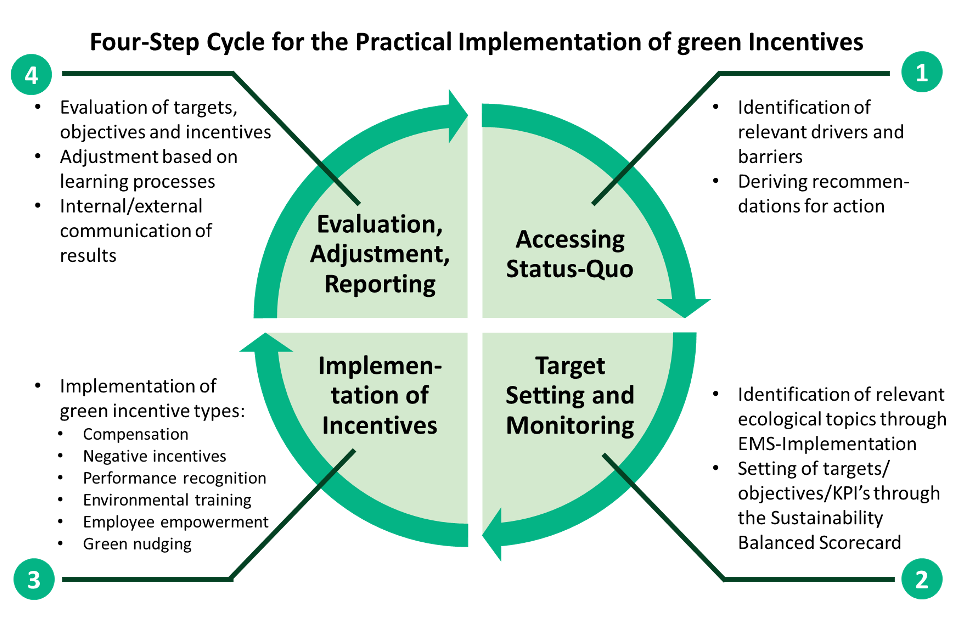
In accordance with the principles of the PDCA cycle, a new four-step process is initiated, as demonstrated in figure 9. The results of the evaluation process are subsequently utilised to inform the planning process, thereby establishing a continuous feedback loop.184Prashar, A. Adopting PDCA (Plan-Do-Check-Act) cycle for energy optimization in energy-intensive SMEs. Journal of Cleaner Production 145, 277–293; 10.1016/j.jclepro.2017.01.068 (2017). The process then reverts to the initial stage, at which point new and adapted incentive and management systems are employed. These progressive evaluations and subsequent developments demonstrate a commitment to enhance the EP and integrate sustainability into business operations and strategy.208Yusliza, M.-Y. et al. Top management commitment, corporate social responsibility and green human resource management. Benchmarking: An International Journal 26, 2051–2078; 10.1108/BIJ-09-2018-0283 (2019). This perception exerts a direct and positive influence on the intrinsic motivation of the workforce, thereby strengthening general commitment and consolidating a sustainable green culture as the basis for the development of further incentive systems.127Cao, S., Xu, P., Qalati, S. A. & Wu, K. Impact of Employee Environmental Concerns on Sustainable Practices: Investigating Organizational Commitment and Job Satisfaction. Sustainability 16, 5823; 10.3390/su16135823 (2024).132Francoeur, C., Melis, A., Gaia, S. & Aresu, S. Green or Greed? An Alternative Look at CEO Compensation and Corporate Environmental Commitment. Journal of Business Ethics 140, 439–453 (2017). Finally, the lessons learned, together with the improvement measures, are communicated to all relevant participants to create complete transparency.
Reporting
To ensure external transparency, external communication using reporting standards is a necessary step. This approach fosters comparability, enables external stakeholders to evaluate the effectiveness of green incentives, and ensures that companies meet regulatory requirements. In this regard, two international frameworks are presented that use green incentive-related disclosures: the GRI and the ESRS.
The GRI standard requires the reporting of incentives, predominantly through GRI 404 (Training and Education) and the general governance disclosures (GRI 2). In addition to the extent to which sustainability goals are integrated into compensation systems, companies are required to report on how many hours of training on sustainability topics are conducted and which training measures are implemented. GRI thus establishes a framework for voluntarily disclosing employee and management incentives that is both widely applicable and recognised on an international level.288Global Reporting Initiative. GRI 404: Training and Education 2016. Available at https://www.globalreporting.org/how-to-use-the-gri-standards/gri-standards-english-language/.289Global Reporting Initiative. GRI 2: General Disclosures 2021. Available at https://www.globalreporting.org/how-to-use-the-gri-standards/gri-standards-english-language/.
The Corporate Sustainability Reporting Directive, in conjunction with the ESRS, has taken a further step by introducing mandatory disclosure requirements for European companies. This necessitates the integration of management compensation with sustainability targets as well as the provision of disclosures pertaining to employee training. According to the ESRS 2 (General Disclosures), companies must disclose whether and how sustainability aspects are integrated into the remuneration and incentive schemes of their administrative, management, and supervisory bodies. The disclosure should cover:
- Key characteristics of the incentive schemes,
- Sustainability-related targets or impacts used for performance assessment (if any),
- Integration of sustainability metrics into remuneration policies or performance benchmarks,
- Proportion of variable remuneration linked to sustainability targets and impacts,
- Governance level at which incentive schemes are approved and updated.102EFRAG. ESRS 2 General Disclosures. Available at https://www.efrag.org/sites/default/files/media/document/2024-08/ESRS%202%20Delegated-act-2023-5303-annex-1_en.pdf (2025).
The ESRS 2 also demands that companies must describe the expertise and skills of their administrative, management and supervisory bodies. This should include details of how they rely on internal or external experts and training programs to develop and update sustainability-related knowledge. Companies must also ensure that this expertise is relevant to their material impacts, risks and opportunities. Consequently, the ESRS places a particular emphasis on disclosures related to training as a green incentive as well.102EFRAG. ESRS 2 General Disclosures. Available at https://www.efrag.org/sites/default/files/media/document/2024-08/ESRS%202%20Delegated-act-2023-5303-annex-1_en.pdf (2025).
Nevertheless, these requirements of the standards with regard to compensation and environmental training should merely constitute the fundamental basis on which companies are required to report on green incentive systems. The relevant environmental topics from the ISO 14001 standard, in conjunction with the dynamically adaptable target formulations and KPIs from the SBSC, can provide a solid data foundation for communicating more detailed connections between EP and the PEB through green incentives. Organisations can link their environmental goals with incentive systems by, for example, publishing information and data on employee engagement in sustainability initiatives, making green nudging processes and their results transparent, or communicating new ideas through employee empowerment for participation processes.106Obereder, L., Müller-Camen, M. & Renwick, D. W. S. GHRM in Sustainability Reporting: An Exploratory Analysis Across Six Countries Using the AMO Framework. Green Human Resource Management Research, 141–166; 10.1007/978-3-031-06558-3_7 (2022).290Zaidi, S. Y. A., Aslam, M. F., Mahmood, F., Ahmad, B. & Tasaddque, S. Accomplishing the SDGs Through Green HRM Practices: Insights From Industrial Sustainability Experts. Glob Bus Org Exc 44, 19–45; 10.1002/joe.22294 (2025). However, such reporting of green incentive systems for sustainability remains infrequent in practice and will continue to be so without a substantial revision of the standards.106Obereder, L., Müller-Camen, M. & Renwick, D. W. S. GHRM in Sustainability Reporting: An Exploratory Analysis Across Six Countries Using the AMO Framework. Green Human Resource Management Research, 141–166; 10.1007/978-3-031-06558-3_7 (2022).
- Key characteristics of the incentive schemes,
- Sustainability-related targets or impacts used for performance assessment (if any),
- Integration of sustainability metrics into remuneration policies or performance benchmarks,
- Proportion of variable remuneration linked to sustainability targets and impacts,
- Governance level at which incentive schemes are approved and updated.104
The ESRS 2 also demands that companies must describe the expertise and skills of their administrative, management and supervisory bodies. This should include details of how they rely on internal or external experts and training programmes to develop and update sustainability-related knowledge. Companies must also ensure that this expertise is relevant to their material impacts, risks and opportunities. Consequently, the ESRS places a particular emphasis on disclosures related to training as a green incentive as well.104
Nevertheless, these requirements of the standards with regard to compensation and environmental training should merely constitute the fundamental basis on which companies are required to report on green incentive systems. The relevant environmental topics from the ISO 14001 standard, in conjunction with the dynamically adaptable target formulations and KPIs from the SBSC, can provide a solid data foundation for communicating more detailed connections between EP and the PEB through green incentives. Organisations can link their environmental goals with incentive systems by, for example, publishing information and data on employee engagement in sustainability initiatives, making green nudging processes and their results transparent, or communicating new ideas through employee empowerment for participation processes.108,292 However, such reporting of green incentive systems for sustainability remains infrequent in practice and will continue to be so without a substantial revision of the standards.108
References
1. Shahzad, M. A., Du Jianguo & Junaid, M. Impact of green HRM practices on sustainable performance: mediating role of green innovation, green culture, and green employees’ behavior. Environ Sci Pollut Res 30, 88524–88547; 10.1007/s11356-023-28498-6 (2023).
3. Hirschnitz-Garbers, M., Tan, A. R., Gradmann, A. & Srebotnjak, T. Key drivers for unsustainable resource use – categories, effects and policy pointers. Journal of Cleaner Production 132, 13–31; 10.1016/j.jclepro.2015.02.038 (2016).
4. Panwar, R., Ober, H. & Pinkse, J. The uncomfortable relationship between business and biodiversity: Advancing research on business strategies for biodiversity protection. Bus Strat Env 32, 2554–2566; 10.1002/bse.3139 (2023).
5. Lindgreen, A. & Swaen, V. Corporate Social Responsibility. International Journal of Management Reviews 12, 1–7; 10.1111/j.1468-2370.2009.00277.x (2010).
6. Zhao, Y. & Yang, Y. Sustainability target setting and incentive design: A literature review. BMTP 2, 3134; 10.54517/bmtp3134 (2025).
7. González‐Benito, J. & González‐Benito, Ó. A study of determinant factors of stakeholder environmental pressure perceived by industrial companies. Bus Strat Env 19, 164–181; 10.1002/bse.631 (2010).
8. Deegan, C. & Islam, M. A. An exploration of NGO and media efforts to influence workplace practices and associated accountability within global supply chains. The British Accounting Review 46, 397–415; 10.1016/j.bar.2014.10.002 (2014).
9. Saka, N., Olanipekun, A. O. & Omotayo, T. Reward and compensation incentives for enhancing green building construction. Environmental and Sustainability Indicators 11, 100138; 10.1016/j.indic.2021.100138 (2021).
10. Khattak, M. S., Wu, Q., Ahmad, M. & Ullah, R. Exploring the knowledge structure between government incentives and corporate social responsibility. CR; 10.1108/CR-03-2024-0062 (2025).
11. Jiang, K., Leng, M., Jiang, Y. & Xu, L. From penalties to profits: how government regulation and cost-revenue trade-offs shape green production and marketing. Environ Dev Sustain, 1–37; 10.1007/s10668-025-06250-z (2025).
12. Anton, W. R. Q., Deltas, G. & Khanna, M. Incentives for environmental self-regulation and implications for environmental performance. Journal of Environmental Economics and Management 48, 632–654; 10.1016/j.jeem.2003.06.003 (2004).
13. Sarkis, J., Gonzalez‐Torre, P. & Adenso‐Diaz, B. Stakeholder pressure and the adoption of environmental practices: The mediating effect of training. Journal of Operations Management 28, 163–176; 10.1016/j.jom.2009.10.001 (2010).
14. Song, L. et al. How much is global business sectors contributing to sustainable development goals? Sustainable Horizons 1, 100012; 10.1016/j.horiz.2022.100012 (2022).
16. Graafland, J. & Bovenberg, L. Government regulation, business leaders’ motivations and environmental performance of SMEs. Journal of Environmental Planning and Management 63, 1335–1355 (2020).
17. He, Q. The influence of organizational policies on firm environmental performance through sustainable technologies and innovation and stakeholder concerns. Sci Rep 15, 10019; 10.1038/s41598-025-94499-9 (2025).
18. Loedphacharakamon, N. & Worakittikul, W. TQM and sustainable hospitality: unpacking the link between green culture, employee behavior, and hotel performance. Cogent Business & Management 12, 2499948; 10.1080/23311975.2025.2499948 (2025).
19. Derchi, G.-B., Davila, A. & Oyon, D. Green incentives for environmental goals. Management Accounting Research 59, 100830; 10.1016/j.mar.2022.100830 (2023).
20. Johnstone, L. & Beusch, P. Motivating sustainable behaviour in the workplace through control. J Manag Control, 1–36; 10.1007/s00187-025-00390-z (2025).
21. Govindarajulu, N. & Daily, B. F. Motivating employees for environmental improvement. Industrial Management & Data Systems 104, 364–372; 10.1108/02635570410530775 (2004).
22. Nikolaou, I. E., Tsagarakis, K. P. & Tasopoulou, K. An examination of ecopreneurs’ incentives through a combination between institutional and resource-based approach. MEQ 29, 195–215; 10.1108/MEQ-01-2017-0004 (2018).
23. Süßbauer, E. & Schäfer, M. Corporate strategies for greening the workplace: Findings from sustainability-oriented companies in Germany. Journal of Cleaner Production 226, 564–577; 10.1016/j.jclepro.2019.04.009 (2019).
24. Amrutha, V. N. & Geetha, S. N. A systematic review on green human resource management: Implications for social sustainability. Journal of Cleaner Production 247, 119131; 10.1016/j.jclepro.2019.119131 (2020).
25. Beck-Krala, E. & Klimkiewicz, K. Reward Programs Supporting Environmental Organizational Policy. Zarządzanie Zasobami Ludzkimi, 41–54 (2017).
26. Dahlmann, F., Branicki, L. & Brammer, S. ‘Carrots for Corporate Sustainability’: Impacts of Incentive Inclusiveness and Variety on Environmental Performance. Bus Strat Env 26, 1110–1131; 10.1002/bse.1971 (2017).
27. Aftab, J., Abid, N., Cucari, N. & Savastano, M. Green human resource management and environmental performance: The role of green innovation and environmental strategy in a developing country. Bus Strat Env 32, 1782–1798; 10.1002/bse.3219 (2023).
28. Ojo, A. O., Tan, C. N.-L. & Alias, M. Linking green HRM practices to environmental performance through pro-environment behaviour in the information technology sector. Social Responsibility Journal 18, 1–18; 10.1108/SRJ-12-2019-0403 (2022).
29. Rahman, M., Abd Wahab, S. & Abdul Latiff, A. S. The Underlying Theories of Organizational Sustainability: The Motivation Perspective. JBMS 5, 181–193; 10.32996/jbms.2023.5.1.18 (2023).
30. Liu, J. & Liu, J. The greater the incentives, the better the effect? Interactive moderating effects on the relationship between green motivation and green creativity. IJCHM 35, 919–932; 10.1108/IJCHM-03-2022-0340 (2023).
31. Maki, A., Burns, R. J., Ha, L. & Rothman, A. J. Paying people to protect the environment: A meta-analysis of financial incentive interventions to promote proenvironmental behaviors. Journal of Environmental Psychology 47, 242–255; 10.1016/j.jenvp.2016.07.006 (2016).
32. Snyder, H. Literature review as a research methodology: An overview and guidelines. Journal of Business Research 104, 333–339; 10.1016/j.jbusres.2019.07.039 (2019).
33. Baumeister, R. F. & Leary, M. R. Writing Narrative Literature Reviews. Review of General Psychology 1, 311–320; 10.1037/1089-2680.1.3.311 (1997).
34. Ren, S., Tang, G. & E. Jackson, S. Green human resource management research in emergence: A review and future directions. Asia Pac J Manag 35, 769–803; 10.1007/s10490-017-9532-1 (2018).
35. Amjad, F. et al. Effect of green human resource management practices on organizational sustainability: the mediating role of environmental and employee performance. Environ Sci Pollut Res 28, 28191–28206; 10.1007/s11356-020-11307-9 (2021).
36. Kang, Y.-C., Hsiao, H.-S. & Ni, J.-Y. The Role of Sustainable Training and Reward in Influencing Employee Accountability Perception and Behavior for Corporate Sustainability. Sustainability 14, 11589; 10.3390/su141811589 (2022).
37. Leidner, S., Baden, D. & Ashleigh, M. J. Green (environmental) HRM: aligning ideals with appropriate practices. PR 48, 1169–1185; 10.1108/PR-12-2017-0382 (2019).
38. Renwick, D. W., Redman, T. & Maguire, S. Green Human Resource Management: A Review and Research Agenda*. Int J Management Reviews 15, 1–14; 10.1111/j.1468-2370.2011.00328.x (2013).
39. Arulrajah, A. A., Opatha, H. & Nawaratne, N. Green Human Resource Management Practices: A Review. SLJHRM 5 (2015).
40. Das, S. & Dash, M. Green Compensation And Reward System: A Novel Approach Towards The Growth And Sustainability Of Organisation. Journal of Advanced Zoology 45, 1213–1219 (2024).
41. Yin, Y., Wang, Y. & Lu, Y. How to Design Green Compensation to Promote Managers’ Pro-Environmental Behavior? A Goal-Framing Perspective. J Bus Ethics 197, 341–353; 10.1007/s10551-024-05762-4 (2025).
42. Mandip, G. Green HRM: People Management Commitment to Environmental Sustainability. Research Journal of Recent Sciences 1, 244–252 (2012).
43. Saeed, B. B. et al. Promoting employee’s proenvironmental behavior through green human resource management practices. Corp Soc Responsibility Env 26, 424–438; 10.1002/csr.1694 (2019).
44. Milne, P. Motivation, incentives and organisational culture. Journal of Knowledge Management 11, 28–38; 10.1108/13673270710832145 (2007).
45. Pham, N. T., Vo-Thanh, T., Shahbaz, M., Duc Huynh, T. L. & Usman, M. Managing environmental challenges: Training as a solution to improve employee green performance. Journal of Environmental Management 269, 110781; 10.1016/j.jenvman.2020.110781 (2020).
46. Teixeira, A. A., Jabbour, C. J. C., Sousa Jabbour, A. B. L. de, Latan, H. & Oliveira, J. H. C. de. Green training and green supply chain management: evidence from Brazilian firms. Journal of Cleaner Production 116, 170–176; 10.1016/j.jclepro.2015.12.061 (2016).
47. Tariq, S., Jan, F. A. & Ahmad, M. S. Green employee empowerment: a systematic literature review on state-of-art in green human resource management. Qual Quant 50, 237–269; 10.1007/s11135-014-0146-0 (2016).
48. Markey, R., McIvor, J., O’Brien, M. & Wright, C. F. Reducing carbon emissions through employee participation: evidence from Australia. Industrial Relations Journal 50, 57–83; 10.1111/irj.12238 (2019).
49. Ye, P., Liu, L. & Tan, J. Influence of leadership empowering behavior on employee innovation behavior: The moderating effect of personal development support. Front. Psychol. 13, 1022377; 10.3389/fpsyg.2022.1022377 (2022).
50. Decrinis, L., Freibichler, W., Kaiser, M., Sunstein, C. R. & Reisch, L. A. Sustainable behaviour at work: How message framing encourages employees to choose electric vehicles. Bus Strat Env 32, 5650–5668; 10.1002/bse.3441 (2023).
51. Paolis, G. de, Tiberio, L. & Caffaro, F. More sustainable choices in the workplace: a systematic review of nudge theory applications. Front. Psychol. 16, 1556796; 10.3389/fpsyg.2025.1556796 (2025).
53. Elkington, J. Accounting for the triple bottom line. Measuring Business Excellence 2, 18–22; 10.1108/eb025539 (1998).
54. Elkington, J. Towards the Sustainable Corporation: Win-Win-Win Business Strategies for Sustainable Development.California Management Review 36, 90–100; 10.2307/41165746 (1994).
55. Purvis, B., Mao, Y. & Robinson, D. Three pillars of sustainability: in search of conceptual origins. Sustain Sci 14, 681–695; 10.1007/s11625-018-0627-5 (2019).
56. Kuhlman, T. & Farrington, J. What is Sustainability? Sustainability 2, 3436–3448; 10.3390/su2113436 (2010).
57. Giovannoni, E. & Fabietti, G. What Is Sustainability? A Review of the Concept and Its Applications. In Integrated reporting. Concepts and cases that redefine corporate accountability, edited by C. Busco (Springer, Cham, Heidelberg, 2013), pp. 21–40.
58. Maas, K. & Rosendaal, S. Sustainability Targets in Executive Remuneration: Targets, Time Frame, Country and Sector Specification. Bus Strat Env 25, 390–401; 10.1002/bse.1880 (2016).
59. Elshaer, I. A., Sobaih, A. E. E., Aliedan, M. & Azazz, A. M. S. The Effect of Green Human Resource Management on Environmental Performance in Small Tourism Enterprises: Mediating Role of Pro-Environmental Behaviors.Sustainability 13, 1956; 10.3390/su13041956 (2021).
60. Marrucci, L., Daddi, T. & Iraldo, F. Creating environmental performance indicators to assess corporate sustainability and reward employees. Ecological Indicators 158, 111489; 10.1016/j.ecolind.2023.111489 (2024).
61. Hameed Aldulaimi, S., Mohammed Yousif Abo Keir & Abdeldayem, M. M. Implementing Green Human Resources Management to Promote Sustainability Development: Application from Telecommunication Companies in Kingdom of Bahrain. Journal of Statistics Applications & Probability 11, 321–330; 10.18576/jsap/110125 (2022).
62. Hnin, S. W., Javed, A., Karnjana, J., Jeenanunta, C. & Kohda, Y. Workplace sustainability: energy-saving behaviors in office environments of Thailand. Front. Psychol. 16, 1400410; 10.3389/fpsyg.2025.1400410 (2025).
63. Zacher, H., Rudolph, C. W. & Katz, I. M. Employee Green Behavior as the Core of Environmentally Sustainable Organizations. Annu. Rev. Organ. Psychol. Organ. Behav. 10, 465–494; 10.1146/annurev-orgpsych-120920-050421 (2023).
64. Liaquat, M. et al. Impact of motivational factors and green behaviors on employee environmental performance. Research in Globalization 8, 100180; 10.1016/j.resglo.2023.100180 (2024).
65. Odhiambo, G. M., Waiganjo, E. & Simiyu, A. N. Incentivizing Employee Pro-Environmental Behaviour: Harnessing the Potential of Green Rewards. AJER 4, 601–611; 10.51867/ajernet.4.2.60 (2023).
66. Ahuja, J., Yadav, M. & Sergio, R. P. Green leadership and pro-environmental behaviour: a moderated mediation model with rewards, self-efficacy and training. International Journal of Ethics and Systems 39, 481–501; 10.1108/IJOES-02-2022-0041 (2023).
67. Grace Mwamburi Odhiambo, Esther Wangithi Waiganjo & Alice Nanjala Simiyu. Incentivizing Employee Pro-Environmental Behaviour: Harnessing the Potential of Green Rewards. AJER 4, 601–611-601–611 (2023).
68. Woo, E. J. The Necessity of Environmental Education for Employee Green Behavior. East Asian Journal of Business Economics (EAJBE) 9, 29–41; 10.20498/eajbe.2021.9.4.29 (2021).
69. Ture, R. S. & Ganesh, M. P. Understanding Pro-environmental Behaviours at Workplace: Proposal of a Model. Asia-Pacific Journal of Management Research and Innovation 10, 137–145; 10.1177/2319510X14536219 (2014).
70. Ones, D. S., Wiernik, B. M., Dilchert, S. & Klein, R. M. Multiple domains and categories of employee green behaviours: more than conservation. Chapters, 13–38 (2018).
71. Aan Hardiyana, Manik, E. & Komara, A. T. Exploring the Impact of Eco-Friendly Leadership and Motivation on Sustainable Workplace Culture and Environmental Effectiveness to Support the Sustainable Development Goals (SDG’s). jlsdgr 5, e02447; 10.47172/2965-730X.SDGsReview.v5.n01.pe02447 (2024).
72. Paillé, P., Chen, Y., Boiral, O. & Jin, J. The Impact of Human Resource Management on Environmental Performance: An Employee-Level Study. Journal of Business Ethics 121, 451–466; 10.1007/s10551-013-1732-0 (2014).
73. Ali, S., Jiang, J., Rehman, R. u. & Khan, M. K. Tournament incentives and environmental performance: the role of green innovation. Environ Sci Pollut Res 30, 17670–17680; 10.1007/s11356-022-23406-w (2023).
74. Mio, C., Costantini, A. & Panfilo, S. Performance measurement tools for sustainable business: A systematic literature review on the sustainability balanced scorecard use. Corporate Social Responsibility and Environmental Management 29, 367–384; 10.1002/csr.2206 (2022).
75. Campos, L. M., Melo Heizen, D. A. de, Verdinelli, M. A. & Cauchick Miguel, P. A. Environmental performance indicators: a study on ISO 14001 certified companies. Journal of Cleaner Production 99, 286–296; 10.1016/j.jclepro.2015.03.019 (2015).
76. Ali, I., Sami, S., Senan, N. A. M., Baig, A. & Khan, I. A. A study on corporate sustainability performance evaluation and management: The sustainability balanced scorecard. CGOBR 6, 150–162; 10.22495/cgobrv6i2p15 (2022).
77. Paillé, P., Valéau, P. & Carballo-Penela, A. Green rewards for optimizing employee environmental performance: examining the role of perceived organizational support for the environment and internal environmental orientation.Journal of Environmental Planning and Management 66, 2810–2831; 10.1080/09640568.2022.2092723 (2023).
78. Taylor, F. W. The principles of scientific management (Harper & Brothers, New York, 1911).
79. Herzberg, F. The Motivation to Work (John Wiley & Sons, New York, 1959).
80. Vroom, V. H. Work and motivation (Wiley, New York, 1964).
81. Caudill, H. L. & Porter, C. D. An Historical Perspective of Reward Systems: Lessons Learned from the Scientific Management Era. International Journal of Human Resource Studies 4, 127; 10.5296/ijhrs.v4i4.6605 (2014).
82. Jensen, M. C. & Meckling, W. H. Theory of the firm: Managerial behavior, agency costs and ownership structure.Journal of Financial Economics 3, 305–360; 10.1016/0304-405X(76)90026-X (1976).
83. Meadows, D. H., Meadows, D. L. & Randers, J. The limits to growth: A report for the Club of Rome’s project on the predicament of mankind (Universe Books, New York, 1972).
84. Gerard, D. & Lave, L. B. Implementing technology-forcing policies: The 1970 Clean Air Act Amendments and the introduction of advanced automotive emissions controls in the United States. Technological Forecasting and Social Change 72, 761–778; 10.1016/j.techfore.2004.08.003 (2005).
85. Turnock, S. T. et al. The impact of European legislative and technology measures to reduce air pollutants on air quality, human health and climate. Environ. Res. Lett. 11, 24010; 10.1088/1748-9326/11/2/024010 (2016).
86. Goldsmith, P. D. & Basak, R. Incentive Contracts and Environmental Performance Indicators. Environmental and Resource Economics 20, 259–279; 10.1023/A:1013065801547 (2001).
87. Florida, R. & Davison, D. Gaining from Green Management: Environmental Management Systems inside and outside the Factory. California Management Review 43, 64–84; 10.2307/41166089 (2001).
88. Franke, J. Political evolution of EMAS: Perspectives from the EU, national governments and industrial groups. Eur. Env. 5, 155–159; 10.1002/eet.3320050602 (1995).
89. Wehrmeyer, W. Greening People. Human Resources and Environmental Management (Taylor and Francis, London, 1996).
90. Rondinelli, D. & Vastag, G. Panacea, common sense, or just a label? European Management Journal 18, 499–510; 10.1016/S0263-2373(00)00039-6 (2000).
91. Gallarotti, G. M. It pays to be green: The managerial incentive structure and environmentally sound strategies. The Columbia Journal of World Business 30, 38–57; 10.1016/0022-5428(95)90004-7 (1995).
92. Eccles, R. G., Ioannou, I. & Serafeim, G. The Impact of Corporate Sustainability on Organizational Processes and Performance. Management Science 60, 2835–2857 (2014).
93. DuBose, J. R. Sustainability and Performance at Interface, Inc. Interfaces 30, 190–201; 10.1287/inte.30.3.190.11665 (2000).
94. Rattalino, F. Circular advantage anyone? Sustainability‐driven innovation and circularity at Patagonia, Inc.Thunderbird Intl Bus Rev 60, 747–755; 10.1002/tie.21917 (2018).
95. Ims, K. J. Caring Entrepreneurship and Ecological Conscience—The Case of Patagonia Inc. Caring Management in the New Economy, 197–220; 10.1007/978-3-030-14199-8_11 (2019).
96. McElhaney, K. A., Toffel, M. W. & Hill, N. Designing a Sustainability Management System at BMW Group: The Designworks/USA Case Study. Greener Management International, 102–116 (2004).
97. Berrone, P. & Gomez-Mejia, L. R. Environmental Performance and Executive Compensation: An Integrated Agency-Institutional Perspective. AMJ 52, 103–126; 10.5465/amj.2009.36461950 (2009).
98. Global Reporting Initiative. GRI Sustainability Reporting Guidelines 2002, 2002.
99. Jabbour, C. J. C. & Santos, F. C. A. The central role of human resource management in the search for sustainable organizations. The International Journal of Human Resource Management 19, 2133–2154; 10.1080/09585190802479389 (2008).
100. Renwick, D., Redman, T. & Maguire, S. Green HRM: A review, process model, and research agenda. University of Sheffield Management School Discussion Paper 1, 1–46 (2008).
101. Fernández, E., Junquera, B. & Ordiz, M. Organizational culture and human resources in the environmental issue: a review of the literature. The International Journal of Human Resource Management 14, 634–656; 10.1080/0958519032000057628 (2003).
102. Hanna, M. D., Rocky Newman, W. & Johnson, P. Linking operational and environmental improvement through employee involvement. International Journal of Operations & Production Management 20, 148–165; 10.1108/01443570010304233 (2000).
105. Ferretti, P., Gonnella, C. & Martino, P. Integrating sustainability in management control systems: an exploratory study on Italian banks. MEDAR 32, 1–34; 10.1108/MEDAR-03-2023-1954 (2024).
106. Crutzen, N., Zvezdov, D. & Schaltegger, S. Sustainability and management control. Exploring and theorizing control patterns in large European firms. Journal of Cleaner Production 143, 1291–1301; 10.1016/j.jclepro.2016.11.135 (2017).
107. Benvenuto, M., Aufiero, C. & Viola, C. A systematic literature review on the determinants of sustainability reporting systems. Heliyon 9, e14893; 10.1016/j.heliyon.2023.e14893 (2023).
108. Obereder, L., Müller-Camen, M. & Renwick, D. W. S. GHRM in Sustainability Reporting: An Exploratory Analysis Across Six Countries Using the AMO Framework. Green Human Resource Management Research, 141–166; 10.1007/978-3-031-06558-3_7 (2022).
109. Zhu, C., Liu, X., Chen, D. & Yue, Y. Executive compensation and corporate sustainability: Evidence from ESG ratings. Heliyon 10, e32943; 10.1016/j.heliyon.2024.e32943 (2024).
110. AlKetbi, A. & Rice, J. The Impact of Green Human Resource Management Practices on Employees, Clients, and Organizational Performance: A Literature Review. Administrative Sciences 14, 78; 10.3390/admsci14040078 (2024).
111. Hart, S. L. A Natural-Resource-Based View of the Firm. AMR 20, 986; 10.2307/258963 (1995).
112. Barney, J. Firm Resources and Sustained Competitive Advantage. Journal of Management 17, 99–120; 10.1177/014920639101700108 (1991).
113. Austrup, D. & Blomberg, C. von. Anreiz- und Vergütungssysteme: Verlockung zur Nachhaltigkeit. CSR und Finance, 83–94; 10.1007/978-3-642-54882-6_5 (2014).
114. Liu, M., Zhao, J. & Liu, H. Digital transformation, employee and executive compensation, and sustained green innovation. International Review of Financial Analysis 97, 103873; 10.1016/j.irfa.2024.103873 (2025).
115. Ramus, C. A. Encouraging innovative environmental actions: what companies and managers must do. Journal of World Business 37, 151–164; 10.1016/S1090-9516(02)00074-3 (2002).
116. Ren, S., Tang, G. & Jackson, S. E. Effects of Green HRM and CEO ethical leadership on organizations’ environmental performance. IJM 42, 961–983; 10.1108/IJM-09-2019-0414 (2021).
117. Li, B., Yin, S. & Zhang, B. Incentive mechanism of multiple green innovation behaviors of equipment manufacturing enterprises: A managers, green coordination groups and employees perspective. PloS one 19, e0300533; 10.1371/journal.pone.0300533 (2024).
118. Shen, C. H. & Zhang, H. Tournament Incentives and Firm Innovation. Review of Finance 22, 1515–1548; 10.1093/rof/rfw064 (2018).
119. Parrish, B. D. Sustainability-driven entrepreneurship: Principles of organization design. Journal of Business Venturing 25, 510–523; 10.1016/j.jbusvent.2009.05.005 (2010).
120. Xuecheng, W., Ahmad, N. H., Iqbal, Q. & Saina, B. Responsible Leadership and Sustainable Development in East Asia Economic Group: Application of Social Exchange Theory. Sustainability 14, 6020; 10.3390/su14106020 (2022).
121. Bilderback, S. Integrating training for organizational sustainability: the application of Sustainable Development Goals globally. EJTD 48, 730–748; 10.1108/EJTD-01-2023-0005 (2024).
122. Hassanein, F. et al. Green Human Resource Management and Employee Retention in the Hotel Industry of UAE: The Mediating Effect of Green Innovation. Sustainability 16, 4668; 10.3390/su16114668 (2024).
123. Lambert, E. G. et al. To be committed or not: a systematic review of the empirical literature on organizational commitment among correctional staff. Criminal Justice Studies 34, 88–114; 10.1080/1478601X.2020.1762082 (2021).
124. Rayner, J. & Morgan, D. An empirical study of ‘green’ workplace behaviours: ability, motivation and opportunity.Asia Pacific Journal of Human Resources 56, 56–78; 10.1111/1744-7941.12151 (2018).
125. Diri, T. V. & Elisha, O. D. Green human resource management: A catalyst for environmental sustainability in Nigeria. Journal of Global Ecology and Environment 11, 9–27 (2021).
126. Lawson, V. Reshaping Economic Geography? Producing Spaces of Inclusive Development. Economic Geography 86, 351–360; 10.1111/j.1944-8287.2010.001092.x (2010).
127. Mirvis, P. Employee Engagement and CSR: Transactional, Relational, and Developmental Approaches. California Management Review 54, 93–117; 10.1525/cmr.2012.54.4.93 (2012).
128. Wagner, M. ‘Green’ Human Resource Benefits: Do they Matter as Determinants of Environmental Management System Implementation? J Bus Ethics 114, 443–456; 10.1007/s10551-012-1356-9 (2013).
129. Cao, S., Xu, P., Qalati, S. A. & Wu, K. Impact of Employee Environmental Concerns on Sustainable Practices: Investigating Organizational Commitment and Job Satisfaction. Sustainability 16, 5823; 10.3390/su16135823 (2024).
130. A. Banu Goktan. Impact of green management on CEO compensation: interplay of the agency theory and institutional theory perspectives. Journal of Business Economics and Management 15, 96–110 (2014).
131. Merriman, K. K., Sen, S., Felo, A. J. & Litzky, B. E. Employees and sustainability: the role of incentives. Journal of Managerial Psychology 31, 820–836; 10.1108/JMP-09-2014-0285 (2016).
132. Greiner, M. & Sun, J. How corporate social responsibility can incentivize top managers: A commitment to sustainability as an agency intervention. Corporate Social Responsibility and Environmental Management 28, 1360–1375; 10.1002/csr.2148 (2021).
133. Aguilera, R. V., Aragón-Correa, J. A., Marano, V. & Tashman, P. A. The Corporate Governance of Environmental Sustainability: A Review and Proposal for More Integrated Research. Journal of Management 47, 1468–1497; 10.1177/0149206321991212 (2021).
134. Francoeur, C., Melis, A., Gaia, S. & Aresu, S. Green or Greed? An Alternative Look at CEO Compensation and Corporate Environmental Commitment. Journal of Business Ethics 140, 439–453 (2017).
135. Donaldson, L. & Davis, J. H. Stewardship Theory or Agency Theory: CEO Governance and Shareholder Returns.Australian Journal of Management 16, 49–64; 10.1177/031289629101600103 (1991).
136. Seun, K. J., Esther, I. O. & Wasiu, A. A. Unveiling Stewardship Theory: Emerging Trends and Future Direction.Journal of Business and African Economy 11, 95–112 (2024).
137. Hernandez, M. Toward an Understanding of the Psychology of Stewardship. AMR 37, 172–193; 10.5465/amr.2010.0363 (2012).
138. Zens, P. & Heiler, C. Nachhaltig führen, nachhaltig belohnen. Wie ESG-Kriterien die Vergütung in DAX-Unternehmen prägen (Springer Fachmedien Wiesbaden; Imprint Springer Gabler, Wiesbaden, 2025).
139. Saeed, U. F. & Abdul-Karim, M. The evolving role of executive compensation, sustainability performance, and corporate dynamics in the era of corporate sustainability: insights from quantile regression in emerging markets.Cogent Business & Management 12, 2512833; 10.1080/23311975.2025.2512833 (2025).
140. Holmstrom, B. & Milgrom, P. Multitask Principal–Agent Analyses: Incentive Contracts, Asset Ownership, and Job Design. J Law Econ Organ 7, 24–52; 10.1093/jleo/7.special_issue.24 (1991).
141. Merriman, K. K. & Sen, S. Incenting managers toward the triple bottom line: An agency and social norm perspective. Human Resource Management 51, 851–871; 10.1002/hrm.21491 (2012).
142. Ratti, S., Arena, M., Azzone, G. & Dell’Agostino, L. Environmental claims and executive compensation plans: Is there a link? An empirical investigation of Italian listed companies. Journal of Cleaner Production 422, 138434; 10.1016/j.jclepro.2023.138434 (2023).
143. Bandhu, D. et al. Theories of motivation: A comprehensive analysis of human behavior drivers. Acta Psychologica 244, 104177; 10.1016/j.actpsy.2024.104177 (2024).
144. Deci, E. L. & Ryan, R. M. Intrinsic motivation and self-determination in human behavior (Plenum Press, New York, N.Y., 1985).
145. Graves, L. M., Sarkis, J. & Zhu, Q. How transformational leadership and employee motivation combine to predict employee proenvironmental behaviors in China. Journal of Environmental Psychology 35, 81–91; 10.1016/j.jenvp.2013.05.002 (2013).
146. Hewett, R. & Conway, N. The undermining effect revisited: The salience of everyday verbal rewards and self‐determined motivation. Journal of Organizational Behavior 37, 436–455; 10.1002/job.2051 (2016).
147. Zhang, Y., Luo, Y., Zhang, X. & Zhao, J. How Green Human Resource Management Can Promote Green Employee Behavior in China: A Technology Acceptance Model Perspective. Sustainability 11, 5408; 10.3390/su11195408 (2019).
148. Ryan, R. M. & Deci, E. L. Self-determination theory. Basic psychological needs in motivation, development, and wellness (The Guilford Press, New York, London, 2018).
149. Gagné, M. & Deci, E. L. Self‐determination theory and work motivation. Journal of Organizational Behavior 26, 331–362; 10.1002/job.322 (2005).
150. Tajfel, H. & Turner, J. C. An integrative theory of intergroup conflict. (Brooks/Cole, Monterey, CA, 1979).
151. Ribeiro, N., Gomes, D. R., Ortega, E., Gomes, G. P. & Semedo, A. S. The Impact of Green HRM on Employees’ Eco-Friendly Behavior: The Mediator Role of Organizational Identification. Sustainability 14, 2897; 10.3390/su14052897 (2022).
152. Khan, R. U., Abbasi, M. A., Farhan, A. F. A., Al-sakkaf, M. A. & Singh, K. S. D. Green HRM, organizational identification and sustainable development in the emerging economy: applications from social identity theory.Journal of Economic and Administrative Sciences; 10.1108/JEAS-07-2022-0177 (2023).
153. Carmeli, A., Brammer, S., Gomes, E. & Tarba, S. Y. An organizational ethic of care and employee involvement in sustainability‐related behaviors: A social identity perspective. Journal of Organizational Behavior 38, 1380–1395; 10.1002/job.2185 (2017).
154. Gond, J.-P., El Akremi, A., Swaen, V. & Babu, N. The psychological microfoundations of corporate social responsibility: A person‐centric systematic review. Journal of Organizational Behavior 38, 225–246; 10.1002/job.2170 (2017).
155. Chaudhary, R. Green Human Resource Management and Employee Green Behavior: An Empirical Analysis.Corporate Social Responsibility and Environmental Management 27, 630–641; 10.1002/csr.1827 (2020).
156. Ashforth, B. E. & Mael, F. Social Identity Theory and the Organization. AMR 14, 20; 10.2307/258189 (1989).
157. Roscoe, S., Subramanian, N., Jabbour, C. J. & Chong, T. Green human resource management and the enablers of green organisational culture: Enhancing a firm’s environmental performance for sustainable development. Bus Strat Env 28, 737–749; 10.1002/bse.2277 (2019).
158. Paillé, P., Sanchez-Famoso, V., Valéau, P., Ren, S. & Mejia-Morelos, J. H. Green HRM through social exchange revisited: when negotiated exchanges shape cooperation. The International Journal of Human Resource Management 34, 3277–3307; 10.1080/09585192.2022.2117992 (2023).
159. Homans, G. C. Social Behavior as Exchange. American Journal of Sociology 63, 597–606 (1958).
160. Memon, K. R., Ghani, B. & Khalid, S. The relationship between corporate social responsibility and employee engagement: A social exchange perspective. International Journal of Business Science & Applied Management (IJBSAM) 15, 1–16 (2020).
161. Piwowar-Sulej, K., Iqbal, Q., Dagar, V. & Singh, S. Employees’ eco-friendly innovative behaviors: Examining the role of individual and situational factors. European Management Journal; 10.1016/j.emj.2024.04.005 (2024).
162. Chiarini, A. & Bag, S. Using green human resource management practices to achieve green performance: Evidence from Italian manufacturing context. Bus Strat Env 33, 4694–4707; 10.1002/bse.3724 (2024).
163. Ostertag, F. Integrating OCBE Literature and Norm Activation Theory: A Moderated Mediation on Proenvironmental Behavior of Employees. Sustainability 15, 7605; 10.3390/su15097605 (2023).
164. Zhang, Y., Wang, Z. & Zhou, G. Antecedents of employee electricity saving behavior in organizations: An empirical study based on norm activation model. Energy Policy 62, 1120–1127; 10.1016/j.enpol.2013.07.036 (2013).
165. Tverskoi, D. et al. Energy saving at work: Understanding the roles of normative values and perceived benefits and costs in single-person and shared offices in the United States. Energy Research & Social Science 79, 102173; 10.1016/j.erss.2021.102173 (2021).
166. Kotsopoulos, D., Bardaki, C. & Pramatari, K. How to motivate employees towards organizational energy conservation: Insights based on employees perceptions and an IoT-enabled gamified IS intervention. Heliyon 9, e16314; 10.1016/j.heliyon.2023.e16314 (2023).
167. Temminck, E., Mearns, K. & Fruhen, L. Motivating Employees towards Sustainable Behaviour. Bus Strat Env 24, 402–412; 10.1002/bse.1827 (2015).
168. Malik, S. Y. et al. Corporate Social Responsibility, Green Human Resources Management, and Sustainable Performance: Is Organizational Citizenship Behavior towards Environment the Missing Link? Sustainability 13, 1044; 10.3390/su13031044 (2021).
169. Roy, M.-J., Boiral, O. & Paillé, P. Pursuing quality and environmental performance. Business Process Mgmt Journal 19, 30–53; 10.1108/14637151311294859 (2013).
170. Ramus, C. A. Organizational Support for Employees: Encouraging Creative Ideas for Environmental Sustainability.California Management Review 43, 85–105; 10.2307/41166090 (2001).
171. Zhang, Y., Fu, B., Maani, S. & Le Wen. Employee energy-saving behaviors: Review of theories, influencing factors, and interventions. Renewable and Sustainable Energy Reviews 203, 114766; 10.1016/j.rser.2024.114766 (2024).
172. Birbirsa, Z. & Worku, M. Green Human Resource Management: A Systematic Literature Review and Future Research Directions. IJOL 11, 357–383; 10.33844/ijol.2022.60334 (2022).
173. Sampene, A. K., Li, C. & Esther Agyeiwaa, O. Green human resource to stimulate low carbon behaviour through the mediation role of innovation practices and organizational commitment. International Journal of Innovation Studies 8, 364–380; 10.1016/j.ijis.2024.09.001 (2024).
174. Agyabeng-Mensah, Y. & Tang, L. The relationship among green human capital, green logistics practices, green competitiveness, social performance and financial performance. Journal of Manufacturing Technology Management 32, 1377–1398; 10.1108/JMTM-11-2020-0441 (2021).
175. Ramus, C. A. & Steger, U. The Roles of Supervisory Support Behaviors and Environmental Policy in Employee “Ecoinitiatives” at Leading-Edge European Companies. AMJ 43, 605–626; 10.5465/1556357 (2000).
176. Saputro, A. & Nawangsari, L. C. The Effect of Green Human Resource Management on Organization Citizenship Behaviour for Environment (OCBE) and Its Implications on Employee Performance at Pt Andalan Bakti Niaga.EJBMR 6, 174–181; 10.24018/ejbmr.2021.6.1.716 (2021).
177. Kim, Y. J., Kim, W. G., Choi, H.-M. & Phetvaroon, K. The effect of green human resource management on hotel employees’ eco-friendly behavior and environmental performance. International Journal of Hospitality Management 76, 83–93; 10.1016/j.ijhm.2018.04.007 (2019).
178. Miah, M., Szabó-Szentgróti, G. & Walter, V. A systematic literature review on green human resource management (GHRM): an organizational sustainability perspective. Cogent Business & Management 11, 2371983; 10.1080/23311975.2024.2371983 (2024).
179. Appelbaum, E. Manufacturing advantage. Why high performance work systems pay off. 1st ed. (Cornell University Press, Ithaca, NY, 2000).
180. Ercantan, O. & Eyupoglu, S. How Do Green Human Resource Management Practices Encourage Employees to Engage in Green Behavior? Perceptions of University Students as Prospective Employees. Sustainability 14, 1718; 10.3390/su14031718 (2022).
181. Singh, S. K., Del Giudice, M., Chierici, R. & Graziano, D. Green innovation and environmental performance: The role of green transformational leadership and green human resource management. Technological Forecasting and Social Change 150, 119762; 10.1016/j.techfore.2019.119762 (2020).
182. Mwamburi, G. O., Wangithi, E. W. & Simiyu, A. N. Incentivizing Employee Pro-Environmental Behaviour: Harnessing the Potential of Green Rewards. AJER 4, 601–611-601–611 (2023).
183. Zhang, Y., Du, J. & Boamah, K. B. Green climate and pro‐environmental behavior: Addressing attitude‐behavior gaps towards promoting sustainable development. Sustainable Development 31, 2428–2445; 10.1002/sd.2520 (2023).
184. Nguyen, V., Nguyen, N., Schumacher, B. & Tran, T. Practical Application of Plan–Do–Check–Act Cycle for Quality Improvement of Sustainable Packaging: A Case Study. Applied Sciences 10, 6332; 10.3390/app10186332 (2020).
185. Jovanović, B., Filipović, J. & Bakić, V. Energy management system implementation in Serbian manufacturing – Plan-Do-Check-Act cycle approach. Journal of Cleaner Production 162, 1144–1156; 10.1016/j.jclepro.2017.06.140 (2017).
186. Prashar, A. Adopting PDCA (Plan-Do-Check-Act) cycle for energy optimization in energy-intensive SMEs. Journal of Cleaner Production 145, 277–293; 10.1016/j.jclepro.2017.01.068 (2017).
187. Brouwer, M. A. & van Koppen, C. The soul of the machine: continual improvement in ISO 14001. Journal of Cleaner Production 16, 450–457; 10.1016/j.jclepro.2006.08.022 (2008).
188. Teixeira, A. A., Jabbour, C. J. C. & Jabbour, Ana Beatriz Lopes de Sousa. Relationship between green management and environmental training in companies located in Brazil: A theoretical framework and case studies. International Journal of Production Economics 140, 318–329; 10.1016/j.ijpe.2012.01.009 (2012).
190. Luqmani, A., Leach, M. & Jesson, D. Factors behind sustainable business innovation: The case of a global carpet manufacturing company. Environmental Innovation and Societal Transitions 24, 94–105; 10.1016/j.eist.2016.10.007 (2017).
191. Stubbs, W. & Cocklin, C. An ecological modernist interpretation of sustainability: the case of Interface Inc. Bus Strat Env 17, 512–523; 10.1002/bse.544 (2008).
192. Matejun, M., Matusiak, B. E. & Różańska-Bińczyk, I. Employee Readiness for GHRM and Its Individual Antecedents: Instrumental and Change-Based Approach. Sustainability 16, 4776; 10.3390/su16114776 (2024).
193. Yuriev, A., Boiral, O., Francoeur, V. & Paillé, P. Overcoming the barriers to pro-environmental behaviors in the workplace: A systematic review. Journal of Cleaner Production 182, 379–394; 10.1016/j.jclepro.2018.02.041 (2018).
194. Ruepert, A. et al. Environmental considerations in the organizational context: A pathway to pro-environmental behaviour at work. Energy Research & Social Science 17, 59–70; 10.1016/j.erss.2016.04.004 (2016).
195. Gneezy, U., Meier, S. & Rey-Biel, P. When and Why Incentives (Don’t) Work to Modify Behavior. Journal of Economic Perspectives 25, 191–210; 10.1257/jep.25.4.191 (2011).
196. Lee, M. P. When money fails to talk: unintended consequences of using monetary incentives to elicit sustainable behaviours. In Handbook on the business of sustainability. The organization, implementation, and practice of sustainable growth, edited by G. George, M. R. Haas, H. Joshi, A. M. McGahan & P. Tracey (Edward Elgar Publishing, Cheltenham, Northampton, 2022).
197. Chan, E. S. W. Implementing Environmental Management Systems in Small- and Medium-Sized Hotels: Obstacles.Journal of Hospitality & Tourism Research 35, 3–23; 10.1177/1096348010370857 (2011).
198. Chan, E. S., Hon, A. H., Chan, W. & Okumus, F. What drives employees’ intentions to implement green practices in hotels? The role of knowledge, awareness, concern and ecological behaviour. International Journal of Hospitality Management 40, 20–28; 10.1016/j.ijhm.2014.03.001 (2014).
199. Nejati, M., Rabiei, S. & Chiappetta Jabbour, C. J. Envisioning the invisible: Understanding the synergy between green human resource management and green supply chain management in manufacturing firms in Iran in light of the moderating effect of employees’ resistance to change. Journal of Cleaner Production 168, 163–172; 10.1016/j.jclepro.2017.08.213 (2017).
200. van Dijk, R. & van Dick, R. Navigating Organizational Change: Change Leaders, Employee Resistance and Work-based Identities. Journal of Change Management 9, 143–163; 10.1080/14697010902879087 (2009).
201. Shamaila Gull & Hafsa Rehman. Impact of Green Training on Ecological Sustainability in the Presence of Employee Resistance as a Moderator: Evidence from Textile Sector of Pakistan. PJEAS 30 (2022).
202. Lozano, R. Resistance to Sustainability Change in Organisations and Strategies to Overcome It. Organisational Change Management for Sustainability, 129–156; 10.1007/978-3-031-59622-3_8 (2024).
203. Pinzone, M., Guerci, M., Lettieri, E. & Redman, T. Progressing in the change journey towards sustainability in healthcare: the role of ‘Green’ HRM. Journal of Cleaner Production 122, 201–211; 10.1016/j.jclepro.2016.02.031 (2016).
204. Adams, E. J., Esliger, D. W., Taylor, I. M. & Sherar, L. B. Individual, employment and psychosocial factors influencing walking to work: Implications for intervention design. PLOS ONE 12, e0171374; 10.1371/journal.pone.0171374 (2017).
205. Kim, A., Kim, Y., Han, K., Jackson, S. E. & Ployhart, R. E. Multilevel Influences on Voluntary Workplace Green Behavior: Individual Differences, Leader Behavior, and Coworker Advocacy. Journal of Management 43, 1335–1358; 10.1177/0149206314547386 (2017).
206. Khan, N. U. et al. Antecedents of Employee Green Behavior in the Hospitality Industry. Front. Psychol. 13, 836109; 10.3389/fpsyg.2022.836109 (2022).
207. Ye, P., Liu, Z., Wang, X. & Zhang, Y. Barriers to green human resources management (GHRM) implementation in developing countries: evidence from China. Environ Sci Pollut Res 30, 99570–99583; 10.1007/s11356-023-28697-1 (2023).
208. Khawaja, A. & Janjua, K. N. The impact of green human resource management practices on organisational sustainability through green knowledge sharing. SA j. hum. resour. manag. 23; 10.4102/sajhrm.v23i0.2702 (2024).
209. Kiesnere, A. L. & Baumgartner, R. J. Sustainability Management in Practice: Organizational Change for Sustainability in Smaller Large-Sized Companies in Austria. Sustainability 11, 572; 10.3390/su11030572 (2019).
210. Yusliza, M.-Y. et al. Top management commitment, corporate social responsibility and green human resource management. Benchmarking: An International Journal 26, 2051–2078; 10.1108/BIJ-09-2018-0283 (2019).
211. Allen, S. Employees’ Perspectives on the Costs and Benefits of Organizations’ Environmental Initiatives. Business & Society 62, 787–823; 10.1177/00076503221113250 (2023).
212. Usman, M., Rofcanin, Y., Ali, M., Ogbonnaya, C. & Babalola, M. T. Toward a more sustainable environment: Understanding why and when green training promotes employees’ eco‐friendly behaviors outside of work. Human Resource Management 62, 355–371; 10.1002/hrm.22148 (2023).
213. Chen, M., Yang, Z., Dou, W. & Wang, F. Flying or dying? Organizational change, customer participation, and innovation ambidexterity in emerging economies. Asia Pac J Manag 35, 97–119; 10.1007/s10490-017-9520-5 (2018).
214. Tsymbaliuk, S., Vasylik, A. & Stoliaruk, K. Staff Motivation for Green Behaviour and Environmental Initiatives.EPESS 24, 78–83; 10.55549/epess.1179692 (2022).
215. Schein, E. H. Organizational Culture and Leadership, Edgar H. Schein. 1992. Jossey-Bass Publishers, San Francisco, CA. 418 pages. ISBN: 1-55542-487-2. $25.95. Bulletin of Science, Technology & Society 14, 121–122; 10.1177/027046769401400247 (1994).
216. Tao, Z. Green leadership, green action: How environmentally specific transformational leadership drives employee green behavior. Business and Society Review; 10.1111/basr.70017 (2025).
217. Mukhtar, A., Mahmood, S., Naeem, M. & Khan, K. I. I feel green with my leader: when and how green transformational leadership influences employees’ green behavior. International Journal of Ethics and Systems 41, 590–607; 10.1108/IJOES-08-2024-0250 (2025).
218. Xie, J., Bhutta, Z. M., Di Li & Andleeb, N. Green HRM practices for encouraging pro-environmental behavior among employees: the mediating influence of job satisfaction. Environ Sci Pollut Res 30, 103620–103639; 10.1007/s11356-023-29362-3 (2023).
219. Sharari, H., Qawasmeh, R., Helalat, A. & Jahmani, A. Enhancing employee sustainability through employee quality of life: the role of top management support. The TQM Journal 37, 1320–1341; 10.1108/TQM-11-2023-0379 (2024).
220. Lisi, I. E. Translating environmental motivations into performance: The role of environmental performance measurement systems. Management Accounting Research 29, 27–44; 10.1016/j.mar.2015.06.001 (2015).
221. Hansen, M. T. The Search-Transfer Problem: The Role of Weak Ties in Sharing Knowledge across Organization Subunits. Administrative Science Quarterly 44, 82–111; 10.2307/2667032 (1999).
222. Yang, M. & Li, Z. The influence of green human resource management on employees’ green innovation behavior: The role of green organizational commitment and knowledge sharing. Heliyon 9, e22161; 10.1016/j.heliyon.2023.e22161 (2023).
223. Fawehinmi, O., Yusliza, M. Y., Mohamad, Z., Noor Faezah, J. & Muhammad, Z. Assessing the green behaviour of academics. IJM 41, 879–900; 10.1108/IJM-07-2019-0347 (2020).
224. Khan, K., Shams, M. S., Khan, Q., Akbar, S. & Niazi, M. M. Relationship Among Green Human Resource Management, Green Knowledge Sharing, Green Commitment, and Green Behavior: A Moderated Mediation Model.Front. Psychol. 13, 924492; 10.3389/fpsyg.2022.924492 (2022).
225. Wang, X., Wang, S., Wu, K., Zhai, C. & Li, Y. Environmental protection tax and enterprises’ green technology innovation: Evidence from China. International Review of Economics & Finance 96, 103617; 10.1016/j.iref.2024.103617 (2024).
226. Schleich, J., Rogge, K. & Betz, R. Incentives for energy efficiency in the EU Emissions Trading Scheme. Energy Efficiency 2, 37–67; 10.1007/s12053-008-9029-3 (2009).
227. Alda, M. Corporate sustainability and institutional shareholders: The pressure of social responsible pension funds on environmental firm practices. Bus Strat Env 28, 1060–1071; 10.1002/bse.2301 (2019).
228. Tseng, S.-C. & Hung, S.-W. A framework identifying the gaps between customers’ expectations and their perceptions in green products. Journal of Cleaner Production 59, 174–184; 10.1016/j.jclepro.2013.06.050 (2013).
229. Lei Yang, Danae Manika & Frances Bowen. Organisational and employee symbolic environmental behaviours: an integrated multi-level framework. In Research handbook on employee pro-environmental behaviour, edited by V. K. Wells, D. Gregory-Smith & D. Manika (Edward Elgar Publishing, Cheltenham, Northampton, 2018), pp. 229–264.
230. Assoratgoon, W. & Kantabutra, S. Toward a sustainability organizational culture model. Journal of Cleaner Production 400, 136666; 10.1016/j.jclepro.2023.136666 (2023).
231. Perron, G. M., Côté, R. P. & Duffy, J. F. Improving environmental awareness training in business. Journal of Cleaner Production 14, 551–562; 10.1016/j.jclepro.2005.07.006 (2006).
232. Yafi, E., Tehseen, S. & Haider, S. A. Impact of Green Training on Environmental Performance through Mediating Role of Competencies and Motivation. Sustainability 13, 5624; 10.3390/su13105624 (2021).
233. Nazir, M. W., Zunhuwan, S., Zulfiqat, A., Khan, H. & Bangash, S. A. Green HRM and Leadership Style as Drivers of Sustainable Innovation Examining the Mediating Role of Knowledge Sharing. JSSR 5, 314–325; 10.62843/jssr.v5i1.493 (2025).
234. Seroka‐Stolka, O. & Fijorek, K. Linking stakeholder pressure and corporate environmental competitiveness: The moderating effect of ISO 14001 adoption. Corporate Social Responsibility and Environmental Management 29, 1663–1675; 10.1002/csr.2311 (2022).
235. Moizer, J. & Tracey, P. Strategy making in social enterprise: The role of resource allocation and its effects on organizational sustainability. Syst. Res. 27, 252–266; 10.1002/sres.1006 (2010).
236. Bento, R. F., Mertins, L. & White, L. F. Do Sustainability Measures Matter in Managerial Appraisal and Rewards? InBeyond Perceptions, Crafting Meaning, edited by R. F. Bento, L. Mertins & L. F. White (Emerald Publishing Limited2019), Vol. 21, pp. 1–24.
237. Hossari, H. & Elfahli, K. Green Human Resource Management: An Exploratory Study from Moroccan ISO 14001 Certified Companies. In Corporate Social Responsibility in the 21st Century, edited by M. Sarfraz (IntechOpen, Erscheinungsort nicht ermittelbar, 2023), Vol. 4.
238. ISO. The ISO Survey. Available at https://www.iso.org/the-iso-survey.html (2023).
240. Testa, F. et al. EMAS and ISO 14001: the differences in effectively improving environmental performance. Journal of Cleaner Production 68, 165–173; 10.1016/j.jclepro.2013.12.061 (2014).
241. Ferenhof, H. A., Vignochi, L., Selig, P. M., Lezana, Á. G. R. & Campos, L. M. Environmental management systems in small and medium-sized enterprises: an analysis and systematic review. Journal of Cleaner Production 74, 44–53; 10.1016/j.jclepro.2014.03.027 (2014).
242. Iatridis, K. & Kesidou, E. What Drives Substantive Versus Symbolic Implementation of ISO 14001 in a Time of Economic Crisis? Insights from Greek Manufacturing Companies. J Bus Ethics 148, 859–877; 10.1007/s10551-016-3019-8 (2018).
243. Kaplan, R. S. & Norton, D. P. The balanced scorecard – Measures that drive performance. Harvard Business Review 70, 71–79 (1992).
244. Oliveira, J. Balanced Scorecard and Sustainability. In Encyclopedia of Sustainable Management, edited by S. O. Idowu, et al. (Springer, Cham, 2019), pp. 1–6.
245. Sahu, S. & Satpathy, B. Green human resource management practices for sustainable business environment: a model based on balanced scorecard approach. International Research Journal of Management Sociology & Humanity 13,219–227 (2022).
246. Mittal, E. & Kaur, N. GHRM practices and employee retention in the IT sector: Parallel mediation approach.Prajnan 52, 155–178 (2023).
247. Hansen, E. G. & Schaltegger, S. Sustainability Balanced Scorecards and their Architectures: Irrelevant or Misunderstood? J Bus Ethics 150, 937–952; 10.1007/s10551-017-3531-5 (2018).
249. Epstein, M. J. & Wisner, P. S. Using a Balanced Scorecard to Implement Sustainability. Environmental Quality Management 11, 1–10; 10.1002/tqem.1300 (2001).
250. Beck-Krala, E. & Klimkiewicz, K. Sustainable Rewards. In Encyclopedia of Sustainable Management, edited by S. O. Idowu, et al. (Springer, Cham, 2019), pp. 1–8.
251. Farooq, K., Yusliza, M. Y. & Alkaf, A. R. Understanding Employee Ecological Behavior in Malaysian Higher Educational Institutes Through Green HRM Practices. In Green Human Resource Management. A View from Global South Countries, edited by M.-Y. Yusliza & D. W. S. Renwick (Springer Nature Singapore; Imprint Springer, Singapore, 2024), pp. 163–177.
252. Aresu, S., Rombi, L. & Khalfaoui, M. The Evolution of CSR Contracting in Italian Non-financial Listed Companies.Environmental, Social, Governance (ESG), 131–153; 10.1007/978-3-031-76618-3_7 (2025).
253. Young, W. et al. Changing Behaviour: Successful Environmental Programmes in the Workplace. Bus Strat Env 24, 689–703; 10.1002/bse.1836 (2015).
254. Lindenberg, S. & Foss, N. J. Managing Joint Production Motivation: The Role of Goal Framing and Governance Mechanisms. AMR 36, 500–525; 10.5465/AMR.2011.61031808 (2011).
255. Delmas, M. A. & Pekovic, S. Corporate Sustainable Innovation and Employee Behavior. Journal of Business Ethics 150, 1071–1088 (2018).
256. Khan, A. et al. The mediating role of proactive environmental behavior between environmental knowledge and green discipline management. International Journal of Innovation, Creativity and Change 15, 470–491 (2021).
257. Homonoff, T. A. Can Small Incentives Have Large Effects? The Impact of Taxes versus Bonuses on Disposable Bag Use. American Economic Journal: Economic Policy 10, 177–210; 10.1257/pol.20150261 (2018).
258. Nisar, Q. A. et al. Green human resource management practices and environmental performance in Malaysian green hotels: The role of green intellectual capital and pro-environmental behavior. Journal of Cleaner Production 311, 127504; 10.1016/j.jclepro.2021.127504 (2021).
259. Jackson, S. E., Renwick, D. W. S., Jabbour, C. J. C. & Muller-Camen, M. State-of-the-Art and Future Directions for Green Human Resource Management: Introduction to the Special Issue. German Journal of Human Resource Management: Zeitschrift für Personalforschung 25, 99–116; 10.1177/239700221102500203 (2011).
260. Lawler, E. Motivation in Work Organizations (Brooks/Cole Publishing, Monetary, CA, 1973).
261. Ullah, M. Integrating Environmental Sustainability into Human Resource Management : A Comprehensive Review on Green Human Resource Management. Maghreb Review of Economics and Management 4, 6–22; 10.12816/0037717 (2017).
262. Aldabbas, H., Pinnington, A., Lahrech, A. & Blaique, L. Extrinsic rewards for employee creativity? The role of perceived organisational support, work engagement and intrinsic motivation. International Journal of Innovation Science 17, 237–260; 10.1108/IJIS-08-2022-0165 (2025).
263. Kuvaas, B. Performance appraisal satisfaction and employee outcomes: mediating and moderating roles of work motivation. The International Journal of Human Resource Management 17, 504–522; 10.1080/09585190500521581 (2006).
264. Rizvi, Y. S. & Garg, R. Environmental sustainability performance: a study of the role of green human resource management and other green internal intellectual capital components. IJBSR 16, 65; 10.1504/IJBSR.2022.119598 (2022).
265. Sholotan, C. Training Executives and Policymakers on the Need to Integrate Sustainability into Decision Making.Management and Leadership for a Sustainable Africa, Volume 3, 157–177; 10.1007/978-3-031-05284-2_8 (2022).
266. Wu, J. et al. How Does Green Training Boost Employee Green Creativity? A Sequential Mediation Process Model. Front. Psychol. 12, 759548; 10.3389/fpsyg.2021.759548 (2021).
267. Unnikrishnan, S. & Hegde, D. S. Environmental training and cleaner production in Indian industry—A micro-level study. Resources, Conservation and Recycling 50, 427–441; 10.1016/j.resconrec.2006.07.003 (2007).
268. Sarkis, J., Gonzalez‐Torre, P. & Adenso‐Diaz, B. Stakeholder pressure and the adoption of environmental practices: The mediating effect of training. J of Ops Management 28, 163–176; 10.1016/j.jom.2009.10.001 (2010).
269. Sult, A., Wobst, J. & Lueg, R. The role of training in implementing corporate sustainability: A systematic literature review. Corporate Social Responsibility and Environmental Management 31, 1–30; 10.1002/csr.2560 (2024).
270. Torabi, Z.-A., Rezvani, M. R. & Palouj, M. Comparing the Effect of Lecture and Jigsaw Teaching Strategies on Attitude and Environmentally Responsible Behavior: A Mixed-methods Approach. Journal of Quality Assurance in Hospitality & Tourism 23, 1064–1087; 10.1080/1528008X.2021.1955235 (2022).
271. Massimo, B. & Nora, A. Barriers to organizational learning and sustainability: The case of a consumer cooperative.Journal of Co-operative Organization and Management 10, 100182; 10.1016/j.jcom.2022.100182 (2022).
272. Dong, E., Sun, R. & Lee, Y. Linking interacting/engaging environmental CSR communication strategy and employees’ pro-environmental behaviors (PEBs): mediating roles of communal relationship and employee empowerment. CCIJ 29, 451–472; 10.1108/CCIJ-05-2023-0068 (2024).
273. Wijaya, S. V., Tarigan, Z. J. H. & Siagian, H. The role of top management commitment, employee empowerment and total quality management in production waste management and enhancing firm performance. Uncertain Supply Chain Management 11, 1369–1382; 10.5267/j.uscm.2023.3.011 (2023).
274. Sudin, S. Strategic Green HRM: A Proposed Model That Supports Corporate Environmental Citizenship.International Conference on Sociality and Economics Development 10, 79–83.
275. Wang, Q., Hou, H. & Li, Z. Participative Leadership: A Literature Review and Prospects for Future Research. Front. Psychol. 13, 924357; 10.3389/fpsyg.2022.924357 (2022).
276. Lamm, E., Tosti-Kharas, J. & King, C. E. Empowering Employee Sustainability: Perceived Organizational Support Toward the Environment. J Bus Ethics 128, 207–220; 10.1007/s10551-014-2093-z (2015).
277. Adu Sarfo, P. et al. Influence of Green Human Resource Management on firm’s environmental performance: Green Employee Empowerment as a mediating factor. PLOS ONE 19, e0293957; 10.1371/journal.pone.0293957 (2024).
278. Decrinis, L. & Reisch, L. A. Nudging employees for corporate sustainability: a systematic evidence map. InResearch handbook on nudges and society, edited by C. R. Sunstein (Edward Elgar Publishing, Cheltenham, Northampton, 2023), pp. 152–173.
279. Kácha, O. & Ruggeri, K. Nudging intrinsic motivation in environmental risk and social policy. Journal of Risk Research 22, 581–592; 10.1080/13669877.2018.1459799 (2019).
280. Keshavarz, M., Damghanian, H., Ebrahimi, S. & Rastgar, A. Investigating the Role of Organizational Nudge, Emotional Intelligence, and Intrinsic Motivation in Creating Proenvironmental Behavior of Employees.Organizational Behaviour Studies Quarterly 10, 103–125 (2021).
281. Carrel, C., Gavard-Perret, M.-L. & Caldara, C. Factors of effectiveness of green nudges for more eco-responsible behaviour – Systematic review and research directions. Recherche et Applications en Marketing (English Edition) 38, 32–76; 10.1177/20515707231177814 (2023).
282. Moin, F. Green Nudges: A Review of Behavioral Economics Based Interventions for Reducing Carbon Emissions.Review of Economics & Development Studies 8, 347–353 (2022).
283. Cappellucci, L. et al. Small Changes, Big Impact: Nudging Employees Toward Sustainable Behaviors. National Bureau of Economic Research; 10.3386/w33120 (2024).
284. Blumenstock, J., Callen, M. & Ghani, T. Why Do Defaults Affect Behavior? Experimental Evidence from Afghanistan. American Economic Review 108, 2868–2901; 10.1257/aer.20171676 (2018).
285. Klege, R. A., Visser, M., Datta, S. & Darling, M. The Power of Nudging: Using Feedback, Competition, and Responsibility Assignment to Save Electricity in a Non-residential Setting. Environmental & Resource Economics 81, 573–589 (2022).
286. Sunstein, C. R. Nudges that fail. Behav. Public Policy 1, 4–25; 10.1017/bpp.2016.3 (2017).
287. Di Falco, S. & Sharma, S. Investing in Climate Change Adaptation: Motivations and Green Incentives in the Fiji Islands. Ecological Economics 154, 394–408; 10.1016/j.ecolecon.2018.08.015 (2018).
288. Heras-Saizarbitoria, I., Dogui, K. & Boiral, O. Shedding light on ISO 14001 certification audits. Journal of Cleaner Production 51, 88–98; 10.1016/j.jclepro.2013.01.040 (2013).
289. Beck-Krala, E. Evaluation of rewards programs as an element of sustainable employee rewards – Research results.Entrepreneurship and Management 19, 133–145 (2018).
292. Zaidi, S. Y. A., Aslam, M. F., Mahmood, F., Ahmad, B. & Tasaddque, S. Accomplishing the SDGs Through Green HRM Practices: Insights From Industrial Sustainability Experts. Glob Bus Org Exc 44, 19–45; 10.1002/joe.22294 (2025).
- 1Shahzad, M. A., Du Jianguo & Junaid, M. Impact of green HRM practices on sustainable performance: mediating role of green innovation, green culture, and green employees’ behavior. Environ Sci Pollut Res 30, 88524–88547; 10.1007/s11356-023-28498-6 (2023).
- 2Europäisches Parlament. Treibhausgasemissionen nach Ländern und Sektoren (Infografik) | Themen | Europäisches Parlament. Available at https://www.europarl.europa.eu/topics/de/article/20180301STO98928/treibhausgasemissionen-nach-landern-und-sektoren-infografik (2022).
- 3Hirschnitz-Garbers, M., Tan, A. R., Gradmann, A. & Srebotnjak, T. Key drivers for unsustainable resource use – categories, effects and policy pointers. Journal of Cleaner Production 132, 13–31; 10.1016/j.jclepro.2015.02.038 (2016).
- 4Panwar, R., Ober, H. & Pinkse, J. The uncomfortable relationship between business and biodiversity: Advancing research on business strategies for biodiversity protection. Bus Strat Env 32, 2554–2566; 10.1002/bse.3139 (2023).
- 5Lindgreen, A. & Swaen, V. Corporate Social Responsibility. International Journal of Management Reviews 12, 1–7; 10.1111/j.1468-2370.2009.00277.x (2010).
- 6Zhao, Y. & Yang, Y. Sustainability target setting and incentive design: A literature review. BMTP 2, 3134; 10.54517/bmtp3134 (2025).
- 7González‐Benito, J. & González‐Benito, Ó. A study of determinant factors of stakeholder environmental pressure perceived by industrial companies. Bus Strat Env 19, 164–181; 10.1002/bse.631 (2010).
- 8Deegan, C. & Islam, M. A. An exploration of NGO and media efforts to influence workplace practices and associated accountability within global supply chains. The British Accounting Review 46, 397–415; 10.1016/j.bar.2014.10.002 (2014).
- 9Saka, N., Olanipekun, A. O. & Omotayo, T. Reward and compensation incentives for enhancing green building construction. Environmental and Sustainability Indicators 11, 100138; 10.1016/j.indic.2021.100138 (2021).
- 10Khattak, M. S., Wu, Q., Ahmad, M. & Ullah, R. Exploring the knowledge structure between government incentives and corporate social responsibility. CR; 10.1108/CR-03-2024-0062 (2025).
- 11Jiang, K., Leng, M., Jiang, Y. & Xu, L. From penalties to profits: how government regulation and cost-revenue trade-offs shape green production and marketing. Environ Dev Sustain, 1–37; 10.1007/s10668-025-06250-z (2025).
- 12Anton, W. R. Q., Deltas, G. & Khanna, M. Incentives for environmental self-regulation and implications for environmental performance. Journal of Environmental Economics and Management 48, 632–654; 10.1016/j.jeem.2003.06.003 (2004).
- 13Sarkis, J., Gonzalez‐Torre, P. & Adenso‐Diaz, B. Stakeholder pressure and the adoption of environmental practices: The mediating effect of training. Journal of Operations Management 28, 163–176; 10.1016/j.jom.2009.10.001 (2010).
- 14Song, L. et al. How much is global business sectors contributing to sustainable development goals? Sustainable Horizons 1, 100012; 10.1016/j.horiz.2022.100012 (2022).
- 15United Nations. The Sustainable Development Goals. Available at https://www.un.org/sustainabledevelopment/development-goals/ (2025).
- 16Graafland, J. & Bovenberg, L. Government regulation, business leaders’ motivations and environmental performance of SMEs. Journal of Environmental Planning and Management 63, 1335–1355 (2020).
- 17He, Q. The influence of organizational policies on firm environmental performance through sustainable technologies and innovation and stakeholder concerns. Sci Rep 15, 10019; 10.1038/s41598-025-94499-9 (2025).
- 18Loedphacharakamon, N. & Worakittikul, W. TQM and sustainable hospitality: unpacking the link between green culture, employee behavior, and hotel performance. Cogent Business & Management 12, 2499948; 10.1080/23311975.2025.2499948 (2025).
- 19Derchi, G.-B., Davila, A. & Oyon, D. Green incentives for environmental goals. Management Accounting Research 59, 100830; 10.1016/j.mar.2022.100830 (2023).
- 20Johnstone, L. & Beusch, P. Motivating sustainable behaviour in the workplace through control. J Manag Control, 1–36; 10.1007/s00187-025-00390-z (2025).
- 21Govindarajulu, N. & Daily, B. F. Motivating employees for environmental improvement. Industrial Management & Data Systems 104, 364–372; 10.1108/02635570410530775 (2004).
- 22Nikolaou, I. E., Tsagarakis, K. P. & Tasopoulou, K. An examination of ecopreneurs’ incentives through a combination between institutional and resource-based approach. MEQ 29, 195–215; 10.1108/MEQ-01-2017-0004 (2018).
- 23Süßbauer, E. & Schäfer, M. Corporate strategies for greening the workplace: Findings from sustainability-oriented companies in Germany. Journal of Cleaner Production 226, 564–577; 10.1016/j.jclepro.2019.04.009 (2019).
- 24Amrutha, V. N. & Geetha, S. N. A systematic review on green human resource management: Implications for social sustainability. Journal of Cleaner Production 247, 119131; 10.1016/j.jclepro.2019.119131 (2020).
- 25Beck-Krala, E. & Klimkiewicz, K. Reward Programs Supporting Environmental Organizational Policy. Zarządzanie Zasobami Ludzkimi, 41–54 (2017).
- 26Dahlmann, F., Branicki, L. & Brammer, S. ‘Carrots for Corporate Sustainability’: Impacts of Incentive Inclusiveness and Variety on Environmental Performance. Bus Strat Env 26, 1110–1131; 10.1002/bse.1971 (2017).
- 27Aftab, J., Abid, N., Cucari, N. & Savastano, M. Green human resource management and environmental performance: The role of green innovation and environmental strategy in a developing country. Bus Strat Env 32, 1782–1798; 10.1002/bse.3219 (2023).
- 28Ojo, A. O., Tan, C. N.-L. & Alias, M. Linking green HRM practices to environmental performance through pro-environment behaviour in the information technology sector. Social Responsibility Journal 18, 1–18; 10.1108/SRJ-12-2019-0403 (2022).
- 29Rahman, M., Abd Wahab, S. & Abdul Latiff, A. S. The Underlying Theories of Organizational Sustainability: The Motivation Perspective. JBMS 5, 181–193; 10.32996/jbms.2023.5.1.18 (2023).
- 30Liu, J. & Liu, J. The greater the incentives, the better the effect? Interactive moderating effects on the relationship between green motivation and green creativity. IJCHM 35, 919–932; 10.1108/IJCHM-03-2022-0340 (2023).
- 31Maki, A., Burns, R. J., Ha, L. & Rothman, A. J. Paying people to protect the environment: A meta-analysis of financial incentive interventions to promote proenvironmental behaviors. Journal of Environmental Psychology 47, 242–255; 10.1016/j.jenvp.2016.07.006 (2016).
- 32Ren, S., Tang, G. & E. Jackson, S. Green human resource management research in emergence: A review and future directions. Asia Pac J Manag 35, 769–803; 10.1007/s10490-017-9532-1 (2018).
- 33Amjad, F. et al. Effect of green human resource management practices on organizational sustainability: the mediating role of environmental and employee performance. Environ Sci Pollut Res 28, 28191–28206; 10.1007/s11356-020-11307-9 (2021).
- 34Kang, Y.-C., Hsiao, H.-S. & Ni, J.-Y. The Role of Sustainable Training and Reward in Influencing Employee Accountability Perception and Behavior for Corporate Sustainability. Sustainability 14, 11589; 10.3390/su141811589 (2022).
- 35Leidner, S., Baden, D. & Ashleigh, M. J. Green (environmental) HRM: aligning ideals with appropriate practices. PR 48, 1169–1185; 10.1108/PR-12-2017-0382 (2019).
- 36Renwick, D. W., Redman, T. & Maguire, S. Green Human Resource Management: A Review and Research Agenda*. Int J Management Reviews 15, 1–14; 10.1111/j.1468-2370.2011.00328.x (2013).
- 37Arulrajah, A. A., Opatha, H. & Nawaratne, N. Green Human Resource Management Practices: A Review. SLJHRM 5 (2015).
- 38Das, S. & Dash, M. Green Compensation And Reward System: A Novel Approach Towards The Growth And Sustainability Of Organisation. Journal of Advanced Zoology 45, 1213–1219 (2024).
- 39Yin, Y., Wang, Y. & Lu, Y. How to Design Green Compensation to Promote Managers’ Pro-Environmental Behavior? A Goal-Framing Perspective. J Bus Ethics 197, 341–353; 10.1007/s10551-024-05762-4 (2025).
- 40Mandip, G. Green HRM: People Management Commitment to Environmental Sustainability. Research Journal of Recent Sciences 1, 244–252 (2012).
- 41Saeed, B. B. et al. Promoting employee’s proenvironmental behavior through green human resource management practices. Corp Soc Responsibility Env 26, 424–438; 10.1002/csr.1694 (2019).
- 42Milne, P. Motivation, incentives and organisational culture. Journal of Knowledge Management 11, 28–38; 10.1108/13673270710832145 (2007).
- 43Pham, N. T., Vo-Thanh, T., Shahbaz, M., Duc Huynh, T. L. & Usman, M. Managing environmental challenges: Training as a solution to improve employee green performance. Journal of Environmental Management 269, 110781; 10.1016/j.jenvman.2020.110781 (2020).
- 44Teixeira, A. A., Jabbour, C. J. C., Sousa Jabbour, A. B. L. de, Latan, H. & Oliveira, J. H. C. de. Green training and green supply chain management: evidence from Brazilian firms. Journal of Cleaner Production 116, 170–176; 10.1016/j.jclepro.2015.12.061 (2016).
- 45Tariq, S., Jan, F. A. & Ahmad, M. S. Green employee empowerment: a systematic literature review on state-of-art in green human resource management. Qual Quant 50, 237–269; 10.1007/s11135-014-0146-0 (2016).
- 46Markey, R., McIvor, J., O’Brien, M. & Wright, C. F. Reducing carbon emissions through employee participation: evidence from Australia. Industrial Relations Journal 50, 57–83; 10.1111/irj.12238 (2019).
- 47Ye, P., Liu, L. & Tan, J. Influence of leadership empowering behavior on employee innovation behavior: The moderating effect of personal development support. Front. Psychol. 13, 1022377; 10.3389/fpsyg.2022.1022377 (2022).
- 48Decrinis, L., Freibichler, W., Kaiser, M., Sunstein, C. R. & Reisch, L. A. Sustainable behaviour at work: How message framing encourages employees to choose electric vehicles. Bus Strat Env 32, 5650–5668; 10.1002/bse.3441 (2023).
- 49Paolis, G. de, Tiberio, L. & Caffaro, F. More sustainable choices in the workplace: a systematic review of nudge theory applications. Front. Psychol. 16, 1556796; 10.3389/fpsyg.2025.1556796 (2025).
- 50Brundtland, G. H. Our Common Future: Report of the World Commission on Environment and Development, 1987.
- 51Goldsmith, P. D. & Basak, R. Incentive Contracts and Environmental Performance Indicators. Environmental and Resource Economics 20, 259–279; 10.1023/A:1013065801547 (2001).
- 52Elkington, J. Accounting for the triple bottom line. Measuring Business Excellence 2, 18–22; 10.1108/eb025539 (1998).
- 53Elkington, J. Towards the Sustainable Corporation: Win-Win-Win Business Strategies for Sustainable Development.California Management Review 36, 90–100; 10.2307/41165746 (1994).
- 54Purvis, B., Mao, Y. & Robinson, D. Three pillars of sustainability: in search of conceptual origins. Sustain Sci 14, 681–695; 10.1007/s11625-018-0627-5 (2019).
- 55Kuhlman, T. & Farrington, J. What is Sustainability? Sustainability 2, 3436–3448; 10.3390/su2113436 (2010).
- 56Giovannoni, E. & Fabietti, G. What Is Sustainability? A Review of the Concept and Its Applications. In Integrated reporting. Concepts and cases that redefine corporate accountability, edited by C. Busco (Springer, Cham, Heidelberg, 2013), pp. 21–40.
- 57Maas, K. & Rosendaal, S. Sustainability Targets in Executive Remuneration: Targets, Time Frame, Country and Sector Specification. Bus Strat Env 25, 390–401; 10.1002/bse.1880 (2016).
- 58Elshaer, I. A., Sobaih, A. E. E., Aliedan, M. & Azazz, A. M. S. The Effect of Green Human Resource Management on Environmental Performance in Small Tourism Enterprises: Mediating Role of Pro-Environmental Behaviors.Sustainability 13, 1956; 10.3390/su13041956 (2021).
- 59Marrucci, L., Daddi, T. & Iraldo, F. Creating environmental performance indicators to assess corporate sustainability and reward employees. Ecological Indicators 158, 111489; 10.1016/j.ecolind.2023.111489 (2024).
- 60Hameed Aldulaimi, S., Mohammed Yousif Abo Keir & Abdeldayem, M. M. Implementing Green Human Resources Management to Promote Sustainability Development: Application from Telecommunication Companies in Kingdom of Bahrain. Journal of Statistics Applications & Probability 11, 321–330; 10.18576/jsap/110125 (2022).
- 61Hnin, S. W., Javed, A., Karnjana, J., Jeenanunta, C. & Kohda, Y. Workplace sustainability: energy-saving behaviors in office environments of Thailand. Front. Psychol. 16, 1400410; 10.3389/fpsyg.2025.1400410 (2025).
- 62Zacher, H., Rudolph, C. W. & Katz, I. M. Employee Green Behavior as the Core of Environmentally Sustainable Organizations. Annu. Rev. Organ. Psychol. Organ. Behav. 10, 465–494; 10.1146/annurev-orgpsych-120920-050421 (2023).
- 63Liaquat, M. et al. Impact of motivational factors and green behaviors on employee environmental performance. Research in Globalization 8, 100180; 10.1016/j.resglo.2023.100180 (2024).
- 64Odhiambo, G. M., Waiganjo, E. & Simiyu, A. N. Incentivizing Employee Pro-Environmental Behaviour: Harnessing the Potential of Green Rewards. AJER 4, 601–611; 10.51867/ajernet.4.2.60 (2023).
- 65Ahuja, J., Yadav, M. & Sergio, R. P. Green leadership and pro-environmental behaviour: a moderated mediation model with rewards, self-efficacy and training. International Journal of Ethics and Systems 39, 481–501; 10.1108/IJOES-02-2022-0041 (2023).
- 66Grace Mwamburi Odhiambo, Esther Wangithi Waiganjo & Alice Nanjala Simiyu. Incentivizing Employee Pro-Environmental Behaviour: Harnessing the Potential of Green Rewards. AJER 4, 601–611-601–611 (2023).
- 67Woo, E. J. The Necessity of Environmental Education for Employee Green Behavior. East Asian Journal of Business Economics (EAJBE) 9, 29–41; 10.20498/eajbe.2021.9.4.29 (2021).
- 68Ture, R. S. & Ganesh, M. P. Understanding Pro-environmental Behaviours at Workplace: Proposal of a Model. Asia-Pacific Journal of Management Research and Innovation 10, 137–145; 10.1177/2319510X14536219 (2014).
- 69Ones, D. S., Wiernik, B. M., Dilchert, S. & Klein, R. M. Multiple domains and categories of employee green behaviours: more than conservation. Chapters, 13–38 (2018).
- 70Aan Hardiyana, Manik, E. & Komara, A. T. Exploring the Impact of Eco-Friendly Leadership and Motivation on Sustainable Workplace Culture and Environmental Effectiveness to Support the Sustainable Development Goals (SDG’s). jlsdgr 5, e02447; 10.47172/2965-730X.SDGsReview.v5.n01.pe02447 (2024).
- 71Paillé, P., Chen, Y., Boiral, O. & Jin, J. The Impact of Human Resource Management on Environmental Performance: An Employee-Level Study. Journal of Business Ethics 121, 451–466; 10.1007/s10551-013-1732-0 (2014).
- 72Ali, S., Jiang, J., Rehman, R. u. & Khan, M. K. Tournament incentives and environmental performance: the role of green innovation. Environ Sci Pollut Res 30, 17670–17680; 10.1007/s11356-022-23406-w (2023).
- 73Mio, C., Costantini, A. & Panfilo, S. Performance measurement tools for sustainable business: A systematic literature review on the sustainability balanced scorecard use. Corporate Social Responsibility and Environmental Management 29, 367–384; 10.1002/csr.2206 (2022).
- 74Campos, L. M., Melo Heizen, D. A. de, Verdinelli, M. A. & Cauchick Miguel, P. A. Environmental performance indicators: a study on ISO 14001 certified companies. Journal of Cleaner Production 99, 286–296; 10.1016/j.jclepro.2015.03.019 (2015).
- 75Ali, I., Sami, S., Senan, N. A. M., Baig, A. & Khan, I. A. A study on corporate sustainability performance evaluation and management: The sustainability balanced scorecard. CGOBR 6, 150–162; 10.22495/cgobrv6i2p15 (2022).
- 76Paillé, P., Valéau, P. & Carballo-Penela, A. Green rewards for optimizing employee environmental performance: examining the role of perceived organizational support for the environment and internal environmental orientation.Journal of Environmental Planning and Management 66, 2810–2831; 10.1080/09640568.2022.2092723 (2023).
- 77Taylor, F. W. The principles of scientific management (Harper & Brothers, New York, 1911).
- 78Herzberg, F. The Motivation to Work (John Wiley & Sons, New York, 1959).
- 79Vroom, V. H. Work and motivation (Wiley, New York, 1964).
- 80Caudill, H. L. & Porter, C. D. An Historical Perspective of Reward Systems: Lessons Learned from the Scientific Management Era. International Journal of Human Resource Studies 4, 127; 10.5296/ijhrs.v4i4.6605 (2014).
- 81Jensen, M. C. & Meckling, W. H. Theory of the firm: Managerial behavior, agency costs and ownership structure.Journal of Financial Economics 3, 305–360; 10.1016/0304-405X(76)90026-X (1976).
- 82Meadows, D. H., Meadows, D. L. & Randers, J. The limits to growth: A report for the Club of Rome’s project on the predicament of mankind (Universe Books, New York, 1972).
- 83Gerard, D. & Lave, L. B. Implementing technology-forcing policies: The 1970 Clean Air Act Amendments and the introduction of advanced automotive emissions controls in the United States. Technological Forecasting and Social Change 72, 761–778; 10.1016/j.techfore.2004.08.003 (2005).
- 84Turnock, S. T. et al. The impact of European legislative and technology measures to reduce air pollutants on air quality, human health and climate. Environ. Res. Lett. 11, 24010; 10.1088/1748-9326/11/2/024010 (2016).
- 85Florida, R. & Davison, D. Gaining from Green Management: Environmental Management Systems inside and outside the Factory. California Management Review 43, 64–84; 10.2307/41166089 (2001).
- 86Franke, J. Political evolution of EMAS: Perspectives from the EU, national governments and industrial groups. Eur. Env. 5, 155–159; 10.1002/eet.3320050602 (1995).
- 87Wehrmeyer, W. Greening People. Human Resources and Environmental Management (Taylor and Francis, London, 1996).
- 88Rondinelli, D. & Vastag, G. Panacea, common sense, or just a label? European Management Journal 18, 499–510; 10.1016/S0263-2373(00)00039-6 (2000).
- 89Gallarotti, G. M. It pays to be green: The managerial incentive structure and environmentally sound strategies. The Columbia Journal of World Business 30, 38–57; 10.1016/0022-5428(95)90004-7 (1995).
- 90Eccles, R. G., Ioannou, I. & Serafeim, G. The Impact of Corporate Sustainability on Organizational Processes and Performance. Management Science 60, 2835–2857 (2014).
- 91DuBose, J. R. Sustainability and Performance at Interface, Inc. Interfaces 30, 190–201; 10.1287/inte.30.3.190.11665 (2000).
- 92Rattalino, F. Circular advantage anyone? Sustainability‐driven innovation and circularity at Patagonia, Inc.Thunderbird Intl Bus Rev 60, 747–755; 10.1002/tie.21917 (2018).
- 93Ims, K. J. Caring Entrepreneurship and Ecological Conscience—The Case of Patagonia Inc. Caring Management in the New Economy, 197–220; 10.1007/978-3-030-14199-8_11 (2019).
- 94McElhaney, K. A., Toffel, M. W. & Hill, N. Designing a Sustainability Management System at BMW Group: The Designworks/USA Case Study. Greener Management International, 102–116 (2004).
- 95Berrone, P. & Gomez-Mejia, L. R. Environmental Performance and Executive Compensation: An Integrated Agency-Institutional Perspective. AMJ 52, 103–126; 10.5465/amj.2009.36461950 (2009).
- 96Global Reporting Initiative. GRI Sustainability Reporting Guidelines 2002, 2002.
- 97Jabbour, C. J. C. & Santos, F. C. A. The central role of human resource management in the search for sustainable organizations. The International Journal of Human Resource Management 19, 2133–2154; 10.1080/09585190802479389 (2008).
- 98Renwick, D., Redman, T. & Maguire, S. Green HRM: A review, process model, and research agenda. University of Sheffield Management School Discussion Paper 1, 1–46 (2008).
- 99Fernández, E., Junquera, B. & Ordiz, M. Organizational culture and human resources in the environmental issue: a review of the literature. The International Journal of Human Resource Management 14, 634–656; 10.1080/0958519032000057628 (2003).
- 100Hanna, M. D., Rocky Newman, W. & Johnson, P. Linking operational and environmental improvement through employee involvement. International Journal of Operations & Production Management 20, 148–165; 10.1108/01443570010304233 (2000).
- 101Henkel. Sustainability ambassador program. Available at https://www.henkel.in/sustainability/initiatives-and-partnerships/sustainability-ambassador-program (2025).
- 102EFRAG. ESRS 2 General Disclosures. Available at https://www.efrag.org/sites/default/files/media/document/2024-08/ESRS%202%20Delegated-act-2023-5303-annex-1_en.pdf (2025).
- 103Ferretti, P., Gonnella, C. & Martino, P. Integrating sustainability in management control systems: an exploratory study on Italian banks. MEDAR 32, 1–34; 10.1108/MEDAR-03-2023-1954 (2024).
- 104Crutzen, N., Zvezdov, D. & Schaltegger, S. Sustainability and management control. Exploring and theorizing control patterns in large European firms. Journal of Cleaner Production 143, 1291–1301; 10.1016/j.jclepro.2016.11.135 (2017).
- 105Benvenuto, M., Aufiero, C. & Viola, C. A systematic literature review on the determinants of sustainability reporting systems. Heliyon 9, e14893; 10.1016/j.heliyon.2023.e14893 (2023).
- 106Obereder, L., Müller-Camen, M. & Renwick, D. W. S. GHRM in Sustainability Reporting: An Exploratory Analysis Across Six Countries Using the AMO Framework. Green Human Resource Management Research, 141–166; 10.1007/978-3-031-06558-3_7 (2022).
- 107Zhu, C., Liu, X., Chen, D. & Yue, Y. Executive compensation and corporate sustainability: Evidence from ESG ratings. Heliyon 10, e32943; 10.1016/j.heliyon.2024.e32943 (2024).
- 108AlKetbi, A. & Rice, J. The Impact of Green Human Resource Management Practices on Employees, Clients, and Organizational Performance: A Literature Review. Administrative Sciences 14, 78; 10.3390/admsci14040078 (2024).
- 109Hart, S. L. A Natural-Resource-Based View of the Firm. AMR 20, 986; 10.2307/258963 (1995).
- 110Barney, J. Firm Resources and Sustained Competitive Advantage. Journal of Management 17, 99–120; 10.1177/014920639101700108 (1991).
- 111Austrup, D. & Blomberg, C. von. Anreiz- und Vergütungssysteme: Verlockung zur Nachhaltigkeit. CSR und Finance, 83–94; 10.1007/978-3-642-54882-6_5 (2014).
- 112Liu, M., Zhao, J. & Liu, H. Digital transformation, employee and executive compensation, and sustained green innovation. International Review of Financial Analysis 97, 103873; 10.1016/j.irfa.2024.103873 (2025).
- 113Ramus, C. A. Encouraging innovative environmental actions: what companies and managers must do. Journal of World Business 37, 151–164; 10.1016/S1090-9516(02)00074-3 (2002).
- 114Ren, S., Tang, G. & Jackson, S. E. Effects of Green HRM and CEO ethical leadership on organizations’ environmental performance. IJM 42, 961–983; 10.1108/IJM-09-2019-0414 (2021).
- 115Li, B., Yin, S. & Zhang, B. Incentive mechanism of multiple green innovation behaviors of equipment manufacturing enterprises: A managers, green coordination groups and employees perspective. PloS one 19, e0300533; 10.1371/journal.pone.0300533 (2024).
- 116Shen, C. H. & Zhang, H. Tournament Incentives and Firm Innovation. Review of Finance 22, 1515–1548; 10.1093/rof/rfw064 (2018).
- 117Parrish, B. D. Sustainability-driven entrepreneurship: Principles of organization design. Journal of Business Venturing 25, 510–523; 10.1016/j.jbusvent.2009.05.005 (2010).
- 118Xuecheng, W., Ahmad, N. H., Iqbal, Q. & Saina, B. Responsible Leadership and Sustainable Development in East Asia Economic Group: Application of Social Exchange Theory. Sustainability 14, 6020; 10.3390/su14106020 (2022).
- 119Bilderback, S. Integrating training for organizational sustainability: the application of Sustainable Development Goals globally. EJTD 48, 730–748; 10.1108/EJTD-01-2023-0005 (2024).
- 120Hassanein, F. et al. Green Human Resource Management and Employee Retention in the Hotel Industry of UAE: The Mediating Effect of Green Innovation. Sustainability 16, 4668; 10.3390/su16114668 (2024).
- 121Lambert, E. G. et al. To be committed or not: a systematic review of the empirical literature on organizational commitment among correctional staff. Criminal Justice Studies 34, 88–114; 10.1080/1478601X.2020.1762082 (2021).
- 122Rayner, J. & Morgan, D. An empirical study of ‘green’ workplace behaviours: ability, motivation and opportunity.Asia Pacific Journal of Human Resources 56, 56–78; 10.1111/1744-7941.12151 (2018).
- 123Diri, T. V. & Elisha, O. D. Green human resource management: A catalyst for environmental sustainability in Nigeria. Journal of Global Ecology and Environment 11, 9–27 (2021).
- 124Lawson, V. Reshaping Economic Geography? Producing Spaces of Inclusive Development. Economic Geography 86, 351–360; 10.1111/j.1944-8287.2010.001092.x (2010).
- 125Mirvis, P. Employee Engagement and CSR: Transactional, Relational, and Developmental Approaches. California Management Review 54, 93–117; 10.1525/cmr.2012.54.4.93 (2012).
- 126Wagner, M. ‘Green’ Human Resource Benefits: Do they Matter as Determinants of Environmental Management System Implementation? J Bus Ethics 114, 443–456; 10.1007/s10551-012-1356-9 (2013).
- 127Cao, S., Xu, P., Qalati, S. A. & Wu, K. Impact of Employee Environmental Concerns on Sustainable Practices: Investigating Organizational Commitment and Job Satisfaction. Sustainability 16, 5823; 10.3390/su16135823 (2024).
- 128A. Banu Goktan. Impact of green management on CEO compensation: interplay of the agency theory and institutional theory perspectives. Journal of Business Economics and Management 15, 96–110 (2014).
- 129Merriman, K. K., Sen, S., Felo, A. J. & Litzky, B. E. Employees and sustainability: the role of incentives. Journal of Managerial Psychology 31, 820–836; 10.1108/JMP-09-2014-0285 (2016).
- 130Greiner, M. & Sun, J. How corporate social responsibility can incentivize top managers: A commitment to sustainability as an agency intervention. Corporate Social Responsibility and Environmental Management 28, 1360–1375; 10.1002/csr.2148 (2021).
- 131Aguilera, R. V., Aragón-Correa, J. A., Marano, V. & Tashman, P. A. The Corporate Governance of Environmental Sustainability: A Review and Proposal for More Integrated Research. Journal of Management 47, 1468–1497; 10.1177/0149206321991212 (2021).
- 132Francoeur, C., Melis, A., Gaia, S. & Aresu, S. Green or Greed? An Alternative Look at CEO Compensation and Corporate Environmental Commitment. Journal of Business Ethics 140, 439–453 (2017).
- 133Donaldson, L. & Davis, J. H. Stewardship Theory or Agency Theory: CEO Governance and Shareholder Returns.Australian Journal of Management 16, 49–64; 10.1177/031289629101600103 (1991).
- 134Seun, K. J., Esther, I. O. & Wasiu, A. A. Unveiling Stewardship Theory: Emerging Trends and Future Direction.Journal of Business and African Economy 11, 95–112 (2024).
- 135Hernandez, M. Toward an Understanding of the Psychology of Stewardship. AMR 37, 172–193; 10.5465/amr.2010.0363 (2012).
- 136Zens, P. & Heiler, C. Nachhaltig führen, nachhaltig belohnen. Wie ESG-Kriterien die Vergütung in DAX-Unternehmen prägen (Springer Fachmedien Wiesbaden; Imprint Springer Gabler, Wiesbaden, 2025).
- 137Saeed, U. F. & Abdul-Karim, M. The evolving role of executive compensation, sustainability performance, and corporate dynamics in the era of corporate sustainability: insights from quantile regression in emerging markets.Cogent Business & Management 12, 2512833; 10.1080/23311975.2025.2512833 (2025).
- 138Holmstrom, B. & Milgrom, P. Multitask Principal–Agent Analyses: Incentive Contracts, Asset Ownership, and Job Design. J Law Econ Organ 7, 24–52; 10.1093/jleo/7.special_issue.24 (1991).
- 139Merriman, K. K. & Sen, S. Incenting managers toward the triple bottom line: An agency and social norm perspective. Human Resource Management 51, 851–871; 10.1002/hrm.21491 (2012).
- 140Ratti, S., Arena, M., Azzone, G. & Dell’Agostino, L. Environmental claims and executive compensation plans: Is there a link? An empirical investigation of Italian listed companies. Journal of Cleaner Production 422, 138434; 10.1016/j.jclepro.2023.138434 (2023).
- 141Bandhu, D. et al. Theories of motivation: A comprehensive analysis of human behavior drivers. Acta Psychologica 244, 104177; 10.1016/j.actpsy.2024.104177 (2024).
- 142Deci, E. L. & Ryan, R. M. Intrinsic motivation and self-determination in human behavior (Plenum Press, New York, N.Y., 1985).
- 143Graves, L. M., Sarkis, J. & Zhu, Q. How transformational leadership and employee motivation combine to predict employee proenvironmental behaviors in China. Journal of Environmental Psychology 35, 81–91; 10.1016/j.jenvp.2013.05.002 (2013).
- 144Hewett, R. & Conway, N. The undermining effect revisited: The salience of everyday verbal rewards and self‐determined motivation. Journal of Organizational Behavior 37, 436–455; 10.1002/job.2051 (2016).
- 145Zhang, Y., Luo, Y., Zhang, X. & Zhao, J. How Green Human Resource Management Can Promote Green Employee Behavior in China: A Technology Acceptance Model Perspective. Sustainability 11, 5408; 10.3390/su11195408 (2019).
- 146Ryan, R. M. & Deci, E. L. Self-determination theory. Basic psychological needs in motivation, development, and wellness (The Guilford Press, New York, London, 2018).
- 147Gagné, M. & Deci, E. L. Self‐determination theory and work motivation. Journal of Organizational Behavior 26, 331–362; 10.1002/job.322 (2005).
- 148Tajfel, H. & Turner, J. C. An integrative theory of intergroup conflict. (Brooks/Cole, Monterey, CA, 1979).
- 149Ribeiro, N., Gomes, D. R., Ortega, E., Gomes, G. P. & Semedo, A. S. The Impact of Green HRM on Employees’ Eco-Friendly Behavior: The Mediator Role of Organizational Identification. Sustainability 14, 2897; 10.3390/su14052897 (2022).
- 150Khan, R. U., Abbasi, M. A., Farhan, A. F. A., Al-sakkaf, M. A. & Singh, K. S. D. Green HRM, organizational identification and sustainable development in the emerging economy: applications from social identity theory.Journal of Economic and Administrative Sciences; 10.1108/JEAS-07-2022-0177 (2023).
- 151Carmeli, A., Brammer, S., Gomes, E. & Tarba, S. Y. An organizational ethic of care and employee involvement in sustainability‐related behaviors: A social identity perspective. Journal of Organizational Behavior 38, 1380–1395; 10.1002/job.2185 (2017).
- 152Gond, J.-P., El Akremi, A., Swaen, V. & Babu, N. The psychological microfoundations of corporate social responsibility: A person‐centric systematic review. Journal of Organizational Behavior 38, 225–246; 10.1002/job.2170 (2017).
- 153Chaudhary, R. Green Human Resource Management and Employee Green Behavior: An Empirical Analysis.Corporate Social Responsibility and Environmental Management 27, 630–641; 10.1002/csr.1827 (2020).
- 154Ashforth, B. E. & Mael, F. Social Identity Theory and the Organization. AMR 14, 20; 10.2307/258189 (1989).
- 155Roscoe, S., Subramanian, N., Jabbour, C. J. & Chong, T. Green human resource management and the enablers of green organisational culture: Enhancing a firm’s environmental performance for sustainable development. Bus Strat Env 28, 737–749; 10.1002/bse.2277 (2019).
- 156Paillé, P., Sanchez-Famoso, V., Valéau, P., Ren, S. & Mejia-Morelos, J. H. Green HRM through social exchange revisited: when negotiated exchanges shape cooperation. The International Journal of Human Resource Management 34, 3277–3307; 10.1080/09585192.2022.2117992 (2023).
- 157Homans, G. C. Social Behavior as Exchange. American Journal of Sociology 63, 597–606 (1958).
- 158Memon, K. R., Ghani, B. & Khalid, S. The relationship between corporate social responsibility and employee engagement: A social exchange perspective. International Journal of Business Science & Applied Management (IJBSAM) 15, 1–16 (2020).
- 159Piwowar-Sulej, K., Iqbal, Q., Dagar, V. & Singh, S. Employees’ eco-friendly innovative behaviors: Examining the role of individual and situational factors. European Management Journal; 10.1016/j.emj.2024.04.005 (2024).
- 160Chiarini, A. & Bag, S. Using green human resource management practices to achieve green performance: Evidence from Italian manufacturing context. Bus Strat Env 33, 4694–4707; 10.1002/bse.3724 (2024).
- 161Ostertag, F. Integrating OCBE Literature and Norm Activation Theory: A Moderated Mediation on Proenvironmental Behavior of Employees. Sustainability 15, 7605; 10.3390/su15097605 (2023).
- 162Zhang, Y., Wang, Z. & Zhou, G. Antecedents of employee electricity saving behavior in organizations: An empirical study based on norm activation model. Energy Policy 62, 1120–1127; 10.1016/j.enpol.2013.07.036 (2013).
- 163Tverskoi, D. et al. Energy saving at work: Understanding the roles of normative values and perceived benefits and costs in single-person and shared offices in the United States. Energy Research & Social Science 79, 102173; 10.1016/j.erss.2021.102173 (2021).
- 164Kotsopoulos, D., Bardaki, C. & Pramatari, K. How to motivate employees towards organizational energy conservation: Insights based on employees perceptions and an IoT-enabled gamified IS intervention. Heliyon 9, e16314; 10.1016/j.heliyon.2023.e16314 (2023).
- 165Temminck, E., Mearns, K. & Fruhen, L. Motivating Employees towards Sustainable Behaviour. Bus Strat Env 24, 402–412; 10.1002/bse.1827 (2015).
- 166Malik, S. Y. et al. Corporate Social Responsibility, Green Human Resources Management, and Sustainable Performance: Is Organizational Citizenship Behavior towards Environment the Missing Link? Sustainability 13, 1044; 10.3390/su13031044 (2021).
- 167Roy, M.-J., Boiral, O. & Paillé, P. Pursuing quality and environmental performance. Business Process Mgmt Journal 19, 30–53; 10.1108/14637151311294859 (2013).
- 168Ramus, C. A. Organizational Support for Employees: Encouraging Creative Ideas for Environmental Sustainability.California Management Review 43, 85–105; 10.2307/41166090 (2001).
- 169Zhang, Y., Fu, B., Maani, S. & Le Wen. Employee energy-saving behaviors: Review of theories, influencing factors, and interventions. Renewable and Sustainable Energy Reviews 203, 114766; 10.1016/j.rser.2024.114766 (2024).
- 170Birbirsa, Z. & Worku, M. Green Human Resource Management: A Systematic Literature Review and Future Research Directions. IJOL 11, 357–383; 10.33844/ijol.2022.60334 (2022).
- 171Sampene, A. K., Li, C. & Esther Agyeiwaa, O. Green human resource to stimulate low carbon behaviour through the mediation role of innovation practices and organizational commitment. International Journal of Innovation Studies 8, 364–380; 10.1016/j.ijis.2024.09.001 (2024).
- 172Agyabeng-Mensah, Y. & Tang, L. The relationship among green human capital, green logistics practices, green competitiveness, social performance and financial performance. Journal of Manufacturing Technology Management 32, 1377–1398; 10.1108/JMTM-11-2020-0441 (2021).
- 173Ramus, C. A. & Steger, U. The Roles of Supervisory Support Behaviors and Environmental Policy in Employee “Ecoinitiatives” at Leading-Edge European Companies. AMJ 43, 605–626; 10.5465/1556357 (2000).
- 174Saputro, A. & Nawangsari, L. C. The Effect of Green Human Resource Management on Organization Citizenship Behaviour for Environment (OCBE) and Its Implications on Employee Performance at Pt Andalan Bakti Niaga.EJBMR 6, 174–181; 10.24018/ejbmr.2021.6.1.716 (2021).
- 175Kim, Y. J., Kim, W. G., Choi, H.-M. & Phetvaroon, K. The effect of green human resource management on hotel employees’ eco-friendly behavior and environmental performance. International Journal of Hospitality Management 76, 83–93; 10.1016/j.ijhm.2018.04.007 (2019).
- 176Miah, M., Szabó-Szentgróti, G. & Walter, V. A systematic literature review on green human resource management (GHRM): an organizational sustainability perspective. Cogent Business & Management 11, 2371983; 10.1080/23311975.2024.2371983 (2024).
- 177Appelbaum, E. Manufacturing advantage. Why high performance work systems pay off. 1st ed. (Cornell University Press, Ithaca, NY, 2000).
- 178Ercantan, O. & Eyupoglu, S. How Do Green Human Resource Management Practices Encourage Employees to Engage in Green Behavior? Perceptions of University Students as Prospective Employees. Sustainability 14, 1718; 10.3390/su14031718 (2022).
- 179Singh, S. K., Del Giudice, M., Chierici, R. & Graziano, D. Green innovation and environmental performance: The role of green transformational leadership and green human resource management. Technological Forecasting and Social Change 150, 119762; 10.1016/j.techfore.2019.119762 (2020).
- 180Mwamburi, G. O., Wangithi, E. W. & Simiyu, A. N. Incentivizing Employee Pro-Environmental Behaviour: Harnessing the Potential of Green Rewards. AJER 4, 601–611-601–611 (2023).
- 181Zhang, Y., Du, J. & Boamah, K. B. Green climate and pro‐environmental behavior: Addressing attitude‐behavior gaps towards promoting sustainable development. Sustainable Development 31, 2428–2445; 10.1002/sd.2520 (2023).
- 182Nguyen, V., Nguyen, N., Schumacher, B. & Tran, T. Practical Application of Plan–Do–Check–Act Cycle for Quality Improvement of Sustainable Packaging: A Case Study. Applied Sciences 10, 6332; 10.3390/app10186332 (2020).
- 183Jovanović, B., Filipović, J. & Bakić, V. Energy management system implementation in Serbian manufacturing – Plan-Do-Check-Act cycle approach. Journal of Cleaner Production 162, 1144–1156; 10.1016/j.jclepro.2017.06.140 (2017).
- 184Prashar, A. Adopting PDCA (Plan-Do-Check-Act) cycle for energy optimization in energy-intensive SMEs. Journal of Cleaner Production 145, 277–293; 10.1016/j.jclepro.2017.01.068 (2017).
- 185Brouwer, M. A. & van Koppen, C. The soul of the machine: continual improvement in ISO 14001. Journal of Cleaner Production 16, 450–457; 10.1016/j.jclepro.2006.08.022 (2008).
- 186Teixeira, A. A., Jabbour, C. J. C. & Jabbour, Ana Beatriz Lopes de Sousa. Relationship between green management and environmental training in companies located in Brazil: A theoretical framework and case studies. International Journal of Production Economics 140, 318–329; 10.1016/j.ijpe.2012.01.009 (2012).
- 188Luqmani, A., Leach, M. & Jesson, D. Factors behind sustainable business innovation: The case of a global carpet manufacturing company. Environmental Innovation and Societal Transitions 24, 94–105; 10.1016/j.eist.2016.10.007 (2017).
- 189Stubbs, W. & Cocklin, C. An ecological modernist interpretation of sustainability: the case of Interface Inc. Bus Strat Env 17, 512–523; 10.1002/bse.544 (2008).
- 190Matejun, M., Matusiak, B. E. & Różańska-Bińczyk, I. Employee Readiness for GHRM and Its Individual Antecedents: Instrumental and Change-Based Approach. Sustainability 16, 4776; 10.3390/su16114776 (2024).
- 191Yuriev, A., Boiral, O., Francoeur, V. & Paillé, P. Overcoming the barriers to pro-environmental behaviors in the workplace: A systematic review. Journal of Cleaner Production 182, 379–394; 10.1016/j.jclepro.2018.02.041 (2018).
- 192Ruepert, A. et al. Environmental considerations in the organizational context: A pathway to pro-environmental behaviour at work. Energy Research & Social Science 17, 59–70; 10.1016/j.erss.2016.04.004 (2016).
- 193Gneezy, U., Meier, S. & Rey-Biel, P. When and Why Incentives (Don’t) Work to Modify Behavior. Journal of Economic Perspectives 25, 191–210; 10.1257/jep.25.4.191 (2011).
- 194Lee, M. P. When money fails to talk: unintended consequences of using monetary incentives to elicit sustainable behaviours. In Handbook on the business of sustainability. The organization, implementation, and practice of sustainable growth, edited by G. George, M. R. Haas, H. Joshi, A. M. McGahan & P. Tracey (Edward Elgar Publishing, Cheltenham, Northampton, 2022).
- 195Chan, E. S. W. Implementing Environmental Management Systems in Small- and Medium-Sized Hotels: Obstacles.Journal of Hospitality & Tourism Research 35, 3–23; 10.1177/1096348010370857 (2011).
- 196Chan, E. S., Hon, A. H., Chan, W. & Okumus, F. What drives employees’ intentions to implement green practices in hotels? The role of knowledge, awareness, concern and ecological behaviour. International Journal of Hospitality Management 40, 20–28; 10.1016/j.ijhm.2014.03.001 (2014).
- 197Nejati, M., Rabiei, S. & Chiappetta Jabbour, C. J. Envisioning the invisible: Understanding the synergy between green human resource management and green supply chain management in manufacturing firms in Iran in light of the moderating effect of employees’ resistance to change. Journal of Cleaner Production 168, 163–172; 10.1016/j.jclepro.2017.08.213 (2017).
- 198van Dijk, R. & van Dick, R. Navigating Organizational Change: Change Leaders, Employee Resistance and Work-based Identities. Journal of Change Management 9, 143–163; 10.1080/14697010902879087 (2009).
- 199Shamaila Gull & Hafsa Rehman. Impact of Green Training on Ecological Sustainability in the Presence of Employee Resistance as a Moderator: Evidence from Textile Sector of Pakistan. PJEAS 30 (2022).
- 200Lozano, R. Resistance to Sustainability Change in Organisations and Strategies to Overcome It. Organisational Change Management for Sustainability, 129–156; 10.1007/978-3-031-59622-3_8 (2024).
- 201Pinzone, M., Guerci, M., Lettieri, E. & Redman, T. Progressing in the change journey towards sustainability in healthcare: the role of ‘Green’ HRM. Journal of Cleaner Production 122, 201–211; 10.1016/j.jclepro.2016.02.031 (2016).
- 202Adams, E. J., Esliger, D. W., Taylor, I. M. & Sherar, L. B. Individual, employment and psychosocial factors influencing walking to work: Implications for intervention design. PLOS ONE 12, e0171374; 10.1371/journal.pone.0171374 (2017).
- 203Kim, A., Kim, Y., Han, K., Jackson, S. E. & Ployhart, R. E. Multilevel Influences on Voluntary Workplace Green Behavior: Individual Differences, Leader Behavior, and Coworker Advocacy. Journal of Management 43, 1335–1358; 10.1177/0149206314547386 (2017).
- 204Khan, N. U. et al. Antecedents of Employee Green Behavior in the Hospitality Industry. Front. Psychol. 13, 836109; 10.3389/fpsyg.2022.836109 (2022).
- 205Ye, P., Liu, Z., Wang, X. & Zhang, Y. Barriers to green human resources management (GHRM) implementation in developing countries: evidence from China. Environ Sci Pollut Res 30, 99570–99583; 10.1007/s11356-023-28697-1 (2023).
- 206Khawaja, A. & Janjua, K. N. The impact of green human resource management practices on organisational sustainability through green knowledge sharing. SA j. hum. resour. manag. 23; 10.4102/sajhrm.v23i0.2702 (2024).
- 207Kiesnere, A. L. & Baumgartner, R. J. Sustainability Management in Practice: Organizational Change for Sustainability in Smaller Large-Sized Companies in Austria. Sustainability 11, 572; 10.3390/su11030572 (2019).
- 208Yusliza, M.-Y. et al. Top management commitment, corporate social responsibility and green human resource management. Benchmarking: An International Journal 26, 2051–2078; 10.1108/BIJ-09-2018-0283 (2019).
- 209Allen, S. Employees’ Perspectives on the Costs and Benefits of Organizations’ Environmental Initiatives. Business & Society 62, 787–823; 10.1177/00076503221113250 (2023).
- 210Usman, M., Rofcanin, Y., Ali, M., Ogbonnaya, C. & Babalola, M. T. Toward a more sustainable environment: Understanding why and when green training promotes employees’ eco‐friendly behaviors outside of work. Human Resource Management 62, 355–371; 10.1002/hrm.22148 (2023).
- 211Chen, M., Yang, Z., Dou, W. & Wang, F. Flying or dying? Organizational change, customer participation, and innovation ambidexterity in emerging economies. Asia Pac J Manag 35, 97–119; 10.1007/s10490-017-9520-5 (2018).
- 212Tsymbaliuk, S., Vasylik, A. & Stoliaruk, K. Staff Motivation for Green Behaviour and Environmental Initiatives.EPESS 24, 78–83; 10.55549/epess.1179692 (2022).
- 213Schein, E. H. Organizational Culture and Leadership, Edgar H. Schein. 1992. Jossey-Bass Publishers, San Francisco, CA. 418 pages. ISBN: 1-55542-487-2. $25.95. Bulletin of Science, Technology & Society 14, 121–122; 10.1177/027046769401400247 (1994).
- 214Tao, Z. Green leadership, green action: How environmentally specific transformational leadership drives employee green behavior. Business and Society Review; 10.1111/basr.70017 (2025).
- 215Mukhtar, A., Mahmood, S., Naeem, M. & Khan, K. I. I feel green with my leader: when and how green transformational leadership influences employees’ green behavior. International Journal of Ethics and Systems 41, 590–607; 10.1108/IJOES-08-2024-0250 (2025).
- 216Xie, J., Bhutta, Z. M., Di Li & Andleeb, N. Green HRM practices for encouraging pro-environmental behavior among employees: the mediating influence of job satisfaction. Environ Sci Pollut Res 30, 103620–103639; 10.1007/s11356-023-29362-3 (2023).
- 217Sharari, H., Qawasmeh, R., Helalat, A. & Jahmani, A. Enhancing employee sustainability through employee quality of life: the role of top management support. The TQM Journal 37, 1320–1341; 10.1108/TQM-11-2023-0379 (2024).
- 218Lisi, I. E. Translating environmental motivations into performance: The role of environmental performance measurement systems. Management Accounting Research 29, 27–44; 10.1016/j.mar.2015.06.001 (2015).
- 219Hansen, M. T. The Search-Transfer Problem: The Role of Weak Ties in Sharing Knowledge across Organization Subunits. Administrative Science Quarterly 44, 82–111; 10.2307/2667032 (1999).
- 220Yang, M. & Li, Z. The influence of green human resource management on employees’ green innovation behavior: The role of green organizational commitment and knowledge sharing. Heliyon 9, e22161; 10.1016/j.heliyon.2023.e22161 (2023).
- 221Fawehinmi, O., Yusliza, M. Y., Mohamad, Z., Noor Faezah, J. & Muhammad, Z. Assessing the green behaviour of academics. IJM 41, 879–900; 10.1108/IJM-07-2019-0347 (2020).
- 222Khan, K., Shams, M. S., Khan, Q., Akbar, S. & Niazi, M. M. Relationship Among Green Human Resource Management, Green Knowledge Sharing, Green Commitment, and Green Behavior: A Moderated Mediation Model.Front. Psychol. 13, 924492; 10.3389/fpsyg.2022.924492 (2022).
- 223Wang, X., Wang, S., Wu, K., Zhai, C. & Li, Y. Environmental protection tax and enterprises’ green technology innovation: Evidence from China. International Review of Economics & Finance 96, 103617; 10.1016/j.iref.2024.103617 (2024).
- 224Schleich, J., Rogge, K. & Betz, R. Incentives for energy efficiency in the EU Emissions Trading Scheme. Energy Efficiency 2, 37–67; 10.1007/s12053-008-9029-3 (2009).
- 225Alda, M. Corporate sustainability and institutional shareholders: The pressure of social responsible pension funds on environmental firm practices. Bus Strat Env 28, 1060–1071; 10.1002/bse.2301 (2019).
- 226Tseng, S.-C. & Hung, S.-W. A framework identifying the gaps between customers’ expectations and their perceptions in green products. Journal of Cleaner Production 59, 174–184; 10.1016/j.jclepro.2013.06.050 (2013).
- 227Lei Yang, Danae Manika & Frances Bowen. Organisational and employee symbolic environmental behaviours: an integrated multi-level framework. In Research handbook on employee pro-environmental behaviour, edited by V. K. Wells, D. Gregory-Smith & D. Manika (Edward Elgar Publishing, Cheltenham, Northampton, 2018), pp. 229–264.
- 228Assoratgoon, W. & Kantabutra, S. Toward a sustainability organizational culture model. Journal of Cleaner Production 400, 136666; 10.1016/j.jclepro.2023.136666 (2023).
- 229Perron, G. M., Côté, R. P. & Duffy, J. F. Improving environmental awareness training in business. Journal of Cleaner Production 14, 551–562; 10.1016/j.jclepro.2005.07.006 (2006).
- 230Yafi, E., Tehseen, S. & Haider, S. A. Impact of Green Training on Environmental Performance through Mediating Role of Competencies and Motivation. Sustainability 13, 5624; 10.3390/su13105624 (2021).
- 231Nazir, M. W., Zunhuwan, S., Zulfiqat, A., Khan, H. & Bangash, S. A. Green HRM and Leadership Style as Drivers of Sustainable Innovation Examining the Mediating Role of Knowledge Sharing. JSSR 5, 314–325; 10.62843/jssr.v5i1.493 (2025).
- 232Seroka‐Stolka, O. & Fijorek, K. Linking stakeholder pressure and corporate environmental competitiveness: The moderating effect of ISO 14001 adoption. Corporate Social Responsibility and Environmental Management 29, 1663–1675; 10.1002/csr.2311 (2022).
- 233Moizer, J. & Tracey, P. Strategy making in social enterprise: The role of resource allocation and its effects on organizational sustainability. Syst. Res. 27, 252–266; 10.1002/sres.1006 (2010).
- 234Bento, R. F., Mertins, L. & White, L. F. Do Sustainability Measures Matter in Managerial Appraisal and Rewards? InBeyond Perceptions, Crafting Meaning, edited by R. F. Bento, L. Mertins & L. F. White (Emerald Publishing Limited2019), Vol. 21, pp. 1–24.
- 235Hossari, H. & Elfahli, K. Green Human Resource Management: An Exploratory Study from Moroccan ISO 14001 Certified Companies. In Corporate Social Responsibility in the 21st Century, edited by M. Sarfraz (IntechOpen, Erscheinungsort nicht ermittelbar, 2023), Vol. 4.
- 236ISO. The ISO Survey. Available at https://www.iso.org/the-iso-survey.html (2023).
- 237European Comission. EMAS – Facts and Figures. Available at https://green-forum.ec.europa.eu/green-business/emas/about-emas/emas-statistics-and-graphs_en (2025).
- 238Testa, F. et al. EMAS and ISO 14001: the differences in effectively improving environmental performance. Journal of Cleaner Production 68, 165–173; 10.1016/j.jclepro.2013.12.061 (2014).
- 239Ferenhof, H. A., Vignochi, L., Selig, P. M., Lezana, Á. G. R. & Campos, L. M. Environmental management systems in small and medium-sized enterprises: an analysis and systematic review. Journal of Cleaner Production 74, 44–53; 10.1016/j.jclepro.2014.03.027 (2014).
- 240Iatridis, K. & Kesidou, E. What Drives Substantive Versus Symbolic Implementation of ISO 14001 in a Time of Economic Crisis? Insights from Greek Manufacturing Companies. J Bus Ethics 148, 859–877; 10.1007/s10551-016-3019-8 (2018).
- 241Kaplan, R. S. & Norton, D. P. The balanced scorecard – Measures that drive performance. Harvard Business Review 70, 71–79 (1992).
- 242Oliveira, J. Balanced Scorecard and Sustainability. In Encyclopedia of Sustainable Management, edited by S. O. Idowu, et al. (Springer, Cham, 2019), pp. 1–6.
- 243Sahu, S. & Satpathy, B. Green human resource management practices for sustainable business environment: a model based on balanced scorecard approach. International Research Journal of Management Sociology & Humanity 13,219–227 (2022).
- 244Mittal, E. & Kaur, N. GHRM practices and employee retention in the IT sector: Parallel mediation approach.Prajnan 52, 155–178 (2023).
- 245Hansen, E. G. & Schaltegger, S. Sustainability Balanced Scorecards and their Architectures: Irrelevant or Misunderstood? J Bus Ethics 150, 937–952; 10.1007/s10551-017-3531-5 (2018).
- 246The Sigma Project. The SIGMA Guidleines – Toolkit: Sustainability Scorecard. Available at https://library.uniteddiversity.coop/Measuring_Progress_and_Eco_Footprinting/SIGMASustainabilityScorecard.pdf.
- 247Epstein, M. J. & Wisner, P. S. Using a Balanced Scorecard to Implement Sustainability. Environmental Quality Management 11, 1–10; 10.1002/tqem.1300 (2001).
- 248Beck-Krala, E. & Klimkiewicz, K. Sustainable Rewards. In Encyclopedia of Sustainable Management, edited by S. O. Idowu, et al. (Springer, Cham, 2019), pp. 1–8.
- 249Farooq, K., Yusliza, M. Y. & Alkaf, A. R. Understanding Employee Ecological Behavior in Malaysian Higher Educational Institutes Through Green HRM Practices. In Green Human Resource Management. A View from Global South Countries, edited by M.-Y. Yusliza & D. W. S. Renwick (Springer Nature Singapore; Imprint Springer, Singapore, 2024), pp. 163–177.
- 250Aresu, S., Rombi, L. & Khalfaoui, M. The Evolution of CSR Contracting in Italian Non-financial Listed Companies.Environmental, Social, Governance (ESG), 131–153; 10.1007/978-3-031-76618-3_7 (2025).
- 251Young, W. et al. Changing Behaviour: Successful Environmental Programmes in the Workplace. Bus Strat Env 24, 689–703; 10.1002/bse.1836 (2015).
- 252Lindenberg, S. & Foss, N. J. Managing Joint Production Motivation: The Role of Goal Framing and Governance Mechanisms. AMR 36, 500–525; 10.5465/AMR.2011.61031808 (2011).
- 253Delmas, M. A. & Pekovic, S. Corporate Sustainable Innovation and Employee Behavior. Journal of Business Ethics 150, 1071–1088 (2018).
- 254Khan, A. et al. The mediating role of proactive environmental behavior between environmental knowledge and green discipline management. International Journal of Innovation, Creativity and Change 15, 470–491 (2021).
- 255Homonoff, T. A. Can Small Incentives Have Large Effects? The Impact of Taxes versus Bonuses on Disposable Bag Use. American Economic Journal: Economic Policy 10, 177–210; 10.1257/pol.20150261 (2018).
- 256Nisar, Q. A. et al. Green human resource management practices and environmental performance in Malaysian green hotels: The role of green intellectual capital and pro-environmental behavior. Journal of Cleaner Production 311, 127504; 10.1016/j.jclepro.2021.127504 (2021).
- 257Jackson, S. E., Renwick, D. W. S., Jabbour, C. J. C. & Muller-Camen, M. State-of-the-Art and Future Directions for Green Human Resource Management: Introduction to the Special Issue. German Journal of Human Resource Management: Zeitschrift für Personalforschung 25, 99–116; 10.1177/239700221102500203 (2011).
- 258Lawler, E. Motivation in Work Organizations (Brooks/Cole Publishing, Monetary, CA, 1973).
- 259Ullah, M. Integrating Environmental Sustainability into Human Resource Management : A Comprehensive Review on Green Human Resource Management. Maghreb Review of Economics and Management 4, 6–22; 10.12816/0037717 (2017).
- 260Aldabbas, H., Pinnington, A., Lahrech, A. & Blaique, L. Extrinsic rewards for employee creativity? The role of perceived organisational support, work engagement and intrinsic motivation. International Journal of Innovation Science 17, 237–260; 10.1108/IJIS-08-2022-0165 (2025).
- 261Kuvaas, B. Performance appraisal satisfaction and employee outcomes: mediating and moderating roles of work motivation. The International Journal of Human Resource Management 17, 504–522; 10.1080/09585190500521581 (2006).
- 262Rizvi, Y. S. & Garg, R. Environmental sustainability performance: a study of the role of green human resource management and other green internal intellectual capital components. IJBSR 16, 65; 10.1504/IJBSR.2022.119598 (2022).
- 263Sholotan, C. Training Executives and Policymakers on the Need to Integrate Sustainability into Decision Making.Management and Leadership for a Sustainable Africa, Volume 3, 157–177; 10.1007/978-3-031-05284-2_8 (2022).
- 264Wu, J. et al. How Does Green Training Boost Employee Green Creativity? A Sequential Mediation Process Model. Front. Psychol. 12, 759548; 10.3389/fpsyg.2021.759548 (2021).
- 265Unnikrishnan, S. & Hegde, D. S. Environmental training and cleaner production in Indian industry—A micro-level study. Resources, Conservation and Recycling 50, 427–441; 10.1016/j.resconrec.2006.07.003 (2007).
- 266Sarkis, J., Gonzalez‐Torre, P. & Adenso‐Diaz, B. Stakeholder pressure and the adoption of environmental practices: The mediating effect of training. J of Ops Management 28, 163–176; 10.1016/j.jom.2009.10.001 (2010).
- 267Sult, A., Wobst, J. & Lueg, R. The role of training in implementing corporate sustainability: A systematic literature review. Corporate Social Responsibility and Environmental Management 31, 1–30; 10.1002/csr.2560 (2024).
- 268Torabi, Z.-A., Rezvani, M. R. & Palouj, M. Comparing the Effect of Lecture and Jigsaw Teaching Strategies on Attitude and Environmentally Responsible Behavior: A Mixed-methods Approach. Journal of Quality Assurance in Hospitality & Tourism 23, 1064–1087; 10.1080/1528008X.2021.1955235 (2022).
- 269Massimo, B. & Nora, A. Barriers to organizational learning and sustainability: The case of a consumer cooperative.Journal of Co-operative Organization and Management 10, 100182; 10.1016/j.jcom.2022.100182 (2022).
- 270Dong, E., Sun, R. & Lee, Y. Linking interacting/engaging environmental CSR communication strategy and employees’ pro-environmental behaviors (PEBs): mediating roles of communal relationship and employee empowerment. CCIJ 29, 451–472; 10.1108/CCIJ-05-2023-0068 (2024).
- 271Wijaya, S. V., Tarigan, Z. J. H. & Siagian, H. The role of top management commitment, employee empowerment and total quality management in production waste management and enhancing firm performance. Uncertain Supply Chain Management 11, 1369–1382; 10.5267/j.uscm.2023.3.011 (2023).
- 272Sudin, S. Strategic Green HRM: A Proposed Model That Supports Corporate Environmental Citizenship.International Conference on Sociality and Economics Development 10, 79–83.
- 273Wang, Q., Hou, H. & Li, Z. Participative Leadership: A Literature Review and Prospects for Future Research. Front. Psychol. 13, 924357; 10.3389/fpsyg.2022.924357 (2022).
- 274Lamm, E., Tosti-Kharas, J. & King, C. E. Empowering Employee Sustainability: Perceived Organizational Support Toward the Environment. J Bus Ethics 128, 207–220; 10.1007/s10551-014-2093-z (2015).
- 275Adu Sarfo, P. et al. Influence of Green Human Resource Management on firm’s environmental performance: Green Employee Empowerment as a mediating factor. PLOS ONE 19, e0293957; 10.1371/journal.pone.0293957 (2024).
- 276Decrinis, L. & Reisch, L. A. Nudging employees for corporate sustainability: a systematic evidence map. InResearch handbook on nudges and society, edited by C. R. Sunstein (Edward Elgar Publishing, Cheltenham, Northampton, 2023), pp. 152–173.
- 277Kácha, O. & Ruggeri, K. Nudging intrinsic motivation in environmental risk and social policy. Journal of Risk Research 22, 581–592; 10.1080/13669877.2018.1459799 (2019).
- 278Keshavarz, M., Damghanian, H., Ebrahimi, S. & Rastgar, A. Investigating the Role of Organizational Nudge, Emotional Intelligence, and Intrinsic Motivation in Creating Proenvironmental Behavior of Employees.Organizational Behaviour Studies Quarterly 10, 103–125 (2021).
- 279Carrel, C., Gavard-Perret, M.-L. & Caldara, C. Factors of effectiveness of green nudges for more eco-responsible behaviour – Systematic review and research directions. Recherche et Applications en Marketing (English Edition) 38, 32–76; 10.1177/20515707231177814 (2023).
- 280Moin, F. Green Nudges: A Review of Behavioral Economics Based Interventions for Reducing Carbon Emissions.Review of Economics & Development Studies 8, 347–353 (2022).
- 281Cappellucci, L. et al. Small Changes, Big Impact: Nudging Employees Toward Sustainable Behaviors. National Bureau of Economic Research; 10.3386/w33120 (2024).
- 282Blumenstock, J., Callen, M. & Ghani, T. Why Do Defaults Affect Behavior? Experimental Evidence from Afghanistan. American Economic Review 108, 2868–2901; 10.1257/aer.20171676 (2018).
- 283Klege, R. A., Visser, M., Datta, S. & Darling, M. The Power of Nudging: Using Feedback, Competition, and Responsibility Assignment to Save Electricity in a Non-residential Setting. Environmental & Resource Economics 81, 573–589 (2022).
- 284Sunstein, C. R. Nudges that fail. Behav. Public Policy 1, 4–25; 10.1017/bpp.2016.3 (2017).
- 285Di Falco, S. & Sharma, S. Investing in Climate Change Adaptation: Motivations and Green Incentives in the Fiji Islands. Ecological Economics 154, 394–408; 10.1016/j.ecolecon.2018.08.015 (2018).
- 286Heras-Saizarbitoria, I., Dogui, K. & Boiral, O. Shedding light on ISO 14001 certification audits. Journal of Cleaner Production 51, 88–98; 10.1016/j.jclepro.2013.01.040 (2013).
- 287Beck-Krala, E. Evaluation of rewards programs as an element of sustainable employee rewards – Research results.Entrepreneurship and Management 19, 133–145 (2018).
- 288Global Reporting Initiative. GRI 404: Training and Education 2016. Available at https://www.globalreporting.org/how-to-use-the-gri-standards/gri-standards-english-language/.
- 289Global Reporting Initiative. GRI 2: General Disclosures 2021. Available at https://www.globalreporting.org/how-to-use-the-gri-standards/gri-standards-english-language/.
- 290Zaidi, S. Y. A., Aslam, M. F., Mahmood, F., Ahmad, B. & Tasaddque, S. Accomplishing the SDGs Through Green HRM Practices: Insights From Industrial Sustainability Experts. Glob Bus Org Exc 44, 19–45; 10.1002/joe.22294 (2025).