
Authors: Anna Boch
Edited by: –
Last updated: January 4, 2026
Executive summary
Multinational companies (MNCs) play a pivotal role in shaping global sustainability. They combine vast economic power with significant environmental and social impacts, making them both contributors to global challenges and potential catalysts for change. Climate change, biodiversity loss, and social inequality are systemic risks that transcend borders, requiring coordinated responses. MNCs influence these dynamics through their global reach, technological capabilities, and financial resources.
Corporate sustainability (CS) in MNCs involves integrating environmental, social, and economic objectives into core strategies and operations. Unlike corporate social responsibility (CSR), which often focuses on ethical obligations and localized initiatives, CS emphasizes strategic alignment and long-term value creation across global networks. This distinction is critical for MNCs operating in diverse institutional contexts, where balancing global integration with local responsiveness remains a persistent challenge.
Research identifies internal and external drivers of CS. Internal drivers include organizational structure, strategic orientation, leadership, and corporate culture. Structures such as regional divisions, matrix configurations, and network-based models shape how sustainability goals are disseminated and adapted. Leadership styles—particularly transformational and servant leadership—along with governance mechanisms and cultural alignment, strongly influence sustainability outcomes. External drivers encompass institutional pressures, stakeholder expectations, and reputational risks. Regulatory frameworks, global standards like the UN Sustainable Development Goals (SDGs), and industry norms compel MNCs to adopt sustainability practices, while stakeholder engagement and reputational considerations further reinforce these commitments.
The outcomes of CS in MNCs span economic, environmental, and social dimensions. Evidence suggests that sustainability-oriented firms achieve superior financial performance, enhanced innovation, and improved risk management. Environmental outcomes include reductions in emissions and resource use, while social outcomes involve contributions to poverty alleviation, education, and health initiatives. However, gaps persist, particularly in addressing issues such as gender equality and sustainable consumption.
Despite progress, challenges remain. Research on CS in MNCs is fragmented, often focusing on narrow issues or specific contexts. Implementation gaps between high-level commitments and operational practices persist, underscoring the need for robust governance and integrative frameworks. Future research should explore cross-sectoral comparisons, longitudinal analyses, and the role of digital technologies in advancing sustainability.
Practically, embedding sustainability in MNCs requires a process-oriented approach. This includes phases of entry and stabilization, organizational embedding and governance, operational integration, external transparency, and feedback-driven innovation. Tools such as management systems, performance metrics, and stakeholder engagement mechanisms support this integration. Ultimately, effective CS implementation in MNCs is iterative, requiring continuous adaptation to evolving institutional, technological, and societal conditions.
1 Introduction
Multinational companies stand at the crossroads of globalization and sustainability, embodying both the forces that drive global environmental and social crises and the capabilities needed to address them.1Christmann, P. Multinational Companies and the Natural Environment: Determinants of Global Environmental Policy Standardization. The Academy of Management Journal 47, 747-760 (2004). https://doi.org/10.5465/20159616,2Rasche, A., Morsing, M., Moon, J. & Kourula, A. Corporate Sustainability: Managing Responsible Business in a Globalised World. 2. edn, (Cambridge University Press, 2023). This position becomes particularly evident in the twenty-first century: climate change, loss of biodiversity, resource scarcity and increasing social inequality constitute systemic risks that transcend national borders, confront the global community on a daily basis and require coordinated responses at the global level.3Burritt, R. L., Christ, K. L., Rammal, H. G. & Schaltegger, S. Multinational Enterprise Strategies for Addressing Sustainability: the Need for Consolidation. Journal of Business Ethics 164, 389-410 (2020). https://doi.org/10.1007/s10551-018-4066-0,4Ocelík, V., Kolk, A. & Ciulli, F. Multinational enterprises, Industry 4.0 and sustainability: A multidisciplinary review and research agenda. Journal of Cleaner Production 413 (2023). https://doi.org/10.1016/j.jclepro.2023.137434,5Ghauri, P., Strange, R. & Cooke, F. L. Research on international business: The new realities. International Business Review 30 (2021). https://doi.org/10.1016/j.ibusrev.2021.101794,6Beltrami, M., Orzes, G., Sarkis, J. & Sartor, M. Industry 4.0 and sustainability: Towards conceptualization and theory. Journal of Cleaner Production 312 (2021). https://doi.org/10.1016/j.jclepro.2021.127733
Companies are no longer perceived merely as economic actors but as institutions whose decisions and practices affect environmental resilience.7Zhang, Z. et al. Embodied carbon emissions in the supply chains of multinational enterprises. Nature Climate Change 10, 1096-1101 (2020). https://doi.org/10.1038/s41558-020-0895-9 Among corporate actors, multinational companies (hereafter abbreviated as MNC) occupy a particularly prominent position.8Korten, D. C. When Corporations Rule the World. 2. edn, (Berrett-Koehler, 2001).,9Adib, M., Zhang, X., A.A.Zaid, M. & Sahyouni, A. Management control system for corporate social responsibility implementation – a stakeholder perspective. Corporate Governance 21, 410-432 (2020). https://doi.org/10.1108/cg-06-2020-0247 By virtue of their power, size, resource and geographic reach, MNCs represent both powerful drivers of economic expansion and environmental degradation.10Andersson, L., Shivarajan, S. & Blau, G. Enacting Ecological Sustainability in the MNC: A Test of an Adapted Value-Belief-Norm Framework. Journal of Business Ethics 59, 295-305 (2005). https://doi.org/10.1007/s10551-005-3440-x,11Zaheer, S. The sustainability of MNE sustainability initiatives. Journal of International Business Studies 56, 491-500 (2025). https://doi.org/10.1057/s41267-024-00760-0,12Allen, F., Barbalau, A., Chavez, E. & Zeni, F. Leveraging the capabilities of multinational firms to address climate change: a finance perspective. Journal of International Business Studies 56, 461-480 (2025). https://doi.org/10.1057/s41267-024-00748-w They account for a disproportionate share of international trade, investment strategies and technological advancements, thereby shaping the material and institutional foundations of globalization.13Fourati, A., Zenaidi, A. & Jeriji, M. Like Parent, Like Subsidiary? On the Diffusion of Sustainability Reporting in Multinational Companies. Corporate Social Responsibility and Environmental Management 32, 3210-3226 (2025). https://doi.org/10.1002/csr.3100 In 2021, the combined earnings of the top 100 MNCs exceeded 11 trillion US dollars, a figure greater than the total GDP of Germany, France, Italy and Spain combined.14Pilgrim, G. & Wahlgren, A. Unlocking New Insights into Multinational Enterprise with the Power of Open-Source-Data, <https://oecdstatistics.blog/2023/05/10/unlocking-new-insights-into-multinational-enterprises-with-the-power-of-open-source-data/> (2023). At the same time, their environmental footprint is equally significant, as even their foreign affiliates alone have been estimated to account for almost one-fifth of global CO2 emissions in the period between 2005 and 2016.7Zhang, Z. et al. Embodied carbon emissions in the supply chains of multinational enterprises. Nature Climate Change 10, 1096-1101 (2020). https://doi.org/10.1038/s41558-020-0895-9 This combination of economic weight and environmental impact underlines the role of MNCs in shaping the trajectory of globalization and sustainability.
Building on this significance, MNCs have become a central topic to debates on global sustainability. While they contribute significantly to global environmental degradation and social externalities, they simultaneously possess the technological capabilities and financial capital to mitigate these challenges.10Andersson, L., Shivarajan, S. & Blau, G. Enacting Ecological Sustainability in the MNC: A Test of an Adapted Value-Belief-Norm Framework. Journal of Business Ethics 59, 295-305 (2005). https://doi.org/10.1007/s10551-005-3440-x Their transnational reach enables them to diffuse innovative practices across markets and their role as standards-setters in global supply chains grants them the capacity to influence suppliers, competitors and policymakers alike.15Soundararajan, V., Sahasranamam, S., Khan, Z. & Jain, T. Multinational enterprises and the governance of sustainability practices in emerging market supply chains: An agile governance perspective. Journal of World Business 56 (2021). https://doi.org/10.1016/j.jwb.2020.101149,16Tong, X. et al. Multinational enterprise buyers’ choices for extending corporate social responsibility practices to suppliers in emerging countries: A multi-method study. Journal of Operations Management 63, 25-43 (2018). https://doi.org/10.1016/j.jom.2018.05.003,17D’Souza, C. et al. An empirical examination of sustainability for multinational firms in China: Implications for cleaner production. Journal of Cleaner Production 242 (2020). https://doi.org/10.1016/j.jclepro.2019.118446,18Franco, S. The influence of the external and internal environments of multinational enterprises on the sustainability commitment of their subsidiaries: A cluster analysis. Journal of Cleaner Production 297 (2021). https://doi.org/10.1016/j.jclepro.2021.126654 As such, MNCs are increasingly recognized not only as contributors to problems, but also as potential catalysts of large-scale transformation towards sustainability.19Vigneau, L., Humphreys, M. & Moon, J. How Do Firms Comply with International Sustainability Standards? Processes and Consequences of Adopting the Global Reporting Initiative. Journal of Business Ethics 131, 469-486 (2015). https://doi.org/10.1007/s10551-014-2278-5
However, the potential of MNCs to act as drivers of sustainability is offset by inherent contradictions. Operating across diverse institutional, cultural and regulatory contexts, MNCs face heterogeneous expectations regarding corporate sustainability (hereafter abbreviated as CS).20Bondy, K. & Starkey, K. The Dilemmas of Internationalization: Corporate Social Responsibility in the Multinational Corporation. British Journal of Management 25, 4-22 (2014). https://doi.org/10.1111/j.1467-8551.2012.00840.x These challenges are further amplified by the structural tensions between global integration and local responsiveness.21Doz, Y. L., Bartlett, C. A. & Prahalad, C. K. Global Competitive Pressures and Host Country Demands Managing Tensions in MNCs. California Management Review 23, 63-74 (1981). https://doi.org/10.2307/41172603 On the one hand, MNCs are expected to define sustainability as a coherent global strategy that aligns with international norms and reflects their corporate identity. On the other hand, subsidiaries are embedded in host-country contexts that require context-specific responses to local regulations, stakeholder priorities and cultural values.3Burritt, R. L., Christ, K. L., Rammal, H. G. & Schaltegger, S. Multinational Enterprise Strategies for Addressing Sustainability: the Need for Consolidation. Journal of Business Ethics 164, 389-410 (2020). https://doi.org/10.1007/s10551-018-4066-0 Balancing these competing imperatives often proves difficult: global strategies risk overlooking local particularities, while locally tailored initiatives can undermine overall coherence.3Burritt, R. L., Christ, K. L., Rammal, H. G. & Schaltegger, S. Multinational Enterprise Strategies for Addressing Sustainability: the Need for Consolidation. Journal of Business Ethics 164, 389-410 (2020). https://doi.org/10.1007/s10551-018-4066-0 This tension raises questions about the strategic effectiveness and legitimacy of CS in multinational settings.
Building on this motivation, the academic and practical relevance of examining CS in MNCs becomes evident. Research on CS in MNCs has developed into a dynamic and multifaceted field over the past decades. Scholars across international business22George, G. & Schillebeeckx, S. J. D. Digital transformation, sustainability, and purpose in the multinational enterprise. Journal of World Business 57 (2022). https://doi.org/10.1016/j.jwb.2022.101326, strategic management3Burritt, R. L., Christ, K. L., Rammal, H. G. & Schaltegger, S. Multinational Enterprise Strategies for Addressing Sustainability: the Need for Consolidation. Journal of Business Ethics 164, 389-410 (2020). https://doi.org/10.1007/s10551-018-4066-0, political science23van der Ven, H. Gatekeeper power: understanding the influence of lead firms over transnational sustainability standards. Review of International Political Economy 25, 624-646 (2018). https://doi.org/10.1080/09692290.2018.1490329 and organizational studies24Akhtar, P., Ullah, S., Amin, S. H., Kabra, G. & Shaw, S. Dynamic capabilities and environmental sustainability for emerging economies’ multinational enterprises. International Studies of Management & Organization 50, 27-42 (2020). https://doi.org/10.1080/00208825.2019.1703376 have provided valuable insights into how sustainability becomes embedded in globally operating firms. This research has advanced the understanding in several important ways. For instance, studies have clarified how MNCs are exposed to heterogeneous institutional environments and how they respond to different regulatory frameworks.3Burritt, R. L., Christ, K. L., Rammal, H. G. & Schaltegger, S. Multinational Enterprise Strategies for Addressing Sustainability: the Need for Consolidation. Journal of Business Ethics 164, 389-410 (2020). https://doi.org/10.1007/s10551-018-4066-0 Other contributions have explored the role of MNCs in promoting sustainability in emerging and developing markets, while further research has illustrated the outcomes of CS initiatives in relation to global frameworks.25Elg, U. & Hånell, S. M. Driving sustainability in emerging markets: The leading role of multinationals. Industrial Marketing Management 114, 211-225 (2023). https://doi.org/10.1016/j.indmarman.2023.08.010,26Ameer, R. & Othman, R. Sustainability Practices and Corporate Financial Performance: A Study Based on the Top Global Corporations. Journal of Business Ethics 108, 61-79 (2012). https://doi.org/10.1007/s10551-011-1063-y,27Ordonez-Ponce, E. & Talbot, D. Multinational enterprises’ sustainability practices and focus on developing countries: Contributions and unexpected results of SDG implementation. Journal of International Development35, 201-232 (2023). https://doi.org/10.1002/jid.3682 This growing amount of literature demonstrates that research has already established a rich understanding of the multiple dimensions of CS in MNCs.
Despite these advantages, the academic debate on CS in MNCs continues to face several challenges. Many studies adopt narrow focus on well-defined problems, which provide valuable depth but leave broader questions underexplored.3Burritt, R. L., Christ, K. L., Rammal, H. G. & Schaltegger, S. Multinational Enterprise Strategies for Addressing Sustainability: the Need for Consolidation. Journal of Business Ethics 164, 389-410 (2020). https://doi.org/10.1007/s10551-018-4066-0 In particular, there is still limited knowledge about how MNCs develop comprehensive sustainability strategies and how responsibilities are negotiated between headquarters and subsidiaries.28Elg, U. & Ghauri, P. N. in Creating a Sustainable Competitive Position: Ethical Challenges for International Firms Vol. 37 (eds Pervez N. Ghauri, Ulf Elg, & Sara Melén Hånell) (Emerald Publishing Limited, 2023). While a considerable number of studies have examined the drivers of CS, much of this research does not focus explicitly on MNCs. Instead, insights are frequently derived from samples that include a mix of corporate actors.29Lozano, R. A Holistic Perspective on Corporate Sustainability Drivers. Corporate Social Responsibility and Environmental Management 22, 32-44 (2015). https://doi.org/10.1002/csr.1325 Although these contributions provide valuable understanding of general sustainability drivers in companies, they do not fully capture the specific complexities faced by MNCs. In addition, much of the existing empirical work is concentrated on specific industries or country contexts, often producing deep but contextualized insights.30Edoho, F. M. Oil transnational corporations: corporate social responsibility and environmental sustainability. Corporate Social Responsibility and Environmental Management 15, 210-222 (2008). https://doi.org/10.1002/csr.143,31Amoah, P. & Eweje, G. Impact mitigation or ecological restoration? Examining the environmental sustainability practices of multinational mining companies. Business Strategy and the Environment 30, 551-565 (2021). https://doi.org/10.1002/bse.2637,32Xiao, S., Roh, T. & Park, Byung I. Entrepreneurial Orientation, Environmental Dynamism, and Disruptive Sustainability in Emerging Markets: Evidence From MNE Subsidiaries in China. Business Strategy and the Environment (2025). https://doi.org/10.1002/bse.70105
Against this background, the thesis makes a dual contribution. On the academic side, it consolidates insights, maps the relationship between internal and external drivers and sustainability outcomes and critically reflects on limitations in the existing body of literature. In doing so, it seeks to overcome disciplinary fragmentation by integrating dispersed findings into a coherent framework and by highlighting both the drivers that shape CS in MNCs and the outcomes that result from such engagement. On the practical side, it provides a structured lens to understand how sustainability can be embedded into global corporate strategies and operations. By focusing explicitly on MNCs, the thesis highlights the unique challenges and opportunities that distinguish them from other corporate actors. Therefore, the following research question can be derived for this thesis:
What is the current state of research on corporate sustainability for multinational companies and how is corporate sustainability implemented in a multinational context?
By addressing this question, the thesis seeks to consolidate existing scholarship, identify key drivers and outcomes and evaluate the limitations of current approaches. In doing so, it contributes to a more comprehensive understanding of how CS is conceptualized and operationalized in the specific setting of MNCs and develops a process-oriented framework for the systematic implementation of CS in MNCs.
Following the introduction, the second chapter outlines the methodological approach of this thesis, describing the unsystematic integrative review and the qualitative thematic analysis applied to identify and synthesize relevant contributions. The third chapter presents the literature review. It begins by clarifying the key concepts of MNC and CS before tracing the historical background of corporate internationalization and the emergence of sustainability in international business debates. Building on this background, the chapter reviews the main academic contributions on CS in a multinational context. It discusses both internal and external drivers that shape corporate engagement with sustainability, highlights the economic, environmental and social outcomes documented in the literature and reflects on the limitations that continue to characterize this field of research. The fourth chapter turns from literature review to implementation. Drawing on identified recurring patterns, it develops a process-oriented framework for the implementation of CS in MNCs. The framework distinguishes five interrelated phases, from initial entry and stabilization through governance, operational integration and external transparency to feedback and innovation, and illustrates how these phases are connected in an iterative cycle. The chapter also discusses the tools and mechanisms that support implementation in practice, such as international frameworks, management systems, reporting standards and stakeholder engagement instruments. In doing so, the thesis not only consolidates and systematizes existing insights but also develops a framework that advances both academic understanding and managerial practice of CS in MNCs.
2 Literature review
2.1 Key terminology
2.1.1 Multinational companies
The concept of the multinational company (also referred to as multinational enterprise (MNE)) has been examined from a wide range of disciplinary perspectives, each offering distinct definitional and analytical emphases. Rather than converging around a single definition, scholars have conceptualized MNCs according to their disciplinary paradigms and research objectives.33Ghoshal, S. & Westney, D. E. in Organization Theory and the Multinational Corporation (eds Sumantra Ghoshal & D. Eleanor Westney) 1-23 (Palgrave Macmillan UK, 1993). From an organizational theory standpoint, MNCs are seen as structurally complex systems that operate across multiple institutional environments. Ghoshal and Westney (1993) define the MNC as an organizational form that comprises entities in two or more countries, regardless of legal form or field of activity, which operates under a system of decision-making permitting coherent policies and a common strategy through one or more decision-making centers. These entities are so linked, by ownership or otherwise, that one or more of them may be able to exercise a significant influence over the activities of the others and to share knowledge, resources and responsibilities.33Ghoshal, S. & Westney, D. E. in Organization Theory and the Multinational Corporation (eds Sumantra Ghoshal & D. Eleanor Westney) 1-23 (Palgrave Macmillan UK, 1993).
In contrast to the organizational perspective, the international economics literature offers a more operational definition centered on foreign direct investment (FDI). Dunning and Lundan (2008) define MNC as “an enterprise that engages in foreign direct investment and owns or, in some way, controls value-added activities in more than one country” (p. 3).34Dunning, J. H. & Lundan, S. M. Multinational Enterprises and the Global Economy. Second Edition edn, (Edward Elgar Publishing, 2008). This understanding is frequently used by institutions such as the Organization for Economic Co-Operation and Development (OECD) and the United Nations Conference on Trade and Development (UNCTAD) and forms the basis for empirical assessments of multinationalism. Within this perspective, the degree of multinationalism is typically assessed using quantitative indicators, such as the number of foreign affiliates, the geographic scope of operations or the share of revenues, assets or employment generated abroad.34Dunning, J. H. & Lundan, S. M. Multinational Enterprises and the Global Economy. Second Edition edn, (Edward Elgar Publishing, 2008).
In political science, the MNC is often conceptualized as a powerful non-state actor with transnational influence. Vernon (1971) describes MNCs as global actors whose economic and strategic activities increasingly escape the regulatory grasp of national governments.35Vernon, R. Sovereignty at bay: The multinational spread of U. S. enterprises. The International Executive 13, 1-3 (1971). https://doi.org/10.1002/tie.5060130401 He observes, that “the network of any multinational enterprise cannot escape serving as a conduit through which sovereign states exert an influence on the economies of other sovereign states” (pp.517 f.).36Vernon, R. Sovereignty at Bay Ten Years after. International Organization 35, 517-529 (1981). This results in a fundamental asymmetry: while national governments are territorially bound, MNCs can shift operations across borders, thereby altering power dynamics and limiting the policy autonomy of host countries.36Vernon, R. Sovereignty at Bay Ten Years after. International Organization 35, 517-529 (1981).
From a strategic management perspective, MNCs are defined as firms that configure and coordinate its globally dispersed units in accordance with strategic objectives, particularly the need to balance global integration and local responsiveness. Stopford and Wells (1972) developed an early typology that linked structural design to two key variables: the degree of internationalization and product diversification. Based on these, they identified international, multidomestic and globalstructures as archetypal organizational forms.37Stopford, J. M. & Wells, L. T. Managing the Multinational Enterprise; Organization of the Firm and Ownership of the Subsidiaries. (Basic Books, 1972). Building on this foundation, Bartlett and Ghoshal (1989) extended the analysis by introducing a behavioral and strategic dimension. In their typology, comprising international, multidomestic, global and transnational models, MNCs are understood as organizational systems that seek to reconcile the competing demands of global integration and local responsiveness.38Bartlett, C. A. & Ghoshal, S. Managing across borders : the transnational solution. (Harvard Business School Press, 1989).
Despite the conceptual diversity outlined above, a unified definition of MNC remains elusive in the academic literature. Recent literature increasingly emphasizes the functional characteristics and organizational complexity of MNCs rather than attempting to establish a universally accepted definition. MNCs are described as firms operating across multiple institutional contexts, managing globally dispersed structures and responding to heterogeneous stakeholder expectations. This reflects a shift towards viewing the multinational form as an adaptive organizational response to global pressures such as digitization, climate change or geopolitical uncertainty.22George, G. & Schillebeeckx, S. J. D. Digital transformation, sustainability, and purpose in the multinational enterprise. Journal of World Business 57 (2022). https://doi.org/10.1016/j.jwb.2022.101326,39Buckley, P. J. & Casson, M. The Internalization Theory of the Multinational Enterprise: Past, Present and Future. British Journal of Management 31, 239-252 (2020). https://doi.org/10.1111/1467-8551.12344,40Petricevic, O. & Teece, D. J. The structural reshaping of globalization: Implications for strategic sectors, profiting from innovation, and the multinational enterprise. Journal of International Business Studies 50, 1487-1512 (2019). https://doi.org/10.1057/s41267-019-00269-x
In addition to the varying disciplinary perspectives, it is essential to distinguish analytically between the MNC as a corporate whole and its individual foreign subsidiaries. The term multinational company refers to the overarching organizational entity that coordinates value-creating activities across multiple national environments through integrated strategic and structural systems. In contrast, a MNC subsidiary denotes a legally and operationally distinct unit situated outside the firm’s home country, under the formal control or significant influence of the parent organization.41Meyer, K. E., Li, C. & Schotter, A. P. J. Managing the MNE subsidiary: Advancing a multi-level and dynamic research agenda. Journal of International Business Studies 51, 538-576 (2020). https://doi.org/10.1057/s41267-020-00318-w According to Birkinshaw, Hood and Jonsson (1998) a MNC subsidiary is defined as “any operational unit controlled by the MNE and situated outside the home country. In some cases, there will be a single subsidiary in the host country; in other cases, there will be several” (p. 224).42Birkinshaw, J., Hood, N. & Jonsson, S. Building Firm-Specific Advantages in Multinational Corporations: The Role of Subsidiary Initiative. Strategic Management Journal 19, 221-241 (1998). MNC subsidiaries vary significantly in terms of strategic relevance, autonomy and functional responsibilities. While some operate under centralized control, others possess considerable decision-making authority and contribute actively to the firm’s global value creation.41Meyer, K. E., Li, C. & Schotter, A. P. J. Managing the MNE subsidiary: Advancing a multi-level and dynamic research agenda. Journal of International Business Studies 51, 538-576 (2020). https://doi.org/10.1057/s41267-020-00318-w The heterogeneity of subsidiary roles and mandates underscores the need for conceptual precision, as much of the literature addresses either the MNC as an integrated actor or its subsidiaries as semi-autonomous units embedded in distinct institutional environments.
While the concept of the multinational company remains analytically contested and multifaceted, this thesis adopts a functional understanding of MNCs as organizational systems operating across multiple national contexts and coordinating globally dispersed activities. Depending on the analytical focus of the respective literature, both the overarching corporate entity and its foreign subsidiaries are considered.
2.1.2 Corporate sustainability
While the notion of corporate sustainability is widely discussed in the academic literature, there is no universally accepted definition. The academic debate is characterized by a rich variety of conceptualizations that reflect disciplinary backgrounds and empirical contexts. This diversity, although sometimes perceived as a lack of conceptual clarity, also demonstrates the multidimensionality and adaptability of the CS concept.43Bansal, P. Evolving Sustainably: A Longitudinal Study of Corporate Sustainable Development. Strategic Management Journal 26, 197-218 (2005).,44Dyllick, T. & Hockerts, K. Beyond the business case for corporate sustainability. Business Strategy and the Environment 11, 130-141 (2002). https://doi.org/10.1002/bse.323
CS can broadly be understood as the integration of environmental, social and economic objectives into corporate strategy and operations in a way that enables the firm to meet the needs of its current stakeholders without compromising its capacity to serve future ones. This transfer of the sustainable development (SD) idea to the corporate level implies that firms must not only ensure long-term profitability but also preserve and enhance their environmental and social capital bases.44Dyllick, T. & Hockerts, K. Beyond the business case for corporate sustainability. Business Strategy and the Environment 11, 130-141 (2002). https://doi.org/10.1002/bse.323 This understanding of CS is derived from the definition of SD introduced in the Brundtland Report, which emphasizes the need to balance present and future needs within a broader socio-environmental framework.45Brundtland, G. H. Our Common Future: Report of the World Commission on Environment and Development. (1987).,46Sharma, S. & Henriques, I. Stakeholder influences on sustainability practices in the Canadian forest products industry. Strategic Management Journal 26, 159-180 (2005). https://doi.org/10.1002/smj.439 However, the variety of existing definitions also reflects that CS remains an evolving and relatively young concept within academic and managerial discourse.47Ashrafi, M., Magnan, G. M., Adams, M. & Walker, T. R. Understanding the Conceptual Evolutionary Path and Theoretical Underpinnings of Corporate Social Responsibility and Corporate Sustainability. Sustainability 12(2020). https://doi.org/10.3390/su12030760,48Montiel, I. & Delgado-Ceballos, J. Defining and Measuring Corporate Sustainability:Are We There Yet? Organization & Environment 27, 113-139 (2014). https://doi.org/10.1177/1086026614526413
Given the conceptual proximity between CS and corporate social responsibility (CSR) and the frequent overlap of their usage, especially within research on MNCs, it becomes necessary to clarify how these concepts differ and how they relate to each other in the academic discourse.49Derqui, B. Towards sustainable development: Evolution of corporate sustainability in multinational firms. Corporate Social Responsibility and Environmental Management 27, 2712-2723 (2020). https://doi.org/10.1002/csr.1995 Although CS and CSR are frequently used interchangeably in academic and managerial contexts, a growing body of literature emphasizes that the two concepts are not conceptually identical.3Burritt, R. L., Christ, K. L., Rammal, H. G. & Schaltegger, S. Multinational Enterprise Strategies for Addressing Sustainability: the Need for Consolidation. Journal of Business Ethics 164, 389-410 (2020). https://doi.org/10.1007/s10551-018-4066-0,50Bergman, M. M., Bergman, Z. & Berger, L. An Empirical Exploration, Typology, and Definition of Corporate Sustainability. Sustainability 9 (2017). https://doi.org/10.3390/su9050753,51van Marrewijk, M. Concepts and Definitions of CSR and Corporate Sustainability: Between Agency and Communion. Journal of Business Ethics 44, 95-105 (2003). https://doi.org/10.1023/A:1023331212247,52Bansal, P. & Song, H.-C. Similar But Not the Same: Differentiating Corporate Sustainability from Corporate Responsibility. Academy of Management Annals 11, 105-149 (2017). https://doi.org/10.5465/annals.2015.0095 CSR traditionally stems from the field of business ethics and is primarily normative in nature, focusing on the moral obligations of firms toward society, such as human rights, philanthropy or labor conditions.50Bergman, M. M., Bergman, Z. & Berger, L. An Empirical Exploration, Typology, and Definition of Corporate Sustainability. Sustainability 9 (2017). https://doi.org/10.3390/su9050753,53Barauskaite, G. & Streimikiene, D. Corporate social responsibility and financial performance of companies: The puzzle of concepts, definitions and assessment methods. Corporate Social Responsibility and Environmental Management 28, 278-287 (2021). https://doi.org/10.1002/csr.2048 In contrast, CS emerges from the SD discourse and emphasizes the strategic integration of environmental, social and economic considerations into core business operations, with the goal of ensuring long-term value creation and systemic resilience.50Bergman, M. M., Bergman, Z. & Berger, L. An Empirical Exploration, Typology, and Definition of Corporate Sustainability. Sustainability 9 (2017). https://doi.org/10.3390/su9050753,54Meuer, J., Koelbel, J. & Hoffmann, V. H. On the Nature of Corporate Sustainability. Organization & Environment33, 319-341 (2020). https://doi.org/10.1177/1086026619850180 Whereas CSR is often interpreted as a peripheral or externally driven activity aimed at meeting stakeholder expectations, CS tends to be framed as an intrinsic and organization-wide management paradigm that aligns sustainability objectives with core business functions and long-term competitiveness.48Montiel, I. & Delgado-Ceballos, J. Defining and Measuring Corporate Sustainability:Are We There Yet? Organization & Environment 27, 113-139 (2014). https://doi.org/10.1177/1086026614526413,54Meuer, J., Koelbel, J. & Hoffmann, V. H. On the Nature of Corporate Sustainability. Organization & Environment33, 319-341 (2020). https://doi.org/10.1177/1086026619850180 As such, CSR is typically grounded in ethical reasoning, while CS is characterized by its orientation toward strategic integration and operational implementation.50Bergman, M. M., Bergman, Z. & Berger, L. An Empirical Exploration, Typology, and Definition of Corporate Sustainability. Sustainability 9 (2017). https://doi.org/10.3390/su9050753,51van Marrewijk, M. Concepts and Definitions of CSR and Corporate Sustainability: Between Agency and Communion. Journal of Business Ethics 44, 95-105 (2003). https://doi.org/10.1023/A:1023331212247 Within this discourse, CSR is often conceptualized as a component or precursor of CS, representing an initial stage of corporate engagement with sustainability concerns that may, over time, evolve into more integrated and strategic sustainability approaches.50Bergman, M. M., Bergman, Z. & Berger, L. An Empirical Exploration, Typology, and Definition of Corporate Sustainability. Sustainability 9 (2017). https://doi.org/10.3390/su9050753,51van Marrewijk, M. Concepts and Definitions of CSR and Corporate Sustainability: Between Agency and Communion. Journal of Business Ethics 44, 95-105 (2003). https://doi.org/10.1023/A:1023331212247
The conceptual relevance of distinguishing CS from CSR becomes particularly pronounced when applied to MNCs.49Derqui, B. Towards sustainable development: Evolution of corporate sustainability in multinational firms. Corporate Social Responsibility and Environmental Management 27, 2712-2723 (2020). https://doi.org/10.1002/csr.1995 Due to their operations across diverse regulatory, cultural and institutional settings, MNCs must simultaneously address heterogeneous stakeholder expectations while maintaining organizational coherence. In such contexts, CSR is often employed as a localized and adaptive mechanism to respond to external pressures and secure legitimacy in fragmented environments.55Zhou, X., Ying, S. X., You, J. & Wu, H. Like parent, like child: MNCs’ CSR and their foreign subsidiaries’ environmental footprint. Journal of Business Research 172 (2024). https://doi.org/10.1016/j.jbusres.2023.114413,56Bondy, K., Moon, J. & Matten, D. An Institution of Corporate Social Responsibility (CSR) in Multi-National Corporations (MNCs): Form and Implications. Journal of Business Ethics 111, 281-299 (2012). https://doi.org/10.1007/s10551-012-1208-7,57Aguilera-Caracuel, J., Guerrero-Villegas, J. & García-Sánchez, E. Reputation of multinational companies. European Journal of Management and Business Economics 26, 329-346 (2017). https://doi.org/10.1108/EJMBE-10-2017-019 In contrast, CS represents a more unified and strategically integrated framework that aspires to embed sustainability principles across global operations and decision-making structures.51van Marrewijk, M. Concepts and Definitions of CSR and Corporate Sustainability: Between Agency and Communion. Journal of Business Ethics 44, 95-105 (2003). https://doi.org/10.1023/A:1023331212247 Despite the frequent semantic convergence of CSR and CS in managerial practice, scholars emphasize that the two concepts differ in their theoretical orientation and level of organizational embeddedness, particularly in multinational settings.49Derqui, B. Towards sustainable development: Evolution of corporate sustainability in multinational firms. Corporate Social Responsibility and Environmental Management 27, 2712-2723 (2020). https://doi.org/10.1002/csr.1995,58Feng, P. & Ngai, C. S.-b. Doing More on the Corporate Sustainability Front: A Longitudinal Analysis of CSR Reporting of Global Fashion Companies. Sustainability 12 (2020). https://doi.org/10.3390/su12062477 While CSR continues to dominate many MNC’s sustainability discourses and reporting practices, there is growing recognition of more strategically oriented sustainability conceptions in multinational context.59Yin, J. & Jamali, D. Strategic Corporate Social Responsibility of Multinational Companies Subsidiaries in Emerging Markets: Evidence from China. Long Range Planning 49, 541-558 (2016). https://doi.org/10.1016/j.lrp.2015.12.024
For this thesis, the term corporate sustainability will be used as the overarching concept that captures the strategic, long-term integration of environmental, social and economic dimensions into corporate decision-making. Where academic sources refer to corporate social responsibility in a manner consistent with this understanding, particularly in the context of MNCs, the respective insights will be considered part of the broader framework of CS, unless otherwise specified.
2.2 Historical background
2.2.1 Evolution of corporate internationalization
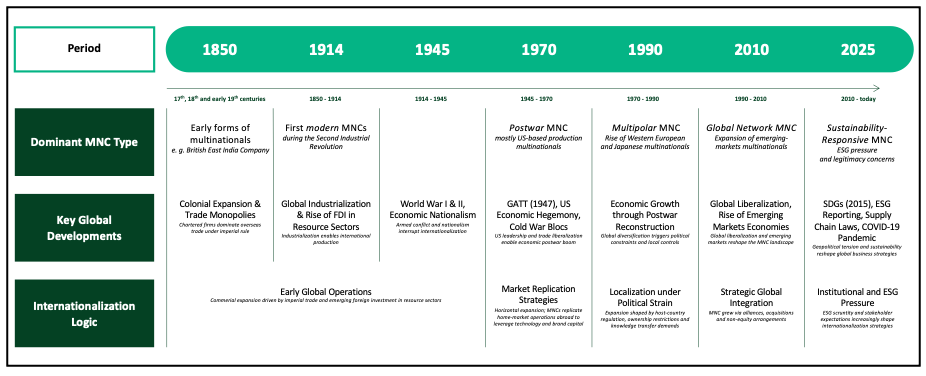
The history of multinational companies is characterized by continuous adaption to technological, institutional and geopolitical shifts. Although international commercial activity predates industrial capitalism, the multinational organizational form began to emerge as early as the late 17th and 18th centuries, with the rise of trading corporations such as the British East India Company. These early entities, however, were primarily focused on commerce rather than on the production of goods and services outside the home economy. The decisive shift toward what would become the modern multinational occurred when firms began to engage in FDI and to manage their operations abroad through structured organizational forms such as subsidiaries and affiliates.60Wilkins, M. in Oxford Handbook of International Business (eds Alan M. Rugman & Thomas L. Brewer) (Oxford University Press, 2001).,61Morgan, G. in The Oxford Handbook of Work and Organization (eds Stephen Ackroyd, Rosemary Batt, Paul Thompson, & Pamela S. Tolbert) (Oxford University Press, 2006).
This transition gained momentum during the 19th century, as global economic integration deepened and FDI increasingly complemented traditional forms of portfolio investment. Particularly in resource-based sectors such as oil, rubber, coffee and minerals, firms from Europe and the United States began establishing foreign operations.61Morgan, G. in The Oxford Handbook of Work and Organization (eds Stephen Ackroyd, Rosemary Batt, Paul Thompson, & Pamela S. Tolbert) (Oxford University Press, 2006). The modern MNC, however, took its institutional and strategic shape during the Second Industrial Revolution.62Guillen, M. & García-Canal, E. The American Model of the Multinational Firm and the “New” Multinationals From Emerging Economies. Academy of Management Perspectives 23, 23-35 (2009). https://doi.org/10.5465/AMP.2009.39985538 From the late 19th to the early 20th century, firms from Britain, North America and continental Europe began expanding internationally not only through trade but also by intangible assets such as managerial expertise, technology and brands.63Wilkins, M. in Transnational Corporations and the Global Economy (eds Richard Kozul-Wright & Robert Rowthorn) 95-133 (Palgrave Macmillan UK, 1998).,64Krugman, P. Multinational enterprise: The old and the new in history and theory. North American Review of Economics and Finance 1, 267-280 (1990). https://doi.org/10.1016/1042-752X(90)90020-G
The Second World War constituted a historical rupture: the dismantling of cartels and the emergence of U.S. economic hegemony allowed American MNCs to dominate global markets during the early Cold War era.65Jones, G. Nationality and multinationals in historical perspective. (Division of Research, Harvard Business School Boston, 2006).,66Dymsza, W. A. Trends in Multinational Business and Global Environments: A Perspective. Journal of International Business Studies 15, 25-46 (1984). https://doi.org/10.1057/palgrave.jibs.8490493 Enabled by institutional frameworks such as the General Agreement on Tariffs and Trade (GATT, 1947), which laid the groundwork for liberalized global trade, U.S. firms engaged in FDI on an unprecedented scale. The relevance of GATT for MNC growth has been empirically confirmed by studies showing positive capital market reactions to its implementation.67Ghani, W. I. & Haverty, J. L. Market reaction of multinational corporations to the passage of the General Agreement on Tariffs and Trade (GATT). Journal of International Accounting, Auditing and Taxation 7, 95-112 (1998). https://doi.org/10.1016/S1061-9518(98)90008-8 Between 1950 and 1970, the volume of American FDI abroad grew from $3.8 to over $32 billion, marking the rise of what Fayerweather termed the postwar multinational.68Fayerweather, J. The Internationalization of Business. The Annals of the American Academy of Political and Social Science 403, 1-11 (1972). During this period, the United States likely accounted for as much as 85 percent of all new FDI flows globally, underscoring the country’s dominant position in shaping the organizational and strategic foundations of modern MNCs.65Jones, G. Nationality and multinationals in historical perspective. (Division of Research, Harvard Business School Boston, 2006). These postwar MNCs were characterized by centralized organizational structures, full ownership of foreign subsidiaries and the transfer of proprietary knowledge across borders.62Guillen, M. & García-Canal, E. The American Model of the Multinational Firm and the “New” Multinationals From Emerging Economies. Academy of Management Perspectives 23, 23-35 (2009). https://doi.org/10.5465/AMP.2009.39985538,68Fayerweather, J. The Internationalization of Business. The Annals of the American Academy of Political and Social Science 403, 1-11 (1972). Their expansion was predominantly horizontal, replicating home-market activities abroad and driven by the need to exploit firm-specific advantages (FSA) such as technology and managerial know-how.64Krugman, P. Multinational enterprise: The old and the new in history and theory. North American Review of Economics and Finance 1, 267-280 (1990). https://doi.org/10.1016/1042-752X(90)90020-G,69Behrman, J. N. & Fischer, W. A. Overseas R&D activities of transnational companies. The International Executive22, 15-17 (1980). https://doi.org/10.1002/tie.5060220309,70Ronstadt, R. C. International R&D: The Establishment and Evolution of Research and Development Abroad by Seven U.S. Multinationals. Journal of International Business Studies 9, 7-24 (1978). https://doi.org/10.1057/palgrave.jibs.8490647
Throughout the 1960s and 1970s, U.S. MNCs such as General Motors and IBM expanded globally, establishing vertically integrated industrial systems that linked R&D, production and distribution.65Jones, G. Nationality and multinationals in historical perspective. (Division of Research, Harvard Business School Boston, 2006).,68Fayerweather, J. The Internationalization of Business. The Annals of the American Academy of Political and Social Science 403, 1-11 (1972). However, the growing influence of U.S.-based MNCs provoked political resistance, particularly in developing countries. In many cases, they were perceived as vehicles of economic domination or as enclave actors with limited local spillovers.65Jones, G. Nationality and multinationals in historical perspective. (Division of Research, Harvard Business School Boston, 2006).,71Narula, R. Multinational firms and the extractive sectors in the 21st century: Can they drive development? Journal of World Business 53, 85-91 (2018). https://doi.org/10.1016/j.jwb.2017.09.004 Governments responded by introducing restrictions on ownership, enforcing localization requirements and demanding knowledge and technology transfer to promote domestic capacity-building.64Krugman, P. Multinational enterprise: The old and the new in history and theory. North American Review of Economics and Finance 1, 267-280 (1990). https://doi.org/10.1016/1042-752X(90)90020-G,71Narula, R. Multinational firms and the extractive sectors in the 21st century: Can they drive development? Journal of World Business 53, 85-91 (2018). https://doi.org/10.1016/j.jwb.2017.09.004 From the 1970s onward, the dominance of U.S.-based MNCs gradually gave way to a more multipolar landscape. Firms from Western Europe and Japan, benefiting from postwar reconstruction and export-oriented growth models, began to internationalize aggressively and establish a strong global presence.65Jones, G. Nationality and multinationals in historical perspective. (Division of Research, Harvard Business School Boston, 2006).,66Dymsza, W. A. Trends in Multinational Business and Global Environments: A Perspective. Journal of International Business Studies 15, 25-46 (1984). https://doi.org/10.1057/palgrave.jibs.8490493,68Fayerweather, J. The Internationalization of Business. The Annals of the American Academy of Political and Social Science 403, 1-11 (1972).
By the 1990s, the strategic logic of MNCs began to shift.71Narula, R. Multinational firms and the extractive sectors in the 21st century: Can they drive development? Journal of World Business 53, 85-91 (2018). https://doi.org/10.1016/j.jwb.2017.09.004 New firms from emerging markets entered the global arena, not to exploit existing FSAs, but to acquire them. The new multinationals often pursued rapid internationalization through acquisitions, alliances and non-equity arrangements, circumventing the gradual, experience-based models of earlier decades.62Guillen, M. & García-Canal, E. The American Model of the Multinational Firm and the “New” Multinationals From Emerging Economies. Academy of Management Perspectives 23, 23-35 (2009). https://doi.org/10.5465/AMP.2009.39985538,66Dymsza, W. A. Trends in Multinational Business and Global Environments: A Perspective. Journal of International Business Studies 15, 25-46 (1984). https://doi.org/10.1057/palgrave.jibs.8490493 Organizationally, MNCs moved away from strict hierarchical control toward networked governance structures, managing complex webs of subsidiaries, suppliers and partners.71Narula, R. Multinational firms and the extractive sectors in the 21st century: Can they drive development? Journal of World Business 53, 85-91 (2018). https://doi.org/10.1016/j.jwb.2017.09.004,72Narula, R. & Verbeke, A. Making internalization theory good for practice: The essence of Alan Rugman’s contributions to international business. Journal of World Business 50, 612-622 (2015). https://doi.org/10.1016/j.jwb.2015.08.007 The 21st century has further intensified this transformation. MNCs are now deeply embedded in global production, finance and innovation systems. For example, MNCs accounted for over 80 percent of industrial R&D in the United States inn.201777 However, their growing complexity and reach have made MNCs targets of increasing scrutiny, not only in terms of economic power but also with regard to their social and environmental impact. Concerns about corporate accountability, inequality and global externalities have reshaped public expectations of MNC conduct and fueled calls for more responsible global business practices.71Narula, R. Multinational firms and the extractive sectors in the 21st century: Can they drive development? Journal of World Business 53, 85-91 (2018). https://doi.org/10.1016/j.jwb.2017.09.004,73Foley, C. F., Hines, J. R. & Wessel, D. Global Goliaths: Multinational Corporations in the 21st Century Economy. (Brookings Institution Press, 2021).
Since the 2010s, MNCs have operated in an increasingly complex strategic environment, shaped by new pressures for environmental and social accountability. Even before the COVID-19 pandemic, many firms began reevaluating the efficiency-driven logic of global supply chains in light of growing expectations regarding corporate sustainability.71Narula, R. Multinational firms and the extractive sectors in the 21st century: Can they drive development? Journal of World Business 53, 85-91 (2018). https://doi.org/10.1016/j.jwb.2017.09.004 The pandemic further exposed systemic vulnerabilities in global production systems and accelerated a shift toward regionalization, resilience-based design and dual sourcing strategies.73Foley, C. F., Hines, J. R. & Wessel, D. Global Goliaths: Multinational Corporations in the 21st Century Economy. (Brookings Institution Press, 2021). Simultaneously, corporate sustainability has evolved from a peripheral or reputational issue to a core strategic capability. In resource-intensive sectors such as mining and energy, the ability to demonstrate environmental and social responsibility now constitutes a higher-order ownership advantage, shaping access to markets, licenses and capital.71Narula, R. Multinational firms and the extractive sectors in the 21st century: Can they drive development? Journal of World Business 53, 85-91 (2018). https://doi.org/10.1016/j.jwb.2017.09.004 In parallel, the institutional environment has undergone a significant transformation. MNCs are increasingly expected to assume quasi-regulatory roles, particularly in regions where state governance is weak or fragmented, by enforcing labor standards, ensuring environmental compliance and promoting transparency throughout global value chains.74Verbeke, A., Oh, C. H. & Jain, R. What is the future of regional multinational enterprises? International Business Review 34 (2025). https://doi.org/10.1016/j.ibusrev.2025.102442
By the mid-2010s, a deeper shift in how MNCs are perceived and assessed had become increasingly evident. Beyond their economic footprint, MNCs are now also evaluated on their ability to address global challenges through environmental, social and governance (ESG) integration.75Kolk, A., Kourula, A. & Pisani, N. Multinational enterprises and the sustainable development goals: What do we know and how to proceed? Transnational Corporations 24, 9-32 (2017).,76Munro, V. & Arli, D. Corporate sustainable actions through United Nations sustainable development goals: The internal customer’s response. International Journal of Nonprofit and Voluntary Sector Marketing 25 (2020). https://doi.org/10.1002/nvsm.1660 Normative frameworks such as the United Nations Sustainable Development Goals (SDGs) have emerged as central benchmarks, shaping not only how firms disclose sustainability efforts but also how they define legitimacy and long-term strategic value.77Ivanaj, S., Ivanaj, V., McIntyre, J. & Guimaraes da Costa, N. What can multinational enterprises do to implement sustainable development goals? Journal of Cleaner Production 296 (2021). https://doi.org/10.1016/j.jclepro.2021.126586 In this evolving context, MNCs’ internationalization strategies are increasingly driven not only by economic opportunity, but also by the need to respond to institutional complexity, reputational risk and increasing public scrutiny.78Nasta, L. & Cundari, V. Aligning multinational corporate strategies with Sustainable Development Goals: A case study of an Italian energy firm’s initiatives in developing markets. Corporate Social Responsibility and Environmental Management 31, 3902-3915 (2024). https://doi.org/10.1002/csr.2779 While normative frameworks such as the SDGs have begun to influence the way companies shape their global expansion, the actual integration of social legitimacy, environmental responsibility and political accountability into cross-border operations remains uneven and subject to significant variation across sectors and institutional contexts.74Verbeke, A., Oh, C. H. & Jain, R. What is the future of regional multinational enterprises? International Business Review 34 (2025). https://doi.org/10.1016/j.ibusrev.2025.102442,77Ivanaj, S., Ivanaj, V., McIntyre, J. & Guimaraes da Costa, N. What can multinational enterprises do to implement sustainable development goals? Journal of Cleaner Production 296 (2021). https://doi.org/10.1016/j.jclepro.2021.126586 China illustrates this duality well. As the world’s largest developing country, it has not only become one of the central host markets for foreign MNCs but also has emerged, alongside the Unites States, as a leading home country of MNCs. This paradox underscores the rise of a developing country to the forefront of global corporate power while continuing to face severe sustainability challenges.17D’Souza, C. et al. An empirical examination of sustainability for multinational firms in China: Implications for cleaner production. Journal of Cleaner Production 242 (2020). https://doi.org/10.1016/j.jclepro.2019.118446
Between 2013 and 2019, longitudinal case evidence illustrates a transformation in the way MNCs operationalize sustainability within their global structures. Firms moved from maintaining isolated CSR departments to embedding sustainability responsibilities across core functions. This shift was accompanied by a gradual transition from predominantly top-down governance towards more participatory approaches, enabling employees to act as internal sustainability ambassadors. In addition to traditional climate and energy targets, new thematic areas such as plastic reduction, waste management and product reformulation gained relevance.49Derqui, B. Towards sustainable development: Evolution of corporate sustainability in multinational firms. Corporate Social Responsibility and Environmental Management 27, 2712-2723 (2020). https://doi.org/10.1002/csr.1995
At the same time, these shifts unfold within a broader debate about the future of globalization.79Temouri, Y., Pereira, V., Delis, A. & Wood, G. How Does Protectionism Impact Multinational Firm Reshoring? Evidence from the UK. Management International Review 63, 791-822 (2023). https://doi.org/10.1007/s11575-023-00521-5 Although narratives of deglobalization have gained visibility in political discourse, recent empirical research suggests that MNCs remain resilient and adaptive global actors. Rather than reversing internationalization, MNCs are responding to geopolitical, environmental and institutional pressures through strategic reconfiguration. Cross-border trade and investment flows remain robust and firms increasingly rely on multisourcing and regional diversification models to maintain operational resilience without abandoning their multinational reach.80Altman, S. A., Bastian, C. R. & Fattedad, D. Challenging the deglobalization narrative: Global flows have remained resilient through successive shocks. Journal of International Business Policy 7, 416-439 (2024). https://doi.org/10.1057/s42214-024-00197-0,81Yücesan, E. Does deglobalization imply the end of global supply chains? International Business Review (2025). https://doi.org/10.1016/j.ibusrev.2025.102398 While isolated reshoring activities have occurred, they remain selective and tied to specific operational contexts. Overall, MNCs continue to pursue internationalization through adjusted, but sustained, forms of global engagement.79Temouri, Y., Pereira, V., Delis, A. & Wood, G. How Does Protectionism Impact Multinational Firm Reshoring? Evidence from the UK. Management International Review 63, 791-822 (2023). https://doi.org/10.1007/s11575-023-00521-5,81Yücesan, E. Does deglobalization imply the end of global supply chains? International Business Review (2025). https://doi.org/10.1016/j.ibusrev.2025.102398
2.2.2 Evolution of research on multinationals and corporate sustainability
Multinational companies began to attract serious academic attention as a distinct organizational form in the early 1960s. Prior to this, their activities were mostly subsumed under the study of international capital flows. The work of Hymermarked a conceptual shift by positioning the MNC as a subject that required its own theoretical framework.82Hymer, S. H. The international operations of national firms, a study of direct foreign investment, Massachusetts Institute of Technology, (1960).,83Dunning, J. H. & Pitelis, C. N. Stephen Hymer’s Contribution to International Business Scholarship: An Assessment and Extension. Journal of International Business Studies 39, 167-176 (2008).,84Aharoni, Y. & Ramamurti, R. in Standing on the Shoulders of International Business Giants 153-177 (2011). In the late 1960s, the first major empirical study on U.S. MNCs, conducted at Harvard Business School, defined multinationalism primarily through offshore manufacturing. This narrow understanding became standard in the international management literature. However, as firms began to internationalize through a wider range of activities beyond production, scholars increasingly questioned this production-centric definition, which ultimately triggered a rethinking of how MNCs were to be conceptualized in academic research.33Ghoshal, S. & Westney, D. E. in Organization Theory and the Multinational Corporation (eds Sumantra Ghoshal & D. Eleanor Westney) 1-23 (Palgrave Macmillan UK, 1993).
Throughout the 1970s and 1980s, economic and strategic models dominated the study of MNCs. Central among them was Dunning’s eclectic paradigm, which sought to explain international expansion through a combination of ownership, location and internationalization advantages (OLI; also known as OLI model or OLI framework).85Dunning, J. H. Toward an Eclectic Theory of International Production: Some Empirical Tests. Journal of International Business Studies 11, 9-31 (1980). https://doi.org/10.1057/palgrave.jibs.8490593,86Dunning, J. H. The Eclectic Paradigm of International Production: A Restatement and Some Possible Extensions. Journal of International Business Studies 19, 1-31 (1988). This perspective treated internationalization as a means to exploit home-based firm-specific advantages, such as superior technology or firm-specific assets, particularly in order to overcome the liability of foreignness.82Hymer, S. H. The international operations of national firms, a study of direct foreign investment, Massachusetts Institute of Technology, (1960).,87Rugman, A. M. Inside the multinationals : the economics of internal markets / Alan M. Rugman. (Croom Helm, 1981).,88Dunning, J. H. in The International Allocation of Economic Activity: Proceedings of a Nobel Symposium held at Stockholm (eds Bertil Ohlin, Per-Ove Hesselborn, & Per Magnus Wijkman) 395-418 (Palgrave Macmillan UK, 1977). While these foundational contributions acknowledged the institutional challenges of foreign operations, analytical attention remained focused on efficiency and competitive positioning, with comparatively little regard for the internal complexity and functional heterogeneity of foreign subsidiaries.89Papanastassiou, M., Pearce, R. & Zanfei, A. Changing perspectives on the internationalization of R&D and innovation by multinational enterprises: A review of the literature. Journal of International Business Studies 51, 623-664 (2020). https://doi.org/10.1057/s41267-019-00258-0
From the 1990s onwards, academic research on MNCs began to critically reassess the limitations of earlier efficiency-focused models and introduced new analytical dimensions to account for the complexity of globally operating firms.89Papanastassiou, M., Pearce, R. & Zanfei, A. Changing perspectives on the internationalization of R&D and innovation by multinational enterprises: A review of the literature. Journal of International Business Studies 51, 623-664 (2020). https://doi.org/10.1057/s41267-019-00258-0,90Roth, K. & Kostova, T. The Use of the Multinational Corporation as a Research Context. Journal of Management29, 883-902 (2003). https://doi.org/10.1016/s0149-2063_03_00083-7,91Holm, D. et al. Vol. 4 3-20 (2009). Scholars increasingly began to reconceptualize MNCs as networks embedded in complex international environments, where coordination, learning and institutional negotiation became central analytical.84Aharoni, Y. & Ramamurti, R. in Standing on the Shoulders of International Business Giants 153-177 (2011). This shift in perspective led to a growing interest in how MNCs integrate dispersed knowledge, manage cross-border uncertainty and evolve under the influence of technological change, political fragmentation and global competition. As a result, MNC research expanded its disciplinary heterogeneity, strategic agility and the institutional embeddedness of international operations.84Aharoni, Y. & Ramamurti, R. in Standing on the Shoulders of International Business Giants 153-177 (2011).,90Roth, K. & Kostova, T. The Use of the Multinational Corporation as a Research Context. Journal of Management29, 883-902 (2003). https://doi.org/10.1016/s0149-2063_03_00083-7
Beginning the early 2000s, corporate sustainability increasingly entered the international business literature, as scholars started to examine how MNCs address environmental and social challenges in an increasingly complex global context.92Christmann, P. Multinational Companies and the Natural Environment: Determinants of Global Environmental Policy. Academy of Management Journal 47, 747-760 (2004). https://doi.org/10.5465/20159616 This development was partly driven by the recognition that while industrial capitalism, globalization and MNCs have been major contributors to global environmental challenges, MNCs also hold significant potential to help address and mitigate these sustainability issues.4Ocelík, V., Kolk, A. & Ciulli, F. Multinational enterprises, Industry 4.0 and sustainability: A multidisciplinary review and research agenda. Journal of Cleaner Production 413 (2023). https://doi.org/10.1016/j.jclepro.2023.137434,93Wright, C. & Nyberg, D. Climate Change, Capitalism, and Corporations: Processes of Creative Self-Destruction. (Cambridge University Press, 2015).,94McNeill, J. R. Something New under the Sun: An Environmental History of the Twentieth-Century World. (W. W. Norton, 2000). The role of MNCs as agents of change became an increasingly central debate around SD, particularly as stakeholders and policymakers began demanding greater accountability and transparency from globally operating firms.4Ocelík, V., Kolk, A. & Ciulli, F. Multinational enterprises, Industry 4.0 and sustainability: A multidisciplinary review and research agenda. Journal of Cleaner Production 413 (2023). https://doi.org/10.1016/j.jclepro.2023.137434,95Sun, P., Doh, J. P., Rajwani, T. & Siegel, D. Navigating cross-border institutional complexity: A review and assessment of multinational nonmarket strategy research. J Int Bus Stud 52, 1818-1853 (2021). https://doi.org/10.1057/s41267-021-00438-x,96Torres de Oliveira, R., Ghobakhloo, M. & Figueira, S. Industry 4.0 towards social and environmental sustainability in multinationals: Enabling circular economy, organizational social practices, and corporate purpose. Journal of Cleaner Production 430 (2023). https://doi.org/10.1016/j.jclepro.2023.139712
From the 2010s onwards, CS research focused more and more on how MNCs integrate sustainability into core business functions and strategic planning, moving beyond peripheral CSR departments towards organization-wide transformation.49Derqui, B. Towards sustainable development: Evolution of corporate sustainability in multinational firms. Corporate Social Responsibility and Environmental Management 27, 2712-2723 (2020). https://doi.org/10.1002/csr.1995,97Asmussen, C. G. & Fosfuri, A. Orchestrating corporate social responsibility in the multinational enterprise. Strategic Management Journal 40, 894-916 (2019). https://doi.org/10.1002/smj.3007 Studies began to document that sustainability was no longer considered a matter of ethical responsibility alone but became a central component of competitive advantage and brand strategy.98Schaltegger, S. Sustainability as a driver for corporate economic success. Society and Economy 33, 15-28 (2011). https://doi.org/10.1556/SocEc.33.2011.1.4,99Kiron, D. et al. Corporate sustainability at a crossroads: Progress toward our common future in uncertain times. MIT Sloan Management Review (2017). The global institutionalization of sustainability, marked by frameworks such as the UN Global Compact and the Sustainable Development Goals, has led researcher to increasingly examine how MNCs operationalize sustainability in line with global norms while addressing local variations in regulatory and stakeholder expectations.78Nasta, L. & Cundari, V. Aligning multinational corporate strategies with Sustainable Development Goals: A case study of an Italian energy firm’s initiatives in developing markets. Corporate Social Responsibility and Environmental Management 31, 3902-3915 (2024). https://doi.org/10.1002/csr.2779,100Park, J., Cuervo-Cazurra, A. & Montiel, I. in Research Handbook on International Corporate Social Responsibility (ed Anthony Goerzen) Ch. 2, (Edward Elgar Publishing Limited, 2023). Taken together, these developments reflect an ongoing scholarly interest in understanding how MNCs balance the pursuit of global sustainability objectives with the realities of operational complexity, institutional diversity and stakeholder fragmentation.
2.3 Foundations of multinationals’ corporate sustainability
This thesis applies a conceptual framework of Drivers and Outcomes to systematically review the academic literature on CS in MNCs. This framework provides a structured lens to investigate both the underlying forces that shape MNC engagement with sustainability and the tangible results that arise from such strategic orientation. Drivers refer to the internal and external factors that initiate or institutionalize sustainability-related behavior within MNCs. Outcomes denote the observable consequences of sustainability-oriented corporate strategies and practices.
2.3.1 Internal drivers of multinationals’ corporate sustainability
2.3.1.1 Organizational structure and strategies
MNCs operate across multiple institutional, cultural and economic environments, requiring organizational structures that can effectively coordinate dispersed units while balancing global efficiency and local responsiveness.41Meyer, K. E., Li, C. & Schotter, A. P. J. Managing the MNE subsidiary: Advancing a multi-level and dynamic research agenda. Journal of International Business Studies 51, 538-576 (2020). https://doi.org/10.1057/s41267-020-00318-w,101Raziq, M. M., Benito, G. R. G. & Kang, Y. Multinational Enterprise Organizational Structures and Subsidiary Role and Capability Development: The Moderating Role of Establishment Mode. Group & Organization Management 48, 908-952 (2023). https://doi.org/10.1177/10596011211060952 These structural arrangements are particularly relevant in the context of CS, as they shape the ways in which sustainability goals are formulated at the headquarters level and subsequently translated or adapted across diverse subsidiary contexts.3Burritt, R. L., Christ, K. L., Rammal, H. G. & Schaltegger, S. Multinational Enterprise Strategies for Addressing Sustainability: the Need for Consolidation. Journal of Business Ethics 164, 389-410 (2020). https://doi.org/10.1007/s10551-018-4066-0 In order to understand how internal factors such as strategic orientations and headquarters-subsidiary relations may act as drivers of CS in MNCs, it is necessary to first examine the structural configurations through which MNCs typically organize their international operations. The structure of a MNC determines not only how decision-making authority is distributed across units but also how knowledge, resources and responsibilities are coordinated across geographical and functional boundaries.101Raziq, M. M., Benito, G. R. G. & Kang, Y. Multinational Enterprise Organizational Structures and Subsidiary Role and Capability Development: The Moderating Role of Establishment Mode. Group & Organization Management 48, 908-952 (2023). https://doi.org/10.1177/10596011211060952,102Dasí, À., Pedersen, T. & Pla-Barber, J. MNCs’ Intermediate Units and Their Choice of Control Mechanisms. Management International Review 64, 59-88 (2024). https://doi.org/10.1007/s11575-023-00527-z
Among the formal structural types identified in the literature, the regional division structure is one of the most prevalent in MNCs. In this configuration, subsidiaries are grouped into broad geographical regions, each managed by a regional headquarters with responsibility for the operations within its designated area.103Celo, S., Nebus, J. & Kim Wang, I. MNC structure, complexity, and performance: Insights from NK methodology. Journal of International Management 21, 182-199 (2015). https://doi.org/10.1016/j.intman.2015.06.002 The regional headquarters (RHQ) serves as an intermediary between the global corporate center and the local subsidiaries, facilitating context-sensitive decision-making while maintaining strategic alignment. This structure is particularly effective when market and institutional conditions vary significantly across regions, as it enables MNCs to benefit from localized adaptation while retaining control over overarching corporate objectives.103Celo, S., Nebus, J. & Kim Wang, I. MNC structure, complexity, and performance: Insights from NK methodology. Journal of International Management 21, 182-199 (2015). https://doi.org/10.1016/j.intman.2015.06.002,104Egelhoff, W. G. Strategy and Structure in Multinational Corporations: An Information- Processing Approach. Administrative Science Quarterly 27, 435-458 (1982). https://doi.org/10.2307/2392321,105Egelhoff, W. G. Organizing the multinational enterprise : an information-processing perspective. (Ballinger Pub. Co., 1988).
A second widely adopted model is the matrix structure, which combines two or more organizational dimensions, typically geography, product or function, into a dual-reporting framework.103Celo, S., Nebus, J. & Kim Wang, I. MNC structure, complexity, and performance: Insights from NK methodology. Journal of International Management 21, 182-199 (2015). https://doi.org/10.1016/j.intman.2015.06.002 Subsidiaries in matrix-configured MNCs often report simultaneously to regional managers and product or functional leaders, reflecting the dual imperative of global integration and local responsiveness. Although matrix structures aim to enhance flexibility and cross-functional coordination, they are frequently associated with high internal complexity, increased coordination costs and managerial ambiguity.103Celo, S., Nebus, J. & Kim Wang, I. MNC structure, complexity, and performance: Insights from NK methodology. Journal of International Management 21, 182-199 (2015). https://doi.org/10.1016/j.intman.2015.06.002,106Egelhoff, W. G. How a Flexible Matrix Structure Could Create Ambidexterity at the Macro Level of Large, Complex Organizations Like MNCs. MIR: Management International Review 60, 459-484 (2020). https://doi.org/10.1007/s11575-020-00418-7 Despite these challenges, matrix designs continue to be used in MNCs that operate in complex, interdependent environments where multiple strategic logistics must be balanced simultaneously.107Egelhoff, W. G. & Wolf, J. in Understanding Matrix Structures and their Alternatives: The Key to Designing and Managing Large, Complex Organizations (eds William G. Egelhoff & Joachim Wolf) 75-108 (Palgrave Macmillan UK, 2017).,108Wolf, J. & Egelhoff, W. G. in Collaborative Communities of Firms: Purpose, Process, and Design (eds Anne Bøllingtoft et al.) 35-57 (Springer New York, 2012).
Beyond these formal hierarchies, network-based structures have gained prominence as flexible alternatives in global operations.103Celo, S., Nebus, J. & Kim Wang, I. MNC structure, complexity, and performance: Insights from NK methodology. Journal of International Management 21, 182-199 (2015). https://doi.org/10.1016/j.intman.2015.06.002 These configurations are characterized by decentralized decision-making, non-hierarchical coordination and the use of informal mechanisms such as trust, shared norms and lateral knowledge exchange.108Wolf, J. & Egelhoff, W. G. in Collaborative Communities of Firms: Purpose, Process, and Design (eds Anne Bøllingtoft et al.) 35-57 (Springer New York, 2012). In such settings, subsidiaries may act as autonomous nodes within a larger network, enabling responsiveness and innovation while reducing reliance on central control. However, the effectiveness of network structures depends heavily on the willingness and ability of individual units to share information and align with broader strategic goals.109Malnight, T. W. The Transition from Decentralized to Network-Based MNC Structures: An Evolutionary Perspective. Journal of International Business Studies 27, 43-65 (1996). https://doi.org/10.1057/palgrave.jibs.8490125,110Wolf, J. & Egelhoff, W. G. in Reshaping the Boundaries of the Firm in an Era of Global Interdependence Vol. 5 (eds José Pla-Barber & Joaquín Alegre) 0 (Emerald Group Publishing Limited, 2010).
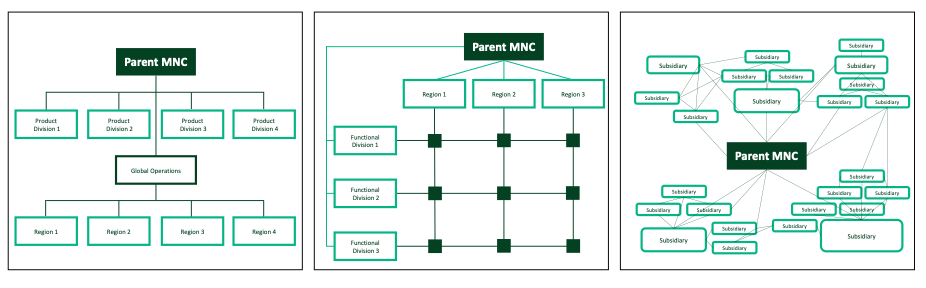
While organizational structures provide the formal scaffolding for managing complexity in MNCs, the HQ-subsidiary relationship also influences the internal capacity to initiate, coordinate and embed CS across geographies.112Kostova, T., Marano, V. & Tallman, S. Headquarters–subsidiary relationships in MNCs: Fifty years of evolving research. Journal of World Business 51, 176-184 (2016). https://doi.org/10.1016/j.jwb.2015.09.003,113Mahnke, V., Ambos, B., Nell, P. C. & Hobdari, B. How do regional headquarters influence corporate decisions in networked MNCs? Journal of International Management 18, 293-301 (2012). https://doi.org/10.1016/j.intman.2012.04.001 Structural configurations shape not only how sustainability strategies are disseminated from the parent MNC to regional and local units, but also how subsidiaries can contribute to sustainability through localized knowledge and context-sensitive implementation.114Jamali, D., Makarem, Y. & Willi, A. From diffusion to translation: implementation of CSR practices in MNC subsidiaries. Social Responsibility Journal 16, 309-327 (2019). https://doi.org/10.1108/srj-05-2018-0108 In regional division structures, the existence of intermediary RHQs can enable MNCs to balance CS objectives with regional contextual demands. Where RHQs are endowed with strategic autonomy and operate within an advanced, entrepreneurial governance framework, they may actively contribute to the development and implementation of sustainability initiatives.115Nachbagauer, A. Stimulating Sustainability in Multinational Companies: the Significance of Regional Headquarters. Management Dynamics in the Knowledge Economy 4, 215-214 (2016).,116Conroy, K., Gammelgaard, J. & Jooss, S. Operating in the middle-power position: Conceptualising the role of regional headquarters through loaned and owned power. International Business Review 32 (2023). https://doi.org/10.1016/j.ibusrev.2023.102161 These settings allow sustainability to be tailored to local institutional environments while remaining aligned with global goals. However, the effectiveness of RHQs as sustainability drivers depends on their structural authority, integration with corporate-level sustainability agendas and access to relevant resources.115Nachbagauer, A. Stimulating Sustainability in Multinational Companies: the Significance of Regional Headquarters. Management Dynamics in the Knowledge Economy 4, 215-214 (2016).,117Ambos, B. & Schlegelmilch, B. B. The New Role of Regional Management. 1 edn, (Palgrave Macmillan, 2009).
Matrix structures can support CS when coordination across product, regional and functional dimensions is well-managed and strategically aligned. Their potential lies in enabling both global standardization and local adaptation.108Wolf, J. & Egelhoff, W. G. in Collaborative Communities of Firms: Purpose, Process, and Design (eds Anne Bøllingtoft et al.) 35-57 (Springer New York, 2012). However, high internal complexity, role ambiguity and inter-unit conflict often impede sustainability integration.115Nachbagauer, A. Stimulating Sustainability in Multinational Companies: the Significance of Regional Headquarters. Management Dynamics in the Knowledge Economy 4, 215-214 (2016).,117Ambos, B. & Schlegelmilch, B. B. The New Role of Regional Management. 1 edn, (Palgrave Macmillan, 2009). Thus, matrix structures act as drivers of CS only if supported by clear accountability, strong sustainability governance and shared organizational priorities.
Network-based structures may foster CS by facilitating decentralized innovation, lateral knowledge flows and shared (sustainability) norms across subsidiaries.103Celo, S., Nebus, J. & Kim Wang, I. MNC structure, complexity, and performance: Insights from NK methodology. Journal of International Management 21, 182-199 (2015). https://doi.org/10.1016/j.intman.2015.06.002 Their informal, trust-based coordination can empower local units to adapt and initiate sustainability practices autonomously. However, lacking hierarchical enforcement, these structures risk inconsistent implementation and strategic fragmentation.115Nachbagauer, A. Stimulating Sustainability in Multinational Companies: the Significance of Regional Headquarters. Management Dynamics in the Knowledge Economy 4, 215-214 (2016). As such, networks can drive sustainability only when embedded in a strong shared vision and robust inter-unit collaboration.118Foss, K., Foss, N. J. & Nell, P. C. MNC organizational form and subsidiary motivation problems: Controlling intervention hazards in the network MNC. Journal of International Management 18, 247-259 (2012). https://doi.org/10.1016/j.intman.2012.03.001
Besides the structural configuration of a company, the choice of strategy also plays an important role in the implementation of CS. MNC face the fundamental challenge of formulating sustainability strategies that can effectively operate across diverse geographic, institutional and cultural environments. Early approaches in the literature often conceptualized sustainability strategy as a conflict between global standardization and local responsiveness.3Burritt, R. L., Christ, K. L., Rammal, H. G. & Schaltegger, S. Multinational Enterprise Strategies for Addressing Sustainability: the Need for Consolidation. Journal of Business Ethics 164, 389-410 (2020). https://doi.org/10.1007/s10551-018-4066-0 A globalsustainability strategy seeks to impose uniform standards and practices across all subsidiaries, joint ventures, suppliers and contractors, facilitating comparability, administrative efficiency and control from the headquarters (HQ).38Bartlett, C. A. & Ghoshal, S. Managing across borders : the transnational solution. (Harvard Business School Press, 1989). However, such centralized approaches can neglect critical local ecological, social or regulatory nuances, potentially undermining legitimacy and effectiveness in host country contexts.3Burritt, R. L., Christ, K. L., Rammal, H. G. & Schaltegger, S. Multinational Enterprise Strategies for Addressing Sustainability: the Need for Consolidation. Journal of Business Ethics 164, 389-410 (2020). https://doi.org/10.1007/s10551-018-4066-0 In contrast, local adaptation strategies prioritize responsiveness to local institutional pressures, stakeholder expectations and cultural values, granting subsidiaries significant autonomy. While these strategies enable context-sensitive implementation and foster local ownership, they can result in fragmented approaches and hinder global alignment of sustainability goals.119Muller, A. Global Versus Local CSR Strategies. European Management Journal 24, 189-198 (2006). https://doi.org/10.1016/j.emj.2006.03.008 Across both perspectives, broad stakeholder inclusion emerges as a central principle. The CSR-literature emphasizes that policymaking cannot be confined to HQ or home-country perspectives but must incorporate stakeholder from diverse host-country contexts to ensure legitimacy and responsiveness across the organizational network.20Bondy, K. & Starkey, K. The Dilemmas of Internationalization: Corporate Social Responsibility in the Multinational Corporation. British Journal of Management 25, 4-22 (2014). https://doi.org/10.1111/j.1467-8551.2012.00840.x
To reconcile the tensions between these polar extremes, the literature identifies three more integrative strategic configurations: glocal, transnational and regional strategies.3Burritt, R. L., Christ, K. L., Rammal, H. G. & Schaltegger, S. Multinational Enterprise Strategies for Addressing Sustainability: the Need for Consolidation. Journal of Business Ethics 164, 389-410 (2020). https://doi.org/10.1007/s10551-018-4066-0 A glocal strategy merges globally defined sustainability priorities, such as climate protection and human rights, with locally adapted implementation, allowing MNCs to maintain coherence while acknowledging context-specific challenges.3Burritt, R. L., Christ, K. L., Rammal, H. G. & Schaltegger, S. Multinational Enterprise Strategies for Addressing Sustainability: the Need for Consolidation. Journal of Business Ethics 164, 389-410 (2020). https://doi.org/10.1007/s10551-018-4066-0,120Arenas, D. & Ayuso, S. Unpacking transnational corporate responsibility: coordination mechanisms and orientations. Business Ethics: A European Review 25, 217-237 (2016). https://doi.org/10.1111/beer.12113,121Chaudhri, V. A. Organising Global CSR: A Case Study of Hewlett-Packard’s e-inclusion Initiative. The Journal of Corporate Citizenship, 39-51 (2006).,122Jain, R. & De Moya, M. Global, Local, or Glocal: Investigating CSR Strategies of Best Corporate Citizens in India. International Journal of Strategic Communication 7, 207-226 (2013). https://doi.org/10.1080/1553118X.2013.782548 The transnational strategy, drawing from organizational theory, emphasizes an iterative process of global standard setting, local adaptation and organizational learning, thereby promoting two-way flows of sustainability knowledge and innovation across borders.3Burritt, R. L., Christ, K. L., Rammal, H. G. & Schaltegger, S. Multinational Enterprise Strategies for Addressing Sustainability: the Need for Consolidation. Journal of Business Ethics 164, 389-410 (2020). https://doi.org/10.1007/s10551-018-4066-0,20Bondy, K. & Starkey, K. The Dilemmas of Internationalization: Corporate Social Responsibility in the Multinational Corporation. British Journal of Management 25, 4-22 (2014). https://doi.org/10.1111/j.1467-8551.2012.00840.x,38Bartlett, C. A. & Ghoshal, S. Managing across borders : the transnational solution. (Harvard Business School Press, 1989).,123Brown, D. & Knudsen, J. S. Managing corporate responsibility globally and locally: Lessons from a CR leader. Business and Politics 14, 1-29 (2012). https://doi.org/10.1515/bap-2012-0021 Regionalstrategies, on the other hand, address sustainability at an intermediary level, adapting to shared cultural, institutional or market conditions within a specific geographical region.3Burritt, R. L., Christ, K. L., Rammal, H. G. & Schaltegger, S. Multinational Enterprise Strategies for Addressing Sustainability: the Need for Consolidation. Journal of Business Ethics 164, 389-410 (2020). https://doi.org/10.1007/s10551-018-4066-0 The idea of integration resonates with the notion of resonates from integrated social contracts theory, which suggest that some values transcend cultural variation and thus provide a normative foundation for combining universal commitments with local adaptations.124Donaldson, T. & Dunfee, T. W. Toward A Unified Conception Of Business Ethics: Integrative Social Contracts Theory. Academy of Management Review 19, 252-284 (1994). https://doi.org/10.5465/amr.1994.9410210749 This perspective underlines that MNCs are encouraged to act both globally and locally, thereby balancing universal and particular sustainability issues.20Bondy, K. & Starkey, K. The Dilemmas of Internationalization: Corporate Social Responsibility in the Multinational Corporation. British Journal of Management 25, 4-22 (2014). https://doi.org/10.1111/j.1467-8551.2012.00840.x
While these hybrid strategies are often lauded for balancing efficiency with legitimacy and fostering innovation, their successful implementation remains contingent. This includes the delegation of strategic authority, the development of effective communication infrastructures and the willingness of both HQ and subsidiaries to engage in continuous collaboration and mutual learning.125Yang, X. & Rivers, C. Antecedents of CSR Practices in MNCs’ Subsidiaries: A Stakeholder and Institutional Perspective. Journal of Business Ethics 86, 155-169 (2009). https://doi.org/10.1007/s10551-009-0191-0,126Barkemeyer, R. & Figge, F. CSR in multiple environments: the impact of headquartering. Critical perspectives on international business 10, 124-151 (2014). https://doi.org/10.1108/cpoib-05-2013-0013,127Gruber, V. & Schlegelmilch, B. B. MNEs’ regional headquarters and their CSR agenda in the African context. International Marketing Review 32, 576-602 (2015). https://doi.org/10.1108/imr-03-2014-0100 Importantly, the choice of strategy is not static, it may evolve depending on factors such as institutional distance, stakeholder pressures and the availability of local resources and competencies.3Burritt, R. L., Christ, K. L., Rammal, H. G. & Schaltegger, S. Multinational Enterprise Strategies for Addressing Sustainability: the Need for Consolidation. Journal of Business Ethics 164, 389-410 (2020). https://doi.org/10.1007/s10551-018-4066-0
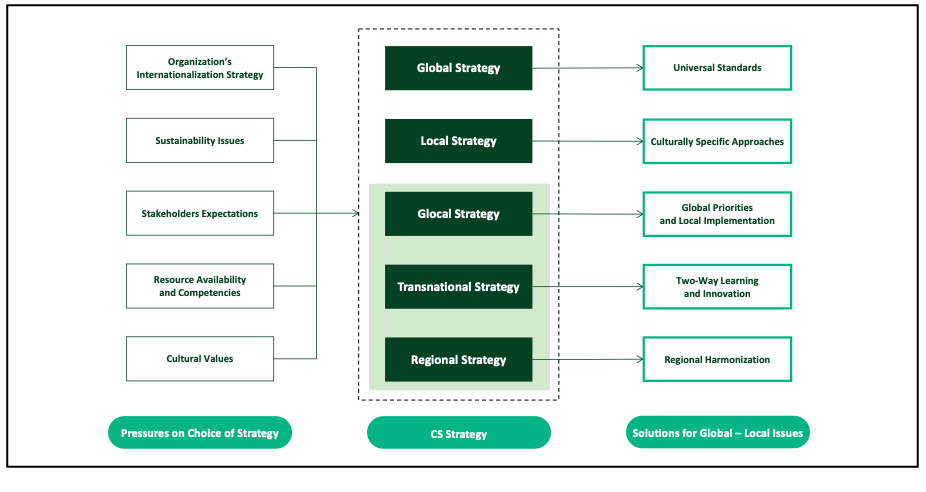
In addition to the geographical orientation of sustainability strategies, the competitive positioning of a MNC in its product markets represents a further dimension shaping the internal drivers of CS. Drawing on Porter’s framework of generic business strategies, two distinct orientations can be distinguished: cost leadership and differentiation.128Murray, A. I. A Contingency View of Porter’s “Generic Strategies”. Academy of Management Review 13, 390-400 (1988). https://doi.org/10.5465/amr.1988.4306951,129Porter, M. E. COMPETITIVE STRATEGY. Measuring Business Excellence 1, 12-17 (1997). https://doi.org/10.1108/eb025476,130Porter, M. E. Competitive Advantage: Creating and Sustaining Superior Performance. (Free Press, 2008).,131Park, S.-B. Bringing strategy back in: Corporate sustainability and firm performance. Journal of Cleaner Production 388 (2023). https://doi.org/10.1016/j.jclepro.2023.136012 Cost leadership prioritizes the delivery of comparable value at a lower cost, appealing to highly price-sensitive customer segments, whereas differentiation strategies seek to create unique value propositions through brand image, service, distribution, quality and product attributes.132Hambrick, D. C. High Profit Strategies in Mature Capital Goods Industries: A Contingency Approach. Academy of Management Journal 26, 687-707 (1983). https://doi.org/10.5465/255916,133Rothaermel, F. T. Strategic Management. 3. edn, (McGraw-Hill, 2017). Evidence from the broader CS literature indicates that firms pursuing differentiation are more likely to integrate sustainability into their core value proposition. In such settings, CS can serve as a non-imitable capability, particularly when embedded into product and process innovation. By contrast, cost leaders may perceive extensive CS initiatives as misaligned with their efficiency-driven priorities, especially where sustainability measures entail additional production or compliance costs that cannot be readily offset by efficiency gains.131Park, S.-B. Bringing strategy back in: Corporate sustainability and firm performance. Journal of Cleaner Production 388 (2023). https://doi.org/10.1016/j.jclepro.2023.136012 While these empirical findings have been established primarily in studies with samples drawn from both MNCs and SMEs, the underlying strategic logic is particularly salient for MNCs.131Park, S.-B. Bringing strategy back in: Corporate sustainability and firm performance. Journal of Cleaner Production 388 (2023). https://doi.org/10.1016/j.jclepro.2023.136012 Operating across diverse institutional environments exposes MNCs to heterogenous stakeholder expectations and varying regulatory demands, magnifying the reputational gains and potential risks associated with sustainability performance.134Marano, V., Wilhelm, M., Kostova, T., Doh, J. & Beugelsdijk, S. Multinational firms and sustainability in global supply chains: scope and boundaries of responsibility. Journal of International Business Studies 55, 413-428 (2024). https://doi.org/10.1057/s41267-024-00706-6,135Kolk, A. The social responsibility of international business: From ethics and the environment to CSR and sustainable development. Journal of World Business 51, 23-34 (2016). https://doi.org/10.1016/j.jwb.2015.08.010 While direct empirical evidence on this relationship in MNC-specific contexts remains limited, the reviewed literature suggests that competitive positioning constitutes a relevant internal contingency that can influence the scope and strategic embedding of CS within MNCs.
2.3.1.2 Leadership and culture
Understanding the distinct roles of key decision-makers in multinational companies has become increasingly central to international business research.136Georgakakis, D., Wedell-Wedellsborg, M. E., Vallone, T. & Greve, P. Strategic leaders in multinational enterprises: A role-specific microfoundational view and research agenda. Journal of International Business Studies 54, 514-537 (2023). https://doi.org/10.1057/s41267-022-00582-y As Buckley et al. assert, many of the foundational theories of the MNC are “essentially theories of managerial choice” (p. 139), emphasizing the pivotal influence of executive agency on organizational outcomes.137Buckley, P., Chen, L., Clegg, L. & Voss, H. Experience and FDI Risk-taking: A Microfoundational Reconceptualization. Journal of International Management 22, 131-146 (2016). https://doi.org/10.1016/j.intman.2016.02.001 This recognition has significant implications for sustainability management in MNCs. As these organizations navigate institutionally fragmented and culturally diverse environments, it finally are the decisions, values and behavioral norms established by top leadership that determine whether sustainability is genuinely embedded as a strategic imperative or relegated to symbolic compliance.138Korendijk, M. & Drogendijk, R. Beyond the CSO: How Alternative Attention Carriers Influence the Role of CSOs on CSR. Business & Society 64, 1010-1051 (2025). https://doi.org/10.1177/00076503241271224,139Filatotchev, I. & Stahl, G. K. Towards transnational CSR: Corporate social responsibility approaches and governance solutions for multinational corporations. Organizational Dynamics 44, 121-129 (2015). https://doi.org/10.1016/j.orgdyn.2015.02.006 Against this background, global leadership and the cultivation of a sustainability-oriented corporate culture are increasingly recognized as essential internal drivers of corporate sustainability in MNCs. Leadership in multinational firms is no longer merely a matter of internal coordination or resource allocation, it also involves mediating between competing institutional logics, aligning global corporate strategies with local expectations and legitimizing corporate action in the eyes of diverse stakeholder groups.140Voegtlin, C., Patzer, M. & Scherer, A. G. Responsible Leadership in Global Business: A New Approach to Leadership and Its Multi-Level Outcomes. Journal of Business Ethics 105, 1-16 (2012). https://doi.org/10.1007/s10551-011-0952-4,141Scherer, A. & Palazzo, G. The New Political Role of Business in a Globalized World–A Paradigm Shift in CSR and its Implications for the Firm, Governance, and Democracy. Journal of Management Studies 03, 899-931 (2009). https://doi.org/10.1111/j.1467-6486.2010.00950.x Leaders in MNCs must act as transnational stewards who not only ensure strategic coherence but also embody ethical commitments that transcend national regulatory frameworks.139Filatotchev, I. & Stahl, G. K. Towards transnational CSR: Corporate social responsibility approaches and governance solutions for multinational corporations. Organizational Dynamics 44, 121-129 (2015). https://doi.org/10.1016/j.orgdyn.2015.02.006,141Scherer, A. & Palazzo, G. The New Political Role of Business in a Globalized World–A Paradigm Shift in CSR and its Implications for the Firm, Governance, and Democracy. Journal of Management Studies 03, 899-931 (2009). https://doi.org/10.1111/j.1467-6486.2010.00950.x
In line with this strategic role, recent scholarship has increasingly emphasized leadership as a key internal driver of sustainability performance in MNCs. Leadership styles not only shape organizational priorities but also condition how sustainability objectives are interpreted, implemented and sustained across geographically dispersed subsidiaries. Executive leadership exerts a formative influence on both the adoption and depth of CS engagement by articulating normative commitments and activating stakeholder-oriented governance logics.142García Martín, R., Duran-Heras, A. & Reina Sánchez, K. Influence of Leadership Styles on Sustainable Development for Social Reconstruction: Current Outcomes and Advisable Reorientation for Two Aerospace Multinationals—Airbus and TASL. Sustainability 15 (2023). https://doi.org/10.3390/su151914047
In this regard, different leadership styles exert distinct influences on sustainability trajectories within MNCs. Transactional leadership operates through contingent reward systems and performance control, thereby promoting compliance-oriented sustainability practices. While effective in ensuring procedural adherence and operational efficiency, this approach often falls short in generating broader commitment to long-term sustainability goals.143Changar, M. & Atan, T. The Role of Transformational and Transactional Leadership Approaches on Environmental and Ethical Aspects of CSR. Sustainability 13, 1411 (2021). https://doi.org/10.3390/su13031411,144Bass, B. M. Leadership and performance beyond expectations. Vol. 25 (Free press, 1985). Transformational leadership, by contrast, is oriented toward vision-building, employee empowerment and strategic innovation. It is particularly impactful in promoting organizational change, aligning dispersed subsidiaries around shared sustainability values and facilitating cross-unit learning.143Changar, M. & Atan, T. The Role of Transformational and Transactional Leadership Approaches on Environmental and Ethical Aspects of CSR. Sustainability 13, 1411 (2021). https://doi.org/10.3390/su13031411,144Bass, B. M. Leadership and performance beyond expectations. Vol. 25 (Free press, 1985). Servant leadership, meanwhile, emphasizes ethical stewardship, stakeholder inclusion and the moral responsibility of leaders to serve both internal and external communities. This style is especially suited to embedding sustainability as a normative imperative across institutional and cultural boundaries.142García Martín, R., Duran-Heras, A. & Reina Sánchez, K. Influence of Leadership Styles on Sustainable Development for Social Reconstruction: Current Outcomes and Advisable Reorientation for Two Aerospace Multinationals—Airbus and TASL. Sustainability 15 (2023). https://doi.org/10.3390/su151914047,145Iqbal, Q. & Piwowar-Sulej, K. Knowledge Sharing in MNCs: Leadership, Hierarchical Similarity, and Cultural Orientation. Academy of Management Proceedings 2024 (2024). https://doi.org/10.5465/AMPROC.2024.17124abstract,146De Silva, A. S., Uthumange, A., Peiris, I. K. & Ulluwishewa, R. in The Palgrave Handbook of Servant Leadership (ed Gary E. Roberts) 1415-1438 (Springer International Publishing, 2023).
While these leadership models are not exclusive to MNCs, the literature highlights that leadership becomes a particularly salient driver of CS in MNCs due to the need to mediate between global objectives and local realities. Empirical findings indicate that MNCs rarely adopt singular leadership styles in practice. Instead, hybrid configurations, most notably those combining transformational and servant elements, are more frequently observed.142García Martín, R., Duran-Heras, A. & Reina Sánchez, K. Influence of Leadership Styles on Sustainable Development for Social Reconstruction: Current Outcomes and Advisable Reorientation for Two Aerospace Multinationals—Airbus and TASL. Sustainability 15 (2023). https://doi.org/10.3390/su151914047 This tendency reflects the structural and institutional complexity inherent to MNCs, where leadership must simultaneously enable strategic coherence, cultural responsiveness and stakeholder legitimacy. By flexibly integrating different leadership logics, MNC leaders can promote sustainability not as a peripheral agenda, but as an embedded, organization-wide commitment. These hybrid leadership constellations serve as critical drivers in aligning sustainability goals with operational practices, enhancing local engagement and ensuring the long-term integration of CS across diverse business units.142García Martín, R., Duran-Heras, A. & Reina Sánchez, K. Influence of Leadership Styles on Sustainable Development for Social Reconstruction: Current Outcomes and Advisable Reorientation for Two Aerospace Multinationals—Airbus and TASL. Sustainability 15 (2023). https://doi.org/10.3390/su151914047
Complementing the behavioral role of leadership, the structural composition and governance mechanisms of executive bodies represent a further central internal determinant of CS in MNCs. Board heterogeneity in terms of gender, nationality and tenure has been associated with stronger sustainability performance, particularly when diversity enhances the board’s capacity to mediate between global sustainability objectives and local institutional expectations.147Chams, N. & García-Blandón, J. Sustainable or not sustainable? The role of the board of directors. Journal of Cleaner Production 226, 1067-1081 (2019). https://doi.org/10.1016/j.jclepro.2019.04.118,148Naciti, V. Corporate governance and board of directors: The effect of a board composition on firm sustainability performance. Journal of Cleaner Production 237 (2019). https://doi.org/10.1016/j.jclepro.2019.117727 Moreover, the separation of the Chief Executive Officer (CEO) and chairperson roles, often cited as a mechanism to reduce agency problems, has been linked to more robust environmental performance, as independent oversight allows boards to resist short-term managerial pressures.148Naciti, V. Corporate governance and board of directors: The effect of a board composition on firm sustainability performance. Journal of Cleaner Production 237 (2019). https://doi.org/10.1016/j.jclepro.2019.117727 These findings suggest that effective sustainability governance in MNCs requires both structural safeguards and normative alignment across leadership tiers.
A further dimension of leadership in MNCs concerns the institutionalization of sustainability responsibilities through designated executive roles. Chief Sustainability Officers (CSOs) have emerged as pivotal roles in MNCs, especially where sustainability challenges span multiple regulatory, cultural and operational domains. Positioned within or reporting to the top management team, CSOs help elevate sustainability from peripheral compliance to a strategic governance concern by coordinating cross-functional efforts, supporting disclosure practices and facilitating internal alignment.149Thun, T. W. & Zülch, H. The effect of chief sustainability officers on sustainability reporting—A management perspective. Business Strategy and the Environment 32, 2093-2110 (2023). https://doi.org/10.1002/bse.3238,150Wiengarten, F., Lo, C. K. Y. & Lam, J. Y. K. “How does Sustainability Leadership Affect Firm Performance? The Choices Associated with Appointing a Chief Officer of Corporate Social Responsibility”. Journal of Business Ethics 140, 477-493 (2017). https://doi.org/10.1007/s10551-015-2666-5 Their presence is associated with higher levels of credible sustainability reporting, particularly when backed by other senior executives such as Chief Financial Officers (CFOs).149Thun, T. W. & Zülch, H. The effect of chief sustainability officers on sustainability reporting—A management perspective. Business Strategy and the Environment 32, 2093-2110 (2023). https://doi.org/10.1002/bse.3238,151Fu, R., Tang, Y. & Chen, G. Chief sustainability officers and corporate social (Ir)responsibility. Strategic Management Journal 41, 656-680 (2020). https://doi.org/10.1002/smj.3113 However, the effectiveness of CSOs as drivers of CS depends on role clarity, internal authority and organizational support structures. In MNCs, where complexity and stakeholder expectations are amplified, CSOs can serve as strategic anchors that embed sustainability into global decision-making logics.149Thun, T. W. & Zülch, H. The effect of chief sustainability officers on sustainability reporting—A management perspective. Business Strategy and the Environment 32, 2093-2110 (2023). https://doi.org/10.1002/bse.3238
Given that leadership plays a central role in defining organizational values and behavioral norms, it is closely intertwined with corporate culture. Corporate culture constitutes a critical internal context within MNCs in which sustainability strategies are interpreted, enacted and institutionalized.152Schotter, A. P. J., Maznevski, M., Stahl, G. K. & Doz, Y. Towards a dynamic theory of lateral collaboration across multinational enterprise structures: A collection of insights. Journal of World Business 60 (2025). https://doi.org/10.1016/j.jwb.2025.101647 Culture in MNCs constitutes a multifaceted construct shaped by both internally developed corporate culture and the national cultures embedded in the organization’s geographically dispersed units.153Williams, C. & van Triest, S. The impact of corporate and national cultures on decentralization in multinational corporations. International Business Review 18, 156-167 (2009). https://doi.org/10.1016/j.ibusrev.2009.01.003 Internally, corporate culture reflects the socio-ideological context of the firm, encompassing shaping the manager’s behavior and decision-making.153Williams, C. & van Triest, S. The impact of corporate and national cultures on decentralization in multinational corporations. International Business Review 18, 156-167 (2009). https://doi.org/10.1016/j.ibusrev.2009.01.003,154Smircich, L. Concepts of Culture and Organizational Analysis. Administrative Science Quarterly 28, 339-358 (1983). https://doi.org/10.2307/2392246,155Johnson, G. Managing strategic change— strategy, culture and action. Long Range Planning 25, 28-36 (1992). https://doi.org/10.1016/0024-6301(92)90307-N Externally, the national culture contexts of both HQ and host countries shape managerial attitudes and the effectiveness of subsidiary governance, with cultural distance potentially driving either greater decentralization for responsiveness or tighter control for coordination.153Williams, C. & van Triest, S. The impact of corporate and national cultures on decentralization in multinational corporations. International Business Review 18, 156-167 (2009). https://doi.org/10.1016/j.ibusrev.2009.01.003,156Dossi, A. & Patelli, L. The decision-influencing use of performance measurement systems in relationships between headquarters and subsidiaries. Management Accounting Research 19, 126-148 (2008). https://doi.org/10.1016/j.mar.2007.11.001,157Kogut, B. & Singh, H. The Effect of National Culture on the Choice of Entry Mode. Journal of International Business Studies 19, 411-432 (1988). https://doi.org/10.1057/palgrave.jibs.8490394
National culture constitutes a salient contextual factor shaping how MNCs engage with and communicate CS.20Bondy, K. & Starkey, K. The Dilemmas of Internationalization: Corporate Social Responsibility in the Multinational Corporation. British Journal of Management 25, 4-22 (2014). https://doi.org/10.1111/j.1467-8551.2012.00840.x,158Christie, P. M. J., Kwon, I. W. G., Stoeberl, P. A. & Baumhart, R. A Cross-Cultural Comparison of Ethical Attitudes of Business Managers: India, Korea and the United States. Journal of Business Ethics 46, 263-287 (2003). https://doi.org/10.1023/A:1025501426590,159García-Sánchez, I.-M., Rodríguez-Ariza, L. & Frías-Aceituno, J.-V. The cultural system and integrated reporting. International Business Review 22, 828-838 (2013). https://doi.org/10.1016/j.ibusrev.2013.01.007 Empirical evidence drawing on Hofstede’s six cultural dimensions demonstrates that specific cultural profiles are systematically associated with variations in both environmental performance and CSR disclosure.160Lu, J. & Wang, J. Corporate governance, law, culture, environmental performance and CSR disclosure: A global perspective. Journal of International Financial Markets, Institutions and Money 70 (2021). https://doi.org/10.1016/j.intfin.2020.101264 Study results indicate that power distance, individualism, masculinity and indulgence are each significantly and negatively related to the extent of CSR disclosure, while uncertainty avoidance and long-term orientation are positively associated with higher performance and more extensive reporting. These findings imply that firms in low power distance, collectivistic, feminine, long-term oriented, high uncertainty avoidance and restrained cultural contexts are more likely to achieve superior environmental performance and disclose comprehensive CSR information.160Lu, J. & Wang, J. Corporate governance, law, culture, environmental performance and CSR disclosure: A global perspective. Journal of International Financial Markets, Institutions and Money 70 (2021). https://doi.org/10.1016/j.intfin.2020.101264 These findings underscore that MNC sustainability practices are not solely determined by internal governance mechanisms, but are also shaped by broader national cultural environments in which HQ and subsidiaries operate.
2.3.2 External drivers of multinationals’ corporate sustainability
2.3.2.1 Institutional pressure
Multinational companies operate within a complex web of institutional environments that vary significantly across national contexts.161Marano, V. & Kostova, T. Unpacking the Institutional Complexity in Adoption of CSR Practices in Multinational Enterprises. Journal of Management Studies 53, 28-54 (2016). https://doi.org/10.1111/joms.12124 A defining characteristic of MNCs is their embeddedness in multiple legal, regulatory and normative systems, resulting in what the literature refers to as institutional duality, the need to comply simultaneously with the formal institutions of both the home and host countries.162Ahworegba, A. H. The dilemma of institutional duality and multinational firms 1967-2017: Implications and future research. Multinational Business Review 26, 145-172 (2018). https://doi.org/10.1108/mbr-03-2017-0014 This institutional embeddedness is not merely a contextual variable but constitutes a distinct operational condition that differentiates MNCs from domestic firms. These regulatory asymmetries act as institutional drivers that incentivize MNCs to develop cross-contextual sustainability strategies capable of addressing divergent legal and normative expectations simultaneously.163Amer, E. Internationalization, institutional pressures in foreign markets, and environmental sustainability. Journal of International Management 29 (2023). https://doi.org/10.1016/j.intman.2022.100974,164van Zanten, J. A. & van Tulder, R. Multinational enterprises and the Sustainable Development Goals: An institutional approach to corporate engagement. Journal of International Business Policy 1, 208-233 (2018). https://doi.org/10.1057/s42214-018-0008-x,165Yudarwati, G. A., Sison, M. D., Putranto, I. A. & Wiratsari, P. Enacting institutional drivers towards strategic corporate social responsibility: The sensemaking process in multinational companies. Corporate Social Responsibility and Environmental Management 30, 1782-1793 (2023). https://doi.org/10.1002/csr.2454 Institutional pressures constitute a foundational category of external drivers that shape corporate sustainability engagement in MNCs.163Amer, E. Internationalization, institutional pressures in foreign markets, and environmental sustainability. Journal of International Management 29 (2023). https://doi.org/10.1016/j.intman.2022.100974 Such pressures refer to the formal and informal rules, norms and expectations that guide organizational behavior within specific socio-political environments. In the context of corporate sustainability, institutional pressure manifests through binding legal obligations, non-binding standards, industry norms and societal expectations that compel firms to adopt or expand environmental and social governance practices.163Amer, E. Internationalization, institutional pressures in foreign markets, and environmental sustainability. Journal of International Management 29 (2023). https://doi.org/10.1016/j.intman.2022.100974,166Tolmie, C. R., Lehnert, K. & Zhao, H. Formal and informal institutional pressures on corporate social responsibility: A cross-country analysis. Corporate Social Responsibility and Environmental Management 27, 786-802 (2020). https://doi.org/10.1002/csr.1844
For MNCs, these pressures are particularly salient due to the breadth and heterogeneity of institutional contexts in which they operate.167Kostova, T., Roth, K. & Dacin, M. T. Institutional Theory in the Study of Multinational Corporations: A Critique and New Directions. The Academy of Management Review 33, 994-1006 (2008).,168Kostova, T. & Roth, K. Adoption of an Organizational Practice by Subsidiaries of Multinational Corporations: Institutional and Relational Effects. The Academy of Management Journal 45, 215-233 (2002). https://doi.org/10.2307/3069293 Regulatory frameworks such as mandatory sustainability reporting, environmental protection laws, labor codes and corporate governance standards impose legally enforceable requirements on firms at the national level.92Christmann, P. Multinational Companies and the Natural Environment: Determinants of Global Environmental Policy. Academy of Management Journal 47, 747-760 (2004). https://doi.org/10.5465/20159616,169Donner, E. K., Meißner, A. & Bort, S. Moving from voluntary to mandatory sustainability reporting—Transparency in sustainable development goals (SDG) reporting: An analysis of Germany’s largest MNCs. Business Ethics, the Environment & Responsibility 34, 900-911 (2025). https://doi.org/10.1111/beer.12687,170Clark, C. & Brown, J. A. Multinational Corporations and Governance Effectiveness: Toward a More Integrative Board. Journal of Business Ethics 132, 565-577 (2015). https://doi.org/10.1007/s10551-014-2358-6 In many developed home countries, particularly within the EU, North America and other OECD jurisdictions, characterized by a higher level of institutional development, such legal obligations have become increasingly comprehensive, ranging from climate-related disclosure rules to supply chain due diligence and non-financial reporting mandates.171Goerzen, A., Van Assche, A., Zhan, J. X. & Zhang, L. From the editors: Global sustainability reporting standards and the future of international business. Journal of International Business Policy 8, 125-136 (2025). https://doi.org/10.1057/s42214-025-00213-x,172Sinnig, J. & Zetzsche, D. A. The EU’s Corporate Sustainability Due Diligence Directive: From Disclosure to Mandatory Prevention of Adverse Sustainability Impacts in Supply Chains. European Journal of Risk Regulation16, 628-652 (2025). https://doi.org/10.1017/err.2024.100,173Aristova, E., Higham, C., Higham, I. & Setzer, J. CORPORATE CLIMATE CHANGE RESPONSIBILITIES UNDER THE OECD GUIDELINES FOR MULTINATIONAL ENTERPRISES. International and Comparative Law Quarterly 73, 505-525 (2024). https://doi.org/10.1017/S0020589324000125 While such regulations also apply to domestically operating firms, their impact on MNCs is amplified by the need to translate and enforce these standards across multiple legal systems and institutional environments. The requirement to ensure cross-border compliance and organizational coherence elevates the strategic relevance of national legislation within MNC governance.
In addition to formal legal requirements, institutional pressure also operates through mechanisms of isomorphism, such as benchmarking, peer comparison or the emulation of industry leaders.168Kostova, T. & Roth, K. Adoption of an Organizational Practice by Subsidiaries of Multinational Corporations: Institutional and Relational Effects. The Academy of Management Journal 45, 215-233 (2002). https://doi.org/10.2307/3069293,174Peng, X., Cui, X., Bai, Y. & Xu, Y. Institutional isomorphism pressure and multinational corporations’ environmental and social performance. Applied Economics Letters 30, 2424-2434 (2023). https://doi.org/10.1080/13504851.2022.2097628 Particularly in sectors with high public visibility or exposure to international scrutiny, MNCs may adopt sustainability standards not merely to comply with legal mandates but to maintain legitimacy and competitiveness within their field.175Christensen, H. B., Hail, L. & Leuz, C. Mandatory CSR and sustainability reporting: economic analysis and literature review. Review of Accounting Studies 26, 1176-1248 (2021). https://doi.org/10.1007/s11142-021-09609-5 Given the global exposure, MNCs are disproportionately affected by such pressures compared to domestic firms, as they are held accountable by a wider range of institutional actors and regulatory regimes.
While institutional pressures constitute a fundamental external driver of corporate sustainability, its manifestation and strategic relevance are highly context dependent. For MNCs, the force and direction of such pressures vary significantly depending on the regulatory characteristics of both their home and host countries. The interplay between these institutional contexts determines whether regulatory expectations reinforce each other, create tensions or substitute for one another and thereby shape how, where and to what extent MNCs implement corporate sustainability-related practices.3Burritt, R. L., Christ, K. L., Rammal, H. G. & Schaltegger, S. Multinational Enterprise Strategies for Addressing Sustainability: the Need for Consolidation. Journal of Business Ethics 164, 389-410 (2020). https://doi.org/10.1007/s10551-018-4066-0
The influence of home-country institutions on the sustainability practices of foreign subsidiaries represents one of the most frequently examined relationships in the literature on external drivers of MNC sustainability.55Zhou, X., Ying, S. X., You, J. & Wu, H. Like parent, like child: MNCs’ CSR and their foreign subsidiaries’ environmental footprint. Journal of Business Research 172 (2024). https://doi.org/10.1016/j.jbusres.2023.114413,176Gambirage, C., Silva, J. C. d., Vasconcelos, F. C. d. & Parente, R. C. Home country institutions and nonmarket political strategy effects on EMNE foreign location choice. Long Range Planning 57 (2024). https://doi.org/10.1016/j.lrp.2024.102477 MNCs headquartered in developed countries are frequently subject to comprehensive sustainability regulations and well-established institutional norms in their domestic environments. These home-country frameworks, ranging from non-financial disclosure obligations to supply chain due diligence, often serve as reference points for firm-wide sustainability strategies.175Christensen, H. B., Hail, L. & Leuz, C. Mandatory CSR and sustainability reporting: economic analysis and literature review. Review of Accounting Studies 26, 1176-1248 (2021). https://doi.org/10.1007/s11142-021-09609-5,177Aragòn-Correa, J. A., Marcus, A. A. & Vogel, D. The Effects of Mandatory and Voluntary Regulatory Pressures on Firms’ Environmental Strategies: A Review and Recommendations for Future Research. Academy of Management Annals 14, 339-365 (2020). https://doi.org/10.5465/annals.2018.0014,178Darnall, N., Henriques, I. & Sadorsky, P. Adopting Proactive Environmental Strategy: The Influence of Stakeholders and Firm Size. Journal of Management Studies 47, 1072-1094 (2010). https://doi.org/10.1111/j.1467-6486.2009.00873.x Empirical studies show that strong home-country institutions, such as stringent environmental regulation and high social capital, can reinforce internal governance mechanisms and increase board-level accountability for group-wide sustainability performance. However, research also indicates that strong stakeholder pressure in the home country can paradoxically reduce CSR in foreign subsidiaries, as MNCs sometimes balance CSR commitments between home and host markets, intensifying efforts domestically while scaling back abroad.55Zhou, X., Ying, S. X., You, J. & Wu, H. Like parent, like child: MNCs’ CSR and their foreign subsidiaries’ environmental footprint. Journal of Business Research 172 (2024). https://doi.org/10.1016/j.jbusres.2023.114413,179Escobar, L. F. & Vredenburg, H. Multinational Oil Companies and the Adoption of Sustainable Development: A Resource-Based and Institutional Theory Interpretation of Adoption Heterogeneity. Journal of Business Ethics 98, 39-65 (2011). https://doi.org/10.1007/s10551-010-0534-x,180Surroca, J., Tribó, J. A. & Zahra, S. A. Stakeholder Pressure on MNEs and the Transfer of Socially Irresponsible Practices to Subsidiaries. Academy of Management Journal 56, 549-572 (2013). https://doi.org/10.5465/amj.2010.0962 When operating in host countries with weaker regulatory enforcement or limited institutional maturity, MNCs may voluntarily extend these domestic standards to their foreign subsidiaries to ensure coherence, manage reputational risk and satisfy stakeholder expectations at the global level.3Burritt, R. L., Christ, K. L., Rammal, H. G. & Schaltegger, S. Multinational Enterprise Strategies for Addressing Sustainability: the Need for Consolidation. Journal of Business Ethics 164, 389-410 (2020). https://doi.org/10.1007/s10551-018-4066-0 At the same time, host-country institutions exert their own influence: local stakeholders, including consumers, employees, competitors, nongovernmental organizations (NGOs) and community groups, can pressure subsidiaries to adopt sustainability practices tailored to local priorities.181Park, B. I. & Ghauri, P. N. Determinants influencing CSR practices in small and medium sized MNE subsidiaries: A stakeholder perspective. Journal of World Business 50, 192-204 (2015). https://doi.org/10.1016/j.jwb.2014.04.007 In contexts where institutional conflicts exist, subsidiaries may even develop innovative CSR projects distinct from those transferred by HQ, sometimes with explicit HQ approval.182Beddewela, E. Managing corporate community responsibility in multinational corporations: Resolving institutional duality. Long Range Planning 52 (2019). https://doi.org/10.1016/j.lrp.2019.101911
While much of the literature focuses on the transmission of institutional pressure from developed home countries to less regulated host environments, the reverse dynamic, where more stringent host-country institutions shape the sustainability behavior of MNCs from less regulated home-country contexts, is attracting growing scholarly attention.183Luo, Y. & Tung, R. L. A general theory of springboard MNEs. Journal of International Business Studies 49, 129-152 (2018). https://doi.org/10.1057/s41267-017-0114-8 Such constellations are particularly relevant for Emerging-Markets MNCs (EMNCs) expanding into developed economies, where they face advanced legal systems, rigorous environmental standards and highly mobilized stakeholder groups.184Lessard, D. in Understanding Multinationals from Emerging Markets (eds Alvaro Cuervo-Cazurra & Ravi Ramamurti) 108-128 (Cambridge University Press, 2014).,185Zhou, C., Xu, G., Sun, C. & Chang, X. How do emerging multinationals achieve sustainable development globally? The enabling mechanism of headquarter-subsidiary structure in subsidiary sustainability. Sustainable Development 32, 2549-2564 (2024). https://doi.org/10.1002/sd.2786 In these cases, host-country regulation can act as a substitute for weak home-country institutional frameworks, compelling EMNCs to adopt more comprehensive sustainability practices in order to meet compliance requirements, secure legitimacy and counter reputational skepticism in the new market.185Zhou, C., Xu, G., Sun, C. & Chang, X. How do emerging multinationals achieve sustainable development globally? The enabling mechanism of headquarter-subsidiary structure in subsidiary sustainability. Sustainable Development 32, 2549-2564 (2024). https://doi.org/10.1002/sd.2786,186Zhou, H., Hou, Y. & Wang, H. Research on the social responsibility performance and its contributing factors to multinational corporations in China. Social Responsibility Journal 20, 405-426 (2023). https://doi.org/10.1108/srj-10-2022-0437,187Jiang, L., Chang, Z., Yao, W., Huang, L. & Zhou, S. Transcend local for global: ESG as a legitimacy signal in the global expansion of emerging multinational enterprises. Finance Research Letters 69 (2024). https://doi.org/10.1016/j.frl.2024.106174
A recurring theme in the literature is that EMNCs often confront what has been termed a liability of emergingness, reflecting the reputational disadvantage and perceived lower governance standards associated with their home-country origin.188Tashman, P., Marano, V. & Kostova, T. Walking the walk or talking the talk? Corporate social responsibility decoupling in emerging market multinationals. Journal of International Business Studies 50, 153-171 (2019). https://doi.org/10.1057/s41267-018-0171-7,189Pant, A. & Ramachandran, J. Legitimacy beyond borders: Indian software services firms in the United States, 1984 to 2004. Global Strategy Journal 2, 224-243 (2012). https://doi.org/10.1111/j.2042-5805.2012.01037.x To mitigate this liability, EMNCs may proactively align with stringent host-country norms, pursue recognized international certifications and adopt advanced environmental and social governance practices that go beyond the requirements of their domestic context.176Gambirage, C., Silva, J. C. d., Vasconcelos, F. C. d. & Parente, R. C. Home country institutions and nonmarket political strategy effects on EMNE foreign location choice. Long Range Planning 57 (2024). https://doi.org/10.1016/j.lrp.2024.102477 In doing so, they not only address compliance and legitimacy concerns but also signal their commitment to global sustainability norms to stakeholders across multiple jurisdictions. However, the degree to which EMNCs internalize these higher standards are contingent on factors such as resource availability, prior international experience and the strategic importance of the host market.188Tashman, P., Marano, V. & Kostova, T. Walking the walk or talking the talk? Corporate social responsibility decoupling in emerging market multinationals. Journal of International Business Studies 50, 153-171 (2019). https://doi.org/10.1057/s41267-018-0171-7 Recent research further highlights that the way EMNCs structure the relationship between HQ and subsidiaries can significantly affect their ability to meet host-country sustainability expectations. Studies show that a loose coupling HQ-subsidiaries structure can stimulate subsidiaries to engage more proactively in sustainability initiatives and foster local recognition of their efforts. By granting subsidiaries greater autonomy, EMNCs can encourage context-specific sustainability trials while also signaling openness to host-country priorities. This structural flexibility can weaken the negative effects of country-of-origin perceptions and enhance the acceptance of sustainability engagement in developed markets.185Zhou, C., Xu, G., Sun, C. & Chang, X. How do emerging multinationals achieve sustainable development globally? The enabling mechanism of headquarter-subsidiary structure in subsidiary sustainability. Sustainable Development 32, 2549-2564 (2024). https://doi.org/10.1002/sd.2786
In contrast, configurations in which both the home and the host countries are highly regulated developed economies have received comparatively little scholarly attention. Existing research in this area is largely confined to intra-regional contexts, such as within the EU or other advanced economic blocs, where regulatory frameworks and institutional norms are relatively harmonized.190Giannarakis, G., Andronikidis, A., Zopounidis, C., Sariannidis, N. & Tsagarakis, K. P. Determinants of Global Reporting Initiative report: A comparative study between USA and European companies. Sustainable Production and Consumption 35, 376-387 (2023). https://doi.org/10.1016/j.spc.2022.11.014,191Kolk, A. Environmental Reporting by Multinationals from the Triad: Convergence or Divergence? MIR: Management International Review 45, 145-166 (2005).,192Kolk, A. Sustainability, accountability and corporate governance: exploring multinationals’ reporting practices. Business Strategy and the Environment 17, 1-15 (2008). https://doi.org/10.1002/bse.511 Beyond a few studies focusing specifically on this setting, comprehensive comparative analyses remain rare, particularly when contrasted with the more substantial body of work on developed-emerging country pairs.193Déniz-Déniz, M. d. l. C. & García-Falcón, J. M. Determinants of the Multinationals’ Social Response. Empirical Application to International Companies Operating in Spain. Journal of Business Ethics 38, 339-370 (2002). https://doi.org/10.1023/A:1016061629745,194Morand, M. & Rayman‐Bacchus, L. Think global, act local: Corporate Social Responsibility Management in Multinational Companies. Social Responsibility Journal 2, 261-272 (2006). https://doi.org/10.1108/17471117200600003,195Pinkse, J., Kuss, M. J. & Hoffmann, V. H. On the implementation of a ‘global’ environmental strategy: The role of absorptive capacity. International Business Review 19, 160-177 (2010). https://doi.org/10.1016/j.ibusrev.2009.11.005,196Aguilera-Caracuel, J., Hurtado-Torres, N. E., Aragón-Correa, J. A. & Rugman, A. M. Differentiated effects of formal and informal institutional distance between countries on the environmental performance of multinational enterprises. Journal of Business Research 66, 2657-2665 (2013). https://doi.org/10.1016/j.jbusres.2013.04.002,197Pisani, N., Kourula, A., Kolk, A. & Meijer, R. How global is international CSR research? Insights and recommendations from a systematic review. Journal of World Business 52, 591-614 (2017). https://doi.org/10.1016/j.jwb.2017.05.003 Similarly, developing-emerging-country pairs, where both home and host countries are developing or emerging economies, are markedly underrepresented in the literature. Existing research offers only isolated case evidence and systematic comparative analyses are nonexistent.3Burritt, R. L., Christ, K. L., Rammal, H. G. & Schaltegger, S. Multinational Enterprise Strategies for Addressing Sustainability: the Need for Consolidation. Journal of Business Ethics 164, 389-410 (2020). https://doi.org/10.1007/s10551-018-4066-0 In the absence of strong formal regulation on either side, sustainability engagement is often driven by alternative mechanisms such as global value chain requirements, voluntary industry standards or cooperation with local stakeholders.198Bu, M., Hatani, F., Holtbrügge, D. & Van Assche, A. Multinational enterprises and sustainable business in emerging markets. Journal of International Management 31 (2025). https://doi.org/10.1016/j.intman.2025.101254
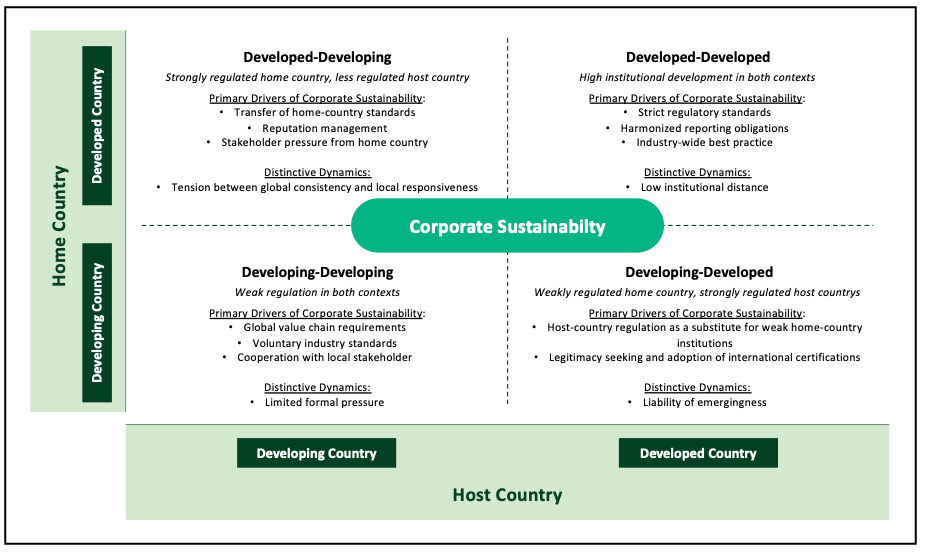
2.3.2.2 Stakeholder pressure and reputational risk
For MNCs, stakeholder pressure represents a particularly salient external driver of CS due to the breadth, heterogeneity and transnational nature of their stakeholder networks.199Sharfman, M. P., Shaft, T. M. & Tihanyi, L. A Model of the Global and Institutional Antecedents of High-Level Corporate Environmental Performance. Business & Society 43, 6-36 (2004). https://doi.org/10.1177/0007650304262962 Operating across multiple jurisdictions exposes MNCs to a diverse and often conflicting set of demands from customers, employees, investors, communities, NGOs, industry associations and policymakers.181Park, B. I. & Ghauri, P. N. Determinants influencing CSR practices in small and medium sized MNE subsidiaries: A stakeholder perspective. Journal of World Business 50, 192-204 (2015). https://doi.org/10.1016/j.jwb.2014.04.007,200Hånell, S. M., Tolstoy, D. & Tarnovskaya, V. in Creating a Sustainable Competitive Position: Ethical Challenges for International Firms Vol. 37 (eds Pervez N. Ghauri, Ulf Elg, & Sara Melén Hånell) (Emerald Publishing Limited, 2023).,201Luo, X. & Bhattacharya, C. B. Corporate Social Responsibility, Customer Satisfaction, and Market Value. Journal of Marketing 70, 1-18 (2006). https://doi.org/10.1509/jmkg.70.4.001,202Crane, A. & Matten, D. Business Ethics: Managing Corporate Citizenship and Sustainability in the Age of Globalization. (Oxford University Press, 2016).,203Rodriguez, P., Siegel, D. S., Hillman, A. & Eden, L. Three lenses on the multinational enterprise: politics, corruption, and corporate social responsibility. Journal of International Business Studies 37, 733-746 (2006). https://doi.org/10.1057/palgrave.jibs.8400229 Unlike domestic firms, MNCs must address these pressures simultaneously and at multiple levels, managing expectations that range from highly formalized regulatory compliance in developed economies to informal, norm-driven accountability in emerging markets. The global visibility of their brands amplifies these pressures: reputational risks triggered in a single location can rapidly escalate through transnational media and activist networks, affecting legitimacy in other markets irrespective of geographic distance.200Hånell, S. M., Tolstoy, D. & Tarnovskaya, V. in Creating a Sustainable Competitive Position: Ethical Challenges for International Firms Vol. 37 (eds Pervez N. Ghauri, Ulf Elg, & Sara Melén Hånell) (Emerald Publishing Limited, 2023).
In the context of CS, stakeholder pressure can operate both as a catalyst and as a constraint. On the one hand, such pressure can stimulate MNCs to adopt higher environmental, social and governance standards, not merely to meet minimum compliance requirements but to safeguard and enhance corporate reputation across markets. Proactive MNCs frequently integrate stakeholder engagement into their sustainability strategies, cultivating long-term trust and leveraging sustainability commitments to position themselves as industry leaders.57Aguilera-Caracuel, J., Guerrero-Villegas, J. & García-Sánchez, E. Reputation of multinational companies. European Journal of Management and Business Economics 26, 329-346 (2017). https://doi.org/10.1108/EJMBE-10-2017-019 Partnerships with international organizations such as the United Nations Framework Convention on Climate Change (UNFCCC), collaboration with global NGOs like the World Wide Fund for Nature (WWF) and joint sector initiatives with competitors illustrate how stakeholder relationships are institutionalized to co-create solutions, align global and local priorities and reinforce legitimacy across jurisdictions.200Hånell, S. M., Tolstoy, D. & Tarnovskaya, V. in Creating a Sustainable Competitive Position: Ethical Challenges for International Firms Vol. 37 (eds Pervez N. Ghauri, Ulf Elg, & Sara Melén Hånell) (Emerald Publishing Limited, 2023).
On the other hand, empirical research highlights the ambivalence of stakeholder pressure as a sustainability driver. While pressure at the home-country level may incentivize sustainability improvements domestically, it can also induce strategic responses that relocate socially and environmentally irresponsible practices to subsidiaries in host countries with weaker institutional oversight.8Korten, D. C. When Corporations Rule the World. 2. edn, (Berrett-Koehler, 2001).,57Aguilera-Caracuel, J., Guerrero-Villegas, J. & García-Sánchez, E. Reputation of multinational companies. European Journal of Management and Business Economics 26, 329-346 (2017). https://doi.org/10.1108/EJMBE-10-2017-019 This form of institutional arbitrage allows MNCs to preserve legitimacy in their home markets while avoiding the full costs of compliance in less regulated environments. Such relocation strategies are facilitated by the structural dispersion of MNCs, especially when subsidiaries are organizationally distant from HQ but still under HQ control through mechanisms such as board interlocks. In these cases, reputational spillovers are less likely to reach the HQ, enabling the MNC to maintain a positive image with home-country stakeholders while limiting scrutiny of foreign operations.180Surroca, J., Tribó, J. A. & Zahra, S. A. Stakeholder Pressure on MNEs and the Transfer of Socially Irresponsible Practices to Subsidiaries. Academy of Management Journal 56, 549-572 (2013). https://doi.org/10.5465/amj.2010.0962
The degree to which stakeholder pressure translates into genuine group-wide sustainability engagement is further moderated by institutional conditions in both home and host countries. Strong regulatory and civil society enforcement at home, when combined with weak enforcement abroad, can increase the likelihood of sustainability gaps between HQ and subsidiaries.180Surroca, J., Tribó, J. A. & Zahra, S. A. Stakeholder Pressure on MNEs and the Transfer of Socially Irresponsible Practices to Subsidiaries. Academy of Management Journal 56, 549-572 (2013). https://doi.org/10.5465/amj.2010.0962 Conversely, a vigorous civil society in the host country, characterized by active NGOs, media and community groups, can constrain such practices by elevating visibility and reputational risk. These dynamics underscore that the effectiveness of stakeholder pressure as a sustainability driver depends not only on its intensity but also on the institutional environments through which it is channeled.180Surroca, J., Tribó, J. A. & Zahra, S. A. Stakeholder Pressure on MNEs and the Transfer of Socially Irresponsible Practices to Subsidiaries. Academy of Management Journal 56, 549-572 (2013). https://doi.org/10.5465/amj.2010.0962,202Crane, A. & Matten, D. Business Ethics: Managing Corporate Citizenship and Sustainability in the Age of Globalization. (Oxford University Press, 2016).
From a strategic perspective, reputational considerations serve as a link between stakeholder pressure and sustainability engagement in MNCs.180Surroca, J., Tribó, J. A. & Zahra, S. A. Stakeholder Pressure on MNEs and the Transfer of Socially Irresponsible Practices to Subsidiaries. Academy of Management Journal 56, 549-572 (2013). https://doi.org/10.5465/amj.2010.0962,200Hånell, S. M., Tolstoy, D. & Tarnovskaya, V. in Creating a Sustainable Competitive Position: Ethical Challenges for International Firms Vol. 37 (eds Pervez N. Ghauri, Ulf Elg, & Sara Melén Hånell) (Emerald Publishing Limited, 2023). Protecting and enhancing reputation across diverse institutional contexts necessitates consistency in sustainability practices, as inconsistencies are increasingly subject to transnational exposure. Consequently, MNCs that respond to stakeholder pressure with globally coherent sustainability standards, rather than selective adaptation, are better positioned to secure long-term legitimacy, mitigate reputational risk and leverage sustainability as a competitive advantage. The capacity to manage multi-level stakeholder relationships and navigate reputational vulnerabilities thus constitutes a core dimension of the external environment driving CS in the MNC.200Hånell, S. M., Tolstoy, D. & Tarnovskaya, V. in Creating a Sustainable Competitive Position: Ethical Challenges for International Firms Vol. 37 (eds Pervez N. Ghauri, Ulf Elg, & Sara Melén Hånell) (Emerald Publishing Limited, 2023).,204Tarnovskaya, V., Tolstoy, D. & Melén Hånell, S. Drivers or passengers? A taxonomy of multinationals’ approaches to corporate social responsibility implementation in developing markets. International Marketing Review 39, 1-24 (2022). https://doi.org/10.1108/imr-05-2021-0161,205Eccles, R. G., Ioannou, I. & Serafeim, G. The Impact of Corporate Sustainability on Organizational Processes and Performance. Management Science 60, 2835-2857 (2014).
2.3.3 Outcomes of multinationals’ corporate sustainability
Identifying the outcomes of CS in MNCs is inherently challenging. The academic literature provides a broad range of findings, yet these outcomes are rarely attributable to single drivers in isolation. Rather, they tend to be discussed as the cumulative effect of broader implementation processes, often linked to the adoption of global standards and reporting frameworks such as the Global Reporting Initiative (GRI) or initiatives like the United Nations Global Compact (UNGC).19Vigneau, L., Humphreys, M. & Moon, J. How Do Firms Comply with International Sustainability Standards? Processes and Consequences of Adopting the Global Reporting Initiative. Journal of Business Ethics 131, 469-486 (2015). https://doi.org/10.1007/s10551-014-2278-5,206Ortas, E., Álvarez, I. & Garayar, A. The Environmental, Social, Governance, and Financial Performance Effects on Companies that Adopt the United Nations Global Compact. Sustainability 7, 1932-1956 (2015). https://doi.org/10.3390/su7021932 Moreover, the available evidence on outcomes is frequently shaped by the scope and design of individual studies. Research often focuses on specific industries.30Edoho, F. M. Oil transnational corporations: corporate social responsibility and environmental sustainability. Corporate Social Responsibility and Environmental Management 15, 210-222 (2008). https://doi.org/10.1002/csr.143,207Lin, W. L., Lee, C. & Law, S. H. Asymmetric effects of corporate sustainability strategy on value creation among global automotive firms: A dynamic panel quantile regression approach. Business Strategy and the Environment30, 931-954 (2021). https://doi.org/10.1002/bse.2662 Similarly, many analyzes are conducted in single-country settings, highlighting how institutional environments and cultural contexts influence the ways in which outcomes are generated and perceived.208Ike, M., Donovan, J. D., Topple, C. & Masli, E. K. A holistic perspective on corporate sustainability from a management viewpoint: Evidence from Japanese manufacturing multinational enterprises. Journal of Cleaner Production 216, 139-151 (2019). https://doi.org/10.1016/j.jclepro.2019.01.151,209Pranugrahaning, A., Donovan, J. D., Topple, C. & Masli, E. K. Exploring Corporate Sustainability in the Insurance Sector: A Case Study of a Multinational Enterprise Engaging with UN SDGs in Malaysia. Sustainability15 (2023). https://doi.org/10.3390/su15118609
From an economic perspective, sustainability is frequently associated with superior financial performance. Firms with advanced sustainability practices have been shown to outperform peers in terms of sales growth, return on assets, profit before tax and operating cash flows, while environmental investments that initially impose costs often generate long-term efficiency gains and innovation benefits.26Ameer, R. & Othman, R. Sustainability Practices and Corporate Financial Performance: A Study Based on the Top Global Corporations. Journal of Business Ethics 108, 61-79 (2012). https://doi.org/10.1007/s10551-011-1063-y Research further demonstrates that companies with long-standing commitment to sustainability achieve significantly higher stock market returns, improved accounting performance and reduced volatility compared to less sustainability-oriented firms, with particularly strong effects in consumer-facing, brand-driven and resource-intensive industries.205Eccles, R. G., Ioannou, I. & Serafeim, G. The Impact of Corporate Sustainability on Organizational Processes and Performance. Management Science 60, 2835-2857 (2014).
Environmental outcomes have received substantial attention in the literature, although their scope and intensity vary across industries and institutional contexts. Longitudinal evidence shows that firms with advanced sustainability practices are more likely to implement environmental and social standards in their supply chains, using these criteria for supplier selection and monitoring.205Eccles, R. G., Ioannou, I. & Serafeim, G. The Impact of Corporate Sustainability on Organizational Processes and Performance. Management Science 60, 2835-2857 (2014). More recent research highlights that environmental outcomes are frequently articulated through the framework of the SDGs. MNCs report contributions such as investments in renewable energy, water management and emission control, illustrating how ecological initiatives are aligned with global agendas.27Ordonez-Ponce, E. & Talbot, D. Multinational enterprises’ sustainability practices and focus on developing countries: Contributions and unexpected results of SDG implementation. Journal of International Development35, 201-232 (2023). https://doi.org/10.1002/jid.3682 At the same time, critical gaps persist, as issues such as sustainable consumption (SDG 12) and marine protection (SDG 14) remain underrepresented.27Ordonez-Ponce, E. & Talbot, D. Multinational enterprises’ sustainability practices and focus on developing countries: Contributions and unexpected results of SDG implementation. Journal of International Development35, 201-232 (2023). https://doi.org/10.1002/jid.3682 These findings emphasize both the potential and the limitations of MNC engagement, showing that while significant environmental outcomes are documented, they remain highly uneven across regions and thematic priorities.
Social outcomes represent another important dimension of CS in MNCs. Research shows that sustainability-oriented firms are more likely to institutionalize comprehensive stakeholder engagement mechanisms, including processes for identifying stakeholder concerns, establishing feedback channels and integrating social objectives into compensation systems.205Eccles, R. G., Ioannou, I. & Serafeim, G. The Impact of Corporate Sustainability on Organizational Processes and Performance. Management Science 60, 2835-2857 (2014). Literature further documents how MNCs contribute to SDGs through investments in poverty alleviation, education and healthcare, particularly in developing countries.27Ordonez-Ponce, E. & Talbot, D. Multinational enterprises’ sustainability practices and focus on developing countries: Contributions and unexpected results of SDG implementation. Journal of International Development35, 201-232 (2023). https://doi.org/10.1002/jid.3682 Such initiatives underline the potential of MNCs to act as agents of social progress in regions where state capacity may be limited. At the same time, outcomes remain unevenly distributed across geographies and thematic priorities. While substantial resources are directed to large emerging markets such as China and India, other regions receive comparatively little attention. Similarly, issues such as gender equality (SDG 5) and reduced inequalities (SDG 10) are underrepresented in CS agendas.27Ordonez-Ponce, E. & Talbot, D. Multinational enterprises’ sustainability practices and focus on developing countries: Contributions and unexpected results of SDG implementation. Journal of International Development35, 201-232 (2023). https://doi.org/10.1002/jid.3682
2.4 Limitations and future research needs
Although the academic literature on CS has expanded considerably over the past two decades, a central limitation lies in the difficulty of isolating findings that are specific to MNCs. Many of the drivers and barriers discussed in the literature are not unique to MNCs but apply equally to other types of firms, such as large domestic companies and international SMEs. As a result, it remains challenging to differentiate a body of knowledge that exclusively addresses the multinational context. The defining distinction, however, lies in the persistent dilemma of global integration and local responsiveness, which recurs across nearly all strands of MNC-related research.
Within this broader limitation, research on CS in MNCs has grown substantially, but remains highly fragmented in scope and focus. Much of the literature continues to draw on general CSR and international business foundations rather than MNC-specific conceptualizations. Existing studies frequently have examined sustainability in MNCs through the lens of HQ-subsidiary relations, analyzing how strategies are transferred and adapted across organizational levels.41Meyer, K. E., Li, C. & Schotter, A. P. J. Managing the MNE subsidiary: Advancing a multi-level and dynamic research agenda. Journal of International Business Studies 51, 538-576 (2020). https://doi.org/10.1057/s41267-020-00318-w,42Birkinshaw, J., Hood, N. & Jonsson, S. Building Firm-Specific Advantages in Multinational Corporations: The Role of Subsidiary Initiative. Strategic Management Journal 19, 221-241 (1998).,210Birkinshaw, J. & Hood, N. Multinational Subsidiary Evolution: Capability and Charter Change in Foreign-Owned Subsidiary Companies. The Academy of Management Review 23, 773-795 (1998). https://doi.org/10.2307/259062 Another major stream of research explores the role of MNCs in developing countries, highlighting how sustainability practices unfold in specific institutional contexts.27Ordonez-Ponce, E. & Talbot, D. Multinational enterprises’ sustainability practices and focus on developing countries: Contributions and unexpected results of SDG implementation. Journal of International Development35, 201-232 (2023). https://doi.org/10.1002/jid.3682,211Lartey, T. A. et al. Environmental sustainability practices and offshoring activities of multinational corporations across emerging and developed markets. International Business Review 30 (2021). https://doi.org/10.1016/j.ibusrev.2020.101789,212Garri, M. MNE’s sustainability strategies in emerging and developing markets. International Journal of Organizational Analysis 30, 743-759 (2021). https://doi.org/10.1108/ijoa-03-2020-2111 A key limitation of this body of work, however, is that it has largely concentrated on developed-developing country constellations, while developing-developing relations have received far less attention.3Burritt, R. L., Christ, K. L., Rammal, H. G. & Schaltegger, S. Multinational Enterprise Strategies for Addressing Sustainability: the Need for Consolidation. Journal of Business Ethics 164, 389-410 (2020). https://doi.org/10.1007/s10551-018-4066-0
Beyond these thematic concentrations, research on CS implementation in MNCs has often remained limited to the identification of influencing factors, many of which have been discussed in this review as drivers. What is largely absent are detailed accounts of how these factors are translated into concrete organizational practices through specific tools and mechanisms. In particular, the literature does not provide a systematic process that links driver, barriers and instruments of implementation in an integrated way. This gap underscores the need to scan the available evidence and to develop a process model that explains how MNCs can operationalize CS by combining conceptual drivers with practical tools and addressing barriers within their global structures.
Against this background, several directions for future research can be identified. First, future research should broaden its empirical scope beyond the prevalent focus on single industries or individual country cases. Comparative studies across sectors or institutional environments could provide important insights into whether the drivers and outcomes of CS implementation vary systematically across different industries and regional contexts. Existing research has, for instance, begun to explore how MNCs adapt their sustainability practices in context such as China, Latin America or African Countries, highlighting the importance of institutional environments in shaping outcomes.17D’Souza, C. et al. An empirical examination of sustainability for multinational firms in China: Implications for cleaner production. Journal of Cleaner Production 242 (2020). https://doi.org/10.1016/j.jclepro.2019.118446,213Aguilera-Caracuel, J., Guerrero-Villegas, J., Ahmadova, G. & Bornay-Barrachina, M. Social sustainability and financial performance of multilatinas: the moderating role of board independence and the sustainability committee. Review of Managerial Science (2025). https://doi.org/10.1007/s11846-025-00922-w,214Amoah, P. & Eweje, G. Barriers to environmental sustainability practices of multinational mining companies in Ghana: an institutional complexity perspective. Corporate Governance 22, 364-384 (2021). https://doi.org/10.1108/cg-06-2021-0229 Yet, these contributions remain largely confined to isolated case studies. More systematic cross-sectoral and cross-country analyses are needed to disentangle mechanisms from context-specific dynamics.
Second, longitudinal studies are needed to trace how sustainability strategies in MNCs evolve over time, particularly in response to regulatory shifts, changing stakeholder expectations and technological innovation. While Bansal’s (2005) study of Canadian firms in resource-intensive industries provides early longitudinal evidence on how institutional and resource-based factors shape CS development, such contributions remain rare.43Bansal, P. Evolving Sustainably: A Longitudinal Study of Corporate Sustainable Development. Strategic Management Journal 26, 197-218 (2005). Extending this approach to MNCs would allow scholars to examine how global integration pressures, subsidiary dynamics and cross-border stakeholder relations influence the trajectories of sustainability strategies.
Third, a further direction for future research lies in the integration of digital technologies into CS in MNCs. The increasing use of Industry 4.0 tools, artificial intelligence and data analytics in sustainability management raises novel questions about their potential to both enhance and constrain sustainable practices.14Pilgrim, G. & Wahlgren, A. Unlocking New Insights into Multinational Enterprise with the Power of Open-Source-Data, <https://oecdstatistics.blog/2023/05/10/unlocking-new-insights-into-multinational-enterprises-with-the-power-of-open-source-data/> (2023).,96Torres de Oliveira, R., Ghobakhloo, M. & Figueira, S. Industry 4.0 towards social and environmental sustainability in multinationals: Enabling circular economy, organizational social practices, and corporate purpose. Journal of Cleaner Production 430 (2023). https://doi.org/10.1016/j.jclepro.2023.139712,215Gomes, S. & Lopes, J. in Digital Transformation and Enterprise Information Systems (eds Adelaide Martins & Carolina Machado) Ch. 7, 113-137 (CRC Press, 2024). Future studies could explore how digital technologies shape sustainability reporting, enable greater supply-chain transparency and facilitate stakeholder engagement across global operations. At the same time, research should also address the risks of over-reliance on such digital systems, resulting in the possibility of reinforcing symbolic rather than substantive sustainability practices.
3 Practical implementations
The integration of sustainability into the strategic and operational structures of MNCs is a multifaced process that extends far beyond the implementation of isolated environmental or social initiatives. While an increasing number of MNCs have adopted sustainability-oriented policies and integration efforts have advanced significantly over the past decades, the extent to which sustainability is embedded in core business functions remains inconsistent.216Sroufe, R. Integration and organizational change towards sustainability. Journal of Cleaner Production 162, 315-329 (2017). https://doi.org/10.1016/j.jclepro.2017.05.180
Early evidence revealed a pronounced gap between recognition and execution: in 2010, more than half of 2,000 surveyed CEOs described sustainability as highly relevant, yet only 30 percent actively embedded it into their operations.217Bonini, S., Görner, S. & Jones, A. How Companies Manage Sustainability, <https://www.mckinsey.com/capabilities/sustainability/our-insights/how-companies-manage-sustainability-mckinsey-global-survey-results> (2010). The following year, a McKinsey study revealed that integration into budgeting, supply chain management and employee engagement processes was still minimal.218Bonini, S. & Görner, S. The Business of Sustainability, <https://www.mckinsey.com/capabilities/sustainability/our-insights/the-business-of-sustainability-mckinsey-global-survey-results> (2011). By 2012, sustainability disclosure had become nearly universal among S&P 500 firms, yet in 2014 only 38 percent incorporated it into performance management systems, despite 58 percent perceiving it as a part of their corporate culture.219Bonini, S. & Bové, A.-T. Sustainability’s Strategic Worth, <https://www.mckinsey.com/capabilities/sustainability/our-insights/sustainabilitys-strategic-worth-mckinsey-global-survey-results> (2014). By 2017, 90 percent of executives acknowledged sustainability’s strategic importance, though just 60 percent had established a formal sustainability strategy and by the early 2020s, more than 90 percent of S&P 500 companies were publishing ESG reports in some form.220Kiron, D. et al. Corporate Sustainabilty at a Crossroads, <https://sloanreview.mit.edu/projects/corporate-sustainability-at-a-crossroads/> (2017).,221Pérez, L., Hunt, V., Samandari, H., Nuttall, R. & Biniek, K. Does ESG really matter – and why?, <https://www.mckinsey.com/capabilities/sustainability/our-insights/does-esg-really-matter-and-why> (2022). This trajectory reflects gradual progress in mainstreaming sustainability within MNCs, while also illustrating the persistence of structural and operational gaps that many companies continue to address when it comes to implementing sustainability.
This variation reflects not only differences in ambition and resources but also distinct typologies in how MNCs approach sustainability. Broadly, three categories can be distinguished: Non-SD-Oriented Companies, which address sustainability only to the extent required by regulation and remain primarily focused on financial outcomes; Protocol Sustainable Companies, which incorporate sustainability into their corporate identity and engage in measures such as sustainability reporting, participation in global pacts and seeking external recognition; and Native Sustainable Companies, for which sustainability is deeply embedded in organizational culture and operations.222Simões-Coelho, M., Figueira, A. R. & Russo, E. in Responsible Firms: CSR, ESG, and Global Sustainability Vol. 23 (eds J. Jay Choi & Jimi Kim) 0 (Emerald Publishing Limited, 2024). The latter is characterized by long-term sustainability-oriented leadership, incentive systems linked to sustainability performance, prioritization of sustainability over short-term financial returns and business models designed entirely around sustainable innovation.222Simões-Coelho, M., Figueira, A. R. & Russo, E. in Responsible Firms: CSR, ESG, and Global Sustainability Vol. 23 (eds J. Jay Choi & Jimi Kim) 0 (Emerald Publishing Limited, 2024).
While CS has become a prominent component of corporate strategy, scholarly disclosure has primarily focused on its conceptual foundations and integration at the strategic level. In contrast, systematic research on the practical implementation of CS, specifically on bridging the gap between strategic ambition and operational realization, remains comparatively scarce.9Adib, M., Zhang, X., A.A.Zaid, M. & Sahyouni, A. Management control system for corporate social responsibility implementation – a stakeholder perspective. Corporate Governance 21, 410-432 (2020). https://doi.org/10.1108/cg-06-2020-0247,223Roche, K. E. & Baumgartner, R. J. Corporate sustainability strategy deployment: A case study on the implementation of corporate sustainability using hoshin kanri. Corporate Social Responsibility and Environmental Management 32, 927-946 (2025). https://doi.org/10.1002/csr.2959,224Sult, A., Wobst, J. & Lueg, R. The role of training in implementing corporate sustainability: A systematic literature review. Corporate Social Responsibility and Environmental Management 31, 1-30 (2024). https://doi.org/10.1002/csr.2560 Existing contributions, such as the governance framework by Klettner et al. (2014) for large Australian firms, emphasize that CS should be implemented through a cyclical process involving commitment at senior level including industry frameworks, leadership involvement in sustainability strategy development, implementation and communication.225Klettner, A., Clarke, T. & Boersma, M. The Governance of Corporate Sustainability: Empirical Insights into the Development, Leadership and Implementation of Responsible Business Strategy. Journal of Business Ethics 122, 145-165 (2014). https://doi.org/10.1007/s10551-013-1750-y However, no universally accepted process model currently exists that reflects the heterogeneous realities of MNCs. Given the differences in organizational maturity and strategic orientation outlined above and the inherently iterative nature of sustainability transformation, the development of a structured yet adaptable process framework is essential to guide MNCs in the effective CS implementation.
Building on recurring conceptual patterns identified across multiple studies, this review synthesizes an integrative MNC-specific process model for CS implementation. While the individual stages are grounded in distinct strands of the literature, their consolidation into a unified, sequential framework serves to illustrate the iterative nature of sustainability integration in MNCs. Although the underlying mechanisms may also be relevant to other types of firms, the scope, cross-border operations and structural complexity of MNCs justify a dedicated focus. The proposed model therefore comprises five interrelated phases capturing both the strategic and operational dynamics observed in MNCs and designed to be cycled through repeatedly to refine, expand and adapt sustainability initiatives in response to evolving internal and external conditions, namely: (1) Entry & Stabilization, (2) Organizational Embedding & Governance, (3) Operational Integration & Control, (4) External Transparency & Accountability and (5) Feedback & Innovation.
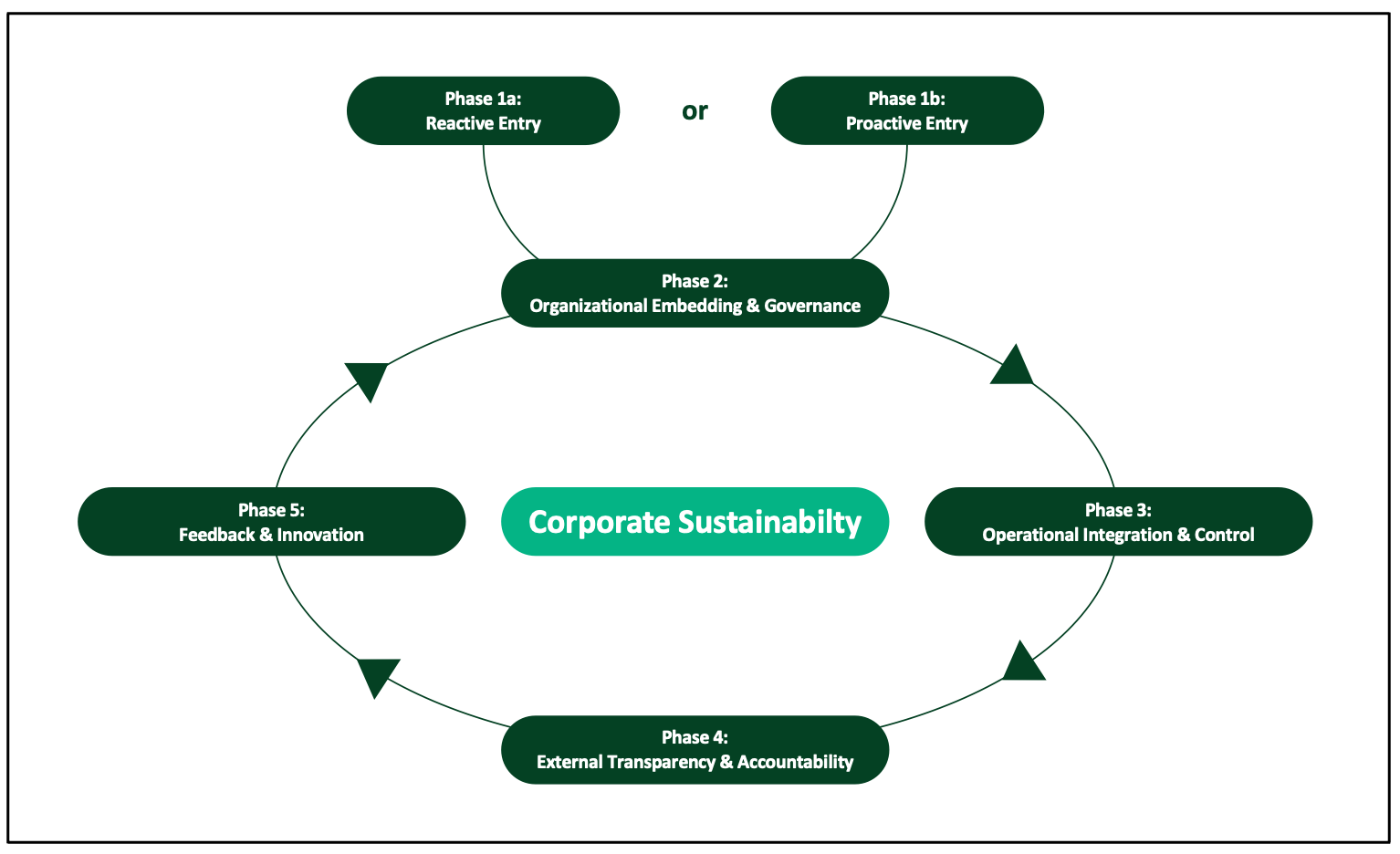
3.1 Phase 1: Entry & stabilization
In the proposed framework, Phase 1 constitutes the initial point of engagement with CS in MNCs, preceding the iterative core cycle represented by Phase 2 to Phase.5Ghauri, P., Strange, R. & Cooke, F. L. Research on international business: The new realities. International Business Review 30 (2021). https://doi.org/10.1016/j.ibusrev.2021.101794 At this stage, sustainability shifts from a peripheral consideration to a structured component of the corporate agenda, establishing the strategic and operational foundations for subsequent integration. The entry can follow two distinct pathways, depending on whether the impetus for change is reactive or proactive. In both cases, the underlying objective is to stabilize the organization by either containing acute risks or preventively minimizing emerging vulnerabilities.226Aragón-Correa, J. A. & Sharma, S. A Contingent Resource-Based View of Proactive Corporate Environmental Strategy. Academy of Management Review 28, 71-88 (2003). https://doi.org/10.5465/amr.2003.8925233,227González-Benito, J. & González-Benito, Ó. A review of determinant factors of environmental proactivity. Business Strategy and the Environment 15, 87-102 (2006). https://doi.org/10.1002/bse.450,228Wijethilake, C. & Ekanayake, A. in Advances in Management Accounting Vol. 30 (ed Mary A. Malina) (Emerald Publishing Limited, 2018). This stabilization forms the operational and strategic foundation for subsequent phases of integration.229United Nations Global Compact. Sustainability Stages Model: Roadmap for Integrated Sustainability, <https://d306pr3pise04h.cloudfront.net/docs/issues_doc%2Flead%2Froadmap%2Froadmap-five-sustainability-stages.pdf> (2025).,230Manninen, K. & Huiskonen, J. Factors influencing the implementation of an integrated corporate sustainability and business strategy. Journal of Cleaner Production 343 (2022). https://doi.org/10.1016/j.jclepro.2022.131036
Phase 1a: Reactive entry – Trigger event and crisis management
A reactive entry typically occurs when a MNC faces acute external pressures that expose critical sustainability-related vulnerabilities. Such triggers may include severe environmental incidents, supply chain controversies, regulatory investigations or breaches of international non-binding standards, with the impact often amplified by global media coverage and the simultaneous scrutiny of multiple jurisdictions.229United Nations Global Compact. Sustainability Stages Model: Roadmap for Integrated Sustainability, <https://d306pr3pise04h.cloudfront.net/docs/issues_doc%2Flead%2Froadmap%2Froadmap-five-sustainability-stages.pdf> (2025).,231Fazli, H., Farooq, S., Yang, C. & Wæhrens, B. V. Proactive and Reactive Approaches towards Sustainable Practices in Manufacturing Companies: Emerging Economies Perspective. Sustainability 15 (2023). https://doi.org/10.3390/su151712796,232Chan, R. Y. K., Lai, J. W. M. & Kim, N. Strategic motives and performance implications of proactive versus reactive environmental strategies in corporate sustainable development. Business Strategy and the Environment31, 2127-2142 (2022). https://doi.org/10.1002/bse.3011,233Pahl-Wostl, C., Odume, O. N., Scholz, G., De Villiers, A. & Amankwaa, E. F. The role of crises in transformative change towards sustainability. Ecosystems and People 19 (2023). https://doi.org/10.1080/26395916.2023.2188087,234Mateska, I., Wagner, S. M. & Stienen, L. Media Reporting of Environmental Supply Chain Sustainability Risks: Contextual and Moderating Factors. Journal of Business Ethics 199, 285-308 (2025). https://doi.org/10.1007/s10551-024-05759-z Prominent examples from recent decades illustrate how such events can compel MNCs to initiate or accelerate sustainability integration. The Deepwater Horizonoil spill in 2010 forced BP to implement far-reaching safety and environmental reform across its global operations.235Epstein, M. & Buhovac, A. Solving the sustainability implementation challenge. Organizational Dynamics 39, 306-315 (2010). https://doi.org/10.1016/j.orgdyn.2010.07.003,236BP p.l.c. Sustainability Review 2011, <https://www.bp.com/content/dam/bp/business-sites/en/global/corporate/pdfs/sustainability/archive/archived-reports-and-translations/2011/bp_sustainability_review_2011.pdf> (2011). Further, the Rana Plaza factory collapse in 2013 prompted numerous multinational apparel brands to adopt stricter supply chain monitoring and labor standards.237Auke, E. & Simaens, A. Corporate responsibility in the fast fashion industry: how media pressure affected corporate disclosure following the collapse of Rana Plaza. International Journal of Entrepreneurship and Innovation Management 23, 356-382 (2019). https://doi.org/10.1504/ijeim.2019.100800 The Volkswagen Dieselgate emissions scandal in 2015 led to extensive compliance programs and strategic shifts towards low-emission technologies.238Barth, F., Eckert, C., Gatzert, N. & Scholz, H. Spillover Effects from the Volkswagen Emissions Scandal: An Analysis of Stock and Corporate Bond Markets. Schmalenbach Journal of Business Research 74, 37-76 (2022). https://doi.org/10.1007/s41471-021-00121-9,239Volkswagen AG. Annual Report 2016, <https://www.volkswagen-group.com/en/publications/corporate/annual-report-2016-2335/download?disposition=attachment> (2017). Each of these cases demonstrates how crisis, amplified by media attention and cross-jurisdictional pressure, can act as catalysts for sustainability responses in MNCs.
In these situations, the primary objective is to secure the license to operate, contain reputational and operational risks and swiftly re-establish stakeholder trust.229United Nations Global Compact. Sustainability Stages Model: Roadmap for Integrated Sustainability, <https://d306pr3pise04h.cloudfront.net/docs/issues_doc%2Flead%2Froadmap%2Froadmap-five-sustainability-stages.pdf> (2025).,231Fazli, H., Farooq, S., Yang, C. & Wæhrens, B. V. Proactive and Reactive Approaches towards Sustainable Practices in Manufacturing Companies: Emerging Economies Perspective. Sustainability 15 (2023). https://doi.org/10.3390/su151712796 While the adoption of CS measures in this phase is driven by the urgency of the triggering event rather than by a long-term strategic plan, MNCs often possess the governance structures, cross-border coordination mechanisms and financial resources to implement corrective actions rapidly and on a global scale.200Hånell, S. M., Tolstoy, D. & Tarnovskaya, V. in Creating a Sustainable Competitive Position: Ethical Challenges for International Firms Vol. 37 (eds Pervez N. Ghauri, Ulf Elg, & Sara Melén Hånell) (Emerald Publishing Limited, 2023).,231Fazli, H., Farooq, S., Yang, C. & Wæhrens, B. V. Proactive and Reactive Approaches towards Sustainable Practices in Manufacturing Companies: Emerging Economies Perspective. Sustainability 15 (2023). https://doi.org/10.3390/su151712796,240Sharma, R. R. Environmental strategic role orientations of multinational enterprises: Different shades of green. Journal of International Management (2025). https://doi.org/10.1016/j.intman.2025.101283 Empirical evidence indicates that initial measures in such reactive scenarios tend to concentrate on compliance-oriented actions with a strong emphasis on measurable environmental performance improvements such as pollution reduction, waste management and resource efficiency. These interventions can effectively demonstrate accountability and deliver short-term performance gains. However, their immediate scope is often operational rather than transformative.231Fazli, H., Farooq, S., Yang, C. & Wæhrens, B. V. Proactive and Reactive Approaches towards Sustainable Practices in Manufacturing Companies: Emerging Economies Perspective. Sustainability 15 (2023). https://doi.org/10.3390/su151712796
Phase 1b – Proactive entry: Strategic opportunity trigger
While management actions following an unplanned event, as in a reactive entry, are often aimed at restoring the status quo, a strategically initiated proactive entry seeks to improve corporate sustainability performance beyond existing standards.241Flynn, P. J., Awaysheh, A., Bliese, P. D. & Flynn, B. B. From Intent to Impact: A Proactive Event Approach for Amplifying Sustainability Across Time. Journal of Management 51, 999-1032 (2025). https://doi.org/10.1177/01492063231224370 Proactive corporate sustainability refers to the voluntary, forward-looking integration of environmental and social objectives into corporate strategy, influenced by growing internal and external sustainability concerns such as regulatory pressures, a heightened awareness of the top management’s social and ethical responsibility, market shifts and new business opportunities and cost considerations.242Wijethilake, C. Proactive sustainability strategy and corporate sustainability performance: The mediating effect of sustainability control systems. Journal of Environmental Management 196, 569-582 (2017). https://doi.org/10.1016/j.jenvman.2017.03.057,243Aragón-Correa, J. A. & A. Rubio-López, E. Proactive Corporate Environmental Strategies: Myths and Misunderstandings. Long Range Planning 40, 357-381 (2007). https://doi.org/10.1016/j.lrp.2007.02.008
In recent decades, MNCs have been increasingly expected to act in accordance with ethical principles and are held accountable for their actions by customers, shareholders, NGOs and lawmakers across multiple jurisdictions.244Tarnovskaya, V., Hånell, S. M. & Tolstoy, D. Proactive Corporate Sustainability via Social Innovation—A Case Study of the Hennes & Mauritz Grand Challenge in Bangladesh. Sustainability 14, 599 (2022). https://doi.org/10.3390/su14020599 Rather than responding to immediate external pressures, proactive adoption is driven by the strategic recognition of sustainability as a source of long-term competitive advantage, risk mitigation and corporate resilience.200Hånell, S. M., Tolstoy, D. & Tarnovskaya, V. in Creating a Sustainable Competitive Position: Ethical Challenges for International Firms Vol. 37 (eds Pervez N. Ghauri, Ulf Elg, & Sara Melén Hånell) (Emerald Publishing Limited, 2023).,231Fazli, H., Farooq, S., Yang, C. & Wæhrens, B. V. Proactive and Reactive Approaches towards Sustainable Practices in Manufacturing Companies: Emerging Economies Perspective. Sustainability 15 (2023). https://doi.org/10.3390/su151712796 Empirical evidence suggests that proactive engagement often results in broader sustainability practices, encompassing both environmental and social dimensions and is more likely to generate enduring improvements in performance.231Fazli, H., Farooq, S., Yang, C. & Wæhrens, B. V. Proactive and Reactive Approaches towards Sustainable Practices in Manufacturing Companies: Emerging Economies Perspective. Sustainability 15 (2023). https://doi.org/10.3390/su151712796
For MNCs, proactive sustainability often extends beyond immediate business operations to address broader societal and environmental issues, including so-called grand challenges such as climate change, poverty, and decent work. Addressing such challenges requires expanding the corporate sustainability agenda to encompass market-shaping activities, including the development of social innovations that can restructure value chains, influence the behavior of suppliers, competitors and other stakeholders and ultimately transform industry structures.244Tarnovskaya, V., Hånell, S. M. & Tolstoy, D. Proactive Corporate Sustainability via Social Innovation—A Case Study of the Hennes & Mauritz Grand Challenge in Bangladesh. Sustainability 14, 599 (2022). https://doi.org/10.3390/su14020599 The case of H&M’s operations in Bangladesh illustrates how a proactive approach can be operationalized through mission-oriented social innovations aimed at improving labor standards and implementing fair living wages. Although the company faced significant challenges in achieving its targets, the initiatives demonstrate the potential of proactive engagement to enhance brand positioning, strengthen stakeholder relations and contribute to social progress in emerging markets.244Tarnovskaya, V., Hånell, S. M. & Tolstoy, D. Proactive Corporate Sustainability via Social Innovation—A Case Study of the Hennes & Mauritz Grand Challenge in Bangladesh. Sustainability 14, 599 (2022). https://doi.org/10.3390/su14020599
Within the proposed framework, such strategic opportunity triggers represent one possible entry point into sustainability integration. However, they can also emerge at later stages, particularly during Phase 5 Feedback & Innovation, where they may initiate a new iteration process.
3.2 Phase 2: Organizational embedding & governance
While Phase 1 outlines the conditions under which MNCs initiate their sustainability integration, whether in a reaction to external pressure or through the strategic pursuit of opportunities, the subsequent phases constitute the iterative core of the process. Phases 2 to 5 capture the continuous cycle of embedding sustainability into the MNC. This cyclical approach reflects the dynamic nature of sustainability in MNCs, where internal developments and external changes can prompt repeated progression through the process, ensuring that corporate sustainability remains aligned with evolving strategic priorities and stakeholder expectations.
Following the initial drivers that set sustainability integration in motion, Phase 2 establishes the strategic and organizational foundation necessary for effective implementation. In the CS / CSR management literature, this stage is frequently associated with the formalization of commitment and the creation of governance structures to anchor sustainability in the organization. This corresponds closely to the early stages identified in several established frameworks. Klettner et al. (2014) describe a Commitment Stage and a Leadership Stage, in which companies formalize their sustainability commitments through voluntary frameworks such as the GRI, sign up to international charters and establish dedicated governance structures to oversee strategy.225Klettner, A., Clarke, T. & Boersma, M. The Governance of Corporate Sustainability: Empirical Insights into the Development, Leadership and Implementation of Responsible Business Strategy. Journal of Business Ethics 122, 145-165 (2014). https://doi.org/10.1007/s10551-013-1750-y Similarly, Fatima & Elbanna’s (2022) dimension, CSR awareness, highlights the need to raise internal sensitivity to CSR issues and translate this into formal commitments embedded in policy documents.245Fatima, T. & Elbanna, S. Corporate Social Responsibility (CSR) Implementation: A Review and a Research Agenda Towards an Integrative Framework. Journal of Business Ethics 183, 105-121 (2023). https://doi.org/10.1007/s10551-022-05047-8 Maon et al. (2009) Plan phase likewise emphasizes connecting CSR vision to core values, formalizing it through official documents, engaging stakeholder and building on organizational structures to support the initiative.246Maon, F., Lindgreen, A. & Swaen, V. Designing and Implementing Corporate Social Responsibility: An Integrative Framework Grounded in Theory and Practice. Journal of Business Ethics 87, 71-89 (2009). https://doi.org/10.1007/s10551-008-9804-2 Bondy et al. (2012) identified early phases, namely Strategy Development and Systems Development. These phases echo the elements by focusing on defining purpose and commitments and formalizing strategy.56Bondy, K., Moon, J. & Matten, D. An Institution of Corporate Social Responsibility (CSR) in Multi-National Corporations (MNCs): Form and Implications. Journal of Business Ethics 111, 281-299 (2012). https://doi.org/10.1007/s10551-012-1208-7 Across these models, this early phase consistently combines strategic intent with the creation of governance mechanisms, ensuring that sustainability is embedded in organizational decision-making from the outset.
However, despite the widespread recognition of the importance of establishing strategic intent and governance structures, MNCs often face a significant gap between their high-level commitments and their actual implementation across the organization, namely the “large firm implementation gap” (p. 1169).247Wickert, C., Scherer, A. G. & Spence, L. J. Walking and Talking Corporate Social Responsibility: Implications of Firm Size and Organizational Cost. Journal of Management Studies 53, 1169-1196 (2016). https://doi.org/10.1111/joms.12209 Due to their size, geographic dispersion and complex structures, it can be challenging to translate ambitious sustainability objectives into consistent practices in all subsidiaries.247Wickert, C., Scherer, A. G. & Spence, L. J. Walking and Talking Corporate Social Responsibility: Implications of Firm Size and Organizational Cost. Journal of Management Studies 53, 1169-1196 (2016). https://doi.org/10.1111/joms.12209,248Vigneau, L. A micro-level perspective on the implementation of corporate social responsibility practices in multinational corporations. Journal of International Management 26 (2020). https://doi.org/10.1016/j.intman.2020.100804 This gap underscores the importance of Phase 2: without robust embedding mechanisms and governance arrangements that operate effectively across different organizational levels and geographies.
To address these challenges, MNCs increasingly rely on international frameworks that provide both guidance and legitimacy for embedding sustainability. The value of these frameworks often differs across contexts: in developed markets, they primarily serve as legitimacy-enhancing mechanisms by demonstrating compliance with demanding stakeholder expectations.249Kostova, T. & Zaheer, S. Organizational Legitimacy under Conditions of Complexity: The Case of the Multinational Enterprise. The Academy of Management Review 24, 64-81 (1999). https://doi.org/10.2307/259037,250DasGupta, R., Kumar, S. & Pathak, R. Multinational enterprises’ internationalization and adoption of sustainable development goals. International Journal of Managerial Finance 18, 617-638 (2022). https://doi.org/10.1108/ijmf-09-2021-0416 In developing markets, they provide guidance and capacity-building tools as substitutes for weaker institutional infrastructures.250DasGupta, R., Kumar, S. & Pathak, R. Multinational enterprises’ internationalization and adoption of sustainable development goals. International Journal of Managerial Finance 18, 617-638 (2022). https://doi.org/10.1108/ijmf-09-2021-0416 Among the wide range of frameworks, the United Nations Sustainable Development Goals (SDGs) have emerged as one of the most prominent reference points for MNCs. As a set of universally recognized goals with measurable targets that set out both quantitative and qualitative objectives across the economic, environmental and social dimensions, the SDGs allow firms to align their CS strategies with a global agenda while simultaneously tailoring implementation to diverse local conditions.77Ivanaj, S., Ivanaj, V., McIntyre, J. & Guimaraes da Costa, N. What can multinational enterprises do to implement sustainable development goals? Journal of Cleaner Production 296 (2021). https://doi.org/10.1016/j.jclepro.2021.126586,251Kolk, A., Kourula, A. & Pisani, N. Multinational Enterprises and the Sustainable Development Goals: What do we know and how to proceed? Transnational Corporations 24, 9-32 (2017). https://doi.org/10.18356/6f5fab5e-en
Empirical research further underlines the important role of SDGs for MNCs: studies show, that MNC internationalization is positively associated with SDG engagement, as exposure to diverse local contexts increases awareness of development-related issues and provides opportunities for learning and adaption.250DasGupta, R., Kumar, S. & Pathak, R. Multinational enterprises’ internationalization and adoption of sustainable development goals. International Journal of Managerial Finance 18, 617-638 (2022). https://doi.org/10.1108/ijmf-09-2021-0416 At the same time, country-specific institutional factors, such as legal systems and investor protection regimes, and industry characteristics, such as competition intensity or negative externalities, shape the extent to which MNCs engage with the SDGs, highlighting both the opportunities and challenges of using this framework as a central element of sustainability governance.250DasGupta, R., Kumar, S. & Pathak, R. Multinational enterprises’ internationalization and adoption of sustainable development goals. International Journal of Managerial Finance 18, 617-638 (2022). https://doi.org/10.1108/ijmf-09-2021-0416
While the SDGs provide MNCs with a universally recognized framework, their actual adoption is strongly shaped by institutional and industrial context. In developed markets, demanding regulatory systems and active stakeholder groups often drive MNCs to focus on goals related to health, education, climate action and biodiversity. In developing markets, weaker institutions make SDGs a substitute governance tool, helping firms to address issues such as poverty, energy access or urban development, while other SDGs remain consistently underrepresented, such as reduced inequalities, responsible consumption and production or peace and strong institutions. Moreover, MNCs frequently concentrate their initiatives in economically strategic regions, leaving less attractive markets comparatively neglected.27Ordonez-Ponce, E. & Talbot, D. Multinational enterprises’ sustainability practices and focus on developing countries: Contributions and unexpected results of SDG implementation. Journal of International Development35, 201-232 (2023). https://doi.org/10.1002/jid.3682 These patterns highlight both drivers, such as legitimacy pressures and opportunities for market alignment, and barriers, including institutional voids and commercial priorities, of the SDG framework.
Besides the SDGs, the United Nations Global Compact (UNGC) represents another central framework guiding MNC sustainability governance. Established in 2000, the UNGC provided ten universal principles covering human rights, labor, the environment and anti-corruption and requires member firms to publish annual communication on progress to document implementation.252Williams, O. F. The UN Global Compact: The Challenge and the Promise. Business Ethics Quarterly 14, 755-774 (2004). https://doi.org/10.5840/beq200414432 For MNCs, affiliation with the UNGC serves both symbolic and practical purposes. It strengthens legitimacy by signaling commitment to globally recognized standards while also offering guidance for operating in weak institutional environments.253Janney, J. J., Dess, G. & Forlani, V. Glass Houses? Market Reactions to Firms Joining the UN Global Compact. Journal of Business Ethics 90, 407-423 (2009). https://doi.org/10.1007/s10551-009-0052-x However, its voluntary and flexible design also raises questions about enforcement and effectiveness, particularly for MNCs that operate across diverse institutional settings. The challenge lies in ensuring that commitments made at HQ are consistently translated into subsidiary practices, as uneven participation across regions and recurring cases of non-compliance highlight the risk that symbolic adherence may outweigh substantive change.254Andrews, N. Normative spaces and the UN Global Compact for transnational corporations: the norm diffusion paradox. Journal of International Relations and Development 22, 77-106 (2019). https://doi.org/10.1057/s41268-017-0103-3
Alongside UN-based frameworks, the OECD Guidelines for Multinational Enterprises represent one of the most relevant instruments specifically designed for MNCs. First issued in 1976 and regularly updated, the Guidelines cover responsible conduct across human rights, environment, taxation, disclosure, competition and anti-corruption.255Hägg, C. The OECD Guidelines for multinational enterprises. Journal of Business Ethics 3, 71-76 (1984). https://doi.org/10.1007/BF00381719 Unlike many voluntary standards, they explicitly target multinational business activity, addressing challenges that arise from operating across multiple jurisdictions and institutional settings.256OECD. OECD Guidelines for Multinational Enterprises on Responsible Business Conduct. (2023). https://doi.org/10.1787/81f92357-en A distinctive feature for MNCs is the creation of National Contact Points (NCPs), which offer a state-backed, non-judicial mechanism for mediation, recommendations and public statements in cross-border cases, including those arising in non-adhering host states. Thus, the OECD Guidelines not only serve as a legitimacy framework but also as a governance tool that helps MNCs translate broad commitments into actionable practices across subsidiaries and supply chains.257Perillo, P. S. The Role of the OECD Guidelines for Multinational Enterprises and the National Contact Points in Shaping the Future of Corporate Accountability. International Community Law Review 24, 36-56 (2022). https://doi.org/10.1163/18719732-bja10071
This interplay between global frameworks and corporate practice is exemplified by Unilever, offering a widely recognized best-practice example. The company has systematically embedded the SDGs and the UNGC into its sustainability strategy Unilever Sustainable Living Plan.258Unilever p.l.c. Unilever Sustainable Living Plan 2010 to 2020: Summary of 10 years’ progress, <https://www.unilever.com/files/92ui5egz/production/16cb778e4d31b81509dc5937001559f1f5c863ab.pdf> (2021). Unilever has positioned the SDGs as a central reference point of its CS governance. Through the Sustainable Living Plan, the company explicitly aligns its three overarching goals, namely improving health and well-being, halving the environmental footprints and enhancing livelihoods, with multiple SDG targets.259Delabre, I., Alexander, A. & Rodrigues, C. Strategies for tropical forest protection and sustainable supply chains: challenges and opportunities for alignment with the UN sustainable development goals. Sustainability Science 15, 1637-1651 (2020). https://doi.org/10.1007/s11625-019-00747-z In practice, this alignment has materialized through initiatives in sustainable sourcing, supplier qualification and cross-sector partnerships, which reflects attempts to operationalize global principles across diverse business units and geographies.259Delabre, I., Alexander, A. & Rodrigues, C. Strategies for tropical forest protection and sustainable supply chains: challenges and opportunities for alignment with the UN sustainable development goals. Sustainability Science 15, 1637-1651 (2020). https://doi.org/10.1007/s11625-019-00747-z,260Montiel, I., Cuervo-Cazurra, A., Park, J., Antolín-López, R. & Husted, B. W. Implementing the United Nations’ Sustainable Development Goals in international business. Journal of International Business Studies 52, 999-1030 (2021). https://doi.org/10.1057/s41267-021-00445-y Unilever has also been an active member of the UNGC since the year 2000, reporting at the advanced level and systematically linking its sustainability commitments to the Compact’s ten principles on human rights, labor, environment and anti-corruption.261United Nations Global Compact. Company Information: Unilever, <https://unglobalcompact.org/what-is-gc/participants/9643-Unilever> (2025). In practice, Unilever translates the UNGC principles into binding internal frameworks that steer corporate governance and operations. Its Responsible Sourcing Policy requires all suppliers to adhere to standards on labor rights, environmental management and anti-corruption, directly reflecting the Compact’s principles. Likewise, its Human Rights Policy Statement embeds UNGC values into group-wide risk assessments and due diligence. Oversight is institutionalized through the Board’s Corporate Responsibility Committee, which monitors progress and ensures alignment with global standards.262Unilever p.l.c. Unilever UN Global Compact Advanced Communication on Progress 2022 Self-Assessment, <https://www.unilever.com/files/fe061e24-8ff9-4db6-90d8-6c18930802e0/unilever-ungc-cop-advanced-level-2022.pdf> (2022).
3.3 Phase 3: Operational integration & control
Building on the strategic commitments and governance structures established in Phase 2, Phase 3 marks the translation of sustainability strategies into concrete organizational practice. In the CS / CSR management literature, this stage is consistently described as particularly complex, as firms must move from high-level aspirations to concrete organizational practices. Klettner et al. (2014) highlight the Implementation phase as a big challenge, noting that companies often lack systematic frameworks to roll out, monitor and integrate sustainability across functions and geographies.225Klettner, A., Clarke, T. & Boersma, M. The Governance of Corporate Sustainability: Empirical Insights into the Development, Leadership and Implementation of Responsible Business Strategy. Journal of Business Ethics 122, 145-165 (2014). https://doi.org/10.1007/s10551-013-1750-y Fatima & Elbanna (2022) similarly emphasize the inherent complexity of CSR implementation, which emerges from diverse stakeholder demands, varying institutional environments and the need to reconcile communication with actual practices.245Fatima, T. & Elbanna, S. Corporate Social Responsibility (CSR) Implementation: A Review and a Research Agenda Towards an Integrative Framework. Journal of Business Ethics 183, 105-121 (2023). https://doi.org/10.1007/s10551-022-05047-8 Maon et al. (2009) conceptualize this stage as the Do phase, where firms focus on ensuring the necessary organizational skills, providing training to employees and embedding CSR objectives into managerial routines.246Maon, F., Lindgreen, A. & Swaen, V. Designing and Implementing Corporate Social Responsibility: An Integrative Framework Grounded in Theory and Practice. Journal of Business Ethics 87, 71-89 (2009). https://doi.org/10.1007/s10551-008-9804-2 Similarly, Bondy et al. (2012) describe this stage as the Rollout phase, emphasizing awareness-building, stakeholder engagement and the translation of commitments into local systems and practices.56Bondy, K., Moon, J. & Matten, D. An Institution of Corporate Social Responsibility (CSR) in Multi-National Corporations (MNCs): Form and Implications. Journal of Business Ethics 111, 281-299 (2012). https://doi.org/10.1007/s10551-012-1208-7 Across these models, Phase 3 represents the critical shift from strategic design to execution, requiring organizations to ensure that sustainability commitments are not only declared but effectively enacted throughout the corporation.
Building on this theoretical framing, the implementation of sustainability strategies in MNCs requires navigating the additional complexity of dispersed operations, heterogenous regulatory contexts and diverse cultural expectations.263Epstein, M. & Roy, M.-J. Managing corporate environmental performance: A multinational perspective. European Management Journal 16, 284-296 (1998). https://doi.org/10.1016/S0263-2373(98)00005-X The literature on environmental management in MNCs shows that firms face a fundamental strategic choice: whether to impose global integrative standards or allow for local adaptive standards.3Burritt, R. L., Christ, K. L., Rammal, H. G. & Schaltegger, S. Multinational Enterprise Strategies for Addressing Sustainability: the Need for Consolidation. Journal of Business Ethics 164, 389-410 (2020). https://doi.org/10.1007/s10551-018-4066-0 To address these challenges, MNCs rely on a range of organizational instruments that translate abstract sustainability commitments into operational routines. To better capture the complexity of operational integration, Simons’ (1995) Levers of Control propose a classification of management control mechanisms into four categories: belief systems, boundary systems, diagnostic controls and interactive controls.264Simons, R. Levers of control : how managers use innovative control systems to drive strategic renewal. (Harvard Business School Press, 1995).,265Narayanan, V. & Boyce, G. Exploring the transformative potential of management control systems in organisational change towards sustainability. Accounting, Auditing & Accountability Journal 32, 1210-1239 (2019). https://doi.org/10.1108/aaaj-04-2016-2536 Following this logic, the tools and measures employed by MNCs to implement sustainability can likewise be structured along these four dimensions.
Belief systems define the ideological core of corporations by articulating values and purposes that guide organizational behavior.264Simons, R. Levers of control : how managers use innovative control systems to drive strategic renewal. (Harvard Business School Press, 1995). In Phase 3, they play a crucial role in operationalizing sustainability, as they establish the cultural and normative foundations upon which policies and measurement tools can take effect. Their effectiveness depends on whether employees internalize sustainability not only as a strategic objective but as part of their daily routines.28Elg, U. & Ghauri, P. N. in Creating a Sustainable Competitive Position: Ethical Challenges for International Firms Vol. 37 (eds Pervez N. Ghauri, Ulf Elg, & Sara Melén Hånell) (Emerald Publishing Limited, 2023). In MNCs, this process is closely linked to the corporate culture that HQ seeks to preserve or develop, as cultural alignment must exist between the promoted values and the chosen environmental strategy.263Epstein, M. & Roy, M.-J. Managing corporate environmental performance: A multinational perspective. European Management Journal 16, 284-296 (1998). https://doi.org/10.1016/S0263-2373(98)00005-X
Research identifies several drivers that strengthen the anchoring of belief systems in MNCs. Clear communication from top management and visible leadership commitments enhance legitimacy, while training and incentive structures translate sustainability into tangible expectations.225Klettner, A., Clarke, T. & Boersma, M. The Governance of Corporate Sustainability: Empirical Insights into the Development, Leadership and Implementation of Responsible Business Strategy. Journal of Business Ethics 122, 145-165 (2014). https://doi.org/10.1007/s10551-013-1750-y,245Fatima, T. & Elbanna, S. Corporate Social Responsibility (CSR) Implementation: A Review and a Research Agenda Towards an Integrative Framework. Journal of Business Ethics 183, 105-121 (2023). https://doi.org/10.1007/s10551-022-05047-8 An effective mechanism is the linkage of sustainability objectives to monetary incentive systems, whereby the achievement of targets is directly tied to variable compensation, such as bonuses measured with environmental, social and external perception performance metrics.205Eccles, R. G., Ioannou, I. & Serafeim, G. The Impact of Corporate Sustainability on Organizational Processes and Performance. Management Science 60, 2835-2857 (2014). Aligning sustainability with corporate identity can further amplify this effect. IKEA, for instance, integrates sustainability into its cultural narrative by drawing on the founder’s legacy of frugality and resource efficiency, linking corporate identity with sustainability values.28Elg, U. & Ghauri, P. N. in Creating a Sustainable Competitive Position: Ethical Challenges for International Firms Vol. 37 (eds Pervez N. Ghauri, Ulf Elg, & Sara Melén Hånell) (Emerald Publishing Limited, 2023).,266Alänge, S., Clancy, G. & Marmgren, M. Naturalizing sustainability in product development: A comparative analysis of IKEA and SCA. Journal of Cleaner Production 135, 1009-1022 (2016). https://doi.org/10.1016/j.jclepro.2016.06.148 At the same time, IKEA grants local stores some autonomy in how sustainability messages are emphasized, highlighting both the strength and challenge of embedding culture in a decentralized organization.28Elg, U. & Ghauri, P. N. in Creating a Sustainable Competitive Position: Ethical Challenges for International Firms Vol. 37 (eds Pervez N. Ghauri, Ulf Elg, & Sara Melén Hånell) (Emerald Publishing Limited, 2023). Other firms complement such cultural anchoring with performance-based tools. H&M, for example, has introduced sustainability-related key performance indicators (KPIs) across its operations to evaluate progress in areas such as circularity. This not only provides measurable benchmarks but also signals to employees that sustainability performance is valued on par with financial performance.28Elg, U. & Ghauri, P. N. in Creating a Sustainable Competitive Position: Ethical Challenges for International Firms Vol. 37 (eds Pervez N. Ghauri, Ulf Elg, & Sara Melén Hånell) (Emerald Publishing Limited, 2023). Ericsson illustrates yet another model by combining centralized governance with localized execution. Corporate-level managers design sustainability programs and risk assessment templates, but subsidiaries are responsible for adapting them to their markets.28Elg, U. & Ghauri, P. N. in Creating a Sustainable Competitive Position: Ethical Challenges for International Firms Vol. 37 (eds Pervez N. Ghauri, Ulf Elg, & Sara Melén Hånell) (Emerald Publishing Limited, 2023).
Despite these examples, belief systems also face barriers in MNCs. The complexity of global operations and cultural heterogeneity can lead to divergent interpretations of sustainability practices.263Epstein, M. & Roy, M.-J. Managing corporate environmental performance: A multinational perspective. European Management Journal 16, 284-296 (1998). https://doi.org/10.1016/S0263-2373(98)00005-X Moreover, the risk of symbolic adaption persists if sustainability narratives are not consistently reinforced through concrete practices.265Narayanan, V. & Boyce, G. Exploring the transformative potential of management control systems in organisational change towards sustainability. Accounting, Auditing & Accountability Journal 32, 1210-1239 (2019). https://doi.org/10.1108/aaaj-04-2016-2536
Boundary systems define the limits within which organizational actors are expected to operate, thereby constraining behaviors that could jeopardize corporate objectives.265Narayanan, V. & Boyce, G. Exploring the transformative potential of management control systems in organisational change towards sustainability. Accounting, Auditing & Accountability Journal 32, 1210-1239 (2019). https://doi.org/10.1108/aaaj-04-2016-2536 For MNCs, the reliance on Management Systems (MS) has become a central mechanism to formalize such boundaries.263Epstein, M. & Roy, M.-J. Managing corporate environmental performance: A multinational perspective. European Management Journal 16, 284-296 (1998). https://doi.org/10.1016/S0263-2373(98)00005-X MS are voluntary, internationally recognized guidelines that formalize and systematize a firm’s managerial activities across areas such as quality, environment or occupational health and safety.267Heriyati, P., Yadav, N. & Tamara, D. Accomplishing sustainable development goals through international management system standards and multinational supply chains. Business Strategy and the Environment 33, 5214-5231 (2024). https://doi.org/10.1002/bse.3752 Within this model, this illustrates the transition from Phase 2, where companies commit to global frameworks, such as the SDGs and the UNGC, to Phase 3, where the commitments are embedded into organizational routines through MS, such as ISO standards. In return, these systems also prepare the ground for Phase 4, where external audits, ESG ratings and reporting mechanisms assess and communicate the extent to which sustainability has been effectively implemented.19Vigneau, L., Humphreys, M. & Moon, J. How Do Firms Comply with International Sustainability Standards? Processes and Consequences of Adopting the Global Reporting Initiative. Journal of Business Ethics 131, 469-486 (2015). https://doi.org/10.1007/s10551-014-2278-5,267Heriyati, P., Yadav, N. & Tamara, D. Accomplishing sustainable development goals through international management system standards and multinational supply chains. Business Strategy and the Environment 33, 5214-5231 (2024). https://doi.org/10.1002/bse.3752
For MNC, MS offer a way to reconcile the tension between global integration and local responsiveness. Through certification schemes, they create a harmonized baseline across subsidiaries while still allowing for local adaption to specific regulatory and cultural environments.267Heriyati, P., Yadav, N. & Tamara, D. Accomplishing sustainable development goals through international management system standards and multinational supply chains. Business Strategy and the Environment 33, 5214-5231 (2024). https://doi.org/10.1002/bse.3752 MS are also deeply embedded in global supply chains, as MNCs often require ISO certification from their suppliers as a contractual condition and employ MS-based audits to evaluate compliance.268Fraser, I. J., Schwarzkopf, J. & Müller, M. Exploring Supplier Sustainability Audit Standards: Potential for and Barriers to Standardization. Sustainability 12 (2020). https://doi.org/10.3390/su12198223 At the same time, many MNCs have developed their own audit and assessment frameworks, which often build on or combine elements from ISO standards such as ISO 9001 (quality), ISO 14001 (environment) or ISO 45001 (occupational health and safety), but extend them with company-specific requirements.267Heriyati, P., Yadav, N. & Tamara, D. Accomplishing sustainable development goals through international management system standards and multinational supply chains. Business Strategy and the Environment 33, 5214-5231 (2024). https://doi.org/10.1002/bse.3752,269Fonseca, L. & Carvalho, F. The Reporting of SDGs by Quality, Environmental, and Occupational Health and Safety-Certified Organizations. Sustainability 11 (2019). https://doi.org/10.3390/su11205797 These proprietary systems enable MNCs to enforce sustainability expectations more flexibly across their global networks, while still relying on the legitimacy of ISO-based approaches.267Heriyati, P., Yadav, N. & Tamara, D. Accomplishing sustainable development goals through international management system standards and multinational supply chains. Business Strategy and the Environment 33, 5214-5231 (2024). https://doi.org/10.1002/bse.3752 This dual reliance on standardized certification and internal audit schemes makes MS not only a mechanism of internal governance but also an instrument of cascading sustainability requirements down the supply chain.268Fraser, I. J., Schwarzkopf, J. & Müller, M. Exploring Supplier Sustainability Audit Standards: Potential for and Barriers to Standardization. Sustainability 12 (2020). https://doi.org/10.3390/su12198223
Among the wide range of available management systems, ISO 14001 has become the most prominent global standard for environmental management and is particularly relevant for MNCs.270King, A. A., Lenox, M. J. & Terlaak, A. The Strategic Use of Decentralized Institutions: Exploring Certification With the ISO 14001 Management Standard. Academy of Management Journal 48, 1091-1106 (2005). https://doi.org/10.5465/amj.2005.19573111 Its global reach makes the standard highly attractive for MNCs, which must align their environmental commitments across geographically dispersed subsidiaries. Prominent examples underline this appeal: IBM applied ISO 14001 to its global operations, while Samsung, Ford, General Motors and Toyota mandated certifications for their production facilities across diverse locations to ensure consistency in environmental practices and signal sustainability leadership.271Margaret, I., Schoubben, F. & Verwaal, E. When do investors see value in international environmental management certification of multinational corporations? A study of ISO 14001 certification after the Paris Agreement. Global Strategy Journal 14, 25-55 (2024). https://doi.org/10.1002/gsj.1490
While certification is formally obtained at the facility level, the implementation of ISO 14001 within MNCs is typically mandated by HQ, ensuring its adoption across all subsidiaries. The effectiveness and perceived value of such implementation, however, vary considerably across institutional contexts. MNCs headquartered in developed countries often derive limited reputational benefits from ISO 14001, as their environmental practices are already subject to strict regulatory oversight and alternative benchmarks provide additional credibility.270King, A. A., Lenox, M. J. & Terlaak, A. The Strategic Use of Decentralized Institutions: Exploring Certification With the ISO 14001 Management Standard. Academy of Management Journal 48, 1091-1106 (2005). https://doi.org/10.5465/amj.2005.19573111,271Margaret, I., Schoubben, F. & Verwaal, E. When do investors see value in international environmental management certification of multinational corporations? A study of ISO 14001 certification after the Paris Agreement. Global Strategy Journal 14, 25-55 (2024). https://doi.org/10.1002/gsj.1490,272Wiengarten, F., Pagell, M. & Fynes, B. ISO 14000 certification and investments in environmental supply chain management practices: identifying differences in motivation and adoption levels between Western European and North American companies. Journal of Cleaner Production 56, 18-28 (2013). https://doi.org/10.1016/j.jclepro.2012.01.021 By contrast, MNCs in developing countries frequently gain a stronger legitimacy advantage, since ISO 14001 certification functions as a reputational booster that compensates for weaker home-country institutions and signals alignment with global standards in international markets.271Margaret, I., Schoubben, F. & Verwaal, E. When do investors see value in international environmental management certification of multinational corporations? A study of ISO 14001 certification after the Paris Agreement. Global Strategy Journal 14, 25-55 (2024). https://doi.org/10.1002/gsj.1490 Moreover, exposure to host countries with stringent environmental regulations further amplifies the substantive value of ISO 14001, as compliance is more likely to be accompanied by environmental improvements. On the contrary, operations in less regulated environments may invite skepticism and risk that ISO 14001 is perceived as a symbolic adoption rather than a substantive commitment.271Margaret, I., Schoubben, F. & Verwaal, E. When do investors see value in international environmental management certification of multinational corporations? A study of ISO 14001 certification after the Paris Agreement. Global Strategy Journal 14, 25-55 (2024). https://doi.org/10.1002/gsj.1490
However, research also highlights limitations. The effectiveness of ISO certifications is not always guaranteed, renewal rates are declining and several studies find little difference in performance between certified and non-certified firms.273Cândido, C. J. F., Coelho, L. M. S. & Peixinho, R. M. T. Why firms lose their ISO 9001 certification: Evidence from Portugal. Total Quality Management & Business Excellence 32, 632-651 (2021). https://doi.org/10.1080/14783363.2019.1625266,274Kusumah, L. H. & Fabianto, Y. S. The differences in the financial performance of manufacturing companies in Indonesia before and after ISO 9000 implementation. Total Quality Management & Business Excellence 29, 941-957 (2018). https://doi.org/10.1080/14783363.2016.1237285 Moreover, the effectiveness of certification depends heavily on organizational commitment and the quality of external auditors, which vary significantly across countries and create opportunities for symbolic adaption.267Heriyati, P., Yadav, N. & Tamara, D. Accomplishing sustainable development goals through international management system standards and multinational supply chains. Business Strategy and the Environment 33, 5214-5231 (2024). https://doi.org/10.1002/bse.3752,275Lo, C. K. Y., Wiengarten, F., Humphreys, P., Yeung, A. C. L. & Cheng, T. C. E. The impact of contextual factors on the efficacy of ISO 9000 adoption. Journal of Operations Management 31, 229-235 (2013). https://doi.org/10.1016/j.jom.2013.04.002,276Yadav, N., Heriyati, P., Kumar, H. & Tamara, D. Influence of quality management and allied certifications on consumers. International Journal of Quality and Service Sciences 14, 421-441 (2022). https://doi.org/10.1108/ijqss-09-2021-0120
These limitations illustrate that ISO certifications alone may not guarantee substantive sustainability improvements. As a aforementioned result, many MNCs have moved beyond relying exclusively on standardized certifications and have developed their own management and auditing frameworks, often building on and extending ISO requirements.267Heriyati, P., Yadav, N. & Tamara, D. Accomplishing sustainable development goals through international management system standards and multinational supply chains. Business Strategy and the Environment 33, 5214-5231 (2024). https://doi.org/10.1002/bse.3752 A well-known example is IKEA’s IWAY Standard, which combines elements of ISO-based approaches with broader social, environmental and ethical requirements, thereby demonstrating how customized frameworks can transform certification-based mechanisms into more comprehensive tools for advancing corporate sustainability.277Laurin, F. & Fantazy, K. Sustainable supply chain management: a case study at IKEA. Transnational Corporations Review 9, 309-318 (2017). https://doi.org/10.1080/19186444.2017.1401208 The IWAY Standard represents IKEA’s supplier code of conduct and sets minimum requirements on environmental protection, labor conditions, occupational health and safety and business ethics, which are contractually binding for all suppliers.278Inter IKEA Systems B.V. The IWAY Auditing Process – Ten Principles for Building a Responsible Supply Chain, <https://www.ikea.com/global/en/stories/sustainability/the-iway-auditing-process-ten-principles-for-building-a-responsible-supply-chain-230619/> (2025). Unlike ISO certifications, which typically apply at the facility level, IWAY explicitly includes sub-suppliers, thereby cascading sustainability requirements across multiple tiers of the value chain. Its provisions are grounded in international reference points such as the SDGs and the UNGC yet operationalized through detailed rules on issues such as child and forced labor, wages, health and safety, waste management and pollution prevention. Compliance is monitored through a mix of self-assessments, audits and corrective action plans, ensuring that suppliers demonstrate continuous alignment with IKEA’s requirements.277Laurin, F. & Fantazy, K. Sustainable supply chain management: a case study at IKEA. Transnational Corporations Review 9, 309-318 (2017). https://doi.org/10.1080/19186444.2017.1401208
In contrast to boundary systems, which establish minimum standards and define the limits of acceptable behavior, diagnostic controls function as internal steering mechanisms that measure sustainability performance against predefined objectives.265Narayanan, V. & Boyce, G. Exploring the transformative potential of management control systems in organisational change towards sustainability. Accounting, Auditing & Accountability Journal 32, 1210-1239 (2019). https://doi.org/10.1108/aaaj-04-2016-2536 Their purpose in Phase 3 is not to restrict but to monitor and evaluate progress, ensuring that subsidiaries remain aligned with CS strategies. For MNCs, these mechanisms are crucial to maintain global consistency while operating across heterogeneous regulatory and cultural environments.279Jaussaud, J. & Schaaper, J. Control mechanisms of their subsidiaries by multinational firms: A multidimensional perspective. Journal of International Management 12, 23-45 (2006). https://doi.org/10.1016/j.intman.2005.04.001 In practice, systematic evidence on how MNCs measure sustainability performance across their subsidiaries remains limited. The international business literature has traditionally focused on financial, operational and organizational outcomes.280Hansen, M. W. & Gwozdz, W. What makes MNCs succeed in developing countries?: An empirical analysis of subsidiary performance. Multinational Business Review 23, 224-247 (2015). https://doi.org/10.1108/mbr-06-2014-0020 While corporate sustainability performance measurement is widely discussed in the literature, its operationalization in MNCs illustrates the difficulty of establishing universally applicable indicators.281Ivory, S. B. & Brooks, S. B. Managing Corporate Sustainability with a Paradoxical Lens: Lessons from Strategic Agility. Journal of Business Ethics 148, 347-361 (2018). https://doi.org/10.1007/s10551-017-3583-6 Research on the diffusion of sustainability reporting confirms this dilemma, showing that global standardization may inhibit transparency while local institutional dynamics and isomorphic pressures exert a stronger influence on practice.13Fourati, A., Zenaidi, A. & Jeriji, M. Like Parent, Like Subsidiary? On the Diffusion of Sustainability Reporting in Multinational Companies. Corporate Social Responsibility and Environmental Management 32, 3210-3226 (2025). https://doi.org/10.1002/csr.3100 Beyond this general dilemma, the literature provides little systematic evidence on which specific sustainability KPIs MNCs employ across their subsidiaries. Existing general studies tend to focus on generic indicators such as environmental KPIs (KPIs on gas emissions, renewable resources, resource consumption, waste), social KPIs (KPIs on work conditions, consideration of human rights, participation in social initiatives) and economic KPIs (KPIs on financial performance linked to sustainability dimensions).282Hristov, I. & Chirico, A. The Role of Sustainability Key Performance Indicators (KPIs) in Implementing Sustainable Strategies. Sustainability 11 (2019). https://doi.org/10.3390/su11205742
Against this background, company-level evidence provides valuable insights into how diagnostic controls are operationalized in practice. H&M, for instance, integrates sustainability KPIs into its internal governance structures by requiring the Sustainability Director to provide quarterly updates to the CEO and CFO on progress against KPIs, activities and challenges across brands and markets.283H & M Hennes & Mauritz AB. Annual & Sustainability Report 2024, <https://hmgroup.com/wp-content/uploads/2025/03/HM-Group-Annual-and-sustainability-report-2024.pdf> (2025). This highlights the role of diagnostic controls as mechanisms that link operational performance to corporate strategy and ensure top management oversight. At the same time, H&M’s Annual and Sustainability Report largely presents aggregated results without disclosing how specific KPIs are applied or weighted across subsidiaries. While internal procedures, such as standardized accounting systems and group-wide audits, create a high degree of comparability, they leave open how local materiality is captured and whether regional challenges are adequately reflected.283H & M Hennes & Mauritz AB. Annual & Sustainability Report 2024, <https://hmgroup.com/wp-content/uploads/2025/03/HM-Group-Annual-and-sustainability-report-2024.pdf> (2025). This limitation is not unique to H&M but a characteristic of MNCs more broadly, as external reports are primarily directed at their shareholders as well as their internal and external stakeholders, whose interest lies in the consolidated sustainability performance of the corporation rather than the subsidiary-level.13Fourati, A., Zenaidi, A. & Jeriji, M. Like Parent, Like Subsidiary? On the Diffusion of Sustainability Reporting in Multinational Companies. Corporate Social Responsibility and Environmental Management 32, 3210-3226 (2025). https://doi.org/10.1002/csr.3100,284Dienes, D., Sassen, R. & Fischer, J. What are the drivers of sustainability reporting? A systematic review. Sustainability Accounting, Management and Policy Journal 7, 154-189 (2016). https://doi.org/10.1108/sampj-08-2014-0050
Diagnostic controls, like KPIs, provide a structured framework for monitoring sustainability performance. To complement these mechanisms, interactive controls emphasize continuous dialogue, joint problem solving and adaptive learning. Rather than merely recording sustainability outcomes, they involve managers actively engaging with performance measures to identify critical success factors, detect risks and take corrective action.265Narayanan, V. & Boyce, G. Exploring the transformative potential of management control systems in organisational change towards sustainability. Accounting, Auditing & Accountability Journal 32, 1210-1239 (2019). https://doi.org/10.1108/aaaj-04-2016-2536 In Phase 3 of the CS integration process, their purpose is to ensure that sustainability goals remain visible across the organization and open to debate, thereby embedding them into managerial routines and decision-making processes.
In the context of MNCs, interactive controls are also institutionalized through governance structures such as subsidiary boards. Beyond their monitoring role, these boards frequently assume coordinating and service functions, facilitating knowledge exchange and strategic alignment between HQ and subsidiaries.285Du, Y., Deloof, M. & Jorissen, A. The Roles of Subsidiary Boards in Multinational Enterprises. Journal of International Management 21, 169-181 (2015). https://doi.org/10.1016/j.intman.2015.05.001 In addition to internal governance structures, MNCs increasingly rely on collaborative mechanisms with external partners to operationalize sustainability commitments. Research on supplier sustainability management shows that auditing and monitoring alone are insufficient to achieve substantive improvements. Instead, mechanisms such as knowledge transfer, joint training programs or co-investment in cleaner technologies create interactive spaces for dialogue and problem-solving, enabling focal firms and suppliers to co-develop sustainability solutions.286Patil, V., Tan, T., Rispens, S., Dabadghao, S. & Demerouti, E. Supplier sustainability: A comprehensive review and future research directions. Sustainable Manufacturing and Service Economics 1 (2022). https://doi.org/10.1016/j.smse.2022.100003 Industry associations such as the Automotive Industry Action Group(AIAG) or the Electronics Industry Citizenship Coalition (EICC) provide further examples of how MNCs institutionalize interactive controls. By participating in joint workshops and developing shared standards, firms such as Ford, GM and Toyota or Dell, IBM and Apple use these platforms to align operational practices and ensure the diffusion of sustainability requirements.287Villena, V. H. The Missing Link? The Strategic Role of Procurement in Building Sustainable Supply Networks. Production and Operations Management 28, 1149-1172 (2019). https://doi.org/10.1111/poms.12980 However, research also points to barriers that limit the effectiveness of such associations. Procurement units are often poorly integrated with sustainability functions and employees frequently lack both training and incentives to engage actively in these initiatives. Moreover, limited data and language barriers make it difficult to extend interactive mechanisms beyond first-tier suppliers, leaving lower tiers largely unclear.287Villena, V. H. The Missing Link? The Strategic Role of Procurement in Building Sustainable Supply Networks. Production and Operations Management 28, 1149-1172 (2019). https://doi.org/10.1111/poms.12980
At the same time, case evidence illustrates that even when sustainability data are collected systematically, they may not be used to guide managerial debates or corrective action. Information was often treated as a formality in meetings, acknowledged but sidelined in favor of financial priorities and eventually reframed within a discourse of commercialization.265Narayanan, V. & Boyce, G. Exploring the transformative potential of management control systems in organisational change towards sustainability. Accounting, Auditing & Accountability Journal 32, 1210-1239 (2019). https://doi.org/10.1108/aaaj-04-2016-2536 This example underscores the risk that interactive controls remain underdeveloped in MNCs if sustainability information is subordinated to dominant financial logics, thereby limiting their potential as mechanisms. Overall, interactive controls in Phase 3 serve a distinct role compared to Phase.5Ghauri, P., Strange, R. & Cooke, F. L. Research on international business: The new realities. International Business Review 30 (2021). https://doi.org/10.1016/j.ibusrev.2021.101794 While in Phase 3 they primarily operate as internal steering and coordination mechanisms, such as subsidiary boards, supply chain collaboration or industry associations, their orientation in Phase 5 shifts toward external engagement and systemic transformation.
3.4 Phase 4: External transparency & accountability
Following the internal implementation of sustainability strategies, Phase 4 marks the transition towards external transparency and accountability. In the CS / CSR management literature, this stage is associated with the disclosure of sustainability-related information. Klettner et al. (2014) identify reporting in their Communication phase as a central component of this phase, highlighting the increasing mainstreaming of sustainability information into their corporate reporting structures.225Klettner, A., Clarke, T. & Boersma, M. The Governance of Corporate Sustainability: Empirical Insights into the Development, Leadership and Implementation of Responsible Business Strategy. Journal of Business Ethics 122, 145-165 (2014). https://doi.org/10.1007/s10551-013-1750-y Bondy et al. (2012) similarly consider reporting to be a central element of their later phase of CSR implementation, placing it alongside measurement, auditing and compliance as key mechanisms through which corporate commitments are communicated.56Bondy, K., Moon, J. & Matten, D. An Institution of Corporate Social Responsibility (CSR) in Multi-National Corporations (MNCs): Form and Implications. Journal of Business Ethics 111, 281-299 (2012). https://doi.org/10.1007/s10551-012-1208-7 Building on the operational practices established in Phase 3, Phase 4 shifts the focus outward by institutionalizing transparency and accountability. At this stage, internal performance data and compliance outcomes are transformed into external communication and standardized disclosure practices.
For MNCs, sustainability reporting constitutes a central instrument through which CS commitments are operationalized and communicated to external stakeholders. Beyond the publication of information, such reports serve as indicators of organizational commitment, as both the extent of disclosure and the credibility of the information provided determine how stakeholders perceive a company’s engagement.288Fernandez-Feijoo, B., Romero, S. & Ruiz, S. Commitment to Corporate social responsibility measured through global reporting initiative reporting: factors affecting the behavior of companies. Journal of Cleaner Production81, 244-254 (2014). https://doi.org/10.1016/j.jclepro.2014.06.034 Large firms are more likely to engage in systematic sustainability reporting given their visibility and exposure to diverse stakeholder expectations across markets.289Chen, S. & Bouvain, P. Is Corporate Responsibility Converging? A Comparison of Corporate Responsibility Reporting in the USA, UK, Australia, and Germany. Journal of Business Ethics 87, 299-317 (2009). https://doi.org/10.1007/s10551-008-9794-0,290Simnett, R., Vanstraelen, A. & Chua, W. F. Assurance on Sustainability Reports: An International Comparison. The Accounting Review 84, 937-967 (2009). https://doi.org/10.2308/accr.2009.84.3.937 MNCs increasingly rely on standardized reporting frameworks that provide structure and legitimacy to their disclosure practices. Among these, the Global Reporting Initiative (GRI) has emerged as the most widely adopted standards, offering a comprehensive framework on economic, environmental and social performance.19Vigneau, L., Humphreys, M. & Moon, J. How Do Firms Comply with International Sustainability Standards? Processes and Consequences of Adopting the Global Reporting Initiative. Journal of Business Ethics 131, 469-486 (2015). https://doi.org/10.1007/s10551-014-2278-5 According to KPMG’s 2024 Survey of Sustainability Reporting, 71 percent of the world’s 5,800 largest companies and 77 percent of the 250 largest MNCs use the GRI Standards in their reporting.291KPMG. The Move to Mandatory Reporting: Survey of Sustainability reporting 2024, <https://assets.kpmg.com/content/dam/kpmgsites/xx/pdf/2024/11/the-move-to-mandatory-reporting-web-copy.pdf.coredownload.inline.pdf> (2024). Reporting frameworks such as the GRI do not only function as external signaling devices but also reshape earlier phases of CS implementation. Research shows that GRI requirements influence organizational embedding (Phase 2) and management practices (Phase 3) by anchoring sustainability in reporting cycles.19Vigneau, L., Humphreys, M. & Moon, J. How Do Firms Comply with International Sustainability Standards? Processes and Consequences of Adopting the Global Reporting Initiative. Journal of Business Ethics 131, 469-486 (2015). https://doi.org/10.1007/s10551-014-2278-5
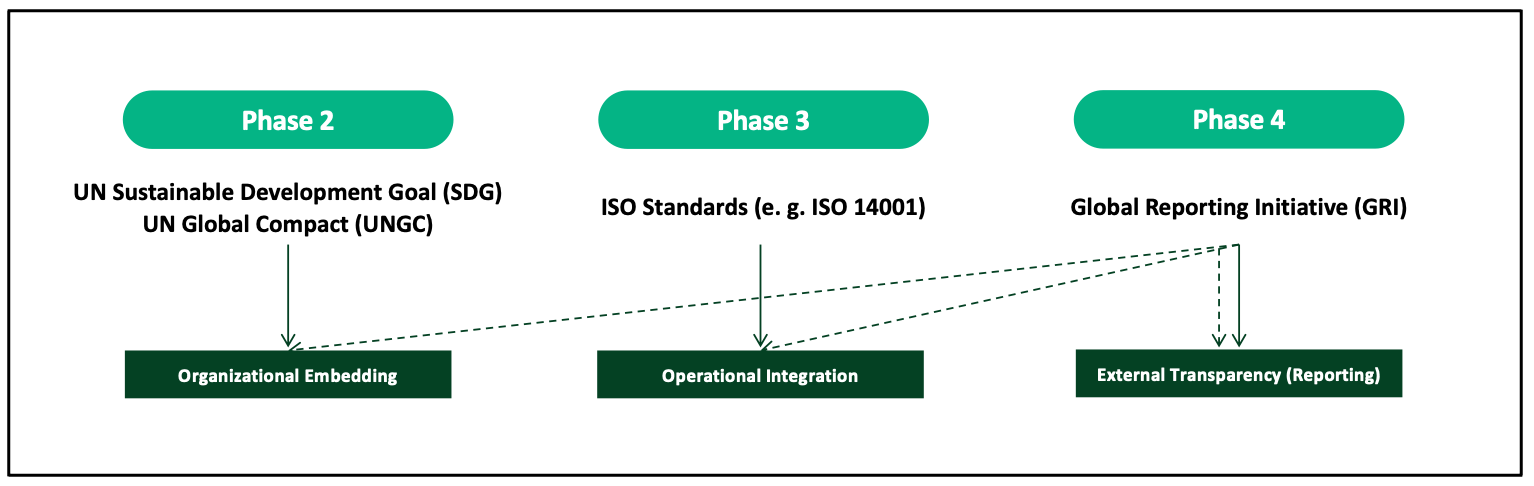
This feedback creates both opportunities and challenges for MNCs. On the one hand, the alignment of earlier phases with reporting standards fosters institutionalization, enhances comparability and strengthens the legitimacy of corporate sustainability commitments. In MNCs, however, the reliance on reporting frameworks such as the GRI also generates several limitations. The GRI has often become a “taken-for-granted” (p. 470) reference point, with disclosure practices being structured around its requirements and by anchoring CS to the annual disclosure cycle.19Vigneau, L., Humphreys, M. & Moon, J. How Do Firms Comply with International Sustainability Standards? Processes and Consequences of Adopting the Global Reporting Initiative. Journal of Business Ethics 131, 469-486 (2015). https://doi.org/10.1007/s10551-014-2278-5 This reliance can redirect organizational attention towards representation rather than substantive performance improvement. Moreover, empirical research highlights that reporting frequently results in uniform disclosure patterns across industries and countries, with companies addressing only a limited share of GRI indicators and often selecting those for which data is readily available or which portray the firm in a favorable light.19Vigneau, L., Humphreys, M. & Moon, J. How Do Firms Comply with International Sustainability Standards? Processes and Consequences of Adopting the Global Reporting Initiative. Journal of Business Ethics 131, 469-486 (2015). https://doi.org/10.1007/s10551-014-2278-5,292Barkemeyer, R., Preuss, L. & Lee, L. On the effectiveness of private transnational governance regimes—Evaluating corporate sustainability reporting according to the Global Reporting Initiative. Journal of World Business 50, 312-325 (2015). https://doi.org/10.1016/j.jwb.2014.10.008 For MNCs, the risk is amplified by the structural dominance of HQs in the reporting process. Reports are often consolidated at the enterprise level, leading to a skewed representation of CS performance that may fail to capture the diverse environmental and social challenges faced across geographically dispersed subsidiaries.292Barkemeyer, R., Preuss, L. & Lee, L. On the effectiveness of private transnational governance regimes—Evaluating corporate sustainability reporting according to the Global Reporting Initiative. Journal of World Business 50, 312-325 (2015). https://doi.org/10.1016/j.jwb.2014.10.008
Case evidence from multinational forestry industry companies illustrates that reporting practices under the GRI framework vary widely in scope and depth. While firms limited their disclosure on community impacts to philanthropic activities or general statements about job creation, other companies advanced further by linking their reporting to systematic management tools, such as Environmental and Social Impact Assessments (ESIAs).293Toppinen, A. & Korhonen-Kurki, K. Global Reporting Initiative and social impact in managing corporate responsibility: a case study of three multinationals in the forest industry. Business Ethics: A European Review 22, 202-217 (2013). https://doi.org/10.1111/beer.12016 As such, it can be seen as a best-practice example of how MNCs can move beyond the symbolic adaption and align reporting with the operational management of sustainability impacts.
Beyond reporting, MNCs increasingly rely on external assurance to enhance the credibility of their sustainability disclosures. Assurance refers to the independent verification of sustainability reports by third parties, mainly through Big-4 firms,298 requiring firms to implement robust internal information and reporting systems, which results in better management of social and environmental performance.294Alsahali, K. F. & Malagueño, R. An empirical study of sustainability reporting assurance: current trends and new insights. Journal of Accounting & Organizational Change 18, 617-642 (2021). https://doi.org/10.1108/jaoc-05-2020-0060,295Perego, P. & Kolk, A. Multinationals’ Accountability on Sustainability: The Evolution of Third-party Assurance of Sustainability Reports. Journal of Business Ethics 110, 173-190 (2012). https://doi.org/10.1007/s10551-012-1420-5 Despite its potential, assurance faces limitations as an implementation tool. Studies show, that MNCs may adopt assurance inconsistently, frequently switching providers or alternating between assured and non-assured reports. Such practices hinder the institutionalization of sustainability routines and weaken its role in embedding CS throughout the organization.294Alsahali, K. F. & Malagueño, R. An empirical study of sustainability reporting assurance: current trends and new insights. Journal of Accounting & Organizational Change 18, 617-642 (2021). https://doi.org/10.1108/jaoc-05-2020-0060 Moreover, research highlights that assurance is often adopted symbolically, reinforcing disclosure practices without necessarily fostering substantive sustainability improvements.295Perego, P. & Kolk, A. Multinationals’ Accountability on Sustainability: The Evolution of Third-party Assurance of Sustainability Reports. Journal of Business Ethics 110, 173-190 (2012). https://doi.org/10.1007/s10551-012-1420-5
In addition to reporting and assurance, external ratings and rankings have emerged as additional mechanisms of transparency and accountability for MNCs. These instruments, such as the Dow Jones Sustainability Index (DJSI), Sustainability Yearbook, FTSE4Good, MSCI-ESG Ratings or Sustainalytics’ ESG Risk Rating, assess corporate sustainability performance based on a combination of publicly available data, company disclosures and proprietary methodologies.296Krasnokutska, N. & Danko, T. in Comparative CSR and Sustainability (eds Gabriel Donleavy & Carlos Noronha) Ch. 20, 16 (Routledge, 2022). Ratings directly influence how MNCs implement CS. High ESG scores push firms to institutionalize sustainability in management systems, which enables proactive strategies such as shared value creation and systematic transformation. Low ratings, by contrast, limit firms to risk-oriented implementation focused on compliance and reputational repair.296Krasnokutska, N. & Danko, T. in Comparative CSR and Sustainability (eds Gabriel Donleavy & Carlos Noronha) Ch. 20, 16 (Routledge, 2022). The relevance of ratings becomes even more pronounced when combined with country-level indices. This intersection highlights four main implementation pathways for MNCs. When both corporate rating and institutional environments are weak, firms are confined to risk minimization and basic compliance. When both dimensions are strong, MNCs can move towards shared value strategies and systematic transformation. Mixed constellations show additional dynamics: firms with strong ESG capabilities but embedded in weak institutional contexts can act as change agents by transferring advanced practices to less developed host environments, while in stronger host countries they can leverage their capabilities to pursue innovation and partnership. Conversely, firms with weak ESG performance but located in strong institutional settings tend to follow defensive approaches, focusing on risk management in weaker host countries and compliance with established frameworks in stronger ones.296Krasnokutska, N. & Danko, T. in Comparative CSR and Sustainability (eds Gabriel Donleavy & Carlos Noronha) Ch. 20, 16 (Routledge, 2022).
In sum, Phase 4 highlights the central role of transparency and accountability in CS. While the primary orientation of reporting, assurance and ratings is towards external stakeholders, best practice goes far beyond disclosure. For MNCs, these instruments should not represent the final stage of sustainability efforts but rather serve as catalysts that reinforce strategic commitments developed in Phase 2 and management practices operationalized in Phase.3Burritt, R. L., Christ, K. L., Rammal, H. G. & Schaltegger, S. Multinational Enterprise Strategies for Addressing Sustainability: the Need for Consolidation. Journal of Business Ethics 164, 389-410 (2020). https://doi.org/10.1007/s10551-018-4066-0 In this way, transparency mechanisms become integral to the implementation of CS across global operations.
3.5 Phase 5: Feedback & innovation
While Phase 4 centers on external transparency and accountability, the subsequent stage in the integration of CS strategies emphasizes continuous improvement. Phase 5, building on the later stages of existing process models, is defined by the systematic use of feedback mechanisms to assess performance, integrate stakeholder perspectives and initiate the learning process within the iterative cycle. Across the literature, this stage is consistently recognized as essential for ensuring that disclosure and accountability are translated into organizational learning and further development. Klettner et al. (2014) identify stakeholder engagement as a central element of their Communication phase.225Klettner, A., Clarke, T. & Boersma, M. The Governance of Corporate Sustainability: Empirical Insights into the Development, Leadership and Implementation of Responsible Business Strategy. Journal of Business Ethics 122, 145-165 (2014). https://doi.org/10.1007/s10551-013-1750-y Bondy et al. (2012) similarly integrate feedback, communication and performance improvement in Phase 5 and Phase 6 of their process model.56Bondy, K., Moon, J. & Matten, D. An Institution of Corporate Social Responsibility (CSR) in Multi-National Corporations (MNCs): Form and Implications. Journal of Business Ethics 111, 281-299 (2012). https://doi.org/10.1007/s10551-012-1208-7 Maon et al. (2009) also include evaluation, verification and communication in their Check / Improve phase.246Maon, F., Lindgreen, A. & Swaen, V. Designing and Implementing Corporate Social Responsibility: An Integrative Framework Grounded in Theory and Practice. Journal of Business Ethics 87, 71-89 (2009). https://doi.org/10.1007/s10551-008-9804-2 These frameworks converge on the insight that CS implementation cannot be regarded as complete with disclosure but must include iterative mechanisms of evaluation and improvement. In line with these contributions, Phase 5 of this model captures the role of feedback as a driver of innovation, ensuring that lessons are reintegrated into strategic decision-making and operational practices. The literature emphasizes that such engagement should not only rely on technical and quantitative measures but also on participatory methods that involve governments, supply-chain actors, communities and third-party organizations.297Topple, C., Donovan, J. D., Masli, E. K. & Borgert, T. Corporate sustainability assessments: MNE engagement with sustainable development and the SDGs. Transnational Corporations 24, 61-71 (2017). https://doi.org/10.18356/2ae5911c-en
In this respect, cross-sector collaborations emerge as particularly relevant mechanisms for enabling iterative learning and innovation in MNCs. Evidence demonstrates that partnerships with nonprofits can extend feedback loops by incorporating local knowledge and government expectations into the evaluation of corporate sustainability practices.298Yin, J. How multinational corporations and nonprofits collaborate for sustainability: assessing social partnerships from China. Sustainability Accounting, Management and Policy Journal 12, 1289-1311 (2021). https://doi.org/10.1108/sampj-04-2020-0104 Yet, the same evidence also highlights the limitations of feedback-oriented mechanisms and collaborations. A majority of partnerships remain situated at a philanthropic or transactional stage, characterized by low resource complementarity, limited interaction and modest innovation.298Yin, J. How multinational corporations and nonprofits collaborate for sustainability: assessing social partnerships from China. Sustainability Accounting, Management and Policy Journal 12, 1289-1311 (2021). https://doi.org/10.1108/sampj-04-2020-0104 These shortcomings underline that Phase 5 does not automatically result in innovation but requires deliberate governance structures and incentives to ensure that feedback mechanisms evolve beyond symbolic adaption toward substantive change.
Best-practice evidence demonstrates how feedback can foster innovation through proactive stakeholder communication. Stakeholder engagement represents a core instrument in Phase 5, as it enables MNCs to embed diverse perspectives into strategy and align long-term objectives with societal expectations.299Vallaster, C. & von Wallpach, S. An online discursive inquiry into the social dynamics of multi-stakeholder brand meaning co-creation. Journal of Business Research 66, 1505-1515 (2013). https://doi.org/10.1016/j.jbusres.2012.09.012,300Jurietti, E., Mandelli, A. & Fudurić, M. How do virtual corporate social responsibility dialogs generate value? A case study of The Unilever Sustainable Living Lab. Corporate Social Responsibility and Environmental Management 24, 357-367 (2017). https://doi.org/10.1002/csr.1407 Proactive approaches increasingly employ interactive and technology-enabled platforms to facilitate continuous dialogue, enhance transparency and co-create sustainability initiatives with stakeholders. The Unilever Sustainable Living Lab (USLL) exemplifies such a practice. Conceived as a virtual forum, the USLL invited a broad range of stakeholders, including NGOs, industry experts, customers and employees, to engage in structured dialogues on environmental and social challenges central to Unilever’s corporate agenda.300Jurietti, E., Mandelli, A. & Fudurić, M. How do virtual corporate social responsibility dialogs generate value? A case study of The Unilever Sustainable Living Lab. Corporate Social Responsibility and Environmental Management 24, 357-367 (2017). https://doi.org/10.1002/csr.1407 This illustrates how feedback mechanisms, when institutionalized, can be transformed into innovation platforms and drive continuous sustainability integration.
Ultimately, the implementation of CS in MNC must be understood as a cyclical and interdependent process rather than a sequence of discrete steps. The phases outlined in this framework are closely interconnected, with instruments and practices introduced in one stage frequently shaping developments in others. Reporting mechanisms designed for external accountability, for example, often influence governance arrangements and operational practices, while stakeholder engagement serves both as a tool for embedding sustainability internally and as a catalyst for innovation in later phases.
In this sense, the process does not end in a final stage but continually feeds back into itself, allowing MNCs to refine strategies, adjust operations and realign commitments in response to evolving expectations and contextual conditions. The cyclical framework thus highlights that the effective implementation of CS depends less on progressing linearly through predefined stages than on maintaining dynamic connections between the phases and ensuring that the tools are mobilized across the entire cycle of integration.
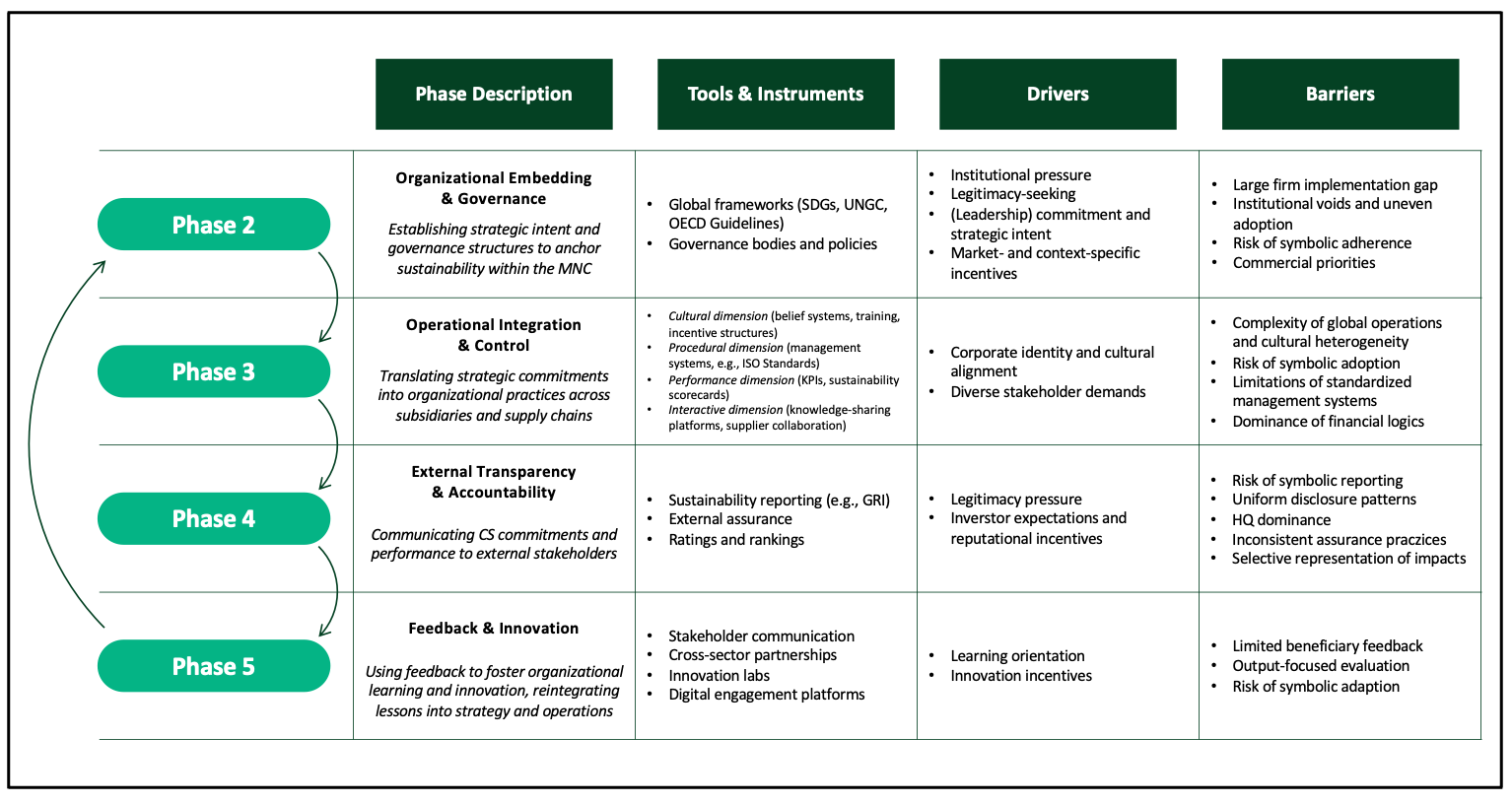
References
- 1Christmann, P. Multinational Companies and the Natural Environment: Determinants of Global Environmental Policy Standardization. The Academy of Management Journal 47, 747-760 (2004). https://doi.org/10.5465/20159616 ↩︎
- 2Rasche, A., Morsing, M., Moon, J. & Kourula, A. Corporate Sustainability: Managing Responsible Business in a Globalised World. 2. edn, (Cambridge University Press, 2023). ↩︎
- 3Burritt, R. L., Christ, K. L., Rammal, H. G. & Schaltegger, S. Multinational Enterprise Strategies for Addressing Sustainability: the Need for Consolidation. Journal of Business Ethics 164, 389-410 (2020). https://doi.org/10.1007/s10551-018-4066-0 ↩︎
- 4Ocelík, V., Kolk, A. & Ciulli, F. Multinational enterprises, Industry 4.0 and sustainability: A multidisciplinary review and research agenda. Journal of Cleaner Production 413 (2023). https://doi.org/10.1016/j.jclepro.2023.137434 ↩︎
- 5Ghauri, P., Strange, R. & Cooke, F. L. Research on international business: The new realities. International Business Review 30 (2021). https://doi.org/10.1016/j.ibusrev.2021.101794 ↩︎
- 6Beltrami, M., Orzes, G., Sarkis, J. & Sartor, M. Industry 4.0 and sustainability: Towards conceptualization and theory. Journal of Cleaner Production 312 (2021). https://doi.org/10.1016/j.jclepro.2021.127733 ↩︎
- 7Zhang, Z. et al. Embodied carbon emissions in the supply chains of multinational enterprises. Nature Climate Change 10, 1096-1101 (2020). https://doi.org/10.1038/s41558-020-0895-9 ↩︎
- 8Korten, D. C. When Corporations Rule the World. 2. edn, (Berrett-Koehler, 2001). ↩︎
- 9Adib, M., Zhang, X., A.A.Zaid, M. & Sahyouni, A. Management control system for corporate social responsibility implementation – a stakeholder perspective. Corporate Governance 21, 410-432 (2020). https://doi.org/10.1108/cg-06-2020-0247 ↩︎
- 10Andersson, L., Shivarajan, S. & Blau, G. Enacting Ecological Sustainability in the MNC: A Test of an Adapted Value-Belief-Norm Framework. Journal of Business Ethics 59, 295-305 (2005). https://doi.org/10.1007/s10551-005-3440-x ↩︎
- 11Zaheer, S. The sustainability of MNE sustainability initiatives. Journal of International Business Studies 56, 491-500 (2025). https://doi.org/10.1057/s41267-024-00760-0 ↩︎
- 12Allen, F., Barbalau, A., Chavez, E. & Zeni, F. Leveraging the capabilities of multinational firms to address climate change: a finance perspective. Journal of International Business Studies 56, 461-480 (2025). https://doi.org/10.1057/s41267-024-00748-w ↩︎
- 13Fourati, A., Zenaidi, A. & Jeriji, M. Like Parent, Like Subsidiary? On the Diffusion of Sustainability Reporting in Multinational Companies. Corporate Social Responsibility and Environmental Management 32, 3210-3226 (2025). https://doi.org/10.1002/csr.3100 ↩︎
- 14Pilgrim, G. & Wahlgren, A. Unlocking New Insights into Multinational Enterprise with the Power of Open-Source-Data, <https://oecdstatistics.blog/2023/05/10/unlocking-new-insights-into-multinational-enterprises-with-the-power-of-open-source-data/> (2023). ↩︎
- 7Zhang, Z. et al. Embodied carbon emissions in the supply chains of multinational enterprises. Nature Climate Change 10, 1096-1101 (2020). https://doi.org/10.1038/s41558-020-0895-9 ↩︎
- 10Andersson, L., Shivarajan, S. & Blau, G. Enacting Ecological Sustainability in the MNC: A Test of an Adapted Value-Belief-Norm Framework. Journal of Business Ethics 59, 295-305 (2005). https://doi.org/10.1007/s10551-005-3440-x ↩︎
- 15Soundararajan, V., Sahasranamam, S., Khan, Z. & Jain, T. Multinational enterprises and the governance of sustainability practices in emerging market supply chains: An agile governance perspective. Journal of World Business 56 (2021). https://doi.org/10.1016/j.jwb.2020.101149 ↩︎
- 16Tong, X. et al. Multinational enterprise buyers’ choices for extending corporate social responsibility practices to suppliers in emerging countries: A multi-method study. Journal of Operations Management 63, 25-43 (2018). https://doi.org/10.1016/j.jom.2018.05.003 ↩︎
- 17D’Souza, C. et al. An empirical examination of sustainability for multinational firms in China: Implications for cleaner production. Journal of Cleaner Production 242 (2020). https://doi.org/10.1016/j.jclepro.2019.118446 ↩︎
- 18Franco, S. The influence of the external and internal environments of multinational enterprises on the sustainability commitment of their subsidiaries: A cluster analysis. Journal of Cleaner Production 297 (2021). https://doi.org/10.1016/j.jclepro.2021.126654 ↩︎
- 19Vigneau, L., Humphreys, M. & Moon, J. How Do Firms Comply with International Sustainability Standards? Processes and Consequences of Adopting the Global Reporting Initiative. Journal of Business Ethics 131, 469-486 (2015). https://doi.org/10.1007/s10551-014-2278-5 ↩︎
- 20Bondy, K. & Starkey, K. The Dilemmas of Internationalization: Corporate Social Responsibility in the Multinational Corporation. British Journal of Management 25, 4-22 (2014). https://doi.org/10.1111/j.1467-8551.2012.00840.x ↩︎
- 21Doz, Y. L., Bartlett, C. A. & Prahalad, C. K. Global Competitive Pressures and Host Country Demands Managing Tensions in MNCs. California Management Review 23, 63-74 (1981). https://doi.org/10.2307/41172603 ↩︎
- 3Burritt, R. L., Christ, K. L., Rammal, H. G. & Schaltegger, S. Multinational Enterprise Strategies for Addressing Sustainability: the Need for Consolidation. Journal of Business Ethics 164, 389-410 (2020). https://doi.org/10.1007/s10551-018-4066-0 ↩︎
- 3Burritt, R. L., Christ, K. L., Rammal, H. G. & Schaltegger, S. Multinational Enterprise Strategies for Addressing Sustainability: the Need for Consolidation. Journal of Business Ethics 164, 389-410 (2020). https://doi.org/10.1007/s10551-018-4066-0 ↩︎
- 22George, G. & Schillebeeckx, S. J. D. Digital transformation, sustainability, and purpose in the multinational enterprise. Journal of World Business 57 (2022). https://doi.org/10.1016/j.jwb.2022.101326 ↩︎
- 3Burritt, R. L., Christ, K. L., Rammal, H. G. & Schaltegger, S. Multinational Enterprise Strategies for Addressing Sustainability: the Need for Consolidation. Journal of Business Ethics 164, 389-410 (2020). https://doi.org/10.1007/s10551-018-4066-0 ↩︎
- 23van der Ven, H. Gatekeeper power: understanding the influence of lead firms over transnational sustainability standards. Review of International Political Economy 25, 624-646 (2018). https://doi.org/10.1080/09692290.2018.1490329 ↩︎
- 24Akhtar, P., Ullah, S., Amin, S. H., Kabra, G. & Shaw, S. Dynamic capabilities and environmental sustainability for emerging economies’ multinational enterprises. International Studies of Management & Organization 50, 27-42 (2020). https://doi.org/10.1080/00208825.2019.1703376 ↩︎
- 3Burritt, R. L., Christ, K. L., Rammal, H. G. & Schaltegger, S. Multinational Enterprise Strategies for Addressing Sustainability: the Need for Consolidation. Journal of Business Ethics 164, 389-410 (2020). https://doi.org/10.1007/s10551-018-4066-0 ↩︎
- 25Elg, U. & Hånell, S. M. Driving sustainability in emerging markets: The leading role of multinationals. Industrial Marketing Management 114, 211-225 (2023). https://doi.org/10.1016/j.indmarman.2023.08.010 ↩︎
- 26Ameer, R. & Othman, R. Sustainability Practices and Corporate Financial Performance: A Study Based on the Top Global Corporations. Journal of Business Ethics 108, 61-79 (2012). https://doi.org/10.1007/s10551-011-1063-y ↩︎
- 27Ordonez-Ponce, E. & Talbot, D. Multinational enterprises’ sustainability practices and focus on developing countries: Contributions and unexpected results of SDG implementation. Journal of International Development35, 201-232 (2023). https://doi.org/10.1002/jid.3682 ↩︎
- 3Burritt, R. L., Christ, K. L., Rammal, H. G. & Schaltegger, S. Multinational Enterprise Strategies for Addressing Sustainability: the Need for Consolidation. Journal of Business Ethics 164, 389-410 (2020). https://doi.org/10.1007/s10551-018-4066-0 ↩︎
- 28Elg, U. & Ghauri, P. N. in Creating a Sustainable Competitive Position: Ethical Challenges for International Firms Vol. 37 (eds Pervez N. Ghauri, Ulf Elg, & Sara Melén Hånell) (Emerald Publishing Limited, 2023). ↩︎
- 29Lozano, R. A Holistic Perspective on Corporate Sustainability Drivers. Corporate Social Responsibility and Environmental Management 22, 32-44 (2015). https://doi.org/10.1002/csr.1325 ↩︎
- 30Edoho, F. M. Oil transnational corporations: corporate social responsibility and environmental sustainability. Corporate Social Responsibility and Environmental Management 15, 210-222 (2008). https://doi.org/10.1002/csr.143 ↩︎
- 31Amoah, P. & Eweje, G. Impact mitigation or ecological restoration? Examining the environmental sustainability practices of multinational mining companies. Business Strategy and the Environment 30, 551-565 (2021). https://doi.org/10.1002/bse.2637 ↩︎
- 32Xiao, S., Roh, T. & Park, Byung I. Entrepreneurial Orientation, Environmental Dynamism, and Disruptive Sustainability in Emerging Markets: Evidence From MNE Subsidiaries in China. Business Strategy and the Environment (2025). https://doi.org/10.1002/bse.70105 ↩︎
- 33Ghoshal, S. & Westney, D. E. in Organization Theory and the Multinational Corporation (eds Sumantra Ghoshal & D. Eleanor Westney) 1-23 (Palgrave Macmillan UK, 1993). ↩︎
- 33Ghoshal, S. & Westney, D. E. in Organization Theory and the Multinational Corporation (eds Sumantra Ghoshal & D. Eleanor Westney) 1-23 (Palgrave Macmillan UK, 1993). ↩︎
- 34Dunning, J. H. & Lundan, S. M. Multinational Enterprises and the Global Economy. Second Edition edn, (Edward Elgar Publishing, 2008). ↩︎
- 34Dunning, J. H. & Lundan, S. M. Multinational Enterprises and the Global Economy. Second Edition edn, (Edward Elgar Publishing, 2008). ↩︎
- 35Vernon, R. Sovereignty at bay: The multinational spread of U. S. enterprises. The International Executive 13, 1-3 (1971). https://doi.org/10.1002/tie.5060130401 ↩︎
- 36Vernon, R. Sovereignty at Bay Ten Years after. International Organization 35, 517-529 (1981). ↩︎
- 36Vernon, R. Sovereignty at Bay Ten Years after. International Organization 35, 517-529 (1981). ↩︎
- 37Stopford, J. M. & Wells, L. T. Managing the Multinational Enterprise; Organization of the Firm and Ownership of the Subsidiaries. (Basic Books, 1972). ↩︎
- 38Bartlett, C. A. & Ghoshal, S. Managing across borders : the transnational solution. (Harvard Business School Press, 1989). ↩︎
- 22George, G. & Schillebeeckx, S. J. D. Digital transformation, sustainability, and purpose in the multinational enterprise. Journal of World Business 57 (2022). https://doi.org/10.1016/j.jwb.2022.101326 ↩︎
- 39Buckley, P. J. & Casson, M. The Internalization Theory of the Multinational Enterprise: Past, Present and Future. British Journal of Management 31, 239-252 (2020). https://doi.org/10.1111/1467-8551.12344 ↩︎
- 40Petricevic, O. & Teece, D. J. The structural reshaping of globalization: Implications for strategic sectors, profiting from innovation, and the multinational enterprise. Journal of International Business Studies 50, 1487-1512 (2019). https://doi.org/10.1057/s41267-019-00269-x ↩︎
- 41Meyer, K. E., Li, C. & Schotter, A. P. J. Managing the MNE subsidiary: Advancing a multi-level and dynamic research agenda. Journal of International Business Studies 51, 538-576 (2020). https://doi.org/10.1057/s41267-020-00318-w ↩︎
- 42Birkinshaw, J., Hood, N. & Jonsson, S. Building Firm-Specific Advantages in Multinational Corporations: The Role of Subsidiary Initiative. Strategic Management Journal 19, 221-241 (1998). ↩︎
- 41Meyer, K. E., Li, C. & Schotter, A. P. J. Managing the MNE subsidiary: Advancing a multi-level and dynamic research agenda. Journal of International Business Studies 51, 538-576 (2020). https://doi.org/10.1057/s41267-020-00318-w ↩︎
- 43Bansal, P. Evolving Sustainably: A Longitudinal Study of Corporate Sustainable Development. Strategic Management Journal 26, 197-218 (2005). ↩︎
- 44Dyllick, T. & Hockerts, K. Beyond the business case for corporate sustainability. Business Strategy and the Environment 11, 130-141 (2002). https://doi.org/10.1002/bse.323 ↩︎
- 44Dyllick, T. & Hockerts, K. Beyond the business case for corporate sustainability. Business Strategy and the Environment 11, 130-141 (2002). https://doi.org/10.1002/bse.323 ↩︎
- 45Brundtland, G. H. Our Common Future: Report of the World Commission on Environment and Development. (1987). ↩︎
- 46Sharma, S. & Henriques, I. Stakeholder influences on sustainability practices in the Canadian forest products industry. Strategic Management Journal 26, 159-180 (2005). https://doi.org/10.1002/smj.439 ↩︎
- 47Ashrafi, M., Magnan, G. M., Adams, M. & Walker, T. R. Understanding the Conceptual Evolutionary Path and Theoretical Underpinnings of Corporate Social Responsibility and Corporate Sustainability. Sustainability 12(2020). https://doi.org/10.3390/su12030760 ↩︎
- 48Montiel, I. & Delgado-Ceballos, J. Defining and Measuring Corporate Sustainability:Are We There Yet? Organization & Environment 27, 113-139 (2014). https://doi.org/10.1177/1086026614526413 ↩︎
- 49Derqui, B. Towards sustainable development: Evolution of corporate sustainability in multinational firms. Corporate Social Responsibility and Environmental Management 27, 2712-2723 (2020). https://doi.org/10.1002/csr.1995 ↩︎
- 3Burritt, R. L., Christ, K. L., Rammal, H. G. & Schaltegger, S. Multinational Enterprise Strategies for Addressing Sustainability: the Need for Consolidation. Journal of Business Ethics 164, 389-410 (2020). https://doi.org/10.1007/s10551-018-4066-0 ↩︎
- 50Bergman, M. M., Bergman, Z. & Berger, L. An Empirical Exploration, Typology, and Definition of Corporate Sustainability. Sustainability 9 (2017). https://doi.org/10.3390/su9050753 ↩︎
- 51van Marrewijk, M. Concepts and Definitions of CSR and Corporate Sustainability: Between Agency and Communion. Journal of Business Ethics 44, 95-105 (2003). https://doi.org/10.1023/A:1023331212247 ↩︎
- 52Bansal, P. & Song, H.-C. Similar But Not the Same: Differentiating Corporate Sustainability from Corporate Responsibility. Academy of Management Annals 11, 105-149 (2017). https://doi.org/10.5465/annals.2015.0095 ↩︎
- 50Bergman, M. M., Bergman, Z. & Berger, L. An Empirical Exploration, Typology, and Definition of Corporate Sustainability. Sustainability 9 (2017). https://doi.org/10.3390/su9050753 ↩︎
- 53Barauskaite, G. & Streimikiene, D. Corporate social responsibility and financial performance of companies: The puzzle of concepts, definitions and assessment methods. Corporate Social Responsibility and Environmental Management 28, 278-287 (2021). https://doi.org/10.1002/csr.2048 ↩︎
- 50Bergman, M. M., Bergman, Z. & Berger, L. An Empirical Exploration, Typology, and Definition of Corporate Sustainability. Sustainability 9 (2017). https://doi.org/10.3390/su9050753 ↩︎
- 54Meuer, J., Koelbel, J. & Hoffmann, V. H. On the Nature of Corporate Sustainability. Organization & Environment33, 319-341 (2020). https://doi.org/10.1177/1086026619850180 ↩︎
- 48Montiel, I. & Delgado-Ceballos, J. Defining and Measuring Corporate Sustainability:Are We There Yet? Organization & Environment 27, 113-139 (2014). https://doi.org/10.1177/1086026614526413 ↩︎
- 54Meuer, J., Koelbel, J. & Hoffmann, V. H. On the Nature of Corporate Sustainability. Organization & Environment33, 319-341 (2020). https://doi.org/10.1177/1086026619850180 ↩︎
- 50Bergman, M. M., Bergman, Z. & Berger, L. An Empirical Exploration, Typology, and Definition of Corporate Sustainability. Sustainability 9 (2017). https://doi.org/10.3390/su9050753 ↩︎
- 51van Marrewijk, M. Concepts and Definitions of CSR and Corporate Sustainability: Between Agency and Communion. Journal of Business Ethics 44, 95-105 (2003). https://doi.org/10.1023/A:1023331212247 ↩︎
- 50Bergman, M. M., Bergman, Z. & Berger, L. An Empirical Exploration, Typology, and Definition of Corporate Sustainability. Sustainability 9 (2017). https://doi.org/10.3390/su9050753 ↩︎
- 51van Marrewijk, M. Concepts and Definitions of CSR and Corporate Sustainability: Between Agency and Communion. Journal of Business Ethics 44, 95-105 (2003). https://doi.org/10.1023/A:1023331212247 ↩︎
- 49Derqui, B. Towards sustainable development: Evolution of corporate sustainability in multinational firms. Corporate Social Responsibility and Environmental Management 27, 2712-2723 (2020). https://doi.org/10.1002/csr.1995 ↩︎
- 55Zhou, X., Ying, S. X., You, J. & Wu, H. Like parent, like child: MNCs’ CSR and their foreign subsidiaries’ environmental footprint. Journal of Business Research 172 (2024). https://doi.org/10.1016/j.jbusres.2023.114413 ↩︎
- 56Bondy, K., Moon, J. & Matten, D. An Institution of Corporate Social Responsibility (CSR) in Multi-National Corporations (MNCs): Form and Implications. Journal of Business Ethics 111, 281-299 (2012). https://doi.org/10.1007/s10551-012-1208-7 ↩︎
- 57Aguilera-Caracuel, J., Guerrero-Villegas, J. & García-Sánchez, E. Reputation of multinational companies. European Journal of Management and Business Economics 26, 329-346 (2017). https://doi.org/10.1108/EJMBE-10-2017-019 ↩︎
- 51van Marrewijk, M. Concepts and Definitions of CSR and Corporate Sustainability: Between Agency and Communion. Journal of Business Ethics 44, 95-105 (2003). https://doi.org/10.1023/A:1023331212247 ↩︎
- 49Derqui, B. Towards sustainable development: Evolution of corporate sustainability in multinational firms. Corporate Social Responsibility and Environmental Management 27, 2712-2723 (2020). https://doi.org/10.1002/csr.1995 ↩︎
- 58Feng, P. & Ngai, C. S.-b. Doing More on the Corporate Sustainability Front: A Longitudinal Analysis of CSR Reporting of Global Fashion Companies. Sustainability 12 (2020). https://doi.org/10.3390/su12062477 ↩︎
- 59Yin, J. & Jamali, D. Strategic Corporate Social Responsibility of Multinational Companies Subsidiaries in Emerging Markets: Evidence from China. Long Range Planning 49, 541-558 (2016). https://doi.org/10.1016/j.lrp.2015.12.024 ↩︎
- 60Wilkins, M. in Oxford Handbook of International Business (eds Alan M. Rugman & Thomas L. Brewer) (Oxford University Press, 2001). ↩︎
- 61Morgan, G. in The Oxford Handbook of Work and Organization (eds Stephen Ackroyd, Rosemary Batt, Paul Thompson, & Pamela S. Tolbert) (Oxford University Press, 2006). ↩︎
- 61Morgan, G. in The Oxford Handbook of Work and Organization (eds Stephen Ackroyd, Rosemary Batt, Paul Thompson, & Pamela S. Tolbert) (Oxford University Press, 2006). ↩︎
- 62Guillen, M. & García-Canal, E. The American Model of the Multinational Firm and the “New” Multinationals From Emerging Economies. Academy of Management Perspectives 23, 23-35 (2009). https://doi.org/10.5465/AMP.2009.39985538 ↩︎
- 63Wilkins, M. in Transnational Corporations and the Global Economy (eds Richard Kozul-Wright & Robert Rowthorn) 95-133 (Palgrave Macmillan UK, 1998). ↩︎
- 64Krugman, P. Multinational enterprise: The old and the new in history and theory. North American Review of Economics and Finance 1, 267-280 (1990). https://doi.org/10.1016/1042-752X(90)90020-G ↩︎
- 65Jones, G. Nationality and multinationals in historical perspective. (Division of Research, Harvard Business School Boston, 2006). ↩︎
- 66Dymsza, W. A. Trends in Multinational Business and Global Environments: A Perspective. Journal of International Business Studies 15, 25-46 (1984). https://doi.org/10.1057/palgrave.jibs.8490493 ↩︎
- 67Ghani, W. I. & Haverty, J. L. Market reaction of multinational corporations to the passage of the General Agreement on Tariffs and Trade (GATT). Journal of International Accounting, Auditing and Taxation 7, 95-112 (1998). https://doi.org/10.1016/S1061-9518(98)90008-8 ↩︎
- 68Fayerweather, J. The Internationalization of Business. The Annals of the American Academy of Political and Social Science 403, 1-11 (1972). ↩︎
- 65Jones, G. Nationality and multinationals in historical perspective. (Division of Research, Harvard Business School Boston, 2006). ↩︎
- 62Guillen, M. & García-Canal, E. The American Model of the Multinational Firm and the “New” Multinationals From Emerging Economies. Academy of Management Perspectives 23, 23-35 (2009). https://doi.org/10.5465/AMP.2009.39985538 ↩︎
- 68Fayerweather, J. The Internationalization of Business. The Annals of the American Academy of Political and Social Science 403, 1-11 (1972). ↩︎
- 64Krugman, P. Multinational enterprise: The old and the new in history and theory. North American Review of Economics and Finance 1, 267-280 (1990). https://doi.org/10.1016/1042-752X(90)90020-G ↩︎
- 69Behrman, J. N. & Fischer, W. A. Overseas R&D activities of transnational companies. The International Executive22, 15-17 (1980). https://doi.org/10.1002/tie.5060220309 ↩︎
- 70Ronstadt, R. C. International R&D: The Establishment and Evolution of Research and Development Abroad by Seven U.S. Multinationals. Journal of International Business Studies 9, 7-24 (1978). https://doi.org/10.1057/palgrave.jibs.8490647 ↩︎
- 65Jones, G. Nationality and multinationals in historical perspective. (Division of Research, Harvard Business School Boston, 2006). ↩︎
- 68Fayerweather, J. The Internationalization of Business. The Annals of the American Academy of Political and Social Science 403, 1-11 (1972). ↩︎
- 65Jones, G. Nationality and multinationals in historical perspective. (Division of Research, Harvard Business School Boston, 2006). ↩︎
- 71Narula, R. Multinational firms and the extractive sectors in the 21st century: Can they drive development? Journal of World Business 53, 85-91 (2018). https://doi.org/10.1016/j.jwb.2017.09.004 ↩︎
- 64Krugman, P. Multinational enterprise: The old and the new in history and theory. North American Review of Economics and Finance 1, 267-280 (1990). https://doi.org/10.1016/1042-752X(90)90020-G ↩︎
- 71Narula, R. Multinational firms and the extractive sectors in the 21st century: Can they drive development? Journal of World Business 53, 85-91 (2018). https://doi.org/10.1016/j.jwb.2017.09.004 ↩︎
- 65Jones, G. Nationality and multinationals in historical perspective. (Division of Research, Harvard Business School Boston, 2006). ↩︎
- 66Dymsza, W. A. Trends in Multinational Business and Global Environments: A Perspective. Journal of International Business Studies 15, 25-46 (1984). https://doi.org/10.1057/palgrave.jibs.8490493 ↩︎
- 68Fayerweather, J. The Internationalization of Business. The Annals of the American Academy of Political and Social Science 403, 1-11 (1972). ↩︎
- 71Narula, R. Multinational firms and the extractive sectors in the 21st century: Can they drive development? Journal of World Business 53, 85-91 (2018). https://doi.org/10.1016/j.jwb.2017.09.004 ↩︎
- 62Guillen, M. & García-Canal, E. The American Model of the Multinational Firm and the “New” Multinationals From Emerging Economies. Academy of Management Perspectives 23, 23-35 (2009). https://doi.org/10.5465/AMP.2009.39985538 ↩︎
- 66Dymsza, W. A. Trends in Multinational Business and Global Environments: A Perspective. Journal of International Business Studies 15, 25-46 (1984). https://doi.org/10.1057/palgrave.jibs.8490493 ↩︎
- 71Narula, R. Multinational firms and the extractive sectors in the 21st century: Can they drive development? Journal of World Business 53, 85-91 (2018). https://doi.org/10.1016/j.jwb.2017.09.004 ↩︎
- 72Narula, R. & Verbeke, A. Making internalization theory good for practice: The essence of Alan Rugman’s contributions to international business. Journal of World Business 50, 612-622 (2015). https://doi.org/10.1016/j.jwb.2015.08.007 ↩︎
- 71Narula, R. Multinational firms and the extractive sectors in the 21st century: Can they drive development? Journal of World Business 53, 85-91 (2018). https://doi.org/10.1016/j.jwb.2017.09.004 ↩︎
- 73Foley, C. F., Hines, J. R. & Wessel, D. Global Goliaths: Multinational Corporations in the 21st Century Economy. (Brookings Institution Press, 2021). ↩︎
- 71Narula, R. Multinational firms and the extractive sectors in the 21st century: Can they drive development? Journal of World Business 53, 85-91 (2018). https://doi.org/10.1016/j.jwb.2017.09.004 ↩︎
- 73Foley, C. F., Hines, J. R. & Wessel, D. Global Goliaths: Multinational Corporations in the 21st Century Economy. (Brookings Institution Press, 2021). ↩︎
- 71Narula, R. Multinational firms and the extractive sectors in the 21st century: Can they drive development? Journal of World Business 53, 85-91 (2018). https://doi.org/10.1016/j.jwb.2017.09.004 ↩︎
- 74Verbeke, A., Oh, C. H. & Jain, R. What is the future of regional multinational enterprises? International Business Review 34 (2025). https://doi.org/10.1016/j.ibusrev.2025.102442 ↩︎
- 75Kolk, A., Kourula, A. & Pisani, N. Multinational enterprises and the sustainable development goals: What do we know and how to proceed? Transnational Corporations 24, 9-32 (2017). ↩︎
- 76Munro, V. & Arli, D. Corporate sustainable actions through United Nations sustainable development goals: The internal customer’s response. International Journal of Nonprofit and Voluntary Sector Marketing 25 (2020). https://doi.org/10.1002/nvsm.1660 ↩︎
- 77Ivanaj, S., Ivanaj, V., McIntyre, J. & Guimaraes da Costa, N. What can multinational enterprises do to implement sustainable development goals? Journal of Cleaner Production 296 (2021). https://doi.org/10.1016/j.jclepro.2021.126586 ↩︎
- 78Nasta, L. & Cundari, V. Aligning multinational corporate strategies with Sustainable Development Goals: A case study of an Italian energy firm’s initiatives in developing markets. Corporate Social Responsibility and Environmental Management 31, 3902-3915 (2024). https://doi.org/10.1002/csr.2779 ↩︎
- 74Verbeke, A., Oh, C. H. & Jain, R. What is the future of regional multinational enterprises? International Business Review 34 (2025). https://doi.org/10.1016/j.ibusrev.2025.102442 ↩︎
- 77Ivanaj, S., Ivanaj, V., McIntyre, J. & Guimaraes da Costa, N. What can multinational enterprises do to implement sustainable development goals? Journal of Cleaner Production 296 (2021). https://doi.org/10.1016/j.jclepro.2021.126586 ↩︎
- 17D’Souza, C. et al. An empirical examination of sustainability for multinational firms in China: Implications for cleaner production. Journal of Cleaner Production 242 (2020). https://doi.org/10.1016/j.jclepro.2019.118446 ↩︎
- 49Derqui, B. Towards sustainable development: Evolution of corporate sustainability in multinational firms. Corporate Social Responsibility and Environmental Management 27, 2712-2723 (2020). https://doi.org/10.1002/csr.1995 ↩︎
- 79Temouri, Y., Pereira, V., Delis, A. & Wood, G. How Does Protectionism Impact Multinational Firm Reshoring? Evidence from the UK. Management International Review 63, 791-822 (2023). https://doi.org/10.1007/s11575-023-00521-5 ↩︎
- 80Altman, S. A., Bastian, C. R. & Fattedad, D. Challenging the deglobalization narrative: Global flows have remained resilient through successive shocks. Journal of International Business Policy 7, 416-439 (2024). https://doi.org/10.1057/s42214-024-00197-0 ↩︎
- 81Yücesan, E. Does deglobalization imply the end of global supply chains? International Business Review (2025). https://doi.org/10.1016/j.ibusrev.2025.102398 ↩︎
- 79Temouri, Y., Pereira, V., Delis, A. & Wood, G. How Does Protectionism Impact Multinational Firm Reshoring? Evidence from the UK. Management International Review 63, 791-822 (2023). https://doi.org/10.1007/s11575-023-00521-5 ↩︎
- 81Yücesan, E. Does deglobalization imply the end of global supply chains? International Business Review (2025). https://doi.org/10.1016/j.ibusrev.2025.102398 ↩︎
- 82Hymer, S. H. The international operations of national firms, a study of direct foreign investment, Massachusetts Institute of Technology, (1960). ↩︎
- 83Dunning, J. H. & Pitelis, C. N. Stephen Hymer’s Contribution to International Business Scholarship: An Assessment and Extension. Journal of International Business Studies 39, 167-176 (2008). ↩︎
- 84Aharoni, Y. & Ramamurti, R. in Standing on the Shoulders of International Business Giants 153-177 (2011). ↩︎
- 33Ghoshal, S. & Westney, D. E. in Organization Theory and the Multinational Corporation (eds Sumantra Ghoshal & D. Eleanor Westney) 1-23 (Palgrave Macmillan UK, 1993). ↩︎
- 85Dunning, J. H. Toward an Eclectic Theory of International Production: Some Empirical Tests. Journal of International Business Studies 11, 9-31 (1980). https://doi.org/10.1057/palgrave.jibs.8490593 ↩︎
- 86Dunning, J. H. The Eclectic Paradigm of International Production: A Restatement and Some Possible Extensions. Journal of International Business Studies 19, 1-31 (1988). ↩︎
- 82Hymer, S. H. The international operations of national firms, a study of direct foreign investment, Massachusetts Institute of Technology, (1960). ↩︎
- 87Rugman, A. M. Inside the multinationals : the economics of internal markets / Alan M. Rugman. (Croom Helm, 1981). ↩︎
- 88Dunning, J. H. in The International Allocation of Economic Activity: Proceedings of a Nobel Symposium held at Stockholm (eds Bertil Ohlin, Per-Ove Hesselborn, & Per Magnus Wijkman) 395-418 (Palgrave Macmillan UK, 1977). ↩︎
- 89Papanastassiou, M., Pearce, R. & Zanfei, A. Changing perspectives on the internationalization of R&D and innovation by multinational enterprises: A review of the literature. Journal of International Business Studies 51, 623-664 (2020). https://doi.org/10.1057/s41267-019-00258-0 ↩︎
- 89Papanastassiou, M., Pearce, R. & Zanfei, A. Changing perspectives on the internationalization of R&D and innovation by multinational enterprises: A review of the literature. Journal of International Business Studies 51, 623-664 (2020). https://doi.org/10.1057/s41267-019-00258-0 ↩︎
- 90Roth, K. & Kostova, T. The Use of the Multinational Corporation as a Research Context. Journal of Management29, 883-902 (2003). https://doi.org/10.1016/s0149-2063_03_00083-7 ↩︎
- 91Holm, D. et al. Vol. 4 3-20 (2009). ↩︎
- 84Aharoni, Y. & Ramamurti, R. in Standing on the Shoulders of International Business Giants 153-177 (2011). ↩︎
- 84Aharoni, Y. & Ramamurti, R. in Standing on the Shoulders of International Business Giants 153-177 (2011). ↩︎
- 90Roth, K. & Kostova, T. The Use of the Multinational Corporation as a Research Context. Journal of Management29, 883-902 (2003). https://doi.org/10.1016/s0149-2063_03_00083-7 ↩︎
- 92Christmann, P. Multinational Companies and the Natural Environment: Determinants of Global Environmental Policy. Academy of Management Journal 47, 747-760 (2004). https://doi.org/10.5465/20159616 ↩︎
- 4Ocelík, V., Kolk, A. & Ciulli, F. Multinational enterprises, Industry 4.0 and sustainability: A multidisciplinary review and research agenda. Journal of Cleaner Production 413 (2023). https://doi.org/10.1016/j.jclepro.2023.137434 ↩︎
- 93Wright, C. & Nyberg, D. Climate Change, Capitalism, and Corporations: Processes of Creative Self-Destruction. (Cambridge University Press, 2015). ↩︎
- 94McNeill, J. R. Something New under the Sun: An Environmental History of the Twentieth-Century World. (W. W. Norton, 2000). ↩︎
- 4Ocelík, V., Kolk, A. & Ciulli, F. Multinational enterprises, Industry 4.0 and sustainability: A multidisciplinary review and research agenda. Journal of Cleaner Production 413 (2023). https://doi.org/10.1016/j.jclepro.2023.137434 ↩︎
- 95Sun, P., Doh, J. P., Rajwani, T. & Siegel, D. Navigating cross-border institutional complexity: A review and assessment of multinational nonmarket strategy research. J Int Bus Stud 52, 1818-1853 (2021). https://doi.org/10.1057/s41267-021-00438-x ↩︎
- 96Torres de Oliveira, R., Ghobakhloo, M. & Figueira, S. Industry 4.0 towards social and environmental sustainability in multinationals: Enabling circular economy, organizational social practices, and corporate purpose. Journal of Cleaner Production 430 (2023). https://doi.org/10.1016/j.jclepro.2023.139712 ↩︎
- 49Derqui, B. Towards sustainable development: Evolution of corporate sustainability in multinational firms. Corporate Social Responsibility and Environmental Management 27, 2712-2723 (2020). https://doi.org/10.1002/csr.1995 ↩︎
- 97Asmussen, C. G. & Fosfuri, A. Orchestrating corporate social responsibility in the multinational enterprise. Strategic Management Journal 40, 894-916 (2019). https://doi.org/10.1002/smj.3007 ↩︎
- 98Schaltegger, S. Sustainability as a driver for corporate economic success. Society and Economy 33, 15-28 (2011). https://doi.org/10.1556/SocEc.33.2011.1.4 ↩︎
- 99Kiron, D. et al. Corporate sustainability at a crossroads: Progress toward our common future in uncertain times. MIT Sloan Management Review (2017). ↩︎
- 78Nasta, L. & Cundari, V. Aligning multinational corporate strategies with Sustainable Development Goals: A case study of an Italian energy firm’s initiatives in developing markets. Corporate Social Responsibility and Environmental Management 31, 3902-3915 (2024). https://doi.org/10.1002/csr.2779 ↩︎
- 100Park, J., Cuervo-Cazurra, A. & Montiel, I. in Research Handbook on International Corporate Social Responsibility (ed Anthony Goerzen) Ch. 2, (Edward Elgar Publishing Limited, 2023). ↩︎
- 41Meyer, K. E., Li, C. & Schotter, A. P. J. Managing the MNE subsidiary: Advancing a multi-level and dynamic research agenda. Journal of International Business Studies 51, 538-576 (2020). https://doi.org/10.1057/s41267-020-00318-w ↩︎
- 101Raziq, M. M., Benito, G. R. G. & Kang, Y. Multinational Enterprise Organizational Structures and Subsidiary Role and Capability Development: The Moderating Role of Establishment Mode. Group & Organization Management 48, 908-952 (2023). https://doi.org/10.1177/10596011211060952 ↩︎
- 3Burritt, R. L., Christ, K. L., Rammal, H. G. & Schaltegger, S. Multinational Enterprise Strategies for Addressing Sustainability: the Need for Consolidation. Journal of Business Ethics 164, 389-410 (2020). https://doi.org/10.1007/s10551-018-4066-0 ↩︎
- 101Raziq, M. M., Benito, G. R. G. & Kang, Y. Multinational Enterprise Organizational Structures and Subsidiary Role and Capability Development: The Moderating Role of Establishment Mode. Group & Organization Management 48, 908-952 (2023). https://doi.org/10.1177/10596011211060952 ↩︎
- 102Dasí, À., Pedersen, T. & Pla-Barber, J. MNCs’ Intermediate Units and Their Choice of Control Mechanisms. Management International Review 64, 59-88 (2024). https://doi.org/10.1007/s11575-023-00527-z ↩︎
- 103Celo, S., Nebus, J. & Kim Wang, I. MNC structure, complexity, and performance: Insights from NK methodology. Journal of International Management 21, 182-199 (2015). https://doi.org/10.1016/j.intman.2015.06.002 ↩︎
- 103Celo, S., Nebus, J. & Kim Wang, I. MNC structure, complexity, and performance: Insights from NK methodology. Journal of International Management 21, 182-199 (2015). https://doi.org/10.1016/j.intman.2015.06.002 ↩︎
- 104Egelhoff, W. G. Strategy and Structure in Multinational Corporations: An Information- Processing Approach. Administrative Science Quarterly 27, 435-458 (1982). https://doi.org/10.2307/2392321 ↩︎
- 105Egelhoff, W. G. Organizing the multinational enterprise : an information-processing perspective. (Ballinger Pub. Co., 1988). ↩︎
- 103Celo, S., Nebus, J. & Kim Wang, I. MNC structure, complexity, and performance: Insights from NK methodology. Journal of International Management 21, 182-199 (2015). https://doi.org/10.1016/j.intman.2015.06.002 ↩︎
- 103Celo, S., Nebus, J. & Kim Wang, I. MNC structure, complexity, and performance: Insights from NK methodology. Journal of International Management 21, 182-199 (2015). https://doi.org/10.1016/j.intman.2015.06.002 ↩︎
- 106Egelhoff, W. G. How a Flexible Matrix Structure Could Create Ambidexterity at the Macro Level of Large, Complex Organizations Like MNCs. MIR: Management International Review 60, 459-484 (2020). https://doi.org/10.1007/s11575-020-00418-7 ↩︎
- 107Egelhoff, W. G. & Wolf, J. in Understanding Matrix Structures and their Alternatives: The Key to Designing and Managing Large, Complex Organizations (eds William G. Egelhoff & Joachim Wolf) 75-108 (Palgrave Macmillan UK, 2017). ↩︎
- 108Wolf, J. & Egelhoff, W. G. in Collaborative Communities of Firms: Purpose, Process, and Design (eds Anne Bøllingtoft et al.) 35-57 (Springer New York, 2012). ↩︎
- 103Celo, S., Nebus, J. & Kim Wang, I. MNC structure, complexity, and performance: Insights from NK methodology. Journal of International Management 21, 182-199 (2015). https://doi.org/10.1016/j.intman.2015.06.002 ↩︎
- 108Wolf, J. & Egelhoff, W. G. in Collaborative Communities of Firms: Purpose, Process, and Design (eds Anne Bøllingtoft et al.) 35-57 (Springer New York, 2012). ↩︎
- 109Malnight, T. W. The Transition from Decentralized to Network-Based MNC Structures: An Evolutionary Perspective. Journal of International Business Studies 27, 43-65 (1996). https://doi.org/10.1057/palgrave.jibs.8490125 ↩︎
- 110Wolf, J. & Egelhoff, W. G. in Reshaping the Boundaries of the Firm in an Era of Global Interdependence Vol. 5 (eds José Pla-Barber & Joaquín Alegre) 0 (Emerald Group Publishing Limited, 2010). ↩︎
- 112Kostova, T., Marano, V. & Tallman, S. Headquarters–subsidiary relationships in MNCs: Fifty years of evolving research. Journal of World Business 51, 176-184 (2016). https://doi.org/10.1016/j.jwb.2015.09.003 ↩︎
- 113Mahnke, V., Ambos, B., Nell, P. C. & Hobdari, B. How do regional headquarters influence corporate decisions in networked MNCs? Journal of International Management 18, 293-301 (2012). https://doi.org/10.1016/j.intman.2012.04.001 ↩︎
- 114Jamali, D., Makarem, Y. & Willi, A. From diffusion to translation: implementation of CSR practices in MNC subsidiaries. Social Responsibility Journal 16, 309-327 (2019). https://doi.org/10.1108/srj-05-2018-0108 ↩︎
- 115Nachbagauer, A. Stimulating Sustainability in Multinational Companies: the Significance of Regional Headquarters. Management Dynamics in the Knowledge Economy 4, 215-214 (2016). ↩︎
- 116Conroy, K., Gammelgaard, J. & Jooss, S. Operating in the middle-power position: Conceptualising the role of regional headquarters through loaned and owned power. International Business Review 32 (2023). https://doi.org/10.1016/j.ibusrev.2023.102161 ↩︎
- 115Nachbagauer, A. Stimulating Sustainability in Multinational Companies: the Significance of Regional Headquarters. Management Dynamics in the Knowledge Economy 4, 215-214 (2016). ↩︎
- 117Ambos, B. & Schlegelmilch, B. B. The New Role of Regional Management. 1 edn, (Palgrave Macmillan, 2009). ↩︎
- 108Wolf, J. & Egelhoff, W. G. in Collaborative Communities of Firms: Purpose, Process, and Design (eds Anne Bøllingtoft et al.) 35-57 (Springer New York, 2012). ↩︎
- 115Nachbagauer, A. Stimulating Sustainability in Multinational Companies: the Significance of Regional Headquarters. Management Dynamics in the Knowledge Economy 4, 215-214 (2016). ↩︎
- 117Ambos, B. & Schlegelmilch, B. B. The New Role of Regional Management. 1 edn, (Palgrave Macmillan, 2009). ↩︎
- 103Celo, S., Nebus, J. & Kim Wang, I. MNC structure, complexity, and performance: Insights from NK methodology. Journal of International Management 21, 182-199 (2015). https://doi.org/10.1016/j.intman.2015.06.002 ↩︎
- 115Nachbagauer, A. Stimulating Sustainability in Multinational Companies: the Significance of Regional Headquarters. Management Dynamics in the Knowledge Economy 4, 215-214 (2016). ↩︎
- 118Foss, K., Foss, N. J. & Nell, P. C. MNC organizational form and subsidiary motivation problems: Controlling intervention hazards in the network MNC. Journal of International Management 18, 247-259 (2012). https://doi.org/10.1016/j.intman.2012.03.001 ↩︎
- 3Burritt, R. L., Christ, K. L., Rammal, H. G. & Schaltegger, S. Multinational Enterprise Strategies for Addressing Sustainability: the Need for Consolidation. Journal of Business Ethics 164, 389-410 (2020). https://doi.org/10.1007/s10551-018-4066-0 ↩︎
- 38Bartlett, C. A. & Ghoshal, S. Managing across borders : the transnational solution. (Harvard Business School Press, 1989). ↩︎
- 3Burritt, R. L., Christ, K. L., Rammal, H. G. & Schaltegger, S. Multinational Enterprise Strategies for Addressing Sustainability: the Need for Consolidation. Journal of Business Ethics 164, 389-410 (2020). https://doi.org/10.1007/s10551-018-4066-0 ↩︎
- 119Muller, A. Global Versus Local CSR Strategies. European Management Journal 24, 189-198 (2006). https://doi.org/10.1016/j.emj.2006.03.008 ↩︎
- 20Bondy, K. & Starkey, K. The Dilemmas of Internationalization: Corporate Social Responsibility in the Multinational Corporation. British Journal of Management 25, 4-22 (2014). https://doi.org/10.1111/j.1467-8551.2012.00840.x ↩︎
- 3Burritt, R. L., Christ, K. L., Rammal, H. G. & Schaltegger, S. Multinational Enterprise Strategies for Addressing Sustainability: the Need for Consolidation. Journal of Business Ethics 164, 389-410 (2020). https://doi.org/10.1007/s10551-018-4066-0 ↩︎
- 3Burritt, R. L., Christ, K. L., Rammal, H. G. & Schaltegger, S. Multinational Enterprise Strategies for Addressing Sustainability: the Need for Consolidation. Journal of Business Ethics 164, 389-410 (2020). https://doi.org/10.1007/s10551-018-4066-0 ↩︎
- 120Arenas, D. & Ayuso, S. Unpacking transnational corporate responsibility: coordination mechanisms and orientations. Business Ethics: A European Review 25, 217-237 (2016). https://doi.org/10.1111/beer.12113 ↩︎
- 121Chaudhri, V. A. Organising Global CSR: A Case Study of Hewlett-Packard’s e-inclusion Initiative. The Journal of Corporate Citizenship, 39-51 (2006). ↩︎
- 122Jain, R. & De Moya, M. Global, Local, or Glocal: Investigating CSR Strategies of Best Corporate Citizens in India. International Journal of Strategic Communication 7, 207-226 (2013). https://doi.org/10.1080/1553118X.2013.782548 ↩︎
- 3Burritt, R. L., Christ, K. L., Rammal, H. G. & Schaltegger, S. Multinational Enterprise Strategies for Addressing Sustainability: the Need for Consolidation. Journal of Business Ethics 164, 389-410 (2020). https://doi.org/10.1007/s10551-018-4066-0 ↩︎
- 20Bondy, K. & Starkey, K. The Dilemmas of Internationalization: Corporate Social Responsibility in the Multinational Corporation. British Journal of Management 25, 4-22 (2014). https://doi.org/10.1111/j.1467-8551.2012.00840.x ↩︎
- 38Bartlett, C. A. & Ghoshal, S. Managing across borders : the transnational solution. (Harvard Business School Press, 1989). ↩︎
- 123Brown, D. & Knudsen, J. S. Managing corporate responsibility globally and locally: Lessons from a CR leader. Business and Politics 14, 1-29 (2012). https://doi.org/10.1515/bap-2012-0021 ↩︎
- 3Burritt, R. L., Christ, K. L., Rammal, H. G. & Schaltegger, S. Multinational Enterprise Strategies for Addressing Sustainability: the Need for Consolidation. Journal of Business Ethics 164, 389-410 (2020). https://doi.org/10.1007/s10551-018-4066-0 ↩︎
- 124Donaldson, T. & Dunfee, T. W. Toward A Unified Conception Of Business Ethics: Integrative Social Contracts Theory. Academy of Management Review 19, 252-284 (1994). https://doi.org/10.5465/amr.1994.9410210749 ↩︎
- 20Bondy, K. & Starkey, K. The Dilemmas of Internationalization: Corporate Social Responsibility in the Multinational Corporation. British Journal of Management 25, 4-22 (2014). https://doi.org/10.1111/j.1467-8551.2012.00840.x ↩︎
- 125Yang, X. & Rivers, C. Antecedents of CSR Practices in MNCs’ Subsidiaries: A Stakeholder and Institutional Perspective. Journal of Business Ethics 86, 155-169 (2009). https://doi.org/10.1007/s10551-009-0191-0 ↩︎
- 126Barkemeyer, R. & Figge, F. CSR in multiple environments: the impact of headquartering. Critical perspectives on international business 10, 124-151 (2014). https://doi.org/10.1108/cpoib-05-2013-0013 ↩︎
- 127Gruber, V. & Schlegelmilch, B. B. MNEs’ regional headquarters and their CSR agenda in the African context. International Marketing Review 32, 576-602 (2015). https://doi.org/10.1108/imr-03-2014-0100 ↩︎
- 3Burritt, R. L., Christ, K. L., Rammal, H. G. & Schaltegger, S. Multinational Enterprise Strategies for Addressing Sustainability: the Need for Consolidation. Journal of Business Ethics 164, 389-410 (2020). https://doi.org/10.1007/s10551-018-4066-0 ↩︎
- 128Murray, A. I. A Contingency View of Porter’s “Generic Strategies”. Academy of Management Review 13, 390-400 (1988). https://doi.org/10.5465/amr.1988.4306951 ↩︎
- 129Porter, M. E. COMPETITIVE STRATEGY. Measuring Business Excellence 1, 12-17 (1997). https://doi.org/10.1108/eb025476 ↩︎
- 130Porter, M. E. Competitive Advantage: Creating and Sustaining Superior Performance. (Free Press, 2008). ↩︎
- 131Park, S.-B. Bringing strategy back in: Corporate sustainability and firm performance. Journal of Cleaner Production 388 (2023). https://doi.org/10.1016/j.jclepro.2023.136012 ↩︎
- 132Hambrick, D. C. High Profit Strategies in Mature Capital Goods Industries: A Contingency Approach. Academy of Management Journal 26, 687-707 (1983). https://doi.org/10.5465/255916 ↩︎
- 133Rothaermel, F. T. Strategic Management. 3. edn, (McGraw-Hill, 2017). ↩︎
- 131Park, S.-B. Bringing strategy back in: Corporate sustainability and firm performance. Journal of Cleaner Production 388 (2023). https://doi.org/10.1016/j.jclepro.2023.136012 ↩︎
- 131Park, S.-B. Bringing strategy back in: Corporate sustainability and firm performance. Journal of Cleaner Production 388 (2023). https://doi.org/10.1016/j.jclepro.2023.136012 ↩︎
- 134Marano, V., Wilhelm, M., Kostova, T., Doh, J. & Beugelsdijk, S. Multinational firms and sustainability in global supply chains: scope and boundaries of responsibility. Journal of International Business Studies 55, 413-428 (2024). https://doi.org/10.1057/s41267-024-00706-6 ↩︎
- 135Kolk, A. The social responsibility of international business: From ethics and the environment to CSR and sustainable development. Journal of World Business 51, 23-34 (2016). https://doi.org/10.1016/j.jwb.2015.08.010 ↩︎
- 136Georgakakis, D., Wedell-Wedellsborg, M. E., Vallone, T. & Greve, P. Strategic leaders in multinational enterprises: A role-specific microfoundational view and research agenda. Journal of International Business Studies 54, 514-537 (2023). https://doi.org/10.1057/s41267-022-00582-y ↩︎
- 137Buckley, P., Chen, L., Clegg, L. & Voss, H. Experience and FDI Risk-taking: A Microfoundational Reconceptualization. Journal of International Management 22, 131-146 (2016). https://doi.org/10.1016/j.intman.2016.02.001 ↩︎
- 138Korendijk, M. & Drogendijk, R. Beyond the CSO: How Alternative Attention Carriers Influence the Role of CSOs on CSR. Business & Society 64, 1010-1051 (2025). https://doi.org/10.1177/00076503241271224 ↩︎
- 139Filatotchev, I. & Stahl, G. K. Towards transnational CSR: Corporate social responsibility approaches and governance solutions for multinational corporations. Organizational Dynamics 44, 121-129 (2015). https://doi.org/10.1016/j.orgdyn.2015.02.006 ↩︎
- 140Voegtlin, C., Patzer, M. & Scherer, A. G. Responsible Leadership in Global Business: A New Approach to Leadership and Its Multi-Level Outcomes. Journal of Business Ethics 105, 1-16 (2012). https://doi.org/10.1007/s10551-011-0952-4 ↩︎
- 141Scherer, A. & Palazzo, G. The New Political Role of Business in a Globalized World–A Paradigm Shift in CSR and its Implications for the Firm, Governance, and Democracy. Journal of Management Studies 03, 899-931 (2009). https://doi.org/10.1111/j.1467-6486.2010.00950.x ↩︎
- 139Filatotchev, I. & Stahl, G. K. Towards transnational CSR: Corporate social responsibility approaches and governance solutions for multinational corporations. Organizational Dynamics 44, 121-129 (2015). https://doi.org/10.1016/j.orgdyn.2015.02.006 ↩︎
- 141Scherer, A. & Palazzo, G. The New Political Role of Business in a Globalized World–A Paradigm Shift in CSR and its Implications for the Firm, Governance, and Democracy. Journal of Management Studies 03, 899-931 (2009). https://doi.org/10.1111/j.1467-6486.2010.00950.x ↩︎
- 142García Martín, R., Duran-Heras, A. & Reina Sánchez, K. Influence of Leadership Styles on Sustainable Development for Social Reconstruction: Current Outcomes and Advisable Reorientation for Two Aerospace Multinationals—Airbus and TASL. Sustainability 15 (2023). https://doi.org/10.3390/su151914047 ↩︎
- 143Changar, M. & Atan, T. The Role of Transformational and Transactional Leadership Approaches on Environmental and Ethical Aspects of CSR. Sustainability 13, 1411 (2021). https://doi.org/10.3390/su13031411 ↩︎
- 144Bass, B. M. Leadership and performance beyond expectations. Vol. 25 (Free press, 1985). ↩︎
- 143Changar, M. & Atan, T. The Role of Transformational and Transactional Leadership Approaches on Environmental and Ethical Aspects of CSR. Sustainability 13, 1411 (2021). https://doi.org/10.3390/su13031411 ↩︎
- 144Bass, B. M. Leadership and performance beyond expectations. Vol. 25 (Free press, 1985). ↩︎
- 142García Martín, R., Duran-Heras, A. & Reina Sánchez, K. Influence of Leadership Styles on Sustainable Development for Social Reconstruction: Current Outcomes and Advisable Reorientation for Two Aerospace Multinationals—Airbus and TASL. Sustainability 15 (2023). https://doi.org/10.3390/su151914047 ↩︎
- 145Iqbal, Q. & Piwowar-Sulej, K. Knowledge Sharing in MNCs: Leadership, Hierarchical Similarity, and Cultural Orientation. Academy of Management Proceedings 2024 (2024). https://doi.org/10.5465/AMPROC.2024.17124abstract ↩︎
- 146De Silva, A. S., Uthumange, A., Peiris, I. K. & Ulluwishewa, R. in The Palgrave Handbook of Servant Leadership (ed Gary E. Roberts) 1415-1438 (Springer International Publishing, 2023). ↩︎
- 142García Martín, R., Duran-Heras, A. & Reina Sánchez, K. Influence of Leadership Styles on Sustainable Development for Social Reconstruction: Current Outcomes and Advisable Reorientation for Two Aerospace Multinationals—Airbus and TASL. Sustainability 15 (2023). https://doi.org/10.3390/su151914047 ↩︎
- 142García Martín, R., Duran-Heras, A. & Reina Sánchez, K. Influence of Leadership Styles on Sustainable Development for Social Reconstruction: Current Outcomes and Advisable Reorientation for Two Aerospace Multinationals—Airbus and TASL. Sustainability 15 (2023). https://doi.org/10.3390/su151914047 ↩︎
- 147Chams, N. & García-Blandón, J. Sustainable or not sustainable? The role of the board of directors. Journal of Cleaner Production 226, 1067-1081 (2019). https://doi.org/10.1016/j.jclepro.2019.04.118 ↩︎
- 148Naciti, V. Corporate governance and board of directors: The effect of a board composition on firm sustainability performance. Journal of Cleaner Production 237 (2019). https://doi.org/10.1016/j.jclepro.2019.117727 ↩︎
- 148Naciti, V. Corporate governance and board of directors: The effect of a board composition on firm sustainability performance. Journal of Cleaner Production 237 (2019). https://doi.org/10.1016/j.jclepro.2019.117727 ↩︎
- 149Thun, T. W. & Zülch, H. The effect of chief sustainability officers on sustainability reporting—A management perspective. Business Strategy and the Environment 32, 2093-2110 (2023). https://doi.org/10.1002/bse.3238 ↩︎
- 150Wiengarten, F., Lo, C. K. Y. & Lam, J. Y. K. “How does Sustainability Leadership Affect Firm Performance? The Choices Associated with Appointing a Chief Officer of Corporate Social Responsibility”. Journal of Business Ethics 140, 477-493 (2017). https://doi.org/10.1007/s10551-015-2666-5 ↩︎
- 149Thun, T. W. & Zülch, H. The effect of chief sustainability officers on sustainability reporting—A management perspective. Business Strategy and the Environment 32, 2093-2110 (2023). https://doi.org/10.1002/bse.3238 ↩︎
- 151Fu, R., Tang, Y. & Chen, G. Chief sustainability officers and corporate social (Ir)responsibility. Strategic Management Journal 41, 656-680 (2020). https://doi.org/10.1002/smj.3113 ↩︎
- 149Thun, T. W. & Zülch, H. The effect of chief sustainability officers on sustainability reporting—A management perspective. Business Strategy and the Environment 32, 2093-2110 (2023). https://doi.org/10.1002/bse.3238 ↩︎
- 152Schotter, A. P. J., Maznevski, M., Stahl, G. K. & Doz, Y. Towards a dynamic theory of lateral collaboration across multinational enterprise structures: A collection of insights. Journal of World Business 60 (2025). https://doi.org/10.1016/j.jwb.2025.101647 ↩︎
- 153Williams, C. & van Triest, S. The impact of corporate and national cultures on decentralization in multinational corporations. International Business Review 18, 156-167 (2009). https://doi.org/10.1016/j.ibusrev.2009.01.003 ↩︎
- 153Williams, C. & van Triest, S. The impact of corporate and national cultures on decentralization in multinational corporations. International Business Review 18, 156-167 (2009). https://doi.org/10.1016/j.ibusrev.2009.01.003 ↩︎
- 154Smircich, L. Concepts of Culture and Organizational Analysis. Administrative Science Quarterly 28, 339-358 (1983). https://doi.org/10.2307/2392246 ↩︎
- 155Johnson, G. Managing strategic change— strategy, culture and action. Long Range Planning 25, 28-36 (1992). https://doi.org/10.1016/0024-6301(92)90307-N ↩︎
- 153Williams, C. & van Triest, S. The impact of corporate and national cultures on decentralization in multinational corporations. International Business Review 18, 156-167 (2009). https://doi.org/10.1016/j.ibusrev.2009.01.003 ↩︎
- 156Dossi, A. & Patelli, L. The decision-influencing use of performance measurement systems in relationships between headquarters and subsidiaries. Management Accounting Research 19, 126-148 (2008). https://doi.org/10.1016/j.mar.2007.11.001 ↩︎
- 157Kogut, B. & Singh, H. The Effect of National Culture on the Choice of Entry Mode. Journal of International Business Studies 19, 411-432 (1988). https://doi.org/10.1057/palgrave.jibs.8490394 ↩︎
- 20Bondy, K. & Starkey, K. The Dilemmas of Internationalization: Corporate Social Responsibility in the Multinational Corporation. British Journal of Management 25, 4-22 (2014). https://doi.org/10.1111/j.1467-8551.2012.00840.x ↩︎
- 158Christie, P. M. J., Kwon, I. W. G., Stoeberl, P. A. & Baumhart, R. A Cross-Cultural Comparison of Ethical Attitudes of Business Managers: India, Korea and the United States. Journal of Business Ethics 46, 263-287 (2003). https://doi.org/10.1023/A:1025501426590 ↩︎
- 159García-Sánchez, I.-M., Rodríguez-Ariza, L. & Frías-Aceituno, J.-V. The cultural system and integrated reporting. International Business Review 22, 828-838 (2013). https://doi.org/10.1016/j.ibusrev.2013.01.007 ↩︎
- 160Lu, J. & Wang, J. Corporate governance, law, culture, environmental performance and CSR disclosure: A global perspective. Journal of International Financial Markets, Institutions and Money 70 (2021). https://doi.org/10.1016/j.intfin.2020.101264 ↩︎
- 160Lu, J. & Wang, J. Corporate governance, law, culture, environmental performance and CSR disclosure: A global perspective. Journal of International Financial Markets, Institutions and Money 70 (2021). https://doi.org/10.1016/j.intfin.2020.101264 ↩︎
- 161Marano, V. & Kostova, T. Unpacking the Institutional Complexity in Adoption of CSR Practices in Multinational Enterprises. Journal of Management Studies 53, 28-54 (2016). https://doi.org/10.1111/joms.12124 ↩︎
- 162Ahworegba, A. H. The dilemma of institutional duality and multinational firms 1967-2017: Implications and future research. Multinational Business Review 26, 145-172 (2018). https://doi.org/10.1108/mbr-03-2017-0014 ↩︎
- 163Amer, E. Internationalization, institutional pressures in foreign markets, and environmental sustainability. Journal of International Management 29 (2023). https://doi.org/10.1016/j.intman.2022.100974 ↩︎
- 164van Zanten, J. A. & van Tulder, R. Multinational enterprises and the Sustainable Development Goals: An institutional approach to corporate engagement. Journal of International Business Policy 1, 208-233 (2018). https://doi.org/10.1057/s42214-018-0008-x ↩︎
- 165Yudarwati, G. A., Sison, M. D., Putranto, I. A. & Wiratsari, P. Enacting institutional drivers towards strategic corporate social responsibility: The sensemaking process in multinational companies. Corporate Social Responsibility and Environmental Management 30, 1782-1793 (2023). https://doi.org/10.1002/csr.2454 ↩︎
- 163Amer, E. Internationalization, institutional pressures in foreign markets, and environmental sustainability. Journal of International Management 29 (2023). https://doi.org/10.1016/j.intman.2022.100974 ↩︎
- 163Amer, E. Internationalization, institutional pressures in foreign markets, and environmental sustainability. Journal of International Management 29 (2023). https://doi.org/10.1016/j.intman.2022.100974 ↩︎
- 166Tolmie, C. R., Lehnert, K. & Zhao, H. Formal and informal institutional pressures on corporate social responsibility: A cross-country analysis. Corporate Social Responsibility and Environmental Management 27, 786-802 (2020). https://doi.org/10.1002/csr.1844 ↩︎
- 167Kostova, T., Roth, K. & Dacin, M. T. Institutional Theory in the Study of Multinational Corporations: A Critique and New Directions. The Academy of Management Review 33, 994-1006 (2008). ↩︎
- 168Kostova, T. & Roth, K. Adoption of an Organizational Practice by Subsidiaries of Multinational Corporations: Institutional and Relational Effects. The Academy of Management Journal 45, 215-233 (2002). https://doi.org/10.2307/3069293 ↩︎
- 92Christmann, P. Multinational Companies and the Natural Environment: Determinants of Global Environmental Policy. Academy of Management Journal 47, 747-760 (2004). https://doi.org/10.5465/20159616 ↩︎
- 169Donner, E. K., Meißner, A. & Bort, S. Moving from voluntary to mandatory sustainability reporting—Transparency in sustainable development goals (SDG) reporting: An analysis of Germany’s largest MNCs. Business Ethics, the Environment & Responsibility 34, 900-911 (2025). https://doi.org/10.1111/beer.12687 ↩︎
- 170Clark, C. & Brown, J. A. Multinational Corporations and Governance Effectiveness: Toward a More Integrative Board. Journal of Business Ethics 132, 565-577 (2015). https://doi.org/10.1007/s10551-014-2358-6 ↩︎
- 171Goerzen, A., Van Assche, A., Zhan, J. X. & Zhang, L. From the editors: Global sustainability reporting standards and the future of international business. Journal of International Business Policy 8, 125-136 (2025). https://doi.org/10.1057/s42214-025-00213-x ↩︎
- 172Sinnig, J. & Zetzsche, D. A. The EU’s Corporate Sustainability Due Diligence Directive: From Disclosure to Mandatory Prevention of Adverse Sustainability Impacts in Supply Chains. European Journal of Risk Regulation16, 628-652 (2025). https://doi.org/10.1017/err.2024.100 ↩︎
- 173Aristova, E., Higham, C., Higham, I. & Setzer, J. CORPORATE CLIMATE CHANGE RESPONSIBILITIES UNDER THE OECD GUIDELINES FOR MULTINATIONAL ENTERPRISES. International and Comparative Law Quarterly 73, 505-525 (2024). https://doi.org/10.1017/S0020589324000125 ↩︎
- 168Kostova, T. & Roth, K. Adoption of an Organizational Practice by Subsidiaries of Multinational Corporations: Institutional and Relational Effects. The Academy of Management Journal 45, 215-233 (2002). https://doi.org/10.2307/3069293 ↩︎
- 174Peng, X., Cui, X., Bai, Y. & Xu, Y. Institutional isomorphism pressure and multinational corporations’ environmental and social performance. Applied Economics Letters 30, 2424-2434 (2023). https://doi.org/10.1080/13504851.2022.2097628 ↩︎
- 175Christensen, H. B., Hail, L. & Leuz, C. Mandatory CSR and sustainability reporting: economic analysis and literature review. Review of Accounting Studies 26, 1176-1248 (2021). https://doi.org/10.1007/s11142-021-09609-5 ↩︎
- 3Burritt, R. L., Christ, K. L., Rammal, H. G. & Schaltegger, S. Multinational Enterprise Strategies for Addressing Sustainability: the Need for Consolidation. Journal of Business Ethics 164, 389-410 (2020). https://doi.org/10.1007/s10551-018-4066-0 ↩︎
- 55Zhou, X., Ying, S. X., You, J. & Wu, H. Like parent, like child: MNCs’ CSR and their foreign subsidiaries’ environmental footprint. Journal of Business Research 172 (2024). https://doi.org/10.1016/j.jbusres.2023.114413 ↩︎
- 176Gambirage, C., Silva, J. C. d., Vasconcelos, F. C. d. & Parente, R. C. Home country institutions and nonmarket political strategy effects on EMNE foreign location choice. Long Range Planning 57 (2024). https://doi.org/10.1016/j.lrp.2024.102477 ↩︎
- 175Christensen, H. B., Hail, L. & Leuz, C. Mandatory CSR and sustainability reporting: economic analysis and literature review. Review of Accounting Studies 26, 1176-1248 (2021). https://doi.org/10.1007/s11142-021-09609-5 ↩︎
- 177Aragòn-Correa, J. A., Marcus, A. A. & Vogel, D. The Effects of Mandatory and Voluntary Regulatory Pressures on Firms’ Environmental Strategies: A Review and Recommendations for Future Research. Academy of Management Annals 14, 339-365 (2020). https://doi.org/10.5465/annals.2018.0014 ↩︎
- 178Darnall, N., Henriques, I. & Sadorsky, P. Adopting Proactive Environmental Strategy: The Influence of Stakeholders and Firm Size. Journal of Management Studies 47, 1072-1094 (2010). https://doi.org/10.1111/j.1467-6486.2009.00873.x ↩︎
- 55Zhou, X., Ying, S. X., You, J. & Wu, H. Like parent, like child: MNCs’ CSR and their foreign subsidiaries’ environmental footprint. Journal of Business Research 172 (2024). https://doi.org/10.1016/j.jbusres.2023.114413 ↩︎
- 179Escobar, L. F. & Vredenburg, H. Multinational Oil Companies and the Adoption of Sustainable Development: A Resource-Based and Institutional Theory Interpretation of Adoption Heterogeneity. Journal of Business Ethics 98, 39-65 (2011). https://doi.org/10.1007/s10551-010-0534-x ↩︎
- 180Surroca, J., Tribó, J. A. & Zahra, S. A. Stakeholder Pressure on MNEs and the Transfer of Socially Irresponsible Practices to Subsidiaries. Academy of Management Journal 56, 549-572 (2013). https://doi.org/10.5465/amj.2010.0962 ↩︎
- 3Burritt, R. L., Christ, K. L., Rammal, H. G. & Schaltegger, S. Multinational Enterprise Strategies for Addressing Sustainability: the Need for Consolidation. Journal of Business Ethics 164, 389-410 (2020). https://doi.org/10.1007/s10551-018-4066-0 ↩︎
- 181Park, B. I. & Ghauri, P. N. Determinants influencing CSR practices in small and medium sized MNE subsidiaries: A stakeholder perspective. Journal of World Business 50, 192-204 (2015). https://doi.org/10.1016/j.jwb.2014.04.007 ↩︎
- 182Beddewela, E. Managing corporate community responsibility in multinational corporations: Resolving institutional duality. Long Range Planning 52 (2019). https://doi.org/10.1016/j.lrp.2019.101911 ↩︎
- 183Luo, Y. & Tung, R. L. A general theory of springboard MNEs. Journal of International Business Studies 49, 129-152 (2018). https://doi.org/10.1057/s41267-017-0114-8 ↩︎
- 184Lessard, D. in Understanding Multinationals from Emerging Markets (eds Alvaro Cuervo-Cazurra & Ravi Ramamurti) 108-128 (Cambridge University Press, 2014). ↩︎
- 185Zhou, C., Xu, G., Sun, C. & Chang, X. How do emerging multinationals achieve sustainable development globally? The enabling mechanism of headquarter-subsidiary structure in subsidiary sustainability. Sustainable Development 32, 2549-2564 (2024). https://doi.org/10.1002/sd.2786 ↩︎
- 185Zhou, C., Xu, G., Sun, C. & Chang, X. How do emerging multinationals achieve sustainable development globally? The enabling mechanism of headquarter-subsidiary structure in subsidiary sustainability. Sustainable Development 32, 2549-2564 (2024). https://doi.org/10.1002/sd.2786 ↩︎
- 186Zhou, H., Hou, Y. & Wang, H. Research on the social responsibility performance and its contributing factors to multinational corporations in China. Social Responsibility Journal 20, 405-426 (2023). https://doi.org/10.1108/srj-10-2022-0437 ↩︎
- 187Jiang, L., Chang, Z., Yao, W., Huang, L. & Zhou, S. Transcend local for global: ESG as a legitimacy signal in the global expansion of emerging multinational enterprises. Finance Research Letters 69 (2024). https://doi.org/10.1016/j.frl.2024.106174 ↩︎
- 188Tashman, P., Marano, V. & Kostova, T. Walking the walk or talking the talk? Corporate social responsibility decoupling in emerging market multinationals. Journal of International Business Studies 50, 153-171 (2019). https://doi.org/10.1057/s41267-018-0171-7 ↩︎
- 189Pant, A. & Ramachandran, J. Legitimacy beyond borders: Indian software services firms in the United States, 1984 to 2004. Global Strategy Journal 2, 224-243 (2012). https://doi.org/10.1111/j.2042-5805.2012.01037.x ↩︎
- 176Gambirage, C., Silva, J. C. d., Vasconcelos, F. C. d. & Parente, R. C. Home country institutions and nonmarket political strategy effects on EMNE foreign location choice. Long Range Planning 57 (2024). https://doi.org/10.1016/j.lrp.2024.102477 ↩︎
- 188Tashman, P., Marano, V. & Kostova, T. Walking the walk or talking the talk? Corporate social responsibility decoupling in emerging market multinationals. Journal of International Business Studies 50, 153-171 (2019). https://doi.org/10.1057/s41267-018-0171-7 ↩︎
- 185Zhou, C., Xu, G., Sun, C. & Chang, X. How do emerging multinationals achieve sustainable development globally? The enabling mechanism of headquarter-subsidiary structure in subsidiary sustainability. Sustainable Development 32, 2549-2564 (2024). https://doi.org/10.1002/sd.2786 ↩︎
- 190Giannarakis, G., Andronikidis, A., Zopounidis, C., Sariannidis, N. & Tsagarakis, K. P. Determinants of Global Reporting Initiative report: A comparative study between USA and European companies. Sustainable Production and Consumption 35, 376-387 (2023). https://doi.org/10.1016/j.spc.2022.11.014 ↩︎
- 191Kolk, A. Environmental Reporting by Multinationals from the Triad: Convergence or Divergence? MIR: Management International Review 45, 145-166 (2005). ↩︎
- 192Kolk, A. Sustainability, accountability and corporate governance: exploring multinationals’ reporting practices. Business Strategy and the Environment 17, 1-15 (2008). https://doi.org/10.1002/bse.511 ↩︎
- 193Déniz-Déniz, M. d. l. C. & García-Falcón, J. M. Determinants of the Multinationals’ Social Response. Empirical Application to International Companies Operating in Spain. Journal of Business Ethics 38, 339-370 (2002). https://doi.org/10.1023/A:1016061629745 ↩︎
- 194Morand, M. & Rayman‐Bacchus, L. Think global, act local: Corporate Social Responsibility Management in Multinational Companies. Social Responsibility Journal 2, 261-272 (2006). https://doi.org/10.1108/17471117200600003 ↩︎
- 195Pinkse, J., Kuss, M. J. & Hoffmann, V. H. On the implementation of a ‘global’ environmental strategy: The role of absorptive capacity. International Business Review 19, 160-177 (2010). https://doi.org/10.1016/j.ibusrev.2009.11.005 ↩︎
- 196Aguilera-Caracuel, J., Hurtado-Torres, N. E., Aragón-Correa, J. A. & Rugman, A. M. Differentiated effects of formal and informal institutional distance between countries on the environmental performance of multinational enterprises. Journal of Business Research 66, 2657-2665 (2013). https://doi.org/10.1016/j.jbusres.2013.04.002 ↩︎
- 197Pisani, N., Kourula, A., Kolk, A. & Meijer, R. How global is international CSR research? Insights and recommendations from a systematic review. Journal of World Business 52, 591-614 (2017). https://doi.org/10.1016/j.jwb.2017.05.003 ↩︎
- 3Burritt, R. L., Christ, K. L., Rammal, H. G. & Schaltegger, S. Multinational Enterprise Strategies for Addressing Sustainability: the Need for Consolidation. Journal of Business Ethics 164, 389-410 (2020). https://doi.org/10.1007/s10551-018-4066-0 ↩︎
- 198Bu, M., Hatani, F., Holtbrügge, D. & Van Assche, A. Multinational enterprises and sustainable business in emerging markets. Journal of International Management 31 (2025). https://doi.org/10.1016/j.intman.2025.101254 ↩︎
- 199Sharfman, M. P., Shaft, T. M. & Tihanyi, L. A Model of the Global and Institutional Antecedents of High-Level Corporate Environmental Performance. Business & Society 43, 6-36 (2004). https://doi.org/10.1177/0007650304262962 ↩︎
- 181Park, B. I. & Ghauri, P. N. Determinants influencing CSR practices in small and medium sized MNE subsidiaries: A stakeholder perspective. Journal of World Business 50, 192-204 (2015). https://doi.org/10.1016/j.jwb.2014.04.007 ↩︎
- 200Hånell, S. M., Tolstoy, D. & Tarnovskaya, V. in Creating a Sustainable Competitive Position: Ethical Challenges for International Firms Vol. 37 (eds Pervez N. Ghauri, Ulf Elg, & Sara Melén Hånell) (Emerald Publishing Limited, 2023). ↩︎
- 201Luo, X. & Bhattacharya, C. B. Corporate Social Responsibility, Customer Satisfaction, and Market Value. Journal of Marketing 70, 1-18 (2006). https://doi.org/10.1509/jmkg.70.4.001 ↩︎
- 202Crane, A. & Matten, D. Business Ethics: Managing Corporate Citizenship and Sustainability in the Age of Globalization. (Oxford University Press, 2016). ↩︎
- 203Rodriguez, P., Siegel, D. S., Hillman, A. & Eden, L. Three lenses on the multinational enterprise: politics, corruption, and corporate social responsibility. Journal of International Business Studies 37, 733-746 (2006). https://doi.org/10.1057/palgrave.jibs.8400229 ↩︎
- 200Hånell, S. M., Tolstoy, D. & Tarnovskaya, V. in Creating a Sustainable Competitive Position: Ethical Challenges for International Firms Vol. 37 (eds Pervez N. Ghauri, Ulf Elg, & Sara Melén Hånell) (Emerald Publishing Limited, 2023). ↩︎
- 57Aguilera-Caracuel, J., Guerrero-Villegas, J. & García-Sánchez, E. Reputation of multinational companies. European Journal of Management and Business Economics 26, 329-346 (2017). https://doi.org/10.1108/EJMBE-10-2017-019 ↩︎
- 200Hånell, S. M., Tolstoy, D. & Tarnovskaya, V. in Creating a Sustainable Competitive Position: Ethical Challenges for International Firms Vol. 37 (eds Pervez N. Ghauri, Ulf Elg, & Sara Melén Hånell) (Emerald Publishing Limited, 2023). ↩︎
- 8Korten, D. C. When Corporations Rule the World. 2. edn, (Berrett-Koehler, 2001). ↩︎
- 57Aguilera-Caracuel, J., Guerrero-Villegas, J. & García-Sánchez, E. Reputation of multinational companies. European Journal of Management and Business Economics 26, 329-346 (2017). https://doi.org/10.1108/EJMBE-10-2017-019 ↩︎
- 180Surroca, J., Tribó, J. A. & Zahra, S. A. Stakeholder Pressure on MNEs and the Transfer of Socially Irresponsible Practices to Subsidiaries. Academy of Management Journal 56, 549-572 (2013). https://doi.org/10.5465/amj.2010.0962 ↩︎
- 180Surroca, J., Tribó, J. A. & Zahra, S. A. Stakeholder Pressure on MNEs and the Transfer of Socially Irresponsible Practices to Subsidiaries. Academy of Management Journal 56, 549-572 (2013). https://doi.org/10.5465/amj.2010.0962 ↩︎
- 180Surroca, J., Tribó, J. A. & Zahra, S. A. Stakeholder Pressure on MNEs and the Transfer of Socially Irresponsible Practices to Subsidiaries. Academy of Management Journal 56, 549-572 (2013). https://doi.org/10.5465/amj.2010.0962 ↩︎
- 202Crane, A. & Matten, D. Business Ethics: Managing Corporate Citizenship and Sustainability in the Age of Globalization. (Oxford University Press, 2016). ↩︎
- 180Surroca, J., Tribó, J. A. & Zahra, S. A. Stakeholder Pressure on MNEs and the Transfer of Socially Irresponsible Practices to Subsidiaries. Academy of Management Journal 56, 549-572 (2013). https://doi.org/10.5465/amj.2010.0962 ↩︎
- 200Hånell, S. M., Tolstoy, D. & Tarnovskaya, V. in Creating a Sustainable Competitive Position: Ethical Challenges for International Firms Vol. 37 (eds Pervez N. Ghauri, Ulf Elg, & Sara Melén Hånell) (Emerald Publishing Limited, 2023). ↩︎
- 200Hånell, S. M., Tolstoy, D. & Tarnovskaya, V. in Creating a Sustainable Competitive Position: Ethical Challenges for International Firms Vol. 37 (eds Pervez N. Ghauri, Ulf Elg, & Sara Melén Hånell) (Emerald Publishing Limited, 2023). ↩︎
- 204Tarnovskaya, V., Tolstoy, D. & Melén Hånell, S. Drivers or passengers? A taxonomy of multinationals’ approaches to corporate social responsibility implementation in developing markets. International Marketing Review 39, 1-24 (2022). https://doi.org/10.1108/imr-05-2021-0161 ↩︎
- 205Eccles, R. G., Ioannou, I. & Serafeim, G. The Impact of Corporate Sustainability on Organizational Processes and Performance. Management Science 60, 2835-2857 (2014). ↩︎
- 19Vigneau, L., Humphreys, M. & Moon, J. How Do Firms Comply with International Sustainability Standards? Processes and Consequences of Adopting the Global Reporting Initiative. Journal of Business Ethics 131, 469-486 (2015). https://doi.org/10.1007/s10551-014-2278-5 ↩︎
- 206Ortas, E., Álvarez, I. & Garayar, A. The Environmental, Social, Governance, and Financial Performance Effects on Companies that Adopt the United Nations Global Compact. Sustainability 7, 1932-1956 (2015). https://doi.org/10.3390/su7021932 ↩︎
- 30Edoho, F. M. Oil transnational corporations: corporate social responsibility and environmental sustainability. Corporate Social Responsibility and Environmental Management 15, 210-222 (2008). https://doi.org/10.1002/csr.143 ↩︎
- 207Lin, W. L., Lee, C. & Law, S. H. Asymmetric effects of corporate sustainability strategy on value creation among global automotive firms: A dynamic panel quantile regression approach. Business Strategy and the Environment30, 931-954 (2021). https://doi.org/10.1002/bse.2662 ↩︎
- 208Ike, M., Donovan, J. D., Topple, C. & Masli, E. K. A holistic perspective on corporate sustainability from a management viewpoint: Evidence from Japanese manufacturing multinational enterprises. Journal of Cleaner Production 216, 139-151 (2019). https://doi.org/10.1016/j.jclepro.2019.01.151 ↩︎
- 209Pranugrahaning, A., Donovan, J. D., Topple, C. & Masli, E. K. Exploring Corporate Sustainability in the Insurance Sector: A Case Study of a Multinational Enterprise Engaging with UN SDGs in Malaysia. Sustainability15 (2023). https://doi.org/10.3390/su15118609 ↩︎
- 26Ameer, R. & Othman, R. Sustainability Practices and Corporate Financial Performance: A Study Based on the Top Global Corporations. Journal of Business Ethics 108, 61-79 (2012). https://doi.org/10.1007/s10551-011-1063-y ↩︎
- 205Eccles, R. G., Ioannou, I. & Serafeim, G. The Impact of Corporate Sustainability on Organizational Processes and Performance. Management Science 60, 2835-2857 (2014). ↩︎
- 205Eccles, R. G., Ioannou, I. & Serafeim, G. The Impact of Corporate Sustainability on Organizational Processes and Performance. Management Science 60, 2835-2857 (2014). ↩︎
- 27Ordonez-Ponce, E. & Talbot, D. Multinational enterprises’ sustainability practices and focus on developing countries: Contributions and unexpected results of SDG implementation. Journal of International Development35, 201-232 (2023). https://doi.org/10.1002/jid.3682 ↩︎
- 27Ordonez-Ponce, E. & Talbot, D. Multinational enterprises’ sustainability practices and focus on developing countries: Contributions and unexpected results of SDG implementation. Journal of International Development35, 201-232 (2023). https://doi.org/10.1002/jid.3682 ↩︎
- 205Eccles, R. G., Ioannou, I. & Serafeim, G. The Impact of Corporate Sustainability on Organizational Processes and Performance. Management Science 60, 2835-2857 (2014). ↩︎
- 27Ordonez-Ponce, E. & Talbot, D. Multinational enterprises’ sustainability practices and focus on developing countries: Contributions and unexpected results of SDG implementation. Journal of International Development35, 201-232 (2023). https://doi.org/10.1002/jid.3682 ↩︎
- 27Ordonez-Ponce, E. & Talbot, D. Multinational enterprises’ sustainability practices and focus on developing countries: Contributions and unexpected results of SDG implementation. Journal of International Development35, 201-232 (2023). https://doi.org/10.1002/jid.3682 ↩︎
- 41Meyer, K. E., Li, C. & Schotter, A. P. J. Managing the MNE subsidiary: Advancing a multi-level and dynamic research agenda. Journal of International Business Studies 51, 538-576 (2020). https://doi.org/10.1057/s41267-020-00318-w ↩︎
- 42Birkinshaw, J., Hood, N. & Jonsson, S. Building Firm-Specific Advantages in Multinational Corporations: The Role of Subsidiary Initiative. Strategic Management Journal 19, 221-241 (1998). ↩︎
- 210Birkinshaw, J. & Hood, N. Multinational Subsidiary Evolution: Capability and Charter Change in Foreign-Owned Subsidiary Companies. The Academy of Management Review 23, 773-795 (1998). https://doi.org/10.2307/259062 ↩︎
- 27Ordonez-Ponce, E. & Talbot, D. Multinational enterprises’ sustainability practices and focus on developing countries: Contributions and unexpected results of SDG implementation. Journal of International Development35, 201-232 (2023). https://doi.org/10.1002/jid.3682 ↩︎
- 211Lartey, T. A. et al. Environmental sustainability practices and offshoring activities of multinational corporations across emerging and developed markets. International Business Review 30 (2021). https://doi.org/10.1016/j.ibusrev.2020.101789 ↩︎
- 212Garri, M. MNE’s sustainability strategies in emerging and developing markets. International Journal of Organizational Analysis 30, 743-759 (2021). https://doi.org/10.1108/ijoa-03-2020-2111 ↩︎
- 3Burritt, R. L., Christ, K. L., Rammal, H. G. & Schaltegger, S. Multinational Enterprise Strategies for Addressing Sustainability: the Need for Consolidation. Journal of Business Ethics 164, 389-410 (2020). https://doi.org/10.1007/s10551-018-4066-0 ↩︎
- 17D’Souza, C. et al. An empirical examination of sustainability for multinational firms in China: Implications for cleaner production. Journal of Cleaner Production 242 (2020). https://doi.org/10.1016/j.jclepro.2019.118446 ↩︎
- 213Aguilera-Caracuel, J., Guerrero-Villegas, J., Ahmadova, G. & Bornay-Barrachina, M. Social sustainability and financial performance of multilatinas: the moderating role of board independence and the sustainability committee. Review of Managerial Science (2025). https://doi.org/10.1007/s11846-025-00922-w ↩︎
- 214Amoah, P. & Eweje, G. Barriers to environmental sustainability practices of multinational mining companies in Ghana: an institutional complexity perspective. Corporate Governance 22, 364-384 (2021). https://doi.org/10.1108/cg-06-2021-0229 ↩︎
- 43Bansal, P. Evolving Sustainably: A Longitudinal Study of Corporate Sustainable Development. Strategic Management Journal 26, 197-218 (2005). ↩︎
- 14Pilgrim, G. & Wahlgren, A. Unlocking New Insights into Multinational Enterprise with the Power of Open-Source-Data, <https://oecdstatistics.blog/2023/05/10/unlocking-new-insights-into-multinational-enterprises-with-the-power-of-open-source-data/> (2023). ↩︎
- 96Torres de Oliveira, R., Ghobakhloo, M. & Figueira, S. Industry 4.0 towards social and environmental sustainability in multinationals: Enabling circular economy, organizational social practices, and corporate purpose. Journal of Cleaner Production 430 (2023). https://doi.org/10.1016/j.jclepro.2023.139712 ↩︎
- 215Gomes, S. & Lopes, J. in Digital Transformation and Enterprise Information Systems (eds Adelaide Martins & Carolina Machado) Ch. 7, 113-137 (CRC Press, 2024). ↩︎
- 216Sroufe, R. Integration and organizational change towards sustainability. Journal of Cleaner Production 162, 315-329 (2017). https://doi.org/10.1016/j.jclepro.2017.05.180 ↩︎
- 217Bonini, S., Görner, S. & Jones, A. How Companies Manage Sustainability, <https://www.mckinsey.com/capabilities/sustainability/our-insights/how-companies-manage-sustainability-mckinsey-global-survey-results> (2010). ↩︎
- 218Bonini, S. & Görner, S. The Business of Sustainability, <https://www.mckinsey.com/capabilities/sustainability/our-insights/the-business-of-sustainability-mckinsey-global-survey-results> (2011). ↩︎
- 219Bonini, S. & Bové, A.-T. Sustainability’s Strategic Worth, <https://www.mckinsey.com/capabilities/sustainability/our-insights/sustainabilitys-strategic-worth-mckinsey-global-survey-results> (2014). ↩︎
- 220Kiron, D. et al. Corporate Sustainabilty at a Crossroads, <https://sloanreview.mit.edu/projects/corporate-sustainability-at-a-crossroads/> (2017). ↩︎
- 221Pérez, L., Hunt, V., Samandari, H., Nuttall, R. & Biniek, K. Does ESG really matter – and why?, <https://www.mckinsey.com/capabilities/sustainability/our-insights/does-esg-really-matter-and-why> (2022). ↩︎
- 222Simões-Coelho, M., Figueira, A. R. & Russo, E. in Responsible Firms: CSR, ESG, and Global Sustainability Vol. 23 (eds J. Jay Choi & Jimi Kim) 0 (Emerald Publishing Limited, 2024). ↩︎
- 222Simões-Coelho, M., Figueira, A. R. & Russo, E. in Responsible Firms: CSR, ESG, and Global Sustainability Vol. 23 (eds J. Jay Choi & Jimi Kim) 0 (Emerald Publishing Limited, 2024). ↩︎
- 9Adib, M., Zhang, X., A.A.Zaid, M. & Sahyouni, A. Management control system for corporate social responsibility implementation – a stakeholder perspective. Corporate Governance 21, 410-432 (2020). https://doi.org/10.1108/cg-06-2020-0247 ↩︎
- 223Roche, K. E. & Baumgartner, R. J. Corporate sustainability strategy deployment: A case study on the implementation of corporate sustainability using hoshin kanri. Corporate Social Responsibility and Environmental Management 32, 927-946 (2025). https://doi.org/10.1002/csr.2959 ↩︎
- 224Sult, A., Wobst, J. & Lueg, R. The role of training in implementing corporate sustainability: A systematic literature review. Corporate Social Responsibility and Environmental Management 31, 1-30 (2024). https://doi.org/10.1002/csr.2560 ↩︎
- 225Klettner, A., Clarke, T. & Boersma, M. The Governance of Corporate Sustainability: Empirical Insights into the Development, Leadership and Implementation of Responsible Business Strategy. Journal of Business Ethics 122, 145-165 (2014). https://doi.org/10.1007/s10551-013-1750-y ↩︎
- 5Ghauri, P., Strange, R. & Cooke, F. L. Research on international business: The new realities. International Business Review 30 (2021). https://doi.org/10.1016/j.ibusrev.2021.101794 ↩︎
- 226Aragón-Correa, J. A. & Sharma, S. A Contingent Resource-Based View of Proactive Corporate Environmental Strategy. Academy of Management Review 28, 71-88 (2003). https://doi.org/10.5465/amr.2003.8925233 ↩︎
- 227González-Benito, J. & González-Benito, Ó. A review of determinant factors of environmental proactivity. Business Strategy and the Environment 15, 87-102 (2006). https://doi.org/10.1002/bse.450 ↩︎
- 228Wijethilake, C. & Ekanayake, A. in Advances in Management Accounting Vol. 30 (ed Mary A. Malina) (Emerald Publishing Limited, 2018). ↩︎
- 229United Nations Global Compact. Sustainability Stages Model: Roadmap for Integrated Sustainability, <https://d306pr3pise04h.cloudfront.net/docs/issues_doc%2Flead%2Froadmap%2Froadmap-five-sustainability-stages.pdf> (2025). ↩︎
- 230Manninen, K. & Huiskonen, J. Factors influencing the implementation of an integrated corporate sustainability and business strategy. Journal of Cleaner Production 343 (2022). https://doi.org/10.1016/j.jclepro.2022.131036 ↩︎
- 229United Nations Global Compact. Sustainability Stages Model: Roadmap for Integrated Sustainability, <https://d306pr3pise04h.cloudfront.net/docs/issues_doc%2Flead%2Froadmap%2Froadmap-five-sustainability-stages.pdf> (2025). ↩︎
- 231Fazli, H., Farooq, S., Yang, C. & Wæhrens, B. V. Proactive and Reactive Approaches towards Sustainable Practices in Manufacturing Companies: Emerging Economies Perspective. Sustainability 15 (2023). https://doi.org/10.3390/su151712796 ↩︎
- 232Chan, R. Y. K., Lai, J. W. M. & Kim, N. Strategic motives and performance implications of proactive versus reactive environmental strategies in corporate sustainable development. Business Strategy and the Environment31, 2127-2142 (2022). https://doi.org/10.1002/bse.3011 ↩︎
- 233Pahl-Wostl, C., Odume, O. N., Scholz, G., De Villiers, A. & Amankwaa, E. F. The role of crises in transformative change towards sustainability. Ecosystems and People 19 (2023). https://doi.org/10.1080/26395916.2023.2188087 ↩︎
- 234Mateska, I., Wagner, S. M. & Stienen, L. Media Reporting of Environmental Supply Chain Sustainability Risks: Contextual and Moderating Factors. Journal of Business Ethics 199, 285-308 (2025). https://doi.org/10.1007/s10551-024-05759-z ↩︎
- 235Epstein, M. & Buhovac, A. Solving the sustainability implementation challenge. Organizational Dynamics 39, 306-315 (2010). https://doi.org/10.1016/j.orgdyn.2010.07.003 ↩︎
- 236BP p.l.c. Sustainability Review 2011, <https://www.bp.com/content/dam/bp/business-sites/en/global/corporate/pdfs/sustainability/archive/archived-reports-and-translations/2011/bp_sustainability_review_2011.pdf> (2011). ↩︎
- 237Auke, E. & Simaens, A. Corporate responsibility in the fast fashion industry: how media pressure affected corporate disclosure following the collapse of Rana Plaza. International Journal of Entrepreneurship and Innovation Management 23, 356-382 (2019). https://doi.org/10.1504/ijeim.2019.100800 ↩︎
- 238Barth, F., Eckert, C., Gatzert, N. & Scholz, H. Spillover Effects from the Volkswagen Emissions Scandal: An Analysis of Stock and Corporate Bond Markets. Schmalenbach Journal of Business Research 74, 37-76 (2022). https://doi.org/10.1007/s41471-021-00121-9 ↩︎
- 239Volkswagen AG. Annual Report 2016, <https://www.volkswagen-group.com/en/publications/corporate/annual-report-2016-2335/download?disposition=attachment> (2017). ↩︎
- 229United Nations Global Compact. Sustainability Stages Model: Roadmap for Integrated Sustainability, <https://d306pr3pise04h.cloudfront.net/docs/issues_doc%2Flead%2Froadmap%2Froadmap-five-sustainability-stages.pdf> (2025). ↩︎
- 231Fazli, H., Farooq, S., Yang, C. & Wæhrens, B. V. Proactive and Reactive Approaches towards Sustainable Practices in Manufacturing Companies: Emerging Economies Perspective. Sustainability 15 (2023). https://doi.org/10.3390/su151712796 ↩︎
- 200Hånell, S. M., Tolstoy, D. & Tarnovskaya, V. in Creating a Sustainable Competitive Position: Ethical Challenges for International Firms Vol. 37 (eds Pervez N. Ghauri, Ulf Elg, & Sara Melén Hånell) (Emerald Publishing Limited, 2023). ↩︎
- 231Fazli, H., Farooq, S., Yang, C. & Wæhrens, B. V. Proactive and Reactive Approaches towards Sustainable Practices in Manufacturing Companies: Emerging Economies Perspective. Sustainability 15 (2023). https://doi.org/10.3390/su151712796 ↩︎
- 240Sharma, R. R. Environmental strategic role orientations of multinational enterprises: Different shades of green. Journal of International Management (2025). https://doi.org/10.1016/j.intman.2025.101283 ↩︎
- 231Fazli, H., Farooq, S., Yang, C. & Wæhrens, B. V. Proactive and Reactive Approaches towards Sustainable Practices in Manufacturing Companies: Emerging Economies Perspective. Sustainability 15 (2023). https://doi.org/10.3390/su151712796 ↩︎
- 241Flynn, P. J., Awaysheh, A., Bliese, P. D. & Flynn, B. B. From Intent to Impact: A Proactive Event Approach for Amplifying Sustainability Across Time. Journal of Management 51, 999-1032 (2025). https://doi.org/10.1177/01492063231224370 ↩︎
- 242Wijethilake, C. Proactive sustainability strategy and corporate sustainability performance: The mediating effect of sustainability control systems. Journal of Environmental Management 196, 569-582 (2017). https://doi.org/10.1016/j.jenvman.2017.03.057 ↩︎
- 243Aragón-Correa, J. A. & A. Rubio-López, E. Proactive Corporate Environmental Strategies: Myths and Misunderstandings. Long Range Planning 40, 357-381 (2007). https://doi.org/10.1016/j.lrp.2007.02.008 ↩︎
- 244Tarnovskaya, V., Hånell, S. M. & Tolstoy, D. Proactive Corporate Sustainability via Social Innovation—A Case Study of the Hennes & Mauritz Grand Challenge in Bangladesh. Sustainability 14, 599 (2022). https://doi.org/10.3390/su14020599 ↩︎
- 200Hånell, S. M., Tolstoy, D. & Tarnovskaya, V. in Creating a Sustainable Competitive Position: Ethical Challenges for International Firms Vol. 37 (eds Pervez N. Ghauri, Ulf Elg, & Sara Melén Hånell) (Emerald Publishing Limited, 2023). ↩︎
- 231Fazli, H., Farooq, S., Yang, C. & Wæhrens, B. V. Proactive and Reactive Approaches towards Sustainable Practices in Manufacturing Companies: Emerging Economies Perspective. Sustainability 15 (2023). https://doi.org/10.3390/su151712796 ↩︎
- 231Fazli, H., Farooq, S., Yang, C. & Wæhrens, B. V. Proactive and Reactive Approaches towards Sustainable Practices in Manufacturing Companies: Emerging Economies Perspective. Sustainability 15 (2023). https://doi.org/10.3390/su151712796 ↩︎
- 244Tarnovskaya, V., Hånell, S. M. & Tolstoy, D. Proactive Corporate Sustainability via Social Innovation—A Case Study of the Hennes & Mauritz Grand Challenge in Bangladesh. Sustainability 14, 599 (2022). https://doi.org/10.3390/su14020599 ↩︎
- 244Tarnovskaya, V., Hånell, S. M. & Tolstoy, D. Proactive Corporate Sustainability via Social Innovation—A Case Study of the Hennes & Mauritz Grand Challenge in Bangladesh. Sustainability 14, 599 (2022). https://doi.org/10.3390/su14020599 ↩︎
- 225Klettner, A., Clarke, T. & Boersma, M. The Governance of Corporate Sustainability: Empirical Insights into the Development, Leadership and Implementation of Responsible Business Strategy. Journal of Business Ethics 122, 145-165 (2014). https://doi.org/10.1007/s10551-013-1750-y ↩︎
- 245Fatima, T. & Elbanna, S. Corporate Social Responsibility (CSR) Implementation: A Review and a Research Agenda Towards an Integrative Framework. Journal of Business Ethics 183, 105-121 (2023). https://doi.org/10.1007/s10551-022-05047-8 ↩︎
- 246Maon, F., Lindgreen, A. & Swaen, V. Designing and Implementing Corporate Social Responsibility: An Integrative Framework Grounded in Theory and Practice. Journal of Business Ethics 87, 71-89 (2009). https://doi.org/10.1007/s10551-008-9804-2 ↩︎
- 56Bondy, K., Moon, J. & Matten, D. An Institution of Corporate Social Responsibility (CSR) in Multi-National Corporations (MNCs): Form and Implications. Journal of Business Ethics 111, 281-299 (2012). https://doi.org/10.1007/s10551-012-1208-7 ↩︎
- 247Wickert, C., Scherer, A. G. & Spence, L. J. Walking and Talking Corporate Social Responsibility: Implications of Firm Size and Organizational Cost. Journal of Management Studies 53, 1169-1196 (2016). https://doi.org/10.1111/joms.12209 ↩︎
- 247Wickert, C., Scherer, A. G. & Spence, L. J. Walking and Talking Corporate Social Responsibility: Implications of Firm Size and Organizational Cost. Journal of Management Studies 53, 1169-1196 (2016). https://doi.org/10.1111/joms.12209 ↩︎
- 248Vigneau, L. A micro-level perspective on the implementation of corporate social responsibility practices in multinational corporations. Journal of International Management 26 (2020). https://doi.org/10.1016/j.intman.2020.100804 ↩︎
- 249Kostova, T. & Zaheer, S. Organizational Legitimacy under Conditions of Complexity: The Case of the Multinational Enterprise. The Academy of Management Review 24, 64-81 (1999). https://doi.org/10.2307/259037 ↩︎
- 250DasGupta, R., Kumar, S. & Pathak, R. Multinational enterprises’ internationalization and adoption of sustainable development goals. International Journal of Managerial Finance 18, 617-638 (2022). https://doi.org/10.1108/ijmf-09-2021-0416 ↩︎
- 250DasGupta, R., Kumar, S. & Pathak, R. Multinational enterprises’ internationalization and adoption of sustainable development goals. International Journal of Managerial Finance 18, 617-638 (2022). https://doi.org/10.1108/ijmf-09-2021-0416 ↩︎
- 77Ivanaj, S., Ivanaj, V., McIntyre, J. & Guimaraes da Costa, N. What can multinational enterprises do to implement sustainable development goals? Journal of Cleaner Production 296 (2021). https://doi.org/10.1016/j.jclepro.2021.126586 ↩︎
- 251Kolk, A., Kourula, A. & Pisani, N. Multinational Enterprises and the Sustainable Development Goals: What do we know and how to proceed? Transnational Corporations 24, 9-32 (2017). https://doi.org/10.18356/6f5fab5e-en ↩︎
- 250DasGupta, R., Kumar, S. & Pathak, R. Multinational enterprises’ internationalization and adoption of sustainable development goals. International Journal of Managerial Finance 18, 617-638 (2022). https://doi.org/10.1108/ijmf-09-2021-0416 ↩︎
- 250DasGupta, R., Kumar, S. & Pathak, R. Multinational enterprises’ internationalization and adoption of sustainable development goals. International Journal of Managerial Finance 18, 617-638 (2022). https://doi.org/10.1108/ijmf-09-2021-0416 ↩︎
- 27Ordonez-Ponce, E. & Talbot, D. Multinational enterprises’ sustainability practices and focus on developing countries: Contributions and unexpected results of SDG implementation. Journal of International Development35, 201-232 (2023). https://doi.org/10.1002/jid.3682 ↩︎
- 252Williams, O. F. The UN Global Compact: The Challenge and the Promise. Business Ethics Quarterly 14, 755-774 (2004). https://doi.org/10.5840/beq200414432 ↩︎
- 253Janney, J. J., Dess, G. & Forlani, V. Glass Houses? Market Reactions to Firms Joining the UN Global Compact. Journal of Business Ethics 90, 407-423 (2009). https://doi.org/10.1007/s10551-009-0052-x ↩︎
- 254Andrews, N. Normative spaces and the UN Global Compact for transnational corporations: the norm diffusion paradox. Journal of International Relations and Development 22, 77-106 (2019). https://doi.org/10.1057/s41268-017-0103-3 ↩︎
- 255Hägg, C. The OECD Guidelines for multinational enterprises. Journal of Business Ethics 3, 71-76 (1984). https://doi.org/10.1007/BF00381719 ↩︎
- 256OECD. OECD Guidelines for Multinational Enterprises on Responsible Business Conduct. (2023). https://doi.org/10.1787/81f92357-en ↩︎
- 257Perillo, P. S. The Role of the OECD Guidelines for Multinational Enterprises and the National Contact Points in Shaping the Future of Corporate Accountability. International Community Law Review 24, 36-56 (2022). https://doi.org/10.1163/18719732-bja10071 ↩︎
- 258Unilever p.l.c. Unilever Sustainable Living Plan 2010 to 2020: Summary of 10 years’ progress, <https://www.unilever.com/files/92ui5egz/production/16cb778e4d31b81509dc5937001559f1f5c863ab.pdf> (2021). ↩︎
- 259Delabre, I., Alexander, A. & Rodrigues, C. Strategies for tropical forest protection and sustainable supply chains: challenges and opportunities for alignment with the UN sustainable development goals. Sustainability Science 15, 1637-1651 (2020). https://doi.org/10.1007/s11625-019-00747-z ↩︎
- 259Delabre, I., Alexander, A. & Rodrigues, C. Strategies for tropical forest protection and sustainable supply chains: challenges and opportunities for alignment with the UN sustainable development goals. Sustainability Science 15, 1637-1651 (2020). https://doi.org/10.1007/s11625-019-00747-z ↩︎
- 260Montiel, I., Cuervo-Cazurra, A., Park, J., Antolín-López, R. & Husted, B. W. Implementing the United Nations’ Sustainable Development Goals in international business. Journal of International Business Studies 52, 999-1030 (2021). https://doi.org/10.1057/s41267-021-00445-y ↩︎
- 261United Nations Global Compact. Company Information: Unilever, <https://unglobalcompact.org/what-is-gc/participants/9643-Unilever> (2025). ↩︎
- 262Unilever p.l.c. Unilever UN Global Compact Advanced Communication on Progress 2022 Self-Assessment, <https://www.unilever.com/files/fe061e24-8ff9-4db6-90d8-6c18930802e0/unilever-ungc-cop-advanced-level-2022.pdf> (2022). ↩︎
- 225Klettner, A., Clarke, T. & Boersma, M. The Governance of Corporate Sustainability: Empirical Insights into the Development, Leadership and Implementation of Responsible Business Strategy. Journal of Business Ethics 122, 145-165 (2014). https://doi.org/10.1007/s10551-013-1750-y ↩︎
- 245Fatima, T. & Elbanna, S. Corporate Social Responsibility (CSR) Implementation: A Review and a Research Agenda Towards an Integrative Framework. Journal of Business Ethics 183, 105-121 (2023). https://doi.org/10.1007/s10551-022-05047-8 ↩︎
- 246Maon, F., Lindgreen, A. & Swaen, V. Designing and Implementing Corporate Social Responsibility: An Integrative Framework Grounded in Theory and Practice. Journal of Business Ethics 87, 71-89 (2009). https://doi.org/10.1007/s10551-008-9804-2 ↩︎
- 56Bondy, K., Moon, J. & Matten, D. An Institution of Corporate Social Responsibility (CSR) in Multi-National Corporations (MNCs): Form and Implications. Journal of Business Ethics 111, 281-299 (2012). https://doi.org/10.1007/s10551-012-1208-7 ↩︎
- 263Epstein, M. & Roy, M.-J. Managing corporate environmental performance: A multinational perspective. European Management Journal 16, 284-296 (1998). https://doi.org/10.1016/S0263-2373(98)00005-X ↩︎
- 3Burritt, R. L., Christ, K. L., Rammal, H. G. & Schaltegger, S. Multinational Enterprise Strategies for Addressing Sustainability: the Need for Consolidation. Journal of Business Ethics 164, 389-410 (2020). https://doi.org/10.1007/s10551-018-4066-0 ↩︎
- 264Simons, R. Levers of control : how managers use innovative control systems to drive strategic renewal. (Harvard Business School Press, 1995). ↩︎
- 265Narayanan, V. & Boyce, G. Exploring the transformative potential of management control systems in organisational change towards sustainability. Accounting, Auditing & Accountability Journal 32, 1210-1239 (2019). https://doi.org/10.1108/aaaj-04-2016-2536 ↩︎
- 264Simons, R. Levers of control : how managers use innovative control systems to drive strategic renewal. (Harvard Business School Press, 1995). ↩︎
- 28Elg, U. & Ghauri, P. N. in Creating a Sustainable Competitive Position: Ethical Challenges for International Firms Vol. 37 (eds Pervez N. Ghauri, Ulf Elg, & Sara Melén Hånell) (Emerald Publishing Limited, 2023). ↩︎
- 263Epstein, M. & Roy, M.-J. Managing corporate environmental performance: A multinational perspective. European Management Journal 16, 284-296 (1998). https://doi.org/10.1016/S0263-2373(98)00005-X ↩︎
- 225Klettner, A., Clarke, T. & Boersma, M. The Governance of Corporate Sustainability: Empirical Insights into the Development, Leadership and Implementation of Responsible Business Strategy. Journal of Business Ethics 122, 145-165 (2014). https://doi.org/10.1007/s10551-013-1750-y ↩︎
- 245Fatima, T. & Elbanna, S. Corporate Social Responsibility (CSR) Implementation: A Review and a Research Agenda Towards an Integrative Framework. Journal of Business Ethics 183, 105-121 (2023). https://doi.org/10.1007/s10551-022-05047-8 ↩︎
- 205Eccles, R. G., Ioannou, I. & Serafeim, G. The Impact of Corporate Sustainability on Organizational Processes and Performance. Management Science 60, 2835-2857 (2014). ↩︎
- 28Elg, U. & Ghauri, P. N. in Creating a Sustainable Competitive Position: Ethical Challenges for International Firms Vol. 37 (eds Pervez N. Ghauri, Ulf Elg, & Sara Melén Hånell) (Emerald Publishing Limited, 2023). ↩︎
- 266Alänge, S., Clancy, G. & Marmgren, M. Naturalizing sustainability in product development: A comparative analysis of IKEA and SCA. Journal of Cleaner Production 135, 1009-1022 (2016). https://doi.org/10.1016/j.jclepro.2016.06.148 ↩︎
- 28Elg, U. & Ghauri, P. N. in Creating a Sustainable Competitive Position: Ethical Challenges for International Firms Vol. 37 (eds Pervez N. Ghauri, Ulf Elg, & Sara Melén Hånell) (Emerald Publishing Limited, 2023). ↩︎
- 28Elg, U. & Ghauri, P. N. in Creating a Sustainable Competitive Position: Ethical Challenges for International Firms Vol. 37 (eds Pervez N. Ghauri, Ulf Elg, & Sara Melén Hånell) (Emerald Publishing Limited, 2023). ↩︎
- 28Elg, U. & Ghauri, P. N. in Creating a Sustainable Competitive Position: Ethical Challenges for International Firms Vol. 37 (eds Pervez N. Ghauri, Ulf Elg, & Sara Melén Hånell) (Emerald Publishing Limited, 2023). ↩︎
- 263Epstein, M. & Roy, M.-J. Managing corporate environmental performance: A multinational perspective. European Management Journal 16, 284-296 (1998). https://doi.org/10.1016/S0263-2373(98)00005-X ↩︎
- 265Narayanan, V. & Boyce, G. Exploring the transformative potential of management control systems in organisational change towards sustainability. Accounting, Auditing & Accountability Journal 32, 1210-1239 (2019). https://doi.org/10.1108/aaaj-04-2016-2536 ↩︎
- 265Narayanan, V. & Boyce, G. Exploring the transformative potential of management control systems in organisational change towards sustainability. Accounting, Auditing & Accountability Journal 32, 1210-1239 (2019). https://doi.org/10.1108/aaaj-04-2016-2536 ↩︎
- 263Epstein, M. & Roy, M.-J. Managing corporate environmental performance: A multinational perspective. European Management Journal 16, 284-296 (1998). https://doi.org/10.1016/S0263-2373(98)00005-X ↩︎
- 267Heriyati, P., Yadav, N. & Tamara, D. Accomplishing sustainable development goals through international management system standards and multinational supply chains. Business Strategy and the Environment 33, 5214-5231 (2024). https://doi.org/10.1002/bse.3752 ↩︎
- 19Vigneau, L., Humphreys, M. & Moon, J. How Do Firms Comply with International Sustainability Standards? Processes and Consequences of Adopting the Global Reporting Initiative. Journal of Business Ethics 131, 469-486 (2015). https://doi.org/10.1007/s10551-014-2278-5 ↩︎
- 267Heriyati, P., Yadav, N. & Tamara, D. Accomplishing sustainable development goals through international management system standards and multinational supply chains. Business Strategy and the Environment 33, 5214-5231 (2024). https://doi.org/10.1002/bse.3752 ↩︎
- 267Heriyati, P., Yadav, N. & Tamara, D. Accomplishing sustainable development goals through international management system standards and multinational supply chains. Business Strategy and the Environment 33, 5214-5231 (2024). https://doi.org/10.1002/bse.3752 ↩︎
- 268Fraser, I. J., Schwarzkopf, J. & Müller, M. Exploring Supplier Sustainability Audit Standards: Potential for and Barriers to Standardization. Sustainability 12 (2020). https://doi.org/10.3390/su12198223 ↩︎
- 267Heriyati, P., Yadav, N. & Tamara, D. Accomplishing sustainable development goals through international management system standards and multinational supply chains. Business Strategy and the Environment 33, 5214-5231 (2024). https://doi.org/10.1002/bse.3752 ↩︎
- 269Fonseca, L. & Carvalho, F. The Reporting of SDGs by Quality, Environmental, and Occupational Health and Safety-Certified Organizations. Sustainability 11 (2019). https://doi.org/10.3390/su11205797 ↩︎
- 267Heriyati, P., Yadav, N. & Tamara, D. Accomplishing sustainable development goals through international management system standards and multinational supply chains. Business Strategy and the Environment 33, 5214-5231 (2024). https://doi.org/10.1002/bse.3752 ↩︎
- 268Fraser, I. J., Schwarzkopf, J. & Müller, M. Exploring Supplier Sustainability Audit Standards: Potential for and Barriers to Standardization. Sustainability 12 (2020). https://doi.org/10.3390/su12198223 ↩︎
- 270King, A. A., Lenox, M. J. & Terlaak, A. The Strategic Use of Decentralized Institutions: Exploring Certification With the ISO 14001 Management Standard. Academy of Management Journal 48, 1091-1106 (2005). https://doi.org/10.5465/amj.2005.19573111 ↩︎
- 271Margaret, I., Schoubben, F. & Verwaal, E. When do investors see value in international environmental management certification of multinational corporations? A study of ISO 14001 certification after the Paris Agreement. Global Strategy Journal 14, 25-55 (2024). https://doi.org/10.1002/gsj.1490 ↩︎
- 270King, A. A., Lenox, M. J. & Terlaak, A. The Strategic Use of Decentralized Institutions: Exploring Certification With the ISO 14001 Management Standard. Academy of Management Journal 48, 1091-1106 (2005). https://doi.org/10.5465/amj.2005.19573111 ↩︎
- 271Margaret, I., Schoubben, F. & Verwaal, E. When do investors see value in international environmental management certification of multinational corporations? A study of ISO 14001 certification after the Paris Agreement. Global Strategy Journal 14, 25-55 (2024). https://doi.org/10.1002/gsj.1490 ↩︎
- 272Wiengarten, F., Pagell, M. & Fynes, B. ISO 14000 certification and investments in environmental supply chain management practices: identifying differences in motivation and adoption levels between Western European and North American companies. Journal of Cleaner Production 56, 18-28 (2013). https://doi.org/10.1016/j.jclepro.2012.01.021 ↩︎
- 271Margaret, I., Schoubben, F. & Verwaal, E. When do investors see value in international environmental management certification of multinational corporations? A study of ISO 14001 certification after the Paris Agreement. Global Strategy Journal 14, 25-55 (2024). https://doi.org/10.1002/gsj.1490 ↩︎
- 271Margaret, I., Schoubben, F. & Verwaal, E. When do investors see value in international environmental management certification of multinational corporations? A study of ISO 14001 certification after the Paris Agreement. Global Strategy Journal 14, 25-55 (2024). https://doi.org/10.1002/gsj.1490 ↩︎
- 273Cândido, C. J. F., Coelho, L. M. S. & Peixinho, R. M. T. Why firms lose their ISO 9001 certification: Evidence from Portugal. Total Quality Management & Business Excellence 32, 632-651 (2021). https://doi.org/10.1080/14783363.2019.1625266 ↩︎
- 274Kusumah, L. H. & Fabianto, Y. S. The differences in the financial performance of manufacturing companies in Indonesia before and after ISO 9000 implementation. Total Quality Management & Business Excellence 29, 941-957 (2018). https://doi.org/10.1080/14783363.2016.1237285 ↩︎
- 267Heriyati, P., Yadav, N. & Tamara, D. Accomplishing sustainable development goals through international management system standards and multinational supply chains. Business Strategy and the Environment 33, 5214-5231 (2024). https://doi.org/10.1002/bse.3752 ↩︎
- 275Lo, C. K. Y., Wiengarten, F., Humphreys, P., Yeung, A. C. L. & Cheng, T. C. E. The impact of contextual factors on the efficacy of ISO 9000 adoption. Journal of Operations Management 31, 229-235 (2013). https://doi.org/10.1016/j.jom.2013.04.002 ↩︎
- 276Yadav, N., Heriyati, P., Kumar, H. & Tamara, D. Influence of quality management and allied certifications on consumers. International Journal of Quality and Service Sciences 14, 421-441 (2022). https://doi.org/10.1108/ijqss-09-2021-0120 ↩︎
- 267Heriyati, P., Yadav, N. & Tamara, D. Accomplishing sustainable development goals through international management system standards and multinational supply chains. Business Strategy and the Environment 33, 5214-5231 (2024). https://doi.org/10.1002/bse.3752 ↩︎
- 277Laurin, F. & Fantazy, K. Sustainable supply chain management: a case study at IKEA. Transnational Corporations Review 9, 309-318 (2017). https://doi.org/10.1080/19186444.2017.1401208 ↩︎
- 278Inter IKEA Systems B.V. The IWAY Auditing Process – Ten Principles for Building a Responsible Supply Chain, <https://www.ikea.com/global/en/stories/sustainability/the-iway-auditing-process-ten-principles-for-building-a-responsible-supply-chain-230619/> (2025). ↩︎
- 277Laurin, F. & Fantazy, K. Sustainable supply chain management: a case study at IKEA. Transnational Corporations Review 9, 309-318 (2017). https://doi.org/10.1080/19186444.2017.1401208 ↩︎
- 265Narayanan, V. & Boyce, G. Exploring the transformative potential of management control systems in organisational change towards sustainability. Accounting, Auditing & Accountability Journal 32, 1210-1239 (2019). https://doi.org/10.1108/aaaj-04-2016-2536 ↩︎
- 279Jaussaud, J. & Schaaper, J. Control mechanisms of their subsidiaries by multinational firms: A multidimensional perspective. Journal of International Management 12, 23-45 (2006). https://doi.org/10.1016/j.intman.2005.04.001 ↩︎
- 280Hansen, M. W. & Gwozdz, W. What makes MNCs succeed in developing countries?: An empirical analysis of subsidiary performance. Multinational Business Review 23, 224-247 (2015). https://doi.org/10.1108/mbr-06-2014-0020 ↩︎
- 281Ivory, S. B. & Brooks, S. B. Managing Corporate Sustainability with a Paradoxical Lens: Lessons from Strategic Agility. Journal of Business Ethics 148, 347-361 (2018). https://doi.org/10.1007/s10551-017-3583-6 ↩︎
- 13Fourati, A., Zenaidi, A. & Jeriji, M. Like Parent, Like Subsidiary? On the Diffusion of Sustainability Reporting in Multinational Companies. Corporate Social Responsibility and Environmental Management 32, 3210-3226 (2025). https://doi.org/10.1002/csr.3100 ↩︎
- 282Hristov, I. & Chirico, A. The Role of Sustainability Key Performance Indicators (KPIs) in Implementing Sustainable Strategies. Sustainability 11 (2019). https://doi.org/10.3390/su11205742 ↩︎
- 283H & M Hennes & Mauritz AB. Annual & Sustainability Report 2024, <https://hmgroup.com/wp-content/uploads/2025/03/HM-Group-Annual-and-sustainability-report-2024.pdf> (2025). ↩︎
- 283H & M Hennes & Mauritz AB. Annual & Sustainability Report 2024, <https://hmgroup.com/wp-content/uploads/2025/03/HM-Group-Annual-and-sustainability-report-2024.pdf> (2025). ↩︎
- 13Fourati, A., Zenaidi, A. & Jeriji, M. Like Parent, Like Subsidiary? On the Diffusion of Sustainability Reporting in Multinational Companies. Corporate Social Responsibility and Environmental Management 32, 3210-3226 (2025). https://doi.org/10.1002/csr.3100 ↩︎
- 284Dienes, D., Sassen, R. & Fischer, J. What are the drivers of sustainability reporting? A systematic review. Sustainability Accounting, Management and Policy Journal 7, 154-189 (2016). https://doi.org/10.1108/sampj-08-2014-0050 ↩︎
- 265Narayanan, V. & Boyce, G. Exploring the transformative potential of management control systems in organisational change towards sustainability. Accounting, Auditing & Accountability Journal 32, 1210-1239 (2019). https://doi.org/10.1108/aaaj-04-2016-2536 ↩︎
- 285Du, Y., Deloof, M. & Jorissen, A. The Roles of Subsidiary Boards in Multinational Enterprises. Journal of International Management 21, 169-181 (2015). https://doi.org/10.1016/j.intman.2015.05.001 ↩︎
- 286Patil, V., Tan, T., Rispens, S., Dabadghao, S. & Demerouti, E. Supplier sustainability: A comprehensive review and future research directions. Sustainable Manufacturing and Service Economics 1 (2022). https://doi.org/10.1016/j.smse.2022.100003 ↩︎
- 287Villena, V. H. The Missing Link? The Strategic Role of Procurement in Building Sustainable Supply Networks. Production and Operations Management 28, 1149-1172 (2019). https://doi.org/10.1111/poms.12980 ↩︎
- 287Villena, V. H. The Missing Link? The Strategic Role of Procurement in Building Sustainable Supply Networks. Production and Operations Management 28, 1149-1172 (2019). https://doi.org/10.1111/poms.12980 ↩︎
- 265Narayanan, V. & Boyce, G. Exploring the transformative potential of management control systems in organisational change towards sustainability. Accounting, Auditing & Accountability Journal 32, 1210-1239 (2019). https://doi.org/10.1108/aaaj-04-2016-2536 ↩︎
- 5Ghauri, P., Strange, R. & Cooke, F. L. Research on international business: The new realities. International Business Review 30 (2021). https://doi.org/10.1016/j.ibusrev.2021.101794 ↩︎
- 225Klettner, A., Clarke, T. & Boersma, M. The Governance of Corporate Sustainability: Empirical Insights into the Development, Leadership and Implementation of Responsible Business Strategy. Journal of Business Ethics 122, 145-165 (2014). https://doi.org/10.1007/s10551-013-1750-y ↩︎
- 56Bondy, K., Moon, J. & Matten, D. An Institution of Corporate Social Responsibility (CSR) in Multi-National Corporations (MNCs): Form and Implications. Journal of Business Ethics 111, 281-299 (2012). https://doi.org/10.1007/s10551-012-1208-7 ↩︎
- 288Fernandez-Feijoo, B., Romero, S. & Ruiz, S. Commitment to Corporate social responsibility measured through global reporting initiative reporting: factors affecting the behavior of companies. Journal of Cleaner Production81, 244-254 (2014). https://doi.org/10.1016/j.jclepro.2014.06.034 ↩︎
- 289Chen, S. & Bouvain, P. Is Corporate Responsibility Converging? A Comparison of Corporate Responsibility Reporting in the USA, UK, Australia, and Germany. Journal of Business Ethics 87, 299-317 (2009). https://doi.org/10.1007/s10551-008-9794-0 ↩︎
- 290Simnett, R., Vanstraelen, A. & Chua, W. F. Assurance on Sustainability Reports: An International Comparison. The Accounting Review 84, 937-967 (2009). https://doi.org/10.2308/accr.2009.84.3.937 ↩︎
- 19Vigneau, L., Humphreys, M. & Moon, J. How Do Firms Comply with International Sustainability Standards? Processes and Consequences of Adopting the Global Reporting Initiative. Journal of Business Ethics 131, 469-486 (2015). https://doi.org/10.1007/s10551-014-2278-5 ↩︎
- 291KPMG. The Move to Mandatory Reporting: Survey of Sustainability reporting 2024, <https://assets.kpmg.com/content/dam/kpmgsites/xx/pdf/2024/11/the-move-to-mandatory-reporting-web-copy.pdf.coredownload.inline.pdf> (2024). ↩︎
- 19Vigneau, L., Humphreys, M. & Moon, J. How Do Firms Comply with International Sustainability Standards? Processes and Consequences of Adopting the Global Reporting Initiative. Journal of Business Ethics 131, 469-486 (2015). https://doi.org/10.1007/s10551-014-2278-5 ↩︎
- 19Vigneau, L., Humphreys, M. & Moon, J. How Do Firms Comply with International Sustainability Standards? Processes and Consequences of Adopting the Global Reporting Initiative. Journal of Business Ethics 131, 469-486 (2015). https://doi.org/10.1007/s10551-014-2278-5 ↩︎
- 19Vigneau, L., Humphreys, M. & Moon, J. How Do Firms Comply with International Sustainability Standards? Processes and Consequences of Adopting the Global Reporting Initiative. Journal of Business Ethics 131, 469-486 (2015). https://doi.org/10.1007/s10551-014-2278-5 ↩︎
- 292Barkemeyer, R., Preuss, L. & Lee, L. On the effectiveness of private transnational governance regimes—Evaluating corporate sustainability reporting according to the Global Reporting Initiative. Journal of World Business 50, 312-325 (2015). https://doi.org/10.1016/j.jwb.2014.10.008 ↩︎
- 292Barkemeyer, R., Preuss, L. & Lee, L. On the effectiveness of private transnational governance regimes—Evaluating corporate sustainability reporting according to the Global Reporting Initiative. Journal of World Business 50, 312-325 (2015). https://doi.org/10.1016/j.jwb.2014.10.008 ↩︎
- 293Toppinen, A. & Korhonen-Kurki, K. Global Reporting Initiative and social impact in managing corporate responsibility: a case study of three multinationals in the forest industry. Business Ethics: A European Review 22, 202-217 (2013). https://doi.org/10.1111/beer.12016 ↩︎
- 294Alsahali, K. F. & Malagueño, R. An empirical study of sustainability reporting assurance: current trends and new insights. Journal of Accounting & Organizational Change 18, 617-642 (2021). https://doi.org/10.1108/jaoc-05-2020-0060 ↩︎
- 295Perego, P. & Kolk, A. Multinationals’ Accountability on Sustainability: The Evolution of Third-party Assurance of Sustainability Reports. Journal of Business Ethics 110, 173-190 (2012). https://doi.org/10.1007/s10551-012-1420-5 ↩︎
- 294Alsahali, K. F. & Malagueño, R. An empirical study of sustainability reporting assurance: current trends and new insights. Journal of Accounting & Organizational Change 18, 617-642 (2021). https://doi.org/10.1108/jaoc-05-2020-0060 ↩︎
- 295Perego, P. & Kolk, A. Multinationals’ Accountability on Sustainability: The Evolution of Third-party Assurance of Sustainability Reports. Journal of Business Ethics 110, 173-190 (2012). https://doi.org/10.1007/s10551-012-1420-5 ↩︎
- 296Krasnokutska, N. & Danko, T. in Comparative CSR and Sustainability (eds Gabriel Donleavy & Carlos Noronha) Ch. 20, 16 (Routledge, 2022). ↩︎
- 296Krasnokutska, N. & Danko, T. in Comparative CSR and Sustainability (eds Gabriel Donleavy & Carlos Noronha) Ch. 20, 16 (Routledge, 2022). ↩︎
- 296Krasnokutska, N. & Danko, T. in Comparative CSR and Sustainability (eds Gabriel Donleavy & Carlos Noronha) Ch. 20, 16 (Routledge, 2022). ↩︎
- 3Burritt, R. L., Christ, K. L., Rammal, H. G. & Schaltegger, S. Multinational Enterprise Strategies for Addressing Sustainability: the Need for Consolidation. Journal of Business Ethics 164, 389-410 (2020). https://doi.org/10.1007/s10551-018-4066-0 ↩︎
- 225Klettner, A., Clarke, T. & Boersma, M. The Governance of Corporate Sustainability: Empirical Insights into the Development, Leadership and Implementation of Responsible Business Strategy. Journal of Business Ethics 122, 145-165 (2014). https://doi.org/10.1007/s10551-013-1750-y ↩︎
- 56Bondy, K., Moon, J. & Matten, D. An Institution of Corporate Social Responsibility (CSR) in Multi-National Corporations (MNCs): Form and Implications. Journal of Business Ethics 111, 281-299 (2012). https://doi.org/10.1007/s10551-012-1208-7 ↩︎
- 246Maon, F., Lindgreen, A. & Swaen, V. Designing and Implementing Corporate Social Responsibility: An Integrative Framework Grounded in Theory and Practice. Journal of Business Ethics 87, 71-89 (2009). https://doi.org/10.1007/s10551-008-9804-2 ↩︎
- 297Topple, C., Donovan, J. D., Masli, E. K. & Borgert, T. Corporate sustainability assessments: MNE engagement with sustainable development and the SDGs. Transnational Corporations 24, 61-71 (2017). https://doi.org/10.18356/2ae5911c-en ↩︎
- 298Yin, J. How multinational corporations and nonprofits collaborate for sustainability: assessing social partnerships from China. Sustainability Accounting, Management and Policy Journal 12, 1289-1311 (2021). https://doi.org/10.1108/sampj-04-2020-0104 ↩︎
- 298Yin, J. How multinational corporations and nonprofits collaborate for sustainability: assessing social partnerships from China. Sustainability Accounting, Management and Policy Journal 12, 1289-1311 (2021). https://doi.org/10.1108/sampj-04-2020-0104 ↩︎
- 299Vallaster, C. & von Wallpach, S. An online discursive inquiry into the social dynamics of multi-stakeholder brand meaning co-creation. Journal of Business Research 66, 1505-1515 (2013). https://doi.org/10.1016/j.jbusres.2012.09.012 ↩︎
- 300Jurietti, E., Mandelli, A. & Fudurić, M. How do virtual corporate social responsibility dialogs generate value? A case study of The Unilever Sustainable Living Lab. Corporate Social Responsibility and Environmental Management 24, 357-367 (2017). https://doi.org/10.1002/csr.1407 ↩︎
- 300Jurietti, E., Mandelli, A. & Fudurić, M. How do virtual corporate social responsibility dialogs generate value? A case study of The Unilever Sustainable Living Lab. Corporate Social Responsibility and Environmental Management 24, 357-367 (2017). https://doi.org/10.1002/csr.1407 ↩︎
- 1Christmann, P. Multinational Companies and the Natural Environment: Determinants of Global Environmental Policy Standardization. The Academy of Management Journal 47, 747-760 (2004). https://doi.org/10.5465/20159616 ↩︎
- 2Rasche, A., Morsing, M., Moon, J. & Kourula, A. Corporate Sustainability: Managing Responsible Business in a Globalised World. 2. edn, (Cambridge University Press, 2023). ↩︎
- 3Burritt, R. L., Christ, K. L., Rammal, H. G. & Schaltegger, S. Multinational Enterprise Strategies for Addressing Sustainability: the Need for Consolidation. Journal of Business Ethics 164, 389-410 (2020). https://doi.org/10.1007/s10551-018-4066-0 ↩︎
- 4Ocelík, V., Kolk, A. & Ciulli, F. Multinational enterprises, Industry 4.0 and sustainability: A multidisciplinary review and research agenda. Journal of Cleaner Production 413 (2023). https://doi.org/10.1016/j.jclepro.2023.137434 ↩︎
- 5Ghauri, P., Strange, R. & Cooke, F. L. Research on international business: The new realities. International Business Review 30 (2021). https://doi.org/10.1016/j.ibusrev.2021.101794 ↩︎
- 6Beltrami, M., Orzes, G., Sarkis, J. & Sartor, M. Industry 4.0 and sustainability: Towards conceptualization and theory. Journal of Cleaner Production 312 (2021). https://doi.org/10.1016/j.jclepro.2021.127733 ↩︎
- 7Zhang, Z. et al. Embodied carbon emissions in the supply chains of multinational enterprises. Nature Climate Change 10, 1096-1101 (2020). https://doi.org/10.1038/s41558-020-0895-9 ↩︎
- 8Korten, D. C. When Corporations Rule the World. 2. edn, (Berrett-Koehler, 2001). ↩︎
- 9Adib, M., Zhang, X., A.A.Zaid, M. & Sahyouni, A. Management control system for corporate social responsibility implementation – a stakeholder perspective. Corporate Governance 21, 410-432 (2020). https://doi.org/10.1108/cg-06-2020-0247 ↩︎
- 10Andersson, L., Shivarajan, S. & Blau, G. Enacting Ecological Sustainability in the MNC: A Test of an Adapted Value-Belief-Norm Framework. Journal of Business Ethics 59, 295-305 (2005). https://doi.org/10.1007/s10551-005-3440-x ↩︎
- 11Zaheer, S. The sustainability of MNE sustainability initiatives. Journal of International Business Studies 56, 491-500 (2025). https://doi.org/10.1057/s41267-024-00760-0 ↩︎
- 12Allen, F., Barbalau, A., Chavez, E. & Zeni, F. Leveraging the capabilities of multinational firms to address climate change: a finance perspective. Journal of International Business Studies 56, 461-480 (2025). https://doi.org/10.1057/s41267-024-00748-w ↩︎
- 13Fourati, A., Zenaidi, A. & Jeriji, M. Like Parent, Like Subsidiary? On the Diffusion of Sustainability Reporting in Multinational Companies. Corporate Social Responsibility and Environmental Management 32, 3210-3226 (2025). https://doi.org/10.1002/csr.3100 ↩︎
- 14Pilgrim, G. & Wahlgren, A. Unlocking New Insights into Multinational Enterprise with the Power of Open-Source-Data, <https://oecdstatistics.blog/2023/05/10/unlocking-new-insights-into-multinational-enterprises-with-the-power-of-open-source-data/> (2023). ↩︎
- 7Zhang, Z. et al. Embodied carbon emissions in the supply chains of multinational enterprises. Nature Climate Change 10, 1096-1101 (2020). https://doi.org/10.1038/s41558-020-0895-9 ↩︎
- 10Andersson, L., Shivarajan, S. & Blau, G. Enacting Ecological Sustainability in the MNC: A Test of an Adapted Value-Belief-Norm Framework. Journal of Business Ethics 59, 295-305 (2005). https://doi.org/10.1007/s10551-005-3440-x ↩︎
- 15Soundararajan, V., Sahasranamam, S., Khan, Z. & Jain, T. Multinational enterprises and the governance of sustainability practices in emerging market supply chains: An agile governance perspective. Journal of World Business 56 (2021). https://doi.org/10.1016/j.jwb.2020.101149 ↩︎
- 16Tong, X. et al. Multinational enterprise buyers’ choices for extending corporate social responsibility practices to suppliers in emerging countries: A multi-method study. Journal of Operations Management 63, 25-43 (2018). https://doi.org/10.1016/j.jom.2018.05.003 ↩︎
- 17D’Souza, C. et al. An empirical examination of sustainability for multinational firms in China: Implications for cleaner production. Journal of Cleaner Production 242 (2020). https://doi.org/10.1016/j.jclepro.2019.118446 ↩︎
- 18Franco, S. The influence of the external and internal environments of multinational enterprises on the sustainability commitment of their subsidiaries: A cluster analysis. Journal of Cleaner Production 297 (2021). https://doi.org/10.1016/j.jclepro.2021.126654 ↩︎
- 19Vigneau, L., Humphreys, M. & Moon, J. How Do Firms Comply with International Sustainability Standards? Processes and Consequences of Adopting the Global Reporting Initiative. Journal of Business Ethics 131, 469-486 (2015). https://doi.org/10.1007/s10551-014-2278-5 ↩︎
- 20Bondy, K. & Starkey, K. The Dilemmas of Internationalization: Corporate Social Responsibility in the Multinational Corporation. British Journal of Management 25, 4-22 (2014). https://doi.org/10.1111/j.1467-8551.2012.00840.x ↩︎
- 21Doz, Y. L., Bartlett, C. A. & Prahalad, C. K. Global Competitive Pressures and Host Country Demands Managing Tensions in MNCs. California Management Review 23, 63-74 (1981). https://doi.org/10.2307/41172603 ↩︎
- 3Burritt, R. L., Christ, K. L., Rammal, H. G. & Schaltegger, S. Multinational Enterprise Strategies for Addressing Sustainability: the Need for Consolidation. Journal of Business Ethics 164, 389-410 (2020). https://doi.org/10.1007/s10551-018-4066-0 ↩︎
- 3Burritt, R. L., Christ, K. L., Rammal, H. G. & Schaltegger, S. Multinational Enterprise Strategies for Addressing Sustainability: the Need for Consolidation. Journal of Business Ethics 164, 389-410 (2020). https://doi.org/10.1007/s10551-018-4066-0 ↩︎
- 22George, G. & Schillebeeckx, S. J. D. Digital transformation, sustainability, and purpose in the multinational enterprise. Journal of World Business 57 (2022). https://doi.org/10.1016/j.jwb.2022.101326 ↩︎
- 3Burritt, R. L., Christ, K. L., Rammal, H. G. & Schaltegger, S. Multinational Enterprise Strategies for Addressing Sustainability: the Need for Consolidation. Journal of Business Ethics 164, 389-410 (2020). https://doi.org/10.1007/s10551-018-4066-0 ↩︎
- 23van der Ven, H. Gatekeeper power: understanding the influence of lead firms over transnational sustainability standards. Review of International Political Economy 25, 624-646 (2018). https://doi.org/10.1080/09692290.2018.1490329 ↩︎
- 24Akhtar, P., Ullah, S., Amin, S. H., Kabra, G. & Shaw, S. Dynamic capabilities and environmental sustainability for emerging economies’ multinational enterprises. International Studies of Management & Organization 50, 27-42 (2020). https://doi.org/10.1080/00208825.2019.1703376 ↩︎
- 3Burritt, R. L., Christ, K. L., Rammal, H. G. & Schaltegger, S. Multinational Enterprise Strategies for Addressing Sustainability: the Need for Consolidation. Journal of Business Ethics 164, 389-410 (2020). https://doi.org/10.1007/s10551-018-4066-0 ↩︎
- 25Elg, U. & Hånell, S. M. Driving sustainability in emerging markets: The leading role of multinationals. Industrial Marketing Management 114, 211-225 (2023). https://doi.org/10.1016/j.indmarman.2023.08.010 ↩︎
- 26Ameer, R. & Othman, R. Sustainability Practices and Corporate Financial Performance: A Study Based on the Top Global Corporations. Journal of Business Ethics 108, 61-79 (2012). https://doi.org/10.1007/s10551-011-1063-y ↩︎
- 27Ordonez-Ponce, E. & Talbot, D. Multinational enterprises’ sustainability practices and focus on developing countries: Contributions and unexpected results of SDG implementation. Journal of International Development35, 201-232 (2023). https://doi.org/10.1002/jid.3682 ↩︎
- 3Burritt, R. L., Christ, K. L., Rammal, H. G. & Schaltegger, S. Multinational Enterprise Strategies for Addressing Sustainability: the Need for Consolidation. Journal of Business Ethics 164, 389-410 (2020). https://doi.org/10.1007/s10551-018-4066-0 ↩︎
- 28Elg, U. & Ghauri, P. N. in Creating a Sustainable Competitive Position: Ethical Challenges for International Firms Vol. 37 (eds Pervez N. Ghauri, Ulf Elg, & Sara Melén Hånell) (Emerald Publishing Limited, 2023). ↩︎
- 29Lozano, R. A Holistic Perspective on Corporate Sustainability Drivers. Corporate Social Responsibility and Environmental Management 22, 32-44 (2015). https://doi.org/10.1002/csr.1325 ↩︎
- 30Edoho, F. M. Oil transnational corporations: corporate social responsibility and environmental sustainability. Corporate Social Responsibility and Environmental Management 15, 210-222 (2008). https://doi.org/10.1002/csr.143 ↩︎
- 31Amoah, P. & Eweje, G. Impact mitigation or ecological restoration? Examining the environmental sustainability practices of multinational mining companies. Business Strategy and the Environment 30, 551-565 (2021). https://doi.org/10.1002/bse.2637 ↩︎
- 32Xiao, S., Roh, T. & Park, Byung I. Entrepreneurial Orientation, Environmental Dynamism, and Disruptive Sustainability in Emerging Markets: Evidence From MNE Subsidiaries in China. Business Strategy and the Environment (2025). https://doi.org/10.1002/bse.70105 ↩︎
- 33Ghoshal, S. & Westney, D. E. in Organization Theory and the Multinational Corporation (eds Sumantra Ghoshal & D. Eleanor Westney) 1-23 (Palgrave Macmillan UK, 1993). ↩︎
- 33Ghoshal, S. & Westney, D. E. in Organization Theory and the Multinational Corporation (eds Sumantra Ghoshal & D. Eleanor Westney) 1-23 (Palgrave Macmillan UK, 1993). ↩︎
- 34Dunning, J. H. & Lundan, S. M. Multinational Enterprises and the Global Economy. Second Edition edn, (Edward Elgar Publishing, 2008). ↩︎
- 34Dunning, J. H. & Lundan, S. M. Multinational Enterprises and the Global Economy. Second Edition edn, (Edward Elgar Publishing, 2008). ↩︎
- 35Vernon, R. Sovereignty at bay: The multinational spread of U. S. enterprises. The International Executive 13, 1-3 (1971). https://doi.org/10.1002/tie.5060130401 ↩︎
- 36Vernon, R. Sovereignty at Bay Ten Years after. International Organization 35, 517-529 (1981). ↩︎
- 36Vernon, R. Sovereignty at Bay Ten Years after. International Organization 35, 517-529 (1981). ↩︎
- 37Stopford, J. M. & Wells, L. T. Managing the Multinational Enterprise; Organization of the Firm and Ownership of the Subsidiaries. (Basic Books, 1972). ↩︎
- 38Bartlett, C. A. & Ghoshal, S. Managing across borders : the transnational solution. (Harvard Business School Press, 1989). ↩︎
- 22George, G. & Schillebeeckx, S. J. D. Digital transformation, sustainability, and purpose in the multinational enterprise. Journal of World Business 57 (2022). https://doi.org/10.1016/j.jwb.2022.101326 ↩︎
- 39Buckley, P. J. & Casson, M. The Internalization Theory of the Multinational Enterprise: Past, Present and Future. British Journal of Management 31, 239-252 (2020). https://doi.org/10.1111/1467-8551.12344 ↩︎
- 40Petricevic, O. & Teece, D. J. The structural reshaping of globalization: Implications for strategic sectors, profiting from innovation, and the multinational enterprise. Journal of International Business Studies 50, 1487-1512 (2019). https://doi.org/10.1057/s41267-019-00269-x ↩︎
- 41Meyer, K. E., Li, C. & Schotter, A. P. J. Managing the MNE subsidiary: Advancing a multi-level and dynamic research agenda. Journal of International Business Studies 51, 538-576 (2020). https://doi.org/10.1057/s41267-020-00318-w ↩︎
- 42Birkinshaw, J., Hood, N. & Jonsson, S. Building Firm-Specific Advantages in Multinational Corporations: The Role of Subsidiary Initiative. Strategic Management Journal 19, 221-241 (1998). ↩︎
- 41Meyer, K. E., Li, C. & Schotter, A. P. J. Managing the MNE subsidiary: Advancing a multi-level and dynamic research agenda. Journal of International Business Studies 51, 538-576 (2020). https://doi.org/10.1057/s41267-020-00318-w ↩︎
- 43Bansal, P. Evolving Sustainably: A Longitudinal Study of Corporate Sustainable Development. Strategic Management Journal 26, 197-218 (2005). ↩︎
- 44Dyllick, T. & Hockerts, K. Beyond the business case for corporate sustainability. Business Strategy and the Environment 11, 130-141 (2002). https://doi.org/10.1002/bse.323 ↩︎
- 44Dyllick, T. & Hockerts, K. Beyond the business case for corporate sustainability. Business Strategy and the Environment 11, 130-141 (2002). https://doi.org/10.1002/bse.323 ↩︎
- 45Brundtland, G. H. Our Common Future: Report of the World Commission on Environment and Development. (1987). ↩︎
- 46Sharma, S. & Henriques, I. Stakeholder influences on sustainability practices in the Canadian forest products industry. Strategic Management Journal 26, 159-180 (2005). https://doi.org/10.1002/smj.439 ↩︎
- 47Ashrafi, M., Magnan, G. M., Adams, M. & Walker, T. R. Understanding the Conceptual Evolutionary Path and Theoretical Underpinnings of Corporate Social Responsibility and Corporate Sustainability. Sustainability 12(2020). https://doi.org/10.3390/su12030760 ↩︎
- 48Montiel, I. & Delgado-Ceballos, J. Defining and Measuring Corporate Sustainability:Are We There Yet? Organization & Environment 27, 113-139 (2014). https://doi.org/10.1177/1086026614526413 ↩︎
- 49Derqui, B. Towards sustainable development: Evolution of corporate sustainability in multinational firms. Corporate Social Responsibility and Environmental Management 27, 2712-2723 (2020). https://doi.org/10.1002/csr.1995 ↩︎
- 3Burritt, R. L., Christ, K. L., Rammal, H. G. & Schaltegger, S. Multinational Enterprise Strategies for Addressing Sustainability: the Need for Consolidation. Journal of Business Ethics 164, 389-410 (2020). https://doi.org/10.1007/s10551-018-4066-0 ↩︎
- 50Bergman, M. M., Bergman, Z. & Berger, L. An Empirical Exploration, Typology, and Definition of Corporate Sustainability. Sustainability 9 (2017). https://doi.org/10.3390/su9050753 ↩︎
- 51van Marrewijk, M. Concepts and Definitions of CSR and Corporate Sustainability: Between Agency and Communion. Journal of Business Ethics 44, 95-105 (2003). https://doi.org/10.1023/A:1023331212247 ↩︎
- 52Bansal, P. & Song, H.-C. Similar But Not the Same: Differentiating Corporate Sustainability from Corporate Responsibility. Academy of Management Annals 11, 105-149 (2017). https://doi.org/10.5465/annals.2015.0095 ↩︎
- 50Bergman, M. M., Bergman, Z. & Berger, L. An Empirical Exploration, Typology, and Definition of Corporate Sustainability. Sustainability 9 (2017). https://doi.org/10.3390/su9050753 ↩︎
- 53Barauskaite, G. & Streimikiene, D. Corporate social responsibility and financial performance of companies: The puzzle of concepts, definitions and assessment methods. Corporate Social Responsibility and Environmental Management 28, 278-287 (2021). https://doi.org/10.1002/csr.2048 ↩︎
- 50Bergman, M. M., Bergman, Z. & Berger, L. An Empirical Exploration, Typology, and Definition of Corporate Sustainability. Sustainability 9 (2017). https://doi.org/10.3390/su9050753 ↩︎
- 54Meuer, J., Koelbel, J. & Hoffmann, V. H. On the Nature of Corporate Sustainability. Organization & Environment33, 319-341 (2020). https://doi.org/10.1177/1086026619850180 ↩︎
- 48Montiel, I. & Delgado-Ceballos, J. Defining and Measuring Corporate Sustainability:Are We There Yet? Organization & Environment 27, 113-139 (2014). https://doi.org/10.1177/1086026614526413 ↩︎
- 54Meuer, J., Koelbel, J. & Hoffmann, V. H. On the Nature of Corporate Sustainability. Organization & Environment33, 319-341 (2020). https://doi.org/10.1177/1086026619850180 ↩︎
- 50Bergman, M. M., Bergman, Z. & Berger, L. An Empirical Exploration, Typology, and Definition of Corporate Sustainability. Sustainability 9 (2017). https://doi.org/10.3390/su9050753 ↩︎
- 51van Marrewijk, M. Concepts and Definitions of CSR and Corporate Sustainability: Between Agency and Communion. Journal of Business Ethics 44, 95-105 (2003). https://doi.org/10.1023/A:1023331212247 ↩︎
- 50Bergman, M. M., Bergman, Z. & Berger, L. An Empirical Exploration, Typology, and Definition of Corporate Sustainability. Sustainability 9 (2017). https://doi.org/10.3390/su9050753 ↩︎
- 51van Marrewijk, M. Concepts and Definitions of CSR and Corporate Sustainability: Between Agency and Communion. Journal of Business Ethics 44, 95-105 (2003). https://doi.org/10.1023/A:1023331212247 ↩︎
- 49Derqui, B. Towards sustainable development: Evolution of corporate sustainability in multinational firms. Corporate Social Responsibility and Environmental Management 27, 2712-2723 (2020). https://doi.org/10.1002/csr.1995 ↩︎
- 55Zhou, X., Ying, S. X., You, J. & Wu, H. Like parent, like child: MNCs’ CSR and their foreign subsidiaries’ environmental footprint. Journal of Business Research 172 (2024). https://doi.org/10.1016/j.jbusres.2023.114413 ↩︎
- 56Bondy, K., Moon, J. & Matten, D. An Institution of Corporate Social Responsibility (CSR) in Multi-National Corporations (MNCs): Form and Implications. Journal of Business Ethics 111, 281-299 (2012). https://doi.org/10.1007/s10551-012-1208-7 ↩︎
- 57Aguilera-Caracuel, J., Guerrero-Villegas, J. & García-Sánchez, E. Reputation of multinational companies. European Journal of Management and Business Economics 26, 329-346 (2017). https://doi.org/10.1108/EJMBE-10-2017-019 ↩︎
- 51van Marrewijk, M. Concepts and Definitions of CSR and Corporate Sustainability: Between Agency and Communion. Journal of Business Ethics 44, 95-105 (2003). https://doi.org/10.1023/A:1023331212247 ↩︎
- 49Derqui, B. Towards sustainable development: Evolution of corporate sustainability in multinational firms. Corporate Social Responsibility and Environmental Management 27, 2712-2723 (2020). https://doi.org/10.1002/csr.1995 ↩︎
- 58Feng, P. & Ngai, C. S.-b. Doing More on the Corporate Sustainability Front: A Longitudinal Analysis of CSR Reporting of Global Fashion Companies. Sustainability 12 (2020). https://doi.org/10.3390/su12062477 ↩︎
- 59Yin, J. & Jamali, D. Strategic Corporate Social Responsibility of Multinational Companies Subsidiaries in Emerging Markets: Evidence from China. Long Range Planning 49, 541-558 (2016). https://doi.org/10.1016/j.lrp.2015.12.024 ↩︎
- 60Wilkins, M. in Oxford Handbook of International Business (eds Alan M. Rugman & Thomas L. Brewer) (Oxford University Press, 2001). ↩︎
- 61Morgan, G. in The Oxford Handbook of Work and Organization (eds Stephen Ackroyd, Rosemary Batt, Paul Thompson, & Pamela S. Tolbert) (Oxford University Press, 2006). ↩︎
- 61Morgan, G. in The Oxford Handbook of Work and Organization (eds Stephen Ackroyd, Rosemary Batt, Paul Thompson, & Pamela S. Tolbert) (Oxford University Press, 2006). ↩︎
- 62Guillen, M. & García-Canal, E. The American Model of the Multinational Firm and the “New” Multinationals From Emerging Economies. Academy of Management Perspectives 23, 23-35 (2009). https://doi.org/10.5465/AMP.2009.39985538 ↩︎
- 63Wilkins, M. in Transnational Corporations and the Global Economy (eds Richard Kozul-Wright & Robert Rowthorn) 95-133 (Palgrave Macmillan UK, 1998). ↩︎
- 64Krugman, P. Multinational enterprise: The old and the new in history and theory. North American Review of Economics and Finance 1, 267-280 (1990). https://doi.org/10.1016/1042-752X(90)90020-G ↩︎
- 65Jones, G. Nationality and multinationals in historical perspective. (Division of Research, Harvard Business School Boston, 2006). ↩︎
- 66Dymsza, W. A. Trends in Multinational Business and Global Environments: A Perspective. Journal of International Business Studies 15, 25-46 (1984). https://doi.org/10.1057/palgrave.jibs.8490493 ↩︎
- 67Ghani, W. I. & Haverty, J. L. Market reaction of multinational corporations to the passage of the General Agreement on Tariffs and Trade (GATT). Journal of International Accounting, Auditing and Taxation 7, 95-112 (1998). https://doi.org/10.1016/S1061-9518(98)90008-8 ↩︎
- 68Fayerweather, J. The Internationalization of Business. The Annals of the American Academy of Political and Social Science 403, 1-11 (1972). ↩︎
- 65Jones, G. Nationality and multinationals in historical perspective. (Division of Research, Harvard Business School Boston, 2006). ↩︎
- 62Guillen, M. & García-Canal, E. The American Model of the Multinational Firm and the “New” Multinationals From Emerging Economies. Academy of Management Perspectives 23, 23-35 (2009). https://doi.org/10.5465/AMP.2009.39985538 ↩︎
- 68Fayerweather, J. The Internationalization of Business. The Annals of the American Academy of Political and Social Science 403, 1-11 (1972). ↩︎
- 64Krugman, P. Multinational enterprise: The old and the new in history and theory. North American Review of Economics and Finance 1, 267-280 (1990). https://doi.org/10.1016/1042-752X(90)90020-G ↩︎
- 69Behrman, J. N. & Fischer, W. A. Overseas R&D activities of transnational companies. The International Executive22, 15-17 (1980). https://doi.org/10.1002/tie.5060220309 ↩︎
- 70Ronstadt, R. C. International R&D: The Establishment and Evolution of Research and Development Abroad by Seven U.S. Multinationals. Journal of International Business Studies 9, 7-24 (1978). https://doi.org/10.1057/palgrave.jibs.8490647 ↩︎
- 65Jones, G. Nationality and multinationals in historical perspective. (Division of Research, Harvard Business School Boston, 2006). ↩︎
- 68Fayerweather, J. The Internationalization of Business. The Annals of the American Academy of Political and Social Science 403, 1-11 (1972). ↩︎
- 65Jones, G. Nationality and multinationals in historical perspective. (Division of Research, Harvard Business School Boston, 2006). ↩︎
- 71Narula, R. Multinational firms and the extractive sectors in the 21st century: Can they drive development? Journal of World Business 53, 85-91 (2018). https://doi.org/10.1016/j.jwb.2017.09.004 ↩︎
- 64Krugman, P. Multinational enterprise: The old and the new in history and theory. North American Review of Economics and Finance 1, 267-280 (1990). https://doi.org/10.1016/1042-752X(90)90020-G ↩︎
- 71Narula, R. Multinational firms and the extractive sectors in the 21st century: Can they drive development? Journal of World Business 53, 85-91 (2018). https://doi.org/10.1016/j.jwb.2017.09.004 ↩︎
- 65Jones, G. Nationality and multinationals in historical perspective. (Division of Research, Harvard Business School Boston, 2006). ↩︎
- 66Dymsza, W. A. Trends in Multinational Business and Global Environments: A Perspective. Journal of International Business Studies 15, 25-46 (1984). https://doi.org/10.1057/palgrave.jibs.8490493 ↩︎
- 68Fayerweather, J. The Internationalization of Business. The Annals of the American Academy of Political and Social Science 403, 1-11 (1972). ↩︎
- 71Narula, R. Multinational firms and the extractive sectors in the 21st century: Can they drive development? Journal of World Business 53, 85-91 (2018). https://doi.org/10.1016/j.jwb.2017.09.004 ↩︎
- 62Guillen, M. & García-Canal, E. The American Model of the Multinational Firm and the “New” Multinationals From Emerging Economies. Academy of Management Perspectives 23, 23-35 (2009). https://doi.org/10.5465/AMP.2009.39985538 ↩︎
- 66Dymsza, W. A. Trends in Multinational Business and Global Environments: A Perspective. Journal of International Business Studies 15, 25-46 (1984). https://doi.org/10.1057/palgrave.jibs.8490493 ↩︎
- 71Narula, R. Multinational firms and the extractive sectors in the 21st century: Can they drive development? Journal of World Business 53, 85-91 (2018). https://doi.org/10.1016/j.jwb.2017.09.004 ↩︎
- 72Narula, R. & Verbeke, A. Making internalization theory good for practice: The essence of Alan Rugman’s contributions to international business. Journal of World Business 50, 612-622 (2015). https://doi.org/10.1016/j.jwb.2015.08.007 ↩︎
- 71Narula, R. Multinational firms and the extractive sectors in the 21st century: Can they drive development? Journal of World Business 53, 85-91 (2018). https://doi.org/10.1016/j.jwb.2017.09.004 ↩︎
- 73Foley, C. F., Hines, J. R. & Wessel, D. Global Goliaths: Multinational Corporations in the 21st Century Economy. (Brookings Institution Press, 2021). ↩︎
- 71Narula, R. Multinational firms and the extractive sectors in the 21st century: Can they drive development? Journal of World Business 53, 85-91 (2018). https://doi.org/10.1016/j.jwb.2017.09.004 ↩︎
- 73Foley, C. F., Hines, J. R. & Wessel, D. Global Goliaths: Multinational Corporations in the 21st Century Economy. (Brookings Institution Press, 2021). ↩︎
- 71Narula, R. Multinational firms and the extractive sectors in the 21st century: Can they drive development? Journal of World Business 53, 85-91 (2018). https://doi.org/10.1016/j.jwb.2017.09.004 ↩︎
- 74Verbeke, A., Oh, C. H. & Jain, R. What is the future of regional multinational enterprises? International Business Review 34 (2025). https://doi.org/10.1016/j.ibusrev.2025.102442 ↩︎
- 75Kolk, A., Kourula, A. & Pisani, N. Multinational enterprises and the sustainable development goals: What do we know and how to proceed? Transnational Corporations 24, 9-32 (2017). ↩︎
- 76Munro, V. & Arli, D. Corporate sustainable actions through United Nations sustainable development goals: The internal customer’s response. International Journal of Nonprofit and Voluntary Sector Marketing 25 (2020). https://doi.org/10.1002/nvsm.1660 ↩︎
- 77Ivanaj, S., Ivanaj, V., McIntyre, J. & Guimaraes da Costa, N. What can multinational enterprises do to implement sustainable development goals? Journal of Cleaner Production 296 (2021). https://doi.org/10.1016/j.jclepro.2021.126586 ↩︎
- 78Nasta, L. & Cundari, V. Aligning multinational corporate strategies with Sustainable Development Goals: A case study of an Italian energy firm’s initiatives in developing markets. Corporate Social Responsibility and Environmental Management 31, 3902-3915 (2024). https://doi.org/10.1002/csr.2779 ↩︎
- 74Verbeke, A., Oh, C. H. & Jain, R. What is the future of regional multinational enterprises? International Business Review 34 (2025). https://doi.org/10.1016/j.ibusrev.2025.102442 ↩︎
- 77Ivanaj, S., Ivanaj, V., McIntyre, J. & Guimaraes da Costa, N. What can multinational enterprises do to implement sustainable development goals? Journal of Cleaner Production 296 (2021). https://doi.org/10.1016/j.jclepro.2021.126586 ↩︎
- 17D’Souza, C. et al. An empirical examination of sustainability for multinational firms in China: Implications for cleaner production. Journal of Cleaner Production 242 (2020). https://doi.org/10.1016/j.jclepro.2019.118446 ↩︎
- 49Derqui, B. Towards sustainable development: Evolution of corporate sustainability in multinational firms. Corporate Social Responsibility and Environmental Management 27, 2712-2723 (2020). https://doi.org/10.1002/csr.1995 ↩︎
- 79Temouri, Y., Pereira, V., Delis, A. & Wood, G. How Does Protectionism Impact Multinational Firm Reshoring? Evidence from the UK. Management International Review 63, 791-822 (2023). https://doi.org/10.1007/s11575-023-00521-5 ↩︎
- 80Altman, S. A., Bastian, C. R. & Fattedad, D. Challenging the deglobalization narrative: Global flows have remained resilient through successive shocks. Journal of International Business Policy 7, 416-439 (2024). https://doi.org/10.1057/s42214-024-00197-0 ↩︎
- 81Yücesan, E. Does deglobalization imply the end of global supply chains? International Business Review (2025). https://doi.org/10.1016/j.ibusrev.2025.102398 ↩︎
- 79Temouri, Y., Pereira, V., Delis, A. & Wood, G. How Does Protectionism Impact Multinational Firm Reshoring? Evidence from the UK. Management International Review 63, 791-822 (2023). https://doi.org/10.1007/s11575-023-00521-5 ↩︎
- 81Yücesan, E. Does deglobalization imply the end of global supply chains? International Business Review (2025). https://doi.org/10.1016/j.ibusrev.2025.102398 ↩︎
- 82Hymer, S. H. The international operations of national firms, a study of direct foreign investment, Massachusetts Institute of Technology, (1960). ↩︎
- 83Dunning, J. H. & Pitelis, C. N. Stephen Hymer’s Contribution to International Business Scholarship: An Assessment and Extension. Journal of International Business Studies 39, 167-176 (2008). ↩︎
- 84Aharoni, Y. & Ramamurti, R. in Standing on the Shoulders of International Business Giants 153-177 (2011). ↩︎
- 33Ghoshal, S. & Westney, D. E. in Organization Theory and the Multinational Corporation (eds Sumantra Ghoshal & D. Eleanor Westney) 1-23 (Palgrave Macmillan UK, 1993). ↩︎
- 85Dunning, J. H. Toward an Eclectic Theory of International Production: Some Empirical Tests. Journal of International Business Studies 11, 9-31 (1980). https://doi.org/10.1057/palgrave.jibs.8490593 ↩︎
- 86Dunning, J. H. The Eclectic Paradigm of International Production: A Restatement and Some Possible Extensions. Journal of International Business Studies 19, 1-31 (1988). ↩︎
- 82Hymer, S. H. The international operations of national firms, a study of direct foreign investment, Massachusetts Institute of Technology, (1960). ↩︎
- 87Rugman, A. M. Inside the multinationals : the economics of internal markets / Alan M. Rugman. (Croom Helm, 1981). ↩︎
- 88Dunning, J. H. in The International Allocation of Economic Activity: Proceedings of a Nobel Symposium held at Stockholm (eds Bertil Ohlin, Per-Ove Hesselborn, & Per Magnus Wijkman) 395-418 (Palgrave Macmillan UK, 1977). ↩︎
- 89Papanastassiou, M., Pearce, R. & Zanfei, A. Changing perspectives on the internationalization of R&D and innovation by multinational enterprises: A review of the literature. Journal of International Business Studies 51, 623-664 (2020). https://doi.org/10.1057/s41267-019-00258-0 ↩︎
- 89Papanastassiou, M., Pearce, R. & Zanfei, A. Changing perspectives on the internationalization of R&D and innovation by multinational enterprises: A review of the literature. Journal of International Business Studies 51, 623-664 (2020). https://doi.org/10.1057/s41267-019-00258-0 ↩︎
- 90Roth, K. & Kostova, T. The Use of the Multinational Corporation as a Research Context. Journal of Management29, 883-902 (2003). https://doi.org/10.1016/s0149-2063_03_00083-7 ↩︎
- 91Holm, D. et al. Vol. 4 3-20 (2009). ↩︎
- 84Aharoni, Y. & Ramamurti, R. in Standing on the Shoulders of International Business Giants 153-177 (2011). ↩︎
- 84Aharoni, Y. & Ramamurti, R. in Standing on the Shoulders of International Business Giants 153-177 (2011). ↩︎
- 90Roth, K. & Kostova, T. The Use of the Multinational Corporation as a Research Context. Journal of Management29, 883-902 (2003). https://doi.org/10.1016/s0149-2063_03_00083-7 ↩︎
- 92Christmann, P. Multinational Companies and the Natural Environment: Determinants of Global Environmental Policy. Academy of Management Journal 47, 747-760 (2004). https://doi.org/10.5465/20159616 ↩︎
- 4Ocelík, V., Kolk, A. & Ciulli, F. Multinational enterprises, Industry 4.0 and sustainability: A multidisciplinary review and research agenda. Journal of Cleaner Production 413 (2023). https://doi.org/10.1016/j.jclepro.2023.137434 ↩︎
- 93Wright, C. & Nyberg, D. Climate Change, Capitalism, and Corporations: Processes of Creative Self-Destruction. (Cambridge University Press, 2015). ↩︎
- 94McNeill, J. R. Something New under the Sun: An Environmental History of the Twentieth-Century World. (W. W. Norton, 2000). ↩︎
- 4Ocelík, V., Kolk, A. & Ciulli, F. Multinational enterprises, Industry 4.0 and sustainability: A multidisciplinary review and research agenda. Journal of Cleaner Production 413 (2023). https://doi.org/10.1016/j.jclepro.2023.137434 ↩︎
- 95Sun, P., Doh, J. P., Rajwani, T. & Siegel, D. Navigating cross-border institutional complexity: A review and assessment of multinational nonmarket strategy research. J Int Bus Stud 52, 1818-1853 (2021). https://doi.org/10.1057/s41267-021-00438-x ↩︎
- 96Torres de Oliveira, R., Ghobakhloo, M. & Figueira, S. Industry 4.0 towards social and environmental sustainability in multinationals: Enabling circular economy, organizational social practices, and corporate purpose. Journal of Cleaner Production 430 (2023). https://doi.org/10.1016/j.jclepro.2023.139712 ↩︎
- 49Derqui, B. Towards sustainable development: Evolution of corporate sustainability in multinational firms. Corporate Social Responsibility and Environmental Management 27, 2712-2723 (2020). https://doi.org/10.1002/csr.1995 ↩︎
- 97Asmussen, C. G. & Fosfuri, A. Orchestrating corporate social responsibility in the multinational enterprise. Strategic Management Journal 40, 894-916 (2019). https://doi.org/10.1002/smj.3007 ↩︎
- 98Schaltegger, S. Sustainability as a driver for corporate economic success. Society and Economy 33, 15-28 (2011). https://doi.org/10.1556/SocEc.33.2011.1.4 ↩︎
- 99Kiron, D. et al. Corporate sustainability at a crossroads: Progress toward our common future in uncertain times. MIT Sloan Management Review (2017). ↩︎
- 78Nasta, L. & Cundari, V. Aligning multinational corporate strategies with Sustainable Development Goals: A case study of an Italian energy firm’s initiatives in developing markets. Corporate Social Responsibility and Environmental Management 31, 3902-3915 (2024). https://doi.org/10.1002/csr.2779 ↩︎
- 100Park, J., Cuervo-Cazurra, A. & Montiel, I. in Research Handbook on International Corporate Social Responsibility (ed Anthony Goerzen) Ch. 2, (Edward Elgar Publishing Limited, 2023). ↩︎
- 41Meyer, K. E., Li, C. & Schotter, A. P. J. Managing the MNE subsidiary: Advancing a multi-level and dynamic research agenda. Journal of International Business Studies 51, 538-576 (2020). https://doi.org/10.1057/s41267-020-00318-w ↩︎
- 101Raziq, M. M., Benito, G. R. G. & Kang, Y. Multinational Enterprise Organizational Structures and Subsidiary Role and Capability Development: The Moderating Role of Establishment Mode. Group & Organization Management 48, 908-952 (2023). https://doi.org/10.1177/10596011211060952 ↩︎
- 3Burritt, R. L., Christ, K. L., Rammal, H. G. & Schaltegger, S. Multinational Enterprise Strategies for Addressing Sustainability: the Need for Consolidation. Journal of Business Ethics 164, 389-410 (2020). https://doi.org/10.1007/s10551-018-4066-0 ↩︎
- 101Raziq, M. M., Benito, G. R. G. & Kang, Y. Multinational Enterprise Organizational Structures and Subsidiary Role and Capability Development: The Moderating Role of Establishment Mode. Group & Organization Management 48, 908-952 (2023). https://doi.org/10.1177/10596011211060952 ↩︎
- 102Dasí, À., Pedersen, T. & Pla-Barber, J. MNCs’ Intermediate Units and Their Choice of Control Mechanisms. Management International Review 64, 59-88 (2024). https://doi.org/10.1007/s11575-023-00527-z ↩︎
- 103Celo, S., Nebus, J. & Kim Wang, I. MNC structure, complexity, and performance: Insights from NK methodology. Journal of International Management 21, 182-199 (2015). https://doi.org/10.1016/j.intman.2015.06.002 ↩︎
- 103Celo, S., Nebus, J. & Kim Wang, I. MNC structure, complexity, and performance: Insights from NK methodology. Journal of International Management 21, 182-199 (2015). https://doi.org/10.1016/j.intman.2015.06.002 ↩︎
- 104Egelhoff, W. G. Strategy and Structure in Multinational Corporations: An Information- Processing Approach. Administrative Science Quarterly 27, 435-458 (1982). https://doi.org/10.2307/2392321 ↩︎
- 105Egelhoff, W. G. Organizing the multinational enterprise : an information-processing perspective. (Ballinger Pub. Co., 1988). ↩︎
- 103Celo, S., Nebus, J. & Kim Wang, I. MNC structure, complexity, and performance: Insights from NK methodology. Journal of International Management 21, 182-199 (2015). https://doi.org/10.1016/j.intman.2015.06.002 ↩︎
- 103Celo, S., Nebus, J. & Kim Wang, I. MNC structure, complexity, and performance: Insights from NK methodology. Journal of International Management 21, 182-199 (2015). https://doi.org/10.1016/j.intman.2015.06.002 ↩︎
- 106Egelhoff, W. G. How a Flexible Matrix Structure Could Create Ambidexterity at the Macro Level of Large, Complex Organizations Like MNCs. MIR: Management International Review 60, 459-484 (2020). https://doi.org/10.1007/s11575-020-00418-7 ↩︎
- 107Egelhoff, W. G. & Wolf, J. in Understanding Matrix Structures and their Alternatives: The Key to Designing and Managing Large, Complex Organizations (eds William G. Egelhoff & Joachim Wolf) 75-108 (Palgrave Macmillan UK, 2017). ↩︎
- 108Wolf, J. & Egelhoff, W. G. in Collaborative Communities of Firms: Purpose, Process, and Design (eds Anne Bøllingtoft et al.) 35-57 (Springer New York, 2012). ↩︎
- 103Celo, S., Nebus, J. & Kim Wang, I. MNC structure, complexity, and performance: Insights from NK methodology. Journal of International Management 21, 182-199 (2015). https://doi.org/10.1016/j.intman.2015.06.002 ↩︎
- 108Wolf, J. & Egelhoff, W. G. in Collaborative Communities of Firms: Purpose, Process, and Design (eds Anne Bøllingtoft et al.) 35-57 (Springer New York, 2012). ↩︎
- 109Malnight, T. W. The Transition from Decentralized to Network-Based MNC Structures: An Evolutionary Perspective. Journal of International Business Studies 27, 43-65 (1996). https://doi.org/10.1057/palgrave.jibs.8490125 ↩︎
- 110Wolf, J. & Egelhoff, W. G. in Reshaping the Boundaries of the Firm in an Era of Global Interdependence Vol. 5 (eds José Pla-Barber & Joaquín Alegre) 0 (Emerald Group Publishing Limited, 2010). ↩︎
- 112Kostova, T., Marano, V. & Tallman, S. Headquarters–subsidiary relationships in MNCs: Fifty years of evolving research. Journal of World Business 51, 176-184 (2016). https://doi.org/10.1016/j.jwb.2015.09.003 ↩︎
- 113Mahnke, V., Ambos, B., Nell, P. C. & Hobdari, B. How do regional headquarters influence corporate decisions in networked MNCs? Journal of International Management 18, 293-301 (2012). https://doi.org/10.1016/j.intman.2012.04.001 ↩︎
- 114Jamali, D., Makarem, Y. & Willi, A. From diffusion to translation: implementation of CSR practices in MNC subsidiaries. Social Responsibility Journal 16, 309-327 (2019). https://doi.org/10.1108/srj-05-2018-0108 ↩︎
- 115Nachbagauer, A. Stimulating Sustainability in Multinational Companies: the Significance of Regional Headquarters. Management Dynamics in the Knowledge Economy 4, 215-214 (2016). ↩︎
- 116Conroy, K., Gammelgaard, J. & Jooss, S. Operating in the middle-power position: Conceptualising the role of regional headquarters through loaned and owned power. International Business Review 32 (2023). https://doi.org/10.1016/j.ibusrev.2023.102161 ↩︎
- 115Nachbagauer, A. Stimulating Sustainability in Multinational Companies: the Significance of Regional Headquarters. Management Dynamics in the Knowledge Economy 4, 215-214 (2016). ↩︎
- 117Ambos, B. & Schlegelmilch, B. B. The New Role of Regional Management. 1 edn, (Palgrave Macmillan, 2009). ↩︎
- 108Wolf, J. & Egelhoff, W. G. in Collaborative Communities of Firms: Purpose, Process, and Design (eds Anne Bøllingtoft et al.) 35-57 (Springer New York, 2012). ↩︎
- 115Nachbagauer, A. Stimulating Sustainability in Multinational Companies: the Significance of Regional Headquarters. Management Dynamics in the Knowledge Economy 4, 215-214 (2016). ↩︎
- 117Ambos, B. & Schlegelmilch, B. B. The New Role of Regional Management. 1 edn, (Palgrave Macmillan, 2009). ↩︎
- 103Celo, S., Nebus, J. & Kim Wang, I. MNC structure, complexity, and performance: Insights from NK methodology. Journal of International Management 21, 182-199 (2015). https://doi.org/10.1016/j.intman.2015.06.002 ↩︎
- 115Nachbagauer, A. Stimulating Sustainability in Multinational Companies: the Significance of Regional Headquarters. Management Dynamics in the Knowledge Economy 4, 215-214 (2016). ↩︎
- 118Foss, K., Foss, N. J. & Nell, P. C. MNC organizational form and subsidiary motivation problems: Controlling intervention hazards in the network MNC. Journal of International Management 18, 247-259 (2012). https://doi.org/10.1016/j.intman.2012.03.001 ↩︎
- 3Burritt, R. L., Christ, K. L., Rammal, H. G. & Schaltegger, S. Multinational Enterprise Strategies for Addressing Sustainability: the Need for Consolidation. Journal of Business Ethics 164, 389-410 (2020). https://doi.org/10.1007/s10551-018-4066-0 ↩︎
- 38Bartlett, C. A. & Ghoshal, S. Managing across borders : the transnational solution. (Harvard Business School Press, 1989). ↩︎
- 3Burritt, R. L., Christ, K. L., Rammal, H. G. & Schaltegger, S. Multinational Enterprise Strategies for Addressing Sustainability: the Need for Consolidation. Journal of Business Ethics 164, 389-410 (2020). https://doi.org/10.1007/s10551-018-4066-0 ↩︎
- 119Muller, A. Global Versus Local CSR Strategies. European Management Journal 24, 189-198 (2006). https://doi.org/10.1016/j.emj.2006.03.008 ↩︎
- 20Bondy, K. & Starkey, K. The Dilemmas of Internationalization: Corporate Social Responsibility in the Multinational Corporation. British Journal of Management 25, 4-22 (2014). https://doi.org/10.1111/j.1467-8551.2012.00840.x ↩︎
- 3Burritt, R. L., Christ, K. L., Rammal, H. G. & Schaltegger, S. Multinational Enterprise Strategies for Addressing Sustainability: the Need for Consolidation. Journal of Business Ethics 164, 389-410 (2020). https://doi.org/10.1007/s10551-018-4066-0 ↩︎
- 3Burritt, R. L., Christ, K. L., Rammal, H. G. & Schaltegger, S. Multinational Enterprise Strategies for Addressing Sustainability: the Need for Consolidation. Journal of Business Ethics 164, 389-410 (2020). https://doi.org/10.1007/s10551-018-4066-0 ↩︎
- 120Arenas, D. & Ayuso, S. Unpacking transnational corporate responsibility: coordination mechanisms and orientations. Business Ethics: A European Review 25, 217-237 (2016). https://doi.org/10.1111/beer.12113 ↩︎
- 121Chaudhri, V. A. Organising Global CSR: A Case Study of Hewlett-Packard’s e-inclusion Initiative. The Journal of Corporate Citizenship, 39-51 (2006). ↩︎
- 122Jain, R. & De Moya, M. Global, Local, or Glocal: Investigating CSR Strategies of Best Corporate Citizens in India. International Journal of Strategic Communication 7, 207-226 (2013). https://doi.org/10.1080/1553118X.2013.782548 ↩︎
- 3Burritt, R. L., Christ, K. L., Rammal, H. G. & Schaltegger, S. Multinational Enterprise Strategies for Addressing Sustainability: the Need for Consolidation. Journal of Business Ethics 164, 389-410 (2020). https://doi.org/10.1007/s10551-018-4066-0 ↩︎
- 20Bondy, K. & Starkey, K. The Dilemmas of Internationalization: Corporate Social Responsibility in the Multinational Corporation. British Journal of Management 25, 4-22 (2014). https://doi.org/10.1111/j.1467-8551.2012.00840.x ↩︎
- 38Bartlett, C. A. & Ghoshal, S. Managing across borders : the transnational solution. (Harvard Business School Press, 1989). ↩︎
- 123Brown, D. & Knudsen, J. S. Managing corporate responsibility globally and locally: Lessons from a CR leader. Business and Politics 14, 1-29 (2012). https://doi.org/10.1515/bap-2012-0021 ↩︎
- 3Burritt, R. L., Christ, K. L., Rammal, H. G. & Schaltegger, S. Multinational Enterprise Strategies for Addressing Sustainability: the Need for Consolidation. Journal of Business Ethics 164, 389-410 (2020). https://doi.org/10.1007/s10551-018-4066-0 ↩︎
- 124Donaldson, T. & Dunfee, T. W. Toward A Unified Conception Of Business Ethics: Integrative Social Contracts Theory. Academy of Management Review 19, 252-284 (1994). https://doi.org/10.5465/amr.1994.9410210749 ↩︎
- 20Bondy, K. & Starkey, K. The Dilemmas of Internationalization: Corporate Social Responsibility in the Multinational Corporation. British Journal of Management 25, 4-22 (2014). https://doi.org/10.1111/j.1467-8551.2012.00840.x ↩︎
- 125Yang, X. & Rivers, C. Antecedents of CSR Practices in MNCs’ Subsidiaries: A Stakeholder and Institutional Perspective. Journal of Business Ethics 86, 155-169 (2009). https://doi.org/10.1007/s10551-009-0191-0 ↩︎
- 126Barkemeyer, R. & Figge, F. CSR in multiple environments: the impact of headquartering. Critical perspectives on international business 10, 124-151 (2014). https://doi.org/10.1108/cpoib-05-2013-0013 ↩︎
- 127Gruber, V. & Schlegelmilch, B. B. MNEs’ regional headquarters and their CSR agenda in the African context. International Marketing Review 32, 576-602 (2015). https://doi.org/10.1108/imr-03-2014-0100 ↩︎
- 3Burritt, R. L., Christ, K. L., Rammal, H. G. & Schaltegger, S. Multinational Enterprise Strategies for Addressing Sustainability: the Need for Consolidation. Journal of Business Ethics 164, 389-410 (2020). https://doi.org/10.1007/s10551-018-4066-0 ↩︎
- 128Murray, A. I. A Contingency View of Porter’s “Generic Strategies”. Academy of Management Review 13, 390-400 (1988). https://doi.org/10.5465/amr.1988.4306951 ↩︎
- 129Porter, M. E. COMPETITIVE STRATEGY. Measuring Business Excellence 1, 12-17 (1997). https://doi.org/10.1108/eb025476 ↩︎
- 130Porter, M. E. Competitive Advantage: Creating and Sustaining Superior Performance. (Free Press, 2008). ↩︎
- 131Park, S.-B. Bringing strategy back in: Corporate sustainability and firm performance. Journal of Cleaner Production 388 (2023). https://doi.org/10.1016/j.jclepro.2023.136012 ↩︎
- 132Hambrick, D. C. High Profit Strategies in Mature Capital Goods Industries: A Contingency Approach. Academy of Management Journal 26, 687-707 (1983). https://doi.org/10.5465/255916 ↩︎
- 133Rothaermel, F. T. Strategic Management. 3. edn, (McGraw-Hill, 2017). ↩︎
- 131Park, S.-B. Bringing strategy back in: Corporate sustainability and firm performance. Journal of Cleaner Production 388 (2023). https://doi.org/10.1016/j.jclepro.2023.136012 ↩︎
- 131Park, S.-B. Bringing strategy back in: Corporate sustainability and firm performance. Journal of Cleaner Production 388 (2023). https://doi.org/10.1016/j.jclepro.2023.136012 ↩︎
- 134Marano, V., Wilhelm, M., Kostova, T., Doh, J. & Beugelsdijk, S. Multinational firms and sustainability in global supply chains: scope and boundaries of responsibility. Journal of International Business Studies 55, 413-428 (2024). https://doi.org/10.1057/s41267-024-00706-6 ↩︎
- 135Kolk, A. The social responsibility of international business: From ethics and the environment to CSR and sustainable development. Journal of World Business 51, 23-34 (2016). https://doi.org/10.1016/j.jwb.2015.08.010 ↩︎
- 136Georgakakis, D., Wedell-Wedellsborg, M. E., Vallone, T. & Greve, P. Strategic leaders in multinational enterprises: A role-specific microfoundational view and research agenda. Journal of International Business Studies 54, 514-537 (2023). https://doi.org/10.1057/s41267-022-00582-y ↩︎
- 137Buckley, P., Chen, L., Clegg, L. & Voss, H. Experience and FDI Risk-taking: A Microfoundational Reconceptualization. Journal of International Management 22, 131-146 (2016). https://doi.org/10.1016/j.intman.2016.02.001 ↩︎
- 138Korendijk, M. & Drogendijk, R. Beyond the CSO: How Alternative Attention Carriers Influence the Role of CSOs on CSR. Business & Society 64, 1010-1051 (2025). https://doi.org/10.1177/00076503241271224 ↩︎
- 139Filatotchev, I. & Stahl, G. K. Towards transnational CSR: Corporate social responsibility approaches and governance solutions for multinational corporations. Organizational Dynamics 44, 121-129 (2015). https://doi.org/10.1016/j.orgdyn.2015.02.006 ↩︎
- 140Voegtlin, C., Patzer, M. & Scherer, A. G. Responsible Leadership in Global Business: A New Approach to Leadership and Its Multi-Level Outcomes. Journal of Business Ethics 105, 1-16 (2012). https://doi.org/10.1007/s10551-011-0952-4 ↩︎
- 141Scherer, A. & Palazzo, G. The New Political Role of Business in a Globalized World–A Paradigm Shift in CSR and its Implications for the Firm, Governance, and Democracy. Journal of Management Studies 03, 899-931 (2009). https://doi.org/10.1111/j.1467-6486.2010.00950.x ↩︎
- 139Filatotchev, I. & Stahl, G. K. Towards transnational CSR: Corporate social responsibility approaches and governance solutions for multinational corporations. Organizational Dynamics 44, 121-129 (2015). https://doi.org/10.1016/j.orgdyn.2015.02.006 ↩︎
- 141Scherer, A. & Palazzo, G. The New Political Role of Business in a Globalized World–A Paradigm Shift in CSR and its Implications for the Firm, Governance, and Democracy. Journal of Management Studies 03, 899-931 (2009). https://doi.org/10.1111/j.1467-6486.2010.00950.x ↩︎
- 142García Martín, R., Duran-Heras, A. & Reina Sánchez, K. Influence of Leadership Styles on Sustainable Development for Social Reconstruction: Current Outcomes and Advisable Reorientation for Two Aerospace Multinationals—Airbus and TASL. Sustainability 15 (2023). https://doi.org/10.3390/su151914047 ↩︎
- 143Changar, M. & Atan, T. The Role of Transformational and Transactional Leadership Approaches on Environmental and Ethical Aspects of CSR. Sustainability 13, 1411 (2021). https://doi.org/10.3390/su13031411 ↩︎
- 144Bass, B. M. Leadership and performance beyond expectations. Vol. 25 (Free press, 1985). ↩︎
- 143Changar, M. & Atan, T. The Role of Transformational and Transactional Leadership Approaches on Environmental and Ethical Aspects of CSR. Sustainability 13, 1411 (2021). https://doi.org/10.3390/su13031411 ↩︎
- 144Bass, B. M. Leadership and performance beyond expectations. Vol. 25 (Free press, 1985). ↩︎
- 142García Martín, R., Duran-Heras, A. & Reina Sánchez, K. Influence of Leadership Styles on Sustainable Development for Social Reconstruction: Current Outcomes and Advisable Reorientation for Two Aerospace Multinationals—Airbus and TASL. Sustainability 15 (2023). https://doi.org/10.3390/su151914047 ↩︎
- 145Iqbal, Q. & Piwowar-Sulej, K. Knowledge Sharing in MNCs: Leadership, Hierarchical Similarity, and Cultural Orientation. Academy of Management Proceedings 2024 (2024). https://doi.org/10.5465/AMPROC.2024.17124abstract ↩︎
- 146De Silva, A. S., Uthumange, A., Peiris, I. K. & Ulluwishewa, R. in The Palgrave Handbook of Servant Leadership (ed Gary E. Roberts) 1415-1438 (Springer International Publishing, 2023). ↩︎
- 142García Martín, R., Duran-Heras, A. & Reina Sánchez, K. Influence of Leadership Styles on Sustainable Development for Social Reconstruction: Current Outcomes and Advisable Reorientation for Two Aerospace Multinationals—Airbus and TASL. Sustainability 15 (2023). https://doi.org/10.3390/su151914047 ↩︎
- 142García Martín, R., Duran-Heras, A. & Reina Sánchez, K. Influence of Leadership Styles on Sustainable Development for Social Reconstruction: Current Outcomes and Advisable Reorientation for Two Aerospace Multinationals—Airbus and TASL. Sustainability 15 (2023). https://doi.org/10.3390/su151914047 ↩︎
- 147Chams, N. & García-Blandón, J. Sustainable or not sustainable? The role of the board of directors. Journal of Cleaner Production 226, 1067-1081 (2019). https://doi.org/10.1016/j.jclepro.2019.04.118 ↩︎
- 148Naciti, V. Corporate governance and board of directors: The effect of a board composition on firm sustainability performance. Journal of Cleaner Production 237 (2019). https://doi.org/10.1016/j.jclepro.2019.117727 ↩︎
- 148Naciti, V. Corporate governance and board of directors: The effect of a board composition on firm sustainability performance. Journal of Cleaner Production 237 (2019). https://doi.org/10.1016/j.jclepro.2019.117727 ↩︎
- 149Thun, T. W. & Zülch, H. The effect of chief sustainability officers on sustainability reporting—A management perspective. Business Strategy and the Environment 32, 2093-2110 (2023). https://doi.org/10.1002/bse.3238 ↩︎
- 150Wiengarten, F., Lo, C. K. Y. & Lam, J. Y. K. “How does Sustainability Leadership Affect Firm Performance? The Choices Associated with Appointing a Chief Officer of Corporate Social Responsibility”. Journal of Business Ethics 140, 477-493 (2017). https://doi.org/10.1007/s10551-015-2666-5 ↩︎
- 149Thun, T. W. & Zülch, H. The effect of chief sustainability officers on sustainability reporting—A management perspective. Business Strategy and the Environment 32, 2093-2110 (2023). https://doi.org/10.1002/bse.3238 ↩︎
- 151Fu, R., Tang, Y. & Chen, G. Chief sustainability officers and corporate social (Ir)responsibility. Strategic Management Journal 41, 656-680 (2020). https://doi.org/10.1002/smj.3113 ↩︎
- 149Thun, T. W. & Zülch, H. The effect of chief sustainability officers on sustainability reporting—A management perspective. Business Strategy and the Environment 32, 2093-2110 (2023). https://doi.org/10.1002/bse.3238 ↩︎
- 152Schotter, A. P. J., Maznevski, M., Stahl, G. K. & Doz, Y. Towards a dynamic theory of lateral collaboration across multinational enterprise structures: A collection of insights. Journal of World Business 60 (2025). https://doi.org/10.1016/j.jwb.2025.101647 ↩︎
- 153Williams, C. & van Triest, S. The impact of corporate and national cultures on decentralization in multinational corporations. International Business Review 18, 156-167 (2009). https://doi.org/10.1016/j.ibusrev.2009.01.003 ↩︎
- 153Williams, C. & van Triest, S. The impact of corporate and national cultures on decentralization in multinational corporations. International Business Review 18, 156-167 (2009). https://doi.org/10.1016/j.ibusrev.2009.01.003 ↩︎
- 154Smircich, L. Concepts of Culture and Organizational Analysis. Administrative Science Quarterly 28, 339-358 (1983). https://doi.org/10.2307/2392246 ↩︎
- 155Johnson, G. Managing strategic change— strategy, culture and action. Long Range Planning 25, 28-36 (1992). https://doi.org/10.1016/0024-6301(92)90307-N ↩︎
- 153Williams, C. & van Triest, S. The impact of corporate and national cultures on decentralization in multinational corporations. International Business Review 18, 156-167 (2009). https://doi.org/10.1016/j.ibusrev.2009.01.003 ↩︎
- 156Dossi, A. & Patelli, L. The decision-influencing use of performance measurement systems in relationships between headquarters and subsidiaries. Management Accounting Research 19, 126-148 (2008). https://doi.org/10.1016/j.mar.2007.11.001 ↩︎
- 157Kogut, B. & Singh, H. The Effect of National Culture on the Choice of Entry Mode. Journal of International Business Studies 19, 411-432 (1988). https://doi.org/10.1057/palgrave.jibs.8490394 ↩︎
- 20Bondy, K. & Starkey, K. The Dilemmas of Internationalization: Corporate Social Responsibility in the Multinational Corporation. British Journal of Management 25, 4-22 (2014). https://doi.org/10.1111/j.1467-8551.2012.00840.x ↩︎
- 158Christie, P. M. J., Kwon, I. W. G., Stoeberl, P. A. & Baumhart, R. A Cross-Cultural Comparison of Ethical Attitudes of Business Managers: India, Korea and the United States. Journal of Business Ethics 46, 263-287 (2003). https://doi.org/10.1023/A:1025501426590 ↩︎
- 159García-Sánchez, I.-M., Rodríguez-Ariza, L. & Frías-Aceituno, J.-V. The cultural system and integrated reporting. International Business Review 22, 828-838 (2013). https://doi.org/10.1016/j.ibusrev.2013.01.007 ↩︎
- 160Lu, J. & Wang, J. Corporate governance, law, culture, environmental performance and CSR disclosure: A global perspective. Journal of International Financial Markets, Institutions and Money 70 (2021). https://doi.org/10.1016/j.intfin.2020.101264 ↩︎
- 160Lu, J. & Wang, J. Corporate governance, law, culture, environmental performance and CSR disclosure: A global perspective. Journal of International Financial Markets, Institutions and Money 70 (2021). https://doi.org/10.1016/j.intfin.2020.101264 ↩︎
- 161Marano, V. & Kostova, T. Unpacking the Institutional Complexity in Adoption of CSR Practices in Multinational Enterprises. Journal of Management Studies 53, 28-54 (2016). https://doi.org/10.1111/joms.12124 ↩︎
- 162Ahworegba, A. H. The dilemma of institutional duality and multinational firms 1967-2017: Implications and future research. Multinational Business Review 26, 145-172 (2018). https://doi.org/10.1108/mbr-03-2017-0014 ↩︎
- 163Amer, E. Internationalization, institutional pressures in foreign markets, and environmental sustainability. Journal of International Management 29 (2023). https://doi.org/10.1016/j.intman.2022.100974 ↩︎
- 164van Zanten, J. A. & van Tulder, R. Multinational enterprises and the Sustainable Development Goals: An institutional approach to corporate engagement. Journal of International Business Policy 1, 208-233 (2018). https://doi.org/10.1057/s42214-018-0008-x ↩︎
- 165Yudarwati, G. A., Sison, M. D., Putranto, I. A. & Wiratsari, P. Enacting institutional drivers towards strategic corporate social responsibility: The sensemaking process in multinational companies. Corporate Social Responsibility and Environmental Management 30, 1782-1793 (2023). https://doi.org/10.1002/csr.2454 ↩︎
- 163Amer, E. Internationalization, institutional pressures in foreign markets, and environmental sustainability. Journal of International Management 29 (2023). https://doi.org/10.1016/j.intman.2022.100974 ↩︎
- 163Amer, E. Internationalization, institutional pressures in foreign markets, and environmental sustainability. Journal of International Management 29 (2023). https://doi.org/10.1016/j.intman.2022.100974 ↩︎
- 166Tolmie, C. R., Lehnert, K. & Zhao, H. Formal and informal institutional pressures on corporate social responsibility: A cross-country analysis. Corporate Social Responsibility and Environmental Management 27, 786-802 (2020). https://doi.org/10.1002/csr.1844 ↩︎
- 167Kostova, T., Roth, K. & Dacin, M. T. Institutional Theory in the Study of Multinational Corporations: A Critique and New Directions. The Academy of Management Review 33, 994-1006 (2008). ↩︎
- 168Kostova, T. & Roth, K. Adoption of an Organizational Practice by Subsidiaries of Multinational Corporations: Institutional and Relational Effects. The Academy of Management Journal 45, 215-233 (2002). https://doi.org/10.2307/3069293 ↩︎
- 92Christmann, P. Multinational Companies and the Natural Environment: Determinants of Global Environmental Policy. Academy of Management Journal 47, 747-760 (2004). https://doi.org/10.5465/20159616 ↩︎
- 169Donner, E. K., Meißner, A. & Bort, S. Moving from voluntary to mandatory sustainability reporting—Transparency in sustainable development goals (SDG) reporting: An analysis of Germany’s largest MNCs. Business Ethics, the Environment & Responsibility 34, 900-911 (2025). https://doi.org/10.1111/beer.12687 ↩︎
- 170Clark, C. & Brown, J. A. Multinational Corporations and Governance Effectiveness: Toward a More Integrative Board. Journal of Business Ethics 132, 565-577 (2015). https://doi.org/10.1007/s10551-014-2358-6 ↩︎
- 171Goerzen, A., Van Assche, A., Zhan, J. X. & Zhang, L. From the editors: Global sustainability reporting standards and the future of international business. Journal of International Business Policy 8, 125-136 (2025). https://doi.org/10.1057/s42214-025-00213-x ↩︎
- 172Sinnig, J. & Zetzsche, D. A. The EU’s Corporate Sustainability Due Diligence Directive: From Disclosure to Mandatory Prevention of Adverse Sustainability Impacts in Supply Chains. European Journal of Risk Regulation16, 628-652 (2025). https://doi.org/10.1017/err.2024.100 ↩︎
- 173Aristova, E., Higham, C., Higham, I. & Setzer, J. CORPORATE CLIMATE CHANGE RESPONSIBILITIES UNDER THE OECD GUIDELINES FOR MULTINATIONAL ENTERPRISES. International and Comparative Law Quarterly 73, 505-525 (2024). https://doi.org/10.1017/S0020589324000125 ↩︎
- 168Kostova, T. & Roth, K. Adoption of an Organizational Practice by Subsidiaries of Multinational Corporations: Institutional and Relational Effects. The Academy of Management Journal 45, 215-233 (2002). https://doi.org/10.2307/3069293 ↩︎
- 174Peng, X., Cui, X., Bai, Y. & Xu, Y. Institutional isomorphism pressure and multinational corporations’ environmental and social performance. Applied Economics Letters 30, 2424-2434 (2023). https://doi.org/10.1080/13504851.2022.2097628 ↩︎
- 175Christensen, H. B., Hail, L. & Leuz, C. Mandatory CSR and sustainability reporting: economic analysis and literature review. Review of Accounting Studies 26, 1176-1248 (2021). https://doi.org/10.1007/s11142-021-09609-5 ↩︎
- 3Burritt, R. L., Christ, K. L., Rammal, H. G. & Schaltegger, S. Multinational Enterprise Strategies for Addressing Sustainability: the Need for Consolidation. Journal of Business Ethics 164, 389-410 (2020). https://doi.org/10.1007/s10551-018-4066-0 ↩︎
- 55Zhou, X., Ying, S. X., You, J. & Wu, H. Like parent, like child: MNCs’ CSR and their foreign subsidiaries’ environmental footprint. Journal of Business Research 172 (2024). https://doi.org/10.1016/j.jbusres.2023.114413 ↩︎
- 176Gambirage, C., Silva, J. C. d., Vasconcelos, F. C. d. & Parente, R. C. Home country institutions and nonmarket political strategy effects on EMNE foreign location choice. Long Range Planning 57 (2024). https://doi.org/10.1016/j.lrp.2024.102477 ↩︎
- 175Christensen, H. B., Hail, L. & Leuz, C. Mandatory CSR and sustainability reporting: economic analysis and literature review. Review of Accounting Studies 26, 1176-1248 (2021). https://doi.org/10.1007/s11142-021-09609-5 ↩︎
- 177Aragòn-Correa, J. A., Marcus, A. A. & Vogel, D. The Effects of Mandatory and Voluntary Regulatory Pressures on Firms’ Environmental Strategies: A Review and Recommendations for Future Research. Academy of Management Annals 14, 339-365 (2020). https://doi.org/10.5465/annals.2018.0014 ↩︎
- 178Darnall, N., Henriques, I. & Sadorsky, P. Adopting Proactive Environmental Strategy: The Influence of Stakeholders and Firm Size. Journal of Management Studies 47, 1072-1094 (2010). https://doi.org/10.1111/j.1467-6486.2009.00873.x ↩︎
- 55Zhou, X., Ying, S. X., You, J. & Wu, H. Like parent, like child: MNCs’ CSR and their foreign subsidiaries’ environmental footprint. Journal of Business Research 172 (2024). https://doi.org/10.1016/j.jbusres.2023.114413 ↩︎
- 179Escobar, L. F. & Vredenburg, H. Multinational Oil Companies and the Adoption of Sustainable Development: A Resource-Based and Institutional Theory Interpretation of Adoption Heterogeneity. Journal of Business Ethics 98, 39-65 (2011). https://doi.org/10.1007/s10551-010-0534-x ↩︎
- 180Surroca, J., Tribó, J. A. & Zahra, S. A. Stakeholder Pressure on MNEs and the Transfer of Socially Irresponsible Practices to Subsidiaries. Academy of Management Journal 56, 549-572 (2013). https://doi.org/10.5465/amj.2010.0962 ↩︎
- 3Burritt, R. L., Christ, K. L., Rammal, H. G. & Schaltegger, S. Multinational Enterprise Strategies for Addressing Sustainability: the Need for Consolidation. Journal of Business Ethics 164, 389-410 (2020). https://doi.org/10.1007/s10551-018-4066-0 ↩︎
- 181Park, B. I. & Ghauri, P. N. Determinants influencing CSR practices in small and medium sized MNE subsidiaries: A stakeholder perspective. Journal of World Business 50, 192-204 (2015). https://doi.org/10.1016/j.jwb.2014.04.007 ↩︎
- 182Beddewela, E. Managing corporate community responsibility in multinational corporations: Resolving institutional duality. Long Range Planning 52 (2019). https://doi.org/10.1016/j.lrp.2019.101911 ↩︎
- 183Luo, Y. & Tung, R. L. A general theory of springboard MNEs. Journal of International Business Studies 49, 129-152 (2018). https://doi.org/10.1057/s41267-017-0114-8 ↩︎
- 184Lessard, D. in Understanding Multinationals from Emerging Markets (eds Alvaro Cuervo-Cazurra & Ravi Ramamurti) 108-128 (Cambridge University Press, 2014). ↩︎
- 185Zhou, C., Xu, G., Sun, C. & Chang, X. How do emerging multinationals achieve sustainable development globally? The enabling mechanism of headquarter-subsidiary structure in subsidiary sustainability. Sustainable Development 32, 2549-2564 (2024). https://doi.org/10.1002/sd.2786 ↩︎
- 185Zhou, C., Xu, G., Sun, C. & Chang, X. How do emerging multinationals achieve sustainable development globally? The enabling mechanism of headquarter-subsidiary structure in subsidiary sustainability. Sustainable Development 32, 2549-2564 (2024). https://doi.org/10.1002/sd.2786 ↩︎
- 186Zhou, H., Hou, Y. & Wang, H. Research on the social responsibility performance and its contributing factors to multinational corporations in China. Social Responsibility Journal 20, 405-426 (2023). https://doi.org/10.1108/srj-10-2022-0437 ↩︎
- 187Jiang, L., Chang, Z., Yao, W., Huang, L. & Zhou, S. Transcend local for global: ESG as a legitimacy signal in the global expansion of emerging multinational enterprises. Finance Research Letters 69 (2024). https://doi.org/10.1016/j.frl.2024.106174 ↩︎
- 188Tashman, P., Marano, V. & Kostova, T. Walking the walk or talking the talk? Corporate social responsibility decoupling in emerging market multinationals. Journal of International Business Studies 50, 153-171 (2019). https://doi.org/10.1057/s41267-018-0171-7 ↩︎
- 189Pant, A. & Ramachandran, J. Legitimacy beyond borders: Indian software services firms in the United States, 1984 to 2004. Global Strategy Journal 2, 224-243 (2012). https://doi.org/10.1111/j.2042-5805.2012.01037.x ↩︎
- 176Gambirage, C., Silva, J. C. d., Vasconcelos, F. C. d. & Parente, R. C. Home country institutions and nonmarket political strategy effects on EMNE foreign location choice. Long Range Planning 57 (2024). https://doi.org/10.1016/j.lrp.2024.102477 ↩︎
- 188Tashman, P., Marano, V. & Kostova, T. Walking the walk or talking the talk? Corporate social responsibility decoupling in emerging market multinationals. Journal of International Business Studies 50, 153-171 (2019). https://doi.org/10.1057/s41267-018-0171-7 ↩︎
- 185Zhou, C., Xu, G., Sun, C. & Chang, X. How do emerging multinationals achieve sustainable development globally? The enabling mechanism of headquarter-subsidiary structure in subsidiary sustainability. Sustainable Development 32, 2549-2564 (2024). https://doi.org/10.1002/sd.2786 ↩︎
- 190Giannarakis, G., Andronikidis, A., Zopounidis, C., Sariannidis, N. & Tsagarakis, K. P. Determinants of Global Reporting Initiative report: A comparative study between USA and European companies. Sustainable Production and Consumption 35, 376-387 (2023). https://doi.org/10.1016/j.spc.2022.11.014 ↩︎
- 191Kolk, A. Environmental Reporting by Multinationals from the Triad: Convergence or Divergence? MIR: Management International Review 45, 145-166 (2005). ↩︎
- 192Kolk, A. Sustainability, accountability and corporate governance: exploring multinationals’ reporting practices. Business Strategy and the Environment 17, 1-15 (2008). https://doi.org/10.1002/bse.511 ↩︎
- 193Déniz-Déniz, M. d. l. C. & García-Falcón, J. M. Determinants of the Multinationals’ Social Response. Empirical Application to International Companies Operating in Spain. Journal of Business Ethics 38, 339-370 (2002). https://doi.org/10.1023/A:1016061629745 ↩︎
- 194Morand, M. & Rayman‐Bacchus, L. Think global, act local: Corporate Social Responsibility Management in Multinational Companies. Social Responsibility Journal 2, 261-272 (2006). https://doi.org/10.1108/17471117200600003 ↩︎
- 195Pinkse, J., Kuss, M. J. & Hoffmann, V. H. On the implementation of a ‘global’ environmental strategy: The role of absorptive capacity. International Business Review 19, 160-177 (2010). https://doi.org/10.1016/j.ibusrev.2009.11.005 ↩︎
- 196Aguilera-Caracuel, J., Hurtado-Torres, N. E., Aragón-Correa, J. A. & Rugman, A. M. Differentiated effects of formal and informal institutional distance between countries on the environmental performance of multinational enterprises. Journal of Business Research 66, 2657-2665 (2013). https://doi.org/10.1016/j.jbusres.2013.04.002 ↩︎
- 197Pisani, N., Kourula, A., Kolk, A. & Meijer, R. How global is international CSR research? Insights and recommendations from a systematic review. Journal of World Business 52, 591-614 (2017). https://doi.org/10.1016/j.jwb.2017.05.003 ↩︎
- 3Burritt, R. L., Christ, K. L., Rammal, H. G. & Schaltegger, S. Multinational Enterprise Strategies for Addressing Sustainability: the Need for Consolidation. Journal of Business Ethics 164, 389-410 (2020). https://doi.org/10.1007/s10551-018-4066-0 ↩︎
- 198Bu, M., Hatani, F., Holtbrügge, D. & Van Assche, A. Multinational enterprises and sustainable business in emerging markets. Journal of International Management 31 (2025). https://doi.org/10.1016/j.intman.2025.101254 ↩︎
- 199Sharfman, M. P., Shaft, T. M. & Tihanyi, L. A Model of the Global and Institutional Antecedents of High-Level Corporate Environmental Performance. Business & Society 43, 6-36 (2004). https://doi.org/10.1177/0007650304262962 ↩︎
- 181Park, B. I. & Ghauri, P. N. Determinants influencing CSR practices in small and medium sized MNE subsidiaries: A stakeholder perspective. Journal of World Business 50, 192-204 (2015). https://doi.org/10.1016/j.jwb.2014.04.007 ↩︎
- 200Hånell, S. M., Tolstoy, D. & Tarnovskaya, V. in Creating a Sustainable Competitive Position: Ethical Challenges for International Firms Vol. 37 (eds Pervez N. Ghauri, Ulf Elg, & Sara Melén Hånell) (Emerald Publishing Limited, 2023). ↩︎
- 201Luo, X. & Bhattacharya, C. B. Corporate Social Responsibility, Customer Satisfaction, and Market Value. Journal of Marketing 70, 1-18 (2006). https://doi.org/10.1509/jmkg.70.4.001 ↩︎
- 202Crane, A. & Matten, D. Business Ethics: Managing Corporate Citizenship and Sustainability in the Age of Globalization. (Oxford University Press, 2016). ↩︎
- 203Rodriguez, P., Siegel, D. S., Hillman, A. & Eden, L. Three lenses on the multinational enterprise: politics, corruption, and corporate social responsibility. Journal of International Business Studies 37, 733-746 (2006). https://doi.org/10.1057/palgrave.jibs.8400229 ↩︎
- 200Hånell, S. M., Tolstoy, D. & Tarnovskaya, V. in Creating a Sustainable Competitive Position: Ethical Challenges for International Firms Vol. 37 (eds Pervez N. Ghauri, Ulf Elg, & Sara Melén Hånell) (Emerald Publishing Limited, 2023). ↩︎
- 57Aguilera-Caracuel, J., Guerrero-Villegas, J. & García-Sánchez, E. Reputation of multinational companies. European Journal of Management and Business Economics 26, 329-346 (2017). https://doi.org/10.1108/EJMBE-10-2017-019 ↩︎
- 200Hånell, S. M., Tolstoy, D. & Tarnovskaya, V. in Creating a Sustainable Competitive Position: Ethical Challenges for International Firms Vol. 37 (eds Pervez N. Ghauri, Ulf Elg, & Sara Melén Hånell) (Emerald Publishing Limited, 2023). ↩︎
- 8Korten, D. C. When Corporations Rule the World. 2. edn, (Berrett-Koehler, 2001). ↩︎
- 57Aguilera-Caracuel, J., Guerrero-Villegas, J. & García-Sánchez, E. Reputation of multinational companies. European Journal of Management and Business Economics 26, 329-346 (2017). https://doi.org/10.1108/EJMBE-10-2017-019 ↩︎
- 180Surroca, J., Tribó, J. A. & Zahra, S. A. Stakeholder Pressure on MNEs and the Transfer of Socially Irresponsible Practices to Subsidiaries. Academy of Management Journal 56, 549-572 (2013). https://doi.org/10.5465/amj.2010.0962 ↩︎
- 180Surroca, J., Tribó, J. A. & Zahra, S. A. Stakeholder Pressure on MNEs and the Transfer of Socially Irresponsible Practices to Subsidiaries. Academy of Management Journal 56, 549-572 (2013). https://doi.org/10.5465/amj.2010.0962 ↩︎
- 180Surroca, J., Tribó, J. A. & Zahra, S. A. Stakeholder Pressure on MNEs and the Transfer of Socially Irresponsible Practices to Subsidiaries. Academy of Management Journal 56, 549-572 (2013). https://doi.org/10.5465/amj.2010.0962 ↩︎
- 202Crane, A. & Matten, D. Business Ethics: Managing Corporate Citizenship and Sustainability in the Age of Globalization. (Oxford University Press, 2016). ↩︎
- 180Surroca, J., Tribó, J. A. & Zahra, S. A. Stakeholder Pressure on MNEs and the Transfer of Socially Irresponsible Practices to Subsidiaries. Academy of Management Journal 56, 549-572 (2013). https://doi.org/10.5465/amj.2010.0962 ↩︎
- 200Hånell, S. M., Tolstoy, D. & Tarnovskaya, V. in Creating a Sustainable Competitive Position: Ethical Challenges for International Firms Vol. 37 (eds Pervez N. Ghauri, Ulf Elg, & Sara Melén Hånell) (Emerald Publishing Limited, 2023). ↩︎
- 200Hånell, S. M., Tolstoy, D. & Tarnovskaya, V. in Creating a Sustainable Competitive Position: Ethical Challenges for International Firms Vol. 37 (eds Pervez N. Ghauri, Ulf Elg, & Sara Melén Hånell) (Emerald Publishing Limited, 2023). ↩︎
- 204Tarnovskaya, V., Tolstoy, D. & Melén Hånell, S. Drivers or passengers? A taxonomy of multinationals’ approaches to corporate social responsibility implementation in developing markets. International Marketing Review 39, 1-24 (2022). https://doi.org/10.1108/imr-05-2021-0161 ↩︎
- 205Eccles, R. G., Ioannou, I. & Serafeim, G. The Impact of Corporate Sustainability on Organizational Processes and Performance. Management Science 60, 2835-2857 (2014). ↩︎
- 19Vigneau, L., Humphreys, M. & Moon, J. How Do Firms Comply with International Sustainability Standards? Processes and Consequences of Adopting the Global Reporting Initiative. Journal of Business Ethics 131, 469-486 (2015). https://doi.org/10.1007/s10551-014-2278-5 ↩︎
- 206Ortas, E., Álvarez, I. & Garayar, A. The Environmental, Social, Governance, and Financial Performance Effects on Companies that Adopt the United Nations Global Compact. Sustainability 7, 1932-1956 (2015). https://doi.org/10.3390/su7021932 ↩︎
- 30Edoho, F. M. Oil transnational corporations: corporate social responsibility and environmental sustainability. Corporate Social Responsibility and Environmental Management 15, 210-222 (2008). https://doi.org/10.1002/csr.143 ↩︎
- 207Lin, W. L., Lee, C. & Law, S. H. Asymmetric effects of corporate sustainability strategy on value creation among global automotive firms: A dynamic panel quantile regression approach. Business Strategy and the Environment30, 931-954 (2021). https://doi.org/10.1002/bse.2662 ↩︎
- 208Ike, M., Donovan, J. D., Topple, C. & Masli, E. K. A holistic perspective on corporate sustainability from a management viewpoint: Evidence from Japanese manufacturing multinational enterprises. Journal of Cleaner Production 216, 139-151 (2019). https://doi.org/10.1016/j.jclepro.2019.01.151 ↩︎
- 209Pranugrahaning, A., Donovan, J. D., Topple, C. & Masli, E. K. Exploring Corporate Sustainability in the Insurance Sector: A Case Study of a Multinational Enterprise Engaging with UN SDGs in Malaysia. Sustainability15 (2023). https://doi.org/10.3390/su15118609 ↩︎
- 26Ameer, R. & Othman, R. Sustainability Practices and Corporate Financial Performance: A Study Based on the Top Global Corporations. Journal of Business Ethics 108, 61-79 (2012). https://doi.org/10.1007/s10551-011-1063-y ↩︎
- 205Eccles, R. G., Ioannou, I. & Serafeim, G. The Impact of Corporate Sustainability on Organizational Processes and Performance. Management Science 60, 2835-2857 (2014). ↩︎
- 205Eccles, R. G., Ioannou, I. & Serafeim, G. The Impact of Corporate Sustainability on Organizational Processes and Performance. Management Science 60, 2835-2857 (2014). ↩︎
- 27Ordonez-Ponce, E. & Talbot, D. Multinational enterprises’ sustainability practices and focus on developing countries: Contributions and unexpected results of SDG implementation. Journal of International Development35, 201-232 (2023). https://doi.org/10.1002/jid.3682 ↩︎
- 27Ordonez-Ponce, E. & Talbot, D. Multinational enterprises’ sustainability practices and focus on developing countries: Contributions and unexpected results of SDG implementation. Journal of International Development35, 201-232 (2023). https://doi.org/10.1002/jid.3682 ↩︎
- 205Eccles, R. G., Ioannou, I. & Serafeim, G. The Impact of Corporate Sustainability on Organizational Processes and Performance. Management Science 60, 2835-2857 (2014). ↩︎
- 27Ordonez-Ponce, E. & Talbot, D. Multinational enterprises’ sustainability practices and focus on developing countries: Contributions and unexpected results of SDG implementation. Journal of International Development35, 201-232 (2023). https://doi.org/10.1002/jid.3682 ↩︎
- 27Ordonez-Ponce, E. & Talbot, D. Multinational enterprises’ sustainability practices and focus on developing countries: Contributions and unexpected results of SDG implementation. Journal of International Development35, 201-232 (2023). https://doi.org/10.1002/jid.3682 ↩︎
- 41Meyer, K. E., Li, C. & Schotter, A. P. J. Managing the MNE subsidiary: Advancing a multi-level and dynamic research agenda. Journal of International Business Studies 51, 538-576 (2020). https://doi.org/10.1057/s41267-020-00318-w ↩︎
- 42Birkinshaw, J., Hood, N. & Jonsson, S. Building Firm-Specific Advantages in Multinational Corporations: The Role of Subsidiary Initiative. Strategic Management Journal 19, 221-241 (1998). ↩︎
- 210Birkinshaw, J. & Hood, N. Multinational Subsidiary Evolution: Capability and Charter Change in Foreign-Owned Subsidiary Companies. The Academy of Management Review 23, 773-795 (1998). https://doi.org/10.2307/259062 ↩︎
- 27Ordonez-Ponce, E. & Talbot, D. Multinational enterprises’ sustainability practices and focus on developing countries: Contributions and unexpected results of SDG implementation. Journal of International Development35, 201-232 (2023). https://doi.org/10.1002/jid.3682 ↩︎
- 211Lartey, T. A. et al. Environmental sustainability practices and offshoring activities of multinational corporations across emerging and developed markets. International Business Review 30 (2021). https://doi.org/10.1016/j.ibusrev.2020.101789 ↩︎
- 212Garri, M. MNE’s sustainability strategies in emerging and developing markets. International Journal of Organizational Analysis 30, 743-759 (2021). https://doi.org/10.1108/ijoa-03-2020-2111 ↩︎
- 3Burritt, R. L., Christ, K. L., Rammal, H. G. & Schaltegger, S. Multinational Enterprise Strategies for Addressing Sustainability: the Need for Consolidation. Journal of Business Ethics 164, 389-410 (2020). https://doi.org/10.1007/s10551-018-4066-0 ↩︎
- 17D’Souza, C. et al. An empirical examination of sustainability for multinational firms in China: Implications for cleaner production. Journal of Cleaner Production 242 (2020). https://doi.org/10.1016/j.jclepro.2019.118446 ↩︎
- 213Aguilera-Caracuel, J., Guerrero-Villegas, J., Ahmadova, G. & Bornay-Barrachina, M. Social sustainability and financial performance of multilatinas: the moderating role of board independence and the sustainability committee. Review of Managerial Science (2025). https://doi.org/10.1007/s11846-025-00922-w ↩︎
- 214Amoah, P. & Eweje, G. Barriers to environmental sustainability practices of multinational mining companies in Ghana: an institutional complexity perspective. Corporate Governance 22, 364-384 (2021). https://doi.org/10.1108/cg-06-2021-0229 ↩︎
- 43Bansal, P. Evolving Sustainably: A Longitudinal Study of Corporate Sustainable Development. Strategic Management Journal 26, 197-218 (2005). ↩︎
- 14Pilgrim, G. & Wahlgren, A. Unlocking New Insights into Multinational Enterprise with the Power of Open-Source-Data, <https://oecdstatistics.blog/2023/05/10/unlocking-new-insights-into-multinational-enterprises-with-the-power-of-open-source-data/> (2023). ↩︎
- 96Torres de Oliveira, R., Ghobakhloo, M. & Figueira, S. Industry 4.0 towards social and environmental sustainability in multinationals: Enabling circular economy, organizational social practices, and corporate purpose. Journal of Cleaner Production 430 (2023). https://doi.org/10.1016/j.jclepro.2023.139712 ↩︎
- 215Gomes, S. & Lopes, J. in Digital Transformation and Enterprise Information Systems (eds Adelaide Martins & Carolina Machado) Ch. 7, 113-137 (CRC Press, 2024). ↩︎
- 216Sroufe, R. Integration and organizational change towards sustainability. Journal of Cleaner Production 162, 315-329 (2017). https://doi.org/10.1016/j.jclepro.2017.05.180 ↩︎
- 217Bonini, S., Görner, S. & Jones, A. How Companies Manage Sustainability, <https://www.mckinsey.com/capabilities/sustainability/our-insights/how-companies-manage-sustainability-mckinsey-global-survey-results> (2010). ↩︎
- 218Bonini, S. & Görner, S. The Business of Sustainability, <https://www.mckinsey.com/capabilities/sustainability/our-insights/the-business-of-sustainability-mckinsey-global-survey-results> (2011). ↩︎
- 219Bonini, S. & Bové, A.-T. Sustainability’s Strategic Worth, <https://www.mckinsey.com/capabilities/sustainability/our-insights/sustainabilitys-strategic-worth-mckinsey-global-survey-results> (2014). ↩︎
- 220Kiron, D. et al. Corporate Sustainabilty at a Crossroads, <https://sloanreview.mit.edu/projects/corporate-sustainability-at-a-crossroads/> (2017). ↩︎
- 221Pérez, L., Hunt, V., Samandari, H., Nuttall, R. & Biniek, K. Does ESG really matter – and why?, <https://www.mckinsey.com/capabilities/sustainability/our-insights/does-esg-really-matter-and-why> (2022). ↩︎
- 222Simões-Coelho, M., Figueira, A. R. & Russo, E. in Responsible Firms: CSR, ESG, and Global Sustainability Vol. 23 (eds J. Jay Choi & Jimi Kim) 0 (Emerald Publishing Limited, 2024). ↩︎
- 222Simões-Coelho, M., Figueira, A. R. & Russo, E. in Responsible Firms: CSR, ESG, and Global Sustainability Vol. 23 (eds J. Jay Choi & Jimi Kim) 0 (Emerald Publishing Limited, 2024). ↩︎
- 9Adib, M., Zhang, X., A.A.Zaid, M. & Sahyouni, A. Management control system for corporate social responsibility implementation – a stakeholder perspective. Corporate Governance 21, 410-432 (2020). https://doi.org/10.1108/cg-06-2020-0247 ↩︎
- 223Roche, K. E. & Baumgartner, R. J. Corporate sustainability strategy deployment: A case study on the implementation of corporate sustainability using hoshin kanri. Corporate Social Responsibility and Environmental Management 32, 927-946 (2025). https://doi.org/10.1002/csr.2959 ↩︎
- 224Sult, A., Wobst, J. & Lueg, R. The role of training in implementing corporate sustainability: A systematic literature review. Corporate Social Responsibility and Environmental Management 31, 1-30 (2024). https://doi.org/10.1002/csr.2560 ↩︎
- 225Klettner, A., Clarke, T. & Boersma, M. The Governance of Corporate Sustainability: Empirical Insights into the Development, Leadership and Implementation of Responsible Business Strategy. Journal of Business Ethics 122, 145-165 (2014). https://doi.org/10.1007/s10551-013-1750-y ↩︎
- 5Ghauri, P., Strange, R. & Cooke, F. L. Research on international business: The new realities. International Business Review 30 (2021). https://doi.org/10.1016/j.ibusrev.2021.101794 ↩︎
- 226Aragón-Correa, J. A. & Sharma, S. A Contingent Resource-Based View of Proactive Corporate Environmental Strategy. Academy of Management Review 28, 71-88 (2003). https://doi.org/10.5465/amr.2003.8925233 ↩︎
- 227González-Benito, J. & González-Benito, Ó. A review of determinant factors of environmental proactivity. Business Strategy and the Environment 15, 87-102 (2006). https://doi.org/10.1002/bse.450 ↩︎
- 228Wijethilake, C. & Ekanayake, A. in Advances in Management Accounting Vol. 30 (ed Mary A. Malina) (Emerald Publishing Limited, 2018). ↩︎
- 229United Nations Global Compact. Sustainability Stages Model: Roadmap for Integrated Sustainability, <https://d306pr3pise04h.cloudfront.net/docs/issues_doc%2Flead%2Froadmap%2Froadmap-five-sustainability-stages.pdf> (2025). ↩︎
- 230Manninen, K. & Huiskonen, J. Factors influencing the implementation of an integrated corporate sustainability and business strategy. Journal of Cleaner Production 343 (2022). https://doi.org/10.1016/j.jclepro.2022.131036 ↩︎
- 229United Nations Global Compact. Sustainability Stages Model: Roadmap for Integrated Sustainability, <https://d306pr3pise04h.cloudfront.net/docs/issues_doc%2Flead%2Froadmap%2Froadmap-five-sustainability-stages.pdf> (2025). ↩︎
- 231Fazli, H., Farooq, S., Yang, C. & Wæhrens, B. V. Proactive and Reactive Approaches towards Sustainable Practices in Manufacturing Companies: Emerging Economies Perspective. Sustainability 15 (2023). https://doi.org/10.3390/su151712796 ↩︎
- 232Chan, R. Y. K., Lai, J. W. M. & Kim, N. Strategic motives and performance implications of proactive versus reactive environmental strategies in corporate sustainable development. Business Strategy and the Environment31, 2127-2142 (2022). https://doi.org/10.1002/bse.3011 ↩︎
- 233Pahl-Wostl, C., Odume, O. N., Scholz, G., De Villiers, A. & Amankwaa, E. F. The role of crises in transformative change towards sustainability. Ecosystems and People 19 (2023). https://doi.org/10.1080/26395916.2023.2188087 ↩︎
- 234Mateska, I., Wagner, S. M. & Stienen, L. Media Reporting of Environmental Supply Chain Sustainability Risks: Contextual and Moderating Factors. Journal of Business Ethics 199, 285-308 (2025). https://doi.org/10.1007/s10551-024-05759-z ↩︎
- 235Epstein, M. & Buhovac, A. Solving the sustainability implementation challenge. Organizational Dynamics 39, 306-315 (2010). https://doi.org/10.1016/j.orgdyn.2010.07.003 ↩︎
- 236BP p.l.c. Sustainability Review 2011, <https://www.bp.com/content/dam/bp/business-sites/en/global/corporate/pdfs/sustainability/archive/archived-reports-and-translations/2011/bp_sustainability_review_2011.pdf> (2011). ↩︎
- 237Auke, E. & Simaens, A. Corporate responsibility in the fast fashion industry: how media pressure affected corporate disclosure following the collapse of Rana Plaza. International Journal of Entrepreneurship and Innovation Management 23, 356-382 (2019). https://doi.org/10.1504/ijeim.2019.100800 ↩︎
- 238Barth, F., Eckert, C., Gatzert, N. & Scholz, H. Spillover Effects from the Volkswagen Emissions Scandal: An Analysis of Stock and Corporate Bond Markets. Schmalenbach Journal of Business Research 74, 37-76 (2022). https://doi.org/10.1007/s41471-021-00121-9 ↩︎
- 239Volkswagen AG. Annual Report 2016, <https://www.volkswagen-group.com/en/publications/corporate/annual-report-2016-2335/download?disposition=attachment> (2017). ↩︎
- 229United Nations Global Compact. Sustainability Stages Model: Roadmap for Integrated Sustainability, <https://d306pr3pise04h.cloudfront.net/docs/issues_doc%2Flead%2Froadmap%2Froadmap-five-sustainability-stages.pdf> (2025). ↩︎
- 231Fazli, H., Farooq, S., Yang, C. & Wæhrens, B. V. Proactive and Reactive Approaches towards Sustainable Practices in Manufacturing Companies: Emerging Economies Perspective. Sustainability 15 (2023). https://doi.org/10.3390/su151712796 ↩︎
- 200Hånell, S. M., Tolstoy, D. & Tarnovskaya, V. in Creating a Sustainable Competitive Position: Ethical Challenges for International Firms Vol. 37 (eds Pervez N. Ghauri, Ulf Elg, & Sara Melén Hånell) (Emerald Publishing Limited, 2023). ↩︎
- 231Fazli, H., Farooq, S., Yang, C. & Wæhrens, B. V. Proactive and Reactive Approaches towards Sustainable Practices in Manufacturing Companies: Emerging Economies Perspective. Sustainability 15 (2023). https://doi.org/10.3390/su151712796 ↩︎
- 240Sharma, R. R. Environmental strategic role orientations of multinational enterprises: Different shades of green. Journal of International Management (2025). https://doi.org/10.1016/j.intman.2025.101283 ↩︎
- 231Fazli, H., Farooq, S., Yang, C. & Wæhrens, B. V. Proactive and Reactive Approaches towards Sustainable Practices in Manufacturing Companies: Emerging Economies Perspective. Sustainability 15 (2023). https://doi.org/10.3390/su151712796 ↩︎
- 241Flynn, P. J., Awaysheh, A., Bliese, P. D. & Flynn, B. B. From Intent to Impact: A Proactive Event Approach for Amplifying Sustainability Across Time. Journal of Management 51, 999-1032 (2025). https://doi.org/10.1177/01492063231224370 ↩︎
- 242Wijethilake, C. Proactive sustainability strategy and corporate sustainability performance: The mediating effect of sustainability control systems. Journal of Environmental Management 196, 569-582 (2017). https://doi.org/10.1016/j.jenvman.2017.03.057 ↩︎
- 243Aragón-Correa, J. A. & A. Rubio-López, E. Proactive Corporate Environmental Strategies: Myths and Misunderstandings. Long Range Planning 40, 357-381 (2007). https://doi.org/10.1016/j.lrp.2007.02.008 ↩︎
- 244Tarnovskaya, V., Hånell, S. M. & Tolstoy, D. Proactive Corporate Sustainability via Social Innovation—A Case Study of the Hennes & Mauritz Grand Challenge in Bangladesh. Sustainability 14, 599 (2022). https://doi.org/10.3390/su14020599 ↩︎
- 200Hånell, S. M., Tolstoy, D. & Tarnovskaya, V. in Creating a Sustainable Competitive Position: Ethical Challenges for International Firms Vol. 37 (eds Pervez N. Ghauri, Ulf Elg, & Sara Melén Hånell) (Emerald Publishing Limited, 2023). ↩︎
- 231Fazli, H., Farooq, S., Yang, C. & Wæhrens, B. V. Proactive and Reactive Approaches towards Sustainable Practices in Manufacturing Companies: Emerging Economies Perspective. Sustainability 15 (2023). https://doi.org/10.3390/su151712796 ↩︎
- 231Fazli, H., Farooq, S., Yang, C. & Wæhrens, B. V. Proactive and Reactive Approaches towards Sustainable Practices in Manufacturing Companies: Emerging Economies Perspective. Sustainability 15 (2023). https://doi.org/10.3390/su151712796 ↩︎
- 244Tarnovskaya, V., Hånell, S. M. & Tolstoy, D. Proactive Corporate Sustainability via Social Innovation—A Case Study of the Hennes & Mauritz Grand Challenge in Bangladesh. Sustainability 14, 599 (2022). https://doi.org/10.3390/su14020599 ↩︎
- 244Tarnovskaya, V., Hånell, S. M. & Tolstoy, D. Proactive Corporate Sustainability via Social Innovation—A Case Study of the Hennes & Mauritz Grand Challenge in Bangladesh. Sustainability 14, 599 (2022). https://doi.org/10.3390/su14020599 ↩︎
- 225Klettner, A., Clarke, T. & Boersma, M. The Governance of Corporate Sustainability: Empirical Insights into the Development, Leadership and Implementation of Responsible Business Strategy. Journal of Business Ethics 122, 145-165 (2014). https://doi.org/10.1007/s10551-013-1750-y ↩︎
- 245Fatima, T. & Elbanna, S. Corporate Social Responsibility (CSR) Implementation: A Review and a Research Agenda Towards an Integrative Framework. Journal of Business Ethics 183, 105-121 (2023). https://doi.org/10.1007/s10551-022-05047-8 ↩︎
- 246Maon, F., Lindgreen, A. & Swaen, V. Designing and Implementing Corporate Social Responsibility: An Integrative Framework Grounded in Theory and Practice. Journal of Business Ethics 87, 71-89 (2009). https://doi.org/10.1007/s10551-008-9804-2 ↩︎
- 56Bondy, K., Moon, J. & Matten, D. An Institution of Corporate Social Responsibility (CSR) in Multi-National Corporations (MNCs): Form and Implications. Journal of Business Ethics 111, 281-299 (2012). https://doi.org/10.1007/s10551-012-1208-7 ↩︎
- 247Wickert, C., Scherer, A. G. & Spence, L. J. Walking and Talking Corporate Social Responsibility: Implications of Firm Size and Organizational Cost. Journal of Management Studies 53, 1169-1196 (2016). https://doi.org/10.1111/joms.12209 ↩︎
- 247Wickert, C., Scherer, A. G. & Spence, L. J. Walking and Talking Corporate Social Responsibility: Implications of Firm Size and Organizational Cost. Journal of Management Studies 53, 1169-1196 (2016). https://doi.org/10.1111/joms.12209 ↩︎
- 248Vigneau, L. A micro-level perspective on the implementation of corporate social responsibility practices in multinational corporations. Journal of International Management 26 (2020). https://doi.org/10.1016/j.intman.2020.100804 ↩︎
- 249Kostova, T. & Zaheer, S. Organizational Legitimacy under Conditions of Complexity: The Case of the Multinational Enterprise. The Academy of Management Review 24, 64-81 (1999). https://doi.org/10.2307/259037 ↩︎
- 250DasGupta, R., Kumar, S. & Pathak, R. Multinational enterprises’ internationalization and adoption of sustainable development goals. International Journal of Managerial Finance 18, 617-638 (2022). https://doi.org/10.1108/ijmf-09-2021-0416 ↩︎
- 250DasGupta, R., Kumar, S. & Pathak, R. Multinational enterprises’ internationalization and adoption of sustainable development goals. International Journal of Managerial Finance 18, 617-638 (2022). https://doi.org/10.1108/ijmf-09-2021-0416 ↩︎
- 77Ivanaj, S., Ivanaj, V., McIntyre, J. & Guimaraes da Costa, N. What can multinational enterprises do to implement sustainable development goals? Journal of Cleaner Production 296 (2021). https://doi.org/10.1016/j.jclepro.2021.126586 ↩︎
- 251Kolk, A., Kourula, A. & Pisani, N. Multinational Enterprises and the Sustainable Development Goals: What do we know and how to proceed? Transnational Corporations 24, 9-32 (2017). https://doi.org/10.18356/6f5fab5e-en ↩︎
- 250DasGupta, R., Kumar, S. & Pathak, R. Multinational enterprises’ internationalization and adoption of sustainable development goals. International Journal of Managerial Finance 18, 617-638 (2022). https://doi.org/10.1108/ijmf-09-2021-0416 ↩︎
- 250DasGupta, R., Kumar, S. & Pathak, R. Multinational enterprises’ internationalization and adoption of sustainable development goals. International Journal of Managerial Finance 18, 617-638 (2022). https://doi.org/10.1108/ijmf-09-2021-0416 ↩︎
- 27Ordonez-Ponce, E. & Talbot, D. Multinational enterprises’ sustainability practices and focus on developing countries: Contributions and unexpected results of SDG implementation. Journal of International Development35, 201-232 (2023). https://doi.org/10.1002/jid.3682 ↩︎
- 252Williams, O. F. The UN Global Compact: The Challenge and the Promise. Business Ethics Quarterly 14, 755-774 (2004). https://doi.org/10.5840/beq200414432 ↩︎
- 253Janney, J. J., Dess, G. & Forlani, V. Glass Houses? Market Reactions to Firms Joining the UN Global Compact. Journal of Business Ethics 90, 407-423 (2009). https://doi.org/10.1007/s10551-009-0052-x ↩︎
- 254Andrews, N. Normative spaces and the UN Global Compact for transnational corporations: the norm diffusion paradox. Journal of International Relations and Development 22, 77-106 (2019). https://doi.org/10.1057/s41268-017-0103-3 ↩︎
- 255Hägg, C. The OECD Guidelines for multinational enterprises. Journal of Business Ethics 3, 71-76 (1984). https://doi.org/10.1007/BF00381719 ↩︎
- 256OECD. OECD Guidelines for Multinational Enterprises on Responsible Business Conduct. (2023). https://doi.org/10.1787/81f92357-en ↩︎
- 257Perillo, P. S. The Role of the OECD Guidelines for Multinational Enterprises and the National Contact Points in Shaping the Future of Corporate Accountability. International Community Law Review 24, 36-56 (2022). https://doi.org/10.1163/18719732-bja10071 ↩︎
- 258Unilever p.l.c. Unilever Sustainable Living Plan 2010 to 2020: Summary of 10 years’ progress, <https://www.unilever.com/files/92ui5egz/production/16cb778e4d31b81509dc5937001559f1f5c863ab.pdf> (2021). ↩︎
- 259Delabre, I., Alexander, A. & Rodrigues, C. Strategies for tropical forest protection and sustainable supply chains: challenges and opportunities for alignment with the UN sustainable development goals. Sustainability Science 15, 1637-1651 (2020). https://doi.org/10.1007/s11625-019-00747-z ↩︎
- 259Delabre, I., Alexander, A. & Rodrigues, C. Strategies for tropical forest protection and sustainable supply chains: challenges and opportunities for alignment with the UN sustainable development goals. Sustainability Science 15, 1637-1651 (2020). https://doi.org/10.1007/s11625-019-00747-z ↩︎
- 260Montiel, I., Cuervo-Cazurra, A., Park, J., Antolín-López, R. & Husted, B. W. Implementing the United Nations’ Sustainable Development Goals in international business. Journal of International Business Studies 52, 999-1030 (2021). https://doi.org/10.1057/s41267-021-00445-y ↩︎
- 261United Nations Global Compact. Company Information: Unilever, <https://unglobalcompact.org/what-is-gc/participants/9643-Unilever> (2025). ↩︎
- 262Unilever p.l.c. Unilever UN Global Compact Advanced Communication on Progress 2022 Self-Assessment, <https://www.unilever.com/files/fe061e24-8ff9-4db6-90d8-6c18930802e0/unilever-ungc-cop-advanced-level-2022.pdf> (2022). ↩︎
- 225Klettner, A., Clarke, T. & Boersma, M. The Governance of Corporate Sustainability: Empirical Insights into the Development, Leadership and Implementation of Responsible Business Strategy. Journal of Business Ethics 122, 145-165 (2014). https://doi.org/10.1007/s10551-013-1750-y ↩︎
- 245Fatima, T. & Elbanna, S. Corporate Social Responsibility (CSR) Implementation: A Review and a Research Agenda Towards an Integrative Framework. Journal of Business Ethics 183, 105-121 (2023). https://doi.org/10.1007/s10551-022-05047-8 ↩︎
- 246Maon, F., Lindgreen, A. & Swaen, V. Designing and Implementing Corporate Social Responsibility: An Integrative Framework Grounded in Theory and Practice. Journal of Business Ethics 87, 71-89 (2009). https://doi.org/10.1007/s10551-008-9804-2 ↩︎
- 56Bondy, K., Moon, J. & Matten, D. An Institution of Corporate Social Responsibility (CSR) in Multi-National Corporations (MNCs): Form and Implications. Journal of Business Ethics 111, 281-299 (2012). https://doi.org/10.1007/s10551-012-1208-7 ↩︎
- 263Epstein, M. & Roy, M.-J. Managing corporate environmental performance: A multinational perspective. European Management Journal 16, 284-296 (1998). https://doi.org/10.1016/S0263-2373(98)00005-X ↩︎
- 3Burritt, R. L., Christ, K. L., Rammal, H. G. & Schaltegger, S. Multinational Enterprise Strategies for Addressing Sustainability: the Need for Consolidation. Journal of Business Ethics 164, 389-410 (2020). https://doi.org/10.1007/s10551-018-4066-0 ↩︎
- 264Simons, R. Levers of control : how managers use innovative control systems to drive strategic renewal. (Harvard Business School Press, 1995). ↩︎
- 265Narayanan, V. & Boyce, G. Exploring the transformative potential of management control systems in organisational change towards sustainability. Accounting, Auditing & Accountability Journal 32, 1210-1239 (2019). https://doi.org/10.1108/aaaj-04-2016-2536 ↩︎
- 264Simons, R. Levers of control : how managers use innovative control systems to drive strategic renewal. (Harvard Business School Press, 1995). ↩︎
- 28Elg, U. & Ghauri, P. N. in Creating a Sustainable Competitive Position: Ethical Challenges for International Firms Vol. 37 (eds Pervez N. Ghauri, Ulf Elg, & Sara Melén Hånell) (Emerald Publishing Limited, 2023). ↩︎
- 263Epstein, M. & Roy, M.-J. Managing corporate environmental performance: A multinational perspective. European Management Journal 16, 284-296 (1998). https://doi.org/10.1016/S0263-2373(98)00005-X ↩︎
- 225Klettner, A., Clarke, T. & Boersma, M. The Governance of Corporate Sustainability: Empirical Insights into the Development, Leadership and Implementation of Responsible Business Strategy. Journal of Business Ethics 122, 145-165 (2014). https://doi.org/10.1007/s10551-013-1750-y ↩︎
- 245Fatima, T. & Elbanna, S. Corporate Social Responsibility (CSR) Implementation: A Review and a Research Agenda Towards an Integrative Framework. Journal of Business Ethics 183, 105-121 (2023). https://doi.org/10.1007/s10551-022-05047-8 ↩︎
- 205Eccles, R. G., Ioannou, I. & Serafeim, G. The Impact of Corporate Sustainability on Organizational Processes and Performance. Management Science 60, 2835-2857 (2014). ↩︎
- 28Elg, U. & Ghauri, P. N. in Creating a Sustainable Competitive Position: Ethical Challenges for International Firms Vol. 37 (eds Pervez N. Ghauri, Ulf Elg, & Sara Melén Hånell) (Emerald Publishing Limited, 2023). ↩︎
- 266Alänge, S., Clancy, G. & Marmgren, M. Naturalizing sustainability in product development: A comparative analysis of IKEA and SCA. Journal of Cleaner Production 135, 1009-1022 (2016). https://doi.org/10.1016/j.jclepro.2016.06.148 ↩︎
- 28Elg, U. & Ghauri, P. N. in Creating a Sustainable Competitive Position: Ethical Challenges for International Firms Vol. 37 (eds Pervez N. Ghauri, Ulf Elg, & Sara Melén Hånell) (Emerald Publishing Limited, 2023). ↩︎
- 28Elg, U. & Ghauri, P. N. in Creating a Sustainable Competitive Position: Ethical Challenges for International Firms Vol. 37 (eds Pervez N. Ghauri, Ulf Elg, & Sara Melén Hånell) (Emerald Publishing Limited, 2023). ↩︎
- 28Elg, U. & Ghauri, P. N. in Creating a Sustainable Competitive Position: Ethical Challenges for International Firms Vol. 37 (eds Pervez N. Ghauri, Ulf Elg, & Sara Melén Hånell) (Emerald Publishing Limited, 2023). ↩︎
- 263Epstein, M. & Roy, M.-J. Managing corporate environmental performance: A multinational perspective. European Management Journal 16, 284-296 (1998). https://doi.org/10.1016/S0263-2373(98)00005-X ↩︎
- 265Narayanan, V. & Boyce, G. Exploring the transformative potential of management control systems in organisational change towards sustainability. Accounting, Auditing & Accountability Journal 32, 1210-1239 (2019). https://doi.org/10.1108/aaaj-04-2016-2536 ↩︎
- 265Narayanan, V. & Boyce, G. Exploring the transformative potential of management control systems in organisational change towards sustainability. Accounting, Auditing & Accountability Journal 32, 1210-1239 (2019). https://doi.org/10.1108/aaaj-04-2016-2536 ↩︎
- 263Epstein, M. & Roy, M.-J. Managing corporate environmental performance: A multinational perspective. European Management Journal 16, 284-296 (1998). https://doi.org/10.1016/S0263-2373(98)00005-X ↩︎
- 267Heriyati, P., Yadav, N. & Tamara, D. Accomplishing sustainable development goals through international management system standards and multinational supply chains. Business Strategy and the Environment 33, 5214-5231 (2024). https://doi.org/10.1002/bse.3752 ↩︎
- 19Vigneau, L., Humphreys, M. & Moon, J. How Do Firms Comply with International Sustainability Standards? Processes and Consequences of Adopting the Global Reporting Initiative. Journal of Business Ethics 131, 469-486 (2015). https://doi.org/10.1007/s10551-014-2278-5 ↩︎
- 267Heriyati, P., Yadav, N. & Tamara, D. Accomplishing sustainable development goals through international management system standards and multinational supply chains. Business Strategy and the Environment 33, 5214-5231 (2024). https://doi.org/10.1002/bse.3752 ↩︎
- 267Heriyati, P., Yadav, N. & Tamara, D. Accomplishing sustainable development goals through international management system standards and multinational supply chains. Business Strategy and the Environment 33, 5214-5231 (2024). https://doi.org/10.1002/bse.3752 ↩︎
- 268Fraser, I. J., Schwarzkopf, J. & Müller, M. Exploring Supplier Sustainability Audit Standards: Potential for and Barriers to Standardization. Sustainability 12 (2020). https://doi.org/10.3390/su12198223 ↩︎
- 267Heriyati, P., Yadav, N. & Tamara, D. Accomplishing sustainable development goals through international management system standards and multinational supply chains. Business Strategy and the Environment 33, 5214-5231 (2024). https://doi.org/10.1002/bse.3752 ↩︎
- 269Fonseca, L. & Carvalho, F. The Reporting of SDGs by Quality, Environmental, and Occupational Health and Safety-Certified Organizations. Sustainability 11 (2019). https://doi.org/10.3390/su11205797 ↩︎
- 267Heriyati, P., Yadav, N. & Tamara, D. Accomplishing sustainable development goals through international management system standards and multinational supply chains. Business Strategy and the Environment 33, 5214-5231 (2024). https://doi.org/10.1002/bse.3752 ↩︎
- 268Fraser, I. J., Schwarzkopf, J. & Müller, M. Exploring Supplier Sustainability Audit Standards: Potential for and Barriers to Standardization. Sustainability 12 (2020). https://doi.org/10.3390/su12198223 ↩︎
- 270King, A. A., Lenox, M. J. & Terlaak, A. The Strategic Use of Decentralized Institutions: Exploring Certification With the ISO 14001 Management Standard. Academy of Management Journal 48, 1091-1106 (2005). https://doi.org/10.5465/amj.2005.19573111 ↩︎
- 271Margaret, I., Schoubben, F. & Verwaal, E. When do investors see value in international environmental management certification of multinational corporations? A study of ISO 14001 certification after the Paris Agreement. Global Strategy Journal 14, 25-55 (2024). https://doi.org/10.1002/gsj.1490 ↩︎
- 270King, A. A., Lenox, M. J. & Terlaak, A. The Strategic Use of Decentralized Institutions: Exploring Certification With the ISO 14001 Management Standard. Academy of Management Journal 48, 1091-1106 (2005). https://doi.org/10.5465/amj.2005.19573111 ↩︎
- 271Margaret, I., Schoubben, F. & Verwaal, E. When do investors see value in international environmental management certification of multinational corporations? A study of ISO 14001 certification after the Paris Agreement. Global Strategy Journal 14, 25-55 (2024). https://doi.org/10.1002/gsj.1490 ↩︎
- 272Wiengarten, F., Pagell, M. & Fynes, B. ISO 14000 certification and investments in environmental supply chain management practices: identifying differences in motivation and adoption levels between Western European and North American companies. Journal of Cleaner Production 56, 18-28 (2013). https://doi.org/10.1016/j.jclepro.2012.01.021 ↩︎
- 271Margaret, I., Schoubben, F. & Verwaal, E. When do investors see value in international environmental management certification of multinational corporations? A study of ISO 14001 certification after the Paris Agreement. Global Strategy Journal 14, 25-55 (2024). https://doi.org/10.1002/gsj.1490 ↩︎
- 271Margaret, I., Schoubben, F. & Verwaal, E. When do investors see value in international environmental management certification of multinational corporations? A study of ISO 14001 certification after the Paris Agreement. Global Strategy Journal 14, 25-55 (2024). https://doi.org/10.1002/gsj.1490 ↩︎
- 273Cândido, C. J. F., Coelho, L. M. S. & Peixinho, R. M. T. Why firms lose their ISO 9001 certification: Evidence from Portugal. Total Quality Management & Business Excellence 32, 632-651 (2021). https://doi.org/10.1080/14783363.2019.1625266 ↩︎
- 274Kusumah, L. H. & Fabianto, Y. S. The differences in the financial performance of manufacturing companies in Indonesia before and after ISO 9000 implementation. Total Quality Management & Business Excellence 29, 941-957 (2018). https://doi.org/10.1080/14783363.2016.1237285 ↩︎
- 267Heriyati, P., Yadav, N. & Tamara, D. Accomplishing sustainable development goals through international management system standards and multinational supply chains. Business Strategy and the Environment 33, 5214-5231 (2024). https://doi.org/10.1002/bse.3752 ↩︎
- 275Lo, C. K. Y., Wiengarten, F., Humphreys, P., Yeung, A. C. L. & Cheng, T. C. E. The impact of contextual factors on the efficacy of ISO 9000 adoption. Journal of Operations Management 31, 229-235 (2013). https://doi.org/10.1016/j.jom.2013.04.002 ↩︎
- 276Yadav, N., Heriyati, P., Kumar, H. & Tamara, D. Influence of quality management and allied certifications on consumers. International Journal of Quality and Service Sciences 14, 421-441 (2022). https://doi.org/10.1108/ijqss-09-2021-0120 ↩︎
- 267Heriyati, P., Yadav, N. & Tamara, D. Accomplishing sustainable development goals through international management system standards and multinational supply chains. Business Strategy and the Environment 33, 5214-5231 (2024). https://doi.org/10.1002/bse.3752 ↩︎
- 277Laurin, F. & Fantazy, K. Sustainable supply chain management: a case study at IKEA. Transnational Corporations Review 9, 309-318 (2017). https://doi.org/10.1080/19186444.2017.1401208 ↩︎
- 278Inter IKEA Systems B.V. The IWAY Auditing Process – Ten Principles for Building a Responsible Supply Chain, <https://www.ikea.com/global/en/stories/sustainability/the-iway-auditing-process-ten-principles-for-building-a-responsible-supply-chain-230619/> (2025). ↩︎
- 277Laurin, F. & Fantazy, K. Sustainable supply chain management: a case study at IKEA. Transnational Corporations Review 9, 309-318 (2017). https://doi.org/10.1080/19186444.2017.1401208 ↩︎
- 265Narayanan, V. & Boyce, G. Exploring the transformative potential of management control systems in organisational change towards sustainability. Accounting, Auditing & Accountability Journal 32, 1210-1239 (2019). https://doi.org/10.1108/aaaj-04-2016-2536 ↩︎
- 279Jaussaud, J. & Schaaper, J. Control mechanisms of their subsidiaries by multinational firms: A multidimensional perspective. Journal of International Management 12, 23-45 (2006). https://doi.org/10.1016/j.intman.2005.04.001 ↩︎
- 280Hansen, M. W. & Gwozdz, W. What makes MNCs succeed in developing countries?: An empirical analysis of subsidiary performance. Multinational Business Review 23, 224-247 (2015). https://doi.org/10.1108/mbr-06-2014-0020 ↩︎
- 281Ivory, S. B. & Brooks, S. B. Managing Corporate Sustainability with a Paradoxical Lens: Lessons from Strategic Agility. Journal of Business Ethics 148, 347-361 (2018). https://doi.org/10.1007/s10551-017-3583-6 ↩︎
- 13Fourati, A., Zenaidi, A. & Jeriji, M. Like Parent, Like Subsidiary? On the Diffusion of Sustainability Reporting in Multinational Companies. Corporate Social Responsibility and Environmental Management 32, 3210-3226 (2025). https://doi.org/10.1002/csr.3100 ↩︎
- 282Hristov, I. & Chirico, A. The Role of Sustainability Key Performance Indicators (KPIs) in Implementing Sustainable Strategies. Sustainability 11 (2019). https://doi.org/10.3390/su11205742 ↩︎
- 283H & M Hennes & Mauritz AB. Annual & Sustainability Report 2024, <https://hmgroup.com/wp-content/uploads/2025/03/HM-Group-Annual-and-sustainability-report-2024.pdf> (2025). ↩︎
- 283H & M Hennes & Mauritz AB. Annual & Sustainability Report 2024, <https://hmgroup.com/wp-content/uploads/2025/03/HM-Group-Annual-and-sustainability-report-2024.pdf> (2025). ↩︎
- 13Fourati, A., Zenaidi, A. & Jeriji, M. Like Parent, Like Subsidiary? On the Diffusion of Sustainability Reporting in Multinational Companies. Corporate Social Responsibility and Environmental Management 32, 3210-3226 (2025). https://doi.org/10.1002/csr.3100 ↩︎
- 284Dienes, D., Sassen, R. & Fischer, J. What are the drivers of sustainability reporting? A systematic review. Sustainability Accounting, Management and Policy Journal 7, 154-189 (2016). https://doi.org/10.1108/sampj-08-2014-0050 ↩︎
- 265Narayanan, V. & Boyce, G. Exploring the transformative potential of management control systems in organisational change towards sustainability. Accounting, Auditing & Accountability Journal 32, 1210-1239 (2019). https://doi.org/10.1108/aaaj-04-2016-2536 ↩︎
- 285Du, Y., Deloof, M. & Jorissen, A. The Roles of Subsidiary Boards in Multinational Enterprises. Journal of International Management 21, 169-181 (2015). https://doi.org/10.1016/j.intman.2015.05.001 ↩︎
- 286Patil, V., Tan, T., Rispens, S., Dabadghao, S. & Demerouti, E. Supplier sustainability: A comprehensive review and future research directions. Sustainable Manufacturing and Service Economics 1 (2022). https://doi.org/10.1016/j.smse.2022.100003 ↩︎
- 287Villena, V. H. The Missing Link? The Strategic Role of Procurement in Building Sustainable Supply Networks. Production and Operations Management 28, 1149-1172 (2019). https://doi.org/10.1111/poms.12980 ↩︎
- 287Villena, V. H. The Missing Link? The Strategic Role of Procurement in Building Sustainable Supply Networks. Production and Operations Management 28, 1149-1172 (2019). https://doi.org/10.1111/poms.12980 ↩︎
- 265Narayanan, V. & Boyce, G. Exploring the transformative potential of management control systems in organisational change towards sustainability. Accounting, Auditing & Accountability Journal 32, 1210-1239 (2019). https://doi.org/10.1108/aaaj-04-2016-2536 ↩︎
- 5Ghauri, P., Strange, R. & Cooke, F. L. Research on international business: The new realities. International Business Review 30 (2021). https://doi.org/10.1016/j.ibusrev.2021.101794 ↩︎
- 225Klettner, A., Clarke, T. & Boersma, M. The Governance of Corporate Sustainability: Empirical Insights into the Development, Leadership and Implementation of Responsible Business Strategy. Journal of Business Ethics 122, 145-165 (2014). https://doi.org/10.1007/s10551-013-1750-y ↩︎
- 56Bondy, K., Moon, J. & Matten, D. An Institution of Corporate Social Responsibility (CSR) in Multi-National Corporations (MNCs): Form and Implications. Journal of Business Ethics 111, 281-299 (2012). https://doi.org/10.1007/s10551-012-1208-7 ↩︎
- 288Fernandez-Feijoo, B., Romero, S. & Ruiz, S. Commitment to Corporate social responsibility measured through global reporting initiative reporting: factors affecting the behavior of companies. Journal of Cleaner Production81, 244-254 (2014). https://doi.org/10.1016/j.jclepro.2014.06.034 ↩︎
- 289Chen, S. & Bouvain, P. Is Corporate Responsibility Converging? A Comparison of Corporate Responsibility Reporting in the USA, UK, Australia, and Germany. Journal of Business Ethics 87, 299-317 (2009). https://doi.org/10.1007/s10551-008-9794-0 ↩︎
- 290Simnett, R., Vanstraelen, A. & Chua, W. F. Assurance on Sustainability Reports: An International Comparison. The Accounting Review 84, 937-967 (2009). https://doi.org/10.2308/accr.2009.84.3.937 ↩︎
- 19Vigneau, L., Humphreys, M. & Moon, J. How Do Firms Comply with International Sustainability Standards? Processes and Consequences of Adopting the Global Reporting Initiative. Journal of Business Ethics 131, 469-486 (2015). https://doi.org/10.1007/s10551-014-2278-5 ↩︎
- 291KPMG. The Move to Mandatory Reporting: Survey of Sustainability reporting 2024, <https://assets.kpmg.com/content/dam/kpmgsites/xx/pdf/2024/11/the-move-to-mandatory-reporting-web-copy.pdf.coredownload.inline.pdf> (2024). ↩︎
- 19Vigneau, L., Humphreys, M. & Moon, J. How Do Firms Comply with International Sustainability Standards? Processes and Consequences of Adopting the Global Reporting Initiative. Journal of Business Ethics 131, 469-486 (2015). https://doi.org/10.1007/s10551-014-2278-5 ↩︎
- 19Vigneau, L., Humphreys, M. & Moon, J. How Do Firms Comply with International Sustainability Standards? Processes and Consequences of Adopting the Global Reporting Initiative. Journal of Business Ethics 131, 469-486 (2015). https://doi.org/10.1007/s10551-014-2278-5 ↩︎
- 19Vigneau, L., Humphreys, M. & Moon, J. How Do Firms Comply with International Sustainability Standards? Processes and Consequences of Adopting the Global Reporting Initiative. Journal of Business Ethics 131, 469-486 (2015). https://doi.org/10.1007/s10551-014-2278-5 ↩︎
- 292Barkemeyer, R., Preuss, L. & Lee, L. On the effectiveness of private transnational governance regimes—Evaluating corporate sustainability reporting according to the Global Reporting Initiative. Journal of World Business 50, 312-325 (2015). https://doi.org/10.1016/j.jwb.2014.10.008 ↩︎
- 292Barkemeyer, R., Preuss, L. & Lee, L. On the effectiveness of private transnational governance regimes—Evaluating corporate sustainability reporting according to the Global Reporting Initiative. Journal of World Business 50, 312-325 (2015). https://doi.org/10.1016/j.jwb.2014.10.008 ↩︎
- 293Toppinen, A. & Korhonen-Kurki, K. Global Reporting Initiative and social impact in managing corporate responsibility: a case study of three multinationals in the forest industry. Business Ethics: A European Review 22, 202-217 (2013). https://doi.org/10.1111/beer.12016 ↩︎
- 294Alsahali, K. F. & Malagueño, R. An empirical study of sustainability reporting assurance: current trends and new insights. Journal of Accounting & Organizational Change 18, 617-642 (2021). https://doi.org/10.1108/jaoc-05-2020-0060 ↩︎
- 295Perego, P. & Kolk, A. Multinationals’ Accountability on Sustainability: The Evolution of Third-party Assurance of Sustainability Reports. Journal of Business Ethics 110, 173-190 (2012). https://doi.org/10.1007/s10551-012-1420-5 ↩︎
- 294Alsahali, K. F. & Malagueño, R. An empirical study of sustainability reporting assurance: current trends and new insights. Journal of Accounting & Organizational Change 18, 617-642 (2021). https://doi.org/10.1108/jaoc-05-2020-0060 ↩︎
- 295Perego, P. & Kolk, A. Multinationals’ Accountability on Sustainability: The Evolution of Third-party Assurance of Sustainability Reports. Journal of Business Ethics 110, 173-190 (2012). https://doi.org/10.1007/s10551-012-1420-5 ↩︎
- 296Krasnokutska, N. & Danko, T. in Comparative CSR and Sustainability (eds Gabriel Donleavy & Carlos Noronha) Ch. 20, 16 (Routledge, 2022). ↩︎
- 296Krasnokutska, N. & Danko, T. in Comparative CSR and Sustainability (eds Gabriel Donleavy & Carlos Noronha) Ch. 20, 16 (Routledge, 2022). ↩︎
- 296Krasnokutska, N. & Danko, T. in Comparative CSR and Sustainability (eds Gabriel Donleavy & Carlos Noronha) Ch. 20, 16 (Routledge, 2022). ↩︎
- 3Burritt, R. L., Christ, K. L., Rammal, H. G. & Schaltegger, S. Multinational Enterprise Strategies for Addressing Sustainability: the Need for Consolidation. Journal of Business Ethics 164, 389-410 (2020). https://doi.org/10.1007/s10551-018-4066-0 ↩︎
- 225Klettner, A., Clarke, T. & Boersma, M. The Governance of Corporate Sustainability: Empirical Insights into the Development, Leadership and Implementation of Responsible Business Strategy. Journal of Business Ethics 122, 145-165 (2014). https://doi.org/10.1007/s10551-013-1750-y ↩︎
- 56Bondy, K., Moon, J. & Matten, D. An Institution of Corporate Social Responsibility (CSR) in Multi-National Corporations (MNCs): Form and Implications. Journal of Business Ethics 111, 281-299 (2012). https://doi.org/10.1007/s10551-012-1208-7 ↩︎
- 246Maon, F., Lindgreen, A. & Swaen, V. Designing and Implementing Corporate Social Responsibility: An Integrative Framework Grounded in Theory and Practice. Journal of Business Ethics 87, 71-89 (2009). https://doi.org/10.1007/s10551-008-9804-2 ↩︎
- 297Topple, C., Donovan, J. D., Masli, E. K. & Borgert, T. Corporate sustainability assessments: MNE engagement with sustainable development and the SDGs. Transnational Corporations 24, 61-71 (2017). https://doi.org/10.18356/2ae5911c-en ↩︎
- 298Yin, J. How multinational corporations and nonprofits collaborate for sustainability: assessing social partnerships from China. Sustainability Accounting, Management and Policy Journal 12, 1289-1311 (2021). https://doi.org/10.1108/sampj-04-2020-0104 ↩︎
- 298Yin, J. How multinational corporations and nonprofits collaborate for sustainability: assessing social partnerships from China. Sustainability Accounting, Management and Policy Journal 12, 1289-1311 (2021). https://doi.org/10.1108/sampj-04-2020-0104 ↩︎
- 299Vallaster, C. & von Wallpach, S. An online discursive inquiry into the social dynamics of multi-stakeholder brand meaning co-creation. Journal of Business Research 66, 1505-1515 (2013). https://doi.org/10.1016/j.jbusres.2012.09.012 ↩︎
- 300Jurietti, E., Mandelli, A. & Fudurić, M. How do virtual corporate social responsibility dialogs generate value? A case study of The Unilever Sustainable Living Lab. Corporate Social Responsibility and Environmental Management 24, 357-367 (2017). https://doi.org/10.1002/csr.1407 ↩︎
- 300Jurietti, E., Mandelli, A. & Fudurić, M. How do virtual corporate social responsibility dialogs generate value? A case study of The Unilever Sustainable Living Lab. Corporate Social Responsibility and Environmental Management 24, 357-367 (2017). https://doi.org/10.1002/csr.1407 ↩︎