Authors: Marsel Sokoli
Edited by:
Last updated: July 31, 2026
Executive summary
Impact investing allocates capital with the explicit intention of generating measurable social or environmental benefits alongside financial returns. It differs from conventional investing, philanthropy, and many socially responsible investment approaches through its emphasis on intentionality, investor contribution, additionality, and impact measurement. The field includes diverse investors, investees, intermediaries, instruments, and return expectations, ranging from finance-first to impact-first strategies.
Effective impact investing requires organizations to manage six interconnected dimensions: intentionality, additionality, contribution, materiality, measurability, and attribution. Investors influence company impact primarily through capital allocation and active engagement. Because impact investors and investees combine commercial and social logics, mission alignment, trust, clear governance, suitable contracts, and continuous engagement are essential to reduce mission drift and manage tensions between financial and impact objectives.
The Theory of Change provides a practical foundation for linking inputs and activities to outputs, outcomes, and long-term impact. Organizations should define assumptions and causal pathways, engage affected stakeholders, and combine quantitative metrics with qualitative evidence. Frameworks such as the Sustainable Development Goals, the Five Dimensions of Impact, IRIS+, and COMPASS can support target setting, due diligence, performance monitoring, comparison, and reporting. However, measurement remains costly and difficult, especially for long-term social outcomes, additionality, attribution, and systemic change.
Practical implementation spans deal sourcing, initial screening, due diligence and structuring, impact measurement and management, and exit. At each stage, investors should integrate impact objectives with financial return, liquidity, resource capacity, and both financial and impact risk. Strong leadership, internal expertise, supportive regulation, credible networks, standardized frameworks, and high-quality data can enable implementation. Barriers include regulatory uncertainty, political instability, information asymmetry, limited organizational capacity, inconsistent metrics, and measurement costs.
The evidence does not establish a universal trade-off between impact and financial return. Outcomes vary by investor motivation, sector, strategy, risk exposure, and time horizon. Organizations should therefore avoid assuming that impact is either costless or inherently incompatible with competitive returns. Instead, they should set explicit minimum expectations, select aligned partners and sectors, monitor both dimensions over time, and use transparent reporting and stakeholder engagement to support accountability, learning, and long-term value creation.
1 Introduction
In 2015, the United Nations (UN) announced the 17 Sustainable Development Goals (SDGs) as part of the 2030 Agenda for Sustainable Development, with the aim of shifting the world onto a more sustainable, peaceful, and resilient path. The SDGs represent an urgent call to action to address global challenges such as extreme poverty, inequality, educational issues, health problems, depletion of natural resources, and climate change.1United Nations. Transforming Our World: The 2030 Agenda for Sustainable Development. (2015). Addressing societal challenges such as inequality and climate change requires significant financial capital investment.2Schlütter, D., Schätzlein, L., Hahn, R. & Waldner, C. Missing the Impact in Impact Investing Research – A Systematic Review and Critical Reflection of the Literature. J Management Studies 61, 2694–2718 (2024). Traditional investments primarily focus on financial returns, without considering societal impact, while funding gaps related to these challenges are often addressed through grants and philanthropy. However, such approaches focus mainly on social consideration without accounting for financial returns, and philanthropy alone is insufficient to close the financing gap required to address these global challenges. The idea of simultaneously achieving financial and social returns has therefore grown significantly in recent years.2Schlütter, D., Schätzlein, L., Hahn, R. & Waldner, C. Missing the Impact in Impact Investing Research – A Systematic Review and Critical Reflection of the Literature. J Management Studies 61, 2694–2718 (2024).3Singhania, M. & Swami, D. Impact investing: Scientometric review and research agenda. Business Ethics Env & Resp 33, 251–286 (2024).
In response to the increasing urgency of integrating societal considerations into financial investments, impact investing has emerged as an approach positioned between traditional investing and pure philanthropy, allocating capital with the goal of generating social and environmental impacts, as well as financial returns. As impact investing aims to tackle global challenges, it is considered a promising investment vehicle for contributing to the achievement of the SDGs.4Islam, S. M. & Scott, T. Current demand and supply of impact investments across different geographic regions, sectors, and stages of business: Match or mismatch? Australian Journal of Management 47, 686–704 (2022). The market size of impact investing amounted to approximately USD 1.571 trillion in 2024 and has experienced significant growth in both capital flows and popularity.5Global Impact Investing Network. Sizing the Impact Investing Market 2024. (2024).6Tekula, R. & Andersen, K. The Role of Government, Nonprofit, and Private Facilitation of the Impact Investing Marketplace. Public Performance & Management Review 42, 142–161 (2019). A growing body of literature examines impact investing as a field with significant theoretical and practical implications, requiring closer observation to support the further development of the impact investing market.6Tekula, R. & Andersen, K. The Role of Government, Nonprofit, and Private Facilitation of the Impact Investing Marketplace. Public Performance & Management Review 42, 142–161 (2019).
The complexity of impact investing arises from the blending of social and environmental objectives with economic and financial goals, as well as the blurring of boundaries between nonprofit and for-profit activities. This complexity is reflected in the many perspectives and concepts explored by researchers and complicates a holistic understanding of impact investing, how it differs from other types of investment, and the nature of the impact it can generate. At the same time, impact investing has attracted increasing attention from policymakers, academics, and practitioners and has been further driven by the growth of social entrepreneurship activity.2Schlütter, D., Schätzlein, L., Hahn, R. & Waldner, C. Missing the Impact in Impact Investing Research – A Systematic Review and Critical Reflection of the Literature. J Management Studies 61, 2694–2718 (2024).7Höchstädter, A. K. & Scheck, B. What’s in a Name: An Analysis of Impact Investing Understandings by Academics and Practitioners. J Bus Ethics 132, 449–475 (2015). The aim of this article is to provide a comprehensive understanding and overview of the key concepts, frameworks, and academic debates related to impact investing and its practical implementation. Such understanding is important not only for researchers, but also for other stakeholders involved in impact investing, such as policymakers implementing regulations aligned with the needs of actors in the field, asset owners and asset managers, requiring conceptual clarity for portfolio decisions, as well as companies and individual investors.
2 Literature review
The following literature review provides an overview of key impact investing terminology, including the definition of impact investing and related concepts. It also covers the historical background of impact investing. Next, the core determinants will be discussed, followed by an analysis of the factors motivating investors to engage in impact investing and the resulting outcomes, using the Antecedents, Decisions, and Outcomes (ADO) framework. Additionally, it will analyze the management of organizational hybridity, particularly the relationship between investors and investees in achieving successful investments and mitigating conflicts between competing logics. Section 2.3.4 discusses the impact creation mechanisms, from inputs to impact creation, using the Theory of Change and the academic discourse on impact and its measurement. Additionally, the risk-return-impact framework will be analyzed in connection with the debate on financial returns and impact, particularly whether there are trade-offs between financial returns and impact. Finally, research gaps and future avenues of research are identified.
2.1 Key terminology
This section defines impact investing and distinguishes it from other types of investments and sustainability-related investment approaches. It also explains other terms, such as impact, investor impact, and company impact. Other terms, such as “impact-aligned” and “impact-generating” investments, are explained to help understand the literature.
Impact investing definition
The definition and conceptualization of impact investing are presented to contribute to a better understanding of its heterogeneity as a relatively new concept and to distinguish it from other sustainability-related investments. The Global Impact Investing Network (2025) has defined impact investing as ”Investments with the intention to generate positive, measurable social and environmental impact alongside a financial return, and specifically use that investment capital along with engagement or investment terms to positively influence targeted impact results” (p. 52).8Global Impact Investing Network. State of the Market 2025: Trends, Performance and Allocations. (2025). According to the GIIN definition, impact investing, like conventional investing, involves the provision of financial resources with the expectation of financial returns. However, financial return is not the sole objective of impact investing, as it simultaneously seeks to generate social and environmental impact. Impact investing became more clearly defined in the early 2000s, when venture capitalists began applying venture capital (VC) principles to philanthropy.9Hockerts, K., Hehenberger, L., Schaltegger, S. & Farber, V. Defining and Conceptualizing Impact Investing: Attractive Nuisance or Catalyst? J Bus Ethics 179, 937–950 (2022). It differs from traditional financing in that, in addition to financial objectives, it explicitly incorporates social and environmental goals.10Clarkin, J. E. & L. Cangioni, C. Impact Investing: A Primer and Review of the Literature. Entrepreneurship Research Journal 6, (2016).
Gautier et al. (2023) characterize impact investing as a hybrid practice that combines elements of philanthropy and traditional finance, as illustrated in Figure 1. Philanthropy is associated with charitable activities that support communities, improve human welfare, and address the root causes of social problems. It is often unconditional and typically performed through donations to nonprofit organizations and charitable foundations. In contrast, traditional finance focuses on the allocation of resources to generate profits and maximize returns on investment, using instruments such as debt and equity.11Gautier, A., Pache, A.-C. & Santos, F. Making Sense of Hybrid Practices: The role of individual adherence to institutional logics in impact investing. Organization Studies 44, 1385–1412 (2023).
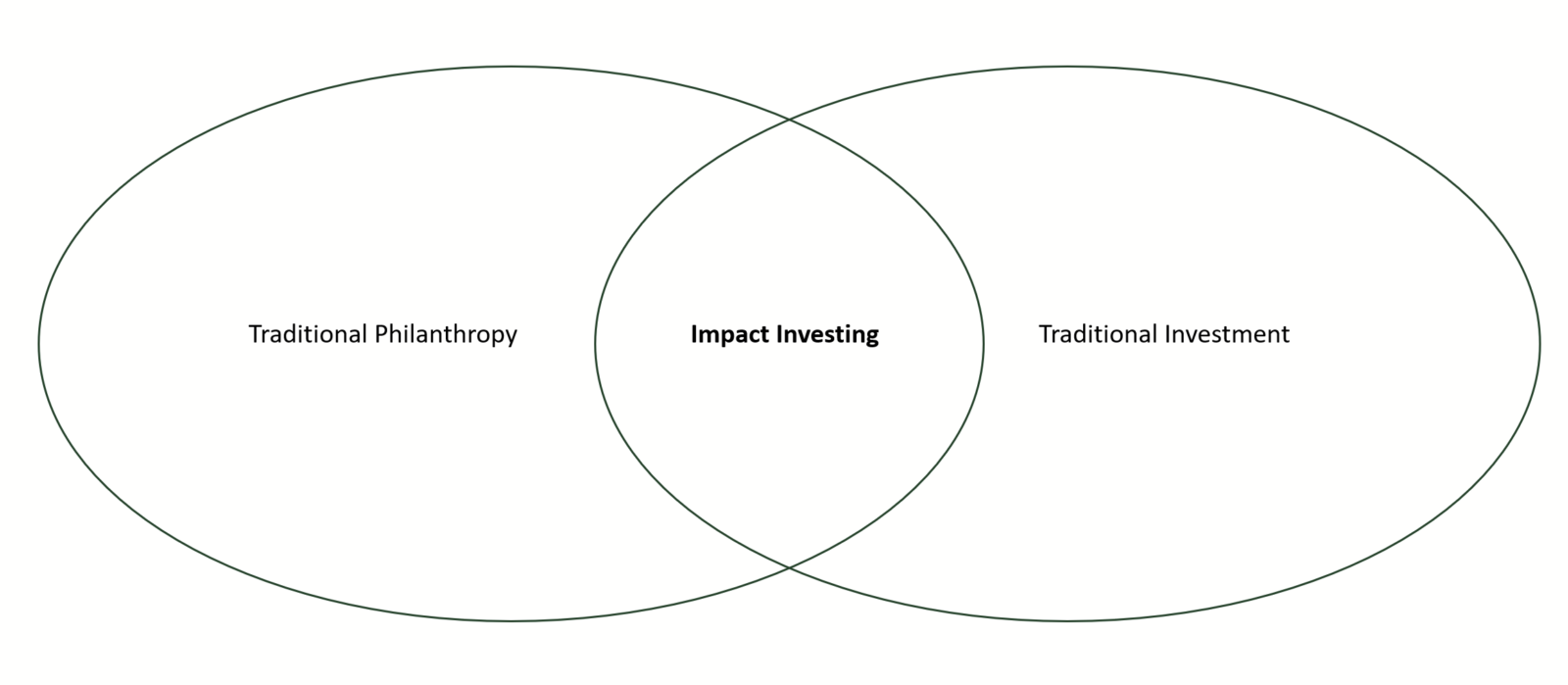
Figure 1: Blended logics and impact investing (own illustration based on Roundy (2020)12Roundy, P. T. Regional differences in impact investment: a theory of impact investing ecosystems. SRJ 16, 467–485 (2019).)
Impact investing represents a unique market activity because it blends two distinct logics of action: a market logic, based on efficiency and profit maximization, and a community logic, which emphasizes collaboration and value creation. As such, it constitutes a hybrid form of organizing that differs from other types of investments, which typically follow only a single dominant logic.12Roundy, P. T. Regional differences in impact investment: a theory of impact investing ecosystems. SRJ 16, 467–485 (2019).
Impact investing blends these two logics by pursuing positive societal and environmental impacts alongside financial returns.2Schlütter, D., Schätzlein, L., Hahn, R. & Waldner, C. Missing the Impact in Impact Investing Research – A Systematic Review and Critical Reflection of the Literature. J Management Studies 61, 2694–2718 (2024).11Gautier, A., Pache, A.-C. & Santos, F. Making Sense of Hybrid Practices: The role of individual adherence to institutional logics in impact investing. Organization Studies 44, 1385–1412 (2023). The return of the invested principal appears to be a minimum requirement, while non-financial returns must be intentional and their impact measurable.7Höchstädter, A. K. & Scheck, B. What’s in a Name: An Analysis of Impact Investing Understandings by Academics and Practitioners. J Bus Ethics 132, 449–475 (2015). Emerson (2003) proposes the concept of Blended Value, which describes value created through investments as an indivisible combination of social, environmental, and economic components.13Emerson, J. The Blended Value Proposition: Integrating Social and Financial Returns. California Management Review 45, 35–51 (2003). The idea of blended value suggests that community, capital, and commerce can perform better as a unified construct than when each component operates independently. The primary requirement is that the components remain inseparable, even in the returns.13Emerson, J. The Blended Value Proposition: Integrating Social and Financial Returns. California Management Review 45, 35–51 (2003).14Bugg-Levine, A. & Emerson, J. Impact Investing: Transforming How We Make Money while Making a Difference. Innovations: Technology, Governance, Globalization 6, 9–18 (2011).
Some scholars and practitioners debate whether financial returns can be below, at, or above the market rate, depending on investors’ strategies and specific investment contexts. Nevertheless, financial return remains an omnipresent element of impact investing.7Höchstädter, A. K. & Scheck, B. What’s in a Name: An Analysis of Impact Investing Understandings by Academics and Practitioners. J Bus Ethics 132, 449–475 (2015). This debate will be analyzed further in section 3.3.5.
Difference with other sustainability-related investments
Many scholars, such as Agrawal and Hockerts (2019), Höchstädter and Scheck (2015), and Schlütter et al. (2024), in their research recognize the conceptual confusion between impact investing and other sustainability-related investment approaches.2Schlütter, D., Schätzlein, L., Hahn, R. & Waldner, C. Missing the Impact in Impact Investing Research – A Systematic Review and Critical Reflection of the Literature. J Management Studies 61, 2694–2718 (2024).7Höchstädter, A. K. & Scheck, B. What’s in a Name: An Analysis of Impact Investing Understandings by Academics and Practitioners. J Bus Ethics 132, 449–475 (2015).15Agrawal, A. & Hockerts, K. Impact investing: review and research agenda. Journal of Small Business & Entrepreneurship 33, 153–181 (2021).
Social investment is often used interchangeably with impact investing. It is commonly mentioned as a synonym and is considered a broader or narrower concept. It is described similarly to Socially Responsible Investing (SRI), which incorporates social and environmental issues into investment decisions. As a narrow concept, social investment is considered an impact-first investment that prioritizes social impact over financial returns. It focuses on social enterprises and social purpose businesses designed to create social impact. Therefore, social investment is sometimes considered a sub-form of impact investing, as it places a relatively greater emphasis on non-financial impact compared to financial considerations.7Höchstädter, A. K. & Scheck, B. What’s in a Name: An Analysis of Impact Investing Understandings by Academics and Practitioners. J Bus Ethics 132, 449–475 (2015).
Venture philanthropy represents another related approach used by social investors. It applies VC methods and provides a high level of non-financial support to investees, thereby combining social impact and financial considerations. However, it places less emphasis on financial returns than impact investing, which distinguishes the two approaches. Venture philanthropy shares several similarities with impact investing, particularly in its close engagement with investees, its strong focus on maximizing social impact, and its emphasis on accountability.16Block, J. H., Hirschmann, M. & Fisch, C. Which criteria matter when impact investors screen social enterprises? Journal of Corporate Finance 66, 101813 (2021). Similarities, differences, and areas of overlap also exist with other sustainability-oriented investment approaches, such as social impact bonds, microfinance, and sustainability-based crowdfunding.
SRI vs impact investing
A critical discussion in impact investing, as acknowledged by Höchstädter and Scheck (2015), concerns whether impact investing should be considered a form of SRI or whether it overlaps with it. SRI has been defined by Renneboog et al. (2008) as “An investment process that integrates social, ethical, or environmental considerations into financial decision-making” (p. 1723).17Renneboog, L., Ter Horst, J. & Zhang, C. Socially responsible investments: Institutional aspects, performance, and investor behavior. Journal of Banking & Finance 32, 1723–1742 (2008). While both approaches share similarities, impact investing is primarily driven by the impact that an investment can generate. Some scholars, therefore, conclude that impact investing is distinct from SRI.7Höchstädter, A. K. & Scheck, B. What’s in a Name: An Analysis of Impact Investing Understandings by Academics and Practitioners. J Bus Ethics 132, 449–475 (2015). Scholars such as Meng et al. (2022) suggest that impact investing represents a distinct form of investment, emphasizing motivations such as intentionality and impact creation.18Meng, T., Newth, J. & Woods, C. Ethical Sensemaking in Impact Investing: Reasons and Motives in the Chinese Renewable Energy Sector. J Bus Ethics 179, 1091–1117 (2022). Other scholars, such as Zolfaghari and Hand (2023), argue that key elements of impact investing, such as intentionality, measurement, and broader conceptual foundations, are rooted in SRI, considering it as a form of SRI.19Zolfaghari, B. & Hand, G. (Dean). Impact investing and philanthropic foundations: strategies deployed when aligning fiduciary duty and social mission. Journal of Sustainable Finance & Investment 13, 962–989 (2023).
Similar to Zolfaghari and Hand (2023), Arjaliès et al. (2023) described impact investing as a new trend emerging from SRI practices.20Arjaliès, D.-L., Chollet, P., Crifo, P. & Mottis, N. The Motivations and Practices of Impact Assessment in Socially Responsible Investing: The French Case and its Implications for the Accounting and Impact Investing Communities. Social and Environmental Accountability Journal 43, 1–29 (2023). In contrast, Apostolakis et al. (2016) and Castellas, Ormiston, and Findlay (2018) emphasized the distinction between the two concepts, arguing that impact investing goes beyond SRI by explicitly targeting investments that increase social added value.21Castellas, E. I.-P., Ormiston, J. & Findlay, S. Financing social entrepreneurship: The role of impact investment in shaping social enterprise in Australia. SEJ 14, 130–155 (2018).22Apostolakis, G., Kraanen, F. & Van Dijk, G. Examining pension beneficiaries’ willingness to pay for a socially responsible and impact investment portfolio: A case study in the Dutch healthcare sector. Journal of Behavioral and Experimental Finance 11, 27–43 (2016). Apostolakis et al. (2016) provide one of the earliest studies examining the criteria of both investments.22Apostolakis, G., Kraanen, F. & Van Dijk, G. Examining pension beneficiaries’ willingness to pay for a socially responsible and impact investment portfolio: A case study in the Dutch healthcare sector. Journal of Behavioral and Experimental Finance 11, 27–43 (2016). Nevertheless, Dordi et al. (2024) argue that the distinction between SRI and impact investing still requires further clarification.23Dordi, T., Stephens, P., Geobey, S. & Weber, O. New bottle or new label? Distinguishing impact investing from responsible and ethical investing. Accounting & Finance 64, 309–330 (2024).
Unlike traditional investing, SRI incorporates non-financial factors into investment decision-making alongside risk and return considerations. It aims to avoid companies with harmful impacts through negative screening while including those with positive environmental or social performance, with the focus on preventing negative impact rather than actively generating impact. Environmental, Social, and Governance (ESG) indicators are commonly used by investors in investment selection, often through best-in-class approaches. These indicators serve to measure the environmental, social, and governance performance of companies.2Schlütter, D., Schätzlein, L., Hahn, R. & Waldner, C. Missing the Impact in Impact Investing Research – A Systematic Review and Critical Reflection of the Literature. J Management Studies 61, 2694–2718 (2024).24Richardson, B. J. Keeping Ethical Investment Ethical: Regulatory Issues for Investing for Sustainability. J Bus Ethics 87, 555–572 (2009).25Sandberg, J., Juravle, C., Hedesström, T. M. & Hamilton, I. The Heterogeneity of Socially Responsible Investment. J Bus Ethics 87, 519–533 (2009). SRI investors usually invest in publicly listed companies and rely primarily on portfolio selection strategies, with relatively limited direct engagement.2Schlütter, D., Schätzlein, L., Hahn, R. & Waldner, C. Missing the Impact in Impact Investing Research – A Systematic Review and Critical Reflection of the Literature. J Management Studies 61, 2694–2718 (2024). Impact investing is more targeted in terms of social and environmental objectives, where the generation of measurable impact is fundamental to the investment. It is more commonly associated with private debt and equity instruments rather than publicly traded securities and goes beyond the use of minimum ESG criteria.7Höchstädter, A. K. & Scheck, B. What’s in a Name: An Analysis of Impact Investing Understandings by Academics and Practitioners. J Bus Ethics 132, 449–475 (2015). SRI is primarily directed toward large corporations through public equity and debt instruments to achieve at least risk-adjusted market returns.4Islam, S. M. & Scott, T. Current demand and supply of impact investments across different geographic regions, sectors, and stages of business: Match or mismatch? Australian Journal of Management 47, 686–704 (2022).
A key distinguishing feature of impact investing is the concept of dual return, as developed by Emerson (2003), that integrates both financial returns and impact.13Emerson, J. The Blended Value Proposition: Integrating Social and Financial Returns. California Management Review 45, 35–51 (2003).14Bugg-Levine, A. & Emerson, J. Impact Investing: Transforming How We Make Money while Making a Difference. Innovations: Technology, Governance, Globalization 6, 9–18 (2011). The existence of multiple institutional logics complicates this relationship. These differing logics can lead to misalignment but also highlight the distinct nature of impact investing compared to SRI. Another important distinction lies in the active relationship between investors and investees. Impact investors often engage closely with investees to ensure alignment with social or environmental missions. Frameworks that emphasize integrating risk-return and impact go beyond SRI, such as including the “impact risk” alongside the risk of financial return.26Brandstetter, L. & Lehner, O. M. Opening the Market for Impact Investments: The Need for Adapted Portfolio Tools. Entrepreneurship Research Journal 5, (2015).27Islam, S. M. Impact Risk Management in Impact Investing: How Impact Investing Organizations Adopt Control Mechanisms to Manage Their Impact Risk. Journal of Management Accounting Research 35, 115–139 (2023).28Jeffers, J., Lyu, T. & Posenau, K. The risk and return of impact investing funds. Journal of Financial Economics 161, 103928 (2024).
The discussion of whether impact investing is an extension of SRI highlights both similarities and important differences between the two approaches. While some concepts and theoretical foundations overlap, several scholars, including Agrawal and Hockerts (2019), Höchstädter and Scheck (2015), and Schlütter et al. (2024), emphasize the distinct nature of impact investing. Impact investing differs from SRI in several key aspects, including a longer investment horizon, a stronger focus on generating positive impact, more innovative governance structures, and a closer connection to philanthropic principles. Establishing a clear distinction between impact investing and SRI is essential to position impact investing as a legitimate and independent asset class and to strengthen its role as a distinct field of research and practice.23Dordi, T., Stephens, P., Geobey, S. & Weber, O. New bottle or new label? Distinguishing impact investing from responsible and ethical investing. Accounting & Finance 64, 309–330 (2024).
Actors and instruments
Actors involved in impact investing include high-net-worth individuals and families, foundations, corporations, fund managers, pension funds, and banks, as well as governments. The industry also includes demand-side actors that utilize and receive impact investments, such as social enterprises, community development organizations, corporations, and small and growing businesses. In addition, service providers such as networks, non-governmental organizations, and government programs play an important supporting role.6Tekula, R. & Andersen, K. The Role of Government, Nonprofit, and Private Facilitation of the Impact Investing Marketplace. Public Performance & Management Review 42, 142–161 (2019).
Impact investing encompasses a variety of financial vehicles and instruments, including primarily private debt, as well as private equity, deposits, guarantees, and real assets.29Impact Management Platform. Impact and the impact pathway. https://impactmanagementplatform.org/impact/ (n.d). Unlike traditional investing, impact investing often relies on conventional actors such as universities, governments, and non-governmental organizations to help identify sustainability-related investment opportunities and demand.30Holtslag, M., Chevrollier, N. & Nijhof, A. Impact investing and sustainable market transformations: The role of venture capital funds. Business Ethics Env & Resp 30, 522–537 (2021).
Defining impact, company, and investor impact
The broad use of the term impact in practitioner contexts such as impact investing and social entrepreneurship, as well as in academic contexts, has led to differing understandings and definitions.31Busch, T. et al. Principles for impact investments: practical guidance for impact measurement, assessment and valuation. SN Bus Econ 5, 48 (2025). In recent years, regulators and practitioners have contributed to the standardization of the concept of impact. The Impact Management Platform (IMP) has played a key role in establishing a widely used definition within the field of impact investing. According to the IMP, impact is defined as “The effect(s) of organisations’ actions on people and the natural environment”.29Impact Management Platform. Impact and the impact pathway. https://impactmanagementplatform.org/impact/ (n.d). Based on this perspective, selecting relevant metrics and collecting both quantitative and qualitative data are essential for measuring impact. These data must then be contextualized through a structured impact assessment process.31Busch, T. et al. Principles for impact investments: practical guidance for impact measurement, assessment and valuation. SN Bus Econ 5, 48 (2025).
Therefore, a key distinction is between company impact and investor impact. Investor impact is defined as the “change that investor activities achieve in company impact” (p. 555).32Kölbel, J. F., Heeb, F., Paetzold, F. & Busch, T. Can Sustainable Investing Save the World? Reviewing the Mechanisms of Investor Impact. Organization & Environment 33, 554–574 (2020). It does not directly affect social and environmental outcomes; rather, it influences the companies in which investors invest, which in turn generate direct social and environmental impacts. The company impact is defined as the “change that company activities achieve in social and environmental parameters” (p. 555).32Kölbel, J. F., Heeb, F., Paetzold, F. & Busch, T. Can Sustainable Investing Save the World? Reviewing the Mechanisms of Investor Impact. Organization & Environment 33, 554–574 (2020).
Investors can play a crucial role in accelerating the change, while companies themselves can evolve and improve their practices. In this context, the literature identifies two key mechanisms through which investors can generate impact: (1) shareholder engagement and (2) capital allocation.32Kölbel, J. F., Heeb, F., Paetzold, F. & Busch, T. Can Sustainable Investing Save the World? Reviewing the Mechanisms of Investor Impact. Organization & Environment 33, 554–574 (2020).
Active shareholder engagement is an effective mechanism through which investors can encourage companies to improve the quality of their activities. This engagement is intentional and primarily outcome-oriented, with investors working closely with investee companies to achieve environmental and social objectives.33Dimson, E., Karakaş, O. & Li, X. Active Ownership. Rev. Financ. Stud. 28, 3225–3268 (2015). This mechanism is particularly relevant for large companies due to their many shareholders with voting rights.
Capital allocation is an important mechanism through which impact investors allocate capital to companies to contribute to environmental and societal outcomes. By allocating capital and altering companies’ financial conditions, investors can affect firm growth and adjust the level of activities undertaken by more sustainable or less sustainable companies. This mechanism is particularly important for small and young enterprises, especially in developing countries, which are often constrained by high capital costs and are considered a primary target for impact investors.7Höchstädter, A. K. & Scheck, B. What’s in a Name: An Analysis of Impact Investing Understandings by Academics and Practitioners. J Bus Ethics 132, 449–475 (2015).32Kölbel, J. F., Heeb, F., Paetzold, F. & Busch, T. Can Sustainable Investing Save the World? Reviewing the Mechanisms of Investor Impact. Organization & Environment 33, 554–574 (2020).
Company impact can be categorized into upstream, operational, and downstream impacts. Upstream impacts are associated with inputs and sourcing practices throughout the supply chain. Operational impacts arise from a company’s direct activities and production processes. Downstream impacts relate to the products and services provided by the company, including their use and end-of-life effects. A company’s positive impact is considered significant when the resulting outcomes contribute meaningfully to sustainability objectives and when such objectives are integrated into the company’s operations and business model.31Busch, T. et al. Principles for impact investments: practical guidance for impact measurement, assessment and valuation. SN Bus Econ 5, 48 (2025).
Impact-aligned and impact-generating
Two impact-related investments are distinguished: impact-aligned investments and impact-generating investments, which differ in their objectives, strategies, and approaches. Impact-aligned investments aim to address social and environmental goals primarily through screening strategies, including the application of exclusion criteria during both pre- and post-investment decision-making. They do not require that the company’s impact be influenced by investor activities; rather, investors align their investments with the company’s existing impact. In contrast, impact-generating investments involve investors actively contributing to social and environmental solutions and broader societal transformations. Investors seek to contribute to the company’s impact to create additional social and environmental value that otherwise would not have been generated.34Busch, T. et al. Impact investments: a call for (re)orientation. SN Bus Econ 1, 33 (2021).
To achieve this, impact-generating investments employ the main mechanisms, as also mentioned earlier in this section: first, the provision of additional capital to firms to enable the generation of social impact; second, a focus on firms that set new and ambitious targets for impact generation; and third, active ownership practices, such as voting and engagement on social and environmental issues. While impact-generating investments focus on creating investor impact, impact-aligned investments concentrate on identifying and selecting companies that already demonstrate positive impact.35Scheitza, L. & Busch, T. SFDR Article 9: Is it all about impact? Finance Research Letters 62, 105179 (2024).
The difference between these two typologies lies in their understanding of materiality. In impact-aligned investments, materiality is typically demonstrated through benchmarking analyses and alignment with frameworks such as the SDGs or science-based targets. In contrast, in impact-generating investments, materiality is reflected in the impact generated or expected to be achieved, so that the impact generated and achieved targets can be attributed to the investment. To ensure transparency, impact-aligned investments rely on documented disclosures and external verification. In contrast, impact-generating investments require more advanced measurement approaches, including detailed tracking and external assessment of impact achievements and targets.34Busch, T. et al. Impact investments: a call for (re)orientation. SN Bus Econ 1, 33 (2021).
This section outlined the key concepts and terminologies related to impact investing by highlighting its characteristics and differentiating it from other sustainability-related investment approaches. It further examined the role of key actors within the impact investing ecosystem, including investor and company impact and their respective mechanisms, and terms such as impact-generating and impact-aligned investments. Together, these concepts provide the foundation for understanding the following sections.
2.2 Historical background
Impact investing is closely connected to the evolution of SRI and corporate responsibility during the last quarter of the twentieth century, emphasizing the pursuit of doing good alongside financial returns.10Clarkin, J. E. & L. Cangioni, C. Impact Investing: A Primer and Review of the Literature. Entrepreneurship Research Journal 6, (2016). The origins can be traced back to the 17th century, when the Shakers in England sought to align their investments with their values. Similarly, Shakers in colonial America during the 19th century established businesses aligned with social values to fund religious communities.14Bugg-Levine, A. & Emerson, J. Impact Investing: Transforming How We Make Money while Making a Difference. Innovations: Technology, Governance, Globalization 6, 9–18 (2011). More broadly, indigenous cultures and religious traditions have long emphasized the importance of generating positive impact through financial decisions and avoiding harmful activities such as gambling, alcohol, or slavery, even though these practices did not involve the terminology or level of engagement seen today.36Brandenburg, M. & Iqbal, A. The Ford Foundation’s Work to Build the Field of Impact Investing. The Foundation Review 14, (2022).
In recent decades, a shift toward integrating non-financial factors into investment decision-making has become evident. This shift began in the 1960s with the emergence of SRI, when investors started to avoid industries or companies perceived as having negative environmental or social impacts.37Trelstad Brian. Impact Investing: A Brief History. Capitalism & Society 11, (2016). During this period, the first sustainable mutual funds were established, and both positive and negative screening approaches for stock selection were developed.36Brandenburg, M. & Iqbal, A. The Ford Foundation’s Work to Build the Field of Impact Investing. The Foundation Review 14, (2022). Investors initially excluded companies involved in harmful activities, such as firearms or tobacco production (negative screening), while selecting firms engaged in environmentally or socially beneficial activities (positive screening).38Widyawati, L. A systematic literature review of socially responsible investment and environmental social governance metrics. Bus Strat Env 29, 619–637 (2020). In addition, SRI investors began to engage with companies through shareholder activism to promote improved social and environmental practices and raise awareness of these issues.37Trelstad Brian. Impact Investing: A Brief History. Capitalism & Society 11, (2016).
In the late 1960s, at the same time that SRI was emerging, the Ford Foundation pioneered Program-Related Investments (PRIs), which at the time were referred to as one form of the broad idea of social investing. These investments aimed to complement traditional grants with low-interest loans to finance social programs, such as urban redevelopment. The rationale behind PRIs was that recipients with income-generating business models could repay loans, allowing philanthropic capital to be reused. This approach served two main purposes: first, it enabled the recycling of capital for further philanthropic use; second, successful repayment signaled financial viability, helping recipients attract additional commercial investment and reduce dependence on grants.37Trelstad Brian. Impact Investing: A Brief History. Capitalism & Society 11, (2016).
American economist Howard Bowen coined the term “Corporate Social Responsibility” (CSR) as an approach encouraging businesses to integrate social and environmental concerns into their operations, contributing positively to society and the environment. The concept gained widespread use during the 1990s, following growing awareness of the environmental consequences of economic activity, particularly after 1992 with the adoption of Agenda 21 at the United Nations Conference on Environment and Development, also known as the “Earth Summit”.36Brandenburg, M. & Iqbal, A. The Ford Foundation’s Work to Build the Field of Impact Investing. The Foundation Review 14, (2022). The intention of Agenda 21 was to address the societal and environmental problems of the world at that time and prepare the world for the challenges of the new century, making a better world for future generations.39United Nations. Agenda 21. (1992). In this way, it created a framework for the implementation of global environmental protection and sustainable development. In 1997, world leaders assembled for the Kyoto Protocol, which set targets for reducing greenhouse gas (GHG) emissions. These developments were of particular importance for industry, as they increased awareness of environmental impacts and thereby strengthened the relevance of CSR efforts.36Brandenburg, M. & Iqbal, A. The Ford Foundation’s Work to Build the Field of Impact Investing. The Foundation Review 14, (2022).
At the beginning of the 2000s, the growing integration of sustainability considerations into investments through screening of negative social or environmental factors or the selection of investments based on social and environmental considerations led to the search for new investment opportunities. The shift reflected the growing recognition that sustainability investment was not limited to doing less harm but could also actively allocate capital to generate additional social and environmental benefits. As a result, capital providers increasingly sought ways to address societal challenges more proactively, creating the foundation for a new investment approach.37Trelstad Brian. Impact Investing: A Brief History. Capitalism & Society 11, (2016).
The term impact investing was formally coined in 2007 at a meeting convened by the Rockefeller Foundation at the Bellagio Center in Italy, which brought together actors from philanthropy and development finance. At this meeting, impact investing was formally coined with the intention of using profit-seeking investment to generate social and environmental impact.14Bugg-Levine, A. & Emerson, J. Impact Investing: Transforming How We Make Money while Making a Difference. Innovations: Technology, Governance, Globalization 6, 9–18 (2011). In 2008, as the industry began implementing plans developed through the Bellagio convening, the Rockefeller Foundation Board of Trustees approved USD 38 million for new impact-investing initiatives, including grants, PRIs, and non-grant activities. At that time, debates emerged regarding whether it was possible to achieve attractive financial returns while promoting social impacts, while other debates concerned whether incorporating social issues into investment decisions could lead to mission drift.40Quinn, Q. C. & Munir, K. A. Hybrid Categories as Political Devices: The Case of Impact Investing in Frontier Markets. in Research in the Sociology of Organizations (eds Durand, R., Granqvist, N. & Tyllström, A.) vol. 51 113–150 (Emerald Publishing Limited, 2017).
Through a strategic partnership between the Rockefeller Foundation and J.P. Morgan, the hybrid category of impact investing became more visible. It became evident through this partnership between these key pioneers and central leaders that such highly skilled and well-resourced actors could generate the necessary legitimacy and attention to institutionalize impact investing as a legitimate investment category and to promote it as a distinct asset class.40Quinn, Q. C. & Munir, K. A. Hybrid Categories as Political Devices: The Case of Impact Investing in Frontier Markets. in Research in the Sociology of Organizations (eds Durand, R., Granqvist, N. & Tyllström, A.) vol. 51 113–150 (Emerald Publishing Limited, 2017).
In 2008, the Rockefeller Foundation, Acumen, and B Lab developed the Impact Reporting and Investment Standards (IRIS) to address challenges associated with the emerging concept of impact investing, particularly the lack of transparency and credibility in how funds define, track, and report the social and environmental performance of their portfolios. IRIS provides a standardized framework for measuring the social and environmental impacts of investments.10Clarkin, J. E. & L. Cangioni, C. Impact Investing: A Primer and Review of the Literature. Entrepreneurship Research Journal 6, (2016).41Global Impact Investing Network. Data, Direction and Decisions: What We Know About Measuring and Managing Impact Performance. (2025).42The Rockefeller Foundation. Global Impact Investing Network (GIIN). https://www.rockefellerfoundation.org/bellagio-bulletin/from-the-archives/global-impact-investing-network-giin/ (2023).43Global Impact Investing Network. History of IRIS+. https://iris.thegiin.org/history/ (n.d). During the 2008 financial crisis, governments faced significant challenges in protecting jobs and maintaining social stability. Rather than relying solely on donations, they invested tens of billions of dollars through loans, equity investments, and guarantees, tools similar to those used in impact investing. This resulted in what is considered one of the largest impact-oriented investment efforts ever undertaken.14Bugg-Levine, A. & Emerson, J. Impact Investing: Transforming How We Make Money while Making a Difference. Innovations: Technology, Governance, Globalization 6, 9–18 (2011).
Later, in 2009, the Rockefeller Foundation founded the GIIN under the coordination of the Foundation’s program officer, Antony Bugg-Levine. The network’s members include asset owners, asset managers, and service providers active in the field of impact investing.44Lehner, O. M. (ed.). Routledge Handbook of Social and Sustainable Finance. (Routledge, 2016). doi:10.4324/9781315772578. In the same year, the Global Impact Investing Rating System (GIIRS) was developed to assess social and environmental impacts. GIIRS is comparable to traditional investment analysis tools, such as those used by Morningstar, which investors rely on to compare and evaluate conventional financial investments. GIIRS is designed to rate funds making equity and debt investments in companies. Today, IRIS complements GIIRS, and both frameworks are part of the GIIN ecosystem.42The Rockefeller Foundation. Global Impact Investing Network (GIIN). https://www.rockefellerfoundation.org/bellagio-bulletin/from-the-archives/global-impact-investing-network-giin/ (2023).
The Obama administration was initially one of the main adopters, allocating around USD 2.3 billion to impact investment initiatives, and since 2014, the Vatican has held three conferences to show Catholic institutions how private capital can help the poor.42The Rockefeller Foundation. Global Impact Investing Network (GIIN). https://www.rockefellerfoundation.org/bellagio-bulletin/from-the-archives/global-impact-investing-network-giin/ (2023). Highlights in the development of impact investing include the development of the SDGs as a global framework for understanding impact across sectors, as well as the Intergovernmental Panel on Climate Change (IPCC 5th) Assessment Report (2016), which provided a scientific basis for targets and regulations.41Global Impact Investing Network. Data, Direction and Decisions: What We Know About Measuring and Managing Impact Performance. (2025). To address the SDG investment gaps and achieve the SDG goals, impact investing is considered a promising vehicle, as it focuses on creating impact by addressing global challenges and targeting impact-driven investee companies whose growth is linked to the achievement of the SDG goals.45Islam, S. M. & Rahman, A. Impact investment deal flow and Sustainable Development Goals: “Mind the gap?” Accounting & Finance 63, 3797–3813 (2023). Other important developments include the establishment of the IMP in 2017, which aimed to build consensus on what managing for impact means, and the release of the European Commission Sustainable Finance Action Plan in 2018, representing one of the first major regulatory efforts to classify and mandate impact-related disclosures. In the same year, the GIIN evolved IRIS into IRIS+, expanding the catalog of metrics and translating impact intentions into measurable results.5Global Impact Investing Network. Sizing the Impact Investing Market 2024. (2024).
In 2021, the GIIN introduced COMPASS as a methodology for comparing and assessing impact results. As stated in the GIIN report Sizing the Impact Investing Market (2024), “Through research, tools, standards, convenings, education, and a network of over 400 investors from 60 countries, the GIIN is working to secure a sustainable and equitable future for people and the planet” (p. 2).5Global Impact Investing Network. Sizing the Impact Investing Market 2024. (2024). This statement illustrates how impact investing has developed and become more structured over the years as a distinct investment approach, and how it has become more widely adopted.5Global Impact Investing Network. Sizing the Impact Investing Market 2024. (2024). This institutional development was accompanied by a growing body of academic research, which has increasingly shaped the theoretical foundations of the field.
2.3 Integrated conceptual frameworks
This section provides insights into the conceptual frameworks identified in the impact investing literature and the main academic debates related to them. It covers the core determinants of impact investing, the ADO framework, the investor-investee relationship, and the mechanisms of impact creation and measurement through the Theory of Change, including the academic discourse on impact measurement and quantification. This section concludes by examining the outcomes and performance of impact investments.
2.3.1 Core determinants of impact investing
Building on the conceptual distinctions outlined in the key terminology section, this section shifts the focus to the structure of impact investing. The aim is to unpack the core determinants of impact investing, including (1) intentionality, (2) additionality, (3) contribution, (4) measurability, (5) materiality, and (6) attribution. These determinants are understood as interrelated dimensions that characterize how the impact is intended, created, assessed and attributed.
1. Intentionality
Intentionality is considered the most important element of impact investing and a key component for establishing market integrity and legitimacy.46Barman, E. Of Principle and Principal: Value Plurality in the Market of Impact Investing. VS 3, 9–44 (2015). It is emphasized in definitions of impact investing by Barman (2015), such as “investment with the intentional expectation of social or environmental impact alongside financial return” (p. 9).46Barman, E. Of Principle and Principal: Value Plurality in the Market of Impact Investing. VS 3, 9–44 (2015). A distinction exists between social and environmental intentions and financial intentions; however, all of these must be present in an investment for it to be classified as impact investing. The intention to create social or environmental impact must be explicit, not an unintended side effect, which differentiates impact investing from other strategies such as ESG investing.9Hockerts, K., Hehenberger, L., Schaltegger, S. & Farber, V. Defining and Conceptualizing Impact Investing: Attractive Nuisance or Catalyst? J Bus Ethics 179, 937–950 (2022). The impact investor must demonstrate the intention to generate both positive environmental/social impact and financial return, and it requires that both investors and investees exhibit this intent, even if the investee does not fully share this intention in all contexts.47Findlay, S. & Moran, M. Purpose-washing of impact investing funds: motivations, occurrence and prevention. SRJ 15, 853–873 (2019).48Hansen, S. E. & Sigurjonsson, T. O. Do impact investing opportunities exist in public equity? An empirical examination. JGR 13, 83 (2024). The impact intention can be further demonstrated through other dimensions, such as measurement during the investment-making process.47Findlay, S. & Moran, M. Purpose-washing of impact investing funds: motivations, occurrence and prevention. SRJ 15, 853–873 (2019). Financial intention is also complex, and the absence of financial return would not qualify as impact investing but rather as a grant or donation.9Hockerts, K., Hehenberger, L., Schaltegger, S. & Farber, V. Defining and Conceptualizing Impact Investing: Attractive Nuisance or Catalyst? J Bus Ethics 179, 937–950 (2022).
2. Additionality
The second determinant relates to additionality, the extent to which an investment increases the quantity and quality of social and environmental outcomes that would otherwise not occur.9Hockerts, K., Hehenberger, L., Schaltegger, S. & Farber, V. Defining and Conceptualizing Impact Investing: Attractive Nuisance or Catalyst? J Bus Ethics 179, 937–950 (2022).34Busch, T. et al. Impact investments: a call for (re)orientation. SN Bus Econ 1, 33 (2021).49Born, K. & Brest, P. When Can Impact Investing Create Real Impact? Stanford Social Innovation Review 11, 2231 (2013).50Global Impact Investing Network. Core Characteristics of Impact Investing. (2019). Hockerts et al. (2022) distinguish between idealist impact investors, who target investments with below-market returns when additionality would not occur because all actors focus on profit maximization, and arbitrage impact investors. Arbitrage impact investors can achieve additionality by identifying opportunities that others cannot detect and by investing in social enterprises that have been overlooked by conventional investors due to high search and transaction costs, as well as small or complex investment sizes.9Hockerts, K., Hehenberger, L., Schaltegger, S. & Farber, V. Defining and Conceptualizing Impact Investing: Attractive Nuisance or Catalyst? J Bus Ethics 179, 937–950 (2022). Additionality in the microfinance field assumes that investors are willing to invest under market conditions by accepting lower financial returns or an inferior risk-return ratio. In contrast, within impact investing, the idea of additionality is considered independent of financial performance, and the major feature is the generation of impact. Within investment criteria, additionality remains a challenging dimension to demonstrate, particularly when investments are made through intermediary services in open and competitive markets.34Busch, T. et al. Impact investments: a call for (re)orientation. SN Bus Econ 1, 33 (2021). It is closely linked to intentionality and is often considered an underlying component of it, as evidence of additionality must reflect the investor’s intention.47Findlay, S. & Moran, M. Purpose-washing of impact investing funds: motivations, occurrence and prevention. SRJ 15, 853–873 (2019). Challenges remain regarding how additionality can be assessed, whether by impact investors themselves or by independent parties, how it can be codified and regulated, and whether additionality can be transferred across different investment contexts.9Hockerts, K., Hehenberger, L., Schaltegger, S. & Farber, V. Defining and Conceptualizing Impact Investing: Attractive Nuisance or Catalyst? J Bus Ethics 179, 937–950 (2022).
3. Contribution
There are two strategies directly connected to the contribution dimension. Impact investors follow these two strategies: signaling that impact matters and engaging actively.9Hockerts, K., Hehenberger, L., Schaltegger, S. & Farber, V. Defining and Conceptualizing Impact Investing: Attractive Nuisance or Catalyst? J Bus Ethics 179, 937–950 (2022). When there is an investment interaction, integrating impact considerations into the decision-making process signals to the investor that the impact matters. This encourages investees to measure their impact contributions and enables enterprises to prioritize impact-oriented activities.9Hockerts, K., Hehenberger, L., Schaltegger, S. & Farber, V. Defining and Conceptualizing Impact Investing: Attractive Nuisance or Catalyst? J Bus Ethics 179, 937–950 (2022). Through active engagement, investors provide non-financial support to investees. This strategy is borrowed from venture philanthropy and includes added value through mentoring and networking to strengthen enterprises’ impact, thereby fostering a closer investor-investee relationship.9Hockerts, K., Hehenberger, L., Schaltegger, S. & Farber, V. Defining and Conceptualizing Impact Investing: Attractive Nuisance or Catalyst? J Bus Ethics 179, 937–950 (2022).
4. Materiality
There is often a lack of clarity regarding how to determine priorities among relevant impacts; therefore, in impact investing, materiality helps to identify which information must be disclosed and which information can be excluded for investors and other stakeholders.9Hockerts, K., Hehenberger, L., Schaltegger, S. & Farber, V. Defining and Conceptualizing Impact Investing: Attractive Nuisance or Catalyst? J Bus Ethics 179, 937–950 (2022).31Busch, T. et al. Principles for impact investments: practical guidance for impact measurement, assessment and valuation. SN Bus Econ 5, 48 (2025). Materiality is highly significant in financial accounting practices and, in its traditional form, is considered a fundamental concept due to the relevance of the information it provides to specific investors.51Lehner, O. M., Nicholls, A. & Kapplmüller, S. B. Arenas of Contestation: A Senian Social Justice Perspective on the Nature of Materiality in Impact Measurement. J Bus Ethics 179, 971–989 (2022).
Materiality has been transferred to impact investing by expanding traditional financial materiality to reflect companies’ sustainability engagement. This expansion broadens both the scope of information considered and the range of information users, including beneficiaries and society at large.9Hockerts, K., Hehenberger, L., Schaltegger, S. & Farber, V. Defining and Conceptualizing Impact Investing: Attractive Nuisance or Catalyst? J Bus Ethics 179, 937–950 (2022). Under impact materiality, information is selected to explain the impact of activities on the economy, the environment, and society to multiple stakeholders, including investors, employees, local communities, etc.52Mezzanotte, F. E. Corporate sustainability reporting: double materiality, impacts, and legal risk. Journal of Corporate Law Studies 23, 633–663 (2023). The relevance of impact data within impact materiality involves multiple stakeholders, as impact investing includes a broad range of actors rather than focusing solely on financial considerations; together, this forms the reporting concept of “double materiality”.9Hockerts, K., Hehenberger, L., Schaltegger, S. & Farber, V. Defining and Conceptualizing Impact Investing: Attractive Nuisance or Catalyst? J Bus Ethics 179, 937–950 (2022).51Lehner, O. M., Nicholls, A. & Kapplmüller, S. B. Arenas of Contestation: A Senian Social Justice Perspective on the Nature of Materiality in Impact Measurement. J Bus Ethics 179, 971–989 (2022). Difficulties related to impact materiality arise in determining what is relevant, for whom, and what should be reported. Materiality assessment is therefore important, as it emphasizes stakeholder engagement and encourages dialogue to identify relevant impact information, thereby enabling effective impact reporting. Tools used to express materiality include Social Return on Investment (SROI) calculations and impact-weighted accounts.9Hockerts, K., Hehenberger, L., Schaltegger, S. & Farber, V. Defining and Conceptualizing Impact Investing: Attractive Nuisance or Catalyst? J Bus Ethics 179, 937–950 (2022).
5. Measurability
Measurability is a key determinant of impact investing, as underlined by the GIIN (2025) definition, which emphasizes that, alongside achieving financial returns, investments are expected to generate measurable social and environmental impact. Impact measurement demonstrates how social and environmental impacts and outcomes are documented, and it has become an increasingly important topic for academics and practitioners due to its close connection with intentionality in achieving impact goals.9Hockerts, K., Hehenberger, L., Schaltegger, S. & Farber, V. Defining and Conceptualizing Impact Investing: Attractive Nuisance or Catalyst? J Bus Ethics 179, 937–950 (2022).53Casasnovas, G. & Jones, J. Who Has a Seat at the Table in Impact Investing? Addressing Inequality by Giving Voice. J Bus Ethics 179, 951–969 (2022).
Measurement is important for attracting investors, as it enables the linkage between risk, return, and impact, and serves as a means of demonstrating intentionality. It is central to impact investing because it reflects the investor’s intention to generate positive change. Furthermore, measurement helps mitigate the risk of mission drift and ensures that investments remain aligned with their initial objectives.48Hansen, S. E. & Sigurjonsson, T. O. Do impact investing opportunities exist in public equity? An empirical examination. JGR 13, 83 (2024). However, impact measurement presents significant challenges, as impact typically refers to long-term effects, while measurability often focuses on short-term inputs and outputs that are easier to quantify. Nevertheless, measuring impact remains closely linked to broader sustainability concepts.9Hockerts, K., Hehenberger, L., Schaltegger, S. & Farber, V. Defining and Conceptualizing Impact Investing: Attractive Nuisance or Catalyst? J Bus Ethics 179, 937–950 (2022). This approach differs from traditional finance, which primarily focuses on financial returns and indicators at the investee-company level, whereas impact investors adopt a multi-perspective approach that extends beyond organizational boundaries. In this context, data acquisition, the choice of measurement methods, and the interpretation of results should be embedded in a multi-stakeholder process.9Hockerts, K., Hehenberger, L., Schaltegger, S. & Farber, V. Defining and Conceptualizing Impact Investing: Attractive Nuisance or Catalyst? J Bus Ethics 179, 937–950 (2022).
6. Attribution
Attribution is the most abstract dimension of impact investing and refers to identifying who is responsible for the change and which portion of the outcomes can be attributed to the investor’s activities. In impact investing, attribution assesses how much of the observed outcomes can be attributed to the investee; however, in practice, assessing attribution is highly challenging, as it often requires scientific methods such as randomized controlled trials.9Hockerts, K., Hehenberger, L., Schaltegger, S. & Farber, V. Defining and Conceptualizing Impact Investing: Attractive Nuisance or Catalyst? J Bus Ethics 179, 937–950 (2022).
Debates regarding the attribution also concern its transferability, namely, whether the attributed impact remains with the original investor or transfers to a new owner. For example, if an investor purchases shares in a company, it is unclear whether the future impact on the company can also be attributed to that investor. The concept of collective impact emphasizes collaborative relationships among organizations to achieve shared goals and moves away from the notion of isolated impact, in which each company is evaluated based on its potential to generate impact.9Hockerts, K., Hehenberger, L., Schaltegger, S. & Farber, V. Defining and Conceptualizing Impact Investing: Attractive Nuisance or Catalyst? J Bus Ethics 179, 937–950 (2022).
The six core dimensions highlight the multidimensional nature of impact investing and emphasize the need to generate impact alongside financial returns. While determinants such as intentionality, additionality, and measurability form the foundation for identifying and assessing impact, the remaining dimensions are equally important and closely interconnected. Together, they provide a comprehensive framework for understanding how impact is created, measured, and attributed. The extent to which these dimensions are collectively incorporated influences the quality of the impact investment and its ability to demonstrate meaningful impact. Collectively, these dimensions define the conceptual boundaries of impact investing.
2.3.2 The Antecedents, Decisions, and Outcomes (ADO) framework
In this section, the major factors that drive investors to engage in impact investing are analyzed using the Antecedents-Decisions-Outcomes (ADO) framework. The ADO framework provides a structured approach in which the key antecedent factors that influence investors to engage in impact investing are organized, highlighting the importance of understanding why investors engage in this field and how these decisions contribute to outcomes such as financial returns and social and environmental impact. These factors are further linked to David McClelland’s theory of needs to classify the investors’ motivational drivers.54Aggarwal, S., Rathee, P., Arya, V. & Roy, H. Inside story of impact investing in emerging market: A systematic review to measure the responsible and sustainable investing pattern using the ADO framework. Journal of Economic Surveys 39, 1695–1726 (2025).
McClelland proposed the Theory of Needs (also known as Achievement Theory), which introduces three fundamental motivational needs as illustrated in Figure 2: power, affiliation, and achievement. These needs reflect different levels of human motivation, including security and power, social belonging and affiliation, and, at higher levels, the need for achievement, in which individuals focus on self-fulfillment and contributing to society and environmental protection. Managers and impact investors act differently according to their dominant motivational needs when selecting investments, for example, by prioritizing scalability, financial returns, or the number of beneficiaries.54Aggarwal, S., Rathee, P., Arya, V. & Roy, H. Inside story of impact investing in emerging market: A systematic review to measure the responsible and sustainable investing pattern using the ADO framework. Journal of Economic Surveys 39, 1695–1726 (2025).

Figure 2: Conceptual framework of motivation for impact investors (own illustration based on Aggarwal et al. (2025)54Aggarwal, S., Rathee, P., Arya, V. & Roy, H. Inside story of impact investing in emerging market: A systematic review to measure the responsible and sustainable investing pattern using the ADO framework. Journal of Economic Surveys 39, 1695–1726 (2025).)
Antecedents
Social, financial, and self-actualization factors constitute key antecedents of motivation among impact investors and are derived from the three motivational needs in David McClelland’s theory of needs: power, affiliation, and achievement.
Financial factors are essential in motivating impact investors, as they address basic needs such as security, growth, and power. Investment decisions in impact investing are guided by expected financial returns as well as the value generated by the investment.54Aggarwal, S., Rathee, P., Arya, V. & Roy, H. Inside story of impact investing in emerging market: A systematic review to measure the responsible and sustainable investing pattern using the ADO framework. Journal of Economic Surveys 39, 1695–1726 (2025).
Social factors represent another important source of motivation for impact investors, as they relate to social value creation and social recognition, rather than solely contributing to societal or community well-being. These factors enable investors to enhance their image by creating social value through their investments.54Aggarwal, S., Rathee, P., Arya, V. & Roy, H. Inside story of impact investing in emerging market: A systematic review to measure the responsible and sustainable investing pattern using the ADO framework. Journal of Economic Surveys 39, 1695–1726 (2025).
Self-actualization factors refer to the experiences and individual characteristics of investors that motivate them to participate in impact investing. Impact investors driven by self-actualization seek to satisfy higher-order needs and are motivated more by emotional and ethical considerations than by purely social or financial factors. Their primary motivation is to contribute to social change, promote a more sustainable future, and support future generations.54Aggarwal, S., Rathee, P., Arya, V. & Roy, H. Inside story of impact investing in emerging market: A systematic review to measure the responsible and sustainable investing pattern using the ADO framework. Journal of Economic Surveys 39, 1695–1726 (2025).
Decisions
The key factors affecting the antecedents of motivation for impact investors and their investment-related decisions are explained, as well as how investors evaluate investment proposals.54Aggarwal, S., Rathee, P., Arya, V. & Roy, H. Inside story of impact investing in emerging market: A systematic review to measure the responsible and sustainable investing pattern using the ADO framework. Journal of Economic Surveys 39, 1695–1726 (2025).
Financial factors: Several decisions characterize financially motivated impact investors. One type is the finance-first investor, who makes decisions based primarily on financial returns and aims to invest in enterprises that generate market-rate returns. For these investors, high financial performance is the main motivating factor for engaging in impact investing. This group includes banks, pension funds, and sovereign wealth funds that seek to achieve market-competitive financial returns.55Ormiston, J., Charlton, K., Donald, M. S. & Seymour, R. G. Overcoming the Challenges of Impact Investing: Insights from Leading Investors. Journal of Social Entrepreneurship 6, 352–378 (2015).
Commercial investors are impact investors who invest in enterprises to increase investment value and are driven by profit maximization and wealth creation; value generation acts as a key motivator for their engagement in impact investing. Tax incentives and subsidies granted to impact investing enterprises can also stimulate investor interest. In addition, the development of secondary markets for impact investing is essential, as it enables investors to exit their investments more flexibly. Another important motivation is portfolio diversification. Investors adopt impact investing to diversify their portfolios across different sectors, thereby mitigating risks in areas such as IT, health, education, technology, and agriculture.54Aggarwal, S., Rathee, P., Arya, V. & Roy, H. Inside story of impact investing in emerging market: A systematic review to measure the responsible and sustainable investing pattern using the ADO framework. Journal of Economic Surveys 39, 1695–1726 (2025).56Barber, B. M., Morse, A. & Yasuda, A. Impact investing. Journal of Financial Economics 139, 162–185 (2021). Furthermore, applying the Theory of Change, which represents a critical step in constructing impact investing portfolios, as it enhances accountability and impact measurement while supporting stakeholder engagement and collaboration to promote sustainable development.54Aggarwal, S., Rathee, P., Arya, V. & Roy, H. Inside story of impact investing in emerging market: A systematic review to measure the responsible and sustainable investing pattern using the ADO framework. Journal of Economic Surveys 39, 1695–1726 (2025).
Social factors: Investors seek to generate positive social value and prioritize social outcomes. They are willing to incorporate social and environmental value into their investment decisions and are motivated to maximize social impact. In this context, community logic plays a central role in investment decision-making, emphasizing cooperation and the creation of social value.54Aggarwal, S., Rathee, P., Arya, V. & Roy, H. Inside story of impact investing in emerging market: A systematic review to measure the responsible and sustainable investing pattern using the ADO framework. Journal of Economic Surveys 39, 1695–1726 (2025).56Barber, B. M., Morse, A. & Yasuda, A. Impact investing. Journal of Financial Economics 139, 162–185 (2021). Impact investors who prioritize social and environmental returns often experience a sense of achievement and confidence from contributing positively to society and the environment. In addition, impact investing can enhance social recognition and help investors build a positive public image by addressing social challenges, which further reinforces their engagement in impact investing.54Aggarwal, S., Rathee, P., Arya, V. & Roy, H. Inside story of impact investing in emerging market: A systematic review to measure the responsible and sustainable investing pattern using the ADO framework. Journal of Economic Surveys 39, 1695–1726 (2025).
Self-actualization factors: Investors perceive investing as a form of sustainability-oriented investment and as a moral responsibility toward the environment and society. These investors are motivated by concerns about environmental degradation and engage in impact investing to promote positive environmental action. Driven by altruistic values, they aim to protect the planet and contribute to a safer and better future for the coming generations by investing in companies capable of creating meaningful impact.54Aggarwal, S., Rathee, P., Arya, V. & Roy, H. Inside story of impact investing in emerging market: A systematic review to measure the responsible and sustainable investing pattern using the ADO framework. Journal of Economic Surveys 39, 1695–1726 (2025).
Outcomes
The outcomes constitute the final component of the ADO framework, where the antecedents and strategic decisions are put into action.
Financial factors: Financial impact investors emphasize financial satisfaction and primarily evaluate investments based on financial returns, which they consider an essential element of impact investing. Higher financial returns and profit maximization motivate them to engage in impact investing. Another important motivation is the ability to achieve financial returns while using capital to generate positive social outcomes in a sustainable manner, thereby increasing the overall value of the investment. Through diversification, impact investors spread their portfolios across multiple sectors, including those with an oversupply of investments, such as energy, housing, and microfinance, as well as sectors with growth potential, such as financial services and healthcare. However, the underperformance of impact investments may create dissatisfaction among investors.4Islam, S. M. & Scott, T. Current demand and supply of impact investments across different geographic regions, sectors, and stages of business: Match or mismatch? Australian Journal of Management 47, 686–704 (2022).54Aggarwal, S., Rathee, P., Arya, V. & Roy, H. Inside story of impact investing in emerging market: A systematic review to measure the responsible and sustainable investing pattern using the ADO framework. Journal of Economic Surveys 39, 1695–1726 (2025).
Social factors: Impact investors seek to create positive societal impact by generating value that increases the income and wealth of disadvantaged groups, mitigates climate change, and promotes renewable energy sources. Impact investing also addresses inequalities in areas such as healthcare and education by supporting innovative social enterprises. Achieving social impact further involves capacity building, including recruiting appropriate personnel and persuading stakeholders to value and support the underlying theory of social change.54Aggarwal, S., Rathee, P., Arya, V. & Roy, H. Inside story of impact investing in emerging market: A systematic review to measure the responsible and sustainable investing pattern using the ADO framework. Journal of Economic Surveys 39, 1695–1726 (2025).
Self-actualization factors: Impact investors driven by self-actualization factors prioritize social and environmental impact over financial returns and seek to address pressing social and environmental challenges by investing in companies that can generate significant impact and contribute to the achievement of the SDGs. Self-actualization factors motivate investors to satisfy higher-level needs and contribute to broader societal uplift by improving beneficiaries’ lives through affordable solutions to social problems. This includes improving the lives of women and girls through gender-lens investing. Impact investors also engage in green and blue economy investments, focusing on areas such as forestry, ocean conservation, and the scaling of new climate technologies.54Aggarwal, S., Rathee, P., Arya, V. & Roy, H. Inside story of impact investing in emerging market: A systematic review to measure the responsible and sustainable investing pattern using the ADO framework. Journal of Economic Surveys 39, 1695–1726 (2025).
In conclusion, the ADO framework demonstrates that investors’ engagement in impact investing cannot be explained by a single factor or by directly linking motivational needs to outcomes. Rather, it conceptualizes impact investing as a sequential process in which investors’ motivational needs and other antecedents shape investment decisions, which ultimately influence both financial and impact outcomes.
2.3.3 Managing organizational hybridity in investor-investee relationship
This section examines, through the frameworks of organizational hybridity and institutional logics, the relationship between investor and investee (i.e., the company or recipient of the investment). It begins by exploring why investors select specific investees to achieve both financial returns and impact, and how this relationship is maintained, either enabling the achievement of investment goals or potentially leading to mission drift
The relationship between investor and investee has not been sufficiently studied in the literature; it represents a key mechanism through which legitimacy in impact investing is constructed by creating both social/environmental and economic value. Accordingly, the investor-investee relationship must be sustained to enable effective impact measurement and broader stakeholder engagement. Nevertheless, the primary stakeholders remain the investor, the investee, and the beneficiaries of impact investing.53Casasnovas, G. & Jones, J. Who Has a Seat at the Table in Impact Investing? Addressing Inequality by Giving Voice. J Bus Ethics 179, 951–969 (2022).57Agrawal, A. & Hockerts, K. Impact Investing Strategy: Managing Conflicts between Impact Investor and Investee Social Enterprise. Sustainability 11, 4117 (2019).58Agrawal, A. & Jespersen, K. How do impact investors evaluate an investee social enterprise? A framework of impact investing process. JEEE 16, 999–1022 (2024).
Investor-investee selection
This relationship is characterized by inherent tensions when investors prioritize social impact at the expense of financial returns, thereby increasing financial risk, and conversely, when the emphasis is placed on financial returns, this may increase the risk to social and environmental impact. Investor selection criteria for choosing investees are therefore dynamic and depend on investors’ differing objectives. Impact investors assess not only the potential financial returns of portfolio ventures but also social/environmental values and invest in sectors that address global challenges, such as poverty reduction and climate change mitigation.16Block, J. H., Hirschmann, M. & Fisch, C. Which criteria matter when impact investors screen social enterprises? Journal of Corporate Finance 66, 101813 (2021).
Agrawal and Jespersen (2024) identify the selection of the right investee as a major investment risk and highlight two moral hazards in this process: mission drift and financial misconduct by investees. One way to mitigate these risks is through careful selection of investees, making it a central strategy in impact investing.58Agrawal, A. & Jespersen, K. How do impact investors evaluate an investee social enterprise? A framework of impact investing process. JEEE 16, 999–1022 (2024). Investees in impact investing are identified as hybrid organizations, which combine elements of profit and nonprofit organizations to achieve social impact and financial returns simultaneously. Risks related to the hybridity of investees were identified, such as mission drift and mission lock-in, which arise when one dimension is prioritized over another, even though value creation depends on the interaction of these dimensions within a single enterprise. As a result, trust within the investor-investee relationship, as well as shared core values, serves as a key mechanism for mitigating moral hazards and opportunistic behavior associated with the financing relationship.59Viviani, J.-L. & Maurel, C. Performance of impact investing: A value creation approach. Research in International Business and Finance 47, 31–39 (2019).
In section 3.1, the actors involved in impact investing were introduced, namely investors (asset owners, individuals, etc.) and investees (final recipients of funds, usually social enterprises), with intermediaries often acting between them.53Casasnovas, G. & Jones, J. Who Has a Seat at the Table in Impact Investing? Addressing Inequality by Giving Voice. J Bus Ethics 179, 951–969 (2022). The impact investing market is heterogeneous and highly complex, as it includes different types of investors, such as finance-first impact investors, who expect market-rate financial returns while also generating social and environmental value. The others are impact-first investors, who are willing to accept below-market financial returns in exchange for generating social or environmental impact; investors who construct portfolios with varying return profiles, prioritizing either financial or social returns; and philanthropic grant-makers.12Roundy, P. T. Regional differences in impact investment: a theory of impact investing ecosystems. SRJ 16, 467–485 (2019).60Moran, M. & Ward-Christie, L. Blended Social Impact Investment Transactions: Why Are They So Complex? J Bus Ethics 179, 1011–1031 (2022).61Hansen, S. E. & Sigurjonsson, T. O. Do impact investing opportunities exist in public equity? An empirical examination. JGR 13, 83–95 (2024). Taken together, these differing values and expectations introduce a high degree of logical complexity when they choose the investee and the return expectations.60Moran, M. & Ward-Christie, L. Blended Social Impact Investment Transactions: Why Are They So Complex? J Bus Ethics 179, 1011–1031 (2022).
As impact investors constitute a heterogeneous group, Block et al. (2021) classify them into three types: equity investors, debt investors, and donors.16Block, J. H., Hirschmann, M. & Fisch, C. Which criteria matter when impact investors screen social enterprises? Journal of Corporate Finance 66, 101813 (2021). Equity investors are the most common type and typically invest through funds seeking market-rate returns, with clear financial objectives and exit processes similar to traditional VC. Debt investors provide loans to portfolio companies and seek financial returns, although these investments are often characterized by below-market returns. Donors, in contrast, provide philanthropic donations and grants to social enterprises and primarily prioritize social goals rather than market returns.16Block, J. H., Hirschmann, M. & Fisch, C. Which criteria matter when impact investors screen social enterprises? Journal of Corporate Finance 66, 101813 (2021). Each of these investors differs in its investment logic, requiring different return expectations.
Financing impact investees is prone to generating relational conflicts between investors and investees due to the dual purpose of investments, the difficulty of measuring social impact, and differing investor preferences, such as prioritizing social missions, environmental goals, or financial profitability. Conflicts may also arise from differences in return requirements and from the design of financial instruments used to finance investees.59Viviani, J.-L. & Maurel, C. Performance of impact investing: A value creation approach. Research in International Business and Finance 47, 31–39 (2019).
Institutional logics and hybridity
Impact investing combines potentially conflicting rationalities and priorities and seeks to deliver blended value. These conflicts are often referred to as institutional logics. The persistence of such conflicting logics is described as institutional complexity, which poses challenges for scholars and practitioners in managing tensions arising from contexts in which multiple logics and rationalities coexist.21Castellas, E. I.-P., Ormiston, J. & Findlay, S. Financing social entrepreneurship: The role of impact investment in shaping social enterprise in Australia. SEJ 14, 130–155 (2018). Institutional logics represent a central theoretical lens within institutional theory for analyzing relationships among individuals and organizations. To understand the relationship between impact investors and investees, institutional theorists suggest applying the institutional logic framework to examine how these actors navigate both financial and social objectives.21Castellas, E. I.-P., Ormiston, J. & Findlay, S. Financing social entrepreneurship: The role of impact investment in shaping social enterprise in Australia. SEJ 14, 130–155 (2018).57Agrawal, A. & Hockerts, K. Impact Investing Strategy: Managing Conflicts between Impact Investor and Investee Social Enterprise. Sustainability 11, 4117 (2019).
Institutional logic has been defined as “the socially constructed, historical patterns of material practices, assumptions, values, beliefs, and rules by which individuals produce and reproduce their material subsistence, organize time and space, and provide meaning to their social reality.”(p. 2).62Thornton, P. H., Ocasio, W. & Lounsbury, M. The Institutional Logics Perspective: A New Approach to Culture, Structure, and Process. (Oxford University Press, Oxford, 2012). Institutional logics connect field-level values and beliefs with actions at the organizational level. Social value generation and income generation are often conceptualized as competing activities, and prioritizing income generation over social value creation can lead to mission drift. For this reason, institutional logics provide a well-established framework for studying competing goals within social enterprises.57Agrawal, A. & Hockerts, K. Impact Investing Strategy: Managing Conflicts between Impact Investor and Investee Social Enterprise. Sustainability 11, 4117 (2019).
Rather than focusing solely on competition to explain institutional change, collaboration is considered a central mechanism of institutionalization. Collaboration occurs when autonomous stakeholders engage in interactive processes, share values, norms, and structures, and jointly address issues within a given domain. Such collaboration brings together actors with differing interests and, through the management of these interests, can influence institutional community norms and values.63Reay, T. & Hinings, C. R. Managing the Rivalry of Competing Institutional Logics. Organization Studies 30, 629–652 (2009).
Two core logics commonly used to analyze hybrid organizations are social logic and commercial logic. Charitable organizations represent one end of the investment continuum, characterized by social-only motives and the maximization of social value. The dominance of one logic over another gives rise to inherent tensions. Social logic emphasizes addressing social and environmental needs and provides legitimacy to social enterprises and impact investing firms. At the opposite end of the continuum, VC represents a profit-oriented logic focused on high economic returns and efficiency.57Agrawal, A. & Hockerts, K. Impact Investing Strategy: Managing Conflicts between Impact Investor and Investee Social Enterprise. Sustainability 11, 4117 (2019).60Moran, M. & Ward-Christie, L. Blended Social Impact Investment Transactions: Why Are They So Complex? J Bus Ethics 179, 1011–1031 (2022). Venture capitalists invest based solely on financial expectations, measure only financial returns, and are driven by profit maximization and fiduciary duty.57Agrawal, A. & Hockerts, K. Impact Investing Strategy: Managing Conflicts between Impact Investor and Investee Social Enterprise. Sustainability 11, 4117 (2019).
Managing conflicts and mission drift
The institutional logic framework helps explain inter-organizational relationships between impact investors and investees, particularly social enterprises, as both are exposed to commercial and social logics. Inter-organizational alignment emerges from the need to manage costs and reduce uncertainty, leading organizations to engage in relationships aimed at creating value beyond what could be achieved individually. Inter-organizational alignment between impact investors and investees (social enterprises) is illustrated in Figure 3. Impact investors and investees often share similar institutional logics and goals related to creating social and environmental change through commercial means; however, their sources of legitimacy may differ. As a result, they are exposed to competing institutional logics, which can generate tensions within the relationship.57Agrawal, A. & Hockerts, K. Impact Investing Strategy: Managing Conflicts between Impact Investor and Investee Social Enterprise. Sustainability 11, 4117 (2019).
The benefits of organizational alignment between investors and investees stem from organizational collaboration. These benefits include access to capital for investees and social and environmental legitimacy for investors. Their mutually aligned motivations to achieve shared goals are shaped by competing institutional logics during the initial stages of inter-organizational alignment. The primary driver of alignment between investors and investees lies in institutional logics, particularly the tension between social objectives and financial returns.57Agrawal, A. & Hockerts, K. Impact Investing Strategy: Managing Conflicts between Impact Investor and Investee Social Enterprise. Sustainability 11, 4117 (2019).
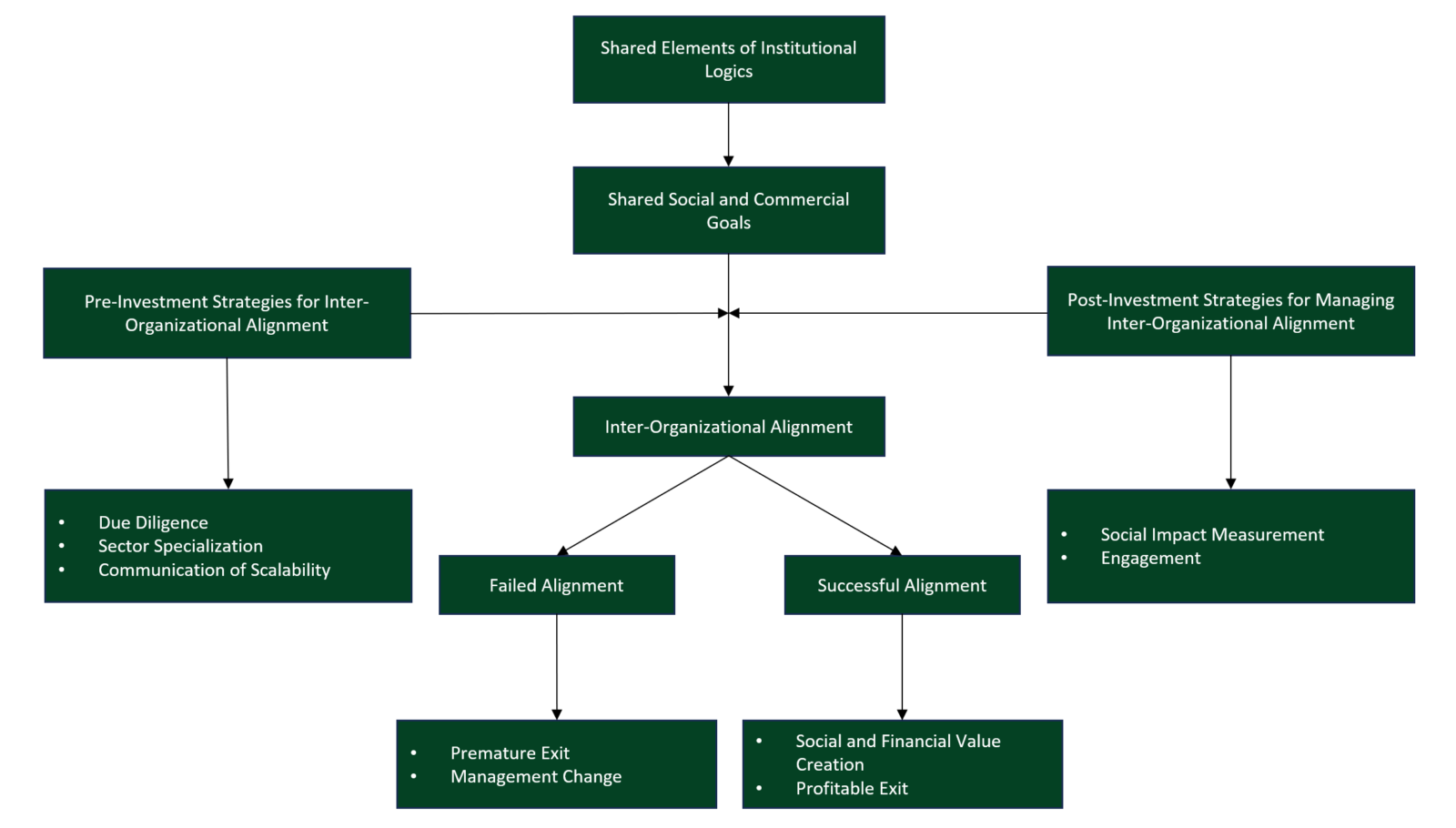
Figure 3: Model of inter-organizational alignment of impact investor-investee (own illustration based on Agrawal and Hockerts (2019)57Agrawal, A. & Hockerts, K. Impact Investing Strategy: Managing Conflicts between Impact Investor and Investee Social Enterprise. Sustainability 11, 4117 (2019).)
The effectiveness of the investment is determined not only by the investor’s dominant position but also by the social and environmental value created by the investee. While the investor’s role as a capital provider is significant, it is balanced by the investee’s role in value creation, which ultimately benefits all stakeholders.57Agrawal, A. & Hockerts, K. Impact Investing Strategy: Managing Conflicts between Impact Investor and Investee Social Enterprise. Sustainability 11, 4117 (2019). The reasons why investors select specific investees constitute a central criterion in impact investing. Investors evaluate the investee’s background, the authenticity of the management team, the characteristics of the products and services offered, the revenue model, financial sustainability, a strong commitment to social change, and a high level of professionalism.4Islam, S. M. & Scott, T. Current demand and supply of impact investments across different geographic regions, sectors, and stages of business: Match or mismatch? Australian Journal of Management 47, 686–704 (2022).30Holtslag, M., Chevrollier, N. & Nijhof, A. Impact investing and sustainable market transformations: The role of venture capital funds. Business Ethics Env & Resp 30, 522–537 (2021).57Agrawal, A. & Hockerts, K. Impact Investing Strategy: Managing Conflicts between Impact Investor and Investee Social Enterprise. Sustainability 11, 4117 (2019). A particularly important factor in alignment between the investor and the investee is whether their missions and values are closely aligned, as this facilitates the communication of impact.57Agrawal, A. & Hockerts, K. Impact Investing Strategy: Managing Conflicts between Impact Investor and Investee Social Enterprise. Sustainability 11, 4117 (2019).
Economic and business criteria also play a key role, and impact investors generally seek investments with a high degree of financial sustainability. At the same time, effective communication of impact helps to manage mission drift and enables investees to counterbalance the dominance of the capital provider.16Block, J. H., Hirschmann, M. & Fisch, C. Which criteria matter when impact investors screen social enterprises? Journal of Corporate Finance 66, 101813 (2021).58Agrawal, A. & Jespersen, K. How do impact investors evaluate an investee social enterprise? A framework of impact investing process. JEEE 16, 999–1022 (2024). However, these criteria vary by the type of investor. Equity and debt investors tend to emphasize business criteria and expect financial returns in addition to impact, whereas donors primarily pursue social goals and do not expect financial returns. Debt investors, in particular, often invest in social enterprises with the aim of addressing poverty-related challenges.16Block, J. H., Hirschmann, M. & Fisch, C. Which criteria matter when impact investors screen social enterprises? Journal of Corporate Finance 66, 101813 (2021). Barber et al. (2021) note that in impact investing, investors often value environmental and social impact such as poverty alleviation and support for minorities or women, more highly than purely financial criteria.56Barber, B. M., Morse, A. & Yasuda, A. Impact investing. Journal of Financial Economics 139, 162–185 (2021). To manage conflicts arising from competing institutional logics, it is advantageous for impact investors to develop expertise in specific sectors and invest in enterprises that address problems within those sectors, as this is associated with higher performance.57Agrawal, A. & Hockerts, K. Impact Investing Strategy: Managing Conflicts between Impact Investor and Investee Social Enterprise. Sustainability 11, 4117 (2019).
In the early stages of the relationship, impact evaluation often serves as an accountability mechanism; over time, however, investors and investees tend to adopt a more collaborative approach to impact evaluation to better manage their objectives. The dominance of one logic can lead to misalignment in the investor-investee relationship, premature exit, organizational decline, or management change. Furthermore, the less emphasis investors place on positive social or environmental impact, the greater the pressure on investees to prioritize financial returns over impact.57Agrawal, A. & Hockerts, K. Impact Investing Strategy: Managing Conflicts between Impact Investor and Investee Social Enterprise. Sustainability 11, 4117 (2019).
The activities of the investee result in long-term impact, and to assess the value created, the investee must measure the results of its activities. One of the major risks in impact investing is the lack of replication and, as discussed in the previous section, the difficulty of measuring the social impact created by investments. While measuring financial value is well established through traditional finance, measuring social impact remains underdeveloped; however, the quality of the social impact created contributes to the reputation of both the investor and the investee. For that, the relationship between the investor and the investee is essential not only during the pre-investment stage but also throughout the post-investment stage. It lies in engaging and collaborating to measure and communicate, alongside financial returns, the impact created.57Agrawal, A. & Hockerts, K. Impact Investing Strategy: Managing Conflicts between Impact Investor and Investee Social Enterprise. Sustainability 11, 4117 (2019).
During engagement, impact investors should clearly declare their social and environmental goals alongside financial goals within the investment mandate, and investees should do the same. Otherwise, a focus on only one dimension may give rise to tensions and potentially result in a breakdown of the relationship and premature exit. Frequent engagement between impact investors and investees facilitates alignment and leads to the creation of social, environmental, and financial value.57Agrawal, A. & Hockerts, K. Impact Investing Strategy: Managing Conflicts between Impact Investor and Investee Social Enterprise. Sustainability 11, 4117 (2019).
The investor-investee relationship is highly complex and a critical determinant of the success of the investment, as it can succeed or, if an investee with institutional logics and priorities that differ from the investor’s is selected, lead to mission drift, premature exit, and failed alignment. Therefore, the literature suggests that, from the beginning of the investment stage, their shared logics and missions must be aligned, despite the heterogeneity of both investors and the hybrid nature of investees. This alignment enables the achievement of both financial returns and social/environmental impact over the course of the investment. However, selecting the right investee is only the initial step in this relationship. The engagement between the investor and the investee is a continuous and active process throughout the post-investment stage, involving the monitoring of impact creation alongside financial returns to ensure that their alignment is maintained throughout the investment process.
2.3.4 Mechanisms of impact creation and measurement: The Theory of Change
Impact measurement and creation, as discussed in the previous sections, are key determinants of impact investing. This section examines how the Theory of Change serves as a conceptual framework for impact measurement and management. It addresses the critical academic discourse on impact measurement and quantification, highlighting diverse scholarly perspectives and the challenges associated with this process.
A central element of impact management is the ToC, which is important for understanding the social and environmental impacts on the sectors and communities where investments are made.64Jackson, E. T. Interrogating the theory of change: evaluating impact investing where it matters most. Journal of Sustainable Finance & Investment 3, 95–110 (2013). Breuer et al. (2016) define the Theory of Change as “an approach which describes how a program brings about specific long-term outcomes through a logical sequence of intermediate outcomes” (p. 2).65Breuer, E., Lee, L., De Silva, M. & Lund, C. Using theory of change to design and evaluate public health interventions: a systematic review. Implementation Sci 11, 63 (2015). The ToC aims to move beyond the simplicity of input-output evaluation by establishing a clear connection between a given intervention and its outcomes. It makes the underlying rationale of an initiative explicit, enabling systematic assessment, interrogation, and revision during implementation. The ToC comprises the underlying logic, assumptions, causal linkages, and expected outcomes of a development program.66Reinholz, D. L. & Andrews, T. C. Change theory and theory of change: what’s the difference anyway? IJ STEM Ed 7, 2 (2020).
Usually, the ToC is developed in consultation with stakeholders through workshops and interviews and can be used as a framework for program development and evaluation.65Breuer, E., Lee, L., De Silva, M. & Lund, C. Using theory of change to design and evaluate public health interventions: a systematic review. Implementation Sci 11, 63 (2015). Jackson (2013) proposes that the ToC should be an explicit and integral part of the evaluation process in impact investing and should be applied across different levels, including individual organizations, specific investments, and beneficiary groups such as communities, individuals, and households. The ToC enables the understanding of the complex relationships among actors and factors included in the intervention.64Jackson, E. T. Interrogating the theory of change: evaluating impact investing where it matters most. Journal of Sustainable Finance & Investment 3, 95–110 (2013). It explains the creation of impact by linking it to the “impact value chain” (inputs, activities, outputs, outcomes, impact) and highlights that outputs and impact represent fundamentally different results.31Busch, T. et al. Principles for impact investments: practical guidance for impact measurement, assessment and valuation. SN Bus Econ 5, 48 (2025).44Lehner, O. M. (ed.). Routledge Handbook of Social and Sustainable Finance. (Routledge, 2016). doi:10.4324/9781315772578.64Jackson, E. T. Interrogating the theory of change: evaluating impact investing where it matters most. Journal of Sustainable Finance & Investment 3, 95–110 (2013). Figure 4 presents the model of the impact value chain and adapts it by interrogating the ToC.
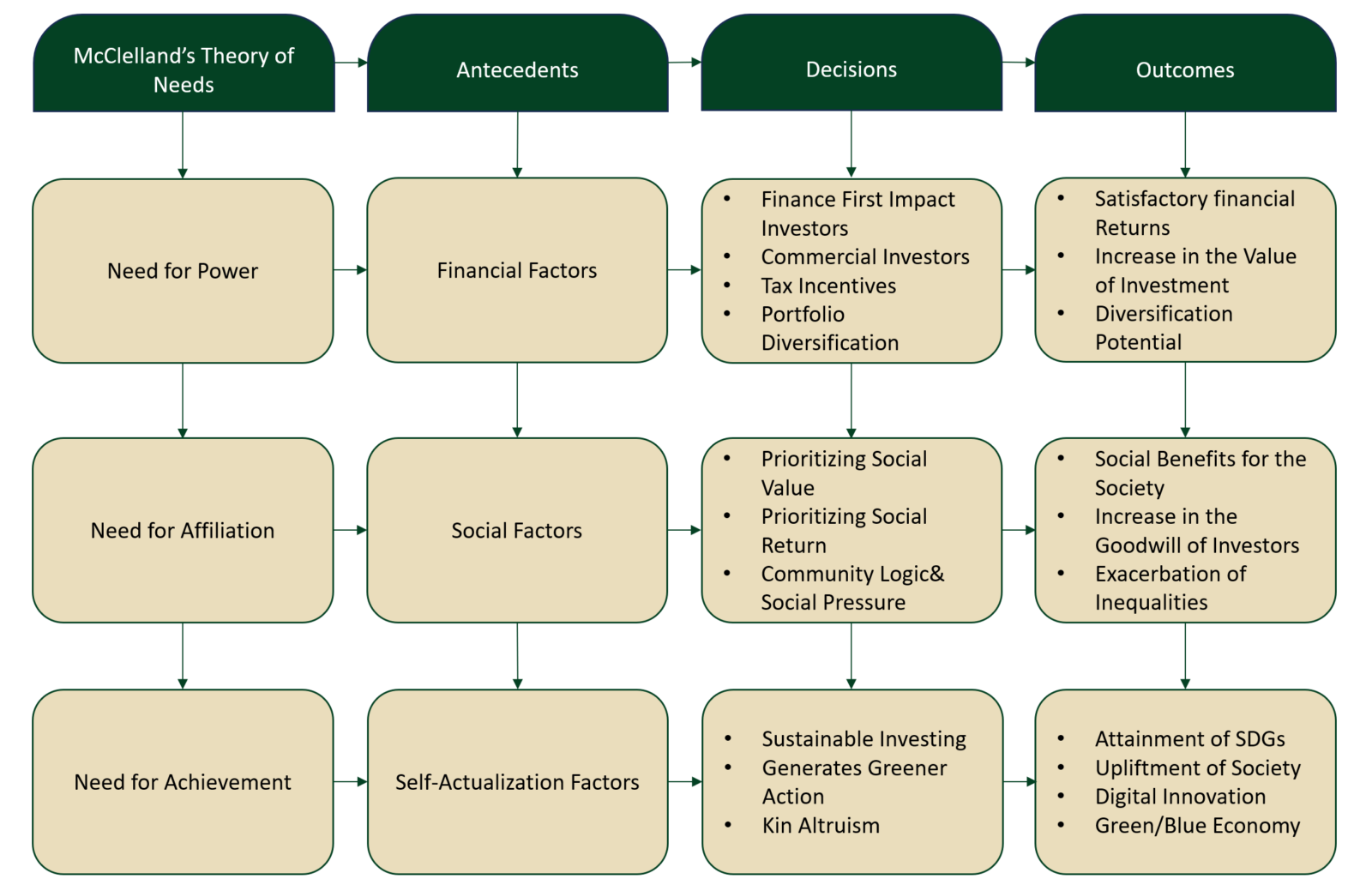
Figure 4: Impact pathway (own illustration based on Busch et al. (2025)31Busch, T. et al. Principles for impact investments: practical guidance for impact measurement, assessment and valuation. SN Bus Econ 5, 48 (2025).)
First, resources are defined as inputs and include both financial and non-financial resources provided by investors, such as capital, instruments, and networks. At this stage, impact investors are not directly involved in creating impact, reflecting the broader role of the financial sector, which can generate both indirect positive and negative impacts.44Lehner, O. M. (ed.). Routledge Handbook of Social and Sustainable Finance. (Routledge, 2016). doi:10.4324/9781315772578.64Jackson, E. T. Interrogating the theory of change: evaluating impact investing where it matters most. Journal of Sustainable Finance & Investment 3, 95–110 (2013).
Activities include the financial actions carried out during the investment phases. Impact investors focus on identifying and assessing investees that are expected to generate positive impact. The investor must first structure financial products and services if the investee meets the relevant criteria and, in addition, conduct an analysis of societal and environmental impacts.44Lehner, O. M. (ed.). Routledge Handbook of Social and Sustainable Finance. (Routledge, 2016). doi:10.4324/9781315772578.64Jackson, E. T. Interrogating the theory of change: evaluating impact investing where it matters most. Journal of Sustainable Finance & Investment 3, 95–110 (2013). Inputs and activities still represent the investment phase, where the foundation for impact creation is established. The subsequent stages focus on the intended results and ultimately impact to understand the effects of the investment. This process requires a clear understanding of cause-and-effect relationships.44Lehner, O. M. (ed.). Routledge Handbook of Social and Sustainable Finance. (Routledge, 2016). doi:10.4324/9781315772578.
Outputs represent the direct results of investments and are often referred to as “activity results.” Examples include the number of units or products sold or the number of people served by a project, one example is the number of electric vehicles sold. The performance of investee activities is reflected in the outcomes of the investment, which include changes affecting individuals and the environment resulting from the delivery of products and services. Outcomes typically focus on short- and medium-term results that can be directly or indirectly linked to the investment.44Lehner, O. M. (ed.). Routledge Handbook of Social and Sustainable Finance. (Routledge, 2016). doi:10.4324/9781315772578.64Jackson, E. T. Interrogating the theory of change: evaluating impact investing where it matters most. Journal of Sustainable Finance & Investment 3, 95–110 (2013).
Impact refers to long-term changes that occur compared to what would otherwise have happened. These changes affect society and the environment and follow from the achieved outcomes. Impact specifies the contribution of an investment relative to other inputs and influencing factors, such as reductions in regional or national poverty levels or increases in the production and use of electric vehicles associated with climate change mitigation.51Lehner, O. M., Nicholls, A. & Kapplmüller, S. B. Arenas of Contestation: A Senian Social Justice Perspective on the Nature of Materiality in Impact Measurement. J Bus Ethics 179, 971–989 (2022).64Jackson, E. T. Interrogating the theory of change: evaluating impact investing where it matters most. Journal of Sustainable Finance & Investment 3, 95–110 (2013).
Connecting the ToC with the evaluation of impact investing and adapting it to the actors involved, Jackson (2013) provides several reasons for this framework. First, a key reason for integrating the ToC into impact investing is that it represents a cost-effective way to address this imperative, as cause-and-effect relationships in impact investing are complex and difficult to assess. The ToC helps investors to clearly understand the change they seek to create and, based on this understanding, to adjust their strategies and instruments accordingly.64Jackson, E. T. Interrogating the theory of change: evaluating impact investing where it matters most. Journal of Sustainable Finance & Investment 3, 95–110 (2013).
An explicit Theory of Change can also be used by governments, non-governmental organizations, and citizens to hold investors accountable for their intentions. For impact investing to achieve social and environmental impact alongside financial returns, all elements of the ToC must function effectively.64Jackson, E. T. Interrogating the theory of change: evaluating impact investing where it matters most. Journal of Sustainable Finance & Investment 3, 95–110 (2013). While the ToC provides a conceptual framework for understanding impact creation, debates in the literature remain regarding the ability to measure and quantify impact.
Measurement and impact quantification
Measurement and disclosure of impact and financial returns help to reduce information asymmetry between investors and investees and allow investors to evaluate whether the investee is using the funds effectively. However, investees may perceive measurement as a disruptive factor due to the complexity of indicators and the time-consuming nature of the process.2Schlütter, D., Schätzlein, L., Hahn, R. & Waldner, C. Missing the Impact in Impact Investing Research – A Systematic Review and Critical Reflection of the Literature. J Management Studies 61, 2694–2718 (2024). Casasnovas and Jones (2022) identify impact measurement, particularly in relation to social impact, as a key area of debate. They emphasize that impact measurement is critical for establishing legitimacy in the field, while also highlighting its limitations, including its failure to capture systemic issues such as structural inequalities. These limitations often arise from a short-term and narrowly focused measurement approach that prioritizes activities and outcomes. Measuring outcomes such as “eliminating racial biases in funding” is often more ambiguous and challenging than measuring outputs, such as the number of beneficiaries reached or the amount of capital invested.53Casasnovas, G. & Jones, J. Who Has a Seat at the Table in Impact Investing? Addressing Inequality by Giving Voice. J Bus Ethics 179, 951–969 (2022). Agrawal and Hockerts (2021) also note that social impact is difficult to measure due to the lack of standardized approaches to social value creation and the time-consuming and costly nature of measurement processes.15Agrawal, A. & Hockerts, K. Impact investing: review and research agenda. Journal of Small Business & Entrepreneurship 33, 153–181 (2021). Lehner et al. (2022) also identify multiple conflicts, tensions, and paradoxes within impact measurement and materiality, particularly in balancing internal short-term outcome measures with external long-term impact perspectives. They further argue for the inclusion of social justice considerations, such as improving individuals’ capabilities for healthy lives and participation in society.51Lehner, O. M., Nicholls, A. & Kapplmüller, S. B. Arenas of Contestation: A Senian Social Justice Perspective on the Nature of Materiality in Impact Measurement. J Bus Ethics 179, 971–989 (2022). These studies show how complex it is to measure the impact and the challenges faced in this process. These include a focus on short-term approaches, the fact that it is costly, and there is limited standardization.
Measurement is also linked to investor motivation: finance-first investors tend to rely on simpler, standardized metrics, whereas impact-first investors favor more precise and comprehensive measures of social performance. For that, rigorous impact measurement is essential for the legitimacy and growth of the impact investing field, while also acknowledging the challenges arising from the heterogeneity of impact and the frequent focus on output measurement.21Castellas, E. I.-P., Ormiston, J. & Findlay, S. Financing social entrepreneurship: The role of impact investment in shaping social enterprise in Australia. SEJ 14, 130–155 (2018). Measuring impact demonstrates the intentionality of impact investing and positions it as a central dimension of the investment, as it reflects the investor’s intent to generate positive change. A key factor for increasing value is the agreement between the investor and the investee on measurement metrics,47Findlay, S. & Moran, M. Purpose-washing of impact investing funds: motivations, occurrence and prevention. SRJ 15, 853–873 (2019). and a lack of shared measurement frameworks between investors and investees can be an element of mistrust.57Agrawal, A. & Hockerts, K. Impact Investing Strategy: Managing Conflicts between Impact Investor and Investee Social Enterprise. Sustainability 11, 4117 (2019).67Islam, S. M. & Habib, A. How impact investing firms use reference frameworks to manage their impact performance: An industry‐level study. Accounting & Finance 64, 161–184 (2024).
Hehenberger et al. (2019) extend this discussion by emphasizing that impact measurement should not rely solely on quantitative methods but also include qualitative approaches, recognizing that not all aspects of impact can be measured. Another implication of impact measurement is that investors may pay less attention to investments where measurement is difficult, creating a risk of focusing on investments with a strong emphasis on quantitative metrics that incentivize short-term results. A key challenge in measuring impact, therefore, remains the assessment of social impact.68Hehenberger, L., Mair, J. & Metz, A. The Assembly of a Field Ideology: An Idea-Centric Perspective on Systemic Power in Impact Investing. AMJ 62, 1672–1704 (2019). Three main gaps in the measurement of social impact have been identified by Dufour (2019) how outcomes and outputs are treated, how stakeholder participation is handled, and how metric creation is managed, all of which contribute to the overall difficulty of measuring impact. The importance of outcomes lies in focusing on affected outcomes rather than on numerical indicators, such as the number of jobs created, thereby moving from a focus on numbers toward a more outcomes-focused understanding of impact. Stakeholder engagement and the investor-investee relationship are considered important for overcoming the challenges of measuring social impact; therefore, it is important that they share common missions and values.69Dufour, B. Social impact measurement: What can impact investment practices and the policy evaluation paradigm learn from each other? Research in International Business and Finance 47, 18–30 (2019).
Costa and Pesci (2016) highlight the impact measurement from a stakeholder perspective, emphasizing that such approaches may lead to measurement dilemmas, as the concept of impact is difficult to quantify. A lack of clear conceptualization and standardized approaches to impact measurement may lead to impact washing. Including multiple stakeholders with different measurement requirements makes developing standardized metrics more difficult. In this context, it is also necessary to determine what should be measured, whether outputs, outcomes, or activities. Measuring social impact, therefore, requires the inclusion of stakeholders and their needs throughout the entire measurement process.70Costa, E. & Pesci, C. Social impact measurement: why do stakeholders matter? Sustainability Accounting, Management and Policy Journal 7, 99–124 (2016). A five-step model is proposed for stakeholder involvement in impact measurement. The first step is to identify stakeholders to determine who is affected. The second step consists of categorizing stakeholders. The third step focuses on understanding the nature of their interests, which requires evaluating differences in stakeholder perceptions and ensuring effective engagement. The fourth step is the assessment of relevant metrics, where stakeholder input is necessary to define appropriate measures and validate the information presented in reports. The final step involves collecting feedback from stakeholders, ensuring their active engagement, and incorporating their perspectives regarding impact.70Costa, E. & Pesci, C. Social impact measurement: why do stakeholders matter? Sustainability Accounting, Management and Policy Journal 7, 99–124 (2016).
Hansen et al. (2024) describe the current state of impact measurement as far from satisfactory.61Hansen, S. E. & Sigurjonsson, T. O. Do impact investing opportunities exist in public equity? An empirical examination. JGR 13, 83–95 (2024). As shown in the literature review, the motivations of investors shape the rigor of metric standards, but for the legitimization and growth of impact investing, rigorous impact measurement remains an essential component of the investment process, as it reflects the intentionality of the investment. The shared missions and values of the investor-investee relationship also shape the measurement process and what should be measured, whether outcomes or outputs. The difficulty of measuring social impact, and whether the focus should be on quantitative or qualitative approaches, depends on the fact that impact is a long-term issue and may be better captured through qualitative measures, while a quantitative focus is more common and is often associated with outputs. However, both approaches are interconnected and contribute to impact assessment. Importantly, stakeholder engagement is essential, including understanding stakeholder needs, creating metrics through engagement, and incorporating stakeholder perspectives into impact assessment.
Whether measuring the impact through quantitative or qualitative methods, using metrics or outcome-based approaches, and despite the high costs and time-consuming nature of the process, remains highly challenging for both scholars and practitioners. Within the academic literature, the ToC and the impact value chain are frequently referred to as benchmarks for investors and investees to assess whether results are aligned with their intended pathways for change and to communicate their impact vision to stakeholders.64Jackson, E. T. Interrogating the theory of change: evaluating impact investing where it matters most. Journal of Sustainable Finance & Investment 3, 95–110 (2013).71Geobey, S., Westley, F. R. & Weber, O. Enabling Social Innovation through Developmental Social Finance. Journal of Social Entrepreneurship 3, 151–165 (2012).
2.3.5 Outcomes and performance: Balancing risk, return, and impact
In this section, outcomes and performance in impact investing are assessed through the interplay between financial returns, associated risks, and impact generation. Unlike traditional investment approaches, which focus primarily on the risk-return framework, impact investing extends this by introducing a third dimension: impact. This expanded risk-return-impact framework is associated with the expected risks of social and environmental outcomes, alongside the risks associated with financial returns, and it gives rise to an ongoing academic debate regarding whether trade-offs exist between financial returns and impact.
Brandstetter and Lehner (2015) address questions such as how financial risk changes when a second return dimension is added and which types of risks influence social returns. Impact assessment focuses on evaluating both the intention and the realized impact of an investment opportunity, while returns are understood as a combination of financial and social or environmental outcomes. Accordingly, the risk parameter incorporates factors from both perspectives, including traditional financial risks and impact-related risks.26Brandstetter, L. & Lehner, O. M. Opening the Market for Impact Investments: The Need for Adapted Portfolio Tools. Entrepreneurship Research Journal 5, (2015). Scholars therefore argue that impact investing should be evaluated within a three-dimensional framework: risk, return, and impact, often referred to as the “trifecta”, assuming that both return and impact are subject to similar risk considerations. Other scholars argue that risk should instead be evaluated separately as financial risk and impact risk, linking this distinction to the presence of hybrid logics in impact investing.72Thompson, B. S. Impact investing in biodiversity conservation with bonds: An analysis of financial and environmental risk. Bus Strat Env 32, 353–368 (2023).
There are several types of risks associated with impact. One such risk is early-stage market risk, which arises from small market size, limited portfolio diversification, and fund managers’ limited experience with the dual-return objectives of impact investing. When impact investing depends on supporting infrastructure, ecosystem risk may arise, and when investees deviate from the investment’s original goals, mission drift risk occurs.26Brandstetter, L. & Lehner, O. M. Opening the Market for Impact Investments: The Need for Adapted Portfolio Tools. Entrepreneurship Research Journal 5, (2015).
Similar to traditional finance, impact investing also faces financial return risk as well as the risk of failing to deliver the intended social or environmental impact. Even when funds attempt to strengthen investees, maintaining financial discipline in terms of loss recognition and accountability continues to pose significant challenges. Impact-oriented ventures may also face institutional change risks and regulatory complexities as they scale or undergo ownership changes, which can constrain the growth of impact investing and create legal risks. Another important risk arises from tensions between impact creation and profit generation; for example, prioritizing higher-profit investments may lead to reduced impact and result in reputational risk.26Brandstetter, L. & Lehner, O. M. Opening the Market for Impact Investments: The Need for Adapted Portfolio Tools. Entrepreneurship Research Journal 5, (2015).
Most previous studies have focused primarily on financial risks that influence financial returns. However, assessing financial risk remains important, and approaches to risk reduction may help mitigate the trade-off between financial and impact returns.27Islam, S. M. Impact Risk Management in Impact Investing: How Impact Investing Organizations Adopt Control Mechanisms to Manage Their Impact Risk. Journal of Management Accounting Research 35, 115–139 (2023). Sources of impact risk may arise, first, from irresponsible actions by investees that prevent activities from being executed as intended, and second, from investors themselves, whose operational practices, such as inadequate impact measurement systems, may constitute a major source of risk. Impact risk can also emerge from the broader impact investing ecosystem, including weak governance structures or irresponsible behavior by actors that prevent investments from achieving their intended positive impact.27Islam, S. M. Impact Risk Management in Impact Investing: How Impact Investing Organizations Adopt Control Mechanisms to Manage Their Impact Risk. Journal of Management Accounting Research 35, 115–139 (2023). The framework, therefore, adopts the integrated risk-return-impact perspective, in which both social or environmental and financial returns are relevant to investor objectives, while combined risk incorporates financial risk as well as social and environmental risks linked to reputational concerns and stakeholder alignment.26Brandstetter, L. & Lehner, O. M. Opening the Market for Impact Investments: The Need for Adapted Portfolio Tools. Entrepreneurship Research Journal 5, (2015). Academics have also emphasized the importance of effective impact investing by considering financial returns, social and environmental impacts, and associated risks jointly.4Islam, S. M. & Scott, T. Current demand and supply of impact investments across different geographic regions, sectors, and stages of business: Match or mismatch? Australian Journal of Management 47, 686–704 (2022). Combining these risks into a single measure poses significant challenges, as uncertainty exists in measuring social impact and, consequently, impact risk. Social impact refers to positive changes in society that may relate to diverse issues, such as youth unemployment or extreme poverty, and may therefore be interpreted differently across contexts. Furthermore, social impact is not a one-off outcome but rather an ongoing process. These factors result in substantial uncertainty in measuring social impact and impact risk.26Brandstetter, L. & Lehner, O. M. Opening the Market for Impact Investments: The Need for Adapted Portfolio Tools. Entrepreneurship Research Journal 5, (2015).27Islam, S. M. Impact Risk Management in Impact Investing: How Impact Investing Organizations Adopt Control Mechanisms to Manage Their Impact Risk. Journal of Management Accounting Research 35, 115–139 (2023).73Islam, S. M. Impact investing in social sector organisations: a systematic review and research agenda. Accounting & Finance 62, 709–737 (2022).
The framework is further developed through hybrid logics, which yield two categories of risk. The first is project-level impact risk, including social/environmental impact risk, which refers to the possibility that the expected social or environmental outcomes are not achieved. The second is measurement risk, which arises from inaccurate assessment of social and environmental impact and the possibility that programs may fail due to incorrect evaluation of outcomes.72Thompson, B. S. Impact investing in biodiversity conservation with bonds: An analysis of financial and environmental risk. Bus Strat Env 32, 353–368 (2023). Another category is project-level financial risk, which is divided into enterprise risk, such as the risk faced by social enterprises, including successful business execution and internal problems that can negatively impact performance. Another category is market risk, which refers to risks affecting asset values and problems in capital markets that may disrupt business investment and financing performance. All these risks can influence impact investing, where impact logic is reflected in impact reporting and profit logic in return on investment. These dimensions are often introduced separately, meaning that some projects target both return and impact simultaneously.72Thompson, B. S. Impact investing in biodiversity conservation with bonds: An analysis of financial and environmental risk. Bus Strat Env 32, 353–368 (2023).
Because social risk is difficult to measure, investments exposed to such risks may appear less attractive from a traditional risk-return perspective. However, within an integrated risk-return-impact framework, financial and social/environmental values are treated as interconnected rather than separate. In this way, by evaluating the risk jointly, it accounts for investors’ objectives of achieving dual returns. Accordingly, achieving impact does not necessarily require a financial trade-off; instead, increased impact performance may lead to increased financial value. This leads to the debate about whether there is a trade-off between financial return and impact.26Brandstetter, L. & Lehner, O. M. Opening the Market for Impact Investments: The Need for Adapted Portfolio Tools. Entrepreneurship Research Journal 5, (2015).
Financial return vs impact
There has been a long-standing debate in the impact investing literature about whether there is a trade-off between financial returns and social or environmental impact, and whether investors should accept lower financial returns to achieve impact.7Höchstädter, A. K. & Scheck, B. What’s in a Name: An Analysis of Impact Investing Understandings by Academics and Practitioners. J Bus Ethics 132, 449–475 (2015).15Agrawal, A. & Hockerts, K. Impact investing: review and research agenda. Journal of Small Business & Entrepreneurship 33, 153–181 (2021).22Apostolakis, G., Kraanen, F. & Van Dijk, G. Examining pension beneficiaries’ willingness to pay for a socially responsible and impact investment portfolio: A case study in the Dutch healthcare sector. Journal of Behavioral and Experimental Finance 11, 27–43 (2016).26Brandstetter, L. & Lehner, O. M. Opening the Market for Impact Investments: The Need for Adapted Portfolio Tools. Entrepreneurship Research Journal 5, (2015).28Jeffers, J., Lyu, T. & Posenau, K. The risk and return of impact investing funds. Journal of Financial Economics 161, 103928 (2024).55Ormiston, J., Charlton, K., Donald, M. S. & Seymour, R. G. Overcoming the Challenges of Impact Investing: Insights from Leading Investors. Journal of Social Entrepreneurship 6, 352–378 (2015).60Moran, M. & Ward-Christie, L. Blended Social Impact Investment Transactions: Why Are They So Complex? J Bus Ethics 179, 1011–1031 (2022).61Hansen, S. E. & Sigurjonsson, T. O. Do impact investing opportunities exist in public equity? An empirical examination. JGR 13, 83–95 (2024).74Mogapi, E. M., Sutherland, M. M. & Wilson-Prangley, A. Impact investing in South Africa: managing tensions between financial returns and social impact. EBR 31, 397–419 (2019).75Borrello, A., Bengo, I. & Moran, M. How impact investing funds invest in social‐purpose organizations: A cross‐country comparison. Corp Soc Responsibility Env 31, 879–894 (2024).76Caseau, C. & Grolleau, G. Impact Investing: Killing Two Birds with One Stone? Financial Analysts Journal 76, 40–52 (2020).77Lee, M., Adbi, A. & Singh, J. Categorical cognition and outcome efficiency in impact investing decisions. Strategic Management Journal 41, 86–107 (2020).
The hybridity of logics in impact investing poses a challenge to cognitive legitimacy, as it produces both positive and negative effects and creates trade-offs among logics.78Casasnovas, G. & Chliova, M. Legitimacy Trade-Offs in Hybrid Fields: An Illustration Through Microfinance, Impact Investing and Social Entrepreneurship. in Organizational Hybridity: Perspectives, Processes, Promises (eds Besharov, M. L. & Mitzinneck, B. C.) 291–312 (Emerald Publishing Limited, 2020). doi:10.1108/S0733-558X20200000069020. There are also dilemmas regarding the ability of impact investing to deliver a dual return, although some scholars argue, based on evidence from private equity funds, that this is possible.47Findlay, S. & Moran, M. Purpose-washing of impact investing funds: motivations, occurrence and prevention. SRJ 15, 853–873 (2019). Lazzarini et al. (2021) note that some funds set targets aligned with the traditional financial industry, while others attract investors who are willing to accept financial trade-offs.79Lazzarini, S. G., Cabral, S., Pongeluppe, L. S., Ferreira, L. C. D. M. & Rotondaro, A. The best of both worlds? Impact investors and their role in the financial versus social performance debate. in A Research Agenda for Social Finance (ed. Lehner, O. M.) 99–125 (Edward Elgar Publishing, 2021). doi:10.4337/9781789907964.00012. Investments that aim to deliver both financial returns and impact may be perceived as less effective compared to investments that promise only market-rate returns.76Caseau, C. & Grolleau, G. Impact Investing: Killing Two Birds with One Stone? Financial Analysts Journal 76, 40–52 (2020). However, some scholars argue that there should not be a trade-off between impact and financial return.21Castellas, E. I.-P., Ormiston, J. & Findlay, S. Financing social entrepreneurship: The role of impact investment in shaping social enterprise in Australia. SEJ 14, 130–155 (2018).60Moran, M. & Ward-Christie, L. Blended Social Impact Investment Transactions: Why Are They So Complex? J Bus Ethics 179, 1011–1031 (2022).80Rizzi, F., Pellegrini, C. & Battaglia, M. The structuring of social finance: Emerging approaches for supporting environmentally and socially impactful projects. Journal of Cleaner Production 170, 805–817 (2018). Barber et al. (2021) showed that the annualized internal rate of return on impact funds is 4.7% lower compared to the market rate of traditional VC funds.56Barber, B. M., Morse, A. & Yasuda, A. Impact investing. Journal of Financial Economics 139, 162–185 (2021). According to Höchstädter and Scheck (2015), financial returns in impact investing can range from below, at, or above market rates, depending on the investment context and investor’s strategy; however, a minimum requirement is the return of the invested principal, while social or environmental impact must be intentional and measurable.7Höchstädter, A. K. & Scheck, B. What’s in a Name: An Analysis of Impact Investing Understandings by Academics and Practitioners. J Bus Ethics 132, 449–475 (2015).
Research on financial returns in impact investing remains limited, as much of the literature has focused on definitions, vocabulary, exit mechanisms, and perspectives of social enterprises seeking funding. As a result, investees often struggle to achieve the level of financial returns required by impact investors and face complexities in balancing short-term financial returns with long-term impacts. In response to these tensions, paradox scholarship has emerged, suggesting that these tensions should be managed over time rather than eliminated.74Mogapi, E. M., Sutherland, M. M. & Wilson-Prangley, A. Impact investing in South Africa: managing tensions between financial returns and social impact. EBR 31, 397–419 (2019). The existence of different logics and the heterogeneity of investors with varying expectations contribute to the persistence of this conflict between financial return and impact.81Spiess-Knafl, W. & Scheck, B. Impact Investing: Instruments, Mechanisms and Actors. (Springer International Publishing, Cham, 2023). doi:10.1007/978-3-031-32183-2. If there are trade-offs between financial performance and impact, it has not been widely investigated by scholars due to the lack of comprehensive data.82Schmidt, R. Are Business Ethics Effective? A Market Failures Approach to Impact Investing. J Bus Ethics 184, 505–524 (2023).
Schmidt (2023) examines dual project returns in the context of impact investing, as illustrated in Figure 5. The financial return of investment (f) is represented on the vertical axis, while social return (s) is shown on the horizontal axis.82Schmidt, R. Are Business Ethics Effective? A Market Failures Approach to Impact Investing. J Bus Ethics 184, 505–524 (2023).
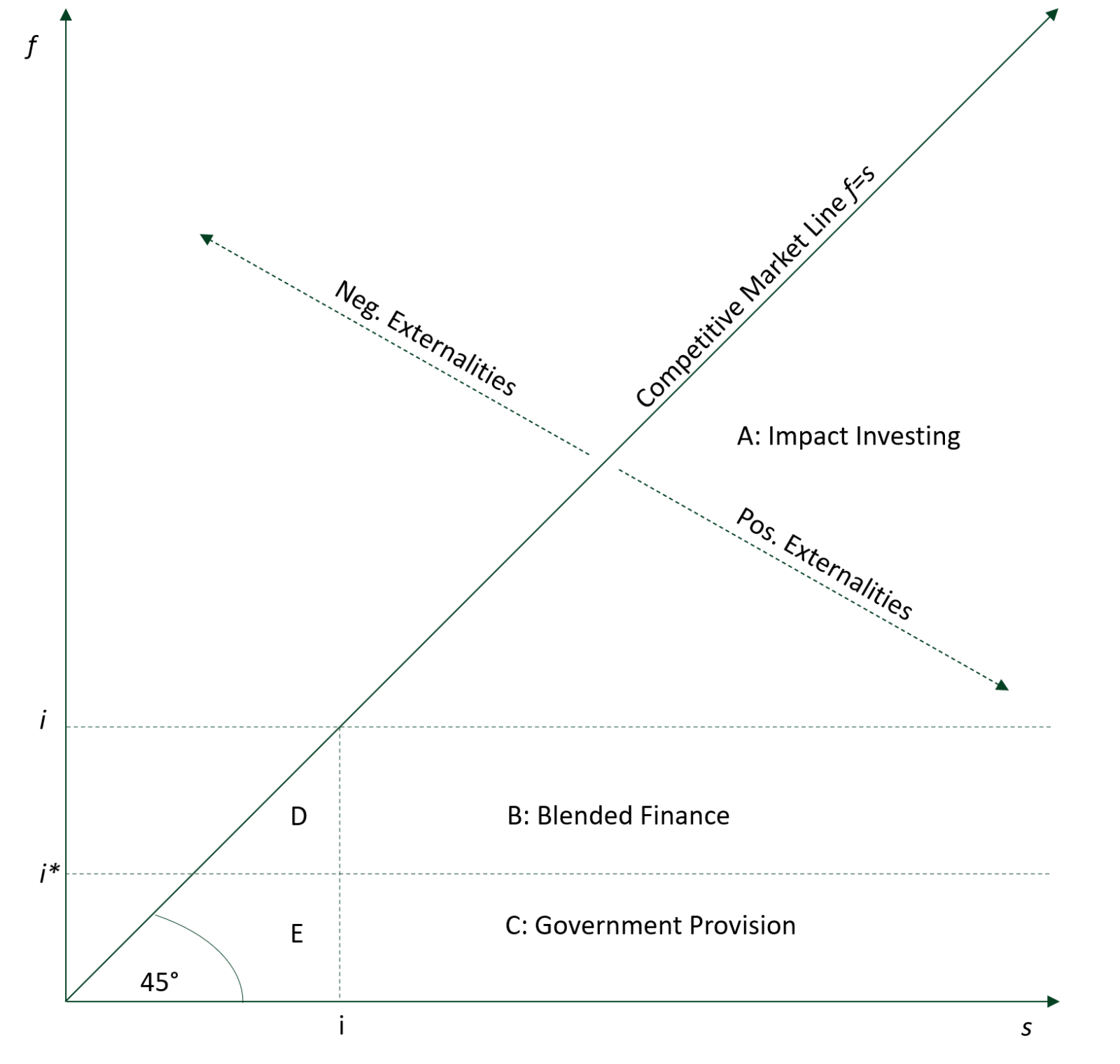
Figure 5: Dual impact project returns spaces (own illustration based on Schmidt (2023)82Schmidt, R. Are Business Ethics Effective? A Market Failures Approach to Impact Investing. J Bus Ethics 184, 505–524 (2023).)
The 45-degree line represents the equal market rate at which financial and social returns are equal (f = s). Investment areas located away from this line indicate that financial and social returns are not equal. Projects above the line (f > s) are associated with negative externalities, such as unethical investments, meaning lower social impact relative to financial returns. In SRI, investors commit to eliminating these externalities and moving to the left, where (f = s). In contrast, projects below the line (f < s) indicate positive externalities, where social impact exceeds financial returns. In dual-return investments, the aim is often to converge toward this market equilibrium line. While the dashed line (i) represents the commercial borrowing rate, meaning the safe return that investors can obtain from an investment, other projects involve risk, while (i*) represents the international market-risk-free borrowing rate.82Schmidt, R. Are Business Ethics Effective? A Market Failures Approach to Impact Investing. J Bus Ethics 184, 505–524 (2023).
If (f < i), this means the project is less commercially viable because its earnings are below the safe return. However, such projects may still be valuable for society if (s > i). In contrast, if (f < i) and (s < i), they are neither commercially effective nor socially effective, as higher commercial and social returns could be achieved at the safe rate.82Schmidt, R. Are Business Ethics Effective? A Market Failures Approach to Impact Investing. J Bus Ethics 184, 505–524 (2023). The area A represents the impact investing space, even though financial and social returns are not equal (f < s); however, the financial return, as emphasized by Höchstädter and Scheck (2015), must meet a minimum required level, and financial and social value are achieved even if the rates are not equal.7Höchstädter, A. K. & Scheck, B. What’s in a Name: An Analysis of Impact Investing Understandings by Academics and Practitioners. J Bus Ethics 132, 449–475 (2015).82Schmidt, R. Are Business Ethics Effective? A Market Failures Approach to Impact Investing. J Bus Ethics 184, 505–524 (2023).
Area B is the space where investments are not commercially viable because they exceed local market risk; these risks may include liquidity risk, political risk, or a weak enabling environment. Area C represents positive externalities that are not commercially viable in the local market and also not in the international market; in this case, the project can be supported by development assistance. Areas D and E represent investments that are neither financially nor socially effective in the local market, and investors, blended finance, or development assistance may not select these projects.82Schmidt, R. Are Business Ethics Effective? A Market Failures Approach to Impact Investing. J Bus Ethics 184, 505–524 (2023). Studies show that trade-offs are identified mostly in social sectors, where social returns tend to be higher, such as in healthcare, education, homelessness, and housing for the poor. Trade-offs are lower, and projects tend to be more investable in economic sectors, where social returns are also lower in sectors such as renewable energy, microfinance, agriculture, and sustainable land use.82Schmidt, R. Are Business Ethics Effective? A Market Failures Approach to Impact Investing. J Bus Ethics 184, 505–524 (2023).
Knafl and Scheck (2023) highlight the trade-off between impact and financial returns, where an increase in one dimension may lead to a reduction in the other, and note that trade-off preferences differ across investors. However, investees with a dual mission are required to pursue both objectives, and there is also the possibility of increasing both simultaneously through the so-called lockstep model.81Spiess-Knafl, W. & Scheck, B. Impact Investing: Instruments, Mechanisms and Actors. (Springer International Publishing, Cham, 2023). doi:10.1007/978-3-031-32183-2. The existence of hybridity in impact investing, as examined in the previous sections, implies that one logic may become dominant, which can erode the legitimacy of impact investment. On this spectrum, impact investors divided into categories such as finance-first and impact-first investors reflect the different levels of willingness to sacrifice financial returns or impact and different attitudes toward risk.81Spiess-Knafl, W. & Scheck, B. Impact Investing: Instruments, Mechanisms and Actors. (Springer International Publishing, Cham, 2023). doi:10.1007/978-3-031-32183-2. Casasnovas et al. (2020) study how hybridity affects legitimacy, showing that it is influenced by both the maturity and the degree of hybridity, and highlighting both the positive and negative effects of hybridity on legitimacy, as well as its high potential for generating trade-offs.78Casasnovas, G. & Chliova, M. Legitimacy Trade-Offs in Hybrid Fields: An Illustration Through Microfinance, Impact Investing and Social Entrepreneurship. in Organizational Hybridity: Perspectives, Processes, Promises (eds Besharov, M. L. & Mitzinneck, B. C.) 291–312 (Emerald Publishing Limited, 2020). doi:10.1108/S0733-558X20200000069020. Trade-off conflicts do not arise from the presence of different financial instruments, but rather from the inclusion of investors with different return expectations.81Spiess-Knafl, W. & Scheck, B. Impact Investing: Instruments, Mechanisms and Actors. (Springer International Publishing, Cham, 2023). doi:10.1007/978-3-031-32183-2. This categorization is seen as a major source of tension for blended value, as finance-first investors emphasize profitability while neglecting externalities that companies may generate, whereas the integration of blended value is a central element of impact investing.79Lazzarini, S. G., Cabral, S., Pongeluppe, L. S., Ferreira, L. C. D. M. & Rotondaro, A. The best of both worlds? Impact investors and their role in the financial versus social performance debate. in A Research Agenda for Social Finance (ed. Lehner, O. M.) 99–125 (Edward Elgar Publishing, 2021). doi:10.4337/9781789907964.00012. Finance-first investment strategies tend to target economic sectors with limited social or environmental impact, whereas impact-first strategies target social sectors and accept lower financial returns. This categorization leads to different investment targets and return expectations, resulting in trade-offs. Evidence shows that most investors are finance-first investors, which suggests that a large share of investments is directed toward economic sectors.82Schmidt, R. Are Business Ethics Effective? A Market Failures Approach to Impact Investing. J Bus Ethics 184, 505–524 (2023).
Lee et al. (2020) study impact and financial returns through the concepts of outcome efficiency and outcome inefficiency, defining them as follows: “[…] “outcome-efficient” decisions are those that invest the minimum amount of capital necessary to produce the realized combination of financial payback and social benefits, while ”[…] “outcome-inefficient” decisions leave money (and hence potential value creation) on the table” (p. 88).77Lee, M., Adbi, A. & Singh, J. Categorical cognition and outcome efficiency in impact investing decisions. Strategic Management Journal 41, 86–107 (2020). They demonstrate that outcome inefficiency is related to categorical cognition, meaning that individuals tend to rely on categories based on prior beliefs, and that this categorical thinking prevents impact investing from achieving its full potential in terms of both impact and financial value creation.77Lee, M., Adbi, A. & Singh, J. Categorical cognition and outcome efficiency in impact investing decisions. Strategic Management Journal 41, 86–107 (2020). Findlay and Moran (2019) identify the trade-off from the perspective of intentionality, as intentionality shapes the setting and characterization of social and environmental impact and financial return objectives, necessitating measurement of their achievement. Furthermore, additionality requires both investors and investees to explicitly intend to create a positive impact, arguing that impact exists if social outcomes exceed what would otherwise have occurred.47Findlay, S. & Moran, M. Purpose-washing of impact investing funds: motivations, occurrence and prevention. SRJ 15, 853–873 (2019).
Castellas et al. (2018) argue that investors do not necessarily face a trade-off between financial returns and social or environmental impact over the long term; however, for some investors, a trade-off exists, and they perceive higher risk than traditional investments.21Castellas, E. I.-P., Ormiston, J. & Findlay, S. Financing social entrepreneurship: The role of impact investment in shaping social enterprise in Australia. SEJ 14, 130–155 (2018). Mogapi et al. (2019) identify the management of both financial risk and impact as a critical factor in constructing impact investing portfolios, emphasizing the dynamics between the investment team and the investee.74Mogapi, E. M., Sutherland, M. M. & Wilson-Prangley, A. Impact investing in South Africa: managing tensions between financial returns and social impact. EBR 31, 397–419 (2019). As mentioned in previous sections, impact investing portfolios are often diversified across multiple sectors, which may reduce risk. Evidence suggests that impact-oriented portfolios can outperform non-impact portfolios during periods of crisis, and impact investing may serve as a buffer during market disruptions.72Thompson, B. S. Impact investing in biodiversity conservation with bonds: An analysis of financial and environmental risk. Bus Strat Env 32, 353–368 (2023).
No widely accepted framework enables impact investors to understand and manage trade-offs between financial and social returns. Weak financial performance is attributed to a lack of management skills or to unsustainable business cases, while challenges in achieving social returns are linked to difficulties in measuring impact.83Glänzel, G. & Scheuerle, T. Social Impact Investing in Germany: Current Impediments from Investors’ and Social Entrepreneurs’ Perspectives. Voluntas 27, 1638–1668 (2016). Mogapi et al. (2019) further examine the management of tensions between financial returns and the desire to create positive impact, positioning the debate within the context of hybrid organizing and paradox theory. Their findings show disagreement among impact investors: one position acknowledges trade-offs between financial returns and impact, while the other suggests that this is primarily a matter of perception and that both objectives can be achieved simultaneously.74Mogapi, E. M., Sutherland, M. M. & Wilson-Prangley, A. Impact investing in South Africa: managing tensions between financial returns and social impact. EBR 31, 397–419 (2019). For those who recognize the existence of trade-offs, it is acknowledged that financial risk differs across sectors and that trade-off pressures may lead to mission drift. At the same time, financial returns are not expected to exceed market rates but should remain market-related to demonstrate the investment approach’s viability.74Mogapi, E. M., Sutherland, M. M. & Wilson-Prangley, A. Impact investing in South Africa: managing tensions between financial returns and social impact. EBR 31, 397–419 (2019).
Mogapi et al. (2019) identify how to manage the tension between financial return and impact return by focusing on value alignment, contracting, engaged leadership, and sector identification.74Mogapi, E. M., Sutherland, M. M. & Wilson-Prangley, A. Impact investing in South Africa: managing tensions between financial returns and social impact. EBR 31, 397–419 (2019). Through the necessary value alignment between stakeholders, such as fund managers and the leadership of investee companies, tensions can be better managed. Through the contracting process, tensions are balanced by legal contracts and mission locks, ensuring that investees do not shift direction in ways that lead to mission drift. For risk mitigation, exit routes should also be considered. Engaged leadership, supported by the right investors, facilitates value creation while simultaneously managing tensions. Through sector identification, investors believe that focusing on high-impact sectors with strong financial return potential represents an effective strategy.74Mogapi, E. M., Sutherland, M. M. & Wilson-Prangley, A. Impact investing in South Africa: managing tensions between financial returns and social impact. EBR 31, 397–419 (2019).
At the center of the trade-off between financial and impact returns lies the debate of whether investors seeking to achieve social and environmental goals must accept lower financial returns. The literature indicates that the performance of investments varies according to the prioritization of one return over the other and depends on factors such as investor motivations, investment sector, and categorical cognitions, thereby requiring different return expectations and making it difficult for the field to determine whether a trade-off exists. For example, impact-generating investments may involve a high risk that expected financial returns are not achieved. However, if the expected financial returns are realized while impact is also generated, the investment may create additional value. As reflected in the empirical research of Barber et al. (2021), the annualized internal rate of return on impact funds was 4.7% lower than that of traditional VC funds.56Barber, B. M., Morse, A. & Yasuda, A. Impact investing. Journal of Financial Economics 139, 162–185 (2021). Jeffers et al. (2024), through empirical research, found that impact funds have lower total financial returns than non-impact funds. They also found that adding impact investments to a portfolio results in lower market risk exposure; however, this financial return gap becomes smaller when market risk exposure is taken into account.28Jeffers, J., Lyu, T. & Posenau, K. The risk and return of impact investing funds. Journal of Financial Economics 161, 103928 (2024). It remains important to maintain a minimum level of financial return while generating impact to remain within the boundaries of impact investing, as previously emphasized by Höchstädter and Scheck (2015), while intentionality and additionality should also be fulfilled. Figure 5 is a good illustration of the range of returns that can still make an impact investment attractive and the extent to which it can be classified as impact investing by maintaining a minimum level of both financial return and impact. Nevertheless, impact measurement is a long-term process that requires broad stakeholder engagement to enable meaningful comparisons with financial returns and to determine whether a real trade-off exists.
2.4 Research gaps and future avenues
Based on the issues covered in this review, research gaps and future avenues are identified in the literature. These are categorized into reducing the conflict between competing logics, managing risk, impact measurement, and limiting tensions. However, further research gaps also exist in other areas, which are beyond the scope of this literature review and not included in this section.
Reducing the conflict of competing logics
A research gap exists regarding the processes that can reduce conflicts between investors and investees, particularly conflicts arising from competing logics. It remains unclear whether competing logics represent a partnership dynamic or a permanent source of conflict. Understanding this is important because it facilitates long-term collaboration and improves investment performance.57Agrawal, A. & Hockerts, K. Impact Investing Strategy: Managing Conflicts between Impact Investor and Investee Social Enterprise. Sustainability 11, 4117 (2019). Further research is needed on the development of strong organizational processes capable of reducing conflicts arising from competing logics between investors and investees. In addition, studies using data from different countries should conduct cross-case analyses or test propositions to further explore the interorganizational relationship between investors and investees.58Agrawal, A. & Jespersen, K. How do impact investors evaluate an investee social enterprise? A framework of impact investing process. JEEE 16, 999–1022 (2024). Existing research does not explore the role of the investee throughout the selection process and its influence on the outcomes. Exploring the role of the investee during the selection process and its contribution to the outcomes could make impact investments more accountable.58Agrawal, A. & Jespersen, K. How do impact investors evaluate an investee social enterprise? A framework of impact investing process. JEEE 16, 999–1022 (2024).
Another unexplored area is when the investee receives investment from multiple investors with different requirements, and these investors have conflicting requirements regarding impact evaluation and reporting. Future research should explore how investees deal with these multiple requirements, which investors’ requirements they prioritize, and on what basis they prioritize them.73Islam, S. M. Impact investing in social sector organisations: a systematic review and research agenda. Accounting & Finance 62, 709–737 (2022). There is a need to better understand the challenges that hybrid organizations pose for investors seeking to pursue both financial returns and impact. Further research should examine how hybrid organizations influence resource allocation decisions when stakeholders must balance trade-offs between self-enrichment and social welfare. Understanding these trade-offs becomes particularly important for decision-making and strategic management when organizations move beyond pursuing only one dominant logic.77Lee, M., Adbi, A. & Singh, J. Categorical cognition and outcome efficiency in impact investing decisions. Strategic Management Journal 41, 86–107 (2020).
Overall, future research should explore the roles of investors, investees, and other stakeholders, and how they jointly shape investment decisions and impact outcomes. This collaboration helps reduce the conflicts arising from competing logics, strengthen relationships, and improve the effectiveness of impact investing.
Measuring the impact
Impact-generating investments focus on creating measurable impact; therefore, measuring impact is of high importance. Existing studies often focus on the social achievements of investees, reporting on aspects or outcomes at the individual investee level rather than on the aggregated impact of impact investing. Future research on the aggregated impact of impact investments could help assess whether its market generates meaningful social and environmental impact and whether it creates greater impact than ESG or traditional investments. Such research would also support policymakers in designing more effective policies, as individual investee outcomes are insufficient for informing decisions at the market level.2Schlütter, D., Schätzlein, L., Hahn, R. & Waldner, C. Missing the Impact in Impact Investing Research – A Systematic Review and Critical Reflection of the Literature. J Management Studies 61, 2694–2718 (2024). Furthermore, methodological gaps remain, particularly the lack of large-scale, longitudinal, and quantitative studies that measure impact and compare the impact of impact investing with traditional investments. Further research using these methodologies could help assess the long-term effectiveness of impact investments and increase the credibility of impact measurement.84Chiappini, H., Marinelli, N., Jalal, R. N.-U.-D. & Birindelli, G. Past, present and future of impact investing and closely related financial vehicles: a literature review. SAMPJ 14, 232–257 (2023).
Other identified gaps relate to who bears the costs of impact measurement, as measurement is complex, expensive, and often characterized by a long time horizon between intervention and observable results.57Agrawal, A. & Hockerts, K. Impact Investing Strategy: Managing Conflicts between Impact Investor and Investee Social Enterprise. Sustainability 11, 4117 (2019). Future research should examine who bears the costs of impact measurement, investors or investees, as these costs influence portfolio composition and investment selection, while measurement costs may be particularly prohibitive for smaller organizations. Scholars should evaluate what it costs impact investors to provide non-financial support, how they finance it, and what benefits it generates.84Chiappini, H., Marinelli, N., Jalal, R. N.-U.-D. & Birindelli, G. Past, present and future of impact investing and closely related financial vehicles: a literature review. SAMPJ 14, 232–257 (2023). As investors were grouped into impact-first and finance-first investors, with impact-first investors expecting higher impact returns and placing greater emphasis on impact measurement than finance-first investors, further research should classify investees into distinct groups and evaluate their social and environmental impact to compare which approach is more effective.2Schlütter, D., Schätzlein, L., Hahn, R. & Waldner, C. Missing the Impact in Impact Investing Research – A Systematic Review and Critical Reflection of the Literature. J Management Studies 61, 2694–2718 (2024).
Gaps related to impact measurement tools were acknowledged, and future research should focus on how the ToC could improve current methodologies.54Aggarwal, S., Rathee, P., Arya, V. & Roy, H. Inside story of impact investing in emerging market: A systematic review to measure the responsible and sustainable investing pattern using the ADO framework. Journal of Economic Surveys 39, 1695–1726 (2025). Alternative measurement techniques should be further researched, particularly regarding the trade-offs involved in measurement tools and how they can influence the design and stability of the investor-investee relationship.79Lazzarini, S. G., Cabral, S., Pongeluppe, L. S., Ferreira, L. C. D. M. & Rotondaro, A. The best of both worlds? Impact investors and their role in the financial versus social performance debate. in A Research Agenda for Social Finance (ed. Lehner, O. M.) 99–125 (Edward Elgar Publishing, 2021). doi:10.4337/9781789907964.00012. Another area for further research, given the involvement of many stakeholders with different expectations, is to understand what value means, to whom it matters, and how potential biases in impact measurement and stakeholder power imbalances can be reduced. Furthermore, future research should examine what the impact of an investment would have been if it had not occurred through impact investing, requiring consideration of both realities.9Hockerts, K., Hehenberger, L., Schaltegger, S. & Farber, V. Defining and Conceptualizing Impact Investing: Attractive Nuisance or Catalyst? J Bus Ethics 179, 937–950 (2022). Linking this to additionality, by observing the impact under both scenarios when the investment is made through impact investing and when it would not have occurred through impact investing, improves the credibility of impact measurement.
Managing the risk
An unexplored area remains the lack of established methodologies to identify the variables related to the quantification of impact risk and return, as this would support better investment decisions, facilitate the assessment of trade-offs between financial and impact returns, and improve the comparison of investment opportunities. Further research is needed on impact risk and return methodologies to quantify the variables related to impact risk and return.75Borrello, A., Bengo, I. & Moran, M. How impact investing funds invest in social‐purpose organizations: A cross‐country comparison. Corp Soc Responsibility Env 31, 879–894 (2024). Further investigation of impact risk is important due to the increasing demand for impact investing and the possibility that such investments may perform favorably on a risk-adjusted basis because of their low covariance with broader markets. An area for research concerns resilience, especially during crisis periods, and how resilience relates to impact investing instruments. Further research is needed to examine whether impact investing contributes to portfolio resilience during crisis periods through portfolio diversification across different sectors. Such research would help determine whether the financial performance of impact investments extends beyond their social and environmental objectives.84Chiappini, H., Marinelli, N., Jalal, R. N.-U.-D. & Birindelli, G. Past, present and future of impact investing and closely related financial vehicles: a literature review. SAMPJ 14, 232–257 (2023).
Limiting the tensions in impact investing
A gap in the research, which remains unresolved in the academic debate on return trade-offs, is the lack of comprehensive datasets on the financial performance of the investment. There are only a few academic papers based on quantitative methods that analyze the financial returns of impact investing. More studies comparing investment returns would provide stronger empirical evidence for the academic debate surrounding return trade-offs. Further research based on primary and quantitative data is needed, as many existing studies remain conceptual and rely heavily on secondary data. Further research to describe and measure investor preferences toward financial and social goals is also needed to examine the extent to which investors are willing to sacrifice economic value for greater social value creation, or vice versa.79Lazzarini, S. G., Cabral, S., Pongeluppe, L. S., Ferreira, L. C. D. M. & Rotondaro, A. The best of both worlds? Impact investors and their role in the financial versus social performance debate. in A Research Agenda for Social Finance (ed. Lehner, O. M.) 99–125 (Edward Elgar Publishing, 2021). doi:10.4337/9781789907964.00012. A research gap concerns the challenges faced by investors and investees in pursuing dual returns, particularly the trade-offs involved in achieving long-term social and environmental impact while generating financial returns and managing stakeholder expectations. Further research is needed to explore how investors can effectively navigate these tensions while ensuring the long-term sustainability of their investments.23Dordi, T., Stephens, P., Geobey, S. & Weber, O. New bottle or new label? Distinguishing impact investing from responsible and ethical investing. Accounting & Finance 64, 309–330 (2024).
Understanding the factors that influence tensions between impact and financial returns, as well as tensions between financial investors and other stakeholder groups, is important for reducing uncertainties and helping impact investing become a more mainstream investment. Further research is proposed to examine the contractual forms emerging within impact investing and to analyze how contractual practices across different financial instruments align financial performance with impact delivery to reduce conflicts. Topics such as governance structures and the desired characteristics of executives in top positions remain underinvestigated in impact investing, and further research on their role in preventing mission drift is important.84Chiappini, H., Marinelli, N., Jalal, R. N.-U.-D. & Birindelli, G. Past, present and future of impact investing and closely related financial vehicles: a literature review. SAMPJ 14, 232–257 (2023).
In summary, impact investing is a relatively new and evolving field that promises to address social and environmental challenges not only by reducing social and environmental risks but also by generating positive impact for society and the environment. This section provides an overview of the main research gaps and future avenues within the scope of this article. Although research on impact investing has developed considerably and laid important foundations, many research areas remain to be explored beyond the scope of this article, including impact washing, means-ends decoupling, stakeholder engagement, and the institutional environment, among others. Key questions regarding outcomes and impact measurement remain unanswered. Future research should adopt different methodological approaches to comprehensively capture the complexity and dynamics of impact measurement and outcomes, thereby generating valuable contributions for both academics and practitioners in the field of impact investing.
3 Investment processes of the practical implementation
Building on the previous chapter, which analyzed the current state of research on impact investing and highlighted its complexity, this chapter examines the practical implementation process of impact investments. The practical implementation process is divided into three main stages. The first stage is deal origination (deal sourcing and initial screening), which includes finding investment opportunities and analyzing the criteria. The second stage is deal screening (including due diligence and deal structuring), such as screening for performance and setting objectives. The deal establishment (including impact measurement and management, and exit) supports the impact management and, at the end, verifies the results with objectives.75Borrello, A., Bengo, I. & Moran, M. How impact investing funds invest in social‐purpose organizations: A cross‐country comparison. Corp Soc Responsibility Env 31, 879–894 (2024). These stages cover the implementation process of impact investing, with each stage involving both investor and investee perspectives and being illustrated through practical cases. Within each stage, the drivers and barriers that influence practical implementation are discussed, together with the tools and methods used for impact measurement.
3.1 Deal origin
The deal origination stage explains how investment opportunities are sourced and how investors identify and screen investees by introducing practical cases, as well as the drivers and barriers associated with this stage.
3.1.1 Deal sourcing
Impact investing funds use a mixed strategy to select investment opportunities. At the beginning of the deal-sourcing process, impact investing funds often post calls for applications on their websites or through direct outreach.75Borrello, A., Bengo, I. & Moran, M. How impact investing funds invest in social‐purpose organizations: A cross‐country comparison. Corp Soc Responsibility Env 31, 879–894 (2024). At this stage, investors develop impact strategies and objectives. Frameworks such as the SDGs are commonly used as an overarching guide to assess credibility, relevance, scale, and contribution to sustainable development for people and the planet.67Islam, S. M. & Habib, A. How impact investing firms use reference frameworks to manage their impact performance: An industry‐level study. Accounting & Finance 64, 161–184 (2024). The ToC serves as a conceptual framework of cause-and-effect relationships, through which investors or organizations define how they expect to create the desired impact within a specific objective, category, or sector. Through the ToC, impact investors can better understand the impact associated with an investment.85Global Impact Investing Network. Methodology for Standardizing and Comparing Impact Performance. (2020). These strategies guide the definition of the investment approach and the initial stage of portfolio construction. At this stage, investors begin to address key questions regarding opportunities that enable the achievement of impact goals within defined risk, return, and liquidity parameters. Decision-making for investors is highly dynamic, as illustrated in Figure 6, and six factors influence this process. Investors consider these factors to achieve investment performance and to assess the effectiveness of their strategy in reaching defined objectives.86Global Impact Investing Network. COMPASS: The Methodology for Comparing and Assessing Impact. (2021).
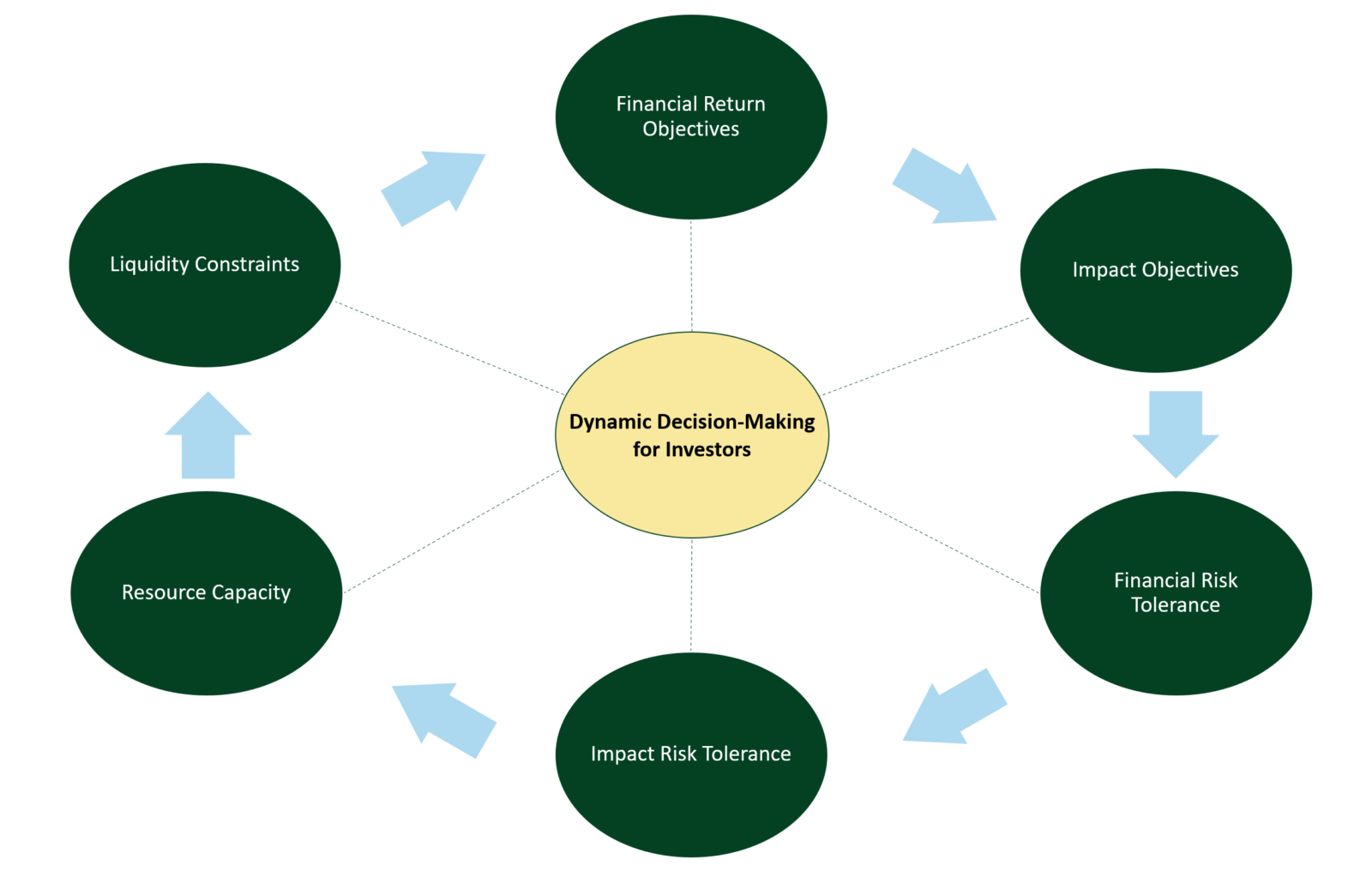
Figure 6: Dynamic decision-making model for investors (own illustration based on Global Impact Investing Network (2021)86Global Impact Investing Network. COMPASS: The Methodology for Comparing and Assessing Impact. (2021).)
The factors influencing investor decision-making are financial return objectives, impact objectives, financial risk tolerance, impact risk tolerance, resource capacity, and liquidity constraints. Investors use a multidimensional approach to manage performance and allocate capital, considering the influence of each factor to achieve investment performance aligned with their objectives. Investors should consider these factors alongside financial performance, including risk and return, liquidity, and resourcing. This provides a holistic view of investment performance, helping investors make informed decisions and ensuring long-term sustainability.86Global Impact Investing Network. COMPASS: The Methodology for Comparing and Assessing Impact. (2021).
Incofin Investment Management is an international private equity and debt fund manager that invests in financial services and agriculture worldwide and incorporates all new investments into the SDG framework. In Incofin’s view, the SDGs are an effective and practical framework for aligning its impact strategy, and its aim is to apply the SDGs in ways that are practical for Incofin, its investees, and its investors.87Global Impact Investing Network. Financing the Sustainable Development Goals: Impact Investing in Action. (2018).
AlphaMundi Group is an investment advisory firm dedicated to impact investing, with a dual mission to reduce poverty and preserve the environment in developing countries. Their SDG focus includes SDG 1 (No Poverty), SDG 5 (Gender Equality), SDG 6 (Clean Water and Sanitation), SDG 7 (Affordable and Clean Energy), and SDG 12 (Responsible Consumption and Production), and they have invested USD 60 million in 47 social impact businesses through more than 200 transactions, supporting social enterprises in sectors such as agriculture, energy, financial services, and employment, using impact funds that make debt, equity, and mezzanine investments in Sub-Saharan Africa and Latin America.88Global Impact Investing Network. IRIS+ Use Case: Alphamundi Impact. (2021). AlphaMundi seeks to achieve impact in each investment through both financial and non-financial means, and offers financing to companies that cannot access capital from local banks, thereby supporting their growth. They state that they invest only in social ventures whose impact is integral to their business model.88Global Impact Investing Network. IRIS+ Use Case: Alphamundi Impact. (2021).
In its strategy, AlphaMundi Group specifies that investees are selected based on criteria such as: “an established operational track record over many years, financial profitability and growth prospects, quality of products and services compared to their peers, quality and stability of the management team, soundness of governance structure, measurability of the social and/or environmental impact of their activities, responsible corporate behavior, reporting capacity, alignment of vision between the aspirations and objectives of their main shareholders, as well as country and sector risk.”(p. 2).88Global Impact Investing Network. IRIS+ Use Case: Alphamundi Impact. (2021). In this stage, the core dimension of impact investing is reflected, particularly intentionality, which refers to contributing to positive social and environmental impact through investments alongside financial returns.
Drivers
Senior leadership and organizational culture can act as both drivers and barriers, depending on whether the board of directors and senior management support the integration of impact considerations into investment decisions. Securing internal buy-in and demonstrating the feasibility of optimizing for risk, return, and impact are critical for defining impact priorities. To address skepticism regarding the impact-return relationship, organizations often adopt a proof-of-concept approach, using data and pilot investments to demonstrate that impact strategies can achieve both strong financial performance and meaningful impact simultaneously. In addition, presenting successful examples from peer organizations helps to strengthen internal buy-in and build confidence in impact investing strategies.89Global Impact Investing Network. Institutional Asset Owners: Approaches to Setting Social and Environmental Goals. (2021).
Political drivers play an important role in setting policies and regulatory frameworks and supporting the development of the impact investing market by stimulating the supply of impact investment capital or providing funding for impact investments. They can also support the market by directing public capital and expenditures toward impact investments. Another way to support the impact investing market is by stimulating demand through building the capacity of impact investment recipients to absorb capital.44Lehner, O. M. (ed.). Routledge Handbook of Social and Sustainable Finance. (Routledge, 2016). doi:10.4324/9781315772578. During the United Kingdom’s presidency of the G8 in 2013, the Social Impact Investment Task Force was established with the mission of catalyzing the development of the social impact investment market by bringing together leaders from government, business, and philanthropy sectors. In 2014, the Obama Administration committed to catalyzing private sector impact investments and supporting the companies involved.6Tekula, R. & Andersen, K. The Role of Government, Nonprofit, and Private Facilitation of the Impact Investing Marketplace. Public Performance & Management Review 42, 142–161 (2019).
Governments also create and offer incentives and regulatory environments to scale up impact investments. One example is the European Union Taxonomy Regulation (EU) Taxonomy, a classification system established to clarify which economic activities are considered environmentally sustainable, which also supports the objectives of the European Green Deal, an initiative to make Europe climate-neutral by 2050. Regulatory environments are increasingly encouraging asset owners to assess and disclose climate-related risks and opportunities based on climate scenario analysis.89Global Impact Investing Network. Institutional Asset Owners: Approaches to Setting Social and Environmental Goals. (2021). Another example is the strengthening of regulatory frameworks to prevent greenwashing and ensure comparability, such as the EU’s Sustainable Finance Disclosure Regulation (SFDR), which establishes sustainability-related disclosure requirements to increase transparency in the market for sustainable financial products. By enhancing the comparability of these products, the SFDR enables investors to better understand the potential impact of their investment decisions.90BlueOrchard Finance Ltd. An Investor’s Guide to Impact Investing: 5 Steps to Create a Strategy. (2021). Market participants must classify financial products into Article 8 categories (products that promote environmental or social characteristics, often referred to as “light green”) and Article 9 categories (products with sustainable investment as their objective). Article 9 products, often referred to as “dark green” or impact-related investments, pursue more ambitious ESG strategies and are frequently associated with impact investing.91Eurosif. EU Sustainable Finance & SFDR: Making the Framework Fit for Purpose – Eurosif Policy Recommendations. (2022). Article 9 products are expected to demonstrate a high level of environmental or social ambition.35Scheitza, L. & Busch, T. SFDR Article 9: Is it all about impact? Finance Research Letters 62, 105179 (2024). Governments can play multiple roles, including regulator, provider of subsidies, and supplier of technical assistance.6Tekula, R. & Andersen, K. The Role of Government, Nonprofit, and Private Facilitation of the Impact Investing Marketplace. Public Performance & Management Review 42, 142–161 (2019).
Frameworks and targets: The SDGs, the Paris Agreement, and the 100 Resilient Cities have been used as frameworks to achieve their targets. For example, the SDG goals, which are an ambitious and universal call to action to end poverty, protect the planet, and ensure prosperity for all, have been widely used by impact investing practitioners as a major framework to achieve these goals and fill the financial gaps to address these challenges. Investors have found that the SDGs are a good framework to articulate the relationship between investment and impact goals and streamline communication with a range of stakeholders.87Global Impact Investing Network. Financing the Sustainable Development Goals: Impact Investing in Action. (2018). The reference frameworks are good guides and tools to share best practices on specific issues. They also serve as good enablers to help investors better achieve their impact goals.67Islam, S. M. & Habib, A. How impact investing firms use reference frameworks to manage their impact performance: An industry‐level study. Accounting & Finance 64, 161–184 (2024).
Societal and environmental drivers, together with stakeholder pressure and societal expectations, are strong drivers shaping how impact investing priorities are set. It is relatively rare for societal and environmental needs to be the primary drivers, as investors tend to prioritize investability; however, these issues still shape the thematic focus. Stakeholder expectations and reputational concerns push investors to integrate impact into capital allocation to maximize impact per unit of investment and achieve the dual objective of financial return and impact.89Global Impact Investing Network. Institutional Asset Owners: Approaches to Setting Social and Environmental Goals. (2021). Macro-level events, such as the increasing implications of the climate change crisis and the long-term effects of the COVID-19 pandemic, are dominant factors influencing impact investors to engage in investments that address pressing societal challenges. As the climate crisis intensifies, investors are increasingly allocating capital to climate-focused impact investments and seeking climate solutions across their portfolios. Climate is viewed as a cross-cutting strategy that can be applied across multiple impact themes and sectors. Such investments are mainly concentrated in sectors such as energy, agriculture and land use, and waste management. This demonstrates the ability of impact investing opportunities to adapt and respond to global crises.92Global Impact Investing Network. GIINsight 2023: Emerging Trends in Impact Investing. (2023).
Barriers
Changes in regulatory frameworks can weaken or remove supportive frameworks and can change the demand for impact investing by reducing initiatives for impact investing, for example, by no longer providing subsidies or not stimulating supply. In some states in the United States, the so-called “ESG backlash” has made some investors more cautious, and when consortia-related practices may fall under antitrust legislation, some investors have chosen to withdraw from public signaling of their commitment.5Global Impact Investing Network. Sizing the Impact Investing Market 2024. (2024). A lack of guidance from regulatory bodies on what is required for impact investing strategies is considered a barrier, and uncertainty in guidance from regulatory bodies also creates barriers in implementation.92Global Impact Investing Network. GIINsight 2023: Emerging Trends in Impact Investing. (2023). Regulatory frameworks can provide a useful baseline, but they may also create confusion, particularly when they are complex and costly to implement.8Global Impact Investing Network. State of the Market 2025: Trends, Performance and Allocations. (2025).
Internal expertise, for many investors, a lack of general knowledge in specific themes is considered a barrier to pursuing impact in these areas. For individual investors, common barriers include a lack of confidence in their own investment capabilities, limited clarity regarding strategic objectives, and capacity constraints, particularly in relation to deal-sharing.93Bertelsmann Stiftung. Family Offices and the SDGs: Investing for Impact. (2020).
Global issues such as political insecurity and armed conflicts pose significant barriers to emerging-market-focused investor strategies, more so than to those focused on developed markets. These insecurities affect the impact-investing strategies of emerging-market-focused investors more strongly than those of developed-market-focused investors. They may also lower the financial performance expectations of investments.92Global Impact Investing Network. GIINsight 2023: Emerging Trends in Impact Investing. (2023).
3.1.2 First-deal screening
Firstly, the financial, social, and environmental aspects of the investee are assessed before the investor and investee come together. The investor seeks to understand the investee’s social and environmental impact and its measurability, while the financial aspect is treated similarly to traditional financing.75Borrello, A., Bengo, I. & Moran, M. How impact investing funds invest in social‐purpose organizations: A cross‐country comparison. Corp Soc Responsibility Env 31, 879–894 (2024). During this stage, impact investors conduct a preliminary assessment to determine whether a project can deliver the expected performance. Initially, investors use negative screening to avoid creating a negative impact. While negative screening is important, investors also recognize the importance of positive screening in impact investing. They acknowledge that some projects go beyond avoiding harm and make a significant positive contribution, with clear impact intentions. One possibility for investors is to apply positive screening criteria based on the SDGs.67Islam, S. M. & Habib, A. How impact investing firms use reference frameworks to manage their impact performance: An industry‐level study. Accounting & Finance 64, 161–184 (2024).
3.2 Deal screening
This stage includes deal screening activities such as investment assessment and due diligence, involving a detailed investigation of the investment, and concludes with the negotiation and design of the investment terms.
3.2.1 Due Diligence and deal structuring
Projects that pass the initial screening process are selected for due diligence, and the results of this stage help investors decide whether to invest in the project. At this stage, it enables investors to introduce a holistic dimension by conducting an ex ante impact assessment and to identify the impact dimensions to be assessed in relation to the investment project, providing guidance on how to evaluate these impact dimensions.67Islam, S. M. & Habib, A. How impact investing firms use reference frameworks to manage their impact performance: An industry‐level study. Accounting & Finance 64, 161–184 (2024). The key questions in this stage are: which investments have the greatest potential to create impact, and what level of impact is likely to be achieved?86Global Impact Investing Network. COMPASS: The Methodology for Comparing and Assessing Impact. (2021). At this stage, the investor seeks to understand from the investee whether the impact is intentionally generated or incidental, and whether it is reflected not only in the investee’s mission but also in the organization’s strategy and objectives.75Borrello, A., Bengo, I. & Moran, M. How impact investing funds invest in social‐purpose organizations: A cross‐country comparison. Corp Soc Responsibility Env 31, 879–894 (2024).
In the case of Incofin Investment Management, investees are required to contribute to broader social, environmental, and commercial goals. The sectors in which they invest include financial services and agriculture, and they expect investees in agriculture to demonstrate sustainability practices through certifications such as Fair Trade or Rainforest Alliance. Incofin has developed SDG-targeted indicators for investees, and these indicators are used to evaluate them. Potential investees must meet a minimum score, and this evaluation also identifies areas for improvement.87Global Impact Investing Network. Financing the Sustainable Development Goals: Impact Investing in Action. (2018).
AlphaMundi Group invests in companies with measurable, demonstrable social and/or environmental impact related to their activities, and these characteristics are evaluated before projects are presented to the Investment Committee. Due diligence memos include a dedicated section that describes the company’s social impact, both directly with clients and indirectly with beneficiaries. For all investments, AlphaMundi integrates a gender lens assessment with the intention of eliminating gender bias and promoting gender equity across investees. All investees must complete the assessment prior to investment and commit to receiving support on gender-related issues. A diagnostic assessment is conducted prior to investment to evaluate how gender considerations are incorporated across five elements: (1) design of products or services, (2) production, manufacturing, and processing, (3) sales and after-sales services, (4) marketing and advertising, and (5) equitable systems and structures. This assessment is shared with companies to discuss strengths and opportunities for integrating gender considerations across the business.88Global Impact Investing Network. IRIS+ Use Case: Alphamundi Impact. (2021).
The Impact Management Project has developed a five-dimensional framework to help impact investors assess a project’s potential impact. By asking questions such as “What?”, “Who?”, “How much?”, “Contribution,” and “Risk,” the framework helps organizations make better investment decisions, monitor impact, and improve outcomes.
1. What is the goal?This dimension enables investors to identify the outcomes to which the investee contributes and how important these outcomes are to stakeholders. It includes the objectives of the investment or enterprise, as well as the strategic goals and metrics that define how outcomes will be measured.94Global Impact Investing Network. IRIS+ Core Metrics Sets. (2019). Villa Andina is a Peruvian agro-industrial company dedicated to producing and commercializing organic food products, including cacao, quinoa, and chia. In an effort to contribute to the economic development of Peru’s most isolated rural communities, it buys raw materials from smallholder farmers in these communities. Villa Andina has been an AlphaMundi Group investee since December 2019. For Villa Andina, the outcome indicator is the average agricultural yield of smallholder suppliers, and its importance to stakeholders is very high. Through their involvement, smallholder farmers have been able to expand and diversify their crop production toward higher-yielding crops, supported by certification training.88Global Impact Investing Network. IRIS+ Use Case: Alphamundi Impact. (2021).
2. Who is affected?This dimension describes the stakeholders affected by the investment, including stakeholder type and characteristics such as demographics, socio-economic status, setting, and geography.94Global Impact Investing Network. IRIS+ Core Metrics Sets. (2019). The stakeholders of Villa Andina are smallholder farmers in rural areas using traditional practices aligned with organic standards. The company also hires local community members on a part-time basis to process fruit, and it partners with nongovernmental organizations (NGOs) to provide organic certification and training. The characteristics of stakeholders include women and men farmers ages 20–50, with low incomes in the Cajamarca region of Peru.88Global Impact Investing Network. IRIS+ Use Case: Alphamundi Impact. (2021).
3. How much change is happening?This dimension focuses on the scale (how many stakeholders experience the outcome) and the depth (the degree of change experienced by stakeholders).94Global Impact Investing Network. IRIS+ Core Metrics Sets. (2019). For Villa Andina, there is limited available data on scale and depth; however, the company tracks crop yield and pricing at an aggregate level. The change is reflected in higher incomes for smallholder farmers, as Villa Andina pays higher prices per kilogram for organic goldenberries than the local market price.88Global Impact Investing Network. IRIS+ Use Case: Alphamundi Impact. (2021).
4. What is the contribution?This dimension refers to the investee’s contribution, such as the use of identified data to assess its contribution to social and environmental outcomes relative to what the market or social system would have achieved on its own. It also refers to the investor’s contribution in defining and applying strategies that support investees in generating impact.94Global Impact Investing Network. IRIS+ Core Metrics Sets. (2019). In the case of Villa Andina, AlphaMundi Group signals that measurable impact matters and actively engages in promoting it, while the investee contributes through different programs to increase the productivity of smallholder farmers, including guaranteed sales of their produce at fair market prices, logistical support, and the collection of raw materials.88Global Impact Investing Network. IRIS+ Use Case: Alphamundi Impact. (2021).
5. What is the impact risk?Each impact risk factor is described and identified as material for a specific investment, including risks such as stakeholder participation risk, execution risk, and contribution risk, depending on the strategic goal.94Global Impact Investing Network. IRIS+ Core Metrics Sets. (2019). Smallholder farmers’ operations are subject to natural risks, such as extreme weather events and crop diseases. There can also be alignment risks, such as mission drift, in which Villa Andina might shift sourcing toward larger-scale distributors rather than smallholder farmers.88Global Impact Investing Network. IRIS+ Use Case: Alphamundi Impact. (2021).
6. How is change happening?This dimension helps contextualize the data captured in the previous dimensions to examine the full picture of the enterprise and its relationship with people and the planet.94Global Impact Investing Network. IRIS+ Core Metrics Sets. (2019). Villa Andina provides support to smallholder farmers in four key areas, such as technical assistance in environmental practices, closed-system farming that ensures farmers do not use foreign chemicals or substances that do not grow naturally on the farm, soil protection, and support in bookkeeping skills to help farmers track costs and profits. It also supports them with seeds obtained from seedbeds, certification through training, coverage of certification costs, and logistical support to guarantee product quality. Key indicators include the total number of farmers and the number of new farmers added.88Global Impact Investing Network. IRIS+ Use Case: Alphamundi Impact. (2021).
Using the SDG framework in the case of Incofin Investment Management, it collaborates with investees to tailor the impact strategy and jointly develop plans on how to measure and improve social and environmental performance. Indicators are mapped to relevant SDG targets, and Incofin supports investees and other stakeholders in understanding the SDGs and ensures that indicators are measurable and practicable.87Global Impact Investing Network. Financing the Sustainable Development Goals: Impact Investing in Action. (2018).
Another stage of due diligence is dedicated to ex ante impact risk assessment, aimed at assessing the risk of creating negative impacts. Major frameworks used for this purpose include the International Finance Corporation (IFC) Performance Standards on Environmental and Social Sustainability, the IFC Environmental and Social Risk Categorization, and the World Bank Group frameworks. These provide investors with guidance on identifying, assessing, and categorizing environmental and social risks arising from investee operations, thereby facilitating more informed investment decisions.67Islam, S. M. & Habib, A. How impact investing firms use reference frameworks to manage their impact performance: An industry‐level study. Accounting & Finance 64, 161–184 (2024). The social and environmental objectives must be established at this stage, together with the corresponding impact metrics, and these objectives should be aligned with the financial objective.75Borrello, A., Bengo, I. & Moran, M. How impact investing funds invest in social‐purpose organizations: A cross‐country comparison. Corp Soc Responsibility Env 31, 879–894 (2024).
Good drivers for the assessment may include standards and frameworks, such as the Impact Management Project’s Five Dimensions, as they can act as a checklist for understanding the intended impact in relation to the investment strategy. Other drivers may include the availability of high-quality data, which can make investment decisions more transparent and reduce risks, as well as clear impact investment strategies that contribute to the success of the investment. Barriers to this process may include the lack of data availability, which may lead to lower transparency and insufficient information for investors.94Global Impact Investing Network. IRIS+ Core Metrics Sets. (2019). Information asymmetry between the investor and the investee is another barrier that, as discussed in the literature review, can lead to mission drift. In addition, differing investor expectations regarding the investee can also act as a barrier.
3.3 Deal establishment
When the investor decides to invest in the investee, the relationship between them becomes more stable, and they enrich each other through active engagement.75Borrello, A., Bengo, I. & Moran, M. How impact investing funds invest in social‐purpose organizations: A cross‐country comparison. Corp Soc Responsibility Env 31, 879–894 (2024).
3.3.1 Impact measurement and management
This stage involves the co-creation of social/environmental and economic goals, with ideas exchanged between the investor and the investee about where to focus and which goals to set. In some cases, a third party, such as an impact measurement expert, is included to assist in defining objectives and indicators. After that, the measurement process is established, including the use of frameworks for impact measurement with specific parameters and indicators. Output measurement is useful for contracting and dialogue with investors to gain financial resources or for communication with stakeholders; however, more resource-intensive methods are required to measure impact.75Borrello, A., Bengo, I. & Moran, M. How impact investing funds invest in social‐purpose organizations: A cross‐country comparison. Corp Soc Responsibility Env 31, 879–894 (2024).
Reference frameworks used to monitor impact performance, such as IRIS+, help investors identify and set standard metrics aligned with their impact objectives and provide guidelines for implementation.67Islam, S. M. & Habib, A. How impact investing firms use reference frameworks to manage their impact performance: An industry‐level study. Accounting & Finance 64, 161–184 (2024). One key question for investors is whether they are underperforming on impact and engaging appropriately with investees. By comparing their impact performance with that of their peers, investors can gain better insight into whether their performance is above or below average. This allows investors to obtain real-time diagnostics of their impact results through continuous monitoring and identify areas where investees need additional support to strengthen impact results.86Global Impact Investing Network. COMPASS: The Methodology for Comparing and Assessing Impact. (2021).
Through impact management and measurement, a framework is used to test whether the portfolio investment is achieving its impact goals, and there are three core questions in this strategy: why, what, and how. Answering the question why means understanding, during impact measurement, whether short-term changes and long-term effects are occurring as expected, or whether performance is over- or underperforming. It also serves as a learning process for investors for future portfolios. Based on the question of why, this determines what should be measured, and which frameworks, standards, and principles can be used as drivers to gather impact data. Frameworks are specific structures used to organize impact measurement and management, and they translate the intentions of principles into practice. Examples include the UN SDGs, which are widely used in impact investing, and the five dimensions of impact. Standards refer to the taxonomies and core metrics applied, which vary by specific investment focus, and widely used examples include the IRIS+ standards.95Rockefeller Philanthropy Advisors. Impact Investing Handbook: An Implementation Guide for Practitioners. (2020).
Answering the question of how impact is measured starts with the impact measurement and management lifecycle, which includes the design, collection, and assessment of impact. It is divided into four stages: Plan, Do, Assess, and Review. As shown in Figure 7, the first stage is Plan, and the goals need to consider the investment’s effect on society and the environment, and the balance among risk, return, liquidity, and impact. ToC can be used as a guide to determine what data is needed and whether the data is available. Based on this, the investor must identify which metrics and tools are appropriate for the sector to track performance and manage toward success, considering time, costs, skills, and the intention to capture data. The impact metrics should provide decision-relevant information for investors and investees.95Rockefeller Philanthropy Advisors. Impact Investing Handbook: An Implementation Guide for Practitioners. (2020).96Global Impact Investing Network. Impact Investing: A Guide to This Dynamic Market. (2025). In the Do stage, data is collected using different methodologies and tools, such as those developed by IRIS+. This data needs to be validated, and the most relevant tools or a combination of tools should be used as appropriate.95Rockefeller Philanthropy Advisors. Impact Investing Handbook: An Implementation Guide for Practitioners. (2020).
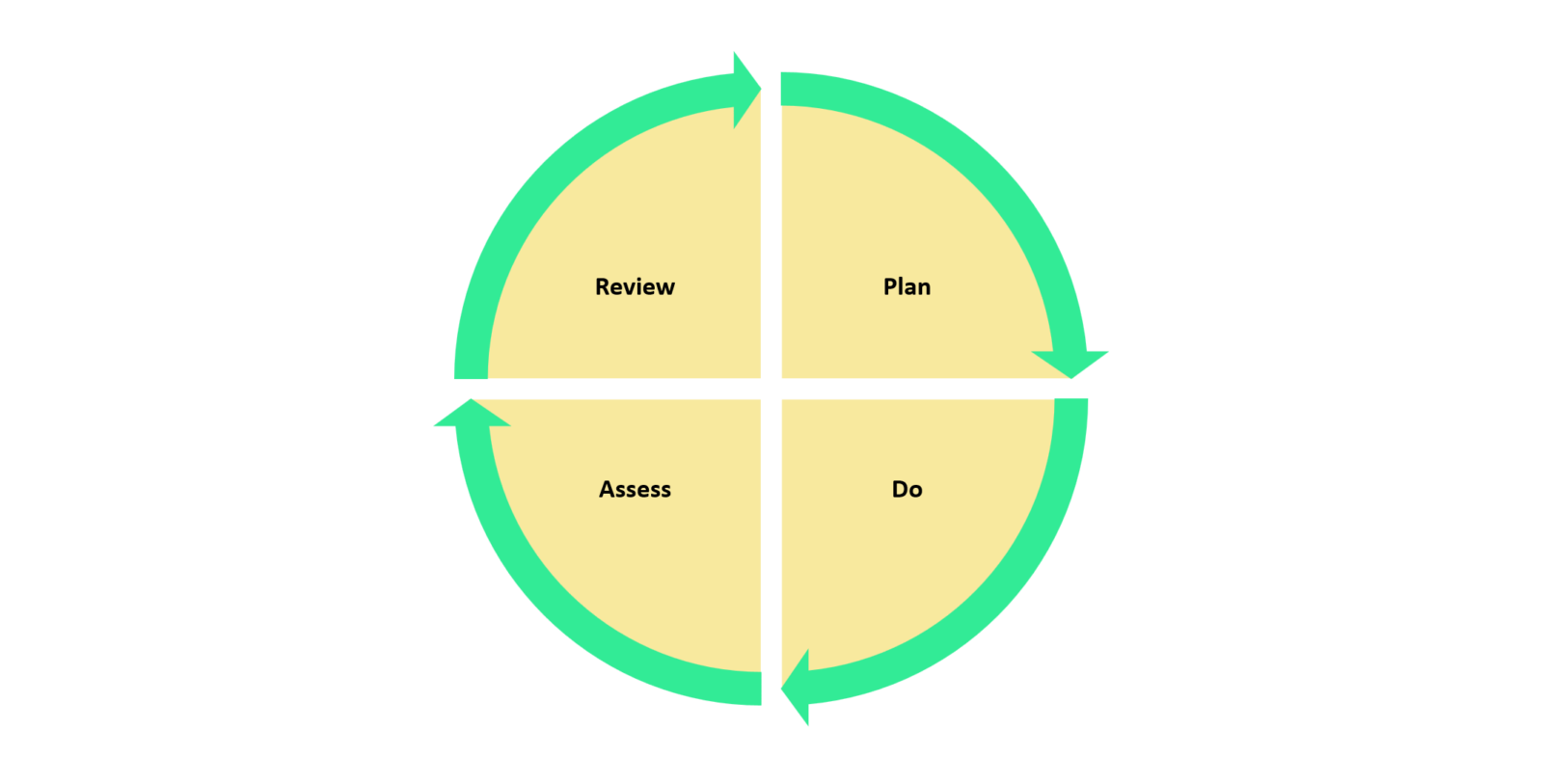
Figure 7: Impact measurement management (own illustration based on Rockefeller Philanthropy Advisors (2020)95Rockefeller Philanthropy Advisors. Impact Investing Handbook: An Implementation Guide for Practitioners. (2020).)
In the Assess stage, the collected data should be analyzed to identify the impact on people and/or the environment, and to determine how operations can be improved to increase impact. These data are important because they provide information about the risk, returns, and impact, which help to strengthen portfolio performance and investment strategy.95Rockefeller Philanthropy Advisors. Impact Investing Handbook: An Implementation Guide for Practitioners. (2020).96Global Impact Investing Network. Impact Investing: A Guide to This Dynamic Market. (2025). In the Review stage, progress is shared with key stakeholders, and insights gained inform decision-making and may generate new questions. Implementation mechanisms are then identified to strengthen the investment process and outcomes, thereby forming a continuous cycle.95Rockefeller Philanthropy Advisors. Impact Investing Handbook: An Implementation Guide for Practitioners. (2020). The Five Dimensions introduced during the due diligence stage are also continuously refined and monitored throughout the impact management stage and reporting.
Incofin Investment Management measures and reports annually on investee performance against impact indicators and creates an impact-output dashboard for each investee to demonstrate alignment with the SDGs and overall impact objectives. Investees benefit from aligning their impact indicators with the SDGs and communicating their impact within the SDG framework.87Global Impact Investing Network. Financing the Sustainable Development Goals: Impact Investing in Action. (2018).
In the case of AlphaMundi Group, once the investment is made, investees report by submitting the data. AlphaMundi reviews the data for accuracy and trend analysis, and for follow-on financing or extensions, it reevaluates impact metrics using IRIS+ core metric sets.88Global Impact Investing Network. IRIS+ Use Case: Alphamundi Impact. (2021).
IRIS+ thematic taxonomy
The taxonomy is structured as a classification hierarchy from broad to narrow, translating objectives into measurable data and results. It starts at the highest level with impact categories, and within each category, there are more specific impact themes, which reflect the different ways investors and enterprises contribute to impact within that category.
Some impact themes include lenses, which are applied across the portfolio to provide more specific focal points. The taxonomy comprises a set of specific goals, while lenses provide more targeted perspectives. For these, IRIS+ includes evidence-backed Core Metrics based on best practices. When used alongside the five dimensions of impact, the taxonomy provides a coherent and comparable set of core metrics, along with guidance and resources for measuring environmental and social performance.97Global Impact Investing Network. IRIS+ Thematic Taxonomy. (2025).
All impact categories can generate both positive and negative social or environmental effects, and no category is exempt from potential negative outcomes. The IRIS+ taxonomy is agnostic and does not define whether certain categories contribute to positive or negative effects. Instead, it connects different elements through a structured framework, enabling investors and investees to map their contributions to impact. Impact categories are defined based on input from stakeholders involved in the development of IRIS+, and include areas such as agriculture, air, climate, energy, and pollution. For example, climate represents one key impact category.97Global Impact Investing Network. IRIS+ Thematic Taxonomy. (2025).
Impact themes or lenses describe purpose-driven approaches that contribute to social or environmental impact within broader impact categories, and they are classified within these categories. Themes within the climate category include climate change mitigation, adaptation, and resilience, often aligned with frameworks such as the SDGs, the Paris Agreement, or initiatives like 100 Resilient Cities.97Global Impact Investing Network. IRIS+ Thematic Taxonomy. (2025).
Delivery models operationalize these themes or lenses, representing the project-based mechanisms through which impact is delivered to people and the environment. Examples include cap-and-trade systems, government-driven financial initiatives to reduce greenhouse gas emissions, climate bonds, and bioproducts or biochemicals.97Global Impact Investing Network. IRIS+ Thematic Taxonomy. (2025).
Strategic goals or focal points refer to the common objectives that investors pursue to achieve impact. These goals can span multiple themes, such as mitigating climate change through clean mobility, clean electricity and heat production, reducing emissions from forestry and land use, improving household resilience to flood risks, strengthening power system resilience, or developing job skills for the future.97Global Impact Investing Network. IRIS+ Thematic Taxonomy. (2025).
As shown, the taxonomy is designed to capture multiple interrelationships among investment themes and goals, allowing investors operating in one category to identify relevant strategies across other categories.97Global Impact Investing Network. IRIS+ Thematic Taxonomy. (2025). Other tools used in impact measurement include SROI and ToC. Expected return methods weigh the anticipated benefits of an investment against its costs. SROI provides a framework for quantifying and assessing the social value created by an investment.
IRIS standard
Many impact investors continue to struggle to define what to measure and how to collect appropriate data. Without relevant and comparable data points to inform decision-making, there is an investment risk, which limits the chances of achieving successful impact investments. To address these challenges, in 2019, GIIN developed the IRIS+ system to support investors and investees in identifying what to measure and how to use collected data for decision-making, through the Core Metrics Sets and the IRIS Catalog of Metrics. These tools help collect appropriate data, and IRIS+ provides tools to apply the Core Metrics Sets and the IRIS Catalog of Metrics in practice.98Global Impact Investing Network. Using IRIS+ for Data Collection. (2019). Figure 8 illustrates an example of an IRIS metric. It starts with the definition of the term used, followed by an ID as a unique identifier for verifiability and reporting purposes. Each metric includes values such as numbers or other quantitative measures, and a footnote is provided for each metric.96Global Impact Investing Network. Impact Investing: A Guide to This Dynamic Market. (2025).
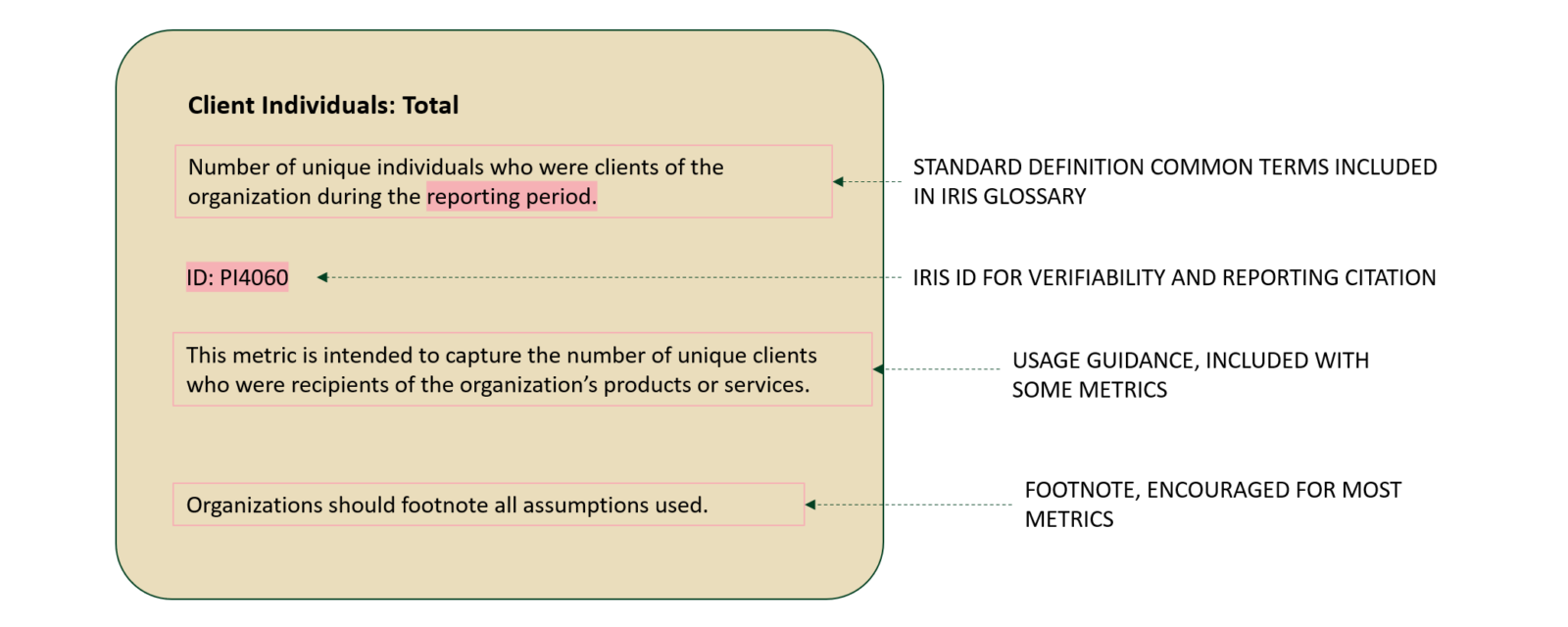
Figure 8: Example of an IRIS metric (own illustration based on Global Impact Investing Network (2025)96Global Impact Investing Network. Impact Investing: A Guide to This Dynamic Market. (2025).)
The catalog of metrics is used during impact assessment. Some of the metrics are appropriate for assessing qualitative data; however, many metrics focus on quantitative data and output rather than on impact, which represents one of its limitations. IRIS is used across different sectors and provides usage guidance, reporting formats, and instructions on how to calculate each indicator. One of the strengths of IRIS is that it is easy to learn and use. However, it offers only a limited number of metrics and does not provide guidance on interpreting the results. Furthermore, IRIS does not provide tools for data collection or data analysis.44Lehner, O. M. (ed.). Routledge Handbook of Social and Sustainable Finance. (Routledge, 2016). doi:10.4324/9781315772578.
Introduced by IRIS to help impact investors collect impact data, it includes different tools and methods such as: (1) company data, (2) diaries, (3) focus groups, (4) in-person surveys, (5) mobile surveys, (6) macro data, and other sources.
Company data refers to data reported by the company, such as commercial data, administrative data, and key performance indicators (KPIs). Examples include sales numbers, Human resources data such as headcount, and education-related data such as student attendance. The strengths of this type of data are that it does not require collecting new primary data and provides a starting point for estimating a business’s impact. However, weaknesses include potential bias, over-reliance on administrative or commercial data, and the inability to explain causal relationships (i.e., the “why” question). An example of an IRIS metric used to gather this type of data is Sales Revenue, which is expressed as the value of revenue generated from the sale of an organization’s products or services during the reporting period. It also includes guidance on how it should be used, such as in relation to earned revenue, impact categories and themes, and its alignment with relevant SDG goals and targets.98Global Impact Investing Network. Using IRIS+ for Data Collection. (2019).99CDC Group. Impact Measurement Handbook: A Practical Guide to Data Collection. (2019).
Diaries are a qualitative data collection method used in impact measurement to capture time-based information on stakeholder behavior, such as daily or weekly activities. They have been used to understand users’ economic behavior better. They are especially helpful for understanding how users interact with services and products, identifying gaps, and informing product development. Key strengths include generating context-specific insights into behavior and product design, highlighting areas for improvement. However, weaknesses include that they are resource-intensive and time-consuming to implement, often produce non-representative samples, and can be difficult for participants to maintain over long periods.98Global Impact Investing Network. Using IRIS+ for Data Collection. (2019).99CDC Group. Impact Measurement Handbook: A Practical Guide to Data Collection. (2019).
Focus groups are another qualitative data collection method used in impact measurement to gather insights from stakeholders through moderated group discussions, usually involving a small number of participants. They are particularly useful for exploring topics influenced by social or cultural norms. A key strength of this method is its inclusiveness, as it allows participation from individuals who can generate rich qualitative data through group dynamics. However, a limitation is that the number of questions is often limited, and it requires significant logistical resources, making it less feasible in remote or resource-constrained settings.98Global Impact Investing Network. Using IRIS+ for Data Collection. (2019).99CDC Group. Impact Measurement Handbook: A Practical Guide to Data Collection. (2019).
In-person surveys or interviews involve one-on-one interactions with stakeholders and allow for longer and more complex responses. They have been a key tool in projects related to social change and development, and the choice of survey method should be adapted to the local context. As a tool, they can capture detailed feedback while incorporating local context, helping to better understand products or services and overcoming challenges such as limited access to technology. However, weaknesses include logistical costs, such as travel to remote areas, and the potential for response bias across different types. An example of an IRIS metric used in this context is “Client Individuals Served” with ID (PI9409), which measures the number of individuals served during the reporting period. Data can be collected by asking clients whether their income has changed during the reporting period and reporting the number of clients in each category.98Global Impact Investing Network. Using IRIS+ for Data Collection. (2019).99CDC Group. Impact Measurement Handbook: A Practical Guide to Data Collection. (2019).
Mobile surveys use mobile technology rather than in-person methods and typically take the form of simple question-and-answer formats. Strengths include low cost, the ability to ask specific questions in a short format, ease of reaching stakeholders in remote areas, low respondent burden, and the ability to cover a large number of stakeholders. However, weaknesses include the limited depth of impact data captured and challenges in obtaining responses from a representative sample.98Global Impact Investing Network. Using IRIS+ for Data Collection. (2019).99CDC Group. Impact Measurement Handbook: A Practical Guide to Data Collection. (2019).
Macro data refers to data at the micro or meso level collected by governments or global institutions, including both free and licensed datasets. This data informs impact measurements for reporting and accountability processes and helps shape overall portfolio strategies. Strengths include providing useful inputs for measuring impact at the household sector or market level, for example, the number of jobs created by an impact investment. Weaknesses include difficulties in understanding the impact at the individual level and the inability to explain why certain indicators appear as they do.98Global Impact Investing Network. Using IRIS+ for Data Collection. (2019).99CDC Group. Impact Measurement Handbook: A Practical Guide to Data Collection. (2019).
Other data sources include satellite data (e.g., images from Earth orbit) used to measure outcomes such as crop yield variations, as well as sensor-based data that capture physical dimensions such as temperature, light, and humidity. These tools are useful in sectors such as agriculture, energy, transportation, and health. In addition, Artificial Intelligence (AI) can further support data collection and analysis.98Global Impact Investing Network. Using IRIS+ for Data Collection. (2019).99CDC Group. Impact Measurement Handbook: A Practical Guide to Data Collection. (2019).
Reporting
During the investment cycle, impact results should be reported to a range of stakeholders, and reporting is key to ensuring transparency around impact performance and enabling investors to strengthen their reputation. In these reports, performance is disaggregated by impact themes, asset class, and geography. Disclosures serve as a useful guide in implementation and help investors increase accountability in the industry while embedding impact throughout the investment process. By providing comparable, high-quality impact performance information, investors are better able to shape their strategies and capital allocation to drive impact through both investment and engagement.86Global Impact Investing Network. COMPASS: The Methodology for Comparing and Assessing Impact. (2021).
3.3.2 Exit
In this stage, the results against the objectives are verified, and a mission lock agreement is formalized. In accounting for impact performance, reference frameworks play an important role, as they provide investors with practical tools to hold investee companies accountable for achieving impact. Reference frameworks also provide an effective tool for discharging investors’ accountability to their stakeholders. Frameworks such as IRIS+, an accepted measurement tool in impact investing, help improve transparency between investors and investees and allow stakeholders to assess whether investors are fulfilling their development mandate.67Islam, S. M. & Habib, A. How impact investing firms use reference frameworks to manage their impact performance: An industry‐level study. Accounting & Finance 64, 161–184 (2024).75Borrello, A., Bengo, I. & Moran, M. How impact investing funds invest in social‐purpose organizations: A cross‐country comparison. Corp Soc Responsibility Env 31, 879–894 (2024).
The relationship between impact results and financial returns is also analyzed post-exit, revealing which market segments perform positively or negatively and what level of return is appropriate in the future. From this perspective, investors’ strategies and expectations are reinforced. Historical and standardized performance data can be used by investors to show how the impact has evolved over time and to determine the most suitable timing for exiting an investment. Impact results measured at the point of exit strengthen investors’ ability to present a clearer and more effective track record of their performance compared to peers. Using the SDGs as a framework, as in the example, the exit cycle consists of measuring and reporting progress made toward the SDGs, and Incofin Investment Management, in the exit stage, communicates the impact created toward the SDGs and the associated indicators to investors.87Global Impact Investing Network. Financing the Sustainable Development Goals: Impact Investing in Action. (2018).
Drivers
Networks serve as actors that connect the supply and demand sides of the social capital market. They act as intermediaries, enable access to expertise, and, through conferences, bring stakeholders together.81Spiess-Knafl, W. & Scheck, B. Impact Investing: Instruments, Mechanisms and Actors. (Springer International Publishing, Cham, 2023). doi:10.1007/978-3-031-32183-2. They play an important role in improving impact investing, for example, through the development of impact metrics and the provision of technical assistance. Networks such as the GIIN serve as key drivers of impact investing by bringing together investors, developing a shared understanding, and publishing reports on trends, surveys, case studies, and methodologies. They also contribute to the creation of new standards, such as IRIS.48Hansen, S. E. & Sigurjonsson, T. O. Do impact investing opportunities exist in public equity? An empirical examination. JGR 13, 83 (2024).
Standardized measurement frameworks, as shown in the literature review, measuring impact and determining what to measure are key and challenging issues in impact investing. Standardized frameworks and the integration of impact measurement and management into organizational budgets are critical components. Measurement tools such as IRIS+ provide a structured system for measuring, managing, and reporting impact. Through this, investors can enhance the transparency, comparability, and credibility of their data and enable better decision-making that can drive positive change.100Global Impact Investing Network. 2023 GIINsight: Impact Measurement & Management Practice. (2023). Credible and comparable data are necessary to inform impact investment decisions, and their effective management is essential to assess whether investors are achieving their intended impact.94Global Impact Investing Network. IRIS+ Core Metrics Sets. (2019).
Technological drivers, with the help of AI tools for analysis and data collection, may become cheaper and more accessible. It can help automate data collection, due diligence, and impact performance tracking.41Global Impact Investing Network. Data, Direction and Decisions: What We Know About Measuring and Managing Impact Performance. (2025).
Barriers
Costs and resources for impact measurement serve as difficulties related to measurement, reporting, and accounting. There are issues related to limited resources and time, as effective evaluation requires sufficient budget and systematic assessment. In addition, there is often a lack of training and funding to properly evaluate investment outcomes, thereby providing compelling evidence of impact.101Kaufmann, L., Krlev, G. & Brown, M. (Michael). In Plain Sight: Mechanisms of means–ends decoupling in impact investing. Organization Studies 46, 667–692 (2025).
Weak impact measurement and the lack of standardized performance standards: there is a lack of standardization in impact measurement, as impact is multidimensional and therefore difficult to standardize. For the growth of impact investing, the objective is to create real social and environmental change. However, weak impact measurement systems can lead to impact investing being used as a marketing tool rather than delivering meaningful impact.102Reisman, J. & Olazabal, V. Situating the Next Generation of Impact Measurement and Evaluation for Impact Investing. (2016).
Another challenge that acts as a barrier to the development of impact investing is the lack of performance standards. Investors find it difficult to understand the impact performance and compare it with peers when frameworks, metrics, and underlying assumptions are unclear or inconsistent. Most impact investors use IRIS+, but there are still investors who rely on different tools and systems for impact measurement and management. Investors have a dual need for standardized methodologies and customized metrics or frameworks to meet their unique needs.8Global Impact Investing Network. State of the Market 2025: Trends, Performance and Allocations. (2025).41Global Impact Investing Network. Data, Direction and Decisions: What We Know About Measuring and Managing Impact Performance. (2025).
Conclusion
This article examined impact investing as a new and complex field by addressing the research question concerning the current state of academic research on impact investing and its implications for practical implementation. By synthesizing the existing academic and practitioner literature, it identified the key conceptual frameworks that shape impact investing and translated them into a practical implementation guideline covering the investment process from deal origination to exit and identified the main drivers and barriers at each stage
The literature demonstrates that impact creation does not begin with intentionality alone but represents a continuous process that starts with investors’ motivations and continues through investment decisions, active investor-investee engagement, impact measurement, and ultimately the generation of financial and social or environmental outcomes. The relationship between financial return and impact remains one of the central unresolved debates in the impact investing literature. Whether a trade-off exists depends on several factors, including investor motivations, which also influence the rigor of impact measurement, as well as the regulatory environment and the investment sector. These differences make it difficult for the field to determine whether trade-offs exist.
The analysis identified political factors, industry networks, internal expertise, and standardized measurement frameworks as important drivers for the practical implementation of impact investing. Conversely, regulatory barriers, the lack of standardized performance frameworks, limited expertise, and political instability may hinder its practical implementation. Furthermore, the Five Dimensions framework can be applied during the due diligence stage and throughout the investment process to monitor and manage impact continuously. The practical cases presented in each stage further illustrate how impact investing is implemented in practice and how these drivers and barriers shape the investment process.
In conclusion, this article provides an overview of the current state of academic research on impact investing by synthesizing the existing literature and translating it into a practical implementation guideline. The findings demonstrate that the challenges of impact investing do not lie solely in pursuing dual objectives but also in managing the entire investment process, from investors’ motivations and investee selection to long-term collaboration, impact measurement, and value creation. Overall, this article highlights an important transformation in the relationship between finance and sustainability. As sustainability challenges continue to intensify, the role of the financial system in supporting economic stability, environmental sustainability, and societal well-being will become increasingly important
References
- 1United Nations. Transforming Our World: The 2030 Agenda for Sustainable Development. (2015). ↩︎
- 2Schlütter, D., Schätzlein, L., Hahn, R. & Waldner, C. Missing the Impact in Impact Investing Research – A Systematic Review and Critical Reflection of the Literature. J Management Studies 61, 2694–2718 (2024). ↩︎
- 2Schlütter, D., Schätzlein, L., Hahn, R. & Waldner, C. Missing the Impact in Impact Investing Research – A Systematic Review and Critical Reflection of the Literature. J Management Studies 61, 2694–2718 (2024). ↩︎
- 3Singhania, M. & Swami, D. Impact investing: Scientometric review and research agenda. Business Ethics Env & Resp 33, 251–286 (2024). ↩︎
- 4Islam, S. M. & Scott, T. Current demand and supply of impact investments across different geographic regions, sectors, and stages of business: Match or mismatch? Australian Journal of Management 47, 686–704 (2022). ↩︎
- 5Global Impact Investing Network. Sizing the Impact Investing Market 2024. (2024). ↩︎
- 6Tekula, R. & Andersen, K. The Role of Government, Nonprofit, and Private Facilitation of the Impact Investing Marketplace. Public Performance & Management Review 42, 142–161 (2019). ↩︎
- 6Tekula, R. & Andersen, K. The Role of Government, Nonprofit, and Private Facilitation of the Impact Investing Marketplace. Public Performance & Management Review 42, 142–161 (2019). ↩︎
- 2Schlütter, D., Schätzlein, L., Hahn, R. & Waldner, C. Missing the Impact in Impact Investing Research – A Systematic Review and Critical Reflection of the Literature. J Management Studies 61, 2694–2718 (2024). ↩︎
- 7Höchstädter, A. K. & Scheck, B. What’s in a Name: An Analysis of Impact Investing Understandings by Academics and Practitioners. J Bus Ethics 132, 449–475 (2015). ↩︎
- 8Global Impact Investing Network. State of the Market 2025: Trends, Performance and Allocations. (2025). ↩︎
- 9Hockerts, K., Hehenberger, L., Schaltegger, S. & Farber, V. Defining and Conceptualizing Impact Investing: Attractive Nuisance or Catalyst? J Bus Ethics 179, 937–950 (2022). ↩︎
- 10Clarkin, J. E. & L. Cangioni, C. Impact Investing: A Primer and Review of the Literature. Entrepreneurship Research Journal 6, (2016). ↩︎
- 11Gautier, A., Pache, A.-C. & Santos, F. Making Sense of Hybrid Practices: The role of individual adherence to institutional logics in impact investing. Organization Studies 44, 1385–1412 (2023). ↩︎
- 12Roundy, P. T. Regional differences in impact investment: a theory of impact investing ecosystems. SRJ 16, 467–485 (2019). ↩︎
- 12Roundy, P. T. Regional differences in impact investment: a theory of impact investing ecosystems. SRJ 16, 467–485 (2019). ↩︎
- 2Schlütter, D., Schätzlein, L., Hahn, R. & Waldner, C. Missing the Impact in Impact Investing Research – A Systematic Review and Critical Reflection of the Literature. J Management Studies 61, 2694–2718 (2024). ↩︎
- 11Gautier, A., Pache, A.-C. & Santos, F. Making Sense of Hybrid Practices: The role of individual adherence to institutional logics in impact investing. Organization Studies 44, 1385–1412 (2023). ↩︎
- 7Höchstädter, A. K. & Scheck, B. What’s in a Name: An Analysis of Impact Investing Understandings by Academics and Practitioners. J Bus Ethics 132, 449–475 (2015). ↩︎
- 13Emerson, J. The Blended Value Proposition: Integrating Social and Financial Returns. California Management Review 45, 35–51 (2003). ↩︎
- 13Emerson, J. The Blended Value Proposition: Integrating Social and Financial Returns. California Management Review 45, 35–51 (2003). ↩︎
- 14Bugg-Levine, A. & Emerson, J. Impact Investing: Transforming How We Make Money while Making a Difference. Innovations: Technology, Governance, Globalization 6, 9–18 (2011). ↩︎
- 7Höchstädter, A. K. & Scheck, B. What’s in a Name: An Analysis of Impact Investing Understandings by Academics and Practitioners. J Bus Ethics 132, 449–475 (2015). ↩︎
- 2Schlütter, D., Schätzlein, L., Hahn, R. & Waldner, C. Missing the Impact in Impact Investing Research – A Systematic Review and Critical Reflection of the Literature. J Management Studies 61, 2694–2718 (2024). ↩︎
- 7Höchstädter, A. K. & Scheck, B. What’s in a Name: An Analysis of Impact Investing Understandings by Academics and Practitioners. J Bus Ethics 132, 449–475 (2015). ↩︎
- 15Agrawal, A. & Hockerts, K. Impact investing: review and research agenda. Journal of Small Business & Entrepreneurship 33, 153–181 (2021). ↩︎
- 7Höchstädter, A. K. & Scheck, B. What’s in a Name: An Analysis of Impact Investing Understandings by Academics and Practitioners. J Bus Ethics 132, 449–475 (2015). ↩︎
- 16Block, J. H., Hirschmann, M. & Fisch, C. Which criteria matter when impact investors screen social enterprises? Journal of Corporate Finance 66, 101813 (2021). ↩︎
- 17Renneboog, L., Ter Horst, J. & Zhang, C. Socially responsible investments: Institutional aspects, performance, and investor behavior. Journal of Banking & Finance 32, 1723–1742 (2008). ↩︎
- 7Höchstädter, A. K. & Scheck, B. What’s in a Name: An Analysis of Impact Investing Understandings by Academics and Practitioners. J Bus Ethics 132, 449–475 (2015). ↩︎
- 18Meng, T., Newth, J. & Woods, C. Ethical Sensemaking in Impact Investing: Reasons and Motives in the Chinese Renewable Energy Sector. J Bus Ethics 179, 1091–1117 (2022). ↩︎
- 19Zolfaghari, B. & Hand, G. (Dean). Impact investing and philanthropic foundations: strategies deployed when aligning fiduciary duty and social mission. Journal of Sustainable Finance & Investment 13, 962–989 (2023). ↩︎
- 20Arjaliès, D.-L., Chollet, P., Crifo, P. & Mottis, N. The Motivations and Practices of Impact Assessment in Socially Responsible Investing: The French Case and its Implications for the Accounting and Impact Investing Communities. Social and Environmental Accountability Journal 43, 1–29 (2023). ↩︎
- 21Castellas, E. I.-P., Ormiston, J. & Findlay, S. Financing social entrepreneurship: The role of impact investment in shaping social enterprise in Australia. SEJ 14, 130–155 (2018). ↩︎
- 22Apostolakis, G., Kraanen, F. & Van Dijk, G. Examining pension beneficiaries’ willingness to pay for a socially responsible and impact investment portfolio: A case study in the Dutch healthcare sector. Journal of Behavioral and Experimental Finance 11, 27–43 (2016). ↩︎
- 22Apostolakis, G., Kraanen, F. & Van Dijk, G. Examining pension beneficiaries’ willingness to pay for a socially responsible and impact investment portfolio: A case study in the Dutch healthcare sector. Journal of Behavioral and Experimental Finance 11, 27–43 (2016). ↩︎
- 23Dordi, T., Stephens, P., Geobey, S. & Weber, O. New bottle or new label? Distinguishing impact investing from responsible and ethical investing. Accounting & Finance 64, 309–330 (2024). ↩︎
- 2Schlütter, D., Schätzlein, L., Hahn, R. & Waldner, C. Missing the Impact in Impact Investing Research – A Systematic Review and Critical Reflection of the Literature. J Management Studies 61, 2694–2718 (2024). ↩︎
- 24Richardson, B. J. Keeping Ethical Investment Ethical: Regulatory Issues for Investing for Sustainability. J Bus Ethics 87, 555–572 (2009). ↩︎
- 25Sandberg, J., Juravle, C., Hedesström, T. M. & Hamilton, I. The Heterogeneity of Socially Responsible Investment. J Bus Ethics 87, 519–533 (2009). ↩︎
- 2Schlütter, D., Schätzlein, L., Hahn, R. & Waldner, C. Missing the Impact in Impact Investing Research – A Systematic Review and Critical Reflection of the Literature. J Management Studies 61, 2694–2718 (2024). ↩︎
- 7Höchstädter, A. K. & Scheck, B. What’s in a Name: An Analysis of Impact Investing Understandings by Academics and Practitioners. J Bus Ethics 132, 449–475 (2015). ↩︎
- 4Islam, S. M. & Scott, T. Current demand and supply of impact investments across different geographic regions, sectors, and stages of business: Match or mismatch? Australian Journal of Management 47, 686–704 (2022). ↩︎
- 13Emerson, J. The Blended Value Proposition: Integrating Social and Financial Returns. California Management Review 45, 35–51 (2003). ↩︎
- 14Bugg-Levine, A. & Emerson, J. Impact Investing: Transforming How We Make Money while Making a Difference. Innovations: Technology, Governance, Globalization 6, 9–18 (2011). ↩︎
- 26Brandstetter, L. & Lehner, O. M. Opening the Market for Impact Investments: The Need for Adapted Portfolio Tools. Entrepreneurship Research Journal 5, (2015). ↩︎
- 27Islam, S. M. Impact Risk Management in Impact Investing: How Impact Investing Organizations Adopt Control Mechanisms to Manage Their Impact Risk. Journal of Management Accounting Research 35, 115–139 (2023). ↩︎
- 28Jeffers, J., Lyu, T. & Posenau, K. The risk and return of impact investing funds. Journal of Financial Economics 161, 103928 (2024). ↩︎
- 23Dordi, T., Stephens, P., Geobey, S. & Weber, O. New bottle or new label? Distinguishing impact investing from responsible and ethical investing. Accounting & Finance 64, 309–330 (2024). ↩︎
- 6Tekula, R. & Andersen, K. The Role of Government, Nonprofit, and Private Facilitation of the Impact Investing Marketplace. Public Performance & Management Review 42, 142–161 (2019). ↩︎
- 29Impact Management Platform. Impact and the impact pathway. https://impactmanagementplatform.org/impact/ (n.d). ↩︎
- 30Holtslag, M., Chevrollier, N. & Nijhof, A. Impact investing and sustainable market transformations: The role of venture capital funds. Business Ethics Env & Resp 30, 522–537 (2021). ↩︎
- 31Busch, T. et al. Principles for impact investments: practical guidance for impact measurement, assessment and valuation. SN Bus Econ 5, 48 (2025). ↩︎
- 29Impact Management Platform. Impact and the impact pathway. https://impactmanagementplatform.org/impact/ (n.d). ↩︎
- 31Busch, T. et al. Principles for impact investments: practical guidance for impact measurement, assessment and valuation. SN Bus Econ 5, 48 (2025). ↩︎
- 32Kölbel, J. F., Heeb, F., Paetzold, F. & Busch, T. Can Sustainable Investing Save the World? Reviewing the Mechanisms of Investor Impact. Organization & Environment 33, 554–574 (2020). ↩︎
- 32Kölbel, J. F., Heeb, F., Paetzold, F. & Busch, T. Can Sustainable Investing Save the World? Reviewing the Mechanisms of Investor Impact. Organization & Environment 33, 554–574 (2020). ↩︎
- 32Kölbel, J. F., Heeb, F., Paetzold, F. & Busch, T. Can Sustainable Investing Save the World? Reviewing the Mechanisms of Investor Impact. Organization & Environment 33, 554–574 (2020). ↩︎
- 33Dimson, E., Karakaş, O. & Li, X. Active Ownership. Rev. Financ. Stud. 28, 3225–3268 (2015). ↩︎
- 7Höchstädter, A. K. & Scheck, B. What’s in a Name: An Analysis of Impact Investing Understandings by Academics and Practitioners. J Bus Ethics 132, 449–475 (2015). ↩︎
- 32Kölbel, J. F., Heeb, F., Paetzold, F. & Busch, T. Can Sustainable Investing Save the World? Reviewing the Mechanisms of Investor Impact. Organization & Environment 33, 554–574 (2020). ↩︎
- 31Busch, T. et al. Principles for impact investments: practical guidance for impact measurement, assessment and valuation. SN Bus Econ 5, 48 (2025). ↩︎
- 34Busch, T. et al. Impact investments: a call for (re)orientation. SN Bus Econ 1, 33 (2021). ↩︎
- 35Scheitza, L. & Busch, T. SFDR Article 9: Is it all about impact? Finance Research Letters 62, 105179 (2024). ↩︎
- 34Busch, T. et al. Impact investments: a call for (re)orientation. SN Bus Econ 1, 33 (2021). ↩︎
- 10Clarkin, J. E. & L. Cangioni, C. Impact Investing: A Primer and Review of the Literature. Entrepreneurship Research Journal 6, (2016). ↩︎
- 14Bugg-Levine, A. & Emerson, J. Impact Investing: Transforming How We Make Money while Making a Difference. Innovations: Technology, Governance, Globalization 6, 9–18 (2011). ↩︎
- 36Brandenburg, M. & Iqbal, A. The Ford Foundation’s Work to Build the Field of Impact Investing. The Foundation Review 14, (2022). ↩︎
- 37Trelstad Brian. Impact Investing: A Brief History. Capitalism & Society 11, (2016). ↩︎
- 36Brandenburg, M. & Iqbal, A. The Ford Foundation’s Work to Build the Field of Impact Investing. The Foundation Review 14, (2022). ↩︎
- 38Widyawati, L. A systematic literature review of socially responsible investment and environmental social governance metrics. Bus Strat Env 29, 619–637 (2020). ↩︎
- 37Trelstad Brian. Impact Investing: A Brief History. Capitalism & Society 11, (2016). ↩︎
- 37Trelstad Brian. Impact Investing: A Brief History. Capitalism & Society 11, (2016). ↩︎
- 36Brandenburg, M. & Iqbal, A. The Ford Foundation’s Work to Build the Field of Impact Investing. The Foundation Review 14, (2022). ↩︎
- 39United Nations. Agenda 21. (1992). ↩︎
- 36Brandenburg, M. & Iqbal, A. The Ford Foundation’s Work to Build the Field of Impact Investing. The Foundation Review 14, (2022). ↩︎
- 37Trelstad Brian. Impact Investing: A Brief History. Capitalism & Society 11, (2016). ↩︎
- 14Bugg-Levine, A. & Emerson, J. Impact Investing: Transforming How We Make Money while Making a Difference. Innovations: Technology, Governance, Globalization 6, 9–18 (2011). ↩︎
- 40Quinn, Q. C. & Munir, K. A. Hybrid Categories as Political Devices: The Case of Impact Investing in Frontier Markets. in Research in the Sociology of Organizations (eds Durand, R., Granqvist, N. & Tyllström, A.) vol. 51 113–150 (Emerald Publishing Limited, 2017). ↩︎
- 40Quinn, Q. C. & Munir, K. A. Hybrid Categories as Political Devices: The Case of Impact Investing in Frontier Markets. in Research in the Sociology of Organizations (eds Durand, R., Granqvist, N. & Tyllström, A.) vol. 51 113–150 (Emerald Publishing Limited, 2017). ↩︎
- 10Clarkin, J. E. & L. Cangioni, C. Impact Investing: A Primer and Review of the Literature. Entrepreneurship Research Journal 6, (2016). ↩︎
- 41Global Impact Investing Network. Data, Direction and Decisions: What We Know About Measuring and Managing Impact Performance. (2025). ↩︎
- 42The Rockefeller Foundation. Global Impact Investing Network (GIIN). https://www.rockefellerfoundation.org/bellagio-bulletin/from-the-archives/global-impact-investing-network-giin/ (2023). ↩︎
- 43Global Impact Investing Network. History of IRIS+. https://iris.thegiin.org/history/ (n.d). ↩︎
- 14Bugg-Levine, A. & Emerson, J. Impact Investing: Transforming How We Make Money while Making a Difference. Innovations: Technology, Governance, Globalization 6, 9–18 (2011). ↩︎
- 44Lehner, O. M. (ed.). Routledge Handbook of Social and Sustainable Finance. (Routledge, 2016). doi:10.4324/9781315772578. ↩︎
- 42The Rockefeller Foundation. Global Impact Investing Network (GIIN). https://www.rockefellerfoundation.org/bellagio-bulletin/from-the-archives/global-impact-investing-network-giin/ (2023). ↩︎
- 42The Rockefeller Foundation. Global Impact Investing Network (GIIN). https://www.rockefellerfoundation.org/bellagio-bulletin/from-the-archives/global-impact-investing-network-giin/ (2023). ↩︎
- 41Global Impact Investing Network. Data, Direction and Decisions: What We Know About Measuring and Managing Impact Performance. (2025). ↩︎
- 45Islam, S. M. & Rahman, A. Impact investment deal flow and Sustainable Development Goals: “Mind the gap?” Accounting & Finance 63, 3797–3813 (2023). ↩︎
- 5Global Impact Investing Network. Sizing the Impact Investing Market 2024. (2024). ↩︎
- 5Global Impact Investing Network. Sizing the Impact Investing Market 2024. (2024). ↩︎
- 5Global Impact Investing Network. Sizing the Impact Investing Market 2024. (2024). ↩︎
- 46Barman, E. Of Principle and Principal: Value Plurality in the Market of Impact Investing. VS 3, 9–44 (2015). ↩︎
- 46Barman, E. Of Principle and Principal: Value Plurality in the Market of Impact Investing. VS 3, 9–44 (2015). ↩︎
- 9Hockerts, K., Hehenberger, L., Schaltegger, S. & Farber, V. Defining and Conceptualizing Impact Investing: Attractive Nuisance or Catalyst? J Bus Ethics 179, 937–950 (2022). ↩︎
- 47Findlay, S. & Moran, M. Purpose-washing of impact investing funds: motivations, occurrence and prevention. SRJ 15, 853–873 (2019). ↩︎
- 48Hansen, S. E. & Sigurjonsson, T. O. Do impact investing opportunities exist in public equity? An empirical examination. JGR 13, 83 (2024). ↩︎
- 47Findlay, S. & Moran, M. Purpose-washing of impact investing funds: motivations, occurrence and prevention. SRJ 15, 853–873 (2019). ↩︎
- 9Hockerts, K., Hehenberger, L., Schaltegger, S. & Farber, V. Defining and Conceptualizing Impact Investing: Attractive Nuisance or Catalyst? J Bus Ethics 179, 937–950 (2022). ↩︎
- 9Hockerts, K., Hehenberger, L., Schaltegger, S. & Farber, V. Defining and Conceptualizing Impact Investing: Attractive Nuisance or Catalyst? J Bus Ethics 179, 937–950 (2022). ↩︎
- 34Busch, T. et al. Impact investments: a call for (re)orientation. SN Bus Econ 1, 33 (2021). ↩︎
- 49Born, K. & Brest, P. When Can Impact Investing Create Real Impact? Stanford Social Innovation Review 11, 2231 (2013). ↩︎
- 50Global Impact Investing Network. Core Characteristics of Impact Investing. (2019). ↩︎
- 9Hockerts, K., Hehenberger, L., Schaltegger, S. & Farber, V. Defining and Conceptualizing Impact Investing: Attractive Nuisance or Catalyst? J Bus Ethics 179, 937–950 (2022). ↩︎
- 34Busch, T. et al. Impact investments: a call for (re)orientation. SN Bus Econ 1, 33 (2021). ↩︎
- 47Findlay, S. & Moran, M. Purpose-washing of impact investing funds: motivations, occurrence and prevention. SRJ 15, 853–873 (2019). ↩︎
- 9Hockerts, K., Hehenberger, L., Schaltegger, S. & Farber, V. Defining and Conceptualizing Impact Investing: Attractive Nuisance or Catalyst? J Bus Ethics 179, 937–950 (2022). ↩︎
- 9Hockerts, K., Hehenberger, L., Schaltegger, S. & Farber, V. Defining and Conceptualizing Impact Investing: Attractive Nuisance or Catalyst? J Bus Ethics 179, 937–950 (2022). ↩︎
- 9Hockerts, K., Hehenberger, L., Schaltegger, S. & Farber, V. Defining and Conceptualizing Impact Investing: Attractive Nuisance or Catalyst? J Bus Ethics 179, 937–950 (2022). ↩︎
- 9Hockerts, K., Hehenberger, L., Schaltegger, S. & Farber, V. Defining and Conceptualizing Impact Investing: Attractive Nuisance or Catalyst? J Bus Ethics 179, 937–950 (2022). ↩︎
- 9Hockerts, K., Hehenberger, L., Schaltegger, S. & Farber, V. Defining and Conceptualizing Impact Investing: Attractive Nuisance or Catalyst? J Bus Ethics 179, 937–950 (2022). ↩︎
- 31Busch, T. et al. Principles for impact investments: practical guidance for impact measurement, assessment and valuation. SN Bus Econ 5, 48 (2025). ↩︎
- 51Lehner, O. M., Nicholls, A. & Kapplmüller, S. B. Arenas of Contestation: A Senian Social Justice Perspective on the Nature of Materiality in Impact Measurement. J Bus Ethics 179, 971–989 (2022). ↩︎
- 9Hockerts, K., Hehenberger, L., Schaltegger, S. & Farber, V. Defining and Conceptualizing Impact Investing: Attractive Nuisance or Catalyst? J Bus Ethics 179, 937–950 (2022). ↩︎
- 52Mezzanotte, F. E. Corporate sustainability reporting: double materiality, impacts, and legal risk. Journal of Corporate Law Studies 23, 633–663 (2023). ↩︎
- 9Hockerts, K., Hehenberger, L., Schaltegger, S. & Farber, V. Defining and Conceptualizing Impact Investing: Attractive Nuisance or Catalyst? J Bus Ethics 179, 937–950 (2022). ↩︎
- 51Lehner, O. M., Nicholls, A. & Kapplmüller, S. B. Arenas of Contestation: A Senian Social Justice Perspective on the Nature of Materiality in Impact Measurement. J Bus Ethics 179, 971–989 (2022). ↩︎
- 9Hockerts, K., Hehenberger, L., Schaltegger, S. & Farber, V. Defining and Conceptualizing Impact Investing: Attractive Nuisance or Catalyst? J Bus Ethics 179, 937–950 (2022). ↩︎
- 9Hockerts, K., Hehenberger, L., Schaltegger, S. & Farber, V. Defining and Conceptualizing Impact Investing: Attractive Nuisance or Catalyst? J Bus Ethics 179, 937–950 (2022). ↩︎
- 53Casasnovas, G. & Jones, J. Who Has a Seat at the Table in Impact Investing? Addressing Inequality by Giving Voice. J Bus Ethics 179, 951–969 (2022). ↩︎
- 48Hansen, S. E. & Sigurjonsson, T. O. Do impact investing opportunities exist in public equity? An empirical examination. JGR 13, 83 (2024). ↩︎
- 9Hockerts, K., Hehenberger, L., Schaltegger, S. & Farber, V. Defining and Conceptualizing Impact Investing: Attractive Nuisance or Catalyst? J Bus Ethics 179, 937–950 (2022). ↩︎
- 9Hockerts, K., Hehenberger, L., Schaltegger, S. & Farber, V. Defining and Conceptualizing Impact Investing: Attractive Nuisance or Catalyst? J Bus Ethics 179, 937–950 (2022). ↩︎
- 9Hockerts, K., Hehenberger, L., Schaltegger, S. & Farber, V. Defining and Conceptualizing Impact Investing: Attractive Nuisance or Catalyst? J Bus Ethics 179, 937–950 (2022). ↩︎
- 9Hockerts, K., Hehenberger, L., Schaltegger, S. & Farber, V. Defining and Conceptualizing Impact Investing: Attractive Nuisance or Catalyst? J Bus Ethics 179, 937–950 (2022). ↩︎
- 54Aggarwal, S., Rathee, P., Arya, V. & Roy, H. Inside story of impact investing in emerging market: A systematic review to measure the responsible and sustainable investing pattern using the ADO framework. Journal of Economic Surveys 39, 1695–1726 (2025). ↩︎
- 54Aggarwal, S., Rathee, P., Arya, V. & Roy, H. Inside story of impact investing in emerging market: A systematic review to measure the responsible and sustainable investing pattern using the ADO framework. Journal of Economic Surveys 39, 1695–1726 (2025). ↩︎
- 54Aggarwal, S., Rathee, P., Arya, V. & Roy, H. Inside story of impact investing in emerging market: A systematic review to measure the responsible and sustainable investing pattern using the ADO framework. Journal of Economic Surveys 39, 1695–1726 (2025). ↩︎
- 54Aggarwal, S., Rathee, P., Arya, V. & Roy, H. Inside story of impact investing in emerging market: A systematic review to measure the responsible and sustainable investing pattern using the ADO framework. Journal of Economic Surveys 39, 1695–1726 (2025). ↩︎
- 54Aggarwal, S., Rathee, P., Arya, V. & Roy, H. Inside story of impact investing in emerging market: A systematic review to measure the responsible and sustainable investing pattern using the ADO framework. Journal of Economic Surveys 39, 1695–1726 (2025). ↩︎
- 54Aggarwal, S., Rathee, P., Arya, V. & Roy, H. Inside story of impact investing in emerging market: A systematic review to measure the responsible and sustainable investing pattern using the ADO framework. Journal of Economic Surveys 39, 1695–1726 (2025). ↩︎
- 54Aggarwal, S., Rathee, P., Arya, V. & Roy, H. Inside story of impact investing in emerging market: A systematic review to measure the responsible and sustainable investing pattern using the ADO framework. Journal of Economic Surveys 39, 1695–1726 (2025). ↩︎
- 55Ormiston, J., Charlton, K., Donald, M. S. & Seymour, R. G. Overcoming the Challenges of Impact Investing: Insights from Leading Investors. Journal of Social Entrepreneurship 6, 352–378 (2015). ↩︎
- 54Aggarwal, S., Rathee, P., Arya, V. & Roy, H. Inside story of impact investing in emerging market: A systematic review to measure the responsible and sustainable investing pattern using the ADO framework. Journal of Economic Surveys 39, 1695–1726 (2025). ↩︎
- 56Barber, B. M., Morse, A. & Yasuda, A. Impact investing. Journal of Financial Economics 139, 162–185 (2021). ↩︎
- 54Aggarwal, S., Rathee, P., Arya, V. & Roy, H. Inside story of impact investing in emerging market: A systematic review to measure the responsible and sustainable investing pattern using the ADO framework. Journal of Economic Surveys 39, 1695–1726 (2025). ↩︎
- 54Aggarwal, S., Rathee, P., Arya, V. & Roy, H. Inside story of impact investing in emerging market: A systematic review to measure the responsible and sustainable investing pattern using the ADO framework. Journal of Economic Surveys 39, 1695–1726 (2025). ↩︎
- 56Barber, B. M., Morse, A. & Yasuda, A. Impact investing. Journal of Financial Economics 139, 162–185 (2021). ↩︎
- 54Aggarwal, S., Rathee, P., Arya, V. & Roy, H. Inside story of impact investing in emerging market: A systematic review to measure the responsible and sustainable investing pattern using the ADO framework. Journal of Economic Surveys 39, 1695–1726 (2025). ↩︎
- 54Aggarwal, S., Rathee, P., Arya, V. & Roy, H. Inside story of impact investing in emerging market: A systematic review to measure the responsible and sustainable investing pattern using the ADO framework. Journal of Economic Surveys 39, 1695–1726 (2025). ↩︎
- 4Islam, S. M. & Scott, T. Current demand and supply of impact investments across different geographic regions, sectors, and stages of business: Match or mismatch? Australian Journal of Management 47, 686–704 (2022). ↩︎
- 54Aggarwal, S., Rathee, P., Arya, V. & Roy, H. Inside story of impact investing in emerging market: A systematic review to measure the responsible and sustainable investing pattern using the ADO framework. Journal of Economic Surveys 39, 1695–1726 (2025). ↩︎
- 54Aggarwal, S., Rathee, P., Arya, V. & Roy, H. Inside story of impact investing in emerging market: A systematic review to measure the responsible and sustainable investing pattern using the ADO framework. Journal of Economic Surveys 39, 1695–1726 (2025). ↩︎
- 54Aggarwal, S., Rathee, P., Arya, V. & Roy, H. Inside story of impact investing in emerging market: A systematic review to measure the responsible and sustainable investing pattern using the ADO framework. Journal of Economic Surveys 39, 1695–1726 (2025). ↩︎
- 53Casasnovas, G. & Jones, J. Who Has a Seat at the Table in Impact Investing? Addressing Inequality by Giving Voice. J Bus Ethics 179, 951–969 (2022). ↩︎
- 57Agrawal, A. & Hockerts, K. Impact Investing Strategy: Managing Conflicts between Impact Investor and Investee Social Enterprise. Sustainability 11, 4117 (2019). ↩︎
- 58Agrawal, A. & Jespersen, K. How do impact investors evaluate an investee social enterprise? A framework of impact investing process. JEEE 16, 999–1022 (2024). ↩︎
- 16Block, J. H., Hirschmann, M. & Fisch, C. Which criteria matter when impact investors screen social enterprises? Journal of Corporate Finance 66, 101813 (2021). ↩︎
- 58Agrawal, A. & Jespersen, K. How do impact investors evaluate an investee social enterprise? A framework of impact investing process. JEEE 16, 999–1022 (2024). ↩︎
- 59Viviani, J.-L. & Maurel, C. Performance of impact investing: A value creation approach. Research in International Business and Finance 47, 31–39 (2019). ↩︎
- 53Casasnovas, G. & Jones, J. Who Has a Seat at the Table in Impact Investing? Addressing Inequality by Giving Voice. J Bus Ethics 179, 951–969 (2022). ↩︎
- 12Roundy, P. T. Regional differences in impact investment: a theory of impact investing ecosystems. SRJ 16, 467–485 (2019). ↩︎
- 60Moran, M. & Ward-Christie, L. Blended Social Impact Investment Transactions: Why Are They So Complex? J Bus Ethics 179, 1011–1031 (2022). ↩︎
- 61Hansen, S. E. & Sigurjonsson, T. O. Do impact investing opportunities exist in public equity? An empirical examination. JGR 13, 83–95 (2024). ↩︎
- 60Moran, M. & Ward-Christie, L. Blended Social Impact Investment Transactions: Why Are They So Complex? J Bus Ethics 179, 1011–1031 (2022). ↩︎
- 16Block, J. H., Hirschmann, M. & Fisch, C. Which criteria matter when impact investors screen social enterprises? Journal of Corporate Finance 66, 101813 (2021). ↩︎
- 16Block, J. H., Hirschmann, M. & Fisch, C. Which criteria matter when impact investors screen social enterprises? Journal of Corporate Finance 66, 101813 (2021). ↩︎
- 59Viviani, J.-L. & Maurel, C. Performance of impact investing: A value creation approach. Research in International Business and Finance 47, 31–39 (2019). ↩︎
- 21Castellas, E. I.-P., Ormiston, J. & Findlay, S. Financing social entrepreneurship: The role of impact investment in shaping social enterprise in Australia. SEJ 14, 130–155 (2018). ↩︎
- 21Castellas, E. I.-P., Ormiston, J. & Findlay, S. Financing social entrepreneurship: The role of impact investment in shaping social enterprise in Australia. SEJ 14, 130–155 (2018). ↩︎
- 57Agrawal, A. & Hockerts, K. Impact Investing Strategy: Managing Conflicts between Impact Investor and Investee Social Enterprise. Sustainability 11, 4117 (2019). ↩︎
- 62Thornton, P. H., Ocasio, W. & Lounsbury, M. The Institutional Logics Perspective: A New Approach to Culture, Structure, and Process. (Oxford University Press, Oxford, 2012). ↩︎
- 57Agrawal, A. & Hockerts, K. Impact Investing Strategy: Managing Conflicts between Impact Investor and Investee Social Enterprise. Sustainability 11, 4117 (2019). ↩︎
- 63Reay, T. & Hinings, C. R. Managing the Rivalry of Competing Institutional Logics. Organization Studies 30, 629–652 (2009). ↩︎
- 57Agrawal, A. & Hockerts, K. Impact Investing Strategy: Managing Conflicts between Impact Investor and Investee Social Enterprise. Sustainability 11, 4117 (2019). ↩︎
- 60Moran, M. & Ward-Christie, L. Blended Social Impact Investment Transactions: Why Are They So Complex? J Bus Ethics 179, 1011–1031 (2022). ↩︎
- 57Agrawal, A. & Hockerts, K. Impact Investing Strategy: Managing Conflicts between Impact Investor and Investee Social Enterprise. Sustainability 11, 4117 (2019). ↩︎
- 57Agrawal, A. & Hockerts, K. Impact Investing Strategy: Managing Conflicts between Impact Investor and Investee Social Enterprise. Sustainability 11, 4117 (2019). ↩︎
- 57Agrawal, A. & Hockerts, K. Impact Investing Strategy: Managing Conflicts between Impact Investor and Investee Social Enterprise. Sustainability 11, 4117 (2019). ↩︎
- 57Agrawal, A. & Hockerts, K. Impact Investing Strategy: Managing Conflicts between Impact Investor and Investee Social Enterprise. Sustainability 11, 4117 (2019). ↩︎
- 57Agrawal, A. & Hockerts, K. Impact Investing Strategy: Managing Conflicts between Impact Investor and Investee Social Enterprise. Sustainability 11, 4117 (2019). ↩︎
- 4Islam, S. M. & Scott, T. Current demand and supply of impact investments across different geographic regions, sectors, and stages of business: Match or mismatch? Australian Journal of Management 47, 686–704 (2022). ↩︎
- 30Holtslag, M., Chevrollier, N. & Nijhof, A. Impact investing and sustainable market transformations: The role of venture capital funds. Business Ethics Env & Resp 30, 522–537 (2021). ↩︎
- 57Agrawal, A. & Hockerts, K. Impact Investing Strategy: Managing Conflicts between Impact Investor and Investee Social Enterprise. Sustainability 11, 4117 (2019). ↩︎
- 57Agrawal, A. & Hockerts, K. Impact Investing Strategy: Managing Conflicts between Impact Investor and Investee Social Enterprise. Sustainability 11, 4117 (2019). ↩︎
- 16Block, J. H., Hirschmann, M. & Fisch, C. Which criteria matter when impact investors screen social enterprises? Journal of Corporate Finance 66, 101813 (2021). ↩︎
- 58Agrawal, A. & Jespersen, K. How do impact investors evaluate an investee social enterprise? A framework of impact investing process. JEEE 16, 999–1022 (2024). ↩︎
- 16Block, J. H., Hirschmann, M. & Fisch, C. Which criteria matter when impact investors screen social enterprises? Journal of Corporate Finance 66, 101813 (2021). ↩︎
- 56Barber, B. M., Morse, A. & Yasuda, A. Impact investing. Journal of Financial Economics 139, 162–185 (2021). ↩︎
- 57Agrawal, A. & Hockerts, K. Impact Investing Strategy: Managing Conflicts between Impact Investor and Investee Social Enterprise. Sustainability 11, 4117 (2019). ↩︎
- 57Agrawal, A. & Hockerts, K. Impact Investing Strategy: Managing Conflicts between Impact Investor and Investee Social Enterprise. Sustainability 11, 4117 (2019). ↩︎
- 57Agrawal, A. & Hockerts, K. Impact Investing Strategy: Managing Conflicts between Impact Investor and Investee Social Enterprise. Sustainability 11, 4117 (2019). ↩︎
- 57Agrawal, A. & Hockerts, K. Impact Investing Strategy: Managing Conflicts between Impact Investor and Investee Social Enterprise. Sustainability 11, 4117 (2019). ↩︎
- 64Jackson, E. T. Interrogating the theory of change: evaluating impact investing where it matters most. Journal of Sustainable Finance & Investment 3, 95–110 (2013). ↩︎
- 65Breuer, E., Lee, L., De Silva, M. & Lund, C. Using theory of change to design and evaluate public health interventions: a systematic review. Implementation Sci 11, 63 (2015). ↩︎
- 66Reinholz, D. L. & Andrews, T. C. Change theory and theory of change: what’s the difference anyway? IJ STEM Ed 7, 2 (2020). ↩︎
- 65Breuer, E., Lee, L., De Silva, M. & Lund, C. Using theory of change to design and evaluate public health interventions: a systematic review. Implementation Sci 11, 63 (2015). ↩︎
- 64Jackson, E. T. Interrogating the theory of change: evaluating impact investing where it matters most. Journal of Sustainable Finance & Investment 3, 95–110 (2013). ↩︎
- 31Busch, T. et al. Principles for impact investments: practical guidance for impact measurement, assessment and valuation. SN Bus Econ 5, 48 (2025). ↩︎
- 44Lehner, O. M. (ed.). Routledge Handbook of Social and Sustainable Finance. (Routledge, 2016). doi:10.4324/9781315772578. ↩︎
- 64Jackson, E. T. Interrogating the theory of change: evaluating impact investing where it matters most. Journal of Sustainable Finance & Investment 3, 95–110 (2013). ↩︎
- 31Busch, T. et al. Principles for impact investments: practical guidance for impact measurement, assessment and valuation. SN Bus Econ 5, 48 (2025). ↩︎
- 44Lehner, O. M. (ed.). Routledge Handbook of Social and Sustainable Finance. (Routledge, 2016). doi:10.4324/9781315772578. ↩︎
- 64Jackson, E. T. Interrogating the theory of change: evaluating impact investing where it matters most. Journal of Sustainable Finance & Investment 3, 95–110 (2013). ↩︎
- 44Lehner, O. M. (ed.). Routledge Handbook of Social and Sustainable Finance. (Routledge, 2016). doi:10.4324/9781315772578. ↩︎
- 64Jackson, E. T. Interrogating the theory of change: evaluating impact investing where it matters most. Journal of Sustainable Finance & Investment 3, 95–110 (2013). ↩︎
- 44Lehner, O. M. (ed.). Routledge Handbook of Social and Sustainable Finance. (Routledge, 2016). doi:10.4324/9781315772578. ↩︎
- 44Lehner, O. M. (ed.). Routledge Handbook of Social and Sustainable Finance. (Routledge, 2016). doi:10.4324/9781315772578. ↩︎
- 64Jackson, E. T. Interrogating the theory of change: evaluating impact investing where it matters most. Journal of Sustainable Finance & Investment 3, 95–110 (2013). ↩︎
- 51Lehner, O. M., Nicholls, A. & Kapplmüller, S. B. Arenas of Contestation: A Senian Social Justice Perspective on the Nature of Materiality in Impact Measurement. J Bus Ethics 179, 971–989 (2022). ↩︎
- 64Jackson, E. T. Interrogating the theory of change: evaluating impact investing where it matters most. Journal of Sustainable Finance & Investment 3, 95–110 (2013). ↩︎
- 64Jackson, E. T. Interrogating the theory of change: evaluating impact investing where it matters most. Journal of Sustainable Finance & Investment 3, 95–110 (2013). ↩︎
- 64Jackson, E. T. Interrogating the theory of change: evaluating impact investing where it matters most. Journal of Sustainable Finance & Investment 3, 95–110 (2013). ↩︎
- 2Schlütter, D., Schätzlein, L., Hahn, R. & Waldner, C. Missing the Impact in Impact Investing Research – A Systematic Review and Critical Reflection of the Literature. J Management Studies 61, 2694–2718 (2024). ↩︎
- 53Casasnovas, G. & Jones, J. Who Has a Seat at the Table in Impact Investing? Addressing Inequality by Giving Voice. J Bus Ethics 179, 951–969 (2022). ↩︎
- 15Agrawal, A. & Hockerts, K. Impact investing: review and research agenda. Journal of Small Business & Entrepreneurship 33, 153–181 (2021). ↩︎
- 51Lehner, O. M., Nicholls, A. & Kapplmüller, S. B. Arenas of Contestation: A Senian Social Justice Perspective on the Nature of Materiality in Impact Measurement. J Bus Ethics 179, 971–989 (2022). ↩︎
- 21Castellas, E. I.-P., Ormiston, J. & Findlay, S. Financing social entrepreneurship: The role of impact investment in shaping social enterprise in Australia. SEJ 14, 130–155 (2018). ↩︎
- 47Findlay, S. & Moran, M. Purpose-washing of impact investing funds: motivations, occurrence and prevention. SRJ 15, 853–873 (2019). ↩︎
- 57Agrawal, A. & Hockerts, K. Impact Investing Strategy: Managing Conflicts between Impact Investor and Investee Social Enterprise. Sustainability 11, 4117 (2019). ↩︎
- 67Islam, S. M. & Habib, A. How impact investing firms use reference frameworks to manage their impact performance: An industry‐level study. Accounting & Finance 64, 161–184 (2024). ↩︎
- 68Hehenberger, L., Mair, J. & Metz, A. The Assembly of a Field Ideology: An Idea-Centric Perspective on Systemic Power in Impact Investing. AMJ 62, 1672–1704 (2019). ↩︎
- 69Dufour, B. Social impact measurement: What can impact investment practices and the policy evaluation paradigm learn from each other? Research in International Business and Finance 47, 18–30 (2019). ↩︎
- 70Costa, E. & Pesci, C. Social impact measurement: why do stakeholders matter? Sustainability Accounting, Management and Policy Journal 7, 99–124 (2016). ↩︎
- 70Costa, E. & Pesci, C. Social impact measurement: why do stakeholders matter? Sustainability Accounting, Management and Policy Journal 7, 99–124 (2016). ↩︎
- 61Hansen, S. E. & Sigurjonsson, T. O. Do impact investing opportunities exist in public equity? An empirical examination. JGR 13, 83–95 (2024). ↩︎
- 64Jackson, E. T. Interrogating the theory of change: evaluating impact investing where it matters most. Journal of Sustainable Finance & Investment 3, 95–110 (2013). ↩︎
- 71Geobey, S., Westley, F. R. & Weber, O. Enabling Social Innovation through Developmental Social Finance. Journal of Social Entrepreneurship 3, 151–165 (2012). ↩︎
- 26Brandstetter, L. & Lehner, O. M. Opening the Market for Impact Investments: The Need for Adapted Portfolio Tools. Entrepreneurship Research Journal 5, (2015). ↩︎
- 72Thompson, B. S. Impact investing in biodiversity conservation with bonds: An analysis of financial and environmental risk. Bus Strat Env 32, 353–368 (2023). ↩︎
- 26Brandstetter, L. & Lehner, O. M. Opening the Market for Impact Investments: The Need for Adapted Portfolio Tools. Entrepreneurship Research Journal 5, (2015). ↩︎
- 26Brandstetter, L. & Lehner, O. M. Opening the Market for Impact Investments: The Need for Adapted Portfolio Tools. Entrepreneurship Research Journal 5, (2015). ↩︎
- 27Islam, S. M. Impact Risk Management in Impact Investing: How Impact Investing Organizations Adopt Control Mechanisms to Manage Their Impact Risk. Journal of Management Accounting Research 35, 115–139 (2023). ↩︎
- 27Islam, S. M. Impact Risk Management in Impact Investing: How Impact Investing Organizations Adopt Control Mechanisms to Manage Their Impact Risk. Journal of Management Accounting Research 35, 115–139 (2023). ↩︎
- 26Brandstetter, L. & Lehner, O. M. Opening the Market for Impact Investments: The Need for Adapted Portfolio Tools. Entrepreneurship Research Journal 5, (2015). ↩︎
- 4Islam, S. M. & Scott, T. Current demand and supply of impact investments across different geographic regions, sectors, and stages of business: Match or mismatch? Australian Journal of Management 47, 686–704 (2022). ↩︎
- 26Brandstetter, L. & Lehner, O. M. Opening the Market for Impact Investments: The Need for Adapted Portfolio Tools. Entrepreneurship Research Journal 5, (2015). ↩︎
- 27Islam, S. M. Impact Risk Management in Impact Investing: How Impact Investing Organizations Adopt Control Mechanisms to Manage Their Impact Risk. Journal of Management Accounting Research 35, 115–139 (2023). ↩︎
- 73Islam, S. M. Impact investing in social sector organisations: a systematic review and research agenda. Accounting & Finance 62, 709–737 (2022). ↩︎
- 72Thompson, B. S. Impact investing in biodiversity conservation with bonds: An analysis of financial and environmental risk. Bus Strat Env 32, 353–368 (2023). ↩︎
- 72Thompson, B. S. Impact investing in biodiversity conservation with bonds: An analysis of financial and environmental risk. Bus Strat Env 32, 353–368 (2023). ↩︎
- 26Brandstetter, L. & Lehner, O. M. Opening the Market for Impact Investments: The Need for Adapted Portfolio Tools. Entrepreneurship Research Journal 5, (2015). ↩︎
- 7Höchstädter, A. K. & Scheck, B. What’s in a Name: An Analysis of Impact Investing Understandings by Academics and Practitioners. J Bus Ethics 132, 449–475 (2015). ↩︎
- 15Agrawal, A. & Hockerts, K. Impact investing: review and research agenda. Journal of Small Business & Entrepreneurship 33, 153–181 (2021). ↩︎
- 22Apostolakis, G., Kraanen, F. & Van Dijk, G. Examining pension beneficiaries’ willingness to pay for a socially responsible and impact investment portfolio: A case study in the Dutch healthcare sector. Journal of Behavioral and Experimental Finance 11, 27–43 (2016). ↩︎
- 26Brandstetter, L. & Lehner, O. M. Opening the Market for Impact Investments: The Need for Adapted Portfolio Tools. Entrepreneurship Research Journal 5, (2015). ↩︎
- 28Jeffers, J., Lyu, T. & Posenau, K. The risk and return of impact investing funds. Journal of Financial Economics 161, 103928 (2024). ↩︎
- 55Ormiston, J., Charlton, K., Donald, M. S. & Seymour, R. G. Overcoming the Challenges of Impact Investing: Insights from Leading Investors. Journal of Social Entrepreneurship 6, 352–378 (2015). ↩︎
- 60Moran, M. & Ward-Christie, L. Blended Social Impact Investment Transactions: Why Are They So Complex? J Bus Ethics 179, 1011–1031 (2022). ↩︎
- 61Hansen, S. E. & Sigurjonsson, T. O. Do impact investing opportunities exist in public equity? An empirical examination. JGR 13, 83–95 (2024). ↩︎
- 74Mogapi, E. M., Sutherland, M. M. & Wilson-Prangley, A. Impact investing in South Africa: managing tensions between financial returns and social impact. EBR 31, 397–419 (2019). ↩︎
- 75Borrello, A., Bengo, I. & Moran, M. How impact investing funds invest in social‐purpose organizations: A cross‐country comparison. Corp Soc Responsibility Env 31, 879–894 (2024). ↩︎
- 76Caseau, C. & Grolleau, G. Impact Investing: Killing Two Birds with One Stone? Financial Analysts Journal 76, 40–52 (2020). ↩︎
- 77Lee, M., Adbi, A. & Singh, J. Categorical cognition and outcome efficiency in impact investing decisions. Strategic Management Journal 41, 86–107 (2020). ↩︎
- 78Casasnovas, G. & Chliova, M. Legitimacy Trade-Offs in Hybrid Fields: An Illustration Through Microfinance, Impact Investing and Social Entrepreneurship. in Organizational Hybridity: Perspectives, Processes, Promises (eds Besharov, M. L. & Mitzinneck, B. C.) 291–312 (Emerald Publishing Limited, 2020). doi:10.1108/S0733-558X20200000069020. ↩︎
- 47Findlay, S. & Moran, M. Purpose-washing of impact investing funds: motivations, occurrence and prevention. SRJ 15, 853–873 (2019). ↩︎
- 79Lazzarini, S. G., Cabral, S., Pongeluppe, L. S., Ferreira, L. C. D. M. & Rotondaro, A. The best of both worlds? Impact investors and their role in the financial versus social performance debate. in A Research Agenda for Social Finance (ed. Lehner, O. M.) 99–125 (Edward Elgar Publishing, 2021). doi:10.4337/9781789907964.00012. ↩︎
- 76Caseau, C. & Grolleau, G. Impact Investing: Killing Two Birds with One Stone? Financial Analysts Journal 76, 40–52 (2020). ↩︎
- 21Castellas, E. I.-P., Ormiston, J. & Findlay, S. Financing social entrepreneurship: The role of impact investment in shaping social enterprise in Australia. SEJ 14, 130–155 (2018). ↩︎
- 60Moran, M. & Ward-Christie, L. Blended Social Impact Investment Transactions: Why Are They So Complex? J Bus Ethics 179, 1011–1031 (2022). ↩︎
- 80Rizzi, F., Pellegrini, C. & Battaglia, M. The structuring of social finance: Emerging approaches for supporting environmentally and socially impactful projects. Journal of Cleaner Production 170, 805–817 (2018). ↩︎
- 56Barber, B. M., Morse, A. & Yasuda, A. Impact investing. Journal of Financial Economics 139, 162–185 (2021). ↩︎
- 7Höchstädter, A. K. & Scheck, B. What’s in a Name: An Analysis of Impact Investing Understandings by Academics and Practitioners. J Bus Ethics 132, 449–475 (2015). ↩︎
- 74Mogapi, E. M., Sutherland, M. M. & Wilson-Prangley, A. Impact investing in South Africa: managing tensions between financial returns and social impact. EBR 31, 397–419 (2019). ↩︎
- 81Spiess-Knafl, W. & Scheck, B. Impact Investing: Instruments, Mechanisms and Actors. (Springer International Publishing, Cham, 2023). doi:10.1007/978-3-031-32183-2. ↩︎
- 82Schmidt, R. Are Business Ethics Effective? A Market Failures Approach to Impact Investing. J Bus Ethics 184, 505–524 (2023). ↩︎
- 82Schmidt, R. Are Business Ethics Effective? A Market Failures Approach to Impact Investing. J Bus Ethics 184, 505–524 (2023). ↩︎
- 82Schmidt, R. Are Business Ethics Effective? A Market Failures Approach to Impact Investing. J Bus Ethics 184, 505–524 (2023). ↩︎
- 82Schmidt, R. Are Business Ethics Effective? A Market Failures Approach to Impact Investing. J Bus Ethics 184, 505–524 (2023). ↩︎
- 82Schmidt, R. Are Business Ethics Effective? A Market Failures Approach to Impact Investing. J Bus Ethics 184, 505–524 (2023). ↩︎
- 7Höchstädter, A. K. & Scheck, B. What’s in a Name: An Analysis of Impact Investing Understandings by Academics and Practitioners. J Bus Ethics 132, 449–475 (2015). ↩︎
- 82Schmidt, R. Are Business Ethics Effective? A Market Failures Approach to Impact Investing. J Bus Ethics 184, 505–524 (2023). ↩︎
- 82Schmidt, R. Are Business Ethics Effective? A Market Failures Approach to Impact Investing. J Bus Ethics 184, 505–524 (2023). ↩︎
- 82Schmidt, R. Are Business Ethics Effective? A Market Failures Approach to Impact Investing. J Bus Ethics 184, 505–524 (2023). ↩︎
- 81Spiess-Knafl, W. & Scheck, B. Impact Investing: Instruments, Mechanisms and Actors. (Springer International Publishing, Cham, 2023). doi:10.1007/978-3-031-32183-2. ↩︎
- 81Spiess-Knafl, W. & Scheck, B. Impact Investing: Instruments, Mechanisms and Actors. (Springer International Publishing, Cham, 2023). doi:10.1007/978-3-031-32183-2. ↩︎
- 78Casasnovas, G. & Chliova, M. Legitimacy Trade-Offs in Hybrid Fields: An Illustration Through Microfinance, Impact Investing and Social Entrepreneurship. in Organizational Hybridity: Perspectives, Processes, Promises (eds Besharov, M. L. & Mitzinneck, B. C.) 291–312 (Emerald Publishing Limited, 2020). doi:10.1108/S0733-558X20200000069020. ↩︎
- 81Spiess-Knafl, W. & Scheck, B. Impact Investing: Instruments, Mechanisms and Actors. (Springer International Publishing, Cham, 2023). doi:10.1007/978-3-031-32183-2. ↩︎
- 79Lazzarini, S. G., Cabral, S., Pongeluppe, L. S., Ferreira, L. C. D. M. & Rotondaro, A. The best of both worlds? Impact investors and their role in the financial versus social performance debate. in A Research Agenda for Social Finance (ed. Lehner, O. M.) 99–125 (Edward Elgar Publishing, 2021). doi:10.4337/9781789907964.00012. ↩︎
- 82Schmidt, R. Are Business Ethics Effective? A Market Failures Approach to Impact Investing. J Bus Ethics 184, 505–524 (2023). ↩︎
- 77Lee, M., Adbi, A. & Singh, J. Categorical cognition and outcome efficiency in impact investing decisions. Strategic Management Journal 41, 86–107 (2020). ↩︎
- 77Lee, M., Adbi, A. & Singh, J. Categorical cognition and outcome efficiency in impact investing decisions. Strategic Management Journal 41, 86–107 (2020). ↩︎
- 47Findlay, S. & Moran, M. Purpose-washing of impact investing funds: motivations, occurrence and prevention. SRJ 15, 853–873 (2019). ↩︎
- 21Castellas, E. I.-P., Ormiston, J. & Findlay, S. Financing social entrepreneurship: The role of impact investment in shaping social enterprise in Australia. SEJ 14, 130–155 (2018). ↩︎
- 74Mogapi, E. M., Sutherland, M. M. & Wilson-Prangley, A. Impact investing in South Africa: managing tensions between financial returns and social impact. EBR 31, 397–419 (2019). ↩︎
- 72Thompson, B. S. Impact investing in biodiversity conservation with bonds: An analysis of financial and environmental risk. Bus Strat Env 32, 353–368 (2023). ↩︎
- 83Glänzel, G. & Scheuerle, T. Social Impact Investing in Germany: Current Impediments from Investors’ and Social Entrepreneurs’ Perspectives. Voluntas 27, 1638–1668 (2016). ↩︎
- 74Mogapi, E. M., Sutherland, M. M. & Wilson-Prangley, A. Impact investing in South Africa: managing tensions between financial returns and social impact. EBR 31, 397–419 (2019). ↩︎
- 74Mogapi, E. M., Sutherland, M. M. & Wilson-Prangley, A. Impact investing in South Africa: managing tensions between financial returns and social impact. EBR 31, 397–419 (2019). ↩︎
- 74Mogapi, E. M., Sutherland, M. M. & Wilson-Prangley, A. Impact investing in South Africa: managing tensions between financial returns and social impact. EBR 31, 397–419 (2019). ↩︎
- 74Mogapi, E. M., Sutherland, M. M. & Wilson-Prangley, A. Impact investing in South Africa: managing tensions between financial returns and social impact. EBR 31, 397–419 (2019). ↩︎
- 56Barber, B. M., Morse, A. & Yasuda, A. Impact investing. Journal of Financial Economics 139, 162–185 (2021). ↩︎
- 28Jeffers, J., Lyu, T. & Posenau, K. The risk and return of impact investing funds. Journal of Financial Economics 161, 103928 (2024). ↩︎
- 57Agrawal, A. & Hockerts, K. Impact Investing Strategy: Managing Conflicts between Impact Investor and Investee Social Enterprise. Sustainability 11, 4117 (2019). ↩︎
- 58Agrawal, A. & Jespersen, K. How do impact investors evaluate an investee social enterprise? A framework of impact investing process. JEEE 16, 999–1022 (2024). ↩︎
- 58Agrawal, A. & Jespersen, K. How do impact investors evaluate an investee social enterprise? A framework of impact investing process. JEEE 16, 999–1022 (2024). ↩︎
- 73Islam, S. M. Impact investing in social sector organisations: a systematic review and research agenda. Accounting & Finance 62, 709–737 (2022). ↩︎
- 77Lee, M., Adbi, A. & Singh, J. Categorical cognition and outcome efficiency in impact investing decisions. Strategic Management Journal 41, 86–107 (2020). ↩︎
- 2Schlütter, D., Schätzlein, L., Hahn, R. & Waldner, C. Missing the Impact in Impact Investing Research – A Systematic Review and Critical Reflection of the Literature. J Management Studies 61, 2694–2718 (2024). ↩︎
- 84Chiappini, H., Marinelli, N., Jalal, R. N.-U.-D. & Birindelli, G. Past, present and future of impact investing and closely related financial vehicles: a literature review. SAMPJ 14, 232–257 (2023). ↩︎
- 57Agrawal, A. & Hockerts, K. Impact Investing Strategy: Managing Conflicts between Impact Investor and Investee Social Enterprise. Sustainability 11, 4117 (2019). ↩︎
- 84Chiappini, H., Marinelli, N., Jalal, R. N.-U.-D. & Birindelli, G. Past, present and future of impact investing and closely related financial vehicles: a literature review. SAMPJ 14, 232–257 (2023). ↩︎
- 2Schlütter, D., Schätzlein, L., Hahn, R. & Waldner, C. Missing the Impact in Impact Investing Research – A Systematic Review and Critical Reflection of the Literature. J Management Studies 61, 2694–2718 (2024). ↩︎
- 54Aggarwal, S., Rathee, P., Arya, V. & Roy, H. Inside story of impact investing in emerging market: A systematic review to measure the responsible and sustainable investing pattern using the ADO framework. Journal of Economic Surveys 39, 1695–1726 (2025). ↩︎
- 79Lazzarini, S. G., Cabral, S., Pongeluppe, L. S., Ferreira, L. C. D. M. & Rotondaro, A. The best of both worlds? Impact investors and their role in the financial versus social performance debate. in A Research Agenda for Social Finance (ed. Lehner, O. M.) 99–125 (Edward Elgar Publishing, 2021). doi:10.4337/9781789907964.00012. ↩︎
- 9Hockerts, K., Hehenberger, L., Schaltegger, S. & Farber, V. Defining and Conceptualizing Impact Investing: Attractive Nuisance or Catalyst? J Bus Ethics 179, 937–950 (2022). ↩︎
- 75Borrello, A., Bengo, I. & Moran, M. How impact investing funds invest in social‐purpose organizations: A cross‐country comparison. Corp Soc Responsibility Env 31, 879–894 (2024). ↩︎
- 84Chiappini, H., Marinelli, N., Jalal, R. N.-U.-D. & Birindelli, G. Past, present and future of impact investing and closely related financial vehicles: a literature review. SAMPJ 14, 232–257 (2023). ↩︎
- 79Lazzarini, S. G., Cabral, S., Pongeluppe, L. S., Ferreira, L. C. D. M. & Rotondaro, A. The best of both worlds? Impact investors and their role in the financial versus social performance debate. in A Research Agenda for Social Finance (ed. Lehner, O. M.) 99–125 (Edward Elgar Publishing, 2021). doi:10.4337/9781789907964.00012. ↩︎
- 23Dordi, T., Stephens, P., Geobey, S. & Weber, O. New bottle or new label? Distinguishing impact investing from responsible and ethical investing. Accounting & Finance 64, 309–330 (2024). ↩︎
- 84Chiappini, H., Marinelli, N., Jalal, R. N.-U.-D. & Birindelli, G. Past, present and future of impact investing and closely related financial vehicles: a literature review. SAMPJ 14, 232–257 (2023). ↩︎
- 75Borrello, A., Bengo, I. & Moran, M. How impact investing funds invest in social‐purpose organizations: A cross‐country comparison. Corp Soc Responsibility Env 31, 879–894 (2024). ↩︎
- 75Borrello, A., Bengo, I. & Moran, M. How impact investing funds invest in social‐purpose organizations: A cross‐country comparison. Corp Soc Responsibility Env 31, 879–894 (2024). ↩︎
- 67Islam, S. M. & Habib, A. How impact investing firms use reference frameworks to manage their impact performance: An industry‐level study. Accounting & Finance 64, 161–184 (2024). ↩︎
- 85Global Impact Investing Network. Methodology for Standardizing and Comparing Impact Performance. (2020). ↩︎
- 86Global Impact Investing Network. COMPASS: The Methodology for Comparing and Assessing Impact. (2021). ↩︎
- 86Global Impact Investing Network. COMPASS: The Methodology for Comparing and Assessing Impact. (2021). ↩︎
- 86Global Impact Investing Network. COMPASS: The Methodology for Comparing and Assessing Impact. (2021). ↩︎
- 87Global Impact Investing Network. Financing the Sustainable Development Goals: Impact Investing in Action. (2018). ↩︎
- 88Global Impact Investing Network. IRIS+ Use Case: Alphamundi Impact. (2021). ↩︎
- 88Global Impact Investing Network. IRIS+ Use Case: Alphamundi Impact. (2021). ↩︎
- 88Global Impact Investing Network. IRIS+ Use Case: Alphamundi Impact. (2021). ↩︎
- 89Global Impact Investing Network. Institutional Asset Owners: Approaches to Setting Social and Environmental Goals. (2021). ↩︎
- 44Lehner, O. M. (ed.). Routledge Handbook of Social and Sustainable Finance. (Routledge, 2016). doi:10.4324/9781315772578. ↩︎
- 6Tekula, R. & Andersen, K. The Role of Government, Nonprofit, and Private Facilitation of the Impact Investing Marketplace. Public Performance & Management Review 42, 142–161 (2019). ↩︎
- 89Global Impact Investing Network. Institutional Asset Owners: Approaches to Setting Social and Environmental Goals. (2021). ↩︎
- 90BlueOrchard Finance Ltd. An Investor’s Guide to Impact Investing: 5 Steps to Create a Strategy. (2021). ↩︎
- 91Eurosif. EU Sustainable Finance & SFDR: Making the Framework Fit for Purpose – Eurosif Policy Recommendations. (2022). ↩︎
- 35Scheitza, L. & Busch, T. SFDR Article 9: Is it all about impact? Finance Research Letters 62, 105179 (2024). ↩︎
- 6Tekula, R. & Andersen, K. The Role of Government, Nonprofit, and Private Facilitation of the Impact Investing Marketplace. Public Performance & Management Review 42, 142–161 (2019). ↩︎
- 87Global Impact Investing Network. Financing the Sustainable Development Goals: Impact Investing in Action. (2018). ↩︎
- 67Islam, S. M. & Habib, A. How impact investing firms use reference frameworks to manage their impact performance: An industry‐level study. Accounting & Finance 64, 161–184 (2024). ↩︎
- 89Global Impact Investing Network. Institutional Asset Owners: Approaches to Setting Social and Environmental Goals. (2021). ↩︎
- 92Global Impact Investing Network. GIINsight 2023: Emerging Trends in Impact Investing. (2023). ↩︎
- 5Global Impact Investing Network. Sizing the Impact Investing Market 2024. (2024). ↩︎
- 92Global Impact Investing Network. GIINsight 2023: Emerging Trends in Impact Investing. (2023). ↩︎
- 8Global Impact Investing Network. State of the Market 2025: Trends, Performance and Allocations. (2025). ↩︎
- 93Bertelsmann Stiftung. Family Offices and the SDGs: Investing for Impact. (2020). ↩︎
- 92Global Impact Investing Network. GIINsight 2023: Emerging Trends in Impact Investing. (2023). ↩︎
- 75Borrello, A., Bengo, I. & Moran, M. How impact investing funds invest in social‐purpose organizations: A cross‐country comparison. Corp Soc Responsibility Env 31, 879–894 (2024). ↩︎
- 67Islam, S. M. & Habib, A. How impact investing firms use reference frameworks to manage their impact performance: An industry‐level study. Accounting & Finance 64, 161–184 (2024). ↩︎
- 67Islam, S. M. & Habib, A. How impact investing firms use reference frameworks to manage their impact performance: An industry‐level study. Accounting & Finance 64, 161–184 (2024). ↩︎
- 86Global Impact Investing Network. COMPASS: The Methodology for Comparing and Assessing Impact. (2021). ↩︎
- 75Borrello, A., Bengo, I. & Moran, M. How impact investing funds invest in social‐purpose organizations: A cross‐country comparison. Corp Soc Responsibility Env 31, 879–894 (2024). ↩︎
- 87Global Impact Investing Network. Financing the Sustainable Development Goals: Impact Investing in Action. (2018). ↩︎
- 88Global Impact Investing Network. IRIS+ Use Case: Alphamundi Impact. (2021). ↩︎
- 94Global Impact Investing Network. IRIS+ Core Metrics Sets. (2019). ↩︎
- 88Global Impact Investing Network. IRIS+ Use Case: Alphamundi Impact. (2021). ↩︎
- 94Global Impact Investing Network. IRIS+ Core Metrics Sets. (2019). ↩︎
- 88Global Impact Investing Network. IRIS+ Use Case: Alphamundi Impact. (2021). ↩︎
- 94Global Impact Investing Network. IRIS+ Core Metrics Sets. (2019). ↩︎
- 88Global Impact Investing Network. IRIS+ Use Case: Alphamundi Impact. (2021). ↩︎
- 94Global Impact Investing Network. IRIS+ Core Metrics Sets. (2019). ↩︎
- 88Global Impact Investing Network. IRIS+ Use Case: Alphamundi Impact. (2021). ↩︎
- 94Global Impact Investing Network. IRIS+ Core Metrics Sets. (2019). ↩︎
- 88Global Impact Investing Network. IRIS+ Use Case: Alphamundi Impact. (2021). ↩︎
- 94Global Impact Investing Network. IRIS+ Core Metrics Sets. (2019). ↩︎
- 88Global Impact Investing Network. IRIS+ Use Case: Alphamundi Impact. (2021). ↩︎
- 87Global Impact Investing Network. Financing the Sustainable Development Goals: Impact Investing in Action. (2018). ↩︎
- 67Islam, S. M. & Habib, A. How impact investing firms use reference frameworks to manage their impact performance: An industry‐level study. Accounting & Finance 64, 161–184 (2024). ↩︎
- 75Borrello, A., Bengo, I. & Moran, M. How impact investing funds invest in social‐purpose organizations: A cross‐country comparison. Corp Soc Responsibility Env 31, 879–894 (2024). ↩︎
- 94Global Impact Investing Network. IRIS+ Core Metrics Sets. (2019). ↩︎
- 75Borrello, A., Bengo, I. & Moran, M. How impact investing funds invest in social‐purpose organizations: A cross‐country comparison. Corp Soc Responsibility Env 31, 879–894 (2024). ↩︎
- 75Borrello, A., Bengo, I. & Moran, M. How impact investing funds invest in social‐purpose organizations: A cross‐country comparison. Corp Soc Responsibility Env 31, 879–894 (2024). ↩︎
- 67Islam, S. M. & Habib, A. How impact investing firms use reference frameworks to manage their impact performance: An industry‐level study. Accounting & Finance 64, 161–184 (2024). ↩︎
- 86Global Impact Investing Network. COMPASS: The Methodology for Comparing and Assessing Impact. (2021). ↩︎
- 95Rockefeller Philanthropy Advisors. Impact Investing Handbook: An Implementation Guide for Practitioners. (2020). ↩︎
- 95Rockefeller Philanthropy Advisors. Impact Investing Handbook: An Implementation Guide for Practitioners. (2020). ↩︎
- 96Global Impact Investing Network. Impact Investing: A Guide to This Dynamic Market. (2025). ↩︎
- 95Rockefeller Philanthropy Advisors. Impact Investing Handbook: An Implementation Guide for Practitioners. (2020). ↩︎
- 95Rockefeller Philanthropy Advisors. Impact Investing Handbook: An Implementation Guide for Practitioners. (2020). ↩︎
- 95Rockefeller Philanthropy Advisors. Impact Investing Handbook: An Implementation Guide for Practitioners. (2020). ↩︎
- 96Global Impact Investing Network. Impact Investing: A Guide to This Dynamic Market. (2025). ↩︎
- 95Rockefeller Philanthropy Advisors. Impact Investing Handbook: An Implementation Guide for Practitioners. (2020). ↩︎
- 87Global Impact Investing Network. Financing the Sustainable Development Goals: Impact Investing in Action. (2018). ↩︎
- 88Global Impact Investing Network. IRIS+ Use Case: Alphamundi Impact. (2021). ↩︎
- 97Global Impact Investing Network. IRIS+ Thematic Taxonomy. (2025). ↩︎
- 97Global Impact Investing Network. IRIS+ Thematic Taxonomy. (2025). ↩︎
- 97Global Impact Investing Network. IRIS+ Thematic Taxonomy. (2025). ↩︎
- 97Global Impact Investing Network. IRIS+ Thematic Taxonomy. (2025). ↩︎
- 97Global Impact Investing Network. IRIS+ Thematic Taxonomy. (2025). ↩︎
- 97Global Impact Investing Network. IRIS+ Thematic Taxonomy. (2025). ↩︎
- 98Global Impact Investing Network. Using IRIS+ for Data Collection. (2019). ↩︎
- 96Global Impact Investing Network. Impact Investing: A Guide to This Dynamic Market. (2025). ↩︎
- 96Global Impact Investing Network. Impact Investing: A Guide to This Dynamic Market. (2025). ↩︎
- 44Lehner, O. M. (ed.). Routledge Handbook of Social and Sustainable Finance. (Routledge, 2016). doi:10.4324/9781315772578. ↩︎
- 98Global Impact Investing Network. Using IRIS+ for Data Collection. (2019). ↩︎
- 99CDC Group. Impact Measurement Handbook: A Practical Guide to Data Collection. (2019). ↩︎
- 98Global Impact Investing Network. Using IRIS+ for Data Collection. (2019). ↩︎
- 99CDC Group. Impact Measurement Handbook: A Practical Guide to Data Collection. (2019). ↩︎
- 98Global Impact Investing Network. Using IRIS+ for Data Collection. (2019). ↩︎
- 99CDC Group. Impact Measurement Handbook: A Practical Guide to Data Collection. (2019). ↩︎
- 98Global Impact Investing Network. Using IRIS+ for Data Collection. (2019). ↩︎
- 99CDC Group. Impact Measurement Handbook: A Practical Guide to Data Collection. (2019). ↩︎
- 98Global Impact Investing Network. Using IRIS+ for Data Collection. (2019). ↩︎
- 99CDC Group. Impact Measurement Handbook: A Practical Guide to Data Collection. (2019). ↩︎
- 98Global Impact Investing Network. Using IRIS+ for Data Collection. (2019). ↩︎
- 99CDC Group. Impact Measurement Handbook: A Practical Guide to Data Collection. (2019). ↩︎
- 98Global Impact Investing Network. Using IRIS+ for Data Collection. (2019). ↩︎
- 99CDC Group. Impact Measurement Handbook: A Practical Guide to Data Collection. (2019). ↩︎
- 86Global Impact Investing Network. COMPASS: The Methodology for Comparing and Assessing Impact. (2021). ↩︎
- 67Islam, S. M. & Habib, A. How impact investing firms use reference frameworks to manage their impact performance: An industry‐level study. Accounting & Finance 64, 161–184 (2024). ↩︎
- 75Borrello, A., Bengo, I. & Moran, M. How impact investing funds invest in social‐purpose organizations: A cross‐country comparison. Corp Soc Responsibility Env 31, 879–894 (2024). ↩︎
- 87Global Impact Investing Network. Financing the Sustainable Development Goals: Impact Investing in Action. (2018). ↩︎
- 81Spiess-Knafl, W. & Scheck, B. Impact Investing: Instruments, Mechanisms and Actors. (Springer International Publishing, Cham, 2023). doi:10.1007/978-3-031-32183-2. ↩︎
- 48Hansen, S. E. & Sigurjonsson, T. O. Do impact investing opportunities exist in public equity? An empirical examination. JGR 13, 83 (2024). ↩︎
- 100Global Impact Investing Network. 2023 GIINsight: Impact Measurement & Management Practice. (2023). ↩︎
- 94Global Impact Investing Network. IRIS+ Core Metrics Sets. (2019). ↩︎
- 41Global Impact Investing Network. Data, Direction and Decisions: What We Know About Measuring and Managing Impact Performance. (2025). ↩︎
- 101Kaufmann, L., Krlev, G. & Brown, M. (Michael). In Plain Sight: Mechanisms of means–ends decoupling in impact investing. Organization Studies 46, 667–692 (2025). ↩︎
- 102Reisman, J. & Olazabal, V. Situating the Next Generation of Impact Measurement and Evaluation for Impact Investing. (2016). ↩︎
- 8Global Impact Investing Network. State of the Market 2025: Trends, Performance and Allocations. (2025). ↩︎
- 41Global Impact Investing Network. Data, Direction and Decisions: What We Know About Measuring and Managing Impact Performance. (2025). ↩︎
- 1United Nations. Transforming Our World: The 2030 Agenda for Sustainable Development. (2015). ↩︎
- 2Schlütter, D., Schätzlein, L., Hahn, R. & Waldner, C. Missing the Impact in Impact Investing Research – A Systematic Review and Critical Reflection of the Literature. J Management Studies 61, 2694–2718 (2024). ↩︎
- 2Schlütter, D., Schätzlein, L., Hahn, R. & Waldner, C. Missing the Impact in Impact Investing Research – A Systematic Review and Critical Reflection of the Literature. J Management Studies 61, 2694–2718 (2024). ↩︎
- 3Singhania, M. & Swami, D. Impact investing: Scientometric review and research agenda. Business Ethics Env & Resp 33, 251–286 (2024). ↩︎
- 4Islam, S. M. & Scott, T. Current demand and supply of impact investments across different geographic regions, sectors, and stages of business: Match or mismatch? Australian Journal of Management 47, 686–704 (2022). ↩︎
- 5Global Impact Investing Network. Sizing the Impact Investing Market 2024. (2024). ↩︎
- 6Tekula, R. & Andersen, K. The Role of Government, Nonprofit, and Private Facilitation of the Impact Investing Marketplace. Public Performance & Management Review 42, 142–161 (2019). ↩︎
- 6Tekula, R. & Andersen, K. The Role of Government, Nonprofit, and Private Facilitation of the Impact Investing Marketplace. Public Performance & Management Review 42, 142–161 (2019). ↩︎
- 2Schlütter, D., Schätzlein, L., Hahn, R. & Waldner, C. Missing the Impact in Impact Investing Research – A Systematic Review and Critical Reflection of the Literature. J Management Studies 61, 2694–2718 (2024). ↩︎
- 7Höchstädter, A. K. & Scheck, B. What’s in a Name: An Analysis of Impact Investing Understandings by Academics and Practitioners. J Bus Ethics 132, 449–475 (2015). ↩︎
- 8Global Impact Investing Network. State of the Market 2025: Trends, Performance and Allocations. (2025). ↩︎
- 9Hockerts, K., Hehenberger, L., Schaltegger, S. & Farber, V. Defining and Conceptualizing Impact Investing: Attractive Nuisance or Catalyst? J Bus Ethics 179, 937–950 (2022). ↩︎
- 10Clarkin, J. E. & L. Cangioni, C. Impact Investing: A Primer and Review of the Literature. Entrepreneurship Research Journal 6, (2016). ↩︎
- 11Gautier, A., Pache, A.-C. & Santos, F. Making Sense of Hybrid Practices: The role of individual adherence to institutional logics in impact investing. Organization Studies 44, 1385–1412 (2023). ↩︎
- 12Roundy, P. T. Regional differences in impact investment: a theory of impact investing ecosystems. SRJ 16, 467–485 (2019). ↩︎
- 12Roundy, P. T. Regional differences in impact investment: a theory of impact investing ecosystems. SRJ 16, 467–485 (2019). ↩︎
- 2Schlütter, D., Schätzlein, L., Hahn, R. & Waldner, C. Missing the Impact in Impact Investing Research – A Systematic Review and Critical Reflection of the Literature. J Management Studies 61, 2694–2718 (2024). ↩︎
- 11Gautier, A., Pache, A.-C. & Santos, F. Making Sense of Hybrid Practices: The role of individual adherence to institutional logics in impact investing. Organization Studies 44, 1385–1412 (2023). ↩︎
- 7Höchstädter, A. K. & Scheck, B. What’s in a Name: An Analysis of Impact Investing Understandings by Academics and Practitioners. J Bus Ethics 132, 449–475 (2015). ↩︎
- 13Emerson, J. The Blended Value Proposition: Integrating Social and Financial Returns. California Management Review 45, 35–51 (2003). ↩︎
- 13Emerson, J. The Blended Value Proposition: Integrating Social and Financial Returns. California Management Review 45, 35–51 (2003). ↩︎
- 14Bugg-Levine, A. & Emerson, J. Impact Investing: Transforming How We Make Money while Making a Difference. Innovations: Technology, Governance, Globalization 6, 9–18 (2011). ↩︎
- 7Höchstädter, A. K. & Scheck, B. What’s in a Name: An Analysis of Impact Investing Understandings by Academics and Practitioners. J Bus Ethics 132, 449–475 (2015). ↩︎
- 2Schlütter, D., Schätzlein, L., Hahn, R. & Waldner, C. Missing the Impact in Impact Investing Research – A Systematic Review and Critical Reflection of the Literature. J Management Studies 61, 2694–2718 (2024). ↩︎
- 7Höchstädter, A. K. & Scheck, B. What’s in a Name: An Analysis of Impact Investing Understandings by Academics and Practitioners. J Bus Ethics 132, 449–475 (2015). ↩︎
- 15Agrawal, A. & Hockerts, K. Impact investing: review and research agenda. Journal of Small Business & Entrepreneurship 33, 153–181 (2021). ↩︎
- 7Höchstädter, A. K. & Scheck, B. What’s in a Name: An Analysis of Impact Investing Understandings by Academics and Practitioners. J Bus Ethics 132, 449–475 (2015). ↩︎
- 16Block, J. H., Hirschmann, M. & Fisch, C. Which criteria matter when impact investors screen social enterprises? Journal of Corporate Finance 66, 101813 (2021). ↩︎
- 17Renneboog, L., Ter Horst, J. & Zhang, C. Socially responsible investments: Institutional aspects, performance, and investor behavior. Journal of Banking & Finance 32, 1723–1742 (2008). ↩︎
- 7Höchstädter, A. K. & Scheck, B. What’s in a Name: An Analysis of Impact Investing Understandings by Academics and Practitioners. J Bus Ethics 132, 449–475 (2015). ↩︎
- 18Meng, T., Newth, J. & Woods, C. Ethical Sensemaking in Impact Investing: Reasons and Motives in the Chinese Renewable Energy Sector. J Bus Ethics 179, 1091–1117 (2022). ↩︎
- 19Zolfaghari, B. & Hand, G. (Dean). Impact investing and philanthropic foundations: strategies deployed when aligning fiduciary duty and social mission. Journal of Sustainable Finance & Investment 13, 962–989 (2023). ↩︎
- 20Arjaliès, D.-L., Chollet, P., Crifo, P. & Mottis, N. The Motivations and Practices of Impact Assessment in Socially Responsible Investing: The French Case and its Implications for the Accounting and Impact Investing Communities. Social and Environmental Accountability Journal 43, 1–29 (2023). ↩︎
- 21Castellas, E. I.-P., Ormiston, J. & Findlay, S. Financing social entrepreneurship: The role of impact investment in shaping social enterprise in Australia. SEJ 14, 130–155 (2018). ↩︎
- 22Apostolakis, G., Kraanen, F. & Van Dijk, G. Examining pension beneficiaries’ willingness to pay for a socially responsible and impact investment portfolio: A case study in the Dutch healthcare sector. Journal of Behavioral and Experimental Finance 11, 27–43 (2016). ↩︎
- 22Apostolakis, G., Kraanen, F. & Van Dijk, G. Examining pension beneficiaries’ willingness to pay for a socially responsible and impact investment portfolio: A case study in the Dutch healthcare sector. Journal of Behavioral and Experimental Finance 11, 27–43 (2016). ↩︎
- 23Dordi, T., Stephens, P., Geobey, S. & Weber, O. New bottle or new label? Distinguishing impact investing from responsible and ethical investing. Accounting & Finance 64, 309–330 (2024). ↩︎
- 2Schlütter, D., Schätzlein, L., Hahn, R. & Waldner, C. Missing the Impact in Impact Investing Research – A Systematic Review and Critical Reflection of the Literature. J Management Studies 61, 2694–2718 (2024). ↩︎
- 24Richardson, B. J. Keeping Ethical Investment Ethical: Regulatory Issues for Investing for Sustainability. J Bus Ethics 87, 555–572 (2009). ↩︎
- 25Sandberg, J., Juravle, C., Hedesström, T. M. & Hamilton, I. The Heterogeneity of Socially Responsible Investment. J Bus Ethics 87, 519–533 (2009). ↩︎
- 2Schlütter, D., Schätzlein, L., Hahn, R. & Waldner, C. Missing the Impact in Impact Investing Research – A Systematic Review and Critical Reflection of the Literature. J Management Studies 61, 2694–2718 (2024). ↩︎
- 7Höchstädter, A. K. & Scheck, B. What’s in a Name: An Analysis of Impact Investing Understandings by Academics and Practitioners. J Bus Ethics 132, 449–475 (2015). ↩︎
- 4Islam, S. M. & Scott, T. Current demand and supply of impact investments across different geographic regions, sectors, and stages of business: Match or mismatch? Australian Journal of Management 47, 686–704 (2022). ↩︎
- 13Emerson, J. The Blended Value Proposition: Integrating Social and Financial Returns. California Management Review 45, 35–51 (2003). ↩︎
- 14Bugg-Levine, A. & Emerson, J. Impact Investing: Transforming How We Make Money while Making a Difference. Innovations: Technology, Governance, Globalization 6, 9–18 (2011). ↩︎
- 26Brandstetter, L. & Lehner, O. M. Opening the Market for Impact Investments: The Need for Adapted Portfolio Tools. Entrepreneurship Research Journal 5, (2015). ↩︎
- 27Islam, S. M. Impact Risk Management in Impact Investing: How Impact Investing Organizations Adopt Control Mechanisms to Manage Their Impact Risk. Journal of Management Accounting Research 35, 115–139 (2023). ↩︎
- 28Jeffers, J., Lyu, T. & Posenau, K. The risk and return of impact investing funds. Journal of Financial Economics 161, 103928 (2024). ↩︎
- 23Dordi, T., Stephens, P., Geobey, S. & Weber, O. New bottle or new label? Distinguishing impact investing from responsible and ethical investing. Accounting & Finance 64, 309–330 (2024). ↩︎
- 6Tekula, R. & Andersen, K. The Role of Government, Nonprofit, and Private Facilitation of the Impact Investing Marketplace. Public Performance & Management Review 42, 142–161 (2019). ↩︎
- 29Impact Management Platform. Impact and the impact pathway. https://impactmanagementplatform.org/impact/ (n.d). ↩︎
- 30Holtslag, M., Chevrollier, N. & Nijhof, A. Impact investing and sustainable market transformations: The role of venture capital funds. Business Ethics Env & Resp 30, 522–537 (2021). ↩︎
- 31Busch, T. et al. Principles for impact investments: practical guidance for impact measurement, assessment and valuation. SN Bus Econ 5, 48 (2025). ↩︎
- 29Impact Management Platform. Impact and the impact pathway. https://impactmanagementplatform.org/impact/ (n.d). ↩︎
- 31Busch, T. et al. Principles for impact investments: practical guidance for impact measurement, assessment and valuation. SN Bus Econ 5, 48 (2025). ↩︎
- 32Kölbel, J. F., Heeb, F., Paetzold, F. & Busch, T. Can Sustainable Investing Save the World? Reviewing the Mechanisms of Investor Impact. Organization & Environment 33, 554–574 (2020). ↩︎
- 32Kölbel, J. F., Heeb, F., Paetzold, F. & Busch, T. Can Sustainable Investing Save the World? Reviewing the Mechanisms of Investor Impact. Organization & Environment 33, 554–574 (2020). ↩︎
- 32Kölbel, J. F., Heeb, F., Paetzold, F. & Busch, T. Can Sustainable Investing Save the World? Reviewing the Mechanisms of Investor Impact. Organization & Environment 33, 554–574 (2020). ↩︎
- 33Dimson, E., Karakaş, O. & Li, X. Active Ownership. Rev. Financ. Stud. 28, 3225–3268 (2015). ↩︎
- 7Höchstädter, A. K. & Scheck, B. What’s in a Name: An Analysis of Impact Investing Understandings by Academics and Practitioners. J Bus Ethics 132, 449–475 (2015). ↩︎
- 32Kölbel, J. F., Heeb, F., Paetzold, F. & Busch, T. Can Sustainable Investing Save the World? Reviewing the Mechanisms of Investor Impact. Organization & Environment 33, 554–574 (2020). ↩︎
- 31Busch, T. et al. Principles for impact investments: practical guidance for impact measurement, assessment and valuation. SN Bus Econ 5, 48 (2025). ↩︎
- 34Busch, T. et al. Impact investments: a call for (re)orientation. SN Bus Econ 1, 33 (2021). ↩︎
- 35Scheitza, L. & Busch, T. SFDR Article 9: Is it all about impact? Finance Research Letters 62, 105179 (2024). ↩︎
- 34Busch, T. et al. Impact investments: a call for (re)orientation. SN Bus Econ 1, 33 (2021). ↩︎
- 10Clarkin, J. E. & L. Cangioni, C. Impact Investing: A Primer and Review of the Literature. Entrepreneurship Research Journal 6, (2016). ↩︎
- 14Bugg-Levine, A. & Emerson, J. Impact Investing: Transforming How We Make Money while Making a Difference. Innovations: Technology, Governance, Globalization 6, 9–18 (2011). ↩︎
- 36Brandenburg, M. & Iqbal, A. The Ford Foundation’s Work to Build the Field of Impact Investing. The Foundation Review 14, (2022). ↩︎
- 37Trelstad Brian. Impact Investing: A Brief History. Capitalism & Society 11, (2016). ↩︎
- 36Brandenburg, M. & Iqbal, A. The Ford Foundation’s Work to Build the Field of Impact Investing. The Foundation Review 14, (2022). ↩︎
- 38Widyawati, L. A systematic literature review of socially responsible investment and environmental social governance metrics. Bus Strat Env 29, 619–637 (2020). ↩︎
- 37Trelstad Brian. Impact Investing: A Brief History. Capitalism & Society 11, (2016). ↩︎
- 37Trelstad Brian. Impact Investing: A Brief History. Capitalism & Society 11, (2016). ↩︎
- 36Brandenburg, M. & Iqbal, A. The Ford Foundation’s Work to Build the Field of Impact Investing. The Foundation Review 14, (2022). ↩︎
- 39United Nations. Agenda 21. (1992). ↩︎
- 36Brandenburg, M. & Iqbal, A. The Ford Foundation’s Work to Build the Field of Impact Investing. The Foundation Review 14, (2022). ↩︎
- 37Trelstad Brian. Impact Investing: A Brief History. Capitalism & Society 11, (2016). ↩︎
- 14Bugg-Levine, A. & Emerson, J. Impact Investing: Transforming How We Make Money while Making a Difference. Innovations: Technology, Governance, Globalization 6, 9–18 (2011). ↩︎
- 40Quinn, Q. C. & Munir, K. A. Hybrid Categories as Political Devices: The Case of Impact Investing in Frontier Markets. in Research in the Sociology of Organizations (eds Durand, R., Granqvist, N. & Tyllström, A.) vol. 51 113–150 (Emerald Publishing Limited, 2017). ↩︎
- 40Quinn, Q. C. & Munir, K. A. Hybrid Categories as Political Devices: The Case of Impact Investing in Frontier Markets. in Research in the Sociology of Organizations (eds Durand, R., Granqvist, N. & Tyllström, A.) vol. 51 113–150 (Emerald Publishing Limited, 2017). ↩︎
- 10Clarkin, J. E. & L. Cangioni, C. Impact Investing: A Primer and Review of the Literature. Entrepreneurship Research Journal 6, (2016). ↩︎
- 41Global Impact Investing Network. Data, Direction and Decisions: What We Know About Measuring and Managing Impact Performance. (2025). ↩︎
- 42The Rockefeller Foundation. Global Impact Investing Network (GIIN). https://www.rockefellerfoundation.org/bellagio-bulletin/from-the-archives/global-impact-investing-network-giin/ (2023). ↩︎
- 43Global Impact Investing Network. History of IRIS+. https://iris.thegiin.org/history/ (n.d). ↩︎
- 14Bugg-Levine, A. & Emerson, J. Impact Investing: Transforming How We Make Money while Making a Difference. Innovations: Technology, Governance, Globalization 6, 9–18 (2011). ↩︎
- 44Lehner, O. M. (ed.). Routledge Handbook of Social and Sustainable Finance. (Routledge, 2016). doi:10.4324/9781315772578. ↩︎
- 42The Rockefeller Foundation. Global Impact Investing Network (GIIN). https://www.rockefellerfoundation.org/bellagio-bulletin/from-the-archives/global-impact-investing-network-giin/ (2023). ↩︎
- 42The Rockefeller Foundation. Global Impact Investing Network (GIIN). https://www.rockefellerfoundation.org/bellagio-bulletin/from-the-archives/global-impact-investing-network-giin/ (2023). ↩︎
- 41Global Impact Investing Network. Data, Direction and Decisions: What We Know About Measuring and Managing Impact Performance. (2025). ↩︎
- 45Islam, S. M. & Rahman, A. Impact investment deal flow and Sustainable Development Goals: “Mind the gap?” Accounting & Finance 63, 3797–3813 (2023). ↩︎
- 5Global Impact Investing Network. Sizing the Impact Investing Market 2024. (2024). ↩︎
- 5Global Impact Investing Network. Sizing the Impact Investing Market 2024. (2024). ↩︎
- 5Global Impact Investing Network. Sizing the Impact Investing Market 2024. (2024). ↩︎
- 46Barman, E. Of Principle and Principal: Value Plurality in the Market of Impact Investing. VS 3, 9–44 (2015). ↩︎
- 46Barman, E. Of Principle and Principal: Value Plurality in the Market of Impact Investing. VS 3, 9–44 (2015). ↩︎
- 9Hockerts, K., Hehenberger, L., Schaltegger, S. & Farber, V. Defining and Conceptualizing Impact Investing: Attractive Nuisance or Catalyst? J Bus Ethics 179, 937–950 (2022). ↩︎
- 47Findlay, S. & Moran, M. Purpose-washing of impact investing funds: motivations, occurrence and prevention. SRJ 15, 853–873 (2019). ↩︎
- 48Hansen, S. E. & Sigurjonsson, T. O. Do impact investing opportunities exist in public equity? An empirical examination. JGR 13, 83 (2024). ↩︎
- 47Findlay, S. & Moran, M. Purpose-washing of impact investing funds: motivations, occurrence and prevention. SRJ 15, 853–873 (2019). ↩︎
- 9Hockerts, K., Hehenberger, L., Schaltegger, S. & Farber, V. Defining and Conceptualizing Impact Investing: Attractive Nuisance or Catalyst? J Bus Ethics 179, 937–950 (2022). ↩︎
- 9Hockerts, K., Hehenberger, L., Schaltegger, S. & Farber, V. Defining and Conceptualizing Impact Investing: Attractive Nuisance or Catalyst? J Bus Ethics 179, 937–950 (2022). ↩︎
- 34Busch, T. et al. Impact investments: a call for (re)orientation. SN Bus Econ 1, 33 (2021). ↩︎
- 49Born, K. & Brest, P. When Can Impact Investing Create Real Impact? Stanford Social Innovation Review 11, 2231 (2013). ↩︎
- 50Global Impact Investing Network. Core Characteristics of Impact Investing. (2019). ↩︎
- 9Hockerts, K., Hehenberger, L., Schaltegger, S. & Farber, V. Defining and Conceptualizing Impact Investing: Attractive Nuisance or Catalyst? J Bus Ethics 179, 937–950 (2022). ↩︎
- 34Busch, T. et al. Impact investments: a call for (re)orientation. SN Bus Econ 1, 33 (2021). ↩︎
- 47Findlay, S. & Moran, M. Purpose-washing of impact investing funds: motivations, occurrence and prevention. SRJ 15, 853–873 (2019). ↩︎
- 9Hockerts, K., Hehenberger, L., Schaltegger, S. & Farber, V. Defining and Conceptualizing Impact Investing: Attractive Nuisance or Catalyst? J Bus Ethics 179, 937–950 (2022). ↩︎
- 9Hockerts, K., Hehenberger, L., Schaltegger, S. & Farber, V. Defining and Conceptualizing Impact Investing: Attractive Nuisance or Catalyst? J Bus Ethics 179, 937–950 (2022). ↩︎
- 9Hockerts, K., Hehenberger, L., Schaltegger, S. & Farber, V. Defining and Conceptualizing Impact Investing: Attractive Nuisance or Catalyst? J Bus Ethics 179, 937–950 (2022). ↩︎
- 9Hockerts, K., Hehenberger, L., Schaltegger, S. & Farber, V. Defining and Conceptualizing Impact Investing: Attractive Nuisance or Catalyst? J Bus Ethics 179, 937–950 (2022). ↩︎
- 9Hockerts, K., Hehenberger, L., Schaltegger, S. & Farber, V. Defining and Conceptualizing Impact Investing: Attractive Nuisance or Catalyst? J Bus Ethics 179, 937–950 (2022). ↩︎
- 31Busch, T. et al. Principles for impact investments: practical guidance for impact measurement, assessment and valuation. SN Bus Econ 5, 48 (2025). ↩︎
- 51Lehner, O. M., Nicholls, A. & Kapplmüller, S. B. Arenas of Contestation: A Senian Social Justice Perspective on the Nature of Materiality in Impact Measurement. J Bus Ethics 179, 971–989 (2022). ↩︎
- 9Hockerts, K., Hehenberger, L., Schaltegger, S. & Farber, V. Defining and Conceptualizing Impact Investing: Attractive Nuisance or Catalyst? J Bus Ethics 179, 937–950 (2022). ↩︎
- 52Mezzanotte, F. E. Corporate sustainability reporting: double materiality, impacts, and legal risk. Journal of Corporate Law Studies 23, 633–663 (2023). ↩︎
- 9Hockerts, K., Hehenberger, L., Schaltegger, S. & Farber, V. Defining and Conceptualizing Impact Investing: Attractive Nuisance or Catalyst? J Bus Ethics 179, 937–950 (2022). ↩︎
- 51Lehner, O. M., Nicholls, A. & Kapplmüller, S. B. Arenas of Contestation: A Senian Social Justice Perspective on the Nature of Materiality in Impact Measurement. J Bus Ethics 179, 971–989 (2022). ↩︎
- 9Hockerts, K., Hehenberger, L., Schaltegger, S. & Farber, V. Defining and Conceptualizing Impact Investing: Attractive Nuisance or Catalyst? J Bus Ethics 179, 937–950 (2022). ↩︎
- 9Hockerts, K., Hehenberger, L., Schaltegger, S. & Farber, V. Defining and Conceptualizing Impact Investing: Attractive Nuisance or Catalyst? J Bus Ethics 179, 937–950 (2022). ↩︎
- 53Casasnovas, G. & Jones, J. Who Has a Seat at the Table in Impact Investing? Addressing Inequality by Giving Voice. J Bus Ethics 179, 951–969 (2022). ↩︎
- 48Hansen, S. E. & Sigurjonsson, T. O. Do impact investing opportunities exist in public equity? An empirical examination. JGR 13, 83 (2024). ↩︎
- 9Hockerts, K., Hehenberger, L., Schaltegger, S. & Farber, V. Defining and Conceptualizing Impact Investing: Attractive Nuisance or Catalyst? J Bus Ethics 179, 937–950 (2022). ↩︎
- 9Hockerts, K., Hehenberger, L., Schaltegger, S. & Farber, V. Defining and Conceptualizing Impact Investing: Attractive Nuisance or Catalyst? J Bus Ethics 179, 937–950 (2022). ↩︎
- 9Hockerts, K., Hehenberger, L., Schaltegger, S. & Farber, V. Defining and Conceptualizing Impact Investing: Attractive Nuisance or Catalyst? J Bus Ethics 179, 937–950 (2022). ↩︎
- 9Hockerts, K., Hehenberger, L., Schaltegger, S. & Farber, V. Defining and Conceptualizing Impact Investing: Attractive Nuisance or Catalyst? J Bus Ethics 179, 937–950 (2022). ↩︎
- 54Aggarwal, S., Rathee, P., Arya, V. & Roy, H. Inside story of impact investing in emerging market: A systematic review to measure the responsible and sustainable investing pattern using the ADO framework. Journal of Economic Surveys 39, 1695–1726 (2025). ↩︎
- 54Aggarwal, S., Rathee, P., Arya, V. & Roy, H. Inside story of impact investing in emerging market: A systematic review to measure the responsible and sustainable investing pattern using the ADO framework. Journal of Economic Surveys 39, 1695–1726 (2025). ↩︎
- 54Aggarwal, S., Rathee, P., Arya, V. & Roy, H. Inside story of impact investing in emerging market: A systematic review to measure the responsible and sustainable investing pattern using the ADO framework. Journal of Economic Surveys 39, 1695–1726 (2025). ↩︎
- 54Aggarwal, S., Rathee, P., Arya, V. & Roy, H. Inside story of impact investing in emerging market: A systematic review to measure the responsible and sustainable investing pattern using the ADO framework. Journal of Economic Surveys 39, 1695–1726 (2025). ↩︎
- 54Aggarwal, S., Rathee, P., Arya, V. & Roy, H. Inside story of impact investing in emerging market: A systematic review to measure the responsible and sustainable investing pattern using the ADO framework. Journal of Economic Surveys 39, 1695–1726 (2025). ↩︎
- 54Aggarwal, S., Rathee, P., Arya, V. & Roy, H. Inside story of impact investing in emerging market: A systematic review to measure the responsible and sustainable investing pattern using the ADO framework. Journal of Economic Surveys 39, 1695–1726 (2025). ↩︎
- 54Aggarwal, S., Rathee, P., Arya, V. & Roy, H. Inside story of impact investing in emerging market: A systematic review to measure the responsible and sustainable investing pattern using the ADO framework. Journal of Economic Surveys 39, 1695–1726 (2025). ↩︎
- 55Ormiston, J., Charlton, K., Donald, M. S. & Seymour, R. G. Overcoming the Challenges of Impact Investing: Insights from Leading Investors. Journal of Social Entrepreneurship 6, 352–378 (2015). ↩︎
- 54Aggarwal, S., Rathee, P., Arya, V. & Roy, H. Inside story of impact investing in emerging market: A systematic review to measure the responsible and sustainable investing pattern using the ADO framework. Journal of Economic Surveys 39, 1695–1726 (2025). ↩︎
- 56Barber, B. M., Morse, A. & Yasuda, A. Impact investing. Journal of Financial Economics 139, 162–185 (2021). ↩︎
- 54Aggarwal, S., Rathee, P., Arya, V. & Roy, H. Inside story of impact investing in emerging market: A systematic review to measure the responsible and sustainable investing pattern using the ADO framework. Journal of Economic Surveys 39, 1695–1726 (2025). ↩︎
- 54Aggarwal, S., Rathee, P., Arya, V. & Roy, H. Inside story of impact investing in emerging market: A systematic review to measure the responsible and sustainable investing pattern using the ADO framework. Journal of Economic Surveys 39, 1695–1726 (2025). ↩︎
- 56Barber, B. M., Morse, A. & Yasuda, A. Impact investing. Journal of Financial Economics 139, 162–185 (2021). ↩︎
- 54Aggarwal, S., Rathee, P., Arya, V. & Roy, H. Inside story of impact investing in emerging market: A systematic review to measure the responsible and sustainable investing pattern using the ADO framework. Journal of Economic Surveys 39, 1695–1726 (2025). ↩︎
- 54Aggarwal, S., Rathee, P., Arya, V. & Roy, H. Inside story of impact investing in emerging market: A systematic review to measure the responsible and sustainable investing pattern using the ADO framework. Journal of Economic Surveys 39, 1695–1726 (2025). ↩︎
- 4Islam, S. M. & Scott, T. Current demand and supply of impact investments across different geographic regions, sectors, and stages of business: Match or mismatch? Australian Journal of Management 47, 686–704 (2022). ↩︎
- 54Aggarwal, S., Rathee, P., Arya, V. & Roy, H. Inside story of impact investing in emerging market: A systematic review to measure the responsible and sustainable investing pattern using the ADO framework. Journal of Economic Surveys 39, 1695–1726 (2025). ↩︎
- 54Aggarwal, S., Rathee, P., Arya, V. & Roy, H. Inside story of impact investing in emerging market: A systematic review to measure the responsible and sustainable investing pattern using the ADO framework. Journal of Economic Surveys 39, 1695–1726 (2025). ↩︎
- 54Aggarwal, S., Rathee, P., Arya, V. & Roy, H. Inside story of impact investing in emerging market: A systematic review to measure the responsible and sustainable investing pattern using the ADO framework. Journal of Economic Surveys 39, 1695–1726 (2025). ↩︎
- 53Casasnovas, G. & Jones, J. Who Has a Seat at the Table in Impact Investing? Addressing Inequality by Giving Voice. J Bus Ethics 179, 951–969 (2022). ↩︎
- 57Agrawal, A. & Hockerts, K. Impact Investing Strategy: Managing Conflicts between Impact Investor and Investee Social Enterprise. Sustainability 11, 4117 (2019). ↩︎
- 58Agrawal, A. & Jespersen, K. How do impact investors evaluate an investee social enterprise? A framework of impact investing process. JEEE 16, 999–1022 (2024). ↩︎
- 16Block, J. H., Hirschmann, M. & Fisch, C. Which criteria matter when impact investors screen social enterprises? Journal of Corporate Finance 66, 101813 (2021). ↩︎
- 58Agrawal, A. & Jespersen, K. How do impact investors evaluate an investee social enterprise? A framework of impact investing process. JEEE 16, 999–1022 (2024). ↩︎
- 59Viviani, J.-L. & Maurel, C. Performance of impact investing: A value creation approach. Research in International Business and Finance 47, 31–39 (2019). ↩︎
- 53Casasnovas, G. & Jones, J. Who Has a Seat at the Table in Impact Investing? Addressing Inequality by Giving Voice. J Bus Ethics 179, 951–969 (2022). ↩︎
- 12Roundy, P. T. Regional differences in impact investment: a theory of impact investing ecosystems. SRJ 16, 467–485 (2019). ↩︎
- 60Moran, M. & Ward-Christie, L. Blended Social Impact Investment Transactions: Why Are They So Complex? J Bus Ethics 179, 1011–1031 (2022). ↩︎
- 61Hansen, S. E. & Sigurjonsson, T. O. Do impact investing opportunities exist in public equity? An empirical examination. JGR 13, 83–95 (2024). ↩︎
- 60Moran, M. & Ward-Christie, L. Blended Social Impact Investment Transactions: Why Are They So Complex? J Bus Ethics 179, 1011–1031 (2022). ↩︎
- 16Block, J. H., Hirschmann, M. & Fisch, C. Which criteria matter when impact investors screen social enterprises? Journal of Corporate Finance 66, 101813 (2021). ↩︎
- 16Block, J. H., Hirschmann, M. & Fisch, C. Which criteria matter when impact investors screen social enterprises? Journal of Corporate Finance 66, 101813 (2021). ↩︎
- 59Viviani, J.-L. & Maurel, C. Performance of impact investing: A value creation approach. Research in International Business and Finance 47, 31–39 (2019). ↩︎
- 21Castellas, E. I.-P., Ormiston, J. & Findlay, S. Financing social entrepreneurship: The role of impact investment in shaping social enterprise in Australia. SEJ 14, 130–155 (2018). ↩︎
- 21Castellas, E. I.-P., Ormiston, J. & Findlay, S. Financing social entrepreneurship: The role of impact investment in shaping social enterprise in Australia. SEJ 14, 130–155 (2018). ↩︎
- 57Agrawal, A. & Hockerts, K. Impact Investing Strategy: Managing Conflicts between Impact Investor and Investee Social Enterprise. Sustainability 11, 4117 (2019). ↩︎
- 62Thornton, P. H., Ocasio, W. & Lounsbury, M. The Institutional Logics Perspective: A New Approach to Culture, Structure, and Process. (Oxford University Press, Oxford, 2012). ↩︎
- 57Agrawal, A. & Hockerts, K. Impact Investing Strategy: Managing Conflicts between Impact Investor and Investee Social Enterprise. Sustainability 11, 4117 (2019). ↩︎
- 63Reay, T. & Hinings, C. R. Managing the Rivalry of Competing Institutional Logics. Organization Studies 30, 629–652 (2009). ↩︎
- 57Agrawal, A. & Hockerts, K. Impact Investing Strategy: Managing Conflicts between Impact Investor and Investee Social Enterprise. Sustainability 11, 4117 (2019). ↩︎
- 60Moran, M. & Ward-Christie, L. Blended Social Impact Investment Transactions: Why Are They So Complex? J Bus Ethics 179, 1011–1031 (2022). ↩︎
- 57Agrawal, A. & Hockerts, K. Impact Investing Strategy: Managing Conflicts between Impact Investor and Investee Social Enterprise. Sustainability 11, 4117 (2019). ↩︎
- 57Agrawal, A. & Hockerts, K. Impact Investing Strategy: Managing Conflicts between Impact Investor and Investee Social Enterprise. Sustainability 11, 4117 (2019). ↩︎
- 57Agrawal, A. & Hockerts, K. Impact Investing Strategy: Managing Conflicts between Impact Investor and Investee Social Enterprise. Sustainability 11, 4117 (2019). ↩︎
- 57Agrawal, A. & Hockerts, K. Impact Investing Strategy: Managing Conflicts between Impact Investor and Investee Social Enterprise. Sustainability 11, 4117 (2019). ↩︎
- 57Agrawal, A. & Hockerts, K. Impact Investing Strategy: Managing Conflicts between Impact Investor and Investee Social Enterprise. Sustainability 11, 4117 (2019). ↩︎
- 4Islam, S. M. & Scott, T. Current demand and supply of impact investments across different geographic regions, sectors, and stages of business: Match or mismatch? Australian Journal of Management 47, 686–704 (2022). ↩︎
- 30Holtslag, M., Chevrollier, N. & Nijhof, A. Impact investing and sustainable market transformations: The role of venture capital funds. Business Ethics Env & Resp 30, 522–537 (2021). ↩︎
- 57Agrawal, A. & Hockerts, K. Impact Investing Strategy: Managing Conflicts between Impact Investor and Investee Social Enterprise. Sustainability 11, 4117 (2019). ↩︎
- 57Agrawal, A. & Hockerts, K. Impact Investing Strategy: Managing Conflicts between Impact Investor and Investee Social Enterprise. Sustainability 11, 4117 (2019). ↩︎
- 16Block, J. H., Hirschmann, M. & Fisch, C. Which criteria matter when impact investors screen social enterprises? Journal of Corporate Finance 66, 101813 (2021). ↩︎
- 58Agrawal, A. & Jespersen, K. How do impact investors evaluate an investee social enterprise? A framework of impact investing process. JEEE 16, 999–1022 (2024). ↩︎
- 16Block, J. H., Hirschmann, M. & Fisch, C. Which criteria matter when impact investors screen social enterprises? Journal of Corporate Finance 66, 101813 (2021). ↩︎
- 56Barber, B. M., Morse, A. & Yasuda, A. Impact investing. Journal of Financial Economics 139, 162–185 (2021). ↩︎
- 57Agrawal, A. & Hockerts, K. Impact Investing Strategy: Managing Conflicts between Impact Investor and Investee Social Enterprise. Sustainability 11, 4117 (2019). ↩︎
- 57Agrawal, A. & Hockerts, K. Impact Investing Strategy: Managing Conflicts between Impact Investor and Investee Social Enterprise. Sustainability 11, 4117 (2019). ↩︎
- 57Agrawal, A. & Hockerts, K. Impact Investing Strategy: Managing Conflicts between Impact Investor and Investee Social Enterprise. Sustainability 11, 4117 (2019). ↩︎
- 57Agrawal, A. & Hockerts, K. Impact Investing Strategy: Managing Conflicts between Impact Investor and Investee Social Enterprise. Sustainability 11, 4117 (2019). ↩︎
- 64Jackson, E. T. Interrogating the theory of change: evaluating impact investing where it matters most. Journal of Sustainable Finance & Investment 3, 95–110 (2013). ↩︎
- 65Breuer, E., Lee, L., De Silva, M. & Lund, C. Using theory of change to design and evaluate public health interventions: a systematic review. Implementation Sci 11, 63 (2015). ↩︎
- 66Reinholz, D. L. & Andrews, T. C. Change theory and theory of change: what’s the difference anyway? IJ STEM Ed 7, 2 (2020). ↩︎
- 65Breuer, E., Lee, L., De Silva, M. & Lund, C. Using theory of change to design and evaluate public health interventions: a systematic review. Implementation Sci 11, 63 (2015). ↩︎
- 64Jackson, E. T. Interrogating the theory of change: evaluating impact investing where it matters most. Journal of Sustainable Finance & Investment 3, 95–110 (2013). ↩︎
- 31Busch, T. et al. Principles for impact investments: practical guidance for impact measurement, assessment and valuation. SN Bus Econ 5, 48 (2025). ↩︎
- 44Lehner, O. M. (ed.). Routledge Handbook of Social and Sustainable Finance. (Routledge, 2016). doi:10.4324/9781315772578. ↩︎
- 64Jackson, E. T. Interrogating the theory of change: evaluating impact investing where it matters most. Journal of Sustainable Finance & Investment 3, 95–110 (2013). ↩︎
- 31Busch, T. et al. Principles for impact investments: practical guidance for impact measurement, assessment and valuation. SN Bus Econ 5, 48 (2025). ↩︎
- 44Lehner, O. M. (ed.). Routledge Handbook of Social and Sustainable Finance. (Routledge, 2016). doi:10.4324/9781315772578. ↩︎
- 64Jackson, E. T. Interrogating the theory of change: evaluating impact investing where it matters most. Journal of Sustainable Finance & Investment 3, 95–110 (2013). ↩︎
- 44Lehner, O. M. (ed.). Routledge Handbook of Social and Sustainable Finance. (Routledge, 2016). doi:10.4324/9781315772578. ↩︎
- 64Jackson, E. T. Interrogating the theory of change: evaluating impact investing where it matters most. Journal of Sustainable Finance & Investment 3, 95–110 (2013). ↩︎
- 44Lehner, O. M. (ed.). Routledge Handbook of Social and Sustainable Finance. (Routledge, 2016). doi:10.4324/9781315772578. ↩︎
- 44Lehner, O. M. (ed.). Routledge Handbook of Social and Sustainable Finance. (Routledge, 2016). doi:10.4324/9781315772578. ↩︎
- 64Jackson, E. T. Interrogating the theory of change: evaluating impact investing where it matters most. Journal of Sustainable Finance & Investment 3, 95–110 (2013). ↩︎
- 51Lehner, O. M., Nicholls, A. & Kapplmüller, S. B. Arenas of Contestation: A Senian Social Justice Perspective on the Nature of Materiality in Impact Measurement. J Bus Ethics 179, 971–989 (2022). ↩︎
- 64Jackson, E. T. Interrogating the theory of change: evaluating impact investing where it matters most. Journal of Sustainable Finance & Investment 3, 95–110 (2013). ↩︎
- 64Jackson, E. T. Interrogating the theory of change: evaluating impact investing where it matters most. Journal of Sustainable Finance & Investment 3, 95–110 (2013). ↩︎
- 64Jackson, E. T. Interrogating the theory of change: evaluating impact investing where it matters most. Journal of Sustainable Finance & Investment 3, 95–110 (2013). ↩︎
- 2Schlütter, D., Schätzlein, L., Hahn, R. & Waldner, C. Missing the Impact in Impact Investing Research – A Systematic Review and Critical Reflection of the Literature. J Management Studies 61, 2694–2718 (2024). ↩︎
- 53Casasnovas, G. & Jones, J. Who Has a Seat at the Table in Impact Investing? Addressing Inequality by Giving Voice. J Bus Ethics 179, 951–969 (2022). ↩︎
- 15Agrawal, A. & Hockerts, K. Impact investing: review and research agenda. Journal of Small Business & Entrepreneurship 33, 153–181 (2021). ↩︎
- 51Lehner, O. M., Nicholls, A. & Kapplmüller, S. B. Arenas of Contestation: A Senian Social Justice Perspective on the Nature of Materiality in Impact Measurement. J Bus Ethics 179, 971–989 (2022). ↩︎
- 21Castellas, E. I.-P., Ormiston, J. & Findlay, S. Financing social entrepreneurship: The role of impact investment in shaping social enterprise in Australia. SEJ 14, 130–155 (2018). ↩︎
- 47Findlay, S. & Moran, M. Purpose-washing of impact investing funds: motivations, occurrence and prevention. SRJ 15, 853–873 (2019). ↩︎
- 57Agrawal, A. & Hockerts, K. Impact Investing Strategy: Managing Conflicts between Impact Investor and Investee Social Enterprise. Sustainability 11, 4117 (2019). ↩︎
- 67Islam, S. M. & Habib, A. How impact investing firms use reference frameworks to manage their impact performance: An industry‐level study. Accounting & Finance 64, 161–184 (2024). ↩︎
- 68Hehenberger, L., Mair, J. & Metz, A. The Assembly of a Field Ideology: An Idea-Centric Perspective on Systemic Power in Impact Investing. AMJ 62, 1672–1704 (2019). ↩︎
- 69Dufour, B. Social impact measurement: What can impact investment practices and the policy evaluation paradigm learn from each other? Research in International Business and Finance 47, 18–30 (2019). ↩︎
- 70Costa, E. & Pesci, C. Social impact measurement: why do stakeholders matter? Sustainability Accounting, Management and Policy Journal 7, 99–124 (2016). ↩︎
- 70Costa, E. & Pesci, C. Social impact measurement: why do stakeholders matter? Sustainability Accounting, Management and Policy Journal 7, 99–124 (2016). ↩︎
- 61Hansen, S. E. & Sigurjonsson, T. O. Do impact investing opportunities exist in public equity? An empirical examination. JGR 13, 83–95 (2024). ↩︎
- 64Jackson, E. T. Interrogating the theory of change: evaluating impact investing where it matters most. Journal of Sustainable Finance & Investment 3, 95–110 (2013). ↩︎
- 71Geobey, S., Westley, F. R. & Weber, O. Enabling Social Innovation through Developmental Social Finance. Journal of Social Entrepreneurship 3, 151–165 (2012). ↩︎
- 26Brandstetter, L. & Lehner, O. M. Opening the Market for Impact Investments: The Need for Adapted Portfolio Tools. Entrepreneurship Research Journal 5, (2015). ↩︎
- 72Thompson, B. S. Impact investing in biodiversity conservation with bonds: An analysis of financial and environmental risk. Bus Strat Env 32, 353–368 (2023). ↩︎
- 26Brandstetter, L. & Lehner, O. M. Opening the Market for Impact Investments: The Need for Adapted Portfolio Tools. Entrepreneurship Research Journal 5, (2015). ↩︎
- 26Brandstetter, L. & Lehner, O. M. Opening the Market for Impact Investments: The Need for Adapted Portfolio Tools. Entrepreneurship Research Journal 5, (2015). ↩︎
- 27Islam, S. M. Impact Risk Management in Impact Investing: How Impact Investing Organizations Adopt Control Mechanisms to Manage Their Impact Risk. Journal of Management Accounting Research 35, 115–139 (2023). ↩︎
- 27Islam, S. M. Impact Risk Management in Impact Investing: How Impact Investing Organizations Adopt Control Mechanisms to Manage Their Impact Risk. Journal of Management Accounting Research 35, 115–139 (2023). ↩︎
- 26Brandstetter, L. & Lehner, O. M. Opening the Market for Impact Investments: The Need for Adapted Portfolio Tools. Entrepreneurship Research Journal 5, (2015). ↩︎
- 4Islam, S. M. & Scott, T. Current demand and supply of impact investments across different geographic regions, sectors, and stages of business: Match or mismatch? Australian Journal of Management 47, 686–704 (2022). ↩︎
- 26Brandstetter, L. & Lehner, O. M. Opening the Market for Impact Investments: The Need for Adapted Portfolio Tools. Entrepreneurship Research Journal 5, (2015). ↩︎
- 27Islam, S. M. Impact Risk Management in Impact Investing: How Impact Investing Organizations Adopt Control Mechanisms to Manage Their Impact Risk. Journal of Management Accounting Research 35, 115–139 (2023). ↩︎
- 73Islam, S. M. Impact investing in social sector organisations: a systematic review and research agenda. Accounting & Finance 62, 709–737 (2022). ↩︎
- 72Thompson, B. S. Impact investing in biodiversity conservation with bonds: An analysis of financial and environmental risk. Bus Strat Env 32, 353–368 (2023). ↩︎
- 72Thompson, B. S. Impact investing in biodiversity conservation with bonds: An analysis of financial and environmental risk. Bus Strat Env 32, 353–368 (2023). ↩︎
- 26Brandstetter, L. & Lehner, O. M. Opening the Market for Impact Investments: The Need for Adapted Portfolio Tools. Entrepreneurship Research Journal 5, (2015). ↩︎
- 7Höchstädter, A. K. & Scheck, B. What’s in a Name: An Analysis of Impact Investing Understandings by Academics and Practitioners. J Bus Ethics 132, 449–475 (2015). ↩︎
- 15Agrawal, A. & Hockerts, K. Impact investing: review and research agenda. Journal of Small Business & Entrepreneurship 33, 153–181 (2021). ↩︎
- 22Apostolakis, G., Kraanen, F. & Van Dijk, G. Examining pension beneficiaries’ willingness to pay for a socially responsible and impact investment portfolio: A case study in the Dutch healthcare sector. Journal of Behavioral and Experimental Finance 11, 27–43 (2016). ↩︎
- 26Brandstetter, L. & Lehner, O. M. Opening the Market for Impact Investments: The Need for Adapted Portfolio Tools. Entrepreneurship Research Journal 5, (2015). ↩︎
- 28Jeffers, J., Lyu, T. & Posenau, K. The risk and return of impact investing funds. Journal of Financial Economics 161, 103928 (2024). ↩︎
- 55Ormiston, J., Charlton, K., Donald, M. S. & Seymour, R. G. Overcoming the Challenges of Impact Investing: Insights from Leading Investors. Journal of Social Entrepreneurship 6, 352–378 (2015). ↩︎
- 60Moran, M. & Ward-Christie, L. Blended Social Impact Investment Transactions: Why Are They So Complex? J Bus Ethics 179, 1011–1031 (2022). ↩︎
- 61Hansen, S. E. & Sigurjonsson, T. O. Do impact investing opportunities exist in public equity? An empirical examination. JGR 13, 83–95 (2024). ↩︎
- 74Mogapi, E. M., Sutherland, M. M. & Wilson-Prangley, A. Impact investing in South Africa: managing tensions between financial returns and social impact. EBR 31, 397–419 (2019). ↩︎
- 75Borrello, A., Bengo, I. & Moran, M. How impact investing funds invest in social‐purpose organizations: A cross‐country comparison. Corp Soc Responsibility Env 31, 879–894 (2024). ↩︎
- 76Caseau, C. & Grolleau, G. Impact Investing: Killing Two Birds with One Stone? Financial Analysts Journal 76, 40–52 (2020). ↩︎
- 77Lee, M., Adbi, A. & Singh, J. Categorical cognition and outcome efficiency in impact investing decisions. Strategic Management Journal 41, 86–107 (2020). ↩︎
- 78Casasnovas, G. & Chliova, M. Legitimacy Trade-Offs in Hybrid Fields: An Illustration Through Microfinance, Impact Investing and Social Entrepreneurship. in Organizational Hybridity: Perspectives, Processes, Promises (eds Besharov, M. L. & Mitzinneck, B. C.) 291–312 (Emerald Publishing Limited, 2020). doi:10.1108/S0733-558X20200000069020. ↩︎
- 47Findlay, S. & Moran, M. Purpose-washing of impact investing funds: motivations, occurrence and prevention. SRJ 15, 853–873 (2019). ↩︎
- 79Lazzarini, S. G., Cabral, S., Pongeluppe, L. S., Ferreira, L. C. D. M. & Rotondaro, A. The best of both worlds? Impact investors and their role in the financial versus social performance debate. in A Research Agenda for Social Finance (ed. Lehner, O. M.) 99–125 (Edward Elgar Publishing, 2021). doi:10.4337/9781789907964.00012. ↩︎
- 76Caseau, C. & Grolleau, G. Impact Investing: Killing Two Birds with One Stone? Financial Analysts Journal 76, 40–52 (2020). ↩︎
- 21Castellas, E. I.-P., Ormiston, J. & Findlay, S. Financing social entrepreneurship: The role of impact investment in shaping social enterprise in Australia. SEJ 14, 130–155 (2018). ↩︎
- 60Moran, M. & Ward-Christie, L. Blended Social Impact Investment Transactions: Why Are They So Complex? J Bus Ethics 179, 1011–1031 (2022). ↩︎
- 80Rizzi, F., Pellegrini, C. & Battaglia, M. The structuring of social finance: Emerging approaches for supporting environmentally and socially impactful projects. Journal of Cleaner Production 170, 805–817 (2018). ↩︎
- 56Barber, B. M., Morse, A. & Yasuda, A. Impact investing. Journal of Financial Economics 139, 162–185 (2021). ↩︎
- 7Höchstädter, A. K. & Scheck, B. What’s in a Name: An Analysis of Impact Investing Understandings by Academics and Practitioners. J Bus Ethics 132, 449–475 (2015). ↩︎
- 74Mogapi, E. M., Sutherland, M. M. & Wilson-Prangley, A. Impact investing in South Africa: managing tensions between financial returns and social impact. EBR 31, 397–419 (2019). ↩︎
- 81Spiess-Knafl, W. & Scheck, B. Impact Investing: Instruments, Mechanisms and Actors. (Springer International Publishing, Cham, 2023). doi:10.1007/978-3-031-32183-2. ↩︎
- 82Schmidt, R. Are Business Ethics Effective? A Market Failures Approach to Impact Investing. J Bus Ethics 184, 505–524 (2023). ↩︎
- 82Schmidt, R. Are Business Ethics Effective? A Market Failures Approach to Impact Investing. J Bus Ethics 184, 505–524 (2023). ↩︎
- 82Schmidt, R. Are Business Ethics Effective? A Market Failures Approach to Impact Investing. J Bus Ethics 184, 505–524 (2023). ↩︎
- 82Schmidt, R. Are Business Ethics Effective? A Market Failures Approach to Impact Investing. J Bus Ethics 184, 505–524 (2023). ↩︎
- 82Schmidt, R. Are Business Ethics Effective? A Market Failures Approach to Impact Investing. J Bus Ethics 184, 505–524 (2023). ↩︎
- 7Höchstädter, A. K. & Scheck, B. What’s in a Name: An Analysis of Impact Investing Understandings by Academics and Practitioners. J Bus Ethics 132, 449–475 (2015). ↩︎
- 82Schmidt, R. Are Business Ethics Effective? A Market Failures Approach to Impact Investing. J Bus Ethics 184, 505–524 (2023). ↩︎
- 82Schmidt, R. Are Business Ethics Effective? A Market Failures Approach to Impact Investing. J Bus Ethics 184, 505–524 (2023). ↩︎
- 82Schmidt, R. Are Business Ethics Effective? A Market Failures Approach to Impact Investing. J Bus Ethics 184, 505–524 (2023). ↩︎
- 81Spiess-Knafl, W. & Scheck, B. Impact Investing: Instruments, Mechanisms and Actors. (Springer International Publishing, Cham, 2023). doi:10.1007/978-3-031-32183-2. ↩︎
- 81Spiess-Knafl, W. & Scheck, B. Impact Investing: Instruments, Mechanisms and Actors. (Springer International Publishing, Cham, 2023). doi:10.1007/978-3-031-32183-2. ↩︎
- 78Casasnovas, G. & Chliova, M. Legitimacy Trade-Offs in Hybrid Fields: An Illustration Through Microfinance, Impact Investing and Social Entrepreneurship. in Organizational Hybridity: Perspectives, Processes, Promises (eds Besharov, M. L. & Mitzinneck, B. C.) 291–312 (Emerald Publishing Limited, 2020). doi:10.1108/S0733-558X20200000069020. ↩︎
- 81Spiess-Knafl, W. & Scheck, B. Impact Investing: Instruments, Mechanisms and Actors. (Springer International Publishing, Cham, 2023). doi:10.1007/978-3-031-32183-2. ↩︎
- 79Lazzarini, S. G., Cabral, S., Pongeluppe, L. S., Ferreira, L. C. D. M. & Rotondaro, A. The best of both worlds? Impact investors and their role in the financial versus social performance debate. in A Research Agenda for Social Finance (ed. Lehner, O. M.) 99–125 (Edward Elgar Publishing, 2021). doi:10.4337/9781789907964.00012. ↩︎
- 82Schmidt, R. Are Business Ethics Effective? A Market Failures Approach to Impact Investing. J Bus Ethics 184, 505–524 (2023). ↩︎
- 77Lee, M., Adbi, A. & Singh, J. Categorical cognition and outcome efficiency in impact investing decisions. Strategic Management Journal 41, 86–107 (2020). ↩︎
- 77Lee, M., Adbi, A. & Singh, J. Categorical cognition and outcome efficiency in impact investing decisions. Strategic Management Journal 41, 86–107 (2020). ↩︎
- 47Findlay, S. & Moran, M. Purpose-washing of impact investing funds: motivations, occurrence and prevention. SRJ 15, 853–873 (2019). ↩︎
- 21Castellas, E. I.-P., Ormiston, J. & Findlay, S. Financing social entrepreneurship: The role of impact investment in shaping social enterprise in Australia. SEJ 14, 130–155 (2018). ↩︎
- 74Mogapi, E. M., Sutherland, M. M. & Wilson-Prangley, A. Impact investing in South Africa: managing tensions between financial returns and social impact. EBR 31, 397–419 (2019). ↩︎
- 72Thompson, B. S. Impact investing in biodiversity conservation with bonds: An analysis of financial and environmental risk. Bus Strat Env 32, 353–368 (2023). ↩︎
- 83Glänzel, G. & Scheuerle, T. Social Impact Investing in Germany: Current Impediments from Investors’ and Social Entrepreneurs’ Perspectives. Voluntas 27, 1638–1668 (2016). ↩︎
- 74Mogapi, E. M., Sutherland, M. M. & Wilson-Prangley, A. Impact investing in South Africa: managing tensions between financial returns and social impact. EBR 31, 397–419 (2019). ↩︎
- 74Mogapi, E. M., Sutherland, M. M. & Wilson-Prangley, A. Impact investing in South Africa: managing tensions between financial returns and social impact. EBR 31, 397–419 (2019). ↩︎
- 74Mogapi, E. M., Sutherland, M. M. & Wilson-Prangley, A. Impact investing in South Africa: managing tensions between financial returns and social impact. EBR 31, 397–419 (2019). ↩︎
- 74Mogapi, E. M., Sutherland, M. M. & Wilson-Prangley, A. Impact investing in South Africa: managing tensions between financial returns and social impact. EBR 31, 397–419 (2019). ↩︎
- 56Barber, B. M., Morse, A. & Yasuda, A. Impact investing. Journal of Financial Economics 139, 162–185 (2021). ↩︎
- 28Jeffers, J., Lyu, T. & Posenau, K. The risk and return of impact investing funds. Journal of Financial Economics 161, 103928 (2024). ↩︎
- 57Agrawal, A. & Hockerts, K. Impact Investing Strategy: Managing Conflicts between Impact Investor and Investee Social Enterprise. Sustainability 11, 4117 (2019). ↩︎
- 58Agrawal, A. & Jespersen, K. How do impact investors evaluate an investee social enterprise? A framework of impact investing process. JEEE 16, 999–1022 (2024). ↩︎
- 58Agrawal, A. & Jespersen, K. How do impact investors evaluate an investee social enterprise? A framework of impact investing process. JEEE 16, 999–1022 (2024). ↩︎
- 73Islam, S. M. Impact investing in social sector organisations: a systematic review and research agenda. Accounting & Finance 62, 709–737 (2022). ↩︎
- 77Lee, M., Adbi, A. & Singh, J. Categorical cognition and outcome efficiency in impact investing decisions. Strategic Management Journal 41, 86–107 (2020). ↩︎
- 2Schlütter, D., Schätzlein, L., Hahn, R. & Waldner, C. Missing the Impact in Impact Investing Research – A Systematic Review and Critical Reflection of the Literature. J Management Studies 61, 2694–2718 (2024). ↩︎
- 84Chiappini, H., Marinelli, N., Jalal, R. N.-U.-D. & Birindelli, G. Past, present and future of impact investing and closely related financial vehicles: a literature review. SAMPJ 14, 232–257 (2023). ↩︎
- 57Agrawal, A. & Hockerts, K. Impact Investing Strategy: Managing Conflicts between Impact Investor and Investee Social Enterprise. Sustainability 11, 4117 (2019). ↩︎
- 84Chiappini, H., Marinelli, N., Jalal, R. N.-U.-D. & Birindelli, G. Past, present and future of impact investing and closely related financial vehicles: a literature review. SAMPJ 14, 232–257 (2023). ↩︎
- 2Schlütter, D., Schätzlein, L., Hahn, R. & Waldner, C. Missing the Impact in Impact Investing Research – A Systematic Review and Critical Reflection of the Literature. J Management Studies 61, 2694–2718 (2024). ↩︎
- 54Aggarwal, S., Rathee, P., Arya, V. & Roy, H. Inside story of impact investing in emerging market: A systematic review to measure the responsible and sustainable investing pattern using the ADO framework. Journal of Economic Surveys 39, 1695–1726 (2025). ↩︎
- 79Lazzarini, S. G., Cabral, S., Pongeluppe, L. S., Ferreira, L. C. D. M. & Rotondaro, A. The best of both worlds? Impact investors and their role in the financial versus social performance debate. in A Research Agenda for Social Finance (ed. Lehner, O. M.) 99–125 (Edward Elgar Publishing, 2021). doi:10.4337/9781789907964.00012. ↩︎
- 9Hockerts, K., Hehenberger, L., Schaltegger, S. & Farber, V. Defining and Conceptualizing Impact Investing: Attractive Nuisance or Catalyst? J Bus Ethics 179, 937–950 (2022). ↩︎
- 75Borrello, A., Bengo, I. & Moran, M. How impact investing funds invest in social‐purpose organizations: A cross‐country comparison. Corp Soc Responsibility Env 31, 879–894 (2024). ↩︎
- 84Chiappini, H., Marinelli, N., Jalal, R. N.-U.-D. & Birindelli, G. Past, present and future of impact investing and closely related financial vehicles: a literature review. SAMPJ 14, 232–257 (2023). ↩︎
- 79Lazzarini, S. G., Cabral, S., Pongeluppe, L. S., Ferreira, L. C. D. M. & Rotondaro, A. The best of both worlds? Impact investors and their role in the financial versus social performance debate. in A Research Agenda for Social Finance (ed. Lehner, O. M.) 99–125 (Edward Elgar Publishing, 2021). doi:10.4337/9781789907964.00012. ↩︎
- 23Dordi, T., Stephens, P., Geobey, S. & Weber, O. New bottle or new label? Distinguishing impact investing from responsible and ethical investing. Accounting & Finance 64, 309–330 (2024). ↩︎
- 84Chiappini, H., Marinelli, N., Jalal, R. N.-U.-D. & Birindelli, G. Past, present and future of impact investing and closely related financial vehicles: a literature review. SAMPJ 14, 232–257 (2023). ↩︎
- 75Borrello, A., Bengo, I. & Moran, M. How impact investing funds invest in social‐purpose organizations: A cross‐country comparison. Corp Soc Responsibility Env 31, 879–894 (2024). ↩︎
- 75Borrello, A., Bengo, I. & Moran, M. How impact investing funds invest in social‐purpose organizations: A cross‐country comparison. Corp Soc Responsibility Env 31, 879–894 (2024). ↩︎
- 67Islam, S. M. & Habib, A. How impact investing firms use reference frameworks to manage their impact performance: An industry‐level study. Accounting & Finance 64, 161–184 (2024). ↩︎
- 85Global Impact Investing Network. Methodology for Standardizing and Comparing Impact Performance. (2020). ↩︎
- 86Global Impact Investing Network. COMPASS: The Methodology for Comparing and Assessing Impact. (2021). ↩︎
- 86Global Impact Investing Network. COMPASS: The Methodology for Comparing and Assessing Impact. (2021). ↩︎
- 86Global Impact Investing Network. COMPASS: The Methodology for Comparing and Assessing Impact. (2021). ↩︎
- 87Global Impact Investing Network. Financing the Sustainable Development Goals: Impact Investing in Action. (2018). ↩︎
- 88Global Impact Investing Network. IRIS+ Use Case: Alphamundi Impact. (2021). ↩︎
- 88Global Impact Investing Network. IRIS+ Use Case: Alphamundi Impact. (2021). ↩︎
- 88Global Impact Investing Network. IRIS+ Use Case: Alphamundi Impact. (2021). ↩︎
- 89Global Impact Investing Network. Institutional Asset Owners: Approaches to Setting Social and Environmental Goals. (2021). ↩︎
- 44Lehner, O. M. (ed.). Routledge Handbook of Social and Sustainable Finance. (Routledge, 2016). doi:10.4324/9781315772578. ↩︎
- 6Tekula, R. & Andersen, K. The Role of Government, Nonprofit, and Private Facilitation of the Impact Investing Marketplace. Public Performance & Management Review 42, 142–161 (2019). ↩︎
- 89Global Impact Investing Network. Institutional Asset Owners: Approaches to Setting Social and Environmental Goals. (2021). ↩︎
- 90BlueOrchard Finance Ltd. An Investor’s Guide to Impact Investing: 5 Steps to Create a Strategy. (2021). ↩︎
- 91Eurosif. EU Sustainable Finance & SFDR: Making the Framework Fit for Purpose – Eurosif Policy Recommendations. (2022). ↩︎
- 35Scheitza, L. & Busch, T. SFDR Article 9: Is it all about impact? Finance Research Letters 62, 105179 (2024). ↩︎
- 6Tekula, R. & Andersen, K. The Role of Government, Nonprofit, and Private Facilitation of the Impact Investing Marketplace. Public Performance & Management Review 42, 142–161 (2019). ↩︎
- 87Global Impact Investing Network. Financing the Sustainable Development Goals: Impact Investing in Action. (2018). ↩︎
- 67Islam, S. M. & Habib, A. How impact investing firms use reference frameworks to manage their impact performance: An industry‐level study. Accounting & Finance 64, 161–184 (2024). ↩︎
- 89Global Impact Investing Network. Institutional Asset Owners: Approaches to Setting Social and Environmental Goals. (2021). ↩︎
- 92Global Impact Investing Network. GIINsight 2023: Emerging Trends in Impact Investing. (2023). ↩︎
- 5Global Impact Investing Network. Sizing the Impact Investing Market 2024. (2024). ↩︎
- 92Global Impact Investing Network. GIINsight 2023: Emerging Trends in Impact Investing. (2023). ↩︎
- 8Global Impact Investing Network. State of the Market 2025: Trends, Performance and Allocations. (2025). ↩︎
- 93Bertelsmann Stiftung. Family Offices and the SDGs: Investing for Impact. (2020). ↩︎
- 92Global Impact Investing Network. GIINsight 2023: Emerging Trends in Impact Investing. (2023). ↩︎
- 75Borrello, A., Bengo, I. & Moran, M. How impact investing funds invest in social‐purpose organizations: A cross‐country comparison. Corp Soc Responsibility Env 31, 879–894 (2024). ↩︎
- 67Islam, S. M. & Habib, A. How impact investing firms use reference frameworks to manage their impact performance: An industry‐level study. Accounting & Finance 64, 161–184 (2024). ↩︎
- 67Islam, S. M. & Habib, A. How impact investing firms use reference frameworks to manage their impact performance: An industry‐level study. Accounting & Finance 64, 161–184 (2024). ↩︎
- 86Global Impact Investing Network. COMPASS: The Methodology for Comparing and Assessing Impact. (2021). ↩︎
- 75Borrello, A., Bengo, I. & Moran, M. How impact investing funds invest in social‐purpose organizations: A cross‐country comparison. Corp Soc Responsibility Env 31, 879–894 (2024). ↩︎
- 87Global Impact Investing Network. Financing the Sustainable Development Goals: Impact Investing in Action. (2018). ↩︎
- 88Global Impact Investing Network. IRIS+ Use Case: Alphamundi Impact. (2021). ↩︎
- 94Global Impact Investing Network. IRIS+ Core Metrics Sets. (2019). ↩︎
- 88Global Impact Investing Network. IRIS+ Use Case: Alphamundi Impact. (2021). ↩︎
- 94Global Impact Investing Network. IRIS+ Core Metrics Sets. (2019). ↩︎
- 88Global Impact Investing Network. IRIS+ Use Case: Alphamundi Impact. (2021). ↩︎
- 94Global Impact Investing Network. IRIS+ Core Metrics Sets. (2019). ↩︎
- 88Global Impact Investing Network. IRIS+ Use Case: Alphamundi Impact. (2021). ↩︎
- 94Global Impact Investing Network. IRIS+ Core Metrics Sets. (2019). ↩︎
- 88Global Impact Investing Network. IRIS+ Use Case: Alphamundi Impact. (2021). ↩︎
- 94Global Impact Investing Network. IRIS+ Core Metrics Sets. (2019). ↩︎
- 88Global Impact Investing Network. IRIS+ Use Case: Alphamundi Impact. (2021). ↩︎
- 94Global Impact Investing Network. IRIS+ Core Metrics Sets. (2019). ↩︎
- 88Global Impact Investing Network. IRIS+ Use Case: Alphamundi Impact. (2021). ↩︎
- 87Global Impact Investing Network. Financing the Sustainable Development Goals: Impact Investing in Action. (2018). ↩︎
- 67Islam, S. M. & Habib, A. How impact investing firms use reference frameworks to manage their impact performance: An industry‐level study. Accounting & Finance 64, 161–184 (2024). ↩︎
- 75Borrello, A., Bengo, I. & Moran, M. How impact investing funds invest in social‐purpose organizations: A cross‐country comparison. Corp Soc Responsibility Env 31, 879–894 (2024). ↩︎
- 94Global Impact Investing Network. IRIS+ Core Metrics Sets. (2019). ↩︎
- 75Borrello, A., Bengo, I. & Moran, M. How impact investing funds invest in social‐purpose organizations: A cross‐country comparison. Corp Soc Responsibility Env 31, 879–894 (2024). ↩︎
- 75Borrello, A., Bengo, I. & Moran, M. How impact investing funds invest in social‐purpose organizations: A cross‐country comparison. Corp Soc Responsibility Env 31, 879–894 (2024). ↩︎
- 67Islam, S. M. & Habib, A. How impact investing firms use reference frameworks to manage their impact performance: An industry‐level study. Accounting & Finance 64, 161–184 (2024). ↩︎
- 86Global Impact Investing Network. COMPASS: The Methodology for Comparing and Assessing Impact. (2021). ↩︎
- 95Rockefeller Philanthropy Advisors. Impact Investing Handbook: An Implementation Guide for Practitioners. (2020). ↩︎
- 95Rockefeller Philanthropy Advisors. Impact Investing Handbook: An Implementation Guide for Practitioners. (2020). ↩︎
- 96Global Impact Investing Network. Impact Investing: A Guide to This Dynamic Market. (2025). ↩︎
- 95Rockefeller Philanthropy Advisors. Impact Investing Handbook: An Implementation Guide for Practitioners. (2020). ↩︎
- 95Rockefeller Philanthropy Advisors. Impact Investing Handbook: An Implementation Guide for Practitioners. (2020). ↩︎
- 95Rockefeller Philanthropy Advisors. Impact Investing Handbook: An Implementation Guide for Practitioners. (2020). ↩︎
- 96Global Impact Investing Network. Impact Investing: A Guide to This Dynamic Market. (2025). ↩︎
- 95Rockefeller Philanthropy Advisors. Impact Investing Handbook: An Implementation Guide for Practitioners. (2020). ↩︎
- 87Global Impact Investing Network. Financing the Sustainable Development Goals: Impact Investing in Action. (2018). ↩︎
- 88Global Impact Investing Network. IRIS+ Use Case: Alphamundi Impact. (2021). ↩︎
- 97Global Impact Investing Network. IRIS+ Thematic Taxonomy. (2025). ↩︎
- 97Global Impact Investing Network. IRIS+ Thematic Taxonomy. (2025). ↩︎
- 97Global Impact Investing Network. IRIS+ Thematic Taxonomy. (2025). ↩︎
- 97Global Impact Investing Network. IRIS+ Thematic Taxonomy. (2025). ↩︎
- 97Global Impact Investing Network. IRIS+ Thematic Taxonomy. (2025). ↩︎
- 97Global Impact Investing Network. IRIS+ Thematic Taxonomy. (2025). ↩︎
- 98Global Impact Investing Network. Using IRIS+ for Data Collection. (2019). ↩︎
- 96Global Impact Investing Network. Impact Investing: A Guide to This Dynamic Market. (2025). ↩︎
- 96Global Impact Investing Network. Impact Investing: A Guide to This Dynamic Market. (2025). ↩︎
- 44Lehner, O. M. (ed.). Routledge Handbook of Social and Sustainable Finance. (Routledge, 2016). doi:10.4324/9781315772578. ↩︎
- 98Global Impact Investing Network. Using IRIS+ for Data Collection. (2019). ↩︎
- 99CDC Group. Impact Measurement Handbook: A Practical Guide to Data Collection. (2019). ↩︎
- 98Global Impact Investing Network. Using IRIS+ for Data Collection. (2019). ↩︎
- 99CDC Group. Impact Measurement Handbook: A Practical Guide to Data Collection. (2019). ↩︎
- 98Global Impact Investing Network. Using IRIS+ for Data Collection. (2019). ↩︎
- 99CDC Group. Impact Measurement Handbook: A Practical Guide to Data Collection. (2019). ↩︎
- 98Global Impact Investing Network. Using IRIS+ for Data Collection. (2019). ↩︎
- 99CDC Group. Impact Measurement Handbook: A Practical Guide to Data Collection. (2019). ↩︎
- 98Global Impact Investing Network. Using IRIS+ for Data Collection. (2019). ↩︎
- 99CDC Group. Impact Measurement Handbook: A Practical Guide to Data Collection. (2019). ↩︎
- 98Global Impact Investing Network. Using IRIS+ for Data Collection. (2019). ↩︎
- 99CDC Group. Impact Measurement Handbook: A Practical Guide to Data Collection. (2019). ↩︎
- 98Global Impact Investing Network. Using IRIS+ for Data Collection. (2019). ↩︎
- 99CDC Group. Impact Measurement Handbook: A Practical Guide to Data Collection. (2019). ↩︎
- 86Global Impact Investing Network. COMPASS: The Methodology for Comparing and Assessing Impact. (2021). ↩︎
- 67Islam, S. M. & Habib, A. How impact investing firms use reference frameworks to manage their impact performance: An industry‐level study. Accounting & Finance 64, 161–184 (2024). ↩︎
- 75Borrello, A., Bengo, I. & Moran, M. How impact investing funds invest in social‐purpose organizations: A cross‐country comparison. Corp Soc Responsibility Env 31, 879–894 (2024). ↩︎
- 87Global Impact Investing Network. Financing the Sustainable Development Goals: Impact Investing in Action. (2018). ↩︎
- 81Spiess-Knafl, W. & Scheck, B. Impact Investing: Instruments, Mechanisms and Actors. (Springer International Publishing, Cham, 2023). doi:10.1007/978-3-031-32183-2. ↩︎
- 48Hansen, S. E. & Sigurjonsson, T. O. Do impact investing opportunities exist in public equity? An empirical examination. JGR 13, 83 (2024). ↩︎
- 100Global Impact Investing Network. 2023 GIINsight: Impact Measurement & Management Practice. (2023). ↩︎
- 94Global Impact Investing Network. IRIS+ Core Metrics Sets. (2019). ↩︎
- 41Global Impact Investing Network. Data, Direction and Decisions: What We Know About Measuring and Managing Impact Performance. (2025). ↩︎
- 101Kaufmann, L., Krlev, G. & Brown, M. (Michael). In Plain Sight: Mechanisms of means–ends decoupling in impact investing. Organization Studies 46, 667–692 (2025). ↩︎
- 102Reisman, J. & Olazabal, V. Situating the Next Generation of Impact Measurement and Evaluation for Impact Investing. (2016). ↩︎
- 8Global Impact Investing Network. State of the Market 2025: Trends, Performance and Allocations. (2025). ↩︎
- 41Global Impact Investing Network. Data, Direction and Decisions: What We Know About Measuring and Managing Impact Performance. (2025). ↩︎