
Authors: Laura Begert
Edited by: –
Last updated: October 8, 2025
Executive summary
Wood pellet heating offers a renewable alternative to oil and gas for space and water heating in homes and small commercial buildings. Pellets are typically manufactured from sawdust and other wood-processing residues through drying, grinding, and high-pressure pelletizing, followed by cooling and screening. Advanced practices such as torrefaction and superheated steam drying improve fuel quality, durability, and energy density, while modern stoves and boilers automate ignition, air control, and ash handling to raise efficiency and cut local emissions.
For organizations evaluating options, total cost of ownership depends on acquisition, operating, and maintenance costs. Pellet boilers generally require higher upfront investment than oil or gas systems but can be competitive on annual fuel costs, especially where local pellet supply chains reduce transport expenses. Heat pumps often deliver the lowest energy use but rely on electricity prices and building suitability. Maintenance needs for pellet systems are higher than for fossil systems because of fuel handling, cleaning, and flue service; however, newer integrated boilers reduce user effort through automated controls and self-cleaning features.
Ecological performance hinges on full life-cycle management: responsible feedstock sourcing (preferably industrial residues), efficient production, short transport distances, safe storage, and clean combustion. While pellet combustion can be near carbon-neutral over time with sustainable forestry, harvesting whole trees and long-distance shipping increase emissions and can erode climate benefits. Modern boilers with lambda control and optimized secondary air mixing achieve lower particulate and NOx emissions than legacy biomass stoves; fuel quality standards (e.g., ENplus/DINplus) further support clean operation.
Social acceptance reflects perceived affordability, comfort, and environmental integrity. Local pellet production can create jobs and enhance energy security, yet stakeholders raise concerns about air quality, storage safety (CO off-gassing and dust), and biodiversity when pellets derive from whole-tree harvests. Policy frameworks strongly shape adoption: Germany’s BEG programs, Sweden’s long-standing CO2 taxation and biomass support, and Italy’s generous household incentives influence technology choices and market growth.
Action for organizations: (1) assess building heat demand and insulation; (2) compare heat pumps, district heat, and pellet systems using site-specific energy prices; (3) require certified pellets (ENplus/DINplus) and verify responsible sourcing; (4) specify integrated boilers with automated air control and filtration; (5) plan safe bulk storage and ventilation; and (6) document life-cycle impacts for ESG reporting.
1 Introduction
1.1 Relevance and motivation
Climate change and the resulting global warming are topics that are inevitable nowadays and one of the greatest challenges of the 21st century. In this context, the search for sustainable energy sources is becoming increasingly important, predominantly in the field of heat supply, which in many countries is still heavily dependent on fossil fuels.1EU-27: Primary energy consumption by fuel 2023. Statista https://www.statista.com/statistics/236316/primary-energy-consumption-in-the-eu-by-fuel-in-oil-equivalent/. This is particularly relevant since, as outlined below, fossil fuels represent a major contributor to anthropogenic climate change. According to a study of the Imperial College London, in some cities fossil fuels have led to an increase of temperature up to 4°C in the last heatwave that occurred in West Europe during the end of June 2025. The study was conducted in twelve European cities from 06/23/2025 until 07/02/2025 and it says that due to the human induced climate change, extreme heatwaves become more frequent.2Bird J., Clarke, B., Konstantinoudis, G., and Otto, F. (2025). UK and European heatwave 2025. Grantham Institute background briefing.
Furthermore, the reduction of greenhouse gas (GHG) emissions and therefore the reduction of climate change is one of the top priorities of our generation. It is “instrumental in improving the future health and well-being of the next generations. Climate change has already substantially endangered public health, and these impacts will most certainly worsen in the next decades without immediate intervention and proactive political strategies to reduce GHG emissions.”3Quinteiro, P. et al. A comparative life cycle assessment of centralised and decentralised wood pellets production for residential heating. Sci. Total Environ. 730, 139162 (2020). DOI: 10.1016/j.scitotenv.2020.139162.
As the global climate crisis intensifies, the urgency to transition away from fossil fuels has never been more pressing. Heating systems, often overlooked in the broader discourse on energy, remain a significant contributor to carbon emissions, particularly in residential and small-scale commercial sectors.4Mastrucci, A., Boza-Kiss, B. & van Ruijven, B. Towards net-zero emissions in global residential heating and cooling: a global scenario analysis. Clim. Change 178, (2025). DOI: 10.1007/s10584-025-03923-6. In response, the search for sustainable, low-emission alternatives has gained momentum, with wood pellet heating emerging as a promising solution.5Thomson, H. & Liddell, C. The suitability of wood pellet heating for domestic households: A review of literature. Renew. Sustain. Energy Rev. 42, 1362–1369 (2015). DOI: 10.1016/j.rser.2014.11.009.
In the search for climate-friendly alternatives to fossil fuel-based heating, wood pellets are in many cases promoted as a renewable and carbon-neutral solution. Their appeal lies in the assumption that the carbon released during combustion is offset by the carbon that was absorbed during tree growth. However, this assumption is increasingly being questioned. Literature argues that the full environmental impact of wood pellet production, transportation, storing and combustion is in many scenarios underestimated.6ForestFinance. Der Aufstieg der Pellets: Klimaschutz auf dem Holzweg? ForestFinance-Bloghttps://blog.forestfinance.de/2017/08/24/pellets/ (2017). This raises the question, what is the current state of wood pellet heating, and what role can it play in sustainable development?
2 Description and history
2.1 Definition
Wood pellets can be defined in many ways and in literature there are numerous definitions that exist. The most common and general definition is “Wood pellets and briquettes are usually cylindrical compressed-wood fuel products made from the residues and by-products of the mechanical wood-processing industry.”7Alakangas, E. 3 – Biomass and agricultural residues for energy generation. in Fuel Flexible Energy Generation(ed. Oakey, J.) 59–96 (Woodhead Publishing, Boston, 2016). DOI:10.1016/B978-1-78242-378-2.00003-1.
Another one that focuses more on the shape is “Wood pellets are small cylindrical pieces 1020 mm long with diameters varying from 5-10 mm produced from fine-ground wood bark.”8Kayo, C., Tojo, S., Iwaoka, M. & Matsumoto, T. Chapter 14 – Evaluation of Biomass Production and Utilization Systems. in Research Approaches to Sustainable Biomass Systems (eds. Tojo, S. & Hirasawa, T.) 309–346 (Academic Press, Boston, 2014). DOI:10.1016/B978-0-12-404609-2.00014-3. The third definition specifies more on what wood pellets are made of and how they are produced. “Wood Pellets are made from sawdust, shavings, bark or chips. They are produced by using high pressure and temperature to compress biomass wood material.”5Thomson, H. & Liddell, C. The suitability of wood pellet heating for domestic households: A review of literature. Renew. Sustain. Energy Rev. 42, 1362–1369 (2015). DOI: 10.1016/j.rser.2014.11.009.
Even though a great number of definitions exist, there are several key words and features that are identical and can be found in most of them:
• small
• compressed
• cylindrical shape
• made out of wood-residues.
Taken together, these recurring characteristics capture the essential attributes that define wood pellets across the various definitions found in the literature.
2.2 History
“Human beings have been utilizing bioenergy and biofuels for domestic purposes since prerecorded history. […] Before the 19th century, wood was the predominant fuel for cooking and heating and plant oil was the chief fuel for lighting worldwide.”9Guo, M., Song, W. & Buhain, J. Bioenergy and biofuels: History, status, and perspective. Renew. Sustain. Energy Rev. 42, 712–725 (2015). DOI: 10.1016/j.rser.2014.10.013. So heating with wood is not uncommon and some of us might even know someone who still uses wood as a heating source regardless of its shape. In this context, bioenergy can be defined as a sustainable form of energy derived from biomass. Biomass on the other hand, are natural materials like trees, plants or waste materials.10Mahmoud, Y. A.-G. & Abd El-Zaher, E. H. F. 4 – Recent advancements in biofuels production with a special attention to fungi. in Sustainable Biofuels (ed. Ray, R. C.) 73–99 (Academic Press, 2021). DOI:10.1016/B978-0-12-820297-5.00009-8. Biofuels derive directly or indirectly from biomass. They can be categorized into three categories solid biofuels, liquid biofuels and biogases.11Glossary:Biofuels. https://ec.europa.eu/eurostat/statistics-explained/index.php?title=Glossary:Biofuels.
Nevertheless, as described before, nowadays fossil fuels are the dominant heating sources. But fossil fuels are nonrenewable, which means that they are limited, whereas wood is a renewable source, even if the growth takes a long time and the prices of fossil fuels are often volatile.9Guo, M., Song, W. & Buhain, J. Bioenergy and biofuels: History, status, and perspective. Renew. Sustain. Energy Rev. 42, 712–725 (2015). DOI: 10.1016/j.rser.2014.10.013.
The Oil Crisis in the 70’s triggered the search for alternative and cheaper heating sources.12Laschi, A., Marchi, E. & González-García, S. Environmental performance of wood pellets’ production through life cycle analysis. Energy 103, 469–480 (2016). For industrial heating purposes wood pellets were already known and significant but not in the residential heating sector. This innovation at first progressed slowly in Europe and mostly in those countries that were already familiar with heating with wood. That’s why the Scandinavian countries, like Sweden, were one of the first countries that adapted this heating source and started their own wood pellet production. But the demand expanded slowly and not until the 1990’s there was a ‘wood pellet boom’ in Sweden. Only two years later in 1992, Austria imported wood pellets and in 1996 wood pellets were officially approved as a heating source in Germany. The demand grew immensely in the 2000’s and is still ongoing.13Historie. https://depi.de/historie.

This column chart compares and illustrates the production, import, consumption and export of 15 European countries in 2009. It proves that Sweden was the biggest consumer of wood pellets in 2009, noticeably greater than its own production, resulting in a large import volume. Closely followed by Germany. Its consumption was not as high as the one of Sweden, but its production was nearly the same, therefore Germany was able to export roughly 500 kilotons of wood pellets. Interesting to see is that Italy consumed even more wood pellets than Germany and because of that was heavily import-dependent. Austria, Estonia and Latvia were major exporters, each showing export volumes that significantly exceed their domestic consumption. Countries such as France, Finland, and Poland demonstrated a closer alignment between production and consumption, accompanied by only limited trade activity.14Sikkema, R. et al. The European wood pellet markets: current status and prospects for 2020. Biofuels Bioprod. Biorefining 5, 250–278 (2011). DOI: 10.1002/bbb.277.
2.3 Life cycle
The life cycle of wood pellets, can be imagined in a circular flow from raw material to residential energy production.
The first phase of the life cycle is the planting phase. Normally trees are not especially planted for the production of wood pellets. So in order to keep the ecological footprint as low as possible, the tree planting happens anyway as well as the second phase, the tree growth. Be it due to natural pollination or planting for other reasons. The third step is the forest or tree harvesting. Mature trees are harvested for use, often as part of managed forestry. But here it is exactly the same scenario. The trees or the forest should not be harvested specifically for the production of wood pellets. Once the wood is gathered, it gets processed for whatever purpose and during these processes bark, sawdust, shavings and other residues are produced and collected. The wood residues are then transported to another factory, where wood pellets are produced. Once they are finished, they are transported to distributors, retailers or directly to consumers. This depends on the factory and its sales channels and can differ. Regardless of the place, the pellets need to be stored before their use. If they were transported to a retailer, the storing occurs there and the wood pellets need to be delivered again after purchase. But if they were directly transported to an end consumer, they can be immediately used in pellet stoves or boilers. The last step in their life cycle, is the combustion for energy. The wood pellets are burned whereby heat or electricity is generated.12Laschi, A., Marchi, E. & González-García, S. Environmental performance of wood pellets’ production through life cycle analysis. Energy 103, 469–480 (2016).
2.4 Production
Wood pellets are a more processed biofuel product compared to for example wood chips, therefore their production process is more complex but in the end they are the result of a “relatively simple mechanical process”.9Guo, M., Song, W. & Buhain, J. Bioenergy and biofuels: History, status, and perspective. Renew. Sustain. Energy Rev. 42, 712–725 (2015). DOI: 10.1016/j.rser.2014.10.013.,15Karkania, V., Fanara, E. & Zabaniotou, A. Review of sustainable biomass pellets production – A study for agricultural residues pellets’ market in Greece. Renew. Sustain. Energy Rev. 16, 1426–1436 (2012). DOI: 10.1016/j.energy.2016.02.165. There are numerous variations in the production of wood pellets but the process is always identical and illustrated in a simplified manner in the following graphic.
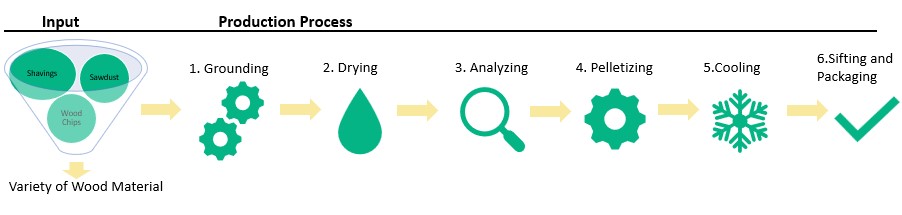
As mentioned before, wood pellets are made of sawdust, shavings, wood chips or chunks or other wood materials. Whereas sawdust has already the perfect initial structure, all of the other resources need to be put into a grounding machine, often also called hammer mill, where the different wood materials are ground to similar sizes because the variation of size before the grounding process is immense and that is because the different raw materials are delivered in a range of semi-finished states. After the milling, the material should not be bigger than the final product and due to that the diameter now is not more than 6mm.15Karkania, V., Fanara, E. & Zabaniotou, A. Review of sustainable biomass pellets production – A study for agricultural residues pellets’ market in Greece. Renew. Sustain. Energy Rev. 16, 1426–1436 (2012). DOI: 10.1016/j.energy.2016.02.165.
The second phase is the drying phase. In the end wood pellets have a moisture content of only 5-10%. Sawdust often already has the right moisture while the other wood materials need to be dried because their moisture content does not fit the regulations of the end product.9Guo, M., Song, W. & Buhain, J. Bioenergy and biofuels: History, status, and perspective. Renew. Sustain. Energy Rev. 42, 712–725 (2015). DOI: 10.1016/j.rser.2014.10.013. In between drying and pelletizing, the wood material gets analyzed. The production facilities need to make sure, that the moisture has reached the right level and that there are no other materials like stone or metal mixed within.15Karkania, V., Fanara, E. & Zabaniotou, A. Review of sustainable biomass pellets production – A study for agricultural residues pellets’ market in Greece. Renew. Sustain. Energy Rev. 16, 1426–1436 (2012). DOI: 10.1016/j.energy.2016.02.165.
After the preparatory analysis, pellet formation is carried out by compressing the dried wood material in a press, where the application of very high pressure induces densification and binding of the particles. These presses are also known as extruders. They exist in different sizes and shapes. There are two common ones: one has a flat and the other has a rotary form.
When using the flat one, the wood material is forced “through the top of a horizontally mounted die.”15Karkania, V., Fanara, E. & Zabaniotou, A. Review of sustainable biomass pellets production – A study for agricultural residues pellets’ market in Greece. Renew. Sustain. Energy Rev. 16, 1426–1436 (2012). DOI: 10.1016/j.energy.2016.02.165. When using the rotary one, two or more rotary presses are used in order to press the wood material from the inside of a ring to the outside, where it can be trimmed to the required length. Either system works because both of them use high pressure to force the wood material through holes in a die. “As pressure and friction increase so does the temperature of the wood. This allows lignin to soften and the fiber to be reshaped into pellet form.”15Karkania, V., Fanara, E. & Zabaniotou, A. Review of sustainable biomass pellets production – A study for agricultural residues pellets’ market in Greece. Renew. Sustain. Energy Rev. 16, 1426–1436 (2012). DOI: 10.1016/j.energy.2016.02.165.
After the wood pellets are in their desired shape, they need to cool down, because immediately after the pelletizing the pellets have a temperature of 90-95°C. So, as they leave the extruders, they are still soft and not transportable yet. The cooling process, which occurs due to gradually air cooling, is important for the strength of the pellets and their durability. Here the lignin hardens again and therefore strengthens the pellets. Due to its components, wood expands when exposed to heat because the molecules in wood materials are able to move faster around, thus taking up more space. As the temperature decreases again, wood starts to contract and, in this case, makes it durable and storable. The bonding process occurs naturally and does not need any addition of energy. There are three different ways to cool the pellets down: vertical, horizontal and with continuous flow.15Karkania, V., Fanara, E. & Zabaniotou, A. Review of sustainable biomass pellets production – A study for agricultural residues pellets’ market in Greece. Renew. Sustain. Energy Rev. 16, 1426–1436 (2012). DOI: 10.1016/j.energy.2016.02.165.
In the last step of the production process of wood pellets, they are passed over a vibrating machine that removes any fine particles. These “fines” are then fed back into the pelletizing process, ensuring that all raw material is utilized in order to minimize waste. This step in the production chain ensures a clean, nearly dust-free fuel, after which the pellets are packaged for their intended use.
After the pellets are produced, they can be distributed or stored.15Karkania, V., Fanara, E. & Zabaniotou, A. Review of sustainable biomass pellets production – A study for agricultural residues pellets’ market in Greece. Renew. Sustain. Energy Rev. 16, 1426–1436 (2012). DOI: 10.1016/j.energy.2016.02.165. “The grain-like geometry, high density, and low moisture content of the material further permit compact storage, bunker transfer, and long-distance transport.”9Guo, M., Song, W. & Buhain, J. Bioenergy and biofuels: History, status, and perspective. Renew. Sustain. Energy Rev. 42, 712–725 (2015). DOI: 10.1016/j.rser.2014.10.013. These perfect product characteristics enable numerous transport options like by truck, ship or rail and they can be bought in diverse quantities.15Karkania, V., Fanara, E. & Zabaniotou, A. Review of sustainable biomass pellets production – A study for agricultural residues pellets’ market in Greece. Renew. Sustain. Energy Rev. 16, 1426–1436 (2012). DOI: 10.1016/j.energy.2016.02.165.
2.4.1 Torrefaction
Since wood pellets get more and more popular as mentioned before, the pellet production creates new methods in order to optimize wood pellets in various stages. One of these new approaches is torrefaction. Here, the different wood materials are heated in the absence of oxygen at temperatures between 200°C and 300°C at atmospheric pressure. It is used to “upgrade biomass for combustion and gasification applications.”15Karkania, V., Fanara, E. & Zabaniotou, A. Review of sustainable biomass pellets production – A study for agricultural residues pellets’ market in Greece. Renew. Sustain. Energy Rev. 16, 1426–1436 (2012). DOI: 10.1016/j.energy.2016.02.165.
Torrefaction occurs as a pre-treatment of the wood because it prepares the raw biomass before it is used for energy production either by burning it directly or converting it into gas. The absence of oxygen is really important because otherwise the biomass would start to burn. After this process, the biomass turns into a solid, uniform material that has very low moisture, has a higher energy content and is better fuel compared to untreated raw biomass. The calorific value is higher with this new method than with the standard one and the higher the calorific value, the more energy one can get from the same amount of fuel.15Karkania, V., Fanara, E. & Zabaniotou, A. Review of sustainable biomass pellets production – A study for agricultural residues pellets’ market in Greece. Renew. Sustain. Energy Rev. 16, 1426–1436 (2012). DOI: 10.1016/j.energy.2016.02.165. So, it provides information on how much energy a fuel releases when its completely burned.
In comparison, normal wood pellets have a moisture content at around 10%, whereas torrefied pellets only show 3% of moisture. So, there is a difference of 7%. Also, the calorific value of torrefied pellets is 5 megajoules per kilogram higher than the one of normal pellets. The mass and the energy density of torrefied pellets are additionally higher than the one of the normal pellets.15Karkania, V., Fanara, E. & Zabaniotou, A. Review of sustainable biomass pellets production – A study for agricultural residues pellets’ market in Greece. Renew. Sustain. Energy Rev. 16, 1426–1436 (2012). DOI: 10.1016/j.energy.2016.02.165.
To sum it up, torrefied wood pellets get pre-treated, have a lower moisture content, a higher calorific value as well as higher mass and energy density, allowing the pellets to release more energy with the same amount of fuel and having more energy per unit of volume.
2.4.2 Other improved drying methods
As stated above, there are numerous variations of dryers for the drying procedure of wood pellets but superheated steam dryers seem to be one of the best because they got several advantages. In this scenario, instead of air or oxygen, superheated steam is used. This results in no possibility of combustion reactions or oxidation and since the process is done in a closed, oxygen-free system, there is no risk of fire or dust explosions which is one of the main problems with hot-air dryers. These systems are a bit more complex but they have a higher drying rate than air or gas dryers.15Karkania, V., Fanara, E. & Zabaniotou, A. Review of sustainable biomass pellets production – A study for agricultural residues pellets’ market in Greece. Renew. Sustain. Energy Rev. 16, 1426–1436 (2012). DOI: 10.1016/j.energy.2016.02.165. In this process there is a direct contact between the material that is supposed to be dried, in this case biomass, in order to reduce internal moisture. “The biggest advantage of this method is that latent heat of the dried waste gas can be recovered and reused which greatly improves the energy utilization rate.”16Mahmood, N. et al. Influences of emerging drying technologies on rice quality. Food Res. Int. 184, 114264 (2024). DOI: 10.1016/j.foodres.2024.114264. In the process of hot air drying, the hot air has to pick up water vapor from the biomass. This creates a resistance layer of moist air around the material that slows down evaporation. While superheated steam drying does not create this barrier of moist air because the surrounding atmosphere is already steam.
The water inside of the wood material just evaporates directly into the steam environment. And because the heat is transferred faster and the moisture leaves the biomass more easily due to no resistance, the drying process happens much quicker and with less energy waste compared to hot-air drying.16Mahmood, N. et al. Influences of emerging drying technologies on rice quality. Food Res. Int. 184, 114264 (2024). DOI: 10.1016/j.foodres.2024.114264.
In summary, superheated steam dryers are a more safe and efficient way to minimize the moisture content of biomass before pelletizing and they are great for energy saving as the drying stage of the wood materials is the most energy-consuming part of wood pellet production but on the other hand, the technical requirements are high because the pressure and the temperature need to be adjusted perfectly.
2.5 Heating models
2.5.1 Wood pellet stove
Wood pellet stoves are small, often automated biomass heating systems designed to provide efficient and clean heat. They are commonly used to only heat single rooms, apartments or even a house but with low energy requirement.17Fiedler, F. The state of the art of small-scale pellet-based heating systems and relevant regulations in Sweden, Austria and Germany. Renew. Sustain. Energy Rev. 8, 201–221 (2004). DOI: 10.1016/j.rser.2003.11.002. They are comparable to the more common fireplace that has been used since several centuries.18Brewer, P. J. From Fireplace to Cookstove: Technology and the Domestic Ideal in America. (Syracuse University Press, 2000). The thermal energy generated by the stove is delivered to the indoor environment primarily through convective and radiative heat transfer. Certain models are additionally equipped with water jackets, enabling integration into hydronic radiator systems. The heating capacity typically reaches up to 10 kilowatt (kW) and can be controlled either manually or via automatic regulation based on room temperature.17Fiedler, F. The state of the art of small-scale pellet-based heating systems and relevant regulations in Sweden, Austria and Germany. Renew. Sustain. Energy Rev. 8, 201–221 (2004). DOI: 10.1016/j.rser.2003.11.002.
Primarily, two types of pellet stoves are available: stand-alone stoves and chimney-integrated stoves. The latter are created to be placed directly in an open fireplace, but the more common type is the stand-alone stove. These stand-alone systems usually include an integrated pellet storage, allowing a restricted number of pellets to be stored directly in the stove. Such storage typically lasts for one or two days before refilling is required.17Fiedler, F. The state of the art of small-scale pellet-based heating systems and relevant regulations in Sweden, Austria and Germany. Renew. Sustain. Energy Rev. 8, 201–221 (2004). DOI: 10.1016/j.rser.2003.11.002.
Pellet stoves use an integrated burner in which the pellets are combusted. In most cases, the stoves employ a fall channel, feeding pellets from the integrated storage or from an external storage at a controlled rate depending on the required heat output. The feeding of pellets to the combustion chamber can occur in three different ways: with bottom-fed burners, horizontally fed burners or top-fed burners.17Fiedler, F. The state of the art of small-scale pellet-based heating systems and relevant regulations in Sweden, Austria and Germany. Renew. Sustain. Energy Rev. 8, 201–221 (2004). DOI: 10.1016/j.rser.2003.11.002.
In Sweden, the majority of pellet burners rely on the top-feeding principle. This approach is not only common in stoves but also widely applied in pellet boilers. Its main advantage is that the wood pellets remain constantly separated from the combustion area, which significantly reduces the risk of back burn from the furnace. Additionally, it prevents prolonged after-glow when the burner is turned off and ensures that pellets are accurately dosed according to the current power demand. However, one drawback of the top-feeding system is that the falling of the pellets can cause an increased release of dust and unburned particles.17Fiedler, F. The state of the art of small-scale pellet-based heating systems and relevant regulations in Sweden, Austria and Germany. Renew. Sustain. Energy Rev. 8, 201–221 (2004). DOI: 10.1016/j.rser.2003.11.002.
The bottom-fed burner was originally developed for wood chip boilers, though it can also be applied to wood pellet boilers. In this system, a screw conveyor pushes the pellets into the combustion zone through the burner pipe. An important benefit is that ash removal is unnecessary, since incoming wood pellets automatically replace the ash in the combustion area. Nevertheless, compared to top-fed burners, bottom-fed systems are characterized by a longer after-burning period and a higher risk of back burning.17Fiedler, F. The state of the art of small-scale pellet-based heating systems and relevant regulations in Sweden, Austria and Germany. Renew. Sustain. Energy Rev. 8, 201–221 (2004). DOI: 10.1016/j.rser.2003.11.002.
Horizontally fed burners function very similarly to bottom-fed systems, as pellets are also pushed by a screw conveyor into the combustion zone. The key difference, however, is that horizontally fed burners require additional ash removal.17Fiedler, F. The state of the art of small-scale pellet-based heating systems and relevant regulations in Sweden, Austria and Germany. Renew. Sustain. Energy Rev. 8, 201–221 (2004). DOI: 10.1016/j.rser.2003.11.002.
In order to achieve complete combustion of biomass fuels such as wood pellets, several criteria must be fulfilled. These measures not only ensure efficient energy conversion but also contribute to reduced emissions and low slagging. In this context, low slagging refers to the production of ash with a high melting temperature, which prevents the ash from melting or agglomerating. This is crucial, as slagging can obstruct airflow and, in severe cases, cause damage to the combustion equipment.17Fiedler, F. The state of the art of small-scale pellet-based heating systems and relevant regulations in Sweden, Austria and Germany. Renew. Sustain. Energy Rev. 8, 201–221 (2004). DOI: 10.1016/j.rser.2003.11.002.
A central requirement for optimized combustion is the correct quantity and method of supplying combustion air. For this purpose, the combustion chamber is typically divided into two distinct zones: the primary and the secondary combustion zone, each equipped with its own air supply system. In the primary combustion zone, the fuel passes through three stages: drying, the pyrolysis and final combustion. During the drying phase, residual moisture in the pellets is evaporated. Once sufficiently dry, the pellets undergo thermal decomposition, forming volatile combustible gases and a solid carbon-rich residue. The initial combustion reactions are endothermic, requiring external energy input and occur under sub-stoichiometric conditions, meaning that the available air is insufficient for complete oxidation.17Fiedler, F. The state of the art of small-scale pellet-based heating systems and relevant regulations in Sweden, Austria and Germany. Renew. Sustain. Energy Rev. 8, 201–221 (2004). DOI: 10.1016/j.rser.2003.11.002.
The secondary combustion phase takes place in a separate zone, where the volatile gases are oxidized with an excess air supply, while the carbon-rich residue continues to oxidize in the primary zone. Both processes occur in parallel and contribute to the overall energy release. Efficient combustion performance depends on thorough mixing of the secondary air with the flue gases, which is strongly influenced by the combustion chamber’s geometry and the design of the secondary air nozzles. Furthermore, an extended residence time of the flue gases inside the furnace promotes more complete combustion.17Fiedler, F. The state of the art of small-scale pellet-based heating systems and relevant regulations in Sweden, Austria and Germany. Renew. Sustain. Energy Rev. 8, 201–221 (2004). DOI: 10.1016/j.rser.2003.11.002.
The level of excess air in the secondary combustion zone is particularly important for emission control. Insufficient air results in higher emissions of carbon monoxide (CO) and unburned hydrocarbons, while excessive air promotes the formation of nitrogen oxides (NOx). Early empirical studies reported that pellet burners emitted two to four times more NOx than oil burners. However, modern Austrian and German pellet boilers are generally equipped with advanced lambda control systems that automatically regulate air supply, significantly reducing NOx emissions compared to older systems. Swedish pellet boilers often rely on manual adjustments, which can lead to less efficient emission control. This highlights the importance of updated regulation technologies to achieve both high efficiency and low environmental impact.17Fiedler, F. The state of the art of small-scale pellet-based heating systems and relevant regulations in Sweden, Austria and Germany. Renew. Sustain. Energy Rev. 8, 201–221 (2004). DOI: 10.1016/j.rser.2003.11.002.
Top-fed burners typically feature openings at the bottom of the stove, supplying the primary air and hot air needed for automatic ignition. Secondary air is usually preheated by the mantle of the combustion pot and introduced through many small mantle openings. The aspirator that provides combustion air is placed below the burner and in some cases an additional fan is installed to enhance heat transfer from the stove to the surrounding environment. This setup allows for more efficient and cleaner combustion compared to traditional wood stoves, resulting in less smoke and a more complete burn.17Fiedler, F. The state of the art of small-scale pellet-based heating systems and relevant regulations in Sweden, Austria and Germany. Renew. Sustain. Energy Rev. 8, 201–221 (2004). DOI: 10.1016/j.rser.2003.11.002.
The generated heat is transferred to the room by both convection and radiation. The primary heat output is achieved through a fan that circulates hot air into the living space, while the stove’s heated body also radiates warmth directly into the room. Ash removal is kept simple, as the pellets combust either on a manually or automatically moveable grate plate, which allows the remaining ash to fall into a dedicated container.17Fiedler, F. The state of the art of small-scale pellet-based heating systems and relevant regulations in Sweden, Austria and Germany. Renew. Sustain. Energy Rev. 8, 201–221 (2004). DOI: 10.1016/j.rser.2003.11.002.
2.5.2 Wood pellet boiler
Wood pellet boilers or also called central heating boilers are commonly applied in single- and multi-family residential buildings to supply space heating. The generated heat is transferred through an exhaust gas to water heat exchanger and subsequently distributed via the heating system. These units generally exhibit a thermal output capacity between 10 and 40 kW. In addition, certain models incorporate automatic modulation, allowing the output to adjust dynamically between 30% and 100% in accordance with the actual heat demand.17Fiedler, F. The state of the art of small-scale pellet-based heating systems and relevant regulations in Sweden, Austria and Germany. Renew. Sustain. Energy Rev. 8, 201–221 (2004). DOI: 10.1016/j.rser.2003.11.002.
Biomass boilers designed for pellet combustion are constructed in a similar manner to conventional oil boilers. In these systems, the biomass is automatically transported from the storage facility into the burner, which is located inside the combustion chamber. Once in place, the fuel is ignited and combusted, generating flue gases. These gases pass through multiple channels of the heat exchanger, where their thermal energy is transferred to water circulating
on the opposite side. A circulation pump then delivers the heated water into the building’s heating system. To ensure efficient combustion and adequate air supply, a fan is incorporated into the design. For stable combustion and effective heat transfer across the entire power range, both the combustion chamber and heat exchanger must be dimensioned according to the maximum capacity of the burner. The complete boiler unit is insulated and enclosed with sheet metal to prevent damage and to minimize heat losses to the surroundings.17Fiedler, F. The state of the art of small-scale pellet-based heating systems and relevant regulations in Sweden, Austria and Germany. Renew. Sustain. Energy Rev. 8, 201–221 (2004). DOI: 10.1016/j.rser.2003.11.002.
In Sweden for example, the most common configuration is the so-called two-unit boiler, which combines a conventional boiler with a separate pellet burner. This hybrid design allows the conventional boiler to be fitted with different burner types, offering a high degree of flexibility. A particularly widespread practice is the replacement of outdated oil burners with modern pellet burners, facilitated by standardized connection flanges. This ease of retrofitting has been a major factor contributing to the broad diffusion of pellet heating systems in Sweden. However, these two-unit systems are often less optimized, with efficiencies frequently below 85% and correspondingly higher emissions.17Fiedler, F. The state of the art of small-scale pellet-based heating systems and relevant regulations in Sweden, Austria and Germany. Renew. Sustain. Energy Rev. 8, 201–221 (2004). DOI: 10.1016/j.rser.2003.11.002.
By contrast, integrated pellet boilers, which are particularly common in Austria and Germany, represent a more advanced technological solution. In these systems, the burner is permanently integrated into the boiler unit and cannot be separated. Austrian boilers, in particular, are characterized by a high level of user comfort, often comparable to that of oil or gas heating systems. Cleaning of the passages and burner is frequently automated by helical screws, which simultaneously act as turbulators to enhance heat transfer to the distribution fluid. Moreover, Austrian boilers are commonly equipped with aspirators for air supply and lambda sensors that regulate combustion conditions and allow for modulation of the heating output. As a result, these systems achieve very high efficiencies, often reaching up to 94%, while maintaining low emission levels.17Fiedler, F. The state of the art of small-scale pellet-based heating systems and relevant regulations in Sweden, Austria and Germany. Renew. Sustain. Energy Rev. 8, 201–221 (2004). DOI: 10.1016/j.rser.2003.11.002.
2.5.3 Differences
So apart from the obvious and biggest difference, their appearance, there are certain characteristics that vary between these two domestic heating models, the wood pellet stove and the wood pellet boiler.
• Heat distribution
The two types of heating models distribute their heat differently. While the pellet stove generates heat through the air and therefore often only heats the room in which it was placed, the pellet boiler on the other hand transfers the generated heat through an exhaust gas to water heat exchanger and then distributes it through the heating system. This happens throughout the whole house via its water pipes.
• Emissions
Modern central heating boilers work with certain combustion regulations. The temperature, oxygen levels and the quantity of pellets needed, is automatically regulated depending on the wanted heat outcome leading to a reduced biomass consumption and with that, less ash production. Stoves in contrast often do not work with these regulations or techniques, resulting in a higher pellet consumption and ash production.
• Visibility of the fire
The central heating boiler combusts the pellets in a closed, internal combustion chamber whereas the fire in a pellet stove is often visible due to a glass front. This creates the feeling of coziness.
• Automatic ignition
Pellet stoves often do not have automatic ignition, resulting in self-ignition per hand. But boilers always ignite pellets automatically which leads to more comfort because there is no need to even go into the heating room and some boilers even feature an app with individual control.
• Electronically controlled combustion
In pellet boilers the combustion process is always electronically controlled. Certain criteria determine whether more fuel or oxygen needs to be added into the combustion chamber to maintain a constant heating temperature or not. As before, pellet stoves often do not feature this.
• Automatic ash removal
As mentioned before, modern boilers are very efficient and because of that produce only little ash. But they also feature a daily automatic self-cleaning process in which the ash is transferred into an external ash box. Pellet stoves sometimes also have this, but it depends on the brand and year the model was created.19GmbH, Ö. H. Heizen mit Pellets: Unterschied von Pelletofen & Pelletheizung | ÖkoFEN. https://www.oekofen.com/de-at/unterschied-pelletofen-pelletheizung/.
In summary, wood pellet stoves and pellet boilers differ not only in their design but also in their functionality and efficiency. While stoves primarily heat single rooms through air distribution and offer visible flames that create a sense of comfort, boilers distribute heat throughout an entire building via water-based systems and emphasize automated operation. Boilers generally achieve higher efficiency, with electronically controlled combustion, automatic ignition, and ash removal, resulting in lower pellet consumption and reduced emissions. Stoves, by contrast, are often less automated, require more manual intervention, and tend to produce higher emissions, though they remain attractive for their aesthetic appeal.
3 Economic performance
3.1 Financial comparison to other heating options
When evaluating heating options, the question is rarely only about technology, it is about money as well, especially the acquisition and energy costs. Homeowners want to know whether switching to wood pellets actually pays off compared to established solutions such as oil or gas. The true financial balance depends on factors such as investment costs, fuel price trends and supply reliability. A closer look at these aspects reveals how wood pellets perform in direct comparison to other heating options and whether the transition can be considered not only more sustainable, but also economically sound.
3.1.1 Acquisition costs
The acquisition costs of heating systems vary significantly depending on the technology chosen and they represent an essential factor when considering the long-term economic viability of a heating solution. The following costs refer exclusively to the purchase price of the heating instrument itself, excluding additional expenditures for installation, infrastructure or complementary system components.
To provide a practical illustration of acquisition costs, a complete offer from a German craftsman company from 2024 for the installation of a wood pellet boiler is included in the appendix. This document details not only the price of the heating unit itself, but also additional cost components that typically arise in practice, such as labor, commissioning and system integration. While the main chapter focuses exclusively on the acquisition costs of the heating instrument, the appendix offers a more comprehensive perspective by demonstrating how these costs expand once installation and related services are taken into account. This example reflects the financial reality faced by households considering a transition to pellet heating and illustrates the difference between the theoretical acquisition price and the actual investment required.
The previously mentioned Swedish boilers cost around 4,000 to 6,000€. The Austrian or German boilers on the other hand cost roughly 7,000 to 10,000€. The price gap for pellet boilers can be explained by their optical appearance, their differences in features and the transport system is often already included in the price for the Austrian or German boilers.20Fiedler, F. The state of the art of small-scale pellet-based heating systems and relevant regulations in Sweden, Austria and Germany. Renew. Sustain. Energy Rev. 8, 201–221 (2004). Their acquisition costs are generally higher compared to conventional oil or gas boilers. For example, VIESSMANN’s Vitoligno 300-C, a wood pellet boiler, is priced at approximately €9,996.00, with costs easily exceeding €17,000 depending on system size and configuration.21Pelletheizung: Aufbau, Modelle, Brennstoff. https://www.viessmann.de/de/wissen/technik-und-systeme/pelletheizung.html (2024). A pellet stove only costs about 1,500 to 3,500€ when purchasing. Whereas here a freestanding pellet stove costs less than a chimney-integrated stove. Also, the size of the stove has an influence on the price as well as the appearance and the aesthetics.22Pellet Stove Cost Breakdown. EnergySage https://www.energysage.com/clean-heating-cooling/pellet-stoves/costs-benefits-pellet-stoves/.
Oil heating continues to be one of the most important energy sources in the German heating market, with more than ten million households still relying on this technology. Oil is expected to remain a relevant energy carrier for at least the next two decades. Therefore, the market for oil boilers offers a wide range of prices depending on design and efficiency. For example, the company VIESSMANN provides oil boilers from approximately €2,199 for simpler models to over €10,218 for high-efficiency oil condensing boilers. Within this range, the Vitoladens 300-C costs around €5,861.90, while the Vitoladens 300-T is priced at €6,439.00.23Öl-Brennwertkessel: Modernste Heiztechnik. https://www.viessmann.de/de/wissen/technik-und-systeme/oel-brennwertkessel.html (2024).
Gas heating represents the most widely used heating system in Germany, installed in nearly half of all residential buildings, including single-family, two-family and multi-family houses (49.3%), as well as in apartments (48.2%).24Gasheizung: Modern heizen mit Brennwert. https://www.viessmann.de/de/wissen/technik-und-systeme/gasheizung.html (2024). This dominance is also reflected in the broad availability and competitive costs of gas boilers. For instance, VIESSMANN’s Vitodens 300-
W is available at €3,956.27, while the Vitodens 333-F is priced at €5,579.00, placing gas heating in a moderate price segment compared to other technologies.24Gasheizung: Modern heizen mit Brennwert. https://www.viessmann.de/de/wissen/technik-und-systeme/gasheizung.html (2024).
Heat pumps have experienced a substantial increase in demand in recent years, particularly in Northern and Western Europe. In Germany alone, 140,390 heat pumps were sold in 2020, representing a sales growth of 37.2% compared to the previous year. Even higher sales volumes were recorded in Italy (232,834 units) and France (394,129 units). Despite their growing popularity, heat pumps typically involve higher acquisition costs than oil or gas boilers. This is mainly due to their more complex technology and the larger quantity of construction materials required. For instance, air-water heat pumps such as the VIESSMANN Vitocal 250A are available for €7,310.00, while the Vitocal 252-A, which includes an integrated hot water tank, is priced at €10,829.00. Brine-water heat pumps such as the Vitocal 200-G (€9,019.00) or the Vitocal 222-G (€9,787.00) demonstrate smaller price differences within their category. Split heat pumps, such as the Vitocal 200-S (€7,736.00) and the Vitocal 222-S (€9,619.00), as well as hot water heat pumps like the Vitocal 262-A Typ T2W (€2,199.00) and Vitocal 262-A (€2,589.00), further illustrate the wide range of acquisition costs depending on system type and performance.25Wärmepumpe: Alle Infos auf einen Blick. https://www.viessmann.de/de/wissen/technik-und-systeme/waermepumpe.html (2024).
In summary, while oil and gas heating systems are relatively affordable in terms of acquisition costs, heat pumps and pellet boilers tend to require higher initial investments. However, these technologies are often associated with advantages in terms of efficiency, environmental performance, and long-term energy savings, which may outweigh their higher purchase prices.

3.1.2 Heating costs
The expenses for residential heating differ significantly depending on the technology applied and are shaped by several external influences. Key factors include the thermal efficiency of the building, the local climate and the occupants’ heating behavior. These aspects must be considered when comparing different fuels and systems, as they play a decisive role in explaining the cost variations observed in practice.26Heizkosten pro m2: Fernwärme / Zentralheizung (Rechner). https://www.heizspiegel.de/index.php?id=13183.
Conventional fuels such as heating oil and natural gas continue to be widely used in household heating. Their price trends are closely connected and both were heavily impacted by the European energy crisis of 2022. At that time, the cost of natural gas surged to roughly 16 cents per kilowatt-hour (kWh). By 2023, however, the price fell to an average of 12.9 cents per kWh due to state intervention in the form of the gas price cap and a gradual stabilization of the energy market. In 2024, natural gas prices settled at about 10.5 cents per kWh. Heating oil displayed a similar development, costing 10.2 cents per kWh in 2023 and 10.4 cents per kWh in 2024, indicating relative stability in that segment.26Heizkosten pro m2: Fernwärme / Zentralheizung (Rechner). https://www.heizspiegel.de/index.php?id=13183.
The effect of these prices becomes clearer when applied to everyday households. For a 70 m² apartment, annual gas heating costs range between €835 and €1,930. In a 110 m² detached house, expenses increase to between €1,440 and €3,510. In multi-family housing, gas heating consumption averaged 131 kWh per m2 in 2023, which equates to about €19 per m2 annually. For a 70 m² flat, this corresponds to approximately 9,170 kWh per year, leading to overall costs of around €1,330 including surcharges. Monthly advance payments in such households averaged €111.26Heizkosten pro m2: Fernwärme / Zentralheizung (Rechner). https://www.heizspiegel.de/index.php?id=13183.
Heat pumps represent one of the most efficient alternatives to fossil-fuel-based heating systems. Their operating costs are directly dependent on electricity prices, which averaged 31.6 cents per kWh in 2023. Although electricity remains comparatively expensive, the high efficiency of heat pumps, expressed through their coefficient of performance, significantly reduces heating energy demand.26Heizkosten pro m2: Fernwärme / Zentralheizung (Rechner). https://www.heizspiegel.de/index.php?id=13183. Moreover, heat pumps make it possible to efficiently utilize freely available energy from the ground, air, groundwater, and waste heat. In doing so, they contribute to reducing dependency on fossil fuels such as oil and gas, lower CO₂ emissions, and help conserve finite fossil resources. In addition, their combination with photovoltaic systems enables an increased share of self-consumed solar electricity, thereby enhancing independence from external energy providers.25Wärmepumpe: Alle Infos auf einen Blick. https://www.viessmann.de/de/wissen/technik-und-systeme/waermepumpe.html (2024).
In practice, annual heating costs in a 70 m² apartment ranged from €525 to €1,975, while in a 110 m² single-family dwelling they were between €880 and €3,290. On average, apartment buildings equipped with heat pumps consumed 36 kWh per m2 in 2023, translating into €13 per m2 annually. For a 70 m² reference apartment, this corresponds to approximately 2,520 kWh of yearly consumption, leading to heating costs of about €910 or roughly €75 per month, including additional charges.26Heizkosten pro m2: Fernwärme / Zentralheizung (Rechner). https://www.heizspiegel.de/index.php?id=13183.
For a 70 m² reference apartment, this resulted in average annual heating expenses of €840, equal to roughly €70 per month. Owners of detached houses faced somewhat higher costs, averaging €1,465 annually, primarily due to smaller purchasing quantities and the resulting higher price per unit of pellets. In apartment buildings with pellet heating, the average energy consumption in 2023 was 119 kWh per m2, with annual heating costs of around €12 per m.2Bird J., Clarke, B., Konstantinoudis, G., and Otto, F. (2025). UK and European heatwave 2025. Grantham Institute background briefing. For a 70 m² apartment, this equals about 8,330 kWh of heating energy per year, which corresponds to average costs of €840.26Heizkosten pro m2: Fernwärme / Zentralheizung (Rechner). https://www.heizspiegel.de/index.php?id=13183.
The comparison of heating costs demonstrates that significant differences exist between conventional and renewable energy sources. Fossil fuels such as oil and gas remain important in the heating sector but are subject to considerable price fluctuations, as illustrated by the impact of the 2022 energy crisis. Heat pumps, despite their reliance on relatively expensive electricity, achieve lower energy consumption due to their high efficiency and therefore represent a viable long-term alternative, particularly in well-insulated buildings. Wood pellets, on the other hand, combine cost stability with comparatively low annual expenses, making them one of the most affordable and sustainable heating options currently available. Overall, the choice of heating system depends not only on energy prices but also on building efficiency, climatic conditions and household-specific consumption patterns.

3.1.3 Maintenance costs
The amount of maintenance costs is determined by various factors. Key influencing factors, in addition to the general labor required, include the type of system and the regional location, which can affect both the pricing structure and travel costs. Furthermore, the replacement of necessary wear parts has a direct impact on the overall costs. An existing maintenance contract can, in turn, reduce these costs or make them more predictable, as it often includes discounted terms for regular inspections.27Heizungswartung: Kosten, Pflichten & Regelmäßigkeit. https://www.heizspiegel.de/index.php?id=17015.
The maintenance requirements and associated costs of heating systems vary considerably depending on the technology employed. Oil-fired heating systems, for instance, incur annual maintenance expenses ranging from approximately €120 to €260, with an average of around €160. The comparatively higher costs relative to gas heating, listed below, are largely attributable to the need for regular inspections of oil storage tanks.27Heizungswartung: Kosten, Pflichten & Regelmäßigkeit. https://www.heizspiegel.de/index.php?id=17015.
In contrast, the maintenance costs of gas heating systems are influenced by several variables. In addition to the basic labor required, factors such as the replacement of worn parts, the degree of contamination of the burner and heat exchanger, as well as potential travel costs play a significant role. For single-family homes, annual costs generally fall between €80 and €220 and the average lays at €130.27Heizungswartung: Kosten, Pflichten & Regelmäßigkeit. https://www.heizspiegel.de/index.php?id=17015.
Heat pumps represent a comparatively low-maintenance alternative. Regular servicing is essential to ensure both efficiency and durability, as dirt, wear or incorrect settings can significantly increase electricity consumption. Air and ground-source heat pumps are particularly sensitive to the accumulation of dirt in pipes, which can lead to increased resistance and energy demand. Likewise, incorrect system adjustments contribute to unnecessary excess consumption. Nevertheless, because heat pumps do not produce combustion residues such as soot or slag, they require less maintenance overall compared to oil or gas systems but due to their more complex system, the maintenance is more expensive. The annual costs for single-family homes are estimated between €110 and €220, with an average of €140.27Heizungswartung: Kosten, Pflichten & Regelmäßigkeit. https://www.heizspiegel.de/index.php?id=17015.
Pellet heating systems, however, entail the highest maintenance requirements among the technologies considered. Annual costs for single-family homes typically range from €110 to €370, with an average of €215.27Heizungswartung: Kosten, Pflichten & Regelmäßigkeit. https://www.heizspiegel.de/index.php?id=17015. The elevated maintenance effort arises primarily from the complex servicing needs of the pellet transport system. Furthermore, pellet boilers and stoves demand more frequent and extensive cleaning than conventional heating systems. This includes tasks such as refilling pellets (particularly when only small storage units are available), cleaning flue gas passages, removing ash from containers and maintaining stove windows, if it is not a fully automated boiler.20Fiedler, F. The state of the art of small-scale pellet-based heating systems and relevant regulations in Sweden, Austria and Germany. Renew. Sustain. Energy Rev. 8, 201–221 (2004). Even though many of these cleaning activities do not generate direct monetary expenses, they involve considerable time investments. In addition, pellet heating requires regular chimney cleaning, which further contributes to the overall maintenance burden.27Heizungswartung: Kosten, Pflichten & Regelmäßigkeit. https://www.heizspiegel.de/index.php?id=17015.
In summary, maintenance costs vary significantly across heating technologies, shaped by system complexity, regional conditions, and servicing requirements. While oil and gas systems remain relatively moderate in cost, heat pumps offer lower maintenance needs despite higher servicing expenses, and pellet heating systems incur the highest financial and time-related burdens due to their extensive cleaning and operational demands.

3.2 Industrial transformation
Wood has long been a vital energy source, dominating cooking and heating until the 19th century. As a renewable form of bioenergy, it offers an alternative to finite fossil fuels. Pelletizing, first applied to animal feed in the early 20th century, gained new significance during the 1970s oil crisis, which spurred interest in wood pellets as a modern energy carrier.9Guo, M., Song, W. & Buhain, J. Bioenergy and biofuels: History, status, and perspective. Renew. Sustain. Energy Rev. 42, 712–725 (2015). DOI: 10.1016/j.rser.2014.10.013.
Industrial use of wood pellets developed first, but residential applications gained momentum in the 1980s with the invention of the pellet stove in the United States. Scandinavian countries such as Sweden and Denmark were among the first in Europe to adopt the technology. The market expanded slowly at first, but a significant boom followed in the 1990s and early 2000s, spreading to Austria and Germany. In order to meet the rising demand, the market for wood pellets expanded and imports and exports became important. Additionally, logistics had to change. Special pellet export terminals were created as well as long-distance supply chains.13Historie. https://depi.de/historie.
Today, wood pellets have become a widely used renewable energy source for both industrial and residential purposes. Produced from compacted sawdust and wood residues, they provide a sustainable substitute for fossil fuels, reducing GHG emissions while offering stable quality and high energy density. They are used in power generation as a coal alternative, as well as in industrial boilers and furnaces across sectors such as manufacturing, agriculture and food processing. Their efficient combustion, especially with torrefied pellets, reliable supply chains and supportive policy frameworks enhance their attractiveness, while technological improvements in production are expected to further stimulate market growth.28Francisco J. Bacunawa Jr & Angieneth S. Perido-Pascua. Utilization of wood pellet for industrial use. World J. Adv. Res. Rev. 21, 2439–2441 (2024). DOI: 10.30574/wjarr.2024.21.3.0990.
In summary, the wood pellet industry has evolved from traditional wood use and early pelletizing techniques into a global renewable energy sector. Triggered by the oil crisis of the 1970s and driven by technological innovation, the market expanded from industrial to residential applications, with Scandinavia leading the European adoption. Today, wood pellets serve as an alternative to fossil fuels in both heating and power generation, supported by reliable logistics, policy frameworks and ongoing improvements in efficiency and production. Their transformation illustrates the shift from a niche by-product to a key component of the modern energy transition.
3.3 Supply reliability and sales volume
The reliability of wood pellet supply has become an increasingly important issue in the context of their growing role as a renewable energy source. As demand continues to rise in both industrial and residential sectors, questions emerge regarding the stability of raw material availability, international trade flows and price developments. While wood pellets are often presented as a secure and sustainable alternative to fossil fuels, their supply chain is influenced by a range of factors including access to biomass feedstocks, transportation logistics, and geopolitical dynamics. Recent market fluctuations, raw material bottlenecks and the reconfiguration of trade patterns following the loss of Russian exports illustrate the vulnerability of the sector. At the same time, strong domestic production capacities in countries such as Germany, alongside technological advances and supportive policy frameworks, contribute to maintaining a relatively stable supply base.29Fritsche, U. R. et al. Margin potential for a long-term sustainable wood pellet supply chain.
As mentioned before, traditionally wood pellets were produced from low-value industrial residues such as sawdust and shavings, which offered stable availability and low costs. Their fine structure and low moisture content also reduced processing requirements, making them an ideal feedstock. However, rising demand and limited residue availability have increased reliance on forestry products like pulp-grade roundwood, which require more pre-treatment steps such as debarking and chipping. The costs and availability of feedstocks are strongly influenced by regional factors, including local resource availability and the closure of sawmills or paper mills. This dependency highlights the vulnerability of pellet supply chains, as raw material shortages or shifts in industrial activity can directly affect production reliability.29Fritsche, U. R. et al. Margin potential for a long-term sustainable wood pellet supply chain.
The wood pellet industry can be profitable, especially for well-capitalized, efficiently operated producers with favorable access to inexpensive feedstocks and strong market demand. Margins and Return on Investment are generally positive in robust markets. However, financial outcomes are sensitive to supply chain reliability, contract structuring and operational costs, as evidenced by contrasting cases like Drax (profitability) and Enviva (bankruptcy).30Wood Pellets Market Size, Share & Forecast Report, 2032. https://www.fortunebusinessinsights.com/industry-reports/wood-pellets-market-100877.
Drax Group is a UK-based energy company that has transitioned from traditional coal-fired generation to a leading role in renewable energy production. Its core activities include the operation of Drax Power Station, Europe’s largest biomass-fueled power plant, as well as hydroelectric and pumped storage facilities that support grid stability. In addition, Drax operates wood pellet production plants, primarily in North America, to secure sustainable biomass supply for its own generation and for international markets. The company also provides renewable electricity to business customers in the UK.31About us. Drax Global https://www.drax.com/about-us/.
Enviva is a U.S.-based producer of industrial wood pellets. The company manufactures and exports pellets to power and heat producers in Europe and Asia, where they are used as a substitute for coal in energy generation. Enviva positions itself as a key player in the global bioenergy supply chain, emphasizing renewable energy transition and carbon reduction goals, although it has faced significant financial and operational challenges in recent years.32About Us – Enviva Biomass. https://www.envivabiomass.com/about-us/.,33Enviva emerges from Chapter 11 bankruptcy | Biomass Magazine. https://biomassmagazine.com//articles/enviva-emerges-from-chapter-11-bankruptcy.
Drax Group demonstrates that profitability in the biomass sector can be achieved through vertical integration and consistent policy support.34Chestney, N. & Chestney, N. UK’s Drax profit falls as power prices drop but buy-backs extended. Reuters (2025). The example of Drax illustrates how crucial it is for companies in the wood pellet industry to avoid dependency on a single supplier. By sourcing biomass from a wide range of actors, including large forest product companies, small harvesting contractors, tenure holders and private landowners, Drax reduces the risks associated with supply disruptions. Moreover, the company’s ability to process different forms of feedstock, from sawdust and woods chips to unmerchantable logs, ensures greater flexibility and resilience. This diversified procurement strategy not only secures a stable raw material flow but also strengthens the company’s long-term supply reliability. Drax operates at a large industrial scale, supplying bulk biomass pellets to customers across Europe, North America and Asia. Shipments vary in size depending on the mode of transport, ranging from 40-tonne truckloads and 100-tonne railcars to Panamax Ocean vessels carrying up to 60,000 tons. This illustrates the company’s ability to serve both small- and large-scale energy producers. To strengthen its international sales capacity, Drax has strategically developed export infrastructure in British Columbia, with terminals in Vancouver and Prince Rupert. These ports are supplied by a network of interconnected pellet mills located in the province’s forest regions, all linked by rail. This logistical system not only facilitates high export volumes but also ensures consistent supply to meet European industrial standards, thereby underpinning
Drax’s position as a major global biomass supplier.35Pellet Sales. Drax UK https://www.drax.com/uk/pellet-sales/.
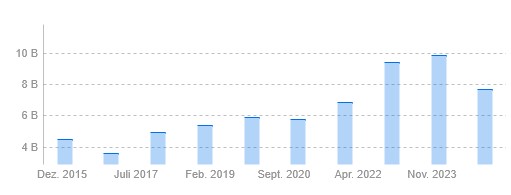
The Drax Group was able to achieve a sales volume of $7.757 billion in the last twelve months, on average from 2020 to 2024 the company received $7.715 billion and in the last five years the highest amount of sales volume was achieved in December 2023 with $9.858 billion.36Drax Group plc (DRXG.F) Umsatz. Investing.comhttps://de.investing.com/pro/OTCPK:DRXG.F/explorer/total_rev.
Conversely, the case of Enviva highlights the financial vulnerabilities arising from speculative market behavior, operational inefficiencies and excessive expansion.33Enviva emerges from Chapter 11 bankruptcy | Biomass Magazine. https://biomassmagazine.com//articles/enviva-emerges-from-chapter-11-bankruptcy. This contrast underlines the necessity of measured growth strategies, robust logistical structures and careful contract management within the wood pellet industry.
The supply reliability and profitability of the wood pellet industry are closely interconnected. While secure access to raw materials and efficient logistics form the basis of a stable supply chain, profitability depends on strategic positioning, technological efficiency and supportive policy frameworks. The contrasting cases of Drax and Enviva illustrate that vertical integration and stable regulation can foster sustainable growth, whereas overexpansion and weak operational management pose significant financial risks. Overall, the industry’s future profitability will depend on balancing resource availability, market demand and prudent business strategies.
4 Ecological performance
The ecological impact of heating systems is increasingly central to discussions on energy transition and climate policy. In particular, carbon dioxide (CO2) emissions represent a key metric for evaluating the sustainability of different heating technologies. While fossil-based systems such as oil and gas boilers continue to dominate the market, their high emission levels raise concerns about long-term environmental compatibility. In contrast, renewable alternatives such as wood pellets are promoted as more climate-friendly options, though their ecological performance depends on multiple factors including production processes, energy efficiency and life-cycle emissions. This chapter analyzes the CO2 footprint of wood pellet heating and compares it to conventional fossil systems, in order to assess its role as a sustainable heating technology.
4.1 Origin of materials
Wood pellets are primarily produced from industrial wood residues, such as sawdust, shavings and offcuts. These by-products are generated continuously in the timber industry, regardless of pellet production and have traditionally formed the core raw material for pellet manufacturing.5Thomson, H. & Liddell, C. The suitability of wood pellet heating for domestic households: A review of literature. Renew. Sustain. Energy Rev. 42, 1362–1369 (2015). DOI: 10.1016/j.rser.2014.11.009. However, the globally rising demand for pellets has put pressure on this model, as the available quantities of residues could become insufficient to cover the increasing need.
In order to meet demand, some producers, most prominently Enviva, the world’s largest pellet manufacturer, have expanded their feedstock base by processing whole, healthy trees on a large scale. This practice is partly motivated by the need to ensure the high density of pellets, which cannot always be guaranteed when relying solely on residues. Concerns over deforestation linked to pellet production have been reported in European countries such as Estonia and Romania.37Kruse, M. Holzpellets: sauberes Image, zerstörerische Realität. Blog des NABU https://blogs.nabu.de/holzpellet-industrie/ (2023).
The growth in pellet demand has been driven significantly by renewable energy subsidies, especially within Europe. These incentives have encouraged a sharp rise in the number of power plants using wood pellets as a co-firing fuel alongside coal. Germany has thus far relied predominantly on domestically produced pellets, which according to industry reports are still largely composed of sawdust and other wood residues. Nonetheless, recent developments suggest a shift. In 2022, Enviva began supplying pellets to German customers and plans are underway to convert the coal-fired power plant in Wilhelmshaven, owned by the same owner as the one of Enviva, into a wood-fired facility. If realized, this conversion would require imports of approximately 2.9 million tons of wood pellets annually, an amount nearly equivalent to Germany’s entire current pellet production. Such a development would mark a significant departure from the country’s reliance on domestic residue-based production, underscoring the broader tensions between renewable energy targets, resource availability and environmental sustainability in the global pellet industry.37Kruse, M. Holzpellets: sauberes Image, zerstörerische Realität. Blog des NABU https://blogs.nabu.de/holzpellet-industrie/ (2023).
4.2 Emissions
The ecological performance of wood pellets must be assessed across their entire life cycle, including production, storage, transportation and the combustion process. Each of these phases generates distinct environmental impacts that influence the overall sustainability of wood pellet-based heating.
4.2.1 Production
The ecological performance of wood pellets is highly dependent on the origin of their raw materials and the production methods applied. When produced according to their original purpose, utilizing industrial residues such as sawdust, shavings, or other by-products of the wood-processing industry, the GHG emissions associated with pellet production are comparatively low. In such cases, no additional harvesting activities are required, meaning that the feedstock is generated independently of pellet demand. This approach not only avoids the emission of additional GHG but also contributes to waste reduction by valorizing materials that would otherwise remain unused.38International, B. Woodchips and pellets reduce GHG emissions by 65-100% – BTEC study finds. Bioenergy International https://bioenergyinternational.com/woodchips-andpellets-reduce-ghg-emissions-by-65-100-btec-study-finds/ (2021).
However, the global rise in pellet demand, coupled with stringent quality requirements, has altered production practices in certain regions. Instead of relying solely on residues, entire trees are increasingly harvested to meet volume and density needs.37Kruse, M. Holzpellets: sauberes Image, zerstörerische Realität. Blog des NABU https://blogs.nabu.de/holzpellet-industrie/ (2023). This shift is ecologically problematic: it generates direct GHG emissions through deforestation, while simultaneously contributing to biodiversity loss and ecosystem degradation. The resulting environmental impacts undermine the potential climate benefits of pellet-based energy systems and raise questions about their long-term sustainability.
Beyond raw material sourcing, the production process itself is energy-intensive. In particular, the drying and compressing of biomass into pellets requires substantial amounts of both electricity and thermal energy. Depending on the energy mix used, these inputs can significantly increase the carbon footprint of pellet production. Nevertheless, even when accounting for these inputs, the carbon intensity of pellet production remains relatively low in comparison to fossil fuels. The manufacture of wood pellets generates approximately 22 g CO₂ per kWh of pellet heat, which is significantly lower than the 318 g CO₂/kWh associated with heating oil or the 247 g CO₂/kWh emitted by natural gas.39DEPI – Klima und Umwelt. https://www.depi.de/klima-und-umwelt/.
4.2.2 Storage
The storage of wood pellets varies significantly depending on the scale of the end-user. Large-scale operators, such as distributors and energy suppliers, commonly rely on storage halls or silos to secure sufficient volumes for continuous supply. In contrast, small-scale consumers, particularly households, typically store pellets in designated rooms within their homes. The duration of storage also differs seasonally: during periods of high demand, such as the heating season, pellets are stored only for short intervals, whereas in summer months they may remain in storage for extended periods to ensure steady production and supply.40Alakoski, E., Jämsén, M., Agar, D., Tampio, E. & Wihersaari, M. From wood pellets to wood chips, risks of degradation and emissions from the storage of woody biomass – A short review. Renew. Sustain. Energy Rev. 54, 376–383 (2016). DOI: 10.1016/j.rser.2015.10.021.
From an ecological perspective, prolonged storage is critical because it contributes substantially to emissions. In large silos, natural degradation processes occur within the stored biomass, which lead to two primary concerns. First, the decomposition generates heat within the pile, creating a fire hazard due to the risk of spontaneous ignition when combined with the presence of wood dust. Second, chemical degradation results in the release of gases such as CO. This not only poses risks for human health but also contributes to GHG emissions. Thus, while storage ensures supply security, it is simultaneously associated with environmental and safety challenges.40Alakoski, E., Jämsén, M., Agar, D., Tampio, E. & Wihersaari, M. From wood pellets to wood chips, risks of degradation and emissions from the storage of woody biomass – A short review. Renew. Sustain. Energy Rev. 54, 376–383 (2016). DOI: 10.1016/j.rser.2015.10.021.
4.2.3 Transportation
The transportation of wood pellets represents another phase with significant ecological implications. Depending on distance, pellets are typically transported either by truck or rail. For example, transportation distances “in British Columbia, Canada are up to 150km by truck from a pellet mill to a railhead and nearly 800km by railway to port for overseas shipping.” Since more than 20 years, Canadian pellets have been regularly shipped to Europe, typically via large marine vessels. The longest routes start from Canada’s west coast, passing through the Panama Canal and the Atlantic Ocean before reaching northern Europe, such as Sweden. These journeys can last between seven and nine weeks.40Alakoski, E., Jämsén, M., Agar, D., Tampio, E. & Wihersaari, M. From wood pellets to wood chips, risks of degradation and emissions from the storage of woody biomass – A short review. Renew. Sustain. Energy Rev. 54, 376–383 (2016). DOI: 10.1016/j.rser.2015.10.021.
Such long-distance transportation contributes considerably to the carbon footprint of wood pellets. Extended shipping periods not only result in substantial CO2 emissions from freight transport but also exacerbate storage-related challenges during transit. Pellets stored in enclosed spaces on vessels are subject to off-gassing, releasing a range of compounds into the atmosphere. Documented emissions include CO2, CO, methane and NOx, as well as volatile organic compounds such as aldehydes, hexanal, and pentanal. These emissions contribute to climate change and local air quality issues, underscoring that transportation, particularly over intercontinental distances, represents one of the most ecologically burdensome stages in the pellet life cycle.40Alakoski, E., Jämsén, M., Agar, D., Tampio, E. & Wihersaari, M. From wood pellets to wood chips, risks of degradation and emissions from the storage of woody biomass – A short review. Renew. Sustain. Energy Rev. 54, 376–383 (2016). DOI: 10.1016/j.rser.2015.10.021.
By contrast, Germany exemplifies a region where transport-related emissions are minimized due to its domestic production structure. As one of the largest pellet producers in Europe, with an annual output of approximately 2.8 million tons, Germany consistently exports more pellets than it imports. German sawmills primarily process wood from domestic forests and in many cases pellet plants are directly integrated within sawmill facilities, thereby eliminating additional transport steps in production. The distribution network is similarly efficient: a dense infrastructure of producers and dealers ensures short delivery routes to end-users. This regional orientation substantially reduces the transport-related CO2 footprint of wood pellets compared to the import of fossil fuels or biomass from overseas, underscoring the importance of local production in enhancing the ecological performance of pellet-based heating systems.41Bessere CO2-Bilanz mit Holzpellets! DEPI https://www.depi.de/mediathek/d/bessereco2-bilanz-mit-holzpellets/.
4.2.4 Heating process
The combustion phase is central to evaluating the ecological benefits of wood pellets. Compared to fossil fuels, pellet combustion is often regarded as carbon-neutral, as the CO₂ released during burning can theoretically be reabsorbed by new forest growth.6ForestFinance. Der Aufstieg der Pellets: Klimaschutz auf dem Holzweg? ForestFinance-Bloghttps://blog.forestfinance.de/2017/08/24/pellets/ (2017). However, this assumption depends on sustainable forestry practices and long-term carbon accounting, since forest regrowth can take decades. On a local level, pellet combustion generates particulate matter (PM), NOₓ and other air pollutants that affect air quality and human health. Modern pellet boilers equipped with efficient combustion technologies and emission control systems can mitigate these impacts, achieving higher efficiency and lower pollutant levels than older biomass stoves. Nevertheless, improper operation or poor fuel quality can significantly increase emissions, undermining the ecological benefits.42GmbH, Ö. H. Wie viel Feinstaub erzeugen Pelletheizungen? >> oekofen.com. https://www.oekofen.com/de-de/feinstaub-pelletheizung/.
PM often used synonymously with aerosols, is a component of so-called suspended dust. It consists of fine solid or liquid particles present in the air, which, when inhaled, can cause discomfort and, in the long term, contribute to severe health conditions. According to WHO, air pollution represents one of the most significant global threats to human health. For this reason, PM is a critical factor in air quality management and a central focus in efforts to reduce emissions.42GmbH, Ö. H. Wie viel Feinstaub erzeugen Pelletheizungen? >> oekofen.com. https://www.oekofen.com/de-de/feinstaub-pelletheizung/.
PM is generated by various human activities, including transportation, industry, agriculture, and domestic heating. Although heating systems are frequently highlighted in public debate, data from the German Environment Agency show that particulate emissions from this sector have been declining significantly for years. In this context, modern pellet heating systems differ fundamentally from older combustion technologies or simple pellet stoves. Thanks to advanced combustion and filter technologies, they represent an environmentally friendly alternative that supports both CO₂ reduction and improved air quality.42GmbH, Ö. H. Wie viel Feinstaub erzeugen Pelletheizungen? >> oekofen.com. https://www.oekofen.com/de-de/feinstaub-pelletheizung/.
The actual level of particulate emissions from a heating system depends largely on the combustion technology and the fuel employed. In the case of pellet heating, technological advancements in recent years have led to remarkable reductions in emissions. Today, pellet boilers are considered among the cleanest wood-based combustion systems, combining high efficiency with the use of a renewable resource. State-of-the-art pellet systems achieve dust emission levels of less than 2.5 mg/m³, making them a comparatively low-emission option within the field of biomass heating.42GmbH, Ö. H. Wie viel Feinstaub erzeugen Pelletheizungen? >> oekofen.com. https://www.oekofen.com/de-de/feinstaub-pelletheizung/.
In summary, the ecological impact of wood pellet heating is highly context-dependent. While pellets can offer substantial CO₂ reductions compared to fossil fuels, their overall sustainability hinges on responsible sourcing, energy-efficient production, limited transport distances and advanced combustion technologies. Unsustainable practices, particularly the harvesting of whole trees and long-distance shipping, risk undermining the climate benefits of this energy carrier, highlighting the need for stricter standards and regionalized supply chains.
5 Social impact
The social dimension of wood pellet heating plays a decisive role in determining its broader adoption and long-term success. Beyond technical performance and ecological benefits, public perception and socio-cultural acceptance influence whether this technology is embraced or rejected. This chapter therefore examines the drivers and barriers that shape acceptance, exploring both the factors that encourage positive attitudes and the obstacles that hinder broader use. In addition, it considers how acceptance has evolved over time, thereby providing insights into the socio-cultural feasibility of wood pellet heating.
• Economic contributions and energy independence
The use of wood pellets can provide significant socioeconomic benefits, particularly when production is localized. Local manufacturing and supply chains support regional economies and create new job opportunities. In Germany, one frequently cited advantage is the reduced reliance on fossil fuel imports, which increases national energy security. However, this shift also introduces a new dependency on the continuous availability of wood pellets. Another driver is the relative affordability of the pellet heating. Compared to oil, pellets are often less expensive and less subject to global market volatility, thereby lowering domestic heating costs and providing households with greater financial stability.5Thomson, H. & Liddell, C. The suitability of wood pellet heating for domestic households: A review of literature. Renew. Sustain. Energy Rev. 42, 1362–1369 (2015). DOI: 10.1016/j.rser.2014.11.009.
• Consumer motivation and market dynamics
The stability of wood pellet prices has made them an attractive option in countries such as England, Finland and Norway, where unpredictable oil prices have encouraged households to switch to biomass heating. In contrast, experiences in Germany and Austria demonstrate that pellet prices can also fluctuate. For example, in 2007, an exceptionally cold winter and increased demand in Italy drove pellet prices to unusually high levels, which temporarily discouraged adoption. These examples highlight that consumer trust in pellet heating is shaped not only by long-term cost savings but also by perceptions of price security.5Thomson, H. & Liddell, C. The suitability of wood pellet heating for domestic households: A review of literature. Renew. Sustain. Energy Rev. 42, 1362–1369 (2015). DOI: 10.1016/j.rser.2014.11.009.
• Comfort and technical advantages
From a user perspective, pellet boilers offer several advantages over competing renewable technologies. They provide a continuous heat supply, independent of weather conditions, unlike for example solar thermal systems. Pellet boilers can also deliver water temperatures of up to 80°C, making them well suited for conventional radiator systems. Their design allows for relatively straightforward installation, as many models fit through standard doorways and integrate easily into existing heating infrastructures. In addition, the compact form and density of pellets facilitate transportation and storage, making them especially suitable for domestic use in areas without extensive natural gas networks. Hybrid solutions are also available, including dual-fuel boilers that can operate with both pellets and wood logs or systems that combine pellet boilers with solar thermal units, offering households greater flexibility.5Thomson, H. & Liddell, C. The suitability of wood pellet heating for domestic households: A review of literature. Renew. Sustain. Energy Rev. 42, 1362–1369 (2015). DOI: 10.1016/j.rser.2014.11.009.
• User challenges and technical barriers
Despite these advantages, several challenges affect end-user experiences. Traditional pellet boilers require frequent maintenance, including refilling pellets, cleaning burners and flue gas passages and emptying ash pans. Although newer models with self-cleaning burners reduce these tasks, maintenance requirements remain higher than for conventional fossil fuel systems. Technical issues have also been reported, such as the Swedish case where boilers unintentionally shut down due to failures in the pellet feed system. Moreover, in Sweden, awareness of pellet heating remained relatively low in 2008 and word-of-mouth recommendations proved to be one of the most effective means of consumer outreach.5Thomson, H. & Liddell, C. The suitability of wood pellet heating for domestic households: A review of literature. Renew. Sustain. Energy Rev. 42, 1362–1369 (2015). DOI: 10.1016/j.rser.2014.11.009.
• Environmental concerns and social perception
Public acceptance of pellet heating is closely linked to its environmental image. While pellets are promoted as a renewable energy source, unsustainable extraction practices raise concerns about biodiversity loss and habitat destruction. Such issues can negatively influence consumer perceptions and make pellet heating less attractive, particularly among environmentally conscious users.5Thomson, H. & Liddell, C. The suitability of wood pellet heating for domestic households: A review of literature. Renew. Sustain. Energy Rev. 42, 1362–1369 (2015). DOI: 10.1016/j.rser.2014.11.009. “Enviva’s wood pellet mills are located in areas that already endure some of the highest logging rates in the world, with surrounding communities suffering high poverty rates and facing the threat of flooding from climate change.”43Investigation Shows Forests Destroyed to Supply Biomass. https://www.nrdc.org/press-releases/investigation-shows-forests-destroyed-supply-biomass (2019). So the surrounding communities bear a disproportionate share of the social and environmental burdens, raising concerns of environmental justice.
• Storage and safety risks
Although pellets are compact and easy to transport, storage conditions present both practical and safety-related challenges. For households using bagged pellets, storing ten to twenty 15-kg bags requires significant space. Improper storage may cause pellets to swell due to moisture, rendering them unusable.5Thomson, H. & Liddell, C. The suitability of wood pellet heating for domestic households: A review of literature. Renew. Sustain. Energy Rev. 42, 1362–1369 (2015). DOI: 10.1016/j.rser.2014.11.009. More critically, wood pellets release CO during storage, especially in closed or poorly ventilated compartments, which can lead to oxygen depletion and pose serious health risks. Several accidents and fatalities have been reported in this context.44Gauthier, S. et al. Lethal Carbon Monoxide Poisoning in Wood Pellet Storerooms—Two Cases and a Review of the Literature. Ann. Occup. Hyg. 56, 755–763 (2012). DOI: 10.1093/annhyg/mes047. An additional concern is the risk of self-heating and even self-ignition of pellets during storage. This risk is particularly high with freshly produced pellets, as they can undergo chemical reactions that increase internal temperature. Such incidents have already caused several serious accidents, underlining the importance of safe handling and proper storage conditions. Dust formation represents another health risk, as inhalation can cause irritation of the respiratory system, eyes and skin, and in some cases trigger allergic reactions. Moreover, fungal decay in pellets can release spores and toxins into the air, potentially exacerbating respiratory issues. While well-maintained boilers generally keep emissions at levels that do not pose health threats, poor maintenance can increase PM exposure, which is associated with cardiovascular and pulmonary diseases.5Thomson, H. & Liddell, C. The suitability of wood pellet heating for domestic households: A review of literature. Renew. Sustain. Energy Rev. 42, 1362–1369 (2015). DOI: 10.1016/j.rser.2014.11.009.
In summary, the social impact of wood pellet heating is shaped by a complex interplay of economic, technical and environmental factors. On the one hand, benefits such as regional value creation, enhanced energy security, cost stability and user comfort foster positive attitudes toward this technology, while on the other hand, challenges related to maintenance requirements, technical reliability, safety risks and environmental controversies, particularly regarding sourcing practices, pose barriers to broader acceptance. Overall, public perception of wood pellet heating has evolved over time: while initial skepticism has gradually given way to greater recognition of its advantages, concerns about sustainability and safety continue to influence acceptance and prevent it from becoming unequivocally positive.
6 Political and legal aspects
The development and diffusion of heating technologies are strongly shaped by political frameworks and legal regulations. Subsidies, tax incentives and support schemes play a decisive role in influencing consumer choices and investment decisions, particularly in the transition from fossil-based systems such as oil and gas to renewable alternatives like wood pellets and heat pumps.45Duca, D., Riva, G., Foppa Pedretti, E. & Toscano, G. Wood pellet quality with respect to EN 14961-2 standard and certifications. Fuel 135, 9–14 (2014). DOI: 10.1016/j.fuel.2014.06.042. This chapter examines the political and legal context of wood pellet heating, with a focus on Germany, Sweden and Italy, three countries with high wood pellet consumption, as previously mentioned.14Sikkema, R. et al. The European wood pellet markets: current status and prospects for 2020. Biofuels Bioprod. Biorefining 5, 250–278 (2011). DOI: 10.1002/bbb.277. In addition to comparing subsidies and incentives for different heating technologies, the chapter also considers the environmental regulations and quality standards governing wood pellets especially of Germany.
6.1 Political aspects
6.1.1 Subsidies and incentives in Italy and Sweden
Italy has established a range of financial support schemes to encourage the use of biomass heating technologies, including wood pellet boilers and stoves. The “Ecobonus” and “Bonus Casa” programs provide households with tax deductions of 65% or 50% for the installation of new biomass heating systems. In addition, the “Conto Termico” scheme offers up to 65% financial support for replacing outdated heating systems with modern biomass units, significantly lowering investment costs. Importantly, regional initiatives may complement national programs, in some cases covering up to 100% of expenses, thus creating strong incentives for both private households and businesses to adopt pellet heating.46National support schemes that will help you switch to pellet appliance 2023. Enplus https://enplus-pellets.eu/2023/09/29/appliance_2023/ (2023).
Sweden, on the other hand, has pursued a long-term and multi-faceted strategy to promote biomass energy since the mid-1970s. The government initially invested 36 million euros to support the development of biomass technologies, later introducing 25% investment subsidies for biomass cogeneration projects between 1997 and 2002. From 2004 to 2006, households adopting biomass heating systems received direct subsidies of €1,350. Alongside investment support, Sweden relied heavily on fiscal measures: high taxes were imposed on fossil fuels, CO2 and sulfur dioxide emissions, while biomass projects were exempted. The introduction of the CO2 tax in 1991 further increased the cost of fossil fuels, leading many district heating systems and power plants to switch to biomass.47Sweden biomass pellet fuel industry analysis. https://www.pellet-making.com/blog/Sweden-biomass-pellet-fuel-industry.html.
To strengthen renewable electricity generation, Sweden also implemented a quota system, requiring electricity suppliers to ensure a defined share of their output derives from renewable sources. Under this scheme, suppliers received tax relief proportional to the biomass-generated electricity they produced.47Sweden biomass pellet fuel industry analysis. https://www.pellet-making.com/blog/Sweden-biomass-pellet-fuel-industry.html.
6.1.2 Comparison German subsidies and incentives
To reduce the use of fossil fuels and protect the climate, the German state provided in 2024 extensive subsidies for heating systems. Within the framework of the Federal Funding for Efficient Buildings (BEG), homeowners and building owners can receive grants of 30% to 70%, often combined with low-interest loans, for replacing heating systems in residential and non-residential buildings.48Förderung der Heizung für 2025 jetzt noch sichern! https://www.viessmann.de/de/wissen/gesetze-und-verordnungen/foerderung.html (2024).
In the renovation sector, direct subsidies are available, while in the new construction sector, support is granted only indirectly through the Efficiency House 40 standard, provided that a sustainability certificate is obtained. The subsidies are divided into a basic grant of 30% and additional bonus components for particularly efficient or innovative systems. Eligible technologies include heat pumps, hybrid heat pump systems (up to 65% support) and pellet heating systems.48Förderung der Heizung für 2025 jetzt noch sichern! https://www.viessmann.de/de/wissen/gesetze-und-verordnungen/foerderung.html (2024).
Particular emphasis is placed on the promotion of heat pump systems, which provide heating and hot water and are increasingly used in both new buildings and renovations. For example, specially designed renovation models such as the Viessmann Vitocal 250-A and 252-A illustrate the growing suitability of this technology for existing buildings. Homeowners can receive up to 70% support for heat pump installations, depending on the system type and individual conditions. Funding is available for groundwater heat pumps, air-source heat pumps and geothermal heat pumps. In addition to BEG subsidies, homeowners may also benefit from supplementary loans or tax bonuses for existing buildings, while new buildings can access support through loans tied to efficiency house standards.49Förderung der Wärmepumpe für 2025 jetzt noch sichern! https://www.viessmann.de/de/wissen/gesetze-und-verordnungen/foerderung/waermepumpe.html (2024).
In addition to the promotion of heat pumps, pellet heating systems are also supported under the Federal Funding for Efficient Buildings-Individual Measure (BEG-EM) program. Homeowners can apply for grants and low-interest loans through the Credit Union for Reconstruction before commissioning the installation, with both instruments being combinable. Alternatively, owners of self-occupied buildings may benefit from a tax bonus for renovation, which is claimed via the income tax declaration after project completion. A separate tax bonus for craftsman services further supports smaller renovation measures without technical requirements.50Förderung der Pelletheizung jetzt noch sichern! https://www.viessmann.de/de/wissen/gesetze-und-verordnungen/foerderung/pelletheizung.html (2024).
For new construction, direct subsidies for pellet heating are not available; instead, only lowinterest loans with repayment grants are offered within the framework of highly efficient building standards. Some regional programs also exist, but these are often temporary and must be checked individually with local energy advisors.50Förderung der Pelletheizung jetzt noch sichern! https://www.viessmann.de/de/wissen/gesetze-und-verordnungen/foerderung/pelletheizung.html (2024).
Applicants must request funding before starting the renovation or installation; otherwise, they may instead use a tax bonus as a retroactive measure. Since 2024, the BEG scheme has placed particular emphasis on heating system replacement in buildings that are at least five years old, thereby linking financial support to modernization and long-term sustainability goals.50Förderung der Pelletheizung jetzt noch sichern! https://www.viessmann.de/de/wissen/gesetze-und-verordnungen/foerderung/pelletheizung.html (2024).
6.1.3 Differences
The design of subsidies and incentives for heating with wood pellets varies significantly between Germany, Italy, and Sweden, reflecting their distinct policy traditions and energy strategies.
In Italy, households benefit from highly generous incentives. Programs such as “Ecobonus” and “Bonus Casa” grant 50–65% tax deductions, while the “Conto Termico” scheme provides up to 65% direct support for system replacements. Regional programs may even cover 100% of costs, making pellet heating particularly attractive at the household level.
Sweden, by contrast, has pursued a long-term, systemic strategy. Since the 1970s, the government supported biomass technologies through subsidies and later focused on fiscal instruments: CO2 and fuel taxes, combined with tax exemptions for biomass. The 1991 CO2 tax drove a large-scale shift from fossil fuels to biomass in district heating. Additional measures, such as a renewable electricity quota system, further stimulated biomass use.
In Germany, pellet heating is integrated into the BEG. Grants of 30–50% are available, often with low-interest loans, but support is differentiated: direct subsidies apply mainly to renovations, while new buildings are supported only indirectly through efficiency standards. While pellet heating remains eligible, the focus increasingly lies on heat pumps, which can receive the highest levels of support.
6.2 Legal aspects
6.2.1 Environmental regulations
The Renewable Energy Directive (RED II) raises the overall EU target for renewable energy consumption to 32% by 2030, while also requiring that at least 14% of the energy used in road and rail transport come from renewable sources. To qualify towards these targets and remain eligible for financial support, biofuels and biomass must meet strict sustainability and GHG emission criteria, including requirements for forestry feedstocks and emission thresholds for solid and gaseous biomass.51Renewable Energy – Recast to 2030 (RED II) – European Commission. https://jointresearch-centre.ec.europa.eu/welcome-jec-website/reference-regulatory-framework/renewable-energy-recast-2030-red-ii_en.
RED II sets specific GHG savings thresholds for different types of renewable energy depending on the plant operation start date. For transport biofuels, savings must be at least 50% for plants operating before October 2015, 60% for those after October 2015 and 65% for plants after January 2021, remaining at 65% after January 2026. Transport renewable fuels of nonbiological origin must achieve 70% savings from January 2021 onwards, while electricity, heating, and cooling from biomass must achieve 70% savings after January 2021, increasing to 80% after January 2026. These thresholds ensure that renewable energy sources contribute significantly to GHG reductions.51Renewable Energy – Recast to 2030 (RED II) – European Commission. https://jointresearch-centre.ec.europa.eu/welcome-jec-website/reference-regulatory-framework/renewable-energy-recast-2030-red-ii_en.
A central concern addressed in RED II is indirect land use change, which occurs when agricultural land previously used for food production is diverted to biofuel cultivation, potentially pushing agricultural expansion into carbon-rich ecosystems such as forests, wetlands, or peatlands. Such developments can release large amounts of CO₂, negating the intended GHG savings. To mitigate this risk, RED II limits the use of high indirect land use change-risk fuels, capping their share at 2019 levels from 2021–2023 and gradually reducing it to zero by 2030.51Renewable Energy – Recast to 2030 (RED II) – European Commission. https://jointresearch-centre.ec.europa.eu/welcome-jec-website/reference-regulatory-framework/renewable-energy-recast-2030-red-ii_en.
Germany’s Climate Action Law forms the core of its national climate policy, legally anchoring the country’s commitment to reduce GHG emissions by 65% by 2030 and to achieve climate neutrality by 2045. The law also addresses the role of carbon sinks, such as forests and assigns responsibilities to the federal government alongside oversight by an independent expert council. Importantly, it requires each new government to present a concrete program of measures to ensure compliance with these targets. Germany’s national framework is closely tied to its obligations under the European Union’s climate policy, as the country’s targets contribute to achieving the EU’s collective reduction goals.52Germany’s Climate Action Law. Clean Energy Wire https://www.cleanenergywire.org/factsheets/germanys-climate-action-law-begins-take-shape (2019).
6.2.2 Norms and quality standards
The standardization of wood pellets is a crucial factor in ensuring fuel quality, facilitating international trade and maintaining consumer confidence. At the global level, the International Organization for Standardization (ISO) 17225 series provides a comprehensive classification of solid biofuels based on their physical and chemical properties. This framework establishes uniform definitions and testing procedures, thereby enabling comparability of products and supporting cross-border trade.45Duca, D., Riva, G., Foppa Pedretti, E. & Toscano, G. Wood pellet quality with respect to EN 14961-2 standard and certifications. Fuel 135, 9–14 (2014). DOI: 10.1016/j.fuel.2014.06.042.
In Europe, earlier European Norm (EN) standards (such as EN 14961) were integrated into the ISO 17225 framework to harmonize regulations on a wider scale. Complementing these technical standards, the ENplus certification scheme, managed by the European Pellet Council, plays a central role in guaranteeing high-quality pellets across the European market. ENplus distinguishes between quality classes A1, A2, and B, which vary according to ash content, feedstock origin, and the intended end use. The scheme also emphasizes traceability and supply chain audits, ensuring transparency from production to final consumption.45Duca, D., Riva, G., Foppa Pedretti, E. & Toscano, G. Wood pellet quality with respect to EN 14961-2 standard and certifications. Fuel 135, 9–14 (2014). DOI: 10.1016/j.fuel.2014.06.042.
At the national level, several countries have introduced additional certification systems. In Germany, pellet quality is regulated primarily through the DIN standard and the widely recognized DINplus certification. While the DIN standard defines the minimum requirements for pellet quality, DINplus serves as a voluntary certification scheme that guarantees particularly high standards in both chemical and mechanical properties. Low moisture and ash content are central quality parameters, as they increase combustion efficiency, improve heating value, and reduce slagging and emissions. Pellet dimensions are standardized at 6 mm, which has proven optimal for transport and combustion systems commonly used in the German market. Beyond DINplus, the German Pellet Association has introduced the ‘PVD-Norm’, a certification label designed to enhance supply chain transparency and prevent blending with lower-quality products. The system relies on coded traceability of pellet batches and includes unannounced inspections of manufacturers. Certification criteria emphasize high efficiency, low emissions, continuous research and development, and reliable service. Taken together,
Germany’s regulatory framework and certification schemes not only secure consistently high fuel quality for consumers but also serve as benchmarks in the ongoing European standardization process.53Wood Pellet Quality Schemes. https://biomassenergylab.com/archives/news9-14.html.
Standardization of wood pellets ensures consistent fuel quality in terms of moisture, ash content, and calorific value. This not only improves combustion efficiency and lowers emissions but also strengthens consumer trust and market integration. Furthermore, it guarantees compatibility with modern stoves and boilers, ensuring reliable and efficient operation.20Fiedler, F. The state of the art of small-scale pellet-based heating systems and relevant regulations in Sweden, Austria and Germany. Renew. Sustain. Energy Rev. 8, 201–221 (2004).
The political and legal framework plays a decisive role in shaping the market development of wood pellet heating systems. While European directives provide overarching sustainability, emission and renewable energy targets, national regulations and subsidy schemes determine their concrete implementation. Germany, Sweden and Italy have each established specific mechanisms, ranging from stringent emission thresholds to financial incentives, that directly influence investment decisions and consumer adoption. Compared to fossil-based heating, wood pellets benefit from targeted support but must also comply with strict environmental standards and quality norms. Taken together, these measures ensure not only market integration and consumer protection but also alignment with broader climate and energy policy objectives across Europe.
References
- 1EU-27: Primary energy consumption by fuel 2023. Statista https://www.statista.com/statistics/236316/primary-energy-consumption-in-the-eu-by-fuel-in-oil-equivalent/. ↩︎
- 2Bird J., Clarke, B., Konstantinoudis, G., and Otto, F. (2025). UK and European heatwave 2025. Grantham Institute background briefing. ↩︎
- 3Quinteiro, P. et al. A comparative life cycle assessment of centralised and decentralised wood pellets production for residential heating. Sci. Total Environ. 730, 139162 (2020). DOI: 10.1016/j.scitotenv.2020.139162. ↩︎
- 4Mastrucci, A., Boza-Kiss, B. & van Ruijven, B. Towards net-zero emissions in global residential heating and cooling: a global scenario analysis. Clim. Change 178, (2025). DOI: 10.1007/s10584-025-03923-6. ↩︎
- 5Thomson, H. & Liddell, C. The suitability of wood pellet heating for domestic households: A review of literature. Renew. Sustain. Energy Rev. 42, 1362–1369 (2015). DOI: 10.1016/j.rser.2014.11.009. ↩︎
- 6ForestFinance. Der Aufstieg der Pellets: Klimaschutz auf dem Holzweg? ForestFinance-Bloghttps://blog.forestfinance.de/2017/08/24/pellets/ (2017). ↩︎
- 7Alakangas, E. 3 – Biomass and agricultural residues for energy generation. in Fuel Flexible Energy Generation(ed. Oakey, J.) 59–96 (Woodhead Publishing, Boston, 2016). DOI:10.1016/B978-1-78242-378-2.00003-1. ↩︎
- 8Kayo, C., Tojo, S., Iwaoka, M. & Matsumoto, T. Chapter 14 – Evaluation of Biomass Production and Utilization Systems. in Research Approaches to Sustainable Biomass Systems (eds. Tojo, S. & Hirasawa, T.) 309–346 (Academic Press, Boston, 2014). DOI:10.1016/B978-0-12-404609-2.00014-3. ↩︎
- 5Thomson, H. & Liddell, C. The suitability of wood pellet heating for domestic households: A review of literature. Renew. Sustain. Energy Rev. 42, 1362–1369 (2015). DOI: 10.1016/j.rser.2014.11.009. ↩︎
- 9Guo, M., Song, W. & Buhain, J. Bioenergy and biofuels: History, status, and perspective. Renew. Sustain. Energy Rev. 42, 712–725 (2015). DOI: 10.1016/j.rser.2014.10.013. ↩︎
- 10Mahmoud, Y. A.-G. & Abd El-Zaher, E. H. F. 4 – Recent advancements in biofuels production with a special attention to fungi. in Sustainable Biofuels (ed. Ray, R. C.) 73–99 (Academic Press, 2021). DOI:10.1016/B978-0-12-820297-5.00009-8. ↩︎
- 11Glossary:Biofuels. https://ec.europa.eu/eurostat/statistics-explained/index.php?title=Glossary:Biofuels. ↩︎
- 9Guo, M., Song, W. & Buhain, J. Bioenergy and biofuels: History, status, and perspective. Renew. Sustain. Energy Rev. 42, 712–725 (2015). DOI: 10.1016/j.rser.2014.10.013. ↩︎
- 12Laschi, A., Marchi, E. & González-García, S. Environmental performance of wood pellets’ production through life cycle analysis. Energy 103, 469–480 (2016). ↩︎
- 13Historie. https://depi.de/historie. ↩︎
- 14Sikkema, R. et al. The European wood pellet markets: current status and prospects for 2020. Biofuels Bioprod. Biorefining 5, 250–278 (2011). DOI: 10.1002/bbb.277. ↩︎
- 12Laschi, A., Marchi, E. & González-García, S. Environmental performance of wood pellets’ production through life cycle analysis. Energy 103, 469–480 (2016). ↩︎
- 9Guo, M., Song, W. & Buhain, J. Bioenergy and biofuels: History, status, and perspective. Renew. Sustain. Energy Rev. 42, 712–725 (2015). DOI: 10.1016/j.rser.2014.10.013. ↩︎
- 15Karkania, V., Fanara, E. & Zabaniotou, A. Review of sustainable biomass pellets production – A study for agricultural residues pellets’ market in Greece. Renew. Sustain. Energy Rev. 16, 1426–1436 (2012). DOI: 10.1016/j.energy.2016.02.165. ↩︎
- 15Karkania, V., Fanara, E. & Zabaniotou, A. Review of sustainable biomass pellets production – A study for agricultural residues pellets’ market in Greece. Renew. Sustain. Energy Rev. 16, 1426–1436 (2012). DOI: 10.1016/j.energy.2016.02.165. ↩︎
- 9Guo, M., Song, W. & Buhain, J. Bioenergy and biofuels: History, status, and perspective. Renew. Sustain. Energy Rev. 42, 712–725 (2015). DOI: 10.1016/j.rser.2014.10.013. ↩︎
- 15Karkania, V., Fanara, E. & Zabaniotou, A. Review of sustainable biomass pellets production – A study for agricultural residues pellets’ market in Greece. Renew. Sustain. Energy Rev. 16, 1426–1436 (2012). DOI: 10.1016/j.energy.2016.02.165. ↩︎
- 15Karkania, V., Fanara, E. & Zabaniotou, A. Review of sustainable biomass pellets production – A study for agricultural residues pellets’ market in Greece. Renew. Sustain. Energy Rev. 16, 1426–1436 (2012). DOI: 10.1016/j.energy.2016.02.165. ↩︎
- 15Karkania, V., Fanara, E. & Zabaniotou, A. Review of sustainable biomass pellets production – A study for agricultural residues pellets’ market in Greece. Renew. Sustain. Energy Rev. 16, 1426–1436 (2012). DOI: 10.1016/j.energy.2016.02.165. ↩︎
- 15Karkania, V., Fanara, E. & Zabaniotou, A. Review of sustainable biomass pellets production – A study for agricultural residues pellets’ market in Greece. Renew. Sustain. Energy Rev. 16, 1426–1436 (2012). DOI: 10.1016/j.energy.2016.02.165. ↩︎
- 15Karkania, V., Fanara, E. & Zabaniotou, A. Review of sustainable biomass pellets production – A study for agricultural residues pellets’ market in Greece. Renew. Sustain. Energy Rev. 16, 1426–1436 (2012). DOI: 10.1016/j.energy.2016.02.165. ↩︎
- 9Guo, M., Song, W. & Buhain, J. Bioenergy and biofuels: History, status, and perspective. Renew. Sustain. Energy Rev. 42, 712–725 (2015). DOI: 10.1016/j.rser.2014.10.013. ↩︎
- 15Karkania, V., Fanara, E. & Zabaniotou, A. Review of sustainable biomass pellets production – A study for agricultural residues pellets’ market in Greece. Renew. Sustain. Energy Rev. 16, 1426–1436 (2012). DOI: 10.1016/j.energy.2016.02.165. ↩︎
- 15Karkania, V., Fanara, E. & Zabaniotou, A. Review of sustainable biomass pellets production – A study for agricultural residues pellets’ market in Greece. Renew. Sustain. Energy Rev. 16, 1426–1436 (2012). DOI: 10.1016/j.energy.2016.02.165. ↩︎
- 15Karkania, V., Fanara, E. & Zabaniotou, A. Review of sustainable biomass pellets production – A study for agricultural residues pellets’ market in Greece. Renew. Sustain. Energy Rev. 16, 1426–1436 (2012). DOI: 10.1016/j.energy.2016.02.165. ↩︎
- 15Karkania, V., Fanara, E. & Zabaniotou, A. Review of sustainable biomass pellets production – A study for agricultural residues pellets’ market in Greece. Renew. Sustain. Energy Rev. 16, 1426–1436 (2012). DOI: 10.1016/j.energy.2016.02.165. ↩︎
- 15Karkania, V., Fanara, E. & Zabaniotou, A. Review of sustainable biomass pellets production – A study for agricultural residues pellets’ market in Greece. Renew. Sustain. Energy Rev. 16, 1426–1436 (2012). DOI: 10.1016/j.energy.2016.02.165. ↩︎
- 16Mahmood, N. et al. Influences of emerging drying technologies on rice quality. Food Res. Int. 184, 114264 (2024). DOI: 10.1016/j.foodres.2024.114264. ↩︎
- 16Mahmood, N. et al. Influences of emerging drying technologies on rice quality. Food Res. Int. 184, 114264 (2024). DOI: 10.1016/j.foodres.2024.114264. ↩︎
- 17Fiedler, F. The state of the art of small-scale pellet-based heating systems and relevant regulations in Sweden, Austria and Germany. Renew. Sustain. Energy Rev. 8, 201–221 (2004). DOI: 10.1016/j.rser.2003.11.002. ↩︎
- 18Brewer, P. J. From Fireplace to Cookstove: Technology and the Domestic Ideal in America. (Syracuse University Press, 2000). ↩︎
- 17Fiedler, F. The state of the art of small-scale pellet-based heating systems and relevant regulations in Sweden, Austria and Germany. Renew. Sustain. Energy Rev. 8, 201–221 (2004). DOI: 10.1016/j.rser.2003.11.002. ↩︎
- 17Fiedler, F. The state of the art of small-scale pellet-based heating systems and relevant regulations in Sweden, Austria and Germany. Renew. Sustain. Energy Rev. 8, 201–221 (2004). DOI: 10.1016/j.rser.2003.11.002. ↩︎
- 17Fiedler, F. The state of the art of small-scale pellet-based heating systems and relevant regulations in Sweden, Austria and Germany. Renew. Sustain. Energy Rev. 8, 201–221 (2004). DOI: 10.1016/j.rser.2003.11.002. ↩︎
- 17Fiedler, F. The state of the art of small-scale pellet-based heating systems and relevant regulations in Sweden, Austria and Germany. Renew. Sustain. Energy Rev. 8, 201–221 (2004). DOI: 10.1016/j.rser.2003.11.002. ↩︎
- 17Fiedler, F. The state of the art of small-scale pellet-based heating systems and relevant regulations in Sweden, Austria and Germany. Renew. Sustain. Energy Rev. 8, 201–221 (2004). DOI: 10.1016/j.rser.2003.11.002. ↩︎
- 17Fiedler, F. The state of the art of small-scale pellet-based heating systems and relevant regulations in Sweden, Austria and Germany. Renew. Sustain. Energy Rev. 8, 201–221 (2004). DOI: 10.1016/j.rser.2003.11.002. ↩︎
- 17Fiedler, F. The state of the art of small-scale pellet-based heating systems and relevant regulations in Sweden, Austria and Germany. Renew. Sustain. Energy Rev. 8, 201–221 (2004). DOI: 10.1016/j.rser.2003.11.002. ↩︎
- 17Fiedler, F. The state of the art of small-scale pellet-based heating systems and relevant regulations in Sweden, Austria and Germany. Renew. Sustain. Energy Rev. 8, 201–221 (2004). DOI: 10.1016/j.rser.2003.11.002. ↩︎
- 17Fiedler, F. The state of the art of small-scale pellet-based heating systems and relevant regulations in Sweden, Austria and Germany. Renew. Sustain. Energy Rev. 8, 201–221 (2004). DOI: 10.1016/j.rser.2003.11.002. ↩︎
- 17Fiedler, F. The state of the art of small-scale pellet-based heating systems and relevant regulations in Sweden, Austria and Germany. Renew. Sustain. Energy Rev. 8, 201–221 (2004). DOI: 10.1016/j.rser.2003.11.002. ↩︎
- 17Fiedler, F. The state of the art of small-scale pellet-based heating systems and relevant regulations in Sweden, Austria and Germany. Renew. Sustain. Energy Rev. 8, 201–221 (2004). DOI: 10.1016/j.rser.2003.11.002. ↩︎
- 17Fiedler, F. The state of the art of small-scale pellet-based heating systems and relevant regulations in Sweden, Austria and Germany. Renew. Sustain. Energy Rev. 8, 201–221 (2004). DOI: 10.1016/j.rser.2003.11.002. ↩︎
- 17Fiedler, F. The state of the art of small-scale pellet-based heating systems and relevant regulations in Sweden, Austria and Germany. Renew. Sustain. Energy Rev. 8, 201–221 (2004). DOI: 10.1016/j.rser.2003.11.002. ↩︎
- 17Fiedler, F. The state of the art of small-scale pellet-based heating systems and relevant regulations in Sweden, Austria and Germany. Renew. Sustain. Energy Rev. 8, 201–221 (2004). DOI: 10.1016/j.rser.2003.11.002. ↩︎
- 17Fiedler, F. The state of the art of small-scale pellet-based heating systems and relevant regulations in Sweden, Austria and Germany. Renew. Sustain. Energy Rev. 8, 201–221 (2004). DOI: 10.1016/j.rser.2003.11.002. ↩︎
- 17Fiedler, F. The state of the art of small-scale pellet-based heating systems and relevant regulations in Sweden, Austria and Germany. Renew. Sustain. Energy Rev. 8, 201–221 (2004). DOI: 10.1016/j.rser.2003.11.002. ↩︎
- 19GmbH, Ö. H. Heizen mit Pellets: Unterschied von Pelletofen & Pelletheizung | ÖkoFEN. https://www.oekofen.com/de-at/unterschied-pelletofen-pelletheizung/. ↩︎
- 20Fiedler, F. The state of the art of small-scale pellet-based heating systems and relevant regulations in Sweden, Austria and Germany. Renew. Sustain. Energy Rev. 8, 201–221 (2004). ↩︎
- 21Pelletheizung: Aufbau, Modelle, Brennstoff. https://www.viessmann.de/de/wissen/technik-und-systeme/pelletheizung.html (2024). ↩︎
- 22Pellet Stove Cost Breakdown. EnergySage https://www.energysage.com/clean-heating-cooling/pellet-stoves/costs-benefits-pellet-stoves/. ↩︎
- 23Öl-Brennwertkessel: Modernste Heiztechnik. https://www.viessmann.de/de/wissen/technik-und-systeme/oel-brennwertkessel.html (2024). ↩︎
- 24Gasheizung: Modern heizen mit Brennwert. https://www.viessmann.de/de/wissen/technik-und-systeme/gasheizung.html (2024). ↩︎
- 24Gasheizung: Modern heizen mit Brennwert. https://www.viessmann.de/de/wissen/technik-und-systeme/gasheizung.html (2024). ↩︎
- 25Wärmepumpe: Alle Infos auf einen Blick. https://www.viessmann.de/de/wissen/technik-und-systeme/waermepumpe.html (2024). ↩︎
- 26Heizkosten pro m2: Fernwärme / Zentralheizung (Rechner). https://www.heizspiegel.de/index.php?id=13183. ↩︎
- 26Heizkosten pro m2: Fernwärme / Zentralheizung (Rechner). https://www.heizspiegel.de/index.php?id=13183. ↩︎
- 26Heizkosten pro m2: Fernwärme / Zentralheizung (Rechner). https://www.heizspiegel.de/index.php?id=13183. ↩︎
- 26Heizkosten pro m2: Fernwärme / Zentralheizung (Rechner). https://www.heizspiegel.de/index.php?id=13183. ↩︎
- 25Wärmepumpe: Alle Infos auf einen Blick. https://www.viessmann.de/de/wissen/technik-und-systeme/waermepumpe.html (2024). ↩︎
- 26Heizkosten pro m2: Fernwärme / Zentralheizung (Rechner). https://www.heizspiegel.de/index.php?id=13183. ↩︎
- 2Bird J., Clarke, B., Konstantinoudis, G., and Otto, F. (2025). UK and European heatwave 2025. Grantham Institute background briefing. ↩︎
- 26Heizkosten pro m2: Fernwärme / Zentralheizung (Rechner). https://www.heizspiegel.de/index.php?id=13183. ↩︎
- 27Heizungswartung: Kosten, Pflichten & Regelmäßigkeit. https://www.heizspiegel.de/index.php?id=17015. ↩︎
- 27Heizungswartung: Kosten, Pflichten & Regelmäßigkeit. https://www.heizspiegel.de/index.php?id=17015. ↩︎
- 27Heizungswartung: Kosten, Pflichten & Regelmäßigkeit. https://www.heizspiegel.de/index.php?id=17015. ↩︎
- 27Heizungswartung: Kosten, Pflichten & Regelmäßigkeit. https://www.heizspiegel.de/index.php?id=17015. ↩︎
- 27Heizungswartung: Kosten, Pflichten & Regelmäßigkeit. https://www.heizspiegel.de/index.php?id=17015. ↩︎
- 20Fiedler, F. The state of the art of small-scale pellet-based heating systems and relevant regulations in Sweden, Austria and Germany. Renew. Sustain. Energy Rev. 8, 201–221 (2004). ↩︎
- 27Heizungswartung: Kosten, Pflichten & Regelmäßigkeit. https://www.heizspiegel.de/index.php?id=17015. ↩︎
- 9Guo, M., Song, W. & Buhain, J. Bioenergy and biofuels: History, status, and perspective. Renew. Sustain. Energy Rev. 42, 712–725 (2015). DOI: 10.1016/j.rser.2014.10.013. ↩︎
- 13Historie. https://depi.de/historie. ↩︎
- 28Francisco J. Bacunawa Jr & Angieneth S. Perido-Pascua. Utilization of wood pellet for industrial use. World J. Adv. Res. Rev. 21, 2439–2441 (2024). DOI: 10.30574/wjarr.2024.21.3.0990. ↩︎
- 29Fritsche, U. R. et al. Margin potential for a long-term sustainable wood pellet supply chain. ↩︎
- 29Fritsche, U. R. et al. Margin potential for a long-term sustainable wood pellet supply chain. ↩︎
- 30Wood Pellets Market Size, Share & Forecast Report, 2032. https://www.fortunebusinessinsights.com/industry-reports/wood-pellets-market-100877. ↩︎
- 31About us. Drax Global https://www.drax.com/about-us/. ↩︎
- 32About Us – Enviva Biomass. https://www.envivabiomass.com/about-us/. ↩︎
- 33Enviva emerges from Chapter 11 bankruptcy | Biomass Magazine. https://biomassmagazine.com//articles/enviva-emerges-from-chapter-11-bankruptcy. ↩︎
- 34Chestney, N. & Chestney, N. UK’s Drax profit falls as power prices drop but buy-backs extended. Reuters (2025). ↩︎
- 35Pellet Sales. Drax UK https://www.drax.com/uk/pellet-sales/. ↩︎
- 36Drax Group plc (DRXG.F) Umsatz. Investing.comhttps://de.investing.com/pro/OTCPK:DRXG.F/explorer/total_rev. ↩︎
- 33Enviva emerges from Chapter 11 bankruptcy | Biomass Magazine. https://biomassmagazine.com//articles/enviva-emerges-from-chapter-11-bankruptcy. ↩︎
- 5Thomson, H. & Liddell, C. The suitability of wood pellet heating for domestic households: A review of literature. Renew. Sustain. Energy Rev. 42, 1362–1369 (2015). DOI: 10.1016/j.rser.2014.11.009. ↩︎
- 37Kruse, M. Holzpellets: sauberes Image, zerstörerische Realität. Blog des NABU https://blogs.nabu.de/holzpellet-industrie/ (2023). ↩︎
- 37Kruse, M. Holzpellets: sauberes Image, zerstörerische Realität. Blog des NABU https://blogs.nabu.de/holzpellet-industrie/ (2023). ↩︎
- 38International, B. Woodchips and pellets reduce GHG emissions by 65-100% – BTEC study finds. Bioenergy International https://bioenergyinternational.com/woodchips-andpellets-reduce-ghg-emissions-by-65-100-btec-study-finds/ (2021). ↩︎
- 37Kruse, M. Holzpellets: sauberes Image, zerstörerische Realität. Blog des NABU https://blogs.nabu.de/holzpellet-industrie/ (2023). ↩︎
- 39DEPI – Klima und Umwelt. https://www.depi.de/klima-und-umwelt/. ↩︎
- 40Alakoski, E., Jämsén, M., Agar, D., Tampio, E. & Wihersaari, M. From wood pellets to wood chips, risks of degradation and emissions from the storage of woody biomass – A short review. Renew. Sustain. Energy Rev. 54, 376–383 (2016). DOI: 10.1016/j.rser.2015.10.021. ↩︎
- 40Alakoski, E., Jämsén, M., Agar, D., Tampio, E. & Wihersaari, M. From wood pellets to wood chips, risks of degradation and emissions from the storage of woody biomass – A short review. Renew. Sustain. Energy Rev. 54, 376–383 (2016). DOI: 10.1016/j.rser.2015.10.021. ↩︎
- 40Alakoski, E., Jämsén, M., Agar, D., Tampio, E. & Wihersaari, M. From wood pellets to wood chips, risks of degradation and emissions from the storage of woody biomass – A short review. Renew. Sustain. Energy Rev. 54, 376–383 (2016). DOI: 10.1016/j.rser.2015.10.021. ↩︎
- 40Alakoski, E., Jämsén, M., Agar, D., Tampio, E. & Wihersaari, M. From wood pellets to wood chips, risks of degradation and emissions from the storage of woody biomass – A short review. Renew. Sustain. Energy Rev. 54, 376–383 (2016). DOI: 10.1016/j.rser.2015.10.021. ↩︎
- 41Bessere CO2-Bilanz mit Holzpellets! DEPI https://www.depi.de/mediathek/d/bessereco2-bilanz-mit-holzpellets/. ↩︎
- 6ForestFinance. Der Aufstieg der Pellets: Klimaschutz auf dem Holzweg? ForestFinance-Bloghttps://blog.forestfinance.de/2017/08/24/pellets/ (2017). ↩︎
- 42GmbH, Ö. H. Wie viel Feinstaub erzeugen Pelletheizungen? >> oekofen.com. https://www.oekofen.com/de-de/feinstaub-pelletheizung/. ↩︎
- 42GmbH, Ö. H. Wie viel Feinstaub erzeugen Pelletheizungen? >> oekofen.com. https://www.oekofen.com/de-de/feinstaub-pelletheizung/. ↩︎
- 42GmbH, Ö. H. Wie viel Feinstaub erzeugen Pelletheizungen? >> oekofen.com. https://www.oekofen.com/de-de/feinstaub-pelletheizung/. ↩︎
- 42GmbH, Ö. H. Wie viel Feinstaub erzeugen Pelletheizungen? >> oekofen.com. https://www.oekofen.com/de-de/feinstaub-pelletheizung/. ↩︎
- 5Thomson, H. & Liddell, C. The suitability of wood pellet heating for domestic households: A review of literature. Renew. Sustain. Energy Rev. 42, 1362–1369 (2015). DOI: 10.1016/j.rser.2014.11.009. ↩︎
- 5Thomson, H. & Liddell, C. The suitability of wood pellet heating for domestic households: A review of literature. Renew. Sustain. Energy Rev. 42, 1362–1369 (2015). DOI: 10.1016/j.rser.2014.11.009. ↩︎
- 5Thomson, H. & Liddell, C. The suitability of wood pellet heating for domestic households: A review of literature. Renew. Sustain. Energy Rev. 42, 1362–1369 (2015). DOI: 10.1016/j.rser.2014.11.009. ↩︎
- 5Thomson, H. & Liddell, C. The suitability of wood pellet heating for domestic households: A review of literature. Renew. Sustain. Energy Rev. 42, 1362–1369 (2015). DOI: 10.1016/j.rser.2014.11.009. ↩︎
- 5Thomson, H. & Liddell, C. The suitability of wood pellet heating for domestic households: A review of literature. Renew. Sustain. Energy Rev. 42, 1362–1369 (2015). DOI: 10.1016/j.rser.2014.11.009. ↩︎
- 43Investigation Shows Forests Destroyed to Supply Biomass. https://www.nrdc.org/press-releases/investigation-shows-forests-destroyed-supply-biomass (2019). ↩︎
- 5Thomson, H. & Liddell, C. The suitability of wood pellet heating for domestic households: A review of literature. Renew. Sustain. Energy Rev. 42, 1362–1369 (2015). DOI: 10.1016/j.rser.2014.11.009. ↩︎
- 44Gauthier, S. et al. Lethal Carbon Monoxide Poisoning in Wood Pellet Storerooms—Two Cases and a Review of the Literature. Ann. Occup. Hyg. 56, 755–763 (2012). DOI: 10.1093/annhyg/mes047. ↩︎
- 5Thomson, H. & Liddell, C. The suitability of wood pellet heating for domestic households: A review of literature. Renew. Sustain. Energy Rev. 42, 1362–1369 (2015). DOI: 10.1016/j.rser.2014.11.009. ↩︎
- 45Duca, D., Riva, G., Foppa Pedretti, E. & Toscano, G. Wood pellet quality with respect to EN 14961-2 standard and certifications. Fuel 135, 9–14 (2014). DOI: 10.1016/j.fuel.2014.06.042. ↩︎
- 14Sikkema, R. et al. The European wood pellet markets: current status and prospects for 2020. Biofuels Bioprod. Biorefining 5, 250–278 (2011). DOI: 10.1002/bbb.277. ↩︎
- 46National support schemes that will help you switch to pellet appliance 2023. Enplus https://enplus-pellets.eu/2023/09/29/appliance_2023/ (2023). ↩︎
- 47Sweden biomass pellet fuel industry analysis. https://www.pellet-making.com/blog/Sweden-biomass-pellet-fuel-industry.html. ↩︎
- 47Sweden biomass pellet fuel industry analysis. https://www.pellet-making.com/blog/Sweden-biomass-pellet-fuel-industry.html. ↩︎
- 48Förderung der Heizung für 2025 jetzt noch sichern! https://www.viessmann.de/de/wissen/gesetze-und-verordnungen/foerderung.html (2024). ↩︎
- 48Förderung der Heizung für 2025 jetzt noch sichern! https://www.viessmann.de/de/wissen/gesetze-und-verordnungen/foerderung.html (2024). ↩︎
- 49Förderung der Wärmepumpe für 2025 jetzt noch sichern! https://www.viessmann.de/de/wissen/gesetze-und-verordnungen/foerderung/waermepumpe.html (2024). ↩︎
- 50Förderung der Pelletheizung jetzt noch sichern! https://www.viessmann.de/de/wissen/gesetze-und-verordnungen/foerderung/pelletheizung.html (2024). ↩︎
- 50Förderung der Pelletheizung jetzt noch sichern! https://www.viessmann.de/de/wissen/gesetze-und-verordnungen/foerderung/pelletheizung.html (2024). ↩︎
- 50Förderung der Pelletheizung jetzt noch sichern! https://www.viessmann.de/de/wissen/gesetze-und-verordnungen/foerderung/pelletheizung.html (2024). ↩︎
- 51Renewable Energy – Recast to 2030 (RED II) – European Commission. https://jointresearch-centre.ec.europa.eu/welcome-jec-website/reference-regulatory-framework/renewable-energy-recast-2030-red-ii_en. ↩︎
- 51Renewable Energy – Recast to 2030 (RED II) – European Commission. https://jointresearch-centre.ec.europa.eu/welcome-jec-website/reference-regulatory-framework/renewable-energy-recast-2030-red-ii_en. ↩︎
- 51Renewable Energy – Recast to 2030 (RED II) – European Commission. https://jointresearch-centre.ec.europa.eu/welcome-jec-website/reference-regulatory-framework/renewable-energy-recast-2030-red-ii_en. ↩︎
- 52Germany’s Climate Action Law. Clean Energy Wire https://www.cleanenergywire.org/factsheets/germanys-climate-action-law-begins-take-shape (2019). ↩︎
- 45Duca, D., Riva, G., Foppa Pedretti, E. & Toscano, G. Wood pellet quality with respect to EN 14961-2 standard and certifications. Fuel 135, 9–14 (2014). DOI: 10.1016/j.fuel.2014.06.042. ↩︎
- 45Duca, D., Riva, G., Foppa Pedretti, E. & Toscano, G. Wood pellet quality with respect to EN 14961-2 standard and certifications. Fuel 135, 9–14 (2014). DOI: 10.1016/j.fuel.2014.06.042. ↩︎
- 53Wood Pellet Quality Schemes. https://biomassenergylab.com/archives/news9-14.html. ↩︎
- 20Fiedler, F. The state of the art of small-scale pellet-based heating systems and relevant regulations in Sweden, Austria and Germany. Renew. Sustain. Energy Rev. 8, 201–221 (2004). ↩︎
- 1EU-27: Primary energy consumption by fuel 2023. Statista https://www.statista.com/statistics/236316/primary-energy-consumption-in-the-eu-by-fuel-in-oil-equivalent/. ↩︎
- 2Bird J., Clarke, B., Konstantinoudis, G., and Otto, F. (2025). UK and European heatwave 2025. Grantham Institute background briefing. ↩︎
- 3Quinteiro, P. et al. A comparative life cycle assessment of centralised and decentralised wood pellets production for residential heating. Sci. Total Environ. 730, 139162 (2020). DOI: 10.1016/j.scitotenv.2020.139162. ↩︎
- 4Mastrucci, A., Boza-Kiss, B. & van Ruijven, B. Towards net-zero emissions in global residential heating and cooling: a global scenario analysis. Clim. Change 178, (2025). DOI: 10.1007/s10584-025-03923-6. ↩︎
- 5Thomson, H. & Liddell, C. The suitability of wood pellet heating for domestic households: A review of literature. Renew. Sustain. Energy Rev. 42, 1362–1369 (2015). DOI: 10.1016/j.rser.2014.11.009. ↩︎
- 6ForestFinance. Der Aufstieg der Pellets: Klimaschutz auf dem Holzweg? ForestFinance-Bloghttps://blog.forestfinance.de/2017/08/24/pellets/ (2017). ↩︎
- 7Alakangas, E. 3 – Biomass and agricultural residues for energy generation. in Fuel Flexible Energy Generation(ed. Oakey, J.) 59–96 (Woodhead Publishing, Boston, 2016). DOI:10.1016/B978-1-78242-378-2.00003-1. ↩︎
- 8Kayo, C., Tojo, S., Iwaoka, M. & Matsumoto, T. Chapter 14 – Evaluation of Biomass Production and Utilization Systems. in Research Approaches to Sustainable Biomass Systems (eds. Tojo, S. & Hirasawa, T.) 309–346 (Academic Press, Boston, 2014). DOI:10.1016/B978-0-12-404609-2.00014-3. ↩︎
- 5Thomson, H. & Liddell, C. The suitability of wood pellet heating for domestic households: A review of literature. Renew. Sustain. Energy Rev. 42, 1362–1369 (2015). DOI: 10.1016/j.rser.2014.11.009. ↩︎
- 9Guo, M., Song, W. & Buhain, J. Bioenergy and biofuels: History, status, and perspective. Renew. Sustain. Energy Rev. 42, 712–725 (2015). DOI: 10.1016/j.rser.2014.10.013. ↩︎
- 10Mahmoud, Y. A.-G. & Abd El-Zaher, E. H. F. 4 – Recent advancements in biofuels production with a special attention to fungi. in Sustainable Biofuels (ed. Ray, R. C.) 73–99 (Academic Press, 2021). DOI:10.1016/B978-0-12-820297-5.00009-8. ↩︎
- 11Glossary:Biofuels. https://ec.europa.eu/eurostat/statistics-explained/index.php?title=Glossary:Biofuels. ↩︎
- 9Guo, M., Song, W. & Buhain, J. Bioenergy and biofuels: History, status, and perspective. Renew. Sustain. Energy Rev. 42, 712–725 (2015). DOI: 10.1016/j.rser.2014.10.013. ↩︎
- 12Laschi, A., Marchi, E. & González-García, S. Environmental performance of wood pellets’ production through life cycle analysis. Energy 103, 469–480 (2016). ↩︎
- 13Historie. https://depi.de/historie. ↩︎
- 14Sikkema, R. et al. The European wood pellet markets: current status and prospects for 2020. Biofuels Bioprod. Biorefining 5, 250–278 (2011). DOI: 10.1002/bbb.277. ↩︎
- 12Laschi, A., Marchi, E. & González-García, S. Environmental performance of wood pellets’ production through life cycle analysis. Energy 103, 469–480 (2016). ↩︎
- 9Guo, M., Song, W. & Buhain, J. Bioenergy and biofuels: History, status, and perspective. Renew. Sustain. Energy Rev. 42, 712–725 (2015). DOI: 10.1016/j.rser.2014.10.013. ↩︎
- 15Karkania, V., Fanara, E. & Zabaniotou, A. Review of sustainable biomass pellets production – A study for agricultural residues pellets’ market in Greece. Renew. Sustain. Energy Rev. 16, 1426–1436 (2012). DOI: 10.1016/j.energy.2016.02.165. ↩︎
- 15Karkania, V., Fanara, E. & Zabaniotou, A. Review of sustainable biomass pellets production – A study for agricultural residues pellets’ market in Greece. Renew. Sustain. Energy Rev. 16, 1426–1436 (2012). DOI: 10.1016/j.energy.2016.02.165. ↩︎
- 9Guo, M., Song, W. & Buhain, J. Bioenergy and biofuels: History, status, and perspective. Renew. Sustain. Energy Rev. 42, 712–725 (2015). DOI: 10.1016/j.rser.2014.10.013. ↩︎
- 15Karkania, V., Fanara, E. & Zabaniotou, A. Review of sustainable biomass pellets production – A study for agricultural residues pellets’ market in Greece. Renew. Sustain. Energy Rev. 16, 1426–1436 (2012). DOI: 10.1016/j.energy.2016.02.165. ↩︎
- 15Karkania, V., Fanara, E. & Zabaniotou, A. Review of sustainable biomass pellets production – A study for agricultural residues pellets’ market in Greece. Renew. Sustain. Energy Rev. 16, 1426–1436 (2012). DOI: 10.1016/j.energy.2016.02.165. ↩︎
- 15Karkania, V., Fanara, E. & Zabaniotou, A. Review of sustainable biomass pellets production – A study for agricultural residues pellets’ market in Greece. Renew. Sustain. Energy Rev. 16, 1426–1436 (2012). DOI: 10.1016/j.energy.2016.02.165. ↩︎
- 15Karkania, V., Fanara, E. & Zabaniotou, A. Review of sustainable biomass pellets production – A study for agricultural residues pellets’ market in Greece. Renew. Sustain. Energy Rev. 16, 1426–1436 (2012). DOI: 10.1016/j.energy.2016.02.165. ↩︎
- 15Karkania, V., Fanara, E. & Zabaniotou, A. Review of sustainable biomass pellets production – A study for agricultural residues pellets’ market in Greece. Renew. Sustain. Energy Rev. 16, 1426–1436 (2012). DOI: 10.1016/j.energy.2016.02.165. ↩︎
- 9Guo, M., Song, W. & Buhain, J. Bioenergy and biofuels: History, status, and perspective. Renew. Sustain. Energy Rev. 42, 712–725 (2015). DOI: 10.1016/j.rser.2014.10.013. ↩︎
- 15Karkania, V., Fanara, E. & Zabaniotou, A. Review of sustainable biomass pellets production – A study for agricultural residues pellets’ market in Greece. Renew. Sustain. Energy Rev. 16, 1426–1436 (2012). DOI: 10.1016/j.energy.2016.02.165. ↩︎
- 15Karkania, V., Fanara, E. & Zabaniotou, A. Review of sustainable biomass pellets production – A study for agricultural residues pellets’ market in Greece. Renew. Sustain. Energy Rev. 16, 1426–1436 (2012). DOI: 10.1016/j.energy.2016.02.165. ↩︎
- 15Karkania, V., Fanara, E. & Zabaniotou, A. Review of sustainable biomass pellets production – A study for agricultural residues pellets’ market in Greece. Renew. Sustain. Energy Rev. 16, 1426–1436 (2012). DOI: 10.1016/j.energy.2016.02.165. ↩︎
- 15Karkania, V., Fanara, E. & Zabaniotou, A. Review of sustainable biomass pellets production – A study for agricultural residues pellets’ market in Greece. Renew. Sustain. Energy Rev. 16, 1426–1436 (2012). DOI: 10.1016/j.energy.2016.02.165. ↩︎
- 15Karkania, V., Fanara, E. & Zabaniotou, A. Review of sustainable biomass pellets production – A study for agricultural residues pellets’ market in Greece. Renew. Sustain. Energy Rev. 16, 1426–1436 (2012). DOI: 10.1016/j.energy.2016.02.165. ↩︎
- 16Mahmood, N. et al. Influences of emerging drying technologies on rice quality. Food Res. Int. 184, 114264 (2024). DOI: 10.1016/j.foodres.2024.114264. ↩︎
- 16Mahmood, N. et al. Influences of emerging drying technologies on rice quality. Food Res. Int. 184, 114264 (2024). DOI: 10.1016/j.foodres.2024.114264. ↩︎
- 17Fiedler, F. The state of the art of small-scale pellet-based heating systems and relevant regulations in Sweden, Austria and Germany. Renew. Sustain. Energy Rev. 8, 201–221 (2004). DOI: 10.1016/j.rser.2003.11.002. ↩︎
- 18Brewer, P. J. From Fireplace to Cookstove: Technology and the Domestic Ideal in America. (Syracuse University Press, 2000). ↩︎
- 17Fiedler, F. The state of the art of small-scale pellet-based heating systems and relevant regulations in Sweden, Austria and Germany. Renew. Sustain. Energy Rev. 8, 201–221 (2004). DOI: 10.1016/j.rser.2003.11.002. ↩︎
- 17Fiedler, F. The state of the art of small-scale pellet-based heating systems and relevant regulations in Sweden, Austria and Germany. Renew. Sustain. Energy Rev. 8, 201–221 (2004). DOI: 10.1016/j.rser.2003.11.002. ↩︎
- 17Fiedler, F. The state of the art of small-scale pellet-based heating systems and relevant regulations in Sweden, Austria and Germany. Renew. Sustain. Energy Rev. 8, 201–221 (2004). DOI: 10.1016/j.rser.2003.11.002. ↩︎
- 17Fiedler, F. The state of the art of small-scale pellet-based heating systems and relevant regulations in Sweden, Austria and Germany. Renew. Sustain. Energy Rev. 8, 201–221 (2004). DOI: 10.1016/j.rser.2003.11.002. ↩︎
- 17Fiedler, F. The state of the art of small-scale pellet-based heating systems and relevant regulations in Sweden, Austria and Germany. Renew. Sustain. Energy Rev. 8, 201–221 (2004). DOI: 10.1016/j.rser.2003.11.002. ↩︎
- 17Fiedler, F. The state of the art of small-scale pellet-based heating systems and relevant regulations in Sweden, Austria and Germany. Renew. Sustain. Energy Rev. 8, 201–221 (2004). DOI: 10.1016/j.rser.2003.11.002. ↩︎
- 17Fiedler, F. The state of the art of small-scale pellet-based heating systems and relevant regulations in Sweden, Austria and Germany. Renew. Sustain. Energy Rev. 8, 201–221 (2004). DOI: 10.1016/j.rser.2003.11.002. ↩︎
- 17Fiedler, F. The state of the art of small-scale pellet-based heating systems and relevant regulations in Sweden, Austria and Germany. Renew. Sustain. Energy Rev. 8, 201–221 (2004). DOI: 10.1016/j.rser.2003.11.002. ↩︎
- 17Fiedler, F. The state of the art of small-scale pellet-based heating systems and relevant regulations in Sweden, Austria and Germany. Renew. Sustain. Energy Rev. 8, 201–221 (2004). DOI: 10.1016/j.rser.2003.11.002. ↩︎
- 17Fiedler, F. The state of the art of small-scale pellet-based heating systems and relevant regulations in Sweden, Austria and Germany. Renew. Sustain. Energy Rev. 8, 201–221 (2004). DOI: 10.1016/j.rser.2003.11.002. ↩︎
- 17Fiedler, F. The state of the art of small-scale pellet-based heating systems and relevant regulations in Sweden, Austria and Germany. Renew. Sustain. Energy Rev. 8, 201–221 (2004). DOI: 10.1016/j.rser.2003.11.002. ↩︎
- 17Fiedler, F. The state of the art of small-scale pellet-based heating systems and relevant regulations in Sweden, Austria and Germany. Renew. Sustain. Energy Rev. 8, 201–221 (2004). DOI: 10.1016/j.rser.2003.11.002. ↩︎
- 17Fiedler, F. The state of the art of small-scale pellet-based heating systems and relevant regulations in Sweden, Austria and Germany. Renew. Sustain. Energy Rev. 8, 201–221 (2004). DOI: 10.1016/j.rser.2003.11.002. ↩︎
- 17Fiedler, F. The state of the art of small-scale pellet-based heating systems and relevant regulations in Sweden, Austria and Germany. Renew. Sustain. Energy Rev. 8, 201–221 (2004). DOI: 10.1016/j.rser.2003.11.002. ↩︎
- 17Fiedler, F. The state of the art of small-scale pellet-based heating systems and relevant regulations in Sweden, Austria and Germany. Renew. Sustain. Energy Rev. 8, 201–221 (2004). DOI: 10.1016/j.rser.2003.11.002. ↩︎
- 17Fiedler, F. The state of the art of small-scale pellet-based heating systems and relevant regulations in Sweden, Austria and Germany. Renew. Sustain. Energy Rev. 8, 201–221 (2004). DOI: 10.1016/j.rser.2003.11.002. ↩︎
- 19GmbH, Ö. H. Heizen mit Pellets: Unterschied von Pelletofen & Pelletheizung | ÖkoFEN. https://www.oekofen.com/de-at/unterschied-pelletofen-pelletheizung/. ↩︎
- 20Fiedler, F. The state of the art of small-scale pellet-based heating systems and relevant regulations in Sweden, Austria and Germany. Renew. Sustain. Energy Rev. 8, 201–221 (2004). ↩︎
- 21Pelletheizung: Aufbau, Modelle, Brennstoff. https://www.viessmann.de/de/wissen/technik-und-systeme/pelletheizung.html (2024). ↩︎
- 22Pellet Stove Cost Breakdown. EnergySage https://www.energysage.com/clean-heating-cooling/pellet-stoves/costs-benefits-pellet-stoves/. ↩︎
- 23Öl-Brennwertkessel: Modernste Heiztechnik. https://www.viessmann.de/de/wissen/technik-und-systeme/oel-brennwertkessel.html (2024). ↩︎
- 24Gasheizung: Modern heizen mit Brennwert. https://www.viessmann.de/de/wissen/technik-und-systeme/gasheizung.html (2024). ↩︎
- 24Gasheizung: Modern heizen mit Brennwert. https://www.viessmann.de/de/wissen/technik-und-systeme/gasheizung.html (2024). ↩︎
- 25Wärmepumpe: Alle Infos auf einen Blick. https://www.viessmann.de/de/wissen/technik-und-systeme/waermepumpe.html (2024). ↩︎
- 26Heizkosten pro m2: Fernwärme / Zentralheizung (Rechner). https://www.heizspiegel.de/index.php?id=13183. ↩︎
- 26Heizkosten pro m2: Fernwärme / Zentralheizung (Rechner). https://www.heizspiegel.de/index.php?id=13183. ↩︎
- 26Heizkosten pro m2: Fernwärme / Zentralheizung (Rechner). https://www.heizspiegel.de/index.php?id=13183. ↩︎
- 26Heizkosten pro m2: Fernwärme / Zentralheizung (Rechner). https://www.heizspiegel.de/index.php?id=13183. ↩︎
- 25Wärmepumpe: Alle Infos auf einen Blick. https://www.viessmann.de/de/wissen/technik-und-systeme/waermepumpe.html (2024). ↩︎
- 26Heizkosten pro m2: Fernwärme / Zentralheizung (Rechner). https://www.heizspiegel.de/index.php?id=13183. ↩︎
- 2Bird J., Clarke, B., Konstantinoudis, G., and Otto, F. (2025). UK and European heatwave 2025. Grantham Institute background briefing. ↩︎
- 26Heizkosten pro m2: Fernwärme / Zentralheizung (Rechner). https://www.heizspiegel.de/index.php?id=13183. ↩︎
- 27Heizungswartung: Kosten, Pflichten & Regelmäßigkeit. https://www.heizspiegel.de/index.php?id=17015. ↩︎
- 27Heizungswartung: Kosten, Pflichten & Regelmäßigkeit. https://www.heizspiegel.de/index.php?id=17015. ↩︎
- 27Heizungswartung: Kosten, Pflichten & Regelmäßigkeit. https://www.heizspiegel.de/index.php?id=17015. ↩︎
- 27Heizungswartung: Kosten, Pflichten & Regelmäßigkeit. https://www.heizspiegel.de/index.php?id=17015. ↩︎
- 27Heizungswartung: Kosten, Pflichten & Regelmäßigkeit. https://www.heizspiegel.de/index.php?id=17015. ↩︎
- 20Fiedler, F. The state of the art of small-scale pellet-based heating systems and relevant regulations in Sweden, Austria and Germany. Renew. Sustain. Energy Rev. 8, 201–221 (2004). ↩︎
- 27Heizungswartung: Kosten, Pflichten & Regelmäßigkeit. https://www.heizspiegel.de/index.php?id=17015. ↩︎
- 9Guo, M., Song, W. & Buhain, J. Bioenergy and biofuels: History, status, and perspective. Renew. Sustain. Energy Rev. 42, 712–725 (2015). DOI: 10.1016/j.rser.2014.10.013. ↩︎
- 13Historie. https://depi.de/historie. ↩︎
- 28Francisco J. Bacunawa Jr & Angieneth S. Perido-Pascua. Utilization of wood pellet for industrial use. World J. Adv. Res. Rev. 21, 2439–2441 (2024). DOI: 10.30574/wjarr.2024.21.3.0990. ↩︎
- 29Fritsche, U. R. et al. Margin potential for a long-term sustainable wood pellet supply chain. ↩︎
- 29Fritsche, U. R. et al. Margin potential for a long-term sustainable wood pellet supply chain. ↩︎
- 30Wood Pellets Market Size, Share & Forecast Report, 2032. https://www.fortunebusinessinsights.com/industry-reports/wood-pellets-market-100877. ↩︎
- 31About us. Drax Global https://www.drax.com/about-us/. ↩︎
- 32About Us – Enviva Biomass. https://www.envivabiomass.com/about-us/. ↩︎
- 33Enviva emerges from Chapter 11 bankruptcy | Biomass Magazine. https://biomassmagazine.com//articles/enviva-emerges-from-chapter-11-bankruptcy. ↩︎
- 34Chestney, N. & Chestney, N. UK’s Drax profit falls as power prices drop but buy-backs extended. Reuters (2025). ↩︎
- 35Pellet Sales. Drax UK https://www.drax.com/uk/pellet-sales/. ↩︎
- 36Drax Group plc (DRXG.F) Umsatz. Investing.comhttps://de.investing.com/pro/OTCPK:DRXG.F/explorer/total_rev. ↩︎
- 33Enviva emerges from Chapter 11 bankruptcy | Biomass Magazine. https://biomassmagazine.com//articles/enviva-emerges-from-chapter-11-bankruptcy. ↩︎
- 5Thomson, H. & Liddell, C. The suitability of wood pellet heating for domestic households: A review of literature. Renew. Sustain. Energy Rev. 42, 1362–1369 (2015). DOI: 10.1016/j.rser.2014.11.009. ↩︎
- 37Kruse, M. Holzpellets: sauberes Image, zerstörerische Realität. Blog des NABU https://blogs.nabu.de/holzpellet-industrie/ (2023). ↩︎
- 37Kruse, M. Holzpellets: sauberes Image, zerstörerische Realität. Blog des NABU https://blogs.nabu.de/holzpellet-industrie/ (2023). ↩︎
- 38International, B. Woodchips and pellets reduce GHG emissions by 65-100% – BTEC study finds. Bioenergy International https://bioenergyinternational.com/woodchips-andpellets-reduce-ghg-emissions-by-65-100-btec-study-finds/ (2021). ↩︎
- 37Kruse, M. Holzpellets: sauberes Image, zerstörerische Realität. Blog des NABU https://blogs.nabu.de/holzpellet-industrie/ (2023). ↩︎
- 39DEPI – Klima und Umwelt. https://www.depi.de/klima-und-umwelt/. ↩︎
- 40Alakoski, E., Jämsén, M., Agar, D., Tampio, E. & Wihersaari, M. From wood pellets to wood chips, risks of degradation and emissions from the storage of woody biomass – A short review. Renew. Sustain. Energy Rev. 54, 376–383 (2016). DOI: 10.1016/j.rser.2015.10.021. ↩︎
- 40Alakoski, E., Jämsén, M., Agar, D., Tampio, E. & Wihersaari, M. From wood pellets to wood chips, risks of degradation and emissions from the storage of woody biomass – A short review. Renew. Sustain. Energy Rev. 54, 376–383 (2016). DOI: 10.1016/j.rser.2015.10.021. ↩︎
- 40Alakoski, E., Jämsén, M., Agar, D., Tampio, E. & Wihersaari, M. From wood pellets to wood chips, risks of degradation and emissions from the storage of woody biomass – A short review. Renew. Sustain. Energy Rev. 54, 376–383 (2016). DOI: 10.1016/j.rser.2015.10.021. ↩︎
- 40Alakoski, E., Jämsén, M., Agar, D., Tampio, E. & Wihersaari, M. From wood pellets to wood chips, risks of degradation and emissions from the storage of woody biomass – A short review. Renew. Sustain. Energy Rev. 54, 376–383 (2016). DOI: 10.1016/j.rser.2015.10.021. ↩︎
- 41Bessere CO2-Bilanz mit Holzpellets! DEPI https://www.depi.de/mediathek/d/bessereco2-bilanz-mit-holzpellets/. ↩︎
- 6ForestFinance. Der Aufstieg der Pellets: Klimaschutz auf dem Holzweg? ForestFinance-Bloghttps://blog.forestfinance.de/2017/08/24/pellets/ (2017). ↩︎
- 42GmbH, Ö. H. Wie viel Feinstaub erzeugen Pelletheizungen? >> oekofen.com. https://www.oekofen.com/de-de/feinstaub-pelletheizung/. ↩︎
- 42GmbH, Ö. H. Wie viel Feinstaub erzeugen Pelletheizungen? >> oekofen.com. https://www.oekofen.com/de-de/feinstaub-pelletheizung/. ↩︎
- 42GmbH, Ö. H. Wie viel Feinstaub erzeugen Pelletheizungen? >> oekofen.com. https://www.oekofen.com/de-de/feinstaub-pelletheizung/. ↩︎
- 42GmbH, Ö. H. Wie viel Feinstaub erzeugen Pelletheizungen? >> oekofen.com. https://www.oekofen.com/de-de/feinstaub-pelletheizung/. ↩︎
- 5Thomson, H. & Liddell, C. The suitability of wood pellet heating for domestic households: A review of literature. Renew. Sustain. Energy Rev. 42, 1362–1369 (2015). DOI: 10.1016/j.rser.2014.11.009. ↩︎
- 5Thomson, H. & Liddell, C. The suitability of wood pellet heating for domestic households: A review of literature. Renew. Sustain. Energy Rev. 42, 1362–1369 (2015). DOI: 10.1016/j.rser.2014.11.009. ↩︎
- 5Thomson, H. & Liddell, C. The suitability of wood pellet heating for domestic households: A review of literature. Renew. Sustain. Energy Rev. 42, 1362–1369 (2015). DOI: 10.1016/j.rser.2014.11.009. ↩︎
- 5Thomson, H. & Liddell, C. The suitability of wood pellet heating for domestic households: A review of literature. Renew. Sustain. Energy Rev. 42, 1362–1369 (2015). DOI: 10.1016/j.rser.2014.11.009. ↩︎
- 5Thomson, H. & Liddell, C. The suitability of wood pellet heating for domestic households: A review of literature. Renew. Sustain. Energy Rev. 42, 1362–1369 (2015). DOI: 10.1016/j.rser.2014.11.009. ↩︎
- 43Investigation Shows Forests Destroyed to Supply Biomass. https://www.nrdc.org/press-releases/investigation-shows-forests-destroyed-supply-biomass (2019). ↩︎
- 5Thomson, H. & Liddell, C. The suitability of wood pellet heating for domestic households: A review of literature. Renew. Sustain. Energy Rev. 42, 1362–1369 (2015). DOI: 10.1016/j.rser.2014.11.009. ↩︎
- 44Gauthier, S. et al. Lethal Carbon Monoxide Poisoning in Wood Pellet Storerooms—Two Cases and a Review of the Literature. Ann. Occup. Hyg. 56, 755–763 (2012). DOI: 10.1093/annhyg/mes047. ↩︎
- 5Thomson, H. & Liddell, C. The suitability of wood pellet heating for domestic households: A review of literature. Renew. Sustain. Energy Rev. 42, 1362–1369 (2015). DOI: 10.1016/j.rser.2014.11.009. ↩︎
- 45Duca, D., Riva, G., Foppa Pedretti, E. & Toscano, G. Wood pellet quality with respect to EN 14961-2 standard and certifications. Fuel 135, 9–14 (2014). DOI: 10.1016/j.fuel.2014.06.042. ↩︎
- 14Sikkema, R. et al. The European wood pellet markets: current status and prospects for 2020. Biofuels Bioprod. Biorefining 5, 250–278 (2011). DOI: 10.1002/bbb.277. ↩︎
- 46National support schemes that will help you switch to pellet appliance 2023. Enplus https://enplus-pellets.eu/2023/09/29/appliance_2023/ (2023). ↩︎
- 47Sweden biomass pellet fuel industry analysis. https://www.pellet-making.com/blog/Sweden-biomass-pellet-fuel-industry.html. ↩︎
- 47Sweden biomass pellet fuel industry analysis. https://www.pellet-making.com/blog/Sweden-biomass-pellet-fuel-industry.html. ↩︎
- 48Förderung der Heizung für 2025 jetzt noch sichern! https://www.viessmann.de/de/wissen/gesetze-und-verordnungen/foerderung.html (2024). ↩︎
- 48Förderung der Heizung für 2025 jetzt noch sichern! https://www.viessmann.de/de/wissen/gesetze-und-verordnungen/foerderung.html (2024). ↩︎
- 49Förderung der Wärmepumpe für 2025 jetzt noch sichern! https://www.viessmann.de/de/wissen/gesetze-und-verordnungen/foerderung/waermepumpe.html (2024). ↩︎
- 50Förderung der Pelletheizung jetzt noch sichern! https://www.viessmann.de/de/wissen/gesetze-und-verordnungen/foerderung/pelletheizung.html (2024). ↩︎
- 50Förderung der Pelletheizung jetzt noch sichern! https://www.viessmann.de/de/wissen/gesetze-und-verordnungen/foerderung/pelletheizung.html (2024). ↩︎
- 50Förderung der Pelletheizung jetzt noch sichern! https://www.viessmann.de/de/wissen/gesetze-und-verordnungen/foerderung/pelletheizung.html (2024). ↩︎
- 51Renewable Energy – Recast to 2030 (RED II) – European Commission. https://jointresearch-centre.ec.europa.eu/welcome-jec-website/reference-regulatory-framework/renewable-energy-recast-2030-red-ii_en. ↩︎
- 51Renewable Energy – Recast to 2030 (RED II) – European Commission. https://jointresearch-centre.ec.europa.eu/welcome-jec-website/reference-regulatory-framework/renewable-energy-recast-2030-red-ii_en. ↩︎
- 51Renewable Energy – Recast to 2030 (RED II) – European Commission. https://jointresearch-centre.ec.europa.eu/welcome-jec-website/reference-regulatory-framework/renewable-energy-recast-2030-red-ii_en. ↩︎
- 52Germany’s Climate Action Law. Clean Energy Wire https://www.cleanenergywire.org/factsheets/germanys-climate-action-law-begins-take-shape (2019). ↩︎
- 45Duca, D., Riva, G., Foppa Pedretti, E. & Toscano, G. Wood pellet quality with respect to EN 14961-2 standard and certifications. Fuel 135, 9–14 (2014). DOI: 10.1016/j.fuel.2014.06.042. ↩︎
- 45Duca, D., Riva, G., Foppa Pedretti, E. & Toscano, G. Wood pellet quality with respect to EN 14961-2 standard and certifications. Fuel 135, 9–14 (2014). DOI: 10.1016/j.fuel.2014.06.042. ↩︎
- 53Wood Pellet Quality Schemes. https://biomassenergylab.com/archives/news9-14.html. ↩︎
- 20Fiedler, F. The state of the art of small-scale pellet-based heating systems and relevant regulations in Sweden, Austria and Germany. Renew. Sustain. Energy Rev. 8, 201–221 (2004). ↩︎