
Authors: Philip Klose
Edited by:
Last updated: July 3, 2026
Executive summary
ESG ratings have become a central tool in sustainable finance because they translate complex environmental, social, and governance information into structured signals for investors, customers, lenders, regulators, and corporate decision-makers. Their rise reflects growing recognition that sustainability-related risks and opportunities affect long-term value creation, capital access, supply chain relationships, and organizational resilience. For companies, ESG ratings are no longer only an investor relations issue; they increasingly shape customer requirements, regulatory preparedness, internal performance assessment, and strategic sustainability management.
The article shows that ESG ratings are useful but limited information products. Rating providers differ significantly in what they measure, how they collect data, how they define materiality, and how they weight and aggregate indicators. Some focus on financial materiality and enterprise risk, while others incorporate broader environmental and social impacts or assess management systems. As a result, ratings from different providers often diverge substantially, meaning that the same company can be assessed as a leader by one provider and a laggard by another.
Key barriers include inconsistent ESG data, limited methodological transparency, proprietary weighting systems, firm-size and regional biases, and an overreliance on policies, targets, and disclosures rather than verified sustainability outcomes. These weaknesses create greenwashing risks: companies may improve ratings by communicating more or aligning with specific rating methodologies without materially improving environmental or social performance. Evidence also suggests that ESG ratings often correlate more strongly with disclosure capacity and apparent performance than with real-world sustainability impacts.
For practitioners, the central implication is that ESG ratings should be managed strategically but not treated as definitive measures of sustainability performance. Organizations should identify which stakeholders use which ratings, select providers based on methodological fit and business relevance, maintain consistent and transparent data processes, and engage continuously with rating agencies to correct factual errors and understand methodology changes. At the same time, ratings should remain diagnostic tools, not steering targets. Internal governance should separate rating management from sustainability performance management and prioritize measurable improvements in emissions, labor practices, human rights, supply chain standards, governance quality, and other material impacts.
A robust implementation approach therefore combines strategic anchoring, provider selection, relationship management, reliable ESG data architecture, and careful score interpretation. The most mature organizations use multiple ratings in parallel, explain their differences, and avoid collapsing them into a single composite score. This preserves the information contained in rating divergence and helps prevent cosmetic optimization. Ultimately, ESG ratings can support better decision-making only when organizations understand their methodological limits and use them alongside credible sustainability data, stakeholder dialogue, and real performance indicators.
1 Introduction
Human activity has pushed the Earth system into a critical state. According to the Potsdam Institute for Climate Impact Research and Rockström et al. (2024), seven out of nine planetary boundaries that define “the safe operating space for humanity” (S.774) have been crossed.1Elisha, O. & Jebbin, F. The Loss of Biodiversity and Ecosystems: A Threat to the Functioning of our Planet, Economy and Human Society. Int. J. Econ. Environ. Dev. Soc. 1, 30–44 (2020).,2Rockström, J. et al. Planetary Boundaries guide humanity’s future on Earth. Nat. Rev. Earth Environ. 5, 773–788 (2024). Environmental degradation increases pressure on essential resources and erodes the social trust required for collective responses, which further weakens societies’ ability to address sustainability challenges in an equitable manner.3Edelman Trust Institute. 2025 Edelman Trust Barometer. https://www.edelman.de/sites/g/files/aatuss401/files/2025-01/2025%20Edelman%20Trust%20Barometer_Germany%20Report.pdf (2025).
The so-called funnel metaphor illustrates how the capacity of Earth’s ecological and social systems to support human civilization is systematically degrading due to unsustainable practices. As the “walls” of the funnel narrow over time, they represent the shrinking capacity of nature and society to support civilization. This metaphor was developed to clarify the above-mentioned safe operating space for humanity in combination with the self-benefit of proactivity by highlighting how these systemic changes will inevitably impact all companies. By understanding these dynamics, leaders and companies can better manage risks and innovate in ways that support the transition to sustainability.4Broman, G. I. & Robèrt, K.-H. A framework for strategic sustainable development. J. Clean. Prod. 140, 17–31 (2017).,5Esteban-Amaro, R., Estelles-Miguel, S. & Lengua, I. Towards sustainable business: Leading change from the bottom-up. WPOM-Work. Pap. Oper. Manag. 15, 95–111 (2024).
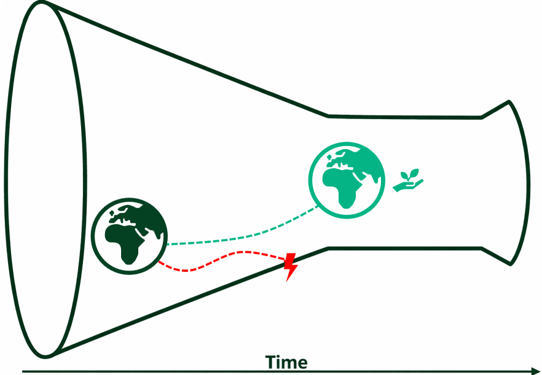
Figure 1: The Funnel metaphor
The Funnel metaphor, own visualisation after Broman & Robèrt (2017).4Broman, G. I. & Robèrt, K.-H. A framework for strategic sustainable development. J. Clean. Prod. 140, 17–31 (2017).
Building on these systemic sustainability challenges, it becomes quite clear that addressing them cannot be limited to political action or individual behavioural change alone. Given the central role of capital allocation in shaping economic activity, the financial system appears as a critical lever in the transition toward sustainability. As of 2024, approximately 27% of global regulated fund assets (~USD 16.7 trillion) report the application of responsible and sustainable investment approaches, up from around 3% in 2018.6GSIA. Global Sustainable Investment Review 2024. https://www.gsi-alliance.org/members-resources/gsir2024/. In this context, the International Energy Agency (IEA) estimates that global investments in i.e. clean energy would need to rise to around USD 4–4.5 trillion per year by 2030 in order to align with a pathway consistent with the 1.5 °C target of Paris.7IEA. World Energy Investment 2025 – Analysis. https://www.iea.org/reports/world-energy-investment-2025 (2025). This highlights that the achievement of climate goals depends fundamentally on large-scale shifts in investment flows and has given rise to the field of sustainable finance, as an approach to align financial decision-making with environmental and social objectives. Rather than treating sustainability as an externality, sustainable finance integrates environmental, social and governance (ESG) considerations into how risks, returns and long-term value are assessed. In doing so, it aims to redirect financial flows toward activities that contribute to long-term societal value creation while mitigating systemic risks arising from unsustainable business practices.8Schoenmaker, D. & Schramade, W. Principles of Sustainable Finance. (Oxford University Press, 2019).
The growing relevance of sustainable finance is closely linked to the recognition that sustainability-related risks are financially material. Biodiversity loss can disrupt supply chains and increase cash flow uncertainty. Energy price volatility increases input cost risk. And tighter environmental regulation can lead to higher compliance costs and stranded assets for carbon-intensive firms.8Schoenmaker, D. & Schramade, W. Principles of Sustainable Finance. (Oxford University Press, 2019). The list goes on. As a result, investors and regulators have intensified their demand for decision-useful information that allows them to assess a firm’s exposure to sustainability-related risks and opportunities in a structured and comparable way. However, sustainability performance is difficult to assess and quantify in practice, as it is inherently multidimensional and forward-looking. This creates a fundamental information problem: while sustainability considerations are recognized as financially relevant, they are not directly observable in standard financial statements.9Friede, G., Busch, T. & Bassen, A. ESG and financial performance: aggregated evidence from more than 2000 empirical studies. J. Sustain. Finance Invest. 5, 210–233 (2015).,10Pagano, M. S., Sinclair, G. & Yang, T. Understanding ESG ratings and ESG indexes. in Research Handbook of Finance and Sustainability 339–371 (Edward Elgar Publishing, Cheltenham, UK; Northampton, MA, USA, 2018).
It is precisely at this intersection of sustainability challenges and financial decision-making that ESG ratings have become increasingly important. How central ESG ratings have become is visible in current practice: the FNG 2026 industry survey shows that 72% of sustainable investors use aggregated ESG ratings to assess their portfolio companies on ESG criteria, more than any other instrument.11FNG. FNG Marktbericht 2026. (2026). Yet despite this central role, what ESG ratings actually measure and whether they fulfil their informational function remains contested, which makes their theoretical foundation and practical use a matter of active debate. ESG ratings aim to translate complex, heterogeneous and largely nonfinancial information on ESG issues into standardized metrics that can be integrated within financial markets.10Pagano, M. S., Sinclair, G. & Yang, T. Understanding ESG ratings and ESG indexes. in Research Handbook of Finance and Sustainability 339–371 (Edward Elgar Publishing, Cheltenham, UK; Northampton, MA, USA, 2018).,12Zumente, I. & Lāce, N. ESG Rating—Necessity for the Investor or the Company? Sustainability 13, 8940 (2021).,13Larcker, D. F., Pomorski, L., Tayan, B. & Watts, E. M. ESG Ratings: A Compass without Direction. SSRN Scholarly Paper at https://papers.ssrn.com/abstract=4179647 (2022).,14Stewart, R. Towards a better understanding of ESG ratings. J. Sustain. Finance Invest. 15, 624–643 (2025). By aggregating firm-level data on topics such as carbon emissions, biodiversity, labor practices or corporate governance structures, ESG ratings serve as information bridges between companies and capital providers. In practice, they are used by investors to screen portfolios regarding sustainability-related risks and from this construct ESG-based investment strategies or comply with regulatory disclosure requirements.10Pagano, M. S., Sinclair, G. & Yang, T. Understanding ESG ratings and ESG indexes. in Research Handbook of Finance and Sustainability 339–371 (Edward Elgar Publishing, Cheltenham, UK; Northampton, MA, USA, 2018).,12Zumente, I. & Lāce, N. ESG Rating—Necessity for the Investor or the Company? Sustainability 13, 8940 (2021). Consequently, ESG ratings have become a central infrastructure element of sustainable finance.8Schoenmaker, D. & Schramade, W. Principles of Sustainable Finance. (Oxford University Press, 2019). To stay in the picture of the Funnel, ESG ratings can be understood as an attempt to assess how firms are positioned within a progressively narrowing operating space shaped by ecological and social constraints. By translating sustainability-related exposures and strategic resilience into standardized metrics, ESG ratings aim to reflect a firms’ vulnerability to, and preparedness for, the systemic pressures described by the Funnel Metaphor. Derived from this logic, the following shows the research question:
RQ: “What theoretical insights does the existing literature on ESG Ratings provide and which practical implications can be derived for an implementation by practitioners?”
This research question will be explored within the following structure: The literature review is divided into five chapters. The first chapter is 2.1, definitions and concepts of ESG ratings, where central terminology used throughout the wiki entry will be clarified and situated within the broader sustainable finance discourse. In 2.2, historical background and evolution of ESG and ESG ratings, the development of the field will be traced from its SRI and CSR roots to the current ESG backlash, with particular attention to the commercial infrastructure of ESG ratings. In 2.3, the structure and concentration of the provider landscape will be characterized. In 2.4, the methodological architecture of the two largest providers will be examined as a concrete entry point into the question of rating divergence. Chapter 2.5 synthesizes the literature along a drivers, barriers and outcomes framework and identifies limitations and directions for future research. This chapter provides an answer to the first part of the research question on what theoretical insights the existing literature on ESG ratings provides.
The practical implementation is divided into two sub-chapters. In 3.1, the rating process will be reconstructed step by step from the perspective of the provider. In 3.2, this logic is mirrored from the perspective of the rated company along four steps: Strategic Anchoring, Provider Selection, Relationship Building and Continuous Engagement and Score Interpretation and Internal Anchoring. This chapter provides an answer to the second part of the research question on the practical implications that can be derived for an implementation by practitioners.
2 Literature review
Several systematic literature reviews on ESG ratings already exist, notably those by Clement et al. (2023), Halid et al. (2023) and La Torre et al. (2023), complemented by a wide range of individual contributions. Building on this body of work, the following definition and historical background consolidate the current state of the literature and provide the foundation for the analysis that follows.
A central challenge in the academic literature on ESG ratings lies in the lack of a unified definition of what ESG ratings represent and how they should be interpreted. Despite their widespread use in empirical research and investment practice, ESG ratings remain conceptually ambiguous, as they pursue different objectives and rely on diverse measurement logics.15Clement, A., Robinot, E. & Trespeuch, L. (PDF) The use of ESG scores in academic literature: a systematic literature review. ResearchGate https://doi.org/10.1108/JEC-10-2022-0147 (2023) doi:10.1108/JEC-10-2022-0147. Given the role assigned to ESG ratings within the Funnel Metaphor, the question of what these ratings actually capture is anything but secondary. This chapter therefore clarifies the core definitions and conceptual distinctions, traces the historical background of ESG and ESG ratings, examines the methodologies of leading rating providers and synthesizes the academic debate along the drivers, barriers and outcomes of ESG ratings.
2.1 Definition ESG ratings
To ensure conceptual clarity of this article, it is important to begin by clarifying terminology. In the existing academic literature, the terms “ESG Scores” and “ESG Ratings” are commonly used interchangeably and generally refer to the same concept. Both describe standardized assessments of a organizations environmental, social and governance characteristics. Literature still suggests a conceptual distinction for academic writing: “ESG Score” often denotes a quantitative output, typically a numerical value produced by Rating Providers.16Ferro, A., Marazzina, D. & Stocco, D. Uncovering ESG Ratings: The (Im)Balance of Aspirational and Performance Features. Corp. Soc. Responsib. Environ. Manag. 32, 5895–5917 (2025). “ESG Rating” can be used as the broader umbrella term, covering both quantitative scores and categorical assessments and can apply across different object types.10Pagano, M. S., Sinclair, G. & Yang, T. Understanding ESG ratings and ESG indexes. in Research Handbook of Finance and Sustainability 339–371 (Edward Elgar Publishing, Cheltenham, UK; Northampton, MA, USA, 2018). Ultimately, these are two sides of the same coin. For simplicity, this article uses the term “ESG ratings” to refer to both ESG ratings and ESG scores. Within this broader category, a further distinction is sometimes drawn between absolute ratings, which assess companies against a fixed scale, and “ESG Rankings”, which position companies relative to peers on a best-to-worst basis.17ERM Sustainability Institute. Rate the Raters 2025: ESG Ratings in Evolution – Corporate Survey Results. (2025).
In broad terms, ESG ratings are standardized, aggregated assessments produced by specialized rating agencies that evaluate firms against environmental, social and governance criteria. They condense a wide range of sustainability-related information into a structured indicator that allows comparison across firms, industries and markets.15Clement, A., Robinot, E. & Trespeuch, L. (PDF) The use of ESG scores in academic literature: a systematic literature review. ResearchGate https://doi.org/10.1108/JEC-10-2022-0147 (2023) doi:10.1108/JEC-10-2022-0147.,18Berg, F., Fabisik, K. & Sautner, Z. Is history repeating itself? The (un) predictable past of ESG ratings. SSRN Electron. J. 3722087, (2021).
Three structural features distinguish ESG ratings from comparable financial information products. First, they are not designed to capture a single, clearly defined outcome. While credit ratings assess one well-defined construct, the probability of default, ESG ratings aggregate heterogeneous dimensions that include risk exposure, management quality, broader environmental and social impacts and in some cases ethical considerations.19Berg, F., Kölbel, J. F. & Rigobon, R. Aggregate confusion: The divergence of ESG ratings. Rev. Finance 26, 1315–1344 (2022).,20Eccles, R. G. & Stroehle, J. C. Exploring social origins in the construction of ESG measures. SSRN Electron. J. https://ora.ox.ac.uk/objects/uuid:8b655ba6-a5d6-4774-a24f-8a235176a595 (2018). Stewart (2025) argues that rating providers therefore do not measure the same construct with varying degrees of accuracy, but conceptually different things, an observation that will be developed in detail in Chapter 2.5.2.4.14Stewart, R. Towards a better understanding of ESG ratings. J. Sustain. Finance Invest. 15, 624–643 (2025). Second, ESG ratings rely on data that is heterogeneous, only partly standardized and frequently disclosed on a voluntary basis. Third, methodologies are largely proprietary, which limits transparency regarding the choices that shape the final score.19Berg, F., Kölbel, J. F. & Rigobon, R. Aggregate confusion: The divergence of ESG ratings. Rev. Finance 26, 1315–1344 (2022).,20Eccles, R. G. & Stroehle, J. C. Exploring social origins in the construction of ESG measures. SSRN Electron. J. https://ora.ox.ac.uk/objects/uuid:8b655ba6-a5d6-4774-a24f-8a235176a595 (2018).
These structural features matter because ESG ratings are not passive descriptions of corporate behavior. As Ridgway observed in his early critique of performance measurement, what gets measured, gets managed.21Ridgway, V. F. Dysfunctional Consequences of Performance Measurements. Adm. Sci. Q. 1, 240–247 (1956). The composition of an ESG rating therefore shapes the behavior it intends to assess. Whether the current measurement infrastructure captures sustainability in a meaningful way, or whether it incentivises corporate responses that diverge from genuine sustainability outcomes, is a recurring question across the literature reviewed in this chapter.
2.1.1 Major research streams on ESG ratings
The academic literature on ESG ratings has developed across three disciplinary traditions that share a subject but approach it with fundamentally different questions.
The largest stream comes from financial economics. It treats ESG ratings as information products and asks whether they carry signal value for investor-relevant outcomes, stock returns, portfolio risk, cost of capital. The method is predominantly quantitative and financial materiality is the central concern. Friede et al. (2015), synthesising evidence from over 2,000 empirical studies, remain the most cited reference point within this tradition.9Friede, G., Busch, T. & Bassen, A. ESG and financial performance: aggregated evidence from more than 2000 empirical studies. J. Sustain. Finance Invest. 5, 210–233 (2015).
Management and organizational research forms a second stream. Rather than asking what ratings predict, it asks what they actually measure and how firms respond to them. Work on rating divergence, the social construction of rating methodologies and corporate responses to rating pressure all belong here.
A third stream, less cohesive than the other two, draws on sustainability science and political economy. Its concern is whether ESG ratings can meaningfully capture ecological and social performance at all. A question Ferro et al. (2025) approach empirically through their finding that roughly 60% of ESG scores reflect aspirational commitments rather than demonstrated performance.16Ferro, A., Marazzina, D. & Stocco, D. Uncovering ESG Ratings: The (Im)Balance of Aspirational and Performance Features. Corp. Soc. Responsib. Environ. Manag. 32, 5895–5917 (2025).
Financial economics assumes rating quality and studies outputs. Management research unpacks the construction process. Sustainability science questions the normative premises of the whole enterprise. The present review draws on all three, which is one reason a semi-systematic approach was chosen over a narrower systematic one.
2.2 Historical background and evolution of ESG and ESG ratings
An initial deep dive into the historical background and evolution of ESG and ESG ratings will serve as a foundation for the analysis that follows afterwards. This chapter therefore outlines the evolution of ESG ratings chronologically, starting from early forms of responsible investing and continuing to current market practices. By outlining how ESG concepts and actors have developed over time, this chapter forms the foundation to later clarify why ESG ratings are inherently complex and why they remain contested today.
2.2.1 Early roots and normative origins
Although today’s ESG market is often portrayed as a recent innovation, much of its underlying logic builds on older traditions of value-based investing. The literature commonly locates early roots in the concept of socially responsible investing (SRI) in the 1960s, which played only a limited role in mainstream capital markets for most of the twentieth century, despite being practiced for decades.22Billio, M., Costola, M., Hristova, I., Latino, C. & Pelizzon, L. Inside the ESG ratings: (Dis)agreement and performance. Corp. Soc. Responsib. Environ. Manag. 28, 1426–1445 (2021).,23Dorfleitner, G., Halbritter, G. & Nguyen, M. Measuring the level and risk of corporate responsibility – An empirical comparison of different ESG rating approaches. J. Asset Manag. 16, 450–466 (2015).,24Ballestero, E., Bravo, M., Pérez-Gladish, B., Arenas-Parra, M. & Plà-Santamaria, D. Socially Responsible Investment: A multicriteria approach to portfolio selection combining ethical and financial objectives. Eur. J. Oper. Res. 216, 487–494 (2012). Terminology in this field has not always been entirely consistent. While some authors use the term ethical investment to describe specialized retail funds, others treat SRI as a broader umbrella term that includes a range of related investment approaches incorporating ethical or social considerations.25Sparkes, R. & Cowton, C. J. The Maturing of Socially Responsible Investment: A Review of the Developing Link with Corporate Social Responsibility. J. Bus. Ethics 52, 45–57 (2004). Within this broader understanding, many of these approaches correspond in some way to Cowton’s (1994) definition of ethical investment as “the exercise of ethical and social criteria in the selection and management of investment portfolios”(p. 213)26Cowton, C. J. The development of ethical investment products. Ethical Confl. Finance 213–232 (1994)..
A defining feature of these early approaches of SRI was that “responsibility” was primarily operationalized through exclusionary screening. Investment decisions were shaped by normative judgments that varied across investors and contexts. As a result, portfolios were often built by avoiding activities seen as ethically problematic.20Eccles, R. G. & Stroehle, J. C. Exploring social origins in the construction of ESG measures. SSRN Electron. J. https://ora.ox.ac.uk/objects/uuid:8b655ba6-a5d6-4774-a24f-8a235176a595 (2018).,27Drempetic, S., Klein, C. & Zwergel, B. The influence of firm size on the ESG score: Corporate sustainability ratings under review. J. Bus. Ethics 333–360 (2020). In this context, “sin” screens (e.g., adult entertainment, alcohol, gambling, nuclear power, tobacco and weapons) illustrate differing moral views translated into varied investment rather than to standardized measurement systems.27Drempetic, S., Klein, C. & Zwergel, B. The influence of firm size on the ESG score: Corporate sustainability ratings under review. J. Bus. Ethics 333–360 (2020).
Closely related to this development, ideas from Corporate Social Responsibility (CSR) gained increasing attention from the 1970s onward. The academic literature contains a wide range of interpretations that reflect different views on the role of corporations in society.28Schneider, A. & Schmidpeter, R. Corporate Social Responsibility: Verantwortungsvolle Unternehmensführung in Theorie Und Praxis. (2012). doi:10.1007/978-3-642-25399-7. To bring more clarity to this debate, the European Commission offered a widely cited definition of CSR in 2011 as “process to integrate social, environmental, ethical and human rights concerns into their business operations and core strategy in close interaction with their stakeholders, with the aim [of] maximising the creation of shared value for their owners/shareholders and for their other stakeholders and society at large [as well as] identifying, preventing and mitigating their possible adverse impacts.” (p. 6)28Schneider, A. & Schmidpeter, R. Corporate Social Responsibility: Verantwortungsvolle Unternehmensführung in Theorie Und Praxis. (2012). doi:10.1007/978-3-642-25399-7.,29European Comission. MITTEILUNG DER KOMMISSION AN DAS EUROPÄISCHE PARLAMENT, DEN RAT, DEN EUROPÄISCHEN WIRTSCHAFTS- UND SOZIALAUSSCHUSS UND DEN AUSSCHUSS DER REGIONEN Eine Neue EU-Strategie (2011-14) Für Die Soziale Verantwortung Der Unternehmen (CSR). (2011)..
In parallel, the rise of CSR debates in the late twentieth century created a growing demand for structured information on a firm’s social and environmental conduct. Eccles and Stroehle (2018) link the data-collection infrastructure behind today’s ESG measurement back to the late 1970s, when sustainability issues began entering capital market considerations, often driven by NGOs.20Eccles, R. G. & Stroehle, J. C. Exploring social origins in the construction of ESG measures. SSRN Electron. J. https://ora.ox.ac.uk/objects/uuid:8b655ba6-a5d6-4774-a24f-8a235176a595 (2018). These organizations aimed to inform concerned investors about corporate involvement in disputed issues such as nuclear weapons development or Apartheid South Africa, anticipating the later role of “controversy” monitoring in ESG ratings.20Eccles, R. G. & Stroehle, J. C. Exploring social origins in the construction of ESG measures. SSRN Electron. J. https://ora.ox.ac.uk/objects/uuid:8b655ba6-a5d6-4774-a24f-8a235176a595 (2018).,30Escrig-Olmedo, E., Fernández-Izquierdo, M. Á., Ferrero-Ferrero, I., Rivera-Lirio, J. M. & Muñoz-Torres, M. J. Rating the Raters: Evaluating how ESG Rating Agencies Integrate Sustainability Principles. Sustainability 11, 915 (2019). Taken together, CSR and SRI provided the intellectual and practical context from which the later ESG concept emerged.20Eccles, R. G. & Stroehle, J. C. Exploring social origins in the construction of ESG measures. SSRN Electron. J. https://ora.ox.ac.uk/objects/uuid:8b655ba6-a5d6-4774-a24f-8a235176a595 (2018).,30Escrig-Olmedo, E., Fernández-Izquierdo, M. Á., Ferrero-Ferrero, I., Rivera-Lirio, J. M. & Muñoz-Torres, M. J. Rating the Raters: Evaluating how ESG Rating Agencies Integrate Sustainability Principles. Sustainability 11, 915 (2019). At this stage, however, sustainability-related investment approaches remained largely normative, fragmented in their application, and only marginally integrated into mainstream financial analysis.
2.2.2 Early non-financial research and data infrastructure
Before ESG became a clearly defined concept, important parts of its later informational infrastructure had already begun to develop. By the late 1980s and early 1990s, extra-financial research had moved beyond ad hoc data collection and become more systematic, even though the term “ESG” was not yet widely used. Organizations providing information to SRI-focused investors expanded their coverage and developed more structured research practices. During this period, several organizations were founded that later became central actors in the ESG ratings landscape, including KLD Research & Analytics in the United States (1988), EIRIS in the United Kingdom (1983), and Jantzi Research in Canada (1992). These organizations developed structured databases to assess corporate environmental and social performance, often shaped by explicit normative or mission-driven goals rather than purely financial objectives.20Eccles, R. G. & Stroehle, J. C. Exploring social origins in the construction of ESG measures. SSRN Electron. J. https://ora.ox.ac.uk/objects/uuid:8b655ba6-a5d6-4774-a24f-8a235176a595 (2018).
At the same time, the underlying informational infrastructure remained relatively simple, relying mainly on qualitative assessments, company disclosure and media reports rather than standardized metrics, which contributed to substantial heterogeneity in coverage and evaluation criteria. Governance-related assessments initially played a less prominent role, as early rating providers on nonfinancial information focused primarily on environmental and social dimensions.20Eccles, R. G. & Stroehle, J. C. Exploring social origins in the construction of ESG measures. SSRN Electron. J. https://ora.ox.ac.uk/objects/uuid:8b655ba6-a5d6-4774-a24f-8a235176a595 (2018).
Nevertheless, this period established the core idea that corporate behavior beyond financial performance could and should be systematically evaluated. At the same time, it created important path dependencies. Because these early research practices emerged from different institutional settings and served different purposes, they contributed to the methodological heterogeneity that continues to shape ESG ratings today, which will be further detailed in chapter 2.3 and 2.4.
2.2.3 Emergence of the concept of ESG
A consistent finding across the literature is that the concept of ESG emerged relatively late compared to earlier forms of SRI and CSR. While sustainability-related investment practices and related data had existed for decades, the explicit framing of environmental, social and governance issues under the unified label “ESG” only emerged as a widely used concept in the early 2000s.
The institutionalisation of ESG is commonly linked to two key UN-related initiatives. First, the 2004 United Nations Global Compact report Who Cares Wins: Connecting Financial Markets to a Changing World explicitly promoted the integration of ESG factors into financial analysis.14Stewart, R. Towards a better understanding of ESG ratings. J. Sustain. Finance Invest. 15, 624–643 (2025).,20Eccles, R. G. & Stroehle, J. C. Exploring social origins in the construction of ESG measures. SSRN Electron. J. https://ora.ox.ac.uk/objects/uuid:8b655ba6-a5d6-4774-a24f-8a235176a595 (2018).,31Chen, S., Song, Y. & Gao, P. Environmental, social, and governance (ESG) performance and financial outcomes: Analyzing the impact of ESG on financial performance. J. Environ. Manage. 345, 118829 (2023). Second, the 2005 Freshfields Report, produced under the UNEP Finance Initiative, addressed the legal implications of considering ESG issues in investment decision-making. Together, these initiatives played a central role in translating sustainability concerns into a language compatible with financial markets.14Stewart, R. Towards a better understanding of ESG ratings. J. Sustain. Finance Invest. 15, 624–643 (2025).,16Ferro, A., Marazzina, D. & Stocco, D. Uncovering ESG Ratings: The (Im)Balance of Aspirational and Performance Features. Corp. Soc. Responsib. Environ. Manag. 32, 5895–5917 (2025).,20Eccles, R. G. & Stroehle, J. C. Exploring social origins in the construction of ESG measures. SSRN Electron. J. https://ora.ox.ac.uk/objects/uuid:8b655ba6-a5d6-4774-a24f-8a235176a595 (2018).,32Shi, Y. & Yao, T. ESG Rating Divergence: Existence, Driving Factors, and Impact Effects. Sustainability 17, 4717 (2025).,33Shen, Y. ESG and firm performance: A literature review. BCP Bus. Manag. 46, 283–288 (2023).
They helped reframe ESG considerations by linking them explicitly to financial materiality and the launch of the UN Principles for Responsible Investment in 2005 provided an institutional frame for translating this thought into investor practice.34Abhayawansa, S. Swimming against the tide: back to single materiality for sustainability reporting. Sustain. Account. Manag. Policy J. 13, 1361–1385 (2022). For the rating industry, the practical significance of this shift was that demand for structured, comparable sustainability information now came from mainstream investors rather than only from value-based niches. The stage was set for the later expansion of ESG ratings and their integration into mainstream investment analysis.10Pagano, M. S., Sinclair, G. & Yang, T. Understanding ESG ratings and ESG indexes. in Research Handbook of Finance and Sustainability 339–371 (Edward Elgar Publishing, Cheltenham, UK; Northampton, MA, USA, 2018).,35Christensen, D. M., Serafeim, G. & Sikochi, A. (Siko). Why is Corporate Virtue in the Eye of the Beholder? The Case of ESG Ratings. SSRN Scholarly Paper at https://papers.ssrn.com/abstract=3793804 (2021).
2.2.4 Mainstream ESG investing
Following its institutionalisation in the early 2000s, ESG investing entered a period of rapid expansion and moved into the financial mainstream. The niche form of SRI gained broader acceptance and increasingly became part of general investment thinking rather than a specialized ethical approach.22Billio, M., Costola, M., Hristova, I., Latino, C. & Pelizzon, L. Inside the ESG ratings: (Dis)agreement and performance. Corp. Soc. Responsib. Environ. Manag. 28, 1426–1445 (2021).
One way this mainstreaming becomes visible is through the changing definition of sustainable investing itself. While earlier approaches to responsible investment mainly relied on ethical screening and exclusion strategies, as described before, Abhayawansa and Tyagi (2021) characterise sustainable investing as an approach that explicitly considers ESG factors in investment decision-making, marking a move beyond purely financial signals.34Abhayawansa, S. Swimming against the tide: back to single materiality for sustainability reporting. Sustain. Account. Manag. Policy J. 13, 1361–1385 (2022).
The mainstreaming of ESG investing was also reflected in rapid market growth. Assets under management (AUM) applying ESG-related investment strategies increased from around US$4 trillion in 2006 to approximately US$60 trillion by 2016 at an annualized rate of 35%.10Pagano, M. S., Sinclair, G. & Yang, T. Understanding ESG ratings and ESG indexes. in Research Handbook of Finance and Sustainability 339–371 (Edward Elgar Publishing, Cheltenham, UK; Northampton, MA, USA, 2018). Similarly, the expansion of investor initiatives further signals the increasing institutional adoption of ESG. The AUM represented by members of the PRI, for instance, grew from only a few hundred billion dollars in the early years after their introduction in 2005 to more than US$100 trillion by 2020.36Serafeim, G. & Yoon, A. Stock price reactions to ESG news: the role of ESG ratings and disagreement. Rev. Account. Stud. 28, 1500–1530 (2023).
In parallel, ESG considerations became more visible also at the firm level. The number of companies reporting ESG-related information increased substantially, rising from fewer than 20 firms in the early 1990s to nearly 6000 firms by 2014, reflecting the growing relevance of sustainability-related information for investors and other stakeholders.36Serafeim, G. & Yoon, A. Stock price reactions to ESG news: the role of ESG ratings and disagreement. Rev. Account. Stud. 28, 1500–1530 (2023). At the firm level, ESG considerations also became more embedded in corporate evaluation. Chen et al. (2023) for example show that ESG performance increasingly came to be treated as an indicator of a firm’s commitments to environmental protection and social responsibility, suggesting that ESG was no longer understood merely as reputational rhetoric, but as a structured lens through which corporate behavior was assessed on nonfinancial criteria by investors and other stakeholders.31Chen, S., Song, Y. & Gao, P. Environmental, social, and governance (ESG) performance and financial outcomes: Analyzing the impact of ESG on financial performance. J. Environ. Manage. 345, 118829 (2023). Chen et al. (2023) also link this mainstreaming of ESG to a broader ecosystem of market institutions and note that ESG investment entered a phase of rapid development alongside initiatives such as the Sustainable Stock Exchanges Initiative (SSEi), which supported the integration of ESG consideration at the level of stock exchanges.31Chen, S., Song, Y. & Gao, P. Environmental, social, and governance (ESG) performance and financial outcomes: Analyzing the impact of ESG on financial performance. J. Environ. Manage. 345, 118829 (2023).
As ESG investing expanded, so did the demand for comparable and systematic information on corporate sustainability performance. This created favorable conditions for the emergence of ESG ratings as scalable market tools.
2.2.5 ESG ratings as a commercial information product
Building on this growing demand, early research practices evolved into a distinct market for ESG ratings designed to assess and represent firms’ ESG performance in a scalable way. Rather than remaining specialized outputs for niche responsible investors, ESG assessments increasingly became standardized tools that translated diverse sustainability-related information into metrics usable at scale.22Billio, M., Costola, M., Hristova, I., Latino, C. & Pelizzon, L. Inside the ESG ratings: (Dis)agreement and performance. Corp. Soc. Responsib. Environ. Manag. 28, 1426–1445 (2021). They functioned as intermediaries that reduced informational complexity and made ESG considerations actionable for financial market participants. This shift also changed how sustainability information was perceived more broadly. Major credit rating agencies such as Moody’s, S&P and Fitch began incorporating ESG-related assessments into their analytical frameworks, reflecting a move from treating sustainability as an ethical concern toward treating it as financially relevant information for risk assessment and investment analysis.10Pagano, M. S., Sinclair, G. & Yang, T. Understanding ESG ratings and ESG indexes. in Research Handbook of Finance and Sustainability 339–371 (Edward Elgar Publishing, Cheltenham, UK; Northampton, MA, USA, 2018).
The period following the global financial crisis marked an important turning point. Growing investor demand, combined with advances in data processing and financial analytics, transformed ESG ratings into a commercially attractive market segment.10Pagano, M. S., Sinclair, G. & Yang, T. Understanding ESG ratings and ESG indexes. in Research Handbook of Finance and Sustainability 339–371 (Edward Elgar Publishing, Cheltenham, UK; Northampton, MA, USA, 2018).,30Escrig-Olmedo, E., Fernández-Izquierdo, M. Á., Ferrero-Ferrero, I., Rivera-Lirio, J. M. & Muñoz-Torres, M. J. Rating the Raters: Evaluating how ESG Rating Agencies Integrate Sustainability Principles. Sustainability 11, 915 (2019).
This phase was characterized by extensive mergers and acquisitions, which led to the integration of ESG data into large financial information platforms.10Pagano, M. S., Sinclair, G. & Yang, T. Understanding ESG ratings and ESG indexes. in Research Handbook of Finance and Sustainability 339–371 (Edward Elgar Publishing, Cheltenham, UK; Northampton, MA, USA, 2018).,13Larcker, D. F., Pomorski, L., Tayan, B. & Watts, E. M. ESG Ratings: A Compass without Direction. SSRN Scholarly Paper at https://papers.ssrn.com/abstract=4179647 (2022). The acquisition of RiskMetrics Group by MSCI in 2010 served as an early and consequential example, consolidating ESG pioneers such as KLD and Innovest under a single umbrella.10Pagano, M. S., Sinclair, G. & Yang, T. Understanding ESG ratings and ESG indexes. in Research Handbook of Finance and Sustainability 339–371 (Edward Elgar Publishing, Cheltenham, UK; Northampton, MA, USA, 2018).,20Eccles, R. G. & Stroehle, J. C. Exploring social origins in the construction of ESG measures. SSRN Electron. J. https://ora.ox.ac.uk/objects/uuid:8b655ba6-a5d6-4774-a24f-8a235176a595 (2018).,32Shi, Y. & Yao, T. ESG Rating Divergence: Existence, Driving Factors, and Impact Effects. Sustainability 17, 4717 (2025). Similar consolidation followed in Europe with the merger of Vigeo and EIRIS in 2015.1026. Further transactions included Morningstar’s acquisition of 40% of Sustainalytics in 2017 and both Moody’s purchase of Vigeo-Eiris and S&P Global’s acquisition of RobecoSAM in 2019.10Pagano, M. S., Sinclair, G. & Yang, T. Understanding ESG ratings and ESG indexes. in Research Handbook of Finance and Sustainability 339–371 (Edward Elgar Publishing, Cheltenham, UK; Northampton, MA, USA, 2018).
Consolidation expanded the global reach of ESG data and made it easier to embed ESG metrics in financial products such as indices and ETFs. At the same time, it strengthened the proprietary character of ESG methodologies and reduced transparency around weighting and aggregation.13Larcker, D. F., Pomorski, L., Tayan, B. & Watts, E. M. ESG Ratings: A Compass without Direction. SSRN Scholarly Paper at https://papers.ssrn.com/abstract=4179647 (2022).
The various social origins help to explain why ESG ratings never converged around a single, universally accepted definition.14Stewart, R. Towards a better understanding of ESG ratings. J. Sustain. Finance Invest. 15, 624–643 (2025).,19Berg, F., Kölbel, J. F. & Rigobon, R. Aggregate confusion: The divergence of ESG ratings. Rev. Finance 26, 1315–1344 (2022).,20Eccles, R. G. & Stroehle, J. C. Exploring social origins in the construction of ESG measures. SSRN Electron. J. https://ora.ox.ac.uk/objects/uuid:8b655ba6-a5d6-4774-a24f-8a235176a595 (2018).,22Billio, M., Costola, M., Hristova, I., Latino, C. & Pelizzon, L. Inside the ESG ratings: (Dis)agreement and performance. Corp. Soc. Responsib. Environ. Manag. 28, 1426–1445 (2021).,37Liu, M. Quantitative ESG disclosure and divergence of ESG ratings. Front. Psychol. 13, (2022).
2.2.6 Current ESG backlash
In recent years, the mainstream view on ESG has begun to shift again. Blum (2025) describes this backlash as a reaction to the rapid expansion of ESG ratings during an ongoing “ESG rush”.38Blum, V. From the ESG Rush to the ESG Backlash: A Western Story. SSRN Scholarly Paper at https://doi.org/10.2139/ssrn.5238272 (2025). As ESG ratings became integrated in investment processes and regulatory discussions, expectations regarding their ability to capture sustainability outcomes increased substantially. When ESG-labeled investments appeared to underperform or when highly rated firms later became involved in major controversies, dissatisfaction with ESG ratings intensified.38Blum, V. From the ESG Rush to the ESG Backlash: A Western Story. SSRN Scholarly Paper at https://doi.org/10.2139/ssrn.5238272 (2025). One widely cited example of these concerns is the case of Tesla. In 2018, the car manufacturer received an exemplary “AA” environmental rating from MSCI, while FTSE assessed Tesla very poorly and Sustainalytics placed it around the middle of its peer group.39Dimson, E., Marsh, P. & Staunton, M. Divergent ESG ratings. https://doi.org/10.17863/CAM.55949 (2020) doi:10.17863/CAM.55949.,40Gibson Brandon, R., Krueger, P. & Schmidt, P. S. ESG Rating Disagreement and Stock Returns. Financ. Anal. J. 77, 104–127 (2021). These differences reflect the contrasting methodological choices of rating agencies and reinforce the doubts about what ESG ratings actually measure and how reliably they reflect the sustainability performance. According to Blum (2025) the gap between expectations and what ESG ratings can realistically measure is a central driver of the backlash, which she interprets as partly rooted in an attribute substitution confusion: The tendency to mistake proxy indicators for real-world sustainability outcomes.38Blum, V. From the ESG Rush to the ESG Backlash: A Western Story. SSRN Scholarly Paper at https://doi.org/10.2139/ssrn.5238272 (2025). This discussion represents only a small part of the broader academic debate on the divergence of ESG ratings, which will be examined in detail in chapter 2.5.2.4.
Along with methodological and informational concerns, the ESG backlash also has a clear political root. Sætra (2025) situates the backlash within broader ideological conflicts, particularly in the United States, where ESG has increasingly been framed as a form of political or activist intervention in markets.41Sætra, H. S. The ESG Backlash: Politics, Ideology, and the Future of Sustainable Business. SSRN Scholarly Paper at https://doi.org/10.2139/ssrn.4782018 (2024). From this perspective, criticism of ESG reflects ongoing debates about shareholder versus stakeholder capitalism and concerns about what critics perceive as excessive regulation or progressive social agendas embedded in corporate decision-making. As ESG became associated with issues such as climate policy, diversity and social justice, it moved beyond the technical domain of investment analysis and entered a polarized political arena, thereby intensifying backlash dynamics.41Sætra, H. S. The ESG Backlash: Politics, Ideology, and the Future of Sustainable Business. SSRN Scholarly Paper at https://doi.org/10.2139/ssrn.4782018 (2024).
The ESG backlash marks the most recent stage in the historical evolution of ESG and ESG ratings. It highlights that ESG ratings have reached a level of influence at which their limitations are no longer only academic concerns but have tangible market and political consequences. The underlying market infrastructure and practical implications for ESG rating agencies of these developments will be examined in more detail in the following section. In context of this wiki entry, understanding the origins of the backlash provides an important bridge to the following look at ESG rating methodologies and the divergence of ESG ratings.
2.3 The ESG rating market
ESG ratings have become a central component of modern financial markets. Understanding their role therefore requires examining the structure and characteristics of the ESG rating market.
The OECD notes that the market for ESG data products and related services exceeded USD 1.5 billion in 2023 and continued to grow rapidly with an expected growth rate of 23% through 2025.42OECD. Behind ESG ratings: Unpacking sustainability metrics. OECD https://www.oecd.org/en/publications/behind-esg-ratings_3f055f0c-en.html (2025) doi:10.1787/3f055f0c-en. ESG metrics and ratings have become a central input into investment and corporate decision-making. US-based institutional investors spent on average around USD 487,000 per year on external ESG rating and data services in 2022, with total expenditures estimated to be about 2.5 times higher than for traditional credit rating services.43ERM. Costs and Benefits of Climate-Related Disclosure Activities by Corporate Issuers and Institutional Investors. ERM https://www.erm.com/insights/costs-and-benefits-of-climate-related-disclosure-activities-by-corporate-issuers-and-institutional-investors/. Despite these costs, the demand for ESG data continues to rise, underlining the growing reliance of market participants on external ESG information.42OECD. Behind ESG ratings: Unpacking sustainability metrics. OECD https://www.oecd.org/en/publications/behind-esg-ratings_3f055f0c-en.html (2025) doi:10.1787/3f055f0c-en.
The market environment in which ESG rating agencies operate is continuously evolving. The dynamics around the EU Corporate Sustainability Reporting Directive (CSRD) and the growing adoption of the International Sustainability Standards Board (ISSB) framework are reshaping the availability and standardization of ESG data.17ERM Sustainability Institute. Rate the Raters 2025: ESG Ratings in Evolution – Corporate Survey Results. (2025). At the same time, the aforementioned increasing political and societal backlash against ESG has led to a closer review of rating methodologies and their underlying assumptions. This is also supported by evolving regulatory requirements for ESG and impact investment products, particularly those aimed at addressing greenwashing risks.17ERM Sustainability Institute. Rate the Raters 2025: ESG Ratings in Evolution – Corporate Survey Results. (2025).,42OECD. Behind ESG ratings: Unpacking sustainability metrics. OECD https://www.oecd.org/en/publications/behind-esg-ratings_3f055f0c-en.html (2025) doi:10.1787/3f055f0c-en. More on that in chapter 2.5.1.
In this more dynamic environment, ESG rating agencies need to demonstrate a considerable degree of adaptability. As shown before, organizational restructuring and mergers between several players have become common practice among rating agencies, as well as ongoing refinements of their methodology. This is reflected, for example, in the increasing integration of materiality-driven frameworks and more granular data structures.22Billio, M., Costola, M., Hristova, I., Latino, C. & Pelizzon, L. Inside the ESG ratings: (Dis)agreement and performance. Corp. Soc. Responsib. Environ. Manag. 28, 1426–1445 (2021). MSCI, for example, has continuously refined its methodology by strengthening its focus on financially material ESG issues and expanding its use of alternative data sources, including controversy monitoring and external datasets, to improve the risk assessment.44MSCI, E. MSCI ESG ratings methodology. (2022). At the same time, the weighting of key issues has been more closely aligned with industry-specific risk exposure. The result is a increasingly data-driven approach to materiality.
2.3.1 Major ESG rating providers and their methodologies
Most leading providers are oriented toward the investment community, assessing how firms manage sustainability risks and perform on ESG-related issues. At the same time, ESG ratings are also relevant for a broader set of stakeholders, including employees, business partners and customers.10Pagano, M. S., Sinclair, G. & Yang, T. Understanding ESG ratings and ESG indexes. in Research Handbook of Finance and Sustainability 339–371 (Edward Elgar Publishing, Cheltenham, UK; Northampton, MA, USA, 2018).,14Stewart, R. Towards a better understanding of ESG ratings. J. Sustain. Finance Invest. 15, 624–643 (2025).
ESG rating agencies differ in their methodological approaches. Some follow an active model, collecting data directly from companies through questionnaires and engagement, while others rely primarily on publicly available information complemented by company feedback. To provide an overview of the ESG rating market today, Table 1 shows the eight leading ESG data vendors providing ESG ratings, selected based on market share and company coverage.
The market is shaped by a relatively small group of globally recognized providers. According to Opimas data, these eight providers together account for about 86% of the estimated ESG data providers market share in 2023.45Opimas. Market Share of ESG Data Vendors. Opimas: We begin with an understanding https://www.opimas.com/research/976/detail/ (2024). This indicates a relatively high level of market concentration, despite the presence of numerous smaller or specialized providers. The ESG rating market can be described as relatively dynamic as mergers and acquisitions occur regularly, as described in the historical background.
Table 1: Overview of the most relevant rating agencies
| MSCI46MSCI. ESG Ratings Methodology. (2024). | S&P Global ESG47S&P Global. S&P Global ESG Score: Methodology. (2025). | ISS ESG48ISS ESG. ESG Corporate Rating: Methodology and Process. (2025). | Moody’s49Moody’s. General Principles for Assessing Environmental, Social and Governance Risks Methodology. (2021). | |
|---|---|---|---|---|
| Rating Score | CCC – AAA | 0 – 100 | D-/1.00 – A+/4.00 with industry-specific prime labels | 5 – 1 |
| Ownership Type17ERM Sustainability Institute. Rate the Raters 2025: ESG Ratings in Evolution – Corporate Survey Results. (2025). | Financial data firm (public company) | Credit rater (public company) | Stock exchange-owned (Deutsche Börse subsidiary) | Credit rater (public company) |
| Primary Rating Objective | Opinion of companies’ management of financially relevant ESG risks and opportunities | Performance on and management of material ESG risks, opportunities and impacts | ESG performance: manage material risks, mitigate negative / generate positive impacts, capture opportunities | Measurement of the integration of material ESG impact into credit analysis / credit risk |
| Data Sources | 100+ specialized datasets, company disclosures, 3,400+ media sources | 62 industry-specific company questionnaires + supporting evidence; public data for non-responders, media & stakeholder analysis | Company disclosure + third-party sources; in-house analyst research; company dialogue, media sources | Company disclosures; relevant third-party sources; non-public issuer information; internal credit and sector research |
| N Criteria | 33 | Up to 30 | Ca. 100 | No fixed number of criteria |
| Main Risk Factors | Climate, natural capital, pollution, product liability, stakeholder opposition, governance, opportunities | E/S/G core and industry-specific factors; risk exposure and management quality, stakeholder and environmental impacts, controversies | Not only risk exposures, but also staff & suppliers; society & product responsibility; governance & business ethics; environmental management; products & services | ESG risks that can materially impact cash flows, costs or risk profile |
| Materiality | Only industry-material issues | Double materiality; industry / sub-industry specific | Double materiality; industry- and sub-industry-specific key issues | Financial materiality: only credit-relevant ESG factors; issuer- and sector-specific |
| Weighting | Depending on the industry: E & S issues typically 5–30% each / G issues min. 33% | Industry-specific weighting, 40–50% core cross-industry criteria / 50–60% industry-specific criteria | Industry-specific weighting scenarios; key issues usually 50–80% of total score; product/service impact can get 10–50% | No fixed additive weighting like classic ESG ratings; qualitative integration into issuer profile and credit impact scores |
| Ecovadis50Ecovadis. EcoVadis Ratings: Methodology Overview and Principles. (2025). | Sustainalytics51Sustainalytics. The ESG Risk Ratings: Methodology Abstract Version 3.1. (2024). | LSEG/Refinitiv52LSEG. Environmental, Social and Governance scores from LSEG. (2024). | Bloomberg53Bloomberg. Bloomberg ESG Scores: Methodology. (2025). | |
|---|---|---|---|---|
| Rating Score | 0 – 100 | 50 – 0 | D- to A+ & 0 – 100 | D- to A+ & 0 – 100 |
| Ownership Type17ERM Sustainability Institute. Rate the Raters 2025: ESG Ratings in Evolution – Corporate Survey Results. (2025). | Independent (private company) | Financial data firm (Morningstar subsidiary) | Stock exchange-owned (LSE subsidiary) | Financial data firm (private company) |
| Primary Rating Objective | Measurement of quality of sustainability management systems | Measurement of ESG-driven risk to enterprise value (unmanaged ESG risk level) | Measurement of relative ESG performance, commitment, and effectiveness | Measurement of exposure to and management of financially material ESG factors |
| Data Sources | Evidence-based company documents, questionnaires, third-party sources | Public company disclosures, company-provided data, Morningstar data, third-party sources (NGOs, media, regulators), automated web scraping | Public company disclosures, NGO data, media; processed by 600+ analysts | Public company disclosures, Bloomberg data, BI research; limited estimation where needed |
| N Criteria | 21 | 22 | 186 | Over 30 |
| Main Risk Factors | ESG risks and impacts across environment, labor & human rights, ethics & sustainable procurement; stakeholder controversies | Material ESG risks via exposure + management lens; includes systemic and idiosyncratic risks, controversies | ESG performance and exposure across 10 themes (e.g., emissions, human rights, governance); includes controversies overlay | Financially material ESG risks and opportunities (E/S) + governance practices; based on industry-specific key issues |
| Materiality | Industry-, size-, and geography-specific materiality | Financial materiality | Financial materiality | Financial materiality |
| Weighting | Based on policies, actions and results with the final score being the weighted average of theme scores | Issue weights implicit via exposure, betas and manageable risk factors (30–100%) with the final score being the sum of issue-level unmanaged risks | Category weights derived from industry-specific materiality matrix | Industry-specific weighting derived from materiality and statistical modeling |
Today’s leading ESG raters can be grouped into four primary ownership categories: financial data companies, stock exchange-owned entities, credit rating agencies and independent firms.17ERM Sustainability Institute. Rate the Raters 2025: ESG Ratings in Evolution – Corporate Survey Results. (2025).,38Blum, V. From the ESG Rush to the ESG Backlash: A Western Story. SSRN Scholarly Paper at https://doi.org/10.2139/ssrn.5238272 (2025). As Blum (2025) notes, in just twenty years of existence, the ESG rating market has undergone a dramatic consolidation toward an oligopolistic structure, with major financial institutions absorbing formerly independent ESG pioneers.38Blum, V. From the ESG Rush to the ESG Backlash: A Western Story. SSRN Scholarly Paper at https://doi.org/10.2139/ssrn.5238272 (2025). These distinct ownership models are not just structural characteristics, they shape the commercial incentives, methodological priorities and target audiences of each provider.38Blum, V. From the ESG Rush to the ESG Backlash: A Western Story. SSRN Scholarly Paper at https://doi.org/10.2139/ssrn.5238272 (2025).
These providers differ not only in size and coverage, but also in their positioning and target audience. MSCI, Sustainalytics, S&P Global and ISS ESG are primarily oriented toward the investment community, acting as intermediaries that assess how firms manage sustainability risks and perform on ESG-related issues.46MSCI. ESG Ratings Methodology. (2024).,47S&P Global. S&P Global ESG Score: Methodology. (2025).,48ISS ESG. ESG Corporate Rating: Methodology and Process. (2025).,54Sustainalytics. The ESG Risk Ratings – Methodology Abstract: Version 3.1. (2024). Bloomberg and LSEG focus more strongly on processing and standardising large volumes of publicly available ESG data for financial market participants.52LSEG. Environmental, Social and GOvernance scores from LSEG. (2024).,53Bloomberg. Bloomberg ESG Scores: Methodology. (2025). EcoVadis specialises in supply chain assessments, particularly for business-to-business relationships.50Ecovadis. EcoVadis Ratings: Methodology Overview and Principles. (2025). Moody’s integrates ESG considerations into credit risk analysis rather than producing a standalone ESG performance score.49Moody`s. General Principles for Assessing Environmental, Social and Governance Risks Methodology. (2021).
Another central distinction between ESG rating providers lies in their underlying conceptual approach, particularly whether ratings are designed to capture financially material ESG risks or broader environmental and social impacts. MSCI and Sustainalytics center their approaches on financially material ESG risks.46MSCI. ESG Ratings Methodology. (2024).,54Sustainalytics. The ESG Risk Ratings – Methodology Abstract: Version 3.1. (2024). S&P Global and ISS ESG go beyond this and explicitly incorporate opportunities and broader impacts.47S&P Global. S&P Global ESG Score: Methodology. (2025).,48ISS ESG. ESG Corporate Rating: Methodology and Process. (2025). EcoVadis focuses on the quality of sustainability management systems, based on policies, actions and results of sustainability efforts of the above-mentioned B2B relationships.50Ecovadis. EcoVadis Ratings: Methodology Overview and Principles. (2025). These differences highlight that ESG ratings do not capture a single, clearly defined concept, but reflect distinct analytical perspectives.
Differences also exist in how providers collect and process information. S&P Global and EcoVadis rely on active data collection through company questionnaires and direct engagement.47S&P Global. S&P Global ESG Score: Methodology. (2025).,50Ecovadis. EcoVadis Ratings: Methodology Overview and Principles. (2025). In contrast, MSCI, LSEG and Bloomberg primarily use publicly available information, complemented by company feedback.46MSCI. ESG Ratings Methodology. (2024).,52LSEG. Environmental, Social and GOvernance scores from LSEG. (2024).,53Bloomberg. Bloomberg ESG Scores: Methodology. (2025). Sustainalytics and ISS ESG combine reported data with third-party sources, media screening and controversy analysis.48ISS ESG. ESG Corporate Rating: Methodology and Process. (2025).,54Sustainalytics. The ESG Risk Ratings – Methodology Abstract: Version 3.1. (2024). As a result, the underlying data basis varies significantly across providers.
The structure of the assessment frameworks also differs. MSCI works with 35 key issues, while EcoVadis uses 21 criteria organized around management practices.46MSCI. ESG Ratings Methodology. (2024).,50Ecovadis. EcoVadis Ratings: Methodology Overview and Principles. (2025). Sustainalytics assesses 22 material ESG issues.54Sustainalytics. The ESG Risk Ratings – Methodology Abstract: Version 3.1. (2024). In contrast, LSEG relies on a highly granular system with hundreds of indicators, and ISS ESG evaluates around 100 indicators per industry.48ISS ESG. ESG Corporate Rating: Methodology and Process. (2025).,52LSEG. Environmental, Social and GOvernance scores from LSEG. (2024). Moody’s does not follow a fixed ESG criteria catalogue.49Moody`s. General Principles for Assessing Environmental, Social and Governance Risks Methodology. (2021).
Another dimension of differentiation is the treatment of materiality. Whereas MSCI, Sustainalytics and Bloomberg predominantly follow a financial materiality perspective, S&P Global and ISS ESG incorporate elements of double materiality by considering both financial risks and broader environmental and social impacts.46MSCI. ESG Ratings Methodology. (2024).,47S&P Global. S&P Global ESG Score: Methodology. (2025).,48ISS ESG. ESG Corporate Rating: Methodology and Process. (2025).,53Bloomberg. Bloomberg ESG Scores: Methodology. (2025).,54Sustainalytics. The ESG Risk Ratings – Methodology Abstract: Version 3.1. (2024). EcoVadis, in turn, applies a context-specific approach in which materiality depends on industry, size and geographic exposure.50Ecovadis. EcoVadis Ratings: Methodology Overview and Principles. (2025). These differing interpretations of materiality further contribute to inconsistencies across ESG ratings.
Finally, there is no common approach to the weighting and aggregation of ESG factors. MSCI assigns weights at the level of industry-specific key issues, with governance receiving a minimum share.46MSCI. ESG Ratings Methodology. (2024). S&P Global determines weights through its industry-specific assessment framework within the Corporate Sustainability Assessment.47S&P Global. S&P Global ESG Score: Methodology. (2025). ISS ESG uses industry-specific weighting scenarios in which key issues dominate the score.48ISS ESG. ESG Corporate Rating: Methodology and Process. (2025). Sustainalytics derives weights implicitly from exposure and management assessments rather than fixed pillar weights.54Sustainalytics. The ESG Risk Ratings – Methodology Abstract: Version 3.1. (2024). LSEG and Bloomberg base their weighting on materiality matrices and statistical models.52LSEG. Environmental, Social and GOvernance scores from LSEG. (2024).,53Bloomberg. Bloomberg ESG Scores: Methodology. (2025). Moody’s, again, does not aggregate ESG factors into a single ESG score but integrates them qualitatively into credit ratings.53Bloomberg. Bloomberg ESG Scores: Methodology. (2025).
Moody’s takes a somewhat different role in the ESG rating market. Following its 2024 partnership with MSCI, the focus has shifted further toward integrating ESG and climate data into credit risk analysis rather than providing a standalone ESG rating. Therefore, while Moody’s remains relevant in the ESG data landscape, it is better understood as linking ESG factors to financial risk instead of acting as a traditional ESG rating provider.49Moody`s. General Principles for Assessing Environmental, Social and Governance Risks Methodology. (2021).
At the same time, ESG rating methodologies are largely proprietary, which limits transparency regarding data selection, weighting and aggregation. As a result, users of ESG ratings often face challenges in fully understanding how scores are constructed and how different dimensions are reflected in the final assessment. This limited transparency reflects the commercial nature of ESG ratings as data-driven products and represents a defining characteristic of the current ESG rating market.19Berg, F., Kölbel, J. F. & Rigobon, R. Aggregate confusion: The divergence of ESG ratings. Rev. Finance 26, 1315–1344 (2022).
2.3.2 Correlation of ESG ratings among each other
Given the methodological differences across ESG rating providers, an important aspect examined in literature is the degree of agreement between ESG ratings and the respective dimension. Berg et al. (2022) provide empirical evidence on the correlation of ratings across major providers and show that this agreement is only moderate.
The authors report an average correlation of approximately 0.54 across Sustainalytics, S&P Global ESG, Moody`s ESG, Refinitiv LSEG, KLD and MSCI, with values ranging from 0.38 to 0.71.19Berg, F., Kölbel, J. F. & Rigobon, R. Aggregate confusion: The divergence of ESG ratings. Rev. Finance 26, 1315–1344 (2022). They explicitly include KLD as a separate data source, although it has been acquired by MSCI via RiskMetrics, as it continues to exist as a distinct dataset and is widely used in academic research.
In this wiki entry, KLD is excluded from the analysis to avoid double counting conceptually and historically related data sources, as KLD forms part of MSCI’s ESG data infrastructure. In addition, the analysis focuses on the current ESG rating market landscape, in which KLD no longer operates as an independent provider. Focusing on the remaining providers results in a slightly higher average correlation of approximately 0.57 at the aggregate ESG level. Similarly, Billio et al. (2021) find an average correlation of around 0.58 between Sustainalytics, RobecoSAM, Refinitiv and MSCI.22Billio, M., Costola, M., Hristova, I., Latino, C. & Pelizzon, L. Inside the ESG ratings: (Dis)agreement and performance. Corp. Soc. Responsib. Environ. Manag. 28, 1426–1445 (2021).
The pairwise comparison in Table
2 show that the highest level of agreement is observed between Sustainalytics and Moody’s ESG, with a correlation of 0.71. When breaking down ESG ratings into their individual dimensions, the level of agreement varies further. Environmental scores show the highest consistency, with an average correlation of about 0.53, followed by social scores at around 0.42. Governance scores exhibit the lowest level of agreement, with correlations averaging only 0.30.19Berg, F., Kölbel, J. F. & Rigobon, R. Aggregate confusion: The divergence of ESG ratings. Rev. Finance 26, 1315–1344 (2022).
These differences can be traced back to three main sources identified by Berg et al. (2022): divergences in the scope of what is measured (which indicators are included), in the measurement of those indicators (how they are quantified), and in the weighting schemes used to aggregate them into overall scores.19Berg, F., Kölbel, J. F. & Rigobon, R. Aggregate confusion: The divergence of ESG ratings. Rev. Finance 26, 1315–1344 (2022). This can be seen as a barrier of ESG ratings and will be discussed more in detail in 3.5.2.
Earlier evidence by Chatterji et al. (2016) points in the same direction. Comparing KLD, DJSI, Calvert, FTSE4Good, Asset4 and Innovest corporate social responsibility ratings, the authors find correlations of roughly 0.3 to 0.6 across providers.55Chatterji, A. K., Durand, R., Levine, D. I. & Touboul, S. Do ratings of firms converge? Implications for managers, investors and strategy researchers. Strateg. Manag. J. 37, 1597–1614 (2016).

Table 2: Correlation between ESG ratings after Berg et al. (2022), excluding KLD
2.3.3 ESG ratings vs. credit ratings
The purely financial counterpart of ESG ratings are the classic credit ratings. Although the two are often compared, they differ fundamentally in their objectives and underlying concepts. Credit ratings are designed to assess a clearly defined outcome, namely the probability of default and therefore focus strictly on financial risk. ESG ratings, by contrast, do not measure a single, universally agreed-upon construct.14Stewart, R. Towards a better understanding of ESG ratings. J. Sustain. Finance Invest. 15, 624–643 (2025).,19Berg, F., Kölbel, J. F. & Rigobon, R. Aggregate confusion: The divergence of ESG ratings. Rev. Finance 26, 1315–1344 (2022).,35Christensen, D. M., Serafeim, G. & Sikochi, A. (Siko). Why is Corporate Virtue in the Eye of the Beholder? The Case of ESG Ratings. SSRN Scholarly Paper at https://papers.ssrn.com/abstract=3793804 (2021). Instead, and as shown above, ESG ratings capture a broader and considerably more heterogeneous set of dimensions.
A further key difference lies in the level of standardization. Credit rating methodologies are relatively harmonised and lead to highly comparable outcomes across agencies.14Stewart, R. Towards a better understanding of ESG ratings. J. Sustain. Finance Invest. 15, 624–643 (2025). ESG ratings, in contrast, are based on diverse methodological choices regarding data sources, scope, materiality and aggregation. As a result, ESG ratings should not be interpreted as directly comparable measures in the same way as credit ratings.
Finally, ESG ratings are more strongly shaped by subjective and normative elements. Decisions about which ESG issues to include, how materiality is defined, and how individual indicators are weighted all involve value-laden choices that vary considerably across providers.35Christensen, D. M., Serafeim, G. & Sikochi, A. (Siko). Why is Corporate Virtue in the Eye of the Beholder? The Case of ESG Ratings. SSRN Scholarly Paper at https://papers.ssrn.com/abstract=3793804 (2021). Credit ratings, while not entirely free from judgment, operate within a more narrowly defined and widely accepted analytical framework.14Stewart, R. Towards a better understanding of ESG ratings. J. Sustain. Finance Invest. 15, 624–643 (2025).
The literature quantifies the correlation among selected ESG ratings. While Billio et al. (2021) and Berg et al. (2022) report correlations of approximately 0.54 and 0.58, respectively, credit ratings show a near-perfect correlation of around 0.99.15Clement, A., Robinot, E. & Trespeuch, L. (PDF) The use of ESG scores in academic literature: a systematic literature review. ResearchGate https://doi.org/10.1108/JEC-10-2022-0147 (2023) doi:10.1108/JEC-10-2022-0147.,19Berg, F., Kölbel, J. F. & Rigobon, R. Aggregate confusion: The divergence of ESG ratings. Rev. Finance 26, 1315–1344 (2022).,22Billio, M., Costola, M., Hristova, I., Latino, C. & Pelizzon, L. Inside the ESG ratings: (Dis)agreement and performance. Corp. Soc. Responsib. Environ. Manag. 28, 1426–1445 (2021).. These figures speak for themselves. The implications for investors, firms and capital markets will be examined in detail in Chapter 2.5.3, Outcomes of ESG ratings.
Before turning to consequences, however, it is worth asking where this divergence originates, not at the aggregate market level, but within the methodological choices of individual providers. The following section examines this question by comparing MSCI and Sustainalytics in depth, two of the most widely studied ESG rating providers.
2.4 A methodological comparison between MSCI and sustainalytics
Both rating agencies appear as a central point of comparison in Bissoondoyal-Bheenick et al. (2024), Berg et al. (2022), Billio et al. (2021) and Dimson et al. (2020). Both are explicitly oriented toward institutional investors and apply a financial materiality lens, although MSCI evaluates both risks and opportunities while Sustainalytics focuses exclusively on unmanaged risk. The shared underlying paradigm makes a comparison particularly meaningful.39Dimson, E., Marsh, P. & Staunton, M. Divergent ESG ratings. https://doi.org/10.17863/CAM.55949 (2020) doi:10.17863/CAM.55949.,46MSCI. ESG Ratings Methodology. (2024).,51Sustainalytics. The ESG Risk Ratings: Methodology Abstract Version 3.1. (2024). With 25% market share for MSCI and 6% market share for Sustainalytics.1Elisha, O. & Jebbin, F. The Loss of Biodiversity and Ecosystems: A Threat to the Functioning of our Planet, Economy and Human Society. Int. J. Econ. Environ. Dev. Soc. 1, 30–44 (2020). the two providers have among the largest company coverage in the ESG rating industry, making their methodological choices consequential at scale also beyond academic coverage.45Opimas. Market Share of ESG Data Vendors. Opimas: We begin with an understanding https://www.opimas.com/research/976/detail/ (2024).
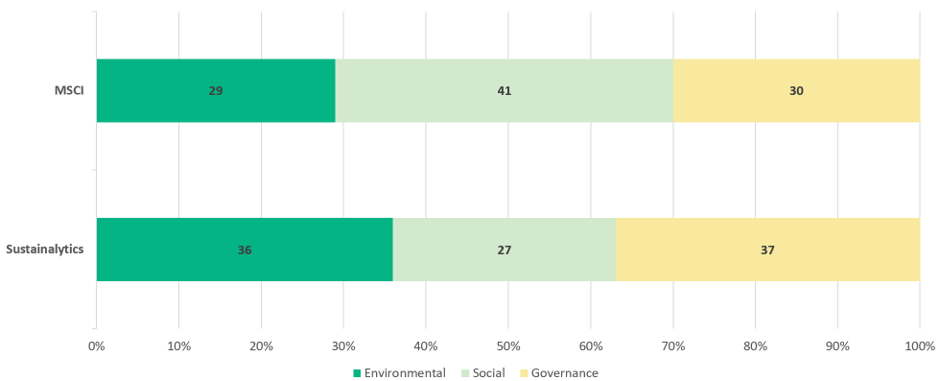
Figure 2: Pillar weights for MSCI and sustainalytics across ESG dimensions (in %)
If two providers with the same purpose arrive at materially different conclusions, the source of divergence does not originate in fundamentally different goals, but in how each provider operationalises that goal in practice. The goal of this section is therefore not to replicate what Table 1 covers at a summary level, but to uncover the divergence at the level of individual methodological choices. This understanding provides the analytical foundation for the chapter on barriers of ESG ratings that follows, where the consequences of these architectural differences are examined.
2.4.1 Conceptual foundation: What is being measured?
The most fundamental difference lies not in the stated purpose, but in what each provider actually measures and how the result needs to be interpreted. MSCI ESG ratings are designed to provide an opinion on a company’s management of financially relevant ESG risks and opportunities. Companies are rated on an AAA-to-CCC scale relative to the standards and performance of their industry peers, with the result explicitly intended to reflect a company’s standing within a defined peer group rather than its absolute level of ESG risk.46MSCI. ESG Ratings Methodology. (2024). As a structural consequence, an AAA-rated tobacco producer and a BBB-rated solar company are positioned against different benchmarks rather than against a common standard. The implications of this design choice for comparability are examined in the Outcomes chapter 2.5.3.
Sustainalytics starts from a different angle. Rather than measuring how well a company manages ESG risks relative to peers, it measures how much ESG risk remains unmanaged in absolute terms. In their methodological abstract, Sustainalytics describes the ESG Risk Rating as assessing “the magnitude of a company’s unmanaged ESG risks (p.2)”, expressed on an open-ended numerical scale on which a score close to zero indicates negligible unmanaged risk.51Sustainalytics. The ESG Risk Ratings: Methodology Abstract Version 3.1. (2024). For 95% of companies, the score remains below 50. Sustainalytics refers to this as a “single-currency-of-risk” approach, designed to allow direct comparability of companies across industries on the same scale, something MSCI’s peer-relative framework does not permit by design.46MSCI. ESG Ratings Methodology. (2024).,51Sustainalytics. The ESG Risk Ratings: Methodology Abstract Version 3.1. (2024).
2.4.2 The exposure-management framework: Shared architecture, different logic
Despite their different objectives, both providers share a structural approach: they breakdown the ESG assessment into an exposure dimension and a management dimension. However, the logic of this decomposition and the role each dimension plays in the final score differ substantially.46MSCI. ESG Ratings Methodology. (2024).,51Sustainalytics. The ESG Risk Ratings: Methodology Abstract Version 3.1. (2024).
MSCI uses exposure and management to calculate a Key Issue Score for each of its 33 material issues and specifies the formula as: Key Issue Score = 7 − (MAX(exposure, 2) − management), constrained to a 0-to-10 scale. Both exposure and management are scored on a 0-to-10 scale.46MSCI. ESG Ratings Methodology. (2024). This design means that a company with high exposure must demonstrate strong management to achieve a good Key Issue Score. A company with high exposure must also have very strong management, whereas a company with limited exposure can have a more modest approach. Two structural constraints further shape the outcome. First, the model requires a minimum management threshold to achieve a Key Issue Score greater than five, preventing companies from earning high scores solely through low exposure. Second, at very high exposure levels the maximum possible Key Issue Score falls below ten, reflecting MSCI’s assumption that some residual risk persists regardless of management quality.54Sustainalytics. The ESG Risk Ratings – Methodology Abstract: Version 3.1. (2024). The individual Key Issue Scores are then combined via industry-specific weights into overall Environmental and Social Pillar Scores, which are normalized against a company’s peer group to produce the final industry-adjusted rating.46MSCI. ESG Ratings Methodology. (2024). While MSCI publishes the combination formula in detail, the conversion of the over 80 underlying business and geographic segment metrics into 0-to-10 Exposure Scores is not disclosed at a granular level.
For opportunity-based Key Issues, MSCI applies a different combination logic, expressed as Key Issue Score = (0.5 + exposure/2) × management + (0.5 − exposure/2) × 5.0. Where exposure is low, the score is constrained toward the midpoint of five, while high exposure permits both higher and lower outcomes depending on management capacity.46MSCI. ESG Ratings Methodology. (2024). The asymmetry between risk and opportunity scoring is itself a methodological choice that does not exist in the Sustainalytics framework.
Sustainalytics applies a more granular breakdown through the concept of risk decomposition and describe the overall unmanaged risk score as the difference between a company’s overall exposure score and its overall managed risk score.51Sustainalytics. The ESG Risk Ratings: Methodology Abstract Version 3.1. (2024). At the issue level, the framework distinguishes three layers: the total issue exposure, the theoretically manageable portion of that risk determined by the Manageable Risk Factor (MRF), which is predetermined at sub-industry level and ranges from 0% to 100%, and the portion the company has actually managed.51Sustainalytics. The ESG Risk Ratings: Methodology Abstract Version 3.1. (2024). The final ESG Risk Rating is calculated as the sum of the individual Material ESG Issues’ unmanaged risk scores. This additive aggregation logic is structurally distinct from MSCI’s weighted average approach.51Sustainalytics. The ESG Risk Ratings: Methodology Abstract Version 3.1. (2024). The MRF itself, however, raises a transparency issue analogous to MSCI’s exposure conversion. Sustainalytics determines the manageable share of each issue at the sub-industry level through internal expert judgment, without publishing the granular reasoning behind the specific percentage values. A higher MRF directly translates into a greater portion of risk being attributable to management quality, which mechanically affects the final score.51Sustainalytics. The ESG Risk Ratings: Methodology Abstract Version 3.1. (2024). Because these values are not publicly traceable, it is difficult to determine how much of the rating is based on analyst judgment and how much on empirical evidence, a challenge that is also evident in MSCI’s exposure assessment.
2.4.3 Material issues: Scope and selection
MSCI identifies 33 Key Issues organized across three pillars and ten themes, with 27 Environmental and Social Key Issues and 6 Governance Key Issues. From the 27 Environmental and Social Key Issues, each company is evaluated on a selection of two to seven, assigned based on its GICS2Rockström, J. et al. Planetary Boundaries guide humanity’s future on Earth. Nat. Rev. Earth Environ. 5, 773–788 (2024). sub-industry classification across the 163 GICS sub-industries covered, and reviewed annually.46MSCI. ESG Ratings Methodology. (2024). The selection process considers each industry’s contribution to the relevant environmental or social externality and the expected time horizon for the risk to materialize. A company’s specific business segments and geographic operations further determine which issues are material at the individual company level. Beyond the standard assignment, MSCI applies company specific Key Issues in approximately 21% of cases, typically for diversified business models or for companies facing severe controversies on issues outside the standard industry mapping.46MSCI. ESG Ratings Methodology. (2024).
Sustainalytics identifies 22 Material ESG Issues per sub-industry, determined through a structured consultation process with sector analysts and refined at the company level through Beta Indicators, which capture the degree to which an individual company’s exposure deviates from its sub-industry average.51Sustainalytics. The ESG Risk Ratings: Methodology Abstract Version 3.1. (2024). Sustainalytics’ rating further describes the concept of Idiosyncratic Issues assigns, where only those ESG issues considered material for a company’s sub-industry are included in its rating. If a company becomes involved in a controversy classified as Category 4 (high impact) or Category 5 (severe impact), that issue is added to the company’s individual rating regardless of sub-industry norms, without affecting the template for peers. The resulting exposure score follows a predetermined scheme tied to event severity, raising the company’s overall unmanaged risk score accordingly.51Sustainalytics. The ESG Risk Ratings: Methodology Abstract Version 3.1. (2024).
Although both providers thus adapt company-specific deviations from industry templates, the underlying logic differs. MSCI adds Company-Specific Key Issues prospectively, by analyst judgment and committee approval, to better reflect a unique business model. Sustainalytics’ Idiosyncratic Issues are triggered reactively by controversies that exceed a defined severity threshold.
2.4.4 Weighting and aggregation
In MSCI’s framework, Key Issue weights are determined at the GICS3Edelman Trust Institute. 2025 Edelman Trust Barometer. https://www.edelman.de/sites/g/files/aatuss401/files/2025-01/2025%20Edelman%20Trust%20Barometer_Germany%20Report.pdf (2025). sub-industry level based on two factors: the industry’s level of contribution to the relevant environmental or social externality, and the expected time horizon for the risk to materialize. Environmental and Social Key Issues each typically receive a weight between 5% and 30% of the total ESG rating. The Governance Pillar is treated separately: it receives a minimum floor weight of 33% for all GICS sub-industries, regardless of industry-specific considerations.46MSCI. ESG Ratings Methodology. (2024). The 33% threshold is a normative architectural decision rather than an empirically derived value. It guarantees that governance contributes one third of every company’s rating, even for companies whose financially material risks lie predominantly in the environmental or social pillar. The weighting logic is therefore not fully data-driven but reflects a methodological priority set by MSCI, which is precisely the kind of weighting choice that Chatterji et al. (2016) identify as a significant driver of rating disagreement across providers.55Chatterji, A. K., Durand, R., Levine, D. I. & Touboul, S. Do ratings of firms converge? Implications for managers, investors and strategy researchers. Strateg. Manag. J. 37, 1597–1614 (2016).
Sustainalytics does not use fixed explicit pillar weights. Instead, weights emerge implicitly from the exposure assessment: the higher a company’s exposure to a given Material ESG Issue, the greater that issue’s contribution to the overall unmanaged risk score. Governance factors are not treated as a separate pillar with a minimum weight floor; Corporate Governance and Stakeholder Governance are integrated as Material ESG Issues within the same framework, directly comparable to environmental and social risks in terms of their contribution to the total unmanaged risk score.51Sustainalytics. The ESG Risk Ratings: Methodology Abstract Version 3.1. (2024).
2.4.5 Controversies: Deduction vs. dilution
Both providers incorporate controversy monitoring, but through different mechanisms. In MSCI’s model, controversies are translated into explicit point deductions from the management score on the affected Key Issue, calibrated by severity and by whether the case indicates a structural problem with the company’s risk management. Structural controversies lead to deductions of −5.0 (Very Severe), −2.5 (Severe), −1.3 (Moderate) and −0.4 (Minor) points; non-structural cases carry smaller deductions of −3.0, −1.7, −0.8 and −0.0 respectively.46MSCI. ESG Ratings Methodology. (2024). Controversies thereby reduce the management score in a calibrated, transparent way, but do not alter which issues are assessed.
Sustainalytics uses a different logic, describing event indicators as carrying a raw score of zero, with a dilution effect achieved by giving each event indicator a weight in the overall management score calculation that increases with the severity and frequency of events. This means that a severe controversy does not deduct points from an existing management score directly, but instead, the controversy receives a higher weight in the overall assessment, which decreases the influence of positive management indicators on the final rating. As noted above, a sufficiently severe event of Category 4 or 5 can furthermore activate an Idiosyncratic Issue, expanding the scope of assessed issues for that specific company.51Sustainalytics. The ESG Risk Ratings: Methodology Abstract Version 3.1. (2024).
2.5 Main topics in literature
Having established how ESG ratings are defined, how the rating market has evolved and how the methodologies major rating agencies can differ in practice, the following sections examine the core debates that have emerged in the academic literature on ESG ratings.
2.5.1 Drivers of ESG ratings
While the previous sections have established what ESG ratings are, how they evolved and how their methodologies differ in practice, the following section on Drivers of ESG ratings turns to the forces that explain why this product has emerged and continues to grow in use.
2.5.1.1 Market and stakeholder demand
Empirical evidence from the ERM Sustainability Institute’s Rate the Raters 2025 report confirms that investor demand remains the most important reason why companies engage with ESG rating agencies, with 46% of respondents identifying it as their top motivation. However, his number has declined from 57% in 2023, indicating a shift of demand.17ERM Sustainability Institute. Rate the Raters 2025: ESG Ratings in Evolution – Corporate Survey Results. (2025). Customer demand has tripled in importance from 7% to 23% and now ranks alongside performance assessment as the second most cited motivation for engagement.17ERM Sustainability Institute. Rate the Raters 2025: ESG Ratings in Evolution – Corporate Survey Results. (2025). This shift can also be observed in the growing importance of EcoVadis, which is focusing on supply chains. Between 2023 and 2025, it moved from seventh to first place in perceived usefulness among corporate respondents.17ERM Sustainability Institute. Rate the Raters 2025: ESG Ratings in Evolution – Corporate Survey Results. (2025). Today, it covers more than 150,000 companies and is widely used by large firms to evaluate the sustainability performance of their suppliers.17ERM Sustainability Institute. Rate the Raters 2025: ESG Ratings in Evolution – Corporate Survey Results. (2025).,50Ecovadis. EcoVadis Ratings: Methodology Overview and Principles. (2025). This suggests that ESG ratings are no longer exclusively an investor tool but are becoming embedded in business-to-business relationships, where a favorable rating can help companies win and maintain customer contracts.
Beyond external stakeholder pressure, companies also use ESG ratings for internal strategic purposes.17ERM Sustainability Institute. Rate the Raters 2025: ESG Ratings in Evolution – Corporate Survey Results. (2025).,35Christensen, D. M., Serafeim, G. & Sikochi, A. (Siko). Why is Corporate Virtue in the Eye of the Beholder? The Case of ESG Ratings. SSRN Scholarly Paper at https://papers.ssrn.com/abstract=3793804 (2021). When still looking at the ERM report, performance assessment and strategy development rank among the top four reasons for engagement, with 73% and 64% of respondents selecting these options respectively.17ERM Sustainability Institute. Rate the Raters 2025: ESG Ratings in Evolution – Corporate Survey Results. (2025). Several respondents reported using rating questionnaires as practical tools for internal assessment. They use them to identify gaps in their disclosures and to inform the development of future sustainability strategies. In some cases, ESG ratings are also linked to executive remuneration. On top, banks have begun to reference ESG ratings in their lending decisions, adding further layers of demand beyond the traditional investor-company relationship.17ERM Sustainability Institute. Rate the Raters 2025: ESG Ratings in Evolution – Corporate Survey Results. (2025). All of this suggests that the demand for ESG ratings is driven by an increasingly diverse set of stakeholders, each with distinct motivations, which in turn reinforces the role of rating agencies as key intermediaries within the sustainable finance system.
2.5.1.2 The need to aggregate ESG data
A primary reason for the existence of ESG ratings lies in the nature of sustainability performance itself. Unlike financial performance, sustainability performance is inherently multidimensional and not directly observable through standard financial reports.15Clement, A., Robinot, E. & Trespeuch, L. (PDF) The use of ESG scores in academic literature: a systematic literature review. ResearchGate https://doi.org/10.1108/JEC-10-2022-0147 (2023) doi:10.1108/JEC-10-2022-0147.,22Billio, M., Costola, M., Hristova, I., Latino, C. & Pelizzon, L. Inside the ESG ratings: (Dis)agreement and performance. Corp. Soc. Responsib. Environ. Manag. 28, 1426–1445 (2021). Measuring carbon emissions, labor practices, supply chain conditions or governance structures have very little in common methodologically and each requires different types of data, analytical approaches or even contextual knowledge. This creates a structural information problem. While sustainability aspects are becoming increasingly recognized as financially material, the underlying data is inconsistent, heterogeneous and often disclosed on a voluntary basis without universal standards.35Christensen, D. M., Serafeim, G. & Sikochi, A. (Siko). Why is Corporate Virtue in the Eye of the Beholder? The Case of ESG Ratings. SSRN Scholarly Paper at https://papers.ssrn.com/abstract=3793804 (2021).
ESG rating agencies have emerged precisely at this point to address this gap. They function as information intermediaries that collect, process and condense a wide range of nonfinancial data points into standardized metrics, which can then be used by investors, regulators and other stakeholders to assess and compare firms across industries and markets.10Pagano, M. S., Sinclair, G. & Yang, T. Understanding ESG ratings and ESG indexes. in Research Handbook of Finance and Sustainability 339–371 (Edward Elgar Publishing, Cheltenham, UK; Northampton, MA, USA, 2018).,56Torre, M. L., Sabelfeld, S., Blomkvist, M. & Dumay, J. Rebuilding trust: sustainability and non-financial reporting and the European Union regulation. Meditari Account. Res. 28, 701–725 (2020). In doing so, they aim to reduce the information asymmetry between companies and capital providers that exists because mandatory, audited sustainability reporting is mostly absent or still in early stages.14Stewart, R. Towards a better understanding of ESG ratings. J. Sustain. Finance Invest. 15, 624–643 (2025). Christensen et al. (2021) describe this intermediary role as particularly relevant in the presence of incomplete information about a company’s actual ESG performance, where ratings can help mitigate adverse selection by providing external assessments that go beyond corporate self-reporting.35Christensen, D. M., Serafeim, G. & Sikochi, A. (Siko). Why is Corporate Virtue in the Eye of the Beholder? The Case of ESG Ratings. SSRN Scholarly Paper at https://papers.ssrn.com/abstract=3793804 (2021). However, this aggregation process itself introduces significant challenges as well. The act of translating complex and context-dependent sustainability realities into a single score or letter grade inevitably requires judgment calls on what to measure, how to measure it and how to weigh the individual components against each other.57Berg, F., Heeb, F. & Kölbel, J. The Economic Impact of ESG Ratings. https://www.econstor.eu/handle/10419/308045 (2024) doi:10.2139/ssrn.4088545. These choices vary substantially across providers and constitute a core source of the divergence of ESG ratings documented in section 2.5.2.
2.5.1.3 Regulatory compliance as a driver
While the information gap described above has been addressed through voluntary engagement with rating agencies, a new driver has emerged in recent years. The expansion of mandatory sustainability disclosure requirements is changing the way companies relate to ESG ratings. Frameworks like CSRD or ISSB have created a regulatory environment in which companies are required to report on sustainability topics in a structured and increasingly standardized manner.6GSIA. Global Sustainable Investment Review 2024. https://www.gsi-alliance.org/members-resources/gsir2024/. In this context, ESG ratings are no longer used solely to satisfy investor or customer demand but also serve as preparatory tools for regulatory compliance.
The ERM report captures this shift. Preparation for regulatory compliance, a response option introduced for the first time in 2025, was selected by 57% of respondents as a motivation for engaging with rating agencies, with 9% ranking it as their most important reason.17ERM Sustainability Institute. Rate the Raters 2025: ESG Ratings in Evolution – Corporate Survey Results. (2025). When asked how they use ESG ratings in relation to compliance, 73% of companies reported using them for benchmarking against peers, 63% said the process of responding to ratings helped them improve internal data collection and management, and 55% used ratings to identify gaps in their compliance preparedness by mapping rating metrics to regulatory requirements. Only 10% of respondents indicated that they do not use ESG ratings for compliance purposes at all.17ERM Sustainability Institute. Rate the Raters 2025: ESG Ratings in Evolution – Corporate Survey Results. (2025).
This finding reflects a broader development. As disclosure regulation expands, the data that rating agencies collect increasingly overlaps with what companies are required to report publicly.16Ferro, A., Marazzina, D. & Stocco, D. Uncovering ESG Ratings: The (Im)Balance of Aspirational and Performance Features. Corp. Soc. Responsib. Environ. Manag. 32, 5895–5917 (2025).,38Blum, V. From the ESG Rush to the ESG Backlash: A Western Story. SSRN Scholarly Paper at https://doi.org/10.2139/ssrn.5238272 (2025). The GSIA (2024) notes that this overlap has the potential to challenge the traditional business model of rating agencies, as investors and stakeholders gain access to mandatory, comparable sustainability data without relying on intermediaries.6GSIA. Global Sustainable Investment Review 2024. https://www.gsi-alliance.org/members-resources/gsir2024/. At the same time, the current slowdown of regulatory rollout in Europe, where the scope of CSRD is to be reduced by up to 80% under the EU’s Omnibus simplification agenda and the indefinite postponement of disclosure regulation in the United States give rating agencies more time to adapt their methodologies and maintain their relevance for the companies that will remain outside the scope of mandatory reporting.6GSIA. Global Sustainable Investment Review 2024. https://www.gsi-alliance.org/members-resources/gsir2024/.,17ERM Sustainability Institute. Rate the Raters 2025: ESG Ratings in Evolution – Corporate Survey Results. (2025).
2.5.1.4 Incentives for firms
Beyond responding to external demand, firms themselves have practical reasons to engage with ESG ratings, both as a strategic management tool and as a prerequisite for access to capital. From a strategic perspective, companies increasingly treat ESG ratings as management tools rather than as an externally imposed obligation. As discussed in the previous section, the ERM survey shows that performance assessment and strategy development are among the top reasons for engagement.17ERM Sustainability Institute. Rate the Raters 2025: ESG Ratings in Evolution – Corporate Survey Results. (2025). Corporate sustainability managers reported using rating questionnaires to identify weaknesses in their own reporting and to anticipate emerging expectations from investors and clients. One survey respondent described the process as using rater questionnaires as a mirror, where gap analyses become the basis for deciding which disclosures to prioritise in the following year.17ERM Sustainability Institute. Rate the Raters 2025: ESG Ratings in Evolution – Corporate Survey Results. (2025).
The absence of ESG ratings itself can become a problem. Zumente and Lāce (2021) find that 72% of the companies listed on Central and Eastern European stock exchanges have no external ESG rating at all.12Zumente, I. & Lāce, N. ESG Rating—Necessity for the Investor or the Company? Sustainability 13, 8940 (2021). For these firms, the absence of a rating poses a concrete risk: asset managers who rely on third-party ESG assessments for their investment decisions may simply exclude unrated companies from their investment universe. In a market environment where ESG integration has become a standard practice among institutional investors, not having a rating can therefore translate into reduced visibility, lower trading volumes and with that, limited access to capital.12Zumente, I. & Lāce, N. ESG Rating—Necessity for the Investor or the Company? Sustainability 13, 8940 (2021). This creates a self-reinforcing dynamic in which the existence of ESG ratings generates its own demand, particularly among firms that compete for external capital.
2.5.2 Barriers of ESG-ratings
While the previous section has explored how the literature explains the existence and growing demand for ESG ratings, the following section on Barriers of ESG ratings turns to the challenges that limit how well they fulfil this role in practice.
2.5.2.1 The role of ESG data and data quality
The quality and consistency of the underlying data is one of the most fundamental challenges in ESG ratings. Unlike financial data, which follows established accounting standards and is subject to external audits, ESG data lacks a comparable infrastructure. Companies report sustainability information in widely different formats, using different metrics for the same topic and often without external verification.19Berg, F., Kölbel, J. F. & Rigobon, R. Aggregate confusion: The divergence of ESG ratings. Rev. Finance 26, 1315–1344 (2022). Kotsantonis and Serafeim (2019) illustrate this by examining a sample of 50 large publicly listed companies and their disclosures on employee health and safety. They found more than 20 different ways in which companies chose to report on this single topic, ranging from lost time frequency rates to total case incident rates to the number of severe accidents.58Kotsantonis, S. & Serafeim, G. Four Things No One Will Tell You About ESG Data. J. Appl. Corp. Finance 31, 50–58 (2019). These metrics may sound similar, but they are not comparable and cannot be meaningfully aggregated without significant judgment on the part of the rating agency.12Zumente, I. & Lāce, N. ESG Rating—Necessity for the Investor or the Company? Sustainability 13, 8940 (2021).,37Liu, M. Quantitative ESG disclosure and divergence of ESG ratings. Front. Psychol. 13, (2022).
Where companies do disclose, inconsistency is the rule. Where they do not disclose at all, rating agencies face a separate problem. When a company does not disclose a particular metric, rating agencies handle the gap in different ways. Some assign a score of zero, assuming the worst. Others estimate the missing value based on industry peers. More advanced approaches use statistical models, but the resulting scores remain difficult to interpret for users who cannot see which data points were actually reported and which were filled in.39Dimson, E., Marsh, P. & Staunton, M. Divergent ESG ratings. https://doi.org/10.17863/CAM.55949 (2020) doi:10.17863/CAM.55949. The way missing data is treated can shift a company’s rating significantly and varies from one agency to the next, adding another layer of inconsistency to the final assessment.
A closely related issue is the systematic relationship between firm size and ESG ratings. Drempetic et al. (2020) use the Thomson Reuters ASSET4 database to show that larger firms receive higher ESG scores, not necessarily because they perform better on sustainability, but because they have more resources to collect and report ESG data. The correlation between firm size and data availability is highly significant across all sectors, and data availability in turn correlates strongly with the ESG rating itself. What ratings often capture is therefore not sustainability performance as such, but the capacity of a firm to produce and disclose information about it.27Drempetic, S., Klein, C. & Zwergel, B. The influence of firm size on the ESG score: Corporate sustainability ratings under review. J. Bus. Ethics 333–360 (2020). The same pattern is observed across regions: European companies, operating under stronger disclosure traditions and regulatory expectations, tend to receive higher scores than firms in other parts of the world.12Zumente, I. & Lāce, N. ESG Rating—Necessity for the Investor or the Company? Sustainability 13, 8940 (2021).,13Larcker, D. F., Pomorski, L., Tayan, B. & Watts, E. M. ESG Ratings: A Compass without Direction. SSRN Scholarly Paper at https://papers.ssrn.com/abstract=4179647 (2022). This regional dimension will be discussed more in detail in the outcomes section 2.5.3 on geographical differences.
The reliability of ESG data is further called into question by the practice of retroactive score rewriting. Berg et al. (2021) document that Refinitiv has repeatedly changed its historical ESG scores, with revisions affecting 86% of firms across multiple years within just six weeks between two data downloads.18Berg, F., Fabisik, K. & Sautner, Z. Is history repeating itself? The (un) predictable past of ESG ratings. SSRN Electron. J. 3722087, (2021). After these changes, only 70% of firm-year observations still overlapped in the top ESG score decile and in the bottom decile the overlap dropped to 57%. These revisions are not minor recalibrations. They alter firm rankings, change the composition of quantile-based portfolios and undermine the reproducibility of academic research that relies on these data.18Berg, F., Fabisik, K. & Sautner, Z. Is history repeating itself? The (un) predictable past of ESG ratings. SSRN Electron. J. 3722087, (2021). For practitioners and investors, this means that the ESG data available today may not reflect the same assessment that was available when the original investment decision was made.
2.5.2.2 Lack of methodological transparency
A closely related challenge concerns the difficulty of understanding how rating agencies process and translate the data they collect into a final score. Investors, regulators and rated companies alike face the problem that the methodologies behind ESG ratings remain only partially disclosed. Abhayawansa and Tyagi (2021) describe ESG ratings as a black box, in which providers disclose categories and weightings but rarely explain how these categories were determined or what specific criteria are applied within them.34Abhayawansa, S. Swimming against the tide: back to single materiality for sustainability reporting. Sustain. Account. Manag. Policy J. 13, 1361–1385 (2022). Some providers go further than others, but even the most transparent agencies treat their core methodology, data sources and weighting schemes as proprietary intellectual property.10Pagano, M. S., Sinclair, G. & Yang, T. Understanding ESG ratings and ESG indexes. in Research Handbook of Finance and Sustainability 339–371 (Edward Elgar Publishing, Cheltenham, UK; Northampton, MA, USA, 2018).,34Abhayawansa, S. Swimming against the tide: back to single materiality for sustainability reporting. Sustain. Account. Manag. Policy J. 13, 1361–1385 (2022). This is not a neglectable issue, it directly limits the ability of users to assess whether a given rating actually captures what they care about and whether it can be meaningfully compared with another.
Practitioner surveys document the consequences of this lack of transparency. Larcker et al. (2022) report that investors consistently express a lack of understanding about the methodologies and reliability of ESG ratings.13Larcker, D. F., Pomorski, L., Tayan, B. & Watts, E. M. ESG Ratings: A Compass without Direction. SSRN Scholarly Paper at https://papers.ssrn.com/abstract=4179647 (2022). The Alternative Investment Management Association, representing institutional investors globally, finds that its members struggle to understand and validate the approaches used by different providers.59AIMA. ESG – Progress and Pitfalls. https://www.aima.org/article/esg-progress-and-pitfalls.html. The ESMA has described the ESG ratings market as immature, citing the structural dispersion of methodologies.60ESMA, M. J. Outcome of ESMA Call for Evidence on Market Characteristics of ESG Rating and Data Providers in the EU. Ferro et al. (2025) provide a more recent and quantitative perspective: among the practitioners they survey, 53% of investors have responded to dissatisfaction with external ESG providers by developing their own in-house ESG models, and only 37% consider external ESG ratings a credible source of information about corporate ESG performance.16Ferro, A., Marazzina, D. & Stocco, D. Uncovering ESG Ratings: The (Im)Balance of Aspirational and Performance Features. Corp. Soc. Responsib. Environ. Manag. 32, 5895–5917 (2025). The OECD (2025) reaches a similar conclusion at the metric level, noting that very few rating products make the underlying indicators publicly accessible, which prevents independent verification of how scores are produced.42OECD. Behind ESG ratings: Unpacking sustainability metrics. OECD https://www.oecd.org/en/publications/behind-esg-ratings_3f055f0c-en.html (2025) doi:10.1787/3f055f0c-en.
A particular concern within this debate is the potential for conflicts of interest. Several providers maintain commercial relationships with the firms they rate, offer consulting services to help companies improve their ratings, or sell index products built on their own assessment.13Larcker, D. F., Pomorski, L., Tayan, B. & Watts, E. M. ESG Ratings: A Compass without Direction. SSRN Scholarly Paper at https://papers.ssrn.com/abstract=4179647 (2022).,34Abhayawansa, S. Swimming against the tide: back to single materiality for sustainability reporting. Sustain. Account. Manag. Policy J. 13, 1361–1385 (2022). These arrangements raise questions about the independence of the ratings, as the financial incentives of the rating agency may not always align with the interests of the investor relying on them. Regulatory initiatives have begun to address this issue. The EU Regulation on ESG Rating Activities (EU) 2024/3005, in force since January 2025, requires that rating providers operating in the European Union are authorised and supervised by the ESMA and obliges them to separate their business activities to prevent conflicts of interest.6GSIA. Global Sustainable Investment Review 2024. https://www.gsi-alliance.org/members-resources/gsir2024/. Codes of conduct introduced in Japan, Singapore, Hong Kong and the United Kingdom pursue similar objectives, although they remain voluntary in most cases.17ERM Sustainability Institute. Rate the Raters 2025: ESG Ratings in Evolution – Corporate Survey Results. (2025).
Beyond methodology disclosure itself, the Rate the Raters 2025 survey shows that companies most frequently associate high quality ratings with methodological consistency and accessible engagement with rating analysts, suggesting that consistency, not just disclosure, is a precondition for ratings to be useful in practice.17ERM Sustainability Institute. Rate the Raters 2025: ESG Ratings in Evolution – Corporate Survey Results. (2025).
2.5.2.3 Aspirational vs. performance metrics
Data quality and methodological transparency aside, a more fundamental question concerns what ESG ratings actually measure. Recent evidence suggests that ratings capture corporate intentions and commitments to a far greater extent than actual results. Ferro et al. (2025) replicate the LSEG ESG scoring methodology using machine learning and find that approximately 60% of the final ESG score is built on forward-looking, aspirational features such as policies, targets and commitments, while only around 40% reflects backward-looking performance data.16Ferro, A., Marazzina, D. & Stocco, D. Uncovering ESG Ratings: The (Im)Balance of Aspirational and Performance Features. Corp. Soc. Responsib. Environ. Manag. 32, 5895–5917 (2025). This imbalance holds across all economic sectors, with the aspirational share ranging from 56.1% in the financial sector to 64.2% in telecommunications.16Ferro, A., Marazzina, D. & Stocco, D. Uncovering ESG Ratings: The (Im)Balance of Aspirational and Performance Features. Corp. Soc. Responsib. Environ. Manag. 32, 5895–5917 (2025). At the pillar level, the gap is even bigger: both the Environmental and Social pillars are primarily driven by aspirational metrics, at 61.2% and 76.7% respectively, while the Governance pillar is the exception, relying more heavily on performance data largely because its management category is built on observable, factual indicators at 69.7%.16Ferro, A., Marazzina, D. & Stocco, D. Uncovering ESG Ratings: The (Im)Balance of Aspirational and Performance Features. Corp. Soc. Responsib. Environ. Manag. 32, 5895–5917 (2025).
The OECD (2025) confirms this from a different angle. Analysing over 2,000 metrics across eight major ESG rating products, the report finds that 68% of all metrics are input-based, meaning they capture the policies and measures a company has put in place to address ESG topics, regardless of how effective those measures actually are.42OECD. Behind ESG ratings: Unpacking sustainability metrics. OECD https://www.oecd.org/en/publications/behind-esg-ratings_3f055f0c-en.html (2025) doi:10.1787/3f055f0c-en. Qualitative input-based metrics alone account for nearly 60% of the total. Quantitative output-based metrics, which provide the strongest link between the metric and actual performance, make up only 17%. Dynamic and forward-looking metrics that would be needed to track progress against specific targets are largely absent from the dataset, representing just 5%.42OECD. Behind ESG ratings: Unpacking sustainability metrics. OECD https://www.oecd.org/en/publications/behind-esg-ratings_3f055f0c-en.html (2025) doi:10.1787/3f055f0c-en.
The thematic coverage of these metrics is also uneven. Established ESG topics such as corporate governance, business ethics and environmental management are covered by more than 20 metrics on average across rating products.42OECD. Behind ESG ratings: Unpacking sustainability metrics. OECD https://www.oecd.org/en/publications/behind-esg-ratings_3f055f0c-en.html (2025) doi:10.1787/3f055f0c-en. In contrast, topics like biodiversity, climate resilience, community relations and human rights are captured by fewer than five metrics, and some, including corruption and certain human rights dimensions, are entirely absent from individual rating products.38Blum, V. From the ESG Rush to the ESG Backlash: A Western Story. SSRN Scholarly Paper at https://doi.org/10.2139/ssrn.5238272 (2025).,42OECD. Behind ESG ratings: Unpacking sustainability metrics. OECD https://www.oecd.org/en/publications/behind-esg-ratings_3f055f0c-en.html (2025) doi:10.1787/3f055f0c-en. There is a visible correlation between the number of available metrics per topic and the share of quantitative data: topics with fewer metrics also tend to rely more heavily on qualitative assessments, which further weakens the ability to measure actual performance in those areas.42OECD. Behind ESG ratings: Unpacking sustainability metrics. OECD https://www.oecd.org/en/publications/behind-esg-ratings_3f055f0c-en.html (2025) doi:10.1787/3f055f0c-en.
The practical consequence of this imbalance is significant. If ESG scores are primarily built on what a company promises rather than what it delivers, firms can improve their ratings by adopting policies and setting targets without necessarily changing their actual environmental or social performance.16Ferro, A., Marazzina, D. & Stocco, D. Uncovering ESG Ratings: The (Im)Balance of Aspirational and Performance Features. Corp. Soc. Responsib. Environ. Manag. 32, 5895–5917 (2025). Ferro et al. (2025) warn that this may shift the focus of corporate sustainability efforts from genuine improvement to what they describe as a ticking-the-boxes exercise.16Ferro, A., Marazzina, D. & Stocco, D. Uncovering ESG Ratings: The (Im)Balance of Aspirational and Performance Features. Corp. Soc. Responsib. Environ. Manag. 32, 5895–5917 (2025). The structural imbalance between aspirational and performance metrics therefore creates the methodological conditions under which the greenwashing risks discussed later in this chapter can emerge, raising the question of whether ESG ratings in their current form are able to distinguish between companies that are moving toward sustainability and those that are merely projecting a green image on paper.
2.5.2.4 The divergence of ESG ratings
But among all the challenges discussed in this chapter, the divergence between ESG ratings is the most extensively documented and probably the most consequential. The very purpose of an ESG rating is to provide an assessment of a company’s ESG performance that investors and other stakeholders can rely on. Yet ratings issued by different providers for the same firm often differ to such an extent that observers are left with substantially different pictures of how the company actually performs.19Berg, F., Kölbel, J. F. & Rigobon, R. Aggregate confusion: The divergence of ESG ratings. Rev. Finance 26, 1315–1344 (2022). This will be more detailed in chapter 2.5. The implications go beyond the methodological debate: if ESG ratings are meant to show where firms stand within the narrowing operating space described by the Funnel Metaphor, divergence means that different providers locate the same firm in different positions, which undermines the credibility of ESG ratings as an information product and raises fundamental questions about whether they can fulfil the role assigned to them in sustainable finance.
With over 5,000 citations on Google Scholar and more than 2,000 citations on Scopus, the article “Aggregate confusion: The divergence of ESG Ratings” from Berg, Kölbel and Rigobon (2022) has become a standard reference in the field. The authors examine ESG ratings from six major providers, namely KLD, Sustainalytics, Moody’s ESG, S&P Global, Refinitiv and MSCI for a sample of 924 firms. Their starting point is the low pairwise correlation between providers, already discussed in the methodological comparison, ranging from 0.38 to 0.71 with an average of 0.54. Using Krippendorff’s alpha, a statistical measure that captures how consistently multiple raters assess the same subject, Berg et al. calculate a value of 0.55 for their sample, well below the 0.667 threshold that is generally considered the minimum to arrive at conclusions about an underlying construct based on multiple raters.19Berg, F., Kölbel, J. F. & Rigobon, R. Aggregate confusion: The divergence of ESG ratings. Rev. Finance 26, 1315–1344 (2022).
The main contribution of the study lies in their decomposition of the divergence into three structural sources. They map the methodologies of all six providers onto a common taxonomy and then attribute the variation in scores to 1. scope, 2. measurement and 3. weight. Scope divergence arises when raters disagree on which attributes belong to ESG in the first place. One agency may include lobbying activities or animal welfare as separate categories, while another does not consider them at all. Measurement divergence describes the situation in which raters agree on what to measure but use different indicators in doing so. The authors illustrate this with the example of labor practices, which can be assessed through workforce turnover, the number of labor-related court cases or general management commitment. Weight divergence refers to the different importance that providers assign to individual categories when aggregating them into an overall score. The empirical decomposition shows that measurement divergence is by far the dominant source, accounting for 56% of the variation, while scope contributes 38% and weight only 6%.19Berg, F., Kölbel, J. F. & Rigobon, R. Aggregate confusion: The divergence of ESG ratings. Rev. Finance 26, 1315–1344 (2022).
This breakdown has clear implications for how divergence might be reduced. Berg et al. (2022) argue that weight divergence would be the easiest source to resolve, as it could in principle be addressed by aligning the weighting schemes across providers. Yet, since weight contributes only 6% of the divergence, doing so would have little effect. Scope divergence is more impactful but harder to address, as it would require providers to agree on a common set of categories and to abandon those that are unique to their own approach. The most consequential finding, however, is that measurement divergence remains the largest source of disagreement even within a reduced set of common categories. This means that the problem cannot be solved by harmonising definitions or weights alone. It requires addressing how the underlying data is collected, interpreted and translated into scores, which is a far more fundamental challenge.19Berg, F., Kölbel, J. F. & Rigobon, R. Aggregate confusion: The divergence of ESG ratings. Rev. Finance 26, 1315–1344 (2022). Put differently, even if all rating agencies agreed on exactly which topics to cover and how to weigh them against each other, they would still arrive at substantially different conclusions about the same company, because the core problem lies in how individual analysts interpret and translate real-world corporate behavior into a numerical score.
These findings are not unique to the Berg et al. dataset. Chatterji et al. (2016), examining KLD, Asset.4Broman, G. I. & Robèrt, K.-H. A framework for strategic sustainable development. J. Clean. Prod. 140, 17–31 (2017). Innovest, DJSI, FTSE4Good and Calvert, find low convergence across these six providers even after adjusting for explicit differences in how the agencies define what they are trying to measure, which directly supports the argument that disagreement runs deeper than definitional inconsistency.55Chatterji, A. K., Durand, R., Levine, D. I. & Touboul, S. Do ratings of firms converge? Implications for managers, investors and strategy researchers. Strateg. Manag. J. 37, 1597–1614 (2016). Billio et al. (2021), analysing Sustainalytics, MSCI, RobecoSAM and Refinitiv, find that agreement on which firms qualify as ESG leaders stands at only around 24% on average and that the overlap between ESG-labeled stock indices is in the range of 15%.22Billio, M., Costola, M., Hristova, I., Latino, C. & Pelizzon, L. Inside the ESG ratings: (Dis)agreement and performance. Corp. Soc. Responsib. Environ. Manag. 28, 1426–1445 (2021). Dorfleitner, Halbritter and Nguyen (2015) confirm the same picture across ASSET.4Broman, G. I. & Robèrt, K.-H. A framework for strategic sustainable development. J. Clean. Prod. 140, 17–31 (2017). MSCI/KLD and Bloomberg, with correlations between MSCI/KLD and the other two providers ranging between 0.05 and 0.39 at the level of individual ESG dimensions.23Dorfleitner, G., Halbritter, G. & Nguyen, M. Measuring the level and risk of corporate responsibility – An empirical comparison of different ESG rating approaches. J. Asset Manag. 16, 450–466 (2015). Beyond this general pattern, the literature also documents a consistent structure within the divergence itself. Gibson Brandon, Krueger and Schmidt (2021), using ratings from MSCI, Sustainalytics, Bloomberg, Thomson Reuters, KLD, RepRrisk and Robeco, show that divergence is not evenly distributed across pillars but follows a consistent pattern, with Environmental scores showing the highest agreement and Governance scores the lowest.40Gibson Brandon, R., Krueger, P. & Schmidt, P. S. ESG Rating Disagreement and Stock Returns. Financ. Anal. J. 77, 104–127 (2021). Across these studies, the pillar-level pattern is remarkably consistent: the Environmental pillar shows the highest agreement across providers, the Social pillar slightly lower, and the Governance pillar by far the lowest, with average correlations of 0.30 or below. Dorfleitner et al. (2015) again report a similar pattern across ASSET.4Broman, G. I. & Robèrt, K.-H. A framework for strategic sustainable development. J. Clean. Prod. 140, 17–31 (2017). MSCI/KLD and Bloomberg, with the Governance pillar showing the weakest correlation across providers and even within the same provider`s own pillar structure.23Dorfleitner, G., Halbritter, G. & Nguyen, M. Measuring the level and risk of corporate responsibility – An empirical comparison of different ESG rating approaches. J. Asset Manag. 16, 450–466 (2015).
A more counterintuitive finding concerns the role of corporate disclosure in this debate. One might assume that more transparency from companies would narrow the gap between rating providers, but the empirical evidence suggests the opposite. Christensen, Serafeim and Sikochi (2021) show that greater ESG disclosure is associated with greater rating disagreement, not less, because ESG information is inherently subjective and more data simply expands the room for interpretation.35Christensen, D. M., Serafeim, G. & Sikochi, A. (Siko). Why is Corporate Virtue in the Eye of the Beholder? The Case of ESG Ratings. SSRN Scholarly Paper at https://papers.ssrn.com/abstract=3793804 (2021). Liu (2022) confirms this finding for quantitative disclosures and adds that the effect is particularly strong for firms with extensive numerical reporting on environmental and social topics.37Liu, M. Quantitative ESG disclosure and divergence of ESG ratings. Front. Psychol. 13, (2022). Kimbrough et al. (2022) provide a more nuanced perspective: voluntary ESG reports do reduce disagreement on the Environmental and Social pillars, where reporting standards are more developed, but not on the Governance pillar.61Kimbrough, M. D., Wang, X. (Frank), Wei, S. & Zhang, J. (Iris). Does Voluntary ESG Reporting Resolve Disagreement Among ESG Rating Agencies? SSRN Scholarly Paper at https://papers.ssrn.com/abstract=4128503 (2022). Without commonly accepted standards on how to interpret and weight the disclosed information, more data can deepen the disagreement among raters rather than resolve it.
Beyond the methodological and informational sources of divergence, there is a further dimension that has received increasing attention in recent years. Eccles and Stroehle (2018) argue that ESG rating agencies are not neutral measurement instruments but reflect the social and historical contexts in which they were founded. Their study compares two early rating providers, KLD and Innovest, and shows that their methodologies were shaped by the values, professional backgrounds and intended audiences of their founders. KLD emerged from the values-based investing movement of the 1980s and was oriented toward ethical investors with broad sustainability concerns, while Innovest was founded with a stronger financial performance orientation aimed at mainstream institutional investors. These different origins translated into different definitions of what ESG means and how it should be measured, and these differences have persisted even as the agencies have grown and consolidated.20Eccles, R. G. & Stroehle, J. C. Exploring social origins in the construction of ESG measures. SSRN Electron. J. https://ora.ox.ac.uk/objects/uuid:8b655ba6-a5d6-4774-a24f-8a235176a595 (2018). Stewart (2025) extends this argument by analysing the methodology documents of 13 rating agencies and finds that they define the very concept of ESG performance in fundamentally different ways, as shown in Table 2. Some define it as a measure of risk exposure, others as a measure of management performance, and still others combine the two. The implication is that different rating providers are not measuring the same construct more or less accurately. They are measuring conceptually different things, which means that the divergence observed empirically is at least partly the result of different normative views about what sustainability performance actually is.14Stewart, R. Towards a better understanding of ESG ratings. J. Sustain. Finance Invest. 15, 624–643 (2025).
If rating providers measure conceptually different things, the question naturally arises whether their assessments allow users to identify firms that are genuinely sustainable. The answer is closely tied to the next barrier: the risk that ESG ratings reward visible commitment more than actual impact and therefore expose investors to greenwashing.
2.5.2.5 Greenwashing risk
Kathan et al. (2025) examine the STOXX Europe 600 over the period from 2015 to 2023 and find that companies with high ESG scores are systematically more likely to face greenwashing accusations.62Kathan, M. C., Utz, S., Dorfleitner, G., Eckberg, J. & Chmel, L. What you see is not what you get: ESG scores and greenwashing risk. Finance Res. Lett. 74, 106710 (2025). Their analysis builds on a theoretical model that distinguishes between apparent environmental performance, which captures what a company communicates about its environmental efforts, and real environmental performance, which captures the actual measurable impact based on emissions data, environmental incidents and supply chain issues. The empirical results show that LSEG and Bloomberg ESG scores correlate strongly and positively with apparent performance, with values between 0.48 and 0.63, while their correlation with real performance is consistently negative, at around -0.25.62Kathan, M. C., Utz, S., Dorfleitner, G., Eckberg, J. & Chmel, L. What you see is not what you get: ESG scores and greenwashing risk. Finance Res. Lett. 74, 106710 (2025). The firms that look most sustainable on paper are not necessarily those that perform best in practice, and in many cases the relationship is reversed.
A second notable observation from Kathan et al. (2025) is that the average apparent environmental performance of their sample firms increased by roughly 40% between 2015 and 2023, while the average real environmental performance remained essentially unchanged. The communication has expanded considerably, but the underlying behavior has not.62Kathan, M. C., Utz, S., Dorfleitner, G., Eckberg, J. & Chmel, L. What you see is not what you get: ESG scores and greenwashing risk. Finance Res. Lett. 74, 106710 (2025). This pattern is consistent with the structural bias toward aspirational metrics described by Ferro et al. (2025): if ESG scores are largely built on policies, targets and disclosures rather than on outcomes, firms can improve their ratings simply by communicating more, regardless of whether their actual environmental impact changes.16Ferro, A., Marazzina, D. & Stocco, D. Uncovering ESG Ratings: The (Im)Balance of Aspirational and Performance Features. Corp. Soc. Responsib. Environ. Manag. 32, 5895–5917 (2025). The authors also find that greenwashing accusations are concentrated among large companies with high ESG scores, which is consistent with the firm size bias as documented earlier in this chapter by Drempetic et al. (2020): larger firms have more resources to produce extensive sustainability communication, and that communication is what ESG ratings primarily reward.16Ferro, A., Marazzina, D. & Stocco, D. Uncovering ESG Ratings: The (Im)Balance of Aspirational and Performance Features. Corp. Soc. Responsib. Environ. Manag. 32, 5895–5917 (2025).,27Drempetic, S., Klein, C. & Zwergel, B. The influence of firm size on the ESG score: Corporate sustainability ratings under review. J. Bus. Ethics 333–360 (2020).
Shi and Yao (2025) describe a related mechanism that operates through firm behavior rather than through rating methodology. When different agencies emphasise different categories and indicators, companies have an incentive to optimise for the specific metrics that drive their preferred rating, rather than to invest in broader sustainability improvements. This selective optimisation can include disclosing positive environmental outcomes while concealing negative ones or aligning policies and reporting with the methodologies of the most influential rating providers.32Shi, Y. & Yao, T. ESG Rating Divergence: Existence, Driving Factors, and Impact Effects. Sustainability 17, 4717 (2025). The combination of these effects creates a structural risk for investors. Portfolios built on the basis of high ESG scores may, contrary to their intended purpose, end up overweighting firms with elevated greenwashing exposure rather than firms with genuine sustainability performance.62Kathan, M. C., Utz, S., Dorfleitner, G., Eckberg, J. & Chmel, L. What you see is not what you get: ESG scores and greenwashing risk. Finance Res. Lett. 74, 106710 (2025).
2.5.3 Outcomes of ESG-ratings
The barriers discussed in the previous sections do not stay limited to academic debate. They translate into tangible consequences for the firms being rated, the investors using the ratings and the financial markets in which both operate. The following sections examine how these consequences play out in practice.
2.5.3.1 Limited comparability
The most direct consequence of the divergence and methodological differences described in the previous sections is that ESG ratings often fail to provide a comparable signal about the same company. One widely cited illustration of this problem is the case of the car manufacturer Tesla. In the period between 2018 and 2019, MSCI rated Tesla with an exemplary AA, placing it among the top automotive companies on ESG performance. FTSE assigned a far lower rating, and Sustainalytics positioned the firm somewhere in the middle.13Larcker, D. F., Pomorski, L., Tayan, B. & Watts, E. M. ESG Ratings: A Compass without Direction. SSRN Scholarly Paper at https://papers.ssrn.com/abstract=4179647 (2022).,39Dimson, E., Marsh, P. & Staunton, M. Divergent ESG ratings. https://doi.org/10.17863/CAM.55949 (2020) doi:10.17863/CAM.55949. The discrepancy did not arise from one of the agencies being wrong. It reflected fundamentally different assessments of what was being declared material. MSCI focused on the carbon emissions associated with Tesla’s products and judged the company to be almost perfect in this regard, while FTSE looked at the emissions and labor conditions of Tesla’s factories and treated the firm as a serious offender.39Dimson, E., Marsh, P. & Staunton, M. Divergent ESG ratings. https://doi.org/10.17863/CAM.55949 (2020) doi:10.17863/CAM.55949. Sustainalytics positioned the company in the middle range. The Tesla case is not an exception. It shows how the same firm can be rated as a leader, a laggard or somewhere in between, depending on which dimensions of ESG performance the rating agency prioritises.39Dimson, E., Marsh, P. & Staunton, M. Divergent ESG ratings. https://doi.org/10.17863/CAM.55949 (2020) doi:10.17863/CAM.55949.
This problem is amplified by the structural differences in how providers compare firms across industries, as discussed in the methodological comparison earlier in this wiki entry: MSCI normalises companies against industry peer groups, Sustainalytics uses an absolute scale and other providers fall somewhere between, with even individual pillars within a single rater sometimes assessed against different reference group.19Berg, F., Kölbel, J. F. & Rigobon, R. Aggregate confusion: The divergence of ESG ratings. Rev. Finance 26, 1315–1344 (2022).,63ICMA. The Evolving Landscape of ESG Ratings and Data Products. https://www.icmagroup.org/News/news-in-brief/icma-publishes-new-paper-on-the-role-of-esg-ratings-and-data-products-in-sustainable-finance/ (2026). The practical consequence is that an ESG rating cannot simply be read at face value. To interpret it correctly, the user needs to know whether the score reflects industry-relative or absolute performance, which dimensions of sustainability the agency emphasises, and how the underlying methodology has changed over time.
Despite being structured similarly to credit ratings on the surface, ESG rating do not function as a comparable common signal about firm performance. For an investor who is used to treating credit ratings as a reliable shorthand for default risk, applying the same logic to ESG ratings would be misleading. Two firms with identical credit ratings can be expected to show similar default characteristics, while two firms with identical ESG ratings from different providers may have very little in common in terms of their actual sustainability profile.39Dimson, E., Marsh, P. & Staunton, M. Divergent ESG ratings. https://doi.org/10.17863/CAM.55949 (2020) doi:10.17863/CAM.55949.
Beyond this question of comparability, ESG ratings have a broader influence on the firms they cover, the investors who use them and the financial markets in which both interact. The following sections examine these effects along three levels, starting with the firms that are subject to ESG ratings.
2.5.3.2 Impact on firms
ESG ratings affect firms in several ways. The most direct and best documented effect is a disciplining mechanism. Tsang et al. (2024) analyse 323,415 US firm-quarter observations from 2000 to 2018 and find that the initiation of ESG rating coverage exemplary by KLD, ASSET.4Broman, G. I. & Robèrt, K.-H. A framework for strategic sustainable development. J. Clean. Prod. 140, 17–31 (2017). IVA and Sustainalytics is associated with a statistically significant reduction in ESG-related regulatory violations.64Tsang, A., Wang, Y., Xiang, Y. & Yu, L. The rise of ESG rating agencies and management of corporate ESG violations. J. Bank. Finance 169, 107312 (2024). Specifically, firms covered by ESG rating agencies show on average an 8.77% reduction in the occurrence of violations and an 11.23% reduction in the frequency of such violations compared to firms without coverage. The effect also extends to the severity of violations, as covered firms face lower regulatory penalty amounts.64Tsang, A., Wang, Y., Xiang, Y. & Yu, L. The rise of ESG rating agencies and management of corporate ESG violations. J. Bank. Finance 169, 107312 (2024). The mechanism, in their interpretation, is the increased public scrutiny that rating coverage creates: once firms know that their ESG behavior will be systematically assessed and disclosed to investors, they have an incentive to mitigate misconduct that could harm their rating. The effect is strongest for firms with low pre-existing levels of monitoring, including those with limited analyst coverage, weak media attention or weaker prior ESG commitments. In these cases, rating agencies effectively step in where other forms of external monitoring are missing.64Tsang, A., Wang, Y., Xiang, Y. & Yu, L. The rise of ESG rating agencies and management of corporate ESG violations. J. Bank. Finance 169, 107312 (2024).
A second consequence concerns the systematic relationship between firm characteristics and ESG ratings. Larger firms benefit from rating coverage in two ways: they are systematically better covered, with rating coverage of firms below USD 300 million market capitalization ranging between 19 and 26% compared to near-complete coverage of large-cap firms and they tend to receive higher scores due to their reporting capacity.42OECD. Behind ESG ratings: Unpacking sustainability metrics. OECD https://www.oecd.org/en/publications/behind-esg-ratings_3f055f0c-en.html (2025) doi:10.1787/3f055f0c-en. The implication is that ratings systematically reward firms with the resources to engage with the rating process, regardless of whether their underlying sustainability performance is actually better than that of smaller, less resourced firms.13Larcker, D. F., Pomorski, L., Tayan, B. & Watts, E. M. ESG Ratings: A Compass without Direction. SSRN Scholarly Paper at https://papers.ssrn.com/abstract=4179647 (2022).,27Drempetic, S., Klein, C. & Zwergel, B. The influence of firm size on the ESG score: Corporate sustainability ratings under review. J. Bus. Ethics 333–360 (2020).
A third effect at the firm level concerns strategic behavior. The structural bias toward aspirational metrics documented by Ferro et al. (2025) creates conditions under which firms can improve their ratings by communicating more rather than performing better.16Ferro, A., Marazzina, D. & Stocco, D. Uncovering ESG Ratings: The (Im)Balance of Aspirational and Performance Features. Corp. Soc. Responsib. Environ. Manag. 32, 5895–5917 (2025). Shi and Yao (2025) describe how this incentive plays out in practice: firms optimise specifically for the metrics emphasised by individual rating agencies, selectively disclose positive outcomes while concealing negative ones or align their reporting with the methodologies of the most influential providers.32Shi, Y. & Yao, T. ESG Rating Divergence: Existence, Driving Factors, and Impact Effects. Sustainability 17, 4717 (2025). Kathan et al. (2025) provide empirical support for the resulting greenwashing risk. Their analysis of the STOXX Europe 600 between 2015 and 2023 shows that firms with high ESG scores are systematically more likely to face greenwashing accusations, suggesting that rating-driven corporate behavior can drift toward image management rather than substantive change.62Kathan, M. C., Utz, S., Dorfleitner, G., Eckberg, J. & Chmel, L. What you see is not what you get: ESG scores and greenwashing risk. Finance Res. Lett. 74, 106710 (2025).
Finally, ESG ratings have an effect on how firms access and use external capital. Christensen et al. (2022) show that ESG rating disagreement is associated with a lower likelihood of issuing equity or debt and a higher level of cash holdings, which they interpret as a substitution toward internal financing in response to uncertainty about a firm’s sustainability profile.35Christensen, D. M., Serafeim, G. & Sikochi, A. (Siko). Why is Corporate Virtue in the Eye of the Beholder? The Case of ESG Ratings. SSRN Scholarly Paper at https://papers.ssrn.com/abstract=3793804 (2021). Berg et al. (2022) caution that continuous disagreement among providers can weaken the incentive for firms to invest in ESG improvements in the first place, since it remains unclear which provider’s assessment will ultimately matter.19Berg, F., Kölbel, J. F. & Rigobon, R. Aggregate confusion: The divergence of ESG ratings. Rev. Finance 26, 1315–1344 (2022).
2.5.3.3 Impact on investment
The effects on rated firms have a direct counterpart on the investor side, since the same ratings that discipline corporate behavior and shape firms’ access to capital are also the inputs that asset managers and asset owners use to allocate that capital in the first place. A starting point for the academic discussion is the broader question of how ESG performance relates to financial performance at all.
The most comprehensive evidence on this point comes from Friede et al. (2015), who synthesise the findings of more than 2,200 studies in a second-order meta-analysis.4Broman, G. I. & Robèrt, K.-H. A framework for strategic sustainable development. J. Clean. Prod. 140, 17–31 (2017). They report that approximately 90% of these studies find a non-negative relationship between ESG criteria and corporate financial performance, with a clear majority pointing to a positive relationship and they note that the aggregate finding is stable over time and across asset classes.9Friede, G., Busch, T. & Bassen, A. ESG and financial performance: aggregated evidence from more than 2000 empirical studies. J. Sustain. Finance Invest. 5, 210–233 (2015). A more recent update by Atz et al. (2023), covering 1,141 peer reviewed studies and 27 meta reviews published between 2015 and 2020, qualifies this picture in a way that is particularly relevant for investors. While 58% of corporate level studies confirm a positive relationship between ESG performance and operational metrics such as return on equity, return on assets or stock price, portfolio level studies show that ESG investing has on average been indistinguishable from conventional investing, with only one in three studies finding superior risk adjusted performance.65Atz, U., Van Holt, T., Liu, Z. Z. & Bruno, C. Does Sustainability Generate Better Financial Performance? Review, Meta-analysis, and Propositions. SSRN Scholarly Paper at https://doi.org/10.2139/ssrn.3708495 (2023). They further document that performance based ESG measures are associated with positive financial outcomes in 53% of studies, compared to only 26% for disclosure based measures, and that ESG integration as a strategy outperforms screening or divestment approaches. Larcker et al. (2022) and Halid et al. (2023) reinforce this discrepancy between corporate level and portfolio level evidence by noting that effect sizes depend strongly on the choice of rating provider, time period and methodology.13Larcker, D. F., Pomorski, L., Tayan, B. & Watts, E. M. ESG Ratings: A Compass without Direction. SSRN Scholarly Paper at https://papers.ssrn.com/abstract=4179647 (2022).,66Halid, S., Rahman, R. A., Mahmud, R., Mansor, N. & Wahab, R. A. A literature review on ESG score and its impact on firm performance. Int. J. Acad. Res. Account. Finance Manag. Sci. 13, 272–282 (2023).
The dependence on the rating provider is itself a consequential outcome. Berg et al. (2024) examine the holdings of US ESG funds and show that, among MSCI ESG, Sustainalytics, Moodys ESG, ISS and S&P Global, only the MSCI ESG ratings systemically explain the fund ownership patterns. Two years after a downgrade on the rating scale, ESG ownership is on average 13.1% lower, while two years after an upgrade it is 17.1% higher than one month before the rating change.57Berg, F., Heeb, F. & Kölbel, J. The Economic Impact of ESG Ratings. https://www.econstor.eu/handle/10419/308045 (2024) doi:10.2139/ssrn.4088545. Buy and hold returns react in the same direction, with abnormal returns reaching minus 3.78% for downgrades over a 19 month horizon. The authors note that the response is slow and gradual, which they interpret as evidence that fund managers use ESG ratings primarily for compliance with ESG mandates rather than as an update to firms’ fundamentals.57Berg, F., Heeb, F. & Kölbel, J. The Economic Impact of ESG Ratings. https://www.econstor.eu/handle/10419/308045 (2024) doi:10.2139/ssrn.4088545.
The ICMA market survey supports this interpretation by showing that MSCI is used by 13 of 14 surveyed asset owners and managers, who together represent USD 28 trillion in assets under management, followed by Sustainalytics and ISS with nine each. Respondents identify compliance with investment mandates and engagement with rated entities as the two leading use cases, while indicating a preference for internal methodologies when assessing material financial risks, which underlines the predominantly external and compliance oriented role that third party ratings play in practice.63ICMA. The Evolving Landscape of ESG Ratings and Data Products. https://www.icmagroup.org/News/news-in-brief/icma-publishes-new-paper-on-the-role-of-esg-ratings-and-data-products-in-sustainable-finance/ (2026). The practical relevance of the chosen provider is illustrated by Li and Polychronopoulos (2020), who construct two portfolios in the United States and Europe with identical methodology but different ESG data providers and document cumulative performance differences of 24.1% in the United States and 10.0% in Europe over an eight year period.67Li, F. & Polychronopoulos, A. What a difference an ESG ratings provider makes. Res. Affil. 24, 1–15 (2020).
A second strand of research focuses on the consequences of disagreement between rating providers for investors. Gibson Brandon et al. (2021) show, for the S&P 500 between 2010 and 2017, that higher ESG rating disagreement is associated with higher stock returns. They estimate that an interquartile range increase in disagreement raises the annual cost of equity capital by about 92 basis points and interpret this as a risk or uncertainty premium that investors demand for holding firms whose ESG profile is debatable.40Gibson Brandon, R., Krueger, P. & Schmidt, P. S. ESG Rating Disagreement and Stock Returns. Financ. Anal. J. 77, 104–127 (2021). Avramov et al. (2022) reach a complementary conclusion, finding that ESG uncertainty raises the market premium and reduces investor demand for affected stocks.68Avramov, D., Cheng, S., Lioui, A. & Tarelli, A. Sustainable Investing with ESG Rating Uncertainty. SSRN Scholarly Paper at https://doi.org/10.2139/ssrn.3711218 (2021). Wang et al. (2024) document a corresponding effect for Chinese A share companies between 2018 and 2022, where ESG rating divergence reduces excess stock returns by 0.027% for each one percent increase in divergence, with information transparency, investor sentiment and ESG improvement potential acting as moderators.69Wang, H., Jiao, S., Ge, C. & Sun, G. Corporate ESG rating divergence and excess stock returns. Energy Econ. 129, 107276 (2024). Serafeim and Yoon (2023) add that disagreement also affects how new ESG information is processed: when raters disagree strongly, the market reaction to ESG news weakens, but a long-short strategy based on the most predictive rating (MSCI) generates an annualised alpha of about 4%. This indicates that disagreement does not only create uncertainty for investors, but also opens up arbitrage opportunities for those who identify the rating with the highest predictive content.36Serafeim, G. & Yoon, A. Stock price reactions to ESG news: the role of ESG ratings and disagreement. Rev. Account. Stud. 28, 1500–1530 (2023).
The picture extends beyond equity markets. Zou et al. (2023) show, for the Chinese corporate bond market, that ESG rating confusion widens credit spreads, with a more noticeable effect in the secondary market where individual investors face higher information asymmetry. The authors explicitly attribute the effect to information asymmetry and investor preferences rather than to the financial position of the issuer, which highlights that the priced risk arises from the rating environment itself, not from changes in fundamentals.70Zou, J., Yan, J. & Deng, G. ESG rating confusion and bond spreads. Econ. Model. 129, 106555 (2023). Zooming out from individual asset classes to the market as a whole reveals a similar pattern of definitional instability. The GSIA (2025) no longer publishes an aggregated global volume of sustainable investments, citing growing divergence in definitions and methodologies across regions, which suggests that even the boundaries of the market on which ESG ratings act remain contested at the macro level.6GSIA. Global Sustainable Investment Review 2024. https://www.gsi-alliance.org/members-resources/gsir2024/. Investors thus mirror the firm side experience documented in the previous section. Where Christensen et al. (2022) find that firms with high ESG rating disagreement substitute internal for external financing, the investor side counterpart is a willingness to provide that external financing only at a higher price, both in equity and in debt markets.35Christensen, D. M., Serafeim, G. & Sikochi, A. (Siko). Why is Corporate Virtue in the Eye of the Beholder? The Case of ESG Ratings. SSRN Scholarly Paper at https://papers.ssrn.com/abstract=3793804 (2021).
The overall picture is one in which ESG ratings play a central role in investment decisions, yet they remain a source of friction for both investors and the firms they finance.
2.5.3.4 ESG ratings and environmental performance
If ESG ratings shape both corporate behavior and capital allocation, a natural follow-up question is whether they actually capture the real-world environmental and social outcomes that they are intended to reward. The evidence on this point is mixed. A Bloomberg Businessweek investigation of 155 ESG rating upgrades that MSCI awarded to S&P 500 companies between January 2020 and June 2021 found that most upgrades occurred for what the journalists call rudimentary business practices rather than for substantive improvements.71Simpson, C., Rathi, A. & Kishan, S. Sustainable Investing Is Mostly About Sustaining Corporations. Bloomberg.com (2021). Among all factors cited by MSCI, governance accounted for 42%, social aspects for 32% and environmental aspects for only 26%. As many as half of the upgrades were the result of methodological reweightings rather than any change in firm behavior and only one of the 155 upgrades cited an actual reduction in greenhouse gas emissions as a key factor, while almost half of the upgraded firms had not even disclosed their emissions in full.71Simpson, C., Rathi, A. & Kishan, S. Sustainable Investing Is Mostly About Sustaining Corporations. Bloomberg.com (2021). Raghunandan and Rajgopal (2022) add that companies in ESG portfolios with high Sustainalytics ratings even show worse compliance records with labor and environmental laws than companies in non ESG portfolios, and do not subsequently improve their compliance after being added.72Raghunandan, A. & Rajgopal, S. Do ESG funds make stakeholder-friendly investments? Rev. Account. Stud. 27, 822–863 (2022).
The Kathan et al. (2025) findings discussed in section 2.5.2.5 make this disconnect explicit at the firm level: ESG scores correlate positively with apparent environmental performance but negatively with real performance, captured by quantifiable measures such as Scope 1 and Scope 2 emissions intensity. This pattern is strongest among large firms with high ESG scores, which are also the firms where greenwashing cases concentrate.27Drempetic, S., Klein, C. & Zwergel, B. The influence of firm size on the ESG score: Corporate sustainability ratings under review. J. Bus. Ethics 333–360 (2020).,62Kathan, M. C., Utz, S., Dorfleitner, G., Eckberg, J. & Chmel, L. What you see is not what you get: ESG scores and greenwashing risk. Finance Res. Lett. 74, 106710 (2025). Van Zanten (2025) reaches a similar conclusion at the impact level, finding essentially no correlation between Sustainalytics, MSCI, S&P and Refinitiv and two SDG based impact scores, which he interprets as evidence that ESG ratings have low construct validity for assessing real-world sustainability performance.73van Zanten, J. A. Measuring Companies’ Environmental and Social Impacts: An analysis of ESG Ratings and SDG Scores. (2025).
The structural reasons for this disconnect become visible in the OECD’s (2025) classification of more than 2,000 metrics from eight major ESG rating products, already discussed in section 2.5.2.3. Beyond the input-output imbalance documented there, only 7% of metrics relate to supply chain risk management, which means measurement beyond a firm’s direct operations is substantially limited, and a further 15% are controversy based, penalising firms for the mere presence of risks rather than for inadequate due diligence.42OECD. Behind ESG ratings: Unpacking sustainability metrics. OECD https://www.oecd.org/en/publications/behind-esg-ratings_3f055f0c-en.html (2025) doi:10.1787/3f055f0c-en. These limitations sit alongside earlier evidence by Dorfleitner et al. (2015) that environmental ratings reasonably reflect past performance but fail to predict future developments.23Dorfleitner, G., Halbritter, G. & Nguyen, M. Measuring the level and risk of corporate responsibility – An empirical comparison of different ESG rating approaches. J. Asset Manag. 16, 450–466 (2015). The mismatch between rating outputs and ecological outcomes therefore appears to be both temporal and structural, which directly weakens the case for treating ESG ratings as proxies for sustainability performance.
2.5.3.5 Geographical differences
Beyond temporal and structural gaps, ESG ratings also vary systematically by region. Larcker et al. (2022) note that European companies receive on average higher ESG scores than United States companies and that emerging market firms score lower than firms in more developed economies.13Larcker, D. F., Pomorski, L., Tayan, B. & Watts, E. M. ESG Ratings: A Compass without Direction. SSRN Scholarly Paper at https://papers.ssrn.com/abstract=4179647 (2022).,42OECD. Behind ESG ratings: Unpacking sustainability metrics. OECD https://www.oecd.org/en/publications/behind-esg-ratings_3f055f0c-en.html (2025) doi:10.1787/3f055f0c-en. Pagano et al. (2018) document the same pattern at the data infrastructure level for the Thomson Reuters ASSET4 universe, where company coverage is concentrated in North America and Europe and falls off sharply in Asia, Latin America and Africa, reflecting where research demand and disclosure infrastructure are most developed.10Pagano, M. S., Sinclair, G. & Yang, T. Understanding ESG ratings and ESG indexes. in Research Handbook of Finance and Sustainability 339–371 (Edward Elgar Publishing, Cheltenham, UK; Northampton, MA, USA, 2018). For Central and Eastern Europe, Zumente and Lāce (2021) show that 72% of all available ESG ratings in their European sample are concentrated in only six countries, the United Kingdom, Germany, France, Sweden, Italy and Switzerland, while the eleven CEE countries together account for just 4% of the total score count. Within the CEE sample itself, 97% of listed companies have no external ESG rating at all and the few that are rated score on average 21 points below the broader European average.12Zumente, I. & Lāce, N. ESG Rating—Necessity for the Investor or the Company? Sustainability 13, 8940 (2021).
Part of the explanation lies in legal and institutional context. Liang and Renneboog (2017) analyse MSCI data for 23,000 companies across 114 countries and show that legal origin explains ESG scores more strongly than political institutions, social preferences or firm characteristics.74Liang, H. & Renneboog, L. On the Foundations of Corporate Social Responsibility. J. Finance 72, 853–910 (2017). Firms from civil law countries and particularly those from the Scandinavian legal tradition, score systematically higher than firms from common law jurisdictions.74Liang, H. & Renneboog, L. On the Foundations of Corporate Social Responsibility. J. Finance 72, 853–910 (2017). The Rate the Raters survey (2025) adds the user perspective and shows that respondents in APAC and EMEA rate the quality of major ESG providers between 3.20 and 3.29 on a five point scale, while respondents in North America rate them just below 3.0, indicating that perceptions of rating quality themselves vary across regions.17ERM Sustainability Institute. Rate the Raters 2025: ESG Ratings in Evolution – Corporate Survey Results. (2025).
2.5.3.6 Market and systemic implications
The individual level effects documented in the previous sections aggregate into systemic challenges that affect the functioning of sustainable finance as a whole. A first feature of the ESG rating market is its concentration. As discussed in the historical background, the ESG rating market has consolidated heavily over the past three decades, with more than twenty major mergers and acquisitions between 2009 and 2021 alone.10Pagano, M. S., Sinclair, G. & Yang, T. Understanding ESG ratings and ESG indexes. in Research Handbook of Finance and Sustainability 339–371 (Edward Elgar Publishing, Cheltenham, UK; Northampton, MA, USA, 2018).,13Larcker, D. F., Pomorski, L., Tayan, B. & Watts, E. M. ESG Ratings: A Compass without Direction. SSRN Scholarly Paper at https://papers.ssrn.com/abstract=4179647 (2022).,20Eccles, R. G. & Stroehle, J. C. Exploring social origins in the construction of ESG measures. SSRN Electron. J. https://ora.ox.ac.uk/objects/uuid:8b655ba6-a5d6-4774-a24f-8a235176a595 (2018).,30Escrig-Olmedo, E., Fernández-Izquierdo, M. Á., Ferrero-Ferrero, I., Rivera-Lirio, J. M. & Muñoz-Torres, M. J. Rating the Raters: Evaluating how ESG Rating Agencies Integrate Sustainability Principles. Sustainability 11, 915 (2019). Yet consolidation has not produced convergence, since the methodological diversity established at the founding of these agencies has remained embedded in their rating designs even after acquisition, which means that providers operating under market incentives have no structural reason to converge. Any meaningful standardization would have to come from data users rather than data producers.20Eccles, R. G. & Stroehle, J. C. Exploring social origins in the construction of ESG measures. SSRN Electron. J. https://ora.ox.ac.uk/objects/uuid:8b655ba6-a5d6-4774-a24f-8a235176a595 (2018).
The systemic consequence of this dynamic becomes clear when combined with the dominant position of a single provider. As shown earlier, MSCI is used by 13 of 14 of the largest asset managers globally and is the only provider whose ratings systematically explain ESG fund ownership patterns.75ICMA. The evolving landscape of ESG ratings and data products. https://www.icmagroup.org/News/news-in-brief/icma-publishes-new-paper-on-the-role-of-esg-ratings-and-data-products-in-sustainable-finance/ (2026). Methodological choices made by a single commercial actor, including the decision to measure financial materiality rather than impact, therefore propagate across the investment universe in ways that individual investors and regulators cannot easily observe or correct. The market for ESG ratings has thus reached a configuration in which one provider effectively defines the operational meaning of ESG for a substantial share of global assets, while the underlying methodology remains both proprietary and contested.
A second dimension concerns the regulatory response. The EU Regulation on the Transparency and Integrity of ESG Rating Activities, formally Regulation (EU) 2024/3005, was adopted by the European Parliament in April 2024, published in the Official Journal of the European Union in November 2024 and applies from 2 July 2026, making the EU the first jurisdiction worldwide to introduce a binding regime for ESG rating providers.76European Union. Regulation (EU) 2024/3005 of the European Parliament and of the Council of 27 November 2024 on the Transparency and Integrity of Environmental, Social and Governance (ESG) Rating Activities, and Amending Regulations (EU) 2019/2088 and (EU) 2023/2859 (Text with EEA Relevance). (2024).,77ESMA. Final Report on Technical Standards under the Regulation on the Transparency and Integrity of Environmental, Social and Governance (ESG) Rating Activities. https://www.esma.europa.eu/document/final-report-technical-standards-under-regulation-transparency-and-integrity-environmental (2025). The regulation requires any provider issuing or distributing ESG ratings within the EU to be authorised and supervised by ESMA, with non-EU providers needing either an equivalence decision, an endorsement by an EU-authorised provider or formal recognition. Beyond authorisation, the regulation imposes three core obligations. Providers must publicly disclose their methodologies, models and key rating assumptions on their websites, including whether the analysis is backward or forward looking, the time horizon covered, the data sources used and whether environmental, social and governance factors are reported as separate ratings or aggregated. Providers must also separate their rating activities from other commercial services such as consulting, auditing or benchmark provision, in order to prevent conflicts of interest, and they are required to ensure that fees charged to clients are fair, reasonable, transparent and non-discriminatory.76European Union. Regulation (EU) 2024/3005 of the European Parliament and of the Council of 27 November 2024 on the Transparency and Integrity of Environmental, Social and Governance (ESG) Rating Activities, and Amending Regulations (EU) 2019/2088 and (EU) 2023/2859 (Text with EEA Relevance). (2024). ESMA may intervene where conflicts are inadequately managed and may require a provider to cease conflicting activities altogether.77ESMA. Final Report on Technical Standards under the Regulation on the Transparency and Integrity of Environmental, Social and Governance (ESG) Rating Activities. https://www.esma.europa.eu/document/final-report-technical-standards-under-regulation-transparency-and-integrity-environmental (2025).
Similar frameworks based on the IOSCO 2021 recommendations have been introduced in the United Kingdom, India, Japan, Singapore and Hong Kong, although the approaches differ significantly in scope and enforcement. India was the first jurisdiction to introduce binding rules for ESG rating providers under SEBI in 2023, and several global providers withdrew from the Indian market in response, which illustrates the sensitivity of the rating market to prescriptive regulation.63ICMA. The Evolving Landscape of ESG Ratings and Data Products. https://www.icmagroup.org/News/news-in-brief/icma-publishes-new-paper-on-the-role-of-esg-ratings-and-data-products-in-sustainable-finance/ (2026). At the same time, the United States has moved in the opposite direction, with several states passing anti-ESG legislation that restricts the use of ESG criteria in public pension fund management. Blum (2025) describes this as a structural fragmentation of the ESG concept along political lines, in which the same rating product is treated as a fiduciary tool in one jurisdiction and as a proxy for political bias in another.38Blum, V. From the ESG Rush to the ESG Backlash: A Western Story. SSRN Scholarly Paper at https://doi.org/10.2139/ssrn.5238272 (2025).
A final systemic question concerns the long term role of ESG ratings as the disclosure infrastructure matures. As mandatory disclosure under CSRD, ISSB and similar frameworks expands, the data that rating agencies collect increasingly overlaps with what companies are required to publish directly. This raises the question whether ratings will retain their function as information intermediaries or whether their role will be reduced to that of methodological aggregators on top of standardized disclosure. Stewart (2025) argues that this question cannot be answered without first resolving the more fundamental issue underlying the entire chapter, namely that different rating agencies are not measuring the same construct with different methods, but conceptually different things. Whether convergence can be achieved through regulation, market competition or voluntary standardization therefore depends less on disclosure or methodology in isolation than on whether the field can agree on what ESG ratings are meant to measure in the first place. The available evidence does not yet point to such an agreement, which suggests that the structural tensions documented across this chapter will continue to shape sustainable finance in the foreseeable future.
2.6 Limitations and future research
The previous sections have described the drivers, barriers and outcomes of ESG ratings as the literature currently understands them. Recent literature reviews confirm that this body of work has expanded rapidly but remains incomplete. La Torre et al. (2023) survey the field through a bibliometric and systematic analysis and conclude that the empirical base for ESG ratings research is still narrow, with most studies concentrated on a limited set of providers, markets and time periods.56Torre, M. L., Sabelfeld, S., Blomkvist, M. & Dumay, J. Rebuilding trust: sustainability and non-financial reporting and the European Union regulation. Meditari Account. Res. 28, 701–725 (2020). Halid et al. (2023) and Clement et al. (2023) reach a similar conclusion through their own systematic reviews and identify three common shortcomings: inconsistent terminology, contradictory empirical findings and the absence of an agreed conceptual framework for what ESG scores are meant to measure.15Clement, A., Robinot, E. & Trespeuch, L. (PDF) The use of ESG scores in academic literature: a systematic literature review. ResearchGate https://doi.org/10.1108/JEC-10-2022-0147 (2023) doi:10.1108/JEC-10-2022-0147.,66Halid, S., Rahman, R. A., Mahmud, R., Mansor, N. & Wahab, R. A. A literature review on ESG score and its impact on firm performance. Int. J. Acad. Res. Account. Finance Manag. Sci. 13, 272–282 (2023). The following section structures the resulting research agenda along four interrelated questions.
The most fundamental gap concerns the conceptual foundation of ESG ratings. Clement et al. (2023) document that there is little consensus among scholars on the definition of ESG ratings or on what construct they actually represent and Drempetic et al. (2020) explicitly raise the question of how it can be verified that ESG ratings measure sustainability rather than corporate disclosure capacity.15Clement, A., Robinot, E. & Trespeuch, L. (PDF) The use of ESG scores in academic literature: a systematic literature review. ResearchGate https://doi.org/10.1108/JEC-10-2022-0147 (2023) doi:10.1108/JEC-10-2022-0147.,27Drempetic, S., Klein, C. & Zwergel, B. The influence of firm size on the ESG score: Corporate sustainability ratings under review. J. Bus. Ethics 333–360 (2020). This is reinforced by Stewart (2025) by showing that rating agencies define ESG performance in fundamentally different ways, as illustrated in Table 3.14Stewart, R. Towards a better understanding of ESG ratings. J. Sustain. Finance Invest. 15, 624–643 (2025). Future research should therefore focus on developing a shared conceptual framework before further empirical work builds on contested foundations.
A second set of gaps is empirical and methodological. The relationship between ESG ratings and financial performance remains inconclusive at the individual study level despite the meta evidence by Friede et al. (2015) and Atz et al. (2023).9Friede, G., Busch, T. & Bassen, A. ESG and financial performance: aggregated evidence from more than 2000 empirical studies. J. Sustain. Finance Invest. 5, 210–233 (2015).,65Atz, U., Van Holt, T., Liu, Z. Z. & Bruno, C. Does Sustainability Generate Better Financial Performance? Review, Meta-analysis, and Propositions. SSRN Scholarly Paper at https://doi.org/10.2139/ssrn.3708495 (2023). Halid et al. (2023) and Chen et al. (2023) attribute this to heterogeneity in samples, providers and time periods, while Berg et al. (2022) call for systematic investigation of how ESG uncertainty is priced into asset returns, a direction in which Avramov et al. (2022) have made early contributions but which is far from settled.31Chen, S., Song, Y. & Gao, P. Environmental, social, and governance (ESG) performance and financial outcomes: Analyzing the impact of ESG on financial performance. J. Environ. Manage. 345, 118829 (2023).,57Berg, F., Heeb, F. & Kölbel, J. The Economic Impact of ESG Ratings. https://www.econstor.eu/handle/10419/308045 (2024) doi:10.2139/ssrn.4088545.,68Avramov, D., Cheng, S., Lioui, A. & Tarelli, A. Sustainable Investing with ESG Rating Uncertainty. SSRN Scholarly Paper at https://doi.org/10.2139/ssrn.3711218 (2021). Liu (2022) further notes that industry heterogeneity in divergence patterns is poorly understood, particularly for sectors with elevated ESG exposure such as tobacco, mining and energy.37Liu, M. Quantitative ESG disclosure and divergence of ESG ratings. Front. Psychol. 13, (2022). The data infrastructure underlying these studies is itself a limitation. Liu (2022) and Berg et al. (2022) recommend extending the empirical base beyond official corporate disclosures to news, regulatory penalty information and direct corporate communication, while Dorfleitner et al. (2015) suggest testing the robustness of existing findings by systematically varying the underlying ESG data source.19Berg, F., Kölbel, J. F. & Rigobon, R. Aggregate confusion: The divergence of ESG ratings. Rev. Finance 26, 1315–1344 (2022).,37Liu, M. Quantitative ESG disclosure and divergence of ESG ratings. Front. Psychol. 13, (2022).,23Dorfleitner, G., Halbritter, G. & Nguyen, M. Measuring the level and risk of corporate responsibility – An empirical comparison of different ESG rating approaches. J. Asset Manag. 16, 450–466 (2015).
A third set of gaps is structural. The economic incentives that shape rating agencies themselves are insufficiently understood. Berg et al. (2022) explicitly call for research into whether economic motives, ownership structures or commercial relationships with rated firms influence rating outcomes.19Berg, F., Kölbel, J. F. & Rigobon, R. Aggregate confusion: The divergence of ESG ratings. Rev. Finance 26, 1315–1344 (2022). La Torre et al. (2023) frame this as part of a broader question about how a functional market for ESG ratings can be constructed and what role supervisory frameworks should play.56Torre, M. L., Sabelfeld, S., Blomkvist, M. & Dumay, J. Rebuilding trust: sustainability and non-financial reporting and the European Union regulation. Meditari Account. Res. 28, 701–725 (2020). The application of Regulation (EU) 2024/3005 from July 2026 will create a natural setting for empirical research on whether mandatory transparency, separation of activities and ESMA supervision lead to greater methodological convergence, narrower rating divergence or changes in investor behavior. The expanding overlap between mandatory disclosure under CSRD and ISSB on the one side and the rating business model on the other raises a parallel question, namely whether rating agencies will retain their function as information intermediaries or be reduced to methodological aggregators of standardized data. Ferro et al. (2025) propose longitudinal research that tracks the evolution of aspirational and performance based metrics over time and against the regulatory environment.16Ferro, A., Marazzina, D. & Stocco, D. Uncovering ESG Ratings: The (Im)Balance of Aspirational and Performance Features. Corp. Soc. Responsib. Environ. Manag. 32, 5895–5917 (2025).
The most consequential gap concerns the real-world impact of ESG ratings. Escrig-Olmedo et al. (2019) note that supply chain dimensions of corporate sustainability are barely covered in current rating products, an observation reinforced by the OECD (2025) finding that only 7% of metrics relate to supply chain risk management.30Escrig-Olmedo, E., Fernández-Izquierdo, M. Á., Ferrero-Ferrero, I., Rivera-Lirio, J. M. & Muñoz-Torres, M. J. Rating the Raters: Evaluating how ESG Rating Agencies Integrate Sustainability Principles. Sustainability 11, 915 (2019).,42OECD. Behind ESG ratings: Unpacking sustainability metrics. OECD https://www.oecd.org/en/publications/behind-esg-ratings_3f055f0c-en.html (2025) doi:10.1787/3f055f0c-en. Kathan et al. (2025) and Van Zanten (2025) provide first empirical evidence that ESG scores do not correlate with measurable environmental performance or with contributions to the Sustainable Development Goals, but this evidence is recent, geographically limited and not yet established as a robust empirical regularity.62Kathan, M. C., Utz, S., Dorfleitner, G., Eckberg, J. & Chmel, L. What you see is not what you get: ESG scores and greenwashing risk. Finance Res. Lett. 74, 106710 (2025).,73van Zanten, J. A. Measuring Companies’ Environmental and Social Impacts: An analysis of ESG Ratings and SDG Scores. (2025). Future research should therefore prioritise longitudinal designs that test whether ESG ratings, in isolation or in combination with regulation, lead to measurable improvements in emissions, social standards and supply chain compliance over time. Without such evidence, the central justification for the existence of ESG ratings, namely their contribution to sustainable outcomes, will remain a hypothesis rather than a documented effect.
3 Practical implementation
For sustainability practitioners inside companies, the findings from the literature translate into a daily operational question: how to engage with an instrument that academic research has shown to be inconsistent, opaque and only weakly correlated with actual sustainability performance. As Section 2.5.1 has shown, engagement is no longer optional. Investor demand, customer expectations along supply chains, regulatory preparation, and the use of ratings as internal management tools make it a strategic necessity.12Zumente, I. & Lāce, N. ESG Rating—Necessity for the Investor or the Company? Sustainability 13, 8940 (2021). The question is therefore not whether to engage, but how to do so without amplifying the structural weaknesses the literature has documented. EU Regulation 2024/3005 addresses providers, not rated companies, so practitioners cannot wait for the market to be repaired.
This chapter develops an approach in two parts. Building on the methodological comparison in Section 2.4 and the most recent MSCI process documentation published in 2024 and 2026, Section 3.1 reconstructs the six steps through which a leading agency converts raw company data into a final letter rating, examining each step against the literature. Section 3.2 mirrors this from the practitioner’s perspective in four sequential steps: strategic anchoring, provider selection, relationship building, data architecture, and score interpretation. Each is presented with concrete measures, tools, alternative approaches and trade-offs, drivers and barriers, an explicit greenwashing risk, and where available a best practice.
One recommendation runs through both parts and deserves to be stated upfront. As Stewart (2025) shows, leading providers do not measure the same construct with varying accuracy; they measure conceptually different things.14Stewart, R. Towards a better understanding of ESG ratings. J. Sustain. Finance Invest. 15, 624–643 (2025). No single ESG rating can therefore represent a company’s sustainability performance. Practitioners are well advised to engage with several providers in parallel and to read the resulting scores as partial signals on distinct constructs rather than as a verdict on a shared one. Ratings used in isolation, or aggregated into a composite without methodological reflection, actively increase the risk of greenwashing.62Kathan, M. C., Utz, S., Dorfleitner, G., Eckberg, J. & Chmel, L. What you see is not what you get: ESG scores and greenwashing risk. Finance Res. Lett. 74, 106710 (2025).
3.1 The rating process of MSCI
The methodological architecture of the MSCI ESG Rating has been examined in detail in Section 2.4, where it is compared with Sustainalytics. This section traces how the rating operationally comes into being, drawing on MSCI’s published ESG rating process documentation from March 2026. Each step is described first in its procedural form, then read against the academic literature to identify what it means for the company being rated.
Step 1: Data collection
MSCI collects data across 33 ESG Key Issues from three streams: macro datasets from international organizations, governments, and NGOs; company-reported disclosures (annual reports, regulatory filings, sustainability reports, CDP responses); and media sources monitored on an ongoing basis. MSCI issues no surveys or questionnaires; only publicly available data enters the assessment.46MSCI. ESG Ratings Methodology. (2024).,78MSCI. ESG Ratings Process. (2026).
For the rated company, the disclosure-only design creates an asymmetric playing field. Drempetic et al. (2020) demonstrate that ESG scores correlate systematically with firm size, a pattern they attribute primarily to disclosure resources rather than substantive sustainability performance.27Drempetic, S., Klein, C. & Zwergel, B. The influence of firm size on the ESG score: Corporate sustainability ratings under review. J. Bus. Ethics 333–360 (2020). The same procedural choice that ensures consistency produces a structural advantage for companies with more extensive reporting capabilities.
Step 2: Entity selection and data mapping
Before data is mapped onto Key Issues, MSCI determines the data entity for the rating, distinguishing an operational entity for the environment and social pillars and the corporate behavior theme from a governance entity for the corporate governance theme. The evaluation boundary for an equity issuer covers all entities within the scope of consolidated reporting.78MSCI. ESG Ratings Process. (2026). In practice, this step is invisible to the rated company. Yet a change in financing structure, a major corporate action or a reclassification can shift the data entity and thereby the rating basis entirely. Such changes are approved by an internal committee and external transparency is limited.
Step 3: Data and score updates
Data is obtained on an ongoing basis, with daily monitoring of media and governance events. Score components at the Key Issue, Theme and Pillar levels are updated weekly when underlying inputs change. MSCI explicitly states, however, that updates to scores do not in all cases trigger a review of the ESG Rating. The Industry Adjusted Score and the final letter rating are recalculated only at the time of a rating action.46MSCI. ESG Ratings Methodology. (2024).,78MSCI. ESG Ratings Process. (2026).
This dual logic, where underlying scores move continuously while the headline rating remains static, is what Larcker et al. (2022) identify as a source of perceived rating volatility from the user perspective.13Larcker, D. F., Pomorski, L., Tayan, B. & Watts, E. M. ESG Ratings: A Compass without Direction. SSRN Scholarly Paper at https://papers.ssrn.com/abstract=4179647 (2022). For the rated company, the practical implication is that internal communication around ESG performance must address two timelines simultaneously: the live score components in the report and the discrete rating action that defines the headline outcome.
Step 4: Timing and triggers for rating review
MSCI distinguishes three rating action triggers operating in parallel: periodic annual reviews scheduled by MSCI based on operational considerations; data-driven reviews triggered by sufficiently large and persistent score changes and event-driven reviews triggered by severe controversies, material data corrections, GICS reclassifications, or major corporate actions. When triggers overlap, event-driven updates take priority over data-driven ones, which in turn take priority over periodic review.46MSCI. ESG Ratings Methodology. (2024).,78MSCI. ESG Ratings Process. (2026).
Two implications follow. First, the rated company cannot influence the timing of its rating review; MSCI states explicitly that scheduling is not influenced by company requests. Second, controversies carry asymmetric weight: an upgrade to Very Severe can trigger an immediate review, while positive developments follow the slower data-driven or periodic path.78MSCI. ESG Ratings Process. (2026). Tsang et al. (2024) document this asymmetry as a structural property of the broader ESG rating market, where rating agencies respond faster to negative signals than to positive ones.64Tsang, A., Wang, Y., Xiang, Y. & Yu, L. The rise of ESG rating agencies and management of corporate ESG violations. J. Bank. Finance 169, 107312 (2024).
Step 5: Quality assurance and committee review
The ESG rating process runs several quality assurance layers in sequence. Automated and manual data checks form the base. Proposed rating changes go through analytical and senior analyst review, with sensitive cases escalated to an internal review committee. The most complex cases reach the S&C Assessment Committee.46MSCI. ESG Ratings Methodology. (2024).,78MSCI. ESG Ratings Process. (2026).
The rated company has no procedural access to these committees and is not notified when a committee review of its rating is taking place. Christensen et al. (2021) interpret this opacity as a structural feature of the ESG rating market, where the credibility of the rating depends on the agency’s independence from the rated entity.35Christensen, D. M., Serafeim, G. & Sikochi, A. (Siko). Why is Corporate Virtue in the Eye of the Beholder? The Case of ESG Ratings. SSRN Scholarly Paper at https://papers.ssrn.com/abstract=3793804 (2021). From the practitioner’s perspective, especially large rating movements pass through a filter that creates additional latency but also reduces the risk of purely mechanical errors, with no formal recourse beyond data verification through the engagement procedures.
Step 6: Reset upon rating action and ongoing engagement
Upon distribution of an updated rating, the data-driven monitoring framework resets. The newly distributed rating serves as the baseline for subsequent monitoring and the trigger framework evaluates only changes that have occurred since the most recent distributed rating.46MSCI. ESG Ratings Methodology. (2024).,78MSCI. ESG Ratings Process. (2026).
Engagement with the rated company runs in parallel to this cycle through the Issuer Communications Portal, which allows continuous data feedback with a three-to-five business day response window. Critically, MSCI states that updates to data will not necessarily result in changes to the rating, that it provides no advisory services on rating improvement, and that it shares no peer performance information.46MSCI. ESG Ratings Methodology. (2024).,78MSCI. ESG Ratings Process. (2026). These boundaries were tightened in 2026 in anticipation of EU 2024/3005, which introduces conflict-of-interest requirements for ESG rating providers.
A note on single-provider focus
While MSCI serves as the central case in this chapter, its operational logic is not the only legitimate one. Sustainalytics employs different data collection, different controversy mechanics and a different rating cadence.54Sustainalytics. The ESG Risk Ratings – Methodology Abstract: Version 3.1. (2024). S&P Global integrates a questionnaire-based Corporate Sustainability Assessment (CSA) as a complementary data stream.47S&P Global. S&P Global ESG Score: Methodology. (2025). The methodological foundations of these differences were developed in Section 2.4. For the implementation process that follows, the central operational implication is that practitioners cannot treat ESG ratings as a single instrument, neither in methodology nor in procedural design.
3.2 Implementation process for sustainability practitioners
Section 3.1 has shown how MSCI converts company data into a final letter rating, where the procedural touchpoints between agency and company sit and where the rated company has and has no influence. This section turns the perspective around. It traces the implementation process from the viewpoint of the sustainability practitioner responsible for embedding ESG ratings inside the company. Four sequential steps guide the practitioner from strategic anchoring through provider selection, relationship building and finally score interpretation. Each step is presented with concrete process logic, measures and tools, alternative configurations, drivers and barriers, an explicit greenwashing risk, and where available a best practice. The best practices being cited come exclusively from large European listed companies and should be read as feasible reference points for similarly resourced firms rather than as universally applicable models, since these are exactly the organizations that Drempetic et al. (2020) identify as the structural beneficiaries of the ESG rating system.27Drempetic, S., Klein, C. & Zwergel, B. The influence of firm size on the ESG score: Corporate sustainability ratings under review. J. Bus. Ethics 333–360 (2020).
3.2.1 Strategic anchoring
Process
Before the company contacts any rating agency or publishes any new data, the sustainability function defines what ESG ratings are intended to achieve inside the organization. The starting principle is that ESG ratings are not a single instrument but a family of instruments measuring partly different constructs.14Stewart, R. Towards a better understanding of ESG ratings. J. Sustain. Finance Invest. 15, 624–643 (2025). A rating that serves investor communication does not necessarily serve supplier qualification and treating both with the same resource intensity wastes capacity. Strategic anchoring therefore involves four steps. Identifying the stakeholders who actually consume rating information, specifying what decision the rating supports and what acceptance criterion applies, mapping these requirements against current rating coverage and formulating a written rating strategy that prioritises providers for proactive engagement and providers for passive monitoring.79Fiegenbaum, J. ESG Implementation Strategy: A Step-by-Step Guide. https://www.fiegenbaum.solutions/en/blog/implementing-esg-criteria-a-beginners-guide-to-sustainability.
Corporate practice helps narrow the focus further. WBCSD (2026) argues that ratings deserve strategic attention only where they materially affect capital access, index eligibility, lending conditions or major customer requirements. Where none of these channels operate for a given provider, the analytical effort is better directed elsewhere.80WBCSD. ESG ratings: friend or foe? (2026). This criterion translates the anchoring step into a concrete first filter: every prioritised provider must be linked to at least one of these business outcomes, otherwise the entry is deprioritised even when individual internal requests exist.
The central instrument, synthesised here from the practitioner guidance in WBCSD (2026) and ERM (2025), could be a use case matrix that lists stakeholder groups in rows and rating providers in columns, with each cell capturing the use case, the acceptance criterion and the priority level. It is drafted by the sustainability team, validated through structured consultation with investor relations, treasury, procurement and corporate communications, and finally approved at board level. A board-level mandate is decisive. Where the board leaves ratings to the sustainability team, the matrix rarely survives the first few months. Diffuse pressure to perform well across all providers produces resource spreading rather than strategic focus. A materiality cross-check, ideally aligned with ESRS double materiality, verifies that the prioritised providers actually weight the topics the company considers material. A mismatch is itself a warning signal.17ERM Sustainability Institute. Rate the Raters 2025: ESG Ratings in Evolution – Corporate Survey Results. (2025).,80WBCSD. ESG ratings: friend or foe? (2026).,81Ecovadis. ESG Ratings & Scores: What They Are, How They Work and Why They Matter. EcoVadis https://ecovadis.com/glossary/esg-environmental-social-governance-investing/.
Alternatives and trade-offs
Two organizational configurations dominate. Centralised steering through the sustainability function ensures consistency and a single point of accountability but distances the strategy from the functions closest to the stakeholders. Decentralised ownership, where investor relations, procurement, and treasury each manage their own ratings, brings proximity at the cost of fragmentation and uncoordinated submissions that rating analysts notice. A hybrid model, in which the sustainability team owns the strategy and the matrix while operational responsibility sits with the function closest to the stakeholder, has become the standard for large companies.
The use case matrix is one possible structuring instrument. A stakeholder pressure map plots stakeholders along influence and urgency dimensions and is faster to build, but less precise on acceptance criteria. A simple priority list ranking providers without explicit stakeholder mapping is the lightest tool and suits small organizations with one or two clear use cases but loses analytical transparency as the company’s rating exposure grows.
Greenwashing risk
The risk at this stage is selection bias. If the matrix is built around the question of which provider produces the most favorable score rather than which provider serves the company’s stakeholders, the company drifts into rating shopping. The mitigation is procedural. The matrix must be populated based on stakeholder requirements before any score expectations enter the conversation and the rationale must be documented in the rating strategy to create an audit trail of substantive choice rather than cosmetic optimisation.16Ferro, A., Marazzina, D. & Stocco, D. Uncovering ESG Ratings: The (Im)Balance of Aspirational and Performance Features. Corp. Soc. Responsib. Environ. Manag. 32, 5895–5917 (2025).,62Kathan, M. C., Utz, S., Dorfleitner, G., Eckberg, J. & Chmel, L. What you see is not what you get: ESG scores and greenwashing risk. Finance Res. Lett. 74, 106710 (2025).
Best practice
In the publicly available reports of major European issuers, a recurring pattern is visible. Where rating engagement is disclosed at all, it is increasingly framed around different stakeholder audiences rather than presented as a single composite ambition. Schneider Electric, for example, distinguishes in its Sustainability Impact Report between ratings serving investor dialogue and ratings serving customer-facing supply chain expectations, without disclosing the underlying selection logic in detail.82Schneider ELectric. Sustainable Development report. (2025). The strategic logic behind such differentiations is rarely made explicit, but the differentiation itself signals practice converging on the Stewart (2025) reading of ratings as a family of constructs.14Stewart, R. Towards a better understanding of ESG ratings. J. Sustain. Finance Invest. 15, 624–643 (2025). Companies that present all ratings as one undifferentiated league table are now the minority among large issuers with active sustainability reporting.
3.2.2 Provider selection
Process
Once the use case matrix is established, provider selection follows methodological fit rather than expected score outcomes. Berg et al. (2022) decompose ESG rating disagreement into scope (38%), measurement (56%), and weight (6%), showing that two providers can rate the same company very differently without either being wrong: they measure different things and measure them differently.19Berg, F., Kölbel, J. F. & Rigobon, R. Aggregate confusion: The divergence of ESG ratings. Rev. Finance 26, 1315–1344 (2022). Provider selection follows three steps. Each prioritised use case is matched against candidate providers across three dimensions: rating logic (absolute or industry-relative), data collection model (disclosure-only or questionnaire-based), and coverage of the company’s material issues.79Fiegenbaum, J. ESG Implementation Strategy: A Step-by-Step Guide. https://www.fiegenbaum.solutions/en/blog/implementing-esg-criteria-a-beginners-guide-to-sustainability. A resource impact assessment follows. Each additional provider creates work: data preparation, portal management, analyst engagement. Beyond the fourth or fifth provider, the marginal benefit rarely justifies the effort. The selection is then recorded in a decision memo naming the providers chosen, the providers deprioritised, and the stakeholder rationale.17ERM Sustainability Institute. Rate the Raters 2025: ESG Ratings in Evolution – Corporate Survey Results. (2025).,80WBCSD. ESG ratings: friend or foe? (2026).
The central instrument could be a provider scorecard with candidate providers in rows, assessment criteria in columns. The criteria cover rating logic, material issue coverage, data collection mode, geographic reach, update frequency, stakeholder acceptance and resource burden. Each criterion receives a high/medium/low score with a one-line justification. Where candidates diverge on specific topics, a methodological comparison matrix adds detail, mapping how each provider defines, weights and measures the company’s top material issues.17ERM Sustainability Institute. Rate the Raters 2025: ESG Ratings in Evolution – Corporate Survey Results. (2025).,83EY GmbH & CoKG. Worauf es bei einem aussagekräftigen ESG-Rating ankommt. https://www.ey.com/de_de/insights/assurance/worauf-es-bei-einem-aussagekraeftigen-esg-rating-ankommt.
Two contextual realities complicate this logic. WBCSD (2026) reports that many investors do not use providers’ composite scores directly but build internal scorecards from vendor data, controversy reports and direct disclosures. Where investors operate this way, the consistency of the underlying data the provider exposes matters more than the headline score, which shifts selection criteria toward data transparency. Path dependency works against rigorous selection in the opposite direction. A provider chosen years ago often remains in place because switching carries operational cost, while provider outreach to issuer relations creates soft commitments that survive methodological misalignment.80WBCSD. ESG ratings: friend or foe? (2026). The ICMA mapping of provider methodologies offers a neutral entry point that reduces the literacy barrier and supports challenges to legacy choices.75ICMA. The evolving landscape of ESG ratings and data products. https://www.icmagroup.org/News/news-in-brief/icma-publishes-new-paper-on-the-role-of-esg-ratings-and-data-products-in-sustainable-finance/ (2026).
Alternatives and trade-offs
Two configurations dominate in practice. A single-provider focus concentrates all engagement on one rating, typically MSCI for investor-facing companies, EcoVadis for supply-chain-facing ones. The advantage is operational simplicity and deep methodological familiarity, the disadvantage is exposure to the idiosyncrasies of one provider and a weakened position when investors or customers cite alternative ratings. A multi-provider portfolio of three to five raters serving distinct use cases delivers robustness and stakeholder flexibility at the cost of operational complexity.79Fiegenbaum, J. ESG Implementation Strategy: A Step-by-Step Guide. https://www.fiegenbaum.solutions/en/blog/implementing-esg-criteria-a-beginners-guide-to-sustainability.,83EY GmbH & CoKG. Worauf es bei einem aussagekräftigen ESG-Rating ankommt. https://www.ey.com/de_de/insights/assurance/worauf-es-bei-einem-aussagekraeftigen-esg-rating-ankommt. For large multinationals the multi-provider approach has become the standard, while smaller companies often default to one or two providers driven by specific stakeholder requirements.
The provider scorecard is one structuring instrument among several. A weighted-decision tool that assigns numerical weights to criteria produces a clearer ranking but masks qualitative differences and creates false precision when the underlying scoring is necessarily subjective. An external benchmarking service from a sustainability consultancy provides comparison data and saves internal effort but creates dependency on the consultancy’s methodology and limits internal knowledge build-up.17ERM Sustainability Institute. Rate the Raters 2025: ESG Ratings in Evolution – Corporate Survey Results. (2025).,79Fiegenbaum, J. ESG Implementation Strategy: A Step-by-Step Guide. https://www.fiegenbaum.solutions/en/blog/implementing-esg-criteria-a-beginners-guide-to-sustainability.
Greenwashing risk
Rating shopping is the central risk at this stage. Providers vary from harsh to lenient within industries, which makes strategic selection technically possible. A company that picks providers based on expected scores rather than stakeholder fit engages in a form of cosmetic optimisation that academic research and increasingly regulators treat as a misuse of ESG ratings. The mitigation is procedural: selection must be documented in the decision memo before any expected scores enter the discussion, and any deselection following a poor first rating should trigger additional governance review.16Ferro, A., Marazzina, D. & Stocco, D. Uncovering ESG Ratings: The (Im)Balance of Aspirational and Performance Features. Corp. Soc. Responsib. Environ. Manag. 32, 5895–5917 (2025).,62Kathan, M. C., Utz, S., Dorfleitner, G., Eckberg, J. & Chmel, L. What you see is not what you get: ESG scores and greenwashing risk. Finance Res. Lett. 74, 106710 (2025).
Best practice
Public documentation of provider selection rationales remains rare. Most companies disclose which ratings they participate in, typically in a rating table inside the sustainability report, but not why they prioritise some over others. SAP and Henkel are among the European issuers that publish explicit rating tables with brief notes on the use case each rating serves, though without exposing the underlying selection logic.84SAP. ESG-Leistungen der SAP | Rankings & Ratings | SAP News. https://news.sap.com/germany/2023/07/esg-sap/.,85Henkel. Sustainability. https://www.henkel.com/sustainability. EU Regulation 2024/3005, by introducing transparency requirements for ESG rating providers from July 2026 onwards, is likely to make provider methodologies easier to compare and therefore selection rationales easier to document publicly.76European Union. Regulation (EU) 2024/3005 of the European Parliament and of the Council of 27 November 2024 on the Transparency and Integrity of Environmental, Social and Governance (ESG) Rating Activities, and Amending Regulations (EU) 2019/2088 and (EU) 2023/2859 (Text with EEA Relevance). (2024). Until then, the partial disclosure pattern represented by such rating tables is the most informative public signal available.
3.2.3 Relationship building and continuous engagement
Process
Once providers are selected, the practitioner moves from one-off decisions to continuous operations. Relationship building is a permanent function, not a campaign that ends after the first rating cycle. The trigger logic from section 3.2 (periodic, data-driven, and event-driven reviews) shapes the internal rhythm. The starting point is access and ownership: an account at each provider’s issuer portal, a designated internal owner per provider, and a documented escalation path for sensitive cases such as severe controversies.79Fiegenbaum, J. ESG Implementation Strategy: A Step-by-Step Guide. https://www.fiegenbaum.solutions/en/blog/implementing-esg-criteria-a-beginners-guide-to-sustainability.,83EY GmbH & CoKG. Worauf es bei einem aussagekräftigen ESG-Rating ankommt. https://www.ey.com/de_de/insights/assurance/worauf-es-bei-einem-aussagekraeftigen-esg-rating-ankommt.
The most important data-side measure cuts across all three trigger types. WBCSD (2026) describes building a recognized dataset, or single source of truth: one authoritative location where investors, raters, and internal scorecard builders access the same underlying data without bespoke questionnaires. Where this dataset exists, the company spends less time on duplicative submissions and less time correcting inconsistencies between what one rater holds and what another infers. Where it does not, the same disclosure work is repeated annually across each portal, often with subtle differences that propagate into rating divergence the company itself cannot reconstruct.80WBCSD. ESG ratings: friend or foe? (2026).
The operational layer sits on top of this data architecture. Each prioritised provider has one named internal owner responsible for the portal, the data submissions and the analyst contact.78MSCI. ESG Ratings Process. (2026). An annual engagement plan maps the company’s reporting cycle against each provider’s review window and concentrates data submissions in that window. A separate controversy response protocol defines who is contacted, in what order, within what timeframe and with what message when a severe controversy threatens the rating. The protocol must be in place before the controversy occurs, because reactive scrambling produces inconsistent communications that damage the relationship.17ERM Sustainability Institute. Rate the Raters 2025: ESG Ratings in Evolution – Corporate Survey Results. (2025).,79Fiegenbaum, J. ESG Implementation Strategy: A Step-by-Step Guide. https://www.fiegenbaum.solutions/en/blog/implementing-esg-criteria-a-beginners-guide-to-sustainability.,83EY GmbH & CoKG. Worauf es bei einem aussagekräftigen ESG-Rating ankommt. https://www.ey.com/de_de/insights/assurance/worauf-es-bei-einem-aussagekraeftigen-esg-rating-ankommt.
A practical decision rule from corporate practice separates effort that pays off from effort that does not. WBCSD (2026) proposes four engagement thresholds. The team responds when factual data correction is required, clarifies when a methodology question needs an analyst’s answer, escalates when an error or stale controversy is not corrected within the provider’s stated response window, and disengages when the rater’s process delivers no usable response after escalation. The thresholds give the team a defensible logic for stopping work that would otherwise continue indefinitely.
The central operational tool is a rating engagement calendar with providers in rows and months in columns, capturing portal updates, data verification, and analyst contact. It is built at the start of each year, reviewed quarterly, and adjusted whenever a provider announces a methodology change; its three operational functions are aligning data submissions with the provider’s review window, preventing conflicts with other reporting deadlines, and creating an audit trail of engagement activities. The issuer portal itself is the channel for data verification and methodology questions, not for score improvement requests; MSCI explicitly excludes advisory services on rating improvement and peer performance information from its scope of engagement.78MSCI. ESG Ratings Process. (2026).
Drivers and barriers
Two factors shape execution in opposite directions. Staff continuity is the strongest driver, because provider relationships build over years and analysts respond more openly to interlocutors they have worked with repeatedly; methodological literacy reinforces this effect by allowing the team to speak to the specifics of the provider’s framework rather than acting as an administrative contact. Procedural opacity on the provider side works against it. MSCI states that updates to data will not necessarily result in rating changes, and Larcker et al. (2022) document the broader pattern that engagement effort does not translate predictably into rating outcomes, which can demotivate internal teams who do not see the link between effort and result.13Larcker, D. F., Pomorski, L., Tayan, B. & Watts, E. M. ESG Ratings: A Compass without Direction. SSRN Scholarly Paper at https://papers.ssrn.com/abstract=4179647 (2022).,78MSCI. ESG Ratings Process. (2026). A second barrier is internal cross-functional friction, because rating data sits in HR, operations, compliance and finance,and engagement requires reliable cross-functional cooperation that is hard to sustain without senior support.17ERM Sustainability Institute. Rate the Raters 2025: ESG Ratings in Evolution – Corporate Survey Results. (2025).,79Fiegenbaum, J. ESG Implementation Strategy: A Step-by-Step Guide. https://www.fiegenbaum.solutions/en/blog/implementing-esg-criteria-a-beginners-guide-to-sustainability.,83EY GmbH & CoKG. Worauf es bei einem aussagekräftigen ESG-Rating ankommt. https://www.ey.com/de_de/insights/assurance/worauf-es-bei-einem-aussagekraeftigen-esg-rating-ankommt.
Alternatives and trade-offs
Two engagement configurations are common. A reactive model responds to provider requests for clarification but does not proactively submit updates or seek methodology dialogue. The advantage is low resource intensity, the disadvantage is that the company has no influence on the rating beyond what the provider gathers from public sources. A proactive model maintains continuous dialogue throughout the year, with regular portal updates and scheduled methodology calls; it improves data accuracy and gives the team working knowledge of how methodology changes will affect the company, at the cost of resource intensity and the risk of overcommunication that fatigues the analyst team. Most large companies adopt a hybrid: proactive on data verification and methodology clarification, reactive on score improvement attempts that the provider would not entertain in any case.79Fiegenbaum, J. ESG Implementation Strategy: A Step-by-Step Guide. https://www.fiegenbaum.solutions/en/blog/implementing-esg-criteria-a-beginners-guide-to-sustainability.,80WBCSD. ESG ratings: friend or foe? (2026).
The engagement calendar can be supplemented or replaced by a CRM-style provider relationship database that records every interaction, the analyst contacted, the outcome and the follow-up. The database is more granular and supports staff continuity when team members change, but adds maintenance overhead. Outsourcing engagement to a sustainability consultancy provides faster access to methodological updates and benchmarking, but externalises a core capability that becomes hard to rebuild when the contract ends.79Fiegenbaum, J. ESG Implementation Strategy: A Step-by-Step Guide. https://www.fiegenbaum.solutions/en/blog/implementing-esg-criteria-a-beginners-guide-to-sustainability.
Greenwashing risk
The risk at this stage is selective data submission. The practitioner has procedural access to influence which data points the provider receives and emphasises, and the temptation is to highlight favorable data while leaving unfavourable data in less prominent locations. MSCI’s restriction to publicly available data limits this risk, because everything the company submits must already be public, but it does not eliminate it; timing and emphasis can still be managed. The mitigation is to anchor the engagement protocol in the recognized dataset described above and to disclose material negative data proactively.16Ferro, A., Marazzina, D. & Stocco, D. Uncovering ESG Ratings: The (Im)Balance of Aspirational and Performance Features. Corp. Soc. Responsib. Environ. Manag. 32, 5895–5917 (2025).,62Kathan, M. C., Utz, S., Dorfleitner, G., Eckberg, J. & Chmel, L. What you see is not what you get: ESG scores and greenwashing risk. Finance Res. Lett. 74, 106710 (2025). Tsang et al. (2024) document that companies which disclose negative events proactively suffer smaller rating impacts than those caught by media monitoring.64Tsang, A., Wang, Y., Xiang, Y. & Yu, L. The rise of ESG rating agencies and management of corporate ESG violations. J. Bank. Finance 169, 107312 (2024).
Best practice
In the publicly available practice of large rated companies, a recurring pattern is the institutionalisation of rating engagement as a dedicated function rather than an ad hoc activity, typically positioned within investor relations or in close coordination with it. Ørsted publicly describes its rating engagement capability as a dedicated function within investor relations, with continuous portal management and scheduled analyst dialogue, although the operational details of individual rater relationships remain undisclosed.86Orsted. ESG ratings and reporting. https://orsted.com/en/about-us/sustainability/governance-and-responsible-business/esg-ratings-and-reporting.
3.2.4 Score interpretation and internal anchoring
Process
The final step is also the most consequential for how the company actually uses ratings internally. Once data is submitted and scores are received, the practitioner faces the question of what to do with them.62Kathan, M. C., Utz, S., Dorfleitner, G., Eckberg, J. & Chmel, L. What you see is not what you get: ESG scores and greenwashing risk. Finance Res. Lett. 74, 106710 (2025). The starting principle is that ESG scores function as diagnostic instruments, not as steering targets. Where scores become steering targets, the company drifts toward score optimisation rather than substantive improvement, with the structural risk identified by Kathan et al. (2025) that high scores correlate positively with apparent performance and negatively with real performance.62Kathan, M. C., Utz, S., Dorfleitner, G., Eckberg, J. & Chmel, L. What you see is not what you get: ESG scores and greenwashing risk. Finance Res. Lett. 74, 106710 (2025). At the same time, Berg et al. (2024) document that ESG ratings have measurable economic effects through investor and lender behavior, which means ratings deserve serious management attention even when they should not become incentive targets.57Berg, F., Heeb, F. & Kölbel, J. The Economic Impact of ESG Ratings. https://www.econstor.eu/handle/10419/308045 (2024) doi:10.2139/ssrn.4088545. The process involves three steps with aggregating scores from prioritised providers into a coherent internal narrative, translating provider divergence into something the board can use, and embedding the scores into management routines without letting them dominate.62Kathan, M. C., Utz, S., Dorfleitner, G., Eckberg, J. & Chmel, L. What you see is not what you get: ESG scores and greenwashing risk. Finance Res. Lett. 74, 106710 (2025).
The central instrument is a multi-provider rating dashboard that displays current scores from each prioritised provider side by side, with a methodological note explaining why the scores differ and what each measures. A quarterly management review examines the dashboard with a narrative summary structured around three questions: what is the trend in each rating, where does provider divergence reveal a substantive issue, and what is the company’s response. Ratings enter strategic planning as one input among several rather than as a top-line KPI. Crucially, the dashboard does not aggregate scores into a single number. Aggregation would imply that the providers measure the same thing, which the literature has shown they do not, and would erase the information that divergence itself carries.14Stewart, R. Towards a better understanding of ESG ratings. J. Sustain. Finance Invest. 15, 624–643 (2025).,19Berg, F., Kölbel, J. F. & Rigobon, R. Aggregate confusion: The divergence of ESG ratings. Rev. Finance 26, 1315–1344 (2022). WBCSD (2026) reinforces this principle. Ratings should be treated as inputs to engagement and monitoring, not as performance targets, and leadership should set explicit governance thresholds for when a rating output becomes decision-relevant.80WBCSD. ESG ratings: friend or foe? (2026).
Drivers and barriers
Two factors shape whether this discipline holds in practice. Board willingness to engage with complexity is the strongest driver. A board that accepts multiple ratings as carrying different information enables the multi-provider configuration, while a board that demands one number forces aggregation regardless of the analytical cost.17ERM Sustainability Institute. Rate the Raters 2025: ESG Ratings in Evolution – Corporate Survey Results. (2025).,79Fiegenbaum, J. ESG Implementation Strategy: A Step-by-Step Guide. https://www.fiegenbaum.solutions/en/blog/implementing-esg-criteria-a-beginners-guide-to-sustainability.,80WBCSD. ESG ratings: friend or foe? (2026). Strategic clarity reinforces the same direction; where strategy and material issues are well defined, ratings can be interpreted against them, while companies with weak strategic clarity tend to let the ratings themselves become a proxy for strategy. The desire for simplicity in management reporting works against this and is the most common barrier, with a secondary effect from the asymmetry between rating attention and underlying performance. Ratings update frequently and visibly while substantive performance changes slowly, which can pull management focus toward the more visible but less meaningful signal.75ICMA. The evolving landscape of ESG ratings and data products. https://www.icmagroup.org/News/news-in-brief/icma-publishes-new-paper-on-the-role-of-esg-ratings-and-data-products-in-sustainable-finance/ (2026).,80WBCSD. ESG ratings: friend or foe? (2026).
Alternatives and trade-offs
Two configurations are common. A multi-provider transparency configuration presents all scores in parallel, accepting the cognitive complexity in exchange for analytical honesty; this is the configuration recommended by the academic literature on rating divergence, because it preserves the information content of disagreement.19Berg, F., Kölbel, J. F. & Rigobon, R. Aggregate confusion: The divergence of ESG ratings. Rev. Finance 26, 1315–1344 (2022).,35Christensen, D. M., Serafeim, G. & Sikochi, A. (Siko). Why is Corporate Virtue in the Eye of the Beholder? The Case of ESG Ratings. SSRN Scholarly Paper at https://papers.ssrn.com/abstract=3793804 (2021). An aggregated simplicity configuration averages or otherwise combines scores into a single composite measure for ease of board communication. The advantage is communicability, the disadvantage is false precision and the loss of information about why providers disagree. Large companies typically adopt the multi-provider configuration internally and use it as the basis for selective external communication, while smaller companies often default to aggregation despite its analytical weaknesses.79Fiegenbaum, J. ESG Implementation Strategy: A Step-by-Step Guide. https://www.fiegenbaum.solutions/en/blog/implementing-esg-criteria-a-beginners-guide-to-sustainability.,83EY GmbH & CoKG. Worauf es bei einem aussagekräftigen ESG-Rating ankommt. https://www.ey.com/de_de/insights/assurance/worauf-es-bei-einem-aussagekraeftigen-esg-rating-ankommt.
The dashboard can be supplemented with a benchmarking layer that compares the company’s scores against named industry peers. Benchmarking provides context that bare scores lack, but introduces the risk of competitive framing where the company optimises against peers rather than against its own material issues.79Fiegenbaum, J. ESG Implementation Strategy: A Step-by-Step Guide. https://www.fiegenbaum.solutions/en/blog/implementing-esg-criteria-a-beginners-guide-to-sustainability. An external interpretation service from a sustainability consultancy provides credibility and methodological depth, but reduces internal capability over time and creates dependency on the consultancy’s framing.
Greenwashing risk
The risk at this stage is score optimisation as steering logic. When the management routine rewards score improvements rather than substantive sustainability outcomes, the company enters the structural pattern that Kathan et al. (2025) document: rising scores alongside declining real performance. The mitigation is to separate rating performance from sustainability performance in internal reporting. The board sees the rating scores as one diagnostic input and the underlying performance KPIs as the actual steering targets. Where the two diverge over time, the divergence is itself the warning signal, not a problem to be communicated away.16Ferro, A., Marazzina, D. & Stocco, D. Uncovering ESG Ratings: The (Im)Balance of Aspirational and Performance Features. Corp. Soc. Responsib. Environ. Manag. 32, 5895–5917 (2025).,62Kathan, M. C., Utz, S., Dorfleitner, G., Eckberg, J. & Chmel, L. What you see is not what you get: ESG scores and greenwashing risk. Finance Res. Lett. 74, 106710 (2025).
Best practice
Sustainability reports that include rating overviews with explicit methodological notes, distinguishing providers by what they measure rather than presenting scores in isolation, are now the more common format among large issuers with active reporting cycles. Ørsted and Schneider Electric both publish rating overviews that distinguish providers by methodology rather than presenting scores in isolation. This implicit acknowledgement of divergence sits closer to the multi-provider transparency configuration than to aggregated simplicity. Internal score interpretation routines themselves remain undisclosed, because companies are reluctant to expose their governance practices around ratings, but the public framing of the score tables is itself a reading signal.82Schneider ELectric. Sustainable Development report. (2025).,86Orsted. ESG ratings and reporting. https://orsted.com/en/about-us/sustainability/governance-and-responsible-business/esg-ratings-and-reporting.
References
- 1Elisha, O. & Jebbin, F. The Loss of Biodiversity and Ecosystems: A Threat to the Functioning of our Planet, Economy and Human Society. Int. J. Econ. Environ. Dev. Soc. 1, 30–44 (2020). ↩︎
- 2Rockström, J. et al. Planetary Boundaries guide humanity’s future on Earth. Nat. Rev. Earth Environ. 5, 773–788 (2024). ↩︎
- 3Edelman Trust Institute. 2025 Edelman Trust Barometer. https://www.edelman.de/sites/g/files/aatuss401/files/2025-01/2025%20Edelman%20Trust%20Barometer_Germany%20Report.pdf (2025). ↩︎
- 4Broman, G. I. & Robèrt, K.-H. A framework for strategic sustainable development. J. Clean. Prod. 140, 17–31 (2017). ↩︎
- 5Esteban-Amaro, R., Estelles-Miguel, S. & Lengua, I. Towards sustainable business: Leading change from the bottom-up. WPOM-Work. Pap. Oper. Manag. 15, 95–111 (2024). ↩︎
- 4Broman, G. I. & Robèrt, K.-H. A framework for strategic sustainable development. J. Clean. Prod. 140, 17–31 (2017). ↩︎
- 6GSIA. Global Sustainable Investment Review 2024. https://www.gsi-alliance.org/members-resources/gsir2024/. ↩︎
- 7IEA. World Energy Investment 2025 – Analysis. https://www.iea.org/reports/world-energy-investment-2025 (2025). ↩︎
- 8Schoenmaker, D. & Schramade, W. Principles of Sustainable Finance. (Oxford University Press, 2019). ↩︎
- 8Schoenmaker, D. & Schramade, W. Principles of Sustainable Finance. (Oxford University Press, 2019). ↩︎
- 9Friede, G., Busch, T. & Bassen, A. ESG and financial performance: aggregated evidence from more than 2000 empirical studies. J. Sustain. Finance Invest. 5, 210–233 (2015). ↩︎
- 10Pagano, M. S., Sinclair, G. & Yang, T. Understanding ESG ratings and ESG indexes. in Research Handbook of Finance and Sustainability 339–371 (Edward Elgar Publishing, Cheltenham, UK; Northampton, MA, USA, 2018). ↩︎
- 11FNG. FNG Marktbericht 2026. (2026). ↩︎
- 10Pagano, M. S., Sinclair, G. & Yang, T. Understanding ESG ratings and ESG indexes. in Research Handbook of Finance and Sustainability 339–371 (Edward Elgar Publishing, Cheltenham, UK; Northampton, MA, USA, 2018). ↩︎
- 12Zumente, I. & Lāce, N. ESG Rating—Necessity for the Investor or the Company? Sustainability 13, 8940 (2021). ↩︎
- 13Larcker, D. F., Pomorski, L., Tayan, B. & Watts, E. M. ESG Ratings: A Compass without Direction. SSRN Scholarly Paper at https://papers.ssrn.com/abstract=4179647 (2022). ↩︎
- 14Stewart, R. Towards a better understanding of ESG ratings. J. Sustain. Finance Invest. 15, 624–643 (2025). ↩︎
- 10Pagano, M. S., Sinclair, G. & Yang, T. Understanding ESG ratings and ESG indexes. in Research Handbook of Finance and Sustainability 339–371 (Edward Elgar Publishing, Cheltenham, UK; Northampton, MA, USA, 2018). ↩︎
- 12Zumente, I. & Lāce, N. ESG Rating—Necessity for the Investor or the Company? Sustainability 13, 8940 (2021). ↩︎
- 8Schoenmaker, D. & Schramade, W. Principles of Sustainable Finance. (Oxford University Press, 2019). ↩︎
- 15Clement, A., Robinot, E. & Trespeuch, L. (PDF) The use of ESG scores in academic literature: a systematic literature review. ResearchGate https://doi.org/10.1108/JEC-10-2022-0147 (2023) doi:10.1108/JEC-10-2022-0147. ↩︎
- 16Ferro, A., Marazzina, D. & Stocco, D. Uncovering ESG Ratings: The (Im)Balance of Aspirational and Performance Features. Corp. Soc. Responsib. Environ. Manag. 32, 5895–5917 (2025). ↩︎
- 10Pagano, M. S., Sinclair, G. & Yang, T. Understanding ESG ratings and ESG indexes. in Research Handbook of Finance and Sustainability 339–371 (Edward Elgar Publishing, Cheltenham, UK; Northampton, MA, USA, 2018). ↩︎
- 17ERM Sustainability Institute. Rate the Raters 2025: ESG Ratings in Evolution – Corporate Survey Results. (2025). ↩︎
- 15Clement, A., Robinot, E. & Trespeuch, L. (PDF) The use of ESG scores in academic literature: a systematic literature review. ResearchGate https://doi.org/10.1108/JEC-10-2022-0147 (2023) doi:10.1108/JEC-10-2022-0147. ↩︎
- 18Berg, F., Fabisik, K. & Sautner, Z. Is history repeating itself? The (un) predictable past of ESG ratings. SSRN Electron. J. 3722087, (2021). ↩︎
- 19Berg, F., Kölbel, J. F. & Rigobon, R. Aggregate confusion: The divergence of ESG ratings. Rev. Finance 26, 1315–1344 (2022). ↩︎
- 20Eccles, R. G. & Stroehle, J. C. Exploring social origins in the construction of ESG measures. SSRN Electron. J. https://ora.ox.ac.uk/objects/uuid:8b655ba6-a5d6-4774-a24f-8a235176a595 (2018). ↩︎
- 14Stewart, R. Towards a better understanding of ESG ratings. J. Sustain. Finance Invest. 15, 624–643 (2025). ↩︎
- 19Berg, F., Kölbel, J. F. & Rigobon, R. Aggregate confusion: The divergence of ESG ratings. Rev. Finance 26, 1315–1344 (2022). ↩︎
- 20Eccles, R. G. & Stroehle, J. C. Exploring social origins in the construction of ESG measures. SSRN Electron. J. https://ora.ox.ac.uk/objects/uuid:8b655ba6-a5d6-4774-a24f-8a235176a595 (2018). ↩︎
- 21Ridgway, V. F. Dysfunctional Consequences of Performance Measurements. Adm. Sci. Q. 1, 240–247 (1956). ↩︎
- 9Friede, G., Busch, T. & Bassen, A. ESG and financial performance: aggregated evidence from more than 2000 empirical studies. J. Sustain. Finance Invest. 5, 210–233 (2015). ↩︎
- 16Ferro, A., Marazzina, D. & Stocco, D. Uncovering ESG Ratings: The (Im)Balance of Aspirational and Performance Features. Corp. Soc. Responsib. Environ. Manag. 32, 5895–5917 (2025). ↩︎
- 22Billio, M., Costola, M., Hristova, I., Latino, C. & Pelizzon, L. Inside the ESG ratings: (Dis)agreement and performance. Corp. Soc. Responsib. Environ. Manag. 28, 1426–1445 (2021). ↩︎
- 23Dorfleitner, G., Halbritter, G. & Nguyen, M. Measuring the level and risk of corporate responsibility – An empirical comparison of different ESG rating approaches. J. Asset Manag. 16, 450–466 (2015). ↩︎
- 24Ballestero, E., Bravo, M., Pérez-Gladish, B., Arenas-Parra, M. & Plà-Santamaria, D. Socially Responsible Investment: A multicriteria approach to portfolio selection combining ethical and financial objectives. Eur. J. Oper. Res. 216, 487–494 (2012). ↩︎
- 25Sparkes, R. & Cowton, C. J. The Maturing of Socially Responsible Investment: A Review of the Developing Link with Corporate Social Responsibility. J. Bus. Ethics 52, 45–57 (2004). ↩︎
- 26Cowton, C. J. The development of ethical investment products. Ethical Confl. Finance 213–232 (1994). ↩︎
- 20Eccles, R. G. & Stroehle, J. C. Exploring social origins in the construction of ESG measures. SSRN Electron. J. https://ora.ox.ac.uk/objects/uuid:8b655ba6-a5d6-4774-a24f-8a235176a595 (2018). ↩︎
- 27Drempetic, S., Klein, C. & Zwergel, B. The influence of firm size on the ESG score: Corporate sustainability ratings under review. J. Bus. Ethics 333–360 (2020). ↩︎
- 27Drempetic, S., Klein, C. & Zwergel, B. The influence of firm size on the ESG score: Corporate sustainability ratings under review. J. Bus. Ethics 333–360 (2020). ↩︎
- 28Schneider, A. & Schmidpeter, R. Corporate Social Responsibility: Verantwortungsvolle Unternehmensführung in Theorie Und Praxis. (2012). doi:10.1007/978-3-642-25399-7. ↩︎
- 28Schneider, A. & Schmidpeter, R. Corporate Social Responsibility: Verantwortungsvolle Unternehmensführung in Theorie Und Praxis. (2012). doi:10.1007/978-3-642-25399-7. ↩︎
- 29European Comission. MITTEILUNG DER KOMMISSION AN DAS EUROPÄISCHE PARLAMENT, DEN RAT, DEN EUROPÄISCHEN WIRTSCHAFTS- UND SOZIALAUSSCHUSS UND DEN AUSSCHUSS DER REGIONEN Eine Neue EU-Strategie (2011-14) Für Die Soziale Verantwortung Der Unternehmen (CSR). (2011). ↩︎
- 20Eccles, R. G. & Stroehle, J. C. Exploring social origins in the construction of ESG measures. SSRN Electron. J. https://ora.ox.ac.uk/objects/uuid:8b655ba6-a5d6-4774-a24f-8a235176a595 (2018). ↩︎
- 20Eccles, R. G. & Stroehle, J. C. Exploring social origins in the construction of ESG measures. SSRN Electron. J. https://ora.ox.ac.uk/objects/uuid:8b655ba6-a5d6-4774-a24f-8a235176a595 (2018). ↩︎
- 30Escrig-Olmedo, E., Fernández-Izquierdo, M. Á., Ferrero-Ferrero, I., Rivera-Lirio, J. M. & Muñoz-Torres, M. J. Rating the Raters: Evaluating how ESG Rating Agencies Integrate Sustainability Principles. Sustainability 11, 915 (2019). ↩︎
- 20Eccles, R. G. & Stroehle, J. C. Exploring social origins in the construction of ESG measures. SSRN Electron. J. https://ora.ox.ac.uk/objects/uuid:8b655ba6-a5d6-4774-a24f-8a235176a595 (2018). ↩︎
- 30Escrig-Olmedo, E., Fernández-Izquierdo, M. Á., Ferrero-Ferrero, I., Rivera-Lirio, J. M. & Muñoz-Torres, M. J. Rating the Raters: Evaluating how ESG Rating Agencies Integrate Sustainability Principles. Sustainability 11, 915 (2019). ↩︎
- 20Eccles, R. G. & Stroehle, J. C. Exploring social origins in the construction of ESG measures. SSRN Electron. J. https://ora.ox.ac.uk/objects/uuid:8b655ba6-a5d6-4774-a24f-8a235176a595 (2018). ↩︎
- 20Eccles, R. G. & Stroehle, J. C. Exploring social origins in the construction of ESG measures. SSRN Electron. J. https://ora.ox.ac.uk/objects/uuid:8b655ba6-a5d6-4774-a24f-8a235176a595 (2018). ↩︎
- 14Stewart, R. Towards a better understanding of ESG ratings. J. Sustain. Finance Invest. 15, 624–643 (2025). ↩︎
- 20Eccles, R. G. & Stroehle, J. C. Exploring social origins in the construction of ESG measures. SSRN Electron. J. https://ora.ox.ac.uk/objects/uuid:8b655ba6-a5d6-4774-a24f-8a235176a595 (2018). ↩︎
- 31Chen, S., Song, Y. & Gao, P. Environmental, social, and governance (ESG) performance and financial outcomes: Analyzing the impact of ESG on financial performance. J. Environ. Manage. 345, 118829 (2023). ↩︎
- 14Stewart, R. Towards a better understanding of ESG ratings. J. Sustain. Finance Invest. 15, 624–643 (2025). ↩︎
- 16Ferro, A., Marazzina, D. & Stocco, D. Uncovering ESG Ratings: The (Im)Balance of Aspirational and Performance Features. Corp. Soc. Responsib. Environ. Manag. 32, 5895–5917 (2025). ↩︎
- 20Eccles, R. G. & Stroehle, J. C. Exploring social origins in the construction of ESG measures. SSRN Electron. J. https://ora.ox.ac.uk/objects/uuid:8b655ba6-a5d6-4774-a24f-8a235176a595 (2018). ↩︎
- 32Shi, Y. & Yao, T. ESG Rating Divergence: Existence, Driving Factors, and Impact Effects. Sustainability 17, 4717 (2025). ↩︎
- 33Shen, Y. ESG and firm performance: A literature review. BCP Bus. Manag. 46, 283–288 (2023). ↩︎
- 34Abhayawansa, S. Swimming against the tide: back to single materiality for sustainability reporting. Sustain. Account. Manag. Policy J. 13, 1361–1385 (2022). ↩︎
- 10Pagano, M. S., Sinclair, G. & Yang, T. Understanding ESG ratings and ESG indexes. in Research Handbook of Finance and Sustainability 339–371 (Edward Elgar Publishing, Cheltenham, UK; Northampton, MA, USA, 2018). ↩︎
- 35Christensen, D. M., Serafeim, G. & Sikochi, A. (Siko). Why is Corporate Virtue in the Eye of the Beholder? The Case of ESG Ratings. SSRN Scholarly Paper at https://papers.ssrn.com/abstract=3793804 (2021). ↩︎
- 22Billio, M., Costola, M., Hristova, I., Latino, C. & Pelizzon, L. Inside the ESG ratings: (Dis)agreement and performance. Corp. Soc. Responsib. Environ. Manag. 28, 1426–1445 (2021). ↩︎
- 34Abhayawansa, S. Swimming against the tide: back to single materiality for sustainability reporting. Sustain. Account. Manag. Policy J. 13, 1361–1385 (2022). ↩︎
- 10Pagano, M. S., Sinclair, G. & Yang, T. Understanding ESG ratings and ESG indexes. in Research Handbook of Finance and Sustainability 339–371 (Edward Elgar Publishing, Cheltenham, UK; Northampton, MA, USA, 2018). ↩︎
- 36Serafeim, G. & Yoon, A. Stock price reactions to ESG news: the role of ESG ratings and disagreement. Rev. Account. Stud. 28, 1500–1530 (2023). ↩︎
- 36Serafeim, G. & Yoon, A. Stock price reactions to ESG news: the role of ESG ratings and disagreement. Rev. Account. Stud. 28, 1500–1530 (2023). ↩︎
- 31Chen, S., Song, Y. & Gao, P. Environmental, social, and governance (ESG) performance and financial outcomes: Analyzing the impact of ESG on financial performance. J. Environ. Manage. 345, 118829 (2023). ↩︎
- 31Chen, S., Song, Y. & Gao, P. Environmental, social, and governance (ESG) performance and financial outcomes: Analyzing the impact of ESG on financial performance. J. Environ. Manage. 345, 118829 (2023). ↩︎
- 22Billio, M., Costola, M., Hristova, I., Latino, C. & Pelizzon, L. Inside the ESG ratings: (Dis)agreement and performance. Corp. Soc. Responsib. Environ. Manag. 28, 1426–1445 (2021). ↩︎
- 10Pagano, M. S., Sinclair, G. & Yang, T. Understanding ESG ratings and ESG indexes. in Research Handbook of Finance and Sustainability 339–371 (Edward Elgar Publishing, Cheltenham, UK; Northampton, MA, USA, 2018). ↩︎
- 10Pagano, M. S., Sinclair, G. & Yang, T. Understanding ESG ratings and ESG indexes. in Research Handbook of Finance and Sustainability 339–371 (Edward Elgar Publishing, Cheltenham, UK; Northampton, MA, USA, 2018). ↩︎
- 30Escrig-Olmedo, E., Fernández-Izquierdo, M. Á., Ferrero-Ferrero, I., Rivera-Lirio, J. M. & Muñoz-Torres, M. J. Rating the Raters: Evaluating how ESG Rating Agencies Integrate Sustainability Principles. Sustainability 11, 915 (2019). ↩︎
- 10Pagano, M. S., Sinclair, G. & Yang, T. Understanding ESG ratings and ESG indexes. in Research Handbook of Finance and Sustainability 339–371 (Edward Elgar Publishing, Cheltenham, UK; Northampton, MA, USA, 2018). ↩︎
- 13Larcker, D. F., Pomorski, L., Tayan, B. & Watts, E. M. ESG Ratings: A Compass without Direction. SSRN Scholarly Paper at https://papers.ssrn.com/abstract=4179647 (2022). ↩︎
- 10Pagano, M. S., Sinclair, G. & Yang, T. Understanding ESG ratings and ESG indexes. in Research Handbook of Finance and Sustainability 339–371 (Edward Elgar Publishing, Cheltenham, UK; Northampton, MA, USA, 2018). ↩︎
- 20Eccles, R. G. & Stroehle, J. C. Exploring social origins in the construction of ESG measures. SSRN Electron. J. https://ora.ox.ac.uk/objects/uuid:8b655ba6-a5d6-4774-a24f-8a235176a595 (2018). ↩︎
- 32Shi, Y. & Yao, T. ESG Rating Divergence: Existence, Driving Factors, and Impact Effects. Sustainability 17, 4717 (2025). ↩︎
- 10Pagano, M. S., Sinclair, G. & Yang, T. Understanding ESG ratings and ESG indexes. in Research Handbook of Finance and Sustainability 339–371 (Edward Elgar Publishing, Cheltenham, UK; Northampton, MA, USA, 2018). ↩︎
- 13Larcker, D. F., Pomorski, L., Tayan, B. & Watts, E. M. ESG Ratings: A Compass without Direction. SSRN Scholarly Paper at https://papers.ssrn.com/abstract=4179647 (2022). ↩︎
- 14Stewart, R. Towards a better understanding of ESG ratings. J. Sustain. Finance Invest. 15, 624–643 (2025). ↩︎
- 19Berg, F., Kölbel, J. F. & Rigobon, R. Aggregate confusion: The divergence of ESG ratings. Rev. Finance 26, 1315–1344 (2022). ↩︎
- 20Eccles, R. G. & Stroehle, J. C. Exploring social origins in the construction of ESG measures. SSRN Electron. J. https://ora.ox.ac.uk/objects/uuid:8b655ba6-a5d6-4774-a24f-8a235176a595 (2018). ↩︎
- 22Billio, M., Costola, M., Hristova, I., Latino, C. & Pelizzon, L. Inside the ESG ratings: (Dis)agreement and performance. Corp. Soc. Responsib. Environ. Manag. 28, 1426–1445 (2021). ↩︎
- 37Liu, M. Quantitative ESG disclosure and divergence of ESG ratings. Front. Psychol. 13, (2022). ↩︎
- 38Blum, V. From the ESG Rush to the ESG Backlash: A Western Story. SSRN Scholarly Paper at https://doi.org/10.2139/ssrn.5238272 (2025). ↩︎
- 38Blum, V. From the ESG Rush to the ESG Backlash: A Western Story. SSRN Scholarly Paper at https://doi.org/10.2139/ssrn.5238272 (2025). ↩︎
- 39Dimson, E., Marsh, P. & Staunton, M. Divergent ESG ratings. https://doi.org/10.17863/CAM.55949 (2020) doi:10.17863/CAM.55949. ↩︎
- 40Gibson Brandon, R., Krueger, P. & Schmidt, P. S. ESG Rating Disagreement and Stock Returns. Financ. Anal. J. 77, 104–127 (2021). ↩︎
- 38Blum, V. From the ESG Rush to the ESG Backlash: A Western Story. SSRN Scholarly Paper at https://doi.org/10.2139/ssrn.5238272 (2025). ↩︎
- 41Sætra, H. S. The ESG Backlash: Politics, Ideology, and the Future of Sustainable Business. SSRN Scholarly Paper at https://doi.org/10.2139/ssrn.4782018 (2024). ↩︎
- 41Sætra, H. S. The ESG Backlash: Politics, Ideology, and the Future of Sustainable Business. SSRN Scholarly Paper at https://doi.org/10.2139/ssrn.4782018 (2024). ↩︎
- 42OECD. Behind ESG ratings: Unpacking sustainability metrics. OECD https://www.oecd.org/en/publications/behind-esg-ratings_3f055f0c-en.html (2025) doi:10.1787/3f055f0c-en. ↩︎
- 43ERM. Costs and Benefits of Climate-Related Disclosure Activities by Corporate Issuers and Institutional Investors. ERM https://www.erm.com/insights/costs-and-benefits-of-climate-related-disclosure-activities-by-corporate-issuers-and-institutional-investors/. ↩︎
- 42OECD. Behind ESG ratings: Unpacking sustainability metrics. OECD https://www.oecd.org/en/publications/behind-esg-ratings_3f055f0c-en.html (2025) doi:10.1787/3f055f0c-en. ↩︎
- 17ERM Sustainability Institute. Rate the Raters 2025: ESG Ratings in Evolution – Corporate Survey Results. (2025). ↩︎
- 17ERM Sustainability Institute. Rate the Raters 2025: ESG Ratings in Evolution – Corporate Survey Results. (2025). ↩︎
- 42OECD. Behind ESG ratings: Unpacking sustainability metrics. OECD https://www.oecd.org/en/publications/behind-esg-ratings_3f055f0c-en.html (2025) doi:10.1787/3f055f0c-en. ↩︎
- 22Billio, M., Costola, M., Hristova, I., Latino, C. & Pelizzon, L. Inside the ESG ratings: (Dis)agreement and performance. Corp. Soc. Responsib. Environ. Manag. 28, 1426–1445 (2021). ↩︎
- 44MSCI, E. MSCI ESG ratings methodology. (2022). ↩︎
- 10Pagano, M. S., Sinclair, G. & Yang, T. Understanding ESG ratings and ESG indexes. in Research Handbook of Finance and Sustainability 339–371 (Edward Elgar Publishing, Cheltenham, UK; Northampton, MA, USA, 2018). ↩︎
- 14Stewart, R. Towards a better understanding of ESG ratings. J. Sustain. Finance Invest. 15, 624–643 (2025). ↩︎
- 45Opimas. Market Share of ESG Data Vendors. Opimas: We begin with an understanding https://www.opimas.com/research/976/detail/ (2024). ↩︎
- 46MSCI. ESG Ratings Methodology. (2024). ↩︎
- 47S&P Global. S&P Global ESG Score: Methodology. (2025). ↩︎
- 48ISS ESG. ESG Corporate Rating: Methodology and Process. (2025). ↩︎
- 49Moody’s. General Principles for Assessing Environmental, Social and Governance Risks Methodology. (2021). ↩︎
- 17ERM Sustainability Institute. Rate the Raters 2025: ESG Ratings in Evolution – Corporate Survey Results. (2025). ↩︎
- 50Ecovadis. EcoVadis Ratings: Methodology Overview and Principles. (2025). ↩︎
- 51Sustainalytics. The ESG Risk Ratings: Methodology Abstract Version 3.1. (2024). ↩︎
- 52LSEG. Environmental, Social and Governance scores from LSEG. (2024). ↩︎
- 53Bloomberg. Bloomberg ESG Scores: Methodology. (2025). ↩︎
- 17ERM Sustainability Institute. Rate the Raters 2025: ESG Ratings in Evolution – Corporate Survey Results. (2025). ↩︎
- 17ERM Sustainability Institute. Rate the Raters 2025: ESG Ratings in Evolution – Corporate Survey Results. (2025). ↩︎
- 38Blum, V. From the ESG Rush to the ESG Backlash: A Western Story. SSRN Scholarly Paper at https://doi.org/10.2139/ssrn.5238272 (2025). ↩︎
- 38Blum, V. From the ESG Rush to the ESG Backlash: A Western Story. SSRN Scholarly Paper at https://doi.org/10.2139/ssrn.5238272 (2025). ↩︎
- 38Blum, V. From the ESG Rush to the ESG Backlash: A Western Story. SSRN Scholarly Paper at https://doi.org/10.2139/ssrn.5238272 (2025). ↩︎
- 46MSCI. ESG Ratings Methodology. (2024). ↩︎
- 47S&P Global. S&P Global ESG Score: Methodology. (2025). ↩︎
- 48ISS ESG. ESG Corporate Rating: Methodology and Process. (2025). ↩︎
- 54Sustainalytics. The ESG Risk Ratings – Methodology Abstract: Version 3.1. (2024). ↩︎
- 52LSEG. Environmental, Social and GOvernance scores from LSEG. (2024). ↩︎
- 53Bloomberg. Bloomberg ESG Scores: Methodology. (2025). ↩︎
- 50Ecovadis. EcoVadis Ratings: Methodology Overview and Principles. (2025). ↩︎
- 49Moody`s. General Principles for Assessing Environmental, Social and Governance Risks Methodology. (2021). ↩︎
- 46MSCI. ESG Ratings Methodology. (2024). ↩︎
- 54Sustainalytics. The ESG Risk Ratings – Methodology Abstract: Version 3.1. (2024). ↩︎
- 47S&P Global. S&P Global ESG Score: Methodology. (2025). ↩︎
- 48ISS ESG. ESG Corporate Rating: Methodology and Process. (2025). ↩︎
- 50Ecovadis. EcoVadis Ratings: Methodology Overview and Principles. (2025). ↩︎
- 47S&P Global. S&P Global ESG Score: Methodology. (2025). ↩︎
- 50Ecovadis. EcoVadis Ratings: Methodology Overview and Principles. (2025). ↩︎
- 46MSCI. ESG Ratings Methodology. (2024). ↩︎
- 52LSEG. Environmental, Social and GOvernance scores from LSEG. (2024). ↩︎
- 53Bloomberg. Bloomberg ESG Scores: Methodology. (2025). ↩︎
- 48ISS ESG. ESG Corporate Rating: Methodology and Process. (2025). ↩︎
- 54Sustainalytics. The ESG Risk Ratings – Methodology Abstract: Version 3.1. (2024). ↩︎
- 46MSCI. ESG Ratings Methodology. (2024). ↩︎
- 50Ecovadis. EcoVadis Ratings: Methodology Overview and Principles. (2025). ↩︎
- 54Sustainalytics. The ESG Risk Ratings – Methodology Abstract: Version 3.1. (2024). ↩︎
- 48ISS ESG. ESG Corporate Rating: Methodology and Process. (2025). ↩︎
- 52LSEG. Environmental, Social and GOvernance scores from LSEG. (2024). ↩︎
- 49Moody`s. General Principles for Assessing Environmental, Social and Governance Risks Methodology. (2021). ↩︎
- 46MSCI. ESG Ratings Methodology. (2024). ↩︎
- 47S&P Global. S&P Global ESG Score: Methodology. (2025). ↩︎
- 48ISS ESG. ESG Corporate Rating: Methodology and Process. (2025). ↩︎
- 53Bloomberg. Bloomberg ESG Scores: Methodology. (2025). ↩︎
- 54Sustainalytics. The ESG Risk Ratings – Methodology Abstract: Version 3.1. (2024). ↩︎
- 50Ecovadis. EcoVadis Ratings: Methodology Overview and Principles. (2025). ↩︎
- 46MSCI. ESG Ratings Methodology. (2024). ↩︎
- 47S&P Global. S&P Global ESG Score: Methodology. (2025). ↩︎
- 48ISS ESG. ESG Corporate Rating: Methodology and Process. (2025). ↩︎
- 54Sustainalytics. The ESG Risk Ratings – Methodology Abstract: Version 3.1. (2024). ↩︎
- 52LSEG. Environmental, Social and GOvernance scores from LSEG. (2024). ↩︎
- 53Bloomberg. Bloomberg ESG Scores: Methodology. (2025). ↩︎
- 53Bloomberg. Bloomberg ESG Scores: Methodology. (2025). ↩︎
- 49Moody`s. General Principles for Assessing Environmental, Social and Governance Risks Methodology. (2021). ↩︎
- 19Berg, F., Kölbel, J. F. & Rigobon, R. Aggregate confusion: The divergence of ESG ratings. Rev. Finance 26, 1315–1344 (2022). ↩︎
- 19Berg, F., Kölbel, J. F. & Rigobon, R. Aggregate confusion: The divergence of ESG ratings. Rev. Finance 26, 1315–1344 (2022). ↩︎
- 22Billio, M., Costola, M., Hristova, I., Latino, C. & Pelizzon, L. Inside the ESG ratings: (Dis)agreement and performance. Corp. Soc. Responsib. Environ. Manag. 28, 1426–1445 (2021). ↩︎
- 19Berg, F., Kölbel, J. F. & Rigobon, R. Aggregate confusion: The divergence of ESG ratings. Rev. Finance 26, 1315–1344 (2022). ↩︎
- 19Berg, F., Kölbel, J. F. & Rigobon, R. Aggregate confusion: The divergence of ESG ratings. Rev. Finance 26, 1315–1344 (2022). ↩︎
- 55Chatterji, A. K., Durand, R., Levine, D. I. & Touboul, S. Do ratings of firms converge? Implications for managers, investors and strategy researchers. Strateg. Manag. J. 37, 1597–1614 (2016). ↩︎
- 14Stewart, R. Towards a better understanding of ESG ratings. J. Sustain. Finance Invest. 15, 624–643 (2025). ↩︎
- 19Berg, F., Kölbel, J. F. & Rigobon, R. Aggregate confusion: The divergence of ESG ratings. Rev. Finance 26, 1315–1344 (2022). ↩︎
- 35Christensen, D. M., Serafeim, G. & Sikochi, A. (Siko). Why is Corporate Virtue in the Eye of the Beholder? The Case of ESG Ratings. SSRN Scholarly Paper at https://papers.ssrn.com/abstract=3793804 (2021). ↩︎
- 14Stewart, R. Towards a better understanding of ESG ratings. J. Sustain. Finance Invest. 15, 624–643 (2025). ↩︎
- 35Christensen, D. M., Serafeim, G. & Sikochi, A. (Siko). Why is Corporate Virtue in the Eye of the Beholder? The Case of ESG Ratings. SSRN Scholarly Paper at https://papers.ssrn.com/abstract=3793804 (2021). ↩︎
- 14Stewart, R. Towards a better understanding of ESG ratings. J. Sustain. Finance Invest. 15, 624–643 (2025). ↩︎
- 15Clement, A., Robinot, E. & Trespeuch, L. (PDF) The use of ESG scores in academic literature: a systematic literature review. ResearchGate https://doi.org/10.1108/JEC-10-2022-0147 (2023) doi:10.1108/JEC-10-2022-0147. ↩︎
- 19Berg, F., Kölbel, J. F. & Rigobon, R. Aggregate confusion: The divergence of ESG ratings. Rev. Finance 26, 1315–1344 (2022). ↩︎
- 22Billio, M., Costola, M., Hristova, I., Latino, C. & Pelizzon, L. Inside the ESG ratings: (Dis)agreement and performance. Corp. Soc. Responsib. Environ. Manag. 28, 1426–1445 (2021). ↩︎
- 39Dimson, E., Marsh, P. & Staunton, M. Divergent ESG ratings. https://doi.org/10.17863/CAM.55949 (2020) doi:10.17863/CAM.55949. ↩︎
- 46MSCI. ESG Ratings Methodology. (2024). ↩︎
- 51Sustainalytics. The ESG Risk Ratings: Methodology Abstract Version 3.1. (2024). ↩︎
- 1Elisha, O. & Jebbin, F. The Loss of Biodiversity and Ecosystems: A Threat to the Functioning of our Planet, Economy and Human Society. Int. J. Econ. Environ. Dev. Soc. 1, 30–44 (2020). ↩︎
- 45Opimas. Market Share of ESG Data Vendors. Opimas: We begin with an understanding https://www.opimas.com/research/976/detail/ (2024). ↩︎
- 46MSCI. ESG Ratings Methodology. (2024). ↩︎
- 51Sustainalytics. The ESG Risk Ratings: Methodology Abstract Version 3.1. (2024). ↩︎
- 46MSCI. ESG Ratings Methodology. (2024). ↩︎
- 51Sustainalytics. The ESG Risk Ratings: Methodology Abstract Version 3.1. (2024). ↩︎
- 46MSCI. ESG Ratings Methodology. (2024). ↩︎
- 51Sustainalytics. The ESG Risk Ratings: Methodology Abstract Version 3.1. (2024). ↩︎
- 46MSCI. ESG Ratings Methodology. (2024). ↩︎
- 54Sustainalytics. The ESG Risk Ratings – Methodology Abstract: Version 3.1. (2024). ↩︎
- 46MSCI. ESG Ratings Methodology. (2024). ↩︎
- 46MSCI. ESG Ratings Methodology. (2024). ↩︎
- 51Sustainalytics. The ESG Risk Ratings: Methodology Abstract Version 3.1. (2024). ↩︎
- 51Sustainalytics. The ESG Risk Ratings: Methodology Abstract Version 3.1. (2024). ↩︎
- 51Sustainalytics. The ESG Risk Ratings: Methodology Abstract Version 3.1. (2024). ↩︎
- 51Sustainalytics. The ESG Risk Ratings: Methodology Abstract Version 3.1. (2024). ↩︎
- 2Rockström, J. et al. Planetary Boundaries guide humanity’s future on Earth. Nat. Rev. Earth Environ. 5, 773–788 (2024). ↩︎
- 46MSCI. ESG Ratings Methodology. (2024). ↩︎
- 46MSCI. ESG Ratings Methodology. (2024). ↩︎
- 51Sustainalytics. The ESG Risk Ratings: Methodology Abstract Version 3.1. (2024). ↩︎
- 51Sustainalytics. The ESG Risk Ratings: Methodology Abstract Version 3.1. (2024). ↩︎
- 3Edelman Trust Institute. 2025 Edelman Trust Barometer. https://www.edelman.de/sites/g/files/aatuss401/files/2025-01/2025%20Edelman%20Trust%20Barometer_Germany%20Report.pdf (2025). ↩︎
- 46MSCI. ESG Ratings Methodology. (2024). ↩︎
- 55Chatterji, A. K., Durand, R., Levine, D. I. & Touboul, S. Do ratings of firms converge? Implications for managers, investors and strategy researchers. Strateg. Manag. J. 37, 1597–1614 (2016). ↩︎
- 51Sustainalytics. The ESG Risk Ratings: Methodology Abstract Version 3.1. (2024). ↩︎
- 46MSCI. ESG Ratings Methodology. (2024). ↩︎
- 51Sustainalytics. The ESG Risk Ratings: Methodology Abstract Version 3.1. (2024). ↩︎
- 17ERM Sustainability Institute. Rate the Raters 2025: ESG Ratings in Evolution – Corporate Survey Results. (2025). ↩︎
- 17ERM Sustainability Institute. Rate the Raters 2025: ESG Ratings in Evolution – Corporate Survey Results. (2025). ↩︎
- 17ERM Sustainability Institute. Rate the Raters 2025: ESG Ratings in Evolution – Corporate Survey Results. (2025). ↩︎
- 17ERM Sustainability Institute. Rate the Raters 2025: ESG Ratings in Evolution – Corporate Survey Results. (2025). ↩︎
- 50Ecovadis. EcoVadis Ratings: Methodology Overview and Principles. (2025). ↩︎
- 17ERM Sustainability Institute. Rate the Raters 2025: ESG Ratings in Evolution – Corporate Survey Results. (2025). ↩︎
- 35Christensen, D. M., Serafeim, G. & Sikochi, A. (Siko). Why is Corporate Virtue in the Eye of the Beholder? The Case of ESG Ratings. SSRN Scholarly Paper at https://papers.ssrn.com/abstract=3793804 (2021). ↩︎
- 17ERM Sustainability Institute. Rate the Raters 2025: ESG Ratings in Evolution – Corporate Survey Results. (2025). ↩︎
- 17ERM Sustainability Institute. Rate the Raters 2025: ESG Ratings in Evolution – Corporate Survey Results. (2025). ↩︎
- 15Clement, A., Robinot, E. & Trespeuch, L. (PDF) The use of ESG scores in academic literature: a systematic literature review. ResearchGate https://doi.org/10.1108/JEC-10-2022-0147 (2023) doi:10.1108/JEC-10-2022-0147. ↩︎
- 22Billio, M., Costola, M., Hristova, I., Latino, C. & Pelizzon, L. Inside the ESG ratings: (Dis)agreement and performance. Corp. Soc. Responsib. Environ. Manag. 28, 1426–1445 (2021). ↩︎
- 35Christensen, D. M., Serafeim, G. & Sikochi, A. (Siko). Why is Corporate Virtue in the Eye of the Beholder? The Case of ESG Ratings. SSRN Scholarly Paper at https://papers.ssrn.com/abstract=3793804 (2021). ↩︎
- 10Pagano, M. S., Sinclair, G. & Yang, T. Understanding ESG ratings and ESG indexes. in Research Handbook of Finance and Sustainability 339–371 (Edward Elgar Publishing, Cheltenham, UK; Northampton, MA, USA, 2018). ↩︎
- 56Torre, M. L., Sabelfeld, S., Blomkvist, M. & Dumay, J. Rebuilding trust: sustainability and non-financial reporting and the European Union regulation. Meditari Account. Res. 28, 701–725 (2020). ↩︎
- 14Stewart, R. Towards a better understanding of ESG ratings. J. Sustain. Finance Invest. 15, 624–643 (2025). ↩︎
- 35Christensen, D. M., Serafeim, G. & Sikochi, A. (Siko). Why is Corporate Virtue in the Eye of the Beholder? The Case of ESG Ratings. SSRN Scholarly Paper at https://papers.ssrn.com/abstract=3793804 (2021). ↩︎
- 57Berg, F., Heeb, F. & Kölbel, J. The Economic Impact of ESG Ratings. https://www.econstor.eu/handle/10419/308045 (2024) doi:10.2139/ssrn.4088545. ↩︎
- 6GSIA. Global Sustainable Investment Review 2024. https://www.gsi-alliance.org/members-resources/gsir2024/. ↩︎
- 17ERM Sustainability Institute. Rate the Raters 2025: ESG Ratings in Evolution – Corporate Survey Results. (2025). ↩︎
- 17ERM Sustainability Institute. Rate the Raters 2025: ESG Ratings in Evolution – Corporate Survey Results. (2025). ↩︎
- 16Ferro, A., Marazzina, D. & Stocco, D. Uncovering ESG Ratings: The (Im)Balance of Aspirational and Performance Features. Corp. Soc. Responsib. Environ. Manag. 32, 5895–5917 (2025). ↩︎
- 38Blum, V. From the ESG Rush to the ESG Backlash: A Western Story. SSRN Scholarly Paper at https://doi.org/10.2139/ssrn.5238272 (2025). ↩︎
- 6GSIA. Global Sustainable Investment Review 2024. https://www.gsi-alliance.org/members-resources/gsir2024/. ↩︎
- 6GSIA. Global Sustainable Investment Review 2024. https://www.gsi-alliance.org/members-resources/gsir2024/. ↩︎
- 17ERM Sustainability Institute. Rate the Raters 2025: ESG Ratings in Evolution – Corporate Survey Results. (2025). ↩︎
- 17ERM Sustainability Institute. Rate the Raters 2025: ESG Ratings in Evolution – Corporate Survey Results. (2025). ↩︎
- 17ERM Sustainability Institute. Rate the Raters 2025: ESG Ratings in Evolution – Corporate Survey Results. (2025). ↩︎
- 12Zumente, I. & Lāce, N. ESG Rating—Necessity for the Investor or the Company? Sustainability 13, 8940 (2021). ↩︎
- 12Zumente, I. & Lāce, N. ESG Rating—Necessity for the Investor or the Company? Sustainability 13, 8940 (2021). ↩︎
- 19Berg, F., Kölbel, J. F. & Rigobon, R. Aggregate confusion: The divergence of ESG ratings. Rev. Finance 26, 1315–1344 (2022). ↩︎
- 58Kotsantonis, S. & Serafeim, G. Four Things No One Will Tell You About ESG Data. J. Appl. Corp. Finance 31, 50–58 (2019). ↩︎
- 12Zumente, I. & Lāce, N. ESG Rating—Necessity for the Investor or the Company? Sustainability 13, 8940 (2021). ↩︎
- 37Liu, M. Quantitative ESG disclosure and divergence of ESG ratings. Front. Psychol. 13, (2022). ↩︎
- 39Dimson, E., Marsh, P. & Staunton, M. Divergent ESG ratings. https://doi.org/10.17863/CAM.55949 (2020) doi:10.17863/CAM.55949. ↩︎
- 27Drempetic, S., Klein, C. & Zwergel, B. The influence of firm size on the ESG score: Corporate sustainability ratings under review. J. Bus. Ethics 333–360 (2020). ↩︎
- 12Zumente, I. & Lāce, N. ESG Rating—Necessity for the Investor or the Company? Sustainability 13, 8940 (2021). ↩︎
- 13Larcker, D. F., Pomorski, L., Tayan, B. & Watts, E. M. ESG Ratings: A Compass without Direction. SSRN Scholarly Paper at https://papers.ssrn.com/abstract=4179647 (2022). ↩︎
- 18Berg, F., Fabisik, K. & Sautner, Z. Is history repeating itself? The (un) predictable past of ESG ratings. SSRN Electron. J. 3722087, (2021). ↩︎
- 18Berg, F., Fabisik, K. & Sautner, Z. Is history repeating itself? The (un) predictable past of ESG ratings. SSRN Electron. J. 3722087, (2021). ↩︎
- 34Abhayawansa, S. Swimming against the tide: back to single materiality for sustainability reporting. Sustain. Account. Manag. Policy J. 13, 1361–1385 (2022). ↩︎
- 10Pagano, M. S., Sinclair, G. & Yang, T. Understanding ESG ratings and ESG indexes. in Research Handbook of Finance and Sustainability 339–371 (Edward Elgar Publishing, Cheltenham, UK; Northampton, MA, USA, 2018). ↩︎
- 34Abhayawansa, S. Swimming against the tide: back to single materiality for sustainability reporting. Sustain. Account. Manag. Policy J. 13, 1361–1385 (2022). ↩︎
- 13Larcker, D. F., Pomorski, L., Tayan, B. & Watts, E. M. ESG Ratings: A Compass without Direction. SSRN Scholarly Paper at https://papers.ssrn.com/abstract=4179647 (2022). ↩︎
- 59AIMA. ESG – Progress and Pitfalls. https://www.aima.org/article/esg-progress-and-pitfalls.html. ↩︎
- 60ESMA, M. J. Outcome of ESMA Call for Evidence on Market Characteristics of ESG Rating and Data Providers in the EU. ↩︎
- 16Ferro, A., Marazzina, D. & Stocco, D. Uncovering ESG Ratings: The (Im)Balance of Aspirational and Performance Features. Corp. Soc. Responsib. Environ. Manag. 32, 5895–5917 (2025). ↩︎
- 42OECD. Behind ESG ratings: Unpacking sustainability metrics. OECD https://www.oecd.org/en/publications/behind-esg-ratings_3f055f0c-en.html (2025) doi:10.1787/3f055f0c-en. ↩︎
- 13Larcker, D. F., Pomorski, L., Tayan, B. & Watts, E. M. ESG Ratings: A Compass without Direction. SSRN Scholarly Paper at https://papers.ssrn.com/abstract=4179647 (2022). ↩︎
- 34Abhayawansa, S. Swimming against the tide: back to single materiality for sustainability reporting. Sustain. Account. Manag. Policy J. 13, 1361–1385 (2022). ↩︎
- 6GSIA. Global Sustainable Investment Review 2024. https://www.gsi-alliance.org/members-resources/gsir2024/. ↩︎
- 17ERM Sustainability Institute. Rate the Raters 2025: ESG Ratings in Evolution – Corporate Survey Results. (2025). ↩︎
- 17ERM Sustainability Institute. Rate the Raters 2025: ESG Ratings in Evolution – Corporate Survey Results. (2025). ↩︎
- 16Ferro, A., Marazzina, D. & Stocco, D. Uncovering ESG Ratings: The (Im)Balance of Aspirational and Performance Features. Corp. Soc. Responsib. Environ. Manag. 32, 5895–5917 (2025). ↩︎
- 16Ferro, A., Marazzina, D. & Stocco, D. Uncovering ESG Ratings: The (Im)Balance of Aspirational and Performance Features. Corp. Soc. Responsib. Environ. Manag. 32, 5895–5917 (2025). ↩︎
- 16Ferro, A., Marazzina, D. & Stocco, D. Uncovering ESG Ratings: The (Im)Balance of Aspirational and Performance Features. Corp. Soc. Responsib. Environ. Manag. 32, 5895–5917 (2025). ↩︎
- 42OECD. Behind ESG ratings: Unpacking sustainability metrics. OECD https://www.oecd.org/en/publications/behind-esg-ratings_3f055f0c-en.html (2025) doi:10.1787/3f055f0c-en. ↩︎
- 42OECD. Behind ESG ratings: Unpacking sustainability metrics. OECD https://www.oecd.org/en/publications/behind-esg-ratings_3f055f0c-en.html (2025) doi:10.1787/3f055f0c-en. ↩︎
- 42OECD. Behind ESG ratings: Unpacking sustainability metrics. OECD https://www.oecd.org/en/publications/behind-esg-ratings_3f055f0c-en.html (2025) doi:10.1787/3f055f0c-en. ↩︎
- 38Blum, V. From the ESG Rush to the ESG Backlash: A Western Story. SSRN Scholarly Paper at https://doi.org/10.2139/ssrn.5238272 (2025). ↩︎
- 42OECD. Behind ESG ratings: Unpacking sustainability metrics. OECD https://www.oecd.org/en/publications/behind-esg-ratings_3f055f0c-en.html (2025) doi:10.1787/3f055f0c-en. ↩︎
- 42OECD. Behind ESG ratings: Unpacking sustainability metrics. OECD https://www.oecd.org/en/publications/behind-esg-ratings_3f055f0c-en.html (2025) doi:10.1787/3f055f0c-en. ↩︎
- 16Ferro, A., Marazzina, D. & Stocco, D. Uncovering ESG Ratings: The (Im)Balance of Aspirational and Performance Features. Corp. Soc. Responsib. Environ. Manag. 32, 5895–5917 (2025). ↩︎
- 16Ferro, A., Marazzina, D. & Stocco, D. Uncovering ESG Ratings: The (Im)Balance of Aspirational and Performance Features. Corp. Soc. Responsib. Environ. Manag. 32, 5895–5917 (2025). ↩︎
- 19Berg, F., Kölbel, J. F. & Rigobon, R. Aggregate confusion: The divergence of ESG ratings. Rev. Finance 26, 1315–1344 (2022). ↩︎
- 19Berg, F., Kölbel, J. F. & Rigobon, R. Aggregate confusion: The divergence of ESG ratings. Rev. Finance 26, 1315–1344 (2022). ↩︎
- 19Berg, F., Kölbel, J. F. & Rigobon, R. Aggregate confusion: The divergence of ESG ratings. Rev. Finance 26, 1315–1344 (2022). ↩︎
- 19Berg, F., Kölbel, J. F. & Rigobon, R. Aggregate confusion: The divergence of ESG ratings. Rev. Finance 26, 1315–1344 (2022). ↩︎
- 4Broman, G. I. & Robèrt, K.-H. A framework for strategic sustainable development. J. Clean. Prod. 140, 17–31 (2017). ↩︎
- 55Chatterji, A. K., Durand, R., Levine, D. I. & Touboul, S. Do ratings of firms converge? Implications for managers, investors and strategy researchers. Strateg. Manag. J. 37, 1597–1614 (2016). ↩︎
- 22Billio, M., Costola, M., Hristova, I., Latino, C. & Pelizzon, L. Inside the ESG ratings: (Dis)agreement and performance. Corp. Soc. Responsib. Environ. Manag. 28, 1426–1445 (2021). ↩︎
- 4Broman, G. I. & Robèrt, K.-H. A framework for strategic sustainable development. J. Clean. Prod. 140, 17–31 (2017). ↩︎
- 23Dorfleitner, G., Halbritter, G. & Nguyen, M. Measuring the level and risk of corporate responsibility – An empirical comparison of different ESG rating approaches. J. Asset Manag. 16, 450–466 (2015). ↩︎
- 40Gibson Brandon, R., Krueger, P. & Schmidt, P. S. ESG Rating Disagreement and Stock Returns. Financ. Anal. J. 77, 104–127 (2021). ↩︎
- 4Broman, G. I. & Robèrt, K.-H. A framework for strategic sustainable development. J. Clean. Prod. 140, 17–31 (2017). ↩︎
- 23Dorfleitner, G., Halbritter, G. & Nguyen, M. Measuring the level and risk of corporate responsibility – An empirical comparison of different ESG rating approaches. J. Asset Manag. 16, 450–466 (2015). ↩︎
- 35Christensen, D. M., Serafeim, G. & Sikochi, A. (Siko). Why is Corporate Virtue in the Eye of the Beholder? The Case of ESG Ratings. SSRN Scholarly Paper at https://papers.ssrn.com/abstract=3793804 (2021). ↩︎
- 37Liu, M. Quantitative ESG disclosure and divergence of ESG ratings. Front. Psychol. 13, (2022). ↩︎
- 61Kimbrough, M. D., Wang, X. (Frank), Wei, S. & Zhang, J. (Iris). Does Voluntary ESG Reporting Resolve Disagreement Among ESG Rating Agencies? SSRN Scholarly Paper at https://papers.ssrn.com/abstract=4128503 (2022). ↩︎
- 20Eccles, R. G. & Stroehle, J. C. Exploring social origins in the construction of ESG measures. SSRN Electron. J. https://ora.ox.ac.uk/objects/uuid:8b655ba6-a5d6-4774-a24f-8a235176a595 (2018). ↩︎
- 14Stewart, R. Towards a better understanding of ESG ratings. J. Sustain. Finance Invest. 15, 624–643 (2025). ↩︎
- 62Kathan, M. C., Utz, S., Dorfleitner, G., Eckberg, J. & Chmel, L. What you see is not what you get: ESG scores and greenwashing risk. Finance Res. Lett. 74, 106710 (2025). ↩︎
- 62Kathan, M. C., Utz, S., Dorfleitner, G., Eckberg, J. & Chmel, L. What you see is not what you get: ESG scores and greenwashing risk. Finance Res. Lett. 74, 106710 (2025). ↩︎
- 62Kathan, M. C., Utz, S., Dorfleitner, G., Eckberg, J. & Chmel, L. What you see is not what you get: ESG scores and greenwashing risk. Finance Res. Lett. 74, 106710 (2025). ↩︎
- 16Ferro, A., Marazzina, D. & Stocco, D. Uncovering ESG Ratings: The (Im)Balance of Aspirational and Performance Features. Corp. Soc. Responsib. Environ. Manag. 32, 5895–5917 (2025). ↩︎
- 16Ferro, A., Marazzina, D. & Stocco, D. Uncovering ESG Ratings: The (Im)Balance of Aspirational and Performance Features. Corp. Soc. Responsib. Environ. Manag. 32, 5895–5917 (2025). ↩︎
- 27Drempetic, S., Klein, C. & Zwergel, B. The influence of firm size on the ESG score: Corporate sustainability ratings under review. J. Bus. Ethics 333–360 (2020). ↩︎
- 32Shi, Y. & Yao, T. ESG Rating Divergence: Existence, Driving Factors, and Impact Effects. Sustainability 17, 4717 (2025). ↩︎
- 62Kathan, M. C., Utz, S., Dorfleitner, G., Eckberg, J. & Chmel, L. What you see is not what you get: ESG scores and greenwashing risk. Finance Res. Lett. 74, 106710 (2025). ↩︎
- 13Larcker, D. F., Pomorski, L., Tayan, B. & Watts, E. M. ESG Ratings: A Compass without Direction. SSRN Scholarly Paper at https://papers.ssrn.com/abstract=4179647 (2022). ↩︎
- 39Dimson, E., Marsh, P. & Staunton, M. Divergent ESG ratings. https://doi.org/10.17863/CAM.55949 (2020) doi:10.17863/CAM.55949. ↩︎
- 39Dimson, E., Marsh, P. & Staunton, M. Divergent ESG ratings. https://doi.org/10.17863/CAM.55949 (2020) doi:10.17863/CAM.55949. ↩︎
- 39Dimson, E., Marsh, P. & Staunton, M. Divergent ESG ratings. https://doi.org/10.17863/CAM.55949 (2020) doi:10.17863/CAM.55949. ↩︎
- 19Berg, F., Kölbel, J. F. & Rigobon, R. Aggregate confusion: The divergence of ESG ratings. Rev. Finance 26, 1315–1344 (2022). ↩︎
- 63ICMA. The Evolving Landscape of ESG Ratings and Data Products. https://www.icmagroup.org/News/news-in-brief/icma-publishes-new-paper-on-the-role-of-esg-ratings-and-data-products-in-sustainable-finance/ (2026). ↩︎
- 39Dimson, E., Marsh, P. & Staunton, M. Divergent ESG ratings. https://doi.org/10.17863/CAM.55949 (2020) doi:10.17863/CAM.55949. ↩︎
- 4Broman, G. I. & Robèrt, K.-H. A framework for strategic sustainable development. J. Clean. Prod. 140, 17–31 (2017). ↩︎
- 64Tsang, A., Wang, Y., Xiang, Y. & Yu, L. The rise of ESG rating agencies and management of corporate ESG violations. J. Bank. Finance 169, 107312 (2024). ↩︎
- 64Tsang, A., Wang, Y., Xiang, Y. & Yu, L. The rise of ESG rating agencies and management of corporate ESG violations. J. Bank. Finance 169, 107312 (2024). ↩︎
- 64Tsang, A., Wang, Y., Xiang, Y. & Yu, L. The rise of ESG rating agencies and management of corporate ESG violations. J. Bank. Finance 169, 107312 (2024). ↩︎
- 42OECD. Behind ESG ratings: Unpacking sustainability metrics. OECD https://www.oecd.org/en/publications/behind-esg-ratings_3f055f0c-en.html (2025) doi:10.1787/3f055f0c-en. ↩︎
- 13Larcker, D. F., Pomorski, L., Tayan, B. & Watts, E. M. ESG Ratings: A Compass without Direction. SSRN Scholarly Paper at https://papers.ssrn.com/abstract=4179647 (2022). ↩︎
- 27Drempetic, S., Klein, C. & Zwergel, B. The influence of firm size on the ESG score: Corporate sustainability ratings under review. J. Bus. Ethics 333–360 (2020). ↩︎
- 16Ferro, A., Marazzina, D. & Stocco, D. Uncovering ESG Ratings: The (Im)Balance of Aspirational and Performance Features. Corp. Soc. Responsib. Environ. Manag. 32, 5895–5917 (2025). ↩︎
- 32Shi, Y. & Yao, T. ESG Rating Divergence: Existence, Driving Factors, and Impact Effects. Sustainability 17, 4717 (2025). ↩︎
- 62Kathan, M. C., Utz, S., Dorfleitner, G., Eckberg, J. & Chmel, L. What you see is not what you get: ESG scores and greenwashing risk. Finance Res. Lett. 74, 106710 (2025). ↩︎
- 35Christensen, D. M., Serafeim, G. & Sikochi, A. (Siko). Why is Corporate Virtue in the Eye of the Beholder? The Case of ESG Ratings. SSRN Scholarly Paper at https://papers.ssrn.com/abstract=3793804 (2021). ↩︎
- 19Berg, F., Kölbel, J. F. & Rigobon, R. Aggregate confusion: The divergence of ESG ratings. Rev. Finance 26, 1315–1344 (2022). ↩︎
- 4Broman, G. I. & Robèrt, K.-H. A framework for strategic sustainable development. J. Clean. Prod. 140, 17–31 (2017). ↩︎
- 9Friede, G., Busch, T. & Bassen, A. ESG and financial performance: aggregated evidence from more than 2000 empirical studies. J. Sustain. Finance Invest. 5, 210–233 (2015). ↩︎
- 65Atz, U., Van Holt, T., Liu, Z. Z. & Bruno, C. Does Sustainability Generate Better Financial Performance? Review, Meta-analysis, and Propositions. SSRN Scholarly Paper at https://doi.org/10.2139/ssrn.3708495 (2023). ↩︎
- 13Larcker, D. F., Pomorski, L., Tayan, B. & Watts, E. M. ESG Ratings: A Compass without Direction. SSRN Scholarly Paper at https://papers.ssrn.com/abstract=4179647 (2022). ↩︎
- 66Halid, S., Rahman, R. A., Mahmud, R., Mansor, N. & Wahab, R. A. A literature review on ESG score and its impact on firm performance. Int. J. Acad. Res. Account. Finance Manag. Sci. 13, 272–282 (2023). ↩︎
- 57Berg, F., Heeb, F. & Kölbel, J. The Economic Impact of ESG Ratings. https://www.econstor.eu/handle/10419/308045 (2024) doi:10.2139/ssrn.4088545. ↩︎
- 57Berg, F., Heeb, F. & Kölbel, J. The Economic Impact of ESG Ratings. https://www.econstor.eu/handle/10419/308045 (2024) doi:10.2139/ssrn.4088545. ↩︎
- 63ICMA. The Evolving Landscape of ESG Ratings and Data Products. https://www.icmagroup.org/News/news-in-brief/icma-publishes-new-paper-on-the-role-of-esg-ratings-and-data-products-in-sustainable-finance/ (2026). ↩︎
- 67Li, F. & Polychronopoulos, A. What a difference an ESG ratings provider makes. Res. Affil. 24, 1–15 (2020). ↩︎
- 40Gibson Brandon, R., Krueger, P. & Schmidt, P. S. ESG Rating Disagreement and Stock Returns. Financ. Anal. J. 77, 104–127 (2021). ↩︎
- 68Avramov, D., Cheng, S., Lioui, A. & Tarelli, A. Sustainable Investing with ESG Rating Uncertainty. SSRN Scholarly Paper at https://doi.org/10.2139/ssrn.3711218 (2021). ↩︎
- 69Wang, H., Jiao, S., Ge, C. & Sun, G. Corporate ESG rating divergence and excess stock returns. Energy Econ. 129, 107276 (2024). ↩︎
- 36Serafeim, G. & Yoon, A. Stock price reactions to ESG news: the role of ESG ratings and disagreement. Rev. Account. Stud. 28, 1500–1530 (2023). ↩︎
- 70Zou, J., Yan, J. & Deng, G. ESG rating confusion and bond spreads. Econ. Model. 129, 106555 (2023). ↩︎
- 6GSIA. Global Sustainable Investment Review 2024. https://www.gsi-alliance.org/members-resources/gsir2024/. ↩︎
- 35Christensen, D. M., Serafeim, G. & Sikochi, A. (Siko). Why is Corporate Virtue in the Eye of the Beholder? The Case of ESG Ratings. SSRN Scholarly Paper at https://papers.ssrn.com/abstract=3793804 (2021). ↩︎
- 71Simpson, C., Rathi, A. & Kishan, S. Sustainable Investing Is Mostly About Sustaining Corporations. Bloomberg.com (2021). ↩︎
- 71Simpson, C., Rathi, A. & Kishan, S. Sustainable Investing Is Mostly About Sustaining Corporations. Bloomberg.com (2021). ↩︎
- 72Raghunandan, A. & Rajgopal, S. Do ESG funds make stakeholder-friendly investments? Rev. Account. Stud. 27, 822–863 (2022). ↩︎
- 27Drempetic, S., Klein, C. & Zwergel, B. The influence of firm size on the ESG score: Corporate sustainability ratings under review. J. Bus. Ethics 333–360 (2020). ↩︎
- 62Kathan, M. C., Utz, S., Dorfleitner, G., Eckberg, J. & Chmel, L. What you see is not what you get: ESG scores and greenwashing risk. Finance Res. Lett. 74, 106710 (2025). ↩︎
- 73van Zanten, J. A. Measuring Companies’ Environmental and Social Impacts: An analysis of ESG Ratings and SDG Scores. (2025). ↩︎
- 42OECD. Behind ESG ratings: Unpacking sustainability metrics. OECD https://www.oecd.org/en/publications/behind-esg-ratings_3f055f0c-en.html (2025) doi:10.1787/3f055f0c-en. ↩︎
- 23Dorfleitner, G., Halbritter, G. & Nguyen, M. Measuring the level and risk of corporate responsibility – An empirical comparison of different ESG rating approaches. J. Asset Manag. 16, 450–466 (2015). ↩︎
- 13Larcker, D. F., Pomorski, L., Tayan, B. & Watts, E. M. ESG Ratings: A Compass without Direction. SSRN Scholarly Paper at https://papers.ssrn.com/abstract=4179647 (2022). ↩︎
- 42OECD. Behind ESG ratings: Unpacking sustainability metrics. OECD https://www.oecd.org/en/publications/behind-esg-ratings_3f055f0c-en.html (2025) doi:10.1787/3f055f0c-en. ↩︎
- 10Pagano, M. S., Sinclair, G. & Yang, T. Understanding ESG ratings and ESG indexes. in Research Handbook of Finance and Sustainability 339–371 (Edward Elgar Publishing, Cheltenham, UK; Northampton, MA, USA, 2018). ↩︎
- 12Zumente, I. & Lāce, N. ESG Rating—Necessity for the Investor or the Company? Sustainability 13, 8940 (2021). ↩︎
- 74Liang, H. & Renneboog, L. On the Foundations of Corporate Social Responsibility. J. Finance 72, 853–910 (2017). ↩︎
- 74Liang, H. & Renneboog, L. On the Foundations of Corporate Social Responsibility. J. Finance 72, 853–910 (2017). ↩︎
- 17ERM Sustainability Institute. Rate the Raters 2025: ESG Ratings in Evolution – Corporate Survey Results. (2025). ↩︎
- 10Pagano, M. S., Sinclair, G. & Yang, T. Understanding ESG ratings and ESG indexes. in Research Handbook of Finance and Sustainability 339–371 (Edward Elgar Publishing, Cheltenham, UK; Northampton, MA, USA, 2018). ↩︎
- 13Larcker, D. F., Pomorski, L., Tayan, B. & Watts, E. M. ESG Ratings: A Compass without Direction. SSRN Scholarly Paper at https://papers.ssrn.com/abstract=4179647 (2022). ↩︎
- 20Eccles, R. G. & Stroehle, J. C. Exploring social origins in the construction of ESG measures. SSRN Electron. J. https://ora.ox.ac.uk/objects/uuid:8b655ba6-a5d6-4774-a24f-8a235176a595 (2018). ↩︎
- 30Escrig-Olmedo, E., Fernández-Izquierdo, M. Á., Ferrero-Ferrero, I., Rivera-Lirio, J. M. & Muñoz-Torres, M. J. Rating the Raters: Evaluating how ESG Rating Agencies Integrate Sustainability Principles. Sustainability 11, 915 (2019). ↩︎
- 20Eccles, R. G. & Stroehle, J. C. Exploring social origins in the construction of ESG measures. SSRN Electron. J. https://ora.ox.ac.uk/objects/uuid:8b655ba6-a5d6-4774-a24f-8a235176a595 (2018). ↩︎
- 75ICMA. The evolving landscape of ESG ratings and data products. https://www.icmagroup.org/News/news-in-brief/icma-publishes-new-paper-on-the-role-of-esg-ratings-and-data-products-in-sustainable-finance/ (2026). ↩︎
- 76European Union. Regulation (EU) 2024/3005 of the European Parliament and of the Council of 27 November 2024 on the Transparency and Integrity of Environmental, Social and Governance (ESG) Rating Activities, and Amending Regulations (EU) 2019/2088 and (EU) 2023/2859 (Text with EEA Relevance). (2024). ↩︎
- 77ESMA. Final Report on Technical Standards under the Regulation on the Transparency and Integrity of Environmental, Social and Governance (ESG) Rating Activities. https://www.esma.europa.eu/document/final-report-technical-standards-under-regulation-transparency-and-integrity-environmental (2025). ↩︎
- 76European Union. Regulation (EU) 2024/3005 of the European Parliament and of the Council of 27 November 2024 on the Transparency and Integrity of Environmental, Social and Governance (ESG) Rating Activities, and Amending Regulations (EU) 2019/2088 and (EU) 2023/2859 (Text with EEA Relevance). (2024). ↩︎
- 77ESMA. Final Report on Technical Standards under the Regulation on the Transparency and Integrity of Environmental, Social and Governance (ESG) Rating Activities. https://www.esma.europa.eu/document/final-report-technical-standards-under-regulation-transparency-and-integrity-environmental (2025). ↩︎
- 63ICMA. The Evolving Landscape of ESG Ratings and Data Products. https://www.icmagroup.org/News/news-in-brief/icma-publishes-new-paper-on-the-role-of-esg-ratings-and-data-products-in-sustainable-finance/ (2026). ↩︎
- 38Blum, V. From the ESG Rush to the ESG Backlash: A Western Story. SSRN Scholarly Paper at https://doi.org/10.2139/ssrn.5238272 (2025). ↩︎
- 56Torre, M. L., Sabelfeld, S., Blomkvist, M. & Dumay, J. Rebuilding trust: sustainability and non-financial reporting and the European Union regulation. Meditari Account. Res. 28, 701–725 (2020). ↩︎
- 15Clement, A., Robinot, E. & Trespeuch, L. (PDF) The use of ESG scores in academic literature: a systematic literature review. ResearchGate https://doi.org/10.1108/JEC-10-2022-0147 (2023) doi:10.1108/JEC-10-2022-0147. ↩︎
- 66Halid, S., Rahman, R. A., Mahmud, R., Mansor, N. & Wahab, R. A. A literature review on ESG score and its impact on firm performance. Int. J. Acad. Res. Account. Finance Manag. Sci. 13, 272–282 (2023). ↩︎
- 15Clement, A., Robinot, E. & Trespeuch, L. (PDF) The use of ESG scores in academic literature: a systematic literature review. ResearchGate https://doi.org/10.1108/JEC-10-2022-0147 (2023) doi:10.1108/JEC-10-2022-0147. ↩︎
- 27Drempetic, S., Klein, C. & Zwergel, B. The influence of firm size on the ESG score: Corporate sustainability ratings under review. J. Bus. Ethics 333–360 (2020). ↩︎
- 14Stewart, R. Towards a better understanding of ESG ratings. J. Sustain. Finance Invest. 15, 624–643 (2025). ↩︎
- 9Friede, G., Busch, T. & Bassen, A. ESG and financial performance: aggregated evidence from more than 2000 empirical studies. J. Sustain. Finance Invest. 5, 210–233 (2015). ↩︎
- 65Atz, U., Van Holt, T., Liu, Z. Z. & Bruno, C. Does Sustainability Generate Better Financial Performance? Review, Meta-analysis, and Propositions. SSRN Scholarly Paper at https://doi.org/10.2139/ssrn.3708495 (2023). ↩︎
- 31Chen, S., Song, Y. & Gao, P. Environmental, social, and governance (ESG) performance and financial outcomes: Analyzing the impact of ESG on financial performance. J. Environ. Manage. 345, 118829 (2023). ↩︎
- 57Berg, F., Heeb, F. & Kölbel, J. The Economic Impact of ESG Ratings. https://www.econstor.eu/handle/10419/308045 (2024) doi:10.2139/ssrn.4088545. ↩︎
- 68Avramov, D., Cheng, S., Lioui, A. & Tarelli, A. Sustainable Investing with ESG Rating Uncertainty. SSRN Scholarly Paper at https://doi.org/10.2139/ssrn.3711218 (2021). ↩︎
- 37Liu, M. Quantitative ESG disclosure and divergence of ESG ratings. Front. Psychol. 13, (2022). ↩︎
- 19Berg, F., Kölbel, J. F. & Rigobon, R. Aggregate confusion: The divergence of ESG ratings. Rev. Finance 26, 1315–1344 (2022). ↩︎
- 37Liu, M. Quantitative ESG disclosure and divergence of ESG ratings. Front. Psychol. 13, (2022). ↩︎
- 23Dorfleitner, G., Halbritter, G. & Nguyen, M. Measuring the level and risk of corporate responsibility – An empirical comparison of different ESG rating approaches. J. Asset Manag. 16, 450–466 (2015). ↩︎
- 19Berg, F., Kölbel, J. F. & Rigobon, R. Aggregate confusion: The divergence of ESG ratings. Rev. Finance 26, 1315–1344 (2022). ↩︎
- 56Torre, M. L., Sabelfeld, S., Blomkvist, M. & Dumay, J. Rebuilding trust: sustainability and non-financial reporting and the European Union regulation. Meditari Account. Res. 28, 701–725 (2020). ↩︎
- 16Ferro, A., Marazzina, D. & Stocco, D. Uncovering ESG Ratings: The (Im)Balance of Aspirational and Performance Features. Corp. Soc. Responsib. Environ. Manag. 32, 5895–5917 (2025). ↩︎
- 30Escrig-Olmedo, E., Fernández-Izquierdo, M. Á., Ferrero-Ferrero, I., Rivera-Lirio, J. M. & Muñoz-Torres, M. J. Rating the Raters: Evaluating how ESG Rating Agencies Integrate Sustainability Principles. Sustainability 11, 915 (2019). ↩︎
- 42OECD. Behind ESG ratings: Unpacking sustainability metrics. OECD https://www.oecd.org/en/publications/behind-esg-ratings_3f055f0c-en.html (2025) doi:10.1787/3f055f0c-en. ↩︎
- 62Kathan, M. C., Utz, S., Dorfleitner, G., Eckberg, J. & Chmel, L. What you see is not what you get: ESG scores and greenwashing risk. Finance Res. Lett. 74, 106710 (2025). ↩︎
- 73van Zanten, J. A. Measuring Companies’ Environmental and Social Impacts: An analysis of ESG Ratings and SDG Scores. (2025). ↩︎
- 12Zumente, I. & Lāce, N. ESG Rating—Necessity for the Investor or the Company? Sustainability 13, 8940 (2021). ↩︎
- 14Stewart, R. Towards a better understanding of ESG ratings. J. Sustain. Finance Invest. 15, 624–643 (2025). ↩︎
- 62Kathan, M. C., Utz, S., Dorfleitner, G., Eckberg, J. & Chmel, L. What you see is not what you get: ESG scores and greenwashing risk. Finance Res. Lett. 74, 106710 (2025). ↩︎
- 46MSCI. ESG Ratings Methodology. (2024). ↩︎
- 78MSCI. ESG Ratings Process. (2026). ↩︎
- 27Drempetic, S., Klein, C. & Zwergel, B. The influence of firm size on the ESG score: Corporate sustainability ratings under review. J. Bus. Ethics 333–360 (2020). ↩︎
- 78MSCI. ESG Ratings Process. (2026). ↩︎
- 46MSCI. ESG Ratings Methodology. (2024). ↩︎
- 78MSCI. ESG Ratings Process. (2026). ↩︎
- 13Larcker, D. F., Pomorski, L., Tayan, B. & Watts, E. M. ESG Ratings: A Compass without Direction. SSRN Scholarly Paper at https://papers.ssrn.com/abstract=4179647 (2022). ↩︎
- 46MSCI. ESG Ratings Methodology. (2024). ↩︎
- 78MSCI. ESG Ratings Process. (2026). ↩︎
- 78MSCI. ESG Ratings Process. (2026). ↩︎
- 64Tsang, A., Wang, Y., Xiang, Y. & Yu, L. The rise of ESG rating agencies and management of corporate ESG violations. J. Bank. Finance 169, 107312 (2024). ↩︎
- 46MSCI. ESG Ratings Methodology. (2024). ↩︎
- 78MSCI. ESG Ratings Process. (2026). ↩︎
- 35Christensen, D. M., Serafeim, G. & Sikochi, A. (Siko). Why is Corporate Virtue in the Eye of the Beholder? The Case of ESG Ratings. SSRN Scholarly Paper at https://papers.ssrn.com/abstract=3793804 (2021). ↩︎
- 46MSCI. ESG Ratings Methodology. (2024). ↩︎
- 78MSCI. ESG Ratings Process. (2026). ↩︎
- 46MSCI. ESG Ratings Methodology. (2024). ↩︎
- 78MSCI. ESG Ratings Process. (2026). ↩︎
- 54Sustainalytics. The ESG Risk Ratings – Methodology Abstract: Version 3.1. (2024). ↩︎
- 47S&P Global. S&P Global ESG Score: Methodology. (2025). ↩︎
- 27Drempetic, S., Klein, C. & Zwergel, B. The influence of firm size on the ESG score: Corporate sustainability ratings under review. J. Bus. Ethics 333–360 (2020). ↩︎
- 14Stewart, R. Towards a better understanding of ESG ratings. J. Sustain. Finance Invest. 15, 624–643 (2025). ↩︎
- 79Fiegenbaum, J. ESG Implementation Strategy: A Step-by-Step Guide. https://www.fiegenbaum.solutions/en/blog/implementing-esg-criteria-a-beginners-guide-to-sustainability. ↩︎
- 80WBCSD. ESG ratings: friend or foe? (2026). ↩︎
- 17ERM Sustainability Institute. Rate the Raters 2025: ESG Ratings in Evolution – Corporate Survey Results. (2025). ↩︎
- 80WBCSD. ESG ratings: friend or foe? (2026). ↩︎
- 81Ecovadis. ESG Ratings & Scores: What They Are, How They Work and Why They Matter. EcoVadis https://ecovadis.com/glossary/esg-environmental-social-governance-investing/. ↩︎
- 16Ferro, A., Marazzina, D. & Stocco, D. Uncovering ESG Ratings: The (Im)Balance of Aspirational and Performance Features. Corp. Soc. Responsib. Environ. Manag. 32, 5895–5917 (2025). ↩︎
- 62Kathan, M. C., Utz, S., Dorfleitner, G., Eckberg, J. & Chmel, L. What you see is not what you get: ESG scores and greenwashing risk. Finance Res. Lett. 74, 106710 (2025). ↩︎
- 82Schneider ELectric. Sustainable Development report. (2025). ↩︎
- 14Stewart, R. Towards a better understanding of ESG ratings. J. Sustain. Finance Invest. 15, 624–643 (2025). ↩︎
- 19Berg, F., Kölbel, J. F. & Rigobon, R. Aggregate confusion: The divergence of ESG ratings. Rev. Finance 26, 1315–1344 (2022). ↩︎
- 79Fiegenbaum, J. ESG Implementation Strategy: A Step-by-Step Guide. https://www.fiegenbaum.solutions/en/blog/implementing-esg-criteria-a-beginners-guide-to-sustainability. ↩︎
- 17ERM Sustainability Institute. Rate the Raters 2025: ESG Ratings in Evolution – Corporate Survey Results. (2025). ↩︎
- 80WBCSD. ESG ratings: friend or foe? (2026). ↩︎
- 17ERM Sustainability Institute. Rate the Raters 2025: ESG Ratings in Evolution – Corporate Survey Results. (2025). ↩︎
- 83EY GmbH & CoKG. Worauf es bei einem aussagekräftigen ESG-Rating ankommt. https://www.ey.com/de_de/insights/assurance/worauf-es-bei-einem-aussagekraeftigen-esg-rating-ankommt. ↩︎
- 80WBCSD. ESG ratings: friend or foe? (2026). ↩︎
- 75ICMA. The evolving landscape of ESG ratings and data products. https://www.icmagroup.org/News/news-in-brief/icma-publishes-new-paper-on-the-role-of-esg-ratings-and-data-products-in-sustainable-finance/ (2026). ↩︎
- 79Fiegenbaum, J. ESG Implementation Strategy: A Step-by-Step Guide. https://www.fiegenbaum.solutions/en/blog/implementing-esg-criteria-a-beginners-guide-to-sustainability. ↩︎
- 83EY GmbH & CoKG. Worauf es bei einem aussagekräftigen ESG-Rating ankommt. https://www.ey.com/de_de/insights/assurance/worauf-es-bei-einem-aussagekraeftigen-esg-rating-ankommt. ↩︎
- 17ERM Sustainability Institute. Rate the Raters 2025: ESG Ratings in Evolution – Corporate Survey Results. (2025). ↩︎
- 79Fiegenbaum, J. ESG Implementation Strategy: A Step-by-Step Guide. https://www.fiegenbaum.solutions/en/blog/implementing-esg-criteria-a-beginners-guide-to-sustainability. ↩︎
- 16Ferro, A., Marazzina, D. & Stocco, D. Uncovering ESG Ratings: The (Im)Balance of Aspirational and Performance Features. Corp. Soc. Responsib. Environ. Manag. 32, 5895–5917 (2025). ↩︎
- 62Kathan, M. C., Utz, S., Dorfleitner, G., Eckberg, J. & Chmel, L. What you see is not what you get: ESG scores and greenwashing risk. Finance Res. Lett. 74, 106710 (2025). ↩︎
- 84SAP. ESG-Leistungen der SAP | Rankings & Ratings | SAP News. https://news.sap.com/germany/2023/07/esg-sap/. ↩︎
- 85Henkel. Sustainability. https://www.henkel.com/sustainability. ↩︎
- 76European Union. Regulation (EU) 2024/3005 of the European Parliament and of the Council of 27 November 2024 on the Transparency and Integrity of Environmental, Social and Governance (ESG) Rating Activities, and Amending Regulations (EU) 2019/2088 and (EU) 2023/2859 (Text with EEA Relevance). (2024). ↩︎
- 79Fiegenbaum, J. ESG Implementation Strategy: A Step-by-Step Guide. https://www.fiegenbaum.solutions/en/blog/implementing-esg-criteria-a-beginners-guide-to-sustainability. ↩︎
- 83EY GmbH & CoKG. Worauf es bei einem aussagekräftigen ESG-Rating ankommt. https://www.ey.com/de_de/insights/assurance/worauf-es-bei-einem-aussagekraeftigen-esg-rating-ankommt. ↩︎
- 80WBCSD. ESG ratings: friend or foe? (2026). ↩︎
- 78MSCI. ESG Ratings Process. (2026). ↩︎
- 17ERM Sustainability Institute. Rate the Raters 2025: ESG Ratings in Evolution – Corporate Survey Results. (2025). ↩︎
- 79Fiegenbaum, J. ESG Implementation Strategy: A Step-by-Step Guide. https://www.fiegenbaum.solutions/en/blog/implementing-esg-criteria-a-beginners-guide-to-sustainability. ↩︎
- 83EY GmbH & CoKG. Worauf es bei einem aussagekräftigen ESG-Rating ankommt. https://www.ey.com/de_de/insights/assurance/worauf-es-bei-einem-aussagekraeftigen-esg-rating-ankommt. ↩︎
- 78MSCI. ESG Ratings Process. (2026). ↩︎
- 13Larcker, D. F., Pomorski, L., Tayan, B. & Watts, E. M. ESG Ratings: A Compass without Direction. SSRN Scholarly Paper at https://papers.ssrn.com/abstract=4179647 (2022). ↩︎
- 78MSCI. ESG Ratings Process. (2026). ↩︎
- 17ERM Sustainability Institute. Rate the Raters 2025: ESG Ratings in Evolution – Corporate Survey Results. (2025). ↩︎
- 79Fiegenbaum, J. ESG Implementation Strategy: A Step-by-Step Guide. https://www.fiegenbaum.solutions/en/blog/implementing-esg-criteria-a-beginners-guide-to-sustainability. ↩︎
- 83EY GmbH & CoKG. Worauf es bei einem aussagekräftigen ESG-Rating ankommt. https://www.ey.com/de_de/insights/assurance/worauf-es-bei-einem-aussagekraeftigen-esg-rating-ankommt. ↩︎
- 79Fiegenbaum, J. ESG Implementation Strategy: A Step-by-Step Guide. https://www.fiegenbaum.solutions/en/blog/implementing-esg-criteria-a-beginners-guide-to-sustainability. ↩︎
- 80WBCSD. ESG ratings: friend or foe? (2026). ↩︎
- 79Fiegenbaum, J. ESG Implementation Strategy: A Step-by-Step Guide. https://www.fiegenbaum.solutions/en/blog/implementing-esg-criteria-a-beginners-guide-to-sustainability. ↩︎
- 16Ferro, A., Marazzina, D. & Stocco, D. Uncovering ESG Ratings: The (Im)Balance of Aspirational and Performance Features. Corp. Soc. Responsib. Environ. Manag. 32, 5895–5917 (2025). ↩︎
- 62Kathan, M. C., Utz, S., Dorfleitner, G., Eckberg, J. & Chmel, L. What you see is not what you get: ESG scores and greenwashing risk. Finance Res. Lett. 74, 106710 (2025). ↩︎
- 64Tsang, A., Wang, Y., Xiang, Y. & Yu, L. The rise of ESG rating agencies and management of corporate ESG violations. J. Bank. Finance 169, 107312 (2024). ↩︎
- 86Orsted. ESG ratings and reporting. https://orsted.com/en/about-us/sustainability/governance-and-responsible-business/esg-ratings-and-reporting. ↩︎
- 62Kathan, M. C., Utz, S., Dorfleitner, G., Eckberg, J. & Chmel, L. What you see is not what you get: ESG scores and greenwashing risk. Finance Res. Lett. 74, 106710 (2025). ↩︎
- 62Kathan, M. C., Utz, S., Dorfleitner, G., Eckberg, J. & Chmel, L. What you see is not what you get: ESG scores and greenwashing risk. Finance Res. Lett. 74, 106710 (2025). ↩︎
- 57Berg, F., Heeb, F. & Kölbel, J. The Economic Impact of ESG Ratings. https://www.econstor.eu/handle/10419/308045 (2024) doi:10.2139/ssrn.4088545. ↩︎
- 62Kathan, M. C., Utz, S., Dorfleitner, G., Eckberg, J. & Chmel, L. What you see is not what you get: ESG scores and greenwashing risk. Finance Res. Lett. 74, 106710 (2025). ↩︎
- 14Stewart, R. Towards a better understanding of ESG ratings. J. Sustain. Finance Invest. 15, 624–643 (2025). ↩︎
- 19Berg, F., Kölbel, J. F. & Rigobon, R. Aggregate confusion: The divergence of ESG ratings. Rev. Finance 26, 1315–1344 (2022). ↩︎
- 80WBCSD. ESG ratings: friend or foe? (2026). ↩︎
- 17ERM Sustainability Institute. Rate the Raters 2025: ESG Ratings in Evolution – Corporate Survey Results. (2025). ↩︎
- 79Fiegenbaum, J. ESG Implementation Strategy: A Step-by-Step Guide. https://www.fiegenbaum.solutions/en/blog/implementing-esg-criteria-a-beginners-guide-to-sustainability. ↩︎
- 80WBCSD. ESG ratings: friend or foe? (2026). ↩︎
- 75ICMA. The evolving landscape of ESG ratings and data products. https://www.icmagroup.org/News/news-in-brief/icma-publishes-new-paper-on-the-role-of-esg-ratings-and-data-products-in-sustainable-finance/ (2026). ↩︎
- 80WBCSD. ESG ratings: friend or foe? (2026). ↩︎
- 19Berg, F., Kölbel, J. F. & Rigobon, R. Aggregate confusion: The divergence of ESG ratings. Rev. Finance 26, 1315–1344 (2022). ↩︎
- 35Christensen, D. M., Serafeim, G. & Sikochi, A. (Siko). Why is Corporate Virtue in the Eye of the Beholder? The Case of ESG Ratings. SSRN Scholarly Paper at https://papers.ssrn.com/abstract=3793804 (2021). ↩︎
- 79Fiegenbaum, J. ESG Implementation Strategy: A Step-by-Step Guide. https://www.fiegenbaum.solutions/en/blog/implementing-esg-criteria-a-beginners-guide-to-sustainability. ↩︎
- 83EY GmbH & CoKG. Worauf es bei einem aussagekräftigen ESG-Rating ankommt. https://www.ey.com/de_de/insights/assurance/worauf-es-bei-einem-aussagekraeftigen-esg-rating-ankommt. ↩︎
- 79Fiegenbaum, J. ESG Implementation Strategy: A Step-by-Step Guide. https://www.fiegenbaum.solutions/en/blog/implementing-esg-criteria-a-beginners-guide-to-sustainability. ↩︎
- 16Ferro, A., Marazzina, D. & Stocco, D. Uncovering ESG Ratings: The (Im)Balance of Aspirational and Performance Features. Corp. Soc. Responsib. Environ. Manag. 32, 5895–5917 (2025). ↩︎
- 62Kathan, M. C., Utz, S., Dorfleitner, G., Eckberg, J. & Chmel, L. What you see is not what you get: ESG scores and greenwashing risk. Finance Res. Lett. 74, 106710 (2025). ↩︎
- 82Schneider ELectric. Sustainable Development report. (2025). ↩︎
- 86Orsted. ESG ratings and reporting. https://orsted.com/en/about-us/sustainability/governance-and-responsible-business/esg-ratings-and-reporting. ↩︎
- 1Elisha, O. & Jebbin, F. The Loss of Biodiversity and Ecosystems: A Threat to the Functioning of our Planet, Economy and Human Society. Int. J. Econ. Environ. Dev. Soc. 1, 30–44 (2020). ↩︎
- 2Rockström, J. et al. Planetary Boundaries guide humanity’s future on Earth. Nat. Rev. Earth Environ. 5, 773–788 (2024). ↩︎
- 3Edelman Trust Institute. 2025 Edelman Trust Barometer. https://www.edelman.de/sites/g/files/aatuss401/files/2025-01/2025%20Edelman%20Trust%20Barometer_Germany%20Report.pdf (2025). ↩︎
- 4Broman, G. I. & Robèrt, K.-H. A framework for strategic sustainable development. J. Clean. Prod. 140, 17–31 (2017). ↩︎
- 5Esteban-Amaro, R., Estelles-Miguel, S. & Lengua, I. Towards sustainable business: Leading change from the bottom-up. WPOM-Work. Pap. Oper. Manag. 15, 95–111 (2024). ↩︎
- 4Broman, G. I. & Robèrt, K.-H. A framework for strategic sustainable development. J. Clean. Prod. 140, 17–31 (2017). ↩︎
- 6GSIA. Global Sustainable Investment Review 2024. https://www.gsi-alliance.org/members-resources/gsir2024/. ↩︎
- 7IEA. World Energy Investment 2025 – Analysis. https://www.iea.org/reports/world-energy-investment-2025 (2025). ↩︎
- 8Schoenmaker, D. & Schramade, W. Principles of Sustainable Finance. (Oxford University Press, 2019). ↩︎
- 8Schoenmaker, D. & Schramade, W. Principles of Sustainable Finance. (Oxford University Press, 2019). ↩︎
- 9Friede, G., Busch, T. & Bassen, A. ESG and financial performance: aggregated evidence from more than 2000 empirical studies. J. Sustain. Finance Invest. 5, 210–233 (2015). ↩︎
- 10Pagano, M. S., Sinclair, G. & Yang, T. Understanding ESG ratings and ESG indexes. in Research Handbook of Finance and Sustainability 339–371 (Edward Elgar Publishing, Cheltenham, UK; Northampton, MA, USA, 2018). ↩︎
- 11FNG. FNG Marktbericht 2026. (2026). ↩︎
- 10Pagano, M. S., Sinclair, G. & Yang, T. Understanding ESG ratings and ESG indexes. in Research Handbook of Finance and Sustainability 339–371 (Edward Elgar Publishing, Cheltenham, UK; Northampton, MA, USA, 2018). ↩︎
- 12Zumente, I. & Lāce, N. ESG Rating—Necessity for the Investor or the Company? Sustainability 13, 8940 (2021). ↩︎
- 13Larcker, D. F., Pomorski, L., Tayan, B. & Watts, E. M. ESG Ratings: A Compass without Direction. SSRN Scholarly Paper at https://papers.ssrn.com/abstract=4179647 (2022). ↩︎
- 14Stewart, R. Towards a better understanding of ESG ratings. J. Sustain. Finance Invest. 15, 624–643 (2025). ↩︎
- 10Pagano, M. S., Sinclair, G. & Yang, T. Understanding ESG ratings and ESG indexes. in Research Handbook of Finance and Sustainability 339–371 (Edward Elgar Publishing, Cheltenham, UK; Northampton, MA, USA, 2018). ↩︎
- 12Zumente, I. & Lāce, N. ESG Rating—Necessity for the Investor or the Company? Sustainability 13, 8940 (2021). ↩︎
- 8Schoenmaker, D. & Schramade, W. Principles of Sustainable Finance. (Oxford University Press, 2019). ↩︎
- 15Clement, A., Robinot, E. & Trespeuch, L. (PDF) The use of ESG scores in academic literature: a systematic literature review. ResearchGate https://doi.org/10.1108/JEC-10-2022-0147 (2023) doi:10.1108/JEC-10-2022-0147. ↩︎
- 16Ferro, A., Marazzina, D. & Stocco, D. Uncovering ESG Ratings: The (Im)Balance of Aspirational and Performance Features. Corp. Soc. Responsib. Environ. Manag. 32, 5895–5917 (2025). ↩︎
- 10Pagano, M. S., Sinclair, G. & Yang, T. Understanding ESG ratings and ESG indexes. in Research Handbook of Finance and Sustainability 339–371 (Edward Elgar Publishing, Cheltenham, UK; Northampton, MA, USA, 2018). ↩︎
- 17ERM Sustainability Institute. Rate the Raters 2025: ESG Ratings in Evolution – Corporate Survey Results. (2025). ↩︎
- 15Clement, A., Robinot, E. & Trespeuch, L. (PDF) The use of ESG scores in academic literature: a systematic literature review. ResearchGate https://doi.org/10.1108/JEC-10-2022-0147 (2023) doi:10.1108/JEC-10-2022-0147. ↩︎
- 18Berg, F., Fabisik, K. & Sautner, Z. Is history repeating itself? The (un) predictable past of ESG ratings. SSRN Electron. J. 3722087, (2021). ↩︎
- 19Berg, F., Kölbel, J. F. & Rigobon, R. Aggregate confusion: The divergence of ESG ratings. Rev. Finance 26, 1315–1344 (2022). ↩︎
- 20Eccles, R. G. & Stroehle, J. C. Exploring social origins in the construction of ESG measures. SSRN Electron. J. https://ora.ox.ac.uk/objects/uuid:8b655ba6-a5d6-4774-a24f-8a235176a595 (2018). ↩︎
- 14Stewart, R. Towards a better understanding of ESG ratings. J. Sustain. Finance Invest. 15, 624–643 (2025). ↩︎
- 19Berg, F., Kölbel, J. F. & Rigobon, R. Aggregate confusion: The divergence of ESG ratings. Rev. Finance 26, 1315–1344 (2022). ↩︎
- 20Eccles, R. G. & Stroehle, J. C. Exploring social origins in the construction of ESG measures. SSRN Electron. J. https://ora.ox.ac.uk/objects/uuid:8b655ba6-a5d6-4774-a24f-8a235176a595 (2018). ↩︎
- 21Ridgway, V. F. Dysfunctional Consequences of Performance Measurements. Adm. Sci. Q. 1, 240–247 (1956). ↩︎
- 9Friede, G., Busch, T. & Bassen, A. ESG and financial performance: aggregated evidence from more than 2000 empirical studies. J. Sustain. Finance Invest. 5, 210–233 (2015). ↩︎
- 16Ferro, A., Marazzina, D. & Stocco, D. Uncovering ESG Ratings: The (Im)Balance of Aspirational and Performance Features. Corp. Soc. Responsib. Environ. Manag. 32, 5895–5917 (2025). ↩︎
- 22Billio, M., Costola, M., Hristova, I., Latino, C. & Pelizzon, L. Inside the ESG ratings: (Dis)agreement and performance. Corp. Soc. Responsib. Environ. Manag. 28, 1426–1445 (2021). ↩︎
- 23Dorfleitner, G., Halbritter, G. & Nguyen, M. Measuring the level and risk of corporate responsibility – An empirical comparison of different ESG rating approaches. J. Asset Manag. 16, 450–466 (2015). ↩︎
- 24Ballestero, E., Bravo, M., Pérez-Gladish, B., Arenas-Parra, M. & Plà-Santamaria, D. Socially Responsible Investment: A multicriteria approach to portfolio selection combining ethical and financial objectives. Eur. J. Oper. Res. 216, 487–494 (2012). ↩︎
- 25Sparkes, R. & Cowton, C. J. The Maturing of Socially Responsible Investment: A Review of the Developing Link with Corporate Social Responsibility. J. Bus. Ethics 52, 45–57 (2004). ↩︎
- 26Cowton, C. J. The development of ethical investment products. Ethical Confl. Finance 213–232 (1994). ↩︎
- 20Eccles, R. G. & Stroehle, J. C. Exploring social origins in the construction of ESG measures. SSRN Electron. J. https://ora.ox.ac.uk/objects/uuid:8b655ba6-a5d6-4774-a24f-8a235176a595 (2018). ↩︎
- 27Drempetic, S., Klein, C. & Zwergel, B. The influence of firm size on the ESG score: Corporate sustainability ratings under review. J. Bus. Ethics 333–360 (2020). ↩︎
- 27Drempetic, S., Klein, C. & Zwergel, B. The influence of firm size on the ESG score: Corporate sustainability ratings under review. J. Bus. Ethics 333–360 (2020). ↩︎
- 28Schneider, A. & Schmidpeter, R. Corporate Social Responsibility: Verantwortungsvolle Unternehmensführung in Theorie Und Praxis. (2012). doi:10.1007/978-3-642-25399-7. ↩︎
- 28Schneider, A. & Schmidpeter, R. Corporate Social Responsibility: Verantwortungsvolle Unternehmensführung in Theorie Und Praxis. (2012). doi:10.1007/978-3-642-25399-7. ↩︎
- 29European Comission. MITTEILUNG DER KOMMISSION AN DAS EUROPÄISCHE PARLAMENT, DEN RAT, DEN EUROPÄISCHEN WIRTSCHAFTS- UND SOZIALAUSSCHUSS UND DEN AUSSCHUSS DER REGIONEN Eine Neue EU-Strategie (2011-14) Für Die Soziale Verantwortung Der Unternehmen (CSR). (2011). ↩︎
- 20Eccles, R. G. & Stroehle, J. C. Exploring social origins in the construction of ESG measures. SSRN Electron. J. https://ora.ox.ac.uk/objects/uuid:8b655ba6-a5d6-4774-a24f-8a235176a595 (2018). ↩︎
- 20Eccles, R. G. & Stroehle, J. C. Exploring social origins in the construction of ESG measures. SSRN Electron. J. https://ora.ox.ac.uk/objects/uuid:8b655ba6-a5d6-4774-a24f-8a235176a595 (2018). ↩︎
- 30Escrig-Olmedo, E., Fernández-Izquierdo, M. Á., Ferrero-Ferrero, I., Rivera-Lirio, J. M. & Muñoz-Torres, M. J. Rating the Raters: Evaluating how ESG Rating Agencies Integrate Sustainability Principles. Sustainability 11, 915 (2019). ↩︎
- 20Eccles, R. G. & Stroehle, J. C. Exploring social origins in the construction of ESG measures. SSRN Electron. J. https://ora.ox.ac.uk/objects/uuid:8b655ba6-a5d6-4774-a24f-8a235176a595 (2018). ↩︎
- 30Escrig-Olmedo, E., Fernández-Izquierdo, M. Á., Ferrero-Ferrero, I., Rivera-Lirio, J. M. & Muñoz-Torres, M. J. Rating the Raters: Evaluating how ESG Rating Agencies Integrate Sustainability Principles. Sustainability 11, 915 (2019). ↩︎
- 20Eccles, R. G. & Stroehle, J. C. Exploring social origins in the construction of ESG measures. SSRN Electron. J. https://ora.ox.ac.uk/objects/uuid:8b655ba6-a5d6-4774-a24f-8a235176a595 (2018). ↩︎
- 20Eccles, R. G. & Stroehle, J. C. Exploring social origins in the construction of ESG measures. SSRN Electron. J. https://ora.ox.ac.uk/objects/uuid:8b655ba6-a5d6-4774-a24f-8a235176a595 (2018). ↩︎
- 14Stewart, R. Towards a better understanding of ESG ratings. J. Sustain. Finance Invest. 15, 624–643 (2025). ↩︎
- 20Eccles, R. G. & Stroehle, J. C. Exploring social origins in the construction of ESG measures. SSRN Electron. J. https://ora.ox.ac.uk/objects/uuid:8b655ba6-a5d6-4774-a24f-8a235176a595 (2018). ↩︎
- 31Chen, S., Song, Y. & Gao, P. Environmental, social, and governance (ESG) performance and financial outcomes: Analyzing the impact of ESG on financial performance. J. Environ. Manage. 345, 118829 (2023). ↩︎
- 14Stewart, R. Towards a better understanding of ESG ratings. J. Sustain. Finance Invest. 15, 624–643 (2025). ↩︎
- 16Ferro, A., Marazzina, D. & Stocco, D. Uncovering ESG Ratings: The (Im)Balance of Aspirational and Performance Features. Corp. Soc. Responsib. Environ. Manag. 32, 5895–5917 (2025). ↩︎
- 20Eccles, R. G. & Stroehle, J. C. Exploring social origins in the construction of ESG measures. SSRN Electron. J. https://ora.ox.ac.uk/objects/uuid:8b655ba6-a5d6-4774-a24f-8a235176a595 (2018). ↩︎
- 32Shi, Y. & Yao, T. ESG Rating Divergence: Existence, Driving Factors, and Impact Effects. Sustainability 17, 4717 (2025). ↩︎
- 33Shen, Y. ESG and firm performance: A literature review. BCP Bus. Manag. 46, 283–288 (2023). ↩︎
- 34Abhayawansa, S. Swimming against the tide: back to single materiality for sustainability reporting. Sustain. Account. Manag. Policy J. 13, 1361–1385 (2022). ↩︎
- 10Pagano, M. S., Sinclair, G. & Yang, T. Understanding ESG ratings and ESG indexes. in Research Handbook of Finance and Sustainability 339–371 (Edward Elgar Publishing, Cheltenham, UK; Northampton, MA, USA, 2018). ↩︎
- 35Christensen, D. M., Serafeim, G. & Sikochi, A. (Siko). Why is Corporate Virtue in the Eye of the Beholder? The Case of ESG Ratings. SSRN Scholarly Paper at https://papers.ssrn.com/abstract=3793804 (2021). ↩︎
- 22Billio, M., Costola, M., Hristova, I., Latino, C. & Pelizzon, L. Inside the ESG ratings: (Dis)agreement and performance. Corp. Soc. Responsib. Environ. Manag. 28, 1426–1445 (2021). ↩︎
- 34Abhayawansa, S. Swimming against the tide: back to single materiality for sustainability reporting. Sustain. Account. Manag. Policy J. 13, 1361–1385 (2022). ↩︎
- 10Pagano, M. S., Sinclair, G. & Yang, T. Understanding ESG ratings and ESG indexes. in Research Handbook of Finance and Sustainability 339–371 (Edward Elgar Publishing, Cheltenham, UK; Northampton, MA, USA, 2018). ↩︎
- 36Serafeim, G. & Yoon, A. Stock price reactions to ESG news: the role of ESG ratings and disagreement. Rev. Account. Stud. 28, 1500–1530 (2023). ↩︎
- 36Serafeim, G. & Yoon, A. Stock price reactions to ESG news: the role of ESG ratings and disagreement. Rev. Account. Stud. 28, 1500–1530 (2023). ↩︎
- 31Chen, S., Song, Y. & Gao, P. Environmental, social, and governance (ESG) performance and financial outcomes: Analyzing the impact of ESG on financial performance. J. Environ. Manage. 345, 118829 (2023). ↩︎
- 31Chen, S., Song, Y. & Gao, P. Environmental, social, and governance (ESG) performance and financial outcomes: Analyzing the impact of ESG on financial performance. J. Environ. Manage. 345, 118829 (2023). ↩︎
- 22Billio, M., Costola, M., Hristova, I., Latino, C. & Pelizzon, L. Inside the ESG ratings: (Dis)agreement and performance. Corp. Soc. Responsib. Environ. Manag. 28, 1426–1445 (2021). ↩︎
- 10Pagano, M. S., Sinclair, G. & Yang, T. Understanding ESG ratings and ESG indexes. in Research Handbook of Finance and Sustainability 339–371 (Edward Elgar Publishing, Cheltenham, UK; Northampton, MA, USA, 2018). ↩︎
- 10Pagano, M. S., Sinclair, G. & Yang, T. Understanding ESG ratings and ESG indexes. in Research Handbook of Finance and Sustainability 339–371 (Edward Elgar Publishing, Cheltenham, UK; Northampton, MA, USA, 2018). ↩︎
- 30Escrig-Olmedo, E., Fernández-Izquierdo, M. Á., Ferrero-Ferrero, I., Rivera-Lirio, J. M. & Muñoz-Torres, M. J. Rating the Raters: Evaluating how ESG Rating Agencies Integrate Sustainability Principles. Sustainability 11, 915 (2019). ↩︎
- 10Pagano, M. S., Sinclair, G. & Yang, T. Understanding ESG ratings and ESG indexes. in Research Handbook of Finance and Sustainability 339–371 (Edward Elgar Publishing, Cheltenham, UK; Northampton, MA, USA, 2018). ↩︎
- 13Larcker, D. F., Pomorski, L., Tayan, B. & Watts, E. M. ESG Ratings: A Compass without Direction. SSRN Scholarly Paper at https://papers.ssrn.com/abstract=4179647 (2022). ↩︎
- 10Pagano, M. S., Sinclair, G. & Yang, T. Understanding ESG ratings and ESG indexes. in Research Handbook of Finance and Sustainability 339–371 (Edward Elgar Publishing, Cheltenham, UK; Northampton, MA, USA, 2018). ↩︎
- 20Eccles, R. G. & Stroehle, J. C. Exploring social origins in the construction of ESG measures. SSRN Electron. J. https://ora.ox.ac.uk/objects/uuid:8b655ba6-a5d6-4774-a24f-8a235176a595 (2018). ↩︎
- 32Shi, Y. & Yao, T. ESG Rating Divergence: Existence, Driving Factors, and Impact Effects. Sustainability 17, 4717 (2025). ↩︎
- 10Pagano, M. S., Sinclair, G. & Yang, T. Understanding ESG ratings and ESG indexes. in Research Handbook of Finance and Sustainability 339–371 (Edward Elgar Publishing, Cheltenham, UK; Northampton, MA, USA, 2018). ↩︎
- 13Larcker, D. F., Pomorski, L., Tayan, B. & Watts, E. M. ESG Ratings: A Compass without Direction. SSRN Scholarly Paper at https://papers.ssrn.com/abstract=4179647 (2022). ↩︎
- 14Stewart, R. Towards a better understanding of ESG ratings. J. Sustain. Finance Invest. 15, 624–643 (2025). ↩︎
- 19Berg, F., Kölbel, J. F. & Rigobon, R. Aggregate confusion: The divergence of ESG ratings. Rev. Finance 26, 1315–1344 (2022). ↩︎
- 20Eccles, R. G. & Stroehle, J. C. Exploring social origins in the construction of ESG measures. SSRN Electron. J. https://ora.ox.ac.uk/objects/uuid:8b655ba6-a5d6-4774-a24f-8a235176a595 (2018). ↩︎
- 22Billio, M., Costola, M., Hristova, I., Latino, C. & Pelizzon, L. Inside the ESG ratings: (Dis)agreement and performance. Corp. Soc. Responsib. Environ. Manag. 28, 1426–1445 (2021). ↩︎
- 37Liu, M. Quantitative ESG disclosure and divergence of ESG ratings. Front. Psychol. 13, (2022). ↩︎
- 38Blum, V. From the ESG Rush to the ESG Backlash: A Western Story. SSRN Scholarly Paper at https://doi.org/10.2139/ssrn.5238272 (2025). ↩︎
- 38Blum, V. From the ESG Rush to the ESG Backlash: A Western Story. SSRN Scholarly Paper at https://doi.org/10.2139/ssrn.5238272 (2025). ↩︎
- 39Dimson, E., Marsh, P. & Staunton, M. Divergent ESG ratings. https://doi.org/10.17863/CAM.55949 (2020) doi:10.17863/CAM.55949. ↩︎
- 40Gibson Brandon, R., Krueger, P. & Schmidt, P. S. ESG Rating Disagreement and Stock Returns. Financ. Anal. J. 77, 104–127 (2021). ↩︎
- 38Blum, V. From the ESG Rush to the ESG Backlash: A Western Story. SSRN Scholarly Paper at https://doi.org/10.2139/ssrn.5238272 (2025). ↩︎
- 41Sætra, H. S. The ESG Backlash: Politics, Ideology, and the Future of Sustainable Business. SSRN Scholarly Paper at https://doi.org/10.2139/ssrn.4782018 (2024). ↩︎
- 41Sætra, H. S. The ESG Backlash: Politics, Ideology, and the Future of Sustainable Business. SSRN Scholarly Paper at https://doi.org/10.2139/ssrn.4782018 (2024). ↩︎
- 42OECD. Behind ESG ratings: Unpacking sustainability metrics. OECD https://www.oecd.org/en/publications/behind-esg-ratings_3f055f0c-en.html (2025) doi:10.1787/3f055f0c-en. ↩︎
- 43ERM. Costs and Benefits of Climate-Related Disclosure Activities by Corporate Issuers and Institutional Investors. ERM https://www.erm.com/insights/costs-and-benefits-of-climate-related-disclosure-activities-by-corporate-issuers-and-institutional-investors/. ↩︎
- 42OECD. Behind ESG ratings: Unpacking sustainability metrics. OECD https://www.oecd.org/en/publications/behind-esg-ratings_3f055f0c-en.html (2025) doi:10.1787/3f055f0c-en. ↩︎
- 17ERM Sustainability Institute. Rate the Raters 2025: ESG Ratings in Evolution – Corporate Survey Results. (2025). ↩︎
- 17ERM Sustainability Institute. Rate the Raters 2025: ESG Ratings in Evolution – Corporate Survey Results. (2025). ↩︎
- 42OECD. Behind ESG ratings: Unpacking sustainability metrics. OECD https://www.oecd.org/en/publications/behind-esg-ratings_3f055f0c-en.html (2025) doi:10.1787/3f055f0c-en. ↩︎
- 22Billio, M., Costola, M., Hristova, I., Latino, C. & Pelizzon, L. Inside the ESG ratings: (Dis)agreement and performance. Corp. Soc. Responsib. Environ. Manag. 28, 1426–1445 (2021). ↩︎
- 44MSCI, E. MSCI ESG ratings methodology. (2022). ↩︎
- 10Pagano, M. S., Sinclair, G. & Yang, T. Understanding ESG ratings and ESG indexes. in Research Handbook of Finance and Sustainability 339–371 (Edward Elgar Publishing, Cheltenham, UK; Northampton, MA, USA, 2018). ↩︎
- 14Stewart, R. Towards a better understanding of ESG ratings. J. Sustain. Finance Invest. 15, 624–643 (2025). ↩︎
- 45Opimas. Market Share of ESG Data Vendors. Opimas: We begin with an understanding https://www.opimas.com/research/976/detail/ (2024). ↩︎
- 46MSCI. ESG Ratings Methodology. (2024). ↩︎
- 47S&P Global. S&P Global ESG Score: Methodology. (2025). ↩︎
- 48ISS ESG. ESG Corporate Rating: Methodology and Process. (2025). ↩︎
- 49Moody’s. General Principles for Assessing Environmental, Social and Governance Risks Methodology. (2021). ↩︎
- 17ERM Sustainability Institute. Rate the Raters 2025: ESG Ratings in Evolution – Corporate Survey Results. (2025). ↩︎
- 50Ecovadis. EcoVadis Ratings: Methodology Overview and Principles. (2025). ↩︎
- 51Sustainalytics. The ESG Risk Ratings: Methodology Abstract Version 3.1. (2024). ↩︎
- 52LSEG. Environmental, Social and Governance scores from LSEG. (2024). ↩︎
- 53Bloomberg. Bloomberg ESG Scores: Methodology. (2025). ↩︎
- 17ERM Sustainability Institute. Rate the Raters 2025: ESG Ratings in Evolution – Corporate Survey Results. (2025). ↩︎
- 17ERM Sustainability Institute. Rate the Raters 2025: ESG Ratings in Evolution – Corporate Survey Results. (2025). ↩︎
- 38Blum, V. From the ESG Rush to the ESG Backlash: A Western Story. SSRN Scholarly Paper at https://doi.org/10.2139/ssrn.5238272 (2025). ↩︎
- 38Blum, V. From the ESG Rush to the ESG Backlash: A Western Story. SSRN Scholarly Paper at https://doi.org/10.2139/ssrn.5238272 (2025). ↩︎
- 38Blum, V. From the ESG Rush to the ESG Backlash: A Western Story. SSRN Scholarly Paper at https://doi.org/10.2139/ssrn.5238272 (2025). ↩︎
- 46MSCI. ESG Ratings Methodology. (2024). ↩︎
- 47S&P Global. S&P Global ESG Score: Methodology. (2025). ↩︎
- 48ISS ESG. ESG Corporate Rating: Methodology and Process. (2025). ↩︎
- 54Sustainalytics. The ESG Risk Ratings – Methodology Abstract: Version 3.1. (2024). ↩︎
- 52LSEG. Environmental, Social and GOvernance scores from LSEG. (2024). ↩︎
- 53Bloomberg. Bloomberg ESG Scores: Methodology. (2025). ↩︎
- 50Ecovadis. EcoVadis Ratings: Methodology Overview and Principles. (2025). ↩︎
- 49Moody`s. General Principles for Assessing Environmental, Social and Governance Risks Methodology. (2021). ↩︎
- 46MSCI. ESG Ratings Methodology. (2024). ↩︎
- 54Sustainalytics. The ESG Risk Ratings – Methodology Abstract: Version 3.1. (2024). ↩︎
- 47S&P Global. S&P Global ESG Score: Methodology. (2025). ↩︎
- 48ISS ESG. ESG Corporate Rating: Methodology and Process. (2025). ↩︎
- 50Ecovadis. EcoVadis Ratings: Methodology Overview and Principles. (2025). ↩︎
- 47S&P Global. S&P Global ESG Score: Methodology. (2025). ↩︎
- 50Ecovadis. EcoVadis Ratings: Methodology Overview and Principles. (2025). ↩︎
- 46MSCI. ESG Ratings Methodology. (2024). ↩︎
- 52LSEG. Environmental, Social and GOvernance scores from LSEG. (2024). ↩︎
- 53Bloomberg. Bloomberg ESG Scores: Methodology. (2025). ↩︎
- 48ISS ESG. ESG Corporate Rating: Methodology and Process. (2025). ↩︎
- 54Sustainalytics. The ESG Risk Ratings – Methodology Abstract: Version 3.1. (2024). ↩︎
- 46MSCI. ESG Ratings Methodology. (2024). ↩︎
- 50Ecovadis. EcoVadis Ratings: Methodology Overview and Principles. (2025). ↩︎
- 54Sustainalytics. The ESG Risk Ratings – Methodology Abstract: Version 3.1. (2024). ↩︎
- 48ISS ESG. ESG Corporate Rating: Methodology and Process. (2025). ↩︎
- 52LSEG. Environmental, Social and GOvernance scores from LSEG. (2024). ↩︎
- 49Moody`s. General Principles for Assessing Environmental, Social and Governance Risks Methodology. (2021). ↩︎
- 46MSCI. ESG Ratings Methodology. (2024). ↩︎
- 47S&P Global. S&P Global ESG Score: Methodology. (2025). ↩︎
- 48ISS ESG. ESG Corporate Rating: Methodology and Process. (2025). ↩︎
- 53Bloomberg. Bloomberg ESG Scores: Methodology. (2025). ↩︎
- 54Sustainalytics. The ESG Risk Ratings – Methodology Abstract: Version 3.1. (2024). ↩︎
- 50Ecovadis. EcoVadis Ratings: Methodology Overview and Principles. (2025). ↩︎
- 46MSCI. ESG Ratings Methodology. (2024). ↩︎
- 47S&P Global. S&P Global ESG Score: Methodology. (2025). ↩︎
- 48ISS ESG. ESG Corporate Rating: Methodology and Process. (2025). ↩︎
- 54Sustainalytics. The ESG Risk Ratings – Methodology Abstract: Version 3.1. (2024). ↩︎
- 52LSEG. Environmental, Social and GOvernance scores from LSEG. (2024). ↩︎
- 53Bloomberg. Bloomberg ESG Scores: Methodology. (2025). ↩︎
- 53Bloomberg. Bloomberg ESG Scores: Methodology. (2025). ↩︎
- 49Moody`s. General Principles for Assessing Environmental, Social and Governance Risks Methodology. (2021). ↩︎
- 19Berg, F., Kölbel, J. F. & Rigobon, R. Aggregate confusion: The divergence of ESG ratings. Rev. Finance 26, 1315–1344 (2022). ↩︎
- 19Berg, F., Kölbel, J. F. & Rigobon, R. Aggregate confusion: The divergence of ESG ratings. Rev. Finance 26, 1315–1344 (2022). ↩︎
- 22Billio, M., Costola, M., Hristova, I., Latino, C. & Pelizzon, L. Inside the ESG ratings: (Dis)agreement and performance. Corp. Soc. Responsib. Environ. Manag. 28, 1426–1445 (2021). ↩︎
- 19Berg, F., Kölbel, J. F. & Rigobon, R. Aggregate confusion: The divergence of ESG ratings. Rev. Finance 26, 1315–1344 (2022). ↩︎
- 19Berg, F., Kölbel, J. F. & Rigobon, R. Aggregate confusion: The divergence of ESG ratings. Rev. Finance 26, 1315–1344 (2022). ↩︎
- 55Chatterji, A. K., Durand, R., Levine, D. I. & Touboul, S. Do ratings of firms converge? Implications for managers, investors and strategy researchers. Strateg. Manag. J. 37, 1597–1614 (2016). ↩︎
- 14Stewart, R. Towards a better understanding of ESG ratings. J. Sustain. Finance Invest. 15, 624–643 (2025). ↩︎
- 19Berg, F., Kölbel, J. F. & Rigobon, R. Aggregate confusion: The divergence of ESG ratings. Rev. Finance 26, 1315–1344 (2022). ↩︎
- 35Christensen, D. M., Serafeim, G. & Sikochi, A. (Siko). Why is Corporate Virtue in the Eye of the Beholder? The Case of ESG Ratings. SSRN Scholarly Paper at https://papers.ssrn.com/abstract=3793804 (2021). ↩︎
- 14Stewart, R. Towards a better understanding of ESG ratings. J. Sustain. Finance Invest. 15, 624–643 (2025). ↩︎
- 35Christensen, D. M., Serafeim, G. & Sikochi, A. (Siko). Why is Corporate Virtue in the Eye of the Beholder? The Case of ESG Ratings. SSRN Scholarly Paper at https://papers.ssrn.com/abstract=3793804 (2021). ↩︎
- 14Stewart, R. Towards a better understanding of ESG ratings. J. Sustain. Finance Invest. 15, 624–643 (2025). ↩︎
- 15Clement, A., Robinot, E. & Trespeuch, L. (PDF) The use of ESG scores in academic literature: a systematic literature review. ResearchGate https://doi.org/10.1108/JEC-10-2022-0147 (2023) doi:10.1108/JEC-10-2022-0147. ↩︎
- 19Berg, F., Kölbel, J. F. & Rigobon, R. Aggregate confusion: The divergence of ESG ratings. Rev. Finance 26, 1315–1344 (2022). ↩︎
- 22Billio, M., Costola, M., Hristova, I., Latino, C. & Pelizzon, L. Inside the ESG ratings: (Dis)agreement and performance. Corp. Soc. Responsib. Environ. Manag. 28, 1426–1445 (2021). ↩︎
- 39Dimson, E., Marsh, P. & Staunton, M. Divergent ESG ratings. https://doi.org/10.17863/CAM.55949 (2020) doi:10.17863/CAM.55949. ↩︎
- 46MSCI. ESG Ratings Methodology. (2024). ↩︎
- 51Sustainalytics. The ESG Risk Ratings: Methodology Abstract Version 3.1. (2024). ↩︎
- 1Elisha, O. & Jebbin, F. The Loss of Biodiversity and Ecosystems: A Threat to the Functioning of our Planet, Economy and Human Society. Int. J. Econ. Environ. Dev. Soc. 1, 30–44 (2020). ↩︎
- 45Opimas. Market Share of ESG Data Vendors. Opimas: We begin with an understanding https://www.opimas.com/research/976/detail/ (2024). ↩︎
- 46MSCI. ESG Ratings Methodology. (2024). ↩︎
- 51Sustainalytics. The ESG Risk Ratings: Methodology Abstract Version 3.1. (2024). ↩︎
- 46MSCI. ESG Ratings Methodology. (2024). ↩︎
- 51Sustainalytics. The ESG Risk Ratings: Methodology Abstract Version 3.1. (2024). ↩︎
- 46MSCI. ESG Ratings Methodology. (2024). ↩︎
- 51Sustainalytics. The ESG Risk Ratings: Methodology Abstract Version 3.1. (2024). ↩︎
- 46MSCI. ESG Ratings Methodology. (2024). ↩︎
- 54Sustainalytics. The ESG Risk Ratings – Methodology Abstract: Version 3.1. (2024). ↩︎
- 46MSCI. ESG Ratings Methodology. (2024). ↩︎
- 46MSCI. ESG Ratings Methodology. (2024). ↩︎
- 51Sustainalytics. The ESG Risk Ratings: Methodology Abstract Version 3.1. (2024). ↩︎
- 51Sustainalytics. The ESG Risk Ratings: Methodology Abstract Version 3.1. (2024). ↩︎
- 51Sustainalytics. The ESG Risk Ratings: Methodology Abstract Version 3.1. (2024). ↩︎
- 51Sustainalytics. The ESG Risk Ratings: Methodology Abstract Version 3.1. (2024). ↩︎
- 2Rockström, J. et al. Planetary Boundaries guide humanity’s future on Earth. Nat. Rev. Earth Environ. 5, 773–788 (2024). ↩︎
- 46MSCI. ESG Ratings Methodology. (2024). ↩︎
- 46MSCI. ESG Ratings Methodology. (2024). ↩︎
- 51Sustainalytics. The ESG Risk Ratings: Methodology Abstract Version 3.1. (2024). ↩︎
- 51Sustainalytics. The ESG Risk Ratings: Methodology Abstract Version 3.1. (2024). ↩︎
- 3Edelman Trust Institute. 2025 Edelman Trust Barometer. https://www.edelman.de/sites/g/files/aatuss401/files/2025-01/2025%20Edelman%20Trust%20Barometer_Germany%20Report.pdf (2025). ↩︎
- 46MSCI. ESG Ratings Methodology. (2024). ↩︎
- 55Chatterji, A. K., Durand, R., Levine, D. I. & Touboul, S. Do ratings of firms converge? Implications for managers, investors and strategy researchers. Strateg. Manag. J. 37, 1597–1614 (2016). ↩︎
- 51Sustainalytics. The ESG Risk Ratings: Methodology Abstract Version 3.1. (2024). ↩︎
- 46MSCI. ESG Ratings Methodology. (2024). ↩︎
- 51Sustainalytics. The ESG Risk Ratings: Methodology Abstract Version 3.1. (2024). ↩︎
- 17ERM Sustainability Institute. Rate the Raters 2025: ESG Ratings in Evolution – Corporate Survey Results. (2025). ↩︎
- 17ERM Sustainability Institute. Rate the Raters 2025: ESG Ratings in Evolution – Corporate Survey Results. (2025). ↩︎
- 17ERM Sustainability Institute. Rate the Raters 2025: ESG Ratings in Evolution – Corporate Survey Results. (2025). ↩︎
- 17ERM Sustainability Institute. Rate the Raters 2025: ESG Ratings in Evolution – Corporate Survey Results. (2025). ↩︎
- 50Ecovadis. EcoVadis Ratings: Methodology Overview and Principles. (2025). ↩︎
- 17ERM Sustainability Institute. Rate the Raters 2025: ESG Ratings in Evolution – Corporate Survey Results. (2025). ↩︎
- 35Christensen, D. M., Serafeim, G. & Sikochi, A. (Siko). Why is Corporate Virtue in the Eye of the Beholder? The Case of ESG Ratings. SSRN Scholarly Paper at https://papers.ssrn.com/abstract=3793804 (2021). ↩︎
- 17ERM Sustainability Institute. Rate the Raters 2025: ESG Ratings in Evolution – Corporate Survey Results. (2025). ↩︎
- 17ERM Sustainability Institute. Rate the Raters 2025: ESG Ratings in Evolution – Corporate Survey Results. (2025). ↩︎
- 15Clement, A., Robinot, E. & Trespeuch, L. (PDF) The use of ESG scores in academic literature: a systematic literature review. ResearchGate https://doi.org/10.1108/JEC-10-2022-0147 (2023) doi:10.1108/JEC-10-2022-0147. ↩︎
- 22Billio, M., Costola, M., Hristova, I., Latino, C. & Pelizzon, L. Inside the ESG ratings: (Dis)agreement and performance. Corp. Soc. Responsib. Environ. Manag. 28, 1426–1445 (2021). ↩︎
- 35Christensen, D. M., Serafeim, G. & Sikochi, A. (Siko). Why is Corporate Virtue in the Eye of the Beholder? The Case of ESG Ratings. SSRN Scholarly Paper at https://papers.ssrn.com/abstract=3793804 (2021). ↩︎
- 10Pagano, M. S., Sinclair, G. & Yang, T. Understanding ESG ratings and ESG indexes. in Research Handbook of Finance and Sustainability 339–371 (Edward Elgar Publishing, Cheltenham, UK; Northampton, MA, USA, 2018). ↩︎
- 56Torre, M. L., Sabelfeld, S., Blomkvist, M. & Dumay, J. Rebuilding trust: sustainability and non-financial reporting and the European Union regulation. Meditari Account. Res. 28, 701–725 (2020). ↩︎
- 14Stewart, R. Towards a better understanding of ESG ratings. J. Sustain. Finance Invest. 15, 624–643 (2025). ↩︎
- 35Christensen, D. M., Serafeim, G. & Sikochi, A. (Siko). Why is Corporate Virtue in the Eye of the Beholder? The Case of ESG Ratings. SSRN Scholarly Paper at https://papers.ssrn.com/abstract=3793804 (2021). ↩︎
- 57Berg, F., Heeb, F. & Kölbel, J. The Economic Impact of ESG Ratings. https://www.econstor.eu/handle/10419/308045 (2024) doi:10.2139/ssrn.4088545. ↩︎
- 6GSIA. Global Sustainable Investment Review 2024. https://www.gsi-alliance.org/members-resources/gsir2024/. ↩︎
- 17ERM Sustainability Institute. Rate the Raters 2025: ESG Ratings in Evolution – Corporate Survey Results. (2025). ↩︎
- 17ERM Sustainability Institute. Rate the Raters 2025: ESG Ratings in Evolution – Corporate Survey Results. (2025). ↩︎
- 16Ferro, A., Marazzina, D. & Stocco, D. Uncovering ESG Ratings: The (Im)Balance of Aspirational and Performance Features. Corp. Soc. Responsib. Environ. Manag. 32, 5895–5917 (2025). ↩︎
- 38Blum, V. From the ESG Rush to the ESG Backlash: A Western Story. SSRN Scholarly Paper at https://doi.org/10.2139/ssrn.5238272 (2025). ↩︎
- 6GSIA. Global Sustainable Investment Review 2024. https://www.gsi-alliance.org/members-resources/gsir2024/. ↩︎
- 6GSIA. Global Sustainable Investment Review 2024. https://www.gsi-alliance.org/members-resources/gsir2024/. ↩︎
- 17ERM Sustainability Institute. Rate the Raters 2025: ESG Ratings in Evolution – Corporate Survey Results. (2025). ↩︎
- 17ERM Sustainability Institute. Rate the Raters 2025: ESG Ratings in Evolution – Corporate Survey Results. (2025). ↩︎
- 17ERM Sustainability Institute. Rate the Raters 2025: ESG Ratings in Evolution – Corporate Survey Results. (2025). ↩︎
- 12Zumente, I. & Lāce, N. ESG Rating—Necessity for the Investor or the Company? Sustainability 13, 8940 (2021). ↩︎
- 12Zumente, I. & Lāce, N. ESG Rating—Necessity for the Investor or the Company? Sustainability 13, 8940 (2021). ↩︎
- 19Berg, F., Kölbel, J. F. & Rigobon, R. Aggregate confusion: The divergence of ESG ratings. Rev. Finance 26, 1315–1344 (2022). ↩︎
- 58Kotsantonis, S. & Serafeim, G. Four Things No One Will Tell You About ESG Data. J. Appl. Corp. Finance 31, 50–58 (2019). ↩︎
- 12Zumente, I. & Lāce, N. ESG Rating—Necessity for the Investor or the Company? Sustainability 13, 8940 (2021). ↩︎
- 37Liu, M. Quantitative ESG disclosure and divergence of ESG ratings. Front. Psychol. 13, (2022). ↩︎
- 39Dimson, E., Marsh, P. & Staunton, M. Divergent ESG ratings. https://doi.org/10.17863/CAM.55949 (2020) doi:10.17863/CAM.55949. ↩︎
- 27Drempetic, S., Klein, C. & Zwergel, B. The influence of firm size on the ESG score: Corporate sustainability ratings under review. J. Bus. Ethics 333–360 (2020). ↩︎
- 12Zumente, I. & Lāce, N. ESG Rating—Necessity for the Investor or the Company? Sustainability 13, 8940 (2021). ↩︎
- 13Larcker, D. F., Pomorski, L., Tayan, B. & Watts, E. M. ESG Ratings: A Compass without Direction. SSRN Scholarly Paper at https://papers.ssrn.com/abstract=4179647 (2022). ↩︎
- 18Berg, F., Fabisik, K. & Sautner, Z. Is history repeating itself? The (un) predictable past of ESG ratings. SSRN Electron. J. 3722087, (2021). ↩︎
- 18Berg, F., Fabisik, K. & Sautner, Z. Is history repeating itself? The (un) predictable past of ESG ratings. SSRN Electron. J. 3722087, (2021). ↩︎
- 34Abhayawansa, S. Swimming against the tide: back to single materiality for sustainability reporting. Sustain. Account. Manag. Policy J. 13, 1361–1385 (2022). ↩︎
- 10Pagano, M. S., Sinclair, G. & Yang, T. Understanding ESG ratings and ESG indexes. in Research Handbook of Finance and Sustainability 339–371 (Edward Elgar Publishing, Cheltenham, UK; Northampton, MA, USA, 2018). ↩︎
- 34Abhayawansa, S. Swimming against the tide: back to single materiality for sustainability reporting. Sustain. Account. Manag. Policy J. 13, 1361–1385 (2022). ↩︎
- 13Larcker, D. F., Pomorski, L., Tayan, B. & Watts, E. M. ESG Ratings: A Compass without Direction. SSRN Scholarly Paper at https://papers.ssrn.com/abstract=4179647 (2022). ↩︎
- 59AIMA. ESG – Progress and Pitfalls. https://www.aima.org/article/esg-progress-and-pitfalls.html. ↩︎
- 60ESMA, M. J. Outcome of ESMA Call for Evidence on Market Characteristics of ESG Rating and Data Providers in the EU. ↩︎
- 16Ferro, A., Marazzina, D. & Stocco, D. Uncovering ESG Ratings: The (Im)Balance of Aspirational and Performance Features. Corp. Soc. Responsib. Environ. Manag. 32, 5895–5917 (2025). ↩︎
- 42OECD. Behind ESG ratings: Unpacking sustainability metrics. OECD https://www.oecd.org/en/publications/behind-esg-ratings_3f055f0c-en.html (2025) doi:10.1787/3f055f0c-en. ↩︎
- 13Larcker, D. F., Pomorski, L., Tayan, B. & Watts, E. M. ESG Ratings: A Compass without Direction. SSRN Scholarly Paper at https://papers.ssrn.com/abstract=4179647 (2022). ↩︎
- 34Abhayawansa, S. Swimming against the tide: back to single materiality for sustainability reporting. Sustain. Account. Manag. Policy J. 13, 1361–1385 (2022). ↩︎
- 6GSIA. Global Sustainable Investment Review 2024. https://www.gsi-alliance.org/members-resources/gsir2024/. ↩︎
- 17ERM Sustainability Institute. Rate the Raters 2025: ESG Ratings in Evolution – Corporate Survey Results. (2025). ↩︎
- 17ERM Sustainability Institute. Rate the Raters 2025: ESG Ratings in Evolution – Corporate Survey Results. (2025). ↩︎
- 16Ferro, A., Marazzina, D. & Stocco, D. Uncovering ESG Ratings: The (Im)Balance of Aspirational and Performance Features. Corp. Soc. Responsib. Environ. Manag. 32, 5895–5917 (2025). ↩︎
- 16Ferro, A., Marazzina, D. & Stocco, D. Uncovering ESG Ratings: The (Im)Balance of Aspirational and Performance Features. Corp. Soc. Responsib. Environ. Manag. 32, 5895–5917 (2025). ↩︎
- 16Ferro, A., Marazzina, D. & Stocco, D. Uncovering ESG Ratings: The (Im)Balance of Aspirational and Performance Features. Corp. Soc. Responsib. Environ. Manag. 32, 5895–5917 (2025). ↩︎
- 42OECD. Behind ESG ratings: Unpacking sustainability metrics. OECD https://www.oecd.org/en/publications/behind-esg-ratings_3f055f0c-en.html (2025) doi:10.1787/3f055f0c-en. ↩︎
- 42OECD. Behind ESG ratings: Unpacking sustainability metrics. OECD https://www.oecd.org/en/publications/behind-esg-ratings_3f055f0c-en.html (2025) doi:10.1787/3f055f0c-en. ↩︎
- 42OECD. Behind ESG ratings: Unpacking sustainability metrics. OECD https://www.oecd.org/en/publications/behind-esg-ratings_3f055f0c-en.html (2025) doi:10.1787/3f055f0c-en. ↩︎
- 38Blum, V. From the ESG Rush to the ESG Backlash: A Western Story. SSRN Scholarly Paper at https://doi.org/10.2139/ssrn.5238272 (2025). ↩︎
- 42OECD. Behind ESG ratings: Unpacking sustainability metrics. OECD https://www.oecd.org/en/publications/behind-esg-ratings_3f055f0c-en.html (2025) doi:10.1787/3f055f0c-en. ↩︎
- 42OECD. Behind ESG ratings: Unpacking sustainability metrics. OECD https://www.oecd.org/en/publications/behind-esg-ratings_3f055f0c-en.html (2025) doi:10.1787/3f055f0c-en. ↩︎
- 16Ferro, A., Marazzina, D. & Stocco, D. Uncovering ESG Ratings: The (Im)Balance of Aspirational and Performance Features. Corp. Soc. Responsib. Environ. Manag. 32, 5895–5917 (2025). ↩︎
- 16Ferro, A., Marazzina, D. & Stocco, D. Uncovering ESG Ratings: The (Im)Balance of Aspirational and Performance Features. Corp. Soc. Responsib. Environ. Manag. 32, 5895–5917 (2025). ↩︎
- 19Berg, F., Kölbel, J. F. & Rigobon, R. Aggregate confusion: The divergence of ESG ratings. Rev. Finance 26, 1315–1344 (2022). ↩︎
- 19Berg, F., Kölbel, J. F. & Rigobon, R. Aggregate confusion: The divergence of ESG ratings. Rev. Finance 26, 1315–1344 (2022). ↩︎
- 19Berg, F., Kölbel, J. F. & Rigobon, R. Aggregate confusion: The divergence of ESG ratings. Rev. Finance 26, 1315–1344 (2022). ↩︎
- 19Berg, F., Kölbel, J. F. & Rigobon, R. Aggregate confusion: The divergence of ESG ratings. Rev. Finance 26, 1315–1344 (2022). ↩︎
- 4Broman, G. I. & Robèrt, K.-H. A framework for strategic sustainable development. J. Clean. Prod. 140, 17–31 (2017). ↩︎
- 55Chatterji, A. K., Durand, R., Levine, D. I. & Touboul, S. Do ratings of firms converge? Implications for managers, investors and strategy researchers. Strateg. Manag. J. 37, 1597–1614 (2016). ↩︎
- 22Billio, M., Costola, M., Hristova, I., Latino, C. & Pelizzon, L. Inside the ESG ratings: (Dis)agreement and performance. Corp. Soc. Responsib. Environ. Manag. 28, 1426–1445 (2021). ↩︎
- 4Broman, G. I. & Robèrt, K.-H. A framework for strategic sustainable development. J. Clean. Prod. 140, 17–31 (2017). ↩︎
- 23Dorfleitner, G., Halbritter, G. & Nguyen, M. Measuring the level and risk of corporate responsibility – An empirical comparison of different ESG rating approaches. J. Asset Manag. 16, 450–466 (2015). ↩︎
- 40Gibson Brandon, R., Krueger, P. & Schmidt, P. S. ESG Rating Disagreement and Stock Returns. Financ. Anal. J. 77, 104–127 (2021). ↩︎
- 4Broman, G. I. & Robèrt, K.-H. A framework for strategic sustainable development. J. Clean. Prod. 140, 17–31 (2017). ↩︎
- 23Dorfleitner, G., Halbritter, G. & Nguyen, M. Measuring the level and risk of corporate responsibility – An empirical comparison of different ESG rating approaches. J. Asset Manag. 16, 450–466 (2015). ↩︎
- 35Christensen, D. M., Serafeim, G. & Sikochi, A. (Siko). Why is Corporate Virtue in the Eye of the Beholder? The Case of ESG Ratings. SSRN Scholarly Paper at https://papers.ssrn.com/abstract=3793804 (2021). ↩︎
- 37Liu, M. Quantitative ESG disclosure and divergence of ESG ratings. Front. Psychol. 13, (2022). ↩︎
- 61Kimbrough, M. D., Wang, X. (Frank), Wei, S. & Zhang, J. (Iris). Does Voluntary ESG Reporting Resolve Disagreement Among ESG Rating Agencies? SSRN Scholarly Paper at https://papers.ssrn.com/abstract=4128503 (2022). ↩︎
- 20Eccles, R. G. & Stroehle, J. C. Exploring social origins in the construction of ESG measures. SSRN Electron. J. https://ora.ox.ac.uk/objects/uuid:8b655ba6-a5d6-4774-a24f-8a235176a595 (2018). ↩︎
- 14Stewart, R. Towards a better understanding of ESG ratings. J. Sustain. Finance Invest. 15, 624–643 (2025). ↩︎
- 62Kathan, M. C., Utz, S., Dorfleitner, G., Eckberg, J. & Chmel, L. What you see is not what you get: ESG scores and greenwashing risk. Finance Res. Lett. 74, 106710 (2025). ↩︎
- 62Kathan, M. C., Utz, S., Dorfleitner, G., Eckberg, J. & Chmel, L. What you see is not what you get: ESG scores and greenwashing risk. Finance Res. Lett. 74, 106710 (2025). ↩︎
- 62Kathan, M. C., Utz, S., Dorfleitner, G., Eckberg, J. & Chmel, L. What you see is not what you get: ESG scores and greenwashing risk. Finance Res. Lett. 74, 106710 (2025). ↩︎
- 16Ferro, A., Marazzina, D. & Stocco, D. Uncovering ESG Ratings: The (Im)Balance of Aspirational and Performance Features. Corp. Soc. Responsib. Environ. Manag. 32, 5895–5917 (2025). ↩︎
- 16Ferro, A., Marazzina, D. & Stocco, D. Uncovering ESG Ratings: The (Im)Balance of Aspirational and Performance Features. Corp. Soc. Responsib. Environ. Manag. 32, 5895–5917 (2025). ↩︎
- 27Drempetic, S., Klein, C. & Zwergel, B. The influence of firm size on the ESG score: Corporate sustainability ratings under review. J. Bus. Ethics 333–360 (2020). ↩︎
- 32Shi, Y. & Yao, T. ESG Rating Divergence: Existence, Driving Factors, and Impact Effects. Sustainability 17, 4717 (2025). ↩︎
- 62Kathan, M. C., Utz, S., Dorfleitner, G., Eckberg, J. & Chmel, L. What you see is not what you get: ESG scores and greenwashing risk. Finance Res. Lett. 74, 106710 (2025). ↩︎
- 13Larcker, D. F., Pomorski, L., Tayan, B. & Watts, E. M. ESG Ratings: A Compass without Direction. SSRN Scholarly Paper at https://papers.ssrn.com/abstract=4179647 (2022). ↩︎
- 39Dimson, E., Marsh, P. & Staunton, M. Divergent ESG ratings. https://doi.org/10.17863/CAM.55949 (2020) doi:10.17863/CAM.55949. ↩︎
- 39Dimson, E., Marsh, P. & Staunton, M. Divergent ESG ratings. https://doi.org/10.17863/CAM.55949 (2020) doi:10.17863/CAM.55949. ↩︎
- 39Dimson, E., Marsh, P. & Staunton, M. Divergent ESG ratings. https://doi.org/10.17863/CAM.55949 (2020) doi:10.17863/CAM.55949. ↩︎
- 19Berg, F., Kölbel, J. F. & Rigobon, R. Aggregate confusion: The divergence of ESG ratings. Rev. Finance 26, 1315–1344 (2022). ↩︎
- 63ICMA. The Evolving Landscape of ESG Ratings and Data Products. https://www.icmagroup.org/News/news-in-brief/icma-publishes-new-paper-on-the-role-of-esg-ratings-and-data-products-in-sustainable-finance/ (2026). ↩︎
- 39Dimson, E., Marsh, P. & Staunton, M. Divergent ESG ratings. https://doi.org/10.17863/CAM.55949 (2020) doi:10.17863/CAM.55949. ↩︎
- 4Broman, G. I. & Robèrt, K.-H. A framework for strategic sustainable development. J. Clean. Prod. 140, 17–31 (2017). ↩︎
- 64Tsang, A., Wang, Y., Xiang, Y. & Yu, L. The rise of ESG rating agencies and management of corporate ESG violations. J. Bank. Finance 169, 107312 (2024). ↩︎
- 64Tsang, A., Wang, Y., Xiang, Y. & Yu, L. The rise of ESG rating agencies and management of corporate ESG violations. J. Bank. Finance 169, 107312 (2024). ↩︎
- 64Tsang, A., Wang, Y., Xiang, Y. & Yu, L. The rise of ESG rating agencies and management of corporate ESG violations. J. Bank. Finance 169, 107312 (2024). ↩︎
- 42OECD. Behind ESG ratings: Unpacking sustainability metrics. OECD https://www.oecd.org/en/publications/behind-esg-ratings_3f055f0c-en.html (2025) doi:10.1787/3f055f0c-en. ↩︎
- 13Larcker, D. F., Pomorski, L., Tayan, B. & Watts, E. M. ESG Ratings: A Compass without Direction. SSRN Scholarly Paper at https://papers.ssrn.com/abstract=4179647 (2022). ↩︎
- 27Drempetic, S., Klein, C. & Zwergel, B. The influence of firm size on the ESG score: Corporate sustainability ratings under review. J. Bus. Ethics 333–360 (2020). ↩︎
- 16Ferro, A., Marazzina, D. & Stocco, D. Uncovering ESG Ratings: The (Im)Balance of Aspirational and Performance Features. Corp. Soc. Responsib. Environ. Manag. 32, 5895–5917 (2025). ↩︎
- 32Shi, Y. & Yao, T. ESG Rating Divergence: Existence, Driving Factors, and Impact Effects. Sustainability 17, 4717 (2025). ↩︎
- 62Kathan, M. C., Utz, S., Dorfleitner, G., Eckberg, J. & Chmel, L. What you see is not what you get: ESG scores and greenwashing risk. Finance Res. Lett. 74, 106710 (2025). ↩︎
- 35Christensen, D. M., Serafeim, G. & Sikochi, A. (Siko). Why is Corporate Virtue in the Eye of the Beholder? The Case of ESG Ratings. SSRN Scholarly Paper at https://papers.ssrn.com/abstract=3793804 (2021). ↩︎
- 19Berg, F., Kölbel, J. F. & Rigobon, R. Aggregate confusion: The divergence of ESG ratings. Rev. Finance 26, 1315–1344 (2022). ↩︎
- 4Broman, G. I. & Robèrt, K.-H. A framework for strategic sustainable development. J. Clean. Prod. 140, 17–31 (2017). ↩︎
- 9Friede, G., Busch, T. & Bassen, A. ESG and financial performance: aggregated evidence from more than 2000 empirical studies. J. Sustain. Finance Invest. 5, 210–233 (2015). ↩︎
- 65Atz, U., Van Holt, T., Liu, Z. Z. & Bruno, C. Does Sustainability Generate Better Financial Performance? Review, Meta-analysis, and Propositions. SSRN Scholarly Paper at https://doi.org/10.2139/ssrn.3708495 (2023). ↩︎
- 13Larcker, D. F., Pomorski, L., Tayan, B. & Watts, E. M. ESG Ratings: A Compass without Direction. SSRN Scholarly Paper at https://papers.ssrn.com/abstract=4179647 (2022). ↩︎
- 66Halid, S., Rahman, R. A., Mahmud, R., Mansor, N. & Wahab, R. A. A literature review on ESG score and its impact on firm performance. Int. J. Acad. Res. Account. Finance Manag. Sci. 13, 272–282 (2023). ↩︎
- 57Berg, F., Heeb, F. & Kölbel, J. The Economic Impact of ESG Ratings. https://www.econstor.eu/handle/10419/308045 (2024) doi:10.2139/ssrn.4088545. ↩︎
- 57Berg, F., Heeb, F. & Kölbel, J. The Economic Impact of ESG Ratings. https://www.econstor.eu/handle/10419/308045 (2024) doi:10.2139/ssrn.4088545. ↩︎
- 63ICMA. The Evolving Landscape of ESG Ratings and Data Products. https://www.icmagroup.org/News/news-in-brief/icma-publishes-new-paper-on-the-role-of-esg-ratings-and-data-products-in-sustainable-finance/ (2026). ↩︎
- 67Li, F. & Polychronopoulos, A. What a difference an ESG ratings provider makes. Res. Affil. 24, 1–15 (2020). ↩︎
- 40Gibson Brandon, R., Krueger, P. & Schmidt, P. S. ESG Rating Disagreement and Stock Returns. Financ. Anal. J. 77, 104–127 (2021). ↩︎
- 68Avramov, D., Cheng, S., Lioui, A. & Tarelli, A. Sustainable Investing with ESG Rating Uncertainty. SSRN Scholarly Paper at https://doi.org/10.2139/ssrn.3711218 (2021). ↩︎
- 69Wang, H., Jiao, S., Ge, C. & Sun, G. Corporate ESG rating divergence and excess stock returns. Energy Econ. 129, 107276 (2024). ↩︎
- 36Serafeim, G. & Yoon, A. Stock price reactions to ESG news: the role of ESG ratings and disagreement. Rev. Account. Stud. 28, 1500–1530 (2023). ↩︎
- 70Zou, J., Yan, J. & Deng, G. ESG rating confusion and bond spreads. Econ. Model. 129, 106555 (2023). ↩︎
- 6GSIA. Global Sustainable Investment Review 2024. https://www.gsi-alliance.org/members-resources/gsir2024/. ↩︎
- 35Christensen, D. M., Serafeim, G. & Sikochi, A. (Siko). Why is Corporate Virtue in the Eye of the Beholder? The Case of ESG Ratings. SSRN Scholarly Paper at https://papers.ssrn.com/abstract=3793804 (2021). ↩︎
- 71Simpson, C., Rathi, A. & Kishan, S. Sustainable Investing Is Mostly About Sustaining Corporations. Bloomberg.com (2021). ↩︎
- 71Simpson, C., Rathi, A. & Kishan, S. Sustainable Investing Is Mostly About Sustaining Corporations. Bloomberg.com (2021). ↩︎
- 72Raghunandan, A. & Rajgopal, S. Do ESG funds make stakeholder-friendly investments? Rev. Account. Stud. 27, 822–863 (2022). ↩︎
- 27Drempetic, S., Klein, C. & Zwergel, B. The influence of firm size on the ESG score: Corporate sustainability ratings under review. J. Bus. Ethics 333–360 (2020). ↩︎
- 62Kathan, M. C., Utz, S., Dorfleitner, G., Eckberg, J. & Chmel, L. What you see is not what you get: ESG scores and greenwashing risk. Finance Res. Lett. 74, 106710 (2025). ↩︎
- 73van Zanten, J. A. Measuring Companies’ Environmental and Social Impacts: An analysis of ESG Ratings and SDG Scores. (2025). ↩︎
- 42OECD. Behind ESG ratings: Unpacking sustainability metrics. OECD https://www.oecd.org/en/publications/behind-esg-ratings_3f055f0c-en.html (2025) doi:10.1787/3f055f0c-en. ↩︎
- 23Dorfleitner, G., Halbritter, G. & Nguyen, M. Measuring the level and risk of corporate responsibility – An empirical comparison of different ESG rating approaches. J. Asset Manag. 16, 450–466 (2015). ↩︎
- 13Larcker, D. F., Pomorski, L., Tayan, B. & Watts, E. M. ESG Ratings: A Compass without Direction. SSRN Scholarly Paper at https://papers.ssrn.com/abstract=4179647 (2022). ↩︎
- 42OECD. Behind ESG ratings: Unpacking sustainability metrics. OECD https://www.oecd.org/en/publications/behind-esg-ratings_3f055f0c-en.html (2025) doi:10.1787/3f055f0c-en. ↩︎
- 10Pagano, M. S., Sinclair, G. & Yang, T. Understanding ESG ratings and ESG indexes. in Research Handbook of Finance and Sustainability 339–371 (Edward Elgar Publishing, Cheltenham, UK; Northampton, MA, USA, 2018). ↩︎
- 12Zumente, I. & Lāce, N. ESG Rating—Necessity for the Investor or the Company? Sustainability 13, 8940 (2021). ↩︎
- 74Liang, H. & Renneboog, L. On the Foundations of Corporate Social Responsibility. J. Finance 72, 853–910 (2017). ↩︎
- 74Liang, H. & Renneboog, L. On the Foundations of Corporate Social Responsibility. J. Finance 72, 853–910 (2017). ↩︎
- 17ERM Sustainability Institute. Rate the Raters 2025: ESG Ratings in Evolution – Corporate Survey Results. (2025). ↩︎
- 10Pagano, M. S., Sinclair, G. & Yang, T. Understanding ESG ratings and ESG indexes. in Research Handbook of Finance and Sustainability 339–371 (Edward Elgar Publishing, Cheltenham, UK; Northampton, MA, USA, 2018). ↩︎
- 13Larcker, D. F., Pomorski, L., Tayan, B. & Watts, E. M. ESG Ratings: A Compass without Direction. SSRN Scholarly Paper at https://papers.ssrn.com/abstract=4179647 (2022). ↩︎
- 20Eccles, R. G. & Stroehle, J. C. Exploring social origins in the construction of ESG measures. SSRN Electron. J. https://ora.ox.ac.uk/objects/uuid:8b655ba6-a5d6-4774-a24f-8a235176a595 (2018). ↩︎
- 30Escrig-Olmedo, E., Fernández-Izquierdo, M. Á., Ferrero-Ferrero, I., Rivera-Lirio, J. M. & Muñoz-Torres, M. J. Rating the Raters: Evaluating how ESG Rating Agencies Integrate Sustainability Principles. Sustainability 11, 915 (2019). ↩︎
- 20Eccles, R. G. & Stroehle, J. C. Exploring social origins in the construction of ESG measures. SSRN Electron. J. https://ora.ox.ac.uk/objects/uuid:8b655ba6-a5d6-4774-a24f-8a235176a595 (2018). ↩︎
- 75ICMA. The evolving landscape of ESG ratings and data products. https://www.icmagroup.org/News/news-in-brief/icma-publishes-new-paper-on-the-role-of-esg-ratings-and-data-products-in-sustainable-finance/ (2026). ↩︎
- 76European Union. Regulation (EU) 2024/3005 of the European Parliament and of the Council of 27 November 2024 on the Transparency and Integrity of Environmental, Social and Governance (ESG) Rating Activities, and Amending Regulations (EU) 2019/2088 and (EU) 2023/2859 (Text with EEA Relevance). (2024). ↩︎
- 77ESMA. Final Report on Technical Standards under the Regulation on the Transparency and Integrity of Environmental, Social and Governance (ESG) Rating Activities. https://www.esma.europa.eu/document/final-report-technical-standards-under-regulation-transparency-and-integrity-environmental (2025). ↩︎
- 76European Union. Regulation (EU) 2024/3005 of the European Parliament and of the Council of 27 November 2024 on the Transparency and Integrity of Environmental, Social and Governance (ESG) Rating Activities, and Amending Regulations (EU) 2019/2088 and (EU) 2023/2859 (Text with EEA Relevance). (2024). ↩︎
- 77ESMA. Final Report on Technical Standards under the Regulation on the Transparency and Integrity of Environmental, Social and Governance (ESG) Rating Activities. https://www.esma.europa.eu/document/final-report-technical-standards-under-regulation-transparency-and-integrity-environmental (2025). ↩︎
- 63ICMA. The Evolving Landscape of ESG Ratings and Data Products. https://www.icmagroup.org/News/news-in-brief/icma-publishes-new-paper-on-the-role-of-esg-ratings-and-data-products-in-sustainable-finance/ (2026). ↩︎
- 38Blum, V. From the ESG Rush to the ESG Backlash: A Western Story. SSRN Scholarly Paper at https://doi.org/10.2139/ssrn.5238272 (2025). ↩︎
- 56Torre, M. L., Sabelfeld, S., Blomkvist, M. & Dumay, J. Rebuilding trust: sustainability and non-financial reporting and the European Union regulation. Meditari Account. Res. 28, 701–725 (2020). ↩︎
- 15Clement, A., Robinot, E. & Trespeuch, L. (PDF) The use of ESG scores in academic literature: a systematic literature review. ResearchGate https://doi.org/10.1108/JEC-10-2022-0147 (2023) doi:10.1108/JEC-10-2022-0147. ↩︎
- 66Halid, S., Rahman, R. A., Mahmud, R., Mansor, N. & Wahab, R. A. A literature review on ESG score and its impact on firm performance. Int. J. Acad. Res. Account. Finance Manag. Sci. 13, 272–282 (2023). ↩︎
- 15Clement, A., Robinot, E. & Trespeuch, L. (PDF) The use of ESG scores in academic literature: a systematic literature review. ResearchGate https://doi.org/10.1108/JEC-10-2022-0147 (2023) doi:10.1108/JEC-10-2022-0147. ↩︎
- 27Drempetic, S., Klein, C. & Zwergel, B. The influence of firm size on the ESG score: Corporate sustainability ratings under review. J. Bus. Ethics 333–360 (2020). ↩︎
- 14Stewart, R. Towards a better understanding of ESG ratings. J. Sustain. Finance Invest. 15, 624–643 (2025). ↩︎
- 9Friede, G., Busch, T. & Bassen, A. ESG and financial performance: aggregated evidence from more than 2000 empirical studies. J. Sustain. Finance Invest. 5, 210–233 (2015). ↩︎
- 65Atz, U., Van Holt, T., Liu, Z. Z. & Bruno, C. Does Sustainability Generate Better Financial Performance? Review, Meta-analysis, and Propositions. SSRN Scholarly Paper at https://doi.org/10.2139/ssrn.3708495 (2023). ↩︎
- 31Chen, S., Song, Y. & Gao, P. Environmental, social, and governance (ESG) performance and financial outcomes: Analyzing the impact of ESG on financial performance. J. Environ. Manage. 345, 118829 (2023). ↩︎
- 57Berg, F., Heeb, F. & Kölbel, J. The Economic Impact of ESG Ratings. https://www.econstor.eu/handle/10419/308045 (2024) doi:10.2139/ssrn.4088545. ↩︎
- 68Avramov, D., Cheng, S., Lioui, A. & Tarelli, A. Sustainable Investing with ESG Rating Uncertainty. SSRN Scholarly Paper at https://doi.org/10.2139/ssrn.3711218 (2021). ↩︎
- 37Liu, M. Quantitative ESG disclosure and divergence of ESG ratings. Front. Psychol. 13, (2022). ↩︎
- 19Berg, F., Kölbel, J. F. & Rigobon, R. Aggregate confusion: The divergence of ESG ratings. Rev. Finance 26, 1315–1344 (2022). ↩︎
- 37Liu, M. Quantitative ESG disclosure and divergence of ESG ratings. Front. Psychol. 13, (2022). ↩︎
- 23Dorfleitner, G., Halbritter, G. & Nguyen, M. Measuring the level and risk of corporate responsibility – An empirical comparison of different ESG rating approaches. J. Asset Manag. 16, 450–466 (2015). ↩︎
- 19Berg, F., Kölbel, J. F. & Rigobon, R. Aggregate confusion: The divergence of ESG ratings. Rev. Finance 26, 1315–1344 (2022). ↩︎
- 56Torre, M. L., Sabelfeld, S., Blomkvist, M. & Dumay, J. Rebuilding trust: sustainability and non-financial reporting and the European Union regulation. Meditari Account. Res. 28, 701–725 (2020). ↩︎
- 16Ferro, A., Marazzina, D. & Stocco, D. Uncovering ESG Ratings: The (Im)Balance of Aspirational and Performance Features. Corp. Soc. Responsib. Environ. Manag. 32, 5895–5917 (2025). ↩︎
- 30Escrig-Olmedo, E., Fernández-Izquierdo, M. Á., Ferrero-Ferrero, I., Rivera-Lirio, J. M. & Muñoz-Torres, M. J. Rating the Raters: Evaluating how ESG Rating Agencies Integrate Sustainability Principles. Sustainability 11, 915 (2019). ↩︎
- 42OECD. Behind ESG ratings: Unpacking sustainability metrics. OECD https://www.oecd.org/en/publications/behind-esg-ratings_3f055f0c-en.html (2025) doi:10.1787/3f055f0c-en. ↩︎
- 62Kathan, M. C., Utz, S., Dorfleitner, G., Eckberg, J. & Chmel, L. What you see is not what you get: ESG scores and greenwashing risk. Finance Res. Lett. 74, 106710 (2025). ↩︎
- 73van Zanten, J. A. Measuring Companies’ Environmental and Social Impacts: An analysis of ESG Ratings and SDG Scores. (2025). ↩︎
- 12Zumente, I. & Lāce, N. ESG Rating—Necessity for the Investor or the Company? Sustainability 13, 8940 (2021). ↩︎
- 14Stewart, R. Towards a better understanding of ESG ratings. J. Sustain. Finance Invest. 15, 624–643 (2025). ↩︎
- 62Kathan, M. C., Utz, S., Dorfleitner, G., Eckberg, J. & Chmel, L. What you see is not what you get: ESG scores and greenwashing risk. Finance Res. Lett. 74, 106710 (2025). ↩︎
- 46MSCI. ESG Ratings Methodology. (2024). ↩︎
- 78MSCI. ESG Ratings Process. (2026). ↩︎
- 27Drempetic, S., Klein, C. & Zwergel, B. The influence of firm size on the ESG score: Corporate sustainability ratings under review. J. Bus. Ethics 333–360 (2020). ↩︎
- 78MSCI. ESG Ratings Process. (2026). ↩︎
- 46MSCI. ESG Ratings Methodology. (2024). ↩︎
- 78MSCI. ESG Ratings Process. (2026). ↩︎
- 13Larcker, D. F., Pomorski, L., Tayan, B. & Watts, E. M. ESG Ratings: A Compass without Direction. SSRN Scholarly Paper at https://papers.ssrn.com/abstract=4179647 (2022). ↩︎
- 46MSCI. ESG Ratings Methodology. (2024). ↩︎
- 78MSCI. ESG Ratings Process. (2026). ↩︎
- 78MSCI. ESG Ratings Process. (2026). ↩︎
- 64Tsang, A., Wang, Y., Xiang, Y. & Yu, L. The rise of ESG rating agencies and management of corporate ESG violations. J. Bank. Finance 169, 107312 (2024). ↩︎
- 46MSCI. ESG Ratings Methodology. (2024). ↩︎
- 78MSCI. ESG Ratings Process. (2026). ↩︎
- 35Christensen, D. M., Serafeim, G. & Sikochi, A. (Siko). Why is Corporate Virtue in the Eye of the Beholder? The Case of ESG Ratings. SSRN Scholarly Paper at https://papers.ssrn.com/abstract=3793804 (2021). ↩︎
- 46MSCI. ESG Ratings Methodology. (2024). ↩︎
- 78MSCI. ESG Ratings Process. (2026). ↩︎
- 46MSCI. ESG Ratings Methodology. (2024). ↩︎
- 78MSCI. ESG Ratings Process. (2026). ↩︎
- 54Sustainalytics. The ESG Risk Ratings – Methodology Abstract: Version 3.1. (2024). ↩︎
- 47S&P Global. S&P Global ESG Score: Methodology. (2025). ↩︎
- 27Drempetic, S., Klein, C. & Zwergel, B. The influence of firm size on the ESG score: Corporate sustainability ratings under review. J. Bus. Ethics 333–360 (2020). ↩︎
- 14Stewart, R. Towards a better understanding of ESG ratings. J. Sustain. Finance Invest. 15, 624–643 (2025). ↩︎
- 79Fiegenbaum, J. ESG Implementation Strategy: A Step-by-Step Guide. https://www.fiegenbaum.solutions/en/blog/implementing-esg-criteria-a-beginners-guide-to-sustainability. ↩︎
- 80WBCSD. ESG ratings: friend or foe? (2026). ↩︎
- 17ERM Sustainability Institute. Rate the Raters 2025: ESG Ratings in Evolution – Corporate Survey Results. (2025). ↩︎
- 80WBCSD. ESG ratings: friend or foe? (2026). ↩︎
- 81Ecovadis. ESG Ratings & Scores: What They Are, How They Work and Why They Matter. EcoVadis https://ecovadis.com/glossary/esg-environmental-social-governance-investing/. ↩︎
- 16Ferro, A., Marazzina, D. & Stocco, D. Uncovering ESG Ratings: The (Im)Balance of Aspirational and Performance Features. Corp. Soc. Responsib. Environ. Manag. 32, 5895–5917 (2025). ↩︎
- 62Kathan, M. C., Utz, S., Dorfleitner, G., Eckberg, J. & Chmel, L. What you see is not what you get: ESG scores and greenwashing risk. Finance Res. Lett. 74, 106710 (2025). ↩︎
- 82Schneider ELectric. Sustainable Development report. (2025). ↩︎
- 14Stewart, R. Towards a better understanding of ESG ratings. J. Sustain. Finance Invest. 15, 624–643 (2025). ↩︎
- 19Berg, F., Kölbel, J. F. & Rigobon, R. Aggregate confusion: The divergence of ESG ratings. Rev. Finance 26, 1315–1344 (2022). ↩︎
- 79Fiegenbaum, J. ESG Implementation Strategy: A Step-by-Step Guide. https://www.fiegenbaum.solutions/en/blog/implementing-esg-criteria-a-beginners-guide-to-sustainability. ↩︎
- 17ERM Sustainability Institute. Rate the Raters 2025: ESG Ratings in Evolution – Corporate Survey Results. (2025). ↩︎
- 80WBCSD. ESG ratings: friend or foe? (2026). ↩︎
- 17ERM Sustainability Institute. Rate the Raters 2025: ESG Ratings in Evolution – Corporate Survey Results. (2025). ↩︎
- 83EY GmbH & CoKG. Worauf es bei einem aussagekräftigen ESG-Rating ankommt. https://www.ey.com/de_de/insights/assurance/worauf-es-bei-einem-aussagekraeftigen-esg-rating-ankommt. ↩︎
- 80WBCSD. ESG ratings: friend or foe? (2026). ↩︎
- 75ICMA. The evolving landscape of ESG ratings and data products. https://www.icmagroup.org/News/news-in-brief/icma-publishes-new-paper-on-the-role-of-esg-ratings-and-data-products-in-sustainable-finance/ (2026). ↩︎
- 79Fiegenbaum, J. ESG Implementation Strategy: A Step-by-Step Guide. https://www.fiegenbaum.solutions/en/blog/implementing-esg-criteria-a-beginners-guide-to-sustainability. ↩︎
- 83EY GmbH & CoKG. Worauf es bei einem aussagekräftigen ESG-Rating ankommt. https://www.ey.com/de_de/insights/assurance/worauf-es-bei-einem-aussagekraeftigen-esg-rating-ankommt. ↩︎
- 17ERM Sustainability Institute. Rate the Raters 2025: ESG Ratings in Evolution – Corporate Survey Results. (2025). ↩︎
- 79Fiegenbaum, J. ESG Implementation Strategy: A Step-by-Step Guide. https://www.fiegenbaum.solutions/en/blog/implementing-esg-criteria-a-beginners-guide-to-sustainability. ↩︎
- 16Ferro, A., Marazzina, D. & Stocco, D. Uncovering ESG Ratings: The (Im)Balance of Aspirational and Performance Features. Corp. Soc. Responsib. Environ. Manag. 32, 5895–5917 (2025). ↩︎
- 62Kathan, M. C., Utz, S., Dorfleitner, G., Eckberg, J. & Chmel, L. What you see is not what you get: ESG scores and greenwashing risk. Finance Res. Lett. 74, 106710 (2025). ↩︎
- 84SAP. ESG-Leistungen der SAP | Rankings & Ratings | SAP News. https://news.sap.com/germany/2023/07/esg-sap/. ↩︎
- 85Henkel. Sustainability. https://www.henkel.com/sustainability. ↩︎
- 76European Union. Regulation (EU) 2024/3005 of the European Parliament and of the Council of 27 November 2024 on the Transparency and Integrity of Environmental, Social and Governance (ESG) Rating Activities, and Amending Regulations (EU) 2019/2088 and (EU) 2023/2859 (Text with EEA Relevance). (2024). ↩︎
- 79Fiegenbaum, J. ESG Implementation Strategy: A Step-by-Step Guide. https://www.fiegenbaum.solutions/en/blog/implementing-esg-criteria-a-beginners-guide-to-sustainability. ↩︎
- 83EY GmbH & CoKG. Worauf es bei einem aussagekräftigen ESG-Rating ankommt. https://www.ey.com/de_de/insights/assurance/worauf-es-bei-einem-aussagekraeftigen-esg-rating-ankommt. ↩︎
- 80WBCSD. ESG ratings: friend or foe? (2026). ↩︎
- 78MSCI. ESG Ratings Process. (2026). ↩︎
- 17ERM Sustainability Institute. Rate the Raters 2025: ESG Ratings in Evolution – Corporate Survey Results. (2025). ↩︎
- 79Fiegenbaum, J. ESG Implementation Strategy: A Step-by-Step Guide. https://www.fiegenbaum.solutions/en/blog/implementing-esg-criteria-a-beginners-guide-to-sustainability. ↩︎
- 83EY GmbH & CoKG. Worauf es bei einem aussagekräftigen ESG-Rating ankommt. https://www.ey.com/de_de/insights/assurance/worauf-es-bei-einem-aussagekraeftigen-esg-rating-ankommt. ↩︎
- 78MSCI. ESG Ratings Process. (2026). ↩︎
- 13Larcker, D. F., Pomorski, L., Tayan, B. & Watts, E. M. ESG Ratings: A Compass without Direction. SSRN Scholarly Paper at https://papers.ssrn.com/abstract=4179647 (2022). ↩︎
- 78MSCI. ESG Ratings Process. (2026). ↩︎
- 17ERM Sustainability Institute. Rate the Raters 2025: ESG Ratings in Evolution – Corporate Survey Results. (2025). ↩︎
- 79Fiegenbaum, J. ESG Implementation Strategy: A Step-by-Step Guide. https://www.fiegenbaum.solutions/en/blog/implementing-esg-criteria-a-beginners-guide-to-sustainability. ↩︎
- 83EY GmbH & CoKG. Worauf es bei einem aussagekräftigen ESG-Rating ankommt. https://www.ey.com/de_de/insights/assurance/worauf-es-bei-einem-aussagekraeftigen-esg-rating-ankommt. ↩︎
- 79Fiegenbaum, J. ESG Implementation Strategy: A Step-by-Step Guide. https://www.fiegenbaum.solutions/en/blog/implementing-esg-criteria-a-beginners-guide-to-sustainability. ↩︎
- 80WBCSD. ESG ratings: friend or foe? (2026). ↩︎
- 79Fiegenbaum, J. ESG Implementation Strategy: A Step-by-Step Guide. https://www.fiegenbaum.solutions/en/blog/implementing-esg-criteria-a-beginners-guide-to-sustainability. ↩︎
- 16Ferro, A., Marazzina, D. & Stocco, D. Uncovering ESG Ratings: The (Im)Balance of Aspirational and Performance Features. Corp. Soc. Responsib. Environ. Manag. 32, 5895–5917 (2025). ↩︎
- 62Kathan, M. C., Utz, S., Dorfleitner, G., Eckberg, J. & Chmel, L. What you see is not what you get: ESG scores and greenwashing risk. Finance Res. Lett. 74, 106710 (2025). ↩︎
- 64Tsang, A., Wang, Y., Xiang, Y. & Yu, L. The rise of ESG rating agencies and management of corporate ESG violations. J. Bank. Finance 169, 107312 (2024). ↩︎
- 86Orsted. ESG ratings and reporting. https://orsted.com/en/about-us/sustainability/governance-and-responsible-business/esg-ratings-and-reporting. ↩︎
- 62Kathan, M. C., Utz, S., Dorfleitner, G., Eckberg, J. & Chmel, L. What you see is not what you get: ESG scores and greenwashing risk. Finance Res. Lett. 74, 106710 (2025). ↩︎
- 62Kathan, M. C., Utz, S., Dorfleitner, G., Eckberg, J. & Chmel, L. What you see is not what you get: ESG scores and greenwashing risk. Finance Res. Lett. 74, 106710 (2025). ↩︎
- 57Berg, F., Heeb, F. & Kölbel, J. The Economic Impact of ESG Ratings. https://www.econstor.eu/handle/10419/308045 (2024) doi:10.2139/ssrn.4088545. ↩︎
- 62Kathan, M. C., Utz, S., Dorfleitner, G., Eckberg, J. & Chmel, L. What you see is not what you get: ESG scores and greenwashing risk. Finance Res. Lett. 74, 106710 (2025). ↩︎
- 14Stewart, R. Towards a better understanding of ESG ratings. J. Sustain. Finance Invest. 15, 624–643 (2025). ↩︎
- 19Berg, F., Kölbel, J. F. & Rigobon, R. Aggregate confusion: The divergence of ESG ratings. Rev. Finance 26, 1315–1344 (2022). ↩︎
- 80WBCSD. ESG ratings: friend or foe? (2026). ↩︎
- 17ERM Sustainability Institute. Rate the Raters 2025: ESG Ratings in Evolution – Corporate Survey Results. (2025). ↩︎
- 79Fiegenbaum, J. ESG Implementation Strategy: A Step-by-Step Guide. https://www.fiegenbaum.solutions/en/blog/implementing-esg-criteria-a-beginners-guide-to-sustainability. ↩︎
- 80WBCSD. ESG ratings: friend or foe? (2026). ↩︎
- 75ICMA. The evolving landscape of ESG ratings and data products. https://www.icmagroup.org/News/news-in-brief/icma-publishes-new-paper-on-the-role-of-esg-ratings-and-data-products-in-sustainable-finance/ (2026). ↩︎
- 80WBCSD. ESG ratings: friend or foe? (2026). ↩︎
- 19Berg, F., Kölbel, J. F. & Rigobon, R. Aggregate confusion: The divergence of ESG ratings. Rev. Finance 26, 1315–1344 (2022). ↩︎
- 35Christensen, D. M., Serafeim, G. & Sikochi, A. (Siko). Why is Corporate Virtue in the Eye of the Beholder? The Case of ESG Ratings. SSRN Scholarly Paper at https://papers.ssrn.com/abstract=3793804 (2021). ↩︎
- 79Fiegenbaum, J. ESG Implementation Strategy: A Step-by-Step Guide. https://www.fiegenbaum.solutions/en/blog/implementing-esg-criteria-a-beginners-guide-to-sustainability. ↩︎
- 83EY GmbH & CoKG. Worauf es bei einem aussagekräftigen ESG-Rating ankommt. https://www.ey.com/de_de/insights/assurance/worauf-es-bei-einem-aussagekraeftigen-esg-rating-ankommt. ↩︎
- 79Fiegenbaum, J. ESG Implementation Strategy: A Step-by-Step Guide. https://www.fiegenbaum.solutions/en/blog/implementing-esg-criteria-a-beginners-guide-to-sustainability. ↩︎
- 16Ferro, A., Marazzina, D. & Stocco, D. Uncovering ESG Ratings: The (Im)Balance of Aspirational and Performance Features. Corp. Soc. Responsib. Environ. Manag. 32, 5895–5917 (2025). ↩︎
- 62Kathan, M. C., Utz, S., Dorfleitner, G., Eckberg, J. & Chmel, L. What you see is not what you get: ESG scores and greenwashing risk. Finance Res. Lett. 74, 106710 (2025). ↩︎
- 82Schneider ELectric. Sustainable Development report. (2025). ↩︎
- 86Orsted. ESG ratings and reporting. https://orsted.com/en/about-us/sustainability/governance-and-responsible-business/esg-ratings-and-reporting. ↩︎