
Authors: Maya Leonie Lammertz
Edited by:
Last updated: July 4, 2026
Executive summary
Sustainability work in organizations is becoming more professionalized and strategically important. Sustainability Professionals and Chief Sustainability Officers help organizations translate broad social and ecological ambitions into concrete responsibilities, practices, governance structures, and decisions. Their effectiveness depends less on individual commitment alone and more on whether sustainability is embedded in organizational authority, resources, leadership support, and routines.
Sustainability Professionals are a diverse group rather than a single standardized profession. They may work as managers, analysts, coordinators, consultants, experts, facilitators, catalysts, strategists, or internal change agents. Their work typically involves interpreting sustainability challenges, building internal support, coordinating across departments, engaging stakeholders, developing metrics, supporting reporting, and turning sustainability goals into practical action. They often operate below the executive level and therefore rely heavily on persuasion, networks, coalition-building, and incremental progress.
The article emphasizes that sustainability work is values-driven but psychologically demanding. Many Sustainability Professionals are motivated by purpose, contribution, and alignment between personal values and professional activity. However, they can experience frustration, isolation, emotional strain, and burnout when organizational priorities, limited authority, or insufficient resources prevent meaningful progress. Supportive communities, clear roles, adequate resources, and senior leadership backing are therefore critical.
The most important competencies for Sustainability Professionals combine sustainability-specific thinking with practical intervention skills. Key areas include systems thinking, futures and strategic thinking, values reflection, stakeholder engagement, communication, collaboration, implementation, intrapreneurship, project management, continuous learning, and self-care. Because sustainability work differs by task and organizational context, no single competency profile fits every role.
Chief Sustainability Officers represent the more formalized and strategically elevated side of sustainability work. They are senior executives or near-executive leaders with primary responsibility for sustainability, CSR, ESG, climate, or related issues. Their roles usually involve sustainability strategy, governance, reporting, stakeholder management, cross-functional coordination, and integration of sustainability into business decisions. Their influence is strongest when they have proximity to the CEO or board, clear authority, expertise, and support from sustainability committees or other governance structures.
Overall, the article argues that organizations should design sustainability roles according to their maturity, complexity, regulatory environment, and strategic ambitions. Effective sustainability architecture often combines executive-level ownership with distributed implementation capacity. Organizations should avoid symbolic appointments, unclear responsibilities, and under-resourced roles, and instead build structures that enable substantive, measurable, and adaptive sustainability progress.
1 Introduction
“The greatest threat to our world is the belief that someone else will save it.” — Wangari Maathai
This quote highlights the main tension in this article. Sustainability is widely seen as a global challenge, but global challenges are not addressed in the abstract. Instead, they are dealt with, delayed, or ignored through the decisions and actions of specific actors. This includes not just governments and civil society, but also companies and their employees. For sustainability to be more than just a broad public goal, it must become part of organizational responsibilities, professional practices, and leadership decisions.
Sustainability has become one of the main challenges of our time. Making the world more sustainable is described as “one of the most important and difficult societal challenges today,” and sustainability issues are called “wicked problems” because they are complex, debated, and hard to solve with simple solutions.1Annelin, A. & Boström, G.-O. An assessment of key sustainability competencies: a review of scales and propositions for validation. International Journal of Sustainability in Higher Education 24, 53-69 (2022). https://doi.org/10.1108/ijshe-05-2022-0166,2Heiskanen, E., Thidell, Å. & Rodhe, H. Educating sustainability change agents: the importance of practical skills and experience. Journal of Cleaner Production 123, 218-226 (2016). https://doi.org/10.1016/j.jclepro.2015.11.063,3Lambrechts, W. & Van Petegem, P. The interrelations between competences for sustainable development and research competences. International Journal of Sustainability in Higher Education 17, 776-795 (2016). https://doi.org/10.1108/ijshe-03-2015-0060,4Leicht, A., Heiss, J. & Byun, W. J. Issues and trends in Education for Sustainable Development. (2018).,5Maharani, M. & Amalia, D. Corporate social responsibility disclosure: how do corporate governance, profitability, and stand-alone reports play a role? Jurnal Akademi Akuntansi 8 (2025). https://doi.org/10.22219/jaa.v8i3.39623,6MacDonald, L. & Shriberg, M. Sustainability leadership programs in higher education: alumni outcomes and impacts. Journal of Environmental Studies and Sciences 6, 360-370 (2015). https://doi.org/10.1007/s13412-015-0344-7,7Ploum, L., Blok, V., Lans, T. & Omta, O. Toward a Validated Competence Framework for Sustainable Entrepreneurship. Organ Environ 31, 113-132 (2018). https://doi.org/10.1177/1086026617697039,8Salovaara, J. J. & Soini, K. Educated professionals of sustainability and the dimensions of practices. (2021). https://doi.org/10.1108/IJSHE-09-2020-0327IJSHE,9Sancak, I. E. Change management in sustainability transformation: A model for business organizations. J Environ Manage 330, 117165 (2023). https://doi.org/10.1016/j.jenvman.2022.117165,10Van Poeck, K., Læssøe, J. & Block, T. An exploration of sustainability change agents as facilitators of nonformal learning: mapping a moving and intertwined landscape. Ecology and Society 22 (2017). https://doi.org/10.5751/es-09308-220233,11Venn, R., Vandenbussche, V. & Perez, P. Competencies of experienced sustainability professionals. Frontiers in Sustainability 5 (2024). https://doi.org/10.3389/frsus.2024.1411041,12Venn, R., Perez, P. & Vandenbussche, V. Competencies of Sustainability Professionals: An Empirical Study on Key Competencies for Sustainability. Sustainability 14 (2022). https://doi.org/10.3390/su14094916,13Wesselink, R., Blok, V., van Leur, S., Lans, T. & Dentoni, D. Individual competencies for managers engaged in corporate sustainable management practices. Journal of Cleaner Production 106, 497-506 (2015). https://doi.org/10.1016/j.jclepro.2014.10.093,14Wong, W.-K., Teh, B.-H. & Tan, S.-H. The Influence of External Stakeholders on Environmental, Social, and Governance (ESG) Reporting: Toward a Conceptual Framework for ESG Disclosure. Foresight and STI Governance 17, 9-20 (2023). https://doi.org/10.17323/2500-2597.2023.2.9.20,15Moser, C. & Lysova, E. I. in Corporate Sustainability Ch. 10, 190-206 (2023). This suggests that sustainability is not just a technical or political issue. It spans across institutions, sectors, and value systems. Even the term “sustainability” lacks a clear and universally accepted definition and is often used inconsistently across professional and organizational contexts.16Morelli, J. Environmental Sustainability: A Definition for Environmental Professionals. Journal of Environmental Sustainability 1, 1-10 (2011). https://doi.org/10.14448/jes.01.0002
The urgency has become even clearer in recent years. The current decade has seen “a global pandemic, war, poverty, gender inequality, mass extinction […], and climate change,” which forces us “to rethink and reinvent our norms, values, and practices toward sustainability.”11 Climate change, in particular, is seen as “one of the most significant and intricate challenges confronting the world today,” and business-as-usual approaches are becoming less and less effective.17Toumi, A. The impact of climate-related risks on firm performance: evidence from the healthcare sector. Journal of Business and Socio-economic Development 6, 170-190 (2025). https://doi.org/10.1108/jbsed-02-2025-0042
This bigger picture helps explain why sustainability has taken center stage in organizations. Companies are not outsiders to sustainability challenges, they are deeply involved. Environmental harm, climate risks, social inequality, and ethical failures increasingly influence a company’s reputation, strategy, and future viability. Sustainability became relevant to companies not just because it was added to agendas, but because environmental and social disruptions, stakeholder demands, and regulations increasingly challenge traditional ways of doing business. At the same time, sustainability isn’t a small or isolated issue for organizations. “Sustainability is a complex issue that cannot be addressed by one function inside the business.”18 This is a key point for this article, as it means that sustainability in companies requires specific responsibilities, organizational frameworks, and actors who can connect sustainability concerns with actual decisions and actions.
As sustainability became more institutionalized in companies, roles related to sustainability also gained importance. Companies are now judged not only by financial metrics, and expertise in sustainability at the board and executive levels has grown in importance. However, this has not led to a single organizational model. Instead, a wide range of sustainability-related roles has emerged, from sustainability managers and champions to Sustainability Professionals (SPs) and Chief Sustainability Officers (CSOs). This shows that sustainability is not only a strategic issue but also a field of work in itself. Professionals from many fields and backgrounds develop and carry out solutions to sustainability challenges, pointing to “the rise of an entirely new profession.”11 At the executive level, a more defined role has become clearer: “More and more companies worldwide are appointing a chief sustainability officer to anchor the topic of sustainability at the top management level.”19 The CSO is described as an executive responsible for “primary responsibility for corporate sustainability or issues related to corporate social performance.”20 This signals two related but distinct developments: the increasing professionalization of sustainability work within companies and the stronger involvement of top management in sustainability.
Given this context, this article does not aim to test a narrow hypothesis but rather to synthesize the current literature on Sustainability Professionals and Chief Sustainability Officers. It then aims to develop a practical guide based on that synthesis. The goal is to describe how SPs and CSOs are understood in the literature, how their roles differ, how they have evolved, what tasks, skills, and conditions are linked to them, and what this means for companies trying to embed sustainability more deeply. The focus is not only on describing these roles but also on understanding their place within the broader organizational environment. This is especially important because both SPs and CSOs are often seen as influential actors, but their actual effectiveness depends heavily on their position, support, resources, governance, and external factors.
The structure of the article begins with the methodological approach, followed by the main theoretical perspectives found in the literature. Then it discusses the broader field of professionally embedded sustainability work and moves on to the more formalized and strategic role of Chief Sustainability Officers. Building on these comparisons, the article explores overall patterns, tensions, and trends across the literature. Finally, it turns these findings into a practical implementation guide. Overall, this article argues that sustainability in companies cannot be reduced to just governance principles or individual efforts. It is increasingly driven by specific professional and executive roles, whose success depends on their integration into organizational structures, leadership support, and alignment with the company’s sustainability maturity.
2 Theoretical background and theories
2.1 Main theoretical perspectives in the reviewed literature
The reviewed literature draws on a wide range of theoretical perspectives. However, only a small group of theories appears repeatedly across the analyzed studies and thus forms the main theoretical foundation of the field. These frequently used theories are stakeholder theory, legitimacy theory, institutional theory, agency theory, resource dependence theory, and upper echelons theory. Additionally, the resource-based view appears in several studies as a complementary strategic perspective. Together, these theories offer a broad explanatory basis for understanding how sustainability-related structures, decisions, and organizational responses are interpreted in the literature.
This chapter focuses solely on these most frequently used theoretical perspectives. Less common theories are not discussed in detail here, as they play a more limited role in the reviewed studies and are therefore less central to the overall theoretical framework of the field.
2.2 Stakeholder theory
Stakeholder theory is one of the most commonly used perspectives in the reviewed literature. It generally views the firm as an organization that must respond not only to shareholders but also to a wider set of internal and external stakeholders. The main idea is that companies need to recognize and balance multiple claims, expectations, and interests to create long-term value and sustain healthy relationships with their environment.
This concept is clearly reflected in the literature. One paper states that firms should “take into account the interests of a broad range of stakeholders”.18Chipimo, M. L., Bwalya, J. & Kanyanga, J. K. The Role of ESG in Driving Firm Profitability. SEISENSE Journal of Management 8, 119-131 (2025). https://doi.org/10.33215/m1c78498 Another source describes the core principle of stakeholder theory as the responsibility “to develop relationships and create as much value as possible for stakeholders”.14Wong, W.-K., Teh, B.-H. & Tan, S.-H. The Influence of External Stakeholders on Environmental, Social, and Governance (ESG) Reporting: Toward a Conceptual Framework for ESG Disclosure. Foresight and STI Governance 17, 9-20 (2023). https://doi.org/10.17323/2500-2597.2023.2.9.20 Across the reviewed studies, stakeholder theory is mainly used to explain why sustainability-related decisions cannot be based solely on shareholder value but must also consider broader expectations from employees, customers, regulators, communities, and other relevant groups.
Empirical research further supports the central assumption of stakeholder theory that external actors influence corporate behavior. For example, media can act as a powerful stakeholder by increasing visibility and public scrutiny of managerial actions. Studies show that higher levels of top management team (TMT) media exposure are associated with increased corporate social responsibility, as executives anticipate stakeholder reactions and adjust their behavior accordingly. This suggests that sustainability-related decisions are not only driven by internal strategic considerations, but also by how managers perceive external attention and expectations. Media exposure can therefore be understood as a mechanism that amplifies stakeholder pressure and translates it into managerial action.19Jiang, Y., Zhang, L. & Tarbert, H. Does Top Management Team Media Exposure Affect Corporate Social Responsibility? Front Psychol 13, 827346 (2022). https://doi.org/10.3389/fpsyg.2022.827346
Recent conceptual research further emphasizes that stakeholder theory should be understood not only as a descriptive framework, but as a normative foundation for sustainable business practices. Companies are increasingly expected to actively address the needs of multiple stakeholder groups, including employees, communities, and the natural environment, rather than focusing solely on shareholders. This broader interpretation implies that sustainability-related roles such as Sustainability Professionals and CSOs are embedded in a stakeholder-oriented logic, where their function is to balance competing expectations and translate them into organizational practices.20Kapliar, K. Balancing the Doughnut: A New Paradigm for Sustainable Business Practices through Stakeholder Engagement. Green, Blue and Digital Economy Journal 6, 15-22 (2025). https://doi.org/10.30525/2661-5169/2025-3-3
2.3 Legitimacy theory
Legitimacy theory is another key perspective in the studies reviewed. Its main idea is that companies rely on social acceptance and must align their actions with societal norms, values, and expectations. In this view, organizations do not only act for economic reasons but also to maintain their legitimacy and ensure ongoing acceptance by society. This concept is reflected in the literature through the idea of a “social contract” between business and society.21Benvenuto, M., Aufiero, C. & Viola, C. A systematic literature review on the determinants of sustainability reporting systems. Heliyon 9, e14893 (2023). https://doi.org/10.1016/j.heliyon.2023.e14893 A common definition describes legitimacy as whether corporate actions are seen as “desirable, proper or appropriate” within a socially constructed system of norms and values.14Wong, W.-K., Teh, B.-H. & Tan, S.-H. The Influence of External Stakeholders on Environmental, Social, and Governance (ESG) Reporting: Toward a Conceptual Framework for ESG Disclosure. Foresight and STI Governance 17, 9-20 (2023). https://doi.org/10.17323/2500-2597.2023.2.9.20 Overall, the reviewed studies mainly use legitimacy theory to explain why companies disclose sustainability-related information, respond to public pressure, and adopt visible sustainability practices in order to justify their behavior and maintain organizational acceptance.
2.4 Institutional theory
Institutional theory appears in the literature to explain how organizational behavior is influenced more by broader institutional environments than by internal decision-making alone. The main idea is that firms are embedded in systems of rules, norms, expectations, and professional standards that shape what is regarded as appropriate, legitimate, and necessary behavior.
One study summarizes this by stating that organizations “operate in an environment that contains institutions that influence their behaviour and expectations”.21Benvenuto, M., Aufiero, C. & Viola, C. A systematic literature review on the determinants of sustainability reporting systems. Heliyon 9, e14893 (2023). https://doi.org/10.1016/j.heliyon.2023.e14893 Another paper emphasizes that firms face “coercive, normative, and mimetic pressures” that influence adoption patterns and implementation quality.22Mandongwe, L., Matowanyika, K. & Mbizi, R. The value of integrated reporting for corporate sustainability: A Scoping Review (2015–2025). (2025). In the reviewed literature, institutional theory is primarily used to demonstrate that sustainability-related practices emerge not only from managerial choices but also from regulation, industry norms, professional expectations, and processes of adaptation and conformity within organizational fields.
2.5 Agency theory
Agency theory frequently appears in the reviewed studies, especially when discussing governance, disclosure, and accountability. Its main premise is that managers and owners may have conflicting interests, leading to conflicts and information asymmetries that must be managed through governance mechanisms and monitoring structures. This idea is clearly stated when agency theory is described as addressing “contrasting interests between owner and manager”.21Benvenuto, M., Aufiero, C. & Viola, C. A systematic literature review on the determinants of sustainability reporting systems. Heliyon 9, e14893 (2023). https://doi.org/10.1016/j.heliyon.2023.e14893 Similarly, boards are seen as having a “monitoring function” to align managerial actions with shareholder interests.23Endrikat, J., de Villiers, C., Guenther, T. W. & Guenther, E. M. Board Characteristics and Corporate Social Responsibility: A Meta-Analytic Investigation. Business & Society 60, 2099-2135 (2020). https://doi.org/10.1177/0007650320930638 In the reviewed literature, agency theory is primarily used to explain why companies depend on oversight, reporting, and formal governance arrangements to reduce agency costs, enhance transparency, and better control managerial discretion.
2.6 Resource dependence theory
Resource dependence theory explains that organizations are not self-sufficient; instead, they rely on external resources, relationships, and sources of legitimacy. According to this perspective, firms must maintain connections with relevant external actors to access knowledge, networks, expertise, support, and strategic resources. This idea is clearly stated in the argument that companies, “not being self-sufficient, must draw on resources” from their environment.21Benvenuto, M., Aufiero, C. & Viola, C. A systematic literature review on the determinants of sustainability reporting systems. Heliyon 9, e14893 (2023). https://doi.org/10.1016/j.heliyon.2023.e14893 Another source highlights that external ties can help firms “reduce uncertainty and secure valuable resources”.24Dixon-Fowler, H. R., Ellstrand, A. E. & Johnson, J. L. The Role of Board Environmental Committees in Corporate Environmental Performance. Journal of Business Ethics 140, 423-438 (2015). https://doi.org/10.1007/s10551-015-2664-7 Across the reviewed papers, resource dependence theory is mainly used to demonstrate that organizational sustainability-related decisions are influenced not only by internal capacities but also by access to key external constituencies, expertise, and legitimacy.
2.7 Upper echelons theory
Upper echelons theory is a major perspective in the reviewed literature. Its main idea is that organizational outcomes are shaped by the characteristics, values, and mental approaches of top leaders.25Riera, M. & Iborra, M. Looking at the darker side of the mirror: the impact of CEO’s narcissism on corporate social irresponsibility. European Journal of Management and Business Economics 34, 67-87 (2023). https://doi.org/10.1108/ejmbe-09-2022-0289 Strategic choices are not seen as purely neutral or rational decisions but as reflections of how senior executives interpret issues and make decisions within the limits of bounded rationality. This is clearly stated in the literature through the argument that “managers’ personal as well as cognitive characteristics” influence strategic choices and organizational results.26Kutzschbach, J., Tanikulova, P. & Lueg, R. The Role of Top Managers in Implementing Corporate Sustainability—A Systematic Literature Review on Small and Medium-Sized Enterprises. Administrative Sciences 11 (2021). https://doi.org/10.3390/admsci11020044 Another study summarizes the theory by saying that “senior executives in general shape firm strategies and outcomes”.27Fu, R., Tang, Y. & Chen, G. Chief sustainability officers and corporate social (Ir)responsibility. Strategic Management Journal 41, 656-680 (2019). https://doi.org/10.1002/smj.3113 In the reviewed studies, upper echelons theory is mainly used to explain why organizational responses to sustainability issues differ depending on the perceptions, values, backgrounds, and priorities of top management.
2.8 Summary
The theoretical background of the reviewed literature is shaped by a relatively stable core of recurring perspectives. Stakeholder theory, legitimacy theory, and institutional theory mainly explain how firms are embedded in broader societal and organizational contexts. Agency theory and resource dependence theory focus more strongly on governance, control, interdependence, and access to resources. Upper echelons theory adds an important managerial perspective by highlighting the influence of top-level decision-makers, while the resource-based view introduces a strategic angle centered on internal capabilities and competitive advantage. Taken together, these theories form the main conceptual foundation of the reviewed field. They do not yet explain specific actor roles on their own, but they provide the theoretical vocabulary through which later chapters can interpret the empirical and conceptual findings of the literature.
3 Findings on sustainability professionals
3.1 Definition and conceptual boundaries of sustainability professionals
Defining Sustainability Professionals is less straightforward than the term initially suggests. The literature does not describe them as a clearly standardized profession with one stable title, one fixed task profile, or one universally accepted boundary. Instead, the field features overlapping labels, diverse backgrounds, and varying degrees of formalization. Therefore, Sustainability Professionals are better understood as a professional field rather than a single, uniform occupation.
This ambiguity is evident even in the terminology. Sustainability-related actors are called “change agents,” “integrated catalysts,” “sustainability managers,” and “sustainability professionals”, while other labels include “CSR manager,” “sustainability manager,” “sustainability consultants,” and similar terms.11Venn, R., Vandenbussche, V. & Perez, P. Competencies of experienced sustainability professionals. Frontiers in Sustainability 5 (2024). https://doi.org/10.3389/frsus.2024.1411041,15Moser, C. & Lysova, E. I. in Corporate Sustainability Ch. 10, 190-206 (2023). This variety reflects that sustainability work has emerged from different traditions, such as Corporate Social Responsibility (CSR), environmental management, consulting, and organizational change.
Despite these different labels, the literature points to a common core. Sustainability Professionals are described as “professional practitioners” who contribute to sustainable development while earning their livelihood through this work.12Venn, R., Perez, P. & Vandenbussche, V. Competencies of Sustainability Professionals: An Empirical Study on Key Competencies for Sustainability. Sustainability 14 (2022). https://doi.org/10.3390/su14094916 More broadly, they are regarded as professionals for whom sustainability is a “primary component of their jobs,” including “experts, managers, auditors, coordinators, consultants, and strategists”, or simply as people tasked with “advancing and implementing sustainability in organizations”.15Moser, C. & Lysova, E. I. in Corporate Sustainability Ch. 10, 190-206 (2023).,28Gluch, P. & Hellsvik, S. The influence of multiple logics on the work of sustainability professionals. Construction Management and Economics 41, 893-909 (2023). https://doi.org/10.1080/01446193.2023.2214252 Across these definitions, the key shared aspect is that sustainability is a central and ongoing part of their work.
At the same time, the category remains diverse. Sustainability professionals are described as a “heterogeneous group with various educational backgrounds and attainments”, and may include people from “diverse disciplinary and occupational backgrounds” who engage with sustainability over extended periods.11Venn, R., Vandenbussche, V. & Perez, P. Competencies of experienced sustainability professionals. Frontiers in Sustainability 5 (2024). https://doi.org/10.3389/frsus.2024.1411041,29Singer-Brodowski, M., Henkel, G.-M., Reith, A., Frank, P. & Rieckmann, M. What is needed to act as a professional change agent for sustainability? A scoping review. International Review of Education 72, 11-35 (2025). https://doi.org/10.1007/s11159-024-10092-8 This makes the term useful analytically but also somewhat fuzzy.
For this article, distinguishing between Sustainability Professionals and change agents is especially important. The literature often links sustainability work to change agency, but the two concepts are not identical. Change agents are broadly defined as “a variety of actors” who promote change toward sustainable development across companies, public institutions, communities, Non-Governmental Organization (NGOs), and other settings.10Van Poeck, K., Læssøe, J. & Block, T. An exploration of sustainability change agents as facilitators of nonformal learning: mapping a moving and intertwined landscape. Ecology and Society 22 (2017). https://doi.org/10.5751/es-09308-220233 The term is “deliberately broad,” and such actors can include politicians, government officials, community members, or industry representatives.30Mintrom, M. & Rogers, B. C. How can we drive sustainability transitions? Policy Design and Practice 5, 294-306 (2022). https://doi.org/10.1080/25741292.2022.2057835 Sustainability Professionals can be seen as a specific professional type of change agent, because they work on sustainability-related change as part of their job role. Heiskanen et al. (2015) describe them accordingly as “agents for change towards sustainable development”.2Heiskanen, E., Thidell, Å. & Rodhe, H. Educating sustainability change agents: the importance of practical skills and experience. Journal of Cleaner Production 123, 218-226 (2016). https://doi.org/10.1016/j.jclepro.2015.11.063 However, the reverse is not true: not all change agents are Sustainability Professionals. This distinction is necessary to keep the SP category professionally and organizationally specific.
The role is also often defined by function. Sustainability Professionals are expected to engage in “planning, executing, monitoring and improving CSR activities and strategies,” while communicating with stakeholders and navigating environmental, social, and governance demands.31Lespinasse‐Camargo, B., Eustachio, J. H. P. P., Bonifacio, D., Macini, N. & Caldana, A. C. F. Corporate sustainability professionals: The landscape of sustainability job positions. Business Ethics, the Environment & Responsibility 33, 184-200 (2023). https://doi.org/10.1111/beer.12644 Similarly, they are associated with analyzing, controlling, and advancing sustainability within organizations.15Moser, C. & Lysova, E. I. in Corporate Sustainability Ch. 10, 190-206 (2023). This functional perspective helps explain why the role remains broad and hard to define precisely: sustainability work spans departments, levels, and issues, often requiring professionals to switch between specialist and generalist roles.28Gluch, P. & Hellsvik, S. The influence of multiple logics on the work of sustainability professionals. Construction Management and Economics 41, 893-909 (2023). https://doi.org/10.1080/01446193.2023.2214252
Overall, Sustainability Professionals should not be seen as a single fixed occupation. Instead, they are best understood as a diverse field of professionals for whom sustainability is a core part of their work, contributing to the advancement, translation, and implementation of sustainability in organizational practice. Many can be regarded as change agents, but only in a specific sense: they are professionally embedded change agents operating within organizations, unlike the broader category of change agents that extends well beyond formal sustainability roles.
3.2 Types and role configurations of sustainability professionals
Sustainability Professionals should not be viewed as a single, uniform occupational group. Instead, the literature indicates they appear in various organizational forms and role configurations, depending on their placement, how formalized their role is, and how they contribute to sustainability-related efforts. A helpful first distinction concerns their organizational status. Moser and Lysova (2023) differentiate between “insiders or outsiders,” with insiders usually being organizational members, often “(middle) managers whose task is to put sustainability into practice,” while outsiders are more often consultants “hired for particular and temporally bounded projects, or to coach employees”.15Moser, C. & Lysova, E. I. in Corporate Sustainability Ch. 10, 190-206 (2023). A second distinction relates to the formality of the role. In the explicit case, individuals “are designated as Sustainability Professionals” and typically work in CSR or sustainability departments; in the implicit case, they engage in sustainability efforts independently of their formal job titles, as long as they actively promote sustainability within the organization.15Moser, C. & Lysova, E. I. in Corporate Sustainability Ch. 10, 190-206 (2023). Collectively, these distinctions demonstrate that sustainability work can be carried out by formally recognized role holders, but also by actors whose sustainability mandate remains more informal. Beyond these structural differences, the literature also highlights different role orientations. Moser and Lysova (2023) summarize a typology that includes “experts, facilitators and collaborators, catalysts and strategists, and activists”.15Moser, C. & Lysova, E. I. in Corporate Sustainability Ch. 10, 190-206 (2023). These categories are best understood as heuristic rather than fixed types, but they remain useful because they illustrate that Sustainability Professionals do not all contribute in the same way. Experts primarily focus on specialized knowledge and quality improvement; facilitators and collaborators concentrate on enabling others and supporting cooperation; catalysts and strategists are more closely associated with influencing change and advancing sustainability issues; and activists derive meaning from broader societal contributions, even if their ambitions may exceed what organizations are prepared to support.15Moser, C. & Lysova, E. I. in Corporate Sustainability Ch. 10, 190-206 (2023). A similar expert-oriented pattern is seen in Gluch and Hellsvik (2023), where some professionals “identified primarily as experts” and built their agency on sustainability expertise, trying to “identify future challenges” and “predict the next move”.28Gluch, P. & Hellsvik, S. The influence of multiple logics on the work of sustainability professionals. Construction Management and Economics 41, 893-909 (2023). https://doi.org/10.1080/01446193.2023.2214252 Overall, these distinctions suggest that Sustainability Professionals differ not only in titles but also in their organizational embeddedness, role visibility, and modes of contribution. For this reason, it is more accurate to speak of a field with diverse role configurations than a single, standardized profession. At the same time, these typologies should not be overstated. They help organize the diversity of sustainability work, but they do not fully capture its often fluid and hybrid nature in practice.
3.3 Tasks and professional practices of sustainability professionals
Sustainability Professionals are not defined by a single, narrow, standardized task profile. Instead, their work is broad, cross-functional, and often difficult to clearly delimit. They are typically described as individuals who promote and implement sustainability within organizations by combining analytical, strategic, operational, and communicative activities. This includes “planning, executing, monitoring and improving CSR activities and strategies” as well as “analyzing, controlling, and advancing sustainability”.15Moser, C. & Lysova, E. I. in Corporate Sustainability Ch. 10, 190-206 (2023).,31Lespinasse‐Camargo, B., Eustachio, J. H. P. P., Bonifacio, D., Macini, N. & Caldana, A. C. F. Corporate sustainability professionals: The landscape of sustainability job positions. Business Ethics, the Environment & Responsibility 33, 184-200 (2023). https://doi.org/10.1111/beer.12644 In this way, Sustainability Professionals are less specialists in a single isolated function than facilitators who translate sustainability into organizational practice.
A key feature of this work is its breadth. Sustainability Professionals often operate across departments and, in some cases, throughout the entire value chain. Their responsibilities range from strategy development and support for implementation to stakeholder communication, internal persuasion, and the creation of indicators and metrics.15Moser, C. & Lysova, E. I. in Corporate Sustainability Ch. 10, 190-206 (2023).,31Lespinasse‐Camargo, B., Eustachio, J. H. P. P., Bonifacio, D., Macini, N. & Caldana, A. C. F. Corporate sustainability professionals: The landscape of sustainability job positions. Business Ethics, the Environment & Responsibility 33, 184-200 (2023). https://doi.org/10.1111/beer.12644 This makes them typical boundary-spanning actors. They work between strategy and operations, between technical and social issues, and between sustainability ambitions and business realities. Their role is not only to manage sustainability activities but also to make sustainability understandable and actionable within the organization’s existing logic. Therefore, the literature also highlights the importance of leadership as a core element of Sustainability Professionals’ work.32Opoku, A., Alex Opoku, P. V. A., Dr Heather Cruickshank, D., Ahmed, V. & Cruickshank, H. Leadership style of sustainability professionals in the UK construction industry. Built Environment Project and Asset Management 5, 184-201 (2015). https://doi.org/10.1108/bepam-12-2013-0075 Sustainability Professionals are not only technical experts but also act as intra-organizational leaders who promote sustainability practices across different organizational levels. Their role includes influencing colleagues, shaping organizational vision, and embedding sustainability into business strategy, which requires strong interpersonal and leadership capabilities.32Opoku, A., Alex Opoku, P. V. A., Dr Heather Cruickshank, D., Ahmed, V. & Cruickshank, H. Leadership style of sustainability professionals in the UK construction industry. Built Environment Project and Asset Management 5, 184-201 (2015). https://doi.org/10.1108/bepam-12-2013-0075
At the same time, the literature shows that this role is often structurally ambiguous. Gluch and Hellsvik (2023) argue that the “open definition of sustainability has amplified the ambiguity and vastness of the work of Sustainability Professionals,” who face “various interpretations of sustainability” and sometimes “unreasonable expectations” regarding their duties.28Gluch, P. & Hellsvik, S. The influence of multiple logics on the work of sustainability professionals. Construction Management and Economics 41, 893-909 (2023). https://doi.org/10.1080/01446193.2023.2214252 In this context, Sustainability Professionals often work in conditions where tasks must be defined while already in progress. The role can therefore become a “catch-all for miscellaneous tasks,” especially where sustainability is weakly institutionalized or poorly specified.28Gluch, P. & Hellsvik, S. The influence of multiple logics on the work of sustainability professionals. Construction Management and Economics 41, 893-909 (2023). https://doi.org/10.1080/01446193.2023.2214252 This ambiguity is not incidental. It reflects the fact that Sustainability Professionals frequently have to navigate different organizational and institutional logics simultaneously.
Research on professional practice adds an important layer to this understanding, showing that sustainability efforts are carried out not only through formal responsibilities but also through the resources and practices employed daily. Salovaara and Soini (2021) emphasize the importance of “internal resources, external resources, and mediating resources” in shaping sustainability practice.8Salovaara, J. J. & Soini, K. Educated professionals of sustainability and the dimensions of practices. (2021). https://doi.org/10.1108/IJSHE-09-2020-0327IJSHE In their study, Sustainability Professionals rely not only on formal tools but also on knowledge, networks, experience, presentations, visual communication, storytelling, and co-development tools.8Salovaara, J. J. & Soini, K. Educated professionals of sustainability and the dimensions of practices. (2021). https://doi.org/10.1108/IJSHE-09-2020-0327IJSHE This highlights that sustainability work heavily relies on translation—connecting sustainability language with business language, making abstract goals meaningful to different audiences, and building legitimacy through communication rather than formal authority alone.
Another common feature of sustainability practice is its incremental nature. Instead of pursuing one major, transformative intervention, Sustainability Professionals often work through smaller, pragmatic steps. Moser and Lysova (2023) describe a “task-by-task” approach where sustainability is integrated into organizational routines “in action cycles” and in “small portions”.15Moser, C. & Lysova, E. I. in Corporate Sustainability Ch. 10, 190-206 (2023). Venn et al. (2022) also emphasize a “hands-on approach,” an “opportunity seeking mindset,” and the importance of achieving short-term results to maintain internal support.12Venn, R., Perez, P. & Vandenbussche, V. Competencies of Sustainability Professionals: An Empirical Study on Key Competencies for Sustainability. Sustainability 14 (2022). https://doi.org/10.3390/su14094916 This suggests that sustainability work is often less heroic than some narratives imply. In practice, it usually depends on feasible projects, coalition-building, and gradual gains that can later be expanded.
The literature portrays the tasks and practices of Sustainability Professionals as broad, relational, and often ambiguous. Their work includes strategy development, implementation, monitoring, communication, stakeholder engagement, and ongoing efforts to translate sustainability into organizationally workable forms. They often operate with limited formal authority and rely on persuasion, networks, and incremental progress. This explains why Sustainability Professionals are both highly relevant and difficult to clearly define: their role involves connecting multiple expectations, practices, and change processes within the organization.
3.4 Motivations, values, and private goals
Sustainability Professionals are rarely portrayed as being mainly driven by formal role requirements or traditional career motives. Their engagement is much more closely linked to values, purpose, and the desire to make their work meaningful beyond narrow organizational performance metrics. Consequently, sustainability work appears not just as a job but as a personally meaningful field of action. This is particularly evident when professionals describe their work as “making the world a better place, responsibility over future generations, and the well-being of fellow earthlings”.8Salovaara, J. J. & Soini, K. Educated professionals of sustainability and the dimensions of practices. (2021). https://doi.org/10.1108/IJSHE-09-2020-0327IJSHE One interviewee articulates this clearly: “For me, I don’t want to wake up and make the world a worse place. […] I’m more into: ‘okay I want to do a job that is aligned with my values. That is not in confrontation with my values.’”.8Salovaara, J. J. & Soini, K. Educated professionals of sustainability and the dimensions of practices. (2021). https://doi.org/10.1108/IJSHE-09-2020-0327IJSHE Such statements show that motivation in this field is often rooted in value congruence: Sustainability Professionals don’t just want to perform well, but also want to see themselves in their work.
This close relationship between values and work motivation is also emphasized by Moser and Lysova (2023), who argue that “sustainability professionals are guided and motivated by values – the vision they have on how they ought to behave, and what their positive goals in life are”.15Moser, C. & Lysova, E. I. in Corporate Sustainability Ch. 10, 190-206 (2023). According to them, values influence both the direction of desired change and the feeling of authenticity at work. Therefore, “being able to act following their personal values is important for sustainability professionals” because it makes their work feel “personally significant and worthwhile”.15Moser, C. & Lysova, E. I. in Corporate Sustainability Ch. 10, 190-206 (2023). In other words, motivation cannot be separated from personal meaning and moral beliefs.
At the same time, the literature does not support the idea of one uniform motivational profile. Moser and Lysova (2023) explicitly state that “sustainability professionals can differ in the kind of drivers that motivate their engagement in sustainability work”.15Moser, C. & Lysova, E. I. in Corporate Sustainability Ch. 10, 190-206 (2023). Their typology divides experts “derive meaning from developing and offering specialist input,” facilitators “from using their knowledge and skills to empower others,” catalysts “from creating and influencing change,” and activists “from contributing to improving the lot of others at a broader societal level”.15Moser, C. & Lysova, E. I. in Corporate Sustainability Ch. 10, 190-206 (2023). This distinction is crucial because it prevents an overly idealized view of the role: Sustainability Professionals may share a common orientation but seek different kinds of meaning in their work.
However, a broader common denominator remains visible. Many Sustainability Professionals seem to focus on contribution rather than just maximizing benefits. Participants “reject excessive profit-maximization” and “want to create sustainable value instead,” while prioritizing “contribution to sustainable development as their most important goal”.11Venn, R., Vandenbussche, V. & Perez, P. Competencies of experienced sustainability professionals. Frontiers in Sustainability 5 (2024). https://doi.org/10.3389/frsus.2024.1411041 Similarly, they strive for “self-sustaining change” and are “willing to sacrifice personal fame if that helps achieve transformation toward sustainability”.12Venn, R., Perez, P. & Vandenbussche, V. Competencies of Sustainability Professionals: An Empirical Study on Key Competencies for Sustainability. Sustainability 14 (2022). https://doi.org/10.3390/su14094916 This indicates that personal goals are often framed around impact, contribution, and long-term change rather than status or personal advancement.
Some of the more person-centered descriptions reinforce this view. Sustainability Professionals are described as “passionate about sustainability,” “seeking opportunities,” and “taking personal responsibility”.12Venn, R., Perez, P. & Vandenbussche, V. Competencies of Sustainability Professionals: An Empirical Study on Key Competencies for Sustainability. Sustainability 14 (2022). https://doi.org/10.3390/su14094916 Salovaara and Soini (2021) capture this active orientation in one interviewee’s remark: “If you see that the things aren’t fine and they’re not going well, and you see and feel that you could possibly change things? It’s in my nature to try to affect where I can.”8 Motivation is thus portrayed as an active, self-driven force rather than passive agreement with organizational goals, helping explain why sustainability work is sometimes seen as a calling.
Meaning also appears layered rather than singular. Salovaara and Soini (2021) distinguish between “universal meanings,” “contextual meanings,” and “personal meanings”.8Salovaara, J. J. & Soini, K. Educated professionals of sustainability and the dimensions of practices. (2021). https://doi.org/10.1108/IJSHE-09-2020-0327IJSHE Some meaning stems from the sustainability cause itself, some from the specific organization or role, and some from personal life choices and core values. Their conclusion that “meanings appear to be at the core of sustainability professionalism” highlights that Sustainability Professionalism cannot be fully understood through skills alone.8Salovaara, J. J. & Soini, K. Educated professionals of sustainability and the dimensions of practices. (2021). https://doi.org/10.1108/IJSHE-09-2020-0327IJSHE The motivational aspect is integral; it is part of what makes the field distinctive.
To conclude, sustainability professionals are portrayed as strongly driven by values, with motivation often combining ethical concerns, personal meaning, and a desire to contribute to broader change. Their personal goals typically focus on sustainable value, societal contribution, and practical progress in sustainability. At the same time, these motivations are varied by role, organizational context, and individual perceptions of meaning. This already indicates the other side of the coin: when work is closely tied to personal values and purpose, tensions and frustrations can arise if organizational realities do not support these aspirations.
These motivational patterns can also be seen through a theoretical lens. From self-determination theory, the focus on value alignment, meaning, and contribution suggests that sustainability professionals are often motivated not just by external rewards but by the need to experience autonomy, competence, and purpose. Simultaneously, the findings resonate with existential psychology, as sustainability work is frequently framed as connecting professional activity with larger questions of meaning, responsibility, and contribution. This explains why roles in sustainability are often highly motivating but can also become psychologically taxing when organizational conditions hinder these aspirations.
3.5 Psychological dimensions and tensions of sustainability work
The work of sustainability professionals is not only demanding technically or organizationally, but also psychologically complex. This is hardly surprising because many sustainability professionals enter the field because it aligns with their values and desire to contribute to broader change. As a result, the role becomes psychologically vulnerable when these ambitions are constrained, ignored, or absorbed into routine organizational practices. When sustainability work is meaningful, it can be highly motivating; however, when it is blocked, it can lead to frustration, exhaustion, and emotional ambivalence.
A helpful starting point is Andrews’ definition of psychosocial factors as “psychological processes interacting with social contextual forces to shape behaviour”.33Andrews, N. Psychosocial factors influencing the experience of sustainability professionals. Sustainability Accounting, Management and Policy Journal (2017). This is significant because studies do not portray psychological experiences as purely individual. Instead, they arise from the interaction between personal values, organizational expectations, role demands, and broader pressures related to sustainability challenges. Andrews (2017) argues that these tensions emerge as sustainability professionals “seek to satisfy basic psychological needs of competency, autonomy and relatedness” while also managing “psychological threats” linked to ecological crises and organizational life.33Andrews, N. Psychosocial factors influencing the experience of sustainability professionals. Sustainability Accounting, Management and Policy Journal (2017). The psychological aspect of sustainability work is thus deeply influenced by the context.
A recurring pattern is that sustainability professionals often find themselves in a contradictory position within organizations. Wright et al. (2012) describe sustainability specialists as occupying “a contradictory space” because their work is validated by current business concerns while simultaneously challenging dominant discourses of “shareholder value and economic growth”.34Wright, C., Nyberg, D. & Grant, D. “Hippies on the third floor”: Climate Change, Narrative Identity and the Micro-Politics of Corporate Environmentalism. Organization Studies 33, 1451-1475 (2012). https://doi.org/10.1177/0170840612463316 This helps explain why identity becomes such a key issue. Wright et al. (2012) connect this to “identity work,” understood as the effort to build “a coherent sense of self amid multiple social interactions and conflicting demands”.34Wright, C., Nyberg, D. & Grant, D. “Hippies on the third floor”: Climate Change, Narrative Identity and the Micro-Politics of Corporate Environmentalism. Organization Studies 33, 1451-1475 (2012). https://doi.org/10.1177/0170840612463316 Sustainability professionals are therefore expected to perform specific tasks and also negotiate who they can be within organizational environments that may only partially support their goals.
This contradiction becomes especially apparent when personal values and organizational realities diverge. Andrews (2017) demonstrates that sustainability-oriented individuals may suppress parts of their identity to remain credible and effective. One strategy involves suppressing a “‘deep green’ identity to fit in with colleagues” and “conform to the dominant organizational culture”.33Andrews, N. Psychosocial factors influencing the experience of sustainability professionals. Sustainability Accounting, Management and Policy Journal (2017). However, this comes with a cost: such suppression “may also affect inner coherence and thwart autonomy,” while those experiencing some level of incongruence often report “a sense of isolation or feeling different”.33Andrews, N. Psychosocial factors influencing the experience of sustainability professionals. Sustainability Accounting, Management and Policy Journal (2017). Psychological strain, therefore, arises not only because sustainability issues are complex but also because sustainability professionals may need to regulate themselves to stay acceptable within their organizations.
Frustration is a common feature of sustainability work. In Visser and Crane’s (2010) research, experts often become frustrated when “their expertise is not appreciated or their advice not heeded”.35Visser, W. & Crane, A. Corporate Sustainability and the Individual: Understanding What Drives Sustainability Professionals as Change Agents. (2010). One sustainability manager clearly describes this: “You feel frustrated when you think out of the box and you want to implement something new … and you come up against a brick wall … That puts a big boulder in the way and sometimes, you ask yourself, ‘But you know: is it worth it?’”.35Visser, W. & Crane, A. Corporate Sustainability and the Individual: Understanding What Drives Sustainability Professionals as Change Agents. (2010). Catalysts feel frustrated by the slow pace of change—“you think that you’ve got messages across and then find that it just hasn’t happened”—while activists struggle with “the limits of their power to effect change” and the indirect results.35Visser, W. & Crane, A. Corporate Sustainability and the Individual: Understanding What Drives Sustainability Professionals as Change Agents. (2010). Gluch and Hellsvik (2023) show a similar pattern, describing sustainability work as exposing tensions of “time, scope, and power” and noting that professionals “often experience limitations in their agency”.28Gluch, P. & Hellsvik, S. The influence of multiple logics on the work of sustainability professionals. Construction Management and Economics 41, 893-909 (2023). https://doi.org/10.1080/01446193.2023.2214252 Their idea of “thankless work” is particularly striking: one interviewee describes “how lonely and demoralizing it can be to perform a job that no one seems to need” and adds that when there is “no response to it, no engagement,” one risks “los[ing] that engagement from and within yourself”.28Gluch, P. & Hellsvik, S. The influence of multiple logics on the work of sustainability professionals. Construction Management and Economics 41, 893-909 (2023). https://doi.org/10.1080/01446193.2023.2214252 What connects these stories is that strong commitment repeatedly clashes with limited influence. The emotional burden of sustainability work is therefore not incidental. Andrews (2017) reports reactions such as “sadness, frustration, angry, worrying, overwhelmingly distressing, depressing, upset, gloomy, melancholy and deeply disturbing” when participants reflect on ecological destruction.33Andrews, N. Psychosocial factors influencing the experience of sustainability professionals. Sustainability Accounting, Management and Policy Journal (2017). Johannessen et al. (2024) also note that sustainability-related work can evoke “stress and complex emotions,” while frustration with the slow pace of change can lead to burnout.36Johannessen, V., Giæver, F., Efstathiou, S. & Russell, S. Emotion regulation of sustainability professionals facing adversity. Gruppe. Interaktion. Organisation. Zeitschrift für Angewandte Organisationspsychologie (GIO) 55, 167-174 (2024). https://doi.org/10.1007/s11612-024-00734-8 Brundiers and Wiek (2017) add that people who start in sustainability work because they “want to make a positive difference” may still become “overwhelmed” and experience “mental and emotional distress because of the urgency, complexity, and intractability inherent in sustainability issues”.37Brundiers, K. & Wiek, A. Beyond Interpersonal Competence: Teaching and Learning Professional Skills in Sustainability. Education Sciences 7 (2017). https://doi.org/10.3390/educsci7010039 Overall, these findings suggest that the psychological burden of sustainability work results from the combination of moral seriousness, systemic complexity, and limited control.
At the same time, these studies go beyond just diagnosing stress. They also explore strategies that sustainability professionals use to regulate and sustain themselves. Johannessen et al. (2024) identify four strategies: “redefining and accepting problems as challenges,” “creating meaning from their work,” “seeking community through the exchange of knowledge and care,” and “protecting their philosophy and practices”.36Johannessen, V., Giæver, F., Efstathiou, S. & Russell, S. Emotion regulation of sustainability professionals facing adversity. Gruppe. Interaktion. Organisation. Zeitschrift für Angewandte Organisationspsychologie (GIO) 55, 167-174 (2024). https://doi.org/10.1007/s11612-024-00734-8 Andrews (2017) similarly distinguishes between adaptive and maladaptive coping, noting that for example, emotional avoidance might reduce immediate stress, but “if prolonged” it becomes maladaptive.33Andrews, N. Psychosocial factors influencing the experience of sustainability professionals. Sustainability Accounting, Management and Policy Journal (2017). A notably consistent finding is the significance of community and support. Johannessen et al. (2024) show that “seeking community through the exchange of knowledge and care” fosters “a sense of belonging”.36Johannessen, V., Giæver, F., Efstathiou, S. & Russell, S. Emotion regulation of sustainability professionals facing adversity. Gruppe. Interaktion. Organisation. Zeitschrift für Angewandte Organisationspsychologie (GIO) 55, 167-174 (2024). https://doi.org/10.1007/s11612-024-00734-8 Gluch and Hellsvik (2023) report a similar effect when an interviewee states: “You talk about sustainability, and you make decisions, and you feel that you’re not alone”.28Gluch, P. & Hellsvik, S. The influence of multiple logics on the work of sustainability professionals. Construction Management and Economics 41, 893-909 (2023). https://doi.org/10.1080/01446193.2023.2214252 Andrews (2017) also points out that when workplace relationships do not provide enough relatedness, people may turn to “external third sector partners or like-minded friends and social networks”.33Andrews, N. Psychosocial factors influencing the experience of sustainability professionals. Sustainability Accounting, Management and Policy Journal (2017). Psychological resilience in sustainability work is thus not merely an individual trait but also socially constructed.
To conclude, the psychological aspect of sustainability work emerges as a field of tension rather than a simple narrative of either passion or burnout. Sustainability professionals are often highly motivated and deeply committed, yet this dedication makes them especially vulnerable to conflicts between sustainability goals and organizational realities. Their work can feel meaningful but also lonely, frustrating, emotionally regulated, and sometimes exhausting. Many of these tensions stem not despite the practical nature of the role but because of it: sustainability professionals are expected to drive change while also adapting to organizational routines, commercial priorities, and cultural norms. The psychological dimension of this role is not just a side issue but a core part of how sustainability work is experienced, negotiated, and maintained over time.
From a theoretical perspective, these findings suggest that the psychological aspects of sustainability work cannot be reduced solely to personality or resilience. Instead, they develop through the interaction between personal values and organizational context. This aligns with self-determination theory, because tensions often arise when autonomy, relatedness, or the sense of competence are limited. It also supports change agency theory, since sustainability professionals are repeatedly asked to promote change without full control over the structures they aim to transform. In this way, the psychological strain described here is not accidental but closely linked to the role’s position at the crossroads of commitment, ambiguity, and limited authority.
3.6 Competencies of sustainability professionals
3.6.1 Competency frameworks in the literature
The literature on sustainability professionals does not offer a single, universally accepted competency framework. Instead, different authors propose various models depending on whether they examine sustainability education, professional practice, CSR management, or organizational change. This diversity is not only terminological but also conceptual: competence is viewed differently as analytical understanding, professional skill, personal disposition, practical intervention capacity, or a combination of these factors. This ambiguity reflects a broader issue in competence research. As Stoof et al. (2002) argue, there is no universally accepted definition of competence, and it is better understood as a context-dependent construct rather than a fixed set of attributes.38STOOF, A., MARTENS, R. L., MERRIËNBOER, J. J. G. V. & BASTIAENS, T. J. The Boundary Approach of Competence:A Constructivist Aid for Understanding and Using the Concept of Competence. (2002).
One influential starting point is the literature on key sustainability competencies. In this tradition, competencies are seen as sustainability-specific ways of thinking and acting. Redman and Wiek (2021) refer to an established set of “systems-thinking, anticipatory, normative, strategic, and interpersonal competence” and note that these have “gained widespread use”.39Redman, A. & Wiek, A. Competencies for Advancing Transformations Towards Sustainability. Frontiers in Education 6 (2021). https://doi.org/10.3389/feduc.2021.785163 Subsequent work expanded this framework by adding “intrapersonal, implementation, and integration competence”, and Annelin and Boström (2022) describe it as a “helpful” and widely used structure for sustainability education and practice.1Annelin, A. & Boström, G.-O. An assessment of key sustainability competencies: a review of scales and propositions for validation. International Journal of Sustainability in Higher Education 24, 53-69 (2022). https://doi.org/10.1108/ijshe-05-2022-0166,39Redman, A. & Wiek, A. Competencies for Advancing Transformations Towards Sustainability. Frontiers in Education 6 (2021). https://doi.org/10.3389/feduc.2021.785163 This approach gained further prominence when UNESCO (2017) incorporated key sustainability competencies into the broader discourse on Education for Sustainable Development.40UNESCO. Education for Sustainable Development Goals: Learning Objectives. (2017). This is significant because it shows that the framework did not stay confined to a narrower academic debate but became influential in international educational and policy discussions as well. At the same time, it should not be viewed as fixed, since later work refined and expanded it further. UNESCO’s adoption represents an important point of diffusion and consolidation, but not the final stage of conceptual development.
A second group of frameworks is more explicitly linked to business, CSR, and work environments. Ploum et al. (2018) argue that competencies should not remain “rather abstract academic descriptions of competencies,” but should be more strongly contextualized within actual work settings.7Ploum, L., Blok, V., Lans, T. & Omta, O. Toward a Validated Competence Framework for Sustainable Entrepreneurship. Organ Environ 31, 113-132 (2018). https://doi.org/10.1177/1086026617697039 Their framework includes “systems thinking competence,” “embracing diversity and interdisciplinarity competence,” “foresighted thinking competence,” “normative competence,” “action competence,” “interpersonal competence,” and “strategic management competence”.7Ploum, L., Blok, V., Lans, T. & Omta, O. Toward a Validated Competence Framework for Sustainable Entrepreneurship. Organ Environ 31, 113-132 (2018). https://doi.org/10.1177/1086026617697039 Wesselink et al. (2015) propose a very similar set and are particularly helpful because they show that not all competencies are equally relevant for every task area.13Wesselink, R., Blok, V., van Leur, S., Lans, T. & Dentoni, D. Individual competencies for managers engaged in corporate sustainable management practices. Journal of Cleaner Production 106, 497-506 (2015). https://doi.org/10.1016/j.jclepro.2014.10.093 Compared with the broader sustainability education literature, this line of work is more directly related to corporate and managerial tasks.
A third important contribution comes from Venn et al. (2024), since their framework is explicitly based on empirical research with sustainability professionals rather than solely on educational design.11Venn, R., Vandenbussche, V. & Perez, P. Competencies of experienced sustainability professionals. Frontiers in Sustainability 5 (2024). https://doi.org/10.3389/frsus.2024.1411041 Their model includes three clusters: “Sustainability Intervention Competencies, basic sustainability competencies, and an integrated learning competency”.11Venn, R., Vandenbussche, V. & Perez, P. Competencies of experienced sustainability professionals. Frontiers in Sustainability 5 (2024). https://doi.org/10.3389/frsus.2024.1411041 The basic sustainability competencies cover academic skills, futures-thinking, systems-thinking, and values-thinking, while the integrated learning competency combines “topical knowledge” and “lived experience”.11Venn, R., Vandenbussche, V. & Perez, P. Competencies of experienced sustainability professionals. Frontiers in Sustainability 5 (2024). https://doi.org/10.3389/frsus.2024.1411041,12Venn, R., Perez, P. & Vandenbussche, V. Competencies of Sustainability Professionals: An Empirical Study on Key Competencies for Sustainability. Sustainability 14 (2022). https://doi.org/10.3390/su14094916 Most notable, however, is the cluster of Sustainability Intervention Competencies, which includes “interpersonal collaboration competency, capacity building competency, intrapreneurial competency, strategic competency, political competency, and implementation competency”.11Venn, R., Vandenbussche, V. & Perez, P. Competencies of experienced sustainability professionals. Frontiers in Sustainability 5 (2024). https://doi.org/10.3389/frsus.2024.1411041 This framework is especially relevant for this article because it captures the intervention-oriented and organizationally embedded side of sustainability work. Some of these competencies are further detailed; for example, interpersonal collaboration competency includes “co-creation, communication, building mutual trust, stakeholder engagement, and boundary spanning,” while intrapreneurial competency relates to transformational leadership, adaptability, creative thinking, bricolage, and opportunity seeking.11Venn, R., Vandenbussche, V. & Perez, P. Competencies of experienced sustainability professionals. Frontiers in Sustainability 5 (2024). https://doi.org/10.3389/frsus.2024.1411041,12Venn, R., Perez, P. & Vandenbussche, V. Competencies of Sustainability Professionals: An Empirical Study on Key Competencies for Sustainability. Sustainability 14 (2022). https://doi.org/10.3390/su14094916
A fourth important strand is the work of Brundiers and Wiek (2017), who shift the discussion from narrow sustainability-specific competencies to broader professional skill domains.37Brundiers, K. & Wiek, A. Beyond Interpersonal Competence: Teaching and Learning Professional Skills in Sustainability. Education Sciences 7 (2017). https://doi.org/10.3390/educsci7010039 They identify “six professional skill domains of relevance,” namely “preventative self-care, effective and compassionate communication, collaborative teamwork, responsive project management, impactful stakeholder engagement, and advanced continuous learning.37Brundiers, K. & Wiek, A. Beyond Interpersonal Competence: Teaching and Learning Professional Skills in Sustainability. Education Sciences 7 (2017). https://doi.org/10.3390/educsci7010039 This framework is especially useful because it highlights that sustainability professionals need not only to understand sustainability but also to communicate difficult issues, work in teams, manage projects, engage stakeholders, and remain capable of learning in a dynamic field. Compared to the Key Sustainability Competency (KSC) literature, this model aligns more closely with actual professional practice.
Empirical work also provides more concrete evidence on the relevance of specific competencies. For example, Agyekum et al. (2025) identify competencies such as value engineering, stakeholder engagement, and circular impact assessment as particularly critical for achieving sustainability outcomes in practice.41Agyekum, K. et al. Key Competencies of Built Environment Professionals for Achieving Net-Zero Carbon Emissions in the Ghanaian Construction Industry. Buildings 15 (2025). https://doi.org/10.3390/buildings15101750
Collectively, these frameworks suggest that the literature on SP competencies comprises at least four partially overlapping traditions: (1) sustainability-specific thinking frameworks, (2) business- and CSR-contextualized competence models, (3) empirical intervention-oriented practitioner frameworks, and (4) broader professional skill models. Rather than viewing them as mutually exclusive, it is more convincing to see these as different attempts to capture the same broad phenomenon from different perspectives.
3.6.2 Sustainability programs, ESD, and the education-practice gap
A significant portion of the existing literature on sustainability competencies is closely tied to sustainability programs in higher education and to Education for Sustainable Development (ESD). This line of research typically does not start from the daily work of sustainability professionals within organizations but from the question of which knowledge, skills, values, and attitudes learners should develop to contribute to sustainable development. This focus is especially prominent in UNESCO-related literature. Leicht et al. (2018) define ESD as an approach that should equip learners with “the knowledge, skills, values and attitudes that empower learners to contribute to sustainable development” and characterize it as “holistic and transformational education” that enables learners to “think critically and systematically” while cultivating “values and attitudes for a sustainable future”.4Leicht, A., Heiss, J. & Byun, W. J. Issues and trends in Education for Sustainable Development. (2018). This is important because it demonstrates that many of the competency frameworks used in the SP literature were not originally designed solely for organizational roles but for broader educational aims. A similar trend can be observed in the wider higher education literature. Ploum et al. (2018) point out that higher education institutions increasingly aim to train “future sustainability professionals as change agents for sustainable development”.7Ploum, L., Blok, V., Lans, T. & Omta, O. Toward a Validated Competence Framework for Sustainable Entrepreneurship. Organ Environ 31, 113-132 (2018). https://doi.org/10.1177/1086026617697039 However, they criticize that competence descriptions often remain “rather abstract academic descriptions of competencies” and are frequently “decontextualized” because they are intended to fit multiple study programs and learning contexts rather than specific workplace settings.7Ploum, L., Blok, V., Lans, T. & Omta, O. Toward a Validated Competence Framework for Sustainable Entrepreneurship. Organ Environ 31, 113-132 (2018). https://doi.org/10.1177/1086026617697039 This is a critical point for this article because it suggests that while the educational competency debate has led to influential frameworks, these do not always accurately reflect the real-world demands faced by sustainability professionals in organizations. Redman and Wiek (2021) describe a similar tension: they argue that “a unified framework of sustainability learning objectives would provide guidance to students, educators, and administrators of sustainability programs”.39Redman, A. & Wiek, A. Competencies for Advancing Transformations Towards Sustainability. Frontiers in Education 6 (2021). https://doi.org/10.3389/feduc.2021.785163 Yet, they also highlight a “lack of clarity and coordination” and warn that sustainability education often remains too aligned with the status quo, preparing graduates more for incremental rather than transformative change.39Redman, A. & Wiek, A. Competencies for Advancing Transformations Towards Sustainability. Frontiers in Education 6 (2021). https://doi.org/10.3389/feduc.2021.785163 Singer-Brodowski (2025) makes a related point, emphasizing that implementing competence remains challenging because higher education institutions do not always adequately prepare graduates for “‘doing sustainability’” and because intrapersonal competence is often overlooked.29Singer-Brodowski, M., Henkel, G.-M., Reith, A., Frank, P. & Rieckmann, M. What is needed to act as a professional change agent for sustainability? A scoping review. International Review of Education 72, 11-35 (2025). https://doi.org/10.1007/s11159-024-10092-8 The gap between education and practice becomes even clearer in studies comparing program outcomes with workplace demands. Brundiers and Wiek (2017) note that “sustainability programs in higher education often do not sufficiently prepare students for sustainability jobs in governments, NGOs, or businesses” and that “professional skills are rarely taught in sustainability programs”.37Brundiers, K. & Wiek, A. Beyond Interpersonal Competence: Teaching and Learning Professional Skills in Sustainability. Education Sciences 7 (2017). https://doi.org/10.3390/educsci7010039 MacDonald and Shriberg (2015) similarly identify a significant problem for sustainability leadership programs due to a mismatch between the knowledge and skills acquired and those needed in real-world settings; they emphasize a particular demand for more practice-oriented skills such as “negotiation, public speaking, facilitation, and coalition building”.6MacDonald, L. & Shriberg, M. Sustainability leadership programs in higher education: alumni outcomes and impacts. Journal of Environmental Studies and Sciences 6, 360-370 (2015). https://doi.org/10.1007/s13412-015-0344-7 Venn et al. (2022) deepen this critique, arguing that “sustainability competencies in higher education seem to differ from empirical research on sustainability professionals,” with practitioners placing a stronger emphasis on competencies necessary “to devise and implement interventions together with stakeholders”.12Venn, R., Perez, P. & Vandenbussche, V. Competencies of Sustainability Professionals: An Empirical Study on Key Competencies for Sustainability. Sustainability 14 (2022). https://doi.org/10.3390/su14094916
Overall, this body of literature is highly relevant for understanding the competencies required by sustainability professionals. It has developed many of the most influential frameworks in the field but also reveals that these frameworks often require adaptation when moving from educational settings to organizational practice. Therefore, the debate over competencies for sustainability professionals should not be limited solely to educational models or practice-based lists. Educational frameworks provide essential conceptual structures, while empirical research on professional practice indicates where these frameworks need to be clarified, supplemented, or revised.
3.6.3 Distribution of competencies across the reviewed literature
The coding results show that some competencies recur much more frequently across the reviewed literature than others. This allows for adding a broader frequency-based perspective to the frameworks discussed above. While the results do not determine which competencies are objectively most important in practice, they do identify which areas are most consistently emphasized in the literature.
At the top of the recurrence list, systems-thinking competence and interpersonal collaboration are the most frequently covered, each appearing in 13 papers. Systems thinking is further supported by entries such as “systems-thinking” in 10 papers, confirming its stability across the literature. Interpersonal collaboration is also reflected in related categories like collaborative teamwork (11 papers), impactful stakeholder engagement (5 papers), and various communication-related skills. This indicates that sustainability professionals are portrayed less as isolated experts and more as actors who must work relationally across boundaries.
A second prominent cluster involves futures- or anticipatory thinking and strategic competence. Futures-thinking appears in 12 papers, anticipatory in 9, while strategic competence and strategic planning/thinking each feature in 11 papers. This shows that sustainability work is consistently seen as future-oriented and strategically guided. Sustainability professionals are expected to not only address current issues but also anticipate future developments, consider long-term implications, and align sustainability concerns with organizational goals.
A third recurring area focuses on implementation and practical action. Implementation competence, problem-solving skills, and intrapreneurial capabilities each appear in 6 papers. Though these numbers are lower than for systems thinking or strategic competence, they remain significant, signaling a growing emphasis on moving from understanding sustainability to actively intervening in organizations. This trend is also evident in practice-oriented studies emphasizing project management, stakeholder engagement, and acting under uncertainty.2Heiskanen, E., Thidell, Å. & Rodhe, H. Educating sustainability change agents: the importance of practical skills and experience. Journal of Cleaner Production 123, 218-226 (2016). https://doi.org/10.1016/j.jclepro.2015.11.063,37Brundiers, K. & Wiek, A. Beyond Interpersonal Competence: Teaching and Learning Professional Skills in Sustainability. Education Sciences 7 (2017). https://doi.org/10.3390/educsci7010039
A fourth cluster involves communication and stakeholder-related skills. Effective and compassionate communication appears in 6 papers, along with interpersonal skills or emotional intelligence. Impactful stakeholder engagement appears in 5 papers. Additional communication-related subcategories such as public speaking, facilitation, issue selling, coalition-building, and trust-building occur less often but still hold relevance. This suggests that communication is a core competence in sustainability work, especially in practical studies.
A fifth cluster concerns normative and values-related competencies. Normative competencies and normative-thinking each show up in 6 papers, values-thinking in 5, and values orientation also appears.4Leicht, A., Heiss, J. & Byun, W. J. Issues and trends in Education for Sustainable Development. (2018). This confirms that sustainability work is closely tied to value reflection and normative considerations, although these are somewhat less frequently discussed than areas like systems thinking, collaboration, strategy, or futures thinking. The literature continues to recognize values as important, while increasingly emphasizing explicit implementation and organizational capabilities.
Lastly, intrapersonal and developmental competencies are also relevant, though less prominent than the main clusters. Intrapersonal thinking appears in 3 papers, integrated learning in 4, advanced continuous learning in 3, and preventive self-care also appears.1Annelin, A. & Boström, G.-O. An assessment of key sustainability competencies: a review of scales and propositions for validation. International Journal of Sustainability in Higher Education 24, 53-69 (2022). https://doi.org/10.1108/ijshe-05-2022-0166 Despite their lower numbers, these are noteworthy because they align with recent literature that emphasizes the psychological and developmental demands of sustainability work. Considering earlier discussions on motivation, identity, and psychological strain, these competencies are likely to grow in importance in future research.
In conclusion, the frequency analysis indicates that the most discussed competence areas in the literature are systems thinking, interpersonal collaboration, futures/anticipatory thinking, strategic competence, collaborative teamwork, strategic planning, and implementation skills. This does not mean less frequently mentioned competencies are unimportant. Instead, it highlights which areas the literature most consistently regards as central to the work of sustainability professionals.
3.6.4 Recurring competencies, task dependence, and an integrative competence framework
Taken together, the reviewed literature indicates that various competency frameworks should not be seen as competing models but rather as overlapping perspectives on the competence profile of sustainability professionals. Some frameworks originate in sustainability education and emphasize sustainability-specific thinking, while others are more rooted in professional practice, stressing implementation, collaboration, and intervention. Together, they point to a relatively stable core. The previous subsection already demonstrated that some areas of competence recur more frequently than others. This subsection thus consolidates these patterns and connects them to the task structure of sustainability work.
A first core cluster includes competencies specific to sustainability thinking. Across the literature, these encompass systems thinking, futures or anticipatory thinking, values- or normative thinking, and strategic thinking.1Annelin, A. & Boström, G.-O. An assessment of key sustainability competencies: a review of scales and propositions for validation. International Journal of Sustainability in Higher Education 24, 53-69 (2022). https://doi.org/10.1108/ijshe-05-2022-0166,4Leicht, A., Heiss, J. & Byun, W. J. Issues and trends in Education for Sustainable Development. (2018).,39Redman, A. & Wiek, A. Competencies for Advancing Transformations Towards Sustainability. Frontiers in Education 6 (2021). https://doi.org/10.3389/feduc.2021.785163 These skills form the analytical foundation of sustainability work. Sustainability professionals are often expected to grasp complexity, identify interdependencies, reflect on trade-offs, and link current decisions to long-term developments. This aligns with the frequency analysis, where systems thinking, futures-oriented competence, and strategic thinking are among the most prominent areas across the reviewed studies.
Another key cluster involves relational and influence skills. The literature highlights interpersonal collaboration, communication, stakeholder engagement, teamwork, trust-building, facilitation, and coalition-building.11Venn, R., Vandenbussche, V. & Perez, P. Competencies of experienced sustainability professionals. Frontiers in Sustainability 5 (2024). https://doi.org/10.3389/frsus.2024.1411041,15Moser, C. & Lysova, E. I. in Corporate Sustainability Ch. 10, 190-206 (2023).,37Brundiers, K. & Wiek, A. Beyond Interpersonal Competence: Teaching and Learning Professional Skills in Sustainability. Education Sciences 7 (2017). https://doi.org/10.3390/educsci7010039,42Runhaar, H., Driessen, P. & Vermeulen, W. Policy Competences of Environmental Sustainability Professionals. Greener Management International 2005, 24-41 (2005). https://doi.org/10.9774/GLEAF.3062.2005.sp.00005 This cluster is especially prominent in empirical and practice-focused sources and indicates that sustainability professionals are expected not only to understand sustainability issues but also to work across boundaries and gather support. In real-world practice, sustainability efforts often hinge on making sustainability understandable, acceptable, and actionable for various internal and external stakeholders, rather than just analyzing it correctly.
A third cluster includes implementation and intervention competencies. These cover implementation competence, action competence, intrapreneurial competence, project management, capacity building, and integrated problem-solving.2Heiskanen, E., Thidell, Å. & Rodhe, H. Educating sustainability change agents: the importance of practical skills and experience. Journal of Cleaner Production 123, 218-226 (2016). https://doi.org/10.1016/j.jclepro.2015.11.063,11Venn, R., Vandenbussche, V. & Perez, P. Competencies of experienced sustainability professionals. Frontiers in Sustainability 5 (2024). https://doi.org/10.3389/frsus.2024.1411041,37Brundiers, K. & Wiek, A. Beyond Interpersonal Competence: Teaching and Learning Professional Skills in Sustainability. Education Sciences 7 (2017). https://doi.org/10.3390/educsci7010039 This cluster is especially important because organizational sustainability rarely advances through abstract strategies alone. Instead, sustainability professionals often must take initiative, foster change, and turn broad sustainability goals into specific organizational actions. The emphasis on this cluster in practice-focused literature also supports the broader idea that educational models alone do not fully address the demands of sustainability work within organizations.
Finally, intrapersonal and developmental competencies form a fourth cluster. These include self-awareness, intrapersonal skills, self-care, ongoing learning, and the ability to grow from experience.37Brundiers, K. & Wiek, A. Beyond Interpersonal Competence: Teaching and Learning Professional Skills in Sustainability. Education Sciences 7 (2017). https://doi.org/10.3390/educsci7010039,39Redman, A. & Wiek, A. Competencies for Advancing Transformations Towards Sustainability. Frontiers in Education 6 (2021). https://doi.org/10.3389/feduc.2021.785163 Compared to systems thinking, strategy, or collaboration, these skills are less emphasized in earlier frameworks and less frequently addressed in the reviewed studies. However, they have become more significant in recent work, especially where the complexity, emotional challenges, and psychological stress of sustainability efforts are acknowledged. This directly links the debate on competencies to earlier findings about motivation, purpose, and psychological tension.
These clusters are not equally important in every situation. One of the most useful insights in the literature is that competence requirements are highly task-dependent. Wesselink et al. (2015) show explicitly that different sets of core tasks need different competences and that not all competences are equally important across all task areas.13Wesselink, R., Blok, V., van Leur, S., Lans, T. & Dentoni, D. Individual competencies for managers engaged in corporate sustainable management practices. Journal of Cleaner Production 106, 497-506 (2015). https://doi.org/10.1016/j.jclepro.2014.10.093 They also identify some cross-cutting competences, such as “embracing diversity and interdisciplinarity competence,” which they consider necessary “for all sets of core tasks”.13Wesselink, R., Blok, V., van Leur, S., Lans, T. & Dentoni, D. Individual competencies for managers engaged in corporate sustainable management practices. Journal of Cleaner Production 106, 497-506 (2015). https://doi.org/10.1016/j.jclepro.2014.10.093 Tasks related to diagnosing sustainability issues, interpreting interdependencies, and guiding organizational actions rely especially on systems thinking, strategic management competence, and foresighted thinking.7Ploum, L., Blok, V., Lans, T. & Omta, O. Toward a Validated Competence Framework for Sustainable Entrepreneurship. Organ Environ 31, 113-132 (2018). https://doi.org/10.1177/1086026617697039,13Wesselink, R., Blok, V., van Leur, S., Lans, T. & Dentoni, D. Individual competencies for managers engaged in corporate sustainable management practices. Journal of Cleaner Production 106, 497-506 (2015). https://doi.org/10.1016/j.jclepro.2014.10.093 Tasks focused on strategy development and organizational positioning depend more on strategic competence and the ability to link sustainability with organizational priorities.13Wesselink, R., Blok, V., van Leur, S., Lans, T. & Dentoni, D. Individual competencies for managers engaged in corporate sustainable management practices. Journal of Cleaner Production 106, 497-506 (2015). https://doi.org/10.1016/j.jclepro.2014.10.093,15Moser, C. & Lysova, E. I. in Corporate Sustainability Ch. 10, 190-206 (2023). Tasks related to communication, training, stakeholder dialogue, or internal coordination rely more on interpersonal competence, communication, stakeholder engagement, and collaborative teamwork.11Venn, R., Vandenbussche, V. & Perez, P. Competencies of experienced sustainability professionals. Frontiers in Sustainability 5 (2024). https://doi.org/10.3389/frsus.2024.1411041,37Brundiers, K. & Wiek, A. Beyond Interpersonal Competence: Teaching and Learning Professional Skills in Sustainability. Education Sciences 7 (2017). https://doi.org/10.3390/educsci7010039 Tasks involving implementation, pilot projects, and embedding sustainability into everyday organizational practices require stronger implementation competence, project management, intrapreneurial abilities, and integrated problem-solving.11Venn, R., Vandenbussche, V. & Perez, P. Competencies of experienced sustainability professionals. Frontiers in Sustainability 5 (2024). https://doi.org/10.3389/frsus.2024.1411041,13Wesselink, R., Blok, V., van Leur, S., Lans, T. & Dentoni, D. Individual competencies for managers engaged in corporate sustainable management practices. Journal of Cleaner Production 106, 497-506 (2015). https://doi.org/10.1016/j.jclepro.2014.10.093,37Brundiers, K. & Wiek, A. Beyond Interpersonal Competence: Teaching and Learning Professional Skills in Sustainability. Education Sciences 7 (2017). https://doi.org/10.3390/educsci7010039 Lastly, because sustainability work is often demanding and constantly evolving, continuous learning and intrapersonal competence cut across most task areas rather than belonging to a single type of task.37Brundiers, K. & Wiek, A. Beyond Interpersonal Competence: Teaching and Learning Professional Skills in Sustainability. Education Sciences 7 (2017). https://doi.org/10.3390/educsci7010039,39Redman, A. & Wiek, A. Competencies for Advancing Transformations Towards Sustainability. Frontiers in Education 6 (2021). https://doi.org/10.3389/feduc.2021.785163
This task dependence is important because it prevents an overly static understanding of competence. Sustainability professionals do not need every competence to the same degree in every situation. Rather, the relative importance of specific competences shifts depending on whether the role is oriented more toward diagnosis, coordination, implementation, stakeholder work, or organizational change. At the same time, the literature suggests that some baseline competences remain relevant across most task areas, especially systems thinking, strategic orientation, communication, collaboration, stakeholder engagement, and the ability to translate sustainability into workable organizational practices.7Ploum, L., Blok, V., Lans, T. & Omta, O. Toward a Validated Competence Framework for Sustainable Entrepreneurship. Organ Environ 31, 113-132 (2018). https://doi.org/10.1177/1086026617697039,13Wesselink, R., Blok, V., van Leur, S., Lans, T. & Dentoni, D. Individual competencies for managers engaged in corporate sustainable management practices. Journal of Cleaner Production 106, 497-506 (2015). https://doi.org/10.1016/j.jclepro.2014.10.093,29Singer-Brodowski, M., Henkel, G.-M., Reith, A., Frank, P. & Rieckmann, M. What is needed to act as a professional change agent for sustainability? A scoping review. International Review of Education 72, 11-35 (2025). https://doi.org/10.1007/s11159-024-10092-8
Overall, the reviewed literature supports an integrated understanding of the competence profile of Sustainability Professionals. Instead of pointing to a single ideal type, the literature suggests a broad, hybrid profile that combines sustainability-specific thinking, relational and influence-oriented skills, implementation and intervention competence, and intrapersonal and developmental capacities. These competence clusters do not replace each other; rather, their relative importance shifts depending on the specific tasks, organizational conditions, and role expectations faced by sustainability professionals. The following diagram in Figure 1 summarizes the integrated competence framework developed in this article.
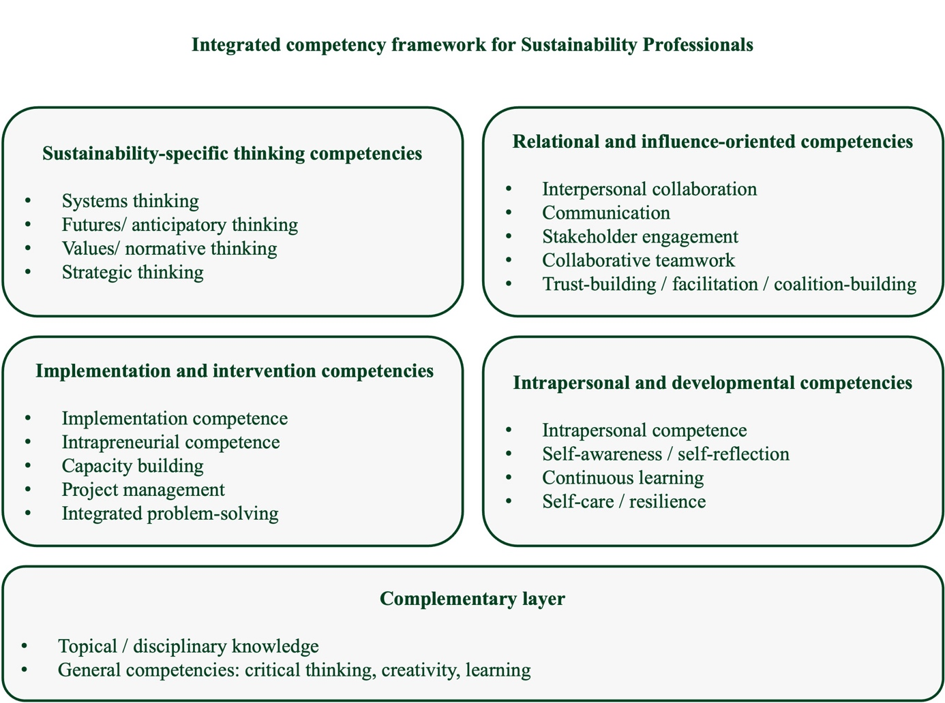
Figure 1: Integrated competency framework for sustainability professionals (own illustration)
3.7 Educational and professional backgrounds of sustainability professionals
Unlike more established professions, sustainability work does not follow a single clear educational route or career path. Instead, individuals in these roles come from many different disciplines, sectors, and previous functions. This diversity is intentional and reflects the nature of sustainability work: it spans organizational boundaries, combines technical and social issues, and demands the integration of various expertise. Educational and professional diversity should therefore be viewed not as an exception but as a core feature of the field.
One key aspect is the variety of formal educational backgrounds. Gluch and Hellsvik (2023) report that sustainability professionals in their study studied “civil engineering, architecture, natural sciences or environmental science”.28Gluch, P. & Hellsvik, S. The influence of multiple logics on the work of sustainability professionals. Construction Management and Economics 41, 893-909 (2023). https://doi.org/10.1080/01446193.2023.2214252 Meanwhile, one interviewee highlights the challenge of merging different knowledge areas by contrasting technical and social perspectives: “The environment is natural science. My background is in natural laws and science, so I think it became a mishmash”.28Gluch, P. & Hellsvik, S. The influence of multiple logics on the work of sustainability professionals. Construction Management and Economics 41, 893-909 (2023). https://doi.org/10.1080/01446193.2023.2214252 This underscores an important point about sustainability work: prior qualifications matter, but they often need to be expanded beyond disciplinary boundaries.
Research also shows that sustainability professionals tend to be highly educated. In Lespinasse-Camargo’s (2024) sample, “92% of the sample had at least a bachelor’s degree,” and “at least 80% of the participants were attending or held an MBA, master’s or PhD degree”.31Lespinasse‐Camargo, B., Eustachio, J. H. P. P., Bonifacio, D., Macini, N. & Caldana, A. C. F. Corporate sustainability professionals: The landscape of sustainability job positions. Business Ethics, the Environment & Responsibility 33, 184-200 (2023). https://doi.org/10.1111/beer.12644 However, high levels of qualification don’t necessarily mean they had specific training for sustainability roles. The same study notes that sustainability professionals are “not always with specific training to work in the area of sustainability”.31Lespinasse‐Camargo, B., Eustachio, J. H. P. P., Bonifacio, D., Macini, N. & Caldana, A. C. F. Corporate sustainability professionals: The landscape of sustainability job positions. Business Ethics, the Environment & Responsibility 33, 184-200 (2023). https://doi.org/10.1111/beer.12644 This highlights that the field is still developing a clear, professionalized educational pathway.
Instead, becoming a sustainability professional often depends on continued learning after starting in the field. Lespinasse-Camargo (2024) reports that about 65% of respondents attended sustainability training within the past year, while only 11% had never participated in such training.31Lespinasse‐Camargo, B., Eustachio, J. H. P. P., Bonifacio, D., Macini, N. & Caldana, A. C. F. Corporate sustainability professionals: The landscape of sustainability job positions. Business Ethics, the Environment & Responsibility 33, 184-200 (2023). https://doi.org/10.1111/beer.12644 Self-assessments of sustainability knowledge varied, suggesting that success in this work relies not just on prior education, but also on ongoing learning and flexibility.
Career paths into sustainability roles are also very varied. Moser and Lysova (2023) describe one important route as “naturally grow[ing] within the company, being previously based in another department”.15Moser, C. & Lysova, E. I. in Corporate Sustainability Ch. 10, 190-206 (2023). Their review shows that employees who move into these roles often come from departments like communication, investor relations, accounting, health and safety, quality management, or HRM. This demonstrates that sustainability professionals are not always hired explicitly as specialists; many emerge from related organizational functions, bringing with them knowledge of internal structures and organizational logic.
These findings suggest that sustainability professionals are characterized more by diversity than by any single educational profile. They tend to be well-educated, but not necessarily trained in a specific or sustainability-focused way from the start. Their backgrounds often blend technical, managerial, social, or communication skills, with many growing into the role from nearby organizational areas. This reflects the interdisciplinary and boundary-crossing nature of sustainability work and explains why competencies are a major focus in the literature: since there’s no one specific training route, competencies serve as a key way to specify what sustainability professionals are expected to bring to their roles.
3.8 Organizational position of sustainability professionals
The effectiveness of Sustainability Professionals cannot be explained by tasks, competencies, or motivation alone. It also depends on the organizational and external conditions under which these actors work. Sustainability roles are shaped by where they are positioned, how much authority they have, which resources are available to them, and whether the surrounding environment enables or constrains sustainability-related action. Sustainability professionals should therefore be understood as context-dependent actors rather than as autonomous drivers of change.
A first important point is that sustainability work is not always tied to a clearly formalized organizational position. Lespinasse-Camargo (2024) shows that in some organizations, sustainability-driven change agents “assume formal roles as CSR managers,” whereas in others, they “do not hold a specific job position,” making them “sustainable entrepreneurs and intrapreneurs”.31Lespinasse‐Camargo, B., Eustachio, J. H. P. P., Bonifacio, D., Macini, N. & Caldana, A. C. F. Corporate sustainability professionals: The landscape of sustainability job positions. Business Ethics, the Environment & Responsibility 33, 184-200 (2023). https://doi.org/10.1111/beer.12644 Sustainability professionalism is therefore not defined solely by title or hierarchy but also by how sustainability becomes attached to actual work.
At the same time, many sustainability professionals are not positioned at the top of the organization. In Lespinasse-Camargo’s (2024) sample, around “32% of the respondents reported as analysts, 20% as managers, 13% as coordinators, and 13% as specialists,” while only smaller shares identified as “presidents (7%) and directors (5%)”.31Lespinasse‐Camargo, B., Eustachio, J. H. P. P., Bonifacio, D., Macini, N. & Caldana, A. C. F. Corporate sustainability professionals: The landscape of sustainability job positions. Business Ethics, the Environment & Responsibility 33, 184-200 (2023). https://doi.org/10.1111/beer.12644 The same study concludes that “few of them are in leadership positions”.31Lespinasse‐Camargo, B., Eustachio, J. H. P. P., Bonifacio, D., Macini, N. & Caldana, A. C. F. Corporate sustainability professionals: The landscape of sustainability job positions. Business Ethics, the Environment & Responsibility 33, 184-200 (2023). https://doi.org/10.1111/beer.12644 This indicates that a lot of sustainability work is carried out below the top executive level, often by actors who have responsibility without equivalent strategic authority.
This limited hierarchical authority matters because sustainability professionals rely heavily on organizational support. Moser and Lysova (2023) note that they often find it “difficult to receive the necessary acceptance and resources,” and therefore need to “build a network of internal allies” to advance sustainability issues.15Moser, C. & Lysova, E. I. in Corporate Sustainability Ch. 10, 190-206 (2023). They also emphasize the importance of “the backing of senior management,” since this determines whether projects get legitimacy, resources, and capacity for implementation.15Moser, C. & Lysova, E. I. in Corporate Sustainability Ch. 10, 190-206 (2023). A similar point is made by Neessen et al. (2019), who state that “Receiving management support is very important,” and define such support as the willingness of management to “facilitate and promote intrapreneurship”.43Neessen, P. C. M., Caniëls, M. C. J., Vos, B. & de Jong, J. P. The intrapreneurial employee: toward an integrated model of intrapreneurship and research agenda. International Entrepreneurship and Management Journal 15, 545-571 (2018). https://doi.org/10.1007/s11365-018-0552-1 Although their study does not focus exclusively on sustainability professionals, it is highly relevant because SPs often act in intrapreneurial ways within firms.
Closely related to this are organizational structure and autonomy. Neessen et al. (2019) argue that “open channels of communication and providing mechanisms that allow for ideas to be evaluated, selected and implemented are positively related to intrapreneurship”.43Neessen, P. C. M., Caniëls, M. C. J., Vos, B. & de Jong, J. P. The intrapreneurial employee: toward an integrated model of intrapreneurship and research agenda. International Entrepreneurship and Management Journal 15, 545-571 (2018). https://doi.org/10.1007/s11365-018-0552-1 They further note that “giving the employee the freedom to design his/her work and to decentralize the decision-making process results in more intrapreneurial activities,” while “many rules and procedures may also inhibit intrapreneurship”.43Neessen, P. C. M., Caniëls, M. C. J., Vos, B. & de Jong, J. P. The intrapreneurial employee: toward an integrated model of intrapreneurship and research agenda. International Entrepreneurship and Management Journal 15, 545-571 (2018). https://doi.org/10.1007/s11365-018-0552-1 This is highly relevant for sustainability professionals, whose work often depends on experimentation, cross-functional coordination, and the ability to move ideas through the organization. In rigid, highly centralized, or procedurally dense settings, their role is likely to become more constrained and reactive. Resources form another major contextual factor. Venn et al. (2024) report that participants identified “resource restrictions, such as limited time, manpower, and budget, as important obstacles to achieve transitions toward sustainability”.11Venn, R., Vandenbussche, V. & Perez, P. Competencies of experienced sustainability professionals. Frontiers in Sustainability 5 (2024). https://doi.org/10.3389/frsus.2024.1411041 Gluch and Hellsvik (2023) similarly note that sustainability responsibilities broadened in scope, but this broadening “had not resulted in more resources” for the people expected to carry it.28Gluch, P. & Hellsvik, S. The influence of multiple logics on the work of sustainability professionals. Construction Management and Economics 41, 893-909 (2023). https://doi.org/10.1080/01446193.2023.2214252 Neessen et al. (2019) also emphasize that “providing the right resources is influential,” especially time and financial resources.43Neessen, P. C. M., Caniëls, M. C. J., Vos, B. & de Jong, J. P. The intrapreneurial employee: toward an integrated model of intrapreneurship and research agenda. International Entrepreneurship and Management Journal 15, 545-571 (2018). https://doi.org/10.1007/s11365-018-0552-1 Expectations thus often grow faster than support structures, exposing sustainability professionals to structural overload. Authority is equally crucial. Even when sustainability professionals understand what should be done, they may lack the power to enforce action. Miller and Serafeim (2014) highlight “the increasing importance of where champions of sustainability are located as a criterion in where to locate primary responsibility for sustainability”.44Miller, K. & Serafeim, G. Chief Sustainability Officers: Who Are They and What Do They Do? (2014). Gluch and Hellsvik (2023) illustrate this issue by showing that sustainability professionals sometimes have to rely on higher corporate goals or certification schemes as sources of borrowed authority; without such leverage, it may be “hard to do anything”.28Gluch, P. & Hellsvik, S. The influence of multiple logics on the work of sustainability professionals. Construction Management and Economics 41, 893-909 (2023). https://doi.org/10.1080/01446193.2023.2214252 This explains why SP influence often seems indirect: it relies more on persuasion, alliances, and access than on formal command power.
Another recurring issue is the tension between sustainability goals and commercial priorities. Moser and Lysova (2023) emphasize that sustainability professionals “have to deal with tensions that arise when sustainable goals are in conflict with the commercial goals of organizations”.15Moser, C. & Lysova, E. I. in Corporate Sustainability Ch. 10, 190-206 (2023). When short-term financial pressures take precedence, sustainability efforts may become justificatory, incremental, or symbolic rather than resulting in more transformative actions. This explains why SPs are often seen as balancing, translating, and negotiating instead of simply implementing. External factors also play a significant role. Kanashiro and Rivera (2017) argue that external contextual pressures are key in influencing sustainability efforts, especially through regulation, stakeholder pressure, public scrutiny, and industry conditions.45Kanashiro, P. & Rivera, J. Do Chief Sustainability Officers Make Companies Greener? The Moderating Role of Regulatory Pressures. Journal of Business Ethics 155, 687-701 (2017). https://doi.org/10.1007/s10551-017-3461-2 Similarly, Benvenuto et al. (2023) show that broader institutional settings can influence how strongly firms focus on sustainability and reporting.21Benvenuto, M., Aufiero, C. & Viola, C. A systematic literature review on the determinants of sustainability reporting systems. Heliyon 9, e14893 (2023). https://doi.org/10.1016/j.heliyon.2023.e14893 Therefore, sustainability professionals operate within institutional environments that can either bolster or undermine their internal legitimacy.
This broader institutional view also explains why SPs are frequently described as navigating multiple conflicting logics. Gluch and Hellsvik (2023) portray them as working amid ambiguity, contested sustainability definitions, and sometimes “unreasonable expectations” about what their expertise should cover.28Gluch, P. & Hellsvik, S. The influence of multiple logics on the work of sustainability professionals. Construction Management and Economics 41, 893-909 (2023). https://doi.org/10.1080/01446193.2023.2214252 Institutional theory suggests that SPs do not just perform organizational tasks but act as mediators between different institutional expectations. Stakeholder theory further clarifies why much of their work involves communication, coalition-building, and balancing competing claims.
Overall, the position of sustainability professionals within organizations varies but is usually not dominant. More importantly, their effectiveness heavily depends on contextual factors such as management support, authority, autonomy, resources, organizational flexibility, and external pressure. As a result, sustainability professionals should not be seen as isolated change agents. Their ability to act depends on whether the organization provides them with sufficient space, recognition, and legitimacy to turn sustainability concerns into meaningful action.
3.9 Influence and boundaries of impact of sustainability professionals
3.9.1 Impact dimensions and measurement criteria in the literature
Before discussing the effects of Sustainability Professionals, it is important to clarify how impact is understood in the reviewed literature. The studies do not rely on a single outcome variable but use a broad range of criteria, including CSR performance, corporate social performance, sustainability reporting and disclosure, Environmental, Social, and Governance (ESG)-related outcomes, environmental performance, climate and carbon disclosure, and, in some cases, firm financial performance. Impact in this field is therefore not a uniform construct but a diverse set of outcome dimensions.
A key category is CSR performance and the related concept of corporate social performance. The literature often distinguishes between positive and negative aspects of corporate conduct. Fu et al. (2020) state that “a firm’s corporate social performance can be evaluated along two aspects. The firm can increase its socially responsible activities and/or it can reduce its socially irresponsible activities,” summarized as “doing good” and “doing no harm”.27Fu, R., Tang, Y. & Chen, G. Chief sustainability officers and corporate social (Ir)responsibility. Strategic Management Journal 41, 656-680 (2019). https://doi.org/10.1002/smj.3113 More broadly, CSR is understood as a business approach where firms “voluntarily integrate environmental, social, and economic concerns with their business strategies”.13Wesselink, R., Blok, V., van Leur, S., Lans, T. & Dentoni, D. Individual competencies for managers engaged in corporate sustainable management practices. Journal of Cleaner Production 106, 497-506 (2015). https://doi.org/10.1016/j.jclepro.2014.10.093 CSR performance is usually treated as an umbrella category rather than a narrowly defined metric.
Furthermore, sustainability reporting and disclosure form a second major outcome dimension. Reporting is often viewed as an observable expression of sustainability engagement. Benvenuto et al. (2023) describe sustainability reporting as “a tool for communicating and reporting on the performance of sustainability objectives by companies”, while Wong et al. (2023) define disclosure more broadly as communication from within the company to external actors, especially investors.14Wong, W.-K., Teh, B.-H. & Tan, S.-H. The Influence of External Stakeholders on Environmental, Social, and Governance (ESG) Reporting: Toward a Conceptual Framework for ESG Disclosure. Foresight and STI Governance 17, 9-20 (2023). https://doi.org/10.17323/2500-2597.2023.2.9.20,21Benvenuto, M., Aufiero, C. & Viola, C. A systematic literature review on the determinants of sustainability reporting systems. Heliyon 9, e14893 (2023). https://doi.org/10.1016/j.heliyon.2023.e14893 Importantly, the literature also distinguishes between the quantity and quality of reporting. Thun and Zülch (2022) define quantity as “the amount of sustainability information disclosed,” while quality is assessed through “credibility, comparability and relevance,” including external assurance, Global Reporting Initiative (GRI) Standards use, and integrated reporting options.46Thun, T. W. & Zülch, H. The effect of chief sustainability officers on sustainability reporting—A management perspective. Business Strategy and the Environment 32, 2093-2110 (2022). https://doi.org/10.1002/bse.3238 This shows that reporting-related impact can refer not only to increased disclosure but also to more credible and decision-relevant disclosure. Furthermore, firms use sustainability reporting and related practices to demonstrate that their actions are appropriate and aligned with societal expectations.47Way, S. P. T., Khalid, S. N. A. & Jalaludin, D. Environmental Information: Pressures, Types, and Usage. Journal of Business Management and Accounting (2020). Hence, environmental disclosure can also be understood as a response to both stakeholder expectations and institutional pressures, including regulatory requirements and market demand for transparency.47Way, S. P. T., Khalid, S. N. A. & Jalaludin, D. Environmental Information: Pressures, Types, and Usage. Journal of Business Management and Accounting (2020).
Related to this is CSR disclosure, which is often viewed as a transparency-oriented outcome. Maharani and Amalia (2025) describe it as “a transparency framework that reflects a company’s commitment to fulfilling its social and environmental responsibilities”.5Maharani, M. & Amalia, D. Corporate social responsibility disclosure: how do corporate governance, profitability, and stand-alone reports play a role? Jurnal Akademi Akuntansi 8 (2025). https://doi.org/10.22219/jaa.v8i3.39623 In this context, disclosure is less about substantive operational performance and more about the visibility and credibility of communicated responsibility.
Additionally, a third outcome category relates to ESG-related performance. Impact here is often assessed using metrics, ratings, or scores. Sancak describes ESG performance as Key Performance Indicator “KPIs,” meaning “quantifiable metrics for tracking the sustainability performance of business organizations,” such as green turnover or green asset ratios.9Sancak, I. E. Change management in sustainability transformation: A model for business organizations. J Environ Manage 330, 117165 (2023). https://doi.org/10.1016/j.jenvman.2022.117165 Toumi (2025) also notes that “ESG scores serve as a quantitative tool to measure stakeholder interests” and can act as an indicator of reduced risk.17Toumi, A. The impact of climate-related risks on firm performance: evidence from the healthcare sector. Journal of Business and Socio-economic Development 6, 170-190 (2025). https://doi.org/10.1108/jbsed-02-2025-0042 This indicates that ESG is typically viewed as a composite, rating-based outcome dimension rather than a measure of a specific activity.
A fourth category involves environmental performance, including the more specific concept of corporate environmental performance (CEP). Dixon-Fowler et al. (2015) define CEP as something that “measures how successful a firm is in reducing and minimizing its impact on the environment” and explain that it reflects environmentally related “processes, policies, programs, and observable outcomes”.24Dixon-Fowler, H. R., Ellstrand, A. E. & Johnson, J. L. The Role of Board Environmental Committees in Corporate Environmental Performance. Journal of Business Ethics 140, 423-438 (2015). https://doi.org/10.1007/s10551-015-2664-7 In their study, this is measured through environmental “strengths and weaknesses,” including positive practices such as pollution prevention, recycling, clean energy, and transparency.24Dixon-Fowler, H. R., Ellstrand, A. E. & Johnson, J. L. The Role of Board Environmental Committees in Corporate Environmental Performance. Journal of Business Ethics 140, 423-438 (2015). https://doi.org/10.1007/s10551-015-2664-7 This shows that environmental performance is often assessed multidimensionally rather than through a single indicator.
The final category involves climate and carbon disclosure. This is narrower than general sustainability reporting and focuses specifically on climate-related risks, commitments, and carbon-related information. Toumi (2025) emphasizes the growing demand for “transparent and detailed disclosures related to climate change”, while Mohamed Toukabri (2023) describes carbon disclosure as “an important step in better proactive carbon management and reducing Greenhouse Gas (GHG) emissions”.17Toumi, A. The impact of climate-related risks on firm performance: evidence from the healthcare sector. Journal of Business and Socio-economic Development 6, 170-190 (2025). https://doi.org/10.1108/jbsed-02-2025-0042,48Toukabri, M. Chief Sustainability Officer (CSO) power and sustainability-based compensation for climate change disclosure and carbon performance: is it different for developed and developing nations? Society and Business Review 20, 52-102 (2024). https://doi.org/10.1108/sbr-12-2023-0356 In this area, impact is often measured through disclosure intensity, climate transparency, or the link between disclosure and carbon performance.
Finally, some studies also examine firm financial performance. These are the most distant outcome measures related to the work of Sustainability Professionals. Toumi, for example, mentions financial indicators such as “Tobin’s Q, [Return on Assets] ROA, and [Return on Equity] ROE” in relation to climate-related factors.17Toumi, A. The impact of climate-related risks on firm performance: evidence from the healthcare sector. Journal of Business and Socio-economic Development 6, 170-190 (2025). https://doi.org/10.1108/jbsed-02-2025-0042 These outcomes are important but also the hardest to directly attribute to Sustainability Professionals, as they are affected by many additional organizational and market factors.
To conclude, the reviewed literature indicates that impact should be categorized into at least four main outcome areas: (1) process- and practice-related outcomes, (2) reporting and disclosure outcomes, (3) sustainability and environmental performance outcomes, and (4) broader organizational and financial results. This differentiation is key for understanding the role of Sustainability Professionals, as their influence is typically more direct in implementation, coordination, and disclosure activities than in distant firm-wide financial outcomes.
3.9.2 Influence of sustainability professionals on organizational outcomes
Against the background of the impact dimensions outlined above, the reviewed literature indicates that Sustainability Professionals can influence organizational outcomes in multiple ways. However, this influence is not evenly distributed across all outcome categories. The strongest evidence exists where outcomes are closely linked to everyday organizational processes, while the weakest is found in outcomes that are distant, aggregated, or shaped by many intervening factors. Therefore, the impact of Sustainability Professionals is best understood by differentiating between process- and practice-related outcomes, reporting and disclosure outcomes, sustainability and environmental performance outcomes, and broader organizational or financial results.
First of all, the most direct area of influence involves process- and practice-related outcomes. This area provides the clearest evidence in the literature. Sustainability professionals are repeatedly depicted as agents who initiate change, identify opportunities, build coalitions, and facilitate the implementation of sustainability issues. Venn et al. (2024) argue that sustainability professionals “must become true pioneers within their organization to foster change”.11Venn, R., Vandenbussche, V. & Perez, P. Competencies of experienced sustainability professionals. Frontiers in Sustainability 5 (2024). https://doi.org/10.3389/frsus.2024.1411041 Similarly, Visser and Crane (2010) describe them as actors who may bring “critical ideas and energy to the greening of their organisations” and influence the “successful identification of opportunities”.35Visser, W. & Crane, A. Corporate Sustainability and the Individual: Understanding What Drives Sustainability Professionals as Change Agents. (2010). Gluch and Hellsvik (2023) further show that sustainability professionals can foster “collaborative agency” once their knowledge gains recognition as valuable, with one respondent even describing this as “a game-changing experience”.28Gluch, P. & Hellsvik, S. The influence of multiple logics on the work of sustainability professionals. Construction Management and Economics 41, 893-909 (2023). https://doi.org/10.1080/01446193.2023.2214252 In this category, their influence appears strongest: they shape agenda-setting, opportunity recognition, internal coordination, communication, and implementation processes.
A second area pertains to reporting and disclosure outcomes. Here, the influence of sustainability professionals is generally more indirect but still observable. Their role often includes monitoring, evaluation, communication, and preparing sustainability-related information. Lespinasse-Camargo (2024) reports that many sustainability professionals are involved in “developing, monitoring and evaluating sustainability indicators and metrics,” and that over half of respondents also engaged in “preparing and presenting sustainability reports”.31Lespinasse‐Camargo, B., Eustachio, J. H. P. P., Bonifacio, D., Macini, N. & Caldana, A. C. F. Corporate sustainability professionals: The landscape of sustainability job positions. Business Ethics, the Environment & Responsibility 33, 184-200 (2023). https://doi.org/10.1111/beer.12644 This suggests that SPs contribute to the routines through which reporting and disclosure become possible. However, unlike the CSO literature, SP research often does not assess their effects on disclosure quality, assurance, or reporting architecture directly and systematically. Their role is thus better understood as helping produce and coordinate reporting practices rather than directly shaping disclosure outcomes at the firm level.
Sustainability and environmental performance outcomes form the third area. Here, the literature implies that sustainability professionals can make a difference, though the relationship is less direct than in the process domain. Visser and Crane (2010) describe “the actions of sustainability managers themselves” as “one of the key drivers of sustainability performance”.35Visser, W. & Crane, A. Corporate Sustainability and the Individual: Understanding What Drives Sustainability Professionals as Change Agents. (2010). They also emphasize that this effect depends on the alignment of “personal and organisational values or morals,” which reduces dissonance and “therefore improves sustainability performance”.35Visser, W. & Crane, A. Corporate Sustainability and the Individual: Understanding What Drives Sustainability Professionals as Change Agents. (2010). Kanashiro and Rivera (2017) similarly argue that individuals “have the potential to significantly contribute with their knowledge and motivation toward improving the environmental performance of their organizations”.45Kanashiro, P. & Rivera, J. Do Chief Sustainability Officers Make Companies Greener? The Moderating Role of Regulatory Pressures. Journal of Business Ethics 155, 687-701 (2017). https://doi.org/10.1007/s10551-017-3461-2 These findings suggest that SPs can indeed influence sustainability and environmental performance mainly through organizational mechanisms they affect: implementation, interpretation, support-building, and embedding sustainability into routines and decisions. Their impact on these outcomes is real but mediated.
The weakest and final area concerns broader organizational and financial outcomes. The reviewed SP literature provides limited direct evidence in this area. Broader outcomes such as legitimacy, reputation, organizational learning, or even financial results may be indirectly affected by the work of sustainability professionals, but they are rarely attributed to them through direct causal links. This is expected because such outcomes are influenced by many external factors, including top management decisions, governance structures, industry conditions, regulations, stakeholder pressure, and existing firm capabilities. Hence, the literature does not strongly support claims that sustainability professionals directly influence firm-level financial performance. Their impact at this level is better understood as indirect and cumulative.
Consequently, the reviewed literature shows a clear pattern. Sustainability Professionals have the strongest and most immediate impact on process- and practice-related outcomes, a more indirect influence on reporting and disclosure routines, and a mediated effect on sustainability and environmental performance. Their impact on broader organizational and financial results is weak and hard to isolate. This layered pattern is important because it prevents overstating or understating their role. Sustainability Professionals are not simply symbolic figures nor direct determinants of distant firm-level metrics. Instead, they are best understood as process-oriented, relational, and implementation-focused actors whose influence is strongest where sustainability must be integrated into organizational practice.
3.9.3 Contextual conditions and attribution problems
The previous subsection demonstrated that Sustainability Professionals can influence organizational outcomes, especially at the process and practice levels. However, this influence is neither automatic nor unlimited. The reviewed literature indicates that SP impact heavily depends on organizational and external conditions under which these actors operate, and broader outcomes are often difficult to attribute directly to them.
A primary limitation involves internal organizational conditions. Sustainability professionals often lack strong formal authority and rely significantly on support from senior management, internal allies, and access to resources. Moser and Lysova (2023) note that they often find it “difficult to receive the necessary acceptance and resources” and need to “build a network of internal allies”.15Moser, C. & Lysova, E. I. in Corporate Sustainability Ch. 10, 190-206 (2023). Similarly, Neessen et al. (2019) argue that “Receiving management support is very important” and emphasize that open communication, decentralization, and freedom to act foster intrapreneurial activity, whereas rigid rules and procedures can hinder it.43Neessen, P. C. M., Caniëls, M. C. J., Vos, B. & de Jong, J. P. The intrapreneurial employee: toward an integrated model of intrapreneurship and research agenda. International Entrepreneurship and Management Journal 15, 545-571 (2018). https://doi.org/10.1007/s11365-018-0552-1 Gluch and Hellsvik (2023) highlight the practical consequence of weak authority: without reference to stronger corporate goals or certification schemes, “it’s hard to do anything”.28Gluch, P. & Hellsvik, S. The influence of multiple logics on the work of sustainability professionals. Construction Management and Economics 41, 893-909 (2023). https://doi.org/10.1080/01446193.2023.2214252 Resource scarcity exacerbates this issue, as broad sustainability expectations are often not matched by sufficient time, personnel, or budget.11Venn, R., Vandenbussche, V. & Perez, P. Competencies of experienced sustainability professionals. Frontiers in Sustainability 5 (2024). https://doi.org/10.3389/frsus.2024.1411041,28Gluch, P. & Hellsvik, S. The influence of multiple logics on the work of sustainability professionals. Construction Management and Economics 41, 893-909 (2023). https://doi.org/10.1080/01446193.2023.2214252
Additionally, further limitations include structural tensions within organizations. Sustainability professionals often operate in environments where sustainability goals conflict with business priorities. Moser and Lysova (2023) explicitly state that they “have to deal with tensions that arise when sustainable goals are in conflict with the commercial goals of organizations”.15Moser, C. & Lysova, E. I. in Corporate Sustainability Ch. 10, 190-206 (2023). This indicates that even with strong motivation and skills, success is not guaranteed if sustainability is subordinate to short-term financial interests. Their role, therefore, often involves translating, negotiating, and balancing rather than straightforward implementation.
Furthermore, there are limitations related to external and institutional factors. Sustainability efforts are shaped not only by internal structures but also by regulations, stakeholder influence, public scrutiny, and industry conditions. Van Poeck et al. (2017) argue that “sustainability change agency is always related to political struggles on what, how, who, why, and when to change”.10Van Poeck, K., Læssøe, J. & Block, T. An exploration of sustainability change agents as facilitators of nonformal learning: mapping a moving and intertwined landscape. Ecology and Society 22 (2017). https://doi.org/10.5751/es-09308-220233 Gluch and Hellsvik (2023) similarly find that even when sustainability is highlighted in policy documents or customer demands, it does not automatically change “the status quo of the business”.28Gluch, P. & Hellsvik, S. The influence of multiple logics on the work of sustainability professionals. Construction Management and Economics 41, 893-909 (2023). https://doi.org/10.1080/01446193.2023.2214252 External pressure may boost the legitimacy of sustainability initiatives, but it does not ensure organizational change. Recent research further extends institutional theory by showing that environmental regulation does not only constrain firms but actively shapes innovation trajectories. Environmental law increasingly functions as a “regulatory compass” that guides firms toward sustainability-oriented strategies and practices rather than merely limiting behavior.49Mouawad, J. Environmental law, green entrepreneurial orientation, and circular business models: a systematic literature review. Discover Sustainability 6 (2025). https://doi.org/10.1007/s43621-025-02282-7 In this sense, institutional pressures are not only coercive but can also create opportunities for innovation and competitive differentiation. Firms are therefore not passive recipients of regulation but respond strategically, depending on their internal capabilities and orientation.49Mouawad, J. Environmental law, green entrepreneurial orientation, and circular business models: a systematic literature review. Discover Sustainability 6 (2025). https://doi.org/10.1007/s43621-025-02282-7
These contextual limits are closely linked to attribution problems. As the previous subsection showed, the literature uses a wide range of outcome measures—from process-related results and reporting practices to CSR, ESG, environmental performance, and financial indicators. The more distant and broad these indicators are, the harder it becomes to attribute them directly to Sustainability Professionals. Their influence is strongest at the level of translation, coordination, and implementation but weaker and harder to isolate when it comes to broad firm-wide performance. This is because such outcomes are shaped not only by SPs but also by top management, governance structures, functional departments, regulation, and external pressures.
These limits can also be understood through theoretical lenses. Institutional theory explains why SP influence varies across firms and sectors, as their work is shaped by differing norms, pressures, and competing logics. Stakeholder theory clarifies why their influence is most significant where stakeholder expectations are visible and difficult to ignore. Change agency theory, lastly, shows why sustainability professionals often act as intermediaries in broader change processes rather than as autonomous determinants of firm-level outcomes.
In conclusion, the literature indicates that the impact of Sustainability Professionals is genuine but limited. Their influence relies on management support, authority, resources, organizational flexibility, and external legitimacy. Furthermore, it becomes increasingly challenging to track their impact as one moves from daily implementation processes to broad firm-level performance metrics.
3.10 Conclusion: Sustainability professionals as boundary-spanning and context-dependent change actors
Collectively, the reviewed literature depicts Sustainability Professionals as a diverse but increasingly prominent group of organizational actors focused on advancing and implementing sustainability. They are not characterized by fixed roles or career paths but share a common focus: turning sustainability ambitions into organizational practice. A key insight is that Sustainability Professionals can be seen as organizational change agents embedded within the organization. Unlike broader notions of change agents, this category highlights actors who operate within formal organizational roles. This distinction maintains the specificity of SPs while linking them conceptually to larger change processes.
The literature also emphasizes their hybrid role profile. Sustainability Professionals combine strategic, communicative, relational, and implementation tasks. They analyze sustainability issues, align them with organizational priorities, coordinate across departments, engage stakeholders, and support execution. Accordingly, their necessary skills include systems thinking, strategic and interpersonal abilities, and the capacity to turn abstract goals into practical actions.
At the same time, sustainability professionalism is driven by values and can be demanding. SPs are often highly motivated by personal values and purpose. This can boost commitment but also lead to stress when sustainability efforts face obstacles, are deprioritized, or are reduced to symbolic gestures.
Finally, the chapter highlights that SP impact is highly dependent on context. Their ability to act depends on management support, authority, resources, and organizational structures. As a consequence, their influence is usually indirect: they shape processes, attention, and implementation rather than directly affecting firm-level results. Sustainability Professionals are best understood as boundary-spanning actors whose impact is influenced by organizational context.
This forms the foundation for the next chapter. While Sustainability Professionals encompass the broader field of sustainability work within organizations, the Chief Sustainability Officer represents a more formalized and strategically elevated role. The next chapter thus explores how sustainability becomes embedded at the executive level.
4 Chief sustainability officers
4.1 Definition of the CSO role
Defining the Chief Sustainability Officer is more complex than the title implies. While it designates a senior sustainability executive, the literature shows variations in definitions, titles, and formal roles. The CSO has developed at the intersection of CSR, environmental management, ethics, and ESG governance.
First, the CSO is consistently positioned at the senior executive level. Fu et al. (2020) note that “in contemporary firms, CSOs are senior executives in TMTs who are explicitly hired to manage a firm’s corporate social performance”.27Fu, R., Tang, Y. & Chen, G. Chief sustainability officers and corporate social (Ir)responsibility. Strategic Management Journal 41, 656-680 (2019). https://doi.org/10.1002/smj.3113 Velte and Stawinoga (2020) similarly define CSOs as “senior executives in top management teams who are explicitly responsible for CSR issues”.50Velte, P. & Stawinoga, M. Do chief sustainability officers and CSR committees influence CSR-related outcomes? A structured literature review based on empirical-quantitative research findings. Journal of Management Control 31, 333-377 (2020). https://doi.org/10.1007/s00187-020-00308-x Kanashiro and Rivera (2017) emphasize both responsibility and hierarchy: “The CSO is a top executive manager who has the primary responsibility to oversee the environmental strategy of the firm” and is “positioned at the top of the corporate hierarchy at the C-suite level”.45Kanashiro, P. & Rivera, J. Do Chief Sustainability Officers Make Companies Greener? The Moderating Role of Regulatory Pressures. Journal of Business Ethics 155, 687-701 (2017). https://doi.org/10.1007/s10551-017-3461-2 Across these definitions, the CSO is clearly an executive role with formal, strategic responsibilities.
Second, the role involves primary responsibility for sustainability-related issues. Fu et al. (2020) define CSOs as “those executives who take primary responsibility for corporate sustainability or issues related to corporate social performance”, while Velte and Stawinoga (2020) note “top management team members and executives who are primarily responsible for issues related to CSR”.27Fu, R., Tang, Y. & Chen, G. Chief sustainability officers and corporate social (Ir)responsibility. Strategic Management Journal 41, 656-680 (2019). https://doi.org/10.1002/smj.3113,50Velte, P. & Stawinoga, M. Do chief sustainability officers and CSR committees influence CSR-related outcomes? A structured literature review based on empirical-quantitative research findings. Journal of Management Control 31, 333-377 (2020). https://doi.org/10.1007/s00187-020-00308-x The specific title is less important than the presence of formal executive responsibility.
Title variation is common. Toukabri (2023) mentions alternatives such as “director of sustainable development, director of ethics, and chief environmental officer, director of CSR”.48Toukabri, M. Chief Sustainability Officer (CSO) power and sustainability-based compensation for climate change disclosure and carbon performance: is it different for developed and developing nations? Society and Business Review 20, 52-102 (2024). https://doi.org/10.1108/sbr-12-2023-0356 Fu et al. (2020) mention “CSO, chief ethics officer, and chief environmental officer”, and Velte and Stawinoga (2020) add “chief social officer or chief CSR officer”.27Fu, R., Tang, Y. & Chen, G. Chief sustainability officers and corporate social (Ir)responsibility. Strategic Management Journal 41, 656-680 (2019). https://doi.org/10.1002/smj.3113,50Velte, P. & Stawinoga, M. Do chief sustainability officers and CSR committees influence CSR-related outcomes? A structured literature review based on empirical-quantitative research findings. Journal of Management Control 31, 333-377 (2020). https://doi.org/10.1007/s00187-020-00308-x Empirical studies often broadly define CSOs, for example, including executives whose departments cover sustainability or ESG aspects.46Thun, T. W. & Zülch, H. The effect of chief sustainability officers on sustainability reporting—A management perspective. Business Strategy and the Environment 32, 2093-2110 (2022). https://doi.org/10.1002/bse.3238 Conversely, Kanashiro and Rivera (2017) examined only those executives exclusively dedicated to environmental performance.45Kanashiro, P. & Rivera, J. Do Chief Sustainability Officers Make Companies Greener? The Moderating Role of Regulatory Pressures. Journal of Business Ethics 155, 687-701 (2017). https://doi.org/10.1007/s10551-017-3461-2
The CSO is distinct from lower-level roles. As Kanashiro and Rivera (2017) note, “CSOs are different from environmental managers as the latter are middle managers responsible for specific regions or production lines”.45Kanashiro, P. & Rivera, J. Do Chief Sustainability Officers Make Companies Greener? The Moderating Role of Regulatory Pressures. Journal of Business Ethics 155, 687-701 (2017). https://doi.org/10.1007/s10551-017-3461-2 The CSO bears company-wide, strategic responsibility rather than local implementation duties.
Over time, the role has become more visible and formalized. Thun and Zülch (2022) observe that “More and more companies worldwide are appointing a chief sustainability officer to anchor the topic of sustainability at the top management level”.46Thun, T. W. & Zülch, H. The effect of chief sustainability officers on sustainability reporting—A management perspective. Business Strategy and the Environment 32, 2093-2110 (2022). https://doi.org/10.1002/bse.3238 Fu et al. (2020) trace this trend to Linda Fisher’s appointment at DuPont in 2004 and note that by 2015 “more than three dozen of the largest U.S. public companies had a CSO” .27Fu, R., Tang, Y. & Chen, G. Chief sustainability officers and corporate social (Ir)responsibility. Strategic Management Journal 41, 656-680 (2019). https://doi.org/10.1002/smj.3113 Miller and Serafeim (2014) report that the number of CSOs “doubled between 1995 and 2003, and doubled again between 2003 and 2008”.44Miller, K. & Serafeim, G. Chief Sustainability Officers: Who Are They and What Do They Do? (2014). Kreutzer (2023) adds that in 2021 68 CSO appointments were recorded, and that the role is increasingly shifting from a communicative focus to a strategic role.51Kreutzer, R. T. Die Rollen des Chief Sustainability Officers. (2013).
However, formalization varies. Kreutzer (2023) notes that around 30% of companies have a CSO role at senior or middle management level. A further 49% employ a ‘CSO light’”.51Kreutzer, R. T. Die Rollen des Chief Sustainability Officers. (2013). Fu et al. (2020) also observe that firms may remove the CSO “once the principle of sustainability had become well integrated into the firm strategy” (Fu et al., 2020).27Fu, R., Tang, Y. & Chen, G. Chief sustainability officers and corporate social (Ir)responsibility. Strategic Management Journal 41, 656-680 (2019). https://doi.org/10.1002/smj.3113 Miller and Serafeim (2014) argue that “the likelihood that the manager with primary responsibility for sustainability has the title of a CSO versus a lower level title increases monotonically as companies move through the stages of commitment to sustainability”.44Miller, K. & Serafeim, G. Chief Sustainability Officers: Who Are They and What Do They Do? (2014).
Overall, despite variations in titles, coding, and organizational setup, the CSO can be understood as a senior executive or TMT member with primary responsibility for sustainability, CSR, or ESG-related issues. The role has developed gradually, become more formalized as sustainability has gained strategic importance, and continues to be influenced by corporate traditions and governance structures. For this article, the CSO is defined as a formally senior sustainability-related executive at or near the C-suite, carrying primary responsibility for strategic oversight, coordination, and advancement of corporate sustainability.
4.2 Organizational and governance context of sustainability in firms
4.2.1 Boards, CEOs, and top management teams
To understand the role of the Chief Sustainability Officer, it is important to consider the broader governance context of sustainability within companies. The literature does not view companies as single entities; instead, sustainability decisions are influenced by multiple actors with different levels of authority and influence, especially the board, the Chief Executive Officer (CEO), and the top management team.
A helpful distinction exists between monitoring and strategic decision-making. The TMT is commonly seen as the core of strategic interpretation and executive decision-making. Yamauchi and Sato (2021) define it as “the strategic decision-making unit of a company”.52Yamauchi, N. & Sato, H. Diverse more than ever. Annals of Business Administrative Science 20, 121-140 (2021). https://doi.org/10.7880/abas.0210901b Similarly, Kutzschbach et al. (2021) demonstrate that managers’ “personal as well as cognitive characteristics” influence “strategic choices and organizational outcomes”.26Kutzschbach, J., Tanikulova, P. & Lueg, R. The Role of Top Managers in Implementing Corporate Sustainability—A Systematic Literature Review on Small and Medium-Sized Enterprises. Administrative Sciences 11 (2021). https://doi.org/10.3390/admsci11020044 Extending this to sustainability, Peng and Chandarasupsang (2023) argue that “the perceptions and values of the executive team can influence a company’s socially responsible behavior”.53Peng, H. & Chandarasupsang, T. The Effect of Female Directors on ESG Practice: Evidence from China. International Journal of Financial Studies 11 (2023). https://doi.org/10.3390/ijfs11020066 This suggests that sustainability results depend not only on formal structures but also on the values and interpretations of executives.
The CEO has a particularly central role. While the TMT functions collectively, the CEO is especially influential in setting priorities and legitimizing sustainability efforts. As Miller and Serafeim (2014) state, “CEO commitment is critical to successful implementation of sustainability strategies”.44Miller, K. & Serafeim, G. Chief Sustainability Officers: Who Are They and What Do They Do? (2014). Therefore, sustainability is unlikely to be effectively integrated without CEO support, even when dedicated roles are present.
Boards, on the other hand, are less involved in daily strategy and more in oversight and accountability. Endrikat et al. (2020) highlight both “a management support function” and “a monitoring function” of boards concerning CSR and sustainability.23Endrikat, J., de Villiers, C., Guenther, T. W. & Guenther, E. M. Board Characteristics and Corporate Social Responsibility: A Meta-Analytic Investigation. Business & Society 60, 2099-2135 (2020). https://doi.org/10.1177/0007650320930638 Consistent with agency theory, boards oversee management and ensure that pertinent issues are addressed, making them important for setting agendas and maintaining accountability rather than operational strategy.
The literature also indicates that the importance of these actors varies based on the level of institutionalization of sustainability. In some firms, it depends heavily on CEO commitment or individual executives; in others, responsibilities are more widely shared among the TMT, the board, and governance structures. Consequently, understanding the role of the CSO requires considering this broader executive landscape.
In addition to formal governance structures, external visibility of top management also plays an important role. Empirical research shows that increased media exposure of top management teams can act as an informal governance mechanism that strengthens corporate social responsibility. When executives are more visible in the media, they face stronger public scrutiny and stakeholder expectations, which increases the likelihood that they align corporate behavior with social and environmental responsibilities. However, this effect is not uniform. The same research indicates that high levels of managerial power and political connections can weaken the influence of media exposure, as powerful executives are better able to resist external pressure or shape information flows. This suggests that governance effectiveness depends not only on formal structures, but also on the interaction between visibility, power, and external pressure.19Jiang, Y., Zhang, L. & Tarbert, H. Does Top Management Team Media Exposure Affect Corporate Social Responsibility? Front Psychol 13, 827346 (2022). https://doi.org/10.3389/fpsyg.2022.827346
In conclusion, sustainability governance reflects a division of labor: the TMT acts as the primary decision-making body, the CEO functions as a key sponsor or obstacle, and the board provides oversight and formal governance support. This framework sets the context in which the CSO role develops and gains importance.
4.2.2 Board committees and sustainability committees
In addition to boards, CEOs, and TMTs, the literature emphasizes the important role of board committees. These are not secondary mechanisms but core governance tools through which boards manage complexity, delegate tasks, and formalize specialized areas such as sustainability. CSR and sustainability committees are particularly relevant because they show how sustainability becomes integrated into the firm’s governance system.
More broadly, committees are described as tools for specialization and delegation. Baraibar-Diez and Odriozola (2019) identify the audit, remuneration, and nominating committees as those that “guarantee good functioning and independence of the boards” and note that “boards are delegating their key functions more and more to those committees”.54Baraibar-Diez, E. & Odriozola, M. D. CSR Committees and Their Effect on ESG Performance in UK, France, Germany, and Spain. Sustainability 11 (2019). https://doi.org/10.3390/su11185077 This highlights that committees are not minor formalities but important responses to increasing governance complexity, including sustainability.
Within this framework, CSR or sustainability committees are viewed as specific governance innovations. Vuong (2024) defines CSR or sustainability committees as specialized governance mechanisms established at board level to oversee sustainability-related strategies, reporting, and implementation.55Vuong, N. B. CSR committees and their effect on green practices. Economics and Business Review 10 (2024). https://doi.org/10.18559/ebr.2024.3 Their role is to ensure that ESG criteria are incorporated into business activities and that sustainability policies are properly monitored and executed. Baraibar-Diez and Odriozola (2019) describe them as linked to the “shared concerns between corporate governance and corporate social responsibility”.54Baraibar-Diez, E. & Odriozola, M. D. CSR Committees and Their Effect on ESG Performance in UK, France, Germany, and Spain. Sustainability 11 (2019). https://doi.org/10.3390/su11185077 Endrikat et al. (2020) further specify that “the typical activities carried out by CSR committees comprise the creation, implementation, and updating of environmental and social policies, the assessment of a firm’s resource allocation decisions, and the coordination and monitoring of CSR-related issues”.23Endrikat, J., de Villiers, C., Guenther, T. W. & Guenther, E. M. Board Characteristics and Corporate Social Responsibility: A Meta-Analytic Investigation. Business & Society 60, 2099-2135 (2020). https://doi.org/10.1177/0007650320930638 Similarly, Benvenuto et al. (2023) describe the CSR committee as “a resource for a company,” as expertise at the committee level supports responsible management and CSR strategy implementation.21Benvenuto, M., Aufiero, C. & Viola, C. A systematic literature review on the determinants of sustainability reporting systems. Heliyon 9, e14893 (2023). https://doi.org/10.1016/j.heliyon.2023.e14893 Collectively, these studies show that such committees formalize board-level attention, create focal points for oversight, and strengthen sustainability governance.
The literature also suggests that these committees can influence outcomes, though not always uniformly. Baraibar-Diez and Odriozola (2019) find that CSR committees “significantly and positively affect corporate governance scores in Spain, Germany, France, and the UK”.54Baraibar-Diez, E. & Odriozola, M. D. CSR Committees and Their Effect on ESG Performance in UK, France, Germany, and Spain. Sustainability 11 (2019). https://doi.org/10.3390/su11185077 Other studies link them to improved disclosure and stronger sustainability leadership effects. Fu et al. (2020), for example, show that the impact of CSO presence on reducing corporate social irresponsibility is stronger when a sustainability committee exists.27Fu, R., Tang, Y. & Chen, G. Chief sustainability officers and corporate social (Ir)responsibility. Strategic Management Journal 41, 656-680 (2019). https://doi.org/10.1002/smj.3113 This indicates that committees can enhance executive roles by institutionalizing attention and strengthening monitoring. Additionally, sustainability committees contribute to the development and implementation of CSR strategies, which are essential for improving environmental and social performance.56Orazalin, N. Do board sustainability committees contribute to corporate environmental and social performance? The mediating role of corporate social responsibility strategy. Business Strategy and the Environment 29, 140-153 (2019). https://doi.org/10.1002/bse.2354
At the same time, their effects are not always positive. Outcomes depend on how committees interact with the broader governance structure and the level of sustainability integration. In some cases, they reinforce executive action; in others, they reassign responsibility or serve more as symbols. Therefore, their existence should not automatically be equated with effective sustainability governance.
An important factor is the variation across countries in governance structures. Baraibar-Diez and Odriozola (2019) note that “Germany requires a two-tier board, whereas French companies can choose between a two-tier or one-tier board structure”.54Baraibar-Diez, E. & Odriozola, M. D. CSR Committees and Their Effect on ESG Performance in UK, France, Germany, and Spain. Sustainability 11 (2019). https://doi.org/10.3390/su11185077 They argue that one-tier boards may facilitate CSR committee creation when sustainability is embedded in strategy, while in two-tier systems “the creation of an independent supervisory board responds to monitor the decisions of the management board on behalf of other parties”.54Baraibar-Diez, E. & Odriozola, M. D. CSR Committees and Their Effect on ESG Performance in UK, France, Germany, and Spain. Sustainability 11 (2019). https://doi.org/10.3390/su11185077 They also observe that “in two-tier systems, committees are less common when compared to one-tier boards” and that supervisory board functions may overlap with those of CSR committees.54Baraibar-Diez, E. & Odriozola, M. D. CSR Committees and Their Effect on ESG Performance in UK, France, Germany, and Spain. Sustainability 11 (2019). https://doi.org/10.3390/su11185077 This suggests that sustainability governance design depends on national board structures.
Overall, board committees—especially sustainability committees—are portrayed as increasingly significant governance mechanisms. They do not replace executive responsibility but shape the context in which roles like the CSO operate, primarily through specialization, formalized attention, monitoring, and linking sustainability to board oversight.
4.2.3 Governance structures and sustainability maturity
The literature indicates that the position of the CSO cannot be understood separately from the firm’s governance structure and sustainability maturity. The role appears as part of a larger shift from fragmented, compliance-focused activities toward more strategic and integrated sustainability governance.
Miller and Serafeim (2014) offer a useful stage model of corporate sustainability commitment. In the early compliance stage, “very few companies have a person holding the title of CSO or the equivalent,” and existing roles tend to have “relatively low levels of authority”.44Miller, K. & Serafeim, G. Chief Sustainability Officers: Who Are They and What Do They Do? (2014). This suggests that sustainability is initially managed in a scattered and non-strategic manner, without a clearly formalized executive role.
As companies advance, governance structures change. Miller and Serafeim (2014) argue that “it is in the second and third stages (Efficiency and Innovation) that companies begin to create the CSO position with more elevated authority”.44Miller, K. & Serafeim, G. Chief Sustainability Officers: Who Are They and What Do They Do? (2014). They also show that the “probability that she reports to the CEO or the Board of Directors increases for companies that are in later stages of sustainability commitment, suggesting higher CSO authority”.44Miller, K. & Serafeim, G. Chief Sustainability Officers: Who Are They and What Do They Do? (2014). This demonstrates that the emergence and formalization of the CSO closely relate to sustainability maturity.
At the same time, more mature governance does not necessarily mean simple centralization. In the innovation stage, the CSO gains strategic authority while operational responsibilities become more spread out. As noted, “the role of the CSO tends to gain an increasing level of authority,” and interviewees state that “the CSO should report to the CEO and should sit on the executive team” to ensure legitimacy and access.44Miller, K. & Serafeim, G. Chief Sustainability Officers: Who Are They and What Do They Do? (2014). Simultaneously, the CSO more frequently “allocates these responsibilities to champions of sustainability throughout the organization,” reflecting decentralized implementation.44Miller, K. & Serafeim, G. Chief Sustainability Officers: Who Are They and What Do They Do? (2014). Therefore, the CSO becomes more strategic through coordination and leadership rather than through task concentration.
This developmental pattern also explains connections to other governance mechanisms. Miller and Serafeim (2014) show that “the probability of the Board having a separate sustainability committee is significantly higher in the Innovation stage,” indicating stronger CSO authority and increased board involvement.44Miller, K. & Serafeim, G. Chief Sustainability Officers: Who Are They and What Do They Do? (2014). The CSO thus develops alongside broader governance changes, including CEO commitment, board attention, and committee structures.
The broader literature supports this perspective. Specialized roles, committees, and governance mechanisms tend to become more common as sustainability pressures, stakeholder demands, and coordination needs grow. This aligns with institutional theory, as governance structures evolve with the increasing institutionalization of sustainability, and with upper echelons theory, as executive focus becomes more influential.
In addition to these structural considerations, empirical research suggests that not all governance mechanisms contribute equally to sustainability-related outcomes. While certain governance features, such as active board engagement reflected in frequent board meetings, are associated with higher levels of sustainability disclosure, other mechanisms, such as the mere presence of CSR committees, do not necessarily show a significant effect.57Alshbili, I., Elamer, A. A. & Beddewela, E. Ownership types, corporate governance and corporate social responsibility disclosures. Accounting Research Journal 33, 148-166 (2019). https://doi.org/10.1108/arj-03-2018-0060 Alshbili et al. (2018) illustrate that governance structures alone are not sufficient to ensure effective sustainability integration. Rather, their impact depends on how actively they are enacted within the organization and how they interact with broader institutional pressures. In this sense, sustainability governance should be understood not only in formal structural terms, but also in terms of actual engagement, attention allocation, and organizational embedding.57Alshbili, I., Elamer, A. A. & Beddewela, E. Ownership types, corporate governance and corporate social responsibility disclosures. Accounting Research Journal 33, 148-166 (2019). https://doi.org/10.1108/arj-03-2018-0060
The CSO should be viewed within a dynamic governance framework rather than as a fixed position. In firms with low maturity, the role is often absent or weakly formalized. In more advanced companies, it gains authority, becomes closer to the CEO or board, and operates alongside sustainability committees and distributed structures. The position of the CSO thus reflects how deeply sustainability is institutionalized within the firm’s governance system.
4.3 Emergence and drivers of the CSO role
The reviewed literature indicates that firms do not establish the CSO role for a single reason. Instead, appointments stem from a combination of external pressure, internal strategic needs, organizational learning, and sometimes symbolic considerations. Therefore, having a CSO does not automatically mean a firm is genuinely committed to sustainability; in some cases, the role reflects true strategic integration, while in others, it serves more reactive or reputational goals.
A key explanation revolves around increasing external pressure. Thun and Zülch (2022) argue that firms have “been increasingly forced to address sustainability as shareholders pay more and more attention to sustainability performance,” alongside rising regulatory requirements like Sustainable Finance Disclosure Regulation and Corporate Sustainability Reporting Directive.46Thun, T. W. & Zülch, H. The effect of chief sustainability officers on sustainability reporting—A management perspective. Business Strategy and the Environment 32, 2093-2110 (2022). https://doi.org/10.1002/bse.3238 Similarly, Mohamed Toukabri (2023) notes that companies “seeking to satisfy different stakeholders, legitimize their activities in society and respond to climate change issues are increasingly hiring CSOs”.48Toukabri, M. Chief Sustainability Officer (CSO) power and sustainability-based compensation for climate change disclosure and carbon performance: is it different for developed and developing nations? Society and Business Review 20, 52-102 (2024). https://doi.org/10.1108/sbr-12-2023-0356 The role often arises when sustainability can no longer be treated as a peripheral issue.
Closely linked is the pursuit of legitimacy. Firms may appoint CSOs to justify or reinforce their position with external audiences, especially after environmental crises or to meet investor expectations.48Toukabri, M. Chief Sustainability Officer (CSO) power and sustainability-based compensation for climate change disclosure and carbon performance: is it different for developed and developing nations? Society and Business Review 20, 52-102 (2024). https://doi.org/10.1108/sbr-12-2023-0356 In this context, the role may act more as a governance signal rather than a guarantee of meaningful change. Peters et al. (2018) expand on this, suggesting that CSO appointments can be “symbolic action that is consistent with societal expectations, while not actually altering firm behavior,” especially when they are reactive.58Peters, G. F., Romi, A. M. & Sanchez, J. M. The Influence of Corporate Sustainability Officers on Performance. Journal of Business Ethics 159, 1065-1087 (2018). https://doi.org/10.1007/s10551-018-3818-1 This emphasizes the importance of distinguishing between symbolic and substantive role creation.
At the same time, the literature points to more substantive reasons. Firms may establish a CSO because current executives lack the time, expertise, or focus needed for sustainability. Peters et al. (2018) argue that mainstream executives often do not have the necessary understanding to leverage sustainability opportunities, while Thun and Zülch (2022) highlight the growing need for developing sustainability reporting capabilities.46Thun, T. W. & Zülch, H. The effect of chief sustainability officers on sustainability reporting—A management perspective. Business Strategy and the Environment 32, 2093-2110 (2022). https://doi.org/10.1002/bse.3238,58Peters, G. F., Romi, A. M. & Sanchez, J. M. The Influence of Corporate Sustainability Officers on Performance. Journal of Business Ethics 159, 1065-1087 (2018). https://doi.org/10.1007/s10551-018-3818-1 The CSO can thus be seen as a response to increasing complexity and specialization.
Another rationale involves embedding sustainability into strategic priorities. Creating a CSO elevates sustainability within the company’s power structure, making it a strategic focus and assigning formal responsibility for performance outcomes.46Thun, T. W. & Zülch, H. The effect of chief sustainability officers on sustainability reporting—A management perspective. Business Strategy and the Environment 32, 2093-2110 (2022). https://doi.org/10.1002/bse.3238,58Peters, G. F., Romi, A. M. & Sanchez, J. M. The Influence of Corporate Sustainability Officers on Performance. Journal of Business Ethics 159, 1065-1087 (2018). https://doi.org/10.1007/s10551-018-3818-1 In this way, the role reflects not only expertise needs but also internal power shifts and accountability frameworks.
The literature also notes that CSO appointments can be both proactive and reactive. Peters et al. (2018) explicitly state that “CSOs are appointed both proactively and reactively”.58Peters, G. F., Romi, A. M. & Sanchez, J. M. The Influence of Corporate Sustainability Officers on Performance. Journal of Business Ethics 159, 1065-1087 (2018). https://doi.org/10.1007/s10551-018-3818-1 Likewise, Kanashiro and Rivera (2017) argue that firms may hire CSOs either to boost performance and seize opportunities or to mitigate damage and manage risk.45Kanashiro, P. & Rivera, J. Do Chief Sustainability Officers Make Companies Greener? The Moderating Role of Regulatory Pressures. Journal of Business Ethics 155, 687-701 (2017). https://doi.org/10.1007/s10551-017-3461-2 This duality highlights the ongoing tension between genuine commitment and symbolic gestures.
Another explanation pertains to organizational evolution and sustainability maturity. Miller and Serafeim (2014) suggest that roles like the CSO emerge in response to significant technological and social disruptions.44Miller, K. & Serafeim, G. Chief Sustainability Officers: Who Are They and What Do They Do? (2014). Their stage model shows that the role becomes more prominent and gaining authority as firms progress from compliance to more advanced sustainability stages, where coordination and strategic integration are essential.44Miller, K. & Serafeim, G. Chief Sustainability Officers: Who Are They and What Do They Do? (2014).
The role may also originate from internal advocacy. Individuals advocating for stainability within the organization might contribute to creating the CSO position and later assume it themselves.44Miller, K. & Serafeim, G. Chief Sustainability Officers: Who Are They and What Do They Do? (2014). This indicates that the role is not always imposed from the top but can result from internal entrepreneurial efforts.
Lastly, empirical research links CSO appointments to specific firm characteristics. Fu et al. (2020) identify factors like firm size, prior CSR and Corporate Social Irresponsibility (CSiR) performance, industry culpability, and diffusion effects within industries.27Fu, R., Tang, Y. & Chen, G. Chief sustainability officers and corporate social (Ir)responsibility. Strategic Management Journal 41, 656-680 (2019). https://doi.org/10.1002/smj.3113 Peters et al. (2018) find links with global operations and firm age.58Peters, G. F., Romi, A. M. & Sanchez, J. M. The Influence of Corporate Sustainability Officers on Performance. Journal of Business Ethics 159, 1065-1087 (2018). https://doi.org/10.1007/s10551-018-3818-1 These findings suggest that the role is more common in larger, more complex, and visible firms.
In conclusion, companies establish the CSO role for a combination of external pressures, internal needs, and strategic motivations. Some appointments genuinely aim for sustainability integration, while others are more about symbolism or legitimacy. The meaning of the role varies based on organizational context, pressures, and the level of substantive sustainability commitment.
4.4 Position of the CSO in the company
The reviewed literature indicates that the position of the CSO is both one of the most important and most variable aspects of the role. While there is broad agreement that the CSO is typically situated close to the executive core, organizational placement varies widely among firms in terms of hierarchy, reporting lines, formal authority, and whether sustainability is assigned to a dedicated role or combined with another executive portfolio.
A key point of agreement is that the CSO is generally positioned at or near the top of the corporate hierarchy. Mohamed Toukabri (2023) states that “the CSO is placed at the top of the company’s hierarchy, at the C-suite level”, while Peters et al. (2018) describe establishing CSOs in top management teams as “a distinct manifestation of the firm’s strategic response to societal demands of sustainability concerns”.48Toukabri, M. Chief Sustainability Officer (CSO) power and sustainability-based compensation for climate change disclosure and carbon performance: is it different for developed and developing nations? Society and Business Review 20, 52-102 (2024). https://doi.org/10.1108/sbr-12-2023-0356,58Peters, G. F., Romi, A. M. & Sanchez, J. M. The Influence of Corporate Sustainability Officers on Performance. Journal of Business Ethics 159, 1065-1087 (2018). https://doi.org/10.1007/s10551-018-3818-1 This suggests that the role is seen as an executive position rather than a purely technical one. At the same time, this executive positioning is not uniform. Thun and Zülch (2022) highlight that “the responsibilities and authority of a CSO may vary from company to company” and that the role may either be dedicated or combined with an existing board position.46Thun, T. W. & Zülch, H. The effect of chief sustainability officers on sustainability reporting—A management perspective. Business Strategy and the Environment 32, 2093-2110 (2022). https://doi.org/10.1002/bse.3238 Empirical findings support this variability: in some firms, sustainability responsibilities are assigned to CEOs or Chief Financial Officer (CFOs), with “14%” and “6%” respectively holding this role in their sample.46Thun, T. W. & Zülch, H. The effect of chief sustainability officers on sustainability reporting—A management perspective. Business Strategy and the Environment 32, 2093-2110 (2022). https://doi.org/10.1002/bse.3238 Velte and Stawinoga (2020) similarly argue that combining roles can increase formal power but may also dilute focus.50Velte, P. & Stawinoga, M. Do chief sustainability officers and CSR committees influence CSR-related outcomes? A structured literature review based on empirical-quantitative research findings. Journal of Management Control 31, 333-377 (2020). https://doi.org/10.1007/s00187-020-00308-x
Reporting lines are a key indicator of actual influence. Miller and Serafeim (2014) reveal that organizations differ significantly in where they place the CSO, with some reporting directly to the CEO or board and others being “two or three steps removed,” indicating substantial differences in influence.44Miller, K. & Serafeim, G. Chief Sustainability Officers: Who Are They and What Do They Do? (2014). The title alone does not guarantee authority; proximity to top decision-makers is essential. Empirical evidence also shows that direct access to top leadership remains limited. While “approximately 30%” of CSOs report to the CEO, in other cases “less than 10%” do, with many reporting to functions such as external affairs.44Miller, K. & Serafeim, G. Chief Sustainability Officers: Who Are They and What Do They Do? (2014). Meanwhile, many CSOs still hold influential positions, with “most” sitting on the executive committee.44Miller, K. & Serafeim, G. Chief Sustainability Officers: Who Are They and What Do They Do? (2014). This indicates proximity to the executive core, but not necessarily uniform power.The literature also highlights differences in the formalization of the role. Kreutzer (2023) notes that about “30%” of firms have a CSO at the first or second management level, while “49%” employ a weaker “CSO light” version.51Kreutzer, R. T. Die Rollen des Chief Sustainability Officers. (2013). This suggests that the role exists in stronger and weaker forms rather than as a binary presence.
Position is closely tied to enforcement power. Thun and Zülch (2022) argue that anchoring sustainability responsibility at the board level reflects greater strategic importance and provides the “necessary enforcement power”.46Thun, T. W. & Zülch, H. The effect of chief sustainability officers on sustainability reporting—A management perspective. Business Strategy and the Environment 32, 2093-2110 (2022). https://doi.org/10.1002/bse.3238 Accordingly, CSOs in executive or board-level positions are more likely to influence strategic priorities and resource allocation than those located further down the hierarchy. However, a high formal position does not automatically translate into meaningful influence. When combined with other executive responsibilities, the role may gain visibility but lose focus or effectiveness.46Thun, T. W. & Zülch, H. The effect of chief sustainability officers on sustainability reporting—A management perspective. Business Strategy and the Environment 32, 2093-2110 (2022). https://doi.org/10.1002/bse.3238
To conclude, the CSO is usually positioned near the executive core but varies significantly across companies. Differences in hierarchy, reporting lines, and formalization influence authority, visibility, and the capacity to shape strategy and execution. Therefore, the position of the CSO should be seen as a core aspect of the role rather than just a formal organizational feature.
4.5 Backgrounds and pathways into the role
The reviewed literature suggests that there is no single standard pathway into the CSO role. However, a clear pattern emerges: many CSOs do not enter as external sustainability specialists but develop into the role from within the company. The position thus appears less as the endpoint of a predefined sustainability career and more as the result of internal progression, organizational credibility, and prior involvement in sustainability-related activities.
Miller and Serafeim (2014) show that “more than half” of CSOs were internally appointed and had typically worked “15 to 20 years” within the company before assuming the role.44Miller, K. & Serafeim, G. Chief Sustainability Officers: Who Are They and What Do They Do? (2014). Their previous positions often came from functions such as external affairs, operations, marketing, research, or Environment, Health and Safety (EHS), rather than formal sustainability roles. They further note that “most CSOs are assigned to this role while being with the company already and have limited backgrounds in sustainability”.44Miller, K. & Serafeim, G. Chief Sustainability Officers: Who Are They and What Do They Do? (2014). This suggests that firms prioritize organizational knowledge over purely specialist expertise.
These internal pathways are often preceded by informal engagement with sustainability. Many future CSOs had participated in sustainability-related activities alongside their primary roles, across functions such as HR, compliance, procurement, IT, or production.44Miller, K. & Serafeim, G. Chief Sustainability Officers: Who Are They and What Do They Do? (2014). The transition into the CSO role therefore frequently reflects the formalization of previously peripheral involvement rather than a distinct career shift. This pattern also exhibits a clear organizational logic. Internal candidates typically have firm-specific knowledge, established relationships, and credibility with senior leadership. Miller and Serafeim (2014) note that future CSOs often had prior relationships with CEOs or senior executives, which enhanced their “credibility as advocates”.44Miller, K. & Serafeim, G. Chief Sustainability Officers: Who Are They and What Do They Do? (2014). In many cases, individuals first acted as internal sustainability advocates before the formal role was created, suggesting that the CSO position may institutionalize pre-existing influence.
Illustrative cases support this dynamic. For example, Peter Graf at SAP promoted stronger sustainability commitments while working in marketing before being appointed CSO, while another case involved a former Chief Information Officer (CIO) chosen for transformation and coordination skills.44Miller, K. & Serafeim, G. Chief Sustainability Officers: Who Are They and What Do They Do? (2014). These examples indicate that firms often value leadership and change capabilities over formal sustainability expertise. At the same time, internal appointments are not the only pathway. External hires usually differ in profile, bringing formal education and prior experience in sustainability-related fields.44Miller, K. & Serafeim, G. Chief Sustainability Officers: Who Are They and What Do They Do? (2014). This creates a trade-off: internal candidates provide organizational familiarity and credibility, while external candidates offer “fresh eyes” and specialized knowledge.44Miller, K. & Serafeim, G. Chief Sustainability Officers: Who Are They and What Do They Do? (2014). The preferred path depends on how firms interpret the role—either as an internal integrator or as a specialized leadership position. The pathway into the CSO role also seems connected to a company’s sustainability maturity. Miller and Serafeim (2014) argue that many future CSOs were already leading the shift from compliance to more advanced sustainability stages before the role was officially formed.44Miller, K. & Serafeim, G. Chief Sustainability Officers: Who Are They and What Do They Do? (2014). This indicates that the position often arises when sustainability becomes complex enough to require executive coordination.
Finally, empirical studies link CSO appointments with firm traits such as size, previous CSR and CSiR performance, industry responsibility, and diffusion effects, along with global operations and firm age.27Fu, R., Tang, Y. & Chen, G. Chief sustainability officers and corporate social (Ir)responsibility. Strategic Management Journal 41, 656-680 (2019). https://doi.org/10.1002/smj.3113,58Peters, G. F., Romi, A. M. & Sanchez, J. M. The Influence of Corporate Sustainability Officers on Performance. Journal of Business Ethics 159, 1065-1087 (2018). https://doi.org/10.1007/s10551-018-3818-1 These results suggest that the role is more likely in firms dealing with greater complexity and visibility.
Overall, the literature indicates that the CSO role is mainly filled through internal career paths, with candidates often coming from related functions and long-standing organizational experience. While external appointments happen, they are less common and tend to be tied to specialized expertise. Therefore, the pathway into the role reflects companies’ preference for a mix of sustainability knowledge, organizational insight, and the ability to integrate sustainability into the company’s core strategy.
4.6 Tasks and roles of CSOs
The reviewed literature distinguishes between CSO tasks and roles. While the task literature emphasizes formal responsibilities, the role literature explores how CSOs function in practice, such as strategists, communicators, or change agents. This distinction shows that the CSO is defined not only by what they are responsible for but also by how they enact their role within organizations.
A key point of agreement is that the CSO has a broad strategic core. CSOs “formulate, execute, and oversee the sustainability strategy of the firm” and integrate business and sustainability goals.27Fu, R., Tang, Y. & Chen, G. Chief sustainability officers and corporate social (Ir)responsibility. Strategic Management Journal 41, 656-680 (2019). https://doi.org/10.1002/smj.3113 Similarly, Velte and Stawinoga (2020) highlight the formulation, execution, and supervision of CSR strategy.50Velte, P. & Stawinoga, M. Do chief sustainability officers and CSR committees influence CSR-related outcomes? A structured literature review based on empirical-quantitative research findings. Journal of Management Control 31, 333-377 (2020). https://doi.org/10.1007/s00187-020-00308-x Throughout the literature, the role is consistently linked to coordinating and overseeing corporate sustainability strategies. In addition, CSOs perform a strong integration function. They embed sustainability into organizational practices, policies, and management systems, ensuring it becomes part of the core strategy rather than a peripheral activity.45Kanashiro, P. & Rivera, J. Do Chief Sustainability Officers Make Companies Greener? The Moderating Role of Regulatory Pressures. Journal of Business Ethics 155, 687-701 (2017). https://doi.org/10.1007/s10551-017-3461-2,59Yülek, M. A. & Candan, S. K. The chief sustainability officer: institutionalizing sustainability in organizations. Discover Sustainability 6 (2025). https://doi.org/10.1007/s43621-025-01319-1 This involves translating sustainability into actionable frameworks and organizational structures.
Another major task area is stakeholder management and communication. CSOs manage stakeholder relations, foster internal awareness, and communicate sustainability activities through instruments such as sustainability reports.46Thun, T. W. & Zülch, H. The effect of chief sustainability officers on sustainability reporting—A management perspective. Business Strategy and the Environment 32, 2093-2110 (2022). https://doi.org/10.1002/bse.3238,27Fu, R., Tang, Y. & Chen, G. Chief sustainability officers and corporate social (Ir)responsibility. Strategic Management Journal 41, 656-680 (2019). https://doi.org/10.1002/smj.3113,48Toukabri, M. Chief Sustainability Officer (CSO) power and sustainability-based compensation for climate change disclosure and carbon performance: is it different for developed and developing nations? Society and Business Review 20, 52-102 (2024). https://doi.org/10.1108/sbr-12-2023-0356 Therefore, their role includes both internal coordination and external representation.
The literature also emphasizes governance-related and anticipatory tasks. CSOs contribute to governance design, long-term planning, and institutionalizing sustainability through tools such as scenario planning, risk assessment, and reporting systems.59Yülek, M. A. & Candan, S. K. The chief sustainability officer: institutionalizing sustainability in organizations. Discover Sustainability 6 (2025). https://doi.org/10.1007/s43621-025-01319-1 This expands the role beyond traditional CSR coordination to include strategic governance and future-focused management.
At the same time, these responsibilities involve significant tensions. CSOs must balance long-term sustainability goals with short-term financial pressures, reconcile conflicting stakeholder demands, and manage competing priorities.45Kanashiro, P. & Rivera, J. Do Chief Sustainability Officers Make Companies Greener? The Moderating Role of Regulatory Pressures. Journal of Business Ethics 155, 687-701 (2017). https://doi.org/10.1007/s10551-017-3461-2 The role is inherently political and positioned at the intersection of competing organizational logics.
A useful conceptualization by Fu et al. (2020) describes the CSO as an “attention carrier” for corporate social performance.27Fu, R., Tang, Y. & Chen, G. Chief sustainability officers and corporate social (Ir)responsibility. Strategic Management Journal 41, 656-680 (2019). https://doi.org/10.1002/smj.3113 This highlights the role’s function in shaping managerial focus and ensuring that sustainability issues remain prominent at the executive level.
More detailed insights from the role literature, especially Kreutzer (2023), further differentiate these functions. CSOs may act as storytellers, change managers, organizational developers, legal translators, controllers, and coordinators.51Kreutzer, R. T. Die Rollen des Chief Sustainability Officers. (2013). These roles reflect key aspects of the task profile, including communication, transformation, compliance, and monitoring. For example, the storyteller role relates to stakeholder communication, while the change manager and organizational developer roles focus on organizational transformation. Legal and compliance roles address increasing regulatory complexity, and the controller emphasizes monitoring and measurement to align business models with sustainability goals.51Kreutzer, R. T. Die Rollen des Chief Sustainability Officers. (2013).
However, this typology is primarily practice-oriented and should be viewed as a heuristic guide rather than a fully established empirical framework. Nonetheless, it offers a more nuanced understanding of how the CSO role is enacted within organizations.
Therefore, the CSO is seen as a hybrid executive role. At its core, it involves formulating and managing sustainability strategy, embedding sustainability into organizational systems, managing stakeholders, and supporting reporting and governance. In practice, this expands to roles such as communicator, change agent, integrator, and controller. The CSO therefore combines strategy, governance, communication, and organizational transformation, rather than being solely a technical or symbolic position.
4.7 Qualification profile and competencies of CSOs
4.7.1 Personal characteristics and leadership profile
Besides its formal role in sustainability, the CSO also requires a unique personal and leadership profile. Because of its close proximity to the executive core and exposure to conflicting organizational demands, the role cannot rely solely on technical expertise. Instead, it merges credibility, leadership ability, adaptability, and skill in managing complex organizational environments.
Miller and Serafeim (2014) emphasize that successful CSOs need “a keen sense of the culture” and “a sophistication in both understanding and implementing change through a complex organization”.44Miller, K. & Serafeim, G. Chief Sustainability Officers: Who Are They and What Do They Do? (2014). This highlights that the role involves not only sustainability knowledge but also the ability to embed it within existing structures. Therefore, CSO leadership must be politically aware, organizationally sensitive, and capable of managing complexity. Kreutzer (2023) adds that key personal traits include passion for sustainability, adaptability, integrity, and a visionary outlook.51Kreutzer, R. T. Die Rollen des Chief Sustainability Officers. (2013). These qualities reflect the demands of the role: persistence in the face of resistance, responsiveness to changing conditions, credibility across stakeholders, and a long-term strategic perspective. The literature also points to a specific leadership profile. Fu et al. (2020) describe the CSO as a “specialized top executive” and an “attention carrier” for corporate social performance, emphasizing the role’s function in shaping managerial attention.27Fu, R., Tang, Y. & Chen, G. Chief sustainability officers and corporate social (Ir)responsibility. Strategic Management Journal 41, 656-680 (2019). https://doi.org/10.1002/smj.3113 This aligns with upper echelons theory, as the CSO influences strategic priorities at the executive level. At the same time, CSO leadership differs from traditional line management. Instead of relying primarily on hierarchical authority, the role often operates through influence, coordination, and strategic framing. Kreutzer’s (2023) characterization of the CSO as storyteller, change manager, and organizational developer reflects this hybrid leadership style.51Kreutzer, R. T. Die Rollen des Chief Sustainability Officers. (2013).
Hence, the CSO is further defined as a unique executive profile characterized by credibility, adaptability, integrity, strategic vision, and the ability to lead change in complex organizational environments. Although there is no formal competency framework, these traits consistently show that the role requires more than just seniority or sustainability expertise.
4.7.2 Knowledge, skills, and competencies
In contrast to the literature on Sustainability Professional, the literature on Chief Sustainability Officers does not offer a similarly consolidated competency framework. However, this does not imply lower requirements. Instead, CSOs build upon the broader SP competence base, while the executive nature of the role shifts focus toward a smaller set of critical competencies at the top-management level.
The SP framework remains relevant as a foundation, including sustainability-specific thinking, relational and influence-oriented skills, implementation capabilities, and intrapersonal development. CSOs must also understand sustainability systemically, relate short- and long-term considerations, navigate trade-offs, communicate across stakeholders, and support implementation. The difference is not in the relevance of these skills but in their weighting and application mode at the executive level.
A primary competence area is strategic and integrative competence. The CSO works at the intersection of sustainability and corporate strategy, formulating and overseeing sustainability strategies while embedding them into organizational policies and management systems.27Fu, R., Tang, Y. & Chen, G. Chief sustainability officers and corporate social (Ir)responsibility. Strategic Management Journal 41, 656-680 (2019). https://doi.org/10.1002/smj.3113,50Velte, P. & Stawinoga, M. Do chief sustainability officers and CSR committees influence CSR-related outcomes? A structured literature review based on empirical-quantitative research findings. Journal of Management Control 31, 333-377 (2020). https://doi.org/10.1007/s00187-020-00308-x,59Yülek, M. A. & Candan, S. K. The chief sustainability officer: institutionalizing sustainability in organizations. Discover Sustainability 6 (2025). https://doi.org/10.1007/s43621-025-01319-1 Strategic thinking becomes more executive, focusing on firm-wide integration rather than functional application. Closely related is governance and regulatory competence, which is more prominent in the CSO literature than in the SP literature. CSOs are involved in sustainability reporting, external assurance, climate disclosures, and broader governance mechanisms.46Thun, T. W. & Zülch, H. The effect of chief sustainability officers on sustainability reporting—A management perspective. Business Strategy and the Environment 32, 2093-2110 (2022). https://doi.org/10.1002/bse.3238,48Toukabri, M. Chief Sustainability Officer (CSO) power and sustainability-based compensation for climate change disclosure and carbon performance: is it different for developed and developing nations? Society and Business Review 20, 52-102 (2024). https://doi.org/10.1108/sbr-12-2023-0356,51Kreutzer, R. T. Die Rollen des Chief Sustainability Officers. (2013). This requires understanding regulatory frameworks, reporting standards, and the institutional infrastructure that makes sustainability accountable and transparent.
A third key area is executive communication and stakeholder competence. While communication is also vital for SPs, the CSO role operates at a higher level of visibility and representation. CSOs manage stakeholder relationships, shape internal culture, and communicate sustainability efforts to boards, executives, and external audiences.46Thun, T. W. & Zülch, H. The effect of chief sustainability officers on sustainability reporting—A management perspective. Business Strategy and the Environment 32, 2093-2110 (2022). https://doi.org/10.1002/bse.3238,27Fu, R., Tang, Y. & Chen, G. Chief sustainability officers and corporate social (Ir)responsibility. Strategic Management Journal 41, 656-680 (2019). https://doi.org/10.1002/smj.3113,51Kreutzer, R. T. Die Rollen des Chief Sustainability Officers. (2013). Communication expertise is thus closely linked to legitimacy, strategic framing, and persuasion.
In addition, political and negotiation skills form the fourth area. CSOs must navigate conflicting demands, reconcile opposing perspectives, and manage internal organizational politics.45Kanashiro, P. & Rivera, J. Do Chief Sustainability Officers Make Companies Greener? The Moderating Role of Regulatory Pressures. Journal of Business Ethics 155, 687-701 (2017). https://doi.org/10.1007/s10551-017-3461-2,51Kreutzer, R. T. Die Rollen des Chief Sustainability Officers. (2013). Given the tension between sustainability and commercial priorities, this competence is essential rather than optional.
A fifth competence area involves organizational orchestration and cross-functional coordination. The CSO must connect strategy, operations, reporting, and compliance across the organization. As Miller and Serafeim (2014) emphasize, this requires “a sophistication in both understanding and implementing change through a complex organization”.44Miller, K. & Serafeim, G. Chief Sustainability Officers: Who Are They and What Do They Do? (2014). It broadens boundary-spanning competence into executive coordination and integration.
Change and implementation competence remain important but are enacted differently at the CSO level. Instead of direct implementation, their role focuses on enabling, coordinating, and aligning organizational actors in sustainability transformation.44Miller, K. & Serafeim, G. Chief Sustainability Officers: Who Are They and What Do They Do? (2014).,51Kreutzer, R. T. Die Rollen des Chief Sustainability Officers. (2013). Meanwhile, some competencies emphasized in the SP literature—such as systems thinking, anticipatory thinking, and normative competency—are less explicitly discussed in the CSO literature, though they remain implicitly necessary. These competencies often appear within strategy, governance, and risk discussions rather than as separate categories.
Consequently, the CSO role builds on the SP competence base while shifting toward a more executive profile. Key competencies include strategic integration, governance and regulatory expertise, executive communication, political and negotiation skills, and organizational coordination. The CSO is best understood not as a separate professional type but as a sustainability expert with an executive extension and a different focus in competence application.
4.7.3 Education and prior experience
The reviewed literature indicates that there is no single educational or career pathway into the CSO role. Instead, individuals come from diverse educational and professional backgrounds, reflecting the interdisciplinary nature of the position. Companies do not adhere to a fixed disciplinary model but prioritize different combinations of business understanding, sustainability knowledge, leadership experience, and organizational fit.
Kreutzer (2023) identifies relevant backgrounds in environmental sciences, business administration, engineering, and related fields, emphasizing the value of advanced qualifications such as a master’s degree, especially when combined with leadership and project experience.51Kreutzer, R. T. Die Rollen des Chief Sustainability Officers. (2013). This diversity reflects the hybrid demands of the role, which requires expertise in business, technical skills, and sustainability, along with strong communication capabilities.
Miller and Serafeim (2014) offer a more detailed empirical perspective, demonstrating that firms value a broad range of prior experience, including business, finance, communications, engineering, operations, science, and product development.44Miller, K. & Serafeim, G. Chief Sustainability Officers: Who Are They and What Do They Do? (2014). This suggests that qualification profiles are often influenced by firm-specific priorities rather than standardized criteria.
The literature also indicates that prior experience is at least as important as formal education. Firms often place value on internal credibility, familiarity with the organization, and leadership experience in related functions.44Miller, K. & Serafeim, G. Chief Sustainability Officers: Who Are They and What Do They Do? (2014). This aligns with the broader finding that CSOs are frequently appointed from within the organization, as candidates who can integrate sustainability into existing structures and practices.
Meanwhile, a trade-off exists between internal organizational knowledge and specialized sustainability expertise. Internal candidates bring “familiarity with the culture, understanding of the business, and credibility with the leaders,” while external candidates offer “fresh eyes” and specialized sustainability knowledge.44Miller, K. & Serafeim, G. Chief Sustainability Officers: Who Are They and What Do They Do? (2014). The ideal profile, therefore, depends on how firms conceptualize the role—either as an internal integrator or as a provider of external expertise.
Therefore, no single educational or experiential background is definitive. What matters is a combination of strategic understanding, sustainability knowledge, leadership skills, and organizational credibility. The diversity of backgrounds is not a weakness but a core characteristic of the CSO role.
4.8 Effects and influence of CSOs
4.8.1 Impact dimensions and measurement criteria in the literature
Before evaluating CSO effects, it is necessary to clarify how impact is defined in the literature. There is no single dependent variable; instead, studies use a wide range of outcome measures, including corporate social performance, environmental performance, sustainability performance, reporting and disclosure, climate-related outcomes, and, in some cases, financial indicators. This heterogeneity helps explain the mixed empirical findings.
A key outcome category is corporate social performance (CSP), which is often viewed as encompassing both positive and negative aspects of firm behavior. Fu et al. (2020) differentiate between increasing socially responsible activities and reducing socially irresponsible ones (“doing good” vs. “doing no harm”).27Fu, R., Tang, Y. & Chen, G. Chief sustainability officers and corporate social (Ir)responsibility. Strategic Management Journal 41, 656-680 (2019). https://doi.org/10.1002/smj.3113 This distinction suggests that CSOs may affect different aspects of performance unevenly, aligning with upper echelons theory.
Another category is sustainability performance, although the term is used inconsistently. Thun and Zülch (2022) point out that studies operationalize it differently, focusing on social, environmental, or combined measures.46Thun, T. W. & Zülch, H. The effect of chief sustainability officers on sustainability reporting—A management perspective. Business Strategy and the Environment 32, 2093-2110 (2022). https://doi.org/10.1002/bse.3238 As a result, divergent findings may stem from measurement differences rather than actual contradictions.
Environmental performance is also often used as a measurement and is usually assessed more directly. Kanashiro and Rivera (2017), for example, operationalize it through toxic emissions.45Kanashiro, P. & Rivera, J. Do Chief Sustainability Officers Make Companies Greener? The Moderating Role of Regulatory Pressures. Journal of Business Ethics 155, 687-701 (2017). https://doi.org/10.1007/s10551-017-3461-2 While useful for evaluating substantive outcomes, such measures only capture one aspect of sustainability.
A fourth dimension involves sustainability reporting and disclosure. The literature here distinguishes between quantity and quality. Thun and Zülch (2022) define quality in terms of credibility, comparability, and relevance, operationalized through external assurance, GRI guidelines, and integrated reporting.46Thun, T. W. & Zülch, H. The effect of chief sustainability officers on sustainability reporting—A management perspective. Business Strategy and the Environment 32, 2093-2110 (2022). https://doi.org/10.1002/bse.3238 Consequently, reporting outcomes include not only increased disclosure but also more credible and integrated reporting. External assurance is especially important, signaling credibility and reducing information asymmetries, thus linking this dimension to both stakeholder and agency theory.46Thun, T. W. & Zülch, H. The effect of chief sustainability officers on sustainability reporting—A management perspective. Business Strategy and the Environment 32, 2093-2110 (2022). https://doi.org/10.1002/bse.3238
The last category involves climate change disclosure, focusing specifically on climate-related information. Mohamed Toukabri (2023) demonstrates that it can be explained through legitimacy and voluntary disclosure theories, emphasizing its dual role as both an outcome and a strategic communication tool.48Toukabri, M. Chief Sustainability Officer (CSO) power and sustainability-based compensation for climate change disclosure and carbon performance: is it different for developed and developing nations? Society and Business Review 20, 52-102 (2024). https://doi.org/10.1108/sbr-12-2023-0356 Closely related is carbon performance, capturing actual emissions-related outcomes and connecting disclosure to tangible environmental results.48Toukabri, M. Chief Sustainability Officer (CSO) power and sustainability-based compensation for climate change disclosure and carbon performance: is it different for developed and developing nations? Society and Business Review 20, 52-102 (2024). https://doi.org/10.1108/sbr-12-2023-0356
Finally, some studies consider market-based outcomes. Fu et al. (2020) find that adding a CSO can improve Tobin’s Q, indicating positive market reactions, although these effects are more indirect and influenced by multiple factors.27Fu, R., Tang, Y. & Chen, G. Chief sustainability officers and corporate social (Ir)responsibility. Strategic Management Journal 41, 656-680 (2019). https://doi.org/10.1002/smj.3113
Five dimensions of impact can be seen in the literature: (1) corporate social performance; (2) broader sustainability performance; (3) environmental performance; (4) reporting and disclosure; and (5) climate- and carbon-related outcomes, with occasional extensions to financial indicators. This diversity shows that the literature does not focus on a single CSO impact question but explores multiple aspects, from executive attention and reduced irresponsibility to disclosure, emissions, and market valuation.
4.8.2 Influence of CSOs on organizational outcomes
The findings suggest that CSOs can influence organizational outcomes, but not in a uniform way. Effects depend on how outcomes are measured, how the role is operationalized, and which theoretical lens is applied. Overall, the strongest evidence concerns issue attention, socially irresponsible activities, disclosure, and climate-related reporting, while broader sustainability and environmental performance effects remain mixed.
One of the clearest findings relates to corporate social performance. Fu et al. (2020) show that CSOs increase socially responsible activities and reduce socially irresponsible activities, with a stronger effect on reducing CSiR.27Fu, R., Tang, Y. & Chen, G. Chief sustainability officers and corporate social (Ir)responsibility. Strategic Management Journal 41, 656-680 (2019). https://doi.org/10.1002/smj.3113 They attribute this asymmetry to attention allocation, arguing that CSOs, as “attention carriers,” direct managerial focus more toward mitigating negative practices than expanding positive ones.27Fu, R., Tang, Y. & Chen, G. Chief sustainability officers and corporate social (Ir)responsibility. Strategic Management Journal 41, 656-680 (2019). https://doi.org/10.1002/smj.3113 This aligns with upper echelons theory and can also be interpreted through agency theory, as CSOs strengthen monitoring and control over potentially harmful conduct. Evidence on broader sustainability performance is less conclusive. Peters et al. (2018) find no general performance improvement following CSO appointments, but show that effects are contingent on prior performance and CSO expertise.58Peters, G. F., Romi, A. M. & Sanchez, J. M. The Influence of Corporate Sustainability Officers on Performance. Journal of Business Ethics 159, 1065-1087 (2018). https://doi.org/10.1007/s10551-018-3818-1 Firms with stronger initial sustainability performance and more qualified CSOs tend to improve over time, suggesting that the role reinforces existing trajectories rather than creating them from scratch.
A similar ambiguity appears in environmental performance. Kanashiro and Rivera (2017) report a negative association between CSO presence and environmental performance, which they partly interpret as evidence of symbolic “window dressing”.45Kanashiro, P. & Rivera, J. Do Chief Sustainability Officers Make Companies Greener? The Moderating Role of Regulatory Pressures. Journal of Business Ethics 155, 687-701 (2017). https://doi.org/10.1007/s10551-017-3461-2 However, they also show that positive effects emerge under higher regulatory pressure, where external constraints increase the CSO’s ability to drive environmental improvements. This highlights the importance of institutional context. By contrast, the literature on sustainability reporting and disclosure shows more consistent positive effects. Thun and Zülch (2022) find that CSOs increase disclosure levels and are positively associated with external assurance.46Thun, T. W. & Zülch, H. The effect of chief sustainability officers on sustainability reporting—A management perspective. Business Strategy and the Environment 32, 2093-2110 (2022). https://doi.org/10.1002/bse.3238 However, their influence is selective: CSOs do not significantly affect the adoption of GRI frameworks or integrated reporting.46Thun, T. W. & Zülch, H. The effect of chief sustainability officers on sustainability reporting—A management perspective. Business Strategy and the Environment 32, 2093-2110 (2022). https://doi.org/10.1002/bse.3238 This suggests stronger effects on disclosure intensity and credibility than on technical reporting design.
Similar patterns appear in climate-related outcomes. Mohamed Toukabri (2023) finds that CSOs significantly increase climate change disclosure, supporting legitimacy and stakeholder-based explanations.48Toukabri, M. Chief Sustainability Officer (CSO) power and sustainability-based compensation for climate change disclosure and carbon performance: is it different for developed and developing nations? Society and Business Review 20, 52-102 (2024). https://doi.org/10.1108/sbr-12-2023-0356 Moreover, CSO expertise contributes to improved carbon performance, particularly when combined with complementary governance mechanisms such as sustainability-linked remuneration.48Toukabri, M. Chief Sustainability Officer (CSO) power and sustainability-based compensation for climate change disclosure and carbon performance: is it different for developed and developing nations? Society and Business Review 20, 52-102 (2024). https://doi.org/10.1108/sbr-12-2023-0356 Finally, some studies identify effects on market-based outcomes. Fu et al. (2020) show that CSO appointments improve Tobin’s Q, indicating positive market reactions, although such effects are indirect and influenced by multiple factors.27Fu, R., Tang, Y. & Chen, G. Chief sustainability officers and corporate social (Ir)responsibility. Strategic Management Journal 41, 656-680 (2019). https://doi.org/10.1002/smj.3113
While the literature does not support a consistent positive effect of CSOs, it reveals a varied pattern: strong evidence shows increased attention, decreased irresponsible behavior, and enhanced disclosure and climate reporting, whereas environmental and broader sustainability performance remain uncertain. This pattern aligns with multiple theoretical perspectives. Upper echelons theory explains shifts in managerial focus, stakeholder and legitimacy theories account for disclosure effects, agency theory emphasizes monitoring and accountability, and institutional theory highlights the influence of external pressures in enabling meaningful impact.
4.8.3 Contextual conditions and boundaries of CSO impact
The reviewed literature suggests that the effects of CSOs are strongly conditioned by context, which explains the mixed empirical findings. The presence of a CSO alone does not guarantee improved sustainability outcomes. Instead, impact relies on internal and external factors such as expertise, prior sustainability maturity, top management support, governance structures, and external pressure. CSO influence is therefore best understood as contingent rather than automatic.
A key factor is the expertise of the CSO. Peters et al. (2018) show that outcomes depend on both the firm’s prior sustainability performance and the appointee’s sustainability-related expertise.58Peters, G. F., Romi, A. M. & Sanchez, J. M. The Influence of Corporate Sustainability Officers on Performance. Journal of Business Ethics 159, 1065-1087 (2018). https://doi.org/10.1007/s10551-018-3818-1 Firms with strong initial performance and qualified CSOs improve further over time, while others do not. Similarly, Mohamed Toukabri (2023) finds that competent CSOs contribute to improved carbon performance and reporting.48Toukabri, M. Chief Sustainability Officer (CSO) power and sustainability-based compensation for climate change disclosure and carbon performance: is it different for developed and developing nations? Society and Business Review 20, 52-102 (2024). https://doi.org/10.1108/sbr-12-2023-0356 This supports an upper echelons perspective, as executive characteristics shape organizational outcomes. Closely related is the firm’s prior sustainability maturity. Peters et al. (2018) demonstrate that CSOs are more effective in firms where sustainability is already institutionalized, whereas weaker-performing firms benefit less.58Peters, G. F., Romi, A. M. & Sanchez, J. M. The Influence of Corporate Sustainability Officers on Performance. Journal of Business Ethics 159, 1065-1087 (2018). https://doi.org/10.1007/s10551-018-3818-1 This suggests that CSOs tend to reinforce existing trajectories rather than initiate them from scratch. A third factor is executive embedding and top management support. Miller and Serafeim (2014) emphasize that CEO commitment is critical for effective sustainability implementation.44Miller, K. & Serafeim, G. Chief Sustainability Officers: Who Are They and What Do They Do? (2014). CSOs rely on executive backing for authority, resources, and strategic prioritization, indicating that their effectiveness depends on integration into decision-making structures rather than isolated positioning.
Governance structures further shape CSO impact. Fu et al. (2020) show that sustainability committees strengthen the CSO’s ability to reduce socially irresponsible activities by increasing managerial attention and coordination.27Fu, R., Tang, Y. & Chen, G. Chief sustainability officers and corporate social (Ir)responsibility. Strategic Management Journal 41, 656-680 (2019). https://doi.org/10.1002/smj.3113 At the same time, effects are not uniformly positive, as responsibility distribution across governance actors can also dilute influence. This highlights that CSOs operate within broader governance configurations rather than independently.
External pressure and institutional context represent another major conditions. Kanashiro and Rivera (2017) find that CSOs are more effective under strong regulatory pressure, which reduces managerial discretion and enhances their influence.45Kanashiro, P. & Rivera, J. Do Chief Sustainability Officers Make Companies Greener? The Moderating Role of Regulatory Pressures. Journal of Business Ethics 155, 687-701 (2017). https://doi.org/10.1007/s10551-017-3461-2 Thun and Zülch (2022) similarly link the role to rising disclosure requirements and investor scrutiny.46Thun, T. W. & Zülch, H. The effect of chief sustainability officers on sustainability reporting—A management perspective. Business Strategy and the Environment 32, 2093-2110 (2022). https://doi.org/10.1002/bse.3238 From an institutional perspective, regulation and stakeholder demands increase both urgency and legitimacy, enabling more substantive impact. Industry context also matters. Fu et al. (2020) show that CSOs have a stronger effect in high-culpability industries, where public scrutiny and reputational risks are higher.27Fu, R., Tang, Y. & Chen, G. Chief sustainability officers and corporate social (Ir)responsibility. Strategic Management Journal 41, 656-680 (2019). https://doi.org/10.1002/smj.3113 This reinforces legitimacy-based explanations, as external expectations increase the importance of sustainability issues within firms.
An important boundary condition relates to the difference between substantive and symbolic appointments. Peters et al. (2018) argue that CSOs can be “symbolic actions’ without changing firm behavior, while Kanashiro and Rivera (2017) describe cases of “window dressing”.45Kanashiro, P. & Rivera, J. Do Chief Sustainability Officers Make Companies Greener? The Moderating Role of Regulatory Pressures. Journal of Business Ethics 155, 687-701 (2017). https://doi.org/10.1007/s10551-017-3461-2,58Peters, G. F., Romi, A. M. & Sanchez, J. M. The Influence of Corporate Sustainability Officers on Performance. Journal of Business Ethics 159, 1065-1087 (2018). https://doi.org/10.1007/s10551-018-3818-1 This risk is especially relevant in weak regulatory environments, low-performing firms, or where the role lacks authority and expertise. In such cases, CSOs may mainly serve legitimacy functions rather than drive real change.
Finally, attribution remains a limitation. Many outcomes studied in the research, such as sustainability performance or market valuation, are influenced by multiple actors and external factors. Therefore, causal claims about CSO effects should be approached with caution. The CSO should be viewed as one part of a broader sustainability governance system rather than a standalone factor.
Consequently, CSO’s impact is genuine but highly dependent on context. Positive effects are most likely when the role is filled by a qualified individual, embedded in firms with existing sustainability maturity, supported by top management, and reinforced by governance structures and external pressure. Conversely, weak embedding, low expertise, and symbolic actions limit the role’s effectiveness. The CSO matters most when it is substantively integrated into corporate governance rather than simply as a visible signal.
4.9 Common practices and implementation implications
Compared with the literature on CSO effects, the literature on common and best practices is more practice-focused and partly prescriptive. Rather than asking whether CSOs improve outcomes, it looks at how the role can be enacted to support organizational sustainability. These practices should not be seen as a universal “recipe,” but they do show recurring patterns of how the role is operationalized.
A key practice is a clear assessment of the firm’s starting point. Kreutzer (2023) emphasizes the need for a comprehensive assessment of the current situation including internal conditions, customers, and competitors.51Kreutzer, R. T. Die Rollen des Chief Sustainability Officers. (2013). Similarly, Miller and Serafeim (2014) argue that sustainability strategy should be based on the company’s “unique position with respect to future global challenges”.44Miller, K. & Serafeim, G. Chief Sustainability Officers: Who Are They and What Do They Do? (2014). This suggests that effective CSO practice begins with a realistic analysis of material issues and the firm’s position within its industry and value chain, rather than generic sustainability rhetoric. Another common practice is developing a company-specific sustainability vision and strategy. Miller and Serafeim (2014) highlight the importance of linking sustainability to long-term relevance and survival, while also stressing that strategies must be “legitimized with stakeholders” and supported by a business case.44Miller, K. & Serafeim, G. Chief Sustainability Officers: Who Are They and What Do They Do? (2014). This considers both stakeholder influence and legitimacy: sustainability strategies need to be credible externally and acceptable internally to gain traction.
At the same time, the literature stresses that implementation approaches must fit the organizational context. Miller and Serafeim (2014) show that centralized firms allow for more unified change strategies, while decentralized organizations require more differentiated and locally adapted approaches.44Miller, K. & Serafeim, G. Chief Sustainability Officers: Who Are They and What Do They Do? (2014). This means that CSO practices cannot simply be transferred across firms, but must align with organizational structure and culture.
Furthermore, coalition-building and stakeholder involvement are common practices for CSOs. Effective CSOs rarely act alone. Miller and Serafeim (2014) report that successful strategies often involve executives, internal experts, opinion leaders, and external actors like NGOs.44Miller, K. & Serafeim, G. Chief Sustainability Officers: Who Are They and What Do They Do? (2014). Kreutzer (2023) also emphasizes the importance of systematic stakeholder analysis, warning that insufficient assessment of stakeholder expectations can cause problems later.51Kreutzer, R. T. Die Rollen des Chief Sustainability Officers. (2013). This highlights that CSO practice includes building support, early identification of relevant actors, and managing conflicting expectations.
A fourth recurring theme is change management and organizational development. Kreutzer (2023) stresses that both are key factors for successful sustainability transitions and that different organizational groups must be addressed differently, including skeptics and opponents.51Kreutzer, R. T. Die Rollen des Chief Sustainability Officers. (2013). This fits with broader research: sustainability requires not just strategy, but also structured organizational change. Closely related is embedding sustainability into management systems and measurement tools. Yülek and Candan (2025) emphasize creating “actionable managerial frameworks” and integrating them into reporting systems.59Yülek, M. A. & Candan, S. K. The chief sustainability officer: institutionalizing sustainability in organizations. Discover Sustainability 6 (2025). https://doi.org/10.1007/s43621-025-01319-1 Kreutzer (2023) adds concrete tools like sustainability-modified Balanced Scorecards, monitoring systems, controlling, audits, and life cycle assessments.51Kreutzer, R. T. Die Rollen des Chief Sustainability Officers. (2013). A key insight is that sustainability becomes lasting only when it’s translated into indicators, processes, and decision-making tools. This also emphasizes the importance of monitoring and reporting. Kreutzer (2023) describes sustainability monitoring as checking whether processes work as intended and targets are met.51Kreutzer, R. T. Die Rollen des Chief Sustainability Officers. (2013). This connects to earlier findings that CSOs have strong effects on disclosure and reporting. In practice, CSOs need to ensure sustainability is measurable, transparent, and reviewable over time.
Another important practice is compliance and legal integration. Kreutzer (2023) highlights the need for close cooperation with compliance functions to ensure regulatory requirements are met and supported by employee training.51Kreutzer, R. T. Die Rollen des Chief Sustainability Officers. (2013). Given increasing regulation, this suggests that sustainability should be integrated into formal governance rather than treated separately. Communication also plays a key role in CSO practice. Kreutzer (2023) emphasizes engaging communication and advises against moralizing, instead promoting messages that motivate rather than alienate.51Kreutzer, R. T. Die Rollen des Chief Sustainability Officers. (2013). This underscores that sustainability communication is not just informational, but also crucial for shaping acceptance and engagement within the organization. At the same time, the literature indicates that specific “green practices,” like green organizational structures, sustainable business models, or value chain transparency, are implementation domains rather than defining features of the role itself.51Kreutzer, R. T. Die Rollen des Chief Sustainability Officers. (2013).,59Yülek, M. A. & Candan, S. K. The chief sustainability officer: institutionalizing sustainability in organizations. Discover Sustainability 6 (2025). https://doi.org/10.1007/s43621-025-01319-1 The CSO’s role is more about coordinating and enabling such practices than executing them directly.
Finally, the literature consistently stresses that the CSO cannot work alone. Kreutzer (2023) describes the CSO as an important Teamplayer and emphasizes that sustainability requires distributed implementation across the organization.51Kreutzer, R. T. Die Rollen des Chief Sustainability Officers. (2013). This aligns with the broader findings of the chapter: the role is central but inherently dependent on coordination with others.
Consequently, the literature points to several recurring practices associated with effective CSO work: starting with a realistic diagnosis, developing a firm-specific strategy, aligning implementation with organizational context, building coalitions, embedding sustainability into management systems and KPIs, integrating compliance and reporting, and maintaining credible, engaging communication. These practices should be seen as guiding principles rather than universally validated models. Their success depends on strategic fit, organizational embedding, and ongoing coordination within the firm.
5 Integrated review and discussion
5.1 Sustainability professionals and chief sustainability officers in comparison
The literature reviewed in this article indicates that Sustainability Professionals and Chief Sustainability Officers should neither be viewed as entirely separate entities nor merged into a single category. The most compelling interpretation is that SPs encompass the broader field of professionally embedded sustainability work, while the CSO represents a more formalized, executive, and strategically elevated role within that realm.
This distinction is important because the roles differ less in their focus on sustainability than in how sustainability is organizationally positioned. SPs are generally described as individuals who translate, implement, and coordinate sustainability efforts in daily practice. They work across departments, connect stakeholders, and often operate without extensive formal authority. Conversely, CSOs are situated closer to the executive core and are associated with strategic oversight, governance structures, and formal ownership of sustainability initiatives. The CSO is therefore not merely a more senior SP but a specific institutionalization of sustainability at the executive level.
At the same time, significant continuities exist. Both SPs and CSOs serve as boundary-spanning actors who link sustainability with business priorities, engage stakeholders, and work across organizational silos. Both engage in strategic, communicative, and implementation activities. The key difference lies in the level and scope of their influence: SPs are more directly involved in operational translation and internal change processes, whereas CSOs are connected to executive attention, strategic integration, and governance.
Another distinction pertains to the nature of influence. In the SP literature, influence is typically indirect, process-oriented, and practice-focused, emphasizing coordination, coalition-building, and implementation. In the CSO literature, influence is more frequently examined through firm-level outcomes such as CSR performance, disclosure, or environmental metrics. This reflects their organizational positions: CSOs, as members of top management, are more readily linked to measurable performance indicators, while SPs operate through organizational processes that are more difficult to measure empirically.
The comparison also clarifies the relationship to change agents. Many SPs can be seen as professionally embedded change agents within firms, but the broader category of change agents includes a wider array of actors beyond organizations. Similarly, the CSO represents a change-oriented executive role within a specific governance structure rather than a generic change agent. Organizational embeddedness of this kind is vital and should not be overlooked.
Overall, SPs and CSOs are best understood as related but distinct organizational responses to corporate sustainability. SPs constitute the broader professional field that translates sustainability into practice, while CSOs embody its executive and governance-oriented institutionalization. This distinction has important practical implications: companies do not just need “someone for sustainability,” but must decide whether they require distributed implementation, executive oversight, or a combination of both.
5.2 Internal and external contextual factors influencing the effectiveness of SPs and CSOs roles
One of the clearest findings across both role categories is that effectiveness heavily depends on context. Neither sustainability professionals nor chief sustainability officers operate as independent agents. Their influence is shaped by internal structures, external pressures, and the broader institutional environment.
At the internal level, several conditions frequently appear in the literature, including management support, access to resources, organizational authority, autonomy, and internal allies. For SPs, these factors are especially important because they often work without formal power and rely on collaboration and organizational openness to promote sustainability issues. For CSOs, internal context is equally vital but manifests differently, including executive embedding, CEO commitment, board-level attention, sustainability committees, and the integration of sustainability into strategic decision-making. As a result, the same role can lead to very different outcomes depending on the organizational setting. A capable SP may remain marginalized in an unsupportive environment, while a formally strong CSO might have limited impact if the role lacks executive backing, is burdened with unrelated responsibilities, or serves mainly as a symbol. Conversely, even roles with less formal standing can gain influence if supported by strong networks, leadership commitment, and strategic importance.
External conditions further shape effectiveness. Regulatory pressure, investor expectations, public scrutiny, and industry exposure influence how sustainability roles are viewed internally. In highly regulated or scrutinized contexts, sustainability gains legitimacy and urgency, increasing the leverage of both SPs and CSOs. This effect is especially clear in the CSO literature, where stronger external pressures correlate with more meaningful environmental outcomes and disclosures, but it also applies to SPs by encouraging internal mobilization and support.
This context dependency is also reflected in empirical governance research, which shows that sustainability-related practices such as CSR disclosure are often driven by external pressures rather than purely internal strategic commitment. For example, government influence, stakeholder expectations, and ownership structures have been found to significantly shape disclosure behavior, particularly in institutional environments where formal regulation is weak.57Alshbili, I., Elamer, A. A. & Beddewela, E. Ownership types, corporate governance and corporate social responsibility disclosures. Accounting Research Journal 33, 148-166 (2019). https://doi.org/10.1108/arj-03-2018-0060 This reinforces the argument that sustainability roles, including both SPs and CSOs, derive much of their influence not from their formal existence alone, but from the broader institutional context that defines the legitimacy and urgency of sustainability within the firm.
Furthermore, external visibility and media pressure reinforce the importance of context dependency. Jiang et al. (2022) show that increased media exposure of top management teams can strengthen corporate social responsibility by increasing public scrutiny and stakeholder expectations.19Jiang, Y., Zhang, L. & Tarbert, H. Does Top Management Team Media Exposure Affect Corporate Social Responsibility? Front Psychol 13, 827346 (2022). https://doi.org/10.3389/fpsyg.2022.827346 However, this effect is not uniform. It can be weakened by internal factors such as managerial power or political connections, which reduce the effectiveness of external monitoring. This highlights that sustainability outcomes are shaped by the interaction between external pressure and internal governance structures, rather than by either factor alone.19Jiang, Y., Zhang, L. & Tarbert, H. Does Top Management Team Media Exposure Affect Corporate Social Responsibility? Front Psychol 13, 827346 (2022). https://doi.org/10.3389/fpsyg.2022.827346
Another common factor is the presence of competing organizational logics. Sustainability actors operate in environments where financial, operational, reputational, and compliance priorities coexist and often conflict. Their work involves balancing, mediating, and aligning these competing demands rather than implementing sustainability in isolation.
Taken together, the literature indicates that the effectiveness of sustainability roles cannot be explained solely by individual traits or task descriptions. It is shaped jointly by role design, organizational placement, and institutional pressure. An important takeaway is that appointing sustainability roles without adjusting their organizational context is unlikely to generate meaningful impact.
5.3 Development of the literature over time
The reviewed literature indicates that research on sustainability-related roles in firms has grown substantially over time, but not as a single unified stream. Instead, it has evolved through several overlapping pathways, including broader sustainability and transformation studies, competency and education frameworks, practice-focused work on SPs, and a more recent focus on CSOs and governance-related roles.
At a broad level, sustainability has become increasingly prominent in research and policy debates.9Sancak, I. E. Change management in sustainability transformation: A model for business organizations. J Environ Manage 330, 117165 (2023). https://doi.org/10.1016/j.jenvman.2022.117165 However, this growth has not produced a fully coherent body of role literature. As Yülek and Candan (2025) point out, the concept of sustainability itself remains inadequately mature in terms of scope.59Yülek, M. A. & Candan, S. K. The chief sustainability officer: institutionalizing sustainability in organizations. Discover Sustainability 6 (2025). https://doi.org/10.1007/s43621-025-01319-1 Role concepts such as SPs and CSOs are therefore developing within an evolving conceptual field.
One of the earliest and most developed strands relates to competencies and sustainability education. Research in this area has steadily expanded since the late 1990s, with a strong emphasis on defining key sustainability competencies, especially in higher education.39Redman, A. & Wiek, A. Competencies for Advancing Transformations Towards Sustainability. Frontiers in Education 6 (2021). https://doi.org/10.3389/feduc.2021.785163 Foundational frameworks, like Wiek et al. (2022), have been widely adopted.1Annelin, A. & Boström, G.-O. An assessment of key sustainability competencies: a review of scales and propositions for validation. International Journal of Sustainability in Higher Education 24, 53-69 (2022). https://doi.org/10.1108/ijshe-05-2022-0166,37Brundiers, K. & Wiek, A. Beyond Interpersonal Competence: Teaching and Learning Professional Skills in Sustainability. Education Sciences 7 (2017). https://doi.org/10.3390/educsci7010039 Nevertheless, later studies increasingly criticize this strand as overly abstract and decontextualized. Ploum et al. (2018) argue that competency frameworks often lack connection to real-world work contexts, while Venn et al. (2024) highlight the scarcity of empirical research on practitioners.7Ploum, L., Blok, V., Lans, T. & Omta, O. Toward a Validated Competence Framework for Sustainable Entrepreneurship. Organ Environ 31, 113-132 (2018). https://doi.org/10.1177/1086026617697039,11Venn, R., Vandenbussche, V. & Perez, P. Competencies of experienced sustainability professionals. Frontiers in Sustainability 5 (2024). https://doi.org/10.3389/frsus.2024.1411041 This reflects a broader shift from conceptual models toward practice-based research.
This shift is especially visible in research on sustainability professionals. Earlier studies often used broad terms like sustainability managers or champions and paid limited attention to individual roles and experiences.35Visser, W. & Crane, A. Corporate Sustainability and the Individual: Understanding What Drives Sustainability Professionals as Change Agents. (2010). More recent work is more nuanced, focusing on competencies, role identities, and psychological aspects, although it remains fragmented and still consolidating.11Venn, R., Vandenbussche, V. & Perez, P. Competencies of experienced sustainability professionals. Frontiers in Sustainability 5 (2024). https://doi.org/10.3389/frsus.2024.1411041,29Singer-Brodowski, M., Henkel, G.-M., Reith, A., Frank, P. & Rieckmann, M. What is needed to act as a professional change agent for sustainability? A scoping review. International Review of Education 72, 11-35 (2025). https://doi.org/10.1007/s11159-024-10092-8 Overall, research on SPs has moved from normative descriptions toward a more empirical and actor-centered approach.
Conversely, the literature on CSOs is newer, narrower in scope, and more focused on governance and outcomes. Several studies note that research on this role is still limited and fragmented.27Fu, R., Tang, Y. & Chen, G. Chief sustainability officers and corporate social (Ir)responsibility. Strategic Management Journal 41, 656-680 (2019). https://doi.org/10.1002/smj.3113,44Miller, K. & Serafeim, G. Chief Sustainability Officers: Who Are They and What Do They Do? (2014).,50Velte, P. & Stawinoga, M. Do chief sustainability officers and CSR committees influence CSR-related outcomes? A structured literature review based on empirical-quantitative research findings. Journal of Management Control 31, 333-377 (2020). https://doi.org/10.1007/s00187-020-00308-x At the same time, the CSO literature mirrors a broader change in governance research: from general board characteristics to specialized sustainability structures like committees and executive roles.46Thun, T. W. & Zülch, H. The effect of chief sustainability officers on sustainability reporting—A management perspective. Business Strategy and the Environment 32, 2093-2110 (2022). https://doi.org/10.1002/bse.3238,23Endrikat, J., de Villiers, C., Guenther, T. W. & Guenther, E. M. Board Characteristics and Corporate Social Responsibility: A Meta-Analytic Investigation. Business & Society 60, 2099-2135 (2020). https://doi.org/10.1177/0007650320930638
Another related trend is the increasing emphasis on measurable outcomes. While earlier research was mostly descriptive, more recent studies analyze factors like CSR performance, environmental metrics, sustainability reporting, and climate disclosures. However, this empirical shift has not led to greater coherence. Instead, the literature remains diverse in methods, measures, and theoretical frameworks, which limits comparability.50Velte, P. & Stawinoga, M. Do chief sustainability officers and CSR committees influence CSR-related outcomes? A structured literature review based on empirical-quantitative research findings. Journal of Management Control 31, 333-377 (2020). https://doi.org/10.1007/s00187-020-00308-x
The field’s thematic focus has also changed over time. Earlier research often concentrated on environmental or CSR issues, whereas more recent work adopts broader perspectives like ESG, climate change, and transformation.17Toumi, A. The impact of climate-related risks on firm performance: evidence from the healthcare sector. Journal of Business and Socio-economic Development 6, 170-190 (2025). https://doi.org/10.1108/jbsed-02-2025-0042,31Lespinasse‐Camargo, B., Eustachio, J. H. P. P., Bonifacio, D., Macini, N. & Caldana, A. C. F. Corporate sustainability professionals: The landscape of sustainability job positions. Business Ethics, the Environment & Responsibility 33, 184-200 (2023). https://doi.org/10.1111/beer.12644 This shift is especially clear in CSO research, where the focus has moved toward climate disclosure and carbon performance.48Toukabri, M. Chief Sustainability Officer (CSO) power and sustainability-based compensation for climate change disclosure and carbon performance: is it different for developed and developing nations? Society and Business Review 20, 52-102 (2024). https://doi.org/10.1108/sbr-12-2023-0356
Despite these advances, notable research gaps remain. Studies frequently point out the lack of empirical research on sustainability professionals, particularly regarding the practical relevance and interaction of competencies.11Venn, R., Vandenbussche, V. & Perez, P. Competencies of experienced sustainability professionals. Frontiers in Sustainability 5 (2024). https://doi.org/10.3389/frsus.2024.1411041,29Singer-Brodowski, M., Henkel, G.-M., Reith, A., Frank, P. & Rieckmann, M. What is needed to act as a professional change agent for sustainability? A scoping review. International Review of Education 72, 11-35 (2025). https://doi.org/10.1007/s11159-024-10092-8 Similarly, CSO research is limited, with inconclusive results and missing insights in areas like sustainability reporting.46Thun, T. W. & Zülch, H. The effect of chief sustainability officers on sustainability reporting—A management perspective. Business Strategy and the Environment 32, 2093-2110 (2022). https://doi.org/10.1002/bse.3238,50Velte, P. & Stawinoga, M. Do chief sustainability officers and CSR committees influence CSR-related outcomes? A structured literature review based on empirical-quantitative research findings. Journal of Management Control 31, 333-377 (2020). https://doi.org/10.1007/s00187-020-00308-x
To conclude, the literature has developed along three main directions. First, it has shifted from fragmented and conceptual discussions to more role-based perspectives. Second, it has moved from educational and normative approaches toward practice-oriented and empirical studies, especially in the SP area. Third, it has become more focused on governance and outcomes in the CSO domain, although this stream is still relatively young and diverse. The field has experienced significant growth and differentiation but has yet to achieve full conceptual or empirical maturity.
5.4 Critical reflection and research gaps
Although the literature on SPs and CSOs has expanded and diversified, it remains fragmented in important ways. The field is sufficiently developed to identify recurring patterns, but not yet coherent enough to provide a fully consolidated understanding of sustainability-related roles in firms. This is particularly visible in the uneven development of SP and CSO research, inconsistent concepts and outcome measures, and the still limited connection between role analysis and practical implementation.
A first limitation is conceptual fragmentation. Especially in the SP literature, overlapping labels such as sustainability professionals, managers, CSR managers, champions, and change agents are used inconsistently. While this reflects diversity, it weakens conceptual precision. As Visser and Crane (2010) note, the role has often been portrayed “fairly one-dimensionally,” with limited attention to the individual level.35Visser, W. & Crane, A. Corporate Sustainability and the Individual: Understanding What Drives Sustainability Professionals as Change Agents. (2010). Boundaries remain blurred, particularly where broader change agency is conflated with specific professional roles. This article therefore distinguishes clearly between sustainability professionals as embedded organizational actors and the broader category of change agents.
Furthermore, SP literature is richer in insights on motivation, competencies, and lived practice, but weaker on measurable outcomes. The CSO literature, by contrast, focuses more on governance and performance variables, yet remains limited in scope and volume. Miller and Serafeim (2014) describe CSO research as “limited”, while Fu et al. (2020) characterize it as “almost devoid” of systematic work, a view supported by Velte and Stawinoga (2020).27Fu, R., Tang, Y. & Chen, G. Chief sustainability officers and corporate social (Ir)responsibility. Strategic Management Journal 41, 656-680 (2019). https://doi.org/10.1002/smj.3113,44Miller, K. & Serafeim, G. Chief Sustainability Officers: Who Are They and What Do They Do? (2014).,50Velte, P. & Stawinoga, M. Do chief sustainability officers and CSR committees influence CSR-related outcomes? A structured literature review based on empirical-quantitative research findings. Journal of Management Control 31, 333-377 (2020). https://doi.org/10.1007/s00187-020-00308-x In addition, the CSO role itself is not consistently defined across studies. In some cases, it is treated as a distinct executive position, while in others sustainability responsibility is embedded in existing roles, such as the CEO or other top management members. This variation in how the role is operationalized makes empirical results difficult to compare and may partly explain why reported effects differ across studies.
Additionally, the gap between education and practice remains significant. Much of the competency research comes from sustainability education, offering influential but often abstract and detached models.7Ploum, L., Blok, V., Lans, T. & Omta, O. Toward a Validated Competence Framework for Sustainable Entrepreneurship. Organ Environ 31, 113-132 (2018). https://doi.org/10.1177/1086026617697039 There is still limited empirical research on how competencies are demonstrated in real-world settings.11Venn, R., Vandenbussche, V. & Perez, P. Competencies of experienced sustainability professionals. Frontiers in Sustainability 5 (2024). https://doi.org/10.3389/frsus.2024.1411041 As a result, the field know more about what sustainability professionals ideally should do than about how competencies are enacted in real organizational settings.
Furthermore, methodological heterogeneity and weak comparability pose challenges. Specifically, in the CSO literature, studies use different outcome measures, such as CSR, CSiR, environmental performance, disclosure, assurance, and financial indicators. These are not directly comparable, and apparent contradictions often result from differences in how they are operationalized rather than genuine disagreements.46Thun, T. W. & Zülch, H. The effect of chief sustainability officers on sustainability reporting—A management perspective. Business Strategy and the Environment 32, 2093-2110 (2022). https://doi.org/10.1002/bse.3238,50Velte, P. & Stawinoga, M. Do chief sustainability officers and CSR committees influence CSR-related outcomes? A structured literature review based on empirical-quantitative research findings. Journal of Management Control 31, 333-377 (2020). https://doi.org/10.1007/s00187-020-00308-x
Another challenge is the difficulty in attributing causality. Outcomes such as disclosure, ESG performance, or financial indicators are shaped by multiple actors and structures, including CEOs, boards, industry dynamics, and regulation. The mixed findings in the literature therefore reflect not the irrelevance of sustainability roles, but their embeddedness in broader governance systems.58Peters, G. F., Romi, A. M. & Sanchez, J. M. The Influence of Corporate Sustainability Officers on Performance. Journal of Business Ethics 159, 1065-1087 (2018). https://doi.org/10.1007/s10551-018-3818-1 For example, the literature shows that firms are able to simultaneously engage in both socially responsible and irresponsible behavior.60Singh, A. S., Pillai, D. & Bhosale, T. Institutionalizing corporate social irresponsibility within the framework of corporate social responsibility: lessons of corporate advocacy. Cogent Business & Management 12 (2025). https://doi.org/10.1080/23311975.2025.2526142 This coexistence reflects a paradox in which sustainability initiatives do not necessarily prevent harmful practices, particularly when short-term profit motives dominate.
While some studies suggest that roles evolve with sustainability maturity, such dynamics are rarely analyzed systematically.44Miller, K. & Serafeim, G. Chief Sustainability Officers: Who Are They and What Do They Do? (2014). The literature still focuses more on the existence of roles than on how they emerge, evolve, and transform over time. Therfore a lack of longitudinal and developmental research exists.
In addition, an implementation gap exists because many studies describe competencies and governance structures but provide limited guidance on how sustainability roles should be designed and embedded in practice. Empirical evidence on how competencies function in real-world settings remains scarce, and systematic studies on role interaction are still lacking.11Venn, R., Vandenbussche, V. & Perez, P. Competencies of experienced sustainability professionals. Frontiers in Sustainability 5 (2024). https://doi.org/10.3389/frsus.2024.1411041,46Thun, T. W. & Zülch, H. The effect of chief sustainability officers on sustainability reporting—A management perspective. Business Strategy and the Environment 32, 2093-2110 (2022). https://doi.org/10.1002/bse.3238,29Singer-Brodowski, M., Henkel, G.-M., Reith, A., Frank, P. & Rieckmann, M. What is needed to act as a professional change agent for sustainability? A scoping review. International Review of Education 72, 11-35 (2025). https://doi.org/10.1007/s11159-024-10092-8
Another important gap concerns the psychological dimension of sustainability work. Despite the high responsibility associated with SP and CSO roles, there is only very limited peer-reviewed research that explicitly examines psychological influencing factors and the effects of sustainability work on the individuals in these roles.36Johannessen, V., Giæver, F., Efstathiou, S. & Russell, S. Emotion regulation of sustainability professionals facing adversity. Gruppe. Interaktion. Organisation. Zeitschrift für Angewandte Organisationspsychologie (GIO) 55, 167-174 (2024). https://doi.org/10.1007/s11612-024-00734-8 This is particularly striking given that sustainability professionals often perceive their work as contributing to solving global challenges, which can create strong pressure, value conflicts, and emotional strain. The literature suggests that sustainability work can be highly meaningful, but also burdensome, yet this dimension remains significantly underexplored.
Finally, the literature reveals a lack of integration between theory and role analysis. Although multiple theoretical perspectives are employed, they are often used side by side rather than in a combined, cohesive manner. This affects the analytical coherence of the field. As a result, while the literature has advanced significantly, it remains in a stage of partial consolidation. It provides enough material to identify patterns and compare SPs and CSOs, but still faces issues such as conceptual ambiguity, uneven development, limited comparability, weak longitudinal evidence, and insufficient focus on implementation. The contribution of this article is in filling these gaps by systematically connecting fragmented research strands, comparing SPs and CSOs, and more explicitly linking role analysis to practical implementation.
6 Practical implementation guide for sustainability professionals and chief sustainability officers
6.1 Purpose, scope, and logic of the guide
The previous chapters have demonstrated that roles related to sustainability in firms cannot be understood in isolation. Neither Sustainability Professionals nor Chief Sustainability Officers function as independent actors who automatically enhance sustainability outcomes once appointed. Instead, their effectiveness relies on how the role is structured, its placement within the organization, the support it receives, and the organizational and institutional context in which it is embedded. Therefore, the practical contribution of this article is not limited to simply recommending that firms appoint sustainability-related roles. Rather, it aims to offer a structured guide for determining which role architecture is suitable under specific conditions and how to implement this architecture in a manner that promotes meaningful, rather than purely symbolic, sustainability efforts.
This guide is derived from the literature review of relevant literature and the coded analysis of SPs and CSOs. It therefore builds on the key findings from earlier chapters. First, the literature indicates that SPs and CSOs should not be seen as interchangeable roles. SPs represent the broader field of professionally embedded sustainability work, while CSOs constitute a more formalized and strategically elevated executive role. Second, the review shows that the impact of both roles depends heavily on context. Peters et al. (2018) argue that sustainability-related executive appointments can also be “represent symbolic action that is consistent with societal expectations, while not actually changing firm behavior”.58Peters, G. F., Romi, A. M. & Sanchez, J. M. The Influence of Corporate Sustainability Officers on Performance. Journal of Business Ethics 159, 1065-1087 (2018). https://doi.org/10.1007/s10551-018-3818-1 Similarly, Miller and Serafeim (2014) demonstrate that the authority and importance of sustainability roles vary significantly across firms and stages of sustainability commitment.44Miller, K. & Serafeim, G. Chief Sustainability Officers: Who Are They and What Do They Do? (2014). Third, the literature suggests that successful performance by SPs and CSOs depends not only on the individuals in these roles but also on whether the organization provides the necessary structural conditions, such as support, authority, resources, and governance mechanisms.
The purpose of this guide is therefore twofold. First, it aims to assist firms in determining whether they need Sustainability Professionals, a Chief Sustainability Officer, or both. Second, it seeks to show how these roles should be positioned, supported, and integrated into broader implementation structures to achieve real sustainability progress. The guide does not assume that there is one universally valid model. Instead, the reviewed literature indicates that sustainability roles vary depending on factors like organizational size, sustainability maturity, governance structure, industry exposure, and external pressure. As Miller and Serafeim (2014) note, “a successful approach to change in a strong centralized culture will differ from strategies that will succeed in a less centralized pluralistic company”.44Miller, K. & Serafeim, G. Chief Sustainability Officers: Who Are They and What Do They Do? (2014). Therefore, the guide is structured as a flexible, context-sensitive decision and implementation framework rather than a fixed blueprint.
The core principle of the guide is that designing sustainability roles should start with diagnosis rather than predefined position titles. Firms should not initially ask whether they need a CSO simply because other firms have one, or whether they should appoint sustainability managers because sustainability has become more visible. Instead, they should first evaluate their context, maturity, governance structure, and core challenges. Only after this assessment can they decide whether sustainability should be embedded through distributed professional roles, executive leadership, governance committees, or a combination of these elements. In this way, the guide progresses from context assessment to role design, then to change implementation, and finally to monitoring and adjustment.
This also means that the guide should not be viewed as a checklist of best practices. Many practices discussed in the literature are effective only under certain conditions. Quick wins, for example, may help in early phases but may not be sufficient in more mature organizations. A dedicated CSO may be extremely valuable in one company but largely symbolic in another. A sustainability committee may formalize board attention but may not, by itself, create implementation capacity. The practical value of this guide lies less in prescribing a single model and more in helping firms align their sustainability roles, structures, and practices with their specific organizational conditions.
Therefore, the first and most critical step is to evaluate the organizational and institutional context in which sustainability efforts will be implemented.
6.2 Step 1: Assess the organizational and institutional context
It becomes clear that firms should not create sustainability roles without first understanding the context in which these roles are expected to operate. Sustainability work is shaped by internal structures, external pressures, governance arrangements, and country-specific institutional settings. This means that implementation should begin with diagnosis rather than role appointment. A firm that does not assess its own context risks creating sustainability structures that are underpowered, redundant, poorly positioned, or purely symbolic.
A first aspect of this diagnosis concerns the institutional and regulatory environment. The literature repeatedly shows that roles related to sustainability become more important when external pressure increases. Kanashiro and Rivera (2017) argue that “the positive relationship between having a CSO and environmental performance appears to hold at higher levels of environmental regulatory pressures”.45Kanashiro, P. & Rivera, J. Do Chief Sustainability Officers Make Companies Greener? The Moderating Role of Regulatory Pressures. Journal of Business Ethics 155, 687-701 (2017). https://doi.org/10.1007/s10551-017-3461-2 Thun and Zülch (2022) similarly highlight the growing relevance of sustainability-related executive responsibility in the context of increasing reporting obligations and investor attention.46Thun, T. W. & Zülch, H. The effect of chief sustainability officers on sustainability reporting—A management perspective. Business Strategy and the Environment 32, 2093-2110 (2022). https://doi.org/10.1002/bse.3238 This is a crucial practical point. Firms operating in highly regulated or heavily scrutinized environments cannot treat sustainability as a peripheral communication issue. In such contexts, sustainability often requires stronger governance, clearer accountability, and greater executive focus. Conversely, firms facing weaker regulatory and stakeholder pressures may have more discretion but also a higher risk of implementing only symbolic rather than substantive initiatives.
Regarding the industry context, the literature suggests that sustainability roles become more significant where industries are subject to high environmental and social scrutiny. Fu et al. (2020) show that the influence of a CSO on reducing socially irresponsible activities becomes stronger in culpable industries.27Fu, R., Tang, Y. & Chen, G. Chief sustainability officers and corporate social (Ir)responsibility. Strategic Management Journal 41, 656-680 (2019). https://doi.org/10.1002/smj.3113 This indicates that firms should evaluate not only overall regulatory pressure but also how visible and sensitive their sector is. In industries with high environmental risks, supply chain exposure, or intense stakeholder scrutiny, sustainability roles may need greater authority, stronger governance integration, and more formalized reporting than in less exposed sectors.
Sustainability is managed differently across various corporate systems. The literature on boards and committees shows that governance arrangements affect how sustainability is monitored and responsibilities allocated. Baraibar-Diez and Odriozola (2019) explicitly note that “Germany requires a two-tier board, whereas French companies can choose between a two-tier or one-tier board structure”.54Baraibar-Diez, E. & Odriozola, M. D. CSR Committees and Their Effect on ESG Performance in UK, France, Germany, and Spain. Sustainability 11 (2019). https://doi.org/10.3390/su11185077 They further argue that in two-tier systems, some functions of a dedicated CSR committee may overlap with the supervisory role already embedded in the governance structure, whereas in one-tier systems, specialized committees may be more common.54Baraibar-Diez, E. & Odriozola, M. D. CSR Committees and Their Effect on ESG Performance in UK, France, Germany, and Spain. Sustainability 11 (2019). https://doi.org/10.3390/su11185077 Practically, this means that firms should not simply adopt sustainability governance models from other countries. The way sustainability is embedded at the board or committee level should align with the broader legal and governance framework of the company.
The literature indicates that sustainability roles function differently in small firms, large multinationals, and highly decentralized organizations. Moser and Lysova (2023) note that the characteristics and placement of sustainability professionals depend on the organization’s context, and that in multinational firms, they often need to navigate “different layers of bureaucracy and multilevel hierarchies”.15Moser, C. & Lysova, E. I. in Corporate Sustainability Ch. 10, 190-206 (2023). Miller and Serafeim (2014) make a related point at the strategic level, arguing that a centralized organization requires a different approach to sustainability change than a more pluralistic one.44Miller, K. & Serafeim, G. Chief Sustainability Officers: Who Are They and What Do They Do? (2014). This suggests that firms should evaluate their own structural complexity before deciding where to position sustainability roles. In highly complex organizations, the challenge is often not just expertise, but coordination across functions, hierarchies, and business units.
Studies reviewed suggest that sustainability roles rarely succeed without backing from top management. Miller and Serafeim (2014) state that “CEO commitment is critical to successful implementation of sustainability strategies”.44Miller, K. & Serafeim, G. Chief Sustainability Officers: Who Are They and What Do They Do? (2014). Likewise, Neessen et al. (2019) emphasize that “Receiving management support is very important” for intrapreneurial, change-oriented work.43Neessen, P. C. M., Caniëls, M. C. J., Vos, B. & de Jong, J. P. The intrapreneurial employee: toward an integrated model of intrapreneurship and research agenda. International Entrepreneurship and Management Journal 15, 545-571 (2018). https://doi.org/10.1007/s11365-018-0552-1 For practical implementation, firms should ask a simple yet critical question at the start: Is there genuine willingness among senior leadership to support sustainability, allocate resources, and view it as strategically important? If the answer is no, creating a role without building support structures is unlikely to bring meaningful change.
Moreover, effective sustainability implementation requires aligning internal strategies with external regulatory frameworks. Mouawad et al. show that firms need to anticipate regulatory developments and integrate sustainability into their strategic orientation rather than treating it as a compliance issue.49Mouawad, J. Environmental law, green entrepreneurial orientation, and circular business models: a systematic literature review. Discover Sustainability 6 (2025). https://doi.org/10.1007/s43621-025-02282-7 This includes developing internal capabilities such as managerial commitment, absorptive capacity, and innovation capability, which enable firms to respond proactively to sustainability challenges. Furthermore, collaboration with stakeholders, public institutions, and networks is essential to support sustainability transitions. Public–private partnerships, regulatory incentives, and knowledge-sharing platforms can significantly enhance the effectiveness of sustainability initiatives.49Mouawad, J. Environmental law, green entrepreneurial orientation, and circular business models: a systematic literature review. Discover Sustainability 6 (2025). https://doi.org/10.1007/s43621-025-02282-7
Another factor illustrates the importance of resource availability, authority, and implementation capacity. The literature makes it clear that sustainability actors often face broad expectations without sufficient resources. Venn et al. (2024) report that participants identified “resource restrictions, such as limited time, manpower, and budget, as important obstacles to achieve transitions toward sustainability”.11Venn, R., Vandenbussche, V. & Perez, P. Competencies of experienced sustainability professionals. Frontiers in Sustainability 5 (2024). https://doi.org/10.3389/frsus.2024.1411041 Gluch and Hellsvik (2023) similarly show that sustainability responsibilities can expand without a corresponding increase in resources.28Gluch, P. & Hellsvik, S. The influence of multiple logics on the work of sustainability professionals. Construction Management and Economics 41, 893-909 (2023). https://doi.org/10.1080/01446193.2023.2214252 This is a vital practical consideration. Before establishing roles, firms should assess whether they are prepared to provide real time, staffing, budget, data access, and decision support. Otherwise, even a well-designed role may become overloaded and merely symbolic.
Overall, these findings indicate that Step 1 of the guide should involve a structured contextual diagnosis. At a minimum, firms should evaluate: (1) the regulatory and stakeholder environment, (2) industry exposure and sustainability-related risks, (3) the national governance framework, (4) organizational size and complexity, (5) the level of executive support, and (6) available resources and authority for sustainability efforts.
Only once these factors are understood can firms make informed decisions about whether they need distributed sustainability professionals, a chief sustainability officer, specialized governance structures, or a more gradual sustainability architecture. In this way, context assessment is not merely a preliminary step but the foundation of the entire implementation process.
6.3 Step 2: Assess the firm’s sustainability maturity
After assessing the broader organizational and institutional context, the next step is to evaluate the company’s level of sustainability maturity. This is crucial because the literature review indicates that sustainability roles do not serve the same function in all organizations. Their importance, authority, and structure depend heavily on how far sustainability has progressed from a peripheral concern to a core strategic and organizational issue. Therefore, firms should not only ask whether they face sustainability pressures but also how advanced their internal sustainability efforts already are.
A particularly helpful starting point is the stage logic proposed by Miller and Serafeim (2014).44Miller, K. & Serafeim, G. Chief Sustainability Officers: Who Are They and What Do They Do? (2014). They distinguish different phases of commitment to sustainability and demonstrate that the roles and authority of sustainability-related actors change throughout these phases.44Miller, K. & Serafeim, G. Chief Sustainability Officers: Who Are They and What Do They Do? (2014). In the earliest phase, sustainability is mainly about compliance, fragmented, and weakly connected to corporate strategy. In such cases, firms often lack a formalized sustainability role or have only weak roles with limited authority.44Miller, K. & Serafeim, G. Chief Sustainability Officers: Who Are They and What Do They Do? (2014). As firms progress, sustainability becomes more closely linked to efficiency, stakeholder concerns, and strategic positioning. In these later stages, firms are most likely to appoint a CSO and establish roles with greater authority.44Miller, K. & Serafeim, G. Chief Sustainability Officers: Who Are They and What Do They Do? (2014). This suggests that sustainability maturity is a key factor influencing role design, not just a background variable.
For practical purposes, it is useful to translate this developmental model into a simpler, implementation-focused maturity framework. Based on the literature, four broad phases can be identified.
The first phase is characterized by compliance and fragmentation. At this stage, sustainability mainly focuses on risk management, legal compliance, or isolated CSR communication. Responsibilities are often scattered across departments, and there is usually no cohesive sustainability architecture. Roles related to sustainability, if they exist, tend to be weakly formalized with limited influence. The main challenge here is not executive coordination but establishing basic visibility, issue ownership, and minimum internal cooperation.
The next phase is about efficiency and coordination. Here, sustainability shifts from a compliance issue to a source of efficiency, process improvement, cost savings, and reputation enhancement. Organizations at this stage tend to create more stable sustainability roles, but sustainability is not yet fully integrated into corporate strategy. Miller and Serafeim (2014) describe this as the point where companies start “to move to a more strategic approach to sustainability” and begin linking sustainability efforts with business efficiency and stakeholder expectations.44Miller, K. & Serafeim, G. Chief Sustainability Officers: Who Are They and What Do They Do? (2014). Internal coordination becomes much more important.
Strategic integration is the third phase, during which sustainability becomes more closely connected to the company’s long-term goals, strategic decision-making, and formal governance structures. Responsibility grows more centralized and visible, with greater involvement from top executives. Thun and Zülch (2022) suggest that establishing a CSO is one way to elevate sustainability as a priority and embed it more deeply into strategic thinking.46Thun, T. W. & Zülch, H. The effect of chief sustainability officers on sustainability reporting—A management perspective. Business Strategy and the Environment 32, 2093-2110 (2022). https://doi.org/10.1002/bse.3238 Enhancing executive ownership, clarifying reporting lines, and creating explicit links between sustainability, governance, and performance are essential steps.
The fourth stage is embedded and distributed sustainability governance, which means that sustainability roles are no longer isolated but are institutionalized across functions, units, and leadership levels. Miller and Serafeim (2014) observe that in more advanced organizations, the CSO may become more strategically influential while implementation responsibilities are shared among “champions of sustainability throughout the organization”.44Miller, K. & Serafeim, G. Chief Sustainability Officers: Who Are They and What Do They Do? (2014). Importantly, this indicates that maturity does not mean increasing centralization; instead, as firms develop, sustainability becomes more embedded across the organization, with the executive role focusing on orchestration, steering, and governance rather than direct coordination of every activity.
Additionally, the literature suggests that maturity should not be judged solely by formal role existence. A company may have a CSO but still be immature if sustainability efforts are weakly supported, under-resourced, or mainly symbolic. Peters et al. (2018) explicitly warn that some CSO appointments could be “symbolic action that is consistent with societal expectations, while not actually altering firm behavior”.58Peters, G. F., Romi, A. M. & Sanchez, J. M. The Influence of Corporate Sustainability Officers on Performance. Journal of Business Ethics 159, 1065-1087 (2018). https://doi.org/10.1007/s10551-018-3818-1 Similarly, Kanashiro and Rivera (2017) show that merely having a CSO does not automatically improve environmental performance and may even serve as “window dressing” under unfavorable conditions.45Kanashiro, P. & Rivera, J. Do Chief Sustainability Officers Make Companies Greener? The Moderating Role of Regulatory Pressures. Journal of Business Ethics 155, 687-701 (2017). https://doi.org/10.1007/s10551-017-3461-2 Therefore, assessing maturity requires looking beyond titles to see if sustainability is genuinely integrated into decision-making, strategy, resources, and implementation.
For practical purposes, firms should evaluate maturity along several dimensions: (1) the strategic importance of sustainability, (2) the level of executive involvement, (3) role clarity, (4) governance structures like committees or reporting routines, (5) the distribution of responsibilities across functions, and (6) whether sustainability is linked to actual organizational processes rather than only symbolic communication.
This maturity assessment is essential because it guides the development of a suitable sustainability architecture. A company in the early compliance stage might need internal champions and operational sustainability specialists first, before establishing an executive CSO. Conversely, a company that has reached strategic integration may require a CSO, as sustainability has become too broad and complex to manage with weak coordination alone. The most advanced firms might need both—executive leadership and distributed ownership.
Furthermore, Sustainability implementation should be guided by a clear understanding of both social and ecological boundaries. Conceptual frameworks such as Doughnut Economics suggest that firms need to balance the satisfaction of stakeholder needs with the limitation of environmental impact. For practice, this implies that organizations should define sustainability not only in terms of compliance or reporting, but as a strategic orientation that shapes decision-making across the entire value chain. This includes ethical sourcing, stakeholder engagement, resource efficiency, and the development of circular business models. Additionally, successful implementation requires active stakeholder involvement. Companies that engage stakeholders early and continuously are better able to identify relevant sustainability issues, build legitimacy, and align their strategies with societal expectations.20Kapliar, K. Balancing the Doughnut: A New Paradigm for Sustainable Business Practices through Stakeholder Engagement. Green, Blue and Digital Economy Journal 6, 15-22 (2025). https://doi.org/10.30525/2661-5169/2025-3-3
Ultimately, maturity assessments link contextual understanding with concrete role design. They help companies avoid both under- and over-designing roles, ensuring that appointed roles align with their organizational stage and capacity.
6.4 Step 3: Decide whether the firm needs SPs, a CSO, or both
Once the organizational context and sustainability maturity have been assessed, the next step is to determine what type of sustainability role structure the company truly needs. This is a key practical question because the reviewed literature indicates that firms should not automatically stick to one preferred model. Not every company requires a CSO, and not every organization can depend solely on distributed sustainability efforts. The more important question is how sustainability can be embedded within the organization so that it becomes both strategically apparent and practically actionable.
A primary implication of the literature is that Sustainability Professionals and CSOs should not be viewed as interchangeable in a simple way. They have related but distinct functions. SPs are generally more involved with implementation, coordination, translation, and daily sustainability activities across organizational boundaries. Conversely, CSOs are more closely associated with strategic oversight, executive focus, governance integration, and formal ownership of sustainability at the senior management level. This means that choosing between SPs and a CSO is not just about hierarchy, but about what the organization needs most at its current development stage.
A company is more likely to benefit mainly from SPs when sustainability efforts are still scattered, when the main challenge is coordination and internal translation, or when the organization is not yet prepared for a highly formalized executive role. The SP literature consistently shows that sustainability professionals are especially vital where sustainability needs to be translated into practice, supported across departments, and integrated into daily routines. Moser and Lysova (2023) describe sustainability professionals as those tasked with “advancing and implementing sustainability in organizations, while Lespinasse-Camargo (2024) highlights activities such as planning, executing, monitoring, and improving sustainability-related initiatives and strategies.15Moser, C. & Lysova, E. I. in Corporate Sustainability Ch. 10, 190-206 (2023).,31Lespinasse‐Camargo, B., Eustachio, J. H. P. P., Bonifacio, D., Macini, N. & Caldana, A. C. F. Corporate sustainability professionals: The landscape of sustainability job positions. Business Ethics, the Environment & Responsibility 33, 184-200 (2023). https://doi.org/10.1111/beer.12644 Practically, this suggests that organizations in the earlier or intermediate stages of sustainability maturity often require capable sustainability professionals before or alongside any formal executive role.
At the same time, the literature also shows that firms may reach a point where distributed sustainability work alone is not enough. A CSO becomes especially important when sustainability needs clear executive ownership, stronger strategic integration, and more formal governance. This is particularly true for larger firms, companies with high external exposure, or organizations where sustainability demands are too broad, too political, or too cross-functional to handle with dispersed responsibilities alone. Thun and Zülch (2022) argue that establishing a CSO makes sustainability “a corresponding priority for the company” and more deeply embedded in strategic thinking.46Thun, T. W. & Zülch, H. The effect of chief sustainability officers on sustainability reporting—A management perspective. Business Strategy and the Environment 32, 2093-2110 (2022). https://doi.org/10.1002/bse.3238 Fu et al. (2020) similarly define the CSO as an executive responsible for corporate sustainability or related issues at the TMT level.27Fu, R., Tang, Y. & Chen, G. Chief sustainability officers and corporate social (Ir)responsibility. Strategic Management Journal 41, 656-680 (2019). https://doi.org/10.1002/smj.3113 In practice, this means firms may need a CSO when sustainability must be represented at the executive level, linked to strategy and reporting, and protected from competing organizational priorities.
However, the literature also indicates that the most effective structure in many firms might combine SPs and a CSO. This is especially common in large, complex, or more mature organizations. In such settings, a CSO alone might be too isolated, while SPs alone might lack enough authority. The CSO can provide strategic direction, executive legitimacy, and governance connections, while sustainability professionals offer operational translation, coordination, and implementation capacity across functions and units. Miller and Serafeim’s (2014) findings support this view indirectly, showing that in more mature firms, the CSO role becomes more authoritative while sustainability responsibilities are increasingly shared among champions throughout the organization.44Miller, K. & Serafeim, G. Chief Sustainability Officers: Who Are They and What Do They Do? (2014). This suggests that the best structure is often a mix of executive leadership and distributed implementation.
The decision also depends on the specific problem the organization aims to solve. If the main issue is that sustainability lacks executive visibility, struggles to compete with short-term priorities, or remains weakly linked to governance and reporting, then appointing a CSO could be a crucial first step. If the main problem is that sustainability ambitions exist but do not translate into concrete projects, routines, stakeholder engagement, or internal buy-in, then strategic partners might be more urgently needed. When both problems occur simultaneously, a combined architecture is likely necessary.
This decision should also consider the organization’s governance maturity and role clarity. In some companies, appointing a CSO too early might create a prominent role without genuine support, increasing the risk of symbolic initiatives. Peters et al. (2018) explicitly warn that CSO appointments may remain just symbolic under certain conditions.58Peters, G. F., Romi, A. M. & Sanchez, J. M. The Influence of Corporate Sustainability Officers on Performance. Journal of Business Ethics 159, 1065-1087 (2018). https://doi.org/10.1007/s10551-018-3818-1 In these cases, the organization might need to build stronger internal support structures, develop sustainability professionals, and establish clearer operational coordination before an executive role can be genuinely effective. Conversely, in companies where sustainability already holds strategic importance but no one is responsible for it at the executive level, the lack of a CSO can itself become a governance challenge.
Another key factor to consider is the level of centralization that fits the organization. In less mature or more centralized companies, sustainability may initially require stronger central coordination. In more mature or diverse organizations, sustainability often benefits from a more distributed structure, with executive oversight at the top and responsibility spread across different functions and business units. Miller and Serafeim (2014) explicitly state that change strategies differ between centralized and more pluralistic organizations.44Miller, K. & Serafeim, G. Chief Sustainability Officers: Who Are They and What Do They Do? (2014). This means that the decision involves more than just appointing specific roles; it also concerns how centralized or decentralized the sustainability framework should be. The reviewed literature also suggests that firms should avoid framing the decision too narrowly in terms of titles. What matters is not whether a company has a CSO, or whether several people work on sustainability. What matters is whether the chosen structure provides sustainability with sufficient visibility, coordination capacity, authority, and implementation depth. A poorly supported CSO may contribute less than a strong network of sustainability professionals backed by management. Conversely, a group of SPs without executive sponsorship may struggle to move beyond local initiatives. The practical implication is that firms should design their role structure around function rather than prestige. Overall, the literature suggests three broad decision strategies. Firms are more likely to need SPs mainly when sustainability challenges are primarily operational, translational, and coordination-related. They are more likely to need a CSO mainly when sustainability requires executive ownership, strategic integration, formal governance visibility, and a stronger presence at the top management level. They are most likely to need both when sustainability has become strategically important and organizationally complex enough to require both top-level guidance and distributed implementation capacity. In this sense, the decision about SPs, CSOs, or both should not be made as a symbolic gesture but rather as a structural response to the firm’s actual sustainability situation and maturity.
6.5 Step 4: Design the role architecture and governance structure
Once the firm has assessed its context and sustainability maturity and has decided whether it needs SPs, a CSO, or both, the next step is to design the actual role architecture. The reviewed literature suggests that this is a critical stage, because sustainability roles do not become effective simply by being created. Their influence depends heavily on how responsibilities are distributed, how reporting lines are structured, and how sustainability is embedded in the broader governance system of the firm. In other words, firms do not only need sustainability roles; they need a sustainability architecture.
A first design principle is role clarity. The literature suggests that sustainability work easily becomes blurred when firms create roles without clearly specifying their scope and mandate. This risk is particularly high for sustainability professionals, who are often expected to cover broad, ambiguous, or cross-functional tasks. Gluch and Hellsvik (2023) show that sustainability professionals may become “a catch-all for miscellaneous tasks” and face “ambiguity in what [they are] supposed to deliver”.28Gluch, P. & Hellsvik, S. The influence of multiple logics on the work of sustainability professionals. Construction Management and Economics 41, 893-909 (2023). https://doi.org/10.1080/01446193.2023.2214252 For implementation practice, this means that firms should define early on whether a role is primarily strategic, coordinative, operational, reporting-related, or change-oriented. The point is not to reduce sustainability work to a narrow function, but to avoid vague role expectations that undermine effectiveness from the outset.
A second design principle concerns the division of labour between executive and non-executive sustainability roles. The reviewed literature suggests that firms should distinguish clearly between roles that provide strategic oversight and governance linkage and roles that carry sustainability into everyday practice. In practical terms, this often means separating the function of a CSO from that of sustainability professionals. The CSO is more likely to be effective when the role focuses on executive attention, governance embedding, strategic integration, and high-level coordination. SPs, by contrast, are more likely to be effective when they have enough space for translation, cross-functional support, implementation, and internal coalition-building. If both roles exist, firms should therefore avoid designing them as competing or duplicative positions. Instead, they should treat them as complementary parts of a broader sustainability architecture.
A third principle is the careful design of reporting lines and authority. The literature on CSOs is especially clear that organizational distance to the CEO, the board, or the executive team matters. Miller and Serafeim (2014) argue that firms differ in “where they place the CSO in the corporate hierarchy,” and that this is “a frequently used measure of power within an organization”.44Miller, K. & Serafeim, G. Chief Sustainability Officers: Who Are They and What Do They Do? (2014). Thun and Zülch (2022) similarly stress that anchoring sustainability responsibility at management board level reflects increased strategic importance and provides “the necessary enforcement power” for the issue.46Thun, T. W. & Zülch, H. The effect of chief sustainability officers on sustainability reporting—A management perspective. Business Strategy and the Environment 32, 2093-2110 (2022). https://doi.org/10.1002/bse.3238 For practice, this implies that role architecture should not be designed independently of reporting lines. If a firm expects the role to influence strategy, cross-functional alignment, or reporting, then placing it too far away from executive decision-making is likely to weaken its effect.
A fourth design principle concerns governance support structures, especially committees and board involvement. The reviewed literature suggests that specialized governance mechanisms can strengthen sustainability roles by formalizing attention, monitoring, and coordination. Endrikat et al. (2020) note that CSR committees support boards in dealing with complex issues by providing both management support and monitoring functions.23Endrikat, J., de Villiers, C., Guenther, T. W. & Guenther, E. M. Board Characteristics and Corporate Social Responsibility: A Meta-Analytic Investigation. Business & Society 60, 2099-2135 (2020). https://doi.org/10.1177/0007650320930638 Fu et al. (2020) further show that the influence of a CSO on reducing socially irresponsible activities becomes stronger when a board sustainability committee is in place.27Fu, R., Tang, Y. & Chen, G. Chief sustainability officers and corporate social (Ir)responsibility. Strategic Management Journal 41, 656-680 (2019). https://doi.org/10.1002/smj.3113 This suggests that firms should not design sustainability roles in isolation from governance structures. If sustainability is expected to be strategically relevant, it may require not only an executive role, but also board-level or supervisory-level structures that support oversight and issue continuity. Hence, governance mechanisms such as audit committee improve transparency, oversight.61Sahu, M., Mishra, A., Alahdal, W. M. & Sami, M. ESG performance and audit committee expertise: advancing sustainable development goals in leading nations. International Review of Economics & Finance 103 (2025). https://doi.org/10.1016/j.iref.2025.104445
At the same time, governance architecture should reflect the legal and national context of the firm. This is particularly relevant in Europe and especially in Germany, where governance structures differ from one-tier systems. Baraibar-Diez and Odriozola (2019) note that Germany requires a two-tier board structure, while in one-tier systems board committees may play a different role.54Baraibar-Diez, E. & Odriozola, M. D. CSR Committees and Their Effect on ESG Performance in UK, France, Germany, and Spain. Sustainability 11 (2019). https://doi.org/10.3390/su11185077 For practical implementation, this means that sustainability governance should be adapted to the existing board model rather than imported mechanically from another context. In a two-tier system, for example, the interaction between executive sustainability roles and supervisory oversight may need to be designed differently than in firms with a more integrated board structure.
A fifth design principle concerns the balance between centralization and decentralization. The reviewed literature suggests that firms should avoid assuming that one central role can manage all sustainability issues alone. Miller and Serafeim (2014) show that as sustainability matures, the CSO may gain strategic authority while at the same time distributing implementation responsibilities to “champions of sustainability throughout the organization”.44Miller, K. & Serafeim, G. Chief Sustainability Officers: Who Are They and What Do They Do? (2014). This is a highly relevant practical lesson. In earlier phases, stronger central coordination may be necessary. In more mature organizations, however, a purely centralized model can become a bottleneck. Effective sustainability governance often requires a combination of central strategic ownership and distributed operational responsibility.
A sixth design principle is the integration of sustainability roles with adjacent functions. The literature repeatedly suggests that sustainability cannot be managed effectively when it remains isolated from areas such as finance, compliance, legal, HR, operations, procurement, or communications. Kreutzer (2023), for example, stresses the importance of linking sustainability to compliance, controlling, monitoring, and broader management systems.51Kreutzer, R. T. Die Rollen des Chief Sustainability Officers. (2013). This means that the role architecture should define not only the sustainability roles themselves, but also their interfaces with other key organizational functions. Otherwise, sustainability risks remaining parallel to the main organizational processes instead of becoming embedded within them.
Overall, the reviewed literature suggests that effective role architecture depends on several interrelated design decisions: role clarity, division of labour between SPs and CSOs, suitable reporting lines, governance support structures, context-sensitive board embedding, the right balance between centralization and decentralization, and strong interfaces to adjacent organizational functions. In practical terms, the most important implication is that sustainability roles should be designed as part of a broader governance system rather than as standalone appointments.
6.6 Step 5: Match the role to the person and the type of professional
Role design alone is not sufficient if the person occupying the role does not fit the demands of that position. The reviewed literature suggests very clearly that sustainability roles should not be filled only on the basis of formal title, goodwill, or symbolic visibility. Instead, firms need to consider the fit between the requirements of the role, the type of sustainability work needed, and the profile of the person appointed. This applies both to sustainability professionals and to Chief Sustainability Officers, although the relevant dimensions differ somewhat between the two.
In the case of sustainability professionals, the literature suggests that different types of professionals derive meaning from different parts of sustainability work and are likely to be effective in different kinds of roles. Moser and Lysova (2023) distinguish among “experts, facilitators and collaborators, catalysts and strategists, and activists”.15Moser, C. & Lysova, E. I. in Corporate Sustainability Ch. 10, 190-206 (2023). This is highly relevant for practical implementation. It implies that firms should not assume that every sustainability professional is equally suited for every sustainability task. An expert-oriented profile may be particularly effective in roles that require analytical depth, specialist knowledge, standards, or technical guidance. A facilitator or collaborator may be especially well suited for cross-functional coordination, stakeholder dialogue, and internal support work. Catalyst- or strategist-types may be better matched to agenda-setting, transformation projects, and internal mobilization. Activist-oriented profiles may bring strong normative commitment and broader societal perspective, but may also require a setting in which such orientation can be translated productively into organizational work rather than being marginalized.
This also means that firms should avoid assigning roles in ways that suppress rather than use the strengths of the person involved. Several parts of the literature suggest that sustainability work becomes more difficult when there is strong misalignment between personal orientation and organizational role. Visser and Crane (2010) show that alignment between “personal and organisational values or morals” can reduce dissonance and support stronger sustainability performance .35Visser, W. & Crane, A. Corporate Sustainability and the Individual: Understanding What Drives Sustainability Professionals as Change Agents. (2010). Andrews (2017) likewise points to the psychological strain that arises when sustainability-oriented individuals feel pressure to suppress parts of their identity in order to fit into the organization.33Andrews, N. Psychosocial factors influencing the experience of sustainability professionals. Sustainability Accounting, Management and Policy Journal (2017). From a practical point of view, this means that implementation should not only ask whether someone is technically capable, but also whether the role allows that person to work in a way that is consistent with their orientation, motivation, and strengths.
The competency literature reinforces this point. The previous chapter showed that sustainability professionals need a hybrid profile combining sustainability-specific thinking competencies, relational and influence-oriented competencies, implementation and intervention competencies, and intrapersonal and developmental competencies. However, not every SP will be equally strong across all of these areas. Firms should therefore design roles in ways that reflect the actual competence profile of the person involved. Someone with strong systems thinking and strategic ability may be better placed in analytical or planning-oriented sustainability work, while someone with strong interpersonal collaboration and implementation competence may be more effective in facilitation, stakeholder work, or project delivery. In this sense, role-person fit should be treated as a practical design principle rather than an afterthought.
The same logic applies to the CSO role, but with a different emphasis. The reviewed literature suggests that firms vary considerably in what they value when appointing a CSO. Miller and Serafeim (2014) describe a clear trade-off: internal candidates offer “familiarity with the culture, understanding of the business, and credibility with the leaders,” whereas external candidates bring “fresh eyes” and “the knowledge to deal with the very complex issues pertaining to sustainability”.44Miller, K. & Serafeim, G. Chief Sustainability Officers: Who Are They and What Do They Do? (2014). This indicates that appointing a CSO is not only a question of sustainability commitment, but of choosing the kind of executive profile the organization actually needs. If the main challenge is internal integration and executive alignment, an internal candidate with strong organizational credibility may be more suitable. If the main challenge is lack of sustainability expertise or insufficient challenge to the status quo, an external candidate may be more useful.
The literature also suggests that the fit between the person and the role matters for outcomes. Peters et al. (2018) show that the effects of CSO appointments depend partly on “the CSO’s prior sustainability-related expertise”.58Peters, G. F., Romi, A. M. & Sanchez, J. M. The Influence of Corporate Sustainability Officers on Performance. Journal of Business Ethics 159, 1065-1087 (2018). https://doi.org/10.1007/s10551-018-3818-1 Mohamed Toukabri (2023) similarly argues that “the most competent CSOs benefit from their specific knowledge and experience in sustainable development” in relation to climate disclosure and carbon-related outcomes.48Toukabri, M. Chief Sustainability Officer (CSO) power and sustainability-based compensation for climate change disclosure and carbon performance: is it different for developed and developing nations? Society and Business Review 20, 52-102 (2024). https://doi.org/10.1108/sbr-12-2023-0356 This implies that firms should not appoint a CSO simply because the role is visible or fashionable. The competence profile of the individual matters, especially where sustainability is expected to shape strategy, reporting, and governance.
At the same time, the analysis of Chapter 4 showed that CSOs build on part of the broader competence base associated with SPs, but that the emphasis shifts. CSOs still require systems thinking, strategic orientation, communication, stakeholder understanding, implementation awareness, and continuous learning. However, the executive nature of the role places greater emphasis on strategic integration, governance and regulatory competence, executive communication, political and negotiation competence, and cross-functional orchestration. For practice, this means that the CSO should not be selected simply as ‘the strongest sustainability person in the company’. The firm should ask whether the person can operate effectively at the executive level, navigate governance structures, and align sustainability with broader corporate decision-making.
Another practical implication is that firms should not expect one person to cover all deficits in the organization. This is true for SPs and even more so for CSOs. If the sustainability architecture is badly designed, the role lacks authority, or top management is unsupportive, even a well-qualified individual may have limited impact. Role-person fit therefore has to be considered together with context fit. A highly capable catalyst-type SP may fail in a rigid, unsupportive structure. A well-qualified CSO may remain symbolic if the role has no CEO backing or no real place in governance. For this reason, matching the person to the role should always be accompanied by the question whether the organization is ready to support the role in the way it is designed.
Overall, the reviewed literature suggests that sustainability implementation should avoid a one-size-fits-all approach to staffing. Firms should identify the actual function of the role, match it to the dominant task profile, and then consider whether the person appointed has the type, competencies, motivation, and background that fit this function. In the case of SPs, this means using different professional types and strengths in a more differentiated way. In the case of CSOs, it means appointing individuals whose executive profile matches the strategic and governance demands of the role. In both cases, the most important practical lesson is the same: sustainability roles should not only be created, but carefully matched to the people who are expected to make them work.
6.7 Step 6: Build the organizational enabling conditions
The reviewed literature suggests that sustainability roles can only become effective if the organization provides the conditions that allow them to work. This applies to Sustainability Professionals as well as to CSOs. A recurring finding across the literature is that weak sustainability outcomes are often not only the result of individual deficits, but of organizational environments that fail to provide support, authority, resources, and legitimacy. For this reason, building the right enabling conditions should be treated as a central implementation task rather than as a secondary issue.
A first enabling condition is visible and credible top-management support. The literature is unusually consistent on this point. Miller and Serafeim (2014) state very clearly that “CEO commitment is critical to successful implementation of sustainability strategies”.44Miller, K. & Serafeim, G. Chief Sustainability Officers: Who Are They and What Do They Do? (2014). Neessen et al. (2019) make a closely related point when they argue that “Receiving management support is very important” and define this support as management’s willingness to “facilitate and promote intrapreneurship”.43Neessen, P. C. M., Caniëls, M. C. J., Vos, B. & de Jong, J. P. The intrapreneurial employee: toward an integrated model of intrapreneurship and research agenda. International Entrepreneurship and Management Journal 15, 545-571 (2018). https://doi.org/10.1007/s11365-018-0552-1 For practice, this means that sustainability roles should not be implemented in a way that leaves them dependent on informal goodwill alone. Senior leaders must actively legitimize the issue, signal that sustainability is strategically relevant, and protect the role from being sidelined by competing short-term priorities.
A second enabling condition is sufficient authority and decision access. The literature repeatedly shows that sustainability work becomes ineffective when the role carries responsibility without influence. Gluch and Hellsvik (2023) illustrate this point vividly when one interviewee explains that higher corporate goals or certification schemes sometimes have to be used as a substitute source of authority because otherwise “it’s hard to do anything”.28Gluch, P. & Hellsvik, S. The influence of multiple logics on the work of sustainability professionals. Construction Management and Economics 41, 893-909 (2023). https://doi.org/10.1080/01446193.2023.2214252 Thun and Zülch (2022) make the same point at the executive level by linking board-level anchoring to the “necessary enforcement power” for sustainability-related issues.46Thun, T. W. & Zülch, H. The effect of chief sustainability officers on sustainability reporting—A management perspective. Business Strategy and the Environment 32, 2093-2110 (2022). https://doi.org/10.1002/bse.3238 In practical terms, this means that firms should ensure that SPs and CSOs have not only tasks, but also enough formal or informal leverage to move issues forward. Otherwise, the role risks becoming symbolic.
A third enabling condition concerns time, staffing, budget, and organizational capacity. Venn et al. (2024) report that participants identified “resource restrictions, such as limited time, manpower, and budget, as important obstacles to achieve transitions toward sustainability”.11Venn, R., Vandenbussche, V. & Perez, P. Competencies of experienced sustainability professionals. Frontiers in Sustainability 5 (2024). https://doi.org/10.3389/frsus.2024.1411041 Gluch and Hellsvik (2023) likewise show that sustainability responsibilities can expand without corresponding increases in resources.28Gluch, P. & Hellsvik, S. The influence of multiple logics on the work of sustainability professionals. Construction Management and Economics 41, 893-909 (2023). https://doi.org/10.1080/01446193.2023.2214252 This is a major practical problem, because sustainability roles are often overloaded by broad expectations. For implementation, the implication is straightforward: firms should decide in advance which resources they are prepared to allocate. If sustainability is declared strategically important but the role is not given time, staff, data access, and budget, then even a well-designed sustainability architecture is unlikely to perform well.
A fourth enabling condition is organizational openness, autonomy, and room for experimentation. Neessen et al. (2019) argue that “open channels of communication and providing mechanisms that allow for ideas to be evaluated, selected and implemented are positively related to intrapreneurship”.43Neessen, P. C. M., Caniëls, M. C. J., Vos, B. & de Jong, J. P. The intrapreneurial employee: toward an integrated model of intrapreneurship and research agenda. International Entrepreneurship and Management Journal 15, 545-571 (2018). https://doi.org/10.1007/s11365-018-0552-1 They further note that “giving the employee the freedom to design his/her work and to decentralize the decision-making process results in more intrapreneurial activities,” whereas “many rules and procedures may also inhibit intrapreneurship”.43Neessen, P. C. M., Caniëls, M. C. J., Vos, B. & de Jong, J. P. The intrapreneurial employee: toward an integrated model of intrapreneurship and research agenda. International Entrepreneurship and Management Journal 15, 545-571 (2018). https://doi.org/10.1007/s11365-018-0552-1 This is highly relevant for sustainability roles, because they often depend on trying out new solutions, connecting different organizational domains, and gradually building momentum. Firms should therefore ask not only whether they have appointed a role, but whether the organization actually leaves enough room for the role to act.
A fifth enabling condition is internal alliances and coalition support. Sustainability roles rarely succeed in isolation. Moser and Lysova (2023) note that sustainability professionals often need to “build a network of internal allies” and, where necessary, start with “flagship projects” that can later be scaled up.15Moser, C. & Lysova, E. I. in Corporate Sustainability Ch. 10, 190-206 (2023). Gluch and Hellsvik (2023) similarly show that collaborative support can become “a game-changing experience” once sustainability professionals are recognized as relevant contributors.28Gluch, P. & Hellsvik, S. The influence of multiple logics on the work of sustainability professionals. Construction Management and Economics 41, 893-909 (2023). https://doi.org/10.1080/01446193.2023.2214252 This implies that organizations should not treat sustainability roles as one-person functions. They should actively connect them to other managers, experts, and supportive functions, and create pathways for coalition-building across the firm.
A sixth enabling condition is cultural and normative support. The literature suggests that sustainability work becomes especially difficult where the role is forced to operate against dominant organizational norms. Andrews (2017) shows that sustainability-oriented actors may suppress parts of their identity in order to fit into organizational culture, which can create dissonance and isolation.33Andrews, N. Psychosocial factors influencing the experience of sustainability professionals. Sustainability Accounting, Management and Policy Journal (2017). Moser and Lysova (2023) likewise show that sustainability professionals often face tensions when sustainability goals conflict with commercial priorities.15Moser, C. & Lysova, E. I. in Corporate Sustainability Ch. 10, 190-206 (2023). For practical implementation, this means that firms should not rely solely on formal structures. They also need to create cultural conditions in which sustainability is seen as legitimate, discussable, and organizationally relevant rather than as a marginal moral add-on.
A seventh enabling condition is psychological sustainability of the role itself. This point is often overlooked in implementation discussions, but the earlier chapters showed that sustainability work can be psychologically demanding. Johannessen et al. (2024) note that sustainability-related work can evoke “stress and complex emotions” and may create a risk of burnout when frustration and slow progress accumulate.36Johannessen, V., Giæver, F., Efstathiou, S. & Russell, S. Emotion regulation of sustainability professionals facing adversity. Gruppe. Interaktion. Organisation. Zeitschrift für Angewandte Organisationspsychologie (GIO) 55, 167-174 (2024). https://doi.org/10.1007/s11612-024-00734-8 Brundiers and Wiek (2017) similarly point to the relevance of “preventative self-care” in sustainability work (Brundiers & Wiek, 2017).37Brundiers, K. & Wiek, A. Beyond Interpersonal Competence: Teaching and Learning Professional Skills in Sustainability. Education Sciences 7 (2017). https://doi.org/10.3390/educsci7010039 For firms, this means that creating enabling conditions should also include protecting sustainability roles from chronic overload, isolation, and responsibility without support. Otherwise, firms may lose exactly the people on whom they rely for long-term sustainability implementation.
Furthermore, Jiang et al. (2022) show that external visibility and stakeholder pressure should be actively considered as part of sustainability implementation.19Jiang, Y., Zhang, L. & Tarbert, H. Does Top Management Team Media Exposure Affect Corporate Social Responsibility? Front Psychol 13, 827346 (2022). https://doi.org/10.3389/fpsyg.2022.827346 Empirical research shows that increased media exposure of top management can strengthen corporate social responsibility by increasing transparency and accountability. For practice, this implies that firms should not only focus on internal governance structures, but also recognize the role of external scrutiny. Transparent communication, stakeholder engagement, and openness toward external evaluation can reinforce sustainability efforts by increasing accountability and reducing information asymmetry. At the same time, firms should be aware that internal power structures can weaken these effects. Strong managerial dominance or political connections may reduce responsiveness to external pressure, which highlights the importance of balanced governance and effective oversight mechanisms.19Jiang, Y., Zhang, L. & Tarbert, H. Does Top Management Team Media Exposure Affect Corporate Social Responsibility? Front Psychol 13, 827346 (2022). https://doi.org/10.3389/fpsyg.2022.827346
Taken together, the reviewed literature suggests that organizations must create a structural foundation for sustainability roles before expecting strong performance from them. At minimum, this includes top-management support, authority, resources, autonomy, internal allies, cultural legitimacy, and psychologically sustainable working conditions. The key practical implication is therefore clear: SPs and CSOs should not be expected to compensate for weak organizational conditions through personal commitment alone. Their potential can only be realized if the organization provides the enabling conditions that make substantive sustainability work possible.
6.8 Step 7: Build and manage the change process
Once the role architecture and enabling conditions have been established, firms need to translate sustainability into an actual change process. The reviewed literature strongly suggests that sustainability implementation should not be treated as a single decision or one-off initiative. Instead, it should be understood as an organizational transition that requires diagnosis, coalition-building, communication, sequencing, and institutionalization. This is particularly important because many of the failures discussed in the literature do not result from the absence of sustainability ambitions, but from weak implementation processes.
A first recurring step is the assessment of the starting point. Kreutzer (2023) argues that sustainability-related change should begin with a comprehensive assessment of the current situation including the internal situation, the expectations of relevant stakeholders, and the position of the company within its competitive environment.51Kreutzer, R. T. Die Rollen des Chief Sustainability Officers. (2013). Miller and Serafeim (2014) make a similar point when they argue that sustainability strategy must be grounded in the firm’s “unique position with respect to future global challenges”.44Miller, K. & Serafeim, G. Chief Sustainability Officers: Who Are They and What Do They Do? (2014). In practical terms, this means that change processes should start with diagnosis rather than immediate actionism. Firms need to clarify where the main sustainability issues lie, which organizational weaknesses exist, and what kind of change they are actually trying to achieve.
A second step is the creation of a guiding coalition. The literature repeatedly suggests that sustainability-related change cannot be led effectively by one isolated actor, even when that actor is positioned at a senior level. Miller and Serafeim (2014) report that successful sustainability strategy development often involved “executives, internal experts, opinion leaders, and even NGOs”.44Miller, K. & Serafeim, G. Chief Sustainability Officers: Who Are They and What Do They Do? (2014). Moser and Lysova (2023) similarly emphasize the importance of internal allies for sustainability professionals.15Moser, C. & Lysova, E. I. in Corporate Sustainability Ch. 10, 190-206 (2023). This suggests that firms should actively identify who needs to be involved in driving the transition. A guiding coalition should normally include executive sponsors, role holders, key line managers, technical experts, and influential internal supporters. Without such a coalition, sustainability work is more likely to remain isolated and fragile.
A third step is the development of a clear sustainability vision and narrative. The literature shows that sustainability-related roles need to do more than collect projects or report indicators. They need to articulate why sustainability matters for the organization and what direction the firm should take. Miller and Serafeim (2014) report that some interviewees saw a long-term sustainability vision as the only way to ensure that the company would remain relevant “for the next 100 years”.44Miller, K. & Serafeim, G. Chief Sustainability Officers: Who Are They and What Do They Do? (2014). Kreutzer (2023) similarly assigns the CSO the role of storyteller and emphasizes the need to communicate the history of sustainability in a way that creates understanding and commitment.51Kreutzer, R. T. Die Rollen des Chief Sustainability Officers. (2013). This means that change management in sustainability depends heavily on narrative work. A vision is necessary not only to define goals, but to make sustainability interpretable and legitimate across the organization.
The fourth step is to communicate the vision in an organization-specific way. Miller and Serafeim (2014) emphasize that successful change strategies differ between more centralized and more pluralistic organizations and therefore need to fit the internal culture and structure of the firm.44Miller, K. & Serafeim, G. Chief Sustainability Officers: Who Are They and What Do They Do? (2014). Kreutzer (2023) adds that sustainability communication should avoid moralizing and instead create motivation and practical relevance, advising firms to develop a form of communication that makes you want to embrace sustainability.51Kreutzer, R. T. Die Rollen des Chief Sustainability Officers. (2013). This is highly relevant for the guide. It suggests that sustainability communication should not be treated as generic awareness-building, but as a targeted part of organizational change. Different audiences need different messages, and sustainability has to be framed in ways that connect with organizational realities rather than simply imposing moral claims from outside.
A fifth step is to empower others and remove barriers to action. The reviewed literature shows that sustainability roles become much more effective when others in the organization are enabled to participate. Moser and Lysova’s (2023) findings on building internal allies and scaling flagship projects point in this direction.15Moser, C. & Lysova, E. I. in Corporate Sustainability Ch. 10, 190-206 (2023). Venn et al. (2024) similarly emphasize capacity building as a core sustainability intervention competence, meaning the ability “to develop and strengthen resources and capabilities of stakeholders”.11Venn, R., Vandenbussche, V. & Perez, P. Competencies of experienced sustainability professionals. Frontiers in Sustainability 5 (2024). https://doi.org/10.3389/frsus.2024.1411041 In practical terms, firms should therefore not design sustainability implementation around a small central team alone. They should create training opportunities, remove bottlenecks, define interfaces, and support managers and employees in taking ownership within their own areas.
A sixth step is to use flagship projects and quick wins strategically. The literature suggests that visible early progress is important, especially in less mature organizations. Venn et al. (2022) report a “hands-on approach” and stress the importance of quickly achieving results in the short term.12Venn, R., Perez, P. & Vandenbussche, V. Competencies of Sustainability Professionals: An Empirical Study on Key Competencies for Sustainability. Sustainability 14 (2022). https://doi.org/10.3390/su14094916 In a similar vein, Moser and Lysova (2023) suggest that one way to build support is to establish “flagship projects” and then “scale things up” over time.15Moser, C. & Lysova, E. I. in Corporate Sustainability Ch. 10, 190-206 (2023). This is a useful corrective to overly abstract sustainability strategies. In many organizations, change gains momentum when people can see that sustainability produces tangible improvements rather than only long-term aspirations.
A seventh step is to monitor, strengthen, and institutionalize change. Sustainability should not remain dependent on temporary enthusiasm or one-off campaigns. Kreutzer (2023) emphasizes sustainability monitoring and controlling as ways to determine whether processes are working as intended and whether thresholds and goals are being met.51Kreutzer, R. T. Die Rollen des Chief Sustainability Officers. (2013). Miller and Serafeim (2014) similarly suggest that sustainability becomes more durable when it is increasingly integrated into strategy and distributed across the organization rather than concentrated in one fragile role.44Miller, K. & Serafeim, G. Chief Sustainability Officers: Who Are They and What Do They Do? (2014). This implies that change management should end not with the launch of initiatives, but with the institutionalization of routines, KPIs, reporting systems, role clarity, and governance structures that make sustainability less person-dependent over time.
Taken together, the reviewed literature suggests that effective sustainability implementation follows a recognizable process logic. Firms should begin by diagnosing their starting point, then build a guiding coalition, develop and communicate a clear sustainability vision, empower others, generate visible progress through early projects, and gradually institutionalize the resulting structures and routines. Importantly, this process should be tailored to organizational context and maturity rather than copied from generic change management models. The main practical implication is therefore that sustainability change should be managed as an organizational transformation process, not as a disconnected set of initiatives. SPs and CSOs can play key roles in this process, but only if the organization builds a change architecture in which their efforts can be amplified rather than absorbed.
6.9 Step 8: Select implementation fields and sustainability practices
Once the organization has built an appropriate role architecture, created enabling conditions, and established a change process, the next step is to decide where sustainability should actually be implemented. The reviewed literature suggests that this decision should not be made on the basis of generic ‘best practices’ alone. Instead, implementation fields should be selected according to the firm’s sustainability maturity, strategic priorities, material issues, stakeholder pressures, and organizational capabilities. In other words, not every firm needs the same sustainability practices at the same time.
A useful starting point is to distinguish between orientation frameworks and implementation fields. Some concepts help firms decide what to focus on, but do not themselves constitute concrete practices. This includes broad guiding frameworks such as the Sustainable Development Goals (SDGs), Triple Bottom Line thinking, or more holistic ideas of sustainability boundaries and responsibilities. Yülek and Candan (2025), for example, emphasize that the CSO should integrate sustainability into organizational goals and planning processes and connect sustainability work to wider societal frameworks such as the SDGs.59Yülek, M. A. & Candan, S. K. The chief sustainability officer: institutionalizing sustainability in organizations. Discover Sustainability 6 (2025). https://doi.org/10.1007/s43621-025-01319-1 Such frameworks are useful because they help organizations identify relevant themes and communicate direction. However, they do not replace the need to choose actual implementation fields in which sustainability becomes operational.
The reviewed material suggests at least four broad implementation fields. A first field consists of internal environmental and operational practices. This includes areas such as internal pollution prevention, resource efficiency, waste reduction, cleaner operations, and the reduction of negative environmental impacts. In many firms, these are among the earliest and most visible sustainability practices because they are relatively concrete and often linked to efficiency gains. For firms in earlier maturity stages, such practices may provide a pragmatic starting point. They are close enough to existing operations to be manageable, but still visible enough to create organizational learning and early credibility.
A second field concerns value-chain and market-facing practices. Here the literature points to activities such as green supply chain management, green product innovation, and more sustainable business model development. These practices go beyond internal optimization and require stronger coordination across organizational boundaries. In practical terms, this means that they are often more suitable for firms that have already moved beyond a purely compliance-oriented stage. They usually require stronger collaboration with procurement, suppliers, product development, sales, and external stakeholders. This makes them particularly relevant in the middle and later phases of sustainability maturity, where sustainability becomes more strongly linked to the firm’s strategic positioning.
A third field concerns communication, stakeholder, and transparency practices. This includes sustainability reporting, climate-related disclosure, employee training, stakeholder communication, and the broader communication of sustainability goals and progress. Thun and Zülch (2022) show that disclosure and assurance are increasingly important outcomes in the sustainability governance literature, while Mohamed Toukabri (2023) emphasizes the growing relevance of climate change disclosure and carbon-related transparency.46Thun, T. W. & Zülch, H. The effect of chief sustainability officers on sustainability reporting—A management perspective. Business Strategy and the Environment 32, 2093-2110 (2022). https://doi.org/10.1002/bse.3238,48Toukabri, M. Chief Sustainability Officer (CSO) power and sustainability-based compensation for climate change disclosure and carbon performance: is it different for developed and developing nations? Society and Business Review 20, 52-102 (2024). https://doi.org/10.1108/sbr-12-2023-0356 For implementation practice, this means that communication should not be treated as a secondary add-on. In many firms, transparent communication and reporting are themselves part of sustainability implementation, especially in contexts where legitimacy, accountability, and stakeholder trust are central.
A fourth field involves organizational and managerial integration practices. This includes integrating sustainability into strategic planning, management systems, risk assessment, internal processes, and decision-making routines. Yülek and Candan (2025) emphasize the role of “actionable managerial frameworks” and the integration of sustainability into policies and long-term planning.59Yülek, M. A. & Candan, S. K. The chief sustainability officer: institutionalizing sustainability in organizations. Discover Sustainability 6 (2025). https://doi.org/10.1007/s43621-025-01319-1 Kreutzer (2023) likewise points to tools such as sustainability-oriented controlling, risk management, and management system integration as ways of embedding sustainability more durably in the organization.51Kreutzer, R. T. Die Rollen des Chief Sustainability Officers. (2013). These implementation fields are especially relevant for firms that want to move from isolated sustainability initiatives to more systemic organizational change.
The reviewed literature also suggests that these implementation fields should be linked to the maturity stage of the firm. In the early compliance and fragmentation stage, implementation may focus more strongly on foundational practices: legal compliance, basic environmental measures, initial data collection, internal awareness-building, and simple reporting structures. In the efficiency and coordination stage, firms are more likely to add process improvements, stakeholder engagement, cross-functional projects, and first sustainability metrics. In the strategic integration stage, implementation broadens toward management systems, more formalized reporting and assurance, strategic coordination, and stronger linkage to product, supply-chain, and innovation decisions. In the most advanced stage, sustainability practices become more distributed and embedded, extending into business model innovation, wider value-chain transformation, and more decentralized ownership across the organization.
This also means that firms should avoid choosing sustainability practices purely because they are currently popular. A practice that is appropriate in a mature multinational corporation may be too complex, too expensive, or too weakly anchored to work in a smaller or less mature firm. Conversely, a firm that remains too long at the level of basic environmental housekeeping may fail to build the broader capabilities and governance structures required for strategic sustainability. The literature therefore supports a selective rather than imitative approach: firms should choose sustainability practices that fit their material issues, maturity stage, and implementation capacity.
Another important implication is that implementation fields should be linked back to the role architecture discussed earlier. Some practices are more likely to be driven by SPs, others more strongly by CSOs or by broader governance structures. SPs are especially important where sustainability has to be translated into projects, routines, training, and cross-functional collaboration. CSOs become more important where implementation fields require executive prioritization, cross-functional steering, strategic integration, or stronger governance embedding. In mature firms, the most effective pattern is often a combination of both: executive-level steering for priorities and distributed professional implementation across functions and business units.
Overall, the literature suggests that selecting sustainability practices should be treated as a strategic and phased design decision. Firms should use broad sustainability frameworks for orientation, but then choose implementation fields according to materiality, maturity, governance, and capability. In practical terms, this means moving from “What sustainability practices are possible?” to the more useful question: Which practices are appropriate for this firm, at this stage, under these conditions, and with this role architecture?
6.10 Step 9: Measure, monitor, and adapt
The final step in the guide concerns measurement, monitoring, and adaptation. The reviewed literature suggests that sustainability implementation cannot remain effective if it relies only on role creation, strategic intent, or project-based enthusiasm. To become durable, sustainability must be linked to systems of review, measurement, feedback, and organizational learning. This is especially important because sustainability work unfolds in changing contexts and because both SPs and CSOs may lose influence if their work remains invisible, weakly assessed, or disconnected from managerial routines.
A first practical implication is that firms need to distinguish between what is being measured. As shown in earlier chapters, the literature uses a broad range of impact criteria, including process-related outcomes, reporting outcomes, environmental performance, CSR and ESG-related outcomes, and more distant financial indicators. For implementation practice, this means that firms should not rely on one metric alone. Different metrics are needed for different purposes. Process indicators may be useful for tracking whether sustainability initiatives are actually being implemented. Reporting indicators are useful for transparency and accountability. Environmental and social performance indicators are useful for monitoring substantive outcomes. Broader financial or market indicators may be relevant, but they should be interpreted more cautiously because they are influenced by many additional factors.
The literature also suggests that firms should use KPI-based monitoring systems where appropriate. Sancak (2022) defines KPIs as “quantifiable metrics for tracking the sustainability performance of business organizations” and gives examples such as “green turnover KPIs” and “green asset ratios”.9Sancak, I. E. Change management in sustainability transformation: A model for business organizations. J Environ Manage 330, 117165 (2023). https://doi.org/10.1016/j.jenvman.2022.117165 This is useful because it shows that measurement should be tied to the actual implementation fields selected in the previous step. A firm focusing on climate and energy issues will need different indicators than a firm focusing on supply-chain practices, sustainable products, or governance and disclosure. The practical implication is that measurement systems should be tailored rather than generic.
At the same time, the reviewed literature suggests that sustainability monitoring should not be reduced to raw metrics alone. Kreutzer (2023) emphasizes that sustainability monitoring is needed to assess whether processes “laufen wie beabsichtigt” and whether relevant thresholds are being met.51Kreutzer, R. T. Die Rollen des Chief Sustainability Officers. (2013). He also describes sustainability controlling as an essential component of maintaining sustainability orientation within value creation and the business model more broadly.51Kreutzer, R. T. Die Rollen des Chief Sustainability Officers. (2013). This points to a broader understanding of monitoring: it is not only about counting outcomes, but about ensuring that sustainability is embedded in decision-making and remains visible in managerial review processes.
A third implication concerns the use of tools and control systems. The reviewed practice-oriented literature points to a number of recurring instruments, including sustainability-oriented Balanced Scorecards, sustainability controlling systems, eco-audits, risk management audits, and life cycle assessment. These tools matter because they help translate sustainability into recurring organizational routines rather than leaving it as a standalone discourse. Kreutzer’s (2023) discussion is particularly relevant here, because he repeatedly shows that sustainability gains durability when it is linked to established management instruments rather than treated as a parallel moral agenda.51Kreutzer, R. T. Die Rollen des Chief Sustainability Officers. (2013). In practical terms, this means that firms should integrate sustainability indicators and review processes into the broader management architecture wherever possible.
A fourth implication concerns reporting quality and assurance. Thun and Zülch (2022) show that reporting quality can be differentiated in terms of “credibility, comparability and relevance” and that external assurance is one way to strengthen credibility.46Thun, T. W. & Zülch, H. The effect of chief sustainability officers on sustainability reporting—A management perspective. Business Strategy and the Environment 32, 2093-2110 (2022). https://doi.org/10.1002/bse.3238 This is highly relevant for the guide because it shows that monitoring should not focus only on internal control, but also on the reliability and usefulness of sustainability communication. Especially in firms with higher reporting obligations or stronger stakeholder scrutiny, external assurance and clear reporting frameworks may play an important role in moving sustainability from symbolic communication toward more accountable practice.
A fifth practical lesson is that measurement systems should support organizational learning and adaptation, not only accountability. Sustainability is a moving target: stakeholder expectations change, regulation evolves, and firms learn over time which practices are effective and which are not. For this reason, monitoring should not be designed as a static compliance system. It should help firms reassess priorities, identify where sustainability is stalled, and adapt the role architecture when necessary. Miller and Serafeim’s (2014) stage logic is useful here, because it suggests that firms in more mature stages often move from centralized sustainability coordination toward more distributed and embedded governance arrangements.44Miller, K. & Serafeim, G. Chief Sustainability Officers: Who Are They and What Do They Do? (2014). This means that the sustainability architecture itself should be reviewed over time rather than treated as fixed.
This is particularly important with regard to the roles of SPs and CSOs. The literature suggests that both role types may need to evolve as sustainability matures. In some firms, a central CSO role may initially be needed to create executive attention and governance anchoring, but later become more orchestration-oriented once sustainability is embedded more broadly. Likewise, sustainability professionals may initially focus on translation and internal coalition-building, but later shift toward more specialized, cross-functional, or innovation-related responsibilities. Monitoring and adaptation should therefore include not only sustainability outcomes, but also the ongoing suitability of the role architecture itself.
Finally, the reviewed literature suggests that firms should use monitoring to avoid a common implementation trap: the creation of visible sustainability roles and reporting structures without substantive follow-through. Peters et al. (2018) warn that sustainability governance arrangements may remain symbolic under certain conditions.58Peters, G. F., Romi, A. M. & Sanchez, J. M. The Influence of Corporate Sustainability Officers on Performance. Journal of Business Ethics 159, 1065-1087 (2018). https://doi.org/10.1007/s10551-018-3818-1 This means that measurement systems should be designed to capture not only disclosure and visibility, but also implementation depth, operational progress, and organizational uptake. Otherwise, firms may overestimate their sustainability maturity because they are measuring only what is easiest to communicate rather than what actually changes.
Overall, the literature suggests that the final implementation step should combine KPIs, management tools, reporting systems, and review processes into a dynamic sustainability monitoring architecture. The goal is not only to track performance, but to make sustainability governable, visible, and adaptable over time. In practical terms, this means that firms should measure selectively, monitor systematically, and revise both practices and role architectures as sustainability develops. Effective implementation therefore ends not with the appointment of SPs or CSOs, but with the creation of learning-oriented governance structures that allow these roles to remain effective as the organization changes. Below follow, Figure 2, which provides a diagrammatic illustration of the implementation guide, while Figure 3 presents the key information in a structured table format.
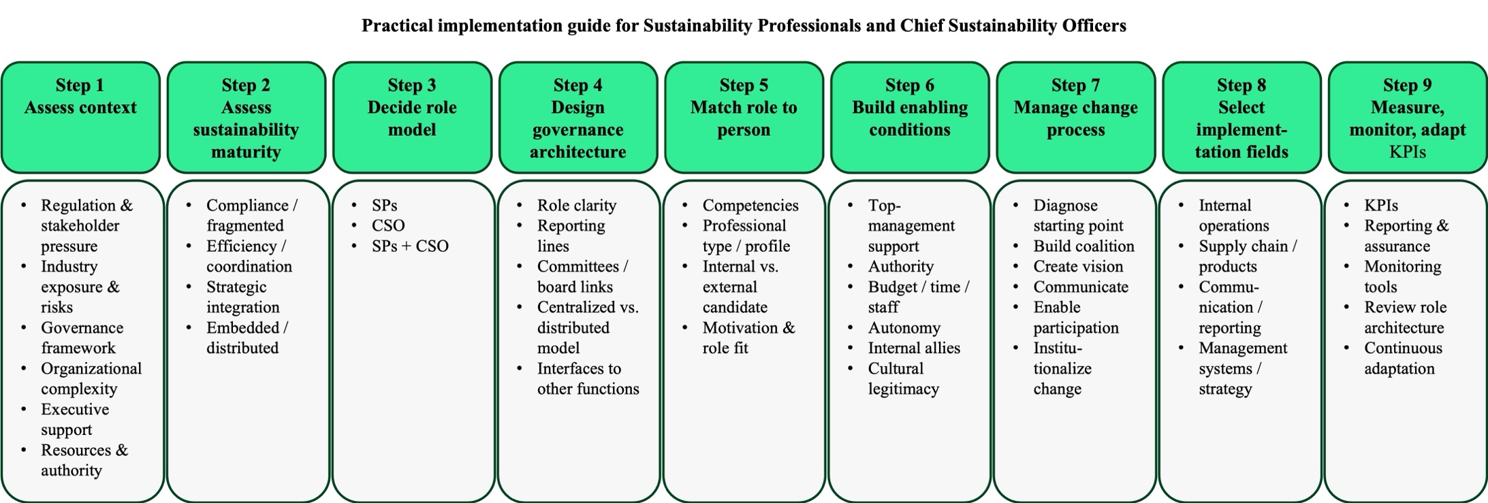
Figure 2: Practical implementation guide for sustainability professionals and chief sustainability officers (own illustration)
| Step | Key question | Main decision / implementation focus | Relevant role(s) | Typical risk if neglected |
|---|---|---|---|---|
| 1. Assess context | In which regulatory, institutional, and industry-specific environment does the firm operate? | Analyze country context, regulation, governance structure, stakeholder pressure, industry exposure, and organizational complexity | SPs, CSO, Board, TMT | Mismatched role architecture; symbolic rather than substantive sustainability structures |
| 2. Assess sustainability maturity | At what stage of sustainability development is the firm? | Classify the firm, for example into compliance, coordination, strategic integration, or embedded sustainability governance | SPs, CSO, Committees | Overdesign or under design of roles; poorly chosen priorities |
| 3. Choose SPs, a CSO, or both | Does the firm primarily need operational translation, executive ownership, or both? | Decide whether the firm needs SPs, a CSO, or a combined architecture | SPs, CSO | Executive gap or implementation gap |
| 4. Design role architecture and governance | How should mandates, reporting lines, and responsibilities be distributed? | Define role clarity, reporting lines, authority, interfaces, and governance support structures | CSO, SPs, Board, Committees | Unclear responsibilities, duplication, weak enforcement power |
| 5. Match role and person | Does the person fit the role, and does the role fit the person? | Appoint based on role fit, competence profile, motivation, background, and professional type | SPs, CSO | Poor appointments, weak legitimacy, demotivation |
| 6. Build enabling conditions | Does the organization provide the conditions for strong performance? | Ensure management support, resources, autonomy, internal allies, legitimacy, data access, and time capacity | SPs, CSO, CEO, TMT | Overload, isolation, low impact despite good role design |
| 7. Build and manage the change process | How will sustainability be translated into actual organizational change? | Assess the status quo, build a guiding coalition, develop a vision, communicate it, create quick wins, and institutionalize change | SPs, CSO, Managers | Strong strategy but weak implementation |
| 8. Select implementation fields and sustainability practices | Which practices fit the firm’s maturity, industry, and material issues? | Choose appropriate practices such as reporting systems, green supply chain management, green product innovation, internal pollution prevention, training, or management integration | SPs, CSO, organizational units | Actionism, wrong measures, organizational overload |
| 9. Measure, monitor, and adapt | How will progress be tracked, and how will the sustainability architecture evolve over time? | Use KPIs, monitoring, controlling, assurance, reporting review, and regular adaptation of roles and governance structures | CSO, SPs, Board, management accounting unit | Static roles, weak learning, symbolism instead of substance |
Figure 3: Practical roadmap for implementing sustainability professionals and chief sustainability officer
References
- 1Annelin, A. & Boström, G.-O. An assessment of key sustainability competencies: a review of scales and propositions for validation. International Journal of Sustainability in Higher Education 24, 53-69 (2022). https://doi.org/10.1108/ijshe-05-2022-0166 ↩︎
- 2Heiskanen, E., Thidell, Å. & Rodhe, H. Educating sustainability change agents: the importance of practical skills and experience. Journal of Cleaner Production 123, 218-226 (2016). https://doi.org/10.1016/j.jclepro.2015.11.063 ↩︎
- 3Lambrechts, W. & Van Petegem, P. The interrelations between competences for sustainable development and research competences. International Journal of Sustainability in Higher Education 17, 776-795 (2016). https://doi.org/10.1108/ijshe-03-2015-0060 ↩︎
- 4Leicht, A., Heiss, J. & Byun, W. J. Issues and trends in Education for Sustainable Development. (2018). ↩︎
- 5Maharani, M. & Amalia, D. Corporate social responsibility disclosure: how do corporate governance, profitability, and stand-alone reports play a role? Jurnal Akademi Akuntansi 8 (2025). https://doi.org/10.22219/jaa.v8i3.39623 ↩︎
- 6MacDonald, L. & Shriberg, M. Sustainability leadership programs in higher education: alumni outcomes and impacts. Journal of Environmental Studies and Sciences 6, 360-370 (2015). https://doi.org/10.1007/s13412-015-0344-7 ↩︎
- 7Ploum, L., Blok, V., Lans, T. & Omta, O. Toward a Validated Competence Framework for Sustainable Entrepreneurship. Organ Environ 31, 113-132 (2018). https://doi.org/10.1177/1086026617697039 ↩︎
- 8Salovaara, J. J. & Soini, K. Educated professionals of sustainability and the dimensions of practices. (2021). https://doi.org/10.1108/IJSHE-09-2020-0327IJSHE ↩︎
- 9Sancak, I. E. Change management in sustainability transformation: A model for business organizations. J Environ Manage 330, 117165 (2023). https://doi.org/10.1016/j.jenvman.2022.117165 ↩︎
- 10Van Poeck, K., Læssøe, J. & Block, T. An exploration of sustainability change agents as facilitators of nonformal learning: mapping a moving and intertwined landscape. Ecology and Society 22 (2017). https://doi.org/10.5751/es-09308-220233 ↩︎
- 11Venn, R., Vandenbussche, V. & Perez, P. Competencies of experienced sustainability professionals. Frontiers in Sustainability 5 (2024). https://doi.org/10.3389/frsus.2024.1411041 ↩︎
- 12Venn, R., Perez, P. & Vandenbussche, V. Competencies of Sustainability Professionals: An Empirical Study on Key Competencies for Sustainability. Sustainability 14 (2022). https://doi.org/10.3390/su14094916 ↩︎
- 13Wesselink, R., Blok, V., van Leur, S., Lans, T. & Dentoni, D. Individual competencies for managers engaged in corporate sustainable management practices. Journal of Cleaner Production 106, 497-506 (2015). https://doi.org/10.1016/j.jclepro.2014.10.093 ↩︎
- 14Wong, W.-K., Teh, B.-H. & Tan, S.-H. The Influence of External Stakeholders on Environmental, Social, and Governance (ESG) Reporting: Toward a Conceptual Framework for ESG Disclosure. Foresight and STI Governance 17, 9-20 (2023). https://doi.org/10.17323/2500-2597.2023.2.9.20 ↩︎
- 15Moser, C. & Lysova, E. I. in Corporate Sustainability Ch. 10, 190-206 (2023). ↩︎
- 16Morelli, J. Environmental Sustainability: A Definition for Environmental Professionals. Journal of Environmental Sustainability 1, 1-10 (2011). https://doi.org/10.14448/jes.01.0002 ↩︎
- 17Toumi, A. The impact of climate-related risks on firm performance: evidence from the healthcare sector. Journal of Business and Socio-economic Development 6, 170-190 (2025). https://doi.org/10.1108/jbsed-02-2025-0042 ↩︎
- 18Chipimo, M. L., Bwalya, J. & Kanyanga, J. K. The Role of ESG in Driving Firm Profitability. SEISENSE Journal of Management 8, 119-131 (2025). https://doi.org/10.33215/m1c78498 ↩︎
- 14Wong, W.-K., Teh, B.-H. & Tan, S.-H. The Influence of External Stakeholders on Environmental, Social, and Governance (ESG) Reporting: Toward a Conceptual Framework for ESG Disclosure. Foresight and STI Governance 17, 9-20 (2023). https://doi.org/10.17323/2500-2597.2023.2.9.20 ↩︎
- 19Jiang, Y., Zhang, L. & Tarbert, H. Does Top Management Team Media Exposure Affect Corporate Social Responsibility? Front Psychol 13, 827346 (2022). https://doi.org/10.3389/fpsyg.2022.827346 ↩︎
- 20Kapliar, K. Balancing the Doughnut: A New Paradigm for Sustainable Business Practices through Stakeholder Engagement. Green, Blue and Digital Economy Journal 6, 15-22 (2025). https://doi.org/10.30525/2661-5169/2025-3-3 ↩︎
- 21Benvenuto, M., Aufiero, C. & Viola, C. A systematic literature review on the determinants of sustainability reporting systems. Heliyon 9, e14893 (2023). https://doi.org/10.1016/j.heliyon.2023.e14893 ↩︎
- 14Wong, W.-K., Teh, B.-H. & Tan, S.-H. The Influence of External Stakeholders on Environmental, Social, and Governance (ESG) Reporting: Toward a Conceptual Framework for ESG Disclosure. Foresight and STI Governance 17, 9-20 (2023). https://doi.org/10.17323/2500-2597.2023.2.9.20 ↩︎
- 21Benvenuto, M., Aufiero, C. & Viola, C. A systematic literature review on the determinants of sustainability reporting systems. Heliyon 9, e14893 (2023). https://doi.org/10.1016/j.heliyon.2023.e14893 ↩︎
- 22Mandongwe, L., Matowanyika, K. & Mbizi, R. The value of integrated reporting for corporate sustainability: A Scoping Review (2015–2025). (2025). ↩︎
- 21Benvenuto, M., Aufiero, C. & Viola, C. A systematic literature review on the determinants of sustainability reporting systems. Heliyon 9, e14893 (2023). https://doi.org/10.1016/j.heliyon.2023.e14893 ↩︎
- 23Endrikat, J., de Villiers, C., Guenther, T. W. & Guenther, E. M. Board Characteristics and Corporate Social Responsibility: A Meta-Analytic Investigation. Business & Society 60, 2099-2135 (2020). https://doi.org/10.1177/0007650320930638 ↩︎
- 21Benvenuto, M., Aufiero, C. & Viola, C. A systematic literature review on the determinants of sustainability reporting systems. Heliyon 9, e14893 (2023). https://doi.org/10.1016/j.heliyon.2023.e14893 ↩︎
- 24Dixon-Fowler, H. R., Ellstrand, A. E. & Johnson, J. L. The Role of Board Environmental Committees in Corporate Environmental Performance. Journal of Business Ethics 140, 423-438 (2015). https://doi.org/10.1007/s10551-015-2664-7 ↩︎
- 25Riera, M. & Iborra, M. Looking at the darker side of the mirror: the impact of CEO’s narcissism on corporate social irresponsibility. European Journal of Management and Business Economics 34, 67-87 (2023). https://doi.org/10.1108/ejmbe-09-2022-0289 ↩︎
- 26Kutzschbach, J., Tanikulova, P. & Lueg, R. The Role of Top Managers in Implementing Corporate Sustainability—A Systematic Literature Review on Small and Medium-Sized Enterprises. Administrative Sciences 11 (2021). https://doi.org/10.3390/admsci11020044 ↩︎
- 27Fu, R., Tang, Y. & Chen, G. Chief sustainability officers and corporate social (Ir)responsibility. Strategic Management Journal 41, 656-680 (2019). https://doi.org/10.1002/smj.3113 ↩︎
- 11Venn, R., Vandenbussche, V. & Perez, P. Competencies of experienced sustainability professionals. Frontiers in Sustainability 5 (2024). https://doi.org/10.3389/frsus.2024.1411041 ↩︎
- 15Moser, C. & Lysova, E. I. in Corporate Sustainability Ch. 10, 190-206 (2023). ↩︎
- 12Venn, R., Perez, P. & Vandenbussche, V. Competencies of Sustainability Professionals: An Empirical Study on Key Competencies for Sustainability. Sustainability 14 (2022). https://doi.org/10.3390/su14094916 ↩︎
- 15Moser, C. & Lysova, E. I. in Corporate Sustainability Ch. 10, 190-206 (2023). ↩︎
- 28Gluch, P. & Hellsvik, S. The influence of multiple logics on the work of sustainability professionals. Construction Management and Economics 41, 893-909 (2023). https://doi.org/10.1080/01446193.2023.2214252 ↩︎
- 11Venn, R., Vandenbussche, V. & Perez, P. Competencies of experienced sustainability professionals. Frontiers in Sustainability 5 (2024). https://doi.org/10.3389/frsus.2024.1411041 ↩︎
- 29Singer-Brodowski, M., Henkel, G.-M., Reith, A., Frank, P. & Rieckmann, M. What is needed to act as a professional change agent for sustainability? A scoping review. International Review of Education 72, 11-35 (2025). https://doi.org/10.1007/s11159-024-10092-8 ↩︎
- 10Van Poeck, K., Læssøe, J. & Block, T. An exploration of sustainability change agents as facilitators of nonformal learning: mapping a moving and intertwined landscape. Ecology and Society 22 (2017). https://doi.org/10.5751/es-09308-220233 ↩︎
- 30Mintrom, M. & Rogers, B. C. How can we drive sustainability transitions? Policy Design and Practice 5, 294-306 (2022). https://doi.org/10.1080/25741292.2022.2057835 ↩︎
- 2Heiskanen, E., Thidell, Å. & Rodhe, H. Educating sustainability change agents: the importance of practical skills and experience. Journal of Cleaner Production 123, 218-226 (2016). https://doi.org/10.1016/j.jclepro.2015.11.063 ↩︎
- 31Lespinasse‐Camargo, B., Eustachio, J. H. P. P., Bonifacio, D., Macini, N. & Caldana, A. C. F. Corporate sustainability professionals: The landscape of sustainability job positions. Business Ethics, the Environment & Responsibility 33, 184-200 (2023). https://doi.org/10.1111/beer.12644 ↩︎
- 15Moser, C. & Lysova, E. I. in Corporate Sustainability Ch. 10, 190-206 (2023). ↩︎
- 28Gluch, P. & Hellsvik, S. The influence of multiple logics on the work of sustainability professionals. Construction Management and Economics 41, 893-909 (2023). https://doi.org/10.1080/01446193.2023.2214252 ↩︎
- 15Moser, C. & Lysova, E. I. in Corporate Sustainability Ch. 10, 190-206 (2023). ↩︎
- 15Moser, C. & Lysova, E. I. in Corporate Sustainability Ch. 10, 190-206 (2023). ↩︎
- 15Moser, C. & Lysova, E. I. in Corporate Sustainability Ch. 10, 190-206 (2023). ↩︎
- 15Moser, C. & Lysova, E. I. in Corporate Sustainability Ch. 10, 190-206 (2023). ↩︎
- 28Gluch, P. & Hellsvik, S. The influence of multiple logics on the work of sustainability professionals. Construction Management and Economics 41, 893-909 (2023). https://doi.org/10.1080/01446193.2023.2214252 ↩︎
- 15Moser, C. & Lysova, E. I. in Corporate Sustainability Ch. 10, 190-206 (2023). ↩︎
- 31Lespinasse‐Camargo, B., Eustachio, J. H. P. P., Bonifacio, D., Macini, N. & Caldana, A. C. F. Corporate sustainability professionals: The landscape of sustainability job positions. Business Ethics, the Environment & Responsibility 33, 184-200 (2023). https://doi.org/10.1111/beer.12644 ↩︎
- 15Moser, C. & Lysova, E. I. in Corporate Sustainability Ch. 10, 190-206 (2023). ↩︎
- 31Lespinasse‐Camargo, B., Eustachio, J. H. P. P., Bonifacio, D., Macini, N. & Caldana, A. C. F. Corporate sustainability professionals: The landscape of sustainability job positions. Business Ethics, the Environment & Responsibility 33, 184-200 (2023). https://doi.org/10.1111/beer.12644 ↩︎
- 32Opoku, A., Alex Opoku, P. V. A., Dr Heather Cruickshank, D., Ahmed, V. & Cruickshank, H. Leadership style of sustainability professionals in the UK construction industry. Built Environment Project and Asset Management 5, 184-201 (2015). https://doi.org/10.1108/bepam-12-2013-0075 ↩︎
- 32Opoku, A., Alex Opoku, P. V. A., Dr Heather Cruickshank, D., Ahmed, V. & Cruickshank, H. Leadership style of sustainability professionals in the UK construction industry. Built Environment Project and Asset Management 5, 184-201 (2015). https://doi.org/10.1108/bepam-12-2013-0075 ↩︎
- 28Gluch, P. & Hellsvik, S. The influence of multiple logics on the work of sustainability professionals. Construction Management and Economics 41, 893-909 (2023). https://doi.org/10.1080/01446193.2023.2214252 ↩︎
- 28Gluch, P. & Hellsvik, S. The influence of multiple logics on the work of sustainability professionals. Construction Management and Economics 41, 893-909 (2023). https://doi.org/10.1080/01446193.2023.2214252 ↩︎
- 8Salovaara, J. J. & Soini, K. Educated professionals of sustainability and the dimensions of practices. (2021). https://doi.org/10.1108/IJSHE-09-2020-0327IJSHE ↩︎
- 8Salovaara, J. J. & Soini, K. Educated professionals of sustainability and the dimensions of practices. (2021). https://doi.org/10.1108/IJSHE-09-2020-0327IJSHE ↩︎
- 15Moser, C. & Lysova, E. I. in Corporate Sustainability Ch. 10, 190-206 (2023). ↩︎
- 12Venn, R., Perez, P. & Vandenbussche, V. Competencies of Sustainability Professionals: An Empirical Study on Key Competencies for Sustainability. Sustainability 14 (2022). https://doi.org/10.3390/su14094916 ↩︎
- 8Salovaara, J. J. & Soini, K. Educated professionals of sustainability and the dimensions of practices. (2021). https://doi.org/10.1108/IJSHE-09-2020-0327IJSHE ↩︎
- 8Salovaara, J. J. & Soini, K. Educated professionals of sustainability and the dimensions of practices. (2021). https://doi.org/10.1108/IJSHE-09-2020-0327IJSHE ↩︎
- 15Moser, C. & Lysova, E. I. in Corporate Sustainability Ch. 10, 190-206 (2023). ↩︎
- 15Moser, C. & Lysova, E. I. in Corporate Sustainability Ch. 10, 190-206 (2023). ↩︎
- 15Moser, C. & Lysova, E. I. in Corporate Sustainability Ch. 10, 190-206 (2023). ↩︎
- 15Moser, C. & Lysova, E. I. in Corporate Sustainability Ch. 10, 190-206 (2023). ↩︎
- 11Venn, R., Vandenbussche, V. & Perez, P. Competencies of experienced sustainability professionals. Frontiers in Sustainability 5 (2024). https://doi.org/10.3389/frsus.2024.1411041 ↩︎
- 12Venn, R., Perez, P. & Vandenbussche, V. Competencies of Sustainability Professionals: An Empirical Study on Key Competencies for Sustainability. Sustainability 14 (2022). https://doi.org/10.3390/su14094916 ↩︎
- 12Venn, R., Perez, P. & Vandenbussche, V. Competencies of Sustainability Professionals: An Empirical Study on Key Competencies for Sustainability. Sustainability 14 (2022). https://doi.org/10.3390/su14094916 ↩︎
- 8Salovaara, J. J. & Soini, K. Educated professionals of sustainability and the dimensions of practices. (2021). https://doi.org/10.1108/IJSHE-09-2020-0327IJSHE ↩︎
- 8Salovaara, J. J. & Soini, K. Educated professionals of sustainability and the dimensions of practices. (2021). https://doi.org/10.1108/IJSHE-09-2020-0327IJSHE ↩︎
- 33Andrews, N. Psychosocial factors influencing the experience of sustainability professionals. Sustainability Accounting, Management and Policy Journal (2017). ↩︎
- 33Andrews, N. Psychosocial factors influencing the experience of sustainability professionals. Sustainability Accounting, Management and Policy Journal (2017). ↩︎
- 34Wright, C., Nyberg, D. & Grant, D. “Hippies on the third floor”: Climate Change, Narrative Identity and the Micro-Politics of Corporate Environmentalism. Organization Studies 33, 1451-1475 (2012). https://doi.org/10.1177/0170840612463316 ↩︎
- 34Wright, C., Nyberg, D. & Grant, D. “Hippies on the third floor”: Climate Change, Narrative Identity and the Micro-Politics of Corporate Environmentalism. Organization Studies 33, 1451-1475 (2012). https://doi.org/10.1177/0170840612463316 ↩︎
- 33Andrews, N. Psychosocial factors influencing the experience of sustainability professionals. Sustainability Accounting, Management and Policy Journal (2017). ↩︎
- 33Andrews, N. Psychosocial factors influencing the experience of sustainability professionals. Sustainability Accounting, Management and Policy Journal (2017). ↩︎
- 35Visser, W. & Crane, A. Corporate Sustainability and the Individual: Understanding What Drives Sustainability Professionals as Change Agents. (2010). ↩︎
- 35Visser, W. & Crane, A. Corporate Sustainability and the Individual: Understanding What Drives Sustainability Professionals as Change Agents. (2010). ↩︎
- 35Visser, W. & Crane, A. Corporate Sustainability and the Individual: Understanding What Drives Sustainability Professionals as Change Agents. (2010). ↩︎
- 28Gluch, P. & Hellsvik, S. The influence of multiple logics on the work of sustainability professionals. Construction Management and Economics 41, 893-909 (2023). https://doi.org/10.1080/01446193.2023.2214252 ↩︎
- 28Gluch, P. & Hellsvik, S. The influence of multiple logics on the work of sustainability professionals. Construction Management and Economics 41, 893-909 (2023). https://doi.org/10.1080/01446193.2023.2214252 ↩︎
- 33Andrews, N. Psychosocial factors influencing the experience of sustainability professionals. Sustainability Accounting, Management and Policy Journal (2017). ↩︎
- 36Johannessen, V., Giæver, F., Efstathiou, S. & Russell, S. Emotion regulation of sustainability professionals facing adversity. Gruppe. Interaktion. Organisation. Zeitschrift für Angewandte Organisationspsychologie (GIO) 55, 167-174 (2024). https://doi.org/10.1007/s11612-024-00734-8 ↩︎
- 37Brundiers, K. & Wiek, A. Beyond Interpersonal Competence: Teaching and Learning Professional Skills in Sustainability. Education Sciences 7 (2017). https://doi.org/10.3390/educsci7010039 ↩︎
- 36Johannessen, V., Giæver, F., Efstathiou, S. & Russell, S. Emotion regulation of sustainability professionals facing adversity. Gruppe. Interaktion. Organisation. Zeitschrift für Angewandte Organisationspsychologie (GIO) 55, 167-174 (2024). https://doi.org/10.1007/s11612-024-00734-8 ↩︎
- 33Andrews, N. Psychosocial factors influencing the experience of sustainability professionals. Sustainability Accounting, Management and Policy Journal (2017). ↩︎
- 36Johannessen, V., Giæver, F., Efstathiou, S. & Russell, S. Emotion regulation of sustainability professionals facing adversity. Gruppe. Interaktion. Organisation. Zeitschrift für Angewandte Organisationspsychologie (GIO) 55, 167-174 (2024). https://doi.org/10.1007/s11612-024-00734-8 ↩︎
- 28Gluch, P. & Hellsvik, S. The influence of multiple logics on the work of sustainability professionals. Construction Management and Economics 41, 893-909 (2023). https://doi.org/10.1080/01446193.2023.2214252 ↩︎
- 33Andrews, N. Psychosocial factors influencing the experience of sustainability professionals. Sustainability Accounting, Management and Policy Journal (2017). ↩︎
- 38STOOF, A., MARTENS, R. L., MERRIËNBOER, J. J. G. V. & BASTIAENS, T. J. The Boundary Approach of Competence:A Constructivist Aid for Understanding and Using the Concept of Competence. (2002). ↩︎
- 39Redman, A. & Wiek, A. Competencies for Advancing Transformations Towards Sustainability. Frontiers in Education 6 (2021). https://doi.org/10.3389/feduc.2021.785163 ↩︎
- 1Annelin, A. & Boström, G.-O. An assessment of key sustainability competencies: a review of scales and propositions for validation. International Journal of Sustainability in Higher Education 24, 53-69 (2022). https://doi.org/10.1108/ijshe-05-2022-0166 ↩︎
- 39Redman, A. & Wiek, A. Competencies for Advancing Transformations Towards Sustainability. Frontiers in Education 6 (2021). https://doi.org/10.3389/feduc.2021.785163 ↩︎
- 40UNESCO. Education for Sustainable Development Goals: Learning Objectives. (2017). ↩︎
- 7Ploum, L., Blok, V., Lans, T. & Omta, O. Toward a Validated Competence Framework for Sustainable Entrepreneurship. Organ Environ 31, 113-132 (2018). https://doi.org/10.1177/1086026617697039 ↩︎
- 7Ploum, L., Blok, V., Lans, T. & Omta, O. Toward a Validated Competence Framework for Sustainable Entrepreneurship. Organ Environ 31, 113-132 (2018). https://doi.org/10.1177/1086026617697039 ↩︎
- 13Wesselink, R., Blok, V., van Leur, S., Lans, T. & Dentoni, D. Individual competencies for managers engaged in corporate sustainable management practices. Journal of Cleaner Production 106, 497-506 (2015). https://doi.org/10.1016/j.jclepro.2014.10.093 ↩︎
- 11Venn, R., Vandenbussche, V. & Perez, P. Competencies of experienced sustainability professionals. Frontiers in Sustainability 5 (2024). https://doi.org/10.3389/frsus.2024.1411041 ↩︎
- 11Venn, R., Vandenbussche, V. & Perez, P. Competencies of experienced sustainability professionals. Frontiers in Sustainability 5 (2024). https://doi.org/10.3389/frsus.2024.1411041 ↩︎
- 11Venn, R., Vandenbussche, V. & Perez, P. Competencies of experienced sustainability professionals. Frontiers in Sustainability 5 (2024). https://doi.org/10.3389/frsus.2024.1411041 ↩︎
- 12Venn, R., Perez, P. & Vandenbussche, V. Competencies of Sustainability Professionals: An Empirical Study on Key Competencies for Sustainability. Sustainability 14 (2022). https://doi.org/10.3390/su14094916 ↩︎
- 11Venn, R., Vandenbussche, V. & Perez, P. Competencies of experienced sustainability professionals. Frontiers in Sustainability 5 (2024). https://doi.org/10.3389/frsus.2024.1411041 ↩︎
- 11Venn, R., Vandenbussche, V. & Perez, P. Competencies of experienced sustainability professionals. Frontiers in Sustainability 5 (2024). https://doi.org/10.3389/frsus.2024.1411041 ↩︎
- 12Venn, R., Perez, P. & Vandenbussche, V. Competencies of Sustainability Professionals: An Empirical Study on Key Competencies for Sustainability. Sustainability 14 (2022). https://doi.org/10.3390/su14094916 ↩︎
- 37Brundiers, K. & Wiek, A. Beyond Interpersonal Competence: Teaching and Learning Professional Skills in Sustainability. Education Sciences 7 (2017). https://doi.org/10.3390/educsci7010039 ↩︎
- 37Brundiers, K. & Wiek, A. Beyond Interpersonal Competence: Teaching and Learning Professional Skills in Sustainability. Education Sciences 7 (2017). https://doi.org/10.3390/educsci7010039 ↩︎
- 41Agyekum, K. et al. Key Competencies of Built Environment Professionals for Achieving Net-Zero Carbon Emissions in the Ghanaian Construction Industry. Buildings 15 (2025). https://doi.org/10.3390/buildings15101750 ↩︎
- 4Leicht, A., Heiss, J. & Byun, W. J. Issues and trends in Education for Sustainable Development. (2018). ↩︎
- 7Ploum, L., Blok, V., Lans, T. & Omta, O. Toward a Validated Competence Framework for Sustainable Entrepreneurship. Organ Environ 31, 113-132 (2018). https://doi.org/10.1177/1086026617697039 ↩︎
- 7Ploum, L., Blok, V., Lans, T. & Omta, O. Toward a Validated Competence Framework for Sustainable Entrepreneurship. Organ Environ 31, 113-132 (2018). https://doi.org/10.1177/1086026617697039 ↩︎
- 39Redman, A. & Wiek, A. Competencies for Advancing Transformations Towards Sustainability. Frontiers in Education 6 (2021). https://doi.org/10.3389/feduc.2021.785163 ↩︎
- 39Redman, A. & Wiek, A. Competencies for Advancing Transformations Towards Sustainability. Frontiers in Education 6 (2021). https://doi.org/10.3389/feduc.2021.785163 ↩︎
- 29Singer-Brodowski, M., Henkel, G.-M., Reith, A., Frank, P. & Rieckmann, M. What is needed to act as a professional change agent for sustainability? A scoping review. International Review of Education 72, 11-35 (2025). https://doi.org/10.1007/s11159-024-10092-8 ↩︎
- 37Brundiers, K. & Wiek, A. Beyond Interpersonal Competence: Teaching and Learning Professional Skills in Sustainability. Education Sciences 7 (2017). https://doi.org/10.3390/educsci7010039 ↩︎
- 6MacDonald, L. & Shriberg, M. Sustainability leadership programs in higher education: alumni outcomes and impacts. Journal of Environmental Studies and Sciences 6, 360-370 (2015). https://doi.org/10.1007/s13412-015-0344-7 ↩︎
- 12Venn, R., Perez, P. & Vandenbussche, V. Competencies of Sustainability Professionals: An Empirical Study on Key Competencies for Sustainability. Sustainability 14 (2022). https://doi.org/10.3390/su14094916 ↩︎
- 2Heiskanen, E., Thidell, Å. & Rodhe, H. Educating sustainability change agents: the importance of practical skills and experience. Journal of Cleaner Production 123, 218-226 (2016). https://doi.org/10.1016/j.jclepro.2015.11.063 ↩︎
- 37Brundiers, K. & Wiek, A. Beyond Interpersonal Competence: Teaching and Learning Professional Skills in Sustainability. Education Sciences 7 (2017). https://doi.org/10.3390/educsci7010039 ↩︎
- 4Leicht, A., Heiss, J. & Byun, W. J. Issues and trends in Education for Sustainable Development. (2018). ↩︎
- 1Annelin, A. & Boström, G.-O. An assessment of key sustainability competencies: a review of scales and propositions for validation. International Journal of Sustainability in Higher Education 24, 53-69 (2022). https://doi.org/10.1108/ijshe-05-2022-0166 ↩︎
- 1Annelin, A. & Boström, G.-O. An assessment of key sustainability competencies: a review of scales and propositions for validation. International Journal of Sustainability in Higher Education 24, 53-69 (2022). https://doi.org/10.1108/ijshe-05-2022-0166 ↩︎
- 4Leicht, A., Heiss, J. & Byun, W. J. Issues and trends in Education for Sustainable Development. (2018). ↩︎
- 39Redman, A. & Wiek, A. Competencies for Advancing Transformations Towards Sustainability. Frontiers in Education 6 (2021). https://doi.org/10.3389/feduc.2021.785163 ↩︎
- 11Venn, R., Vandenbussche, V. & Perez, P. Competencies of experienced sustainability professionals. Frontiers in Sustainability 5 (2024). https://doi.org/10.3389/frsus.2024.1411041 ↩︎
- 15Moser, C. & Lysova, E. I. in Corporate Sustainability Ch. 10, 190-206 (2023). ↩︎
- 37Brundiers, K. & Wiek, A. Beyond Interpersonal Competence: Teaching and Learning Professional Skills in Sustainability. Education Sciences 7 (2017). https://doi.org/10.3390/educsci7010039 ↩︎
- 42Runhaar, H., Driessen, P. & Vermeulen, W. Policy Competences of Environmental Sustainability Professionals. Greener Management International 2005, 24-41 (2005). https://doi.org/10.9774/GLEAF.3062.2005.sp.00005 ↩︎
- 2Heiskanen, E., Thidell, Å. & Rodhe, H. Educating sustainability change agents: the importance of practical skills and experience. Journal of Cleaner Production 123, 218-226 (2016). https://doi.org/10.1016/j.jclepro.2015.11.063 ↩︎
- 11Venn, R., Vandenbussche, V. & Perez, P. Competencies of experienced sustainability professionals. Frontiers in Sustainability 5 (2024). https://doi.org/10.3389/frsus.2024.1411041 ↩︎
- 37Brundiers, K. & Wiek, A. Beyond Interpersonal Competence: Teaching and Learning Professional Skills in Sustainability. Education Sciences 7 (2017). https://doi.org/10.3390/educsci7010039 ↩︎
- 37Brundiers, K. & Wiek, A. Beyond Interpersonal Competence: Teaching and Learning Professional Skills in Sustainability. Education Sciences 7 (2017). https://doi.org/10.3390/educsci7010039 ↩︎
- 39Redman, A. & Wiek, A. Competencies for Advancing Transformations Towards Sustainability. Frontiers in Education 6 (2021). https://doi.org/10.3389/feduc.2021.785163 ↩︎
- 13Wesselink, R., Blok, V., van Leur, S., Lans, T. & Dentoni, D. Individual competencies for managers engaged in corporate sustainable management practices. Journal of Cleaner Production 106, 497-506 (2015). https://doi.org/10.1016/j.jclepro.2014.10.093 ↩︎
- 13Wesselink, R., Blok, V., van Leur, S., Lans, T. & Dentoni, D. Individual competencies for managers engaged in corporate sustainable management practices. Journal of Cleaner Production 106, 497-506 (2015). https://doi.org/10.1016/j.jclepro.2014.10.093 ↩︎
- 7Ploum, L., Blok, V., Lans, T. & Omta, O. Toward a Validated Competence Framework for Sustainable Entrepreneurship. Organ Environ 31, 113-132 (2018). https://doi.org/10.1177/1086026617697039 ↩︎
- 13Wesselink, R., Blok, V., van Leur, S., Lans, T. & Dentoni, D. Individual competencies for managers engaged in corporate sustainable management practices. Journal of Cleaner Production 106, 497-506 (2015). https://doi.org/10.1016/j.jclepro.2014.10.093 ↩︎
- 13Wesselink, R., Blok, V., van Leur, S., Lans, T. & Dentoni, D. Individual competencies for managers engaged in corporate sustainable management practices. Journal of Cleaner Production 106, 497-506 (2015). https://doi.org/10.1016/j.jclepro.2014.10.093 ↩︎
- 15Moser, C. & Lysova, E. I. in Corporate Sustainability Ch. 10, 190-206 (2023). ↩︎
- 11Venn, R., Vandenbussche, V. & Perez, P. Competencies of experienced sustainability professionals. Frontiers in Sustainability 5 (2024). https://doi.org/10.3389/frsus.2024.1411041 ↩︎
- 37Brundiers, K. & Wiek, A. Beyond Interpersonal Competence: Teaching and Learning Professional Skills in Sustainability. Education Sciences 7 (2017). https://doi.org/10.3390/educsci7010039 ↩︎
- 11Venn, R., Vandenbussche, V. & Perez, P. Competencies of experienced sustainability professionals. Frontiers in Sustainability 5 (2024). https://doi.org/10.3389/frsus.2024.1411041 ↩︎
- 13Wesselink, R., Blok, V., van Leur, S., Lans, T. & Dentoni, D. Individual competencies for managers engaged in corporate sustainable management practices. Journal of Cleaner Production 106, 497-506 (2015). https://doi.org/10.1016/j.jclepro.2014.10.093 ↩︎
- 37Brundiers, K. & Wiek, A. Beyond Interpersonal Competence: Teaching and Learning Professional Skills in Sustainability. Education Sciences 7 (2017). https://doi.org/10.3390/educsci7010039 ↩︎
- 37Brundiers, K. & Wiek, A. Beyond Interpersonal Competence: Teaching and Learning Professional Skills in Sustainability. Education Sciences 7 (2017). https://doi.org/10.3390/educsci7010039 ↩︎
- 39Redman, A. & Wiek, A. Competencies for Advancing Transformations Towards Sustainability. Frontiers in Education 6 (2021). https://doi.org/10.3389/feduc.2021.785163 ↩︎
- 7Ploum, L., Blok, V., Lans, T. & Omta, O. Toward a Validated Competence Framework for Sustainable Entrepreneurship. Organ Environ 31, 113-132 (2018). https://doi.org/10.1177/1086026617697039 ↩︎
- 13Wesselink, R., Blok, V., van Leur, S., Lans, T. & Dentoni, D. Individual competencies for managers engaged in corporate sustainable management practices. Journal of Cleaner Production 106, 497-506 (2015). https://doi.org/10.1016/j.jclepro.2014.10.093 ↩︎
- 29Singer-Brodowski, M., Henkel, G.-M., Reith, A., Frank, P. & Rieckmann, M. What is needed to act as a professional change agent for sustainability? A scoping review. International Review of Education 72, 11-35 (2025). https://doi.org/10.1007/s11159-024-10092-8 ↩︎
- 28Gluch, P. & Hellsvik, S. The influence of multiple logics on the work of sustainability professionals. Construction Management and Economics 41, 893-909 (2023). https://doi.org/10.1080/01446193.2023.2214252 ↩︎
- 28Gluch, P. & Hellsvik, S. The influence of multiple logics on the work of sustainability professionals. Construction Management and Economics 41, 893-909 (2023). https://doi.org/10.1080/01446193.2023.2214252 ↩︎
- 31Lespinasse‐Camargo, B., Eustachio, J. H. P. P., Bonifacio, D., Macini, N. & Caldana, A. C. F. Corporate sustainability professionals: The landscape of sustainability job positions. Business Ethics, the Environment & Responsibility 33, 184-200 (2023). https://doi.org/10.1111/beer.12644 ↩︎
- 31Lespinasse‐Camargo, B., Eustachio, J. H. P. P., Bonifacio, D., Macini, N. & Caldana, A. C. F. Corporate sustainability professionals: The landscape of sustainability job positions. Business Ethics, the Environment & Responsibility 33, 184-200 (2023). https://doi.org/10.1111/beer.12644 ↩︎
- 31Lespinasse‐Camargo, B., Eustachio, J. H. P. P., Bonifacio, D., Macini, N. & Caldana, A. C. F. Corporate sustainability professionals: The landscape of sustainability job positions. Business Ethics, the Environment & Responsibility 33, 184-200 (2023). https://doi.org/10.1111/beer.12644 ↩︎
- 15Moser, C. & Lysova, E. I. in Corporate Sustainability Ch. 10, 190-206 (2023). ↩︎
- 31Lespinasse‐Camargo, B., Eustachio, J. H. P. P., Bonifacio, D., Macini, N. & Caldana, A. C. F. Corporate sustainability professionals: The landscape of sustainability job positions. Business Ethics, the Environment & Responsibility 33, 184-200 (2023). https://doi.org/10.1111/beer.12644 ↩︎
- 31Lespinasse‐Camargo, B., Eustachio, J. H. P. P., Bonifacio, D., Macini, N. & Caldana, A. C. F. Corporate sustainability professionals: The landscape of sustainability job positions. Business Ethics, the Environment & Responsibility 33, 184-200 (2023). https://doi.org/10.1111/beer.12644 ↩︎
- 31Lespinasse‐Camargo, B., Eustachio, J. H. P. P., Bonifacio, D., Macini, N. & Caldana, A. C. F. Corporate sustainability professionals: The landscape of sustainability job positions. Business Ethics, the Environment & Responsibility 33, 184-200 (2023). https://doi.org/10.1111/beer.12644 ↩︎
- 15Moser, C. & Lysova, E. I. in Corporate Sustainability Ch. 10, 190-206 (2023). ↩︎
- 15Moser, C. & Lysova, E. I. in Corporate Sustainability Ch. 10, 190-206 (2023). ↩︎
- 43Neessen, P. C. M., Caniëls, M. C. J., Vos, B. & de Jong, J. P. The intrapreneurial employee: toward an integrated model of intrapreneurship and research agenda. International Entrepreneurship and Management Journal 15, 545-571 (2018). https://doi.org/10.1007/s11365-018-0552-1 ↩︎
- 43Neessen, P. C. M., Caniëls, M. C. J., Vos, B. & de Jong, J. P. The intrapreneurial employee: toward an integrated model of intrapreneurship and research agenda. International Entrepreneurship and Management Journal 15, 545-571 (2018). https://doi.org/10.1007/s11365-018-0552-1 ↩︎
- 43Neessen, P. C. M., Caniëls, M. C. J., Vos, B. & de Jong, J. P. The intrapreneurial employee: toward an integrated model of intrapreneurship and research agenda. International Entrepreneurship and Management Journal 15, 545-571 (2018). https://doi.org/10.1007/s11365-018-0552-1 ↩︎
- 11Venn, R., Vandenbussche, V. & Perez, P. Competencies of experienced sustainability professionals. Frontiers in Sustainability 5 (2024). https://doi.org/10.3389/frsus.2024.1411041 ↩︎
- 28Gluch, P. & Hellsvik, S. The influence of multiple logics on the work of sustainability professionals. Construction Management and Economics 41, 893-909 (2023). https://doi.org/10.1080/01446193.2023.2214252 ↩︎
- 43Neessen, P. C. M., Caniëls, M. C. J., Vos, B. & de Jong, J. P. The intrapreneurial employee: toward an integrated model of intrapreneurship and research agenda. International Entrepreneurship and Management Journal 15, 545-571 (2018). https://doi.org/10.1007/s11365-018-0552-1 ↩︎
- 44Miller, K. & Serafeim, G. Chief Sustainability Officers: Who Are They and What Do They Do? (2014). ↩︎
- 28Gluch, P. & Hellsvik, S. The influence of multiple logics on the work of sustainability professionals. Construction Management and Economics 41, 893-909 (2023). https://doi.org/10.1080/01446193.2023.2214252 ↩︎
- 15Moser, C. & Lysova, E. I. in Corporate Sustainability Ch. 10, 190-206 (2023). ↩︎
- 45Kanashiro, P. & Rivera, J. Do Chief Sustainability Officers Make Companies Greener? The Moderating Role of Regulatory Pressures. Journal of Business Ethics 155, 687-701 (2017). https://doi.org/10.1007/s10551-017-3461-2 ↩︎
- 21Benvenuto, M., Aufiero, C. & Viola, C. A systematic literature review on the determinants of sustainability reporting systems. Heliyon 9, e14893 (2023). https://doi.org/10.1016/j.heliyon.2023.e14893 ↩︎
- 28Gluch, P. & Hellsvik, S. The influence of multiple logics on the work of sustainability professionals. Construction Management and Economics 41, 893-909 (2023). https://doi.org/10.1080/01446193.2023.2214252 ↩︎
- 27Fu, R., Tang, Y. & Chen, G. Chief sustainability officers and corporate social (Ir)responsibility. Strategic Management Journal 41, 656-680 (2019). https://doi.org/10.1002/smj.3113 ↩︎
- 13Wesselink, R., Blok, V., van Leur, S., Lans, T. & Dentoni, D. Individual competencies for managers engaged in corporate sustainable management practices. Journal of Cleaner Production 106, 497-506 (2015). https://doi.org/10.1016/j.jclepro.2014.10.093 ↩︎
- 14Wong, W.-K., Teh, B.-H. & Tan, S.-H. The Influence of External Stakeholders on Environmental, Social, and Governance (ESG) Reporting: Toward a Conceptual Framework for ESG Disclosure. Foresight and STI Governance 17, 9-20 (2023). https://doi.org/10.17323/2500-2597.2023.2.9.20 ↩︎
- 21Benvenuto, M., Aufiero, C. & Viola, C. A systematic literature review on the determinants of sustainability reporting systems. Heliyon 9, e14893 (2023). https://doi.org/10.1016/j.heliyon.2023.e14893 ↩︎
- 46Thun, T. W. & Zülch, H. The effect of chief sustainability officers on sustainability reporting—A management perspective. Business Strategy and the Environment 32, 2093-2110 (2022). https://doi.org/10.1002/bse.3238 ↩︎
- 47Way, S. P. T., Khalid, S. N. A. & Jalaludin, D. Environmental Information: Pressures, Types, and Usage. Journal of Business Management and Accounting (2020). ↩︎
- 47Way, S. P. T., Khalid, S. N. A. & Jalaludin, D. Environmental Information: Pressures, Types, and Usage. Journal of Business Management and Accounting (2020). ↩︎
- 5Maharani, M. & Amalia, D. Corporate social responsibility disclosure: how do corporate governance, profitability, and stand-alone reports play a role? Jurnal Akademi Akuntansi 8 (2025). https://doi.org/10.22219/jaa.v8i3.39623 ↩︎
- 9Sancak, I. E. Change management in sustainability transformation: A model for business organizations. J Environ Manage 330, 117165 (2023). https://doi.org/10.1016/j.jenvman.2022.117165 ↩︎
- 17Toumi, A. The impact of climate-related risks on firm performance: evidence from the healthcare sector. Journal of Business and Socio-economic Development 6, 170-190 (2025). https://doi.org/10.1108/jbsed-02-2025-0042 ↩︎
- 24Dixon-Fowler, H. R., Ellstrand, A. E. & Johnson, J. L. The Role of Board Environmental Committees in Corporate Environmental Performance. Journal of Business Ethics 140, 423-438 (2015). https://doi.org/10.1007/s10551-015-2664-7 ↩︎
- 24Dixon-Fowler, H. R., Ellstrand, A. E. & Johnson, J. L. The Role of Board Environmental Committees in Corporate Environmental Performance. Journal of Business Ethics 140, 423-438 (2015). https://doi.org/10.1007/s10551-015-2664-7 ↩︎
- 17Toumi, A. The impact of climate-related risks on firm performance: evidence from the healthcare sector. Journal of Business and Socio-economic Development 6, 170-190 (2025). https://doi.org/10.1108/jbsed-02-2025-0042 ↩︎
- 48Toukabri, M. Chief Sustainability Officer (CSO) power and sustainability-based compensation for climate change disclosure and carbon performance: is it different for developed and developing nations? Society and Business Review 20, 52-102 (2024). https://doi.org/10.1108/sbr-12-2023-0356 ↩︎
- 17Toumi, A. The impact of climate-related risks on firm performance: evidence from the healthcare sector. Journal of Business and Socio-economic Development 6, 170-190 (2025). https://doi.org/10.1108/jbsed-02-2025-0042 ↩︎
- 11Venn, R., Vandenbussche, V. & Perez, P. Competencies of experienced sustainability professionals. Frontiers in Sustainability 5 (2024). https://doi.org/10.3389/frsus.2024.1411041 ↩︎
- 35Visser, W. & Crane, A. Corporate Sustainability and the Individual: Understanding What Drives Sustainability Professionals as Change Agents. (2010). ↩︎
- 28Gluch, P. & Hellsvik, S. The influence of multiple logics on the work of sustainability professionals. Construction Management and Economics 41, 893-909 (2023). https://doi.org/10.1080/01446193.2023.2214252 ↩︎
- 31Lespinasse‐Camargo, B., Eustachio, J. H. P. P., Bonifacio, D., Macini, N. & Caldana, A. C. F. Corporate sustainability professionals: The landscape of sustainability job positions. Business Ethics, the Environment & Responsibility 33, 184-200 (2023). https://doi.org/10.1111/beer.12644 ↩︎
- 35Visser, W. & Crane, A. Corporate Sustainability and the Individual: Understanding What Drives Sustainability Professionals as Change Agents. (2010). ↩︎
- 35Visser, W. & Crane, A. Corporate Sustainability and the Individual: Understanding What Drives Sustainability Professionals as Change Agents. (2010). ↩︎
- 45Kanashiro, P. & Rivera, J. Do Chief Sustainability Officers Make Companies Greener? The Moderating Role of Regulatory Pressures. Journal of Business Ethics 155, 687-701 (2017). https://doi.org/10.1007/s10551-017-3461-2 ↩︎
- 15Moser, C. & Lysova, E. I. in Corporate Sustainability Ch. 10, 190-206 (2023). ↩︎
- 43Neessen, P. C. M., Caniëls, M. C. J., Vos, B. & de Jong, J. P. The intrapreneurial employee: toward an integrated model of intrapreneurship and research agenda. International Entrepreneurship and Management Journal 15, 545-571 (2018). https://doi.org/10.1007/s11365-018-0552-1 ↩︎
- 28Gluch, P. & Hellsvik, S. The influence of multiple logics on the work of sustainability professionals. Construction Management and Economics 41, 893-909 (2023). https://doi.org/10.1080/01446193.2023.2214252 ↩︎
- 11Venn, R., Vandenbussche, V. & Perez, P. Competencies of experienced sustainability professionals. Frontiers in Sustainability 5 (2024). https://doi.org/10.3389/frsus.2024.1411041 ↩︎
- 28Gluch, P. & Hellsvik, S. The influence of multiple logics on the work of sustainability professionals. Construction Management and Economics 41, 893-909 (2023). https://doi.org/10.1080/01446193.2023.2214252 ↩︎
- 15Moser, C. & Lysova, E. I. in Corporate Sustainability Ch. 10, 190-206 (2023). ↩︎
- 10Van Poeck, K., Læssøe, J. & Block, T. An exploration of sustainability change agents as facilitators of nonformal learning: mapping a moving and intertwined landscape. Ecology and Society 22 (2017). https://doi.org/10.5751/es-09308-220233 ↩︎
- 28Gluch, P. & Hellsvik, S. The influence of multiple logics on the work of sustainability professionals. Construction Management and Economics 41, 893-909 (2023). https://doi.org/10.1080/01446193.2023.2214252 ↩︎
- 49Mouawad, J. Environmental law, green entrepreneurial orientation, and circular business models: a systematic literature review. Discover Sustainability 6 (2025). https://doi.org/10.1007/s43621-025-02282-7 ↩︎
- 49Mouawad, J. Environmental law, green entrepreneurial orientation, and circular business models: a systematic literature review. Discover Sustainability 6 (2025). https://doi.org/10.1007/s43621-025-02282-7 ↩︎
- 27Fu, R., Tang, Y. & Chen, G. Chief sustainability officers and corporate social (Ir)responsibility. Strategic Management Journal 41, 656-680 (2019). https://doi.org/10.1002/smj.3113 ↩︎
- 50Velte, P. & Stawinoga, M. Do chief sustainability officers and CSR committees influence CSR-related outcomes? A structured literature review based on empirical-quantitative research findings. Journal of Management Control 31, 333-377 (2020). https://doi.org/10.1007/s00187-020-00308-x ↩︎
- 45Kanashiro, P. & Rivera, J. Do Chief Sustainability Officers Make Companies Greener? The Moderating Role of Regulatory Pressures. Journal of Business Ethics 155, 687-701 (2017). https://doi.org/10.1007/s10551-017-3461-2 ↩︎
- 27Fu, R., Tang, Y. & Chen, G. Chief sustainability officers and corporate social (Ir)responsibility. Strategic Management Journal 41, 656-680 (2019). https://doi.org/10.1002/smj.3113 ↩︎
- 50Velte, P. & Stawinoga, M. Do chief sustainability officers and CSR committees influence CSR-related outcomes? A structured literature review based on empirical-quantitative research findings. Journal of Management Control 31, 333-377 (2020). https://doi.org/10.1007/s00187-020-00308-x ↩︎
- 48Toukabri, M. Chief Sustainability Officer (CSO) power and sustainability-based compensation for climate change disclosure and carbon performance: is it different for developed and developing nations? Society and Business Review 20, 52-102 (2024). https://doi.org/10.1108/sbr-12-2023-0356 ↩︎
- 27Fu, R., Tang, Y. & Chen, G. Chief sustainability officers and corporate social (Ir)responsibility. Strategic Management Journal 41, 656-680 (2019). https://doi.org/10.1002/smj.3113 ↩︎
- 50Velte, P. & Stawinoga, M. Do chief sustainability officers and CSR committees influence CSR-related outcomes? A structured literature review based on empirical-quantitative research findings. Journal of Management Control 31, 333-377 (2020). https://doi.org/10.1007/s00187-020-00308-x ↩︎
- 46Thun, T. W. & Zülch, H. The effect of chief sustainability officers on sustainability reporting—A management perspective. Business Strategy and the Environment 32, 2093-2110 (2022). https://doi.org/10.1002/bse.3238 ↩︎
- 45Kanashiro, P. & Rivera, J. Do Chief Sustainability Officers Make Companies Greener? The Moderating Role of Regulatory Pressures. Journal of Business Ethics 155, 687-701 (2017). https://doi.org/10.1007/s10551-017-3461-2 ↩︎
- 45Kanashiro, P. & Rivera, J. Do Chief Sustainability Officers Make Companies Greener? The Moderating Role of Regulatory Pressures. Journal of Business Ethics 155, 687-701 (2017). https://doi.org/10.1007/s10551-017-3461-2 ↩︎
- 46Thun, T. W. & Zülch, H. The effect of chief sustainability officers on sustainability reporting—A management perspective. Business Strategy and the Environment 32, 2093-2110 (2022). https://doi.org/10.1002/bse.3238 ↩︎
- 27Fu, R., Tang, Y. & Chen, G. Chief sustainability officers and corporate social (Ir)responsibility. Strategic Management Journal 41, 656-680 (2019). https://doi.org/10.1002/smj.3113 ↩︎
- 44Miller, K. & Serafeim, G. Chief Sustainability Officers: Who Are They and What Do They Do? (2014). ↩︎
- 51Kreutzer, R. T. Die Rollen des Chief Sustainability Officers. (2013). ↩︎
- 51Kreutzer, R. T. Die Rollen des Chief Sustainability Officers. (2013). ↩︎
- 27Fu, R., Tang, Y. & Chen, G. Chief sustainability officers and corporate social (Ir)responsibility. Strategic Management Journal 41, 656-680 (2019). https://doi.org/10.1002/smj.3113 ↩︎
- 44Miller, K. & Serafeim, G. Chief Sustainability Officers: Who Are They and What Do They Do? (2014). ↩︎
- 52Yamauchi, N. & Sato, H. Diverse more than ever. Annals of Business Administrative Science 20, 121-140 (2021). https://doi.org/10.7880/abas.0210901b ↩︎
- 26Kutzschbach, J., Tanikulova, P. & Lueg, R. The Role of Top Managers in Implementing Corporate Sustainability—A Systematic Literature Review on Small and Medium-Sized Enterprises. Administrative Sciences 11 (2021). https://doi.org/10.3390/admsci11020044 ↩︎
- 53Peng, H. & Chandarasupsang, T. The Effect of Female Directors on ESG Practice: Evidence from China. International Journal of Financial Studies 11 (2023). https://doi.org/10.3390/ijfs11020066 ↩︎
- 44Miller, K. & Serafeim, G. Chief Sustainability Officers: Who Are They and What Do They Do? (2014). ↩︎
- 23Endrikat, J., de Villiers, C., Guenther, T. W. & Guenther, E. M. Board Characteristics and Corporate Social Responsibility: A Meta-Analytic Investigation. Business & Society 60, 2099-2135 (2020). https://doi.org/10.1177/0007650320930638 ↩︎
- 19Jiang, Y., Zhang, L. & Tarbert, H. Does Top Management Team Media Exposure Affect Corporate Social Responsibility? Front Psychol 13, 827346 (2022). https://doi.org/10.3389/fpsyg.2022.827346 ↩︎
- 54Baraibar-Diez, E. & Odriozola, M. D. CSR Committees and Their Effect on ESG Performance in UK, France, Germany, and Spain. Sustainability 11 (2019). https://doi.org/10.3390/su11185077 ↩︎
- 55Vuong, N. B. CSR committees and their effect on green practices. Economics and Business Review 10 (2024). https://doi.org/10.18559/ebr.2024.3 ↩︎
- 54Baraibar-Diez, E. & Odriozola, M. D. CSR Committees and Their Effect on ESG Performance in UK, France, Germany, and Spain. Sustainability 11 (2019). https://doi.org/10.3390/su11185077 ↩︎
- 23Endrikat, J., de Villiers, C., Guenther, T. W. & Guenther, E. M. Board Characteristics and Corporate Social Responsibility: A Meta-Analytic Investigation. Business & Society 60, 2099-2135 (2020). https://doi.org/10.1177/0007650320930638 ↩︎
- 21Benvenuto, M., Aufiero, C. & Viola, C. A systematic literature review on the determinants of sustainability reporting systems. Heliyon 9, e14893 (2023). https://doi.org/10.1016/j.heliyon.2023.e14893 ↩︎
- 54Baraibar-Diez, E. & Odriozola, M. D. CSR Committees and Their Effect on ESG Performance in UK, France, Germany, and Spain. Sustainability 11 (2019). https://doi.org/10.3390/su11185077 ↩︎
- 27Fu, R., Tang, Y. & Chen, G. Chief sustainability officers and corporate social (Ir)responsibility. Strategic Management Journal 41, 656-680 (2019). https://doi.org/10.1002/smj.3113 ↩︎
- 56Orazalin, N. Do board sustainability committees contribute to corporate environmental and social performance? The mediating role of corporate social responsibility strategy. Business Strategy and the Environment 29, 140-153 (2019). https://doi.org/10.1002/bse.2354 ↩︎
- 54Baraibar-Diez, E. & Odriozola, M. D. CSR Committees and Their Effect on ESG Performance in UK, France, Germany, and Spain. Sustainability 11 (2019). https://doi.org/10.3390/su11185077 ↩︎
- 54Baraibar-Diez, E. & Odriozola, M. D. CSR Committees and Their Effect on ESG Performance in UK, France, Germany, and Spain. Sustainability 11 (2019). https://doi.org/10.3390/su11185077 ↩︎
- 54Baraibar-Diez, E. & Odriozola, M. D. CSR Committees and Their Effect on ESG Performance in UK, France, Germany, and Spain. Sustainability 11 (2019). https://doi.org/10.3390/su11185077 ↩︎
- 44Miller, K. & Serafeim, G. Chief Sustainability Officers: Who Are They and What Do They Do? (2014). ↩︎
- 44Miller, K. & Serafeim, G. Chief Sustainability Officers: Who Are They and What Do They Do? (2014). ↩︎
- 44Miller, K. & Serafeim, G. Chief Sustainability Officers: Who Are They and What Do They Do? (2014). ↩︎
- 44Miller, K. & Serafeim, G. Chief Sustainability Officers: Who Are They and What Do They Do? (2014). ↩︎
- 44Miller, K. & Serafeim, G. Chief Sustainability Officers: Who Are They and What Do They Do? (2014). ↩︎
- 44Miller, K. & Serafeim, G. Chief Sustainability Officers: Who Are They and What Do They Do? (2014). ↩︎
- 57Alshbili, I., Elamer, A. A. & Beddewela, E. Ownership types, corporate governance and corporate social responsibility disclosures. Accounting Research Journal 33, 148-166 (2019). https://doi.org/10.1108/arj-03-2018-0060 ↩︎
- 57Alshbili, I., Elamer, A. A. & Beddewela, E. Ownership types, corporate governance and corporate social responsibility disclosures. Accounting Research Journal 33, 148-166 (2019). https://doi.org/10.1108/arj-03-2018-0060 ↩︎
- 46Thun, T. W. & Zülch, H. The effect of chief sustainability officers on sustainability reporting—A management perspective. Business Strategy and the Environment 32, 2093-2110 (2022). https://doi.org/10.1002/bse.3238 ↩︎
- 48Toukabri, M. Chief Sustainability Officer (CSO) power and sustainability-based compensation for climate change disclosure and carbon performance: is it different for developed and developing nations? Society and Business Review 20, 52-102 (2024). https://doi.org/10.1108/sbr-12-2023-0356 ↩︎
- 48Toukabri, M. Chief Sustainability Officer (CSO) power and sustainability-based compensation for climate change disclosure and carbon performance: is it different for developed and developing nations? Society and Business Review 20, 52-102 (2024). https://doi.org/10.1108/sbr-12-2023-0356 ↩︎
- 58Peters, G. F., Romi, A. M. & Sanchez, J. M. The Influence of Corporate Sustainability Officers on Performance. Journal of Business Ethics 159, 1065-1087 (2018). https://doi.org/10.1007/s10551-018-3818-1 ↩︎
- 46Thun, T. W. & Zülch, H. The effect of chief sustainability officers on sustainability reporting—A management perspective. Business Strategy and the Environment 32, 2093-2110 (2022). https://doi.org/10.1002/bse.3238 ↩︎
- 58Peters, G. F., Romi, A. M. & Sanchez, J. M. The Influence of Corporate Sustainability Officers on Performance. Journal of Business Ethics 159, 1065-1087 (2018). https://doi.org/10.1007/s10551-018-3818-1 ↩︎
- 46Thun, T. W. & Zülch, H. The effect of chief sustainability officers on sustainability reporting—A management perspective. Business Strategy and the Environment 32, 2093-2110 (2022). https://doi.org/10.1002/bse.3238 ↩︎
- 58Peters, G. F., Romi, A. M. & Sanchez, J. M. The Influence of Corporate Sustainability Officers on Performance. Journal of Business Ethics 159, 1065-1087 (2018). https://doi.org/10.1007/s10551-018-3818-1 ↩︎
- 58Peters, G. F., Romi, A. M. & Sanchez, J. M. The Influence of Corporate Sustainability Officers on Performance. Journal of Business Ethics 159, 1065-1087 (2018). https://doi.org/10.1007/s10551-018-3818-1 ↩︎
- 45Kanashiro, P. & Rivera, J. Do Chief Sustainability Officers Make Companies Greener? The Moderating Role of Regulatory Pressures. Journal of Business Ethics 155, 687-701 (2017). https://doi.org/10.1007/s10551-017-3461-2 ↩︎
- 44Miller, K. & Serafeim, G. Chief Sustainability Officers: Who Are They and What Do They Do? (2014). ↩︎
- 44Miller, K. & Serafeim, G. Chief Sustainability Officers: Who Are They and What Do They Do? (2014). ↩︎
- 44Miller, K. & Serafeim, G. Chief Sustainability Officers: Who Are They and What Do They Do? (2014). ↩︎
- 27Fu, R., Tang, Y. & Chen, G. Chief sustainability officers and corporate social (Ir)responsibility. Strategic Management Journal 41, 656-680 (2019). https://doi.org/10.1002/smj.3113 ↩︎
- 58Peters, G. F., Romi, A. M. & Sanchez, J. M. The Influence of Corporate Sustainability Officers on Performance. Journal of Business Ethics 159, 1065-1087 (2018). https://doi.org/10.1007/s10551-018-3818-1 ↩︎
- 48Toukabri, M. Chief Sustainability Officer (CSO) power and sustainability-based compensation for climate change disclosure and carbon performance: is it different for developed and developing nations? Society and Business Review 20, 52-102 (2024). https://doi.org/10.1108/sbr-12-2023-0356 ↩︎
- 58Peters, G. F., Romi, A. M. & Sanchez, J. M. The Influence of Corporate Sustainability Officers on Performance. Journal of Business Ethics 159, 1065-1087 (2018). https://doi.org/10.1007/s10551-018-3818-1 ↩︎
- 46Thun, T. W. & Zülch, H. The effect of chief sustainability officers on sustainability reporting—A management perspective. Business Strategy and the Environment 32, 2093-2110 (2022). https://doi.org/10.1002/bse.3238 ↩︎
- 46Thun, T. W. & Zülch, H. The effect of chief sustainability officers on sustainability reporting—A management perspective. Business Strategy and the Environment 32, 2093-2110 (2022). https://doi.org/10.1002/bse.3238 ↩︎
- 50Velte, P. & Stawinoga, M. Do chief sustainability officers and CSR committees influence CSR-related outcomes? A structured literature review based on empirical-quantitative research findings. Journal of Management Control 31, 333-377 (2020). https://doi.org/10.1007/s00187-020-00308-x ↩︎
- 44Miller, K. & Serafeim, G. Chief Sustainability Officers: Who Are They and What Do They Do? (2014). ↩︎
- 44Miller, K. & Serafeim, G. Chief Sustainability Officers: Who Are They and What Do They Do? (2014). ↩︎
- 44Miller, K. & Serafeim, G. Chief Sustainability Officers: Who Are They and What Do They Do? (2014). ↩︎
- 51Kreutzer, R. T. Die Rollen des Chief Sustainability Officers. (2013). ↩︎
- 46Thun, T. W. & Zülch, H. The effect of chief sustainability officers on sustainability reporting—A management perspective. Business Strategy and the Environment 32, 2093-2110 (2022). https://doi.org/10.1002/bse.3238 ↩︎
- 46Thun, T. W. & Zülch, H. The effect of chief sustainability officers on sustainability reporting—A management perspective. Business Strategy and the Environment 32, 2093-2110 (2022). https://doi.org/10.1002/bse.3238 ↩︎
- 44Miller, K. & Serafeim, G. Chief Sustainability Officers: Who Are They and What Do They Do? (2014). ↩︎
- 44Miller, K. & Serafeim, G. Chief Sustainability Officers: Who Are They and What Do They Do? (2014). ↩︎
- 44Miller, K. & Serafeim, G. Chief Sustainability Officers: Who Are They and What Do They Do? (2014). ↩︎
- 44Miller, K. & Serafeim, G. Chief Sustainability Officers: Who Are They and What Do They Do? (2014). ↩︎
- 44Miller, K. & Serafeim, G. Chief Sustainability Officers: Who Are They and What Do They Do? (2014). ↩︎
- 44Miller, K. & Serafeim, G. Chief Sustainability Officers: Who Are They and What Do They Do? (2014). ↩︎
- 44Miller, K. & Serafeim, G. Chief Sustainability Officers: Who Are They and What Do They Do? (2014). ↩︎
- 44Miller, K. & Serafeim, G. Chief Sustainability Officers: Who Are They and What Do They Do? (2014). ↩︎
- 27Fu, R., Tang, Y. & Chen, G. Chief sustainability officers and corporate social (Ir)responsibility. Strategic Management Journal 41, 656-680 (2019). https://doi.org/10.1002/smj.3113 ↩︎
- 58Peters, G. F., Romi, A. M. & Sanchez, J. M. The Influence of Corporate Sustainability Officers on Performance. Journal of Business Ethics 159, 1065-1087 (2018). https://doi.org/10.1007/s10551-018-3818-1 ↩︎
- 27Fu, R., Tang, Y. & Chen, G. Chief sustainability officers and corporate social (Ir)responsibility. Strategic Management Journal 41, 656-680 (2019). https://doi.org/10.1002/smj.3113 ↩︎
- 50Velte, P. & Stawinoga, M. Do chief sustainability officers and CSR committees influence CSR-related outcomes? A structured literature review based on empirical-quantitative research findings. Journal of Management Control 31, 333-377 (2020). https://doi.org/10.1007/s00187-020-00308-x ↩︎
- 45Kanashiro, P. & Rivera, J. Do Chief Sustainability Officers Make Companies Greener? The Moderating Role of Regulatory Pressures. Journal of Business Ethics 155, 687-701 (2017). https://doi.org/10.1007/s10551-017-3461-2 ↩︎
- 59Yülek, M. A. & Candan, S. K. The chief sustainability officer: institutionalizing sustainability in organizations. Discover Sustainability 6 (2025). https://doi.org/10.1007/s43621-025-01319-1 ↩︎
- 46Thun, T. W. & Zülch, H. The effect of chief sustainability officers on sustainability reporting—A management perspective. Business Strategy and the Environment 32, 2093-2110 (2022). https://doi.org/10.1002/bse.3238 ↩︎
- 27Fu, R., Tang, Y. & Chen, G. Chief sustainability officers and corporate social (Ir)responsibility. Strategic Management Journal 41, 656-680 (2019). https://doi.org/10.1002/smj.3113 ↩︎
- 48Toukabri, M. Chief Sustainability Officer (CSO) power and sustainability-based compensation for climate change disclosure and carbon performance: is it different for developed and developing nations? Society and Business Review 20, 52-102 (2024). https://doi.org/10.1108/sbr-12-2023-0356 ↩︎
- 59Yülek, M. A. & Candan, S. K. The chief sustainability officer: institutionalizing sustainability in organizations. Discover Sustainability 6 (2025). https://doi.org/10.1007/s43621-025-01319-1 ↩︎
- 45Kanashiro, P. & Rivera, J. Do Chief Sustainability Officers Make Companies Greener? The Moderating Role of Regulatory Pressures. Journal of Business Ethics 155, 687-701 (2017). https://doi.org/10.1007/s10551-017-3461-2 ↩︎
- 27Fu, R., Tang, Y. & Chen, G. Chief sustainability officers and corporate social (Ir)responsibility. Strategic Management Journal 41, 656-680 (2019). https://doi.org/10.1002/smj.3113 ↩︎
- 51Kreutzer, R. T. Die Rollen des Chief Sustainability Officers. (2013). ↩︎
- 51Kreutzer, R. T. Die Rollen des Chief Sustainability Officers. (2013). ↩︎
- 44Miller, K. & Serafeim, G. Chief Sustainability Officers: Who Are They and What Do They Do? (2014). ↩︎
- 51Kreutzer, R. T. Die Rollen des Chief Sustainability Officers. (2013). ↩︎
- 27Fu, R., Tang, Y. & Chen, G. Chief sustainability officers and corporate social (Ir)responsibility. Strategic Management Journal 41, 656-680 (2019). https://doi.org/10.1002/smj.3113 ↩︎
- 51Kreutzer, R. T. Die Rollen des Chief Sustainability Officers. (2013). ↩︎
- 27Fu, R., Tang, Y. & Chen, G. Chief sustainability officers and corporate social (Ir)responsibility. Strategic Management Journal 41, 656-680 (2019). https://doi.org/10.1002/smj.3113 ↩︎
- 50Velte, P. & Stawinoga, M. Do chief sustainability officers and CSR committees influence CSR-related outcomes? A structured literature review based on empirical-quantitative research findings. Journal of Management Control 31, 333-377 (2020). https://doi.org/10.1007/s00187-020-00308-x ↩︎
- 59Yülek, M. A. & Candan, S. K. The chief sustainability officer: institutionalizing sustainability in organizations. Discover Sustainability 6 (2025). https://doi.org/10.1007/s43621-025-01319-1 ↩︎
- 46Thun, T. W. & Zülch, H. The effect of chief sustainability officers on sustainability reporting—A management perspective. Business Strategy and the Environment 32, 2093-2110 (2022). https://doi.org/10.1002/bse.3238 ↩︎
- 48Toukabri, M. Chief Sustainability Officer (CSO) power and sustainability-based compensation for climate change disclosure and carbon performance: is it different for developed and developing nations? Society and Business Review 20, 52-102 (2024). https://doi.org/10.1108/sbr-12-2023-0356 ↩︎
- 51Kreutzer, R. T. Die Rollen des Chief Sustainability Officers. (2013). ↩︎
- 46Thun, T. W. & Zülch, H. The effect of chief sustainability officers on sustainability reporting—A management perspective. Business Strategy and the Environment 32, 2093-2110 (2022). https://doi.org/10.1002/bse.3238 ↩︎
- 27Fu, R., Tang, Y. & Chen, G. Chief sustainability officers and corporate social (Ir)responsibility. Strategic Management Journal 41, 656-680 (2019). https://doi.org/10.1002/smj.3113 ↩︎
- 51Kreutzer, R. T. Die Rollen des Chief Sustainability Officers. (2013). ↩︎
- 45Kanashiro, P. & Rivera, J. Do Chief Sustainability Officers Make Companies Greener? The Moderating Role of Regulatory Pressures. Journal of Business Ethics 155, 687-701 (2017). https://doi.org/10.1007/s10551-017-3461-2 ↩︎
- 51Kreutzer, R. T. Die Rollen des Chief Sustainability Officers. (2013). ↩︎
- 44Miller, K. & Serafeim, G. Chief Sustainability Officers: Who Are They and What Do They Do? (2014). ↩︎
- 44Miller, K. & Serafeim, G. Chief Sustainability Officers: Who Are They and What Do They Do? (2014). ↩︎
- 51Kreutzer, R. T. Die Rollen des Chief Sustainability Officers. (2013). ↩︎
- 51Kreutzer, R. T. Die Rollen des Chief Sustainability Officers. (2013). ↩︎
- 44Miller, K. & Serafeim, G. Chief Sustainability Officers: Who Are They and What Do They Do? (2014). ↩︎
- 44Miller, K. & Serafeim, G. Chief Sustainability Officers: Who Are They and What Do They Do? (2014). ↩︎
- 44Miller, K. & Serafeim, G. Chief Sustainability Officers: Who Are They and What Do They Do? (2014). ↩︎
- 27Fu, R., Tang, Y. & Chen, G. Chief sustainability officers and corporate social (Ir)responsibility. Strategic Management Journal 41, 656-680 (2019). https://doi.org/10.1002/smj.3113 ↩︎
- 46Thun, T. W. & Zülch, H. The effect of chief sustainability officers on sustainability reporting—A management perspective. Business Strategy and the Environment 32, 2093-2110 (2022). https://doi.org/10.1002/bse.3238 ↩︎
- 45Kanashiro, P. & Rivera, J. Do Chief Sustainability Officers Make Companies Greener? The Moderating Role of Regulatory Pressures. Journal of Business Ethics 155, 687-701 (2017). https://doi.org/10.1007/s10551-017-3461-2 ↩︎
- 46Thun, T. W. & Zülch, H. The effect of chief sustainability officers on sustainability reporting—A management perspective. Business Strategy and the Environment 32, 2093-2110 (2022). https://doi.org/10.1002/bse.3238 ↩︎
- 46Thun, T. W. & Zülch, H. The effect of chief sustainability officers on sustainability reporting—A management perspective. Business Strategy and the Environment 32, 2093-2110 (2022). https://doi.org/10.1002/bse.3238 ↩︎
- 48Toukabri, M. Chief Sustainability Officer (CSO) power and sustainability-based compensation for climate change disclosure and carbon performance: is it different for developed and developing nations? Society and Business Review 20, 52-102 (2024). https://doi.org/10.1108/sbr-12-2023-0356 ↩︎
- 48Toukabri, M. Chief Sustainability Officer (CSO) power and sustainability-based compensation for climate change disclosure and carbon performance: is it different for developed and developing nations? Society and Business Review 20, 52-102 (2024). https://doi.org/10.1108/sbr-12-2023-0356 ↩︎
- 27Fu, R., Tang, Y. & Chen, G. Chief sustainability officers and corporate social (Ir)responsibility. Strategic Management Journal 41, 656-680 (2019). https://doi.org/10.1002/smj.3113 ↩︎
- 27Fu, R., Tang, Y. & Chen, G. Chief sustainability officers and corporate social (Ir)responsibility. Strategic Management Journal 41, 656-680 (2019). https://doi.org/10.1002/smj.3113 ↩︎
- 27Fu, R., Tang, Y. & Chen, G. Chief sustainability officers and corporate social (Ir)responsibility. Strategic Management Journal 41, 656-680 (2019). https://doi.org/10.1002/smj.3113 ↩︎
- 58Peters, G. F., Romi, A. M. & Sanchez, J. M. The Influence of Corporate Sustainability Officers on Performance. Journal of Business Ethics 159, 1065-1087 (2018). https://doi.org/10.1007/s10551-018-3818-1 ↩︎
- 45Kanashiro, P. & Rivera, J. Do Chief Sustainability Officers Make Companies Greener? The Moderating Role of Regulatory Pressures. Journal of Business Ethics 155, 687-701 (2017). https://doi.org/10.1007/s10551-017-3461-2 ↩︎
- 46Thun, T. W. & Zülch, H. The effect of chief sustainability officers on sustainability reporting—A management perspective. Business Strategy and the Environment 32, 2093-2110 (2022). https://doi.org/10.1002/bse.3238 ↩︎
- 46Thun, T. W. & Zülch, H. The effect of chief sustainability officers on sustainability reporting—A management perspective. Business Strategy and the Environment 32, 2093-2110 (2022). https://doi.org/10.1002/bse.3238 ↩︎
- 48Toukabri, M. Chief Sustainability Officer (CSO) power and sustainability-based compensation for climate change disclosure and carbon performance: is it different for developed and developing nations? Society and Business Review 20, 52-102 (2024). https://doi.org/10.1108/sbr-12-2023-0356 ↩︎
- 48Toukabri, M. Chief Sustainability Officer (CSO) power and sustainability-based compensation for climate change disclosure and carbon performance: is it different for developed and developing nations? Society and Business Review 20, 52-102 (2024). https://doi.org/10.1108/sbr-12-2023-0356 ↩︎
- 27Fu, R., Tang, Y. & Chen, G. Chief sustainability officers and corporate social (Ir)responsibility. Strategic Management Journal 41, 656-680 (2019). https://doi.org/10.1002/smj.3113 ↩︎
- 58Peters, G. F., Romi, A. M. & Sanchez, J. M. The Influence of Corporate Sustainability Officers on Performance. Journal of Business Ethics 159, 1065-1087 (2018). https://doi.org/10.1007/s10551-018-3818-1 ↩︎
- 48Toukabri, M. Chief Sustainability Officer (CSO) power and sustainability-based compensation for climate change disclosure and carbon performance: is it different for developed and developing nations? Society and Business Review 20, 52-102 (2024). https://doi.org/10.1108/sbr-12-2023-0356 ↩︎
- 58Peters, G. F., Romi, A. M. & Sanchez, J. M. The Influence of Corporate Sustainability Officers on Performance. Journal of Business Ethics 159, 1065-1087 (2018). https://doi.org/10.1007/s10551-018-3818-1 ↩︎
- 44Miller, K. & Serafeim, G. Chief Sustainability Officers: Who Are They and What Do They Do? (2014). ↩︎
- 27Fu, R., Tang, Y. & Chen, G. Chief sustainability officers and corporate social (Ir)responsibility. Strategic Management Journal 41, 656-680 (2019). https://doi.org/10.1002/smj.3113 ↩︎
- 45Kanashiro, P. & Rivera, J. Do Chief Sustainability Officers Make Companies Greener? The Moderating Role of Regulatory Pressures. Journal of Business Ethics 155, 687-701 (2017). https://doi.org/10.1007/s10551-017-3461-2 ↩︎
- 46Thun, T. W. & Zülch, H. The effect of chief sustainability officers on sustainability reporting—A management perspective. Business Strategy and the Environment 32, 2093-2110 (2022). https://doi.org/10.1002/bse.3238 ↩︎
- 27Fu, R., Tang, Y. & Chen, G. Chief sustainability officers and corporate social (Ir)responsibility. Strategic Management Journal 41, 656-680 (2019). https://doi.org/10.1002/smj.3113 ↩︎
- 45Kanashiro, P. & Rivera, J. Do Chief Sustainability Officers Make Companies Greener? The Moderating Role of Regulatory Pressures. Journal of Business Ethics 155, 687-701 (2017). https://doi.org/10.1007/s10551-017-3461-2 ↩︎
- 58Peters, G. F., Romi, A. M. & Sanchez, J. M. The Influence of Corporate Sustainability Officers on Performance. Journal of Business Ethics 159, 1065-1087 (2018). https://doi.org/10.1007/s10551-018-3818-1 ↩︎
- 51Kreutzer, R. T. Die Rollen des Chief Sustainability Officers. (2013). ↩︎
- 44Miller, K. & Serafeim, G. Chief Sustainability Officers: Who Are They and What Do They Do? (2014). ↩︎
- 44Miller, K. & Serafeim, G. Chief Sustainability Officers: Who Are They and What Do They Do? (2014). ↩︎
- 44Miller, K. & Serafeim, G. Chief Sustainability Officers: Who Are They and What Do They Do? (2014). ↩︎
- 44Miller, K. & Serafeim, G. Chief Sustainability Officers: Who Are They and What Do They Do? (2014). ↩︎
- 51Kreutzer, R. T. Die Rollen des Chief Sustainability Officers. (2013). ↩︎
- 51Kreutzer, R. T. Die Rollen des Chief Sustainability Officers. (2013). ↩︎
- 59Yülek, M. A. & Candan, S. K. The chief sustainability officer: institutionalizing sustainability in organizations. Discover Sustainability 6 (2025). https://doi.org/10.1007/s43621-025-01319-1 ↩︎
- 51Kreutzer, R. T. Die Rollen des Chief Sustainability Officers. (2013). ↩︎
- 51Kreutzer, R. T. Die Rollen des Chief Sustainability Officers. (2013). ↩︎
- 51Kreutzer, R. T. Die Rollen des Chief Sustainability Officers. (2013). ↩︎
- 51Kreutzer, R. T. Die Rollen des Chief Sustainability Officers. (2013). ↩︎
- 51Kreutzer, R. T. Die Rollen des Chief Sustainability Officers. (2013). ↩︎
- 59Yülek, M. A. & Candan, S. K. The chief sustainability officer: institutionalizing sustainability in organizations. Discover Sustainability 6 (2025). https://doi.org/10.1007/s43621-025-01319-1 ↩︎
- 51Kreutzer, R. T. Die Rollen des Chief Sustainability Officers. (2013). ↩︎
- 57Alshbili, I., Elamer, A. A. & Beddewela, E. Ownership types, corporate governance and corporate social responsibility disclosures. Accounting Research Journal 33, 148-166 (2019). https://doi.org/10.1108/arj-03-2018-0060 ↩︎
- 19Jiang, Y., Zhang, L. & Tarbert, H. Does Top Management Team Media Exposure Affect Corporate Social Responsibility? Front Psychol 13, 827346 (2022). https://doi.org/10.3389/fpsyg.2022.827346 ↩︎
- 19Jiang, Y., Zhang, L. & Tarbert, H. Does Top Management Team Media Exposure Affect Corporate Social Responsibility? Front Psychol 13, 827346 (2022). https://doi.org/10.3389/fpsyg.2022.827346 ↩︎
- 9Sancak, I. E. Change management in sustainability transformation: A model for business organizations. J Environ Manage 330, 117165 (2023). https://doi.org/10.1016/j.jenvman.2022.117165 ↩︎
- 59Yülek, M. A. & Candan, S. K. The chief sustainability officer: institutionalizing sustainability in organizations. Discover Sustainability 6 (2025). https://doi.org/10.1007/s43621-025-01319-1 ↩︎
- 39Redman, A. & Wiek, A. Competencies for Advancing Transformations Towards Sustainability. Frontiers in Education 6 (2021). https://doi.org/10.3389/feduc.2021.785163 ↩︎
- 1Annelin, A. & Boström, G.-O. An assessment of key sustainability competencies: a review of scales and propositions for validation. International Journal of Sustainability in Higher Education 24, 53-69 (2022). https://doi.org/10.1108/ijshe-05-2022-0166 ↩︎
- 37Brundiers, K. & Wiek, A. Beyond Interpersonal Competence: Teaching and Learning Professional Skills in Sustainability. Education Sciences 7 (2017). https://doi.org/10.3390/educsci7010039 ↩︎
- 7Ploum, L., Blok, V., Lans, T. & Omta, O. Toward a Validated Competence Framework for Sustainable Entrepreneurship. Organ Environ 31, 113-132 (2018). https://doi.org/10.1177/1086026617697039 ↩︎
- 11Venn, R., Vandenbussche, V. & Perez, P. Competencies of experienced sustainability professionals. Frontiers in Sustainability 5 (2024). https://doi.org/10.3389/frsus.2024.1411041 ↩︎
- 35Visser, W. & Crane, A. Corporate Sustainability and the Individual: Understanding What Drives Sustainability Professionals as Change Agents. (2010). ↩︎
- 11Venn, R., Vandenbussche, V. & Perez, P. Competencies of experienced sustainability professionals. Frontiers in Sustainability 5 (2024). https://doi.org/10.3389/frsus.2024.1411041 ↩︎
- 29Singer-Brodowski, M., Henkel, G.-M., Reith, A., Frank, P. & Rieckmann, M. What is needed to act as a professional change agent for sustainability? A scoping review. International Review of Education 72, 11-35 (2025). https://doi.org/10.1007/s11159-024-10092-8 ↩︎
- 27Fu, R., Tang, Y. & Chen, G. Chief sustainability officers and corporate social (Ir)responsibility. Strategic Management Journal 41, 656-680 (2019). https://doi.org/10.1002/smj.3113 ↩︎
- 44Miller, K. & Serafeim, G. Chief Sustainability Officers: Who Are They and What Do They Do? (2014). ↩︎
- 50Velte, P. & Stawinoga, M. Do chief sustainability officers and CSR committees influence CSR-related outcomes? A structured literature review based on empirical-quantitative research findings. Journal of Management Control 31, 333-377 (2020). https://doi.org/10.1007/s00187-020-00308-x ↩︎
- 46Thun, T. W. & Zülch, H. The effect of chief sustainability officers on sustainability reporting—A management perspective. Business Strategy and the Environment 32, 2093-2110 (2022). https://doi.org/10.1002/bse.3238 ↩︎
- 23Endrikat, J., de Villiers, C., Guenther, T. W. & Guenther, E. M. Board Characteristics and Corporate Social Responsibility: A Meta-Analytic Investigation. Business & Society 60, 2099-2135 (2020). https://doi.org/10.1177/0007650320930638 ↩︎
- 50Velte, P. & Stawinoga, M. Do chief sustainability officers and CSR committees influence CSR-related outcomes? A structured literature review based on empirical-quantitative research findings. Journal of Management Control 31, 333-377 (2020). https://doi.org/10.1007/s00187-020-00308-x ↩︎
- 17Toumi, A. The impact of climate-related risks on firm performance: evidence from the healthcare sector. Journal of Business and Socio-economic Development 6, 170-190 (2025). https://doi.org/10.1108/jbsed-02-2025-0042 ↩︎
- 31Lespinasse‐Camargo, B., Eustachio, J. H. P. P., Bonifacio, D., Macini, N. & Caldana, A. C. F. Corporate sustainability professionals: The landscape of sustainability job positions. Business Ethics, the Environment & Responsibility 33, 184-200 (2023). https://doi.org/10.1111/beer.12644 ↩︎
- 48Toukabri, M. Chief Sustainability Officer (CSO) power and sustainability-based compensation for climate change disclosure and carbon performance: is it different for developed and developing nations? Society and Business Review 20, 52-102 (2024). https://doi.org/10.1108/sbr-12-2023-0356 ↩︎
- 11Venn, R., Vandenbussche, V. & Perez, P. Competencies of experienced sustainability professionals. Frontiers in Sustainability 5 (2024). https://doi.org/10.3389/frsus.2024.1411041 ↩︎
- 29Singer-Brodowski, M., Henkel, G.-M., Reith, A., Frank, P. & Rieckmann, M. What is needed to act as a professional change agent for sustainability? A scoping review. International Review of Education 72, 11-35 (2025). https://doi.org/10.1007/s11159-024-10092-8 ↩︎
- 46Thun, T. W. & Zülch, H. The effect of chief sustainability officers on sustainability reporting—A management perspective. Business Strategy and the Environment 32, 2093-2110 (2022). https://doi.org/10.1002/bse.3238 ↩︎
- 50Velte, P. & Stawinoga, M. Do chief sustainability officers and CSR committees influence CSR-related outcomes? A structured literature review based on empirical-quantitative research findings. Journal of Management Control 31, 333-377 (2020). https://doi.org/10.1007/s00187-020-00308-x ↩︎
- 35Visser, W. & Crane, A. Corporate Sustainability and the Individual: Understanding What Drives Sustainability Professionals as Change Agents. (2010). ↩︎
- 27Fu, R., Tang, Y. & Chen, G. Chief sustainability officers and corporate social (Ir)responsibility. Strategic Management Journal 41, 656-680 (2019). https://doi.org/10.1002/smj.3113 ↩︎
- 44Miller, K. & Serafeim, G. Chief Sustainability Officers: Who Are They and What Do They Do? (2014). ↩︎
- 50Velte, P. & Stawinoga, M. Do chief sustainability officers and CSR committees influence CSR-related outcomes? A structured literature review based on empirical-quantitative research findings. Journal of Management Control 31, 333-377 (2020). https://doi.org/10.1007/s00187-020-00308-x ↩︎
- 7Ploum, L., Blok, V., Lans, T. & Omta, O. Toward a Validated Competence Framework for Sustainable Entrepreneurship. Organ Environ 31, 113-132 (2018). https://doi.org/10.1177/1086026617697039 ↩︎
- 11Venn, R., Vandenbussche, V. & Perez, P. Competencies of experienced sustainability professionals. Frontiers in Sustainability 5 (2024). https://doi.org/10.3389/frsus.2024.1411041 ↩︎
- 46Thun, T. W. & Zülch, H. The effect of chief sustainability officers on sustainability reporting—A management perspective. Business Strategy and the Environment 32, 2093-2110 (2022). https://doi.org/10.1002/bse.3238 ↩︎
- 50Velte, P. & Stawinoga, M. Do chief sustainability officers and CSR committees influence CSR-related outcomes? A structured literature review based on empirical-quantitative research findings. Journal of Management Control 31, 333-377 (2020). https://doi.org/10.1007/s00187-020-00308-x ↩︎
- 58Peters, G. F., Romi, A. M. & Sanchez, J. M. The Influence of Corporate Sustainability Officers on Performance. Journal of Business Ethics 159, 1065-1087 (2018). https://doi.org/10.1007/s10551-018-3818-1 ↩︎
- 60Singh, A. S., Pillai, D. & Bhosale, T. Institutionalizing corporate social irresponsibility within the framework of corporate social responsibility: lessons of corporate advocacy. Cogent Business & Management 12 (2025). https://doi.org/10.1080/23311975.2025.2526142 ↩︎
- 44Miller, K. & Serafeim, G. Chief Sustainability Officers: Who Are They and What Do They Do? (2014). ↩︎
- 11Venn, R., Vandenbussche, V. & Perez, P. Competencies of experienced sustainability professionals. Frontiers in Sustainability 5 (2024). https://doi.org/10.3389/frsus.2024.1411041 ↩︎
- 46Thun, T. W. & Zülch, H. The effect of chief sustainability officers on sustainability reporting—A management perspective. Business Strategy and the Environment 32, 2093-2110 (2022). https://doi.org/10.1002/bse.3238 ↩︎
- 29Singer-Brodowski, M., Henkel, G.-M., Reith, A., Frank, P. & Rieckmann, M. What is needed to act as a professional change agent for sustainability? A scoping review. International Review of Education 72, 11-35 (2025). https://doi.org/10.1007/s11159-024-10092-8 ↩︎
- 36Johannessen, V., Giæver, F., Efstathiou, S. & Russell, S. Emotion regulation of sustainability professionals facing adversity. Gruppe. Interaktion. Organisation. Zeitschrift für Angewandte Organisationspsychologie (GIO) 55, 167-174 (2024). https://doi.org/10.1007/s11612-024-00734-8 ↩︎
- 58Peters, G. F., Romi, A. M. & Sanchez, J. M. The Influence of Corporate Sustainability Officers on Performance. Journal of Business Ethics 159, 1065-1087 (2018). https://doi.org/10.1007/s10551-018-3818-1 ↩︎
- 44Miller, K. & Serafeim, G. Chief Sustainability Officers: Who Are They and What Do They Do? (2014). ↩︎
- 44Miller, K. & Serafeim, G. Chief Sustainability Officers: Who Are They and What Do They Do? (2014). ↩︎
- 45Kanashiro, P. & Rivera, J. Do Chief Sustainability Officers Make Companies Greener? The Moderating Role of Regulatory Pressures. Journal of Business Ethics 155, 687-701 (2017). https://doi.org/10.1007/s10551-017-3461-2 ↩︎
- 46Thun, T. W. & Zülch, H. The effect of chief sustainability officers on sustainability reporting—A management perspective. Business Strategy and the Environment 32, 2093-2110 (2022). https://doi.org/10.1002/bse.3238 ↩︎
- 27Fu, R., Tang, Y. & Chen, G. Chief sustainability officers and corporate social (Ir)responsibility. Strategic Management Journal 41, 656-680 (2019). https://doi.org/10.1002/smj.3113 ↩︎
- 54Baraibar-Diez, E. & Odriozola, M. D. CSR Committees and Their Effect on ESG Performance in UK, France, Germany, and Spain. Sustainability 11 (2019). https://doi.org/10.3390/su11185077 ↩︎
- 54Baraibar-Diez, E. & Odriozola, M. D. CSR Committees and Their Effect on ESG Performance in UK, France, Germany, and Spain. Sustainability 11 (2019). https://doi.org/10.3390/su11185077 ↩︎
- 15Moser, C. & Lysova, E. I. in Corporate Sustainability Ch. 10, 190-206 (2023). ↩︎
- 44Miller, K. & Serafeim, G. Chief Sustainability Officers: Who Are They and What Do They Do? (2014). ↩︎
- 44Miller, K. & Serafeim, G. Chief Sustainability Officers: Who Are They and What Do They Do? (2014). ↩︎
- 43Neessen, P. C. M., Caniëls, M. C. J., Vos, B. & de Jong, J. P. The intrapreneurial employee: toward an integrated model of intrapreneurship and research agenda. International Entrepreneurship and Management Journal 15, 545-571 (2018). https://doi.org/10.1007/s11365-018-0552-1 ↩︎
- 49Mouawad, J. Environmental law, green entrepreneurial orientation, and circular business models: a systematic literature review. Discover Sustainability 6 (2025). https://doi.org/10.1007/s43621-025-02282-7 ↩︎
- 49Mouawad, J. Environmental law, green entrepreneurial orientation, and circular business models: a systematic literature review. Discover Sustainability 6 (2025). https://doi.org/10.1007/s43621-025-02282-7 ↩︎
- 11Venn, R., Vandenbussche, V. & Perez, P. Competencies of experienced sustainability professionals. Frontiers in Sustainability 5 (2024). https://doi.org/10.3389/frsus.2024.1411041 ↩︎
- 28Gluch, P. & Hellsvik, S. The influence of multiple logics on the work of sustainability professionals. Construction Management and Economics 41, 893-909 (2023). https://doi.org/10.1080/01446193.2023.2214252 ↩︎
- 44Miller, K. & Serafeim, G. Chief Sustainability Officers: Who Are They and What Do They Do? (2014). ↩︎
- 44Miller, K. & Serafeim, G. Chief Sustainability Officers: Who Are They and What Do They Do? (2014). ↩︎
- 44Miller, K. & Serafeim, G. Chief Sustainability Officers: Who Are They and What Do They Do? (2014). ↩︎
- 44Miller, K. & Serafeim, G. Chief Sustainability Officers: Who Are They and What Do They Do? (2014). ↩︎
- 44Miller, K. & Serafeim, G. Chief Sustainability Officers: Who Are They and What Do They Do? (2014). ↩︎
- 46Thun, T. W. & Zülch, H. The effect of chief sustainability officers on sustainability reporting—A management perspective. Business Strategy and the Environment 32, 2093-2110 (2022). https://doi.org/10.1002/bse.3238 ↩︎
- 44Miller, K. & Serafeim, G. Chief Sustainability Officers: Who Are They and What Do They Do? (2014). ↩︎
- 58Peters, G. F., Romi, A. M. & Sanchez, J. M. The Influence of Corporate Sustainability Officers on Performance. Journal of Business Ethics 159, 1065-1087 (2018). https://doi.org/10.1007/s10551-018-3818-1 ↩︎
- 45Kanashiro, P. & Rivera, J. Do Chief Sustainability Officers Make Companies Greener? The Moderating Role of Regulatory Pressures. Journal of Business Ethics 155, 687-701 (2017). https://doi.org/10.1007/s10551-017-3461-2 ↩︎
- 20Kapliar, K. Balancing the Doughnut: A New Paradigm for Sustainable Business Practices through Stakeholder Engagement. Green, Blue and Digital Economy Journal 6, 15-22 (2025). https://doi.org/10.30525/2661-5169/2025-3-3 ↩︎
- 15Moser, C. & Lysova, E. I. in Corporate Sustainability Ch. 10, 190-206 (2023). ↩︎
- 31Lespinasse‐Camargo, B., Eustachio, J. H. P. P., Bonifacio, D., Macini, N. & Caldana, A. C. F. Corporate sustainability professionals: The landscape of sustainability job positions. Business Ethics, the Environment & Responsibility 33, 184-200 (2023). https://doi.org/10.1111/beer.12644 ↩︎
- 46Thun, T. W. & Zülch, H. The effect of chief sustainability officers on sustainability reporting—A management perspective. Business Strategy and the Environment 32, 2093-2110 (2022). https://doi.org/10.1002/bse.3238 ↩︎
- 27Fu, R., Tang, Y. & Chen, G. Chief sustainability officers and corporate social (Ir)responsibility. Strategic Management Journal 41, 656-680 (2019). https://doi.org/10.1002/smj.3113 ↩︎
- 44Miller, K. & Serafeim, G. Chief Sustainability Officers: Who Are They and What Do They Do? (2014). ↩︎
- 58Peters, G. F., Romi, A. M. & Sanchez, J. M. The Influence of Corporate Sustainability Officers on Performance. Journal of Business Ethics 159, 1065-1087 (2018). https://doi.org/10.1007/s10551-018-3818-1 ↩︎
- 44Miller, K. & Serafeim, G. Chief Sustainability Officers: Who Are They and What Do They Do? (2014). ↩︎
- 28Gluch, P. & Hellsvik, S. The influence of multiple logics on the work of sustainability professionals. Construction Management and Economics 41, 893-909 (2023). https://doi.org/10.1080/01446193.2023.2214252 ↩︎
- 44Miller, K. & Serafeim, G. Chief Sustainability Officers: Who Are They and What Do They Do? (2014). ↩︎
- 46Thun, T. W. & Zülch, H. The effect of chief sustainability officers on sustainability reporting—A management perspective. Business Strategy and the Environment 32, 2093-2110 (2022). https://doi.org/10.1002/bse.3238 ↩︎
- 23Endrikat, J., de Villiers, C., Guenther, T. W. & Guenther, E. M. Board Characteristics and Corporate Social Responsibility: A Meta-Analytic Investigation. Business & Society 60, 2099-2135 (2020). https://doi.org/10.1177/0007650320930638 ↩︎
- 27Fu, R., Tang, Y. & Chen, G. Chief sustainability officers and corporate social (Ir)responsibility. Strategic Management Journal 41, 656-680 (2019). https://doi.org/10.1002/smj.3113 ↩︎
- 61Sahu, M., Mishra, A., Alahdal, W. M. & Sami, M. ESG performance and audit committee expertise: advancing sustainable development goals in leading nations. International Review of Economics & Finance 103 (2025). https://doi.org/10.1016/j.iref.2025.104445 ↩︎
- 54Baraibar-Diez, E. & Odriozola, M. D. CSR Committees and Their Effect on ESG Performance in UK, France, Germany, and Spain. Sustainability 11 (2019). https://doi.org/10.3390/su11185077 ↩︎
- 44Miller, K. & Serafeim, G. Chief Sustainability Officers: Who Are They and What Do They Do? (2014). ↩︎
- 51Kreutzer, R. T. Die Rollen des Chief Sustainability Officers. (2013). ↩︎
- 15Moser, C. & Lysova, E. I. in Corporate Sustainability Ch. 10, 190-206 (2023). ↩︎
- 35Visser, W. & Crane, A. Corporate Sustainability and the Individual: Understanding What Drives Sustainability Professionals as Change Agents. (2010). ↩︎
- 33Andrews, N. Psychosocial factors influencing the experience of sustainability professionals. Sustainability Accounting, Management and Policy Journal (2017). ↩︎
- 44Miller, K. & Serafeim, G. Chief Sustainability Officers: Who Are They and What Do They Do? (2014). ↩︎
- 58Peters, G. F., Romi, A. M. & Sanchez, J. M. The Influence of Corporate Sustainability Officers on Performance. Journal of Business Ethics 159, 1065-1087 (2018). https://doi.org/10.1007/s10551-018-3818-1 ↩︎
- 48Toukabri, M. Chief Sustainability Officer (CSO) power and sustainability-based compensation for climate change disclosure and carbon performance: is it different for developed and developing nations? Society and Business Review 20, 52-102 (2024). https://doi.org/10.1108/sbr-12-2023-0356 ↩︎
- 44Miller, K. & Serafeim, G. Chief Sustainability Officers: Who Are They and What Do They Do? (2014). ↩︎
- 43Neessen, P. C. M., Caniëls, M. C. J., Vos, B. & de Jong, J. P. The intrapreneurial employee: toward an integrated model of intrapreneurship and research agenda. International Entrepreneurship and Management Journal 15, 545-571 (2018). https://doi.org/10.1007/s11365-018-0552-1 ↩︎
- 28Gluch, P. & Hellsvik, S. The influence of multiple logics on the work of sustainability professionals. Construction Management and Economics 41, 893-909 (2023). https://doi.org/10.1080/01446193.2023.2214252 ↩︎
- 46Thun, T. W. & Zülch, H. The effect of chief sustainability officers on sustainability reporting—A management perspective. Business Strategy and the Environment 32, 2093-2110 (2022). https://doi.org/10.1002/bse.3238 ↩︎
- 11Venn, R., Vandenbussche, V. & Perez, P. Competencies of experienced sustainability professionals. Frontiers in Sustainability 5 (2024). https://doi.org/10.3389/frsus.2024.1411041 ↩︎
- 28Gluch, P. & Hellsvik, S. The influence of multiple logics on the work of sustainability professionals. Construction Management and Economics 41, 893-909 (2023). https://doi.org/10.1080/01446193.2023.2214252 ↩︎
- 43Neessen, P. C. M., Caniëls, M. C. J., Vos, B. & de Jong, J. P. The intrapreneurial employee: toward an integrated model of intrapreneurship and research agenda. International Entrepreneurship and Management Journal 15, 545-571 (2018). https://doi.org/10.1007/s11365-018-0552-1 ↩︎
- 43Neessen, P. C. M., Caniëls, M. C. J., Vos, B. & de Jong, J. P. The intrapreneurial employee: toward an integrated model of intrapreneurship and research agenda. International Entrepreneurship and Management Journal 15, 545-571 (2018). https://doi.org/10.1007/s11365-018-0552-1 ↩︎
- 15Moser, C. & Lysova, E. I. in Corporate Sustainability Ch. 10, 190-206 (2023). ↩︎
- 28Gluch, P. & Hellsvik, S. The influence of multiple logics on the work of sustainability professionals. Construction Management and Economics 41, 893-909 (2023). https://doi.org/10.1080/01446193.2023.2214252 ↩︎
- 33Andrews, N. Psychosocial factors influencing the experience of sustainability professionals. Sustainability Accounting, Management and Policy Journal (2017). ↩︎
- 15Moser, C. & Lysova, E. I. in Corporate Sustainability Ch. 10, 190-206 (2023). ↩︎
- 36Johannessen, V., Giæver, F., Efstathiou, S. & Russell, S. Emotion regulation of sustainability professionals facing adversity. Gruppe. Interaktion. Organisation. Zeitschrift für Angewandte Organisationspsychologie (GIO) 55, 167-174 (2024). https://doi.org/10.1007/s11612-024-00734-8 ↩︎
- 37Brundiers, K. & Wiek, A. Beyond Interpersonal Competence: Teaching and Learning Professional Skills in Sustainability. Education Sciences 7 (2017). https://doi.org/10.3390/educsci7010039 ↩︎
- 19Jiang, Y., Zhang, L. & Tarbert, H. Does Top Management Team Media Exposure Affect Corporate Social Responsibility? Front Psychol 13, 827346 (2022). https://doi.org/10.3389/fpsyg.2022.827346 ↩︎
- 19Jiang, Y., Zhang, L. & Tarbert, H. Does Top Management Team Media Exposure Affect Corporate Social Responsibility? Front Psychol 13, 827346 (2022). https://doi.org/10.3389/fpsyg.2022.827346 ↩︎
- 51Kreutzer, R. T. Die Rollen des Chief Sustainability Officers. (2013). ↩︎
- 44Miller, K. & Serafeim, G. Chief Sustainability Officers: Who Are They and What Do They Do? (2014). ↩︎
- 44Miller, K. & Serafeim, G. Chief Sustainability Officers: Who Are They and What Do They Do? (2014). ↩︎
- 15Moser, C. & Lysova, E. I. in Corporate Sustainability Ch. 10, 190-206 (2023). ↩︎
- 44Miller, K. & Serafeim, G. Chief Sustainability Officers: Who Are They and What Do They Do? (2014). ↩︎
- 51Kreutzer, R. T. Die Rollen des Chief Sustainability Officers. (2013). ↩︎
- 44Miller, K. & Serafeim, G. Chief Sustainability Officers: Who Are They and What Do They Do? (2014). ↩︎
- 51Kreutzer, R. T. Die Rollen des Chief Sustainability Officers. (2013). ↩︎
- 15Moser, C. & Lysova, E. I. in Corporate Sustainability Ch. 10, 190-206 (2023). ↩︎
- 11Venn, R., Vandenbussche, V. & Perez, P. Competencies of experienced sustainability professionals. Frontiers in Sustainability 5 (2024). https://doi.org/10.3389/frsus.2024.1411041 ↩︎
- 12Venn, R., Perez, P. & Vandenbussche, V. Competencies of Sustainability Professionals: An Empirical Study on Key Competencies for Sustainability. Sustainability 14 (2022). https://doi.org/10.3390/su14094916 ↩︎
- 15Moser, C. & Lysova, E. I. in Corporate Sustainability Ch. 10, 190-206 (2023). ↩︎
- 51Kreutzer, R. T. Die Rollen des Chief Sustainability Officers. (2013). ↩︎
- 44Miller, K. & Serafeim, G. Chief Sustainability Officers: Who Are They and What Do They Do? (2014). ↩︎
- 59Yülek, M. A. & Candan, S. K. The chief sustainability officer: institutionalizing sustainability in organizations. Discover Sustainability 6 (2025). https://doi.org/10.1007/s43621-025-01319-1 ↩︎
- 46Thun, T. W. & Zülch, H. The effect of chief sustainability officers on sustainability reporting—A management perspective. Business Strategy and the Environment 32, 2093-2110 (2022). https://doi.org/10.1002/bse.3238 ↩︎
- 48Toukabri, M. Chief Sustainability Officer (CSO) power and sustainability-based compensation for climate change disclosure and carbon performance: is it different for developed and developing nations? Society and Business Review 20, 52-102 (2024). https://doi.org/10.1108/sbr-12-2023-0356 ↩︎
- 59Yülek, M. A. & Candan, S. K. The chief sustainability officer: institutionalizing sustainability in organizations. Discover Sustainability 6 (2025). https://doi.org/10.1007/s43621-025-01319-1 ↩︎
- 51Kreutzer, R. T. Die Rollen des Chief Sustainability Officers. (2013). ↩︎
- 9Sancak, I. E. Change management in sustainability transformation: A model for business organizations. J Environ Manage 330, 117165 (2023). https://doi.org/10.1016/j.jenvman.2022.117165 ↩︎
- 51Kreutzer, R. T. Die Rollen des Chief Sustainability Officers. (2013). ↩︎
- 51Kreutzer, R. T. Die Rollen des Chief Sustainability Officers. (2013). ↩︎
- 51Kreutzer, R. T. Die Rollen des Chief Sustainability Officers. (2013). ↩︎
- 46Thun, T. W. & Zülch, H. The effect of chief sustainability officers on sustainability reporting—A management perspective. Business Strategy and the Environment 32, 2093-2110 (2022). https://doi.org/10.1002/bse.3238 ↩︎
- 44Miller, K. & Serafeim, G. Chief Sustainability Officers: Who Are They and What Do They Do? (2014). ↩︎
- 58Peters, G. F., Romi, A. M. & Sanchez, J. M. The Influence of Corporate Sustainability Officers on Performance. Journal of Business Ethics 159, 1065-1087 (2018). https://doi.org/10.1007/s10551-018-3818-1 ↩︎
- 1Annelin, A. & Boström, G.-O. An assessment of key sustainability competencies: a review of scales and propositions for validation. International Journal of Sustainability in Higher Education 24, 53-69 (2022). https://doi.org/10.1108/ijshe-05-2022-0166 ↩︎
- 2Heiskanen, E., Thidell, Å. & Rodhe, H. Educating sustainability change agents: the importance of practical skills and experience. Journal of Cleaner Production 123, 218-226 (2016). https://doi.org/10.1016/j.jclepro.2015.11.063 ↩︎
- 3Lambrechts, W. & Van Petegem, P. The interrelations between competences for sustainable development and research competences. International Journal of Sustainability in Higher Education 17, 776-795 (2016). https://doi.org/10.1108/ijshe-03-2015-0060 ↩︎
- 4Leicht, A., Heiss, J. & Byun, W. J. Issues and trends in Education for Sustainable Development. (2018). ↩︎
- 5Maharani, M. & Amalia, D. Corporate social responsibility disclosure: how do corporate governance, profitability, and stand-alone reports play a role? Jurnal Akademi Akuntansi 8 (2025). https://doi.org/10.22219/jaa.v8i3.39623 ↩︎
- 6MacDonald, L. & Shriberg, M. Sustainability leadership programs in higher education: alumni outcomes and impacts. Journal of Environmental Studies and Sciences 6, 360-370 (2015). https://doi.org/10.1007/s13412-015-0344-7 ↩︎
- 7Ploum, L., Blok, V., Lans, T. & Omta, O. Toward a Validated Competence Framework for Sustainable Entrepreneurship. Organ Environ 31, 113-132 (2018). https://doi.org/10.1177/1086026617697039 ↩︎
- 8Salovaara, J. J. & Soini, K. Educated professionals of sustainability and the dimensions of practices. (2021). https://doi.org/10.1108/IJSHE-09-2020-0327IJSHE ↩︎
- 9Sancak, I. E. Change management in sustainability transformation: A model for business organizations. J Environ Manage 330, 117165 (2023). https://doi.org/10.1016/j.jenvman.2022.117165 ↩︎
- 10Van Poeck, K., Læssøe, J. & Block, T. An exploration of sustainability change agents as facilitators of nonformal learning: mapping a moving and intertwined landscape. Ecology and Society 22 (2017). https://doi.org/10.5751/es-09308-220233 ↩︎
- 11Venn, R., Vandenbussche, V. & Perez, P. Competencies of experienced sustainability professionals. Frontiers in Sustainability 5 (2024). https://doi.org/10.3389/frsus.2024.1411041 ↩︎
- 12Venn, R., Perez, P. & Vandenbussche, V. Competencies of Sustainability Professionals: An Empirical Study on Key Competencies for Sustainability. Sustainability 14 (2022). https://doi.org/10.3390/su14094916 ↩︎
- 13Wesselink, R., Blok, V., van Leur, S., Lans, T. & Dentoni, D. Individual competencies for managers engaged in corporate sustainable management practices. Journal of Cleaner Production 106, 497-506 (2015). https://doi.org/10.1016/j.jclepro.2014.10.093 ↩︎
- 14Wong, W.-K., Teh, B.-H. & Tan, S.-H. The Influence of External Stakeholders on Environmental, Social, and Governance (ESG) Reporting: Toward a Conceptual Framework for ESG Disclosure. Foresight and STI Governance 17, 9-20 (2023). https://doi.org/10.17323/2500-2597.2023.2.9.20 ↩︎
- 15Moser, C. & Lysova, E. I. in Corporate Sustainability Ch. 10, 190-206 (2023). ↩︎
- 16Morelli, J. Environmental Sustainability: A Definition for Environmental Professionals. Journal of Environmental Sustainability 1, 1-10 (2011). https://doi.org/10.14448/jes.01.0002 ↩︎
- 17Toumi, A. The impact of climate-related risks on firm performance: evidence from the healthcare sector. Journal of Business and Socio-economic Development 6, 170-190 (2025). https://doi.org/10.1108/jbsed-02-2025-0042 ↩︎
- 18Chipimo, M. L., Bwalya, J. & Kanyanga, J. K. The Role of ESG in Driving Firm Profitability. SEISENSE Journal of Management 8, 119-131 (2025). https://doi.org/10.33215/m1c78498 ↩︎
- 14Wong, W.-K., Teh, B.-H. & Tan, S.-H. The Influence of External Stakeholders on Environmental, Social, and Governance (ESG) Reporting: Toward a Conceptual Framework for ESG Disclosure. Foresight and STI Governance 17, 9-20 (2023). https://doi.org/10.17323/2500-2597.2023.2.9.20 ↩︎
- 19Jiang, Y., Zhang, L. & Tarbert, H. Does Top Management Team Media Exposure Affect Corporate Social Responsibility? Front Psychol 13, 827346 (2022). https://doi.org/10.3389/fpsyg.2022.827346 ↩︎
- 20Kapliar, K. Balancing the Doughnut: A New Paradigm for Sustainable Business Practices through Stakeholder Engagement. Green, Blue and Digital Economy Journal 6, 15-22 (2025). https://doi.org/10.30525/2661-5169/2025-3-3 ↩︎
- 21Benvenuto, M., Aufiero, C. & Viola, C. A systematic literature review on the determinants of sustainability reporting systems. Heliyon 9, e14893 (2023). https://doi.org/10.1016/j.heliyon.2023.e14893 ↩︎
- 14Wong, W.-K., Teh, B.-H. & Tan, S.-H. The Influence of External Stakeholders on Environmental, Social, and Governance (ESG) Reporting: Toward a Conceptual Framework for ESG Disclosure. Foresight and STI Governance 17, 9-20 (2023). https://doi.org/10.17323/2500-2597.2023.2.9.20 ↩︎
- 21Benvenuto, M., Aufiero, C. & Viola, C. A systematic literature review on the determinants of sustainability reporting systems. Heliyon 9, e14893 (2023). https://doi.org/10.1016/j.heliyon.2023.e14893 ↩︎
- 22Mandongwe, L., Matowanyika, K. & Mbizi, R. The value of integrated reporting for corporate sustainability: A Scoping Review (2015–2025). (2025). ↩︎
- 21Benvenuto, M., Aufiero, C. & Viola, C. A systematic literature review on the determinants of sustainability reporting systems. Heliyon 9, e14893 (2023). https://doi.org/10.1016/j.heliyon.2023.e14893 ↩︎
- 23Endrikat, J., de Villiers, C., Guenther, T. W. & Guenther, E. M. Board Characteristics and Corporate Social Responsibility: A Meta-Analytic Investigation. Business & Society 60, 2099-2135 (2020). https://doi.org/10.1177/0007650320930638 ↩︎
- 21Benvenuto, M., Aufiero, C. & Viola, C. A systematic literature review on the determinants of sustainability reporting systems. Heliyon 9, e14893 (2023). https://doi.org/10.1016/j.heliyon.2023.e14893 ↩︎
- 24Dixon-Fowler, H. R., Ellstrand, A. E. & Johnson, J. L. The Role of Board Environmental Committees in Corporate Environmental Performance. Journal of Business Ethics 140, 423-438 (2015). https://doi.org/10.1007/s10551-015-2664-7 ↩︎
- 25Riera, M. & Iborra, M. Looking at the darker side of the mirror: the impact of CEO’s narcissism on corporate social irresponsibility. European Journal of Management and Business Economics 34, 67-87 (2023). https://doi.org/10.1108/ejmbe-09-2022-0289 ↩︎
- 26Kutzschbach, J., Tanikulova, P. & Lueg, R. The Role of Top Managers in Implementing Corporate Sustainability—A Systematic Literature Review on Small and Medium-Sized Enterprises. Administrative Sciences 11 (2021). https://doi.org/10.3390/admsci11020044 ↩︎
- 27Fu, R., Tang, Y. & Chen, G. Chief sustainability officers and corporate social (Ir)responsibility. Strategic Management Journal 41, 656-680 (2019). https://doi.org/10.1002/smj.3113 ↩︎
- 11Venn, R., Vandenbussche, V. & Perez, P. Competencies of experienced sustainability professionals. Frontiers in Sustainability 5 (2024). https://doi.org/10.3389/frsus.2024.1411041 ↩︎
- 15Moser, C. & Lysova, E. I. in Corporate Sustainability Ch. 10, 190-206 (2023). ↩︎
- 12Venn, R., Perez, P. & Vandenbussche, V. Competencies of Sustainability Professionals: An Empirical Study on Key Competencies for Sustainability. Sustainability 14 (2022). https://doi.org/10.3390/su14094916 ↩︎
- 15Moser, C. & Lysova, E. I. in Corporate Sustainability Ch. 10, 190-206 (2023). ↩︎
- 28Gluch, P. & Hellsvik, S. The influence of multiple logics on the work of sustainability professionals. Construction Management and Economics 41, 893-909 (2023). https://doi.org/10.1080/01446193.2023.2214252 ↩︎
- 11Venn, R., Vandenbussche, V. & Perez, P. Competencies of experienced sustainability professionals. Frontiers in Sustainability 5 (2024). https://doi.org/10.3389/frsus.2024.1411041 ↩︎
- 29Singer-Brodowski, M., Henkel, G.-M., Reith, A., Frank, P. & Rieckmann, M. What is needed to act as a professional change agent for sustainability? A scoping review. International Review of Education 72, 11-35 (2025). https://doi.org/10.1007/s11159-024-10092-8 ↩︎
- 10Van Poeck, K., Læssøe, J. & Block, T. An exploration of sustainability change agents as facilitators of nonformal learning: mapping a moving and intertwined landscape. Ecology and Society 22 (2017). https://doi.org/10.5751/es-09308-220233 ↩︎
- 30Mintrom, M. & Rogers, B. C. How can we drive sustainability transitions? Policy Design and Practice 5, 294-306 (2022). https://doi.org/10.1080/25741292.2022.2057835 ↩︎
- 2Heiskanen, E., Thidell, Å. & Rodhe, H. Educating sustainability change agents: the importance of practical skills and experience. Journal of Cleaner Production 123, 218-226 (2016). https://doi.org/10.1016/j.jclepro.2015.11.063 ↩︎
- 31Lespinasse‐Camargo, B., Eustachio, J. H. P. P., Bonifacio, D., Macini, N. & Caldana, A. C. F. Corporate sustainability professionals: The landscape of sustainability job positions. Business Ethics, the Environment & Responsibility 33, 184-200 (2023). https://doi.org/10.1111/beer.12644 ↩︎
- 15Moser, C. & Lysova, E. I. in Corporate Sustainability Ch. 10, 190-206 (2023). ↩︎
- 28Gluch, P. & Hellsvik, S. The influence of multiple logics on the work of sustainability professionals. Construction Management and Economics 41, 893-909 (2023). https://doi.org/10.1080/01446193.2023.2214252 ↩︎
- 15Moser, C. & Lysova, E. I. in Corporate Sustainability Ch. 10, 190-206 (2023). ↩︎
- 15Moser, C. & Lysova, E. I. in Corporate Sustainability Ch. 10, 190-206 (2023). ↩︎
- 15Moser, C. & Lysova, E. I. in Corporate Sustainability Ch. 10, 190-206 (2023). ↩︎
- 15Moser, C. & Lysova, E. I. in Corporate Sustainability Ch. 10, 190-206 (2023). ↩︎
- 28Gluch, P. & Hellsvik, S. The influence of multiple logics on the work of sustainability professionals. Construction Management and Economics 41, 893-909 (2023). https://doi.org/10.1080/01446193.2023.2214252 ↩︎
- 15Moser, C. & Lysova, E. I. in Corporate Sustainability Ch. 10, 190-206 (2023). ↩︎
- 31Lespinasse‐Camargo, B., Eustachio, J. H. P. P., Bonifacio, D., Macini, N. & Caldana, A. C. F. Corporate sustainability professionals: The landscape of sustainability job positions. Business Ethics, the Environment & Responsibility 33, 184-200 (2023). https://doi.org/10.1111/beer.12644 ↩︎
- 15Moser, C. & Lysova, E. I. in Corporate Sustainability Ch. 10, 190-206 (2023). ↩︎
- 31Lespinasse‐Camargo, B., Eustachio, J. H. P. P., Bonifacio, D., Macini, N. & Caldana, A. C. F. Corporate sustainability professionals: The landscape of sustainability job positions. Business Ethics, the Environment & Responsibility 33, 184-200 (2023). https://doi.org/10.1111/beer.12644 ↩︎
- 32Opoku, A., Alex Opoku, P. V. A., Dr Heather Cruickshank, D., Ahmed, V. & Cruickshank, H. Leadership style of sustainability professionals in the UK construction industry. Built Environment Project and Asset Management 5, 184-201 (2015). https://doi.org/10.1108/bepam-12-2013-0075 ↩︎
- 32Opoku, A., Alex Opoku, P. V. A., Dr Heather Cruickshank, D., Ahmed, V. & Cruickshank, H. Leadership style of sustainability professionals in the UK construction industry. Built Environment Project and Asset Management 5, 184-201 (2015). https://doi.org/10.1108/bepam-12-2013-0075 ↩︎
- 28Gluch, P. & Hellsvik, S. The influence of multiple logics on the work of sustainability professionals. Construction Management and Economics 41, 893-909 (2023). https://doi.org/10.1080/01446193.2023.2214252 ↩︎
- 28Gluch, P. & Hellsvik, S. The influence of multiple logics on the work of sustainability professionals. Construction Management and Economics 41, 893-909 (2023). https://doi.org/10.1080/01446193.2023.2214252 ↩︎
- 8Salovaara, J. J. & Soini, K. Educated professionals of sustainability and the dimensions of practices. (2021). https://doi.org/10.1108/IJSHE-09-2020-0327IJSHE ↩︎
- 8Salovaara, J. J. & Soini, K. Educated professionals of sustainability and the dimensions of practices. (2021). https://doi.org/10.1108/IJSHE-09-2020-0327IJSHE ↩︎
- 15Moser, C. & Lysova, E. I. in Corporate Sustainability Ch. 10, 190-206 (2023). ↩︎
- 12Venn, R., Perez, P. & Vandenbussche, V. Competencies of Sustainability Professionals: An Empirical Study on Key Competencies for Sustainability. Sustainability 14 (2022). https://doi.org/10.3390/su14094916 ↩︎
- 8Salovaara, J. J. & Soini, K. Educated professionals of sustainability and the dimensions of practices. (2021). https://doi.org/10.1108/IJSHE-09-2020-0327IJSHE ↩︎
- 8Salovaara, J. J. & Soini, K. Educated professionals of sustainability and the dimensions of practices. (2021). https://doi.org/10.1108/IJSHE-09-2020-0327IJSHE ↩︎
- 15Moser, C. & Lysova, E. I. in Corporate Sustainability Ch. 10, 190-206 (2023). ↩︎
- 15Moser, C. & Lysova, E. I. in Corporate Sustainability Ch. 10, 190-206 (2023). ↩︎
- 15Moser, C. & Lysova, E. I. in Corporate Sustainability Ch. 10, 190-206 (2023). ↩︎
- 15Moser, C. & Lysova, E. I. in Corporate Sustainability Ch. 10, 190-206 (2023). ↩︎
- 11Venn, R., Vandenbussche, V. & Perez, P. Competencies of experienced sustainability professionals. Frontiers in Sustainability 5 (2024). https://doi.org/10.3389/frsus.2024.1411041 ↩︎
- 12Venn, R., Perez, P. & Vandenbussche, V. Competencies of Sustainability Professionals: An Empirical Study on Key Competencies for Sustainability. Sustainability 14 (2022). https://doi.org/10.3390/su14094916 ↩︎
- 12Venn, R., Perez, P. & Vandenbussche, V. Competencies of Sustainability Professionals: An Empirical Study on Key Competencies for Sustainability. Sustainability 14 (2022). https://doi.org/10.3390/su14094916 ↩︎
- 8Salovaara, J. J. & Soini, K. Educated professionals of sustainability and the dimensions of practices. (2021). https://doi.org/10.1108/IJSHE-09-2020-0327IJSHE ↩︎
- 8Salovaara, J. J. & Soini, K. Educated professionals of sustainability and the dimensions of practices. (2021). https://doi.org/10.1108/IJSHE-09-2020-0327IJSHE ↩︎
- 33Andrews, N. Psychosocial factors influencing the experience of sustainability professionals. Sustainability Accounting, Management and Policy Journal (2017). ↩︎
- 33Andrews, N. Psychosocial factors influencing the experience of sustainability professionals. Sustainability Accounting, Management and Policy Journal (2017). ↩︎
- 34Wright, C., Nyberg, D. & Grant, D. “Hippies on the third floor”: Climate Change, Narrative Identity and the Micro-Politics of Corporate Environmentalism. Organization Studies 33, 1451-1475 (2012). https://doi.org/10.1177/0170840612463316 ↩︎
- 34Wright, C., Nyberg, D. & Grant, D. “Hippies on the third floor”: Climate Change, Narrative Identity and the Micro-Politics of Corporate Environmentalism. Organization Studies 33, 1451-1475 (2012). https://doi.org/10.1177/0170840612463316 ↩︎
- 33Andrews, N. Psychosocial factors influencing the experience of sustainability professionals. Sustainability Accounting, Management and Policy Journal (2017). ↩︎
- 33Andrews, N. Psychosocial factors influencing the experience of sustainability professionals. Sustainability Accounting, Management and Policy Journal (2017). ↩︎
- 35Visser, W. & Crane, A. Corporate Sustainability and the Individual: Understanding What Drives Sustainability Professionals as Change Agents. (2010). ↩︎
- 35Visser, W. & Crane, A. Corporate Sustainability and the Individual: Understanding What Drives Sustainability Professionals as Change Agents. (2010). ↩︎
- 35Visser, W. & Crane, A. Corporate Sustainability and the Individual: Understanding What Drives Sustainability Professionals as Change Agents. (2010). ↩︎
- 28Gluch, P. & Hellsvik, S. The influence of multiple logics on the work of sustainability professionals. Construction Management and Economics 41, 893-909 (2023). https://doi.org/10.1080/01446193.2023.2214252 ↩︎
- 28Gluch, P. & Hellsvik, S. The influence of multiple logics on the work of sustainability professionals. Construction Management and Economics 41, 893-909 (2023). https://doi.org/10.1080/01446193.2023.2214252 ↩︎
- 33Andrews, N. Psychosocial factors influencing the experience of sustainability professionals. Sustainability Accounting, Management and Policy Journal (2017). ↩︎
- 36Johannessen, V., Giæver, F., Efstathiou, S. & Russell, S. Emotion regulation of sustainability professionals facing adversity. Gruppe. Interaktion. Organisation. Zeitschrift für Angewandte Organisationspsychologie (GIO) 55, 167-174 (2024). https://doi.org/10.1007/s11612-024-00734-8 ↩︎
- 37Brundiers, K. & Wiek, A. Beyond Interpersonal Competence: Teaching and Learning Professional Skills in Sustainability. Education Sciences 7 (2017). https://doi.org/10.3390/educsci7010039 ↩︎
- 36Johannessen, V., Giæver, F., Efstathiou, S. & Russell, S. Emotion regulation of sustainability professionals facing adversity. Gruppe. Interaktion. Organisation. Zeitschrift für Angewandte Organisationspsychologie (GIO) 55, 167-174 (2024). https://doi.org/10.1007/s11612-024-00734-8 ↩︎
- 33Andrews, N. Psychosocial factors influencing the experience of sustainability professionals. Sustainability Accounting, Management and Policy Journal (2017). ↩︎
- 36Johannessen, V., Giæver, F., Efstathiou, S. & Russell, S. Emotion regulation of sustainability professionals facing adversity. Gruppe. Interaktion. Organisation. Zeitschrift für Angewandte Organisationspsychologie (GIO) 55, 167-174 (2024). https://doi.org/10.1007/s11612-024-00734-8 ↩︎
- 28Gluch, P. & Hellsvik, S. The influence of multiple logics on the work of sustainability professionals. Construction Management and Economics 41, 893-909 (2023). https://doi.org/10.1080/01446193.2023.2214252 ↩︎
- 33Andrews, N. Psychosocial factors influencing the experience of sustainability professionals. Sustainability Accounting, Management and Policy Journal (2017). ↩︎
- 38STOOF, A., MARTENS, R. L., MERRIËNBOER, J. J. G. V. & BASTIAENS, T. J. The Boundary Approach of Competence:A Constructivist Aid for Understanding and Using the Concept of Competence. (2002). ↩︎
- 39Redman, A. & Wiek, A. Competencies for Advancing Transformations Towards Sustainability. Frontiers in Education 6 (2021). https://doi.org/10.3389/feduc.2021.785163 ↩︎
- 1Annelin, A. & Boström, G.-O. An assessment of key sustainability competencies: a review of scales and propositions for validation. International Journal of Sustainability in Higher Education 24, 53-69 (2022). https://doi.org/10.1108/ijshe-05-2022-0166 ↩︎
- 39Redman, A. & Wiek, A. Competencies for Advancing Transformations Towards Sustainability. Frontiers in Education 6 (2021). https://doi.org/10.3389/feduc.2021.785163 ↩︎
- 40UNESCO. Education for Sustainable Development Goals: Learning Objectives. (2017). ↩︎
- 7Ploum, L., Blok, V., Lans, T. & Omta, O. Toward a Validated Competence Framework for Sustainable Entrepreneurship. Organ Environ 31, 113-132 (2018). https://doi.org/10.1177/1086026617697039 ↩︎
- 7Ploum, L., Blok, V., Lans, T. & Omta, O. Toward a Validated Competence Framework for Sustainable Entrepreneurship. Organ Environ 31, 113-132 (2018). https://doi.org/10.1177/1086026617697039 ↩︎
- 13Wesselink, R., Blok, V., van Leur, S., Lans, T. & Dentoni, D. Individual competencies for managers engaged in corporate sustainable management practices. Journal of Cleaner Production 106, 497-506 (2015). https://doi.org/10.1016/j.jclepro.2014.10.093 ↩︎
- 11Venn, R., Vandenbussche, V. & Perez, P. Competencies of experienced sustainability professionals. Frontiers in Sustainability 5 (2024). https://doi.org/10.3389/frsus.2024.1411041 ↩︎
- 11Venn, R., Vandenbussche, V. & Perez, P. Competencies of experienced sustainability professionals. Frontiers in Sustainability 5 (2024). https://doi.org/10.3389/frsus.2024.1411041 ↩︎
- 11Venn, R., Vandenbussche, V. & Perez, P. Competencies of experienced sustainability professionals. Frontiers in Sustainability 5 (2024). https://doi.org/10.3389/frsus.2024.1411041 ↩︎
- 12Venn, R., Perez, P. & Vandenbussche, V. Competencies of Sustainability Professionals: An Empirical Study on Key Competencies for Sustainability. Sustainability 14 (2022). https://doi.org/10.3390/su14094916 ↩︎
- 11Venn, R., Vandenbussche, V. & Perez, P. Competencies of experienced sustainability professionals. Frontiers in Sustainability 5 (2024). https://doi.org/10.3389/frsus.2024.1411041 ↩︎
- 11Venn, R., Vandenbussche, V. & Perez, P. Competencies of experienced sustainability professionals. Frontiers in Sustainability 5 (2024). https://doi.org/10.3389/frsus.2024.1411041 ↩︎
- 12Venn, R., Perez, P. & Vandenbussche, V. Competencies of Sustainability Professionals: An Empirical Study on Key Competencies for Sustainability. Sustainability 14 (2022). https://doi.org/10.3390/su14094916 ↩︎
- 37Brundiers, K. & Wiek, A. Beyond Interpersonal Competence: Teaching and Learning Professional Skills in Sustainability. Education Sciences 7 (2017). https://doi.org/10.3390/educsci7010039 ↩︎
- 37Brundiers, K. & Wiek, A. Beyond Interpersonal Competence: Teaching and Learning Professional Skills in Sustainability. Education Sciences 7 (2017). https://doi.org/10.3390/educsci7010039 ↩︎
- 41Agyekum, K. et al. Key Competencies of Built Environment Professionals for Achieving Net-Zero Carbon Emissions in the Ghanaian Construction Industry. Buildings 15 (2025). https://doi.org/10.3390/buildings15101750 ↩︎
- 4Leicht, A., Heiss, J. & Byun, W. J. Issues and trends in Education for Sustainable Development. (2018). ↩︎
- 7Ploum, L., Blok, V., Lans, T. & Omta, O. Toward a Validated Competence Framework for Sustainable Entrepreneurship. Organ Environ 31, 113-132 (2018). https://doi.org/10.1177/1086026617697039 ↩︎
- 7Ploum, L., Blok, V., Lans, T. & Omta, O. Toward a Validated Competence Framework for Sustainable Entrepreneurship. Organ Environ 31, 113-132 (2018). https://doi.org/10.1177/1086026617697039 ↩︎
- 39Redman, A. & Wiek, A. Competencies for Advancing Transformations Towards Sustainability. Frontiers in Education 6 (2021). https://doi.org/10.3389/feduc.2021.785163 ↩︎
- 39Redman, A. & Wiek, A. Competencies for Advancing Transformations Towards Sustainability. Frontiers in Education 6 (2021). https://doi.org/10.3389/feduc.2021.785163 ↩︎
- 29Singer-Brodowski, M., Henkel, G.-M., Reith, A., Frank, P. & Rieckmann, M. What is needed to act as a professional change agent for sustainability? A scoping review. International Review of Education 72, 11-35 (2025). https://doi.org/10.1007/s11159-024-10092-8 ↩︎
- 37Brundiers, K. & Wiek, A. Beyond Interpersonal Competence: Teaching and Learning Professional Skills in Sustainability. Education Sciences 7 (2017). https://doi.org/10.3390/educsci7010039 ↩︎
- 6MacDonald, L. & Shriberg, M. Sustainability leadership programs in higher education: alumni outcomes and impacts. Journal of Environmental Studies and Sciences 6, 360-370 (2015). https://doi.org/10.1007/s13412-015-0344-7 ↩︎
- 12Venn, R., Perez, P. & Vandenbussche, V. Competencies of Sustainability Professionals: An Empirical Study on Key Competencies for Sustainability. Sustainability 14 (2022). https://doi.org/10.3390/su14094916 ↩︎
- 2Heiskanen, E., Thidell, Å. & Rodhe, H. Educating sustainability change agents: the importance of practical skills and experience. Journal of Cleaner Production 123, 218-226 (2016). https://doi.org/10.1016/j.jclepro.2015.11.063 ↩︎
- 37Brundiers, K. & Wiek, A. Beyond Interpersonal Competence: Teaching and Learning Professional Skills in Sustainability. Education Sciences 7 (2017). https://doi.org/10.3390/educsci7010039 ↩︎
- 4Leicht, A., Heiss, J. & Byun, W. J. Issues and trends in Education for Sustainable Development. (2018). ↩︎
- 1Annelin, A. & Boström, G.-O. An assessment of key sustainability competencies: a review of scales and propositions for validation. International Journal of Sustainability in Higher Education 24, 53-69 (2022). https://doi.org/10.1108/ijshe-05-2022-0166 ↩︎
- 1Annelin, A. & Boström, G.-O. An assessment of key sustainability competencies: a review of scales and propositions for validation. International Journal of Sustainability in Higher Education 24, 53-69 (2022). https://doi.org/10.1108/ijshe-05-2022-0166 ↩︎
- 4Leicht, A., Heiss, J. & Byun, W. J. Issues and trends in Education for Sustainable Development. (2018). ↩︎
- 39Redman, A. & Wiek, A. Competencies for Advancing Transformations Towards Sustainability. Frontiers in Education 6 (2021). https://doi.org/10.3389/feduc.2021.785163 ↩︎
- 11Venn, R., Vandenbussche, V. & Perez, P. Competencies of experienced sustainability professionals. Frontiers in Sustainability 5 (2024). https://doi.org/10.3389/frsus.2024.1411041 ↩︎
- 15Moser, C. & Lysova, E. I. in Corporate Sustainability Ch. 10, 190-206 (2023). ↩︎
- 37Brundiers, K. & Wiek, A. Beyond Interpersonal Competence: Teaching and Learning Professional Skills in Sustainability. Education Sciences 7 (2017). https://doi.org/10.3390/educsci7010039 ↩︎
- 42Runhaar, H., Driessen, P. & Vermeulen, W. Policy Competences of Environmental Sustainability Professionals. Greener Management International 2005, 24-41 (2005). https://doi.org/10.9774/GLEAF.3062.2005.sp.00005 ↩︎
- 2Heiskanen, E., Thidell, Å. & Rodhe, H. Educating sustainability change agents: the importance of practical skills and experience. Journal of Cleaner Production 123, 218-226 (2016). https://doi.org/10.1016/j.jclepro.2015.11.063 ↩︎
- 11Venn, R., Vandenbussche, V. & Perez, P. Competencies of experienced sustainability professionals. Frontiers in Sustainability 5 (2024). https://doi.org/10.3389/frsus.2024.1411041 ↩︎
- 37Brundiers, K. & Wiek, A. Beyond Interpersonal Competence: Teaching and Learning Professional Skills in Sustainability. Education Sciences 7 (2017). https://doi.org/10.3390/educsci7010039 ↩︎
- 37Brundiers, K. & Wiek, A. Beyond Interpersonal Competence: Teaching and Learning Professional Skills in Sustainability. Education Sciences 7 (2017). https://doi.org/10.3390/educsci7010039 ↩︎
- 39Redman, A. & Wiek, A. Competencies for Advancing Transformations Towards Sustainability. Frontiers in Education 6 (2021). https://doi.org/10.3389/feduc.2021.785163 ↩︎
- 13Wesselink, R., Blok, V., van Leur, S., Lans, T. & Dentoni, D. Individual competencies for managers engaged in corporate sustainable management practices. Journal of Cleaner Production 106, 497-506 (2015). https://doi.org/10.1016/j.jclepro.2014.10.093 ↩︎
- 13Wesselink, R., Blok, V., van Leur, S., Lans, T. & Dentoni, D. Individual competencies for managers engaged in corporate sustainable management practices. Journal of Cleaner Production 106, 497-506 (2015). https://doi.org/10.1016/j.jclepro.2014.10.093 ↩︎
- 7Ploum, L., Blok, V., Lans, T. & Omta, O. Toward a Validated Competence Framework for Sustainable Entrepreneurship. Organ Environ 31, 113-132 (2018). https://doi.org/10.1177/1086026617697039 ↩︎
- 13Wesselink, R., Blok, V., van Leur, S., Lans, T. & Dentoni, D. Individual competencies for managers engaged in corporate sustainable management practices. Journal of Cleaner Production 106, 497-506 (2015). https://doi.org/10.1016/j.jclepro.2014.10.093 ↩︎
- 13Wesselink, R., Blok, V., van Leur, S., Lans, T. & Dentoni, D. Individual competencies for managers engaged in corporate sustainable management practices. Journal of Cleaner Production 106, 497-506 (2015). https://doi.org/10.1016/j.jclepro.2014.10.093 ↩︎
- 15Moser, C. & Lysova, E. I. in Corporate Sustainability Ch. 10, 190-206 (2023). ↩︎
- 11Venn, R., Vandenbussche, V. & Perez, P. Competencies of experienced sustainability professionals. Frontiers in Sustainability 5 (2024). https://doi.org/10.3389/frsus.2024.1411041 ↩︎
- 37Brundiers, K. & Wiek, A. Beyond Interpersonal Competence: Teaching and Learning Professional Skills in Sustainability. Education Sciences 7 (2017). https://doi.org/10.3390/educsci7010039 ↩︎
- 11Venn, R., Vandenbussche, V. & Perez, P. Competencies of experienced sustainability professionals. Frontiers in Sustainability 5 (2024). https://doi.org/10.3389/frsus.2024.1411041 ↩︎
- 13Wesselink, R., Blok, V., van Leur, S., Lans, T. & Dentoni, D. Individual competencies for managers engaged in corporate sustainable management practices. Journal of Cleaner Production 106, 497-506 (2015). https://doi.org/10.1016/j.jclepro.2014.10.093 ↩︎
- 37Brundiers, K. & Wiek, A. Beyond Interpersonal Competence: Teaching and Learning Professional Skills in Sustainability. Education Sciences 7 (2017). https://doi.org/10.3390/educsci7010039 ↩︎
- 37Brundiers, K. & Wiek, A. Beyond Interpersonal Competence: Teaching and Learning Professional Skills in Sustainability. Education Sciences 7 (2017). https://doi.org/10.3390/educsci7010039 ↩︎
- 39Redman, A. & Wiek, A. Competencies for Advancing Transformations Towards Sustainability. Frontiers in Education 6 (2021). https://doi.org/10.3389/feduc.2021.785163 ↩︎
- 7Ploum, L., Blok, V., Lans, T. & Omta, O. Toward a Validated Competence Framework for Sustainable Entrepreneurship. Organ Environ 31, 113-132 (2018). https://doi.org/10.1177/1086026617697039 ↩︎
- 13Wesselink, R., Blok, V., van Leur, S., Lans, T. & Dentoni, D. Individual competencies for managers engaged in corporate sustainable management practices. Journal of Cleaner Production 106, 497-506 (2015). https://doi.org/10.1016/j.jclepro.2014.10.093 ↩︎
- 29Singer-Brodowski, M., Henkel, G.-M., Reith, A., Frank, P. & Rieckmann, M. What is needed to act as a professional change agent for sustainability? A scoping review. International Review of Education 72, 11-35 (2025). https://doi.org/10.1007/s11159-024-10092-8 ↩︎
- 28Gluch, P. & Hellsvik, S. The influence of multiple logics on the work of sustainability professionals. Construction Management and Economics 41, 893-909 (2023). https://doi.org/10.1080/01446193.2023.2214252 ↩︎
- 28Gluch, P. & Hellsvik, S. The influence of multiple logics on the work of sustainability professionals. Construction Management and Economics 41, 893-909 (2023). https://doi.org/10.1080/01446193.2023.2214252 ↩︎
- 31Lespinasse‐Camargo, B., Eustachio, J. H. P. P., Bonifacio, D., Macini, N. & Caldana, A. C. F. Corporate sustainability professionals: The landscape of sustainability job positions. Business Ethics, the Environment & Responsibility 33, 184-200 (2023). https://doi.org/10.1111/beer.12644 ↩︎
- 31Lespinasse‐Camargo, B., Eustachio, J. H. P. P., Bonifacio, D., Macini, N. & Caldana, A. C. F. Corporate sustainability professionals: The landscape of sustainability job positions. Business Ethics, the Environment & Responsibility 33, 184-200 (2023). https://doi.org/10.1111/beer.12644 ↩︎
- 31Lespinasse‐Camargo, B., Eustachio, J. H. P. P., Bonifacio, D., Macini, N. & Caldana, A. C. F. Corporate sustainability professionals: The landscape of sustainability job positions. Business Ethics, the Environment & Responsibility 33, 184-200 (2023). https://doi.org/10.1111/beer.12644 ↩︎
- 15Moser, C. & Lysova, E. I. in Corporate Sustainability Ch. 10, 190-206 (2023). ↩︎
- 31Lespinasse‐Camargo, B., Eustachio, J. H. P. P., Bonifacio, D., Macini, N. & Caldana, A. C. F. Corporate sustainability professionals: The landscape of sustainability job positions. Business Ethics, the Environment & Responsibility 33, 184-200 (2023). https://doi.org/10.1111/beer.12644 ↩︎
- 31Lespinasse‐Camargo, B., Eustachio, J. H. P. P., Bonifacio, D., Macini, N. & Caldana, A. C. F. Corporate sustainability professionals: The landscape of sustainability job positions. Business Ethics, the Environment & Responsibility 33, 184-200 (2023). https://doi.org/10.1111/beer.12644 ↩︎
- 31Lespinasse‐Camargo, B., Eustachio, J. H. P. P., Bonifacio, D., Macini, N. & Caldana, A. C. F. Corporate sustainability professionals: The landscape of sustainability job positions. Business Ethics, the Environment & Responsibility 33, 184-200 (2023). https://doi.org/10.1111/beer.12644 ↩︎
- 15Moser, C. & Lysova, E. I. in Corporate Sustainability Ch. 10, 190-206 (2023). ↩︎
- 15Moser, C. & Lysova, E. I. in Corporate Sustainability Ch. 10, 190-206 (2023). ↩︎
- 43Neessen, P. C. M., Caniëls, M. C. J., Vos, B. & de Jong, J. P. The intrapreneurial employee: toward an integrated model of intrapreneurship and research agenda. International Entrepreneurship and Management Journal 15, 545-571 (2018). https://doi.org/10.1007/s11365-018-0552-1 ↩︎
- 43Neessen, P. C. M., Caniëls, M. C. J., Vos, B. & de Jong, J. P. The intrapreneurial employee: toward an integrated model of intrapreneurship and research agenda. International Entrepreneurship and Management Journal 15, 545-571 (2018). https://doi.org/10.1007/s11365-018-0552-1 ↩︎
- 43Neessen, P. C. M., Caniëls, M. C. J., Vos, B. & de Jong, J. P. The intrapreneurial employee: toward an integrated model of intrapreneurship and research agenda. International Entrepreneurship and Management Journal 15, 545-571 (2018). https://doi.org/10.1007/s11365-018-0552-1 ↩︎
- 11Venn, R., Vandenbussche, V. & Perez, P. Competencies of experienced sustainability professionals. Frontiers in Sustainability 5 (2024). https://doi.org/10.3389/frsus.2024.1411041 ↩︎
- 28Gluch, P. & Hellsvik, S. The influence of multiple logics on the work of sustainability professionals. Construction Management and Economics 41, 893-909 (2023). https://doi.org/10.1080/01446193.2023.2214252 ↩︎
- 43Neessen, P. C. M., Caniëls, M. C. J., Vos, B. & de Jong, J. P. The intrapreneurial employee: toward an integrated model of intrapreneurship and research agenda. International Entrepreneurship and Management Journal 15, 545-571 (2018). https://doi.org/10.1007/s11365-018-0552-1 ↩︎
- 44Miller, K. & Serafeim, G. Chief Sustainability Officers: Who Are They and What Do They Do? (2014). ↩︎
- 28Gluch, P. & Hellsvik, S. The influence of multiple logics on the work of sustainability professionals. Construction Management and Economics 41, 893-909 (2023). https://doi.org/10.1080/01446193.2023.2214252 ↩︎
- 15Moser, C. & Lysova, E. I. in Corporate Sustainability Ch. 10, 190-206 (2023). ↩︎
- 45Kanashiro, P. & Rivera, J. Do Chief Sustainability Officers Make Companies Greener? The Moderating Role of Regulatory Pressures. Journal of Business Ethics 155, 687-701 (2017). https://doi.org/10.1007/s10551-017-3461-2 ↩︎
- 21Benvenuto, M., Aufiero, C. & Viola, C. A systematic literature review on the determinants of sustainability reporting systems. Heliyon 9, e14893 (2023). https://doi.org/10.1016/j.heliyon.2023.e14893 ↩︎
- 28Gluch, P. & Hellsvik, S. The influence of multiple logics on the work of sustainability professionals. Construction Management and Economics 41, 893-909 (2023). https://doi.org/10.1080/01446193.2023.2214252 ↩︎
- 27Fu, R., Tang, Y. & Chen, G. Chief sustainability officers and corporate social (Ir)responsibility. Strategic Management Journal 41, 656-680 (2019). https://doi.org/10.1002/smj.3113 ↩︎
- 13Wesselink, R., Blok, V., van Leur, S., Lans, T. & Dentoni, D. Individual competencies for managers engaged in corporate sustainable management practices. Journal of Cleaner Production 106, 497-506 (2015). https://doi.org/10.1016/j.jclepro.2014.10.093 ↩︎
- 14Wong, W.-K., Teh, B.-H. & Tan, S.-H. The Influence of External Stakeholders on Environmental, Social, and Governance (ESG) Reporting: Toward a Conceptual Framework for ESG Disclosure. Foresight and STI Governance 17, 9-20 (2023). https://doi.org/10.17323/2500-2597.2023.2.9.20 ↩︎
- 21Benvenuto, M., Aufiero, C. & Viola, C. A systematic literature review on the determinants of sustainability reporting systems. Heliyon 9, e14893 (2023). https://doi.org/10.1016/j.heliyon.2023.e14893 ↩︎
- 46Thun, T. W. & Zülch, H. The effect of chief sustainability officers on sustainability reporting—A management perspective. Business Strategy and the Environment 32, 2093-2110 (2022). https://doi.org/10.1002/bse.3238 ↩︎
- 47Way, S. P. T., Khalid, S. N. A. & Jalaludin, D. Environmental Information: Pressures, Types, and Usage. Journal of Business Management and Accounting (2020). ↩︎
- 47Way, S. P. T., Khalid, S. N. A. & Jalaludin, D. Environmental Information: Pressures, Types, and Usage. Journal of Business Management and Accounting (2020). ↩︎
- 5Maharani, M. & Amalia, D. Corporate social responsibility disclosure: how do corporate governance, profitability, and stand-alone reports play a role? Jurnal Akademi Akuntansi 8 (2025). https://doi.org/10.22219/jaa.v8i3.39623 ↩︎
- 9Sancak, I. E. Change management in sustainability transformation: A model for business organizations. J Environ Manage 330, 117165 (2023). https://doi.org/10.1016/j.jenvman.2022.117165 ↩︎
- 17Toumi, A. The impact of climate-related risks on firm performance: evidence from the healthcare sector. Journal of Business and Socio-economic Development 6, 170-190 (2025). https://doi.org/10.1108/jbsed-02-2025-0042 ↩︎
- 24Dixon-Fowler, H. R., Ellstrand, A. E. & Johnson, J. L. The Role of Board Environmental Committees in Corporate Environmental Performance. Journal of Business Ethics 140, 423-438 (2015). https://doi.org/10.1007/s10551-015-2664-7 ↩︎
- 24Dixon-Fowler, H. R., Ellstrand, A. E. & Johnson, J. L. The Role of Board Environmental Committees in Corporate Environmental Performance. Journal of Business Ethics 140, 423-438 (2015). https://doi.org/10.1007/s10551-015-2664-7 ↩︎
- 17Toumi, A. The impact of climate-related risks on firm performance: evidence from the healthcare sector. Journal of Business and Socio-economic Development 6, 170-190 (2025). https://doi.org/10.1108/jbsed-02-2025-0042 ↩︎
- 48Toukabri, M. Chief Sustainability Officer (CSO) power and sustainability-based compensation for climate change disclosure and carbon performance: is it different for developed and developing nations? Society and Business Review 20, 52-102 (2024). https://doi.org/10.1108/sbr-12-2023-0356 ↩︎
- 17Toumi, A. The impact of climate-related risks on firm performance: evidence from the healthcare sector. Journal of Business and Socio-economic Development 6, 170-190 (2025). https://doi.org/10.1108/jbsed-02-2025-0042 ↩︎
- 11Venn, R., Vandenbussche, V. & Perez, P. Competencies of experienced sustainability professionals. Frontiers in Sustainability 5 (2024). https://doi.org/10.3389/frsus.2024.1411041 ↩︎
- 35Visser, W. & Crane, A. Corporate Sustainability and the Individual: Understanding What Drives Sustainability Professionals as Change Agents. (2010). ↩︎
- 28Gluch, P. & Hellsvik, S. The influence of multiple logics on the work of sustainability professionals. Construction Management and Economics 41, 893-909 (2023). https://doi.org/10.1080/01446193.2023.2214252 ↩︎
- 31Lespinasse‐Camargo, B., Eustachio, J. H. P. P., Bonifacio, D., Macini, N. & Caldana, A. C. F. Corporate sustainability professionals: The landscape of sustainability job positions. Business Ethics, the Environment & Responsibility 33, 184-200 (2023). https://doi.org/10.1111/beer.12644 ↩︎
- 35Visser, W. & Crane, A. Corporate Sustainability and the Individual: Understanding What Drives Sustainability Professionals as Change Agents. (2010). ↩︎
- 35Visser, W. & Crane, A. Corporate Sustainability and the Individual: Understanding What Drives Sustainability Professionals as Change Agents. (2010). ↩︎
- 45Kanashiro, P. & Rivera, J. Do Chief Sustainability Officers Make Companies Greener? The Moderating Role of Regulatory Pressures. Journal of Business Ethics 155, 687-701 (2017). https://doi.org/10.1007/s10551-017-3461-2 ↩︎
- 15Moser, C. & Lysova, E. I. in Corporate Sustainability Ch. 10, 190-206 (2023). ↩︎
- 43Neessen, P. C. M., Caniëls, M. C. J., Vos, B. & de Jong, J. P. The intrapreneurial employee: toward an integrated model of intrapreneurship and research agenda. International Entrepreneurship and Management Journal 15, 545-571 (2018). https://doi.org/10.1007/s11365-018-0552-1 ↩︎
- 28Gluch, P. & Hellsvik, S. The influence of multiple logics on the work of sustainability professionals. Construction Management and Economics 41, 893-909 (2023). https://doi.org/10.1080/01446193.2023.2214252 ↩︎
- 11Venn, R., Vandenbussche, V. & Perez, P. Competencies of experienced sustainability professionals. Frontiers in Sustainability 5 (2024). https://doi.org/10.3389/frsus.2024.1411041 ↩︎
- 28Gluch, P. & Hellsvik, S. The influence of multiple logics on the work of sustainability professionals. Construction Management and Economics 41, 893-909 (2023). https://doi.org/10.1080/01446193.2023.2214252 ↩︎
- 15Moser, C. & Lysova, E. I. in Corporate Sustainability Ch. 10, 190-206 (2023). ↩︎
- 10Van Poeck, K., Læssøe, J. & Block, T. An exploration of sustainability change agents as facilitators of nonformal learning: mapping a moving and intertwined landscape. Ecology and Society 22 (2017). https://doi.org/10.5751/es-09308-220233 ↩︎
- 28Gluch, P. & Hellsvik, S. The influence of multiple logics on the work of sustainability professionals. Construction Management and Economics 41, 893-909 (2023). https://doi.org/10.1080/01446193.2023.2214252 ↩︎
- 49Mouawad, J. Environmental law, green entrepreneurial orientation, and circular business models: a systematic literature review. Discover Sustainability 6 (2025). https://doi.org/10.1007/s43621-025-02282-7 ↩︎
- 49Mouawad, J. Environmental law, green entrepreneurial orientation, and circular business models: a systematic literature review. Discover Sustainability 6 (2025). https://doi.org/10.1007/s43621-025-02282-7 ↩︎
- 27Fu, R., Tang, Y. & Chen, G. Chief sustainability officers and corporate social (Ir)responsibility. Strategic Management Journal 41, 656-680 (2019). https://doi.org/10.1002/smj.3113 ↩︎
- 50Velte, P. & Stawinoga, M. Do chief sustainability officers and CSR committees influence CSR-related outcomes? A structured literature review based on empirical-quantitative research findings. Journal of Management Control 31, 333-377 (2020). https://doi.org/10.1007/s00187-020-00308-x ↩︎
- 45Kanashiro, P. & Rivera, J. Do Chief Sustainability Officers Make Companies Greener? The Moderating Role of Regulatory Pressures. Journal of Business Ethics 155, 687-701 (2017). https://doi.org/10.1007/s10551-017-3461-2 ↩︎
- 27Fu, R., Tang, Y. & Chen, G. Chief sustainability officers and corporate social (Ir)responsibility. Strategic Management Journal 41, 656-680 (2019). https://doi.org/10.1002/smj.3113 ↩︎
- 50Velte, P. & Stawinoga, M. Do chief sustainability officers and CSR committees influence CSR-related outcomes? A structured literature review based on empirical-quantitative research findings. Journal of Management Control 31, 333-377 (2020). https://doi.org/10.1007/s00187-020-00308-x ↩︎
- 48Toukabri, M. Chief Sustainability Officer (CSO) power and sustainability-based compensation for climate change disclosure and carbon performance: is it different for developed and developing nations? Society and Business Review 20, 52-102 (2024). https://doi.org/10.1108/sbr-12-2023-0356 ↩︎
- 27Fu, R., Tang, Y. & Chen, G. Chief sustainability officers and corporate social (Ir)responsibility. Strategic Management Journal 41, 656-680 (2019). https://doi.org/10.1002/smj.3113 ↩︎
- 50Velte, P. & Stawinoga, M. Do chief sustainability officers and CSR committees influence CSR-related outcomes? A structured literature review based on empirical-quantitative research findings. Journal of Management Control 31, 333-377 (2020). https://doi.org/10.1007/s00187-020-00308-x ↩︎
- 46Thun, T. W. & Zülch, H. The effect of chief sustainability officers on sustainability reporting—A management perspective. Business Strategy and the Environment 32, 2093-2110 (2022). https://doi.org/10.1002/bse.3238 ↩︎
- 45Kanashiro, P. & Rivera, J. Do Chief Sustainability Officers Make Companies Greener? The Moderating Role of Regulatory Pressures. Journal of Business Ethics 155, 687-701 (2017). https://doi.org/10.1007/s10551-017-3461-2 ↩︎
- 45Kanashiro, P. & Rivera, J. Do Chief Sustainability Officers Make Companies Greener? The Moderating Role of Regulatory Pressures. Journal of Business Ethics 155, 687-701 (2017). https://doi.org/10.1007/s10551-017-3461-2 ↩︎
- 46Thun, T. W. & Zülch, H. The effect of chief sustainability officers on sustainability reporting—A management perspective. Business Strategy and the Environment 32, 2093-2110 (2022). https://doi.org/10.1002/bse.3238 ↩︎
- 27Fu, R., Tang, Y. & Chen, G. Chief sustainability officers and corporate social (Ir)responsibility. Strategic Management Journal 41, 656-680 (2019). https://doi.org/10.1002/smj.3113 ↩︎
- 44Miller, K. & Serafeim, G. Chief Sustainability Officers: Who Are They and What Do They Do? (2014). ↩︎
- 51Kreutzer, R. T. Die Rollen des Chief Sustainability Officers. (2013). ↩︎
- 51Kreutzer, R. T. Die Rollen des Chief Sustainability Officers. (2013). ↩︎
- 27Fu, R., Tang, Y. & Chen, G. Chief sustainability officers and corporate social (Ir)responsibility. Strategic Management Journal 41, 656-680 (2019). https://doi.org/10.1002/smj.3113 ↩︎
- 44Miller, K. & Serafeim, G. Chief Sustainability Officers: Who Are They and What Do They Do? (2014). ↩︎
- 52Yamauchi, N. & Sato, H. Diverse more than ever. Annals of Business Administrative Science 20, 121-140 (2021). https://doi.org/10.7880/abas.0210901b ↩︎
- 26Kutzschbach, J., Tanikulova, P. & Lueg, R. The Role of Top Managers in Implementing Corporate Sustainability—A Systematic Literature Review on Small and Medium-Sized Enterprises. Administrative Sciences 11 (2021). https://doi.org/10.3390/admsci11020044 ↩︎
- 53Peng, H. & Chandarasupsang, T. The Effect of Female Directors on ESG Practice: Evidence from China. International Journal of Financial Studies 11 (2023). https://doi.org/10.3390/ijfs11020066 ↩︎
- 44Miller, K. & Serafeim, G. Chief Sustainability Officers: Who Are They and What Do They Do? (2014). ↩︎
- 23Endrikat, J., de Villiers, C., Guenther, T. W. & Guenther, E. M. Board Characteristics and Corporate Social Responsibility: A Meta-Analytic Investigation. Business & Society 60, 2099-2135 (2020). https://doi.org/10.1177/0007650320930638 ↩︎
- 19Jiang, Y., Zhang, L. & Tarbert, H. Does Top Management Team Media Exposure Affect Corporate Social Responsibility? Front Psychol 13, 827346 (2022). https://doi.org/10.3389/fpsyg.2022.827346 ↩︎
- 54Baraibar-Diez, E. & Odriozola, M. D. CSR Committees and Their Effect on ESG Performance in UK, France, Germany, and Spain. Sustainability 11 (2019). https://doi.org/10.3390/su11185077 ↩︎
- 55Vuong, N. B. CSR committees and their effect on green practices. Economics and Business Review 10 (2024). https://doi.org/10.18559/ebr.2024.3 ↩︎
- 54Baraibar-Diez, E. & Odriozola, M. D. CSR Committees and Their Effect on ESG Performance in UK, France, Germany, and Spain. Sustainability 11 (2019). https://doi.org/10.3390/su11185077 ↩︎
- 23Endrikat, J., de Villiers, C., Guenther, T. W. & Guenther, E. M. Board Characteristics and Corporate Social Responsibility: A Meta-Analytic Investigation. Business & Society 60, 2099-2135 (2020). https://doi.org/10.1177/0007650320930638 ↩︎
- 21Benvenuto, M., Aufiero, C. & Viola, C. A systematic literature review on the determinants of sustainability reporting systems. Heliyon 9, e14893 (2023). https://doi.org/10.1016/j.heliyon.2023.e14893 ↩︎
- 54Baraibar-Diez, E. & Odriozola, M. D. CSR Committees and Their Effect on ESG Performance in UK, France, Germany, and Spain. Sustainability 11 (2019). https://doi.org/10.3390/su11185077 ↩︎
- 27Fu, R., Tang, Y. & Chen, G. Chief sustainability officers and corporate social (Ir)responsibility. Strategic Management Journal 41, 656-680 (2019). https://doi.org/10.1002/smj.3113 ↩︎
- 56Orazalin, N. Do board sustainability committees contribute to corporate environmental and social performance? The mediating role of corporate social responsibility strategy. Business Strategy and the Environment 29, 140-153 (2019). https://doi.org/10.1002/bse.2354 ↩︎
- 54Baraibar-Diez, E. & Odriozola, M. D. CSR Committees and Their Effect on ESG Performance in UK, France, Germany, and Spain. Sustainability 11 (2019). https://doi.org/10.3390/su11185077 ↩︎
- 54Baraibar-Diez, E. & Odriozola, M. D. CSR Committees and Their Effect on ESG Performance in UK, France, Germany, and Spain. Sustainability 11 (2019). https://doi.org/10.3390/su11185077 ↩︎
- 54Baraibar-Diez, E. & Odriozola, M. D. CSR Committees and Their Effect on ESG Performance in UK, France, Germany, and Spain. Sustainability 11 (2019). https://doi.org/10.3390/su11185077 ↩︎
- 44Miller, K. & Serafeim, G. Chief Sustainability Officers: Who Are They and What Do They Do? (2014). ↩︎
- 44Miller, K. & Serafeim, G. Chief Sustainability Officers: Who Are They and What Do They Do? (2014). ↩︎
- 44Miller, K. & Serafeim, G. Chief Sustainability Officers: Who Are They and What Do They Do? (2014). ↩︎
- 44Miller, K. & Serafeim, G. Chief Sustainability Officers: Who Are They and What Do They Do? (2014). ↩︎
- 44Miller, K. & Serafeim, G. Chief Sustainability Officers: Who Are They and What Do They Do? (2014). ↩︎
- 44Miller, K. & Serafeim, G. Chief Sustainability Officers: Who Are They and What Do They Do? (2014). ↩︎
- 57Alshbili, I., Elamer, A. A. & Beddewela, E. Ownership types, corporate governance and corporate social responsibility disclosures. Accounting Research Journal 33, 148-166 (2019). https://doi.org/10.1108/arj-03-2018-0060 ↩︎
- 57Alshbili, I., Elamer, A. A. & Beddewela, E. Ownership types, corporate governance and corporate social responsibility disclosures. Accounting Research Journal 33, 148-166 (2019). https://doi.org/10.1108/arj-03-2018-0060 ↩︎
- 46Thun, T. W. & Zülch, H. The effect of chief sustainability officers on sustainability reporting—A management perspective. Business Strategy and the Environment 32, 2093-2110 (2022). https://doi.org/10.1002/bse.3238 ↩︎
- 48Toukabri, M. Chief Sustainability Officer (CSO) power and sustainability-based compensation for climate change disclosure and carbon performance: is it different for developed and developing nations? Society and Business Review 20, 52-102 (2024). https://doi.org/10.1108/sbr-12-2023-0356 ↩︎
- 48Toukabri, M. Chief Sustainability Officer (CSO) power and sustainability-based compensation for climate change disclosure and carbon performance: is it different for developed and developing nations? Society and Business Review 20, 52-102 (2024). https://doi.org/10.1108/sbr-12-2023-0356 ↩︎
- 58Peters, G. F., Romi, A. M. & Sanchez, J. M. The Influence of Corporate Sustainability Officers on Performance. Journal of Business Ethics 159, 1065-1087 (2018). https://doi.org/10.1007/s10551-018-3818-1 ↩︎
- 46Thun, T. W. & Zülch, H. The effect of chief sustainability officers on sustainability reporting—A management perspective. Business Strategy and the Environment 32, 2093-2110 (2022). https://doi.org/10.1002/bse.3238 ↩︎
- 58Peters, G. F., Romi, A. M. & Sanchez, J. M. The Influence of Corporate Sustainability Officers on Performance. Journal of Business Ethics 159, 1065-1087 (2018). https://doi.org/10.1007/s10551-018-3818-1 ↩︎
- 46Thun, T. W. & Zülch, H. The effect of chief sustainability officers on sustainability reporting—A management perspective. Business Strategy and the Environment 32, 2093-2110 (2022). https://doi.org/10.1002/bse.3238 ↩︎
- 58Peters, G. F., Romi, A. M. & Sanchez, J. M. The Influence of Corporate Sustainability Officers on Performance. Journal of Business Ethics 159, 1065-1087 (2018). https://doi.org/10.1007/s10551-018-3818-1 ↩︎
- 58Peters, G. F., Romi, A. M. & Sanchez, J. M. The Influence of Corporate Sustainability Officers on Performance. Journal of Business Ethics 159, 1065-1087 (2018). https://doi.org/10.1007/s10551-018-3818-1 ↩︎
- 45Kanashiro, P. & Rivera, J. Do Chief Sustainability Officers Make Companies Greener? The Moderating Role of Regulatory Pressures. Journal of Business Ethics 155, 687-701 (2017). https://doi.org/10.1007/s10551-017-3461-2 ↩︎
- 44Miller, K. & Serafeim, G. Chief Sustainability Officers: Who Are They and What Do They Do? (2014). ↩︎
- 44Miller, K. & Serafeim, G. Chief Sustainability Officers: Who Are They and What Do They Do? (2014). ↩︎
- 44Miller, K. & Serafeim, G. Chief Sustainability Officers: Who Are They and What Do They Do? (2014). ↩︎
- 27Fu, R., Tang, Y. & Chen, G. Chief sustainability officers and corporate social (Ir)responsibility. Strategic Management Journal 41, 656-680 (2019). https://doi.org/10.1002/smj.3113 ↩︎
- 58Peters, G. F., Romi, A. M. & Sanchez, J. M. The Influence of Corporate Sustainability Officers on Performance. Journal of Business Ethics 159, 1065-1087 (2018). https://doi.org/10.1007/s10551-018-3818-1 ↩︎
- 48Toukabri, M. Chief Sustainability Officer (CSO) power and sustainability-based compensation for climate change disclosure and carbon performance: is it different for developed and developing nations? Society and Business Review 20, 52-102 (2024). https://doi.org/10.1108/sbr-12-2023-0356 ↩︎
- 58Peters, G. F., Romi, A. M. & Sanchez, J. M. The Influence of Corporate Sustainability Officers on Performance. Journal of Business Ethics 159, 1065-1087 (2018). https://doi.org/10.1007/s10551-018-3818-1 ↩︎
- 46Thun, T. W. & Zülch, H. The effect of chief sustainability officers on sustainability reporting—A management perspective. Business Strategy and the Environment 32, 2093-2110 (2022). https://doi.org/10.1002/bse.3238 ↩︎
- 46Thun, T. W. & Zülch, H. The effect of chief sustainability officers on sustainability reporting—A management perspective. Business Strategy and the Environment 32, 2093-2110 (2022). https://doi.org/10.1002/bse.3238 ↩︎
- 50Velte, P. & Stawinoga, M. Do chief sustainability officers and CSR committees influence CSR-related outcomes? A structured literature review based on empirical-quantitative research findings. Journal of Management Control 31, 333-377 (2020). https://doi.org/10.1007/s00187-020-00308-x ↩︎
- 44Miller, K. & Serafeim, G. Chief Sustainability Officers: Who Are They and What Do They Do? (2014). ↩︎
- 44Miller, K. & Serafeim, G. Chief Sustainability Officers: Who Are They and What Do They Do? (2014). ↩︎
- 44Miller, K. & Serafeim, G. Chief Sustainability Officers: Who Are They and What Do They Do? (2014). ↩︎
- 51Kreutzer, R. T. Die Rollen des Chief Sustainability Officers. (2013). ↩︎
- 46Thun, T. W. & Zülch, H. The effect of chief sustainability officers on sustainability reporting—A management perspective. Business Strategy and the Environment 32, 2093-2110 (2022). https://doi.org/10.1002/bse.3238 ↩︎
- 46Thun, T. W. & Zülch, H. The effect of chief sustainability officers on sustainability reporting—A management perspective. Business Strategy and the Environment 32, 2093-2110 (2022). https://doi.org/10.1002/bse.3238 ↩︎
- 44Miller, K. & Serafeim, G. Chief Sustainability Officers: Who Are They and What Do They Do? (2014). ↩︎
- 44Miller, K. & Serafeim, G. Chief Sustainability Officers: Who Are They and What Do They Do? (2014). ↩︎
- 44Miller, K. & Serafeim, G. Chief Sustainability Officers: Who Are They and What Do They Do? (2014). ↩︎
- 44Miller, K. & Serafeim, G. Chief Sustainability Officers: Who Are They and What Do They Do? (2014). ↩︎
- 44Miller, K. & Serafeim, G. Chief Sustainability Officers: Who Are They and What Do They Do? (2014). ↩︎
- 44Miller, K. & Serafeim, G. Chief Sustainability Officers: Who Are They and What Do They Do? (2014). ↩︎
- 44Miller, K. & Serafeim, G. Chief Sustainability Officers: Who Are They and What Do They Do? (2014). ↩︎
- 44Miller, K. & Serafeim, G. Chief Sustainability Officers: Who Are They and What Do They Do? (2014). ↩︎
- 27Fu, R., Tang, Y. & Chen, G. Chief sustainability officers and corporate social (Ir)responsibility. Strategic Management Journal 41, 656-680 (2019). https://doi.org/10.1002/smj.3113 ↩︎
- 58Peters, G. F., Romi, A. M. & Sanchez, J. M. The Influence of Corporate Sustainability Officers on Performance. Journal of Business Ethics 159, 1065-1087 (2018). https://doi.org/10.1007/s10551-018-3818-1 ↩︎
- 27Fu, R., Tang, Y. & Chen, G. Chief sustainability officers and corporate social (Ir)responsibility. Strategic Management Journal 41, 656-680 (2019). https://doi.org/10.1002/smj.3113 ↩︎
- 50Velte, P. & Stawinoga, M. Do chief sustainability officers and CSR committees influence CSR-related outcomes? A structured literature review based on empirical-quantitative research findings. Journal of Management Control 31, 333-377 (2020). https://doi.org/10.1007/s00187-020-00308-x ↩︎
- 45Kanashiro, P. & Rivera, J. Do Chief Sustainability Officers Make Companies Greener? The Moderating Role of Regulatory Pressures. Journal of Business Ethics 155, 687-701 (2017). https://doi.org/10.1007/s10551-017-3461-2 ↩︎
- 59Yülek, M. A. & Candan, S. K. The chief sustainability officer: institutionalizing sustainability in organizations. Discover Sustainability 6 (2025). https://doi.org/10.1007/s43621-025-01319-1 ↩︎
- 46Thun, T. W. & Zülch, H. The effect of chief sustainability officers on sustainability reporting—A management perspective. Business Strategy and the Environment 32, 2093-2110 (2022). https://doi.org/10.1002/bse.3238 ↩︎
- 27Fu, R., Tang, Y. & Chen, G. Chief sustainability officers and corporate social (Ir)responsibility. Strategic Management Journal 41, 656-680 (2019). https://doi.org/10.1002/smj.3113 ↩︎
- 48Toukabri, M. Chief Sustainability Officer (CSO) power and sustainability-based compensation for climate change disclosure and carbon performance: is it different for developed and developing nations? Society and Business Review 20, 52-102 (2024). https://doi.org/10.1108/sbr-12-2023-0356 ↩︎
- 59Yülek, M. A. & Candan, S. K. The chief sustainability officer: institutionalizing sustainability in organizations. Discover Sustainability 6 (2025). https://doi.org/10.1007/s43621-025-01319-1 ↩︎
- 45Kanashiro, P. & Rivera, J. Do Chief Sustainability Officers Make Companies Greener? The Moderating Role of Regulatory Pressures. Journal of Business Ethics 155, 687-701 (2017). https://doi.org/10.1007/s10551-017-3461-2 ↩︎
- 27Fu, R., Tang, Y. & Chen, G. Chief sustainability officers and corporate social (Ir)responsibility. Strategic Management Journal 41, 656-680 (2019). https://doi.org/10.1002/smj.3113 ↩︎
- 51Kreutzer, R. T. Die Rollen des Chief Sustainability Officers. (2013). ↩︎
- 51Kreutzer, R. T. Die Rollen des Chief Sustainability Officers. (2013). ↩︎
- 44Miller, K. & Serafeim, G. Chief Sustainability Officers: Who Are They and What Do They Do? (2014). ↩︎
- 51Kreutzer, R. T. Die Rollen des Chief Sustainability Officers. (2013). ↩︎
- 27Fu, R., Tang, Y. & Chen, G. Chief sustainability officers and corporate social (Ir)responsibility. Strategic Management Journal 41, 656-680 (2019). https://doi.org/10.1002/smj.3113 ↩︎
- 51Kreutzer, R. T. Die Rollen des Chief Sustainability Officers. (2013). ↩︎
- 27Fu, R., Tang, Y. & Chen, G. Chief sustainability officers and corporate social (Ir)responsibility. Strategic Management Journal 41, 656-680 (2019). https://doi.org/10.1002/smj.3113 ↩︎
- 50Velte, P. & Stawinoga, M. Do chief sustainability officers and CSR committees influence CSR-related outcomes? A structured literature review based on empirical-quantitative research findings. Journal of Management Control 31, 333-377 (2020). https://doi.org/10.1007/s00187-020-00308-x ↩︎
- 59Yülek, M. A. & Candan, S. K. The chief sustainability officer: institutionalizing sustainability in organizations. Discover Sustainability 6 (2025). https://doi.org/10.1007/s43621-025-01319-1 ↩︎
- 46Thun, T. W. & Zülch, H. The effect of chief sustainability officers on sustainability reporting—A management perspective. Business Strategy and the Environment 32, 2093-2110 (2022). https://doi.org/10.1002/bse.3238 ↩︎
- 48Toukabri, M. Chief Sustainability Officer (CSO) power and sustainability-based compensation for climate change disclosure and carbon performance: is it different for developed and developing nations? Society and Business Review 20, 52-102 (2024). https://doi.org/10.1108/sbr-12-2023-0356 ↩︎
- 51Kreutzer, R. T. Die Rollen des Chief Sustainability Officers. (2013). ↩︎
- 46Thun, T. W. & Zülch, H. The effect of chief sustainability officers on sustainability reporting—A management perspective. Business Strategy and the Environment 32, 2093-2110 (2022). https://doi.org/10.1002/bse.3238 ↩︎
- 27Fu, R., Tang, Y. & Chen, G. Chief sustainability officers and corporate social (Ir)responsibility. Strategic Management Journal 41, 656-680 (2019). https://doi.org/10.1002/smj.3113 ↩︎
- 51Kreutzer, R. T. Die Rollen des Chief Sustainability Officers. (2013). ↩︎
- 45Kanashiro, P. & Rivera, J. Do Chief Sustainability Officers Make Companies Greener? The Moderating Role of Regulatory Pressures. Journal of Business Ethics 155, 687-701 (2017). https://doi.org/10.1007/s10551-017-3461-2 ↩︎
- 51Kreutzer, R. T. Die Rollen des Chief Sustainability Officers. (2013). ↩︎
- 44Miller, K. & Serafeim, G. Chief Sustainability Officers: Who Are They and What Do They Do? (2014). ↩︎
- 44Miller, K. & Serafeim, G. Chief Sustainability Officers: Who Are They and What Do They Do? (2014). ↩︎
- 51Kreutzer, R. T. Die Rollen des Chief Sustainability Officers. (2013). ↩︎
- 51Kreutzer, R. T. Die Rollen des Chief Sustainability Officers. (2013). ↩︎
- 44Miller, K. & Serafeim, G. Chief Sustainability Officers: Who Are They and What Do They Do? (2014). ↩︎
- 44Miller, K. & Serafeim, G. Chief Sustainability Officers: Who Are They and What Do They Do? (2014). ↩︎
- 44Miller, K. & Serafeim, G. Chief Sustainability Officers: Who Are They and What Do They Do? (2014). ↩︎
- 27Fu, R., Tang, Y. & Chen, G. Chief sustainability officers and corporate social (Ir)responsibility. Strategic Management Journal 41, 656-680 (2019). https://doi.org/10.1002/smj.3113 ↩︎
- 46Thun, T. W. & Zülch, H. The effect of chief sustainability officers on sustainability reporting—A management perspective. Business Strategy and the Environment 32, 2093-2110 (2022). https://doi.org/10.1002/bse.3238 ↩︎
- 45Kanashiro, P. & Rivera, J. Do Chief Sustainability Officers Make Companies Greener? The Moderating Role of Regulatory Pressures. Journal of Business Ethics 155, 687-701 (2017). https://doi.org/10.1007/s10551-017-3461-2 ↩︎
- 46Thun, T. W. & Zülch, H. The effect of chief sustainability officers on sustainability reporting—A management perspective. Business Strategy and the Environment 32, 2093-2110 (2022). https://doi.org/10.1002/bse.3238 ↩︎
- 46Thun, T. W. & Zülch, H. The effect of chief sustainability officers on sustainability reporting—A management perspective. Business Strategy and the Environment 32, 2093-2110 (2022). https://doi.org/10.1002/bse.3238 ↩︎
- 48Toukabri, M. Chief Sustainability Officer (CSO) power and sustainability-based compensation for climate change disclosure and carbon performance: is it different for developed and developing nations? Society and Business Review 20, 52-102 (2024). https://doi.org/10.1108/sbr-12-2023-0356 ↩︎
- 48Toukabri, M. Chief Sustainability Officer (CSO) power and sustainability-based compensation for climate change disclosure and carbon performance: is it different for developed and developing nations? Society and Business Review 20, 52-102 (2024). https://doi.org/10.1108/sbr-12-2023-0356 ↩︎
- 27Fu, R., Tang, Y. & Chen, G. Chief sustainability officers and corporate social (Ir)responsibility. Strategic Management Journal 41, 656-680 (2019). https://doi.org/10.1002/smj.3113 ↩︎
- 27Fu, R., Tang, Y. & Chen, G. Chief sustainability officers and corporate social (Ir)responsibility. Strategic Management Journal 41, 656-680 (2019). https://doi.org/10.1002/smj.3113 ↩︎
- 27Fu, R., Tang, Y. & Chen, G. Chief sustainability officers and corporate social (Ir)responsibility. Strategic Management Journal 41, 656-680 (2019). https://doi.org/10.1002/smj.3113 ↩︎
- 58Peters, G. F., Romi, A. M. & Sanchez, J. M. The Influence of Corporate Sustainability Officers on Performance. Journal of Business Ethics 159, 1065-1087 (2018). https://doi.org/10.1007/s10551-018-3818-1 ↩︎
- 45Kanashiro, P. & Rivera, J. Do Chief Sustainability Officers Make Companies Greener? The Moderating Role of Regulatory Pressures. Journal of Business Ethics 155, 687-701 (2017). https://doi.org/10.1007/s10551-017-3461-2 ↩︎
- 46Thun, T. W. & Zülch, H. The effect of chief sustainability officers on sustainability reporting—A management perspective. Business Strategy and the Environment 32, 2093-2110 (2022). https://doi.org/10.1002/bse.3238 ↩︎
- 46Thun, T. W. & Zülch, H. The effect of chief sustainability officers on sustainability reporting—A management perspective. Business Strategy and the Environment 32, 2093-2110 (2022). https://doi.org/10.1002/bse.3238 ↩︎
- 48Toukabri, M. Chief Sustainability Officer (CSO) power and sustainability-based compensation for climate change disclosure and carbon performance: is it different for developed and developing nations? Society and Business Review 20, 52-102 (2024). https://doi.org/10.1108/sbr-12-2023-0356 ↩︎
- 48Toukabri, M. Chief Sustainability Officer (CSO) power and sustainability-based compensation for climate change disclosure and carbon performance: is it different for developed and developing nations? Society and Business Review 20, 52-102 (2024). https://doi.org/10.1108/sbr-12-2023-0356 ↩︎
- 27Fu, R., Tang, Y. & Chen, G. Chief sustainability officers and corporate social (Ir)responsibility. Strategic Management Journal 41, 656-680 (2019). https://doi.org/10.1002/smj.3113 ↩︎
- 58Peters, G. F., Romi, A. M. & Sanchez, J. M. The Influence of Corporate Sustainability Officers on Performance. Journal of Business Ethics 159, 1065-1087 (2018). https://doi.org/10.1007/s10551-018-3818-1 ↩︎
- 48Toukabri, M. Chief Sustainability Officer (CSO) power and sustainability-based compensation for climate change disclosure and carbon performance: is it different for developed and developing nations? Society and Business Review 20, 52-102 (2024). https://doi.org/10.1108/sbr-12-2023-0356 ↩︎
- 58Peters, G. F., Romi, A. M. & Sanchez, J. M. The Influence of Corporate Sustainability Officers on Performance. Journal of Business Ethics 159, 1065-1087 (2018). https://doi.org/10.1007/s10551-018-3818-1 ↩︎
- 44Miller, K. & Serafeim, G. Chief Sustainability Officers: Who Are They and What Do They Do? (2014). ↩︎
- 27Fu, R., Tang, Y. & Chen, G. Chief sustainability officers and corporate social (Ir)responsibility. Strategic Management Journal 41, 656-680 (2019). https://doi.org/10.1002/smj.3113 ↩︎
- 45Kanashiro, P. & Rivera, J. Do Chief Sustainability Officers Make Companies Greener? The Moderating Role of Regulatory Pressures. Journal of Business Ethics 155, 687-701 (2017). https://doi.org/10.1007/s10551-017-3461-2 ↩︎
- 46Thun, T. W. & Zülch, H. The effect of chief sustainability officers on sustainability reporting—A management perspective. Business Strategy and the Environment 32, 2093-2110 (2022). https://doi.org/10.1002/bse.3238 ↩︎
- 27Fu, R., Tang, Y. & Chen, G. Chief sustainability officers and corporate social (Ir)responsibility. Strategic Management Journal 41, 656-680 (2019). https://doi.org/10.1002/smj.3113 ↩︎
- 45Kanashiro, P. & Rivera, J. Do Chief Sustainability Officers Make Companies Greener? The Moderating Role of Regulatory Pressures. Journal of Business Ethics 155, 687-701 (2017). https://doi.org/10.1007/s10551-017-3461-2 ↩︎
- 58Peters, G. F., Romi, A. M. & Sanchez, J. M. The Influence of Corporate Sustainability Officers on Performance. Journal of Business Ethics 159, 1065-1087 (2018). https://doi.org/10.1007/s10551-018-3818-1 ↩︎
- 51Kreutzer, R. T. Die Rollen des Chief Sustainability Officers. (2013). ↩︎
- 44Miller, K. & Serafeim, G. Chief Sustainability Officers: Who Are They and What Do They Do? (2014). ↩︎
- 44Miller, K. & Serafeim, G. Chief Sustainability Officers: Who Are They and What Do They Do? (2014). ↩︎
- 44Miller, K. & Serafeim, G. Chief Sustainability Officers: Who Are They and What Do They Do? (2014). ↩︎
- 44Miller, K. & Serafeim, G. Chief Sustainability Officers: Who Are They and What Do They Do? (2014). ↩︎
- 51Kreutzer, R. T. Die Rollen des Chief Sustainability Officers. (2013). ↩︎
- 51Kreutzer, R. T. Die Rollen des Chief Sustainability Officers. (2013). ↩︎
- 59Yülek, M. A. & Candan, S. K. The chief sustainability officer: institutionalizing sustainability in organizations. Discover Sustainability 6 (2025). https://doi.org/10.1007/s43621-025-01319-1 ↩︎
- 51Kreutzer, R. T. Die Rollen des Chief Sustainability Officers. (2013). ↩︎
- 51Kreutzer, R. T. Die Rollen des Chief Sustainability Officers. (2013). ↩︎
- 51Kreutzer, R. T. Die Rollen des Chief Sustainability Officers. (2013). ↩︎
- 51Kreutzer, R. T. Die Rollen des Chief Sustainability Officers. (2013). ↩︎
- 51Kreutzer, R. T. Die Rollen des Chief Sustainability Officers. (2013). ↩︎
- 59Yülek, M. A. & Candan, S. K. The chief sustainability officer: institutionalizing sustainability in organizations. Discover Sustainability 6 (2025). https://doi.org/10.1007/s43621-025-01319-1 ↩︎
- 51Kreutzer, R. T. Die Rollen des Chief Sustainability Officers. (2013). ↩︎
- 57Alshbili, I., Elamer, A. A. & Beddewela, E. Ownership types, corporate governance and corporate social responsibility disclosures. Accounting Research Journal 33, 148-166 (2019). https://doi.org/10.1108/arj-03-2018-0060 ↩︎
- 19Jiang, Y., Zhang, L. & Tarbert, H. Does Top Management Team Media Exposure Affect Corporate Social Responsibility? Front Psychol 13, 827346 (2022). https://doi.org/10.3389/fpsyg.2022.827346 ↩︎
- 19Jiang, Y., Zhang, L. & Tarbert, H. Does Top Management Team Media Exposure Affect Corporate Social Responsibility? Front Psychol 13, 827346 (2022). https://doi.org/10.3389/fpsyg.2022.827346 ↩︎
- 9Sancak, I. E. Change management in sustainability transformation: A model for business organizations. J Environ Manage 330, 117165 (2023). https://doi.org/10.1016/j.jenvman.2022.117165 ↩︎
- 59Yülek, M. A. & Candan, S. K. The chief sustainability officer: institutionalizing sustainability in organizations. Discover Sustainability 6 (2025). https://doi.org/10.1007/s43621-025-01319-1 ↩︎
- 39Redman, A. & Wiek, A. Competencies for Advancing Transformations Towards Sustainability. Frontiers in Education 6 (2021). https://doi.org/10.3389/feduc.2021.785163 ↩︎
- 1Annelin, A. & Boström, G.-O. An assessment of key sustainability competencies: a review of scales and propositions for validation. International Journal of Sustainability in Higher Education 24, 53-69 (2022). https://doi.org/10.1108/ijshe-05-2022-0166 ↩︎
- 37Brundiers, K. & Wiek, A. Beyond Interpersonal Competence: Teaching and Learning Professional Skills in Sustainability. Education Sciences 7 (2017). https://doi.org/10.3390/educsci7010039 ↩︎
- 7Ploum, L., Blok, V., Lans, T. & Omta, O. Toward a Validated Competence Framework for Sustainable Entrepreneurship. Organ Environ 31, 113-132 (2018). https://doi.org/10.1177/1086026617697039 ↩︎
- 11Venn, R., Vandenbussche, V. & Perez, P. Competencies of experienced sustainability professionals. Frontiers in Sustainability 5 (2024). https://doi.org/10.3389/frsus.2024.1411041 ↩︎
- 35Visser, W. & Crane, A. Corporate Sustainability and the Individual: Understanding What Drives Sustainability Professionals as Change Agents. (2010). ↩︎
- 11Venn, R., Vandenbussche, V. & Perez, P. Competencies of experienced sustainability professionals. Frontiers in Sustainability 5 (2024). https://doi.org/10.3389/frsus.2024.1411041 ↩︎
- 29Singer-Brodowski, M., Henkel, G.-M., Reith, A., Frank, P. & Rieckmann, M. What is needed to act as a professional change agent for sustainability? A scoping review. International Review of Education 72, 11-35 (2025). https://doi.org/10.1007/s11159-024-10092-8 ↩︎
- 27Fu, R., Tang, Y. & Chen, G. Chief sustainability officers and corporate social (Ir)responsibility. Strategic Management Journal 41, 656-680 (2019). https://doi.org/10.1002/smj.3113 ↩︎
- 44Miller, K. & Serafeim, G. Chief Sustainability Officers: Who Are They and What Do They Do? (2014). ↩︎
- 50Velte, P. & Stawinoga, M. Do chief sustainability officers and CSR committees influence CSR-related outcomes? A structured literature review based on empirical-quantitative research findings. Journal of Management Control 31, 333-377 (2020). https://doi.org/10.1007/s00187-020-00308-x ↩︎
- 46Thun, T. W. & Zülch, H. The effect of chief sustainability officers on sustainability reporting—A management perspective. Business Strategy and the Environment 32, 2093-2110 (2022). https://doi.org/10.1002/bse.3238 ↩︎
- 23Endrikat, J., de Villiers, C., Guenther, T. W. & Guenther, E. M. Board Characteristics and Corporate Social Responsibility: A Meta-Analytic Investigation. Business & Society 60, 2099-2135 (2020). https://doi.org/10.1177/0007650320930638 ↩︎
- 50Velte, P. & Stawinoga, M. Do chief sustainability officers and CSR committees influence CSR-related outcomes? A structured literature review based on empirical-quantitative research findings. Journal of Management Control 31, 333-377 (2020). https://doi.org/10.1007/s00187-020-00308-x ↩︎
- 17Toumi, A. The impact of climate-related risks on firm performance: evidence from the healthcare sector. Journal of Business and Socio-economic Development 6, 170-190 (2025). https://doi.org/10.1108/jbsed-02-2025-0042 ↩︎
- 31Lespinasse‐Camargo, B., Eustachio, J. H. P. P., Bonifacio, D., Macini, N. & Caldana, A. C. F. Corporate sustainability professionals: The landscape of sustainability job positions. Business Ethics, the Environment & Responsibility 33, 184-200 (2023). https://doi.org/10.1111/beer.12644 ↩︎
- 48Toukabri, M. Chief Sustainability Officer (CSO) power and sustainability-based compensation for climate change disclosure and carbon performance: is it different for developed and developing nations? Society and Business Review 20, 52-102 (2024). https://doi.org/10.1108/sbr-12-2023-0356 ↩︎
- 11Venn, R., Vandenbussche, V. & Perez, P. Competencies of experienced sustainability professionals. Frontiers in Sustainability 5 (2024). https://doi.org/10.3389/frsus.2024.1411041 ↩︎
- 29Singer-Brodowski, M., Henkel, G.-M., Reith, A., Frank, P. & Rieckmann, M. What is needed to act as a professional change agent for sustainability? A scoping review. International Review of Education 72, 11-35 (2025). https://doi.org/10.1007/s11159-024-10092-8 ↩︎
- 46Thun, T. W. & Zülch, H. The effect of chief sustainability officers on sustainability reporting—A management perspective. Business Strategy and the Environment 32, 2093-2110 (2022). https://doi.org/10.1002/bse.3238 ↩︎
- 50Velte, P. & Stawinoga, M. Do chief sustainability officers and CSR committees influence CSR-related outcomes? A structured literature review based on empirical-quantitative research findings. Journal of Management Control 31, 333-377 (2020). https://doi.org/10.1007/s00187-020-00308-x ↩︎
- 35Visser, W. & Crane, A. Corporate Sustainability and the Individual: Understanding What Drives Sustainability Professionals as Change Agents. (2010). ↩︎
- 27Fu, R., Tang, Y. & Chen, G. Chief sustainability officers and corporate social (Ir)responsibility. Strategic Management Journal 41, 656-680 (2019). https://doi.org/10.1002/smj.3113 ↩︎
- 44Miller, K. & Serafeim, G. Chief Sustainability Officers: Who Are They and What Do They Do? (2014). ↩︎
- 50Velte, P. & Stawinoga, M. Do chief sustainability officers and CSR committees influence CSR-related outcomes? A structured literature review based on empirical-quantitative research findings. Journal of Management Control 31, 333-377 (2020). https://doi.org/10.1007/s00187-020-00308-x ↩︎
- 7Ploum, L., Blok, V., Lans, T. & Omta, O. Toward a Validated Competence Framework for Sustainable Entrepreneurship. Organ Environ 31, 113-132 (2018). https://doi.org/10.1177/1086026617697039 ↩︎
- 11Venn, R., Vandenbussche, V. & Perez, P. Competencies of experienced sustainability professionals. Frontiers in Sustainability 5 (2024). https://doi.org/10.3389/frsus.2024.1411041 ↩︎
- 46Thun, T. W. & Zülch, H. The effect of chief sustainability officers on sustainability reporting—A management perspective. Business Strategy and the Environment 32, 2093-2110 (2022). https://doi.org/10.1002/bse.3238 ↩︎
- 50Velte, P. & Stawinoga, M. Do chief sustainability officers and CSR committees influence CSR-related outcomes? A structured literature review based on empirical-quantitative research findings. Journal of Management Control 31, 333-377 (2020). https://doi.org/10.1007/s00187-020-00308-x ↩︎
- 58Peters, G. F., Romi, A. M. & Sanchez, J. M. The Influence of Corporate Sustainability Officers on Performance. Journal of Business Ethics 159, 1065-1087 (2018). https://doi.org/10.1007/s10551-018-3818-1 ↩︎
- 60Singh, A. S., Pillai, D. & Bhosale, T. Institutionalizing corporate social irresponsibility within the framework of corporate social responsibility: lessons of corporate advocacy. Cogent Business & Management 12 (2025). https://doi.org/10.1080/23311975.2025.2526142 ↩︎
- 44Miller, K. & Serafeim, G. Chief Sustainability Officers: Who Are They and What Do They Do? (2014). ↩︎
- 11Venn, R., Vandenbussche, V. & Perez, P. Competencies of experienced sustainability professionals. Frontiers in Sustainability 5 (2024). https://doi.org/10.3389/frsus.2024.1411041 ↩︎
- 46Thun, T. W. & Zülch, H. The effect of chief sustainability officers on sustainability reporting—A management perspective. Business Strategy and the Environment 32, 2093-2110 (2022). https://doi.org/10.1002/bse.3238 ↩︎
- 29Singer-Brodowski, M., Henkel, G.-M., Reith, A., Frank, P. & Rieckmann, M. What is needed to act as a professional change agent for sustainability? A scoping review. International Review of Education 72, 11-35 (2025). https://doi.org/10.1007/s11159-024-10092-8 ↩︎
- 36Johannessen, V., Giæver, F., Efstathiou, S. & Russell, S. Emotion regulation of sustainability professionals facing adversity. Gruppe. Interaktion. Organisation. Zeitschrift für Angewandte Organisationspsychologie (GIO) 55, 167-174 (2024). https://doi.org/10.1007/s11612-024-00734-8 ↩︎
- 58Peters, G. F., Romi, A. M. & Sanchez, J. M. The Influence of Corporate Sustainability Officers on Performance. Journal of Business Ethics 159, 1065-1087 (2018). https://doi.org/10.1007/s10551-018-3818-1 ↩︎
- 44Miller, K. & Serafeim, G. Chief Sustainability Officers: Who Are They and What Do They Do? (2014). ↩︎
- 44Miller, K. & Serafeim, G. Chief Sustainability Officers: Who Are They and What Do They Do? (2014). ↩︎
- 45Kanashiro, P. & Rivera, J. Do Chief Sustainability Officers Make Companies Greener? The Moderating Role of Regulatory Pressures. Journal of Business Ethics 155, 687-701 (2017). https://doi.org/10.1007/s10551-017-3461-2 ↩︎
- 46Thun, T. W. & Zülch, H. The effect of chief sustainability officers on sustainability reporting—A management perspective. Business Strategy and the Environment 32, 2093-2110 (2022). https://doi.org/10.1002/bse.3238 ↩︎
- 27Fu, R., Tang, Y. & Chen, G. Chief sustainability officers and corporate social (Ir)responsibility. Strategic Management Journal 41, 656-680 (2019). https://doi.org/10.1002/smj.3113 ↩︎
- 54Baraibar-Diez, E. & Odriozola, M. D. CSR Committees and Their Effect on ESG Performance in UK, France, Germany, and Spain. Sustainability 11 (2019). https://doi.org/10.3390/su11185077 ↩︎
- 54Baraibar-Diez, E. & Odriozola, M. D. CSR Committees and Their Effect on ESG Performance in UK, France, Germany, and Spain. Sustainability 11 (2019). https://doi.org/10.3390/su11185077 ↩︎
- 15Moser, C. & Lysova, E. I. in Corporate Sustainability Ch. 10, 190-206 (2023). ↩︎
- 44Miller, K. & Serafeim, G. Chief Sustainability Officers: Who Are They and What Do They Do? (2014). ↩︎
- 44Miller, K. & Serafeim, G. Chief Sustainability Officers: Who Are They and What Do They Do? (2014). ↩︎
- 43Neessen, P. C. M., Caniëls, M. C. J., Vos, B. & de Jong, J. P. The intrapreneurial employee: toward an integrated model of intrapreneurship and research agenda. International Entrepreneurship and Management Journal 15, 545-571 (2018). https://doi.org/10.1007/s11365-018-0552-1 ↩︎
- 49Mouawad, J. Environmental law, green entrepreneurial orientation, and circular business models: a systematic literature review. Discover Sustainability 6 (2025). https://doi.org/10.1007/s43621-025-02282-7 ↩︎
- 49Mouawad, J. Environmental law, green entrepreneurial orientation, and circular business models: a systematic literature review. Discover Sustainability 6 (2025). https://doi.org/10.1007/s43621-025-02282-7 ↩︎
- 11Venn, R., Vandenbussche, V. & Perez, P. Competencies of experienced sustainability professionals. Frontiers in Sustainability 5 (2024). https://doi.org/10.3389/frsus.2024.1411041 ↩︎
- 28Gluch, P. & Hellsvik, S. The influence of multiple logics on the work of sustainability professionals. Construction Management and Economics 41, 893-909 (2023). https://doi.org/10.1080/01446193.2023.2214252 ↩︎
- 44Miller, K. & Serafeim, G. Chief Sustainability Officers: Who Are They and What Do They Do? (2014). ↩︎
- 44Miller, K. & Serafeim, G. Chief Sustainability Officers: Who Are They and What Do They Do? (2014). ↩︎
- 44Miller, K. & Serafeim, G. Chief Sustainability Officers: Who Are They and What Do They Do? (2014). ↩︎
- 44Miller, K. & Serafeim, G. Chief Sustainability Officers: Who Are They and What Do They Do? (2014). ↩︎
- 44Miller, K. & Serafeim, G. Chief Sustainability Officers: Who Are They and What Do They Do? (2014). ↩︎
- 46Thun, T. W. & Zülch, H. The effect of chief sustainability officers on sustainability reporting—A management perspective. Business Strategy and the Environment 32, 2093-2110 (2022). https://doi.org/10.1002/bse.3238 ↩︎
- 44Miller, K. & Serafeim, G. Chief Sustainability Officers: Who Are They and What Do They Do? (2014). ↩︎
- 58Peters, G. F., Romi, A. M. & Sanchez, J. M. The Influence of Corporate Sustainability Officers on Performance. Journal of Business Ethics 159, 1065-1087 (2018). https://doi.org/10.1007/s10551-018-3818-1 ↩︎
- 45Kanashiro, P. & Rivera, J. Do Chief Sustainability Officers Make Companies Greener? The Moderating Role of Regulatory Pressures. Journal of Business Ethics 155, 687-701 (2017). https://doi.org/10.1007/s10551-017-3461-2 ↩︎
- 20Kapliar, K. Balancing the Doughnut: A New Paradigm for Sustainable Business Practices through Stakeholder Engagement. Green, Blue and Digital Economy Journal 6, 15-22 (2025). https://doi.org/10.30525/2661-5169/2025-3-3 ↩︎
- 15Moser, C. & Lysova, E. I. in Corporate Sustainability Ch. 10, 190-206 (2023). ↩︎
- 31Lespinasse‐Camargo, B., Eustachio, J. H. P. P., Bonifacio, D., Macini, N. & Caldana, A. C. F. Corporate sustainability professionals: The landscape of sustainability job positions. Business Ethics, the Environment & Responsibility 33, 184-200 (2023). https://doi.org/10.1111/beer.12644 ↩︎
- 46Thun, T. W. & Zülch, H. The effect of chief sustainability officers on sustainability reporting—A management perspective. Business Strategy and the Environment 32, 2093-2110 (2022). https://doi.org/10.1002/bse.3238 ↩︎
- 27Fu, R., Tang, Y. & Chen, G. Chief sustainability officers and corporate social (Ir)responsibility. Strategic Management Journal 41, 656-680 (2019). https://doi.org/10.1002/smj.3113 ↩︎
- 44Miller, K. & Serafeim, G. Chief Sustainability Officers: Who Are They and What Do They Do? (2014). ↩︎
- 58Peters, G. F., Romi, A. M. & Sanchez, J. M. The Influence of Corporate Sustainability Officers on Performance. Journal of Business Ethics 159, 1065-1087 (2018). https://doi.org/10.1007/s10551-018-3818-1 ↩︎
- 44Miller, K. & Serafeim, G. Chief Sustainability Officers: Who Are They and What Do They Do? (2014). ↩︎
- 28Gluch, P. & Hellsvik, S. The influence of multiple logics on the work of sustainability professionals. Construction Management and Economics 41, 893-909 (2023). https://doi.org/10.1080/01446193.2023.2214252 ↩︎
- 44Miller, K. & Serafeim, G. Chief Sustainability Officers: Who Are They and What Do They Do? (2014). ↩︎
- 46Thun, T. W. & Zülch, H. The effect of chief sustainability officers on sustainability reporting—A management perspective. Business Strategy and the Environment 32, 2093-2110 (2022). https://doi.org/10.1002/bse.3238 ↩︎
- 23Endrikat, J., de Villiers, C., Guenther, T. W. & Guenther, E. M. Board Characteristics and Corporate Social Responsibility: A Meta-Analytic Investigation. Business & Society 60, 2099-2135 (2020). https://doi.org/10.1177/0007650320930638 ↩︎
- 27Fu, R., Tang, Y. & Chen, G. Chief sustainability officers and corporate social (Ir)responsibility. Strategic Management Journal 41, 656-680 (2019). https://doi.org/10.1002/smj.3113 ↩︎
- 61Sahu, M., Mishra, A., Alahdal, W. M. & Sami, M. ESG performance and audit committee expertise: advancing sustainable development goals in leading nations. International Review of Economics & Finance 103 (2025). https://doi.org/10.1016/j.iref.2025.104445 ↩︎
- 54Baraibar-Diez, E. & Odriozola, M. D. CSR Committees and Their Effect on ESG Performance in UK, France, Germany, and Spain. Sustainability 11 (2019). https://doi.org/10.3390/su11185077 ↩︎
- 44Miller, K. & Serafeim, G. Chief Sustainability Officers: Who Are They and What Do They Do? (2014). ↩︎
- 51Kreutzer, R. T. Die Rollen des Chief Sustainability Officers. (2013). ↩︎
- 15Moser, C. & Lysova, E. I. in Corporate Sustainability Ch. 10, 190-206 (2023). ↩︎
- 35Visser, W. & Crane, A. Corporate Sustainability and the Individual: Understanding What Drives Sustainability Professionals as Change Agents. (2010). ↩︎
- 33Andrews, N. Psychosocial factors influencing the experience of sustainability professionals. Sustainability Accounting, Management and Policy Journal (2017). ↩︎
- 44Miller, K. & Serafeim, G. Chief Sustainability Officers: Who Are They and What Do They Do? (2014). ↩︎
- 58Peters, G. F., Romi, A. M. & Sanchez, J. M. The Influence of Corporate Sustainability Officers on Performance. Journal of Business Ethics 159, 1065-1087 (2018). https://doi.org/10.1007/s10551-018-3818-1 ↩︎
- 48Toukabri, M. Chief Sustainability Officer (CSO) power and sustainability-based compensation for climate change disclosure and carbon performance: is it different for developed and developing nations? Society and Business Review 20, 52-102 (2024). https://doi.org/10.1108/sbr-12-2023-0356 ↩︎
- 44Miller, K. & Serafeim, G. Chief Sustainability Officers: Who Are They and What Do They Do? (2014). ↩︎
- 43Neessen, P. C. M., Caniëls, M. C. J., Vos, B. & de Jong, J. P. The intrapreneurial employee: toward an integrated model of intrapreneurship and research agenda. International Entrepreneurship and Management Journal 15, 545-571 (2018). https://doi.org/10.1007/s11365-018-0552-1 ↩︎
- 28Gluch, P. & Hellsvik, S. The influence of multiple logics on the work of sustainability professionals. Construction Management and Economics 41, 893-909 (2023). https://doi.org/10.1080/01446193.2023.2214252 ↩︎
- 46Thun, T. W. & Zülch, H. The effect of chief sustainability officers on sustainability reporting—A management perspective. Business Strategy and the Environment 32, 2093-2110 (2022). https://doi.org/10.1002/bse.3238 ↩︎
- 11Venn, R., Vandenbussche, V. & Perez, P. Competencies of experienced sustainability professionals. Frontiers in Sustainability 5 (2024). https://doi.org/10.3389/frsus.2024.1411041 ↩︎
- 28Gluch, P. & Hellsvik, S. The influence of multiple logics on the work of sustainability professionals. Construction Management and Economics 41, 893-909 (2023). https://doi.org/10.1080/01446193.2023.2214252 ↩︎
- 43Neessen, P. C. M., Caniëls, M. C. J., Vos, B. & de Jong, J. P. The intrapreneurial employee: toward an integrated model of intrapreneurship and research agenda. International Entrepreneurship and Management Journal 15, 545-571 (2018). https://doi.org/10.1007/s11365-018-0552-1 ↩︎
- 43Neessen, P. C. M., Caniëls, M. C. J., Vos, B. & de Jong, J. P. The intrapreneurial employee: toward an integrated model of intrapreneurship and research agenda. International Entrepreneurship and Management Journal 15, 545-571 (2018). https://doi.org/10.1007/s11365-018-0552-1 ↩︎
- 15Moser, C. & Lysova, E. I. in Corporate Sustainability Ch. 10, 190-206 (2023). ↩︎
- 28Gluch, P. & Hellsvik, S. The influence of multiple logics on the work of sustainability professionals. Construction Management and Economics 41, 893-909 (2023). https://doi.org/10.1080/01446193.2023.2214252 ↩︎
- 33Andrews, N. Psychosocial factors influencing the experience of sustainability professionals. Sustainability Accounting, Management and Policy Journal (2017). ↩︎
- 15Moser, C. & Lysova, E. I. in Corporate Sustainability Ch. 10, 190-206 (2023). ↩︎
- 36Johannessen, V., Giæver, F., Efstathiou, S. & Russell, S. Emotion regulation of sustainability professionals facing adversity. Gruppe. Interaktion. Organisation. Zeitschrift für Angewandte Organisationspsychologie (GIO) 55, 167-174 (2024). https://doi.org/10.1007/s11612-024-00734-8 ↩︎
- 37Brundiers, K. & Wiek, A. Beyond Interpersonal Competence: Teaching and Learning Professional Skills in Sustainability. Education Sciences 7 (2017). https://doi.org/10.3390/educsci7010039 ↩︎
- 19Jiang, Y., Zhang, L. & Tarbert, H. Does Top Management Team Media Exposure Affect Corporate Social Responsibility? Front Psychol 13, 827346 (2022). https://doi.org/10.3389/fpsyg.2022.827346 ↩︎
- 19Jiang, Y., Zhang, L. & Tarbert, H. Does Top Management Team Media Exposure Affect Corporate Social Responsibility? Front Psychol 13, 827346 (2022). https://doi.org/10.3389/fpsyg.2022.827346 ↩︎
- 51Kreutzer, R. T. Die Rollen des Chief Sustainability Officers. (2013). ↩︎
- 44Miller, K. & Serafeim, G. Chief Sustainability Officers: Who Are They and What Do They Do? (2014). ↩︎
- 44Miller, K. & Serafeim, G. Chief Sustainability Officers: Who Are They and What Do They Do? (2014). ↩︎
- 15Moser, C. & Lysova, E. I. in Corporate Sustainability Ch. 10, 190-206 (2023). ↩︎
- 44Miller, K. & Serafeim, G. Chief Sustainability Officers: Who Are They and What Do They Do? (2014). ↩︎
- 51Kreutzer, R. T. Die Rollen des Chief Sustainability Officers. (2013). ↩︎
- 44Miller, K. & Serafeim, G. Chief Sustainability Officers: Who Are They and What Do They Do? (2014). ↩︎
- 51Kreutzer, R. T. Die Rollen des Chief Sustainability Officers. (2013). ↩︎
- 15Moser, C. & Lysova, E. I. in Corporate Sustainability Ch. 10, 190-206 (2023). ↩︎
- 11Venn, R., Vandenbussche, V. & Perez, P. Competencies of experienced sustainability professionals. Frontiers in Sustainability 5 (2024). https://doi.org/10.3389/frsus.2024.1411041 ↩︎
- 12Venn, R., Perez, P. & Vandenbussche, V. Competencies of Sustainability Professionals: An Empirical Study on Key Competencies for Sustainability. Sustainability 14 (2022). https://doi.org/10.3390/su14094916 ↩︎
- 15Moser, C. & Lysova, E. I. in Corporate Sustainability Ch. 10, 190-206 (2023). ↩︎
- 51Kreutzer, R. T. Die Rollen des Chief Sustainability Officers. (2013). ↩︎
- 44Miller, K. & Serafeim, G. Chief Sustainability Officers: Who Are They and What Do They Do? (2014). ↩︎
- 59Yülek, M. A. & Candan, S. K. The chief sustainability officer: institutionalizing sustainability in organizations. Discover Sustainability 6 (2025). https://doi.org/10.1007/s43621-025-01319-1 ↩︎
- 46Thun, T. W. & Zülch, H. The effect of chief sustainability officers on sustainability reporting—A management perspective. Business Strategy and the Environment 32, 2093-2110 (2022). https://doi.org/10.1002/bse.3238 ↩︎
- 48Toukabri, M. Chief Sustainability Officer (CSO) power and sustainability-based compensation for climate change disclosure and carbon performance: is it different for developed and developing nations? Society and Business Review 20, 52-102 (2024). https://doi.org/10.1108/sbr-12-2023-0356 ↩︎
- 59Yülek, M. A. & Candan, S. K. The chief sustainability officer: institutionalizing sustainability in organizations. Discover Sustainability 6 (2025). https://doi.org/10.1007/s43621-025-01319-1 ↩︎
- 51Kreutzer, R. T. Die Rollen des Chief Sustainability Officers. (2013). ↩︎
- 9Sancak, I. E. Change management in sustainability transformation: A model for business organizations. J Environ Manage 330, 117165 (2023). https://doi.org/10.1016/j.jenvman.2022.117165 ↩︎
- 51Kreutzer, R. T. Die Rollen des Chief Sustainability Officers. (2013). ↩︎
- 51Kreutzer, R. T. Die Rollen des Chief Sustainability Officers. (2013). ↩︎
- 51Kreutzer, R. T. Die Rollen des Chief Sustainability Officers. (2013). ↩︎
- 46Thun, T. W. & Zülch, H. The effect of chief sustainability officers on sustainability reporting—A management perspective. Business Strategy and the Environment 32, 2093-2110 (2022). https://doi.org/10.1002/bse.3238 ↩︎
- 44Miller, K. & Serafeim, G. Chief Sustainability Officers: Who Are They and What Do They Do? (2014). ↩︎
- 58Peters, G. F., Romi, A. M. & Sanchez, J. M. The Influence of Corporate Sustainability Officers on Performance. Journal of Business Ethics 159, 1065-1087 (2018). https://doi.org/10.1007/s10551-018-3818-1 ↩︎