
Authors: Niklas Schenk, Lilly Folkens, Joschua Elbing
Edited by:
Last updated: June 23, 2026
Executive summary
Occupational safety and health (OSH) is a core component of sustainable corporate management because it protects workers’ physical, mental, and social well-being while supporting organizational performance. Effective OSH management can reduce accidents, illness, absenteeism, and insurance costs, while improving productivity, motivation, employee satisfaction, and reputation. Organizations also face increasing legal, contractual, and sustainability reporting expectations related to workplace health and safety.
International OSH management frameworks, especially ILO-OSH 2001 and ISO 45001, provide structured approaches for identifying hazards, managing risks, involving workers, documenting processes, and continuously improving performance through the Plan-Do-Check-Act cycle. ISO 45001 is particularly useful for organizations seeking certification and integration with other management systems such as quality and environmental management. GRI 403 and ESRS S1 complement these frameworks by defining reporting expectations for occupational health and safety outcomes, processes, and indicators.
Operational tools and templates translate broad OSH frameworks into practical action. Examples include risk assessment forms, competence matrices, training records, incident reports, and objective-planning templates. These tools help organizations standardize processes, assign responsibilities, document compliance, and avoid missing critical steps. However, templates must be selected and adapted carefully because different sectors, company sizes, and work environments require different levels of detail and different workflows.
The new checklist-based template presented in this article introduces organizations to OSHMS implementation using the structure of ISO 45001 and the PDCA cycle. It combines a broad framework orientation with links to practical tools, templates, good-practice examples, sustainability reporting indicators, and relevant OSH standards. Its sections cover motivation and introduction, overview tables, checklists, literature and further reading, selected templates, and links to the Sustainability Management Wiki.
The template is designed to help organizational management understand OSH requirements, navigate relevant standards, plan objectives, define responsibilities, monitor progress, and integrate OSH into business processes. Its main limitation is that it remains broad and general, with limited sector-specific customization and limited interactivity in Microsoft Word. Future improvements could include more detailed topic-specific templates, sector-specific checklists, and interactive Excel-based functions.
1 Motivation and background
Holistic sustainable corporate management encompasses not only environmental and economic aspects but also the social dimension – in particular, the protection of health and safety in the workplace.1Ivascu, L., Artene, A., Turi, A., Balan, M. & Dufour, C. OSH – sustainability connection: innovation, education, and benefits. MATEC Web Conf. 290, 12017 (2019). Accidents at work and physical and mental illnesses continue to be a pressing issue in many industries, affecting not only the well-being of employees but also the performance of companies.2International Labour Office. Committee on Employment and Social Policy. Governing Body. Occupational Safety and Health: Synergies between Security and Productivity. 14 https://www.ilo.org/sites/default/files/wcmsp5/groups/public/%40ed_protect/%40protrav/%40safework/documents/meetingdocument/wcms_110380.pdf (2006).
An effective Occupational Safety and Health Management System (OSHMS) is a key instrument for identifying and minimizing work-related hazards, minimizing risks to the company, and systematically and continuously improving occupational safety and health. OSH is defined by the ILO/WHO Joint Committee on Occupational Health as “the promotion and maintenance of the highest degree of physical, mental and social well-being of workers in all occupations” (Forastieri, n.d., p.2International Labour Office. Committee on Employment and Social Policy. Governing Body. Occupational Safety and Health: Synergies between Security and Productivity. 14 https://www.ilo.org/sites/default/files/wcmsp5/groups/public/%40ed_protect/%40protrav/%40safework/documents/meetingdocument/wcms_110380.pdf (2006).) and includes the anticipation, recognition, assessment and control of work-related hazards, including potential impacts on the environment and surrounding communities.3Forastieri, V. Improving health in the workplace: ILO’s framework for action. In addition to protecting the health of employees, OSH promotes the performance of the company. Improving OSH performance increases productivity, concentration, motivation, and employee satisfaction. At the same time, it reduces absenteeism and insurance costs and improves the company’s reputation.2International Labour Office. Committee on Employment and Social Policy. Governing Body. Occupational Safety and Health: Synergies between Security and Productivity. 14 https://www.ilo.org/sites/default/files/wcmsp5/groups/public/%40ed_protect/%40protrav/%40safework/documents/meetingdocument/wcms_110380.pdf (2006).
However, companies have not only moral and economic reasons to implement OSHMS; to a certain extent, they are also required to do so by national legislation and contractual agreements on occupational safety.4Asbury, S. Navigating ISO 45001. (CRC Press, 2024). doi:10.1201/9781032719795. Numerous laws and regulations are based on International Labour Organization (ILO) Conventions No. 155 and No. 187, which create an international framework for the introduction of OSHMS and promote the development of a culture of prevention. These conventions have been ratified globally by a large number of countries and thus incorporated into national law.5International Labour Organization. The Fundamental Conventions on Occupational Safety and Health: An Overview of the Occupational Safety and Health Convention, 1981 (No. 155) and the Promotional Framework for Occupational Safety and Health Convention, 2006 (No. 187). (Geneva, 2023). There are various international standards for the implementation of an OSHMS worldwide.4Asbury, S. Navigating ISO 45001. (CRC Press, 2024). doi:10.1201/9781032719795.,6Marhavilas, P. K., Pliaki, F. & Koulouriotis, D. International Management System Standards Related to Occupational Safety and Health: An Updated Literature Survey. Sustainability 14, (2022). They provide guidelines for OSH in a company and support the integration of an OSHMS. Among the best-known standards are the ILO-OSH 2001 Guidelines, the former OHSAS 18001 and ISO 45001, which has been in force since 2018 and has replaced OHSAS 18001 as a certifiable and internationally recognized standard.6Marhavilas, P. K., Pliaki, F. & Koulouriotis, D. International Management System Standards Related to Occupational Safety and Health: An Updated Literature Survey. Sustainability 14, (2022).
The structure of the standards is often based on Deming’s PDCA cycle (Plan-Do-Check-Act), which promotes continuous improvement of the system (Fig. 1). ILO-OSH 2001 and ISO 45001 are structured according to the PDCA cycle.4Asbury, S. Navigating ISO 45001. (CRC Press, 2024). doi:10.1201/9781032719795.,6Marhavilas, P. K., Pliaki, F. & Koulouriotis, D. International Management System Standards Related to Occupational Safety and Health: An Updated Literature Survey. Sustainability 14, (2022). ISO 45001 also follows a so-called high-level structure, which enables a uniform system with other management systems such as ISO 9001 (quality management) and ISO 14001 (environmental management). This facilitates the integration of the OSHMS into existing management systems and promotes synergies between the systems during implementation. Since its introduction in 2018, over half a million company sites worldwide have already been certified to ISO 45001, and the trend is increasing.4Asbury, S. Navigating ISO 45001. (CRC Press, 2024). doi:10.1201/9781032719795. At the same time, regulatory pressure is growing in the area of sustainability reporting4Asbury, S. Navigating ISO 45001. (CRC Press, 2024). doi:10.1201/9781032719795.,7Operato, L., Gallo, A., Marino, E. A. E. & Mattioli, D. Navigating CSRD reporting: Turning compliance into sustainable development with science-based metrics. Environ. Dev. 54, 101138 (2025)., which requires companies to report on OSH structures and KPIs. The Global Reporting Initiative (GRI), in particular GRI 4038Global Reporting Initiative. GRI 403: Occupational Health and Safety 2018. (Amsterdam, 2024)., and the new European Sustainability Reporting Standards (ESRS), in particular S1-149European Commission. COMMISSION DELEGATED REGULATION (EU) /… Supplementing Directive 2013/34/EU of the European Parliament and of the Council as Regards Sustainability Reporting Standards. C/2023/5303 final (2023)., include requirements for occupational health and safety. An implemented OSHMS forms a basis for systematically complying with the requirements and anchoring OSH in the corporate strategy.
To give company management the best possible starting point for implementing an OSHMS and to provide an overview of the requirements of international standards for an OSHMS, we have developed a checklist that guides users through the topic and refers to useful templates, tools and best-practice examples from other companies. The classification of our template in relation to current templates, and an explanation of our new template, are examined in more detail in the following chapters.
2 Existing tools/templates
Occupational health and safety relies on both framework-level standards and operational tools. These two levels serve different but complementary purposes and therefore should be considered separately. Frameworks such as ILO-OSH 2001 and ISO 45001 provide the structural foundation. They define what needs to be managed, how organizations should approach risk prevention, what needs to be documented to show transparency and compliance,, and many other aspects of OSH management. This contrasts with the purpose of operational templates (e.g., risk assessment forms, competence matrices, etc.). These are practical instruments to help organizations implement these overarching frameworks. Without frameworks, operational templates risk becoming fragmented and inconsistent. Without templates, frameworks remain abstract and difficult to implement. Both levels are therefore complementary to each other. Frameworks ensure overall consistency, while operational tools ensure the practical and effective implementation.
Framework tools/templates
The International Labour Organization published Guidelines on occupational safety and health management systems (ILO-OSH 2001) in 2001 (the second version was published in 2009). These guidelines can be applied on an organizational level but also at a national level. At the organizational level, they are intended to provide guidance on integrating OSH management elements into policy and management arrangements and motivate all members of the organization to ultimately improve OSH performance.10ILO. Guidelines on occupational safety and health management systems (ILO-OSH 2001) | International Labour Organization. https://www.ilo.org/publications/guidelines-occupational-safety-and-health-management-systems-ilo-osh-2001 (2001). The guidelines follow a continuous improvement approach by applying the PDCA cycle. The PDCA structure is also a strength of the guidelines, as this allows for easier alignment with other international standards that follow the same structure (e.g., ISO 45001). The international recognition of the ILO also strengthens the guidelines, as it facilitates their acceptance across countries and industries. The guidelines are, however, voluntary and do not require/allow certification.10ILO. Guidelines on occupational safety and health management systems (ILO-OSH 2001) | International Labour Organization. https://www.ilo.org/publications/guidelines-occupational-safety-and-health-management-systems-ilo-osh-2001 (2001). They can however be used to prepare for more elaborate certifiable OSH standards. Additionally, while the guidelines emphasize evaluating and documenting OSH efforts, they do not offer concrete guidance on this process. This can lead especially smaller organizations to choose heterogeneous approaches to comply with the guidelines.
The ISO 45001 is an internationally recognized OSHMS standard that replaced OHSAS 18001 when it was released in 2018.11OHSAS 18001 vs. ISO 45001. TÜV Süd https://www.tuvsud.com/de-de/wissenswert/newsletter/value-newsletter/1-2020/keine-audits-nach-ohsas-18001-mehr. As OHSAS 18001 was replaced we will focus on ISO 45001 instead. The ISO 45001 follows the high-level structure concept that is also used by other management system standards, making it easier for organizations to implement multiple standards.12Brauweiler, J., Zenker-Hoffmann, A. & Will, M. Arbeitsschutzmanagementsysteme Nach ISO 45001:2018. (Springer Gabler Wiesbaden). The standard also follows the PDCA cycle for continuous improvement. The ISO 45001 is auditable (meaning organizations can certify their OSHMS according to the standard) and internationally recognized.4Asbury, S. Navigating ISO 45001. (CRC Press, 2024). doi:10.1201/9781032719795. The standard is intended to apply to organizations irrespective of size or sector. It is focused on the commitment and involvement of workers and management. However, for organizations without prior experience in management system standards, considerable resources may be required to effectively implement the standard.13Soltanifar, M. ISO 45001 Implementation. (Productivity Press, 2022). doi:10.4324/9781003266532. The standard requires significant documentation and organizations are advised to keep documentation as limited as possible while it still helps with the overall improvement of OSH performance.12Brauweiler, J., Zenker-Hoffmann, A. & Will, M. Arbeitsschutzmanagementsysteme Nach ISO 45001:2018. (Springer Gabler Wiesbaden).
Another OSH tool is GRI 403: Occupational Health and Safety. Compared to the previously discussed tools GRI 403 is not a management system standard, but a reporting standard. The standard’s goal is to be aligned with international agreed best practices.14Topic Standard for Occupational Health and Safety. GRI https://www.globalreporting.org/standards/standards-development/topic-standard-for-occupational-health-and-safety/#:~:text=In%202018%2C%20the%20Global%20Sustainability%20Standards%20Board%20%28GSSB%29%2C,in%20occupational%20health%20and%20safety%20management%20and%20reporting. Its integration into the wider GRI Standards also supports comprehensive sustainability reporting. The standard requires disclosures on lagging indicators (e.g., injury rates) and leading indicators (e.g., number of workers trained in hazard identification). These requirements encourage organizations to adopt a more proactive approach to OSH. However, as a reporting standard GRI 403 does not provide any direct guidance on how to implement OSH practices or an OSHMS.
In addition to the mentioned globally recognized frameworks, there are various regional and sector-specific frameworks including: BS 8800, HSG 65, AS/NZS 4801–2001, ANSI/AIHA Z10–2005, SS 506, Une 81900:1996 EX, Uni 10616, GOST 12.0.230-20076. These also provide structured guidance for organizations to implement effective OSH policies. However, they are for example adapted to national contexts, which means that while they may offer practical and targeted guidance within their jurisdiction, they are less suited for inclusion in a universally oriented OSH framework/tool.
Although frameworks establish important structures and principles, they often lack concrete guidance for day-to-day application. This gap is filled by operational tools and templates, which complement the higher-level approach of these frameworks and make abstract requirements actionable and measurable.
For some of these OSH standards, more concrete guidelines exist more concrete guidelines that are aimed at helping the implementers comply with the standards. In the case of ISO 45001 this is e.g., the ISO 45002:2023. It provides organizations with guidance to comply with the ISO 45001.15ISO 45002:2023. International Organization for Standardization https://www.iso.org/standard/76619.html. To access these standards frameworks (ISO 45001 and ISO 45002) organizations do however have to pay, creating an additional barrier for very small organizations. Alternatively, books on the implementation of ISO 45001 from experts in the field also provide extensive guidance (and also operational tools for the implementation).4Asbury, S. Navigating ISO 45001. (CRC Press, 2024). doi:10.1201/9781032719795.,12Brauweiler, J., Zenker-Hoffmann, A. & Will, M. Arbeitsschutzmanagementsysteme Nach ISO 45001:2018. (Springer Gabler Wiesbaden).,13Soltanifar, M. ISO 45001 Implementation. (Productivity Press, 2022). doi:10.4324/9781003266532.,16Weigl, C. Praxishandbuch DIN ISO 45001 – inkl. Arbeitshilfen online. (Haufe Lexware, Planegg, 2018). However, these are not available for free.
Operational tools/templates
Operational tools and templates are the concrete instruments organizations use to implement OSH requirements in practice. They provide standardized ways to conduct risk assessments, track responsibilities, competencies, and training needs, or report incidents. Many of these operational tools not only support daily OSH practices but also serve as essential documentation, enabling organizations to demonstrate compliance with standards that involve certification and auditing. In this way, they bridge the gap between abstract requirements and practical implementation.
Operational templates are predefined forms or frameworks that organizations can use to structure and document specific OSH processes. They can take on different forms including empty tables or questionnaires. The predefined format that these templates offer helps ensure consistency and reduces the risk of overlooking critical steps by documenting the necessary information. Depending on the scope of an organization’s OSH efforts, a variety of templates might be useful, as the field of operational OSH templates is highly diverse with countless different templates and variations. Many of these templates are freely available online and can be downloaded and adapted to the organization’s specific needs. The templates are often provided by either government bodies, labor organizations, consultancy firms or provided through file-sharing websites. The difficulty here is that what might be a suitable template for a large manufacturing company may not work well for a small office business. Therefore, selecting and customizing the right template are essential to ensure effective action.
| Health and Safety Executive (GB)17 | Alberta Government (CA)18 | Consultancy Firm19 | International Labour Organization20 |
| Tasks | Task Step | ||
| What are the hazards? | Hazards | Hazards/Risks | What are the hazards? |
| Likelihood (Initially) | |||
| Who might be harmed and how? | Consequences (Initially) | Who might be harmed and how? | |
| Risk (Initially) | |||
| What are you already doing to control the risks? | Controls (Elimination, Engineering, Administrative, PPE) | Controls | What are you already doing? |
| What further action do you need to take to control the risks? | What further action is necessary? | ||
| Likelihood (Residual) | |||
| Consequences (Residual) | |||
| Risk (Residual) | |||
| Who needs to carry out the action? | Person Responsible | How will the assessment be put into action? | |
| When is the action needed by? | Date implemented | ||
| Done |
Table 1 compares risk assessment templates.
Due to the different use cases and variations of operational OSH templates, a comprehensive discussion of all existing templates would be neither feasible nor useful. For this reason, the following section will focus on general strengths and challenges, illustrated through a selected example. The chosen example is a set of risk assessment templates, which are a crucial component of health and safety management. For an illustrative comparison, four risk assessment templates were chosen. Table 1 shows the selected examples and the column categories that each example contains. The comparison shows that risk assessment templates differ in structure and level of detail. This also applies to operational OSH templates in general, as their design and comprehensiveness vary (e.g., depending on the source or purpose of the template). The third example from the consultancy firm, for example, also includes an evaluation of the likelihood of the risk and the resulting consequences, while the other templates focus solely on risk and control identification without also assessing the risk (likelihood * consequences) in the template. The templates also overlap substantially in the main aspects of the process (identification of hazards, identification of affected persons and identification of controls). This underlines that operational templates in general standardise complex processes and aim at reducing the risk of missing important steps while providing adequate documentation. That way the templates (if they are not overly complex) reduce entry barriers and support OSH efforts.
This comparison also shows that organizations still need to actively engage with the underlying processes to find the template that fits their context. In the case of the risk assessment templates in Table 1, for example, one might need to adapt the scope of the template. Three of the four templates do not directly cover the assessment of the risks, likely addressing this in a subsequent step. For example, employees who identify the risks might not be comfortable also assessing likelihood and consequences of these risks. Separating these steps, either by completing them separately or by dividing the template into two sections, might be more appropriate in that case. This example illustrates the importance of critically comparing different template options and adjusting them as needed to their own needs.
3 New tool/template
Our template introduces organization to the process of implementing an OSHMS based on international OSH standards, in the form of a checklist. The structure of the template is based on ISO 45001, building on the PDCA cycle to emphasize continuous improvement. It therefore uses an internationally recognized structure and creates synergies with other systems. To ensure that the guidance on implementing an OSHMS is useful for different organizations, our template takes a broad approach, merely referring to examples of further templates, tools, sources, and good practice on specific topics. References are also provided to international sustainability reporting indicators and to the OSH standards ISO 45001 and ILO-OSH 2001. This enables organizations to easily access more detailed information on the specific requirements and guidance. Our template therefore offers the benefit of both broad frameworks and operational instruments. The objective of our template is to provide a structured and clear introduction to OSH, enabling organizational managers to implement a tailored OSHMS and benefit from an effective management system.
Structure of the template
The template is divided into the following sections: motivation & introduction, overviews, checklists, literature and sources used and further reading, and templates on selected topics. Finally, reference is made to the Sustainability Management Wiki.
At the beginning, the advantages of an OSHMS for employees and the organization are highlighted to motivate the organization’s management to continue working on OSH and to emphasize the importance of OSH as an economic benefit. Moreover, the title page outlines the template’s overarching framework and provides background information on the PDCA cycle and the OSH standards and sources used. This enables the organization’s management to quickly gain an overview of the template and its foundation. The title page is succeeded by an overview table that breaks down the specific topics on the checklist and refers to the relevant sections of the standards. This functionality enables users to quickly identify the topics covered by specific OSH standards and sustainability reporting initiatives. This facilitates the acquisition of greater knowledge on specific topics within the standards, or a more detailed examination of the particular requirements, without the need to search for the topics in the standards themselves. For efficient navigation, the third page contains a table of contents that references all sections of the checklist and the attached templates. However, it is also possible to navigate flexibly using the Word navigation panel, so that it is not necessary to return to the table of contents.
The initial pages are followed by the respective checklists, which provide an overview of the relevant requirements. The sequence of the checklists follows ISO 45001 and is structured as follows: Context of the Organisation, Leadership and Worker Participation, Plan, Do, Check and Act. In addition to the checklist itself, the sections include short introductions and references to practical templates and tools, as well as references to the respective standards. The precise structure of an exemplary checklist is explained in more detail in the following section.
After the checklists, the sources used for the template are listed, and references are made to further reading materials, tools, and practical examples. This extensive literature on implementing an OSHMS in accordance with ISO 45001 contains comprehensive information, case studies and templates for specific sections. The objective is to facilitate a profound comprehension of effective OSHMS. Furthermore, reference is made to the ILO website and the European Union’s wiki. The OSHwiki also contains extensive information on OSH, as well as numerous tools and practical reports from companies and sectors. These deal with very specific topics, which unfortunately could not be integrated into our template in a suitable way due to our objective of providing a general overview of the topic. However, they can provide valuable assistance to organizations with specific questions and measures.
The sources are followed by templates we created, most of which are based on examples from the literature used. These are specifically referred to in the checklists. In addition to a detailed explanation of a checklist, the following section explains an example template.
Example structure of a checklist and template
The general structure of the checklists is divided into three sections: an optional introduction, a checklist section covering the most important requirements and, where possible, references to a relevant tool or template for implementing the described or queried measures. In addition to tools and templates, links to examples of good practice from companies are also provided. This is intended to give company management direct practical assistance through the checklist and promote implementation. At the end of each topic, reference is also made to the relevant sections of the standards and sustainability reporting initiatives.
As an example checklist and template, we examine the “3. Actions to Address Risks and Opportunities / Hazard Prevention” (Fig. 2) and the provided “Operational Health and Safety Objectives Template” of our checklist (Fig. 3). This template is taken from the “PLAN” chapter, section “4. OSH Objectives and Planning to Achieve Them”. As mentioned in the introduction of the checklist section this part is required to organize and plan the operational controls for the tasks already described in section “3. Actions to Address Risks and Opportunities / Hazard Prevention” of the “PLAN” chapter. This requirement is set by both ISO 45001 and the ILO-OSH 2001 standards and is mentioned in the text box at the top of checklist and also marked in the lower-left corner at the end of the checklist. The template also indicates the relevant chapters of the standards (ISO 45001 Chapter 6.2 and ILO-OSH 2001 Chapter 3.9). The template provided is accessible by the marked link. The checklist points then provide an overview of the core demands of ISO 45001 as well as the ILO-OSH 2001 standards.
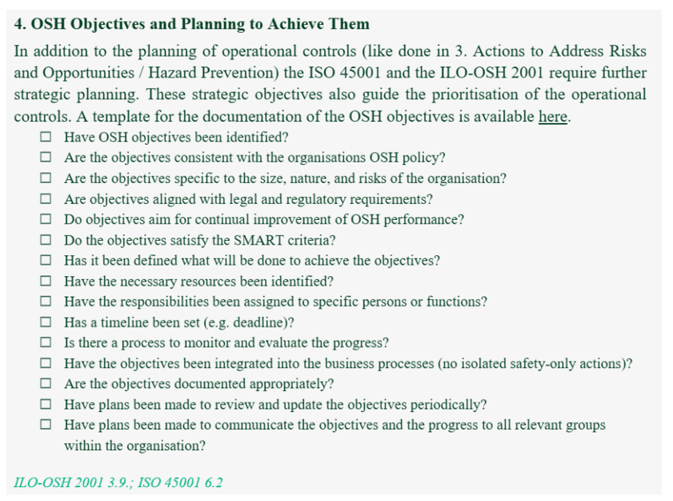
Figure 1: Checklist example “OSH Objectives and Planning to Achieve Them”.
The preparation of this example template was inspired by Asbury (2024, p. 145)4Asbury, S. Navigating ISO 45001. (CRC Press, 2024). doi:10.1201/9781032719795., which is based on ISO 45001 standard.
This template is constructed to help simplify the structural foundation of ISO 45001 standard into a more approachable form and facilitate its use in a practical work setting. This is achieved by breaking the approach of integrating OSH objectives down into smaller tasks, which can then be executed in a more manageable and clearer way. Before editing the table provided for this task, the responsible manager must insert their name and the name of the organization. Furthermore, the creation date of the template and the date of the last update must be specified. This first step helps to clearly identify the person responsible for the task and ensures that there are no disagreements about the distribution of responsibilities later on. Stating the exact start date and the date of the last update not only confirms that there has been an update during the task, but also that continued pursuit of the goal is being taken seriously and carried forward.
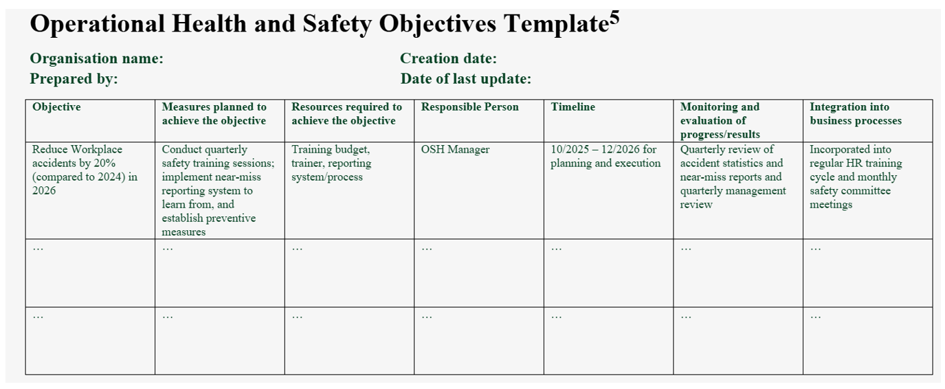
Figure 2: Template example “Operational Health and Safety Objectives Template”.
The upper row of the table names the different steps to successfully integrate new objectives over the long term. First, the objective must be described followed by the steps “Measures planned to achieve the objective” and “Resources required to achieve the objective”. The fourth column identifies the “Responsible Person” for this objective. The fifth column defines the “Timeline” and therefore asks for clearly formulated goals to achieve. The “Monitoring and evaluation of progress/results” in the next column sets an additional requirement to control and manage the outcome and in the last column a clear definition of how “Integration into business processes” is going to happen. All these steps are in line with ISO 45001 and are further defined by Asbury (2024, p. 145).4Asbury, S. Navigating ISO 45001. (CRC Press, 2024). doi:10.1201/9781032719795.
Limitations and avenues for future work
Our template takes a broad approach with the objective of facilitating a comprehensive understanding of OSH. However, this scope comes at the expense of detail in certain aspects of OSH requirements. To gain a deeper understanding, it is therefore necessary to consult additional literature and relevant requirements and standards. Furthermore, the template is currently general in nature and offers limited scope for sector-specific or context-related adjustments. Because Microsoft Word is used, interactive elements such as progress overviews or automated checklists based on previous selections are also possible only to a limited extent. Despite these limitations, the integrated links, custom templates, and referenced tools and templates provide a clear structure and facilitate navigation and access to relevant information. They also support the practical implementation of specific aspects of OSHMS, thereby adding value beyond a simple checklist. It combines the advantages of broad frameworks and operational templates and tools.
To improve the template in the future, it would be particularly valuable to develop more practical and detailed templates for specific OSHMS topics. The integration of sector-specific checklists and interactive functions using Microsoft Excel tools could increase the applicability of the template. Due to the limited time frame of this work and the complexity of OSH, it was not possible to develop more in-depth and practical templates on specific topics. The development and integration of these templates and tools represent an important step for future developments of this template.
References
- 1Ivascu, L., Artene, A., Turi, A., Balan, M. & Dufour, C. OSH – sustainability connection: innovation, education, and benefits. MATEC Web Conf. 290, 12017 (2019). ↩︎
- 2International Labour Office. Committee on Employment and Social Policy. Governing Body. Occupational Safety and Health: Synergies between Security and Productivity. 14 https://www.ilo.org/sites/default/files/wcmsp5/groups/public/%40ed_protect/%40protrav/%40safework/documents/meetingdocument/wcms_110380.pdf (2006). ↩︎
- 2International Labour Office. Committee on Employment and Social Policy. Governing Body. Occupational Safety and Health: Synergies between Security and Productivity. 14 https://www.ilo.org/sites/default/files/wcmsp5/groups/public/%40ed_protect/%40protrav/%40safework/documents/meetingdocument/wcms_110380.pdf (2006). ↩︎
- 3Forastieri, V. Improving health in the workplace: ILO’s framework for action. ↩︎
- 2International Labour Office. Committee on Employment and Social Policy. Governing Body. Occupational Safety and Health: Synergies between Security and Productivity. 14 https://www.ilo.org/sites/default/files/wcmsp5/groups/public/%40ed_protect/%40protrav/%40safework/documents/meetingdocument/wcms_110380.pdf (2006). ↩︎
- 4Asbury, S. Navigating ISO 45001. (CRC Press, 2024). doi:10.1201/9781032719795. ↩︎
- 5International Labour Organization. The Fundamental Conventions on Occupational Safety and Health: An Overview of the Occupational Safety and Health Convention, 1981 (No. 155) and the Promotional Framework for Occupational Safety and Health Convention, 2006 (No. 187). (Geneva, 2023). ↩︎
- 4Asbury, S. Navigating ISO 45001. (CRC Press, 2024). doi:10.1201/9781032719795. ↩︎
- 6Marhavilas, P. K., Pliaki, F. & Koulouriotis, D. International Management System Standards Related to Occupational Safety and Health: An Updated Literature Survey. Sustainability 14, (2022). ↩︎
- 6Marhavilas, P. K., Pliaki, F. & Koulouriotis, D. International Management System Standards Related to Occupational Safety and Health: An Updated Literature Survey. Sustainability 14, (2022). ↩︎
- 4Asbury, S. Navigating ISO 45001. (CRC Press, 2024). doi:10.1201/9781032719795. ↩︎
- 6Marhavilas, P. K., Pliaki, F. & Koulouriotis, D. International Management System Standards Related to Occupational Safety and Health: An Updated Literature Survey. Sustainability 14, (2022). ↩︎
- 4Asbury, S. Navigating ISO 45001. (CRC Press, 2024). doi:10.1201/9781032719795. ↩︎
- 4Asbury, S. Navigating ISO 45001. (CRC Press, 2024). doi:10.1201/9781032719795. ↩︎
- 7Operato, L., Gallo, A., Marino, E. A. E. & Mattioli, D. Navigating CSRD reporting: Turning compliance into sustainable development with science-based metrics. Environ. Dev. 54, 101138 (2025). ↩︎
- 8Global Reporting Initiative. GRI 403: Occupational Health and Safety 2018. (Amsterdam, 2024). ↩︎
- 9European Commission. COMMISSION DELEGATED REGULATION (EU) /… Supplementing Directive 2013/34/EU of the European Parliament and of the Council as Regards Sustainability Reporting Standards. C/2023/5303 final (2023). ↩︎
- 10ILO. Guidelines on occupational safety and health management systems (ILO-OSH 2001) | International Labour Organization. https://www.ilo.org/publications/guidelines-occupational-safety-and-health-management-systems-ilo-osh-2001 (2001). ↩︎
- 10ILO. Guidelines on occupational safety and health management systems (ILO-OSH 2001) | International Labour Organization. https://www.ilo.org/publications/guidelines-occupational-safety-and-health-management-systems-ilo-osh-2001 (2001). ↩︎
- 11OHSAS 18001 vs. ISO 45001. TÜV Süd https://www.tuvsud.com/de-de/wissenswert/newsletter/value-newsletter/1-2020/keine-audits-nach-ohsas-18001-mehr. ↩︎
- 12Brauweiler, J., Zenker-Hoffmann, A. & Will, M. Arbeitsschutzmanagementsysteme Nach ISO 45001:2018. (Springer Gabler Wiesbaden). ↩︎
- 4Asbury, S. Navigating ISO 45001. (CRC Press, 2024). doi:10.1201/9781032719795. ↩︎
- 13Soltanifar, M. ISO 45001 Implementation. (Productivity Press, 2022). doi:10.4324/9781003266532. ↩︎
- 12Brauweiler, J., Zenker-Hoffmann, A. & Will, M. Arbeitsschutzmanagementsysteme Nach ISO 45001:2018. (Springer Gabler Wiesbaden). ↩︎
- 14Topic Standard for Occupational Health and Safety. GRI https://www.globalreporting.org/standards/standards-development/topic-standard-for-occupational-health-and-safety/#:~:text=In%202018%2C%20the%20Global%20Sustainability%20Standards%20Board%20%28GSSB%29%2C,in%20occupational%20health%20and%20safety%20management%20and%20reporting. ↩︎
- 15ISO 45002:2023. International Organization for Standardization https://www.iso.org/standard/76619.html. ↩︎
- 4Asbury, S. Navigating ISO 45001. (CRC Press, 2024). doi:10.1201/9781032719795. ↩︎
- 12Brauweiler, J., Zenker-Hoffmann, A. & Will, M. Arbeitsschutzmanagementsysteme Nach ISO 45001:2018. (Springer Gabler Wiesbaden). ↩︎
- 13Soltanifar, M. ISO 45001 Implementation. (Productivity Press, 2022). doi:10.4324/9781003266532. ↩︎
- 16Weigl, C. Praxishandbuch DIN ISO 45001 – inkl. Arbeitshilfen online. (Haufe Lexware, Planegg, 2018). ↩︎
- 4Asbury, S. Navigating ISO 45001. (CRC Press, 2024). doi:10.1201/9781032719795. ↩︎
- 4Asbury, S. Navigating ISO 45001. (CRC Press, 2024). doi:10.1201/9781032719795. ↩︎
- 1Ivascu, L., Artene, A., Turi, A., Balan, M. & Dufour, C. OSH – sustainability connection: innovation, education, and benefits. MATEC Web Conf. 290, 12017 (2019). ↩︎
- 2International Labour Office. Committee on Employment and Social Policy. Governing Body. Occupational Safety and Health: Synergies between Security and Productivity. 14 https://www.ilo.org/sites/default/files/wcmsp5/groups/public/%40ed_protect/%40protrav/%40safework/documents/meetingdocument/wcms_110380.pdf (2006). ↩︎
- 2International Labour Office. Committee on Employment and Social Policy. Governing Body. Occupational Safety and Health: Synergies between Security and Productivity. 14 https://www.ilo.org/sites/default/files/wcmsp5/groups/public/%40ed_protect/%40protrav/%40safework/documents/meetingdocument/wcms_110380.pdf (2006). ↩︎
- 3Forastieri, V. Improving health in the workplace: ILO’s framework for action. ↩︎
- 2International Labour Office. Committee on Employment and Social Policy. Governing Body. Occupational Safety and Health: Synergies between Security and Productivity. 14 https://www.ilo.org/sites/default/files/wcmsp5/groups/public/%40ed_protect/%40protrav/%40safework/documents/meetingdocument/wcms_110380.pdf (2006). ↩︎
- 4Asbury, S. Navigating ISO 45001. (CRC Press, 2024). doi:10.1201/9781032719795. ↩︎
- 5International Labour Organization. The Fundamental Conventions on Occupational Safety and Health: An Overview of the Occupational Safety and Health Convention, 1981 (No. 155) and the Promotional Framework for Occupational Safety and Health Convention, 2006 (No. 187). (Geneva, 2023). ↩︎
- 4Asbury, S. Navigating ISO 45001. (CRC Press, 2024). doi:10.1201/9781032719795. ↩︎
- 6Marhavilas, P. K., Pliaki, F. & Koulouriotis, D. International Management System Standards Related to Occupational Safety and Health: An Updated Literature Survey. Sustainability 14, (2022). ↩︎
- 6Marhavilas, P. K., Pliaki, F. & Koulouriotis, D. International Management System Standards Related to Occupational Safety and Health: An Updated Literature Survey. Sustainability 14, (2022). ↩︎
- 4Asbury, S. Navigating ISO 45001. (CRC Press, 2024). doi:10.1201/9781032719795. ↩︎
- 6Marhavilas, P. K., Pliaki, F. & Koulouriotis, D. International Management System Standards Related to Occupational Safety and Health: An Updated Literature Survey. Sustainability 14, (2022). ↩︎
- 4Asbury, S. Navigating ISO 45001. (CRC Press, 2024). doi:10.1201/9781032719795. ↩︎
- 4Asbury, S. Navigating ISO 45001. (CRC Press, 2024). doi:10.1201/9781032719795. ↩︎
- 7Operato, L., Gallo, A., Marino, E. A. E. & Mattioli, D. Navigating CSRD reporting: Turning compliance into sustainable development with science-based metrics. Environ. Dev. 54, 101138 (2025). ↩︎
- 8Global Reporting Initiative. GRI 403: Occupational Health and Safety 2018. (Amsterdam, 2024). ↩︎
- 9European Commission. COMMISSION DELEGATED REGULATION (EU) /… Supplementing Directive 2013/34/EU of the European Parliament and of the Council as Regards Sustainability Reporting Standards. C/2023/5303 final (2023). ↩︎
- 10ILO. Guidelines on occupational safety and health management systems (ILO-OSH 2001) | International Labour Organization. https://www.ilo.org/publications/guidelines-occupational-safety-and-health-management-systems-ilo-osh-2001 (2001). ↩︎
- 10ILO. Guidelines on occupational safety and health management systems (ILO-OSH 2001) | International Labour Organization. https://www.ilo.org/publications/guidelines-occupational-safety-and-health-management-systems-ilo-osh-2001 (2001). ↩︎
- 11OHSAS 18001 vs. ISO 45001. TÜV Süd https://www.tuvsud.com/de-de/wissenswert/newsletter/value-newsletter/1-2020/keine-audits-nach-ohsas-18001-mehr. ↩︎
- 12Brauweiler, J., Zenker-Hoffmann, A. & Will, M. Arbeitsschutzmanagementsysteme Nach ISO 45001:2018. (Springer Gabler Wiesbaden). ↩︎
- 4Asbury, S. Navigating ISO 45001. (CRC Press, 2024). doi:10.1201/9781032719795. ↩︎
- 13Soltanifar, M. ISO 45001 Implementation. (Productivity Press, 2022). doi:10.4324/9781003266532. ↩︎
- 12Brauweiler, J., Zenker-Hoffmann, A. & Will, M. Arbeitsschutzmanagementsysteme Nach ISO 45001:2018. (Springer Gabler Wiesbaden). ↩︎
- 14Topic Standard for Occupational Health and Safety. GRI https://www.globalreporting.org/standards/standards-development/topic-standard-for-occupational-health-and-safety/#:~:text=In%202018%2C%20the%20Global%20Sustainability%20Standards%20Board%20%28GSSB%29%2C,in%20occupational%20health%20and%20safety%20management%20and%20reporting. ↩︎
- 15ISO 45002:2023. International Organization for Standardization https://www.iso.org/standard/76619.html. ↩︎
- 4Asbury, S. Navigating ISO 45001. (CRC Press, 2024). doi:10.1201/9781032719795. ↩︎
- 12Brauweiler, J., Zenker-Hoffmann, A. & Will, M. Arbeitsschutzmanagementsysteme Nach ISO 45001:2018. (Springer Gabler Wiesbaden). ↩︎
- 13Soltanifar, M. ISO 45001 Implementation. (Productivity Press, 2022). doi:10.4324/9781003266532. ↩︎
- 16Weigl, C. Praxishandbuch DIN ISO 45001 – inkl. Arbeitshilfen online. (Haufe Lexware, Planegg, 2018). ↩︎
- 4Asbury, S. Navigating ISO 45001. (CRC Press, 2024). doi:10.1201/9781032719795. ↩︎
- 4Asbury, S. Navigating ISO 45001. (CRC Press, 2024). doi:10.1201/9781032719795. ↩︎