
Authors: Anna Bertram, Melanie Bootsmann, Lina Jäde
Edited by:
Last updated: June 23, 2026
Executive summary
Stakeholder analysis and management help organizations understand who can affect, or be affected by, their decisions and activities. For organizations seeking stronger social and ecological performance, stakeholder management is not only a communication task but a strategic practice for creating value, building trust, reducing conflict, and improving long-term sustainability outcomes. The article explains that stakeholder theory has evolved from a narrow focus on shareholders and economic outputs toward a broader view that recognizes employees, customers, suppliers, regulators, NGOs, and other actors as essential contributors to organizational success.
Existing stakeholder tools offer useful but incomplete support. The Power/Interest Matrix helps classify stakeholders according to their influence and level of concern, while the Salience Model adds legitimacy and urgency to identify which groups require management attention. The Net-Map tool provides deeper insight into relationships, networks, power structures, and potential conflicts. However, these approaches can be static, subjective, time-consuming, difficult to compare across users, and limited in their ability to reflect changing stakeholder dynamics.
The proposed Excel-based stakeholder management tool addresses these limitations by combining the practical logic of the Mendelow Matrix with structured, stakeholder-specific assessment questions. Users enter stakeholders in a central worksheet, classify them by group, and assess their power and interest using standardized numerical scales. The tool then automatically calculates scores, consolidates results, assigns stakeholders to management categories, and provides action-oriented recommendations. This automation improves transparency, comparability, and consistency while reducing manual errors.
The tool distinguishes between groups such as customers, shareholders, suppliers, employees, regulatory authorities, and NGOs. For each group, tailored questions capture relevant sources of power and interest, such as financial dependence, influence over governance, supply chain criticality, operational expertise, formal regulatory authority, public pressure, or social and ecological concerns. The results classify stakeholders as Key Players, Keep Satisfied, Keep Informed, or Minimal Effort, with corresponding engagement strategies ranging from close strategic involvement to basic monitoring.
Despite its usefulness, the tool should not be treated as a stand-alone decision-making system. Its results depend on user judgment, fixed thresholds, predefined stakeholder categories, and quantitative scoring that may not fully capture informal networks, cultural values, or changing relationships. To support effective sustainability management, organizations should use the tool as a structured orientation aid, update it regularly, and complement it with contextual knowledge, dialogue, and qualitative reflection.
1 Motivation and background
In today’s fast-changing and interconnected business world, effective stakeholder management is essential for companies that want to achieve long-term sustainable success. Modern enterprises are not only responsible to their shareholders for making a profit, but also to society, their different stakeholders, and the environment. The transition to knowledge and digital economies, growing societal expectations, and global challenges such as sustainability and the COVID-19 pandemic contribute to this change. Due to these developments, structured and scientific strategies are important for identifying, analyzing, and involving stakeholder groups.1Nicolescu, O. & Nicolescu, C. Stakeholder management and social responsibility: Concepts, approaches and tools in the covid context. (Taylor & Francis, 2022).
Stakeholder management has gradually evolved into a strategic theory over time. Its origins can be traced back to the 1930s, with more formal conceptualization achieved in the 1960s and academic structuring established in the 1980s through Freeman’s work.2Fontaine, C., Haarman, A. & Schmid, S. The stakeholder theory. Edlays education 1, 1-33 (2006). Initially, the primary focus of organizations was on the technical and economic outputs, often overlooking stakeholders’ needs and voices.3Freeman, R. E. Strategic management: A stakeholder approach. (Cambridge University Press, 2010). However, it became evident that project outcomes are strongly influenced by the systematic identification of relevant stakeholders, comprehensive understanding of their influence, expectations, needs, and ethical engagement with them. Building on this development, “stakeholder theory” fundamentally explores how businesses create value and how they should operate at their best.4Freeman, R. E., Harrison, J. S., Wicks, A. C., Parmar, B. L. & De Colle, S. Stakeholder theory: The state of the art. (Cambridge University Press, 2010). Stakeholder theory offers descriptive, instrumental, and normative perspectives that go beyond simply acknowledging stakeholders’ existence. It offers practical guidelines on attitudes, structures, and practices for stakeholder engagement. While some argue that its value primarily lies in improving economic performance, the theory’s strongest foundation is normative. It is based on the idea that serving shareholders alone is morally insufficient and that the modern understanding of property rights supports a stakeholder approach. Ultimately, the theory focuses on value creation and trade. It emphasizes that companies are successful when they create value for all stakeholders. This represents a change from a reactive approach to stakeholders to a strategic, relationship-based integration throughout the entire project life cycle.5Donaldson, T. & Preston, L. E. The stakeholder theory of the corporation: Concepts, evidence, and implications. Academy of management Review 20, 65-91 (1995).
Numerous documented project failures worldwide have shown how crucial it is to manage stakeholders effectively. Poor communication and a lack of stakeholder involvement can result in loss of trust, legal penalties, reputational damage, and adverse financial consequences.6Ullah, N., Showrav, I. & Eram, M. Effects of Project Failure Towards Stakeholders: A Review of Literature. (Munich Personal RePEc Archive, 2023). One example that is often mentioned in literature is the unsuccessful U.S. LAMP-H (Lightweight Amphibious Heavy-Lift) military project. The program intended an amphibious craft for heavy logistics support, but it became bogged down by conflicting priorities among key stakeholders, including disagreements over technical requirements, cost targets, and unit numbers. The stakeholders had different ideas about the system, and the people who were supposed to make the critical decisions were not on the same page from the start. These unresolved conflicts, combined with poor communication, delays in essential documentation, and changing leadership priorities, eventually stopped the project and led to its cancellation. This case illustrates that, without structured stakeholder engagement, consensus can erode, causing technically viable projects to be lost.7Sutterfield, J. S., Friday-Stroud, S. S. & Shivers-Blackwell, S. L. A case study of project and stakeholder management failures: lessons learned. Project Management Journal 37, 26-35 (2006).
Therefore, stakeholders are individuals or groups directly or indirectly affected by, or having an influence on, an organization’s operations and decisions. Internal stakeholders, such as managers, shareholders, and employees, as well as external stakeholders, including customers, suppliers, NGOs, and the government, are the main holders of information, knowledge, and tangible resources. They have an increasing impact on a company’s activities and performance.4Freeman, R. E., Harrison, J. S., Wicks, A. C., Parmar, B. L. & De Colle, S. Stakeholder theory: The state of the art. (Cambridge University Press, 2010). All companies have stakeholders who heavily influence their activities and success, and as organizations grow in size and complexity, the number and importance of stakeholders increase. For this reason, placing the main stakeholders at the forefront of company priorities is essential, not only for large corporations, but for every enterprise.1Nicolescu, O. & Nicolescu, C. Stakeholder management and social responsibility: Concepts, approaches and tools in the covid context. (Taylor & Francis, 2022).
Stakeholder management involves identifying all relevant stakeholders and evaluating their interests, power, legitimacy, and urgency. This process requires structured communication, collaborative engagement, and ongoing relationship cultivation to handle diverse and evolving stakeholder interests. Recent research shows that companies need more practical stakeholder management tools. Digital and structured tools can enhance transparency, responsiveness, and value co-creation among diverse stakeholder groups.8Dorhetso, S. Digital Technologies and Stakeholders’ Engagement in SMEs. (SSRN (Social Science Research Network), 2025). In stakeholder management, the Mendelow Power/Interest Matrix, the Salience Model, and the Net-Map Tool are among the most commonly used instruments for analyzing and prioritizing stakeholder groups. While the Mendelow Matrix classifies stakeholders according to power and interest and the Salience Model additionally incorporates legitimacy, and urgency, the Net Map Tool focuses on the qualitative representation of social networks and power structures between stakeholders. These tools, which will be explained in more detail in the next chapter, offer important perspectives for the systematic classification and management of stakeholders.
Nevertheless, all three approaches have limitations: They are often too static to illustrate the dynamics of stakeholder attributes over the course of the project and usually reduce complex relationships to just a few categories. The evaluation is often based on subjective assessments, which makes inaccuracies and comparability more difficult. In addition, the manual effort for data collection and analysis is high, which increases errors and time requirements.9Mariani, C., Navrotska, Y. & Mancini, M. Unsupervised machine learning for project stakeholder classification: Benefits and limitations. Project Leadership and Society 4, 100093 (2023).
Based on this, we developed the idea for an Excel-based stakeholder management tool. It builds on the well-known Mendelow Matrix and similar approaches but overcomes their weaknesses. Rather than applying generic criteria to all stakeholders, the tool uses clear and structured questions, tailored to different stakeholder groups, to assess power and interest. Each question is rated on a standardized numerical scale, allowing qualitative insights to be transformed into quantifiable data. This way, qualitative opinions can be turned into measurable scores, making the evaluation more objective, transparent, and easier to compare. The systematic automation of analysis processes, which minimizes errors arising from manual data entry, and the transparent visualization of results are particularly important. These factors create a robust basis for prioritization and targeted stakeholder engagement, combined with an integrated risk assessment that identifies potential areas of conflict at an early stage. Our tool fills the gap between the theoretical foundation of classic models and practical applicability in complex, dynamic business contexts. It supports sustainable and impact-oriented management of stakeholder relationships and facilitates integration into strategic decision-making processes.
2 Existing tools/templates
The Power/Interest Matrix and the Salience Model are two of the most adopted models for stakeholder analysis.9Mariani, C., Navrotska, Y. & Mancini, M. Unsupervised machine learning for project stakeholder classification: Benefits and limitations. Project Leadership and Society 4, 100093 (2023).
The Power/Interest Matrix, based on the 2×2 matrix developed by Mendelow in 1981, tries to describe the political context in which strategies are developed by classifying stakeholders according to their level of power and interest.10Gianotti, E. & Damião da Silva, E. Strategic management of credit card fraud: stakeholder mapping of a card issuer. Journal of Financial Crime 28, 156-169 (2021).,11Mendelow, A. L. Environmental scanning–the impact of the stakeholder concept. (1981). The development of the matrix is subjective.10Gianotti, E. & Damião da Silva, E. Strategic management of credit card fraud: stakeholder mapping of a card issuer. Journal of Financial Crime 28, 156-169 (2021). However, there are still guidelines on the development defined in the literature.10Gianotti, E. & Damião da Silva, E. Strategic management of credit card fraud: stakeholder mapping of a card issuer. Journal of Financial Crime 28, 156-169 (2021).
The criterion power indicates how much official or unofficial decision-making authority the stakeholder has in the organization to enforce certain decisions. It is defined as the ability to influence, induce or even coerce a course of action. Power can be derived from an official role or a function. However, it could also be unofficial power, relating therefore to the ability to enforce a decision in the face of resistance. Generally, the criterion power is placed on the X-axis.12Neeb, H.-P. Account-Management-Strategien im B2B-Vertrieb. (Springer Books, 2022).
The criterion interest assesses how much interest a stakeholder has in the topic and whether the topic falls into their area of responsibility. It defines the willingness of a stakeholder to influence the organization’s actions. This criterion is placed on the Y-axis of the matrix.12Neeb, H.-P. Account-Management-Strategien im B2B-Vertrieb. (Springer Books, 2022).
The position of stakeholders in the Power/Interest Matrix ultimately determines the strategies that the company should pursue for its stakeholders. Stakeholders with a high level of power and a high level of interest are considered key players. It is therefore recommended that the company provides them with intensive support. Stakeholders who have a high level of power but no high level of interest are not among the most important stakeholders but should be kept satisfied by the company due to their power. Those who have no power but show a high level of interest should be kept informed by the company. Finally, stakeholders who have neither power nor interest require only minimal effort on the part of the company. Nevertheless, they should still be monitored.10Gianotti, E. & Damião da Silva, E. Strategic management of credit card fraud: stakeholder mapping of a card issuer. Journal of Financial Crime 28, 156-169 (2021).
In general, the Power/Interest Matrix is considered to be one of the most efficient tools for mapping out stakeholders and categorizing them effectively. It is a simple tool, helping project managers to categorize project stakeholders with growing interest and power in a project. It also enables the management to target key stakeholders who can determine the success or failure of a project. Furthermore, grouping stakeholders into the Power/Interest Matrix can give a clear idea about the communication and relationships of the stakeholders and their influence in a project.13Maqbool, R., Rashid, Y. & Ashfaq, S. Renewable energy project success: Internal versus external stakeholders’ satisfaction and influences of power‐interest matrix. Sustainable Development 30, 1542-1561 (2022).
The Salience Model was developed by Mitchell et al. in 1997. It determines relevant stakeholder groups and the extent to which these stakeholders are considered in the corporate decision-making process.14Poeschl, H. Strategische Unternehmensführung zwischen Shareholder-Value und Stakeholder-Value. (Springer-Verlag, 2013). This model evaluates stakeholders in terms of the presence or absence of the attributes power, legitimacy, and urgency.14Poeschl, H. Strategische Unternehmensführung zwischen Shareholder-Value und Stakeholder-Value. (Springer-Verlag, 2013).
Similar to the Power/Interest Matrix, in the Salience Model the attribute power is the ability to enforce one’s own interests and demands. However, this model differentiates between different types of power. One type would be the power to define goals and norms, the other type determines the power to influence the process organization within the scope of service provision. Both of these types are used in a power matrix to determine the kind of power a stakeholder holds. According to this, a stakeholder can have so-called “Arm’s Length Power”, determining that this stakeholder has no power over processes but does have power to influence fundamental values and goals. The stakeholders with “comprehensive power” possess both types of power and are therefore the most powerful group, while the stakeholders of the group “disempowerment” possess no power. The stakeholders of the group “operational power” only possess the power to influence the operational organization.14Poeschl, H. Strategische Unternehmensführung zwischen Shareholder-Value und Stakeholder-Value. (Springer-Verlag, 2013).
The next criterion of this model would be the attribute legitimacy, relating to the legitimacy of the stakeholders’ claims against the company.14Poeschl, H. Strategische Unternehmensführung zwischen Shareholder-Value und Stakeholder-Value. (Springer-Verlag, 2013). Generally, legitimacy should be perceived as a general assumption that the actions of an entity within a socially constructed system of norms, values and beliefs are desirable, right or appropriate.15Ali, M. A. Stakeholder salience for stakeholder firms: An attempt to reframe an important heuristic device. Journal of Business Ethics 144, 153-168 (2017). Therefore, legitimacy represents the presence of a desirable social good.15Ali, M. A. Stakeholder salience for stakeholder firms: An attempt to reframe an important heuristic device. Journal of Business Ethics 144, 153-168 (2017). Concerning the model, legitimacy must be perceived through the lens of the management when determining the degree of legitimacy of a stakeholder.15Ali, M. A. Stakeholder salience for stakeholder firms: An attempt to reframe an important heuristic device. Journal of Business Ethics 144, 153-168 (2017). For example, legitimacy can be present through property rights, moral rights, or rights derived from investments.14Poeschl, H. Strategische Unternehmensführung zwischen Shareholder-Value und Stakeholder-Value. (Springer-Verlag, 2013).
Finally, the Salience Model includes the attribute urgency which is based on two principles. First, urgency relates to time sensitivity. The company must take into account what would happen if the stakeholders’ claims were not addressed in a timely manner. Second, urgency refers to criticality, addressing the value of the claim for the stakeholder and rating the degree to which a claim calls for immediate attention.14Poeschl, H. Strategische Unternehmensführung zwischen Shareholder-Value und Stakeholder-Value. (Springer-Verlag, 2013).
These three criteria create four categories of stakeholders.14Poeschl, H. Strategische Unternehmensführung zwischen Shareholder-Value und Stakeholder-Value. (Springer-Verlag, 2013). The first category, the non-stakeholders, consists of stakeholders not possessing any of the named attributes.14Poeschl, H. Strategische Unternehmensführung zwischen Shareholder-Value und Stakeholder-Value. (Springer-Verlag, 2013). Therefore, they are not of importance for management attention.14Poeschl, H. Strategische Unternehmensführung zwischen Shareholder-Value und Stakeholder-Value. (Springer-Verlag, 2013). Second, there would be latent stakeholders who possess only one of the attributes. They are considered to be of limited importance.14Poeschl, H. Strategische Unternehmensführung zwischen Shareholder-Value und Stakeholder-Value. (Springer-Verlag, 2013). Furthermore, this category of stakeholders can also be further classified according to the attributes they possess.14Poeschl, H. Strategische Unternehmensführung zwischen Shareholder-Value und Stakeholder-Value. (Springer-Verlag, 2013). Thus, the latent stakeholders include dormant, discretionary and demanding stakeholders.16Mitchell, R. K., Agle, B. R. & Wood, D. J. Toward a theory of stakeholder identification and salience: Defining the principle of who and what really counts. Academy of management review 22, 853-886 (1997). For example, dormant stakeholders are part of the latent stakeholders, possessing power but no urgency or legitimacy.14Poeschl, H. Strategische Unternehmensführung zwischen Shareholder-Value und Stakeholder-Value. (Springer-Verlag, 2013). Therefore, it is advised to closely monitor these stakeholders in case they gain another one of the attributes.14Poeschl, H. Strategische Unternehmensführung zwischen Shareholder-Value und Stakeholder-Value. (Springer-Verlag, 2013). Apart from that, management should choose to invest their resources, time and energy into a more important group of stakeholders.16Mitchell, R. K., Agle, B. R. & Wood, D. J. Toward a theory of stakeholder identification and salience: Defining the principle of who and what really counts. Academy of management review 22, 853-886 (1997). Third, there are expectant stakeholders who possess two of the three attributes. This group deserves increased attention by the company.14Poeschl, H. Strategische Unternehmensführung zwischen Shareholder-Value und Stakeholder-Value. (Springer-Verlag, 2013). Similarly to the latent stakeholders, the expectant stakeholders can also be divided according to the attributes they possess.14Poeschl, H. Strategische Unternehmensführung zwischen Shareholder-Value und Stakeholder-Value. (Springer-Verlag, 2013). This category would include the dominant, the dependent and the dangerous stakeholders.16Mitchell, R. K., Agle, B. R. & Wood, D. J. Toward a theory of stakeholder identification and salience: Defining the principle of who and what really counts. Academy of management review 22, 853-886 (1997). For example, dangerous stakeholders possess power and urgency, but no legitimacy.14Poeschl, H. Strategische Unternehmensführung zwischen Shareholder-Value und Stakeholder-Value. (Springer-Verlag, 2013). Here, it would be advised to adopt a strategy of self-defense.17Roloff, J. Learning from multi-stakeholder networks: Issue-focussed stakeholder management. Journal of business ethics 82, 233-250 (2008). Last, the definitive stakeholders possess all three attributes. Thus, they must receive maximal attention from the company.14Poeschl, H. Strategische Unternehmensführung zwischen Shareholder-Value und Stakeholder-Value. (Springer-Verlag, 2013).
All in all, the Salience Model provides a clear picture of stakeholders and their level of authority.13Maqbool, R., Rashid, Y. & Ashfaq, S. Renewable energy project success: Internal versus external stakeholders’ satisfaction and influences of power‐interest matrix. Sustainable Development 30, 1542-1561 (2022). Thus, it helps to ensure that the different kinds of stakeholders receive the appropriate level of attention based on their actual influence.13Maqbool, R., Rashid, Y. & Ashfaq, S. Renewable energy project success: Internal versus external stakeholders’ satisfaction and influences of power‐interest matrix. Sustainable Development 30, 1542-1561 (2022). Managers can identify a specific stakeholder and immediately record the challenges for stakeholder engagement associated with each type at the same time as identification.18Mitchell, R. K. & Lee, J. H. in The Cambridge handbook of stakeholder theory Vol. 1 53-73 (2019).
However, the Salience Model as well as the Power/Interest Matrix are subject to some limitations. First, these models are considered to be too static. They cannot be used to monitor dynamism and changes occurring in stakeholders’ attributes during a project. Second, the approach of these models is also seen as too restrictive since they only consider a small number of stakeholder attributes. In accordance, the classification results would benefit from the consideration of more than these few attributes. Third, in those traditional models, the management often identifies and maps the intensity of the stakeholder attributes. This is done through brainstorming and checklists, therefore usually relying on the individual managers’ judgment. That, in turn, relies to some degree on subjectivity which can lead to vagueness and imprecision in the classification process. Last, the classification with these models is often carried out manually by drawing and updating charts and tables. Thus, there is an increased risk of errors occurring during the classification process.9Mariani, C., Navrotska, Y. & Mancini, M. Unsupervised machine learning for project stakeholder classification: Benefits and limitations. Project Leadership and Society 4, 100093 (2023).
A further relevant tool for stakeholder analysis would be the Net Map tool, developed by Eva Schiffer and first applied in 2006, concentrating on social network analysis.19Leimkühler, M. et al. Using the Net-Map tool to analyze stakeholder networks in the city region food systems of seven European cities. Frontiers in Sustainable Food Systems 8, 1315399 (2024). It is an interview-based mapping tool, used for clarifying individual perspectives in a network of actors and analyzing the structures hidden in social networks.19Leimkühler, M. et al. Using the Net-Map tool to analyze stakeholder networks in the city region food systems of seven European cities. Frontiers in Sustainable Food Systems 8, 1315399 (2024). Furthermore, it is a mixed-method approach, thus collecting both qualitative and quantitative data.19Leimkühler, M. et al. Using the Net-Map tool to analyze stakeholder networks in the city region food systems of seven European cities. Frontiers in Sustainable Food Systems 8, 1315399 (2024). For example, the material of the narratives can be analyzed qualitatively, while the actors and their links can be analyzed quantitatively.19Leimkühler, M. et al. Using the Net-Map tool to analyze stakeholder networks in the city region food systems of seven European cities. Frontiers in Sustainable Food Systems 8, 1315399 (2024). Moreover, with this tool, managers can visualize implicit knowledge, understand the interplay of networks, power relations and actors’ goals, uncover sources of conflict, facilitate knowledge exchange and learning processes, and develop visions and strategies for the achievement of goals.20Schiffer, E. & Hauck, J. Net-Map: collecting social network data and facilitating network learning through participatory influence network mapping. Field methods 22, 231-249 (2010). Additionally, the Net Map tool is flexible in the choice of formats and interview formats.19Leimkühler, M. et al. Using the Net-Map tool to analyze stakeholder networks in the city region food systems of seven European cities. Frontiers in Sustainable Food Systems 8, 1315399 (2024).
The implementation of the Net Map tool typically starts with a preparation phase. There, terminology is defined. Also, researchers could predefine links and establish a list of network members. However, predefining those is voluntary since both could also be developed during the interview process. Next, the basic idea of the tool has to be explained to the interview partners. After that, the interview partner should list all potential stakeholders and assemble them on a map. This will be followed by the definition of different links and the creation of a network. Here, the interviewer collects data about how the selected stakeholders are interconnected. In the next step, the power/influence of a stakeholder on the issue at stake will be defined and added to the map. Furthermore, the goals and motivation of the actors will be determined.20Schiffer, E. & Hauck, J. Net-Map: collecting social network data and facilitating network learning through participatory influence network mapping. Field methods 22, 231-249 (2010).
All in all, the interview process allows the interviewees to name important key persons, relationship patterns, influences, and power structures of the actors during the entire interview process.19Leimkühler, M. et al. Using the Net-Map tool to analyze stakeholder networks in the city region food systems of seven European cities. Frontiers in Sustainable Food Systems 8, 1315399 (2024). As a result, a visual network map is created which allows the analysis of social relationships as a last step of the Net Map tool.19Leimkühler, M. et al. Using the Net-Map tool to analyze stakeholder networks in the city region food systems of seven European cities. Frontiers in Sustainable Food Systems 8, 1315399 (2024).
The Net Map tool is also subject to some limitations. First, it is quite time-consuming. It takes time for the individual interviews to be carried out and the gathered information to be processed. This can also lead to the concentration of the interviewees waning which leads to less information being gathered. Additionally, further analysis of the Net Map with social network analysis algorithms will be time-consuming because of data transfer and the preparation, implementation, and analysis processes. Second, there might be problems concerning data collection since the tool uses a strict categorization of relationship types. Therefore, complexity is being reduced, and the true nuanced nature of human interaction will not be reflected anymore. Third, the results could be distorted because of the perceptions of the participants. Last, the method might not capture all stakeholders, especially those marginalized or with limited involvement.19Leimkühler, M. et al. Using the Net-Map tool to analyze stakeholder networks in the city region food systems of seven European cities. Frontiers in Sustainable Food Systems 8, 1315399 (2024).
3 New tool/template
3.1 Relevance for tool development
The development of the tool is based on proven concepts from stakeholder analysis, particularly the Mendelow Matrix, which has established itself as a practical method for systematically categorizing stakeholder groups. It offers a clear logic for classifying stakeholders and enables the allocation of management resources where they can have the greatest impact on project success or corporate strategy development, as discussed in Chapter 2.
Especially in organizational contexts where many stakeholder groups must be considered simultaneously, a systematic and transparent method is essential. The Mendelow Matrix offers an ideal foundation for this. It is easy to understand, quick to apply, and allows for a clear visualization of power and interest dynamics.11Mendelow, A. L. Environmental scanning–the impact of the stakeholder concept. (1981).
Our developed tool is conceptually based on this approach but does not adopt the classic quadrant matrix in its original form. Instead, the dimensions of power and interest are operationalized through targeted questions, captured in a standardized manner, and then transferred into categories that are inspired by the core ideas of the Mendelow Matrix.
In this way, a methodologically sound foundation is created that makes use of the matrix’s advantages while allowing for more flexible and context-specific application. The aim is not to rigidly reproduce the original model but to further develop it into a practical tool that supports both analysis and the derivation of action-oriented recommendations.
3.2 Design and structure of the tool
3.2.1 Structure, workflow and user guidance
The Excel tool is modular in design and follows a clear workflow. The aim is to systematically identify stakeholders, assess them in terms of power and interest, and derive well-supported recommendations for stakeholder management. It is suitable for both experienced project managers and beginners without prior knowledge.
The starting point is the “Dashboard” sheet, which functions as the central control panel. It provides a quick overview of the current status of the analysis and allows direct access to the relevant worksheets via hyperlinks. The following sheet, “Instructions”, explains the logic and functionality of the tool. Each step is described in an easy-to-understand way, making the analysis easily accessible even for users without methodological background (see Figure 1).
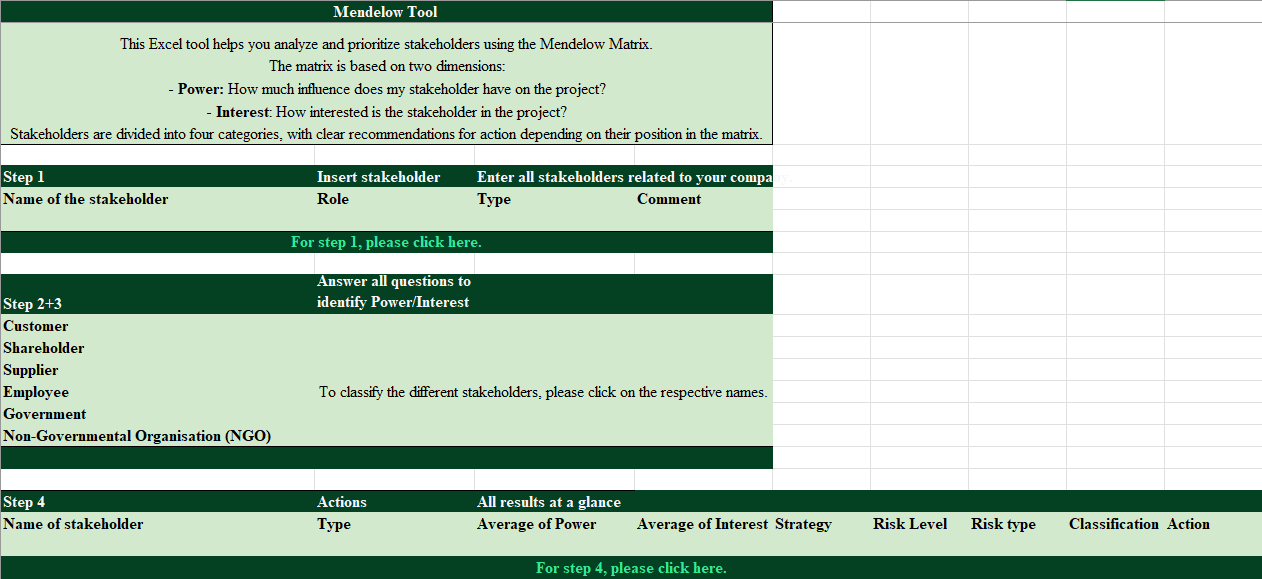
Figure 1: Instructions
3.2.2 Data basis and automation
The “Stakeholder” worksheet forms the foundation of the entire analysis and serves as the central data source (see Figure 2).
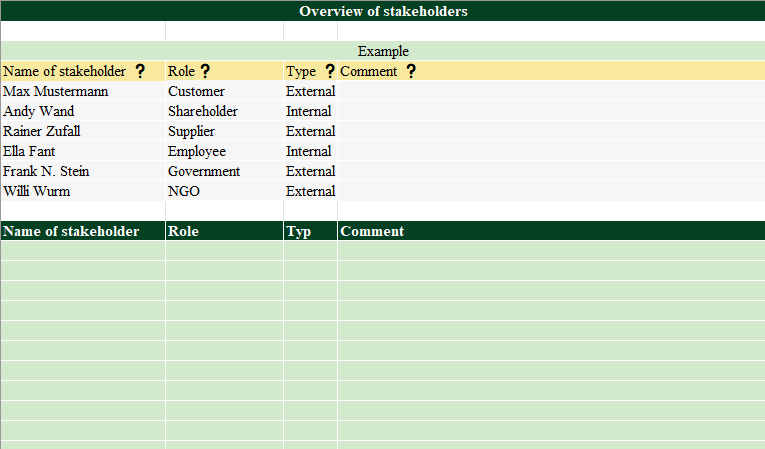
Figure 2: Stakeholder
In this section, all relevant stakeholders are entered row by row, resulting in a clear and uniform structure. For each stakeholder, various types of information can be recorded, including name or designation, role in the project or organization, and their affiliation with a stakeholder category. In addition, interests, expectations, and potential risks or conflicts that may arise from the respective position can be documented. The data input is deliberately kept simple to ensure a consistent data basis that can be easily maintained even by users without extensive experience in stakeholder management. Based on this data, the subsequent worksheets automatically access the entered information, which keeps all further analyses up to date. Changes in the “Stakeholder” sheet immediately affect the entire evaluation, including the matrix, thereby ensuring a consistent, transparent and continuously adaptable analysis.
All worksheets include integrated help symbols (“?”) that provide users with immediate access to relevant guidance or instructions.
Each stakeholder group is assigned its own analysis sheet where the dimensions “Power” and “Interest” are assessed. While “Power” reflects influence and power factors, “Interest” examines the level of concern, motivation, and interest of each group. The relevant stakeholders are automatically pulled from the “Stakeholder” data sheet, provided that both name and category are entered. The evaluation is based on scientifically grounded questions that are tailored to the specific characteristics of each stakeholder category. Figure 3 shows an example of how all worksheets are structured.
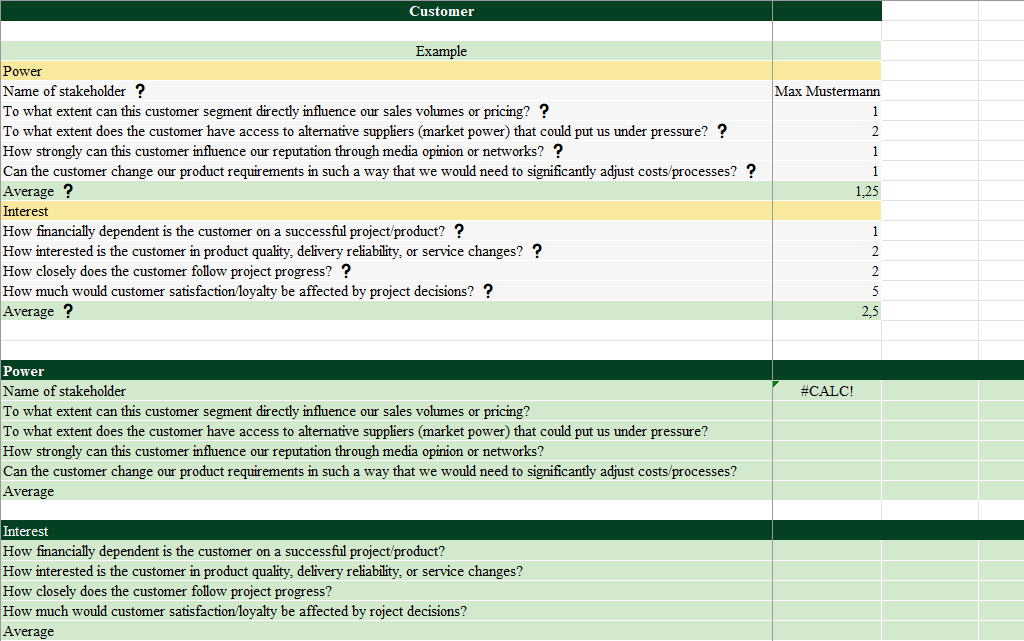
Figure 3: Customer
This results in a differentiated analysis that systematically reveals the various positions of influence and interest. All answers are recorded numerically on a standardized scale from 1 (very low) to 5 (very high). Based on this, the Excel file automatically calculates average scores per dimension and generates a Power and an Interest score for each stakeholder. Users cannot enter values outside of the given scale; otherwise, an error message appears.
In the case of customers, the analysis of the Power dimension focuses on economic and reputational factors. It evaluates, for example, to what extent customer segments can influence sales volumes or prices, whether substitution options indicate market power, and whether reputational risks arise via media channels. Additionally, it considers whether customer requirements necessitate changes to products or processes.21Hillman, A. J., Withers, M. C. & Collins, B. J. Resource dependence theory: A review. Journal of management 35, 1404-1427 (2009). The Interest dimension, on the other hand, examines how much customers depend financially on the success of the project or organization, how strong their interest in quality and service changes is, how closely they follow project progress, and how decisions affect their satisfaction and loyalty.22DesJardine, M. R., Zhang, M. & Shi, W. How shareholders impact stakeholder interests: A review and map for future research. Journal of management 49, 400-429 (2023).
For shareholders, the Power analysis focuses on formal and informal means of influence over corporate governance and capital control. It assesses how strongly shareholders can influence investment decisions or executive board resolutions, what voting rights exist, and whether the withdrawal of capital can be used as a strategic tool.16Mitchell, R. K., Agle, B. R. & Wood, D. J. Toward a theory of stakeholder identification and salience: Defining the principle of who and what really counts. Academy of management review 22, 853-886 (1997).,21Hillman, A. J., Withers, M. C. & Collins, B. J. Resource dependence theory: A review. Journal of management 35, 1404-1427 (2009).,22DesJardine, M. R., Zhang, M. & Shi, W. How shareholders impact stakeholder interests: A review and map for future research. Journal of management 49, 400-429 (2023). The Interest analysis examines financial risk and return potential, strategic investment goals, the importance of ESG criteria, and the extent of oversight of management decisions.22DesJardine, M. R., Zhang, M. & Shi, W. How shareholders impact stakeholder interests: A review and map for future research. Journal of management 49, 400-429 (2023).
The supplier group is assessed in the Power sheet primarily in terms of dependencies within the supply chain. This includes critical resources, monopoly positions, bargaining power in relation to pricing and contract terms, as well as technical requirements that may affect timelines and processes.21Hillman, A. J., Withers, M. C. & Collins, B. J. Resource dependence theory: A review. Journal of management 35, 1404-1427 (2009). In the Interest analysis, the focus lies on economic dependency on the project, the intensity of cooperation, the impact on business models, and the willingness to provide active support.21Hillman, A. J., Withers, M. C. & Collins, B. J. Resource dependence theory: A review. Journal of management 35, 1404-1427 (2009).
For employees, the Power analysis captures both formal authority and informal influence. It examines whether decision-making authority, critical expertise or operational capabilities can directly affect project success and the extent to which resistance or internal networks may play a role.23Rowley, T. J. Moving beyond dyadic ties: A network theory of stakeholder influences. Academy of management Review 22, 887-910 (1997). The Interest analysis focuses on individual and collective levels of concern, such as changes in work tasks, conditions or career opportunities. It also considers motivation, identification with the project or organization, and additional willingness to contribute.
Regulatory authorities are assessed in the Power analysis based on their formal control instruments. This includes legal regulations, approval procedures, requirements or sanctions that may delay or halt a project.24Shimshack, J. P. & Ward, M. B. Regulator reputation, enforcement, and environmental compliance. Journal of Environmental Economics and Management 50, 519-540 (2005). The Interest analysis illustrates the extent to which authorities are involved in societal objectives, their political or media interests, and the role of funding programs or regulatory developments.25Grimmelikhuijsen, S. et al. Does enforcement style influence citizen trust in regulatory agencies? An experiment in six countries. Journal of Public Administration Research and Theory 35, 29-44 (2025).
Finally, the analyses of non-governmental organizations (NGOs) examine the mechanisms of mobilization and influence that affect public perception and project legitimacy. The Power analysis investigates whether campaigns, legal actions or networks can create public pressure, while the Interest dimension evaluates the extent to which NGOs are affected by ecological, social or cultural consequences and their long-term engagement in monitoring, cooperation or compensation efforts.26Toepler, S., Zimmer, A., Fröhlich, C. & Obuch, K. The changing space for NGOs: Civil society in authoritarian and hybrid regimes. VOLUNTAS: International Journal of Voluntary and Nonprofit Organizations 31, 649-662 (2020).
3.2.3 Consolidation of results
The aggregated results of all stakeholders are consolidated in the “Results” worksheet, visually processed, and systematically classified. The underlying structure is based on the Mendelow Matrix, which is implemented here in a tabular format. Based on the calculated power and interest scores, stakeholders are automatically assigned to the following categories:
- Key Players (high power, high interest)
- Keep Satisfied (high power, low interest)
- Keep Informed (low power, high interest)
- Minimal Effort (low power, low interest)
The classification is based on a nested IF/AND logic, where a stakeholder is considered a “Key Player” if both the power and interest scores are at least 3.0. Different threshold values lead to assignment to the corresponding alternative categories. Additionally, each category is color-coded: red for high priority, yellow/blue for medium priority, and green for low priority. This enables quick orientation even in large stakeholder portfolios.
Each stakeholder category in the tool is linked to a practical recommendation for action. These suggestions are added automatically and show how and to what extent a stakeholder should be involved in the company’s strategy. This provides a structured framework based on the findings of a literature review. Since there are no consistent or universally accepted recommendations for dealing with stakeholders in academic literature, the suggestions presented here have been compiled from various sources and adapted for practical use (see Figure 4).
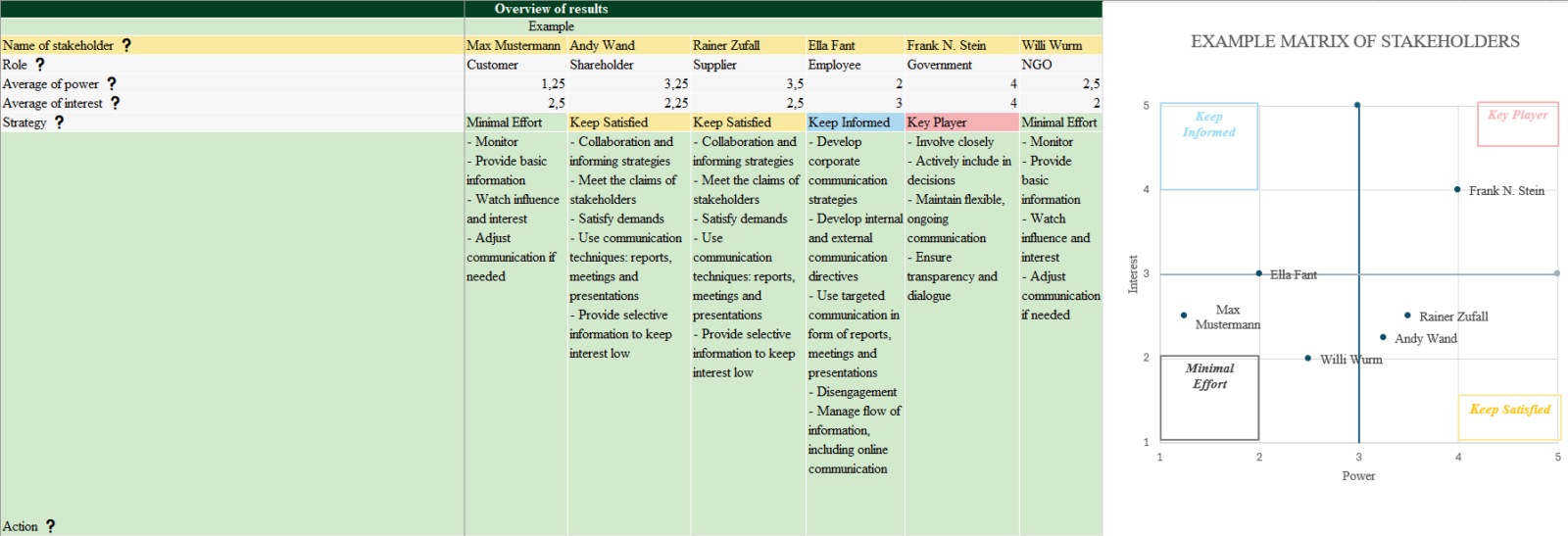
Figure 4: Results
For the category Key Players, close and strategic involvement is essential. These stakeholders should actively take part in decision-making processes, for example through steering committees, regular coordination meetings or co-creation workshops. This approach is based on the principle of management for stakeholders, which not only considers the interests and contributions of key actors but also values and integrates them visibly into strategic decisions.27Senaratne, S. & Ruwanpura, M. Communication in construction: a management perspective through case studies in Sri Lanka. Architectural Engineering and Design Management 12, 3-18 (2016). Additionally, it is advisable to maintain flexible and ongoing communication to ensure transparency and open dialogue at all times. In this way, Key Players are not just informed but treated as central partners in the project.4Freeman, R. E., Harrison, J. S., Wicks, A. C., Parmar, B. L. & De Colle, S. Stakeholder theory: The state of the art. (Cambridge University Press, 2010).,16Mitchell, R. K., Agle, B. R. & Wood, D. J. Toward a theory of stakeholder identification and salience: Defining the principle of who and what really counts. Academy of management review 22, 853-886 (1997).
For the group Keep Satisfied, it is sufficient to provide selected updates on important developments. Communication should be purposeful and limited, in order not to raise unnecessary interest that might lead to more active involvement. This strategy aims to maintain the satisfaction of powerful but less engaged stakeholders without overly activating them. Defensive approaches may also be used to reduce the influence of unsupportive actors if necessary. Managers are aware of the potential influence of these stakeholders and act accordingly to balance their interests. They aim to meet their expectations to the extent needed to secure their support, while avoiding inefficient use of resources or unnecessary disclosure of information.28Lehtinen, J., Aaltonen, K. & Rajala, R. Stakeholder management in complex product systems: Practices and rationales for engagement and disengagement. Industrial marketing management 79, 58-70 (2019).,29Reynolds, S. J., Schultz, F. C. & Hekman, D. R. Stakeholder theory and managerial decision-making: Constraints and implications of balancing stakeholder interests. Journal of business ethics 64, 285-301 (2006).
For Keep Informed, regular and targeted communication is essential for this group. This can take the form of reports, meetings or presentations. Effective communication goes beyond simply sharing information. It includes the exchange of meanings and perspectives using a shared system of understanding, whether verbal or written. Developing internal and external communication strategies, managing the flow of information, and incorporating digital tools are all part of this process. The goal is to build and maintain trust in order to ensure ongoing support. Even though these stakeholders do not have a strong influence on decisions, their involvement can positively contribute to the project’s development.28Lehtinen, J., Aaltonen, K. & Rajala, R. Stakeholder management in complex product systems: Practices and rationales for engagement and disengagement. Industrial marketing management 79, 58-70 (2019).,30Rajhans, K. Effective communication management: A key to stakeholder relationship management in project-based organizations. IUP Journal of Soft Skills 12, 47-66 (2018).
For the category Minimal Effort, a more passive approach is sufficient. This group should be monitored and provided with basic information without overwhelming them with unnecessary details. Standard communication methods such as brief status updates or newsletters are suitable for this purpose. At the same time, it is important to observe any changes in their level of influence or interest so that the stakeholder management approach can be adjusted if their role in the project changes. As long as this is not the case, it is enough to keep them in view and provide light-touch communication when needed.16Mitchell, R. K., Agle, B. R. & Wood, D. J. Toward a theory of stakeholder identification and salience: Defining the principle of who and what really counts. Academy of management review 22, 853-886 (1997).,31Eskerod, P., Huemann, M. & Ringhofer, C. Stakeholder inclusiveness: Enriching project management with general stakeholder theory. Project management journal 46, 42-53 (2015).
This worksheet, titled “Results,” also contains a sample matrix that serves as a reference to illustrate the later graphical presentation of the stakeholder analysis. In the matrix, stakeholders are positioned along two axes: Power and Interest. Their placement within these four quadrants provides guidance on the appropriate strategy for managing each stakeholder.
The displayed matrix is solely an example to demonstrate the basic principle of stakeholder classification (see Figure 4). A fully automated and dynamic visualization of all stakeholders directly in Excel is only partially feasible. Especially with a larger number of stakeholders, Excel quickly reaches its limits in terms of scaling, positioning accuracy, and clarity. Individual data points can no longer be clearly distinguished, and manual placement becomes increasingly confusing and prone to errors.
For this reason, the final matrix should be created and customized individually by the user, based on their own analysis results and by using the provided instructions and templates. This approach allows for a precise representation that is both accurate in content and visually comprehensible (see Figure 5).

Figure 5: Matrix
4 Limitations
Despite its structured approach and sound methodology, the tool presents several limitations that should be taken into account when using it. A key issue lies in the subjectivity of the evaluations. While the assessment is conducted using a standardized scale from one to five, the results are still based on the personal perceptions of the users. Different individuals may rate the same stakeholder’s power or interest differently, which can lead to distortions that may not be fully balanced out by calculating averages.32Long, H. & Wang, J. Dissecting reliability and validity evidence of subjective creativity assessment: A literature review. Educational psychology review 34, 1399-1443 (2022).
In addition, the tool works with fixed statistical threshold values. These are used in nested formulas to clearly classify stakeholders into categories. However, these thresholds are rigid and do not consider that the importance of power and interest can vary depending on the context. In certain projects, a value below the threshold may already represent considerable influence, while in others, it may have little relevance. This creates the risk that stakeholders are classified in ways that do not fully reflect their actual role.16Mitchell, R. K., Agle, B. R. & Wood, D. J. Toward a theory of stakeholder identification and salience: Defining the principle of who and what really counts. Academy of management review 22, 853-886 (1997).,33Reed, M. S. et al. Who’s in and why? A typology of stakeholder analysis methods for natural resource management. Journal of environmental management 90, 1933-1949 (2009).
Moreover, the analysis remains static while stakeholder groups are highly dynamic. People change roles, organizations shift priorities, and new stakeholders can emerge. The tool provides a snapshot that may become outdated quickly if not updated regularly. This means that continuous maintenance is required to ensure the validity of the results. Another limitation lies in the restricted flexibility of stakeholder group categories. The tool is designed for a fixed number of predefined groups. If additional groups need to be considered, or if existing categories need to be more differentiated, manual adjustments are necessary. This reduces the tool’s applicability in contexts where unusual or highly specific stakeholders are relevant.23Rowley, T. J. Moving beyond dyadic ties: A network theory of stakeholder influences. Academy of management Review 22, 887-910 (1997).
An additional point is the lack of weighting between the power and interest dimensions. The tool treats both dimensions equally, even though in certain projects or corporate strategies, power may be more significant than interest. This can lead to an underestimation of stakeholders with high power but low interest, even though they may become highly influential if they choose to act. Lastly, the method’s reduction to quantitative scales is problematic. Complex qualitative factors such as cultural values, informal networks, or personal relationships, which are often decisive in real-world projects, are difficult to capture using standardized numeric scales. This poses the risk that soft but impactful influences remain invisible.34Eden, C. & Ackermann, F. Making strategy: The journey of strategic management. (Sage, 1998).,35Olander, S. Stakeholder impact analysis in construction project management. Construction management and economics 25, 277-287 (2007).
In conclusion, although the tool is built on solid academic foundations, it is not without its weaknesses. Subjective evaluations, rigid thresholds, and limited adaptability of stakeholder categories reduce its explanatory power. For this reason, it should not be seen as the sole basis for decision-making but rather as a structured orientation aid that must be complemented by contextual judgment and regular updates.
References
- 1Nicolescu, O. & Nicolescu, C. Stakeholder management and social responsibility: Concepts, approaches and tools in the covid context. (Taylor & Francis, 2022). ↩︎
- 2Fontaine, C., Haarman, A. & Schmid, S. The stakeholder theory. Edlays education 1, 1-33 (2006). ↩︎
- 3Freeman, R. E. Strategic management: A stakeholder approach. (Cambridge University Press, 2010). ↩︎
- 4Freeman, R. E., Harrison, J. S., Wicks, A. C., Parmar, B. L. & De Colle, S. Stakeholder theory: The state of the art. (Cambridge University Press, 2010). ↩︎
- 5Donaldson, T. & Preston, L. E. The stakeholder theory of the corporation: Concepts, evidence, and implications. Academy of management Review 20, 65-91 (1995). ↩︎
- 6Ullah, N., Showrav, I. & Eram, M. Effects of Project Failure Towards Stakeholders: A Review of Literature. (Munich Personal RePEc Archive, 2023). ↩︎
- 7Sutterfield, J. S., Friday-Stroud, S. S. & Shivers-Blackwell, S. L. A case study of project and stakeholder management failures: lessons learned. Project Management Journal 37, 26-35 (2006). ↩︎
- 4Freeman, R. E., Harrison, J. S., Wicks, A. C., Parmar, B. L. & De Colle, S. Stakeholder theory: The state of the art. (Cambridge University Press, 2010). ↩︎
- 1Nicolescu, O. & Nicolescu, C. Stakeholder management and social responsibility: Concepts, approaches and tools in the covid context. (Taylor & Francis, 2022). ↩︎
- 8Dorhetso, S. Digital Technologies and Stakeholders’ Engagement in SMEs. (SSRN (Social Science Research Network), 2025). ↩︎
- 9Mariani, C., Navrotska, Y. & Mancini, M. Unsupervised machine learning for project stakeholder classification: Benefits and limitations. Project Leadership and Society 4, 100093 (2023). ↩︎
- 9Mariani, C., Navrotska, Y. & Mancini, M. Unsupervised machine learning for project stakeholder classification: Benefits and limitations. Project Leadership and Society 4, 100093 (2023). ↩︎
- 10Gianotti, E. & Damião da Silva, E. Strategic management of credit card fraud: stakeholder mapping of a card issuer. Journal of Financial Crime 28, 156-169 (2021). ↩︎
- 11Mendelow, A. L. Environmental scanning–the impact of the stakeholder concept. (1981). ↩︎
- 10Gianotti, E. & Damião da Silva, E. Strategic management of credit card fraud: stakeholder mapping of a card issuer. Journal of Financial Crime 28, 156-169 (2021). ↩︎
- 10Gianotti, E. & Damião da Silva, E. Strategic management of credit card fraud: stakeholder mapping of a card issuer. Journal of Financial Crime 28, 156-169 (2021). ↩︎
- 12Neeb, H.-P. Account-Management-Strategien im B2B-Vertrieb. (Springer Books, 2022). ↩︎
- 12Neeb, H.-P. Account-Management-Strategien im B2B-Vertrieb. (Springer Books, 2022). ↩︎
- 10Gianotti, E. & Damião da Silva, E. Strategic management of credit card fraud: stakeholder mapping of a card issuer. Journal of Financial Crime 28, 156-169 (2021). ↩︎
- 13Maqbool, R., Rashid, Y. & Ashfaq, S. Renewable energy project success: Internal versus external stakeholders’ satisfaction and influences of power‐interest matrix. Sustainable Development 30, 1542-1561 (2022). ↩︎
- 14Poeschl, H. Strategische Unternehmensführung zwischen Shareholder-Value und Stakeholder-Value. (Springer-Verlag, 2013). ↩︎
- 14Poeschl, H. Strategische Unternehmensführung zwischen Shareholder-Value und Stakeholder-Value. (Springer-Verlag, 2013). ↩︎
- 14Poeschl, H. Strategische Unternehmensführung zwischen Shareholder-Value und Stakeholder-Value. (Springer-Verlag, 2013). ↩︎
- 14Poeschl, H. Strategische Unternehmensführung zwischen Shareholder-Value und Stakeholder-Value. (Springer-Verlag, 2013). ↩︎
- 15Ali, M. A. Stakeholder salience for stakeholder firms: An attempt to reframe an important heuristic device. Journal of Business Ethics 144, 153-168 (2017). ↩︎
- 15Ali, M. A. Stakeholder salience for stakeholder firms: An attempt to reframe an important heuristic device. Journal of Business Ethics 144, 153-168 (2017). ↩︎
- 15Ali, M. A. Stakeholder salience for stakeholder firms: An attempt to reframe an important heuristic device. Journal of Business Ethics 144, 153-168 (2017). ↩︎
- 14Poeschl, H. Strategische Unternehmensführung zwischen Shareholder-Value und Stakeholder-Value. (Springer-Verlag, 2013). ↩︎
- 14Poeschl, H. Strategische Unternehmensführung zwischen Shareholder-Value und Stakeholder-Value. (Springer-Verlag, 2013). ↩︎
- 14Poeschl, H. Strategische Unternehmensführung zwischen Shareholder-Value und Stakeholder-Value. (Springer-Verlag, 2013). ↩︎
- 14Poeschl, H. Strategische Unternehmensführung zwischen Shareholder-Value und Stakeholder-Value. (Springer-Verlag, 2013). ↩︎
- 14Poeschl, H. Strategische Unternehmensführung zwischen Shareholder-Value und Stakeholder-Value. (Springer-Verlag, 2013). ↩︎
- 14Poeschl, H. Strategische Unternehmensführung zwischen Shareholder-Value und Stakeholder-Value. (Springer-Verlag, 2013). ↩︎
- 14Poeschl, H. Strategische Unternehmensführung zwischen Shareholder-Value und Stakeholder-Value. (Springer-Verlag, 2013). ↩︎
- 16Mitchell, R. K., Agle, B. R. & Wood, D. J. Toward a theory of stakeholder identification and salience: Defining the principle of who and what really counts. Academy of management review 22, 853-886 (1997). ↩︎
- 14Poeschl, H. Strategische Unternehmensführung zwischen Shareholder-Value und Stakeholder-Value. (Springer-Verlag, 2013). ↩︎
- 14Poeschl, H. Strategische Unternehmensführung zwischen Shareholder-Value und Stakeholder-Value. (Springer-Verlag, 2013). ↩︎
- 16Mitchell, R. K., Agle, B. R. & Wood, D. J. Toward a theory of stakeholder identification and salience: Defining the principle of who and what really counts. Academy of management review 22, 853-886 (1997). ↩︎
- 14Poeschl, H. Strategische Unternehmensführung zwischen Shareholder-Value und Stakeholder-Value. (Springer-Verlag, 2013). ↩︎
- 14Poeschl, H. Strategische Unternehmensführung zwischen Shareholder-Value und Stakeholder-Value. (Springer-Verlag, 2013). ↩︎
- 16Mitchell, R. K., Agle, B. R. & Wood, D. J. Toward a theory of stakeholder identification and salience: Defining the principle of who and what really counts. Academy of management review 22, 853-886 (1997). ↩︎
- 14Poeschl, H. Strategische Unternehmensführung zwischen Shareholder-Value und Stakeholder-Value. (Springer-Verlag, 2013). ↩︎
- 17Roloff, J. Learning from multi-stakeholder networks: Issue-focussed stakeholder management. Journal of business ethics 82, 233-250 (2008). ↩︎
- 14Poeschl, H. Strategische Unternehmensführung zwischen Shareholder-Value und Stakeholder-Value. (Springer-Verlag, 2013). ↩︎
- 13Maqbool, R., Rashid, Y. & Ashfaq, S. Renewable energy project success: Internal versus external stakeholders’ satisfaction and influences of power‐interest matrix. Sustainable Development 30, 1542-1561 (2022). ↩︎
- 13Maqbool, R., Rashid, Y. & Ashfaq, S. Renewable energy project success: Internal versus external stakeholders’ satisfaction and influences of power‐interest matrix. Sustainable Development 30, 1542-1561 (2022). ↩︎
- 18Mitchell, R. K. & Lee, J. H. in The Cambridge handbook of stakeholder theory Vol. 1 53-73 (2019). ↩︎
- 9Mariani, C., Navrotska, Y. & Mancini, M. Unsupervised machine learning for project stakeholder classification: Benefits and limitations. Project Leadership and Society 4, 100093 (2023). ↩︎
- 19Leimkühler, M. et al. Using the Net-Map tool to analyze stakeholder networks in the city region food systems of seven European cities. Frontiers in Sustainable Food Systems 8, 1315399 (2024). ↩︎
- 19Leimkühler, M. et al. Using the Net-Map tool to analyze stakeholder networks in the city region food systems of seven European cities. Frontiers in Sustainable Food Systems 8, 1315399 (2024). ↩︎
- 19Leimkühler, M. et al. Using the Net-Map tool to analyze stakeholder networks in the city region food systems of seven European cities. Frontiers in Sustainable Food Systems 8, 1315399 (2024). ↩︎
- 19Leimkühler, M. et al. Using the Net-Map tool to analyze stakeholder networks in the city region food systems of seven European cities. Frontiers in Sustainable Food Systems 8, 1315399 (2024). ↩︎
- 20Schiffer, E. & Hauck, J. Net-Map: collecting social network data and facilitating network learning through participatory influence network mapping. Field methods 22, 231-249 (2010). ↩︎
- 19Leimkühler, M. et al. Using the Net-Map tool to analyze stakeholder networks in the city region food systems of seven European cities. Frontiers in Sustainable Food Systems 8, 1315399 (2024). ↩︎
- 20Schiffer, E. & Hauck, J. Net-Map: collecting social network data and facilitating network learning through participatory influence network mapping. Field methods 22, 231-249 (2010). ↩︎
- 19Leimkühler, M. et al. Using the Net-Map tool to analyze stakeholder networks in the city region food systems of seven European cities. Frontiers in Sustainable Food Systems 8, 1315399 (2024). ↩︎
- 19Leimkühler, M. et al. Using the Net-Map tool to analyze stakeholder networks in the city region food systems of seven European cities. Frontiers in Sustainable Food Systems 8, 1315399 (2024). ↩︎
- 19Leimkühler, M. et al. Using the Net-Map tool to analyze stakeholder networks in the city region food systems of seven European cities. Frontiers in Sustainable Food Systems 8, 1315399 (2024). ↩︎
- 11Mendelow, A. L. Environmental scanning–the impact of the stakeholder concept. (1981). ↩︎
- 21Hillman, A. J., Withers, M. C. & Collins, B. J. Resource dependence theory: A review. Journal of management 35, 1404-1427 (2009). ↩︎
- 22DesJardine, M. R., Zhang, M. & Shi, W. How shareholders impact stakeholder interests: A review and map for future research. Journal of management 49, 400-429 (2023). ↩︎
- 16Mitchell, R. K., Agle, B. R. & Wood, D. J. Toward a theory of stakeholder identification and salience: Defining the principle of who and what really counts. Academy of management review 22, 853-886 (1997). ↩︎
- 21Hillman, A. J., Withers, M. C. & Collins, B. J. Resource dependence theory: A review. Journal of management 35, 1404-1427 (2009). ↩︎
- 22DesJardine, M. R., Zhang, M. & Shi, W. How shareholders impact stakeholder interests: A review and map for future research. Journal of management 49, 400-429 (2023). ↩︎
- 22DesJardine, M. R., Zhang, M. & Shi, W. How shareholders impact stakeholder interests: A review and map for future research. Journal of management 49, 400-429 (2023). ↩︎
- 21Hillman, A. J., Withers, M. C. & Collins, B. J. Resource dependence theory: A review. Journal of management 35, 1404-1427 (2009). ↩︎
- 21Hillman, A. J., Withers, M. C. & Collins, B. J. Resource dependence theory: A review. Journal of management 35, 1404-1427 (2009). ↩︎
- 23Rowley, T. J. Moving beyond dyadic ties: A network theory of stakeholder influences. Academy of management Review 22, 887-910 (1997). ↩︎
- 24Shimshack, J. P. & Ward, M. B. Regulator reputation, enforcement, and environmental compliance. Journal of Environmental Economics and Management 50, 519-540 (2005). ↩︎
- 25Grimmelikhuijsen, S. et al. Does enforcement style influence citizen trust in regulatory agencies? An experiment in six countries. Journal of Public Administration Research and Theory 35, 29-44 (2025). ↩︎
- 26Toepler, S., Zimmer, A., Fröhlich, C. & Obuch, K. The changing space for NGOs: Civil society in authoritarian and hybrid regimes. VOLUNTAS: International Journal of Voluntary and Nonprofit Organizations 31, 649-662 (2020). ↩︎
- 27Senaratne, S. & Ruwanpura, M. Communication in construction: a management perspective through case studies in Sri Lanka. Architectural Engineering and Design Management 12, 3-18 (2016). ↩︎
- 4Freeman, R. E., Harrison, J. S., Wicks, A. C., Parmar, B. L. & De Colle, S. Stakeholder theory: The state of the art. (Cambridge University Press, 2010). ↩︎
- 16Mitchell, R. K., Agle, B. R. & Wood, D. J. Toward a theory of stakeholder identification and salience: Defining the principle of who and what really counts. Academy of management review 22, 853-886 (1997). ↩︎
- 28Lehtinen, J., Aaltonen, K. & Rajala, R. Stakeholder management in complex product systems: Practices and rationales for engagement and disengagement. Industrial marketing management 79, 58-70 (2019). ↩︎
- 29Reynolds, S. J., Schultz, F. C. & Hekman, D. R. Stakeholder theory and managerial decision-making: Constraints and implications of balancing stakeholder interests. Journal of business ethics 64, 285-301 (2006). ↩︎
- 28Lehtinen, J., Aaltonen, K. & Rajala, R. Stakeholder management in complex product systems: Practices and rationales for engagement and disengagement. Industrial marketing management 79, 58-70 (2019). ↩︎
- 30Rajhans, K. Effective communication management: A key to stakeholder relationship management in project-based organizations. IUP Journal of Soft Skills 12, 47-66 (2018). ↩︎
- 16Mitchell, R. K., Agle, B. R. & Wood, D. J. Toward a theory of stakeholder identification and salience: Defining the principle of who and what really counts. Academy of management review 22, 853-886 (1997). ↩︎
- 31Eskerod, P., Huemann, M. & Ringhofer, C. Stakeholder inclusiveness: Enriching project management with general stakeholder theory. Project management journal 46, 42-53 (2015). ↩︎
- 32Long, H. & Wang, J. Dissecting reliability and validity evidence of subjective creativity assessment: A literature review. Educational psychology review 34, 1399-1443 (2022). ↩︎
- 16Mitchell, R. K., Agle, B. R. & Wood, D. J. Toward a theory of stakeholder identification and salience: Defining the principle of who and what really counts. Academy of management review 22, 853-886 (1997). ↩︎
- 33Reed, M. S. et al. Who’s in and why? A typology of stakeholder analysis methods for natural resource management. Journal of environmental management 90, 1933-1949 (2009). ↩︎
- 23Rowley, T. J. Moving beyond dyadic ties: A network theory of stakeholder influences. Academy of management Review 22, 887-910 (1997). ↩︎
- 34Eden, C. & Ackermann, F. Making strategy: The journey of strategic management. (Sage, 1998). ↩︎
- 35Olander, S. Stakeholder impact analysis in construction project management. Construction management and economics 25, 277-287 (2007). ↩︎
- 1Nicolescu, O. & Nicolescu, C. Stakeholder management and social responsibility: Concepts, approaches and tools in the covid context. (Taylor & Francis, 2022). ↩︎
- 2Fontaine, C., Haarman, A. & Schmid, S. The stakeholder theory. Edlays education 1, 1-33 (2006). ↩︎
- 3Freeman, R. E. Strategic management: A stakeholder approach. (Cambridge University Press, 2010). ↩︎
- 4Freeman, R. E., Harrison, J. S., Wicks, A. C., Parmar, B. L. & De Colle, S. Stakeholder theory: The state of the art. (Cambridge University Press, 2010). ↩︎
- 5Donaldson, T. & Preston, L. E. The stakeholder theory of the corporation: Concepts, evidence, and implications. Academy of management Review 20, 65-91 (1995). ↩︎
- 6Ullah, N., Showrav, I. & Eram, M. Effects of Project Failure Towards Stakeholders: A Review of Literature. (Munich Personal RePEc Archive, 2023). ↩︎
- 7Sutterfield, J. S., Friday-Stroud, S. S. & Shivers-Blackwell, S. L. A case study of project and stakeholder management failures: lessons learned. Project Management Journal 37, 26-35 (2006). ↩︎
- 4Freeman, R. E., Harrison, J. S., Wicks, A. C., Parmar, B. L. & De Colle, S. Stakeholder theory: The state of the art. (Cambridge University Press, 2010). ↩︎
- 1Nicolescu, O. & Nicolescu, C. Stakeholder management and social responsibility: Concepts, approaches and tools in the covid context. (Taylor & Francis, 2022). ↩︎
- 8Dorhetso, S. Digital Technologies and Stakeholders’ Engagement in SMEs. (SSRN (Social Science Research Network), 2025). ↩︎
- 9Mariani, C., Navrotska, Y. & Mancini, M. Unsupervised machine learning for project stakeholder classification: Benefits and limitations. Project Leadership and Society 4, 100093 (2023). ↩︎
- 9Mariani, C., Navrotska, Y. & Mancini, M. Unsupervised machine learning for project stakeholder classification: Benefits and limitations. Project Leadership and Society 4, 100093 (2023). ↩︎
- 10Gianotti, E. & Damião da Silva, E. Strategic management of credit card fraud: stakeholder mapping of a card issuer. Journal of Financial Crime 28, 156-169 (2021). ↩︎
- 11Mendelow, A. L. Environmental scanning–the impact of the stakeholder concept. (1981). ↩︎
- 10Gianotti, E. & Damião da Silva, E. Strategic management of credit card fraud: stakeholder mapping of a card issuer. Journal of Financial Crime 28, 156-169 (2021). ↩︎
- 10Gianotti, E. & Damião da Silva, E. Strategic management of credit card fraud: stakeholder mapping of a card issuer. Journal of Financial Crime 28, 156-169 (2021). ↩︎
- 12Neeb, H.-P. Account-Management-Strategien im B2B-Vertrieb. (Springer Books, 2022). ↩︎
- 12Neeb, H.-P. Account-Management-Strategien im B2B-Vertrieb. (Springer Books, 2022). ↩︎
- 10Gianotti, E. & Damião da Silva, E. Strategic management of credit card fraud: stakeholder mapping of a card issuer. Journal of Financial Crime 28, 156-169 (2021). ↩︎
- 13Maqbool, R., Rashid, Y. & Ashfaq, S. Renewable energy project success: Internal versus external stakeholders’ satisfaction and influences of power‐interest matrix. Sustainable Development 30, 1542-1561 (2022). ↩︎
- 14Poeschl, H. Strategische Unternehmensführung zwischen Shareholder-Value und Stakeholder-Value. (Springer-Verlag, 2013). ↩︎
- 14Poeschl, H. Strategische Unternehmensführung zwischen Shareholder-Value und Stakeholder-Value. (Springer-Verlag, 2013). ↩︎
- 14Poeschl, H. Strategische Unternehmensführung zwischen Shareholder-Value und Stakeholder-Value. (Springer-Verlag, 2013). ↩︎
- 14Poeschl, H. Strategische Unternehmensführung zwischen Shareholder-Value und Stakeholder-Value. (Springer-Verlag, 2013). ↩︎
- 15Ali, M. A. Stakeholder salience for stakeholder firms: An attempt to reframe an important heuristic device. Journal of Business Ethics 144, 153-168 (2017). ↩︎
- 15Ali, M. A. Stakeholder salience for stakeholder firms: An attempt to reframe an important heuristic device. Journal of Business Ethics 144, 153-168 (2017). ↩︎
- 15Ali, M. A. Stakeholder salience for stakeholder firms: An attempt to reframe an important heuristic device. Journal of Business Ethics 144, 153-168 (2017). ↩︎
- 14Poeschl, H. Strategische Unternehmensführung zwischen Shareholder-Value und Stakeholder-Value. (Springer-Verlag, 2013). ↩︎
- 14Poeschl, H. Strategische Unternehmensführung zwischen Shareholder-Value und Stakeholder-Value. (Springer-Verlag, 2013). ↩︎
- 14Poeschl, H. Strategische Unternehmensführung zwischen Shareholder-Value und Stakeholder-Value. (Springer-Verlag, 2013). ↩︎
- 14Poeschl, H. Strategische Unternehmensführung zwischen Shareholder-Value und Stakeholder-Value. (Springer-Verlag, 2013). ↩︎
- 14Poeschl, H. Strategische Unternehmensführung zwischen Shareholder-Value und Stakeholder-Value. (Springer-Verlag, 2013). ↩︎
- 14Poeschl, H. Strategische Unternehmensführung zwischen Shareholder-Value und Stakeholder-Value. (Springer-Verlag, 2013). ↩︎
- 14Poeschl, H. Strategische Unternehmensführung zwischen Shareholder-Value und Stakeholder-Value. (Springer-Verlag, 2013). ↩︎
- 16Mitchell, R. K., Agle, B. R. & Wood, D. J. Toward a theory of stakeholder identification and salience: Defining the principle of who and what really counts. Academy of management review 22, 853-886 (1997). ↩︎
- 14Poeschl, H. Strategische Unternehmensführung zwischen Shareholder-Value und Stakeholder-Value. (Springer-Verlag, 2013). ↩︎
- 14Poeschl, H. Strategische Unternehmensführung zwischen Shareholder-Value und Stakeholder-Value. (Springer-Verlag, 2013). ↩︎
- 16Mitchell, R. K., Agle, B. R. & Wood, D. J. Toward a theory of stakeholder identification and salience: Defining the principle of who and what really counts. Academy of management review 22, 853-886 (1997). ↩︎
- 14Poeschl, H. Strategische Unternehmensführung zwischen Shareholder-Value und Stakeholder-Value. (Springer-Verlag, 2013). ↩︎
- 14Poeschl, H. Strategische Unternehmensführung zwischen Shareholder-Value und Stakeholder-Value. (Springer-Verlag, 2013). ↩︎
- 16Mitchell, R. K., Agle, B. R. & Wood, D. J. Toward a theory of stakeholder identification and salience: Defining the principle of who and what really counts. Academy of management review 22, 853-886 (1997). ↩︎
- 14Poeschl, H. Strategische Unternehmensführung zwischen Shareholder-Value und Stakeholder-Value. (Springer-Verlag, 2013). ↩︎
- 17Roloff, J. Learning from multi-stakeholder networks: Issue-focussed stakeholder management. Journal of business ethics 82, 233-250 (2008). ↩︎
- 14Poeschl, H. Strategische Unternehmensführung zwischen Shareholder-Value und Stakeholder-Value. (Springer-Verlag, 2013). ↩︎
- 13Maqbool, R., Rashid, Y. & Ashfaq, S. Renewable energy project success: Internal versus external stakeholders’ satisfaction and influences of power‐interest matrix. Sustainable Development 30, 1542-1561 (2022). ↩︎
- 13Maqbool, R., Rashid, Y. & Ashfaq, S. Renewable energy project success: Internal versus external stakeholders’ satisfaction and influences of power‐interest matrix. Sustainable Development 30, 1542-1561 (2022). ↩︎
- 18Mitchell, R. K. & Lee, J. H. in The Cambridge handbook of stakeholder theory Vol. 1 53-73 (2019). ↩︎
- 9Mariani, C., Navrotska, Y. & Mancini, M. Unsupervised machine learning for project stakeholder classification: Benefits and limitations. Project Leadership and Society 4, 100093 (2023). ↩︎
- 19Leimkühler, M. et al. Using the Net-Map tool to analyze stakeholder networks in the city region food systems of seven European cities. Frontiers in Sustainable Food Systems 8, 1315399 (2024). ↩︎
- 19Leimkühler, M. et al. Using the Net-Map tool to analyze stakeholder networks in the city region food systems of seven European cities. Frontiers in Sustainable Food Systems 8, 1315399 (2024). ↩︎
- 19Leimkühler, M. et al. Using the Net-Map tool to analyze stakeholder networks in the city region food systems of seven European cities. Frontiers in Sustainable Food Systems 8, 1315399 (2024). ↩︎
- 19Leimkühler, M. et al. Using the Net-Map tool to analyze stakeholder networks in the city region food systems of seven European cities. Frontiers in Sustainable Food Systems 8, 1315399 (2024). ↩︎
- 20Schiffer, E. & Hauck, J. Net-Map: collecting social network data and facilitating network learning through participatory influence network mapping. Field methods 22, 231-249 (2010). ↩︎
- 19Leimkühler, M. et al. Using the Net-Map tool to analyze stakeholder networks in the city region food systems of seven European cities. Frontiers in Sustainable Food Systems 8, 1315399 (2024). ↩︎
- 20Schiffer, E. & Hauck, J. Net-Map: collecting social network data and facilitating network learning through participatory influence network mapping. Field methods 22, 231-249 (2010). ↩︎
- 19Leimkühler, M. et al. Using the Net-Map tool to analyze stakeholder networks in the city region food systems of seven European cities. Frontiers in Sustainable Food Systems 8, 1315399 (2024). ↩︎
- 19Leimkühler, M. et al. Using the Net-Map tool to analyze stakeholder networks in the city region food systems of seven European cities. Frontiers in Sustainable Food Systems 8, 1315399 (2024). ↩︎
- 19Leimkühler, M. et al. Using the Net-Map tool to analyze stakeholder networks in the city region food systems of seven European cities. Frontiers in Sustainable Food Systems 8, 1315399 (2024). ↩︎
- 11Mendelow, A. L. Environmental scanning–the impact of the stakeholder concept. (1981). ↩︎
- 21Hillman, A. J., Withers, M. C. & Collins, B. J. Resource dependence theory: A review. Journal of management 35, 1404-1427 (2009). ↩︎
- 22DesJardine, M. R., Zhang, M. & Shi, W. How shareholders impact stakeholder interests: A review and map for future research. Journal of management 49, 400-429 (2023). ↩︎
- 16Mitchell, R. K., Agle, B. R. & Wood, D. J. Toward a theory of stakeholder identification and salience: Defining the principle of who and what really counts. Academy of management review 22, 853-886 (1997). ↩︎
- 21Hillman, A. J., Withers, M. C. & Collins, B. J. Resource dependence theory: A review. Journal of management 35, 1404-1427 (2009). ↩︎
- 22DesJardine, M. R., Zhang, M. & Shi, W. How shareholders impact stakeholder interests: A review and map for future research. Journal of management 49, 400-429 (2023). ↩︎
- 22DesJardine, M. R., Zhang, M. & Shi, W. How shareholders impact stakeholder interests: A review and map for future research. Journal of management 49, 400-429 (2023). ↩︎
- 21Hillman, A. J., Withers, M. C. & Collins, B. J. Resource dependence theory: A review. Journal of management 35, 1404-1427 (2009). ↩︎
- 21Hillman, A. J., Withers, M. C. & Collins, B. J. Resource dependence theory: A review. Journal of management 35, 1404-1427 (2009). ↩︎
- 23Rowley, T. J. Moving beyond dyadic ties: A network theory of stakeholder influences. Academy of management Review 22, 887-910 (1997). ↩︎
- 24Shimshack, J. P. & Ward, M. B. Regulator reputation, enforcement, and environmental compliance. Journal of Environmental Economics and Management 50, 519-540 (2005). ↩︎
- 25Grimmelikhuijsen, S. et al. Does enforcement style influence citizen trust in regulatory agencies? An experiment in six countries. Journal of Public Administration Research and Theory 35, 29-44 (2025). ↩︎
- 26Toepler, S., Zimmer, A., Fröhlich, C. & Obuch, K. The changing space for NGOs: Civil society in authoritarian and hybrid regimes. VOLUNTAS: International Journal of Voluntary and Nonprofit Organizations 31, 649-662 (2020). ↩︎
- 27Senaratne, S. & Ruwanpura, M. Communication in construction: a management perspective through case studies in Sri Lanka. Architectural Engineering and Design Management 12, 3-18 (2016). ↩︎
- 4Freeman, R. E., Harrison, J. S., Wicks, A. C., Parmar, B. L. & De Colle, S. Stakeholder theory: The state of the art. (Cambridge University Press, 2010). ↩︎
- 16Mitchell, R. K., Agle, B. R. & Wood, D. J. Toward a theory of stakeholder identification and salience: Defining the principle of who and what really counts. Academy of management review 22, 853-886 (1997). ↩︎
- 28Lehtinen, J., Aaltonen, K. & Rajala, R. Stakeholder management in complex product systems: Practices and rationales for engagement and disengagement. Industrial marketing management 79, 58-70 (2019). ↩︎
- 29Reynolds, S. J., Schultz, F. C. & Hekman, D. R. Stakeholder theory and managerial decision-making: Constraints and implications of balancing stakeholder interests. Journal of business ethics 64, 285-301 (2006). ↩︎
- 28Lehtinen, J., Aaltonen, K. & Rajala, R. Stakeholder management in complex product systems: Practices and rationales for engagement and disengagement. Industrial marketing management 79, 58-70 (2019). ↩︎
- 30Rajhans, K. Effective communication management: A key to stakeholder relationship management in project-based organizations. IUP Journal of Soft Skills 12, 47-66 (2018). ↩︎
- 16Mitchell, R. K., Agle, B. R. & Wood, D. J. Toward a theory of stakeholder identification and salience: Defining the principle of who and what really counts. Academy of management review 22, 853-886 (1997). ↩︎
- 31Eskerod, P., Huemann, M. & Ringhofer, C. Stakeholder inclusiveness: Enriching project management with general stakeholder theory. Project management journal 46, 42-53 (2015). ↩︎
- 32Long, H. & Wang, J. Dissecting reliability and validity evidence of subjective creativity assessment: A literature review. Educational psychology review 34, 1399-1443 (2022). ↩︎
- 16Mitchell, R. K., Agle, B. R. & Wood, D. J. Toward a theory of stakeholder identification and salience: Defining the principle of who and what really counts. Academy of management review 22, 853-886 (1997). ↩︎
- 33Reed, M. S. et al. Who’s in and why? A typology of stakeholder analysis methods for natural resource management. Journal of environmental management 90, 1933-1949 (2009). ↩︎
- 23Rowley, T. J. Moving beyond dyadic ties: A network theory of stakeholder influences. Academy of management Review 22, 887-910 (1997). ↩︎
- 34Eden, C. & Ackermann, F. Making strategy: The journey of strategic management. (Sage, 1998). ↩︎
- 35Olander, S. Stakeholder impact analysis in construction project management. Construction management and economics 25, 277-287 (2007). ↩︎