
Authors: Ricardo Andres Martinez Shi, Kerolos Mekhail, Rocio Evelina Ramirez Rojas
Edited by:
Last updated: June 18, 2026
Executive summary
Corporate philanthropy has evolved from charitable giving into a strategic management practice that can create social value while strengthening organizational legitimacy, reputation, stakeholder trust, and long-term competitiveness. For organizations seeking to improve social and ecological performance, the central lesson is that philanthropy should not be treated as isolated donations. It should be aligned with the organization’s purpose, capabilities, stakeholder needs, and broader sustainability strategy.
The article traces this evolution through the development of corporate social responsibility and shows how strategic corporate philanthropy builds on a company’s core competencies to support public-interest goals. Common approaches include community grants, corporate foundations, sponsorships, gift matching, venture philanthropy, in-kind contributions, and employee volunteering. These approaches can generate business benefits, but only when they are authentic, well-governed, and consistent with the company’s activities and values. Poor alignment can create reputational risks, especially when giving appears self-serving or disconnected from a company’s real social and environmental impacts.
Measurement and reporting are essential for making philanthropy credible and useful. The IOOI method helps organizations distinguish between inputs, outputs, outcomes, and long-term impacts, while the B4SI framework offers a practical structure for tracking community investment, business innovation for social impact, and procurement for social impact. Both approaches emphasize the need for clear indicators, reliable data collection, defined responsibilities, transparent reporting, and realistic evaluation methods.
The proposed Excel-based tool adapts the B4SI logic into an accessible template for organizations beginning to systematize philanthropic initiatives. It supports data collection, initiative classification, performance tracking, and dashboard-based communication for managers and stakeholders. While it cannot replace a fully customized impact assessment, it provides a practical starting point for documenting contributions, improving decision-making, and building a culture of continuous learning. The article concludes that strategic philanthropy is most effective when it is genuine, measurable, transparent, and closely connected to the organization’s expertise and sustainability ambitions.
1 Introduction
In an increasingly interconnected and socially conscious world, businesses are expected not only to generate profits but also to contribute meaningfully to the societies in which they operate. Corporate philanthropy initially emerged as a prominent way for companies to fulfill this expectation, representing a voluntary effort to support social causes while gaining recognition among their customers and stakeholders. It has shifted from being viewed simply as a social initiative to being considered an important business practice that demands proper management and dedicated tools to accurately track and measure its impact.
Specifically, strategic corporate philanthropy has gained recognition as a powerful business tool for creating both societal value and business benefits when managed properly. Like any business strategy, organizations should understand its limitations and risks to achieve optimal results.
This paper explores the conceptual foundations of philanthropy, tracing its origins from charitable acts to a more strategic approach that aligns with a company’s core strengths and long-term objectives.
The establishment of an efficient system for the collection, measurement, and reporting of corporate giving outcomes has become essential. This necessity led to a comprehensive analysis of various existing theoretical frameworks used in the field, including the IOOI method and the B4SI Model. These provide structured approaches for the assessment and evaluation of philanthropic initiatives.
The B4SI-based framework serves as the baseline for our proposed tool for collecting, tracking, and measuring corporate philanthropy. It provides an accessible and effective first step toward strategic corporate philanthropy by adapting proven methods into a simplified version that any company can use.
2 The history and evolution of corporate philanthropy
2.1 Early beginnings and legal frameworks
To begin discussing corporate philanthropy, it is necessary to begin by discussing the origins of this practice, specifically focusing on the history of corporate social responsibility over time. Philanthropy was appearing on the scene in the late 1800s, but it was difficult to determine whether it stemmed from personal motives or was part of business activities.1Carroll, A. B. A History of Corporate Social Responsibility: Concepts and Practices. in The Oxford Handbook of Corporate Social Responsibility (eds Crane, A., Matten, D., McWilliams, A., Moon, J. & Siegel, D. S.) 0 (Oxford University Press, 2008). doi:10.1093/oxfordhb/9780199211593.003.0002. There is debate about when CSR practices first emerged, even though they were not labeled as such, mentions from the time of the Industrial Revolution can be taken as a first starting point.1Carroll, A. B. A History of Corporate Social Responsibility: Concepts and Practices. in The Oxford Handbook of Corporate Social Responsibility (eds Crane, A., Matten, D., McWilliams, A., Moon, J. & Siegel, D. S.) 0 (Oxford University Press, 2008). doi:10.1093/oxfordhb/9780199211593.003.0002. This is attributable to the rising demand for businesses and increased labor force characteristic of that period of heightened productivity. Emerging businesses were especially concerned with employees and how to make them more productive workers.1Carroll, A. B. A History of Corporate Social Responsibility: Concepts and Practices. in The Oxford Handbook of Corporate Social Responsibility (eds Crane, A., Matten, D., McWilliams, A., Moon, J. & Siegel, D. S.) 0 (Oxford University Press, 2008). doi:10.1093/oxfordhb/9780199211593.003.0002.
From that moment on, different steps were taken to formally address Corporate Social Responsibility as such. A good argument can be made that CSR began to take form in the 1950s.1Carroll, A. B. A History of Corporate Social Responsibility: Concepts and Practices. in The Oxford Handbook of Corporate Social Responsibility (eds Crane, A., Matten, D., McWilliams, A., Moon, J. & Siegel, D. S.) 0 (Oxford University Press, 2008). doi:10.1093/oxfordhb/9780199211593.003.0002. Howard R. Bowen published his landmark book “Social Responsibilities of the Businessman” in 1951. This publication is widely recognized as marking the beginning of CSR in its modern form.2Carroll, A. B. Carroll’s pyramid of CSR: taking another look. Int. J. Corp. Soc. Responsib. 1, 3 (2016). Bowen mentions that this change in scope among businessmen occurred as more individuals started to recognize their expected responsibilities toward society.3Bowen, H. R. Social Responsibilities of the Businessman. (Iowa City: University of Iowa Press, 2013).
Some of the specific purposes of the educational efforts by businesspeople at the time proposed to achieve better public relations in the communities in which the individual businesses operate and to develop more favorable attitudes toward the companies among the consumers.3Bowen, H. R. Social Responsibilities of the Businessman. (Iowa City: University of Iowa Press, 2013).
2.2 Emergence of corporate social responsibility
CSR was initiated to expand the reach of a firm’s influence. Businessmen started to think about the decisions and actions taken for reasons, at least partially, beyond the firm’s direct economic or technical interest.4Davis, K. Can Business Afford to Ignore Social Responsibilities? Calif. Manage. Rev. 2, 70–76 (1960). In the early stages, Corporate Social Responsibility was often referred to as social responsibility (SR) more than corporate social responsibility (CSR) for many years.1Carroll, A. B. A History of Corporate Social Responsibility: Concepts and Practices. in The Oxford Handbook of Corporate Social Responsibility (eds Crane, A., Matten, D., McWilliams, A., Moon, J. & Siegel, D. S.) 0 (Oxford University Press, 2008). doi:10.1093/oxfordhb/9780199211593.003.0002. The literature identifies that the 1960s marked a momentous growth in attempts to formalize or more precisely state what CSR meant.1Carroll, A. B. A History of Corporate Social Responsibility: Concepts and Practices. in The Oxford Handbook of Corporate Social Responsibility (eds Crane, A., Matten, D., McWilliams, A., Moon, J. & Siegel, D. S.) 0 (Oxford University Press, 2008). doi:10.1093/oxfordhb/9780199211593.003.0002.
From 1974-1978 and continuing beyond, companies began taking serious management and organizational actions to address CSR issues.1Carroll, A. B. A History of Corporate Social Responsibility: Concepts and Practices. in The Oxford Handbook of Corporate Social Responsibility (eds Crane, A., Matten, D., McWilliams, A., Moon, J. & Siegel, D. S.) 0 (Oxford University Press, 2008). doi:10.1093/oxfordhb/9780199211593.003.0002. Archie Carroll (1979) published “A Three-Dimensional Conceptual model of Corporate Performance”, in which a model to encapsulate what corporate social performance should answer was proposed.5Carroll, A. B. A Three-Dimensional Conceptual Model of Corporate Performance. Acad. Manage. Rev. 4, 497–505 (1979). Carroll also disaggregated what the core business obligations toward society should be, these proposed categories being: Economic, Legal, Ethical, and Discretionary (Philanthropic).5Carroll, A. B. A Three-Dimensional Conceptual Model of Corporate Performance. Acad. Manage. Rev. 4, 497–505 (1979). This was among the earliest formal definitions of CSR’s objectives that helped create a foundation and delineated the aspects of businesses’ responsibilities to society. This framework was then depicted as a pyramid by Carroll (1991) through the pyramid of corporate social responsibility.6Carroll, A. B. The pyramid of corporate social responsibility: Toward the moral management of organizational stakeholders. Bus. Horiz. 34, 39–48 (1991).
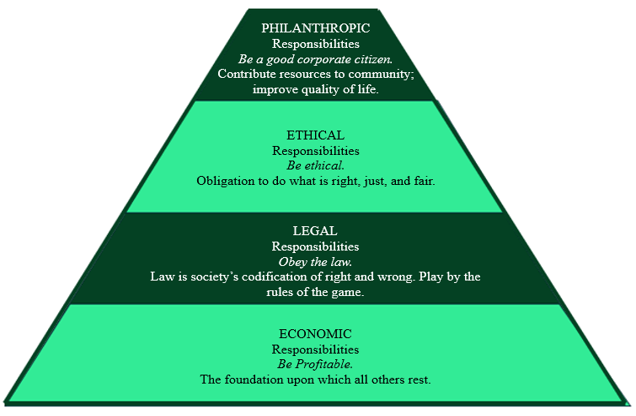
Figure 1: The pyramid of corporate social responsibility, own elaboration based on Carroll (1991)6Carroll, A. B. The pyramid of corporate social responsibility: Toward the moral management of organizational stakeholders. Bus. Horiz. 34, 39–48 (1991).
In summary, “the pyramid entails the simultaneous fulfillment of the firm’s responsibilities”, which are the aspects that the companies must balance to define their CSR orientation and reputation.6Carroll, A. B. The pyramid of corporate social responsibility: Toward the moral management of organizational stakeholders. Bus. Horiz. 34, 39–48 (1991).
The trend that characterized the 1990s and continues today is the emergence of many different companies that have developed excellent reputations for CSR practices.1Carroll, A. B. A History of Corporate Social Responsibility: Concepts and Practices. in The Oxford Handbook of Corporate Social Responsibility (eds Crane, A., Matten, D., McWilliams, A., Moon, J. & Siegel, D. S.) 0 (Oxford University Press, 2008). doi:10.1093/oxfordhb/9780199211593.003.0002. That was the preface of the CSR movement later seen as a global phenomenon among multinationals around the globe. The interest and growth of CSR has been most evident in the European Community.1Carroll, A. B. A History of Corporate Social Responsibility: Concepts and Practices. in The Oxford Handbook of Corporate Social Responsibility (eds Crane, A., Matten, D., McWilliams, A., Moon, J. & Siegel, D. S.) 0 (Oxford University Press, 2008). doi:10.1093/oxfordhb/9780199211593.003.0002. Businesses are missing out if they aren’t participating in CSR as it has become an integral part of doing business and is increasingly driving consumer choice, laying the scope of CSR into different practices that companies can choose in order to gain recognition among society.
Kotler (2011) categorized CSR practices into six major types of initiatives that frame effectively what CSR is all about: (1) cause promotion; (2) cause‐related marketing; (3) corporate social marketing; (4) corporate philanthropy; (5) community volunteering; and (6) socially responsible business practices.7Kotler, P. & Lee, N. R. Corporate Social Responsibility: Doing the Most Good for Your Company and Your Cause. (John Wiley & Sons, 2011).
Corporate philanthropy represents only one aspect of the broader CSR framework, however, according to Gautier (2013), it is very important and can be viewed as a monetary (or equivalent) expression of a firm’s care for the society that surrounds it.8Gautier, A. & Pache, A.-C. Research on Corporate Philanthropy: A Review and Assessment. J. Bus. Ethics 126, 343–369 (2013). The following chapter will review existing literature on corporate philanthropy in greater detail.
2.3 Foundational literature on corporate philanthropy
2.3.1 Early beginnings
As with CSR, the roots of corporate philanthropy can be traced back to the nineteenth century. Prior to the 1900s, corporate contributions were perceived by many in a negative light, being seen as giving away stockholders’ assets without their approval.1Carroll, A. B. A History of Corporate Social Responsibility: Concepts and Practices. in The Oxford Handbook of Corporate Social Responsibility (eds Crane, A., Matten, D., McWilliams, A., Moon, J. & Siegel, D. S.) 0 (Oxford University Press, 2008). doi:10.1093/oxfordhb/9780199211593.003.0002. But as with CSR, its conception and definition have evolved over time to reach their current form.
Philanthropy, probably one of the most tangible CSR practices, grew in popularity from the Community Chest movement, later called the United Way. It, too, began in about the 1920s.1Carroll, A. B. A History of Corporate Social Responsibility: Concepts and Practices. in The Oxford Handbook of Corporate Social Responsibility (eds Crane, A., Matten, D., McWilliams, A., Moon, J. & Siegel, D. S.) 0 (Oxford University Press, 2008). doi:10.1093/oxfordhb/9780199211593.003.0002. The period of the 1870s–1930s should be considered the ‘prelegalization period’ of corporate contributions.1Carroll, A. B. A History of Corporate Social Responsibility: Concepts and Practices. in The Oxford Handbook of Corporate Social Responsibility (eds Crane, A., Matten, D., McWilliams, A., Moon, J. & Siegel, D. S.) 0 (Oxford University Press, 2008). doi:10.1093/oxfordhb/9780199211593.003.0002. Philanthropy continued as the most noticeable manifestation of CSR during the 1960s.1Carroll, A. B. A History of Corporate Social Responsibility: Concepts and Practices. in The Oxford Handbook of Corporate Social Responsibility (eds Crane, A., Matten, D., McWilliams, A., Moon, J. & Siegel, D. S.) 0 (Oxford University Press, 2008). doi:10.1093/oxfordhb/9780199211593.003.0002. During the late 1980s and into the 1990s, philanthropy expanded considerably, as more global companies appeared in the economy, management positions dedicated to corporate giving began proliferating on the organizational charts of major companies.1Carroll, A. B. A History of Corporate Social Responsibility: Concepts and Practices. in The Oxford Handbook of Corporate Social Responsibility (eds Crane, A., Matten, D., McWilliams, A., Moon, J. & Siegel, D. S.) 0 (Oxford University Press, 2008). doi:10.1093/oxfordhb/9780199211593.003.0002.
Corporate philanthropy has the potential to create multiple benefits for a business, including enhanced reputation, legitimacy, local integration, network creation, knowledge acquisition, institutional acceptance, and stakeholder trust.9Casajús-Burutaran, A., Ambos, T. C. & Probst, G. Do You Have a Corporate Philanthropy Strategy? (2023). Although this practice is widely acknowledged and respected within society, there is also a risk inherent to Corporate Philanthropy, which highlights the importance for a company to carefully consider how to direct its philanthropic efforts. It is not just about giving without a plan, as the heart’s emotional impulses must be coupled with the brain’s logic to have a truly great corporate philanthropy program.10McClimon, Timothy J. The Shape of Corporate Philanthropy Yesterday and Today | Grantmakers in the Arts. Grantmakers in the Arts vol. 15 (2004). Corporate philanthropy should be reconsidered to ensure it aligns strategically with the company’s overall objectives, establishing the basis for the term Strategic Corporate Philanthropy.
2.4 Strategic corporate philanthropy
2.4.1 Definition & strategies
Strategic philanthropy is considered the most effective approach by taking into account both the needs of the stakeholders and the internal competence of the company.11Ásványi, K. Corporate Philanthropy. in (2023). doi:10.1007/978-3-031-25984-5_1090. It transforms the approach of monetary (or equivalents) donations by linking CSR to the company’s goals.11Ásványi, K. Corporate Philanthropy. in (2023). doi:10.1007/978-3-031-25984-5_1090.
While corporate social responsibility (CSR) is part of most companies’ business strategies, philanthropy often remains disconnected from core business objectives.9Casajús-Burutaran, A., Ambos, T. C. & Probst, G. Do You Have a Corporate Philanthropy Strategy? (2023). This new conception of philanthropy pushes the definition toward a voluntary giving that now builds on the company’s core competencies (using the company’s unique skills, expertise or resources) to achieve social impact while improving its competitive edge.9Casajús-Burutaran, A., Ambos, T. C. & Probst, G. Do You Have a Corporate Philanthropy Strategy? (2023). The drivers behind the realization of corporate philanthropy should be chosen separately based on whether it is individual, corporate, or industry motivations.11Ásványi, K. Corporate Philanthropy. in (2023). doi:10.1007/978-3-031-25984-5_1090. This redefinition requires a more thoughtful and customized approach as it’s not a “one-size-fits-all” for every company’s expertise.
Some of the questions that Gautier (2013) links to this new process of thought are Why would corporations curb their objective of increasing profits to give money away to nice causes? What would have them fund causes and organizations seemingly peripheral to their core business?8Gautier, A. & Pache, A.-C. Research on Corporate Philanthropy: A Review and Assessment. J. Bus. Ethics 126, 343–369 (2013). These questions aim to find a solution or at least partially address the lack of strategic focus and professionalism, making these contributions meaningfully beneficial to the company as part of the goals.
The literature focuses on some main types or practices of corporate philanthropy engagement:9Casajús-Burutaran, A., Ambos, T. C. & Probst, G. Do You Have a Corporate Philanthropy Strategy? (2023).
- Community grants: The company supports local community efforts or nonprofits with financial or in-kind contributions.
- Corporate foundations: The company establishes and funds an independent legal entity to manage its philanthropic projects. These can be directly operated by the foundation or co-led through partnerships or grant giving.
- Corporate sponsoring: The company finances the events, projects, or programs of a nonprofit organization.
- Gift matching: The company matches the charitable donation of an employee, usually at a 1:1 ratio.
- Venture philanthropy: The corporation takes the principles of venture capital financing to select, guide, and support a charitable project. This is often done through a corporate foundation.
Gift matching has led the way for many years in the United States. Coca-Cola, Google, and Walt Disney are just a few of the many multinationals that now engage in more than one type of corporate philanthropy.9Casajús-Burutaran, A., Ambos, T. C. & Probst, G. Do You Have a Corporate Philanthropy Strategy? (2023). The Coca-Cola Company’s philanthropy has earned it a reputation for being a “local citizen” in nearly 200 countries.10McClimon, Timothy J. The Shape of Corporate Philanthropy Yesterday and Today | Grantmakers in the Arts. Grantmakers in the Arts vol. 15 (2004). The philanthropic reputation of these companies shows how Strategic Corporate Philanthropy can contribute to the company’s image, turning these into a powerful tool to foster a positive relationship with consumers globally. It is uncommon to encounter someone who is unfamiliar with Coca-Cola’s philanthropic initiatives and the positive effects these programs have had on the company’s brand image. As McClimon (2004) states, “being socially responsible, indeed, does result in financial gains, particularly through an impact on customer loyalty”.10McClimon, Timothy J. The Shape of Corporate Philanthropy Yesterday and Today | Grantmakers in the Arts. Grantmakers in the Arts vol. 15 (2004).
As corporate social responsibility continues to evolve, incorporating these practices into decision-making processes is becoming essential for companies seeking to achieve their economic goals and maintain strong brand recognition among consumers.
2.4.2 New challenges for corporate philanthropy
Strategic Corporate Philanthropy has evolved significantly to reach its current definition, as have the current challenges it faces in the 21st century. Based on the literature, corporate philanthropy is not merely about making charitable donations but about establishing strategic objectives that are integrated with the company’s vision. All actions and strategic decisions can have both positive and negative repercussions, which may be either intended or unintended. McClimon (2004) raises the question of how a corporation link its business interests with the interests of its communities without appearing too self-serving?10McClimon, Timothy J. The Shape of Corporate Philanthropy Yesterday and Today | Grantmakers in the Arts. Grantmakers in the Arts vol. 15 (2004). As previously mentioned, Corporate Philanthropy, even when well intentioned, can pose a risk to a company’s brand image if not given the correct approach.
During the Covid-19 pandemic, Philip Morris International was strongly criticized due to a philanthropic donation that was initially conceived as a positive and useful strategy.12Chapman, Matthew. Big Tobacco criticised for ‘coronavirus publicity stunt’ after…. TBIJ https://www.thebureauinvestigates.com/stories/2020-03-30/pmi-criticised-for-coronavirus-pr-stunt-ventilator-donation. A donation of 50 ventilators to a hospital was later categorized by many as a “shameful publicity stunt” as the core business of the company was identified as a contributing factor to worsened expected outcomes of people affected by Covid-19.
The ability of corporate philanthropy professionals to steer through this maze of questions is a major challenge and an opportunity for those corporations who are engaged in strategic philanthropy.10McClimon, Timothy J. The Shape of Corporate Philanthropy Yesterday and Today | Grantmakers in the Arts. Grantmakers in the Arts vol. 15 (2004). As seen with Philip Morris case, it’s not just about donating but also about ensuring that “the giving” is a strategic, authentic, and helpful act to avoid being categorized as a PR maneuver.
When building a corporate philanthropy strategy, a business’s most important decisions revolve around three central issues: what topics to engage in, which parts of the company can support these efforts, and how to maximize impact.9Casajús-Burutaran, A., Ambos, T. C. & Probst, G. Do You Have a Corporate Philanthropy Strategy? (2023). The structure of the industry itself strongly influences the extent of philanthropic activities.11Ásványi, K. Corporate Philanthropy. in (2023). doi:10.1007/978-3-031-25984-5_1090. The company’s strategic philanthropic actions must be consistent with its core practices to maintain its reputation and public trust.
Another debate among companies now is whether they decide to house some projects through external entities or internally. Some companies are establishing corporate foundations, which are legally independent entities that work exclusively on philanthropic activities.9Casajús-Burutaran, A., Ambos, T. C. & Probst, G. Do You Have a Corporate Philanthropy Strategy? (2023). This way, companies’ philanthropic efforts can be perceived as more objective toward social welfare.
3 Existent tools or templates
3.1 The IOOI matrix
The IOOI method is a well-known results-based management (RBM) framework used especially in program evaluation, monitoring, and impact measurement. The method itself was not designed in the context of corporate social responsibility, but merely as an impact measurement tool; although it has recently been used particularly in the nonprofit, social impact, and development sectors.13Bertelsmann Stiftung. Gesellschaftliches Unternehmensengagement strategisch ausrichten – Die iooi-Methode. https://www.bertelsmann-stiftung.de/de/unsere-projekte/abgeschlossene-projekte/cri-corporate-responsibility-index/projektthemen/die-iooi-methode (2010).
Due to the lack of tools to measure Corporate Social Responsibility (CSR) impacts, the Bertelsmann Foundation and other interested organizations evaluated different approaches and proposed guidelines to use the IOOI method as an impact measurement in this context as it offers a general and structured approach to understand and improve the effects of initiatives in a broad spectrum.14Birgit Riess. Corporate Citizenship planen und messen mit der iooi-Methode. https://www.bertelsmann-stiftung.de/de/publikationen/publikation/did/corporate-citizenship-planen-und-messen-mit-der-iooi-methode.
The abbreviation stands for: input, output, outcome, and impact. The method starts with inputs, which are the resources and activities invested in a project, such as financial capital, personnel, infrastructure, or social contributions like time and labor. These inputs lead to outputs, the immediate results or services delivered (e.g., materials distributed), which in turn produce outcomes, concrete changes observed at the level of the target group, such as increased knowledge, behavioral shifts, or improved skills. Finally, the model captures impact, understood as the long-term social changes triggered by the intervention.15Sauer, S., Bartolomucci, F., Groot, M., Then, V. & Jacob, F. Closing the gap: The comprehensive approach to measure societal impact. Soc. Impacts 5, 100111 (2025).
The application of the IOOI method not only creates a shared basis of understanding and language among all stakeholders involved but also provides a powerful tool for the active and strategic management of corporate social engagement, as well as greater transparency regarding its outcomes.14Birgit Riess. Corporate Citizenship planen und messen mit der iooi-Methode. https://www.bertelsmann-stiftung.de/de/publikationen/publikation/did/corporate-citizenship-planen-und-messen-mit-der-iooi-methode.
While the IOOI model offers a structured approach to measuring social engagement, several limitations should be considered. First, assessing long-term impact is inherently complex and resource-intensive. Impacts often emerge over extended periods and can be influenced by numerous external factors, making attribution to a single intervention difficult. Second, the model is not equally applicable to all types of projects.13Bertelsmann Stiftung. Gesellschaftliches Unternehmensengagement strategisch ausrichten – Die iooi-Methode. https://www.bertelsmann-stiftung.de/de/unsere-projekte/abgeschlossene-projekte/cri-corporate-responsibility-index/projektthemen/die-iooi-methode (2010).
In smaller or short-term initiatives, applying the full IOOI logic may be unnecessary or impractical; focusing on inputs, outputs, and immediate outcomes may be sufficient.14Birgit Riess. Corporate Citizenship planen und messen mit der iooi-Methode. https://www.bertelsmann-stiftung.de/de/publikationen/publikation/did/corporate-citizenship-planen-und-messen-mit-der-iooi-methode. Third, the effective implementation of the model requires internal capacity, strategic planning, and adequate evaluation resources. Organizations must define measurable goals, select appropriate indicators, and establish processes for monitoring and evaluation, which can be challenging without existing systems or expertise in place.
3.2 The B4SI framework
The B4SI Model is a tool designed to help companies evaluate, compare, and report on the value and impact of their community investments that fall outside their core business activities, specifically designed for Corporate Community Investments (CCI). It focuses on areas such as education, health, economic development, the environment, arts and culture, social welfare, and emergency aid. The model considers contributions in the form of cash, in-kind support, and employee time, as well as the business benefits derived from such investments. It offers a clear, practical, and user-friendly framework for selecting and assessing inputs, outputs, outcomes, and impacts. The model supports better management and reporting by structuring community investment data and includes practical guidance on overcoming challenges and collecting data.
B4SI provides an online platform that enables year-to-year tracking and benchmarking. While the framework itself is publicly available, the data collection tools and online tracking platform are reserved for B4SI Members.16Wiman, A., Temmes, A., Farsang, A., Schönherr, N. & Reisch, L. The LBG Model – a GLOBAL VALUE Tool Showcase. (2017) doi:10.13140/RG.2.2.35610.13764.
The B4SI measurement model is grounded in three straightforward principles derived from business management practices: first, to accurately calculate the main inputs invested in the community; second, to map and measure the resulting outputs; and third, to evaluate the impact of individual elements and when possible, the entire community program across different timeframes.17Association of Corporate Contributions Professionals. Measuring Community Impact Using the LBG Model. https://corporate-citizenship.com/wp-content/uploads/ACCP_Corporate_Citizenship_Report_Final_082213.pdf (2013).
The B4SI Model is particularly useful when aiming to assess the social impact generated by CCIs, as well as the business benefits these initiatives may bring, such as enhanced employee motivation, stronger supplier engagement, and increased publicity. It also supports improved reporting of philanthropic contributions, contributing to clearer communication and more effective management. Additionally, for member companies, the model enables benchmarking of their community investments and outcomes against those of other other member organizations.16Wiman, A., Temmes, A., Farsang, A., Schönherr, N. & Reisch, L. The LBG Model – a GLOBAL VALUE Tool Showcase. (2017) doi:10.13140/RG.2.2.35610.13764.
One of the main advantages of the B4SI Model is that it allows companies to measure the social impact of their community investments in a practical and accessible way, without the need for complex observational studies. By distinguishing between the depth and type of impact, the model enables more detailed evaluations that go beyond simply counting the number of people reached. In addition to assessing community outcomes, the model also helps companies capture the business-related benefits of their engagement. These insights support the development of a strong internal case for sustaining community investment efforts.16Wiman, A., Temmes, A., Farsang, A., Schönherr, N. & Reisch, L. The LBG Model – a GLOBAL VALUE Tool Showcase. (2017) doi:10.13140/RG.2.2.35610.13764.
The B4SI Model also offers hands-on support for implementation. Developed by companies for companies, it provides concrete guidance on navigating potential challenges such as identifying relevant data sources, calculating necessary indicators, and determining who should be involved in the process. Furthermore, the tool connects users to a broader network enabling shared learning through joint events and recurrent training sessions.16Wiman, A., Temmes, A., Farsang, A., Schönherr, N. & Reisch, L. The LBG Model – a GLOBAL VALUE Tool Showcase. (2017) doi:10.13140/RG.2.2.35610.13764.
Finally, the model’s alignment with the Sustainable Development Goals (SDGs) has been evaluated, with a detailed screening to determine how many specific targets under each SDG are addressed by the tool. The results, presented in a normalized graph, illustrate not only which SDGs the model supports, but also the extent of coverage across their individual targets.16Wiman, A., Temmes, A., Farsang, A., Schönherr, N. & Reisch, L. The LBG Model – a GLOBAL VALUE Tool Showcase. (2017) doi:10.13140/RG.2.2.35610.13764.
3.2.1 B4SI framework implementation
The B4SI Model focuses on three different routes to measure social impact. The framework focuses on measuring: Community Investment, Business Innovation for Social Impact and Procurement for Social Impact.18Business for Societal Impact (B4SI). Sample Guidance Manual. https://b4si.net/wp-content/uploads/2024/09/B4SI-Sample-Guidance-Manual-2024.pdf (n.d.). The basic objective stated by the organization is to “address identified social needs and contribute to social causes and organizations in ways that make strategic sense to the business”.
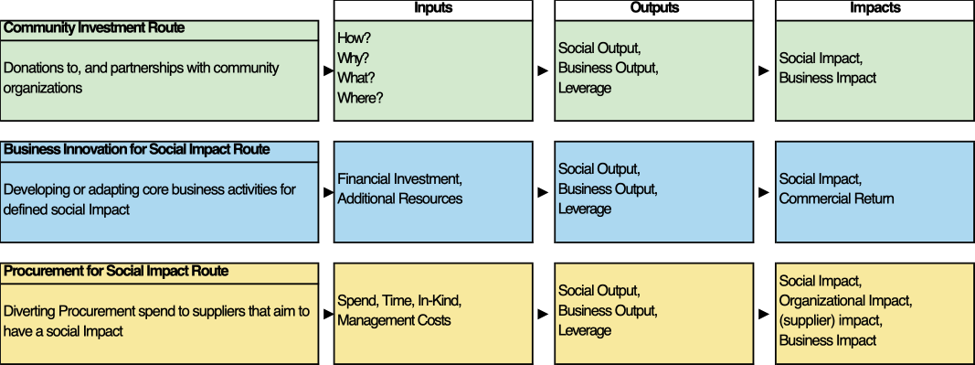
Figure 2: B4SI framework: Routes on social impact, own elaboration based on Business for Societal Impact (B4SI) (n.d.)18Business for Societal Impact (B4SI). Sample Guidance Manual. https://b4si.net/wp-content/uploads/2024/09/B4SI-Sample-Guidance-Manual-2024.pdf (n.d.).
The members of the B4SI network are offered a social impact compass (“The Compass”) to give a first step into understanding and implementing social impact programs in a company. It covers Planning, Implementation, Measurement, Reporting and Engagement.
It begins by selecting which community initiatives to assess. These can be individual projects or groups of initiatives based on geography, theme, or strategic relevance. The model defines community investment as voluntary, non-commercial actions with a charitable or public purpose, distinct from regular business operations and without direct commercial returns like marketing exposure. Contributions may include financial donations, in-kind support, or employee volunteering.16Wiman, A., Temmes, A., Farsang, A., Schönherr, N. & Reisch, L. The LBG Model – a GLOBAL VALUE Tool Showcase. (2017) doi:10.13140/RG.2.2.35610.13764.
Once initiatives are selected, the next step is to gather data on inputs—the total resources dedicated to community investment. This includes not only monetary donations, but also employee time, donated goods, and other non-cash contributions. While B4SI members have access to specific tools for this, non-members can collect data manually. The goal is to calculate a consolidated figure representing the full investment.16Wiman, A., Temmes, A., Farsang, A., Schönherr, N. & Reisch, L. The LBG Model – a GLOBAL VALUE Tool Showcase. (2017) doi:10.13140/RG.2.2.35610.13764.
The third step is to capture outputs, meaning the immediate results of the initiative. This includes the number of people reached or supported, additional resources leveraged (e.g., other donors or volunteer time), and business-related outcomes such as employee involvement, media coverage, or stakeholder recognition.16Wiman, A., Temmes, A., Farsang, A., Schönherr, N. & Reisch, L. The LBG Model – a GLOBAL VALUE Tool Showcase. (2017) doi:10.13140/RG.2.2.35610.13764.
The fourth step involves identifying impacts, which are the actual changes brought about by the initiative. These could affect the target beneficiaries, partner organizations, or the company itself. This stage is often the most complex, as it involves assessing the broader value and effectiveness of the activities.16Wiman, A., Temmes, A., Farsang, A., Schönherr, N. & Reisch, L. The LBG Model – a GLOBAL VALUE Tool Showcase. (2017) doi:10.13140/RG.2.2.35610.13764.
Finally, all collected data is analyzed to evaluate the outcomes for both society and the business. This helps determine whether the investments align with strategic goals and provide a basis for improving future community engagement strategies.16Wiman, A., Temmes, A., Farsang, A., Schönherr, N. & Reisch, L. The LBG Model – a GLOBAL VALUE Tool Showcase. (2017) doi:10.13140/RG.2.2.35610.13764.

Figure 3: B4SI framework: Input, outputs and impacts metrics, own elaboration based on Business for Societal Impact (B4SI) (n.d.)18Business for Societal Impact (B4SI). Sample Guidance Manual. https://b4si.net/wp-content/uploads/2024/09/B4SI-Sample-Guidance-Manual-2024.pdf (n.d.).
3.3 Reporting
Effective reporting is a pivotal component of the successful implementation of a Strategic Corporate Philanthropy plan, enabling projects to achieve scalability, measurability, and transparency among stakeholders and leadership.
Keeping an accurate record of every initiative supports the credibility of a company Philanthropic Practices, helping raise the reputation among customers and shareholders.13Bertelsmann Stiftung. Gesellschaftliches Unternehmensengagement strategisch ausrichten – Die iooi-Methode. https://www.bertelsmann-stiftung.de/de/unsere-projekte/abgeschlossene-projekte/cri-corporate-responsibility-index/projektthemen/die-iooi-methode (2010). This requires all of the information provided to be correct and complete. In cases where the resources required to keep track of the information accurately outweigh the value of the information, it is reasonable to use an adapted methodology to estimate valuations.18Business for Societal Impact (B4SI). Sample Guidance Manual. https://b4si.net/wp-content/uploads/2024/09/B4SI-Sample-Guidance-Manual-2024.pdf (n.d.). As a basic principle, it is important to work on the information under three pillars: clarity, unambiguity, and understandability.
Being able to map every activity, responsibilities, dates, and controls is fundamental for accurate data collection. Bertelsmann Stiftung (2010) suggests the following checklist in order to establish a successful reporting process.13Bertelsmann Stiftung. Gesellschaftliches Unternehmensengagement strategisch ausrichten – Die iooi-Methode. https://www.bertelsmann-stiftung.de/de/unsere-projekte/abgeschlossene-projekte/cri-corporate-responsibility-index/projektthemen/die-iooi-methode (2010).
1) definition of key figures and indicators, 2) binding reporting channels with clear responsibilities, 3) principles and instructions for the provision and processing of information, 4) IT systems and tools used, 5) Measures to ensure data quality, and 6) Deadlines and time frames.
In addition to this, they propose different data quality assessments post-collection to ensure the reliability of the information gathered, with random checks and plausibility checks being two suggested practices.13Bertelsmann Stiftung. Gesellschaftliches Unternehmensengagement strategisch ausrichten – Die iooi-Methode. https://www.bertelsmann-stiftung.de/de/unsere-projekte/abgeschlossene-projekte/cri-corporate-responsibility-index/projektthemen/die-iooi-methode (2010).
4 Excel tool: Based on the B4SI framework
The Excel template tool was designed to establish an easy-to-use tracking tool for common corporate philanthropy practices previously mentioned through the background information check (Matching Gifts, Volunteer Grants, Corporate Sponsorships, In-Kind Donations, etc.) using the guidelines from the B4SI framework as a baseline.
The effective management of corporate philanthropic practices requires a robust framework for assessing their impact. While all outcomes are valuable, a significant challenge for companies is the accurate tracking of inputs, outputs, and quantifiable metrics to determine the true effectiveness of their contributions. This measurement dilemma is one of the greatest barriers to incorporating meaningful philanthropic initiatives into corporate strategy. In this instance, the B4SI methodology offers a well-established and structured model for measuring community involvement. This framework focuses on creating global standards that can be applied by any organization to quantify its philanthropic contributions effectively. Through its global network, B4SI connects partners ranging from small enterprises to multinational corporations across various sectors, promoting a consistent approach to impact assessment.
The idea behind the tool is to simplify the methodology into one “free-of-cost Compass” file explaining the basic steps to replicate these practices with previously defined strategies & metrics to quantify the results and impact for the company and the community. This does not substitute a complete implementation of the framework itself (which would need a specific approach and study for each company, a service offered by B4SI through “The Compass” project) but gives a first glimpse of how it should be implemented in a general way allowing the companies to communicate results and metrics to key audiences.
The structure of the file consists of 7 sections: Home, Purpose, Methodology. Guidelines, Philanthropic Initiatives, Summary of results and the Impacts Dashboard. The first section, Purpose, consists of stating the importance of the Corporate Philanthropy Data Implementation Template presented, and the general objectives of the tool: systematizing data collection, measuring impact, enhancing decision-making, and promoting transparency and reporting. These are all steps to follow toward the primary and single objective: to contribute to and enable positive social change through the tool. The collective understanding and commitment are crucial for success to transcend mere financial contributions to embody a deep and unified dedication to the practice of Philanthropy.
In this section, a concise overview of the B4SI framework’s philanthropic routes is presented, along with the main objective of each. The template is explicitly presented as a suggested framework using The Compass as a baseline for measuring the impact of corporate philanthropy within a company.
The following section of this tool provides a comprehensive guide for its use. It explains, step by step, how to complete the data collection fields and details how the summary and results dashboard function in detail.
The Philanthropic Initiatives section is the core of the Excel tool. It is where all the data for the initiatives is collected and recorded in detail. The fields within this section include comprehensive explanations to guide the user, so there is no need for further elaboration. Every field must be completed (if applicable) so that every initiative can be classified according to the framework.
The summary of results is organized according to the B4SI framework and main focus areas. This provides an overview of the overall impact based on the total number of initiatives and highlights specific fields and areas.
The impact dashboard presents key information to stakeholders, including total percentage by Route (B4SI Framework), beneficiary focus, top strategies, donation trends, and additional fields in a visually appealing form.
B4SI offers their network a private benchmark and insights report, to see their position against other major companies in the subject of corporate philanthropy. This is used by companies as an opportunity to make informed decisions, plan and act accordingly.
The addition of a section on the actual social impact analysis could be a beneficial avenue for future work related to the tool, as it is currently another topic outside our scope, it has not been added, but it could be a great complement to our work. A step-by-step guidance manual (similar to “The Compass” provided by Business for Societal Impact) could also be an interesting and important addition, as it will guide the companies through the actual path to choose the right initiatives according to their area of expertise, instead of the preestablished by the tool that might not be fully implemented.
5 Conclusion
Corporate philanthropy’s evolution from a simple charitable act to a fundamental component of a company’s strategic business practice has become increasingly important. The historical development of the practice has been reviewed to examine its adaptation to present-day business and social conditions. It is important to highlight the modern challenges it faces, as well as to analyze the tools and methodologies companies are using to assess and manage their implementation. By examining established methodologies like the IOOI method and the B4SI framework, it was possible to understand how an effective philanthropy strategy plan should go hand in hand with a data-driven approach to successfully meet current business and social needs.
The core idea behind this new approach of Strategic Philanthropy is that to be credible, social impact must be proven, and proof requires structured data collection, measurable outcome metrics, and transparent reporting after implementation.
The proposed Excel-based tool, using the B4SI framework methodology as a baseline, might serve as a first step to enable organizations to pursue strategic corporate philanthropy in a manner that is both practical and accessible, with its core concepts clearly explained for anyone new to the practice to apply. Its predefined sections for Inputs, Outputs, and Impacts (along with the proposed strategies and key performance indicators) offer an easy first step toward a more impactful approach that can be followed by any organization. The dashboards also offer a comprehensive, simplified view of the overall strategy performance, transforming data into actionable insights for both stakeholders and management teams. The tool’s purpose is to cultivate a culture of continuous documentation throughout philanthropic efforts, ensuring that, regardless of their scale, they contribute to the greater good of both the company and society.
There are several avenues for future work to enhance the tool and its application; a personalized approach could be a next step to take because it is important to align the philanthropic strategies closely with their core business expertise, something that cannot be generalized in a single-approach tool.
A company’s social responsibility approach should be genuine, well-managed, and used to create lasting positive change. A company’s ability to demonstrate quantifiable social impact is what differentiates it in the realm of Corporate Social Responsibility.
References
- 1Carroll, A. B. A History of Corporate Social Responsibility: Concepts and Practices. in The Oxford Handbook of Corporate Social Responsibility (eds Crane, A., Matten, D., McWilliams, A., Moon, J. & Siegel, D. S.) 0 (Oxford University Press, 2008). doi:10.1093/oxfordhb/9780199211593.003.0002. ↩︎
- 1Carroll, A. B. A History of Corporate Social Responsibility: Concepts and Practices. in The Oxford Handbook of Corporate Social Responsibility (eds Crane, A., Matten, D., McWilliams, A., Moon, J. & Siegel, D. S.) 0 (Oxford University Press, 2008). doi:10.1093/oxfordhb/9780199211593.003.0002. ↩︎
- 1Carroll, A. B. A History of Corporate Social Responsibility: Concepts and Practices. in The Oxford Handbook of Corporate Social Responsibility (eds Crane, A., Matten, D., McWilliams, A., Moon, J. & Siegel, D. S.) 0 (Oxford University Press, 2008). doi:10.1093/oxfordhb/9780199211593.003.0002. ↩︎
- 1Carroll, A. B. A History of Corporate Social Responsibility: Concepts and Practices. in The Oxford Handbook of Corporate Social Responsibility (eds Crane, A., Matten, D., McWilliams, A., Moon, J. & Siegel, D. S.) 0 (Oxford University Press, 2008). doi:10.1093/oxfordhb/9780199211593.003.0002. ↩︎
- 2Carroll, A. B. Carroll’s pyramid of CSR: taking another look. Int. J. Corp. Soc. Responsib. 1, 3 (2016). ↩︎
- 3Bowen, H. R. Social Responsibilities of the Businessman. (Iowa City: University of Iowa Press, 2013). ↩︎
- 3Bowen, H. R. Social Responsibilities of the Businessman. (Iowa City: University of Iowa Press, 2013). ↩︎
- 4Davis, K. Can Business Afford to Ignore Social Responsibilities? Calif. Manage. Rev. 2, 70–76 (1960). ↩︎
- 1Carroll, A. B. A History of Corporate Social Responsibility: Concepts and Practices. in The Oxford Handbook of Corporate Social Responsibility (eds Crane, A., Matten, D., McWilliams, A., Moon, J. & Siegel, D. S.) 0 (Oxford University Press, 2008). doi:10.1093/oxfordhb/9780199211593.003.0002. ↩︎
- 1Carroll, A. B. A History of Corporate Social Responsibility: Concepts and Practices. in The Oxford Handbook of Corporate Social Responsibility (eds Crane, A., Matten, D., McWilliams, A., Moon, J. & Siegel, D. S.) 0 (Oxford University Press, 2008). doi:10.1093/oxfordhb/9780199211593.003.0002. ↩︎
- 1Carroll, A. B. A History of Corporate Social Responsibility: Concepts and Practices. in The Oxford Handbook of Corporate Social Responsibility (eds Crane, A., Matten, D., McWilliams, A., Moon, J. & Siegel, D. S.) 0 (Oxford University Press, 2008). doi:10.1093/oxfordhb/9780199211593.003.0002. ↩︎
- 5Carroll, A. B. A Three-Dimensional Conceptual Model of Corporate Performance. Acad. Manage. Rev. 4, 497–505 (1979). ↩︎
- 5Carroll, A. B. A Three-Dimensional Conceptual Model of Corporate Performance. Acad. Manage. Rev. 4, 497–505 (1979). ↩︎
- 6Carroll, A. B. The pyramid of corporate social responsibility: Toward the moral management of organizational stakeholders. Bus. Horiz. 34, 39–48 (1991). ↩︎
- 6Carroll, A. B. The pyramid of corporate social responsibility: Toward the moral management of organizational stakeholders. Bus. Horiz. 34, 39–48 (1991). ↩︎
- 6Carroll, A. B. The pyramid of corporate social responsibility: Toward the moral management of organizational stakeholders. Bus. Horiz. 34, 39–48 (1991). ↩︎
- 1Carroll, A. B. A History of Corporate Social Responsibility: Concepts and Practices. in The Oxford Handbook of Corporate Social Responsibility (eds Crane, A., Matten, D., McWilliams, A., Moon, J. & Siegel, D. S.) 0 (Oxford University Press, 2008). doi:10.1093/oxfordhb/9780199211593.003.0002. ↩︎
- 1Carroll, A. B. A History of Corporate Social Responsibility: Concepts and Practices. in The Oxford Handbook of Corporate Social Responsibility (eds Crane, A., Matten, D., McWilliams, A., Moon, J. & Siegel, D. S.) 0 (Oxford University Press, 2008). doi:10.1093/oxfordhb/9780199211593.003.0002. ↩︎
- 7Kotler, P. & Lee, N. R. Corporate Social Responsibility: Doing the Most Good for Your Company and Your Cause. (John Wiley & Sons, 2011). ↩︎
- 8Gautier, A. & Pache, A.-C. Research on Corporate Philanthropy: A Review and Assessment. J. Bus. Ethics 126, 343–369 (2013). ↩︎
- 1Carroll, A. B. A History of Corporate Social Responsibility: Concepts and Practices. in The Oxford Handbook of Corporate Social Responsibility (eds Crane, A., Matten, D., McWilliams, A., Moon, J. & Siegel, D. S.) 0 (Oxford University Press, 2008). doi:10.1093/oxfordhb/9780199211593.003.0002. ↩︎
- 1Carroll, A. B. A History of Corporate Social Responsibility: Concepts and Practices. in The Oxford Handbook of Corporate Social Responsibility (eds Crane, A., Matten, D., McWilliams, A., Moon, J. & Siegel, D. S.) 0 (Oxford University Press, 2008). doi:10.1093/oxfordhb/9780199211593.003.0002. ↩︎
- 1Carroll, A. B. A History of Corporate Social Responsibility: Concepts and Practices. in The Oxford Handbook of Corporate Social Responsibility (eds Crane, A., Matten, D., McWilliams, A., Moon, J. & Siegel, D. S.) 0 (Oxford University Press, 2008). doi:10.1093/oxfordhb/9780199211593.003.0002. ↩︎
- 1Carroll, A. B. A History of Corporate Social Responsibility: Concepts and Practices. in The Oxford Handbook of Corporate Social Responsibility (eds Crane, A., Matten, D., McWilliams, A., Moon, J. & Siegel, D. S.) 0 (Oxford University Press, 2008). doi:10.1093/oxfordhb/9780199211593.003.0002. ↩︎
- 1Carroll, A. B. A History of Corporate Social Responsibility: Concepts and Practices. in The Oxford Handbook of Corporate Social Responsibility (eds Crane, A., Matten, D., McWilliams, A., Moon, J. & Siegel, D. S.) 0 (Oxford University Press, 2008). doi:10.1093/oxfordhb/9780199211593.003.0002. ↩︎
- 9Casajús-Burutaran, A., Ambos, T. C. & Probst, G. Do You Have a Corporate Philanthropy Strategy? (2023). ↩︎
- 10McClimon, Timothy J. The Shape of Corporate Philanthropy Yesterday and Today | Grantmakers in the Arts. Grantmakers in the Arts vol. 15 (2004). ↩︎
- 11Ásványi, K. Corporate Philanthropy. in (2023). doi:10.1007/978-3-031-25984-5_1090. ↩︎
- 11Ásványi, K. Corporate Philanthropy. in (2023). doi:10.1007/978-3-031-25984-5_1090. ↩︎
- 9Casajús-Burutaran, A., Ambos, T. C. & Probst, G. Do You Have a Corporate Philanthropy Strategy? (2023). ↩︎
- 9Casajús-Burutaran, A., Ambos, T. C. & Probst, G. Do You Have a Corporate Philanthropy Strategy? (2023). ↩︎
- 11Ásványi, K. Corporate Philanthropy. in (2023). doi:10.1007/978-3-031-25984-5_1090. ↩︎
- 8Gautier, A. & Pache, A.-C. Research on Corporate Philanthropy: A Review and Assessment. J. Bus. Ethics 126, 343–369 (2013). ↩︎
- 9Casajús-Burutaran, A., Ambos, T. C. & Probst, G. Do You Have a Corporate Philanthropy Strategy? (2023). ↩︎
- 9Casajús-Burutaran, A., Ambos, T. C. & Probst, G. Do You Have a Corporate Philanthropy Strategy? (2023). ↩︎
- 10McClimon, Timothy J. The Shape of Corporate Philanthropy Yesterday and Today | Grantmakers in the Arts. Grantmakers in the Arts vol. 15 (2004). ↩︎
- 10McClimon, Timothy J. The Shape of Corporate Philanthropy Yesterday and Today | Grantmakers in the Arts. Grantmakers in the Arts vol. 15 (2004). ↩︎
- 10McClimon, Timothy J. The Shape of Corporate Philanthropy Yesterday and Today | Grantmakers in the Arts. Grantmakers in the Arts vol. 15 (2004). ↩︎
- 12Chapman, Matthew. Big Tobacco criticised for ‘coronavirus publicity stunt’ after…. TBIJ https://www.thebureauinvestigates.com/stories/2020-03-30/pmi-criticised-for-coronavirus-pr-stunt-ventilator-donation. ↩︎
- 10McClimon, Timothy J. The Shape of Corporate Philanthropy Yesterday and Today | Grantmakers in the Arts. Grantmakers in the Arts vol. 15 (2004). ↩︎
- 9Casajús-Burutaran, A., Ambos, T. C. & Probst, G. Do You Have a Corporate Philanthropy Strategy? (2023). ↩︎
- 11Ásványi, K. Corporate Philanthropy. in (2023). doi:10.1007/978-3-031-25984-5_1090. ↩︎
- 9Casajús-Burutaran, A., Ambos, T. C. & Probst, G. Do You Have a Corporate Philanthropy Strategy? (2023). ↩︎
- 13Bertelsmann Stiftung. Gesellschaftliches Unternehmensengagement strategisch ausrichten – Die iooi-Methode. https://www.bertelsmann-stiftung.de/de/unsere-projekte/abgeschlossene-projekte/cri-corporate-responsibility-index/projektthemen/die-iooi-methode (2010). ↩︎
- 14Birgit Riess. Corporate Citizenship planen und messen mit der iooi-Methode. https://www.bertelsmann-stiftung.de/de/publikationen/publikation/did/corporate-citizenship-planen-und-messen-mit-der-iooi-methode. ↩︎
- 15Sauer, S., Bartolomucci, F., Groot, M., Then, V. & Jacob, F. Closing the gap: The comprehensive approach to measure societal impact. Soc. Impacts 5, 100111 (2025). ↩︎
- 14Birgit Riess. Corporate Citizenship planen und messen mit der iooi-Methode. https://www.bertelsmann-stiftung.de/de/publikationen/publikation/did/corporate-citizenship-planen-und-messen-mit-der-iooi-methode. ↩︎
- 13Bertelsmann Stiftung. Gesellschaftliches Unternehmensengagement strategisch ausrichten – Die iooi-Methode. https://www.bertelsmann-stiftung.de/de/unsere-projekte/abgeschlossene-projekte/cri-corporate-responsibility-index/projektthemen/die-iooi-methode (2010). ↩︎
- 14Birgit Riess. Corporate Citizenship planen und messen mit der iooi-Methode. https://www.bertelsmann-stiftung.de/de/publikationen/publikation/did/corporate-citizenship-planen-und-messen-mit-der-iooi-methode. ↩︎
- 16Wiman, A., Temmes, A., Farsang, A., Schönherr, N. & Reisch, L. The LBG Model – a GLOBAL VALUE Tool Showcase. (2017) doi:10.13140/RG.2.2.35610.13764. ↩︎
- 17Association of Corporate Contributions Professionals. Measuring Community Impact Using the LBG Model. https://corporate-citizenship.com/wp-content/uploads/ACCP_Corporate_Citizenship_Report_Final_082213.pdf (2013). ↩︎
- 16Wiman, A., Temmes, A., Farsang, A., Schönherr, N. & Reisch, L. The LBG Model – a GLOBAL VALUE Tool Showcase. (2017) doi:10.13140/RG.2.2.35610.13764. ↩︎
- 16Wiman, A., Temmes, A., Farsang, A., Schönherr, N. & Reisch, L. The LBG Model – a GLOBAL VALUE Tool Showcase. (2017) doi:10.13140/RG.2.2.35610.13764. ↩︎
- 16Wiman, A., Temmes, A., Farsang, A., Schönherr, N. & Reisch, L. The LBG Model – a GLOBAL VALUE Tool Showcase. (2017) doi:10.13140/RG.2.2.35610.13764. ↩︎
- 16Wiman, A., Temmes, A., Farsang, A., Schönherr, N. & Reisch, L. The LBG Model – a GLOBAL VALUE Tool Showcase. (2017) doi:10.13140/RG.2.2.35610.13764. ↩︎
- 18Business for Societal Impact (B4SI). Sample Guidance Manual. https://b4si.net/wp-content/uploads/2024/09/B4SI-Sample-Guidance-Manual-2024.pdf (n.d.). ↩︎
- 18Business for Societal Impact (B4SI). Sample Guidance Manual. https://b4si.net/wp-content/uploads/2024/09/B4SI-Sample-Guidance-Manual-2024.pdf (n.d.). ↩︎
- 16Wiman, A., Temmes, A., Farsang, A., Schönherr, N. & Reisch, L. The LBG Model – a GLOBAL VALUE Tool Showcase. (2017) doi:10.13140/RG.2.2.35610.13764. ↩︎
- 16Wiman, A., Temmes, A., Farsang, A., Schönherr, N. & Reisch, L. The LBG Model – a GLOBAL VALUE Tool Showcase. (2017) doi:10.13140/RG.2.2.35610.13764. ↩︎
- 16Wiman, A., Temmes, A., Farsang, A., Schönherr, N. & Reisch, L. The LBG Model – a GLOBAL VALUE Tool Showcase. (2017) doi:10.13140/RG.2.2.35610.13764. ↩︎
- 16Wiman, A., Temmes, A., Farsang, A., Schönherr, N. & Reisch, L. The LBG Model – a GLOBAL VALUE Tool Showcase. (2017) doi:10.13140/RG.2.2.35610.13764. ↩︎
- 16Wiman, A., Temmes, A., Farsang, A., Schönherr, N. & Reisch, L. The LBG Model – a GLOBAL VALUE Tool Showcase. (2017) doi:10.13140/RG.2.2.35610.13764. ↩︎
- 18Business for Societal Impact (B4SI). Sample Guidance Manual. https://b4si.net/wp-content/uploads/2024/09/B4SI-Sample-Guidance-Manual-2024.pdf (n.d.). ↩︎
- 13Bertelsmann Stiftung. Gesellschaftliches Unternehmensengagement strategisch ausrichten – Die iooi-Methode. https://www.bertelsmann-stiftung.de/de/unsere-projekte/abgeschlossene-projekte/cri-corporate-responsibility-index/projektthemen/die-iooi-methode (2010). ↩︎
- 18Business for Societal Impact (B4SI). Sample Guidance Manual. https://b4si.net/wp-content/uploads/2024/09/B4SI-Sample-Guidance-Manual-2024.pdf (n.d.). ↩︎
- 13Bertelsmann Stiftung. Gesellschaftliches Unternehmensengagement strategisch ausrichten – Die iooi-Methode. https://www.bertelsmann-stiftung.de/de/unsere-projekte/abgeschlossene-projekte/cri-corporate-responsibility-index/projektthemen/die-iooi-methode (2010). ↩︎
- 13Bertelsmann Stiftung. Gesellschaftliches Unternehmensengagement strategisch ausrichten – Die iooi-Methode. https://www.bertelsmann-stiftung.de/de/unsere-projekte/abgeschlossene-projekte/cri-corporate-responsibility-index/projektthemen/die-iooi-methode (2010). ↩︎
- 1Carroll, A. B. A History of Corporate Social Responsibility: Concepts and Practices. in The Oxford Handbook of Corporate Social Responsibility (eds Crane, A., Matten, D., McWilliams, A., Moon, J. & Siegel, D. S.) 0 (Oxford University Press, 2008). doi:10.1093/oxfordhb/9780199211593.003.0002. ↩︎
- 1Carroll, A. B. A History of Corporate Social Responsibility: Concepts and Practices. in The Oxford Handbook of Corporate Social Responsibility (eds Crane, A., Matten, D., McWilliams, A., Moon, J. & Siegel, D. S.) 0 (Oxford University Press, 2008). doi:10.1093/oxfordhb/9780199211593.003.0002. ↩︎
- 1Carroll, A. B. A History of Corporate Social Responsibility: Concepts and Practices. in The Oxford Handbook of Corporate Social Responsibility (eds Crane, A., Matten, D., McWilliams, A., Moon, J. & Siegel, D. S.) 0 (Oxford University Press, 2008). doi:10.1093/oxfordhb/9780199211593.003.0002. ↩︎
- 1Carroll, A. B. A History of Corporate Social Responsibility: Concepts and Practices. in The Oxford Handbook of Corporate Social Responsibility (eds Crane, A., Matten, D., McWilliams, A., Moon, J. & Siegel, D. S.) 0 (Oxford University Press, 2008). doi:10.1093/oxfordhb/9780199211593.003.0002. ↩︎
- 2Carroll, A. B. Carroll’s pyramid of CSR: taking another look. Int. J. Corp. Soc. Responsib. 1, 3 (2016). ↩︎
- 3Bowen, H. R. Social Responsibilities of the Businessman. (Iowa City: University of Iowa Press, 2013). ↩︎
- 3Bowen, H. R. Social Responsibilities of the Businessman. (Iowa City: University of Iowa Press, 2013). ↩︎
- 4Davis, K. Can Business Afford to Ignore Social Responsibilities? Calif. Manage. Rev. 2, 70–76 (1960). ↩︎
- 1Carroll, A. B. A History of Corporate Social Responsibility: Concepts and Practices. in The Oxford Handbook of Corporate Social Responsibility (eds Crane, A., Matten, D., McWilliams, A., Moon, J. & Siegel, D. S.) 0 (Oxford University Press, 2008). doi:10.1093/oxfordhb/9780199211593.003.0002. ↩︎
- 1Carroll, A. B. A History of Corporate Social Responsibility: Concepts and Practices. in The Oxford Handbook of Corporate Social Responsibility (eds Crane, A., Matten, D., McWilliams, A., Moon, J. & Siegel, D. S.) 0 (Oxford University Press, 2008). doi:10.1093/oxfordhb/9780199211593.003.0002. ↩︎
- 1Carroll, A. B. A History of Corporate Social Responsibility: Concepts and Practices. in The Oxford Handbook of Corporate Social Responsibility (eds Crane, A., Matten, D., McWilliams, A., Moon, J. & Siegel, D. S.) 0 (Oxford University Press, 2008). doi:10.1093/oxfordhb/9780199211593.003.0002. ↩︎
- 5Carroll, A. B. A Three-Dimensional Conceptual Model of Corporate Performance. Acad. Manage. Rev. 4, 497–505 (1979). ↩︎
- 5Carroll, A. B. A Three-Dimensional Conceptual Model of Corporate Performance. Acad. Manage. Rev. 4, 497–505 (1979). ↩︎
- 6Carroll, A. B. The pyramid of corporate social responsibility: Toward the moral management of organizational stakeholders. Bus. Horiz. 34, 39–48 (1991). ↩︎
- 6Carroll, A. B. The pyramid of corporate social responsibility: Toward the moral management of organizational stakeholders. Bus. Horiz. 34, 39–48 (1991). ↩︎
- 6Carroll, A. B. The pyramid of corporate social responsibility: Toward the moral management of organizational stakeholders. Bus. Horiz. 34, 39–48 (1991). ↩︎
- 1Carroll, A. B. A History of Corporate Social Responsibility: Concepts and Practices. in The Oxford Handbook of Corporate Social Responsibility (eds Crane, A., Matten, D., McWilliams, A., Moon, J. & Siegel, D. S.) 0 (Oxford University Press, 2008). doi:10.1093/oxfordhb/9780199211593.003.0002. ↩︎
- 1Carroll, A. B. A History of Corporate Social Responsibility: Concepts and Practices. in The Oxford Handbook of Corporate Social Responsibility (eds Crane, A., Matten, D., McWilliams, A., Moon, J. & Siegel, D. S.) 0 (Oxford University Press, 2008). doi:10.1093/oxfordhb/9780199211593.003.0002. ↩︎
- 7Kotler, P. & Lee, N. R. Corporate Social Responsibility: Doing the Most Good for Your Company and Your Cause. (John Wiley & Sons, 2011). ↩︎
- 8Gautier, A. & Pache, A.-C. Research on Corporate Philanthropy: A Review and Assessment. J. Bus. Ethics 126, 343–369 (2013). ↩︎
- 1Carroll, A. B. A History of Corporate Social Responsibility: Concepts and Practices. in The Oxford Handbook of Corporate Social Responsibility (eds Crane, A., Matten, D., McWilliams, A., Moon, J. & Siegel, D. S.) 0 (Oxford University Press, 2008). doi:10.1093/oxfordhb/9780199211593.003.0002. ↩︎
- 1Carroll, A. B. A History of Corporate Social Responsibility: Concepts and Practices. in The Oxford Handbook of Corporate Social Responsibility (eds Crane, A., Matten, D., McWilliams, A., Moon, J. & Siegel, D. S.) 0 (Oxford University Press, 2008). doi:10.1093/oxfordhb/9780199211593.003.0002. ↩︎
- 1Carroll, A. B. A History of Corporate Social Responsibility: Concepts and Practices. in The Oxford Handbook of Corporate Social Responsibility (eds Crane, A., Matten, D., McWilliams, A., Moon, J. & Siegel, D. S.) 0 (Oxford University Press, 2008). doi:10.1093/oxfordhb/9780199211593.003.0002. ↩︎
- 1Carroll, A. B. A History of Corporate Social Responsibility: Concepts and Practices. in The Oxford Handbook of Corporate Social Responsibility (eds Crane, A., Matten, D., McWilliams, A., Moon, J. & Siegel, D. S.) 0 (Oxford University Press, 2008). doi:10.1093/oxfordhb/9780199211593.003.0002. ↩︎
- 1Carroll, A. B. A History of Corporate Social Responsibility: Concepts and Practices. in The Oxford Handbook of Corporate Social Responsibility (eds Crane, A., Matten, D., McWilliams, A., Moon, J. & Siegel, D. S.) 0 (Oxford University Press, 2008). doi:10.1093/oxfordhb/9780199211593.003.0002. ↩︎
- 9Casajús-Burutaran, A., Ambos, T. C. & Probst, G. Do You Have a Corporate Philanthropy Strategy? (2023). ↩︎
- 10McClimon, Timothy J. The Shape of Corporate Philanthropy Yesterday and Today | Grantmakers in the Arts. Grantmakers in the Arts vol. 15 (2004). ↩︎
- 11Ásványi, K. Corporate Philanthropy. in (2023). doi:10.1007/978-3-031-25984-5_1090. ↩︎
- 11Ásványi, K. Corporate Philanthropy. in (2023). doi:10.1007/978-3-031-25984-5_1090. ↩︎
- 9Casajús-Burutaran, A., Ambos, T. C. & Probst, G. Do You Have a Corporate Philanthropy Strategy? (2023). ↩︎
- 9Casajús-Burutaran, A., Ambos, T. C. & Probst, G. Do You Have a Corporate Philanthropy Strategy? (2023). ↩︎
- 11Ásványi, K. Corporate Philanthropy. in (2023). doi:10.1007/978-3-031-25984-5_1090. ↩︎
- 8Gautier, A. & Pache, A.-C. Research on Corporate Philanthropy: A Review and Assessment. J. Bus. Ethics 126, 343–369 (2013). ↩︎
- 9Casajús-Burutaran, A., Ambos, T. C. & Probst, G. Do You Have a Corporate Philanthropy Strategy? (2023). ↩︎
- 9Casajús-Burutaran, A., Ambos, T. C. & Probst, G. Do You Have a Corporate Philanthropy Strategy? (2023). ↩︎
- 10McClimon, Timothy J. The Shape of Corporate Philanthropy Yesterday and Today | Grantmakers in the Arts. Grantmakers in the Arts vol. 15 (2004). ↩︎
- 10McClimon, Timothy J. The Shape of Corporate Philanthropy Yesterday and Today | Grantmakers in the Arts. Grantmakers in the Arts vol. 15 (2004). ↩︎
- 10McClimon, Timothy J. The Shape of Corporate Philanthropy Yesterday and Today | Grantmakers in the Arts. Grantmakers in the Arts vol. 15 (2004). ↩︎
- 12Chapman, Matthew. Big Tobacco criticised for ‘coronavirus publicity stunt’ after…. TBIJ https://www.thebureauinvestigates.com/stories/2020-03-30/pmi-criticised-for-coronavirus-pr-stunt-ventilator-donation. ↩︎
- 10McClimon, Timothy J. The Shape of Corporate Philanthropy Yesterday and Today | Grantmakers in the Arts. Grantmakers in the Arts vol. 15 (2004). ↩︎
- 9Casajús-Burutaran, A., Ambos, T. C. & Probst, G. Do You Have a Corporate Philanthropy Strategy? (2023). ↩︎
- 11Ásványi, K. Corporate Philanthropy. in (2023). doi:10.1007/978-3-031-25984-5_1090. ↩︎
- 9Casajús-Burutaran, A., Ambos, T. C. & Probst, G. Do You Have a Corporate Philanthropy Strategy? (2023). ↩︎
- 13Bertelsmann Stiftung. Gesellschaftliches Unternehmensengagement strategisch ausrichten – Die iooi-Methode. https://www.bertelsmann-stiftung.de/de/unsere-projekte/abgeschlossene-projekte/cri-corporate-responsibility-index/projektthemen/die-iooi-methode (2010). ↩︎
- 14Birgit Riess. Corporate Citizenship planen und messen mit der iooi-Methode. https://www.bertelsmann-stiftung.de/de/publikationen/publikation/did/corporate-citizenship-planen-und-messen-mit-der-iooi-methode. ↩︎
- 15Sauer, S., Bartolomucci, F., Groot, M., Then, V. & Jacob, F. Closing the gap: The comprehensive approach to measure societal impact. Soc. Impacts 5, 100111 (2025). ↩︎
- 14Birgit Riess. Corporate Citizenship planen und messen mit der iooi-Methode. https://www.bertelsmann-stiftung.de/de/publikationen/publikation/did/corporate-citizenship-planen-und-messen-mit-der-iooi-methode. ↩︎
- 13Bertelsmann Stiftung. Gesellschaftliches Unternehmensengagement strategisch ausrichten – Die iooi-Methode. https://www.bertelsmann-stiftung.de/de/unsere-projekte/abgeschlossene-projekte/cri-corporate-responsibility-index/projektthemen/die-iooi-methode (2010). ↩︎
- 14Birgit Riess. Corporate Citizenship planen und messen mit der iooi-Methode. https://www.bertelsmann-stiftung.de/de/publikationen/publikation/did/corporate-citizenship-planen-und-messen-mit-der-iooi-methode. ↩︎
- 16Wiman, A., Temmes, A., Farsang, A., Schönherr, N. & Reisch, L. The LBG Model – a GLOBAL VALUE Tool Showcase. (2017) doi:10.13140/RG.2.2.35610.13764. ↩︎
- 17Association of Corporate Contributions Professionals. Measuring Community Impact Using the LBG Model. https://corporate-citizenship.com/wp-content/uploads/ACCP_Corporate_Citizenship_Report_Final_082213.pdf (2013). ↩︎
- 16Wiman, A., Temmes, A., Farsang, A., Schönherr, N. & Reisch, L. The LBG Model – a GLOBAL VALUE Tool Showcase. (2017) doi:10.13140/RG.2.2.35610.13764. ↩︎
- 16Wiman, A., Temmes, A., Farsang, A., Schönherr, N. & Reisch, L. The LBG Model – a GLOBAL VALUE Tool Showcase. (2017) doi:10.13140/RG.2.2.35610.13764. ↩︎
- 16Wiman, A., Temmes, A., Farsang, A., Schönherr, N. & Reisch, L. The LBG Model – a GLOBAL VALUE Tool Showcase. (2017) doi:10.13140/RG.2.2.35610.13764. ↩︎
- 16Wiman, A., Temmes, A., Farsang, A., Schönherr, N. & Reisch, L. The LBG Model – a GLOBAL VALUE Tool Showcase. (2017) doi:10.13140/RG.2.2.35610.13764. ↩︎
- 18Business for Societal Impact (B4SI). Sample Guidance Manual. https://b4si.net/wp-content/uploads/2024/09/B4SI-Sample-Guidance-Manual-2024.pdf (n.d.). ↩︎
- 18Business for Societal Impact (B4SI). Sample Guidance Manual. https://b4si.net/wp-content/uploads/2024/09/B4SI-Sample-Guidance-Manual-2024.pdf (n.d.). ↩︎
- 16Wiman, A., Temmes, A., Farsang, A., Schönherr, N. & Reisch, L. The LBG Model – a GLOBAL VALUE Tool Showcase. (2017) doi:10.13140/RG.2.2.35610.13764. ↩︎
- 16Wiman, A., Temmes, A., Farsang, A., Schönherr, N. & Reisch, L. The LBG Model – a GLOBAL VALUE Tool Showcase. (2017) doi:10.13140/RG.2.2.35610.13764. ↩︎
- 16Wiman, A., Temmes, A., Farsang, A., Schönherr, N. & Reisch, L. The LBG Model – a GLOBAL VALUE Tool Showcase. (2017) doi:10.13140/RG.2.2.35610.13764. ↩︎
- 16Wiman, A., Temmes, A., Farsang, A., Schönherr, N. & Reisch, L. The LBG Model – a GLOBAL VALUE Tool Showcase. (2017) doi:10.13140/RG.2.2.35610.13764. ↩︎
- 16Wiman, A., Temmes, A., Farsang, A., Schönherr, N. & Reisch, L. The LBG Model – a GLOBAL VALUE Tool Showcase. (2017) doi:10.13140/RG.2.2.35610.13764. ↩︎
- 18Business for Societal Impact (B4SI). Sample Guidance Manual. https://b4si.net/wp-content/uploads/2024/09/B4SI-Sample-Guidance-Manual-2024.pdf (n.d.). ↩︎
- 13Bertelsmann Stiftung. Gesellschaftliches Unternehmensengagement strategisch ausrichten – Die iooi-Methode. https://www.bertelsmann-stiftung.de/de/unsere-projekte/abgeschlossene-projekte/cri-corporate-responsibility-index/projektthemen/die-iooi-methode (2010). ↩︎
- 18Business for Societal Impact (B4SI). Sample Guidance Manual. https://b4si.net/wp-content/uploads/2024/09/B4SI-Sample-Guidance-Manual-2024.pdf (n.d.). ↩︎
- 13Bertelsmann Stiftung. Gesellschaftliches Unternehmensengagement strategisch ausrichten – Die iooi-Methode. https://www.bertelsmann-stiftung.de/de/unsere-projekte/abgeschlossene-projekte/cri-corporate-responsibility-index/projektthemen/die-iooi-methode (2010). ↩︎
- 13Bertelsmann Stiftung. Gesellschaftliches Unternehmensengagement strategisch ausrichten – Die iooi-Methode. https://www.bertelsmann-stiftung.de/de/unsere-projekte/abgeschlossene-projekte/cri-corporate-responsibility-index/projektthemen/die-iooi-methode (2010). ↩︎