Authors: Neele Eilers, Klara Diekamp, Fynn Geisler
Edited by: –
Last updated: June 23, 2026
Executive summary
Sustainability marketing helps organizations align marketing decisions with ecological, social, and economic performance. The article explains that sustainability is now a strategic requirement rather than an optional communications theme: regulation, stakeholder expectations, competitive pressure, and customer demand for credible proof all require organizations to embed sustainability into strategy, product development, supply chains, and communication. Sustainable marketing differs from conventional marketing because it seeks long-term value creation, responsible consumption, social well-being, and environmental protection alongside financial results.
The article highlights several guiding frameworks. The Triple Bottom Line encourages organizations to balance people, planet, and profit, while the Sustainable Development Goals provide a global reference point for setting priorities and identifying opportunities. Stakeholder engagement is essential: customers, employees, investors, NGOs, governments, and suppliers all shape whether sustainability claims are seen as credible. Organizations can strengthen trust by combining societal benefits with clear business value and by using measurable evidence rather than vague or superficial claims.
Existing tools support sustainability marketing in different ways. International frameworks such as the SDGs and the SDG Compass offer legitimacy and strategic orientation. Reporting standards such as GRI and SASB help organizations measure and substantiate sustainability performance. Marketing-specific tools, including the Sustainable Marketing Mix and the Sustainable Marketing Canvas, translate sustainability into practical decisions about products, pricing, distribution, promotion, people, processes, and physical evidence. However, no single tool is sufficient: broad frameworks can be too abstract, reporting standards can be resource intensive, and marketing-specific templates may lack broad recognition. A layered approach can combine legitimacy, credible measurement, and practical usability.
The proposed template guides organizations through a structured sustainability marketing planning process. It includes an executive summary, mission and vision, situational and competitor analysis, SWOT analysis, sustainability goals, target groups and stakeholders, a sustainable marketing mix, Triple Bottom Line-oriented strategy, controlling, KPIs, and an action plan. SMART goals help organizations define specific, measurable, attainable, relevant, and time-bound sustainability objectives. The action plan translates these objectives into responsibilities, timelines, communication steps, product changes, and monitoring mechanisms.
Overall, the template’s main value is that it makes sustainability marketing more actionable. It supports transparency, stakeholder dialogue, credible communication, measurable progress, employee engagement, and long-term resilience. Its limitations are that it may overwhelm organizations new to sustainability marketing and requires reliable data, making it especially suitable for medium-sized and large organizations.
1 Motivation and background
In today’s business environment, sustainability has become a decisive success factor for companies. Challenges such as climate change, resource scarcity, and rising societal expectations highlight that traditional business models and marketing strategies are no longer sufficient to secure long-term success. Companies are now expected to align their strategies with ecological and social goals rather than focusing solely on short-term financial performance (Belz, Peattie 2009; Martin, Schouten 2014).
Against this backdrop, sustainable marketing is gaining momentum. It refers to promoting products and companies in ways that embed ecological, social, and economic considerations into core business practices. Unlike conventional marketing, which typically emphasizes growth and profit maximization, sustainable marketing seeks to balance corporate objectives with societal well-being and environmental protection. This shift not only meets external expectations but also creates competitive advantages. Firms that embrace sustainability can differentiate themselves from competitors, cut costs through efficiency gains, drive innovation by developing new products and business models, and build consumer trust through transparency and responsibility1Kemper Joya A., Ballantine Paul W. (2019) “What do we mean by sustainability marketing”, Journal of Marketing Management, 35 (3-4), 277 – 309.,2Jung Yeo Jin, Kim Youngmin (2023) “Research trends of sustainability and marketing research, 2010 – 2020: Topic modeling analysis”, Heliyon, 9 (3), 1- 18.. At the same time, regulatory frameworks such as the European Green Deal, supply chain laws, and new reporting standards (e.g., CSRD) make sustainable marketing a necessity rather than an option. Companies that fail to adapt risk higher compliance costs, reputational harm, or even exclusion from global value chains. In contrast, firms that proactively integrate sustainability often secure better access to markets, investors, and consumers who value responsible practices3Thu Nguyen N. Q., Kadirov Djavlonbek, Fam Kim-Shyan, Tho Nguyen Dinh (2023) “Firm´s Sustainablility Marketing Commitment: The Roles of Chief Marketing Officers Future Focus and Prosocial Motivation”, Journal of Macromarketing, 43 (3), 306 – 321.,4Tollin Karin, Christensen Lars Bech (2019) “Sustainability Marketing Commitment: Empirical Insights About Its Drivers at the Corporate and Functional Level of Marketing”, Journal of Business Ethics, 156 (May), 1165 – 1185..
Consumers themselves have also raised the bar. Today’s customers expect transparency and authenticity and demand that sustainability claims are backed by measurable results. They look for proof that companies integrate sustainability into their strategy, supply chains, and product development rather than relying on superficial “green” campaigns5Wallach Karen Anne, Popovich Deidre (2022) “Cause Beneficial or Cause Exploitative? Using Joint Motives to Increase Credibility of Sustainability Efforts”, Journal of Public Policy & Marketing, 42 (2), 187 – 202.,6Szabo Szerena, Webster Jane (2020) “Perceived Greenwashing: The Effects of Green Marketing on Environmental and Product Perceptions”, Journal of Business Ethics, 171 (February), 719 – 739.. Motivation therefore plays a central role in developing a sustainable marketing plan. Companies need to be driven not just by external pressures such as regulation or stakeholder demands but also by intrinsic values and long-term strategic vision. Genuine commitment is essential: marketing strategies should go beyond cultivating a “green image” and instead deliver tangible value for society and the environment. This requires companies to rethink their role in the marketplace, not merely as providers of goods and services, but
as active contributors to sustainable development and social responsibility7Bridges Claudia M., Wilhelm Wendy Bryce (2008) “Going Beyond Green: The “Why and How” of Integrating Sustainability Into the Marketing Curriculum”, Journal of Marketing Education, 30 (1), 33 – 46.,8Peattie Ken, Belz Frank-Martin (2010) “Sustainability marketing – An innovative conception of marketing”, Marketing Review, 27 (5), 8-15..
1.1 From classical to sustainable marketing: Definitions, distinctions and new role
Sustainability is now understood as a fundamental, long-term corporate strategy encompassing three dimensions: ecological, economic, and social2Jung Yeo Jin, Kim Youngmin (2023) “Research trends of sustainability and marketing research, 2010 – 2020: Topic modeling analysis”, Heliyon, 9 (3), 1- 18.. Sustainable marketing adapts traditional processes such as planning, organizing, and implementing by embedding these dimensions9McDonagh Pierre, Prothero Andrea (2014) “Sustainability marketing research: past, present and future”, Journal of Marketing Management, 30 (11-12), 1186 – 1219.. The objective is to create lasting value and build relationships that benefit both society and the environment1Kemper Joya A., Ballantine Paul W. (2019) “What do we mean by sustainability marketing”, Journal of Marketing Management, 35 (3-4), 277 – 309.. In contrast, traditional marketing has largely focused on short-term profits and stimulating consumption2Jung Yeo Jin, Kim Youngmin (2023) “Research trends of sustainability and marketing research, 2010 – 2020: Topic modeling analysis”, Heliyon, 9 (3), 1- 18..
It is important to differentiate sustainable marketing from related concepts. Corporate Social Responsibility (CSR) refers to voluntary company actions to meet stakeholder expectations but is not necessarily embedded in marketing strategies10Hildebrand Diogo, Demotta Yoshiko, Sen Sankar, Valenzuela Ana (2017) “Consumer Responses to Corporate Social Responsibility (CSR) Contribution Type”, Journal of Consumer Research, 44 (4), 738 – 758.,11Sweeney Lorraine, Coughlan Joseph (2008) “Do different industries report Corporate Social Responsibility differently? An investigation through the lens of stakeholder theory”, Journal of Marketing Communications, 14 (2), 113 – 124.. Green marketing emphasizes ecological aspects such as eco-friendly products but carries the risk of greenwashing12Cronin J. Joseph, Smith Jr. & Jeffery S., Gleim Mark R., Ramirez Edward, Martinez Jennifer Dawn (2010) “Green marketing strategies: an examination of stakeholders and the opportunities they present”, Journal of the Academy of Marketing Science, 39, 158 – 174.,6Szabo Szerena, Webster Jane (2020) “Perceived Greenwashing: The Effects of Green Marketing on Environmental and Product Perceptions”, Journal of Business Ethics, 171 (February), 719 – 739.. Social marketing applies traditional marketing principles to address societal needs13Dann Stephen (2010) “Redefining social marketing with contemporary commercial marketing definitions”, Journal of Business Research, 63 (2), 147 – 153.. In turn, purpose-driven marketing puts a higher societal mission at the core of business strategy, helping firms stand out from competitors and strengthen customer loyalty14Blocker Christopher P., Cannon Joseph P., Zhang Jonathan Z. (2024) “Purpose orientation: An emerging theory transforming business for a better world”, Journal of the Academy of Marketing Science, 53 (January), 367 – 393.,15Hajdas Monika, Kleczek Ryszard (2021) “The real purpose of purpose-driven branding: consumer empowerment and social transformation”, Journal of Brand Management, 28 (February), 359 – 373..
In conclusion, sustainable marketing goes beyond CSR or green marketing by integrating ecological, social, and economic factors into business practice9McDonagh Pierre, Prothero Andrea (2014) “Sustainability marketing research: past, present and future”, Journal of Marketing Management, 30 (11-12), 1186 – 1219..
Sustainability also reflects a new and essential role in marketing. Marketing increasingly acts as a bridge between companies and society, addressing diverse customer expectations8Peattie Ken, Belz Frank-Martin (2010) “Sustainability marketing – An innovative conception of marketing”, Marketing Review, 27 (5), 8-15.. Unlike classical marketing, which prioritizes profit, today’s focus lies on balancing ecological, social, and economic objectives (Belz, Peattie 2009; Martin, Schouten 2014). This shift not only opens up opportunities for brand positioning and customer loyalty8Peattie Ken, Belz Frank-Martin (2010) “Sustainability marketing – An innovative conception of marketing”, Marketing Review, 27 (5), 8-15.,2Jung Yeo Jin, Kim Youngmin (2023) “Research trends of sustainability and marketing research, 2010 – 2020: Topic modeling analysis”, Heliyon, 9 (3), 1- 18. but also drives innovation, as sustainable products and business models respond to evolving market demands4Tollin Karin, Christensen Lars Bech (2019) “Sustainability Marketing Commitment: Empirical Insights About Its Drivers at the Corporate and Functional Level of Marketing”, Journal of Business Ethics, 156 (May), 1165 – 1185..
1.2 Concepts, motivations, and strategic implications
Implementing sustainable marketing requires theoretical concepts and models as guiding frameworks. One of the most influential is the Triple Bottom Line (TBL), which frames corporate success as the balance between people, planet, and profit. Within marketing, it helps to define and measure goals and KPIs across these three dimensions16Purnama Yunus Indra (2024) “Implementation of the triple bottom line concept to improve sustainable marketing performance”, Journal of Economics and Business Letters, 4 (2), 40 – 50.. Another key framework is the United Nations’ Sustainable Development Goals (SDGs). Acting as a global compass, they highlight sustainability challenges and define how marketing can promote responsible consumption and production. Often, firms embed the SDGs across their processes and link them to TBL metrics, thereby identifying both opportunities and gaps17Anwar Yasmin, El-Bassiouny Noha (2020) “Marketing and the Sustainable Development Goals (SDGs): A Review and Research Agenda” In: Idowu Samuel O., Liangrong René Schmidpeter “The Future of the UN Sustainable Development Goals Business Perspectives for Global Development in 2030”, Springer, 187 – 207.,18Deo Sheetal, Hinchcliffh Mercedes, Thai Nguyen T., Papakosmas Mary, Chad Paul, Heffernan Troy, Gibbons Belinda (2024) “Educating for the Sustainable Future: A Conceptual Process for Mapping the United Nations Sustainable Development Goals in Marketing Teaching Using Bloom´s Taxonomy”, Journal of Marketing Education, 46 (2), 84 – 96.. Together, TBL and SDGs provide a solid foundation for designing marketing strategies that are both impactful and measurable. Companies pursue sustainability for economic reasons (e.g., efficiency), ecological goals (e.g., emission reductions), and social incentives (e.g., employer attractiveness). A future-oriented and socially motivated marketing leadership makes sustainable strategies more consistent and enduring3Thu Nguyen N. Q., Kadirov Djavlonbek, Fam Kim-Shyan, Tho Nguyen Dinh (2023) “Firm´s Sustainablility Marketing Commitment: The Roles of Chief Marketing Officers Future Focus and Prosocial Motivation”, Journal of Macromarketing, 43 (3), 306 – 321.,4Tollin Karin, Christensen Lars Bech (2019) “Sustainability Marketing Commitment: Empirical Insights About Its Drivers at the Corporate and Functional Level of Marketing”, Journal of Business Ethics, 156 (May), 1165 – 1185.,7Bridges Claudia M., Wilhelm Wendy Bryce (2008) “Going Beyond Green: The “Why and How” of Integrating Sustainability Into the Marketing Curriculum”, Journal of Marketing Education, 30 (1), 33 – 46..
These motivations extend beyond external pressure and can create lasting competitive advantages. For example, sustainable innovations can improve resource productivity, lower costs, and strengthen market position. When sustainability marketing is strategically embedded, these effects are amplified. Explorative approaches, such as developing new products or business models, further boost performance. Joint motives that combine business and societal value also enhance credibility and purchase intent more effectively than purely altruistic appeals (Alam, Islam 2021; Bridges, Wilhelm 2008; Papadas et al. 2019; Tollin, Christensen 2019; Wallach, Popovich 2022).
On the other hand, failing to act exposes companies to risks. Greenwashing accusations arise when firms rely on superficial claims without action. Regulatory compliance costs are also increasing, and reputational harm can follow from inconsistent or weak environmental performance5Wallach Karen Anne, Popovich Deidre (2022) “Cause Beneficial or Cause Exploitative? Using Joint Motives to Increase Credibility of Sustainability Efforts”, Journal of Public Policy & Marketing, 42 (2), 187 – 202.,7Bridges Claudia M., Wilhelm Wendy Bryce (2008) “Going Beyond Green: The “Why and How” of Integrating Sustainability Into the Marketing Curriculum”, Journal of Marketing Education, 30 (1), 33 – 46.,3Thu Nguyen N. Q., Kadirov Djavlonbek, Fam Kim-Shyan, Tho Nguyen Dinh (2023) “Firm´s Sustainablility Marketing Commitment: The Roles of Chief Marketing Officers Future Focus and Prosocial Motivation”, Journal of Macromarketing, 43 (3), 306 – 321.,19Alam S. M. Shafiul, Islam K. M. Zahidul (2021) “Examining the role of environmental corporate social responsibility in building green corporate image and green competitive advantage”, International Journal of Corporate Social Responsibility, 6 (8), 1 – 16.. In this light, sustainability marketing is no longer optional but a strategic requirement for long-term competitiveness.
1.3 Stakeholder perspective in sustainability marketing
A central success factor in sustainability marketing is the consistent consideration of stakeholders. Companies today operate in a field of tension shaped by the expectations of diverse groups – from consumers and employees to investors, NGOs, and governments. These groups increasingly demand transparency, authenticity, and measurable contributions to ecological and social goals. As a result, sustainable strategies that ignore relevant stakeholders quickly lose credibility8Peattie Ken, Belz Frank-Martin (2010) “Sustainability marketing – An innovative conception of marketing”, Marketing Review, 27 (5), 8-15.,2Jung Yeo Jin, Kim Youngmin (2023) “Research trends of sustainability and marketing research, 2010 – 2020: Topic modeling analysis”, Heliyon, 9 (3), 1- 18..
Stakeholder theory emphasizes that companies can only be successful in the long run if they account for the interests of both internal and external groups. For marketing, this means going beyond a narrow view of consumer needs. Instead, it requires actively integrating societal and ecological expectations into product development, communication strategies, and business models1Kemper Joya A., Ballantine Paul W. (2019) “What do we mean by sustainability marketing”, Journal of Marketing Management, 35 (3-4), 277 – 309.. Moreover, research on corporate motives highlights that stakeholder perceptions are decisive for trust and credibility. Particularly, combining societal benefits with business advantages through a “joint motive” can strengthen acceptance and support5Wallach Karen Anne, Popovich Deidre (2022) “Cause Beneficial or Cause Exploitative? Using Joint Motives to Increase Credibility of Sustainability Efforts”, Journal of Public Policy & Marketing, 42 (2), 187 – 202.. This perspective also aligns with the requirements of the template, where stakeholder mapping is emphasized as a central element in designing consistent and effective strategies2Jung Yeo Jin, Kim Youngmin (2023) “Research trends of sustainability and marketing research, 2010 – 2020: Topic modeling analysis”, Heliyon, 9 (3), 1- 18.,4Tollin Karin, Christensen Lars Bech (2019) “Sustainability Marketing Commitment: Empirical Insights About Its Drivers at the Corporate and Functional Level of Marketing”, Journal of Business Ethics, 156 (May), 1165 – 1185..
Overall, the stakeholder perspective shows that sustainability marketing is not simply an internal management tool but rather a dialogue process. Companies that take stakeholder expectations seriously and translate them into concrete actions are more likely to design strategies that are credible, effective, and competitive.
2 Existing tools/templates
While the concept of sustainable marketing is well-established in academic discourse20Belz Frank, Peattie Kenneth J. (2012) “Sustainable Marketing: a global perspective”, second edition, Chichester, Wiley., many organizations struggle with operationalizing these ideas in day-to-day decision-making. Tools and templates therefore play a crucial role by offering structured frameworks to guide the analysis, planning, and implementation of marketing activities in line with environmental, social, and economic objectives21Kotler Philip (2011) “Reinventing Marketing to Manage the Environmental Imperative”, Journal of marketing, 75 (4), 132-135.,22Martin Diane M., Schouten John W. (2012) “Sustainable marketing”, Munich, Prentice Hall..
Existing instruments range from overarching international frameworks, such as the United Nations Sustainable Development Goals23United Nations (UN) (2015) “Transforming our world: the 2030 Agenda for Sustainable Development” New York: United Nations., to industry-specific reporting standards
like the Global Reporting Initiative24Global Reporting Initiative (GRI) (2020) “GRI Standards”, GRI, Amsterdam. or the Sustainability Accounting Standards Board25SASB (2020) “Sustainability Accounting Standards Board Standards”, San Francisco: SASB.. In addition, more marketing-focused approaches have emerged, including adaptations of the marketing mix for sustainability8Peattie Ken, Belz Frank-Martin (2010) “Sustainability marketing – An innovative conception of marketing”, Marketing Review, 27 (5), 8-15. and visual planning tools such as the Sustainable Marketing Canvas26Fuduric Nikolina (2020) “The Sustainable Marketing Canvas – A new Decision-Making Tool”, Marketing Review St. Gallen, 37 (4), 50-57.. These resources help companies identify relevant sustainability aspects, increase transparency, and enhance accountability in their communication and strategic positioning. However, the diversity of available tools also shows that no universal approach exists. Companies must carefully select and adapt frameworks that fit their industry context, size, and sustainability ambition27Lyman Steven B., Tan Choon Keah, Wisner Joel D. (2002) “Supply chain management: a strategic perspective”, International journal of operations & production management, 22 (6), 614-631..
2.1 International frameworks
One of the most widely used frameworks is the United Nations Sustainable Development Goals (SDGs), adopted in 2015. They provide a universal agenda for addressing global challenges such as poverty, inequality, climate change, and sustainable consumption23United Nations (UN) (2015) “Transforming our world: the 2030 Agenda for Sustainable Development” New York: United Nations.. While not designed specifically for marketing, the SDGs function as a strategic reference point that companies can link their marketing initiatives to demonstrate alignment with global priorities. Another key framework is the Triple Bottom Line (TBL) approach, developed by John Elkington in the 1990s. It emphasizes that companies should measure their success not only by financial performance but also by their social and environmental impact28Elkington John, Rowlands Ian H. (2000) “Cannibals with forks: the triple bottom line of 21st century business” 25 (4), 42-43.. In the context of marketing, this framework encourages organizations to communicate value propositions that go beyond profit and address societal and ecological concerns.
2.2 Reporting standards and guidelines
The Global Reporting Initiative (GRI) Standards are among the most established tools for sustainability reporting. They provide a structured methodology for measuring and communicating environmental, social, and governance (ESG) performance24Global Reporting Initiative (GRI) (2020) “GRI Standards”, GRI, Amsterdam.. While primarily developed for reporting, GRI indicators can be used in marketing contexts to substantiate sustainability claims with credible data, thereby increasing transparency and trust. The Sustainability Accounting Standards Board (SASB) similarly provides industry-specific standards that identify material sustainability issues for investors and stakeholders25SASB (2020) “Sustainability Accounting Standards Board Standards”, San Francisco: SASB.. For marketing professionals, SASB metrics can help to prioritize communication on the issues most
relevant to stakeholders, thus ensuring consistency between financial, sustainability, and brand communication.
2.3 Marketing-specific tools
Beyond broad frameworks, several tools directly address the need for integrating sustainability into marketing strategies. The Sustainable Marketing Mix (also known as the 7 Ps for sustainability) adapts the traditional marketing mix by embedding ecological and social considerations into product development, pricing, distribution, and promotion8Peattie Ken, Belz Frank-Martin (2010) “Sustainability marketing – An innovative conception of marketing”, Marketing Review, 27 (5), 8-15.. This model has been widely adopted in academic literature as a conceptual template for aligning marketing activities with sustainability objectives. A more practice-oriented tool is the Sustainable Marketing Canvas, developed as a visual planning template to help companies map out sustainability-driven marketing strategies26Fuduric Nikolina (2020) “The Sustainable Marketing Canvas – A new Decision-Making Tool”, Marketing Review St. Gallen, 37 (4), 50-57.. Like the Business Model Canvas, it provides predefined sections such as value proposition, stakeholders, and sustainability goals, encouraging companies to consider both impact and communication from the outset. Another emerging instrument is the B Impact Assessment (BIA), developed by B Lab as part of the B Corporation certification process. The BIA evaluates companies across dimensions such as governance, workers, community, environment, and customers (B Lab 2021). Although not exclusively a marketing tool, the assessment provides valuable insights for marketers by highlighting areas where companies can credibly communicate sustainability performance.
2.4 Comparison of selected templates
The wide range of tools and templates for sustainable business illustrates that companies can approach the integration of sustainability into marketing from different angles. Some frameworks provide broad orientation and legitimacy, while others focus on practical implementation in strategy and communication. A comparative analysis of selected tools demonstrates both their complementary strengths and their inherent limitations. One of the most prominent instruments is the SDG Compass, which was jointly developed by the UN Global Compact, the Global Reporting Initiative (GRI), and the World Business Council for Sustainable Development (WBCSD). It aims to help companies align their strategies with the United Nations Sustainable Development Goals and provides a step-by-step methodology for integrating these goals into corporate strategies and reporting structures29UNGC, GRI, WBCSD (2015) “SDG Compass: The Guide for Business Action on the SDGs” New York, Amsterdam, Geneva. The main strength of the SDG Compass lies in its international recognition and its clear link to the globally acknowledged SDGs, which makes it a highly legitimate reference point for companies. However, it is not designed with marketing in mind, and its broad orientation requires significant adaptation before it can be applied to communication strategies and consumer-oriented campaigns.
The GRI Standards are another widely used tool. They offer comprehensive guidelines for sustainability reporting and cover environmental, social, and governance aspects across a range of industries24Global Reporting Initiative (GRI) (2020) “GRI Standards”, GRI, Amsterdam.. Their detailed indicators allow companies to measure and communicate performance in a structured and comparable way. This is particularly relevant for marketers, as it provides a reliable basis for substantiating sustainability claims and avoiding accusations of greenwashing. Nevertheless, GRI is primarily designed as a reporting instrument. Its complexity can pose challenges, especially for smaller firms, and its direct usability in marketing contexts is limited, as it does not provide specific guidance for brand communication or customer engagement.
In contrast to these broad frameworks, the Sustainable Marketing Canvas was developed as a more practice-oriented tool. Inspired by the Business Model Canvas, it offers a visual template that enables companies to map out sustainability-driven marketing strategies in a structured and accessible manner26Fuduric Nikolina (2020) “The Sustainable Marketing Canvas – A new Decision-Making Tool”, Marketing Review St. Gallen, 37 (4), 50-57.. It explicitly integrates marketing dimensions such as value propositions, stakeholder relationships, and sustainability goals, thereby fostering cross-functional collaboration within organizations. Its strength lies in its user-friendliness and its clear orientation toward marketing practice. At the same time, the tool is relatively new and less established in both academic research and business practice, which limits its legitimacy and the degree of standardization it can provide.
The B Impact Assessment (BIA), developed by the nonprofit organization B Lab, represents another approach. Originally created as the basis for B Corporation certification, it assesses company performance across governance, workers, community, environment, and customers (B Lab 2021). While it is not a marketing-specific tool, it generates holistic and data-driven insights into corporate sustainability performance. For marketers, these insights can serve as a credible foundation for communication, as they are based on an external, standardized framework. At the same time, the BIA is resource-intensive and best suited for organizations that are willing to undergo a comprehensive certification process, which may limit its accessibility for smaller companies.
When viewed in comparison, these tools illustrate complementary strengths. The SDG Compass and the GRI Standards provide international legitimacy and structured reporting frameworks, yet they require considerable adaptation for marketing purposes. The Sustainable Marketing Canvas, by contrast, directly addresses marketing practice and facilitates strategic development, though it lacks widespread recognition. The B Impact Assessment offers credibility and measurable outcomes but demands significant resources and commitment. Taken together, this suggests that no single instrument can comprehensively meet the needs of sustainable marketing. Instead, a combination of frameworks appears most effective: the SDGs as a global orientation, GRI or BIA for credible measurement, and the Sustainable Marketing Canvas for practical strategy development. This layered approach allows firms to combine legitimacy, accountability, and usability in their sustainable marketing practices.
2.5 Critical reflection
Although the existing tools and templates provide valuable orientation, a critical reflection reveals significant gaps and challenges when applying them to sustainable marketing. A recurring issue is the tension between broad international frameworks and the specific needs of marketing practice. Instruments such as the SDG Compass or the GRI Standards provide global legitimacy and structured reporting, but their general nature often makes them too abstract for guiding concrete marketing activities. Companies may struggle to translate these high-level goals into consumer-oriented messages and campaigns, which can result in a disconnect between sustainability strategies and brand communication30Baumgartner Rupert J, Rauter Romana (2017) “Strategic perspectives of corporate sustainability management to develop a sustainable organization” 140 (1), 81-92.. Another challenge lies in the complexity and resource intensity of many established standards. The GRI Standards and the B Impact Assessment, for example, demand extensive data collection and reporting processes (GRI 2020; B Lab 2021). While this enhances credibility, it also creates barriers for small and medium-sized enterprises that often lack the necessary financial and staffing resources. As a result, there is a risk that sustainability-oriented marketing remains the privilege of larger corporations, while smaller firms are left without accessible tools31Hahn Tobias, Figge Frank, Pinkse Jonatan, Preuss Lutz (2018) “A Paradox Perspective on Corporate Sustainability: Descriptive, Instrumental, and Normative Aspects”, Journal of business ethics, 148 (2), 235 – 248.. At the same time, marketing-specific instruments such as the Sustainable Marketing Canvas offer a more practical and accessible entry point, particularly for smaller organizations. However, their limited institutional recognition and academic validation may undermine their legitimacy in the eyes of stakeholders26Fuduric Nikolina (2020) “The Sustainable Marketing Canvas – A new Decision-Making Tool”, Marketing Review St. Gallen, 37 (4), 50-57.. This creates a paradox: while companies need easy-to-use tools to operationalize sustainable marketing, stakeholders often demand alignment with recognized international frameworks. The lack of integration between these two categories of tools contributes to inconsistencies in the way sustainability is planned, implemented, and communicated. Finally, there is the risk of greenwashing if tools are used superficially. Broad frameworks such as the SDGs can be selectively adopted for reputational purposes without embedding sustainability into core business models32Delmas Magali A., Burbano Vanessa Cuerel (2011) “The Drivers of Greenwashing”, California management review, 54 (1), 64 – 87.. Similarly, visual planning tools may encourage companies to highlight positive initiatives while neglecting negative impacts. This underlines the need for rigorous application, transparency, and continuous monitoring when using any sustainability framework in marketing.
Taken together, the critical analysis shows that while existing tools provide important foundations, they are not sufficient in isolation. Companies require templates that combine the credibility of established frameworks with the practical applicability of marketing-specific tools. Developing such integrative approaches can help to close the gap between sustainability ambition and marketing practice, ensuring that communication remains both authentic and effective.
3 New tool/template
The template begins with a clear strategic structure organized in a table of contents. This is intended to ensure that the respective company does not lose track at the beginning and receives a basic plan of what to expect.
It starts with an executive summary. This provides a structured overview of the content of the template and gives the target audience a good overview. This section appears at the beginning of the new template, as it is the first point of contact for interested parties. The mission and vision are explained and followed by four important key aspects. The sustainability goals for the company and the sustainable marketing plan are clearly evident.
The template continues with a situational analysis. This section analyzes the current market situation. It examines the current market and current trends. It also examines how sustainable competitors are and which methods have already proven successful for competitors.33Upson, J. W., Ketchen, D. J., Connelly, B. L., & Ranft, A. L. (2012). Competitor analysis and foothold moves. Academy of Management Journal, 55(1), 93–110. In addition, the company’s own ideas can be derived from established trends and competitor strategies, and new sustainable marketing plans can be developed.
In addition to the situational analysis, there is also a SWOT analysis so that an internal analysis is carried out alongside the broader analysis.34Dietrich, P. (2019, November). (PDF) die swot-analyse – wirksame analysen und lösungen entwickeln.
Here, potential strengths, weaknesses, opportunities, and threats are identified and collected. For the strengths, the template lists possible existing sustainable products or sustainable supply chains. For the weaknesses, examples include a lack of data for monitoring emissions. In addition, there may be individual suppliers in the supply chain that do not operate sustainably, but the company is dependent on the supply chain. Opportunities could include new products or subsidies and training for employees. Threats could include the aforementioned weaknesses leading to a greenwashing image, or products having to be offered at a higher price due to more sustainable handling. This allows the company to determine its current position. To do this, the company answers the SWOT analysis for itself.

Figure 1: SWOT analysis
The third part of the new template is filled with sustainability goals.35Banelienė, R., & Strazdas, R. (2025). A holistic approach to sustainability: Sustainable development goals (sdgs) and corporate sustainability. Contemporary Economics, 19(2), 186–207. This chapter of the template shows that clearly set and clearly formulated sustainability goals pave the way for effective and efficient progress. The SMART formula is used here.36Bahrami, Z., Heidari, A., & Cranney, J. (2022). Applying smart goal intervention leads to greater goal attainment, need satisfaction and positive affect. International Journal of Mental Health Promotion, 24(6), 869–882.
S stands for specific. This means that all sustainability goals should be clearly defined.
M stands for measurable. Progress in sustainability must be traceable through various indicators and metrics.
The third letter, A, stands for attainable. The sustainability goals set must be achievable with the resources available to you.
The penultimate letter, R, stands for relevant. The sustainability goals set must have a purpose and meaning that is worth pursuing.
Finally, there is the letter T. This stands for timely and means that a deadline must be set that must be met and all goals set must be achieved. The individual levels of the SMART formula are defined and explained in a way that is easy for companies to understand.
There is also a short paragraph on SMART goals in connection with the SDGs, the Sustainable Development Goals. (BMUKN) In order not to overload the company with too much information, three of the SDGs are explained in a short paragraph. Finally, it was considered useful to mention short-term value and long-term value. The brief notes and guidance on which goals should be set as short-term and which as long-term allow any questions to be clarified immediately.
The template continues with a brief but clear and direct digression on target groups and stakeholders.
An important aspect of our newly developed template is the sustainable marketing mix. The expanded marketing mix of seven Ps should be easy to understand and implement in marketing. A clear goal should be defined that products have the longest possible lifespan and are or will be recyclable. Prices should be set fairly, and for the place, local supply chains should ideally be established and expanded to promote logistics that consume hardly any CO₂ and are therefore environmentally friendly. The last point of the original four Ps is promotion. External communication should be as transparent and informative as possible. Messages such as greenwashing can thus be avoided.37Quaranta, A. (2024). Applying the 7 PS of marketing to enhance dental practice operations and success. Annali Di Stomatologia, 15(2), 94.
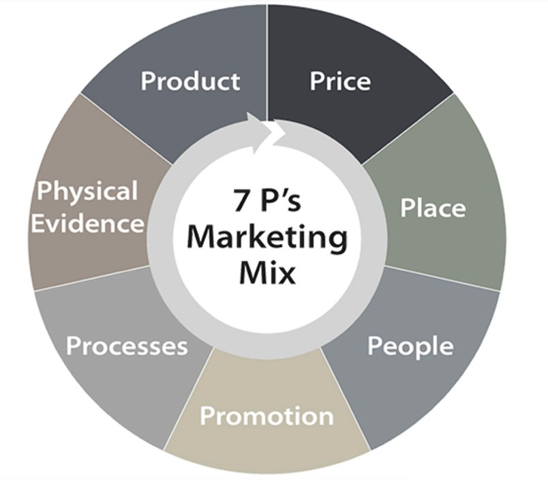
Figure 2: The sustainable marketing mix
The next element in the expanded seven Ps is People. People should be employed under fair working conditions and actively participate. This should involve both customers and increasing knowledge promotion in sustainability. The next element is Process. This step in the sustainable marketing mix should place a special focus on production processes. This also includes incorporating recycling where possible. Certifications should also be obtained to confirm the sustainability changes. Finally, there is Physical Evidence. The focus here is precisely on evidence and proof of the sustainable corporate strategy and sustainable marketing strategy. Actions should be as transparent as possible. Offices and similar spaces should promote sustainability through digital work processes and sustainable furnishings.37Quaranta, A. (2024). Applying the 7 PS of marketing to enhance dental practice operations and success. Annali Di Stomatologia, 15(2), 94.
The template also mentions the triple bottom line. This can be found under the heading of marketing strategy. The triple bottom line refers to the concepts of people, planet, and profit. Classic marketing strategies typically include maximizing profit and achieving the best possible competitive positioning. With the triple bottom line, the corporate strategy aims for sustainable responsibility and clear differentiation from other competitors, for example through climate-neutral production.38Alhaddi, H. (2015). Triple bottom line and sustainability: A literature review. Business and Management Studies, 1(2), 6.
The next step in the new template for a sustainable marketing plan is the part for the company that deals with controlling. Sustainability and sustainable marketing can only take place sensibly if it is well documented and measured effectively. In addition to classic key figures, such as the company’s revenue, for example, sustainability components are added. These can be social KPIs or ecological KPIs, for example. The sustainable additions mentioned above can be used to measure emissions savings or the proportion of recycled material in a product. Controlling therefore serves not only as a means of monitoring, but can also be used to correct the desired path if necessary, while at the same time providing a certain degree of transparency to the outside world.39Shrivastava, G. D., & Choithrani, S. (2024). The future of Content Marketing: Developing Kpis for Metaverse Content Marketing. ComFin Research, 12(4), 13–22.
An action plan was created at the end of the new template. Companies and other interested parties can set deadlines, get a rough idea of their status quo in terms of sustainability, and do so relatively easily and conveniently, as they can usually do this by simply ticking boxes.
The action plan first addresses questions such as which product changes can be implemented to achieve the goal of sustainability. It also addresses how to communicate to the outside world that the company is now operating in a more sustainable manner. In addition, questions about stakeholders should be answered, supplemented by rough timelines and responsibilities. This also includes information on possible control mechanisms.

Figure 3: Example from the action plan
The action plan has already been filled with possible answers as examples. This gives the company a good overview of what is really required and expected.
The last page of the new template for a sustainable marketing plan summarizes the most important aspects of the template and reminds the company of them. The aim should be to review the previous pages and start the sustainable marketing plan with motivation.
3.1 What does the new template offer?
The new template contributes to even easier handling of sustainable marketing. It follows a clear path and leads to a clear structure that is manageable and easy to implement within the company. Great importance is placed on acting transparently and working closely with local and regional stakeholders. In addition, the focus on customer relationships is not overlooked, and the credibility of the company and its brand is strengthened. The risk of being perceived by outsiders as a company that engages in greenwashing is minimized because clear metrics, such as KPIs, are used.
In general, sustainability in connection with marketing is not only seen as an additional point, but is treated as an essential element. This gives sustainability a long-term connection. Companies can look to the future with greater peace of mind if energy prices rise, climate crises arise, or stakeholders demand more sustainable practices. The company becomes more future-proof.
Finally, the new template also has some advantages for the company’s employees. Internal organization could be strengthened by enabling people to connect with and identify with the new sustainable goals and values. Marketing can help with employer branding by making the company attractive to potential employees and communicating its sustainable goals positively to the outside world. In addition, conserving resources can reduce costs, leading to more efficient internal processes.
3.2 Strengths and weaknesses of the template
On one hand, the template has a clear focus on long-term and sustainable value creation. This is appropriate, as it enables companies to make their sustainability goals a core component of their marketing strategy and to establish them. One focus is on stakeholder engagement. Transparent engagement with these groups can help to expand and deepen relationships with other companies and, especially with customers. Various measurable indicators help to ensure that all of this can be monitored.
On the other hand, there are many factors that companies must adhere to and implement. Especially for companies that are new to sustainable marketing, this could easily seem overwhelming and lead to unsatisfactory implementation of the template. In addition, the wiki article requires substantial data work. Smaller companies in particular may have problems ensuring high data availability. It is therefore more suitable for medium-sized to large companies.
References
- 1Kemper Joya A., Ballantine Paul W. (2019) “What do we mean by sustainability marketing”, Journal of Marketing Management, 35 (3-4), 277 – 309. ↩︎
- 2Jung Yeo Jin, Kim Youngmin (2023) “Research trends of sustainability and marketing research, 2010 – 2020: Topic modeling analysis”, Heliyon, 9 (3), 1- 18. ↩︎
- 3Thu Nguyen N. Q., Kadirov Djavlonbek, Fam Kim-Shyan, Tho Nguyen Dinh (2023) “Firm´s Sustainablility Marketing Commitment: The Roles of Chief Marketing Officers Future Focus and Prosocial Motivation”, Journal of Macromarketing, 43 (3), 306 – 321. ↩︎
- 4Tollin Karin, Christensen Lars Bech (2019) “Sustainability Marketing Commitment: Empirical Insights About Its Drivers at the Corporate and Functional Level of Marketing”, Journal of Business Ethics, 156 (May), 1165 – 1185. ↩︎
- 5Wallach Karen Anne, Popovich Deidre (2022) “Cause Beneficial or Cause Exploitative? Using Joint Motives to Increase Credibility of Sustainability Efforts”, Journal of Public Policy & Marketing, 42 (2), 187 – 202. ↩︎
- 6Szabo Szerena, Webster Jane (2020) “Perceived Greenwashing: The Effects of Green Marketing on Environmental and Product Perceptions”, Journal of Business Ethics, 171 (February), 719 – 739. ↩︎
- 7Bridges Claudia M., Wilhelm Wendy Bryce (2008) “Going Beyond Green: The “Why and How” of Integrating Sustainability Into the Marketing Curriculum”, Journal of Marketing Education, 30 (1), 33 – 46. ↩︎
- 8Peattie Ken, Belz Frank-Martin (2010) “Sustainability marketing – An innovative conception of marketing”, Marketing Review, 27 (5), 8-15. ↩︎
- 2Jung Yeo Jin, Kim Youngmin (2023) “Research trends of sustainability and marketing research, 2010 – 2020: Topic modeling analysis”, Heliyon, 9 (3), 1- 18. ↩︎
- 9McDonagh Pierre, Prothero Andrea (2014) “Sustainability marketing research: past, present and future”, Journal of Marketing Management, 30 (11-12), 1186 – 1219. ↩︎
- 1Kemper Joya A., Ballantine Paul W. (2019) “What do we mean by sustainability marketing”, Journal of Marketing Management, 35 (3-4), 277 – 309. ↩︎
- 2Jung Yeo Jin, Kim Youngmin (2023) “Research trends of sustainability and marketing research, 2010 – 2020: Topic modeling analysis”, Heliyon, 9 (3), 1- 18. ↩︎
- 10Hildebrand Diogo, Demotta Yoshiko, Sen Sankar, Valenzuela Ana (2017) “Consumer Responses to Corporate Social Responsibility (CSR) Contribution Type”, Journal of Consumer Research, 44 (4), 738 – 758. ↩︎
- 11Sweeney Lorraine, Coughlan Joseph (2008) “Do different industries report Corporate Social Responsibility differently? An investigation through the lens of stakeholder theory”, Journal of Marketing Communications, 14 (2), 113 – 124. ↩︎
- 12Cronin J. Joseph, Smith Jr. & Jeffery S., Gleim Mark R., Ramirez Edward, Martinez Jennifer Dawn (2010) “Green marketing strategies: an examination of stakeholders and the opportunities they present”, Journal of the Academy of Marketing Science, 39, 158 – 174. ↩︎
- 6Szabo Szerena, Webster Jane (2020) “Perceived Greenwashing: The Effects of Green Marketing on Environmental and Product Perceptions”, Journal of Business Ethics, 171 (February), 719 – 739. ↩︎
- 13Dann Stephen (2010) “Redefining social marketing with contemporary commercial marketing definitions”, Journal of Business Research, 63 (2), 147 – 153. ↩︎
- 14Blocker Christopher P., Cannon Joseph P., Zhang Jonathan Z. (2024) “Purpose orientation: An emerging theory transforming business for a better world”, Journal of the Academy of Marketing Science, 53 (January), 367 – 393. ↩︎
- 15Hajdas Monika, Kleczek Ryszard (2021) “The real purpose of purpose-driven branding: consumer empowerment and social transformation”, Journal of Brand Management, 28 (February), 359 – 373. ↩︎
- 9McDonagh Pierre, Prothero Andrea (2014) “Sustainability marketing research: past, present and future”, Journal of Marketing Management, 30 (11-12), 1186 – 1219. ↩︎
- 8Peattie Ken, Belz Frank-Martin (2010) “Sustainability marketing – An innovative conception of marketing”, Marketing Review, 27 (5), 8-15. ↩︎
- 8Peattie Ken, Belz Frank-Martin (2010) “Sustainability marketing – An innovative conception of marketing”, Marketing Review, 27 (5), 8-15. ↩︎
- 2Jung Yeo Jin, Kim Youngmin (2023) “Research trends of sustainability and marketing research, 2010 – 2020: Topic modeling analysis”, Heliyon, 9 (3), 1- 18. ↩︎
- 4Tollin Karin, Christensen Lars Bech (2019) “Sustainability Marketing Commitment: Empirical Insights About Its Drivers at the Corporate and Functional Level of Marketing”, Journal of Business Ethics, 156 (May), 1165 – 1185. ↩︎
- 16Purnama Yunus Indra (2024) “Implementation of the triple bottom line concept to improve sustainable marketing performance”, Journal of Economics and Business Letters, 4 (2), 40 – 50. ↩︎
- 17Anwar Yasmin, El-Bassiouny Noha (2020) “Marketing and the Sustainable Development Goals (SDGs): A Review and Research Agenda” In: Idowu Samuel O., Liangrong René Schmidpeter “The Future of the UN Sustainable Development Goals Business Perspectives for Global Development in 2030”, Springer, 187 – 207. ↩︎
- 18Deo Sheetal, Hinchcliffh Mercedes, Thai Nguyen T., Papakosmas Mary, Chad Paul, Heffernan Troy, Gibbons Belinda (2024) “Educating for the Sustainable Future: A Conceptual Process for Mapping the United Nations Sustainable Development Goals in Marketing Teaching Using Bloom´s Taxonomy”, Journal of Marketing Education, 46 (2), 84 – 96. ↩︎
- 3Thu Nguyen N. Q., Kadirov Djavlonbek, Fam Kim-Shyan, Tho Nguyen Dinh (2023) “Firm´s Sustainablility Marketing Commitment: The Roles of Chief Marketing Officers Future Focus and Prosocial Motivation”, Journal of Macromarketing, 43 (3), 306 – 321. ↩︎
- 4Tollin Karin, Christensen Lars Bech (2019) “Sustainability Marketing Commitment: Empirical Insights About Its Drivers at the Corporate and Functional Level of Marketing”, Journal of Business Ethics, 156 (May), 1165 – 1185. ↩︎
- 7Bridges Claudia M., Wilhelm Wendy Bryce (2008) “Going Beyond Green: The “Why and How” of Integrating Sustainability Into the Marketing Curriculum”, Journal of Marketing Education, 30 (1), 33 – 46. ↩︎
- 5Wallach Karen Anne, Popovich Deidre (2022) “Cause Beneficial or Cause Exploitative? Using Joint Motives to Increase Credibility of Sustainability Efforts”, Journal of Public Policy & Marketing, 42 (2), 187 – 202. ↩︎
- 7Bridges Claudia M., Wilhelm Wendy Bryce (2008) “Going Beyond Green: The “Why and How” of Integrating Sustainability Into the Marketing Curriculum”, Journal of Marketing Education, 30 (1), 33 – 46. ↩︎
- 3Thu Nguyen N. Q., Kadirov Djavlonbek, Fam Kim-Shyan, Tho Nguyen Dinh (2023) “Firm´s Sustainablility Marketing Commitment: The Roles of Chief Marketing Officers Future Focus and Prosocial Motivation”, Journal of Macromarketing, 43 (3), 306 – 321. ↩︎
- 19Alam S. M. Shafiul, Islam K. M. Zahidul (2021) “Examining the role of environmental corporate social responsibility in building green corporate image and green competitive advantage”, International Journal of Corporate Social Responsibility, 6 (8), 1 – 16. ↩︎
- 8Peattie Ken, Belz Frank-Martin (2010) “Sustainability marketing – An innovative conception of marketing”, Marketing Review, 27 (5), 8-15. ↩︎
- 2Jung Yeo Jin, Kim Youngmin (2023) “Research trends of sustainability and marketing research, 2010 – 2020: Topic modeling analysis”, Heliyon, 9 (3), 1- 18. ↩︎
- 1Kemper Joya A., Ballantine Paul W. (2019) “What do we mean by sustainability marketing”, Journal of Marketing Management, 35 (3-4), 277 – 309. ↩︎
- 5Wallach Karen Anne, Popovich Deidre (2022) “Cause Beneficial or Cause Exploitative? Using Joint Motives to Increase Credibility of Sustainability Efforts”, Journal of Public Policy & Marketing, 42 (2), 187 – 202. ↩︎
- 2Jung Yeo Jin, Kim Youngmin (2023) “Research trends of sustainability and marketing research, 2010 – 2020: Topic modeling analysis”, Heliyon, 9 (3), 1- 18. ↩︎
- 4Tollin Karin, Christensen Lars Bech (2019) “Sustainability Marketing Commitment: Empirical Insights About Its Drivers at the Corporate and Functional Level of Marketing”, Journal of Business Ethics, 156 (May), 1165 – 1185. ↩︎
- 20Belz Frank, Peattie Kenneth J. (2012) “Sustainable Marketing: a global perspective”, second edition, Chichester, Wiley. ↩︎
- 21Kotler Philip (2011) “Reinventing Marketing to Manage the Environmental Imperative”, Journal of marketing, 75 (4), 132-135. ↩︎
- 22Martin Diane M., Schouten John W. (2012) “Sustainable marketing”, Munich, Prentice Hall. ↩︎
- 23United Nations (UN) (2015) “Transforming our world: the 2030 Agenda for Sustainable Development” New York: United Nations. ↩︎
- 24Global Reporting Initiative (GRI) (2020) “GRI Standards”, GRI, Amsterdam. ↩︎
- 25SASB (2020) “Sustainability Accounting Standards Board Standards”, San Francisco: SASB. ↩︎
- 8Peattie Ken, Belz Frank-Martin (2010) “Sustainability marketing – An innovative conception of marketing”, Marketing Review, 27 (5), 8-15. ↩︎
- 26Fuduric Nikolina (2020) “The Sustainable Marketing Canvas – A new Decision-Making Tool”, Marketing Review St. Gallen, 37 (4), 50-57. ↩︎
- 27Lyman Steven B., Tan Choon Keah, Wisner Joel D. (2002) “Supply chain management: a strategic perspective”, International journal of operations & production management, 22 (6), 614-631. ↩︎
- 23United Nations (UN) (2015) “Transforming our world: the 2030 Agenda for Sustainable Development” New York: United Nations. ↩︎
- 28Elkington John, Rowlands Ian H. (2000) “Cannibals with forks: the triple bottom line of 21st century business” 25 (4), 42-43. ↩︎
- 24Global Reporting Initiative (GRI) (2020) “GRI Standards”, GRI, Amsterdam. ↩︎
- 25SASB (2020) “Sustainability Accounting Standards Board Standards”, San Francisco: SASB. ↩︎
- 8Peattie Ken, Belz Frank-Martin (2010) “Sustainability marketing – An innovative conception of marketing”, Marketing Review, 27 (5), 8-15. ↩︎
- 26Fuduric Nikolina (2020) “The Sustainable Marketing Canvas – A new Decision-Making Tool”, Marketing Review St. Gallen, 37 (4), 50-57. ↩︎
- 29UNGC, GRI, WBCSD (2015) “SDG Compass: The Guide for Business Action on the SDGs” New York, Amsterdam, Geneva ↩︎
- 24Global Reporting Initiative (GRI) (2020) “GRI Standards”, GRI, Amsterdam. ↩︎
- 26Fuduric Nikolina (2020) “The Sustainable Marketing Canvas – A new Decision-Making Tool”, Marketing Review St. Gallen, 37 (4), 50-57. ↩︎
- 30Baumgartner Rupert J, Rauter Romana (2017) “Strategic perspectives of corporate sustainability management to develop a sustainable organization” 140 (1), 81-92. ↩︎
- 31Hahn Tobias, Figge Frank, Pinkse Jonatan, Preuss Lutz (2018) “A Paradox Perspective on Corporate Sustainability: Descriptive, Instrumental, and Normative Aspects”, Journal of business ethics, 148 (2), 235 – 248. ↩︎
- 26Fuduric Nikolina (2020) “The Sustainable Marketing Canvas – A new Decision-Making Tool”, Marketing Review St. Gallen, 37 (4), 50-57. ↩︎
- 32Delmas Magali A., Burbano Vanessa Cuerel (2011) “The Drivers of Greenwashing”, California management review, 54 (1), 64 – 87. ↩︎
- 33Upson, J. W., Ketchen, D. J., Connelly, B. L., & Ranft, A. L. (2012). Competitor analysis and foothold moves. Academy of Management Journal, 55(1), 93–110. ↩︎
- 34Dietrich, P. (2019, November). (PDF) die swot-analyse – wirksame analysen und lösungen entwickeln. ↩︎
- 35Banelienė, R., & Strazdas, R. (2025). A holistic approach to sustainability: Sustainable development goals (sdgs) and corporate sustainability. Contemporary Economics, 19(2), 186–207. ↩︎
- 36Bahrami, Z., Heidari, A., & Cranney, J. (2022). Applying smart goal intervention leads to greater goal attainment, need satisfaction and positive affect. International Journal of Mental Health Promotion, 24(6), 869–882. ↩︎
- 37Quaranta, A. (2024). Applying the 7 PS of marketing to enhance dental practice operations and success. Annali Di Stomatologia, 15(2), 94. ↩︎
- 37Quaranta, A. (2024). Applying the 7 PS of marketing to enhance dental practice operations and success. Annali Di Stomatologia, 15(2), 94. ↩︎
- 38Alhaddi, H. (2015). Triple bottom line and sustainability: A literature review. Business and Management Studies, 1(2), 6. ↩︎
- 39Shrivastava, G. D., & Choithrani, S. (2024). The future of Content Marketing: Developing Kpis for Metaverse Content Marketing. ComFin Research, 12(4), 13–22. ↩︎
- 1Kemper Joya A., Ballantine Paul W. (2019) “What do we mean by sustainability marketing”, Journal of Marketing Management, 35 (3-4), 277 – 309. ↩︎
- 2Jung Yeo Jin, Kim Youngmin (2023) “Research trends of sustainability and marketing research, 2010 – 2020: Topic modeling analysis”, Heliyon, 9 (3), 1- 18. ↩︎
- 3Thu Nguyen N. Q., Kadirov Djavlonbek, Fam Kim-Shyan, Tho Nguyen Dinh (2023) “Firm´s Sustainablility Marketing Commitment: The Roles of Chief Marketing Officers Future Focus and Prosocial Motivation”, Journal of Macromarketing, 43 (3), 306 – 321. ↩︎
- 4Tollin Karin, Christensen Lars Bech (2019) “Sustainability Marketing Commitment: Empirical Insights About Its Drivers at the Corporate and Functional Level of Marketing”, Journal of Business Ethics, 156 (May), 1165 – 1185. ↩︎
- 5Wallach Karen Anne, Popovich Deidre (2022) “Cause Beneficial or Cause Exploitative? Using Joint Motives to Increase Credibility of Sustainability Efforts”, Journal of Public Policy & Marketing, 42 (2), 187 – 202. ↩︎
- 6Szabo Szerena, Webster Jane (2020) “Perceived Greenwashing: The Effects of Green Marketing on Environmental and Product Perceptions”, Journal of Business Ethics, 171 (February), 719 – 739. ↩︎
- 7Bridges Claudia M., Wilhelm Wendy Bryce (2008) “Going Beyond Green: The “Why and How” of Integrating Sustainability Into the Marketing Curriculum”, Journal of Marketing Education, 30 (1), 33 – 46. ↩︎
- 8Peattie Ken, Belz Frank-Martin (2010) “Sustainability marketing – An innovative conception of marketing”, Marketing Review, 27 (5), 8-15. ↩︎
- 2Jung Yeo Jin, Kim Youngmin (2023) “Research trends of sustainability and marketing research, 2010 – 2020: Topic modeling analysis”, Heliyon, 9 (3), 1- 18. ↩︎
- 9McDonagh Pierre, Prothero Andrea (2014) “Sustainability marketing research: past, present and future”, Journal of Marketing Management, 30 (11-12), 1186 – 1219. ↩︎
- 1Kemper Joya A., Ballantine Paul W. (2019) “What do we mean by sustainability marketing”, Journal of Marketing Management, 35 (3-4), 277 – 309. ↩︎
- 2Jung Yeo Jin, Kim Youngmin (2023) “Research trends of sustainability and marketing research, 2010 – 2020: Topic modeling analysis”, Heliyon, 9 (3), 1- 18. ↩︎
- 10Hildebrand Diogo, Demotta Yoshiko, Sen Sankar, Valenzuela Ana (2017) “Consumer Responses to Corporate Social Responsibility (CSR) Contribution Type”, Journal of Consumer Research, 44 (4), 738 – 758. ↩︎
- 11Sweeney Lorraine, Coughlan Joseph (2008) “Do different industries report Corporate Social Responsibility differently? An investigation through the lens of stakeholder theory”, Journal of Marketing Communications, 14 (2), 113 – 124. ↩︎
- 12Cronin J. Joseph, Smith Jr. & Jeffery S., Gleim Mark R., Ramirez Edward, Martinez Jennifer Dawn (2010) “Green marketing strategies: an examination of stakeholders and the opportunities they present”, Journal of the Academy of Marketing Science, 39, 158 – 174. ↩︎
- 6Szabo Szerena, Webster Jane (2020) “Perceived Greenwashing: The Effects of Green Marketing on Environmental and Product Perceptions”, Journal of Business Ethics, 171 (February), 719 – 739. ↩︎
- 13Dann Stephen (2010) “Redefining social marketing with contemporary commercial marketing definitions”, Journal of Business Research, 63 (2), 147 – 153. ↩︎
- 14Blocker Christopher P., Cannon Joseph P., Zhang Jonathan Z. (2024) “Purpose orientation: An emerging theory transforming business for a better world”, Journal of the Academy of Marketing Science, 53 (January), 367 – 393. ↩︎
- 15Hajdas Monika, Kleczek Ryszard (2021) “The real purpose of purpose-driven branding: consumer empowerment and social transformation”, Journal of Brand Management, 28 (February), 359 – 373. ↩︎
- 9McDonagh Pierre, Prothero Andrea (2014) “Sustainability marketing research: past, present and future”, Journal of Marketing Management, 30 (11-12), 1186 – 1219. ↩︎
- 8Peattie Ken, Belz Frank-Martin (2010) “Sustainability marketing – An innovative conception of marketing”, Marketing Review, 27 (5), 8-15. ↩︎
- 8Peattie Ken, Belz Frank-Martin (2010) “Sustainability marketing – An innovative conception of marketing”, Marketing Review, 27 (5), 8-15. ↩︎
- 2Jung Yeo Jin, Kim Youngmin (2023) “Research trends of sustainability and marketing research, 2010 – 2020: Topic modeling analysis”, Heliyon, 9 (3), 1- 18. ↩︎
- 4Tollin Karin, Christensen Lars Bech (2019) “Sustainability Marketing Commitment: Empirical Insights About Its Drivers at the Corporate and Functional Level of Marketing”, Journal of Business Ethics, 156 (May), 1165 – 1185. ↩︎
- 16Purnama Yunus Indra (2024) “Implementation of the triple bottom line concept to improve sustainable marketing performance”, Journal of Economics and Business Letters, 4 (2), 40 – 50. ↩︎
- 17Anwar Yasmin, El-Bassiouny Noha (2020) “Marketing and the Sustainable Development Goals (SDGs): A Review and Research Agenda” In: Idowu Samuel O., Liangrong René Schmidpeter “The Future of the UN Sustainable Development Goals Business Perspectives for Global Development in 2030”, Springer, 187 – 207. ↩︎
- 18Deo Sheetal, Hinchcliffh Mercedes, Thai Nguyen T., Papakosmas Mary, Chad Paul, Heffernan Troy, Gibbons Belinda (2024) “Educating for the Sustainable Future: A Conceptual Process for Mapping the United Nations Sustainable Development Goals in Marketing Teaching Using Bloom´s Taxonomy”, Journal of Marketing Education, 46 (2), 84 – 96. ↩︎
- 3Thu Nguyen N. Q., Kadirov Djavlonbek, Fam Kim-Shyan, Tho Nguyen Dinh (2023) “Firm´s Sustainablility Marketing Commitment: The Roles of Chief Marketing Officers Future Focus and Prosocial Motivation”, Journal of Macromarketing, 43 (3), 306 – 321. ↩︎
- 4Tollin Karin, Christensen Lars Bech (2019) “Sustainability Marketing Commitment: Empirical Insights About Its Drivers at the Corporate and Functional Level of Marketing”, Journal of Business Ethics, 156 (May), 1165 – 1185. ↩︎
- 7Bridges Claudia M., Wilhelm Wendy Bryce (2008) “Going Beyond Green: The “Why and How” of Integrating Sustainability Into the Marketing Curriculum”, Journal of Marketing Education, 30 (1), 33 – 46. ↩︎
- 5Wallach Karen Anne, Popovich Deidre (2022) “Cause Beneficial or Cause Exploitative? Using Joint Motives to Increase Credibility of Sustainability Efforts”, Journal of Public Policy & Marketing, 42 (2), 187 – 202. ↩︎
- 7Bridges Claudia M., Wilhelm Wendy Bryce (2008) “Going Beyond Green: The “Why and How” of Integrating Sustainability Into the Marketing Curriculum”, Journal of Marketing Education, 30 (1), 33 – 46. ↩︎
- 3Thu Nguyen N. Q., Kadirov Djavlonbek, Fam Kim-Shyan, Tho Nguyen Dinh (2023) “Firm´s Sustainablility Marketing Commitment: The Roles of Chief Marketing Officers Future Focus and Prosocial Motivation”, Journal of Macromarketing, 43 (3), 306 – 321. ↩︎
- 19Alam S. M. Shafiul, Islam K. M. Zahidul (2021) “Examining the role of environmental corporate social responsibility in building green corporate image and green competitive advantage”, International Journal of Corporate Social Responsibility, 6 (8), 1 – 16. ↩︎
- 8Peattie Ken, Belz Frank-Martin (2010) “Sustainability marketing – An innovative conception of marketing”, Marketing Review, 27 (5), 8-15. ↩︎
- 2Jung Yeo Jin, Kim Youngmin (2023) “Research trends of sustainability and marketing research, 2010 – 2020: Topic modeling analysis”, Heliyon, 9 (3), 1- 18. ↩︎
- 1Kemper Joya A., Ballantine Paul W. (2019) “What do we mean by sustainability marketing”, Journal of Marketing Management, 35 (3-4), 277 – 309. ↩︎
- 5Wallach Karen Anne, Popovich Deidre (2022) “Cause Beneficial or Cause Exploitative? Using Joint Motives to Increase Credibility of Sustainability Efforts”, Journal of Public Policy & Marketing, 42 (2), 187 – 202. ↩︎
- 2Jung Yeo Jin, Kim Youngmin (2023) “Research trends of sustainability and marketing research, 2010 – 2020: Topic modeling analysis”, Heliyon, 9 (3), 1- 18. ↩︎
- 4Tollin Karin, Christensen Lars Bech (2019) “Sustainability Marketing Commitment: Empirical Insights About Its Drivers at the Corporate and Functional Level of Marketing”, Journal of Business Ethics, 156 (May), 1165 – 1185. ↩︎
- 20Belz Frank, Peattie Kenneth J. (2012) “Sustainable Marketing: a global perspective”, second edition, Chichester, Wiley. ↩︎
- 21Kotler Philip (2011) “Reinventing Marketing to Manage the Environmental Imperative”, Journal of marketing, 75 (4), 132-135. ↩︎
- 22Martin Diane M., Schouten John W. (2012) “Sustainable marketing”, Munich, Prentice Hall. ↩︎
- 23United Nations (UN) (2015) “Transforming our world: the 2030 Agenda for Sustainable Development” New York: United Nations. ↩︎
- 24Global Reporting Initiative (GRI) (2020) “GRI Standards”, GRI, Amsterdam. ↩︎
- 25SASB (2020) “Sustainability Accounting Standards Board Standards”, San Francisco: SASB. ↩︎
- 8Peattie Ken, Belz Frank-Martin (2010) “Sustainability marketing – An innovative conception of marketing”, Marketing Review, 27 (5), 8-15. ↩︎
- 26Fuduric Nikolina (2020) “The Sustainable Marketing Canvas – A new Decision-Making Tool”, Marketing Review St. Gallen, 37 (4), 50-57. ↩︎
- 27Lyman Steven B., Tan Choon Keah, Wisner Joel D. (2002) “Supply chain management: a strategic perspective”, International journal of operations & production management, 22 (6), 614-631. ↩︎
- 23United Nations (UN) (2015) “Transforming our world: the 2030 Agenda for Sustainable Development” New York: United Nations. ↩︎
- 28Elkington John, Rowlands Ian H. (2000) “Cannibals with forks: the triple bottom line of 21st century business” 25 (4), 42-43. ↩︎
- 24Global Reporting Initiative (GRI) (2020) “GRI Standards”, GRI, Amsterdam. ↩︎
- 25SASB (2020) “Sustainability Accounting Standards Board Standards”, San Francisco: SASB. ↩︎
- 8Peattie Ken, Belz Frank-Martin (2010) “Sustainability marketing – An innovative conception of marketing”, Marketing Review, 27 (5), 8-15. ↩︎
- 26Fuduric Nikolina (2020) “The Sustainable Marketing Canvas – A new Decision-Making Tool”, Marketing Review St. Gallen, 37 (4), 50-57. ↩︎
- 29UNGC, GRI, WBCSD (2015) “SDG Compass: The Guide for Business Action on the SDGs” New York, Amsterdam, Geneva ↩︎
- 24Global Reporting Initiative (GRI) (2020) “GRI Standards”, GRI, Amsterdam. ↩︎
- 26Fuduric Nikolina (2020) “The Sustainable Marketing Canvas – A new Decision-Making Tool”, Marketing Review St. Gallen, 37 (4), 50-57. ↩︎
- 30Baumgartner Rupert J, Rauter Romana (2017) “Strategic perspectives of corporate sustainability management to develop a sustainable organization” 140 (1), 81-92. ↩︎
- 31Hahn Tobias, Figge Frank, Pinkse Jonatan, Preuss Lutz (2018) “A Paradox Perspective on Corporate Sustainability: Descriptive, Instrumental, and Normative Aspects”, Journal of business ethics, 148 (2), 235 – 248. ↩︎
- 26Fuduric Nikolina (2020) “The Sustainable Marketing Canvas – A new Decision-Making Tool”, Marketing Review St. Gallen, 37 (4), 50-57. ↩︎
- 32Delmas Magali A., Burbano Vanessa Cuerel (2011) “The Drivers of Greenwashing”, California management review, 54 (1), 64 – 87. ↩︎
- 33Upson, J. W., Ketchen, D. J., Connelly, B. L., & Ranft, A. L. (2012). Competitor analysis and foothold moves. Academy of Management Journal, 55(1), 93–110. ↩︎
- 34Dietrich, P. (2019, November). (PDF) die swot-analyse – wirksame analysen und lösungen entwickeln. ↩︎
- 35Banelienė, R., & Strazdas, R. (2025). A holistic approach to sustainability: Sustainable development goals (sdgs) and corporate sustainability. Contemporary Economics, 19(2), 186–207. ↩︎
- 36Bahrami, Z., Heidari, A., & Cranney, J. (2022). Applying smart goal intervention leads to greater goal attainment, need satisfaction and positive affect. International Journal of Mental Health Promotion, 24(6), 869–882. ↩︎
- 37Quaranta, A. (2024). Applying the 7 PS of marketing to enhance dental practice operations and success. Annali Di Stomatologia, 15(2), 94. ↩︎
- 37Quaranta, A. (2024). Applying the 7 PS of marketing to enhance dental practice operations and success. Annali Di Stomatologia, 15(2), 94. ↩︎
- 38Alhaddi, H. (2015). Triple bottom line and sustainability: A literature review. Business and Management Studies, 1(2), 6. ↩︎
- 39Shrivastava, G. D., & Choithrani, S. (2024). The future of Content Marketing: Developing Kpis for Metaverse Content Marketing. ComFin Research, 12(4), 13–22. ↩︎