
Authors: Carolin Wachtendorf, Clara Dahlhaus, Elisabeth Frey
Edited by:
Last updated: June 23, 2026
Executive summary
Materiality assessments help organizations focus sustainability reporting and management on the topics that matter most. The article explains how sustainability disclosure has evolved from voluntary reporting toward binding requirements, especially through the CSRD and ESRS in the EU, while GRI and IFRS SDS remain important global reference points. Because these frameworks cover many potential topics, organizations need a structured way to identify and prioritize material impacts, risks, and opportunities.
The article distinguishes three perspectives. GRI emphasizes impact materiality: how an organization affects people, the environment, and the economy. IFRS SDS emphasizes financial materiality: sustainability-related risks and opportunities that may affect enterprise value, cash flows, access to finance, or capital costs. ESRS combines both through double materiality, requiring organizations to consider inside-out impacts and outside-in financial effects across their operations and value chains.
The proposed Excel-based materiality assessment tool is designed to use the interoperability among ESRS, GRI, and IFRS SDS. It helps organizations assess impacts using criteria such as scale, scope, irremediability, and probability, and assess financial risks and opportunities using probability and magnitude. The tool also includes stakeholder engagement, value chain mapping, weighting options, automated scoring, and a matrix that visualizes which topics exceed the chosen materiality threshold.
For practitioners, the tool offers an accessible starting point for identifying and documenting material sustainability matters, particularly for organizations seeking to improve social and ecological performance while preparing credible reports. Its main limitations are typical of spreadsheet-based tools: formulas can be overwritten, collaboration can become difficult, and long-term data management may require more robust software. The article concludes that the tool can support double materiality analysis and reduce duplicated work across reporting frameworks, but should be complemented by stronger digital workflows where complexity, auditability, or multi-user collaboration increase.
1 Introduction
Beyond financial performance, addressing social and environmental impacts has shifted from a niche practice to a core requirement for organizations. Thus, sustainability and Corporate Social Responsibility have become pivotal factors in corporate strategy and accountability. International Financial Reporting Standards (IFRS) have shaped financial reporting since 2003.1IFRS. IFRS 1 First-time Adoption of International Financial Reporting Standards. https://www.ifrs.org/issued-standards/list-of-standards/ifrs-1-first-time-adoption-of-ifrs/. However, sustainability reporting only became subject to binding rules in 2014 when the Non-Financial Reporting Directive (NFRD) introduced disclosure requirements for certain organizations to increase transparency regarding their sustainability performance.2Bundesministerium für Arbeit und Soziales (BMAS). Corporate Sustainability Reporting Directive (CSRD). https://www.csr-in-deutschland.de/DE/CSR-Allgemein/CSR-Politik/CSR-in-der-EU/Corporate-Sustainability-Reporting-Directive/corporate-sustainability-reporting-directive.html. With the introduction of the NFRD, large organizations above the defined thresholds were required to disclose non-financial information. They typically used recognized standards, such as the Global Reporting Initiative (GRI), which was published in 2000 and is widely adopted for voluntary sustainability reporting.3GRI. A Short Introduction to the GRI Standards. https://www.globalreporting.org/media/wtaf14tw/a-short-introduction-to-the-gri-standards.pdf.,4GRI. Our mission and history. https://www.globalreporting.org/about-gri/mission-history/. In response to the growing demand for sustainability reporting, the IFRS Foundation introduced the Sustainability Disclosure Standards (SDS) in 2023. The standards set a global baseline for reporting sustainability-related (IFRS S1) and climate-related (IFRS S2) financial information.5IFRS. Introduction to the ISSB and IFRS Sustainability Disclosure Standards. https://www.ifrs.org/sustainability/knowledge-hub/introduction-to-issb-and-ifrs-sustainability-disclosure-standards/. While the IFRS SDS framework was developed internationally, the EU finalized the Corporate Sustainability Reporting Directive (CSRD) in 2023, which significantly expanded mandatory sustainability reporting.6European Commission. Corporate sustainability reporting. https://finance.ec.europa.eu/capital-markets-union-and-financial-markets/company-reporting-and-auditing/company-reporting/corporate-sustainability-reporting_en. The CSRD requires reporting based on the European Sustainability Reporting Standards (ESRS), which were developed by the GRI and EFRAG.7GRI. EFRAG and GRI enhance collaboration with deeper ties. https://www.globalreporting.org/news/news-center/efrag-and-gri-enhance-collaboration-with-deeper-ties/. Through collaboration with the GRI, the ESRS closely align with the GRI framework, ensuring high interoperability between these frameworks.8EFRAG & GRI. EFRAG-GRI Joint Statement of Interoperability. https://efrag.sharefile.com/share/view/s459956b01c6841298f78e5031759ca6e/fo8ed338-4c5e-4502-823b-88009818b85a (2023).
Since all three frameworks cover numerous topics, it is impractical to report on everything. Therefore, organizations must focus on the most relevant information, known as material aspects. While the GRI emphasizes impact materiality and the IFRS SDS financial materiality, the ESRS require both, applying double materiality.9European Commission. Commission Delegated Regulation (EU) 2023/2772 of 31 July 2023 supplementing Directive 2013/34/EU of the European Parliament and of the Council as regards sustainability reporting standards. http://data.europa.eu/eli/reg_del/2023/2772/2023-12-22/eng (2023). Therefore, ESRS were developed as a unified European standard for sustainability reporting, aligned closely with IFRS SDS and GRI to ensure interoperability and reduce duplication.8EFRAG & GRI. EFRAG-GRI Joint Statement of Interoperability. https://efrag.sharefile.com/share/view/s459956b01c6841298f78e5031759ca6e/fo8ed338-4c5e-4502-823b-88009818b85a (2023).,10Accountancy Europe. ESRS perspectives: Interoperability. (2024).,11EFRAG. Interoperability between ESRS and other sustainability reporting standards. https://www.efrag.org/en/sustainability-reporting/esrs-workstreams/interoperability.
A reliable materiality assessment tool helps organizations identify and prioritize important sustainability aspects, reducing unnecessary reporting and optimizing resource use.12EFRAG. Implementation Guidance EFRAG IG 1 Materiality Assessment. (2024). By linking sustainability to financial interests, the tool encourages more responsible business practices.9European Commission. Commission Delegated Regulation (EU) 2023/2772 of 31 July 2023 supplementing Directive 2013/34/EU of the European Parliament and of the Council as regards sustainability reporting standards. http://data.europa.eu/eli/reg_del/2023/2772/2023-12-22/eng (2023). Particularly because sustainability reporting is often criticized for being overly bureaucratic, a well-structured and regularly updated materiality assessment tool can significantly reduce the overall workload of the reporting process.13EFRAG. Draft status report ESRS simplification. (2025). This tool lays the foundation for effective and credible sustainability reporting.12EFRAG. Implementation Guidance EFRAG IG 1 Materiality Assessment. (2024).,13EFRAG. Draft status report ESRS simplification. (2025).
First, this paper introduces the three mentioned sustainability disclosure standards and the concept of materiality in chapter 2. Existing tools will be presented in chapter 3, and the development of a new materiality tool is explained in chapter 4. Key findings and limitations are discussed in chapter 5, while in chapter 6, recommendations for improving sustainability Wiki Entries are provided.
2 Background on disclosure and materiality
This chapter provides the theoretical foundation for applying the materiality assessment tool by introducing the three sustainability reporting standards outlined earlier. It is also explained how impacts, risks, and opportunities (IROs) are addressed within materiality, ensuring that the tool can be applied clearly and consistently. Finally, in this chapter, the importance of materiality in sustainability disclosures is emphasized.
2.1 Global Reporting Initiative (GRI)
The GRI is one of the most commonly used sustainability reporting frameworks worldwide.14Bais, B., Nassimbeni, G. & Orzes, G. Global Reporting Initiative: Literature review and research directions. J. Clean. Prod. 471, (2024). Companies that are required to report according to the NFRD can choose from international, European, or national standards, including the GRI.15Hahnkamper-Vandenbulcke, N. Non-financial Reporting Directive. (2021). Additionally, the GRI is used voluntarily by companies that are not formally required to report. Since the introduction of the ESRS, the GRI has often been viewed as reflecting the impact dimension of materiality. It focuses on an organization’s effects on the economy, the environment, and people, while giving priority to stakeholders’ needs.3GRI. A Short Introduction to the GRI Standards. https://www.globalreporting.org/media/wtaf14tw/a-short-introduction-to-the-gri-standards.pdf.
Appendix 1 illustrates the modular structure of the GRI Standards, which contains three interconnected components. Organizations should apply all three universal standards (GRI 1 to 3), which establish the core reporting principles. The sector standards guide reporting on issues specific to each sector, while the topic standards help organizations disclose information on their material topics.3GRI. A Short Introduction to the GRI Standards. https://www.globalreporting.org/media/wtaf14tw/a-short-introduction-to-the-gri-standards.pdf.,16GRI. GRI Standards English Language. https://www.globalreporting.org/how-to-use-the-gri-standards/gri-standards-english-language/. In addition to impact materiality, the ESRS introduced financial materiality, which aligns with the IFRS SDS perspective. According to the ESRS, organizations must report on both dimensions using the double materiality approach, as shown in Appendix 3.17Mezzanotte, F. E. Corporate sustainability reporting: double materiality, impacts, and legal risk. J. Corp. Law Stud. 23, 633–663 (2023).
2.2 International Financial Reporting Standards Sustainability Disclosure Standards (IFRS SDS)
In 2020, the IFRS Foundation began developing the IFRS Sustainability Disclosure Standards (IFRS SDS) and established the International Sustainability Standards Board (ISSB). These standards, IFRS S1 and S2, provide a global baseline for reporting sustainability and climate-related financial information.18Baumüller, J. IFRS Sustainability Disclosure Standards. Z. Für Corp. Gov. 10 (2023) doi:10.37307/j.1868-7792.2023.03.10. They were developed in parallel with the EU’s ESRS.9European Commission. Commission Delegated Regulation (EU) 2023/2772 of 31 July 2023 supplementing Directive 2013/34/EU of the European Parliament and of the Council as regards sustainability reporting standards. http://data.europa.eu/eli/reg_del/2023/2772/2023-12-22/eng (2023).
The IFRS SDS are investor-focused and particularly important for the capital market. Closely linked with financial reporting and the IFRS, they represent a comprehensive framework for consistent financial and sustainability-related corporate reporting.18Baumüller, J. IFRS Sustainability Disclosure Standards. Z. Für Corp. Gov. 10 (2023) doi:10.37307/j.1868-7792.2023.03.10. The first standard, IFRS S1 General Requirements for Disclosure of Sustainability-related Financial Information, focuses on the communication of general sustainability-related risks and opportunities, based on the structure of the Task Force on Climate-related Financial Disclosures (TCFD).5IFRS. Introduction to the ISSB and IFRS Sustainability Disclosure Standards. https://www.ifrs.org/sustainability/knowledge-hub/introduction-to-issb-and-ifrs-sustainability-disclosure-standards/. IFRS S2 Climate-related Disclosures represents the second standard and stipulates the precise climate-related disclosure requirements for an organization to disclose information about its climate-related risks and opportunities, also considering the TCFD.19IFRS. Sustainability-Related Risks and Opportunities and the Disclosure of Material Information. https://www.ifrs.org/content/dam/ifrs/supporting-implementation/issb-standards/issb-materiality-education-material.pdf (2024). Due to the financial perspective of these standards, the IFRS SDS consider what is material only from a financial perspective.5IFRS. Introduction to the ISSB and IFRS Sustainability Disclosure Standards. https://www.ifrs.org/sustainability/knowledge-hub/introduction-to-issb-and-ifrs-sustainability-disclosure-standards/.
2.3 Corporate Sustainability Reporting Directive (CSRD)
The CSRD was originally planned to apply starting in 2024, with a phased introduction for other companies over the following years.20European Commission. Proposal for a Directive of the European Parliament and of the Council amending Directives (EU) 2022/2464 and (EU) 2024/1760 as regards the dates from which Member States are to apply certain corporate sustainability reporting and due diligence requirements. https://eur-lex.europa.eu/legal-content/EN/TXT/PDF/?uri=CELEX:52025PC0080 (2025).,21European Commission. Q&A adoption of European Sustainability Reporting Standards. https://ec.europa.eu/commission/presscorner/detail/en/qanda_23_4043. In February 2025, the European Commission presented the Omnibus proposal, which aims to reduce the number of companies affected by raising thresholds (e.g. 1,000 employees or more) and simplify ESRS requirements by cutting mandatory data points and clarifying disclosures.20European Commission. Proposal for a Directive of the European Parliament and of the Council amending Directives (EU) 2022/2464 and (EU) 2024/1760 as regards the dates from which Member States are to apply certain corporate sustainability reporting and due diligence requirements. https://eur-lex.europa.eu/legal-content/EN/TXT/PDF/?uri=CELEX:52025PC0080 (2025).,22EMAS. EU-Omnibus: Neue Regeln für CSRD-Berichtspflicht. https://www.emas.de/aktuelles/news/2025-02-crsd-omnibus (2024).,23Deloitte. European Sustainability Reporting — Omnibus Update and Proposed Revised European Sustainability Reporting Standards (August 21, 2025). https://dart.deloitte.com/USDART/home/publications/deloitte/heads-up/2025/european-sustainability-omnibus-reporting-standards.,24European Commission. Omnibus package. https://finance.ec.europa.eu/news/omnibus-package-2025-04-01_en. These structural adjustments are still under negotiation. Shortly thereafter, in April 2025, the Stop-the-Clock Directive was adopted, temporarily postponing reporting obligations under the CSRD and the CSDDD.25Rat der Europäischen Union. Vereinfachung: Rat gibt endgültig grünes Licht für „Stop-the-Clock“-Mechanismus zur Stärkung der Wettbewerbsfähigkeit der EU und der Rechtssicherheit für Unternehmen. https://www.consilium.europa.eu/de/press/press-releases/2025/04/14/simplification-council-gives-final-green-light-on-the-stop-the-clock-mechanism-to-boost-eu-competitiveness-and-provide-legal-certainty-to-businesses/. Nevertheless, companies that are already subject to the NFRD in the EU must report using the ESRS.26Macedo Vitorino. Understanding the EU Stop-the-Clock Directive Omnibus Package. (2025).
The Delegated Regulation (EU) 2023/2772 defines the ESRS and provides the legal basis for sustainability reporting under the CSRD.9European Commission. Commission Delegated Regulation (EU) 2023/2772 of 31 July 2023 supplementing Directive 2013/34/EU of the European Parliament and of the Council as regards sustainability reporting standards. http://data.europa.eu/eli/reg_del/2023/2772/2023-12-22/eng (2023). According to the European Commission, the ESRS build on existing international standards and best practices, explaining their broader and more comprehensive scope.21European Commission. Q&A adoption of European Sustainability Reporting Standards. https://ec.europa.eu/commission/presscorner/detail/en/qanda_23_4043.
2.3.1 European Sustainability Reporting Standards (ESRS)
The CSRD requires compliance with the ESRS, which provides a detailed framework for sustainability reporting. A key element of this framework is the materiality assessment, which is based on the principle of double materiality.27EFRAG. Sector-specific ESRS. https://www.efrag.org/en/sustainability-reporting/esrs-workstreams/sectorspecific-esrs.
As shown in Appendix 2, the ESRS are organized into two main groups: cross-cutting standards and topical standards.9European Commission. Commission Delegated Regulation (EU) 2023/2772 of 31 July 2023 supplementing Directive 2013/34/EU of the European Parliament and of the Council as regards sustainability reporting standards. http://data.europa.eu/eli/reg_del/2023/2772/2023-12-22/eng (2023). Originally, a third group of sector-specific standards was planned to address industry-specific sustainability challenges. However, their development has been paused due to the Omnibus.27EFRAG. Sector-specific ESRS. https://www.efrag.org/en/sustainability-reporting/esrs-workstreams/sectorspecific-esrs. The cross-cutting standards, ESRS 1 (general requirements) and ESRS 2 (general disclosures), lay the foundation for all reporting companies by defining the overall reporting framework, including the principles for materiality assessment, reporting boundaries, and disclosure structures, the so-called minimum disclosure requirements.9European Commission. Commission Delegated Regulation (EU) 2023/2772 of 31 July 2023 supplementing Directive 2013/34/EU of the European Parliament and of the Council as regards sustainability reporting standards. http://data.europa.eu/eli/reg_del/2023/2772/2023-12-22/eng (2023).
Topical standards cover the Environmental, Social, and Governance (ESG) areas. Environmental standards (E1 to E5) cover issues such as climate change, pollution, water and marine resources, biodiversity and the use of resources, including aspects of the circular economy. Social standards (S1 to S4) focus on the organization’s own workforce, workers in the value chain, affected communities, and consumers or end-users. The Governance standard (G1) deals with business conduct. The cross-cutting and topical standards are designed to apply to all companies under the CSRD, regardless of the industry.9European Commission. Commission Delegated Regulation (EU) 2023/2772 of 31 July 2023 supplementing Directive 2013/34/EU of the European Parliament and of the Council as regards sustainability reporting standards. http://data.europa.eu/eli/reg_del/2023/2772/2023-12-22/eng (2023).
2.3.2 Impacts, risks and opportunities (IROs)
The ESRS framework requires companies to identify impacts, risks, and opportunities (IROs) as part of their materiality assessment. In this context, risks and opportunities are evaluated based on financial materiality (outside-in), as shown in Appendix 3. This evaluation considers the potential short-, medium-, and long-term effects on development, financial position, performance, cash flow, access to capital, and cost of capital. Impacts are assessed from an inside-out materiality perspective, reflecting how an organization affects people and the environment through its activities, relationships or products. These impacts can be positive or negative and can be either actual or potential. They indicate whether the organization is contributing to sustainable development in a beneficial or harmful way.28Deutscher Nachhaltigkeitskodex (DNK). Prozessleitfaden zur Umsetzung einer CSRD-konformen Wesentlichkeitsanalyse. https://www.deutscher-nachhaltigkeitskodex.de/media/1yohdluy/20250218_dnk-prozessleitfaden-umsetzung-wesentlichkeitsanalyse.pdf (2025).,29Deutscher Nachhaltigkeitskodex (DNK). IROs Impacts, Risks und Opportunities. (2024).
IROs must be considered across the entire value chain (both upstream and downstream), assigned to suitable ESRS topics, and, where relevant, linked to specific stages.28Deutscher Nachhaltigkeitskodex (DNK). Prozessleitfaden zur Umsetzung einer CSRD-konformen Wesentlichkeitsanalyse. https://www.deutscher-nachhaltigkeitskodex.de/media/1yohdluy/20250218_dnk-prozessleitfaden-umsetzung-wesentlichkeitsanalyse.pdf (2025). Their phrasing should be precise and clear to facilitate reliable assessment and evaluation. Measures that reduce negative impacts or ensure legal compliance alone do not constitute positive impacts.28Deutscher Nachhaltigkeitskodex (DNK). Prozessleitfaden zur Umsetzung einer CSRD-konformen Wesentlichkeitsanalyse. https://www.deutscher-nachhaltigkeitskodex.de/media/1yohdluy/20250218_dnk-prozessleitfaden-umsetzung-wesentlichkeitsanalyse.pdf (2025).,29Deutscher Nachhaltigkeitskodex (DNK). IROs Impacts, Risks und Opportunities. (2024).
According to the Delegated Regulation (EU) 2023/2772, organizations must assess the materiality of IROs based on severity, defined by scale, scope, and irremediability, and potential impact must be considered in terms of likelihood. Organizations must disclose how they evaluate the likelihood, magnitude, and nature of the identified risks and opportunities, as well as the qualitative or quantitative thresholds and other criteria used.9European Commission. Commission Delegated Regulation (EU) 2023/2772 of 31 July 2023 supplementing Directive 2013/34/EU of the European Parliament and of the Council as regards sustainability reporting standards. http://data.europa.eu/eli/reg_del/2023/2772/2023-12-22/eng (2023).
Although IROs were introduced through the ESRS, the 2025 FfD4 conference in Seville actively encouraged their integration into sustainability disclosure standards such as GRI and ISSB.30Fourth International Conference on Financing for Development (FfD4). Outcome document of the Fourth International Conference on Financing for Development. The commitment of the GRI and the IFRS Foundation, through the ISSB, to closer collaboration to ensure greater interoperability and consistency in global sustainability reporting further emphasizes this point.31GRI. GRI and IFRS Foundation collaboration to deliver full interoperability that enables seamless sustainability reporting. https://www.globalreporting.org/news/news-center/gri-and-ifrs-foundation-collaboration-to-deliver-full-interoperability-that-enables-seamless-sustainability-reporting (2024).
2.4 Materiality in the sustainable disclosure
Understanding materiality is essential to identifying important sustainability issues and guiding reporting. This section outlines how the GRI, IFRS SDS, and ESRS define and apply materiality.
The GRI represents the materiality-impact dimension of the ESRS. As shown in Appendix 1, the GRI 3: Material Topics standard is used to identify an organization’s sustainability-related material topics. This standard provides step-by-step guidance for identifying these topics and outlines the necessary disclosures for reporting on the process, the list of topics, and how they are managed.32GRI. GRI 3: Material Topics 2021. https://www.globalreporting.org/publications/documents/english/gri-3-material-topics-2021 (2021). Organizations refer to the specific topic standards for detailed reporting on each identified topic because these standards provide specific disclosures for each material topic.3GRI. A Short Introduction to the GRI Standards. https://www.globalreporting.org/media/wtaf14tw/a-short-introduction-to-the-gri-standards.pdf.
The IFRS SDS, developed by the ISSB, focuses on the financial materiality dimension of the ESRS. It requires companies to report sustainability-related risks and opportunities that could affect their prospects and influence the decisions of investors, lenders, or other capital providers. Materiality is assessed for each organization individually, considering potential impacts on cash flows, access to finance, or cost of capital. The standards also provide guidance on how to identify and disclose material information in line with the ISSB framework.19IFRS. Sustainability-Related Risks and Opportunities and the Disclosure of Material Information. https://www.ifrs.org/content/dam/ifrs/supporting-implementation/issb-standards/issb-materiality-education-material.pdf (2024). In comparison to the financial materiality of the ESRS, under the IFRS SDS, organizations only have to report information about materiality, rather than the processes or arguments used to determine what is or is not material.19IFRS. Sustainability-Related Risks and Opportunities and the Disclosure of Material Information. https://www.ifrs.org/content/dam/ifrs/supporting-implementation/issb-standards/issb-materiality-education-material.pdf (2024).
The ESRS employs a Double Materiality Assessment to integrate both perspectives. This requirement was first established under the NFRD and has been reinforced through the CSRD and ESRS.17Mezzanotte, F. E. Corporate sustainability reporting: double materiality, impacts, and legal risk. J. Corp. Law Stud. 23, 633–663 (2023). Organizations must report on material topics, taking into account financial risks, stakeholder concerns, and their actual or potential impacts on society and the environment. This approach ensures that all relevant topics, even those that do not directly affect financial performance, are addressed. Materiality assessments help organizations align their sustainability strategies with their business objectives, protect environmental systems, and identify strategic risks and opportunities.12EFRAG. Implementation Guidance EFRAG IG 1 Materiality Assessment. (2024).,33EFRAG. ANNEX I to Commission Delegated Regulation (EU) 2023/2772 supplementing Directive 2013/34/EU of the European Parliament and of the Council as regards sustainability reporting standards, published in the Official Journal of the European Union on 22 December 2023 and including the corrigendum published on 18 April 2024. ESRS Set 1. https://xbrl.efrag.org/e-esrs/esrs-set1-2023.html.
Organizations are required to document their materiality assessment process in detail to ensure transparency and pass auditor verification.34GRI. Reporting Tools. https://www.globalreporting.org/reporting-support/reporting-tools/. While IROs themselves are not disclosed, they guide the identification of material topics from a predefined but expandable list. Organizations must regularly update this list to reflect relevant sustainability matters and report the corresponding ESRS-defined data points.12EFRAG. Implementation Guidance EFRAG IG 1 Materiality Assessment. (2024).
3 Motivation
Designing this materiality tool, the aim is to make use of the interoperability between the CSRD, GRI, and IFRS SDS. In this chapter, limitations of existing materiality tools and how this approach aims to address these are also discussed.
3.1 Interoperability
Although the three reporting frameworks differ in origin and focus, efforts have been made to align them where possible. Figure 1 shows how each standard addresses materiality and its emergence.
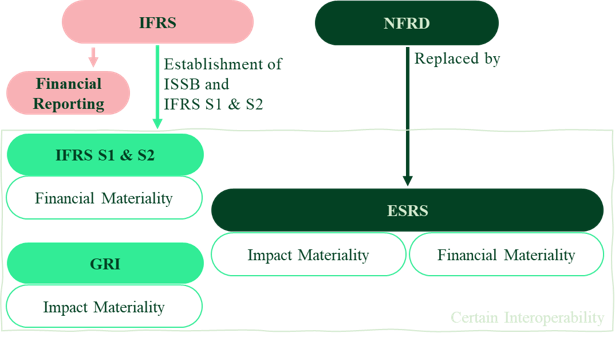
Figure 1: Interoperability of Sustainability Reporting Standards based on 34 GRI. Reporting Tools.”. Reporting in accordance with the ESRS is closely aligned with the GRI Standards, with significant similarities in both content and structure. In a joint statement, EFRAG and GRI mention that they share a similar definition of impact materiality, and that EFRAG has used GRI’s expertise for ESRS disclosure. This interoperability simplifies the reporting for organizations, as they can report in accordance with both the ESRS and GRI Standards through one report.8EFRAG & GRI. EFRAG-GRI Joint Statement of Interoperability. https://efrag.sharefile.com/share/view/s459956b01c6841298f78e5031759ca6e/fo8ed338-4c5e-4502-823b-88009818b85a (2023).
This interoperability offers the chance to create a materiality tool that considers all three disclosure frameworks. While a materiality tool that combines all three frameworks does not yet seem to be available, it would simplify the assessment of important information to report on without the need for additional work, for organizations as well as auditors.
3.2 Review and limitations of existing materiality tools
Several papers have been published on materiality assessment under the GRI, such as GRI 3: Material Topics 2021, showing what the determination of material topics might look.32GRI. GRI 3: Material Topics 2021. https://www.globalreporting.org/publications/documents/english/gri-3-material-topics-2021 (2021). Nevertheless, there appears to be no Excel-based tool that operates as a materiality tool for the GRI standards in particular.32GRI. GRI 3: Material Topics 2021. https://www.globalreporting.org/publications/documents/english/gri-3-material-topics-2021 (2021). As mentioned above, organizations do have guidance and the option to use GRI’s content index template, but there is no provided interface that one must use as a guide for the materiality assessment.34GRI. Reporting Tools. https://www.globalreporting.org/reporting-support/reporting-tools/. The legal basis for sustainability reporting under ESRS regulation is defined in the Delegated Regulation (EU) 2023/2772.9European Commission. Commission Delegated Regulation (EU) 2023/2772 of 31 July 2023 supplementing Directive 2013/34/EU of the European Parliament and of the Council as regards sustainability reporting standards. http://data.europa.eu/eli/reg_del/2023/2772/2023-12-22/eng (2023).,34GRI. Reporting Tools. https://www.globalreporting.org/reporting-support/reporting-tools/. Further methodological guidance on how to report under the CSRD is provided by EFRAG and an increasing number of private actors such as consultancies.12EFRAG. Implementation Guidance EFRAG IG 1 Materiality Assessment. (2024). As materiality assessments are not required for the IFRS SDS and only the determination of material information is necessary, guidance documents point out what constitutes material information but no specific tools are provided.19IFRS. Sustainability-Related Risks and Opportunities and the Disclosure of Material Information. https://www.ifrs.org/content/dam/ifrs/supporting-implementation/issb-standards/issb-materiality-education-material.pdf (2024).
However, freely accessible tools that allow companies to conduct a materiality assessment without registration, contact, or payment are rare. Many tools and services are offered by consulting organizations such as PwC, KPMG, Sphera Solutions, and others, while access is often restricted behind a sign-up process or paywall, as these tools are part of their commercial service offerings. Providers that seem to offer (online) materiality assessment tools, give only limited insight into the process and structure used to determine what qualifies as material. Initially, it seems that the assessment of material information is rather flexible. Some tools do not indicate that they are specifically intended for ESRS reporting; rather, they address the broader process of identifying material information. Several platforms and software solutions can simplify organizations’ materiality assessment processes, as the following examples illustrate. The tools can be deployed by consultants or rather private organizations, to analyze one’s ESG topics and material information. Workiva, one of the world’s leading platforms for transparent reporting from the US, offers customers a CSRD reporting platform that contains a materiality assessment. One can request a demo. Based on available information, the tool remediates gaps and seamlessly connects material topics and IROs to final disclosures and displays the material information in a matrix.35Workvia. Master the CSRD and drive strategic impact. https://www.workiva.com/solutions/csrd-reporting. Osapiens, a German software company, offers a similar product. Osapiens HUB is a software for materiality assessment required by CSRD. The identification of the IROs, evaluation of what is material, the creation of a matrix and integration in the report are its main components.36Osapiens. Doppelte Wesentlichkeit leicht gemacht: Die vier Schritte mit dem osapiens HUB for CSRD. https://osapiens.com/de/loesungen/csrd/. Other organizations, such as Zooid, VelocityEHS, or GoodLab, among others, also offer tools for materiality assessment.37VelocityEHS. Materiality Assessment. https://www.ehs.com/solutions/sustainability/materiality-assessments/.,38Zooid. Materiality Assessment Tool. https://www.zooid.com.au/tools/.,39GoodLab. Simplify Materiality Processes. https://getgoodlab.com/solutions/esg-materiality-assessment/. With the introduction of the ESRS, the focus increasingly lies on these standards. At the same time, some of the organizations provide no indication of which standards the tool is based on or working with.
One directly accessible Excel-based materiality assessment tool comes from the Information Center for the Environment (IZU), Bavarian State Office for the Environment, and the Chamber of Industry and Commerce (IHK). It shows the complexity of the materiality determination for SMEs under the ESRS. Its first sheet depicts an introduction on materiality assessment and how to use the tool. The second is a longlist with all ESRS followed by one sheet for the impact materiality (inside-out) and another for financial materiality (outside-in). A comparison or extension with GRI or IFRS SDS is not included in the template.
The limited number of accessible tools creates an opportunity to develop a materiality assessment tool that covers all three disclosure frameworks. This contribution fills an important gap by doing so. In creating this tool, the goal was to provide a clear presentation of this complex assessment while ensuring an easy-to-use interface. The impact materiality of the GRI, the financially material information of the IFRS SDS, and double materiality with the ESRS are to be brought together in one Excel-based materiality assessment tool. This ensures that organizations do not have to perform additional work if they need or want to report under different frameworks or have done so before.
4 Development of the materiality assessment tool
This chapter presents the development process of the materiality assessment tool, offering contextual background for the underlying design decisions. Key components such as stakeholder engagement, severity evaluation (including scope, scale, and irremediability) and the methodology for calculating materiality are addressed. It also explains how the structure of the tool is designed to reflect both impact and financial materiality in accordance with relevant standards. A comprehensive description and a practical walkthrough of the tool are provided to guide users through its application.
4.1 Structure and design
The methodology underlying the materiality assessment tool is based on the principles and criteria outlined by EFRAG, particularly those presented in their Materiality Assessment Implementation Guidance.12EFRAG. Implementation Guidance EFRAG IG 1 Materiality Assessment. (2024).
The assessment of impact materiality should be based on a set of criteria applied by organizations. For actual negative impacts, the assessment criteria include the scale, scope, and irremediability of the impact. In the case of potential negative impacts, the organization additionally estimates the probability of occurrence. For actual positive impacts, the criteria are scale and scope. For potential positive impacts, the organization also evaluates the probability of occurrence.12EFRAG. Implementation Guidance EFRAG IG 1 Materiality Assessment. (2024).
Scale refers to the seriousness of the impact, such as restrictions on basic needs or rights like education or livelihood. Scope describes how widespread the impact is. This includes, for example, the number of people affected or the extent of environmental damage. An issue that affects a large group or a wide area is considered to have a broader scope. Irremediability considers whether the harm can be undone or compensated. It asks whether those affected can return to their previous situation or whether the environment can be restored.12EFRAG. Implementation Guidance EFRAG IG 1 Materiality Assessment. (2024).
During the design of the materiality assessment tool, a numerical scale from 1 to 5 was selected to evaluate the severity of IROs in terms of probability of occurrence, scale, scope, and irremediability. This decision was inspired by EFRAG’s illustrative approach, which uses a five-step color gradient, from yellow to red, to represent increasing severity levels.12EFRAG. Implementation Guidance EFRAG IG 1 Materiality Assessment. (2024). While EFRAG’s visual model is intuitive, the use of numerical values allows easier calculation, making the evaluation more tangible and data-driven.
As described above, impacts must be assessed for both actual and potential effects. However, a separate column for this distinction was not implemented. Instead, it was integrated into the calculation. If a user selects a value from 1 to 5, it is converted into a percentage (e.g. 5 becomes 100%). Based on this logic, two formulas were embedded into the tool that automatically adjust depending on whether the impact is marked as positive or negative in the corresponding column.
Formula 1: Negative impact formula
(Probability of occurrence)/5 × (Scale + Scope + Irremediability)/3 × Weighting factor
Formula 2: Positive impact formula
(Probability of occurrence)/5 × (Scale + Scope)/2 × Weighting factor
An additional weighting factor can be set to two for topics considered highly important, ensuring that these issues receive a higher materiality score.
For the financial materiality assessment, the organization should evaluate risks and opportunities based on their probability of occurrence and the potential magnitude of their financial effects.12EFRAG. Implementation Guidance EFRAG IG 1 Materiality Assessment. (2024). In contrast to impact materiality, which focuses on the effects of sustainability matters on people and the environment, and therefore requires stakeholder engagement, financial materiality is concerned with the financial consequences for the organization itself, such as effects on cash flows, financial performance, or access to capital. Since this perspective is primarily relevant to investors and other financial users, stakeholder-related columns in the financial materiality sheet were excluded.12EFRAG. Implementation Guidance EFRAG IG 1 Materiality Assessment. (2024). Similar to the impact materiality assessment, a 1–5 range in the financial materiality calculation is used to evaluate severity. Based on this, the following formula was derived:
Formula 3: Financial risk & opportunity formula
(Probability of occurrence)/5 × Magnitude × Weighting factor
To provide a clear overview of double materiality, the materiality scores from both impact and financial assessments were combined into a single sheet. Additionally, a matrix was included to visually highlight which topics are considered material and which fall below the threshold. This approach was inspired by reports of companies already reporting under ESRS.40DHL. Nachhaltiges Wachstum ESG-Fortschrittsbericht 2024. (2024).
In the tool, several columns were implemented that have a particular relevance. Stakeholder engagement is a key element in assessing impact materiality.12EFRAG. Implementation Guidance EFRAG IG 1 Materiality Assessment. (2024). This includes not only direct stakeholders like employees or communities but also silent stakeholders such as nature, whose interests can be represented through scientific data or expert input.12EFRAG. Implementation Guidance EFRAG IG 1 Materiality Assessment. (2024). Several studies and reporting guidelines, such as GRI, also emphasize the importance of stakeholder engagement as an element of sustainability reporting.41Kaspersen, M. & Johansen, T. R. Stakeholder Engagement and Materiality Assessments in Sustainability Reporting. in Measuring Sustainability and CSR: From Reporting to Decision-Making (eds Kacanski, S., Kabderian Dreyer, J. & Sund, K. J.) vol. 64 73–83 (Springer International Publishing, Cham, 2023). Based on this information, stakeholder-related columns were added to our materiality tool. Initially, a single column was used for listing all affected stakeholders. Following feedback, the structure was refined to include individual columns for each stakeholder group along with a five-step differentiation ranging from not affected to critically affected. In addition, a column for value chain specification was incorporated, in alignment with ESRS 1 requirements, which mandate that companies disclose whether each material IRO relates to their own operations or to their upstream or downstream value chain.12EFRAG. Implementation Guidance EFRAG IG 1 Materiality Assessment. (2024).
To reflect the relevance of the GRI Universal Standards within the context of impact materiality, a dedicated sheet for GRI was integrated into the tool. While the structure and calculation logic remain consistent with the ESRS-based sheets, the content was adapted by listing the topical standards 201-207 (economic standards), 301-308 (environmental standards), and 401-419 (social standards) from GRI.16GRI. GRI Standards English Language. https://www.globalreporting.org/how-to-use-the-gri-standards/gri-standards-english-language/. This approach aligns with EFRAG Implementation Guidance, which recognizes that GRI’s impact materiality framework is compatible with ESRS and can serve as a solid foundation for assessing entity-specific impacts. However, GRI focuses only on impact materiality. When reporting under the ESRS, the financial materiality must still be assessed.12EFRAG. Implementation Guidance EFRAG IG 1 Materiality Assessment. (2024).
A separate sheet for the IFRS SDS was included in the tool, structured according to the core content defined by IFRS (governance, strategy, risk management, metrics and targets). While it provides a thematic framework, it lacks the detailed structure found in the ESRS.42IFRS. IFRS S1 Sustainability Disclosure Standard General Requirements for Disclosure of Sustainability-Related Financial Information. (2023).,43IFRS. IFRS S2 Sustainability Disclosure Standard Climate-Related Disclosures. (2023). Since the criteria for financial materiality are aligned between ESRS and IFRS SDS, the ESRS financial materiality sheet offers a practical and structured basis that can be integrated into the IFRS SDS framework to support the assessment of risks and opportunities.12EFRAG. Implementation Guidance EFRAG IG 1 Materiality Assessment. (2024).
4.2 Description and application
While this chapter provides a detailed explanation of the application, additional guidance is embedded directly in the Excel file in the form of cell comments. These comments can be shown or hidden as needed and offer practical support during use. The tool begins with the impact materiality sheet. The first columns list the different topics, which are further broken down into subtopics and, where relevant, sub-subtopics. As several IROs can fall under one topic, the IRO name column allows you to assign a unique identifier and provide a description. The positive/negative column specifies whether the impact is positive or negative. Next, the user can indicate which entity (organization, subsidiary, or group-wide) is affected and where in the value chain the IRO occurs (own operations, upstream, downstream, or across the whole value chain).
For stakeholder relevance, there are dedicated columns to mark which stakeholders (e.g. nature, investors, customers, banks, suppliers) may be impacted. Users can select the degree of impact for each group, ranging from not affected to critically affected. Additional columns are available for stakeholders not listed and additional rows can be added as needed. An additional comments field allows for supplementary notes or the inclusion of references, such as links to relevant source documents.
The evaluation section follows, where the evaluator inserts their name for traceability. Each criterion must be rated based on its severity, using a range from 1 (low) to 5 (high). This includes probability of occurrence (with a score of 5 if the issue is actual), scale, scope, and irremediability. A weighting factor of two can be applied to emphasize issues of particular relevance to the organization. The resulting score is calculated automatically based on the Formulas 1–3, along with the status of whether the IRO is considered material. However, even with the weighting factor applied, the score cannot exceed 5. By default, the materiality threshold is set at 2.5, but this can be adjusted in the matrix sheet, which updates the materiality status accordingly.
The financial materiality sheet follows the same structure as the impact sheet, with some adjustments. The positive/negative column is replaced by risk/opportunity, and stakeholder relevance is excluded, as external stakeholders may lack sufficient insight into internal financial risks. The evaluation is based on two criteria: probability of occurrence and magnitude. The evaluator again rates the severity of each criterion on a scale from 1 to 5, with the option to apply a weighting factor. The materiality score is then calculated automatically.
The double materiality sheet consolidates the results from both the impact and financial assessments. The matrix sheet then visualizes all sub-subtopics, each represented by a numbered point linked to the summary table. A threshold cell above the matrix allows users to adjust the materiality cutoff. A bar in the matrix highlights which topics are material, making the results more visual. In cases where certain topics lie close to the threshold within the matrix, it may be appropriate to adjust the threshold level in order to classify the topic as material. Overall, the materiality score is set with a cutoff of five to make sure that all topics remain within the defined range of the matrix.
The GRI sheet includes the topical standards 201-207 (economic standards), 301-308 (environmental standards), and 401-419 (social standards) listed in the first columns. The evaluation process follows the same approach as in the impact materiality sheet, using identical scoring logic and structure.
The IFRS SDS sheet is structured according to the core content elements defined by the IFRS, which include governance, strategy, risk management, metrics, and targets.42IFRS. IFRS S1 Sustainability Disclosure Standard General Requirements for Disclosure of Sustainability-Related Financial Information. (2023).,43IFRS. IFRS S2 Sustainability Disclosure Standard Climate-Related Disclosures. (2023). The structure was adopted from the financial materiality sheet, and the evaluation is based on formula 3.
4.3 Limitations of the tool
While the materiality tool provides a helpful starting point for identifying relevant topics, there are several limitations that should be considered. Excel remains a powerful and widely used tool, especially in corporate environments where platforms like SharePoint or Teams enable simultaneous collaboration. However, it can be prone to issues such as broken formulas or overwritten cells, particularly when multiple users have access and make unintended changes. In contexts where external parties such as consultants are involved, a software-based platform with individual user access and role-based permissions could be more suitable. Such platforms typically offer built-in analytics, visualization, and structured workflows, which we can find in solutions like Osapiens.36Osapiens. Doppelte Wesentlichkeit leicht gemacht: Die vier Schritte mit dem osapiens HUB for CSRD. https://osapiens.com/de/loesungen/csrd/. This makes them more robust and scalable for collaborative processes. While Excel is effective for initial assessments, it may not be ideal for complex, multi-user environments or long-term data management.
The materiality tool is designed specifically to support the identification of material topics and fully meets the requirements for determining materiality under relevant standards. It is not intended to cover the full scope of data point disclosures. For that purpose, the separate EFRAG Excel provides a more detailed foundation.42IFRS. IFRS S1 Sustainability Disclosure Standard General Requirements for Disclosure of Sustainability-Related Financial Information. (2023). The outcome of the tool should therefore not be interpreted as a direct reporting output, as it does not indicate which specific data points need to be addressed. Additionally, further layers of assessment, such as phase-in provisions, or topic-level irrelevance can lead to the exclusion of certain data points even after a topic has been deemed material.
5 Conclusion
To summarize, the purpose of this work is to develop a materiality assessment tool that combines the three major sustainability disclosure frameworks (GRI, IFRS SDS, and ESRS) into one consistent and practical instrument. In line with the latest implementation guidance and simplification efforts by EFRAG, the tool now captures both the impact and financial materiality dimensions. It also provides organizations with a structured approach to identifying, evaluating, and prioritizing sustainability-related impacts, risks, and opportunities. It emphasizes the importance of stakeholder engagement and value chain considerations, both of which are critical for credible and transparent sustainability reporting. Its Excel-based design ensures accessibility and ease of use, making it suitable for a wide range of organizations, including those new to structured materiality assessments. However, the tool’s limitations regarding multi-user collaboration and long-term data management highlight the need for enhancements through digital platforms in the future. Nevertheless, this materiality assessment tool represents a significant step forward in facilitating double materiality analysis and helping organizations meet evolving regulatory requirements while promoting sustainable business practices. It presents a tool that not only captures double materiality but also incorporates GRI and IFRS SDS, thereby connecting these frameworks within a single tool.
References
- 1IFRS. IFRS 1 First-time Adoption of International Financial Reporting Standards. https://www.ifrs.org/issued-standards/list-of-standards/ifrs-1-first-time-adoption-of-ifrs/. ↩︎
- 2Bundesministerium für Arbeit und Soziales (BMAS). Corporate Sustainability Reporting Directive (CSRD). https://www.csr-in-deutschland.de/DE/CSR-Allgemein/CSR-Politik/CSR-in-der-EU/Corporate-Sustainability-Reporting-Directive/corporate-sustainability-reporting-directive.html. ↩︎
- 3GRI. A Short Introduction to the GRI Standards. https://www.globalreporting.org/media/wtaf14tw/a-short-introduction-to-the-gri-standards.pdf. ↩︎
- 4GRI. Our mission and history. https://www.globalreporting.org/about-gri/mission-history/. ↩︎
- 5IFRS. Introduction to the ISSB and IFRS Sustainability Disclosure Standards. https://www.ifrs.org/sustainability/knowledge-hub/introduction-to-issb-and-ifrs-sustainability-disclosure-standards/. ↩︎
- 6European Commission. Corporate sustainability reporting. https://finance.ec.europa.eu/capital-markets-union-and-financial-markets/company-reporting-and-auditing/company-reporting/corporate-sustainability-reporting_en. ↩︎
- 7GRI. EFRAG and GRI enhance collaboration with deeper ties. https://www.globalreporting.org/news/news-center/efrag-and-gri-enhance-collaboration-with-deeper-ties/. ↩︎
- 8EFRAG & GRI. EFRAG-GRI Joint Statement of Interoperability. https://efrag.sharefile.com/share/view/s459956b01c6841298f78e5031759ca6e/fo8ed338-4c5e-4502-823b-88009818b85a (2023). ↩︎
- 9European Commission. Commission Delegated Regulation (EU) 2023/2772 of 31 July 2023 supplementing Directive 2013/34/EU of the European Parliament and of the Council as regards sustainability reporting standards. http://data.europa.eu/eli/reg_del/2023/2772/2023-12-22/eng (2023). ↩︎
- 8EFRAG & GRI. EFRAG-GRI Joint Statement of Interoperability. https://efrag.sharefile.com/share/view/s459956b01c6841298f78e5031759ca6e/fo8ed338-4c5e-4502-823b-88009818b85a (2023). ↩︎
- 10Accountancy Europe. ESRS perspectives: Interoperability. (2024). ↩︎
- 11EFRAG. Interoperability between ESRS and other sustainability reporting standards. https://www.efrag.org/en/sustainability-reporting/esrs-workstreams/interoperability. ↩︎
- 12EFRAG. Implementation Guidance EFRAG IG 1 Materiality Assessment. (2024). ↩︎
- 9European Commission. Commission Delegated Regulation (EU) 2023/2772 of 31 July 2023 supplementing Directive 2013/34/EU of the European Parliament and of the Council as regards sustainability reporting standards. http://data.europa.eu/eli/reg_del/2023/2772/2023-12-22/eng (2023). ↩︎
- 13EFRAG. Draft status report ESRS simplification. (2025). ↩︎
- 12EFRAG. Implementation Guidance EFRAG IG 1 Materiality Assessment. (2024). ↩︎
- 13EFRAG. Draft status report ESRS simplification. (2025). ↩︎
- 14Bais, B., Nassimbeni, G. & Orzes, G. Global Reporting Initiative: Literature review and research directions. J. Clean. Prod. 471, (2024). ↩︎
- 15Hahnkamper-Vandenbulcke, N. Non-financial Reporting Directive. (2021). ↩︎
- 3GRI. A Short Introduction to the GRI Standards. https://www.globalreporting.org/media/wtaf14tw/a-short-introduction-to-the-gri-standards.pdf. ↩︎
- 3GRI. A Short Introduction to the GRI Standards. https://www.globalreporting.org/media/wtaf14tw/a-short-introduction-to-the-gri-standards.pdf. ↩︎
- 16GRI. GRI Standards English Language. https://www.globalreporting.org/how-to-use-the-gri-standards/gri-standards-english-language/. ↩︎
- 17Mezzanotte, F. E. Corporate sustainability reporting: double materiality, impacts, and legal risk. J. Corp. Law Stud. 23, 633–663 (2023). ↩︎
- 18Baumüller, J. IFRS Sustainability Disclosure Standards. Z. Für Corp. Gov. 10 (2023) doi:10.37307/j.1868-7792.2023.03.10. ↩︎
- 9European Commission. Commission Delegated Regulation (EU) 2023/2772 of 31 July 2023 supplementing Directive 2013/34/EU of the European Parliament and of the Council as regards sustainability reporting standards. http://data.europa.eu/eli/reg_del/2023/2772/2023-12-22/eng (2023). ↩︎
- 18Baumüller, J. IFRS Sustainability Disclosure Standards. Z. Für Corp. Gov. 10 (2023) doi:10.37307/j.1868-7792.2023.03.10. ↩︎
- 5IFRS. Introduction to the ISSB and IFRS Sustainability Disclosure Standards. https://www.ifrs.org/sustainability/knowledge-hub/introduction-to-issb-and-ifrs-sustainability-disclosure-standards/. ↩︎
- 19IFRS. Sustainability-Related Risks and Opportunities and the Disclosure of Material Information. https://www.ifrs.org/content/dam/ifrs/supporting-implementation/issb-standards/issb-materiality-education-material.pdf (2024). ↩︎
- 5IFRS. Introduction to the ISSB and IFRS Sustainability Disclosure Standards. https://www.ifrs.org/sustainability/knowledge-hub/introduction-to-issb-and-ifrs-sustainability-disclosure-standards/. ↩︎
- 20European Commission. Proposal for a Directive of the European Parliament and of the Council amending Directives (EU) 2022/2464 and (EU) 2024/1760 as regards the dates from which Member States are to apply certain corporate sustainability reporting and due diligence requirements. https://eur-lex.europa.eu/legal-content/EN/TXT/PDF/?uri=CELEX:52025PC0080 (2025). ↩︎
- 21European Commission. Q&A adoption of European Sustainability Reporting Standards. https://ec.europa.eu/commission/presscorner/detail/en/qanda_23_4043. ↩︎
- 20European Commission. Proposal for a Directive of the European Parliament and of the Council amending Directives (EU) 2022/2464 and (EU) 2024/1760 as regards the dates from which Member States are to apply certain corporate sustainability reporting and due diligence requirements. https://eur-lex.europa.eu/legal-content/EN/TXT/PDF/?uri=CELEX:52025PC0080 (2025). ↩︎
- 22EMAS. EU-Omnibus: Neue Regeln für CSRD-Berichtspflicht. https://www.emas.de/aktuelles/news/2025-02-crsd-omnibus (2024). ↩︎
- 23Deloitte. European Sustainability Reporting — Omnibus Update and Proposed Revised European Sustainability Reporting Standards (August 21, 2025). https://dart.deloitte.com/USDART/home/publications/deloitte/heads-up/2025/european-sustainability-omnibus-reporting-standards. ↩︎
- 24European Commission. Omnibus package. https://finance.ec.europa.eu/news/omnibus-package-2025-04-01_en. ↩︎
- 25Rat der Europäischen Union. Vereinfachung: Rat gibt endgültig grünes Licht für „Stop-the-Clock“-Mechanismus zur Stärkung der Wettbewerbsfähigkeit der EU und der Rechtssicherheit für Unternehmen. https://www.consilium.europa.eu/de/press/press-releases/2025/04/14/simplification-council-gives-final-green-light-on-the-stop-the-clock-mechanism-to-boost-eu-competitiveness-and-provide-legal-certainty-to-businesses/. ↩︎
- 26Macedo Vitorino. Understanding the EU Stop-the-Clock Directive Omnibus Package. (2025). ↩︎
- 9European Commission. Commission Delegated Regulation (EU) 2023/2772 of 31 July 2023 supplementing Directive 2013/34/EU of the European Parliament and of the Council as regards sustainability reporting standards. http://data.europa.eu/eli/reg_del/2023/2772/2023-12-22/eng (2023). ↩︎
- 21European Commission. Q&A adoption of European Sustainability Reporting Standards. https://ec.europa.eu/commission/presscorner/detail/en/qanda_23_4043. ↩︎
- 27EFRAG. Sector-specific ESRS. https://www.efrag.org/en/sustainability-reporting/esrs-workstreams/sectorspecific-esrs. ↩︎
- 9European Commission. Commission Delegated Regulation (EU) 2023/2772 of 31 July 2023 supplementing Directive 2013/34/EU of the European Parliament and of the Council as regards sustainability reporting standards. http://data.europa.eu/eli/reg_del/2023/2772/2023-12-22/eng (2023). ↩︎
- 27EFRAG. Sector-specific ESRS. https://www.efrag.org/en/sustainability-reporting/esrs-workstreams/sectorspecific-esrs. ↩︎
- 9European Commission. Commission Delegated Regulation (EU) 2023/2772 of 31 July 2023 supplementing Directive 2013/34/EU of the European Parliament and of the Council as regards sustainability reporting standards. http://data.europa.eu/eli/reg_del/2023/2772/2023-12-22/eng (2023). ↩︎
- 9European Commission. Commission Delegated Regulation (EU) 2023/2772 of 31 July 2023 supplementing Directive 2013/34/EU of the European Parliament and of the Council as regards sustainability reporting standards. http://data.europa.eu/eli/reg_del/2023/2772/2023-12-22/eng (2023). ↩︎
- 28Deutscher Nachhaltigkeitskodex (DNK). Prozessleitfaden zur Umsetzung einer CSRD-konformen Wesentlichkeitsanalyse. https://www.deutscher-nachhaltigkeitskodex.de/media/1yohdluy/20250218_dnk-prozessleitfaden-umsetzung-wesentlichkeitsanalyse.pdf (2025). ↩︎
- 29Deutscher Nachhaltigkeitskodex (DNK). IROs Impacts, Risks und Opportunities. (2024). ↩︎
- 28Deutscher Nachhaltigkeitskodex (DNK). Prozessleitfaden zur Umsetzung einer CSRD-konformen Wesentlichkeitsanalyse. https://www.deutscher-nachhaltigkeitskodex.de/media/1yohdluy/20250218_dnk-prozessleitfaden-umsetzung-wesentlichkeitsanalyse.pdf (2025). ↩︎
- 28Deutscher Nachhaltigkeitskodex (DNK). Prozessleitfaden zur Umsetzung einer CSRD-konformen Wesentlichkeitsanalyse. https://www.deutscher-nachhaltigkeitskodex.de/media/1yohdluy/20250218_dnk-prozessleitfaden-umsetzung-wesentlichkeitsanalyse.pdf (2025). ↩︎
- 29Deutscher Nachhaltigkeitskodex (DNK). IROs Impacts, Risks und Opportunities. (2024). ↩︎
- 9European Commission. Commission Delegated Regulation (EU) 2023/2772 of 31 July 2023 supplementing Directive 2013/34/EU of the European Parliament and of the Council as regards sustainability reporting standards. http://data.europa.eu/eli/reg_del/2023/2772/2023-12-22/eng (2023). ↩︎
- 30Fourth International Conference on Financing for Development (FfD4). Outcome document of the Fourth International Conference on Financing for Development. ↩︎
- 31GRI. GRI and IFRS Foundation collaboration to deliver full interoperability that enables seamless sustainability reporting. https://www.globalreporting.org/news/news-center/gri-and-ifrs-foundation-collaboration-to-deliver-full-interoperability-that-enables-seamless-sustainability-reporting (2024). ↩︎
- 32GRI. GRI 3: Material Topics 2021. https://www.globalreporting.org/publications/documents/english/gri-3-material-topics-2021 (2021). ↩︎
- 3GRI. A Short Introduction to the GRI Standards. https://www.globalreporting.org/media/wtaf14tw/a-short-introduction-to-the-gri-standards.pdf. ↩︎
- 19IFRS. Sustainability-Related Risks and Opportunities and the Disclosure of Material Information. https://www.ifrs.org/content/dam/ifrs/supporting-implementation/issb-standards/issb-materiality-education-material.pdf (2024). ↩︎
- 19IFRS. Sustainability-Related Risks and Opportunities and the Disclosure of Material Information. https://www.ifrs.org/content/dam/ifrs/supporting-implementation/issb-standards/issb-materiality-education-material.pdf (2024). ↩︎
- 17Mezzanotte, F. E. Corporate sustainability reporting: double materiality, impacts, and legal risk. J. Corp. Law Stud. 23, 633–663 (2023). ↩︎
- 12EFRAG. Implementation Guidance EFRAG IG 1 Materiality Assessment. (2024). ↩︎
- 33EFRAG. ANNEX I to Commission Delegated Regulation (EU) 2023/2772 supplementing Directive 2013/34/EU of the European Parliament and of the Council as regards sustainability reporting standards, published in the Official Journal of the European Union on 22 December 2023 and including the corrigendum published on 18 April 2024. ESRS Set 1. https://xbrl.efrag.org/e-esrs/esrs-set1-2023.html. ↩︎
- 34GRI. Reporting Tools. https://www.globalreporting.org/reporting-support/reporting-tools/. ↩︎
- 12EFRAG. Implementation Guidance EFRAG IG 1 Materiality Assessment. (2024). ↩︎
- 8
- 34GRI. Reporting Tools.”.
Reporting in accordance with the ESRS is closely aligned with the GRI Standards, with significant similarities in both content and structure. In a joint statement, EFRAG and GRI mention that they share a similar definition of impact materiality, and that EFRAG has used GRI’s expertise for ESRS disclosure. This interoperability simplifies the reporting for organizations, as they can report in accordance with both the ESRS and GRI Standards through one report.8EFRAG & GRI. EFRAG-GRI Joint Statement of Interoperability. https://efrag.sharefile.com/share/view/s459956b01c6841298f78e5031759ca6e/fo8ed338-4c5e-4502-823b-88009818b85a (2023). ↩︎
- 11EFRAG. Interoperability between ESRS and other sustainability reporting standards. https://www.efrag.org/en/sustainability-reporting/esrs-workstreams/interoperability. ↩︎
- 19IFRS. Sustainability-Related Risks and Opportunities and the Disclosure of Material Information. https://www.ifrs.org/content/dam/ifrs/supporting-implementation/issb-standards/issb-materiality-education-material.pdf (2024). ↩︎
- 33EFRAG. ANNEX I to Commission Delegated Regulation (EU) 2023/2772 supplementing Directive 2013/34/EU of the European Parliament and of the Council as regards sustainability reporting standards, published in the Official Journal of the European Union on 22 December 2023 and including the corrigendum published on 18 April 2024. ESRS Set 1. https://xbrl.efrag.org/e-esrs/esrs-set1-2023.html. ↩︎
- 19IFRS. Sustainability-Related Risks and Opportunities and the Disclosure of Material Information. https://www.ifrs.org/content/dam/ifrs/supporting-implementation/issb-standards/issb-materiality-education-material.pdf (2024). ↩︎
- 32GRI. GRI 3: Material Topics 2021. https://www.globalreporting.org/publications/documents/english/gri-3-material-topics-2021 (2021). ↩︎
- 32GRI. GRI 3: Material Topics 2021. https://www.globalreporting.org/publications/documents/english/gri-3-material-topics-2021 (2021). ↩︎
- 34GRI. Reporting Tools. https://www.globalreporting.org/reporting-support/reporting-tools/. ↩︎
- 9European Commission. Commission Delegated Regulation (EU) 2023/2772 of 31 July 2023 supplementing Directive 2013/34/EU of the European Parliament and of the Council as regards sustainability reporting standards. http://data.europa.eu/eli/reg_del/2023/2772/2023-12-22/eng (2023). ↩︎
- 34GRI. Reporting Tools. https://www.globalreporting.org/reporting-support/reporting-tools/. ↩︎
- 12EFRAG. Implementation Guidance EFRAG IG 1 Materiality Assessment. (2024). ↩︎
- 19IFRS. Sustainability-Related Risks and Opportunities and the Disclosure of Material Information. https://www.ifrs.org/content/dam/ifrs/supporting-implementation/issb-standards/issb-materiality-education-material.pdf (2024). ↩︎
- 35Workvia. Master the CSRD and drive strategic impact. https://www.workiva.com/solutions/csrd-reporting. ↩︎
- 36Osapiens. Doppelte Wesentlichkeit leicht gemacht: Die vier Schritte mit dem osapiens HUB for CSRD. https://osapiens.com/de/loesungen/csrd/. ↩︎
- 37VelocityEHS. Materiality Assessment. https://www.ehs.com/solutions/sustainability/materiality-assessments/. ↩︎
- 38Zooid. Materiality Assessment Tool. https://www.zooid.com.au/tools/. ↩︎
- 39GoodLab. Simplify Materiality Processes. https://getgoodlab.com/solutions/esg-materiality-assessment/. ↩︎
- 12EFRAG. Implementation Guidance EFRAG IG 1 Materiality Assessment. (2024). ↩︎
- 12EFRAG. Implementation Guidance EFRAG IG 1 Materiality Assessment. (2024). ↩︎
- 12EFRAG. Implementation Guidance EFRAG IG 1 Materiality Assessment. (2024). ↩︎
- 12EFRAG. Implementation Guidance EFRAG IG 1 Materiality Assessment. (2024). ↩︎
- 12EFRAG. Implementation Guidance EFRAG IG 1 Materiality Assessment. (2024). ↩︎
- 12EFRAG. Implementation Guidance EFRAG IG 1 Materiality Assessment. (2024). ↩︎
- 40DHL. Nachhaltiges Wachstum ESG-Fortschrittsbericht 2024. (2024). ↩︎
- 12EFRAG. Implementation Guidance EFRAG IG 1 Materiality Assessment. (2024). ↩︎
- 12EFRAG. Implementation Guidance EFRAG IG 1 Materiality Assessment. (2024). ↩︎
- 41Kaspersen, M. & Johansen, T. R. Stakeholder Engagement and Materiality Assessments in Sustainability Reporting. in Measuring Sustainability and CSR: From Reporting to Decision-Making (eds Kacanski, S., Kabderian Dreyer, J. & Sund, K. J.) vol. 64 73–83 (Springer International Publishing, Cham, 2023). ↩︎
- 12EFRAG. Implementation Guidance EFRAG IG 1 Materiality Assessment. (2024). ↩︎
- 16GRI. GRI Standards English Language. https://www.globalreporting.org/how-to-use-the-gri-standards/gri-standards-english-language/. ↩︎
- 12EFRAG. Implementation Guidance EFRAG IG 1 Materiality Assessment. (2024). ↩︎
- 42IFRS. IFRS S1 Sustainability Disclosure Standard General Requirements for Disclosure of Sustainability-Related Financial Information. (2023). ↩︎
- 43IFRS. IFRS S2 Sustainability Disclosure Standard Climate-Related Disclosures. (2023). ↩︎
- 12EFRAG. Implementation Guidance EFRAG IG 1 Materiality Assessment. (2024). ↩︎
- 42IFRS. IFRS S1 Sustainability Disclosure Standard General Requirements for Disclosure of Sustainability-Related Financial Information. (2023). ↩︎
- 43IFRS. IFRS S2 Sustainability Disclosure Standard Climate-Related Disclosures. (2023). ↩︎
- 36Osapiens. Doppelte Wesentlichkeit leicht gemacht: Die vier Schritte mit dem osapiens HUB for CSRD. https://osapiens.com/de/loesungen/csrd/. ↩︎
- 42IFRS. IFRS S1 Sustainability Disclosure Standard General Requirements for Disclosure of Sustainability-Related Financial Information. (2023). ↩︎
- 1IFRS. IFRS 1 First-time Adoption of International Financial Reporting Standards. https://www.ifrs.org/issued-standards/list-of-standards/ifrs-1-first-time-adoption-of-ifrs/. ↩︎
- 2Bundesministerium für Arbeit und Soziales (BMAS). Corporate Sustainability Reporting Directive (CSRD). https://www.csr-in-deutschland.de/DE/CSR-Allgemein/CSR-Politik/CSR-in-der-EU/Corporate-Sustainability-Reporting-Directive/corporate-sustainability-reporting-directive.html. ↩︎
- 3GRI. A Short Introduction to the GRI Standards. https://www.globalreporting.org/media/wtaf14tw/a-short-introduction-to-the-gri-standards.pdf. ↩︎
- 4GRI. Our mission and history. https://www.globalreporting.org/about-gri/mission-history/. ↩︎
- 5IFRS. Introduction to the ISSB and IFRS Sustainability Disclosure Standards. https://www.ifrs.org/sustainability/knowledge-hub/introduction-to-issb-and-ifrs-sustainability-disclosure-standards/. ↩︎
- 6European Commission. Corporate sustainability reporting. https://finance.ec.europa.eu/capital-markets-union-and-financial-markets/company-reporting-and-auditing/company-reporting/corporate-sustainability-reporting_en. ↩︎
- 7GRI. EFRAG and GRI enhance collaboration with deeper ties. https://www.globalreporting.org/news/news-center/efrag-and-gri-enhance-collaboration-with-deeper-ties/. ↩︎
- 8EFRAG & GRI. EFRAG-GRI Joint Statement of Interoperability. https://efrag.sharefile.com/share/view/s459956b01c6841298f78e5031759ca6e/fo8ed338-4c5e-4502-823b-88009818b85a (2023). ↩︎
- 9European Commission. Commission Delegated Regulation (EU) 2023/2772 of 31 July 2023 supplementing Directive 2013/34/EU of the European Parliament and of the Council as regards sustainability reporting standards. http://data.europa.eu/eli/reg_del/2023/2772/2023-12-22/eng (2023). ↩︎
- 8EFRAG & GRI. EFRAG-GRI Joint Statement of Interoperability. https://efrag.sharefile.com/share/view/s459956b01c6841298f78e5031759ca6e/fo8ed338-4c5e-4502-823b-88009818b85a (2023). ↩︎
- 10Accountancy Europe. ESRS perspectives: Interoperability. (2024). ↩︎
- 11EFRAG. Interoperability between ESRS and other sustainability reporting standards. https://www.efrag.org/en/sustainability-reporting/esrs-workstreams/interoperability. ↩︎
- 12EFRAG. Implementation Guidance EFRAG IG 1 Materiality Assessment. (2024). ↩︎
- 9European Commission. Commission Delegated Regulation (EU) 2023/2772 of 31 July 2023 supplementing Directive 2013/34/EU of the European Parliament and of the Council as regards sustainability reporting standards. http://data.europa.eu/eli/reg_del/2023/2772/2023-12-22/eng (2023). ↩︎
- 13EFRAG. Draft status report ESRS simplification. (2025). ↩︎
- 12EFRAG. Implementation Guidance EFRAG IG 1 Materiality Assessment. (2024). ↩︎
- 13EFRAG. Draft status report ESRS simplification. (2025). ↩︎
- 14Bais, B., Nassimbeni, G. & Orzes, G. Global Reporting Initiative: Literature review and research directions. J. Clean. Prod. 471, (2024). ↩︎
- 15Hahnkamper-Vandenbulcke, N. Non-financial Reporting Directive. (2021). ↩︎
- 3GRI. A Short Introduction to the GRI Standards. https://www.globalreporting.org/media/wtaf14tw/a-short-introduction-to-the-gri-standards.pdf. ↩︎
- 3GRI. A Short Introduction to the GRI Standards. https://www.globalreporting.org/media/wtaf14tw/a-short-introduction-to-the-gri-standards.pdf. ↩︎
- 16GRI. GRI Standards English Language. https://www.globalreporting.org/how-to-use-the-gri-standards/gri-standards-english-language/. ↩︎
- 17Mezzanotte, F. E. Corporate sustainability reporting: double materiality, impacts, and legal risk. J. Corp. Law Stud. 23, 633–663 (2023). ↩︎
- 18Baumüller, J. IFRS Sustainability Disclosure Standards. Z. Für Corp. Gov. 10 (2023) doi:10.37307/j.1868-7792.2023.03.10. ↩︎
- 9European Commission. Commission Delegated Regulation (EU) 2023/2772 of 31 July 2023 supplementing Directive 2013/34/EU of the European Parliament and of the Council as regards sustainability reporting standards. http://data.europa.eu/eli/reg_del/2023/2772/2023-12-22/eng (2023). ↩︎
- 18Baumüller, J. IFRS Sustainability Disclosure Standards. Z. Für Corp. Gov. 10 (2023) doi:10.37307/j.1868-7792.2023.03.10. ↩︎
- 5IFRS. Introduction to the ISSB and IFRS Sustainability Disclosure Standards. https://www.ifrs.org/sustainability/knowledge-hub/introduction-to-issb-and-ifrs-sustainability-disclosure-standards/. ↩︎
- 19IFRS. Sustainability-Related Risks and Opportunities and the Disclosure of Material Information. https://www.ifrs.org/content/dam/ifrs/supporting-implementation/issb-standards/issb-materiality-education-material.pdf (2024). ↩︎
- 5IFRS. Introduction to the ISSB and IFRS Sustainability Disclosure Standards. https://www.ifrs.org/sustainability/knowledge-hub/introduction-to-issb-and-ifrs-sustainability-disclosure-standards/. ↩︎
- 20European Commission. Proposal for a Directive of the European Parliament and of the Council amending Directives (EU) 2022/2464 and (EU) 2024/1760 as regards the dates from which Member States are to apply certain corporate sustainability reporting and due diligence requirements. https://eur-lex.europa.eu/legal-content/EN/TXT/PDF/?uri=CELEX:52025PC0080 (2025). ↩︎
- 21European Commission. Q&A adoption of European Sustainability Reporting Standards. https://ec.europa.eu/commission/presscorner/detail/en/qanda_23_4043. ↩︎
- 20European Commission. Proposal for a Directive of the European Parliament and of the Council amending Directives (EU) 2022/2464 and (EU) 2024/1760 as regards the dates from which Member States are to apply certain corporate sustainability reporting and due diligence requirements. https://eur-lex.europa.eu/legal-content/EN/TXT/PDF/?uri=CELEX:52025PC0080 (2025). ↩︎
- 22EMAS. EU-Omnibus: Neue Regeln für CSRD-Berichtspflicht. https://www.emas.de/aktuelles/news/2025-02-crsd-omnibus (2024). ↩︎
- 23Deloitte. European Sustainability Reporting — Omnibus Update and Proposed Revised European Sustainability Reporting Standards (August 21, 2025). https://dart.deloitte.com/USDART/home/publications/deloitte/heads-up/2025/european-sustainability-omnibus-reporting-standards. ↩︎
- 24European Commission. Omnibus package. https://finance.ec.europa.eu/news/omnibus-package-2025-04-01_en. ↩︎
- 25Rat der Europäischen Union. Vereinfachung: Rat gibt endgültig grünes Licht für „Stop-the-Clock“-Mechanismus zur Stärkung der Wettbewerbsfähigkeit der EU und der Rechtssicherheit für Unternehmen. https://www.consilium.europa.eu/de/press/press-releases/2025/04/14/simplification-council-gives-final-green-light-on-the-stop-the-clock-mechanism-to-boost-eu-competitiveness-and-provide-legal-certainty-to-businesses/. ↩︎
- 26Macedo Vitorino. Understanding the EU Stop-the-Clock Directive Omnibus Package. (2025). ↩︎
- 9European Commission. Commission Delegated Regulation (EU) 2023/2772 of 31 July 2023 supplementing Directive 2013/34/EU of the European Parliament and of the Council as regards sustainability reporting standards. http://data.europa.eu/eli/reg_del/2023/2772/2023-12-22/eng (2023). ↩︎
- 21European Commission. Q&A adoption of European Sustainability Reporting Standards. https://ec.europa.eu/commission/presscorner/detail/en/qanda_23_4043. ↩︎
- 27EFRAG. Sector-specific ESRS. https://www.efrag.org/en/sustainability-reporting/esrs-workstreams/sectorspecific-esrs. ↩︎
- 9European Commission. Commission Delegated Regulation (EU) 2023/2772 of 31 July 2023 supplementing Directive 2013/34/EU of the European Parliament and of the Council as regards sustainability reporting standards. http://data.europa.eu/eli/reg_del/2023/2772/2023-12-22/eng (2023). ↩︎
- 27EFRAG. Sector-specific ESRS. https://www.efrag.org/en/sustainability-reporting/esrs-workstreams/sectorspecific-esrs. ↩︎
- 9European Commission. Commission Delegated Regulation (EU) 2023/2772 of 31 July 2023 supplementing Directive 2013/34/EU of the European Parliament and of the Council as regards sustainability reporting standards. http://data.europa.eu/eli/reg_del/2023/2772/2023-12-22/eng (2023). ↩︎
- 9European Commission. Commission Delegated Regulation (EU) 2023/2772 of 31 July 2023 supplementing Directive 2013/34/EU of the European Parliament and of the Council as regards sustainability reporting standards. http://data.europa.eu/eli/reg_del/2023/2772/2023-12-22/eng (2023). ↩︎
- 28Deutscher Nachhaltigkeitskodex (DNK). Prozessleitfaden zur Umsetzung einer CSRD-konformen Wesentlichkeitsanalyse. https://www.deutscher-nachhaltigkeitskodex.de/media/1yohdluy/20250218_dnk-prozessleitfaden-umsetzung-wesentlichkeitsanalyse.pdf (2025). ↩︎
- 29Deutscher Nachhaltigkeitskodex (DNK). IROs Impacts, Risks und Opportunities. (2024). ↩︎
- 28Deutscher Nachhaltigkeitskodex (DNK). Prozessleitfaden zur Umsetzung einer CSRD-konformen Wesentlichkeitsanalyse. https://www.deutscher-nachhaltigkeitskodex.de/media/1yohdluy/20250218_dnk-prozessleitfaden-umsetzung-wesentlichkeitsanalyse.pdf (2025). ↩︎
- 28Deutscher Nachhaltigkeitskodex (DNK). Prozessleitfaden zur Umsetzung einer CSRD-konformen Wesentlichkeitsanalyse. https://www.deutscher-nachhaltigkeitskodex.de/media/1yohdluy/20250218_dnk-prozessleitfaden-umsetzung-wesentlichkeitsanalyse.pdf (2025). ↩︎
- 29Deutscher Nachhaltigkeitskodex (DNK). IROs Impacts, Risks und Opportunities. (2024). ↩︎
- 9European Commission. Commission Delegated Regulation (EU) 2023/2772 of 31 July 2023 supplementing Directive 2013/34/EU of the European Parliament and of the Council as regards sustainability reporting standards. http://data.europa.eu/eli/reg_del/2023/2772/2023-12-22/eng (2023). ↩︎
- 30Fourth International Conference on Financing for Development (FfD4). Outcome document of the Fourth International Conference on Financing for Development. ↩︎
- 31GRI. GRI and IFRS Foundation collaboration to deliver full interoperability that enables seamless sustainability reporting. https://www.globalreporting.org/news/news-center/gri-and-ifrs-foundation-collaboration-to-deliver-full-interoperability-that-enables-seamless-sustainability-reporting (2024). ↩︎
- 32GRI. GRI 3: Material Topics 2021. https://www.globalreporting.org/publications/documents/english/gri-3-material-topics-2021 (2021). ↩︎
- 3GRI. A Short Introduction to the GRI Standards. https://www.globalreporting.org/media/wtaf14tw/a-short-introduction-to-the-gri-standards.pdf. ↩︎
- 19IFRS. Sustainability-Related Risks and Opportunities and the Disclosure of Material Information. https://www.ifrs.org/content/dam/ifrs/supporting-implementation/issb-standards/issb-materiality-education-material.pdf (2024). ↩︎
- 19IFRS. Sustainability-Related Risks and Opportunities and the Disclosure of Material Information. https://www.ifrs.org/content/dam/ifrs/supporting-implementation/issb-standards/issb-materiality-education-material.pdf (2024). ↩︎
- 17Mezzanotte, F. E. Corporate sustainability reporting: double materiality, impacts, and legal risk. J. Corp. Law Stud. 23, 633–663 (2023). ↩︎
- 12EFRAG. Implementation Guidance EFRAG IG 1 Materiality Assessment. (2024). ↩︎
- 33EFRAG. ANNEX I to Commission Delegated Regulation (EU) 2023/2772 supplementing Directive 2013/34/EU of the European Parliament and of the Council as regards sustainability reporting standards, published in the Official Journal of the European Union on 22 December 2023 and including the corrigendum published on 18 April 2024. ESRS Set 1. https://xbrl.efrag.org/e-esrs/esrs-set1-2023.html. ↩︎
- 34GRI. Reporting Tools. https://www.globalreporting.org/reporting-support/reporting-tools/. ↩︎
- 12EFRAG. Implementation Guidance EFRAG IG 1 Materiality Assessment. (2024). ↩︎
- 8
- 34GRI. Reporting Tools.”.
Reporting in accordance with the ESRS is closely aligned with the GRI Standards, with significant similarities in both content and structure. In a joint statement, EFRAG and GRI mention that they share a similar definition of impact materiality, and that EFRAG has used GRI’s expertise for ESRS disclosure. This interoperability simplifies the reporting for organizations, as they can report in accordance with both the ESRS and GRI Standards through one report.8EFRAG & GRI. EFRAG-GRI Joint Statement of Interoperability. https://efrag.sharefile.com/share/view/s459956b01c6841298f78e5031759ca6e/fo8ed338-4c5e-4502-823b-88009818b85a (2023). ↩︎
- 11EFRAG. Interoperability between ESRS and other sustainability reporting standards. https://www.efrag.org/en/sustainability-reporting/esrs-workstreams/interoperability. ↩︎
- 19IFRS. Sustainability-Related Risks and Opportunities and the Disclosure of Material Information. https://www.ifrs.org/content/dam/ifrs/supporting-implementation/issb-standards/issb-materiality-education-material.pdf (2024). ↩︎
- 33EFRAG. ANNEX I to Commission Delegated Regulation (EU) 2023/2772 supplementing Directive 2013/34/EU of the European Parliament and of the Council as regards sustainability reporting standards, published in the Official Journal of the European Union on 22 December 2023 and including the corrigendum published on 18 April 2024. ESRS Set 1. https://xbrl.efrag.org/e-esrs/esrs-set1-2023.html. ↩︎
- 19IFRS. Sustainability-Related Risks and Opportunities and the Disclosure of Material Information. https://www.ifrs.org/content/dam/ifrs/supporting-implementation/issb-standards/issb-materiality-education-material.pdf (2024). ↩︎
- 32GRI. GRI 3: Material Topics 2021. https://www.globalreporting.org/publications/documents/english/gri-3-material-topics-2021 (2021). ↩︎
- 32GRI. GRI 3: Material Topics 2021. https://www.globalreporting.org/publications/documents/english/gri-3-material-topics-2021 (2021). ↩︎
- 34GRI. Reporting Tools. https://www.globalreporting.org/reporting-support/reporting-tools/. ↩︎
- 9European Commission. Commission Delegated Regulation (EU) 2023/2772 of 31 July 2023 supplementing Directive 2013/34/EU of the European Parliament and of the Council as regards sustainability reporting standards. http://data.europa.eu/eli/reg_del/2023/2772/2023-12-22/eng (2023). ↩︎
- 34GRI. Reporting Tools. https://www.globalreporting.org/reporting-support/reporting-tools/. ↩︎
- 12EFRAG. Implementation Guidance EFRAG IG 1 Materiality Assessment. (2024). ↩︎
- 19IFRS. Sustainability-Related Risks and Opportunities and the Disclosure of Material Information. https://www.ifrs.org/content/dam/ifrs/supporting-implementation/issb-standards/issb-materiality-education-material.pdf (2024). ↩︎
- 35Workvia. Master the CSRD and drive strategic impact. https://www.workiva.com/solutions/csrd-reporting. ↩︎
- 36Osapiens. Doppelte Wesentlichkeit leicht gemacht: Die vier Schritte mit dem osapiens HUB for CSRD. https://osapiens.com/de/loesungen/csrd/. ↩︎
- 37VelocityEHS. Materiality Assessment. https://www.ehs.com/solutions/sustainability/materiality-assessments/. ↩︎
- 38Zooid. Materiality Assessment Tool. https://www.zooid.com.au/tools/. ↩︎
- 39GoodLab. Simplify Materiality Processes. https://getgoodlab.com/solutions/esg-materiality-assessment/. ↩︎
- 12EFRAG. Implementation Guidance EFRAG IG 1 Materiality Assessment. (2024). ↩︎
- 12EFRAG. Implementation Guidance EFRAG IG 1 Materiality Assessment. (2024). ↩︎
- 12EFRAG. Implementation Guidance EFRAG IG 1 Materiality Assessment. (2024). ↩︎
- 12EFRAG. Implementation Guidance EFRAG IG 1 Materiality Assessment. (2024). ↩︎
- 12EFRAG. Implementation Guidance EFRAG IG 1 Materiality Assessment. (2024). ↩︎
- 12EFRAG. Implementation Guidance EFRAG IG 1 Materiality Assessment. (2024). ↩︎
- 40DHL. Nachhaltiges Wachstum ESG-Fortschrittsbericht 2024. (2024). ↩︎
- 12EFRAG. Implementation Guidance EFRAG IG 1 Materiality Assessment. (2024). ↩︎
- 12EFRAG. Implementation Guidance EFRAG IG 1 Materiality Assessment. (2024). ↩︎
- 41Kaspersen, M. & Johansen, T. R. Stakeholder Engagement and Materiality Assessments in Sustainability Reporting. in Measuring Sustainability and CSR: From Reporting to Decision-Making (eds Kacanski, S., Kabderian Dreyer, J. & Sund, K. J.) vol. 64 73–83 (Springer International Publishing, Cham, 2023). ↩︎
- 12EFRAG. Implementation Guidance EFRAG IG 1 Materiality Assessment. (2024). ↩︎
- 16GRI. GRI Standards English Language. https://www.globalreporting.org/how-to-use-the-gri-standards/gri-standards-english-language/. ↩︎
- 12EFRAG. Implementation Guidance EFRAG IG 1 Materiality Assessment. (2024). ↩︎
- 42IFRS. IFRS S1 Sustainability Disclosure Standard General Requirements for Disclosure of Sustainability-Related Financial Information. (2023). ↩︎
- 43IFRS. IFRS S2 Sustainability Disclosure Standard Climate-Related Disclosures. (2023). ↩︎
- 12EFRAG. Implementation Guidance EFRAG IG 1 Materiality Assessment. (2024). ↩︎
- 42IFRS. IFRS S1 Sustainability Disclosure Standard General Requirements for Disclosure of Sustainability-Related Financial Information. (2023). ↩︎
- 43IFRS. IFRS S2 Sustainability Disclosure Standard Climate-Related Disclosures. (2023). ↩︎
- 36Osapiens. Doppelte Wesentlichkeit leicht gemacht: Die vier Schritte mit dem osapiens HUB for CSRD. https://osapiens.com/de/loesungen/csrd/. ↩︎
- 42IFRS. IFRS S1 Sustainability Disclosure Standard General Requirements for Disclosure of Sustainability-Related Financial Information. (2023). ↩︎