Authors: Julius Schepers, Tim Lake, Alexander Janssen
Edited by:
Last updated: June 23, 2026
Executive summary
Greenwashing occurs when organizations create a misleading impression of environmental responsibility through selective disclosure, vague claims, exaggerated promises, unsupported evidence, questionable labels, or communication that is inconsistent with actual organizational practice. Because sustainability communication is increasingly scrutinized by consumers, investors, regulators, and other stakeholders, organizations need practical ways to ensure that environmental claims are accurate, transparent, and supported by evidence.
The article explains that greenwashing can be intentional, as illustrated by Volkswagen’s Dieselgate scandal, or unintentional, as shown by the criticism of H&M’s use of the Higg Index. Both examples show that misleading sustainability communication can create reputational, financial, and regulatory risks, even when organizations intend to communicate progress. Emerging regulatory initiatives, including the EU Green Claims Directive, reflect this growing pressure by emphasizing scientific substantiation, independent verification, and clear communication.
Existing checklists and guidance tools help organizations identify misleading claims, but they also have limitations. Regulatory guidelines create minimum standards, institutional typologies raise awareness of common deception patterns, and corporate tools support day-to-day decision-making. However, many approaches rely on vague terminology, lack mandatory third-party verification, use inconsistent standards, provide weak guidance on acceptable evidence, focus too narrowly on product-level claims, or remain too complex for routine business use.
The proposed Greenwashing Avoidance Checklist addresses these gaps as a practical self-assessment tool. It uses ten guiding questions covering substantiation, clarity, life cycle impacts, independent verification, credible eco-labels, strategic alignment, measurable indicators, regular review, stakeholder involvement, and marketing integrity. The checklist combines Yes, Partly, No, and Unknown answer options with a traffic-light risk indication, making it easy for organizations to identify strengths, improvement areas, and high-risk claims.
The checklist is designed to help organizations improve the credibility of their sustainability communication before claims are published. It does not replace independent audits or certifications, and future versions could include weighted scoring, sector-specific adaptations, or digital functionality. Used as a first-line internal review, it can support more responsible communication, reduce greenwashing risks, and strengthen stakeholder trust.
1 Motivation and background
In recent years, sustainability has become a central concern for businesses, consumers, and policymakers. As environmental and social awareness grows, companies are increasingly expected to communicate their sustainability efforts transparently and credibly. However, this rising demand has also led to a surge in misleading or exaggerated claims. This phenomenon is called greenwashing, which makes it harder for consumers, investors, and regulators to distinguish between genuine sustainability and marketing tactics. With growing pressure not only from environmental, social, and governance regulations but also from public expectations, companies need practical tools to assess the credibility of their claims and ensure that they are fact-based. This led to the creation of a Greenwashing Avoidance Checklist, which is intended to help companies communicate their sustainability efforts more transparently without making false claims.
2 Greenwashing
As there is no uniform definition of greenwashing, it can be described as the attempt by companies or institutions to present themselves as particularly environmentally friendly and achieve a “green image” through PR measures, financial donations for ecological projects or similar, whether intentionally or not.1Kraft, M. H. G., Ivancic, R. & Nertinger, S. Grundlagen des Greenwashings. in Greenwashing 7–13 (Springer Fachmedien Wiesbaden, Wiesbaden, 2024). doi:10.1007/978-3-658-44744-1\_2. Without a single definition, identifying greenwashing can sometimes be difficult. Therefore, several attempts were made to identify features that can help companies identify claims that might be misleading. Nemes et al. have developed characteristics that describe the various types and aspects of greenwashing.2Nemes, N. et al. An Integrated Framework to Assess Greenwashing. Sustainability 14, 4431 (2022). These aspects had a significant influence on the development of the Greenwashing Avoidance Checklist and are explained below.
2.1 Types of greenwashing
Greenwashing can take many different forms, ranging from subtle framing to deliberate deception. While the tactics vary, they all share the same effect of creating a misleading impression of environmental responsibility, which makes it harder for stakeholders to distinguish genuine action from marketing rhetoric.
One common category involves selective or incomplete disclosure. Here, companies highlight a small selection of positive environmental effects while omitting information about their broader, more harmful impacts. This can also include irrelevant claims, where achievements are promoted that have little real environmental benefit or are already required by law or widely practiced in the industry. Both approaches rely on technically true statements that nonetheless distort the overall picture.3Nemes, N. et al. Integrated Framework of Greenwashing. A second group of practices revolves around unsubstantiated or exaggerated statements. This includes empty claims, which are ambitious promises or policies that sound impressive but are never fully realized. These also include situations of no proof, where assertions cannot be backed up with accessible, verifiable evidence. In more extreme cases, these claims cross into blatant lies, involving fabricated data, invented certifications, or entirely fictitious initiatives.3Nemes, N. et al. Integrated Framework of Greenwashing.
Greenwashing can also occur when the core nature of a product, service, or policy contradicts the environmental message. For example, a company might promote the “green” aspects of a product that is inherently harmful or highly controversial, making the claim not credible. Similarly, corporate responsibility greenwashing happens when public sustainability messaging is not reflected in consistent organizational practice.3Nemes, N. et al. Integrated Framework of Greenwashing. Another tactic is to create a false sense of credibility through endorsements or labels. This includes dubious certifications that lack independent standards or are self-awarded, as well as co-opted endorsements, where partnerships or third-party approvals are leveraged to legitimize questionable practices. Misleading symbols placed on a product can have the same result. On the political level, political spin occurs when a company publicly commits to environmental goals while simultaneously lobbying against environmental regulations or supporting policies that undermine them.3Nemes, N. et al. Integrated Framework of Greenwashing.
Finally, some greenwashing relies on vague or overly broad statements that lack clear definition, making their meaning easy to misinterpret. Others use technical jargon or complex information that consumers cannot easily understand or verify, creating an impression of credibility without real transparency.3Nemes, N. et al. Integrated Framework of Greenwashing.
Despite their differences, these forms often overlap in practice, resulting in the same consequences. Recognizing these patterns is therefore an important step in developing tools, such as a Greenwashing Avoidance Checklist that can help organizations communicate more transparently and act more responsibly.
2.2 Greenwashing scandals
After presenting the different types of greenwashing, the following section will describe famous greenwashing scandals, using the examples of Volkswagen and H&M to illustrate how greenwashing occurs in practice.
The Volkswagen “Dieselgate” scandal, uncovered in 2015, is one of the most prominent examples of corporate greenwashing. For years, the company marketed its diesel vehicles under the label “clean diesel”, claiming exceptionally low emissions and environmental compatibility. In reality, millions of cars were equipped with illegal defeat devices, which used software that could detect whether the car was being operated under testing conditions or on the road.4Jong, W. & Van Der Linde, V. Clean diesel and dirty scandal: The echo of Volkswagen’s dieselgate in an intra-industry setting. Public Relations Review 48, 102146 (2022). During testing, the emissions were reduced significantly in order to comply with the emission limits. When the cars were driven on the road, test results showed that emissions were up to 35 times higher than emission regulations allowed.5Siano, A., Vollero, A., Conte, F. & Amabile, S. “More than words”: Expanding the taxonomy of greenwashing after the Volkswagen scandal. Journal of Business Research 71, 27–37 (2017). This case combined several greenwashing tactics, including outright lies, selective disclosure of only favorable data, and vague claims by advertising their cars as “clean diesel”. The scandal not only caused severe damage to the company’s reputation, but also resulted in extreme financial losses as their stock crashed by 22% in only one day.5Siano, A., Vollero, A., Conte, F. & Amabile, S. “More than words”: Expanding the taxonomy of greenwashing after the Volkswagen scandal. Journal of Business Research 71, 27–37 (2017).
Another example of greenwashing is H&M and its use of the “Higg Index”, which is intended to classify products into sustainability categories. This index was developed by the Sustainable Apparel Coalition and was designed to provide customers with information about the sustainability of products when making purchases. However, it quickly came under criticism. The Norwegian Consumer Authority prohibited the use of the index as a marketing tool because the evaluation criteria were misleading due to a lack of transparency.6Lehmacher, W. & Bödecker, J. Vorsicht Falle: Greenwashing-Vorwürfe und deren Vorbeugung. in Circular Economy 87–100 (Springer Fachmedien Wiesbaden, Wiesbaden, 2023). doi:10.1007/978-3-658-41311-8\_5.
These two examples illustrate that greenwashing can occur both intentionally and unintentionally. The Volkswagen Dieselgate represents a deliberate act of deception, in which the company knowingly manipulated emissions tests. In contrast, H&M’s sustainability initiative appears to have been driven by a genuine intention to promote more responsible clothing production. Poor implementation and lack of transparency led to the campaign failing to fulfill its promises and ultimately coming under criticism for misleading consumers. The Greenwashing Avoidance Checklist can be used to prevent cases of greenwashing, particularly those that are unintentional. In addition, more legal requirements are being introduced to prevent greenwashing.
3 EU Green Claims Directive
The EU Green Claims Directive, proposed by the European Commission in March 2023, aims to combat greenwashing by ensuring that environmental claims made by companies are reliable, comparable, and verifiable.7Directive of the European Parliament and of the Council on Substantiation and Communication of Explicit Environmental Claims. (2023). It requires companies to prove such claims with scientific evidence, have them verified by an independent organization, and present the information in a clear and transparent manner.8Klein, F. Die Green-Claims-Richtlinie am Scheidepunkt. Legal Tribune Online (2025). The directive targets explicit statements about the environmental impact, aspects, or performance of a product or the company itself.7Directive of the European Parliament and of the Council on Substantiation and Communication of Explicit Environmental Claims. (2023). By introducing these criteria, the directive attempts to protect consumers from misleading marketing claims and thereby protect the trust in sustainability-related claims. The draft was widely criticized for also affecting small and medium-sized companies. Similarly, the proposed verification of claims, which was to take place in advance, met with resistance.8Klein, F. Die Green-Claims-Richtlinie am Scheidepunkt. Legal Tribune Online (2025). Due to this criticism, the future of the directive is currently unknown, as the European Commission withdrew the proposal just days before the final meeting.8Klein, F. Die Green-Claims-Richtlinie am Scheidepunkt. Legal Tribune Online (2025).
4 Existing tools/templates
4.1 Overview of existing checklists
Checklists have become a central instrument in the debate on greenwashing to systematically verify the credibility of environmental claims. They can be divided into three broad groups: regulatory guidelines, institutional typologies, and practice-oriented corporate tools.9De Freitas Netto, S. V., Sobral, M. F. F., Ribeiro, A. R. B. & Soares, G. R. D. L. Concepts and forms of greenwashing: a systematic review. Environ Sci Eur 32, 19 (2020). Regulatory approaches are represented, for example, by the Competition and Markets Authority in the United Kingdom with its Green Claims Code (2021) or by the Australian Competition and Consumer Commission with its Draft Guidelines (2023). While the CMA requires companies to ensure that environmental claims are clear, unambiguous, and verifiable, the ACCC additionally emphasizes the obligation to have robust evidence available before publication. Furthermore, the ACCC clarifies that vague terms such as “eco-friendly” or “green” are considered misleading unless they are precisely defined and substantiated, and it demands consistency across communication channels, requiring companies to transparently report both achievements and ongoing targets.10Australian Competition and Consumer Commission. ACCC Publishes Draft Guidance to Improve Businesses’ Environmental Claims. https://www.accc.gov.au/media-release/accc-publishes-draft-guidance-to-improve-businesses-environmental-claims (2023). At the European level, the European Commission pursues a more binding approach with the draft Green Claims Directive (2023), which stipulates that voluntary environmental claims must be substantiated on the basis of scientifically sound analyses and introduces mandatory third-party verification by accredited bodies. The aim is to improve comparability between Member States and reduce the pronounced fragmentation in regulatory practice.11European Commission, D.-G. for E. Proposal for a Directive on Substantiation and Communication of Explicit Environmental Claims (Green Claims Directive). https://eur-lex.europa.eu/legal-content/EN/TXT/?uri=COM%3A2023%3A0166%3AFIN (2023).
In addition to governmental requirements, NGOs and institutions have also developed checklists designed primarily to raise awareness. A widely cited example is the typology of the “Seven Sins of Greenwashing,” originally developed by the Canadian consultancy TerraChoice and later continued by UL Environment. The report identifies typical patterns of misleading communication, such as the hidden trade-off, where minor ecological benefits are emphasized while greater disadvantages are concealed, or worshipping false labels, i.e., the use of dubious or self-created seals.12UL Environment / TerraChoice. The Sins of Greenwashing: Home and Family Edition. https://www.twosides.info/wp-content/uploads/2018/05/Terrachoice\_The\_Sins\_of\_Greenwashing\_-\_Home\_and\_Family\_Edition\_2010.pdf (2010). Methodologically, it is a heuristic instrument without scientific peer review, but it has gained broad recognition as a practical awareness tool. The German Environment Agency (Umweltbundesamt) has also published practical guidance aimed at sensitizing consumers to potentially misleading environmental claims, for instance by highlighting vague terms, deceptive labels, or the emphasis of minor advantages while obscuring major drawbacks.13Umweltbundesamt (UBA). Recognising Greenwashing – Creating Transparency. https://www.umweltbundesamt.de/en/press/pressinformation/recognising-greenwashing-creating-transparency (2025). However, such approaches largely focus on communicative surface features, which research confirms are predominantly classified as executional claims.9De Freitas Netto, S. V., Sobral, M. F. F., Ribeiro, A. R. B. & Soares, G. R. D. L. Concepts and forms of greenwashing: a systematic review. Environ Sci Eur 32, 19 (2020).
Finally, there are several practice-oriented corporate instruments developed by specialized service providers. One example is the In Practice ESG Checklist by Compliance & Risks, which consolidates questions on the substantiation of claims, the avoidance of vague terminology, and compliance with regulatory requirements.14Compliance & Risks. ESG Compliance Checklist. https://www.complianceandrisks.com/app/uploads/2023/10/ESG-Compliance-Checklist-2.pdf (2023). These tools are low-threshold and practical for everyday business use, as they can be applied with little effort; however, they are rarely scientifically validated. This is precisely why recent research emphasizes that the usefulness of such instruments critically depends on whether they are linked to scientifically based indicators for measuring actual sustainability performance.15Dorfleitner, G. & Utz, S. Green, green, it’s green they say: a conceptual framework for measuring greenwashing on firm level. Rev Manag Sci 18, 3463–3486 (2024).
Overall, existing checklists address very different target groups but converge on a common goal: reducing misleading sustainability communication. Regulatory guidelines create minimum legal standards, institutional typologies raise awareness of typical patterns of deception, and practice-oriented tools provide everyday guidance for companies. Their effectiveness, however, remains limited as long as they are not linked to scientifically validated evaluation frameworks.
4.2 Scholarly perspectives
The academic debate on greenwashing checklists begins where regulatory and practice-oriented guidelines reach their limits. While authorities such as the CMA or ACCC primarily aim at establishing minimum legal standards, research focuses on how greenwashing can be defined with theoretical precision and simultaneously made measurable. A key starting point is systematic reviews such as that by de Freitas Netto et al., who classify greenwashing along two central dimensions: the level (product-related versus company-related) and the form (claim-based versus executional). These typologies are particularly relevant because they help structure checklists by indicating which areas are especially vulnerable to deception and how they should be examined.9De Freitas Netto, S. V., Sobral, M. F. F., Ribeiro, A. R. B. & Soares, G. R. D. L. Concepts and forms of greenwashing: a systematic review. Environ Sci Eur 32, 19 (2020).
Beyond the systematization of manifestations, more recent studies place greater emphasis on definitional clarity. Spaniol et al. demonstrate that, despite extensive debate, there is still no universally accepted definition of greenwashing. However, they identify three core elements: the existence of an environmentally relevant claim, the absence or distortion of reliable evidence, and the effect or intention of misleading stakeholders. For the development of checklists, this implies that these criteria must be regarded as minimum requirements to ensure consistent application.16Spaniol, M. J., Danilova-Jensen, E., Nielsen, M., Rosdahl, C. G. & Schmidt, C. J. Defining Greenwashing: A Concept Analysis. Sustainability 16, 9055 (2024).
A third line of research focuses on developing models to measure the discrepancy between communicated and actual sustainability performance. Particularly noteworthy is the five-pillar model by Dorfleitner and Utz, which, in addition to classical ESG data, also incorporates marketing expenditures, self-representations, and the difference between claimed and actual performance.15Dorfleitner, G. & Utz, S. Green, green, it’s green they say: a conceptual framework for measuring greenwashing on firm level. Rev Manag Sci 18, 3463–3486 (2024). This approach attempts to make the quantitative gap between aspiration and reality visible—an innovation that goes far beyond classical checklists, which primarily focus on formal criteria. A similar approach is pursued by the integrated framework by Nemes et al., which combines scientific criteria with practice-oriented typologies such as the “Seven Sins of Greenwashing.” The aim is to create a universal assessment tool that not only facilitates the diagnosis of greenwashing but also provides recommendations for action for companies and regulators.2Nemes, N. et al. An Integrated Framework to Assess Greenwashing. Sustainability 14, 4431 (2022).
Checklists, therefore, can go beyond their function as simple tick-box instruments. In academic work, they are developed into components of a measurement and evaluation system that combines quantitative indicators with communicative criteria. At the same time, the theory–practice gap remains: models such as those by de Freitas Netto et al., Spaniol et al., Dorfleitner and Utz, and Nemes et al. offer analytical precision but are often too complex for direct application in everyday business practice. For the development of a new checklist, it is therefore crucial to resolve this tension efficiently.2Nemes, N. et al. An Integrated Framework to Assess Greenwashing. Sustainability 14, 4431 (2022).,9De Freitas Netto, S. V., Sobral, M. F. F., Ribeiro, A. R. B. & Soares, G. R. D. L. Concepts and forms of greenwashing: a systematic review. Environ Sci Eur 32, 19 (2020).,15Dorfleitner, G. & Utz, S. Green, green, it’s green they say: a conceptual framework for measuring greenwashing on firm level. Rev Manag Sci 18, 3463–3486 (2024).,16Spaniol, M. J., Danilova-Jensen, E., Nielsen, M., Rosdahl, C. G. & Schmidt, C. J. Defining Greenwashing: A Concept Analysis. Sustainability 16, 9055 (2024).
4.3 Limitations and challenges
Despite their widespread use, existing greenwashing checklists exhibit significant weaknesses, repeatedly highlighted both in practice and in academic literature. A central problem lies in the use of vague and overly general terminology. While many instruments prohibit ambiguous claims such as “environmentally friendly,” “climate neutral,” or “sustainable,” they often lack binding definitions of when such terms may legitimately be used. The EU’s Green Claims Directive stipulates that such formulations should be prohibited unless they can be substantiated by precise indicators such as CO₂ emissions, energy consumption, or water use. Research confirms that companies strategically exploit these semantic gaps to create a positive image without achieving substantive sustainability improvements.15Dorfleitner, G. & Utz, S. Green, green, it’s green they say: a conceptual framework for measuring greenwashing on firm level. Rev Manag Sci 18, 3463–3486 (2024).
Another weakness is the absence of institutionalized third-party verification. Many checklists, such as the Green Claims Code or the In Practice ESG Checklist by Compliance & Risks, include a substantiation requirement but leave implementation to companies themselves. Thus, the burden of proof lies entirely with the advertiser, without systematic external validation. The literature emphasizes that self-regulation is often insufficient, as firms have strong incentives to embellish their performance.2Nemes, N. et al. An Integrated Framework to Assess Greenwashing. Sustainability 14, 4431 (2022). The EU attempts to address this with the Green Claims Directive, which foresees mandatory external verification. However, since the directive has not yet entered into force, this problem persists. Fragmentation of standards adds another layer of complexity. National and international initiatives, such as the ACCC in Australia, the UK Green Claims Code, or EU regulations, pursue similar goals but differ in their specific criteria and procedures. In practice, this creates confusion for both companies and consumers: a claim that is permissible in one jurisdiction may be considered greenwashing in another. For multinational companies, this increases compliance costs, while from an academic perspective, the absence of a unified evaluation framework remains problematic.9De Freitas Netto, S. V., Sobral, M. F. F., Ribeiro, A. R. B. & Soares, G. R. D. L. Concepts and forms of greenwashing: a systematic review. Environ Sci Eur 32, 19 (2020). The evidence base of many checklists is also problematic. Although almost all instruments require that environmental claims be substantiated, they often fail to specify what type of evidence is acceptable. As a result, companies frequently rely on internal studies, proprietary calculations, or non-transparent data sources. Studies show that the range of accepted evidence spans from scientifically validated life cycle assessments to unverifiable internal reports.2Nemes, N. et al. An Integrated Framework to Assess Greenwashing. Sustainability 14, 4431 (2022). Moreover, many checklists lack an obligation to update data, meaning that sustainability claims may be based on outdated information. Another criticism concerns the insufficient consideration of systemic forms of greenwashing. Most checklists are strongly focused on product-level advertising claims, while strategic or company-wide practices, such as “dirty company” strategies or “political spin”, remain largely unaddressed. Typologies such as the “Seven Sins of Greenwashing” or regulatory guidelines such as the Green Claims Code primarily target individual claims rather than long-term corporate strategies. The academic literature emphasizes that this leaves out a crucial part of the problem.16Spaniol, M. J., Danilova-Jensen, E., Nielsen, M., Rosdahl, C. G. & Schmidt, C. J. Defining Greenwashing: A Concept Analysis. Sustainability 16, 9055 (2024).
Finally, a significant theory–practice gap emerges. Academic frameworks, such as the systematic review by de Freitas Netto et al. or the multidimensional models of Nemes et al., offer high analytical precision and nuanced categorizations, but their complexity limits applicability in everyday business.2Nemes, N. et al. An Integrated Framework to Assess Greenwashing. Sustainability 14, 4431 (2022).,9De Freitas Netto, S. V., Sobral, M. F. F., Ribeiro, A. R. B. & Soares, G. R. D. L. Concepts and forms of greenwashing: a systematic review. Environ Sci Eur 32, 19 (2020). Conversely, practice-oriented checklists such as those issued by the CMA or ACCC are easy to understand but theoretically underdeveloped, often overlooking key dimensions. This discrepancy has been repeatedly highlighted in the literature as a core problem.15Dorfleitner, G. & Utz, S. Green, green, it’s green they say: a conceptual framework for measuring greenwashing on firm level. Rev Manag Sci 18, 3463–3486 (2024).
In sum, while existing checklists contribute to the regulation and standardization of environmental claims, they exhibit substantial shortcomings. The combination of vague terminology, lack of external verification, inconsistent standards, weak evidence bases, insufficient consideration of systemic forms, and the persistent theory–practice gap makes them only partially effective in preventing greenwashing in its entirety. Designing a perfect checklist is therefore no easy task; in the following, a simple and intuitive version will be proposed.
5 New tool/template
5.1 Rationale for developing the checklist
The growing focus on sustainability communication has also led to an increase in greenwashing, which is defined as the practice of exaggerating or misrepresenting environmental performance in order to gain consumer trust without providing substantial evidence.17Delmas, M. A. & Burbano, V. C. The Drivers of Greenwashing. California Management Review 54, 64–87 (2011). While regulatory initiatives such as the proposed EU Green Claims Directive intend to set stricter standards for environmental marketing, companies still lack practical, user-friendly tools to evaluate their claims internally before presenting them to the public.11European Commission, D.-G. for E. Proposal for a Directive on Substantiation and Communication of Explicit Environmental Claims (Green Claims Directive). https://eur-lex.europa.eu/legal-content/EN/TXT/?uri=COM%3A2023%3A0166%3AFIN (2023).
Many existing tools and certifications either address specific industries or require extensive resources, making them inaccessible to smaller organizations. Additionally, many current frameworks lack clarity and usability for practitioners who require straightforward, actionable guidance. It is this gap that provided the main motivation for developing a new checklist template.18Testa, F., Boiral, O. & Iraldo, F. Internalization of Environmental Practices and Institutional Complexity: Can Stakeholders Pressures Encourage Greenwashing? J Bus Ethics 147, 287–307 (2018).
The rationale for creating this checklist was therefore threefold:
- To provide a simple but systematic framework that helps organizations self-assess the credibility of their environmental claims.
- To integrate practical answer options (Yes, Partly, No, Unknown) combined with a traffic-light risk indication (green, orange, red), making the assessment process both intuitive and visually accessible.
- To bridge the gap between academic research, policy requirements, and managerial practice by translating abstract principles into a concrete, actionable template.
By focusing on clarity, transparency, and applicability, the newly developed checklist aims to support organizations in avoiding misleading communication and in preparing for future regulatory scrutiny. It is not designed to replace external audits or certifications but rather to serve as a first-line internal evaluation tool.
5.2 Structure of the checklist
The newly developed checklist is designed to be clear, user-friendly, and visually structured. It consists of ten guiding questions, each addressing a crucial aspect of environmental claim credibility, such as substantiation, clarity, life cycle perspective, third-party verification, and marketing integrity. All questions are formulated so that a “Yes” answer indicates compliance, while “Partly”, “No”, and “Unknown” highlight potential risks of greenwashing.
To make the tool more intuitive, the checklist integrates a traffic-light system:
- Green (Yes) = fully compliant
- Orange (Partly) = partially fulfilled, improvements needed
- Red (No or Unknown) = high risk of misleading communication
Each question is presented alongside four answer options, with a checkbox and a color indicator. Additionally, a Notes/Evidence column is included to allow organizations to document supporting information, such as references to data, certifications, or internal reports.
The design emphasizes visual clarity through alternating row colors, white checkboxes, and colored circles, making it easy to use both in printed and digital formats. A condensed version of the checklist is presented in Figure 1 below, while the complete, high-resolution template is provided in Appendix A for practical application.
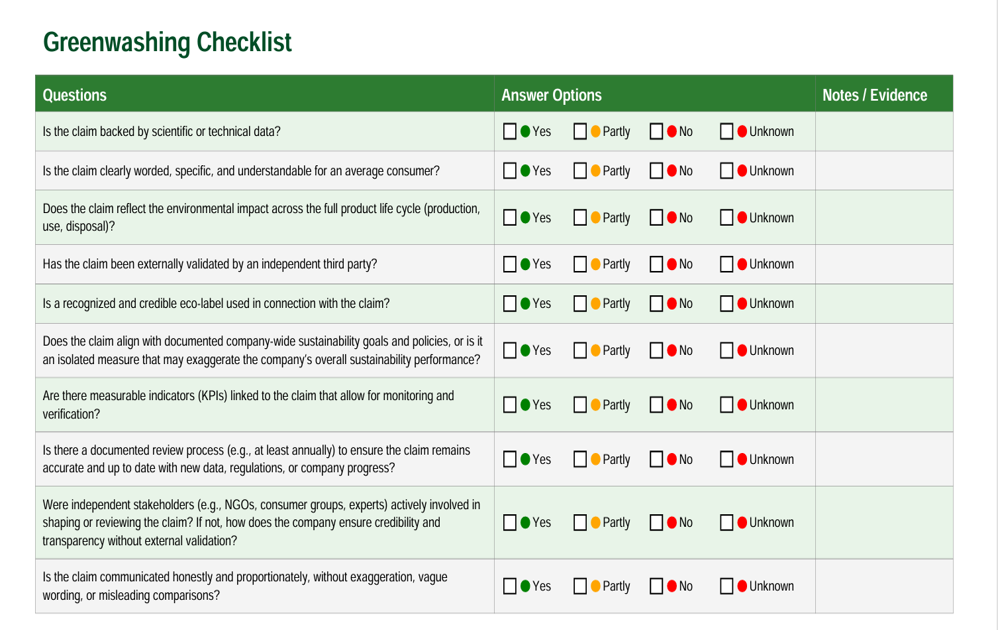
Figure 1: Greenwashing checklist (own illustration)
5.3 Explanation of the questions
The checklist consists of ten questions that together form a comprehensive framework to evaluate the credibility of environmental claims. Each question addresses a specific dimension of greenwashing risk and is designed so that a “Yes” response indicates good practice, whereas “Partly”, “No”, or “Unknown” responses point to weaknesses or potentially misleading communication.
Substantiation of claims: The first question asks whether the environmental claim is backed by scientific or technical data. This criterion is fundamental, as unsubstantiated claims are at the core of greenwashing practices. Companies must provide verifiable evidence to ensure credibility.17Delmas, M. A. & Burbano, V. C. The Drivers of Greenwashing. California Management Review 54, 64–87 (2011).
Clarity and specificity: The second question highlights the importance of clear, specific, and consumer-friendly wording. Vague expressions such as “eco-friendly” or “green” without explanation can easily mislead consumers.11European Commission, D.-G. for E. Proposal for a Directive on Substantiation and Communication of Explicit Environmental Claims (Green Claims Directive). https://eur-lex.europa.eu/legal-content/EN/TXT/?uri=COM%3A2023%3A0166%3AFIN (2023).
Life cycle perspective: The third question emphasizes whether the claim reflects the entire product life cycle, including production, use, and disposal. Many cases of greenwashing focus on a single positive aspect while ignoring other stages with significant environmental impact.18Testa, F., Boiral, O. & Iraldo, F. Internalization of Environmental Practices and Institutional Complexity: Can Stakeholders Pressures Encourage Greenwashing? J Bus Ethics 147, 287–307 (2018).
Independent verification: The fourth question addresses the need for third-party validation. Independent verification reduces the risk of bias and enhances consumer trust.17Delmas, M. A. & Burbano, V. C. The Drivers of Greenwashing. California Management Review 54, 64–87 (2011).
Use of eco-labels: The fifth question asks whether a credible and recognized eco-label is used. While eco-labels can enhance credibility, the checklist also recognizes that not all products can or should carry a label, making this criterion supportive rather than mandatory.19International Organization for Standardization (ISO). ISO 14024:2018 — Environmental labels and declarations — Type I environmental labelling — Principles and procedures. (2018).
Strategic alignment: The sixth question examines whether the claim is consistent with the company’s broader sustainability goals and policies. Isolated actions that do not align with overall corporate behavior may signal greenwashing by distraction.17Delmas, M. A. & Burbano, V. C. The Drivers of Greenwashing. California Management Review 54, 64–87 (2011).
Measurable indicators: The seventh question ensures that claims are linked to measurable key performance indicators (KPIs). This transforms vague commitments into actionable and monitorable objectives.20Kolk, A. Sustainability, accountability and corporate governance: exploring multinationals’ reporting practices. Bus Strat Env 17, 1–15 (2008).
Regular review process: The eighth question requires that claims are updated regularly. Without periodic review, companies risk communicating outdated or misleading information, even even if they do so unintentionally.11European Commission, D.-G. for E. Proposal for a Directive on Substantiation and Communication of Explicit Environmental Claims (Green Claims Directive). https://eur-lex.europa.eu/legal-content/EN/TXT/?uri=COM%3A2023%3A0166%3AFIN (2023).
Stakeholder involvement: The ninth question evaluates whether external stakeholders such as NGOs, consumer groups, or experts were engaged in shaping or reviewing the claim. Stakeholder involvement enhances transparency and credibility even though it is not always required.21Darnall, N., Henriques, I. & Sadorsky, P. Adopting Proactive Environmental Strategy: The Influence of Stakeholders and Firm Size. J Management Studies 47, 1072–1094 (2010).
Although stakeholder involvement (Q9) also introduces an external perspective, it differs substantially from independent verification (Q4). While Q4 focuses on a formal, objective audit conducted by accredited third parties to validate factual accuracy, Q9 emphasizes a participatory process in which NGOs, consumer groups, or experts are invited to review or comment on a company’s claim. In other words, independent verification ensures that the underlying data are correct, whereas stakeholder involvement builds trust and legitimacy by including diverse viewpoints. Both dimensions are complementary: one safeguards scientific accuracy; the other enhances transparency and credibility.
Marketing integrity: Finally, the tenth question addresses whether claims are communicated proportionately and without exaggeration. Honest and balanced communication is a cornerstone of trustworthy sustainability marketing.22OECD. OECD Guidelines for Multinational Enterprises, 2011 Edition. (OECD, 2011). doi:10.1787/9789264115415-en.
When considered as a whole, these ten questions guarantee that environmental claims are not only accurate but also communicated in a transparent and responsible manner. The transformation of abstract sustainability principles into practical evaluation steps that companies can apply systematically is a key tenet of the approach.
5.4 Advantages of the new template
Compared to existing tools for evaluating environmental claims, the checklist offers several advantages. One strength is its simplicity and clarity. Many existing frameworks are highly technical or tailored to specific industries, which can make them difficult to use, particularly for smaller organizations. In contrast, this checklist uses straightforward language and can be applied across sectors without requiring specialist knowledge.18Testa, F., Boiral, O. & Iraldo, F. Internalization of Environmental Practices and Institutional Complexity: Can Stakeholders Pressures Encourage Greenwashing? J Bus Ethics 147, 287–307 (2018).
Another advantage is the use of a visual traffic-light system alongside tick boxes, which makes the assessment process practical and engaging. This design enables users to swiftly identify strengths (green), partial compliance (orange), and risks (red). The visual element increases usability and motivates companies to actively engage with the tool rather than viewing it as a purely bureaucratic task.
The template strikes a balance between academic rigor and practical usability. The questions are based on academic literature and EU initiatives, such as the Green Claims Directive, and were further refined based on feedback from the course. This ensures that the framework is theoretically robust and applicable in practice. The inclusion of a ‘Notes/Evidence’ column increases accountability further, as organizations are encouraged to provide supporting documentation for their claims.11European Commission, D.-G. for E. Proposal for a Directive on Substantiation and Communication of Explicit Environmental Claims (Green Claims Directive). https://eur-lex.europa.eu/legal-content/EN/TXT/?uri=COM%3A2023%3A0166%3AFIN (2023).
Finally, the checklist is designed as a self-assessment tool to complement, rather than replace, external certifications or audits. It helps organizations identify weaknesses at an early stage, thereby reducing the risk of reputational damage and preparing them for future regulatory scrutiny. In this way, the checklist promotes more transparent sustainability communication and builds greater trust with stakeholders.
5.5 Limitations and outlook
Although the checklist is a useful tool for evaluating environmental claims, it does have some limitations. It is primarily intended for self-assessment. This means that it cannot replace independent audits or certifications, both of which remain essential for ensuring credibility.23Marquis, C., Toffel, M. W. & Zhou, Y. Scrutiny, Norms, and Selective Disclosure: A Global Study of Greenwashing. Organization Science 27, 483–504 (2016).
Another limitation is that the checklist treats all questions as equally important. In practice, however, some issues are more critical than others. For instance, providing scientific evidence or third-party verification is generally more important than using an eco-label or engaging stakeholders. As scholars have pointed out, treating all sustainability practices as equal can hide important differences in their real impact. A possible future step could be to create a scoring system that weighs the questions differently. However, developing such a system would require further research and testing, which is beyond the scope of this version.24Lyon, T. P. & Montgomery, A. W. The Means and End of Greenwash. Organization & Environment 28, 223–249 (2015).
Finally, the checklist provides a general framework. While this makes it flexible and easy to use, it does not fully address the specific challenges faced by different industries. For instance, the textile sector deals with issues such as supply chains, whereas the energy sector is more concerned with efficiency and emissions. In the future, the checklist could be adapted for specific industries or developed into a digital tool offering automatic scoring and regular updates.22OECD. OECD Guidelines for Multinational Enterprises, 2011 Edition. (OECD, 2011). doi:10.1787/9789264115415-en.
References
- 1Kraft, M. H. G., Ivancic, R. & Nertinger, S. Grundlagen des Greenwashings. in Greenwashing 7–13 (Springer Fachmedien Wiesbaden, Wiesbaden, 2024). doi:10.1007/978-3-658-44744-1\_2. ↩︎
- 2Nemes, N. et al. An Integrated Framework to Assess Greenwashing. Sustainability 14, 4431 (2022). ↩︎
- 3Nemes, N. et al. Integrated Framework of Greenwashing. ↩︎
- 3Nemes, N. et al. Integrated Framework of Greenwashing. ↩︎
- 3Nemes, N. et al. Integrated Framework of Greenwashing. ↩︎
- 3Nemes, N. et al. Integrated Framework of Greenwashing. ↩︎
- 3Nemes, N. et al. Integrated Framework of Greenwashing. ↩︎
- 4Jong, W. & Van Der Linde, V. Clean diesel and dirty scandal: The echo of Volkswagen’s dieselgate in an intra-industry setting. Public Relations Review 48, 102146 (2022). ↩︎
- 5Siano, A., Vollero, A., Conte, F. & Amabile, S. “More than words”: Expanding the taxonomy of greenwashing after the Volkswagen scandal. Journal of Business Research 71, 27–37 (2017). ↩︎
- 5Siano, A., Vollero, A., Conte, F. & Amabile, S. “More than words”: Expanding the taxonomy of greenwashing after the Volkswagen scandal. Journal of Business Research 71, 27–37 (2017). ↩︎
- 6Lehmacher, W. & Bödecker, J. Vorsicht Falle: Greenwashing-Vorwürfe und deren Vorbeugung. in Circular Economy 87–100 (Springer Fachmedien Wiesbaden, Wiesbaden, 2023). doi:10.1007/978-3-658-41311-8\_5. ↩︎
- 7Directive of the European Parliament and of the Council on Substantiation and Communication of Explicit Environmental Claims. (2023). ↩︎
- 8Klein, F. Die Green-Claims-Richtlinie am Scheidepunkt. Legal Tribune Online (2025). ↩︎
- 7Directive of the European Parliament and of the Council on Substantiation and Communication of Explicit Environmental Claims. (2023). ↩︎
- 8Klein, F. Die Green-Claims-Richtlinie am Scheidepunkt. Legal Tribune Online (2025). ↩︎
- 8Klein, F. Die Green-Claims-Richtlinie am Scheidepunkt. Legal Tribune Online (2025). ↩︎
- 9De Freitas Netto, S. V., Sobral, M. F. F., Ribeiro, A. R. B. & Soares, G. R. D. L. Concepts and forms of greenwashing: a systematic review. Environ Sci Eur 32, 19 (2020). ↩︎
- 10Australian Competition and Consumer Commission. ACCC Publishes Draft Guidance to Improve Businesses’ Environmental Claims. https://www.accc.gov.au/media-release/accc-publishes-draft-guidance-to-improve-businesses-environmental-claims (2023). ↩︎
- 11European Commission, D.-G. for E. Proposal for a Directive on Substantiation and Communication of Explicit Environmental Claims (Green Claims Directive). https://eur-lex.europa.eu/legal-content/EN/TXT/?uri=COM%3A2023%3A0166%3AFIN (2023). ↩︎
- 12UL Environment / TerraChoice. The Sins of Greenwashing: Home and Family Edition. https://www.twosides.info/wp-content/uploads/2018/05/Terrachoice\_The\_Sins\_of\_Greenwashing\_-\_Home\_and\_Family\_Edition\_2010.pdf (2010). ↩︎
- 13Umweltbundesamt (UBA). Recognising Greenwashing – Creating Transparency. https://www.umweltbundesamt.de/en/press/pressinformation/recognising-greenwashing-creating-transparency (2025). ↩︎
- 9De Freitas Netto, S. V., Sobral, M. F. F., Ribeiro, A. R. B. & Soares, G. R. D. L. Concepts and forms of greenwashing: a systematic review. Environ Sci Eur 32, 19 (2020). ↩︎
- 14Compliance & Risks. ESG Compliance Checklist. https://www.complianceandrisks.com/app/uploads/2023/10/ESG-Compliance-Checklist-2.pdf (2023). ↩︎
- 15Dorfleitner, G. & Utz, S. Green, green, it’s green they say: a conceptual framework for measuring greenwashing on firm level. Rev Manag Sci 18, 3463–3486 (2024). ↩︎
- 9De Freitas Netto, S. V., Sobral, M. F. F., Ribeiro, A. R. B. & Soares, G. R. D. L. Concepts and forms of greenwashing: a systematic review. Environ Sci Eur 32, 19 (2020). ↩︎
- 16Spaniol, M. J., Danilova-Jensen, E., Nielsen, M., Rosdahl, C. G. & Schmidt, C. J. Defining Greenwashing: A Concept Analysis. Sustainability 16, 9055 (2024). ↩︎
- 15Dorfleitner, G. & Utz, S. Green, green, it’s green they say: a conceptual framework for measuring greenwashing on firm level. Rev Manag Sci 18, 3463–3486 (2024). ↩︎
- 2Nemes, N. et al. An Integrated Framework to Assess Greenwashing. Sustainability 14, 4431 (2022). ↩︎
- 2Nemes, N. et al. An Integrated Framework to Assess Greenwashing. Sustainability 14, 4431 (2022). ↩︎
- 9De Freitas Netto, S. V., Sobral, M. F. F., Ribeiro, A. R. B. & Soares, G. R. D. L. Concepts and forms of greenwashing: a systematic review. Environ Sci Eur 32, 19 (2020). ↩︎
- 15Dorfleitner, G. & Utz, S. Green, green, it’s green they say: a conceptual framework for measuring greenwashing on firm level. Rev Manag Sci 18, 3463–3486 (2024). ↩︎
- 16Spaniol, M. J., Danilova-Jensen, E., Nielsen, M., Rosdahl, C. G. & Schmidt, C. J. Defining Greenwashing: A Concept Analysis. Sustainability 16, 9055 (2024). ↩︎
- 15Dorfleitner, G. & Utz, S. Green, green, it’s green they say: a conceptual framework for measuring greenwashing on firm level. Rev Manag Sci 18, 3463–3486 (2024). ↩︎
- 2Nemes, N. et al. An Integrated Framework to Assess Greenwashing. Sustainability 14, 4431 (2022). ↩︎
- 9De Freitas Netto, S. V., Sobral, M. F. F., Ribeiro, A. R. B. & Soares, G. R. D. L. Concepts and forms of greenwashing: a systematic review. Environ Sci Eur 32, 19 (2020). ↩︎
- 2Nemes, N. et al. An Integrated Framework to Assess Greenwashing. Sustainability 14, 4431 (2022). ↩︎
- 16Spaniol, M. J., Danilova-Jensen, E., Nielsen, M., Rosdahl, C. G. & Schmidt, C. J. Defining Greenwashing: A Concept Analysis. Sustainability 16, 9055 (2024). ↩︎
- 2Nemes, N. et al. An Integrated Framework to Assess Greenwashing. Sustainability 14, 4431 (2022). ↩︎
- 9De Freitas Netto, S. V., Sobral, M. F. F., Ribeiro, A. R. B. & Soares, G. R. D. L. Concepts and forms of greenwashing: a systematic review. Environ Sci Eur 32, 19 (2020). ↩︎
- 15Dorfleitner, G. & Utz, S. Green, green, it’s green they say: a conceptual framework for measuring greenwashing on firm level. Rev Manag Sci 18, 3463–3486 (2024). ↩︎
- 17Delmas, M. A. & Burbano, V. C. The Drivers of Greenwashing. California Management Review 54, 64–87 (2011). ↩︎
- 11European Commission, D.-G. for E. Proposal for a Directive on Substantiation and Communication of Explicit Environmental Claims (Green Claims Directive). https://eur-lex.europa.eu/legal-content/EN/TXT/?uri=COM%3A2023%3A0166%3AFIN (2023). ↩︎
- 18Testa, F., Boiral, O. & Iraldo, F. Internalization of Environmental Practices and Institutional Complexity: Can Stakeholders Pressures Encourage Greenwashing? J Bus Ethics 147, 287–307 (2018). ↩︎
- 17Delmas, M. A. & Burbano, V. C. The Drivers of Greenwashing. California Management Review 54, 64–87 (2011). ↩︎
- 11European Commission, D.-G. for E. Proposal for a Directive on Substantiation and Communication of Explicit Environmental Claims (Green Claims Directive). https://eur-lex.europa.eu/legal-content/EN/TXT/?uri=COM%3A2023%3A0166%3AFIN (2023). ↩︎
- 18Testa, F., Boiral, O. & Iraldo, F. Internalization of Environmental Practices and Institutional Complexity: Can Stakeholders Pressures Encourage Greenwashing? J Bus Ethics 147, 287–307 (2018). ↩︎
- 17Delmas, M. A. & Burbano, V. C. The Drivers of Greenwashing. California Management Review 54, 64–87 (2011). ↩︎
- 19International Organization for Standardization (ISO). ISO 14024:2018 — Environmental labels and declarations — Type I environmental labelling — Principles and procedures. (2018). ↩︎
- 17Delmas, M. A. & Burbano, V. C. The Drivers of Greenwashing. California Management Review 54, 64–87 (2011). ↩︎
- 20Kolk, A. Sustainability, accountability and corporate governance: exploring multinationals’ reporting practices. Bus Strat Env 17, 1–15 (2008). ↩︎
- 11European Commission, D.-G. for E. Proposal for a Directive on Substantiation and Communication of Explicit Environmental Claims (Green Claims Directive). https://eur-lex.europa.eu/legal-content/EN/TXT/?uri=COM%3A2023%3A0166%3AFIN (2023). ↩︎
- 21Darnall, N., Henriques, I. & Sadorsky, P. Adopting Proactive Environmental Strategy: The Influence of Stakeholders and Firm Size. J Management Studies 47, 1072–1094 (2010). ↩︎
- 22OECD. OECD Guidelines for Multinational Enterprises, 2011 Edition. (OECD, 2011). doi:10.1787/9789264115415-en. ↩︎
- 18Testa, F., Boiral, O. & Iraldo, F. Internalization of Environmental Practices and Institutional Complexity: Can Stakeholders Pressures Encourage Greenwashing? J Bus Ethics 147, 287–307 (2018). ↩︎
- 11European Commission, D.-G. for E. Proposal for a Directive on Substantiation and Communication of Explicit Environmental Claims (Green Claims Directive). https://eur-lex.europa.eu/legal-content/EN/TXT/?uri=COM%3A2023%3A0166%3AFIN (2023). ↩︎
- 23Marquis, C., Toffel, M. W. & Zhou, Y. Scrutiny, Norms, and Selective Disclosure: A Global Study of Greenwashing. Organization Science 27, 483–504 (2016). ↩︎
- 24Lyon, T. P. & Montgomery, A. W. The Means and End of Greenwash. Organization & Environment 28, 223–249 (2015). ↩︎
- 22OECD. OECD Guidelines for Multinational Enterprises, 2011 Edition. (OECD, 2011). doi:10.1787/9789264115415-en. ↩︎
- 1Kraft, M. H. G., Ivancic, R. & Nertinger, S. Grundlagen des Greenwashings. in Greenwashing 7–13 (Springer Fachmedien Wiesbaden, Wiesbaden, 2024). doi:10.1007/978-3-658-44744-1\_2. ↩︎
- 2Nemes, N. et al. An Integrated Framework to Assess Greenwashing. Sustainability 14, 4431 (2022). ↩︎
- 3Nemes, N. et al. Integrated Framework of Greenwashing. ↩︎
- 3Nemes, N. et al. Integrated Framework of Greenwashing. ↩︎
- 3Nemes, N. et al. Integrated Framework of Greenwashing. ↩︎
- 3Nemes, N. et al. Integrated Framework of Greenwashing. ↩︎
- 3Nemes, N. et al. Integrated Framework of Greenwashing. ↩︎
- 4Jong, W. & Van Der Linde, V. Clean diesel and dirty scandal: The echo of Volkswagen’s dieselgate in an intra-industry setting. Public Relations Review 48, 102146 (2022). ↩︎
- 5Siano, A., Vollero, A., Conte, F. & Amabile, S. “More than words”: Expanding the taxonomy of greenwashing after the Volkswagen scandal. Journal of Business Research 71, 27–37 (2017). ↩︎
- 5Siano, A., Vollero, A., Conte, F. & Amabile, S. “More than words”: Expanding the taxonomy of greenwashing after the Volkswagen scandal. Journal of Business Research 71, 27–37 (2017). ↩︎
- 6Lehmacher, W. & Bödecker, J. Vorsicht Falle: Greenwashing-Vorwürfe und deren Vorbeugung. in Circular Economy 87–100 (Springer Fachmedien Wiesbaden, Wiesbaden, 2023). doi:10.1007/978-3-658-41311-8\_5. ↩︎
- 7Directive of the European Parliament and of the Council on Substantiation and Communication of Explicit Environmental Claims. (2023). ↩︎
- 8Klein, F. Die Green-Claims-Richtlinie am Scheidepunkt. Legal Tribune Online (2025). ↩︎
- 7Directive of the European Parliament and of the Council on Substantiation and Communication of Explicit Environmental Claims. (2023). ↩︎
- 8Klein, F. Die Green-Claims-Richtlinie am Scheidepunkt. Legal Tribune Online (2025). ↩︎
- 8Klein, F. Die Green-Claims-Richtlinie am Scheidepunkt. Legal Tribune Online (2025). ↩︎
- 9De Freitas Netto, S. V., Sobral, M. F. F., Ribeiro, A. R. B. & Soares, G. R. D. L. Concepts and forms of greenwashing: a systematic review. Environ Sci Eur 32, 19 (2020). ↩︎
- 10Australian Competition and Consumer Commission. ACCC Publishes Draft Guidance to Improve Businesses’ Environmental Claims. https://www.accc.gov.au/media-release/accc-publishes-draft-guidance-to-improve-businesses-environmental-claims (2023). ↩︎
- 11European Commission, D.-G. for E. Proposal for a Directive on Substantiation and Communication of Explicit Environmental Claims (Green Claims Directive). https://eur-lex.europa.eu/legal-content/EN/TXT/?uri=COM%3A2023%3A0166%3AFIN (2023). ↩︎
- 12UL Environment / TerraChoice. The Sins of Greenwashing: Home and Family Edition. https://www.twosides.info/wp-content/uploads/2018/05/Terrachoice\_The\_Sins\_of\_Greenwashing\_-\_Home\_and\_Family\_Edition\_2010.pdf (2010). ↩︎
- 13Umweltbundesamt (UBA). Recognising Greenwashing – Creating Transparency. https://www.umweltbundesamt.de/en/press/pressinformation/recognising-greenwashing-creating-transparency (2025). ↩︎
- 9De Freitas Netto, S. V., Sobral, M. F. F., Ribeiro, A. R. B. & Soares, G. R. D. L. Concepts and forms of greenwashing: a systematic review. Environ Sci Eur 32, 19 (2020). ↩︎
- 14Compliance & Risks. ESG Compliance Checklist. https://www.complianceandrisks.com/app/uploads/2023/10/ESG-Compliance-Checklist-2.pdf (2023). ↩︎
- 15Dorfleitner, G. & Utz, S. Green, green, it’s green they say: a conceptual framework for measuring greenwashing on firm level. Rev Manag Sci 18, 3463–3486 (2024). ↩︎
- 9De Freitas Netto, S. V., Sobral, M. F. F., Ribeiro, A. R. B. & Soares, G. R. D. L. Concepts and forms of greenwashing: a systematic review. Environ Sci Eur 32, 19 (2020). ↩︎
- 16Spaniol, M. J., Danilova-Jensen, E., Nielsen, M., Rosdahl, C. G. & Schmidt, C. J. Defining Greenwashing: A Concept Analysis. Sustainability 16, 9055 (2024). ↩︎
- 15Dorfleitner, G. & Utz, S. Green, green, it’s green they say: a conceptual framework for measuring greenwashing on firm level. Rev Manag Sci 18, 3463–3486 (2024). ↩︎
- 2Nemes, N. et al. An Integrated Framework to Assess Greenwashing. Sustainability 14, 4431 (2022). ↩︎
- 2Nemes, N. et al. An Integrated Framework to Assess Greenwashing. Sustainability 14, 4431 (2022). ↩︎
- 9De Freitas Netto, S. V., Sobral, M. F. F., Ribeiro, A. R. B. & Soares, G. R. D. L. Concepts and forms of greenwashing: a systematic review. Environ Sci Eur 32, 19 (2020). ↩︎
- 15Dorfleitner, G. & Utz, S. Green, green, it’s green they say: a conceptual framework for measuring greenwashing on firm level. Rev Manag Sci 18, 3463–3486 (2024). ↩︎
- 16Spaniol, M. J., Danilova-Jensen, E., Nielsen, M., Rosdahl, C. G. & Schmidt, C. J. Defining Greenwashing: A Concept Analysis. Sustainability 16, 9055 (2024). ↩︎
- 15Dorfleitner, G. & Utz, S. Green, green, it’s green they say: a conceptual framework for measuring greenwashing on firm level. Rev Manag Sci 18, 3463–3486 (2024). ↩︎
- 2Nemes, N. et al. An Integrated Framework to Assess Greenwashing. Sustainability 14, 4431 (2022). ↩︎
- 9De Freitas Netto, S. V., Sobral, M. F. F., Ribeiro, A. R. B. & Soares, G. R. D. L. Concepts and forms of greenwashing: a systematic review. Environ Sci Eur 32, 19 (2020). ↩︎
- 2Nemes, N. et al. An Integrated Framework to Assess Greenwashing. Sustainability 14, 4431 (2022). ↩︎
- 16Spaniol, M. J., Danilova-Jensen, E., Nielsen, M., Rosdahl, C. G. & Schmidt, C. J. Defining Greenwashing: A Concept Analysis. Sustainability 16, 9055 (2024). ↩︎
- 2Nemes, N. et al. An Integrated Framework to Assess Greenwashing. Sustainability 14, 4431 (2022). ↩︎
- 9De Freitas Netto, S. V., Sobral, M. F. F., Ribeiro, A. R. B. & Soares, G. R. D. L. Concepts and forms of greenwashing: a systematic review. Environ Sci Eur 32, 19 (2020). ↩︎
- 15Dorfleitner, G. & Utz, S. Green, green, it’s green they say: a conceptual framework for measuring greenwashing on firm level. Rev Manag Sci 18, 3463–3486 (2024). ↩︎
- 17Delmas, M. A. & Burbano, V. C. The Drivers of Greenwashing. California Management Review 54, 64–87 (2011). ↩︎
- 11European Commission, D.-G. for E. Proposal for a Directive on Substantiation and Communication of Explicit Environmental Claims (Green Claims Directive). https://eur-lex.europa.eu/legal-content/EN/TXT/?uri=COM%3A2023%3A0166%3AFIN (2023). ↩︎
- 18Testa, F., Boiral, O. & Iraldo, F. Internalization of Environmental Practices and Institutional Complexity: Can Stakeholders Pressures Encourage Greenwashing? J Bus Ethics 147, 287–307 (2018). ↩︎
- 17Delmas, M. A. & Burbano, V. C. The Drivers of Greenwashing. California Management Review 54, 64–87 (2011). ↩︎
- 11European Commission, D.-G. for E. Proposal for a Directive on Substantiation and Communication of Explicit Environmental Claims (Green Claims Directive). https://eur-lex.europa.eu/legal-content/EN/TXT/?uri=COM%3A2023%3A0166%3AFIN (2023). ↩︎
- 18Testa, F., Boiral, O. & Iraldo, F. Internalization of Environmental Practices and Institutional Complexity: Can Stakeholders Pressures Encourage Greenwashing? J Bus Ethics 147, 287–307 (2018). ↩︎
- 17Delmas, M. A. & Burbano, V. C. The Drivers of Greenwashing. California Management Review 54, 64–87 (2011). ↩︎
- 19International Organization for Standardization (ISO). ISO 14024:2018 — Environmental labels and declarations — Type I environmental labelling — Principles and procedures. (2018). ↩︎
- 17Delmas, M. A. & Burbano, V. C. The Drivers of Greenwashing. California Management Review 54, 64–87 (2011). ↩︎
- 20Kolk, A. Sustainability, accountability and corporate governance: exploring multinationals’ reporting practices. Bus Strat Env 17, 1–15 (2008). ↩︎
- 11European Commission, D.-G. for E. Proposal for a Directive on Substantiation and Communication of Explicit Environmental Claims (Green Claims Directive). https://eur-lex.europa.eu/legal-content/EN/TXT/?uri=COM%3A2023%3A0166%3AFIN (2023). ↩︎
- 21Darnall, N., Henriques, I. & Sadorsky, P. Adopting Proactive Environmental Strategy: The Influence of Stakeholders and Firm Size. J Management Studies 47, 1072–1094 (2010). ↩︎
- 22OECD. OECD Guidelines for Multinational Enterprises, 2011 Edition. (OECD, 2011). doi:10.1787/9789264115415-en. ↩︎
- 18Testa, F., Boiral, O. & Iraldo, F. Internalization of Environmental Practices and Institutional Complexity: Can Stakeholders Pressures Encourage Greenwashing? J Bus Ethics 147, 287–307 (2018). ↩︎
- 11European Commission, D.-G. for E. Proposal for a Directive on Substantiation and Communication of Explicit Environmental Claims (Green Claims Directive). https://eur-lex.europa.eu/legal-content/EN/TXT/?uri=COM%3A2023%3A0166%3AFIN (2023). ↩︎
- 23Marquis, C., Toffel, M. W. & Zhou, Y. Scrutiny, Norms, and Selective Disclosure: A Global Study of Greenwashing. Organization Science 27, 483–504 (2016). ↩︎
- 24Lyon, T. P. & Montgomery, A. W. The Means and End of Greenwash. Organization & Environment 28, 223–249 (2015). ↩︎
- 22OECD. OECD Guidelines for Multinational Enterprises, 2011 Edition. (OECD, 2011). doi:10.1787/9789264115415-en. ↩︎